EP1908016B1 - Event detection method and video surveillance system using said method - Google Patents
Event detection method and video surveillance system using said method Download PDFInfo
- Publication number
- EP1908016B1 EP1908016B1 EP07789499A EP07789499A EP1908016B1 EP 1908016 B1 EP1908016 B1 EP 1908016B1 EP 07789499 A EP07789499 A EP 07789499A EP 07789499 A EP07789499 A EP 07789499A EP 1908016 B1 EP1908016 B1 EP 1908016B1
- Authority
- EP
- European Patent Office
- Prior art keywords
- images
- image
- matrix
- learning
- phase
- Prior art date
- Legal status (The legal status is an assumption and is not a legal conclusion. Google has not performed a legal analysis and makes no representation as to the accuracy of the status listed.)
- Not-in-force
Links
Images



Classifications
-
- G—PHYSICS
- G06—COMPUTING OR CALCULATING; COUNTING
- G06T—IMAGE DATA PROCESSING OR GENERATION, IN GENERAL
- G06T7/00—Image analysis
- G06T7/20—Analysis of motion
- G06T7/254—Analysis of motion involving subtraction of images
-
- G—PHYSICS
- G06—COMPUTING OR CALCULATING; COUNTING
- G06V—IMAGE OR VIDEO RECOGNITION OR UNDERSTANDING
- G06V20/00—Scenes; Scene-specific elements
- G06V20/50—Context or environment of the image
- G06V20/52—Surveillance or monitoring of activities, e.g. for recognising suspicious objects
Definitions
- the present invention relates to an event detection method according to the preamble of claim 1 and to a video surveillance system using said method.
- video surveillance system refers to a surveillance system using at least one image acquisition unit and being capable of acquiring sequences of images of a supervised area.
- known video surveillance systems include event detection systems which can generate alarms when an anomalous event takes place.
- Some known systems only detect variations (beyond a certain user-defined threshold) in the brightness of the pixels of two successive images, such as two frames of a video signal or two images taken by a camera at different times.
- video surveillance systems which comprise a learning phase wherein the system builds a model of the supervised area in a normal situation, i.e. a situation wherein no alarm should be triggered.
- the pixels of the taken image are compared with the pixels of the model. If the difference in the pixels is beyond a certain operator-defined threshold, an alarm will be triggered.
- this solution has the drawback that it requires much available memory for storing the models of the scene and of the authorized objects, as well as high computing power for analyzing the whole image in real time by comparing the detected objects with the authorized ones.
- EP1542154 discloses that event detection can be made by comparing a image with a model of facial and non facial features and that in the training phase, an analysis process is applied to a set of images known to contain faces, and (optionally) another set of images (“nonface images”) known not to contain faces.
- the main object of the present invention is to overcome the drawbacks of the prior art, and in particular to provide a video surveillance system and an event detection method which allow for a more effective detection of events while reducing the number of false alarms and preferably while not requiring high capacity in terms of available memory and computing power.
- the present invention also aims at providing a video surveillance system and an event detection method capable of optimizing memory usage and of varying the computing complexity depending on the dynamics being present in the supervised area during the learning phase.
- the present invention is based on the idea of leaving the traditional approach according to which every single pixel of a current image is compared with a respective pixel of a reference image or with a pixel model.
- the invention aims at taking into consideration regions of the image, i.e. groups of pixels, in order to take also into account the correlation among the pixels when detecting an event, thus reducing the number of false alarms.
- the video surveillance system acquires images of a supervised area and compares single regions thereof with respective "models" representing a normal situation, which are built in the form of a space of images acquired during a learning phase, said images relating to a normal situation of the watched scene.
- the image or region is treated like an image vector, the difference of which from a normal situation is measured as a projection error of the image vector on a space of images representing the "model" of the supervised area in a normal situation.
- the "model” is built by starting from a set of images acquired during a learning phase by shooting the area in a normal situation.
- the learning phase may include a model validation phase substantially consisting in a simulation of an operating detection phase.
- the validation phase uses images of the scene in a normal situation acquired during the learning phase, and checks whether the model just built is good or not.
- PCA principal components analysis
- the method also provides for a suitable reduction of the informative content of the acquired images, thus ignoring minor phenomena occurring in a scene and reducing the number of false alarms.
- Fig. 1 shows a video surveillance system 1. Through a monitor 3, an operator 2 watches the images 6 acquired by an image acquisition unit 5.
- the image acquisition unit is a video camera capable of providing an output video, i.e. a continuous sequence of images, but it is understood that, for the purposes of the invention, it may be replaced with any other equivalent means, e.g. a programmed digital camera acquiring images at regular time intervals.
- An image may thus correspond to a frame or a half-frame of a video signal acquired by the video camera, to a static image acquired by a digital camera, to the output of a CCD sensor, or more in general to a portion of the above.
- a digital or analog image can be disassembled into pixels, i.e. fundamental elements of the image.
- One or several matrixes may therefore be associated with each image, the elements of which are the voltage values of the analog video signal or the brightness or colour values of the pixels.
- the acquired image will correspond to a tridimensional matrix wherein each matrix element (i.e. each pixel) corresponds to a triplet of values corresponding to the values of the RGB signals.
- each matrix element is associated with a value corresponding to the grey value of the corresponding pixel.
- the video camera 5 shoots an area, in this specific case a corridor, and transmits a video signal which can be displayed on the monitor 3.
- the surveillance system 1 includes an image processing unit 4 capable of detecting events starting from the images acquired by the video camera 5.
- the image processing unit 4 is represented by an electronic computer connected to the video camera 5 and to the monitor 3 in order to receive and process the video signal sent by the video camera and to display images on the monitor.
- the image processing unit 4 is a video server, i.e. a numerical computer receiving a video signal from the image acquisition unit, processing it according to the method of the present invention, and transferring a video signal to one or several terminals connected thereto, said terminal being in particular an operator's workstation.
- a video server i.e. a numerical computer receiving a video signal from the image acquisition unit, processing it according to the method of the present invention, and transferring a video signal to one or several terminals connected thereto, said terminal being in particular an operator's workstation.
- the image processing unit 4 may be incorporated in the video camera 5 (which in such a case will comprise an image acquisition unit and an image processing unit), which will be connected to the monitor 3 either directly or through a video switch.
- the image processing unit 4 is provided with software containing code portions capable of implementing the event detection method described below. According to said method, a learning phase is executed at least once at installation time, wherein the system builds a "model" of the watched scene in a normal situation.
- the learning phase may advantageously be repeated several times under different environmental conditions (light, traffic, etc.). This allows to build one or several models.
- the operator 2 starts the software learning phase, wherein images of the supervised area are acquired which will be hereafter referred to as "learning images”.
- the acquired images correspond to the frames of the video signal generated by the video camera 5.
- moving objects are taken, such as leaves of trees or vehicles travelling down a street behind the scene, so that the acquired images may differ from one another.
- the model can represent the watched scene in a dynamic situation, without any events to be detected.
- the first step of the learning phase of the event detection method consists in the selection (202) of a set of N frames F 1 , ... ,F N starting from the video signal 201 acquired by the video camera.
- these frames are subjected to image processing operations such as a greyscale conversion (203) in order to reduce the size of the data to be treated, and possibly, additionally or alternatively, a low-pass filtering (204) with a Gaussian kernel in order to eliminate and smooth any high-frequency variations not to be detected, thus reducing the informative content of the images to be treated and focusing the detection on the interesting informative content of the image.
- the frames thus modified are then inserted into a learning buffer (205).
- the above image processing steps may be repeated cyclically on each acquired frame, as shown in Fig. 2b .
- the parameter n is set initially to 1 and an image is acquired (202b), which is then converted to greyscale (203b), filtered with a low-pass filter (204c) and stored in the buffer (205c). Subsequently, the value of n is incremented and these steps are repeated until N images are stored in the buffer.
- the content of the learning buffer is subdivided into two parts: a first group of frames, called “training frames”, on which a principal components analysis (PCA) is carried out, and a second group of frames, called “validation frames”, used for validating the results obtained from the PCA.
- training frames on which a principal components analysis (PCA) is carried out
- validation frames used for validating the results obtained from the PCA.
- the learning phase correspondingly comprises a training phase and a validation phase.
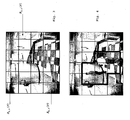
- the result as shown in Fig. 3 , is a plurality of portions of images obtained from each frame.
- the size of the grid depends on the typical dimensions of the target to be discovered in the watched scene.
- Said grid may then be set up by an installer at installation time depending on the shooting perspective and on the operator's needs, or else be predefined at the factory.
- This vector IR i,j (Fn) is substantially obtained by progressively entering the elements of the matrix R i,j (i.e. the values of the pixels of the region), which meet together when scrolling the columns from the top and from the left.
- the element IR i,j (Fn)(2) corresponds to the pixel located on the second row of the first column of the image R i,j .
- a corresponding normality matrix Y i,j (IR i,j (F 1 ),IR i,j (F 2 ),...,IR i,j (F S )) is created.
- the columns of the normality matrix generate a vectorial space of the images.
- the columns carry the information relating to one region of the watched scene at different instants and in a normal situation, whereas the autovectors of the respective co-variance matrix are the principal components thereof, i.e. the directions in which the variance of the columns of Y i,j , i.e. of the collected images, is greater.
- the matrix Y i , j r has the same dimensions as the matrix Y i,j , but it only carries the information relating to the first r principal components of the matrix Y i,j .
- the columns u 1 ... u r of the matrix U i , j r are the principal components of the matrix Y i,j .
- the validation phase is carried out, aiming at verifying that the learning set consisting of the training frames is sufficiently representative of the watched scene in a normal situation.
- the verification provides a simulation of an operating detection phase, wherein current images of the supervised area are replaced with at least one validation frame F VAL , i.e. a learning image not belonging to the learning set, and therefore not used for building the normality matrix Y i,j .
- the validation is carried out by using at least one validation frame F VAL which is subdivided into a plurality of regions R i,j (F VAL ) through the same grid already used for subdividing the training frames.
- the vector IR i,j (F VAL ) is projected on a space of the learning images in order to determine the "distance" between the validation image and the normal situation synthesized in the matrix Y i , j r .
- the watched scene will be signalled as anomalous (i.e. an event will be detected) if the projection error is greater than the respective threshold, i.e. if the following relationship is fulfilled: err_Proj IR i , j ⁇ Thr i , j
- the threshold can be set to k ⁇ r+1 with k>1 so as to take into account any background noise being present in the images.
- the validation frames F VAL should represent the scene in a normal situation, no event should be detected even in the worst conditions. Otherwise, the set of acquired training frames is not representative of the scene in a normal situation; according to the method, it will be necessary in this case to select a different learning set and to rebuild the matrix Y i , j r .
- the method provides for simulating the event detection on a plurality of validation frames.
- the set of training frames will be changed if a number of events is detected which is greater that a preset percentage, e.g. 25%, calculated on the total number of measurements. For example, if the validation phase verifies 100 validation frames and detects 25 events, then the method will require the learning set to be rebuilt.
- the normality matrix Y i,j will be regenerated by starting from a new learning set if the mean projection error err_Proj of a plurality of validation images is greater than or equal to the threshold Thr i,j .
- the number of frames to be added depends on the difference between the mean projection error err_Proj and the threshold.
- a predetermined number of frames may be added which is dependent on the memory available in the buffer.
- not all of the frames added to the learning set are consecutive.
- the maximum size of the learning set may be defined (at installation or production time) as a function of the available memory and computing power.
- the method provides for storing a plurality of pieces of information which are useful for detecting an event.
- the following information is stored:
- the video surveillance system can start the actual operating phase by acquiring current images of the supervised area in order to detect any events.
- a current image of the supervised area is acquired, in particular a frame F* of the video signal generated by the video camera.
- the frame F* is subdivided into a plurality of regions R i,j (F*) by means of the same grid previously used during the learning phase.
- Fig. 4 illustrates an example of event detection.
- the analysed frame F* shows a corridor, which is the same corridor as that shown in Figs. 1 and 3 , wherein two people are present whose silhouettes occupy a portion of the frame; in the example of Fig. 4 , said silhouettes occupy seven regions R i,j .
- Range(Y i,j r ) corresponds to comparing a current image R i,j (F*) with an image corresponding to a linear combination of a plurality of reference images approximating, or coinciding with, respective learning images.
- the space Range(Y i,j r ) is represented by the plane ⁇ in which the reference images y 1 r ⁇ y S r and all linear combinations C 1 ,C 2 ,C 3 ... of such reference images lay.
- Projecting a current image R i,j (F*) on the plane ⁇ means comparing said image with the linear combination C i of the reference images which is closer to the image R i,j (F*) in the sense of the L2 norm.
- this is an image-by-image comparison; this means that, in addition to the values of the pixels of the image, the correlation thereof is also taken into account through the principal components analysis.
- this comparison which according to the preferred and advantageous embodiment of the present invention is synthesized by the step of projecting the vector corresponding to the current image on the space of the images Range(Y i,j r ), may alternatively be obtained by comparing first the values of the single pixels and then the relationships among the pixels of a current image and of an image built during the learning phase and corresponding to a linear combination of images approximating, or coinciding with, images acquired in a normal situation.
- the proposed approach based on a comparison between portions of the current image (i.e. groups of pixels) and respective models built during the learning phase, turns out to be more reliable than known solutions based on a comparison of each pixel, in that it allows to take also into account the spatial correlation among the pixels.
- the model according to the invention consists of a set of vectorial spaces, each pertaining to one region of the image, obtained from a learning phase.
- the model according to the invention allows to represent normality in a much more accurate manner than the solutions known in the art, since it uses images rather than statistical parameters such as average and variance.
- PCA is an information compression method which allows to rebuild the original data (this not being possible with the statistic methods used by existing solutions), thus not endangering the quality with which normality is described and the resulting detection reliability.
- the proposed approach also offers a high degree of automation, unlike traditional approaches which require arbitrary choices when programming and setting up the system.
- the detection threshold is calculated automatically based on the learning data.
- the proposed approach selects the length of the learning buffer autonomously depending on the dynamics being present in the watched scene during the learning phase.
- the algorithm chooses a compromise solution between available memory and scene dynamics.
- the minimum number of principal components used for representing the vectorial space also changes as a function of the scene dynamics and is also calculated by the algorithm.
- the selection of the optimum number of components r i,j which allows to reduce the informative content of the matrix Y i,j , can be carried out in several different manners.
- the r i,j principal components may be chosen by picking up those associated with a singular value being greater than a percentage (preferably in the range of 1-4%, more preferably 2%) of the greatest singular value ( ⁇ 1 ) of the matrix Y i,j .
- err_Proj IR i , j ⁇ Proj IR i , j - IR i , j ⁇ Lp
Landscapes
- Engineering & Computer Science (AREA)
- Multimedia (AREA)
- Physics & Mathematics (AREA)
- General Physics & Mathematics (AREA)
- Theoretical Computer Science (AREA)
- Computer Vision & Pattern Recognition (AREA)
- Image Analysis (AREA)
- Burglar Alarm Systems (AREA)
- Closed-Circuit Television Systems (AREA)
- Alarm Systems (AREA)
- Image Processing (AREA)
Applications Claiming Priority (2)
| Application Number | Priority Date | Filing Date | Title |
|---|---|---|---|
| IT000556A ITTO20060556A1 (it) | 2006-07-27 | 2006-07-27 | Metodo di rilevazione eventi e sistema di video sorveglianza utilizzante il metodo |
| PCT/IB2007/002050 WO2008012631A1 (en) | 2006-07-27 | 2007-07-20 | Event detection method and video surveillance system using said method |
Publications (2)
| Publication Number | Publication Date |
|---|---|
| EP1908016A1 EP1908016A1 (en) | 2008-04-09 |
| EP1908016B1 true EP1908016B1 (en) | 2010-06-23 |
Family
ID=38670734
Family Applications (1)
| Application Number | Title | Priority Date | Filing Date |
|---|---|---|---|
| EP07789499A Not-in-force EP1908016B1 (en) | 2006-07-27 | 2007-07-20 | Event detection method and video surveillance system using said method |
Country Status (11)
| Country | Link |
|---|---|
| US (1) | US20090310855A1 (it) |
| EP (1) | EP1908016B1 (it) |
| JP (1) | JP2009545223A (it) |
| CN (1) | CN101501729A (it) |
| AT (1) | ATE472142T1 (it) |
| BR (1) | BRPI0714646A2 (it) |
| CA (1) | CA2658020A1 (it) |
| DE (1) | DE602007007267D1 (it) |
| IT (1) | ITTO20060556A1 (it) |
| RU (1) | RU2009106852A (it) |
| WO (1) | WO2008012631A1 (it) |
Families Citing this family (8)
| Publication number | Priority date | Publication date | Assignee | Title |
|---|---|---|---|---|
| US8947495B2 (en) * | 2011-12-06 | 2015-02-03 | Alcatel Lucent | Telepresence apparatus for immersion of a human image in a physical environment |
| KR102217186B1 (ko) * | 2014-04-11 | 2021-02-19 | 삼성전자주식회사 | 요약 컨텐츠 서비스를 위한 방송 수신 장치 및 방법 |
| GB201512283D0 (en) | 2015-07-14 | 2015-08-19 | Apical Ltd | Track behaviour events |
| CN106407657A (zh) * | 2016-08-31 | 2017-02-15 | 无锡雅座在线科技发展有限公司 | 事件捕获方法和装置 |
| US10303954B2 (en) * | 2017-02-22 | 2019-05-28 | Sas Institute Inc. | Monitoring, detection, and surveillance system using principal component analysis with machine and sensor data |
| EP3809366A1 (fr) * | 2019-10-15 | 2021-04-21 | Aisapack Holding SA | Procédé de fabrication |
| CN113111843B (zh) * | 2021-04-27 | 2023-12-29 | 北京赛博云睿智能科技有限公司 | 一种图像数据的远程采集方法及系统 |
| CN115767040B (zh) * | 2023-01-06 | 2023-04-25 | 松立控股集团股份有限公司 | 基于交互式持续学习的360度全景监控自动巡航方法 |
Family Cites Families (1)
| Publication number | Priority date | Publication date | Assignee | Title |
|---|---|---|---|---|
| GB2409029A (en) | 2003-12-11 | 2005-06-15 | Sony Uk Ltd | Face detection |
-
2006
- 2006-07-27 IT IT000556A patent/ITTO20060556A1/it unknown
-
2007
- 2007-07-20 CN CNA2007800301492A patent/CN101501729A/zh active Pending
- 2007-07-20 AT AT07789499T patent/ATE472142T1/de not_active IP Right Cessation
- 2007-07-20 DE DE602007007267T patent/DE602007007267D1/de active Active
- 2007-07-20 WO PCT/IB2007/002050 patent/WO2008012631A1/en not_active Ceased
- 2007-07-20 US US12/374,342 patent/US20090310855A1/en not_active Abandoned
- 2007-07-20 EP EP07789499A patent/EP1908016B1/en not_active Not-in-force
- 2007-07-20 RU RU2009106852/08A patent/RU2009106852A/ru not_active Application Discontinuation
- 2007-07-20 JP JP2009521364A patent/JP2009545223A/ja active Pending
- 2007-07-20 CA CA002658020A patent/CA2658020A1/en not_active Abandoned
- 2007-07-20 BR BRPI0714646-9A2A patent/BRPI0714646A2/pt not_active Application Discontinuation
Also Published As
| Publication number | Publication date |
|---|---|
| CN101501729A (zh) | 2009-08-05 |
| ITTO20060556A1 (it) | 2008-01-28 |
| BRPI0714646A2 (pt) | 2013-10-01 |
| EP1908016A1 (en) | 2008-04-09 |
| DE602007007267D1 (de) | 2010-08-05 |
| RU2009106852A (ru) | 2010-09-10 |
| WO2008012631A1 (en) | 2008-01-31 |
| CA2658020A1 (en) | 2008-01-31 |
| JP2009545223A (ja) | 2009-12-17 |
| US20090310855A1 (en) | 2009-12-17 |
| ATE472142T1 (de) | 2010-07-15 |
Similar Documents
| Publication | Publication Date | Title |
|---|---|---|
| CN111291718B (zh) | 行为预测方法及装置、步态识别方法及装置 | |
| CN114926781B (zh) | 支持实时监控场景的多人时空域异常行为定位方法及系统 | |
| Lin et al. | Estimation of number of people in crowded scenes using perspective transformation | |
| US20090310855A1 (en) | Event detection method and video surveillance system using said method | |
| JPH05501770A (ja) | 動的物体認識方法及びその画像処理システム | |
| US7574039B2 (en) | Video based fire detection system | |
| CN112487891A (zh) | 一种应用于电力作业现场的视觉智能动态识别模型构建方法 | |
| US8125522B2 (en) | Spurious motion filter | |
| CN118334747B (zh) | 一种结合多空间尺度特征的作业违章识别方法 | |
| CN119229260A (zh) | 基于彩票门店违规异常识别方法及系统 | |
| US8442278B2 (en) | Covariance based face association | |
| Raif et al. | Metamorphic testing for edge real-time face recognition and intrusion detection solution | |
| Foresti et al. | Event classification for automatic visual-based surveillance of parking lots | |
| CN109240123A (zh) | 一种面向智能物流车的在环仿真方法及系统 | |
| CN116129502B (zh) | 人脸伪造视频检测模型的训练方法、装置及计算设备 | |
| CN111402185B (zh) | 一种图像检测方法及装置 | |
| Gal | Automatic obstacle detection for USV’s navigation using vision sensors | |
| CN115830517B (zh) | 基于视频的考场异常帧提取方法及系统 | |
| CN117975405A (zh) | 基于深度学习的巡检轨迹监测方法及装置 | |
| HK1137560A (en) | Event detection method and video surveillance system using said method | |
| CN112634233A (zh) | 基于图像检测和分析技术在配电设备中的应用方法 | |
| CN118101899B (zh) | 一种安防监控存储信息智能分析管理方法及系统 | |
| CN120726576B (zh) | 一种智能安防的异常识别方法及装置 | |
| KR102870989B1 (ko) | 침입 검출 방법 및 장치 | |
| CN121838055A (zh) | 项目作业安全监测方法、装置、存储介质及计算机设备 |
Legal Events
| Date | Code | Title | Description |
|---|---|---|---|
| PUAI | Public reference made under article 153(3) epc to a published international application that has entered the european phase |
Free format text: ORIGINAL CODE: 0009012 |
|
| 17P | Request for examination filed |
Effective date: 20080201 |
|
| AK | Designated contracting states |
Kind code of ref document: A1 Designated state(s): AT BE BG CH CY CZ DE DK EE ES FI FR GB GR HU IE IS IT LI LT LU LV MC MT NL PL PT RO SE SI SK TR |
|
| AX | Request for extension of the european patent |
Extension state: AL BA HR MK RS |
|
| 17Q | First examination report despatched |
Effective date: 20080724 |
|
| DAX | Request for extension of the european patent (deleted) | ||
| GRAP | Despatch of communication of intention to grant a patent |
Free format text: ORIGINAL CODE: EPIDOSNIGR1 |
|
| GRAS | Grant fee paid |
Free format text: ORIGINAL CODE: EPIDOSNIGR3 |
|
| GRAA | (expected) grant |
Free format text: ORIGINAL CODE: 0009210 |
|
| AK | Designated contracting states |
Kind code of ref document: B1 Designated state(s): AT BE BG CH CY CZ DE DK EE ES FI FR GB GR HU IE IS IT LI LT LU LV MC MT NL PL PT RO SE SI SK TR |
|
| REG | Reference to a national code |
Ref country code: CH Ref legal event code: EP |
|
| REG | Reference to a national code |
Ref country code: IE Ref legal event code: FG4D |
|
| REF | Corresponds to: |
Ref document number: 602007007267 Country of ref document: DE Date of ref document: 20100805 Kind code of ref document: P |
|
| REG | Reference to a national code |
Ref country code: SE Ref legal event code: TRGR |
|
| REG | Reference to a national code |
Ref country code: NL Ref legal event code: VDEP Effective date: 20100623 |
|
| PG25 | Lapsed in a contracting state [announced via postgrant information from national office to epo] |
Ref country code: LT Free format text: LAPSE BECAUSE OF FAILURE TO SUBMIT A TRANSLATION OF THE DESCRIPTION OR TO PAY THE FEE WITHIN THE PRESCRIBED TIME-LIMIT Effective date: 20100623 |
|
| LTIE | Lt: invalidation of european patent or patent extension |
Effective date: 20100623 |
|
| PG25 | Lapsed in a contracting state [announced via postgrant information from national office to epo] |
Ref country code: SI Free format text: LAPSE BECAUSE OF FAILURE TO SUBMIT A TRANSLATION OF THE DESCRIPTION OR TO PAY THE FEE WITHIN THE PRESCRIBED TIME-LIMIT Effective date: 20100623 Ref country code: AT Free format text: LAPSE BECAUSE OF FAILURE TO SUBMIT A TRANSLATION OF THE DESCRIPTION OR TO PAY THE FEE WITHIN THE PRESCRIBED TIME-LIMIT Effective date: 20100623 Ref country code: FI Free format text: LAPSE BECAUSE OF FAILURE TO SUBMIT A TRANSLATION OF THE DESCRIPTION OR TO PAY THE FEE WITHIN THE PRESCRIBED TIME-LIMIT Effective date: 20100623 Ref country code: LV Free format text: LAPSE BECAUSE OF FAILURE TO SUBMIT A TRANSLATION OF THE DESCRIPTION OR TO PAY THE FEE WITHIN THE PRESCRIBED TIME-LIMIT Effective date: 20100623 |
|
| PG25 | Lapsed in a contracting state [announced via postgrant information from national office to epo] |
Ref country code: PL Free format text: LAPSE BECAUSE OF FAILURE TO SUBMIT A TRANSLATION OF THE DESCRIPTION OR TO PAY THE FEE WITHIN THE PRESCRIBED TIME-LIMIT Effective date: 20100623 |
|
| PG25 | Lapsed in a contracting state [announced via postgrant information from national office to epo] |
Ref country code: EE Free format text: LAPSE BECAUSE OF FAILURE TO SUBMIT A TRANSLATION OF THE DESCRIPTION OR TO PAY THE FEE WITHIN THE PRESCRIBED TIME-LIMIT Effective date: 20100623 Ref country code: NL Free format text: LAPSE BECAUSE OF FAILURE TO SUBMIT A TRANSLATION OF THE DESCRIPTION OR TO PAY THE FEE WITHIN THE PRESCRIBED TIME-LIMIT Effective date: 20100623 |
|
| PG25 | Lapsed in a contracting state [announced via postgrant information from national office to epo] |
Ref country code: MC Free format text: LAPSE BECAUSE OF NON-PAYMENT OF DUE FEES Effective date: 20100731 Ref country code: CZ Free format text: LAPSE BECAUSE OF FAILURE TO SUBMIT A TRANSLATION OF THE DESCRIPTION OR TO PAY THE FEE WITHIN THE PRESCRIBED TIME-LIMIT Effective date: 20100623 Ref country code: IS Free format text: LAPSE BECAUSE OF FAILURE TO SUBMIT A TRANSLATION OF THE DESCRIPTION OR TO PAY THE FEE WITHIN THE PRESCRIBED TIME-LIMIT Effective date: 20101023 Ref country code: BE Free format text: LAPSE BECAUSE OF FAILURE TO SUBMIT A TRANSLATION OF THE DESCRIPTION OR TO PAY THE FEE WITHIN THE PRESCRIBED TIME-LIMIT Effective date: 20100623 Ref country code: CY Free format text: LAPSE BECAUSE OF FAILURE TO SUBMIT A TRANSLATION OF THE DESCRIPTION OR TO PAY THE FEE WITHIN THE PRESCRIBED TIME-LIMIT Effective date: 20100623 Ref country code: PT Free format text: LAPSE BECAUSE OF FAILURE TO SUBMIT A TRANSLATION OF THE DESCRIPTION OR TO PAY THE FEE WITHIN THE PRESCRIBED TIME-LIMIT Effective date: 20101025 Ref country code: RO Free format text: LAPSE BECAUSE OF FAILURE TO SUBMIT A TRANSLATION OF THE DESCRIPTION OR TO PAY THE FEE WITHIN THE PRESCRIBED TIME-LIMIT Effective date: 20100623 Ref country code: SK Free format text: LAPSE BECAUSE OF FAILURE TO SUBMIT A TRANSLATION OF THE DESCRIPTION OR TO PAY THE FEE WITHIN THE PRESCRIBED TIME-LIMIT Effective date: 20100623 |
|
| PG25 | Lapsed in a contracting state [announced via postgrant information from national office to epo] |
Ref country code: DK Free format text: LAPSE BECAUSE OF FAILURE TO SUBMIT A TRANSLATION OF THE DESCRIPTION OR TO PAY THE FEE WITHIN THE PRESCRIBED TIME-LIMIT Effective date: 20100623 |
|
| PLBE | No opposition filed within time limit |
Free format text: ORIGINAL CODE: 0009261 |
|
| STAA | Information on the status of an ep patent application or granted ep patent |
Free format text: STATUS: NO OPPOSITION FILED WITHIN TIME LIMIT |
|
| PG25 | Lapsed in a contracting state [announced via postgrant information from national office to epo] |
Ref country code: GR Free format text: LAPSE BECAUSE OF FAILURE TO SUBMIT A TRANSLATION OF THE DESCRIPTION OR TO PAY THE FEE WITHIN THE PRESCRIBED TIME-LIMIT Effective date: 20100924 |
|
| 26N | No opposition filed |
Effective date: 20110324 |
|
| REG | Reference to a national code |
Ref country code: FR Ref legal event code: ST Effective date: 20110531 |
|
| REG | Reference to a national code |
Ref country code: DE Ref legal event code: R097 Ref document number: 602007007267 Country of ref document: DE Effective date: 20110323 |
|
| PG25 | Lapsed in a contracting state [announced via postgrant information from national office to epo] |
Ref country code: FR Free format text: LAPSE BECAUSE OF NON-PAYMENT OF DUE FEES Effective date: 20100823 Ref country code: IE Free format text: LAPSE BECAUSE OF NON-PAYMENT OF DUE FEES Effective date: 20100720 |
|
| PG25 | Lapsed in a contracting state [announced via postgrant information from national office to epo] |
Ref country code: MT Free format text: LAPSE BECAUSE OF FAILURE TO SUBMIT A TRANSLATION OF THE DESCRIPTION OR TO PAY THE FEE WITHIN THE PRESCRIBED TIME-LIMIT Effective date: 20100623 |
|
| REG | Reference to a national code |
Ref country code: CH Ref legal event code: PL |
|
| GBPC | Gb: european patent ceased through non-payment of renewal fee |
Effective date: 20110720 |
|
| PG25 | Lapsed in a contracting state [announced via postgrant information from national office to epo] |
Ref country code: LI Free format text: LAPSE BECAUSE OF NON-PAYMENT OF DUE FEES Effective date: 20110731 Ref country code: CH Free format text: LAPSE BECAUSE OF NON-PAYMENT OF DUE FEES Effective date: 20110731 |
|
| PG25 | Lapsed in a contracting state [announced via postgrant information from national office to epo] |
Ref country code: GB Free format text: LAPSE BECAUSE OF NON-PAYMENT OF DUE FEES Effective date: 20110720 |
|
| PG25 | Lapsed in a contracting state [announced via postgrant information from national office to epo] |
Ref country code: LU Free format text: LAPSE BECAUSE OF NON-PAYMENT OF DUE FEES Effective date: 20100720 Ref country code: HU Free format text: LAPSE BECAUSE OF FAILURE TO SUBMIT A TRANSLATION OF THE DESCRIPTION OR TO PAY THE FEE WITHIN THE PRESCRIBED TIME-LIMIT Effective date: 20101224 Ref country code: BG Free format text: LAPSE BECAUSE OF FAILURE TO SUBMIT A TRANSLATION OF THE DESCRIPTION OR TO PAY THE FEE WITHIN THE PRESCRIBED TIME-LIMIT Effective date: 20100623 |
|
| PG25 | Lapsed in a contracting state [announced via postgrant information from national office to epo] |
Ref country code: TR Free format text: LAPSE BECAUSE OF FAILURE TO SUBMIT A TRANSLATION OF THE DESCRIPTION OR TO PAY THE FEE WITHIN THE PRESCRIBED TIME-LIMIT Effective date: 20100623 |
|
| PG25 | Lapsed in a contracting state [announced via postgrant information from national office to epo] |
Ref country code: BG Free format text: LAPSE BECAUSE OF FAILURE TO SUBMIT A TRANSLATION OF THE DESCRIPTION OR TO PAY THE FEE WITHIN THE PRESCRIBED TIME-LIMIT Effective date: 20100923 |
|
| PG25 | Lapsed in a contracting state [announced via postgrant information from national office to epo] |
Ref country code: ES Free format text: LAPSE BECAUSE OF FAILURE TO SUBMIT A TRANSLATION OF THE DESCRIPTION OR TO PAY THE FEE WITHIN THE PRESCRIBED TIME-LIMIT Effective date: 20101004 |
|
| PGFP | Annual fee paid to national office [announced via postgrant information from national office to epo] |
Ref country code: IT Payment date: 20180731 Year of fee payment: 12 Ref country code: DE Payment date: 20180730 Year of fee payment: 12 |
|
| PGFP | Annual fee paid to national office [announced via postgrant information from national office to epo] |
Ref country code: SE Payment date: 20180725 Year of fee payment: 12 |
|
| REG | Reference to a national code |
Ref country code: DE Ref legal event code: R119 Ref document number: 602007007267 Country of ref document: DE |
|
| REG | Reference to a national code |
Ref country code: SE Ref legal event code: EUG |
|
| PG25 | Lapsed in a contracting state [announced via postgrant information from national office to epo] |
Ref country code: DE Free format text: LAPSE BECAUSE OF NON-PAYMENT OF DUE FEES Effective date: 20200201 Ref country code: SE Free format text: LAPSE BECAUSE OF NON-PAYMENT OF DUE FEES Effective date: 20190721 |
|
| PG25 | Lapsed in a contracting state [announced via postgrant information from national office to epo] |
Ref country code: IT Free format text: LAPSE BECAUSE OF NON-PAYMENT OF DUE FEES Effective date: 20190720 |