EP1908013B1 - Image analysis - Google Patents
Image analysis Download PDFInfo
- Publication number
- EP1908013B1 EP1908013B1 EP06755690.2A EP06755690A EP1908013B1 EP 1908013 B1 EP1908013 B1 EP 1908013B1 EP 06755690 A EP06755690 A EP 06755690A EP 1908013 B1 EP1908013 B1 EP 1908013B1
- Authority
- EP
- European Patent Office
- Prior art keywords
- elements
- image
- value
- selecting
- root
- Prior art date
- Legal status (The legal status is an assumption and is not a legal conclusion. Google has not performed a legal analysis and makes no representation as to the accuracy of the status listed.)
- Active
Links
Images


Classifications
-
- G—PHYSICS
- G06—COMPUTING OR CALCULATING; COUNTING
- G06T—IMAGE DATA PROCESSING OR GENERATION, IN GENERAL
- G06T7/00—Image analysis
-
- G—PHYSICS
- G06—COMPUTING OR CALCULATING; COUNTING
- G06V—IMAGE OR VIDEO RECOGNITION OR UNDERSTANDING
- G06V10/00—Arrangements for image or video recognition or understanding
- G06V10/40—Extraction of image or video features
- G06V10/44—Local feature extraction by analysis of parts of the pattern, e.g. by detecting edges, contours, loops, corners, strokes or intersections; Connectivity analysis, e.g. of connected components
-
- G—PHYSICS
- G06—COMPUTING OR CALCULATING; COUNTING
- G06V—IMAGE OR VIDEO RECOGNITION OR UNDERSTANDING
- G06V20/00—Scenes; Scene-specific elements
Definitions
- the present invention is concerned with image analysis and more particularly with extracting three-dimensional information from a two-dimensional image.
- Rother [4] applies the ideas to architectural environments and rejects falsely detected vanishing points by making use of camera parameters.
- Cantoni et al [5] explores two approaches, one using the Hough transform and the other edge detection. Successive analyses are required to locate multiple vanishing points.
- Almansa et al [6] proposes a method not dependent on camera parameters which searches for image regions that contain maximum numbers of line segment intersections. Curved boundaries in images that do not contain actual vanishing points can cause false alarms.
- Gabor wavelet filters are used by Rasmussen [7] to obtain dominant texture orientation in images of roads.
- US6778699 (B1 ) describes a method of determining a vanishing point related to an image based on determining intersections from pairs of line segments found in the image. Intersections are assessed and a probability assigned to each intersection. An estimated vanishing point vector is determined from a local maximum of the probability values .
- Patents Abstracts of Japan vol. 016, no. 024 P-1301) & JP 03 238566 describes detrmining a vanishing point by sequentially extracting two points among edge points, accumulating only the intersection point of two straight lines extended in the direction of edges through the edge points as the candidate point of the vanishing point and decoding a position having the maximum accumulated value as the position of the vanishing point.
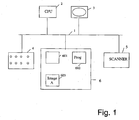
- Figure 1 shows an apparatus consisting of a general purpose computer programmed to perform image analysis according to a first embodiment of the invention. It has a bus 1, to which are connected a central processing unit 2, a visual display 3, a keyboard 4, a scanner 5 (or other device, not shown) for input of images, and a memory 6.
- an operating system 601 In the memory 6 are stored an operating system 601, a program 602 for performing the image analysis, and a storage area 603 for storing an image.
- the image is stored as a two-dimensional array of values, each value representing the brightness and/or colour components of a picture element within the array.
- FIG. 2 is a flowchart explaining the application of the method.
- Step 100 a set of scores H(i,j) is set to zero, and a counter k set to zero.
- a score is to be generated for each element x 0 of the image array. They can be dealt with any order but as shown we start with x 0 set to 0,0 at Step 102. For convenience this is referred to in this description as the root.
- the first task of the method is to make a random selection of elements in the image. This may be visualised as stabbing the image with an irregular fork having m tines.
- references to a random selection also envisage the possibility of selection by means of a pseudo-random process. Also, a reference to random selection envisages the possibility not only of a random selection for which the selection of any value (within a range specified) is equally probable, but also of a selection in accordance with a non-uniform probability distribution.
- Step 104 a set S x of m elements at random positions x i is selected in the image, subject to the constraint that all elements lie within the image.
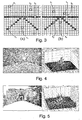
- An example set is shown in Figure 3(a) .
- Step 110 It is to be determined whether each of the selected elements x i matches the corresponding element u i .
- the test for a match occurs at Step 110. In the r, g, b case a match occurs if
- Step 112 the Score H(x 0 ) is incremented. It could simply be incremented by 1 (or other fixed value).
- the iteration counter k is incremented at 114 and tested at 116 to see if it has reached a maximum iteration count K; if not, the process returns to Step 104 for a further iteration with a new fork shape.
- the next step, at 122, is to detect the position of any peak in the histogram.
- the criterion for this is the location of the image element x 0 with the highest score max x - 1 ⁇ H x .
- the peak may be located after first smoothing the histogram with a Gaussian or other type of filter. Multiple peaks may be located by gradient ascent from different starting points.
- the scaling factor ⁇ is fixed.
- a value of 1/2 is suggested.
- Other values may be chosen, dependent on the picture content. In general, values close to unity are unsatisfactory as they tend to result in large numbers of matches simply because the change in fork size is insufficient to cause a mismatch. Very small values will tend to make the results more susceptible to noise and hence unreliable.
- ⁇ it is not actually essential that ⁇ be fixed, though naturally the same value must be used for scaling each of the m tines of a particular fork on a given iteration k .
- a randomly varying choice has been tried and found to be successful: this approach may indeed be preferred in situations where the optimum value cannot be predicted.
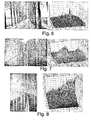
- the detected vanishing point in Figure 6 lies on the horizon but slight asymmetry pulls the vanishing point to the right of that which might be indicated by the road.
- High scoring pixels cover the neighbourhood of the road as it disappears to the left in Figure 7 .
- the peak takes into account the trees and the sky as well as the road and its markings.
- the perspective scores in Figure 8 increase towards the horizon, but rise up to a maximum immediately to the right of the mountain. Again this maximum value reflects perspective structure in the sky, the mountain and the road. Other lower peaks align with perspectives arising from the road and the road markings.
- the principal vanishing point in Figure 9 is identified.
- ⁇ ik can be chosen at random - and if desired be chosen afresh for each k , and must be chosen such that they do not cause u ik to fall outside the image.
- ⁇ ik for matching forks give the directions of the distant vanishing points.
Landscapes
- Engineering & Computer Science (AREA)
- Physics & Mathematics (AREA)
- General Physics & Mathematics (AREA)
- Theoretical Computer Science (AREA)
- Computer Vision & Pattern Recognition (AREA)
- Multimedia (AREA)
- Image Analysis (AREA)
Description
- The present invention is concerned with image analysis and more particularly with extracting three-dimensional information from a two-dimensional image.
- Perspective is present to some extent in all images that reflect 3D information. Parallel lines in the three dimensional scene project to vanishing points in the image. Locating the vanishing points provides a powerful way of inferring 3D structure from a 2D image especially in a landscape or a man-made environment. Lutton et al [1] extract edges and assemble line segments which point towards vanishing points. This approach requires knowledge of camera parameters and has to deal with large numbers of very short segments arising from certain images. McLean et al [2] cluster gradient orientations to again detect line structure in images and evaluates the method against two grey level images. Along with other authors Shufelt [3] uses a Gaussian sphere representation and addresses the problem of spurious edges in images with a limited range of object orientations.
- Rother [4] applies the ideas to architectural environments and rejects falsely detected vanishing points by making use of camera parameters. Cantoni et al [5] explores two approaches, one using the Hough transform and the other edge detection. Successive analyses are required to locate multiple vanishing points. Almansa et al [6] proposes a method not dependent on camera parameters which searches for image regions that contain maximum numbers of line segment intersections. Curved boundaries in images that do not contain actual vanishing points can cause false alarms. Gabor wavelet filters are used by Rasmussen [7] to obtain dominant texture orientation in images of roads.
- Some techniques for analysis of images or other patterns where the pattern is compared with other parts of the same pattern are described in our earlier patent applications as follows.
European patent application00301262.2
International patent applicationPCT/GB01/00504 WO 01/61648
International patent applicationPCT/GB01/03802 WO02/21446
U.S. patent application 977,263/09 filed 16 October 2001 20020081033
International patent application 0PCT/GB2006/002001 - as well as the following papers published by the inventor:
- Stentiford F W M, "An estimator for visual attention through competitive novelty with application to image compression", Proc. Picture Coding Symposium 2001, Seoul, 25 - 27 April, pp 101 - 104, 2001.
- Stentiford F W M, "An evolutionary programming approach to the simulation of visual attention", Proc. Congress on Evolutionary Computation 2001, Seoul, pp 851 - 858, 27 - 30 May, 2001.
- Methods and apparatus for comparing patterns are described in our earlier international patent application
WO03/081523 U.K. patent applications 0420727.0 dated 17th September 2004 0503944.1 dated 25th February 2005 -
US6778699 (B1 ) describes a method of determining a vanishing point related to an image based on determining intersections from pairs of line segments found in the image. Intersections are assessed and a probability assigned to each intersection. An estimated vanishing point vector is determined from a local maximum of the probability values. - Patents Abstracts of Japan vol. 016, no. 024 P-1301) &
JP 03 238566 - Aspects of the present invention are set out in the claims.
- Some embodiments of the present invention will now be described, with reference to the accompanying drawings, in which:
-
Figure 1 is a block diagram of an apparatus for performing the method of the invention; -
Figure 2 is a flowchart illustrating the operation of one embodiment of the invention; -
Figure 3 is a diagram with illustrative pixel selections; and -
Figures 4 to 9 depict some test images and results obtained. -
Figure 1 shows an apparatus consisting of a general purpose computer programmed to perform image analysis according to a first embodiment of the invention. It has abus 1, to which are connected acentral processing unit 2, avisual display 3, akeyboard 4, a scanner 5 (or other device, not shown) for input of images, and amemory 6. - In the
memory 6 are stored anoperating system 601, aprogram 602 for performing the image analysis, and astorage area 603 for storing an image. The image is stored as a two-dimensional array of values, each value representing the brightness and/or colour components of a picture element within the array. - An image array consists of an array of picture elements x i =(x i, y i) where x i and y i are the horizontal and vertical positions of the elements within the image. Each element has a respective value a = a ( x i ). In the case of a monochrome image this would be a scalar value, the brightness a, or in colour would be a vector comprising a set of colour components such as (in r,g,b representation) a = (ar , ag, ab ).
-
Figure 2 is a flowchart explaining the application of the method. InStep 100, a set of scores H(i,j) is set to zero, and a counter k set to zero. A score is to be generated for each element x 0 of the image array. They can be dealt with any order but as shown we start with x 0 set to 0,0 atStep 102. For convenience this is referred to in this description as the root. - The first task of the method is to make a random selection of elements in the image. This may be visualised as stabbing the image with an irregular fork having m tines. Note that, throughout this specification, references to a random selection also envisage the possibility of selection by means of a pseudo-random process. Also, a reference to random selection envisages the possibility not only of a random selection for which the selection of any value (within a range specified) is equally probable, but also of a selection in accordance with a non-uniform probability distribution.
- Thus, at Step 104 a set Sx of m elements at random positions x i is selected in the image, subject to the constraint that all elements lie within the image. An example set is shown in
Figure 3(a) . - Note that this process permits the occurrence of one or more pairs x i = x j i≠j i.e. the x i are not constrained to be distinct. This is not objectionable in practice but if desired may be eliminated by testing for it and reselecting one member of the matching pair.
- For reasons which will become apparent, it is undesirable to choose a set of elements where all, or many, members of the set lie in an area of uniform colour. Thus, at Step 106 a test is performed to check whether at least h of the members differ by more than a threshold amount from all other members of the set. That is,

is true for at least h distinct values of p. For any p it is sufficient that it is true for one value of j (i.e. not all colour components need to mismatch). If it is not true the elements are reselected at 104. - The next stage (Step 108) is to define a second set Su of m elements u i within the image, having vector positions relative to the root x 0 that are reduced by a factor α as compared with the relative vector positions of the previously selected set Sx. That is, u i = x 0 + α(x i - x 0) for all i. This may be visualised (see
Figure 3(b) ) as stabbing image with the shrunken version of the same fork as used for x i. - It is to be determined whether each of the selected elements xi matches the corresponding element u i. The test for a match occurs at
Step 110. In the r, g, b case a match occurs if - Dist[a(x i) - a(u i)] < δ for all i = 1 ... m
- Where Dist is some distance operator (e.g. Euclidean or city-block), or the vector components may be thresholded separately, e.g. for colour components



- where δr, δg and δb are some small threshold values which will commonly be equal.
- If a match occurs, then at
Step 112 the Score H(x0) is incremented. It could simply be incremented by 1 (or other fixed value). - Once the score has been updated (or when there is no match), then the iteration counter k is incremented at 114 and tested at 116 to see if it has reached a maximum iteration count K; if not, the process returns to Step 104 for a further iteration with a new fork shape.
- Once K tests have been performed, then a fresh pixel is dealt with by pointing x0 to a new root at
Step 118 and the process repeated from 104. When all elements have been processed this is recognised at 120. At this point the score matrix H contains, in effect, a histogram indicating the number of matches obtained for each root. Patterns that converge toward the root tend to generate large numbers of matches for that position - for example,Figure 3 shows a m = 5 pixel fork x matching an image and its transformed version u, scaled by α = 1/2 relative to the root V, also matching the image. A high number of such matches would indicate that the point V may be a vanishing point. Thus a vanishing point appears as a peak in the histogram. Although parallel lines in a scene all converge to a single vanishing point, other lines that are at a different angle (but parallel) to one anther) will converge at a different vanishing point. Providing that the lines are (in the original scene) horizontal, then their vanishing points lie on the horizon; thus if there are many such vanishing points the horizon will appear as a ridge in the histogram. - Thus, the next step, at 122, is to detect the position of any peak in the histogram. The criterion for this is the location of the image element x 0 with the highest score

- As described above, the scaling factor α is fixed. A value of 1/2 is suggested. Other values may be chosen, dependent on the picture content. In general, values close to unity are unsatisfactory as they tend to result in large numbers of matches simply because the change in fork size is insufficient to cause a mismatch. Very small values will tend to make the results more susceptible to noise and hence unreliable. It is not actually essential that α be fixed, though naturally the same value must be used for scaling each of the m tines of a particular fork on a given iteration k. A randomly varying choice (within set limits) has been tried and found to be successful: this approach may indeed be preferred in situations where the optimum value cannot be predicted.
- Note too that values of α in excess of unity are permissible, being simply equivalent to selecting u i before x i, but are less convenient to implement because of the danger of elements, after scaling, falling outside the image.
- Note that it is not useful for one of the selected elements to lie at the root position x 0, since such an element is invariant to the scaling and thus always matches. Random selection of x i will occasionally result in selection of the root, but this is not objectionable in practice. If desired, the condition could be tested for and a reselection made.
- The above description also assumes that all points in the image are chosen as the root x 0 and have a score generated for them. It is not however essential that all such points be processed: the analysis could be limited to a particular region of interest, or could be done for a subset. Moreover, it is also possible to perform the analysis in respect of root positions outside the image. For example, some images may contain structure from which it is possible to deduce the position of a vanishing point, notwithstanding that the vanishing point is not itself within the area of the image. In this case there is however a danger that u i may sometimes fall outside the image area (a danger that is magnified by small values of α). This could be, for example, accommodated by immediately after
Step 110, testing u i, for any elements falling outside the image are and if there are, returning to step 104 for a fresh selection of the offending elements (or even all of them). - A number of images from the Corel Database with obvious perspective structure were processed and the measure of perspective at each pixel calculated as above. In these results the number of elements (m) in each fork was set at 12, the number of comparisons (K) at 100, and α at 0.5. The position of the peak marking the principal vanishing point was indicated on the image and the individual scores plotted as 3D histograms. In
Figure 4 the perspective of the road, trees and sky all appear to converge on virtually the same point. The distribution of highest scores centre on a maximum value in this same area. The peak of perspective is slightly to the left of the entrance inFigure 5 because of the asymmetric vegetation. Subsidiary peaks follow the lines of the hedges on each side. The detected vanishing point inFigure 6 lies on the horizon but slight asymmetry pulls the vanishing point to the right of that which might be indicated by the road. High scoring pixels cover the neighbourhood of the road as it disappears to the left inFigure 7 . The peak takes into account the trees and the sky as well as the road and its markings. The perspective scores inFigure 8 increase towards the horizon, but rise up to a maximum immediately to the right of the mountain. Again this maximum value reflects perspective structure in the sky, the mountain and the road. Other lower peaks align with perspectives arising from the road and the road markings. Finally the principal vanishing point inFigure 9 is identified. - The results generated here restrict the location of vanishing points to within the boundaries of the image, but the approach is equally applicable to the detection of vanishing points outside the image providing the matching fork pixels Sx and Su themselves all lie within the image. In these cases α might takes values closer to unity and in the limit for infinitely distant vanishing points α̇ = 1 with the direction of the match being sufficient to capture the perspective information.
- As the root becomes further and further away and α becomes closer to unity, in the limit the effect of the scaling is to shift the pixels of fork S u as compared with S x . Thus, to obtain scores for vanishing points at infinity the transformation becomes

- Where the additional subscript k refers to the particular iteration. In this mode, it is wise to limit the fork size - perhaps to dimensions not exceeding half that of the image itself.
- The two components of Δ ik can be chosen at random - and if desired be chosen afresh for each k, and must be chosen such that they do not cause u ik to fall outside the image. In this special case of testing for vanishing points at infinity peaks in the distribution of the direction of the shifts Δ ik for matching forks give the directions of the distant vanishing points. This approach however does not result in a constant number of iterations for each direction of Δ, so if it is desired to compare values of the score H obtained in this way with scores obtained by scaling, then it would be preferable to perform k iterations for a fixed direction of Δ ik , only the magnitude of Δ ik being reselected on successive iterations, and repeat this to provide a set of scores H (θ) for a range of angles θ.
- Key advantages in this approach over other techniques include the absence of the need for the specification of any a priori features that might characterise the presence of perspective, such as edges or resonance with specific types of filter. This method should still function even if the image is blurred and contains no sharp edges. In addition no knowledge is required of camera parameters or their calibration and no restrictions are placed on the minimum strength of any perspective structure that must be present in the data for the algorithm to function effectively. Finally there is no manual intervention necessary to either initialise or guide the process.
- The same basic mechanism has been used to extract reflective symmetries in facial images where the perspective transform (2) was replaced with a reflection through an axis at an angle θ [10]. The peaks in the distribution of θ for matching forks gave an indication of the position of axes of symmetry present in the images.
- The results reported here have been produced with 100 iterations of fork generation per pixel. Although the computational steps are very simple there are a large number of them and a vanishing point analysis takes about 10 seconds on a 1.8GHz machine running in C++. The computation may be reduced on a sequential machine by only scoring sampled pixels where it may not be necessary to obtain positional accuracy to the nearest pixel. However, the matching of forks can be carried out in parallel as each match is independent of the next and related implementations on the Texas Instruments DM642 DSP platform indicate that processing can take place at video speeds.
-
- 1. Lutton, E., Maitre, H., and Lopez-Krahe, J., "Contribution to the determination of vanishing points using Hough transform," IEEE Trans. on Pattern Analysis and Machine Intelligence, vol. 16, no. 4, pp 430-438, 1994.
- 2. McLean,G.F., and Kotturi, D., "Vanishing point detection by line clustering," IEEE Trans. on Pattern Analysis and Machine Intelligence, vol. 17, no. 11, pp 1090-1095, 1995.
- 3. Shufelt, J.A., "Performance evaluation and analysis of vanishing point detection techniques," IEEE Trans. nn Pattern Analysis and Machine Intelligence, vol. 21, no. 3, pp 282-288, 1999.
- 4. Rother, C., "A new approach for vanishing point detection in architectural environments," 11th British Machine Vision Conference, Bristol, UK, September, 2000.
- 5. Cantoni, V., Lombardi, L., Porta, M., and Sicard, N., "Vanishing point detection: representation analysis and new approaches," 11th Int. Conf. on Image Analysis and Processing, Palermo, Italy, September, 2001.
- 6. Almansa, A., and Desolneux, A., "Vanishing point detection without any a priori information" IEEE Trans. on Pattern Analysis and Machine Intelligence, vol. 25, no. 4, pp 502-506, 2003.
- 7. Rasmussen, C., "Texture-based vanishing point voting for road shape estimation," British Machine Vision Conference, Kingston, UK, September, 2004.
- 8. Stentiford, F.W.M., "Automatic identification of regions of interest with application to the quantification of DNA damage in cells," Proc. SPIE. Vol. 4662, pp 244-253, 2002.
- 9. Stentiford, F.W.M., "An estimator for visual attention through competitive novelty with application to image compression," Picture Coding Symposium, Seoul, pp 101-104,2001.
- 10. Stentiford, F.W.M., "Attention based symmetry detection," Int. Conf. on Advances in Pattern Recognition, Bath, UK, August, 2005.
- 11. Multimedia Understanding through Semantics, Computation and Learning, Network of Excellence. EC 6th Framework Programme. FP6-507752. http://www.muscle-noe.org/
Claims (10)
- A method of analysing an image represented by an ordered set of elements (xi) each having a value comprising, for each of a plurality of root positions (x 0), repeatedly performing the steps of:(i) selecting a first plurality of elements (xi) from the ordered set ;
characterised in that(ii) for each selected element (x i), selecting a second element (u i) such that the selected second element has a vector position relative to the root position that is scaled by a factor (α) in comparison with the position of the first selected element;(iii) determining whether the selected elements meet a match criterion requiring that the value of each of the first elements is similar to the value of the corresponding second element; and(iv) in the event of a match, updating a similarity score (H) in respect of that root element. - A method according to claim 1 including the further step of examining the similarity scores (H) to identify a part of the image corresponding to a peak value of the similarity score.
- A method according to claim 1 or 2 in which all the root position are positions of elements within the image.
- A method according to claim 1 or 2 in which at least some of the root positions are positions outside the image.
- A method according to any one of the preceding claims in which, in the step of selecting a first plurality of elements, the selection is constrained such that no more than a set number of the selected elements meet a predetermined criterion of similarity to others of the elements.
- A method according to any one of the preceding claims in which the scaling factor (α) is fixed.
- A method according to any one of claims 1 to 6 in which the scaling factor (a) is freshly chosen for each step of selecting second elements.
- A method according to any one of the preceding claims in which the scaling factor (α) is in the range 0.3 to 0.8.
- A method according to any one of the preceding claims in which the images is a colour image, each value comprises brightness and/or colour components, and the match criterion is that the difference between each component of the respective first element and the corresponding component of the corresponding second element does not exceed a set amount.
- A method of analysing an image represented by an ordered set of elements (xi) each having a value comprising, for each of a plurality of reference directions, repeatedly performing the steps of:(i) selecting a first plurality of elements (xi) from the ordered set ;
characterised in that(ii) for each selected element (xi), selecting a second element (ui) such that the selected second element has a position that is, in comparison with the position of the first selected element, shifted in the respective reference direction by a shift amount (Δ);(iii) determining whether the selected elements meet a match criterion requiring that the value of each of the first plurality of elements is similar to the value of the corresponding second element; and(iv) in the event of a match, updating a similarity score (H) in respect of that reference direction.
Priority Applications (1)
| Application Number | Priority Date | Filing Date | Title |
|---|---|---|---|
| EP06755690.2A EP1908013B1 (en) | 2005-07-28 | 2006-06-30 | Image analysis |
Applications Claiming Priority (3)
| Application Number | Priority Date | Filing Date | Title |
|---|---|---|---|
| EP05254728 | 2005-07-28 | ||
| PCT/GB2006/002444 WO2007012798A1 (en) | 2005-07-28 | 2006-06-30 | Image analysis |
| EP06755690.2A EP1908013B1 (en) | 2005-07-28 | 2006-06-30 | Image analysis |
Publications (2)
| Publication Number | Publication Date |
|---|---|
| EP1908013A1 EP1908013A1 (en) | 2008-04-09 |
| EP1908013B1 true EP1908013B1 (en) | 2014-04-23 |
Family
ID=34979186
Family Applications (1)
| Application Number | Title | Priority Date | Filing Date |
|---|---|---|---|
| EP06755690.2A Active EP1908013B1 (en) | 2005-07-28 | 2006-06-30 | Image analysis |
Country Status (4)
| Country | Link |
|---|---|
| US (1) | US8135210B2 (en) |
| EP (1) | EP1908013B1 (en) |
| CN (1) | CN101248457B (en) |
| WO (1) | WO2007012798A1 (en) |
Families Citing this family (10)
| Publication number | Priority date | Publication date | Assignee | Title |
|---|---|---|---|---|
| EP1732030A1 (en) | 2005-06-10 | 2006-12-13 | BRITISH TELECOMMUNICATIONS public limited company | Comparison of patterns |
| WO2007012798A1 (en) | 2005-07-28 | 2007-02-01 | British Telecommunications Public Limited Company | Image analysis |
| EP1798961A1 (en) | 2005-12-19 | 2007-06-20 | BRITISH TELECOMMUNICATIONS public limited company | Method for focus control |
| US8611585B2 (en) * | 2008-04-24 | 2013-12-17 | GM Global Technology Operations LLC | Clear path detection using patch approach |
| US8059154B1 (en) * | 2008-10-06 | 2011-11-15 | Verint Systems Ltd. | Systems and methods for automatic camera calibration |
| US8311364B2 (en) * | 2009-09-25 | 2012-11-13 | Eastman Kodak Company | Estimating aesthetic quality of digital images |
| CN102103747B (en) * | 2009-12-16 | 2012-09-05 | 中国科学院电子学研究所 | Method for calibrating external parameters of monitoring camera by adopting reference height |
| WO2011075124A1 (en) * | 2009-12-16 | 2011-06-23 | Hewlett-Packard Development Company, L.P. | Estimating 3d structure from a 2d image |
| US9245192B2 (en) | 2013-09-20 | 2016-01-26 | Here Global B.V. | Ad collateral detection |
| CN105550690B (en) * | 2015-12-14 | 2018-09-11 | 南京邮电大学 | A kind of optimization method based on Stentiford vision modes |
Family Cites Families (63)
| Publication number | Priority date | Publication date | Assignee | Title |
|---|---|---|---|---|
| JP3049997B2 (en) | 1993-07-14 | 2000-06-05 | 松下電器産業株式会社 | Shape detection method |
| DE2256617C3 (en) | 1971-11-19 | 1978-08-31 | Hitachi, Ltd., Tokio | Facility for analyzing a template |
| WO1982001434A1 (en) | 1980-10-20 | 1982-04-29 | Rockwell International Corp | Fingerprint minutiae matcher |
| DE3378794D1 (en) | 1982-06-28 | 1989-02-02 | Nec Corp | Method and device for matching fingerprints |
| US5113454A (en) | 1988-08-19 | 1992-05-12 | Kajaani Electronics Ltd. | Formation testing with digital image analysis |
| GB8821024D0 (en) | 1988-09-07 | 1988-10-05 | Etherington H J | Image recognition |
| JPH03238533A (en) | 1990-02-15 | 1991-10-24 | Nec Corp | Microcomputer |
| JPH03238566A (en) * | 1990-02-15 | 1991-10-24 | Nissan Motor Co Ltd | Vanishing point detection device |
| US5200820A (en) | 1991-04-26 | 1993-04-06 | Bell Communications Research, Inc. | Block-matching motion estimator for video coder |
| JP3106006B2 (en) | 1992-06-24 | 2000-11-06 | キヤノン株式会社 | Electronic still camera |
| US5303885A (en) | 1992-12-14 | 1994-04-19 | Wade Lionel T | Adjustable pipe hanger |
| JP3057981B2 (en) | 1992-12-25 | 2000-07-04 | オムロン株式会社 | Image processing apparatus and copying machine using the same |
| US5790413A (en) | 1993-03-22 | 1998-08-04 | Exxon Chemical Patents Inc. | Plant parameter detection by monitoring of power spectral densities |
| JPH0799658A (en) | 1993-08-03 | 1995-04-11 | Sony Corp | Motion vector detector |
| DE69429847T2 (en) | 1993-10-14 | 2002-11-07 | Omron Corp., Kyoto | Image processing apparatus and method for recognizing an input image and photocopier including the same |
| JP3238566B2 (en) | 1994-03-14 | 2001-12-17 | 三菱農機株式会社 | Engine cover structure for combine harvesters |
| US6169995B1 (en) | 1994-03-17 | 2001-01-02 | Hitachi, Ltd. | Link information maintenance management method |
| JP3333839B2 (en) * | 1994-04-19 | 2002-10-15 | 松下電器産業株式会社 | Interpolation line detection method and interpolation line detection device |
| JPH08248303A (en) | 1995-03-07 | 1996-09-27 | Minolta Co Ltd | Focus detector |
| CA2148340C (en) | 1995-05-01 | 2004-12-07 | Gianni Di Pietro | Method and apparatus for automatically and reproducibly rating the transmission quality of a speech transmission system |
| GB2305050A (en) * | 1995-09-08 | 1997-03-26 | Orad Hi Tec Systems Ltd | Determining the position of a television camera for use in a virtual studio employing chroma keying |
| JP3002721B2 (en) | 1997-03-17 | 2000-01-24 | 警察庁長官 | Graphic position detecting method and apparatus, and machine-readable recording medium storing program |
| JPH10260773A (en) | 1997-03-19 | 1998-09-29 | Nippon Telegr & Teleph Corp <Ntt> | Information input method and device |
| US6215898B1 (en) | 1997-04-15 | 2001-04-10 | Interval Research Corporation | Data processing system and method |
| JP3580670B2 (en) | 1997-06-10 | 2004-10-27 | 富士通株式会社 | Method for associating input image with reference image, apparatus therefor, and storage medium storing program for implementing the method |
| US6078680A (en) | 1997-07-25 | 2000-06-20 | Arch Development Corporation | Method, apparatus, and storage medium for detection of nodules in biological tissue using wavelet snakes to characterize features in radiographic images |
| JPH11306022A (en) | 1998-04-16 | 1999-11-05 | Matsushita Electric Ind Co Ltd | Agent knowledge utilization method and device |
| EP1080444A4 (en) | 1998-05-18 | 2002-02-13 | Datacube Inc | Image recognition and correlation system |
| US6240208B1 (en) * | 1998-07-23 | 2001-05-29 | Cognex Corporation | Method for automatic visual identification of a reference site in an image |
| JP3683758B2 (en) | 1998-11-12 | 2005-08-17 | 日本電信電話株式会社 | Similar image retrieval system, similar image retrieval method, and recording medium recording similar image retrieval program |
| DE69942619D1 (en) | 1998-11-25 | 2010-09-02 | Iridian Technologies Inc | FAST FOCUS EVALUATION SYSTEM AND METHOD FOR IMAGING |
| US6282317B1 (en) | 1998-12-31 | 2001-08-28 | Eastman Kodak Company | Method for automatic determination of main subjects in photographic images |
| DE19913853A1 (en) * | 1999-03-26 | 2000-10-05 | Steffen Setzer | Method and device for the pictorial detection of three-dimensional objects |
| US6480629B1 (en) | 1999-04-06 | 2002-11-12 | Koninklijke Philips Electronics N.V. | Motion estimation method using orthogonal-sum block matching |
| US6483937B1 (en) | 1999-06-17 | 2002-11-19 | International Business Machines Corporation | Process for inspecting an object |
| US6389417B1 (en) | 1999-06-29 | 2002-05-14 | Samsung Electronics Co., Ltd. | Method and apparatus for searching a digital image |
| US6839454B1 (en) * | 1999-09-30 | 2005-01-04 | Biodiscovery, Inc. | System and method for automatically identifying sub-grids in a microarray |
| WO2001029257A2 (en) | 1999-10-22 | 2001-04-26 | Genset | Methods of genetic cluster analysis |
| US6499009B1 (en) | 1999-10-29 | 2002-12-24 | Telefonaktiebolaget Lm Ericsson | Handling variable delay in objective speech quality assessment |
| US7142689B2 (en) | 2000-01-31 | 2006-11-28 | Canon Kabushiki Kaisha | Image processing apparatus for determining specific images |
| US20010013895A1 (en) | 2000-02-04 | 2001-08-16 | Kiyoharu Aizawa | Arbitrarily focused image synthesizing apparatus and multi-image simultaneous capturing camera for use therein |
| EP1126411A1 (en) | 2000-02-17 | 2001-08-22 | BRITISH TELECOMMUNICATIONS public limited company | Visual attention location system |
| AU2001232029A1 (en) | 2000-02-17 | 2001-08-27 | British Telecommunications Public Limited Company | Visual attention system |
| US6778699B1 (en) * | 2000-03-27 | 2004-08-17 | Eastman Kodak Company | Method of determining vanishing point location from an image |
| JP2002050066A (en) | 2000-08-01 | 2002-02-15 | Nec Corp | Optical pickup circuit and method for optical pickup |
| EP1316067B1 (en) * | 2000-09-08 | 2015-05-27 | BRITISH TELECOMMUNICATIONS public limited company | Analysing a moving image |
| US6670963B2 (en) | 2001-01-17 | 2003-12-30 | Tektronix, Inc. | Visual attention model |
| KR100451649B1 (en) | 2001-03-26 | 2004-10-08 | 엘지전자 주식회사 | Image search system and method |
| US7457361B2 (en) | 2001-06-01 | 2008-11-25 | Nanyang Technology University | Block motion estimation method |
| US6996291B2 (en) | 2001-08-06 | 2006-02-07 | Mitutoyo Corporation | Systems and methods for correlating images in an image correlation system with reduced computational loads |
| EP1286539A1 (en) | 2001-08-23 | 2003-02-26 | BRITISH TELECOMMUNICATIONS public limited company | Camera control |
| JP2003187217A (en) | 2001-12-20 | 2003-07-04 | Nef:Kk | Image retrieval system |
| US7546236B2 (en) | 2002-03-22 | 2009-06-09 | British Telecommunications Public Limited Company | Anomaly recognition method for data streams |
| AU2003215755A1 (en) * | 2002-03-22 | 2003-10-08 | British Telecommunications Public Limited Company | Comparing patterns |
| DE10251787A1 (en) | 2002-11-05 | 2004-05-19 | Philips Intellectual Property & Standards Gmbh | Detecting point correspondences in point quantities for fingerprint verification, involves determining potential association pairs with points from two point quantities and maximum number of pairs |
| GB0229625D0 (en) | 2002-12-19 | 2003-01-22 | British Telecomm | Searching images |
| US7030351B2 (en) | 2003-11-24 | 2006-04-18 | Mitutoyo Corporation | Systems and methods for rapidly automatically focusing a machine vision inspection system |
| GB0328326D0 (en) | 2003-12-05 | 2004-01-07 | British Telecomm | Image processing |
| EP1789910B1 (en) | 2004-09-17 | 2008-08-13 | British Telecommunications Public Limited Company | Analysis of patterns |
| EP1732030A1 (en) | 2005-06-10 | 2006-12-13 | BRITISH TELECOMMUNICATIONS public limited company | Comparison of patterns |
| WO2007012798A1 (en) | 2005-07-28 | 2007-02-01 | British Telecommunications Public Limited Company | Image analysis |
| EP1798961A1 (en) | 2005-12-19 | 2007-06-20 | BRITISH TELECOMMUNICATIONS public limited company | Method for focus control |
| US8396285B2 (en) * | 2009-04-20 | 2013-03-12 | Hewlett-Packard Development Company, L.P. | Estimating vanishing points in images |
-
2006
- 2006-06-30 WO PCT/GB2006/002444 patent/WO2007012798A1/en not_active Ceased
- 2006-06-30 CN CN2006800274293A patent/CN101248457B/en not_active Expired - Fee Related
- 2006-06-30 US US11/988,874 patent/US8135210B2/en active Active
- 2006-06-30 EP EP06755690.2A patent/EP1908013B1/en active Active
Also Published As
| Publication number | Publication date |
|---|---|
| US20090252421A1 (en) | 2009-10-08 |
| US8135210B2 (en) | 2012-03-13 |
| CN101248457B (en) | 2011-07-27 |
| EP1908013A1 (en) | 2008-04-09 |
| CN101248457A (en) | 2008-08-20 |
| WO2007012798A1 (en) | 2007-02-01 |
Similar Documents
| Publication | Publication Date | Title |
|---|---|---|
| Cozzolino et al. | Splicebuster: A new blind image splicing detector | |
| US8081798B2 (en) | Method and system for detecting polygon boundaries of structures in images as particle tracks through fields of corners and pixel gradients | |
| Gamba et al. | Improving urban road extraction in high-resolution images exploiting directional filtering, perceptual grouping, and simple topological concepts | |
| CN115035361A (en) | Target detection method and system based on attention mechanism and feature cross fusion | |
| CN109389105B (en) | Multitask-based iris detection and visual angle classification method | |
| EP1675066A1 (en) | Face image candidate area search method, face image candidate area search system, and face image candidate area search program | |
| CN114821282B (en) | Image detection device and method based on domain antagonistic neural network | |
| EP1908013B1 (en) | Image analysis | |
| CN114332058B (en) | Methods, devices, equipment, and media for serum quality identification based on neural networks | |
| Starovoitov et al. | Texture periodicity detection: Features, properties, and comparisons | |
| CN115410100A (en) | Small target detection method and system based on unmanned aerial vehicle image | |
| CN116229189B (en) | Image processing method, device, equipment and storage medium based on fluorescence endoscope | |
| CN113569981A (en) | Power inspection bird nest detection method based on single-stage target detection network | |
| Palenichka et al. | Multiscale isotropic matched filtering for individual tree detection in LiDAR images | |
| CN117218545A (en) | Radar image detection method based on LBP features and improved Yolov5 | |
| Stentiford | Attention-based vanishing point detection | |
| Cao | Good continuations in digital image level lines | |
| US7231086B2 (en) | Knowledge-based hierarchical method for detecting regions of interest | |
| CN114445788A (en) | Vehicle parking detection method and device, terminal equipment and readable storage medium | |
| Milgram et al. | Algorithms and hardware technology for image recognition | |
| Gal | Automatic obstacle detection for USV’s navigation using vision sensors | |
| CN117541842A (en) | Reflective strip detection method and device, electronic equipment and storage medium | |
| Najgebauer et al. | Representation of edge detection results based on graph theory | |
| CN118710871B (en) | A target detection method and system based on privacy protection and optimal selection strategy | |
| CN120931980B (en) | Intelligent classification system for outdoor substation equipment based on point cloud data recognition |
Legal Events
| Date | Code | Title | Description |
|---|---|---|---|
| PUAI | Public reference made under article 153(3) epc to a published international application that has entered the european phase |
Free format text: ORIGINAL CODE: 0009012 |
|
| 17P | Request for examination filed |
Effective date: 20080114 |
|
| AK | Designated contracting states |
Kind code of ref document: A1 Designated state(s): AT BE BG CH CY CZ DE DK EE ES FI FR GB GR HU IE IS IT LI LT LU LV MC NL PL PT RO SE SI SK TR |
|
| 17Q | First examination report despatched |
Effective date: 20120105 |
|
| DAX | Request for extension of the european patent (deleted) | ||
| GRAP | Despatch of communication of intention to grant a patent |
Free format text: ORIGINAL CODE: EPIDOSNIGR1 |
|
| RIC1 | Information provided on ipc code assigned before grant |
Ipc: G06K 9/46 20060101ALI20131030BHEP Ipc: G06K 9/00 20060101ALI20131030BHEP Ipc: G06T 7/00 20060101AFI20131030BHEP |
|
| INTG | Intention to grant announced |
Effective date: 20131202 |
|
| GRAS | Grant fee paid |
Free format text: ORIGINAL CODE: EPIDOSNIGR3 |
|
| GRAA | (expected) grant |
Free format text: ORIGINAL CODE: 0009210 |
|
| AK | Designated contracting states |
Kind code of ref document: B1 Designated state(s): AT BE BG CH CY CZ DE DK EE ES FI FR GB GR HU IE IS IT LI LT LU LV MC NL PL PT RO SE SI SK TR |
|
| REG | Reference to a national code |
Ref country code: GB Ref legal event code: FG4D |
|
| REG | Reference to a national code |
Ref country code: CH Ref legal event code: EP |
|
| REG | Reference to a national code |
Ref country code: AT Ref legal event code: REF Ref document number: 664227 Country of ref document: AT Kind code of ref document: T Effective date: 20140515 |
|
| REG | Reference to a national code |
Ref country code: IE Ref legal event code: FG4D |
|
| REG | Reference to a national code |
Ref country code: DE Ref legal event code: R096 Ref document number: 602006041203 Country of ref document: DE Effective date: 20140605 |
|
| REG | Reference to a national code |
Ref country code: AT Ref legal event code: MK05 Ref document number: 664227 Country of ref document: AT Kind code of ref document: T Effective date: 20140423 |
|
| REG | Reference to a national code |
Ref country code: NL Ref legal event code: VDEP Effective date: 20140423 |
|
| REG | Reference to a national code |
Ref country code: LT Ref legal event code: MG4D |
|
| PG25 | Lapsed in a contracting state [announced via postgrant information from national office to epo] |
Ref country code: FI Free format text: LAPSE BECAUSE OF FAILURE TO SUBMIT A TRANSLATION OF THE DESCRIPTION OR TO PAY THE FEE WITHIN THE PRESCRIBED TIME-LIMIT Effective date: 20140423 Ref country code: BG Free format text: LAPSE BECAUSE OF FAILURE TO SUBMIT A TRANSLATION OF THE DESCRIPTION OR TO PAY THE FEE WITHIN THE PRESCRIBED TIME-LIMIT Effective date: 20140723 Ref country code: NL Free format text: LAPSE BECAUSE OF FAILURE TO SUBMIT A TRANSLATION OF THE DESCRIPTION OR TO PAY THE FEE WITHIN THE PRESCRIBED TIME-LIMIT Effective date: 20140423 Ref country code: GR Free format text: LAPSE BECAUSE OF FAILURE TO SUBMIT A TRANSLATION OF THE DESCRIPTION OR TO PAY THE FEE WITHIN THE PRESCRIBED TIME-LIMIT Effective date: 20140724 Ref country code: IS Free format text: LAPSE BECAUSE OF FAILURE TO SUBMIT A TRANSLATION OF THE DESCRIPTION OR TO PAY THE FEE WITHIN THE PRESCRIBED TIME-LIMIT Effective date: 20140823 Ref country code: LT Free format text: LAPSE BECAUSE OF FAILURE TO SUBMIT A TRANSLATION OF THE DESCRIPTION OR TO PAY THE FEE WITHIN THE PRESCRIBED TIME-LIMIT Effective date: 20140423 Ref country code: CY Free format text: LAPSE BECAUSE OF FAILURE TO SUBMIT A TRANSLATION OF THE DESCRIPTION OR TO PAY THE FEE WITHIN THE PRESCRIBED TIME-LIMIT Effective date: 20140423 |
|
| PG25 | Lapsed in a contracting state [announced via postgrant information from national office to epo] |
Ref country code: SE Free format text: LAPSE BECAUSE OF FAILURE TO SUBMIT A TRANSLATION OF THE DESCRIPTION OR TO PAY THE FEE WITHIN THE PRESCRIBED TIME-LIMIT Effective date: 20140423 Ref country code: ES Free format text: LAPSE BECAUSE OF FAILURE TO SUBMIT A TRANSLATION OF THE DESCRIPTION OR TO PAY THE FEE WITHIN THE PRESCRIBED TIME-LIMIT Effective date: 20140423 Ref country code: LV Free format text: LAPSE BECAUSE OF FAILURE TO SUBMIT A TRANSLATION OF THE DESCRIPTION OR TO PAY THE FEE WITHIN THE PRESCRIBED TIME-LIMIT Effective date: 20140423 Ref country code: PL Free format text: LAPSE BECAUSE OF FAILURE TO SUBMIT A TRANSLATION OF THE DESCRIPTION OR TO PAY THE FEE WITHIN THE PRESCRIBED TIME-LIMIT Effective date: 20140423 Ref country code: AT Free format text: LAPSE BECAUSE OF FAILURE TO SUBMIT A TRANSLATION OF THE DESCRIPTION OR TO PAY THE FEE WITHIN THE PRESCRIBED TIME-LIMIT Effective date: 20140423 |
|
| PG25 | Lapsed in a contracting state [announced via postgrant information from national office to epo] |
Ref country code: PT Free format text: LAPSE BECAUSE OF FAILURE TO SUBMIT A TRANSLATION OF THE DESCRIPTION OR TO PAY THE FEE WITHIN THE PRESCRIBED TIME-LIMIT Effective date: 20140825 |
|
| REG | Reference to a national code |
Ref country code: DE Ref legal event code: R097 Ref document number: 602006041203 Country of ref document: DE |
|
| PG25 | Lapsed in a contracting state [announced via postgrant information from national office to epo] |
Ref country code: RO Free format text: LAPSE BECAUSE OF FAILURE TO SUBMIT A TRANSLATION OF THE DESCRIPTION OR TO PAY THE FEE WITHIN THE PRESCRIBED TIME-LIMIT Effective date: 20140423 Ref country code: CZ Free format text: LAPSE BECAUSE OF FAILURE TO SUBMIT A TRANSLATION OF THE DESCRIPTION OR TO PAY THE FEE WITHIN THE PRESCRIBED TIME-LIMIT Effective date: 20140423 Ref country code: BE Free format text: LAPSE BECAUSE OF FAILURE TO SUBMIT A TRANSLATION OF THE DESCRIPTION OR TO PAY THE FEE WITHIN THE PRESCRIBED TIME-LIMIT Effective date: 20140423 Ref country code: DK Free format text: LAPSE BECAUSE OF FAILURE TO SUBMIT A TRANSLATION OF THE DESCRIPTION OR TO PAY THE FEE WITHIN THE PRESCRIBED TIME-LIMIT Effective date: 20140423 Ref country code: LU Free format text: LAPSE BECAUSE OF FAILURE TO SUBMIT A TRANSLATION OF THE DESCRIPTION OR TO PAY THE FEE WITHIN THE PRESCRIBED TIME-LIMIT Effective date: 20140630 Ref country code: SK Free format text: LAPSE BECAUSE OF FAILURE TO SUBMIT A TRANSLATION OF THE DESCRIPTION OR TO PAY THE FEE WITHIN THE PRESCRIBED TIME-LIMIT Effective date: 20140423 Ref country code: MC Free format text: LAPSE BECAUSE OF FAILURE TO SUBMIT A TRANSLATION OF THE DESCRIPTION OR TO PAY THE FEE WITHIN THE PRESCRIBED TIME-LIMIT Effective date: 20140423 Ref country code: EE Free format text: LAPSE BECAUSE OF FAILURE TO SUBMIT A TRANSLATION OF THE DESCRIPTION OR TO PAY THE FEE WITHIN THE PRESCRIBED TIME-LIMIT Effective date: 20140423 |
|
| REG | Reference to a national code |
Ref country code: CH Ref legal event code: PL |
|
| PLBE | No opposition filed within time limit |
Free format text: ORIGINAL CODE: 0009261 |
|
| STAA | Information on the status of an ep patent application or granted ep patent |
Free format text: STATUS: NO OPPOSITION FILED WITHIN TIME LIMIT |
|
| REG | Reference to a national code |
Ref country code: IE Ref legal event code: MM4A |
|
| REG | Reference to a national code |
Ref country code: FR Ref legal event code: ST Effective date: 20150227 |
|
| PG25 | Lapsed in a contracting state [announced via postgrant information from national office to epo] |
Ref country code: IT Free format text: LAPSE BECAUSE OF FAILURE TO SUBMIT A TRANSLATION OF THE DESCRIPTION OR TO PAY THE FEE WITHIN THE PRESCRIBED TIME-LIMIT Effective date: 20140423 |
|
| 26N | No opposition filed |
Effective date: 20150126 |
|
| PG25 | Lapsed in a contracting state [announced via postgrant information from national office to epo] |
Ref country code: LI Free format text: LAPSE BECAUSE OF NON-PAYMENT OF DUE FEES Effective date: 20140630 Ref country code: IE Free format text: LAPSE BECAUSE OF NON-PAYMENT OF DUE FEES Effective date: 20140630 Ref country code: CH Free format text: LAPSE BECAUSE OF NON-PAYMENT OF DUE FEES Effective date: 20140630 |
|
| REG | Reference to a national code |
Ref country code: DE Ref legal event code: R097 Ref document number: 602006041203 Country of ref document: DE Effective date: 20150126 |
|
| PG25 | Lapsed in a contracting state [announced via postgrant information from national office to epo] |
Ref country code: FR Free format text: LAPSE BECAUSE OF NON-PAYMENT OF DUE FEES Effective date: 20140630 |
|
| PG25 | Lapsed in a contracting state [announced via postgrant information from national office to epo] |
Ref country code: SI Free format text: LAPSE BECAUSE OF FAILURE TO SUBMIT A TRANSLATION OF THE DESCRIPTION OR TO PAY THE FEE WITHIN THE PRESCRIBED TIME-LIMIT Effective date: 20140423 |
|
| PG25 | Lapsed in a contracting state [announced via postgrant information from national office to epo] |
Ref country code: TR Free format text: LAPSE BECAUSE OF FAILURE TO SUBMIT A TRANSLATION OF THE DESCRIPTION OR TO PAY THE FEE WITHIN THE PRESCRIBED TIME-LIMIT Effective date: 20140423 Ref country code: HU Free format text: LAPSE BECAUSE OF FAILURE TO SUBMIT A TRANSLATION OF THE DESCRIPTION OR TO PAY THE FEE WITHIN THE PRESCRIBED TIME-LIMIT; INVALID AB INITIO Effective date: 20060630 |
|
| PGFP | Annual fee paid to national office [announced via postgrant information from national office to epo] |
Ref country code: DE Payment date: 20220518 Year of fee payment: 17 |
|
| P01 | Opt-out of the competence of the unified patent court (upc) registered |
Effective date: 20230623 |
|
| REG | Reference to a national code |
Ref country code: DE Ref legal event code: R119 Ref document number: 602006041203 Country of ref document: DE |
|
| PG25 | Lapsed in a contracting state [announced via postgrant information from national office to epo] |
Ref country code: DE Free format text: LAPSE BECAUSE OF NON-PAYMENT OF DUE FEES Effective date: 20240103 |
|
| PGFP | Annual fee paid to national office [announced via postgrant information from national office to epo] |
Ref country code: GB Payment date: 20250520 Year of fee payment: 20 |