EP1907970B1 - Methode zum generieren von einzigartigen, gesicherten nummern und karte mit einer sochen nummer - Google Patents
Methode zum generieren von einzigartigen, gesicherten nummern und karte mit einer sochen nummer Download PDFInfo
- Publication number
- EP1907970B1 EP1907970B1 EP06793036.2A EP06793036A EP1907970B1 EP 1907970 B1 EP1907970 B1 EP 1907970B1 EP 06793036 A EP06793036 A EP 06793036A EP 1907970 B1 EP1907970 B1 EP 1907970B1
- Authority
- EP
- European Patent Office
- Prior art keywords
- numbers
- secure
- identification
- identification numbers
- generated
- Prior art date
- Legal status (The legal status is an assumption and is not a legal conclusion. Google has not performed a legal analysis and makes no representation as to the accuracy of the status listed.)
- Not-in-force
Links
Images


Classifications
-
- G—PHYSICS
- G06—COMPUTING OR CALCULATING; COUNTING
- G06Q—INFORMATION AND COMMUNICATION TECHNOLOGY [ICT] SPECIALLY ADAPTED FOR ADMINISTRATIVE, COMMERCIAL, FINANCIAL, MANAGERIAL OR SUPERVISORY PURPOSES; SYSTEMS OR METHODS SPECIALLY ADAPTED FOR ADMINISTRATIVE, COMMERCIAL, FINANCIAL, MANAGERIAL OR SUPERVISORY PURPOSES, NOT OTHERWISE PROVIDED FOR
- G06Q20/00—Payment architectures, schemes or protocols
- G06Q20/38—Payment protocols; Details thereof
- G06Q20/385—Payment protocols; Details thereof using an alias or single-use codes
-
- G—PHYSICS
- G06—COMPUTING OR CALCULATING; COUNTING
- G06F—ELECTRIC DIGITAL DATA PROCESSING
- G06F21/00—Security arrangements for protecting computers, components thereof, programs or data against unauthorised activity
- G06F21/30—Authentication, i.e. establishing the identity or authorisation of security principals
- G06F21/45—Structures or tools for the administration of authentication
- G06F21/46—Structures or tools for the administration of authentication by designing passwords or checking the strength of passwords
-
- G—PHYSICS
- G06—COMPUTING OR CALCULATING; COUNTING
- G06Q—INFORMATION AND COMMUNICATION TECHNOLOGY [ICT] SPECIALLY ADAPTED FOR ADMINISTRATIVE, COMMERCIAL, FINANCIAL, MANAGERIAL OR SUPERVISORY PURPOSES; SYSTEMS OR METHODS SPECIALLY ADAPTED FOR ADMINISTRATIVE, COMMERCIAL, FINANCIAL, MANAGERIAL OR SUPERVISORY PURPOSES, NOT OTHERWISE PROVIDED FOR
- G06Q20/00—Payment architectures, schemes or protocols
- G06Q20/38—Payment protocols; Details thereof
- G06Q20/40—Authorisation, e.g. identification of payer or payee, verification of customer or shop credentials; Review and approval of payers, e.g. check credit lines or negative lists
-
- G—PHYSICS
- G06—COMPUTING OR CALCULATING; COUNTING
- G06Q—INFORMATION AND COMMUNICATION TECHNOLOGY [ICT] SPECIALLY ADAPTED FOR ADMINISTRATIVE, COMMERCIAL, FINANCIAL, MANAGERIAL OR SUPERVISORY PURPOSES; SYSTEMS OR METHODS SPECIALLY ADAPTED FOR ADMINISTRATIVE, COMMERCIAL, FINANCIAL, MANAGERIAL OR SUPERVISORY PURPOSES, NOT OTHERWISE PROVIDED FOR
- G06Q20/00—Payment architectures, schemes or protocols
- G06Q20/38—Payment protocols; Details thereof
- G06Q20/40—Authorisation, e.g. identification of payer or payee, verification of customer or shop credentials; Review and approval of payers, e.g. check credit lines or negative lists
- G06Q20/403—Solvency checks
Definitions
- the present invention relates to a method for generating a plurality of unique secure numbers, these numbers being for example printed on a physical medium and allowing, after verification of their authenticity, to access rights or to obtain credit in particular.
- the invention also relates to a physical medium receiving such a number.
- swipe cards with a printed number, hidden by an opaque ink.
- SMS Short Message Service
- the current secure numbers are composed on the one hand of an identification number and on the other hand a control value.
- the identification number can be a random number and represent the first part of the secure number.
- the control value is a number that depends on the identification number. More precisely, this control value can be calculated from the identification number, from a secret such as a key and a calculation rule. This control value represents the second part of the identification number.
- the identification number is extracted from the complete number received.
- the control value is calculated from this identification number. This calculated control value is compared to the received control value. The entitlement or credit is granted only if these two control values match.
- the total length of the secure number is usually set by the service provider. This length is identical for all the secure numbers of a given operator. It should not be too big to prevent the user from sending too many numbers. It should not be too small on the one hand to not limit too much the number of possible numbers and on the other hand to ensure a sufficient level of security.
- the secure number is separated into two "fields" of fixed length.
- One of the fields for example the one comprising the most significant digits, represents the identification number (IN) and the other field, containing the least significant digits, represents the control value (VC).
- Physical media such as "scratch cards” having such a number generally have a limited validity period, but can be relatively long, for example two years. As these numbers have a finite length, it is necessary to ensure that it will be possible, during the validity period of the cards, to generate different secure numbers. For this, it is necessary to provide that the part forming the identification number is sufficiently large. If this part is too short, it will not be possible after a certain period of use of the system that is to say after the creation of a certain number of secure numbers, to generate new numbers. We will have exhausted all the possibilities offered by the size of the identification number. It is therefore necessary, from the outset, to provide a place large enough to generate enough distinct identification numbers during the validity period of a card. This is done to the detriment of security. Indeed, as the total length of the secure number is limited, the more the place taken for the identification numbers is large, the more that remains for the control value is low.
- the invention relates to a method according to claim 1, a physical medium according to claim 6 and a set of physical supports according to claim 8.
- the present invention proposes to provide a method for generating secure numbers valid for a given duration, these secure numbers having an optimal level of security, while retaining the possibility of creating additional numbers or to increase the security level by according to needs.
- the method of the invention thus makes it possible to generate as many secure numbers as necessary, while having a maximum level of security, which reduces by the same amount the risks that the sending of a random number allows the attribution of rights or a credit.
- the conflicting parameters of number of generated numbers and security can be corrected at any time.
- the secured numbers generated are valid for a finite time, for example two years. Numbers that have been generated but not used during this finite time are no longer valid. It is clear that not all secure numbers are generated at the same time. On the contrary, they are generated in batches, for example every month. It is therefore possible that at the beginning of setting up a service using such secure numbers, the number of numbers to be generated during the first months is less than the quantity of numbers to be generated after a long period of use. .
- the method of the invention then makes it possible to adapt the quantity of security numbers generated and the security level during each time interval.
- this method is based on an estimate of the amount of secure numbers to generate during a time interval. If this estimate is wrong, either optimistically or pessimistically, it is possible to correct the amount of secure numbers and the security level during a time interval.
- the validity period of the secure numbers is determined. This period is generally imposed by the provider of "physical media" with these numbers secure. A time period is then chosen which is at most equal to the period of validity, but which is generally a fraction of this period of validity. The number of different secure numbers that will be generated during this time period is then estimated. The size of the field representing the identification number is then determined according to the estimated quantity of secure numbers. Thus, this field has a variable length depending on the estimate that has been made. The remaining digits are used to represent the control value.
- the border may be moved during the time unit to the right, so as to add possible numbers. If, on the contrary, the forecasts were too optimistic and the field size for the identification numbers was too great, it is possible to move the border to the left, which improves security.
- border displacements can be done during a time unit or at the end of such a unit, for the next time unit.
- the secure number comprises on the one hand an identification number (IN) and on the other hand a control value (VC) which depends on this number of 'identification.
- This secure number is usually written on a physical medium such as a card type "scratch card” or a receipt for payment for example. It could also be displayed on a screen such as a computer or television screen. In the remainder of the description, it is assumed that the medium is a card. In all cases, the operating principle is the same.
- the number written on the medium that is to say the secure number SN is a decimal number which may for example comprise 16 digits, the number of digits being defined by the operator. For handling this number in a management or audit center, it is converted to a binary number.
- a decimal number of 16 digits can be represented in binary form by means of 53 binary digits or 53 bits, since 253 is a 16-digit number while 254 has 17 digits. This value of 53 bits is therefore the total length of the identification number IN and the control value VC.
- the method of the present invention operates as follows. Firstly, a maximum validity period of a card is determined. This duration, which in the following description is set at two years, is generally imposed by the operator.
- This maximum duration is then divided into shorter time intervals, so that the number of intervals is "reasonable" and the number of secure numbers to be generated during an interval time is large enough.
- a time interval of one month is a correct value.
- the identification number IN is separated into a value representing the time interval VIT and a digital identification part INP.
- the duration of the time interval VIT is in principle fixed. It is usually incremented by 1 at each change of time period. Thus, for a given month and year, for example August, it will be worth 00000, then 00001 in the following September and so on until 11111. Then, the cycle begins again. Since the maximum validity period elapses before the cycle starts again, there can not be two identical valid cards.
- the total length of the secure number minus the reserved length for the time interval is therefore available for the digital part and the control value.
- the next step of the method is to evaluate the amount of different secure numbers that will need to be generated during the next time interval. This evaluation can be done generally according to indications given by the operator. As explained in detail below, one of the advantages of the method of the invention is to allow a simple correction of the amount of secure numbers. generated during a time interval. Thus, especially at the beginning of the implementation of the system, if the evaluations are too optimistic or on the contrary too pessimistic, it is possible to make changes during a time interval.
- the total length of the secure number SN minus the length used by the time interval VIT minus that used for the digital part INP gives us the total length usable for the control value.
- This control value depends on the identification number. According to one way of generating this control value, the identification number is taken, to which information may be added, and then an operation is applied to the set. Such an operation could for example be a hash function or any other function in which it is necessary to know a secret to calculate the control value from the identification number.
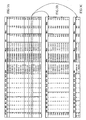
- the Figures 2A and 2B describes an example in which the identifier of the time slot is omitted for reasons of clarity and the secure number has 4 decimal digits.
- the first two columns IN1 and IN2 of the Figure 2A contain the possible values to generate 100 different numbers, that is to say the values from 00 to 99.
- the control value also includes 2 digits so as to respect a total length of 4 digits. This control value is indicated in the columns marked VC1 and VC2 of the Figure 2A .
- the column VC1 contains the absolute value of the difference between the two digits that make up the identification number and the column VC2 contains their sum modulo 10.
- the secure number SN consists of the concatenation of the 4 digits indicated in the columns IN1, IN2, VC1 and VC2.
- the identification number is no longer formed of 2 digits, but of three, denoted IN1, IN2 and IN3 in the figure.
- the identification number is no longer formed of 2 digits, but of three, denoted IN1, IN2 and IN3 in the figure.
- control value has only one digit, here the sum modulo 10 digits forming the identification number, so as to keep the total length of 4 digits.
- FIGS. 3A, 3B and 3C illustrate a similar example, in which the number on the map is decimal, but the values used for the processing and generation of these numbers are binary, which is generally the case in practice.
- the total length of the secure number is 9 bits and the length of the identification number is 4 bits. This makes it possible to generate 16 different secured numbers, noted from 1 to 16 in the left column of the figure.
- each secure number of the figure 3A can give rise to 2 secure numbers as indicated in the figure 3b .
- This flexibility in modifying the numbers of binary or decimal digits used to form the identification number and the control value has two advantages. On the one hand, this makes it possible to modify the quantity of secure numbers that can be generated and the associated security, during a time interval, to correct for example an erroneous estimate. On the other hand, it makes it possible to adapt this quantity at the beginning of each time interval, in particular according to the evolution of the use of the secure numbers.
- the foregoing description relates to how to generate secure numbers and their structure.
- a two-step verification is provided to determine whether this number is genuine and gives entitlement to a credit for example, or if it is false.
- the number is sent to a management center. It should be noted that this center does not necessarily know the length of the identification number since it can vary over a time interval. On the other hand, from the identification number IN, he can know a range of values in which this number is located. By way of example, taking again the case of the figure 3A Let us imagine that among the 16 mentioned possibilities, possibilities Nos. 2 to 8 and 11 to 15 have been chosen to produce secure numbers put into circulation. The other possibilities did not result in secure numbers being put into circulation.
- the identification number corresponds to 0001.
- the secure number is formed of 8 bits.
- the minimum value that can be taken by the secure number having 0001 as the first four most significant bits is 00010000, which corresponds to the concatenated identification number with 0s, until the desired length is reached.
- the maximum value corresponds to the concatenated identification number with 1, 00011111.
- the management center does not know the exact secure numbers, but knows the ranges associated with the secured numbers that have been assigned.
- the management center will check whether this value of 284 belongs to an authentic beach. Assuming the previous hypothesis, the assigned ranges are 32-255; 320-479. The value 284 does not belong to any range assigned. It will therefore be considered by the management center as a false value and the right or associated credit will not be awarded. The number sent having not passed this first verification step, it is not transmitted to undergo the second step.
- the management center can determine that this value is part of the valid ranges and can proceed to the second verification step.
- the secure number is transmitted to a verification center.
- this control value is formed by the identification number to which information is optionally added and to which an operation is applied. This operation may for example be an encryption, a hash key function or any other operation that does not easily allow to find the starting information by knowing the control value.
- the secure number is usually given in decimal form while it is processed in binary form in the management center and in the verification center. Before the control operations, the received decimal value is therefore generally transformed into a binary value.
- the secure number could be entered in alphanumeric form, provided that the means of transmission are appropriate.
- this alphanumeric code should be converted into a format usable by the management center, typically in binary form.
- the verification center On receipt of the identification number IN, the verification center adds the information mentioned above and applies the key hash function, for example with the key of the month. It then compares the calculated result with the expected result, which is stored in the verification center.
- the secure number is considered valid and the credit or entitlement is granted. Otherwise, the credit or the right is refused.
- the secure number is sent after the end of the validity period, even if the identification number is correct, the key or secret used to calculate the check value from the identification number will have changed. In this case, the calculated control value will be different from the expected control value and the secure number will be considered invalid.
Landscapes
- Business, Economics & Management (AREA)
- Engineering & Computer Science (AREA)
- Accounting & Taxation (AREA)
- Theoretical Computer Science (AREA)
- General Physics & Mathematics (AREA)
- Computer Security & Cryptography (AREA)
- Physics & Mathematics (AREA)
- Finance (AREA)
- General Business, Economics & Management (AREA)
- Strategic Management (AREA)
- Computer Hardware Design (AREA)
- Software Systems (AREA)
- General Engineering & Computer Science (AREA)
- Storage Device Security (AREA)
- Financial Or Insurance-Related Operations Such As Payment And Settlement (AREA)
- Lock And Its Accessories (AREA)
- Signal Processing For Digital Recording And Reproducing (AREA)
Claims (8)
- Verfahren zur Zuteilung einer eindeutigen sicheren Zahl an einen materiellen Träger, wobei diese eindeutige sichere Zahl mit einem Verfahren zur Erzeugung eine Vielzahl von eindeutigen sicheren Zahlen (SN) mit einer vorherbestimmten festen Länge erzeugt wird und die sicheren Zahlen mindestens aus einer Identifizierungsnummer (IN) und einem Kontrollwert (VC) bestehen, wobei das Verfahren zur Zuteilung einer gesicherten Zahl die folgenden Phasen umfasst:- Festlegung einer erster Menge von zu erzeugenden sicheren Zahlen;
Festlegung der Mindestanzahl der Ziffern, die notwendig sind, um besagte erste Menge von sicheren Zahlen zu erzeugen;- Erzeugung einer erster Reihe von eindeutigen Identifizierungsnummern (IN), wobei diese Identifizierungsnummern eine Länge aufweisen, die mindestens gleich der Mindestanzahl der Ziffern ist, die notwendig sind, um die sicheren Zahlen (SN) zu erzeugen, wobei diese Identifizierungsnummern unter allen möglichen Zahlen mit der erforderlichen Länge ausgewählt werden;- Zuteilung eines Kontrollwert (VC) an jede Identifizierungsnummer (IN), wobei dieser Kontrollwert eine solche Länge aufweist, dass die Gesamtlänge der sichere Zahlen besagter vorherbestimmten festen Länge entspricht, und wobei dieser Kontrollwert (VC) ausgehend von der Identifizierungsnummer, von einem Geheimnis und von einer Berechnungsregel berechnet wird;- vor der Benutzung aller verfügbaren Identifizierungsnummern der ersten Reihe von Identifizierungsnummern Festlegung einer zweiten zusätzlichen Menge von zu erzeugenden sicheren Zahlen;- Berechnung der verbleibenden Anzahl von Identifizierungsnummern, die man aus der Anzahl der Ziffern, die die Identifizierungsnummern der ersten Reihe bilden, erzeugen kann;- wenn die zweite Menge von zu erzeugenden Identifizierungsnummern höher als die verbleibende Anzahl von Identifizierungsnummern ist, Ermittlung der neuen Mindestanzahl von Ziffern, die notwendig sind, um besagte zweite Menge von Identifizierungsnummern zu erzeugen;- Ermittlung mindestens einer nicht benutzten Identifizierungsnummer unter den Identifizierungsnummern, die man aus der Anzahl von Ziffern der ersten Menge von Identifizierungsnummern erzeugen kann;- Erzeugung einer zweiter Reihe von eindeutigen Identifizierungsnummern (IN), wobei diese Identifizierungsnummern aus nicht benutzten Identifizierungsnummern unter den Identifizierungsnummern, die man aus der Anzahl von Ziffern der ersten Menge von Identifizierungsnummern erzeugen kann, gebildet werden, wobei diese Identifizierungsnummern der zweiten Reihe von Zahlen eine Länge aufweisen, die mindestens gleich der neuen Mindestanzahl von Ziffern ist, die notwendig sind, um besagte Identifizierungsnummern (IN) von dieser zweiten Reihe von Zahlen zu erzeugen;- Auswahl einer eindeutigen sicheren Zahl aus besagter Vielzahl von erzeugten eindeutigen sicheren Zahlen; und- Aufdruck der genannten gewählten eindeutigen Zahl auf einen materiellen Träger. - Verfahren nach Anspruch 1, gekennzeichnet dadurch dass,- wenn die zweite Menge von sicheren zu erzeugenden Zahlen niedriger als die genannte verbleibende Anzahl von sicheren Zahlen ist, Ermittlung der neuen Mindestanzahl von Ziffern, die notwendig sind, um besagte zweite Menge von sicheren Zahlen zu erzeugen;- Ermittlung der Anzahl von Identifizierungsnummern, die man aus der Mindestanzahl von Ziffern erzeugen kann, die notwendig sind, um besagte zweite Menge von Identifizierungsnummern zu erzeugen, wobei diese neuen Identifizierungsnummern verschieden von den Identifizierungsnummern der ersten Reihe sind, die auf die Länge der Identifizierungsnummern der zweiten Reihe zurechtgeschnitten wurden;- wenn die Anzahl von Identifizierungsnummern, die man aus der besagten Mindestanzahl von Ziffern erzeugen kann, höher ist als die zweite Menge, Erzeugung einer Reihe von eindeutigen Identifizierungsnummern, deren Länge gleich der genannten Mindestanzahl von Ziffern ist, die notwendig sind, um besagte neue Menge von Identifizierungsnummern zu erzeugen, sowie derart, dass diese neuen sichere Zahlen verschieden von den sicheren Zahlen der ersten Reihe sind, die auf die Länge der Identifizierungsnummern der zweiten Reihe zurechtgeschnitten wurden.
- Verfahren nach Anspruch 1 oder 2, gekennzeichnet dadurch, dass man die Anzahl der zu erzeugenden sicheren Zahlen im Laufe eines Zeitintervalls bestimmt.
- Verfahren nach Anspruch 3, gekennzeichnet dadurch, dass besagtes Zeitintervall der gesamten oder einem Teil einer maximalen Gültigkeitsdauer der gesicherten Zahl entspricht.
- Verfahren nach Anspruch 1, gekennzeichnet dadurch, dass besagter materieller Träger benutzt wird, um Zugang zu Rechten zu haben und/oder einen Kredit zu erhalten.
- Materieller Träger für den Zugang zu einem Recht und/oder einem Kredit, mit einer eindeutigen sicheren Zahl (SN) von vorherbestimmter fester Länge, wobei diese gesicherte Zahl mindestens aus einer Identifizierungsnummer (IN) und einem Kontrollwert (VC) besteht, gekennzeichnet dadurch, dass besagte eindeutige sichere Zahl durch die folgenden Schritte erzeugt wird:- Festlegung einer erster Menge von zu erzeugenden sicheren Zahlen;- Ermittlung der Mindestanzahl der Ziffern, die notwendig sind, um besagte erste Menge von sicheren Zahlen zu erzeugen;- Erzeugung einer erster Reihe von eindeutigen Identifizierungsnummern (IN), wobei diese Identifizierungsnummern eine Länge aufweisen, die mindestens gleich der Mindestanzahl von Ziffern ist, die notwendig sind, um die sicheren Zahlen (SN) zu erzeugen, wobei diese Identifizierungsnummern unter allen möglichen Zahlen mit der erforderlichen Länge ausgewählt werden;- Zuteilung eines Kontrollwerts (VC) an jede Identifizierungsnummer (IN), wobei dieser Kontrollwert eine solche Länge aufweist, dass die Gesamtlänge der sicheren Zahlen besagter vorherbestimmten festen Länge entspricht, wobei dieser Kontrollwert (VC) ausgehend von der Identifizierungsnummer, von einem Geheimnis und von einer Berechnungsregel berechnet wird.- vor der Benutzung aller verfügbaren Identifizierungsnummern der ersten Reihe von Identifizierungsnummern Festlegung einer zweiten zusätzlichen Menge von zu erzeugenden sicheren Zahlen;- Berechnung der verbleibenden Anzahl von Identifizierungsnummern, die man aus der Anzahl von Ziffern erzeugen kann, die die Identifizierungsnummern der ersten Reihe bilden;- wenn die zweite Menge von zu erzeugenden Identifizierungsnummern höher ist als die verbleibende Anzahl von Identifizierungsnummern, Ermittlung der neuen Mindestanzahl von Ziffern, die notwendig sind, um besagte zweite Menge von Identifizierungsnummern zu erzeugen;- Festlegung mindestens einer nicht benutzte Identifizierungsnummern unter den Identifizierungsnummern, die man aus der Anzahl von Ziffern der ersten Menge von Identifizierungsnummern erzeugen kann;- Erzeugung einer zweiter Reihe von eindeutigen Identifizierungsnummern (IN) gebildet aus nicht benutzten Identifizierungsnummern unter den Identifizierungsnummern, die man aus der Anzahl von Ziffern der ersten Menge von Identifizierungsnummern erzeugen kann, wobei diese Identifizierungsnummern der zweiten Reihe von Zahlen eine Länge aufweisen, die mindestens gleich der neuen Mindestanzahl von Ziffern ist, die notwendig sind, um besagte Identifizierungsnummern (IN) dieser zweiten Reihe von Zahlen zu erzeugen;- Auswahl einer eindeutigen gesicherter Zahl (SN) aus den erzeugten eindeutigen sicheren Zahlen;- Aufdruck der ausgewählten eindeutigen gesicherten Zahl (SN) auf den genannten materiellen Träger.
- Materieller Träger nach Anspruch 6, gekennzeichnet dadurch, dass besagte eindeutige sichere Zahl auf den materiellen Träger aufgedruckt ist.
- Gruppe von materiellen Trägern für den Zugang zu einem Recht und/oder einem Kredit, wobei jeder materielle Träger eine eindeutige gesicherte Zahl (SN) von vorherbestimmter fester Länge aufweist, die mindestens aus einer Identifizierungsnummer (IN) und einem Kontrollwert (VC) besteht, gekennzeichnet dadurch, dass besagte eindeutige sichere Zahl durch die folgenden Schritte erzeugt wird:- Festlegung einer erster Menge von zu erzeugenden sicheren Zahlen;
Ermittlung der Mindestanzahl von Ziffern, die notwendig sind, um besagte erste Menge von sicheren Zahlen zu erzeugen;- Erzeugung einer erster Reihe von eindeutigen Identifizierungsnummern (IN), wobei diese Identifizierungsnummern eine Länge aufweisen, die mindestens gleich der Mindestanzahl von Ziffern ist, die notwendig sind, um die sicheren Zahlen (SN) zu erzeugen, wobei diese Identifizierungsnummern aus allen möglichen Zahlen mit der erforderlichen Länge ausgewählt werden;- Zuteilung eines Kontrollwerts (VC) an jede Identifizierungsnummer (IN), wobei dieser Kontrollwert eine solche Länge aufweist, dass die Gesamtlänge der sicheren Zahlen besagter vorherbestimmten festen Länge entspricht, wobei der Kontrollwert (VC) ausgehend von der Identifizierungsnummer, von einem Geheimnis und von einer Berechnungsregel berechnet wird;- vor der Benutzung aller verfügbarer Identifizierungsnummern der ersten Reihe von Identifizierungsnummern Festlegung einer zweiten zusätzlichen Menge von zu erzeugenden sicheren Zahlen;- Berechnung der verbleibenden Anzahl von Identifizierungsnummern, die man aus der Anzahl von Ziffern erzeugen kann, die die Identifizierungsnummern der ersten Reihe bilden;- wenn die zweite Menge von zu erzeugenden Identifizierungsnummern höher ist als die verbleibende Anzahl von Identifizierungsnummern, Ermittlung der neuen Mindestanzahl von Ziffern, die notwendig sind, um besagte zweite Menge von Identifizierungsnummern zu erzeugen;- Festlegung mindestens einer nicht benutzten Identifizierungsnummer unter den Identifizierungsnummern, die man aus der Anzahl von Ziffern der ersten Menge von Identifizierungsnummern erzeugen kann;- Erzeugung einer zweiten Reihe von eindeutigen Identifizierungsnummern (IN) aus nicht benutzten Identifizierungsnummern unter den Identifizierungsnummern, die man aus der Anzahl von Ziffern der ersten Menge von Identifizierungsnummern erzeugen kann, wobei diese Identifizierungsnummern der zweiten Reihe von Zahlen eine Länge aufweisen, die mindestens gleich der neuen Mindestanzahl von Ziffern ist, die notwendig sind, um besagte Identifizierungsnummern (IN) dieser zweiten Reihe von Zahlen zu erzeugen;- Auswahl einer Menge von verschiedenen eindeutigen sicheren Zahlen (SN) aus den erzeugten eindeutigen sicheren Zahlen, wobei diese Menge mindestens gleich der Anzahl der materiellen Träger ist, die die Gruppe von materiellen Trägern bilden;- Aufdruck einer verschiedenen eindeutigen sicheren Zahl (SN), die aus besagten erzeugten eindeutigen sicheren Zahlen (SN) ausgewählt wurde, auf jeden der genannten materiellen Träger, die besagte Gruppe von materiellen Trägern bilden.
Priority Applications (1)
| Application Number | Priority Date | Filing Date | Title |
|---|---|---|---|
| EP06793036.2A EP1907970B1 (de) | 2005-08-31 | 2006-08-28 | Methode zum generieren von einzigartigen, gesicherten nummern und karte mit einer sochen nummer |
Applications Claiming Priority (3)
| Application Number | Priority Date | Filing Date | Title |
|---|---|---|---|
| EP05107984 | 2005-08-31 | ||
| EP06793036.2A EP1907970B1 (de) | 2005-08-31 | 2006-08-28 | Methode zum generieren von einzigartigen, gesicherten nummern und karte mit einer sochen nummer |
| PCT/EP2006/065748 WO2007025954A2 (fr) | 2005-08-31 | 2006-08-28 | Méthode pour générer une pluralité de numéros sécurisés uniques et carte comportant un tel numéro |
Publications (2)
| Publication Number | Publication Date |
|---|---|
| EP1907970A2 EP1907970A2 (de) | 2008-04-09 |
| EP1907970B1 true EP1907970B1 (de) | 2014-03-05 |
Family
ID=37709861
Family Applications (1)
| Application Number | Title | Priority Date | Filing Date |
|---|---|---|---|
| EP06793036.2A Not-in-force EP1907970B1 (de) | 2005-08-31 | 2006-08-28 | Methode zum generieren von einzigartigen, gesicherten nummern und karte mit einer sochen nummer |
Country Status (4)
| Country | Link |
|---|---|
| US (1) | US8117647B2 (de) |
| EP (1) | EP1907970B1 (de) |
| ES (1) | ES2464273T3 (de) |
| WO (1) | WO2007025954A2 (de) |
Families Citing this family (2)
| Publication number | Priority date | Publication date | Assignee | Title |
|---|---|---|---|---|
| US8494959B2 (en) | 2007-08-17 | 2013-07-23 | Emc Corporation | Payment card with dynamic account number |
| US8489454B1 (en) * | 2007-08-17 | 2013-07-16 | Amdocs Software Systems Limited | System, method, and computer program product for sending information in response to receipt of an alphanumeric code presented with an advertisement |
Family Cites Families (4)
| Publication number | Priority date | Publication date | Assignee | Title |
|---|---|---|---|---|
| US5577109A (en) * | 1994-06-06 | 1996-11-19 | Call Processing, Inc. | Pre-paid card system and method |
| HK1038627B (en) | 1999-02-18 | 2003-05-30 | Orbis Patents Limited | Credit card system and method |
| GB2369800B (en) | 2000-12-08 | 2005-07-06 | Post Office | A cash card and a system and method using such a card |
| GB2396946B (en) | 2002-12-30 | 2006-04-12 | Nokia Corp | Distributing content data |
-
2006
- 2006-08-28 WO PCT/EP2006/065748 patent/WO2007025954A2/fr not_active Ceased
- 2006-08-28 ES ES06793036.2T patent/ES2464273T3/es active Active
- 2006-08-28 US US11/990,750 patent/US8117647B2/en not_active Expired - Fee Related
- 2006-08-28 EP EP06793036.2A patent/EP1907970B1/de not_active Not-in-force
Also Published As
| Publication number | Publication date |
|---|---|
| WO2007025954A3 (fr) | 2007-04-19 |
| US20090125975A1 (en) | 2009-05-14 |
| WO2007025954A2 (fr) | 2007-03-08 |
| EP1907970A2 (de) | 2008-04-09 |
| ES2464273T3 (es) | 2014-06-02 |
| US8117647B2 (en) | 2012-02-14 |
Similar Documents
| Publication | Publication Date | Title |
|---|---|---|
| CA2144124C (fr) | Procede et dispositif pour authentifier un support de donnees destine a permettre une transaction ou l'acces a un service ou a un lieu, et support correspondant | |
| EP2210209B1 (de) | Verfahren zur verwaltung von zugangsrechten für eine smart card | |
| CA2034002C (fr) | Procede pour verifier l'integrite d'un logiciel ou de donnees, et systeme pour la mise en oeuvre de ce procede | |
| FR2703800A1 (fr) | Procédé de signature d'un fichier informatique, et dispositif pour la mise en Óoeuvre. | |
| WO2006053958A9 (fr) | Support personnel de mémoire de masse portatif et système informatique d'accès sécurisé a un espace utilisateur via un réseau | |
| WO2004107283A1 (fr) | Methode de generation d’une cle de securite | |
| CA2529617C (fr) | Procede d'ecriture, de mise a jour et d'allocation memoire applique a l'ecriture de fichiers sur un support memoire tel qu'une carte a puce | |
| EP0531194A1 (de) | Verfahren zur Datenauthentifizierung | |
| CA2877001C (fr) | Procede de saisie de donnees confidentielles sur un terminal | |
| EP0803790A1 (de) | Verfahren zur Verdeckung eines Geheimcodes in einer Rechnerbeglaubigungsvorrichtung | |
| FR2958102A1 (fr) | Procede et systeme de validation d'une transaction, terminal transactionnel et programme correspondants. | |
| EP3472745B1 (de) | Authentifizierungsprozess mit passwort und salt | |
| EP1761835B1 (de) | Sicherheitsmodul und verfahren zur individuellen anpassung eines derartigen moduls | |
| WO2007025954A2 (fr) | Méthode pour générer une pluralité de numéros sécurisés uniques et carte comportant un tel numéro | |
| WO2000042731A1 (fr) | Procede de chargement securise de donnees entre des modules de securite | |
| EP3857810A1 (de) | Kryptografisches verfahren zum sicheren vergleich zweier geheimer daten x und y | |
| EP0974131B1 (de) | Dynamisches dateninterpretationsverfahren für eine chipkarte | |
| WO2005096135A2 (fr) | Procede et dispositif pour accomplir une operation cryptographique | |
| FR3021435A1 (fr) | Procede de diffusion d'une donnee a partir de documents identitaires | |
| FR2661532A1 (fr) | Memoire a acces protege mot par mot. | |
| CA2947544A1 (fr) | Procede d'enregistrement securise de donnees, dispositif et programme correspondants | |
| EP3153961A1 (de) | Verfahren und system zum verteilten dynamischen schutz | |
| WO2024213840A1 (fr) | Procédé de renouvellement automatique d'un attribut vérifiable et système associé | |
| FR2789774A1 (fr) | Procede de comparaison securise de deux registres memoire, et module de securite mettant en oeuvre ce procede | |
| WO2012127025A2 (fr) | Procede de generation et d'utilisation d'un titre dematerialise dans un dispositif portable et systeme de gestion de titres correspondant |
Legal Events
| Date | Code | Title | Description |
|---|---|---|---|
| PUAI | Public reference made under article 153(3) epc to a published international application that has entered the european phase |
Free format text: ORIGINAL CODE: 0009012 |
|
| 17P | Request for examination filed |
Effective date: 20080214 |
|
| AK | Designated contracting states |
Kind code of ref document: A2 Designated state(s): AT BE BG CH CY CZ DE DK EE ES FI FR GB GR HU IE IS IT LI LT LU LV MC NL PL PT RO SE SI SK TR |
|
| RAP1 | Party data changed (applicant data changed or rights of an application transferred) |
Owner name: NAGRAVISION S.A. |
|
| DAX | Request for extension of the european patent (deleted) | ||
| 17Q | First examination report despatched |
Effective date: 20120926 |
|
| REG | Reference to a national code |
Ref country code: DE Ref legal event code: R079 Ref document number: 602006040529 Country of ref document: DE Free format text: PREVIOUS MAIN CLASS: G06F0021200000 Ipc: G06F0021460000 |
|
| GRAP | Despatch of communication of intention to grant a patent |
Free format text: ORIGINAL CODE: EPIDOSNIGR1 |
|
| RIC1 | Information provided on ipc code assigned before grant |
Ipc: G06Q 20/38 20120101ALI20131024BHEP Ipc: G06F 21/46 20130101AFI20131024BHEP Ipc: G06Q 20/40 20120101ALI20131024BHEP |
|
| INTG | Intention to grant announced |
Effective date: 20131112 |
|
| GRAS | Grant fee paid |
Free format text: ORIGINAL CODE: EPIDOSNIGR3 |
|
| GRAA | (expected) grant |
Free format text: ORIGINAL CODE: 0009210 |
|
| AK | Designated contracting states |
Kind code of ref document: B1 Designated state(s): AT BE BG CH CY CZ DE DK EE ES FI FR GB GR HU IE IS IT LI LT LU LV MC NL PL PT RO SE SI SK TR |
|
| REG | Reference to a national code |
Ref country code: GB Ref legal event code: FG4D Free format text: NOT ENGLISH |
|
| REG | Reference to a national code |
Ref country code: CH Ref legal event code: EP |
|
| REG | Reference to a national code |
Ref country code: AT Ref legal event code: REF Ref document number: 655306 Country of ref document: AT Kind code of ref document: T Effective date: 20140315 |
|
| REG | Reference to a national code |
Ref country code: IE Ref legal event code: FG4D Free format text: LANGUAGE OF EP DOCUMENT: FRENCH |
|
| REG | Reference to a national code |
Ref country code: DE Ref legal event code: R096 Ref document number: 602006040529 Country of ref document: DE Effective date: 20140410 |
|
| REG | Reference to a national code |
Ref country code: ES Ref legal event code: FG2A Ref document number: 2464273 Country of ref document: ES Kind code of ref document: T3 Effective date: 20140602 |
|
| REG | Reference to a national code |
Ref country code: AT Ref legal event code: MK05 Ref document number: 655306 Country of ref document: AT Kind code of ref document: T Effective date: 20140305 |
|
| REG | Reference to a national code |
Ref country code: NL Ref legal event code: VDEP Effective date: 20140305 |
|
| PG25 | Lapsed in a contracting state [announced via postgrant information from national office to epo] |
Ref country code: LT Free format text: LAPSE BECAUSE OF FAILURE TO SUBMIT A TRANSLATION OF THE DESCRIPTION OR TO PAY THE FEE WITHIN THE PRESCRIBED TIME-LIMIT Effective date: 20140305 |
|
| REG | Reference to a national code |
Ref country code: LT Ref legal event code: MG4D |
|
| PG25 | Lapsed in a contracting state [announced via postgrant information from national office to epo] |
Ref country code: SE Free format text: LAPSE BECAUSE OF FAILURE TO SUBMIT A TRANSLATION OF THE DESCRIPTION OR TO PAY THE FEE WITHIN THE PRESCRIBED TIME-LIMIT Effective date: 20140305 Ref country code: FI Free format text: LAPSE BECAUSE OF FAILURE TO SUBMIT A TRANSLATION OF THE DESCRIPTION OR TO PAY THE FEE WITHIN THE PRESCRIBED TIME-LIMIT Effective date: 20140305 Ref country code: CY Free format text: LAPSE BECAUSE OF FAILURE TO SUBMIT A TRANSLATION OF THE DESCRIPTION OR TO PAY THE FEE WITHIN THE PRESCRIBED TIME-LIMIT Effective date: 20140305 Ref country code: AT Free format text: LAPSE BECAUSE OF FAILURE TO SUBMIT A TRANSLATION OF THE DESCRIPTION OR TO PAY THE FEE WITHIN THE PRESCRIBED TIME-LIMIT Effective date: 20140305 |
|
| PG25 | Lapsed in a contracting state [announced via postgrant information from national office to epo] |
Ref country code: LV Free format text: LAPSE BECAUSE OF FAILURE TO SUBMIT A TRANSLATION OF THE DESCRIPTION OR TO PAY THE FEE WITHIN THE PRESCRIBED TIME-LIMIT Effective date: 20140305 |
|
| PG25 | Lapsed in a contracting state [announced via postgrant information from national office to epo] |
Ref country code: BG Free format text: LAPSE BECAUSE OF FAILURE TO SUBMIT A TRANSLATION OF THE DESCRIPTION OR TO PAY THE FEE WITHIN THE PRESCRIBED TIME-LIMIT Effective date: 20140605 Ref country code: RO Free format text: LAPSE BECAUSE OF FAILURE TO SUBMIT A TRANSLATION OF THE DESCRIPTION OR TO PAY THE FEE WITHIN THE PRESCRIBED TIME-LIMIT Effective date: 20140305 Ref country code: IS Free format text: LAPSE BECAUSE OF FAILURE TO SUBMIT A TRANSLATION OF THE DESCRIPTION OR TO PAY THE FEE WITHIN THE PRESCRIBED TIME-LIMIT Effective date: 20140705 Ref country code: EE Free format text: LAPSE BECAUSE OF FAILURE TO SUBMIT A TRANSLATION OF THE DESCRIPTION OR TO PAY THE FEE WITHIN THE PRESCRIBED TIME-LIMIT Effective date: 20140305 Ref country code: NL Free format text: LAPSE BECAUSE OF FAILURE TO SUBMIT A TRANSLATION OF THE DESCRIPTION OR TO PAY THE FEE WITHIN THE PRESCRIBED TIME-LIMIT Effective date: 20140305 Ref country code: CZ Free format text: LAPSE BECAUSE OF FAILURE TO SUBMIT A TRANSLATION OF THE DESCRIPTION OR TO PAY THE FEE WITHIN THE PRESCRIBED TIME-LIMIT Effective date: 20140305 |
|
| PG25 | Lapsed in a contracting state [announced via postgrant information from national office to epo] |
Ref country code: PL Free format text: LAPSE BECAUSE OF FAILURE TO SUBMIT A TRANSLATION OF THE DESCRIPTION OR TO PAY THE FEE WITHIN THE PRESCRIBED TIME-LIMIT Effective date: 20140305 Ref country code: SK Free format text: LAPSE BECAUSE OF FAILURE TO SUBMIT A TRANSLATION OF THE DESCRIPTION OR TO PAY THE FEE WITHIN THE PRESCRIBED TIME-LIMIT Effective date: 20140305 |
|
| REG | Reference to a national code |
Ref country code: DE Ref legal event code: R097 Ref document number: 602006040529 Country of ref document: DE |
|
| PG25 | Lapsed in a contracting state [announced via postgrant information from national office to epo] |
Ref country code: PT Free format text: LAPSE BECAUSE OF FAILURE TO SUBMIT A TRANSLATION OF THE DESCRIPTION OR TO PAY THE FEE WITHIN THE PRESCRIBED TIME-LIMIT Effective date: 20140707 |
|
| PLBE | No opposition filed within time limit |
Free format text: ORIGINAL CODE: 0009261 |
|
| STAA | Information on the status of an ep patent application or granted ep patent |
Free format text: STATUS: NO OPPOSITION FILED WITHIN TIME LIMIT |
|
| PG25 | Lapsed in a contracting state [announced via postgrant information from national office to epo] |
Ref country code: DK Free format text: LAPSE BECAUSE OF FAILURE TO SUBMIT A TRANSLATION OF THE DESCRIPTION OR TO PAY THE FEE WITHIN THE PRESCRIBED TIME-LIMIT Effective date: 20140305 |
|
| 26N | No opposition filed |
Effective date: 20141208 |
|
| REG | Reference to a national code |
Ref country code: DE Ref legal event code: R097 Ref document number: 602006040529 Country of ref document: DE Effective date: 20141208 |
|
| PG25 | Lapsed in a contracting state [announced via postgrant information from national office to epo] |
Ref country code: LU Free format text: LAPSE BECAUSE OF FAILURE TO SUBMIT A TRANSLATION OF THE DESCRIPTION OR TO PAY THE FEE WITHIN THE PRESCRIBED TIME-LIMIT Effective date: 20140828 Ref country code: MC Free format text: LAPSE BECAUSE OF FAILURE TO SUBMIT A TRANSLATION OF THE DESCRIPTION OR TO PAY THE FEE WITHIN THE PRESCRIBED TIME-LIMIT Effective date: 20140305 |
|
| REG | Reference to a national code |
Ref country code: CH Ref legal event code: PL |
|
| PG25 | Lapsed in a contracting state [announced via postgrant information from national office to epo] |
Ref country code: LI Free format text: LAPSE BECAUSE OF NON-PAYMENT OF DUE FEES Effective date: 20140831 Ref country code: BE Free format text: LAPSE BECAUSE OF NON-PAYMENT OF DUE FEES Effective date: 20140831 Ref country code: CH Free format text: LAPSE BECAUSE OF NON-PAYMENT OF DUE FEES Effective date: 20140831 |
|
| REG | Reference to a national code |
Ref country code: IE Ref legal event code: MM4A |
|
| PG25 | Lapsed in a contracting state [announced via postgrant information from national office to epo] |
Ref country code: SI Free format text: LAPSE BECAUSE OF FAILURE TO SUBMIT A TRANSLATION OF THE DESCRIPTION OR TO PAY THE FEE WITHIN THE PRESCRIBED TIME-LIMIT Effective date: 20140305 |
|
| PG25 | Lapsed in a contracting state [announced via postgrant information from national office to epo] |
Ref country code: IE Free format text: LAPSE BECAUSE OF NON-PAYMENT OF DUE FEES Effective date: 20140828 |
|
| PG25 | Lapsed in a contracting state [announced via postgrant information from national office to epo] |
Ref country code: GR Free format text: LAPSE BECAUSE OF FAILURE TO SUBMIT A TRANSLATION OF THE DESCRIPTION OR TO PAY THE FEE WITHIN THE PRESCRIBED TIME-LIMIT Effective date: 20140606 |
|
| PG25 | Lapsed in a contracting state [announced via postgrant information from national office to epo] |
Ref country code: TR Free format text: LAPSE BECAUSE OF FAILURE TO SUBMIT A TRANSLATION OF THE DESCRIPTION OR TO PAY THE FEE WITHIN THE PRESCRIBED TIME-LIMIT Effective date: 20140305 Ref country code: HU Free format text: LAPSE BECAUSE OF FAILURE TO SUBMIT A TRANSLATION OF THE DESCRIPTION OR TO PAY THE FEE WITHIN THE PRESCRIBED TIME-LIMIT; INVALID AB INITIO Effective date: 20060828 |
|
| REG | Reference to a national code |
Ref country code: FR Ref legal event code: PLFP Year of fee payment: 11 |
|
| REG | Reference to a national code |
Ref country code: FR Ref legal event code: PLFP Year of fee payment: 12 |
|
| REG | Reference to a national code |
Ref country code: FR Ref legal event code: PLFP Year of fee payment: 13 |
|
| PGFP | Annual fee paid to national office [announced via postgrant information from national office to epo] |
Ref country code: DE Payment date: 20180829 Year of fee payment: 13 Ref country code: ES Payment date: 20180904 Year of fee payment: 13 Ref country code: FR Payment date: 20180827 Year of fee payment: 13 Ref country code: IT Payment date: 20180822 Year of fee payment: 13 |
|
| PGFP | Annual fee paid to national office [announced via postgrant information from national office to epo] |
Ref country code: GB Payment date: 20180828 Year of fee payment: 13 |
|
| REG | Reference to a national code |
Ref country code: DE Ref legal event code: R119 Ref document number: 602006040529 Country of ref document: DE |
|
| GBPC | Gb: european patent ceased through non-payment of renewal fee |
Effective date: 20190828 |
|
| PG25 | Lapsed in a contracting state [announced via postgrant information from national office to epo] |
Ref country code: DE Free format text: LAPSE BECAUSE OF NON-PAYMENT OF DUE FEES Effective date: 20200303 Ref country code: FR Free format text: LAPSE BECAUSE OF NON-PAYMENT OF DUE FEES Effective date: 20190831 |
|
| PG25 | Lapsed in a contracting state [announced via postgrant information from national office to epo] |
Ref country code: GB Free format text: LAPSE BECAUSE OF NON-PAYMENT OF DUE FEES Effective date: 20190828 Ref country code: IT Free format text: LAPSE BECAUSE OF NON-PAYMENT OF DUE FEES Effective date: 20190828 |
|
| REG | Reference to a national code |
Ref country code: ES Ref legal event code: FD2A Effective date: 20210108 |
|
| PG25 | Lapsed in a contracting state [announced via postgrant information from national office to epo] |
Ref country code: ES Free format text: LAPSE BECAUSE OF NON-PAYMENT OF DUE FEES Effective date: 20190829 |