EP1906482A2 - Polymer electrolyte secondary cell - Google Patents
Polymer electrolyte secondary cell Download PDFInfo
- Publication number
- EP1906482A2 EP1906482A2 EP07117010A EP07117010A EP1906482A2 EP 1906482 A2 EP1906482 A2 EP 1906482A2 EP 07117010 A EP07117010 A EP 07117010A EP 07117010 A EP07117010 A EP 07117010A EP 1906482 A2 EP1906482 A2 EP 1906482A2
- Authority
- EP
- European Patent Office
- Prior art keywords
- com
- mass
- polymer
- monomer
- polymer electrolyte
- Prior art date
- Legal status (The legal status is an assumption and is not a legal conclusion. Google has not performed a legal analysis and makes no representation as to the accuracy of the status listed.)
- Granted
Links
- 239000005518 polymer electrolyte Substances 0.000 title claims abstract description 61
- 239000000178 monomer Substances 0.000 claims abstract description 91
- 229920000642 polymer Polymers 0.000 claims abstract description 70
- RUOJZAUFBMNUDX-UHFFFAOYSA-N propylene carbonate Chemical compound CC1COC(=O)O1 RUOJZAUFBMNUDX-UHFFFAOYSA-N 0.000 claims abstract description 65
- KMTRUDSVKNLOMY-UHFFFAOYSA-N Ethylene carbonate Chemical compound O=C1OCCO1 KMTRUDSVKNLOMY-UHFFFAOYSA-N 0.000 claims abstract description 56
- 239000003125 aqueous solvent Substances 0.000 claims abstract description 31
- 150000001875 compounds Chemical class 0.000 claims abstract description 30
- NIXOWILDQLNWCW-UHFFFAOYSA-M acrylate group Chemical group C(C=C)(=O)[O-] NIXOWILDQLNWCW-UHFFFAOYSA-M 0.000 claims abstract description 15
- 229940088644 n,n-dimethylacrylamide Drugs 0.000 claims abstract description 15
- YLGYACDQVQQZSW-UHFFFAOYSA-N n,n-dimethylprop-2-enamide Chemical compound CN(C)C(=O)C=C YLGYACDQVQQZSW-UHFFFAOYSA-N 0.000 claims abstract description 15
- CERQOIWHTDAKMF-UHFFFAOYSA-M methacrylate group Chemical group C(C(=C)C)(=O)[O-] CERQOIWHTDAKMF-UHFFFAOYSA-M 0.000 claims abstract description 10
- 229920001577 copolymer Polymers 0.000 claims abstract description 7
- 229910003002 lithium salt Inorganic materials 0.000 claims abstract description 4
- 159000000002 lithium salts Chemical class 0.000 claims abstract description 4
- FALRKNHUBBKYCC-UHFFFAOYSA-N 2-(chloromethyl)pyridine-3-carbonitrile Chemical compound ClCC1=NC=CC=C1C#N FALRKNHUBBKYCC-UHFFFAOYSA-N 0.000 claims description 40
- 229940014800 succinic anhydride Drugs 0.000 claims description 40
- YCUBDDIKWLELPD-UHFFFAOYSA-N ethenyl 2,2-dimethylpropanoate Chemical group CC(C)(C)C(=O)OC=C YCUBDDIKWLELPD-UHFFFAOYSA-N 0.000 claims description 19
- NIXOWILDQLNWCW-UHFFFAOYSA-N Acrylic acid Chemical group OC(=O)C=C NIXOWILDQLNWCW-UHFFFAOYSA-N 0.000 claims description 16
- 229910052782 aluminium Inorganic materials 0.000 claims description 8
- XAGFODPZIPBFFR-UHFFFAOYSA-N aluminium Chemical compound [Al] XAGFODPZIPBFFR-UHFFFAOYSA-N 0.000 claims description 8
- 238000006116 polymerization reaction Methods 0.000 claims description 6
- 239000005001 laminate film Substances 0.000 claims description 5
- 239000002904 solvent Substances 0.000 description 43
- OIFBSDVPJOWBCH-UHFFFAOYSA-N Diethyl carbonate Chemical compound CCOC(=O)OCC OIFBSDVPJOWBCH-UHFFFAOYSA-N 0.000 description 30
- DAKWPKUUDNSNPN-UHFFFAOYSA-N Trimethylolpropane triacrylate Chemical compound C=CC(=O)OCC(CC)(COC(=O)C=C)COC(=O)C=C DAKWPKUUDNSNPN-UHFFFAOYSA-N 0.000 description 22
- GNWBLLYJQXKPIP-ZOGIJGBBSA-N (1s,3as,3bs,5ar,9ar,9bs,11as)-n,n-diethyl-6,9a,11a-trimethyl-7-oxo-2,3,3a,3b,4,5,5a,8,9,9b,10,11-dodecahydro-1h-indeno[5,4-f]quinoline-1-carboxamide Chemical compound CN([C@@H]1CC2)C(=O)CC[C@]1(C)[C@@H]1[C@@H]2[C@@H]2CC[C@H](C(=O)N(CC)CC)[C@@]2(C)CC1 GNWBLLYJQXKPIP-ZOGIJGBBSA-N 0.000 description 16
- 150000003839 salts Chemical class 0.000 description 15
- 230000000052 comparative effect Effects 0.000 description 14
- 239000003792 electrolyte Substances 0.000 description 14
- 239000008151 electrolyte solution Substances 0.000 description 13
- JBTWLSYIZRCDFO-UHFFFAOYSA-N ethyl methyl carbonate Chemical compound CCOC(=O)OC JBTWLSYIZRCDFO-UHFFFAOYSA-N 0.000 description 11
- 239000011255 nonaqueous electrolyte Substances 0.000 description 11
- 229940126062 Compound A Drugs 0.000 description 10
- NLDMNSXOCDLTTB-UHFFFAOYSA-N Heterophylliin A Natural products O1C2COC(=O)C3=CC(O)=C(O)C(O)=C3C3=C(O)C(O)=C(O)C=C3C(=O)OC2C(OC(=O)C=2C=C(O)C(O)=C(O)C=2)C(O)C1OC(=O)C1=CC(O)=C(O)C(O)=C1 NLDMNSXOCDLTTB-UHFFFAOYSA-N 0.000 description 10
- 238000005516 engineering process Methods 0.000 description 10
- 239000011159 matrix material Substances 0.000 description 10
- -1 alkylene glycol Chemical compound 0.000 description 9
- 239000000203 mixture Substances 0.000 description 9
- 239000000243 solution Substances 0.000 description 9
- IEJIGPNLZYLLBP-UHFFFAOYSA-N dimethyl carbonate Chemical compound COC(=O)OC IEJIGPNLZYLLBP-UHFFFAOYSA-N 0.000 description 8
- 230000000694 effects Effects 0.000 description 8
- 238000002360 preparation method Methods 0.000 description 8
- 239000002002 slurry Substances 0.000 description 6
- OKTJSMMVPCPJKN-UHFFFAOYSA-N Carbon Chemical compound [C] OKTJSMMVPCPJKN-UHFFFAOYSA-N 0.000 description 5
- HBBGRARXTFLTSG-UHFFFAOYSA-N Lithium ion Chemical compound [Li+] HBBGRARXTFLTSG-UHFFFAOYSA-N 0.000 description 5
- 125000004432 carbon atom Chemical group C* 0.000 description 5
- 229910001416 lithium ion Inorganic materials 0.000 description 5
- 238000003860 storage Methods 0.000 description 5
- COORVRSSRBIIFJ-UHFFFAOYSA-N 2-[2-(2-hydroxyethoxy)ethoxy]-1-methoxyethanol;prop-2-enoic acid Chemical compound OC(=O)C=C.COC(O)COCCOCCO COORVRSSRBIIFJ-UHFFFAOYSA-N 0.000 description 4
- SECXISVLQFMRJM-UHFFFAOYSA-N N-Methylpyrrolidone Chemical compound CN1CCCC1=O SECXISVLQFMRJM-UHFFFAOYSA-N 0.000 description 4
- 125000000217 alkyl group Chemical group 0.000 description 4
- 150000002500 ions Chemical class 0.000 description 4
- 125000002496 methyl group Chemical group [H]C([H])([H])* 0.000 description 4
- 239000007773 negative electrode material Substances 0.000 description 4
- 239000003505 polymerization initiator Substances 0.000 description 4
- 239000007774 positive electrode material Substances 0.000 description 4
- 239000007784 solid electrolyte Substances 0.000 description 4
- GZBSIABKXVPBFY-UHFFFAOYSA-N 2,2-bis(hydroxymethyl)propane-1,3-diol;prop-2-enoic acid Chemical compound OC(=O)C=C.OC(=O)C=C.OC(=O)C=C.OC(=O)C=C.OCC(CO)(CO)CO GZBSIABKXVPBFY-UHFFFAOYSA-N 0.000 description 3
- 229910001290 LiPF6 Inorganic materials 0.000 description 3
- XTXRWKRVRITETP-UHFFFAOYSA-N Vinyl acetate Chemical compound CC(=O)OC=C XTXRWKRVRITETP-UHFFFAOYSA-N 0.000 description 3
- 150000001252 acrylic acid derivatives Chemical class 0.000 description 3
- 230000002411 adverse Effects 0.000 description 3
- 150000001733 carboxylic acid esters Chemical group 0.000 description 3
- 239000011248 coating agent Substances 0.000 description 3
- 238000000576 coating method Methods 0.000 description 3
- MEGHWIAOTJPCHQ-UHFFFAOYSA-N ethenyl butanoate Chemical compound CCCC(=O)OC=C MEGHWIAOTJPCHQ-UHFFFAOYSA-N 0.000 description 3
- UIWXSTHGICQLQT-UHFFFAOYSA-N ethenyl propanoate Chemical compound CCC(=O)OC=C UIWXSTHGICQLQT-UHFFFAOYSA-N 0.000 description 3
- 239000007788 liquid Substances 0.000 description 3
- 229910000625 lithium cobalt oxide Inorganic materials 0.000 description 3
- BFZPBUKRYWOWDV-UHFFFAOYSA-N lithium;oxido(oxo)cobalt Chemical compound [Li+].[O-][Co]=O BFZPBUKRYWOWDV-UHFFFAOYSA-N 0.000 description 3
- 238000005259 measurement Methods 0.000 description 3
- 230000000391 smoking effect Effects 0.000 description 3
- HGXJDMCMYLEZMJ-UHFFFAOYSA-N (2-methylpropan-2-yl)oxy 2,2-dimethylpropaneperoxoate Chemical compound CC(C)(C)OOOC(=O)C(C)(C)C HGXJDMCMYLEZMJ-UHFFFAOYSA-N 0.000 description 2
- YEJRWHAVMIAJKC-UHFFFAOYSA-N 4-Butyrolactone Chemical compound O=C1CCCO1 YEJRWHAVMIAJKC-UHFFFAOYSA-N 0.000 description 2
- RYGMFSIKBFXOCR-UHFFFAOYSA-N Copper Chemical compound [Cu] RYGMFSIKBFXOCR-UHFFFAOYSA-N 0.000 description 2
- RTZKZFJDLAIYFH-UHFFFAOYSA-N Diethyl ether Chemical compound CCOCC RTZKZFJDLAIYFH-UHFFFAOYSA-N 0.000 description 2
- 239000002033 PVDF binder Substances 0.000 description 2
- WYURNTSHIVDZCO-UHFFFAOYSA-N Tetrahydrofuran Chemical compound C1CCOC1 WYURNTSHIVDZCO-UHFFFAOYSA-N 0.000 description 2
- 239000006230 acetylene black Substances 0.000 description 2
- 239000011230 binding agent Substances 0.000 description 2
- 238000007334 copolymerization reaction Methods 0.000 description 2
- 229920006037 cross link polymer Polymers 0.000 description 2
- 239000003431 cross linking reagent Substances 0.000 description 2
- 150000005676 cyclic carbonates Chemical class 0.000 description 2
- 238000000354 decomposition reaction Methods 0.000 description 2
- 230000002708 enhancing effect Effects 0.000 description 2
- GAEKPEKOJKCEMS-UHFFFAOYSA-N gamma-valerolactone Chemical compound CC1CCC(=O)O1 GAEKPEKOJKCEMS-UHFFFAOYSA-N 0.000 description 2
- 229910002804 graphite Inorganic materials 0.000 description 2
- 239000010439 graphite Substances 0.000 description 2
- 229910017053 inorganic salt Inorganic materials 0.000 description 2
- 238000009830 intercalation Methods 0.000 description 2
- 150000002576 ketones Chemical class 0.000 description 2
- 238000004519 manufacturing process Methods 0.000 description 2
- 229920003023 plastic Polymers 0.000 description 2
- 239000004033 plastic Substances 0.000 description 2
- 229920002981 polyvinylidene fluoride Polymers 0.000 description 2
- 238000007789 sealing Methods 0.000 description 2
- 125000000391 vinyl group Chemical group [H]C([*])=C([H])[H] 0.000 description 2
- BQCIDUSAKPWEOX-UHFFFAOYSA-N 1,1-Difluoroethene Chemical compound FC(F)=C BQCIDUSAKPWEOX-UHFFFAOYSA-N 0.000 description 1
- ZZXUZKXVROWEIF-UHFFFAOYSA-N 1,2-butylene carbonate Chemical compound CCC1COC(=O)O1 ZZXUZKXVROWEIF-UHFFFAOYSA-N 0.000 description 1
- RYHBNJHYFVUHQT-UHFFFAOYSA-N 1,4-Dioxane Chemical compound C1COCCO1 RYHBNJHYFVUHQT-UHFFFAOYSA-N 0.000 description 1
- 125000002934 2-oxopropylidene group Chemical group 0.000 description 1
- BVKZGUZCCUSVTD-UHFFFAOYSA-L Carbonate Chemical compound [O-]C([O-])=O BVKZGUZCCUSVTD-UHFFFAOYSA-L 0.000 description 1
- 229920002134 Carboxymethyl cellulose Polymers 0.000 description 1
- PXGOKWXKJXAPGV-UHFFFAOYSA-N Fluorine Chemical compound FF PXGOKWXKJXAPGV-UHFFFAOYSA-N 0.000 description 1
- 229910000733 Li alloy Inorganic materials 0.000 description 1
- 229910000552 LiCF3SO3 Inorganic materials 0.000 description 1
- WHXSMMKQMYFTQS-UHFFFAOYSA-N Lithium Chemical compound [Li] WHXSMMKQMYFTQS-UHFFFAOYSA-N 0.000 description 1
- 229910001091 LixCoO2 Inorganic materials 0.000 description 1
- 229910016819 LixCoyNi1-yO2 Inorganic materials 0.000 description 1
- 229910016818 LixCoyNi1−yO2 Inorganic materials 0.000 description 1
- 229910016800 LixCoyNizMn1-y-zO2 Inorganic materials 0.000 description 1
- 229910015329 LixMn2O4 Inorganic materials 0.000 description 1
- 229910003007 LixMnO2 Inorganic materials 0.000 description 1
- 229910014149 LixNiO2 Inorganic materials 0.000 description 1
- 239000004677 Nylon Substances 0.000 description 1
- 239000004698 Polyethylene Substances 0.000 description 1
- 239000004743 Polypropylene Substances 0.000 description 1
- XUIMIQQOPSSXEZ-UHFFFAOYSA-N Silicon Chemical compound [Si] XUIMIQQOPSSXEZ-UHFFFAOYSA-N 0.000 description 1
- 150000001345 alkine derivatives Chemical class 0.000 description 1
- 125000002947 alkylene group Chemical group 0.000 description 1
- 150000008064 anhydrides Chemical class 0.000 description 1
- 229910052799 carbon Inorganic materials 0.000 description 1
- 239000006229 carbon black Substances 0.000 description 1
- 150000001732 carboxylic acid derivatives Chemical class 0.000 description 1
- 150000005678 chain carbonates Chemical class 0.000 description 1
- 238000006243 chemical reaction Methods 0.000 description 1
- 239000003795 chemical substances by application Substances 0.000 description 1
- 229910052802 copper Inorganic materials 0.000 description 1
- 239000010949 copper Substances 0.000 description 1
- 239000011889 copper foil Substances 0.000 description 1
- 238000007599 discharging Methods 0.000 description 1
- 150000002148 esters Chemical class 0.000 description 1
- LYCAIKOWRPUZTN-UHFFFAOYSA-N ethylene glycol Natural products OCCO LYCAIKOWRPUZTN-UHFFFAOYSA-N 0.000 description 1
- 239000011737 fluorine Substances 0.000 description 1
- 229910052731 fluorine Inorganic materials 0.000 description 1
- 239000011888 foil Substances 0.000 description 1
- 239000011245 gel electrolyte Substances 0.000 description 1
- 125000004435 hydrogen atom Chemical group [H]* 0.000 description 1
- WGCNASOHLSPBMP-UHFFFAOYSA-N hydroxyacetaldehyde Natural products OCC=O WGCNASOHLSPBMP-UHFFFAOYSA-N 0.000 description 1
- 230000002401 inhibitory effect Effects 0.000 description 1
- 150000002596 lactones Chemical class 0.000 description 1
- 239000002648 laminated material Substances 0.000 description 1
- 238000003475 lamination Methods 0.000 description 1
- 229910052744 lithium Inorganic materials 0.000 description 1
- 239000001989 lithium alloy Substances 0.000 description 1
- 229910001540 lithium hexafluoroarsenate(V) Inorganic materials 0.000 description 1
- 229910002102 lithium manganese oxide Inorganic materials 0.000 description 1
- MHCFAGZWMAWTNR-UHFFFAOYSA-M lithium perchlorate Chemical compound [Li+].[O-]Cl(=O)(=O)=O MHCFAGZWMAWTNR-UHFFFAOYSA-M 0.000 description 1
- 229910001486 lithium perchlorate Inorganic materials 0.000 description 1
- 229910001496 lithium tetrafluoroborate Inorganic materials 0.000 description 1
- ACFSQHQYDZIPRL-UHFFFAOYSA-N lithium;bis(1,1,2,2,2-pentafluoroethylsulfonyl)azanide Chemical compound [Li+].FC(F)(F)C(F)(F)S(=O)(=O)[N-]S(=O)(=O)C(F)(F)C(F)(F)F ACFSQHQYDZIPRL-UHFFFAOYSA-N 0.000 description 1
- QSZMZKBZAYQGRS-UHFFFAOYSA-N lithium;bis(trifluoromethylsulfonyl)azanide Chemical compound [Li+].FC(F)(F)S(=O)(=O)[N-]S(=O)(=O)C(F)(F)F QSZMZKBZAYQGRS-UHFFFAOYSA-N 0.000 description 1
- VLXXBCXTUVRROQ-UHFFFAOYSA-N lithium;oxido-oxo-(oxomanganiooxy)manganese Chemical compound [Li+].[O-][Mn](=O)O[Mn]=O VLXXBCXTUVRROQ-UHFFFAOYSA-N 0.000 description 1
- URIIGZKXFBNRAU-UHFFFAOYSA-N lithium;oxonickel Chemical compound [Li].[Ni]=O URIIGZKXFBNRAU-UHFFFAOYSA-N 0.000 description 1
- 229910052751 metal Inorganic materials 0.000 description 1
- 239000002184 metal Substances 0.000 description 1
- 229910044991 metal oxide Inorganic materials 0.000 description 1
- 150000004706 metal oxides Chemical class 0.000 description 1
- 238000000034 method Methods 0.000 description 1
- OVHHHVAVHBHXAK-UHFFFAOYSA-N n,n-diethylprop-2-enamide Chemical compound CCN(CC)C(=O)C=C OVHHHVAVHBHXAK-UHFFFAOYSA-N 0.000 description 1
- 229920001778 nylon Polymers 0.000 description 1
- 150000002894 organic compounds Chemical class 0.000 description 1
- 239000003960 organic solvent Substances 0.000 description 1
- 238000009783 overcharge test Methods 0.000 description 1
- 229920000573 polyethylene Polymers 0.000 description 1
- 229920001155 polypropylene Polymers 0.000 description 1
- 239000002243 precursor Substances 0.000 description 1
- 230000002265 prevention Effects 0.000 description 1
- 239000011347 resin Substances 0.000 description 1
- 229920005989 resin Polymers 0.000 description 1
- 229910052710 silicon Inorganic materials 0.000 description 1
- 239000010703 silicon Substances 0.000 description 1
- 229920003048 styrene butadiene rubber Polymers 0.000 description 1
- 239000000126 substance Substances 0.000 description 1
- RINCXYDBBGOEEQ-UHFFFAOYSA-N succinic anhydride Chemical group O=C1CCC(=O)O1 RINCXYDBBGOEEQ-UHFFFAOYSA-N 0.000 description 1
- YLQBMQCUIZJEEH-UHFFFAOYSA-N tetrahydrofuran Natural products C=1C=COC=1 YLQBMQCUIZJEEH-UHFFFAOYSA-N 0.000 description 1
- 239000002562 thickening agent Substances 0.000 description 1
- 229910052723 transition metal Inorganic materials 0.000 description 1
- 229920002554 vinyl polymer Polymers 0.000 description 1
- XLYOFNOQVPJJNP-UHFFFAOYSA-N water Substances O XLYOFNOQVPJJNP-UHFFFAOYSA-N 0.000 description 1
Images


Classifications
-
- H—ELECTRICITY
- H01—ELECTRIC ELEMENTS
- H01M—PROCESSES OR MEANS, e.g. BATTERIES, FOR THE DIRECT CONVERSION OF CHEMICAL ENERGY INTO ELECTRICAL ENERGY
- H01M10/00—Secondary cells; Manufacture thereof
- H01M10/05—Accumulators with non-aqueous electrolyte
- H01M10/056—Accumulators with non-aqueous electrolyte characterised by the materials used as electrolytes, e.g. mixed inorganic/organic electrolytes
- H01M10/0564—Accumulators with non-aqueous electrolyte characterised by the materials used as electrolytes, e.g. mixed inorganic/organic electrolytes the electrolyte being constituted of organic materials only
- H01M10/0565—Polymeric materials, e.g. gel-type or solid-type
-
- H—ELECTRICITY
- H01—ELECTRIC ELEMENTS
- H01M—PROCESSES OR MEANS, e.g. BATTERIES, FOR THE DIRECT CONVERSION OF CHEMICAL ENERGY INTO ELECTRICAL ENERGY
- H01M10/00—Secondary cells; Manufacture thereof
- H01M10/05—Accumulators with non-aqueous electrolyte
- H01M10/058—Construction or manufacture
- H01M10/0587—Construction or manufacture of accumulators having only wound construction elements, i.e. wound positive electrodes, wound negative electrodes and wound separators
-
- H—ELECTRICITY
- H01—ELECTRIC ELEMENTS
- H01M—PROCESSES OR MEANS, e.g. BATTERIES, FOR THE DIRECT CONVERSION OF CHEMICAL ENERGY INTO ELECTRICAL ENERGY
- H01M10/00—Secondary cells; Manufacture thereof
- H01M10/05—Accumulators with non-aqueous electrolyte
-
- H—ELECTRICITY
- H01—ELECTRIC ELEMENTS
- H01M—PROCESSES OR MEANS, e.g. BATTERIES, FOR THE DIRECT CONVERSION OF CHEMICAL ENERGY INTO ELECTRICAL ENERGY
- H01M10/00—Secondary cells; Manufacture thereof
- H01M10/05—Accumulators with non-aqueous electrolyte
- H01M10/052—Li-accumulators
- H01M10/0525—Rocking-chair batteries, i.e. batteries with lithium insertion or intercalation in both electrodes; Lithium-ion batteries
-
- H—ELECTRICITY
- H01—ELECTRIC ELEMENTS
- H01M—PROCESSES OR MEANS, e.g. BATTERIES, FOR THE DIRECT CONVERSION OF CHEMICAL ENERGY INTO ELECTRICAL ENERGY
- H01M10/00—Secondary cells; Manufacture thereof
- H01M10/42—Methods or arrangements for servicing or maintenance of secondary cells or secondary half-cells
- H01M10/4235—Safety or regulating additives or arrangements in electrodes, separators or electrolyte
-
- H—ELECTRICITY
- H01—ELECTRIC ELEMENTS
- H01M—PROCESSES OR MEANS, e.g. BATTERIES, FOR THE DIRECT CONVERSION OF CHEMICAL ENERGY INTO ELECTRICAL ENERGY
- H01M50/00—Constructional details or processes of manufacture of the non-active parts of electrochemical cells other than fuel cells, e.g. hybrid cells
- H01M50/10—Primary casings; Jackets or wrappings
- H01M50/116—Primary casings; Jackets or wrappings characterised by the material
- H01M50/117—Inorganic material
- H01M50/119—Metals
-
- H—ELECTRICITY
- H01—ELECTRIC ELEMENTS
- H01M—PROCESSES OR MEANS, e.g. BATTERIES, FOR THE DIRECT CONVERSION OF CHEMICAL ENERGY INTO ELECTRICAL ENERGY
- H01M50/00—Constructional details or processes of manufacture of the non-active parts of electrochemical cells other than fuel cells, e.g. hybrid cells
- H01M50/10—Primary casings; Jackets or wrappings
- H01M50/116—Primary casings; Jackets or wrappings characterised by the material
- H01M50/121—Organic material
-
- H—ELECTRICITY
- H01—ELECTRIC ELEMENTS
- H01M—PROCESSES OR MEANS, e.g. BATTERIES, FOR THE DIRECT CONVERSION OF CHEMICAL ENERGY INTO ELECTRICAL ENERGY
- H01M50/00—Constructional details or processes of manufacture of the non-active parts of electrochemical cells other than fuel cells, e.g. hybrid cells
- H01M50/10—Primary casings; Jackets or wrappings
- H01M50/116—Primary casings; Jackets or wrappings characterised by the material
- H01M50/124—Primary casings; Jackets or wrappings characterised by the material having a layered structure
- H01M50/126—Primary casings; Jackets or wrappings characterised by the material having a layered structure comprising three or more layers
- H01M50/129—Primary casings; Jackets or wrappings characterised by the material having a layered structure comprising three or more layers with two or more layers of only organic material
-
- H—ELECTRICITY
- H01—ELECTRIC ELEMENTS
- H01M—PROCESSES OR MEANS, e.g. BATTERIES, FOR THE DIRECT CONVERSION OF CHEMICAL ENERGY INTO ELECTRICAL ENERGY
- H01M2300/00—Electrolytes
- H01M2300/0017—Non-aqueous electrolytes
- H01M2300/0025—Organic electrolyte
-
- H—ELECTRICITY
- H01—ELECTRIC ELEMENTS
- H01M—PROCESSES OR MEANS, e.g. BATTERIES, FOR THE DIRECT CONVERSION OF CHEMICAL ENERGY INTO ELECTRICAL ENERGY
- H01M2300/00—Electrolytes
- H01M2300/0085—Immobilising or gelification of electrolyte
-
- H—ELECTRICITY
- H01—ELECTRIC ELEMENTS
- H01M—PROCESSES OR MEANS, e.g. BATTERIES, FOR THE DIRECT CONVERSION OF CHEMICAL ENERGY INTO ELECTRICAL ENERGY
- H01M2300/00—Electrolytes
- H01M2300/0088—Composites
- H01M2300/0091—Composites in the form of mixtures
-
- H—ELECTRICITY
- H01—ELECTRIC ELEMENTS
- H01M—PROCESSES OR MEANS, e.g. BATTERIES, FOR THE DIRECT CONVERSION OF CHEMICAL ENERGY INTO ELECTRICAL ENERGY
- H01M50/00—Constructional details or processes of manufacture of the non-active parts of electrochemical cells other than fuel cells, e.g. hybrid cells
- H01M50/10—Primary casings; Jackets or wrappings
- H01M50/116—Primary casings; Jackets or wrappings characterised by the material
- H01M50/124—Primary casings; Jackets or wrappings characterised by the material having a layered structure
-
- H—ELECTRICITY
- H01—ELECTRIC ELEMENTS
- H01M—PROCESSES OR MEANS, e.g. BATTERIES, FOR THE DIRECT CONVERSION OF CHEMICAL ENERGY INTO ELECTRICAL ENERGY
- H01M50/00—Constructional details or processes of manufacture of the non-active parts of electrochemical cells other than fuel cells, e.g. hybrid cells
- H01M50/50—Current conducting connections for cells or batteries
- H01M50/543—Terminals
- H01M50/547—Terminals characterised by the disposition of the terminals on the cells
- H01M50/55—Terminals characterised by the disposition of the terminals on the cells on the same side of the cell
-
- Y—GENERAL TAGGING OF NEW TECHNOLOGICAL DEVELOPMENTS; GENERAL TAGGING OF CROSS-SECTIONAL TECHNOLOGIES SPANNING OVER SEVERAL SECTIONS OF THE IPC; TECHNICAL SUBJECTS COVERED BY FORMER USPC CROSS-REFERENCE ART COLLECTIONS [XRACs] AND DIGESTS
- Y02—TECHNOLOGIES OR APPLICATIONS FOR MITIGATION OR ADAPTATION AGAINST CLIMATE CHANGE
- Y02E—REDUCTION OF GREENHOUSE GAS [GHG] EMISSIONS, RELATED TO ENERGY GENERATION, TRANSMISSION OR DISTRIBUTION
- Y02E60/00—Enabling technologies; Technologies with a potential or indirect contribution to GHG emissions mitigation
- Y02E60/10—Energy storage using batteries
-
- Y—GENERAL TAGGING OF NEW TECHNOLOGICAL DEVELOPMENTS; GENERAL TAGGING OF CROSS-SECTIONAL TECHNOLOGIES SPANNING OVER SEVERAL SECTIONS OF THE IPC; TECHNICAL SUBJECTS COVERED BY FORMER USPC CROSS-REFERENCE ART COLLECTIONS [XRACs] AND DIGESTS
- Y02—TECHNOLOGIES OR APPLICATIONS FOR MITIGATION OR ADAPTATION AGAINST CLIMATE CHANGE
- Y02P—CLIMATE CHANGE MITIGATION TECHNOLOGIES IN THE PRODUCTION OR PROCESSING OF GOODS
- Y02P70/00—Climate change mitigation technologies in the production process for final industrial or consumer products
- Y02P70/50—Manufacturing or production processes characterised by the final manufactured product
Definitions
- the present invention relates to an improvement of security of polymer electrolyte secondary cells.
- non-aqueous electrolyte secondary cells with polymer electrolytes (also referred to as polymer electrolyte secondary cells).
- polymer electrolytes also referred to as polymer electrolyte secondary cells.
- polymer electrolyte secondary cells are suitable for the power sources of mobile appliances.
- the polymer electrolyte secondary cells are inferior in electrical characteristics such as a discharge characteristic to usual non-aqueous electrolyte secondary cells with liquid non-aqueous electrolytes.
- a polymer matrix resulting from polymerization of a polymer precursor holds a liquid non-aqueous electrolyte. Since the polymer matrix itself has no ion conductivity, an increase in the polymer in the polymer electrolyte hinders conductivity for lithium ions, resulting in a reduction in discharge characteristic of the cell. Meanwhile, a reduction in the polymer in the polymer electrolyte wanes the capability to hold the liquid non-aqueous electrolyte, resulting in solution leakage.
- the polymer electrolyte uses a flammable organic solvent, which poses a possibility of smoking, fire, and the like when the cell is overcharged.
- a flammable organic solvent which poses a possibility of smoking, fire, and the like when the cell is overcharged.
- a polymer formed of alkylene glycol di(meth)acrylate represented by Formula 1 serves as a matrix and holds therein electrolyte salt and a solvent for the electrolyte salt.
- R 1 denotes an alkylene group with 2 to 12 carbon atoms
- R 2 denotes a hydrogen atom or a methyl group.
- an electrolytic salt containing fluorine and tertiary carboxylic acid ester are contained in a non-aqueous solvent containing cyclic carbonate, in order to obtain a cell with superior cell characteristics such as a cycle characteristic.
- This technology is related to a non-aqueous electrolyte secondary cell and therefore cannot be applied as it is to a polymer electrolyte secondary cell.
- carboxylic ester and carboxylate ion are contained in the electrolyte, in order to obtain a cell with superior cell characteristics such as the cycle characteristic.
- This technology is related to a non-aqueous electrolyte secondary cell and therefore cannot be applied as it is to a polymer electrolyte secondary cell.
- cyclic carbonate and/or cyclic ester, an alkyne derivative, and tertiary carboxylic ester are contained in a non-aqueous solvent, in order to obtain a cell with superior cell characteristics such as the cycle characteristic.
- This technology is related to a non-aqueous electrolyte secondary cell and therefore cannot be applied as it is to a polymer electrolyte secondary cell.
- a cross-linked polymer formed of at least one multi-functional (meth)acrylate selected from multi-functional (meth)acrylate represented by Formula 2 and multi-functional (meth)acrylate represented by Formula 3 serves as a polymer matrix and holds therein electrolytic salt and a solvent for the electrolytic salt, thereby forming a gel electrolyte with high performance.
- a non-aqueous electrolytic solution contains a halogen-substituted organic compound and a polymerizable monomer such as a vinyl monomer, in order to obtain a cell with enhanced security in case of thermal runaway of the cell.
- This technology is related to a non-aqueous electrolyte secondary cell and therefore cannot be applied as it is to a polymer electrolyte secondary cell.
- the electrolyte contains a solvent containing at least one selected from the group consisting of carboxylic acid represented by Formula 4 and ketone represented by Formula 5, in order to obtain a cell with a superior cycle characteristic.
- This technology still provides an insufficient discharge characteristic.
- Patent document 8 is related to a cell with a polymer solid electrolyte containing: a polymer matrix formed by copolymerization of a polymerizable monomer represented by Structural Formula (I) and a cross-linking agent represented by Structural Formula (II); a polymerization initiator; and an electrolytic solution made of an inorganic salt and a solvent, in order to obtain a solid electrolyte secondary cell superior in ion conductivity.
- a polymer solid electrolyte containing: a polymer matrix formed by copolymerization of a polymerizable monomer represented by Structural Formula (I) and a cross-linking agent represented by Structural Formula (II); a polymerization initiator; and an electrolytic solution made of an inorganic salt and a solvent, in order to obtain a solid electrolyte secondary cell superior in ion conductivity.
- Patent document 9 is related to a polymer solid electrolyte having vinylidene fluoride resin and/or N,N-diethyl acrylamide contained in a polymer electrolyte solvent containing: a polymer matrix formed by copolymerization of a polymerizable monomer represented by Structural Formula (1) and a cross-linking agent represented by Structural Formula (2); a polymerization initiator; and an electrolytic solution made of an inorganic salt and a solvent, in order to obtain a solid electrolyte secondary cell superior in ion conductivity and mechanical strength.
- a polymer electrolyte solvent containing: a polymer matrix formed by copolymerization of a polymerizable monomer represented by Structural Formula (1) and a cross-linking agent represented by Structural Formula (2); a polymerization initiator; and an electrolytic solution made of an inorganic salt and a solvent, in order to obtain a solid electrolyte secondary cell superior in ion conductivity and mechanical
- This technology still provides an insufficient discharge characteristic.
- the present invention has been accomplished in view of the above inconveniences, and it is an object of the present invention to improve the discharge characteristic of a polymer electrolyte secondary cell.
- a polymer electrolyte secondary cell includes: a positive electrode; a negative electrode; a polymer electrolyte containing a non-aqueous solvent, a polymer, and a lithium salt; and a cell case for accommodating the positive electrode, the negative electrode, and the polymer electrolyte.
- the non-aqueous solvent contains at least one of ethylene carbonate and propylene carbonate.
- the volume ratio (25°C, 1 atm) of the ethylene carbonate and the propylene carbonate combined to the non-aqueous solvent is equal to or more than 60%.
- the polymer comprises a copolymer having a monomer containing N,N-dimethyl acrylamide and a compound with three or more acrylate groups and/or methacrylate groups.
- the ratio of the compound to the total mass of the monomer is from 10 to 30 mass %.
- the ratio of the polymer to the polymer electrolyte is from 1.0 to 2.0 mass %.
- the polymer comprises a copolymer containing N,N-dimethyl acrylamide and a compound with three or more acrylate groups and/or methacrylate groups, and the ratio of the compound to the total mass of the monomer is restricted within the range of from 10 to 30 mass %.
- ethylene carbonate (EC) and propylene carbonate (PC) constitute equal to or more than 60 volume % (25°C, 1 atm) of the solvent. This results in a polymer with sufficient performance for holding the electrolytic solution.
- acrylate groups and/or methacrylate groups means that the total number of the acrylate groups and the methacrylate groups is equal to or more than three.
- the upper limit for the total mass ratio of the ethylene carbonate (EC) and the propylene carbonate (PC) to the solvent is 100 volume %(25°C, 1 atm).
- a polymer electrolyte secondary cell includes: a positive electrode; a negative electrode; a polymer electrolyte containing a non-aqueous solvent, a polymer, and a lithium salt; and a cell case for accommodating the positive electrode, the negative electrode, and the polymer electrolyte.
- the non-aqueous solvent contains at least one of ethylene carbonate and propylene carbonate.
- the volume ratio (25°C, 1 atm) of the ethylene carbonate and the propylene carbonate combined to the non-aqueous solvent is equal to or more than 60%.
- the polymer comprises a copolymer having a monomer containing N,N-dimethyl acrylamide, a compound with three or more acrylate groups and/or methacrylate groups, and tertiary vinyl carboxylate.
- the ratio of the compound to the total mass of the monomer is from 10 to 30 mass %.
- the ratio of the polymer to the polymer electrolyte is from 1.0 to 2.0 mass %.
- This structure provides advantageous effects equivalent to those by the first aspect of the present invention. Further, the tertiary vinyl carboxylate contained in the monomer reacts with the negative electrode to form a high-quality coating that inhibits reaction between the negative electrode and the polymer electrolyte. This enhances security in case of overcharge of the cell. Thus, this structure provides a cell also superior in security during overcharge of the cell.
- a compound represented by Formula 10 may be used as the tertiary vinyl carboxylate.
- vinyl pivalate where R1, R2, and R3 are all methyl compounds
- R1, R2, and R3 independently denote an alkyl group with equal to or less than ten carbon atoms, preferably an alkyl group with equal to or less than eight carbon atoms, more preferably an alkyl group with equal to or less than five carbon atoms, further more preferably an alkyl group with equal to or less than three carbon atoms.
- the mass ratio of the tertiary vinyl carboxylate to the total mass of the monomer is preferably from 10 to 50 %.
- the non-aqueous solvent may contain propylene carbonate, and the polymer electrolyte may further contain succinic anhydride.
- the non-aqueous solvent preferably contains propylene carbonate (PC).
- PC propylene carbonate
- propylene carbonate has the disadvantage of reacting with the negative electrode and thus being decomposed.
- Succinic anhydride functions to inhibit the decomposition of the propylene carbonate at the negative electrode.
- succinic anhydride is preferably contained, too. More preferably, the content of the succinic anhydride is from 0.01 to 10.00 mass %, further more preferably from 0.05 to 5.00 mass %.
- the polymer may be formed by inner cell polymerization.
- the inner cell polymerization facilitates fabrication of the polymer electrolyte.
- the cell case may be made of an aluminum laminate film.
- a polymer electrolyte secondary cell that eliminates the possibility of solution leakage and has a superior discharge characteristic is realized.
- a polymer electrolyte secondary cell that eliminates the possibility of solution leakage and has a superior discharge characteristic and enhanced security during overcharge is realized.
- Fig. 1 is a frontal perspective view of a cell with a film outer casing according to this embodiment the present invention.
- Fig. 2 is a sectional view of the cell taken along the line A-A shown in Fig. 1.
- Fig. 3 is a perspective view of a flat electrode assembly used in the polymer electrolyte cell of the present invention.
- the polymer electrolyte cell according to the present invention has an electrode assembly 1, which is disposed in a storage space 2.
- the storage space 2 is formed by sealing the upper edge, lower edge, and middle portion of the laminate outer casing 3 respectively at sealed portions 4a, 4b, and 4c.
- the storage space 2 accommodates a polymer electrolyte made of a non-aqueous electrolyte containing a non-aqueous solvent and an electrolyte salt, which is held in a polymer matrix and gelled.
- the electrode assembly 1 has a positive electrode 9, a negative electrode 10, and a separator 11 separating the electrodes from one another, which are wound into a flat form.
- the positive electrode 9 and the negative electrode 10 are respectively connected to a positive electrode lead made of aluminum and a negative electrode lead 8 made of copper, so that chemical energy generated inside the cell is extracted outside as electrical energy.
- the electrode leads are respectively attached with tab films 5 and 6.
- the laminate cell case 3 is of a structure with a lamination of a nylon layer, an aluminum film, and a non-extended polypropylene layer.
- the cell is not limited to the above one using an aluminum laminate material.
- the polymer electrolyte has, as its polymer matrix, a copolymer of N,N-dimethyl acrylamide and a compound with three or more acrylate groups and/or methacrylate groups.
- the polymer matrix holds therein, in the form of a gel, a non-aqueous solvent containing ethylene carbonate and propylene carbonate at a volume ratio (25°C, 1 atm) of equal to or more than 60%, and an electrolytic salt dissolved in the non-aqueous solvent.
- a positive electrode active material made of a lithium cobalt oxide (LiCoO 2 ) was mixed together, thus preparing a positive electrode active material slurry.
- LiCoO 2 lithium cobalt oxide
- a conducting agent made of acetylene black 5 mass parts of a conducting agent made of acetylene black, 3 mass parts of a binding agent made of polyvinylidene fluoride (PVDF), and N-Methyl-2-Pyrrolidone (NMP) were mixed together, thus preparing a positive electrode active material slurry.
- PVDF polyvinylidene fluoride
- NMP N-Methyl-2-Pyrrolidone
- the positive electrode active material slurry was applied to both surfaces of a positive electrode core made of an aluminum foil of 20 ⁇ m thick with a doctor blade so that the thickness would be uniform. Then, this electrode plate was passed through a heated drier to be dried, thereby removing the non-aqueous solvent that was used during slurry preparation. After dried, the electrode plate was extended in a roll presser to a thickness of 0.17 mm, thus obtaining the positive electrode 9.
- LiPF 6 as the electrolyte salt was dissolved at a rate of 1.1 (mol/liter), thus obtaining an electrolytic solution.
- 0.5 mass parts of succinic anhydride was added to this electrolytic solution.
- TMPTA trimethylolpropane triacrylate
- TMMTA tetramethylolmethane tetraacrylate
- DMAA N,N-dimethyl acrylamide
- METGA methoxytriethyleneglycol acrylate
- 3000 ppm of tert-butyl peroxypivalate as a polymerization initiator.
- the positive and negative leads 7 and 8 were respectively attached. Then the electrodes were superposed onto one another with a separator made of a polyethylene porous film (0.025 mm thick) disposed between the electrodes, in such a manner that the center line in the width direction of the electrodes would agree to one another. Then the resulting product was wound using a winder and taped at the outermost surface, thus completing the flat electrode assembly 1.
- a laminate film was molded into a cup form (concave form) to form the storage space 2, into which the flat electrode assembly 1 was inserted. Then the film was folded to form the bottom. Both side edges of the film, which communicated with the bottom, were heat-fused by a rectangular box-type mold at 200°C for 3.0 seconds to form the side sealed portions 4b and 4c. Through the opening portion from which the tab was protruding, the prepolymer electrolyte was injected, which was then left standing in an oven for 3 hours at 50°C to allow the prepolymer to polymerize. After depressurization, charging, and sealing of the opening portion, the polymer electrolyte secondary cell according to this embodiment was completed.
- Cells according to examples 1 to 46 and comparative examples 1 to 166 were prepared in the same manner as in the embodiment 1.
- Tables 1 to 15 below list, for each of the examples, the kind of the non-aqueous solvent and its volume ratio (25°C, 1 atm), the mass ratio of the monomer (which is defined as the mass ratio of the monomer to the monomer, solvent, electrolytic salt, and succinic anhydride, which are assumed to be 100 mass parts, which ratio is taken as the polymer mass ratio), and the mass percentage of the succinic anhydride (which is defined as the mass ratio of the succinic anhydride to the monomer, solvent, electrolytic salt, and succinic anhydride, which are assumed to be 100 mass parts).
- the theoretical capacity of the cells according to the examples and comparative examples is 800 mAh.
- Ten cells from each of the examples and comparative examples were prepared and subjected to this test.
- Each cell was charged at a constant current of 1 It (800 mA) to a voltage of 4.2 V, and then at a constant voltage of 4.2 V to 40 mA.
- Ex.157 1.0 20 80 25 25 - 50 - 0.5 NG 0 Com.
- Ex.158 1.0 20 80 25 25 - - 50 0.5 NG 0 Com.
- Ex.159 1.0 20 80 50 - 50 - - 0.5 NG 0 Com.
- Ex.160 1.0 20 80 50 - - 50 - 0.5 NG 0 Com.
- Table 1 shows that in examples 1 to 4, where the monomer was from 1.0 to 2.0 mass % and the combined volume ratio (25°C, 1 atm) of the ethylene carbonate (EC) and propylene carbonate (PC) was from 60 to 100 %, the polymer was cured sufficiently and a preferable discharge characteristic was obtained. Contrarily, in comparative examples 1 to 3, where the monomer was 0.8 mass %, and in comparative examples 4 and 5, where the combined volume ratio (25°C, 1 atm) of EC and PC was 50 %, the discharge characteristic was preferable but the polymer was not cured sufficiently. In comparative examples 6 to 8, where the monomer was 3.0 mass %, the polymer was cured sufficiently but the discharge characteristic was not sufficient.
- the solvent held by the formed polymer has a high volume ratio for the highly viscous ethylene carbonate (EC) and propylene carbonate (PC), and contains a sufficient amount of the polymer for curing the polymer. This realized the above preferable performance. If the amount of the polymer is excessively small or the viscosity of the solvent is small, the polymer is not cured sufficiently. If the amount of the polymer is excessively large, the formed cross-linked polymer undermines ion conductivity for the lithium ions, thereby adversely affecting the discharge characteristic.
- EC highly viscous ethylene carbonate
- PC propylene carbonate
- Tables 1 to 5 show that when the trimethylolpropane triacrylate (TMPTA, a compound with three acrylates) constitute from 10 to 30 mass % of the total monomer while meeting the preferable conditions, then the polymer is cured sufficiently and a preferable discharge characteristic is obtained.
- TMPTA trimethylolpropane triacrylate
- TMPTA trimethylolpropane triacrylate
- Tables 1 to 5 show that when the trimethylolpropane triacrylate (TMPTA) is 0 mass %, the curability is insufficient, while when the trimethylolpropane triacrylate (TMPTA) is 40 mass % the curability is insufficient in some cases and the discharge characteristic is poor in other cases.
- TMPTA trimethylolpropane triacrylate
- DMAA N,N-dimethyl acrylamide
- TMMTA tetramethylolmethane tetraacrylate
- TMPTA trimethylolpropane triacrylate
- Tables 10 to 13 show that when methoxytriethyleneglycol acrylate (METGA, a compound with one acrylate) is used instead of the N,N-dimethyl acrylamide (DMAA), the polymer is not cured sufficiently in the case of the monomer at 3.0 mass % but cured in the case of 4.0 mass %, though with a poor discharge characteristic in either case.
- METGA methoxytriethyleneglycol acrylate
- DMAA N,N-dimethyl acrylamide
- Tables 14 and 15 show that when ethyl methyl carbonate (EMC) or dimethyl carbonate (DMC) is used instead of diethyl carbonate (DEC), preferable performance is obtained insofar as the combined volume ratio (25°C, 1 atm) of the ethylene carbonate (EC) and propylene carbonate (PC) is equal to or more than 60 mass %.
- EMC ethyl methyl carbonate
- DMC dimethyl carbonate
- PC propylene carbonate
- Examples 30 to 35 and 41 to 46 show that addition of the succinic anhydride does not adversely affect the cells. Since the succinic anhydride has the effect of inhibiting the decomposition of the propylene carbonate (PC) at the negative electrode, the succinic anhydride is preferably contained in the non-aqueous solvent when the propylene carbonate is contained.
- the polymer preferably contains a mixture of N,N-dimethyl acrylamide and a compound with three or more acrylate groups and/or methacrylate groups at a mass ratio of from 90: 10 to 70: 30, the ratio of the polymer to the polymer electrolyte is preferably from 1.0 to 2.0 mass %, the non-aqueous solvent preferably contains at least one of ethylene carbonate (EC) and propylene carbonate (PC), and the volume ratio (25°C, 1 atm) of the ethylene carbonate and the propylene carbonate combined to the non-aqueous solvent is preferably equal to or more than 60%.
- EC ethylene carbonate
- PC propylene carbonate
- LiPF 6 as the electrolyte salt was dissolved at a rate of 1.1 (mol/liter), thus obtaining an electrolytic solution.
- 0.5 mass [parts] % of succinic anhydride was added to this electrolytic solution.
- TMPTA trimethylolpropane triacrylate
- TMMTA tetramethylolmethane tetraacrylate
- DMAA N,N-dimethyl acrylamide
- DMAA N,N-dimethyl acrylamide
- vinyl pivalate compound A
- vinyl butyrate compound X1
- vinyl propionate compound X2
- vinyl acetate compound X3
- tert-butyl peroxypivalate 3000 ppm of tert-butyl peroxypivalate as a polymerization initiator.
- Cells according to examples 47 to 102 and comparative examples 167 to 170 were prepared in the same manner as in embodiment 2.
- the cells according to examples 47 to 102 and comparative examples 167 to 170 were subjected to estimation of polymer curability and measurement of capacity, similarly to the first example group.
- the results are shown in Tables 16 to 23.
- the capacity measurement the case where any one of the ten cells was found to be NG was estimated as NG, while the case where no NG was found was estimated as OK.
- Table 16 shows that in the case of the monomer containing the vinyl pivalate (compound A), the cell of comparative example 167, which contains the monomer at 0.8 mass %, has a preferable discharge characteristic but with insufficient polymer curability, and comparative example 168, which contains the monomer at 3.0 mass %, has sufficient polymer curability but with an insufficient discharge characteristic. Contrarily, examples 47 and 48, which contain the monomer at from 1.0 to 2.0 mass %, have a sufficiently cured monomer and a preferable discharge characteristic at the same time.
- TMPTA trimethylolpropane triacrylate
- Table 17 shows that examples 49, 51, 55, and 57, which contain no vinyl pivalate, have preferable polymer curability and discharge characteristic but with insufficient security during cell overcharge. Contrarily, examples 50, 52 to 54, 56, and 58 to 60, which contain the vinyl pivalate, excel in security during cell overcharge.
- a possible explanation is such that the vinyl pivalate reacts with the negative electrode to form a high-quality coating that inhibits the negative electrode from reacting with the polymer electrolyte, thereby enhancing security in case of cell overcharge.
- Table 17 also shows that examples 54 and 60, in which the vinyl pivalate constitutes 60 mass % of the total monomer, have a preferable discharge characteristic but with insufficient polymer curability.
- Table 18 shows that examples 61, 63, 67, and 69, which contain no vinyl pivalate, have preferable polymer curability and discharge characteristic but with insufficient security during cell overcharge. Contrarily, examples 62, 64 to 66, 68, and 70 to 72, which contain the vinyl pivalate, excel in polymer curability, discharge characteristic, and security during cell overcharge.
- Table 18 also shows that examples 66 and 72, in which the vinyl pivalate constitutes 60 mass % of the total monomer, have a preferable discharge characteristic but with insufficient polymer curability.
- Tables 18 to 20 show that the case of using, as solvent components in addition to the ethylene carbonate (EC) and propylene carbonate (PC), diethyl carbonate (DEC), ethyl methyl carbonate (EMC), or dimethyl carbonate (DMC) provides similar advantageous effects (see examples 69 to 80).
- Table 21 shows that the case of using a mixture solvent of the ethylene carbonate (EC) and diethyl carbonate (DEC) provides similar advantageous effects (see examples 81 to 84).
- Table 22 shows that in examples 85 and 87, where no vinyl pivalate is contained, security during cell overcharge is estimated as NG. Contrarily, examples 86 and 88 to 90, which contain the vinyl pivalate content at from 10 to 60 mass %, have preferable security during cell overcharge.
- Table 22 also shows that examples 86, 88, and 89, which contain the vinyl pivalate at from 10 to 50 mass %, have preferable polymer curability. Contrarily, example 90, which contains the vinyl pivalate at 60 mass %, has poor polymer curability.
- a possible explanation is such that if the amount of the vinyl pivalate is excessively large, a preferable polymer network cannot be formed.
- Table 23 shows that in examples 91 to 102, which use secondary vinyl carboxylate (compounds X1 to X3) instead of the tertiary vinyl carboxylate, i.e., the vinyl pivalate, security during cell overcharge is estimated as NG.
- the tertiary vinyl carboxylate reacts with the negative electrode to form a preferable coating, thereby enhancing security during cell overcharge. Since the secondary vinyl carboxylate has no such advantageous effect, security during cell overcharge cannot be enhanced.
- a non-aqueous solvent of carbonate, lactone, ketone, ether, ester, or the like may be added.
- butylene carbonate, dimethyl carbonate, ⁇ -butyrolactone, ⁇ -valerolactone, ⁇ -dimethoxyethane, tetrahydrofuran, 1,4-dioxane, and the like may be used.
- chain carbonate is preferred.
- the electrolytic salt instead of LiPF 6 , for example, LiBF 4 , LiCF 3 SO 3 , LiAsF 6 , LiN(CF 3 SO 2 ) 2 , LiN(C 2 F 5 SO 2 ) 2 , LiClO 4 , or the like may be used alone or in combination of equal to or more than two of the foregoing.
- the amount of the electrolytic salt dissolved in the non-aqueous solvent is preferably from 0.5 to 2.0 mol/liter.
- lithium cobalt oxide Li x CoO 2 , 0 ⁇ x ⁇ 1.1
- lithium nickel oxide Li x NiO 2 , 0 ⁇ x ⁇ 1.1
- lithium manganese oxide Li x MnO 2 , 0 ⁇ x ⁇ 1.1; Li x Mn 2 O 4 , 0 ⁇ x ⁇ 1.1
- compound in which any of the foregoing transition metal elements is substituted with another element e.g., Li x Co y Ni 1-y O 2 , 0 ⁇ x ⁇ 1.1; Li x Co y Ni z Mn 1-y-z O 2 , 0 ⁇ x ⁇ 1.1
- Li x Co y Ni z Mn 1-y-z O 2 0 ⁇ x ⁇ 1.1
- a carbonaceous matter e.g., acetylene black, carbon black, and non-crystalline carbon
- a silicon matter e.g., metal lithium, lithium alloy, and a metal oxide capable of intercalating and disintercalating lithium ions
- a metal oxide capable of intercalating and disintercalating lithium ions
- a polymer electrolyte with superior performance for holding the electrolytic solution, conductivity, and security during cell overcharge is formed, thereby providing a safe polymer electrolyte secondary cell with high capacity and a superior cycle characteristic.
- industrial applicability is considerable.
Landscapes
- Chemical & Material Sciences (AREA)
- Chemical Kinetics & Catalysis (AREA)
- Electrochemistry (AREA)
- General Chemical & Material Sciences (AREA)
- Engineering & Computer Science (AREA)
- Manufacturing & Machinery (AREA)
- Inorganic Chemistry (AREA)
- Physics & Mathematics (AREA)
- Condensed Matter Physics & Semiconductors (AREA)
- Dispersion Chemistry (AREA)
- General Physics & Mathematics (AREA)
- Materials Engineering (AREA)
- Secondary Cells (AREA)
- Sealing Battery Cases Or Jackets (AREA)
- Addition Polymer Or Copolymer, Post-Treatments, Or Chemical Modifications (AREA)
Abstract
Description
- The present invention relates to an improvement of security of polymer electrolyte secondary cells.
- In recent years, an increasing need for thin, light-weight cells or batteries with high performance has prompted use of non-aqueous electrolyte secondary cells with polymer electrolytes (also referred to as polymer electrolyte secondary cells). Provided with high energy density and difficulty for solution leakage, polymer electrolyte secondary cells are suitable for the power sources of mobile appliances. However, the polymer electrolyte secondary cells are inferior in electrical characteristics such as a discharge characteristic to usual non-aqueous electrolyte secondary cells with liquid non-aqueous electrolytes.
- Here is a possible explanation for the drawback. In the polymer electrolyte, a polymer matrix resulting from polymerization of a polymer precursor (monomer) holds a liquid non-aqueous electrolyte. Since the polymer matrix itself has no ion conductivity, an increase in the polymer in the polymer electrolyte hinders conductivity for lithium ions, resulting in a reduction in discharge characteristic of the cell. Meanwhile, a reduction in the polymer in the polymer electrolyte wanes the capability to hold the liquid non-aqueous electrolyte, resulting in solution leakage.
- Thus, prevention of solution leakage and the improvement in discharge characteristic are in a trade-off relationship, making it difficult to secure both of them at the same time.
- In addition, the polymer electrolyte uses a flammable organic solvent, which poses a possibility of smoking, fire, and the like when the cell is overcharged. Thus, there is a need for security during overcharge of the cell.
- Technologies concerning the non-aqueous electrolyte secondary cell are proposed in
Japanese Patent Application Publication No. 2004-63385 WO02-015319 Japanese Patent Application Publication No. 2003-297422 Japanese Patent Application Publication No. 2003-59529 Japanese Patent Application Publication No. 2004-63385 Japanese Patent Application Publication No. 2006-278260 Japanese Patent Application Publication No. 2003-32301 Japanese Patent Application Publication No. 10-116516 Japanese Patent Application Publication No. 10-283839 - In
patent document 1, a polymer formed of alkylene glycol di(meth)acrylate represented by Formula 1 serves as a matrix and holds therein electrolyte salt and a solvent for the electrolyte salt.
- This technology, however, requires much polymer; the compound needs to be approximately 0.5 g (approximately 3.2 mass%) relative to 15 g for the electrolytic solution, in order to obtain a preferable polymer electrolyte. This poses the problem of an insufficient discharge characteristic.
- In patent document 2, an electrolytic salt containing fluorine and tertiary carboxylic acid ester are contained in a non-aqueous solvent containing cyclic carbonate, in order to obtain a cell with superior cell characteristics such as a cycle characteristic.
- This technology, however, is related to a non-aqueous electrolyte secondary cell and therefore cannot be applied as it is to a polymer electrolyte secondary cell.
- In
patent document 3, carboxylic ester and carboxylate ion are contained in the electrolyte, in order to obtain a cell with superior cell characteristics such as the cycle characteristic. - This technology, however, is related to a non-aqueous electrolyte secondary cell and therefore cannot be applied as it is to a polymer electrolyte secondary cell.
- In patent document 4, cyclic carbonate and/or cyclic ester, an alkyne derivative, and tertiary carboxylic ester are contained in a non-aqueous solvent, in order to obtain a cell with superior cell characteristics such as the cycle characteristic.
- This technology, however, is related to a non-aqueous electrolyte secondary cell and therefore cannot be applied as it is to a polymer electrolyte secondary cell.
- In
patent document 5, a cross-linked polymer formed of at least one multi-functional (meth)acrylate selected from multi-functional (meth)acrylate represented by Formula 2 and multi-functional (meth)acrylate represented by Formula 3 serves as a polymer matrix and holds therein electrolytic salt and a solvent for the electrolytic salt, thereby forming a gel electrolyte with high performance.

- This technology, however, requires much polymer; the compound needs to be approximately 0.5 g (approximately 3.2 mass%) relative to 15 g for the electrolytic solution, in order to obtain a preferable polymer electrolyte. This poses the problem of insufficient discharge characteristic.
- In patent document 6, a non-aqueous electrolytic solution contains a halogen-substituted organic compound and a polymerizable monomer such as a vinyl monomer, in order to obtain a cell with enhanced security in case of thermal runaway of the cell.
- This technology, however, is related to a non-aqueous electrolyte secondary cell and therefore cannot be applied as it is to a polymer electrolyte secondary cell.
- In
patent document 7, the electrolyte contains a solvent containing at least one selected from the group consisting of carboxylic acid represented by Formula 4 and ketone represented by Formula 5, in order to obtain a cell with a superior cycle characteristic.

- This technology still provides an insufficient discharge characteristic.
-
Patent document 8 is related to a cell with a polymer solid electrolyte containing: a polymer matrix formed by copolymerization of a polymerizable monomer represented by Structural Formula (I) and a cross-linking agent represented by Structural Formula (II); a polymerization initiator; and an electrolytic solution made of an inorganic salt and a solvent, in order to obtain a solid electrolyte secondary cell superior in ion conductivity.

- This technology, however, requires much polymer; the compound needs to be approximately 4 g (approximately 20 mass%) relative to 15.8 g for the electrolytic solution, in order to obtain a preferable polymer electrolyte. This poses the problem of an insufficient discharge characteristic.
-
Patent document 9 is related to a polymer solid electrolyte having vinylidene fluoride resin and/or N,N-diethyl acrylamide contained in a polymer electrolyte solvent containing: a polymer matrix formed by copolymerization of a polymerizable monomer represented by Structural Formula (1) and a cross-linking agent represented by Structural Formula (2); a polymerization initiator; and an electrolytic solution made of an inorganic salt and a solvent, in order to obtain a solid electrolyte secondary cell superior in ion conductivity and mechanical strength.

- This technology still provides an insufficient discharge characteristic.
- The present invention has been accomplished in view of the above inconveniences, and it is an object of the present invention to improve the discharge characteristic of a polymer electrolyte secondary cell.
- According to a first aspect of the present invention, a polymer electrolyte secondary cell includes: a positive electrode; a negative electrode; a polymer electrolyte containing a non-aqueous solvent, a polymer, and a lithium salt; and a cell case for accommodating the positive electrode, the negative electrode, and the polymer electrolyte. The non-aqueous solvent contains at least one of ethylene carbonate and propylene carbonate. The volume ratio (25°C, 1 atm) of the ethylene carbonate and the propylene carbonate combined to the non-aqueous solvent is equal to or more than 60%. The polymer comprises a copolymer having a monomer containing N,N-dimethyl acrylamide and a compound with three or more acrylate groups and/or methacrylate groups. The ratio of the compound to the total mass of the monomer is from 10 to 30 mass %. The ratio of the polymer to the polymer electrolyte is from 1.0 to 2.0 mass %.
- In this structure, the polymer comprises a copolymer containing N,N-dimethyl acrylamide and a compound with three or more acrylate groups and/or methacrylate groups, and the ratio of the compound to the total mass of the monomer is restricted within the range of from 10 to 30 mass %. This results in a high-quality polymer matrix that eliminates the possibility of solution leakage even when the polymer constitutes as small as 1.0 to 2.0 mass % of the polymer electrolyte. For the non-aqueous solvent held by the polymer, ethylene carbonate (EC) and propylene carbonate (PC) constitute equal to or more than 60 volume % (25°C, 1 atm) of the solvent. This results in a polymer with sufficient performance for holding the electrolytic solution. Although the reason for the effectiveness of the claimed percentage is not still known, it is believed to be related to the high relative permittivity of EC and PC.
- The limitation "three or more acrylate groups and/or methacrylate groups", as used herein, means that the total number of the acrylate groups and the methacrylate groups is equal to or more than three.
- The upper limit for the total mass ratio of the ethylene carbonate (EC) and the propylene carbonate (PC) to the solvent is 100 volume %(25°C, 1 atm).
- According to a second aspect of the present invention, a polymer electrolyte secondary cell includes: a positive electrode; a negative electrode; a polymer electrolyte containing a non-aqueous solvent, a polymer, and a lithium salt; and a cell case for accommodating the positive electrode, the negative electrode, and the polymer electrolyte. The non-aqueous solvent contains at least one of ethylene carbonate and propylene carbonate. The volume ratio (25°C, 1 atm) of the ethylene carbonate and the propylene carbonate combined to the non-aqueous solvent is equal to or more than 60%. The polymer comprises a copolymer having a monomer containing N,N-dimethyl acrylamide, a compound with three or more acrylate groups and/or methacrylate groups, and tertiary vinyl carboxylate. The ratio of the compound to the total mass of the monomer is from 10 to 30 mass %. The ratio of the polymer to the polymer electrolyte is from 1.0 to 2.0 mass %.
- This structure provides advantageous effects equivalent to those by the first aspect of the present invention. Further, the tertiary vinyl carboxylate contained in the monomer reacts with the negative electrode to form a high-quality coating that inhibits reaction between the negative electrode and the polymer electrolyte. This enhances security in case of overcharge of the cell. Thus, this structure provides a cell also superior in security during overcharge of the cell.
- As the tertiary vinyl carboxylate, a compound represented by Formula 10 may be used. In particular, vinyl pivalate (where R1, R2, and R3 are all methyl compounds) is preferred for its efficiency for the effect per unit mass.
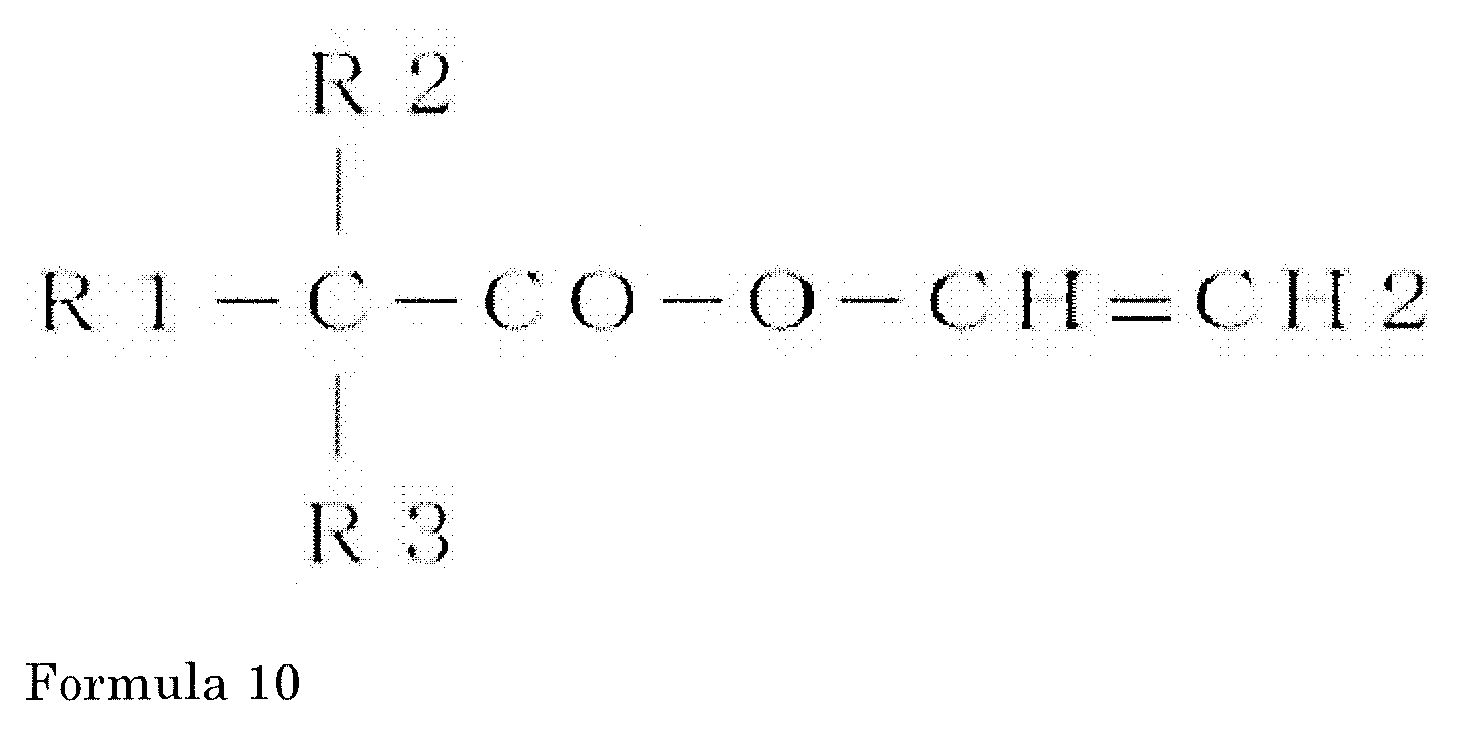
- If the mass ratio of the tertiary vinyl carboxylate to the total mass of the monomer is excessively small, the advantageous effect provided by the tertiary vinyl carboxylate cannot be obtained sufficiently. If, on the other hand, the mass ratio of the tertiary vinyl carboxylate is excessively large, a high-quality polymer network cannot be formed, resulting in deteriorated performance for holding the non-aqueous electrolytic solution. In view of this, the mass ratio of the tertiary vinyl carboxylate to the total mass of the monomer is preferably from 10 to 50 %.
- In the first or second aspect of the present invention, the non-aqueous solvent may contain propylene carbonate, and the polymer electrolyte may further contain succinic anhydride.
- In view of improving the discharge characteristic, the non-aqueous solvent preferably contains propylene carbonate (PC). However, propylene carbonate has the disadvantage of reacting with the negative electrode and thus being decomposed. Succinic anhydride functions to inhibit the decomposition of the propylene carbonate at the negative electrode. When, therefore, propylene carbonate is contained in the non-aqueous solvent, succinic anhydride is preferably contained, too. More preferably, the content of the succinic anhydride is from 0.01 to 10.00 mass %, further more preferably from 0.05 to 5.00 mass %.
- In the first or second aspect of the present invention, the polymer may be formed by inner cell polymerization.
- The inner cell polymerization facilitates fabrication of the polymer electrolyte.
- In the first or second aspect of the present invention, the cell case may be made of an aluminum laminate film.
- Use of a cell case made of an aluminum laminate film makes the cell thinner and smaller.
- According to the first aspect of the present invention, a polymer electrolyte secondary cell that eliminates the possibility of solution leakage and has a superior discharge characteristic is realized. According to the second aspect of the present invention, a polymer electrolyte secondary cell that eliminates the possibility of solution leakage and has a superior discharge characteristic and enhanced security during overcharge is realized.
-
- Fig. 1 is a frontal perspective view of a cell with a film cell case according to the present invention.
- Fig. 2 is a sectional view of the cell taken along the line A-A shown in Fig. 1.
- Fig. 3 is a perspective view of a flat electrode assembly used in the present invention.
-
- 1
- electrode assembly
- 2
- storage space
- 3
- film cell case
- 4 a, 4b ,4c
- sealed portions
- 5
- positive electrode tab film
- 6
- negative electrode tab film
- 7
- positive electrode lead
- 8
- negative electrode lead
- 9
- positive electrode
- 10
- negative electrode
- 11
- separator
- The first aspect of the present invention will be described in detail with reference to the drawings.
- Fig. 1 is a frontal perspective view of a cell with a film outer casing according to this embodiment the present invention. Fig. 2 is a sectional view of the cell taken along the line A-A shown in Fig. 1. Fig. 3 is a perspective view of a flat electrode assembly used in the polymer electrolyte cell of the present invention.
- Referring to Fig. 2, the polymer electrolyte cell according to the present invention has an
electrode assembly 1, which is disposed in a storage space 2. Referring to Fig. 1, the storage space 2 is formed by sealing the upper edge, lower edge, and middle portion of the laminateouter casing 3 respectively at sealedportions electrode assembly 1 has apositive electrode 9, anegative electrode 10, and aseparator 11 separating the electrodes from one another, which are wound into a flat form. - The
positive electrode 9 and thenegative electrode 10 are respectively connected to a positive electrode lead made of aluminum and anegative electrode lead 8 made of copper, so that chemical energy generated inside the cell is extracted outside as electrical energy. The electrode leads are respectively attached withtab films 5 and 6. - The
laminate cell case 3 is of a structure with a lamination of a nylon layer, an aluminum film, and a non-extended polypropylene layer. - It is noted that in the present invention the cell is not limited to the above one using an aluminum laminate material.
- The polymer electrolyte has, as its polymer matrix, a copolymer of N,N-dimethyl acrylamide and a compound with three or more acrylate groups and/or methacrylate groups. The polymer matrix holds therein, in the form of a gel, a non-aqueous solvent containing ethylene carbonate and propylene carbonate at a volume ratio (25°C, 1 atm) of equal to or more than 60%, and an electrolytic salt dissolved in the non-aqueous solvent.
- Ninety-two mass parts of a positive electrode active material made of a lithium cobalt oxide (LiCoO2), 5 mass parts of a conducting agent made of acetylene black, 3 mass parts of a binding agent made of polyvinylidene fluoride (PVDF), and N-Methyl-2-Pyrrolidone (NMP) were mixed together, thus preparing a positive electrode active material slurry.
- Next, the positive electrode active material slurry was applied to both surfaces of a positive electrode core made of an aluminum foil of 20 µm thick with a doctor blade so that the thickness would be uniform. Then, this electrode plate was passed through a heated drier to be dried, thereby removing the non-aqueous solvent that was used during slurry preparation. After dried, the electrode plate was extended in a roll presser to a thickness of 0.17 mm, thus obtaining the
positive electrode 9. - Ninety-five mass parts of a negative electrode active material made of graphite, 3 mass parts of a thickener made of carboxymethyl cellulose (CMC), 2 mass parts of a binding agent made of styrene-butadiene rubber (SBR), and water were mixed together, thus preparing a negative electrode active material slurry. The negative electrode active material slurry was applied to both surfaces of a negative electrode core made of a copper foil (20 µm thick) with a doctor blade so that the thickness would be uniform. Then, this electrode plate was passed through a drier to remove the moisture that was used during the slurry preparation. After dried, the electrode plate was extended in a roll presser to a thickness of 0.14 mm, thus obtaining the
negative electrode 10. - In a mixture solvent of ethylene carbonate (EC), propylene carbonate (PC), diethyl carbonate (DEC), and ethyl methyl carbonate (EMC), LiPF6 as the electrolyte salt was dissolved at a rate of 1.1 (mol/liter), thus obtaining an electrolytic solution. To this electrolytic solution, 0.5 mass parts of succinic anhydride was added. To this mixture solution were added: trimethylolpropane triacrylate (TMPTA) represented by
Formula 11; tetramethylolmethane tetraacrylate (TMMTA) represented by Formula 12; N,N-dimethyl acrylamide (DMAA) represented by Formula 13; methoxytriethyleneglycol acrylate (METGA) represented by Formula 14; and 3000 ppm of tert-butyl peroxypivalate as a polymerization initiator. Thus a prepolymer electrolyte was obtained.

CH2=CH-CO-N(CH3)2 Formula 13
CH2=CH-CO-(O-CH2-CH2)3-O-CH3 Formula 14
- To the positive and negative electrodes thus prepared, the positive and
negative leads flat electrode assembly 1. - A laminate film was molded into a cup form (concave form) to form the storage space 2, into which the
flat electrode assembly 1 was inserted. Then the film was folded to form the bottom. Both side edges of the film, which communicated with the bottom, were heat-fused by a rectangular box-type mold at 200°C for 3.0 seconds to form the side sealedportions - The present invention will be described in further detail with reference to examples.
- Cells according to examples 1 to 46 and comparative examples 1 to 166 were prepared in the same manner as in the
embodiment 1. Tables 1 to 15 below list, for each of the examples, the kind of the non-aqueous solvent and its volume ratio (25°C, 1 atm), the mass ratio of the monomer (which is defined as the mass ratio of the monomer to the monomer, solvent, electrolytic salt, and succinic anhydride, which are assumed to be 100 mass parts, which ratio is taken as the polymer mass ratio), and the mass percentage of the succinic anhydride (which is defined as the mass ratio of the succinic anhydride to the monomer, solvent, electrolytic salt, and succinic anhydride, which are assumed to be 100 mass parts). - In a 200 ml plastic container, 100 ml of the prepolymer electrolyte was placed to allow it to polymerize. After polymerization, the plastic container was tilted by 90 degrees. The case where the solution surface collapsed was estimated as NG, while the case of no collapse was estimated as OK. The results are shown in Tables 1 to 15.
- The theoretical capacity of the cells according to the examples and comparative examples is 800 mAh. Ten cells from each of the examples and comparative examples were prepared and subjected to this test.
- Charging Conditions: Each cell was charged at a constant current of 1 It (800 mA) to a voltage of 4.2 V, and then at a constant voltage of 4.2 V to 40 mA.
- Discharging Conditions: Each cell was discharged at a constant current of 1 It (800 mA) to a voltage of 2.75 V
- Estimation: The case where the discharge capacity was less than 95% of the theoretical capacity was estimated as NG, while the case of equal to or more than 95% of the theoretical capacity was estimated as OK. The number of NGs in the ten samples is listed in Tables 1 to 15.
[Table 1] Monomer mass % Monomer (mass%) Solvent (volume%) Succinic anhydride (mass%) Curability Capacity TMP TA TMM TA DM AA MTE GA EC PC DEC Com. Ex. 1 0.8 20 - 80 - 50 50 - 0.5 NG 0 Com. Ex. 2 0,8 20 - 80 - 30 30 40 0.5 NG 0 Com. Ex. 3 0,8 20 - 80 - 25 25 50 0.5 NG 0 Ex. 1 1.0 20 - 80 - 50 50 - 0.5 OK 0 Ex. 2 1.0 20 - 80 - 30 30 40 0.5 OK 0 Com. Ex. 4 1,0 20 - 80 - 25 25 50 0.5 NG 0 Ex. 3 2.0 20 - 80 - 50 50 - 0.5 OK 0 Ex. 4 2.0 20 - 80 - 30 30 40 0.5 OK 0 Com. Ex. 5 2,0 20 - 80 - 25 25 50 0.5 NG 0 Com. Ex.6 3.0 20 - 80 - 50 50 - 0.5 OK 2 Com. Ex. 7 3.0 20 - 80 - 30 30 40 0.5 OK 2 Com. Ex. 8 3.0 20 - 80 - 25 25 50 0.5 NG 2 [Table 2] Monomer mass % Monomer (mass%) Solvent (volume%) Succinic anhydride (mass%) Curability Capacity TMP TA TMM TA DM AA MTE GA EC PC DEC Com. Ex. 9 0.8 10 - 90 - 50 50 - 0.5 NG 0 Com. Ex.10 0.8 10 - 90 - 30 30 40 0.5 NG 0 Com. Ex.11 0.8 10 - 90 - 25 25 50 0.5 NG 0 Ex. 5 1.0 10 - 90 - 50 50 - 0.5 OK 0 Ex. 6 1.0 10 - 90 - 30 30 40 0.5 OK 0 Com. Ex.12 1.0 10 - 90 - 25 25 50 0.5 NG 0 Ex. 7 2.0 10 - 90 - 50 50 - 0.5 OK 0 Ex. 8 2.0 10 - 90 - 30 30 40 0.5 OK 0 Com. Ex.13 2.0 10 - 90 - 25 25 50 0.5 NG 0 Com. Ex.14 3.0 10 - 90 - 50 50 - 0.5 OK 2 Com. Ex.15 3.0 10 - 90 - 30 30 40 0.5 OK 2 Com. Ex.16 3.0 10 - 90 - 25 25 50 0.5 NG 2 [Table 3] Monomer mass % Monomer (mass%) Solvent (volume%) Succinic anhydride (mass%) Curability Capacity TMP TA TMM TA DM AA MTE CA EC PC DEC Com. Ex.17 0.8 30 - 70 - 50 50 - 0.5 NG 0 Com. Ex.18 0.8 30 - 70 - 30 30 40 0.5 NG 0 Com. Ex.19 0.8 30 - 70 - 25 25 50 0.5 NG 0 Ex.9 1.0 30 - 70 - 50 50 - 0.5 OK 0 Ex.10 1.0 30 - 70 - 30 30 40 0.5 OK 0 Com. Ex.20 1.0 30 - 70 - 25 25 50 0.5 NG 0 Ex.11 2.0 30 - 70 - 50 50 - 0.5 OK 0 Ex.12 2.0 30 - 70 - 30 30 40 0.5 OK 0 Com. Ex.21 2.0 30 - 70 - 25 25 50 0.5 NG 0 Com. Ex.22 3.0 30 - 70 - 50 50 - 0.5 OK 2 Com. Ex.23 3.0 30 - 70 - 30 30 40 0.5 OK 2 Com. Ex.24 3.0 30 - 70 - 25 25 50 0.5 NG 2 [Table 4] Monomer mass % Monomer (mass%) Solvent (volume%) Succinie anhydride (mass%) Curability Capacity TMP TA TMM TA DM AA MTE GA EC PC DEC Com. Ex.25 0.8 40 - 60 - 50 50 - 0.5 NG 0 Com. Ex.26 0.8 40 - 60 - 30 30 40 0.5 NG 0 Com. Ex.27 0.8 40 - 60 - 25 25 50 0.5 NG 0 Com. Ex.28 1.0 40 - 60 - 50 50 - 0.5 NG 0 Com. Ex.29 1.0 40 - 60 - 30 30 40 0.5 NG 0 Com. Ex.30 1.0 40 - 60 - 25 25 50 0.5 NG 0 Com. Ex.31 2.0 40 - 60 - 50 50 - 0.5 NG 0 Com. Ex.32 2.0 40 - 60 - 30 30 40 0.5 NG 0 Com. Ex.33 2.0 40 - 60 - 25 25 50 0.5 NG 0 Com. Ex.34 3.0 40 - 60 - 50 50 - 0.5 NG 3 Com. Ex.35 3.0 40 - 60 - 30 30 40 0.5 NG 2 Com. Ex.36 3.0 40 - 60 - 25 25 50 0.5 NG 2 [Table 5] Monomer mass % Monomer (mass%) Solvent (volume%) Succinic anhydride (mass%) Curability Capacity TMP TA TMM TA DM AA MTE GA EC PC DEC Com. Ex.37 0.8 - - 100 - 50 50 - 0.5 NG 0 Com. Ex.38 0.8 - - 100 - 30 30 40 0.5 NG 0 Com. Ex.39 0.8 - - 100 - 25 25 50 0.5 NG 0 Com. Ex.40 1.0 - - 100 - 50 50 - 0.5 NG 0 Com. Ex.41 1.0 - - 100 - 30 30 40 0.5 NG 0 Com. Ex.42 1.0 - - 100 - 25 25 50 0.5 NG 0 Com. Ex.43 2.0 - - 100 - 50 50 - 0.5 NG 0 Com. Ex.44 2.0 - - 100 - 30 30 40 0.5 NG 0 Com. Ex.45 2.0 - - 100 - 25 25 50 0.5 NG 0 Com. Ex.46 3.0 - - 100 - 50 50 - 0.5 OK 3 Com. Ex.47 3.0 - - 100 - 30 30 40 0.5 OK 3 Com. Ex.48 3.0 - - 100 - 25 25 50 0.5 NG 2 [Table 6] Monomer mass % Monomer (mass%) Solvent (volume%) Succinic anhydride (mass%) Curability Capacity TMP TA TMM TA DM AA MTE GA EC PC DEC Com. Ex.49 0.8 - 20 80 - 50 50 - 0.5 NG 0 Com. Ex.50 0.8 - 20 80 - 30 30 40 0.5 NG 0 Com. Ex.51 0.8 - 20 80 - 25 25 50 0.5 NG 0 Ex.13 1.0 - 20 80 - 50 50 - 0.5 OK 0 Ex.14 1.0 - 20 80 - 30 30 40 0.5 OK 0 Com. Ex.52 1.0 - 20 80 - 25 25 50 0.5 NG 0 Ex.15 2.0 - 20 80 - 50 50 - 0.5 OK 0 Ex.16 2.0 - 20 80 - 30 30 40 0.5 OK 0 Com. Ex.53 2.0 - 20 80 - 25 25 50 0.5 NG 0 Com. Ex.54 3.0 - 20 80 - 50 50 - 0.5 OK 3 Com. Ex.55 3.0 - 20 80 - 30 30 40 0.5 OK 3 Com. Ex.56 3.0 - 20 80 - 25 25 50 0.5 NG 2 [Table 7] Monomer mass % Monomer (mass%) Solvent (volume%) Succinic anhydride (mass%) Curability Capacity TMP TA TMM TA DM AA MTE GA EC PC DEC Com. Ex.57 0.8 - 10 90 - 50 50 - 0.5 NG 0 Com. Ex.58 0.8 - 10 90 - 30 30 40 0.5 NG 0 Com. Ex.59 0.8 - 10 90 - 25 25 50 0.5 NG 0 Ex.17 1.0 - 10 90 - 50 50 - 0.5 OK 0 Ex.18 1.0 - 10 90 - 30 30 40 0.5 OK 0 Com. Ex.60 1.0 - 10 90 - 25 25 50 0.5 NG 0 Ex.19 2.0 - 10 90 - 50 50 - 0.5 OK 0 Ex.20 2.0 - 10 90 - 30 30 40 0.5 OK 0 Com. Ex.61 2.0 - 10 90 - 25 25 50 0.5 NG 0 Com. Ex.62 3.0 - 10 90 - 50 50 - 0.5 OK 3 Com. Ex.63 3.0 - 10 90 - 30 30 40 0.5 OK 2 Com. Ex.64 3.0 - 10 90 - 25 25 50 0.5 NG 2 [Table 8] Monomer mass % Monomer (mass%) Solvent (volume%) Succinic anhydride (mass%) Curability Capacity TMP TA TMM TA DM AA MTE GA EC PC DEC Com. Ex.65 0.8 - 30 70 - 50 50 - 0.5 NG 0 Com. Ex.66 0.8 - 30 70 - 30 30 40 0.5 NG 0 Com. Ex.67 0.8 - 30 70 - 25 25 50 0.5 NG 0 Ex.21 1.0 - 30 70 - 50 50 - 0.5 OK 0 Ex.22 1.0 - 30 70 - 30 30 40 0.5 OK 0 Com. Ex.68 1.0 - 30 70 - 25 25 50 0.5 NG 0 Ex.23 2.0 - 30 70 - 50 50 - 0.5 OK 0 Ex.24 2.0 - 30 70 - 30 30 40 0.5 OK 0 Com. Ex.69 2.0 - 30 70 - 25 25 50 0.5 NG 0 Com. Ex.70 3.0 - 30 70 - 50 50 - 0.5 OK 2 Com. Ex.71 3.0 - 30 70 - 30 30 40 0.5 OK 2 Com. Ex.72 3.0 - 30 70 - 25 25 50 0.5 NG 2 [Table 9] Monomer mass % Monomer (mass%) Solvent (volume%) Succinic anhydride (mass%) Curability Capacity TMP TA TMM TA DM AA MTE GA EC PC DEC Com. Ex.73 0.8 - 40 60 - 50 50 - 0.5 NG 0 Com. Ex.74 0.8 - 40 60 - 30 30 40 0.5 NG 0 Com. Ex.75 0.8 - 40 60 - 25 25 50 0.5 NG 0 Com. Ex.76 1.0 - 40 60 - 50 50 - 0.5 NG 0 Com. Ex.77 1.0 - 40 60 - 30 30 40 0.5 NG 0 Com. Ex.78 1.0 - 40 60 - 25 25 50 0.5 NG 0 Com. Ex.79 2.0 - 40 60 - 50 50 - 0.5 NG 0 Com. Ex.80 2.0 - 40 60 - 30 30 40 0.5 NG 0 Com. Ex.81 2.0 - 40 60 - 25 25 50 0.5 NG 0 Com. Ex.82 3.0 - 40 60 - 50 50 - 0.5 NG 3 Cam. Ex.83 3.0 - 40 60 - 30 30 40 0.5 NG 2 Com. Ex.84 3.0 - 40 60 - 25 25 50 0.5 NG 2 [Table 10] Monomer mass % Monomer (mass%) Solvent (volume%) Succinic anhydride (mass%) Curability Capacity TMP TA TMM TA DM AA MTE GA EC PC DEC Com. Ex.85 3.0 40 - - 60 50 50 - 0.5 NG 4 Com. Ex.86 3.0 40 - - 60 30 30 40 0.5 NG 3 Com. Ex.87 3.0 40 - - 60 25 25 50 0.5 NG 3 Com. Ex.88 3.0 40 - - 60 10 10 80 0.5 NG 3 Com. Ex.89 3.0 30 - - 70 50 50 - 0.5 NG 4 Com. Ex.90 3.0 30 - - 70 30 30 40 0.5 NG 3 Com. Ex.91 3.0 30 - - 70 25 25 50 0.5 NG 3 Com. Ex.92 3.0 30 - - 70 10 10 80 0.5 NG 3 Com. Ex.93 3.0 20 - - 80 50 50 - 0.5 NG 3 Com. Ex.94 3.0 20 - - 80 30 30 40 0.5 NG 2 Com. Ex.95 3.0 20 - - 80 25 25 50 0.5 NG 2 Com. Ex.96 3.0 20 - - 80 10 10 80 0.5 NG 2 Com. Ex.97 3.0 10 - - 90 50 50 - 0.5 NG 4 Com. Ex.98 3.0 10 - - 90 30 30 40 0.5 NG 4 Com. Ex.99 3.0 10 - - 90 25 25 50 0.5 NG 3 Com. Ex. 100 3.0 10 - - 90 10 10 80 0.5 NG 3 Com. Ex. 101 3.0 - - - 100 50 50 - 0.5 NG 3 Com. Ex. 102 3.0 - - - 100 30 30 40 0.5 NG 3 Com. Ex. 103 3.0 - - - 100 25 25 50 0.5 NG 3 Com. Ex. 104 3.0 - - - 100 10 10 80 0.5 NG 3 [Table 11] Monomer mass % Monomer (mass%) Solvent (volume%) Succinic anhydride (mass%) Curability Capacity TMP TA TMM TA DM AA MTE GA EC PC DEC Com. Ex. 105 3.0 - 40 - 60 50 50 - 0.5 NG 3 Com. Ex. 106 3.0 - 40 - 60 30 30 40 0.5 NG 2 Com. Ex. 107 3.0 - 40 - 60 25 25 50 0.5 NG 2 Com. Ex. 108 3.0 - 40 - 60 10 10 80 0.5 NG 2 Com. Ex. 109 3.0 - 30 - 70 50 50 - 0.5 NG 3 Com. Ex. 110 3.0 - 30 - 70 30 30 40 0.5 NG 3 Com. Ex. 111 3.0 - 30 - 70 25 25 50 0.5 NG 3 Com. Ex. 112 3.0 - 30 - 70 10 10 80 0.5 NG 3 Com. Ex. 113 3.0 - 20 - 80 50 50 - 0.5 NG 4 Com. Ex. 114 3.0 - 20 - 80 30 30 40 0.5 NG 3 Com. Ex. 115 3.0 - 20 - 80 25 25 50 0.5 NG 2 Com. Ex. 116 3.0 - 20 - 80 10 10 80 0.5 NG 2 Com. Ex. 117 3.0 - 10 - 90 50 50 - 0.5 NG 3 Com. Ex. 118 3.0 - 10 - 90 30 30 40 0.5 NG 3 Com. Ex. 119 3.0 - 10 - 90 25 25 50 0.5 NG 3 Com. Ex. 120 3.0 - 10 - 90 10 10 80 0.5 NG 3 [Table 12] Monomer mass % Monomer (mass%) Solvent (volume%) Succinic anhydride (mass%) Curability Capacity TMP TA TMM TA DM AA MTE GA EC PC DEC Com. Ex.121 4.0 40 - - 60 50 50 - 0.5 NG 6 Com. Ex.122 4.0 40 - - 60 30 30 40 0.5 NG 5 Com. Ex.123 4.0 40 - - 60 25 25 50 0.5 NG 5 Com. Ex.124 4.0 40 - - 60 10 10 80 0.5 NG 5 Com. Ex.125 4.0 30 - - 70 50 50 - 0.5 NG 6 Com. Ex.126 4.0 30 - - 70 30 30 40 0.5 NG 5 Com. Ex.127 4.0 30 - - 70 25 25 50 0.5 NG 5 Com. Ex.128 4.0 30 - - 70 10 10 80 0.5 NG 5 Com. Ex.129 4.0 20 - - 80 50 50 - 0.5 NG 6 Com. Ex.130 4.0 20 - - 80 30 30 40 0.5 NG 5 Com. Ex.131 4.0 20 - - 80 25 25 50 0.5 NG 6 Com. Ex.132 4.0 20 - - 80 10 10 80 0.5 NG 5 Com. Ex.133 4.0 10 - - 90 50 50 - 0.5 NG 5 Com. Ex.134 4.0 10 - - 90 30 30 40 0.5 NG 5 Com. Ex.135 4.0 10 - - 90 25 25 50 0.5 NG 5 Com. Ex.136 4.0 10 - - 90 10 10 80 0.5 NG 5 Com. Ex.137 4.0 - - - 100 50 50 - 0.5 NG 7 Com. Ex.138 4.0 - - - 100 30 30 40 0.5 NG 6 Com. Ex.139 4.0 - - - 100 25 25 50 0.5 NG 6 Com. Ex.140 4.0 - - - 100 10 10 80 0.5 NG 5 [Table 13] Monomer mass % Monomer (mass%) Solvent (volume%) Succinic anhydride (mass%) Curability Capacity TMP TA TMM TA DM AA MTE GA EC PC DEC Com. Ex.141 4.0 - 40 - 60 50 50 - 0.5 NG 7 Com. Ex.142 4.0 - 40 - 60 30 30 40 0.5 NG 6 Com. Ex.143 4.0 - 40 - 60 25 25 50 0.5 NG 6 Com. Ex.144 4.0 - 40 - 60 10 10 80 0.5 NG 5 Com. Ex.145 4.0 - 30 - 70 50 50 - 0.5 NG 7 Com. Ex.146 4.0 - 30 - 70 30 30 40 0.5 NG 5 Com. Ex.147 4.0 - 30 - 70 25 25 50 0.5 NG 5 Com. Ex.148 4.0 - 30 - 70 10 10 80 0.5 NG 5 Com. Ex.149 4.0 - 20 - 80 50 50 - 0.5 NG 7 Com. Ex.150 4.0 - 20 - 80 30 30 40 0.5 NG 5 Com. Ex.151 4.0 - 20 - 80 25 25 50 0.5 NG 5 Com. Ex.152 4.0 - 20 - 80 10 10 80 0.5 NG 5 Com. Ex.153 4.0 - 10 - 90 50 50 - 0.5 NG 7 Com. Ex.154 4.0 - 10 - 90 30 30 40 0.5 NG 5 Com. Ex.155 4.0 - 10 - 90 25 25 50 0.5 NG 5 Com. Ex.156 4.0 - 10 - 90 10 10 80 0.5 NG 5 [Table 14] Monomer mass % Monomer (mass%) Solvent (volume%) Succinic anhydride (mass%) Curability Capacity TMMTA DMAA EC PC DEC EMC DMC Ex.25 1.0 20 80 30 30 - 40 - 0.5 OK 0 Ex.26 1.0 20 80 30 30 - - 40 0.5 OK 0 Ex.27 1.0 20 80 45 15 40 - - 0.5 OK 0 Ex.28 1.0 20 80 45 15 - 40 - 0.5 OK 0 Ex.29 1.0 20 80 45 15 - - 40 0.5 OK 0 Ex.30 1.0 20 80 60 - 40 - - 0.5 OK 0 Ex.31 1.0 20 80 60 - 40 - - - OK 0 Ex.32 1.0 20 80 60 - - 40 - 0.5 OK 0 Ex.33 1.0 20 80 60 - - 40 - - OK 0 Ex.34 1.0 20 80 60 - - - 40 0.5 OK 0 Ex.35 1.0 20 80 60 - - - 40 - OK 0 Com. Ex.157 1.0 20 80 25 25 - 50 - 0.5 NG 0 Com. Ex.158 1.0 20 80 25 25 - - 50 0.5 NG 0 Com. Ex.159 1.0 20 80 50 - 50 - - 0.5 NG 0 Com. Ex.160 1.0 20 80 50 - - 50 - 0.5 NG 0 Com. Ex.161 1.0 20 80 50 - - - 50 0.5 NG 0 [Table 15] Monomer mass % Monomer (mass%) Solvent (volume%) Succinic anhydride (mass%) Curability Capacity TMMTA DMAA EC PC DEC EMC DMC Ex.36 2.0 20 80 30 30 - 40 - 0.5 OK 0 Ex.37 2.0 20 80 30 30 - - 40 0.5 OK 0 Ex.38 2.0 20 80 45 15 40 - - 0.5 OK 0 Ex.39 2.0 20 80 45 15 - 40 - 0.5 OK 0 Ex.40 2.0 20 80 45 15 - - 40 0.5 OK 0 Ex.41 2.0 20 80 60 - 40 - - 0.5 OK 0 Ex.42 2.0 20 80 60 - 40 - - - OK 0 Ex.43 2.0 20 80 60 - - 40 - 0.5 OK 0 Ex.44 2.0 20 80 60 - - 40 - - OK 0 Ex.45 2.0 20 80 60 - - - 40 0.5 OK 0 Ex.46 2.0 20 80 60 - - - 40 - OK 0 Com. Ex.162 2.0 20 80 25 25 - 50 - 0.5 NG 0 Com. Ex.163 2.0 20 80 25 25 - - 50 0.5 NG 0 Com. Ex.164 2.0 20 80 50 - 50 - - 0.5 NG 0 Com. Ex.165 2.0 20 80 50 - - 50 - 0.5 NG 0 Com. Ex.166 2.0 20 80 50 - - - 50 0.5 NG 0 - Table 1 shows that in examples 1 to 4, where the monomer was from 1.0 to 2.0 mass % and the combined volume ratio (25°C, 1 atm) of the ethylene carbonate (EC) and propylene carbonate (PC) was from 60 to 100 %, the polymer was cured sufficiently and a preferable discharge characteristic was obtained. Contrarily, in comparative examples 1 to 3, where the monomer was 0.8 mass %, and in comparative examples 4 and 5, where the combined volume ratio (25°C, 1 atm) of EC and PC was 50 %, the discharge characteristic was preferable but the polymer was not cured sufficiently. In comparative examples 6 to 8, where the monomer was 3.0 mass %, the polymer was cured sufficiently but the discharge characteristic was not sufficient.
- Here is a possible explanation for the results. In examples 1 to 4, the solvent held by the formed polymer has a high volume ratio for the highly viscous ethylene carbonate (EC) and propylene carbonate (PC), and contains a sufficient amount of the polymer for curing the polymer. This realized the above preferable performance. If the amount of the polymer is excessively small or the viscosity of the solvent is small, the polymer is not cured sufficiently. If the amount of the polymer is excessively large, the formed cross-linked polymer undermines ion conductivity for the lithium ions, thereby adversely affecting the discharge characteristic.
- Tables 1 to 5 show that when the trimethylolpropane triacrylate (TMPTA, a compound with three acrylates) constitute from 10 to 30 mass % of the total monomer while meeting the preferable conditions, then the polymer is cured sufficiently and a preferable discharge characteristic is obtained. When the trimethylolpropane triacrylate (TMPTA) is 0 mass %, the curability is insufficient, while when the trimethylolpropane triacrylate (TMPTA) is 40 mass % the curability is insufficient in some cases and the discharge characteristic is poor in other cases.
- While what caused the results is not definitely understood, a possible explanation is such that a preferable polymer network is formed when the trimethylolpropane triacrylate (TMPTA) is from 10 to 30 mass % and the N,N-dimethyl acrylamide (DMAA) is from 70 to 90 mass %.
- Tables 1 to 9 show that similar advantageous effects are obtained when tetramethylolmethane tetraacrylate (TMMTA, a compound with four acrylates) is used instead of the trimethylolpropane triacrylate (TMPTA).
- Tables 10 to 13 show that when methoxytriethyleneglycol acrylate (METGA, a compound with one acrylate) is used instead of the N,N-dimethyl acrylamide (DMAA), the polymer is not cured sufficiently in the case of the monomer at 3.0 mass % but cured in the case of 4.0 mass %, though with a poor discharge characteristic in either case. A possible explanation is such that because the N,N-dimethyl acrylamide (DMAA) is not used, a preferable polymer network is not formed, and that because the amount of the monomer is excessively large, the cross-linked hinders conductivity for the lithium ions, thereby adversely affecting the discharge characteristic.
- Tables 14 and 15 show that when ethyl methyl carbonate (EMC) or dimethyl carbonate (DMC) is used instead of diethyl carbonate (DEC), preferable performance is obtained insofar as the combined volume ratio (25°C, 1 atm) of the ethylene carbonate (EC) and propylene carbonate (PC) is equal to or more than 60 mass %.
- Examples 30 to 35 and 41 to 46 show that addition of the succinic anhydride does not adversely affect the cells. Since the succinic anhydride has the effect of inhibiting the decomposition of the propylene carbonate (PC) at the negative electrode, the succinic anhydride is preferably contained in the non-aqueous solvent when the propylene carbonate is contained.
- While a mixture of the N,N-dimethyl acrylamide (DMAA) and the methoxytriethyleneglycol acrylate (METGA) was not subjected to the test, the mixture will presumably not provide preferable properties, from comparative examples 37 to 48, where the N,N-dimethyl acrylamide (DMAA) was used alone, and comparative examples 101 to 104 and 137 to 140, where the methoxytriethyleneglycol acrylate (METGA) was used alone.
- Thus, the polymer preferably contains a mixture of N,N-dimethyl acrylamide and a compound with three or more acrylate groups and/or methacrylate groups at a mass ratio of from 90: 10 to 70: 30, the ratio of the polymer to the polymer electrolyte is preferably from 1.0 to 2.0 mass %, the non-aqueous solvent preferably contains at least one of ethylene carbonate (EC) and propylene carbonate (PC), and the volume ratio (25°C, 1 atm) of the ethylene carbonate and the propylene carbonate combined to the non-aqueous solvent is preferably equal to or more than 60%.
- An embodiment according to the second aspect of the present invention will be described below. This embodiment is the same as
embodiment 1 except that the polymer electrolyte contains tertiary vinyl carboxylate (e.g., vinyl pivalate). The method for preparation of this embodiment is as described inEmbodiment 1 except for that of the prepolymer electrolyte, and therefore description thereof will not be repeated herein. - In a mixture solvent of ethylene carbonate (EC), propylene carbonate (PC), diethyl carbonate (DEC), ethyl methyl carbonate (EMC), and dimethyl carbonate (DMC), LiPF6 as the electrolyte salt was dissolved at a rate of 1.1 (mol/liter), thus obtaining an electrolytic solution. To this electrolytic solution, 0.5 mass [parts] % of succinic anhydride was added.
- To this mixture solution were added: trimethylolpropane triacrylate (TMPTA) represented by Formula 15; tetramethylolmethane tetraacrylate (TMMTA) represented by Formula 16; N,N-dimethyl acrylamide (DMAA) represented by Formula 17; vinyl pivalate (compound A) represented by Formula 18; vinyl butyrate (compound X1) represented by Formula 19; vinyl propionate (compound X2) represented by Formula 20; vinyl acetate (compound X3) represented by Formula 21; and 3000 ppm of tert-butyl peroxypivalate as a polymerization initiator. Thus a prepolymer electrolyte was obtained.


CH2=CH-CO-N(CH3)2 Formula 17
C (CH3)3-CO-O-CH=CH2 Formula 18
CH(CH3)2-CO-CH=CH2 Formula 19
CH2(CH3)-CO-CH=CH2 Formula 20
CH3-CO-CH=CH2 Formula 21
- Cells according to examples 47 to 102 and comparative examples 167 to 170 were prepared in the same manner as in embodiment 2. Tables 16 to 23 below list, for each of the examples, the kind of the non-aqueous solvent and its volume ratio (25°C, 1 atm), the mass ratio of the monomer (which is defined as the mass ratio of the monomer to the monomer, solvent, electrolytic salt, and succinic anhydride, which are assumed to be 100 mass parts, which ratio is taken as the polymer mass ratio), and the mass percentage of the succinic anhydride (which is defined as the mass ratio of the succinic anhydride to the monomer, solvent, electrolytic salt, and succinic anhydride, which are assumed to be 100 mass parts).
- The cells according to examples 47 to 102 and comparative examples 167 to 170 were subjected to estimation of polymer curability and measurement of capacity, similarly to the first example group. The results are shown in Tables 16 to 23. In the capacity measurement, the case where any one of the ten cells was found to be NG was estimated as NG, while the case where no NG was found was estimated as OK.
- The cells according to examples 47 to 102 and comparative examples 167 to 170 were charged at a constant current of 3 It (2400 mA) to a voltage of 12 V. The case resulting in smoking or fire was estimated as NG, while the case where no smoking or fire was observed was estimated as OK.
[Table 16] Monomer mass % Monomer (mass%) Solvent (volume%) Succinic anhydride (mass%) Curability Capacity Overcharge characteristic TMPTA TMMTA DMAA Compound A EC PC DEC Com. Ex.167 0.8 30 - 60 10 50 50 - 0.5 NG OK OK Ex.47 1.0 30 - 60 10 50 50 - 0.5 OK OK OK Ex.48 1.0 30 - 60 10 50 50 - 0.5 OK OK OK Com. Ex.168 3.0 30 - 60 10 50 50 - 0.5 OK NG OK Com. Ex.169 2.0 - 5 85 10 50 50 - 0.5 NG OK OK Com. Ex.170 2.0 40 - 50 10 50 50 - 0.5 NG OK OK [Table 17] Monomer mass % Monomer (mass%) Solvent (volume%) Succinic anhydride (mass%) Curability Capacity Overcharge characteristic TMPTA TMMTA DMAA Compound A EC PC DEC Ex.49 1.0 30 - 70 - 50 50 - 0.5 OK OK NG Ex.50 1.0 30 - 60 10 50 50 - 0.5 OK OK OK Ex.51 1.0 30 - 70 - 30 30 40 0.5 OK OK NG Ex.52 1.0 30 - 60 10 30 30 40 0.5 OK OK OK Ex.53 1.0 30 - 20 50 30 30 40 0.5 OK OK OK Ex.54 1.0 30 - 10 60 30 30 40 0.5 NG OK OK Ex.55 1.0 - 30 60 - 50 50 - 0.5 OK OK NG Ex.56 1.0 - 30 60 10 50 50 - 0.5 OK OK OK Ex.57 1.0 - 30 70 - 30 30 40 0.5 OK OK NG Ex.58 1.0 - 30 60 10 30 30 40 0.5 OK OK OK Ex.59 1.0 - 30 20 50 30 30 40 0.5 OK OK OK Ex.60 1.0 - 30 10 60 30 30 40 0.5 NG OK OK [Table 18] Monomer mass % Monomer (mass%) Solvent (volume%) Succinic anhydride (mass%) Curability Capacity Overcharge characteristic TMPTA TMMTA DMAA Compound A EC PC DEC Ex.61 2.0 30 - 70 - 50 50 - 0.5 OK OK NG Ex.62 2.0 30 - 60 10 50 50 - 0.5 OK OK OK Ex.63 2.0 30 - 70 - 30 30 40 0.5 OK OK NG Ex.64 2.0 30 - 60 10 30 30 40 0.5 OK OK OK Ex.65 2.0 30 - 20 50 30 30 40 0.5 OK OK OK Ex.66 2.0 30 - 10 60 30 30 40 0.5 NG OK OK Ex.67 2.0 - 30 60 - 50 50 - 0.5 OK OK NG Ex.68 2.0 - 30 60 10 50 50 - 0.5 OK OK OK Ex.69 2.0 - 30 70 - 30 30 40 0.5 OK OK NG Ex.70 2.0 - 30 60 10 30 30 40 0.5 OK OK OK Ex.71 2.0 - 30 20 50 30 30 40 0.5 OK OK OK Ex.72 2.0 - 30 10 60 30 30 40 0.5 NG OK OK [Table 19] Monomer mass % Monomer (mass%) Solvent (volume%) Succinic anhydride (mass%) Curability Capacity Overcharge characteristic TMPTA TMMTA DMAA Compound A EC PC EMC Ex.73 2.0 - 30 70 - 30 30 40 0.5 OK OK NG Ex.74 2.0 - 30 60 10 30 30 40 0.5 OK OK OK Ex.75 2.0 - 30 20 50 30 30 40 0.5 OK OK OK Ex.76 2.0 - 30 10 60 30 30 40 0.5 NG OK OK [Table 20] Monomer mass % Monomer (mass%) Solvent (volume%) Succinic anhydride (mass%) Curability Capacity Overcharge characteristic TMPTA TMMTA DMAA Compound A EC PC DMC Ex.77 2.0 - 30 70 - 30 30 40 0.5 OK OK NG Ex.78 2.0 - 30 60 10 30 30 40 0.5 OK OK OK Ex.79 2.0 - 30 20 50 30 30 40 0.5 OK OK OK Ex.80 2.0 - 30 10 60 30 30 40 0.5 NG OK OK [Table 21] Monomer mass % Monomer (mass%) Solvent (volume%) Succinic anhydride (mass%) Curability Capacity Overcharge characteristic TMPTA TMMTA DMAA Compound A EC PC DMC Ex.81 2.0 - 30 70 - 40 - 60 0.5 OK OK NG Ex.82 2.0 - 30 60 10 40 - 60 0.5 OK OK OK Ex.83 2.0 - 30 20 50 40 - 60 0.5 OK OK OK Ex.84 2.0 - 30 10 60 40 - 60 0.5 NG OK OK [Table 22] Monomer mass % Monomer (mass%) Solvent (volume%) Succinic anhydride (mass%) Curability Capacity Overcharge characteristic TMP TA TMM TA DM AA Compound A EC PC DEC Ex.85 2.0 - 10 90 - 50 50 - 0.5 OK OK NG Ex.86 2.0 - 10 80 10 50 50 - 0.5 OK OK OK Ex.87 2.0 - 10 90 - 30 30 40 0.5 OK OK NG Ex.88 2.0 - 10 80 10 30 30 40 0.5 OK OK OK Ex.89 2.0 - 10 40 50 30 30 40 0.5 OK OK OK Ex.90 2.0 - 10 30 60 30 30 40 0.5 NG OK OK [Table 23] Monomer mass % Monomer (mass%) Solvent (volume%) Succinic anhydride (mass%) Curability Capacity Overcharge characteristic TMMTA DMAA Compound A Compound X1 Compound X2 Compound X3 EC PC DEC Ex.91 2.0 30 60 - 10 - - 50 50 - 0.5 OK OK NG Ex.92 2.0 30 60 - 10 - - 30 30 40 0.5 OK OK NG Ex.93 2.0 30 20 - , 50 - - 30 30 40 0.5 OK OK NG Ex.94 2.0 30 10 - 60 - - 30 30 40 0.5 NG OK NG Ex.95 2.0 30 60 - - 10 - 50 50 - 0.5 OK OK NG Ex.96 2.0 30 60 - - 10 - 30 30 40 0.5 OK OK NG Ex.97 2.0 30 20 - - 50 - 30 30 40 0.5 OK OK NG Ex.98 2.0 30 10 - - 60 - 30 30 40 0.5 NG OK NG Ex.99 2.0 30 60 - - - 10 50 50 - 0.5 OK OK NG Ex.100 2.0 30 60 - - - 10 30 30 40 0.5 OK OK NG Ex.101 2.0 30 20 - - - 50 30 30 40 0.5 OK OK NG Ex.102 2.0 30 10 - - - 60 30 30 40 0.5 NG OK NG - Table 16 shows that in the case of the monomer containing the vinyl pivalate (compound A), the cell of comparative example 167, which contains the monomer at 0.8 mass %, has a preferable discharge characteristic but with insufficient polymer curability, and comparative example 168, which contains the monomer at 3.0 mass %, has sufficient polymer curability but with an insufficient discharge characteristic. Contrarily, examples 47 and 48, which contain the monomer at from 1.0 to 2.0 mass %, have a sufficiently cured monomer and a preferable discharge characteristic at the same time.
- Table 16 also shows that when the trimethylolpropane triacrylate (TMPTA, a compound with three acrylates) constitutes less than 10 mass % or more than 30 mass % of the total monomer, the polymer is not cured sufficiently (see comparative examples 169 and 170).
- This is believed to be because of the same reason as the one provided for the first example group.
- Table 17 shows that examples 49, 51, 55, and 57, which contain no vinyl pivalate, have preferable polymer curability and discharge characteristic but with insufficient security during cell overcharge. Contrarily, examples 50, 52 to 54, 56, and 58 to 60, which contain the vinyl pivalate, excel in security during cell overcharge.
- A possible explanation is such that the vinyl pivalate reacts with the negative electrode to form a high-quality coating that inhibits the negative electrode from reacting with the polymer electrolyte, thereby enhancing security in case of cell overcharge.
- Table 17 also shows that examples 54 and 60, in which the vinyl pivalate constitutes 60 mass % of the total monomer, have a preferable discharge characteristic but with insufficient polymer curability.
- While what caused the result is not definitely understood, a possible explanation is such that if the amount of the vinyl pivalate is excessively large, a preferable polymer network cannot be formed.
- Table 18 shows that examples 61, 63, 67, and 69, which contain no vinyl pivalate, have preferable polymer curability and discharge characteristic but with insufficient security during cell overcharge. Contrarily, examples 62, 64 to 66, 68, and 70 to 72, which contain the vinyl pivalate, excel in polymer curability, discharge characteristic, and security during cell overcharge.
- This is believed to be because of the same reason as the one provided above.
- Table 18 also shows that examples 66 and 72, in which the vinyl pivalate constitutes 60 mass % of the total monomer, have a preferable discharge characteristic but with insufficient polymer curability.
- This is believed to be because of the same reason as the one provided above.
- Tables 18 to 20 show that the case of using, as solvent components in addition to the ethylene carbonate (EC) and propylene carbonate (PC), diethyl carbonate (DEC), ethyl methyl carbonate (EMC), or dimethyl carbonate (DMC) provides similar advantageous effects (see examples 69 to 80).
- Table 21 shows that the case of using a mixture solvent of the ethylene carbonate (EC) and diethyl carbonate (DEC) provides similar advantageous effects (see examples 81 to 84).
- Table 22 shows that in examples 85 and 87, where no vinyl pivalate is contained, security during cell overcharge is estimated as NG. Contrarily, examples 86 and 88 to 90, which contain the vinyl pivalate content at from 10 to 60 mass %, have preferable security during cell overcharge.
- This is believed to be because of the same reason as the one provided above.
- Table 22 also shows that examples 86, 88, and 89, which contain the vinyl pivalate at from 10 to 50 mass %, have preferable polymer curability. Contrarily, example 90, which contains the vinyl pivalate at 60 mass %, has poor polymer curability.
- A possible explanation is such that if the amount of the vinyl pivalate is excessively large, a preferable polymer network cannot be formed.
- Table 23 shows that in examples 91 to 102, which use secondary vinyl carboxylate (compounds X1 to X3) instead of the tertiary vinyl carboxylate, i.e., the vinyl pivalate, security during cell overcharge is estimated as NG.
- Here is a possible explanation. When the monomer contains the tertiary vinyl carboxylate, the tertiary vinyl carboxylate reacts with the negative electrode to form a preferable coating, thereby enhancing security during cell overcharge. Since the secondary vinyl carboxylate has no such advantageous effect, security during cell overcharge cannot be enhanced.
- To the mixture solvent of ethylene carbonate and propylene carbonate, a non-aqueous solvent of carbonate, lactone, ketone, ether, ester, or the like may be added. Specifically, in addition to the solvents used in the above examples, butylene carbonate, dimethyl carbonate, γ-butyrolactone, γ-valerolactone, γ-dimethoxyethane, tetrahydrofuran, 1,4-dioxane, and the like may be used. In view of improving the discharge characteristic, chain carbonate is preferred.
- As the electrolytic salt, instead of LiPF6, for example, LiBF4, LiCF3SO3, LiAsF6, LiN(CF3SO2)2, LiN(C2F5SO2)2, LiClO4, or the like may be used alone or in combination of equal to or more than two of the foregoing. The amount of the electrolytic salt dissolved in the non-aqueous solvent is preferably from 0.5 to 2.0 mol/liter.
- As the positive electrode active material, in place of the above-described lithium cobalt oxide (LixCoO2, 0<x≤1.1), lithium nickel oxide (LixNiO2, 0<x≤1.1), lithium manganese oxide (LixMnO2, 0<x≤1.1; LixMn2O4, 0<x≤1.1), or compound in which any of the foregoing transition metal elements is substituted with another element (e.g., LixCoyNi1-yO2, 0<x≤1.1; LixCoyNizMn1-y-zO2, 0<x≤1.1) may be used alone or in combination of two or more of the foregoing.
- As the negative electrode material, instead of graphite, a carbonaceous matter (e.g., acetylene black, carbon black, and non-crystalline carbon) capable of intercalating and disintercalating lithium ions, a silicon matter, metal lithium, lithium alloy, and a metal oxide capable of intercalating and disintercalating lithium ions may be used alone or in combination of two or more of the foregoing.
- As has been described hereinbefore, according to the present invention, a polymer electrolyte with superior performance for holding the electrolytic solution, conductivity, and security during cell overcharge is formed, thereby providing a safe polymer electrolyte secondary cell with high capacity and a superior cycle characteristic. Thus, industrial applicability is considerable.
Claims (10)
- A polymer electrolyte secondary cell comprising:a positive electrode;a negative electrode;a polymer electrolyte containing a non-aqueous solvent, a polymer, and a lithium salt; anda cell case for accommodating the positive electrode, the negative electrode, and the polymer electrolyte, wherein:the non-aqueous solvent contains at least one of ethylene carbonate and propylene carbonate, the volume ratio (25°C, 1 atm) of the ethylene carbonate and the propylene carbonate combined to the non-aqueous solvent being equal to or more than 60%;the polymer comprises a copolymer having a monomer containing N,N-dimethyl acrylamide and a compound with three or more acrylate groups and/or methacrylate groups, the ratio of the compound to the total mass of the monomer being from 10 to 30 mass %; andthe ratio of the polymer to the polymer electrolyte is from 1.0 to 2.0 mass %.
- The polymer electrolyte secondary cell according to claim 1, wherein:the non-aqueous solvent contains propylene carbonate; andthe polymer electrolyte further contains succinic anhydride.
- The polymer electrolyte secondary cell according to claim 1, wherein the polymer is formed by polymerization of the monomer in the cell.
- The polymer electrolyte secondary cell according to claim 1, wherein the cell case is made of an aluminum laminate film.
- The polymer electrolyte secondary cell according to claim 1, wherein the polymer comprises a copolymer having a monomer further containing tertiary vinyl carboxylate in addition to N,N-dimethyl acrylamide and a compound with three or more acrylate groups and/or methacrylate groups, the ratio of the compound to the total mass of the monomer being from 10 to 30 mass %.
- The polymer electrolyte secondary cell according to claim 5, wherein the tertiary vinyl carboxylate is vinyl pivalate.
- The polymer electrolyte secondary cell according to claim 5, wherein the mass ratio of the tertiary vinyl carboxylate to the total mass of the monomer is from 10 to 50 %.
- The polymer electrolyte secondary cell according to claim 5, wherein:the non-aqueous solvent contains propylene carbonate; andthe polymer electrolyte further contains succinic anhydride.
- The polymer electrolyte secondary cell according to claim 5, wherein the polymer is formed by polymerization of the monomer in the cell.
- The polymer electrolyte secondary cell according to claim 5, wherein the cell case is made of an aluminum laminate film.
Applications Claiming Priority (2)
| Application Number | Priority Date | Filing Date | Title |
|---|---|---|---|
| JP2006263727 | 2006-09-28 | ||
| JP2007170438 | 2007-06-28 |
Publications (3)
| Publication Number | Publication Date |
|---|---|
| EP1906482A2 true EP1906482A2 (en) | 2008-04-02 |
| EP1906482A3 EP1906482A3 (en) | 2008-04-30 |
| EP1906482B1 EP1906482B1 (en) | 2011-03-23 |
Family
ID=38819389
Family Applications (1)
| Application Number | Title | Priority Date | Filing Date |
|---|---|---|---|
| EP07117010A Not-in-force EP1906482B1 (en) | 2006-09-28 | 2007-09-24 | Polymer electrolyte secondary cell |
Country Status (7)
| Country | Link |
|---|---|
| US (1) | US8012630B2 (en) |
| EP (1) | EP1906482B1 (en) |
| JP (1) | JP5072505B2 (en) |
| KR (1) | KR20080029897A (en) |
| CN (1) | CN101154754B (en) |
| DE (1) | DE602007013333D1 (en) |
| TW (1) | TWI387144B (en) |
Families Citing this family (6)
| Publication number | Priority date | Publication date | Assignee | Title |
|---|---|---|---|---|
| JP5235404B2 (en) * | 2007-12-28 | 2013-07-10 | 三洋電機株式会社 | Polymer electrolyte secondary battery |
| KR101181837B1 (en) * | 2010-06-25 | 2012-09-11 | 삼성에스디아이 주식회사 | Gel electrolyte for lithium secondary battery including additives, and lithium secondary battery including the same |
| CN107221706B (en) * | 2017-05-23 | 2020-04-03 | 苏州大学 | Application of an electrolyte additive for silicon lithium ion battery |
| CN109599588A (en) * | 2017-10-02 | 2019-04-09 | 深圳格林德能源集团有限公司 | A kind of polymer Li-ion battery from inhibition core expansion |
| EP3654436B1 (en) * | 2017-11-28 | 2024-08-28 | LG Energy Solution, Ltd. | Composition for gel polymer electrolyte, and gel polymer electrolyte and lithium secondary battery including the same |
| CN114914533A (en) * | 2022-05-10 | 2022-08-16 | 广东聚圣科技有限公司 | Gel polymer composite electrolyte, secondary lithium battery and preparation method |
Family Cites Families (17)
| Publication number | Priority date | Publication date | Assignee | Title |
|---|---|---|---|---|
| KR100261252B1 (en) | 1996-07-30 | 2000-07-01 | 윤종용 | Polymer solid electrolyte and lithium secondary battery employing the same |
| KR100269204B1 (en) | 1997-04-10 | 2000-10-16 | 윤종용 | Polymer solid electolyte and lithium secondary cell adopting the same |
| JPH1196832A (en) * | 1997-09-19 | 1999-04-09 | Asahi Glass Co Ltd | Polymer electrolyte and lithium battery |
| JP2000011757A (en) * | 1998-06-24 | 2000-01-14 | Toyobo Co Ltd | Ion conductive gel and its manufacture |
| JP4158071B2 (en) * | 1999-05-20 | 2008-10-01 | 東洋紡績株式会社 | Polymer electrolyte gel composition |
| JP4691871B2 (en) * | 2000-08-11 | 2011-06-01 | 宇部興産株式会社 | Non-aqueous electrolyte and lithium secondary battery |
| EP1394886A1 (en) * | 2001-05-10 | 2004-03-03 | Nisshinbo Industries, Inc. | Polymer gel electrolyte-use composition and method of pouring non-aqueous electrolyte solution |
| WO2002101869A1 (en) * | 2001-06-07 | 2002-12-19 | Mitsubishi Chemical Corporation | Lithium secondary cell |
| JP4561013B2 (en) | 2001-08-13 | 2010-10-13 | 宇部興産株式会社 | Non-aqueous electrolyte and lithium secondary battery using the same |
| JP4150202B2 (en) | 2002-04-02 | 2008-09-17 | ソニー株式会社 | battery |
| JP3876989B2 (en) * | 2002-05-17 | 2007-02-07 | 三菱化学株式会社 | Method for producing surface-modified lithium-nickel composite oxide, positive electrode active material using surface-modified lithium-nickel composite oxide, positive electrode material, and lithium secondary battery |
| JP2004063385A (en) * | 2002-07-31 | 2004-02-26 | Nitto Denko Corp | Gel electrolyte and non-aqueous electrolyte battery using the same |
| JP2004342537A (en) * | 2003-05-19 | 2004-12-02 | Nitto Denko Corp | Gel electrolyte and non-aqueous electrolyte battery using the same |
| KR100529085B1 (en) * | 2003-09-24 | 2005-11-15 | 삼성에스디아이 주식회사 | Electrolyte for lithium secondary battery and lithium secondary battery fabricated using same |
| JP2005108515A (en) * | 2003-09-29 | 2005-04-21 | Sanyo Electric Co Ltd | Nonaqueous electrolyte battery |
| JP2006032301A (en) | 2004-07-21 | 2006-02-02 | Sony Corp | Electrolyte and battery |
| JP4651432B2 (en) | 2005-03-30 | 2011-03-16 | 日本碍子株式会社 | Lithium secondary battery |
-
2007
- 2007-07-16 TW TW096125806A patent/TWI387144B/en not_active IP Right Cessation
- 2007-09-20 JP JP2007244441A patent/JP5072505B2/en not_active Expired - Fee Related
- 2007-09-21 CN CN2007101527924A patent/CN101154754B/en not_active Expired - Fee Related
- 2007-09-24 EP EP07117010A patent/EP1906482B1/en not_active Not-in-force
- 2007-09-24 DE DE602007013333T patent/DE602007013333D1/en active Active
- 2007-09-26 US US11/861,480 patent/US8012630B2/en not_active Expired - Fee Related
- 2007-09-28 KR KR1020070098048A patent/KR20080029897A/en not_active Ceased
Non-Patent Citations (1)
| Title |
|---|
| None |
Also Published As
| Publication number | Publication date |
|---|---|
| CN101154754A (en) | 2008-04-02 |
| JP2009032635A (en) | 2009-02-12 |
| US8012630B2 (en) | 2011-09-06 |
| TWI387144B (en) | 2013-02-21 |
| DE602007013333D1 (en) | 2011-05-05 |
| CN101154754B (en) | 2011-10-26 |
| JP5072505B2 (en) | 2012-11-14 |
| TW200816540A (en) | 2008-04-01 |
| US20080081255A1 (en) | 2008-04-03 |
| EP1906482B1 (en) | 2011-03-23 |
| KR20080029897A (en) | 2008-04-03 |
| EP1906482A3 (en) | 2008-04-30 |
Similar Documents
| Publication | Publication Date | Title |
|---|---|---|
| CN1316670C (en) | Lithium polymer cell | |
| JP3982165B2 (en) | Solid electrolyte battery | |
| JP5394239B2 (en) | Gel polymer electrolyte and electrochemical device provided with the same | |
| US8097367B2 (en) | Non-aqueous electrolyte secondary cell containing 1,3-dioxane compound | |
| US20100304222A1 (en) | Electrolyte having eutectic mixture and nitrile compound, and electrochemical device containing the same | |
| EP3333960B1 (en) | Composition for gel polymer electrolyte, gel polymer electrolyte produced therefrom, and electrochemical element comprising same | |
| EP2262037A1 (en) | Lithium secondary battery using ionic liquid | |
| KR101992124B1 (en) | Non-aqueous electrolyte solution and lithium secondary battery comprising the same | |
| EP3745521B1 (en) | Stack-folding type electrode assembly and lithium metal battery comprising same | |
| US20070172741A1 (en) | Non-aqueous electrolyte secondary cell and method for producing same | |
| KR100573109B1 (en) | Organic electrolyte and lithium battery employing the same | |
| EP4369460A1 (en) | Method of preparing gel polymer electrolyte secondary battery and gel polymer electrolyte secondary battery prepared therefrom | |
| EP1906482B1 (en) | Polymer electrolyte secondary cell | |
| US8252465B2 (en) | Electrolyte for lithium secondary battery and lithium secondary battery comprising same | |
| KR20210034985A (en) | Method for manufacturing secondary battery | |
| KR20050031436A (en) | Nonaqueous electrolyte cell | |
| EP3758107A1 (en) | Method for manufacturing electrode comprising polymeric solid electrolyte, and electrode manufactured using same | |
| KR20170038736A (en) | Non-aqueous electrolyte solution and lithium secondary battery comprising the same | |
| JP5326923B2 (en) | Non-aqueous electrolyte secondary battery | |
| KR101156537B1 (en) | Lithium polymer battery | |
| US9660258B2 (en) | Lithium-ion secondary battery | |
| KR102046498B1 (en) | Negative electrode for lithium metal battery and manufacturing method for the same | |
| KR102298292B1 (en) | Composition for gel polymer electrolyte, gel polymer electrolyte prepared therefrom, and lithium secondary battery comprising the same | |
| KR100471968B1 (en) | Electrolytes and lithium secondary batteries | |
| JP2003157834A (en) | Nonaqueous electrolyte secondary battery |
Legal Events
| Date | Code | Title | Description |
|---|---|---|---|
| PUAI | Public reference made under article 153(3) epc to a published international application that has entered the european phase |
Free format text: ORIGINAL CODE: 0009012 |
|
| PUAL | Search report despatched |
Free format text: ORIGINAL CODE: 0009013 |
|
| AK | Designated contracting states |
Kind code of ref document: A2 Designated state(s): AT BE BG CH CY CZ DE DK EE ES FI FR GB GR HU IE IS IT LI LT LU LV MC MT NL PL PT RO SE SI SK TR |
|
| AX | Request for extension of the european patent |
Extension state: AL BA HR MK YU |
|
| AK | Designated contracting states |
Kind code of ref document: A3 Designated state(s): AT BE BG CH CY CZ DE DK EE ES FI FR GB GR HU IE IS IT LI LT LU LV MC MT NL PL PT RO SE SI SK TR |
|
| AX | Request for extension of the european patent |
Extension state: AL BA HR MK RS |
|
| RIC1 | Information provided on ipc code assigned before grant |
Ipc: H01M 2/02 20060101ALI20080325BHEP Ipc: H01M 10/42 20060101ALI20080325BHEP Ipc: H01M 10/40 20060101AFI20071220BHEP |
|
| 17P | Request for examination filed |
Effective date: 20080630 |
|
| AKX | Designation fees paid |
Designated state(s): DE FR GB |
|
| 17Q | First examination report despatched |
Effective date: 20090203 |
|
| RIC1 | Information provided on ipc code assigned before grant |
Ipc: H01M 10/0525 20100101AFI20100831BHEP Ipc: H01M 10/42 20060101ALI20100831BHEP Ipc: H01M 10/0565 20100101ALI20100831BHEP Ipc: H01M 2/02 20060101ALI20100831BHEP |
|
| GRAP | Despatch of communication of intention to grant a patent |
Free format text: ORIGINAL CODE: EPIDOSNIGR1 |
|
| RIN1 | Information on inventor provided before grant (corrected) |
Inventor name: YAMASAKI, MIKIYA Inventor name: TAKAHASHI, KENTARO |
|
| GRAS | Grant fee paid |
Free format text: ORIGINAL CODE: EPIDOSNIGR3 |
|
| GRAA | (expected) grant |
Free format text: ORIGINAL CODE: 0009210 |
|
| AK | Designated contracting states |
Kind code of ref document: B1 Designated state(s): DE FR GB |
|
| REG | Reference to a national code |
Ref country code: GB Ref legal event code: FG4D |
|
| REF | Corresponds to: |
Ref document number: 602007013333 Country of ref document: DE Date of ref document: 20110505 Kind code of ref document: P |
|
| REG | Reference to a national code |
Ref country code: DE Ref legal event code: R096 Ref document number: 602007013333 Country of ref document: DE Effective date: 20110505 |
|
| PLBE | No opposition filed within time limit |
Free format text: ORIGINAL CODE: 0009261 |
|
| STAA | Information on the status of an ep patent application or granted ep patent |
Free format text: STATUS: NO OPPOSITION FILED WITHIN TIME LIMIT |
|
| 26N | No opposition filed |
Effective date: 20111227 |
|
| REG | Reference to a national code |
Ref country code: DE Ref legal event code: R097 Ref document number: 602007013333 Country of ref document: DE Effective date: 20111227 |
|
| PGFP | Annual fee paid to national office [announced via postgrant information from national office to epo] |
Ref country code: DE Payment date: 20130918 Year of fee payment: 7 |
|
| PGFP | Annual fee paid to national office [announced via postgrant information from national office to epo] |
Ref country code: GB Payment date: 20130918 Year of fee payment: 7 Ref country code: FR Payment date: 20130910 Year of fee payment: 7 |
|
| REG | Reference to a national code |
Ref country code: DE Ref legal event code: R119 Ref document number: 602007013333 Country of ref document: DE |
|
| GBPC | Gb: european patent ceased through non-payment of renewal fee |
Effective date: 20140924 |
|
| REG | Reference to a national code |
Ref country code: DE Ref legal event code: R119 Ref document number: 602007013333 Country of ref document: DE Effective date: 20150401 |
|
| REG | Reference to a national code |
Ref country code: FR Ref legal event code: ST Effective date: 20150529 |
|
| PG25 | Lapsed in a contracting state [announced via postgrant information from national office to epo] |
Ref country code: DE Free format text: LAPSE BECAUSE OF NON-PAYMENT OF DUE FEES Effective date: 20150401 Ref country code: GB Free format text: LAPSE BECAUSE OF NON-PAYMENT OF DUE FEES Effective date: 20140924 |
|
| PG25 | Lapsed in a contracting state [announced via postgrant information from national office to epo] |
Ref country code: FR Free format text: LAPSE BECAUSE OF NON-PAYMENT OF DUE FEES Effective date: 20140930 |