EP1906343A2 - Verfahren zum Entwickeln eines Klassifikators mit Adaboost über Genetik Programmierung - Google Patents
Verfahren zum Entwickeln eines Klassifikators mit Adaboost über Genetik Programmierung Download PDFInfo
- Publication number
- EP1906343A2 EP1906343A2 EP07116842A EP07116842A EP1906343A2 EP 1906343 A2 EP1906343 A2 EP 1906343A2 EP 07116842 A EP07116842 A EP 07116842A EP 07116842 A EP07116842 A EP 07116842A EP 1906343 A2 EP1906343 A2 EP 1906343A2
- Authority
- EP
- European Patent Office
- Prior art keywords
- classification
- training
- saved
- programs
- input data
- Prior art date
- Legal status (The legal status is an assumption and is not a legal conclusion. Google has not performed a legal analysis and makes no representation as to the accuracy of the status listed.)
- Withdrawn
Links
Images
Classifications
-
- G—PHYSICS
- G06—COMPUTING OR CALCULATING; COUNTING
- G06N—COMPUTING ARRANGEMENTS BASED ON SPECIFIC COMPUTATIONAL MODELS
- G06N3/00—Computing arrangements based on biological models
- G06N3/12—Computing arrangements based on biological models using genetic models
- G06N3/126—Evolutionary algorithms, e.g. genetic algorithms or genetic programming
-
- G—PHYSICS
- G06—COMPUTING OR CALCULATING; COUNTING
- G06F—ELECTRIC DIGITAL DATA PROCESSING
- G06F18/00—Pattern recognition
- G06F18/20—Analysing
- G06F18/21—Design or setup of recognition systems or techniques; Extraction of features in feature space; Blind source separation
- G06F18/214—Generating training patterns; Bootstrap methods, e.g. bagging or boosting
-
- G—PHYSICS
- G08—SIGNALLING
- G08B—SIGNALLING SYSTEMS, e.g. PERSONAL CALLING SYSTEMS; ORDER TELEGRAPHS; ALARM SYSTEMS
- G08B21/00—Alarms responsive to a single specified undesired or abnormal condition and not otherwise provided for
- G08B21/02—Alarms for ensuring the safety of persons
- G08B21/06—Alarms for ensuring the safety of persons indicating a condition of sleep, e.g. anti-dozing alarms
Definitions
- the present invention relates to classifiers for characterizing input data, and more particularly to a novel method of developing a highly accurate classification algorithm using training examples.
- Classifiers are used to solve a variety of problems, including pattern recognition problems where the presence or state of a given object in a digital image must be determined with high accuracy. Many of these problems are binary in nature - that is, the classifier output indicates only whether the specified object state is true or false. Since the problems are often complex and not easily solvable, the classifier will typically include a learning mechanism such as a neural network that learns a process for solving the problem by analyzing a large number of representative training examples. Once the learning mechanism learns how to accurately classify the training examples, it can be used to classify other examples of the problem with similar accuracy.
- neural network classifiers are relatively complex and require substantial processing capability and memory, which tends to limit their usage in cost-sensitive applications.
- Genetic programming principles can be used to develop reasonably accurate classifiers that are less costly to implement than neural network classifiers.
- Genetic programming uses certain features of biological evolution to automatically construct classifier programs from a defined set of possible arithmetic and logical functions. The constructed classifier programs are used to solve numerous training examples, and performance metrics (fitness measures) are used to rate the classification accuracy. The most accurate programs are retained, and then subjected to genetic alteration in a further stage of learning. The objective is to discover a single program that provides the best classification accuracy, and then to use that program as a classifier.
- Detailed descriptions of genetic algorithms and genetic programming are given in the publications of John H. Holland and John R. Koza, incorporated herein by reference. See in particular: Adaptation in Artificial and Natural Systems (1975) by Holland ; and Genetic Programming: On the Programming of Computers by Means of Natural Selection (1992 ) and Genetic Programming II: Automatic Discovery of Reusable Programs (1994) by Koza .
- AdaBoost adaptive boosting
- AdaBoost adaptive boosting
- the training examples are weighted for each classifier so that training examples that are erroneously classified by a given classifier are more likely to be selected for further training than examples that were correctly classified.
- the present invention is directed to an improved process involving both genetic programming and adaptive boosting for developing a classification algorithm using a series of training examples.
- a genetic programming process is embedded within an adaptive boosting loop to develop a strong classifier based on combination of genetically produced classifiers.
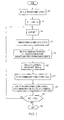
- FIG. 1 is a flow diagram illustrating a process for developing a binary classifier according to the present invention.
- the method of the present invention is discussed herein in the context of a binary classifier that determines the eye state (i.e., open or closed) of a human subject based on a video image of the subject.
- the video images are characterized using over-complete Haar wavelets so that each training example is in the form of a Haar wavelet feature vector (i.e., an array of wavelet coefficients, or elements) and an associated classification result determined by a human expert.
- a Haar wavelet feature vector i.e., an array of wavelet coefficients, or elements
- the method of this invention is also applicable to other classification problems.
- an adaptive boosting (AdaBoost) technique is used to combine a population of small genetically developed programs (also referred to herein as GP trees), each comprising simple arithmetic functions of the input feature vector elements.
- AdaBoost adaptive boosting
- the result is a classifier that provides equal or better accuracy than is ordinary achievable with genetic programming alone, with a negligible increase in the complexity of the classifier.
- the accuracy achieved with this method is comparable with other state-of-the-art classification methods (neural networks, support vector machines, decision trees), but with a significantly lower implementation cost.
- a neural network of comparable accuracy can be as much as 1000 times more complex.
- the method of the present invention is illustrated for a generalized binary classification problem as an iterative routine comprising the blocks 10-28.
- the process input is a set of training examples in the form of feature vectors.
- M training examples are represented by the pairs ( x 1 , y 1 ) ... ( x M , y M ), where each x i is a feature vector consisting of N elements (Haar wavelet coefficients, for example), and each y i is a binary classification result.
- the classification result y i can be zero for training examples for which the subject's eye is not closed, and one for training examples for which the subject's eye is closed.
- the first subscript of weight w identifies the iteration number of the routine, while the second subscript identifies the training example.
- the block 12 is also executed to initialize the values of an iteration counter T and a performance metric PERF.
- the blocks 14-24 represent a single iteration of a classifier development routine according to this invention.
- one genetically programmed (GP) classifier is selected, and the performance metric PERF is computed for a strong classifier based on the selected GP classifier and all GP classifiers selected in previous iterations of the routine. If the strong classifier correctly classifies all of the training examples, PERF will have a value of 100%, and the process will be ended as indicated by blocks 26-28. If the strong classifier incorrectly classifies at least one of the training examples, PERF will be less than 100%, and the blocks 14-24 will be re-executed to develop an additional GP classifier.
- GP genetically programmed
- the process may alternatively be exited if PERF reaches a threshold lower than 100%, or if a specified number of iterations have occurred.
- the training example weights are updated to give more weight to those training examples that were incorrectly classified by the selected GP classifier, and the updated weights are used to evaluate the fitness of GP classifiers produced in the next iteration of the routine.
- each GP tree comprises primitive arithmetic functions and logical operators such as +, -, MIN, MAX, and IF. Standard genetic operators including reproduction, cross-over and mutation are used for the program tree evolution.
- h j (x i ) is the output of GP classifier h j for the feature vector x i of a given training example
- y l is the correct classification result
- w i is the normalized weight for that training example.
- the fitness or accuracy of the GP classifier h j is inversely related to its classification error ⁇ j .
- Block 20 selects the best GP classifier h T for the current iteration T. This is the classifier having the lowest classification error, designated as ⁇ T .
- the classification error ⁇ T will have a value of less than 0.5 (simple chance), the term ⁇ T is less than one; consequently, the updated weight w T+1 for a given training example is decreased if the selected GP classifier h T classifies that training example correctly. Thus, the weight of a training example that is incorrectly classified is effectively increased relative to the weight of a training example that is correctly classified.
- the classification error ⁇ T will be calculated with the updated training example weights to give increased emphasis to training examples that were incorrectly classified by the selected GP classifier h T .
- the block 24 evaluates the performance PERF of a strong classifier h based on a combination of the selected GP classifiers h t (i.e., the currently selected GP classifier h T and the GP classifiers selected in previous iterations of the routine).
- the weight ⁇ t for a selected classifier h t varies in inverse relation to its classification error ⁇ T .
- PERF will be less than one, and the blocks 14-24 will be re-executed to carry out another iteration of the routine. Additional iterations of the routine can be added after 100% performance is achieved, but a validation set is required. And as indicated above, the process may alternatively be exited if PERF reaches a threshold lower than 100%, or if a specified number of iterations have occurred.
- the strong classifier represented by equation (6) including each of the selected GP classifiers h t , is implemented in a microprocessor-based controller and validated using non-training examples that are similar to the training examples used in the development process. Classification accuracy of at least 95% has been achieved in this manner for a variety of different applications.
- the method of the present invention embeds genetic programming within an iterative adaptive boosting process to achieve significantly higher classification accuracy with low computational complexity.
- classifiers developed according to this invention provide performance equivalent to classifiers using neural networks and support vector machines.
- the computational complexity and memory requirements for implementing the developed classifier were significantly lower than required for classifiers using neural networks and support vector machines.
- the cost of hardware to implement a classifier developed according to this invention is significantly reduced for a given classification accuracy.
- classifiers developed according to this invention can usually be intuitively understood, as compared to neural networks, which by nature are not intuitive.
Landscapes
- Engineering & Computer Science (AREA)
- Physics & Mathematics (AREA)
- Life Sciences & Earth Sciences (AREA)
- Theoretical Computer Science (AREA)
- Biophysics (AREA)
- Data Mining & Analysis (AREA)
- Bioinformatics & Computational Biology (AREA)
- Evolutionary Biology (AREA)
- Bioinformatics & Cheminformatics (AREA)
- General Physics & Mathematics (AREA)
- Health & Medical Sciences (AREA)
- Evolutionary Computation (AREA)
- General Engineering & Computer Science (AREA)
- Artificial Intelligence (AREA)
- Biomedical Technology (AREA)
- Software Systems (AREA)
- Genetics & Genomics (AREA)
- Computer Vision & Pattern Recognition (AREA)
- Computational Linguistics (AREA)
- General Health & Medical Sciences (AREA)
- Molecular Biology (AREA)
- Computing Systems (AREA)
- Mathematical Physics (AREA)
- Physiology (AREA)
- Business, Economics & Management (AREA)
- Emergency Management (AREA)
- Image Analysis (AREA)
- Information Retrieval, Db Structures And Fs Structures Therefor (AREA)
- Ultra Sonic Daignosis Equipment (AREA)
- Measuring Or Testing Involving Enzymes Or Micro-Organisms (AREA)
- Apparatus For Radiation Diagnosis (AREA)
Applications Claiming Priority (1)
| Application Number | Priority Date | Filing Date | Title |
|---|---|---|---|
| US11/528,087 US20080126275A1 (en) | 2006-09-27 | 2006-09-27 | Method of developing a classifier using adaboost-over-genetic programming |
Publications (2)
| Publication Number | Publication Date |
|---|---|
| EP1906343A2 true EP1906343A2 (de) | 2008-04-02 |
| EP1906343A3 EP1906343A3 (de) | 2009-07-15 |
Family
ID=38740295
Family Applications (1)
| Application Number | Title | Priority Date | Filing Date |
|---|---|---|---|
| EP07116842A Withdrawn EP1906343A3 (de) | 2006-09-27 | 2007-09-20 | Verfahren zum Entwickeln eines Klassifikators mit Adaboost über Genetik Programmierung |
Country Status (2)
| Country | Link |
|---|---|
| US (1) | US20080126275A1 (de) |
| EP (1) | EP1906343A3 (de) |
Cited By (2)
| Publication number | Priority date | Publication date | Assignee | Title |
|---|---|---|---|---|
| CN108648158A (zh) * | 2018-05-08 | 2018-10-12 | 广州大学 | 基于遗传算法的小波图像去噪方法和装置 |
| CN111340176A (zh) * | 2018-12-19 | 2020-06-26 | 富泰华工业(深圳)有限公司 | 神经网络的训练方法、装置及计算机存储介质 |
Families Citing this family (7)
| Publication number | Priority date | Publication date | Assignee | Title |
|---|---|---|---|---|
| US8117137B2 (en) | 2007-04-19 | 2012-02-14 | Microsoft Corporation | Field-programmable gate array based accelerator system |
| US8131659B2 (en) * | 2008-09-25 | 2012-03-06 | Microsoft Corporation | Field-programmable gate array based accelerator system |
| US8301638B2 (en) * | 2008-09-25 | 2012-10-30 | Microsoft Corporation | Automated feature selection based on rankboost for ranking |
| US9753696B2 (en) * | 2014-03-14 | 2017-09-05 | Microsoft Technology Licensing, Llc | Program boosting including using crowdsourcing for correctness |
| US10204146B2 (en) | 2016-02-09 | 2019-02-12 | Ca, Inc. | Automatic natural language processing based data extraction |
| CN107180140B (zh) * | 2017-06-08 | 2019-12-10 | 中南大学 | 基于双树复小波与AdaBoost的轴系故障识别方法 |
| CN111553117B (zh) * | 2020-04-22 | 2022-04-29 | 东华大学 | 基于遗传算法的堆叠式集成学习的聚酯特性粘度控制方法 |
Family Cites Families (14)
| Publication number | Priority date | Publication date | Assignee | Title |
|---|---|---|---|---|
| US4697242A (en) * | 1984-06-11 | 1987-09-29 | Holland John H | Adaptive computing system capable of learning and discovery |
| US4881178A (en) * | 1987-05-07 | 1989-11-14 | The Regents Of The University Of Michigan | Method of controlling a classifier system |
| US5671333A (en) * | 1994-04-07 | 1997-09-23 | Lucent Technologies Inc. | Training apparatus and method |
| US5781698A (en) * | 1995-10-31 | 1998-07-14 | Carnegie Mellon University | Method of autonomous machine learning |
| WO1999004329A2 (en) * | 1997-07-21 | 1999-01-28 | Kristin Ann Farry | Method of evolving classifier programs for signal processing and control |
| US6532453B1 (en) * | 1999-04-12 | 2003-03-11 | John R. Koza | Genetic programming problem solver with automatically defined stores loops and recursions |
| US6456991B1 (en) * | 1999-09-01 | 2002-09-24 | Hrl Laboratories, Llc | Classification method and apparatus based on boosting and pruning of multiple classifiers |
| US7099510B2 (en) * | 2000-11-29 | 2006-08-29 | Hewlett-Packard Development Company, L.P. | Method and system for object detection in digital images |
| US7024033B2 (en) * | 2001-12-08 | 2006-04-04 | Microsoft Corp. | Method for boosting the performance of machine-learning classifiers |
| US7031499B2 (en) * | 2002-07-22 | 2006-04-18 | Mitsubishi Electric Research Laboratories, Inc. | Object recognition system |
| US7020337B2 (en) * | 2002-07-22 | 2006-03-28 | Mitsubishi Electric Research Laboratories, Inc. | System and method for detecting objects in images |
| JP2005044330A (ja) * | 2003-07-24 | 2005-02-17 | Univ Of California San Diego | 弱仮説生成装置及び方法、学習装置及び方法、検出装置及び方法、表情学習装置及び方法、表情認識装置及び方法、並びにロボット装置 |
| US7421114B1 (en) * | 2004-11-22 | 2008-09-02 | Adobe Systems Incorporated | Accelerating the boosting approach to training classifiers |
| US7526101B2 (en) * | 2005-01-24 | 2009-04-28 | Mitsubishi Electric Research Laboratories, Inc. | Tracking objects in videos with adaptive classifiers |
-
2006
- 2006-09-27 US US11/528,087 patent/US20080126275A1/en not_active Abandoned
-
2007
- 2007-09-20 EP EP07116842A patent/EP1906343A3/de not_active Withdrawn
Cited By (2)
| Publication number | Priority date | Publication date | Assignee | Title |
|---|---|---|---|---|
| CN108648158A (zh) * | 2018-05-08 | 2018-10-12 | 广州大学 | 基于遗传算法的小波图像去噪方法和装置 |
| CN111340176A (zh) * | 2018-12-19 | 2020-06-26 | 富泰华工业(深圳)有限公司 | 神经网络的训练方法、装置及计算机存储介质 |
Also Published As
| Publication number | Publication date |
|---|---|
| US20080126275A1 (en) | 2008-05-29 |
| EP1906343A3 (de) | 2009-07-15 |
Similar Documents
| Publication | Publication Date | Title |
|---|---|---|
| EP1906343A2 (de) | Verfahren zum Entwickeln eines Klassifikators mit Adaboost über Genetik Programmierung | |
| EP1906369B1 (de) | Echtzeitverfahren zur Bestimmung des Augenschließzustands mithilfe von Offline Adaboost über Genetik Programmierung | |
| EP1587024B1 (de) | Vorrichtung, Methode, Aufzeichnungsmedium und Programm zur Informationsverarbeitung | |
| Rätsch et al. | Efficient Margin Maximizing with Boosting. | |
| CN113297572A (zh) | 基于神经元激活模式的深度学习样本级对抗攻击防御方法及其装置 | |
| CN111753881A (zh) | 一种基于概念敏感性量化识别对抗攻击的防御方法 | |
| US8750628B2 (en) | Pattern recognizer, pattern recognition method and program for pattern recognition | |
| WO2020224297A1 (zh) | 计算机执行的集成模型的确定方法及装置 | |
| CN111062036A (zh) | 恶意软件识别模型构建、识别方法及介质和设备 | |
| EP1843323B1 (de) | Informationsverarbeitungsvorrichtung, informationsverarbeitungsverfahren und programm | |
| CN114492279A (zh) | 一种模拟集成电路的参数优化方法及系统 | |
| CN114330650B (zh) | 基于进化元学习模型训练的小样本特征分析方法及装置 | |
| CN112149825A (zh) | 神经网络模型的训练方法及装置、电子设备、存储介质 | |
| CN118351371A (zh) | 一种基于对抗训练和元学习的小样本图像分类方法及系统 | |
| CN111582365B (zh) | 一种基于样本难度的垃圾邮件分类方法 | |
| Agapitos et al. | Deep evolution of image representations for handwritten digit recognition | |
| US20230185998A1 (en) | System and method for ai-assisted system design | |
| CN114841296A (zh) | 设备聚类方法、终端设备以及存储介质 | |
| US6789070B1 (en) | Automatic feature selection system for data containing missing values | |
| CN111178416A (zh) | 参数调整方法和装置 | |
| EP3940601A1 (de) | Informationsverarbeitungsvorrichtung, informationsverarbeitungsverfahren und informationsprogramm | |
| Siebel et al. | Learning defect classifiers for visual inspection images by neuro-evolution using weakly labelled training data | |
| CN115081523A (zh) | 分类器的训练方法和装置及存储介质 | |
| CN114692816A (zh) | 神经网络模型的处理方法和设备 | |
| CN111178488A (zh) | 数据处理方法和装置 |
Legal Events
| Date | Code | Title | Description |
|---|---|---|---|
| PUAI | Public reference made under article 153(3) epc to a published international application that has entered the european phase |
Free format text: ORIGINAL CODE: 0009012 |
|
| AK | Designated contracting states |
Kind code of ref document: A2 Designated state(s): AT BE BG CH CY CZ DE DK EE ES FI FR GB GR HU IE IS IT LI LT LU LV MC MT NL PL PT RO SE SI SK TR |
|
| AX | Request for extension of the european patent |
Extension state: AL BA HR MK YU |
|
| PUAL | Search report despatched |
Free format text: ORIGINAL CODE: 0009013 |
|
| AK | Designated contracting states |
Kind code of ref document: A3 Designated state(s): AT BE BG CH CY CZ DE DK EE ES FI FR GB GR HU IE IS IT LI LT LU LV MC MT NL PL PT RO SE SI SK TR |
|
| AX | Request for extension of the european patent |
Extension state: AL BA HR MK RS |
|
| AKX | Designation fees paid | ||
| REG | Reference to a national code |
Ref country code: DE Ref legal event code: 8566 |
|
| STAA | Information on the status of an ep patent application or granted ep patent |
Free format text: STATUS: THE APPLICATION IS DEEMED TO BE WITHDRAWN |
|
| 18D | Application deemed to be withdrawn |
Effective date: 20100119 |