EP1905645A1 - Adjustable Rear View Mirror Structure - Google Patents
Adjustable Rear View Mirror Structure Download PDFInfo
- Publication number
- EP1905645A1 EP1905645A1 EP07100478A EP07100478A EP1905645A1 EP 1905645 A1 EP1905645 A1 EP 1905645A1 EP 07100478 A EP07100478 A EP 07100478A EP 07100478 A EP07100478 A EP 07100478A EP 1905645 A1 EP1905645 A1 EP 1905645A1
- Authority
- EP
- European Patent Office
- Prior art keywords
- rear view
- view mirror
- disposed
- knob
- threaded
- Prior art date
- Legal status (The legal status is an assumption and is not a legal conclusion. Google has not performed a legal analysis and makes no representation as to the accuracy of the status listed.)
- Withdrawn
Links
- 230000001965 increasing effect Effects 0.000 claims description 8
- 230000003247 decreasing effect Effects 0.000 claims description 2
- 230000000694 effects Effects 0.000 description 3
- 238000000354 decomposition reaction Methods 0.000 description 2
- 238000012986 modification Methods 0.000 description 2
- 230000004048 modification Effects 0.000 description 2
- 230000000007 visual effect Effects 0.000 description 2
- 230000002708 enhancing effect Effects 0.000 description 1
- 230000036544 posture Effects 0.000 description 1
Images





Classifications
-
- B—PERFORMING OPERATIONS; TRANSPORTING
- B60—VEHICLES IN GENERAL
- B60R—VEHICLES, VEHICLE FITTINGS, OR VEHICLE PARTS, NOT OTHERWISE PROVIDED FOR
- B60R1/00—Optical viewing arrangements; Real-time viewing arrangements for drivers or passengers using optical image capturing systems, e.g. cameras or video systems specially adapted for use in or on vehicles
- B60R1/02—Rear-view mirror arrangements
- B60R1/08—Rear-view mirror arrangements involving special optical features, e.g. avoiding blind spots, e.g. convex mirrors; Side-by-side associations of rear-view and other mirrors
- B60R1/081—Rear-view mirror arrangements involving special optical features, e.g. avoiding blind spots, e.g. convex mirrors; Side-by-side associations of rear-view and other mirrors avoiding blind spots, e.g. by using a side-by-side association of mirrors
- B60R1/082—Rear-view mirror arrangements involving special optical features, e.g. avoiding blind spots, e.g. convex mirrors; Side-by-side associations of rear-view and other mirrors avoiding blind spots, e.g. by using a side-by-side association of mirrors using a single wide field mirror or an association of rigidly connected mirrors
Definitions
- the present invention relates to an adjustable structure of a rear view mirror.
- the invention relates to a structure of a rear view mirror with an adjustable mirror curvature.
- the rear view mirror is a standard piece equipment.
- an inner rear view mirror and side rear view mirrors are usually equipped to help the driver be aware of situations behind and beside the car for increased safety during driving.
- the driver encounters blind spots.
- rear view mirrors with increased viewing angles are continuously presented in the market.
- a conventional rear view mirror 10 comprises a mirror 11 for providing a rear view visual with an ordinary viewing angle. Furthermore, a small convex reflective mirror 13 can be mounted onto the mirror 11. Since the convex reflective mirror 13 has a curvature, drivers can partially have a wide viewing angle effect. By attaching the convex mirror to an ordinary mirror, the driver benefits from the combination of the ordinary viewing angle of the mirror 11 and the wide viewing angle of the convex reflective mirror 13. As a result, the rear visuals are improved, creating a wider viewing angle with respect to cars from the side and behind for enhancing driving safety. Additionally, this mirror setup allows for a better view of the rear interior in the car in order to monitor the situations in the back-seat.
- the abovementioned convex reflective mirror 13 can also be replaced by using a fixed rear view mirror with a set wide viewing angle and a large size.
- This fixed rear view mirror can be clipped onto the rear view mirror which has been originally equipped in the car to fully substitute the original rear view mirror.
- the adjustments on the conventional rear view mirror 10 only allow for horizontal and vertical rotation.
- the viewing angle of the mirror 11 is not adjustable so as to bring more limitations in use.
- the primary objective of this invention is to provide a structure for a rear view mirror with an adjustable mirror curvature.
- the adjustable viewing angle can meet different driving habits and requirements for various drivers to effectively improve driving visibility and safety.
- Another objective of this invention is to provide a structure for a rear view mirror with an adjustable curvature.
- the structure may be widely applied in various vehicles and may also provide a wide viewing angle anywhere within the vehicles.
- Yet another objective of this invention is to provide a structure for a rear view mirror with an adjustable curvature.
- the control mechanism for adjusting the curvature can be electrically powered, manually powered, or a combination of both.
- the level of equipment within the car can be indirectly upgraded according to the consumer's desires.
- the present invention provides a structure for a rear view mirror comprising a flexible body and an adjusting mechanism.
- the flexible body has a reflective surface and an inner surface which is opposite to the reflective surface.
- the adjusting mechanism is disposed at the rear portion of the body to adjustably drive the inner surface of the flexible body so that the reflective surface of the body is adapted to a specific curvature.
- the rear view mirror structure 20 comprises a flexible body 21, an adjusting mechanism 23, and a housing 25, wherein the housing 25 has a back plate 251 and an opening 253 to define a receiving space.
- the body 21 is substantially disposed at the opening 253 of the housing 25 after assembly, and the adjusting mechanism 23 is disposed at the rear portion of the body 21 and within the receiving space.
- the body 21 has a reflective surface 211 and an inner surface 213 opposite to the reflective surface 211.
- the adjusting mechanism 23 is used for driving the inner surface 213 such that the reflective surface 211 of body 21 can perform a specific curvature.
- the housing 25 can also be selectively disposed onto other devices, such as the rear view mirror of an original vehicle accessory or other fastening components, through a plurality of protruding lugs 255.
- the body 21 further comprises a first rod 215 and a second rod 217 which are disposed on two side areas of the inner surface 213.
- the first rod 215 and the second rod 217 extend backward, thus allowing the adjusting mechanism 23 to drive the first rod 215 and the second rod 217 to move relatively to adjust the curvature of the body 21.
- the adjusting mechanism 23 further comprises an adjusting device 230, a first threaded element 235, and a second threaded element 237, wherein the first threaded element 235 and the second threaded element 237 are disposed at two sides of the receiving space, corresponding to the first rod 215 and the second rod 217 so as to engage onto the first rod 215 and the second rod 217 respectively.
- the adjusting device 230 has a first threaded portion 231 and a second threaded portion 233 which are oppositely formed.
- first threaded portion 231 and the second threaded portion 233 are threaded within the first threaded element 235 and the second threaded element 237 respectively, in order that the first threaded element 235 is adapted to perform a first transverse movement S1 corresponding to the first threaded portion 231 and the second threaded element 237 is adapted to perform a second transverse movement S2 corresponding to the second threaded portion 233.
- first transverse movement S1 and the second transverse movement S2 face to each other, the distance between the first threaded element 235 and the second threaded element 237 is shortened.
- the distance between the first rod 215 and the second rod 217 is also shortened gradually, driving the body 21 to bend forward and obtain an increased curvature.
- FIG. 4B when the first transverse movement S1 and the second transverse movement S2 separate apart from each other, a decreasing curvature is obtained.
- the curvature of the body 21 is adjustable by controlling the movement direction of the first threaded element 235 and the second threaded element 237 in this embodiment.
- the manner of controlling the adjusting mechanism 23 can be electrically powered, manually powered, or a combination of both.
- the adjusting mechanism 23 can further comprise a driving device 27 for driving the adjusting device 230 to perform the first transverse movement S1 and/or the second transverse movement S2. Since the driving device 27 needs a power supply, the adjusting mechanism 23 can further comprise an electric power device 28 (as shown in FIG. 3 ) that is connected with the driving device 27.
- the electric power device 28 can be a direct current (DC) power supply 281, such as a battery, which is located in a battery container 283 with a cover 285 for protection.
- DC direct current
- the adjusting mechanism 23 further comprises a switch 31 disposed on anywhere on the housing 25, or anywhere in the car, for the driver to conveniently control the electric power device 28 for supplying electric power to the driving device 27, thus to perform the curvature adjustment on the body 21.
- the manner of controlling the adjusting mechanism 23 can also be manually powered.
- the adjusting device 230 further comprises a first knob 291 and a second knob 293.
- the first threaded portion 231 and the second threaded portion 233 protrude through two opposite side walls of the housing 25 and connect with the first knob 291 and the second knob 293 respectively.
- the aforementioned first transverse movement S1 and the mentioned second transverse movement S2 is adapted to be driven so as to alter the curvature of the body 21.
- FIG. 5 Another preferred embodiment of the present invention is shown in FIG. 5, wherein the adjusting device 230 comprises a screw rod 40, and the aforementioned first threaded portion 231 and the second threaded portion 233 are respectively disposed on two opposite sides of the screw rod 40.
- the first threaded portion 231 and the second threaded portion 233 have threads that are reversed to each other.
- the first threaded element 235 and the second threaded element 237 are driven in opposite direction when the screw rod 40 rotates in a specific direction. That is, the first threaded element 235 performs the aforesaid first transverse movement S1 and the second threaded element 237 performs the aforesaid second transverse movement S2.
- the mentioned single screw rod 40 can be divided into several segments. That is, the screw rod 40 comprises a first screw rod 41 and a second screw rod 43, which are connecting with each other by a middle column 45.
- the aforementioned threaded portion 231 and the second threaded portion 233 are disposed on a first screw rod 41 and a second screw rod 43 respectively.
- the first screw rod 41 is disposed across between the middle column 45 and the side wall of the housing 25, and the second screw rod 43 is disposed between the middle column 45 and the opposite side wall of the housing 25.
- the first screw rod 41 and/or the second screw rod 43 rotates in a specific direction, the first threaded element 235 and the second threaded element 237 will be driven to perform the relative movements.
- the adjusting mechanism 23 of the present invention is not limited to the abovementioned solutions.
- the adjusting mechanism 23 can be substituted by a rotating shaft 51 and a control block 53.
- the rotating shaft 51 is vertically disposed in the receiving space and the control block 53 is eccentrically disposed on the rotating shaft 51, wherein an outer edge of the control block 53 is substantially in contact with the inner surface 213 of the body 21.
- the body 21 can be pushed to form a convex surface when the control block 53 rotates on the rotating shaft 51.
- a first distance and a second distance can be defined between the outer edge of the control block 53 and the rotating shaft 51, wherein the first distance is the shortest distance between the outer edge and the rotating shaft 51, and the second distance is the greatest distance between the outer edge and the rotating shaft 51.
- the body 21 can be pushed forward to form a variably increasing curvature.
- the control block 53 rotates on the rotating shaft 51 to push the inner surface 213 of the body 21.
- a knob 295 is disposed out of the housing 25 and connected to an end of the rotating shaft 51.
- the knob 295 rotates, it is adapted to drive the rotating shaft 51 for rotating the control block 53.
- the control block 53 substantially pushes the center of the inner surface 213 of the body 21, two sides of the body 21 need to be fastened appropriately while the curvature of the body 21 is altered.
- the rear view mirror structure 20 can further comprise two columns 61 and 63 which are individually disposed vertically in the receiving space.
- Two fastening lugs 214, 216 are individually disposed on two sides of the inner surface 213 of the body 21, whereby the fastening lugs 214 and 216 are adapted to buckle with the columns 61, 63 to fasten the two sides of the body 213.
- the adjusting mechanism comprises a pushing block 71, a connecting element 73, and a knob 297.
- the pushing block 71 pushes against the inner surface 213 of the body 21.
- the connecting element 73 has an end threaded with the pushing block 71 and an opposite end protruding out of the back plate 251 of the housing 25 to connect with the knob 297.
- the knob 297 rotates, the knob 297 is adapted to drive the connecting element 73 and pushes against the pushing block 71 to perform a reciprocating motion.
- two fastening lugs 214, 216 should be disposed on two sides of the inner surface 213 of the body 21 to buckle with the columns 61, 63 to fasten the body 21 and help facilitate the curvature forming while the pushing block 71 pushes against the center of the body 21.
- the adjusting mechanism 23 comprises a pushing block 91, an adjusting element 93, a linkage 95, a vertical screw rod 97, and a knob 299.
- An end of the vertical screw rod 97 protrudes out of the back plate 257 of the housing and connects with the knob 299, and the body of the vertical screw rod 97 is screwed within the adjusting element 93.
- FIG. 9 is a prospective view illustrating the adjusting mechanism 23 of this embodiment
- the vertical screw rod 97 is adapted to drive the adjusting element 93, which is vertically disposed in the receiving space to perform an up-and-down movement from a first position to a second position.
- the pushing block 91 can push against the inner surface 213 of the body 21, whereby the adjusting element driving the pushing block 91 to perform a forward movement when the adjusting element moves from the first position to the second position.
- the abovementioned two columns 61, 63 are still disposed on two sides of the receiving space in the rear view mirror structure 20 of this embodiment.
- the abovementioned two fastening lugs 214, 216 are correspondingly disposed at two sides of the inner surface 213 of the body 21, whereby the fastening lugs 214, 216 are adapted to buckle with the columns 61, 63 to fasten the two sides of the body.
- the curvature of the body can be adjusted electrically, manually, or both.
- the convex surface can gain a wide viewing angle effect while the concave surface can gain a focusing effect. Thereby, it can satisfy the different driving habits of different drivers, and also help the drivers control the situation behind and besides the car to ensure safe driving.
Landscapes
- Engineering & Computer Science (AREA)
- Multimedia (AREA)
- Mechanical Engineering (AREA)
- Rear-View Mirror Devices That Are Mounted On The Exterior Of The Vehicle (AREA)
Abstract
An adjustable rear view mirror structure is provided. The rear view mirror structure (20) comprises a flexible body (21) and an adjusting apparatus (23) wherein the body has a reflective surface (211) and an inner surface (213). The adjusting apparatus (23) is disposed at a rear portion of the body (21) and is utilized to drive the inner surface (213) of the body (21). Thus, the reflective surface (211) of the body can form a particular curvature whereby the rear view mirror structure (20) can offer a wider viewing angle.
Description
- The present invention relates to an adjustable structure of a rear view mirror. In particular, the invention relates to a structure of a rear view mirror with an adjustable mirror curvature.
- On various vehicles (such as cars, motorcycles, trucks, and etc.), the rear view mirror is a standard piece equipment. Using a car as an example, an inner rear view mirror and side rear view mirrors are usually equipped to help the driver be aware of situations behind and beside the car for increased safety during driving. However, due to the limited viewing angle of an ordinary rear view mirror, the driver encounters blind spots. To overcome this drawback, rear view mirrors with increased viewing angles are continuously presented in the market.
- For example, in FIG. 1, a conventional
rear view mirror 10 comprises amirror 11 for providing a rear view visual with an ordinary viewing angle. Furthermore, a small convexreflective mirror 13 can be mounted onto themirror 11. Since the convexreflective mirror 13 has a curvature, drivers can partially have a wide viewing angle effect. By attaching the convex mirror to an ordinary mirror, the driver benefits from the combination of the ordinary viewing angle of themirror 11 and the wide viewing angle of the convexreflective mirror 13. As a result, the rear visuals are improved, creating a wider viewing angle with respect to cars from the side and behind for enhancing driving safety. Additionally, this mirror setup allows for a better view of the rear interior in the car in order to monitor the situations in the back-seat. - The abovementioned convex
reflective mirror 13 can also be replaced by using a fixed rear view mirror with a set wide viewing angle and a large size. This fixed rear view mirror can be clipped onto the rear view mirror which has been originally equipped in the car to fully substitute the original rear view mirror. - Nevertheless, all of the current conventional designs do not simultaneously fulfill all of a user's particular requirements. Because the seat postures, heights, requirements for viewing angle, and usage habits are different between different drivers, the drivers have no choice but to use conventional rear view mirrors with certain limitations. The different habits between the drivers can not merely be fully satisfied by manually adjusting the angle of the
rear view mirror 10 after the driver has entered the vehicle. Furthermore, not every driver is accustomed to the combined image (a large portion of a flat image with a small portion of a wide angle image) that is associated with the small convexreflective mirror 13 affixed to themirror 11, as seen in therear view mirror 10. - In addition, the adjustments on the conventional
rear view mirror 10 only allow for horizontal and vertical rotation. The viewing angle of themirror 11 is not adjustable so as to bring more limitations in use. - Given the above, a novel structure of a rear view mirror with an adjustable curvature needs to be developed in this field.
- The primary objective of this invention is to provide a structure for a rear view mirror with an adjustable mirror curvature. Thus, the adjustable viewing angle can meet different driving habits and requirements for various drivers to effectively improve driving visibility and safety.
- Another objective of this invention is to provide a structure for a rear view mirror with an adjustable curvature. The structure may be widely applied in various vehicles and may also provide a wide viewing angle anywhere within the vehicles.
- Yet another objective of this invention is to provide a structure for a rear view mirror with an adjustable curvature. The control mechanism for adjusting the curvature can be electrically powered, manually powered, or a combination of both. Thus, the level of equipment within the car can be indirectly upgraded according to the consumer's desires.
- To achieve the aforementioned objectives, the present invention provides a structure for a rear view mirror comprising a flexible body and an adjusting mechanism. The flexible body has a reflective surface and an inner surface which is opposite to the reflective surface. The adjusting mechanism is disposed at the rear portion of the body to adjustably drive the inner surface of the flexible body so that the reflective surface of the body is adapted to a specific curvature.
- The detailed technology and preferred embodiments implemented for the subject invention are described in the following paragraphs accompanying the appended figures for those skilled in this field to well appreciate the features of the claimed invention.
-
- FIG. 1 is a schematic view illustrating the external of a conventional rear view mirror;
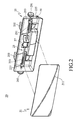
- FIG. 2 is a front-decomposition schematic view illustrating a preferred embodiment of the present invention;
- FIG. 3 is a rear-decomposition schematic view of FIG. 2;
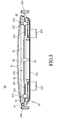
- FIG. 4A is a cross-sectional bottom view of FIG. 2, in which the body has a curvature;
- FIG. 4B is a schematic view similar to FIG. 4A but the body has no curvature;
- FIG. 5 is a schematic view illustrating another preferred embodiment of the control mechanism of FIG. 2;
- FIG. 6A is a schematic view illustrating yet another preferred embodiment of the control mechanism of the present invention;
- FIG. 6B is a cross-sectional bottom view of FIG. 6A, in which the body has a curvature;
- FIG. 7 is a schematic view illustrating a further preferred embodiment of the control mechanism of the present invention;
- FIG. 8 is an elevational view illustrating a further preferred embodiment of the present invention; and
- FIG. 9 is a perspective view illustrating the adjusting mechanism as shown in FIG. 8.
- A preferred embodiment is shown in FIG. 2 and FIG. 3. The rear
view mirror structure 20 comprises aflexible body 21, anadjusting mechanism 23, and ahousing 25, wherein thehousing 25 has aback plate 251 and anopening 253 to define a receiving space. Thebody 21 is substantially disposed at theopening 253 of thehousing 25 after assembly, and theadjusting mechanism 23 is disposed at the rear portion of thebody 21 and within the receiving space. Thebody 21 has areflective surface 211 and aninner surface 213 opposite to thereflective surface 211. Theadjusting mechanism 23 is used for driving theinner surface 213 such that thereflective surface 211 ofbody 21 can perform a specific curvature. In addition, thehousing 25 can also be selectively disposed onto other devices, such as the rear view mirror of an original vehicle accessory or other fastening components, through a plurality of protrudinglugs 255. - Referring to FIG. 3, in this embodiment, the
body 21 further comprises afirst rod 215 and asecond rod 217 which are disposed on two side areas of theinner surface 213. Thefirst rod 215 and thesecond rod 217 extend backward, thus allowing theadjusting mechanism 23 to drive thefirst rod 215 and thesecond rod 217 to move relatively to adjust the curvature of thebody 21. - The detailed structure of the
abovementioned adjusting mechanism 23 that drives thefirst rod 215 and thesecond rod 217 is shown in FIG. 4A and FIG. 4B. Theadjusting mechanism 23 further comprises anadjusting device 230, a first threadedelement 235, and a second threadedelement 237, wherein the first threadedelement 235 and the second threadedelement 237 are disposed at two sides of the receiving space, corresponding to thefirst rod 215 and thesecond rod 217 so as to engage onto thefirst rod 215 and thesecond rod 217 respectively. In addition, the adjustingdevice 230 has a first threadedportion 231 and a second threadedportion 233 which are oppositely formed. - Further, the first threaded
portion 231 and the second threadedportion 233 are threaded within the first threadedelement 235 and the second threadedelement 237 respectively, in order that the first threadedelement 235 is adapted to perform a first transverse movement S1 corresponding to the first threadedportion 231 and the second threadedelement 237 is adapted to perform a second transverse movement S2 corresponding to the second threadedportion 233. As shown in FIG. 4A, when the first transverse movement S1 and the second transverse movement S2 face to each other, the distance between the first threadedelement 235 and the second threadedelement 237 is shortened. Thus the distance between thefirst rod 215 and thesecond rod 217 is also shortened gradually, driving thebody 21 to bend forward and obtain an increased curvature. As shown in FIG. 4B, when the first transverse movement S1 and the second transverse movement S2 separate apart from each other, a decreasing curvature is obtained. The curvature of thebody 21 is adjustable by controlling the movement direction of the first threadedelement 235 and the second threadedelement 237 in this embodiment. - It is noted that the manner of controlling the
adjusting mechanism 23 can be electrically powered, manually powered, or a combination of both. Using electrical power as an example, the adjustingmechanism 23 can further comprise adriving device 27 for driving theadjusting device 230 to perform the first transverse movement S1 and/or the second transverse movement S2. Since the drivingdevice 27 needs a power supply, the adjustingmechanism 23 can further comprise an electric power device 28 (as shown in FIG. 3) that is connected with the drivingdevice 27. It is understandable that theelectric power device 28 can be a direct current (DC)power supply 281, such as a battery, which is located in abattery container 283 with acover 285 for protection. - In order to conveniently control the driving
device 27 for the drivers, the adjustingmechanism 23 further comprises aswitch 31 disposed on anywhere on thehousing 25, or anywhere in the car, for the driver to conveniently control theelectric power device 28 for supplying electric power to the drivingdevice 27, thus to perform the curvature adjustment on thebody 21. In other embodiments, the manner of controlling theadjusting mechanism 23 can also be manually powered. In this case, the adjustingdevice 230 further comprises afirst knob 291 and asecond knob 293. The first threadedportion 231 and the second threadedportion 233 protrude through two opposite side walls of thehousing 25 and connect with thefirst knob 291 and thesecond knob 293 respectively. When thefirst knob 291 and/or thesecond knob 293 rotates, the aforementioned first transverse movement S1 and the mentioned second transverse movement S2 is adapted to be driven so as to alter the curvature of thebody 21. - Another preferred embodiment of the present invention is shown in FIG. 5, wherein the adjusting
device 230 comprises ascrew rod 40, and the aforementioned first threadedportion 231 and the second threadedportion 233 are respectively disposed on two opposite sides of thescrew rod 40. In detail, the first threadedportion 231 and the second threadedportion 233 have threads that are reversed to each other. As a result of the reversed threads, the first threadedelement 235 and the second threadedelement 237 are driven in opposite direction when thescrew rod 40 rotates in a specific direction. That is, the first threadedelement 235 performs the aforesaid first transverse movement S1 and the second threadedelement 237 performs the aforesaid second transverse movement S2. - The mentioned
single screw rod 40 can be divided into several segments. That is, thescrew rod 40 comprises afirst screw rod 41 and asecond screw rod 43, which are connecting with each other by amiddle column 45. The aforementioned threadedportion 231 and the second threadedportion 233 are disposed on afirst screw rod 41 and asecond screw rod 43 respectively. In other words, thefirst screw rod 41 is disposed across between themiddle column 45 and the side wall of thehousing 25, and thesecond screw rod 43 is disposed between themiddle column 45 and the opposite side wall of thehousing 25. Similarly, when thefirst screw rod 41 and/or thesecond screw rod 43 rotates in a specific direction, the first threadedelement 235 and the second threadedelement 237 will be driven to perform the relative movements. - The
adjusting mechanism 23 of the present invention is not limited to the abovementioned solutions. As shown in FIG. 6A and FIG. 6B, the adjustingmechanism 23 can be substituted by a rotatingshaft 51 and acontrol block 53. The rotatingshaft 51 is vertically disposed in the receiving space and thecontrol block 53 is eccentrically disposed on therotating shaft 51, wherein an outer edge of thecontrol block 53 is substantially in contact with theinner surface 213 of thebody 21. With this eccentric design, thebody 21 can be pushed to form a convex surface when thecontrol block 53 rotates on therotating shaft 51. For simplification, a first distance and a second distance can be defined between the outer edge of thecontrol block 53 and therotating shaft 51, wherein the first distance is the shortest distance between the outer edge and therotating shaft 51, and the second distance is the greatest distance between the outer edge and therotating shaft 51. When the distance between therotating shaft 51 and theinner surface 213 is increasing from the first distance to the second distance, thebody 21 can be pushed forward to form a variably increasing curvature. As shown in FIG. 6B, thecontrol block 53 rotates on therotating shaft 51 to push theinner surface 213 of thebody 21. - In order to easily control the rotation of the
rotating shaft 51, aknob 295 is disposed out of thehousing 25 and connected to an end of therotating shaft 51. When theknob 295 rotates, it is adapted to drive the rotatingshaft 51 for rotating thecontrol block 53. In addition, since thecontrol block 53 substantially pushes the center of theinner surface 213 of thebody 21, two sides of thebody 21 need to be fastened appropriately while the curvature of thebody 21 is altered. Referring to FIG. 6A and FIG. 6B again, the rearview mirror structure 20 can further comprise twocolumns inner surface 213 of thebody 21, whereby the fastening lugs 214 and 216 are adapted to buckle with thecolumns body 213. - Another adjusting mechanism of the present invention is illustrated in FIG. 7. The adjusting mechanism comprises a pushing
block 71, a connectingelement 73, and aknob 297. The pushingblock 71 pushes against theinner surface 213 of thebody 21. The connectingelement 73 has an end threaded with the pushingblock 71 and an opposite end protruding out of theback plate 251 of thehousing 25 to connect with theknob 297. When theknob 297 rotates, theknob 297 is adapted to drive the connectingelement 73 and pushes against the pushingblock 71 to perform a reciprocating motion. Similarly, two fastening lugs 214, 216 should be disposed on two sides of theinner surface 213 of thebody 21 to buckle with thecolumns body 21 and help facilitate the curvature forming while the pushingblock 71 pushes against the center of thebody 21. - The abovementioned embodiments for adjusting the curvature of the
body 21 should not be limited. As shown in FIG. 8, the adjustingmechanism 23 comprises a pushingblock 91, an adjustingelement 93, alinkage 95, avertical screw rod 97, and aknob 299. An end of thevertical screw rod 97 protrudes out of theback plate 257 of the housing and connects with theknob 299, and the body of thevertical screw rod 97 is screwed within the adjustingelement 93. - Further referring to FIG. 9, which is a prospective view illustrating the
adjusting mechanism 23 of this embodiment, when theknob 299 rotates, thevertical screw rod 97 is adapted to drive the adjustingelement 93, which is vertically disposed in the receiving space to perform an up-and-down movement from a first position to a second position. In association with thelinkage 95 where one end pivots with the adjustingelement 93 and the other opposite end pivots with the pushingblock 91, the pushingblock 91 can push against theinner surface 213 of thebody 21, whereby the adjusting element driving the pushingblock 91 to perform a forward movement when the adjusting element moves from the first position to the second position. - Similarly, the abovementioned two
columns 61, 63 (not shown) are still disposed on two sides of the receiving space in the rearview mirror structure 20 of this embodiment. The abovementioned two fastening lugs 214, 216 are correspondingly disposed at two sides of theinner surface 213 of thebody 21, whereby the fastening lugs 214, 216 are adapted to buckle with thecolumns - According to the abovementioned structure of the rear view mirror, the curvature of the body can be adjusted electrically, manually, or both. The convex surface can gain a wide viewing angle effect while the concave surface can gain a focusing effect. Thereby, it can satisfy the different driving habits of different drivers, and also help the drivers control the situation behind and besides the car to ensure safe driving.
- The above disclosure is related to the detailed technical contents and inventive features thereof. People skilled in this field may proceed with a variety of modifications and replacements based on the disclosures and suggestions of the invention as described without departing from the characteristics thereof. Nevertheless, although such modifications and replacements are not fully disclosed in the above descriptions, they have substantially been covered in the following claims as appended.
Claims (17)
- A structure of a rear view mirror, comprising:a flexible body, having a reflective surface and an inner surface opposite to the reflective surface; andan adjusting mechanism, disposed at a rear portion of the body, to adjustably drive the inner surface in order that the reflective surface of the body is adapted to present a specific curvature.
- The structure of a rear view mirror as claimed in claim 1, further comprising:a housing, having a back plate and an opening, the housing defining a receiving space;wherein the body is substantially disposed at the opening of the housing and the adjusting mechanism is substantially disposed in the receiving space.
- The structure of a rear view mirror as claimed in claim 1 or 2, wherein the body further comprises a first rod and a second rod which are disposed on two sides areas of the inner surface, respectively, and extending backward, and the adjusting mechanism drives the first rod and the second rod to move relatively to adjust the curvature of the body.
- The structure of a rear view mirror as claimed in claim 3, wherein the adjusting mechanism further comprises:a first threaded element and a second threaded element, disposed at two sides of the receiving space and corresponding to the first rod and the second rod, respectively;an adjusting device, having a first threaded portion and a second threaded portion which are oppositely formed and respectively threaded within the first threaded element and the second threaded element, in order that the first threaded element is adapted to perform a first transverse movement corresponding to the first threaded portion, and the second threaded element is adapted to perform a second transverse movement corresponding to the second threaded portion, in which the first threaded element and the second threaded element engage onto the first rod and the second rod, respectively;when the first transverse movement and the second transverse movement face to each other, the curvature of the body is increasing, whereas when the first transverse movement and the second transverse movement separate apart from each other, the curvature of the body is decreasing.
- The structure of a rear view mirror as claimed in claim 4, wherein the adjusting mechanism further comprises a driving device adapted to drive the adjusting device to perform at least one of the first transverse movement and the second transverse movement.
- The structure of a rear view mirror as claimed in claim 5, wherein the adjusting mechanism further comprises an electric power device, connecting with the driving device.
- The structure of a rear view mirror as claimed in claim 6, wherein the adjusting mechanism further comprises a switch to control the electric power device.
- The structure of a rear view mirror as claimed in claim 6 or 7, wherein the electric power device comprises a direct current (DC) power supply.
- The structure of a rear view mirror as claimed in claim 4 or 5, wherein the adjusting device further comprises a first knob and a second knob, and the first threaded portion and the second threaded portion of the adjusting device protrude through two opposite side walls of the housing and connect with the first knob and the second knob, respectively; when at least one of the first knob and the second knob rotates, at least one of the first and second transverse movements is adapted to be driven in order to alter the curvature of the body.
- The structure of a rear view mirror as claimed in claim 4, 5 or 9, wherein the adjusting device comprises a screw rod in which the first threaded portion and the second threaded portion are respectively disposed on two opposite sides thereof and have threads reversing to each other; when the screw rod rotates in a specific direction, the first transverse movement and the second transverse movement faces to each other.
- The structure of a rear view mirror as claimed in claim 4, 5 or 9, wherein the adjusting device comprises a first screw rod, a second screw rod, and a middle column, the first threaded portion and the second threaded portion are disposed on the first screw rod and the second screw rod, respectively, in which the first screw rod is disposed across between the middle column and a side wall of the housing, and the second screw rod is disposed across between the middle column and the other opposite side wall of the housing.
- The structure of a rear view mirror as claimed in claim 2, wherein the adjusting mechanism comprises:a rotating shaft, vertically disposed in the receiving space;a control block, eccentrically disposed on the rotating shaft, in which an outer edge of the control block is substantially in contact with the inner surface of the body and defines a first distance and a second distance with the rotating shaft, wherein the curvature of the body is increasing when the distance between the inner surface and the rotating shaft is increasing from the first distance to the second distance.
- The structure of a rear view mirror as claimed in claim 12, further comprising a knob disposed out of the housing and connecting to an end of the rotating shaft, for driving the control block by rotating the knob.
- The structure of a rear view mirror as claimed in claim 2, wherein the adjusting mechanism comprises:a pushing block, pushing against the inner surface of the body;a knob; anda connecting element, having an end threaded with the pushing block and an opposite end protruding out of the back plate of the housing to connect with the knob;whereby the knob rotates to drive the connecting element and push against the pushing block to perform a reciprocating motion when the knob rotates.
- The structure of a rear view mirror as claimed in claim 2, wherein the adjusting mechanism comprises:a pushing block, adapted to push against the inner surface of the body;an adjusting element, vertically disposed in the receiving space to perform an up-and-down movement from a first position to a second position;a linkage, having an end pivoting with the adjusting element and an opposite end pivoting with the pushing block;whereby the adjusting element drives the pushing block to perform a forward movement when the adjusting element moves from the first position to the second position.
- The structure of a rear view mirror as claimed in claim 15, further comprising:a vertical screw rod, threaded in the adjusting element in which an end of the vertical screw rod protrudes outward a bottom plate of the housing;a knob, disposed at the end of the vertical screw rod;whereby the knob rotates to drive the adjusting element to perform the up-and-down movement.
- The structure of a rear view mirror as claimed in claim 2, 12, 14 or 15, further comprising two columns independently disposed in the receiving space vertically, and two fastening lugs disposed on two sides of the inner surface of the body, respectively, whereby the fastening lugs respectively buckle with the columns to fasten the body.
Applications Claiming Priority (1)
| Application Number | Priority Date | Filing Date | Title |
|---|---|---|---|
| US11/535,506 US7311408B2 (en) | 2006-02-10 | 2006-09-27 | Adjustable rear view mirror structure |
Publications (1)
| Publication Number | Publication Date |
|---|---|
| EP1905645A1 true EP1905645A1 (en) | 2008-04-02 |
Family
ID=38797388
Family Applications (1)
| Application Number | Title | Priority Date | Filing Date |
|---|---|---|---|
| EP07100478A Withdrawn EP1905645A1 (en) | 2006-09-27 | 2007-01-12 | Adjustable Rear View Mirror Structure |
Country Status (2)
| Country | Link |
|---|---|
| EP (1) | EP1905645A1 (en) |
| CN (1) | CN200960882Y (en) |
Cited By (4)
| Publication number | Priority date | Publication date | Assignee | Title |
|---|---|---|---|---|
| GB2467549A (en) * | 2009-02-04 | 2010-08-11 | Catherine Macconville | Mirror adjustable between flat and convex shapes |
| EP2543545A1 (en) | 2011-07-06 | 2013-01-09 | Scania CV AB (publ) | Mirror for vehicles |
| CN105882530A (en) * | 2016-06-15 | 2016-08-24 | 北京兴科迪科技有限公司 | Multifunctional inside rear-view mirror |
| CN118583444A (en) * | 2024-07-02 | 2024-09-03 | 重庆胜维德赫华翔汽车零部件有限公司 | A rearview mirror reflectivity detection device |
Families Citing this family (2)
| Publication number | Priority date | Publication date | Assignee | Title |
|---|---|---|---|---|
| JP2009158389A (en) * | 2007-12-27 | 2009-07-16 | Niles Co Ltd | Switch device |
| US9964756B2 (en) * | 2015-12-27 | 2018-05-08 | Thunder Power New Energy Vehicle Development Company Limited | Adjustable mirror system |
Citations (7)
| Publication number | Priority date | Publication date | Assignee | Title |
|---|---|---|---|---|
| US1910119A (en) * | 1932-05-23 | 1933-05-23 | De Witt T Moats | Automobile rear view reflector |
| US3004472A (en) * | 1958-07-09 | 1961-10-17 | Glemby Company Inc | Mirror with means for adjustably flexing same |
| DE3828221A1 (en) * | 1988-08-19 | 1990-02-22 | Audi Ag | Wing mirror for a motor vehicle |
| GB2223724A (en) * | 1988-09-24 | 1990-04-18 | Benjamin Peter Corrigan | Dual angle rear view mirror |
| US5052792A (en) * | 1990-04-16 | 1991-10-01 | Mcdonough Michael J | Selectively positionable rear view mirror system for vehicles with two mirror segments and control circuit cooperating with turn signal system |
| US5153781A (en) * | 1989-03-08 | 1992-10-06 | Brandt Dale E | Rear view mirror assembly for motor vehicles and the like |
| US20040264014A1 (en) * | 2003-06-18 | 2004-12-30 | Skilliter Robert T. | Mirror assembly |
-
2006
- 2006-10-10 CN CNU2006201355793U patent/CN200960882Y/en not_active Expired - Lifetime
-
2007
- 2007-01-12 EP EP07100478A patent/EP1905645A1/en not_active Withdrawn
Patent Citations (7)
| Publication number | Priority date | Publication date | Assignee | Title |
|---|---|---|---|---|
| US1910119A (en) * | 1932-05-23 | 1933-05-23 | De Witt T Moats | Automobile rear view reflector |
| US3004472A (en) * | 1958-07-09 | 1961-10-17 | Glemby Company Inc | Mirror with means for adjustably flexing same |
| DE3828221A1 (en) * | 1988-08-19 | 1990-02-22 | Audi Ag | Wing mirror for a motor vehicle |
| GB2223724A (en) * | 1988-09-24 | 1990-04-18 | Benjamin Peter Corrigan | Dual angle rear view mirror |
| US5153781A (en) * | 1989-03-08 | 1992-10-06 | Brandt Dale E | Rear view mirror assembly for motor vehicles and the like |
| US5052792A (en) * | 1990-04-16 | 1991-10-01 | Mcdonough Michael J | Selectively positionable rear view mirror system for vehicles with two mirror segments and control circuit cooperating with turn signal system |
| US20040264014A1 (en) * | 2003-06-18 | 2004-12-30 | Skilliter Robert T. | Mirror assembly |
Cited By (4)
| Publication number | Priority date | Publication date | Assignee | Title |
|---|---|---|---|---|
| GB2467549A (en) * | 2009-02-04 | 2010-08-11 | Catherine Macconville | Mirror adjustable between flat and convex shapes |
| EP2543545A1 (en) | 2011-07-06 | 2013-01-09 | Scania CV AB (publ) | Mirror for vehicles |
| CN105882530A (en) * | 2016-06-15 | 2016-08-24 | 北京兴科迪科技有限公司 | Multifunctional inside rear-view mirror |
| CN118583444A (en) * | 2024-07-02 | 2024-09-03 | 重庆胜维德赫华翔汽车零部件有限公司 | A rearview mirror reflectivity detection device |
Also Published As
| Publication number | Publication date |
|---|---|
| CN200960882Y (en) | 2007-10-17 |
Similar Documents
| Publication | Publication Date | Title |
|---|---|---|
| EP1905645A1 (en) | Adjustable Rear View Mirror Structure | |
| US11214199B2 (en) | Interior rearview mirror assembly with display and tilt mechanism | |
| US7311408B2 (en) | Adjustable rear view mirror structure | |
| US7316485B2 (en) | Flip-up convex mirror attachment | |
| US9718409B2 (en) | Full display mirror with worm gear driven toggle mechanism | |
| KR20150130024A (en) | Inside mirror assembly for vehicle | |
| US20200164808A1 (en) | Vehicular interior mirror assembly with integral spring element for adjusting angle of mirror | |
| US6932484B2 (en) | Rear view mirror assembly | |
| US10506166B2 (en) | Full display mirror actuator with linkage arm | |
| JP3138600B2 (en) | Mirror drive | |
| JP3131088U (en) | Rear view mirror structure | |
| US20180265006A1 (en) | Vehicle Rearview Mirror | |
| US20060132943A1 (en) | Outer mirror | |
| KR200441836Y1 (en) | Rearview mirror structure with adjustable curvature | |
| CN109131090A (en) | A kind of inside rear-view mirror with linkage driving lever | |
| CN2601895Y (en) | Articulated rear-view mirror steering synchronizer for motor vehicle | |
| US20080049343A1 (en) | Vehicle mirror assembly with reduced mirror shaking | |
| JP2006232150A (en) | Outside mirror device for vehicle | |
| CN217969374U (en) | Telescopic rearview mirror and vehicle | |
| KR20050018104A (en) | Side mirror for a vehicle | |
| JPH09150671A (en) | Rear-view mirror | |
| KR960004739Y1 (en) | INTERIOR BACK MIRROR FOR CAR | |
| JPH10166947A (en) | rearview mirror | |
| CN206202127U (en) | Rearview mirror curved surface tunable arrangement | |
| KR19990032000A (en) | Swivel car exterior mirror |
Legal Events
| Date | Code | Title | Description |
|---|---|---|---|
| PUAI | Public reference made under article 153(3) epc to a published international application that has entered the european phase |
Free format text: ORIGINAL CODE: 0009012 |
|
| AK | Designated contracting states |
Kind code of ref document: A1 Designated state(s): AT BE BG CH CY CZ DE DK EE ES FI FR GB GR HU IE IS IT LI LT LU LV MC NL PL PT RO SE SI SK TR |
|
| AX | Request for extension of the european patent |
Extension state: AL BA HR MK YU |
|
| AKX | Designation fees paid | ||
| REG | Reference to a national code |
Ref country code: DE Ref legal event code: 8566 |
|
| STAA | Information on the status of an ep patent application or granted ep patent |
Free format text: STATUS: THE APPLICATION IS DEEMED TO BE WITHDRAWN |
|
| 18D | Application deemed to be withdrawn |
Effective date: 20081003 |