EP1901372B1 - Electrode mixture paste applying method - Google Patents
Electrode mixture paste applying method Download PDFInfo
- Publication number
- EP1901372B1 EP1901372B1 EP06745720A EP06745720A EP1901372B1 EP 1901372 B1 EP1901372 B1 EP 1901372B1 EP 06745720 A EP06745720 A EP 06745720A EP 06745720 A EP06745720 A EP 06745720A EP 1901372 B1 EP1901372 B1 EP 1901372B1
- Authority
- EP
- European Patent Office
- Prior art keywords
- electrode mixture
- mixture paste
- paste
- core material
- coated sheet
- Prior art date
- Legal status (The legal status is an assumption and is not a legal conclusion. Google has not performed a legal analysis and makes no representation as to the accuracy of the status listed.)
- Ceased
Links
- 239000000203 mixture Substances 0.000 title claims abstract description 66
- 238000000034 method Methods 0.000 title claims abstract description 27
- 239000011162 core material Substances 0.000 claims abstract description 19
- 239000000843 powder Substances 0.000 claims abstract description 13
- 238000001035 drying Methods 0.000 claims abstract description 5
- 238000003756 stirring Methods 0.000 claims description 16
- 239000000956 alloy Substances 0.000 claims description 11
- 229910045601 alloy Inorganic materials 0.000 claims description 11
- 238000010521 absorption reaction Methods 0.000 claims description 10
- 229910052751 metal Inorganic materials 0.000 claims description 8
- 239000002184 metal Substances 0.000 claims description 8
- 230000002093 peripheral effect Effects 0.000 claims description 6
- 239000006229 carbon black Substances 0.000 claims description 2
- 238000004804 winding Methods 0.000 claims description 2
- 230000005484 gravity Effects 0.000 abstract description 8
- 239000011248 coating agent Substances 0.000 abstract description 4
- 238000000576 coating method Methods 0.000 abstract description 4
- 230000001105 regulatory effect Effects 0.000 abstract 1
- 238000007654 immersion Methods 0.000 description 14
- PXHVJJICTQNCMI-UHFFFAOYSA-N nickel Substances [Ni] PXHVJJICTQNCMI-UHFFFAOYSA-N 0.000 description 8
- 229910052759 nickel Inorganic materials 0.000 description 7
- 230000000052 comparative effect Effects 0.000 description 6
- 238000004898 kneading Methods 0.000 description 6
- 229910052987 metal hydride Inorganic materials 0.000 description 6
- -1 nickel metal-hydride Chemical class 0.000 description 6
- 239000007864 aqueous solution Substances 0.000 description 3
- 239000000463 material Substances 0.000 description 3
- 230000007423 decrease Effects 0.000 description 2
- 238000004519 manufacturing process Methods 0.000 description 2
- 239000002245 particle Substances 0.000 description 2
- 239000011148 porous material Substances 0.000 description 2
- 238000004062 sedimentation Methods 0.000 description 2
- 238000000926 separation method Methods 0.000 description 2
- 239000007787 solid Substances 0.000 description 2
- 238000012935 Averaging Methods 0.000 description 1
- 229920002134 Carboxymethyl cellulose Polymers 0.000 description 1
- HBBGRARXTFLTSG-UHFFFAOYSA-N Lithium ion Chemical compound [Li+] HBBGRARXTFLTSG-UHFFFAOYSA-N 0.000 description 1
- 230000032683 aging Effects 0.000 description 1
- 239000003513 alkali Substances 0.000 description 1
- 239000001768 carboxy methyl cellulose Substances 0.000 description 1
- 235000010948 carboxy methyl cellulose Nutrition 0.000 description 1
- 239000008112 carboxymethyl-cellulose Substances 0.000 description 1
- 230000000694 effects Effects 0.000 description 1
- 229920001971 elastomer Polymers 0.000 description 1
- 230000006355 external stress Effects 0.000 description 1
- 238000011049 filling Methods 0.000 description 1
- 239000003273 ketjen black Substances 0.000 description 1
- 229910001416 lithium ion Inorganic materials 0.000 description 1
- BFDHFSHZJLFAMC-UHFFFAOYSA-L nickel(ii) hydroxide Chemical compound [OH-].[OH-].[Ni+2] BFDHFSHZJLFAMC-UHFFFAOYSA-L 0.000 description 1
- 229910001404 rare earth metal oxide Inorganic materials 0.000 description 1
- 239000011369 resultant mixture Substances 0.000 description 1
- 239000005060 rubber Substances 0.000 description 1
- 239000013049 sediment Substances 0.000 description 1
- 230000006641 stabilisation Effects 0.000 description 1
- 238000011105 stabilization Methods 0.000 description 1
- 229920003048 styrene butadiene rubber Polymers 0.000 description 1
- 239000000126 substance Substances 0.000 description 1
- 239000006228 supernatant Substances 0.000 description 1
- 238000004381 surface treatment Methods 0.000 description 1
- XLYOFNOQVPJJNP-UHFFFAOYSA-N water Substances O XLYOFNOQVPJJNP-UHFFFAOYSA-N 0.000 description 1
Images

Classifications
-
- H—ELECTRICITY
- H01—ELECTRIC ELEMENTS
- H01M—PROCESSES OR MEANS, e.g. BATTERIES, FOR THE DIRECT CONVERSION OF CHEMICAL ENERGY INTO ELECTRICAL ENERGY
- H01M4/00—Electrodes
- H01M4/02—Electrodes composed of, or comprising, active material
- H01M4/24—Electrodes for alkaline accumulators
- H01M4/26—Processes of manufacture
-
- H—ELECTRICITY
- H01—ELECTRIC ELEMENTS
- H01M—PROCESSES OR MEANS, e.g. BATTERIES, FOR THE DIRECT CONVERSION OF CHEMICAL ENERGY INTO ELECTRICAL ENERGY
- H01M4/00—Electrodes
- H01M4/02—Electrodes composed of, or comprising, active material
- H01M4/04—Processes of manufacture in general
- H01M4/0402—Methods of deposition of the material
- H01M4/0404—Methods of deposition of the material by coating on electrode collectors
-
- H—ELECTRICITY
- H01—ELECTRIC ELEMENTS
- H01M—PROCESSES OR MEANS, e.g. BATTERIES, FOR THE DIRECT CONVERSION OF CHEMICAL ENERGY INTO ELECTRICAL ENERGY
- H01M4/00—Electrodes
- H01M4/02—Electrodes composed of, or comprising, active material
- H01M4/04—Processes of manufacture in general
- H01M4/0402—Methods of deposition of the material
- H01M4/0416—Methods of deposition of the material involving impregnation with a solution, dispersion, paste or dry powder
-
- H—ELECTRICITY
- H01—ELECTRIC ELEMENTS
- H01M—PROCESSES OR MEANS, e.g. BATTERIES, FOR THE DIRECT CONVERSION OF CHEMICAL ENERGY INTO ELECTRICAL ENERGY
- H01M4/00—Electrodes
- H01M4/02—Electrodes composed of, or comprising, active material
- H01M4/13—Electrodes for accumulators with non-aqueous electrolyte, e.g. for lithium-accumulators; Processes of manufacture thereof
- H01M4/139—Processes of manufacture
-
- Y—GENERAL TAGGING OF NEW TECHNOLOGICAL DEVELOPMENTS; GENERAL TAGGING OF CROSS-SECTIONAL TECHNOLOGIES SPANNING OVER SEVERAL SECTIONS OF THE IPC; TECHNICAL SUBJECTS COVERED BY FORMER USPC CROSS-REFERENCE ART COLLECTIONS [XRACs] AND DIGESTS
- Y02—TECHNOLOGIES OR APPLICATIONS FOR MITIGATION OR ADAPTATION AGAINST CLIMATE CHANGE
- Y02E—REDUCTION OF GREENHOUSE GAS [GHG] EMISSIONS, RELATED TO ENERGY GENERATION, TRANSMISSION OR DISTRIBUTION
- Y02E60/00—Enabling technologies; Technologies with a potential or indirect contribution to GHG emissions mitigation
- Y02E60/10—Energy storage using batteries
Definitions
- the present invention relates to a method for applying an electrode mixture paste to a core material made of porous metal thin plate to obtain a paste-coated sheet.
- the invention relates to stabilization of the accuracy of paste application.
- Batteries such as alkaline storage batteries and lithium ion secondary batteries are widely used as the power source for portable devices, machine tools, or electric vehicles.
- nickel metal-hydride storage batteries have a relatively high energy density and excellent durability, and the applications thereof, including as power sources for electric vehicles, are being expanded.
- the main components of nickel metal-hydride storage batteries include: a positive electrode formed by filling a three-dimensional metal porous material with nickel hydroxide and other materials; and a negative electrode formed by applying an electrode mixture paste composed of a hydrogen-absorption alloy and other materials to porous metal thin plate (hereinafter simply abbreviated as a "core material") such as a punched metal.
- a positive electrode formed by filling a three-dimensional metal porous material with nickel hydroxide and other materials
- a negative electrode formed by applying an electrode mixture paste composed of a hydrogen-absorption alloy and other materials to porous metal thin plate (hereinafter simply abbreviated as a "core material") such as a punched metal.
- a core material porous metal thin plate
- a mixture paste of a negative electrode for nickel metal-hydride storage batteries contains a hydrogen-absorption alloy having a high specific gravity of approximately 8 g/ml. Therefore, in this case, the hydrogen-absorption alloy sediments over time. As the sedimentation proceeds, only the supernatant of the electrode mixture paste is applied to a core material. Therefore, the composition of the applied material is not uniform, and at the same time the application amount decreases over time.
- Patent Document 1 a method in which a kneaded paste is left to stand for a predetermined period of time to temporarily increase the viscosity and thereafter is kneaded again (for example, Patent Document 1); a method in which a paste is stirred at a constant temperature and thereafter is subjected to aging in a stored state (for example, Patent Document 2); and a method in which a paste bath having a stirring function is provided at a area adjacent to an application position (for example, Patent Document 3).
- a mixture paste of a negative electrode for nickel metal-hydride batteries contains, in addition to a hydrogen-absorption alloy having a high specific gravity, a powder (for example, such as a rare-earth metal oxide or carbon black) having a specific gravity greatly different from that of the hydrogen-absorption alloy.
- a powder for example, such as a rare-earth metal oxide or carbon black
- the above powders of different types are separated since the affinity therebetween is poor. Accordingly, the stability of the paste rather decreases, and the application accuracy is reduced significantly.
- the present invention has been made in view of the foregoing problems. Accordingly, it is an object of the invention to provide an electrode mixture paste application method which provides stable application accuracy even when a paste-coated sheet is continuously produced using a plurality of lots of electrode mixture pastes containing different types of powders having a large difference in the specific gravity.
- the present invention provides a method for applying an electrode mixture paste.
- the method includes: a first step of unwinding a core material wound in a coil shape; a second step of applying an electrode mixture paste to both sides of the core material; a third step of adjusting an application amount of the electrode mixture paste; a fourth step of drying a paste-coated sheet with the electrode mixture paste applied to the both sides thereof; and a fifth step of winding the paste-coated sheet in a coil shape, wherein, in the second step, the electrode mixture paste is circulated and supplied by circulation means, and wherein the circulation means has a storage function and a stirring function, an average rotation speed of which is 0.2 to 3.0 m/min as a peripheral speed.
- the application accuracy can be significantly improved by circulating an electrode mixture paste sedimenting in the immersion unit by the circulation means and at the same time by supplying to the immersion unit an electrode mixture paste which is homogenized while being prevented from separation by means of the stirring function provided, in the circulation means, together with the storage function capable of storing a plurality of lots of electrode mixture pastes.
- Fig. 1 is a schematic view of an apparatus for applying electrode mixture paste in accordance with the present invention.
- a coil-shaped core material 2 made of porous metal thin plate is unwound by an uncoiler unit 1.
- the core material 2 is introduced into an immersion unit 4 filled with an electrode mixture paste 5, and the electrode mixture paste 5 is applied onto the core material 2.
- the core material 2 passes through an application amount adjusting unit 3 to form a paste-coated sheet 6.
- the paste-coated sheet 6 is introduced into a drying unit 7 and thereafter is wound in a coil shape on a coiler unit 8.
- the electrode mixture paste 5 stored in the immersion unit 4 is circulated and supplied by circulation means (including a stock tank 9 and a pump 10).
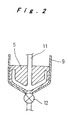
- Fig. 2 is a schematic cross-sectional view of the stock tank (being a storage function for the electrode mixture paste) 9.
- a stirring blade (being a stirring function for the electrode mixture paste) 11 is disposed inside the stock tank 9. With the rotation of the stirring blade 11, the electrode mixture paste 5 returned from the immersion unit 4 is mixed uniformly with an additional electrode mixture paste 5 of a different kneading lot, thereby keeping the properties of the paste constant.
- This uniform electrode mixture paste 5 is returned to the immersion unit 4 by appropriately opening or closing a valve 12. In this manner, even when the paste-coated sheet 6 is continuously produced, high application accuracy can be maintained.
- the different kneading lot refers to that electrode mixture pastes 5 used in this method are manufactured by a plurality of apparatuses or by a plurality of manufacturers.
- the stirring blade 11 In terms of re-forming the sedimentary powders into a uniform paste, it is preferable that the stirring blade 11 have a shape following the bottom shape of the stock tank 9. Moreover, it is desirable that the rotation speed of the stirring blade 11 is moderately slow. Specifically, in terms of preventing both the sedimentation and separation of the electrode mixture paste 5, the average peripheral speed of the blade is 0.2 to 3.0 m/min. As used herein, the average rotation speed refers to an average rotation speed of the intermittent rotation of the stirring blade 11 since the stirring blade 11 is rotated at high and low speeds in an intermittently repeated manner.
- Example of the present invention Comparative Example
- Comparative Example a negative electrode (a hydrogen-absorption alloy electrode) for a nickel metal-hydride storage battery.
- the present invention is not limited to Example, so long as the core material is porous metal thin plate.
- a hydrogen-absorption alloy represented by a chemical formula of MmNi 3.55 CO 0.75 Mn 0.4 Al 0.3 was pulverized into particles, having an average diameter of 30 ⁇ m, in water using a wet ball-mill, thereby obtaining the hydrogen-absorption alloy powder.
- the alloy powder was immersed in an alkali aqueous solution for surface treatment. Subsequently, for each batch, 2 kg of an aqueous solution of carboxymethyl cellulose (solid content ratio: 1.5%) and 0.08 kg of Ketjen black were added to 20 kg of the hydrogen-absorption alloy powder, and the mixture was kneaded.
- the electrode mixture paste 5 of the first batch was supplied to the immersion unit 4 having an inner volume of 20 L, and those of the remaining four batches were supplied to the stock tank 9 having an inner volume of 80 L. Then, the electrode mixture paste 5 was applied to both sides of a core material 2 (the overall length of one coil: 500 m) and dried at a rate of 5 m/min, while the electrode mixture paste 5 was shaved off from an area within 20 mm from each of the edges so as to obtain a coated width of 260 mm and an overall thickness after application of 260 ⁇ m, thereby producing a paste-coated sheet 6.
- a core material 2 the overall length of one coil: 500 m
- the core material 2 was made of an iron-made punched metal plated with nickel and having a thickness of 60 ⁇ m, a width of 300 mm, a punched hole diameter of 1 mm, and a pore rate of 42%.
- the valve 12 provided in the stock tank 9 was repeatedly opened and closed at intervals of 1 minute in such a manner that it was interlocked with a valve (not shown) provided in the immersion unit 4.
- the electrode mixture paste 5 was returned to the stock tank 9 at a processing rate of 2 L/min when the valves were opened.
- the electrode mixture paste 5 was supplied from the stock tank 9 by the pump 10 such that the amount of the electrode mixture paste 5 in the immersion unit 4 was maintained constant at 12 L.
- the stirring blade 11 in the stock tank 9 was rotated at an average peripheral speed of 1 m/min.
- a paste-coated portion in the paste-coated sheet 6 was punched with a 30 mm diameter punch at six positions in the width direction at intervals of 20 m in length, and the application amount of the electrode mixture paste 5 after drying was determined.
- a weight deviation ⁇ 1 in the width direction (a standard deviation represented by percent by weight) was determined at a time after the application over a length of 480 m.
- Example 6 The same procedure as in Example was repeated to produce a paste-coated sheet 6, except that the circulation means (including the stock tank 9 and the pump 10) was not used and that an operation was repeated in which, when the amount of the electrode mixture paste 5 of the first lot was reduced, the electrode mixture paste 5 of the second lot was added such that the amount of the electrode mixture paste 5 in the immersion unit 4 was kept constant at 12 L.
- the circulation means including the stock tank 9 and the pump 10.
- Example 6 The same procedure as in Example was repeated to produce a paste-coated sheet 6, except that the stirring blade 11 in the stock tank 9 was not rotated and that a propeller having a size enough to prevent the contact with both the paste-coated sheet 6 and the inner wall of the immersion unit 4 was disposed in the immersion unit 4 and was rotated at an average peripheral speed of 15 m/min.
- an electrode mixture paste can be stably produced continuously at high application accuracy. Therefore, the invention is highly useful and can be widely used as a technique capable of manufacturing electrodes for nickel metal-hydride storage batteries with high productivity.
Landscapes
- Chemical & Material Sciences (AREA)
- Engineering & Computer Science (AREA)
- Manufacturing & Machinery (AREA)
- Chemical Kinetics & Catalysis (AREA)
- Electrochemistry (AREA)
- General Chemical & Material Sciences (AREA)
- Dispersion Chemistry (AREA)
- Materials Engineering (AREA)
- Battery Electrode And Active Subsutance (AREA)
Abstract
Description
- The present invention relates to a method for applying an electrode mixture paste to a core material made of porous metal thin plate to obtain a paste-coated sheet. In particular, the invention relates to stabilization of the accuracy of paste application.
- Batteries such as alkaline storage batteries and lithium ion secondary batteries are widely used as the power source for portable devices, machine tools, or electric vehicles. Of these, nickel metal-hydride storage batteries have a relatively high energy density and excellent durability, and the applications thereof, including as power sources for electric vehicles, are being expanded.
- Generally, the main components of nickel metal-hydride storage batteries include: a positive electrode formed by filling a three-dimensional metal porous material with nickel hydroxide and other materials; and a negative electrode formed by applying an electrode mixture paste composed of a hydrogen-absorption alloy and other materials to porous metal thin plate (hereinafter simply abbreviated as a "core material") such as a punched metal. Of these two, the negative electrode can be produced continuously because of the nature of its production process, which has received attention as a highly efficient process. Specifically, a method has been proposed in which, after the core material is immersed in the electrode mixture paste, the application amount of the electrode mixture paste is adjusted to produce a paste-coated sheet.
- For example, a mixture paste of a negative electrode for nickel metal-hydride storage batteries contains a hydrogen-absorption alloy having a high specific gravity of approximately 8 g/ml. Therefore, in this case, the hydrogen-absorption alloy sediments over time. As the sedimentation proceeds, only the supernatant of the electrode mixture paste is applied to a core material. Therefore, the composition of the applied material is not uniform, and at the same time the application amount decreases over time. In order to avoid this, for example, the following methods have been proposed: a method in which a kneaded paste is left to stand for a predetermined period of time to temporarily increase the viscosity and thereafter is kneaded again (for example, Patent Document 1); a method in which a paste is stirred at a constant temperature and thereafter is subjected to aging in a stored state (for example, Patent Document 2); and a method in which a paste bath having a stirring function is provided at a area adjacent to an application position (for example, Patent Document 3). In addition to these, it may be effective to evolve, for example, the following methods, although these are examples for other battery systems: a method in which stirring means is provided right at an application position (for example,
Patent Documents 4 and 5); and a method in which a paste is ultrasonically dispersed while being circulated (for example, Patent Document 6). - [Patent Document 1] Japanese Patent Laid-Open Publication No.
9-204917 - [Patent Document 2] Japanese Patent Laid-Open Publication No.
9-035709 - [Patent Document 3] Japanese Patent Laid-Open Publication No.
2000-323138 - [Patent Document 4] Japanese Patent Laid-Open Publication No.
2000-243384 - [Patent Document 5] Japanese Patent Laid-Open Publication No.
2001-076708 - [Patent Document 6] Japanese Patent Laid-Open Publication No.
10-223217 - For example, a mixture paste of a negative electrode for nickel metal-hydride batteries contains, in addition to a hydrogen-absorption alloy having a high specific gravity, a powder (for example, such as a rare-earth metal oxide or carbon black) having a specific gravity greatly different from that of the hydrogen-absorption alloy. In this case, when undue external stress is applied to such an electrode mixture paste containing different types of powders with a large difference in the specific gravity in the manner as shown in
Patent document - When the method of
Patent Document - The present invention has been made in view of the foregoing problems. Accordingly, it is an object of the invention to provide an electrode mixture paste application method which provides stable application accuracy even when a paste-coated sheet is continuously produced using a plurality of lots of electrode mixture pastes containing different types of powders having a large difference in the specific gravity.
- In order to solve the above problems, the present invention provides a method for applying an electrode mixture paste. The method includes: a first step of unwinding a core material wound in a coil shape; a second step of applying an electrode mixture paste to both sides of the core material; a third step of adjusting an application amount of the electrode mixture paste; a fourth step of drying a paste-coated sheet with the electrode mixture paste applied to the both sides thereof; and a fifth step of winding the paste-coated sheet in a coil shape, wherein, in the second step, the electrode mixture paste is circulated and supplied by circulation means, and wherein the circulation means has a storage function and a stirring function, an average rotation speed of which is 0.2 to 3.0 m/min as a peripheral speed.
- The application accuracy can be significantly improved by circulating an electrode mixture paste sedimenting in the immersion unit by the circulation means and at the same time by supplying to the immersion unit an electrode mixture paste which is homogenized while being prevented from separation by means of the stirring function provided, in the circulation means, together with the storage function capable of storing a plurality of lots of electrode mixture pastes.
-
-
Fig. 1 is a schematic view of an apparatus for applying electrode mixture paste in accordance with the method of the present invention; and -
Fig. 2 is a schematic cross-sectional view of a stock tank in the apparatus for carrying out the method of the present invention. - Hereinbelow, the best mode for carrying out the invention will be described in detail with reference to the drawings.
-
Fig. 1 is a schematic view of an apparatus for applying electrode mixture paste in accordance with the present invention. A coil-shaped core material 2 made of porous metal thin plate is unwound by an uncoiler unit 1. Subsequently, thecore material 2 is introduced into animmersion unit 4 filled with anelectrode mixture paste 5, and theelectrode mixture paste 5 is applied onto thecore material 2. Next, thecore material 2 passes through an applicationamount adjusting unit 3 to form a paste-coatedsheet 6. Then, the paste-coatedsheet 6 is introduced into adrying unit 7 and thereafter is wound in a coil shape on acoiler unit 8. In this case, the electrode mixture paste 5 stored in theimmersion unit 4 is circulated and supplied by circulation means (including astock tank 9 and a pump 10). -
Fig. 2 is a schematic cross-sectional view of the stock tank (being a storage function for the electrode mixture paste) 9. A stirring blade (being a stirring function for the electrode mixture paste) 11 is disposed inside thestock tank 9. With the rotation of the stirringblade 11, theelectrode mixture paste 5 returned from theimmersion unit 4 is mixed uniformly with an additional electrode mixture paste 5 of a different kneading lot, thereby keeping the properties of the paste constant. This uniformelectrode mixture paste 5 is returned to theimmersion unit 4 by appropriately opening or closing avalve 12. In this manner, even when the paste-coatedsheet 6 is continuously produced, high application accuracy can be maintained. As used herein, the different kneading lot refers to thatelectrode mixture pastes 5 used in this method are manufactured by a plurality of apparatuses or by a plurality of manufacturers. - In terms of re-forming the sedimentary powders into a uniform paste, it is preferable that the
stirring blade 11 have a shape following the bottom shape of thestock tank 9. Moreover, it is desirable that the rotation speed of the stirringblade 11 is moderately slow. Specifically, in terms of preventing both the sedimentation and separation of the electrode mixture paste 5, the average peripheral speed of the blade is 0.2 to 3.0 m/min. As used herein, the average rotation speed refers to an average rotation speed of the intermittent rotation of the stirringblade 11 since the stirringblade 11 is rotated at high and low speeds in an intermittently repeated manner. - Hereinbelow, the comparison results between Example of the present invention and Comparative Example are described using a negative electrode (a hydrogen-absorption alloy electrode) for a nickel metal-hydride storage battery. Of course, the present invention is not limited to Example, so long as the core material is porous metal thin plate.
- A hydrogen-absorption alloy represented by a chemical formula of MmNi3.55CO0.75Mn0.4Al0.3 was pulverized into particles, having an average diameter of 30 µm, in water using a wet ball-mill, thereby obtaining the hydrogen-absorption alloy powder. The alloy powder was immersed in an alkali aqueous solution for surface treatment. Subsequently, for each batch, 2 kg of an aqueous solution of carboxymethyl cellulose (solid content ratio: 1.5%) and 0.08 kg of Ketjen black were added to 20 kg of the hydrogen-absorption alloy powder, and the mixture was kneaded. Furthermore, 0.35 kg of an aqueous solution of styrene-butadiene copolymer rubber particles (solid content ratio: 40%) was added thereto, and the resultant mixture was stirred, thereby producing an
electrode mixture paste 5. A total of five batches of theelectrode mixture paste 5 were produced. The viscosities of these were measured using a B-type viscometer, and were 220, 233, 228, 215, and 236 ps, respectively. - The electrode mixture paste 5 of the first batch was supplied to the
immersion unit 4 having an inner volume of 20 L, and those of the remaining four batches were supplied to thestock tank 9 having an inner volume of 80 L. Then, theelectrode mixture paste 5 was applied to both sides of a core material 2 (the overall length of one coil: 500 m) and dried at a rate of 5 m/min, while theelectrode mixture paste 5 was shaved off from an area within 20 mm from each of the edges so as to obtain a coated width of 260 mm and an overall thickness after application of 260 µm, thereby producing a paste-coatedsheet 6. In this instance, thecore material 2 was made of an iron-made punched metal plated with nickel and having a thickness of 60 µm, a width of 300 mm, a punched hole diameter of 1 mm, and a pore rate of 42%. Thevalve 12 provided in thestock tank 9 was repeatedly opened and closed at intervals of 1 minute in such a manner that it was interlocked with a valve (not shown) provided in theimmersion unit 4. Theelectrode mixture paste 5 was returned to thestock tank 9 at a processing rate of 2 L/min when the valves were opened. At the same time, theelectrode mixture paste 5 was supplied from thestock tank 9 by thepump 10 such that the amount of theelectrode mixture paste 5 in theimmersion unit 4 was maintained constant at 12 L. Moreover, the stirringblade 11 in thestock tank 9 was rotated at an average peripheral speed of 1 m/min. - After the application over a length of 480 m, a paste-coated portion in the paste-coated
sheet 6 was punched with a 30 mm diameter punch at six positions in the width direction at intervals of 20 m in length, and the application amount of theelectrode mixture paste 5 after drying was determined. A weight deviation σ1 in the width direction (a standard deviation represented by percent by weight) was determined at a time after the application over a length of 480 m. Meanwhile, a weight deviation σ2 in the length direction was determined by averaging the application amounts in the width direction at intervals of 20 m and expressing the standard deviation of the average values in terms of percent by weight. The results were σ1 = 0.07% and σ2 = 0.09%. - The same procedure as in Example was repeated to produce a paste-coated
sheet 6, except that the circulation means (including thestock tank 9 and the pump 10) was not used and that an operation was repeated in which, when the amount of theelectrode mixture paste 5 of the first lot was reduced, theelectrode mixture paste 5 of the second lot was added such that the amount of theelectrode mixture paste 5 in theimmersion unit 4 was kept constant at 12 L. - After the application over a length of 480 m, the weight deviations σ1 and σ2 in the width and length directions, respectively, were determined as in Example 1, and the results were σ1 = 0.06% and σ2 = 0.78%.
- The same procedure as in Example was repeated to produce a paste-coated
sheet 6, except that the stirringblade 11 in thestock tank 9 was not rotated and that a propeller having a size enough to prevent the contact with both the paste-coatedsheet 6 and the inner wall of theimmersion unit 4 was disposed in theimmersion unit 4 and was rotated at an average peripheral speed of 15 m/min. - After the application over a length of 480 m, the weight deviations σ1 and σ2 in the width and length directions, respectively, were determined as in Example 1, and the results were σ1 = 0.36% and σ2 = 1.12%.
- When the
electrode mixture paste 5 was added on a kneading lot by kneading lot basis as described in Comparative Example 1, the application accuracy in the length direction was reduced due to the lot-to-lot fluctuation in properties of the paste. Furthermore, when the stirring mechanism for theelectrode mixture paste 5 was provided in theimmersion unit 4 and excessive stirring was carried out as described in Comparative Example 2, the powders having a large difference in the specific gravity were separated from each other. This resulted in a reduction of not only the application accuracy in the length direction but also that in the width direction. In Comparative Example 2, when the peripheral speed was reduced to a level similar to that in Example, it was observed even visually that theelectrode mixture paste 5 was stirred only in a part of theimmersion unit 4, and no advantageous effect was obtained. - As can be seen from the above results, when a paste-coated sheet is continuously produced using a plurality of lots of electrode mixture pastes containing different types of powders having a large difference in the specific gravity, stable application accuracy is obtained only when the method of Example of the present invention is used.
- As has been described, according to the present invention, an electrode mixture paste can be stably produced continuously at high application accuracy. Therefore, the invention is highly useful and can be widely used as a technique capable of manufacturing electrodes for nickel metal-hydride storage batteries with high productivity.
Claims (2)
- An electrode mixture paste application method for applying an electrode mixture paste (5) containing different types of powders including a hydrogen-absorption alloy powder on a core material (2) made of porous metal thin plate while travelling the core material, the method comprising:a first step of unwinding the core material wound in a coil shape;a second step of applying the electrode mixture paste to both sides of the core material;a third step of adjusting an application amount of the electrode mixture paste;a fourth step of drying a paste-coated sheet with the electrode mixture paste applied to the both sides thereof; anda fifth step of winding the paste-coated sheet in a coil shape, wherein, in the second step, the electrode mixture paste is circulated and supplied by circulation means (9,10), andwherein the circulation means has a storage function (9) and a stirring function (11), an average rotation speed of which is 0.2 to 3.0 m/min as a peripheral speed.
- The electrode mixture paste application method according to claim 1, wherein the electrode mixture paste further contains carbon black.
Applications Claiming Priority (2)
| Application Number | Priority Date | Filing Date | Title |
|---|---|---|---|
| JP2005135546 | 2005-05-09 | ||
| PCT/JP2006/308742 WO2006120907A1 (en) | 2005-05-09 | 2006-04-26 | Electrode mixture paste applying method and device |
Publications (3)
| Publication Number | Publication Date |
|---|---|
| EP1901372A1 EP1901372A1 (en) | 2008-03-19 |
| EP1901372A4 EP1901372A4 (en) | 2011-03-16 |
| EP1901372B1 true EP1901372B1 (en) | 2012-01-11 |
Family
ID=37396417
Family Applications (1)
| Application Number | Title | Priority Date | Filing Date |
|---|---|---|---|
| EP06745720A Ceased EP1901372B1 (en) | 2005-05-09 | 2006-04-26 | Electrode mixture paste applying method |
Country Status (5)
| Country | Link |
|---|---|
| US (1) | US8163334B2 (en) |
| EP (1) | EP1901372B1 (en) |
| JP (1) | JP5160891B2 (en) |
| CN (1) | CN101171707A (en) |
| WO (1) | WO2006120907A1 (en) |
Families Citing this family (10)
| Publication number | Priority date | Publication date | Assignee | Title |
|---|---|---|---|---|
| JP5381274B2 (en) * | 2009-04-22 | 2014-01-08 | 王子ホールディングス株式会社 | Coating apparatus and paper manufacturing method using the same |
| CN103190017A (en) * | 2010-11-02 | 2013-07-03 | 丰田自动车株式会社 | Coating method and coating apparatus |
| JP2012167959A (en) * | 2011-02-10 | 2012-09-06 | Toyota Motor Corp | Paste evaluation device, paste evaluation method, and method for manufacturing electrode plate |
| JP5983001B2 (en) * | 2012-05-01 | 2016-08-31 | 日産自動車株式会社 | Electrode slurry supply apparatus and electrode slurry supply method |
| KR101534642B1 (en) | 2012-07-05 | 2015-07-07 | 주식회사 엘지화학 | Dipping bath |
| CN102935418A (en) * | 2012-11-26 | 2013-02-20 | 江苏福瑞士新能源有限公司 | Cyclic slurry feeding system of coating machine |
| JP6318967B2 (en) * | 2014-08-12 | 2018-05-09 | 株式会社豊田自動織機 | Active material slurry coating equipment |
| EP3327829B1 (en) * | 2015-07-17 | 2020-03-18 | Eliiy Power Co., Ltd. | Battery electrode slurry distribution method, and battery electrode slurry processing method |
| CN107442025B (en) * | 2016-05-30 | 2020-01-17 | 万向一二三股份公司 | Lithium ion battery electrode slurry storage method |
| CN114904713B (en) * | 2021-02-09 | 2023-07-07 | 北京好风光储能技术有限公司 | Battery pole piece slurry hanging device |
Family Cites Families (14)
| Publication number | Priority date | Publication date | Assignee | Title |
|---|---|---|---|---|
| US3238059A (en) * | 1962-09-14 | 1966-03-01 | Michael J Stobierski | Wire coating |
| JPS5981868A (en) * | 1982-11-01 | 1984-05-11 | Matsushita Electric Ind Co Ltd | Manufacturing method for battery electrodes |
| JPS62105363A (en) * | 1985-10-31 | 1987-05-15 | Yuasa Battery Co Ltd | Manufacture of paste type plate |
| JPH0935709A (en) | 1995-07-24 | 1997-02-07 | Toshiba Battery Co Ltd | Manufacture of paste type electrode |
| JPH09204917A (en) | 1996-01-26 | 1997-08-05 | Toshiba Battery Co Ltd | Manufacture of paste type negative electrode for secondary battery |
| JPH10223217A (en) | 1997-02-10 | 1998-08-21 | Matsushita Electric Ind Co Ltd | Method for producing electrode for alkaline storage battery |
| JP2000243384A (en) | 1999-02-22 | 2000-09-08 | Toshiba Battery Co Ltd | Manufacture of positive electrode material for polymer lithium secondary battery |
| JP2000323138A (en) | 1999-05-17 | 2000-11-24 | Toshiba Battery Co Ltd | Paste-like electrode active material coating device |
| JP2001076708A (en) | 1999-09-02 | 2001-03-23 | Toshiba Battery Co Ltd | Method of manufacturing of negative electrode material for polymer lithium secondary battery |
| JP2001149840A (en) | 1999-11-24 | 2001-06-05 | Sony Corp | Coating method and coating device |
| JP4390397B2 (en) | 2001-02-28 | 2009-12-24 | 三洋電機株式会社 | Method for producing alkaline storage battery electrode |
| JP2003170104A (en) * | 2001-09-27 | 2003-06-17 | Toyota Motor Corp | Direct bar coater |
| US7846574B2 (en) * | 2004-08-27 | 2010-12-07 | Panosonic Corporation | Positive electrode plate for alkaline storage battery and method for producing the same |
| WO2006073123A1 (en) * | 2005-01-06 | 2006-07-13 | Matsushita Electric Industrial Co., Ltd. | Nickel hydrogen storage battery and production method for its cathode |
-
2006
- 2006-04-26 EP EP06745720A patent/EP1901372B1/en not_active Ceased
- 2006-04-26 CN CNA2006800158466A patent/CN101171707A/en active Pending
- 2006-04-26 JP JP2007528219A patent/JP5160891B2/en not_active Expired - Fee Related
- 2006-04-26 WO PCT/JP2006/308742 patent/WO2006120907A1/en not_active Ceased
- 2006-04-26 US US11/920,124 patent/US8163334B2/en not_active Expired - Fee Related
Also Published As
| Publication number | Publication date |
|---|---|
| US20090104344A1 (en) | 2009-04-23 |
| EP1901372A4 (en) | 2011-03-16 |
| CN101171707A (en) | 2008-04-30 |
| JPWO2006120907A1 (en) | 2008-12-18 |
| JP5160891B2 (en) | 2013-03-13 |
| EP1901372A1 (en) | 2008-03-19 |
| WO2006120907A1 (en) | 2006-11-16 |
| US8163334B2 (en) | 2012-04-24 |
Similar Documents
| Publication | Publication Date | Title |
|---|---|---|
| US11205774B2 (en) | Nickel composite hydroxide and process for producing same, positive electrode active material and process for producing same, and non-aqueous electrolyte secondary battery | |
| CN107346824B (en) | Preparation method and application of gradient ternary cathode material | |
| CN115196691A (en) | Nickel-iron-manganese ternary precursor for sodium ion battery and preparation method and application thereof | |
| Karami et al. | Synthesis of uniform nano-structured lead oxide by sonochemical method and its application as cathode and anode of lead-acid batteries | |
| EP1901372B1 (en) | Electrode mixture paste applying method | |
| JPH09139206A (en) | Method of manufacturing high dense nickel hydroxide that is used for rechargeable alkali storage battery | |
| Liu et al. | Nanocrosses of lead sulphate as the negative active material of lead acid batteries | |
| US20180287147A1 (en) | Coated Nickel Hydroxide Powder for Positive Electrode Active Material of Alkaline Secondary Battery, and Production Method Therefor | |
| EP3846262A1 (en) | Positive electrode active material particles for secondary batteries, and method for producing positive electrode active material particles for secondary batteries | |
| JP5621506B2 (en) | A method for producing cobalt oxyhydroxide-coated nickel hydroxide. | |
| CN106848184A (en) | A kind of electrodes of lithium-ion batteries and preparation method thereof and lithium ion battery | |
| JP5213989B2 (en) | Coated nickel hydroxide powder for positive electrode active material of alkaline secondary battery and method for producing the same | |
| CN106654224B (en) | A kind of cobalt acid lithium composite material and preparation method, positive electrode | |
| EP3385227A1 (en) | Manufacturing method of cathode active material for secondary cell | |
| US8142837B2 (en) | Method and apparatus for applying electrode mixture paste | |
| EP1876662B1 (en) | Electrode mixture paste coating method and coater | |
| CN104813524A (en) | Coated nickel hydroxide powder for positive electrode active material of alkaline secondary battery and coating adhesion evaluation method of coated nickel hydroxide powder | |
| CN108520940A (en) | A kind of coating process suitable for lithium battery production | |
| EP1901370A1 (en) | Electrode mixture paste applying method and device | |
| US20250296061A1 (en) | Apparatus for mixing and agitating secondary battery electrode materials and control method thereof | |
| EP4700864A1 (en) | Lithium metal composite oxide powder, positive electrode active material for solid secondary battery, positive electrode for solid secondary battery, and solid secondary battery | |
| AU2015201506A1 (en) | Battery electrode materials | |
| JPH11307093A (en) | Mn-containing composite nickel hydroxide active material and method for producing the same | |
| AU2023237062B1 (en) | Preparation method of composite cathode material | |
| JP2015187051A (en) | Nickel hydroxide and alkali battery |
Legal Events
| Date | Code | Title | Description |
|---|---|---|---|
| PUAI | Public reference made under article 153(3) epc to a published international application that has entered the european phase |
Free format text: ORIGINAL CODE: 0009012 |
|
| 17P | Request for examination filed |
Effective date: 20071126 |
|
| AK | Designated contracting states |
Kind code of ref document: A1 Designated state(s): FR |
|
| DAX | Request for extension of the european patent (deleted) | ||
| RBV | Designated contracting states (corrected) |
Designated state(s): FR |
|
| RAP1 | Party data changed (applicant data changed or rights of an application transferred) |
Owner name: PANASONIC CORPORATION |
|
| A4 | Supplementary search report drawn up and despatched |
Effective date: 20110211 |
|
| RIC1 | Information provided on ipc code assigned before grant |
Ipc: H01M 4/04 20060101AFI20061211BHEP Ipc: B05D 1/18 20060101ALI20110207BHEP Ipc: B05C 11/04 20060101ALI20110207BHEP Ipc: B05C 3/132 20060101ALI20110207BHEP Ipc: H01M 4/26 20060101ALI20110207BHEP Ipc: H01M 4/28 20060101ALI20110207BHEP Ipc: B05D 7/24 20060101ALI20110207BHEP |
|
| GRAP | Despatch of communication of intention to grant a patent |
Free format text: ORIGINAL CODE: EPIDOSNIGR1 |
|
| RIC1 | Information provided on ipc code assigned before grant |
Ipc: B05D 1/18 20060101ALI20110714BHEP Ipc: B05D 7/24 20060101ALI20110714BHEP Ipc: H01M 4/26 20060101ALI20110714BHEP Ipc: B05C 3/132 20060101ALI20110714BHEP Ipc: B05C 11/04 20060101ALI20110714BHEP Ipc: H01M 4/04 20060101AFI20110714BHEP Ipc: H01M 4/28 20060101ALI20110714BHEP |
|
| RTI1 | Title (correction) |
Free format text: ELECTRODE MIXTURE PASTE APPLYING METHOD |
|
| GRAS | Grant fee paid |
Free format text: ORIGINAL CODE: EPIDOSNIGR3 |
|
| GRAA | (expected) grant |
Free format text: ORIGINAL CODE: 0009210 |
|
| AK | Designated contracting states |
Kind code of ref document: B1 Designated state(s): FR |
|
| PLBE | No opposition filed within time limit |
Free format text: ORIGINAL CODE: 0009261 |
|
| STAA | Information on the status of an ep patent application or granted ep patent |
Free format text: STATUS: NO OPPOSITION FILED WITHIN TIME LIMIT |
|
| 26N | No opposition filed |
Effective date: 20121012 |
|
| REG | Reference to a national code |
Ref country code: FR Ref legal event code: PLFP Year of fee payment: 11 |
|
| REG | Reference to a national code |
Ref country code: FR Ref legal event code: PLFP Year of fee payment: 12 |
|
| PGFP | Annual fee paid to national office [announced via postgrant information from national office to epo] |
Ref country code: FR Payment date: 20170419 Year of fee payment: 12 |
|
| PG25 | Lapsed in a contracting state [announced via postgrant information from national office to epo] |
Ref country code: FR Free format text: LAPSE BECAUSE OF NON-PAYMENT OF DUE FEES Effective date: 20180430 |