EP1900934A1 - Fuel Injector - Google Patents
Fuel Injector Download PDFInfo
- Publication number
- EP1900934A1 EP1900934A1 EP07017401A EP07017401A EP1900934A1 EP 1900934 A1 EP1900934 A1 EP 1900934A1 EP 07017401 A EP07017401 A EP 07017401A EP 07017401 A EP07017401 A EP 07017401A EP 1900934 A1 EP1900934 A1 EP 1900934A1
- Authority
- EP
- European Patent Office
- Prior art keywords
- spray
- combustion chamber
- tip
- fuel
- fuel injector
- Prior art date
- Legal status (The legal status is an assumption and is not a legal conclusion. Google has not performed a legal analysis and makes no representation as to the accuracy of the status listed.)
- Granted
Links
Images


Classifications
-
- F—MECHANICAL ENGINEERING; LIGHTING; HEATING; WEAPONS; BLASTING
- F02—COMBUSTION ENGINES; HOT-GAS OR COMBUSTION-PRODUCT ENGINE PLANTS
- F02M—SUPPLYING COMBUSTION ENGINES IN GENERAL WITH COMBUSTIBLE MIXTURES OR CONSTITUENTS THEREOF
- F02M61/00—Fuel-injectors not provided for in groups F02M39/00 - F02M57/00 or F02M67/00
- F02M61/16—Details not provided for in, or of interest apart from, the apparatus of groups F02M61/02 - F02M61/14
- F02M61/18—Injection nozzles, e.g. having valve seats; Details of valve member seated ends, not otherwise provided for
- F02M61/1806—Injection nozzles, e.g. having valve seats; Details of valve member seated ends, not otherwise provided for characterised by the arrangement of discharge orifices, e.g. orientation or size
- F02M61/184—Discharge orifices having non circular sections
-
- F—MECHANICAL ENGINEERING; LIGHTING; HEATING; WEAPONS; BLASTING
- F02—COMBUSTION ENGINES; HOT-GAS OR COMBUSTION-PRODUCT ENGINE PLANTS
- F02M—SUPPLYING COMBUSTION ENGINES IN GENERAL WITH COMBUSTIBLE MIXTURES OR CONSTITUENTS THEREOF
- F02M61/00—Fuel-injectors not provided for in groups F02M39/00 - F02M57/00 or F02M67/00
- F02M61/14—Arrangements of injectors with respect to engines; Mounting of injectors
-
- F—MECHANICAL ENGINEERING; LIGHTING; HEATING; WEAPONS; BLASTING
- F02—COMBUSTION ENGINES; HOT-GAS OR COMBUSTION-PRODUCT ENGINE PLANTS
- F02M—SUPPLYING COMBUSTION ENGINES IN GENERAL WITH COMBUSTIBLE MIXTURES OR CONSTITUENTS THEREOF
- F02M69/00—Low-pressure fuel-injection apparatus ; Apparatus with both continuous and intermittent injection; Apparatus injecting different types of fuel
- F02M69/04—Injectors peculiar thereto
- F02M69/042—Positioning of injectors with respect to engine, e.g. in the air intake conduit
- F02M69/045—Positioning of injectors with respect to engine, e.g. in the air intake conduit for injecting into the combustion chamber
Definitions
- This invention pertains to fuel injection in an internal combustion engine.
- One known engine configuration is a spark-ignited, direct-injection (SIDI) engine wherein a fuel injector directly injects fuel into a combustion chamber in close proximity to a spark plug.
- SIDI systems include a spark-ignition, direct-injection, spray-guided engine employing a fuel injector operative at a fuel-rail pressure in the range of 10-20 MPa and adapted to directly inject fuel into a combustion chamber.
- the engine utilizes optimized high-squish bowled pistons, and variable swirl valve control.
- Known injectors used in a spray guided SIDI engine comprise either a multi-hole injector or a piezoelectric hollow-cone injector.
- injected fuel mass is distributed along the outer edge of a conical spray pattern.
- little fuel remains around the spark plug, limiting ignition stability and combustion performance.
- Fuel injected from known multi-hole injectors penetrate deeply into the combustion chamber due to reduced contact area with the surrounding air, especially at heavy loads. Furthermore, fuel injection can be affected by conditions related to fuel temperature, cylinder pressure, and other conditions.
- a fuel injector adapted to inject fuel directly into a combustion chamber of an internal combustion engine includes a spray nozzle mountable to direct a fuel spray into the combustion chamber from a plurality of spray discharge orifices.
- Each spray discharge orifice includes an opening through a tip of the spray nozzle and an elongated cross-section having a major axis orientable to a center electrode of a spark plug in the combustion chamber.
- Fig. 1 is a schematic diagram of a combustion chamber in accordance with the present disclosure
- Fig. 2 is a schematic side-view diagram of an injector tip in accordance with the present disclosure
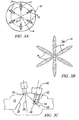
- Fig. 3A is a schematic bottom-view diagram of an injector tip in accordance with the present disclosure
- Fig. 3B is a schematic top-view diagram illustrating a fuel spray pattern for an injector tip in accordance with the present disclosure
- Fig. 3C is a schematic side-view diagram of a combustion chamber, illustrating a fuel spray pattern in accordance with the present disclosure
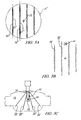
- Fig. 4A is a schematic bottom-view diagram of an injector tip in accordance with the present disclosure.
- Fig. 4B is a schematic top-view diagram illustrating a fuel spray pattern for an injector tip in accordance with the present disclosure
- Fig. 4C is a schematic side-view diagram of a combustion chamber illustrating a fuel spray pattern in accordance with the present disclosure
- Fig. 5A is a schematic bottom-view diagram of an injector tip in accordance with the present disclosure.
- Fig. 5B is a schematic top-view diagram illustrating a spray pattern for an injector tip in accordance with the present disclosure.
- Fig. 5C is a schematic side-view diagram of a combustion chamber illustrating a fuel spray pattern in accordance with the present disclosure.
- FIG. 1 schematically depicts a combustion chamber for an internal combustion engine, comprising a spark-ignition, direct-injection (SIDI) internal combustion engine having multiple cylinders.
- the internal combustion engine is coupled with an engine control module (not shown) operative to execute engine control schemes, based upon operator inputs, ambient conditions, and engine operating conditions.
- the control module monitors inputs from engine sensors and controls engine actuators including a fuel injector 20 and a spark plug 40.
- Each combustion chamber 15 of the internal combustion engine comprises a cylindrical opening in an engine block 11 defining a cylinder, a moveable piston 14, and a cylinder head 12.
- the top of each piston preferably has a bowl formed therein.
- the piston is operable to move linearly within the cylinder.
- the combustion chamber 15 is formed in each cylinder between the bowl in the top of the piston and the cylinder head 12.
- the cylinder head contains one or more moveable air intake valves and one or more moveable exhaust valves (not shown), the fuel injector 20 and the spark plug 40.
- the fuel injector 20 injects a predetermined quantity of pressurized fuel directly into the combustion chamber in response to a command from the control module.
- An injector center line 25 is depicted, consisting of a line defined by a longitudinal axis of the fuel injector 20 and passing through a cross-sectional center thereof.
- the spark plug 40 comprising a center electrode 42 and a side electrode 46 which together form a gap 44, creates an electric arc in the gap in response to an output from the control module effective to ignite a combustible mixture formed in the combustion chamber.
- a spark plug center line 45 is depicted, consisting of a line defined by a longitudinal axis of the spark plug 40 and passing through a center of the center electrode 42.
- the intake valves are operable to open and allow inflow of air and fuel to the combustion chamber.
- the exhaust valves are operable to open and allow exhaust of products of combustion out of the combustion chamber.
- Each piston is mechanically operably connected to a crankshaft via a piston rod.
- the crankshaft is mounted on and rotates in main bearings, in response to linear force applied thereto by the piston rods, as a result
- the fuel injector 20 preferably comprises an electro-mechanical solenoid device adapted to urge open a flow valve contained therein to meter pressurized fuel from a high pressure fuel line through a tip 30 of a nozzle inserted into an opening into the combustion chamber, in response to a control signal from the control module.
- the tip of the spark plug and the injector tip 30 are preferably in close proximity, as depicted in Fig. 1, although the disclosure is not so limited.
- the tip 30 is preferably cone-shaped, having an inner valve seat 32 against which the moveable flow valve (not shown), e.g., a needle valve, of the injector seats to seal and prevent fluidic flow when the injector is not activated.
- the moveable flow valve is selectively actuable to control fluidic flow.
- Each of the openings 36 comprises an elongated cross-section orthogonal to a centerline 37 of the opening defining a major axis 27.
- Fig. 3A depicts a schematic bottom view of an embodiment of the tip of the injector nozzle.
- the tip 30 has a plurality of spray discharge orifices, or openings 36 which pass through the tip from the sac 34 into the combustion chamber 15.
- Each opening preferably has an elliptical cross-section, the elliptical cross-section defined in relationship to a plane orthogonal to the respective opening centerline 37.
- Each elliptical opening 36 is defined by major axis 27 and a minor axis, with a ratio between the minor axis and the major axis of the ellipse measuring significantly less than 1.0. Exemplary ratios between the minor axis and the major axis range from approximately 0.05/1.0 to 0.8/1.0.
- each of the openings 36 there are six openings 36 for discharging fuel spray, with each of the openings preferably having the same dimensions.
- the major axis 27 of each of the openings 36 is oriented radially to a point A on the outer surface of the tip 20 that is preferably coincident with the longitudinal axis 25 of the injector 20.
- Fig. 3B depicts a top-view of corresponding fuel spray pattern comprising spray plumes 38 produced by flowing pressurized fuel through the openings 36 of the tip 30 of the injector nozzle depicted in Fig. 3A, in relation to the gap 44 of the spark plug 40.
- Fig. 3C is a schematic side view diagram of the combustion chamber 15 and depicts the tip 30 of the injector, the spark plug 40 including the center electrode 42, gap 44, and side electrode 46, and propagation of the spray plumes 38 extending from openings 36 of the injector tip 30 when the injector valve is opened permitting fuel flow into the combustion chamber. Two of the spray plumes 38 extend proximal to the spark plug gap 44 on sides thereof.
- Fig. 4A depicts a schematic bottom view of tip 30', comprising another embodiment of the tip of the injector nozzle.
- the tip 30' has a plurality of spray discharge orifices, or openings 36', 36".
- a cross-section of each of the openings is an elongated slit.
- Each elongated slit opening 36', 36" is defined by a major axis 27', 27" and a minor axis, with a ratio between the minor axis and the major axis of the slit measuring significantly less than 1.0.
- Exemplary ratios between the minor axis and the major axis range from approximately 0.05/1.0 to 0.8/1.0.
- FIG. 1 Four openings for discharging the fuel spray are depicted, and with two inner openings 36" preferably having a common axial length, and two outer openings 36' preferably having a common axial length that is less that the length of the inner openings 36".
- the injector is inserted into the cylinder head and indexed such that the major axis 27 of each of the openings 36 is oriented orthogonal to a line (not shown) that is defined by point A on the outer surface of the tip 20 and the spark plug gap 44.
- Fig. 4B depicts a top-view of a corresponding fuel spray pattern comprising spray plumes 38', 38" produced by flowing pressurized fuel through the openings 36', 36" of the tip 30' of the injector nozzle depicted in Fig. 4A, in relation to the gap 44 of the spark plug 40.
- Fig. 4C is a schematic side view diagram of the combustion chamber 15 and depicts the tip 30' of the injector, the spark plug 40 including the center electrode 42, gap 44, and side electrode 46, and propagation of the spray plumes 38', 38" extending from openings 36', 36" of the injector tip 30' when the injector valve is opened permitting fuel flow into the combustion chamber.
- a planar surface of one of the spray plumes 38' extends proximal to the spark plug gap 44.
- Fig. 5A depicts a schematic bottom view of tip 30", comprising another embodiment of the tip of the injector nozzle.
- the tip 30" has spray discharge orifices, or openings 36', 36".
- the cross-section of each of the openings comprising the elongated slit, with each defined by the major axis 27', 27" and a minor axis, with a ratio between the minor axis and the major axis of the slit measuring significantly less than 1.0.
- Exemplary ratios between the minor axis and the major axis range from approximately 0.05/1.0 to 0.8/1.0.
- FIG. 1 Four openings for discharging the fuel spray are depicted, and with two inner openings 36" preferably having a common axial length, and two outer openings 36' preferably having a common axial length.
- the injector is inserted into the cylinder head and indexed such that the major axis 27 of each of the openings 36 is oriented parallel to a line (not shown) that is defined by point A on the outer surface of the tip 30" and the spark plug gap 44, such that the defined line falls between the adjacent slits 36".
- Fig. 5B depicts a corresponding fuel spray pattern comprising spray plumes 38', 38" produced by flowing pressurized fuel through the openings 36', 36" of the tip 30" of the injector nozzle depicted in Fig. 5A, in relation to the gap 44 of the spark plug 40.
- Fig. 5C is a schematic side view diagram of the combustion chamber 15 and depicts the tip 30" of the injector, the spark plug 40 including the center electrode 42, gap 44, and side electrode 46, and propagation of the spray plumes 38', 38" from openings 36', 36" of the injector tip 30" when the injector valve is opened permitting fuel flow into the combustion chamber.
- planar surfaces of the spray plumes 38" are proximal to the spark plug gap 44, having a flow pattern such that the planar surfaces of the spray plumes 38" extend proximal to the spark plug gap 44 on each side thereof.
- each fuel injection pulse being substantially shaped as an oval or a planar sheet, increasing the fuel surface area in the combustion chamber.
- the shaping of the fuel pulse enlarges the contact area between the fuel spray and intake air in the combustion chamber and distributes the fuel charge into the region where initial charge combustion occurs, i.e., the vicinity of the spark plug.
- the increased fuel spray contact area reduces spray penetration into the combustion chamber, thus retaining more fuel around the spark plug to accelerate combustion and reduce wall-wetting of the combustion chamber.
- each fan output from the nozzle openings can be adjusted to provide fuel in a middle portion of each spray plume, adapted for different bowl geometries to provide optimum combustion charge conditions at the spark plug.
- Benefits associated therewith include improved ignition stability, reduced smoke at heavy load, faster and more complete combustion providing an opportunity to reduce hydrocarbons, lower engine-out NOx, and lower dependency on in-cylinder air flow levels.
- the fuel spray primarily controls the combustion charge for the engine.
- the fuel injector provides an ignitable mixture at the spark plug gap during spark ignition. Interaction between the fuel spray and surrounding air affects fuel vaporization and formation of the combustion charge, thus affecting ignition of the combustion charge.
Landscapes
- Engineering & Computer Science (AREA)
- Chemical & Material Sciences (AREA)
- Combustion & Propulsion (AREA)
- Mechanical Engineering (AREA)
- General Engineering & Computer Science (AREA)
- Fuel-Injection Apparatus (AREA)
Abstract


Description
- This application claims the benefit of
U.S. Provisional Application No. 60/824,507 filed on 9/5/2006 which is hereby incorporated herein by reference. - This invention pertains to fuel injection in an internal combustion engine.
- One known engine configuration is a spark-ignited, direct-injection (SIDI) engine wherein a fuel injector directly injects fuel into a combustion chamber in close proximity to a spark plug. Known SIDI systems include a spark-ignition, direct-injection, spray-guided engine employing a fuel injector operative at a fuel-rail pressure in the range of 10-20 MPa and adapted to directly inject fuel into a combustion chamber. The engine utilizes optimized high-squish bowled pistons, and variable swirl valve control.
- Known injectors used in a spray guided SIDI engine comprise either a multi-hole injector or a piezoelectric hollow-cone injector. In such known types of injectors, injected fuel mass is distributed along the outer edge of a conical spray pattern. As a consequence, little fuel remains around the spark plug, limiting ignition stability and combustion performance. Fuel injected from known multi-hole injectors penetrate deeply into the combustion chamber due to reduced contact area with the surrounding air, especially at heavy loads. Furthermore, fuel injection can be affected by conditions related to fuel temperature, cylinder pressure, and other conditions.
- A fuel injector adapted to inject fuel directly into a combustion chamber of an internal combustion engine includes a spray nozzle mountable to direct a fuel spray into the combustion chamber from a plurality of spray discharge orifices. Each spray discharge orifice includes an opening through a tip of the spray nozzle and an elongated cross-section having a major axis orientable to a center electrode of a spark plug in the combustion chamber.
- One or more embodiments will now be described, by way of example, with reference to the accompanying drawings, in which:
- Fig. 1 is a schematic diagram of a combustion chamber in accordance with the present disclosure;
- Fig. 2 is a schematic side-view diagram of an injector tip in accordance with the present disclosure;
- Fig. 3A is a schematic bottom-view diagram of an injector tip in accordance with the present disclosure;
- Fig. 3B is a schematic top-view diagram illustrating a fuel spray pattern for an injector tip in accordance with the present disclosure;
- Fig. 3C is a schematic side-view diagram of a combustion chamber, illustrating a fuel spray pattern in accordance with the present disclosure;
- Fig. 4A is a schematic bottom-view diagram of an injector tip in accordance with the present disclosure;
- Fig. 4B is a schematic top-view diagram illustrating a fuel spray pattern for an injector tip in accordance with the present disclosure;
- Fig. 4C is a schematic side-view diagram of a combustion chamber illustrating a fuel spray pattern in accordance with the present disclosure;
- Fig. 5A is a schematic bottom-view diagram of an injector tip in accordance with the present disclosure;
- Fig. 5B is a schematic top-view diagram illustrating a spray pattern for an injector tip in accordance with the present disclosure; and
- Fig. 5C is a schematic side-view diagram of a combustion chamber illustrating a fuel spray pattern in accordance with the present disclosure.
- Referring now to the drawings, wherein the showings are for the purpose of illustrating certain exemplary embodiments only and not for the purpose of limiting the same, Fig. 1 schematically depicts a combustion chamber for an internal combustion engine, comprising a spark-ignition, direct-injection (SIDI) internal combustion engine having multiple cylinders. The internal combustion engine is coupled with an engine control module (not shown) operative to execute engine control schemes, based upon operator inputs, ambient conditions, and engine operating conditions. The control module monitors inputs from engine sensors and controls engine actuators including a
fuel injector 20 and aspark plug 40. - Each
combustion chamber 15 of the internal combustion engine comprises a cylindrical opening in anengine block 11 defining a cylinder, amoveable piston 14, and a cylinder head 12. The top of each piston preferably has a bowl formed therein. The piston is operable to move linearly within the cylinder. Thecombustion chamber 15 is formed in each cylinder between the bowl in the top of the piston and the cylinder head 12. The cylinder head contains one or more moveable air intake valves and one or more moveable exhaust valves (not shown), thefuel injector 20 and thespark plug 40. Thefuel injector 20 injects a predetermined quantity of pressurized fuel directly into the combustion chamber in response to a command from the control module. Aninjector center line 25 is depicted, consisting of a line defined by a longitudinal axis of thefuel injector 20 and passing through a cross-sectional center thereof. Thespark plug 40, comprising acenter electrode 42 and aside electrode 46 which together form agap 44, creates an electric arc in the gap in response to an output from the control module effective to ignite a combustible mixture formed in the combustion chamber. A sparkplug center line 45 is depicted, consisting of a line defined by a longitudinal axis of thespark plug 40 and passing through a center of thecenter electrode 42. The intake valves are operable to open and allow inflow of air and fuel to the combustion chamber. The exhaust valves are operable to open and allow exhaust of products of combustion out of the combustion chamber. Each piston is mechanically operably connected to a crankshaft via a piston rod. The crankshaft is mounted on and rotates in main bearings, in response to linear force applied thereto by the piston rods, as a result of combustion events in each combustion chamber. - The
fuel injector 20 preferably comprises an electro-mechanical solenoid device adapted to urge open a flow valve contained therein to meter pressurized fuel from a high pressure fuel line through atip 30 of a nozzle inserted into an opening into the combustion chamber, in response to a control signal from the control module. The tip of the spark plug and theinjector tip 30 are preferably in close proximity, as depicted in Fig. 1, although the disclosure is not so limited. - Referring now to Fig. 2, a cut-away side-view schematic of the
tip 30 of the injector nozzle is depicted. Thetip 30 is preferably cone-shaped, having aninner valve seat 32 against which the moveable flow valve (not shown), e.g., a needle valve, of the injector seats to seal and prevent fluidic flow when the injector is not activated. The moveable flow valve is selectively actuable to control fluidic flow. There is asac 34 into which fuel flows, and a plurality of spray orifices oropenings 36 through thetip 30, through which fuel passes to thecombustion chamber 15. Each of theopenings 36 comprises an elongated cross-section orthogonal to acenterline 37 of the opening defining amajor axis 27. - Fig. 3A depicts a schematic bottom view of an embodiment of the tip of the injector nozzle. The
tip 30 has a plurality of spray discharge orifices, oropenings 36 which pass through the tip from thesac 34 into thecombustion chamber 15. Each opening preferably has an elliptical cross-section, the elliptical cross-section defined in relationship to a plane orthogonal to therespective opening centerline 37. Eachelliptical opening 36 is defined bymajor axis 27 and a minor axis, with a ratio between the minor axis and the major axis of the ellipse measuring significantly less than 1.0. Exemplary ratios between the minor axis and the major axis range from approximately 0.05/1.0 to 0.8/1.0. In one embodiment there are sixopenings 36 for discharging fuel spray, with each of the openings preferably having the same dimensions. Themajor axis 27 of each of theopenings 36 is oriented radially to a point A on the outer surface of thetip 20 that is preferably coincident with thelongitudinal axis 25 of theinjector 20. - Fig. 3B depicts a top-view of corresponding fuel spray pattern comprising
spray plumes 38 produced by flowing pressurized fuel through theopenings 36 of thetip 30 of the injector nozzle depicted in Fig. 3A, in relation to thegap 44 of thespark plug 40. Fig. 3C is a schematic side view diagram of thecombustion chamber 15 and depicts thetip 30 of the injector, thespark plug 40 including thecenter electrode 42,gap 44, andside electrode 46, and propagation of thespray plumes 38 extending fromopenings 36 of theinjector tip 30 when the injector valve is opened permitting fuel flow into the combustion chamber. Two of thespray plumes 38 extend proximal to thespark plug gap 44 on sides thereof. - Fig. 4A depicts a schematic bottom view of tip 30', comprising another embodiment of the tip of the injector nozzle. The tip 30' has a plurality of spray discharge orifices, or
openings 36', 36". A cross-section of each of the openings is an elongated slit. Each elongated slit opening 36', 36" is defined by amajor axis 27', 27" and a minor axis, with a ratio between the minor axis and the major axis of the slit measuring significantly less than 1.0. Exemplary ratios between the minor axis and the major axis range from approximately 0.05/1.0 to 0.8/1.0. Four openings for discharging the fuel spray are depicted, and with twoinner openings 36" preferably having a common axial length, and two outer openings 36' preferably having a common axial length that is less that the length of theinner openings 36". The injector is inserted into the cylinder head and indexed such that themajor axis 27 of each of theopenings 36 is oriented orthogonal to a line (not shown) that is defined by point A on the outer surface of thetip 20 and thespark plug gap 44. - Fig. 4B depicts a top-view of a corresponding fuel spray pattern comprising
spray plumes 38', 38" produced by flowing pressurized fuel through theopenings 36', 36" of the tip 30' of the injector nozzle depicted in Fig. 4A, in relation to thegap 44 of thespark plug 40. Fig. 4C is a schematic side view diagram of thecombustion chamber 15 and depicts the tip 30' of the injector, thespark plug 40 including thecenter electrode 42,gap 44, andside electrode 46, and propagation of thespray plumes 38', 38" extending fromopenings 36', 36" of the injector tip 30' when the injector valve is opened permitting fuel flow into the combustion chamber. As depicted, a planar surface of one of the spray plumes 38' extends proximal to thespark plug gap 44. - Fig. 5A depicts a schematic bottom view of
tip 30", comprising another embodiment of the tip of the injector nozzle. Thetip 30" has spray discharge orifices, oropenings 36', 36". The cross-section of each of the openings comprising the elongated slit, with each defined by themajor axis 27', 27" and a minor axis, with a ratio between the minor axis and the major axis of the slit measuring significantly less than 1.0. Exemplary ratios between the minor axis and the major axis range from approximately 0.05/1.0 to 0.8/1.0. Four openings for discharging the fuel spray are depicted, and with twoinner openings 36" preferably having a common axial length, and two outer openings 36' preferably having a common axial length. The injector is inserted into the cylinder head and indexed such that themajor axis 27 of each of theopenings 36 is oriented parallel to a line (not shown) that is defined by point A on the outer surface of thetip 30" and thespark plug gap 44, such that the defined line falls between theadjacent slits 36". - Fig. 5B depicts a corresponding fuel spray pattern comprising
spray plumes 38', 38" produced by flowing pressurized fuel through theopenings 36', 36" of thetip 30" of the injector nozzle depicted in Fig. 5A, in relation to thegap 44 of thespark plug 40. Fig. 5C is a schematic side view diagram of thecombustion chamber 15 and depicts thetip 30" of the injector, thespark plug 40 including thecenter electrode 42,gap 44, andside electrode 46, and propagation of thespray plumes 38', 38" fromopenings 36', 36" of theinjector tip 30" when the injector valve is opened permitting fuel flow into the combustion chamber. As depicted, planar surfaces of thespray plumes 38" are proximal to thespark plug gap 44, having a flow pattern such that the planar surfaces of thespray plumes 38" extend proximal to thespark plug gap 44 on each side thereof. - The design of the tip of the injector nozzle with
elongated openings - The disclosure has described certain preferred embodiments and modifications thereto. Further modifications and alterations may occur to others upon reading and understanding the specification. Therefore, it is intended that the disclosure not be limited to the particular embodiment(s) disclosed as the best mode contemplated for carrying out this disclosure, but that the disclosure will include all embodiments falling within the scope of the appended claims.
Claims (14)
- A fuel injector, adapted to inject fuel directly into a combustion chamber of an internal combustion engine, comprising:a spray nozzle mountable to direct a fuel spray into the combustion chamber from a plurality of spray discharge orifices; and,each spray discharge orifice comprising an opening through a tip of the spray nozzle and an elongated cross-section having a major axis orientable to a center electrode of a spark plug in the combustion chamber.
- The fuel injector of claim 1, wherein the elongated cross-section of each spray discharge orifice comprises an elliptical cross-section.
- The fuel injector of claim 2, wherein each spray discharge orifice comprises the elliptical cross-section having a major axis radial to a center point of the tip of the spray nozzle.
- The fuel injector of claim 3, wherein the center point of the tip of the spray nozzle is collinear with a longitudinal axis of the injector.
- The fuel injector of claim 4, wherein the tip of the spray nozzle is substantially cone-shaped.
- The fuel injector of claim 1, wherein the major axis of the elongated cross-section of each spray discharge orifice is radial to a center point of the tip of the spray nozzle.
- The fuel injector of claim 1, wherein the major axis of the elongated cross-section of each spray discharge orifice is parallel to a line defined by the tip of the spray nozzle and the center electrode of the spark plug.
- The fuel injector of claim 1, wherein the major axis of the elongated cross-section of each spray discharge orifice is orthogonal to a line defined by the tip of the spray nozzle and the center electrode of the spark plug.
- The fuel injector of claim 1, wherein the elongated cross-section of each spray discharge orifice comprises a narrow slit.
- Combustion chamber for an internal combustion engine, comprising:a moveable piston, a cylinder, and, a cylinder head including a fuel injector and a spark plug;the fuel injector adapted to inject fuel directly into the combustion chamber, said fuel injector including a spray nozzle having a plurality of spray discharge orifices through a cone-shaped tip and mountable to direct a fuel spray into the combustion chamber;each spray discharge orifice comprising an opening through the cone-shaped tip and an elongated cross-section with a major axis oriented to a line defined by the cone-shaped tip and a center electrode of the spark plug.
- The combustion chamber of claim 10, wherein the major axes of the elongated cross-sections of the spray discharge orifices are parallel one to another.
- The combustion chamber of claim 11, wherein the major axes of the elongated cross-sections of the spray discharge orifices are parallel to the line defined by the cone-shaped tip of the spray nozzle of the injector and the center electrode of the spark plug.
- The combustion chamber of claim 11, wherein the major axes of the elongated cross-sections of the spray discharge orifices are orthogonal to the line defined by the cone-shaped tip of the spray nozzle of the injector and the center electrode of the spark plug.
- The combustion chamber of claim 10, wherein the fuel spray into the combustion chamber comprises a plurality of spray plumes including planar surfaces with one of the spray plumes extending proximal to the spark plug.
Applications Claiming Priority (1)
| Application Number | Priority Date | Filing Date | Title |
|---|---|---|---|
| US82450706P | 2006-09-05 | 2006-09-05 |
Publications (2)
| Publication Number | Publication Date |
|---|---|
| EP1900934A1 true EP1900934A1 (en) | 2008-03-19 |
| EP1900934B1 EP1900934B1 (en) | 2009-06-17 |
Family
ID=38961928
Family Applications (1)
| Application Number | Title | Priority Date | Filing Date |
|---|---|---|---|
| EP07017401A Active EP1900934B1 (en) | 2006-09-05 | 2007-09-05 | Fuel Injector |
Country Status (3)
| Country | Link |
|---|---|
| US (1) | US7740002B2 (en) |
| EP (1) | EP1900934B1 (en) |
| DE (1) | DE602007001318D1 (en) |
Cited By (2)
| Publication number | Priority date | Publication date | Assignee | Title |
|---|---|---|---|---|
| EP2937553B1 (en) * | 2012-12-20 | 2018-08-01 | Hyundai Kefico Corporation | Vehicular high pressure direct injection type injector with valve seat body for fuel-atomization |
| WO2019057387A1 (en) * | 2017-09-25 | 2019-03-28 | Robert Bosch Gmbh | NOZZLE ASSEMBLY FOR A FUEL INJECTOR, FUEL INJECTOR |
Families Citing this family (12)
| Publication number | Priority date | Publication date | Assignee | Title |
|---|---|---|---|---|
| US8864876B2 (en) * | 2005-02-14 | 2014-10-21 | Neumann Systems Group, Inc. | Indirect and direct method of sequestering contaminates |
| US8398059B2 (en) | 2005-02-14 | 2013-03-19 | Neumann Systems Group, Inc. | Gas liquid contactor and method thereof |
| US7866638B2 (en) | 2005-02-14 | 2011-01-11 | Neumann Systems Group, Inc. | Gas liquid contactor and effluent cleaning system and method |
| US8113491B2 (en) | 2005-02-14 | 2012-02-14 | Neumann Systems Group, Inc. | Gas-liquid contactor apparatus and nozzle plate |
| US7379487B2 (en) | 2005-02-14 | 2008-05-27 | Neumann Information Systems, Inc. | Two phase reactor |
| US7942349B1 (en) * | 2009-03-24 | 2011-05-17 | Meyer Andrew E | Fuel injector |
| US8960151B2 (en) * | 2011-04-06 | 2015-02-24 | GM Global Technology Operations LLC | HCCI fuel injectors for robust auto-ignition and flame propagation |
| US20150014448A1 (en) * | 2013-07-12 | 2015-01-15 | Delphi Technologies, Inc. | Valve seat for gaseous fuel injector |
| MX2017017012A (en) * | 2015-06-26 | 2018-08-15 | Oil & Gas Tech Entpr C V | Vortex-generating wash nozzle assemblies. |
| EP3376019B1 (en) * | 2015-11-10 | 2023-01-04 | Nissan Motor Co., Ltd. | Method for controlling internal combustion engine |
| US10612508B2 (en) * | 2017-06-28 | 2020-04-07 | Caterpillar Inc. | Fuel injector for internal combustion engines |
| US10519883B2 (en) | 2018-06-01 | 2019-12-31 | GM Global Technology Operations LLC | Catalyst temperature maintenance systems and methods |
Citations (5)
| Publication number | Priority date | Publication date | Assignee | Title |
|---|---|---|---|---|
| US6045063A (en) * | 1995-10-31 | 2000-04-04 | Kabushiki Kaisha Toyota Chuo Kenkyusho | Fuel injector |
| EP1020638A2 (en) * | 1999-01-13 | 2000-07-19 | Toyota Jidosha Kabushiki Kaisha | Injector |
| WO2001090571A2 (en) * | 2000-05-26 | 2001-11-29 | Robert Bosch Gmbh | Fuel injection system |
| FR2860557A1 (en) * | 2003-10-06 | 2005-04-08 | Renault Sa | INTERNAL COMBUSTION ENGINE FUEL INJECTOR FOR A VEHICLE COMPRISING A NOZZLE HAVING AT LEAST ONE ORIFICE |
| US6883491B2 (en) * | 2001-05-21 | 2005-04-26 | Robert Bosch Gmbh | Fuel injection system |
Family Cites Families (13)
| Publication number | Priority date | Publication date | Assignee | Title |
|---|---|---|---|---|
| US5265562A (en) | 1992-07-27 | 1993-11-30 | Kruse Douglas C | Internal combustion engine with limited temperature cycle |
| US5540200A (en) * | 1993-12-28 | 1996-07-30 | Nissan Motor Co., Ltd. | Fuel injection valve |
| DE4409848A1 (en) * | 1994-03-22 | 1995-10-19 | Siemens Ag | Device for metering and atomizing fluids |
| BR9605943A (en) * | 1995-03-29 | 1997-08-19 | Bosch Gmbh Robert | Perforated disc particularly for injection valves |
| DE10032336A1 (en) | 2000-07-04 | 2002-01-17 | Bosch Gmbh Robert | Fuel injection system has row(s) of injection holes, additional central hole that produces central region of injection jet enriched with fuel that passes to ignition plug |
| US6719224B2 (en) | 2001-12-18 | 2004-04-13 | Nippon Soken, Inc. | Fuel injector and fuel injection system |
| JP3722285B2 (en) * | 2002-02-28 | 2005-11-30 | ヤマハ発動機株式会社 | In-cylinder fuel injection internal combustion engine |
| US6659074B2 (en) | 2002-05-08 | 2003-12-09 | General Motors Corporation | Spark ignition direct injection engine with shaped multihole injectors |
| US6854670B2 (en) | 2002-05-17 | 2005-02-15 | Keihin Corporation | Fuel injection valve |
| JP3912194B2 (en) | 2002-06-11 | 2007-05-09 | マツダ株式会社 | Spark ignition direct injection engine |
| JP2005201097A (en) | 2004-01-14 | 2005-07-28 | Toyota Motor Corp | In-cylinder internal combustion engine |
| US6971365B1 (en) | 2004-07-12 | 2005-12-06 | General Motors Corporation | Auto-ignition gasoline engine combustion chamber and method |
| JP4619989B2 (en) | 2005-07-04 | 2011-01-26 | 株式会社デンソー | Fuel injection valve |
-
2007
- 2007-08-30 US US11/847,673 patent/US7740002B2/en active Active
- 2007-09-05 EP EP07017401A patent/EP1900934B1/en active Active
- 2007-09-05 DE DE602007001318T patent/DE602007001318D1/en active Active
Patent Citations (5)
| Publication number | Priority date | Publication date | Assignee | Title |
|---|---|---|---|---|
| US6045063A (en) * | 1995-10-31 | 2000-04-04 | Kabushiki Kaisha Toyota Chuo Kenkyusho | Fuel injector |
| EP1020638A2 (en) * | 1999-01-13 | 2000-07-19 | Toyota Jidosha Kabushiki Kaisha | Injector |
| WO2001090571A2 (en) * | 2000-05-26 | 2001-11-29 | Robert Bosch Gmbh | Fuel injection system |
| US6883491B2 (en) * | 2001-05-21 | 2005-04-26 | Robert Bosch Gmbh | Fuel injection system |
| FR2860557A1 (en) * | 2003-10-06 | 2005-04-08 | Renault Sa | INTERNAL COMBUSTION ENGINE FUEL INJECTOR FOR A VEHICLE COMPRISING A NOZZLE HAVING AT LEAST ONE ORIFICE |
Cited By (2)
| Publication number | Priority date | Publication date | Assignee | Title |
|---|---|---|---|---|
| EP2937553B1 (en) * | 2012-12-20 | 2018-08-01 | Hyundai Kefico Corporation | Vehicular high pressure direct injection type injector with valve seat body for fuel-atomization |
| WO2019057387A1 (en) * | 2017-09-25 | 2019-03-28 | Robert Bosch Gmbh | NOZZLE ASSEMBLY FOR A FUEL INJECTOR, FUEL INJECTOR |
Also Published As
| Publication number | Publication date |
|---|---|
| EP1900934B1 (en) | 2009-06-17 |
| DE602007001318D1 (en) | 2009-07-30 |
| US7740002B2 (en) | 2010-06-22 |
| US20080210199A1 (en) | 2008-09-04 |
Similar Documents
| Publication | Publication Date | Title |
|---|---|---|
| EP1900934B1 (en) | Fuel Injector | |
| US6644267B2 (en) | Fuel injection system | |
| JP5328218B2 (en) | Combustion chamber of self-ignition internal combustion engine and method for controlling the engine | |
| JP4280928B2 (en) | Direct injection spark ignition internal combustion engine | |
| US6883491B2 (en) | Fuel injection system | |
| US9850869B2 (en) | Fuel injector | |
| US6742493B2 (en) | Fuel injection system and method for injection | |
| JP4123938B2 (en) | Fuel injection system | |
| US6659070B2 (en) | Fuel injection system | |
| JP5537049B2 (en) | In-cylinder injection spark ignition engine | |
| CN103261665A (en) | Fuel injection valves for internal combustion engines | |
| US6659074B2 (en) | Spark ignition direct injection engine with shaped multihole injectors | |
| US6877477B2 (en) | Fuel injection system | |
| JP4222256B2 (en) | Control device for internal combustion engine | |
| JP4085877B2 (en) | Fuel injection valve for internal combustion engine | |
| US10927804B2 (en) | Direct fuel injector | |
| US6676040B2 (en) | Variable swirl type GDI injector | |
| US11073071B2 (en) | Fuel injector with divided flowpath nozzle |
Legal Events
| Date | Code | Title | Description |
|---|---|---|---|
| PUAI | Public reference made under article 153(3) epc to a published international application that has entered the european phase |
Free format text: ORIGINAL CODE: 0009012 |
|
| AK | Designated contracting states |
Kind code of ref document: A1 Designated state(s): AT BE BG CH CY CZ DE DK EE ES FI FR GB GR HU IE IS IT LI LT LU LV MC MT NL PL PT RO SE SI SK TR |
|
| AX | Request for extension of the european patent |
Extension state: AL BA HR MK YU |
|
| 17P | Request for examination filed |
Effective date: 20080416 |
|
| 17Q | First examination report despatched |
Effective date: 20080516 |
|
| AKX | Designation fees paid |
Designated state(s): DE |
|
| GRAP | Despatch of communication of intention to grant a patent |
Free format text: ORIGINAL CODE: EPIDOSNIGR1 |
|
| GRAS | Grant fee paid |
Free format text: ORIGINAL CODE: EPIDOSNIGR3 |
|
| GRAA | (expected) grant |
Free format text: ORIGINAL CODE: 0009210 |
|
| AK | Designated contracting states |
Kind code of ref document: B1 Designated state(s): DE |
|
| REF | Corresponds to: |
Ref document number: 602007001318 Country of ref document: DE Date of ref document: 20090730 Kind code of ref document: P |
|
| PLBE | No opposition filed within time limit |
Free format text: ORIGINAL CODE: 0009261 |
|
| STAA | Information on the status of an ep patent application or granted ep patent |
Free format text: STATUS: NO OPPOSITION FILED WITHIN TIME LIMIT |
|
| 26N | No opposition filed |
Effective date: 20100318 |
|
| REG | Reference to a national code |
Ref country code: DE Ref legal event code: R081 Ref document number: 602007001318 Country of ref document: DE Owner name: GM GLOBAL TECHNOLOGY OPERATIONS LLC (N. D. GES, US Free format text: FORMER OWNER: GM GLOBAL TECHNOLOGY OPERATIONS, INC., DETROIT, MICH., US Effective date: 20110323 |
|
| PGFP | Annual fee paid to national office [announced via postgrant information from national office to epo] |
Ref country code: DE Payment date: 20250820 Year of fee payment: 19 |