EP1900905A2 - Airfoil thermal management with microcircuit cooling - Google Patents
Airfoil thermal management with microcircuit cooling Download PDFInfo
- Publication number
- EP1900905A2 EP1900905A2 EP07253638A EP07253638A EP1900905A2 EP 1900905 A2 EP1900905 A2 EP 1900905A2 EP 07253638 A EP07253638 A EP 07253638A EP 07253638 A EP07253638 A EP 07253638A EP 1900905 A2 EP1900905 A2 EP 1900905A2
- Authority
- EP
- European Patent Office
- Prior art keywords
- cooling
- cooling circuit
- side wall
- turbine engine
- engine component
- Prior art date
- Legal status (The legal status is an assumption and is not a legal conclusion. Google has not performed a legal analysis and makes no representation as to the accuracy of the status listed.)
- Granted
Links
Images
Classifications
-
- F—MECHANICAL ENGINEERING; LIGHTING; HEATING; WEAPONS; BLASTING
- F01—MACHINES OR ENGINES IN GENERAL; ENGINE PLANTS IN GENERAL; STEAM ENGINES
- F01D—NON-POSITIVE DISPLACEMENT MACHINES OR ENGINES, e.g. STEAM TURBINES
- F01D5/00—Blades; Blade-carrying members; Heating, heat-insulating, cooling or antivibration means on the blades or the members
- F01D5/12—Blades
- F01D5/14—Form or construction
- F01D5/18—Hollow blades, i.e. blades with cooling or heating channels or cavities; Heating, heat-insulating or cooling means on blades
- F01D5/187—Convection cooling
-
- F—MECHANICAL ENGINEERING; LIGHTING; HEATING; WEAPONS; BLASTING
- F05—INDEXING SCHEMES RELATING TO ENGINES OR PUMPS IN VARIOUS SUBCLASSES OF CLASSES F01-F04
- F05D—INDEXING SCHEME FOR ASPECTS RELATING TO NON-POSITIVE-DISPLACEMENT MACHINES OR ENGINES, GAS-TURBINES OR JET-PROPULSION PLANTS
- F05D2260/00—Function
- F05D2260/20—Heat transfer, e.g. cooling
- F05D2260/221—Improvement of heat transfer
- F05D2260/2214—Improvement of heat transfer by increasing the heat transfer surface
Definitions
- the present invention relates to a cooling arrangement for use in a turbine engine component.
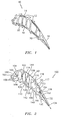
- FIG. 1 illustrates a current cooling scheme for a turbine blade 10. It consists of a hybrid application of embedded microcircuit panels 12 running axially along the airfoil walls 14 and 16 in combination with a set of film cooling holes.
- the airfoil active convective cooling is done through a series of microcircuits 12 in the mid-body and trailing edge portions of the airfoil 18, supplemented with film cooling by a series of film holes 20.
- the axial circuits do not take full advantage of pumping; therefore, dedicated feed cavities are used for independently feeding each circuit. This leads to an increased number of airfoil ribs 22.
- the airfoil outer layers experience relatively hot metal temperatures. If the temperature is sufficiently high, a stress relaxation process occurs at these airfoil locations, leading to relatively high strains (deformations). Simultaneously, the relative cold inside ribs 22 experience an increase in stress as the load to the part needs to be shared by the entire airfoil 18. This balance in the stress-state of the airfoil occurs every time a blade is ramped up, causing some amount of irreversible damage, which, in excessive limits, can lead to catastrophic failures. If these limits are not approached, the amount of damage accumulation can take some time or cycles. That is, long enough to make the design viable for the require life targets.
- the present invention relates to a cooling scheme for a turbine engine component, such as a turbine blade, which reduces the outer metal temperatures and the thermal gradients in the part.
- a turbine engine component which broadly comprises an airfoil portion having a pressure side wall and a suction side wall, a plurality of ribs extending between said pressure side wall and said suction side wall, and a plurality of supply cavities located between said ribs; and an arrangement for cooling said airfoil portion comprising a first means embedded within said suction side wall for convectively cooling said suction side wall, a second means embedded within said pressure side wall for cooling said pressure side wall, and third means for increasing a temperature of at least one said ribs by conduction.
- a process for cooling a turbine engine component broadly comprising the steps of: providing a first cooling circuit in a suction side of an airfoil portion of said turbine engine component; providing a second cooling circuit in a pressure side of said airfoil portion; convectively cooling said suction side of said airfoil portion with said first cooling circuit; and heating a rib within said airfoil portion using cooling fluid leaving said first cooling circuit.
- FIG. 2 there is shown a turbine engine component 100, such as a turbine blade, with a different set of microcircuits 101 and 102 embedded in the walls and ribs of the airfoil portion 104.
- the airfoil portion 104 includes a pressure side wall 106 and a suction side wall 108.
- the airfoil portion 104 also includes a plurality of ribs 110.
- peripheral cooling with microcircuits embedded within the walls 106 and 108 is used.
- the cooling scheme of the present invention takes advantage of pumping, and the thermal stress, due to large temperature differences, should be minimized.
- the cooling scheme of the present invention includes suction side cooling microcircuits 101 and 102 embedded within the suction side wall 108.
- the circuit 101 has a flow inlet 116, while the circuit 102 has a flow inlet 118.
- the flow inlet 116 is located at a root section of the turbine engine component 100 for pumping.
- the flow inlet 118 is also located at the root section of the turbine engine component 100.
- Each of the flow inlets 116 and 118 communicate with a source of cooling fluid, such as engine bleed air, flowing through the supply cavity 120.
- the cooling circuits 101 and 102 have no film holes which would allow cooling fluid to flow over the exterior surface of the suction side 108 of the airfoil portion 104.
- the suction side 108 is cooled solely by convection.
- the cooling circuit 101 has a cooling circuit 114 embedded within the suction side wall 108. Cooling fluid flows from the cooling circuit 114 to the pressure side 106 of the airfoil portion 104 via one or more passageways 122 in a first of the ribs 110. Each passageway 122 connects the cooling circuit 114 with a cooling circuit 124 embedded within the pressure side wall 106.
- the cooling circuit 124 has one or more film cooling holes 126 which allow the cooling fluid to flow over the pressure side wall 106.
- the cooling circuit 102 has a cooling circuit 117 embedded within the suction side wall 108.
- the cooling circuit 117 communicates with one or more passageways 128 in a second one of the ribs 110.
- Each passageway 128 communicates with a second cooling circuit 130 embedded in the pressure side wall 106, which circuit 130 has one or more film cooling holes 132 for allowing a film of cooling fluid to flow over a portion of the pressure side wall 106 adjacent a trailing edge 134 of the airfoil portion 104.
- a third cooling circuit 140 may be embedded in the pressure side wall 106.
- the third cooling circuit 140 has an inlet 142 also located at the root section of the turbine engine component 100 for pumping.
- the inlet 142 communicates with a source of cooling fluid via the supply cavity 144.
- the circuit 140 also may have one or more film cooling holes 146 for allowing cooling fluid to flow over the external surface of the pressure side wall 106.
- cooling fluid from a cavity 150 may pass through a trailing edge cooling circuit 152 via one or more cross over holes 154 in a most rearward one of the ribs 110.
- cooling fluid may be provided to a leading edge cooling cavity 162 from a supply cavity 164 via one or more cross over holes 166 in a most forward one of the ribs 110.
- the leading edge cooling cavity 162 may have one or more fluid outlets 168 in the leading edge 160 to allow cooling fluid to flow over the leading edge portion of the pressure side wall 106 and the suction side wall 108.
- each of the cooling circuits embedded in the pressure and suction side walls 106 and 108 may have a plurality of pedestals 170 for enhancing heat transfer.
- the pedestals 170 may have any desired shape such as a cylindrical shape.
- the cooling scheme of the present invention has a feed which starts at the suction side of the airfoil portion 104, particularly at the root section. The flow is guided through the suction side of the airfoil, picking up heat in that section of the airfoil.
- the cooling circuit in the suction side would end, also at the suction side, by allowing film cooling to eject externally out of the circuit. This has the advantage of film protection at the suction side, but also causes mixing and entropy, which affects performance negatively.
- the circuit does not end in film cooling, but proceeds through the internal ribs 110 towards the pressure side 106.
- the net effect of this is to increase the temperature of the ribs 110 through conduction.
- the third leg of the circuit is formed to transport the coolant through the pressure side wall 106 of the airfoil portion 104, discharging with film cooling at the pressure side.
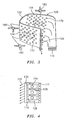
- FIG. 3 there is shown a series of heat balance control volumes 180 which illustrate the concept of picking-up heat at the suction side first; dissipating the heat through the rib; and picking-up heat once again at the pressure side, ending the circuit with film cooling at the pressure side.
- the following targets are accomplished: (1) a reduction in creep damage with peripheral microcircuit cooling; (2) an enhancement of the heat pick-up by taking advantage of a natural rotational pumping action; (3) a reduction in overall thermal gradients by increasing the internal rib temperatures; (4) an increase in the convective efficiency of the microcircuits by allowing a continued cooling capability on the opposite side of the airfoil portion; and (5) a film cooling of the pressure side with a circuit that starts at the suction side, thus eliminating aerodynamic losses in the suction side of the airfoil portion 104.
Landscapes
- Engineering & Computer Science (AREA)
- Mechanical Engineering (AREA)
- General Engineering & Computer Science (AREA)
- Turbine Rotor Nozzle Sealing (AREA)
Abstract
Description
- The present invention relates to a cooling arrangement for use in a turbine engine component.
- FIG. 1 illustrates a current cooling scheme for a
turbine blade 10. It consists of a hybrid application of embeddedmicrocircuit panels 12 running axially along theairfoil walls microcircuits 12 in the mid-body and trailing edge portions of theairfoil 18, supplemented with film cooling by a series offilm holes 20. There are two considerations with this blade that could be improved upon. First, the axial circuits do not take full advantage of pumping; therefore, dedicated feed cavities are used for independently feeding each circuit. This leads to an increased number ofairfoil ribs 22. Second, as a result, theribs 22 are relatively cold when compared with the outer layers of the airfoil walls. - As the
blade 10 ramps up in load, the airfoil outer layers experience relatively hot metal temperatures. If the temperature is sufficiently high, a stress relaxation process occurs at these airfoil locations, leading to relatively high strains (deformations). Simultaneously, the relative cold insideribs 22 experience an increase in stress as the load to the part needs to be shared by theentire airfoil 18. This balance in the stress-state of the airfoil occurs every time a blade is ramped up, causing some amount of irreversible damage, which, in excessive limits, can lead to catastrophic failures. If these limits are not approached, the amount of damage accumulation can take some time or cycles. That is, long enough to make the design viable for the require life targets. Two modes of failure exists: (a) creep; and (b) fatigue. Oxidation also occurs, but is not discussed as it can be incorporated in creep damage due to the reduced load-bearing capability from metal-oxide attack. The creep damage is related to blade temperature; but fatigue is related to temperature differences in the blade, in particular, the outer relative hot airfoil layers and cold internal ribs. It is therefore desirable to reduce the outer metal temperatures, and the thermal gradients in the part. - The present invention relates to a cooling scheme for a turbine engine component, such as a turbine blade, which reduces the outer metal temperatures and the thermal gradients in the part.
- In accordance with the present invention, a turbine engine component is provided which broadly comprises an airfoil portion having a pressure side wall and a suction side wall, a plurality of ribs extending between said pressure side wall and said suction side wall, and a plurality of supply cavities located between said ribs; and an arrangement for cooling said airfoil portion comprising a first means embedded within said suction side wall for convectively cooling said suction side wall, a second means embedded within said pressure side wall for cooling said pressure side wall, and third means for increasing a temperature of at least one said ribs by conduction.
- Further in accordance with the present invention, there is a provided a process for cooling a turbine engine component broadly comprising the steps of: providing a first cooling circuit in a suction side of an airfoil portion of said turbine engine component; providing a second cooling circuit in a pressure side of said airfoil portion; convectively cooling said suction side of said airfoil portion with said first cooling circuit; and
heating a rib within said airfoil portion using cooling fluid leaving said first cooling circuit. - Other details of the airfoil thermal management with microcircuit cooling of the present invention, as well as other advantages attendant thereto, are set forth in the following detailed description and the accompanying drawings wherein like reference numerals depict like elements.
-
- FIG. 1 is a schematic representation of a turbine blade having a current cooling scheme;
- FIG. 2 is a schematic representation of a turbine engine component having a cooling scheme in accordance with the present invention;
- FIG. 3 is a schematic representation of a high pressure turbine engine component with cooling microcircuits starting at the suction side and ending on the pressure side; and
- FIG. 4 is a schematic representation showing communication of suction and pressure side microcircuit legs through the ribs.
- Referring now to FIG. 2, there is shown a
turbine engine component 100, such as a turbine blade, with a different set ofmicrocircuits 101 and 102 embedded in the walls and ribs of theairfoil portion 104. As can be seen from FIG. 2, theairfoil portion 104 includes apressure side wall 106 and asuction side wall 108. Theairfoil portion 104 also includes a plurality ofribs 110. To reduce the outer layer metal temperatures, peripheral cooling with microcircuits embedded within thewalls - The cooling scheme of the present invention includes suction
side cooling microcircuits 101 and 102 embedded within thesuction side wall 108. Thecircuit 101 has aflow inlet 116, while the circuit 102 has aflow inlet 118. As shown in FIG. 3, theflow inlet 116 is located at a root section of theturbine engine component 100 for pumping. Theflow inlet 118 is also located at the root section of theturbine engine component 100. Each of theflow inlets supply cavity 120. - As can be seen from FIG. 2, the
cooling circuits 101 and 102 have no film holes which would allow cooling fluid to flow over the exterior surface of thesuction side 108 of theairfoil portion 104. Thesuction side 108 is cooled solely by convection. - The
cooling circuit 101 has acooling circuit 114 embedded within thesuction side wall 108. Cooling fluid flows from thecooling circuit 114 to thepressure side 106 of theairfoil portion 104 via one ormore passageways 122 in a first of theribs 110. Eachpassageway 122 connects thecooling circuit 114 with acooling circuit 124 embedded within thepressure side wall 106. Thecooling circuit 124 has one or morefilm cooling holes 126 which allow the cooling fluid to flow over thepressure side wall 106. - The cooling circuit 102 has a
cooling circuit 117 embedded within thesuction side wall 108. Thecooling circuit 117 communicates with one ormore passageways 128 in a second one of theribs 110. Eachpassageway 128 communicates with asecond cooling circuit 130 embedded in thepressure side wall 106, whichcircuit 130 has one or morefilm cooling holes 132 for allowing a film of cooling fluid to flow over a portion of thepressure side wall 106 adjacent atrailing edge 134 of theairfoil portion 104. - If desired, a
third cooling circuit 140 may be embedded in thepressure side wall 106. Thethird cooling circuit 140 has aninlet 142 also located at the root section of theturbine engine component 100 for pumping. Theinlet 142 communicates with a source of cooling fluid via thesupply cavity 144. Thecircuit 140 also may have one or morefilm cooling holes 146 for allowing cooling fluid to flow over the external surface of thepressure side wall 106. - Referring now to FIGS. 2 and 4, to further cool the
trailing edge 134 of the airfoil portion, cooling fluid from acavity 150 may pass through a trailingedge cooling circuit 152 via one or more cross overholes 154 in a most rearward one of theribs 110. - To cool a leading
edge 160 of theairfoil portion 104, cooling fluid may be provided to a leadingedge cooling cavity 162 from asupply cavity 164 via one or more cross overholes 166 in a most forward one of theribs 110. The leadingedge cooling cavity 162 may have one ormore fluid outlets 168 in the leadingedge 160 to allow cooling fluid to flow over the leading edge portion of thepressure side wall 106 and thesuction side wall 108. - If desired, each of the cooling circuits embedded in the pressure and
suction side walls pedestals 170 for enhancing heat transfer. Thepedestals 170 may have any desired shape such as a cylindrical shape. - As can be seen from the foregoing discussion, the cooling scheme of the present invention has a feed which starts at the suction side of the
airfoil portion 104, particularly at the root section. The flow is guided through the suction side of the airfoil, picking up heat in that section of the airfoil. In other designs, the cooling circuit in the suction side would end, also at the suction side, by allowing film cooling to eject externally out of the circuit. This has the advantage of film protection at the suction side, but also causes mixing and entropy, which affects performance negatively. In the cooling scheme of the present invention, the circuit does not end in film cooling, but proceeds through theinternal ribs 110 towards thepressure side 106. The net effect of this is to increase the temperature of theribs 110 through conduction. The third leg of the circuit is formed to transport the coolant through thepressure side wall 106 of theairfoil portion 104, discharging with film cooling at the pressure side. In FIG. 3, there is shown a series of heatbalance control volumes 180 which illustrate the concept of picking-up heat at the suction side first; dissipating the heat through the rib; and picking-up heat once again at the pressure side, ending the circuit with film cooling at the pressure side. - As previously discussed, FIG. 4 illustrates details, showing communication of suction side and pressure side microcircuit legs through the
ribs 110, when there are cross over holes in theribs 110. - With the cooling scheme of the present invention, the following targets are accomplished: (1) a reduction in creep damage with peripheral microcircuit cooling; (2) an enhancement of the heat pick-up by taking advantage of a natural rotational pumping action; (3) a reduction in overall thermal gradients by increasing the internal rib temperatures; (4) an increase in the convective efficiency of the microcircuits by allowing a continued cooling capability on the opposite side of the airfoil portion; and (5) a film cooling of the pressure side with a circuit that starts at the suction side, thus eliminating aerodynamic losses in the suction side of the
airfoil portion 104. - It is apparent that there has been provided in accordance with the present invention an airfoil thermal management with microcircuit cooling which fully satisfies the objects, means, and advantages set forth hereinbefore. While the present invention has been described in the context of specific embodiments thereof, other unforeseeable alternatives, modifications, and variations may become apparent to those skilled in the art having read the foregoing description. Accordingly, it is intended to embrace those alternatives, modifications, and variations as fall within the broad scope of the appended claims.
Claims (19)
- A turbine engine component (100) comprising:an airfoil portion (104) having a pressure side wall (106) and a suction side wall (108), a plurality of ribs (110) extending between said pressure side wall (106) and said suction side wall (108), and a plurality of supply cavities (120, 144, 150, 164) located between said ribs (110); andan arrangement for cooling said airfoil portion (104) comprising a first means embedded within said suction side wall (108) for convectively cooling said suction side wall (108), a second means embedded within said pressure side wall (106) for cooling said pressure side wall (106), and third means for increasing a temperature of at least one said ribs (110) by conduction.
- The turbine engine component (100) of claim 1, wherein said first means has a fluid inlet (116, 118) in a root section of said turbine engine component (100) to take advantage of pumping to increase cooling effectiveness.
- The turbine engine component of claim 1 or 2, wherein said first means comprises a first cooling circuit (114, 117) embedded within said suction side wall (108), said second means comprises a second cooling circuit (124, 130) embedded within said pressure side wall (106), and said third means comprises at least one fluid passageway (122, 128) in a first one of said ribs (110) for conducting fluid from said first cooling circuit (114, 117) to said second cooling circuit (124, 130).
- The turbine engine component (100) of claim 3, further comprising said second cooling circuit (124, 130) having at least one film cooling hole (126, 132) for allowing cooling fluid to flow over an external surface of said pressure side wall (106).
- The turbine engine component (100) of claim 3 or 4, wherein said first cooling circuit (114, 117) cools said suction side wall (108) solely by convection and wherein said first cooling circuit (114, 117) has no film cooling hole for allowing cooling fluid to flow over an external surface of said suction side wall (108).
- The turbine engine component (100) of claim 3, 4 or 5, wherein said first means comprises a fourth cooling circuit (117, 114) embedded within said suction side wall (108), said second means comprises a fifth cooling circuit (130, 124) embedded within said pressure side wall (106), and said third means comprises an additional fluid passageway (128, 124) in a second one of said ribs (110) for conducting fluid from said fourth cooling circuit (117, 114) to said fifth cooling circuit (130, 124).
- The turbine engine component (100) of claim 6, further comprising said fifth cooling circuit (130, 124) having at least one film cooling hole (132, 126) for allowing cooling fluid to flow over an external surface of said pressure side wall (106).
- The turbine engine component (100) of claim 6 or 7, wherein said first cooling circuit (114, 117) and said fourth cooling circuit (117, 114) each have a fluid inlet (116, 118) in a root section of said turbine engine component (100) to take advantage of pumping to increase cooling effectiveness.
- The turbine engine component (100) of any of claims 3 to 8, wherein each of said cooling circuits has a plurality of pedestals (170) for increasing convective efficiency.
- The turbine engine component (100) of any preceding claim, further comprising a trailing edge circuit (152) and at least one cooling hole (154) for conducting cooling fluid from at least one of said supply cavities (150) to said trailing edge circuit (152).
- The turbine engine component (100) of any preceding claim, further comprising a leading edge cooling circuit and at least one cooling hole (166) for conducting cooling fluid from at least one of said supply cavities (164) to said leading edge cooling circuit.
- The turbine engine component (100) of any preceding claim, wherein said turbine engine component (100) comprises a turbine blade.
- A process for cooling a turbine engine component (100) comprising the steps of:providing a first cooling circuit (114, 117) in a suction side (108) of an airfoil portion (104) of said turbine engine component (100);providing a second cooling circuit (124, 130) in a pressure side (106) of said airfoil portion (104);convectively cooling said suction side (108) of said airfoil portion (104) with said first cooling circuit (114, 117); andheating a rib (110) within said airfoil portion (104) using cooling fluid leaving said first cooling circuit (114, 117).
- The process of claim 13, wherein said heating step comprises causing said cooling fluid from said first cooling circuit (114, 117) to flow through at least one passageway (122, 128) in said rib (110).
- The process of claim 13 or 14, further comprising supplying said cooling fluid from said first cooling circuit (114, 117) to said second cooling circuit (124, 130) and ejecting said cooling fluid onto said pressure side (106) of said airfoil (104) via at least one film cooling hole (126, 132).
- The process of claim 13, 14 or 15, further comprising providing a third cooling circuit (117, 114) in said suction side (108) and providing a fourth cooling circuit (130, 124) in said pressure side (106) and causing fluid from said third cooling circuit (117, 114) to flow to said fourth cooling circuit (130, 124).
- The process of claim 16, further comprising introducing said cooling fluid into each of said first and third cooling circuits (114, 117) via an inlet (116, 118) positioned at a root section of said airfoil (104) to take advantage of pumping.
- The process of any of claims 13 to 17, further comprising providing a leading edge cooling circuit and supplying cooling fluid to said leading edge cooling circuit from a first supply cavity (164).
- The process of any of claims 13 to 18, further comprising providing a trailing edge cooling circuit (152) and supplying cooling fluid to said trailing edge cooling circuit (152) from a second supply cavity (150).
Applications Claiming Priority (1)
| Application Number | Priority Date | Filing Date | Title |
|---|---|---|---|
| US11/520,374 US7625179B2 (en) | 2006-09-13 | 2006-09-13 | Airfoil thermal management with microcircuit cooling |
Publications (3)
| Publication Number | Publication Date |
|---|---|
| EP1900905A2 true EP1900905A2 (en) | 2008-03-19 |
| EP1900905A3 EP1900905A3 (en) | 2011-06-22 |
| EP1900905B1 EP1900905B1 (en) | 2012-12-05 |
Family
ID=38616560
Family Applications (1)
| Application Number | Title | Priority Date | Filing Date |
|---|---|---|---|
| EP07253638A Ceased EP1900905B1 (en) | 2006-09-13 | 2007-09-13 | Airfoil thermal management with microcircuit cooling |
Country Status (2)
| Country | Link |
|---|---|
| US (1) | US7625179B2 (en) |
| EP (1) | EP1900905B1 (en) |
Cited By (2)
| Publication number | Priority date | Publication date | Assignee | Title |
|---|---|---|---|---|
| EP2631431A1 (en) * | 2011-11-24 | 2013-08-28 | Rolls-Royce plc | Aerofoil Cooling Arrangement |
| EP3165715A1 (en) * | 2015-10-15 | 2017-05-10 | General Electric Company | Turbine blade |
Families Citing this family (5)
| Publication number | Priority date | Publication date | Assignee | Title |
|---|---|---|---|---|
| US7857589B1 (en) * | 2007-09-21 | 2010-12-28 | Florida Turbine Technologies, Inc. | Turbine airfoil with near-wall cooling |
| US8562286B2 (en) | 2010-04-06 | 2013-10-22 | United Technologies Corporation | Dead ended bulbed rib geometry for a gas turbine engine |
| US9353631B2 (en) | 2011-08-22 | 2016-05-31 | United Technologies Corporation | Gas turbine engine airfoil baffle |
| US10174620B2 (en) | 2015-10-15 | 2019-01-08 | General Electric Company | Turbine blade |
| DE102019125779B4 (en) * | 2019-09-25 | 2024-03-21 | Man Energy Solutions Se | Blade of a turbomachine |
Citations (2)
| Publication number | Priority date | Publication date | Assignee | Title |
|---|---|---|---|---|
| GB2246174A (en) | 1982-06-29 | 1992-01-22 | Rolls Royce | Cooled aerofoil for a gas turbine engine |
| US20010018021A1 (en) | 1998-08-31 | 2001-08-30 | Dirk Anding | Turbine blade |
Family Cites Families (6)
| Publication number | Priority date | Publication date | Assignee | Title |
|---|---|---|---|---|
| US6402470B1 (en) * | 1999-10-05 | 2002-06-11 | United Technologies Corporation | Method and apparatus for cooling a wall within a gas turbine engine |
| GB0114503D0 (en) * | 2001-06-14 | 2001-08-08 | Rolls Royce Plc | Air cooled aerofoil |
| US7303376B2 (en) * | 2005-12-02 | 2007-12-04 | Siemens Power Generation, Inc. | Turbine airfoil with outer wall cooling system and inner mid-chord hot gas receiving cavity |
| US7322795B2 (en) * | 2006-01-27 | 2008-01-29 | United Technologies Corporation | Firm cooling method and hole manufacture |
| US7481622B1 (en) * | 2006-06-21 | 2009-01-27 | Florida Turbine Technologies, Inc. | Turbine airfoil with a serpentine flow path |
| US7527474B1 (en) * | 2006-08-11 | 2009-05-05 | Florida Turbine Technologies, Inc. | Turbine airfoil with mini-serpentine cooling passages |
-
2006
- 2006-09-13 US US11/520,374 patent/US7625179B2/en not_active Expired - Fee Related
-
2007
- 2007-09-13 EP EP07253638A patent/EP1900905B1/en not_active Ceased
Patent Citations (2)
| Publication number | Priority date | Publication date | Assignee | Title |
|---|---|---|---|---|
| GB2246174A (en) | 1982-06-29 | 1992-01-22 | Rolls Royce | Cooled aerofoil for a gas turbine engine |
| US20010018021A1 (en) | 1998-08-31 | 2001-08-30 | Dirk Anding | Turbine blade |
Cited By (3)
| Publication number | Priority date | Publication date | Assignee | Title |
|---|---|---|---|---|
| EP2631431A1 (en) * | 2011-11-24 | 2013-08-28 | Rolls-Royce plc | Aerofoil Cooling Arrangement |
| US9376918B2 (en) | 2011-11-24 | 2016-06-28 | Rolls-Royce Plc | Aerofoil cooling arrangement |
| EP3165715A1 (en) * | 2015-10-15 | 2017-05-10 | General Electric Company | Turbine blade |
Also Published As
| Publication number | Publication date |
|---|---|
| EP1900905A3 (en) | 2011-06-22 |
| EP1900905B1 (en) | 2012-12-05 |
| US7625179B2 (en) | 2009-12-01 |
| US20090238675A1 (en) | 2009-09-24 |
Similar Documents
| Publication | Publication Date | Title |
|---|---|---|
| EP1900905B1 (en) | Airfoil thermal management with microcircuit cooling | |
| US7513744B2 (en) | Microcircuit cooling and tip blowing | |
| US9051943B2 (en) | Gas turbine engine heat exchanger fins with periodic gaps | |
| US8628298B1 (en) | Turbine rotor blade with serpentine cooling | |
| US8562295B1 (en) | Three piece bonded thin wall cooled blade | |
| US8192146B2 (en) | Turbine blade dual channel cooling system | |
| US9200570B2 (en) | Air-cooled oil cooler for turbofan engine | |
| US8292582B1 (en) | Turbine blade with serpentine flow cooling | |
| EP1900904B1 (en) | Multi-peripheral serpentine microcircuits for high aspect ratio blades | |
| US8109726B2 (en) | Turbine blade with micro channel cooling system | |
| US8454301B1 (en) | Turbine blade with serpentine cooling | |
| US7806658B2 (en) | Turbine airfoil cooling system with spanwise equalizer rib | |
| US8025482B1 (en) | Turbine blade with dual serpentine cooling | |
| EP2607624B1 (en) | Vane for a turbomachine | |
| EP1884621B1 (en) | Serpentine microciruit cooling with pressure side features | |
| US8613597B1 (en) | Turbine blade with trailing edge cooling | |
| US8016564B1 (en) | Turbine blade with leading edge impingement cooling | |
| US20170089207A1 (en) | Turbine airfoil cooling system with leading edge impingement cooling system and nearwall impingement system | |
| US7950903B1 (en) | Turbine blade with dual serpentine cooling | |
| US11268443B2 (en) | Turbine engine nacelle comprising a cooling device | |
| EP1882819A1 (en) | Integrated platform, tip, and main body microcircuits for turbine blades | |
| US20170370231A1 (en) | Turbine airfoil cooling system with integrated airfoil and platform cooling system | |
| US8267658B1 (en) | Low cooling flow turbine rotor blade | |
| US7988417B1 (en) | Air cooled turbine blade | |
| US8061990B1 (en) | Turbine rotor blade with low cooling flow |
Legal Events
| Date | Code | Title | Description |
|---|---|---|---|
| PUAI | Public reference made under article 153(3) epc to a published international application that has entered the european phase |
Free format text: ORIGINAL CODE: 0009012 |
|
| AK | Designated contracting states |
Kind code of ref document: A2 Designated state(s): AT BE BG CH CY CZ DE DK EE ES FI FR GB GR HU IE IS IT LI LT LU LV MC MT NL PL PT RO SE SI SK TR |
|
| AX | Request for extension of the european patent |
Extension state: AL BA HR MK YU |
|
| PUAL | Search report despatched |
Free format text: ORIGINAL CODE: 0009013 |
|
| AK | Designated contracting states |
Kind code of ref document: A3 Designated state(s): AT BE BG CH CY CZ DE DK EE ES FI FR GB GR HU IE IS IT LI LT LU LV MC MT NL PL PT RO SE SI SK TR |
|
| AX | Request for extension of the european patent |
Extension state: AL BA HR MK RS |
|
| 17P | Request for examination filed |
Effective date: 20111221 |
|
| AKX | Designation fees paid |
Designated state(s): DE GB |
|
| GRAP | Despatch of communication of intention to grant a patent |
Free format text: ORIGINAL CODE: EPIDOSNIGR1 |
|
| GRAS | Grant fee paid |
Free format text: ORIGINAL CODE: EPIDOSNIGR3 |
|
| GRAA | (expected) grant |
Free format text: ORIGINAL CODE: 0009210 |
|
| AK | Designated contracting states |
Kind code of ref document: B1 Designated state(s): DE GB |
|
| REG | Reference to a national code |
Ref country code: GB Ref legal event code: FG4D |
|
| REG | Reference to a national code |
Ref country code: DE Ref legal event code: R096 Ref document number: 602007027106 Country of ref document: DE Effective date: 20130131 |
|
| PLBE | No opposition filed within time limit |
Free format text: ORIGINAL CODE: 0009261 |
|
| STAA | Information on the status of an ep patent application or granted ep patent |
Free format text: STATUS: NO OPPOSITION FILED WITHIN TIME LIMIT |
|
| 26N | No opposition filed |
Effective date: 20130906 |
|
| REG | Reference to a national code |
Ref country code: DE Ref legal event code: R097 Ref document number: 602007027106 Country of ref document: DE Effective date: 20130906 |
|
| REG | Reference to a national code |
Ref country code: DE Ref legal event code: R082 Ref document number: 602007027106 Country of ref document: DE Representative=s name: SCHMITT-NILSON SCHRAUD WAIBEL WOHLFROM PATENTA, DE |
|
| REG | Reference to a national code |
Ref country code: DE Ref legal event code: R082 Ref document number: 602007027106 Country of ref document: DE Representative=s name: SCHMITT-NILSON SCHRAUD WAIBEL WOHLFROM PATENTA, DE Ref country code: DE Ref legal event code: R081 Ref document number: 602007027106 Country of ref document: DE Owner name: UNITED TECHNOLOGIES CORP. (N.D.GES.D. STAATES , US Free format text: FORMER OWNER: UNITED TECHNOLOGIES CORPORATION, HARTFORD, CONN., US |
|
| PGFP | Annual fee paid to national office [announced via postgrant information from national office to epo] |
Ref country code: DE Payment date: 20200819 Year of fee payment: 14 |
|
| REG | Reference to a national code |
Ref country code: DE Ref legal event code: R119 Ref document number: 602007027106 Country of ref document: DE |
|
| PG25 | Lapsed in a contracting state [announced via postgrant information from national office to epo] |
Ref country code: DE Free format text: LAPSE BECAUSE OF NON-PAYMENT OF DUE FEES Effective date: 20220401 |
|
| PGFP | Annual fee paid to national office [announced via postgrant information from national office to epo] |
Ref country code: GB Payment date: 20230823 Year of fee payment: 17 |
|
| GBPC | Gb: european patent ceased through non-payment of renewal fee |
Effective date: 20240913 |
|
| PG25 | Lapsed in a contracting state [announced via postgrant information from national office to epo] |
Ref country code: GB Free format text: LAPSE BECAUSE OF NON-PAYMENT OF DUE FEES Effective date: 20240913 |