EP1898171A1 - Precalciner temperature control - Google Patents
Precalciner temperature control Download PDFInfo
- Publication number
- EP1898171A1 EP1898171A1 EP06405388A EP06405388A EP1898171A1 EP 1898171 A1 EP1898171 A1 EP 1898171A1 EP 06405388 A EP06405388 A EP 06405388A EP 06405388 A EP06405388 A EP 06405388A EP 1898171 A1 EP1898171 A1 EP 1898171A1
- Authority
- EP
- European Patent Office
- Prior art keywords
- water
- precalciner
- temperature
- amount
- injected
- Prior art date
- Legal status (The legal status is an assumption and is not a legal conclusion. Google has not performed a legal analysis and makes no representation as to the accuracy of the status listed.)
- Granted
Links
Images


Classifications
-
- F—MECHANICAL ENGINEERING; LIGHTING; HEATING; WEAPONS; BLASTING
- F27—FURNACES; KILNS; OVENS; RETORTS
- F27D—DETAILS OR ACCESSORIES OF FURNACES, KILNS, OVENS OR RETORTS, IN SO FAR AS THEY ARE OF KINDS OCCURRING IN MORE THAN ONE KIND OF FURNACE
- F27D19/00—Arrangements of controlling devices
-
- B—PERFORMING OPERATIONS; TRANSPORTING
- B01—PHYSICAL OR CHEMICAL PROCESSES OR APPARATUS IN GENERAL
- B01D—SEPARATION
- B01D53/00—Separation of gases or vapours; Recovering vapours of volatile solvents from gases; Chemical or biological purification of waste gases, e.g. engine exhaust gases, smoke, fumes, flue gases, aerosols
- B01D53/34—Chemical or biological purification of waste gases
- B01D53/46—Removing components of defined structure
- B01D53/54—Nitrogen compounds
- B01D53/56—Nitrogen oxides
-
- C—CHEMISTRY; METALLURGY
- C04—CEMENTS; CONCRETE; ARTIFICIAL STONE; CERAMICS; REFRACTORIES
- C04B—LIME, MAGNESIA; SLAG; CEMENTS; COMPOSITIONS THEREOF, e.g. MORTARS, CONCRETE OR LIKE BUILDING MATERIALS; ARTIFICIAL STONE; CERAMICS; REFRACTORIES; TREATMENT OF NATURAL STONE
- C04B7/00—Hydraulic cements
- C04B7/36—Manufacture of hydraulic cements in general
- C04B7/361—Condition or time responsive control in hydraulic cement manufacturing processes
-
- C—CHEMISTRY; METALLURGY
- C04—CEMENTS; CONCRETE; ARTIFICIAL STONE; CERAMICS; REFRACTORIES
- C04B—LIME, MAGNESIA; SLAG; CEMENTS; COMPOSITIONS THEREOF, e.g. MORTARS, CONCRETE OR LIKE BUILDING MATERIALS; ARTIFICIAL STONE; CERAMICS; REFRACTORIES; TREATMENT OF NATURAL STONE
- C04B7/00—Hydraulic cements
- C04B7/36—Manufacture of hydraulic cements in general
- C04B7/43—Heat treatment, e.g. precalcining, burning, melting; Cooling
-
- F—MECHANICAL ENGINEERING; LIGHTING; HEATING; WEAPONS; BLASTING
- F23—COMBUSTION APPARATUS; COMBUSTION PROCESSES
- F23L—SUPPLYING AIR OR NON-COMBUSTIBLE LIQUIDS OR GASES TO COMBUSTION APPARATUS IN GENERAL ; VALVES OR DAMPERS SPECIALLY ADAPTED FOR CONTROLLING AIR SUPPLY OR DRAUGHT IN COMBUSTION APPARATUS; INDUCING DRAUGHT IN COMBUSTION APPARATUS; TOPS FOR CHIMNEYS OR VENTILATING SHAFTS; TERMINALS FOR FLUES
- F23L7/00—Supplying non-combustible liquids or gases, other than air, to the fire, e.g. oxygen, steam
- F23L7/002—Supplying water
-
- F—MECHANICAL ENGINEERING; LIGHTING; HEATING; WEAPONS; BLASTING
- F23—COMBUSTION APPARATUS; COMBUSTION PROCESSES
- F23N—REGULATING OR CONTROLLING COMBUSTION
- F23N5/00—Systems for controlling combustion
- F23N5/003—Systems for controlling combustion using detectors sensitive to combustion gas properties
-
- F—MECHANICAL ENGINEERING; LIGHTING; HEATING; WEAPONS; BLASTING
- F27—FURNACES; KILNS; OVENS; RETORTS
- F27B—FURNACES, KILNS, OVENS OR RETORTS IN GENERAL; OPEN SINTERING OR LIKE APPARATUS
- F27B7/00—Rotary-drum furnaces, i.e. horizontal or slightly inclined
- F27B7/20—Details, accessories or equipment specially adapted for rotary-drum furnaces
- F27B7/2016—Arrangements of preheating devices for the charge
- F27B7/2025—Arrangements of preheating devices for the charge consisting of a single string of cyclones
- F27B7/2033—Arrangements of preheating devices for the charge consisting of a single string of cyclones with means for precalcining the raw material
Definitions
- the present invention relates to a method for controlling the temperature in a precalciner and to a method for controlling the temperature and the level of nitrogen oxides (NO X ) in a precalciner.
- Rotary kiln plants in the cement industry are equipped with precalcining technology in combination with multiple stage suspension pre-heaters.
- the raw material being processed - a mix of limestone and clay - is largely calcined while heat is supplied.
- the precalciner's purpose is essentially to improve the quality of the hot meal before it enters the rotary kiln. Quality means that the raw material is decarbonized, i.e. CaCO 3 + heat ⁇ CaO + CO 2 . This allows for smaller rotary kilns and thus save costs.
- the heat source is to some extent the hot gas from the rotary kiln which flows through the precalciner but to the major part fuel inputs into the precalciner.
- the aim pursued in cement production is to achieve effective NO decomposition in the precalciner accompanied by good burn-out, trouble-free kiln operation and high flexibility with regard to the fuels utilized.
- regular fuels e.g., oil, coal
- alternative fuels e.g. substitute liquid fuels produced from the recycling of waste solvents, scrap tires, packaging waste paper and plastic wastes, waste oils, sewage sludge pellets, meat and bone meal
- a main issue is to stabilize the temperature of the meal in the precalciner. Usually this is done by controlling the main heat input to the precalciner, i.e. the regular and the alternative fuels inputs.
- WO 95/29138 a special temperature sensor is defined, which replaces the standard sensors in an automatic kiln temperature control system.
- the inventive method comprises the step of injecting water into the precalciner to control the temperature.
- both NO X and temperature can be controlled in parallel.
- the short term variations on the water injection for temperature control purposes are superposed to the long term water injections necessary to provide appropriate NO X control.
- the water injection is generally only used to control NO X emissions and moreover it is designed such that a running average of a longer period of time, e.g. 30 minutes, is below a certain threshold.
- water injection is used in a slow varying process.
- injecting water has an immediate impact on the temperature. If the average amount of water injected is unchanged, short term variation of the amount of water injected will not affect the NO X control. It is therefore possible to juxtapose short term variations on the long term average water injection and to use it to support the temperature control task.
- the above principles can be implemented on any industrial control platforms.
- the main control inputs to the precalciner are supported to maintain given temperature targets while simultaneously ensure the long term NO X constraints.
- This principle can be applied to any precalciner, not restricted to cement plants.
- any NO X reducing watery solution such as urea, ammoniac, etc, can be used.
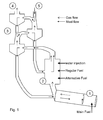
- Fig. 1 schematically shows a typical cement plant with a rotary kiln 1, a precalciner 2 and a multi-stage suspension preheater 3.
- Raw meal to be processed into cement clinker enters the system in a first stage 5 of the preheating system 3.
- Hot exhaust gases from the precalciner and the rotary kiln flow through the preheater from the lower to the top end 4 while the meal flows in the opposite direction.
- the meal and gas are separated. This allows for an efficient heat exchange, thus the meal temperature increases on its way down to the precalciner where the fuel input provides even more heat to spur on the decarbonizing of the meal.
- From the precalciner the hot meal gas mixture enters the lowest suspension preheater where the gas and meal are separated.
- the well prepared hot meal enters then the rotary kiln where the sintering of the clinker takes place.
- Fig. 2 schematically shows the two systems for controlling NO X and temperature that are combined according to this invention.
- a certain amount of water is permanently injected for NO X control purposes.
- This amount of water injected is periodically adjusted by an NO X control circuit, typically following a running average of measured NO X levels. Said running average is taken over a longer period of time, e.g. 30 minutes or more. Adjustments in the amount of water to be injected for NO X purposes are affecting the temperature in the precalciner and are therefore accompanied with an adjustment of the amount of fuel fed into the precalciner. These are however, long term adjustments, in the course of several minutes.
- the appropriate temperature in the precalciner is therefore stabilized by a temperature control circuit controlling the main heat input to the precalciner.
- Regular and/ or alternative fuels are added depending on the permanently measured temperature. Moderate changes in the measured temperature, due to a variation in the amount of injected water or due to other circumstances, can well be controlled by varying the amount of energy added to the system. In order to react to sudden temperature increases, cutting off the energy supply might, however, not have the desired immediate impact. Moreover, if the temperature in the system suddenly drops, there might not be enough energy available to immediately react and bring the temperature back up to the desired level. Unlike gas or liquids, bulk material fuels which are most commonly used are not variable in a few seconds time and therefore not suitable for fast short term temperature control.
- the short term temperature control is achieved by instantaneously varying the amount of water injected into the precalciner. This short term variation on the water injection for temperature control purposes is superposed to the long term water injection necessary to provide appropriate NO X control.
- the temperature control circuit determines an adjustment amount of water to be injected additionally for a specific, short period of time t 1 . This additional amount of water ⁇ +H 2 O is then injected on top of to the constant amount of water injected for NO X control. Once the determined time period t 1 has passed, the amount of water injected is decreased for compensation of the additionally injected water below the constant amount injected for NO X control purposes and kept at that lower lever for another predetermined period of time t 2 . The compensational amount of water ⁇ -H 2 O reduced from the constant amount of water is determined by the control circuit as well as the duration of time period t 2 .
- time period t 2 Once the determined time period t 2 has passed, the amount of water injected is increased up to the constant level determined by the NO X control. Typically, time periods t 1 and t 2 have a lengths of a few seconds to a few minutes. Both the adjustment amount of water and the compensational amount of water can be updated and varied, if a new measurement of the temperature makes such an additional adjustment necessary.
- the total amount of water injected during both time periods t 1 and t 2 is about equal to the average amount of water injected for NO X control purposes injected during the same time period.
- the overall, long-term NO X level is therefore not affected by the short-term variation of the injected amount of water.
- the positive and negative amounts of water injected are exactly equal.
- the dotted line shows the temperature T Disturbed, without an additional amount of water injected.
- the temperature would rise until the cause for the increase is either removed, has disappeared by itself or is compensated by the regular fuel input and would then go back to the level of the reference temperature T Reference. If however, immediately after detecting a deviation from T Reference the amount of water injected is increased, the temperature T H2O-controlled can be lowered and brought back to the level of the reference temperature T Reference .
- the amount of water injected for NOX control can analogously be reduced until the temperature is back on the desired level.
- While the short term temperature control is achieved by instantaneously varying the amount of water injected into the precalciner an additional adjustment to the amount of fuel added to the precalciner is to be initiated in parallel to make sure, the temperature can be maintained on the desired level once the variation of the water injection is through.
- the impact of varying the water injection will affect the temperature corresponding to the shape and length of the variations.
- the regular fuel input thus needs to adjust too to compensate the effect of the variation of water injection after it is through but it has now more time to let the regular fuel feeders to adjust.
- the controller used for temperature and NOX control can be any electronic controller, such as PID, MPC, Fuzzy.
Landscapes
- Engineering & Computer Science (AREA)
- Chemical & Material Sciences (AREA)
- Mechanical Engineering (AREA)
- General Engineering & Computer Science (AREA)
- Ceramic Engineering (AREA)
- Materials Engineering (AREA)
- Structural Engineering (AREA)
- Combustion & Propulsion (AREA)
- Organic Chemistry (AREA)
- Chemical Kinetics & Catalysis (AREA)
- Thermal Sciences (AREA)
- Biomedical Technology (AREA)
- Health & Medical Sciences (AREA)
- Oil, Petroleum & Natural Gas (AREA)
- General Chemical & Material Sciences (AREA)
- Physics & Mathematics (AREA)
- Environmental & Geological Engineering (AREA)
- Analytical Chemistry (AREA)
- Treating Waste Gases (AREA)
- Accessories For Mixers (AREA)
- Devices For Medical Bathing And Washing (AREA)
- Washing And Drying Of Tableware (AREA)
- Liquid Crystal Substances (AREA)
- Seasonings (AREA)
- Organic Low-Molecular-Weight Compounds And Preparation Thereof (AREA)
Abstract
Description
- The present invention relates to a method for controlling the temperature in a precalciner and to a method for controlling the temperature and the level of nitrogen oxides (NOX) in a precalciner.
- Rotary kiln plants in the cement industry are equipped with precalcining technology in combination with multiple stage suspension pre-heaters. In the precalciner, the raw material being processed - a mix of limestone and clay - is largely calcined while heat is supplied. The precalciner's purpose is essentially to improve the quality of the hot meal before it enters the rotary kiln. Quality means that the raw material is decarbonized, i.e. CaCO3 + heat → CaO + CO2. This allows for smaller rotary kilns and thus save costs. The heat source is to some extent the hot gas from the rotary kiln which flows through the precalciner but to the major part fuel inputs into the precalciner. Typically between 50 and 65, in modern plants up to 70 percent of the total firing heat capacity is used in the precalciner, the rest at the 'main' burner in the rotary kiln. The use of staged combustion reduces the NOx, which is produced by the combustion process (the source of the N is the N2 of the combustion air). One of the main legal issues is to ensure that strict constraints are never exceeded. For this purpose water or other NOX reducing watery solutions (such as urea, ammoniac, etc) are injected in the precalciner to reduce NOX emissions when necessary. The water injection used to control NOX emissions is typically designed such that a running average of e.g. 30 minutes is below a certain threshold, i.e. water injection is used for a slow varying process.
- The aim pursued in cement production is to achieve effective NO decomposition in the precalciner accompanied by good burn-out, trouble-free kiln operation and high flexibility with regard to the fuels utilized. In order to go easy on fossil fuels mainly used as regular fuels (e.g., oil, coal) an increasing part of the energy comes from burning alternative fuels (e.g. substitute liquid fuels produced from the recycling of waste solvents, scrap tires, packaging waste paper and plastic wastes, waste oils, sewage sludge pellets, meat and bone meal) which are highly uncertain regarding calorific value. To ensure well prepared meal entering the rotary kiln a main issue is to stabilize the temperature of the meal in the precalciner. Usually this is done by controlling the main heat input to the precalciner, i.e. the regular and the alternative fuels inputs.
- Alternative fuels are commonly fed at remote deposits to conveyor systems to be transported to the calciner. Until they reach the combustion place time delays of several minutes are common. This makes alternative fuels inappropriate to control fast temperature changes within a time frame of 20-30 seconds. Moreover, large changes on alternative fuels introduce disturbances which have to be compensated by the appropriate change of other heat sources, namely the regular fuel input. The regular fuel inputs are however limited to predefined rate changes (due to the used feeding equipment), which leads to poor overall performance.
- In
WO 95/29138 - It is a well known technique and a quite common approach to inject water into the precalciner to control the amount of NOX in the precalciner.
US 2005/0074383 A1 discloses such a water injection application. Alternatively, NOX -levels in the precalciner could be controlled as well by injecting water into the exhaust or directly into the rotary kiln, as proposed inUS 2005/0284347 A1 . - It is an object of the present invention to improve the present precalcining technology by providing a new method to control the temperature in a precalciner.
- This object is achieved using an existing water injecting technology used in precalciners for NOX control. The inventive method comprises the step of injecting water into the precalciner to control the temperature.
- Thanks to considerably different time horizons of the NOX control on one side and the temperature control on the other side, both NOX and temperature can be controlled in parallel. The short term variations on the water injection for temperature control purposes are superposed to the long term water injections necessary to provide appropriate NOX control.
- As mentioned above, the water injection is generally only used to control NOX emissions and moreover it is designed such that a running average of a longer period of time, e.g. 30 minutes, is below a certain threshold. For controlling NOX levels water injection is used in a slow varying process. On the other hand, injecting water has an immediate impact on the temperature. If the average amount of water injected is unchanged, short term variation of the amount of water injected will not affect the NOX control. It is therefore possible to juxtapose short term variations on the long term average water injection and to use it to support the temperature control task.
- The above principles can be implemented on any industrial control platforms. In the cement manufacturing, for example, the main control inputs to the precalciner are supported to maintain given temperature targets while simultaneously ensure the long term NOX constraints. This principle can be applied to any precalciner, not restricted to cement plants.
- Instead of injecting water, any NOX reducing watery solution, such as urea, ammoniac, etc, can be used.
- Some of the features, advantages, and benefits of the present invention having been stated, others will become apparent as the description proceeds when taken in conjunction with the accompanying drawings in which:
- Fig. 1
- schematically shows a typical cement plant with a rotary kiln, a precalciner and a multi-stage suspension preheater,
- Fig. 2
- schematically shows the inventive NOX and temperature control system,
- Fig. 3
- shows a first diagram with three curves representing the temperatures in a calciner over the course of time, and
- Fig. 4
- shows a second diagram with two curves representing the amount of water injected into the calciner over the course of time.
- Fig. 1 schematically shows a typical cement plant with a rotary kiln 1, a
precalciner 2 and amulti-stage suspension preheater 3. - Raw meal to be processed into cement clinker enters the system in a
first stage 5 of thepreheating system 3. Hot exhaust gases from the precalciner and the rotary kiln flow through the preheater from the lower to thetop end 4 while the meal flows in the opposite direction. Before each preheater stage gas and meal are mixed and within the preheater chamber the meal and gas are separated. This allows for an efficient heat exchange, thus the meal temperature increases on its way down to the precalciner where the fuel input provides even more heat to spur on the decarbonizing of the meal. From the precalciner the hot meal gas mixture enters the lowest suspension preheater where the gas and meal are separated. The well prepared hot meal enters then the rotary kiln where the sintering of the clinker takes place. - Fig. 2 schematically shows the two systems for controlling NOX and temperature that are combined according to this invention.
- As explained above, a certain amount of water is permanently injected for NOX control purposes. This amount of water injected is periodically adjusted by an NOX control circuit, typically following a running average of measured NOX levels. Said running average is taken over a longer period of time, e.g. 30 minutes or more. Adjustments in the amount of water to be injected for NOX purposes are affecting the temperature in the precalciner and are therefore accompanied with an adjustment of the amount of fuel fed into the precalciner. These are however, long term adjustments, in the course of several minutes.
- The appropriate temperature in the precalciner is therefore stabilized by a temperature control circuit controlling the main heat input to the precalciner. Regular and/ or alternative fuels are added depending on the permanently measured temperature. Moderate changes in the measured temperature, due to a variation in the amount of injected water or due to other circumstances, can well be controlled by varying the amount of energy added to the system. In order to react to sudden temperature increases, cutting off the energy supply might, however, not have the desired immediate impact. Moreover, if the temperature in the system suddenly drops, there might not be enough energy available to immediately react and bring the temperature back up to the desired level. Unlike gas or liquids, bulk material fuels which are most commonly used are not variable in a few seconds time and therefore not suitable for fast short term temperature control.
- Rather than varying the amount of fuel added to the precalciner, the short term temperature control is achieved by instantaneously varying the amount of water injected into the precalciner. This short term variation on the water injection for temperature control purposes is superposed to the long term water injection necessary to provide appropriate NOX control.
- With the help of two diagrams shown in Fig. 3 and Fig. 4, the inventive method is explained for a sudden increase of temperature.
- Upon detecting a sudden increase in temperature TDisturbed, the temperature control circuit determines an adjustment amount of water to be injected additionally for a specific, short period of time t1. This additional amount of water Δ+H2O is then injected on top of to the constant amount of water injected for NOX control. Once the determined time period t1 has passed, the amount of water injected is decreased for compensation of the additionally injected water below the constant amount injected for NOX control purposes and kept at that lower lever for another predetermined period of time t2. The compensational amount of water Δ-H2O reduced from the constant amount of water is determined by the control circuit as well as the duration of time period t2. Once the determined time period t2 has passed, the amount of water injected is increased up to the constant level determined by the NOX control. Typically, time periods t1 and t2 have a lengths of a few seconds to a few minutes. Both the adjustment amount of water and the compensational amount of water can be updated and varied, if a new measurement of the temperature makes such an additional adjustment necessary.
- The total amount of water injected during both time periods t1 and t2 is about equal to the average amount of water injected for NOX control purposes injected during the same time period. The overall, long-term NOX level is therefore not affected by the short-term variation of the injected amount of water. In one particular embodiment of the inventive method, the positive and negative amounts of water injected are exactly equal.
- In the temperature diagram of Fig.3, the dotted line shows the temperature TDisturbed, without an additional amount of water injected. The temperature would rise until the cause for the increase is either removed, has disappeared by itself or is compensated by the regular fuel input and would then go back to the level of the reference temperature TReference. If however, immediately after detecting a deviation from TReference the amount of water injected is increased, the temperature TH2O-controlled can be lowered and brought back to the level of the reference temperature TReference.
- If the temperature drops suddenly, the amount of water injected for NOX control can analogously be reduced until the temperature is back on the desired level.
- While the short term temperature control is achieved by instantaneously varying the amount of water injected into the precalciner an additional adjustment to the amount of fuel added to the precalciner is to be initiated in parallel to make sure, the temperature can be maintained on the desired level once the variation of the water injection is through. The impact of varying the water injection will affect the temperature corresponding to the shape and length of the variations. The regular fuel input thus needs to adjust too to compensate the effect of the variation of water injection after it is through but it has now more time to let the regular fuel feeders to adjust.
- The controller used for temperature and NOX control can be any electronic controller, such as PID, MPC, Fuzzy.
- In a typical industrial plant, more than one NOx reducing solutions is available with different costs associated. An optimizer can take care of a cost efficient variation of the water injection.
-
- 1
- Rotary kiln
- 2
- Precalciner
- 3
- Suspension preheater
- 4
- Exhaust gas
- 5
- Raw meal feed
- Temp.
- Temperature
- TReference
- Temperature reference
- TDisturbed
- Temperature variation caused by external disturbance
- TH
2 0-controlled - Temperature progression of controlled by water injection
- H2O [NOX]
- Amount of water injected to control NOX level
- H2O [Temp.]
- Variation of water injected for short-term temperature control
- t1
- Time period of increase amount of water injected
- t2
- Time period of reduced amount of water injected
- Δ±H2O
- Short term variation of amount of water injected
Claims (5)
- A method for controlling the temperature in a precalciner, comprising the steps of- determining an amount of water to be injected into the precalciner based on a temperature measurement that detects a deviation of the temperature in the precalciner from a reference temperature, and- injecting said amount of water into the precalciner to adjust the temperature in the precalciner.
- A method for controlling the temperature and the level of nitrogen oxides (NOX) in a precalciner, comprising the following steps:- determining an average amount of water (H2O [NOX]) to be injected into the precalciner based on a NOX measurement that detects a deviation of the NOX concentration from a reference NOX value,- injecting said determined average amount of water (H2O [NOX]) into the precalciner,- determining an adjustment (Δ+H2O) to the amount of water to be injected temporarily into the precalciner based on a temperature measurement that detects a deviation of the temperature in the precalciner from a reference temperature, and- temporarily injecting said adjusted amount of water into the precalciner.
- A method according to claim 2, characterized in, that- a compensational amount of water (Δ-H2O) is determined to compensate for the adjustment to the amount of water injected temporarily for temperature control purposes, and that- said average amount of water (H2O [NOX]) injected for NOX control is temporarily readjusted by said compensational amount of water (Δ-H2O).
- A method according to claim 3, characterized in, that- the compensational amount of water (Δ-H2O) is equal to said adjustment amount of water (Δ+H2O).
- A method according to any of claims 2 to 4, characterized in, that- the average amount of water injected for NOX control purposes is determined based on an average of NOX measurements taken over a first period of time, and that- the adjusted amount of water for temperature control purposes is injected for a second period of time, which is shorter than said first period of time.
Priority Applications (4)
| Application Number | Priority Date | Filing Date | Title |
|---|---|---|---|
| AT06405388T ATE440254T1 (en) | 2006-09-11 | 2006-09-11 | TEMPERATURE CONTROL FOR PRECALCINERS |
| DE602006008617T DE602006008617D1 (en) | 2006-09-11 | 2006-09-11 | Temperature control for precalciner |
| EP06405388A EP1898171B1 (en) | 2006-09-11 | 2006-09-11 | Precalciner temperature control |
| PCT/EP2007/059474 WO2008031800A1 (en) | 2006-09-11 | 2007-09-10 | Precalciner temperature control |
Applications Claiming Priority (1)
| Application Number | Priority Date | Filing Date | Title |
|---|---|---|---|
| EP06405388A EP1898171B1 (en) | 2006-09-11 | 2006-09-11 | Precalciner temperature control |
Publications (2)
| Publication Number | Publication Date |
|---|---|
| EP1898171A1 true EP1898171A1 (en) | 2008-03-12 |
| EP1898171B1 EP1898171B1 (en) | 2009-08-19 |
Family
ID=37770694
Family Applications (1)
| Application Number | Title | Priority Date | Filing Date |
|---|---|---|---|
| EP06405388A Not-in-force EP1898171B1 (en) | 2006-09-11 | 2006-09-11 | Precalciner temperature control |
Country Status (4)
| Country | Link |
|---|---|
| EP (1) | EP1898171B1 (en) |
| AT (1) | ATE440254T1 (en) |
| DE (1) | DE602006008617D1 (en) |
| WO (1) | WO2008031800A1 (en) |
Cited By (3)
| Publication number | Priority date | Publication date | Assignee | Title |
|---|---|---|---|---|
| CN102226643A (en) * | 2011-03-28 | 2011-10-26 | 宁夏惠冶镁业集团有限公司 | Rotary kiln automatic control system and method |
| LU103008B1 (en) * | 2022-09-19 | 2024-03-19 | Thyssenkrupp Ind Solutions Ag | Avoidance of emissions during the production of artificial pozzolans from mineral materials, in particular clays |
| WO2024061688A1 (en) | 2022-09-19 | 2024-03-28 | Thyssenkrupp Industrial Solutions Ag | Avoiding of emissions in the production of artificial pozzolans made of mineral material, in particular clays |
Citations (1)
| Publication number | Priority date | Publication date | Assignee | Title |
|---|---|---|---|---|
| US20050284347A1 (en) * | 2004-06-29 | 2005-12-29 | Cemex Inc. | Method of reducing cement kiln NOx emissions by water injection |
Family Cites Families (2)
| Publication number | Priority date | Publication date | Assignee | Title |
|---|---|---|---|---|
| US6176187B1 (en) * | 1994-03-16 | 2001-01-23 | Cement Industry Environmental Consortium | Sludge handling and feeding system |
| DE10003283A1 (en) * | 2000-01-26 | 2001-08-02 | Krupp Polysius Ag | Process and plant for the heat treatment of fine-grained material |
-
2006
- 2006-09-11 EP EP06405388A patent/EP1898171B1/en not_active Not-in-force
- 2006-09-11 DE DE602006008617T patent/DE602006008617D1/en active Active
- 2006-09-11 AT AT06405388T patent/ATE440254T1/en not_active IP Right Cessation
-
2007
- 2007-09-10 WO PCT/EP2007/059474 patent/WO2008031800A1/en not_active Ceased
Patent Citations (1)
| Publication number | Priority date | Publication date | Assignee | Title |
|---|---|---|---|---|
| US20050284347A1 (en) * | 2004-06-29 | 2005-12-29 | Cemex Inc. | Method of reducing cement kiln NOx emissions by water injection |
Cited By (4)
| Publication number | Priority date | Publication date | Assignee | Title |
|---|---|---|---|---|
| CN102226643A (en) * | 2011-03-28 | 2011-10-26 | 宁夏惠冶镁业集团有限公司 | Rotary kiln automatic control system and method |
| CN102226643B (en) * | 2011-03-28 | 2013-07-31 | 宁夏惠冶镁业集团有限公司 | Rotary kiln automatic control system and method |
| LU103008B1 (en) * | 2022-09-19 | 2024-03-19 | Thyssenkrupp Ind Solutions Ag | Avoidance of emissions during the production of artificial pozzolans from mineral materials, in particular clays |
| WO2024061688A1 (en) | 2022-09-19 | 2024-03-28 | Thyssenkrupp Industrial Solutions Ag | Avoiding of emissions in the production of artificial pozzolans made of mineral material, in particular clays |
Also Published As
| Publication number | Publication date |
|---|---|
| ATE440254T1 (en) | 2009-09-15 |
| WO2008031800A1 (en) | 2008-03-20 |
| DE602006008617D1 (en) | 2009-10-01 |
| EP1898171B1 (en) | 2009-08-19 |
Similar Documents
| Publication | Publication Date | Title |
|---|---|---|
| UA49875C2 (en) | method for reducing the NOx emission from a kiln plant | |
| US20170260089A1 (en) | Method and system for the thermal treatment of dispersible raw material | |
| US6176187B1 (en) | Sludge handling and feeding system | |
| EP1277709B1 (en) | Method to produce cement clinker using coke with a high content of sulfur | |
| WO2008031800A1 (en) | Precalciner temperature control | |
| US20200392041A1 (en) | Clinker production plant and method for producing clinker in such a plant | |
| JP5040737B2 (en) | Operation method of cement production equipment | |
| US20170029328A1 (en) | Method for controlling nox concentration in exhaust gas in combustion facility using pulverized coal | |
| CN102112832B (en) | Method and shaft furnace for firing material pieces | |
| EP3784971A1 (en) | Optimisation of control of rotary kiln | |
| US5586510A (en) | Method and system for controlling pollutant emissions in combustion operations | |
| US20240116809A1 (en) | System and method for thermally treatment of air-dispersible raw material | |
| US20100316969A1 (en) | Method of Heating a Mineral Feedstock in a Firing Furnace of the Tunnel Furnace Type | |
| CN1021482C (en) | Method and equipment for calcining clinker in coal-fired kiln | |
| KR20230159378A (en) | engine | |
| CN116888086A (en) | Systems and methods for thermally treating air-dispersible feedstocks | |
| WO2008032160A3 (en) | Method for pretreating charges contaminated with carbon carriers | |
| CA2997669C (en) | Method and apparatus for reducing the nox emissions in a rotary kiln | |
| RU2068162C1 (en) | Control system for rotary clinker kiln | |
| WO2025140776A1 (en) | A method for controlling an industrial cement manufacturing process, a method for determining one or more burning characteristics of a fuel during an industrial cement manufacturing process, and a cement plant | |
| SU361989A1 (en) | DEVICE FOR CONTROL OF HEAT MODE OF BURNING OF RAW MATERIAL IN A ROTATING FURNACE | |
| SU316663A1 (en) | DEVICE FOR AUTOMATIC REGULATION | |
| Hansen | Changing process priorities when firing alternate fuels | |
| SU1141117A1 (en) | Method of controlling lime calcining process | |
| SU1673612A1 (en) | Method of control of heat treatment of pellets on conveyer machines |
Legal Events
| Date | Code | Title | Description |
|---|---|---|---|
| PUAI | Public reference made under article 153(3) epc to a published international application that has entered the european phase |
Free format text: ORIGINAL CODE: 0009012 |
|
| AK | Designated contracting states |
Kind code of ref document: A1 Designated state(s): AT BE BG CH CY CZ DE DK EE ES FI FR GB GR HU IE IS IT LI LT LU LV MC NL PL PT RO SE SI SK TR |
|
| AX | Request for extension of the european patent |
Extension state: AL BA HR MK YU |
|
| 17P | Request for examination filed |
Effective date: 20080822 |
|
| AKX | Designation fees paid |
Designated state(s): AT BE BG CH CY CZ DE DK EE ES FI FR GB GR HU IE IS IT LI LT LU LV MC NL PL PT RO SE SI SK TR |
|
| GRAP | Despatch of communication of intention to grant a patent |
Free format text: ORIGINAL CODE: EPIDOSNIGR1 |
|
| GRAS | Grant fee paid |
Free format text: ORIGINAL CODE: EPIDOSNIGR3 |
|
| GRAA | (expected) grant |
Free format text: ORIGINAL CODE: 0009210 |
|
| AK | Designated contracting states |
Kind code of ref document: B1 Designated state(s): AT BE BG CH CY CZ DE DK EE ES FI FR GB GR HU IE IS IT LI LT LU LV MC NL PL PT RO SE SI SK TR |
|
| REG | Reference to a national code |
Ref country code: GB Ref legal event code: FG4D |
|
| REG | Reference to a national code |
Ref country code: CH Ref legal event code: EP |
|
| REG | Reference to a national code |
Ref country code: IE Ref legal event code: FG4D |
|
| REF | Corresponds to: |
Ref document number: 602006008617 Country of ref document: DE Date of ref document: 20091001 Kind code of ref document: P |
|
| REG | Reference to a national code |
Ref country code: CH Ref legal event code: NV Representative=s name: ABB SCHWEIZ AG INTELLECTUAL PROPERTY (CH-LC/IP) |
|
| LTIE | Lt: invalidation of european patent or patent extension |
Effective date: 20090819 |
|
| PG25 | Lapsed in a contracting state [announced via postgrant information from national office to epo] |
Ref country code: SE Free format text: LAPSE BECAUSE OF FAILURE TO SUBMIT A TRANSLATION OF THE DESCRIPTION OR TO PAY THE FEE WITHIN THE PRESCRIBED TIME-LIMIT Effective date: 20090819 Ref country code: LT Free format text: LAPSE BECAUSE OF FAILURE TO SUBMIT A TRANSLATION OF THE DESCRIPTION OR TO PAY THE FEE WITHIN THE PRESCRIBED TIME-LIMIT Effective date: 20090819 Ref country code: FI Free format text: LAPSE BECAUSE OF FAILURE TO SUBMIT A TRANSLATION OF THE DESCRIPTION OR TO PAY THE FEE WITHIN THE PRESCRIBED TIME-LIMIT Effective date: 20090819 Ref country code: IS Free format text: LAPSE BECAUSE OF FAILURE TO SUBMIT A TRANSLATION OF THE DESCRIPTION OR TO PAY THE FEE WITHIN THE PRESCRIBED TIME-LIMIT Effective date: 20091219 Ref country code: AT Free format text: LAPSE BECAUSE OF FAILURE TO SUBMIT A TRANSLATION OF THE DESCRIPTION OR TO PAY THE FEE WITHIN THE PRESCRIBED TIME-LIMIT Effective date: 20090819 Ref country code: ES Free format text: LAPSE BECAUSE OF FAILURE TO SUBMIT A TRANSLATION OF THE DESCRIPTION OR TO PAY THE FEE WITHIN THE PRESCRIBED TIME-LIMIT Effective date: 20091130 |
|
| NLV1 | Nl: lapsed or annulled due to failure to fulfill the requirements of art. 29p and 29m of the patents act | ||
| PG25 | Lapsed in a contracting state [announced via postgrant information from national office to epo] |
Ref country code: NL Free format text: LAPSE BECAUSE OF FAILURE TO SUBMIT A TRANSLATION OF THE DESCRIPTION OR TO PAY THE FEE WITHIN THE PRESCRIBED TIME-LIMIT Effective date: 20090819 Ref country code: SI Free format text: LAPSE BECAUSE OF FAILURE TO SUBMIT A TRANSLATION OF THE DESCRIPTION OR TO PAY THE FEE WITHIN THE PRESCRIBED TIME-LIMIT Effective date: 20090819 Ref country code: LV Free format text: LAPSE BECAUSE OF FAILURE TO SUBMIT A TRANSLATION OF THE DESCRIPTION OR TO PAY THE FEE WITHIN THE PRESCRIBED TIME-LIMIT Effective date: 20090819 Ref country code: PL Free format text: LAPSE BECAUSE OF FAILURE TO SUBMIT A TRANSLATION OF THE DESCRIPTION OR TO PAY THE FEE WITHIN THE PRESCRIBED TIME-LIMIT Effective date: 20090819 |
|
| PG25 | Lapsed in a contracting state [announced via postgrant information from national office to epo] |
Ref country code: CY Free format text: LAPSE BECAUSE OF FAILURE TO SUBMIT A TRANSLATION OF THE DESCRIPTION OR TO PAY THE FEE WITHIN THE PRESCRIBED TIME-LIMIT Effective date: 20090819 Ref country code: BG Free format text: LAPSE BECAUSE OF FAILURE TO SUBMIT A TRANSLATION OF THE DESCRIPTION OR TO PAY THE FEE WITHIN THE PRESCRIBED TIME-LIMIT Effective date: 20091119 Ref country code: PT Free format text: LAPSE BECAUSE OF FAILURE TO SUBMIT A TRANSLATION OF THE DESCRIPTION OR TO PAY THE FEE WITHIN THE PRESCRIBED TIME-LIMIT Effective date: 20091221 |
|
| PG25 | Lapsed in a contracting state [announced via postgrant information from national office to epo] |
Ref country code: EE Free format text: LAPSE BECAUSE OF FAILURE TO SUBMIT A TRANSLATION OF THE DESCRIPTION OR TO PAY THE FEE WITHIN THE PRESCRIBED TIME-LIMIT Effective date: 20090819 Ref country code: RO Free format text: LAPSE BECAUSE OF FAILURE TO SUBMIT A TRANSLATION OF THE DESCRIPTION OR TO PAY THE FEE WITHIN THE PRESCRIBED TIME-LIMIT Effective date: 20090819 Ref country code: DK Free format text: LAPSE BECAUSE OF FAILURE TO SUBMIT A TRANSLATION OF THE DESCRIPTION OR TO PAY THE FEE WITHIN THE PRESCRIBED TIME-LIMIT Effective date: 20090819 Ref country code: CZ Free format text: LAPSE BECAUSE OF FAILURE TO SUBMIT A TRANSLATION OF THE DESCRIPTION OR TO PAY THE FEE WITHIN THE PRESCRIBED TIME-LIMIT Effective date: 20090819 Ref country code: MC Free format text: LAPSE BECAUSE OF NON-PAYMENT OF DUE FEES Effective date: 20090930 |
|
| PG25 | Lapsed in a contracting state [announced via postgrant information from national office to epo] |
Ref country code: SK Free format text: LAPSE BECAUSE OF FAILURE TO SUBMIT A TRANSLATION OF THE DESCRIPTION OR TO PAY THE FEE WITHIN THE PRESCRIBED TIME-LIMIT Effective date: 20090819 |
|
| PLBE | No opposition filed within time limit |
Free format text: ORIGINAL CODE: 0009261 |
|
| STAA | Information on the status of an ep patent application or granted ep patent |
Free format text: STATUS: NO OPPOSITION FILED WITHIN TIME LIMIT |
|
| PG25 | Lapsed in a contracting state [announced via postgrant information from national office to epo] |
Ref country code: BE Free format text: LAPSE BECAUSE OF FAILURE TO SUBMIT A TRANSLATION OF THE DESCRIPTION OR TO PAY THE FEE WITHIN THE PRESCRIBED TIME-LIMIT Effective date: 20090819 |
|
| 26N | No opposition filed |
Effective date: 20100520 |
|
| PG25 | Lapsed in a contracting state [announced via postgrant information from national office to epo] |
Ref country code: IE Free format text: LAPSE BECAUSE OF NON-PAYMENT OF DUE FEES Effective date: 20090911 |
|
| PG25 | Lapsed in a contracting state [announced via postgrant information from national office to epo] |
Ref country code: GR Free format text: LAPSE BECAUSE OF FAILURE TO SUBMIT A TRANSLATION OF THE DESCRIPTION OR TO PAY THE FEE WITHIN THE PRESCRIBED TIME-LIMIT Effective date: 20091120 |
|
| PG25 | Lapsed in a contracting state [announced via postgrant information from national office to epo] |
Ref country code: LU Free format text: LAPSE BECAUSE OF NON-PAYMENT OF DUE FEES Effective date: 20090911 |
|
| PG25 | Lapsed in a contracting state [announced via postgrant information from national office to epo] |
Ref country code: HU Free format text: LAPSE BECAUSE OF FAILURE TO SUBMIT A TRANSLATION OF THE DESCRIPTION OR TO PAY THE FEE WITHIN THE PRESCRIBED TIME-LIMIT Effective date: 20100220 |
|
| PG25 | Lapsed in a contracting state [announced via postgrant information from national office to epo] |
Ref country code: TR Free format text: LAPSE BECAUSE OF FAILURE TO SUBMIT A TRANSLATION OF THE DESCRIPTION OR TO PAY THE FEE WITHIN THE PRESCRIBED TIME-LIMIT Effective date: 20090819 |
|
| REG | Reference to a national code |
Ref country code: FR Ref legal event code: PLFP Year of fee payment: 10 |
|
| PGFP | Annual fee paid to national office [announced via postgrant information from national office to epo] |
Ref country code: DE Payment date: 20150922 Year of fee payment: 10 Ref country code: GB Payment date: 20150917 Year of fee payment: 10 Ref country code: CH Payment date: 20150918 Year of fee payment: 10 |
|
| PGFP | Annual fee paid to national office [announced via postgrant information from national office to epo] |
Ref country code: FR Payment date: 20150922 Year of fee payment: 10 |
|
| PGFP | Annual fee paid to national office [announced via postgrant information from national office to epo] |
Ref country code: IT Payment date: 20150924 Year of fee payment: 10 |
|
| REG | Reference to a national code |
Ref country code: DE Ref legal event code: R119 Ref document number: 602006008617 Country of ref document: DE |
|
| REG | Reference to a national code |
Ref country code: CH Ref legal event code: PL |
|
| GBPC | Gb: european patent ceased through non-payment of renewal fee |
Effective date: 20160911 |
|
| REG | Reference to a national code |
Ref country code: FR Ref legal event code: ST Effective date: 20170531 |
|
| PG25 | Lapsed in a contracting state [announced via postgrant information from national office to epo] |
Ref country code: CH Free format text: LAPSE BECAUSE OF NON-PAYMENT OF DUE FEES Effective date: 20160930 Ref country code: LI Free format text: LAPSE BECAUSE OF NON-PAYMENT OF DUE FEES Effective date: 20160930 Ref country code: DE Free format text: LAPSE BECAUSE OF NON-PAYMENT OF DUE FEES Effective date: 20170401 Ref country code: FR Free format text: LAPSE BECAUSE OF NON-PAYMENT OF DUE FEES Effective date: 20160930 Ref country code: GB Free format text: LAPSE BECAUSE OF NON-PAYMENT OF DUE FEES Effective date: 20160911 |
|
| PG25 | Lapsed in a contracting state [announced via postgrant information from national office to epo] |
Ref country code: IT Free format text: LAPSE BECAUSE OF NON-PAYMENT OF DUE FEES Effective date: 20160911 |