EP1897868A1 - N-(3H-inden-1-yl)-acetamide compounds - Google Patents
N-(3H-inden-1-yl)-acetamide compounds Download PDFInfo
- Publication number
- EP1897868A1 EP1897868A1 EP07018349A EP07018349A EP1897868A1 EP 1897868 A1 EP1897868 A1 EP 1897868A1 EP 07018349 A EP07018349 A EP 07018349A EP 07018349 A EP07018349 A EP 07018349A EP 1897868 A1 EP1897868 A1 EP 1897868A1
- Authority
- EP
- European Patent Office
- Prior art keywords
- catalyst
- oxime
- added
- period
- ene
- Prior art date
- Legal status (The legal status is an assumption and is not a legal conclusion. Google has not performed a legal analysis and makes no representation as to the accuracy of the status listed.)
- Withdrawn
Links
- KOWPEILEHUVOCG-UHFFFAOYSA-N n-(3h-inden-1-yl)acetamide Chemical class C1=CC=C2C(NC(=O)C)=CCC2=C1 KOWPEILEHUVOCG-UHFFFAOYSA-N 0.000 title 1
- 125000003118 aryl group Chemical group 0.000 claims abstract description 24
- 125000000217 alkyl group Chemical group 0.000 claims abstract description 20
- 125000000524 functional group Chemical group 0.000 claims abstract description 18
- 125000004435 hydrogen atom Chemical group [H]* 0.000 claims abstract description 17
- 125000002877 alkyl aryl group Chemical group 0.000 claims abstract description 13
- 125000005843 halogen group Chemical group 0.000 claims abstract description 6
- 125000002496 methyl group Chemical group [H]C([H])([H])* 0.000 claims abstract description 4
- 125000000956 methoxy group Chemical group [H]C([H])([H])O* 0.000 claims abstract description 3
- 238000005984 hydrogenation reaction Methods 0.000 claims description 15
- DLFVBJFMPXGRIB-UHFFFAOYSA-N Acetamide Chemical compound CC(N)=O DLFVBJFMPXGRIB-UHFFFAOYSA-N 0.000 claims description 10
- 150000001412 amines Chemical class 0.000 claims description 6
- KXUJSRDVVYTZBP-UHFFFAOYSA-N n-(6-methoxy-3h-inden-1-yl)acetamide Chemical compound COC1=CC=C2CC=C(NC(C)=O)C2=C1 KXUJSRDVVYTZBP-UHFFFAOYSA-N 0.000 claims description 4
- VNPGMOBYHXPLMS-UHFFFAOYSA-N n-(2-phenylcyclohexen-1-yl)acetamide Chemical compound C1CCCC(NC(=O)C)=C1C1=CC=CC=C1 VNPGMOBYHXPLMS-UHFFFAOYSA-N 0.000 claims description 3
- 150000001408 amides Chemical class 0.000 claims description 2
- KQPCBLYKKVSQGB-UHFFFAOYSA-N n-(7-methoxy-3,4-dihydronaphthalen-2-yl)acetamide Chemical compound C1CC(NC(C)=O)=CC2=CC(OC)=CC=C21 KQPCBLYKKVSQGB-UHFFFAOYSA-N 0.000 claims description 2
- WYURNTSHIVDZCO-UHFFFAOYSA-N Tetrahydrofuran Chemical compound C1CCOC1 WYURNTSHIVDZCO-UHFFFAOYSA-N 0.000 description 56
- 239000003054 catalyst Substances 0.000 description 45
- WFDIJRYMOXRFFG-UHFFFAOYSA-N Acetic anhydride Chemical compound CC(=O)OC(C)=O WFDIJRYMOXRFFG-UHFFFAOYSA-N 0.000 description 40
- HEDRZPFGACZZDS-MICDWDOJSA-N Trichloro(2H)methane Chemical compound [2H]C(Cl)(Cl)Cl HEDRZPFGACZZDS-MICDWDOJSA-N 0.000 description 36
- HEMHJVSKTPXQMS-UHFFFAOYSA-M Sodium hydroxide Chemical compound [OH-].[Na+] HEMHJVSKTPXQMS-UHFFFAOYSA-M 0.000 description 33
- YXFVVABEGXRONW-UHFFFAOYSA-N Toluene Chemical compound CC1=CC=CC=C1 YXFVVABEGXRONW-UHFFFAOYSA-N 0.000 description 27
- UFHFLCQGNIYNRP-UHFFFAOYSA-N Hydrogen Chemical compound [H][H] UFHFLCQGNIYNRP-UHFFFAOYSA-N 0.000 description 22
- 125000005610 enamide group Chemical group 0.000 description 22
- 229910052739 hydrogen Inorganic materials 0.000 description 22
- 239000001257 hydrogen Substances 0.000 description 22
- 239000000203 mixture Substances 0.000 description 22
- 150000002923 oximes Chemical class 0.000 description 22
- 239000000725 suspension Substances 0.000 description 22
- XLYOFNOQVPJJNP-UHFFFAOYSA-N water Substances O XLYOFNOQVPJJNP-UHFFFAOYSA-N 0.000 description 20
- FAPWRFPIFSIZLT-UHFFFAOYSA-M Sodium chloride Chemical compound [Na+].[Cl-] FAPWRFPIFSIZLT-UHFFFAOYSA-M 0.000 description 18
- 238000000034 method Methods 0.000 description 16
- IAZDPXIOMUYVGZ-UHFFFAOYSA-N Dimethylsulphoxide Chemical compound CS(C)=O IAZDPXIOMUYVGZ-UHFFFAOYSA-N 0.000 description 15
- 239000012044 organic layer Substances 0.000 description 15
- 238000005160 1H NMR spectroscopy Methods 0.000 description 14
- -1 but not limited to Chemical group 0.000 description 13
- 238000006243 chemical reaction Methods 0.000 description 12
- 239000000243 solution Substances 0.000 description 12
- YLQBMQCUIZJEEH-UHFFFAOYSA-N tetrahydrofuran Natural products C=1C=COC=1 YLQBMQCUIZJEEH-UHFFFAOYSA-N 0.000 description 12
- 239000008346 aqueous phase Substances 0.000 description 10
- 229920006395 saturated elastomer Polymers 0.000 description 10
- 238000001644 13C nuclear magnetic resonance spectroscopy Methods 0.000 description 9
- 150000001875 compounds Chemical class 0.000 description 9
- 239000011780 sodium chloride Substances 0.000 description 9
- 125000004432 carbon atom Chemical group C* 0.000 description 7
- 125000000753 cycloalkyl group Chemical group 0.000 description 7
- MHOVAHRLVXNVSD-UHFFFAOYSA-N rhodium atom Chemical compound [Rh] MHOVAHRLVXNVSD-UHFFFAOYSA-N 0.000 description 7
- 239000013078 crystal Substances 0.000 description 6
- 239000000047 product Substances 0.000 description 6
- UJGDLLGKMWVCPT-UHFFFAOYSA-N 6-methoxy-2,3-dihydroinden-1-one Chemical compound COC1=CC=C2CCC(=O)C2=C1 UJGDLLGKMWVCPT-UHFFFAOYSA-N 0.000 description 5
- 125000000623 heterocyclic group Chemical group 0.000 description 5
- 238000012916 structural analysis Methods 0.000 description 5
- 238000009876 asymmetric hydrogenation reaction Methods 0.000 description 4
- 230000015572 biosynthetic process Effects 0.000 description 4
- 125000001316 cycloalkyl alkyl group Chemical group 0.000 description 4
- GKOZUEZYRPOHIO-UHFFFAOYSA-N iridium atom Chemical compound [Ir] GKOZUEZYRPOHIO-UHFFFAOYSA-N 0.000 description 4
- 238000002360 preparation method Methods 0.000 description 4
- 239000002904 solvent Substances 0.000 description 4
- DRLVMOAWNVOSPE-UHFFFAOYSA-N 2-phenylcyclohexan-1-one Chemical compound O=C1CCCCC1C1=CC=CC=C1 DRLVMOAWNVOSPE-UHFFFAOYSA-N 0.000 description 3
- UHOVQNZJYSORNB-UHFFFAOYSA-N Benzene Chemical compound C1=CC=CC=C1 UHOVQNZJYSORNB-UHFFFAOYSA-N 0.000 description 3
- RTZKZFJDLAIYFH-UHFFFAOYSA-N Diethyl ether Chemical compound CCOCC RTZKZFJDLAIYFH-UHFFFAOYSA-N 0.000 description 3
- 229910052799 carbon Inorganic materials 0.000 description 3
- VLKZOEOYAKHREP-UHFFFAOYSA-N n-Hexane Chemical compound CCCCCC VLKZOEOYAKHREP-UHFFFAOYSA-N 0.000 description 3
- 239000000126 substance Substances 0.000 description 3
- 238000003786 synthesis reaction Methods 0.000 description 3
- 238000005406 washing Methods 0.000 description 3
- ATEGUFMEFAGONB-KTKRTIGZSA-N (nz)-n-(2,3-dihydroinden-1-ylidene)hydroxylamine Chemical compound C1=CC=C2C(=N/O)\CCC2=C1 ATEGUFMEFAGONB-KTKRTIGZSA-N 0.000 description 2
- KEZSUWLEVRELGQ-SEYXRHQNSA-N (nz)-n-(2-phenylcyclohexylidene)hydroxylamine Chemical compound O\N=C1\CCCCC1C1=CC=CC=C1 KEZSUWLEVRELGQ-SEYXRHQNSA-N 0.000 description 2
- 0 *C(NC1=CCc2c(*)c(*)c(*)c(*)c12)=O Chemical compound *C(NC1=CCc2c(*)c(*)c(*)c(*)c12)=O 0.000 description 2
- VRFDJUDNEXTABQ-UHFFFAOYSA-N 7-methoxy-5,6,7,8-tetrahydro-3h-naphthalen-2-one Chemical compound C1C(=O)C=C2CC(OC)CCC2=C1 VRFDJUDNEXTABQ-UHFFFAOYSA-N 0.000 description 2
- QTBSBXVTEAMEQO-UHFFFAOYSA-N Acetic acid Chemical compound CC(O)=O QTBSBXVTEAMEQO-UHFFFAOYSA-N 0.000 description 2
- OKTJSMMVPCPJKN-UHFFFAOYSA-N Carbon Chemical compound [C] OKTJSMMVPCPJKN-UHFFFAOYSA-N 0.000 description 2
- 229910019142 PO4 Inorganic materials 0.000 description 2
- PNEYBMLMFCGWSK-UHFFFAOYSA-N aluminium oxide Inorganic materials [O-2].[O-2].[O-2].[Al+3].[Al+3] PNEYBMLMFCGWSK-UHFFFAOYSA-N 0.000 description 2
- 150000001244 carboxylic acid anhydrides Chemical class 0.000 description 2
- 125000004093 cyano group Chemical group *C#N 0.000 description 2
- 239000003814 drug Substances 0.000 description 2
- 229910052736 halogen Inorganic materials 0.000 description 2
- 125000001072 heteroaryl group Chemical group 0.000 description 2
- 125000005842 heteroatom Chemical group 0.000 description 2
- 239000002638 heterogeneous catalyst Substances 0.000 description 2
- 229910052500 inorganic mineral Inorganic materials 0.000 description 2
- 239000000543 intermediate Substances 0.000 description 2
- 229910052741 iridium Inorganic materials 0.000 description 2
- 238000002955 isolation Methods 0.000 description 2
- 238000011031 large-scale manufacturing process Methods 0.000 description 2
- 239000011707 mineral Substances 0.000 description 2
- ULAWMVQSVZVSFZ-UHFFFAOYSA-N n-(3,4-dihydronaphthalen-2-yl)acetamide Chemical compound C1=CC=C2CCC(NC(=O)C)=CC2=C1 ULAWMVQSVZVSFZ-UHFFFAOYSA-N 0.000 description 2
- IBGZGCQWOXMORO-UHFFFAOYSA-N n-(6-methoxy-2,3-dihydroinden-1-ylidene)hydroxylamine Chemical compound COC1=CC=C2CCC(=NO)C2=C1 IBGZGCQWOXMORO-UHFFFAOYSA-N 0.000 description 2
- 229910052757 nitrogen Inorganic materials 0.000 description 2
- 125000004430 oxygen atom Chemical group O* 0.000 description 2
- NBIIXXVUZAFLBC-UHFFFAOYSA-K phosphate Chemical compound [O-]P([O-])([O-])=O NBIIXXVUZAFLBC-UHFFFAOYSA-K 0.000 description 2
- 239000010452 phosphate Substances 0.000 description 2
- 125000005936 piperidyl group Chemical group 0.000 description 2
- 239000002244 precipitate Substances 0.000 description 2
- 239000011541 reaction mixture Substances 0.000 description 2
- 229910052703 rhodium Inorganic materials 0.000 description 2
- 150000003839 salts Chemical class 0.000 description 2
- 239000007858 starting material Substances 0.000 description 2
- 229910052717 sulfur Inorganic materials 0.000 description 2
- AZUYLZMQTIKGSC-UHFFFAOYSA-N 1-[6-[4-(5-chloro-6-methyl-1H-indazol-4-yl)-5-methyl-3-(1-methylindazol-5-yl)pyrazol-1-yl]-2-azaspiro[3.3]heptan-2-yl]prop-2-en-1-one Chemical compound ClC=1C(=C2C=NNC2=CC=1C)C=1C(=NN(C=1C)C1CC2(CN(C2)C(C=C)=O)C1)C=1C=C2C=NN(C2=CC=1)C AZUYLZMQTIKGSC-UHFFFAOYSA-N 0.000 description 1
- 125000000094 2-phenylethyl group Chemical group [H]C1=C([H])C([H])=C(C([H])=C1[H])C([H])([H])C([H])([H])* 0.000 description 1
- QTBSBXVTEAMEQO-UHFFFAOYSA-M Acetate Chemical compound CC([O-])=O QTBSBXVTEAMEQO-UHFFFAOYSA-M 0.000 description 1
- QGZKDVFQNNGYKY-UHFFFAOYSA-O Ammonium Chemical compound [NH4+] QGZKDVFQNNGYKY-UHFFFAOYSA-O 0.000 description 1
- BTBUEUYNUDRHOZ-UHFFFAOYSA-N Borate Chemical compound [O-]B([O-])[O-] BTBUEUYNUDRHOZ-UHFFFAOYSA-N 0.000 description 1
- BVKZGUZCCUSVTD-UHFFFAOYSA-L Carbonate Chemical compound [O-]C([O-])=O BVKZGUZCCUSVTD-UHFFFAOYSA-L 0.000 description 1
- VEXZGXHMUGYJMC-UHFFFAOYSA-M Chloride anion Chemical compound [Cl-] VEXZGXHMUGYJMC-UHFFFAOYSA-M 0.000 description 1
- KRKNYBCHXYNGOX-UHFFFAOYSA-K Citrate Chemical compound [O-]C(=O)CC(O)(CC([O-])=O)C([O-])=O KRKNYBCHXYNGOX-UHFFFAOYSA-K 0.000 description 1
- BDAGIHXWWSANSR-UHFFFAOYSA-M Formate Chemical compound [O-]C=O BDAGIHXWWSANSR-UHFFFAOYSA-M 0.000 description 1
- XEEYBQQBJWHFJM-UHFFFAOYSA-N Iron Chemical compound [Fe] XEEYBQQBJWHFJM-UHFFFAOYSA-N 0.000 description 1
- BZLVMXJERCGZMT-UHFFFAOYSA-N Methyl tert-butyl ether Chemical compound COC(C)(C)C BZLVMXJERCGZMT-UHFFFAOYSA-N 0.000 description 1
- XTAJFCJXJKRTJF-UHFFFAOYSA-N N-(7-methoxy-5,6,7,8-tetrahydro-3H-naphthalen-2-ylidene)hydroxylamine Chemical compound C1C(=NO)C=C2CC(OC)CCC2=C1 XTAJFCJXJKRTJF-UHFFFAOYSA-N 0.000 description 1
- KJTLSVCANCCWHF-UHFFFAOYSA-N Ruthenium Chemical compound [Ru] KJTLSVCANCCWHF-UHFFFAOYSA-N 0.000 description 1
- 229910006095 SO2F Inorganic materials 0.000 description 1
- QAOWNCQODCNURD-UHFFFAOYSA-L Sulfate Chemical compound [O-]S([O-])(=O)=O QAOWNCQODCNURD-UHFFFAOYSA-L 0.000 description 1
- DHXVGJBLRPWPCS-UHFFFAOYSA-N Tetrahydropyran Chemical compound C1CCOCC1 DHXVGJBLRPWPCS-UHFFFAOYSA-N 0.000 description 1
- 125000002252 acyl group Chemical group 0.000 description 1
- 125000003545 alkoxy group Chemical group 0.000 description 1
- 150000004945 aromatic hydrocarbons Chemical class 0.000 description 1
- 125000003710 aryl alkyl group Chemical group 0.000 description 1
- 125000004104 aryloxy group Chemical group 0.000 description 1
- 125000004429 atom Chemical group 0.000 description 1
- 125000001797 benzyl group Chemical group [H]C1=C([H])C([H])=C(C([H])=C1[H])C([H])([H])* 0.000 description 1
- 239000007853 buffer solution Substances 0.000 description 1
- 125000003917 carbamoyl group Chemical group [H]N([H])C(*)=O 0.000 description 1
- 125000000609 carbazolyl group Chemical group C1(=CC=CC=2C3=CC=CC=C3NC12)* 0.000 description 1
- 125000003178 carboxy group Chemical group [H]OC(*)=O 0.000 description 1
- 150000001735 carboxylic acids Chemical class 0.000 description 1
- 239000003795 chemical substances by application Substances 0.000 description 1
- 239000006184 cosolvent Substances 0.000 description 1
- 125000002592 cumenyl group Chemical group C1(=C(C=CC=C1)*)C(C)C 0.000 description 1
- 125000000113 cyclohexyl group Chemical group [H]C1([H])C([H])([H])C([H])([H])C([H])(*)C([H])([H])C1([H])[H] 0.000 description 1
- 125000004210 cyclohexylmethyl group Chemical group [H]C([H])(*)C1([H])C([H])([H])C([H])([H])C([H])([H])C([H])([H])C1([H])[H] 0.000 description 1
- 125000001511 cyclopentyl group Chemical group [H]C1([H])C([H])([H])C([H])([H])C([H])(*)C1([H])[H] 0.000 description 1
- 125000001559 cyclopropyl group Chemical group [H]C1([H])C([H])([H])C1([H])* 0.000 description 1
- 125000004186 cyclopropylmethyl group Chemical group [H]C([H])(*)C1([H])C([H])([H])C1([H])[H] 0.000 description 1
- 238000000354 decomposition reaction Methods 0.000 description 1
- 150000002170 ethers Chemical class 0.000 description 1
- 125000001495 ethyl group Chemical group [H]C([H])([H])C([H])([H])* 0.000 description 1
- 239000000706 filtrate Substances 0.000 description 1
- 125000002541 furyl group Chemical group 0.000 description 1
- 150000008282 halocarbons Chemical class 0.000 description 1
- 125000000592 heterocycloalkyl group Chemical group 0.000 description 1
- 125000004836 hexamethylene group Chemical group [H]C([H])([*:2])C([H])([H])C([H])([H])C([H])([H])C([H])([H])C([H])([H])[*:1] 0.000 description 1
- 125000002632 imidazolidinyl group Chemical group 0.000 description 1
- 125000002883 imidazolyl group Chemical group 0.000 description 1
- 125000003387 indolinyl group Chemical group N1(CCC2=CC=CC=C12)* 0.000 description 1
- 125000001041 indolyl group Chemical group 0.000 description 1
- 238000009776 industrial production Methods 0.000 description 1
- 125000000959 isobutyl group Chemical group [H]C([H])([H])C([H])(C([H])([H])[H])C([H])([H])* 0.000 description 1
- 238000006317 isomerization reaction Methods 0.000 description 1
- 125000001449 isopropyl group Chemical group [H]C([H])([H])C([H])(*)C([H])([H])[H] 0.000 description 1
- 125000001786 isothiazolyl group Chemical group 0.000 description 1
- 125000000842 isoxazolyl group Chemical group 0.000 description 1
- 229910052751 metal Inorganic materials 0.000 description 1
- 239000002184 metal Substances 0.000 description 1
- 229910000403 monosodium phosphate Inorganic materials 0.000 description 1
- 235000019799 monosodium phosphate Nutrition 0.000 description 1
- 125000004108 n-butyl group Chemical group [H]C([H])([H])C([H])([H])C([H])([H])C([H])([H])* 0.000 description 1
- 125000004123 n-propyl group Chemical group [H]C([H])([H])C([H])([H])C([H])([H])* 0.000 description 1
- 125000001624 naphthyl group Chemical group 0.000 description 1
- 125000004923 naphthylmethyl group Chemical group C1(=CC=CC2=CC=CC=C12)C* 0.000 description 1
- 230000007935 neutral effect Effects 0.000 description 1
- 229910052759 nickel Inorganic materials 0.000 description 1
- 229910052763 palladium Inorganic materials 0.000 description 1
- 125000001997 phenyl group Chemical group [H]C1=C([H])C([H])=C(*)C([H])=C1[H] 0.000 description 1
- 125000004193 piperazinyl group Chemical group 0.000 description 1
- 229910052697 platinum Inorganic materials 0.000 description 1
- 239000002243 precursor Substances 0.000 description 1
- 238000000746 purification Methods 0.000 description 1
- 125000005412 pyrazyl group Chemical group 0.000 description 1
- 125000004076 pyridyl group Chemical group 0.000 description 1
- 125000000714 pyrimidinyl group Chemical group 0.000 description 1
- 125000000719 pyrrolidinyl group Chemical group 0.000 description 1
- 125000000168 pyrrolyl group Chemical group 0.000 description 1
- 229910052707 ruthenium Inorganic materials 0.000 description 1
- 125000002914 sec-butyl group Chemical group [H]C([H])([H])C([H])([H])C([H])(*)C([H])([H])[H] 0.000 description 1
- AJPJDKMHJJGVTQ-UHFFFAOYSA-M sodium dihydrogen phosphate Chemical compound [Na+].OP(O)([O-])=O AJPJDKMHJJGVTQ-UHFFFAOYSA-M 0.000 description 1
- 239000000758 substrate Substances 0.000 description 1
- 125000000999 tert-butyl group Chemical group [H]C([H])([H])C(*)(C([H])([H])[H])C([H])([H])[H] 0.000 description 1
- 125000001544 thienyl group Chemical group 0.000 description 1
- 125000003944 tolyl group Chemical group 0.000 description 1
- 238000010626 work up procedure Methods 0.000 description 1
- 125000005023 xylyl group Chemical group 0.000 description 1
Classifications
-
- C—CHEMISTRY; METALLURGY
- C07—ORGANIC CHEMISTRY
- C07C—ACYCLIC OR CARBOCYCLIC COMPOUNDS
- C07C231/00—Preparation of carboxylic acid amides
- C07C231/10—Preparation of carboxylic acid amides from compounds not provided for in groups C07C231/02 - C07C231/08
-
- C—CHEMISTRY; METALLURGY
- C07—ORGANIC CHEMISTRY
- C07C—ACYCLIC OR CARBOCYCLIC COMPOUNDS
- C07C233/00—Carboxylic acid amides
- C07C233/01—Carboxylic acid amides having carbon atoms of carboxamide groups bound to hydrogen atoms or to acyclic carbon atoms
- C07C233/02—Carboxylic acid amides having carbon atoms of carboxamide groups bound to hydrogen atoms or to acyclic carbon atoms having nitrogen atoms of carboxamide groups bound to hydrogen atoms or to carbon atoms of unsubstituted hydrocarbon radicals
- C07C233/04—Carboxylic acid amides having carbon atoms of carboxamide groups bound to hydrogen atoms or to acyclic carbon atoms having nitrogen atoms of carboxamide groups bound to hydrogen atoms or to carbon atoms of unsubstituted hydrocarbon radicals with carbon atoms of carboxamide groups bound to acyclic carbon atoms of an acyclic saturated carbon skeleton
- C07C233/06—Carboxylic acid amides having carbon atoms of carboxamide groups bound to hydrogen atoms or to acyclic carbon atoms having nitrogen atoms of carboxamide groups bound to hydrogen atoms or to carbon atoms of unsubstituted hydrocarbon radicals with carbon atoms of carboxamide groups bound to acyclic carbon atoms of an acyclic saturated carbon skeleton having the nitrogen atom of at least one of the carboxamide groups bound to a carbon atom of a ring other than a six-membered aromatic ring
-
- C—CHEMISTRY; METALLURGY
- C07—ORGANIC CHEMISTRY
- C07C—ACYCLIC OR CARBOCYCLIC COMPOUNDS
- C07C2602/00—Systems containing two condensed rings
- C07C2602/02—Systems containing two condensed rings the rings having only two atoms in common
- C07C2602/04—One of the condensed rings being a six-membered aromatic ring
- C07C2602/08—One of the condensed rings being a six-membered aromatic ring the other ring being five-membered, e.g. indane
-
- C—CHEMISTRY; METALLURGY
- C07—ORGANIC CHEMISTRY
- C07C—ACYCLIC OR CARBOCYCLIC COMPOUNDS
- C07C2602/00—Systems containing two condensed rings
- C07C2602/02—Systems containing two condensed rings the rings having only two atoms in common
- C07C2602/04—One of the condensed rings being a six-membered aromatic ring
- C07C2602/10—One of the condensed rings being a six-membered aromatic ring the other ring being six-membered, e.g. tetraline
Definitions
- the present invention relates to a new process for the large-scale preparation of ene-amide derivatives useful as valuable substrates for asymmetric hydrogenation reaction and hence for the synthesis of enantiomerically pure amines derivatives known as key intermediates for active pharmaceuticals.
- the process according to the invention presents the advantages of obtaining ene-amides in good yields, great facility of product isolation, an excellent chemical purity of product and reproducible process.
- the process according to the present invention is clearly suitable for the large-scale industrial production of amine derivatives, via an asymmetric or not hydrogenation reaction. These amine derivatives, asymmetric or not, are used as intermediates for active pharmaceuticals preparation.
- the present invention relates to a new process for the preparation of compounds of formula (I), comprising a hydrogenation-isomerization reaction of compound of formula (II) with an acyl derivative of formula (III) in presence of a heterogeneous catalyst as shown in scheme (I).
- R1 and R2 and R3 are independently a hydrogen atom, an alkyl, a cycloalkyl, a cycloalkylalkyl, an alkylaryl, an aryl, a heterocycle, a cyano, an alkoxy, an aryloxy, a carboxyl, a carbamoyl, -CONR5R6 (in which R5 and R6 are independently an alkyl, arylalkyl, aryl group or R5 and R6 taken together may form a ring) or -COOR5 group (in which R5 is an alkyl, cycloalkyl, alkylaryl or aryl group), said alkyl, cycloalkyl, cycloalkylalkyl, alkylaryl and aryl groups being substituted or not with a functional group or with R5; or R1 and R2 taken together, may form a ring (which terms includes mono-, di- and higher polycyclic ring systems), said
- alkyl preferably means a straight or branched alkyl group having 1 to 20 carbons atoms such as, but not limited to, methyl, ethyl, n-propyl, isopropyl, n-butyl, iso-butyl, sec-butyl, tert-butyl optionally substituted with a functional group or with R5.
- cycloalkyl preferably means a cycloalkyl group having 3 to 20 carbon atoms, such as, but not limited to, cyclopropyl, cyclopentyl, cyclohexyl optionally substituted with a functional group or with R5.
- cycloalkylalkyl preferably means a cycloalkylalkyl group having 3-20 carbon atoms such as but not limited to cyclopropylmethyl, cyclohexylmethyl optionally substituted with a functional group or with R5.
- aryl preferably means an aryl group having 6 to 20 carbon atoms such as but not limited to phenyl, tolyl, xylyl, cumenyl, naphthyl optionally substituted with a functional group or with an alkyl or with a fused aryl, or "aryl” means a heteroaryl group having 6 to 20 carbon atoms comprising one or more heteroatom as 0, N or S such as, but not limited to, furyl, thienyl, pyrrolyl, imidazolyl, pyridyl, pyrazyl, pyrimidinyl, indolyl, carbazolyl, isoxazolyl, isothiazolyl optionally substituted with a functional group or with R5 or with an alkyl or with a fused aryl.
- alkylaryl preferably means an alkylaryl group having 6 to 20 carbon atoms such as, but not limited to, benzyl, phenethyl, naphthylmethyl optionally substituted with a functional group or with R5.
- heterocycle preferably means a heterocycle group having 6 to 20 carbon atoms comprising one more heteroatom as 0, N or S such as but not limited pyrrolidinyl, piperazinyl, piperidyl, imidazolidinyl, piperidyl, indolinyl, said heterocycle being saturated or not, said heterocycle being optionally substituted with a functional group or with R5 or a fused aryl group.
- the term "functional group” means halogen atom, or a group comprising -OH, -OR5, -CN, -COOR5, -COR5, -CONR5R6, -OCOR5,-NH2, -NHR5, -NR5R6, -N02, -SH, SR5, wherein R5 and R6 are independently an alkyl, an alkylaryl or an aryl group or R5 and R6 taken together may form a ring,
- leaving group means preferably one of the groups -COR5, -CO2R5, -SO2R5, -COCCl3, -SO2F, -SO2CF3, -SO2CH2CF3, wherein R5 is an alkyl, an alkylaryl or an aryl group
- ring preferably means the formation of ring having 4 to 30 carbon atoms, such as but not limited, compounds of formula hereunder wherein -R1-R2- is a methylene, dimethylene, trimethylene, tetramethylene, pentamethylene or hexamethylene linkage optionally substituted with a functional group or a fused aryl.
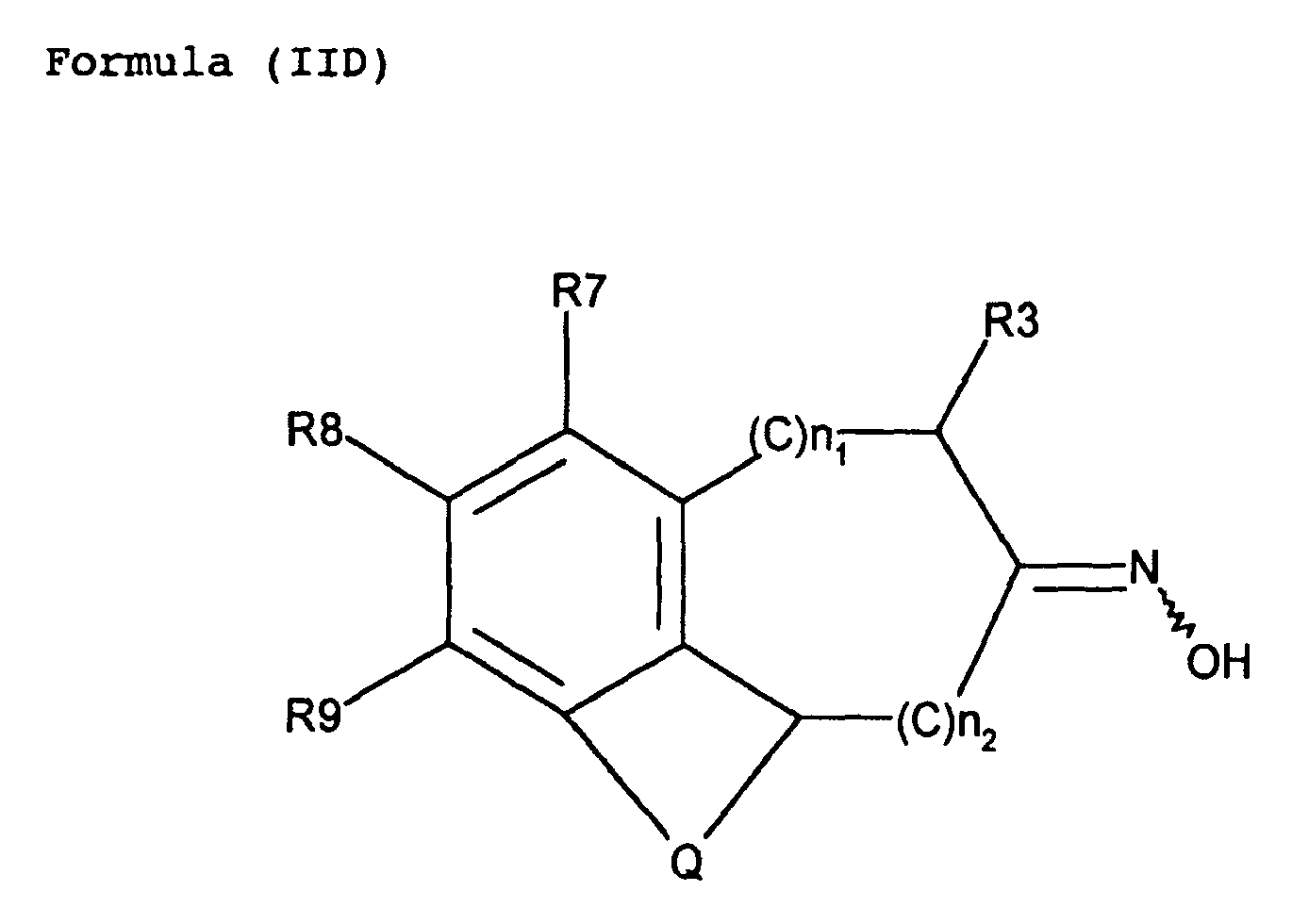
- the present invention is also relates to the most preferable compounds represented by the following formula: wherein n1 is an integer from 0 to 4, m 1 and m 2 are each an integer from 0 to 4, R7 and R8 different or same, are an hydrogen atom, a functional group, an alkyl, an aryl, a cycloalkyl, an alkylaryl.
- each n1 and n2 is an integer from 0 to 4
- Q is an aryl, heteroaryl, cycloaklyl, heterocycloalkyl said group are subtituted or not with at least one functional group preferably alpha- or beta-tretralone-oxime derivatives, alpha- or beta-indanone-oxime derivatives, substituted or not with a functional group.
- R3, R7, R8 are as defined above
- R9, R10 are independently an hydrogen atom, a functional group, an alkyl, an aryl, a cycloalkyl, an alkylaryl.
- n1, n2, R3 and Q are as defined above
- R11 is a hydrogen atom, an alkyl, an aryl.
- n1, n2, R3, R7, R8, R9 and Q are as defined above.
- R4 is a hydrogen atom, an alkyl, an aryl, an alkylaryl, said groups are substituted or not with a halogen atom as Cl, Br, or F;
- R7, R8, R9 and R10, identical or different, with not simultaneously an hydrogen atom, are an hydrogen atom, a functional group, an alkyl, an aryl, preferably R7, R8 and R10 are an hydrogen atom, R9 is a methoxy and R4 is a methyl.
- the present invention relates also to the use of these most preferable compounds in an hydrogenation reaction, asymmetric or not, giving an amine or amide derivative for pharmaceutical interest.
- Heterogeneous catalysts are based on metal like Pd, Ir, Pt, Rh, Ni catalysts preferably Ir or Rh.
- the heterogeneous catalyts is used in the form of an oxide or metallic and may be supported on a suitable carrier (for example Ir/carbon, Ir/alumina, Rh/carbon or Rh/alumina).
- the compound of formula (II) may be used as a syn-form, anti-form or a mixed-form of both.
- the compound of formula (III) should be used in an amount of at least 2 molar equivalents for one molar equivalent of the oxime and may be used in a large amount as a reacting agent combined with a solvent.
- the amount of the catalyst used is in the range of 0.001 to 30% mol, for 1 mol of the oxime derivative.
- Suitable solvents are aprotic non-basic solvents such as ethers (such as but not limited tetrahydrofuran, tetrahydropyran, diethyl ether, etc.) or aromatic hydrocarbons (such as but not limited to benzene, toluene, etc.) or carboxylic anhydrides or halogenated hydrocarbons or lower carboxylic acids or mixtures thereof.
- ethers such as but not limited tetrahydrofuran, tetrahydropyran, diethyl ether, etc.
- aromatic hydrocarbons such as but not limited to benzene, toluene, etc.
- carboxylic anhydrides or halogenated hydrocarbons or lower carboxylic acids or mixtures thereof such as but not limited to benzene, toluene, etc.
- the process of the present invention is carried out under a temperature range of -20 to 150 °C, preferably between 20 °C to 120 °C.
- the hydrogenation of the present invention is carried out under a hydrogen pressure between 0.5 to 20 bars.
- the process of the present invention is carried out for a period of time in the range of 0.5 to 24 hours.
- the process of the present invention can comprises a work up step of the organic solution of the compound of formula (I) which is a washing step with water containing organic or mineral salts without halogen atom, preferably without chloride.
- organic or mineral salts can be selected among phosphate, sulfate, acetate, citrate, formate, borate, carbonate, ammonium, preferably phosphate.
- the washing step allows to obtain a solution with a neutral pH.
- the isolated product is halogen ions free. These halogen ions can interfere with the catalyst during the subsequent asymmetric hydrogenation reaction and thus can affect the yield of this reaction. As a result, this washing step allows to obtain a starting material of better quality for the next asymmetric hydrogenation reaction.
- Example 1a Enamide from ⁇ -tétralone with Rh /C
- tetrahydrofuran (43.5 ml) and 3,4-dihydo-1H-naphtalen-2-one oxime (7.2 g, 0.0447 mole).
- acetic anhydride (13.7 g, 0.134 mole) is added at 20-25°C over a period of 15 minutes.
- the suspension is stirred for 1 hour and the catalyst 5% Rh/C (dry catalyst)(0.29 g, 4% by weight relative to oxime) is added.
- the mixture is heated to 30°C and the hydrogen flow is started. Hydrogenation is continued over a period of 15 hours under 4 bars hydrogen pressure.
- the suspension is filtered from the catalyst and the catalyst is washed with THF.
- This solution is added on a mixture of water (21 ml) and NaOH 30% (30.4 g) at 5°C over a period of 1 hour and maintained at 20°C during 30 minutes.
- the aqueous phase is discarded and the organic layer is washed with water saturated with NaCl.
- THF is distilled under reduced pressure, replaced by toluene and concentrated under vacuum to give an oily brown residue of N-(3,4-Dihydro-naphthalen-2-yl)-acetamide (6.14 g, 74 %).
- Example 1b Enamide from ⁇ -tétralone with Ir /C
- tetrahydrofuran (43.5 ml) and 3,4-dihydo-1H-naphtalen-2-one oxime (7.2 g, 0.047 mole).
- acetic anhydride (13.5 g, 0.134 mole) is added at 20-25°C over a period of 15 minutes.
- the suspension is stirred for 1 hour and the catalyst 5% Ir/C (dry catalyst)(0.29 g, 4% by weight relative to oxime) is added.
- the mixture is heated to 70°C and the hydrogen flow is started. Hydrogenation is continued over a period of 8 to 10 hours under 4 bars hydrogen pressure.
- the suspension is filtered from the catalyst and the catalyst is washed with THF.
- This solution is added on a mixture of water (30 ml) and NaOH 30% (42 g) at 5°C over a period of 1 hour and maintained at 20°C during 30 minutes.
- the aqueous phase is discarded and the organic layer is washed with water saturated with NaCl.
- THF is distilled under pressure, replaced by toluene and concentrated under vacuum to give an oily brown residue of N-(3,4-Dihydro-naphthalen-2-yl)-acetamide (5.5 g, 66 %).
- Example 1c Enamide from ⁇ -tétralone with Ir /C
- Oxime 1H NMR (CDCl3): 2.7-2.8 (t, 1H), 2.85-2.95 (t, 1H), 3-3.1 (m, 2H), 3.75 (s, 1H), 4.05 (s, 1H), 7.25-7.5 (m, 4H), 9.5 (m, OH).
- Oxime acOUSe 1H NMR (CDCl3): 2.2 (s, 3H), 2.65-2.9 (m, 4H), 3.65 (s, 1H), 3.85 (s, 1H), 7.1-7.25 (m, 4H).
- Example 2 Enamide from 6-methoxy-1-indanone.
- reaction is carried out in the same manner as in example 1b, except that 1-indanone-oxime, methoxy-6- is used as starting material.
- the yield is 83.8 %.
- the chemical purity is 98.4 %.
- Example 2b Enamide from 6-methoxy-1-indanone with Ir /C.
- tetrahydrofuran 50 ml
- 1-indanone-oxime, methoxy-6- 10 g, 0.056 mole
- acetic anhydride 17.3 g, 0.170 mole
- the suspension is stirred for 1 hour and the catalyst 5% Rh/C (dry catalyst)(0.40 g, 4% by weight relative to oxime) is added, rinsed by tetrahydrofuran (10 ml).
- the mixture is heated to 30°C and the hydrogen flow is started. Hydrogenation is continued over a period of 15 hours under 4 bars hydrogen pressure.
- the suspension is filtered from the catalyst and the catalyst is washed with THF.
- This solution is added on a mixture of water (29 ml) and NaOH 30% (42.2 g) at 5°C over a period of 1 hour and maintained at 20°C during 30 minutes.
- the aqueous phase is discarded and the organic layer is washed with a buffer solution of sodium dihydrogen phosphate (37.8 w/w) adjusted at pH 6 with NaOH 30%.
- THF is distilled under reduced pressure, replaced by toluene and concentrated under vacuum to give an oily brown residue of N -(6-Methoxy-3 H -inden-1-yl)-acetamide (6.6 g, 57 . 5 %).
- Oxime * 1H NMR 270MHz JEOL (DMSO): 2 . 7-2 . 95 (m, 4H), 3.75 (s, 3H), 6.9 (m, 1H), 7 (m, 1H), 7.25 (d,1H), 10.8 (s, OH). * 13C NMR (DMSO): ⁇ 165, 162, 150, 147, 137, 127, 112, 67, 34, 32. Oxime acetate: * 1H NMR (CDCl3): 2.15 (s, 3H), 2.95 (m, 4H), 3.7 (s, 3H), 6.85-6.95 (m, 1H), 7,1-7.15 (m, 1H), 7.25 (m, 1H).
- Example 3 Enamide from ⁇ -tétralone.
- Example 3a Enamide from ⁇ -tétralone with Rh /C
- tetrahydrofuran 60 ml
- 3,4-dihydo-2H-naphtalen-1-one oxime 10 g, 0.062 mole
- acetic anhydride (19 g, 0.186 mole) is added at 20-25°C over a period of 15 minutes.
- the suspension is stirred for 1 hour and the catalyst 5% Rh/C (dry catalyst)(0.4 g, 4% by weight relative to oxime) is added.
- the mixture is heated to 30°C and the hydrogen flow is started. Hydrogenation is continued over a period of 15 to 20 hours under 4 bars hydrogen pressure.
- the suspension is filtered from the catalyst and the catalyst is washed with THF.
- THF is distilled under reduced pressure and replaced by toluene; the suspension is stirred at 5°C for 1 hour then the precipitate is filtered off and washed twice with 10 ml of cold toluene.
- Example 3b Enamide from ⁇ -tétralone with Ir /C
- tetrahydrofuran 60 ml
- 3,4-dihydo-2H-naphtalen-1-one oxime 10 g, 0.062 mole
- acetic anhydride (19 g, 0.186 mole) is added at 20-25°C over a period of 15 minutes.
- the suspension is stirred for 1 hour and the catalyst 5% Ir/C (dry catalyst)(0.4 g, 4% by weight relative to oxime) is added.
- the mixture is heated to 70°C and the hydrogen flow is started. Hydrogenation is continued over a period of 4 to 5 hours under 4 bars hydrogen pressure.
- the suspension is filtered from the catalyst and the catalyst is washed with THF.
- THF is distilled under reduced pressure and replaced by toluene; the suspension is stirred at 5°C for 1 hour then the precipitate is filtered off and washed twice with 10 ml of cold toluene.
- Example 4 Enamide from 2-Phenylcyclohexanone.
- Example 4a Enamide from 2-Phenylcyclohexanone with Ir /C
- tetrahydrofuran 24 ml
- 2-phenylcyclohexanone oxime 4 g, 0.0211 mole
- acetic anhydride 6.47 g, 0.0634 mole
- the suspension is stirred for 1 hour and the catalyst 5% Ir/C (dry catalyst)(0.16 g, 4% by weight relative to oxime) is added.
- the mixture is heated to 70°C and the hydrogen flow is started. Hydrogenation is continued over a period of 2.5 to 3 hours under 4 bars hydrogen pressure.
- the suspension is filtered from the catalyst and the catalyst is washed with THF.
- This solution is added on a mixture of water (12 ml) and NaOH 30% (10.8 ml) at 5°C over a period of 1 hour and maintained at 20°C during 30 minutes.
- the aqueous phase is discarded and the organic layer is washed with water saturated with NaCl.
- tetrahydrofuran 24 ml
- 2-phenylcyclohexanone oxime 4 g, 0.0211 mole
- acetic anhydride 6.47 g, 0.0634 mole
- the suspension is stirred for 1 hour and the catalyst 5% Rh/C (dry catalyst)(0.16 g, 4% by weight relative to oxime) is added.
- the mixture is heated to 25-30°C and the hydrogen flow is started. Hydrogenation is continued over a period of 5 to 6 hours under 4 bars hydrogen pressure.
- the suspension is filtered from the catalyst and the catalyst is washed with THF.
- This solution is added on a mixture of water (12 ml) and NaOH 30% (10.8 ml) at 5°C over a period of 1 hour and maintained at 20°C during 30 minutes.
- the aqueous phase is discarded and the organic layer is washed with water saturated with NaCl.
- Example 5 Enamide from 2-methoxy-7-tétralone.
- This solution is added on a mixture of water (14 ml) and NaOH 30% (12 ml) at 5°C over a period of 1 hour and maintained at 20°C during 30 minutes.
- the aqueous phase is discarded and the organic layer is washed with water saturated with NaCl.
Landscapes
- Chemical & Material Sciences (AREA)
- Organic Chemistry (AREA)
- Organic Low-Molecular-Weight Compounds And Preparation Thereof (AREA)
- Low-Molecular Organic Synthesis Reactions Using Catalysts (AREA)
- Compositions Of Macromolecular Compounds (AREA)
Abstract

R4 is a hydrogen atom, an alkyl, an aryl, an alkylaryl, said groups are substituted or not with a halogen atom as C1, Br, or F;
R7, R8, R9 and R10, identical or different, with not simultaneously an hydrogen atom, are an hydrogen atom, a functional group, an alkyl, an aryl, preferably R7, R8 and R10 are an hydrogen atom, R9 is a methoxy and R4 is a methyl.
Description
- The present invention relates to a new process for the large-scale preparation of ene-amide derivatives useful as valuable substrates for asymmetric hydrogenation reaction and hence for the synthesis of enantiomerically pure amines derivatives known as key intermediates for active pharmaceuticals.
- Several methods have been described in the prior art, for example in
WO 99/18065
The articles JOC, 1998, 63, p 6084 of the authors M. Burk and Coll. and JOC, 1999, 64(6), p 1775 of the authors X. Zhang and Coll. describe a process for ene-amide compounds synthesis comprising the reduction of oxime derivatives with iron metal in presence of acetic anhydride/acetic acid or acetic anhydride only.
TheUS4194050 patent describes a process for ene-amide compounds synthesis comprising the reduction of oxime derivatives with ruthenium catalyst in presence of carboxylic anhydride.
However, these processes show some limitations such as product decomposition under these conditions, use of cosolvent to facilitate product isolation, impure ene-amides which required arduous purifications and low to moderate yields.
Prior art processes are unsuitable for large-scale production of ene-amide derivatives and hence not applicable to the commercial preparation of chiral amines via asymmetric hydrogenation. - The process according to the invention presents the advantages of obtaining ene-amides in good yields, great facility of product isolation, an excellent chemical purity of product and reproducible process.
The process according to the present invention is clearly suitable for the large-scale industrial production of amine derivatives, via an asymmetric or not hydrogenation reaction. These amine derivatives, asymmetric or not, are used as intermediates for active pharmaceuticals preparation.
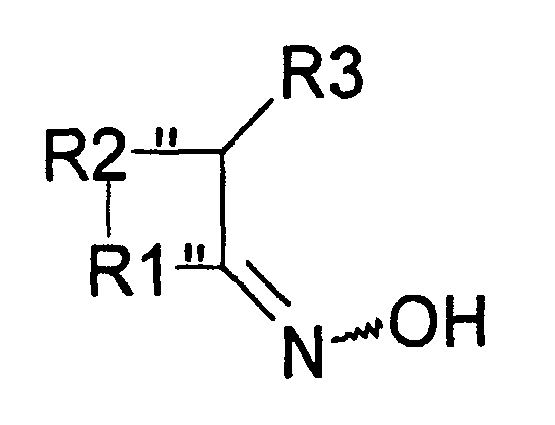
The present invention relates to a new process for the preparation of compounds of formula (I), comprising a hydrogenation-isomerization reaction of compound of formula (II) with an acyl derivative of formula (III) in presence of a heterogeneous catalyst as shown in scheme (I).
R1 and R2 and R3 are independently a hydrogen atom, an alkyl, a cycloalkyl, a cycloalkylalkyl, an alkylaryl, an aryl, a heterocycle, a cyano, an alkoxy, an aryloxy, a carboxyl, a carbamoyl, -CONR5R6 (in which R5 and R6 are independently an alkyl, arylalkyl, aryl group or R5 and R6 taken together may form a ring) or -COOR5 group (in which R5 is an alkyl, cycloalkyl, alkylaryl or aryl group), said alkyl, cycloalkyl, cycloalkylalkyl, alkylaryl and aryl groups being substituted or not with a functional group or with R5;
or R1 and R2 taken together, may form a ring (which terms includes mono-, di- and higher polycyclic ring systems), said ring being substituted or not with a functional group or with R5;
R4 is a hydrogen atom, an alkyl, an aryl, an alkylaryl, said groups are substituted or not with a halogen atom as Cl, Br, or F;
X is an oxygen atom or a leaving group and
m is an integer 1 or 2;
when m is 1 then X is a leaving group; when m is 2 then X is a oxygen atom. - As used herein, unless the context otherwise requires:
- The term "alkyl" preferably means a straight or branched alkyl group having 1 to 20 carbons atoms such as, but not limited to, methyl, ethyl, n-propyl, isopropyl, n-butyl, iso-butyl, sec-butyl, tert-butyl optionally substituted with a functional group or with R5.
- The term "cycloalkyl" preferably means a cycloalkyl group having 3 to 20 carbon atoms, such as, but not limited to, cyclopropyl, cyclopentyl, cyclohexyl optionally substituted with a functional group or with R5.
The term "cycloalkylalkyl" preferably means a cycloalkylalkyl group having 3-20 carbon atoms such as but not limited to cyclopropylmethyl, cyclohexylmethyl optionally substituted with a functional group or with R5.
The term "aryl" preferably means an aryl group having 6 to 20 carbon atoms such as but not limited to phenyl, tolyl, xylyl, cumenyl, naphthyl optionally substituted with a functional group or with an alkyl or with a fused aryl, or "aryl" means a heteroaryl group having 6 to 20 carbon atoms comprising one or more heteroatom as 0, N or S such as, but not limited to, furyl, thienyl, pyrrolyl, imidazolyl, pyridyl, pyrazyl, pyrimidinyl, indolyl, carbazolyl, isoxazolyl, isothiazolyl optionally substituted with a functional group or with R5 or with an alkyl or with a fused aryl.
The term "alkylaryl" preferably means an alkylaryl group having 6 to 20 carbon atoms such as, but not limited to, benzyl, phenethyl, naphthylmethyl optionally substituted with a functional group or with R5.
The term "heterocycle" preferably means a heterocycle group having 6 to 20 carbon atoms comprising one more heteroatom as 0, N or S such as but not limited pyrrolidinyl, piperazinyl, piperidyl, imidazolidinyl, piperidyl, indolinyl, said heterocycle being saturated or not, said heterocycle being optionally substituted with a functional group or with R5 or a fused aryl group.
The term "functional group" means halogen atom, or a group comprising -OH, -OR5, -CN, -COOR5, -COR5, -CONR5R6, -OCOR5,-NH2, -NHR5, -NR5R6, -N02, -SH, SR5, wherein R5 and R6 are independently an alkyl, an alkylaryl or an aryl group or R5 and R6 taken together may form a ring, - The term "leaving group" means preferably one of the groups -COR5, -CO2R5, -SO2R5, -COCCl3, -SO2F, -SO2CF3, -SO2CH2CF3, wherein R5 is an alkyl, an alkylaryl or an aryl group
- The term "ring" preferably means the formation of ring having 4 to 30 carbon atoms, such as but not limited, compounds of formula hereunder
- The present invention is also relates to the most preferable compounds represented by the following formula:


- Wherein R3, R7, R8 are as defined above, R9, R10 are independently an hydrogen atom, a functional group, an alkyl, an aryl, a cycloalkyl, an alkylaryl.



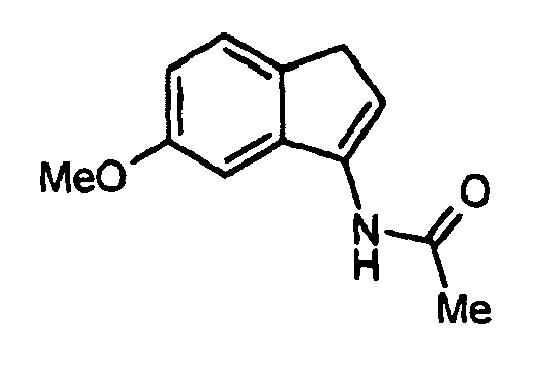
R4 is a hydrogen atom, an alkyl, an aryl, an alkylaryl, said groups are substituted or not with a halogen atom as Cl, Br, or F;
R7, R8, R9 and R10, identical or different, with not simultaneously an hydrogen atom, are an hydrogen atom, a functional group, an alkyl, an aryl, preferably R7, R8 and R10 are an hydrogen atom, R9 is a methoxy and R4 is a methyl. - The present invention relates also to the use of these most preferable compounds in an hydrogenation reaction, asymmetric or not, giving an amine or amide derivative for pharmaceutical interest.
- Heterogeneous catalysts are based on metal like Pd, Ir, Pt, Rh, Ni catalysts preferably Ir or Rh.
The heterogeneous catalyts is used in the form of an oxide or metallic and may be supported on a suitable carrier (for example Ir/carbon, Ir/alumina, Rh/carbon or Rh/alumina). - The method how to carry out the present invention will be explained hereinafter.
The compound of formula (II) may be used as a syn-form, anti-form or a mixed-form of both. - The compound of formula (III) should be used in an amount of at least 2 molar equivalents for one molar equivalent of the oxime and may be used in a large amount as a reacting agent combined with a solvent.
- The amount of the catalyst used is in the range of 0.001 to 30% mol, for 1 mol of the oxime derivative.
- The process of the present invention is carried out in a suitable solvent. Suitable solvents are aprotic non-basic solvents such as ethers (such as but not limited tetrahydrofuran, tetrahydropyran, diethyl ether, etc.) or aromatic hydrocarbons (such as but not limited to benzene, toluene, etc.) or carboxylic anhydrides or halogenated hydrocarbons or lower carboxylic acids or mixtures thereof.
- The process of the present invention is carried out under a temperature range of -20 to 150 °C, preferably between 20 °C to 120 °C.
- The hydrogenation of the present invention is carried out under a hydrogen pressure between 0.5 to 20 bars.
- The process of the present invention is carried out for a period of time in the range of 0.5 to 24 hours.
- The process of the present invention can comprises a work up step of the organic solution of the compound of formula (I) which is a washing step with water containing organic or mineral salts without halogen atom, preferably without chloride.
- These organic or mineral salts can be selected among phosphate, sulfate, acetate, citrate, formate, borate, carbonate, ammonium, preferably phosphate.
- The washing step allows to obtain a solution with a neutral pH. The isolated product is halogen ions free. These halogen ions can interfere with the catalyst during the subsequent asymmetric hydrogenation reaction and thus can affect the yield of this reaction. As a result, this washing step allows to obtain a starting material of better quality for the next asymmetric hydrogenation reaction.
- The invention will be better understood from the experimental details, which follow.
- The present invention will be illustrated by the following examples, which will not limit the scope of the invention in any way.
-

- Into a 100 ml reactor are introduced tetrahydrofuran (43.5 ml) and 3,4-dihydo-1H-naphtalen-2-one oxime (7.2 g, 0.0447 mole). Then acetic anhydride (13.7 g, 0.134 mole) is added at 20-25°C over a period of 15 minutes. The suspension is stirred for 1 hour and the catalyst 5% Rh/C (dry catalyst)(0.29 g, 4% by weight relative to oxime) is added. The mixture is heated to 30°C and the hydrogen flow is started. Hydrogenation is continued over a period of 15 hours under 4 bars hydrogen pressure. After the end of the reaction, the suspension is filtered from the catalyst and the catalyst is washed with THF. This solution is added on a mixture of water (21 ml) and NaOH 30% (30.4 g) at 5°C over a period of 1 hour and maintained at 20°C during 30 minutes. The aqueous phase is discarded and the organic layer is washed with water saturated with NaCl.
- THF is distilled under reduced pressure, replaced by toluene and concentrated under vacuum to give an oily brown residue of N-(3,4-Dihydro-naphthalen-2-yl)-acetamide (6.14 g, 74 %).
- Into a 100 ml reactor are introduced tetrahydrofuran (43.5 ml) and 3,4-dihydo-1H-naphtalen-2-one oxime (7.2 g, 0.047 mole). Then acetic anhydride (13.5 g, 0.134 mole) is added at 20-25°C over a period of 15 minutes. The suspension is stirred for 1 hour and the catalyst 5% Ir/C (dry catalyst)(0.29 g, 4% by weight relative to oxime) is added. The mixture is heated to 70°C and the hydrogen flow is started. Hydrogenation is continued over a period of 8 to 10 hours under 4 bars hydrogen pressure. After the end of the reaction, the suspension is filtered from the catalyst and the catalyst is washed with THF. This solution is added on a mixture of water (30 ml) and NaOH 30% (42 g) at 5°C over a period of 1 hour and maintained at 20°C during 30 minutes. The aqueous phase is discarded and the organic layer is washed with water saturated with NaCl.
- THF is distilled under pressure, replaced by toluene and concentrated under vacuum to give an oily brown residue of N-(3,4-Dihydro-naphthalen-2-yl)-acetamide (5.5 g, 66 %).
- 5.5 g (0.0341 mol) of 3,4-dihydro-1H-naphtalene-2-one oxime was dissolved in 42 ml of THF.Then 9.66 ml of acetic anhydride was added dropwise. The reaction mixture is stirred at a temperature between 20-30 °C during 2 hours. To this reaction mixture is added 0.44 g of the 5% Ir-carbon catalyts. Then the hydrogenation is carried out at a hydrogen pressure of 6 bars and at 75 °C during 3 hours. After the catalyst was filtered off, the filtrate was concentrated to dryness under reduced pressure. The residue was dissolved in 120 ml of toluene and concentrated to dryness under reduced pressure. This new residue was recristallized in a mixture of 10 ml of MTBE and 9 ml of hexane to obtain 3.82 g of the product, the compound N-(3,4-dihydro-naphtalene-2-yl)acetamide.
- Crude yield: quantitative / Isolated yield: 59.9- %
Chemical purity (GC): 98.95 %. - Oxime: 1H NMR (CDCl3): 2.7-2.8 (t, 1H), 2.85-2.95 (t, 1H), 3-3.1 (m, 2H), 3.75 (s, 1H), 4.05 (s, 1H), 7.25-7.5 (m, 4H), 9.5 (m, OH).
Oxime acétate: 1H NMR (CDCl3): 2.2 (s, 3H), 2.65-2.9 (m, 4H), 3.65 (s, 1H), 3.85 (s, 1H), 7.1-7.25 (m, 4H).
Enamide: * 1H NMR (CDCl3): 2.3 (s, 3H), 2.6-2.75 (t, 2H), 3-3.15 (t, 2H), 7.15-7.35 (m, 5H), 7.75 (m, NH).
* 13C NMR (CDCl3): 168, 134, 133, 132.5, 127, 126, 125.5, 125, 27.5, 27, 24. -
- The reaction is carried out in the same manner as in example 1b, except that 1-indanone-oxime, methoxy-6- is used as starting material. The yield is 83.8 %.
The chemical purity is 98.4 %. - Into a 100 ml reactor are introduced tetrahydrofuran (24 ml) and 6-Methoxy-1-indanone oxime (4.5 g, 0.0254 mole). Then acetic anhydride (7.78 g, 0.0762 mole) is added at 20-25°C over a period of 15 minutes. The suspension is stirred for 1 hour and the catalyst 5% Ir/C (dry catalyst) ( 0.225 g, 4% by weight relative to oxime ) is added. The mixture is heated to 70-75°C and the hydrogen flow is started. Hydrogenation is continued over a period of 1 to 2 hours under 4 bars hydrogen pressure. After the end of the reaction, the suspension is filtered from the catalyst and the catalyst is washed with THF. This solution is added on a mixture of water (15 ml) and NaOH 30% (13 ml) at 5°C over a period of 1 hour and maintained at 20°C during 30 minutes. The aqueous phase is discarded and the organic layer is washed with water saturated with NaCl.
- The organic layer is concentrated under vacuum at 50°C to give brown crystals of N-(6-Methoxy-3H-inden-1-yl)-acetamide (3.34 g, 70 %).
- Into a 100 ml reactor are introduced tetrahydrofuran (24 ml) and 6-Methoxy-1-indanone oxime (4.5 g, 0.0254 mole). Then acetic anhydride (7.78 gr, 0.0762 mole) is added at 20-25°C over a period of 15 minutes. The suspension is stirred for 1 hour and the catalyst 5% Rh/C (dry catalyst) ( 0.225 g, 4% by weight relative to oxime ) is added. The mixture is heated to 30-35°C and the hydrogen flow is started. Hydrogenation is continued over a period of 7 to 8 hours under 4 bars hydrogen pressure. After the end of the reaction, the suspension is filtered from the catalyst and the catalyst is washed with THF. This solution is added on a mixture of water (15 ml) and NaOH 30% (13 ml) at 5°C over a period of 1 hour and maintained at 20°C during 30 minutes. The aqueous phase is discarded and the organic layer is washed with water saturated with NaCl.
The organic layer is concentrated under vacuum at 50°C to give off-white crystals of N-(6-Methoxy-3H-inden-1-yl)-acetamide (3.82 g, 80 %). - Into a 250 ml reactor are introduced tetrahydrofuran (50 ml) and 1-indanone-oxime, methoxy-6- (10 g, 0.056 mole). Then acetic anhydride (17.3 g, 0.170 mole) is added at 20-25°C over a period of 15 minutes. The suspension is stirred for 1 hour and the catalyst 5% Rh/C (dry catalyst)(0.40 g, 4% by weight relative to oxime) is added, rinsed by tetrahydrofuran (10 ml). The mixture is heated to 30°C and the hydrogen flow is started. Hydrogenation is continued over a period of 15 hours under 4 bars hydrogen pressure. After the end of the reaction, the suspension is filtered from the catalyst and the catalyst is washed with THF. This solution is added on a mixture of water (29 ml) and NaOH 30% (42.2 g) at 5°C over a period of 1 hour and maintained at 20°C during 30 minutes. The aqueous phase is discarded and the organic layer is washed with a buffer solution of sodium dihydrogen phosphate (37.8 w/w) adjusted at pH 6 with NaOH 30%.
- THF is distilled under reduced pressure, replaced by toluene and concentrated under vacuum to give an oily brown residue of N-(6-Methoxy-3H-inden-1-yl)-acetamide (6.6 g, 57 . 5 %).
- Oxime: * 1H NMR 270MHz JEOL (DMSO): 2 . 7-2 . 95 (m, 4H), 3.75 (s, 3H), 6.9 (m, 1H), 7 (m, 1H), 7.25 (d,1H), 10.8 (s, OH).
* 13C NMR (DMSO): δ 165, 162, 150, 147, 137, 127, 112, 67, 34, 32.
Oxime acetate: * 1H NMR (CDCl3): 2.15 (s, 3H), 2.95 (m, 4H), 3.7 (s, 3H), 6.85-6.95 (m, 1H), 7,1-7.15 (m, 1H), 7.25 (m, 1H).
* 13C NMR (CDCl3): 171, 168, 158, 143, 135, 126, 122, 105, 56, 29, 28, 19.
Enamide: * 1H NMR (CDCl3): 3 (s, 3H), 3.6 (s,3H), 4.1 (d, 2H), 7.5-7.6 (dd, 1H), 7.65 (m, 2H), 8.05-8.15 (d, 1H), 8.45 (s, 1H).
* 13C NMR (CDCl3): 169, 158, 140, 136, 134, 123, 117, 110, 103, 55, 35, 23. -

- Into a 180 ml reactor are introduced tetrahydrofuran (60 ml) and 3,4-dihydo-2H-naphtalen-1-one oxime (10 g, 0.062 mole). Then acetic anhydride (19 g, 0.186 mole) is added at 20-25°C over a period of 15 minutes. The suspension is stirred for 1 hour and the catalyst 5% Rh/C (dry catalyst)(0.4 g, 4% by weight relative to oxime) is added. The mixture is heated to 30°C and the hydrogen flow is started. Hydrogenation is continued over a period of 15 to 20 hours under 4 bars hydrogen pressure. After the end of the reaction, the suspension is filtered from the catalyst and the catalyst is washed with THF. This solution is added on a mixture of water (30 ml) and NaOH 30% (42 g) at 5°C over a period of 1 hour and maintained at 20°C during 30 minutes. The aqueous phase is discarded and the organic layer is washed with water saturated with NaCl.
- THF is distilled under reduced pressure and replaced by toluene; the suspension is stirred at 5°C for 1 hour then the precipitate is filtered off and washed twice with 10 ml of cold toluene.
- Crystals are dried under vacuum at 50°C to give N(3,4-dihydro-1-naphtalenyl)Acetamide ( 9.74 g, 84%).
- Into a 180 ml reactor are introduced tetrahydrofuran (60 ml) and 3,4-dihydo-2H-naphtalen-1-one oxime (10 g, 0.062 mole). Then acetic anhydride (19 g, 0.186 mole) is added at 20-25°C over a period of 15 minutes. The suspension is stirred for 1 hour and the catalyst 5% Ir/C (dry catalyst)(0.4 g, 4% by weight relative to oxime) is added. The mixture is heated to 70°C and the hydrogen flow is started. Hydrogenation is continued over a period of 4 to 5 hours under 4 bars hydrogen pressure. After the end of the reaction, the suspension is filtered from the catalyst and the catalyst is washed with THF. This solution is added on a mixture of water (30 ml) and NaOH 30% (42 g) at 5°C over a period of 1 hour and maintained at 20°C during 30 minutes. The aqueous phase is discarded and the organic layer is washed with water saturated with NaCl.
- THF is distilled under reduced pressure and replaced by toluene; the suspension is stirred at 5°C for 1 hour then the precipitate is filtered off and washed twice with 10 ml of cold toluene.
- Crystals are dried under vacuum at 50°C to give N(3,4-dihydro-1-naphtalenyl) Acetamide (9.18 g, 79%).
- Oxime: * 1H NMR 270MHz JEOL (DMSO): 1.65-1.8 (m, 2H), 2.6-2.8 (m, 4H), 7.1-7.3 (m, 3H), 7.8-7.95 (d, J = 7.5 Hz, 1H), 11.1 (s, OH).
* 13C NMR (DMSO): δ 152.5, 137, 132, 129, 128, 126, 123,29, 23, 21.
Oxime acetate: * 1H NMR (CDCl3): 2.75-3.85 (m, 2H), 3.2 (s, 3H), 3.65-3.75 (m, 2H), 3.75-3.85 (m,2H), 8.05-8.3 (m, 3H), 9.05-9.1 (d, 1H).
* 13C NMR (CDCl3): 169, 162, 141, 131, 128, 127.5, 127, 126, 29, 26, 22, 20.
Enamide: * 1H NMR (CDCl3): 2.1 (s, 3H), 2.25-2.45 (m, 2H), 2.65-2.85 (m, 2H), 6.3 (t, 1H), 7.05-7.35 (m, 4H).
* 13C NMR (CDCl3): 169, 137, 132, 127.5, 127, 126, 121, 120, 28, 24, 22.5. -

- Into a 100 ml reactor are introduced tetrahydrofuran (24 ml) and 2-phenylcyclohexanone oxime (4 g, 0.0211 mole). Then acetic anhydride (6.47 g, 0.0634 mole) is added at 20-25°C over a period of 15 minutes. The suspension is stirred for 1 hour and the catalyst 5% Ir/C (dry catalyst)(0.16 g, 4% by weight relative to oxime) is added. The mixture is heated to 70°C and the hydrogen flow is started. Hydrogenation is continued over a period of 2.5 to 3 hours under 4 bars hydrogen pressure. After the end of the reaction, the suspension is filtered from the catalyst and the catalyst is washed with THF. This solution is added on a mixture of water (12 ml) and NaOH 30% (10.8 ml) at 5°C over a period of 1 hour and maintained at 20°C during 30 minutes. The aqueous phase is discarded and the organic layer is washed with water saturated with NaCl.
- The organic layer is concentrated under vacuum at 50°C to give an oily white residue of N-(2-Phenyl-cyclohex-1-enyl)-acetamide (3.5 g, 77 %).
- Into a 100 ml reactor are introduced tetrahydrofuran (24 ml) and 2-phenylcyclohexanone oxime (4 g, 0.0211 mole). Then acetic anhydride (6.47 g, 0.0634 mole) is added at 20-25°C over a period of 15 minutes. The suspension is stirred for 1 hour and the catalyst 5% Rh/C (dry catalyst)(0.16 g, 4% by weight relative to oxime) is added. The mixture is heated to 25-30°C and the hydrogen flow is started. Hydrogenation is continued over a period of 5 to 6 hours under 4 bars hydrogen pressure. After the end of the reaction, the suspension is filtered from the catalyst and the catalyst is washed with THF. This solution is added on a mixture of water (12 ml) and NaOH 30% (10.8 ml) at 5°C over a period of 1 hour and maintained at 20°C during 30 minutes. The aqueous phase is discarded and the organic layer is washed with water saturated with NaCl.
- The organic layer is concentrated under vacuum at 50°C to give white crystals of N-(2-Phenyl-cyclohex-1-enyl)-acetamide (3.86 g, 85 %).
- Oxime: 1H NMR (DMSO): 1.4-1.65 (m, 2H), 1.7-1.8 (m, 2H), 1.9-2.2 (m, 3H), 2.8-2.95 (m, 1H), 4.1-4.5 (m, 1H), 7.1-7.4 (m, 5H).
- Oxime acetate: * 1H NMR (CDCl3): 1.55-1.75 (m, 4H), 1.85-2.1 (m, 1H), 2.15 (s, 3H), 2.17-2.3 (m, 1H), 2.4-2.5 (m, 1H), 2.75-2.87 (m, 1H), 3.85-3.91 (t, 1H), 7.15-7.4 (m, 5H).
* 13C NMR (CDCl3): 195, 170, 169, 138, 128, 127.5, 126, 46, 31, 27, 25, 22.5, 20.
Enamide: * 1H NMR (CDCl3): 1.65-1.8 (m, 4H), 2.3 (s, 2H), 2.6 (s, 2H), 6.55 (s, NH), 7.1-7.4 (m, 5H).
* 13C NMR (CDCl3): 167, 141, 131, 128, 127.5, 126.5, 126, 31, 27.5, 24, 22.5. -

- Into a 100 ml reactor are introduced tetrahydrofuran. (24 ml) and 2-Methoxy-7-tetralone oxime (4.5 g, 0.0235 mole). Then acetic anhydride (7.21 gr, 0.0706 mole) is added at 20-25°C over a period of 15 minutes. The suspension is stirred for 1 hour and the catalyst 5% Rh/C (dry catalyst)(0.18 gr, 4% by weight relative to oxime) is added. The mixture is heated to 30-35°C and the hydrogen flow is started. Hydrogenation is continued over a period of 4 to 5 hours under 4 bars hydrogen pressure. After the end of the reaction, the suspension is filtered from the catalyst and the catalyst is washed with THF. This solution is added on a mixture of water (14 ml) and NaOH 30% (12 ml) at 5°C over a period of 1 hour and maintained at 20°C during 30 minutes. The aqueous phase is discarded and the organic layer is washed with water saturated with NaCl.
- The organic layer is concentrated under vacuum at 50°C to give grey crystals of N-(7-Methoxy-3,4-dihydro-naphthalen-2-yl)-acetamide (4.21 g, 82.5 %).
- oxime : 1H NMR (CDCl3): 2.7-2.8 (t, 1H), 2.85-2.95 (t, 1H), 3.45 (s, 2H), 3.75 (s, 3H), 6.65 (m, 2H), 7.1(m, 1H), 10.05 (s, OH)
- Oxime acetate: Non-isolated
- Enamide :1H NMR (CDCl3): 2.1 (s, 3H), 2.35-2.45 (t, 2H), 2.7-2.85 (t, 2H), 3.75 (s,3H),6.6 (m, 2H), 6.95 (m, 1H), 7.1 (s, 1H), 7.35 (m, NH)
Claims (7)
- Ene-amide derivative of formula (IIE)

R4 is a hydrogen atom, an alkyl, an aryl, an alkylaryl, said groups are substituted or not with a halogen atom as Cl, Br, or F;
R7, R8, R9 and R10, identical or different, with not simultaneously an hydrogen atom, are an hydrogen atom, a functional group, an alkyl, an aryl, preferably R7, R8 and R10 are an hydrogen atom, R9 is a methoxy and R4 is a methyl. - The ene-amide of claim 1, which is N-(6-Methoxy-3H-inden-1-yl)-acetamide.
- The ene-amide of claim 1, which is N(3,4-dihydro-1-naphtalenyl)acetamide.
- The ene-amide of claim 1, which is N(3,4-dihydro-naphtalen-2-yl)acetamide.
- The ene-amide of claim 1, which is N-(2-Phenyl-cyclohex-1-enyl)-acetamide.
- The ene-amide of claim 1, which is N-(7-Methoxy-3,4-dihydro-naphthalen-2-yl)-acetamide.
- Use of a ene-amide derivative of formula (IIE) as defined in any one of claims 1 to 6 in an hydrogenation reaction, asymmetric or not, giving an amine or amide derivative for pharmaceutical interest.
Priority Applications (1)
| Application Number | Priority Date | Filing Date | Title |
|---|---|---|---|
| EP07018349A EP1897868A1 (en) | 2003-12-22 | 2004-12-22 | N-(3H-inden-1-yl)-acetamide compounds |
Applications Claiming Priority (3)
| Application Number | Priority Date | Filing Date | Title |
|---|---|---|---|
| EP03293281A EP1547997A1 (en) | 2003-12-22 | 2003-12-22 | New process for the synthesis of enamide derivatives |
| EP07018349A EP1897868A1 (en) | 2003-12-22 | 2004-12-22 | N-(3H-inden-1-yl)-acetamide compounds |
| EP04806523A EP1716097B1 (en) | 2003-12-22 | 2004-12-22 | New process for the synthesis of eneamide derivatives |
Related Parent Applications (1)
| Application Number | Title | Priority Date | Filing Date |
|---|---|---|---|
| EP04806523A Division EP1716097B1 (en) | 2003-12-22 | 2004-12-22 | New process for the synthesis of eneamide derivatives |
Publications (1)
| Publication Number | Publication Date |
|---|---|
| EP1897868A1 true EP1897868A1 (en) | 2008-03-12 |
Family
ID=34530825
Family Applications (3)
| Application Number | Title | Priority Date | Filing Date |
|---|---|---|---|
| EP03293281A Withdrawn EP1547997A1 (en) | 2003-12-22 | 2003-12-22 | New process for the synthesis of enamide derivatives |
| EP04806523A Expired - Lifetime EP1716097B1 (en) | 2003-12-22 | 2004-12-22 | New process for the synthesis of eneamide derivatives |
| EP07018349A Withdrawn EP1897868A1 (en) | 2003-12-22 | 2004-12-22 | N-(3H-inden-1-yl)-acetamide compounds |
Family Applications Before (2)
| Application Number | Title | Priority Date | Filing Date |
|---|---|---|---|
| EP03293281A Withdrawn EP1547997A1 (en) | 2003-12-22 | 2003-12-22 | New process for the synthesis of enamide derivatives |
| EP04806523A Expired - Lifetime EP1716097B1 (en) | 2003-12-22 | 2004-12-22 | New process for the synthesis of eneamide derivatives |
Country Status (14)
| Country | Link |
|---|---|
| US (1) | US7884243B2 (en) |
| EP (3) | EP1547997A1 (en) |
| JP (1) | JP4597141B2 (en) |
| KR (1) | KR101155389B1 (en) |
| CN (2) | CN101265210A (en) |
| AT (1) | ATE484491T1 (en) |
| DE (1) | DE602004029611D1 (en) |
| DK (1) | DK1716097T3 (en) |
| ES (1) | ES2354294T3 (en) |
| IL (1) | IL176346A (en) |
| PL (1) | PL1716097T3 (en) |
| PT (1) | PT1716097E (en) |
| SI (1) | SI1716097T1 (en) |
| WO (1) | WO2005063687A2 (en) |
Families Citing this family (3)
| Publication number | Priority date | Publication date | Assignee | Title |
|---|---|---|---|---|
| US7262326B2 (en) | 2004-09-08 | 2007-08-28 | Teva Pharmaceuticals Industries Ltd. | Process for the synthesis of indanylamine or aminotetralin derivatives and novel intermediates |
| DK2816024T3 (en) * | 2006-03-31 | 2017-10-30 | Sunovion Pharmaceuticals Inc | CHIRALE AMINER |
| CN101875590B (en) * | 2010-07-19 | 2013-09-18 | 西北大学 | Method for synthesizing acrylamide compound |
Citations (2)
| Publication number | Priority date | Publication date | Assignee | Title |
|---|---|---|---|---|
| WO2000038673A1 (en) * | 1998-12-31 | 2000-07-06 | Teva Pharmaceutical Industries, Ltd. | Compositions containing and methods of using n-acyl-1h-aminoindenes |
| WO2005082838A1 (en) * | 2004-02-19 | 2005-09-09 | Ppg-Sipsy | New process for the synthesis of substituted alpha -aminoindan derivatives |
Family Cites Families (5)
| Publication number | Priority date | Publication date | Assignee | Title |
|---|---|---|---|---|
| US3375287A (en) * | 1961-08-30 | 1968-03-26 | Union Carbide Corp | Process for isomerizing ethylenically unsaturated compound possessing cycloaliphatic nucleus |
| US4194050A (en) * | 1976-04-30 | 1980-03-18 | Sumitomo Chemical Company, Limited | Process for producing an enamide |
| JPS52133905A (en) * | 1976-04-30 | 1977-11-09 | Sumitomo Chem Co Ltd | Preparation of enamides |
| WO1999018065A1 (en) * | 1997-10-03 | 1999-04-15 | Chirotech Technology Limited | Chiral amines |
| US6635784B2 (en) * | 2000-09-29 | 2003-10-21 | Eastman Chemical Company | Process for the preparation of enantiomerically-enriched cyclopropylalanine derivates |
-
2003
- 2003-12-22 EP EP03293281A patent/EP1547997A1/en not_active Withdrawn
-
2004
- 2004-12-22 PT PT04806523T patent/PT1716097E/en unknown
- 2004-12-22 ES ES04806523T patent/ES2354294T3/en not_active Expired - Lifetime
- 2004-12-22 PL PL04806523T patent/PL1716097T3/en unknown
- 2004-12-22 KR KR1020067011858A patent/KR101155389B1/en not_active Expired - Fee Related
- 2004-12-22 AT AT04806523T patent/ATE484491T1/en active
- 2004-12-22 WO PCT/IB2004/004363 patent/WO2005063687A2/en not_active Ceased
- 2004-12-22 EP EP04806523A patent/EP1716097B1/en not_active Expired - Lifetime
- 2004-12-22 SI SI200431559T patent/SI1716097T1/en unknown
- 2004-12-22 DE DE602004029611T patent/DE602004029611D1/en not_active Expired - Lifetime
- 2004-12-22 JP JP2006546407A patent/JP4597141B2/en not_active Expired - Fee Related
- 2004-12-22 EP EP07018349A patent/EP1897868A1/en not_active Withdrawn
- 2004-12-22 US US10/583,902 patent/US7884243B2/en not_active Expired - Lifetime
- 2004-12-22 DK DK04806523.9T patent/DK1716097T3/en active
- 2004-12-22 CN CNA2008100912952A patent/CN101265210A/en active Pending
- 2004-12-22 CN CN2004800386020A patent/CN1898194B/en not_active Expired - Fee Related
-
2006
- 2006-06-15 IL IL176346A patent/IL176346A/en active IP Right Grant
Patent Citations (2)
| Publication number | Priority date | Publication date | Assignee | Title |
|---|---|---|---|---|
| WO2000038673A1 (en) * | 1998-12-31 | 2000-07-06 | Teva Pharmaceutical Industries, Ltd. | Compositions containing and methods of using n-acyl-1h-aminoindenes |
| WO2005082838A1 (en) * | 2004-02-19 | 2005-09-09 | Ppg-Sipsy | New process for the synthesis of substituted alpha -aminoindan derivatives |
Non-Patent Citations (3)
| Title |
|---|
| BURK, MARK J. ET AL: "A Three-Step Procedure for Asymmetric Catalytic Reductive Amidation of Ketones", JOURNAL OF ORGANIC CHEMISTRY, vol. 63, no. 18, 1998, pages 6084 - 6085, XP002280540 * |
| FU, YU; GUO, XUN-XIANG; ZHU, SHOU-FEI; HU, AI-GUO; XIE, JIAN-HUA; ZHOU, QI-LIN: "Rhodium-Catalyzed Asymmetric Hydrogenation of Functionalized Olefins Using Monodentate Spiro Phosphoramidite Ligands", JOURNAL OF ORGANIC CHEMISTRY, vol. 69, no. 14, 6 May 2004 (2004-05-06), pages 4648 - 4655, XP002463954 * |
| ZHANG Z ET AL: "Highly enantioselective hydrogenation of cyclic enamides catalized by a Rh-PennPhos catalyst", JOURNAL OF ORGANIC CHEMISTRY, AMERICAN CHEMICAL SOCIETY. EASTON, US, vol. 64, 1999, pages 1774 - 1775, XP002280541, ISSN: 0022-3263 * |
Also Published As
| Publication number | Publication date |
|---|---|
| US7884243B2 (en) | 2011-02-08 |
| IL176346A (en) | 2011-01-31 |
| DK1716097T3 (en) | 2011-01-24 |
| ATE484491T1 (en) | 2010-10-15 |
| WO2005063687A3 (en) | 2005-10-27 |
| CN1898194A (en) | 2007-01-17 |
| DE602004029611D1 (en) | 2010-11-25 |
| KR101155389B1 (en) | 2012-06-20 |
| WO2005063687A2 (en) | 2005-07-14 |
| JP2007517017A (en) | 2007-06-28 |
| EP1716097A2 (en) | 2006-11-02 |
| US20070129573A1 (en) | 2007-06-07 |
| CN101265210A (en) | 2008-09-17 |
| ES2354294T3 (en) | 2011-03-11 |
| CN1898194B (en) | 2010-12-29 |
| IL176346A0 (en) | 2006-10-05 |
| KR20070057693A (en) | 2007-06-07 |
| SI1716097T1 (en) | 2011-01-31 |
| EP1547997A1 (en) | 2005-06-29 |
| PL1716097T3 (en) | 2011-04-29 |
| JP4597141B2 (en) | 2010-12-15 |
| EP1716097B1 (en) | 2010-10-13 |
| PT1716097E (en) | 2011-01-17 |
Similar Documents
| Publication | Publication Date | Title |
|---|---|---|
| KR100682697B1 (en) | Synthesis of (7-methoxy-l-naphthyl) acetonitrile and its use in the synthesis of agomelatine | |
| EP2580189B1 (en) | Agomelatine intermediates and preparation method thereof | |
| EP2914574B1 (en) | New process | |
| Sharghi et al. | Titanium oxide (TiO2) catalysed one-Step Beckmann rearrangement of aldehydes and ketones in solvent free conditions | |
| KR100682699B1 (en) | Method for the synthesis of (7-methoxy-3,4-dihydro-1-naphthalenyl) acetonitrile and use thereof in the synthesis of agomelatine | |
| EP1716097B1 (en) | New process for the synthesis of eneamide derivatives | |
| CA2373077A1 (en) | Salts of 2,2-dimethyl-1,3-dioxane intermediates and process for the preparation thereof | |
| KR20220156560A (en) | Synthesis of capsaicin derivatives | |
| TW200304825A (en) | Process for making chiral 1,4-disubstituted piperazines | |
| CN113072514A (en) | Preparation method of cycleanine and intermediate thereof | |
| JPH0317076A (en) | Preparation of 6-fluoro-4-chromone-2-carboxylic acid amide or ester | |
| CN119661386A (en) | A synthetic method and compound of 3-amino-5-(4-methoxybenzyl)-2-nitrobenzoic acid methyl ester | |
| Mohalid et al. | Chemical exploration of 4-hydroxybenzylated 3-substituted tetramic acid | |
| EP3016931B1 (en) | A novel process for the preparation of tetralin and naphthalene derivatives | |
| HK1214585A1 (en) | Process for the preparation of n-[5-(3-dimethylamino-acryloyl)-2-fluoro-phenyl]-n-methyl-ace tamide | |
| CN114262292A (en) | Pyridine derivatives and their preparation methods and uses | |
| Ninomiya et al. | Photocyclisation of enamides. Part 20. Photocyclisation of N-naphthylacrylamides and synthesis of the basic indolo [4, 3-fg] quinoline nucleus of ergot alkaloids | |
| CN103193668B (en) | Chiral indan derivant and its production and use | |
| JP2026501856A (en) | Process for preparing tetrahydro-1-naphthylamine and its derivatives | |
| EP3845518A1 (en) | Preparation method for (1r,3s)-3-amino-1-cyclopentanol and salts thereof | |
| CS214689B2 (en) | Method of making the phenylethanolamines | |
| HK1184136A (en) | Agomelatine intermediates and preparation method thereof | |
| HK1184136B (en) | Agomelatine intermediates and preparation method thereof | |
| JP2002053552A (en) | Method for producing 4,6-dimethylindole and derivative thereof | |
| KR20170018799A (en) | Novel method for the synthesis of 7-methoxy-naphthalene-1-carbaldehyde and use thereof in the synthesis of agomelatine |
Legal Events
| Date | Code | Title | Description |
|---|---|---|---|
| PUAI | Public reference made under article 153(3) epc to a published international application that has entered the european phase |
Free format text: ORIGINAL CODE: 0009012 |
|
| 17P | Request for examination filed |
Effective date: 20070919 |
|
| AC | Divisional application: reference to earlier application |
Ref document number: 1716097 Country of ref document: EP Kind code of ref document: P |
|
| AK | Designated contracting states |
Kind code of ref document: A1 Designated state(s): AT BE BG CH CY CZ DE DK EE ES FI FR GB GR HU IE IS IT LI LT LU MC NL PL PT RO SE SI SK TR |
|
| 17Q | First examination report despatched |
Effective date: 20080930 |
|
| AKX | Designation fees paid |
Designated state(s): AT BE BG CH CY CZ DE DK EE ES FI FR GB GR HU IE IS IT LI LT LU MC NL PL PT RO SE SI SK TR |
|
| STAA | Information on the status of an ep patent application or granted ep patent |
Free format text: STATUS: THE APPLICATION IS DEEMED TO BE WITHDRAWN |
|
| 18D | Application deemed to be withdrawn |
Effective date: 20090211 |