EP1892681A1 - bill processing device and bill processing method - Google Patents
bill processing device and bill processing method Download PDFInfo
- Publication number
- EP1892681A1 EP1892681A1 EP07253199A EP07253199A EP1892681A1 EP 1892681 A1 EP1892681 A1 EP 1892681A1 EP 07253199 A EP07253199 A EP 07253199A EP 07253199 A EP07253199 A EP 07253199A EP 1892681 A1 EP1892681 A1 EP 1892681A1
- Authority
- EP
- European Patent Office
- Prior art keywords
- recording media
- registered information
- processing device
- bill
- information
- Prior art date
- Legal status (The legal status is an assumption and is not a legal conclusion. Google has not performed a legal analysis and makes no representation as to the accuracy of the status listed.)
- Withdrawn
Links
- 238000003672 processing method Methods 0.000 title claims description 5
- 230000015654 memory Effects 0.000 claims abstract description 51
- 230000003068 static effect Effects 0.000 claims description 6
- 238000000034 method Methods 0.000 description 8
- 238000010586 diagram Methods 0.000 description 4
- 238000005516 engineering process Methods 0.000 description 4
- 230000006870 function Effects 0.000 description 2
- 238000012015 optical character recognition Methods 0.000 description 2
Images



Classifications
-
- G—PHYSICS
- G07—CHECKING-DEVICES
- G07D—HANDLING OF COINS OR VALUABLE PAPERS, e.g. TESTING, SORTING BY DENOMINATIONS, COUNTING, DISPENSING, CHANGING OR DEPOSITING
- G07D11/00—Devices accepting coins; Devices accepting, dispensing, sorting or counting valuable papers
- G07D11/20—Controlling or monitoring the operation of devices; Data handling
- G07D11/24—Managing the inventory of valuable papers
- G07D11/25—Relocation of valuable papers within devices
-
- G—PHYSICS
- G07—CHECKING-DEVICES
- G07D—HANDLING OF COINS OR VALUABLE PAPERS, e.g. TESTING, SORTING BY DENOMINATIONS, COUNTING, DISPENSING, CHANGING OR DEPOSITING
- G07D11/00—Devices accepting coins; Devices accepting, dispensing, sorting or counting valuable papers
- G07D11/20—Controlling or monitoring the operation of devices; Data handling
- G07D11/24—Managing the inventory of valuable papers
-
- G—PHYSICS
- G07—CHECKING-DEVICES
- G07D—HANDLING OF COINS OR VALUABLE PAPERS, e.g. TESTING, SORTING BY DENOMINATIONS, COUNTING, DISPENSING, CHANGING OR DEPOSITING
- G07D11/00—Devices accepting coins; Devices accepting, dispensing, sorting or counting valuable papers
- G07D11/20—Controlling or monitoring the operation of devices; Data handling
- G07D11/32—Record keeping
-
- G—PHYSICS
- G07—CHECKING-DEVICES
- G07D—HANDLING OF COINS OR VALUABLE PAPERS, e.g. TESTING, SORTING BY DENOMINATIONS, COUNTING, DISPENSING, CHANGING OR DEPOSITING
- G07D2211/00—Paper-money handling devices
Definitions
- the present invention relates to a bill processing device and a bill processing method, and more particularly, to a bill processing device and a bill processing method for reducing manually input operation when a plurality of transactions are batched.
- Japanese Patent Applications Laid-open Publication No.2006-99391 and No.2000-50356 disclose technology for solving such a problem. These technologies are for recognizing transactions when receiving bills by inserting a separator card on which information inherent in each transaction.
- a general bill processing device has only one hopping opening for reject bills. Therefore, reject bills which are returned in a plurality of transactions are mixed. In this case, it is difficult to know that which reject bill corresponds to which transaction, and time required for checking operation becomes extremely long.
- a bill processing device comprising a hopping part for receiving a placed bill, a carrying part for transferring the bill received by the hopping part, a identifying part for identifying a bill carried by the carrying part, a memory for storing an identification result of the identifying part, a recording media slotting part for receiving recording media in which registered information is stored, a registered information reading part for reading the registered information stored in the recording media received by the recording media slotting part, and a controlling part for controlling the hopping part, the carrying part, the identifying part, the memory, the recording media slotting part and the registered information reading part, wherein when the recording media is received by the recording media slotting part, the controlling part controls them to read the registered information stored in the recording media, to associate the registered information and the identification result of the identifying part with each other and to store the same in the memory.
- a bill processing method comprising, a step for receiving a recording media on which registered information is recorded, a step for reading the registered information stored in the received recording media, a step for receiving a placed bill, a step for identifying the received bill, a step for storing the read registered information and an identification result of the identifying step while associating the registered information and the identification result with each other.
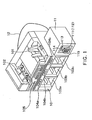
- Fig. 1 illustrates a perspective view showing external structures of a bill processing device 10 and a recording media reading device 11.
- the bill processing device 10 includes a hopping part 101, a rejecting part 102, a stacking part 103, an alarming part 104 and an operating and displaying part 105.
- the hopping part 101 has a mechanism for receiving bills put by an operator into the bill processing device 10.
- the rejecting part 102 returns a reject bill (e.g., bill which can not be recognized and counterfeit bill) existing in bills received by the hopping part 101.
- the stacking part 103 has a mechanism for stacking bills received by the hopping part 101.
- the stacking part 103 has three stacking parts 103a to 103c for respectively stacking different kinds of bills.
- the alarming part 104 is provided in correspondence with the stacking part 103, and has a mechanism for output characters, sound or light when it is necessary to inform an operator.
- the alarming part 104 comprises alarming parts 104a to 104c corresponding to the stacking parts 103a to 103c.
- the operating and displaying part 105 has a key input part for receiving instructions from an operator and a display part for showing information to the operator.
- the number of the stacking part 103 and the alarming part 104 is not limited.
- the recording media reading device 11 includes a recording media slotting part 111, a recording media reading part 112 (not shown), an end key 113, a cancel key 114 and ten keys 115.
- the recording media reading device 11 is connected to the bill processing device 10 through a connection line 12.
- the recording media slotting part 111 has a mechanism for receiving recording media inserted by operators.
- the recording media reading part 112 has a mechanism for reading registered information registered in the recording media received by the recording media slotting part 111.
- the end key 113, the cancel key 114 and the ten keys 115 are for receiving instructions from operators.
- the ten keys 115 are for receiving instructions from operators and are not limited to numeric keys.
- Fig. 2 illustrates a schematic diagram showing an internal structure of the bill processing device 10.
- the bill processing device 10 includes a identifying part 201 and carrying parts 202.
- the identifying part 201 has a mechanism for identifying "denominations" and "real bill or counterfeit bill” of bill received from the hopping part 101.
- Each carrying part 202 has a mechanism for carrying a bill to the rejecting part 102 or the stacking part 103 from the hopping part 101.
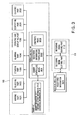
- Fig. 3 illustrates a block diagram showing functions of the bill processing device 10 and the recording media reading device 11.
- the controlling part 30 gives operation instructions to the hopping part 101, the rejecting part 102, the stacking part 103, the alarming part 104, the operating and displaying part 105, the identifying part 201 and the carrying part 202.
- the hopping part 101, the rejecting part 102, the stacking part 103, the alarming part 104, the operating and displaying part 105, the identifying part 201 and the carrying part 202 are operated in accordance with the operation instructions from the controlling part 30.
- the controlling part 30 includes memory controlling means 301, registered information taking means 302 and comparing means 303.
- the memory controlling means 301 reads and writes data between itself and the memory 31 of the bill processing device 10.
- the registered information taking means 302 obtains registered information which is read by the recording media reading part 112 of the recording media reading device 11.
- the comparing means 303 compares the registered information 321 obtained by the registered information taking means 302 and the temporary memory information 312 stored in the memory 31 with each other.
- the memory 31 can store various information including the memory information 311, the temporary memory information 312 and difference information 313.
- the recording media 32 can store various information including the registered information 321.
- the controlling part 30 is a central processing unit (CPU).
- the memory 31 is a hard disk.
- the recording media 32 are flash memories or paper media on which the coded information is printed.
- the coded information is a bar code, a character or a symbol printed in an arbitrary form.
- the recording media reading part 112 is a bar code reader or an optical character reader (OCR).
- Fig. 4A to 4C illustrate one example of information stored in the memory 31 and recording media 32.
- Fig. 4A illustrates one example of the registered information 321 stored in the recording media 32.
- the registered information 321 comprises transaction inherent information (static information) and transaction content information (static information).
- the transaction inherent information is information for specifying a transaction, and includes transaction starting date and time, transaction ending date and time, transaction ID, transaction account number, transaction processing apparatus ID and transaction manager ID.
- the transaction content information is information showing contents of a transaction, and includes the number of bills of each denomination and transaction amount.
- the transaction inherent information and the transaction content information included in the registered information 321 can not be rewritten (static information) until a transaction is completed, and such information may be rewritten (dynamic information) when the transaction is completed.
- Fig. 4B illustrates one example of memory information 311 and temporary memory information 312 stored in the memory 31.
- Each of the memory information 311 and temporary memory information 312 comprises transaction inherent information (static information) and identification content information (dynamic information).
- the transaction inherent information has the same configuration as that of the registered information 321.
- the identification content information includes the number of bills of each denomination, the number of returned bills and a transaction amount which are identification result by the identifying part 201. The identification content information can be rewritten.
- Fig. 4C illustrates one example of the difference information 313.
- the difference information 313 comprises transaction inherent information (static information) and difference content information (dynamic information).
- the transaction inherent information has the same configuration as that of the registered information 321.
- the difference content information shows a result of comparison made by the comparing means 303, and includes the number of difference of each denomination, and a difference amount.
- the difference content information can be rewritten.
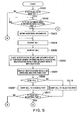
- Fig. 5 illustrates a flowchart showing processing of the controlling part 30 according to the present invention when a transaction is processed.
- the controlling part 30 controls them to wait until the recording media 32 is received by the recording media slotting part 111 (S502).
- the recording media slotting part 111 When the recording media slotting part 111 receives the recording media 32 (S502-Yes), the recording media reading part 112 reads the registered information 321, and the read registered information 321 is obtained (S503).
- the hopping part 101 receives the placed bills (S504).
- the identifying part 201 identifies the received bills (S505).
- step S505 the identifying part 201 checks the "denominations" and whether "real bill or counterfeit bill”.
- the transaction inherent information included in the registered information 321 obtained in step S503 and the identification content information recognized in step S505 are associated with each other, and they are stored as the temporary memory information 312 in the memory 31 (S506).
- step S505 the identification content information recognized in step S505 is displayed on the operating and displaying part 105 (S507).
- the bill is transferred to the stacking part 103 (S508-Yes, S509), and when a fact that the bill is not a real bill is included in the identification content information, the bill is transferred to the rejecting part 102 (S508-No, S510).
- step S511 the receiving processing in the hopping part 101 preferentially is carried out, and the processing efficiency of the entire bill processing device 10 can be enhanced.
- Fig. 6 illustrates a flowchart showing processing of the controlling part 30 when it is determined No in S511.
- the temporary memory information 312 is stored in the memory 31 as the memory information 311 (S605).
- the difference content information is displayed on the operating and displaying part 105 (S607), the difference content information and the transaction inherent information are associated with each other, they are stored in the memory 31 as the difference information 313 (S608), and the procedure is shifted to S609.
- the controlling part 30 controls them to wait until the ten key 115 is pushed down (S613). If one of ten keys 115 is pushed down (S613-Yes), the identification content information included in the temporary memory information 312 is renewed according to the pushed key and the procedure is shifted to S602.
- the transaction inherent information stored in the recording media 32 and the identification content information identified by the identifying part 201 are associated with each other and they are stored as the temporary memory information 312 or the memory information 311 (S506). Therefore, the manually input operation of an operator can be reduced.
- the bill processing device 10 and the recording media reading device 11 are connected to each other through the connection line 12 in the embodiment 1, but the present invention is not limited to this.
- the recording media reading device 11 may be incorporated in the bill processing device 10, i.e., the bill processing device 10 is provided therein with the recording media slotting part 111, the recording media reading part 112, the end key 113, the cancel key 114 and the ten keys 115. Radio or wireless means may be used instead of the connection line 12.
- the entire bill processing system can be reduced in size, and the system can be applied more widely.
Landscapes
- Physics & Mathematics (AREA)
- General Physics & Mathematics (AREA)
- Financial Or Insurance-Related Operations Such As Payment And Settlement (AREA)
- Pile Receivers (AREA)
- Inspection Of Paper Currency And Valuable Securities (AREA)
Abstract
Description
- The present invention relates to a bill processing device and a bill processing method, and more particularly, to a bill processing device and a bill processing method for reducing manually input operation when a plurality of transactions are batched.
- In recent years, as a processing ability of a bill processing device is enhanced, a bill processing device capable of batching a plurality of transactions is required.
- Conventionally, when a plurality of transactions are batched, it is necessary that an operator manually inputs information which recognizes each transaction. However, time required for the manually input operation is longer than time required for processing bills. Therefore, even if the processing ability of the bill processing device is enhanced, the time required for the manually input operation becomes a bottleneck and as a result, the productivity of the bill processing device is not largely enhanced.
-
Japanese Patent Applications Laid-open Publication No.2006-99391 No.2000-50356 - According to the technologies described in
Japanese Patent Applications Laid-open Publication No.2006-99391 No.2000-50356 - According to the technologies described in
Japanese Patent Applications Laid-open Publication No.2006-99391 No.2000-50356 - A general bill processing device has only one hopping opening for reject bills. Therefore, reject bills which are returned in a plurality of transactions are mixed. In this case, it is difficult to know that which reject bill corresponds to which transaction, and time required for checking operation becomes extremely long.
- According to the first aspect of the present invention, there is provided that a bill processing device comprising a hopping part for receiving a placed bill, a carrying part for transferring the bill received by the hopping part, a identifying part for identifying a bill carried by the carrying part, a memory for storing an identification result of the identifying part, a recording media slotting part for receiving recording media in which registered information is stored, a registered information reading part for reading the registered information stored in the recording media received by the recording media slotting part, and a controlling part for controlling the hopping part, the carrying part, the identifying part, the memory, the recording media slotting part and the registered information reading part, wherein when the recording media is received by the recording media slotting part, the controlling part controls them to read the registered information stored in the recording media, to associate the registered information and the identification result of the identifying part with each other and to store the same in the memory.
- According to the second aspect of the present invention, there is provided that a bill processing method comprising, a step for receiving a recording media on which registered information is recorded, a step for reading the registered information stored in the received recording media, a step for receiving a placed bill, a step for identifying the received bill, a step for storing the read registered information and an identification result of the identifying step while associating the registered information and the identification result with each other.
-
- Fig. 1 illustrates a perspective view showing external structures of a
bill processing device 10 and a recordingmedia reading device 11; - Fig. 2 illustrates a schematic diagram showing an internal structure of the
bill processing device 10; - Fig. 3 illustrates a block diagram showing functions of the
bill processing device 10 and the recordingmedia reading device 11; - Figs. 4A to 4C illustrate one example of
temporary memory information 312 andmemory information 311 stored in amemory 31, and registeredinformation 321 stored in recordingmedia 32; - Fig. 5 illustrates a flowchart showing processing of a controlling
part 30 according to an embodiment of the present invention when a transaction is processed; and - Fig. 6 illustrates a flowchart showing processing of the controlling
part 30 when it is determined No in S511 of Fig. 5. - An embodiment of the present invention will be explained with reference to the drawings. The embodiment is only one example and the present invention is not limited to the embodiment.
- Fig. 1 illustrates a perspective view showing external structures of a
bill processing device 10 and a recordingmedia reading device 11. - The
bill processing device 10 includes a hoppingpart 101, a rejectingpart 102, astacking part 103, analarming part 104 and an operating and displayingpart 105. - The hopping
part 101 has a mechanism for receiving bills put by an operator into thebill processing device 10. The rejectingpart 102 returns a reject bill (e.g., bill which can not be recognized and counterfeit bill) existing in bills received by the hoppingpart 101. The stackingpart 103 has a mechanism for stacking bills received by the hoppingpart 101. In this embodiment, thestacking part 103 has threestacking parts 103a to 103c for respectively stacking different kinds of bills. Thealarming part 104 is provided in correspondence with thestacking part 103, and has a mechanism for output characters, sound or light when it is necessary to inform an operator. In this embodiment, thealarming part 104 comprisesalarming parts 104a to 104c corresponding to thestacking parts 103a to 103c. The operating and displayingpart 105 has a key input part for receiving instructions from an operator and a display part for showing information to the operator. The number of thestacking part 103 and thealarming part 104 is not limited. - The recording
media reading device 11 includes a recordingmedia slotting part 111, a recording media reading part 112 (not shown), anend key 113, a cancelkey 114 and tenkeys 115. The recordingmedia reading device 11 is connected to thebill processing device 10 through aconnection line 12. - The recording
media slotting part 111 has a mechanism for receiving recording media inserted by operators. - The recording
media reading part 112 has a mechanism for reading registered information registered in the recording media received by the recordingmedia slotting part 111. - The
end key 113, the cancelkey 114 and the tenkeys 115 are for receiving instructions from operators. The tenkeys 115 are for receiving instructions from operators and are not limited to numeric keys. - Fig. 2 illustrates a schematic diagram showing an internal structure of the
bill processing device 10. - The
bill processing device 10 includes a identifyingpart 201 and carryingparts 202. - The identifying
part 201 has a mechanism for identifying "denominations" and "real bill or counterfeit bill" of bill received from the hoppingpart 101. Each carryingpart 202 has a mechanism for carrying a bill to the rejectingpart 102 or thestacking part 103 from the hoppingpart 101. - Fig. 3 illustrates a block diagram showing functions of the
bill processing device 10 and the recordingmedia reading device 11. - The controlling
part 30 gives operation instructions to the hoppingpart 101, the rejectingpart 102, thestacking part 103, thealarming part 104, the operating and displayingpart 105, the identifyingpart 201 and the carryingpart 202. The hoppingpart 101, the rejectingpart 102, thestacking part 103, thealarming part 104, the operating and displayingpart 105, the identifyingpart 201 and the carryingpart 202 are operated in accordance with the operation instructions from the controllingpart 30. The controllingpart 30 includes memory controllingmeans 301, registered information taking means 302 and comparingmeans 303. - The memory controlling means 301 reads and writes data between itself and the
memory 31 of thebill processing device 10. - The registered information taking means 302 obtains registered information which is read by the recording
media reading part 112 of the recordingmedia reading device 11. - The comparing means 303 compares the registered
information 321 obtained by the registeredinformation taking means 302 and thetemporary memory information 312 stored in thememory 31 with each other. - The
memory 31 can store various information including thememory information 311, thetemporary memory information 312 anddifference information 313. - The
recording media 32 can store various information including the registeredinformation 321. - For example, the controlling
part 30 is a central processing unit (CPU). For example, thememory 31 is a hard disk. For example, therecording media 32 are flash memories or paper media on which the coded information is printed. For example, the coded information is a bar code, a character or a symbol printed in an arbitrary form. For example, the recordingmedia reading part 112 is a bar code reader or an optical character reader (OCR). - Fig. 4A to 4C illustrate one example of information stored in the
memory 31 andrecording media 32. - Fig. 4A illustrates one example of the registered
information 321 stored in therecording media 32. - The registered
information 321 comprises transaction inherent information (static information) and transaction content information (static information). - The transaction inherent information is information for specifying a transaction, and includes transaction starting date and time, transaction ending date and time, transaction ID, transaction account number, transaction processing apparatus ID and transaction manager ID. The transaction content information is information showing contents of a transaction, and includes the number of bills of each denomination and transaction amount. The transaction inherent information and the transaction content information included in the registered
information 321 can not be rewritten (static information) until a transaction is completed, and such information may be rewritten (dynamic information) when the transaction is completed. - Fig. 4B illustrates one example of
memory information 311 andtemporary memory information 312 stored in thememory 31. - Each of the
memory information 311 andtemporary memory information 312 comprises transaction inherent information (static information) and identification content information (dynamic information). The transaction inherent information has the same configuration as that of the registeredinformation 321. The identification content information includes the number of bills of each denomination, the number of returned bills and a transaction amount which are identification result by the identifyingpart 201. The identification content information can be rewritten. - Fig. 4C illustrates one example of the
difference information 313. Thedifference information 313 comprises transaction inherent information (static information) and difference content information (dynamic information). The transaction inherent information has the same configuration as that of the registeredinformation 321. The difference content information shows a result of comparison made by the comparing means 303, and includes the number of difference of each denomination, and a difference amount. The difference content information can be rewritten. - Fig. 5 illustrates a flowchart showing processing of the
controlling part 30 according to the present invention when a transaction is processed. - First, when a plurality of bills which comprise a plurality of denominations are placed on the hopping
part 101 and a predetermined key of the operating and displaying part 105 (requests to start the processing of transaction) pushed by an operator, it is determined whether a recording media mode is set (S501). - When the recording media mode is set (S501-Yes), the controlling
part 30 controls them to wait until therecording media 32 is received by the recording media slotting part 111 (S502). - When the recording
media slotting part 111 receives the recording media 32 (S502-Yes), the recordingmedia reading part 112 reads the registeredinformation 321, and the read registeredinformation 321 is obtained (S503). - Then, the hopping
part 101 receives the placed bills (S504). - Then, the identifying
part 201 identifies the received bills (S505). - In step S505, the identifying
part 201 checks the "denominations" and whether "real bill or counterfeit bill". Next, the transaction inherent information included in the registeredinformation 321 obtained in step S503 and the identification content information recognized in step S505 are associated with each other, and they are stored as thetemporary memory information 312 in the memory 31 (S506). - Next, the identification content information recognized in step S505 is displayed on the operating and displaying part 105 (S507).
- Then, when a fact that the bill is a real bill is included in the identification content information recognized in step S505, the bill is transferred to the stacking part 103 (S508-Yes, S509), and when a fact that the bill is not a real bill is included in the identification content information, the bill is transferred to the rejecting part 102 (S508-No, S510).
- Then, when a bill remains in the hopping
part 101, the procedure is shifted to S504 (S511-Yes), and when no bill remains, the procedure is shifted to Fig. 6 (S511-No). - By making the determination in step S511, the receiving processing in the hopping
part 101 preferentially is carried out, and the processing efficiency of the entirebill processing device 10 can be enhanced. - On the other hand, when the recording media mode is not set (S501-No), the procedure is shifted to S504.
- Fig. 6 illustrates a flowchart showing processing of the
controlling part 30 when it is determined No in S511. - When the recording media mode is set (S601-Yes), it is determined whether the
end key 113 is pushed down (S602). If theend key 113 is pushed down (S602-Yes), it is determined whether the transaction inherent information included in thetemporary memory information 312 stored in S506 exists in the memory 31 (S603). This determination is made by retrieving the information in thememory 31 using the transaction ID as a keyword. When the transaction inherent information exists in the memory 31 (S603-Yes), the identification content information of thememory information 311 is renewed (S604). - When the transaction inherent information does not exists in the memory 31 (S603-No), the
temporary memory information 312 is stored in thememory 31 as the memory information 311 (S605). - Next, it is determined whether the transaction content information of the registered
information 321 and the identification content information of thetemporary memory information 312 match with each other (S606). When they match with each other (S606-Yes), therecording media 32 is brought into a state where therecording media 32 can be pulled out (S609). - When they do not match with each other (S606-No), the difference content information is displayed on the operating and displaying part 105 (S607), the difference content information and the transaction inherent information are associated with each other, they are stored in the
memory 31 as the difference information 313 (S608), and the procedure is shifted to S609. - Then, the
temporary memory information 312 stored in thememory 31 is cleared (S610). - Next, it is determined whether the
recording media 32 is pulled out from the recording media slotting part 111 (S611). If therecording media 32 is pulled out, the transaction is completed (S611-Yes). - If the
recording media 32 is received by the recordingmedia slotting part 111 again (S611-No), the procedure is shifted to S503. - When No in S602, it is determined whether the cancel key 114 is pushed down (S612). When the cancel key 114 is pushed down, the procedure is shifted to S609 (S612-Yes).
- When No in-S612, the controlling
part 30 controls them to wait until the ten key 115 is pushed down (S613). If one of tenkeys 115 is pushed down (S613-Yes), the identification content information included in thetemporary memory information 312 is renewed according to the pushed key and the procedure is shifted to S602. - When the recording media mode is not set (S602-No), the procedure is shifted to S610.
- According to the above embodiment of the present invention, when the recording media mode is set, the transaction inherent information stored in the
recording media 32 and the identification content information identified by the identifyingpart 201 are associated with each other and they are stored as thetemporary memory information 312 or the memory information 311 (S506). Therefore, the manually input operation of an operator can be reduced. - When the recording media mode is set, a fact that the
recording media 32 is inserted into the recordingmedia slotting part 111 becomes an operation condition (S502). Therefore, a relation between bills processed by thebill processing device 10 and transactions becomes a one-to-one relation. Thus, it is possible to store the transaction inherent information and the identification content information including presence and absence of a reject bill, and even if a reject bill exists, it is possible to reduce the manually input operation of an operator. - Although the
bill processing device 10 and the recordingmedia reading device 11 are connected to each other through theconnection line 12 in the embodiment 1, but the present invention is not limited to this. The recordingmedia reading device 11 may be incorporated in thebill processing device 10, i.e., thebill processing device 10 is provided therein with the recordingmedia slotting part 111, the recordingmedia reading part 112, theend key 113, the cancel key 114 and the tenkeys 115. Radio or wireless means may be used instead of theconnection line 12. - According to the embodiment 2 of the present invention, since the
bill processing device 10 and the recordingmedia reading device 11 are formed as one unit, the entire bill processing system can be reduced in size, and the system can be applied more widely.
Claims (16)
- A bill processing device comprising:a hopping part for receiving a placed bill,a carrying part for transferring the bill received by the hopping part,a identifying part for identifying a bill carried by the carrying part,a memory for storing an identification result of the identifying part,a recording media slotting part for receiving recording media in which registered information is stored,a registered information reading part for reading the registered information stored in the recording media received by the recording media slotting part, anda controlling part for controlling the hopping part, the carrying part, the identifying part, the memory, the recording media slotting part and the registered information reading part, whereinwhen the recording media is received by the recording media slotting part, the controlling part controls them to read the registered information stored in the recording media, to associate the registered information and the identification result of the identifying part with each other and to store the same in the memory.
- The bill processing device according to claim 1, further comprising:a plurality of stacking parts for stacking bills, whereinwhen the recording media is received by the recording media slotting part, the controlling part controls them to stack a bill identified by the identifying part in one of the plurality of stacking parts in accordance with the identification result of the identifying part.
- The bill processing device according to claim 1 or 2, wherein the registered information is static information inherent to each transaction and dynamic information indicating contents of the transaction.
- The bill processing device according to any one of claims 1 to 3, wherein
the registered information is a coded information, the recording media is paper media on which the coded information is printed. - The bill processing device according to claim 4, wherein
the registered information reading part recognizes registered information by reading the coded information. - The bill processing device according to any one of claims 1 to 5, further comprising a display part for displaying predetermined information, wherein
the controlling part controls them to display the identification result of the identifying part and the registered information on the display part. - The bill processing device according to claim 6, wherein
the controlling part controls them to compare the identification result of the identifying part and the registered information, and to display a comparison result on the display part. - The bill processing device according to claim 7, wherein
when the identification result of the identifying part and the registered information does not match with each other, the controlling part controls to display the comparison result on the display part. - The bill processing device according to any one of claims 1 to 8, further comprising an alarming part for outputting a character, a sound or light, wherein the controlling part controls them to compare the identification result of the identifying part and the registered information with each other and when they do not match with each other, the controlling part controls the alarming part to output them.
- The bill processing device according to any one of claims 1 to 9, wherein the controlling part compared the identification result of the identifying part and the registered information with each other, and when they do not match with each other, the controlling part controls them to store the comparing result in the memory.
- The bill processing device according to any one of claims 1 to 10, further comprising a key input part for receiving key input from an operator, and wherein
when there is a key input, the controlling part controls them to determinate, to delete or to change the registered information stored in the memory according to the key input. - The bill processing device according to claim 11, wherein
when there is a key input, the controlling part controls them to determinate the registered information stored in the memory so that a recording media can be taken out from the recording media slotting part. - The bill processing device according to claim 11, wherein
when there is a cancel key input, the controlling part controls them to delete the registered information stored in the memory so that a recording media can be taken out from the recording media slotting part. - The bill processing device according to any one of claims 1 to 13, wherein
the controlling part controls them only when the recording media is received by the recording media slotting part. - The bill processing device according to any one of claims 1 to 14, wherein
when the recording media is received by the recording media slotting part, and when information corresponding to the registered information stored in the recording media is stored in the memory, the controlling part controls them to renew the information according to an identification result of the identifying part. - A bill processing method comprising:a step for receiving a recording media on which registered information is recorded,a step for reading the registered information stored in the received recording media,a step for receiving a placed bill,a step for identifying the received bill,a step for storing the read registered information and an identification result of the identifying step while associating the registered information and the identification result with each other.
Applications Claiming Priority (1)
| Application Number | Priority Date | Filing Date | Title |
|---|---|---|---|
| JP2006221486A JP2008046841A (en) | 2006-08-15 | 2006-08-15 | Banknote processing apparatus and banknote processing method |
Publications (1)
| Publication Number | Publication Date |
|---|---|
| EP1892681A1 true EP1892681A1 (en) | 2008-02-27 |
Family
ID=38872094
Family Applications (1)
| Application Number | Title | Priority Date | Filing Date |
|---|---|---|---|
| EP07253199A Withdrawn EP1892681A1 (en) | 2006-08-15 | 2007-08-15 | bill processing device and bill processing method |
Country Status (6)
| Country | Link |
|---|---|
| US (1) | US20080041690A1 (en) |
| EP (1) | EP1892681A1 (en) |
| JP (1) | JP2008046841A (en) |
| KR (1) | KR101416953B1 (en) |
| CN (1) | CN101127135B (en) |
| RU (1) | RU2007131016A (en) |
Families Citing this family (5)
| Publication number | Priority date | Publication date | Assignee | Title |
|---|---|---|---|---|
| JP5484866B2 (en) * | 2009-11-16 | 2014-05-07 | 日本金銭機械株式会社 | Paper sheet handling equipment |
| DE102013010741A1 (en) | 2013-06-27 | 2014-12-31 | Giesecke & Devrient Gmbh | Method for providing measurement data of a device for processing value documents and value-document processing device |
| CN108806061B (en) * | 2017-04-28 | 2021-01-19 | 山东新北洋信息技术股份有限公司 | Ticket box and bill identifying and recycling device |
| CN108320189B (en) * | 2018-02-27 | 2021-01-01 | 北京星选科技有限公司 | Bill processing method and device, electronic equipment and computer readable storage medium |
| JP2021152733A (en) * | 2020-03-24 | 2021-09-30 | グローリー株式会社 | Valuable medium processing device, valuable medium processing system, and authentication method |
Citations (6)
| Publication number | Priority date | Publication date | Assignee | Title |
|---|---|---|---|---|
| GB2246899A (en) * | 1990-06-13 | 1992-02-12 | Toshiba Kk | Cash processing system |
| WO1999005624A1 (en) * | 1997-07-24 | 1999-02-04 | Currency Systems International | Method for currency distribution and management |
| JP2000503956A (en) | 1996-07-31 | 2000-04-04 | カレンシー システムズ インターナショナル | A method for semi-continuous currency processing using separator cards |
| EP1367547A2 (en) * | 2002-05-29 | 2003-12-03 | Hitachi, Ltd. | Bill handling machine |
| US20050173515A1 (en) * | 2004-02-05 | 2005-08-11 | International Business Machines Corporation | Method and system for automatic teller machine cash management |
| JP2006099391A (en) | 2004-09-29 | 2006-04-13 | Toshiba Corp | Paper sheet processing equipment |
Family Cites Families (3)
| Publication number | Priority date | Publication date | Assignee | Title |
|---|---|---|---|---|
| US7104383B1 (en) * | 2000-02-14 | 2006-09-12 | Leon Saltsov | Validator with removable flash memory |
| JP4166098B2 (en) * | 2003-02-06 | 2008-10-15 | 日立オムロンターミナルソリューションズ株式会社 | Banknote handling equipment |
| US7040476B2 (en) * | 2003-08-28 | 2006-05-09 | Glory Ltd. | Apparatus for sorting mixed bills and barcoded tickets and method therefor |
-
2006
- 2006-08-15 JP JP2006221486A patent/JP2008046841A/en active Pending
-
2007
- 2007-08-14 US US11/891,986 patent/US20080041690A1/en not_active Abandoned
- 2007-08-14 RU RU2007131016/09A patent/RU2007131016A/en not_active Application Discontinuation
- 2007-08-14 KR KR1020070081785A patent/KR101416953B1/en not_active Expired - Fee Related
- 2007-08-15 CN CN2007101409561A patent/CN101127135B/en not_active Expired - Fee Related
- 2007-08-15 EP EP07253199A patent/EP1892681A1/en not_active Withdrawn
Patent Citations (6)
| Publication number | Priority date | Publication date | Assignee | Title |
|---|---|---|---|---|
| GB2246899A (en) * | 1990-06-13 | 1992-02-12 | Toshiba Kk | Cash processing system |
| JP2000503956A (en) | 1996-07-31 | 2000-04-04 | カレンシー システムズ インターナショナル | A method for semi-continuous currency processing using separator cards |
| WO1999005624A1 (en) * | 1997-07-24 | 1999-02-04 | Currency Systems International | Method for currency distribution and management |
| EP1367547A2 (en) * | 2002-05-29 | 2003-12-03 | Hitachi, Ltd. | Bill handling machine |
| US20050173515A1 (en) * | 2004-02-05 | 2005-08-11 | International Business Machines Corporation | Method and system for automatic teller machine cash management |
| JP2006099391A (en) | 2004-09-29 | 2006-04-13 | Toshiba Corp | Paper sheet processing equipment |
Also Published As
| Publication number | Publication date |
|---|---|
| KR20080015743A (en) | 2008-02-20 |
| JP2008046841A (en) | 2008-02-28 |
| CN101127135B (en) | 2012-05-09 |
| CN101127135A (en) | 2008-02-20 |
| KR101416953B1 (en) | 2014-07-08 |
| US20080041690A1 (en) | 2008-02-21 |
| RU2007131016A (en) | 2009-02-20 |
Similar Documents
| Publication | Publication Date | Title |
|---|---|---|
| KR101445202B1 (en) | Paper money processing device | |
| EP2518708A2 (en) | Bill transaction system | |
| US8172131B2 (en) | Method for handling cassettes for bank notes | |
| JP4990918B2 (en) | Classification pattern creation device, classification pattern creation method, and classification pattern creation system | |
| US9934643B2 (en) | Method for processing value documents and means for performing the method | |
| US20080041690A1 (en) | Bill processing device and bill processing method | |
| JP4081667B2 (en) | IC card reader | |
| CN102693577B (en) | Note treatment device and note treatment method thereof | |
| US7788633B2 (en) | Bank note processing machine and method for operating bank note processing machine | |
| US20110156334A1 (en) | Method for handling paper sheets | |
| CN103366166B (en) | Paper number reading device and method and system, paper processing device and method | |
| JP2019016323A (en) | Paper sheet handling system | |
| US20130251235A1 (en) | System for high speed processing of currency notes and slot tickets | |
| JP4110258B2 (en) | Form handling device | |
| US9905070B2 (en) | Method for providing measurement data to an apparatus for processing valuable documents and valuable document processing apparatus | |
| CN114999055B (en) | Banknote processing device and banknote processing system | |
| JP4385763B2 (en) | IC card bill increasing machine and IC card bill increasing method | |
| JP2024131168A (en) | Banknote processing system, banknote processing method, and banknote processing program | |
| JP5958090B2 (en) | Paper sheet processing apparatus and program | |
| JP2007058574A (en) | Paper sheet processing system | |
| JPS62274478A (en) | Slip character recognizing and verifying system | |
| JP2015176182A (en) | Cash dealing apparatus, alphanumeric code re-reader, and alphanumeric code re-read system | |
| JPH06139267A (en) | Information processing system capable of individual identification | |
| JP2005279427A (en) | Form sorting device and program | |
| JPWO2008044277A1 (en) | Banknote processing apparatus and control method of banknote processing apparatus |
Legal Events
| Date | Code | Title | Description |
|---|---|---|---|
| PUAI | Public reference made under article 153(3) epc to a published international application that has entered the european phase |
Free format text: ORIGINAL CODE: 0009012 |
|
| AK | Designated contracting states |
Kind code of ref document: A1 Designated state(s): AT BE BG CH CY CZ DE DK EE ES FI FR GB GR HU IE IS IT LI LT LU LV MC MT NL PL PT RO SE SI SK TR |
|
| AX | Request for extension of the european patent |
Extension state: AL BA HR MK YU |
|
| 17P | Request for examination filed |
Effective date: 20080819 |
|
| AKX | Designation fees paid |
Designated state(s): DE ES FR GB IT |
|
| 17Q | First examination report despatched |
Effective date: 20081223 |
|
| STAA | Information on the status of an ep patent application or granted ep patent |
Free format text: STATUS: THE APPLICATION IS DEEMED TO BE WITHDRAWN |
|
| 18D | Application deemed to be withdrawn |
Effective date: 20170817 |