EP1892129A2 - Aircraft tire condition monitoring system and method - Google Patents
Aircraft tire condition monitoring system and method Download PDFInfo
- Publication number
- EP1892129A2 EP1892129A2 EP07114932A EP07114932A EP1892129A2 EP 1892129 A2 EP1892129 A2 EP 1892129A2 EP 07114932 A EP07114932 A EP 07114932A EP 07114932 A EP07114932 A EP 07114932A EP 1892129 A2 EP1892129 A2 EP 1892129A2
- Authority
- EP
- European Patent Office
- Prior art keywords
- tire
- aircraft
- antenna
- reader
- monitoring system
- Prior art date
- Legal status (The legal status is an assumption and is not a legal conclusion. Google has not performed a legal analysis and makes no representation as to the accuracy of the status listed.)
- Withdrawn
Links
Images

Classifications
-
- B—PERFORMING OPERATIONS; TRANSPORTING
- B60—VEHICLES IN GENERAL
- B60C—VEHICLE TYRES; TYRE INFLATION; TYRE CHANGING; CONNECTING VALVES TO INFLATABLE ELASTIC BODIES IN GENERAL; DEVICES OR ARRANGEMENTS RELATED TO TYRES
- B60C23/00—Devices for measuring, signalling, controlling, or distributing tyre pressure or temperature, specially adapted for mounting on vehicles; Arrangement of tyre inflating devices on vehicles, e.g. of pumps or of tanks; Tyre cooling arrangements
- B60C23/02—Signalling devices actuated by tyre pressure
- B60C23/04—Signalling devices actuated by tyre pressure mounted on the wheel or tyre
- B60C23/0491—Constructional details of means for attaching the control device
- B60C23/0493—Constructional details of means for attaching the control device for attachment on the tyre
-
- B—PERFORMING OPERATIONS; TRANSPORTING
- B60—VEHICLES IN GENERAL
- B60C—VEHICLE TYRES; TYRE INFLATION; TYRE CHANGING; CONNECTING VALVES TO INFLATABLE ELASTIC BODIES IN GENERAL; DEVICES OR ARRANGEMENTS RELATED TO TYRES
- B60C23/00—Devices for measuring, signalling, controlling, or distributing tyre pressure or temperature, specially adapted for mounting on vehicles; Arrangement of tyre inflating devices on vehicles, e.g. of pumps or of tanks; Tyre cooling arrangements
- B60C23/02—Signalling devices actuated by tyre pressure
- B60C23/04—Signalling devices actuated by tyre pressure mounted on the wheel or tyre
- B60C23/0408—Signalling devices actuated by tyre pressure mounted on the wheel or tyre transmitting the signals by non-mechanical means from the wheel or tyre to a vehicle body mounted receiver
- B60C23/0422—Signalling devices actuated by tyre pressure mounted on the wheel or tyre transmitting the signals by non-mechanical means from the wheel or tyre to a vehicle body mounted receiver characterised by the type of signal transmission means
- B60C23/0433—Radio signals
- B60C23/0435—Vehicle body mounted circuits, e.g. transceiver or antenna fixed to central console, door, roof, mirror or fender
- B60C23/0444—Antenna structures, control or arrangements thereof, e.g. for directional antennas, diversity antenna, antenna multiplexing or antennas integrated in fenders
Definitions
- the present invention pertains generally to an apparatus for monitoring the condition of a tire, and more particularly to an apparatus for monitoring the condition of a pneumatic aircraft tire.
- properly inflated aircraft tires protect against tire failure due to extreme deflection of the tires during take-off and landing, and also help to reduce dynamic stresses in the tires to thereby extend the working life of the tires.
- RF radio frequency
- the transponders may be active or passive. Active transponders have their own power supply (e.g., a battery), while passive transponders are powered by the energy of an incoming RF signal from a reader device, as known in the art.
- the transponder generates a signal to be received by the reader device and which includes information related to the sensed conditions of the tire.
- RF transponders have a relatively limited communication range
- reader devices must be located relatively close to the transponders to receive the signals.
- Conventional instrumented tires have utilized a transponder fixed to an interior surface of the tire, and an antenna which extends circumferentially around the tire to facilitate communication between the transponder and the reader device regardless of the angular orientation of the transponder in the rotating tire relative to the reader device.
- One drawback of using circumferentially extending antennas mounted within the interiors of pneumatic tires is that cyclic tensile and flexural loading of the tires as they rotate causes stress fractures in the antenna which may degrade performance and/or cause the antennas to break.
- the problem is compounded in pneumatic tires used in aircraft, which must not only handle heavy loads, but must also accommodate high forces when the tires impact the ground during landing maneuvers.
- the present invention refers to a tire according to claim 1. It overcomes the foregoing and other shortcomings and drawbacks of tire condition monitoring systems heretofore known for use in vehicles. Dependent claims refer to preferred embodiments of the invention.
- an aircraft tire condition monitoring system includes a reader mounted in the fuselage of an aircraft for receiving signals from an instrumented aircraft tire, and an antenna that defines a peripheral boundary proximate the circumference of the tire.
- the antenna is electrically connected to the reader for transmission of electrical signals, either by electromagnetic coupling between two conductors or by direct physical connection therebetween.
- the system preferably further includes a tire having a transponder located on the interior of the tire.
- the transponder is configured to sense are pressure and/or temperature associated with the tire.
- the transponder generates a signal related to the sensed pressure and/or temperature.
- the signal is communicated to the reader via the antenna.
- the antenna may be located within the interior of the tire.
- the antenna is located exteriorly of the tire, such as in the fuselage of the aircraft.
- FIG. 1 depicts an exemplary aircraft tire condition monitoring system 10 in accordance with the principles of the present invention.
- the monitoring system 10 includes a pneumatic aircraft tire 12.
- a transponder 14 and an antenna 16 are mounted to tire sidewall 18 within the interior of the tire 12.
- the transponder 14 is configured to sense various parameters of the pneumatic tire 12, such as pressure and temperature of the interior of the tire 12.
- the antenna 16 is electrically connected to the transponder 14 and extends circumferentially around the sidewall 18 of the tire 12. Because the antenna 16 in this embodiment is mounted to the sidewall 18, it should comprise material suited to accommodate the cyclic tensile and flexural stresses experienced during service.
- the monitoring system 10 further includes a reader device 20 positioned exteriorly of the tire 12, at a location in an aircraft fuselage. Accordingly, the transponder 14 can communicate with the reader 20 to transmit information related to the sensed conditions of the tire 12. Because the antenna 16 extends circumferentially around the sidewall 18 of the tire 12, communication between the reader 20 and transponder 14 may occur regardless of the angular orientation of the transponder 14 within tire 12, relative to the reader 20.
- the reader 20 may be configured to record information received from the transponder 14, or to perform calculations or mathematical and/or statistical operations using the information. Reader 20 may also transmit some or all of the information to another device (not shown), such as a display for indicating the conditions of the tire 12 to a user.
- the transmission of information or other signals from reader 20 may be in the form of radio frequency signals, or signals transmitted by a communication line 22.
- monitoring system 10 has been described above as being configured to sense pressure and temperature conditions within a tire 12, it will be recognized that various other parameters may be sensed.
- monitoring systems in accordance with the principles of the invention may sense rotational speed, slip, vertical displacement, or various other parameters related to the condition of the tire and/or operation of the tire or aircraft.
- FIG. 2 depicts another exemplary embodiment of a tire condition monitoring system 10a wherein features similar to those discussed above with respect to FIG. 1 are similarly numbered.
- a transponder 14 and an antenna 16 are disposed within the interior of an aircraft tire 12a, on an inner surface of a circumferential wall 24 of the tire 12a.
- the system further includes a reader device 20 positioned outside the tire 12a for communication with the transponder 14. Information regarding the condition of the tire 12a is communicated from the transponder 14 to the reader 20.
- the reader 20 may store the information for subsequent transmission to another device, or the reader 20 may perform operations or calculations using the information. Thereafter, the information may be communicated to a third device, such as by radio frequency transmission, or by communication line 22, in a manner similar to that described above.
- FIG. 3 illustrates another exemplary embodiment of an aircraft tire condition monitoring system 10b, in accordance with the principles of the present invention.
- a transponder 14 is disposed within a pneumatic aircraft tire 12b, on the interior surface of a sidewall 18.
- the system further includes a reader device 20 located outside the tire, as discussed above with respect to FIGS. 1 and 2.
- the antenna 16 is also located outside the tire 12b and is operatively electrically connected to the reader device 20.
- the antenna 16 defines a peripherally extending boundary generally corresponding to a path traced by transponder 14 as tire 12b rotates about its geometric center. Accordingly, communication between the transponder 14 and the reader device 20 is facilitated regardless of the angular orientation of the transponder 14 within tire 12b relative to reader device 20.
- FIG. 4 illustrates yet another exemplary embodiment of an aircraft tire condition monitoring system 12c.
- a transponder 14 is located within the interior of a pneumatic aircraft tire 12c, on an interior surface of the circumferential sidewall 24 of the tire 12c.
- the reader device 20 and an antenna 16 are disposed outside the tire 12c.
- the antenna 16 extends circumferentially around the outer surface of the tire 12c to define a peripheral boundary which generally corresponds to a path traced by the transponder 14 as the tire 12c rotates about its geometric center. Communication between the transponder 14 and the reader device 20 can occur regardless of the angular orientation of the transponder 14 within the tire 12c, relative to the reader device 20, as discussed above.
- FIGS. 1-4 depict antennas 16 that are physically connected to transponders 14 or readers 20, it will be appreciated that the antennas may alternatively be spaced from the transponders 14 or readers 20 distances suitable for permitting communication of signals between the antennas 16 and the transponders 14 or readers 20, such as by electromagnetic coupling.
- FIG. 5 depicts an exemplary installation of an aircraft tire condition monitoring system, as described above, used with the landing gear 30 of an aircraft.
- the landing gear 30 is coupled to the aircraft fuselage 32 and is movable between an extended condition (not shown) for supporting the aircraft during take off and landing, and a retracted position within a landing gear bay 34 in the fuselage 32.
- the landing gear 30 further includes one or more pneumatic aircraft tires 36 instrumented with a transponder (not shown) as discussed above.
- the tire condition monitoring system includes antennas 38 mounted outside the tires 36 and defining a peripheral boundary around the tires 36, in a manner similar to that described above with respect to FIGS. 3 and 4.
- the antennas 38 are coupled to respective reader devices 40 configured to communicate with the transponders to thereby receive information related to the conditions of the respective tires 36.
- FIG. 5 illustrates an aircraft tire condition monitoring system wherein the antennas 38 are disposed outside the tires 36, it will be recognized that antennas may alternatively be provided on the interior surface of the tires as discussed above with respect to FIGS. 1 and 2.
- the reader devices 40 may perform functions on the information received from the transponders, and may record the information or further transmit the information to other devices so that the information may be recorded or acted upon as appropriate.
- An aircraft tire condition monitoring system in accordance with the principles of the present invention, as described above, is capable of monitoring various parameters of an aircraft's tires in service to ensure that the tires are in good condition.
- Information related to the condition of the tires may be recorded or communicated to users of the system, so that appropriate action can be taken to service or replace tires, as may be required.
- Information related to sensed conditions of a tire can be communicated from a transponder within a tire to a reader located outside the tire regardless of the angular position of the transponder due to tire rotation.
Landscapes
- Engineering & Computer Science (AREA)
- Mechanical Engineering (AREA)
- Tires In General (AREA)
- Arrangements For Transmission Of Measured Signals (AREA)
- Measuring Fluid Pressure (AREA)
Abstract
An aircraft tire condition monitoring system includes a reader (20) mounted in the fuselage (32) of an aircraft and an antenna (16) that defines a peripheral boundary proximate the circumference of a tire (12) of the aircraft. The antenna (16) is electrically coupled to the reader (20) to facilitate the communication of signals from a transponder (14) located within the tire (12). The antenna (16) may be located within the tire (12), or it may be located on the aircraft fuselage (32).
Description
- The present invention pertains generally to an apparatus for monitoring the condition of a tire, and more particularly to an apparatus for monitoring the condition of a pneumatic aircraft tire.
- The benefits of proper inflation of aircraft tires are well known. For example, properly inflated aircraft tires protect against tire failure due to extreme deflection of the tires during take-off and landing, and also help to reduce dynamic stresses in the tires to thereby extend the working life of the tires.
- It is well known to monitor the condition of a pneumatic tire using one or more sensors disposed within the tire or on a wheel rim upon which the tire is mounted. Conventional tire monitoring systems typically utilize radio frequency (RF) transponders that are provided with sensors for detecting various conditions of a tire, such as the internal pressure and temperature of the tire. The transponders may be active or passive. Active transponders have their own power supply (e.g., a battery), while passive transponders are powered by the energy of an incoming RF signal from a reader device, as known in the art. The transponder generates a signal to be received by the reader device and which includes information related to the sensed conditions of the tire.
- Because RF transponders have a relatively limited communication range, reader devices must be located relatively close to the transponders to receive the signals. Conventional instrumented tires have utilized a transponder fixed to an interior surface of the tire, and an antenna which extends circumferentially around the tire to facilitate communication between the transponder and the reader device regardless of the angular orientation of the transponder in the rotating tire relative to the reader device. One drawback of using circumferentially extending antennas mounted within the interiors of pneumatic tires is that cyclic tensile and flexural loading of the tires as they rotate causes stress fractures in the antenna which may degrade performance and/or cause the antennas to break. The problem is compounded in pneumatic tires used in aircraft, which must not only handle heavy loads, but must also accommodate high forces when the tires impact the ground during landing maneuvers.
- A need therefore exits for a system to monitor the conditions of aircraft tires that overcomes these and other drawbacks of the prior art.
- The present invention refers to a tire according to claim 1. It overcomes the foregoing and other shortcomings and drawbacks of tire condition monitoring systems heretofore known for use in vehicles. Dependent claims refer to preferred embodiments of the invention.
- According to one preferred aspect of the invention, an aircraft tire condition monitoring system includes a reader mounted in the fuselage of an aircraft for receiving signals from an instrumented aircraft tire, and an antenna that defines a peripheral boundary proximate the circumference of the tire. The antenna is electrically connected to the reader for transmission of electrical signals, either by electromagnetic coupling between two conductors or by direct physical connection therebetween.
- The system preferably further includes a tire having a transponder located on the interior of the tire. The transponder is configured to sense are pressure and/or temperature associated with the tire. The transponder generates a signal related to the sensed pressure and/or temperature. The signal is communicated to the reader via the antenna. In one embodiment, the antenna may be located within the interior of the tire. In another embodiment, the antenna is located exteriorly of the tire, such as in the fuselage of the aircraft.
- These and other features, objects and advantages of the invention will become more readily apparent to those skilled in the art in view of the following detailed description, taken in conjunction with the accompanying drawings.
-
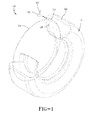
- FIG. 1 is a perspective view illustrating an instrumented pneumatic tire in accordance with the principles of the present invention.
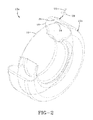
- FIG. 2 is a perspective view of a second exemplary instrumented pneumatic tire in accordance with the principles of the present invention.
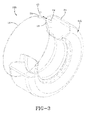
- FIG. 3 is a perspective view of a third exemplary instrumented pneumatic tire in accordance with the principles of the present invention.
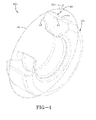
- FIG. 4 is a fourth exemplary instrumented pneumatic tire in accordance with the principles of the present invention.
- FIG. 5 is a schematic plan view illustrating an exemplary installation of an instrumented pneumatic tire on an aircraft, in accordance with the principles of the present invention.
- FIG. 1 depicts an exemplary aircraft tire
condition monitoring system 10 in accordance with the principles of the present invention. Themonitoring system 10 includes apneumatic aircraft tire 12. Atransponder 14 and anantenna 16 are mounted totire sidewall 18 within the interior of thetire 12. Thetransponder 14 is configured to sense various parameters of thepneumatic tire 12, such as pressure and temperature of the interior of thetire 12. Theantenna 16 is electrically connected to thetransponder 14 and extends circumferentially around thesidewall 18 of thetire 12. Because theantenna 16 in this embodiment is mounted to thesidewall 18, it should comprise material suited to accommodate the cyclic tensile and flexural stresses experienced during service. - The
monitoring system 10 further includes areader device 20 positioned exteriorly of thetire 12, at a location in an aircraft fuselage. Accordingly, thetransponder 14 can communicate with thereader 20 to transmit information related to the sensed conditions of thetire 12. Because theantenna 16 extends circumferentially around thesidewall 18 of thetire 12, communication between thereader 20 andtransponder 14 may occur regardless of the angular orientation of thetransponder 14 withintire 12, relative to thereader 20. Thereader 20 may be configured to record information received from thetransponder 14, or to perform calculations or mathematical and/or statistical operations using the information.Reader 20 may also transmit some or all of the information to another device (not shown), such as a display for indicating the conditions of thetire 12 to a user. The transmission of information or other signals fromreader 20 may be in the form of radio frequency signals, or signals transmitted by acommunication line 22. - While the
monitoring system 10 has been described above as being configured to sense pressure and temperature conditions within atire 12, it will be recognized that various other parameters may be sensed. For example, monitoring systems in accordance with the principles of the invention may sense rotational speed, slip, vertical displacement, or various other parameters related to the condition of the tire and/or operation of the tire or aircraft. - FIG. 2 depicts another exemplary embodiment of a tire
condition monitoring system 10a wherein features similar to those discussed above with respect to FIG. 1 are similarly numbered. Atransponder 14 and anantenna 16 are disposed within the interior of anaircraft tire 12a, on an inner surface of acircumferential wall 24 of thetire 12a. The system further includes areader device 20 positioned outside thetire 12a for communication with thetransponder 14. Information regarding the condition of thetire 12a is communicated from thetransponder 14 to thereader 20. Thereader 20 may store the information for subsequent transmission to another device, or thereader 20 may perform operations or calculations using the information. Thereafter, the information may be communicated to a third device, such as by radio frequency transmission, or bycommunication line 22, in a manner similar to that described above. - FIG. 3 illustrates another exemplary embodiment of an aircraft tire condition monitoring system 10b, in accordance with the principles of the present invention. In this embodiment, a
transponder 14 is disposed within a pneumatic aircraft tire 12b, on the interior surface of asidewall 18. The system further includes areader device 20 located outside the tire, as discussed above with respect to FIGS. 1 and 2. In this embodiment, however, theantenna 16 is also located outside the tire 12b and is operatively electrically connected to thereader device 20. Theantenna 16 defines a peripherally extending boundary generally corresponding to a path traced bytransponder 14 as tire 12b rotates about its geometric center. Accordingly, communication between thetransponder 14 and thereader device 20 is facilitated regardless of the angular orientation of thetransponder 14 within tire 12b relative toreader device 20. - FIG. 4 illustrates yet another exemplary embodiment of an aircraft tire
condition monitoring system 12c. In this embodiment, atransponder 14 is located within the interior of apneumatic aircraft tire 12c, on an interior surface of thecircumferential sidewall 24 of thetire 12c. Thereader device 20 and anantenna 16 are disposed outside thetire 12c. Theantenna 16 extends circumferentially around the outer surface of thetire 12c to define a peripheral boundary which generally corresponds to a path traced by thetransponder 14 as thetire 12c rotates about its geometric center. Communication between thetransponder 14 and thereader device 20 can occur regardless of the angular orientation of thetransponder 14 within thetire 12c, relative to thereader device 20, as discussed above. - While FIGS. 1-4 depict
antennas 16 that are physically connected totransponders 14 orreaders 20, it will be appreciated that the antennas may alternatively be spaced from thetransponders 14 orreaders 20 distances suitable for permitting communication of signals between theantennas 16 and thetransponders 14 orreaders 20, such as by electromagnetic coupling. FIG. 5 depicts an exemplary installation of an aircraft tire condition monitoring system, as described above, used with thelanding gear 30 of an aircraft. Thelanding gear 30 is coupled to theaircraft fuselage 32 and is movable between an extended condition (not shown) for supporting the aircraft during take off and landing, and a retracted position within alanding gear bay 34 in thefuselage 32. - The
landing gear 30 further includes one or morepneumatic aircraft tires 36 instrumented with a transponder (not shown) as discussed above. In the embodiment shown, the tire condition monitoring system includesantennas 38 mounted outside thetires 36 and defining a peripheral boundary around thetires 36, in a manner similar to that described above with respect to FIGS. 3 and 4. - The
antennas 38 are coupled torespective reader devices 40 configured to communicate with the transponders to thereby receive information related to the conditions of therespective tires 36. - While FIG. 5 illustrates an aircraft tire condition monitoring system wherein the
antennas 38 are disposed outside thetires 36, it will be recognized that antennas may alternatively be provided on the interior surface of the tires as discussed above with respect to FIGS. 1 and 2. Thereader devices 40 may perform functions on the information received from the transponders, and may record the information or further transmit the information to other devices so that the information may be recorded or acted upon as appropriate. - An aircraft tire condition monitoring system in accordance with the principles of the present invention, as described above, is capable of monitoring various parameters of an aircraft's tires in service to ensure that the tires are in good condition. Information related to the condition of the tires may be recorded or communicated to users of the system, so that appropriate action can be taken to service or replace tires, as may be required. Information related to sensed conditions of a tire can be communicated from a transponder within a tire to a reader located outside the tire regardless of the angular position of the transponder due to tire rotation.
Claims (9)
- An aircraft tire condition monitoring system comprising a reader (20) mounted in the fuselage (32) of an aircraft and an antenna (16) defining a peripheral boundary proximate the circumference of a tire (12) of an aircraft landing gear (30) at least when the tire (12) is in a stowed position, said antenna (16) being operatively electrically connected to said reader (20) for the transmission of signals therebetween.
- The aircraft tire condition monitoring system of claim 1, further comprising a tire (12) and a transponder (14) disposed within said tire (12), said transponder (14) being adapted to sense at least one of a pressure and a temperature of said tire (12) and to communicate information related to the sensed pressure or temperature to said reader (20) via said antenna (16).
- The aircraft tire condition monitoring system of claim 2, wherein said antenna (16) is disposed within an interior of said tire (12).
- The aircraft tire condition monitoring system of claim 2 or 3, wherein said antenna (16) is mounted to a sidewall (18) of said tire (12).
- The aircraft tire condition monitoring system of claim 2 or 3, wherein said antenna (16) is mounted to a circumferential wall (24) of said tire (12).
- The aircraft tire condition monitoring system of at least one of the previous claims, wherein said antenna (16) is mounted to the fuselage (32) of the aircraft.
- A method of monitoring the condition of an aircraft tire, the method comprising:sensing an operating parameter associated with the tire (12); generating a signal related to the sensed parameter using a transponder (14) mounted withinthe tire (12); and transmitting the signal to a reader (20) located on an aircraft fuselage (32).
- The method of claim 7, wherein transmitting the signal to the reader (20) comprises transmitting the signal via an antenna (16) located on the aircraft fuselage (32).
- The method of any of claims 7 or 8, wherein the sensed operating parameter is at least one of a pressure and a temperature associated with the tire.
Applications Claiming Priority (1)
| Application Number | Priority Date | Filing Date | Title |
|---|---|---|---|
| US11/467,405 US7468655B2 (en) | 2006-08-25 | 2006-08-25 | Aircraft tire condition monitoring system and method |
Publications (1)
| Publication Number | Publication Date |
|---|---|
| EP1892129A2 true EP1892129A2 (en) | 2008-02-27 |
Family
ID=38626758
Family Applications (1)
| Application Number | Title | Priority Date | Filing Date |
|---|---|---|---|
| EP07114932A Withdrawn EP1892129A2 (en) | 2006-08-25 | 2007-08-24 | Aircraft tire condition monitoring system and method |
Country Status (3)
| Country | Link |
|---|---|
| US (1) | US7468655B2 (en) |
| EP (1) | EP1892129A2 (en) |
| JP (1) | JP2008049999A (en) |
Cited By (1)
| Publication number | Priority date | Publication date | Assignee | Title |
|---|---|---|---|---|
| WO2012140370A1 (en) * | 2011-04-13 | 2012-10-18 | Societe De Technologie Michelin | Method and device for counting the number of landings performed by an aircraft tyre |
Families Citing this family (12)
| Publication number | Priority date | Publication date | Assignee | Title |
|---|---|---|---|---|
| US8561659B2 (en) * | 2009-08-24 | 2013-10-22 | The Goodyear Tire & Rubber Company | Tire and electronic device assembly |
| US20110041309A1 (en) * | 2009-08-24 | 2011-02-24 | Peter Ross Shepler | Method of installing tire electronics in a tire |
| DE102010034749A1 (en) * | 2010-08-19 | 2012-02-23 | Schaeffler Technologies Gmbh & Co. Kg | Device for monitoring a rotating machine part |
| US10336144B2 (en) | 2014-12-30 | 2019-07-02 | Bridgestone Americas Tire Operations, Llc | Tire electronics securing structures |
| GB2536497A (en) | 2015-03-20 | 2016-09-21 | Airbus Operations Ltd | Method of monitoring the pressure of an aircraft tyre |
| GB2536496A (en) * | 2015-03-20 | 2016-09-21 | Airbus Operations Ltd | Method of checking the pressure of an aircraft tyre |
| GB2540414A (en) | 2015-07-16 | 2017-01-18 | Airbus Operations Ltd | Tyre pressure sensor device |
| JP6811025B2 (en) * | 2016-04-05 | 2021-01-13 | 株式会社ブリヂストン | Aircraft tire management method and aircraft tire management device |
| JP6715066B2 (en) | 2016-04-19 | 2020-07-01 | 株式会社ブリヂストン | Aircraft tire management method and aircraft tire management device |
| GB2591751A (en) * | 2020-02-04 | 2021-08-11 | Airbus Operations Ltd | Internal tire and/or wheel monitoring device and method |
| JP7457520B2 (en) * | 2020-02-18 | 2024-03-28 | 株式会社ブリヂストン | aircraft tires |
| US11110758B1 (en) * | 2020-10-19 | 2021-09-07 | Safran Landing Systems | System for monitoring the inflation pressure of the tires of an aircraft |
Family Cites Families (11)
| Publication number | Priority date | Publication date | Assignee | Title |
|---|---|---|---|---|
| US4334428A (en) | 1978-05-04 | 1982-06-15 | Fima Raoul G | Apparatus for indicating parameters sensed on a rotatable wheel |
| FR2494640A1 (en) * | 1980-11-27 | 1982-05-28 | Aerospatiale | METHOD AND DEVICE FOR DETECTING THE UNDERFLANKING OF A TIRE OF AN AIRCRAFT AIRCRAFT |
| US4550385A (en) * | 1982-07-30 | 1985-10-29 | Sundstrand Data Control, Inc. | Dynamic low tire pressure detection system for aircraft |
| FR2670889B1 (en) | 1990-11-30 | 1995-05-24 | Skf France | ENGLISH RACKED WOODEN STAIRCASES, POSTS, RAILS, SIMPLIFIED MANUFACTURING AND LAYING GUARDS. |
| US5491465A (en) | 1994-11-14 | 1996-02-13 | Adams; Robert H. | Tire air pressure system |
| US6591671B2 (en) | 1999-08-16 | 2003-07-15 | The Goodyear Tire & Rubber Company | Monitoring pneumatic tire conditions |
| US6255940B1 (en) | 1999-10-01 | 2001-07-03 | The Goodyear Tire & Rubber Company | Apparatus for monitoring a condition of a tire |
| FR2817509B1 (en) * | 2000-12-05 | 2003-08-29 | Trw France | WHEEL PARAMETER MEASUREMENT SYSTEM AND MEASUREMENT DETECTOR FOR SUCH A SYSTEM |
| FR2822755B1 (en) | 2001-03-29 | 2004-05-21 | Labinal | INSTALLATION FOR MEASURING THE PRESSURE OF AT LEAST ONE TIRE ON AN AIRCRAFT WHEEL |
| FR2831264B1 (en) * | 2001-10-19 | 2003-12-12 | Commissariat Energie Atomique | MEASURING DEVICE, INCLUDING AT LEAST ONE SENSOR, ABLE TO OPERATE IN DIFFICULT CONDITIONS |
| US6829925B2 (en) | 2002-12-20 | 2004-12-14 | The Goodyear Tire & Rubber Company | Apparatus and method for monitoring a condition of a tire |
-
2006
- 2006-08-25 US US11/467,405 patent/US7468655B2/en not_active Expired - Fee Related
-
2007
- 2007-08-21 JP JP2007214249A patent/JP2008049999A/en active Pending
- 2007-08-24 EP EP07114932A patent/EP1892129A2/en not_active Withdrawn
Cited By (5)
| Publication number | Priority date | Publication date | Assignee | Title |
|---|---|---|---|---|
| WO2012140370A1 (en) * | 2011-04-13 | 2012-10-18 | Societe De Technologie Michelin | Method and device for counting the number of landings performed by an aircraft tyre |
| FR2974061A1 (en) * | 2011-04-13 | 2012-10-19 | Michelin Soc Tech | METHOD AND APPARATUS FOR COUNTING THE NUMBER OF LANDINGS OF A TIRE OF AN AIRCRAFT |
| CN103460258A (en) * | 2011-04-13 | 2013-12-18 | 米其林集团总公司 | Method and device for counting the number of landings performed by an aircraft tyre |
| CN103460258B (en) * | 2011-04-13 | 2016-05-04 | 米其林集团总公司 | For the method and apparatus to the landing of being carried out by aircraft tire time counting number |
| US9850005B2 (en) | 2011-04-13 | 2017-12-26 | Compagnie Generale Des Etablissements Michelin | Method and device for counting the number of landings performed by an aircraft tyre |
Also Published As
| Publication number | Publication date |
|---|---|
| US7468655B2 (en) | 2008-12-23 |
| US20080055060A1 (en) | 2008-03-06 |
| JP2008049999A (en) | 2008-03-06 |
Similar Documents
| Publication | Publication Date | Title |
|---|---|---|
| EP1892129A2 (en) | Aircraft tire condition monitoring system and method | |
| US5960844A (en) | Method and apparatus for monitoring conditions of a vehicle tire | |
| EP2581497B1 (en) | Pneumatic fender management system | |
| KR100817741B1 (en) | Dipole antenna for tire tag | |
| US11641053B2 (en) | Reader system for tire with an integrated RFID and TPMS sensor | |
| EP1341680B2 (en) | Wheel incorporating condition monitoring system | |
| CA2646772C (en) | Apparatus for transmitting stored data and engineering conditions of a tire to a remote location | |
| EP2018980B1 (en) | Tyre localization system | |
| CN101505978B (en) | In-tire multi-element piezoelectric sensor | |
| US8077025B2 (en) | Intelligent tire systems and methods | |
| US10105998B2 (en) | Wireless tire monitoring device | |
| US11267298B2 (en) | Device for evaluating the deformation of a pneumatic tire casing | |
| EP2631093B1 (en) | Method for receiving and processing tire pressure signal and device therefor | |
| EP1227018A3 (en) | Monitoring pneumatic tire conditions | |
| US20130106597A1 (en) | Mount-free tire pressure monitoring system | |
| JP2006282091A (en) | Tire information transfer device, tire information transfer method, and vehicle | |
| CN102514455B (en) | Tire pressure monitoring system without assembly | |
| CN111516439B (en) | In-tire type tire condition monitoring structure | |
| JP4677808B2 (en) | Wheel mounting position determination device, wheel position information setting device, and wheel information acquisition device | |
| KR101720978B1 (en) | Tire monitoring system | |
| EP4691801A1 (en) | Tire with treadwear monitoring | |
| WO2001056814A1 (en) | Improved monitoring system | |
| CN121492531A (en) | Tires with tread wear monitoring function | |
| JP6131198B2 (en) | Tire condition monitoring device | |
| MXPA98010816A (en) | Method and apparatus for verifying conditions of a vehicle tire |
Legal Events
| Date | Code | Title | Description |
|---|---|---|---|
| PUAI | Public reference made under article 153(3) epc to a published international application that has entered the european phase |
Free format text: ORIGINAL CODE: 0009012 |
|
| AK | Designated contracting states |
Kind code of ref document: A2 Designated state(s): AT BE BG CH CY CZ DE DK EE ES FI FR GB GR HU IE IS IT LI LT LU LV MC MT NL PL PT RO SE SI SK TR |
|
| AX | Request for extension of the european patent |
Extension state: AL BA HR MK YU |
|
| STAA | Information on the status of an ep patent application or granted ep patent |
Free format text: STATUS: THE APPLICATION HAS BEEN WITHDRAWN |
|
| 18W | Application withdrawn |
Effective date: 20090416 |