EP1891492B1 - Process change detection through the use of evolutionary algorithms - Google Patents
Process change detection through the use of evolutionary algorithms Download PDFInfo
- Publication number
- EP1891492B1 EP1891492B1 EP06772850A EP06772850A EP1891492B1 EP 1891492 B1 EP1891492 B1 EP 1891492B1 EP 06772850 A EP06772850 A EP 06772850A EP 06772850 A EP06772850 A EP 06772850A EP 1891492 B1 EP1891492 B1 EP 1891492B1
- Authority
- EP
- European Patent Office
- Prior art keywords
- population
- substrate
- dataset
- plasma
- process change
- Prior art date
- Legal status (The legal status is an assumption and is not a legal conclusion. Google has not performed a legal analysis and makes no representation as to the accuracy of the status listed.)
- Active
Links
Images






Classifications
-
- G—PHYSICS
- G05—CONTROLLING; REGULATING
- G05B—CONTROL OR REGULATING SYSTEMS IN GENERAL; FUNCTIONAL ELEMENTS OF SUCH SYSTEMS; MONITORING OR TESTING ARRANGEMENTS FOR SUCH SYSTEMS OR ELEMENTS
- G05B13/00—Adaptive control systems, i.e. systems automatically adjusting themselves to have a performance which is optimum according to some preassigned criterion
- G05B13/02—Adaptive control systems, i.e. systems automatically adjusting themselves to have a performance which is optimum according to some preassigned criterion electric
- G05B13/0265—Adaptive control systems, i.e. systems automatically adjusting themselves to have a performance which is optimum according to some preassigned criterion electric the criterion being a learning criterion
Definitions
- This invention relates to a method for detecting a process change in a plasma system. More particularly, the present invention relates to the use of an evolutionary computing technique to generate a process state function or set of scaling coefficients for a plasma etch endpoint system.
- Process State f a 1 ⁇ M 1 , a 2 ⁇ M 2 , a 3 ⁇ M 3 , ... , a n ⁇ M n
- each variable M n represents a specific process data channel and each a n represents a scaling coefficient.
- the scaling coefficients are selected to modify process data channels in such a way as to optimize the results of the function for detection of process changes.
- Figure 1 represents a generic process change detection system described in terms of a process state function. Data is collected by at least one detector and sent to an analysis unit. In the analysis unit, the data channels are combined with the scaling factors and entered into the process state function which is then evaluated. The output of this function is then available for the detection of process changes.
- An illustrative example of process change detection can be found in the semiconductor industry.
- One of the steps employed in manufacturing semiconductor devices is plasma etch.
- plasma etch processes a sample is exposed to a plasma designed to etch away specific materials from the sample surface. Often it is necessary to stop the plasma etch at a specific time to achieve a precise etch depth. The time at which the plasma etch should be stopped is called the process endpoint. Determination of process endpoint is often done using a multi-channel technique called optical emission spectroscopy (OES).
- OES optical emission spectroscopy
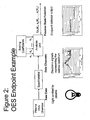
- Figure 2 describes a typical OES endpoint detection system.
- the plasma During a plasma etch, the plasma emits electromagnetic energy in a wide range of wavelengths. The exact spectrum emitted by the plasma is dependent in part on the presence of volatile byproducts created during the etching of the sample.
- a spectrometer In a typical OES endpoint system, a spectrometer is used to separate the plasma emission into discrete wavelengths. The intensity of the emission at each wavelength is measured and becomes a separate process data channel which can be monitored over the course of the etch. By monitoring those data channels that show a repeatable variation during the etch, it is possible to determine when the sample has been completely etched.
- an OES system can be used to monitor a single data channel.
- Gorin et al. U.S. Patent 4,263,088 ) disclose a means of determining endpoint in a polysilicon etch using a photoconductive cell optimized to detect plasma emissions at 520 nm. By monitoring the voltage produced by this cell during the etch, it is possible to detect the change in plasma composition that occurs when the polysilicon film is completely etched.
- Process State M 520 ⁇ nm
- Jerde et al. U.S. Patent 4,491,499 disclose measuring a narrow band of the emission spectrum while simultaneously measuring the intensity of a wider background band centered about the narrow band. In this manner the background data channels can be subtracted from the endpoint signal channels resulting in an improved endpoint signal to noise ratio.
- Process State f ⁇ M Signal 1 + M Signal 2 + ... + M Signal n - M Background 1 + M Background 2 + ... + M Background n .
- the fundamental limitation to the method described by Jerde et al. is that decisions regarding the selection of appropriate process data channels and the associated scaling factors have to be made based on the user's knowledge of the process. As a result, it becomes prohibitively time consuming for any one user to gain the necessary expertise to select appropriate data channels and scaling factors for all possible plasma etch applications. It is unlikely that any process state function produced through manual selection of data channels and scaling factors will be well optimized to detect a given process change. To ease this burden, several multivariate analysis techniques have been proposed.
- Angell et al. U.S. Patent 5,288,367
- PCA principal component analysis
- This well known multivariate analysis technique groups correlated data channels into linear combinations that describe orthogonal components of variance in the analyzed data. By identifying the component that describes the variance associated with the process endpoint and examining the data channel constituents of that component, one can determine which channels are advantageous to monitor for detecting endpoint,
- PCA-based approaches The limitation to PCA-based approaches is that the PCA algorithm attempts to describe the variance as a set of orthogonal components. PCA does not attempt to directly optimize the selection of process data channels and scaling factors for process change detection. One hopes that one of the orthogonal components completely captures the endpoint information, but PCA is not specifically directed at this outcome. The signal to noise ratio of the process state function may therefore not be sufficient for some applications.
- Another object of the present invention is to provide a method for detecting a process change, the method comprising placing a substrate in a chamber; exposing the substrate to a process with at least one known process change; acquiring at least one dataset during a process; and applying an evolutionary computing technique to at least one dataset to generate a process change detection algorithm.
- this invention comprises an improved method for optimizing at least one process state function during the plasma etching of a substrate.
- a feature of the present invention is to provide a method for detecting a process change, the method comprising placing a substrate in a vacuum chamber of a plasma etch system.
- the substrate can be an insulating material such as a photomask, a semiconductor material, or an electrically conductive material.
- the substrate is exposed to a plasma within the vacuum chamber of the plasma etch system.
- measurements of the plasma condition, substrate condition, and processing apparatus condition are recorded, as is the time at which each measurement was taken.
- Each kind of measurement represents an individual data channel.
- the data channels are combined into a dataset.
- An evolutionary computing technique e.g ., a genetic algorithm, genetic program, etc.
- the evolutionary computing technique is applied to the dataset to generate a process change detection algorithm, such as a process state function or set of scaling coefficients.
- a process change detection algorithm such as a process state function or set of scaling coefficients.
- This algorithm can then be applied to future datasets (either in real-time during processing or after the process) to detect a process change.
- the dataset can consist of any or all data channels, such as residual gas analysis data, laser reflectance data, optical emission spectra data, pressure, match network positions, DC voltages, etc.
- the process change detection algorithm can consist of a process state function and/or appropriate scaling coefficients.
- the process state function can be user selected or generated by the evolutionary computing technique.
- the process change to be detected can include transitions in substrate material composition.
- the evolutionary computing technique can employ a population size of about two or more times the number of process variables.
- a process state function can be applied to an incoming process measurable.
- a filter can be applied to the results of the process state function.
- the process state function can be a sum over all scaled elements in a dataset, although more complex state functions can be generated.
- Evolutionary computing techniques are those computing techniques which attempt to replicate, at least in part, some of the processes involved in evolution. These techniques have become a powerful tool for optimization that is capable of being applied to a wide variety of problems that involve both continuous and discrete components.
- One specific type of evolutionary computing technique is known as a genetic algorithm ( Figure 3 ). This technique represents solutions as chromosomes that are evolved to achieve a desired goal.
- a genetic algorithm is employed to generate process state functions that are optimized for the detection of process changes.
- At least one dataset is generated that contains at least one known process change.
- a random population of process state functions (and/or scaling coefficients) is also generated.
- Each member of the population is applied to at least one known dataset and evaluated using a fitness function that quantifies that population member's ability to detect at least one known process change.
- a set of the most successful population members is then recombined to create a new population. This new population is then tested, and is in turn reduced and recombined to generate yet another population.
- the process can be terminated after a set number of iterations, or when at least one population member demonstrates sufficient capability to meet the user's requirements.
- the present invention can be used to optimize aspects of process change detection beyond process state functions and scaling coefficients. Filter coefficients, peak detection techniques, and nearly any other process change detection parameter could be included in the population, and thereby optimized with this technique.
- an optimized set of scaling coefficients was generated using a genetic algorithm for the purposes of detecting a plasma process endpoint on a binary chrome photomask.
- OES optical emission spectroscopy
- a test dataset was generated in which a known process change (endpoint) occurred at 200 seconds ( Figure 4 ).
- a 1000 member population consisting of sets of 2048 scaling coefficients were generated ( Figure 5 ).
- Each set of coefficients was multiplied by the spectrometer data to create scaled spectra ( Figure 6 ).
- the scaled spectra were applied to the process state function to generate an endpoint signal ( Figure 7 ).
- the fitness function - in this case, the Signal to Noise Ratio (SNR) for the generated endpoint signal - was evaluated for each coefficient set ( Figure 8 ).
- the coefficient sets were ranked according to SNR.
- 20% of coefficient sets with the highest SNR were selected for recombination.
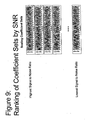
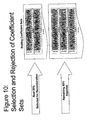
- the remaining 80% of coefficient sets were eliminated from further consideration ( Figures 9 and 10 ).
- each coefficient set was assigned a recombination probability based on its relative fitness compared to the other surviving coefficient sets.
- Figure 11 gives an example in which several ranked sets are assigned a recombination probability. Random selection of pairs of coefficient sets for recombination was then performed to create a new 1000 member population. Note that the population size and percentage of sets selected for recombination or elimination is somewhat arbitrary, and can be selected based on the user's needs.
- each of the coefficient sets (called Parent A and Parent B, respectively) were split into two smaller sections at the same randomly selected breakpoint.
- One section from Parent A (called A1) consisted of the coefficients located before the split point while the other section (called A2) would contain all the coefficients located after the split point.
- a random selection of A1 or A2 was performed. Whichever section was selected, it was then concatenated with the opposing section from parent B. For example, if A1 was retained, then it was combined with B2 to produce the new coefficient set "A1B2.” If A2 was retained, then it was combined with B1 to produce the new coefficient set "B1A2.”
- FIG. 12 illustrates the recombination process with a simplified example.
Landscapes
- Engineering & Computer Science (AREA)
- Artificial Intelligence (AREA)
- Health & Medical Sciences (AREA)
- Computer Vision & Pattern Recognition (AREA)
- Evolutionary Computation (AREA)
- Medical Informatics (AREA)
- Software Systems (AREA)
- Physics & Mathematics (AREA)
- General Physics & Mathematics (AREA)
- Automation & Control Theory (AREA)
- Drying Of Semiconductors (AREA)
Abstract
Description
- This invention relates to a method for detecting a process change in a plasma system. More particularly, the present invention relates to the use of an evolutionary computing technique to generate a process state function or set of scaling coefficients for a plasma etch endpoint system.
- In any industrial process, it is necessary to monitor process data channels in order to detect any changes that might affect the final product. As the complexity of the process increases, the number of data channels that must be monitored also increases. In extremely complex processes, hundreds of data channels must be analyzed to determine the state of the process.
- Although sometimes a matrix notation is used, in general a process state could be described as a function:

- Evaluating a function (or functions) whose variables are process data channels is one method for analyzing multiple data channels and producing an output that describes the process state. This output can then be used for process change detection.
Figure 1 represents a generic process change detection system described in terms of a process state function. Data is collected by at least one detector and sent to an analysis unit. In the analysis unit, the data channels are combined with the scaling factors and entered into the process state function which is then evaluated. The output of this function is then available for the detection of process changes. - An illustrative example of process change detection can be found in the semiconductor industry. One of the steps employed in manufacturing semiconductor devices is plasma etch. In plasma etch processes, a sample is exposed to a plasma designed to etch away specific materials from the sample surface. Often it is necessary to stop the plasma etch at a specific time to achieve a precise etch depth. The time at which the plasma etch should be stopped is called the process endpoint. Determination of process endpoint is often done using a multi-channel technique called optical emission spectroscopy (OES).
Figure 2 describes a typical OES endpoint detection system. - During a plasma etch, the plasma emits electromagnetic energy in a wide range of wavelengths. The exact spectrum emitted by the plasma is dependent in part on the presence of volatile byproducts created during the etching of the sample. In a typical OES endpoint system, a spectrometer is used to separate the plasma emission into discrete wavelengths. The intensity of the emission at each wavelength is measured and becomes a separate process data channel which can be monitored over the course of the etch. By monitoring those data channels that show a repeatable variation during the etch, it is possible to determine when the sample has been completely etched.
- In its simplest implementation, an OES system can be used to monitor a single data channel.
Gorin et al. (U.S. Patent 4,263,088 ) disclose a means of determining endpoint in a polysilicon etch using a photoconductive cell optimized to detect plasma emissions at 520 nm. By monitoring the voltage produced by this cell during the etch, it is possible to detect the change in plasma composition that occurs when the polysilicon film is completely etched. In terms of a process state function, this method can be represented by:
- Other investigators have noted that endpoint detection sensitivity can be increased by using multiple data channels.
Jerde et al. (U.S. Patent 4,491,499 ) disclose measuring a narrow band of the emission spectrum while simultaneously measuring the intensity of a wider background band centered about the narrow band. In this manner the background data channels can be subtracted from the endpoint signal channels resulting in an improved endpoint signal to noise ratio. - However, the function describing the process state becomes slightly more complicated with the inclusion of multiple data channels as follows:

- Corond at al. (EP 0932294A1) disclose a method for real time insitu interactive supervision of a step performed in a tool during semiconductor wafer fabrication process.
-
Angell et al. (U.S. Patent 5,288,367 ) disclose using principal component analysis (PCA) to automatically select data channels. This well known multivariate analysis technique groups correlated data channels into linear combinations that describe orthogonal components of variance in the analyzed data. By identifying the component that describes the variance associated with the process endpoint and examining the data channel constituents of that component, one can determine which channels are advantageous to monitor for detecting endpoint, The Angell et al. method process state function can be represented:
- The limitation to PCA-based approaches is that the PCA algorithm attempts to describe the variance as a set of orthogonal components. PCA does not attempt to directly optimize the selection of process data channels and scaling factors for process change detection. One hopes that one of the orthogonal components completely captures the endpoint information, but PCA is not specifically directed at this outcome. The signal to noise ratio of the process state function may therefore not be sufficient for some applications.
- It should be noted that while the examples presented here are specific to endpoint detection in a plasma etch process, the techniques used are representative of those employed in a wide variety of process monitoring applications. Any process whose state can be described in terms of a function of a data channel or multiple channels can be monitored with similar techniques.
- Therefore, there is a need for improving the optimization of process state functions of a plasma etch process.
- Nothing in the prior art provides the benefits attendant with the present invention.
- Therefore, it is an object of the present invention to provide an improvement which overcomes the inadequacies of the prior art devices and which is a significant contribution to the advancement of the semiconductor processing art.
- Another object of the present invention is to provide a method for detecting a process change, the method comprising placing a substrate in a chamber; exposing the substrate to a process with at least one known process change; acquiring at least one dataset during a process; and applying an evolutionary computing technique to at least one dataset to generate a process change detection algorithm.
- The foregoing has outlined some of the pertinent objects of the present invention. These objects should be construed to be merely illustrative of some of the more prominent features and applications of the intended invention. Many other beneficial results can be attained by applying the disclosed invention in a different manner or modifying the invention within the scope of the disclosure. Accordingly, other objects and a fuller understanding of the invention may be had by referring to the summary of the invention and the detailed description of the preferred embodiment in addition to the scope of the invention defined by the claims taken in conjunction with the accompanying drawings.
- For the purpose of summarizing this invention, this invention comprises an improved method for optimizing at least one process state function during the plasma etching of a substrate.
- A feature of the present invention is to provide a method for detecting a process change, the method comprising placing a substrate in a vacuum chamber of a plasma etch system. The substrate can be an insulating material such as a photomask, a semiconductor material, or an electrically conductive material. The substrate is exposed to a plasma within the vacuum chamber of the plasma etch system. During the process, measurements of the plasma condition, substrate condition, and processing apparatus condition are recorded, as is the time at which each measurement was taken. Each kind of measurement represents an individual data channel. The data channels are combined into a dataset. An evolutionary computing technique (e.g., a genetic algorithm, genetic program, etc.) is executed. Through the use of an appropriate fitness function, the evolutionary computing technique is applied to the dataset to generate a process change detection algorithm, such as a process state function or set of scaling coefficients. This algorithm can then be applied to future datasets (either in real-time during processing or after the process) to detect a process change.
- The dataset can consist of any or all data channels, such as residual gas analysis data, laser reflectance data, optical emission spectra data, pressure, match network positions, DC voltages, etc. The process change detection algorithm can consist of a process state function and/or appropriate scaling coefficients. The process state function can be user selected or generated by the evolutionary computing technique. The process change to be detected can include transitions in substrate material composition. The evolutionary computing technique can employ a population size of about two or more times the number of process variables. As part of the process change detection algorithm, a process state function can be applied to an incoming process measurable. In addition, a filter can be applied to the results of the process state function. The process state function can be a sum over all scaled elements in a dataset, although more complex state functions can be generated.
- The foregoing has outlined rather broadly the more pertinent and important features of the present invention in order that the detailed description of the invention that follows may be better understood so that the present contribution to the art can be more fully appreciated. Additional features of the invention will be described hereinafter which form the subject of the claims of the invention. It should be appreciated by those skilled in the art that the conception and the specific embodiment disclosed may be readily utilized as a basis for modifying or designing other structures for carrying out the same purposes of the present invention.
-
-
Figures 1 is a schematic of a generic process change detection system described in terms of a process state function; -
Figure 2 is a schematic of a typical OES endpoint detection system; -
Figure 3 is a flowchart of a genetic algorithm; -
Figure 4 is a graph of data channel vs. intensity showing process endpoint to occur at 200 seconds; -
Figure 5 shows graphs of populations of data channels vs. scaling coefficients; -
Figure 6 is a graph of the data fromFigure 5 using scaling coefficients; -
Figure 7 is a graph of the scaled coefficients ofFigure 6 applied to the process state function to generate an endpoint signal; -
Figure 8 is a graph of the generated endpoint signal ofFigure 7 evaluation the signal to noise ratio; -
Figure 9 is a ranking of the scaling coefficient sets from highest signal to noise ration to lowest signal to noise ratio; -
Figure 10 shows a selection of the best 20% of the scaling coefficient sets; -
Figure 11 shows an assignment of recombination probability for the coefficient sets; -
Figure 12 shows an example of the recombination process; -
Figure 13 shows a graphical example of genetic optimization for average signal to noise ratio to algorithm loop iteration -
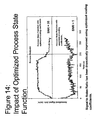
Figure 14 is a graph of the normalized signal over time for an optimized process state function; and -
Figure 15 is a graph of the normalized signal over time for optimized coefficients applied to other datasets. - Similar reference characters refer to similar parts throughout the several views of the drawings.
- We disclose a means of generating directly optimized process state functions for the detection of process changes through the use of an evolutionary computing technique using an algorithm such as a genetic algorithm.
- In biology, it is a generally accepted principle that in response to competitive pressures, organisms become more adapted to their environment through the process of evolution. Those organisms that successfully reproduce are judged "fit" for that environment. Those organisms that fail to reproduce can be thought of as "unfit" for that environment. As there are often many potential solutions to a problem, there may be several genetic traits that enabled the parents to reproduce. Through combination of their respective genetic traits, it is likely reasonable that some combinations of "fit" parents will produce offspring that may be potentially even more "fit" which is also referred to herein as a fitness function. It is also a possibility that a random mutation will occur during reproduction that will give the child a competitive advantage unavailable to either parent. Given these facts, it is statistically likely that each successive generation of organisms exposed to the same environment will on average become more successful at reproducing than the previous generation. Through evolution, organisms are optimized to their environment without the need for direction or any specific knowledge of what an optimal organism should be.
- Evolutionary computing techniques are those computing techniques which attempt to replicate, at least in part, some of the processes involved in evolution. These techniques have become a powerful tool for optimization that is capable of being applied to a wide variety of problems that involve both continuous and discrete components. One specific type of evolutionary computing technique is known as a genetic algorithm (
Figure 3 ). This technique represents solutions as chromosomes that are evolved to achieve a desired goal. - In one embodiment of the present invention, a genetic algorithm is employed to generate process state functions that are optimized for the detection of process changes. At least one dataset is generated that contains at least one known process change. A random population of process state functions (and/or scaling coefficients) is also generated. Each member of the population is applied to at least one known dataset and evaluated using a fitness function that quantifies that population member's ability to detect at least one known process change. A set of the most successful population members is then recombined to create a new population. This new population is then tested, and is in turn reduced and recombined to generate yet another population. The process can be terminated after a set number of iterations, or when at least one population member demonstrates sufficient capability to meet the user's requirements.
- It should be noted that the details of implementation of an evolutionary computing technique (and in fact, the specific evolutionary computing technique employed) depend on the application. Alternate methods of evaluating the fitness of the population, selection of population members for recombination, recombination techniques, the use of mutation operations, size of the population, etc., do not significantly deviate from the present invention.
- It should also be noted that the present invention can be used to optimize aspects of process change detection beyond process state functions and scaling coefficients. Filter coefficients, peak detection techniques, and nearly any other process change detection parameter could be included in the population, and thereby optimized with this technique.
- In this example, an optimized set of scaling coefficients was generated using a genetic algorithm for the purposes of detecting a plasma process endpoint on a binary chrome photomask.
- An optical emission spectroscopy (OES) based endpoint system (identical to the one described in
figure 2 ) was used to collect plasma emissions and separate them into the component wavelengths. Individual wavelengths were each represented by a data channel Mn, with a total of 2048 separate data channels produced. A generic process state function was defined as the sum of the products of the intensity at each wavelength and a unique scaling coefficient an (ranging in value from -1 to 1) for each wavelength:
- A test dataset was generated in which a known process change (endpoint) occurred at 200 seconds (
Figure 4 ). A 1000 member population consisting of sets of 2048 scaling coefficients were generated (Figure 5 ). Each set of coefficients was multiplied by the spectrometer data to create scaled spectra (Figure 6 ). The scaled spectra were applied to the process state function to generate an endpoint signal (Figure 7 ). The fitness function - in this case, the Signal to Noise Ratio (SNR) for the generated endpoint signal - was evaluated for each coefficient set (Figure 8 ). At this point, the coefficient sets were ranked according to SNR. Then, 20% of coefficient sets with the highest SNR were selected for recombination. The remaining 80% of coefficient sets were eliminated from further consideration (Figures 9 and10 ). - Out of the 20% selected for recombination, each coefficient set was assigned a recombination probability based on its relative fitness compared to the other surviving coefficient sets.
Figure 11 gives an example in which several ranked sets are assigned a recombination probability. Random selection of pairs of coefficient sets for recombination was then performed to create a new 1000 member population. Note that the population size and percentage of sets selected for recombination or elimination is somewhat arbitrary, and can be selected based on the user's needs. - When each pair of coefficient sets were selected for recombination, each of the coefficient sets (called Parent A and Parent B, respectively) were split into two smaller sections at the same randomly selected breakpoint. One section from Parent A (called A1) consisted of the coefficients located before the split point while the other section (called A2) would contain all the coefficients located after the split point. A random selection of A1 or A2 was performed. Whichever section was selected, it was then concatenated with the opposing section from parent B. For example, if A1 was retained, then it was combined with B2 to produce the new coefficient set "A1B2." If A2 was retained, then it was combined with B1 to produce the new coefficient set "B1A2."
- When recombination of the pairs occurs, there was also a small chance (15% in our experiments) that a new randomly generated coefficient set could be substituted for one of the parents. This method was used to simulate the process of mutation. It is known in the art that the use of mutation operations can result in a more optimal solution than could be obtained otherwise.
Figure 12 illustrates the recombination process with a simplified example. - Once a second generation had been created through recombination and mutation of the most successful coefficient sets from the first generation, the first generation was discarded. Measurements of the average SNR produced by the second generation population showed that the second generation was in fact superior to the first generation. The second generation was then applied to the same process of testing and recombination, resulting in a third generation. Again, the third generation possessed a higher signal to noise ratio. Continuously applying this algorithm, it was eventually possible to generate coefficient sets with very high signal to noise ratios compared to the initial, unoptimized scaling coefficient sets.
Figure 13 shows a plot of the average SNR vs. the algorithm loop iteration. - Eventually, the algorithm reached a point at which there was no further significant improvement in SNR. The best set of scaling coefficients produced was then multiplied with the data and inserted into the process state function. The resulting endpoint signal had a signal to noise measured at 35:1, easily sufficient for endpoint detection (
Figure 14 ). - To test whether the solution produced by the genetic algorithm was general or specific to the dataset used in the optimization, the coefficient set was applied to other datasets (
Figure 15 ). These datasets were taken during similar etches of binary chrome masks with slightly different etch process parameters and chrome loadings. While performance was degraded relative to the results obtained on the optimization dataset, the performance indicates that the genetic algorithm solution is general in nature, and not limited to the optimization dataset.
Claims (16)
- A method for improving the detection of a process change, the method comprising:placing a substrate in a chamber;exposing the substrate to a process with at least one known process change;acquiring at least one dataset during a process; characterized in that it further comprisesgenerating a random population of process state functions;each member of the random population is applied to at least one known dataset andevaluated using a fitness function that quantifies that population member's ability to detect at least one known process change;recombining the most successful members of the random population to generate a new population;testing the new population; reducing and recombining the new population to generate yet another population.
- The method according to Claim 1 wherein said process is a plasma etch process.
- The method according to Claim 1 wherein said substrate is a photomask.
- The method according to Claim 1 wherein said substrate is a semiconductor material.
- The method according to Claim 1 wherein said substrate is a dielectric material.
- The method according to Claim 1 wherein said substrate is an electrically conductive material.
- The method according to Claim 1 wherein said process change is a material transition in the substrate.
- The method according to Claim I wherein said dataset further comprising plasma emission spectra data.
- The method according to Claim 1 wherein said dataset further comprising residual gas analysis data.
- The method according to Claim 1 wherein said dataset further comprising at least one plasma processing parameter.
- The method according to Claim 10 wherein said plasma processing parameter comprises measurements of the plasma condition, substrate condition, or processing apparatus condition.
- The method according to Claim 1 wherein a process state function is a function of a set of scaling coefficients.
- The method according to Claim 12 wherein said fitness function is a signal to noise ratio for a generated end point signal that is applied to said set of scaling coefficients wherein said most successful members are the top 20 percent of scaling coefficient sets with the highest signal to noise ratio.
- The method according to Claim 13 wherein the remaining 80 percent of the scaling coefficient sets is eliminated from further consideration.
- The method according to Claim I further comprising terminating the generation of populations after a set number of generated populations.
- The method according to Claim 1 further comprising terminating the generation of populations when at least one member of a population demonstrates sufficient capability to meet the user's requirements.
Applications Claiming Priority (3)
| Application Number | Priority Date | Filing Date | Title |
|---|---|---|---|
| US69094105P | 2005-06-16 | 2005-06-16 | |
| US11/441,811 US7625824B2 (en) | 2005-06-16 | 2006-05-26 | Process change detection through the use of evolutionary algorithms |
| PCT/US2006/022705 WO2006138199A1 (en) | 2005-06-16 | 2006-06-12 | Process change detection through the use of evolutionary algorithms |
Publications (2)
| Publication Number | Publication Date |
|---|---|
| EP1891492A1 EP1891492A1 (en) | 2008-02-27 |
| EP1891492B1 true EP1891492B1 (en) | 2012-06-06 |
Family
ID=37075641
Family Applications (1)
| Application Number | Title | Priority Date | Filing Date |
|---|---|---|---|
| EP06772850A Active EP1891492B1 (en) | 2005-06-16 | 2006-06-12 | Process change detection through the use of evolutionary algorithms |
Country Status (5)
| Country | Link |
|---|---|
| US (1) | US7625824B2 (en) |
| EP (1) | EP1891492B1 (en) |
| JP (1) | JP5066517B2 (en) |
| CN (1) | CN101218550B (en) |
| WO (1) | WO2006138199A1 (en) |
Families Citing this family (13)
| Publication number | Priority date | Publication date | Assignee | Title |
|---|---|---|---|---|
| US8255059B2 (en) * | 2003-03-11 | 2012-08-28 | Cochlear Limited | Using a genetic algorithm to fit a medical implant system to a patient |
| JP5026326B2 (en) * | 2008-04-04 | 2012-09-12 | 株式会社日立ハイテクノロジーズ | Method and system for determining etching process state |
| US8983631B2 (en) | 2009-06-30 | 2015-03-17 | Lam Research Corporation | Arrangement for identifying uncontrolled events at the process module level and methods thereof |
| US8618807B2 (en) | 2009-06-30 | 2013-12-31 | Lam Research Corporation | Arrangement for identifying uncontrolled events at the process module level and methods thereof |
| US8473089B2 (en) | 2009-06-30 | 2013-06-25 | Lam Research Corporation | Methods and apparatus for predictive preventive maintenance of processing chambers |
| US8538572B2 (en) * | 2009-06-30 | 2013-09-17 | Lam Research Corporation | Methods for constructing an optimal endpoint algorithm |
| US9336998B2 (en) * | 2014-05-09 | 2016-05-10 | Varian Semiconductor Equipment Associates, Inc. | Apparatus and method for dynamic control of ion beam energy and angle |
| JP6523732B2 (en) | 2015-03-26 | 2019-06-05 | 株式会社日立ハイテクノロジーズ | Plasma processing apparatus and plasma processing method |
| CN105651457B (en) * | 2016-04-14 | 2018-09-28 | 东南大学 | Multi-dimension force sensor calibration experiment data fitting method based on genetic algorithm |
| US12449309B2 (en) | 2019-08-06 | 2025-10-21 | Applied Materials, Inc. | Methods for detection using optical emission spectroscopy |
| CN114080662B (en) | 2020-06-16 | 2025-11-14 | 株式会社日立高新技术 | Plasma treatment apparatus and plasma treatment method |
| US12062530B2 (en) * | 2020-06-25 | 2024-08-13 | Hitachi High-Tech Corporation | Vacuum processing apparatus and vacuum processing method |
| CN113408370B (en) * | 2021-05-31 | 2023-12-19 | 西安电子科技大学 | Forest change remote sensing detection method based on adaptive parameter genetic algorithm |
Family Cites Families (34)
| Publication number | Priority date | Publication date | Assignee | Title |
|---|---|---|---|---|
| US4263088A (en) * | 1979-06-25 | 1981-04-21 | Motorola, Inc. | Method for process control of a plasma reaction |
| US4491499A (en) * | 1984-03-29 | 1985-01-01 | At&T Technologies, Inc. | Optical emission end point detector |
| US4935877A (en) * | 1988-05-20 | 1990-06-19 | Koza John R | Non-linear genetic algorithms for solving problems |
| US5841651A (en) * | 1992-11-09 | 1998-11-24 | The United States Of America As Represented By The United States Department Of Energy | Closed loop adaptive control of spectrum-producing step using neural networks |
| US5653894A (en) * | 1992-12-14 | 1997-08-05 | Lucent Technologies Inc. | Active neural network determination of endpoint in a plasma etch process |
| US5467883A (en) * | 1992-12-14 | 1995-11-21 | At&T Corp. | Active neural network control of wafer attributes in a plasma etch process |
| US5288367A (en) * | 1993-02-01 | 1994-02-22 | International Business Machines Corporation | End-point detection |
| US5737496A (en) * | 1993-11-17 | 1998-04-07 | Lucent Technologies Inc. | Active neural network control of wafer attributes in a plasma etch process |
| US5864633A (en) * | 1996-05-17 | 1999-01-26 | Therma-Wave, Inc. | Method and apparatus for optical data analysis |
| JPH10303126A (en) * | 1997-02-28 | 1998-11-13 | Nikon Corp | How to determine the movement sequence |
| JPH11176815A (en) * | 1997-12-15 | 1999-07-02 | Ricoh Co Ltd | Dry etching end point determination method and dry etching apparatus |
| EP0932194A1 (en) * | 1997-12-30 | 1999-07-28 | International Business Machines Corporation | Method and system for semiconductor wafer fabrication process real-time in-situ interactive supervision |
| US6101971A (en) * | 1998-05-13 | 2000-08-15 | Axcelis Technologies, Inc. | Ion implantation control using charge collection, optical emission spectroscopy and mass analysis |
| US6678572B1 (en) * | 1998-12-31 | 2004-01-13 | Asml Holdings, N.V. | Recipe cascading in a wafer processing system |
| US6472238B1 (en) * | 2000-02-09 | 2002-10-29 | Therma-Wave, Inc. | Evaluation of etching processes in semiconductors |
| US6532076B1 (en) * | 2000-04-04 | 2003-03-11 | Therma-Wave, Inc. | Method and apparatus for multidomain data analysis |
| US6824813B1 (en) * | 2000-04-06 | 2004-11-30 | Applied Materials Inc | Substrate monitoring method and apparatus |
| US6627464B2 (en) * | 2001-02-07 | 2003-09-30 | Eni Technology, Inc. | Adaptive plasma characterization system |
| US6859796B1 (en) * | 2001-07-19 | 2005-02-22 | Hewlett-Packard Development Company, L.P. | Method of using multiple populations with cross-breeding in a genetic algorithm |
| JP2003085526A (en) * | 2001-09-12 | 2003-03-20 | Toshiba Corp | Optimum value search device, optimum value search method, optimum value search program, parameter fitting method, and semiconductor device manufacturing method |
| US6641746B2 (en) * | 2001-09-28 | 2003-11-04 | Agere Systems, Inc. | Control of semiconductor processing |
| JP2003152102A (en) * | 2001-11-15 | 2003-05-23 | Hitachi Ltd | Method for manufacturing semiconductor integrated circuit device |
| US6866559B2 (en) * | 2002-02-04 | 2005-03-15 | Kla-Tencor Technologies | Windows configurable to be coupled to a process tool or to be disposed within an opening in a polishing pad |
| GB0206342D0 (en) * | 2002-03-18 | 2002-05-01 | Murgitroyd & Company | An improved process control method and apparatus |
| JP4274348B2 (en) * | 2002-07-02 | 2009-06-03 | 東京エレクトロン株式会社 | Process prediction method, processing apparatus, and process prediction program |
| AU2003239392A1 (en) * | 2002-05-29 | 2003-12-19 | Tokyo Electron Limited | Method and system for data handling, storage and manipulation |
| JP2004079727A (en) * | 2002-08-15 | 2004-03-11 | Fujitsu Ltd | Etching end point detection method, etching end point detection system, etching apparatus, and etching end point detection program |
| JP4165638B2 (en) * | 2002-09-02 | 2008-10-15 | 東京エレクトロン株式会社 | Process monitoring method and plasma processing apparatus |
| US6919279B1 (en) * | 2002-10-08 | 2005-07-19 | Novellus Systems, Inc. | Endpoint detection for high density plasma (HDP) processes |
| US6879860B2 (en) * | 2003-03-11 | 2005-04-12 | Gregory Howard Wakefield | Cochlear implant MAP optimization with use of a genetic algorithm |
| CN100401491C (en) * | 2003-05-09 | 2008-07-09 | 优利讯美国有限公司 | Envelope Follower Endpoint Detection in Time Division Multiplexing Processing |
| KR100976648B1 (en) * | 2003-05-16 | 2010-08-18 | 도쿄엘렉트론가부시키가이샤 | Health index processing system and method using the same |
| CN100419482C (en) * | 2004-05-09 | 2008-09-17 | 上海理工大学 | Waveguide-fiber automatic core adjustment method and its device based on genetic algorithm |
| CN1256670C (en) * | 2004-09-16 | 2006-05-17 | 上海交通大学 | Dynamic Configuration Method of Application Server Instance Pool Based on Real Number Coded Genetic Algorithm |
-
2006
- 2006-05-26 US US11/441,811 patent/US7625824B2/en active Active
- 2006-06-12 WO PCT/US2006/022705 patent/WO2006138199A1/en not_active Ceased
- 2006-06-12 JP JP2008516968A patent/JP5066517B2/en active Active
- 2006-06-12 EP EP06772850A patent/EP1891492B1/en active Active
- 2006-06-12 CN CN2006800216137A patent/CN101218550B/en active Active
Also Published As
| Publication number | Publication date |
|---|---|
| JP2008547201A (en) | 2008-12-25 |
| CN101218550A (en) | 2008-07-09 |
| EP1891492A1 (en) | 2008-02-27 |
| JP5066517B2 (en) | 2012-11-07 |
| US7625824B2 (en) | 2009-12-01 |
| WO2006138199A1 (en) | 2006-12-28 |
| US20060287753A1 (en) | 2006-12-21 |
| CN101218550B (en) | 2010-10-13 |
Similar Documents
| Publication | Publication Date | Title |
|---|---|---|
| KR101215367B1 (en) | Etching apparatus, analysis apparatus, etching treatment method, and computer readable medium recording etching treatment program | |
| US7625824B2 (en) | Process change detection through the use of evolutionary algorithms | |
| US6238937B1 (en) | Determining endpoint in etching processes using principal components analysis of optical emission spectra with thresholding | |
| EP1210724B1 (en) | Method of determining etch endpoint using principal components analysis of optical emission spectra | |
| KR100560886B1 (en) | Systems and methods for monitoring and controlling gas plasma processes | |
| US6745095B1 (en) | Detection of process endpoint through monitoring fluctuation of output data | |
| US6952657B2 (en) | Industrial process fault detection using principal component analysis | |
| US6368975B1 (en) | Method and apparatus for monitoring a process by employing principal component analysis | |
| JP6549917B2 (en) | Plasma processing apparatus and data analysis apparatus therefor | |
| JPH0862141A (en) | Method and system that analyze plasma data | |
| CN100401491C (en) | Envelope Follower Endpoint Detection in Time Division Multiplexing Processing | |
| US7479395B2 (en) | Method of monitoring a production process using a linear combination of measured variables with selected weights | |
| Hong et al. | Neural network-based real-time malfunction diagnosis of reactive ion etching using in situ metrology data | |
| US20200328067A1 (en) | Plasma processing apparatus and analysis method for analyzing plasma processing data | |
| JP2005114384A (en) | Defect elemental analysis method and apparatus | |
| Choi et al. | Explainable artificial intelligence-based evidential inferencing on process faults in plasma etching | |
| EP4348235A1 (en) | Method of detecting radicals using mass spectrometry | |
| JP4086190B2 (en) | Emission spectrum causative substance identification support apparatus and support method | |
| KR101895707B1 (en) | Method of determining an etching end point of plasma process | |
| TW202605659A (en) | Search device, data compression processing device, semiconductor device manufacturing system, search method, and data compression processing method | |
| TWI338321B (en) | Process change detection through the use of evolutionary algorithms | |
| Conlin et al. | Industrial Spectral Data Calibration from Minimal Data Sets | |
| KR20060053778A (en) | System and method for wavelength selection using spectrometer |
Legal Events
| Date | Code | Title | Description |
|---|---|---|---|
| PUAI | Public reference made under article 153(3) epc to a published international application that has entered the european phase |
Free format text: ORIGINAL CODE: 0009012 |
|
| 17P | Request for examination filed |
Effective date: 20071102 |
|
| AK | Designated contracting states |
Kind code of ref document: A1 Designated state(s): AT BE BG CH CY CZ DE DK EE ES FI FR GB GR HU IE IS IT LI LT LU LV MC NL PL PT RO SE SI SK TR |
|
| DAX | Request for extension of the european patent (deleted) | ||
| RIN1 | Information on inventor provided before grant (corrected) |
Inventor name: PLUMHOFF, JASON |
|
| DAX | Request for extension of the european patent (deleted) | ||
| 17Q | First examination report despatched |
Effective date: 20090310 |
|
| GRAP | Despatch of communication of intention to grant a patent |
Free format text: ORIGINAL CODE: EPIDOSNIGR1 |
|
| GRAS | Grant fee paid |
Free format text: ORIGINAL CODE: EPIDOSNIGR3 |
|
| GRAA | (expected) grant |
Free format text: ORIGINAL CODE: 0009210 |
|
| AK | Designated contracting states |
Kind code of ref document: B1 Designated state(s): AT BE BG CH CY CZ DE DK EE ES FI FR GB GR HU IE IS IT LI LT LU LV MC NL PL PT RO SE SI SK TR |
|
| REG | Reference to a national code |
Ref country code: GB Ref legal event code: FG4D |
|
| REG | Reference to a national code |
Ref country code: CH Ref legal event code: EP Ref country code: AT Ref legal event code: REF Ref document number: 561308 Country of ref document: AT Kind code of ref document: T Effective date: 20120615 |
|
| REG | Reference to a national code |
Ref country code: IE Ref legal event code: FG4D |
|
| REG | Reference to a national code |
Ref country code: CH Ref legal event code: NV Representative=s name: CABINET ROLAND NITHARDT CONSEILS EN PROPRIETE INDU |
|
| REG | Reference to a national code |
Ref country code: DE Ref legal event code: R096 Ref document number: 602006029969 Country of ref document: DE Effective date: 20120802 |
|
| REG | Reference to a national code |
Ref country code: NL Ref legal event code: VDEP Effective date: 20120606 |
|
| PG25 | Lapsed in a contracting state [announced via postgrant information from national office to epo] |
Ref country code: FI Free format text: LAPSE BECAUSE OF FAILURE TO SUBMIT A TRANSLATION OF THE DESCRIPTION OR TO PAY THE FEE WITHIN THE PRESCRIBED TIME-LIMIT Effective date: 20120606 Ref country code: LT Free format text: LAPSE BECAUSE OF FAILURE TO SUBMIT A TRANSLATION OF THE DESCRIPTION OR TO PAY THE FEE WITHIN THE PRESCRIBED TIME-LIMIT Effective date: 20120606 Ref country code: SE Free format text: LAPSE BECAUSE OF FAILURE TO SUBMIT A TRANSLATION OF THE DESCRIPTION OR TO PAY THE FEE WITHIN THE PRESCRIBED TIME-LIMIT Effective date: 20120606 Ref country code: CY Free format text: LAPSE BECAUSE OF FAILURE TO SUBMIT A TRANSLATION OF THE DESCRIPTION OR TO PAY THE FEE WITHIN THE PRESCRIBED TIME-LIMIT Effective date: 20120606 |
|
| REG | Reference to a national code |
Ref country code: AT Ref legal event code: MK05 Ref document number: 561308 Country of ref document: AT Kind code of ref document: T Effective date: 20120606 |
|
| REG | Reference to a national code |
Ref country code: LT Ref legal event code: MG4D Effective date: 20120606 |
|
| PG25 | Lapsed in a contracting state [announced via postgrant information from national office to epo] |
Ref country code: LV Free format text: LAPSE BECAUSE OF FAILURE TO SUBMIT A TRANSLATION OF THE DESCRIPTION OR TO PAY THE FEE WITHIN THE PRESCRIBED TIME-LIMIT Effective date: 20120606 Ref country code: SI Free format text: LAPSE BECAUSE OF FAILURE TO SUBMIT A TRANSLATION OF THE DESCRIPTION OR TO PAY THE FEE WITHIN THE PRESCRIBED TIME-LIMIT Effective date: 20120606 Ref country code: GR Free format text: LAPSE BECAUSE OF FAILURE TO SUBMIT A TRANSLATION OF THE DESCRIPTION OR TO PAY THE FEE WITHIN THE PRESCRIBED TIME-LIMIT Effective date: 20120907 |
|
| PG25 | Lapsed in a contracting state [announced via postgrant information from national office to epo] |
Ref country code: SK Free format text: LAPSE BECAUSE OF FAILURE TO SUBMIT A TRANSLATION OF THE DESCRIPTION OR TO PAY THE FEE WITHIN THE PRESCRIBED TIME-LIMIT Effective date: 20120606 Ref country code: IS Free format text: LAPSE BECAUSE OF FAILURE TO SUBMIT A TRANSLATION OF THE DESCRIPTION OR TO PAY THE FEE WITHIN THE PRESCRIBED TIME-LIMIT Effective date: 20121006 Ref country code: EE Free format text: LAPSE BECAUSE OF FAILURE TO SUBMIT A TRANSLATION OF THE DESCRIPTION OR TO PAY THE FEE WITHIN THE PRESCRIBED TIME-LIMIT Effective date: 20120606 Ref country code: NL Free format text: LAPSE BECAUSE OF FAILURE TO SUBMIT A TRANSLATION OF THE DESCRIPTION OR TO PAY THE FEE WITHIN THE PRESCRIBED TIME-LIMIT Effective date: 20120606 Ref country code: AT Free format text: LAPSE BECAUSE OF FAILURE TO SUBMIT A TRANSLATION OF THE DESCRIPTION OR TO PAY THE FEE WITHIN THE PRESCRIBED TIME-LIMIT Effective date: 20120606 Ref country code: RO Free format text: LAPSE BECAUSE OF FAILURE TO SUBMIT A TRANSLATION OF THE DESCRIPTION OR TO PAY THE FEE WITHIN THE PRESCRIBED TIME-LIMIT Effective date: 20120606 Ref country code: CZ Free format text: LAPSE BECAUSE OF FAILURE TO SUBMIT A TRANSLATION OF THE DESCRIPTION OR TO PAY THE FEE WITHIN THE PRESCRIBED TIME-LIMIT Effective date: 20120606 Ref country code: MC Free format text: LAPSE BECAUSE OF NON-PAYMENT OF DUE FEES Effective date: 20120630 Ref country code: BE Free format text: LAPSE BECAUSE OF FAILURE TO SUBMIT A TRANSLATION OF THE DESCRIPTION OR TO PAY THE FEE WITHIN THE PRESCRIBED TIME-LIMIT Effective date: 20120606 |
|
| PG25 | Lapsed in a contracting state [announced via postgrant information from national office to epo] |
Ref country code: PT Free format text: LAPSE BECAUSE OF FAILURE TO SUBMIT A TRANSLATION OF THE DESCRIPTION OR TO PAY THE FEE WITHIN THE PRESCRIBED TIME-LIMIT Effective date: 20121008 Ref country code: IT Free format text: LAPSE BECAUSE OF FAILURE TO SUBMIT A TRANSLATION OF THE DESCRIPTION OR TO PAY THE FEE WITHIN THE PRESCRIBED TIME-LIMIT Effective date: 20120606 Ref country code: PL Free format text: LAPSE BECAUSE OF FAILURE TO SUBMIT A TRANSLATION OF THE DESCRIPTION OR TO PAY THE FEE WITHIN THE PRESCRIBED TIME-LIMIT Effective date: 20120606 |
|
| REG | Reference to a national code |
Ref country code: IE Ref legal event code: MM4A |
|
| PLBE | No opposition filed within time limit |
Free format text: ORIGINAL CODE: 0009261 |
|
| STAA | Information on the status of an ep patent application or granted ep patent |
Free format text: STATUS: NO OPPOSITION FILED WITHIN TIME LIMIT |
|
| PG25 | Lapsed in a contracting state [announced via postgrant information from national office to epo] |
Ref country code: ES Free format text: LAPSE BECAUSE OF FAILURE TO SUBMIT A TRANSLATION OF THE DESCRIPTION OR TO PAY THE FEE WITHIN THE PRESCRIBED TIME-LIMIT Effective date: 20120917 Ref country code: IE Free format text: LAPSE BECAUSE OF NON-PAYMENT OF DUE FEES Effective date: 20120612 Ref country code: DK Free format text: LAPSE BECAUSE OF FAILURE TO SUBMIT A TRANSLATION OF THE DESCRIPTION OR TO PAY THE FEE WITHIN THE PRESCRIBED TIME-LIMIT Effective date: 20120606 |
|
| 26N | No opposition filed |
Effective date: 20130307 |
|
| REG | Reference to a national code |
Ref country code: DE Ref legal event code: R097 Ref document number: 602006029969 Country of ref document: DE Effective date: 20130307 |
|
| PG25 | Lapsed in a contracting state [announced via postgrant information from national office to epo] |
Ref country code: BG Free format text: LAPSE BECAUSE OF FAILURE TO SUBMIT A TRANSLATION OF THE DESCRIPTION OR TO PAY THE FEE WITHIN THE PRESCRIBED TIME-LIMIT Effective date: 20120906 |
|
| PG25 | Lapsed in a contracting state [announced via postgrant information from national office to epo] |
Ref country code: TR Free format text: LAPSE BECAUSE OF FAILURE TO SUBMIT A TRANSLATION OF THE DESCRIPTION OR TO PAY THE FEE WITHIN THE PRESCRIBED TIME-LIMIT Effective date: 20120606 |
|
| PG25 | Lapsed in a contracting state [announced via postgrant information from national office to epo] |
Ref country code: LU Free format text: LAPSE BECAUSE OF NON-PAYMENT OF DUE FEES Effective date: 20120612 |
|
| PG25 | Lapsed in a contracting state [announced via postgrant information from national office to epo] |
Ref country code: HU Free format text: LAPSE BECAUSE OF FAILURE TO SUBMIT A TRANSLATION OF THE DESCRIPTION OR TO PAY THE FEE WITHIN THE PRESCRIBED TIME-LIMIT Effective date: 20060612 |
|
| REG | Reference to a national code |
Ref country code: FR Ref legal event code: PLFP Year of fee payment: 11 |
|
| REG | Reference to a national code |
Ref country code: FR Ref legal event code: PLFP Year of fee payment: 12 |
|
| REG | Reference to a national code |
Ref country code: FR Ref legal event code: PLFP Year of fee payment: 13 |
|
| P01 | Opt-out of the competence of the unified patent court (upc) registered |
Effective date: 20230524 |
|
| PGFP | Annual fee paid to national office [announced via postgrant information from national office to epo] |
Ref country code: DE Payment date: 20250618 Year of fee payment: 20 |
|
| PGFP | Annual fee paid to national office [announced via postgrant information from national office to epo] |
Ref country code: GB Payment date: 20250618 Year of fee payment: 20 |
|
| PGFP | Annual fee paid to national office [announced via postgrant information from national office to epo] |
Ref country code: FR Payment date: 20250620 Year of fee payment: 20 |
|
| PGFP | Annual fee paid to national office [announced via postgrant information from national office to epo] |
Ref country code: CH Payment date: 20250701 Year of fee payment: 20 |