EP1891285B1 - Method for making a sound-insulating load-bearing floor and sound-insulating material - Google Patents
Method for making a sound-insulating load-bearing floor and sound-insulating material Download PDFInfo
- Publication number
- EP1891285B1 EP1891285B1 EP05753112A EP05753112A EP1891285B1 EP 1891285 B1 EP1891285 B1 EP 1891285B1 EP 05753112 A EP05753112 A EP 05753112A EP 05753112 A EP05753112 A EP 05753112A EP 1891285 B1 EP1891285 B1 EP 1891285B1
- Authority
- EP
- European Patent Office
- Prior art keywords
- sound
- insulating material
- load
- insulating
- making
- Prior art date
- Legal status (The legal status is an assumption and is not a legal conclusion. Google has not performed a legal analysis and makes no representation as to the accuracy of the status listed.)
- Expired - Lifetime
Links
Images
Classifications
-
- C—CHEMISTRY; METALLURGY
- C09—DYES; PAINTS; POLISHES; NATURAL RESINS; ADHESIVES; COMPOSITIONS NOT OTHERWISE PROVIDED FOR; APPLICATIONS OF MATERIALS NOT OTHERWISE PROVIDED FOR
- C09D—COATING COMPOSITIONS, e.g. PAINTS, VARNISHES OR LACQUERS; FILLING PASTES; CHEMICAL PAINT OR INK REMOVERS; INKS; CORRECTING FLUIDS; WOODSTAINS; PASTES OR SOLIDS FOR COLOURING OR PRINTING; USE OF MATERIALS THEREFOR
- C09D119/00—Coating compositions based on rubbers, not provided for in groups C09D107/00 - C09D117/00
- C09D119/003—Precrosslinked rubber; Scrap rubber; Used vulcanised rubber
-
- E—FIXED CONSTRUCTIONS
- E04—BUILDING
- E04F—FINISHING WORK ON BUILDINGS, e.g. STAIRS, FLOORS
- E04F15/00—Flooring
- E04F15/12—Flooring or floor layers made of masses in situ, e.g. seamless magnesite floors, terrazzo gypsum floors
- E04F15/14—Construction of joints, e.g. dividing strips
-
- E—FIXED CONSTRUCTIONS
- E04—BUILDING
- E04F—FINISHING WORK ON BUILDINGS, e.g. STAIRS, FLOORS
- E04F15/00—Flooring
- E04F15/18—Separately-laid insulating layers; Other additional insulating measures; Floating floors
- E04F15/20—Separately-laid insulating layers; Other additional insulating measures; Floating floors for sound insulation
-
- C—CHEMISTRY; METALLURGY
- C08—ORGANIC MACROMOLECULAR COMPOUNDS; THEIR PREPARATION OR CHEMICAL WORKING-UP; COMPOSITIONS BASED THEREON
- C08L—COMPOSITIONS OF MACROMOLECULAR COMPOUNDS
- C08L23/00—Compositions of homopolymers or copolymers of unsaturated aliphatic hydrocarbons having only one carbon-to-carbon double bond; Compositions of derivatives of such polymers
- C08L23/02—Compositions of homopolymers or copolymers of unsaturated aliphatic hydrocarbons having only one carbon-to-carbon double bond; Compositions of derivatives of such polymers not modified by chemical after-treatment
- C08L23/04—Homopolymers or copolymers of ethene
- C08L23/08—Copolymers of ethene
- C08L23/0846—Copolymers of ethene with unsaturated hydrocarbons containing atoms other than carbon or hydrogen
- C08L23/0853—Ethylene vinyl acetate copolymers
-
- C—CHEMISTRY; METALLURGY
- C08—ORGANIC MACROMOLECULAR COMPOUNDS; THEIR PREPARATION OR CHEMICAL WORKING-UP; COMPOSITIONS BASED THEREON
- C08L—COMPOSITIONS OF MACROMOLECULAR COMPOUNDS
- C08L23/00—Compositions of homopolymers or copolymers of unsaturated aliphatic hydrocarbons having only one carbon-to-carbon double bond; Compositions of derivatives of such polymers
- C08L23/02—Compositions of homopolymers or copolymers of unsaturated aliphatic hydrocarbons having only one carbon-to-carbon double bond; Compositions of derivatives of such polymers not modified by chemical after-treatment
- C08L23/04—Homopolymers or copolymers of ethene
- C08L23/08—Copolymers of ethene
- C08L23/0846—Copolymers of ethene with unsaturated hydrocarbons containing atoms other than carbon or hydrogen
- C08L23/0869—Copolymers of ethene with unsaturated hydrocarbons containing atoms other than carbon or hydrogen with unsaturated acids, e.g. [meth]acrylic acid; with unsaturated esters, e.g. [meth]acrylic acid esters
-
- C—CHEMISTRY; METALLURGY
- C08—ORGANIC MACROMOLECULAR COMPOUNDS; THEIR PREPARATION OR CHEMICAL WORKING-UP; COMPOSITIONS BASED THEREON
- C08L—COMPOSITIONS OF MACROMOLECULAR COMPOUNDS
- C08L33/00—Compositions of homopolymers or copolymers of compounds having one or more unsaturated aliphatic radicals, each having only one carbon-to-carbon double bond, and only one being terminated by only one carboxyl radical, or of salts, anhydrides, esters, amides, imides or nitriles thereof; Compositions of derivatives of such polymers
- C08L33/02—Homopolymers or copolymers of acids; Metal or ammonium salts thereof
Definitions
- the present invention relates to a method for making a sound-insulating load-bearing floor.
- the present invention relates to a method for making a sound-insulating load-bearing floor, said method comprising the step of applying onto said load-bearing floor a sound-insulating material including at least one rubber in a subdivided form and at least one binding agent.
- the present invention also relates to a sound-insulating material including at least one rubber in a subdivided form and at least one binding agent.
- the present invention also relates to a building structure including at least one load-bearing floor, said load-bearing floor comprising a sound-insulating material including at least one rubber in a subdivided form and at least one binding agent.
- a sound-insulating material on the load-bearing floor of the upper floors.
- the sound-insulating material minimizes the pressure of sound generated into a room and traveling downward through the load-bearing floor. Sound-insulating material functions by reflecting sound waves, absorbing sound waves, and/or disrupting sound waves.
- Conventional sound-insulating materials comprise pre-formed sheets of cork, asphalt, or other materials such as, for example, foamed polyethylene or foamed polyurethane.
- said sound insulating materials may show some disadvantages.
- the asphalt typically comprises about 80% by weight of tar, the remainder including clay, solvents, and other fillers.
- One disadvantage of the asphalt is that upon aging, it tends to harden. It also hardens in cold weather. When asphalt hardens, it tends to crack if the floor expands or contracts (e.g. as a consequence of temperatures changes).
- cork comprises a matrix of particles pressed together, the cork also tends to develop cracks if the floor expands or contracts (e.g. as a consequence of temperatures changes).
- International Patent Application WO 02/48478 relates to a light soundproof floor-filling structure for filling the space between a floor surface and the level of the laying plane of the walking-on floor covering.
- Said soundproof floor-filling structure consists of a mixture of concrete as air-hardening binder and a given amount of grains of resin materials which may be selected from polyvinyl resins, polyethylene, polypropylene, polyvinylchloride, caoutchouc, rubbers in general, polycarbons, silicon resins, plastics of different kinds.
- Metal elements such as copper and tin may be present as either pure metal or alloys.
- the abovementioned structure is said to have the following features: lightness, soundproofing, compactness, workability, mechanical strength and environmental compatibility.
- International Patent Application WO 00/26485 relates to an acustic insulating material with a filler which is mainly made of granules of a sound-deadening component, mixed with a binding agent, such that an almost coherent mass is formed.
- Said filler mainly contains rubber granules.
- Said binding agent is made on the basis of polyurethane and preferably consists of a polyurethane glue.
- a sound-insulating sprung floor provided with the abovementioned insulating material and resting on a load-bearing floor, and a method for making such a floor, are also disclosed.
- French Patent Application FR 2,221,465 relates to a material made from waste rubber particles, in particular waste rubber particles derived from tyres, and a synthetic elastomeric binding agent, preferably a moisture-hardening isocyanate or polyisocyanate or a two-component polyurethane.
- Said binding agent is of cellular structure and fills only partly the spaces between the rubber particles.
- the abovementioned material is said to be suitable as a floor underlay.
- International Patent Application WO 00/50707 relates to a solid paste which can be applied with a trowel to form regularly spaced striae, comprising an adhesive-type elastomeric resin forming 50%-70% of the volume of the paste, 30-90 mesh rubber granules forming 30%-50% of the volume of the paste, all of which is mixed with air to produce a foam.
- the adhesive is water-based.
- the rubber granules come from recycled tyres which are shredded into granules and ground.
- a method of application of said solid paste comprising the following steps: take a container with the adhesive-type elastomeric resin superposed on rubber granules in a suspension in the air, insert a mechanical mixer and agitate for two to five minutes in order to form a homogeneous emulsion containing air, rubber and resin, apply the product to a hard surface using an adhesive comb in order to form said striae and wedge tiles on top of the striae.
- the abovementioned solid paste is said to have sound-insulating properties.
- the sound-insulating materials as described above may have some disadvantages.
- the sound-insulating materials has low sound-insulating properties because of the stiffness of the concrete.
- the use of isocyanates or polyisocyanates as binding agents has to be avoided because of the toxicity of said substances which leads to risks for both the environment and the health of the operators.
- isocyanates, polyisocyanates or polyurethanes may release cyanidric acid.
- a water-based adhesive-type elastomeric resin when used, problems related to its stability may arise.
- the elastomeric resin may coagulate so forming a non-homogeneous adhesive mixture: the presence of coagulums may negatively affect the sound-insulating properties of said adhesive mixture.
- the Applicant has now found that it is possible to make a sound-insulating load-bearing floor by applying onto said load-bearing floor a sound-insulating material including at least one rubber in a subdivided form and at least one binding agent in the form of an aqueous dispersion, said binding agent comprising at least one water-dispersible polymer.
- Said sound-inaulating, material has good sound-insulating properties. Furthermore, said sound-insulating material maintains its sound-insulating properties upon aging. Moreover, said sound-insulating material has a reduced dynamic stiffness, in particular, a dynamic stiffness, measured according to standard ISO 9052-1:1989, lower than 150 MM/m 3 . Said sound-insulating material also shows vibration damping properties. Furthermore, said sound-insulating material shows a good compression resistance after drying. Additionally, the binding agent used in said sound-insulating material does not contain harmful substances and does not release harmful substances in the case of fire.
- the present invention relates to a method for making a sound-insulating load-bearing floor, said method comprising the following steps:
- FR 2,433,617 discloses a sound-insulating material according to the preamble of claim 43 and a method for making a sound-isolating load-bearing floor by applying a sound isolating material in the form of rubber particles dispersed in a polymerisable phenolic resin dissolved in an hydroalcoholic solvent which is then left to polymerize in the presence of an acid catalyst.
- EP 1,375,778 discloses a mixture of rubber particles and liquid resin selected from acrylic resins and polyurethane resin, optionally diluted by an inert solvent to be employed for catching up the irregularities of a ground or a floor.
- DE 4,340,478 discloses a mixture of rubber particles and solvent free polyurethane binder to be used in a process of manufacturing a sheet-shaped covering material including a compression step and a thermal curing step.
- At least one binding agent in the form of an aqueous dispersion comprising at least one water-dispersible polymer having a glass transition temperature (T g ) of from -50°C to +50°C, preferably of from -40°C to + 10°C.
- Said glass transition temperature may be measured according to known techniques such as, for example, by Differential Scanning Calorimetry (DSC) : further details regarding the DSC analysis will be described in the examples given hereinbelow.
- DSC Differential Scanning Calorimetry
- said step of applying a sound-insulating material further comprises the step of making pre-formed sheets of said sound insulating material.
- said sound-insulating material is applied directly in contact with said load-bearing floor.
- at least one intermediate layer is interposed between the load-bearing floor and the sound-insulating material.
- said method further comprises the step of applying a covering floor onto said load-bearing floor.
- said covering floor is applied onto said sound-insulating material.
- said sound-insulating material is applied onto said covering floor.
- said method further comprises the step of applying a protective foil onto said sound-insulating material.
- a protective foil may be selected, for example, from: polyethylene sheets, paper sheets, nylon sheets, woven-nonwoven sheets.
- the present invention also relates to a sound-insulating material including:
- the present invention also relates to a building structure including at least one load-bearing floor, said load-bearing floor comprising a sound-insulating material including:
- said sound insulating material has, in a dry form, a dynamic stiffness measured according to standard ISO 9052-1:1989, lower than 150 MN/m 3 , preferably lower than 100 MN/m 3 , more preferably of from 10 MN/m 3 to 80 MN/m 3 .
- said sound-insulating material has, in a dry form, a noise index (L), which is a measure of its sound-insulating properties, measured according to standard ISO 140-8:1997, on a sample of said sound-insulating material having a 10 mm thickness, not higher than 65 dB, preferably not higher than 63 dB.
- L noise index
- said sound-insulating material form a substantially continuous coating layer having a thickness of from 5 mm to 50 mm, preferably of from 7 mm to 30 mm.
- Said sound-insulating material may be made according to different processes.
- the process for making a sound-insulating material is carried out by mixing, at a temperature of from -20°C to +60°C, preferably of from +5°C to +40°C, for a time of from 10 seconds to 4 hours, preferably of from 60 seconds to 30 minutes, said at least one rubber in a subdivided form with said binding agent, obtaining a homogeneous sound-insulating material.
- the obtained homogeneous sound-insulating material may be collected in hermetic buckets or tanks and stored for further use.
- the above reported mixing step is carried out not more than 48 hours, preferably from 5 minutes to 24 hours, before the step of applying said sound-insulating material.
- Said mixing step may be carried out manually for example in a bucket, or in different mixing devices such as, for example, concrete mixer, cement mixer, concrete pump, cement pump, plaster sprayer.
- the step of applying a sound-insulating material may be carried according to different ways.
- the step of applying a sound-insulating material is carried out by spreading (for example, by means of a trowel) said sound-insulating material onto said load-bearing floor.
- the step of applying a sound-insulating material is carried out by spraying said sound-insulating material onto said load-bearing floor.
- said sound-insulating material is made and applied "in situ" by:
- said continuous coating layer has a drying time, at 23°C, of from 10 minutes to 72 hours, preferably of from 30 minutes to 24 hours.
- said sound-insulating material may be previuosly shaped as pre-formed sheets which will be subsequently applied onto said load-bearing floor.
- Said pre-formed sheets may be obtained by means of different processes.
- said pre-formed sheets may be obtained by means of a process comprising:
- the gaps optionally present between adjacent pre-formed sheets may be filled with suitable materials, e.g. with a binding agent or with a sound-insulating material, preferably the same used to make the pre-formed sheets according to the present invention.
- the rubber in a subdivided form which may be used in the present invention is in the form of powder or granules having a particle size in the range of from 0.1 mm to 15 mm, preferably of from 1.0 mm to 10 mm.
- the rubber in a subdivided form may be selected, for example, from diene elastomeric polymers or copolymers which may be of natural origin or may be obtained by solution polymerization, emulsion polymerization or gas-phase polymerization of one or more conjugated diolefins, optionally blended with at least one comonomer selected from monovinylarenes and/or polar comonomers in an amount of not more than 60% by weight.
- the diene elastomeric polymers or copolymers may be selected, for example, from: cis-1,4-polyisoprene (natural or synthetic, preferably natural rubber), 3,4-polyisoprene, polybutadiene (in particular polybutadiene with a high 1,4-cis content), optionally halogenated isoprene/isobutene copolymers, 1,3-butadiene/acrylonitrile copolymers, styrene/1,3-butadiene copolymers, styrene/isoprene/1,3-butadiene copolymers, styrene/1,3-butadiene/acrylonitrile copolymers, or mixtures thereof.
- cis-1,4-polyisoprene natural or synthetic, preferably natural rubber
- 3,4-polyisoprene polybutadiene (in particular polybutadiene with a high 1,4-cis
- the rubber in a subdivided form may be selected from elastomeric polymers of one or more monoolefins with olefinic comonomers or derivatives thereof.
- said elastomeric polymers may be selected, for example, from: ethylene/propylene copolymers (EPR) or ethylene/propylene/diene copolymers (EPDM); polyisobutene; butyl rubbers; halobutyl rubbers, in particular chlorobutyl or bromobutyl rubbers; or mixtures thereof.
- said rubber in a subdivided form may be obtained from a waste rubber derived from the rubber manufacturing processes. More preferably, said rubber in a subdivided form is a vulcanized rubber which may be obtained by grinding or otherwise comminuting any source of vulcanized rubber compound such as, for example, tyres, roofing membranes, hoses, gaskets, and the like, and is preferably obtained from reclaimed or scrap tyres using any conventional method.
- the vulcanized rubber in a subdivided form may be obtained by mechanical grinding at ambient temperature or in the presence of a cryogenic coolant (i.e. liquid nitrogen).
- Said vulcanized rubber in a subdivided form may comprise at least one crosslinked diene elastomeric polymer or copolymer, said diene elastomeric polymer or copolymer being selected from those above reported; or at least one crosslinked elastomeric polymer of one or more monoolefins with an olefinic comonomer or derivatives thereof, said elastomeric polymer being selected from those above reported; or mixtures thereof.
- said water-dispersible polymer is used in the form of an aqueous dispersion.
- said aqueous dispersion comprises from 30% by weight to 90% by weight, preferably from 40% by weight to 70% by weight, with respect to the total weight of the aqueous dispersion, of at least one water-dispersible polymer.
- said aqueous dispersion has a Brookfield viscosity, measured at 23°C and at 250 rpm, of from 0.2 Pa.s to 60 Pa.s, preferably of from 0.5 Pa.s to 30 Pa.s.
- Brookfield viscosity is measured using a viscosimeter of Brookfield type, model DV3, equipped with a RV6 spindle.
- said aqueous dispersion has a minimum film-forming temperature lower than or equal to 10°C, preferably of from -10°C to +5°C.
- Said mimimum film-forming temperature is measured according to standard ISO 2115:1996.
- said water-dispersible polymer may be selected from polymers having a main hydrocarbon chain to which hydrophilic groups are linked.
- polymers having a main hydrocarbon chain to which hydrophilic groups are linked it is meant a polymer wherein hydrophilic groups, either directly or through side groups, are linked to the main hydrocarbon chain, which may be either linear or branched.
- hydrophylic groups groups which are able to bind water molecules by means of hydrogen bonds.
- said hydrophylic groups are preferably selected from:
- said polymers having a main hydrocarbon chain to which hydrophilic groups are linked may be selected from:
- the ethylenically unsaturated carboxylic acid monomer or a derivative thereof may be selected, for example, from: (meth)acrylic acid, maleic acid, fumaric acid, itaconic acid, ethacrylic acid, crotonic acid, citraconic acid cinnamic acid, maleic anhydride, methyl hydrogen fumarate, benzyl hydrogen maleate, butyl hydrogen maleate, octyl hydrogen itaconate, dodecyl hydrogen citraconate, methyl (meth)acrylate, ethyl (meth)acrylate, propyl (meth) acrylate, butyl (meth)acrylate, hexyl (meth)acrylate, 2-ethylhexyl (meth)acrylate, octyl (meth)acrylate, isooctyl (meth)acrylate, decyl (meth)acrylate, lauryl (meth)acrylate, steary
- (meth)acrylic esters monomers which may be used according to the present invention are multifunctional (meth)acrylates which may be selected, for example, from: ethylene glycol monoester of (meth)acrylic acid, propylene glycol monoester of (meth)acrylic acid, glycidyl (meth)acrylate, hydroxyethyl (meth)acrylate, hydroxypropyl (meth)acrylate, hexanediol di(meth)acrylate, methoxymethyl (meth)acrylate, ethoxymethyl (meth)acrylate, esters of (meth)acrylic acid with polyoxyethylene glycol or polyoxypropylene glycol, (meth)acryloyl compounds having a polyoxyalkylene structure, or mixtures thereof.
- multifunctional (meth)acrylates which may be selected, for example, from: ethylene glycol monoester of (meth)acrylic acid, propylene glycol monoester of (meth)acrylic acid, gly
- the aliphatic vinyl ester monomer may be selected, for example, from: vinyl formate, vinyl acetate, vinyl propionate, vinyl butyrate, vinyl caproate, vinyl caprylate, vinyl laurate, vinyl stearate, vinyl octylate, vinyl heptanoate, vinyl pelargonate, vinyl-3,6-dioxaheptanoate, vinyl-3,6,9-trioxaundecanoate, vinyl ester of versatic.acid, or mixtures thereof.
- Vinyl acetate is particularly preferred.
- the aliphatic vinyl ether monomer may be selected, for example, from: methyl vinyl ether, ethyl vinyl ether, propyl vinyl ether, butyl vinyl ether, t-amyl vinyl ether, or mixtures thereof. Methyl vinyl ether is particularly preferred.
- the aliphatic or aromatic olefinic monomer may be selected, for example, from:
- comonomers which may optionally be used according to the present invention, may be selected from polar mononers such as, for example: vinyl chloride, vinyl sulfonate, vinyl silane, vinylidene chloride, nitriles or amides.such as, for example, acrylonitrile, acrylamide, or mixtures thereof.
- polar mononers such as, for example: vinyl chloride, vinyl sulfonate, vinyl silane, vinylidene chloride, nitriles or amides.
- amides such as, for example, acrylonitrile, acrylamide, or mixtures thereof.
- said comonomers are present in the polymer in an amount not higher than or equal to 5% by weight, with respect to the total weight of the polymer.
- homopolymers (i) which may be advantageously used according to the present invention are: poly(meth)acrylic acid, polyalkylacrylamide, polyhydroxyalkylate, polyalkylacrylate, polyvinylacetate, polyvinylalcohol, or mixtures thereof.
- copolymers (ii) which may be advantageously used according to the present invention are: vinylacetate/ethylene copolymers, vinylacetate/alkylacrylate copolymers, ethylene/alkylacrylate copolymers, vinylacetate/vinylversatate copolymers, vinylacetate/butylmaleate copolymers, styrene/acrylate copolymers, styrene/acrylic acid/ copolymers, or mixtures thereof.
- terpolymers (iii) which may be advantageously used according to the present invention are: vinylacetate/ethylene/acrylate terpolymers, vinylalcohol/ethylene/vinylacetate terpolymers, or mixtures thereof.
- the aqueous dispersion according to the present invention may be prepared by polymerization of monomers emulsified in water using conventional emulsion polymerization procedures.
- the aqueous dispersion according to the present invention may further comprise protective colloids such as, for example, polyvinyl alcohol, polyvinyl acetate, polyvinyl pirrolidone, polyethylene-glycol distearate, hydroxypropyl methylcellulose, hydroxyethyl cellulose, or mixtures thereof.
- protective colloids such as, for example, polyvinyl alcohol, polyvinyl acetate, polyvinyl pirrolidone, polyethylene-glycol distearate, hydroxypropyl methylcellulose, hydroxyethyl cellulose, or mixtures thereof.
- the polyvinyl alcohol which may be advantageously used according to the present invention, may be a modified polyvinylalcohol (such as, acetoacetylated polyvinyl alcohol), a partially or completely saponified polyvinyl alcohol, or mixtures thereof.
- Said aqueous dispersion may further comprise surfactants.
- Suitable surfactants include non-ionic, anionic, cationic, surfactants, or mixtures thereof.
- Said surfactants may be selected, for example, from: octylphenoxy polyethoxy ethanol, polysiloxane copolymers, acetylenic alcohol or glycols or their ethoxylated derivatives; ethylene oxide/propylene oxide copolymers; or mixtures thereof.
- Said aqueous dispersion may comprise other commonly used additives which may be selected, for example, from: plasticizers such as, for example, polyethylene glycol, dibutyl phthalate, butyl benzyl phthalate, propylene glycol dibenzoate, triethylene glycol polyester of benzoic acid and phthalic acid, alkyd resin plasticizers; humectants such as, for example, glycerin, ethylene glycol, triethylene glycol, propylene glycol, urea, or mixtures thereof; filming aids and coalescing agents such as, for example, esters of lactic acid, 2-butoxy ethanol, esters of phthalic acid (for example, butyl octyl phathalate), 2-(2-butoxy ethoxy)ethanol, ethylene glycol, dyethylene glycol, propylene glycol, diacetone alcohol, or mixtures thereof; or mixtures thereof.
- plasticizers such as, for example, polyethylene glycol, dibutyl
- Said aqueous dispersion may further comprise inorganic fillers such as, for example, sand, silica, calcium carbonate, calcium silicates, barium sulfates, talc, mica, carbon black, or mixtures thereof; pigments; dyes; antiseptic agents; antifoaming agents; or mixtures thereof.
- inorganic fillers such as, for example, sand, silica, calcium carbonate, calcium silicates, barium sulfates, talc, mica, carbon black, or mixtures thereof.
- solvents such as, for example, acetone, ethanol, or mixtures thereof, may be added.
- aqueous dispersions of homopolymers (i), or copolymers (ii), or terpolymers (iii), which may be used according to the present invention and which are commercialy available are the products known as Vinavil ® , Ravemul ® or Crilat ® , from Vinavil, or Airflex ® from Air Products.
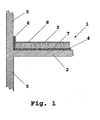
- FIG. 1 represents a schematic cross section of a portion of a load-bearing floor comprising a coating layer made from the sound-insulating material according to an embodiment of the present invention.
- a sprung floor 1 is provided on top of a load-bearing floor 2 associated with the walls 5.
- Said sprung floor 1 comprises a covering floor 3 which rests on a coating layer 4 made from the sound-insulating material according to the present invention and which does not have any direct contact with said load-bearing floor 2 or with the walls 5.
- said coating layer 4 has a thickness of from 5 mm to 50 mm, more preferably of from 7 mm to 30 mm.
- the coating layer 4 is separated from the walls 5 by means of a stranding strip 6, said stranding strip 6 being usually made of a sound-insulating material such as, for example, polyethylene foam, polyurethane foam, rubber granules with a polyurthane glue as a binding agent.
- said stranding strip 6 may be made from the sound-insulating material according to the present invention.
- said coating layer 4 horizontally extends over the load-bearing floor 2 up against the surrounding walls 5 (not represented in Fig. 1 ) and the above-mentioned standing strip 6 rests on the edges of the coating layer 4 (not represented in Fig. 1 ).
- the coating layer 4 extends both horizontally and vertically over the load-bearing floor 2 up against the surrounding walls 5 (not represented in Fig 1 ).
- the stranding strip 6 vertically extends from the load-bearing floor 2 up to the covering floor 3 and it has a thickness of from 2 mm to 20 mm, preferably of from 3 mm to 10 mm.
- a protective foil 7 is provided over said coating layer 4 and it is folded up against the walls 5 on the edges of the sprung floor 1.
- the covering floor 3 is usually made from a hardened composition mainly comprising sand and cement, as is generally known for making fixed floors.
- a metal spot-welded wire netting (not represented in Fig. 1 ) is preferably inserted in the covering floor 3.
- Said covering floor 3 extends up to under the top edge of the above-mentioned standing strip 6 so that, consequently, there is no contact between the surrounding walls 5 and the covering floor 3.
- said covering floor has a thickness of from 2 cm to 10 cm, more preferably of from 4 cm to 6 cm. Depending on the expected load of the floor, this thickness may possibly be adjusted.
- the sprung-floor 1 comprises a covering floor 3 in the shape of a rigid plate whose perimeter is practically entirely enclosed by said standing strip 6 and a coating layer 4, whereby the whole rests on the fixed load-bearing floor 2.
- a layer of a finishing material 8 (such as, tiles, wood), is placed.
- 80% by weight (% by weight with respect to the total weight of the sound-insulating material) of a vulcanized rubber (ground waste rubber from scrap tyres having an average diameter of from 4 mm to 7 mm commercialized by Transeco s.r.l.) was mixed, under stirring, in a 5 liters becker, with 20% by weight (% by weight with respect to the total weight of the sound-insulating material) of the binding agent (the binding agent components are reported in Table 1 - the amounts are expressed in % by weight with respect to the total weight of the binding agent), at room temperature (23°C), until a homogeneous dispersion was obtained.
- Airflex ® EAF 60 100 - - Vinavil ® EVA 2615 M - 50 70 Vinavil ® X 2428 - 50 - Crilat ® X 1815 AZ - - 30
- Airflex ® EAF 60 (from Air Products) : aqueous dispersion comprising 60% of vinylacetate/ethylene/acrylate terpolymer having: a glass transition temperature (T g ) (referred to the terpolymer in a dry form) of -35°C; a Brookfield viscosity, measured at 23°C and at 250 rpm, of 9.4 Pa.s; a minimum film-forming temperature of 0°C; Vinavil ® EVA 2615 M (from Vinavil): aqueous dispersion comprising 52% of vinylacetate/ethylene copolymer having: a glass transition temperature (T g ) (referred to the copolymer in a dry form) of 19°C; a Brookfield vis
- Example 2 The mixtures of Example 2 and 3 were subjected to the following measurement.
- the Brookfield viscosity was measured at 23°C and at 250 rpm using a viscosimeter of Brookfield type, model DV3, equipped with a RV6 spindle.
- the obtained data are the following:
- the minimum filming temperature was measured according to standard ISO 2115:1996. The obtained data are the following:
- the mixture of Examples 2 and 3 were subjected to Differential Scanning Calorimetry (DSC) analysis in order to measure the glass transition temperatures.
- DSC Differential Scanning Calorimetry
- the so obtained sound-insulating material was subjected to the following tests.
- the dynamic stiffness was measured according to standard ISO 9052-1:1989.
- the so obtained sound-insulating material was spreaded over a polyethylene sheet and was allowed drying at room temperature (23°C), for 48 hours.
- the obtained sample was placed between two metal plates which were maintained at the following conditions: 23°C, 50% of humidity.
- the upper plate was a 8 kg load plate corresponding to a load of 200 kg/m 2 that is the typical weight of the load bearing floor.
- the plate was subjected to an impulse frequency of from 50 Hz to 200 Hz: said impulse was generated by a generator and transferred to the upper plate by a shaker.
- the vibrational acceleration was measured by an accelerometer placed on the upper plate.
- the test was performed according to standard ISO 140-8:1997.
Landscapes
- Engineering & Computer Science (AREA)
- Architecture (AREA)
- Chemical & Material Sciences (AREA)
- Civil Engineering (AREA)
- Structural Engineering (AREA)
- Organic Chemistry (AREA)
- Materials Engineering (AREA)
- Wood Science & Technology (AREA)
- Life Sciences & Earth Sciences (AREA)
- Floor Finish (AREA)
- Building Environments (AREA)
- Soundproofing, Sound Blocking, And Sound Damping (AREA)
- Mounting Of Bearings Or Others (AREA)
- Application Of Or Painting With Fluid Materials (AREA)
- Laminated Bodies (AREA)
- Paints Or Removers (AREA)
Abstract
Description
- The present invention relates to a method for making a sound-insulating load-bearing floor.
- In particular, the present invention relates to a method for making a sound-insulating load-bearing floor, said method comprising the step of applying onto said load-bearing floor a sound-insulating material including at least one rubber in a subdivided form and at least one binding agent.
- In a further aspect, the present invention also relates to a sound-insulating material including at least one rubber in a subdivided form and at least one binding agent.
- In a still further aspect, the present invention also relates to a building structure including at least one load-bearing floor, said load-bearing floor comprising a sound-insulating material including at least one rubber in a subdivided form and at least one binding agent.
- In building constructions, in particular in building constructions including two or more stories, it is known to include a sound-insulating material on the load-bearing floor of the upper floors. The sound-insulating material minimizes the pressure of sound generated into a room and traveling downward through the load-bearing floor. Sound-insulating material functions by reflecting sound waves, absorbing sound waves, and/or disrupting sound waves.
- Conventional sound-insulating materials comprise pre-formed sheets of cork, asphalt, or other materials such as, for example, foamed polyethylene or foamed polyurethane.
- However, said sound insulating materials may show some disadvantages.
- For example, the asphalt typically comprises about 80% by weight of tar, the remainder including clay, solvents, and other fillers. One disadvantage of the asphalt is that upon aging, it tends to harden. It also hardens in cold weather. When asphalt hardens, it tends to crack if the floor expands or contracts (e.g. as a consequence of temperatures changes). Similarly, since cork comprises a matrix of particles pressed together, the cork also tends to develop cracks if the floor expands or contracts (e.g. as a consequence of temperatures changes).
- Other sound-insulating materials have been already suggested in the art.
- For example, International Patent Application
WO 02/48478 - International Patent Application
WO 00/26485 - French Patent Application
FR 2,221,465 - International Patent Application
WO 00/50707 - According to the Applicant, the sound-insulating materials as described above may have some disadvantages.
- For example, when concrete is used as an air-hardening binder, the sound-insulating materials has low sound-insulating properties because of the stiffness of the concrete. On the other hand, the use of isocyanates or polyisocyanates as binding agents has to be avoided because of the toxicity of said substances which leads to risks for both the environment and the health of the operators. Moreover, in the case of fire, isocyanates, polyisocyanates or polyurethanes, may release cyanidric acid. Finally, when a water-based adhesive-type elastomeric resin is used, problems related to its stability may arise. The elastomeric resin may coagulate so forming a non-homogeneous adhesive mixture: the presence of coagulums may negatively affect the sound-insulating properties of said adhesive mixture.
- The Applicant has now found that it is possible to make a sound-insulating load-bearing floor by applying onto said load-bearing floor a sound-insulating material including at least one rubber in a subdivided form and at least one binding agent in the form of an aqueous dispersion, said binding agent comprising at least one water-dispersible polymer. Said sound-inaulating, material has good sound-insulating properties. Furthermore, said sound-insulating material maintains its sound-insulating properties upon aging. Moreover, said sound-insulating material has a reduced dynamic stiffness, in particular, a dynamic stiffness, measured according to standard ISO 9052-1:1989, lower than 150 MM/m3. Said sound-insulating material also shows vibration damping properties. Furthermore, said sound-insulating material shows a good compression resistance after drying. Additionally, the binding agent used in said sound-insulating material does not contain harmful substances and does not release harmful substances in the case of fire.
- According to a first aspect, the present invention relates to a method for making a sound-insulating load-bearing floor, said method comprising the following steps:
- providing a load-bearing floor;
- applying a sound-insulating material onto said load-bearing floor so as to form a substantially continuous coating layer;
- allowing said substantially continuous coating layer to dry;
- from 40% by weight to 95% by weight, preferably from 60% by weight to 90% by weight, with respect to the total weight of the sound-insulating material, of at least one rubber in a subdivided form;
- from 5% by weight to 60% by weight, preferably from 10% by weight to 40% by weight, with respect to the total weight of the sound-insulating material, of at
- The following patent applications further disclose material composition for surface covering.
-
FR 2,433,617 -
EP 1,375,778 discloses a mixture of rubber particles and liquid resin selected from acrylic resins and polyurethane resin, optionally diluted by an inert solvent to be employed for catching up the irregularities of a ground or a floor. -
DE 4,340,478 discloses a mixture of rubber particles and solvent free polyurethane binder to be used in a process of manufacturing a sheet-shaped covering material including a compression step and a thermal curing step. - The above mentioned patent applications neither disclose nor suggest the subject matter of the present invention. least one binding agent in the form of an aqueous dispersion comprising at least one water-dispersible polymer having a glass transition temperature (Tg) of from -50°C to +50°C, preferably of from -40°C to + 10°C.
- Said glass transition temperature may be measured according to known techniques such as, for example, by Differential Scanning Calorimetry (DSC) : further details regarding the DSC analysis will be described in the examples given hereinbelow.
- According to one preferred embodiment, said step of applying a sound-insulating material, further comprises the step of making pre-formed sheets of said sound insulating material.
- According to one preferred embodiment, said sound-insulating material is applied directly in contact with said load-bearing floor. Alternatively, at least one intermediate layer is interposed between the load-bearing floor and the sound-insulating material.
- According to a further preferred embodiment, said method further comprises the step of applying a covering floor onto said load-bearing floor. Preferably, said covering floor is applied onto said sound-insulating material.
- According to a further preferred embodiment, said sound-insulating material is applied onto said covering floor.
- According to a further preferred embodiment, said method further comprises the step of applying a protective foil onto said sound-insulating material. Preferably, said step is carried out before the application of said covering floor onto said sound-insulating material. Said protective foil may be selected, for example, from: polyethylene sheets, paper sheets, nylon sheets, woven-nonwoven sheets.
- According to a further aspect, the present invention also relates to a sound-insulating material including:
- from 40% by weight to 95% by weight, preferably from 60% by weight to 90% by weight, with respect to the total weight of the sound-insulating material, of at least one rubber in a subdivided form;
- from 5% by weight to 60% by weight, preferably from 10% by weight to 40% by weight, with respect to the total weight of the sound-insulating material, of at least one binding agent in the form of an aqueous dispersion comprising at least one water-dispersible polymer having a glass transition temperature (Tg) of from -50°C to +50°C, preferably of from -40°C to + 10°C.
- According to a further aspect, the present invention also relates to a building structure including at least one load-bearing floor, said load-bearing floor comprising a sound-insulating material including:
- from 40% by weight to 95% by weight, preferably from 60% by weight to 90% by weight, with respect to the total weight of the sound-insulating material, of at least one rubber in a subdivided form;
- from 5% by weight to 60% by weight, preferably from 10% by weight to 40% by weight, with respect to the total weight of the sound-insulating material, of at least one binding agent comprising at least one water-dispersible polymer having a glass transition temperature (Tg) of from -50°C to +50°C, preferably of from -40°C to + 10°C.
- According to one preferred embodiment, said sound insulating material has, in a dry form, a dynamic stiffness measured according to standard ISO 9052-1:1989, lower than 150 MN/m3, preferably lower than 100 MN/m3, more preferably of from 10 MN/m3 to 80 MN/m3.
- According to a further preferred embodiment, said sound-insulating material has, in a dry form, a noise index (L), which is a measure of its sound-insulating properties, measured according to standard ISO 140-8:1997, on a sample of said sound-insulating material having a 10 mm thickness, not higher than 65 dB, preferably not higher than 63 dB.
- According to one preferred embodiment, said sound-insulating material form a substantially continuous coating layer having a thickness of from 5 mm to 50 mm, preferably of from 7 mm to 30 mm.
- For the purpose of the present description and of the claims which follow, except where otherwise indicated, all numbers expressing amounts, quantities, percentages, and so forth, are to be understood as being modified in all instances by the term "about". Also, all ranges include any combination of the maximum and minimum points disclosed and include any intermediate ranges therein, which may or may not be specifically enumerated herein.
- Said sound-insulating material may be made according to different processes.
- According to one preferred embodiment, the process for making a sound-insulating material is carried out by mixing, at a temperature of from -20°C to +60°C, preferably of from +5°C to +40°C, for a time of from 10 seconds to 4 hours, preferably of from 60 seconds to 30 minutes, said at least one rubber in a subdivided form with said binding agent, obtaining a homogeneous sound-insulating material. The obtained homogeneous sound-insulating material may be collected in hermetic buckets or tanks and stored for further use.
- In the case in which the obtained homogeneous sound-insulating material is not stored, preferably, in order to avoid its pre-drying, the above reported mixing step is carried out not more than 48 hours, preferably from 5 minutes to 24 hours, before the step of applying said sound-insulating material.
- Said mixing step may be carried out manually for example in a bucket, or in different mixing devices such as, for example, concrete mixer, cement mixer, concrete pump, cement pump, plaster sprayer.
- The step of applying a sound-insulating material may be carried according to different ways.
- According to one preferred embodiment, the step of applying a sound-insulating material is carried out by spreading (for example, by means of a trowel) said sound-insulating material onto said load-bearing floor.
- According to a further preferred embodiment, the step of applying a sound-insulating material is carried out by spraying said sound-insulating material onto said load-bearing floor.
- According to a further preferred embodiment, said sound-insulating material is made and applied "in situ" by:
- spreading said at least one rubber in a subdivided form onto said load-bearing floor;
- spraying the binding agent over said spreaded rubber in a subdivided form obtaining a sound-insulating material, said sound-insulating material forming a substantially continuous coating layer.
- According to one preferred embodiment, said continuous coating layer has a drying time, at 23°C, of from 10 minutes to 72 hours, preferably of from 30 minutes to 24 hours.
- According to a further preferred embodiment, as reported above, said sound-insulating material may be previuosly shaped as pre-formed sheets which will be subsequently applied onto said load-bearing floor. Said pre-formed sheets may be obtained by means of different processes. For example, said pre-formed sheets may be obtained by means of a process comprising:
- mixing said at least one rubber in a subdivided form and said at least one binding agent in a mixing device so as to obtain a homogeneous mixture;
- pouring the obtained homogeneous mixture into a die;
- keeping the homogeneous mixture into said die at a temperature and for a time sufficient to to obtain a substantially dry pre-formed sheets.
- In order to obtain a substantially continuous coating layer of a sound-insulating material, after having applied said pre-formed sheets onto said load-bearing floor, the gaps optionally present between adjacent pre-formed sheets may be filled with suitable materials, e.g. with a binding agent or with a sound-insulating material, preferably the same used to make the pre-formed sheets according to the present invention.
- According to one preferred embodiment, the rubber in a subdivided form which may be used in the present invention, is in the form of powder or granules having a particle size in the range of from 0.1 mm to 15 mm, preferably of from 1.0 mm to 10 mm.
- According to one preferred embodiment, the rubber in a subdivided form may be selected, for example, from diene elastomeric polymers or copolymers which may be of natural origin or may be obtained by solution polymerization, emulsion polymerization or gas-phase polymerization of one or more conjugated diolefins, optionally blended with at least one comonomer selected from monovinylarenes and/or polar comonomers in an amount of not more than 60% by weight.
- Preferably, the diene elastomeric polymers or copolymers may be selected, for example, from: cis-1,4-polyisoprene (natural or synthetic, preferably natural rubber), 3,4-polyisoprene, polybutadiene (in particular polybutadiene with a high 1,4-cis content), optionally halogenated isoprene/isobutene copolymers, 1,3-butadiene/acrylonitrile copolymers, styrene/1,3-butadiene copolymers, styrene/isoprene/1,3-butadiene copolymers, styrene/1,3-butadiene/acrylonitrile copolymers, or mixtures thereof.
- Alternatively, the rubber in a subdivided form may be selected from elastomeric polymers of one or more monoolefins with olefinic comonomers or derivatives thereof. Preferably, said elastomeric polymers may be selected, for example, from: ethylene/propylene copolymers (EPR) or ethylene/propylene/diene copolymers (EPDM); polyisobutene; butyl rubbers; halobutyl rubbers, in particular chlorobutyl or bromobutyl rubbers; or mixtures thereof.
- Preferably, said rubber in a subdivided form may be obtained from a waste rubber derived from the rubber manufacturing processes. More preferably, said rubber in a subdivided form is a vulcanized rubber which may be obtained by grinding or otherwise comminuting any source of vulcanized rubber compound such as, for example, tyres, roofing membranes, hoses, gaskets, and the like, and is preferably obtained from reclaimed or scrap tyres using any conventional method. For example, the vulcanized rubber in a subdivided form may be obtained by mechanical grinding at ambient temperature or in the presence of a cryogenic coolant (i.e. liquid nitrogen). Said vulcanized rubber in a subdivided form may comprise at least one crosslinked diene elastomeric polymer or copolymer, said diene elastomeric polymer or copolymer being selected from those above reported; or at least one crosslinked elastomeric polymer of one or more monoolefins with an olefinic comonomer or derivatives thereof, said elastomeric polymer being selected from those above reported; or mixtures thereof.
- According to one preferred embodiment, said water-dispersible polymer is used in the form of an aqueous dispersion. Preferably, said aqueous dispersion comprises from 30% by weight to 90% by weight, preferably from 40% by weight to 70% by weight, with respect to the total weight of the aqueous dispersion, of at least one water-dispersible polymer.
- According to a further preferred embodiment, said aqueous dispersion has a Brookfield viscosity, measured at 23°C and at 250 rpm, of from 0.2 Pa.s to 60 Pa.s, preferably of from 0.5 Pa.s to 30 Pa.s.
- Said Brookfield viscosity is measured using a viscosimeter of Brookfield type, model DV3, equipped with a RV6 spindle.
- According to a further preferred embodiment, said aqueous dispersion has a minimum film-forming temperature lower than or equal to 10°C, preferably of from -10°C to +5°C.
- Said mimimum film-forming temperature is measured according to standard ISO 2115:1996.
- According to one preferred embodiment, said water-dispersible polymer may be selected from polymers having a main hydrocarbon chain to which hydrophilic groups are linked.
- In the present description and in the claims which follow, by the expression "polymers having a main hydrocarbon chain to which hydrophilic groups are linked" it is meant a polymer wherein hydrophilic groups, either directly or through side groups, are linked to the main hydrocarbon chain, which may be either linear or branched.
- In the present description and in the claims which follow, by the expression "hydrophylic groups" it is meant groups which are able to bind water molecules by means of hydrogen bonds.
- With regard to said polymers having a main hydrocarbon chain to which hydrophilic groups are linked, said hydrophylic groups, are preferably selected from:
- hydroxyl groups -OH, or derivatives thereof such as, for example, -OR groups (R = alkyl or hydroxyalkyl);
- carboxylic groups -COOH, possibly at least partially in the salt form;
- ester groups -COOR (R = alkyl or hydroxyalkyl);
- amide groups -CONH2;
- sulfonic groups -SOH3, possibly at least partially in the salts form.
- According to a further preferred embodiment, said polymers having a main hydrocarbon chain to which hydrophilic groups are linked may be selected from:
- (i) homopolymers obtained by the polymerization of an ethylenically unsaturated carboxylic acid monomer or a derivative thereof such as anhydrides, esters or salts; or by the polymerization of an aliphatic vinyl ester monomer; or by the polymerization of an aliphatic vinyl ether monomer;
- (ii) copolymers obtained by the copolymerization of at least one aliphatic or aromatic olefinic monomer, with at least one ethylenically unsaturated carboxylic acid monomer or a derivative thereof such as anhydrides, esters or salts, or with at least one aliphatic vinyl ester monomer, or with at least one aliphatic vinyl ether monomer; or copolymers obtained by the polymerization of an ethylenically unsaturated carboxylic acid monomer or a derivative thereof such as anhydrides, esters or salts, with at least one aliphatic vinyl ester monomer, or with at least one aliphatic vinyl ether monomer;
- (iii) terpolymers obtained by the polymerization of at least one aliphatic or aromatic olefinic monomer, with at least one ethylenically unsaturated carboxylic acids monomer or a derivative thereof such as anhydrides, esters or salts, and with at least one aliphatic vinyl ester monomer or with at leat one aliphatic vinyl ether monomer;
- Preferably, the ethylenically unsaturated carboxylic acid monomer or a derivative thereof may be selected, for example, from: (meth)acrylic acid, maleic acid, fumaric acid, itaconic acid, ethacrylic acid, crotonic acid, citraconic acid cinnamic acid, maleic anhydride, methyl hydrogen fumarate, benzyl hydrogen maleate, butyl hydrogen maleate, octyl hydrogen itaconate, dodecyl hydrogen citraconate, methyl (meth)acrylate, ethyl (meth)acrylate, propyl (meth) acrylate, butyl (meth)acrylate, hexyl (meth)acrylate, 2-ethylhexyl (meth)acrylate, octyl (meth)acrylate, isooctyl (meth)acrylate, decyl (meth)acrylate, lauryl (meth)acrylate, stearyl (meth)acrylate, benzyl (meth)acrylate, butyl fumarate, butyl maleate, octyl maleate, or mixtures thereof. Acrylic acid, methacrylic acid, or a derivative thereof, or mixtures thereof, are particularly preferred.
- Other (meth)acrylic esters monomers which may be used according to the present invention are multifunctional (meth)acrylates which may be selected, for example, from: ethylene glycol monoester of (meth)acrylic acid, propylene glycol monoester of (meth)acrylic acid, glycidyl (meth)acrylate, hydroxyethyl (meth)acrylate, hydroxypropyl (meth)acrylate, hexanediol di(meth)acrylate, methoxymethyl (meth)acrylate, ethoxymethyl (meth)acrylate, esters of (meth)acrylic acid with polyoxyethylene glycol or polyoxypropylene glycol, (meth)acryloyl compounds having a polyoxyalkylene structure, or mixtures thereof.
- Preferably, the aliphatic vinyl ester monomer may be selected, for example, from: vinyl formate, vinyl acetate, vinyl propionate, vinyl butyrate, vinyl caproate, vinyl caprylate, vinyl laurate, vinyl stearate, vinyl octylate, vinyl heptanoate, vinyl pelargonate, vinyl-3,6-dioxaheptanoate, vinyl-3,6,9-trioxaundecanoate, vinyl ester of versatic.acid, or mixtures thereof. Vinyl acetate is particularly preferred.
- Preferably, the aliphatic vinyl ether monomer may be selected, for example, from: methyl vinyl ether, ethyl vinyl ether, propyl vinyl ether, butyl vinyl ether, t-amyl vinyl ether, or mixtures thereof. Methyl vinyl ether is particularly preferred.
- Preferably, the aliphatic or aromatic olefinic monomer may be selected, for example, from:
- aliphatic olefins containing from 2 to 20 carbon atoms such as, for example, ethylene, propylene, 1,3-butadiene, 1-octene, or mixtures thereof; ethylene is particularly preferred;
- aromatic olefins containing from 8 to 20 carbon atoms such as, for example, styrene, p-acetoxystyrene, vinyltoluene, α-methylstyrene, vinyl benzoate, N-vinyl pyrrolidone, vinyl pyridine, or mixtures thereof; styrene is particularly preferred.
- Other comonomers which may optionally be used according to the present invention, may be selected from polar mononers such as, for example: vinyl chloride, vinyl sulfonate, vinyl silane, vinylidene chloride, nitriles or amides.such as, for example, acrylonitrile, acrylamide, or mixtures thereof. When used, said comonomers are present in the polymer in an amount not higher than or equal to 5% by weight, with respect to the total weight of the polymer.
- Specific examples of homopolymers (i) which may be advantageously used according to the present invention are: poly(meth)acrylic acid, polyalkylacrylamide, polyhydroxyalkylate, polyalkylacrylate, polyvinylacetate, polyvinylalcohol, or mixtures thereof.
- Specific examples of copolymers (ii) which may be advantageously used according to the present invention are: vinylacetate/ethylene copolymers, vinylacetate/alkylacrylate copolymers, ethylene/alkylacrylate copolymers, vinylacetate/vinylversatate copolymers, vinylacetate/butylmaleate copolymers, styrene/acrylate copolymers, styrene/acrylic acid/ copolymers, or mixtures thereof.
- Specific examples of terpolymers (iii) which may be advantageously used according to the present invention are: vinylacetate/ethylene/acrylate terpolymers, vinylalcohol/ethylene/vinylacetate terpolymers, or mixtures thereof.
- The aqueous dispersion according to the present invention, may be prepared by polymerization of monomers emulsified in water using conventional emulsion polymerization procedures.
- The aqueous dispersion according to the present invention, may further comprise protective colloids such as, for example, polyvinyl alcohol, polyvinyl acetate, polyvinyl pirrolidone, polyethylene-glycol distearate, hydroxypropyl methylcellulose, hydroxyethyl cellulose, or mixtures thereof. The polyvinyl alcohol which may be advantageously used according to the present invention, may be a modified polyvinylalcohol (such as, acetoacetylated polyvinyl alcohol), a partially or completely saponified polyvinyl alcohol, or mixtures thereof.
- Said aqueous dispersion may further comprise surfactants. Suitable surfactants include non-ionic, anionic, cationic, surfactants, or mixtures thereof. Said surfactants may be selected, for example, from: octylphenoxy polyethoxy ethanol, polysiloxane copolymers, acetylenic alcohol or glycols or their ethoxylated derivatives; ethylene oxide/propylene oxide copolymers; or mixtures thereof.
- Said aqueous dispersion may comprise other commonly used additives which may be selected, for example, from: plasticizers such as, for example, polyethylene glycol, dibutyl phthalate, butyl benzyl phthalate, propylene glycol dibenzoate, triethylene glycol polyester of benzoic acid and phthalic acid, alkyd resin plasticizers; humectants such as, for example, glycerin, ethylene glycol, triethylene glycol, propylene glycol, urea, or mixtures thereof; filming aids and coalescing agents such as, for example, esters of lactic acid, 2-butoxy ethanol, esters of phthalic acid (for example, butyl octyl phathalate), 2-(2-butoxy ethoxy)ethanol, ethylene glycol, dyethylene glycol, propylene glycol, diacetone alcohol, or mixtures thereof; or mixtures thereof.
- Said aqueous dispersion may further comprise inorganic fillers such as, for example, sand, silica, calcium carbonate, calcium silicates, barium sulfates, talc, mica, carbon black, or mixtures thereof; pigments; dyes; antiseptic agents; antifoaming agents; or mixtures thereof.
- In order to speed up the drying of said aqueous dispersion, solvents such as, for example, acetone, ethanol, or mixtures thereof, may be added.
- Examples of aqueous dispersions of homopolymers (i), or copolymers (ii), or terpolymers (iii), which may be used according to the present invention and which are commercialy available, are the products known as Vinavil®, Ravemul® or Crilat®, from Vinavil, or Airflex® from Air Products.
- The present invention will now be illustrated in further detail by means of the attached
Fig. 1 which represents a schematic cross section of a portion of a load-bearing floor comprising a coating layer made from the sound-insulating material according to an embodiment of the present invention. - A sprung
floor 1 is provided on top of a load-bearing floor 2 associated with thewalls 5. Said sprungfloor 1 comprises acovering floor 3 which rests on acoating layer 4 made from the sound-insulating material according to the present invention and which does not have any direct contact with said load-bearing floor 2 or with thewalls 5. Preferably, saidcoating layer 4 has a thickness of from 5 mm to 50 mm, more preferably of from 7 mm to 30 mm. - According to
Fig. 1 thecoating layer 4 is separated from thewalls 5 by means of astranding strip 6, said strandingstrip 6 being usually made of a sound-insulating material such as, for example, polyethylene foam, polyurethane foam, rubber granules with a polyurthane glue as a binding agent. Alternatively, said strandingstrip 6 may be made from the sound-insulating material according to the present invention. - Alternatively, said
coating layer 4 horizontally extends over the load-bearing floor 2 up against the surrounding walls 5 (not represented inFig. 1 ) and the above-mentionedstanding strip 6 rests on the edges of the coating layer 4 (not represented inFig. 1 ). - Alternatively, the
coating layer 4 extends both horizontally and vertically over the load-bearing floor 2 up against the surrounding walls 5 (not represented inFig 1 ). - Preferably, the
stranding strip 6 vertically extends from the load-bearing floor 2 up to thecovering floor 3 and it has a thickness of from 2 mm to 20 mm, preferably of from 3 mm to 10 mm. - Optionally, in order to protect the
coating layer 4 during the manufacturing of the sprungfloor 1, aprotective foil 7 is provided over saidcoating layer 4 and it is folded up against thewalls 5 on the edges of the sprungfloor 1. - The covering
floor 3 is usually made from a hardened composition mainly comprising sand and cement, as is generally known for making fixed floors. - Further, a metal spot-welded wire netting (not represented in
Fig. 1 ) is preferably inserted in thecovering floor 3. - Said covering
floor 3 extends up to under the top edge of the above-mentionedstanding strip 6 so that, consequently, there is no contact between the surroundingwalls 5 and the coveringfloor 3. - Preferably, said covering floor has a thickness of from 2 cm to 10 cm, more preferably of from 4 cm to 6 cm. Depending on the expected load of the floor, this thickness may possibly be adjusted.
- To sum up, the sprung-
floor 1 comprises acovering floor 3 in the shape of a rigid plate whose perimeter is practically entirely enclosed by said standingstrip 6 and acoating layer 4, whereby the whole rests on the fixed load-bearing floor 2. - Usually, over said covering
floor 3, after it has been hardened, a layer of a finishing material 8 (such as, tiles, wood), is placed. - The present invention will be further illustrated below by means of a number of preparation examples, which are given for purely indicative purposes and without any limitation of this invention.
- 80% by weight (% by weight with respect to the total weight of the sound-insulating material) of a vulcanized rubber (ground waste rubber from scrap tyres having an average diameter of from 4 mm to 7 mm commercialized by Transeco s.r.l.) was mixed, under stirring, in a 5 liters becker, with 20% by weight (% by weight with respect to the total weight of the sound-insulating material) of the binding agent (the binding agent components are reported in Table 1 - the amounts are expressed in % by weight with respect to the total weight of the binding agent), at room temperature (23°C), until a homogeneous dispersion was obtained.
TABLE 1 EXAMPLE 1 2 3 Airflex® EAF 60 100 - - Vinavil® EVA 2615 M - 50 70 Vinavil® X 2428 - 50 - Crilat® X 1815 AZ - - 30 Airflex® EAF 60 (from Air Products) : aqueous dispersion comprising 60% of vinylacetate/ethylene/acrylate terpolymer having: a glass transition temperature (Tg) (referred to the terpolymer in a dry form) of -35°C; a Brookfield viscosity, measured at 23°C and at 250 rpm, of 9.4 Pa.s; a minimum film-forming temperature of 0°C;
Vinavil® EVA 2615 M (from Vinavil): aqueous dispersion comprising 52% of vinylacetate/ethylene copolymer having: a glass transition temperature (Tg) (referred to the copolymer in a dry form) of 19°C; a Brookfield viscosity, measured at 23°C and at 250 rpm, of 9.6 Pa.s; a minimum film-forming temperature of 2°C;
Vinavil® X 2428 (from Vinavil): aqueous dispersion comprising 59% of vinylacrylate homopolymer having: a glass transition temperature (Tg) (referred to the homopolymer in a dry form) of -25°C; a Brookfield viscosity, measured at 23°C and at 250 rpm, of 10.5 Pa.s; a minimum film-forming temperature of 1°C;
Crilat® X 1815 AZ (from Vinavil): aqueous dispersion comprising 49% of acrylic acid homopolymer having: a glass transition temperature (Tg) (referred to the homopolymer in a dry form) of -15°C; a Brookfield viscosity, measured at 23°C and at 250 rpm, of 0.2 Pa.s; a minimum film-forming temperature of <0°C. - The mixtures of Example 2 and 3 were subjected to the following measurement.
- The Brookfield viscosity was measured at 23°C and at 250 rpm using a viscosimeter of Brookfield type, model DV3, equipped with a RV6 spindle. The obtained data are the following:
- Example 2: 13.6 Pa.s;
- Example 3: 8.2 Pa.s.
- The minimum filming temperature was measured according to standard ISO 2115:1996. The obtained data are the following:
- Example 2: 2°C;
- Example 3: 2°C.
- The mixture of Examples 2 and 3 were subjected to Differential Scanning Calorimetry (DSC) analysis in order to measure the glass transition temperatures. The DSC analysis was conducted as follows.
-
- temperature scan: heating from -70°C to +100°C with a heating rate of 20°C/min;
- temperature scan: cooling from +100°C to -70°C with a cooling rate of 20°C/min.
-
- temperature scan: heating from -100°C to +80°C with a heating rate of 20°C/min.
- Example 2: 19°C and -25°C (two peaks corresponding to the starting material);
- Example 3: 19°C and -15°C (two peaks corresponding to the starting material).
- The so obtained sound-insulating material was subjected to the following tests.
- The dynamic stiffness was measured according to standard ISO 9052-1:1989.
- To this aim, the so obtained sound-insulating material was spreaded over a polyethylene sheet and was allowed drying at room temperature (23°C), for 48 hours. A sample of the sound-insulating material having the following dimensions: 20 cm x 20 cm x 1 cm was removed from the above polyethylene sheet and was subjected to the dynamic stiffness measurement.
- The obtained sample was placed between two metal plates which were maintained at the following conditions: 23°C, 50% of humidity. The upper plate was a 8 kg load plate corresponding to a load of 200 kg/m2 that is the typical weight of the load bearing floor. The plate was subjected to an impulse frequency of from 50 Hz to 200 Hz: said impulse was generated by a generator and transferred to the upper plate by a shaker. The vibrational acceleration was measured by an accelerometer placed on the upper plate.
- The dynamic stiffness was calculated according to the standard ISO 9052-1:1989 above reported and the obtained data, expressed in MN/m3, were given in Table 2.
- The test was performed according to standard ISO 140-8:1997.
- To this aim the sound-insulating material obtained as disclosed above was spreaded over a 10 m2 of a standard load bearing floor to obtain a layer having 10 mm thickness and was let to harden at room temperature (23°C). After 24 hours the standard cement covering floor was applied. The acoustic measurements were performed after 28 days and the obtained data, expressed as a noise index (L), were given in Table 2.
TABLE 2 EXAMPLES 1 2 3 Dynamic stiffness (MN/m3) 23.6 67.9 66.8 (L) (dB) 58.0 63.0 62.0
Claims (56)
- Method for making a sound-insulating load-bearing floor, said method comprising the following steps:- providing a load-bearing floor;- applying a sound-insulating material onto said load-bearing floor so as to form a substantially continuous coating layer;- allowing said substantially continuous coating layer to dry;wherein said sound-insulating material includes:- from 40% by weight to 95% by weight, with respect to the total weight of the sound-insulating material, of at least one rubber in a subdivided form;- from 5% by weight to 60% by weight, with respect to the total weight of the sound-insulating material, of at least one binding agent in the form of an aqueous dispersion comprising at least one water-dispersible polymer having a glass transition temperature (Tg) of from -50°C to +50°C.
- Method for making a sound-insulating load-bearing floor according to claim 1, wherein said sound-insulating material includes from 60% by weight to 90% by weight, with respect to the total weight of the sound-insulating material, of at least one rubber in a subdivided form.
- Method for making a sound-insulating load-bearing floor according to claims 1 or 2, wherein said sound-insulating material includes from 10% by weight to 40% by weight, with respect to the total weight of the sound-insulating material, of at least one binding agent.
- Method for making a sound-insulating load-bearing floor according to any one of the preceding claims, wherein said water-disperoible polymer has a glass transition temperature (Tg) of from -40°C to + 10°C.
- Method for making a sound-insulating load-bearing floor according to any one of the preceding claims, wherein, said, step of applying a sound-insulating material further comprises the step of making pre-formed sheets of said sound-insulating material.
- Method for making a sound-insulating load-bearing floor according to any one of the preceding claims, wherein said sound-ineulating material is applied directly in contact with said load-bearing floor.
- Method for making a sound-insulating load-bearing floor according to any one of the preceding claims, wherein said method further comprises the step of applying a covering floor onto said load bearing floor.
- Method for making a sound-insulating load-bearding floor according to claims 7, wherein said covering floor is applied onto said sound-insulating material.
- Method for making a sound-insulating load-bearing floor according to claim 7, wherein said sound-insulating material, is applied onto said covering floor.
- Method for making a sound-insulating load-bearing floor according to any one of the preceding claims, wherein said method further comprises the step of applying a protective foil over said sound-insulating material.
- Method for making a sound-insulating load-bearing floor according to any one of the preceding claims, wherein said sound-insulating material has, in a dry form, a dynamic stiffness, measured according to standard ISO 9052-1:1989, lower than 150 MN/m3.
- Method for making a sound-insulating load-bearing floor according to claim 11, wherein said sound-insulating material has, in a dry form, a dynamic stiffness, measured according to standard. ISO 9052-1:1989, lower than 100 MN/m3.
- Method for making a sound-insulating load-bearing floor according to claim 12, wherein said sound-insulating material has, in a dry form, a dynamic stiffness, measured according to standard ISO 9052-1:1989, of from 10 MN/m3 to 80 MN/m3.
- Method for making a sound-insulating load-bearing floor according to any one of the preceding claims, wherein said sound-insulating material has, in a dry form, a noise index (L), measured according to standard ISO 140-8:1997, on a sample of said sound-insulating material having a 10 mm thickness, not higher than 65 dB.
- Method for making a sound-insulating load-bearing floor according to claim 14, wherein said sound-insulating material has, in a dry form, a noise index (L), measured according to ISO 140-8:1997, on a sample of said sound-insulating material having 10 mm thickness, not higher than 60 dB.
- Method for making a sound-insulating load-bearing floor according to any one of the preceding claims, wherein said sound-insulating material form a substantially continuous coating layer having a thickness of from 5 mm to 50 mm.
- Method for making a sound-insulating load-bearing floor according to claim 16, wherein said sound-insulating material form a substantially continuous coating layer having a thickness of from 7 mm to 30 mm.
- Method for making a sound-insulating load-bearing floor according to any one of the preceding claims, wherein said sound-insulating material is made by mixing said at least one rubber in a subdivided form with said at least one binding agent.
- Method for making a sound-insulating load-bearing floor according to claim 18, wherein said mixing steps are carried out at a temperature of from -20°C to +60°C, for a time of from 10 seconds to 4 hours.
- Method for making a sound-insulating load-bearing floor according to claim 18 or 19, wherein said mixing steps are carried out not more than 48 hours before the step of applying said sound-insulating material.
- Method for making a sound-insulating load-bearing floor according to any one of the preceding claims, wherein said step of applying a sound-insulating material is carried out by spreading said sound-insulating material onto said load-bearing floor.
- Method for making a sound-insulating load-bearing floor according to any one of claims 1 to 20, wherein the step of applying a sound-insulating material is carried out by spraying said sound-insulating material onto said load-bearing floor.
- Method for making a sound-insulating load-bearing floor according to any one of claims 1 to 20, wherein said sound-insulating material is made and applied "in situ" by:- spreading said at least one rubber in a subdivided form onto said load-bearing floor;- spraying the binding agent over said spreaded rubber in a subdivided form obtaining a sound-insulating material, said sound-insulating material forming a substantially continuous coating layer.
- Method for making a sound-insulating load-bearing floor according to any one of the preceding claims, wherein said continuous coating layer has a drying time, at 23°C, of from 10 minutes to 72 hours.
- Method for making a sound-insulating load-bearing floor according to claim 24, wherein said continuous coating layer has a drying time, at 23°C, of from 30 minutes to 24 hours.
- Method for making a sound-insulating load-bearing floor according to any one of the preceding claims, wherein said rubber in a subdivided form is in the form of powder or granules having a particle size in the range of from 0,1 mm to 15 mm.
- Method for making a sound-insulating load-bearing floor according to any one of the preceding claims, wherein said rubber in a subdivided form is selected from : cis-1,4-polyisoprene 3,4-polyisoprene, polybutadiene, optionally halogenated isoprene/isobutene copolymers, 1,3-butadiene/acrylonitrile copolymers, styrene/1,3-butadiene copolymers, etyrene/isoprene/1,3-butadiene copolymers, styrene/1,3-butadiene/acrylonitrile copolymers, or mixtures thereof.
- Method for making a sound-insulating load-bearing floor according to any one of claims 1 to 26, wherein said rubber in a subdivided form is selected from: ethylene/propylene copolymers (EPR) or ethylene/propylene/diene copolymers (EPDM); polyisobutene; butyl rubbers; halobutyl rubbers, in particular chlorobutyl or bromobutyl rubbers; or mixtures thereof.
- Method for making a sound-insulating load-bearing floor according to any one of the preceding claims, wherein said rubber in a subdivided form is a vulcanized rubber.
- Method for making a sound-insulating load-bearing floor according to claim 1, wherein said aqueous dispersion comprises from 30% by weight to 90% by weight with respect to the total weight of the aqueous dispersion of at least one water-dispersible polymer.
- Method for making a sound-insulating load-bearing floor according to claim 30, wherein said aqueous dispersion comprises from 40% by weight to 70% by weight with respect to the total weight of the aqueous dispersion of at least one water-dispersible polymer.
- Method for making a sound-insaulating load-bearing floor according to any one of the preceding claims, wherein said aqueous dispersion has a Brookfield viscosity, measured at 23°C and at 250 rpm, of from 0.2 Pa.s to 60 Pa.s.
- Method for making a sound-insulating load-bearing floor according to claim 32, wherein said aqueous dispersion has a Brookfield viscosity, measured at 23°C and at 250 rpm, of from 0.5 Pa.s to 30 Pa.s.
- Method for making a sound-insulating load-bearing floor according to any one of the preceding claims, wherein said aqueous dispersion has a minimum film-forming temperature lower than or equal to 10°C.
- Method for making a sound-insulating load-bearing floor according to claim 34, wherein said aqueous dispersion has a minimum film-forming temperature of from -10°C to +5°C.
- Method for making a sound-insulating load-bearing floor according to any one of the preceding claims, wherein said water-dispersible polymer is selected from polymers having a main hydrocarbon chain to which hydrophilic groups are linked.
- Method for making a sound-insulating load-bearing floor according to claim 36, wherein said hydrophilic groups are selected from:- hydroxy groups -OH, or derivatives thereof such as -OR groups (R = alkyl or hydroxyalkyl) ;- carboxylic groups -COOH, possibly at least partially in the salt form;- ester groups -COOR (R = alkyl or hydroxyalkyl) ;- amide groups -CONH2;- sulfonic groups -SOH3, possibly at least partially in the salts form.
- Method for making a sound-insulating load-bearing floor according to claim 36 or 37, wherein said polymers having a main hydrocarbon chain to which hydrophilic groups are linked are selected from:(i) homopolymers obtained by the polymerization of an ethylenically unsaturated carboxylic acid monomer or a derivative thereof such as anhydrides, esters or salts; or by the polymerization of an aliphatic vinyl ester monomer; or by the polymerization of an aliphatic vinyl ether monomer;(ii) copolymers obtained by the copolymerization of at least one aliphatic or aromatic olefinic monomer, with at least one ethylenically unsaturated carboxylic acid monomer or a derivative thereof such as anhydrides, esters or salts, or with at least one aliphatic vinyl ester monomer, or with at least one aliphatic vinyl ether monomer; or copolymers obtained by the polymerization of an ethylenically unsaturated carboxylic acid monomer or a derivative thereof such as anhydrides, esters or salts, with at least one aliphatic vinyl ester monomer, or with at least one aliphatic vinyl ether monomer;(iii) terpolymers obtained by the polymerization of at least one aliphatic or aromatic olefinic monomer, with at least one ethylenically unsaturated carboxylic acids monomer or a derivative thereof such as anhydrides, esters or salts, and with at least one aliphatic vinyl ester monomer or with at leat one aliphatic vinyl ether monomer;or mixtures thereof.
- Method for making a sound-insulating load-bearing floor according to claim 38, wherein said homopolymers (i) are: poly (meth) acrylic acid, polyalkylacrylamide, polyhydroxyalkylate, polyalkylacrylate, polyvinylacetate, polyvinylalcohol, or mixtures thereof.
- Method for making a sound-insulating load-bearing floor according to claim 38, wherein said copolymers (ii) are: vinylacetate/ethylene copolymers, vinylacetate/alkylacrylate copolymers, ethylene/alkylacrylate copolymers, vinylacetate/vinylversatate copolymers, vinylacetate/butylmaleate copolymers, styrene/acrylate copolymers, styrene/acrylic acid/ copolymers, or mixtures thereof.
- Method for making a sound-insulating load-bearing floor according to claim 38, wherein said terpolymers (iii) are: vinylacetate/ethylene/acrylate terpolymers, vinylalcol/ethylene/vinylacetate terpolymers, or mixtures thereof.
- Method for making a sound-insulating load-bearing floor according to any one of the preceding claims, wherein said aqueous dispersion further comprises: protective colloids; surfactants; plasticizers; humectants; filming aids and coalescing agents; inorganic fillers; pigments; dyes; antiseptic agents; antifoaming agents; or mixtures thereof.
- Sound-insulating material including:- from 40% by weight to 95% by weight, with respect to the total weight of the sound-insulating material, of at least one rubber in a subdivided form;- from 5% by weight to 60% by weight, with respect to the total weight of the sound-insulating material, of at least one binding agent, characterised in that said binding agent is in the form of an aqueous dispersion and comprises at least one water-dispersible polymer having a glass transition temperatures (Tg) of from -50°C to +50°C.
- Sound-insulating material according to claim 43, including from 60% by weight to 90% by weight; with respect to the total weight of the sound-insulating material, of at least one rubber in a subdivided form.
- Sound-insulating material according to claims 43 or 44, including from 10% by weight to 40% by weight, with respect to the total weight of the sound-insulating material, of at least one binding agent.
- Sound-insulating material according to any one of claims 43 to 45, wherein said water-dispersible polymer has a glass transition temperature (Tg) of from -40°C to + 10°C.
- Sound-insulating material according to any one of claims 43 to 46 having, in a dry form, a dynamic stiffness, measured according to standard ISO 9052-1:1989, lower than 150 MN/m3.
- Sound-insulating material according to claim 47 having, in a dry form, a dynamic stiffness, measured according to standard ISO 9052-1:1989, lower than 100
- Sound-insulating material according to claim 48 having, in a dry form, a dynamic stiffness, measured according to standard 180 9052-1:1989, of from 10 mire to 80 MN/m3.
- Sound- insulating material according to any one of claims 43 to 49 having, in a dry form, a noise index (L), measured according to standard ISO 140-8:1997, on a sample of said sound-insulating material having a 10 mm thickness, not higher than 65 dB.
- Sound-insulating material according to claim 50 having, in a dry form, a noise index (L), measured according to ISO 140-8:1997, on a sample of said sound-insulating material, having 10 mm thickness, not higher than 63 dB.
- Sound-insulating material according to any one of claims 43 to 51, wherein said at least one rubber in a subdivided form is defined according to any one of claims 26 to 29.
- Sound-insulating material according to any one of claims 43 to 52, wherein said
aqueous dispersion is defined according to any one of claims 30 to 35. - Sound-insulating material according to any one of claims 43 to 53, wherein said at least one water-dispersible polymer is defined according to any one of claims 36 to 41.
- Sound-insulating material according to claim 53 or 54 wherein said aqueous dispersion further comprise: protective colloids; surfactants; plasticizers; humectants; filming aide and coalescing agents; inorganic fillers; pigmental; dyes; antiseptic agents; antifoaming agents; or mixtures thereof.
- Building structure including at least one load-bearing floor, said load-bearing floor comprising a sound-insulating material according to any one of claims 43 to 55.
Applications Claiming Priority (1)
| Application Number | Priority Date | Filing Date | Title |
|---|---|---|---|
| PCT/EP2005/006260 WO2006131138A1 (en) | 2005-06-10 | 2005-06-10 | Method for making a sound-insulating load-bearing floor |
Publications (3)
| Publication Number | Publication Date |
|---|---|
| EP1891285A1 EP1891285A1 (en) | 2008-02-27 |
| EP1891285B1 true EP1891285B1 (en) | 2010-08-04 |
| EP1891285B9 EP1891285B9 (en) | 2011-01-26 |
Family
ID=35911116
Family Applications (1)
| Application Number | Title | Priority Date | Filing Date |
|---|---|---|---|
| EP05753112A Expired - Lifetime EP1891285B9 (en) | 2005-06-10 | 2005-06-10 | Method for making a sound-insulating load-bearing floor and sound-insulating material |
Country Status (9)
| Country | Link |
|---|---|
| US (1) | US7861477B2 (en) |
| EP (1) | EP1891285B9 (en) |
| JP (1) | JP4757302B2 (en) |
| CN (1) | CN101198756B (en) |
| AT (1) | ATE476569T1 (en) |
| CA (1) | CA2610963A1 (en) |
| DE (1) | DE602005022780D1 (en) |
| ES (1) | ES2349939T3 (en) |
| WO (1) | WO2006131138A1 (en) |
Families Citing this family (21)
| Publication number | Priority date | Publication date | Assignee | Title |
|---|---|---|---|---|
| WO2004031501A1 (en) | 2002-10-01 | 2004-04-15 | Dodge-Regupol, Incorporated | Noise and vibration mitigating mat |
| WO2006105620A1 (en) * | 2004-06-25 | 2006-10-12 | Ferro (Belgium) S.P.R.L. | Acoustic sealant composition |
| US20060244187A1 (en) | 2005-05-02 | 2006-11-02 | Downey Paul C | Vibration damper |
| CA2665352C (en) | 2008-05-06 | 2016-02-23 | Moderco Inc. | An acoustic face of polymer and embedded coarse aggregates and an acoustic panel assembly |
| ES2336184B2 (en) * | 2008-07-11 | 2011-04-07 | Maier, S. Coop. | GRADSET ASSEMBLY ASSEMBLY PROVIDED WITH ACOUSTIC INSULATION WITH CRUSHED RUBBER. |
| JP5525036B2 (en) | 2009-04-10 | 2014-06-18 | サン−ゴバン パフォーマンス プラスティックス コーポレイション | Acoustic damping composition |
| TWI504655B (en) | 2009-04-10 | 2015-10-21 | Saint Gobain Performance Plast | Acoustic damping compositions having elastomeric particulate |
| JP2011021451A (en) * | 2009-07-15 | 2011-02-03 | Kanazawa Seisakusho:Kk | Floor panel and floor panel assembly |
| US8141321B2 (en) * | 2009-12-04 | 2012-03-27 | Young Robert H | Stair tread overlay and method |
| CN102610225A (en) * | 2011-01-25 | 2012-07-25 | 张大为 | Multimedia sound-absorbing material |
| CN105593292B (en) | 2013-10-11 | 2019-02-22 | 陶氏环球技术有限责任公司 | Polymer blends, multilayer articles containing the same, and methods of making the same |
| WO2015146743A1 (en) * | 2014-03-27 | 2015-10-01 | 三井化学株式会社 | Sound insulator |
| JP6313662B2 (en) * | 2014-05-30 | 2018-04-18 | 株式会社日本触媒 | Resin composition for vibration damping material |
| US20180202150A1 (en) | 2015-06-25 | 2018-07-19 | Pliteq Inc. | Impact damping mat, equipment accessory and flooring system |
| CA2914212C (en) | 2015-06-25 | 2018-05-22 | Pliteq, Inc. | Impact damping mat, equipment accessory and flooring system |
| US10933605B2 (en) * | 2016-07-22 | 2021-03-02 | The Gill Corporation | Vibration damping system |
| CA2980564C (en) * | 2016-09-30 | 2024-05-07 | Pliteq Inc. | Sound control underlayment and floor construction incorporating the same |
| CN106750700A (en) * | 2016-11-22 | 2017-05-31 | 深圳洛赛声学技术有限公司 | A kind of building floor preparation method of PU modified rubber particle cushion blockings |
| US20190218795A1 (en) * | 2018-01-12 | 2019-07-18 | Hans-Erik Blomgren | Acoustically Absorptive Solid Volume Building Assembly |
| WO2022125360A1 (en) * | 2020-12-11 | 2022-06-16 | Dow Global Technologies Llc | Preparation of a sound dampened flooring with improved acoustic performance and sound dampened flooring |
| KR102399896B1 (en) * | 2021-09-29 | 2022-05-18 | 차지연 | Versatile paint composition with improved thermal insulation and sound insulation properties |
Family Cites Families (22)
| Publication number | Priority date | Publication date | Assignee | Title |
|---|---|---|---|---|
| US4010123A (en) * | 1972-04-06 | 1977-03-01 | Coal Industry (Patents) Limited | Cellular material |
| DE2312666A1 (en) | 1973-03-14 | 1974-09-19 | Bayer Ag | MATERIAL FROM RUBBER WASTE, IN PARTICULAR FROM TIRE SCRAPS |
| FR2433617A1 (en) * | 1978-08-17 | 1980-03-14 | Caronor | Acoustic insulation of partitions - using layer of rubber particles bonded with phenolic resin |
| US4698249A (en) * | 1982-06-24 | 1987-10-06 | Brown John G | Modular-accessible-tiles providing accessibility to conductors and piping with improved sound isolation |
| US4495240A (en) * | 1981-12-31 | 1985-01-22 | Usm Corporation | Heat-fusible-expandable mastic for automobile floor pans |
| US4588634A (en) * | 1983-08-05 | 1986-05-13 | The Flintkote Company | Coating formulation for inorganic fiber mat based bituminous roofing shingles |
| CA1322209C (en) * | 1988-05-18 | 1993-09-14 | Honda Giken Kogyo Kabushiki Kaisha (Also Trading As Honda Motor Co., Ltd .) | Automotive sound-proof materials and damping materials therefor |
| US5093394A (en) * | 1988-09-27 | 1992-03-03 | Sheller-Globe Corporation | Thermoformable acoustical mat composition and method |
| DE4340478A1 (en) * | 1993-11-27 | 1995-06-01 | Dieter Arnds | Method and device for producing a sheet-like covering material and use as a floor and wall covering |
| US5766754A (en) * | 1996-04-19 | 1998-06-16 | Badger Cork & Manufacturing Co. | Crack suppression and fracture resistant system |
| US6200638B1 (en) * | 1997-04-08 | 2001-03-13 | William C. Ordway | Shock hardened flooring |
| BE1013514A6 (en) | 1998-11-04 | 2002-03-05 | Molenaers Ludovic | Acoustic insulation and suspended floor with such material. |
| DE19851656C2 (en) * | 1998-11-10 | 2002-12-05 | Johannes Schulte | floorboard |
| WO2000050707A1 (en) | 1999-02-25 | 2000-08-31 | Alain Verret | Acoustic adhesive for floors |
| IT1315767B1 (en) | 2000-12-11 | 2003-03-18 | Isolcem Italia S R L | SOUNDPROOFING SCREED |
| CN2498249Y (en) * | 2001-09-30 | 2002-07-03 | 郭文波 | Assembled elastic noise-absorption floor |
| EP1375778A1 (en) * | 2002-06-21 | 2004-01-02 | Polynauve S.A.R.L. | Insulation material on the bases of recycled rubber and its use |
| US6828020B2 (en) * | 2002-08-14 | 2004-12-07 | Adco Products, Inc. | Self-adhesive vibration damping tape and composition |
| FR2852551B1 (en) | 2003-03-21 | 2007-01-26 | Usines Gabriel Wattelez | PROCESS FOR THE PRODUCTION OF AN ACCOUSTIC AND / OR ANTI-VIBRATION ISOLATION COATING |
| US7181891B2 (en) * | 2003-09-08 | 2007-02-27 | Quiet Solution, Inc. | Acoustical sound proofing material and methods for manufacturing same |
| CN2658285Y (en) * | 2003-09-30 | 2004-11-24 | 张在东 | Building floor board with sound insulation device |
| CN1560118A (en) * | 2004-03-10 | 2005-01-05 | 杰 郝 | Floor veneer board and manufacture method |
-
2005
- 2005-06-10 WO PCT/EP2005/006260 patent/WO2006131138A1/en not_active Ceased
- 2005-06-10 ES ES05753112T patent/ES2349939T3/en not_active Expired - Lifetime
- 2005-06-10 CN CN200580050075XA patent/CN101198756B/en not_active Expired - Fee Related
- 2005-06-10 EP EP05753112A patent/EP1891285B9/en not_active Expired - Lifetime
- 2005-06-10 AT AT05753112T patent/ATE476569T1/en not_active IP Right Cessation
- 2005-06-10 DE DE602005022780T patent/DE602005022780D1/en not_active Expired - Lifetime
- 2005-06-10 CA CA002610963A patent/CA2610963A1/en not_active Abandoned
- 2005-06-10 US US11/921,862 patent/US7861477B2/en not_active Expired - Fee Related
- 2005-06-10 JP JP2008515053A patent/JP4757302B2/en not_active Expired - Fee Related
Also Published As
| Publication number | Publication date |
|---|---|
| EP1891285A1 (en) | 2008-02-27 |
| JP2008545908A (en) | 2008-12-18 |
| DE602005022780D1 (en) | 2010-09-16 |
| CA2610963A1 (en) | 2006-12-14 |
| ES2349939T3 (en) | 2011-01-13 |
| US7861477B2 (en) | 2011-01-04 |
| WO2006131138A1 (en) | 2006-12-14 |
| EP1891285B9 (en) | 2011-01-26 |
| CN101198756A (en) | 2008-06-11 |
| CN101198756B (en) | 2010-10-06 |
| ATE476569T1 (en) | 2010-08-15 |
| JP4757302B2 (en) | 2011-08-24 |
| US20090293413A1 (en) | 2009-12-03 |
Similar Documents
| Publication | Publication Date | Title |
|---|---|---|
| EP1891285B9 (en) | Method for making a sound-insulating load-bearing floor and sound-insulating material | |
| KR100883326B1 (en) | Polymer cement concrete composition and concrete pavement repair method using the same | |
| US6632882B2 (en) | Method and composition for waterproofing | |
| KR101119237B1 (en) | Polymer cement concrete composite and overlay method of concrete structure using the composite | |
| KR102677910B1 (en) | A composite waterproofing method for building rooftop slabs using eco-friendly water-soluble waterproofing materials and anti-condensation waterproofing sheets with excellent insulation and waterproofing effects | |
| CA2110449C (en) | Water-based construction adhesive mastic | |
| KR101880455B1 (en) | Method for constructing embossing waterproof layer using mortar spray gun | |
| EP1853396B1 (en) | Method for making a sound-insulatiing load-bearing floor | |
| KR20160087131A (en) | Crack repair construction method for concrete structure | |
| EP0594321B1 (en) | Aqueous composition | |
| KR101979940B1 (en) | Self-adhesion type asphalt waterproofing sheet, manufacturing method therof and complex waterproof method using thereof | |
| JP4902255B2 (en) | Modified asphalt composition for waterproof / waterproof material and method for producing the same | |
| KR101488799B1 (en) | A high early strength concrete compositions using modified emulsified asphalt and method of bridge deck pavement using the same | |
| CN101434818A (en) | Isocyanate modified water-based polymer waterproof coating | |
| JP6171377B2 (en) | Construction method for concrete structures | |
| US20240218167A1 (en) | Liquid applied sound damping mats for flooring and compositions for making them | |
| JP5869104B2 (en) | Improved polymer composition for cement-based substructures | |
| EP0649823B1 (en) | Bonding liquid dispersions | |
| JPH09208283A (en) | Resin-mortar composition and ruggedness regulating material using the same | |
| JPH0598227A (en) | Adhesive composition which also serves as substrate elasticity regulator | |
| KR102751468B1 (en) | Road pavement for anti-icing and anti-slip | |
| KR102284024B1 (en) | Filling composition for semi-rigid pavement and semi-rigid packing method using same | |
| JP2864266B2 (en) | How to apply Alfalt emulsion | |
| CA2761773A1 (en) | Dust suppression agent | |
| JP2576011B2 (en) | Paint for plywood |
Legal Events
| Date | Code | Title | Description |
|---|---|---|---|
| PUAI | Public reference made under article 153(3) epc to a published international application that has entered the european phase |
Free format text: ORIGINAL CODE: 0009012 |
|
| 17P | Request for examination filed |
Effective date: 20071114 |
|
| AK | Designated contracting states |
Kind code of ref document: A1 Designated state(s): AT BE BG CH CY CZ DE DK EE ES FI FR GB GR HU IE IS IT LI LT LU MC NL PL PT RO SE SI SK TR |
|
| DAX | Request for extension of the european patent (deleted) | ||
| 17Q | First examination report despatched |
Effective date: 20090528 |
|
| GRAP | Despatch of communication of intention to grant a patent |
Free format text: ORIGINAL CODE: EPIDOSNIGR1 |
|
| RTI1 | Title (correction) |
Free format text: METHOD FOR MAKING A SOUND-INSULATING LOAD-BEARING FLOOR AND SOUND-INSULATING MATERIAL |
|
| GRAS | Grant fee paid |
Free format text: ORIGINAL CODE: EPIDOSNIGR3 |
|
| RAP1 | Party data changed (applicant data changed or rights of an application transferred) |
Owner name: PIRELLI & C. S.P.A. |
|
| GRAA | (expected) grant |
Free format text: ORIGINAL CODE: 0009210 |
|
| AK | Designated contracting states |
Kind code of ref document: B1 Designated state(s): AT BE BG CH CY CZ DE DK EE ES FI FR GB GR HU IE IS IT LI LT LU MC NL PL PT RO SE SI SK TR |
|
| REG | Reference to a national code |
Ref country code: GB Ref legal event code: FG4D |
|
| REG | Reference to a national code |
Ref country code: CH Ref legal event code: EP |
|
| REG | Reference to a national code |
Ref country code: IE Ref legal event code: FG4D |
|
| REF | Corresponds to: |
Ref document number: 602005022780 Country of ref document: DE Date of ref document: 20100916 Kind code of ref document: P |
|
| REG | Reference to a national code |
Ref country code: RO Ref legal event code: EPE |
|
| REG | Reference to a national code |
Ref country code: NL Ref legal event code: VDEP Effective date: 20100804 |
|
| REG | Reference to a national code |
Ref country code: ES Ref legal event code: FG2A Effective date: 20101230 |
|
| LTIE | Lt: invalidation of european patent or patent extension |
Effective date: 20100804 |
|
| PG25 | Lapsed in a contracting state [announced via postgrant information from national office to epo] |
Ref country code: LT Free format text: LAPSE BECAUSE OF FAILURE TO SUBMIT A TRANSLATION OF THE DESCRIPTION OR TO PAY THE FEE WITHIN THE PRESCRIBED TIME-LIMIT Effective date: 20100804 Ref country code: AT Free format text: LAPSE BECAUSE OF FAILURE TO SUBMIT A TRANSLATION OF THE DESCRIPTION OR TO PAY THE FEE WITHIN THE PRESCRIBED TIME-LIMIT Effective date: 20100804 Ref country code: NL Free format text: LAPSE BECAUSE OF FAILURE TO SUBMIT A TRANSLATION OF THE DESCRIPTION OR TO PAY THE FEE WITHIN THE PRESCRIBED TIME-LIMIT Effective date: 20100804 Ref country code: FI Free format text: LAPSE BECAUSE OF FAILURE TO SUBMIT A TRANSLATION OF THE DESCRIPTION OR TO PAY THE FEE WITHIN THE PRESCRIBED TIME-LIMIT Effective date: 20100804 |
|
| PG25 | Lapsed in a contracting state [announced via postgrant information from national office to epo] |
Ref country code: PT Free format text: LAPSE BECAUSE OF FAILURE TO SUBMIT A TRANSLATION OF THE DESCRIPTION OR TO PAY THE FEE WITHIN THE PRESCRIBED TIME-LIMIT Effective date: 20101206 Ref country code: PL Free format text: LAPSE BECAUSE OF FAILURE TO SUBMIT A TRANSLATION OF THE DESCRIPTION OR TO PAY THE FEE WITHIN THE PRESCRIBED TIME-LIMIT Effective date: 20100804 Ref country code: BG Free format text: LAPSE BECAUSE OF FAILURE TO SUBMIT A TRANSLATION OF THE DESCRIPTION OR TO PAY THE FEE WITHIN THE PRESCRIBED TIME-LIMIT Effective date: 20101104 Ref country code: IS Free format text: LAPSE BECAUSE OF FAILURE TO SUBMIT A TRANSLATION OF THE DESCRIPTION OR TO PAY THE FEE WITHIN THE PRESCRIBED TIME-LIMIT Effective date: 20101204 Ref country code: SI Free format text: LAPSE BECAUSE OF FAILURE TO SUBMIT A TRANSLATION OF THE DESCRIPTION OR TO PAY THE FEE WITHIN THE PRESCRIBED TIME-LIMIT Effective date: 20100804 Ref country code: CY Free format text: LAPSE BECAUSE OF FAILURE TO SUBMIT A TRANSLATION OF THE DESCRIPTION OR TO PAY THE FEE WITHIN THE PRESCRIBED TIME-LIMIT Effective date: 20100804 |
|
| PG25 | Lapsed in a contracting state [announced via postgrant information from national office to epo] |
Ref country code: BE Free format text: LAPSE BECAUSE OF FAILURE TO SUBMIT A TRANSLATION OF THE DESCRIPTION OR TO PAY THE FEE WITHIN THE PRESCRIBED TIME-LIMIT Effective date: 20100804 Ref country code: GR Free format text: LAPSE BECAUSE OF FAILURE TO SUBMIT A TRANSLATION OF THE DESCRIPTION OR TO PAY THE FEE WITHIN THE PRESCRIBED TIME-LIMIT Effective date: 20101105 Ref country code: SE Free format text: LAPSE BECAUSE OF FAILURE TO SUBMIT A TRANSLATION OF THE DESCRIPTION OR TO PAY THE FEE WITHIN THE PRESCRIBED TIME-LIMIT Effective date: 20100804 |
|
| PG25 | Lapsed in a contracting state [announced via postgrant information from national office to epo] |
Ref country code: DK Free format text: LAPSE BECAUSE OF FAILURE TO SUBMIT A TRANSLATION OF THE DESCRIPTION OR TO PAY THE FEE WITHIN THE PRESCRIBED TIME-LIMIT Effective date: 20100804 |
|
| PG25 | Lapsed in a contracting state [announced via postgrant information from national office to epo] |
Ref country code: CZ Free format text: LAPSE BECAUSE OF FAILURE TO SUBMIT A TRANSLATION OF THE DESCRIPTION OR TO PAY THE FEE WITHIN THE PRESCRIBED TIME-LIMIT Effective date: 20100804 Ref country code: EE Free format text: LAPSE BECAUSE OF FAILURE TO SUBMIT A TRANSLATION OF THE DESCRIPTION OR TO PAY THE FEE WITHIN THE PRESCRIBED TIME-LIMIT Effective date: 20100804 Ref country code: SK Free format text: LAPSE BECAUSE OF FAILURE TO SUBMIT A TRANSLATION OF THE DESCRIPTION OR TO PAY THE FEE WITHIN THE PRESCRIBED TIME-LIMIT Effective date: 20100804 |
|
| PLBE | No opposition filed within time limit |
Free format text: ORIGINAL CODE: 0009261 |
|
| STAA | Information on the status of an ep patent application or granted ep patent |
Free format text: STATUS: NO OPPOSITION FILED WITHIN TIME LIMIT |
|
| 26N | No opposition filed |
Effective date: 20110506 |
|
| REG | Reference to a national code |
Ref country code: DE Ref legal event code: R097 Ref document number: 602005022780 Country of ref document: DE Effective date: 20110506 |
|
| REG | Reference to a national code |
Ref country code: CH Ref legal event code: PL |
|
| GBPC | Gb: european patent ceased through non-payment of renewal fee |
Effective date: 20110610 |
|
| REG | Reference to a national code |
Ref country code: IE Ref legal event code: MM4A |
|
| PG25 | Lapsed in a contracting state [announced via postgrant information from national office to epo] |
Ref country code: CH Free format text: LAPSE BECAUSE OF NON-PAYMENT OF DUE FEES Effective date: 20110630 Ref country code: IE Free format text: LAPSE BECAUSE OF NON-PAYMENT OF DUE FEES Effective date: 20110610 Ref country code: LI Free format text: LAPSE BECAUSE OF NON-PAYMENT OF DUE FEES Effective date: 20110630 |
|
| PG25 | Lapsed in a contracting state [announced via postgrant information from national office to epo] |
Ref country code: GB Free format text: LAPSE BECAUSE OF NON-PAYMENT OF DUE FEES Effective date: 20110610 |
|
| PGFP | Annual fee paid to national office [announced via postgrant information from national office to epo] |
Ref country code: DE Payment date: 20120627 Year of fee payment: 8 |
|
| PGFP | Annual fee paid to national office [announced via postgrant information from national office to epo] |
Ref country code: RO Payment date: 20120528 Year of fee payment: 8 Ref country code: FR Payment date: 20120705 Year of fee payment: 8 |
|
| PGFP | Annual fee paid to national office [announced via postgrant information from national office to epo] |
Ref country code: IT Payment date: 20120621 Year of fee payment: 8 |
|
| PGFP | Annual fee paid to national office [announced via postgrant information from national office to epo] |
Ref country code: ES Payment date: 20120626 Year of fee payment: 8 |
|
| PG25 | Lapsed in a contracting state [announced via postgrant information from national office to epo] |
Ref country code: MC Free format text: LAPSE BECAUSE OF NON-PAYMENT OF DUE FEES Effective date: 20110630 |
|
| PG25 | Lapsed in a contracting state [announced via postgrant information from national office to epo] |
Ref country code: LU Free format text: LAPSE BECAUSE OF NON-PAYMENT OF DUE FEES Effective date: 20110610 |
|
| PG25 | Lapsed in a contracting state [announced via postgrant information from national office to epo] |
Ref country code: TR Free format text: LAPSE BECAUSE OF FAILURE TO SUBMIT A TRANSLATION OF THE DESCRIPTION OR TO PAY THE FEE WITHIN THE PRESCRIBED TIME-LIMIT Effective date: 20100804 |
|
| PG25 | Lapsed in a contracting state [announced via postgrant information from national office to epo] |
Ref country code: HU Free format text: LAPSE BECAUSE OF FAILURE TO SUBMIT A TRANSLATION OF THE DESCRIPTION OR TO PAY THE FEE WITHIN THE PRESCRIBED TIME-LIMIT Effective date: 20100804 |
|
| PG25 | Lapsed in a contracting state [announced via postgrant information from national office to epo] |
Ref country code: RO Free format text: LAPSE BECAUSE OF NON-PAYMENT OF DUE FEES Effective date: 20130610 |
|
| REG | Reference to a national code |
Ref country code: DE Ref legal event code: R119 Ref document number: 602005022780 Country of ref document: DE Effective date: 20140101 |
|
| REG | Reference to a national code |
Ref country code: FR Ref legal event code: ST Effective date: 20140228 |
|
| PG25 | Lapsed in a contracting state [announced via postgrant information from national office to epo] |
Ref country code: DE Free format text: LAPSE BECAUSE OF NON-PAYMENT OF DUE FEES Effective date: 20140101 |
|
| PG25 | Lapsed in a contracting state [announced via postgrant information from national office to epo] |
Ref country code: IT Free format text: LAPSE BECAUSE OF NON-PAYMENT OF DUE FEES Effective date: 20130610 Ref country code: FR Free format text: LAPSE BECAUSE OF NON-PAYMENT OF DUE FEES Effective date: 20130701 |
|
| REG | Reference to a national code |
Ref country code: ES Ref legal event code: FD2A Effective date: 20140707 |
|
| PG25 | Lapsed in a contracting state [announced via postgrant information from national office to epo] |
Ref country code: ES Free format text: LAPSE BECAUSE OF NON-PAYMENT OF DUE FEES Effective date: 20130611 |