EP1887824B1 - Verfahren zur realisierung einer karte mit mehreren nummerndiensten - Google Patents
Verfahren zur realisierung einer karte mit mehreren nummerndiensten Download PDFInfo
- Publication number
- EP1887824B1 EP1887824B1 EP06742195A EP06742195A EP1887824B1 EP 1887824 B1 EP1887824 B1 EP 1887824B1 EP 06742195 A EP06742195 A EP 06742195A EP 06742195 A EP06742195 A EP 06742195A EP 1887824 B1 EP1887824 B1 EP 1887824B1
- Authority
- EP
- European Patent Office
- Prior art keywords
- identification information
- called
- slave
- service
- short message
- Prior art date
- Legal status (The legal status is an assumption and is not a legal conclusion. Google has not performed a legal analysis and makes no representation as to the accuracy of the status listed.)
- Ceased
Links
- 238000000034 method Methods 0.000 title claims abstract description 64
- 230000000977 initiatory effect Effects 0.000 claims description 5
- 230000008569 process Effects 0.000 description 38
- 230000011664 signaling Effects 0.000 description 34
- 238000004891 communication Methods 0.000 description 11
- 230000004048 modification Effects 0.000 description 5
- 238000012986 modification Methods 0.000 description 5
- 238000005516 engineering process Methods 0.000 description 4
- 230000000694 effects Effects 0.000 description 3
- 230000004044 response Effects 0.000 description 3
- 230000009466 transformation Effects 0.000 description 3
- 239000002674 ointment Substances 0.000 description 2
- 238000000844 transformation Methods 0.000 description 2
- 241000282836 Camelus dromedarius Species 0.000 description 1
- 238000010295 mobile communication Methods 0.000 description 1
- 230000001960 triggered effect Effects 0.000 description 1
Images







Classifications
-
- H—ELECTRICITY
- H04—ELECTRIC COMMUNICATION TECHNIQUE
- H04M—TELEPHONIC COMMUNICATION
- H04M3/00—Automatic or semi-automatic exchanges
- H04M3/42—Systems providing special services or facilities to subscribers
- H04M3/42025—Calling or Called party identification service
- H04M3/42034—Calling party identification service
-
- H—ELECTRICITY
- H04—ELECTRIC COMMUNICATION TECHNIQUE
- H04M—TELEPHONIC COMMUNICATION
- H04M2207/00—Type of exchange or network, i.e. telephonic medium, in which the telephonic communication takes place
- H04M2207/18—Type of exchange or network, i.e. telephonic medium, in which the telephonic communication takes place wireless networks
-
- H—ELECTRICITY
- H04—ELECTRIC COMMUNICATION TECHNIQUE
- H04M—TELEPHONIC COMMUNICATION
- H04M3/00—Automatic or semi-automatic exchanges
- H04M3/42—Systems providing special services or facilities to subscribers
- H04M3/42229—Personal communication services, i.e. services related to one subscriber independent of his terminal and/or location
- H04M3/42263—Personal communication services, i.e. services related to one subscriber independent of his terminal and/or location where the same subscriber uses different terminals, i.e. nomadism
-
- H—ELECTRICITY
- H04—ELECTRIC COMMUNICATION TECHNIQUE
- H04W—WIRELESS COMMUNICATION NETWORKS
- H04W8/00—Network data management
- H04W8/26—Network addressing or numbering for mobility support
Definitions
- the present invention relates to the intelligent network, and more particularly, to a method for implementing multi-numbers per sim card service.
- multi-numbers per sim card means multiple different numbers can be bound to the same one terminal and each number can provide consistent communication experience of subscribers,for example, dialing and answering calls, sending and receiving messages and so on. Subscribers can choose freely any one of the multiple numbers for communication. Developing the multi-numbers per sim card service aims to meet some subscribers' demand for owning multiple numbers without carrying multiple terminals.
- the prior art involves modifying the existing terminals which apply one-card-per-terminal mode so that one terminal can correspond to multiple numbers, such as multi-cards per cellphone, multi-mode cellphone.
- the "multi-cards per cellphone” means that multiple cellphone cards can be installed into one cellphone, so that the subscriber can use multiple cellphone numbers for communication while carrying only one cellphone terminal.
- the "multi-mode cellphone” is a simple modification of the multi-cards per cellphone solution, in which one cellphone card installed in the cellphone terminal is compatible with multiple network modes, such as the existing GSM mode , CDMA mode, and even PHS mode.
- Chinese Patent Application publication No. CN 1476272A discloses a distribution method of mobile subscriber numbers in the Global System for Mobile communications (GSM), where each mobile subscriber is assigned with an International Mobile Subscriber Identity (IMSI) and a corresponding group of Mobile Station Integrated Services Digital Number (MSISDN).
- GSM Global System for Mobile communications
- IMSI International Mobile Subscriber Identity
- MSISDN Mobile Station Integrated Services Digital Number
- the present invention provides a method for implementing multi-numbers per sim card service to solve the problem existing in the prior art that the subscriber can only use the currently activated online number for communication at any time.
- the present invention also provides another method for implementing multi-numbers per sim card service to solve the problem existing in the prior art that the subscriber can not be informed of the non-voice communication relating to the offline numbers and can not determine for which one of the multiple numbers corresponding to the present terminal the incoming call of the online number is initiated.
- a method for implementing multi-numbers per sim card service of the present invention includes:
- the identification information carried in the called number is removed firstly before the connection to the called side is performed.
- the calling number is changed from the number which initiates the service request to the corresponding number before the connection to the called side is performed.
- the service request initiated by the terminal includes any one as selected from the group including: a request for a voice call, a request for sending a short message, a request for sending a value-added short message, a request for sending a multimedia message, and a request for sending an intra-net connection short message.
- Another method of the present invention for achieving multi numbers per card service includes:
- corresponding identification information is retrieved according to the called number, and the corresponding identification information is added to the calling number, so as to display the calling number added with the identification information on the called terminal after the connection is established, thereby indicating the corresponding original called number corresponding to the present service request.
- the called number is changed from the number to which the calling side directs when initiating the service request to the number currently used by the called side, before the connection to the called side is performed.
- the service request received by the terminal includes any one selected from the group comprising a voice call, a short message, a value-added short message, a multimedia message, and an intra-net connection short message.
- the advantages of the present invention lie in that the system sets identification information uniquely corresponding to each of the multiple numbers bound to one terminal respectively, and stores the correspondence relationship between the identification and the numbers in the Service Control Point.
- the identification information corresponding to the number that the subscriber intends to use is carried in the called number when the service side issues a service request.
- the calling number is changed from the number currently used by the calling subscriber to the number corresponding to the carried identification information after the called number has been analyzed by the Service Control Point.
- the number which the calling subscriber intends to use will be displayed on the called subscriber terminal after the connection is established.
- the called number is analyzed by the Service Control Point and changed from the number to which the service request directs to the number currently used by the called subscriber, and meanwhile the identification information corresponding to the number to which the service request directs is added in the calling number.
- the calling number and the identification information corresponding to the number to which the service request directs are displayed on the called subscriber terminal after the connection is established.
- the present invention includes setting identification information uniquely corresponding to each of the multiple numbers bound to the terminal respectively, carrying the identification information corresponding to the number that the subscriber intends to use in the called number, and storing the one-to-one correspondence relationship between the multiple numbers and the identification information in the Service Control Point (SCP) for resolving the called number and performing corresponding modification to the calling number.
- SCP Service Control Point
- the system Before the flow process of initiating a service request, the system first assigns identification information uniquely corresponding to each of the multiple numbers corresponding to a terminal, respectively, and stores the one-to-one correspondence relationship between the multiple numbers and the identification information into the SCP.
- the implementation of the present invention will be described as follows by taking voice call service, short message service, value-added short message service, multimedia message service and intra-net connection short message service as examples, respectively.
- the method of the present invention includes, but not limited to, the following examples.
- a slave number is used as a calling number A to initiate voice call service to the opposite side.
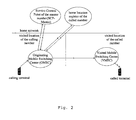
- the signaling flow of the present example is shown in Figure 2 , and includes the following steps as seen from Figure 2 .
- a subscriber M of the multi-numbers per sim card service intends to call a subscriber A by using the identity of the slave number S.
- the identification information corresponding to the slave number S is added in front of the called number A, and/or in other positions of the called number A.
- the Originating Mobile Services Switching Center triggers the intelligent service on the Service Control Point to which the Master number homes (SCP-Master) according to the Originating CAMEL Subscription Information (O-CSI).
- the intelligent service on the SCP-Master retrieves, from the one-to-one correspondence relationship between the multiple numbers and the identification information stored in the SCP-Master, the slave number S corresponding to the identification information carried in the called number A, and hereby determines that the present call is initiated by using the identity of the slave number S.
- the calling number is changed from the master number M to the slave number S, and meanwhile the identification information in the called number is removed.
- the OMSC sends the Sending Routing Information (SRI) to the Home Location Register (HLR) to which the called subscriber A homes to query the roaming number of the called A.
- SRI Sending Routing Information
- HLR Home Location Register
- the HLR to which the called subscriber A homes returns the roaming number of the called subscriber A to OMSC.
- the OMSC performs connection to the Visited Mobile Service Switching Center (VMSC) according to the acquired roaming number of the called subscriber A.
- VMSC Visited Mobile Service Switching Center
- the slave number S will be displayed as the calling number on the terminal of the called subscriber.
- a slave number is used as a calling number to send a short message to the opposite side.
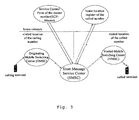
- the signaling flow of the present embodiment is as shown in Figure 3 , and includes the following steps as can be seen in Figure 2 .
- a subscriber M of the multi-numbers per sim card service intends to send a short message to a subscriber A by using the identity of the slave number S.
- the identification information corresponding to slave number S is added in front of the destination number A, and/or in other positions of the destination number A.
- the Originating Mobile Services Switching Center sends the short message request of the subscriber M to the Short Message Service Center (SMSC) for processing.
- the SMSC finds that the called subscriber M is an intelligent subscriber, and then it triggers the intelligent service on the SCP-Master.
- the intelligent service on the SCP-Master finds that the destination number A carries the identification information after the intelligent service analyzes the sent request.
- the intelligent service on the SCP-Master retrieves, from the one-to-one correspondence relationship between the multiple numbers and the identification information stored in the SCP-Master, the slave number S corresponding to the carried identification information, and hereby determines that the present service request is initiated by using the identity of the slave number S.
- the calling number in the signaling parameters is changed from the master number M to the slave number S, and the identification information in the called number A is removed.
- the SMSC sends the Sending Routing Information-Short Message (SRI-SM) to the HLR to which the called number A homes, so as to acquire the current routing information of the called number A.
- SRI-SM Sending Routing Information-Short Message
- the HLR to which the called number A homes feeds back the current routing information of the called number A to the SMSC after a query.
- the SMSC sends, according to the routing information, the short message to the VMSC of the currently visited location of the called number A for processing.
- the VMSC sends the short message to the called subscriber A after the VMSC has processed the short message.
- the slave number S will be displayed as the calling number on the terminal of the called subscriber A.
- a subscriber M of the multi-numbers per sim card service intends to send a short message to a subscriber A by using the identity of the slave number S.
- the identification information corresponding to slave number S is added in front of the destination number A, and/or in other positions of the destination number A.
- the Originating Mobile Services Switching Center triggers the intelligent service on the SCP-Master according to a Mobile Originating-Short Message Service-CAMEL Subscription Information (MO-SMS-CSI) stored in the Visited Location Register (VLR).
- MO-SMS-CSI Mobile Originating-Short Message Service-CAMEL Subscription Information
- the intelligent service on the SCP-Master analyzes the sent request and finds that the destination number A carries the identification information.
- the intelligent service on the SCP-Master retrieves, from the one-to-one correspondence relationship between the multiple numbers and the identification information stored in the SCP-Master, the slave number S corresponding to the carried identification information, and hereby determines that the present service request is initiated by using the identity of the slave number S.
- the calling number in the signaling parameters is changed from the master number M to the slave number S, and the identification information in the called number A is removed.
- the OMSC submits the short message to the SMSC for sending after the OMSC has received the short message connection instruction dispatched by the SCP-Master.
- the SMSC sends a Sending Routing Information-Short Message (SRI-SM) to the HLR to which the called number A homes, so as to acquire the current routing information of the called number A.
- SRI-SM Sending Routing Information-Short Message
- the HLR to which the called number A homes feeds back the current routing information of the called number A to the SMSC after a query.
- the VMSC sends, according to the routing information, the short message to the VMSC of the currently visited location of the called number A for processing.
- the VMSC sends the short message to the called subscriber A.
- the slave number S will be displayed as the calling number on the terminal of the called subscriber A.
- a slave number is used as a calling number to send a value-added short message to the opposite side.
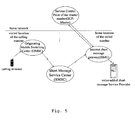
- the signaling flow of the present embodiment is as shown in Figure 5 , and includes the following steps as can be seen from Figure 5 .
- a subscriber M of the multi-numbers per sim card service intends to send a value-added short message to the value-added short message Service Provider (SP) by using the identity of the slave number S.
- SP value-added short message Service Provider
- the identification information corresponding to the slave number S is added in front of the destination number, and/or in other positions of the destination number.
- the Originating Mobile Services Switching Center sends the value-added short message request of the subscriber to the SMSC for processing.
- the SMSC analyzes the destination number in the value-added short message request and finds it is a value-added short message request, and then the SMSC submits the value-added short message request to the Internet Short Message Gateway (ISMG) for processing.
- ISMG Internet Short Message Gateway
- the ISMG performs analysis and finds that the calling subscriber M is an intelligent subscriber, and then the ISMG triggers the intelligent service on the SCP-Master.
- the intelligent service on the SCP-Master finds that the destination number SP carries the identification information, retrieves, from the one-to-one correspondence relationship between the multiple numbers and the identification information stored in the SCP-Master, the slave number S corresponding to the identification information, and hereby determines that the present service request is initiated by using the identity of the slave number S.
- the calling number in the signaling parameters is changed from the master number M to the slave number S, and the identification information in the called number SP is removed.
- the ISMG performs routing process for the value-added short message according to the connection instruction dispatched by the SCP-Master, and then sends the value-added short message to the assigned SP.
- the SP receives the value-added short message with the salve number S being displayed as the calling number in the short message.
- a subscriber M of the multi-number numbers per card service intends to send a value-added short message to the value-added short message service SP by using the identity of the slave number S.
- the identification information corresponding to slave number S is added in front of the destination number SP, and/or in other positions of the destination number SP.
- the OMSC triggers the intelligent service on the SCP-Master according to the MO-SMS-CSI stored in the VLR.
- the intelligent service on the SCP-Master finds that the destination number SP carries identification information, retrieves, from the one-to-one correspondence relationship between the multiple numbers and the identification information stored in the SCP-Master, the slave number S corresponding to the identification information, and hereby determines that the present service request is initiated by using the identification of slave number S.
- the calling number in the signaling parameters is changed from the master number M to the slave number S, and the identification information in the called number SP is removed.
- the OMSC submits the value-added short message to the SMSC for sending process after the OMSC has received the connection instruction dispatched by the SCP-Master.
- the SMSC finds, from the destination number SP, that this is a value-added short message, and directly submits the value-added short message to the ISMG for routing and sending processes.
- the ISMG routes and sends the value-added short message to the assigned SP.
- the SP receives the value-added short message with the salve number S being displayed as the calling number in the short message.
- a slave number is used as a calling number to send an intranet connection short message to the opposite side.
- the signaling flow of the present embodiment is as shown in Figure 7 , and includes the following steps as can be seen from Figure 7 .
- a subscriber M of the multi-numbers per sim card service intends to send an intra-net connection short message to another network subscriber A by using the identity of the slave number S.
- the identification information corresponding to slave number S is added in front of the destination number A, and/or in other positions of the destination number A.
- the Originating Mobile Services Switching Center sends the intra-net connection short message request of the subscriber to the SMSC for processing.
- the SMSC analyzes the destination number A and finds it is an intra-net connection short message request, and then the SMSC submits the short message request to the ISMG for processing.
- the ISMG performs analysis and finds that the called subscriber M is an intelligent subscriber, and then the ISMG triggers the intelligent service on the SCP-Master.
- the intelligent service on the SCP-Master finds that the destination number A carries the identification information, retrieves, from the one-to-one correspondence relationship between the multiple numbers and the identification information stored in the SCP-Master, the slave number S corresponding to the identification information, and hereby determines that the present service request is initiated by using the identity of the slave number S.
- the calling number in the signaling parameters is changed from the master number M to the slave number S, and the identification information in the called number A is removed.
- the ISMG performs routing process on the intra-net connection short message according to the connection instruction dispatched by the SCP-Master, and sends the intra-net connection short message to an Interconnect Gateway of an external network. Finally, the short message is sent to the terminal of the called subscriber A with the slave number S being displayed as the calling number.
- a slave number is used as a calling number to send a multimedia message to the opposite side.
- the signaling flow of the present embodiment is as shown in Figure 8 , and includes the following steps as can be seen from Figure 8 .
- a subscriber of the multi-numbers per sim card service M intends to send a multimedia message to a subscriber A by using the identity of the slave number S.
- the identification information corresponding to the slave number S is added in front of the destination number A, and/or in other positions of the destination number A.
- the Wireless Application Protocol-Gateway sends the multimedia message request sent by the subscriber to the source Multimedia Messaging Service Center (MMSC) for processing.
- MMSC Multimedia Messaging Service Center
- the source MMSC performs analysis and finds that the calling subscriber M is an intelligent subscriber, and then triggers the intelligent service on the SCP-Master.
- the intelligent service on the SCP-Master finds that the destination number carries the identification information, retrieves, from the one-to-one correspondence relationship between the multiple numbers and the identification information stored in the SCP-Master, the slave number S corresponding to the identification information, and hereby determines that the present service request is initiated by using the identification of the slave number S.
- the calling number in the signaling parameters is changed from the master number M to the slave number S, and the identification information in the called number A is removed.
- the source MMSC sends, according to the connection instruction dispatched by the SCP-Master, the multimedia message to the destination MMSC for processing.
- the destination MMSC instructs the SMSC to send a notification message to the called subscriber A after the destination MMSC has received the multimedia message.
- the SMSC sends the notification message to the called subscriber A, so as to inform the subscriber A that there is a multimedia message to be received.
- the called subscriber A downloads the multimedia message from the destination MMSC through the WAP-GW.
- the slave number S is displayed as the calling number on the terminal of the subscriber A after the completion of the download.
- the present invention includes setting identification information uniquely corresponding to each one of the multiple numbers which are bound to the terminal respectively, storing the one-to-one correspondence relationship between the multiple numbers and the identification information in the Service Control Point (SCP).
- SCP Service Control Point
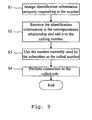
- the SCP receives a service request, it resolves the called number according to the correspondence relationship and carries the identification information corresponding to the called number in the calling number; thereafter, the number currently used by the subscriber is used as the called number to perform the connection to the called side.
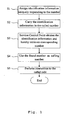
- the process flow of the present method is shown in Figure 9 .
- the system Before the process flow of responding to a service request, the system first assigns identification information uniquely corresponding to each one of the multiple numbers that a terminal corresponds to, respectively, and stores the one-to-one correspondence relationship between the multiple numbers and the identification information in the SCP.
- the implementation of the present method is described as follows with voice call service, short message service, value-added short message service, multimedia message service and intra-net connection short message service as examples respectively.
- the method of the present invention includes, but not limited to, the following embodiments.
- a slave number is used as a called number to respond to voice call service initiated by the opposite side.
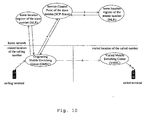
- the signaling flow of the present embodiment is as shown in Figure 10 , and includes the following steps as can be seen from Figure 10 .
- the calling subscriber A initiates a call to the slave number S of a subscriber of the multi-numbers per sim card service, i.e. the called number that is dialed is the slave number S.
- the Originating Mobile Services Switching Center sends a Sending Routing Information (SRI) to the Home Location Register of the slave number S (HLR-Slave) to acquire the roaming number of the slave number S.
- SRI Sending Routing Information
- HLR-Slave performs corresponding processes and feeds back a Terminating -CAMEL Subscription Information (T-CSI) to the OMSC.
- T-CSI Terminating -CAMEL Subscription Information
- the OMSC triggers the intelligent service on the Service Control Point to which the slave number S homes (SCP-Slave) according to the T-SCI.
- the intelligent service on the SCP-Slave retrieves, according to the one-to-one correspondence relationship between the multiple numbers and the identification information stored in the SCP-Slave, the identification information corresponding to the slave number S, and determines that the current online number of the multiple numbers bound to the called terminal is the master number M. Thereafter the SCP-Slave sends the SRI to the Home Location Register of the master number M (HLR-Master) to acquire the roaming number of the master number M.
- HLR-Master Home Location Register of the master number M
- the HLR-Master performs corresponding processes and feeds back the current roaming number of the master number M to the SCP-Slave.
- the called number is changed from the slave number S to the current roaming number of the master number M in the call connection instruction which is dispatched to OMSC by the SCP-Slave, and the retrieved identification information is added in the calling number to indicate that the present calling is initiated to the slave number S.
- the OMSC After having received the call connection instruction sent from the SCP-Slave, the OMSC performs connection to the Visited Mobile Switching center (VMSC) of the currently visited location of the master number M according to the roaming number of the master number M in the message.
- VMSC Visited Mobile Switching center
- the calling number added with the identification information corresponding to the slave number S is displayed on the terminal of the called subscriber M after the connection has been completed.
- the slave number S itself never really roams and updates its location, and the address of the Visited MSC (i.e. the VMSC) of the slave number S is set initially as the address of the SCP to which the master number M homes (i.e. the SCP-Master) in the HLR of the slave number S (HLR-Slave), and therefore the initially set content in the HLR-Slave keeps unchanged.
- the signaling flow chart of the process includes the following steps, as can be seen from Figure 11 .
- the calling subscriber A initiates a call to the slave number S of a subscriber of the multi-numbers per sim card service, i.e. the called number that is dialed is the slave number S.
- the Originating Mobile Services Switching Center sends the Sending Routing Information (SRI) to the HLR-Slave to acquire the roaming number of the slave number S.
- SRI Sending Routing Information
- the HLR-Slave performs corresponding processes and feeds back the T-CSI to the OMSC.
- the OMSC triggers the intelligent service on the SCP-Slave according to the T-SCI.
- the intelligent service on the SCP-Slave retrieves, according to the one-to-one correspondence relationship between the multiple numbers and the identification information stored in the SCP-Slave, the identification information corresponding to the slave number S, and determines that the current online number of the multiple numbers bound to the called terminal is the master number M.
- the called number the slave number S
- the calling number is added with the retrieved identification information to indicate that the present call is initiated to the slave number S.
- the OMSC processes the call according to the call connection instruction dispatched by the SCP-Slave, and sends the SRI request to the HLR-Slave to acquire the current roaming number of the slave number.
- the HLR-Slave sends, according to the registered address information of the Visited Mobile Switching Center (VMSC), a Providing Roaming Number message (PRN) to the Service Control Point to which the master number homes (SCP-Master) to acquire information about the currently visited location of the slave number S.
- VMSC Visited Mobile Switching Center
- PRN Providing Roaming Number message
- SCP-Master master number homes
- the SCP-Master before responding to the PRN message sent by the HLR-Slave in the last step, the SCP-Master first sends the SRI to the HLR-Master to acquire the current roaming number of the master number M.
- the HLR-Master feeds back the current roaming number of the master number M to the SCP-Master.
- the SCP-Master feeds back the acquired current roaming number of the master number M to the HLR-Slave as the current roaming information of the slave number S.
- the HLR-Slave feeds back the acquired current roaming information of the slave number S (i.e. the current roaming number of the master number M) to the OMSC.
- the OMSC performs connection to the current Visited Mobile Switching Center of the master number M according to the roaming number of the master number M in the information.
- the calling number added with the identification information corresponding to the slave number S is displayed on the terminal of the called subscriber M after the connection has succeeded.
- a slave number is used as the called number to receive a short message sent from the opposite side.
- the signaling flow of the present embodiment is as shown in Figure 12 , and includes the following steps as can be seen from Figure 12 .
- the calling subscriber A sends a short message to the slave number S of a subscriber of the multi-numbers per sim card service, i.e. the destination number is the slave number S.
- the Originating Mobile Services Switching Center submits the short message to the Short Message Service Center (SMSC) for short message sending process.
- OMSC Originating Mobile Services Switching Center
- SMSC Short Message Service Center
- the SMSC performs analysis and finds that the called number S is an intelligent subscriber, and then the SMSC triggers the intelligent service on the SCP-Slave for processing.
- the intelligent service on the SCP-Slave retrieves, from the one-to-one correspondence relationship between the multiple numbers and the identification information stored in the SCP-Slave, the identification information corresponding to the destination number (the slave number S), and determines that the current online number of the multiple numbers which are bound to the called terminal is the master number M.
- the connection instruction which is dispatched to the OMSC by the SCP-Slave the called number is changed from the slave number S to the master number M, and the retrieved identification information is added in the calling number in order to indicate that the present calling is initiated to the slave number S.
- the SMSC sends, according to the connection instruction dispatched by the SCP-Slave, a Sending Routing Information for Short Message (SRI-SM) to the HLR-Master to acquire the current routing information of the called master number M.
- SRI-SM Sending Routing Information for Short Message
- HLR-Master performs processing and feeds back the routing information of the master number M to the SMSC.
- the SMSC sends, according to the routing information, the short message to the VMSC of the currently visited location of the master number M for processing.
- the VMSC sends the short message to the called subscriber M after the processing.
- the calling number added with the identification information corresponding to the slave number S is displayed on the terminal of the called subscriber M.
- the slave number S itself never really roams or updates its location, and the address of the Visited MSC (i.e. VMSC) of the slave number S is initially set as the address of the SCP to which the master number M homes (i.e. the SCP-Master) in the HLR of the slave number S (HLR-Slave), and therefore the initially set content in the HLR-Slave keeps unchanged.
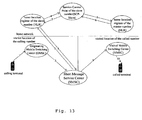
- the signaling flow chart of the process includes the following steps, as can be seen from Figure 13 .
- the calling subscriber A sends a short message to the slave number S of a subscriber of the multi-numbers per sim card service, i.e. the destination number is the slave number S.
- the OMSC submits the short message to the SMSC for sending process.
- the SMSC sends a Sending Routing Information-Short Message (SRI-SM) to the HLR-Slave to acquire the current routing information of the called number S.
- SRI-SM Sending Routing Information-Short Message
- the HLR-Slave sends, according to the registered address information of the VMSC, a Providing Roaming Number message (PRN) to the SCP-Master to obtain information about the currently visited location of the slave number S.
- PRN Providing Roaming Number message
- the intelligent service on the SCP-Master is triggered simultaneously.
- the intelligent service on the SCP-Slave retrieves, according to the one-to-one correspondence relationship between the multiple numbers and the identification information stored in the SCP-Slave, the identification information corresponding to the called number (the slave number S), and determines that the current online number of the multiple numbers which are bound to the called terminal is the master number M.
- the called number keeps unchanged, and the calling number is added with the retrieved identification information to indicate that the present service is initiated to the slave number S.
- the SCP-Master sends a SRI to the HLR-Master to acquire the current roaming number of the master number M.
- the HLR-Master performs processing and feeds back the current roaming number of the master number M to the SCP-Master.
- the SCP-Master feeds back the acquired current roaming number of the master number M to the HLR-Slave as the current roaming information of the slave number S.
- the HLR-Slave feeds back the acquired current roaming information of the slave number S, i.e. the current roaming number of the master number M, to the SMSC.
- the OMSC sends, according to the routing information, i.e. the current roaming number of the master number M, the short message to the VMSC of the currently Visited Location of the master number M for processing.
- the routing information i.e. the current roaming number of the master number M
- the VMSC of the currently Visited Location of the master number M sends the short message to the subscriber M, and the calling number added with the identification information corresponding to the slave number S will be displayed on the terminal of the called subscriber M.
- a slave number is used as a called number to receive a value-added short message sent from the opposite side.
- the signaling flow of the present embodiment includes the following steps, as can be seen in Figure 14 .
- the value-added short message Service Provider sends a value-added short message to the slave number S of a subscriber of the multi-numbers per sim card service, i.e. the destination number is the slave number S.
- the ISMG performs analysis and finds that the called number S is an intelligent subscriber, and then the ISMG triggers the intelligent service on the SCP-Slave for processing.
- the intelligent service on the SCP-Slave retrieves, from the one-to-one correspondence relationship between the multiple numbers and the identification information stored in the SCP-Slave, the identification information corresponding to the slave number S, and determines that the current online number of the multiple numbers which are bound to the called terminal is the master number M.
- the called number is changed from the slave number S to the master number M, and the calling number is added with the retrieved identification information to indicate that the present service request is initiated to the slave number S.
- the ISMG sends, according to the connection instruction dispatched by the SCP-Slave, the value-added short message to the SMSC for processing.
- the SMSC receives the current called number M, and sends a Sending Routing Information-Short Message (SRI-SM) to the HLR-M to obtain the current routing information of the master number M.
- SRI-SM Sending Routing Information-Short Message
- the HLR-M performs processing and feeds back the routing information to the SMSC.
- the SMSC sends, according to the routing information, the value-added short message to the VMSC of the currently visited location of the master number M for processing.
- the VMSC sends the value-added short message to the called subscriber M, and the calling number added with the identification information corresponding to the slave number S will be displayed on the terminal of the called subscriber M.
- a slave number is used as a called number to receive an intra-net connection short message from the opposite side.
- the signaling flow of the present embodiment includes the following steps, as can be seen in Figure 15 .
- a subscriber A of an external network sends an intranet connection short message to the slave number S of a subscriber of the multi-numbers per sim card service, i.e. the destination number is the slave number S.
- the intra-net connection short message request is sent to the Internet Short Message Gateway (ISMG) for processing.
- ISMG Internet Short Message Gateway
- the ISMG performs analysis and finds that the called number S is an intelligent subscriber, and then the ISMG triggers the intelligent service on the SCP-Slave for processing.
- the intelligent service on the SCP-Slave retrieves, from the one-to-one correspondence relationship between the multiple numbers and the identification information stored in the SCP-Slave, the identification information corresponding to the slave number S, and determines that the current online number of the multiple numbers which are bound to the called terminal is the master number M.
- the called number is changed from the slave number S to the master number M, and the calling number is added with the retrieved identification information to indicate that the present call is directed to the slave number S.
- the ISMG sends, according to the connection instruction dispatched by the SCP-Slave, the intra-net connection short message to the SMSC for processing.
- the SMSC obtains the current called number M from the intra-net connection short message, and sends a Sending Routing Information-Short Message(SRI-SM)to the HLR-M to obtain the current routing information of the master number M.
- SRI-SM Sending Routing Information-Short Message
- the HLR-M performs processing and feeds back the routing information to the SMSC.
- the SMSC sends, according to the routing information, the intra-net connection short message to the VMSC of the currently visited location of the master number M for processing.
- the VMSC sends the intra-net connection short message to the called subscriber M, and the calling number added with the identification information corresponding to the slave number S will be displayed on the terminal of the called subscriber M.
- a slave number is used as a called number to receive a Multimedia Message Service sent from the opposite side.
- the signaling flow of the present embodiment includes the following steps, as shown in Figure 16 .
- a subscriber A sends the Multimedia Message Service (MMS) to the slave number S of a subscriber of the multi-numbers per sim card service, i.e. the destination number is the slave number S.
- MMS Multimedia Message Service
- the MMS request message is sent to the source Multimedia Messaging Service Center (MMSC) for processing through a Wireless Application Protocol-Gateway (WAP-GW).
- MMSC Multimedia Messaging Service Center
- WAP-GW Wireless Application Protocol-Gateway
- the source MMSC sends the MMS short message to the destination MMSC according to the called number S.
- the destination MMSC performs analysis and finds that the called number S is an intelligent subscriber, and then the destination MMSC triggers the intelligent service on the SCP-Slave for processing.
- the intelligent service on the SCP-Slave retrieves, from the one-to-one correspondence relationship between the multiple numbers and the identification information stored in the SCP-Slave, the identification information corresponding to the destination number (the slave number S), and determines that the current online number of the multiple numbers which are bound to the called terminal is the master number M.
- the called number is changed from the slave number S to the master number M, and the calling number is added with the retrieved identification information to indicate that the present call is initiated to the slave number S.
- the destination MMSC instructs the SMSC to send a notification short message to the called subscriber M.
- the SMSC forwards the notification short message to the called subscriber M to notify the subscriber that there is an MMS short message to be received.
- the called subscriber M downloads the MMS short message from the destination MMSC through the Wireless Application Protocol-Gateway (WAP-GW).
- WAP-GW Wireless Application Protocol-Gateway
Landscapes
- Engineering & Computer Science (AREA)
- Signal Processing (AREA)
- Mobile Radio Communication Systems (AREA)
- Telephonic Communication Services (AREA)
- Coupling Device And Connection With Printed Circuit (AREA)
Claims (8)
- Verfahren zur Realisierung eines Dienstes mit mehreren Nummern pro Sim-Karte, mit den folgenden Schritten:Zuweisen (S1) von Identifikationsinformationen für jede der mehreren Nummern eines Endgeräts, die eindeutig jeder der mehreren Nummern entsprechen, um eine eindeutige Korrespondenzbeziehung zwischen jeder der mehreren Nummern und den Identifikationsinformationen zu bilden;
wobei die Korrespondenzbeziehung in einem Service-Control-Point gespeichert wird, die einer Nummer, die ein anrufender Teilnehmer verwenden möchte, entsprechenden Identifikationsinformationen in Informationen einer Dienstanforderung geführt (S2) werden, wenn das Endgerät die Dienstanforderung einleitet;Erhalten (S3) der Identifikationsinformationen durch den Service-Control-Point gemäß der empfangenen Dienstanforderung und Abrufen (S3) einer entsprechenden Nummer mit den Identifikationsinformationen durch den Service-Control-Point; und Durchführen (S4, S5) einer Verbindung zu der angerufenen Seite unten Verwendung der abgerufenen Nummer als eine anrufende Nummer. - Verfahren nach Anspruch 1, wobei die in der angerufenen Nummer geführten Identifikationsinformationen zuerst entfernt werden, bevor die Verbindung zu der angerufenen Seite durchgeführt wird.
- Verfahren nach Anspruch 2, wobei die anrufende Nummer von der Nummer, die die Dienstanforderung einleitet, zu der entsprechenden Nummer gewechselt wird, bevor die Verbindung zu der angerufenen Seite durchgeführt wird.
- Verfahren nach Anspruch 3, wobei die durch das Endgerät eingeleitete Dienstanforderung eine beliebige aus der folgenden Gruppe ausgewählte umfasst:eine Anforderung einer Sprachverbindung, eine Anforderung zum Senden einer Kurznachricht, eine Anforderung zum Senden einer Mehrwert-Kurznachricht, eine Anforderung zum Senden einer Multimedia-Nachricht und eine Anforderung zum Senden einer Intranet-Verbindungs-Kurznachricht.
- Verfahren zum Implementieren eines Dienstes mit mehreren Nummern pro Sim-Karte, mit den folgenden Schritten: Zuweisen (S1) von Identifikationsinformationen, die eindeutig jeder der mehreren Nummern entsprechen, für jede der mehreren Nummern eines angerufenen Endgeräts, um eine eindeutige Korrespondenzbeziehung zwischen jeder der mehreren Nummern und den Identifikationsinformationen zu bilden, wobei die Korrespondenzbeziehung in einem Service-Control-Point gespeichert wird;
Abrufen (S2) einer gerade durch das angerufene Endgerät aktivierten Nummer durch den Service-Control-Point gemäß einer angerufenen Nummer und der Korrespondenzbeziehung nach dem Empfang einer Dienstanforderung;
Durchführen (S3, S4) der Verbindung zu einer angerufenen Seite durch den Service-Control-Point unter Verwendung der gerade aktivierten Nummer als die angerufene Nummer. - Verfahren nach Anspruch 5, wobei entsprechende Identifikationsinformationen gemäß der angerufenen Nummer abgerufen werden und die entsprechenden Identifikationsinformationen zu einer angerufenen Nummer hinzugefügt werden, um so die mit den Identifikationsinformationen hinzugefügte anrufende Nummer auf dem angerufenen Endgerät nach der Herstellung der Verbindung anzuzeigen, um dadurch die der derzeitigen Dienstanforderung entsprechenden ursprüngliche angerufene Nummer anzugeben.
- Verfahren nach Anspruch 6, wobei die angerufene Nummer von der Nummer, zu der die anrufende Seite beim Einleiten der Dienstanforderung weiterschaltet, zu der gerade von der angerufenen Seite verwendeten Nummer gewechselt wird, bevor die Verbindung zu der angerufenen Seite durchgeführt wird.
- Verfahren nach Anspruch 7, wobei die durch das Endgerät eingeleitete Dienstanforderung eine beliebige aus der folgenden Gruppe ausgewählte umfasst:eine Sprachverbindung, eine Kurznachricht, eine Mehrwert-Kurznachricht, eine Multimedia-Nachricht und eine Intranet-Verbindungs-Kurznachricht.
Applications Claiming Priority (2)
| Application Number | Priority Date | Filing Date | Title |
|---|---|---|---|
| CNA2005101035070A CN1852453A (zh) | 2005-09-19 | 2005-09-19 | 一种一卡多号业务呼出及呼入的方法 |
| PCT/CN2006/001398 WO2007033546A1 (en) | 2005-09-19 | 2006-06-20 | Method for realizing one card with multiple numbers service |
Publications (3)
| Publication Number | Publication Date |
|---|---|
| EP1887824A1 EP1887824A1 (de) | 2008-02-13 |
| EP1887824A4 EP1887824A4 (de) | 2008-12-31 |
| EP1887824B1 true EP1887824B1 (de) | 2010-01-20 |
Family
ID=37133918
Family Applications (1)
| Application Number | Title | Priority Date | Filing Date |
|---|---|---|---|
| EP06742195A Ceased EP1887824B1 (de) | 2005-09-19 | 2006-06-20 | Verfahren zur realisierung einer karte mit mehreren nummerndiensten |
Country Status (6)
| Country | Link |
|---|---|
| US (1) | US20100062807A1 (de) |
| EP (1) | EP1887824B1 (de) |
| CN (2) | CN1852453A (de) |
| AT (1) | ATE456267T1 (de) |
| DE (1) | DE602006011882D1 (de) |
| WO (1) | WO2007033546A1 (de) |
Families Citing this family (21)
| Publication number | Priority date | Publication date | Assignee | Title |
|---|---|---|---|---|
| CN1997222B (zh) * | 2006-12-31 | 2012-01-04 | 华为技术有限公司 | 一卡多号的实现方法及其系统 |
| WO2009022978A1 (en) * | 2007-08-16 | 2009-02-19 | Telefonaktiebolaget L M Ericsson (Publ) | A device and a method for multiple numbers for one user |
| CN101400023A (zh) * | 2007-09-30 | 2009-04-01 | 华为技术有限公司 | 一种实现多媒体消息业务的方法及装置 |
| CN101163341B (zh) * | 2007-11-13 | 2010-08-18 | 华为技术有限公司 | 实现一卡多号的方法及其系统、号码管理装置 |
| CN101247651B (zh) * | 2008-03-06 | 2012-07-04 | 华为技术有限公司 | 一种呼叫流程处理方法和装置 |
| CN101534488B (zh) * | 2008-03-11 | 2011-12-14 | 中国移动通信集团公司 | 一卡多号语音业务实现方法及一卡多号语音业务管理设备 |
| JP4499166B2 (ja) * | 2008-03-25 | 2010-07-07 | 株式会社エヌ・ティ・ティ・ドコモ | 加入者識別符号通知装置 |
| CN101394450B (zh) * | 2008-04-09 | 2012-06-06 | 东方通信股份有限公司 | 实现对一机多号副号为基于scp的智能网实时计费方法与平台 |
| CN101291472B (zh) * | 2008-06-20 | 2012-02-29 | 中国移动通信集团湖北有限公司 | 涉及一机多号终端的短信收发方法及系统 |
| US20100182970A1 (en) * | 2009-01-21 | 2010-07-22 | Qualcomm Incorporated | Multiple Subscriptions Using a Single Air-Interface Resource |
| CN101552969B (zh) * | 2009-05-06 | 2011-11-30 | 中兴通讯股份有限公司 | 一号多机业务的实现方法及系统 |
| CN102035813B (zh) * | 2009-09-30 | 2016-01-20 | 中兴通讯股份有限公司 | 端到端呼叫的实现方法、端到端呼叫终端及系统 |
| CN102378101B (zh) * | 2010-08-23 | 2014-11-05 | 中国移动通信有限公司 | 一种实现一卡多号终端通信的方法、装置及通信终端 |
| US9444854B2 (en) * | 2010-09-07 | 2016-09-13 | T-Mobile Usa, Inc. | Session initiation protocol (SIP) router |
| WO2012080763A1 (en) * | 2010-12-14 | 2012-06-21 | Nokia Corporation | Communication apparatus and associated methods |
| CN102143447B (zh) * | 2010-12-31 | 2014-04-16 | 华为技术有限公司 | 一卡多号业务处理方法和系统及一卡多号平台 |
| CN105282721B (zh) * | 2014-07-18 | 2019-06-18 | 中国电信股份有限公司 | 一机多号业务中主叫号码的显示处理方法、系统和设备 |
| CN105307138A (zh) * | 2014-07-18 | 2016-02-03 | 中国电信股份有限公司 | 一机多号业务中被叫号码的识别方法和业务服务器 |
| CN104202460B (zh) * | 2014-09-19 | 2017-12-05 | 北京奇虎科技有限公司 | 基于副号码的呼叫电话的来电显示方法、客户端及系统 |
| CN104320547B (zh) * | 2014-11-24 | 2017-06-06 | 北京奇虎科技有限公司 | 基于副号码的呼叫电话的系统通讯录显示方法及系统 |
| CN108737670B (zh) * | 2018-05-22 | 2021-03-19 | 三星电子(中国)研发中心 | 在通信终端控制来电呼叫转移的方法和设备 |
Family Cites Families (7)
| Publication number | Priority date | Publication date | Assignee | Title |
|---|---|---|---|---|
| US5933785A (en) * | 1997-05-20 | 1999-08-03 | Motorola, Inc. | Telephone and method for concurrent registration of two identification numbers using multi-number sim card |
| KR100315338B1 (ko) * | 1998-10-01 | 2002-02-28 | 김덕우 | 복수의전화번호를사용하는무선전화시스템및무선전화기 |
| CN1214678C (zh) | 2002-08-16 | 2005-08-10 | 华为技术有限公司 | 一种在全球移动通信系统内实现一机多号的方法 |
| CN1265573C (zh) * | 2002-08-19 | 2006-07-19 | 华为技术有限公司 | 一种在码分多址系统内实现一机多号的方法 |
| CN1162031C (zh) * | 2002-11-08 | 2004-08-11 | 得实信息科技(北京)有限公司 | 移动电话用户“一卡多号”业务的实现方法 |
| CN100474954C (zh) * | 2003-01-29 | 2009-04-01 | 华为技术有限公司 | 一机多号业务的实现方法及通信网络 |
| CN100493240C (zh) * | 2004-01-05 | 2009-05-27 | 华为技术有限公司 | 一种一机多号用户收发短消息的方法 |
-
2005
- 2005-09-19 CN CNA2005101035070A patent/CN1852453A/zh active Pending
-
2006
- 2006-06-20 CN CNA2006800117818A patent/CN101156494A/zh active Pending
- 2006-06-20 WO PCT/CN2006/001398 patent/WO2007033546A1/zh not_active Ceased
- 2006-06-20 EP EP06742195A patent/EP1887824B1/de not_active Ceased
- 2006-06-20 DE DE602006011882T patent/DE602006011882D1/de not_active Expired - Lifetime
- 2006-06-20 AT AT06742195T patent/ATE456267T1/de not_active IP Right Cessation
- 2006-06-20 US US11/917,477 patent/US20100062807A1/en not_active Abandoned
Also Published As
| Publication number | Publication date |
|---|---|
| CN101156494A (zh) | 2008-04-02 |
| ATE456267T1 (de) | 2010-02-15 |
| DE602006011882D1 (de) | 2010-03-11 |
| US20100062807A1 (en) | 2010-03-11 |
| EP1887824A1 (de) | 2008-02-13 |
| WO2007033546A1 (en) | 2007-03-29 |
| CN1852453A (zh) | 2006-10-25 |
| EP1887824A4 (de) | 2008-12-31 |
Similar Documents
| Publication | Publication Date | Title |
|---|---|---|
| EP1887824A1 (de) | Verfahren zur realisierung einer karte mit mehreren nummerndiensten | |
| US6684072B1 (en) | Global wireless prepaid roaming | |
| US7890111B2 (en) | System and method for virtual wireless roaming | |
| US7493110B2 (en) | Missed call alerts | |
| US7221952B2 (en) | Method for processing address of short message service center in IMT-2000 asynchronous network | |
| CN101677474B (zh) | 一种实现一卡多号业务的方法、系统及装置 | |
| FI108193B (fi) | Menetelmä ja järjestelmä sanoman reitittämiseksi | |
| US8626145B2 (en) | Device based telecommunications initiated data fulfillment system | |
| US8060087B2 (en) | CDMA intelligent network system and its method, device for realizing international roaming service | |
| EP2153676A1 (de) | Verfahren zum weiterleiten von sms in einem mobilkommunikationssystem | |
| EP1989891B1 (de) | Dienststeuereinheit | |
| JP4599548B2 (ja) | ショートメッセージゲートウェイ | |
| CN100474954C (zh) | 一机多号业务的实现方法及通信网络 | |
| CN1214678C (zh) | 一种在全球移动通信系统内实现一机多号的方法 | |
| EP2144459A1 (de) | Verfahren und Netzwerkvorrichtung zur Umsetzung eines Kommunikationsdienstes | |
| CN1327732C (zh) | 一种实现移动号码可携带的方法 | |
| EP2547131A1 (de) | Routing eines Anrufs an UMA-fähige Geräte unter Verwendung einer geografischen Zahl | |
| US7257401B1 (en) | Messaging service for communications devices | |
| JP2005191880A (ja) | 相互接続契約判定システム、相互接続契約判定装置、及び、相互接続契約判定方法 | |
| CN101374345B (zh) | 一种主叫用户的无线虚拟专网vpn短号传递的方法、装置和系统 | |
| CN101304601B (zh) | 一种实现网间漫游的系统及用该系统实现网间漫游的方法 | |
| CN101340641B (zh) | 回呼业务的处理方法及装置 | |
| EP1807986B1 (de) | Aktivierung eines paketbasierten kommunikationsclients als mobiles endgerät | |
| CN102143454A (zh) | 实现多网络服务的方法、装置及系统 | |
| CN1838825B (zh) | 移动视频电话方法 |
Legal Events
| Date | Code | Title | Description |
|---|---|---|---|
| PUAI | Public reference made under article 153(3) epc to a published international application that has entered the european phase |
Free format text: ORIGINAL CODE: 0009012 |
|
| 17P | Request for examination filed |
Effective date: 20071217 |
|
| AK | Designated contracting states |
Kind code of ref document: A1 Designated state(s): AT BE BG CH CY CZ DE DK EE ES FI FR GB GR HU IE IS IT LI LT LU LV MC NL PL PT RO SE SI SK TR |
|
| DAX | Request for extension of the european patent (deleted) | ||
| A4 | Supplementary search report drawn up and despatched |
Effective date: 20081202 |
|
| 17Q | First examination report despatched |
Effective date: 20090617 |
|
| GRAP | Despatch of communication of intention to grant a patent |
Free format text: ORIGINAL CODE: EPIDOSNIGR1 |
|
| RIC1 | Information provided on ipc code assigned before grant |
Ipc: H04W 8/26 20090101AFI20090928BHEP Ipc: H04M 3/42 20060101ALI20090928BHEP |
|
| GRAS | Grant fee paid |
Free format text: ORIGINAL CODE: EPIDOSNIGR3 |
|
| GRAA | (expected) grant |
Free format text: ORIGINAL CODE: 0009210 |
|
| AK | Designated contracting states |
Kind code of ref document: B1 Designated state(s): AT BE BG CH CY CZ DE DK EE ES FI FR GB GR HU IE IS IT LI LT LU LV MC NL PL PT RO SE SI SK TR |
|
| REG | Reference to a national code |
Ref country code: GB Ref legal event code: FG4D |
|
| REG | Reference to a national code |
Ref country code: CH Ref legal event code: EP |
|
| REG | Reference to a national code |
Ref country code: IE Ref legal event code: FG4D |
|
| REF | Corresponds to: |
Ref document number: 602006011882 Country of ref document: DE Date of ref document: 20100311 Kind code of ref document: P |
|
| REG | Reference to a national code |
Ref country code: NL Ref legal event code: VDEP Effective date: 20100120 |
|
| LTIE | Lt: invalidation of european patent or patent extension |
Effective date: 20100120 |
|
| PG25 | Lapsed in a contracting state [announced via postgrant information from national office to epo] |
Ref country code: AT Free format text: LAPSE BECAUSE OF FAILURE TO SUBMIT A TRANSLATION OF THE DESCRIPTION OR TO PAY THE FEE WITHIN THE PRESCRIBED TIME-LIMIT Effective date: 20100120 |
|
| PG25 | Lapsed in a contracting state [announced via postgrant information from national office to epo] |
Ref country code: LT Free format text: LAPSE BECAUSE OF FAILURE TO SUBMIT A TRANSLATION OF THE DESCRIPTION OR TO PAY THE FEE WITHIN THE PRESCRIBED TIME-LIMIT Effective date: 20100120 Ref country code: ES Free format text: LAPSE BECAUSE OF FAILURE TO SUBMIT A TRANSLATION OF THE DESCRIPTION OR TO PAY THE FEE WITHIN THE PRESCRIBED TIME-LIMIT Effective date: 20100501 Ref country code: PT Free format text: LAPSE BECAUSE OF FAILURE TO SUBMIT A TRANSLATION OF THE DESCRIPTION OR TO PAY THE FEE WITHIN THE PRESCRIBED TIME-LIMIT Effective date: 20100520 Ref country code: IS Free format text: LAPSE BECAUSE OF FAILURE TO SUBMIT A TRANSLATION OF THE DESCRIPTION OR TO PAY THE FEE WITHIN THE PRESCRIBED TIME-LIMIT Effective date: 20100520 Ref country code: NL Free format text: LAPSE BECAUSE OF FAILURE TO SUBMIT A TRANSLATION OF THE DESCRIPTION OR TO PAY THE FEE WITHIN THE PRESCRIBED TIME-LIMIT Effective date: 20100120 |
|
| PG25 | Lapsed in a contracting state [announced via postgrant information from national office to epo] |
Ref country code: PL Free format text: LAPSE BECAUSE OF FAILURE TO SUBMIT A TRANSLATION OF THE DESCRIPTION OR TO PAY THE FEE WITHIN THE PRESCRIBED TIME-LIMIT Effective date: 20100120 Ref country code: SI Free format text: LAPSE BECAUSE OF FAILURE TO SUBMIT A TRANSLATION OF THE DESCRIPTION OR TO PAY THE FEE WITHIN THE PRESCRIBED TIME-LIMIT Effective date: 20100120 Ref country code: FI Free format text: LAPSE BECAUSE OF FAILURE TO SUBMIT A TRANSLATION OF THE DESCRIPTION OR TO PAY THE FEE WITHIN THE PRESCRIBED TIME-LIMIT Effective date: 20100120 Ref country code: LV Free format text: LAPSE BECAUSE OF FAILURE TO SUBMIT A TRANSLATION OF THE DESCRIPTION OR TO PAY THE FEE WITHIN THE PRESCRIBED TIME-LIMIT Effective date: 20100120 |
|
| PG25 | Lapsed in a contracting state [announced via postgrant information from national office to epo] |
Ref country code: SE Free format text: LAPSE BECAUSE OF FAILURE TO SUBMIT A TRANSLATION OF THE DESCRIPTION OR TO PAY THE FEE WITHIN THE PRESCRIBED TIME-LIMIT Effective date: 20100120 Ref country code: BE Free format text: LAPSE BECAUSE OF FAILURE TO SUBMIT A TRANSLATION OF THE DESCRIPTION OR TO PAY THE FEE WITHIN THE PRESCRIBED TIME-LIMIT Effective date: 20100120 Ref country code: CY Free format text: LAPSE BECAUSE OF FAILURE TO SUBMIT A TRANSLATION OF THE DESCRIPTION OR TO PAY THE FEE WITHIN THE PRESCRIBED TIME-LIMIT Effective date: 20100120 Ref country code: EE Free format text: LAPSE BECAUSE OF FAILURE TO SUBMIT A TRANSLATION OF THE DESCRIPTION OR TO PAY THE FEE WITHIN THE PRESCRIBED TIME-LIMIT Effective date: 20100120 Ref country code: GR Free format text: LAPSE BECAUSE OF FAILURE TO SUBMIT A TRANSLATION OF THE DESCRIPTION OR TO PAY THE FEE WITHIN THE PRESCRIBED TIME-LIMIT Effective date: 20100421 Ref country code: RO Free format text: LAPSE BECAUSE OF FAILURE TO SUBMIT A TRANSLATION OF THE DESCRIPTION OR TO PAY THE FEE WITHIN THE PRESCRIBED TIME-LIMIT Effective date: 20100120 |
|
| PLBI | Opposition filed |
Free format text: ORIGINAL CODE: 0009260 |
|
| PLAX | Notice of opposition and request to file observation + time limit sent |
Free format text: ORIGINAL CODE: EPIDOSNOBS2 |
|
| PG25 | Lapsed in a contracting state [announced via postgrant information from national office to epo] |
Ref country code: BG Free format text: LAPSE BECAUSE OF FAILURE TO SUBMIT A TRANSLATION OF THE DESCRIPTION OR TO PAY THE FEE WITHIN THE PRESCRIBED TIME-LIMIT Effective date: 20100420 Ref country code: CZ Free format text: LAPSE BECAUSE OF FAILURE TO SUBMIT A TRANSLATION OF THE DESCRIPTION OR TO PAY THE FEE WITHIN THE PRESCRIBED TIME-LIMIT Effective date: 20100120 Ref country code: SK Free format text: LAPSE BECAUSE OF FAILURE TO SUBMIT A TRANSLATION OF THE DESCRIPTION OR TO PAY THE FEE WITHIN THE PRESCRIBED TIME-LIMIT Effective date: 20100120 |
|
| 26 | Opposition filed |
Opponent name: TELEFONAKTIEBOLAGET L M ERICSSON (PUBL) Effective date: 20101020 |
|
| PG25 | Lapsed in a contracting state [announced via postgrant information from national office to epo] |
Ref country code: DK Free format text: LAPSE BECAUSE OF FAILURE TO SUBMIT A TRANSLATION OF THE DESCRIPTION OR TO PAY THE FEE WITHIN THE PRESCRIBED TIME-LIMIT Effective date: 20100120 Ref country code: MC Free format text: LAPSE BECAUSE OF NON-PAYMENT OF DUE FEES Effective date: 20100630 |
|
| REG | Reference to a national code |
Ref country code: CH Ref legal event code: PL |
|
| GBPC | Gb: european patent ceased through non-payment of renewal fee |
Effective date: 20100620 |
|
| PG25 | Lapsed in a contracting state [announced via postgrant information from national office to epo] |
Ref country code: IT Free format text: LAPSE BECAUSE OF FAILURE TO SUBMIT A TRANSLATION OF THE DESCRIPTION OR TO PAY THE FEE WITHIN THE PRESCRIBED TIME-LIMIT Effective date: 20100120 |
|
| PLAF | Information modified related to communication of a notice of opposition and request to file observations + time limit |
Free format text: ORIGINAL CODE: EPIDOSCOBS2 |
|
| PG25 | Lapsed in a contracting state [announced via postgrant information from national office to epo] |
Ref country code: CH Free format text: LAPSE BECAUSE OF NON-PAYMENT OF DUE FEES Effective date: 20100630 Ref country code: IE Free format text: LAPSE BECAUSE OF NON-PAYMENT OF DUE FEES Effective date: 20100620 Ref country code: LI Free format text: LAPSE BECAUSE OF NON-PAYMENT OF DUE FEES Effective date: 20100630 |
|
| PLBB | Reply of patent proprietor to notice(s) of opposition received |
Free format text: ORIGINAL CODE: EPIDOSNOBS3 |
|
| PLBP | Opposition withdrawn |
Free format text: ORIGINAL CODE: 0009264 |
|
| PG25 | Lapsed in a contracting state [announced via postgrant information from national office to epo] |
Ref country code: GB Free format text: LAPSE BECAUSE OF NON-PAYMENT OF DUE FEES Effective date: 20100620 |
|
| PLBD | Termination of opposition procedure: decision despatched |
Free format text: ORIGINAL CODE: EPIDOSNOPC1 |
|
| PLAM | Termination of opposition procedure: information related to despatch of decision modified |
Free format text: ORIGINAL CODE: EPIDOSCOPC1 |
|
| PLBM | Termination of opposition procedure: date of legal effect published |
Free format text: ORIGINAL CODE: 0009276 |
|
| STAA | Information on the status of an ep patent application or granted ep patent |
Free format text: STATUS: OPPOSITION PROCEDURE CLOSED |
|
| 27C | Opposition proceedings terminated |
Effective date: 20110820 |
|
| REG | Reference to a national code |
Ref country code: AT Ref legal event code: MK05 Ref document number: 456267 Country of ref document: AT Kind code of ref document: T Effective date: 20100120 |
|
| PG25 | Lapsed in a contracting state [announced via postgrant information from national office to epo] |
Ref country code: LU Free format text: LAPSE BECAUSE OF NON-PAYMENT OF DUE FEES Effective date: 20100620 Ref country code: HU Free format text: LAPSE BECAUSE OF FAILURE TO SUBMIT A TRANSLATION OF THE DESCRIPTION OR TO PAY THE FEE WITHIN THE PRESCRIBED TIME-LIMIT Effective date: 20100721 |
|
| PG25 | Lapsed in a contracting state [announced via postgrant information from national office to epo] |
Ref country code: TR Free format text: LAPSE BECAUSE OF FAILURE TO SUBMIT A TRANSLATION OF THE DESCRIPTION OR TO PAY THE FEE WITHIN THE PRESCRIBED TIME-LIMIT Effective date: 20100120 |
|
| REG | Reference to a national code |
Ref country code: FR Ref legal event code: PLFP Year of fee payment: 11 |
|
| REG | Reference to a national code |
Ref country code: FR Ref legal event code: PLFP Year of fee payment: 12 |
|
| REG | Reference to a national code |
Ref country code: FR Ref legal event code: PLFP Year of fee payment: 13 |
|
| PGFP | Annual fee paid to national office [announced via postgrant information from national office to epo] |
Ref country code: FR Payment date: 20220510 Year of fee payment: 17 Ref country code: DE Payment date: 20220505 Year of fee payment: 17 |
|
| REG | Reference to a national code |
Ref country code: DE Ref legal event code: R119 Ref document number: 602006011882 Country of ref document: DE |
|
| PG25 | Lapsed in a contracting state [announced via postgrant information from national office to epo] |
Ref country code: DE Free format text: LAPSE BECAUSE OF NON-PAYMENT OF DUE FEES Effective date: 20240103 |
|
| PG25 | Lapsed in a contracting state [announced via postgrant information from national office to epo] |
Ref country code: FR Free format text: LAPSE BECAUSE OF NON-PAYMENT OF DUE FEES Effective date: 20230630 |