EP1887217A2 - Ignition system for an internal combustion engine - Google Patents
Ignition system for an internal combustion engine Download PDFInfo
- Publication number
- EP1887217A2 EP1887217A2 EP06747762A EP06747762A EP1887217A2 EP 1887217 A2 EP1887217 A2 EP 1887217A2 EP 06747762 A EP06747762 A EP 06747762A EP 06747762 A EP06747762 A EP 06747762A EP 1887217 A2 EP1887217 A2 EP 1887217A2
- Authority
- EP
- European Patent Office
- Prior art keywords
- spark
- ignition
- discharge
- max
- ignition system
- Prior art date
- Legal status (The legal status is an assumption and is not a legal conclusion. Google has not performed a legal analysis and makes no representation as to the accuracy of the status listed.)
- Withdrawn
Links
- 238000002485 combustion reaction Methods 0.000 title abstract description 3
- 238000004804 winding Methods 0.000 claims abstract description 38
- 230000015556 catabolic process Effects 0.000 claims abstract description 7
- 230000003534 oscillatory effect Effects 0.000 claims abstract description 6
- 238000010891 electric arc Methods 0.000 claims abstract description 3
- XEEYBQQBJWHFJM-UHFFFAOYSA-N Iron Chemical compound [Fe] XEEYBQQBJWHFJM-UHFFFAOYSA-N 0.000 claims description 8
- 239000004020 conductor Substances 0.000 claims description 8
- 230000004907 flux Effects 0.000 claims description 4
- 229910052742 iron Inorganic materials 0.000 claims description 4
- 239000000463 material Substances 0.000 claims description 4
- 230000007423 decrease Effects 0.000 abstract description 5
- 238000010276 construction Methods 0.000 abstract description 3
- 239000003990 capacitor Substances 0.000 description 7
- 239000000203 mixture Substances 0.000 description 7
- 238000004519 manufacturing process Methods 0.000 description 5
- 101100129500 Caenorhabditis elegans max-2 gene Proteins 0.000 description 2
- 230000006378 damage Effects 0.000 description 2
- 230000000694 effects Effects 0.000 description 2
- 239000000446 fuel Substances 0.000 description 2
- 238000010438 heat treatment Methods 0.000 description 2
- 239000012212 insulator Substances 0.000 description 2
- 230000002528 anti-freeze Effects 0.000 description 1
- 238000005265 energy consumption Methods 0.000 description 1
- 230000003628 erosive effect Effects 0.000 description 1
- 230000007717 exclusion Effects 0.000 description 1
- 239000003517 fume Substances 0.000 description 1
- 230000006698 induction Effects 0.000 description 1
- 230000010355 oscillation Effects 0.000 description 1
- 230000000717 retained effect Effects 0.000 description 1
- 239000004071 soot Substances 0.000 description 1
- 125000006850 spacer group Chemical group 0.000 description 1
- 230000006641 stabilisation Effects 0.000 description 1
- 238000011105 stabilization Methods 0.000 description 1
- 239000003381 stabilizer Substances 0.000 description 1
- 230000001988 toxicity Effects 0.000 description 1
- 231100000419 toxicity Toxicity 0.000 description 1
- 230000009466 transformation Effects 0.000 description 1
- 230000007704 transition Effects 0.000 description 1
Images

Classifications
-
- F—MECHANICAL ENGINEERING; LIGHTING; HEATING; WEAPONS; BLASTING
- F02—COMBUSTION ENGINES; HOT-GAS OR COMBUSTION-PRODUCT ENGINE PLANTS
- F02P—IGNITION, OTHER THAN COMPRESSION IGNITION, FOR INTERNAL-COMBUSTION ENGINES; TESTING OF IGNITION TIMING IN COMPRESSION-IGNITION ENGINES
- F02P3/00—Other installations
- F02P3/02—Other installations having inductive energy storage, e.g. arrangements of induction coils
- F02P3/04—Layout of circuits
- F02P3/0407—Opening or closing the primary coil circuit with electronic switching means
- F02P3/0435—Opening or closing the primary coil circuit with electronic switching means with semiconductor devices
Definitions
- the invention relates to automobile construction, in particular to electronic ignition systems for internal-combustion engines (ICEs).
- ICEs internal-combustion engines
- the invention can be used in spark ignition systems for a more reliable operation of engines under conditions of low temperatures and/or high humidity, as well as for a not so high quality of the fuel-air mixture.
- a device which increases the plasma volume of a spark in the ignition plug ( RU Patent 2171909 , Int. class 7 F02P3/04, F02P3/08, published in 2001).
- This device contains a series LC circuit connected in parallel to the spark gap in close vicinity to the ignition plug to exclude the influence of a high-resistance wire of the secondary circuit of the ignition plug.
- this device increases the spark volume by a factor of 3 to 4 and enhances the ionizing and thermal effect.
- This known device solves the problem of the spark current increase, but additional elements are introduced into the scheme.
- the main drawback of such ignition system is high wave impedance ( ⁇ ⁇ 1M ⁇ ) of the oscillatory circuit formed by the secondary winding of the ignition coil, which is easy to shunt by the leakage impedance in the circuit.
- the required, time-controlled duration of a continuous discharge can be obtained by a relaxation-oscillatory system of electronic ignition of ICE ( RU Patent 2054575 , Int.class 7 F02P3/04, published in 1996).
- Two additional diodes are introduced into the ICE ignition system, whose primary circuit of the ignition coil contains a high-voltage thyristor-capacitor unit, a low-voltage booster unit, and a thyristor switch.
- the first diode is connected in parallel to the circuit of a thyristor and a capacitor and connects the thyristor anode and the booster unit.
- the second diode connects the middle point of the thyristor-capacitor circuit and the output of the primary winding of the ignition coil.
- the ignition system creates relaxation oscillations, which permits one to support a continuous discharge current the required time and to form a broad initial front of flame.
- the ignition system ensures effective burning of the fuel mixture and improves the fuel-consumption efficiency.
- a drawback of this system is the introduction of additional elements.
- the use of standard existing ignition coils precludes the solution of the problem of high wave impedance ⁇ of the oscillatory circuit of the secondary winding. This reduces reliability of operation and starting of the engine under unfavorable conditions due to shunting of the plug discharge gap by the leakage impedance.
- the largest number of common elements with the proposed ignition system is contained in the standard ignition system (see, e.g., S.V.Akimov and Yu.P.Chizhov, "Electrical equipment of automobiles," a manual for higher school, pp. 188-191, “Za Rulem,” 2001 ), which was chosen as the closest counterpart (a prototype).
- the prototype ignition system contains a power supply, a switch, an ignition coil consisting of the primary and secondary windings and a magnetic conductor, a spark gap, and also tanks and active resistances in the circuits of the primary and secondary windings.
- a drawback of the standard ignition system is its unreliable performance.
- the problem solved by the present invention is to increase the spark power and the reliability of spark producing of the ignition system due to exclusion of "overhead” losses by matching the magnitude of the wave impedance ⁇ of the circuit, formed by the inductance and capacitance as parts of the ignition system, and the spark-charge parameters, namely the breakdown voltage and the discharge current.
- the proposed ignition scheme contains an ignition coil, which consists of the primary and secondary windings and a magnetic conductor, and a spark gap included into the secondary-winding circuit of the ignition coil.
- the novelty of the developed ignition system is that the ignition coil is so designed that the wave impedance ⁇ of the oscillatory circuit, formed by the inductance and effective capacitance in the secondary winding, with allowance for the leakage currents, lies in the range 1.4 ⁇ U br I max ⁇ ⁇ ⁇ 4.5 ⁇ U br I max , where
- U br is the minimum value of the voltage in the discharge gap, for which the breakdown is guaranteed and I max is the maximum admissible current of a spark discharge.
- the maximum value of the discharge current is limited by the condition of transition of the high-voltage spark burning to the mode of a low-voltage plasma-arc discharge for which the main energy of the arc is spent not for heating of the fuel-air mixture, but for destruction of the plug electrodes.
- the windings of the ignition coils should be manufactured with increased magnetic stray flux, e.g., in the form of a wafer.
- the magnetic conductor of the ignition coil should be manufactured of a material with low specific losses, e.g., transformer iron rated for a frequency of 400 Hz.
- the ignition system contains power supply 1, active resistance 2, capacitor 3, and commutator 4, included into primary-winding circuit 5 of the ignition coil.
- the ignition coil also comprises a magnetic conductor, designed as magnetic core 6, and secondary winding 7, whose circuit contains self-inductance 8 of secondary winding 7, capacitance 9, calculated from the primary circuit, leakage impedance 10, and discharge gap 11 of the ignition plug.
- Power supply 1 is an electrical cell, and resistance 2 is the active resistance of the primary circuit.
- the ignition coil is so designed that the transformation coefficient K ⁇ 15-30.
- the maximum voltage in primary winding 5 of the ignition coil reaches 1000-1500 V, which increases the requirement to a choice of the element base for commutator 4.
- Magnetic core 6 of the ignition coil can be manufactured of a material with low specific losses, e.g., transformer iron rated for an operating frequency of 400 Hz.
- Secondary winding 7 can also be designed as a wafer.
- self-inductance 8 of secondary winding 7 limits the spark current and excludes losses in the capacitance phase of a discharge.
- the coil parameters are chosen the same as for an on-shelf ignition coil of industrial design.
- the inductance of primary winding 5 of the ignition coil amounts to L ⁇ 4 mH
- the coil current I ⁇ 6-8 A and the capacitance of capacitor 3, which shields the electronic switch (commutator 4) against voltage overload is C ⁇ 0.1 ⁇ F.
- the proposed ignition system is operated as follows.
- commutator 4 in primary winding 5 of the ignition coil is switched on, a current arises from power supply 1 through primary winding 5 of the coil and commutator 4.
- the current reaches the maximum admissible value, an energy sufficient for producing a spark discharge in the plug is accumulated in the coil.
- the current of primary winding 5 charges capacitor 3, inducting a high voltage in secondary winding 7.
- a breakdown occurs, and a current through secondary winding 7 of the coil is initiated.
- the ignition system with claimed properties was obtained for a constant energy consumption (constant maximum current of the ignition coil).
- the resulting system is less sensitive to leakage currents compared to the known counterparts since the magnitude of leakage impedance 10 is almost always greater than the wave impedance ⁇ of secondary-winding circuit 7 and cannot shunt it, which permits one to exclude "overhead” losses and thereby resolve the posed problem.
- Tests of the ignition system confirmed high stability of spark producing in the plugs, such that the plugs remained serviceable even after about 100 thousand kilometers.
- the presence of a soot deposit, petrol, and antifreeze on the plug insulator did not affect the stable operation of the engine.
- the developed ignition system of ICE is manufactured on the basis of a modern element base (components).
- the number of turns of the secondary-winding of the ignition coil amounted to ⁇ 2000, which should depress its self-cost in serial production since the usual number of turns lies in a range of 16 to 40 thousands.
- the developed ignition system of ICE is ready for mass production.
Landscapes
- Engineering & Computer Science (AREA)
- Chemical & Material Sciences (AREA)
- Combustion & Propulsion (AREA)
- Mechanical Engineering (AREA)
- General Engineering & Computer Science (AREA)
- Ignition Installations For Internal Combustion Engines (AREA)
Abstract

where Ubr is the minimum value of the voltage in the discharge gap, for which a breakdown is guaranteed, and Imax is the maximum admissible current of the spark discharge, for which a spark is not converted to a low-voltage arc discharge. The value of the wave impedance ρ in this range conforms to the parameters of the spark discharge (breakdown voltage and discharge current), which decreases undesirable energy losses in the ignition system and increases the spark power.
Description
- The invention relates to automobile construction, in particular to electronic ignition systems for internal-combustion engines (ICEs). The invention can be used in spark ignition systems for a more reliable operation of engines under conditions of low temperatures and/or high humidity, as well as for a not so high quality of the fuel-air mixture.
- A device is known which increases the plasma volume of a spark in the ignition plug (
RU Patent 2171909 - The required, time-controlled duration of a continuous discharge can be obtained by a relaxation-oscillatory system of electronic ignition of ICE (
RU Patent 2054575 - Starting engine under unfavorable conditions, especially in the winter time, is facilitated by using the spark ignition system of ICE, which is known from the RU Patent
RU 2107184 - The largest number of common elements with the proposed ignition system is contained in the standard ignition system (see, e.g., S.V.Akimov and Yu.P.Chizhov, "Electrical equipment of automobiles," a manual for higher school, pp. 188-191, "Za Rulem," 2001), which was chosen as the closest counterpart (a prototype). The prototype ignition system contains a power supply, a switch, an ignition coil consisting of the primary and secondary windings and a magnetic conductor, a spark gap, and also tanks and active resistances in the circuits of the primary and secondary windings. A drawback of the standard ignition system is its unreliable performance. Fume and moist on the plug insulator as well as dirt and condensate in the spark spacer and on the high-voltage wires lead to engine wobble or a complete failure of the ignition system. Such situations especially often arise when motor vehicles are exploited under low temperatures in winter.
- Analysis shows that in typical ignition systems, a considerable part of the energy stored in the ignition coil is lost when a high voltage is generated on the ignition plug and a discharge current flow in it. The main losses are due to the leakage currents in the high-voltage circuit. Besides, significant induction losses take place in the magnetic conductor of the coil and in the capacitance phase of a discharge.
- The problem solved by the present invention is to increase the spark power and the reliability of spark producing of the ignition system due to exclusion of "overhead" losses by matching the magnitude of the wave impedance ρ of the circuit, formed by the inductance and capacitance as parts of the ignition system, and the spark-charge parameters, namely the breakdown voltage and the discharge current.
- The technical result is reached by the fact that, as the prototype, the proposed ignition scheme contains an ignition coil, which consists of the primary and secondary windings and a magnetic conductor, and a spark gap included into the secondary-winding circuit of the ignition coil.
- The novelty of the developed ignition system is that the ignition coil is so designed that the wave impedance ρ of the oscillatory circuit, formed by the inductance and effective capacitance in the secondary winding, with allowance for the leakage currents, lies in the range
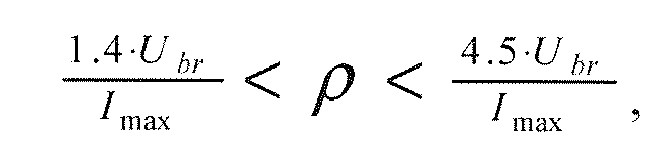
where - Ubr is the minimum value of the voltage in the discharge gap, for which the breakdown is guaranteed and Imax is the maximum admissible current of a spark discharge. The maximum value of the discharge current is limited by the condition of transition of the high-voltage spark burning to the mode of a low-voltage plasma-arc discharge for which the main energy of the arc is spent not for heating of the fuel-air mixture, but for destruction of the plug electrodes.
- In one particular case, it is reasonable that to exclude losses in the capacitance phase of a discharge, the windings of the ignition coils should be manufactured with increased magnetic stray flux, e.g., in the form of a wafer.
- In another particular case, it is reasonable that to reduce losses due to eddy currents, the magnetic conductor of the ignition coil should be manufactured of a material with low specific losses, e.g., transformer iron rated for a frequency of 400 Hz.
- During the high voltage producing, uncontrolled energy losses are related to the leakage currents. Calculations show that the most typical value of the wave impedance ρ of the ignition system with a standard coil amounts to about 1 MΩ. In the presence of the leakage currents in such a system through a leakage impedance equal to the wave impedance, the voltage in the spark gap decreases by almost two times, which leads either to a failure of the ignition system or a dramatic decrease in the spark energy.
- During the spark burning, a bulk of energy losses is due to the heat conductance of the fuel-air mixture, so that with a small spark power, the fuel-air mixture can fail to ignite, even with a longer spark duration.
- Provision of the claimed result can be explained as follows.
- Solution of the wave equation for a parallel oscillatory circuit, represented by the secondary-winding circuit of the ignition system, can be written in the form of voltage in the circuit

where Uamp is the amplitude value of the voltage, ω and t are the frequency and time, respectively, and L, C, and Rleak are the circuit parameters in common designation. - After the switch is off in the primary circuit of the ignition coil, the voltage reaches the maximum value for Rleak = ρ at the instant


- From Eq. (2) for the leakage impedance, for which the condition of discharge-gap breakdown is retained, we find

- From Eq.(3) we find the wave impedance ρ for the minimum value of the leakage impedance

- Assuming that the admissible condition of trouble-free service of the ignition system for Rleak, increased by a factor of 1.5 with respect to the minimum value, we find the range of admissible values for the wave impedance p:

- Taking into account that the typical values of Ubr and Imax amount to ~ 10-15 kV and ~ 0.3 A, respectively, we obtain the range of numerical values ρ corresponding to condition (5):

- The leakage impedance for which the ignition system survives is found from the same equation (3), and it can be shown that its minimum value is equal to the wave impedance, i.e., Rleak = ρ.
-
-
Figure 1 shows an equivalent scheme of the proposed ignition system. - The ignition system contains
power supply 1,active resistance 2, capacitor 3, and commutator 4, included into primary-windingcircuit 5 of the ignition coil. The ignition coil also comprises a magnetic conductor, designed asmagnetic core 6, and secondary winding 7, whose circuit contains self-inductance 8 of secondary winding 7, capacitance 9, calculated from the primary circuit,leakage impedance 10, anddischarge gap 11 of the ignition plug. -
Power supply 1 is an electrical cell, andresistance 2 is the active resistance of the primary circuit. The ignition coil is so designed that the transformation coefficient K ≈ 15-30. Thus, we have a system with the wave impedance ρ ≈ 100 kΩ, which corresponds to rated value (4). The maximum voltage in primary winding 5 of the ignition coil reaches 1000-1500 V, which increases the requirement to a choice of the element base for commutator 4. -
Magnetic core 6 of the ignition coil can be manufactured of a material with low specific losses, e.g., transformer iron rated for an operating frequency of 400 Hz. - Secondary winding 7 can also be designed as a wafer. In this case, self-
inductance 8 of secondary winding 7 (not connected via the magnetic flux to the primary winding) limits the spark current and excludes losses in the capacitance phase of a discharge. - Based on the requirement to accumulate a certain amount of energy required for spark producing in the system, the coil parameters are chosen the same as for an on-shelf ignition coil of industrial design. In the case of a particular embodiment, the inductance of primary winding 5 of the ignition coil amounts to L ≈ 4 mH, the coil current I ≈ 6-8 A, and the capacitance of capacitor 3, which shields the electronic switch (commutator 4) against voltage overload is C ≈ 0.1 µF.
- The proposed ignition system, presented in
Fig. 1 , is operated as follows. As commutator 4 in primary winding 5 of the ignition coil is switched on, a current arises frompower supply 1 through primary winding 5 of the coil and commutator 4. When the current reaches the maximum admissible value, an energy sufficient for producing a spark discharge in the plug is accumulated in the coil. As commutator 4 is switched off by a signal from the crankshaft position indicator (not shown), the current of primary winding 5 charges capacitor 3, inducting a high voltage in secondary winding 7. When a voltage sufficient for breaking ofspark gap 11 is reached in this circuit, a breakdown occurs, and a current through secondary winding 7 of the coil is initiated. This current is composed of the current of the ignition coil itself and the discharge current of capacitor 3, which is calculated for the secondary circuit of the ignition coil into capacitance 9 by theformula 
where K is the ratio between the number of turns in secondary winding 7 of the coil and the number of turns in primary winding 5 of the ignition coil. - The use of a modern element base for manufacturing the electronic switch (commutator 4) and the ignition coil with the changed ratio of turns in primary winding 5 and secondary winding 7 yielded an ignition system which has a low wave impedance ρ ~ 100 kΩ, corresponding to condition (5), is less sensitive to leakage currents, and has a significantly higher spark power if the spark-discharge current is increased up to Imax ≈ 0.3 A.
- The ignition system with claimed properties was obtained for a constant energy consumption (constant maximum current of the ignition coil). The resulting system is less sensitive to leakage currents compared to the known counterparts since the magnitude of
leakage impedance 10 is almost always greater than the wave impedance ρ of secondary-winding circuit 7 and cannot shunt it, which permits one to exclude "overhead" losses and thereby resolve the posed problem. - Specific of the ignition system operation pursuant to par. 2 of these claims is that the spark-discharge current is limited due to increased magnetic stray flux as compared to the counterparts, which is reached by, e.g., manufacturing secondary-winding 7 of the ignition coil in the form of a wafer to exclude losses in the capacitance phase of a discharge.
- Specific of the ignition system operation pursuant to par. 3 of these claims is that during the high-voltage producing, the energy losses (magnetic-conductor heating) are drastically reduced due to using transformer iron with low specific losses to manufacture
core 6 of the coil. - Tests of the ignition system, manufactured as pursuant to the example of particular embodiment on
page 6, confirmed high stability of spark producing in the plugs, such that the plugs remained serviceable even after about 100 thousand kilometers. The presence of a soot deposit, petrol, and antifreeze on the plug insulator did not affect the stable operation of the engine. - An increase in the discharge energy, ensured by the developed ignition system, leads to a more complete burning of the fuel mixture and thereby decreases the exhaust toxicity.
- The developed ignition system of ICE is manufactured on the basis of a modern element base (components). The number of turns of the secondary-winding of the ignition coil amounted to ~ 2000, which should depress its self-cost in serial production since the usual number of turns lies in a range of 16 to 40 thousands.
- At present, three samples of the developed ignition system of ICE have been tested for different car makes. The tests showed high efficiency of ignition of a fuel-air mixture.
- The developed ignition system of ICE is ready for mass production.
Claims (3)
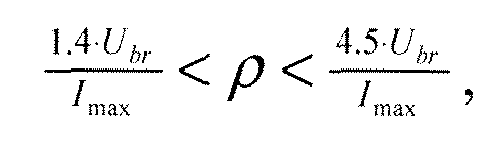
- An ICE ignition system, comprising an ignition coil including a primary winding and a secondary winding, a magnetic conductor, and a discharge gap included into the secondary-winding circuit of the ignition coil, characterized in that the ignition coil is so designed that the wave impedance ρ of the oscillatory circuit, formed by an inductance and an effective capacitance in the secondary winding, with allowance for the leakage currents, lies within a range of
where
Ubr is a minimum value of a voltage in the discharge gap, for which a breakdown is guaranteed, and
Imax is a maximum admissible current of the spark discharge, for which a spark is not converted to a low-voltage arc discharge. - The ICE ignition system of claim 1, characterized in that the windings of the ignition coil are designed with increased magnetic stray flux, e.g., in a form of a wafer.
- The ignition system of claim 1 or 2, characterized in that the magnetic conductor of the ignition coil is manufactured of a material with low specific losses, e.g., transformer iron rated for a frequency of 400 Hz.
Applications Claiming Priority (2)
| Application Number | Priority Date | Filing Date | Title |
|---|---|---|---|
| RU2005113815/06A RU2287080C1 (en) | 2005-05-05 | 2005-05-05 | Ignition system of internal combustion engine |
| PCT/RU2006/000204 WO2006121368A2 (en) | 2005-05-05 | 2006-04-25 | Ignition system for an internal combustion engine |
Publications (1)
| Publication Number | Publication Date |
|---|---|
| EP1887217A2 true EP1887217A2 (en) | 2008-02-13 |
Family
ID=37396994
Family Applications (1)
| Application Number | Title | Priority Date | Filing Date |
|---|---|---|---|
| EP06747762A Withdrawn EP1887217A2 (en) | 2005-05-05 | 2006-04-25 | Ignition system for an internal combustion engine |
Country Status (4)
| Country | Link |
|---|---|
| EP (1) | EP1887217A2 (en) |
| CN (1) | CN100575696C (en) |
| RU (1) | RU2287080C1 (en) |
| WO (1) | WO2006121368A2 (en) |
Families Citing this family (2)
| Publication number | Priority date | Publication date | Assignee | Title |
|---|---|---|---|---|
| EP2682594B1 (en) * | 2011-03-04 | 2021-05-12 | Hitachi Automotive Systems, Ltd. | Ignition coil for internal combustion engine |
| CN106555683B (en) * | 2016-11-18 | 2019-05-31 | 龙岩学院 | A kind of methane fuelled engine ignition control method |
Family Cites Families (5)
| Publication number | Priority date | Publication date | Assignee | Title |
|---|---|---|---|---|
| DE1414588B2 (en) * | 1962-07-04 | 1971-07-22 | Robert Bosch Gmbh, 7000 Stuttgart | IGNITION DEVICE FOR COMBUSTION MACHINERY |
| DE2338556C2 (en) * | 1973-07-30 | 1982-09-09 | Robert Bosch Gmbh, 7000 Stuttgart | Ignition system for internal combustion engines |
| RU2054575C1 (en) * | 1992-10-26 | 1996-02-20 | Акимов Николай Александрович | Relaxation-vibration electronic ignition system for internal combustion engine |
| RU2107184C1 (en) * | 1996-05-13 | 1998-03-20 | Валерий Афанасьевич Винокуров | Spark ignition system |
| US6328025B1 (en) * | 2000-06-19 | 2001-12-11 | Thomas C. Marrs | Ignition coil with driver |
-
2005
- 2005-05-05 RU RU2005113815/06A patent/RU2287080C1/en not_active IP Right Cessation
-
2006
- 2006-04-25 EP EP06747762A patent/EP1887217A2/en not_active Withdrawn
- 2006-04-25 WO PCT/RU2006/000204 patent/WO2006121368A2/en not_active Ceased
- 2006-04-25 CN CN200680024011A patent/CN100575696C/en not_active Expired - Fee Related
Non-Patent Citations (1)
| Title |
|---|
| See references of WO2006121368A2 * |
Also Published As
| Publication number | Publication date |
|---|---|
| CN101213366A (en) | 2008-07-02 |
| CN100575696C (en) | 2009-12-30 |
| WO2006121368A3 (en) | 2007-03-01 |
| RU2287080C1 (en) | 2006-11-10 |
| WO2006121368A2 (en) | 2006-11-16 |
Similar Documents
| Publication | Publication Date | Title |
|---|---|---|
| US8191540B2 (en) | Ignition system | |
| US10072629B2 (en) | Repetitive ignition system for enhanced combustion | |
| US9765751B2 (en) | Ignition apparatus | |
| JP2002502106A (en) | High pulse rate ignition source | |
| US20110239999A1 (en) | Device for storing energy and transforming energy | |
| US20110073058A1 (en) | High-voltage generator device | |
| EP1887217A2 (en) | Ignition system for an internal combustion engine | |
| CN101263299B (en) | Device for acquiring measurement signals on the high-voltage side | |
| US12123385B2 (en) | Ignition device for an internal combustion engine | |
| HK1120095A (en) | Ignition system for an internal combustion engine | |
| US9534575B2 (en) | Method for igniting a fuel/air mixture, ignition system and glow plug | |
| JP2023179015A (en) | igniter | |
| RU2362902C2 (en) | Method of discharge voltage reduction in ignition systems of internal combustion engines | |
| CN102486151B (en) | Dual-energy source independent ignition | |
| RU2364744C2 (en) | Method for reduction of energy losses in ignition systems of internal combustion engines | |
| RU2123132C1 (en) | Ignition coil | |
| US12416281B2 (en) | Ignition device | |
| EP0742369A1 (en) | Triggering circuit for ignition devices | |
| JP2008147534A (en) | Ignition device for internal combustion engine | |
| RU2235898C1 (en) | Fuel mixture igniter | |
| JPH0311876Y2 (en) | ||
| JP2023179016A (en) | igniter | |
| JP2023181784A (en) | Ignition device | |
| RU2190911C2 (en) | Ignition system | |
| RU2161265C2 (en) | Ignition coil |
Legal Events
| Date | Code | Title | Description |
|---|---|---|---|
| PUAI | Public reference made under article 153(3) epc to a published international application that has entered the european phase |
Free format text: ORIGINAL CODE: 0009012 |
|
| 17P | Request for examination filed |
Effective date: 20071204 |
|
| AK | Designated contracting states |
Kind code of ref document: A2 Designated state(s): DE FI FR GB IT SE |
|
| RAP1 | Party data changed (applicant data changed or rights of an application transferred) |
Owner name: INSTITUTE OF APPLIED PHYSICS RAS |
|
| DAX | Request for extension of the european patent (deleted) | ||
| RBV | Designated contracting states (corrected) |
Designated state(s): DE FI FR GB IT SE |
|
| REG | Reference to a national code |
Ref country code: HK Ref legal event code: DE Ref document number: 1120095 Country of ref document: HK |
|
| STAA | Information on the status of an ep patent application or granted ep patent |
Free format text: STATUS: THE APPLICATION IS DEEMED TO BE WITHDRAWN |
|
| 18D | Application deemed to be withdrawn |
Effective date: 20101103 |
|
| REG | Reference to a national code |
Ref country code: HK Ref legal event code: WD Ref document number: 1120095 Country of ref document: HK |