EP1887208A2 - Attachment hanger system for a cooling liner within a gas turbine engine exhaust duct - Google Patents
Attachment hanger system for a cooling liner within a gas turbine engine exhaust duct Download PDFInfo
- Publication number
- EP1887208A2 EP1887208A2 EP07252077A EP07252077A EP1887208A2 EP 1887208 A2 EP1887208 A2 EP 1887208A2 EP 07252077 A EP07252077 A EP 07252077A EP 07252077 A EP07252077 A EP 07252077A EP 1887208 A2 EP1887208 A2 EP 1887208A2
- Authority
- EP
- European Patent Office
- Prior art keywords
- exhaust duct
- segment
- assembly
- recited
- hanger system
- Prior art date
- Legal status (The legal status is an assumption and is not a legal conclusion. Google has not performed a legal analysis and makes no representation as to the accuracy of the status listed.)
- Withdrawn
Links
Images




Classifications
-
- F—MECHANICAL ENGINEERING; LIGHTING; HEATING; WEAPONS; BLASTING
- F02—COMBUSTION ENGINES; HOT-GAS OR COMBUSTION-PRODUCT ENGINE PLANTS
- F02K—JET-PROPULSION PLANTS
- F02K1/00—Plants characterised by the form or arrangement of the jet pipe or nozzle; Jet pipes or nozzles peculiar thereto
- F02K1/78—Other construction of jet pipes
- F02K1/82—Jet pipe walls, e.g. liners
- F02K1/822—Heat insulating structures or liners, cooling arrangements, e.g. post combustion liners; Infrared radiation suppressors
-
- F—MECHANICAL ENGINEERING; LIGHTING; HEATING; WEAPONS; BLASTING
- F01—MACHINES OR ENGINES IN GENERAL; ENGINE PLANTS IN GENERAL; STEAM ENGINES
- F01D—NON-POSITIVE DISPLACEMENT MACHINES OR ENGINES, e.g. STEAM TURBINES
- F01D25/00—Component parts, details, or accessories, not provided for in, or of interest apart from, other groups
- F01D25/30—Exhaust heads, chambers, or the like
-
- F—MECHANICAL ENGINEERING; LIGHTING; HEATING; WEAPONS; BLASTING
- F05—INDEXING SCHEMES RELATING TO ENGINES OR PUMPS IN VARIOUS SUBCLASSES OF CLASSES F01-F04
- F05D—INDEXING SCHEME FOR ASPECTS RELATING TO NON-POSITIVE-DISPLACEMENT MACHINES OR ENGINES, GAS-TURBINES OR JET-PROPULSION PLANTS
- F05D2220/00—Application
- F05D2220/90—Application in vehicles adapted for vertical or short take off and landing (v/stol vehicles)
-
- Y—GENERAL TAGGING OF NEW TECHNOLOGICAL DEVELOPMENTS; GENERAL TAGGING OF CROSS-SECTIONAL TECHNOLOGIES SPANNING OVER SEVERAL SECTIONS OF THE IPC; TECHNICAL SUBJECTS COVERED BY FORMER USPC CROSS-REFERENCE ART COLLECTIONS [XRACs] AND DIGESTS
- Y02—TECHNOLOGIES OR APPLICATIONS FOR MITIGATION OR ADAPTATION AGAINST CLIMATE CHANGE
- Y02T—CLIMATE CHANGE MITIGATION TECHNOLOGIES RELATED TO TRANSPORTATION
- Y02T50/00—Aeronautics or air transport
- Y02T50/60—Efficient propulsion technologies, e.g. for aircraft
-
- Y—GENERAL TAGGING OF NEW TECHNOLOGICAL DEVELOPMENTS; GENERAL TAGGING OF CROSS-SECTIONAL TECHNOLOGIES SPANNING OVER SEVERAL SECTIONS OF THE IPC; TECHNICAL SUBJECTS COVERED BY FORMER USPC CROSS-REFERENCE ART COLLECTIONS [XRACs] AND DIGESTS
- Y10—TECHNICAL SUBJECTS COVERED BY FORMER USPC
- Y10T—TECHNICAL SUBJECTS COVERED BY FORMER US CLASSIFICATION
- Y10T29/00—Metal working
- Y10T29/49—Method of mechanical manufacture
- Y10T29/49316—Impeller making
- Y10T29/4932—Turbomachine making
- Y10T29/49323—Assembling fluid flow directing devices, e.g., stators, diaphragms, nozzles
Definitions
- the present invention relates to gas turbine engines having a cooling liner, and more particularly to an attachment hanger system for a circumferential cooling liner within a swivelable exhaust duct.
- cooling airflow is typically based at an airflow required for the most adverse pressure gradient during the most adverse operating condition.
- recent aircraft include exhaust ducts which can vector through relative swiveling between exhaust duct segments which are interconnected through bearing arrangements may further complicate cooling liner arrangements.
- each liner segment needs to be individually fastened to the duct case and each liner segment needs to be sealed to the adjoining liner segment. This may result in a weight and manufacturing penalty for redundant parts, loss of sealing efficiency and a significant number of non-desirable joints between each individual liner segment.
- cooling liner assembly for a swivelable exhaust duct which minimizes the number of cooling liner segment joints to increase sealing efficiency while reducing weight, maintenance requirements, and assembly complications.
- An exhaust duct assembly disclosed herein articulates for use in a short take off vertical landing (STOVL) type of aircraft includes a cooling liner spaced apart from and extending over a portion of an engine exhaust duct.
- the cooling liner includes a hot sheet separated from a cold sheet by a multitude of stiffeners.
- the cooling liner is attached to the exhaust duct case through a foldable attachment hanger system.
- the foldable attachment hanger system provides a low profile (foldable up/down) for a limited access installation envelope.
- a series of cylindrical cooling liner segments (inboard) are insertable into a fully assembled 3 bearing swivel duct (outboard) which rotates about three bearing planes to permit transition between a cruise configuration and a hover configuration.
- Each cylindrical cooling liner segment provides a reduced cross-sectional area through fold-down of the foldable attachment hanger system in order to pass the cylindrical cooling liner segment through the bearing joints within the duct case. Once past the bearing joint obstruction the cooling liner is attached to the duct case by folding-up the foldable attachment hanger system.
- each cooling liner segment may be formed as a tubular member requiring joints only between the swivelable duct sections.
- the present invention therefore provides a cooling liner assembly for a swivelable exhaust duct which minimizes the number of cooling liner segment joints to increase sealing efficiency while reducing weight, maintenance requirements, and assembly complications.
- Figure I A illustrates, a sectional view of an exhaust duct assembly 20 for a gas turbine engine in both an open position (phantom lines), typical of afterburning operation, and in a closed position (solid lines), typical of non-afterburning operation.
- this invention is utilized on an exhaust duct assembly that articulate for use in a short take off vertical landing (STOVL) type of aircraft.
- STOVL short take off vertical landing
- the exhaust duct assembly 20 is of the convergent-divergent type having a convergent flap region 22, a throat region 24, and a divergent flap region 26.
- the exhaust duct assembly 20 includes an exhaust duct section 28 which communicates with an exhaust nozzle 30.
- the exhaust duct section 28 as illustrated herein is a three bearing swivel duct (3BSD) which rotates about three bearing planes (P 1 , P 2 , P 3 ) to permit transition between a cruise configuration in which the exhaust duct axis Ed is arranged along an engine axis E ( Figure 1A) and a hover configuration in which the exhaust duct axis Ed is articulated to a position transverse to the engine axis E ( Figure 1B).
- the outer wall of the exhaust duct section 28 is formed from an exhaust duct case 32 having an aerodynamic external flap system 34.
- the exhaust duct section 28 includes a forward exhaust duct segment 36, an intermediate exhaust duct segment 38 and a rear exhaust duct segment 40.
- the forward exhaust duct segment 36 is rotatable about the axis E at a first bearing joint 42
- the intermediate exhaust duct segment 38 rotates relative to the forward exhaust duct segment 36 at a second bearing joint 44
- the rear exhaust duct segment 40 rotates relative to the intermediate duct segment 38 at a third bearing joint 46.
- the first bearing joint 42 is disposed along the first bearing plane P 1
- the second bearing joint 44 is disposed along the second bearing plane P 2
- the third bearing joint 46 is disposed along a third bearing plane P 3 .
- the second bearing joint 44 and the third bearing joint 46 are generally disposed at a non-normal angle relative the engine axis E.
- Each of the forward, intermediate and rear exhaust duct segment 36, 38, 40 include a forward, intermediate and rear cooling liner segment 48, 50, 52 which are exposed to the combustion gases and a forward, intermediate and rear outer duct case segment 54, 56, 58 (Figure 1C) spaced therefrom by a foldable attachment hanger system 60 ( Figure 1D).
- each of the forward, intermediate and rear cooling liner segment 48, 50, 52 is an assembly that typically includes a hot sheet 66 separated from a corrugated cold sheet 68 by a multitude of stiffeners 70 ( Figure 1E).
- the term “corrugation” encompasses various rippled or non-planar surfaces that are not to be limited to only the specific "corrugation" disclosed in the illustrated embodiment.
- the foldable attachment hanger system 60 are attached between the cold sheet 68 of the forward, intermediate and rear cooling liner segment 48, 50, 52 and the respective forward, intermediate and rear outer duct case segment 54, 56, 58.
- the foldable attachment hanger system 60 at least partially permits for differential thermal expansion between the cold sheet 68 and the hot sheet 66.
- An annular passage may be defined between the forward, intermediate and rear cooling liner segment 48, 50, 52 and the forward, intermediate and rear outer duct cases 58, 60, 62 to provide passage of cooling air utilized for insulating the forward, intermediate and rear cooling liner segment 48, 50, 52.
- the forward, intermediate and rear cooling liner segment 48, 50, 52 are complete tubular members which are assembled and disassembled into their respective forward, intermediate and rear outer duct case segments 54, 56, 58 without requiring disassembly of the forward, intermediate and rear outer duct case segments 54, 56, 58 and the first, second and third bearing joint 42, 44 and 46 because of the foldable attachment hanger system 60 ( Figure 2A and 2B).
- the foldable attachment hanger system 60 folds-down ( Figure 2A) permitting each of the entire tubular cooling liner segments 48, 50, 52 to pass through the radial obstruction defined by the first, second and third bearing joint 42, 44 and 46. Once past the radial obstructions, the foldable attachment hanger system 60 fold-up ( Figure 2B) for subsequent mechanical attachment to the respective outer duct case segment 54, 56, 58 from the outside thereof.
- the result is reduction in weight and cost, increase in sealing efficiency and minimization of joints within the exhaust duct assembly 20.
- foldable attachment hanger system 60 includes a multitude of rows within each forward, intermediate and rear cooling liner segment 48, 50, 52 that are generally likewise arranged such that detailed explanation may be constrained to a single hanger assembly 72 from a portion of one row of the foldable attachment hanger system 60 as each hanger assembly 72 will be essentially the same.
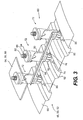
- FIG. 3 a portion of one row of the foldable attachment hanger system 60 is shown assembled between the cold sheet 68 of the forward, intermediate and rear cooling liner segment 48, 50, 52 and the respective forward, intermediate and rear outer duct case segment 54, 56, 58.
- the foldable attachment hanger system 60 provides for axial locating liner to duct case and permits thermally free axial growth.
- Each hanger assembly 72 of the foldable attachment hanger system 60 includes a cold sheet bracket 74, a pin 76, a hinge 78, duct bracket 80, a T-bolt 82, a flanged bushing 84 and a threaded fastener 86.
- An axial stiffener 88 is preferably attached such as through rivets to a multitude of hanger assemblies 72 to increase axial rigidity and facilitate assembly.
- the corrugated cold sheet 68 of each of the forward, intermediate and rear cooling liner segment 48, 50, 52 are provided with rectilinear openings 90 within a multitude of corrugation valleys 92.
- a pre-assembled pin-hinge-cold sheet bracket assembly 94 (Figure 4A) is inserted through the cold sheet opening 90 ( Figure 4A) then rotated ninety degrees to align the cold sheet bracket 74 with the corrugation 92 ( Figure 4B).
- Each cold sheet bracket 74 is located on the stiff geometry offered by the liner corrugation 92 providing for an efficient load path.
- the pin-hinge-cold sheet bracket assembly 94 to pin 76 interface preferably is then installed with fasteners 96 such as solid rivets, adhesive or the like.
- a duct bracket 80 is placed in each hinge 78, then secured with fasteners 98 such as solid rivets, adhesive or the like.
- the axial stiffener 88 is secured with the same fasteners 98 to connect a row of duct brackets 80 ( Figure 5B).
- the pin-hinge-cold sheet bracket assembly 94 incorporates a slider feature that allows the duct bracket 80 to clear the respective duct case 54, 56, 58 inner diameter as the duct bracket is folded-up into position ( Figure 6).
- the foldable attachment hanger system 60 may be folded-down into the corrugation (Figure 2A) permitting the entire tubular cooling liners 48, 50, 56 to pass through the upstream obstruction of the bearing joints 42, 44 and 46. This may be performed sequentially, or the tubular cooling liners 48, 50, 56 may be assembled together then inserted as a sub assembly into the exhaust duct section 28 ( Figure 1C). Once past the bearing joints 42, 44 and 46 obstructions, the foldable attachment hanger system 60 is folded-up ( Figure 2B) and subsequently mechanically attachment to the respective duct case 54, 56, 58.
- the foldable attachment hanger system 60 is folded-up ( Figure 2B) and mechanically attachment to the respective duct case 54, 56, 58 from the outside thereof.
- Each duct case 54, 56, 58 includes corresponding duct case openings 100 which are preferably elongated or rectilinear similarly arranged to correspond with cold sheet openings 90 ( Figure 4A).
- Production liners use hardware w/rivet holes at detail and tabulated dash-numbers to provide one-to-one correspondence.
- the T-bolt 82 is passed through the duct case opening 100 and into a rectilinear duct bracket opening 102.
- the rectilinear duct bracket opening 102 is rotationally aligned with and essentially the same as the duct case opening 100. It should be understood, however, that openings of differing sizes and shapes will likewise be usable with the present invention.
- the T-bolt 82 is then rotated ninety degrees within the duct bracket opening 102 to axially lock the T-bolt 82 into the duct bracket 80 ( Figure 7B).
- a ledge feature 104 in the duct bracket 80 below the duct bracket opening 102 prevents the T-bolt 82 from liberating itself from within the duct bracket 80 ( Figures 8A and 8B).
- the flanged bushing 84 is inserted into the duct case opening 100 such that the bushing tabs 106 pass into the rectilinear duct bracket opening 102 to rotationally restrain the T-bolt 82 to essentially "mistake-proof" orientation ( Figure 8A).
- the flanged busing 84 preferably includes an inner flange 108 ( Figure 8A) which corresponds with the duct case opening 100 to again essentially "mistake-proof” orientation seal the duct case opening 100, and retain the T-bolt 82 in the desired locked orientation ( Figures 8A and 8B).
- the contact footprint between the duct bracket 80 and the respective duct case 54, 56, 58 ( Figure 7C, 8A and 8B) provide a relatively generous area to efficiently transfer load path to the exhaust duct section 28.
- the T-bolt 82 rectilinear head geometry is also preferably maximized to net a relatively large contact footprint within the minimal access duct bracket opening 102.
- the threaded fastener 86 is then threaded onto the T-bolt 82 to finalize attachment.
- the flanged bushing 84 bushing tabs 106 and inner flange 108 respective engagement with the rectilinear duct bracket opening 102 and case opening 100 also serve as an anti-rotation feature for fastener torque application.
- All fastening of the foldable attachment hanger system 60 is accomplished externally (from the outside) of the forward, intermediate and rear outer duct case 54, 56, 58. All fasteners 86 are thereby readily replaced externally without having to disassemble the engine or liner components. This is a highly desirable feature for those applications where the inboard space is limited. This arrangement also makes the likelihood of damage fastener threads minimal and reduces the assembly and repair time to replace a damage fastener by not requiring engine or liner hardware removal.
Landscapes
- Engineering & Computer Science (AREA)
- Mechanical Engineering (AREA)
- General Engineering & Computer Science (AREA)
- Chemical & Material Sciences (AREA)
- Combustion & Propulsion (AREA)
- Exhaust Silencers (AREA)
- Sealing Devices (AREA)
Abstract
Description
- The present invention relates to gas turbine engines having a cooling liner, and more particularly to an attachment hanger system for a circumferential cooling liner within a swivelable exhaust duct.
- In order to improve engine operation and performance, the usage of exhaust duct cooling air is carefully rationed. Since the cooling air is generally extracted from the engine and is then not utilized for producing thrust, this extracted cooling air is a penalty to the overall performance of the engine. In current gas turbine engine exhaust ducts, a liner is disposed between the engine's working medium (exhaust gas path) and the engine outer casing or duct. Cooling air typically extracted from the engine's compressor is flowed between the cooling liner and duct then discharged over the seals and flaps of the nozzle located at the rear end of the exhaust duct.
- A relatively significant quantity of cooling air is required to properly cool the generally annular area to maintain a positive pressure within the cooling liner while being subjected to large core pressure gradients at various operating conditions. The cooling airflow is typically based at an airflow required for the most adverse pressure gradient during the most adverse operating condition. Furthermore, recent aircraft include exhaust ducts which can vector through relative swiveling between exhaust duct segments which are interconnected through bearing arrangements may further complicate cooling liner arrangements.
- To accommodate the multiple duct segments and intermediate bearing systems, a multitude of individual cooling liner segments are assembled within the duct to permit passage and assembly through the upstream bearing obstructions. Although effective, each liner segment needs to be individually fastened to the duct case and each liner segment needs to be sealed to the adjoining liner segment. This may result in a weight and manufacturing penalty for redundant parts, loss of sealing efficiency and a significant number of non-desirable joints between each individual liner segment.
- Accordingly, it is desirable to provide a cooling liner assembly for a swivelable exhaust duct which minimizes the number of cooling liner segment joints to increase sealing efficiency while reducing weight, maintenance requirements, and assembly complications.
- An exhaust duct assembly disclosed herein articulates for use in a short take off vertical landing (STOVL) type of aircraft includes a cooling liner spaced apart from and extending over a portion of an engine exhaust duct. The cooling liner includes a hot sheet separated from a cold sheet by a multitude of stiffeners. The cooling liner is attached to the exhaust duct case through a foldable attachment hanger system.
- The foldable attachment hanger system provides a low profile (foldable up/down) for a limited access installation envelope. A series of cylindrical cooling liner segments (inboard) are insertable into a fully assembled 3 bearing swivel duct (outboard) which rotates about three bearing planes to permit transition between a cruise configuration and a hover configuration.
- Each cylindrical cooling liner segment provides a reduced cross-sectional area through fold-down of the foldable attachment hanger system in order to pass the cylindrical cooling liner segment through the bearing joints within the duct case. Once past the bearing joint obstruction the cooling liner is attached to the duct case by folding-up the foldable attachment hanger system. In this way, each cooling liner segment may be formed as a tubular member requiring joints only between the swivelable duct sections.
- The present invention therefore provides a cooling liner assembly for a swivelable exhaust duct which minimizes the number of cooling liner segment joints to increase sealing efficiency while reducing weight, maintenance requirements, and assembly complications.
- The various features and advantages of this invention will become apparent to those skilled in the art from the following detailed description of the currently preferred embodiment. The drawings that accompany the detailed description can be briefly described as follows:
- Figure 1A is a cross sectional side elevation view of a variable geometry exhaust duct in a cruise position;
- Figure 1B is a cross sectional side elevation view of a variable geometry exhaust duct in a hover position;
- Figure 1C is an exploded perspective view of the exhaust duct assembly;
- Figure 1D is an expanded partially fragmented view of a cooling liner within the exhaust duct assembly;
- Figure 1E is an expanded view of a cooling liner within the exhaust duct assembly;
- Figure 2A is a transverse sectional view of the exhaust duct assembly with a foldable attachment hanger system in a folded position.
- Figure 2B is a transverse sectional view of the exhaust duct assembly with a foldable attachment hanger system in an unfolded position.
- Figure 3 is a perspective view illustrating the foldable attachment hanger system between a cold sheet of cooling liner assembly and an outer exhaust duct case;
- Figure 4A is an exploded view of a multitude of pin-hinge-cold sheet bracket assemblies prior to installation in a cold sheet of the cooling liner assembly;
- Figure 4B is an exploded view of a multitude of pin-hinge-cold sheet bracket assemblies after installation in a cold sheet of the cooling liner assembly;
- Figure 5A is an exploded view of a portion of a row of duct brackets being attached to a multitude of pin-hinge-cold sheet bracket assemblies as illustrated in Figure 4B;
- Figure 5B is a perspective view of the row of duct brackets as attached to the cold sheet through an axial stiffener;
- Figure 6 is a longitudinal sectional side view of a portion of a row of the foldable attachment hanger system in a shifted position illustrating a slider feature thereof;
- Figure 7A is an exploded view of a duct bracket prior to assembly with a T-bolt;
- Figure 7B is an exploded view of a duct bracket with the T-bolt rotationally installed;
- Figure 7C is a perspective view of the duct bracket as attached to an exhaust duct case;
- Figure 8A is a sectional view of a foldable hanger assembly taken transverse to the hinge pin; and
- Figure 8B is a sectional view of a foldable hanger assembly taken parallel to the hinge pin.
- Figure I A illustrates, a sectional view of an
exhaust duct assembly 20 for a gas turbine engine in both an open position (phantom lines), typical of afterburning operation, and in a closed position (solid lines), typical of non-afterburning operation. In its preferred embodiment this invention is utilized on an exhaust duct assembly that articulate for use in a short take off vertical landing (STOVL) type of aircraft. - The
exhaust duct assembly 20 is of the convergent-divergent type having aconvergent flap region 22, athroat region 24, and adivergent flap region 26. Theexhaust duct assembly 20 includes anexhaust duct section 28 which communicates with anexhaust nozzle 30. - The
exhaust duct section 28 as illustrated herein is a three bearing swivel duct (3BSD) which rotates about three bearing planes (P1, P2, P3) to permit transition between a cruise configuration in which the exhaust duct axis Ed is arranged along an engine axis E (Figure 1A) and a hover configuration in which the exhaust duct axis Ed is articulated to a position transverse to the engine axis E (Figure 1B). The outer wall of theexhaust duct section 28 is formed from anexhaust duct case 32 having an aerodynamicexternal flap system 34. - The
exhaust duct section 28 includes a forwardexhaust duct segment 36, an intermediate exhaust duct segment 38 and a rearexhaust duct segment 40. The forwardexhaust duct segment 36 is rotatable about the axis E at a first bearingjoint 42, the intermediate exhaust duct segment 38 rotates relative to the forwardexhaust duct segment 36 at a second bearingjoint 44, and the rearexhaust duct segment 40 rotates relative to the intermediate duct segment 38 at a third bearingjoint 46. The first bearingjoint 42 is disposed along the first bearing plane P1, the second bearingjoint 44 is disposed along the second bearing plane P2 and the third bearingjoint 46 is disposed along a third bearing plane P3. The second bearingjoint 44 and the third bearingjoint 46 are generally disposed at a non-normal angle relative the engine axis E. - Each of the forward, intermediate and rear
exhaust duct segment cooling liner segment duct case segment cooling liner segment hot sheet 66 separated from a corrugatedcold sheet 68 by a multitude of stiffeners 70 (Figure 1E). It should also be understood that the term "corrugation" encompasses various rippled or non-planar surfaces that are not to be limited to only the specific "corrugation" disclosed in the illustrated embodiment. - The foldable
attachment hanger system 60 are attached between thecold sheet 68 of the forward, intermediate and rearcooling liner segment duct case segment attachment hanger system 60 at least partially permits for differential thermal expansion between thecold sheet 68 and thehot sheet 66. An annular passage may be defined between the forward, intermediate and rearcooling liner segment outer duct cases cooling liner segment - Preferably, the forward, intermediate and rear
cooling liner segment duct case segments duct case segments joint - The foldable
attachment hanger system 60 folds-down (Figure 2A) permitting each of the entire tubularcooling liner segments joint attachment hanger system 60 fold-up (Figure 2B) for subsequent mechanical attachment to the respective outerduct case segment exhaust duct assembly 20. It should be understood that foldableattachment hanger system 60 includes a multitude of rows within each forward, intermediate and rearcooling liner segment single hanger assembly 72 from a portion of one row of the foldableattachment hanger system 60 as eachhanger assembly 72 will be essentially the same. - Referring to Figure 3, a portion of one row of the foldable
attachment hanger system 60 is shown assembled between thecold sheet 68 of the forward, intermediate and rearcooling liner segment duct case segment attachment hanger system 60 provides for axial locating liner to duct case and permits thermally free axial growth. - Each
hanger assembly 72 of the foldableattachment hanger system 60 includes acold sheet bracket 74, apin 76, ahinge 78,duct bracket 80, a T-bolt 82, aflanged bushing 84 and a threadedfastener 86. Anaxial stiffener 88 is preferably attached such as through rivets to a multitude ofhanger assemblies 72 to increase axial rigidity and facilitate assembly. - To assemble the forward, intermediate and rear
cooling liner segment cold sheet 68 of each of the forward, intermediate and rearcooling liner segment rectilinear openings 90 within a multitude ofcorrugation valleys 92. A pre-assembled pin-hinge-cold sheet bracket assembly 94 (Figure 4A) is inserted through the cold sheet opening 90 (Figure 4A) then rotated ninety degrees to align thecold sheet bracket 74 with the corrugation 92 (Figure 4B). Eachcold sheet bracket 74 is located on the stiff geometry offered by theliner corrugation 92 providing for an efficient load path. The pin-hinge-coldsheet bracket assembly 94 to pin 76 interface preferably is then installed withfasteners 96 such as solid rivets, adhesive or the like. - Referring to Figure 5A, once the pin-hinge-cold
sheet bracket assembly 94 are installed, aduct bracket 80 is placed in eachhinge 78, then secured withfasteners 98 such as solid rivets, adhesive or the like. Preferably, theaxial stiffener 88 is secured with thesame fasteners 98 to connect a row of duct brackets 80 (Figure 5B). The pin-hinge-coldsheet bracket assembly 94 incorporates a slider feature that allows theduct bracket 80 to clear therespective duct case - At this point, the foldable
attachment hanger system 60 may be folded-down into the corrugation (Figure 2A) permitting the entiretubular cooling liners tubular cooling liners attachment hanger system 60 is folded-up (Figure 2B) and subsequently mechanically attachment to therespective duct case - Referring to Figure 7A, the foldable
attachment hanger system 60 is folded-up (Figure 2B) and mechanically attachment to therespective duct case duct case duct case openings 100 which are preferably elongated or rectilinear similarly arranged to correspond with cold sheet openings 90 (Figure 4A). Production liners use hardware w/rivet holes at detail and tabulated dash-numbers to provide one-to-one correspondence. - Once the foldable
attachment hanger system 60 is folded-up as facilitated by the axial stiffener which permits entire rows ofhanger assemblies 72 to be folded-up, the T-bolt 82 is passed through the duct case opening 100 and into a rectilinearduct bracket opening 102. Notably, the rectilinearduct bracket opening 102 is rotationally aligned with and essentially the same as theduct case opening 100. It should be understood, however, that openings of differing sizes and shapes will likewise be usable with the present invention. - The T-
bolt 82 is then rotated ninety degrees within theduct bracket opening 102 to axially lock the T-bolt 82 into the duct bracket 80 (Figure 7B). Aledge feature 104 in theduct bracket 80 below theduct bracket opening 102 prevents the T-bolt 82 from liberating itself from within the duct bracket 80 (Figures 8A and 8B). - Once the T-
bolt 82 is rotated into position, theflanged bushing 84 is inserted into the duct case opening 100 such that thebushing tabs 106 pass into the rectilinearduct bracket opening 102 to rotationally restrain the T-bolt 82 to essentially "mistake-proof" orientation (Figure 8A). Theflanged busing 84 preferably includes an inner flange 108 (Figure 8A) which corresponds with the duct case opening 100 to again essentially "mistake-proof" orientation seal the duct case opening 100, and retain the T-bolt 82 in the desired locked orientation (Figures 8A and 8B). The contact footprint between theduct bracket 80 and therespective duct case exhaust duct section 28. The T-bolt 82 rectilinear head geometry is also preferably maximized to net a relatively large contact footprint within the minimal accessduct bracket opening 102. - The threaded
fastener 86 is then threaded onto the T-bolt 82 to finalize attachment. Theflanged bushing 84bushing tabs 106 andinner flange 108 respective engagement with the rectilinearduct bracket opening 102 and case opening 100 also serve as an anti-rotation feature for fastener torque application. - All fastening of the foldable
attachment hanger system 60 is accomplished externally (from the outside) of the forward, intermediate and rearouter duct case fasteners 86 are thereby readily replaced externally without having to disassemble the engine or liner components. This is a highly desirable feature for those applications where the inboard space is limited. This arrangement also makes the likelihood of damage fastener threads minimal and reduces the assembly and repair time to replace a damage fastener by not requiring engine or liner hardware removal. - Although particular step sequences are shown, described, and claimed, it should be understood that steps may be performed in any order, separated or combined unless otherwise indicated and will still benefit from the present invention.
- The foregoing description is exemplary rather than defined by the limitations within. Many modifications and variations of the present invention are possible in light of the above teachings. The preferred embodiments of this invention have been disclosed, however, one of ordinary skill in the art would recognize that certain modifications would come within the scope of this invention. It is, therefore, to be understood that within the scope of the appended claims, the invention may be practiced otherwise than as specifically described. For that reason the following claims should be studied to determine the true scope and content of this invention.
Claims (20)
- An exhaust duct assembly (20) for a gas turbine engine comprising:an exhaust duct case segment (54, 56, 58);a cooling liner segment (48, 50, 52); anda foldable attachment hanger system (60) attachable between said exhaust duct case section (54, 56, 58) and said cooling liner segment (48, 50, 52).
- The assembly as recited in claim 1, wherein said cooling liner segment (48, 50, 52) is a cylindrical member.
- The assembly as recited in claim 1 or 2, wherein said exhaust duct case segment supports a bearing joint.
- The assembly as recited in any preceding claim, wherein said cooling liner segment includes a hot sheet (66), a cold sheet (68) and a multitude of stiffeners (70) which attach said hot sheet (66) to said cold sheet (68).
- The assembly as recited in any preceding claim, wherein said foldable attachment hanger system (60) extends at least partially through a corrugated cold sheet (68) of said cooling liner segment (48, 50, 52).
- The assembly as recited in claim 5, wherein said foldable attachment hanger system (60) is foldable at least partially into a valley (92) of said corrugated cold sheet (68).
- A swivelable exhaust duct assembly (20) for a gas turbine engine comprising:a first exhaust duct case segment (36) which defines a first inner diameter;a second exhaust duct case segment (38);a bearing joint (44) between said first exhaust duct case segment (36) and said second exhaust duct case segment (38), said bearing joint (44) defining a second inner diameter less than said second inner diameter;a cooling liner segment (48); anda foldable attachment hanger system (60) attachable between said first exhaust duct case segment (36) and said cooling liner segment (48), said foldable attachment hanger system (60) foldable to define an outer diameter less than said second inner diameter.
- The assembly as recited in claim 7, wherein said first exhaust duct case segment (36) is a cylindrical member and said second exhaust duct case segment (38) is cylindrical member.
- The assembly as recited in claim 8, wherein said cooling liner segment is a cylindrical member.
- The assembly as recited in claim 7, 8 or 9 wherein said foldable attachment hanger system (60) includes a multitude of rows of a multitude of hanger bracket assemblies (72).
- The assembly as recited in claim 10, wherein at least two of said multitude of hanger bracket assemblies (72) in at least one of said multitude of rows are attached together through an axial stiffener (88).
- A method of assembling a swivelable exhaust duct assembly (20) for a gas turbine engine comprising the steps of:(A) assembling a first exhaust duct case segment (36) to a second exhaust duct case segment (38) with a bearing joint (44) therebetween, the bearing joint (44) defining an inner diameter less than an inner diameter of the first exhaust duct case segment (36);(B) folding-down a foldable attachment hanger system (60) attachable to a cooling liner segment (48);(C) locating the cooling liner (48) within the first exhaust duct case segment (36) through the bearing joint;(D) folding-up the foldable attachment hanger system (60); and(E) attaching the foldable attachment hanger system (60) to the first exhaust duct case segment.
- A method as recited in claim 12, wherein said step (A) further comprises locating the bearing joint (44) in a plane non-normal to a longitudinal axis of the first exhaust duct case (36).
- A method as recited in claim 12 or 13, wherein said step (B) further comprises folding-down the foldable attachment hanger system (60) in a direction tangential to the cooling liner segment (48).
- A method as recited in claim 12, 13 or 14, wherein said step (B) further comprises folding-down the foldable attachment hanger system (60) such that the foldable attachment hanger system (60) is at least partially received within a corrugation (92) of a cold sheet (68) of the cooling liner segment (48).
- A method as recited in any of claims 12 to 15, wherein said step (D) further comprises folding-up the foldable attachment hanger system (60) by rows, each row including a multitude of hanger bracket assemblies (72).
- A method as recited in any of claims 12 to 16, wherein said step (E) further comprises attaching the foldable attachment hanger system (60) to the first exhaust duct case segment (36) from an outside of the first exhaust duct case (36).
- A method as recited in claim 17, wherein said step (E) further comprises:(a) passing a T-bolt (82) through a duct opening (100) in the first exhaust duct case;(b) rotating the T-bolt (82) into engagement with a duct bracket (80) of a foldable attachment hanger assembly (72) of the foldable attachment hanger system (60);(c) locating a flanged bushing (84) at least partially into the duct opening (100) and the duct bracket (80); and(d) threading a fastener (86) to the T-bolt (82) atop the flanged bushing (84).
- A method as recited in claim 18, wherein said step (c) further comprises:(I) rotationally retaining the T-bolt (82) into the duct bracket (80) with the flanged bushing (84).
- A method as recited in claim 19, wherein said step (i) further comprises:(i) trapping a head of the T-bolt (82) with the flanged bushing (84) to a predetermined rotational position.
Applications Claiming Priority (1)
| Application Number | Priority Date | Filing Date | Title |
|---|---|---|---|
| US11/492,412 US7814753B2 (en) | 2006-07-25 | 2006-07-25 | Low profile attachment hanger system for a cooling liner within a gas turbine engine swivel exhaust duct |
Publications (2)
| Publication Number | Publication Date |
|---|---|
| EP1887208A2 true EP1887208A2 (en) | 2008-02-13 |
| EP1887208A3 EP1887208A3 (en) | 2010-11-17 |
Family
ID=38626843
Family Applications (1)
| Application Number | Title | Priority Date | Filing Date |
|---|---|---|---|
| EP07252077A Withdrawn EP1887208A3 (en) | 2006-07-25 | 2007-05-21 | Attachment hanger system for a cooling liner within a gas turbine engine exhaust duct |
Country Status (3)
| Country | Link |
|---|---|
| US (1) | US7814753B2 (en) |
| EP (1) | EP1887208A3 (en) |
| JP (1) | JP2008031983A (en) |
Cited By (5)
| Publication number | Priority date | Publication date | Assignee | Title |
|---|---|---|---|---|
| EP1918563A2 (en) | 2006-08-31 | 2008-05-07 | United Technologies Corporation | Exhaust liner suspension system |
| EP2910753A1 (en) * | 2014-02-25 | 2015-08-26 | United Technologies Corporation | Repair or remanufacture of liner panels for a gas turbine engine |
| GB2525197A (en) * | 2014-04-15 | 2015-10-21 | Rolls Royce Plc | A panel attachment system and a method of using the same |
| EP2765295A3 (en) * | 2013-02-07 | 2017-06-14 | Rolls-Royce plc | A panel mounting arrangement |
| EP3181455A1 (en) | 2015-12-16 | 2017-06-21 | AIRBUS HELICOPTERS DEUTSCHLAND GmbH | An aircraft with a hot air exhaust that comprises two pivotally mounted exhaust sections |
Families Citing this family (26)
| Publication number | Priority date | Publication date | Assignee | Title |
|---|---|---|---|---|
| US9297335B2 (en) * | 2008-03-11 | 2016-03-29 | United Technologies Corporation | Metal injection molding attachment hanger system for a cooling liner within a gas turbine engine swivel exhaust duct |
| FR2928900B1 (en) * | 2008-03-20 | 2010-03-19 | Airbus France | DEVICE FOR REDUCING INFRARED EMISSIONS OF A TURBOPROPULSER. |
| US8418473B2 (en) * | 2008-06-02 | 2013-04-16 | United Technologies Corporation | Pivoting liner hanger |
| US9097211B2 (en) * | 2008-06-06 | 2015-08-04 | United Technologies Corporation | Slideable liner anchoring assembly |
| US8511098B2 (en) * | 2008-06-12 | 2013-08-20 | United Technologies Corporation | Slideable liner link assembly |
| US8572986B2 (en) * | 2009-07-27 | 2013-11-05 | United Technologies Corporation | Retainer for suspended thermal protection elements in a gas turbine engine |
| US10227952B2 (en) * | 2011-09-30 | 2019-03-12 | United Technologies Corporation | Gas path liner for a gas turbine engine |
| US20130232949A1 (en) * | 2012-03-09 | 2013-09-12 | Gary J. Dillard | Pressure balanced area control of high aspect ratio nozzle |
| US9309834B2 (en) | 2012-05-31 | 2016-04-12 | United Technologies Corporation | Liner hanger cable |
| US9316174B2 (en) | 2012-06-04 | 2016-04-19 | United Technologies Corporation | Liner hanger with spherical washers |
| US8607574B1 (en) | 2012-06-11 | 2013-12-17 | United Technologies Corporation | Turbine engine exhaust nozzle flap |
| US9133768B2 (en) | 2012-08-21 | 2015-09-15 | United Technologies Corporation | Liner bracket for gas turbine engine |
| US9255548B2 (en) * | 2012-09-11 | 2016-02-09 | United Technologies Corporation | Sliding U-joint hanger for gas turbine engine nozzle |
| US9309833B2 (en) | 2012-10-22 | 2016-04-12 | United Technologies Corporation | Leaf spring hanger for exhaust duct liner |
| US10054080B2 (en) | 2012-10-22 | 2018-08-21 | United Technologies Corporation | Coil spring hanger for exhaust duct liner |
| US9341377B2 (en) | 2012-12-06 | 2016-05-17 | United Technologies Corporation | Spherical collet for mounting a gas turbine engine liner |
| US20140238027A1 (en) * | 2012-12-21 | 2014-08-28 | United Technologies Corporation | Thermally compliant dual wall liner for a gas turbine engine |
| US20140223919A1 (en) * | 2013-02-14 | 2014-08-14 | United Technologies Corporation | Flexible liner hanger |
| WO2014126641A1 (en) * | 2013-02-14 | 2014-08-21 | United Technologies Corporation | Compliant heat shield liner hanger assembly for gas turbine engines |
| FR3005100B1 (en) * | 2013-04-26 | 2015-05-01 | Snecma | TURBOMACHINE HOUSING |
| US20160237950A1 (en) * | 2013-10-07 | 2016-08-18 | United Technologies Corporation | Backside coating cooling passage |
| CN104533661B (en) * | 2014-08-29 | 2017-03-01 | 覃勇 | Thrust-vectoring Nozzle |
| US10443539B2 (en) | 2015-11-23 | 2019-10-15 | Rolls-Royce North American Technologies Inc. | Hybrid exhaust nozzle |
| CN105508080B (en) * | 2016-03-02 | 2017-07-07 | 清华大学 | A kind of three bearing thrust vector spray structure types based on 3 D-printing |
| DE102016213810A1 (en) * | 2016-07-27 | 2018-02-01 | MTU Aero Engines AG | Cladding element for a turbine intermediate housing |
| US11905843B2 (en) * | 2020-04-01 | 2024-02-20 | General Electric Company | Liner support system |
Citations (2)
| Publication number | Priority date | Publication date | Assignee | Title |
|---|---|---|---|---|
| GB543918A (en) | 1939-09-29 | 1942-03-19 | Bbc Brown Boveri & Cie | Improvements and relating to combustion chambers |
| US20050155352A1 (en) | 2004-01-21 | 2005-07-21 | Rolls-Royce Plc | Multiple sectioned duct |
Family Cites Families (14)
| Publication number | Priority date | Publication date | Assignee | Title |
|---|---|---|---|---|
| US3260049A (en) * | 1963-05-09 | 1966-07-12 | Boeing Co | Variable vectoring nozzle for jet propulsion engines |
| DE1481606A1 (en) * | 1966-03-03 | 1970-01-22 | Man Turbo Gmbh | Device for actuating a beam deflection device consisting of three pipe sections which can be rotated relative to one another about their longitudinal axes |
| US3557402A (en) * | 1968-12-04 | 1971-01-26 | Cem Co Inc | Coiled fastening pin |
| US3989193A (en) * | 1974-03-02 | 1976-11-02 | Motoren- Und Turbinen-Union Munchen Gmbh M.A.N. Maybach Mercedes-Benz | Device for varying the gas exit area of an exhaust nozzle for a jet deflecting device |
| FR2469566A1 (en) * | 1979-11-12 | 1981-05-22 | Snecma | IMPROVEMENTS ON FIXING DEVICES FOR MULTIFLUX TURBOREACTORS |
| US4438626A (en) * | 1981-09-11 | 1984-03-27 | General Electric Company | Apparatus for attaching a ceramic member to a metal structure |
| US4465252A (en) * | 1983-04-08 | 1984-08-14 | Nickson Industries, Inc. | Compact universal hanger for tailpipes and the like |
| US4747543A (en) * | 1987-04-14 | 1988-05-31 | United Technologies Corporation | Nozzle flap cooling liner |
| US5141393A (en) * | 1991-09-03 | 1992-08-25 | United Technologies Corporation | Seal accommodating thermal expansion between adjacent casings in gas turbine engine |
| FR2728015B1 (en) * | 1994-12-07 | 1997-01-17 | Snecma | SECTORIZED MONOBLOCK DISTRIBUTOR OF A TURBOMACHINE TURBINE STATOR |
| FR2750167B1 (en) * | 1996-06-20 | 1998-07-31 | Snecma | TURBOREACTOR EJECTION NOZZLE, VARIABLE GEOMETRY |
| US7631481B2 (en) * | 2004-12-01 | 2009-12-15 | United Technologies Corporation | Cooled duct for gas turbine engine |
| US20060137352A1 (en) * | 2004-12-29 | 2006-06-29 | United Technologies Corporation | Augmentor liner |
| US7581399B2 (en) * | 2006-01-05 | 2009-09-01 | United Technologies Corporation | Damped coil pin for attachment hanger hinge |
-
2006
- 2006-07-25 US US11/492,412 patent/US7814753B2/en not_active Expired - Fee Related
-
2007
- 2007-05-11 JP JP2007126253A patent/JP2008031983A/en active Pending
- 2007-05-21 EP EP07252077A patent/EP1887208A3/en not_active Withdrawn
Patent Citations (2)
| Publication number | Priority date | Publication date | Assignee | Title |
|---|---|---|---|---|
| GB543918A (en) | 1939-09-29 | 1942-03-19 | Bbc Brown Boveri & Cie | Improvements and relating to combustion chambers |
| US20050155352A1 (en) | 2004-01-21 | 2005-07-21 | Rolls-Royce Plc | Multiple sectioned duct |
Cited By (11)
| Publication number | Priority date | Publication date | Assignee | Title |
|---|---|---|---|---|
| EP1918563A2 (en) | 2006-08-31 | 2008-05-07 | United Technologies Corporation | Exhaust liner suspension system |
| EP1918563A3 (en) * | 2006-08-31 | 2011-12-07 | United Technologies Corporation | Exhaust liner suspension system |
| EP2765295A3 (en) * | 2013-02-07 | 2017-06-14 | Rolls-Royce plc | A panel mounting arrangement |
| EP2910753A1 (en) * | 2014-02-25 | 2015-08-26 | United Technologies Corporation | Repair or remanufacture of liner panels for a gas turbine engine |
| GB2525197A (en) * | 2014-04-15 | 2015-10-21 | Rolls Royce Plc | A panel attachment system and a method of using the same |
| EP3181455A1 (en) | 2015-12-16 | 2017-06-21 | AIRBUS HELICOPTERS DEUTSCHLAND GmbH | An aircraft with a hot air exhaust that comprises two pivotally mounted exhaust sections |
| CN106882392A (en) * | 2015-12-16 | 2017-06-23 | 空客直升机德国有限公司 | The aircraft of the exhaust of hot air part with the discharge section being pivotally mounted on including two |
| KR20170072130A (en) * | 2015-12-16 | 2017-06-26 | 에어버스 헬리콥터스 도이칠란트 게엠베하 | An aircraft with a hot air exhaust that comprises two pivotally mounted exhaust sections |
| KR101857211B1 (en) * | 2015-12-16 | 2018-06-20 | 에어버스 헬리콥터스 도이칠란트 게엠베하 | An aircraft with a hot air exhaust that comprises two pivotally mounted exhaust sections |
| CN106882392B (en) * | 2015-12-16 | 2019-09-03 | 空客直升机德国有限公司 | Aircraft with hot air discharge including two pivotally mounted discharge sections |
| US10527000B2 (en) | 2015-12-16 | 2020-01-07 | Airbus Helicopters Deutschland GmbH | Aircraft with a hot air exhaust that comprises two pivotally mounted exhaust sections |
Also Published As
| Publication number | Publication date |
|---|---|
| EP1887208A3 (en) | 2010-11-17 |
| US7814753B2 (en) | 2010-10-19 |
| US20080022689A1 (en) | 2008-01-31 |
| JP2008031983A (en) | 2008-02-14 |
Similar Documents
| Publication | Publication Date | Title |
|---|---|---|
| US7814753B2 (en) | Low profile attachment hanger system for a cooling liner within a gas turbine engine swivel exhaust duct | |
| US7975488B2 (en) | Low profile attachment hanger system for a cooling liner within a gas turbine engine swivel exhaust duct | |
| EP1887209A2 (en) | Hanger system for a cooling liner within a gas turbine engine exhaust duct | |
| US6672833B2 (en) | Gas turbine engine frame flowpath liner support | |
| US8007229B2 (en) | Variable area turbine vane arrangement | |
| US9982630B2 (en) | Turbofan bypass air cooled oil cooler fairings | |
| US6935836B2 (en) | Compressor casing with passive tip clearance control and endwall ovalization control | |
| US12078075B2 (en) | Turbomachines and epicyclic gear assemblies with axially offset sun and ring gears | |
| US20070151229A1 (en) | Damped coil pin for attachment hanger hinge | |
| US20070020091A1 (en) | Synch ring variable vane synchronizing mechanism for inner diameter vane shroud | |
| CN114687863B (en) | Turbine rear frame connecting rod assembly for turbofan engines | |
| EP3549856A1 (en) | Fan cowl latch concept for fuselage mounted power plant | |
| EP1087101B1 (en) | Coupling assembly and method for connecting air ducts in gas turbine rotors | |
| US9366185B2 (en) | Flexible connection between a wall and a case of a turbine engine | |
| US9297335B2 (en) | Metal injection molding attachment hanger system for a cooling liner within a gas turbine engine swivel exhaust duct | |
| US11970946B2 (en) | Clearance control assembly | |
| US11492998B2 (en) | Flexible aft cowls for aircraft | |
| EP4331999A1 (en) | Latch assembly | |
| US12486785B2 (en) | Assembly for an exhaust cone in a turbomachine nozzle | |
| EP3677837B1 (en) | Combustor cooling panel with flow guide | |
| EP3663543B1 (en) | Case flange with scallop features | |
| US12296970B2 (en) | Cowl seal assembly for an aircraft propulsion system | |
| US12326113B2 (en) | Segmented nacelle inlet lip with electric anti-icing system | |
| EP3798132B1 (en) | Nacelle cowl deflection limiter |
Legal Events
| Date | Code | Title | Description |
|---|---|---|---|
| PUAI | Public reference made under article 153(3) epc to a published international application that has entered the european phase |
Free format text: ORIGINAL CODE: 0009012 |
|
| AK | Designated contracting states |
Kind code of ref document: A2 Designated state(s): AT BE BG CH CY CZ DE DK EE ES FI FR GB GR HU IE IS IT LI LT LU LV MC MT NL PL PT RO SE SI SK TR |
|
| AX | Request for extension of the european patent |
Extension state: AL BA HR MK YU |
|
| PUAL | Search report despatched |
Free format text: ORIGINAL CODE: 0009013 |
|
| AK | Designated contracting states |
Kind code of ref document: A3 Designated state(s): AT BE BG CH CY CZ DE DK EE ES FI FR GB GR HU IE IS IT LI LT LU LV MC MT NL PL PT RO SE SI SK TR |
|
| AX | Request for extension of the european patent |
Extension state: AL BA HR MK RS |
|
| 17P | Request for examination filed |
Effective date: 20110517 |
|
| AKX | Designation fees paid |
Designated state(s): BE DE FR GB IT NL |
|
| STAA | Information on the status of an ep patent application or granted ep patent |
Free format text: STATUS: THE APPLICATION HAS BEEN WITHDRAWN |
|
| 18W | Application withdrawn |
Effective date: 20140908 |