EP1887085A1 - Process for production of optically active 2-substituted propanal derivative - Google Patents
Process for production of optically active 2-substituted propanal derivative Download PDFInfo
- Publication number
- EP1887085A1 EP1887085A1 EP06756711A EP06756711A EP1887085A1 EP 1887085 A1 EP1887085 A1 EP 1887085A1 EP 06756711 A EP06756711 A EP 06756711A EP 06756711 A EP06756711 A EP 06756711A EP 1887085 A1 EP1887085 A1 EP 1887085A1
- Authority
- EP
- European Patent Office
- Prior art keywords
- genus
- carbon
- enzyme
- candida
- substituted
- Prior art date
- Legal status (The legal status is an assumption and is not a legal conclusion. Google has not performed a legal analysis and makes no representation as to the accuracy of the status listed.)
- Withdrawn
Links
- 238000000034 method Methods 0.000 title claims abstract description 66
- -1 2-substituted propanal Chemical class 0.000 title claims abstract description 40
- 238000004519 manufacturing process Methods 0.000 title description 2
- 102000004190 Enzymes Human genes 0.000 claims abstract description 65
- 108090000790 Enzymes Proteins 0.000 claims abstract description 65
- 239000011203 carbon fibre reinforced carbon Substances 0.000 claims abstract description 18
- 244000005700 microbiome Species 0.000 claims description 45
- 108010014870 NADPH Dehydrogenase Proteins 0.000 claims description 15
- 102000002247 NADPH Dehydrogenase Human genes 0.000 claims description 14
- 102000004316 Oxidoreductases Human genes 0.000 claims description 12
- 108090000854 Oxidoreductases Proteins 0.000 claims description 12
- 125000004432 carbon atom Chemical group C* 0.000 claims description 12
- 241000588724 Escherichia coli Species 0.000 claims description 11
- 150000001875 compounds Chemical class 0.000 claims description 11
- 240000004808 Saccharomyces cerevisiae Species 0.000 claims description 10
- 235000014680 Saccharomyces cerevisiae Nutrition 0.000 claims description 10
- 125000001424 substituent group Chemical group 0.000 claims description 10
- 239000013598 vector Substances 0.000 claims description 10
- 125000000217 alkyl group Chemical group 0.000 claims description 9
- 241001148118 Xanthomonas sp. Species 0.000 claims description 8
- 108090000623 proteins and genes Proteins 0.000 claims description 7
- 241000186063 Arthrobacter Species 0.000 claims description 6
- 101000983174 Saccharomyces cerevisiae (strain ATCC 204508 / S288c) NADPH dehydrogenase 2 Proteins 0.000 claims description 6
- 241000588813 Alcaligenes faecalis Species 0.000 claims description 5
- 241000193749 Bacillus coagulans Species 0.000 claims description 5
- 241000194103 Bacillus pumilus Species 0.000 claims description 5
- 241000222120 Candida <Saccharomycetales> Species 0.000 claims description 5
- OKTJSMMVPCPJKN-UHFFFAOYSA-N Carbon Chemical compound [C] OKTJSMMVPCPJKN-UHFFFAOYSA-N 0.000 claims description 5
- 241001149409 Cystobasidium minutum Species 0.000 claims description 5
- 241001123232 Kazachstania unispora Species 0.000 claims description 5
- 235000014663 Kluyveromyces fragilis Nutrition 0.000 claims description 5
- 241001138401 Kluyveromyces lactis Species 0.000 claims description 5
- 241000193386 Lysinibacillus sphaericus Species 0.000 claims description 5
- 241000178961 Paenibacillus alvei Species 0.000 claims description 5
- 241001123227 Saccharomyces pastorianus Species 0.000 claims description 5
- 241000192487 Trigonopsis cantarellii Species 0.000 claims description 5
- 241000192393 [Candida] etchellsii Species 0.000 claims description 5
- 229940005347 alcaligenes faecalis Drugs 0.000 claims description 5
- 229940054340 bacillus coagulans Drugs 0.000 claims description 5
- 229910052799 carbon Inorganic materials 0.000 claims description 5
- 241000193830 Bacillus <bacterium> Species 0.000 claims description 4
- 241000193408 Bacillus badius Species 0.000 claims description 4
- 241000235649 Kluyveromyces Species 0.000 claims description 4
- 241000235070 Saccharomyces Species 0.000 claims description 4
- 241000228393 Sporidiobolus salmonicolor Species 0.000 claims description 4
- 125000003710 aryl alkyl group Chemical group 0.000 claims description 4
- 125000002496 methyl group Chemical group [H]C([H])([H])* 0.000 claims description 4
- 241001453369 Achromobacter denitrificans Species 0.000 claims description 3
- 241000588853 Acidiphilium Species 0.000 claims description 3
- 241000588849 Acidiphilium cryptum Species 0.000 claims description 3
- 241000588986 Alcaligenes Species 0.000 claims description 3
- 241000588810 Alcaligenes sp. Species 0.000 claims description 3
- 241001524201 Arthrobacter crystallopoietes Species 0.000 claims description 3
- 241000193755 Bacillus cereus Species 0.000 claims description 3
- 241000194108 Bacillus licheniformis Species 0.000 claims description 3
- 241001530515 Candida sake Species 0.000 claims description 3
- 241000186216 Corynebacterium Species 0.000 claims description 3
- 241000186145 Corynebacterium ammoniagenes Species 0.000 claims description 3
- 241000588722 Escherichia Species 0.000 claims description 3
- 241001524188 Glutamicibacter nicotianae Species 0.000 claims description 3
- 241000192041 Micrococcus Species 0.000 claims description 3
- 241000191938 Micrococcus luteus Species 0.000 claims description 3
- 241001123225 Naumovozyma castellii Species 0.000 claims description 3
- 241000179039 Paenibacillus Species 0.000 claims description 3
- 241000235648 Pichia Species 0.000 claims description 3
- 241000521549 Pichia heedii Species 0.000 claims description 3
- 241000235062 Pichia membranifaciens Species 0.000 claims description 3
- 241000589516 Pseudomonas Species 0.000 claims description 3
- 241000589614 Pseudomonas stutzeri Species 0.000 claims description 3
- 241000223252 Rhodotorula Species 0.000 claims description 3
- 241000235072 Saccharomyces bayanus Species 0.000 claims description 3
- 241000228389 Sporidiobolus Species 0.000 claims description 3
- 241000228390 Sporobolomyces johnsonii Species 0.000 claims description 3
- 241001480014 Trigonopsis Species 0.000 claims description 3
- 241001480015 Trigonopsis variabilis Species 0.000 claims description 3
- 241000589634 Xanthomonas Species 0.000 claims description 3
- 241000235017 Zygosaccharomyces Species 0.000 claims description 3
- 241000203998 [Candida] fructus Species 0.000 claims description 3
- 241000192286 [Candida] stellata Species 0.000 claims description 3
- 241000222295 [Candida] zeylanoides Species 0.000 claims description 3
- 241000589538 Pseudomonas fragi Species 0.000 claims description 2
- 241000589776 Pseudomonas putida Species 0.000 claims description 2
- 241000222296 [Candida] nitratophila Species 0.000 claims description 2
- 241000590020 Achromobacter Species 0.000 claims 2
- 241000235650 Kluyveromyces marxianus Species 0.000 claims 1
- 235000003599 food sweetener Nutrition 0.000 abstract description 4
- 239000000463 material Substances 0.000 abstract description 4
- 239000000825 pharmaceutical preparation Substances 0.000 abstract description 4
- 229940127557 pharmaceutical product Drugs 0.000 abstract description 4
- 239000003765 sweetening agent Substances 0.000 abstract description 4
- XEKOWRVHYACXOJ-UHFFFAOYSA-N Ethyl acetate Chemical compound CCOC(C)=O XEKOWRVHYACXOJ-UHFFFAOYSA-N 0.000 description 57
- 239000000047 product Substances 0.000 description 53
- 238000006243 chemical reaction Methods 0.000 description 28
- 239000000758 substrate Substances 0.000 description 28
- 230000000694 effects Effects 0.000 description 20
- 108010050375 Glucose 1-Dehydrogenase Proteins 0.000 description 19
- 210000004027 cell Anatomy 0.000 description 19
- 208000012839 conversion disease Diseases 0.000 description 19
- CSCPPACGZOOCGX-UHFFFAOYSA-N Acetone Chemical compound CC(C)=O CSCPPACGZOOCGX-UHFFFAOYSA-N 0.000 description 18
- VLKZOEOYAKHREP-UHFFFAOYSA-N n-Hexane Chemical compound CCCCCC VLKZOEOYAKHREP-UHFFFAOYSA-N 0.000 description 18
- 241001131785 Escherichia coli HB101 Species 0.000 description 17
- 230000003287 optical effect Effects 0.000 description 17
- XJLXINKUBYWONI-DQQFMEOOSA-N [[(2r,3r,4r,5r)-5-(6-aminopurin-9-yl)-3-hydroxy-4-phosphonooxyoxolan-2-yl]methoxy-hydroxyphosphoryl] [(2s,3r,4s,5s)-5-(3-carbamoylpyridin-1-ium-1-yl)-3,4-dihydroxyoxolan-2-yl]methyl phosphate Chemical compound NC(=O)C1=CC=C[N+]([C@@H]2[C@H]([C@@H](O)[C@H](COP([O-])(=O)OP(O)(=O)OC[C@@H]3[C@H]([C@@H](OP(O)(O)=O)[C@@H](O3)N3C4=NC=NC(N)=C4N=C3)O)O2)O)=C1 XJLXINKUBYWONI-DQQFMEOOSA-N 0.000 description 16
- 239000005515 coenzyme Substances 0.000 description 16
- 238000004817 gas chromatography Methods 0.000 description 16
- 238000012360 testing method Methods 0.000 description 16
- 108020004414 DNA Proteins 0.000 description 14
- WQZGKKKJIJFFOK-GASJEMHNSA-N Glucose Natural products OC[C@H]1OC(O)[C@H](O)[C@@H](O)[C@@H]1O WQZGKKKJIJFFOK-GASJEMHNSA-N 0.000 description 14
- 239000008103 glucose Substances 0.000 description 14
- 239000008363 phosphate buffer Substances 0.000 description 12
- 239000011541 reaction mixture Substances 0.000 description 12
- 239000000243 solution Substances 0.000 description 12
- 239000001963 growth medium Substances 0.000 description 11
- FAPWRFPIFSIZLT-UHFFFAOYSA-M Sodium chloride Chemical compound [Na+].[Cl-] FAPWRFPIFSIZLT-UHFFFAOYSA-M 0.000 description 10
- 238000004458 analytical method Methods 0.000 description 10
- 239000000203 mixture Substances 0.000 description 10
- 238000006722 reduction reaction Methods 0.000 description 10
- 230000001172 regenerating effect Effects 0.000 description 9
- 108020005038 Terminator Codon Proteins 0.000 description 8
- 238000001514 detection method Methods 0.000 description 8
- 239000007788 liquid Substances 0.000 description 8
- 239000002609 medium Substances 0.000 description 8
- 239000012159 carrier gas Substances 0.000 description 7
- 238000005119 centrifugation Methods 0.000 description 7
- 238000000605 extraction Methods 0.000 description 7
- IWEWQGKFUYQGSN-UHFFFAOYSA-N 2-methylidenehexanal Chemical compound CCCCC(=C)C=O IWEWQGKFUYQGSN-UHFFFAOYSA-N 0.000 description 6
- YXFVVABEGXRONW-UHFFFAOYSA-N Toluene Chemical compound CC1=CC=CC=C1 YXFVVABEGXRONW-UHFFFAOYSA-N 0.000 description 6
- 239000000872 buffer Substances 0.000 description 6
- 239000000284 extract Substances 0.000 description 6
- 235000002639 sodium chloride Nutrition 0.000 description 6
- 102000053602 DNA Human genes 0.000 description 5
- KFZMGEQAYNKOFK-UHFFFAOYSA-N Isopropanol Chemical compound CC(C)O KFZMGEQAYNKOFK-UHFFFAOYSA-N 0.000 description 5
- 101100028327 Saccharomyces cerevisiae (strain ATCC 204508 / S288c) OYE2 gene Proteins 0.000 description 5
- 125000003172 aldehyde group Chemical group 0.000 description 5
- 239000012634 fragment Substances 0.000 description 5
- 239000013612 plasmid Substances 0.000 description 5
- 239000011780 sodium chloride Substances 0.000 description 5
- BHVGMUDWABJNRC-SSDOTTSWSA-N (2r)-2-methylhexanal Chemical compound CCCC[C@@H](C)C=O BHVGMUDWABJNRC-SSDOTTSWSA-N 0.000 description 4
- IJGRMHOSHXDMSA-UHFFFAOYSA-N Atomic nitrogen Chemical compound N#N IJGRMHOSHXDMSA-UHFFFAOYSA-N 0.000 description 4
- 244000285963 Kluyveromyces fragilis Species 0.000 description 4
- 101150071391 OYE2 gene Proteins 0.000 description 4
- 244000253724 Saccharomyces cerevisiae S288c Species 0.000 description 4
- 235000004905 Saccharomyces cerevisiae S288c Nutrition 0.000 description 4
- 108091081024 Start codon Proteins 0.000 description 4
- 229910000033 sodium borohydride Inorganic materials 0.000 description 4
- 239000012279 sodium borohydride Substances 0.000 description 4
- 241000894007 species Species 0.000 description 4
- HEPHYCJJLAUKSB-SECBINFHSA-N (2r)-2-methyl-3-phenylpropanal Chemical compound O=C[C@H](C)CC1=CC=CC=C1 HEPHYCJJLAUKSB-SECBINFHSA-N 0.000 description 3
- CVKMFSAVYPAZTQ-ZCFIWIBFSA-N (2r)-2-methylhexanoic acid Chemical compound CCCC[C@@H](C)C(O)=O CVKMFSAVYPAZTQ-ZCFIWIBFSA-N 0.000 description 3
- BHVGMUDWABJNRC-UHFFFAOYSA-N (±)-2-methylhexanal Chemical compound CCCCC(C)C=O BHVGMUDWABJNRC-UHFFFAOYSA-N 0.000 description 3
- DHNSDRAPEVOWJB-UHFFFAOYSA-N 2-benzylprop-2-enal Chemical compound O=CC(=C)CC1=CC=CC=C1 DHNSDRAPEVOWJB-UHFFFAOYSA-N 0.000 description 3
- WMGLDZHURAJTMB-UHFFFAOYSA-N 2-methyl-5-phenylmethoxypentanal Chemical compound O=CC(C)CCCOCC1=CC=CC=C1 WMGLDZHURAJTMB-UHFFFAOYSA-N 0.000 description 3
- CPELAHWINAFKBC-UHFFFAOYSA-N 5-hydroxy-2-methylpentanal Chemical compound O=CC(C)CCCO CPELAHWINAFKBC-UHFFFAOYSA-N 0.000 description 3
- YMWUJEATGCHHMB-UHFFFAOYSA-N Dichloromethane Chemical compound ClCCl YMWUJEATGCHHMB-UHFFFAOYSA-N 0.000 description 3
- LFQSCWFLJHTTHZ-UHFFFAOYSA-N Ethanol Chemical compound CCO LFQSCWFLJHTTHZ-UHFFFAOYSA-N 0.000 description 3
- OKKJLVBELUTLKV-UHFFFAOYSA-N Methanol Chemical compound OC OKKJLVBELUTLKV-UHFFFAOYSA-N 0.000 description 3
- 239000001888 Peptone Substances 0.000 description 3
- 108010080698 Peptones Proteins 0.000 description 3
- 241001452678 Wickerhamomyces canadensis Species 0.000 description 3
- 238000002835 absorbance Methods 0.000 description 3
- 229940041514 candida albicans extract Drugs 0.000 description 3
- 239000013611 chromosomal DNA Substances 0.000 description 3
- 230000014509 gene expression Effects 0.000 description 3
- 125000004108 n-butyl group Chemical group [H]C([H])([H])C([H])([H])C([H])([H])C([H])([H])* 0.000 description 3
- 229930027945 nicotinamide-adenine dinucleotide Natural products 0.000 description 3
- 239000003960 organic solvent Substances 0.000 description 3
- 230000001590 oxidative effect Effects 0.000 description 3
- 235000019319 peptone Nutrition 0.000 description 3
- 239000000126 substance Substances 0.000 description 3
- 125000004044 trifluoroacetyl group Chemical group FC(C(=O)*)(F)F 0.000 description 3
- 238000011144 upstream manufacturing Methods 0.000 description 3
- 239000012138 yeast extract Substances 0.000 description 3
- ZKPFRIDJMMOODR-UHFFFAOYSA-N 2-Methyloctanal Chemical compound CCCCCCC(C)C=O ZKPFRIDJMMOODR-UHFFFAOYSA-N 0.000 description 2
- FTZILAQGHINQQR-UHFFFAOYSA-N 2-Methylpentanal Chemical compound CCCC(C)C=O FTZILAQGHINQQR-UHFFFAOYSA-N 0.000 description 2
- QKNYBSVHEMOAJP-UHFFFAOYSA-N 2-amino-2-(hydroxymethyl)propane-1,3-diol;hydron;chloride Chemical compound Cl.OCC(N)(CO)CO QKNYBSVHEMOAJP-UHFFFAOYSA-N 0.000 description 2
- PFNHSEQQEPMLNI-UHFFFAOYSA-N 2-methyl-1-pentanol Chemical compound CCCC(C)CO PFNHSEQQEPMLNI-UHFFFAOYSA-N 0.000 description 2
- BYGQBDHUGHBGMD-UHFFFAOYSA-N 2-methylbutanal Chemical compound CCC(C)C=O BYGQBDHUGHBGMD-UHFFFAOYSA-N 0.000 description 2
- OITBAMYZXSPIPR-UHFFFAOYSA-N 2-methylidene-5-phenylmethoxypentanal Chemical compound O=CC(=C)CCCOCC1=CC=CC=C1 OITBAMYZXSPIPR-UHFFFAOYSA-N 0.000 description 2
- GMLDCZYTIPCVMO-UHFFFAOYSA-N 2-methylidenebutanal Chemical compound CCC(=C)C=O GMLDCZYTIPCVMO-UHFFFAOYSA-N 0.000 description 2
- KWUBTLAZZWBMRT-UHFFFAOYSA-N 2-methylideneoctanal Chemical compound CCCCCCC(=C)C=O KWUBTLAZZWBMRT-UHFFFAOYSA-N 0.000 description 2
- OSSFUKHWZMVKJD-UHFFFAOYSA-N 5-hydroxy-2-methylidenepentanal Chemical compound OCCCC(=C)C=O OSSFUKHWZMVKJD-UHFFFAOYSA-N 0.000 description 2
- 102000005369 Aldehyde Dehydrogenase Human genes 0.000 description 2
- 108020002663 Aldehyde Dehydrogenase Proteins 0.000 description 2
- 241000194107 Bacillus megaterium Species 0.000 description 2
- VTYYLEPIZMXCLO-UHFFFAOYSA-L Calcium carbonate Chemical compound [Ca+2].[O-]C([O-])=O VTYYLEPIZMXCLO-UHFFFAOYSA-L 0.000 description 2
- IAZDPXIOMUYVGZ-UHFFFAOYSA-N Dimethylsulphoxide Chemical compound CS(C)=O IAZDPXIOMUYVGZ-UHFFFAOYSA-N 0.000 description 2
- WSFSSNUMVMOOMR-UHFFFAOYSA-N Formaldehyde Chemical compound O=C WSFSSNUMVMOOMR-UHFFFAOYSA-N 0.000 description 2
- PEDCQBHIVMGVHV-UHFFFAOYSA-N Glycerine Chemical compound OCC(O)CO PEDCQBHIVMGVHV-UHFFFAOYSA-N 0.000 description 2
- VEXZGXHMUGYJMC-UHFFFAOYSA-N Hydrochloric acid Chemical compound Cl VEXZGXHMUGYJMC-UHFFFAOYSA-N 0.000 description 2
- CSNNHWWHGAXBCP-UHFFFAOYSA-L Magnesium sulfate Chemical compound [Mg+2].[O-][S+2]([O-])([O-])[O-] CSNNHWWHGAXBCP-UHFFFAOYSA-L 0.000 description 2
- 108010086428 NADH Dehydrogenase Proteins 0.000 description 2
- 102000006746 NADH Dehydrogenase Human genes 0.000 description 2
- NBBJYMSMWIIQGU-UHFFFAOYSA-N Propionic aldehyde Chemical compound CCC=O NBBJYMSMWIIQGU-UHFFFAOYSA-N 0.000 description 2
- 230000010757 Reduction Activity Effects 0.000 description 2
- 241000235029 Zygosaccharomyces bailii Species 0.000 description 2
- 238000005804 alkylation reaction Methods 0.000 description 2
- 125000003275 alpha amino acid group Chemical group 0.000 description 2
- 125000003277 amino group Chemical group 0.000 description 2
- DKPFZGUDAPQIHT-UHFFFAOYSA-N butyl acetate Chemical compound CCCCOC(C)=O DKPFZGUDAPQIHT-UHFFFAOYSA-N 0.000 description 2
- 238000001311 chemical methods and process Methods 0.000 description 2
- KRVSOGSZCMJSLX-UHFFFAOYSA-L chromic acid Substances O[Cr](O)(=O)=O KRVSOGSZCMJSLX-UHFFFAOYSA-L 0.000 description 2
- 238000010276 construction Methods 0.000 description 2
- 238000007796 conventional method Methods 0.000 description 2
- 125000004093 cyano group Chemical group *C#N 0.000 description 2
- 230000002255 enzymatic effect Effects 0.000 description 2
- 235000019441 ethanol Nutrition 0.000 description 2
- 125000001495 ethyl group Chemical group [H]C([H])([H])C([H])([H])* 0.000 description 2
- 239000013604 expression vector Substances 0.000 description 2
- AWJWCTOOIBYHON-UHFFFAOYSA-N furo[3,4-b]pyrazine-5,7-dione Chemical compound C1=CN=C2C(=O)OC(=O)C2=N1 AWJWCTOOIBYHON-UHFFFAOYSA-N 0.000 description 2
- 125000005843 halogen group Chemical group 0.000 description 2
- JARKCYVAAOWBJS-UHFFFAOYSA-N hexanal Chemical compound CCCCCC=O JARKCYVAAOWBJS-UHFFFAOYSA-N 0.000 description 2
- 238000004128 high performance liquid chromatography Methods 0.000 description 2
- 125000002887 hydroxy group Chemical group [H]O* 0.000 description 2
- 239000012280 lithium aluminium hydride Substances 0.000 description 2
- 235000013372 meat Nutrition 0.000 description 2
- 125000004123 n-propyl group Chemical group [H]C([H])([H])C([H])([H])C([H])([H])* 0.000 description 2
- 229910052757 nitrogen Inorganic materials 0.000 description 2
- 235000015097 nutrients Nutrition 0.000 description 2
- 238000010979 pH adjustment Methods 0.000 description 2
- SCVFZCLFOSHCOH-UHFFFAOYSA-M potassium acetate Chemical compound [K+].CC([O-])=O SCVFZCLFOSHCOH-UHFFFAOYSA-M 0.000 description 2
- 239000012286 potassium permanganate Substances 0.000 description 2
- 238000011946 reduction process Methods 0.000 description 2
- VWDWKYIASSYTQR-UHFFFAOYSA-N sodium nitrate Chemical compound [Na+].[O-][N+]([O-])=O VWDWKYIASSYTQR-UHFFFAOYSA-N 0.000 description 2
- 239000007858 starting material Substances 0.000 description 2
- 230000001954 sterilising effect Effects 0.000 description 2
- 238000004659 sterilization and disinfection Methods 0.000 description 2
- 238000003756 stirring Methods 0.000 description 2
- 230000002194 synthesizing effect Effects 0.000 description 2
- 239000001893 (2R)-2-methylbutanal Substances 0.000 description 1
- CADQEVDSWXSTQH-GFCCVEGCSA-N (2r)-2-methyl-5-phenylmethoxypentan-1-ol Chemical compound OC[C@H](C)CCCOCC1=CC=CC=C1 CADQEVDSWXSTQH-GFCCVEGCSA-N 0.000 description 1
- WMGLDZHURAJTMB-GFCCVEGCSA-N (2r)-2-methyl-5-phenylmethoxypentanal Chemical compound O=C[C@H](C)CCCOCC1=CC=CC=C1 WMGLDZHURAJTMB-GFCCVEGCSA-N 0.000 description 1
- BYGQBDHUGHBGMD-RXMQYKEDSA-N (2r)-2-methylbutanal Chemical compound CC[C@@H](C)C=O BYGQBDHUGHBGMD-RXMQYKEDSA-N 0.000 description 1
- FTZILAQGHINQQR-ZCFIWIBFSA-N (2r)-2-methylpentanal Chemical compound CCC[C@@H](C)C=O FTZILAQGHINQQR-ZCFIWIBFSA-N 0.000 description 1
- HEPHYCJJLAUKSB-VIFPVBQESA-N (2s)-2-methyl-3-phenylpropanal Chemical compound O=C[C@@H](C)CC1=CC=CC=C1 HEPHYCJJLAUKSB-VIFPVBQESA-N 0.000 description 1
- CADQEVDSWXSTQH-LBPRGKRZSA-N (2s)-2-methyl-5-phenylmethoxypentan-1-ol Chemical compound OC[C@@H](C)CCCOCC1=CC=CC=C1 CADQEVDSWXSTQH-LBPRGKRZSA-N 0.000 description 1
- BHVGMUDWABJNRC-ZETCQYMHSA-N (2s)-2-methylhexanal Chemical compound CCCC[C@H](C)C=O BHVGMUDWABJNRC-ZETCQYMHSA-N 0.000 description 1
- CVKMFSAVYPAZTQ-LURJTMIESA-N (2s)-2-methylhexanoic acid Chemical compound CCCC[C@H](C)C(O)=O CVKMFSAVYPAZTQ-LURJTMIESA-N 0.000 description 1
- WRIDQFICGBMAFQ-UHFFFAOYSA-N (E)-8-Octadecenoic acid Natural products CCCCCCCCCC=CCCCCCCC(O)=O WRIDQFICGBMAFQ-UHFFFAOYSA-N 0.000 description 1
- BYGQBDHUGHBGMD-YFKPBYRVSA-N (S)-2-methylbutanal Chemical compound CC[C@H](C)C=O BYGQBDHUGHBGMD-YFKPBYRVSA-N 0.000 description 1
- KIKXGIRAIYTCRB-GQCTYLIASA-N (e)-2-methylpent-2-en-1-ol Chemical compound CC\C=C(/C)CO KIKXGIRAIYTCRB-GQCTYLIASA-N 0.000 description 1
- IDEYZABHVQLHAF-GQCTYLIASA-N (e)-2-methylpent-2-enal Chemical compound CC\C=C(/C)C=O IDEYZABHVQLHAF-GQCTYLIASA-N 0.000 description 1
- IDEYZABHVQLHAF-UHFFFAOYSA-N 2-Methyl-2-pentenal Natural products CCC=C(C)C=O IDEYZABHVQLHAF-UHFFFAOYSA-N 0.000 description 1
- 125000006282 2-chlorobenzyl group Chemical group [H]C1=C([H])C(Cl)=C(C([H])=C1[H])C([H])([H])* 0.000 description 1
- HEPHYCJJLAUKSB-UHFFFAOYSA-N 2-methyl-3-phenylpropanal Chemical compound O=CC(C)CC1=CC=CC=C1 HEPHYCJJLAUKSB-UHFFFAOYSA-N 0.000 description 1
- 125000000094 2-phenylethyl group Chemical group [H]C1=C([H])C([H])=C(C([H])=C1[H])C([H])([H])C([H])([H])* 0.000 description 1
- LQJBNNIYVWPHFW-UHFFFAOYSA-N 20:1omega9c fatty acid Natural products CCCCCCCCCCC=CCCCCCCCC(O)=O LQJBNNIYVWPHFW-UHFFFAOYSA-N 0.000 description 1
- 125000006279 3-bromobenzyl group Chemical group [H]C1=C([H])C(=C([H])C(Br)=C1[H])C([H])([H])* 0.000 description 1
- 125000004176 4-fluorobenzyl group Chemical group [H]C1=C([H])C(=C([H])C([H])=C1F)C([H])([H])* 0.000 description 1
- QSBYPNXLFMSGKH-UHFFFAOYSA-N 9-Heptadecensaeure Natural products CCCCCCCC=CCCCCCCCC(O)=O QSBYPNXLFMSGKH-UHFFFAOYSA-N 0.000 description 1
- 108010053754 Aldehyde reductase Proteins 0.000 description 1
- 102100027265 Aldo-keto reductase family 1 member B1 Human genes 0.000 description 1
- 241000121411 Beauveria sulfurescens Species 0.000 description 1
- 238000007399 DNA isolation Methods 0.000 description 1
- ZAFNJMIOTHYJRJ-UHFFFAOYSA-N Diisopropyl ether Chemical compound CC(C)OC(C)C ZAFNJMIOTHYJRJ-UHFFFAOYSA-N 0.000 description 1
- 108700035221 EC 1.6.5.10 Proteins 0.000 description 1
- 108700035967 EC 1.6.99.2 Proteins 0.000 description 1
- 108700036024 EC 1.6.99.5 Proteins 0.000 description 1
- 108700036027 EC 1.6.99.6 Proteins 0.000 description 1
- 241001524175 Glutamicibacter protophormiae Species 0.000 description 1
- 108010093096 Immobilized Enzymes Proteins 0.000 description 1
- BZLVMXJERCGZMT-UHFFFAOYSA-N Methyl tert-butyl ether Chemical compound COC(C)(C)C BZLVMXJERCGZMT-UHFFFAOYSA-N 0.000 description 1
- 108020000284 NAD(P)H dehydrogenase (quinone) Proteins 0.000 description 1
- 102000004960 NAD(P)H dehydrogenase (quinone) Human genes 0.000 description 1
- 108090000974 NADH dehydrogenase (quinone) Proteins 0.000 description 1
- GRYLNZFGIOXLOG-UHFFFAOYSA-N Nitric acid Chemical compound O[N+]([O-])=O GRYLNZFGIOXLOG-UHFFFAOYSA-N 0.000 description 1
- 108091028043 Nucleic acid sequence Proteins 0.000 description 1
- 239000005642 Oleic acid Substances 0.000 description 1
- ZQPPMHVWECSIRJ-UHFFFAOYSA-N Oleic acid Natural products CCCCCCCCC=CCCCCCCCC(O)=O ZQPPMHVWECSIRJ-UHFFFAOYSA-N 0.000 description 1
- XBDQKXXYIPTUBI-UHFFFAOYSA-N Propionic acid Chemical class CCC(O)=O XBDQKXXYIPTUBI-UHFFFAOYSA-N 0.000 description 1
- 241001345078 Pseudomonas fragi NBRC 3458 Species 0.000 description 1
- 241001288976 Pseudomonas putida NBRC 14164 Species 0.000 description 1
- 235000019484 Rapeseed oil Nutrition 0.000 description 1
- 241000235346 Schizosaccharomyces Species 0.000 description 1
- 235000021355 Stearic acid Nutrition 0.000 description 1
- CZMRCDWAGMRECN-UGDNZRGBSA-N Sucrose Chemical compound O[C@H]1[C@H](O)[C@@H](CO)O[C@@]1(CO)O[C@@H]1[C@H](O)[C@@H](O)[C@H](O)[C@@H](CO)O1 CZMRCDWAGMRECN-UGDNZRGBSA-N 0.000 description 1
- 229930006000 Sucrose Natural products 0.000 description 1
- ACWQBUSCFPJUPN-UHFFFAOYSA-N Tiglaldehyde Natural products CC=C(C)C=O ACWQBUSCFPJUPN-UHFFFAOYSA-N 0.000 description 1
- 240000008042 Zea mays Species 0.000 description 1
- 235000005824 Zea mays ssp. parviglumis Nutrition 0.000 description 1
- 235000002017 Zea mays subsp mays Nutrition 0.000 description 1
- 239000002253 acid Substances 0.000 description 1
- 230000002411 adverse Effects 0.000 description 1
- 238000000246 agarose gel electrophoresis Methods 0.000 description 1
- 150000001298 alcohols Chemical class 0.000 description 1
- 230000029936 alkylation Effects 0.000 description 1
- 125000004202 aminomethyl group Chemical group [H]N([H])C([H])([H])* 0.000 description 1
- BFNBIHQBYMNNAN-UHFFFAOYSA-N ammonium sulfate Chemical compound N.N.OS(O)(=O)=O BFNBIHQBYMNNAN-UHFFFAOYSA-N 0.000 description 1
- 229910052921 ammonium sulfate Inorganic materials 0.000 description 1
- 235000011130 ammonium sulphate Nutrition 0.000 description 1
- AVKUERGKIZMTKX-NJBDSQKTSA-N ampicillin Chemical compound C1([C@@H](N)C(=O)N[C@H]2[C@H]3SC([C@@H](N3C2=O)C(O)=O)(C)C)=CC=CC=C1 AVKUERGKIZMTKX-NJBDSQKTSA-N 0.000 description 1
- 229960000723 ampicillin Drugs 0.000 description 1
- 230000003321 amplification Effects 0.000 description 1
- 238000000137 annealing Methods 0.000 description 1
- 125000001797 benzyl group Chemical group [H]C1=C([H])C([H])=C(C([H])=C1[H])C([H])([H])* 0.000 description 1
- WQZGKKKJIJFFOK-VFUOTHLCSA-N beta-D-glucose Chemical compound OC[C@H]1O[C@@H](O)[C@H](O)[C@@H](O)[C@@H]1O WQZGKKKJIJFFOK-VFUOTHLCSA-N 0.000 description 1
- 125000005997 bromomethyl group Chemical group 0.000 description 1
- 239000006227 byproduct Substances 0.000 description 1
- 229910000019 calcium carbonate Inorganic materials 0.000 description 1
- 235000010216 calcium carbonate Nutrition 0.000 description 1
- FUFJGUQYACFECW-UHFFFAOYSA-L calcium hydrogenphosphate Chemical compound [Ca+2].OP([O-])([O-])=O FUFJGUQYACFECW-UHFFFAOYSA-L 0.000 description 1
- 125000003178 carboxy group Chemical group [H]OC(*)=O 0.000 description 1
- 230000007910 cell fusion Effects 0.000 description 1
- 125000004218 chloromethyl group Chemical group [H]C([H])(Cl)* 0.000 description 1
- 238000004587 chromatography analysis Methods 0.000 description 1
- 238000010367 cloning Methods 0.000 description 1
- 238000001816 cooling Methods 0.000 description 1
- 235000005822 corn Nutrition 0.000 description 1
- 238000004132 cross linking Methods 0.000 description 1
- 239000000287 crude extract Substances 0.000 description 1
- 210000004748 cultured cell Anatomy 0.000 description 1
- 238000012258 culturing Methods 0.000 description 1
- FWFSEYBSWVRWGL-UHFFFAOYSA-N cyclohex-2-enone Chemical compound O=C1CCCC=C1 FWFSEYBSWVRWGL-UHFFFAOYSA-N 0.000 description 1
- 230000003247 decreasing effect Effects 0.000 description 1
- 230000018044 dehydration Effects 0.000 description 1
- 238000006297 dehydration reaction Methods 0.000 description 1
- 238000004925 denaturation Methods 0.000 description 1
- 230000036425 denaturation Effects 0.000 description 1
- 238000001212 derivatisation Methods 0.000 description 1
- 235000019700 dicalcium phosphate Nutrition 0.000 description 1
- 235000014113 dietary fatty acids Nutrition 0.000 description 1
- XHFGWHUWQXTGAT-UHFFFAOYSA-N dimethylamine hydrochloride Natural products CNC(C)C XHFGWHUWQXTGAT-UHFFFAOYSA-N 0.000 description 1
- IQDGSYLLQPDQDV-UHFFFAOYSA-N dimethylazanium;chloride Chemical compound Cl.CNC IQDGSYLLQPDQDV-UHFFFAOYSA-N 0.000 description 1
- 238000004821 distillation Methods 0.000 description 1
- 150000002148 esters Chemical class 0.000 description 1
- 229930195729 fatty acid Natural products 0.000 description 1
- 239000000194 fatty acid Substances 0.000 description 1
- 150000004665 fatty acids Chemical class 0.000 description 1
- 238000001914 filtration Methods 0.000 description 1
- 101150019455 gdh gene Proteins 0.000 description 1
- 239000000499 gel Substances 0.000 description 1
- 238000010353 genetic engineering Methods 0.000 description 1
- 235000011187 glycerol Nutrition 0.000 description 1
- 238000000227 grinding Methods 0.000 description 1
- 125000004029 hydroxymethyl group Chemical group [H]OC([H])([H])* 0.000 description 1
- 210000001822 immobilized cell Anatomy 0.000 description 1
- 239000004615 ingredient Substances 0.000 description 1
- 229910017053 inorganic salt Inorganic materials 0.000 description 1
- 238000011835 investigation Methods 0.000 description 1
- QXJSBBXBKPUZAA-UHFFFAOYSA-N isooleic acid Natural products CCCCCCCC=CCCCCCCCCC(O)=O QXJSBBXBKPUZAA-UHFFFAOYSA-N 0.000 description 1
- 125000001449 isopropyl group Chemical group [H]C([H])([H])C([H])(*)C([H])([H])[H] 0.000 description 1
- 229910052943 magnesium sulfate Inorganic materials 0.000 description 1
- 235000019341 magnesium sulphate Nutrition 0.000 description 1
- 229910052987 metal hydride Inorganic materials 0.000 description 1
- 150000004681 metal hydrides Chemical class 0.000 description 1
- CVKMFSAVYPAZTQ-UHFFFAOYSA-N methylhexanoic acid Natural products CCCCC(C)C(O)=O CVKMFSAVYPAZTQ-UHFFFAOYSA-N 0.000 description 1
- 229910000402 monopotassium phosphate Inorganic materials 0.000 description 1
- 235000019796 monopotassium phosphate Nutrition 0.000 description 1
- 125000001280 n-hexyl group Chemical group C(CCCCC)* 0.000 description 1
- 125000000740 n-pentyl group Chemical group [H]C([H])([H])C([H])([H])C([H])([H])C([H])([H])C([H])([H])* 0.000 description 1
- 125000004923 naphthylmethyl group Chemical group C1(=CC=CC2=CC=CC=C12)C* 0.000 description 1
- 229910017604 nitric acid Inorganic materials 0.000 description 1
- 125000000449 nitro group Chemical group [O-][N+](*)=O 0.000 description 1
- 231100000989 no adverse effect Toxicity 0.000 description 1
- 238000003199 nucleic acid amplification method Methods 0.000 description 1
- 239000002773 nucleotide Substances 0.000 description 1
- 125000003729 nucleotide group Chemical group 0.000 description 1
- 235000016709 nutrition Nutrition 0.000 description 1
- 230000035764 nutrition Effects 0.000 description 1
- QIQXTHQIDYTFRH-UHFFFAOYSA-N octadecanoic acid Chemical compound CCCCCCCCCCCCCCCCCC(O)=O QIQXTHQIDYTFRH-UHFFFAOYSA-N 0.000 description 1
- OQCDKBAXFALNLD-UHFFFAOYSA-N octadecanoic acid Natural products CCCCCCCC(C)CCCCCCCCC(O)=O OQCDKBAXFALNLD-UHFFFAOYSA-N 0.000 description 1
- 239000003921 oil Substances 0.000 description 1
- 235000019198 oils Nutrition 0.000 description 1
- ZQPPMHVWECSIRJ-KTKRTIGZSA-N oleic acid Chemical compound CCCCCCCC\C=C/CCCCCCCC(O)=O ZQPPMHVWECSIRJ-KTKRTIGZSA-N 0.000 description 1
- 230000003647 oxidation Effects 0.000 description 1
- 238000007254 oxidation reaction Methods 0.000 description 1
- 125000006505 p-cyanobenzyl group Chemical group [H]C1=C([H])C(=C([H])C([H])=C1C#N)C([H])([H])* 0.000 description 1
- 125000006503 p-nitrobenzyl group Chemical group [H]C1=C([H])C(=C([H])C([H])=C1[N+]([O-])=O)C([H])([H])* 0.000 description 1
- PJNZPQUBCPKICU-UHFFFAOYSA-N phosphoric acid;potassium Chemical compound [K].OP(O)(O)=O PJNZPQUBCPKICU-UHFFFAOYSA-N 0.000 description 1
- 235000011056 potassium acetate Nutrition 0.000 description 1
- 150000003147 proline derivatives Chemical class 0.000 description 1
- 238000000746 purification Methods 0.000 description 1
- 125000005344 pyridylmethyl group Chemical group [H]C1=C([H])C([H])=C([H])C(=N1)C([H])([H])* 0.000 description 1
- 230000008929 regeneration Effects 0.000 description 1
- 238000011069 regeneration method Methods 0.000 description 1
- 238000011160 research Methods 0.000 description 1
- 150000003839 salts Chemical class 0.000 description 1
- 125000002914 sec-butyl group Chemical group [H]C([H])([H])C([H])([H])C([H])(*)C([H])([H])[H] 0.000 description 1
- 238000000926 separation method Methods 0.000 description 1
- 235000010344 sodium nitrate Nutrition 0.000 description 1
- 239000004317 sodium nitrate Substances 0.000 description 1
- 239000002904 solvent Substances 0.000 description 1
- 238000001179 sorption measurement Methods 0.000 description 1
- 235000012424 soybean oil Nutrition 0.000 description 1
- 239000003549 soybean oil Substances 0.000 description 1
- 239000008117 stearic acid Substances 0.000 description 1
- 239000005720 sucrose Substances 0.000 description 1
- 125000000999 tert-butyl group Chemical group [H]C([H])([H])C(*)(C([H])([H])[H])C([H])([H])[H] 0.000 description 1
- 230000001131 transforming effect Effects 0.000 description 1
- 238000001291 vacuum drying Methods 0.000 description 1
- XLYOFNOQVPJJNP-UHFFFAOYSA-N water Substances O XLYOFNOQVPJJNP-UHFFFAOYSA-N 0.000 description 1
Images

Classifications
-
- C—CHEMISTRY; METALLURGY
- C12—BIOCHEMISTRY; BEER; SPIRITS; WINE; VINEGAR; MICROBIOLOGY; ENZYMOLOGY; MUTATION OR GENETIC ENGINEERING
- C12P—FERMENTATION OR ENZYME-USING PROCESSES TO SYNTHESISE A DESIRED CHEMICAL COMPOUND OR COMPOSITION OR TO SEPARATE OPTICAL ISOMERS FROM A RACEMIC MIXTURE
- C12P7/00—Preparation of oxygen-containing organic compounds
- C12P7/24—Preparation of oxygen-containing organic compounds containing a carbonyl group
-
- C—CHEMISTRY; METALLURGY
- C12—BIOCHEMISTRY; BEER; SPIRITS; WINE; VINEGAR; MICROBIOLOGY; ENZYMOLOGY; MUTATION OR GENETIC ENGINEERING
- C12P—FERMENTATION OR ENZYME-USING PROCESSES TO SYNTHESISE A DESIRED CHEMICAL COMPOUND OR COMPOSITION OR TO SEPARATE OPTICAL ISOMERS FROM A RACEMIC MIXTURE
- C12P41/00—Processes using enzymes or microorganisms to separate optical isomers from a racemic mixture
- C12P41/002—Processes using enzymes or microorganisms to separate optical isomers from a racemic mixture by oxidation/reduction reactions
Definitions
- the present invention relates to a process for producing an optically active 2-substituted propanal derivative, in particular an optically active 2-alkylpropanal derivative, which is useful as an intermediate of pharmaceutical products, sweetening agents, etc. More particularly, the present invention relates to a process for producing an optically active 2-substituted propanal derivative, in particular an optically active 2-alkylpropanal derivative, which comprises stereoselectively reducing a 2-substituted acrolein derivative, which is available at low cost, by using an enzyme source capable of stereoselectively reducing a carbon-carbon double bond of the derivative.
- the above method 1) requires use of an expensive asymmetric auxiliary group for the asymmetric alkylation reaction. And by the above method 2), a large amount of 2-methyl-2-pentene-1-ol is produced as a byproduct.
- the present invention has for its object to provide a process for producing an optically active 2-substituted propanal derivative, in particular an optically active 2-alkylpropanal derivative, which is useful as an intermediate of pharmaceutical products, sweetening agents, etc., in a convenient manner from inexpensive and easily available materials.
- the present inventors had made intensive investigations for solving the above-mentioned subjects, and as a result, found a process for producing, in a convenient manner, an optically active 2-substituted propanal derivative which comprises stereoselectively reducing a 2-substituted acrolein derivative, which is available at low cost, by using an enzyme source capable of stereoselectively reducing a carbon-carbon double bond of the derivative.
- one of the features of the present invention is to provide a process for producing an optically active 2-substituted propanal derivative represented by the general formula (2): (in the formula, R is a methyl group having a substituent, an alkyl group containing 2 to 10 carbon atoms which may optionally be substituted, or an aralkyl group containing 5 to 15 carbon atoms which may optionally be substituted, and * is an asymmetric carbon) which comprises reacting a 2-substituted acrolein derivative represented by the general formula (1) : (in the formula, R is as mentioned above) with an enzyme source capable of stereoselectively reducing the carbon-carbon double bond of said 2-substituted acrolein derivative (1).
- an optically active 2-substituted propanal derivative which is useful as an intermediate of pharmaceutical products, sweetening agents, etc. can be produced in a convenient manner from inexpensive materials.
- Fig. 1 is a schematic view of the process for producing a recombinant vector pTSYE2G1 and the constitution thereof.
- a starting material used in the process according to the embodiment of the invention is the 2-substituted acrolein compound represented by the above formula (1).
- a substituent R in the formula (1) there may be mentioned a methyl group having a substituent, an alkyl group containing 2 to 10 carbon atoms which may optionally be substituted, or an aralkyl group containing 5 to 15 carbon atoms which may optionally be substituted.
- the substituent is not particularly restricted as long as there is no adverse effect on the reaction caused by the enzyme source but, there may be mentioned, for example, a halogen atom, a hydroxyl group, an aldehyde group, a carboxyl group, a cyano group, an amino group, a nitro group, or the like substituent.
- methyl group having a substituent there may be mentioned, for example, a chloromethyl group, a bromomethyl group, an iodomethyl group, a hydroxymethyl group, an aminomethyl group, a cyanomethyl group, or the like group.
- alkyl group containing 2 to 10 carbon atoms which may optionally be substituted, there may be mentioned a substituted or unsubstituted ethyl group, n-propyl group, iso-propyl group, n-butyl group, sec-butyl group, tert-butyl group, n-pentyl group, n-hexyl group, or the like group.
- the alkyl group contains a substituent, the substituent is not particularly restricted as long as the reduction reaction of the invention is not adversely affected but, there may be mentioned a halogen atom, a hydroxyl group, an amino group, a cyano group, or the like group as the substituent.
- aralkyl group containing 5 to 15 carbon atoms which may optionally be substituted, there may be mentioned a benzyl group, an o-chlorobenzyl group, a m-bromobenzyl group, a p-fluorobenzyl group, a p-nitrobenzyl group, a p-cyanobenzyl group, a m-methoxybenzyl group, a phenethyl group, a naphthylmethyl group, a pyridylmethyl group, or the like group.
- a benzyl group an o-chlorobenzyl group, a m-bromobenzyl group, a p-fluorobenzyl group, a p-nitrobenzyl group, a p-cyanobenzyl group, a m-methoxybenzyl group, a phenethyl group, a naphthylmethyl group, a pyrid
- R an alkyl group containing 2 to 10 carbon atoms which may optionally be substituted, more preferred is an alkyl group containing 2 to 4 carbon atoms which may optionally be substituted, still more preferred is an ethyl group, an n-propyl group or an n-butyl group, and most preferred is an n-butyl group.
- the compound represented by the above formula (1) is industrially available, or can be easily synthesized from materials which are industrially available.
- 2-butylacrolein can be easily synthesized by stirring a mixture comprising n-hexanal, dimethylamine hydrochloride and a 37% formalin solution at 70°C for 24 hours (refer to Journal of chemical research, Synopses 7, 262-3 (1978) ).
- the product obtained in the process according to the embodiment is the optically active 2-substituted propanal derivative represented by the above formula (2).
- R is the same as in the formula (1), and * is an asymmetric carbon.
- the optically active 2-substituted propanal derivative of the above formula (2) is produced by stereoselectively reducing a carbon-carbon double bond of the 2-substituted acrolein derivative of the above formula (1) in the presence of an enzyme source having an activity of stereoselectively reducing the carbon-carbon double bond of said 2-substituted acrolein derivative (1).
- an enzyme source includes an enzyme having the above-mentioned reduction activity, as well as a culture of microorganisms having the above-mentioned reduction activity and a processed product thereof.
- a culture of microorganisms refers to a culture medium containing cells or cultured cells, and also a processed product thereof is included therein.
- a processed product thereof refers to, for example, a crude extract, lyophilized cells, acetone-dried cells, and a product derived from those cells by grinding.
- the enzyme source mentioned above can be immobilized by a method known in the art and used as an immobilized enzyme or an immobilized cell. The immobilization can be carried out by the method known to the person skilled in the art (for example, a crosslinking method, a physical adsorption method, an inclusion method, etc.).
- the enzyme source having an activity of stereoselectively reducing the carbon-carbon double bond of the compound of the above formula (1) there may be mentioned those derived from a microorganism belonging to the genus Candida, the genus Kluyveromyces , the genus Pichia, the genus Rhodotorula , the genus Saccharomyces, the genus Sporidiobolus , the genus Spolobolomyces, the genus Trigonopsis, the genus Zygosaccharomyces , the genus Achramobacter, the genus Acidiphilium, the genus Alcaligenes, the genus Arthrobacter, the genus Bacillus, the genus Corynebacterium, the genus Escherichia, the genus Micrococcus , the genus Pseudomonas, the genus Paenibacillus, or the genus Xanthom
- Enzyme source (examples of an enzyme source having an activity of R-selective reduction)
- the enzyme source having an activity of R-selectively reducing the carbon-carbon double bond of the compound of the above formula (1) preferred are those derived from microorganisms such as Candida cantarellii, Candida etchellsii, Candida kefyr, Candida musae, Candida nitrataphila, Candida sake, Candida stellata, Candida zeylanoides, Kluyveromyces lactis var.
- Enzyme source (examples of an enzyme source having an activity of S-selective reduction)
- the enzyme source having an activity of S-selectively reducing the carbon-carbon double bond of the compound of the above formula (1) preferred are those derived from microorganisms such as Achromobacter xylosoxidans subsp. denitrificans, Alcaligenes faecalis, Alcaligenes sp., Arthrobacter crystallopoietes, Arthrobacter protophormise, Corynebacterium ammoniagenes , and Escherichia coli.
- microorganism from which the above-mentioned reduction enzymes are derived may be a wild strain or a variant.
- a microorganism derived by a genetic engineering technique such as cell fusion or gene manipulation can be used as well.
- a recombinant microorganism capable of producing a reductase derived from these microorganisms can be obtained, for example, by a method comprising a step of isolating and/or purifying such enzyme and then determining a part or whole of the amino acid sequence thereof, a step of obtaining a DNA sequence coding for the enzyme based on the amino acid sequence mentioned above, a step of obtaining a recombinant microorganism by introducing the DNA mentioned above into another microorganism, and a step of obtaining the enzyme by culturing the recombinant microorganism mentioned above (refer to the process disclosed in International Publication WO98/35025 ).
- Escherichia coli is preferred. More preferred is Escherichia coli HB101 (pTSYE2) transformed with a vector containing a gene of NADPH dehydrogenase derived from Saccharomyces cerevisiae (Old Yellow Enzyme 2) mentioned above (refer to The Journal of Biological chemistry, 268, 6097-6106 (1993) ), and the like.
- the process for obtaining Escherichia coli HB101 (pTSYE2) is described in below-mentioned Example 7.
- an oxidoreductase classified into EC 1.6.99 according to the enzyme taxonomy of International Union of Biochemistry and Molecular Biology.
- the oxidoreductases classified into EC 1.6.99 there may be mentioned an enzyme classified into EC 1.6.99.1: NADPH dehydrogenase, an enzyme classified into EC 1.6.99.2: NAD(P)H dehydrogenase (quinone), an enzyme classified into EC 1.6.99.3: NADH dehydrogenase , an enzyme classified into EC 1.6.99.5: NADH dehydrogenase (quinone), and an enzyme classified into EC 1.6.99.6: NADPH dehydrogenase (quinone).
- NADPH dehydrogenase classified into EC 1.6.99.1 another name: Old Yellow Enzyme
- NADPH dehydrogenase is widely distributed among yeast belonging to the genus Candida, the genus Kluyveromyces, the genus Saccharomyces, or the genus Schizosaccharomyces .
- NADPH dehydrogenase derived from Saccharomyces cerevisiae (Old Yellow Enzyme 2) is preferred.
- the culture medium for the microorganism which is used as an enzyme source is not particularly restricted so long as the microorganism can grow thereon.
- a normal liquid medium containing, as a carbon source, sugar such as glucose and sucrose, alcohols such as ethanol and glycerine, fatty acids such as oleic acid and stearic acid, and esters thereof, oils such as rapeseed oil and soybean oil; as a nitrogen source, ammonium sulfate, sodium nitrate, peptone, casamino acid, corn steep liquor, bran, yeast extract, etc.; as a inorganic salt, magnesium sulfate, sodium chloride, calcium carbonate, calcium monohydrogen phosphate, potassium dihydrogen phosphate, etc.; and, as an other nutrition source, malt extract, meat extract, etc..
- Culture is carried out aerobically, and usually, culture period is about 1 to 5 days, pH of the medium is 3 to 9, and culture temperature is 10 to 50°C.
- the reduction reaction of the carbon-carbon double bond in the compound represented by the above formula (1) can be carried out by adding the 2-substituted acrolein derivative of the formula (1) to serve as a substrate, the coenzyme NAD(P)H, and a cultured product derived from the above microorganism or a processed product thereof to an appropriate solvent, and stirring the mixture under pH adjustment.
- concentration of the substrate may be approximately 0.1 to 100% by weight and preferably 1 to 60% by weight
- concentration of the coenzyme NAD(P)H may be 0.0001 to 100 mole% and preferably 0.0001 to 0.1 mole% relative to the concentration of the substrate
- the reaction temperature may be 10 to 60°C and preferably 20 to 50°C
- the pH during the reaction may be 4 to 9 and preferably 5 to 8
- the reaction period may be 1 to 120 hours and preferably 1 to 72 hours.
- an organic solvent can be used as a mixture with the other ingredients in the reaction.
- organic solvent there may be mentioned, for example, toluene, ethyl acetate, n-butyl acetate, hexane, isopropanol, methanol, diisopropyl ether, acetone, dimethyl sulfoxide, and the like.
- the substrate can be added at once or continuously.
- the reaction can be carried out batchwise or continuously.
- NAD(P)H regenerating system which is generally used in combination. Thereby, the amount of use of an expensive coenzyme can be substantially decreased.
- NAD(P)H regenerating system there may be mentioned, for example, a process using glucose dehydrogenase and glucose.
- a transformed microorganism prepared by introducing a gene of a reductase and a gene of an enzyme (e.g., glucose dehydrogenase) capable of regenerating a coenzyme to be a part of the reductase into one and the same host microorganism that is, a cultured product of a transformed microorganism prepared by introducing DNA coding for the reductase according to the embodiment and a gene of an enzyme (e.g., glucose dehydrogenase) capable of regenerating a coenzyme to be a part of the reductase into one and the same host microorganism, or a processed product thereof, etc.
- the optically active 2-substituted propanal derivative can be produced at lower cost since it is not necessary to prepare separately an enzyme source required for regenerating the coenzyme.
- transformed microorganism there may be mentioned one transformed with a plasmid containing both of the above-mentioned DNA coding for a reductase and DNA coding for an enzyme capable of regenerating a coenzyme to be a part of the reductase.
- the enzyme capable of regenerating the coenzyme glucose dehydrogenase is preferred, and glucose dehydrogenase derived from Bacillus megaterium is more preferred.
- Escherichia coli is preferred.
- Escherichia coli HB101 (pTSYE2G1) described in Examples below can be mentioned.
- the transformed microorganism can be cultured on a liquid nutrient medium containing ordinary carbon sources, nitrogen sources, inorganic salts, organic nutrients and so forth so long as the microorganism can grow thereon.
- the activity of the enzyme capable of regenerating a coenzyme in the transformed microorganism can be determined by conventional methods.
- the activity of glucose dehydrogenase can be calculated by adding 100 mM of glucose, 2 mM of the coenzyme NADP or NAD, and the enzyme into 1M tris hydrochloride buffer (pH 8.0), subjecting the obtained mixture to reaction at 25°C for 1 minute, and measuring the rate of increase in absorbance at a wavelength of 340 nm.
- a process for purifying the optically active 2-substituted propanal derivative produced by the reduction reaction is not particularly restricted.
- the derivative can be purified by extracting the same with an organic solvent, for example, ethyl acetate, toluene, t-butylmethyl ether, hexane and methylene chloride, directly or after separating cells, etc. from a reaction mixture, and then subjecting the extract to dehydration, concentration, and processes such as distillation and chromatography.
- an organic solvent for example, ethyl acetate, toluene, t-butylmethyl ether, hexane and methylene chloride
- dehydration, concentration, and processes such as distillation and chromatography.
- conventional methods such as centrifugation and filtration can be used.
- oxidation of an aldehyde group of said compound can produce an optically active 2-substituted propionate derivative.
- reduction of an aldehyde group of the compound of the formula (2) can produce an optically active 2-substituted propanol derivative.
- a chemical technique using a metal hydride such as lithium aluminum hydride (LiAlH 4 ) and sodium borohydride (NaBH 4 ), or an enzymatic technique using an aldehyde reductase, and the like. Either technique can be used.
- a metal hydride such as lithium aluminum hydride (LiAlH 4 ) and sodium borohydride (NaBH 4 )
- an enzymatic technique using an aldehyde reductase and the like. Either technique can be used.
- a liquid medium comprising glucose (5%), peptone (1%) and yeast extract (1%) was prepared to be dispensed into 500 ml Sakaguchi flasks by 50 ml fractions, and each flask was subjected to steam sterilization at 120°C for 20 minutes.
- a loopful of the microorganisms shown in Table 1 was respectively inoculated into each of these liquid media to be subjected to shaking culture at 30°C for 2 to 3 days. Cells were separately collected from each of these culture media by centrifugation, washed with water, added with ice-cold acetone, and then subjected to vacuum drying to prepare acetone dried cells.
- Each 5-mg-portion of the obtained acetone dried cells was scaled into a test tube equipped with a plug, and then suspended into 500 ⁇ l of 100 mM phosphate buffer (pH 6.5). To each of these solutions, glucose 25 mg, NAD and NADP, 0.5 mg of each, and glucose dehydrogenase (product of Amano Enzyme Inc.) 5 U were added. After each 2-mg-portion of the substrate 2-butylacrolein was dissolved in a 500- ⁇ l-portion of ethyl acetate to be added into each of the test tubes each equipped with a plug, these tubes were stirred at 30°C for 20 hours.
- each reaction mixture was centrifuged, and each of the substrate together with the product in an ethyl acetate layer was converted into trifluoroacetyl derivative thereof to be analyzed with gas chromatography (GC).
- GC gas chromatography
- a liquid medium comprising meat extract (1%), peptone (1%), yeast extract (0.5%) and sodium chloride (1%) was prepared to be dispensed into large test tubes by 5 ml fractions, and each tube was subjected to steam sterilization at 120°C for 20 minutes.
- a loopful of the microorganisms shown in Table 2 was respectively inoculated into each of these liquid media to be subjected to shaking culture at 30°C for 2 to 3 days. Cells were collected from each of these culture media by centrifugation. Each cell portion was washed with a 1-ml-portion of 100 mM phosphate buffer (pH 6.5), suspended into a 500- ⁇ l-portion of the same buffer, and then put into a test tube equipped with a plug.
- Each 5-mg-portion of the acetone dried cells prepared in Example 1 or the cells separated from the culture medium prepared in Example 2 was suspended into a 500- ⁇ l-portion of 100 mM phosphate buffer (pH 6.5) in a test tube equipped with a plug.
- glucose 25 mg, NAD and NADP, 0.5 mg of each, glucose dehydrogenase (product of Amano Enzyme Inc.) 5 U were added.
- glucose dehydrogenase product of Amano Enzyme Inc.
- the analysis conditions were as follows. [GC analysis conditions (2-methylbutanal: trifluoroacetyl derivatization of the substrates and products)] Capillary column: Cyclodex- ⁇ ⁇ 0.25 mm I.D.x 60 m (product of J&W Scientific Inc.) Carrier gas: He 300 kPa Detector: FID Column temperature: 40°C Detection time: 16.7 minutes for (R)-2-methyl-1-butanal, 17.0 minutes for (S)-2-methyl-1-butanal, 15.0 minutes for 2-ethylacrolein [GC analysis conditions (2-methyloctanal)] Capillary column: TC-WAX ⁇ 0.25 mm I.D.
- NBRC 3084 16.4 89.0 R 22.1 - - Xanthomonas sp.
- Each 5-mg-portion of acetone dried cells prepared in Example 1 or the cells separated from the culture medium prepared in Example 2 was suspended into a 500- ⁇ l-portion of 100 mM phosphate buffer (pH 6.5) in a test tube equipped with a plug.
- glucose 25 mg, NAD and NADP, 0.5 mg of each, and glucose dehydrogenase (product of Amano Enzyme Inc.) 5 U were added.
- glucose dehydrogenase product of Amano Enzyme Inc.
- each reaction mixture was centrifuged, and each of the substrate together with the product in an ethyl acetate layer was converted into trifluoroacetyl derivertive thereof to be analyzed with gas chromatography (GC).
- GC gas chromatography
- the analysis conditions were as follows. [GC analysis conditions] Capillary column: Cyclodex- ⁇ ⁇ 0.25 mm I.D. x 60 m (product of J&W Scientific Inc.) Carrier gas: He 300 kPa Detector: FID Column temperature: 80°C Detection time: 113.9 minutes for (R)-2-methyl-3-phenylpropanal, 116.9 minutes for (S)-2-methyl-3-phenylpropanal, 96.2 minutes for 2-benzylacrolein Table 4 Microorganism Reaction conversion rate (%) Optical purity (%ee) Configuration Candida cantarellii NBRC 1261 63.4 86.4 R Candida etchellsii NBRC 1229 22.2 43.0 R Candida kefyr NBRC 0706 33.7 85.6 R Kluyveromyces lactis var.
- Paenibacillus alvei NBRC 3343 9.1 55.9
- NBRC 3084 7.4 65.3 R Xanthomonas sp.
- NBRC 3085 7.4 55.2 R Alcaligenes faecalis NBRC 13111 2.7 81.2 S Escherichia coli ATCC 11303 57.4 70.2 S
- An expression vector was prepared by the method mentioned below for expressing an NADPH dehydrogenase derived from Saccharomyces cerevisiae S288C (ATCC26108) strain (Old Yellow Enzyme 2, hereinafter, referred to as "OYE2”) in Escherichia coli (refer to Appl. Environ. Microbiol., 69, 933, (2003)).
- a DNA fragment containing OYE2 gene was amplified by a first-step PCR using a chromosomal DNA of Saccharomyces cerevisiae S288C (ATCC26108) strain as a template. Then, by a second-step PCR using the DNA fragment obtained by the first-step PCR as a template, a double-stranded DNA was obtained in which a SacI site is added to the initiation codon site of OYE2 gene and a new termination codon and a Sall site are added to just after the termination codon. Details are shown below.
- a primer 1 5'-cggtccagatatagaataaatcatcatattaag-3'(SEQ ID NO:1 in the sequence listing) and a primer 2: 5'-gaaatggtgctacaaagtacggttaacac-3'(SEQ ID NO:2 in the sequence listing) were synthesized.
- the chromosomal DNA was prepared by usual DNA isolation method, e.g., a potassium acetate method, etc. Then, a primer 3: 5'-atcgagctctaaggaggttaacaatgccatttgttaaggac-3' (SEQ ID NO:3 in the sequence listing) resulting from addition of the Escherichia coli -derived Shine-Dalgarno sequence (SD sequence, 9 nucleotides) at upstream of the initiation codon of OYE2 gene and a SacI recognition site just before thereof, and a primer 4: 5'-acgcgtcgacttattaatttttgtcccaaccg-3' (SEQ ID NO:4 in the sequence listing) resulting from addition of a new termination codon and a SalI recognition site just after the termination codon were synthesized.
- SD sequence Shine-Dalgarno sequence
- This double-stranded DNA was digested with SacI and SalI, and the digest was inserted into the SacI and SalI sites at downstream of lac promoter of a plasmid pUCT resulting from conversion, in an NdeI site of a plasmid pUCNT (obtainable by the person skilled in the art by the method described in International Publication WO94/03613 ), of G into T in order to construct a recombinant vector pTSYE2.
- PCR was carried out to obtain a double-stranded DNA in which the Escherichia coli-derived Shaine-Dalgarno sequence (SD sequence) is added at a site 5 bases upstream of the initiation codon of a glucose dehydrogenase (hereinafter referred to as "GDH") gene derived from the Bacillus megaterium IAM 1030 strain, a SalI recognition site is added just before that sequence and, further, a new termination codon and a PstI recognition site is added just after the termination codon.
- GDH glucose dehydrogenase
- the digest was inserted between a SalI recognition site and PstI recognition site of the above recombinant vector pTSYE2 to construct a recombinant vector pTSYE2G1.
- the process for producing pTSYE2G1 and the construction thereof are shown in Fig.1 .
- Escherichia coli HB101 (product of Takara Shuzo Co., Ltd.) was transformed to obtain a strain transformant Escherichia coli HB101 (pTSYE2).
- Escherichia coli HB101 (product of Takara Shuzo Co., Ltd.) was transformed to obtain a transformant Escherichia coli HB101 (pTSYE2G1).
- Example 7 Two species of transformants obtained in Example 7 and a transformant Escherichia coli HB101 (pUCT) introduced with a vector plasmid pUCT (refer to Example 5) alone were respectively inoculated into a 2xYT liquid medium (bactotriptone 1.6%, bactoyeast extract 1.0%, sodium chloride 0.5%, pH 7.0) containing 100 ⁇ g/ml of ampicillin, and subjected to shaking culture at 37°C for 24 hours. From the culture media, cells were collected by centrifugation, suspended into 100 mM phosphate buffer (pH 6.5), and subjected to ultrasonic disruption using an UH-50 type ultrasonic homogenizer (product of SMT Co., Ltd). Then, cell residues were removed by centrifugation to obtain a cell-free extraction. The OYE2 activity and GDH activity of this cell-free extraction were determined and shown in Table 5.
- a 2xYT liquid medium bactotriptone 1.6%, bactoyeast extract 1.0%
- the OYE2 activity was calculated by adding 1 mM of the substrate 2-cyclohexenone, 0.2 mM of coenzyme NADPH and a crude enzyme solution to 100 mM phosphate buffer (pH 6.5), subjecting the mixture to reaction at 30°C for 1 minute, and measuring the rate of decrease in absorbance at a wavelength of 340 nm.
- the enzyme activity for oxidizing 1 ⁇ mol of NADPH to NADP + per minute under these reaction conditions was defined as 1 unit.
- the GDH activity was calculated by adding 0.1 M of glucose, 2 mM of coenzyme NADP, and a crude enzyme solution to 1 M tris hydrochloride buffer (pH 8.0), subjecting the mixture to reaction at 25°C for 1 minute, and measuring the rate of increase in absorbance at a wavelength of 340 nm.
- the enzyme activity for reducing 1 ⁇ mol of NADP to NADPH per minute under these reaction conditions was defined as 1 unit.
- Table 5 Strain OYE2 activity (U/ml) GDH activity (U/ml) E. coli HB101(pUCT) 0.00 0.0 E. coli HB101(pTSYE2) 0.30 0.0 E. coli HB101(pTSYE2G1) 1.20 82.0
- the transformant Escherichia coli HB101 (pTSYE2) obtained in Example 7 was inoculated to 50 ml of a 2xYT medium (bactotriptone 1.6%, bactoyeast extract 1.0%, sodium chloride 0.5%, pH 7.0) sterilized in a 500 ml Sakaguchi flask, and subjected to shaking culture at 30°C for 2 days.
- the culture medium obtained was concentrated and subjected to ultrasonic disruption using an UH-50 type ultrasonic homogenizer (product of SMT Co., Ltd). Then, cell residues were removed by centrifugation to obtain a cell-free extraction.
- the transformant Escherichia coli HB101 (pTSYE2G1) obtained in Example 7 was inoculated to 50 ml of a 2xYT medium (bactotriptone 1.6%, bactoyeast extract 1.0%, sodium chloride 0.5%, pH 7.0) sterilized in a 500 ml Sakaguchi flask to be subjected to shaking culture at 30°C for 2 days.
- the culture medium obtained was concentrated and subjected to ultrasonic disruption using an UH-50 type ultrasonic homogenizer (product of SMT Co., Ltd). Then, cell residues were removed by centrifugation to obtain a cell-free extraction.
- the analysis conditions were as follows. [GC analysis conditions] Capillary column: ⁇ -DEX225 ⁇ 0.25 mm I.D. x 30 m (product of SUPELCO Co., Ltd) Carrier gas: He 100 kPa Detector: FID Column temperature: 120°C Detection time: 7.1 minutes for 5-hydroxy-2-methyl-1-pentanal, 14.8 minutes for 2-(3-hydroxypropyl)acrolein
- the analysis conditions were as follows. [GC analysis conditions] Capillary column: TC-WAX ⁇ 0.25 mm I.D. x 15 m (product of GL Sciences Inc.) Carrier gas: He 80 kPa Detector: FID Column temperature: 165°C Detection time: 11.1 minutes for 5-benzyloxy-2-methyl-1-pentanal, 13.2 minutes for 2-(3-benzyloxypropyl)acrolein [HPLC analysis conditions] Chiral column: OB-H ⁇ 4.6 mm I.D.
- the analysis conditions were as follows. [GC analysis conditions] Capillary column: G-PN ⁇ 0.25 mm I.D. x 30 m (product of Tokyo Chemical Industry Co., Ltd.) Carrier gas: He 150 kPa Detector: FID Column temperature: 40°C Detection time: 22.0 minutes for (R)-2-methylhexanoic acid, 23.4 minutes for (S)-2-methylhexanoic acid, 15.1 minutes for 2-methyl-1-hexanal
Landscapes
- Chemical & Material Sciences (AREA)
- Organic Chemistry (AREA)
- Zoology (AREA)
- Life Sciences & Earth Sciences (AREA)
- Engineering & Computer Science (AREA)
- Wood Science & Technology (AREA)
- Biotechnology (AREA)
- Microbiology (AREA)
- General Chemical & Material Sciences (AREA)
- Chemical Kinetics & Catalysis (AREA)
- Health & Medical Sciences (AREA)
- Biochemistry (AREA)
- Bioinformatics & Cheminformatics (AREA)
- General Engineering & Computer Science (AREA)
- General Health & Medical Sciences (AREA)
- Genetics & Genomics (AREA)
- Analytical Chemistry (AREA)
- Preparation Of Compounds By Using Micro-Organisms (AREA)
Abstract
The present invention relates to a process for producing an optically active 2-substituted propanal derivative, and more particularly, a process for producing an optically active 2-substituted propanal derivative which comprises stereoselectively reducing a carbon-carbon double bond of a 2-substituted acrolein derivative by using an enzyme source capable of stereoselectively reducing said carbon-carbon double bond.
According to the present invention, it becomes possible to produce an optically active 2-substituted propanal derivative, in particular an optically active 2-alkylpropanal derivative, which is useful as an intermediate of pharmaceutical products, sweetening agents, etc., in a convenient manner from inexpensive and easily available materials.
Description
- The present invention relates to a process for producing an optically active 2-substituted propanal derivative, in particular an optically active 2-alkylpropanal derivative, which is useful as an intermediate of pharmaceutical products, sweetening agents, etc. More particularly, the present invention relates to a process for producing an optically active 2-substituted propanal derivative, in particular an optically active 2-alkylpropanal derivative, which comprises stereoselectively reducing a 2-substituted acrolein derivative, which is available at low cost, by using an enzyme source capable of stereoselectively reducing a carbon-carbon double bond of the derivative.
- The whole disclosure including the description, the claims, the drawings and the abstract in
Japanese Patent 2005-158393 (filed on 2005, May 31 - At present, methods mentioned below are known as processes for producing an optically active 2-substituted propanal derivative.
- 1) A method for synthesizing (R)-2-methylpentanal with the optical purity of 94%ee by asymmetric alkylation of propanal using a proline derivative as an asymmetric auxiliary group (Non-Patent Document 1).
- 2) A method for synthesizing optically active 2-methylpentanal which comprises reducing 2-methyl-2-pentenal by a microorganism using Beauveria Sulfurescens to obtain optically active 2-methyl-1-pentanol and oxidizing the same. (Non-Patent Document 2).
- Non-Patent Document 1: New Journal of Chemistry, 24(12), 973-975 (2000)
- Non-Patent Document 2: Tetrahedron, 37(22), 3825-3829 (1981)
- The above method 1) requires use of an expensive asymmetric auxiliary group for the asymmetric alkylation reaction. And by the above method 2), a large amount of 2-methyl-2-pentene-1-ol is produced as a byproduct.
- In view of the above-mentioned state of the art, the present invention has for its object to provide a process for producing an optically active 2-substituted propanal derivative, in particular an optically active 2-alkylpropanal derivative, which is useful as an intermediate of pharmaceutical products, sweetening agents, etc., in a convenient manner from inexpensive and easily available materials.
- The present inventors had made intensive investigations for solving the above-mentioned subjects, and as a result, found a process for producing, in a convenient manner, an optically active 2-substituted propanal derivative which comprises stereoselectively reducing a 2-substituted acrolein derivative, which is available at low cost, by using an enzyme source capable of stereoselectively reducing a carbon-carbon double bond of the derivative.
- That is, one of the features of the present invention is to provide
a process for producing an optically active 2-substituted propanal derivative represented by the general formula (2):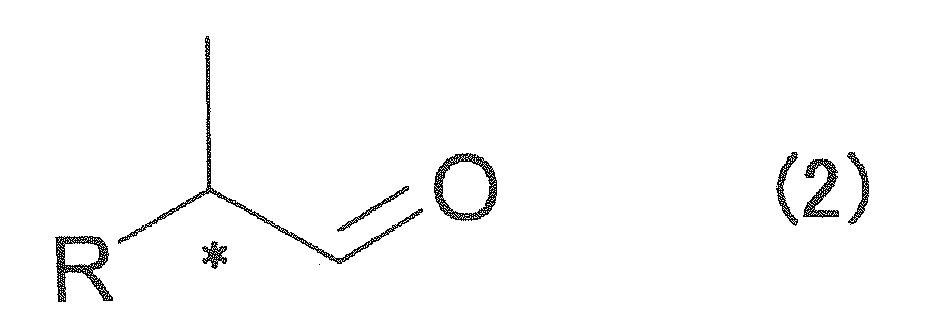
which comprises reacting a 2-substituted acrolein derivative represented by the general formula (1) :
- Other features of the present invention and those effects are shown in the following embodiment and figure.
- By the above-mentioned process of the present invention, an optically active 2-substituted propanal derivative which is useful as an intermediate of pharmaceutical products, sweetening agents, etc. can be produced in a convenient manner from inexpensive materials.
-
Fig. 1 is a schematic view of the process for producing a recombinant vector pTSYE2G1 and the constitution thereof. - First, compounds involved with the embodiment of the present invention are described. A starting material used in the process according to the embodiment of the invention is the 2-substituted acrolein compound represented by the above formula (1). As a substituent R in the formula (1), there may be mentioned a methyl group having a substituent, an alkyl group containing 2 to 10 carbon atoms which may optionally be substituted, or an aralkyl group containing 5 to 15 carbon atoms which may optionally be substituted.
- When substituted, the substituent is not particularly restricted as long as there is no adverse effect on the reaction caused by the enzyme source but, there may be mentioned, for example, a halogen atom, a hydroxyl group, an aldehyde group, a carboxyl group, a cyano group, an amino group, a nitro group, or the like substituent.
- As the methyl group having a substituent, there may be mentioned, for example, a chloromethyl group, a bromomethyl group, an iodomethyl group, a hydroxymethyl group, an aminomethyl group, a cyanomethyl group, or the like group.
- As the alkyl group containing 2 to 10 carbon atoms which may optionally be substituted, there may be mentioned a substituted or unsubstituted ethyl group, n-propyl group, iso-propyl group, n-butyl group, sec-butyl group, tert-butyl group, n-pentyl group, n-hexyl group, or the like group. When the alkyl group contains a substituent, the substituent is not particularly restricted as long as the reduction reaction of the invention is not adversely affected but, there may be mentioned a halogen atom, a hydroxyl group, an amino group, a cyano group, or the like group as the substituent.
- As the aralkyl group containing 5 to 15 carbon atoms which may optionally be substituted, there may be mentioned a benzyl group, an o-chlorobenzyl group, a m-bromobenzyl group, a p-fluorobenzyl group, a p-nitrobenzyl group, a p-cyanobenzyl group, a m-methoxybenzyl group, a phenethyl group, a naphthylmethyl group, a pyridylmethyl group, or the like group.
- Preferred as R among the above-mentioned groups, an alkyl group containing 2 to 10 carbon atoms which may optionally be substituted, more preferred is an alkyl group containing 2 to 4 carbon atoms which may optionally be substituted, still more preferred is an ethyl group, an n-propyl group or an n-butyl group, and most preferred is an n-butyl group.
- The compound represented by the above formula (1) is industrially available, or can be easily synthesized from materials which are industrially available. For example, 2-butylacrolein can be easily synthesized by stirring a mixture comprising n-hexanal, dimethylamine hydrochloride and a 37% formalin solution at 70°C for 24 hours (refer to Journal of chemical research, Synopses 7, 262-3 (1978)).
- The product obtained in the process according to the embodiment is the optically active 2-substituted propanal derivative represented by the above formula (2). In the above formula (2), R is the same as in the formula (1), and * is an asymmetric carbon.
- Next, the process for producing an optically active 2-substituted propanal derivative according to the embodiment of the invention is described.
- According to the embodiment, the optically active 2-substituted propanal derivative of the above formula (2) is produced by stereoselectively reducing a carbon-carbon double bond of the 2-substituted acrolein derivative of the above formula (1) in the presence of an enzyme source having an activity of stereoselectively reducing the carbon-carbon double bond of said 2-substituted acrolein derivative (1).
- Herein, "an enzyme source" includes an enzyme having the above-mentioned reduction activity, as well as a culture of microorganisms having the above-mentioned reduction activity and a processed product thereof. "A culture of microorganisms" refers to a culture medium containing cells or cultured cells, and also a processed product thereof is included therein. "A processed product thereof" refers to, for example, a crude extract, lyophilized cells, acetone-dried cells, and a product derived from those cells by grinding. Moreover, the enzyme source mentioned above can be immobilized by a method known in the art and used as an immobilized enzyme or an immobilized cell. The immobilization can be carried out by the method known to the person skilled in the art (for example, a crosslinking method, a physical adsorption method, an inclusion method, etc.).
- According to the embodiment, as the enzyme source having an activity of stereoselectively reducing the carbon-carbon double bond of the compound of the above formula (1), there may be mentioned those derived from a microorganism belonging to the genus Candida, the genus Kluyveromyces, the genus Pichia, the genus Rhodotorula, the genus Saccharomyces, the genus Sporidiobolus, the genus Spolobolomyces, the genus Trigonopsis, the genus Zygosaccharomyces, the genus Achramobacter, the genus Acidiphilium, the genus Alcaligenes, the genus Arthrobacter, the genus Bacillus, the genus Corynebacterium, the genus Escherichia, the genus Micrococcus, the genus Pseudomonas, the genus Paenibacillus, or the genus Xanthomonas.
- Among the above-mentioned enzyme sources, as the enzyme source having an activity of R-selectively reducing the carbon-carbon double bond of the compound of the above formula (1), preferred are those derived from microorganisms such as Candida cantarellii, Candida etchellsii, Candida kefyr, Candida musae, Candida nitrataphila, Candida sake, Candida stellata, Candida zeylanoides, Kluyveromyces lactis var. drosphzlarum, Pichia membranaefaciens, Pichia heedii, Rhodotorula minuta, Saccharomyces unisporus, Saccharomyces bayanus, Saccharomyces cerevisiae, Saccharomyces castellii, Saccharomyces pastorianus, Sporidiobolus johnsonii, Sporidiobolus salmonicolor, Spolobolomyces salmonicolor, Trigonopsis variabilis, Zygosaccharomyces bailii, Arthrobacter nicotianae, Acidiphilium cryptum, Bacillus cereus, Bacillus coagulans, Bacillus licheniformis, Bacillus pumilus, Bacillus badius, Bacillus sphaericus, Micrococcus luteus, Pseudomonas stutzeri, Pseudomonas fragi, Pseudomonas putida, Paenibacillus alvei and Xanthomonas sp.
- As the enzyme source having an activity of S-selectively reducing the carbon-carbon double bond of the compound of the above formula (1), preferred are those derived from microorganisms such as Achromobacter xylosoxidans subsp. denitrificans, Alcaligenes faecalis, Alcaligenes sp., Arthrobacter crystallopoietes, Arthrobacter protophormise, Corynebacterium ammoniagenes, and Escherichia coli.
- In addition, the microorganism from which the above-mentioned reduction enzymes are derived may be a wild strain or a variant. A microorganism derived by a genetic engineering technique such as cell fusion or gene manipulation can be used as well.
- Furthermore, it is also possible to use a recombinant microorganism capable of producing a reductase derived from these microorganisms. The recombinant microorganism capable of producing such enzyme can be obtained, for example, by a method comprising a step of isolating and/or purifying such enzyme and then determining a part or whole of the amino acid sequence thereof, a step of obtaining a DNA sequence coding for the enzyme based on the amino acid sequence mentioned above, a step of obtaining a recombinant microorganism by introducing the DNA mentioned above into another microorganism, and a step of obtaining the enzyme by culturing the recombinant microorganism mentioned above (refer to the process disclosed in
International Publication WO98/35025 - As such recombinant microorganism mentioned above, there may be mentioned one obtained by transforming a host microorganism with a vector containing DNA coding for said reductase. As the host microorganism, Escherichia coli is preferred. More preferred is Escherichia coli HB101 (pTSYE2) transformed with a vector containing a gene of NADPH dehydrogenase derived from Saccharomyces cerevisiae (Old Yellow Enzyme 2) mentioned above (refer to The Journal of Biological chemistry, 268, 6097-6106 (1993)), and the like. The process for obtaining Escherichia coli HB101 (pTSYE2) is described in below-mentioned Example 7.
- Furthermore, as the above enzyme source, it is also possible to use an oxidoreductase classified into EC 1.6.99 according to the enzyme taxonomy of International Union of Biochemistry and Molecular Biology. As the oxidoreductases classified into EC 1.6.99, there may be mentioned an enzyme classified into EC 1.6.99.1: NADPH dehydrogenase, an enzyme classified into EC 1.6.99.2: NAD(P)H dehydrogenase (quinone), an enzyme classified into EC 1.6.99.3: NADH dehydrogenase , an enzyme classified into EC 1.6.99.5: NADH dehydrogenase (quinone), and an enzyme classified into EC 1.6.99.6: NADPH dehydrogenase (quinone). Among these, NADPH dehydrogenase classified into EC 1.6.99.1 (another name: Old Yellow Enzyme) is preferred.
- It has been reported that NADPH dehydrogenase is widely distributed among yeast belonging to the genus Candida, the genus Kluyveromyces, the genus Saccharomyces, or the genus Schizosaccharomyces. In particular, NADPH dehydrogenase derived from Saccharomyces cerevisiae (Old Yellow Enzyme 2) is preferred.
- The culture medium for the microorganism which is used as an enzyme source is not particularly restricted so long as the microorganism can grow thereon. For example, a normal liquid medium containing, as a carbon source, sugar such as glucose and sucrose, alcohols such as ethanol and glycerine, fatty acids such as oleic acid and stearic acid, and esters thereof, oils such as rapeseed oil and soybean oil; as a nitrogen source, ammonium sulfate, sodium nitrate, peptone, casamino acid, corn steep liquor, bran, yeast extract, etc.; as a inorganic salt, magnesium sulfate, sodium chloride, calcium carbonate, calcium monohydrogen phosphate, potassium dihydrogen phosphate, etc.; and, as an other nutrition source, malt extract, meat extract, etc.. Culture is carried out aerobically, and usually, culture period is about 1 to 5 days, pH of the medium is 3 to 9, and culture temperature is 10 to 50°C.
- In the embodiment, the reduction reaction of the carbon-carbon double bond in the compound represented by the above formula (1) can be carried out by adding the 2-substituted acrolein derivative of the formula (1) to serve as a substrate, the coenzyme NAD(P)H, and a cultured product derived from the above microorganism or a processed product thereof to an appropriate solvent, and stirring the mixture under pH adjustment.
- The conditions of the above reduction reaction are various depending on the enzyme and the microorganism or processed product thereof to be used, concentration of the substrate, and the like. Generally, concentration of the substrate may be approximately 0.1 to 100% by weight and preferably 1 to 60% by weight, concentration of the coenzyme NAD(P)H may be 0.0001 to 100 mole% and preferably 0.0001 to 0.1 mole% relative to the concentration of the substrate, the reaction temperature may be 10 to 60°C and preferably 20 to 50°C, the pH during the reaction may be 4 to 9 and preferably 5 to 8, and the reaction period may be 1 to 120 hours and preferably 1 to 72 hours. In addition, an organic solvent can be used as a mixture with the other ingredients in the reaction. As an organic solvent, there may be mentioned, for example, toluene, ethyl acetate, n-butyl acetate, hexane, isopropanol, methanol, diisopropyl ether, acetone, dimethyl sulfoxide, and the like.
- The substrate can be added at once or continuously. The reaction can be carried out batchwise or continuously.
- In the reduction process of the embodiment, it is possible to use a coenzyme NAD(P)H regenerating system, which is generally used in combination. Thereby, the amount of use of an expensive coenzyme can be substantially decreased. As a representative NAD(P)H regenerating system, there may be mentioned, for example, a process using glucose dehydrogenase and glucose.
- When a transformed microorganism prepared by introducing a gene of a reductase and a gene of an enzyme (e.g., glucose dehydrogenase) capable of regenerating a coenzyme to be a part of the reductase into one and the same host microorganism, that is, a cultured product of a transformed microorganism prepared by introducing DNA coding for the reductase according to the embodiment and a gene of an enzyme (e.g., glucose dehydrogenase) capable of regenerating a coenzyme to be a part of the reductase into one and the same host microorganism, or a processed product thereof, etc. is used to carry out the same reaction as mentioned above, the optically active 2-substituted propanal derivative can be produced at lower cost since it is not necessary to prepare separately an enzyme source required for regenerating the coenzyme.
- As such transformed microorganism mentioned above, there may be mentioned one transformed with a plasmid containing both of the above-mentioned DNA coding for a reductase and DNA coding for an enzyme capable of regenerating a coenzyme to be a part of the reductase. Herein, as the enzyme capable of regenerating the coenzyme, glucose dehydrogenase is preferred, and glucose dehydrogenase derived from Bacillus megaterium is more preferred. And as the host microorganism, Escherichia coli is preferred. As such preferable transformed microorganism, Escherichia coli HB101 (pTSYE2G1) described in Examples below can be mentioned.
- The transformed microorganism can be cultured on a liquid nutrient medium containing ordinary carbon sources, nitrogen sources, inorganic salts, organic nutrients and so forth so long as the microorganism can grow thereon.
- In addition, the activity of the enzyme capable of regenerating a coenzyme in the transformed microorganism can be determined by conventional methods. For example, the activity of glucose dehydrogenase can be calculated by adding 100 mM of glucose, 2 mM of the coenzyme NADP or NAD, and the enzyme into 1M tris hydrochloride buffer (pH 8.0), subjecting the obtained mixture to reaction at 25°C for 1 minute, and measuring the rate of increase in absorbance at a wavelength of 340 nm.
- When the reduction process of the invention is carried out in combination with a coenzyme regeneration system, or a cultured product of the above recombinant microorganism or the processed product thereof is used as the enzyme source, it is also possible to carry out the reaction by using, as a coenzyme, oxidized NAD(P) available at lower cost.
- A process for purifying the optically active 2-substituted propanal derivative produced by the reduction reaction is not particularly restricted. For example, the derivative can be purified by extracting the same with an organic solvent, for example, ethyl acetate, toluene, t-butylmethyl ether, hexane and methylene chloride, directly or after separating cells, etc. from a reaction mixture, and then subjecting the extract to dehydration, concentration, and processes such as distillation and chromatography. For the separation of cells from a reaction mixture, conventional methods such as centrifugation and filtration can be used.
- After obtaining the optically active 2-substituted propanal derivative of the above formula (2) by the above-mentioned processes, oxidation of an aldehyde group of said compound can produce an optically active 2-substituted propionate derivative. Alternatively, reduction of an aldehyde group of the compound of the formula (2) can produce an optically active 2-substituted propanol derivative.
- As a process for oxidizing an aldehyde group, there may be mentioned a chemical technique using potassium permanganate (KMnO4), chromic acid (CrO3), nitric acid, and the like, or an enzymatic technique using an aldehyde dehydrogenase, and the like. Either technique can be used.
- Furthermore, as a process for reducing an aldehyde group, there may be mentioned a chemical technique using a metal hydride such as lithium aluminum hydride (LiAlH4) and sodium borohydride (NaBH4), or an enzymatic technique using an aldehyde reductase, and the like. Either technique can be used.
- The following examples illustrate the present invention in further detail. These examples are, however, by no means limitative of the scope of the invention.
- A liquid medium (pH 6.5) comprising glucose (5%), peptone (1%) and yeast extract (1%) was prepared to be dispensed into 500 ml Sakaguchi flasks by 50 ml fractions, and each flask was subjected to steam sterilization at 120°C for 20 minutes. A loopful of the microorganisms shown in Table 1 was respectively inoculated into each of these liquid media to be subjected to shaking culture at 30°C for 2 to 3 days. Cells were separately collected from each of these culture media by centrifugation, washed with water, added with ice-cold acetone, and then subjected to vacuum drying to prepare acetone dried cells. Each 5-mg-portion of the obtained acetone dried cells was scaled into a test tube equipped with a plug, and then suspended into 500 µl of 100 mM phosphate buffer (pH 6.5). To each of these solutions, glucose 25 mg, NAD and NADP, 0.5 mg of each, and glucose dehydrogenase (product of Amano Enzyme Inc.) 5 U were added. After each 2-mg-portion of the substrate 2-butylacrolein was dissolved in a 500-µl-portion of ethyl acetate to be added into each of the test tubes each equipped with a plug, these tubes were stirred at 30°C for 20 hours. After the reaction, each reaction mixture was centrifuged, and each of the substrate together with the product in an ethyl acetate layer was converted into trifluoroacetyl derivative thereof to be analyzed with gas chromatography (GC). Thus, the reaction conversion rates and optical purities of the products were determined. The results are shown in Table 1 (the reaction conversion is 10 to 100%).
- The analysis conditions and the method for calculating the reaction conversion rate and optical purity were as follows.
[GC analysis conditions]
Capillary column: Cyclodex-β ϕ0.25 mm I.D. x 60 m (product of J&W Scientific Inc.)
Carrier gas: He 300 kPa
Detector: FID
Column temperature: 45°C
Detection time: 49.9 minutes for (R)-2-methyl-1-hexanal, 51.5 minutes for (S)-2-methyl-1-hexanal, and 44.6 minutes for 2-butylacrolein

Table 1 Microorganism Reaction conversion rate(%) Optical purity (%ee) Configuration Candida cantarellii NBRC 1261 40.2 96.7 R Candida etchellsii NBRC 1229 18.2 95.9 R Candida kefyr NBRC 0706 27.9 97.3 R Candida musae NBRC 1582 36.7 73.4 R Candida nitratophila NBRC 10004 37.6 90.2 R Candida sake CBS 5093 32.1 92.2 R Candida stellata NBRC 0701 14.8 89.9 R Candida zeylanoides NBRC 0738 27.2 93.1 R Kluyveromyces lactis var. drosophilarum NBRC 1012 18.8 97.0 R Pichia membranaefaciens IAM 4258 16.9 91.8 R Pichia canadensis NBRC 0976 18.4 95.0 R Pichia heedii NBRC 10019 48.8 92.6 R Rhodotorula minuta NBRC 0387 46.7 95.3 R Saccharomyces unisporus NBRC 0215 23.8 95.8 R Saccharomyces bayanus NBRC 0213 20.1 91.4 R Saccharomyces cerevisiae ATCC26108 48.2 92.4 R Saccharomyces pastorianus NBRC 1265 35.9 96.9 R Saccharomyces castellii NBRC 0285 27.3 94.3 R Sporidiobolus johnsonii NBRC 6903 39.8 69.1 R Sporidiobolus salmonicolor NBRC 1035 16.5 74.8 R Sporobolomyces salmonicolor IAM 12249 20.2 84.0 R Trigonopsis variabilis NBRC 0671 15.1 81.9 R Zygosaccharomyces bailii NBRC 0488 28.3 93.9 R - A liquid medium (pH 6.5) comprising meat extract (1%), peptone (1%), yeast extract (0.5%) and sodium chloride (1%) was prepared to be dispensed into large test tubes by 5 ml fractions, and each tube was subjected to steam sterilization at 120°C for 20 minutes. A loopful of the microorganisms shown in Table 2 was respectively inoculated into each of these liquid media to be subjected to shaking culture at 30°C for 2 to 3 days. Cells were collected from each of these culture media by centrifugation. Each cell portion was washed with a 1-ml-portion of 100 mM phosphate buffer (pH 6.5), suspended into a 500-µl-portion of the same buffer, and then put into a test tube equipped with a plug. To each of these solutions, glucose 25 mg, NAD and NADP, 0.5 mg of each, and glucose dehydrogenase (product of Amano Enzyme Inc.) 5 U were added. After each 2-mg-portion of the substrate 2-butylacrolein was dissolved in a 500-µl-portion of ethyl acetate to be added into each of the test tubes each equipped with a plug, these tubes were stirred at 30 °C for 20 hours. After the reaction, each reaction mixture was centrifuged, and the amounts of substrate and product in an ethyl acetate layer were analyzed in the same manner as in Example 1 to determine the reaction conversion rate and optical purity of the product. The results are shown in Table 2 (the reaction conversion is 10 to 100%).
Table 2 Microorganism Reaction conversion rate (%) Optical purity (%ee) Configuration Arthrobacter nicotianae NBRC 14234 45.2 42.9 R Acidiphilium cryptum NBRC 14242 44.8 45.7 R Bacillus cereus NBRC 3466 21.9 84.3 R Bacillus coagulans NBRC 3886 19.0 95.7 R Bacillus licheniformis IAM 11054 16.2 83.1 R Bacillus pumilus NBRC 12086 18.3 94.7 R Bacillus badius ATCC 14574 29.1 88.7 R Bacillus sphaericus NBRC 3525 73.3 90.7 R Micrococcus luteus NBRC 13867 47.8 66.6 R Pseudomonas stutzeri NBRC 13596 30.2 55.4 R Pseudomonas fragi NBRC 3458 47.2 65.0 R Pseudomonas putida NBRC 14164 24.7 13.3 R Paenibacillus alvei NBRC 3343 35.7 89.7 R Xanthomonas sp. NBRC 3084 65.0 86.1 R Xanthomonas sp. NBRC 3085 52.2 86.0 R Achromobacter xylosoxidans subsp. denitrificans NBRC 15125 11.5 33.5 S Alcaligenes faecalis NERC 13111 15.7 63.2 S Alcaligenes sp. NBRC 14130 10.5 29.9 S Arthrobacter crystallopoietes NBRC 14235 12.9 54.0 S Arthrobacter protophormiae NBRC 12128 16.8 25.2 S Corynebacterium ammoniagenes NBRC 12072 14.4 65.0 S Escherichia coli ATCC 11303 55.1 78.3 S - Each 5-mg-portion of the acetone dried cells prepared in Example 1 or the cells separated from the culture medium prepared in Example 2 was suspended into a 500-µl-portion of 100 mM phosphate buffer (pH 6.5) in a test tube equipped with a plug. To each of these solutions, glucose 25 mg, NAD and NADP, 0.5 mg of each, glucose dehydrogenase (product of Amano Enzyme Inc.) 5 U were added. After each 2-mg-portion of the substrates shown in Table 3 was dissolved in a 500-µl-portion of ethyl acetate to be added into a test tube equipped with a plug, these tubes were stirred at 30°C for 20 hours. After the reaction, each reaction mixture was centrifuged, and the amounts of substrate and product in an ethyl acetate layer were analyzed with gas chromatography (GC) to determine the reaction conversion rate and optical purity of the product. The results are shown in Table 3.
- The analysis conditions were as follows.
[GC analysis conditions (2-methylbutanal: trifluoroacetyl derivatization of the substrates and products)]
Capillary column: Cyclodex-β ϕ0.25 mm I.D.x 60 m (product of J&W Scientific Inc.)
Carrier gas: He 300 kPa
Detector: FID
Column temperature: 40°C
Detection time: 16.7 minutes for (R)-2-methyl-1-butanal, 17.0 minutes for (S)-2-methyl-1-butanal, 15.0 minutes for 2-ethylacrolein
[GC analysis conditions (2-methyloctanal)]
Capillary column: TC-WAX ϕ0.25 mm I.D. x 15 m (product of GL Sciences Inc.)
Carrier gas: He 80 kPa
Detector: FID
Column temperature: 80°C
Detection time: 2.8 minutes for 2-methyl-1-octanal, 3.6 minutes for 2-hexylacroleinTable 3 Microorganism 2-ethylacrolein 2-hexylacrolein Reaction conversion rate (%) Optical purity (%ee) Configuration Reaction conversion rate (%) Optical purity (%ee) Configuration Candida cantarellii NBRC 1261 40.8 93.5 R 83.7 - - Candida etchellsii NBRC 1229 13.3 89.7 R 26.2 - - Candida kefyr NBRC 0706 25.2 93.2 R 39.5 - - Kluyveromyces lactis var. drosophilarum NBRC 1012 17.6 93.0 R 25.6 - - Pichia canadensis NBRC 0976 15.4 91.4 R 15.7 - - Rhodotorula minuta NBRC 0387 32.7 92.7 R 56.0 - - Saccharomyces unisporus NBRC 0215 19.2 90.7 R 31.7 - - Saccharomyces cerevisiae ATCC 26108 48.2 92.4 R 52.8 - - Saccharomyces pastorianus NBRC 1265 28.7 94.1 R 44.4 - - Bacillus coagulans NBRC 3885 12.3 65.9 R 6.7 - - Bacillus pumilus NBRC 12086 49.8 97.8 R 11.9 - - Bacillus baclius ATCC 14574 13.2 85.6 R 5.8 - - Bacillus sphaericus NBRC 3525 51.2 79.5 R 19.0 - - Paenibacillus alvei NBRC 3343 10.0 80.4 R 91.6 Xanthomonas sp. NBRC 3084 16.4 89.0 R 22.1 - - Xanthomonas sp. NBRC 3085 14.3 90.0 R 18.0 - - Alcaligenes faecalis NBRC 13111 0.7 40.5 S 0.5 - - Escherichia coli ATCC 11303 18.8 57.0 S 18.0 - - - Each 5-mg-portion of acetone dried cells prepared in Example 1 or the cells separated from the culture medium prepared in Example 2 was suspended into a 500-µl-portion of 100 mM phosphate buffer (pH 6.5) in a test tube equipped with a plug. To each of these solutions, glucose 25 mg, NAD and NADP, 0.5 mg of each, and glucose dehydrogenase (product of Amano Enzyme Inc.) 5 U were added. After each 2-mg-portion of the substrate 2-benzylacrolein was dissolved in a 500-µl-portion of ethyl acetate to be added into each of the test tubes each equipped with a plug, these tubes were stirred at 30°C for 20 hours. After the reaction, each reaction mixture was centrifuged, and each of the substrate together with the product in an ethyl acetate layer was converted into trifluoroacetyl derivertive thereof to be analyzed with gas chromatography (GC). Thus, the reaction conversion rates and optical purities of the products were determined. The results are shown in Table 4.
- The analysis conditions were as follows.
[GC analysis conditions]
Capillary column: Cyclodex-β ϕ0.25 mm I.D. x 60 m (product of J&W Scientific Inc.)
Carrier gas: He 300 kPa
Detector: FID
Column temperature: 80°C
Detection time: 113.9 minutes for (R)-2-methyl-3-phenylpropanal, 116.9 minutes for (S)-2-methyl-3-phenylpropanal, 96.2 minutes for 2-benzylacroleinTable 4 Microorganism Reaction conversion rate (%) Optical purity (%ee) Configuration Candida cantarellii NBRC 1261 63.4 86.4 R Candida etchellsii NBRC 1229 22.2 43.0 R Candida kefyr NBRC 0706 33.7 85.6 R Kluyveromyces lactis var. drosophilarum NBRC 1012 25.1 42.0 R Pichia canadensis NBRC 0976 18.0 68.0 R Rhodotorula minuta NBRC 0387 61.1 83.2 R Saccharomyces unisporus NBRC 0215 32.9 33.8 R Saccharomyces cerevisiae ATCC 26108 61.6 94.2 R Saccharomyces pastorianus NBRC 1265 44.5 78.0 R Bacillus coagulans NBRC 3886 12.3 22.0 R Bacillus pumilus NBRC 12086 32.8 14.8 R Bacillus badius ATCC 14574 10.3 55.0 R Bacillus sphaericus NBRC 3525 39.1 67.0 R Paenibacillus alvei NBRC 3343 9.1 55.9 R Xanthomonas sp. NBRC 3084 7.4 65.3 R Xanthomonas sp. NBRC 3085 7.4 55.2 R Alcaligenes faecalis NBRC 13111 2.7 81.2 S Escherichia coli ATCC 11303 57.4 70.2 S - An expression vector was prepared by the method mentioned below for expressing an NADPH dehydrogenase derived from Saccharomyces cerevisiae S288C (ATCC26108) strain (Old Yellow Enzyme 2, hereinafter, referred to as "OYE2") in Escherichia coli (refer to Appl. Environ. Microbiol., 69, 933, (2003)).
- First, a DNA fragment containing OYE2 gene was amplified by a first-step PCR using a chromosomal DNA of Saccharomyces cerevisiae S288C (ATCC26108) strain as a template. Then, by a second-step PCR using the DNA fragment obtained by the first-step PCR as a template, a double-stranded DNA was obtained in which a SacI site is added to the initiation codon site of OYE2 gene and a new termination codon and a Sall site are added to just after the termination codon. Details are shown below.
- A primer 1: 5'-cggtccagatatagaataaatcatcatattaag-3'(SEQ ID NO:1 in the sequence listing) and a primer 2: 5'-gaaatggtgctacaaagtacggttaacac-3'(SEQ ID NO:2 in the sequence listing) were synthesized. 50 µl of an ExTaq buffer containing each 50 pmol of these two species of primers (
primers 1 and 2), 200 ng of a chromosomal DNA of Saccharomyces cerevisiae S288C (ATCC26108) strain, each 10 nmol of dNTP, and 2.5 U of ExTaq (product of Takara Shuzo Co., Ltd.) was prepared. A PCR reaction was carried out under the conditions of thermal denaturation (97°C, 0.5 minute), annealing (55°C, 1 minute), and elongation (72°C, 1 minute). After cooling the buffer to 4°C, amplification of the DNA fragment was confirmed by agarose gel electrophoresis, and the amplified fragment was collected from gel. The chromosomal DNA was prepared by usual DNA isolation method, e.g., a potassium acetate method, etc. Then, a primer 3: 5'-atcgagctctaaggaggttaacaatgccatttgttaaggac-3' (SEQ ID NO:3 in the sequence listing) resulting from addition of the Escherichia coli-derived Shine-Dalgarno sequence (SD sequence, 9 nucleotides) at upstream of the initiation codon of OYE2 gene and a SacI recognition site just before thereof, and a primer 4: 5'-acgcgtcgacttattaatttttgtcccaaccg-3' (SEQ ID NO:4 in the sequence listing) resulting from addition of a new termination codon and a SalI recognition site just after the termination codon were synthesized. 50 µl of an ExTaq buffer containing each 50 pmol of these two species of primers (primers 3 and 4), 200 ng of the DNA fragment amplified by the PCR reaction mentioned above, each 10 nmol of dNTP, and 2.5 U of ExTaq (product of Takara Shuzo Co., Ltd.) was prepared to carry out a PCR reaction under the same conditions as mentioned above. As a result, a double-stranded DNA was obtained in which the Escherichia coli-derived Shaine-Dalgarno sequence (SD sequence) is added at a site 5 bases upstream of the initiation codon of OYE2 gene and a SacI recognition site is added just before that sequence and, further, a new termination codon and a SalI recognition site are added just after the termination codon. This double-stranded DNA was digested with SacI and SalI, and the digest was inserted into the SacI and SalI sites at downstream of lac promoter of a plasmid pUCT resulting from conversion, in an NdeI site of a plasmid pUCNT (obtainable by the person skilled in the art by the method described inInternational Publication WO94/03613 - Using a primer 5: 5'-acgcgtcgactaaggaggttaacaatgtataa agatttagaagg-3' (SEQ ID NO:5 in the sequence listing) and a primer 6: 5'-gcgctgcagttatccgcgtcctgcttgga-3'(SEQ ID NO:6 in the sequence listing), and using a plasmid pGDK1 (refer to Eur. J. Biochem., 186, 389 (1989)) as a template, PCR was carried out to obtain a double-stranded DNA in which the Escherichia coli-derived Shaine-Dalgarno sequence (SD sequence) is added at a site 5 bases upstream of the initiation codon of a glucose dehydrogenase (hereinafter referred to as "GDH") gene derived from the Bacillus megaterium IAM 1030 strain, a SalI recognition site is added just before that sequence and, further, a new termination codon and a PstI recognition site is added just after the termination codon. This double-stranded DNA obtained was digested with SalI and PstI. The digest was inserted between a SalI recognition site and PstI recognition site of the above recombinant vector pTSYE2 to construct a recombinant vector pTSYE2G1. The process for producing pTSYE2G1 and the construction thereof are shown in
Fig.1 . - Using the recombinant vector pTSYE2 constructed in Example 5, Escherichia coli HB101 (product of Takara Shuzo Co., Ltd.) was transformed to obtain a strain transformant Escherichia coli HB101 (pTSYE2). In the same manner, using the recombinant vector pTSYE2G1 constructed in Example 6, Escherichia coli HB101 (product of Takara Shuzo Co., Ltd.) was transformed to obtain a transformant Escherichia coli HB101 (pTSYE2G1).
- Two species of transformants obtained in Example 7 and a transformant Escherichia coli HB101 (pUCT) introduced with a vector plasmid pUCT (refer to Example 5) alone were respectively inoculated into a 2xYT liquid medium (bactotriptone 1.6%, bactoyeast extract 1.0%, sodium chloride 0.5%, pH 7.0) containing 100 µg/ml of ampicillin, and subjected to shaking culture at 37°C for 24 hours. From the culture media, cells were collected by centrifugation, suspended into 100 mM phosphate buffer (pH 6.5), and subjected to ultrasonic disruption using an UH-50 type ultrasonic homogenizer (product of SMT Co., Ltd). Then, cell residues were removed by centrifugation to obtain a cell-free extraction. The OYE2 activity and GDH activity of this cell-free extraction were determined and shown in Table 5.
- In both two species of transformants obtained in Example 7, expression of OYE2 activity was observed. Moreover, in a GDH gene-containing transformant Escherichia coli HB101 (pTSYE2G1), expression of GDH activity was also observed.
- Additionally, the OYE2 activity was calculated by adding 1 mM of the substrate 2-cyclohexenone, 0.2 mM of coenzyme NADPH and a crude enzyme solution to 100 mM phosphate buffer (pH 6.5), subjecting the mixture to reaction at 30°C for 1 minute, and measuring the rate of decrease in absorbance at a wavelength of 340 nm. The enzyme activity for oxidizing 1 µmol of NADPH to NADP+ per minute under these reaction conditions was defined as 1 unit.
- The GDH activity was calculated by adding 0.1 M of glucose, 2 mM of coenzyme NADP, and a crude enzyme solution to 1 M tris hydrochloride buffer (pH 8.0), subjecting the mixture to reaction at 25°C for 1 minute, and measuring the rate of increase in absorbance at a wavelength of 340 nm. The enzyme activity for reducing 1 µmol of NADP to NADPH per minute under these reaction conditions was defined as 1 unit.
Table 5 Strain OYE2 activity (U/ml) GDH activity (U/ml) E. coli HB101(pUCT) 0.00 0.0 E. coli HB101(pTSYE2) 0.30 0.0 E. coli HB101(pTSYE2G1) 1.20 82.0 - The transformant Escherichia coli HB101 (pTSYE2) obtained in Example 7 was inoculated to 50 ml of a 2xYT medium (bactotriptone 1.6%, bactoyeast extract 1.0%, sodium chloride 0.5%, pH 7.0) sterilized in a 500 ml Sakaguchi flask, and subjected to shaking culture at 30°C for 2 days. The culture medium obtained was concentrated and subjected to ultrasonic disruption using an UH-50 type ultrasonic homogenizer (product of SMT Co., Ltd). Then, cell residues were removed by centrifugation to obtain a cell-free extraction. In 450 µl of 100 mM phosphate buffer (pH 6.5), this cell-free extraction 50 µl, glucose 25 mg, NAD and NADP, 0.5 mg of each, and glucose dehydrogenase (product of Amano Enzyme Inc.) 5 U were dissolved, and the solution was put into a test tube equipped with a plug. After each 2-mg-portion of the substrates shown in Table 6 was dissolved in a 500-µl-portion of ethyl acetate to be added into each of the test tubes each equipped with a plug, these tubes were stirred at 30°C for 2 hours. After the reaction, each reaction mixture was centrifuged and the amounts of substrate and product in an ethyl acetate layer were analyzed in the same manner as in Examples 1 and 3 to determine the reaction conversion rate and optical purity of the product. The results are shown in Table 6.
Table 6 Substrate Reaction conversion rate Optical purity (%ee) 2-ethylacrolein 96.7 96.0 2-butylacrolein 99.7 94.5 2-hexylacrolein 98.6 - - 50 µl of a cell-free extraction of the transformant Escherichia coli HB101 (pTSYE2) prepared in the same manner as in Example 9, glucose 25 mg, NAD and NADP, 0.5 mg of each, and glucose dehydrogenase (product of Amano Enzyme Inc.) 5 U were dissolved in 450 µl of 100 mM phosphate buffer (pH 6.5), and put into a test tube equipped with a plug. Then, 2 mg of the substrate 2-benzylacrolein was dissolved in 500 µl of ethyl acetate and added into the test tube equipped with a plug, and then stirred at 30°C for 2 hours. After the reaction, the reaction mixture was centrifuged and the amount of substrate and product in an ethyl acetate layer was analyzed in the same manner as in Example 4. As a result, (R)-2-methyl-3-phenylpropanal with the optical purity of 94.7%ee was obtained at the reaction conversion rate of 99.3%.
- The transformant Escherichia coli HB101 (pTSYE2G1) obtained in Example 7 was inoculated to 50 ml of a 2xYT medium (bactotriptone 1.6%, bactoyeast extract 1.0%, sodium chloride 0.5%, pH 7.0) sterilized in a 500 ml Sakaguchi flask to be subjected to shaking culture at 30°C for 2 days. The culture medium obtained was concentrated and subjected to ultrasonic disruption using an UH-50 type ultrasonic homogenizer (product of SMT Co., Ltd). Then, cell residues were removed by centrifugation to obtain a cell-free extraction. 30 ml of the above cell-free extraction, 195 ml of 100 mM phosphate buffer (pH 6.5), 25 ml of 55% glucose solution, and 25 mg of NADP were added to a 500 ml 4-necked flask. Then, 1 g of the substrate 2-butylacrolein was dissolved in 100 ml of hexane, and added dropwise into the reaction system for 25 minutes. Under pH adjustment, the obtained liquid was stirred at 30°C for 1 hour, and the amount of substrate and product in a hexane layer was analyzed in the same manner as in Example 1. Then, the reaction mixture was separated and hexane was distilled off under reduced pressure to obtain (R)-2-methyl-1-hexanal with the optical purity of 96.3%ee in 80% yield.
- 500 µl of a culture medium of the transformant Escherichia coli HB101 (pTSYE2G1) prepared in the same manner as in Example 11, 30 µl of 55% glucose solution and 0.5 mg of NADP were mixed with 100 µl of 100 mM phosphate buffer (pH 6.5), and the mixture was put into a test tube equipped with a plug. Then, 10 mg of the substrate 2-(3-hydroxypropyl)acrolein was added thereto and the mixture was stirred for 2 hours. After the reaction, the reaction mixture was extracted with ethyl acetate, and the amount of substrate and product in an ethyl acetate layer was analyzed with GC under the below-mentioned analysis conditions. As a result, 5-hydroxy-2-methyl-1-pentanal was obtained at the reaction conversion rate of 96.9%.
- The analysis conditions were as follows. [GC analysis conditions]
Capillary column: β-DEX225 ϕ0.25 mm I.D. x 30 m (product of SUPELCO Co., Ltd)
Carrier gas: He 100 kPa
Detector: FID
Column temperature: 120°C
Detection time: 7.1 minutes for 5-hydroxy-2-methyl-1-pentanal, 14.8 minutes for 2-(3-hydroxypropyl)acrolein - 500 µl of a culture medium of the transformant Escherichia coli HB101 (pTSYE2G1) prepared in the same manner as in Example 11, 30 µl of 55% glucose solution and 0.5 mg of NADP were mixed with 100 µl of 100 mM phosphate buffer (pH 6.5), and put into a test tube equipped with a plug. Then, 10 mg of the substrate 2-(3-benzyloxypropyl)acrolein was added thereto and the mixture was stirred for 2 hours. After the reaction, the reaction mixture was extracted with ethyl acetate, and the amounts of substrate and product in an ethyl acetate layer were analyzed with GC under the below-mentioned analysis conditions. As a result, 5-benzyloxy-2-methyl-1-pentanal was obtained at the reaction conversion rate of 99.1%. Furthermore, as a result of reducing 5-benzyloxy-2-methyl-1-pentanal with sodium borohydride (NaBH4) and HPLC analysis under the below-mentioned analysis conditions, the optical purity was 90.0%ee(R).
- The analysis conditions were as follows. [GC analysis conditions]
Capillary column: TC-WAX ϕ0.25 mm I.D. x 15 m (product of GL Sciences Inc.)
Carrier gas: He 80 kPa
Detector: FID
Column temperature: 165°C
Detection time: 11.1 minutes for 5-benzyloxy-2-methyl-1-pentanal, 13.2 minutes for 2-(3-benzyloxypropyl)acrolein
[HPLC analysis conditions]
Chiral column: OB-H ϕ4.6 mm I.D. x 250 mm (product of Daicel Chemical Industries, Ltd.)
Eluant: hexane /2-propanol 95/5
Detector: UV 254 nm
Column temperature: 25°C
Detection time: 12.2 minutes for (S)-5-benzyloxy-2-methyl-1-pentanol, 14.3 minutes for (R)-5-benzyloxy-2-methyl-1-pentanol - 5 U of aldehyde dehydrogenase (product of Sigma-Aldrich Corp.) and 13 mg of NAD were dissolved in 500 µl of 100 mM phosphate buffer (pH 8.0), and put into a test tube equipped with a plug. After 2 mg of (R)-2-methyl-1-hexanal obtained in Example 11 was added thereto, the mixture was stirred at 30°C for 20 hours. After the reaction, 6 N hydrochloric acid solution was added for acidizing the reaction mixture, and 1 ml of ethyl acetate was added for extracting the substrate and product, which were analyzed with GC under the analysis conditions mentioned below. As a result, (R)-2-methyl-1-hexanoic acid with 96.5 %ee was obtained at the reaction conversion rate of 99.1%.
- The analysis conditions were as follows. [GC analysis conditions]
Capillary column: G-PN φ 0.25 mm I.D. x 30 m (product of Tokyo Chemical Industry Co., Ltd.)
Carrier gas: He 150 kPa
Detector: FID
Column temperature: 40°C
Detection time: 22.0 minutes for (R)-2-methylhexanoic acid, 23.4 minutes for (S)-2-methylhexanoic acid, 15.1 minutes for 2-methyl-1-hexanal


Claims (12)
- A process for producing an optically active 2-substituted propanal derivative represented by the general formula (2):

which comprises reacting a 2-substituted acrolein derivative represented by the general formula (1):
- The process according to Claim 1,
wherein R is an alkyl group containing 2 to 10 carbon atoms which may optionally be substituted. - The process according to Claim 1,
wherein R is an alkyl group containing 2 to 4 carbon atoms which may optionally be substituted. - The process according to any one of Claims 1 to 3,
which comprises using, as the enzyme source capable of stereoselectively reducing the carbon-carbon double bond, an enzyme source derived from a microorganism belonging to the genus Candida, the genus Kluyveromyces, the genus Pichia, the genus Rhodotorula, the genus Saccharomyces, the genus Sporidiobolus, the genus Spolobolomyces, the genus Trigonopsis, the genus Zygosaccharomyces, the genus Achromobacter, the genus Acidiphilium, the genus Alcaligenes, the genus Arthrobacter, the genus Bacillus, the genus Corynebacterium, the genus Escherichia, the genus Micrococcus, the genus Pseudomonas, the genus Paenibacillus, or the genus Xanthomonas. - The process according to any one of Claims 1 to 3,
which comprises using, as the enzyme source capable of stereoselectively reducing the carbon-carbon double bond, an enzyme source derived from a microorganism belonging to the genus Candida, the genus Kluyveromyces, the genus Pichia, the genus Rhodotorula, the genus Saccharomyces, the genus Sporidiobolus, the genus Spolobolomyces, the genus Trigonopsis, the genus Zygosaccharomyces, the genus Acidiphilium, the genus Arthrobacter, the genus Bacillus, the genus Micrococcus, the genus Pseudomonas, the genus Paenibacillus, or the genus Xanthomonas, and capable of R-selective reduction of the carbon-carbon double bond of the compound represented by the above formula (1). - The process according to Claim 5,
wherein said enzyme source capable of R-selective reduction is an enzyme source derived from one or more microorganism(s) selected from the group consisting of Candida cantarellii, Candida etchellsii, Candida kefyr, Candida musae, Candida nitratophila, Candida sake, Candida stellata, Candida zeylanoides, Kluyveromyces lactis var. drosphilarum, Pichia membranaefaciens, Pichia heedii, Rhodotorula minuta, Saccharomyces unisporus, Saccharomyces bayanus, Saccharomyces cerevisiae, Saccharomyces castellii, Saccharomyces pastorianus, Sporidiobolus johnsonii, Sporidiobolus salmonicolor, Spolobolomyces salmonicolor, Trigonopsis variabilis, 2ygosaccharomyces bailii, Arthrobacter nicotianae, Acidiphilium cryptum, Bacillus cereus, Bacillus coagulans, Bacillus licheniformis, Bacillus pumilus, Bacillus badius, Bacillus sphaericus, Micrococcus luteus, Pseudomonas stutzeri, Pseudomonas fragi, Pseudomonas putida, Paenibacillus alvei, and Xanthomonas sp. - The process according to Claim 5,
wherein said enzyme source capable of R-selective reduction is a cultured product of a transformed microorganism transformed with a vector containing a gene of NADPH dehydrogenase derived from Saccharomyces cerevisiae (Old Yellow Enzyme 2) . - The process according to any one of Claims 1 to 3,
which comprises using, as the enzyme source capable of stereoselectively reducing the carbon-carbon double bond, an enzyme source derived from a microorganism belonging to the genus Achromobacter, the genus Alcaligenes, the genus Arthrobacter, the genus Corynebacterium, or the genus Escherichia, and capable of S-selective reduction of the carbon-carbon double bond of the compound represented by the above formula (1). - The process according to Claim 8,
wherein said enzyme source capable of S-selective reduction is an enzyme source derived from one or more microorganism(s) selected from the group consisting of Achromobacter xylosoxidans subsp. denitrificans, Alcaligenes faecalis, Alcaligenes sp., Arthrobacter crystallopoietes, Arthrobacter protophormise, Corynebacterium ammoniagenes, and Escherichia coli. - The process according to any one of Claims 1 to 3,
wherein an oxidoreductase classified into Enzyme Commission Number 1.6.99 is used as the enzyme source capable of stereoselectively reducing the carbon-carbon double bond. - The process according to Claim 10,
wherein NADPH dehydrogenase classified into EC 1.6.99.1 is used as the oxidoreductase classified into Enzyme Commission Number 1.6.99, and
an R form of the compound represented by the above formula (2) is produced. - The process according to Claim 11,
wherein said NADPH dehydrogenase is NADPH dehydrogenase derived from Saccharomyces cerevisiae (Old Yellow Enzyme 2).
Applications Claiming Priority (2)
| Application Number | Priority Date | Filing Date | Title |
|---|---|---|---|
| JP2005158393 | 2005-05-31 | ||
| PCT/JP2006/310715 WO2006129628A1 (en) | 2005-05-31 | 2006-05-30 | Process for production of optically active 2-substituted propanal derivative |
Publications (2)
| Publication Number | Publication Date |
|---|---|
| EP1887085A1 true EP1887085A1 (en) | 2008-02-13 |
| EP1887085A4 EP1887085A4 (en) | 2010-10-20 |
Family
ID=37481557
Family Applications (1)
| Application Number | Title | Priority Date | Filing Date |
|---|---|---|---|
| EP06756711A Withdrawn EP1887085A4 (en) | 2005-05-31 | 2006-05-30 | Process for production of optically active 2-substituted propanal derivative |
Country Status (4)
| Country | Link |
|---|---|
| US (1) | US20100003732A1 (en) |
| EP (1) | EP1887085A4 (en) |
| JP (1) | JPWO2006129628A1 (en) |
| WO (1) | WO2006129628A1 (en) |
Cited By (1)
| Publication number | Priority date | Publication date | Assignee | Title |
|---|---|---|---|---|
| CN102559553A (en) * | 2012-01-08 | 2012-07-11 | 中国科学院成都生物研究所 | Achromobacter and method for asymmetrically catalytically reducing carbon-carbon double bond |
Families Citing this family (2)
| Publication number | Priority date | Publication date | Assignee | Title |
|---|---|---|---|---|
| JP5941410B2 (en) * | 2010-11-09 | 2016-06-29 | 株式会社カネカ | Halogenated indenones and methods for producing optically active indanones or optically active indanols using the same |
| US10303880B2 (en) * | 2014-07-24 | 2019-05-28 | Nuvoton Technology Corporation | Security device having indirect access to external non-volatile memory |
Family Cites Families (9)
| Publication number | Priority date | Publication date | Assignee | Title |
|---|---|---|---|---|
| JP3438890B2 (en) | 1992-08-10 | 2003-08-18 | 鐘淵化学工業株式会社 | DNA encoding decarbamylase with improved thermostability and use thereof |
| JPH06263681A (en) * | 1993-03-12 | 1994-09-20 | Mitsubishi Gas Chem Co Inc | Method for producing optically active aldehydes |
| CA2280502A1 (en) | 1997-02-07 | 1998-08-13 | Kaneka Corporation | Novel carbonyl reductase, gene coding same, and method for using such reductase and gene |
| CA2246889A1 (en) * | 1997-09-09 | 1999-03-09 | Rafael Rangel-Aldao | Malt beverage having stabilized flavor and methods of production thereof |
| JP3941184B2 (en) * | 1997-10-06 | 2007-07-04 | 三菱化学株式会社 | Process for producing optically active 1-acyloxy-3-chloro-2-propanol and optically active 3-chloro-1,2-propanediol |
| KR20020068496A (en) * | 2000-06-05 | 2002-08-27 | 카네카 코포레이션 | Process for preparing optically active 2-[6-(hydroxy-methyl)-1,3-dioxan-4-yl]acetic acid derivatives |
| US20070117191A1 (en) * | 2002-02-06 | 2007-05-24 | Harumi Kamachi | Reductase gene for alpha-substituted-alpha, beta-unsaturated carbonyl compound |
| MXPA05009331A (en) * | 2003-03-17 | 2005-11-04 | Kaneka Corp | Processes for production of (r)-3-[4-(trifluoromethyl)- phenylamino]pentanamide derivatives. |
| JP2005158393A (en) | 2003-11-25 | 2005-06-16 | Pioneer Electronic Corp | Method for manufacturing organic electroluminescent element |
-
2006
- 2006-05-30 US US11/916,152 patent/US20100003732A1/en not_active Abandoned
- 2006-05-30 JP JP2007518991A patent/JPWO2006129628A1/en active Pending
- 2006-05-30 WO PCT/JP2006/310715 patent/WO2006129628A1/en not_active Ceased
- 2006-05-30 EP EP06756711A patent/EP1887085A4/en not_active Withdrawn
Non-Patent Citations (6)
| Title |
|---|
| R. WILLIAMS ET AL.: "Biotransformation of Explosives by the Old Yellow Enmyme Family of Flavoproteines" APPLIED AND ENVIRONMENTAL MICROBIOLOGY, June 2004 (2004-06), pages 3566-3574, XP002599129 * |
| See also references of WO2006129628A1 * |
| STOTT KELVIN ET AL: "Old Yellow Enzyme: The discovery of multiple isozymes and a family of related proteins" JOURNAL OF BIOLOGICAL CHEMISTRY, AMERICAN SOCIETY FOR BIOCHEMISTRY AND MOLECULAR BIOLOGY, INC, US, vol. 268, no. 9, 25 March 1993 (1993-03-25), pages 6097-6106, XP002252405 ISSN: 0021-9258 * |
| VAZ A D N ET AL: "OLD YELLOW ENZYME: AROMATIZATION OF CYCLIC ENONES AND THE MECHANISM OF A NOVEL DISMUTATION REACTION" BIOCHEMISTRY, AMERICAN CHEMICAL SOCIETY, US LNKD- DOI:10.1021/BI00013A014, vol. 34, no. 13, 1 January 1995 (1995-01-01), pages 4246-4256, XP001164161 ISSN: 0006-2960 * |
| WADA M ET AL: "PRODUCTION OF A DOUBLY CHIRAL COMPOUND, (4R,6R)-4-HYDROXY-2,2,6-TRIME THYLCYCLOHEXANONE, BY TWO-STEP ENZYMATIC ASYMMETRIC REDUCTION" APPLIED AND ENVIRONMENTAL MICROBIOLOGY, AMERICAN SOCIETY FOR MICROBIOLOGY, US LNKD- DOI:10.1128/AEM.69.2.933-937.2003, vol. 69, no. 2, 1 February 2003 (2003-02-01), pages 933-937, XP009011700 ISSN: 0099-2240 * |
| WILLIAMS RICHARD E ET AL: "'New uses for an Old Enzyme': The Old Yellow Enzyme family of flavoenzymes" MICROBIOLOGY, SOCIETY FOR GENERAL MICROBIOLOGY, READING, GB, vol. 148, no. 6, 1 June 2002 (2002-06-01), pages 1607-1614, XP002419724 ISSN: 1350-0872 * |
Cited By (2)
| Publication number | Priority date | Publication date | Assignee | Title |
|---|---|---|---|---|
| CN102559553A (en) * | 2012-01-08 | 2012-07-11 | 中国科学院成都生物研究所 | Achromobacter and method for asymmetrically catalytically reducing carbon-carbon double bond |
| CN102559553B (en) * | 2012-01-08 | 2013-06-05 | 中国科学院成都生物研究所 | Achromobacter and method for asymmetrically catalytically reducing carbon-carbon double bond |
Also Published As
| Publication number | Publication date |
|---|---|
| WO2006129628A1 (en) | 2006-12-07 |
| EP1887085A4 (en) | 2010-10-20 |
| JPWO2006129628A1 (en) | 2009-01-08 |
| US20100003732A1 (en) | 2010-01-07 |
Similar Documents
| Publication | Publication Date | Title |
|---|---|---|
| JP4630486B2 (en) | Novel (R) -2,3-butanediol dehydrogenase, method for producing the same, and method for producing optically active alcohol using the same | |
| US20130149769A1 (en) | Novel carbonyl reductase, gene therefor and use thereof | |
| JP4651896B2 (en) | (R) -2-Octanol dehydrogenase, method for producing the enzyme, DNA encoding the enzyme, and method for producing alcohol using the same | |
| KR20020008116A (en) | Novel carbonyl reductase, gene thereof and method of using the same | |
| EP2201122B1 (en) | Enantioselective enzymatic reduction of keto compounds | |
| AU2003221082B2 (en) | Novel carbonyl reductase, gene encoding it and process for producing optically active alcohols using the same | |
| JP4414337B2 (en) | Novel carbonyl reductase, its gene, and its use | |
| US8129163B2 (en) | Gene suitable for alcohol dehydrogenase, vector and transformant | |
| EP1918375B1 (en) | D-amino acid oxidase, and method for production of l-amino acid, 2-oxo acid or cyclic imine | |
| EP2639216B1 (en) | Halogenated indenones and method for producing optically active indanones or optically active indanols by using same | |
| EP1854893A1 (en) | Process for producing optically active secondary alcohol | |
| US7329518B2 (en) | Enzyme for producing optically active pyridineethanol derivatives | |
| JP4205496B2 (en) | Novel carbonyl reductase, DNA encoding the same, and method for producing optically active alcohol using the same | |
| US20100003732A1 (en) | Process for production of optically active 2-substituted propanal derivative | |
| US20040086993A1 (en) | Alpha-keto acid reductase, method for producing the same, and method for producing optically active alpha-hydroxy acids using the same | |
| EP3922728B1 (en) | Method for producing (1r,3r)-3-(trifluoromethyl)cyclohexan-1-ol and intermediate thereof | |
| EP1055732A1 (en) | Process for producing (r)-2-hydroxy-1-phenoxypropane derivative | |
| WO2008074506A1 (en) | Optical resolution of a mixture of enantiomers of butynol or butenol | |
| EP1801228A1 (en) | Process for production of enantiomer-enriched compounds | |
| JP2005027552A (en) | Process for producing novel optically active 2-hydroxymethyl-3-arylpropionic acid | |
| JP2005245439A (en) | Process for producing (S) -2-pentanol or (S) -2-hexanol | |
| WO2005108592A1 (en) | Process for production of optically active propargyl alcohol | |
| JP4898129B2 (en) | Process for producing optically active vinyl alcohols | |
| JPWO2005123921A1 (en) | Novel glycerol dehydrogenase, its gene, and use thereof | |
| JP4796323B2 (en) | Novel carbonyl reductase, its gene, and its use |
Legal Events
| Date | Code | Title | Description |
|---|---|---|---|
| PUAI | Public reference made under article 153(3) epc to a published international application that has entered the european phase |
Free format text: ORIGINAL CODE: 0009012 |
|
| 17P | Request for examination filed |
Effective date: 20071205 |
|
| AK | Designated contracting states |
Kind code of ref document: A1 Designated state(s): AT BE BG CH CY CZ DE DK EE ES FI FR GB GR HU IE IS IT LI LT LU LV MC NL PL PT RO SE SI SK TR |
|
| DAX | Request for extension of the european patent (deleted) | ||
| A4 | Supplementary search report drawn up and despatched |
Effective date: 20100920 |
|
| STAA | Information on the status of an ep patent application or granted ep patent |
Free format text: STATUS: THE APPLICATION HAS BEEN WITHDRAWN |
|
| 18W | Application withdrawn |
Effective date: 20130408 |