EP1885096A1 - Application session border element - Google Patents
Application session border element Download PDFInfo
- Publication number
- EP1885096A1 EP1885096A1 EP06291258A EP06291258A EP1885096A1 EP 1885096 A1 EP1885096 A1 EP 1885096A1 EP 06291258 A EP06291258 A EP 06291258A EP 06291258 A EP06291258 A EP 06291258A EP 1885096 A1 EP1885096 A1 EP 1885096A1
- Authority
- EP
- European Patent Office
- Prior art keywords
- application
- session
- service
- server
- service provider
- Prior art date
- Legal status (The legal status is an assumption and is not a legal conclusion. Google has not performed a legal analysis and makes no representation as to the accuracy of the status listed.)
- Granted
Links
- 230000006854 communication Effects 0.000 claims abstract description 78
- 238000004891 communication Methods 0.000 claims abstract description 78
- 238000000034 method Methods 0.000 claims abstract description 19
- 230000011664 signaling Effects 0.000 claims description 12
- 238000013507 mapping Methods 0.000 claims description 7
- 230000000977 initiatory effect Effects 0.000 claims description 6
- 230000006978 adaptation Effects 0.000 claims description 2
- 238000012544 monitoring process Methods 0.000 claims description 2
- 229920006132 styrene block copolymer Polymers 0.000 description 8
- 238000010586 diagram Methods 0.000 description 5
- 230000006870 function Effects 0.000 description 4
- 108010007100 Pulmonary Surfactant-Associated Protein A Proteins 0.000 description 3
- 102100027773 Pulmonary surfactant-associated protein A2 Human genes 0.000 description 3
- 238000012545 processing Methods 0.000 description 3
- 238000002167 anodic stripping potentiometry Methods 0.000 description 2
- 206010003664 atrial septal defect Diseases 0.000 description 2
- 230000004807 localization Effects 0.000 description 2
- 230000001960 triggered effect Effects 0.000 description 2
- 230000007175 bidirectional communication Effects 0.000 description 1
- 230000005540 biological transmission Effects 0.000 description 1
- 230000001419 dependent effect Effects 0.000 description 1
- 230000000694 effects Effects 0.000 description 1
- 238000005516 engineering process Methods 0.000 description 1
- 230000010076 replication Effects 0.000 description 1
- 238000000926 separation method Methods 0.000 description 1
- 238000012360 testing method Methods 0.000 description 1
- 230000036962 time dependent Effects 0.000 description 1
- 238000013519 translation Methods 0.000 description 1
Images


Classifications
-
- H—ELECTRICITY
- H04—ELECTRIC COMMUNICATION TECHNIQUE
- H04L—TRANSMISSION OF DIGITAL INFORMATION, e.g. TELEGRAPHIC COMMUNICATION
- H04L67/00—Network arrangements or protocols for supporting network services or applications
- H04L67/50—Network services
- H04L67/56—Provisioning of proxy services
- H04L67/563—Data redirection of data network streams
-
- H—ELECTRICITY
- H04—ELECTRIC COMMUNICATION TECHNIQUE
- H04L—TRANSMISSION OF DIGITAL INFORMATION, e.g. TELEGRAPHIC COMMUNICATION
- H04L67/00—Network arrangements or protocols for supporting network services or applications
- H04L67/50—Network services
- H04L67/60—Scheduling or organising the servicing of application requests, e.g. requests for application data transmissions using the analysis and optimisation of the required network resources
- H04L67/63—Routing a service request depending on the request content or context
-
- H—ELECTRICITY
- H04—ELECTRIC COMMUNICATION TECHNIQUE
- H04L—TRANSMISSION OF DIGITAL INFORMATION, e.g. TELEGRAPHIC COMMUNICATION
- H04L67/00—Network arrangements or protocols for supporting network services or applications
- H04L67/14—Session management
Definitions
- the present invention relates to a method of providing a session server of a communication service provider network with application services, and an application session border element to execute said method.
- the object of the present invention is achieved by a method of providing a session server of a communication service provider network with application services, whereby the method comprises the steps of routing an application service request used by the session server for invoking an application service towards an application session border element of said communication service provider network, mapping, by the application session border element, the application service request to an appropriate application service provided by a foreign application service provider, establishing a service session between the session server of the communication service provider network and an application server of the foreign application service provider and routing the traffic associated with said service session through the application session border element to said application server, and monitoring and controlling, by the application session border element, the service session to ensure that the service session complies with a set of preset parameters.
- an application session border element for providing a session server of a communication service provider network with application services
- the application session border element comprises a network interface adapted to receive an application service request used by the session server for invoking an application service, and a control unit adapted to map the application service request to an appropriate application service provided by a foreign application service provider, invoke said application service for establishing a service session between the session server of the communication service provider network and an associated application server of the foreign application service provider, forward the traffic associated with said service session towards said application server, and monitor and control the service session to ensure that the service session complies with a set of preset parameters.
- a session server is a server related to a session of a communication service.
- the session server e.g., provides signaling, control, media transport as well as service functions required for the session.
- a session server of a network may be a call server or an application server of the network.
- the present invention provides a bi-directional communication between two networks, a first and a second network.
- the first network may serve as a communication service provider network and the second network may serve as a foreign application service provider.
- the first network may serve as a foreign application service provider and the second network may serve as a communication service provider network. That means that the application session border element allows a communication in both directions between two attached networks.
- the invention breaks the limitation of application services to network-internal application servers.
- IMS IP Multimedia Subsystem
- IP Internet Protocol
- ASP application service provider
- secure in the sense of the invention, it is not meant to express that encryption techniques or other security means are provided, but “secured” is meant to express that a safe connection to a foreign, un-trusted application service domain is established and dangers threatening the communication service provider network, e.g., attacks originating in the foreign, un-trusted domain, are eliminated by means of the secure intercommunication.
- the invention allows to access untrusted ASPs across domain borders and to offer a multitude of applications to subscribers of a communication service provider network which is particularly attractive in an IMS environment.
- the secured connection to the ASP prevents attacks originating from a contracting party's network.
- ASB application session border
- SIP Session Initiation Protocol
- OSA Open Service Access
- the present invention allows a session server to communicate across an unsecure domain border via SIP.
- the application session border element according to the present invention supports SIP capabilities, i.e., it allows to use SIP - an end-to-end protocol - as application protocol to an application server in an un-trusted domain, representing the simplest way for accessing an application.
- the ASB element may be any of the following four main types.
- the ASB element may be a call server gateway/ firewall, optionally with application server gateway/firewall, e.g., used for SIP intercommunication, enriched with application server protocols.
- the ASB element may be an application server gateway/firewall plus a packet transport/ media gateway/firewall, and optionally a call server gateway/firewall, e.g., for web service applications and related media and data streams.
- the ASB element may be a call server gateway/firewall plus a packet transport/ media gateway/firewall, e.g., for SIP signalling plus media and data streams.
- the ASB processes the application service request and provides an associated application service request directed to an application server or an application session border element of the foreign application service provider assigned to the application service.
- an application session border element of a foreign application service provider processes the application service request and provides an associated application service request to an appropriate application server of said foreign application service provider.
- the network traffic associated with said service session is routed through the application session border element of the communication service provider network and through the application session border element of the foreign application service provider to said application server.
- control unit provides unified authentication procedures.
- the control unit may be adapted to examine whether the session server and/or a client of the communication service is authorized to use a requested application service and prevent the establishment of the service session if it is not authorized. It is also possible that the control unit initiates a traffic separation, e.g., a special handling of beta services under test or for minimum trust scenarios.
- control unit also provides a topology hiding of the internal network infrastructure of the communication service provider network.
- ASB element Providing a functionality of a firewall and/or gateway, the ASB element also conducts NAT so that internal information about a network are not laid open to any foreign, untrusted clients.
- control unit provides inter-working functions such as control protocol and media format adaptations.
- control protocol and media format adaptations may be used by the call server and the application server connected in a service session.
- the ASB element provides a policy control. It may control the data rate and content of both signalling intercommunication and media.
- the ASB element may assure a load balancing and an overload protection for services, signalling and media/ data streams. This may assure a specific QoS and SLAs.
- the ASB element may also provide billing records.
- the ASB element controls all layers of intercommunication between a call server and an application server according to preset parameters, e.g., defined as SLA or QoS.
- the ASB element communicates with a call server of an internet protocol multimedia subsystem network. It is also possible that the ASB element communicates with a network element associated with the service session using the session initiation protocol.
- the ASB element handles the service session related traffic on all layers, i.e., the traffic routed between said call server and said application server on the application layer, the signalling/control layer, and the media layer.
- the ASB comprises a database.
- the database may be implemented as a separate device comprising the storage facilities, such as shown in the following embodiments. It is also possible that the database is an integral part of the ASB element.
- the database stores address data and information regarding the mapping of application service requests to an appropriate application service, e.g., an associated application service request or application server.
- the ASB element operates in a SIP environment.
- SIP Application Session Border is to define a special session border, which is only for connecting a communication network to an application server in an untrusted domain.
- the ASB element accepts registration from a SIP application server and routing switches.
- the SIP ASB element provides overload control based destination IP addresses for protecting the application server, overload control based SIP To Header to limit service calls per second, and a control of call setup and third party call setup by limiting calls to softswitches and limiting destination addresses.
- the SIP routing is performed mainly under policy control, i.e., by choosing to accept an incoming invite or not, determining which SIP nodes are allowed to receive and send SIP messages, and a black and white list for external nodes.
- the SIP ASB element supports RTP routing to support media resources in external networks and billing records for SIP applications.
- Fig. 1 shows a communication service provider network 1 providing communications services to a calling client 100 and a called client 101.
- the communication service provider network 1 may be an IMS network operated by a network operator and represent a domain, e.g., an operator's core network domain.
- the communication service provider network 1 comprises a call server 10 for managing calls through the communication service provider network 1.
- the communication service provider network 1 further comprises an application server 12 for providing simple application services such as call forwarding or telephone mailbox services.
- the call server 10 and the application server 12 are composed of one or several interlinked computers, i.e., a hardware platform, a software platform basing on the hardware platform and several application programs executed by the system platform formed by the software and hardware platform.
- the functionalities of the servers 10 and 12 are provided by the execution of these application programs.
- the application programs or a selected part of these application programs constitute a computer software product providing a call control service and an application service, respectively, as described in the following, when executed on the system platform. Further, such computer software product is constituted by a storage medium storing these application programs or said selected part of application programs.
- Fig. 1 further shows an application service provider network 2 operated by a different operator than the communication service provider network 1.
- the application service provider network 2 which represents a separate domain, may be not trusted by the operator of the communication service provider network 1.
- the application service provider network 2 comprises an application server 20 serving one ore more applications to be utilized by clients of the communication service provider network 1.
- the communication service provider network 1 For providing a secured interconnection of the operator's communication service provider network 1 to the untrusted application server 20 located in the foreign application service provider domain 2, the communication service provider network 1 comprises an ASB element 11 with a database 110 and the application service provider domain 2 comprises an ASB element 21 with a database 210.
- the ASB elements 11 and 21, respectively comprise network interfaces 11 a and 21 a, respectively, for communication with the attached communication service provider network 1 and the application service provider domain 2 and control units 11 b and 21 b, respectively, for controlling the functions of the ASB elements 11 and 21, respectively.
- Fig. 2 shows a message flow diagram of an exemplary communication according to a first embodiment of the invention.
- Fig. 2 shows a calling client 100 and a called client 101, a call server 10 of a communication service provider networkproviding communication services to the calling client 100 and the called client 101, an ASB element 11 implemented into the communication network, a database 110 associated with the ASB element 11, an ASB element 21 implemented into an application service provider network, a database 210 associated with the ASB element 21, and an application server 20 of the application service provider network.
- the calling client 100 e.g., a telephone used by a casualty person
- a called client 101 e.g., a telephone at a PSAP call center
- PSAP Public Safety Answering Point
- the clients 100, 101 may any communication devices, preferably devices for realtime communications, e.g., telephones or video conferencing tools.
- the clients 100, 101 and the network elements shown in Fig. 2 allow a communication on the basis of the SIP protocol.
- the clients 100, 101 may be VoIP phones.
- the calling client 100 sends, triggered by a user of the calling client 100, a call initiation message 250, e.g., a SIP message, to the call server 10.
- the call initiation message 250 comprises a call origin address, i.e., an address associated to the calling client 100, a call destination address, i.e., an address associated to the called client 101, and a type ID indicating the type and/or priority of the call to be established.
- the call server 10 recognizes by means of the mentioned type ID that the intended call is an emergency call.
- a call policy implemented in the call server 10 states that an emergency call must comprise location data specifiying a location of the calling client 100. Through this policy, it is assured that a PSAP personnel is enabled to unfailingly locate a requesting party.
- a corresponding trigger set in the call server 10 causes the call server 10, after reception of the call initiation message 250, to interrupt the traffic flow, e.g., packets for signalling/control and media/data, associated with the call establishment and to access an application for providing the location information.
- the traffic flow e.g., packets for signalling/control and media/data
- the call server 10 sends a message 251 to the ASB element 11 of the communication network.
- the ASB element 11 recognizes from the received message 251 that location information of the calling client 100 are to be retrieved and accesses the database 110 associated with the ASB element 11 to look up an address of a corresponding application service delivering the wanted location information.
- An address of a corresponding application service is found in the database 110 and transmitted, in step 253, to the ASB element 11. For example, the address identifies an application service provider network where such application services are provided.
- the ASB element 11 maps the address x of the service request to the new address x1 received from the database 110.
- a message 254 is sent from the ASB element 11 across the domain border to the ASB element 21 of the application service provider network.
- the message 254 indicates the wanted application service and the address associated to the calling client 100.
- the ASB element 21, after reception of the message 254, consults, by sending a message 255 to the database 210 associated with the ASB element 21, the database 210 to look up an address of a network element of the application service provider network which provides the requested service.
- An address of a corresponding application server is found in the database 210 and transmitted, in step 256, to the ASB element 21.
- the address identifies an application server 20 providing a location service.
- the ASB element 21 maps the hitherto address x1 of the service request to the address x2 of the application server 20 received from the database 110.
- the ASB element 21 sends a message 257 to the identified application server 20 to trigger the application server 20 to provide the application.
- the application server 20 retrieves location information associated with the calling client 100.
- the application server 20 may consult a telephone directory to extract the postal address associated with the calling client 100.
- the retrieved location information is sent in a message 258 from the application server 20 back to the ASB element 21.
- the ASB element 21 recognizes, e.g., by means of a message ID, that the received message 258 is a reply to the related inquiry message 257 and forwards the location information as message 259 accross the domain border back to the ASB element 11.
- the ASB element 11 recognizes, e.g., by means of a message ID, that the received message 258 is a reply to the related inquiry message 254 and forwards the location information as message 260 back to the call server 10.
- the call server 10 after receiving the location information comprised within the message 260, recognizes that the location information required for an emergency call has been provided and that the interrupted emergency setup call originating from the calling client 100 can be resumed. Thus, the call server 10 continues the traffic flow associated with the call establishment and sends a corresponding call establishment message 261 comprising - in addition to the information already contained within the message 250 - the location information to the called client 101.
- a communication connection between the calling client 100 and the called client 101 is established through the communication network.
- the calling client 100 can execute the emergency call to the called client 101 which has already been provided with the location information of the calling client 100.
- Fig. 3 shows a detailed view of a communication service provider network 1 with a secured application session border 115 comprising several ASB elements 111 to 114.
- the communication service provider network 1 may be a core network domain used for the transmission of communication data. Subscibers of the communication service offered by the operator of the communication service provider network 1 can use the resources of the communication service provider network 1 through an access network domain 5 or another network operator domain 6.
- the communication service provider network 1 comprises network units such as one or more application servers 13, one or more call control servers 14 (or, more shortly, call servers), and network elements/resources 15 for the packet transport and media processing.
- the network units 13, 14, 15 are connected to the ASB elements 111 to 114 for a secured intercommunication with an application server 22 to 25 of third party application service providers and their assciated domains, respectively.
- the ASB elements 111 to 114 comprise means for guarding, protecting and keeping an application service session under surveillance.
- Fig. 3 shows that a ASB elements 111 to 114 may handle traffic on one or more layers of the application, control and media transport layer.
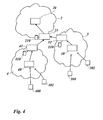
- Fig. 4 shows a first and a second communication service provider network 3 and 4 providing communications services to clients 300, 301, 400, 401.
- the communication service provider network 3 comprises a call server 30 and an ASB element 31 with an associated database 310.
- the communication service provider network 4 comprises a call server 40 and an ASB element 41 with an associated database 410.
- the first and a second communication service provider network 3 and 4 are provided by different operators.
- Fig. 4 further shows an application server 20 provided by a foreign application service provider in an application service provider domain 2.
- the application service provider domain 2 can be accessed through an ASB element 21 with associated database 210.
- the users of the clients 300, 301, 400, 401 want to participate in a televoting advertised by the operators of the first and a second communication service provider network 3 and 4.
- the first and a second communication service provider network 3 and 4 provide the clients 300, 301, 400, 401 with access to the communication service but the televoting service itself is provided by the application server 20.
- the operators of the first and a second communication service provider network 3 and 4 notify subscribers of the first and a second communication service provider network 3 and 4 about telephone numbers to be called to participate in the televoting whereby the telephone numbers comprise two or more different numbers one of which may be selected to express a vote.
- Each user of the clients 300, 301, 400, 401 dials a specific televoting number on their associated clients 300, 301, 400, 401. Triggered by the dialled numbers, the clients 300, 301, 400, 401 set up televoting calls in the respective first and second communication service provider network 3 and 4.
- the televoting calls are received by the call servers 40, 50. After recognition that the received calls relate to the advertised televoting service, the call servers 40, 50 initiate televoting service requests for invoking an application service.
- the televoting service requests are forwarded through the first and second communication service provider network 3 and 4 to the respective ASB elements 31, 41.
- the ASB elements 31, 41 consult the associated databases 310 and 410 to find an address associated with the requested televoting service.
- the ASB elements 31, 41 map the televoting service requests to a televoting service request directed to the ASB element 21 of the foreign application service provider network 2 assigned to the televoting service.
- the databases 310 and 410 retrieve an address of the ASB element 21 which is registered to be the appropriate ASB element regarding televoting requests.
- the ASB element 21 accesses the database 210 and looks for an address of an application server which provides the requested televoting service.
- the ASB element 21 maps, after receiving an address of the application server 20 from the database 210, the televoting service requests to the application server 20.
- a service session through the application session border elements 310, 410 of the communication service provider networks 3, 4 and through the application session border element 21 of the foreign application service provider network 2 to the call servers 30, 40 is established.
- the clients 300, 301, 400, 401 are provided - through the established service session - with the televoting servive offered by the application server 20.
- the traffic associated with the service session is routed on this route and the televoting can be executed.
- the ASB element 21 of an application service provider is accessible from different communication service provider networks 3, 4, preferably also synchronously and in parallel.
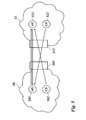
- Fig. 5 shows a first network 50 and a second network 50 and 51.
- the first network 50 comprises an ASB element 503, an application server 501 and a call server 502.
- the second network 51 comprises an ASB element 513, an application server 511 and a call server 512.
- the application server 501 or the call server 502 of the first network 50 may contact the application server 511 of the second network 51 through the ASB elements 503 and 513.
- the application server 511 or the call server 512 of the second network 51 may contact the application server 501 of the first network 51 through the ASB elements 513 and 503.
- Fig. 5 illustrates that the ASB elements 503 and 513, according to the invention, allow a bi-directional access to application services provided by the networks 50 and 51. Either network 50 and 51 may contact the other network 50 and 51 through the ASB elements 503 and 513.
- SIP ASB element providing a secure network access.
- An application service provider provides a schedule that can make appointment calls.
- the application in the public Internet will send a call to a subscriber on a matched time point for an appointment notification or an appointment call with a user B.
- the corresponding signaling will be done in SIP.
- the SIP ASB element can check if the application server is allowed or not and if a SIP message is valid.
- the SIP application server forwards the application message to a switch in an operator domain, whereby the following action may required: topology hiding and call limitation for overload protection.
- a call might be established between the two subscriber domains under control by an application in the public internet.
Landscapes
- Engineering & Computer Science (AREA)
- Computer Networks & Wireless Communication (AREA)
- Signal Processing (AREA)
- Telephonic Communication Services (AREA)
Abstract
Description
- The present invention relates to a method of providing a session server of a communication service provider network with application services, and an application session border element to execute said method.
- The provision of application services to telecommunication clients is an important issue regarding the competitiveness of communication service networks. Useful application services such as time-dependent call forwarding or televoting have the power to attract many subscribers. Many communication networks such as IN networks comprise an interface between a call server and one or more network-internal application servers (IN = Intelligent Network).
- A Session Border Controller (= SBC) is a device used in some VoIP (= Voice over Internet Protocol) networks. SBCs are put into the signalling path between a calling and a called party. The SBC acts as if it was the called VoIP phone and places a second call to the called party. The effect of this behaviour is that not only the signalling traffic but also the media traffic (voice, video, etc.) crosses the SBC. Without an SBC, the media traffic travels directly between the VolP phones. Private SBCs are used along with firewalls to enable VolP calls to and from a protected enterprise network. Public VolP service providers use SBCs to allow the use of VolP protocols from private networks with internet connections using NAT (= Network Address Translation). Moreover, SBCs usually may provide peering tasks, too.
- It is the object of the present invention to improve the provisioning of application services in communication networks.
- The object of the present invention is achieved by a method of providing a session server of a communication service provider network with application services, whereby the method comprises the steps of routing an application service request used by the session server for invoking an application service towards an application session border element of said communication service provider network, mapping, by the application session border element, the application service request to an appropriate application service provided by a foreign application service provider, establishing a service session between the session server of the communication service provider network and an application server of the foreign application service provider and routing the traffic associated with said service session through the application session border element to said application server, and monitoring and controlling, by the application session border element, the service session to ensure that the service session complies with a set of preset parameters. Moreover, the object of the present invention is achieved by an application session border element for providing a session server of a communication service provider network with application services, wherein the application session border element comprises a network interface adapted to receive an application service request used by the session server for invoking an application service, and a control unit adapted to map the application service request to an appropriate application service provided by a foreign application service provider, invoke said application service for establishing a service session between the session server of the communication service provider network and an associated application server of the foreign application service provider, forward the traffic associated with said service session towards said application server, and monitor and control the service session to ensure that the service session complies with a set of preset parameters.
- A session server is a server related to a session of a communication service. The session server, e.g., provides signaling, control, media transport as well as service functions required for the session. A session server of a network may be a call server or an application server of the network.
- The present invention provides a bi-directional communication between two networks, a first and a second network. In a first case, the first network may serve as a communication service provider network and the second network may serve as a foreign application service provider. In another case, the first network may serve as a foreign application service provider and the second network may serve as a communication service provider network. That means that the application session border element allows a communication in both directions between two attached networks.
- The invention breaks the limitation of application services to network-internal application servers. The invention provides a secured interconnection of a communication service provider network, e.g., an IMS-based network, to untrusted third party application servers located in foreign ASP domains (IMS = IP Multimedia Subsystem; IP = Internet Protocol; ASP = application service provider). This is achieved by protecting the border to ASPs by special elements to allow a secure / tunneled intercommunication across all involved layers, i.e., application, signaling/control and media/data.
- With the term "secured" in the sense of the invention, it is not meant to express that encryption techniques or other security means are provided, but "secured" is meant to express that a safe connection to a foreign, un-trusted application service domain is established and dangers threatening the communication service provider network, e.g., attacks originating in the foreign, un-trusted domain, are eliminated by means of the secure intercommunication.
- The invention allows to access untrusted ASPs across domain borders and to offer a multitude of applications to subscribers of a communication service provider network which is particularly attractive in an IMS environment. The secured connection to the ASP prevents attacks originating from a contracting party's network.
- Another advantage of the present invention is that the application session border (= ASB) element provides a network hiding or topology hiding. Therefore, a foreign network attached to the ASB element is not able to "see" any network element located behind the ASB element or to notice another network also attached to the ASB element.
- The invention extends the firewall and gateway features providing security capabilities to the integrated processing of NGN/IMS signaling, application server interconnection and media transport (NGN = Next Generation Network).
- Because SIP usually cannot be used for accessing applications in un-trusted domains, IMS specifies to use OSA/Parlay gateways for this purpose (SIP = Session Initiation Protocol; OSA = Open Service Access). Parlay and OSA is a technology enabling the creation and provision of telecommunication services. It extends these capabilities from network operators to third party service providers.
- However, the present invention allows a session server to communicate across an unsecure domain border via SIP. The application session border element according to the present invention supports SIP capabilities, i.e., it allows to use SIP - an end-to-end protocol - as application protocol to an application server in an un-trusted domain, representing the simplest way for accessing an application.
- Moreover, high data rate media-related applications are enabled and no complex network abstraction is required. The ASB elements provide - SIP aware - firewall/NAT SLA assurance, QoS, session and media replication and routing for lawful interception features (SLA = Service Level Agreement; QoS = Quality of Service).
- Further advantages are achieved by the embodiments of the invention indicated by the dependent claims.
- The ASB element may be any of the following four main types. First, the ASB element may be a gateway/firewall between application servers, e.g., for XML protocol-based applications like web services, Parlay. etc (XML = Extensible Markup Language). Second, the ASB element may be a call server gateway/ firewall, optionally with application server gateway/firewall, e.g., used for SIP intercommunication, enriched with application server protocols. Third, the ASB element may be an application server gateway/firewall plus a packet transport/ media gateway/firewall, and optionally a call server gateway/firewall, e.g., for web service applications and related media and data streams. Fourth, the ASB element may be a call server gateway/firewall plus a packet transport/ media gateway/firewall, e.g., for SIP signalling plus media and data streams.
- According to a preferred embodiment of the invention, the ASB processes the application service request and provides an associated application service request directed to an application server or an application session border element of the foreign application service provider assigned to the application service.
- According to another preferred embodiment of the invention, an application session border element of a foreign application service provider processes the application service request and provides an associated application service request to an appropriate application server of said foreign application service provider. The network traffic associated with said service session is routed through the application session border element of the communication service provider network and through the application session border element of the foreign application service provider to said application server.
- According to another preferred embodiment of the invention, the control unit provides unified authentication procedures. The control unit may be adapted to examine whether the session server and/or a client of the communication service is authorized to use a requested application service and prevent the establishment of the service session if it is not authorized. It is also possible that the control unit initiates a traffic separation, e.g., a special handling of beta services under test or for minimum trust scenarios.
- Preferably, the control unit also provides a topology hiding of the internal network infrastructure of the communication service provider network. Providing a functionality of a firewall and/or gateway, the ASB element also conducts NAT so that internal information about a network are not laid open to any foreign, untrusted clients.
- In a preferred embodiment, the control unit provides inter-working functions such as control protocol and media format adaptations. Thus, the call server and the application server connected in a service session may use different protocols and media formats and still be able to intercommunicate.
- According to another preferred embodiment of the invention, the ASB element provides a policy control. It may control the data rate and content of both signalling intercommunication and media. Thus, the ASB element may assure a load balancing and an overload protection for services, signalling and media/ data streams. This may assure a specific QoS and SLAs. Furthermore, the ASB element may also provide billing records. In short, the ASB element controls all layers of intercommunication between a call server and an application server according to preset parameters, e.g., defined as SLA or QoS.
- Preferably, the ASB element communicates with a call server of an internet protocol multimedia subsystem network. It is also possible that the ASB element communicates with a network element associated with the service session using the session initiation protocol.
- Preferably, the ASB element handles the service session related traffic on all layers, i.e., the traffic routed between said call server and said application server on the application layer, the signalling/control layer, and the media layer.
- According to another preferred embodiment of the invention, the ASB comprises a database. The database may be implemented as a separate device comprising the storage facilities, such as shown in the following embodiments. It is also possible that the database is an integral part of the ASB element. The database stores address data and information regarding the mapping of application service requests to an appropriate application service, e.g., an associated application service request or application server.
- Preferably, the ASB element operates in a SIP environment. The idea of a SIP Application Session Border is to define a special session border, which is only for connecting a communication network to an application server in an untrusted domain. Preferably, it supports the functions of a firewall and executes NAT (aware of SIP and RTP), provides an integrated support of IP connection via internet (IPSec = IP Security), and operates as an integrated SIP proxy, e.g., as SIP router between different network (RTP = Realtime Transport Protocol). Preferably, the ASB element accepts registration from a SIP application server and routing switches. Moreover, the SIP ASB element provides overload control based destination IP addresses for protecting the application server, overload control based SIP To Header to limit service calls per second, and a control of call setup and third party call setup by limiting calls to softswitches and limiting destination addresses.
- The SIP routing is performed mainly under policy control, i.e., by choosing to accept an incoming invite or not, determining which SIP nodes are allowed to receive and send SIP messages, and a black and white list for external nodes. The SIP ASB element supports RTP routing to support media resources in external networks and billing records for SIP applications.
- These as well as further features and advantages of the invention will be better appreciated by reading the following detailed description of presently preferred exemplary embodiments taken in conjunction with accompanying drawings of which:
- Fig. 1
- is a block diagram of a communication service provider network connected to a domain of an application service provider by means of ASB elements.
- Fig. 2
- is a message flow diagram showing processing steps related to a service request according to an embodiment of the invention.
- Fig. 3
- is a detailed view of a communication service provider network comprising several ASB elements.
- Fig. 4
- is a block diagram of two communication service provider networks connected to a domain of an application service provider by means of ASBs.
- Fig. 5
- is a block diagram of two networks connected to each other by means of ASB elements.
- Fig. 1 shows a communication
service provider network 1 providing communications services to a callingclient 100 and a calledclient 101. The communicationservice provider network 1 may be an IMS network operated by a network operator and represent a domain, e.g., an operator's core network domain. The communicationservice provider network 1 comprises acall server 10 for managing calls through the communicationservice provider network 1. The communicationservice provider network 1 further comprises anapplication server 12 for providing simple application services such as call forwarding or telephone mailbox services. - The
call server 10 and theapplication server 12 are composed of one or several interlinked computers, i.e., a hardware platform, a software platform basing on the hardware platform and several application programs executed by the system platform formed by the software and hardware platform. The functionalities of theservers - Fig. 1 further shows an application service provider network 2 operated by a different operator than the communication
service provider network 1. The application service provider network 2, which represents a separate domain, may be not trusted by the operator of the communicationservice provider network 1. The application service provider network 2 comprises anapplication server 20 serving one ore more applications to be utilized by clients of the communicationservice provider network 1. - For providing a secured interconnection of the operator's communication
service provider network 1 to theuntrusted application server 20 located in the foreign application service provider domain 2, the communicationservice provider network 1 comprises anASB element 11 with adatabase 110 and the application service provider domain 2 comprises anASB element 21 with adatabase 210. - From a functional point of view, the
ASB elements service provider network 1 and the application service provider domain 2 and control units 11 b and 21 b, respectively, for controlling the functions of theASB elements - Fig. 2 shows a message flow diagram of an exemplary communication according to a first embodiment of the invention. Fig. 2 shows a calling
client 100 and a calledclient 101, acall server 10 of a communication service provider networkproviding communication services to the callingclient 100 and the calledclient 101, anASB element 11 implemented into the communication network, adatabase 110 associated with theASB element 11, anASB element 21 implemented into an application service provider network, adatabase 210 associated with theASB element 21, and anapplication server 20 of the application service provider network. - Let us assume that the calling
client 100, e.g., a telephone used by a casualty person, is used to establish an emergency call to a calledclient 101, e.g., a telephone at a PSAP call center (PSAP = Public Safety Answering Point). Theclients clients clients - The calling
client 100 sends, triggered by a user of the callingclient 100, acall initiation message 250, e.g., a SIP message, to thecall server 10. Thecall initiation message 250 comprises a call origin address, i.e., an address associated to the callingclient 100, a call destination address, i.e., an address associated to the calledclient 101, and a type ID indicating the type and/or priority of the call to be established. Thecall server 10 recognizes by means of the mentioned type ID that the intended call is an emergency call. A call policy implemented in thecall server 10 states that an emergency call must comprise location data specifiying a location of the callingclient 100. Through this policy, it is assured that a PSAP personnel is enabled to unfailingly locate a requesting party. - A corresponding trigger set in the
call server 10 causes thecall server 10, after reception of thecall initiation message 250, to interrupt the traffic flow, e.g., packets for signalling/control and media/data, associated with the call establishment and to access an application for providing the location information. - The
call server 10 sends amessage 251 to theASB element 11 of the communication network. TheASB element 11 recognizes from the receivedmessage 251 that location information of the callingclient 100 are to be retrieved and accesses thedatabase 110 associated with theASB element 11 to look up an address of a corresponding application service delivering the wanted location information. An address of a corresponding application service is found in thedatabase 110 and transmitted, instep 253, to theASB element 11. For example, the address identifies an application service provider network where such application services are provided. Then, in step 253a, theASB element 11 maps the address x of the service request to the new address x1 received from thedatabase 110. - Therefore, a
message 254 is sent from theASB element 11 across the domain border to theASB element 21 of the application service provider network. Themessage 254 indicates the wanted application service and the address associated to the callingclient 100. TheASB element 21, after reception of themessage 254, consults, by sending amessage 255 to thedatabase 210 associated with theASB element 21, thedatabase 210 to look up an address of a network element of the application service provider network which provides the requested service. An address of a corresponding application server is found in thedatabase 210 and transmitted, instep 256, to theASB element 21. For example, the address identifies anapplication server 20 providing a location service. Then, instep 256a, theASB element 21 maps the hitherto address x1 of the service request to the address x2 of theapplication server 20 received from thedatabase 110. - The
ASB element 21 sends amessage 257 to the identifiedapplication server 20 to trigger theapplication server 20 to provide the application. Theapplication server 20 retrieves location information associated with the callingclient 100. In case theclient 100 is a fixed device, theapplication server 20 may consult a telephone directory to extract the postal address associated with the callingclient 100. In case theclient 100 is a mobile device, theapplication server 20 may apply any of the known localization methods, e.g., a triangulation method based on signal runtime differences or a GPS based method, to retrieve a localization information, e.g., geographic coordinates, of the calling client 100 (GPS = Global Positioning System). - The retrieved location information is sent in a
message 258 from theapplication server 20 back to theASB element 21. TheASB element 21 recognizes, e.g., by means of a message ID, that the receivedmessage 258 is a reply to therelated inquiry message 257 and forwards the location information asmessage 259 accross the domain border back to theASB element 11. Again, theASB element 11 recognizes, e.g., by means of a message ID, that the receivedmessage 258 is a reply to therelated inquiry message 254 and forwards the location information asmessage 260 back to thecall server 10. - The
call server 10, after receiving the location information comprised within themessage 260, recognizes that the location information required for an emergency call has been provided and that the interrupted emergency setup call originating from the callingclient 100 can be resumed. Thus, thecall server 10 continues the traffic flow associated with the call establishment and sends a correspondingcall establishment message 261 comprising - in addition to the information already contained within the message 250 - the location information to the calledclient 101. - After the called
client 101 has received themessage 261 and has confirmed that it wants to accept the incoming call, a communication connection between the callingclient 100 and the calledclient 101 is established through the communication network. The callingclient 100 can execute the emergency call to the calledclient 101 which has already been provided with the location information of the callingclient 100. - Fig. 3 shows a detailed view of a communication
service provider network 1 with a securedapplication session border 115 comprisingseveral ASB elements 111 to 114. The communicationservice provider network 1 may be a core network domain used for the transmission of communication data. Subscibers of the communication service offered by the operator of the communicationservice provider network 1 can use the resources of the communicationservice provider network 1 through an access network domain 5 or another network operator domain 6. - The communication
service provider network 1 comprises network units such as one ormore application servers 13, one or more call control servers 14 (or, more shortly, call servers), and network elements/resources 15 for the packet transport and media processing. Thenetwork units ASB elements 111 to 114 for a secured intercommunication with anapplication server 22 to 25 of third party application service providers and their assciated domains, respectively. - In particular for the case that the application service provider domains hosting the
application servers 22 to 25 are not trusted by the provider of the communicationservice provider network 1, theASB elements 111 to 114 comprise means for guarding, protecting and keeping an application service session under surveillance. - Fig. 3 shows that a
ASB elements 111 to 114 may handle traffic on one or more layers of the application, control and media transport layer. - Fig. 4 shows a first and a second communication
service provider network 3 and 4 providing communications services toclients call server 30 and anASB element 31 with an associateddatabase 310. Likeswise, the communicationservice provider network 4 comprises acall server 40 and anASB element 41 with an associateddatabase 410. The first and a second communicationservice provider network 3 and 4 are provided by different operators. - Fig. 4 further shows an
application server 20 provided by a foreign application service provider in an application service provider domain 2. The application service provider domain 2 can be accessed through anASB element 21 with associateddatabase 210. - The users of the
clients service provider network 3 and 4. The first and a second communicationservice provider network 3 and 4 provide theclients application server 20. The operators of the first and a second communicationservice provider network 3 and 4 notify subscribers of the first and a second communicationservice provider network 3 and 4 about telephone numbers to be called to participate in the televoting whereby the telephone numbers comprise two or more different numbers one of which may be selected to express a vote. - Each user of the
clients clients clients service provider network 3 and 4. The televoting calls are received by thecall servers call servers service provider network 3 and 4 to therespective ASB elements ASB elements databases - The
ASB elements ASB element 21 of the foreign application service provider network 2 assigned to the televoting service. For example, thedatabases ASB element 21 which is registered to be the appropriate ASB element regarding televoting requests. - The
ASB element 21 accesses thedatabase 210 and looks for an address of an application server which provides the requested televoting service. TheASB element 21 maps, after receiving an address of theapplication server 20 from thedatabase 210, the televoting service requests to theapplication server 20. Once theapplication server 20 has received the televoting service requests, a service session through the applicationsession border elements service provider networks 3, 4 and through the applicationsession border element 21 of the foreign application service provider network 2 to thecall servers clients application server 20. The traffic associated with the service session is routed on this route and the televoting can be executed. - After the execution of the televoting service, the service session is terminated and the connections are released. To summarize, the
ASB element 21 of an application service provider is accessible from different communicationservice provider networks 3, 4, preferably also synchronously and in parallel. - Fig. 5 shows a
first network 50 and asecond network first network 50 comprises anASB element 503, anapplication server 501 and acall server 502. Likewise, thesecond network 51 comprises anASB element 513, an application server 511 and acall server 512. According to the present invention, theapplication server 501 or thecall server 502 of thefirst network 50 may contact the application server 511 of thesecond network 51 through theASB elements call server 512 of thesecond network 51 may contact theapplication server 501 of thefirst network 51 through theASB elements - Thus, Fig. 5 illustrates that the
ASB elements networks network other network ASB elements - The following is an exemplary use case for a SIP ASB element providing a secure network access. An application service provider provides a schedule that can make appointment calls. The application in the public Internet will send a call to a subscriber on a matched time point for an appointment notification or an appointment call with a user B. The corresponding signaling will be done in SIP. The SIP ASB element can check if the application server is allowed or not and if a SIP message is valid. Moreover, the SIP ASB element may check if all required header are there and/or if a charging ID is available (ID = Identification).
- The SIP application server forwards the application message to a switch in an operator domain, whereby the following action may required: topology hiding and call limitation for overload protection. A call might be established between the two subscriber domains under control by an application in the public internet.
Claims (10)
- A method of providing a session server (10) of a communication service provider network (1) with application services, the method comprising the steps of:routing an application service request used by the session server (10) for invoking an application service towards an application session border element (11) of said communication service provider network (1);mapping, by the application session border element (11), the application service request to an appropriate application service provided by a foreign application service provider;establishing a service session between the session server (10) of the communication service provider network (1) and an application server (20) of the foreign application service provider and routing the traffic associated with said service session through the application session border element (11) to said application server (20); andmonitoring and controlling, by the application session border element (11), the service session to ensure that the service session complies with a set of preset parameters.
- The method of claim 1
characterized in
that the method comprises the further step of:mapping, by the application session border element (11), the application service request to an application service request directed to an application server (20) or an application session border element (21) of the foreign application service provider assigned to the application service. - The method of claim 1
characterized in
that the method comprises the further steps of:mapping, by an application session border element (21) of the foreign application service provider, the application service request to an appropriate application server (20) of said foreign application service provider; androuting the traffic associated with said service session through the application session border element (11) of the communication service provider network (1) and through the application session border element (21) of the foreign application service provider to said application server (20). - An application session border element (11) for providing a session server (10) of a communication service provider network (1) with application services, wherein the application session border element (11) comprises a network interface (11 a) adapted to receive an application service request used by the session server (10) for invoking an application service, and a control unit (11 b) adapted to map the application service request to an appropriate application service provided by a foreign application service provider, invoke said application service for establishing a service session between the session server (10) of the communication service provider network (1) and an associated application server (20) of the foreign application service provider, forward the traffic associated with said service session towards said application server (20), and monitor and control the service session to ensure that the service session complies with a set of preset parameters.
- The application session border element of claim 4,
characterized in
that the control unit (11 b) is further adapted to examine whether the session server (10) and/or a client (100, 101) of the communication service (1) is authorized to use a requested application service and prevent the establishment of the service session if it is not authorized. - The application session border element of claim 4,
characterized in
that the control unit (11 b) is further adapted to provide adaptations of control protocols and/or media formats used by the session server (10) and the application server (20) for said service session. - The application session border element of claim 4,
characterized in
that the control unit (11 b) is further adapted to control as preset parameters bandwidth rates and/or service level agreements associated with said service session. - The application session border element of claim 4,
characterized in
that the network interface (11a) is further adapted to communicate with a session server (10) of an internet protocol multimedia subsystem network or, based on the session initiation protocol, with a network element (10, 20, 21) associated with the service session. - The application session border element of claim 4,
characterized in
that the control unit (11 b) is further adapted to handle the traffic routed between said session server (10) and said application server (20) on the application layer, the signalling/control layer, and the media layer. - The application session border element of claim 4,
characterized in
that the application session border element (11) comprises a database (110) storing mapping information regarding the mapping of the application service request.
Priority Applications (1)
| Application Number | Priority Date | Filing Date | Title |
|---|---|---|---|
| EP06291258A EP1885096B1 (en) | 2006-08-01 | 2006-08-01 | Application session border element |
Applications Claiming Priority (1)
| Application Number | Priority Date | Filing Date | Title |
|---|---|---|---|
| EP06291258A EP1885096B1 (en) | 2006-08-01 | 2006-08-01 | Application session border element |
Publications (2)
| Publication Number | Publication Date |
|---|---|
| EP1885096A1 true EP1885096A1 (en) | 2008-02-06 |
| EP1885096B1 EP1885096B1 (en) | 2012-07-04 |
Family
ID=37507716
Family Applications (1)
| Application Number | Title | Priority Date | Filing Date |
|---|---|---|---|
| EP06291258A Not-in-force EP1885096B1 (en) | 2006-08-01 | 2006-08-01 | Application session border element |
Country Status (1)
| Country | Link |
|---|---|
| EP (1) | EP1885096B1 (en) |
Cited By (37)
| Publication number | Priority date | Publication date | Assignee | Title |
|---|---|---|---|---|
| CN102308556A (en) * | 2011-07-14 | 2012-01-04 | 华为技术有限公司 | Method and system for realizing cross-domain information processing |
| WO2011149796A3 (en) * | 2010-05-27 | 2012-04-19 | A10 Networks Inc. | System and method to apply network traffic policy to an application session |
| US8584199B1 (en) | 2006-10-17 | 2013-11-12 | A10 Networks, Inc. | System and method to apply a packet routing policy to an application session |
| US8782221B2 (en) | 2012-07-05 | 2014-07-15 | A10 Networks, Inc. | Method to allocate buffer for TCP proxy session based on dynamic network conditions |
| US8897154B2 (en) | 2011-10-24 | 2014-11-25 | A10 Networks, Inc. | Combining stateless and stateful server load balancing |
| US9094364B2 (en) | 2011-12-23 | 2015-07-28 | A10 Networks, Inc. | Methods to manage services over a service gateway |
| US9106561B2 (en) | 2012-12-06 | 2015-08-11 | A10 Networks, Inc. | Configuration of a virtual service network |
| US9215275B2 (en) | 2010-09-30 | 2015-12-15 | A10 Networks, Inc. | System and method to balance servers based on server load status |
| US9338225B2 (en) | 2012-12-06 | 2016-05-10 | A10 Networks, Inc. | Forwarding policies on a virtual service network |
| US9386088B2 (en) | 2011-11-29 | 2016-07-05 | A10 Networks, Inc. | Accelerating service processing using fast path TCP |
| US9420011B2 (en) | 2007-07-18 | 2016-08-16 | Hammond Development International, Inc. | Method and system for enabling a communication device to remotely execute an application |
| US9531846B2 (en) | 2013-01-23 | 2016-12-27 | A10 Networks, Inc. | Reducing buffer usage for TCP proxy session based on delayed acknowledgement |
| US9609052B2 (en) | 2010-12-02 | 2017-03-28 | A10 Networks, Inc. | Distributing application traffic to servers based on dynamic service response time |
| US9705800B2 (en) | 2012-09-25 | 2017-07-11 | A10 Networks, Inc. | Load distribution in data networks |
| US9712493B2 (en) | 2006-10-17 | 2017-07-18 | A10 Networks, Inc. | System and method to associate a private user identity with a public user identity |
| US9742879B2 (en) | 2012-03-29 | 2017-08-22 | A10 Networks, Inc. | Hardware-based packet editor |
| US9843484B2 (en) | 2012-09-25 | 2017-12-12 | A10 Networks, Inc. | Graceful scaling in software driven networks |
| US9900252B2 (en) | 2013-03-08 | 2018-02-20 | A10 Networks, Inc. | Application delivery controller and global server load balancer |
| US9906422B2 (en) | 2014-05-16 | 2018-02-27 | A10 Networks, Inc. | Distributed system to determine a server's health |
| US9942152B2 (en) | 2014-03-25 | 2018-04-10 | A10 Networks, Inc. | Forwarding data packets using a service-based forwarding policy |
| US9942162B2 (en) | 2014-03-31 | 2018-04-10 | A10 Networks, Inc. | Active application response delay time |
| US9960967B2 (en) | 2009-10-21 | 2018-05-01 | A10 Networks, Inc. | Determining an application delivery server based on geo-location information |
| US9986061B2 (en) | 2014-06-03 | 2018-05-29 | A10 Networks, Inc. | Programming a data network device using user defined scripts |
| US9992107B2 (en) | 2013-03-15 | 2018-06-05 | A10 Networks, Inc. | Processing data packets using a policy based network path |
| US9992229B2 (en) | 2014-06-03 | 2018-06-05 | A10 Networks, Inc. | Programming a data network device using user defined scripts with licenses |
| US10002141B2 (en) | 2012-09-25 | 2018-06-19 | A10 Networks, Inc. | Distributed database in software driven networks |
| US10021174B2 (en) | 2012-09-25 | 2018-07-10 | A10 Networks, Inc. | Distributing service sessions |
| US10027761B2 (en) | 2013-05-03 | 2018-07-17 | A10 Networks, Inc. | Facilitating a secure 3 party network session by a network device |
| US10038693B2 (en) | 2013-05-03 | 2018-07-31 | A10 Networks, Inc. | Facilitating secure network traffic by an application delivery controller |
| US10044582B2 (en) | 2012-01-28 | 2018-08-07 | A10 Networks, Inc. | Generating secure name records |
| US10129122B2 (en) | 2014-06-03 | 2018-11-13 | A10 Networks, Inc. | User defined objects for network devices |
| US10230770B2 (en) | 2013-12-02 | 2019-03-12 | A10 Networks, Inc. | Network proxy layer for policy-based application proxies |
| USRE47296E1 (en) | 2006-02-21 | 2019-03-12 | A10 Networks, Inc. | System and method for an adaptive TCP SYN cookie with time validation |
| US10243791B2 (en) | 2015-08-13 | 2019-03-26 | A10 Networks, Inc. | Automated adjustment of subscriber policies |
| US10268467B2 (en) | 2014-11-11 | 2019-04-23 | A10 Networks, Inc. | Policy-driven management of application traffic for providing services to cloud-based applications |
| US10581976B2 (en) | 2015-08-12 | 2020-03-03 | A10 Networks, Inc. | Transmission control of protocol state exchange for dynamic stateful service insertion |
| US11165770B1 (en) | 2013-12-06 | 2021-11-02 | A10 Networks, Inc. | Biometric verification of a human internet user |
Citations (2)
| Publication number | Priority date | Publication date | Assignee | Title |
|---|---|---|---|---|
| US20060075483A1 (en) * | 2004-10-04 | 2006-04-06 | Alcatel | Method for routing bi-directional connections in a telecommunication network by means of a signalling protocol via an interposed firewall with address transformation device and also a telecommunication network and security and tunnel device for this |
| US20060146792A1 (en) * | 2004-12-31 | 2006-07-06 | Sridhar Ramachandran | Voice over IP (VOIP) network infrastructure components and method |
-
2006
- 2006-08-01 EP EP06291258A patent/EP1885096B1/en not_active Not-in-force
Patent Citations (2)
| Publication number | Priority date | Publication date | Assignee | Title |
|---|---|---|---|---|
| US20060075483A1 (en) * | 2004-10-04 | 2006-04-06 | Alcatel | Method for routing bi-directional connections in a telecommunication network by means of a signalling protocol via an interposed firewall with address transformation device and also a telecommunication network and security and tunnel device for this |
| US20060146792A1 (en) * | 2004-12-31 | 2006-07-06 | Sridhar Ramachandran | Voice over IP (VOIP) network infrastructure components and method |
Non-Patent Citations (1)
| Title |
|---|
| "SESSION BORDER CONTROL MAKING DREAMS REALITY", TELECOMMUNICATIONS, DEDHAM, MA, US, vol. 37, no. 9, September 2003 (2003-09-01), pages S01 - S08, XP008052274, ISSN: 0040-2494 * |
Cited By (76)
| Publication number | Priority date | Publication date | Assignee | Title |
|---|---|---|---|---|
| USRE47296E1 (en) | 2006-02-21 | 2019-03-12 | A10 Networks, Inc. | System and method for an adaptive TCP SYN cookie with time validation |
| US9497201B2 (en) | 2006-10-17 | 2016-11-15 | A10 Networks, Inc. | Applying security policy to an application session |
| US9954899B2 (en) | 2006-10-17 | 2018-04-24 | A10 Networks, Inc. | Applying a network traffic policy to an application session |
| US10305859B2 (en) | 2006-10-17 | 2019-05-28 | A10 Networks, Inc. | Applying security policy to an application session |
| US8312507B2 (en) | 2006-10-17 | 2012-11-13 | A10 Networks, Inc. | System and method to apply network traffic policy to an application session |
| US8584199B1 (en) | 2006-10-17 | 2013-11-12 | A10 Networks, Inc. | System and method to apply a packet routing policy to an application session |
| US8595791B1 (en) | 2006-10-17 | 2013-11-26 | A10 Networks, Inc. | System and method to apply network traffic policy to an application session |
| US9712493B2 (en) | 2006-10-17 | 2017-07-18 | A10 Networks, Inc. | System and method to associate a private user identity with a public user identity |
| US9661026B2 (en) | 2006-10-17 | 2017-05-23 | A10 Networks, Inc. | Applying security policy to an application session |
| US11451591B1 (en) | 2007-07-18 | 2022-09-20 | Hammond Development International, Inc. | Method and system for enabling a communication device to remotely execute an application |
| US9716732B2 (en) | 2007-07-18 | 2017-07-25 | Hammond Development International, Inc. | Method and system for enabling a communication device to remotely execute an application |
| US10917444B1 (en) | 2007-07-18 | 2021-02-09 | Hammond Development International, Inc. | Method and system for enabling a communication device to remotely execute an application |
| US10264032B1 (en) | 2007-07-18 | 2019-04-16 | Hammond Development International, Inc. | Method and system for enabling a communication device to remotely execute an application |
| US10749914B1 (en) | 2007-07-18 | 2020-08-18 | Hammond Development International, Inc. | Method and system for enabling a communication device to remotely execute an application |
| US9420011B2 (en) | 2007-07-18 | 2016-08-16 | Hammond Development International, Inc. | Method and system for enabling a communication device to remotely execute an application |
| US9456040B2 (en) | 2007-07-18 | 2016-09-27 | Hammond Development International, Inc. | Method and system for enabling a communication device to remotely execute an application |
| US10193935B2 (en) | 2007-07-18 | 2019-01-29 | Hammond Development International, Inc. | Method and system for enabling a communication device to remotely execute an application |
| US9705937B2 (en) | 2007-07-18 | 2017-07-11 | Hammond Development International, Inc. | Method and system for enabling a communication device to remotely execute an application |
| US10270816B1 (en) | 2007-07-18 | 2019-04-23 | Hammond Development International, Inc. | Method and system for enabling a communication device to remotely execute an application |
| US9960967B2 (en) | 2009-10-21 | 2018-05-01 | A10 Networks, Inc. | Determining an application delivery server based on geo-location information |
| US10735267B2 (en) | 2009-10-21 | 2020-08-04 | A10 Networks, Inc. | Determining an application delivery server based on geo-location information |
| WO2011149796A3 (en) * | 2010-05-27 | 2012-04-19 | A10 Networks Inc. | System and method to apply network traffic policy to an application session |
| US9961135B2 (en) | 2010-09-30 | 2018-05-01 | A10 Networks, Inc. | System and method to balance servers based on server load status |
| US10447775B2 (en) | 2010-09-30 | 2019-10-15 | A10 Networks, Inc. | System and method to balance servers based on server load status |
| US9215275B2 (en) | 2010-09-30 | 2015-12-15 | A10 Networks, Inc. | System and method to balance servers based on server load status |
| US9609052B2 (en) | 2010-12-02 | 2017-03-28 | A10 Networks, Inc. | Distributing application traffic to servers based on dynamic service response time |
| US9961136B2 (en) | 2010-12-02 | 2018-05-01 | A10 Networks, Inc. | Distributing application traffic to servers based on dynamic service response time |
| US10178165B2 (en) | 2010-12-02 | 2019-01-08 | A10 Networks, Inc. | Distributing application traffic to servers based on dynamic service response time |
| CN102308556B (en) * | 2011-07-14 | 2014-10-08 | 华为技术有限公司 | Method and system for realizing cross-domain information processing |
| WO2012106888A1 (en) * | 2011-07-14 | 2012-08-16 | 华为技术有限公司 | Method and system for realizing cross-domain information processing |
| CN102308556A (en) * | 2011-07-14 | 2012-01-04 | 华为技术有限公司 | Method and system for realizing cross-domain information processing |
| US8897154B2 (en) | 2011-10-24 | 2014-11-25 | A10 Networks, Inc. | Combining stateless and stateful server load balancing |
| US9906591B2 (en) | 2011-10-24 | 2018-02-27 | A10 Networks, Inc. | Combining stateless and stateful server load balancing |
| US10484465B2 (en) | 2011-10-24 | 2019-11-19 | A10 Networks, Inc. | Combining stateless and stateful server load balancing |
| US9386088B2 (en) | 2011-11-29 | 2016-07-05 | A10 Networks, Inc. | Accelerating service processing using fast path TCP |
| US9979801B2 (en) | 2011-12-23 | 2018-05-22 | A10 Networks, Inc. | Methods to manage services over a service gateway |
| US9094364B2 (en) | 2011-12-23 | 2015-07-28 | A10 Networks, Inc. | Methods to manage services over a service gateway |
| US10044582B2 (en) | 2012-01-28 | 2018-08-07 | A10 Networks, Inc. | Generating secure name records |
| US9742879B2 (en) | 2012-03-29 | 2017-08-22 | A10 Networks, Inc. | Hardware-based packet editor |
| US10069946B2 (en) | 2012-03-29 | 2018-09-04 | A10 Networks, Inc. | Hardware-based packet editor |
| US8782221B2 (en) | 2012-07-05 | 2014-07-15 | A10 Networks, Inc. | Method to allocate buffer for TCP proxy session based on dynamic network conditions |
| US9602442B2 (en) | 2012-07-05 | 2017-03-21 | A10 Networks, Inc. | Allocating buffer for TCP proxy session based on dynamic network conditions |
| US9843484B2 (en) | 2012-09-25 | 2017-12-12 | A10 Networks, Inc. | Graceful scaling in software driven networks |
| US10516577B2 (en) | 2012-09-25 | 2019-12-24 | A10 Networks, Inc. | Graceful scaling in software driven networks |
| US10002141B2 (en) | 2012-09-25 | 2018-06-19 | A10 Networks, Inc. | Distributed database in software driven networks |
| US10862955B2 (en) | 2012-09-25 | 2020-12-08 | A10 Networks, Inc. | Distributing service sessions |
| US10491523B2 (en) | 2012-09-25 | 2019-11-26 | A10 Networks, Inc. | Load distribution in data networks |
| US9705800B2 (en) | 2012-09-25 | 2017-07-11 | A10 Networks, Inc. | Load distribution in data networks |
| US10021174B2 (en) | 2012-09-25 | 2018-07-10 | A10 Networks, Inc. | Distributing service sessions |
| US10341427B2 (en) | 2012-12-06 | 2019-07-02 | A10 Networks, Inc. | Forwarding policies on a virtual service network |
| US9106561B2 (en) | 2012-12-06 | 2015-08-11 | A10 Networks, Inc. | Configuration of a virtual service network |
| US9338225B2 (en) | 2012-12-06 | 2016-05-10 | A10 Networks, Inc. | Forwarding policies on a virtual service network |
| US9544364B2 (en) | 2012-12-06 | 2017-01-10 | A10 Networks, Inc. | Forwarding policies on a virtual service network |
| US9531846B2 (en) | 2013-01-23 | 2016-12-27 | A10 Networks, Inc. | Reducing buffer usage for TCP proxy session based on delayed acknowledgement |
| US9900252B2 (en) | 2013-03-08 | 2018-02-20 | A10 Networks, Inc. | Application delivery controller and global server load balancer |
| US11005762B2 (en) | 2013-03-08 | 2021-05-11 | A10 Networks, Inc. | Application delivery controller and global server load balancer |
| US9992107B2 (en) | 2013-03-15 | 2018-06-05 | A10 Networks, Inc. | Processing data packets using a policy based network path |
| US10659354B2 (en) | 2013-03-15 | 2020-05-19 | A10 Networks, Inc. | Processing data packets using a policy based network path |
| US10305904B2 (en) | 2013-05-03 | 2019-05-28 | A10 Networks, Inc. | Facilitating secure network traffic by an application delivery controller |
| US10027761B2 (en) | 2013-05-03 | 2018-07-17 | A10 Networks, Inc. | Facilitating a secure 3 party network session by a network device |
| US10038693B2 (en) | 2013-05-03 | 2018-07-31 | A10 Networks, Inc. | Facilitating secure network traffic by an application delivery controller |
| US10230770B2 (en) | 2013-12-02 | 2019-03-12 | A10 Networks, Inc. | Network proxy layer for policy-based application proxies |
| US11165770B1 (en) | 2013-12-06 | 2021-11-02 | A10 Networks, Inc. | Biometric verification of a human internet user |
| US9942152B2 (en) | 2014-03-25 | 2018-04-10 | A10 Networks, Inc. | Forwarding data packets using a service-based forwarding policy |
| US9942162B2 (en) | 2014-03-31 | 2018-04-10 | A10 Networks, Inc. | Active application response delay time |
| US10257101B2 (en) | 2014-03-31 | 2019-04-09 | A10 Networks, Inc. | Active application response delay time |
| US9906422B2 (en) | 2014-05-16 | 2018-02-27 | A10 Networks, Inc. | Distributed system to determine a server's health |
| US10686683B2 (en) | 2014-05-16 | 2020-06-16 | A10 Networks, Inc. | Distributed system to determine a server's health |
| US10749904B2 (en) | 2014-06-03 | 2020-08-18 | A10 Networks, Inc. | Programming a data network device using user defined scripts with licenses |
| US9992229B2 (en) | 2014-06-03 | 2018-06-05 | A10 Networks, Inc. | Programming a data network device using user defined scripts with licenses |
| US9986061B2 (en) | 2014-06-03 | 2018-05-29 | A10 Networks, Inc. | Programming a data network device using user defined scripts |
| US10880400B2 (en) | 2014-06-03 | 2020-12-29 | A10 Networks, Inc. | Programming a data network device using user defined scripts |
| US10129122B2 (en) | 2014-06-03 | 2018-11-13 | A10 Networks, Inc. | User defined objects for network devices |
| US10268467B2 (en) | 2014-11-11 | 2019-04-23 | A10 Networks, Inc. | Policy-driven management of application traffic for providing services to cloud-based applications |
| US10581976B2 (en) | 2015-08-12 | 2020-03-03 | A10 Networks, Inc. | Transmission control of protocol state exchange for dynamic stateful service insertion |
| US10243791B2 (en) | 2015-08-13 | 2019-03-26 | A10 Networks, Inc. | Automated adjustment of subscriber policies |
Also Published As
| Publication number | Publication date |
|---|---|
| EP1885096B1 (en) | 2012-07-04 |
Similar Documents
| Publication | Publication Date | Title |
|---|---|---|
| EP1885096B1 (en) | Application session border element | |
| US8265068B2 (en) | Mapping of IP phones for E911 | |
| EP3292675B1 (en) | Establishing media paths in real time communications | |
| EP2090024B1 (en) | Intercepting voice over ip communications and other data communications | |
| US8607323B2 (en) | Method for providing media communication across firewalls | |
| US8737594B2 (en) | Emergency services for packet networks | |
| US8265250B2 (en) | Registration of multiple VoIP devices | |
| US9201743B2 (en) | Backup SIP server for the survivability of an enterprise network using SIP | |
| CA2603341C (en) | Voip proxy server | |
| US8868757B1 (en) | Two-way web service router gateway | |
| KR101224254B1 (en) | Next generation integration between different domains, such as, enterprise and service provider using sequencing applications and ims peering | |
| EP2299647B1 (en) | Next generation integration between different domains, such as, enterprise and service provider using sequencing applications and IMS peering | |
| WO2014114088A1 (en) | Method and service platform for implementing broadband service function in next generation network (ngn) | |
| JP5541287B2 (en) | PUCI system | |
| JP5069353B2 (en) | Method and apparatus for handling trust in an IP multimedia subsystem communication network | |
| Gurbani et al. | The SPIRITS (services in PSTN requesting Internet services) protocol | |
| KR100660123B1 (en) | Vpn server system and vpn terminal for a nat traversal | |
| KR20040001338A (en) | Method of establishing VPN VoIP call via IP network | |
| Tsagkaropoulos et al. | Provisioning of Multimedia Applications across Heterogeneous All-IP Networks: Requirements, Functions and Research Issues | |
| Costa-Requena | Application of Location Information to SIP | |
| Headquarters | Cisco IOS H. 323 Configuration Guide | |
| Rensing¹ et al. | A Survey of Requirements and Standardization Efforts for | |
| House et al. | VOIP-Location for Emergency Calls (Architecture) | |
| Tsagkaropoulos et al. | Provisioning of Multimedia Applications across Heterogeneous All-IP Networks: Requirements, Functions and Research... |
Legal Events
| Date | Code | Title | Description |
|---|---|---|---|
| PUAI | Public reference made under article 153(3) epc to a published international application that has entered the european phase |
Free format text: ORIGINAL CODE: 0009012 |
|
| AK | Designated contracting states |
Kind code of ref document: A1 Designated state(s): AT BE BG CH CY CZ DE DK EE ES FI FR GB GR HU IE IS IT LI LT LU LV MC NL PL PT RO SE SI SK TR |
|
| AX | Request for extension of the european patent |
Extension state: AL BA HR MK YU |
|
| 17P | Request for examination filed |
Effective date: 20080716 |
|
| AKX | Designation fees paid |
Designated state(s): AT BE BG CH CY CZ DE DK EE ES FI FR GB GR HU IE IS IT LI LT LU LV MC NL PL PT RO SE SI SK TR |
|
| GRAP | Despatch of communication of intention to grant a patent |
Free format text: ORIGINAL CODE: EPIDOSNIGR1 |
|
| GRAS | Grant fee paid |
Free format text: ORIGINAL CODE: EPIDOSNIGR3 |
|
| RAP1 | Party data changed (applicant data changed or rights of an application transferred) |
Owner name: ALCATEL LUCENT |
|
| GRAA | (expected) grant |
Free format text: ORIGINAL CODE: 0009210 |
|
| AK | Designated contracting states |
Kind code of ref document: B1 Designated state(s): AT BE BG CH CY CZ DE DK EE ES FI FR GB GR HU IE IS IT LI LT LU LV MC NL PL PT RO SE SI SK TR |
|
| REG | Reference to a national code |
Ref country code: GB Ref legal event code: FG4D |
|
| REG | Reference to a national code |
Ref country code: CH Ref legal event code: EP |
|
| REG | Reference to a national code |
Ref country code: AT Ref legal event code: REF Ref document number: 565515 Country of ref document: AT Kind code of ref document: T Effective date: 20120715 |
|
| REG | Reference to a national code |
Ref country code: IE Ref legal event code: FG4D |
|
| REG | Reference to a national code |
Ref country code: DE Ref legal event code: R096 Ref document number: 602006030534 Country of ref document: DE Effective date: 20120830 |
|
| REG | Reference to a national code |
Ref country code: AT Ref legal event code: MK05 Ref document number: 565515 Country of ref document: AT Kind code of ref document: T Effective date: 20120704 |
|
| REG | Reference to a national code |
Ref country code: NL Ref legal event code: VDEP Effective date: 20120704 |
|
| PG25 | Lapsed in a contracting state [announced via postgrant information from national office to epo] |
Ref country code: SI Free format text: LAPSE BECAUSE OF FAILURE TO SUBMIT A TRANSLATION OF THE DESCRIPTION OR TO PAY THE FEE WITHIN THE PRESCRIBED TIME-LIMIT Effective date: 20120704 |
|
| REG | Reference to a national code |
Ref country code: LT Ref legal event code: MG4D Effective date: 20120704 |
|
| PG25 | Lapsed in a contracting state [announced via postgrant information from national office to epo] |
Ref country code: LT Free format text: LAPSE BECAUSE OF FAILURE TO SUBMIT A TRANSLATION OF THE DESCRIPTION OR TO PAY THE FEE WITHIN THE PRESCRIBED TIME-LIMIT Effective date: 20120704 Ref country code: AT Free format text: LAPSE BECAUSE OF FAILURE TO SUBMIT A TRANSLATION OF THE DESCRIPTION OR TO PAY THE FEE WITHIN THE PRESCRIBED TIME-LIMIT Effective date: 20120704 Ref country code: BE Free format text: LAPSE BECAUSE OF FAILURE TO SUBMIT A TRANSLATION OF THE DESCRIPTION OR TO PAY THE FEE WITHIN THE PRESCRIBED TIME-LIMIT Effective date: 20120704 Ref country code: CY Free format text: LAPSE BECAUSE OF FAILURE TO SUBMIT A TRANSLATION OF THE DESCRIPTION OR TO PAY THE FEE WITHIN THE PRESCRIBED TIME-LIMIT Effective date: 20120704 Ref country code: FI Free format text: LAPSE BECAUSE OF FAILURE TO SUBMIT A TRANSLATION OF THE DESCRIPTION OR TO PAY THE FEE WITHIN THE PRESCRIBED TIME-LIMIT Effective date: 20120704 Ref country code: IS Free format text: LAPSE BECAUSE OF FAILURE TO SUBMIT A TRANSLATION OF THE DESCRIPTION OR TO PAY THE FEE WITHIN THE PRESCRIBED TIME-LIMIT Effective date: 20121104 |
|
| PG25 | Lapsed in a contracting state [announced via postgrant information from national office to epo] |
Ref country code: GR Free format text: LAPSE BECAUSE OF FAILURE TO SUBMIT A TRANSLATION OF THE DESCRIPTION OR TO PAY THE FEE WITHIN THE PRESCRIBED TIME-LIMIT Effective date: 20121005 Ref country code: PL Free format text: LAPSE BECAUSE OF FAILURE TO SUBMIT A TRANSLATION OF THE DESCRIPTION OR TO PAY THE FEE WITHIN THE PRESCRIBED TIME-LIMIT Effective date: 20120704 Ref country code: LV Free format text: LAPSE BECAUSE OF FAILURE TO SUBMIT A TRANSLATION OF THE DESCRIPTION OR TO PAY THE FEE WITHIN THE PRESCRIBED TIME-LIMIT Effective date: 20120704 Ref country code: SE Free format text: LAPSE BECAUSE OF FAILURE TO SUBMIT A TRANSLATION OF THE DESCRIPTION OR TO PAY THE FEE WITHIN THE PRESCRIBED TIME-LIMIT Effective date: 20120704 Ref country code: PT Free format text: LAPSE BECAUSE OF FAILURE TO SUBMIT A TRANSLATION OF THE DESCRIPTION OR TO PAY THE FEE WITHIN THE PRESCRIBED TIME-LIMIT Effective date: 20121105 |
|
| REG | Reference to a national code |
Ref country code: CH Ref legal event code: PL |
|
| PG25 | Lapsed in a contracting state [announced via postgrant information from national office to epo] |
Ref country code: MC Free format text: LAPSE BECAUSE OF NON-PAYMENT OF DUE FEES Effective date: 20120831 Ref country code: NL Free format text: LAPSE BECAUSE OF FAILURE TO SUBMIT A TRANSLATION OF THE DESCRIPTION OR TO PAY THE FEE WITHIN THE PRESCRIBED TIME-LIMIT Effective date: 20120704 |
|
| PG25 | Lapsed in a contracting state [announced via postgrant information from national office to epo] |
Ref country code: ES Free format text: LAPSE BECAUSE OF FAILURE TO SUBMIT A TRANSLATION OF THE DESCRIPTION OR TO PAY THE FEE WITHIN THE PRESCRIBED TIME-LIMIT Effective date: 20121015 Ref country code: CH Free format text: LAPSE BECAUSE OF NON-PAYMENT OF DUE FEES Effective date: 20120831 Ref country code: CZ Free format text: LAPSE BECAUSE OF FAILURE TO SUBMIT A TRANSLATION OF THE DESCRIPTION OR TO PAY THE FEE WITHIN THE PRESCRIBED TIME-LIMIT Effective date: 20120704 Ref country code: RO Free format text: LAPSE BECAUSE OF FAILURE TO SUBMIT A TRANSLATION OF THE DESCRIPTION OR TO PAY THE FEE WITHIN THE PRESCRIBED TIME-LIMIT Effective date: 20120704 Ref country code: EE Free format text: LAPSE BECAUSE OF FAILURE TO SUBMIT A TRANSLATION OF THE DESCRIPTION OR TO PAY THE FEE WITHIN THE PRESCRIBED TIME-LIMIT Effective date: 20120704 Ref country code: DK Free format text: LAPSE BECAUSE OF FAILURE TO SUBMIT A TRANSLATION OF THE DESCRIPTION OR TO PAY THE FEE WITHIN THE PRESCRIBED TIME-LIMIT Effective date: 20120704 Ref country code: LI Free format text: LAPSE BECAUSE OF NON-PAYMENT OF DUE FEES Effective date: 20120831 |
|
| PLBE | No opposition filed within time limit |
Free format text: ORIGINAL CODE: 0009261 |
|
| STAA | Information on the status of an ep patent application or granted ep patent |
Free format text: STATUS: NO OPPOSITION FILED WITHIN TIME LIMIT |
|
| REG | Reference to a national code |
Ref country code: IE Ref legal event code: MM4A |
|
| PG25 | Lapsed in a contracting state [announced via postgrant information from national office to epo] |
Ref country code: SK Free format text: LAPSE BECAUSE OF FAILURE TO SUBMIT A TRANSLATION OF THE DESCRIPTION OR TO PAY THE FEE WITHIN THE PRESCRIBED TIME-LIMIT Effective date: 20120704 Ref country code: IT Free format text: LAPSE BECAUSE OF FAILURE TO SUBMIT A TRANSLATION OF THE DESCRIPTION OR TO PAY THE FEE WITHIN THE PRESCRIBED TIME-LIMIT Effective date: 20120704 |
|
| 26N | No opposition filed |
Effective date: 20130405 |
|
| PG25 | Lapsed in a contracting state [announced via postgrant information from national office to epo] |
Ref country code: IE Free format text: LAPSE BECAUSE OF NON-PAYMENT OF DUE FEES Effective date: 20120801 Ref country code: BG Free format text: LAPSE BECAUSE OF FAILURE TO SUBMIT A TRANSLATION OF THE DESCRIPTION OR TO PAY THE FEE WITHIN THE PRESCRIBED TIME-LIMIT Effective date: 20121004 |
|
| REG | Reference to a national code |
Ref country code: DE Ref legal event code: R097 Ref document number: 602006030534 Country of ref document: DE Effective date: 20130405 |
|
| REG | Reference to a national code |
Ref country code: FR Ref legal event code: GC Effective date: 20131018 |
|
| PG25 | Lapsed in a contracting state [announced via postgrant information from national office to epo] |
Ref country code: TR Free format text: LAPSE BECAUSE OF FAILURE TO SUBMIT A TRANSLATION OF THE DESCRIPTION OR TO PAY THE FEE WITHIN THE PRESCRIBED TIME-LIMIT Effective date: 20120704 |
|
| PG25 | Lapsed in a contracting state [announced via postgrant information from national office to epo] |
Ref country code: LU Free format text: LAPSE BECAUSE OF NON-PAYMENT OF DUE FEES Effective date: 20120801 |
|
| PG25 | Lapsed in a contracting state [announced via postgrant information from national office to epo] |
Ref country code: HU Free format text: LAPSE BECAUSE OF FAILURE TO SUBMIT A TRANSLATION OF THE DESCRIPTION OR TO PAY THE FEE WITHIN THE PRESCRIBED TIME-LIMIT Effective date: 20060801 |
|
| REG | Reference to a national code |
Ref country code: FR Ref legal event code: RG Effective date: 20141016 |
|
| REG | Reference to a national code |
Ref country code: FR Ref legal event code: PLFP Year of fee payment: 10 |
|
| REG | Reference to a national code |
Ref country code: FR Ref legal event code: PLFP Year of fee payment: 11 |
|
| PGFP | Annual fee paid to national office [announced via postgrant information from national office to epo] |
Ref country code: DE Payment date: 20160822 Year of fee payment: 11 Ref country code: GB Payment date: 20160819 Year of fee payment: 11 |
|
| PGFP | Annual fee paid to national office [announced via postgrant information from national office to epo] |
Ref country code: FR Payment date: 20160822 Year of fee payment: 11 |
|
| REG | Reference to a national code |
Ref country code: DE Ref legal event code: R119 Ref document number: 602006030534 Country of ref document: DE |
|
| GBPC | Gb: european patent ceased through non-payment of renewal fee |
Effective date: 20170801 |
|
| REG | Reference to a national code |
Ref country code: FR Ref legal event code: ST Effective date: 20180430 |
|
| PG25 | Lapsed in a contracting state [announced via postgrant information from national office to epo] |
Ref country code: DE Free format text: LAPSE BECAUSE OF NON-PAYMENT OF DUE FEES Effective date: 20180301 Ref country code: GB Free format text: LAPSE BECAUSE OF NON-PAYMENT OF DUE FEES Effective date: 20170801 |
|
| PG25 | Lapsed in a contracting state [announced via postgrant information from national office to epo] |
Ref country code: FR Free format text: LAPSE BECAUSE OF NON-PAYMENT OF DUE FEES Effective date: 20170831 |