EP1882338B1 - Distributed learning method for wireless mesh networks - Google Patents
Distributed learning method for wireless mesh networks Download PDFInfo
- Publication number
- EP1882338B1 EP1882338B1 EP06744934A EP06744934A EP1882338B1 EP 1882338 B1 EP1882338 B1 EP 1882338B1 EP 06744934 A EP06744934 A EP 06744934A EP 06744934 A EP06744934 A EP 06744934A EP 1882338 B1 EP1882338 B1 EP 1882338B1
- Authority
- EP
- European Patent Office
- Prior art keywords
- mesh
- mesh point
- signal strength
- point
- transmission
- Prior art date
- Legal status (The legal status is an assumption and is not a legal conclusion. Google has not performed a legal analysis and makes no representation as to the accuracy of the status listed.)
- Expired - Lifetime
Links
Images



Classifications
-
- H—ELECTRICITY
- H04—ELECTRIC COMMUNICATION TECHNIQUE
- H04L—TRANSMISSION OF DIGITAL INFORMATION, e.g. TELEGRAPHIC COMMUNICATION
- H04L12/00—Data switching networks
- H04L12/28—Data switching networks characterised by path configuration, e.g. LAN [Local Area Networks] or WAN [Wide Area Networks]
-
- H—ELECTRICITY
- H04—ELECTRIC COMMUNICATION TECHNIQUE
- H04W—WIRELESS COMMUNICATION NETWORKS
- H04W24/00—Supervisory, monitoring or testing arrangements
-
- H—ELECTRICITY
- H04—ELECTRIC COMMUNICATION TECHNIQUE
- H04W—WIRELESS COMMUNICATION NETWORKS
- H04W84/00—Network topologies
- H04W84/18—Self-organising networks, e.g. ad-hoc networks or sensor networks
Definitions
- MBOA MultiBand OFDM Alliance
- WPAN Wireless Personal Area Networks
- UWB Ultrawide band
- DRP Distributed Reservation Protocol
- PCA Prioritized Channel Access
- a mesh network is a PAN (Personal Area Network) that employs one of two connection arrangements, full mesh topology or partial mesh topology.
- PAN Personal Area Network
- full mesh topology each node is connected directly to each of the others.
- partial mesh topology some nodes are connected to all the others, but some of the nodes are connected only to those other nodes with which they exchange the most data.
- Mesh networks have the capability to provide a geographic extension of network coverage without increasing transmit power or receive sensitivity. Mesh networks also provide enhanced reliability via route redundancy, easier network configuration, and may increase device battery life due to the potential for fewer retransmissions of data.
- Wireless mesh networks are multihop systems in which devices assist each other in transmitting packets through their network, especially in adverse conditions.
- Such mesh networks are also revered to as ad hoc networks.
- Mesh networks provide a reliable, flexible system that can be easily extended to thousands of devices.
- the wireless mesh network topology which was originally developed at MIT for industrial control and sensing, is a point-to-point-to-point, or peer-to-peer, system called an ad hoc, multihop network.
- a node such a network can send and receive messages.
- a node in a mesh network also may function as a router that can relay messages for its neighboring nodes. Through the relaying process, a packet of wireless data will find its way to its destination, passing through intermediate nodes with reliable communication links.
- multiple nodes cooperate to relay a message to its destination.
- the mesh topology enhances the overall reliability of the network, which is particularly important when operating in harsh industrial environments.
- a packet of wireless data finds its way to its destination by passing through intermediate nodes with reliable communication links.
- multiple nodes, 12, 14, 16, cooperate to relay a message from an origin node 18 to its destination node 20.
- the mesh topology 10 enhances the overall reliability of the network, which is particularly important and useful when operating in harsh industrial environments.
- a mesh network 10 offers multiple redundant communications paths throughout the network. If one link between nodes fails (e.g. between node 14 and 16) for any reason (including the introduction of strong RF interference), the network automatically routes messages through alternate paths (c.g. from node 14 to node 22 and then to node 20).
- Ultra widcband is a wireless technology for transmitting large amounts of digital data over a wide spectrum of frequency bands with very low power for a short distance.
- Ultra wideband radio can carry a huge amount of data over a distance up to 230 feet at very low power (less than 0.5 milliwatts) and has the ability to carry signals through doors and other obstacles that tend to reflect signals at more limited bandwidths operating at a higher power.
- Ultra wideband is comparable with another short-distance wireless technology, such as Bluetooth, which is a standard for connecting handheld wireless devices with other similar devices and/or to, for example, desktop computers.
- the widcband transmitter and receiver must be coordinated to send and receive pulses with a high accuracy of within trillionths of a second.
- an ultra wideband signal requires less power than a normal signal on the band.
- the anticipated background noise of an ultra wideband signal is so low that theoretically no interference is possible.
- Ultra wideband is being used in various situations, to date two prevalent applications of UWB include applications involving radar, in which the signal penetrates nearby surfaces, but reflects surfaces that are farther away, allowing objects to be detected behind walls or other coverings, and voice and data transmission using digital pulses, allowing a very low powered and relatively low cost signal to carry information at very high rates within a restricted range.
- the cost function comprises cost terms associated with transmission, connection setup, interference, and quality-of-service.
- the interference cost for a link corresponds to the quantity ⁇ P by which power should be increased in order to transmit the information over the link while keeping the error rate fixed.
- the model computes the expected value of Carrier to Interference ratio (C/I) by taking into account the number of nodes, density of nodes, radio propagation aspects, multi-hop characteristics of the network, and the amount of relay traffic.
- the expected values of C/I are used to determine network capacity and data throughput per node.
- Embodiments of the present invention provide a method for mesh points, in a mesh network, to determine whether to transmit to another mesh point simultaneously while another transmission is taking place on the same communication link.
- a mesh point should not transmit to another mesh point if the mesh point's transmission interference disturbs a simultaneous transmission from another mesh point.
- a transmitting mesh point should not transmit to a receiving mesh point if the transmission will be disturbed at the receiving mesh point from interference from a simultaneous transmission from another mesh point.
- Embodiments of the invention can be used in multi-hop networks. Furthermore, embodiments of the invention may be used in conjunction with IEEE802.11 standards and MAC protocols including, but not limited to, being in compliance with the future IEEE802.11s (ESS MESH) standards. Embodiments of the invention may also be applied successfully to other wireless standards and technologies to support mesh networking (i.e. WPANs). Embodiments of the invention take advantage of mesh network topology to support simultaneous transmissions occurring on the same communication link or channel.
- An ESS Mesh is functionally equivalent to a wired ESS, with respect to the stations' relationship with the Basic Service Set (BSS) and ESS.
- BSS Basic Service Set
- Embodiments of the invention provide a Medium Access Control (MAC) protocol for a Wireless Distribution System (WDS) between a set of 802.11 access points (APs).
- MAC Medium Access Control
- WDS Wireless Distribution System
- APs 802.11 access points
- Mobile stations operating in accordance with various embodiments and associated to any of the access points shall be able to communicate with: 1) Any access point in the given set; 2) Any mobile station associated to an access point in the set, and 3) Any connected external networks via a Mesh gateway.
- the communication between the access points enabling the mentioned points shall be transparent to the mobile stations in embodiments of the invention, especially with respect to the station's location.
- Access points in this exemplary wireless distribution service play a twofold role: On the one hand, the access points act as a basic 802.11 access point, providing special features to their associated stations. On the other hand, the access points are wireless stations themselves, communicating with each other to fulfill the services they have provided to their basic service set (BSS).
- BSS basic service set
- FIG. 2 A typical scenario of an exemplary wireless scenario with two BSSs and one Distribution System (DS) is depicted in Figure 2 .
- DS Distribution System
- BSS1 26 Stations one 20, two 22, and three 24 in BSS1 26 and stations four 28 and five 30 in BSS 32 constitute two, non-overlapping BSSs.
- the MAC-mechanism that supports this communication in a wireless distribution system (WDS) will be discussed below.
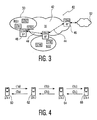
- FIG. 3 is another wireless multihop scenario 40.
- the stations in BSS1 50 are able to connect to Station 8 46, which acts as a gateway to the internet 52. Without a multihop-enabled DS 42, this would be impossible because Station 4 48 cannot wirelessly reach and communicate with Station 8 46.
- Exemplary access points may posses only a single frequency radio. This requirement simplifies and decreases the cost of the construction of APs, but causes the complication that the DS and every BSS have to share the same wireless medium, resulting in possible conflicts and efficiency decreases.
- An exemplary improvement of the MAC-protocol can be archived using dual-frequency radios or even multi-frequency radios.
- a station is (1) a basic 802.11-access point, able to provide management services like association and creation of a BSS, and (2) is a station in a wireless distribution system, able to use multi - hop communication between its peers to obtain abilities needed for its access-point functions, and (3) is placed in a scenario as explained above that is defined to be a mesh-network station or mesh point.
- an exemplary MAC protocol allows an efficient multihop communication in the mesh network.
- TxOPs negotiated transmission opportunities
- the use of negotiated transmission opportunities (TxOPs) of equal length result in a predictable medium access, as all neighboring mesh points are able to learn which mesh point in the mesh network plays what part during a TxOP.
- This enhanced knowledge/information provided to the mesh points allows the protocol to allow for greater spatial reuse, which directly is followed by a capacity increase of an exemplary mesh network.
- Mesh points STA1 60, STA2 62, STA3 64, and STA4 68 each have their own BSS and probably several associated mobile stations.
- the mobile stations in the BSS of mesh point STA1 60 generate traffic that is addressed to mesh point STA4 68 (STA4 68 is, for example, a gateway or portal to the internet), and mesh point STA4 68 replies to traffic.
- STA4 68 is, for example, a gateway or portal to the internet
- mesh point STA1 60 and STA4 68 are mutually out of reception range, they cannot communicate directly with each other. They must use two, three hop routes via mesh points STA2 62 and STA3 64, which are depicted as (1a-c) and (2a-c).
- mesh point STA3 64 may negotiate with mesh point STA4 68 such that the number of used TxOP are to be the same as they are used for the link (1a). The latter information is directly available to mesh point STA3 64 via the negotiation procedure between mesh point STA1 60 and mesh point STA2 62.
- Figure 5 is an optimal alignment of the transmissions during time for the scenario in Figure 4 .
- the above scenario is an example of optimal behavior by the mesh points as seen from an external observer's perspective, but it is not obvious how the mesh points operate to exhibit this behavior.
- Embodiments of the present invention further enhance the efficiency of multihop communication in a mesh network by providing, among other things, a method that allows Mesh points to learn to estimate the environment and to decide whether simultaneous transmissions are possible in the estimated environment.
- the possible internal mechanisms of the mesh points are explained in the next sections.
- One feature of embodiments of the present invention is a definition of a new learning and distributed algorithm that is used by the various mesh points for predicting if a new transmission opportunity (TxOP) or transmission slot can be used for a transmission.
- TxOP transmission opportunity
- the exemplary distributed algorithm first, detects the devices participating in the network by receiving information from beacons and/or other mesh point's traffic headers or other mesh point's beacons. Then, the exemplary distributed algorithm measures and stores the received signal strength for every node in its network. Next, the distributed algorithm estimates the quality of the links in the mesh point's environment based on each of the link's Carrier over Interference (CoI) ratios. With this CoI information, the mesh point can calculate a graph or table representing the different existing links use the graph or table to decide whether a simultaneous new transmission can take place in the existing environment.
- CoI Carrier over Interference
- a model of a mesh point's current environment is called a world model.
- This world model should be as simple as possible, abstracting from reality as much as possible. Also, the world model should be as detailed as necessary in order to provide good estimations of various options available for a specified transmission.
- the world model is updated continuously by sensors of its mesh point.
- the sensors of the mesh point are the receiving entities of the physical layer together with information about the TxOP ownerships, received beacons, information elements, and heard transmissions.
- a request for a new TxOP ownership or a request for change of an existing TxOP ownership arises in a mesh point.
- a new TxOP ownership request or a request to change an existing TxOP ownership may occur because a new traffic stream is started by an associated mesh point or because a TxOP ownership negotiation request is received by a neighboring mesh point.
- These requests would be processed using the world model to find free TxOPs that suit the current status regarding the intended role (transmitter or receiver) and the priority of the traffic.
- the resulting information is used to so that the TxOP negotiation process selects a suitable set of TxOPs and starts the negotiation process (or answers the request respectively), probably preferring TxOPs that lead to a simultaneous transmission.
- FIG. 6 is the general structure of an interference-aware mesh point 70.
- the exemplary interference-aware mesh point or station 70 is located in an environment of a plurality of mesh points and/or stations 72. Transmissions from the environment 72 are received by a station's sensors 73.
- a receiver 74 is part of the station's sensors and receives transmissions.
- the station determines TxOP ownerships 76 and deciphers received beacons 78.
- the received information from the sensors 73 is processed such that the world model 80 can be created. Requests for new or changed TxOP requests 82 are also provide to the world model 80 so that it can be continuously updated.
- the world model 80 provides available or usable TxOPs for requests to the actuators 84.
- TxOP negotiation 86 is performed using information from the world model 80 and other information related to requests for new or changed TxOP ownership.
- the transmitter 88 transmits the results of the station's 70 TxOP negotiations out to the network environment 72.
- Embodiments of the invention are mainly concerned with the ability of stations to perform simultaneous transmissions. Other criteria that involve an optimal selection of TxOPs under foicss conditions or QoS requirements like throughput and delay are not discussed. Therefore, the exemplary algorithm, which chooses and negotiates the TxOPs, is handled as a black box that gets a set of TxOPs that could be suitable for a specified transmission to/from a mesh point, optionally combined with a rating of each TxOP. As a result, the performance of the learning algorithm can be measured by the number of "good” TxOPs it proposes to this black box, compared to the number of "bad" TxOPs.
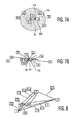
- Figures 7(a) and (b) are helpful.
- the Figures 7(a) and (b) depict measures of signal strength when (a) Tx 90 is transmitting and (b) when Rx 100 is receiving.
- Both subfigures (a) and (b) show an example environment with 11 mesh points, two of them arc marked as the transmitting 90 and the receiving 100 mesh point respectively.
- the transmission power 102 of the transmitting mesh point 90 is drawn in shaded gray color.
- the transmission power's 102 strength is proportional to the distance to the mesh point.
- Figure 7(b) shows the transmission power (in the form of shaded gray line) of all the other stations in the environment as seen from the Rx mesh point 100.
- a line 104 indicates the traffic from the Tx 90 to the Rx 100 mesh point.
- a TxOP is "good” if it does not disturb a simultaneous transmission by its interference.
- the transmitting mesh point 90 would certainly adversely interfere with or disturb any transmission that is being received at the mesh points "1a-1c".
- the impact on reception at mesh points "2a-2d” would be much lower.
- a transmission from mesh point "2b” to “2a” should not be a problem; whereas a transmission between mesh points "3a-3b” would not sense anything from a Tx 90 transmission 102.
- the effect of the transmission depends not only on the distance to another mesh point, but also on the position of the simultaneous transmission's sender: It is less interfering if the distance from the simultaneous sender to the transmitter 90 is very small.
- the shape of the signal strength 102 may be more complicated than a circle around the transmitting mesh point 90. Furthermore, the shape may not be constant over time. It is understood that moving obstacles and/or different channel conditions can change the effects of a transmission.
- the task of the world model 80 inside the learning mesh point 70 is to represent the surrounding environment in the simplest way that allows a good prediction of whether a given TxOP is "good" or not.
- the detailed implementation of the world model which also includes how the outputs of the sensors are used to update its state, is of course independent of the communication protocol specifications, and can be optimized to fulfill different aims. For example a trade off between the needed complexity, the used computational effort and the accuracy of the predictions must be made.
- the world model 80 is limited by the sensitivity and accuracy of the given sensors 73.
- An optimal model in the case discussed here, would know the position of all mesh points in its network, as well as the link characteristics between the mesh points, along with the placement of any obstacles.
- an optimal model situation is not possible in the real world, because some of the needed information can only be obtained by utilizing and enormous amount of overhead traffic (for the mutual link characteristics) or is not achievable under any circumstances (i.e., like knowing the placement of any obstacles).
- the following world model is therefore only an example.
- the following world model relies on the MAC protocol utilized and some information that can be obtained as a side product of the utilized MAC Protocol.
- CoI Carrier over Interference
- C is the carrier's signal strength
- N is the current noise and the sum stands for the interference that is produced by other transmissions.
- ⁇ I>>N if a simultaneous transmission is existent; therefore, the noise can be neglected in the non trivial cases.
- This CoI reflects the success probability that the receiver of a simultaneous transmission is able to decode the signal in spite of the primary transmission.
- the transmitter creates a new source of interference for the primary transmission. Therefore, both mesh points of the new link have to avoid that this new interference is severe at the original receiver.
- the current status of the world model may be represented by a signal strength graph, chart, data table or other applicable means.
- the weight of an edge between two nodes (X, Y) is an estimation of the signal strength as measured at node Y if node X is sending/transmitting data.
- bidirectional w (X, Y) w (Y, X) and the graph can be undirected.
- Figure 8 provides an exemplary graph for the five mesh points Tx, Rx, 1, 2 and 3.
- the signal strength is abstracted as a weight of the connecting edge.
- Figure 8 is a signal strength graph for a scenario with stations Tx, Rx, and 1 to 3. Having a well created world model for each mesh point will nicely approximate the current state of the environment. Then, mesh points possessing this graph (i.e. Figure 8 ) can compute an estimation of the interference CoI during a simultaneous transmission from Tx to Rx. Furthermore, the world model can support the computation of the receiver CoI at Rx.
- the interference CoI is estimated by dividing the weight of the link that represents the simultaneous transmission by the interference that is produced by Tx (given by w (Tx, [receiver of the simultaneous transmission]). The higher the quotient of those two weights, the lower is the chance that Tx interferes with the transmission.
- the receiver computes a value of CoI as the quotient of w (Tx, Rx) and the interference of the simultaneous transmission, which is represented by w (Rx, Sender of the simultaneous transmission).
- w Rx, Sender of the simultaneous transmission
- a high indicator would here also express a high chance of a successful reception.
- the exemplary method can be easily extended to multiple simultaneous transmissions or to multiple receiver transmissions.
- An exemplary algorithm can compute the CoI for every possible simultaneous transmission and then rate all the TxOPs given the information about the current ownerships using the ownership protocol as a sensor.
- the exemplary graph (or data derived there from) provides an outcome that is a list of "good" TxOPs, which are likely to provide a high success of reception and a low interference ratio to other parallel transmissions.
- a threshold may be given that determines whether the computed CoI ratio is high enough.
- a decision on whether the CoI is appropriate for parallel transmissions can be made based upon a (learnable) soft threshold function like the sigmoid function 1 1 + e - x + Offset .
- the computed CoI indicators for the transmission Tx to Rx in the given example graph can be seen in Table 1, all impossible pairs of transmissions (like Tx -> Rx and Rx -> 2 in the same time) are omitted.
- Table 1 Interference CoI and Receiver CoI if a simultaneous transmission from Tx to Rx occurs. Transmissions in TxOP Receiver CoI [dB] Interference CoI [dB] None 0 maximum 1 -> 2 4 -2 2 ->1 10 -14 1 -> 3 4 -1 3 -> 1 13 -16 2 -> 3 10 5 3 -> 2 13 1
- Table 1 clearly shows that the transmission Tx -> Rx cannot be scheduled simultaneously to most of the other possible transmissions, perhaps only parallel to the transmission 2->3.
- Figure 4 the graph of the introduction example
- Continuous learning of the graph can be divided into two separate tasks: First, the graph's structure (V, E) must be learned.
- the graph's structure (V, E) is the identification of the network's participants.
- Second, the weights in the graph are learned.
- the first two tasks are carried out continuously while the station is operating.. The two tasks may be carried out at a speed that is adaptable to the environment, thereby allowing the model to become a good approximation of the environment and also being able to react to changes.
- the learning process is made difficult by any insufficient and unreliable output of the three sensors 74, 76, 78 that are used because as they have not been specifically designed to fulfill the exemplary task.
- filtering of the sensor's output is one of the most important subtasks of the exemplary learning process.
- Another and perhaps last requirement of the learning process is that the learning process should recognize situations where its knowledge is insufficient to result in good estimations for the two CoI values. In detail, a result of the learning process should be ignored if the interference CoI is overestimated and thus disturbs an existing transmission.
- Recognizing other mesh points in the network 72 can be done easily using the exemplary beacon period access protocol and by receiving other mesh point's traffic headers. From the beacon protocol, a mesh point can identify the beacon's sender, the sender's neighbors and the neighbor's neighbors, because each of them is announced in the owner vector of the BPOIE.
- each traffic train has an initial header which gives the structure of the following wagons, including the recipient of each wagon. Using this information, a mesh point can detect other mesh points by listening to the headers even if in the TxOP it is not a receiver.
- Each occurrence of a mesh point's DEVID can be seen as a "ping" indicating the mesh point as being “alive”. It is recommended that a mesh point is included in the graph the first time a "ping" is heard from it. And, should be deleted from the graph with a probability that increases with the amount of time that passes with no "ping" being heard.
- the weighting or prioritizing of signals from the other mesh points must be estimated. This can be done in several ways. Each sensor gives some hints toward how the signal weights should be set, arguably the sensor's outputs are often noisy and have to be filtered or weighted before they can be taken into account.
- learning the (N -1) direct links can be done by using the timing information in the beacon access period protocol together with some side information by the PHY layer.
- BP Beacon Period
- a mesh point senses the point in time when a neighboring mesh point is transmitting its beacon. Furthermore, because of the strict rules in the BP, the mesh point will sense that no other near mesh point is transmitting during BP time.
- the PHY layer can measure the integrated signal strength, and then report this strength to the MAC layer.
- the MAC layer then combines this information with the BP access protocol to determine an estimation of the signal strength of a particular neighbor.
- the weight on each link can now be computed using this estimation method.
- the easiest solution would be to simply take the most current estimation and neglect older values.
- a third exemplary possibility for learning the links is to use a one dimensional Kalman filter to obtain an incremental estimation using the measurements.
- a Kalman filter assumes an additive white Gaussian noise with an unknown variance as an error on the PHY measurements; it can compute the current expected "real" signal strength together with the variance that it assumes together with this estimation.
- An advantage of the Kalman filter is that it weights the influence of new measures proportional to the current degree of believe of the estimation. Therefore, it can be seen as an enhancement of the exponential weighted average. In the latter case, all measurements are weighted with the same ⁇ ; In contrast, the Kalman filter is able to adapt this coefficient to the current variance.
- the learning mesh point is able to learn or establish a weight for all direct links whereas all other links remain unknown.
- an estimation of the lower bound of the weight of the other links suffices for a good interference CoI computation; therefore, two different methods having different complexities can be used.
- the medium access protocol (MAC) during the mesh traffic phase can be used as a simple sensor to get information about this signal strength.
- MAC medium access protocol
- the PHY mode is indicated for each receiver. Since a train header is send in a basic PHY mode, the chances are high that mesh point "2" 62 will receive and read this header and therefore determine the PHY mode that is used. Since a PHY mode can only be received and read successfully if the signal strength at the receiver is above a minimum threshold, mesh point "2" 62 can conclude the minimum signal strength, which suffices for the CoI.
- Table 2 shows the minimum signal strength in dBm for the different 802.11 PHY modes.
- Table 2 The minimum signal strength for the successful reception, depending on the PHY - mode PHY mode Minimum C (dBm) BPSK 1 ⁇ 2 -82 BPSK 3 ⁇ 4 -81 QPSK 1 ⁇ 2 -79 QPSK 3 ⁇ 4 -77 16QAM 1 ⁇ 2 -74 16QAM 3 ⁇ 4 -70 16WAM 2/3 -66 64QAM 3 ⁇ 4 -65
- This signal strength IE consists only of three fields: The mesh point where the signal is received, the transmitting mesh point and finally a decibel value expressing a lower bound on the signal strength.
- the lower bound may be obtained by the estimation of direct links as discussed above, especially if a Kalman filter was used, together with the variance, a confidence interval, which can be computed for the estimation thereby providing the information needed to disseminate the lower limit of an interval.
- the frequency of sending of SSIEs should be very low. Additionally, it is possible to adapt the SSIE to the behavior of the link, e.g. information about a steady, only slightly changing link is disseminated less often than information about a fluctuating link. Furthermore, information about a link should not be send at all if the current knowledge is not very profound.
- the integrity of data about direct links in a received SSIE can be trusted more than data from the sensors, because SSIE data was already filtered and only the lower limit is sent. Therefore, a low pass filtering of the data with a high alpha should be sufficient.
- a station may have to determine whether to have a received SSIE resent or to drop it. The probability of dropping the SSIE should be disproportional to the maximum direct link strength to the mentioned stations in the SSIE, as the information becomes irrelevant for mesh points that are even farther away.
- Embodiments of this invention allow for and provide for a distributed learning method in wireless networks.
- the interference Carrier over Interference ratio (CoI) by dividing a weighted value of a link that represents the simultaneous transmission by the interference that is produced by the potential transmitter; calculating the receiver CoI as the quotient of a weighted value between the potential transmitter and the intended receiver (w(Tx,Rx)) and the interference of the simultaneous transmission; computing the CoI for every possible simultaneous transmission; deciding whether to transmit or not based on a threshold value ( ⁇ good' TxOPs have high interference CoI and high receiver CoI values), and deciding whether to transmit or not based on sophisticated algorithms and procedures that make use of channel and reception information of past transmissions.
- CoI interference Carrier over Interference ratio
- Embodiments of the invention further may include estimating a weighted value of a link by a running exponential weighted average or by using any filtering technique, including using a Kalman filter. Furthermore, a decision may be made based upon a soft threshold function like the sigmod function, storing, updating and processing measurement information of neighboring stations transmissions to adaptively learn about channel conditions and to identify sufficient periods to successfully transmit packets, and a combination of signal strength information to form a model of the surrounding neighborhood.
- a soft threshold function like the sigmod function
Landscapes
- Engineering & Computer Science (AREA)
- Computer Networks & Wireless Communication (AREA)
- Signal Processing (AREA)
- Mobile Radio Communication Systems (AREA)
- Radio Relay Systems (AREA)
- Developing Agents For Electrophotography (AREA)
Applications Claiming Priority (3)
| Application Number | Priority Date | Filing Date | Title |
|---|---|---|---|
| US68070305P | 2005-05-12 | 2005-05-12 | |
| US75844006P | 2006-01-11 | 2006-01-11 | |
| PCT/IB2006/051506 WO2006120652A2 (en) | 2005-05-12 | 2006-05-12 | Distributed learning method for wireless mesh networks |
Publications (2)
| Publication Number | Publication Date |
|---|---|
| EP1882338A2 EP1882338A2 (en) | 2008-01-30 |
| EP1882338B1 true EP1882338B1 (en) | 2011-09-21 |
Family
ID=37022389
Family Applications (1)
| Application Number | Title | Priority Date | Filing Date |
|---|---|---|---|
| EP06744934A Expired - Lifetime EP1882338B1 (en) | 2005-05-12 | 2006-05-12 | Distributed learning method for wireless mesh networks |
Country Status (9)
| Country | Link |
|---|---|
| US (1) | US8532060B2 (enExample) |
| EP (1) | EP1882338B1 (enExample) |
| JP (1) | JP4871355B2 (enExample) |
| KR (1) | KR101270046B1 (enExample) |
| CN (1) | CN101176311B (enExample) |
| AT (1) | ATE525830T1 (enExample) |
| DK (1) | DK1882338T3 (enExample) |
| ES (1) | ES2373973T3 (enExample) |
| WO (1) | WO2006120652A2 (enExample) |
Families Citing this family (30)
| Publication number | Priority date | Publication date | Assignee | Title |
|---|---|---|---|---|
| US8923163B2 (en) * | 2003-12-19 | 2014-12-30 | Telefonaktiebolaget L M Ericsson (Publ) | Fast opportunistic distributed resource reallocation for established connections in a multihop network |
| GB0608898D0 (en) * | 2006-05-05 | 2006-06-14 | Roke Manor Research | System and method for communication |
| US7756055B2 (en) | 2006-05-05 | 2010-07-13 | Roke Manor Research Limited | Method of transmission |
| JP2010519833A (ja) * | 2007-02-27 | 2010-06-03 | アゼリア ネットワークス | 経路距離係数によるメッシュ状ネットワークにおける無線周波数管理のための方法およびシステム |
| US9668225B2 (en) * | 2007-07-10 | 2017-05-30 | Qualcomm Incorporated | Methods and apparatus for active successive interference cancellation based on one rate feedback and probability adaptation in peer-to-peer networks |
| GB2490607B (en) | 2008-01-24 | 2013-03-20 | Firetide Inc | Channel assignment for wireless access networks |
| KR100972588B1 (ko) * | 2008-07-28 | 2010-07-28 | 경희대학교 산학협력단 | Ieee 802.11의 mac 프로토콜에 따른 무선 채널의접속 제어 방법 |
| CN102067711B (zh) * | 2008-07-30 | 2013-06-12 | 上海贝尔股份有限公司 | 网状网络中用于上、下行逻辑拓扑结构管理的方法和装置 |
| US20130121205A1 (en) * | 2009-01-26 | 2013-05-16 | Floyd Backes | Method for Selecting an Optimum Access Point in a Wireless Network on a Common Channel |
| EP2247042A1 (en) | 2009-04-28 | 2010-11-03 | Thomson Licensing, Inc. | Device and method for computation of channel loss rate and collision loss rate of communication link(s) in a random access network |
| CN102006649A (zh) * | 2009-08-28 | 2011-04-06 | 财团法人工业技术研究院 | 基于邻近觉察的同时传输的媒介存取控制协议装置与方法 |
| US20120300662A1 (en) * | 2010-01-22 | 2012-11-29 | Nokia Corporation | Cellular Control Sensing for Multicell Device-to-Device Interference Control |
| US9053503B2 (en) | 2011-04-21 | 2015-06-09 | Gilbarco, S.R.L. | Fueling environment wireless architecture |
| US20130155102A1 (en) | 2011-12-20 | 2013-06-20 | Honeywell International Inc. | Systems and methods of accuracy mapping in a location tracking system |
| US9215609B2 (en) * | 2012-10-16 | 2015-12-15 | Aruba Networks, Inc. | Method and system for measuring wireless link quality |
| CN103298060B (zh) * | 2013-06-19 | 2016-01-27 | 苏州大学 | 以内容为中心的无线网状网络中继节点布置方法 |
| US9325463B2 (en) | 2013-11-19 | 2016-04-26 | Intel IP Corporation | High-efficiency WLAN (HEW) master station and methods to increase information bits for HEW communication |
| WO2015077223A1 (en) | 2013-11-19 | 2015-05-28 | Intel IP Corporation | Method, apparatus, and computer readable medium for multi-user scheduling in wireless local-area networks |
| US9674836B2 (en) | 2014-01-27 | 2017-06-06 | Spectrum Effect, Inc. | Method and system for coexistence of radar and communication systems |
| TWI615055B (zh) * | 2014-02-25 | 2018-02-11 | 英特爾Ip公司 | 存取點輔助式空間再利用之技術 |
| US9386605B2 (en) * | 2014-07-11 | 2016-07-05 | Motorola Solutions, Inc. | Mobile dynamic mesh cluster bridging method and apparatus at incident scenes |
| US9705643B2 (en) | 2014-07-15 | 2017-07-11 | Intel IP Corporation | High-efficiency wireless local-area network devices and methods for acknowledgements during scheduled transmission opportunities |
| US20170079044A1 (en) * | 2015-09-10 | 2017-03-16 | Qualcomm Incorporated | Communication resource allocation |
| US10051510B2 (en) | 2016-05-27 | 2018-08-14 | Corning Optical Communications Wireless Ltd | Front-haul communications system for enabling communication service continuity in a wireless distribution system (WDS) network |
| CN107592622B (zh) * | 2017-07-21 | 2021-09-17 | 哈尔滨工程大学 | 一种基于地理位置信息的机会型并行传输方法 |
| US10613505B2 (en) | 2018-03-29 | 2020-04-07 | Saudi Arabian Oil Company | Intelligent distributed industrial facility safety system |
| US10303147B1 (en) | 2018-03-29 | 2019-05-28 | Saudi Arabian Oil Company | Distributed industrial facility safety system modular remote sensing devices |
| US10311705B1 (en) * | 2018-03-29 | 2019-06-04 | Saudi Arabian Oil Company | Distributed industrial facility safety system |
| US11521090B2 (en) | 2018-08-09 | 2022-12-06 | International Business Machines Corporation | Collaborative distributed machine learning |
| US12069557B2 (en) * | 2019-12-16 | 2024-08-20 | Lyft, Inc. | Mobile mesh network provisioning systems and methods |
Family Cites Families (15)
| Publication number | Priority date | Publication date | Assignee | Title |
|---|---|---|---|---|
| MY123040A (en) * | 1994-12-19 | 2006-05-31 | Salbu Res And Dev Proprietary Ltd | Multi-hop packet radio networks |
| US5949760A (en) * | 1997-03-21 | 1999-09-07 | Rockwell International Corporation | Simultaneous channel access transmission method for a multi-hop communications radio network |
| US6292559B1 (en) * | 1997-12-19 | 2001-09-18 | Rice University | Spectral optimization and joint signaling techniques with upstream/downstream separation for communication in the presence of crosstalk |
| US6456599B1 (en) | 2000-02-07 | 2002-09-24 | Verizon Corporate Services Group Inc. | Distribution of potential neighbor information through an ad hoc network |
| US6788670B1 (en) | 2000-10-27 | 2004-09-07 | Telefonaktiebolaget Lm Ericsson (Publ) | Method for forwarding in multi-hop networks |
| US6704301B2 (en) * | 2000-12-29 | 2004-03-09 | Tropos Networks, Inc. | Method and apparatus to provide a routing protocol for wireless devices |
| US6967944B2 (en) | 2001-03-30 | 2005-11-22 | Koninklijke Philips Electronics N.V. | Increasing link capacity via concurrent transmissions in centralized wireless LANs |
| US6785341B2 (en) * | 2001-05-11 | 2004-08-31 | Qualcomm Incorporated | Method and apparatus for processing data in a multiple-input multiple-output (MIMO) communication system utilizing channel state information |
| CN1462524A (zh) * | 2001-05-15 | 2003-12-17 | 皇家菲利浦电子有限公司 | 用于避免工作在混合协调功能下的ieee802.00无线局域网中冲突的重叠网络分配矢量 |
| KR100510127B1 (ko) * | 2002-12-31 | 2005-08-25 | 삼성전자주식회사 | 무선랜 환경에서 핸드오버 방법 및 모바일 노드의핸드오버 장치 |
| US20040151147A1 (en) * | 2003-01-31 | 2004-08-05 | Huckins Jeffrey L. | Processing wireless packets to reduce roaming host power consumption |
| AU2003288872A1 (en) * | 2003-12-19 | 2005-07-05 | Telefonaktiebolaget Lm Ericsson (Publ) | Fast/opportunistic distributed resource reallocation for established connections in a multihop network |
| US7519371B2 (en) * | 2004-02-09 | 2009-04-14 | Qualcomm Incorporated | Multi-hop communications in a wireless network |
| CA2478458A1 (en) | 2004-08-20 | 2006-02-20 | Michael Panzara | Treatment of pediatric multiple sclerosis |
| EP1882340B1 (en) | 2005-05-12 | 2009-09-16 | Koninklijke Philips Electronics N.V. | Distributed medium access protocol for wireless mesh networks |
-
2006
- 2006-05-12 WO PCT/IB2006/051506 patent/WO2006120652A2/en not_active Ceased
- 2006-05-12 DK DK06744934.8T patent/DK1882338T3/da active
- 2006-05-12 AT AT06744934T patent/ATE525830T1/de not_active IP Right Cessation
- 2006-05-12 EP EP06744934A patent/EP1882338B1/en not_active Expired - Lifetime
- 2006-05-12 CN CN2006800162353A patent/CN101176311B/zh not_active Expired - Lifetime
- 2006-05-12 ES ES06744934T patent/ES2373973T3/es not_active Expired - Lifetime
- 2006-05-12 US US12/159,915 patent/US8532060B2/en active Active
- 2006-05-12 KR KR1020077025853A patent/KR101270046B1/ko not_active Expired - Lifetime
- 2006-05-12 JP JP2008510714A patent/JP4871355B2/ja not_active Expired - Lifetime
Also Published As
| Publication number | Publication date |
|---|---|
| ES2373973T3 (es) | 2012-02-10 |
| KR101270046B1 (ko) | 2013-05-31 |
| CN101176311A (zh) | 2008-05-07 |
| CN101176311B (zh) | 2013-01-02 |
| JP2008541603A (ja) | 2008-11-20 |
| JP4871355B2 (ja) | 2012-02-08 |
| WO2006120652A2 (en) | 2006-11-16 |
| WO2006120652A3 (en) | 2007-01-11 |
| DK1882338T3 (da) | 2011-11-28 |
| KR20080013890A (ko) | 2008-02-13 |
| US20120106362A1 (en) | 2012-05-03 |
| ATE525830T1 (de) | 2011-10-15 |
| US8532060B2 (en) | 2013-09-10 |
| EP1882338A2 (en) | 2008-01-30 |
Similar Documents
| Publication | Publication Date | Title |
|---|---|---|
| US8532060B2 (en) | Distributed learning method for wireless mesh networks | |
| RU2404525C2 (ru) | Способ и устройство для маршрутизации на основе помех в беспроводной ячеистой сети | |
| Golmie | Coexistence in wireless networks: Challenges and system-level solutions in the unlicensed bands | |
| JP5030948B2 (ja) | 無線メッシュネットワークに関する分散型媒体アクセスプロトコル | |
| US7330457B2 (en) | Cooperative wireless communications | |
| JP5362746B2 (ja) | 干渉回避のためのバックホールシグナリング | |
| US7936681B2 (en) | Cross-layer design techniques for interference-aware routing configuration in wireless mesh networks | |
| US7519013B2 (en) | Spatial reuse in a wireless communications network | |
| KR100989754B1 (ko) | 이동통신 시스템에 있어서 통신 레이어 ⅱ 라우팅에 사용되는 링크에 대한 경로 손실을 계산하기 위하여 패킷 당 수신 신호 강도 지수 및 송신 전력 레벨을 사용하기 위한 시스템 및 방법 | |
| EP2659707B1 (en) | Optimal interference estimation and scheduling in a multi-hop wireless network with centralized control | |
| EP3629636B1 (en) | Wireless communication apparatus and wireless communication method | |
| JP2005509323A (ja) | ネットワーク・チャネル・アクセス・プロトコル−干渉および負荷適応 | |
| Khan et al. | MAC protocols for cooperative diversity in wireless LANs and wireless sensor networks | |
| KR101271389B1 (ko) | 무선 메시 네트워크에서 다수 채널 자원 예약 방법 | |
| Hussain et al. | Approach for cluster-based spectrum sensing over band-limited reporting channels | |
| WO2006120650A1 (en) | Frame aggregation method for wireless mesh networks | |
| Fan | Wireless networking with directional antennas for 60 GHz systems | |
| Tavakoli Najafabadi et al. | Dependable Interference-aware Time-slotted Channel Hopping for Wireless Sensor Networks | |
| US20260031893A1 (en) | Antenna selection procedure for time of arrival estimation | |
| Raman et al. | SIR-based interference-maps for TDMA-based outdoor mesh networks | |
| CN119731952A (zh) | 窄带辅助超宽带跳频 | |
| Nikbakht et al. | A New Approach for Helper Selection and Performance Analysis in Poisson CoopMAC Networks | |
| Kanodia | Distributed scheduling and multi-channel opportunistic media access for ad hoc networks | |
| Dai | Study on Wireless Ad Hoc Network Considering Hidden Terminal Problem and Intra-Flow Interference Cancellation | |
| Islam et al. | WSN11-6: Throughput Performance of Cooperative Diversity in Mobile Ad Hoc Networks |
Legal Events
| Date | Code | Title | Description |
|---|---|---|---|
| PUAI | Public reference made under article 153(3) epc to a published international application that has entered the european phase |
Free format text: ORIGINAL CODE: 0009012 |
|
| 17P | Request for examination filed |
Effective date: 20071212 |
|
| AK | Designated contracting states |
Kind code of ref document: A2 Designated state(s): AT BE BG CH CY CZ DE DK EE ES FI FR GB GR HU IE IS IT LI LT LU LV MC NL PL PT RO SE SI SK TR |
|
| 17Q | First examination report despatched |
Effective date: 20080502 |
|
| DAX | Request for extension of the european patent (deleted) | ||
| GRAP | Despatch of communication of intention to grant a patent |
Free format text: ORIGINAL CODE: EPIDOSNIGR1 |
|
| GRAS | Grant fee paid |
Free format text: ORIGINAL CODE: EPIDOSNIGR3 |
|
| GRAA | (expected) grant |
Free format text: ORIGINAL CODE: 0009210 |
|
| AK | Designated contracting states |
Kind code of ref document: B1 Designated state(s): AT BE BG CH CY CZ DE DK EE ES FI FR GB GR HU IE IS IT LI LT LU LV MC NL PL PT RO SE SI SK TR |
|
| REG | Reference to a national code |
Ref country code: GB Ref legal event code: FG4D |
|
| REG | Reference to a national code |
Ref country code: CH Ref legal event code: EP |
|
| REG | Reference to a national code |
Ref country code: IE Ref legal event code: FG4D |
|
| REG | Reference to a national code |
Ref country code: NL Ref legal event code: T3 |
|
| REG | Reference to a national code |
Ref country code: DE Ref legal event code: R096 Ref document number: 602006024551 Country of ref document: DE Effective date: 20111124 |
|
| REG | Reference to a national code |
Ref country code: DK Ref legal event code: T3 |
|
| REG | Reference to a national code |
Ref country code: SE Ref legal event code: TRGR |
|
| PG25 | Lapsed in a contracting state [announced via postgrant information from national office to epo] |
Ref country code: LT Free format text: LAPSE BECAUSE OF FAILURE TO SUBMIT A TRANSLATION OF THE DESCRIPTION OR TO PAY THE FEE WITHIN THE PRESCRIBED TIME-LIMIT Effective date: 20110921 Ref country code: FI Free format text: LAPSE BECAUSE OF FAILURE TO SUBMIT A TRANSLATION OF THE DESCRIPTION OR TO PAY THE FEE WITHIN THE PRESCRIBED TIME-LIMIT Effective date: 20110921 |
|
| REG | Reference to a national code |
Ref country code: ES Ref legal event code: FG2A Ref document number: 2373973 Country of ref document: ES Kind code of ref document: T3 Effective date: 20120210 |
|
| LTIE | Lt: invalidation of european patent or patent extension |
Effective date: 20110921 |
|
| PG25 | Lapsed in a contracting state [announced via postgrant information from national office to epo] |
Ref country code: SI Free format text: LAPSE BECAUSE OF FAILURE TO SUBMIT A TRANSLATION OF THE DESCRIPTION OR TO PAY THE FEE WITHIN THE PRESCRIBED TIME-LIMIT Effective date: 20110921 Ref country code: CY Free format text: LAPSE BECAUSE OF FAILURE TO SUBMIT A TRANSLATION OF THE DESCRIPTION OR TO PAY THE FEE WITHIN THE PRESCRIBED TIME-LIMIT Effective date: 20110921 Ref country code: AT Free format text: LAPSE BECAUSE OF FAILURE TO SUBMIT A TRANSLATION OF THE DESCRIPTION OR TO PAY THE FEE WITHIN THE PRESCRIBED TIME-LIMIT Effective date: 20110921 Ref country code: GR Free format text: LAPSE BECAUSE OF FAILURE TO SUBMIT A TRANSLATION OF THE DESCRIPTION OR TO PAY THE FEE WITHIN THE PRESCRIBED TIME-LIMIT Effective date: 20111222 Ref country code: LV Free format text: LAPSE BECAUSE OF FAILURE TO SUBMIT A TRANSLATION OF THE DESCRIPTION OR TO PAY THE FEE WITHIN THE PRESCRIBED TIME-LIMIT Effective date: 20110921 |
|
| REG | Reference to a national code |
Ref country code: AT Ref legal event code: MK05 Ref document number: 525830 Country of ref document: AT Kind code of ref document: T Effective date: 20110921 |
|
| PG25 | Lapsed in a contracting state [announced via postgrant information from national office to epo] |
Ref country code: BE Free format text: LAPSE BECAUSE OF FAILURE TO SUBMIT A TRANSLATION OF THE DESCRIPTION OR TO PAY THE FEE WITHIN THE PRESCRIBED TIME-LIMIT Effective date: 20110921 |
|
| PG25 | Lapsed in a contracting state [announced via postgrant information from national office to epo] |
Ref country code: IS Free format text: LAPSE BECAUSE OF FAILURE TO SUBMIT A TRANSLATION OF THE DESCRIPTION OR TO PAY THE FEE WITHIN THE PRESCRIBED TIME-LIMIT Effective date: 20120121 Ref country code: CZ Free format text: LAPSE BECAUSE OF FAILURE TO SUBMIT A TRANSLATION OF THE DESCRIPTION OR TO PAY THE FEE WITHIN THE PRESCRIBED TIME-LIMIT Effective date: 20110921 Ref country code: SK Free format text: LAPSE BECAUSE OF FAILURE TO SUBMIT A TRANSLATION OF THE DESCRIPTION OR TO PAY THE FEE WITHIN THE PRESCRIBED TIME-LIMIT Effective date: 20110921 |
|
| PG25 | Lapsed in a contracting state [announced via postgrant information from national office to epo] |
Ref country code: EE Free format text: LAPSE BECAUSE OF FAILURE TO SUBMIT A TRANSLATION OF THE DESCRIPTION OR TO PAY THE FEE WITHIN THE PRESCRIBED TIME-LIMIT Effective date: 20110921 Ref country code: RO Free format text: LAPSE BECAUSE OF FAILURE TO SUBMIT A TRANSLATION OF THE DESCRIPTION OR TO PAY THE FEE WITHIN THE PRESCRIBED TIME-LIMIT Effective date: 20110921 Ref country code: PT Free format text: LAPSE BECAUSE OF FAILURE TO SUBMIT A TRANSLATION OF THE DESCRIPTION OR TO PAY THE FEE WITHIN THE PRESCRIBED TIME-LIMIT Effective date: 20120123 Ref country code: PL Free format text: LAPSE BECAUSE OF FAILURE TO SUBMIT A TRANSLATION OF THE DESCRIPTION OR TO PAY THE FEE WITHIN THE PRESCRIBED TIME-LIMIT Effective date: 20110921 |
|
| PLBE | No opposition filed within time limit |
Free format text: ORIGINAL CODE: 0009261 |
|
| STAA | Information on the status of an ep patent application or granted ep patent |
Free format text: STATUS: NO OPPOSITION FILED WITHIN TIME LIMIT |
|
| 26N | No opposition filed |
Effective date: 20120622 |
|
| REG | Reference to a national code |
Ref country code: DE Ref legal event code: R097 Ref document number: 602006024551 Country of ref document: DE Effective date: 20120622 |
|
| PG25 | Lapsed in a contracting state [announced via postgrant information from national office to epo] |
Ref country code: MC Free format text: LAPSE BECAUSE OF NON-PAYMENT OF DUE FEES Effective date: 20120531 |
|
| REG | Reference to a national code |
Ref country code: CH Ref legal event code: PL |
|
| PG25 | Lapsed in a contracting state [announced via postgrant information from national office to epo] |
Ref country code: CH Free format text: LAPSE BECAUSE OF NON-PAYMENT OF DUE FEES Effective date: 20120531 Ref country code: LI Free format text: LAPSE BECAUSE OF NON-PAYMENT OF DUE FEES Effective date: 20120531 |
|
| REG | Reference to a national code |
Ref country code: IE Ref legal event code: MM4A |
|
| PG25 | Lapsed in a contracting state [announced via postgrant information from national office to epo] |
Ref country code: IE Free format text: LAPSE BECAUSE OF NON-PAYMENT OF DUE FEES Effective date: 20120512 |
|
| PG25 | Lapsed in a contracting state [announced via postgrant information from national office to epo] |
Ref country code: BG Free format text: LAPSE BECAUSE OF FAILURE TO SUBMIT A TRANSLATION OF THE DESCRIPTION OR TO PAY THE FEE WITHIN THE PRESCRIBED TIME-LIMIT Effective date: 20111221 |
|
| REG | Reference to a national code |
Ref country code: ES Ref legal event code: PC2A Owner name: KONINKLIJKE PHILIPS N.V. Effective date: 20140220 |
|
| REG | Reference to a national code |
Ref country code: DE Ref legal event code: R082 Ref document number: 602006024551 Country of ref document: DE Representative=s name: MEISSNER, BOLTE & PARTNER GBR, DE |
|
| REG | Reference to a national code |
Ref country code: DE Ref legal event code: R082 Ref document number: 602006024551 Country of ref document: DE Representative=s name: MEISSNER, BOLTE & PARTNER GBR, DE Effective date: 20140328 Ref country code: DE Ref legal event code: R082 Ref document number: 602006024551 Country of ref document: DE Representative=s name: MEISSNER BOLTE PATENTANWAELTE RECHTSANWAELTE P, DE Effective date: 20140328 Ref country code: DE Ref legal event code: R081 Ref document number: 602006024551 Country of ref document: DE Owner name: KONINKLIJKE PHILIPS N.V., NL Free format text: FORMER OWNER: KONINKLIJKE PHILIPS ELECTRONICS N.V., EINDHOVEN, NL Effective date: 20140328 |
|
| PG25 | Lapsed in a contracting state [announced via postgrant information from national office to epo] |
Ref country code: LU Free format text: LAPSE BECAUSE OF NON-PAYMENT OF DUE FEES Effective date: 20120512 |
|
| PG25 | Lapsed in a contracting state [announced via postgrant information from national office to epo] |
Ref country code: HU Free format text: LAPSE BECAUSE OF FAILURE TO SUBMIT A TRANSLATION OF THE DESCRIPTION OR TO PAY THE FEE WITHIN THE PRESCRIBED TIME-LIMIT Effective date: 20060512 |
|
| REG | Reference to a national code |
Ref country code: FR Ref legal event code: CD Owner name: KONINKLIJKE PHILIPS ELECTRONICS N.V., NL Effective date: 20141126 Ref country code: FR Ref legal event code: CA Effective date: 20141126 |
|
| REG | Reference to a national code |
Ref country code: FR Ref legal event code: PLFP Year of fee payment: 11 |
|
| REG | Reference to a national code |
Ref country code: FR Ref legal event code: PLFP Year of fee payment: 12 |
|
| REG | Reference to a national code |
Ref country code: FR Ref legal event code: PLFP Year of fee payment: 13 |
|
| PGFP | Annual fee paid to national office [announced via postgrant information from national office to epo] |
Ref country code: NL Payment date: 20250526 Year of fee payment: 20 |
|
| PGFP | Annual fee paid to national office [announced via postgrant information from national office to epo] |
Ref country code: DE Payment date: 20250528 Year of fee payment: 20 |
|
| PGFP | Annual fee paid to national office [announced via postgrant information from national office to epo] |
Ref country code: ES Payment date: 20250611 Year of fee payment: 20 Ref country code: GB Payment date: 20250520 Year of fee payment: 20 Ref country code: DK Payment date: 20250526 Year of fee payment: 20 |
|
| PGFP | Annual fee paid to national office [announced via postgrant information from national office to epo] |
Ref country code: IT Payment date: 20250522 Year of fee payment: 20 |
|
| PGFP | Annual fee paid to national office [announced via postgrant information from national office to epo] |
Ref country code: FR Payment date: 20250526 Year of fee payment: 20 |
|
| PGFP | Annual fee paid to national office [announced via postgrant information from national office to epo] |
Ref country code: TR Payment date: 20250429 Year of fee payment: 20 |
|
| PGFP | Annual fee paid to national office [announced via postgrant information from national office to epo] |
Ref country code: SE Payment date: 20250526 Year of fee payment: 20 |
|
| REG | Reference to a national code |
Ref country code: DE Ref legal event code: R071 Ref document number: 602006024551 Country of ref document: DE |
|
| REG | Reference to a national code |
Ref country code: NL Ref legal event code: MK Effective date: 20260511 |
|
| REG | Reference to a national code |
Ref country code: DK Ref legal event code: EUP Expiry date: 20260512 |
|
| REG | Reference to a national code |
Ref country code: ES Ref legal event code: FD2A Effective date: 20260601 |
|
| REG | Reference to a national code |
Ref country code: GB Ref legal event code: PE20 Expiry date: 20260511 |
|
| PG25 | Lapsed in a contracting state [announced via postgrant information from national office to epo] |
Ref country code: ES Free format text: LAPSE BECAUSE OF EXPIRATION OF PROTECTION Effective date: 20260513 |
|
| PG25 | Lapsed in a contracting state [announced via postgrant information from national office to epo] |
Ref country code: GB Free format text: LAPSE BECAUSE OF EXPIRATION OF PROTECTION Effective date: 20260511 |