EP1880649A1 - Water soluble cleaning tool - Google Patents
Water soluble cleaning tool Download PDFInfo
- Publication number
- EP1880649A1 EP1880649A1 EP06745910A EP06745910A EP1880649A1 EP 1880649 A1 EP1880649 A1 EP 1880649A1 EP 06745910 A EP06745910 A EP 06745910A EP 06745910 A EP06745910 A EP 06745910A EP 1880649 A1 EP1880649 A1 EP 1880649A1
- Authority
- EP
- European Patent Office
- Prior art keywords
- water
- cords
- disintegratable
- cleaning
- sheet
- Prior art date
- Legal status (The legal status is an assumption and is not a legal conclusion. Google has not performed a legal analysis and makes no representation as to the accuracy of the status listed.)
- Withdrawn
Links
Images




Classifications
-
- A—HUMAN NECESSITIES
- A46—BRUSHWARE
- A46B—BRUSHES
- A46B3/00—Brushes characterised by the way in which the bristles are fixed or joined in or on the brush body or carrier
- A46B3/08—Brushes characterised by the way in which the bristles are fixed or joined in or on the brush body or carrier by clamping
-
- A—HUMAN NECESSITIES
- A46—BRUSHWARE
- A46B—BRUSHES
- A46B7/00—Bristle carriers arranged in the brush body
- A46B7/04—Bristle carriers arranged in the brush body interchangeably removable bristle carriers
-
- A—HUMAN NECESSITIES
- A46—BRUSHWARE
- A46D—MANUFACTURE OF BRUSHES
- A46D1/00—Bristles; Selection of materials for bristles
-
- A—HUMAN NECESSITIES
- A46—BRUSHWARE
- A46D—MANUFACTURE OF BRUSHES
- A46D1/00—Bristles; Selection of materials for bristles
- A46D1/02—Bristles details
- A46D1/0215—Bristles characterised by the material being biodegradable
-
- A—HUMAN NECESSITIES
- A47—FURNITURE; DOMESTIC ARTICLES OR APPLIANCES; COFFEE MILLS; SPICE MILLS; SUCTION CLEANERS IN GENERAL
- A47K—SANITARY EQUIPMENT; ACCESSORIES THEREFOR, e.g. TOILET ACCESSORIES
- A47K11/00—Closets without flushing; Urinals without flushing; Chamber pots; Chairs with toilet conveniences or specially adapted for use with toilets
- A47K11/10—Hand tools for cleaning the toilet bowl, seat or cover, e.g. toilet brushes
-
- A—HUMAN NECESSITIES
- A46—BRUSHWARE
- A46B—BRUSHES
- A46B2200/00—Brushes characterized by their functions, uses or applications
- A46B2200/30—Brushes for cleaning or polishing
- A46B2200/304—Lavatory brush, i.e. brushes for cleaning toilets
Definitions
- the present invention relates to a water-disintegratable cleaning article for removing dirt in a place where water is used such as a flush toilet, which can be disposed in water after use.
- Japanese patent application laid-open No.62-186833 discloses the invention that relates to a disposable toilet cleaning brush for cleaning a flush toilet.
- the toilet cleaning brush has a brush head formed of a paper made of short fibers as wood pulp and carboxymethyl cellulose (CMC) as a binder, wherein the paper has a plurality of cuts formed therein and is rolled to form the brush head.
- the toilet cleaning brush is attached to an end of a paper stick handle. After the toilet cleaning brush is used for wiping the toilet bowl, the toilet cleaning brush is disposed in a flush toilet together with the stick handle, and thereafter, both of which disintegrate in the water. Also disclosed therein is that a surface of the brush is subjected to wax treatment in order to adjust the time required for dissolving the paper.
- the toilet cleaning brush starts swelling upon getting wet with water in cleaning the toilet bowl, and strength thereof becomes significantly reduced. Therefore, the dirt adhered to the toilet bowl is hardly wiped off. Also, due to the wax treatment which the brush is subjected to, the brush has a problem that a wax component thereof prevents disintegration of the paper, and therefore it requires a long time for the brush to disintegrate in the water in a water-purifier tank, etc.
- the toilet cleaning brush has a low rigidity which makes it difficult to rub the toilet bowl therewith and effectively remove the dirt adhered to the toilet bowl, etc.
- An object of the present invention is to provide a water-disintegratable cleaning article capable of effectively wiping-off dirt and grime that adheres to a surface of a toilet bowl of a flush toilet, and the like.
- the object of the present invention is to provide the water-disintegratable cleaning article having enough strength to rub a surface of the toilet bowl, etc, exhibiting an excellent dirt removing effect, while capable of being disintegrated in the water for relatively a short period after use.
- An aspect of the present invention is a water-disintegratable cleaning article which can be dispersed separately in water, comprising a cleaning part and a holding part, wherein the cleaning part is provided with a plurality of water-disintegratable cords each formed by twisting a water-disintegratable sheet.
- the cords which are formed by twisting the water-disintegratable sheet are positioned in the cleaning part.
- the cords have high density and high rigidity with appropriate elasticity.
- Bundled cords have irregularities on the surface thereof providing a large surface area. Therefore, when the toilet bowl is rubbed by the cords, the dirt adhered to the surface of the toilet bowl and the like can be effectively removed, while maintaining the shape of the cleaning part.
- the twist of the cords is loosened to decrease the density thereof, and the cords are disintegrated in the water for relatively a short period.
- the plurality of cords are fixed to one another in the holding part and positioned independently from one another in the cleaning part.
- the individual cord When the cords are positioned independently from one another in the cleaning part, the individual cord freely moves to slide on a surface to be cleaned such as in a toilet bowl, thus making it possible to clean corners in the toilet bowl.
- a holder to releasably hold the holding part is provided.
- the toilet bowl is wiped with the cleaning part. Thereafter, the cleaning article is released from the holder and disposed in the flush toilet.
- the cleaning article after use can be easily disposed without directly touching it. Since only the cleaning article is disposed in the water, the time required for disintegration in the water becomes shorter.
- each of the cords has its end positioned in the cleaning part.
- each of the cords is bent to have its bent part positioned in the cleaning part.
- the bent parts of the cords come into elastic contact with the part to be cleaned. Therefore, the feel of pressing the cleaning article against the part being cleaned is improved, and the effect of removing the dirt is enhanced. Also, even when the bent part of the cords gets wet, the twist of the cords is hardly loosened. Therefore, the wet strength of the cords can be maintained for relatively a long time.
- the water-disintegratable sheet forming the cords is made of fibers having a fiber length of 20 mm or less, which can be dispersed in water when a large quantity of water is present.
- the water-disintegratable sheet can be a sheet which is formed of only pulp fibers joined by hydrogen bonding force or by using a water-soluble binder.
- the water-disintegratable sheet is preferably a fiber entangled nonwoven fabric in which fibers having fiber lengths of 20 mm or less is entangled.
- the fiber entangled nonwoven fabric has a high strength in wet condition and is hardly broken when rubbing the part to be cleaned by the cords. Also, the fiber entangled nonwoven fabric is constituted by fibers having fiber lengths of 20 mm or less, and therefore when a large quantity of water is given thereto, the fibers can be dispersed separately in relatively a short period of time.
- the cords are formed of the fiber entangled nonwoven fabric wherein the fibers having fiber lengths of 20 mm or less are entangled, and a water-disintegratable paper comprising cellulose-based fibers.
- the cords When the cords are formed by twisting the fiber entangled nonwoven fabric and the water-disintegratable paper together, the cords can be firmly and strongly twisted due to the hydrogen bonding force of the fibers of the water-disintegratable paper, and further a twisted shape thereof can be maintained in drying. In addition, when water is given and the paper is loosened, the strength of the cords can be maintained by a fiber entanglement of the nonwoven fabric.
- the fiber entangled nonwoven fabric of the present invention is constituted by entanglable pulp fibers and other fibers having fiber lengths of 20 mm or less, and contains 10 mass % to 90 mass % of the pulp fibers, and 10 mass % to 90 mass % of the other fibers.
- rayon fiber is given as an example of the aforementioned other fibers.
- the fiber entangled nonwoven fabric is so constituted that mainly other fibers having fiber lengths of 20 mm or less are entangled, and a shape of the cords is maintained in drying by the hydrogen bonding force of the pulp fibers. Therefore, the strongly twisted shape of the cords can be maintained in drying due to the hydrogen bonding force of the pulp fibers, while the cord can exhibit a proper surface strength by an entangling force of other fibers when the fabric gets wet by water. Further, when a large quantity of water is given thereto, dispersion of the pulp fibers is caused, resulting in easy dispersion of the fibers constituting the nonwoven fabric.
- the fabric preferably contains 10 mass % or more of the pulp fibers, and in order to exhibit the strength by the fiber entanglement in wet condition, the fabric preferably contains 10 mass % or more of other fibers.
- the cleaning part may include, in addition to the water-disintegratable cords, at least one of a water-disintegratable sheet member and a water-disintegratable block member.
- the strength of the cleaning part is increased by these sheet member or block member, thus making it passible to strongly rub the cleaning part against the toilet bowl and so forth.
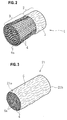
- a water-disintegratable cleaning article 1 has a holding part 2 and a cleaning part 3.
- the holding part 2 has substantially a cylindrical shape.
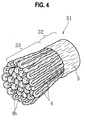
- a holder 10 shown in Fig.1 comprises a synthetic resin handle part 11, a storage part 12 integrally formed at a tip part of the handle part 11, and a synthetic resin pressing part 13 provided on a position opposed to the storage part 12.
- On the side surface opposed to the storage part 12 of the pressing part 13, the inner peripheral surface constituting other part of the cylindrical surface formed by the inner peripheral surface of the storage part 12 is formed. Namely, the inner peripheral surfaces of the storage part 12 and the pressing part 13 face with each other in a diameter direction of the cylindrical surface.
- a lever 14 extending from outside surface of the pressing part 13 in almost parallel with the handle part 11 is integrally formed with the pressing part 13.
- This lever 14 is rotatably supported, at an upper end thereof, on a bracket 11a formed in the handle part 11 through a pin 15.
- An operating wire 16 is rotatably connected to the upper end of the lever 14.
- a torsion spring (not shown) is provided in the pin 15.
- the lever 14 is biased to rotate clockwise, i.e. in a direction in which the pressing part 13 approaches the storage part 12, by the torsion spring with the pin 15 as a fulcrum.
- a handle is provided on an upper part of the handle part 11, and an operating lever is provided in this handle.
- the operating wire 16 is a thick wire, whose upper end is connected to the operating lever. When the operating lever is lifted, the operating wire 16 is also lifted relative to the handle part 11, and the lever 14 is rotated counterclockwise about the pin 15, and the pressing part 13 is moved away from the storage part 12.
- the pressing part 13 and the storage part 12 are held in a state separated from each other by lifting the operating lever, the holding part 2 of the cleaning article 1 is inserted between the storage part 12 and the pressing part 13, and the operating lever is released. Then, by the biasing force of the torsion spring, the lever 14 is rotated clockwise, and the holding part 2 of the cleaning article 1 is held by the storage part 12 and the pressing part 13 therebetween.
- the cleaning article 1 is constituted by bundling a plurality of cords 4. End faces 4a of cords 4 formed by cutting the cords 4 in section face toward the tip of the cleaning part 3, and the individual cords 4 of the cleaning part 3 are independent from one another without being mutually joined. Base parts of the individual cords 4 are bonded to one another by water-soluble adhesive in the holding part 2, and further a holding material 5 is wound around an outer peripheral surface of a bundle of the cords 4, and is bonded thereto by the water-soluble adhesive. Note that a cylindrical shape of the holding part 2 may be formed and maintained only by winding the holding material 5 around the bundle of the cords 4, without mutually bonding the cords 4 in the holding part 2.
- each of the cords 4 is formed to have high density by twisting the water-disintegratable sheet in one direction.
- the water-disintegratable sheet is made of the fibers having fiber lengths of 20 mm or less, and when exposed to a large quantity of water in a flush toilet and in a water-purifier tank, fibers thereof are dispersed separately in a short period.
- the water-disintegratable sheet is a water-disintegratable paper made of only pulp fibers joined together by the hydrogen bonding force, or a water-disintegratable paper of the pulp fibers and rayon fibers joined together by the hydrogen bonding force.
- water-disintegratable paper in which the fibers joined together by water-soluble binder such as polyvinyl alcohol (PVA) and polyacrylic acid (PAA), or carboxymethyl cellulose (CMD) and so forth can also be used.
- PVA polyvinyl alcohol
- PAA polyacrylic acid
- CMD carboxymethyl cellulose
- the twist shape of the cord 4 is maintained by the hydrogen bonding force of the water-disintegratable paper, or the water-soluble binder can be added to the twisted water-disintegratable paper to thereby maintain the shape of the cords 4.
- the water-disintegratable sheet wherein the pulp fibers are subjected to waterproof treatment to slightly lower hydrophilicity and are mutually joined by the water-soluble binder.
- the cords 4 formed of this water-disintegratable sheet can maintain the shape thereof even in wet condition during cleaning.
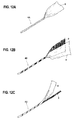
- Figs.12A, 12B, and 12C show further preferable examples of twisted cords 4A, 4B, and 4C forming the cords 4.
- the cords 4 used in the cleaning article 1 are constituted by any one of the twisted cords 4A, 4B, and 4C.
- two or more kinds of the twisted cords 4A, 4B, and 4C may be used in combination as the cords 4 of the cleaning article 1.
- Fig.12A shows the twisted cords 4A which are formed by twisting in one direction a strip of a water-disintegratable sheet 8 of a predetermined width.
- the water-disintegratable sheet 8 is formed as a water-disintegratable fiber entangled nonwoven fabric.
- the fiber entangled nonwoven fabric can be formed by laminating entanglable fibers having fiber lengths of 20 mm or less on a conveyor of a mesh-like perforated screen, and entangling the fibers by water-jet processing.
- the fiber entangled nonwoven fabric is constituted by pulp fibers and fibers having fiber lengths of 20 mm or less, which can be entangled by the water-j et processing.
- the nonwoven fabric is constituted by the pulp fibers and other fibers having fiber lengths of 20 mm or less
- the aforementioned other fibers are entangled by the water-jet processing, and hydrogen bonding are formed between the pulp fibers and between the pulp fiber and the aforementioned other fibers.
- the fiber entangled nonwoven fabric thus formed is capable of maintaining the strength when being dried and also maintaining the twisted shape by the hydrogen bonding of the pulp fibers.
- the fiber entangled nonwoven fabric is capable of maintaining its high surface strength when being wet by the entangling force of the aforementioned entanglable other fibers having fiber lengths of 20 mm or less.
- the twist of the cord is loosened by disintegration of pulp fibers, having the entanglement of other fibers loosened. Therefore, the fibers are broken into pieces in relatively a short period.
- the other fibers having fiber lengths of 20 mm or less which can be entangled by the water-jet processing it is preferable to use a biodegradable fibers. It is also preferable to use a regenerated cellulose fiber such as viscose rayon, solvent spun rayon, polynosic rayon, cuprammonium rayon, and alginate rayon.
- a regenerated cellulose fiber such as viscose rayon, solvent spun rayon, polynosic rayon, cuprammonium rayon, and alginate rayon.
- PET polyethylene terephthalate
- nylon fiber nylon fiber
- PP polypropylene
- pulp fibers in addition to the pulp fibers, or instead of the pulp fibers, natural fibers such as hemp and cotton, and other natural fibers such as bagasse, banana, pineapple, bamboo, and so forth may be used.
- the strength of the water-disintegratable sheet 8 may be increased by adding polyvinyl alcohol (PVA) fiber as water-soluble resin, and water-soluble or water swellable carboxymethyl cellulose (CMC) as a binder.
- PVA polyvinyl alcohol
- CMC carboxymethyl cellulose
- a fiber entangled nonwoven fabric which is made by a wet papermaking process and the water-jet processing thereafter of the fiber having fiber lengths of 20 mm or less and a fibrillated rayon made by beating rayon having fiber lengths of about 3 to 7 mm to have on the surface thereof a plurality of micro fibers having fiber lengths of 1mm or less peeled off, can be used.
- the fibers having fiber lengths of 20 mm or less are entangled, and the fibers are bound together by the hydrogen bonding force of the fibrillated rayon. Therefore, the strength thereof in a dry state and in a wet state is enhanced, and the strength at the time of drying is particularly increased. This contributes to maintaining a tightly twisted shape of the cords 4.
- the fiber entangled nonwoven fabric of which the twisted cords 4A are formed contains 10 mass % or more of natural fibers such as pulp fibers, and contains 10 mass % or more of other fibers having fiber lengths of 20 mm or less which can be entangled by water-jet processing like rayon fibers.
- the hydrogen bonding force can be increased to thereby enable to tightly twist the fabric for forming the twisted cord.
- the strength at the time of getting wet can be enhanced.
- the disintegratable sheet 8 made of the fiber entangled nonwoven fabric has preferably fabric base weight of 30g/m 2 or more and 120g/m 2 or less, and preferably thickness of a sheet of 0.1 mm or more and 0.5 mm or less.
- the above-mentioned binder may be coated thereon to maintain the shape of the twisted cords 4A.
- the twisted cords 4A are formed by using a sheet of the water-disintegratable sheet 8 which is the fiber entangled nonwoven fabric.
- the twisted cord may be formed by twisting a plurality of water-disintegratable sheets 8 stacked on one another.
- the fabric base weight and thickness of one sheet of the water-disintegratable sheet 8 may be increased.
- the twisting process thereof becomes difficult with time required for water disintegration of the water-disintegratable sheet 8 increased.
- the twisted cords 4A When the twisted cords 4A are formed by using plural sheets of the water-disintegratable sheets 8, the twisted cords can be thick having high rigidity. In addition, when the twist of the cord 4 is loosened by exposure to a large quantity of water, the twisted cords 4A are separated into individual water-disintegratable sheets 8, and become easy to be disintegrated in the water.
- the twisted cords 4B shown in Fig.12B are formed by stacking the water-disintegratable sheet 8 which is the fiber entangled nonwoven fabric, and the water-disintegratable paper 9, and twisting both of the water-disintegratable sheet 8 and the water-disintegratable paper 9 together at the same time.
- the water-disintegratable paper 9 is made by papermaking or forming on a screen a layer of the natural fibers such as pulp fibers, or the regenerated cellulose fibers such as rayon fibers.
- the water-disintegratable paper 9 thus made exhibits the strength deriving from the hydrogen bonding force of the fibers .
- the twisted cords 4B can have high density and the shape thereof can be maintained.
- the cords 4 of the cleaning article 1 are formed of the twisted cords 4B having high density as shown in Fig.2, even when a small quantity of water soaks thereinto, the dirt adhered to the surface of the toilet bowl, etc, can be removed by the cords 4 having high rigidity. Also, when disposed in the flush toilet, etc, with a large quantity of water being given thereto, the fibers constituting the water-disintegratable paper 9 are loosened, thereby loosening the twisted water-disintegratable sheet 8.
- the twisted cords 4B may be constituted by using at least one of the plural sheets of the water-disintegratable sheet 8 and water-disintegratable paper 9.
- the water-disintegratable paper 9 is colored in a color other than white such as blue or red.
- the water-disintegratable sheet 8, which is the fiber entangled nonwoven fabric, is formed of white fibers.
- an air-laid nonwoven fabric can be used instead of the water-disintegratable paper 9.
- the air-laid nonwoven fabric is formed by laminating the pulp fibers by an air-laid method to form a fiber web, and bonding the fibers by water-soluble binder such as PVA.
- the air-laid nonwoven fabric has a low fiber density of about 0.04 to 0.700g/cm 3 and is made bulky having thickness of about 0.3 to 5 mm, and can be disintegrated in the water in a short period.
- the air-laid nonwoven fabric has a cushioning property, and therefore by twisting the air-laid nonwoven fabric and the water-disintegratable sheet 8 which is the fiber entangled nonwoven fabric together, the twisted cords having elasticity can be obtained.
- the cords 4C shown in Fig.12C are formed by twisting a sheet of water-disintegratable paper 9 or plural sheets thereof, or the air-laid nonwoven fabric, or by stacking the water-disintegratable paper 9 on the air-laid nonwoven fabric and twisting both of them together to form a core part, and thereafter by further twisting them while winding the water-disintegratable sheet 8, which is the fiber entangled nonwoven fabric, around the core part. Owing to a high hydrogen bonding force, the core part of the twisted cord 4C can maintain the twisted state thereof and have high density.
- the surface strength of the cords 4 can be increased, and the shape of the cords 4 can be maintained when wiping-off is performed in a wet state. Also, when a large quantity of water is given thereto, the water-disintegratable paper 9 or the air-laid nonwoven fabric constituting the core part is disintegrated, loosening the twist of the water-disintegratable sheet 8, whereby the cords 4 can be disintegrated in the water in a short period of time.
- the number of twist of the twisted cords 4A, 4B, and 4C is preferably 4 to 30 times per unit length of 250 mm of the twisted cords.
- the thickness of the twisted cords 4A, 4B, and 4C is preferably 1 to 10 mm. This range gives a tactile feel when wiping is performed with the cords 4, while eliminating the possibility of piping clogging when the cleaning article is disposed in the flush toilet or the like.
- the cords 4 constituting the cleaning article 1 shown in Fig. 2 are formed by cutting at least one of the twisted cords 4A, 4B, and 4C into lengths of 30 to 100 mm, for example, and bundling about 5 to 50 cords having same lengths.
- Base parts of the cords 4 are bonded by water-soluble adhesive such as PVA with the cut end faces 4a thereof aligned, and a water-disintegratable holding material 5 is wound around an outer circumference of a bundle of the cords 4 and bonded thereto by the water-soluble adhesive.
- the cords are mutually bonded and the water-disintegratable holding material 5 is wound around the cords 4, and in the cleaning part 3, individual cords 4 are positioned independently from one another.
- the holding part 2 of the cleaning article 1 is held by the storage part 12 and the pressing part 13 of the holder 10 shown in Fig. 1 when being in use. Therefore, even if the holding part 2 gets wet with water during cleaning work, the separation of the cords 4 in the holding part 2 can be prevented by being held between the storage part 12 and the pressing part 13 of the holder 10. Accordingly, it is sufficient for the holding part 2 to have, in a dry state thereof before being held by the holder 10, a fixing force not allowing the cords 4 thereof to be separated. Therefore, the holding material 5 to be wound around the holding part 2 can be made of the same paper material as that of the water-disintegratable paper 9, or a water-disintegratable film such as a PVA film. Alternately, the holding part 2 may be the one in which the hydrogen bonding force of the cords 4 is increased by bundling and compressing, or heating and compressing the cords 4.
- the cords 4 in the cleaning part 3 may be mutually bonded by the water-soluble adhesive or the hydrogen bonding force. In this case, when wiping the toilet bowl, etc, with the cleaning part 3, and moisture is given to the cleaning part 3, the cords 4 therein becomes independently separated from each other, and the wiping is performed by the separated individual cords 4.
- the time required for the cords 4 in the holding part 2 to be separated from each other becomes shorter than the time required for disintegrating the cords 4 themselves.
- a bonding force of the cords 4 in the holding part 2 first disappears, whereby the cords 4 are quickly separated from one another. This makes it possible to disintegrate the individual cord 4 thereafter in the water in a short period.
- the water disintegration time of the individual cord 4 is preferably 700 seconds or less, or further preferably 600 seconds or less, or still further preferably 300 seconds or less, per one cord 4 of a length of 100 mm when the time is measured pursuant to JIS P4501 (toilet paper releasability test).
- the measurement was performed as follows. 300 milliliter of ion exchange water having water temperature of 20 ⁇ 5°C was put in a beaker having a volume of 300 milliliter, and the cords 4 were put in the ion exchange water, then, a stirrer was rotated at a revolution number of 600 rpm in the water to stir the cords together with the ion exchange water.
- the measurement is performed from the time when the cords 4 were put in the ion exchange water till the time when the shape of the cords disappear with no sheet-like shape left and the fibers of the cords are dispersed into the water.
- the holding part 2 of the cleaning article 1 shown in Fig.2 is held between the storage part 12 and the pressing part 13 of the holder 10 shown in Fig. 1, and the inside of the toilet bowl of the flush toilet is cleaned, being rubbed with the cleaning part 3.
- the cleaning part 3 can be wetted by water in the flush toilet, to thereby remove the dirt effectively.
- the cords 4 are formed by twisting the water-disintegratable sheet 8, or by twisting the water-disintegratable sheet 8 and the water-disintegratable paper 9 together, and have high density of fibers, high rigidity, and elasticity. Further, irregularities are formed on the surface of the cords 4. Therefore, the dirt adhered to the toilet bowl can be further effectively removed.
- the surface strength thereof is increased and the cords 4 are free of fraying/damage during cleaning, thereby making it easy to maintain the shape of the cords 4.
- the cleaning part 3 is formed of plural cords 4, and the individual cord 4 moves independently on the surface of the part to be cleaned, while the cords 4 of the cleaning part 3 are spread over the surface of the part to be cleaned by a pressure applied thereto during cleaning. This makes it easy to clean every corner of the toilet bowl.
- the cleaning article 1 drops into the water of the flush toilet and can be flushed with cleaning water. Since the fixing force of the holding part 2 disappears in the water and the cords 4 are separated into individual cord 4, the cords 4 can be flushed without causing the piping clogged. Then, the cords 4 are disintegrated in the piping or water-purifier tank to be separated fibers.
- Figs.3-11 are perspective views showing the cleaning article of other embodiments of the present invention.
- Fig. 3 shows a water-disintegratable cleaning article 21 of a second embodiment of the present invention.
- the cords 4 of predetermined lengths are bundled, and the water-disintegratable holding material 5 is wound therearound over the whole lengths of the bundle, with the inner side thereof bonded to the plurality of cords 4 by the water-soluble adhesive.
- One of one end part 21a and other end part 21b of the cleaning article 21 can be used as the holding part, and the rest of the end parts can be used as the cleaning part.
- either of the end part 21a or end part 21b can be held between the storage part 12 and the pressing part 13 of the holder 10.
- the holding part and the cleaning part may be indistinguishable in structure from each other.
- the individual cord 4 may not be mutually bonded.
- the shape of the cleaning article 21 shown in Fig. 3 can be maintained until it is held by the holder 10.
- the base parts of the cords 4 in the end part held by the storage part 12 and the pressing part 13 are in a state of being bundled.
- the state of being bundled thereof is maintained even when the holding material 5 gets wet by water and disintegrated thereafter, because the base parts of the cords 4 are held by the storage part 12 and the pressing part 13.
- the cords 4 in the end part not held by the holder 10 are set in a free state, and it becomes possible to wipe the part to be cleaned with the individual cords 4.
- all of the cords 4 may be mutually bonded by the water-soluble adhesive over the whole length thereof.
- the holding material 5 may not be necessary as long as the cords 4 are bonded by the water-soluble adhesive and can maintain the bundled state thereof in dry condition.
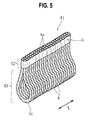
- a cleaning article 31 of a third embodiment shown in Fig.4 the individual cord 4 is folded back at the middle in a direction of its length, and both of the end parts of the cords 4 are bundled in a holding part 32 and mutually bonded by the water-soluble adhesive.
- the holding material 5 is wound therearound and bonded thereto. Bent parts 4b of the cords 4 are aligned at a tip end of a cleaning part 33, and the cords 4 are positioned independently from one another in the cleaning part 33.
- the bent parts 4b of the cords 4 are positioned in the cleaning part 33. Since both of the end parts of the bent cords 4 are bundled in the holding part 32 and no cut end face 4a thereof is exposed in the cleaning part 33, the twist of the each cord 4 is hardly loosened and the rigidity thereof can be maintained relatively longer, even when water is adhered to the tip part of the cleaning part 33 and the bent parts 4b get wet. Therefore, the dirt adhered to the surface of the part to be cleaned can be easily removed by rubbing the bent parts 4b against the part to be cleaned.
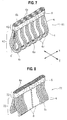
- a water-disintegratable cleaning article 41 of a fourth embodiment shown in Fig. 5 the individual cord 4 is bent to form a loop. Both of the end parts of the looped cord 4 are mutually bonded by the water-soluble adhesive with the cut end faces 4a thereof being aligned.
- the holding material 5 is wound around the aligned end parts of the cords 4 and bonded thereto by the water-soluble adhesive to form a holding part 42 in a flat shape.
- the individual cord 4 is freely movable. Loop parts 4c formed by bending the cords 4 are positioned on the tip part of the cleaning part 43.
- the holding part 42 of this embodiment may be the one that is formed by pressing or by heating and pressing the cords 4 and the holding material 5 together so that the cords 4 and the holding material 5 can be formed in a flat shape and the respective cords 4 therein are mutually hydrogen-bonded.
- the holding part 42 of this embodiment may be the one that is not provided with the holding material 5.
- the storage part 12 and the pressing part 13 are formed to have planar faces opposed to each other.
- the holding part 42 of the cleaning article 41 is sandwiched and held between the planar faces of the storage part 12 and the pressing part 13.
- the loop parts 4c of the cords 4 are positioned in the cleaning part 43, and no cut end face 4a thereof is exposed in the cleaning part 43, the twist of the each cord 4 is hardly loosened, even when the tip part of the cleaning part 43 gets wet. Further, when the loop parts 4c are made to slide on the surface of the part to be cleaned in X direction which is an arrangement direction of the loop parts 4c, the individual loop parts 4c rubs the surface of the part to be cleaned independently, thereby effectively removing the dirt adhered to the surface.
- the cleaning part includes the cords 4 and a water-disintegratable sheet member 6.
- the water-disintegratable sheet member 6 is a sheet-shaped water-disintegratable material called a sheet pulp, which is formed by stacking layers of pulp fibers and pressing the layers into a sheet shape.
- the sheet pulp maintains the sheet shape thereof by the hydrogen bonding of the pulp fibers.
- the pulp fibers may be bonded by the water-soluble adhesive such as PVA.
- the fabric base weight of the sheet pulp is about 500 to 1000 g/m 2 , which is sufficiently large compared with the water-disintegratable paper 9 of Fig.12B, whose fabric base weight is about 10 to 30 g/m 2 .
- the water-disintegratable sheet member 6 formed of the sheet pulp thus has a large fabric base weight, high density, and high rigidity.
- the sheet member 6 provided in the cleaning part of the cleaning article makes it easy to remove the dirt adhered to the part to be cleaned such as the toilet bowl.
- the cleaning article having both of the water-disintegratable sheet member 6 and the cords 4 is used, the cords 4 relatively freely deforms to spread over broad area of the part to be cleaned or reach corners of the toilet bowl, while the easy dirt removal is secured by the sheet member 6.
- the sheet pulp Disposed in the flush toilet after use, the sheet pulp is disintegrated into pulp fibers in relatively a short period.
- a plurality of cords 4 are arranged around plural sheet members 6 (for example, about 5 to 20 sheets) stacked on one another.
- the sheet members 6 and the cords 4 are bonded to each other by the water-soluble adhesive, and the holding material 5 is wound around the sheet members 6 and the cords 4 and bonded thereto.
- the individual sheet members 6 can be separated from one another, and further the cords 4 can be separated from one another.
- the tip part of the cleaning part 53 is pressed against a surface of the part to be cleaned and slid thereon. At this time, the surface is rubbed by the distal end side of the sheet member 6, while the individual cords 4 can spread over a wide area of the surface and reach corners of the toilet bowl, etc.
- the bent parts 4b of the cords 4 shown in Fig.4 may be provided in the cleaning part 53 of the cleaning article 51.
- a water-disintegratable cleaning article 61 of a sixth embodiment is provided, as shown in Fig.7, with one sheet of the water-disintegratable sheet member (sheet pulp) 6 or plural sheets thereof stacked on one another.
- the sheet member 6 is formed to have substantially the same size as that of the cleaning article 61.
- the plurality of the cords 4 are provided around the sheet member 6.
- Each of the cords 4 is formed in a loop shape having its loop part 4c positioned around a lower side 6a of the sheet member 6.
- the cut end faces 4a of the cords 4 are aligned with an upper side 6b of the sheet member 6.
- the cords 4 are bonded to the sheet member 6 with both end parts in vicinity of the cut end faces 4a thereof respectively bonded to both side faces of the sheet member 6, and the holding material 5 is wound around the cords 4 and the sheet member 6 and bonded thereto, whereby the holding part 62 is formed in a flat shape.
- the individual cords 4 can move independently of each other, and can move independently of the sheet member 6.
- the storage part 12 and the pressing part 13 are formed to have planar faces opposed to each other.
- the holding part 62 of the cleaning article 61 is sandwiched and held between the planar faces of the storage part 12 and the pressing part 13.
- the cleaning part 63 of the cleaning article 61 When the cleaning part 63 of the cleaning article 61 is made to slide on the surface of the part to be cleaned in Y direction shown in Fig. 7, the lower side 6a of the sheet member 6 is rubbed against the surface. Further, when the cleaning part 63 of the cleaning article 61 is made to slide on the surface in X direction perpendicular to Y direction, the surface can be wiped by the loop parts 4c of the cords 4.
- a water-disintegratable cleaning article 71 of a seventh embodiment shown in Fig.8 includes a plurality of aforementioned rectangular water-disintegratable sheet members 6 stacked on one another, and a plurality of cords 4.
- the cords 4 are arranged on outer sides of the sheet members 6.
- the holding material 5 is wound around upper parts of the sheet members 6 and upper parts of the cords 4, to form a holding part 72 in a flat shape.
- a cleaning part 73 of the cleaning article 71 is provided with the cords 4 each having downwardly facing cut end faces 4a, and the sheet members 6 positioned independently from one another.
- the cleaning article 71 thus formed can also perform the above-mentioned wiping-off operation, using the cords 4 and the water-disintegratable sheet members 6 of sheet pulps.
- the cords 4 on outer sides of the sheet members 6 may have the bent parts 4b shown in Fig. 4 or the loop parts 4c shown in Fig.5 aligned at the tip part of the cleaning part 73.
- the storage part 12 and the pressing part 13 are formed to have planar faces opposed to each other.
- the holding part 72 of the cleaning article 71 is sandwiched and held between the planar faces of the storage part 12 and the pressing part 13.
- the cleaning part of the cleaning article is provided with a water-disintegratable block member 7 and the cords 4.
- the water-disintegratable block member 7 is a solid block-shaped water-disintegratable material which is formed of biodegradable fibers dispersible into water such as pulp fibers.
- Method of manufacturing the block member 7 includes the steps of: dispersing the pulp fibers into water; pouring the water containing the dispersed pulp fibers into a mold in a concave-shape such as a cylindrical shape and the like, having a perforated dewatering screen on a bottom thereof; and dewatering, heating and drying the pulp fibers.
- Another method of manufacturing the block member 7 includes steps of: pouring the pulp fibers in the aforementioned mold or other shaped press mold; pressing by a press machine after dewatering or during dewatering; and drying the pressed pulp fibers.
- Still other method of manufacturing the block member 7 includes steps of: discharging a sludge-like raw material obtained by mixing pulp fibers, a thickening agent, and the water-soluble adhesive from a screw extruder; and dewatering, heating and drying the product discharged from the screw extruder.
- the water-disintegratable block member 7 is formed in such a way that the pulp fibers or the other fibers are bound by the hydrogen bonding in an aggregated state, or the fibers are bonded by the water-soluble adhesive.
- the water-disintegratable block member 7 is used instead of the water-disintegratable sheet member 6 in the cleaning article 51 shown in Fig.6.
- the block member 7 and the cords 4 are bonded by the water-soluble adhesive, and the holding material 5 is wound therearound and bonded thereto.
- the cords 4 are provided around the block member 7 in a free state. The cords 4 extend out from the tip of the cleaning part 83 to have the cut end faces 4a thereof facing downward.
- a cleaning article 91 of a ninth embodiment shown in Fig.10 is provided in a cleaning part 93 thereof with the bent cords 4 around the block member 7.
- the bent parts 4b of the cords 4 are aligned in a position at the tip of the cleaning part 93.
- a holding part 92 of the cleaning article 91 the block member 7 and the base part of the cords 4 are bonded by the water-soluble adhesive, and the holding material 5 is wound therearound and bonded thereto.
- the end face of the block member 7 is exposed on the tip part of the cleaning parts 83 and 93. Therefore, when the cleaning article 81 or 91 is used, the end face of the block member 7 is rubbed against the part to be cleaned, whereby a dirt removing effect of the article can be enhanced. In addition, broader area of a surface to be cleaned can be wiped off by the cords 4 provided around the block member 7. After the cleaning article is used and disposed in the flush toilet, binding of the holding parts 82 and 92 is removed, and the block member 7 and the cords 4 are disintegrated into pieces. Then, given a large quantity of water, the cords 4 and the block member 7 are further disintegrated in the water in a short period with the fibers thereof dispersed.
- a cleaning article 101 of a tenth embodiment shown in Fig.11 includes a cylindrical water-disintegratable block member 7 inserted through the cords 4 in the cleaning article 41 shown in Fig. 5.
- the block member 7 and each cord 4 are bonded together by the water-soluble adhesive.
- the base parts of the cords 4 are bonded by the water-soluble adhesive, and the holding material 5 is wound therearound and bonded thereto by the water-soluble adhesive.
- a cleaning part 103 of the cleaning article 101 is constituted by the block member 7 and the cords 4 bonded to the block member 7.
- the storage part 12 and the pressing part 13 are formed to have planar faces opposed to each other.
- the holding part 102 of the cleaning article 101 is sandwiched and held between the planar faces of the storage part 12 and the pressing part 13.
- the block member 7 serves as a core member to support the cords 4, when the loop parts 4c of the cords 4 are pressed against the part to be cleaned and slid thereon for cleaning. Therefore, it becomes possible to firmly press the loop parts 4c of the cords 4 against the part to be cleaned, thereby effectively removing the dirt.
- the cords of examples 1 to 6 were tested.
- the water-disintegratable sheet constituting the cords of the examples 1 to 6 is formed of bleached softwood kraft pulp (NBKP) and viscose rayon having a denier of 1.1 dtex and 7mm fiber lengths.
- a blending ratio (mass %) of the NBKP and the viscose rayon is shown in Table 1.
- the blending ratio of the NBKP was set to 95 mass % in the example 1, 90 mass % in the example 2, 50 mass % in the example 3, 10 mass % in the example 4, 5 mass % in the example 5, and 50 mass % in the example 6.
- the rest of the blend was made up of the viscose rayon.
- the fabric base weights of the examples 1 to 6 were all set at 50 g/m 2 .
- the water-disintegratable sheets of the examples 1 to 6 were all manufactured by a wet papermaking process.
- the water-disintegratable sheets of the examples 1 to 5 were subjected to a water-jet processing thereafter to be the fiber entangled nonwoven fabric.
- the water-disintegratable paper to which the water-jet processing was not applied was used.
- a jet water stream was applied to a layer of fiber web of each example 1 to 5 formed on a plastic wire screen by papermaking, using a high-pressure water-jet machine, without applying a drying treatment to the webs.
- the high pressure water-jet machine has 2000 nozzles arranged at a pitch of 0.5 mm in a direction perpendicular to a direction of web travel. Each of the nozzles has an opening diameter of 95 ⁇ m.
- a water-jet processing energy of 0.24682kW/m 2 per unit area was given to the fiber web being transferred at a speed of 30 m/min by the high-pressure water-jet machine. Further, the web was subjected to a second water-jet processing under the same condition, and thereafter dried by a Yankee drying drum. Note that in the example 6, the web was dried by the Yankee drying drum without being applied the water jet processing.
- the thickness and fiber density of the water-disintegratable sheet thus obtained are shown in the column of "values of physical properties of water-disintegratable sheet" and the columns of "thickness” and “density” in Table 1.
- the water-disintegratable sheets of the examples 1 to 6 were cut into samples having a length in the direction of web travel through manufacturing (MD) of 150 mm and a width in the direction (CD) perpendicular to the direction of web travel of 25 mm, and a dry strength and a wet strength thereof were measured.
- This measurement was performed in such a way that each sample was held between chucks of the tensile test device 100 mm apart in a longitudinal direction of the sample, and a tensile test was performed by moving the chucks apart from each other at a speed of 100 mm/min.
- a maximum load at which the sample of the sheet breaks was set to a breaking strength (N/25 mm) of the tested sheet.
- the dry strength is a result of the tensile test performed on each sample in dry condition.
- the wet strength is a result of the tensile test performed on each sample after being immersed in the ion exchange water for 10 seconds. This test was performed under an environment of a room temperature of 25°C and a relative humidity of 65%.
- Table 1 measurement values are shown in the column of "values of physical properties of water-disintegratable sheet” and the columns of "dry strength" and "wet strength”.
- each water-disintegratable sheet of the examples 1 to 4 was cut into a strip shape having the width in CD of 50 mm, and twisted in one direction as shown in Fig.12A to form a twisted cord 4A.
- the number of twist is set to 17 times per 25 cm unit length of the water-disintegratable sheet before twisting.
- the width dimensions and densities of the twisted cords are shown in the rows of "cord width” and "density" in the column of "values of physical properties after twisting".
- the twisted cords were held between chucks 100 mm apart, the tensile test was performed under the same condition as that of the water-disintegratable sheet, and the breaking strength was measured.
- a water-disintegrability was measured by the same measurement method as described in the explanations of the embodiments.
- Each water-disintegratable sheet of the examples 1 to 6 was cut into a size of 100 mm ⁇ 100 mm, and the sheet thus cut was used to measure the water disintegration time.
- Each cord of examples 1 to 4 was cut into the length of 100 mm, and the cord thus cut was also used to measure the water disintegration time. The measurement results are shown in the row of "water-disintegratability" of Table 1.
- the water-disintegratable sheets of the examples 2 to 4 of Table 1 have the dry strengths of 7N/25 mm or more, and they can be easily processed by twisting without causing any cut or breakage.
- the twisted cords of the examples 2 to 4 have large wet strengths of 8N or more, and the water disintegration time thereof were 123 seconds at maximum.
- the water-disintegratable sheets of examples A to F of Table 2 are made in a way that the fiber webs containing 50 mass % of the NBKP and 50 mass % of viscose rayon fibers (a denier of 1.1dtex and 7mm fiber length) were formed by a wet papermaking process, and the fiber webs were applied to a water-jet processing thereafter under the same condition as that of the examples 1 to 5.
- the fabric base weights of the examples A to F are respectively set to "15.0", “20.0", “50.0”, “100.0”, “120.0”, “50.0” (g/m 2 ).
- the thickness and densities of the water-disintegratable sheets of the examples A to F are shown in the rows of "thickness” and “density” of the column of "values of physical properties of water-disintegratable sheet” in Table 2. Then, the dry strength and the wet strength, and the water disintegration time of each water-disintegratable sheet of the example A to F were measured in the same way as that of the example 1 to 6. The results are shown in the columns of the "dry strength” and “wet strength” and “water-disintegrability” in the column of the "values of physical properties of the water-disintegratable sheet".
- each of the water-disintegratable sheets of the examples A to F was twisted to form a twisted cord as shown in Fig.12A.
- the width dimension of the sheet to be twisted was set at 50 mm.
- the numbers of twist per unit length 25 cm of the sheet were differentiated for every example, and set at "18", “18", “17”, “16", and "4" (times) in the example A to example F, respectively.
- the width dimensions and densities of the twisted cords are shown in the rows of "cord width” and "density" in the column of the "values of physical properties after twisting".
- the dry strengths, the wet strengths and the water disintegration times were measured in the same way as that of the examples 1 to 4.
- the fabric base weight of the water-disintegratable sheet is set at 30 g/m 2 or more, in order to maintain high dry strength of the water-disintegratable sheet and high wet strength of the twisted cord. It is preferable to set the fabric base weight of the water-disintegratable sheet at 120 g/m 2 or less, in order to set the water disintegration time at 700 seconds or less.
- the wet strength of the twisted cord can be increased in the case that the number of twist is 4 times or more, preferably 10 times, per unit length 25 cm of the water-disintegratable sheet.
- An upper limit of the number of twist is not particularly limited as long as the sheet is not cut, however, the upper limit will be about 30 times.
- the cleaning article of the present invention is constituted by bundling a plurality of cords.
- the individual cords are bonded to one another with a holding material wound therearound and bonded thereto with a water-soluble adhesive.
- the cords are made of pulp fibers, rayon fibers, and the like, and formed by twisting fiber entangled nonwoven fabrics, which are formed of fibers, such as rayon fibers, entangled by a water-jet processing.
- the cords are capable of maintaining their twisted shape in a dry state due to the pulp fibers, and are capable of maintaining their cord shape in a wet shape due to the entangling force of the rayon fibers, and the like.
- the cords thus have enhanced strength for rubbing, and are capable of effectively removing the dirt.
- the cleaning article of the present invention has enough strength to rub a part to be cleaned, such as a toilet bowl, exhibiting an excellent dirt-removing effect, while the cleaning article can be disposed in water of a flush toilet and the like, after use, and disintegrated in the water for a short period.
- the present invention is to provide an excellent cleaning article and thus industrially applicable.
Landscapes
- Health & Medical Sciences (AREA)
- Public Health (AREA)
- Cleaning Implements For Floors, Carpets, Furniture, Walls, And The Like (AREA)
Abstract
Description
- The present invention relates to a water-disintegratable cleaning article for removing dirt in a place where water is used such as a flush toilet, which can be disposed in water after use.
-
Japanese patent application laid-open No.62-186833 - The toilet cleaning brush has a brush head formed of a paper made of short fibers as wood pulp and carboxymethyl cellulose (CMC) as a binder, wherein the paper has a plurality of cuts formed therein and is rolled to form the brush head. The toilet cleaning brush is attached to an end of a paper stick handle. After the toilet cleaning brush is used for wiping the toilet bowl, the toilet cleaning brush is disposed in a flush toilet together with the stick handle, and thereafter, both of which disintegrate in the water. Also disclosed therein is that a surface of the brush is subjected to wax treatment in order to adjust the time required for dissolving the paper.
- The specification of the
Japanese patent application laid-open No. 62-186833 - However, being formed of the paper made of paper pulp bound with water-soluble CMC, the toilet cleaning brush starts swelling upon getting wet with water in cleaning the toilet bowl, and strength thereof becomes significantly reduced. Therefore, the dirt adhered to the toilet bowl is hardly wiped off. Also, due to the wax treatment which the brush is subjected to, the brush has a problem that a wax component thereof prevents disintegration of the paper, and therefore it requires a long time for the brush to disintegrate in the water in a water-purifier tank, etc.
- In addition, being formed of a rolled paper having cuts formed therein, the toilet cleaning brush has a low rigidity which makes it difficult to rub the toilet bowl therewith and effectively remove the dirt adhered to the toilet bowl, etc.
- The present invention is made to solve the above-described problems. An object of the present invention is to provide a water-disintegratable cleaning article capable of effectively wiping-off dirt and grime that adheres to a surface of a toilet bowl of a flush toilet, and the like.
- Further, the object of the present invention is to provide the water-disintegratable cleaning article having enough strength to rub a surface of the toilet bowl, etc, exhibiting an excellent dirt removing effect, while capable of being disintegrated in the water for relatively a short period after use.
- An aspect of the present invention is a water-disintegratable cleaning article which can be dispersed separately in water, comprising a cleaning part and a holding part, wherein the cleaning part is provided with a plurality of water-disintegratable cords each formed by twisting a water-disintegratable sheet.
- In the water-disintegratable cleaning article of the present invention, the cords which are formed by twisting the water-disintegratable sheet are positioned in the cleaning part. The cords have high density and high rigidity with appropriate elasticity. Bundled cords have irregularities on the surface thereof providing a large surface area. Therefore, when the toilet bowl is rubbed by the cords, the dirt adhered to the surface of the toilet bowl and the like can be effectively removed, while maintaining the shape of the cleaning part. When the cleaning article is disposed in water after use and given a great quantity of water, the twist of the cords is loosened to decrease the density thereof, and the cords are disintegrated in the water for relatively a short period.
- In the present invention, the plurality of cords are fixed to one another in the holding part and positioned independently from one another in the cleaning part.
- When the cords are positioned independently from one another in the cleaning part, the individual cord freely moves to slide on a surface to be cleaned such as in a toilet bowl, thus making it possible to clean corners in the toilet bowl.
- Further, in the present invention, a holder to releasably hold the holding part is provided.
- By holding the holding part of the cleaning article by the holder, the toilet bowl is wiped with the cleaning part. Thereafter, the cleaning article is released from the holder and disposed in the flush toilet. Thus, the cleaning article after use can be easily disposed without directly touching it. Since only the cleaning article is disposed in the water, the time required for disintegration in the water becomes shorter.
- Further, in the present invention, each of the cords has its end positioned in the cleaning part. Alternatively, each of the cords is bent to have its bent part positioned in the cleaning part.
- When the cleaning article with the bent cords is used, the bent parts of the cords come into elastic contact with the part to be cleaned. Therefore, the feel of pressing the cleaning article against the part being cleaned is improved, and the effect of removing the dirt is enhanced. Also, even when the bent part of the cords gets wet, the twist of the cords is hardly loosened. Therefore, the wet strength of the cords can be maintained for relatively a long time.
- The water-disintegratable sheet forming the cords is made of fibers having a fiber length of 20 mm or less, which can be dispersed in water when a large quantity of water is present. For example, the water-disintegratable sheet can be a sheet which is formed of only pulp fibers joined by hydrogen bonding force or by using a water-soluble binder. According to the present invention, the water-disintegratable sheet is preferably a fiber entangled nonwoven fabric in which fibers having fiber lengths of 20 mm or less is entangled.
- The fiber entangled nonwoven fabric has a high strength in wet condition and is hardly broken when rubbing the part to be cleaned by the cords. Also, the fiber entangled nonwoven fabric is constituted by fibers having fiber lengths of 20 mm or less, and therefore when a large quantity of water is given thereto, the fibers can be dispersed separately in relatively a short period of time.
- Alternately, according to the present invention, the cords are formed of the fiber entangled nonwoven fabric wherein the fibers having fiber lengths of 20 mm or less are entangled, and a water-disintegratable paper comprising cellulose-based fibers.
- When the cords are formed by twisting the fiber entangled nonwoven fabric and the water-disintegratable paper together, the cords can be firmly and strongly twisted due to the hydrogen bonding force of the fibers of the water-disintegratable paper, and further a twisted shape thereof can be maintained in drying. In addition, when water is given and the paper is loosened, the strength of the cords can be maintained by a fiber entanglement of the nonwoven fabric.
- For example, the fiber entangled nonwoven fabric of the present invention is constituted by entanglable pulp fibers and other fibers having fiber lengths of 20 mm or less, and contains 10 mass % to 90 mass % of the pulp fibers, and 10 mass % to 90 mass % of the other fibers. As an example of the aforementioned other fibers, rayon fiber is given.
- The fiber entangled nonwoven fabric is so constituted that mainly other fibers having fiber lengths of 20 mm or less are entangled, and a shape of the cords is maintained in drying by the hydrogen bonding force of the pulp fibers. Therefore, the strongly twisted shape of the cords can be maintained in drying due to the hydrogen bonding force of the pulp fibers, while the cord can exhibit a proper surface strength by an entangling force of other fibers when the fabric gets wet by water. Further, when a large quantity of water is given thereto, dispersion of the pulp fibers is caused, resulting in easy dispersion of the fibers constituting the nonwoven fabric. In order to increase strength in drying, the fabric preferably contains 10 mass % or more of the pulp fibers, and in order to exhibit the strength by the fiber entanglement in wet condition, the fabric preferably contains 10 mass % or more of other fibers.
- Further, according to the present invention, the cleaning part may include, in addition to the water-disintegratable cords, at least one of a water-disintegratable sheet member and a water-disintegratable block member.
- When the water-disintegratable sheet member or block member is used in conjunction with the water-disintegratable cords, the strength of the cleaning part is increased by these sheet member or block member, thus making it passible to strongly rub the cleaning part against the toilet bowl and so forth.
-
- Fig.1 is a perspective view showing a state in which a water-disintegratable cleaning article of the present invention is held by a holder.
- Fig.2 is a perspective view showing a water-disintegratable cleaning article according to a first embodiment of the present invention.
- Fig.3 is a perspective view showing a water-disintegratable cleaning article according to a second embodiment of the present invention.
- Fig.4 is a perspective view showing a water-disintegratable cleaning article according to a third embodiment of the present invention.
- Fig.5 is a perspective view showing a water-disintegratable cleaning article according to a fourth embodiment of the present invention.
- Fig.6 is a perspective view showing a water-disintegratable cleaning article according to a fifth embodiment of the present invention.
- Fig.7 is a perspective view showing a water-disintegratable cleaning article according to a sixth embodiment of the present invention.
- Fig.8 is a perspective view showing a water-disintegratable cleaning article according to a seventh embodiment of the present invention.
- Fig.9 is a perspective view showing a water-disintegratable cleaning article according to an eighth embodiment of the present invention.
- Fig.10 is a perspective view showing a water-disintegratable cleaning article according to a ninth embodiment of the present invention.
- Fig.11 is a perspective view showing a water-disintegratable cleaning article according to a tenth embodiment of the present invention.
- Fig.12A is an explanatory view showing one example of a structure of a twisted cord for forming cords.
- Fig.12B is an explanatory view showing the other example of a structure of a twisted cord for forming cords.
- Fig.12C is an explanatory view showing still other example of a structure of a twisted cord for forming cords.
- Embodiments of the present invention will be explained below with reference to the drawings. In the drawings, like members having the same function will be designated by the same reference characters, and the explanation thereof will be omitted.
- As shown in Fig.1 and Fig.2, a water-
disintegratable cleaning article 1 has a holdingpart 2 and acleaning part 3. The holdingpart 2 has substantially a cylindrical shape. - A
holder 10 shown in Fig.1 comprises a synthetic resin handlepart 11, astorage part 12 integrally formed at a tip part of thehandle part 11, and a syntheticresin pressing part 13 provided on a position opposed to thestorage part 12. On a side surface facing thepressing part 13 of thestorage part 12, an inner peripheral surface constituting a part of a cylindrical surface having an axis almost parallel to an axial direction of thehandle part 11 is formed. Also, on the side surface opposed to thestorage part 12 of thepressing part 13, the inner peripheral surface constituting other part of the cylindrical surface formed by the inner peripheral surface of thestorage part 12 is formed. Namely, the inner peripheral surfaces of thestorage part 12 and thepressing part 13 face with each other in a diameter direction of the cylindrical surface. Alever 14 extending from outside surface of thepressing part 13 in almost parallel with thehandle part 11 is integrally formed with thepressing part 13. Thislever 14 is rotatably supported, at an upper end thereof, on abracket 11a formed in thehandle part 11 through apin 15. Anoperating wire 16 is rotatably connected to the upper end of thelever 14. - A torsion spring (not shown) is provided in the
pin 15. Thelever 14 is biased to rotate clockwise, i.e. in a direction in which thepressing part 13 approaches thestorage part 12, by the torsion spring with thepin 15 as a fulcrum. A handle is provided on an upper part of thehandle part 11, and an operating lever is provided in this handle. Theoperating wire 16 is a thick wire, whose upper end is connected to the operating lever. When the operating lever is lifted, theoperating wire 16 is also lifted relative to thehandle part 11, and thelever 14 is rotated counterclockwise about thepin 15, and thepressing part 13 is moved away from thestorage part 12. When holding thecleaning article 1 by theholder 10, thepressing part 13 and thestorage part 12 are held in a state separated from each other by lifting the operating lever, the holdingpart 2 of thecleaning article 1 is inserted between thestorage part 12 and thepressing part 13, and the operating lever is released. Then, by the biasing force of the torsion spring, thelever 14 is rotated clockwise, and the holdingpart 2 of thecleaning article 1 is held by thestorage part 12 and thepressing part 13 therebetween. - By rubbing the part to be cleaned of the toilet bowl and the like with the
cleaning part 3 of thecleaning article 1 held by theholder 10, the dirt adhered to the surface of the toilet bowl and the like can be removed. At this time, it is also possible to wipe-off the toilet bowl with thecleaning part 3 wetted by water in the toilet bowl. When a cleaning work is completed, by lifting the operating lever and removing a pressing force of thepressing part 13 against thecleaning article 1, thecleaning article 1 can be released to be disposed in the toilet bowl, without directly touching it. - As shown in Fig. 2, the
cleaning article 1 is constituted by bundling a plurality ofcords 4. End faces 4a ofcords 4 formed by cutting thecords 4 in section face toward the tip of thecleaning part 3, and theindividual cords 4 of thecleaning part 3 are independent from one another without being mutually joined. Base parts of theindividual cords 4 are bonded to one another by water-soluble adhesive in the holdingpart 2, and further a holdingmaterial 5 is wound around an outer peripheral surface of a bundle of thecords 4, and is bonded thereto by the water-soluble adhesive. Note that a cylindrical shape of the holdingpart 2 may be formed and maintained only by winding the holdingmaterial 5 around the bundle of thecords 4, without mutually bonding thecords 4 in the holdingpart 2. - As shown in Fig.12A, each of the
cords 4 is formed to have high density by twisting the water-disintegratable sheet in one direction. The water-disintegratable sheet is made of the fibers having fiber lengths of 20 mm or less, and when exposed to a large quantity of water in a flush toilet and in a water-purifier tank, fibers thereof are dispersed separately in a short period. The water-disintegratable sheet is a water-disintegratable paper made of only pulp fibers joined together by the hydrogen bonding force, or a water-disintegratable paper of the pulp fibers and rayon fibers joined together by the hydrogen bonding force. Alternately, the water-disintegratable paper in which the fibers joined together by water-soluble binder such as polyvinyl alcohol (PVA) and polyacrylic acid (PAA), or carboxymethyl cellulose (CMD) and so forth can also be used. - The twist shape of the
cord 4 is maintained by the hydrogen bonding force of the water-disintegratable paper, or the water-soluble binder can be added to the twisted water-disintegratable paper to thereby maintain the shape of thecords 4. - It is also possible to use the water-disintegratable sheet, wherein the pulp fibers are subjected to waterproof treatment to slightly lower hydrophilicity and are mutually joined by the water-soluble binder. The
cords 4 formed of this water-disintegratable sheet can maintain the shape thereof even in wet condition during cleaning. - Figs.12A, 12B, and 12C show further preferable examples of
twisted cords cords 4. Thecords 4 used in thecleaning article 1 are constituted by any one of thetwisted cords twisted cords cords 4 of thecleaning article 1. - Fig.12A shows the
twisted cords 4A which are formed by twisting in one direction a strip of a water-disintegratable sheet 8 of a predetermined width. - In order to maintain the strength of the
twisted cords 4A when being wet, the water-disintegratable sheet 8 is formed as a water-disintegratable fiber entangled nonwoven fabric. The fiber entangled nonwoven fabric can be formed by laminating entanglable fibers having fiber lengths of 20 mm or less on a conveyor of a mesh-like perforated screen, and entangling the fibers by water-jet processing. - For example, the fiber entangled nonwoven fabric is constituted by pulp fibers and fibers having fiber lengths of 20 mm or less, which can be entangled by the water-j et processing. When the nonwoven fabric is constituted by the pulp fibers and other fibers having fiber lengths of 20 mm or less, the aforementioned other fibers are entangled by the water-jet processing, and hydrogen bonding are formed between the pulp fibers and between the pulp fiber and the aforementioned other fibers. The fiber entangled nonwoven fabric thus formed is capable of maintaining the strength when being dried and also maintaining the twisted shape by the hydrogen bonding of the pulp fibers. Also, the fiber entangled nonwoven fabric is capable of maintaining its high surface strength when being wet by the entangling force of the aforementioned entanglable other fibers having fiber lengths of 20 mm or less. When disposed in the water and given a large quantity of water, the twist of the cord is loosened by disintegration of pulp fibers, having the entanglement of other fibers loosened. Therefore, the fibers are broken into pieces in relatively a short period.
- As the other fibers having fiber lengths of 20 mm or less which can be entangled by the water-jet processing, it is preferable to use a biodegradable fibers. It is also preferable to use a regenerated cellulose fiber such as viscose rayon, solvent spun rayon, polynosic rayon, cuprammonium rayon, and alginate rayon. As other fibers having fiber lengths of 20 mm or less which can be entangled by the water-jet processing, polyethylene terephthalate (PET), nylon fiber, and polypropylene (PP) fiber can be used.
- Also, in addition to the pulp fibers, or instead of the pulp fibers, natural fibers such as hemp and cotton, and other natural fibers such as bagasse, banana, pineapple, bamboo, and so forth may be used.
- Further, the strength of the water-
disintegratable sheet 8 may be increased by adding polyvinyl alcohol (PVA) fiber as water-soluble resin, and water-soluble or water swellable carboxymethyl cellulose (CMC) as a binder. Alternately, a fiber entangled nonwoven fabric which is made by a wet papermaking process and the water-jet processing thereafter of the fiber having fiber lengths of 20 mm or less and a fibrillated rayon made by beating rayon having fiber lengths of about 3 to 7 mm to have on the surface thereof a plurality of micro fibers having fiber lengths of 1mm or less peeled off, can be used. In the nonwoven fabric, the fibers having fiber lengths of 20 mm or less are entangled, and the fibers are bound together by the hydrogen bonding force of the fibrillated rayon. Therefore, the strength thereof in a dry state and in a wet state is enhanced, and the strength at the time of drying is particularly increased. This contributes to maintaining a tightly twisted shape of thecords 4. - Preferably, the fiber entangled nonwoven fabric of which the
twisted cords 4A are formed, contains 10 mass % or more of natural fibers such as pulp fibers, and contains 10 mass % or more of other fibers having fiber lengths of 20 mm or less which can be entangled by water-jet processing like rayon fibers. By containing 10 mass % or more of natural fibers, the hydrogen bonding force can be increased to thereby enable to tightly twist the fabric for forming the twisted cord. Also, by containing 10 mass % or more of the other fibers, the strength at the time of getting wet can be enhanced. - The
disintegratable sheet 8 made of the fiber entangled nonwoven fabric has preferably fabric base weight of 30g/m2 or more and 120g/m2 or less, and preferably thickness of a sheet of 0.1 mm or more and 0.5 mm or less. - Further, after forming the
cords 4A by twisting the water-disintegratable sheet, the above-mentioned binder may be coated thereon to maintain the shape of thetwisted cords 4A. - In Fig.12A, the
twisted cords 4A are formed by using a sheet of the water-disintegratable sheet 8 which is the fiber entangled nonwoven fabric. However, the twisted cord may be formed by twisting a plurality of water-disintegratable sheets 8 stacked on one another. In order to increase the strength at the time of cleaning by increasing the thickness of theindividual cord 4 used in thecleaning article 1 shown in Fig. 2, the fabric base weight and thickness of one sheet of the water-disintegratable sheet 8 may be increased. However, when the fabric base weight and thickness of one sheet of the water-disintegratable sheet 8 are excessively increased, the twisting process thereof becomes difficult with time required for water disintegration of the water-disintegratable sheet 8 increased. When thetwisted cords 4A are formed by using plural sheets of the water-disintegratable sheets 8, the twisted cords can be thick having high rigidity. In addition, when the twist of thecord 4 is loosened by exposure to a large quantity of water, thetwisted cords 4A are separated into individual water-disintegratable sheets 8, and become easy to be disintegrated in the water. - The
twisted cords 4B shown in Fig.12B are formed by stacking the water-disintegratable sheet 8 which is the fiber entangled nonwoven fabric, and the water-disintegratable paper 9, and twisting both of the water-disintegratable sheet 8 and the water-disintegratable paper 9 together at the same time. The water-disintegratable paper 9 is made by papermaking or forming on a screen a layer of the natural fibers such as pulp fibers, or the regenerated cellulose fibers such as rayon fibers. The water-disintegratable paper 9 thus made exhibits the strength deriving from the hydrogen bonding force of the fibers . - When the water-
disintegratable sheet 8 and the water-disintegratable paper 9 are stacked on each other and twisted together at the same time, since the water-disintegratable sheet 8 which is the fiber entangled nonwoven fabric has greater strength, and therefore a tight twist of thecord 4B can be obtained. The shape of thetwisted cord 4B can be maintained at the time of drying by the hydrogen bonding force of the fibers constituting the water-disintegratable paper 9. Therefore, thetwisted cords 4B can have high density and the shape thereof can be maintained. In the case thecords 4 of thecleaning article 1 are formed of thetwisted cords 4B having high density as shown in Fig.2, even when a small quantity of water soaks thereinto, the dirt adhered to the surface of the toilet bowl, etc, can be removed by thecords 4 having high rigidity. Also, when disposed in the flush toilet, etc, with a large quantity of water being given thereto, the fibers constituting the water-disintegratable paper 9 are loosened, thereby loosening the twisted water-disintegratable sheet 8. - When the water-
disintegratable sheet 8 and the water-disintegratable paper 9 are stacked on each other and twisted together at the same time, a plurality of irregularities are formed on the surface of thetwisted cords 4B, thus increasing the effect of removing the dirt. In addition, thetwisted cords 4B may be constituted by using at least one of the plural sheets of the water-disintegratable sheet 8 and water-disintegratable paper 9. - In the
twisted cords 4B shown in Fig.12B, the water-disintegratable paper 9 is colored in a color other than white such as blue or red. The water-disintegratable sheet 8, which is the fiber entangled nonwoven fabric, is formed of white fibers. By twisting the water-disintegratable sheet 8 and the water-disintegratable paper 9 together, a colored part and a white part are alternately positioned, giving a good appearance. In addition, it becomes easy to perceive a twisted state of thetwisted cords 4B. - When the
twisted cords 4B of Fig.12B are manufactured, an air-laid nonwoven fabric can be used instead of the water-disintegratable paper 9. The air-laid nonwoven fabric is formed by laminating the pulp fibers by an air-laid method to form a fiber web, and bonding the fibers by water-soluble binder such as PVA. The air-laid nonwoven fabric has a low fiber density of about 0.04 to 0.700g/cm3 and is made bulky having thickness of about 0.3 to 5 mm, and can be disintegrated in the water in a short period. The air-laid nonwoven fabric has a cushioning property, and therefore by twisting the air-laid nonwoven fabric and the water-disintegratable sheet 8 which is the fiber entangled nonwoven fabric together, the twisted cords having elasticity can be obtained. - The
cords 4C shown in Fig.12C are formed by twisting a sheet of water-disintegratable paper 9 or plural sheets thereof, or the air-laid nonwoven fabric, or by stacking the water-disintegratable paper 9 on the air-laid nonwoven fabric and twisting both of them together to form a core part, and thereafter by further twisting them while winding the water-disintegratable sheet 8, which is the fiber entangled nonwoven fabric, around the core part. Owing to a high hydrogen bonding force, the core part of thetwisted cord 4C can maintain the twisted state thereof and have high density. Since the water-disintegratable sheet 8 having high wet strength is wound around the core part, the surface strength of thecords 4 can be increased, and the shape of thecords 4 can be maintained when wiping-off is performed in a wet state. Also, when a large quantity of water is given thereto, the water-disintegratable paper 9 or the air-laid nonwoven fabric constituting the core part is disintegrated, loosening the twist of the water-disintegratable sheet 8, whereby thecords 4 can be disintegrated in the water in a short period of time. - The number of twist of the
twisted cords twisted cords cords 4, while eliminating the possibility of piping clogging when the cleaning article is disposed in the flush toilet or the like. - The
cords 4 constituting thecleaning article 1 shown in Fig. 2 are formed by cutting at least one of thetwisted cords cords 4 are bonded by water-soluble adhesive such as PVA with the cut end faces 4a thereof aligned, and a water-disintegratable holding material 5 is wound around an outer circumference of a bundle of thecords 4 and bonded thereto by the water-soluble adhesive. Specifically, in the holdingpart 2, the cords are mutually bonded and the water-disintegratable holding material 5 is wound around thecords 4, and in thecleaning part 3,individual cords 4 are positioned independently from one another. - The holding
part 2 of thecleaning article 1 is held by thestorage part 12 and thepressing part 13 of theholder 10 shown in Fig. 1 when being in use. Therefore, even if the holdingpart 2 gets wet with water during cleaning work, the separation of thecords 4 in the holdingpart 2 can be prevented by being held between thestorage part 12 and thepressing part 13 of theholder 10. Accordingly, it is sufficient for the holdingpart 2 to have, in a dry state thereof before being held by theholder 10, a fixing force not allowing thecords 4 thereof to be separated. Therefore, the holdingmaterial 5 to be wound around the holdingpart 2 can be made of the same paper material as that of the water-disintegratable paper 9, or a water-disintegratable film such as a PVA film. Alternately, the holdingpart 2 may be the one in which the hydrogen bonding force of thecords 4 is increased by bundling and compressing, or heating and compressing thecords 4. - Further, the
cords 4 in thecleaning part 3 may be mutually bonded by the water-soluble adhesive or the hydrogen bonding force. In this case, when wiping the toilet bowl, etc, with thecleaning part 3, and moisture is given to thecleaning part 3, thecords 4 therein becomes independently separated from each other, and the wiping is performed by the separatedindividual cords 4. - In the case where the fixing force of the
cords 4 in the holdingpart 2 is set low, the time required for thecords 4 in the holdingpart 2 to be separated from each other becomes shorter than the time required for disintegrating thecords 4 themselves. When thecleaning article 1 is disposed in the flush toilet and the like, and a large quantity of water is given thereto, a bonding force of thecords 4 in the holdingpart 2 first disappears, whereby thecords 4 are quickly separated from one another. This makes it possible to disintegrate theindividual cord 4 thereafter in the water in a short period. - The water disintegration time of the
individual cord 4 is preferably 700 seconds or less, or further preferably 600 seconds or less, or still further preferably 300 seconds or less, per onecord 4 of a length of 100 mm when the time is measured pursuant to JIS P4501 (toilet paper releasability test). The measurement was performed as follows. 300 milliliter of ion exchange water having water temperature of 20 ± 5°C was put in a beaker having a volume of 300 milliliter, and thecords 4 were put in the ion exchange water, then, a stirrer was rotated at a revolution number of 600 rpm in the water to stir the cords together with the ion exchange water. The measurement is performed from the time when thecords 4 were put in the ion exchange water till the time when the shape of the cords disappear with no sheet-like shape left and the fibers of the cords are dispersed into the water. - Next, a method of using the
cleaning article 1 will be explained. - The holding
part 2 of thecleaning article 1 shown in Fig.2 is held between thestorage part 12 and thepressing part 13 of theholder 10 shown in Fig. 1, and the inside of the toilet bowl of the flush toilet is cleaned, being rubbed with thecleaning part 3. When wiping-off the inside of the toilet bowl, thecleaning part 3 can be wetted by water in the flush toilet, to thereby remove the dirt effectively. Thecords 4 are formed by twisting the water-disintegratable sheet 8, or by twisting the water-disintegratable sheet 8 and the water-disintegratable paper 9 together, and have high density of fibers, high rigidity, and elasticity. Further, irregularities are formed on the surface of thecords 4. Therefore, the dirt adhered to the toilet bowl can be further effectively removed. Particularly, when thecords 4 are constituted by the fiber entangled nonwoven fabric, the surface strength thereof is increased and thecords 4 are free of fraying/damage during cleaning, thereby making it easy to maintain the shape of thecords 4. Thecleaning part 3 is formed ofplural cords 4, and theindividual cord 4 moves independently on the surface of the part to be cleaned, while thecords 4 of thecleaning part 3 are spread over the surface of the part to be cleaned by a pressure applied thereto during cleaning. This makes it easy to clean every corner of the toilet bowl. - After cleaning the toilet bowl, when the
pressing part 13 is released from thestorage part 12, thecleaning article 1 drops into the water of the flush toilet and can be flushed with cleaning water. Since the fixing force of the holdingpart 2 disappears in the water and thecords 4 are separated intoindividual cord 4, thecords 4 can be flushed without causing the piping clogged. Then, thecords 4 are disintegrated in the piping or water-purifier tank to be separated fibers. - Figs.3-11 are perspective views showing the cleaning article of other embodiments of the present invention.
- Fig. 3 shows a water-
disintegratable cleaning article 21 of a second embodiment of the present invention. - In this
cleaning article 21, thecords 4 of predetermined lengths are bundled, and the water-disintegratable holding material 5 is wound therearound over the whole lengths of the bundle, with the inner side thereof bonded to the plurality ofcords 4 by the water-soluble adhesive. One of oneend part 21a andother end part 21b of thecleaning article 21 can be used as the holding part, and the rest of the end parts can be used as the cleaning part. Namely, in thecleaning article 21, either of theend part 21a or endpart 21b can be held between thestorage part 12 and thepressing part 13 of theholder 10. According to this embodiment of the present invention, the holding part and the cleaning part may be indistinguishable in structure from each other. - In the
cleaning article 21, theindividual cord 4 may not be mutually bonded. By the holdingmaterial 5 wound around the bundle of the cords, the shape of thecleaning article 21 shown in Fig. 3 can be maintained until it is held by theholder 10. When either of theend part 21a or endpart 21b is held between thestorage part 12 and thepressing part 13 of theholder 10, the base parts of thecords 4 in the end part held by thestorage part 12 and thepressing part 13 are in a state of being bundled. The state of being bundled thereof is maintained even when the holdingmaterial 5 gets wet by water and disintegrated thereafter, because the base parts of thecords 4 are held by thestorage part 12 and thepressing part 13. Also, when the holdingmaterial 5 gets wet by water and disintegrated, thecords 4 in the end part not held by theholder 10 are set in a free state, and it becomes possible to wipe the part to be cleaned with theindividual cords 4. - In the
cleaning article 21 shown in Fig.3, all of thecords 4 may be mutually bonded by the water-soluble adhesive over the whole length thereof. Alternately, the holdingmaterial 5 may not be necessary as long as thecords 4 are bonded by the water-soluble adhesive and can maintain the bundled state thereof in dry condition. - In a
cleaning article 31 of a third embodiment shown in Fig.4, theindividual cord 4 is folded back at the middle in a direction of its length, and both of the end parts of thecords 4 are bundled in a holdingpart 32 and mutually bonded by the water-soluble adhesive. The holdingmaterial 5 is wound therearound and bonded thereto.Bent parts 4b of thecords 4 are aligned at a tip end of a cleaningpart 33, and thecords 4 are positioned independently from one another in the cleaningpart 33. - In this
cleaning article 31, thebent parts 4b of thecords 4 are positioned in the cleaningpart 33. Since both of the end parts of thebent cords 4 are bundled in the holdingpart 32 and nocut end face 4a thereof is exposed in the cleaningpart 33, the twist of the eachcord 4 is hardly loosened and the rigidity thereof can be maintained relatively longer, even when water is adhered to the tip part of the cleaningpart 33 and thebent parts 4b get wet. Therefore, the dirt adhered to the surface of the part to be cleaned can be easily removed by rubbing thebent parts 4b against the part to be cleaned. - In a water-
disintegratable cleaning article 41 of a fourth embodiment shown in Fig. 5, theindividual cord 4 is bent to form a loop. Both of the end parts of the loopedcord 4 are mutually bonded by the water-soluble adhesive with the cut end faces 4a thereof being aligned. The holdingmaterial 5 is wound around the aligned end parts of thecords 4 and bonded thereto by the water-soluble adhesive to form a holdingpart 42 in a flat shape. In thecleaning part 43, theindividual cord 4 is freely movable.Loop parts 4c formed by bending thecords 4 are positioned on the tip part of the cleaningpart 43. The holdingpart 42 of this embodiment may be the one that is formed by pressing or by heating and pressing thecords 4 and the holdingmaterial 5 together so that thecords 4 and the holdingmaterial 5 can be formed in a flat shape and therespective cords 4 therein are mutually hydrogen-bonded. The holdingpart 42 of this embodiment may be the one that is not provided with the holdingmaterial 5. - In the holder for holding the
cleaning article 41, differently from the case of the holder shown in Fig.1, thestorage part 12 and thepressing part 13 are formed to have planar faces opposed to each other. The holdingpart 42 of thecleaning article 41 is sandwiched and held between the planar faces of thestorage part 12 and thepressing part 13. - The
loop parts 4c of thecords 4 are positioned in the cleaningpart 43, and nocut end face 4a thereof is exposed in the cleaningpart 43, the twist of the eachcord 4 is hardly loosened, even when the tip part of the cleaningpart 43 gets wet. Further, when theloop parts 4c are made to slide on the surface of the part to be cleaned in X direction which is an arrangement direction of theloop parts 4c, theindividual loop parts 4c rubs the surface of the part to be cleaned independently, thereby effectively removing the dirt adhered to the surface. - In the embodiments shown in Fig. 6 to Fig.8, the cleaning part includes the
cords 4 and a water-disintegratable sheet member 6. - The water-
disintegratable sheet member 6 is a sheet-shaped water-disintegratable material called a sheet pulp, which is formed by stacking layers of pulp fibers and pressing the layers into a sheet shape. The sheet pulp maintains the sheet shape thereof by the hydrogen bonding of the pulp fibers. Alternately, the pulp fibers may be bonded by the water-soluble adhesive such as PVA. The fabric base weight of the sheet pulp is about 500 to 1000 g/m2, which is sufficiently large compared with the water-disintegratable paper 9 of Fig.12B, whose fabric base weight is about 10 to 30 g/m2. The water-disintegratable sheet member 6 formed of the sheet pulp thus has a large fabric base weight, high density, and high rigidity. Therefore, thesheet member 6 provided in the cleaning part of the cleaning article makes it easy to remove the dirt adhered to the part to be cleaned such as the toilet bowl. When the cleaning article having both of the water-disintegratable sheet member 6 and thecords 4 is used, thecords 4 relatively freely deforms to spread over broad area of the part to be cleaned or reach corners of the toilet bowl, while the easy dirt removal is secured by thesheet member 6. - Disposed in the flush toilet after use, the sheet pulp is disintegrated into pulp fibers in relatively a short period.
- In a water-
disintegratable cleaning article 51 of a fifth embodiment shown in Fig.6, a plurality ofcords 4 are arranged around plural sheet members 6 (for example, about 5 to 20 sheets) stacked on one another. In a holdingpart 52 of thecleaning article 51, thesheet members 6 and thecords 4 are bonded to each other by the water-soluble adhesive, and the holdingmaterial 5 is wound around thesheet members 6 and thecords 4 and bonded thereto. In acleaning part 53 of thecleaning article 51, theindividual sheet members 6 can be separated from one another, and further thecords 4 can be separated from one another. - When the
cleaning article 51 is used, the tip part of the cleaningpart 53 is pressed against a surface of the part to be cleaned and slid thereon. At this time, the surface is rubbed by the distal end side of thesheet member 6, while theindividual cords 4 can spread over a wide area of the surface and reach corners of the toilet bowl, etc. Thebent parts 4b of thecords 4 shown in Fig.4 may be provided in the cleaningpart 53 of thecleaning article 51. - A water-
disintegratable cleaning article 61 of a sixth embodiment is provided, as shown in Fig.7, with one sheet of the water-disintegratable sheet member (sheet pulp) 6 or plural sheets thereof stacked on one another. Thesheet member 6 is formed to have substantially the same size as that of thecleaning article 61. The plurality of thecords 4 are provided around thesheet member 6. Each of thecords 4 is formed in a loop shape having itsloop part 4c positioned around alower side 6a of thesheet member 6. The cut end faces 4a of thecords 4 are aligned with anupper side 6b of thesheet member 6. Thecords 4 are bonded to thesheet member 6 with both end parts in vicinity of the cut end faces 4a thereof respectively bonded to both side faces of thesheet member 6, and the holdingmaterial 5 is wound around thecords 4 and thesheet member 6 and bonded thereto, whereby the holding part 62 is formed in a flat shape. In acleaning part 63 of thecleaning article 61, theindividual cords 4 can move independently of each other, and can move independently of thesheet member 6. In the holder for holding thecleaning article 61, differently from the case of the holder shown in Fig.1 thestorage part 12 and thepressing part 13 are formed to have planar faces opposed to each other. The holding part 62 of thecleaning article 61 is sandwiched and held between the planar faces of thestorage part 12 and thepressing part 13. - When the cleaning
part 63 of thecleaning article 61 is made to slide on the surface of the part to be cleaned in Y direction shown in Fig. 7, thelower side 6a of thesheet member 6 is rubbed against the surface. Further, when the cleaningpart 63 of thecleaning article 61 is made to slide on the surface in X direction perpendicular to Y direction, the surface can be wiped by theloop parts 4c of thecords 4. - A water-
disintegratable cleaning article 71 of a seventh embodiment shown in Fig.8 includes a plurality of aforementioned rectangular water-disintegratable sheet members 6 stacked on one another, and a plurality ofcords 4. Thecords 4 are arranged on outer sides of thesheet members 6. The holdingmaterial 5 is wound around upper parts of thesheet members 6 and upper parts of thecords 4, to form a holdingpart 72 in a flat shape. A cleaningpart 73 of thecleaning article 71 is provided with thecords 4 each having downwardly facing cut end faces 4a, and thesheet members 6 positioned independently from one another. - The cleaning
article 71 thus formed can also perform the above-mentioned wiping-off operation, using thecords 4 and the water-disintegratable sheet members 6 of sheet pulps. In addition, thecords 4 on outer sides of thesheet members 6 may have thebent parts 4b shown in Fig. 4 or theloop parts 4c shown in Fig.5 aligned at the tip part of the cleaningpart 73. In the holder for holding thecleaning article 71, differently from the case of the holder shown in Fig.1, thestorage part 12 and thepressing part 13 are formed to have planar faces opposed to each other. The holdingpart 72 of thecleaning article 71 is sandwiched and held between the planar faces of thestorage part 12 and thepressing part 13. - In the embodiments shown in Fig.9 and Fig.11, the cleaning part of the cleaning article is provided with a water-disintegratable block member 7 and the
cords 4. - The water-disintegratable block member 7 is a solid block-shaped water-disintegratable material which is formed of biodegradable fibers dispersible into water such as pulp fibers. Method of manufacturing the block member 7 includes the steps of: dispersing the pulp fibers into water; pouring the water containing the dispersed pulp fibers into a mold in a concave-shape such as a cylindrical shape and the like, having a perforated dewatering screen on a bottom thereof; and dewatering, heating and drying the pulp fibers. Another method of manufacturing the block member 7 includes steps of: pouring the pulp fibers in the aforementioned mold or other shaped press mold; pressing by a press machine after dewatering or during dewatering; and drying the pressed pulp fibers. Still other method of manufacturing the block member 7 includes steps of: discharging a sludge-like raw material obtained by mixing pulp fibers, a thickening agent, and the water-soluble adhesive from a screw extruder; and dewatering, heating and drying the product discharged from the screw extruder.
- The water-disintegratable block member 7 is formed in such a way that the pulp fibers or the other fibers are bound by the hydrogen bonding in an aggregated state, or the fibers are bonded by the water-soluble adhesive.
- In a
cleaning article 81 of an eighth embodiment shown in Fig.9, the water-disintegratable block member 7 is used instead of the water-disintegratable sheet member 6 in thecleaning article 51 shown in Fig.6. In a holdingpart 82 of thecleaning article 81, the block member 7 and thecords 4 are bonded by the water-soluble adhesive, and the holdingmaterial 5 is wound therearound and bonded thereto. In acleaning part 83 of thecleaning article 81, thecords 4 are provided around the block member 7 in a free state. Thecords 4 extend out from the tip of the cleaningpart 83 to have the cut end faces 4a thereof facing downward. - A cleaning
article 91 of a ninth embodiment shown in Fig.10 is provided in acleaning part 93 thereof with thebent cords 4 around the block member 7. Thebent parts 4b of thecords 4 are aligned in a position at the tip of the cleaningpart 93. In a holdingpart 92 of thecleaning article 91, the block member 7 and the base part of thecords 4 are bonded by the water-soluble adhesive, and the holdingmaterial 5 is wound therearound and bonded thereto. - In the
cleaning article 81 shown in Fig. 9 and thecleaning article 91 shown in Fig.10, the end face of the block member 7 is exposed on the tip part of thecleaning parts cleaning article cords 4 provided around the block member 7. After the cleaning article is used and disposed in the flush toilet, binding of the holdingparts cords 4 are disintegrated into pieces. Then, given a large quantity of water, thecords 4 and the block member 7 are further disintegrated in the water in a short period with the fibers thereof dispersed. - A
cleaning article 101 of a tenth embodiment shown in Fig.11 includes a cylindrical water-disintegratable block member 7 inserted through thecords 4 in thecleaning article 41 shown in Fig. 5. The block member 7 and eachcord 4 are bonded together by the water-soluble adhesive. In a holdingpart 102 of thecleaning article 101, the base parts of thecords 4 are bonded by the water-soluble adhesive, and the holdingmaterial 5 is wound therearound and bonded thereto by the water-soluble adhesive. Acleaning part 103 of thecleaning article 101 is constituted by the block member 7 and thecords 4 bonded to the block member 7. In the holder for holding thecleaning article 101, differently from the case of the holder shown in Fig.1, thestorage part 12 and thepressing part 13 are formed to have planar faces opposed to each other. The holdingpart 102 of thecleaning article 101 is sandwiched and held between the planar faces of thestorage part 12 and thepressing part 13. - In the
cleaning article 101, the block member 7 serves as a core member to support thecords 4, when theloop parts 4c of thecords 4 are pressed against the part to be cleaned and slid thereon for cleaning. Therefore, it becomes possible to firmly press theloop parts 4c of thecords 4 against the part to be cleaned, thereby effectively removing the dirt. - Several kinds of the
cords 4 of the aforementioned embodiments were tested and strength and water disintegration time thereof were measured. - As shown in Table 1, the cords of examples 1 to 6 were tested. The water-disintegratable sheet constituting the cords of the examples 1 to 6 is formed of bleached softwood kraft pulp (NBKP) and viscose rayon having a denier of 1.1 dtex and 7mm fiber lengths. A blending ratio (mass %) of the NBKP and the viscose rayon is shown in Table 1. The blending ratio of the NBKP was set to 95 mass % in the example 1, 90 mass % in the example 2, 50 mass % in the example 3, 10 mass % in the example 4, 5 mass % in the example 5, and 50 mass % in the example 6. The rest of the blend was made up of the viscose rayon. The fabric base weights of the examples 1 to 6 were all set at 50 g/m2.
- The water-disintegratable sheets of the examples 1 to 6 were all manufactured by a wet papermaking process. The water-disintegratable sheets of the examples 1 to 5 were subjected to a water-jet processing thereafter to be the fiber entangled nonwoven fabric. In the example 6, the water-disintegratable paper to which the water-jet processing was not applied was used.
- In the water-jet processing, a jet water stream was applied to a layer of fiber web of each example 1 to 5 formed on a plastic wire screen by papermaking, using a high-pressure water-jet machine, without applying a drying treatment to the webs. The high pressure water-jet machine has 2000 nozzles arranged at a pitch of 0.5 mm in a direction perpendicular to a direction of web travel. Each of the nozzles has an opening diameter of 95 µm. A water-jet processing energy of 0.24682kW/m2 per unit area was given to the fiber web being transferred at a speed of 30 m/min by the high-pressure water-jet machine. Further, the web was subjected to a second water-jet processing under the same condition, and thereafter dried by a Yankee drying drum. Note that in the example 6, the web was dried by the Yankee drying drum without being applied the water jet processing.
- The thickness and fiber density of the water-disintegratable sheet thus obtained are shown in the column of "values of physical properties of water-disintegratable sheet" and the columns of "thickness" and "density" in Table 1.
- The water-disintegratable sheets of the examples 1 to 6 were cut into samples having a length in the direction of web travel through manufacturing (MD) of 150 mm and a width in the direction (CD) perpendicular to the direction of web travel of 25 mm, and a dry strength and a wet strength thereof were measured. This measurement was performed in such a way that each sample was held between chucks of the tensile test device 100 mm apart in a longitudinal direction of the sample, and a tensile test was performed by moving the chucks apart from each other at a speed of 100 mm/min. A maximum load at which the sample of the sheet breaks was set to a breaking strength (N/25 mm) of the tested sheet.
- The dry strength is a result of the tensile test performed on each sample in dry condition. The wet strength is a result of the tensile test performed on each sample after being immersed in the ion exchange water for 10 seconds. This test was performed under an environment of a room temperature of 25°C and a relative humidity of 65%. In Table 1, measurement values are shown in the column of "values of physical properties of water-disintegratable sheet" and the columns of "dry strength" and "wet strength".
- Next, each water-disintegratable sheet of the examples 1 to 4 was cut into a strip shape having the width in CD of 50 mm, and twisted in one direction as shown in Fig.12A to form a
twisted cord 4A. The number of twist is set to 17 times per 25 cm unit length of the water-disintegratable sheet before twisting. The width dimensions and densities of the twisted cords are shown in the rows of "cord width" and "density" in the column of "values of physical properties after twisting". In the same way as the measurement of the water-disintegratable sheet, the twisted cords were held between chucks 100 mm apart, the tensile test was performed under the same condition as that of the water-disintegratable sheet, and the breaking strength was measured. - Note that the tensile test was performed for obtaining the wet strength of each sample. The sample was immersed in the ion exchange water for 10 seconds before the test, while being held between chucks for avoiding loosening the twist of the cord. The test results are shown in the column of "values of physical properties after twisting" and the columns of "dry strength" and "wet strength".
- A water-disintegrability was measured by the same measurement method as described in the explanations of the embodiments. Each water-disintegratable sheet of the examples 1 to 6 was cut into a size of 100 mm × 100 mm, and the sheet thus cut was used to measure the water disintegration time. Each cord of examples 1 to 4 was cut into the length of 100 mm, and the cord thus cut was also used to measure the water disintegration time. The measurement results are shown in the row of "water-disintegratability" of Table 1.
[Table 1] BLENDING EXAMPLE 1 EXAMPLE 2 EXAMPLE 3 EXAMPLE 4 EXAMPLE 5 EXAMPLE 6 PULP NBKR 95% 90% 50% 10% 5% 50% VISCOSE RAYON 1.1 dtex×7mm 5% 10% 50% 90% 95% 50% W.J.PROCESSING ENERGY/ONCE kW/m2 0.24682 0.24682 0.24682 0.24682 0.24682 0 NUMBER OF W.J.PROCESSING TIMES 2 2 2 2 2 0 PHYSICAL PROPERTIES OF WATER-DISINTEGRATABLE SHEET FABRIC BASE WEIGHT g/m2 50.0 50.0 50.0 50.0 50.0 50.0 THICKNESS mm 0.24 0.25 0.33 0.45 0.47 0.27 DENSITY g/cm3 0.208 0.200 0.152 0.111 0.106 0.185 DRY STRENGTH N/25mm 22.41 18.01 9.86 7.01 6.30 4.20 WET STRENGTH N/25mm 0.81 1.04 2.43 5.35 6.02 0.68 WATER-DISINTEGRATABILITY (WATER DISINTEGRATION TIME) SECONDS 24 36 77 94 118 6 PHYSICAL PROPERTIES AFTER TWISTING SHEET WIDTH mm 50 50 50 50 NUMBER OF TWIST TIMES/25cm 17 17 17 17 CORD WIDTH mm 2.0 2.2 3.5 4.0 DENSITY g/cm3 0.796 0.658 0.260 0.199 DRY STRENGTH N 82.96 66.96 45.42 25.83 WET STRENGTH N 3.94 8.77 16.49 42.80 WATER-DISINTEGRATABILITY (WATER DISINTEGRATION TIME) SECONDS 30 SECONDS 30 60 83 123 - The water-disintegratable sheets of the examples 2 to 4 of Table 1 have the dry strengths of 7N/25 mm or more, and they can be easily processed by twisting without causing any cut or breakage. The twisted cords of the examples 2 to 4 have large wet strengths of 8N or more, and the water disintegration time thereof were 123 seconds at maximum. In order to obtain dry strength of 7N/25 mm or more of the water-disintegratable sheet of the example 2 to 4, it is preferable to contain 10 mass % or more of the pulp fibers. In order to obtain the wet strength of 8N or more of the twisted cord of the example 2 to 4, it is preferable to contain 10 mass % or more of the viscose rayon fibers.
- The water-disintegratable sheets of examples A to F of Table 2 are made in a way that the fiber webs containing 50 mass % of the NBKP and 50 mass % of viscose rayon fibers (a denier of 1.1dtex and 7mm fiber length) were formed by a wet papermaking process, and the fiber webs were applied to a water-jet processing thereafter under the same condition as that of the examples 1 to 5. The fabric base weights of the examples A to F are respectively set to "15.0", "20.0", "50.0", "100.0", "120.0", "50.0" (g/m2). The thickness and densities of the water-disintegratable sheets of the examples A to F are shown in the rows of "thickness" and "density" of the column of "values of physical properties of water-disintegratable sheet" in Table 2. Then, the dry strength and the wet strength, and the water disintegration time of each water-disintegratable sheet of the example A to F were measured in the same way as that of the example 1 to 6. The results are shown in the columns of the "dry strength" and "wet strength" and "water-disintegrability" in the column of the "values of physical properties of the water-disintegratable sheet".
- Further, each of the water-disintegratable sheets of the examples A to F was twisted to form a twisted cord as shown in Fig.12A. The width dimension of the sheet to be twisted was set at 50 mm. The numbers of twist per unit length 25 cm of the sheet were differentiated for every example, and set at "18", "18", "17", "16", and "4" (times) in the example A to example F, respectively. The width dimensions and densities of the twisted cords are shown in the rows of "cord width" and "density" in the column of the "values of physical properties after twisting". In addition, the dry strengths, the wet strengths and the water disintegration times were measured in the same way as that of the examples 1 to 4. The results were shown in the rows of the "dry strength", "wet strength", and "water-disintegrability" of the column of the "values of physical properties after twisting" in Table 2.
[Table 2] BLENDING EXAMPLE A EXAMPLE B EXAMPLE C EXAMPLE D EXAMPLE E EXAMPLE F PULP NBKR 50% VISCOSE RAYON 1.1 dtex × 7mm 50% W.J.PROCESSING ENERGY/ONCE kW/m2 0.24682 0.24682 0.24682 0.24682 0.24682 0.24682 NUMBER OF W.J.PROCESSING TIMES 2 2 2 2 2 2 PHYSICAL PROPERTIES OF WATER-DISINTEGRATABLE SHEET FABRIC BASE WEIGHT g/m2 15.0 20.0 50.0 100.0 120.0 50.0 THICKNESS mm 0.22 0.24 0.33 0.54 0.61 0.33 DENSITY g/cm3 0.068 0.083 0.152 0.185 0.197 0.152 DRY STRENGTH N/25mm 0.551 0.727 9.86 28.26 35.15 9.86 WET STRENGTH N/25mm 0.194 0.341 2.43 7.46 9.33 2.43 WATER-DISINTEGRATABILITY (WATER DISINTEGRATION TIME) SECONDS 8 19 77 184 345 77 PHYSICAL PROPERTIES AFTER TWISTING SHEET WIDTH mm 50 50 50 50 50 50 NUMBER OF TWIST TIMES/25cm 18 18 17 16 16 4 CORD WIDTH mm 2.8 2.9 3.5 4.6 5.0 5.0 DENSITY g/cm3 0.122 0.151 0.260 0.301 0.306 0.127 DRY STRENGTH N 1.87 2.41 45.42 84.78 108.9 10.11 WET STRENGTH N 1.16 2,16 16.49 46.25 75.57 3.44 WATER-DISINTEGRATABILITY (WATER DISINTEGRATION TIME) SECONDS 22 41 83 276 643 80 - It is preferable as shown in Table 2 to set the fabric base weight of the water-disintegratable sheet at 30 g/m2 or more, in order to maintain high dry strength of the water-disintegratable sheet and high wet strength of the twisted cord. It is preferable to set the fabric base weight of the water-disintegratable sheet at 120 g/m2 or less, in order to set the water disintegration time at 700 seconds or less. The wet strength of the twisted cord can be increased in the case that the number of twist is 4 times or more, preferably 10 times, per unit length 25 cm of the water-disintegratable sheet. An upper limit of the number of twist is not particularly limited as long as the sheet is not cut, however, the upper limit will be about 30 times.
- Preferred embodiments of the present invention are described above. However, the present invention is not limited to the embodiments. It should be understood that various alternative embodiments and modifications within the technical scope of the present invention are obvious to those skilled in the art from the disclosure.
- The cleaning article of the present invention is constituted by bundling a plurality of cords. In the holding part thereof, the individual cords are bonded to one another with a holding material wound therearound and bonded thereto with a water-soluble adhesive. The cords are made of pulp fibers, rayon fibers, and the like, and formed by twisting fiber entangled nonwoven fabrics, which are formed of fibers, such as rayon fibers, entangled by a water-jet processing. The cords are capable of maintaining their twisted shape in a dry state due to the pulp fibers, and are capable of maintaining their cord shape in a wet shape due to the entangling force of the rayon fibers, and the like. The cords thus have enhanced strength for rubbing, and are capable of effectively removing the dirt. When a large quantity of water is given thereto, the cords become disintegrated in water. Therefore, the cleaning article of the present invention has enough strength to rub a part to be cleaned, such as a toilet bowl, exhibiting an excellent dirt-removing effect, while the cleaning article can be disposed in water of a flush toilet and the like, after use, and disintegrated in the water for a short period. The present invention is to provide an excellent cleaning article and thus industrially applicable.
Claims (6)
- A water-disintegratable cleaning article which can be dispersed separately in water, comprising a cleaning part and a holding part, wherein the cleaning part is provided with a plurality of water-disintegratable cords each formed by twisting a water-disintegratable sheet.
- The water-disintegratable cleaning article according to claim 1, wherein the plurality of cords are fixed to one another in the holding part and positioned independently from one another in the cleaning part.
- The water-disintegratable cleaning article according to claims 1 or 2, wherein a holder to releasably hold the holding part is provided.
- The water-disintegratable cleaning article according to claim 1, wherein each of the cords has its end positioned in the cleaning part.
- The water-disintegratable cleaning article according to claim 1, wherein each of the cords is bent to have its bent part positioned in the cleaning part.
- The water-disintegratable cleaning article according to claim 1, further comprising: any one of a sheet-shaped water-disintegratable material and a block-shaped water-disintegratable material provided in the cleaning part.
Applications Claiming Priority (2)
| Application Number | Priority Date | Filing Date | Title |
|---|---|---|---|
| JP2005141298A JP4871528B2 (en) | 2005-05-13 | 2005-05-13 | Water-degradable cleaning supplies |
| PCT/JP2006/309051 WO2006120950A1 (en) | 2005-05-13 | 2006-04-28 | Water soluble cleaning tool |
Publications (2)
| Publication Number | Publication Date |
|---|---|
| EP1880649A1 true EP1880649A1 (en) | 2008-01-23 |
| EP1880649A4 EP1880649A4 (en) | 2012-08-15 |
Family
ID=37396459
Family Applications (1)
| Application Number | Title | Priority Date | Filing Date |
|---|---|---|---|
| EP06745910A Withdrawn EP1880649A4 (en) | 2005-05-13 | 2006-04-28 | Water soluble cleaning tool |
Country Status (5)
| Country | Link |
|---|---|
| US (1) | US7761950B2 (en) |
| EP (1) | EP1880649A4 (en) |
| JP (1) | JP4871528B2 (en) |
| TW (1) | TW200716039A (en) |
| WO (1) | WO2006120950A1 (en) |
Families Citing this family (33)
| Publication number | Priority date | Publication date | Assignee | Title |
|---|---|---|---|---|
| JP2009077786A (en) * | 2007-09-25 | 2009-04-16 | Uni Charm Corp | Cleaning utensil |
| JP2009077787A (en) * | 2007-09-25 | 2009-04-16 | Uni Charm Corp | Cleaning utensil |
| JP5510645B2 (en) * | 2010-03-15 | 2014-06-04 | 優一郎 新崎 | Paper roll brush manufacturing method and paper roll brush |
| JP5859526B2 (en) | 2010-07-02 | 2016-02-10 | ザ プロクター アンド ギャンブルカンパニー | Filaments containing an activator nonwoven web and methods for making the same |
| US20180163325A1 (en) | 2016-12-09 | 2018-06-14 | Robert Wayne Glenn, Jr. | Dissolvable fibrous web structure article comprising active agents |
| RU2607747C1 (en) | 2010-07-02 | 2017-01-10 | Дзе Проктер Энд Гэмбл Компани | Method for producing films from non-woven fabrics |
| MX382405B (en) | 2010-07-02 | 2025-03-13 | Procter & Gamble | METHOD FOR DELIVERY OF AN ACTIVE AGENT. |
| EP3533908B1 (en) | 2010-07-02 | 2026-07-01 | The Procter & Gamble Company | NON-WOVEN FABRIC CONTAINING ONE OR MORE ACTIVE INGREDIENTS |
| US8641311B2 (en) | 2010-10-11 | 2014-02-04 | The Procter & Gamble Company | Cleaning head for a target surface |
| US8763192B2 (en) | 2011-03-28 | 2014-07-01 | The Procter & Gamble Company | Starch head having a stiffening member |
| US20120246854A1 (en) | 2011-03-28 | 2012-10-04 | Hirotaka Uchiyama | Water Disposable Head Comprising Plural Water Disposable Materials |
| US8726444B2 (en) | 2011-03-28 | 2014-05-20 | The Procter & Gamble Company | Starch head for cleaning a target surface |
| JP5805485B2 (en) * | 2011-09-30 | 2015-11-04 | 大王製紙株式会社 | Brush head |
| US9226628B2 (en) | 2011-12-14 | 2016-01-05 | Payton A. Morrison, JR. | Flushable spot cleaner |
| CN110191700A (en) | 2017-01-27 | 2019-08-30 | 宝洁公司 | The composition of soluble solids structure type |
| KR102433420B1 (en) | 2018-01-26 | 2022-08-18 | 더 프록터 앤드 갬블 캄파니 | Water-Soluble Articles and Related Methods |
| KR20200086739A (en) | 2018-01-26 | 2020-07-17 | 더 프록터 앤드 갬블 캄파니 | Water soluble unit dose article containing enzyme |
| WO2019147532A1 (en) | 2018-01-26 | 2019-08-01 | The Procter & Gamble Company | Water-soluble unit dose articles comprising perfume |
| US20190233785A1 (en) | 2018-01-26 | 2019-08-01 | The Procter & Gamble Company | Water-soluble unit dose articles comprising perfume |
| WO2019168829A1 (en) | 2018-02-27 | 2019-09-06 | The Procter & Gamble Company | A consumer product comprising a flat package containing unit dose articles |
| US10982176B2 (en) | 2018-07-27 | 2021-04-20 | The Procter & Gamble Company | Process of laundering fabrics using a water-soluble unit dose article |
| US12234431B2 (en) | 2018-10-03 | 2025-02-25 | The Procter & Gamble Company | Water-soluble unit dose articles comprising water-soluble fibrous structures and particles |
| WO2020159860A1 (en) | 2019-01-28 | 2020-08-06 | The Procter & Gamble Company | Recycleable, renewable, or biodegradable package |
| JP7002490B2 (en) * | 2019-03-08 | 2022-01-20 | ユニ・チャーム株式会社 | Cleaning sheet |
| EP3942010A1 (en) | 2019-03-19 | 2022-01-26 | The Procter & Gamble Company | Process of laundering fabrics |
| EP3712237A1 (en) | 2019-03-19 | 2020-09-23 | The Procter & Gamble Company | Fibrous water-soluble unit dose articles comprising water-soluble fibrous structures |
| WO2020191166A1 (en) | 2019-03-19 | 2020-09-24 | The Procter & Gamble Company | Process of reducing malodors on fabrics |
| JP7381613B2 (en) | 2019-06-28 | 2023-11-15 | ザ プロクター アンド ギャンブル カンパニー | Dissolvable solid fibrous article containing anionic surfactant |
| WO2022027067A1 (en) | 2020-07-31 | 2022-02-03 | The Procter & Gamble Company | Water-soluble fibrous pouch containing prills for hair care |
| CN114867834A (en) | 2020-08-19 | 2022-08-05 | 宝洁公司 | Flexible porous dissolvable solid sheet article with directly added microcapsules and method of making same |
| EP4395730A1 (en) | 2021-08-30 | 2024-07-10 | The Procter & Gamble Company | Dissolvable solid structure comprising first and second polymeric structurants |
| US12576013B2 (en) | 2021-12-17 | 2026-03-17 | The Procter & Gamble Company | Dissolvable solid fibrous shampoo articles containing salts |
| US12540238B2 (en) | 2022-03-10 | 2026-02-03 | The Procter & Gamble Company | Dissolvable solid structure having first and second layers |
Family Cites Families (24)
| Publication number | Priority date | Publication date | Assignee | Title |
|---|---|---|---|---|
| US713827A (en) * | 1901-06-29 | 1902-11-18 | R N Fickett Sr | Dusting-brush. |
| US1047703A (en) | 1912-09-17 | 1912-12-17 | Hobart De Lancey Rapson | Swab. |
| US1572885A (en) | 1925-07-11 | 1926-02-16 | Edward L Corbett | Shaving brush |
| US1683538A (en) * | 1927-12-06 | 1928-09-04 | John Harry Haas Sr | Single-service brush |
| US2572178A (en) * | 1946-11-27 | 1951-10-23 | Robert C Monroe | Cleaning device of the releasable swab type |
| US2974339A (en) * | 1958-04-25 | 1961-03-14 | Key Products Company | Dust mop |
| US3222705A (en) * | 1964-02-03 | 1965-12-14 | Albert C Peterka | Disposable brush and sanitary handle |
| JPS5147378Y2 (en) * | 1974-11-06 | 1976-11-16 | ||
| JPS5160162A (en) * | 1974-11-22 | 1976-05-25 | Hitachi Ltd | |
| JPS6160162A (en) | 1984-08-31 | 1986-03-27 | Toshiba Corp | Bus arbitration system |
| JPS62186833A (en) | 1986-02-13 | 1987-08-15 | 内外インタ−ナシヨナル株式会社 | Full-flash disposable toilet cleaning brush |
| JPH0191470A (en) * | 1987-10-02 | 1989-04-11 | Ricoh Co Ltd | Input protecting circuit |
| JPH0191470U (en) * | 1987-11-06 | 1989-06-15 | ||
| US4995133A (en) * | 1988-05-02 | 1991-02-26 | Newell Robert D | Mop head comprising capacitive web elements, and method of making the same |
| JP2845513B2 (en) | 1989-09-18 | 1999-01-13 | 株式会社東芝 | Washing machine operation box device |
| JPH03105217A (en) | 1989-09-20 | 1991-05-02 | Hitachi Ltd | Differential pressure type water level measuring device |
| JPH03103299U (en) * | 1990-02-07 | 1991-10-28 | ||
| JP2520283Y2 (en) * | 1990-02-19 | 1996-12-11 | 多木農工具株式会社 | Seeding machine |
| JP3103299B2 (en) | 1995-08-09 | 2000-10-30 | 株式会社東芝 | CLEANING DEVICE, CLEANING METHOD, AND IMAGE FORMING APPARATUS USING THE CLEANING DEVICE |
| JPH09276194A (en) * | 1996-04-10 | 1997-10-28 | Shinko Kigyo Kk | Cleaning mop |
| JP2000254060A (en) * | 1999-03-08 | 2000-09-19 | Hiroshi Takahashi | Wiping tool, mop with sheet and sheet fixing device used for it |
| JP3105217B1 (en) | 2000-01-20 | 2000-10-30 | 株式会社金田機械製作所 | Plate making equipment |
| JP3103299U (en) * | 2004-02-10 | 2004-08-05 | 株式会社テラモト | Dust mat |
| JP3105217U (en) * | 2004-05-13 | 2004-10-21 | 泰光 野田 | Patterned cleaning tool |
-
2005
- 2005-05-13 JP JP2005141298A patent/JP4871528B2/en not_active Expired - Fee Related
-
2006
- 2006-04-28 WO PCT/JP2006/309051 patent/WO2006120950A1/en not_active Ceased
- 2006-04-28 EP EP06745910A patent/EP1880649A4/en not_active Withdrawn
- 2006-05-02 TW TW095115614A patent/TW200716039A/en unknown
- 2006-05-10 US US11/382,538 patent/US7761950B2/en not_active Expired - Fee Related
Also Published As
| Publication number | Publication date |
|---|---|
| JP4871528B2 (en) | 2012-02-08 |
| TW200716039A (en) | 2007-05-01 |
| WO2006120950A1 (en) | 2006-11-16 |
| US7761950B2 (en) | 2010-07-27 |
| TWI316851B (en) | 2009-11-11 |
| US20060254013A1 (en) | 2006-11-16 |
| EP1880649A4 (en) | 2012-08-15 |
| JP2006314615A (en) | 2006-11-24 |
Similar Documents
| Publication | Publication Date | Title |
|---|---|---|
| US7761950B2 (en) | Water-disintegrable cleaning tool | |
| JP4755847B2 (en) | Water-disintegratable cleaning article and method for manufacturing the same | |
| JP4693490B2 (en) | Water-degradable cleaning supplies | |
| TWI239363B (en) | Water-disintegratable sheet and manufacturing method thereof | |
| EP0945536B1 (en) | Method of manufacturing a water disintegratable non-woven fabric and the water disintegratable non-woven fabric | |
| US6258210B1 (en) | Multi-layered water-decomposable fibrous sheet | |
| KR20190039233A (en) | Durable absorbent wiper | |
| JP4976675B2 (en) | Non-woven fabric for wipers | |
| CN1318339A (en) | Hydrolyzable wiper with multilayer structure | |
| US20060254012A1 (en) | Water disintegrable cleaning utensil | |
| JP5130341B2 (en) | Water-disintegratable cleaning article and method for manufacturing the same | |
| JPH1199636A (en) | Non-woven fabric for cleaning printing press blanket | |
| WO2022091857A1 (en) | Cleaning wet wipe | |
| EP3123914B1 (en) | Wet wipe and method for manufacturing wet wipe | |
| JP2006255116A (en) | Laminated nonwoven fabric for wipers | |
| JP2000265352A (en) | Non-woven wipes and non-woven fabrics for cleaning printing press blankets | |
| US12285143B2 (en) | Wiping sheet and method for producing wiping sheet | |
| JP2025080011A (en) | Cleaning Sheets | |
| RU2462171C2 (en) | Folded perforated canvas | |
| JP4999299B2 (en) | Non-woven fabric for wipers | |
| JP2024065804A (en) | Nonwoven fabric for kitchen and method for producing nonwoven fabric for kitchen | |
| JPH05285083A (en) | Water absorbent cloth and method for manufacturing the same | |
| KR20230132763A (en) | cleaning wet sheets | |
| JPWO2018079823A1 (en) | Wet sheet for cleaning and method for manufacturing wet sheet for cleaning |
Legal Events
| Date | Code | Title | Description |
|---|---|---|---|
| PUAI | Public reference made under article 153(3) epc to a published international application that has entered the european phase |
Free format text: ORIGINAL CODE: 0009012 |
|
| 17P | Request for examination filed |
Effective date: 20071112 |
|
| AK | Designated contracting states |
Kind code of ref document: A1 Designated state(s): AT BE BG CH CY CZ DE DK EE ES FI FR GB GR HU IE IS IT LI LT LU LV MC NL PL PT RO SE SI SK TR |
|
| DAX | Request for extension of the european patent (deleted) | ||
| A4 | Supplementary search report drawn up and despatched |
Effective date: 20120717 |
|
| RIC1 | Information provided on ipc code assigned before grant |
Ipc: A46D 1/00 20060101ALI20120712BHEP Ipc: A46B 3/08 20060101ALI20120712BHEP Ipc: A47L 13/16 20060101ALI20120712BHEP Ipc: A47K 11/10 20060101AFI20120712BHEP Ipc: A46B 7/04 20060101ALI20120712BHEP Ipc: A47D 1/00 20060101ALI20120712BHEP Ipc: A47L 13/10 20060101ALI20120712BHEP |
|
| 17Q | First examination report despatched |
Effective date: 20120813 |
|
| STAA | Information on the status of an ep patent application or granted ep patent |
Free format text: STATUS: THE APPLICATION IS DEEMED TO BE WITHDRAWN |
|
| 18D | Application deemed to be withdrawn |
Effective date: 20141101 |