EP1879901B1 - Pyrrolobenzodiazepines - Google Patents
Pyrrolobenzodiazepines Download PDFInfo
- Publication number
- EP1879901B1 EP1879901B1 EP06726846A EP06726846A EP1879901B1 EP 1879901 B1 EP1879901 B1 EP 1879901B1 EP 06726846 A EP06726846 A EP 06726846A EP 06726846 A EP06726846 A EP 06726846A EP 1879901 B1 EP1879901 B1 EP 1879901B1
- Authority
- EP
- European Patent Office
- Prior art keywords
- mmol
- och
- compound according
- group
- etoac
- Prior art date
- Legal status (The legal status is an assumption and is not a legal conclusion. Google has not performed a legal analysis and makes no representation as to the accuracy of the status listed.)
- Expired - Lifetime
Links
- 0 CC(C(C1)*2C=C1c(cc1)ccc1N)*(C)(C)c1cc(OCCCOc(c(*)c3)cc(*(C)(C)C([C@](*)(C4)*5C=C4c4ccc(*)cc4)O)c3C5=O)c(*)cc1C2=O Chemical compound CC(C(C1)*2C=C1c(cc1)ccc1N)*(C)(C)c1cc(OCCCOc(c(*)c3)cc(*(C)(C)C([C@](*)(C4)*5C=C4c4ccc(*)cc4)O)c3C5=O)c(*)cc1C2=O 0.000 description 6
- DPLWGAROTWFRJS-QQFIATSDSA-N C[C@@H]([C@H]1N2C=C(C)C1)N(C)C(C)C(C)C2=O Chemical compound C[C@@H]([C@H]1N2C=C(C)C1)N(C)C(C)C(C)C2=O DPLWGAROTWFRJS-QQFIATSDSA-N 0.000 description 1
Images

Classifications
-
- C—CHEMISTRY; METALLURGY
- C07—ORGANIC CHEMISTRY
- C07D—HETEROCYCLIC COMPOUNDS
- C07D487/00—Heterocyclic compounds containing nitrogen atoms as the only ring hetero atoms in the condensed system, not provided for by groups C07D451/00 - C07D477/00
- C07D487/02—Heterocyclic compounds containing nitrogen atoms as the only ring hetero atoms in the condensed system, not provided for by groups C07D451/00 - C07D477/00 in which the condensed system contains two hetero rings
- C07D487/04—Ortho-condensed systems
-
- A—HUMAN NECESSITIES
- A61—MEDICAL OR VETERINARY SCIENCE; HYGIENE
- A61K—PREPARATIONS FOR MEDICAL, DENTAL OR TOILETRY PURPOSES
- A61K31/00—Medicinal preparations containing organic active ingredients
- A61K31/33—Heterocyclic compounds
- A61K31/395—Heterocyclic compounds having nitrogen as a ring hetero atom, e.g. guanethidine or rifamycins
- A61K31/55—Heterocyclic compounds having nitrogen as a ring hetero atom, e.g. guanethidine or rifamycins having seven-membered rings, e.g. azelastine, pentylenetetrazole
- A61K31/551—Heterocyclic compounds having nitrogen as a ring hetero atom, e.g. guanethidine or rifamycins having seven-membered rings, e.g. azelastine, pentylenetetrazole having two nitrogen atoms, e.g. dilazep
- A61K31/5513—1,4-Benzodiazepines, e.g. diazepam or clozapine
- A61K31/5517—1,4-Benzodiazepines, e.g. diazepam or clozapine condensed with five-membered rings having nitrogen as a ring hetero atom, e.g. imidazobenzodiazepines, triazolam
-
- C—CHEMISTRY; METALLURGY
- C07—ORGANIC CHEMISTRY
- C07D—HETEROCYCLIC COMPOUNDS
- C07D519/00—Heterocyclic compounds containing more than one system of two or more relevant hetero rings condensed among themselves or condensed with a common carbocyclic ring system not provided for in groups C07D453/00 or C07D455/00
-
- A—HUMAN NECESSITIES
- A61—MEDICAL OR VETERINARY SCIENCE; HYGIENE
- A61P—SPECIFIC THERAPEUTIC ACTIVITY OF CHEMICAL COMPOUNDS OR MEDICINAL PREPARATIONS
- A61P17/00—Drugs for dermatological disorders
- A61P17/06—Antipsoriatics
-
- A—HUMAN NECESSITIES
- A61—MEDICAL OR VETERINARY SCIENCE; HYGIENE
- A61P—SPECIFIC THERAPEUTIC ACTIVITY OF CHEMICAL COMPOUNDS OR MEDICINAL PREPARATIONS
- A61P19/00—Drugs for skeletal disorders
-
- A—HUMAN NECESSITIES
- A61—MEDICAL OR VETERINARY SCIENCE; HYGIENE
- A61P—SPECIFIC THERAPEUTIC ACTIVITY OF CHEMICAL COMPOUNDS OR MEDICINAL PREPARATIONS
- A61P19/00—Drugs for skeletal disorders
- A61P19/04—Drugs for skeletal disorders for non-specific disorders of the connective tissue
-
- A—HUMAN NECESSITIES
- A61—MEDICAL OR VETERINARY SCIENCE; HYGIENE
- A61P—SPECIFIC THERAPEUTIC ACTIVITY OF CHEMICAL COMPOUNDS OR MEDICINAL PREPARATIONS
- A61P19/00—Drugs for skeletal disorders
- A61P19/08—Drugs for skeletal disorders for bone diseases, e.g. rachitism, Paget's disease
-
- A—HUMAN NECESSITIES
- A61—MEDICAL OR VETERINARY SCIENCE; HYGIENE
- A61P—SPECIFIC THERAPEUTIC ACTIVITY OF CHEMICAL COMPOUNDS OR MEDICINAL PREPARATIONS
- A61P35/00—Antineoplastic agents
-
- A—HUMAN NECESSITIES
- A61—MEDICAL OR VETERINARY SCIENCE; HYGIENE
- A61P—SPECIFIC THERAPEUTIC ACTIVITY OF CHEMICAL COMPOUNDS OR MEDICINAL PREPARATIONS
- A61P35/00—Antineoplastic agents
- A61P35/02—Antineoplastic agents specific for leukemia
-
- A—HUMAN NECESSITIES
- A61—MEDICAL OR VETERINARY SCIENCE; HYGIENE
- A61P—SPECIFIC THERAPEUTIC ACTIVITY OF CHEMICAL COMPOUNDS OR MEDICINAL PREPARATIONS
- A61P9/00—Drugs for disorders of the cardiovascular system
- A61P9/10—Drugs for disorders of the cardiovascular system for treating ischaemic or atherosclerotic diseases, e.g. antianginal drugs, coronary vasodilators, drugs for myocardial infarction, retinopathy, cerebrovascula insufficiency, renal arteriosclerosis
Definitions
- the present invention relates to pyrrolobenzodiazepines (PBDs), and in particular pyrrolobenzodiazepine dimers bearing C2 aryl substitutions.
- PBDs pyrrolobenzodiazepines
- pyrrolobenzodiazepine dimers bearing C2 aryl substitutions bearing C2 aryl substitutions.
- PBDs pyrrolobenzodiazepines
- Family members include abbeymycin ( Hochlowski, et al., J. Antibiotics, 40, 145-148 (1987 )), chicamycin ( Konishi, et al., J. Antibiotics, 37, 200-206 (1984 )), DC-81 (Japanese Patent 58-180 487 ; Thurston, et al., Chem. Brit., 26, 767-772 (1990 ); Bose, et al., Tetrahedron, 48, 751-758 (1992 )), mazethramycin ( Kuminoto, et al., J. Antibiotics, 33, 665-667 (1980 )), neothramycins A and B ( Takeuchi, et al., J.
- PBDs are of the general structure: They differ in the number, type and position of substituents, in both their aromatic A rings and pyrrolo C rings, and in the degree of saturation of the C ring.
- EP 1193270 discloses dimeric pyrrolobenzodiazepines which are useful in the treatment of cancer.
- cytotoxic compounds having an aryl group at the C2 position for example:
- the present inventors have encountered some issues with the solubility of compounds such as ZC-207, which they have resolved by the use of a different form of these compounds.
- the present invention comprises a compound with the formula 1: or solvate thereof, wherein:
- Pyrrolobenzodiazepines having an imine bond are known to convert to the di-carbinolamine form in water, and isolated pyrrolobenzodiazepines often exist as a mixture of the imine, mono-carbinolamine and di-carbinolamine forms. Furthermore, if the compound is isolated as a solid with a mixture of these three forms, the balance between them may change over time. Although this does not pose a problem for administration of the compound, it can provide difficulties in accurately assessing the amount of active substance in a given amount of powder. Compounds of the present invention, at least to some extent, overcome this difficulty whilst remaining activity, and are thus suited to formulation as pharmaceuticals.
- Dimeric pyrrolobenzodiazepines offer advantages over monomeric pyrrolobenzodiazepines in that they possess the ability to cross-link DNA in the minor groove, which can lead to an increase in cytotoxicity.
- compositions comprising the compounds, and their use in the manufacture of a medicament for the treatment of a proliferative disease.
- substituted refers to a parent group which bears one or more substitutents.
- substitutents refers to a chemical moiety which is covalently attached to, or if appropriate, fused to, a parent group.
- substituents are well known, and methods for their formation and introduction into a variety of parent groups are also well known.
- C 1-12 alkyl refers to a monovalent moiety obtained by removing a hydrogen atom from a carbon atom of a hydrocarbon compound having from 1 to 12 carbon atoms, which may be aliphatic or alicyclic, and which may be saturated or unsaturated (e.g. partially unsaturated, fully unsaturated).
- alkyl includes the sub-classes alkenyl, alkynyl, cycloalkyl, etc., discussed below.
- saturated alkyl groups include, but are not limited to, methyl (C 1 ), ethyl (C 2 ), propyl (C 3 ), butyl (C 4 ), pentyl (C 5 ), hexyl (C 6 ) and heptyl (C 7 ).
- saturated linear alkyl groups include, but are not limited to, methyl (C 1 ), ethyl (C 2 ), n-propyl (C 3 ), n-butyl (C 4 ), n-pentyl (amyl) (C 5 ), n-hexyl (C 6 ) and n-heptyl (C 7 ).
- saturated branched alkyl groups include iso-propyl (C 3 ), iso-butyl (C 4 ), sec-butyl (C 4 ), tert-butyl (C 4 ), iso-pentyl (C 5 ), and neo-pentyl (C 5 ).
- C 2-12 Alkenyl The term "C 2-12 alkenyl" as used herein, pertains to an alkyl group having one or more carbon-carbon double bonds.
- C 2-12 alkynyl The term "C 2-12 alkynyl" as used herein, pertains to an alkyl group having one or more carbon-carbon triple bonds.
- C 3-12 cycloalkyl refers to an alkyl group which is also a cyclyl group; that is, a monovalent moiety obtained by removing a hydrogen atom from an alicyclic ring atom of a cyclic hydrocarbon (carbocyclic) compound, which moiety has from 3 to 7 carbon atoms, including from 3 to 7 ring atoms.
- cycloalkyl groups include, but are not limited to, those derived from:
- C 3-20 heterocyclyl refers to a monovalent moiety obtained by removing a hydrogen atom from a ring atom of a heterocyclic compound, which moiety has from 3 to 20 ring atoms, of which from 1 to 10 are ring heteroatoms.
- each ring has from 3 to 7 ring atoms, of which from 1 to 4 are ring heteroatoms.
- the prefixes e.g. C 3-20 , C 3-7 , C 5-6 , etc.
- the term "C 5-6 heterocyclyl”, as used herein, pertains to a heterocyclyl group having 5 or 6 ring atoms.
- monocyclic heterocyclyl groups include, but are not limited to, those derived from:
- substituted monocyclic heterocyclyl groups include those derived from saccharides, in cyclic form, for example, furanoses (C 5 ), such as arabinofuranose, lyxofuranose, ribofuranose, and xylofuranse, and pyranoses (C 6 ), such as allopyranose, altropyranose, glucopyranose, mannopyranose, gulopyranose, idopyranose, galactopyranose, and talopyranose.
- furanoses C 5
- arabinofuranose such as arabinofuranose, lyxofuranose, ribofuranose, and xylofuranse
- pyranoses C 6
- allopyranose altropyranose
- glucopyranose glucopyranose
- mannopyranose gulopyranose
- idopyranose galactopyranose
- C 5-20 aryl refers to a monovalent moiety obtained by removing a hydrogen atom from an aromatic ring atom of an aromatic compound, which moiety has from 3 to 20 ring atoms. Preferably, each ring has from 5 to 7 ring atoms.
- the prefixes e.g. C 3-20 , C 5-7 , C 5-6 , etc.
- the term "C 5-6 aryl” as used herein, pertains to an aryl group having 5 or 6 ring atoms.
- the ring atoms may be all carbon atoms, as in "carboaryl groups".
- carboaryl groups include, but are not limited to, those derived from benzene (i.e. phenyl) (C 6 ), naphthalene (C 10 ), azulene (C 10 ), anthracene (C 14 ), phenanthrene (C 14 ), naphthacene (C 18 ), and pyrene (C 16 ).
- aryl groups which comprise fused rings include, but are not limited to, groups derived from indane (e.g. 2,3-dihydro-1H-indene) (C 9 ), indene (C 9 ), isoindene (C 9 ), tetraline (1,2,3,4-tetrahydronaphthalene (C 10 ), acenaphthene (C 12 ), fluorene (C 13 ), phenalene (C 13 ), acephenanthrene (C 15 ), and aceanthrene (C 16 ).
- indane e.g. 2,3-dihydro-1H-indene
- indene C 9
- isoindene C 9
- tetraline (1,2,3,4-tetrahydronaphthalene C 10
- acenaphthene C 12
- fluorene C 13
- phenalene C 13
- acephenanthrene C 15
- aceanthrene
- the ring atoms may include one or more heteroatoms, as in "heteroaryl groups".
- heteroaryl groups include, but are not limited to, those derived from:
- heteroaryl which comprise fused rings, include, but are not limited to:
- Halo -F, -Cl, -Br, and -I.
- Ether -OR, wherein R is an ether substituent, for example, a C 1-7 alkyl group (also referred to as a C 1-7 alkoxy group, discussed below), a C 3-20 heterocyclyl group (also referred to as a C 3-20 heterocyclyloxy group), or a C 5-20 aryl group (also referred to as a C 5-20 aryloxy group), preferably a C 1-7 alkyl group.
- R is an ether substituent, for example, a C 1-7 alkyl group (also referred to as a C 1-7 alkoxy group, discussed below), a C 3-20 heterocyclyl group (also referred to as a C 3-20 heterocyclyloxy group), or a C 5-20 aryl group (also referred to as a C 5-20 aryloxy group), preferably a C 1-7 alkyl group.
- Alkoxy -OR, wherein R is an alkyl group, for example, a C 1-7 alkyl group.
- C 1-7 alkoxy groups include, but are not limited to, -OMe (methoxy), -OEt (ethoxy), -O(nPr) (n-propoxy), -O(iPr) (isopropoxy), -O(nBu) (n-butoxy), -O(sBu) (sec-butoxy), -O(iBu) (isobutoxy), and -O(tBu) (tert-butoxy).
- Acetal -CH(OR 1 )(OR 2 ), wherein R 1 and R 2 are independently acetal substituents, for example, a C 1-7 alkyl group, a C 3-20 heterocyclyl group, or a C 5-20 aryl group, preferably a C 1-7 alkyl group, or, in the case of a "cyclic" acetal group, R 1 and R 2 , taken together with the two oxygen atoms to which they are attached, and the carbon atoms to which they are attached, form a heterocyclic ring having from 4 to 8 ring atoms.
- acetal groups include, but are not limited to, -CH(OMe) 2 , -CH(OEt) 2 , and -CH(OMe)(OEt).
- Hemiacetal -CH(OH)(OR 1 ), wherein R 1 is a hemiacetal substituent, for example, a C 1-7 alkyl group, a C 3-20 heterocyclyl group, or a C 5-20 aryl group, preferably a C 1-7 alkyl group.
- R 1 is a hemiacetal substituent, for example, a C 1-7 alkyl group, a C 3-20 heterocyclyl group, or a C 5-20 aryl group, preferably a C 1-7 alkyl group.
- hemiacetal groups include, but are not limited to, -CH(OH)(OMe) and - CH(OH)(OEt).
- Ketal -CR(OR 1 )(OR 2 ), where R 1 and R 2 are as defined for acetals, and R is a ketal substituent other than hydrogen, for example, a C 1-7 alkyl group, a C 3-20 heterocyclyl group, or a C 5-20 aryl group, preferably a C 1-7 alkyl group.
- Examples ketal groups include, but are not limited to, -C(Me)(OMe) 2 , -C(Me)(OEt) 2 , -C(Me)(OMe)(OEt), -C(Et)(OMe) 2 , - C(Et)(OEt) 2 , and -C(Et)(OMe)(OEt).
- hemiacetal groups include, but are not limited to, -C(Me)(OH)(OMe), -C(Et)(OH)(OMe), -C(Me)(OH)(OEt), and -C(Et)(OH)(OEt).
- Oxo (keto, -one): O.
- Thione (thioketone): S.
- Imino (imine): NR, wherein R is an imino substituent, for example, hydrogen, C 1-7 alkyl group, a C 3-20 heterocyclyl group, or a C 5 - 20 aryl group, preferably hydrogen or a C 1-7 alkyl group.
- Formyl (carbaldehyde, carboxaldehyde): -C( O)H.
- R is an acyl substituent, for example, a C 1-7 alkyl group (also referred to as C 1-7 alkylacyl or C 1-7 alkanoyl), a C 3-20 heterocyclyl group (also referred to as C 3-20 heterocyclylacyl), or a C 5-20 aryl group (also referred to as C 5-20 arylacyl), preferably a C 1-7 alkyl group.
- Carboxy (carboxylic acid): -C( O)OH.
- Thiocarboxy (thiocarboxylic acid): -C( S)SH.
- Thiolocarboxy (thiolocarboxylic acid): -C( O)SH.
- Thionocarboxy (thionocarboxylic acid): -C( S)OH.
- Acyloxy (reverse ester): -OC( O)R, wherein R is an acyloxy substituent, for example, a C 1-7 alkyl group, a C 3-20 heterocyclyl group, or a C 5-20 aryl group, preferably a C 1-7 alkyl group.
- R is an acyloxy substituent, for example, a C 1-7 alkyl group, a C 3-20 heterocyclyl group, or a C 5-20 aryl group, preferably a C 1-7 alkyl group.
- Oxycarboyloxy: -OC( O)OR, wherein R is an ester substituent, for example, a C 1-7 alkyl group, a C 3-20 heterocyclyl group, or a C 5-20 aryl group, preferably a C 1-7 alkyl group.
- R 1 and R 2 are independently amino substituents, for example, hydrogen, a C 1-7 alkyl group (also referred to as C 1-7 alkylamino or di-C 1-7 alkylamino), a C 3-20 heterocyclyl group, or a C 5-20 aryl group, preferably H or a C 1-7 alkyl group, or, in the case of a "cyclic" amino group, R 1 and R 2 , taken together with the nitrogen atom to which they are attached, form a heterocyclic ring having from 4 to 8 ring atoms.
- R 1 and R 2 are independently amino substituents, for example, hydrogen, a C 1-7 alkyl group (also referred to as C 1-7 alkylamino or di-C 1-7 alkylamino), a C 3-20 heterocyclyl group, or a C 5-20 aryl group, preferably H or a C 1-7 alkyl group, or, in the case of a "cyclic" amino group, R 1 and R 2 ,
- Amino groups may be primary (-NH 2 ), secondary (-NHR 1 ), or tertiary (-NHR 1 R 2 ), and in cationic form, may be quaternary (- + NR 1 R 2 R 3 ).
- Examples of amino groups include, but are not limited to, -NH 2 , -NHCH 3 , -NHC(CH 3 ) 2 , -N(CH 3 ) 2 , -N(CH 2 CH 3 ) 2 , and -NHPh.
- Examples of cyclic amino groups include, but are not limited to, aziridino, azetidino, pyrrolidino, piperidino, piperazino, morpholino, and thiomorpholino.
- Amido (carbamoyl, carbamyl, aminocarbonyl, carboxamide): -C( O)NR 1 R 2 , wherein R 1 and R 2 are independently amino substituents, as defined for amino groups.
- Thioamido (thiocarbamyl): -C( S)NR 1 R 2 , wherein R 1 and R 2 are independently amino substituents, as defined for amino groups.
- R 1 is an amide substituent, for example, hydrogen, a C 1-7 alkyl group, a C 3-20 heterocyclyl group, or a C 5-20 aryl group, preferably hydrogen or a C 1-7 alkyl group
- R 1 is an amide substituent, for example, hydrogen, a C 1-7 alkyl group, a C 3-20 heterocyclyl group, or a C 5-20 aryl group,
- ureido groups include, but are not limited to, -NHCONH 2 , - NHCONHMe, -NHCONHEt, -NHCONMe 2 , -NHCONEt 2 , -NMeCONH 2 , -NMeCONHMe, -NMeCONHEt, -NMeCONMe 2 , and -NMeCONEt 2 .
- Guanidino: -NH-C( NH)NH 2 .
- C 1-7 alkylthio groups include, but are not limited to, -SCH 3 and -SCH 2 CH 3 .
- Disulfide -SS-R, wherein R is a disulfide substituent, for example, a C 1-7 alkyl group, a C 3-20 heterocyclyl group, or a C 5-20 aryl group, preferably a C 1-7 alkyl group (also referred to herein as C 1-7 alkyl disulfide).
- R is a disulfide substituent, for example, a C 1-7 alkyl group, a C 3-20 heterocyclyl group, or a C 5-20 aryl group, preferably a C 1-7 alkyl group (also referred to herein as C 1-7 alkyl disulfide).
- C 1-7 alkyl disulfide groups include, but are not limited to, -SSCH 3 and -SSCH 2 CH 3 .
- Sulfine (sulfinyl, sulfoxide): -S( O)R, wherein R is a sulfine substituent, for example, a C 1-7 alkyl group, a C 3-20 heterocyclyl group, or a C 5-20 aryl group, preferably a C 1-7 alkyl group.
- R is a sulfine substituent, for example, a C 1-7 alkyl group, a C 3-20 heterocyclyl group, or a C 5-20 aryl group, preferably a C 1-7 alkyl group.
- R is a sulfinate substituent, for example, a C 1-7 alkyl group, a C 3-20 heterocyclyl group, or a C 5-20 aryl group, preferably a C 1-7 alkyl group.
- R is a sulfonate substituent, for example, a C 1-7 alkyl group, a C 3-20 heterocyclyl group, or a C 5-20 aryl group, preferably a C 1-7 alkyl group.
- R is a sulfinyloxy substituent, for example, a C 1-7 alkyl group, a C 3-20 heterocyclyl group, or a C 5-20 aryl group, preferably a C 1-7 alkyl group.
- R is a sulfonyloxy substituent, for example, a C 1-7 alkyl group, a C 3-20 heterocyclyl group, or a C 5-20 aryl group, preferably a C 1-7 alkyl group.
- R is a sulfate substituent, for example, a C 1-7 alkyl group, a C 3-20 heterocyclyl group, or a C 5-20 aryl group, preferably a C 1-7 alkyl group.
- R 1 and R 2 are independently amino substituents, as defined for amino groups.
- R 1 and R 2 are independently amino substituents, as defined for amino groups.
- R 1 is an amino substituent, as defined for amino groups.
- R 1 is an amino substituent, as defined for amino groups
- R is a sulfonamino substituent, for example, a C 1-7 alkyl group, a C 3-20 heterocyclyl group, or a C 5-20 aryl group, preferably a C 1-7 alkyl group.
- R 1 is an amino substituent, as defined for amino groups
- R is a sulfinamino substituent, for example, a C 1-7 alkyl group, a C 3-20 heterocyclyl group, or a C 5-20 aryl group, preferably a C 1-7 alkyl group.
- Examples of phosphino groups include, but are not limited to, -PH 2 , -P(CH 3 ) 2 , -P(CH 2 CH 3 ) 2 , -P(t-Bu) 2 , and -P(Ph) 2 .
- R is a phosphinyl substituent, for example, a C 1-7 alkyl group, a C 3-20 heterocyclyl group, or a C 5-20 aryl group, preferably a C 1-7 alkyl group or a C 5-20 aryl group.
- Phosphoric acid (phosphonooxy): -OP( O)(OH) 2 .
- R is a phosphate substituent, for example, -H, a C 1-7 alkyl group, a C 3-20 heterocyclyl group, or a C 5-20 aryl group, preferably - H, a C 1-7 alkyl group, or a C 5-20 aryl group.
- Phosphorous acid -OP(OH) 2 .
- Phosphite -OP(OR) 2 , where R is a phosphite substituent, for example, -H, a C 1-7 alkyl group, a C 3-20 heterocyclyl group, or a C 5-20 aryl group, preferably -H, a C 1-7 alkyl group, or a C 5-20 aryl group.
- phosphite groups include, but are not limited to, -OP(OCH 3 ) 2 , -OP(OCH 2 CH 3 ) 2 , -OP(O-t-Bu) 2 , and -OP(OPh) 2 .
- Phosphoramidite -OP(OR 1 )-NR 2 2 , where R 1 and R 2 are phosphoramidite substituents, for example, -H, a (optionally substituted) C 1-7 alkyl group, a C 3-20 heterocyclyl group, or a C 5-20 aryl group, preferably -H, a C 1-7 alkyl group, or a C 5-20 aryl group.
- Examples of phosphoramidite groups include, but are not limited to, -OP(OCH 2 CH 3 )-N(CH 3 ) 2 , -OP(OCH 2 CH 3 )-N(i-Pr) 2 , and -OP(OCH 2 CH 2 CN)-N(i-Pr) 2 .
- Examples of bisoxyalkylene groups include, but are not limited to, -O-CH 2 -O-.
- C 3-12 alkylene refers to a bidentate moiety obtained by removing two hydrogen atoms, either both from the same carbon atom, or one from each of two different carbon atoms, of a hydrocarbon compound having from 3 to 12 carbon atoms (unless otherwise specified), which may be aliphatic or alicyclic, and which may be saturated, partially unsaturated, or fully unsaturated.
- alkylene includes the sub-classes alkenylene, alkynylene, cycloalkylene, etc., discussed below.
- linear saturated C 3-12 alkylene groups include, but are not limited to, -(CH 2 ) n -where n is an integer from 3 to 12, for example, -CH 2 CH 2 CH 2 - (propylene), -CH 2 CH 2 CH 2 CH 2 - (butylene), -CH 2 CH 2 CH 2 CH 2 CH 2 - (pentylene) and -CH 2 CH 2 CH 2 CH 2 CH 2 CH 2 CH 2 - (heptylene).
- Examples of branched saturated C 3-12 alkylene groups include, but are not limited to, -CH(CH 3 )CH 2 -, -CH(CH 3 )CH 2 CH 2 -, -CH(CH 3 )CH 2 CH 2 CH 2 -, -CH 2 CH(CH 3 )CH 2 -, -CH 2 CH(CH 3 )CH 2 CH 2 -, -CH(CH 2 CH 3 )-, -CH(CH 2 CH 3 )CH 2 -, and -CH 2 CH(CH 2 CH 3 )CH 2 -.
- C 3-12 cycloalkylenes examples include, but are not limited to, cyclopentylene (e.g. cyclopent-1,3-ylene), and cyclohexylene (e.g. cyclohex-1,4-ylene).
- C 3-12 cycloalkylenes examples include, but are not limited to, cyclopentenylene (e.g. 4-cyclopenten-1,3-ylene), cyclohexenylene (e.g. 2-cyclohexen-1,4-ylene; 3-cyclohexen-1,2-ylene; 2,5-cyclohexadien-1,4-ylene).
- cyclopentenylene e.g. 4-cyclopenten-1,3-ylene
- cyclohexenylene e.g. 2-cyclohexen-1,4-ylene; 3-cyclohexen-1,2-ylene; 2,5-cyclohexadien-1,4-ylene.
- the pharmaceutically acceptable cation may be inorganic or organic.
- Examples of pharmaceutically acceptable monovalent inorganic cations include, but are not limited to, alkali metal ions such as Na + and K + .
- Examples of pharmaceutically acceptable divalent inorganic cations include, but are not limited to, alkaline earth cations such as Ca 2+ and Mg 2+ .
- Examples of pharmaceutically acceptable organic cations include, but are not limited to, ammonium ion (i.e. NH 4 + ) and substituted ammonium ions (e.g. NH 3 R + , NH 2 R 2 + , NHR 3 + , NR 4 + ).
- Examples of some suitable substituted ammonium ions are those derived from: ethylamine, diethylamine, dicyclohexylamine, triethylamine, butylamine, ethylenediamine, ethanolamine, diethanolamine, piperazine, benzylamine, phenylbenzylamine, choline, meglumine, and tromethamine, as well as amino acids, such as lysine and arginine.
- An example of a common quaternary ammonium ion is N(CH 3 ) 4 + .
- proliferative disease pertains to an unwanted or uncontrolled cellular proliferation of excessive or abnormal cells which is undesired, such as, neoplastic or hyperplastic growth, whether in vitro or in vivo.
- proliferative conditions include, but are not limited to, benign, pre-malignant, and malignant cellular proliferation, including but not limited to, neoplasms and tumours (e.g. histocytoma, glioma, astrocyoma, osteoma), cancers (e.g. lung cancer, small cell lung cancer, gastrointestinal cancer, bowel cancer, colon cancer, breast carinoma, ovarian carcinoma, prostate cancer, testicular cancer, liver cancer, kidney cancer, bladder cancer, pancreas cancer, brain cancer, sarcoma, osteosarcoma, Kaposi's sarcoma, melanoma), leukemias, psoriasis, bone diseases, fibroproliferative disorders (e.g. of connective tissues), and atherosclerosis.
- neoplasms and tumours e.g. histocytoma, glioma, astrocyoma, osteoma
- cancers e.g. lung cancer, small cell
- Any type of cell may be treated, including but not limited to, lung, gastrointestinal (including, e.g. bowel, colon), breast (mammary), ovarian, prostate, liver (hepatic), kidney (renal), bladder, pancreas, brain, and skin.
- gastrointestinal including, e.g. bowel, colon
- breast mammary
- ovarian prostate
- liver hepatic
- kidney renal
- bladder pancreas
- brain and skin.
- the present invention provides a compound of formula I useful in a method of therapy, comprising administering to a subject in need of treatment a therapeutically-effective amount of a compound of formula I, preferably in the form of a pharmaceutical composition.
- a therapeutically-effective amount is an amount sufficient to show benefit to a patient. Such benefit may be at least amelioration of at least one symptom.
- the actual amount administered, and rate and time-course of administration, will depend on the nature and severity of what is being treated. Prescription of treatment, e.g. decisions on dosage, is within the responsibility of general practitioners and other medical doctors.
- a compound may be administered alone or in combination with other treatments, either simultaneously or sequentially dependent upon the condition to be treated.
- treatments and therapies include, but are not limited to, chemotherapy (the administration of active agents, including, e.g. drugs; surgery; and radiation therapy.
- compositions according to the present invention may comprise, in addition to the active ingredient, i.e. a compound of formula I, a pharmaceutically acceptable excipient, carrier, buffer, stabiliser or other materials well known to those skilled in the art. Such materials should be non-toxic and should not interfere with the efficacy of the active ingredient.
- a pharmaceutically acceptable excipient e.g. cutaneous, subcutaneous, or intravenous.
- compositions for oral administration may be in tablet, capsule, powder or liquid form.
- a tablet may comprise a solid carrier or an adjuvant.
- Liquid pharmaceutical compositions generally comprise a liquid carrier such as water, petroleum, animal or vegetable oils, mineral oil or synthetic oil. Physiological saline solution, dextrose or other saccharide solution or glycols such as ethylene glycol, propylene glycol or polyethylene glycol may be included.
- a capsule may comprise a solid carrier such a gelatin.
- the active ingredient will be in the form of a parenterally acceptable aqueous solution which is pyrogen-free and has suitable pH, isotonicity and stability.
- a parenterally acceptable aqueous solution which is pyrogen-free and has suitable pH, isotonicity and stability.
- isotonic vehicles such as Sodium Chloride Injection, Ringer's Injection, Lactated Ringer's Injection.
- Preservatives, stabilisers, buffers, antioxidants and/or other additives may be included, as required.
- a reference to carboxylic acid (-COOH) also includes the anionic (carboxylate) form (-COO - ), a salt or solvate thereof, as well as conventional protected forms.
- a reference to an amino group includes the protonated form (-N + HR 1 R 2 ), a salt or solvate of the amino group, for example, a hydrochloride salt, as well as conventional protected forms of an amino group.
- a reference to a hydroxyl group also includes the anionic form (-O - ), a salt or solvate thereof, as well as conventional protected forms.
- a reference to group (-SO 2 M) also includes the anionic form (-SO 2 - ), or solvate thereof, as well as conventional protected forms.
- Certain compounds may exist in one or more particular geometric, optical, enantiomeric, diasteriomeric, epimeric, atropic, stereoisomeric, tautomeric, conformational, or anomeric forms, including but not limited to, cis- and trans-forms; E- and Z-forms; c-, t-, and r- forms; endo- and exo-forms; R-, S-, and meso-forms; D- and L-forms; d- and 1-forms; (+) and (-) forms; keto-, enol-, and enolate-forms; syn- and anti-forms; synclinal- and anticlinal-forms; ⁇ - and ⁇ -forms; axial and equatorial forms; boat-, chair-, twist-, envelope-, and halfchair-forms; and combinations thereof, hereinafter collectively referred to as "isomers” (or "isomeric forms").
- compounds of the present invention have the following stereochemistry at the C11 position:
- isomers are structural (or constitutional) isomers (i.e. isomers which differ in the connections between atoms rather than merely by the position of atoms in space).
- a reference to a methoxy group, -OCH 3 is not to be construed as a reference to its structural isomer, a hydroxymethyl group, -CH 2 OH.
- a reference to ortho-chlorophenyl is not to be construed as a reference to its structural isomer, meta-chlorophenyl.
- a reference to a class of structures may well include structurally isomeric forms falling within that class (e.g. C 1-7 alkyl includes n-propyl and iso-propyl; butyl includes n-, iso-, sec-, and tert-butyl; methoxyphenyl includes ortho-, meta-, and para-methoxyphenyl).
- C 1-7 alkyl includes n-propyl and iso-propyl
- butyl includes n-, iso-, sec-, and tert-butyl
- methoxyphenyl includes ortho-, meta-, and para-methoxyphenyl
- keto/enol (illustrated below), imine/enamine, amide/imino alcohol, amidine/amidine, nitroso/oxime, thioketone/enethiol, N-nitroso/hyroxyazo, and nitro/aci-nitro.
- isomer compounds with one or more isotopic substitutions.
- H may be in any isotopic form, including 1 H, 2 H (D), and 3 H (T); C may be in any isotopic form, including 12 C, 13 C, and 14 C; O may be in any isotopic form, including 16 O and 18 O; and the like.
- a reference to a particular compound includes all such isomeric forms, including (wholly or partially) racemic and other mixtures thereof.
- Methods for the preparation (e.g. asymmetric synthesis) and separation (e.g. fractional crystallisation and chromatographic means) of such isomeric forms are either known in the art or are readily obtained by adapting the methods taught herein, or known methods, in a known manner.
- solvate is used herein in the conventional sense to refer to a complex of solute (e.g. active compound, salt of active compound) and solvent. If the solvent is water, the solvate may be conveniently referred to as a hydrate, for example, a mono-hydrate, a di-hydrate, a tri-hydrate, etc.
- a key step in a preferred route to PBDs is a cyclisation to produce the B-ring, involving generation of an aldehyde (or functional equivalent thereof) at what will be the 11-position, and attack thereon by the Pro-N10-nitrogen: wherein the substituents are as defined above, R 8 represents the link (-X-R"-X-) to the other PBD moiety, R 10 is a nitrogen protecting group and R 12 is R 2 or a precursor thereof.
- the "masked aldehyde" -CPQ may be an acetal or thioacetal, in which case the cyclisation involves unmasking. Alternatively, it may be an alcohol -CHOH, in which case the reaction involves oxidation, e.g. by means of TPAP, TEMPO or DMSO (Swern oxidation).
- the masked aldehyde compound can be produced by condensing a corresponding 2,4-substituted pyrrolidine with a 2-nitrobenzoic acid:
- the nitro group can then be reduced to -NH 2 and protected by reaction with a suitable agent, e.g. a chloroformate, which provides the removable nitrogen protecting group in the compound of formula IV .
- TPAP tetrapropylammonium perruthenate
- NMO N-methylmorpholine N-oxide
- a particularly preferred oxidising agent is (diacetoxyiodo)benzene (1.1 eq) and TEMPO (0.1 eq) dissolved in CH 2 Cl 2 .
- the uncyclized alcohol (B) may be prepared by the reaction of a nitrogen protection reagent of formula D, which is preferably a chloroformate or acid chloride, to a solution of the amino alcohol C, generally in solution, generally in the presence of a base such as pyridine (preferably 2 equivalents) at a moderate temperature (e.g. at 0 ⁇ C). Under these conditions little or no O-acylation is usually observed.
- a nitrogen protection reagent of formula D which is preferably a chloroformate or acid chloride
- the key amino alcohol C may be prepared by reduction of the corresponding nitro compound E, by choosing a method which will leave the rest of the molecule intact.
- Exposure of E to hydrazine/Raney nickel avoids the production of tin salts and may result in a higher yield of C, although this method is less compatible with the range of possible C and A-ring substituents. For instance, if there is C-ring unsaturation (either in the ring itself, or in R 2 or R 3 ), this technique may be unsuitable.
- Another suitable means of reduction would be catalytic hydrogenation using palladium on carbon as a catalyst.
- the nitro compound of formula E may be prepared by coupling the appropriate o-nitrobenzoyl chloride to a compound of formula F, e.g. in the presence of K 2 CO 3 at -25°C under a N 2 atmosphere.
- Compounds of formula F can be readily prepared, for example by olefination of the ketone derived from L-trans-hydroxy proline.
- the ketone intermediate can also be exploited by conversion to the enol triflate for use in palladium mediated coupling reactions.
- the o-nitrobenzoyl chloride is synthesised from the o-nitrobenzoic acid (or alkyl ester after hydrolysis) of formula G, which itself is prepared from the vanillic acid (or alkyl ester) derivative H.
- formula G which itself is prepared from the vanillic acid (or alkyl ester) derivative H.
- the thioacetal compound may be prepared as shown in scheme 2: the thioacetal protected C-ring [prepared via a literature method: Langley, D.R. & Thurston, D.E., J. Organic Chemistry, 52, 91-97 (1987 )] is coupled to the o-nitrobenzoic acid (or alkyl ester after hydrolysis) (G) using a literature procedure.
- the resulting nitro compound cannot be reduced by hydrogenation, because of the thioacetal group, so the tin(II) chloride method is used to afford the amine.
- This is then N-protected, e.g., by reaction with a chloroformate or acid chloride, such as 2,2,2-trichloroethylchloroformate.
- Acetal-containing C-rings can be used as an alternative in this type of route with deprotection involving other methods, including the use of acidic conditions.
- PBD dimers as in the present invention, may be synthesized using the strategy developed for the synthesis of the protected PBD monomers.
- the synthesis routes illustrated in scheme 3 show compounds when the dimer linkage is of the formula -O-(CH 2 ) n -O-, and may be readily modified for other dimer linkages.
- the step of dimer formation is normally carried out to form a bis(nitro acid) G'. This compound can then be treated as compound G in either scheme 1 or scheme 2 above.
- the bis(nitro acid) G' may be obtained by nitrating (e.g. using 70% nitric acid) the bis(carboxylic acid). This can be synthesised by alkylation of two equivalents of the relevant benzoic acid with the appropriate diiodoalkane under basic conditions. Many benzoic acids are commercially available and others can be synthesised by conventional methods. Alternatively, the relevant benzoic acid esters can be joined together by a Mitsunobu etherification with an appropriate alkanediol, followed by nitration, and then hydrolysis (not illustrated).
- An alternative synthesis of the bis(nitro acid) involves oxidation of the bis(nitro aldehyde), e.g. with potassium permanganate. This can be obtained in turn by direct nitration of the bis(aldehyde), e.g. with 70% HNO 3 . Finally, the bis(aldehyde) can be obtained via the Mitsunobu etherification of two equivalents of the benzoic aldehyde with the appropriate alkanediol.
- the C2 aryl substituent may be in place in compounds of formula IV , by starting with the appropriate material, in which case the N10 may be deprotected to yield the desired compound (see below).
- the following method can be used where R12 is a protected hydroxy group.
- the C11-alcohol IV is then preferably re-protected, by conventional means to provide IIIb .
- R 11 is TBS
- the protection can take place by reacting IV with TBSOTf and 2,6-lutidine.
- Cleavage of the C2-protecting group from IIIb then provides the C2 alcohol.
- the C2 protecting group (R 14 ) is acyl
- this deprotection may be performed by addition of an aqueous solution of K 2 CO 3 .
- This reprotection at the C11 position and deprotection of the C2 alcohol allows subsequent reaction of selectively the C2 alcohol position leaving the C11 position unaffected.
- the C2-alcohol may then be oxidized to the ketone IIIb .
- this oxidation is performed under Swern conditions, in good yield.
- other oxidation methods involving TPAP or the Dess Martin reagent also provide the ketone in good yield.
- R" 12 is trfilate that reaction with trifluoromethanesulfonic anhydride in DCM in the presence of pyridine.
- R" 12 in the compound of formula II may also be -I or -Br, in which case the conversion from IIIb may be achieved by reaction with hydrazine and iodine or bromine respectively.
- R" 12 in the compound of formula II may also be -Cl, where the conversion from IIIb may be achieved by reaction with a phosphorous oxychloride (e.g. POCl 3 ).
- a phosphorous oxychloride e.g. POCl 3
- This compound of formula II may be reacted under a variety of conditions to yield PBD precursor molecules with pendant groups coupled at the C2 position Ic .
- the palladium catalyst may be any suitable catalyst, for example Pd(PPh 3 ) 4 , Pd(OCOCH 3 ) 2 , PdCl 2 , Pd(dba) 3 .
- the compounds which are coupled may be any suitable reactant, e.g. for Heck, alkenes with an sp 2 H; for Stille, organostannanes; and for Suzuki, organoboron derivatives.
- the coupling may be performed under microwave conditions.
- the palladium catalyst such as Pd(PPh 3 ) 4
- the palladium catalyst is solid supported, for example on polystyrene, to facilitate work-up and allow potential recycling of catalyst.
- Unreacted boronic acid can be sequestered following complete consumption of triflate using PS-DEAM, with a phase separator cartridge being used to isolate the coupling product.
- Such a method allows for the parallel synthesis of more than one (e.g. up to 10, 20 or 30) compound at the same time.
- the imine bond in the compound of formula Ic can be unprotected by standard methods to yield the unprotected compound Ib (which may be in its carbinolamine or carboinolamine ether form , depending on the solvents used).
- the deprotection is carried using palladium to remove the N10 protecting group, followed by the elimination of water.
- R 10 is Troc, then the deprotection is carried out using a Cd/Pb couple to yield the compound of formula Ib.
- X is O.
- R" represents a linear saturated C 3-12 alkylene group, and more preferably an alkylene group having 3, 5, 7, 8, 9, 10, 11 or 12 carbon atoms. Of these C 3 and C 5 linear saturated alkylene groups are preferred.
- R 9 is preferably H.
- R 6 is preferably selected from H, OH, OR, SH, NH 2 , nitro and halo, and is more preferably H or halo, and most preferably is H.
- R 7 is preferably selected from H, OH, OR, SH, SR, NH 2 , NHR, NRR', and halo, and more preferably independently selected from H, OH and OR, where R is preferably selected from optionally substituted C 1-7 alkyl, C 3-10 heterocyclyl and C5-10 aryl groups. Particularly preferred substituents at the 7- position are OMe and OCH 2 Ph.
- R 2 is preferably an optionally substituted C 5-7 aryl group, and most preferably an optionally substituted phenyl group.
- R 2 is a C 9-12 aryl group, for example napthy-1-yl or napth-2-yl.
- C 9-12 aryl groups include quinolinyl, for example, quinolin-2-yl, quinolin-3-yl and quinolin-6-yl.
- R 2 is a C 5-7 heteroaryl group, for example furanyl, thiophenyl and pyridyl. Of these thiophenyl is preferred, for example, thiophen-2-yl and thiophen-3-yl.
- the C 5-20 aryl group may bear any substituent group. It preferably bears from 1 to 3 substituent groups, with 1 and 2 being more preferred, and singly substituted groups being most preferred.
- C 5-20 aryl substituents particularly for phenyl, include: halo (e.g. F, Cl, Br); C 1-7 alkoxy (e.g. methoxy, ethoxy); C 1-7 alkyl (e.g. methyl, trifluoromethyl, ethyl, propyl, t-butyl); bis-oxy-alkylene (e.g. bis-oxy-methylene, -O-CH 2 -O-).
- halo e.g. F, Cl, Br
- C 1-7 alkoxy e.g. methoxy, ethoxy
- C 1-7 alkyl e.g. methyl, trifluoromethyl, ethyl, propyl, t-butyl
- bis-oxy-alkylene e.g. bis-oxy-methylene, -O-CH 2 -O-
- Particularly preferred substituted C 5-20 aryl groups include, but are not limited to, 4-methylphenyl, 4-methoxy-phenyl, 3-methoxyphenyl, 4-fluoro-phenyl, 3,4-bisoxymethylene-phenyl, 4-triflouoromethylphenyl, 4-methylthiophenyl, 4-cyanophenyl and 4-phenoxyphenyl.
- Particularly preferred unsubstituted C 5-20 aryl groups include, but are not limited to thiophen-2-yl, napth-2-yl, quinolin-3-yl and quinolin-6-yl.
- R is optionally substituted C 1-12 alkyl, it is preferred that it is optionally substituted C 1-7 alkyl.
- both PBD monomers are identically substituted.
- M and M' are monovalent pharmaceutically acceptable cations, and are more preferably Na + .
- z is preferably 3.
- Preferred compounds include:
- More preferred compounds include:
- a most preferred compound is:
- the above preferred compounds may also have a C 5 alkylene linking chain.
- Compound 1 is formed in high yield in a four step process known in the art starting from trans-4-hydroxy-L-proline ( S.J. Gregson et al., J. Med. Chem., 2004, 1161-1174 ).
- the resulting acid chloride solution was added dropwise to a stirred mixture of the amine 3 (11.9 g, 43.5 mmol, 2.5 eq), TEA (9.71 mL, 7.05 g, 69.7 mmol, 4.0 eq) and H 2 O (2.26 mL) in THF (100 mL) at 0°C (ice/acetone) under a nitrogen atmosphere.
- THF 100 mL
- the reaction mixture was allowed to warm to room temperature and stirred for a further 2.5 h. Excess THF was removed by rotary evaporation and the resulting residue was partitioned between H 2 O (400 mL) and EtOAc (400 mL).
- reaction mixture was washed with saturated NH 4 Cl (2 x 150 mL), saturated CuSO 4 (150 mL), H 2 O (150 mL), brine (150 mL) and dried (MgSO 4 ).
- TEMPO (0.69 g, 4.42 mmol, 0.4 eq) and BAIB (15.7 g, 48.7 mmol, 4.4 eq) were added to a stirred solution of diol 8 (11.5 g, 11.1 mmol) in DCM (150 mL).
- the reaction mixture was allowed to stir for 2 h and diluted with DCM (400 mL), washed with saturated NaHSO 3 (500 mL), saturated NaHCO 3 (500 mL), brine (200 mL) and dried (MgSO 4 ).
- TBSOTf (2.70 mL, 3.10 g, 11.7 mmol, 3.0 eq) was added to a stirred solution of bis-alcohol 9 (4.05 g, 3.91 mmol) and 2,6-lutidine (1.82 mL, 1.68 g, 15.6 mmol, 4.0 eq) in DCM (50 mL).
- the reaction mixture was allowed to stir for 2.5 h and diluted with DCM (150 mL), washed with saturated CuSO 4 (2 X 100 mL), saturated NaHCO 3 (100 mL), brine (200 mL) and dried (MgSO 4 ).
- reaction mixture was heated at 100°C under microwave irradiation for 15 minutes when TLC (80:20 v/v EtOAc/hexane) revealed complete consumption of the starting material. Excess solvent was removed and the residue was dissolved in EtOAc (20 mL), washed with H 2 O (15 mL), brine (15 mL) and dried (MgSO 4 ).
- Glacial acetic acid (90 mL) was added to a stirred solution of 38 (5.06 g, 3.91 mmol) in H 2 O (30 mL) and THF (30 mL). The reaction mixture was allowed to stir at room temperature for 16 h at which point TLC (95:5 v/v CHCl 3 /MeOH) revealed completion of the reaction. The acidic solution was added dropwise to a stirred solution of NaHCO 3 (132 g) in H 2 O (1.3 L) at 0°C (ice/acetone).
- TEMPO (234 mg, 1.50 mmol) and BAIB (5.31 g, 16.5 mmol) were added to a stirred solution of bis-alcohol 39 (4.0 g, 3.75 mmol) in DCM (140 mL).
- the reaction mixture was allowed to stir under a nitrogen atmosphere for 24 hours at which point TLC (95:5 v/v CHCl 3 /MeOH) revealed conversion of starting material to product.
- the mixture was diluted with DCM (30 mL), washed with saturated aqueous NaHSO 3 (2 x 30 mL), saturated aqueous NaHCO 3 (2 x 30 mL), brine (30 mL) and dried (MgSO 4 ).
- TBSOTf (1.27 mL, 1.47 g, 5.54 mmol) was added to a stirred solution of bis-alcohol 40 (1.96 g, 1.85 mmol) and 2,6-lutidine (0.86 mL, 0.79 g, 7.39 mmol) in dry DCM (40 mL).
- the reaction mixture was allowed to stir under a N 2 atmosphere for 5 hours after which time TLC (EtOAc) revealed consumption of starting material. Following dilution with DCM (50 mL), the organic mixture was washed with saturated CuSO 4 (30 mL), saturated NaHCO 3 (30 mL), brine (50 mL) and dried (MgSO 4 ).
- Pd(PPh 3 ) 4 (7.43 mg, 6.43 ⁇ mol) was added to a solution of the triflate 44 (236 mg, 0.16 mmol), 4-methoxyphenylboronic acid (63 mg, 0.42 mmol), TEA (0.13 mL, 98 mg, 0.97 mmol) in H 2 O (0.8 mL), EtOH (5 mL) and toluene (5 mL) at room temperature.
- the reaction mixture was heated in the microwave at 100°C for 30 minutes after which time TLC (80:20 v/v EtOAc/hexane) revealed the complete consumption of the starting material.
- K562 human chronic myeloid leukaemia cells were maintained in RPM1 1640 medium supplemented with 10% fetal calf serum and 2 mM glutamine at 37°C in a humidified atmosphere containing 5% CO 2 and were incubated with a specified dose of drug for 1 hour at 37°C in the dark. The incubation was terminated by centrifugation (5 min, 300 g) and the cells were washed once with drug-free medium. Following the appropriate drug treatment, the cells were transferred to 96-well microtiter plates (10 4 cells per well, 8 wells per sample). Plates were then kept in the dark at 37°C in a humidified atmosphere containing 5% CO 2 .
- the assay is based on the ability of viable cells to reduce a yellow soluble tetrazolium salt, 3-(4,5-dimethylthiazol-2-yl)-2,5-diphenyl-2H-tetrazolium bromide (MTT, Aldrich-Sigma), to an insoluble purple formazan precipitate.
- MTT yellow soluble tetrazolium salt
- MTT 3-(4,5-dimethylthiazol-2-yl)-2,5-diphenyl-2H-tetrazolium bromide
- DMSO 200 ⁇ L
- the optical density was then read at a wavelength of 550 nm on a Titertek Multiscan ELISA plate reader, and a dose-response curve was constructed. For each curve, an IC 50 value was read as the dose required to reduce the final optical density to 50% of the control value.
- 5x10 4 K562 cells were maintained in RPMI 1640 medium (Sigma) supplemented with 10% foetal calf serum (Sigma) and 20mM L-glutamine (Sigma) and 190 ⁇ L of this solution incubated with specific doses of the drug (10 ⁇ L) for 96 hours at 37°C in 5% CO 2 . 250 ⁇ g/ml (final) MTT was added to each well and the plates incubated for a further 4 hours. Absorbance was read at 450nm using an Envision plate reader (Applied Biosystems). Data was then analysed by Graphpad PRISM, and an IC 50 obtained (defined as the compound concentration needed to reduce the cell population by half).
- the compounds to be tested were dissolved in 100% Biotech grade DMSO (Sigma) and subsequently diluted to stock concentrations of either 2 ⁇ M or 200 nM in 2% DMSO. 100 ⁇ l of the stock concentrations were serially diluted 1 in 3 in 2% DMSO in intermediate polystyrene 96 well cell culture plates (Nunc). 2% DMSO was placed in the outer columns for use as blanks, and in the 2 nd or 11 th column (depending on whether the top or bottom of an assay plate was to be used) for use as a control.
- the entire row of the intermediate plate was then transferred in triplicate to either rows B to D or E to G of a fluorescence compatible polystyrene 96 well cell culture plate (Greiner BioOne); 10 ⁇ l to each well.
- a cell solution containing 5 x 10 4 cells/ml was made up in phenol red free RPMI 1640 (Sigma) supplemented with 10% foetal calf serum (Sigma) and 20mM L-glutamine (Sigma).
- 190 ⁇ l cell solution was added to each well of the assay plate, from columns 2 to 11.
- 190 ⁇ l culture media was added to columns 1 and 12. Plates were incubated for 96 hours at 37°C in 5% CO 2 .
- a cell solution containing 5x10 4 cells/ml of either LOXIMVI human melanoma cells or OVCAR-5 human ovarian tumour cells was made up in phenol red free RPMI 1640 (Sigma) supplemented with 10% foetal calf serum (Sigma) and 20mM L-glutamine (Sigma).
- 190 ⁇ l cell solution was added to each well of a fluorescence compatible polystyrene 96 well cell culture plate (Greiner BioOne), from columns 2 to 11.
- 190 ⁇ l culture media was added to columns 1 and 12. Plates were incubated overnight at 37°C in 5% CO 2 .
- LOX IMVI human melanomas
- nude mice B&K Universal, Hull, UK
- Tumours were transplanted as single tumour fragments in the flank by trocar.
- Groups of 8 tumour-bearing mice were treated with ZC423 at the previously established single intravenous (iv) maximum tolerated dose (MTD) of 3mgkg -1 using 5% DMA/saline as the vehicle.
- tumours could be reliably measured by calipers (mean dimensions 4 x 4mm) and therapeutic effects were assessed by daily caliper measurements of the tumour and mouse weights.
- Tumour volumes were determined by the formula a 2 x b/2 where a is the smaller and b is the larger diameter of the tumour.
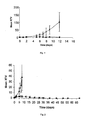
- the results are shown in Fig. 1 as a graphs of relative tumour volume against time ( ⁇ ZC423; ⁇ Control - solvent alone).
- the activity of ZC423 was shown to be statistically significant when assessed by Mann-Whitney analysis (as described, for example, in Essential Statistics 2nd Edition (1989), D.G.Rees, ISBN 0 412 32030 4, Chapman and Hall, Lond on).
- Fig. 2 shows the results of the same test ( ⁇ ZC423; ⁇ Control - solvent alone) but extended over a longer period, and with a larger scale for the Mean RTV.
- the control group was ceased at 16 days, at which point there were no tumour free mice, compared to the treated group where all animals were tumour free at 68 days.
- Electrophoresis was performed on a 0.8% submerged horizontal agarose gel, 20 cm in length for 16 hours at 38-40 V in 1 x TAE running buffer (2.42 g Tris Base, 0.372 g EDTA, 0.571ml glacial acetic acid). Gels were dried under vacuum for 80 minutes at 80°C on a Savant SG210D SpeedGel gel dryer onto one layer of Whatman 3MM with a layer of DE81 filter paper underneath. An autoradiograph was obtained, after overnight exposure onto FujiRX x-ray film. The film bands were quantitated using a BioRad GS-670 imaging laser densitometer.
- the percentage of cross-linking was calculated by measuring the total DNA in each lane (the sum of the densities for the double-stranded and single-stranded bands) relative to the amount of density of double-stranded band alone.
- a dose response curve was derived by plotting drug concentration against the determined percentage level of cross-linked DNA, from which was derived the amount required to cross-link 50% of the DNA (XL 50 ).
- Solubility was determined by dissolving the test compound in the minimum amount of water to produce a saturated solution.
Landscapes
- Health & Medical Sciences (AREA)
- Chemical & Material Sciences (AREA)
- Organic Chemistry (AREA)
- Veterinary Medicine (AREA)
- Medicinal Chemistry (AREA)
- Pharmacology & Pharmacy (AREA)
- Life Sciences & Earth Sciences (AREA)
- Animal Behavior & Ethology (AREA)
- General Health & Medical Sciences (AREA)
- Public Health (AREA)
- Chemical Kinetics & Catalysis (AREA)
- Engineering & Computer Science (AREA)
- General Chemical & Material Sciences (AREA)
- Nuclear Medicine, Radiotherapy & Molecular Imaging (AREA)
- Bioinformatics & Cheminformatics (AREA)
- Physical Education & Sports Medicine (AREA)
- Epidemiology (AREA)
- Hematology (AREA)
- Vascular Medicine (AREA)
- Orthopedic Medicine & Surgery (AREA)
- Rheumatology (AREA)
- Dermatology (AREA)
- Oncology (AREA)
- Urology & Nephrology (AREA)
- Biomedical Technology (AREA)
- Cardiology (AREA)
- Heart & Thoracic Surgery (AREA)
- Pharmaceuticals Containing Other Organic And Inorganic Compounds (AREA)
- Nitrogen Condensed Heterocyclic Rings (AREA)
- Nitrogen And Oxygen Or Sulfur-Condensed Heterocyclic Ring Systems (AREA)
- Hydrogenated Pyridines (AREA)
Abstract
Description
- The present invention relates to pyrrolobenzodiazepines (PBDs), and in particular pyrrolobenzodiazepine dimers bearing C2 aryl substitutions.
- Some pyrrolobenzodiazepines (PBDs) have the ability to recognise and bond to specific sequences of DNA; the preferred sequence is PuGPu. The first PBD antitumour antibiotic, anthramycin, was discovered in 1965 (Leimgruber, et al., J. Am. Chem. Soc., 87, 5793-5795 (1965); Leimgruber, et al., J. Am. Chem. Soc., 87, 5791-5793 (1965)). Since then, a number of naturally occurring PBDs have been reported, and over 10 synthetic routes have been developed to a variety of analogues (Thurston, et al., Chem. Rev. 1994, 433-465 (1994)). Family members include abbeymycin (Hochlowski, et al., J. Antibiotics, 40, 145-148 (1987)), chicamycin (Konishi, et al., J. Antibiotics, 37, 200-206 (1984)), DC-81 (Japanese Patent
58-180 487 
- European application EP 1193270 discloses dimeric pyrrolobenzodiazepines which are useful in the treatment of cancer.
- The present inventors have previously disclosed, in
WO 2004/043963 , cytotoxic compounds having an aryl group at the C2 position, for example:
- The present inventors have also previously disclosed, in co-pending PCT application
PCT/GB2005/000768 WO 2005/085251 ), dimeric PBD compounds bearing C2 aryl substituents, such as:
- The present inventors have encountered some issues with the solubility of compounds such as ZC-207, which they have resolved by the use of a different form of these compounds.
- The present invention comprises a compound with the formula 1:

- R2 is an optionally substituted C5-20 aryl group;
- R6 and R9 are independently selected from H, R, OH, OR, SH, SR, NH2, NHR, NRR', nitro, Me3Sn and halo;
where R and R' are independently selected from optionally substituted C1-12 alkyl, C3-20 heterocyclyl and C5-20 aryl groups; - R7 is selected from H, R, OH, OR, SH, SR, NH2, NHR, NHRR', nitro, Me3Sn and halo;
- R" is a C3-12 alkylene group, which chain may be interrupted by one or more heteroatoms, e.g. O, S, NH, and/or aromatic rings, e.g. benzene or pyridine;
- X is selected from O, S, or NH;
- z is 2 or 3;
- M is a monovalent pharmaceutically acceptable cation;
- R2', R6' , R7', R9', X' and M' are selected from the same groups as R2, R6, R7, R9, X and M respectively, or M and M' may together represent a divalent pharmaceutically acceptable cation.
- Pyrrolobenzodiazepines having an imine bond are known to convert to the di-carbinolamine form in water, and isolated pyrrolobenzodiazepines often exist as a mixture of the imine, mono-carbinolamine and di-carbinolamine forms. Furthermore, if the compound is isolated as a solid with a mixture of these three forms, the balance between them may change over time. Although this does not pose a problem for administration of the compound, it can provide difficulties in accurately assessing the amount of active substance in a given amount of powder. Compounds of the present invention, at least to some extent, overcome this difficulty whilst remaining activity, and are thus suited to formulation as pharmaceuticals.
- Dimeric pyrrolobenzodiazepines offer advantages over monomeric pyrrolobenzodiazepines in that they possess the ability to cross-link DNA in the minor groove, which can lead to an increase in cytotoxicity.
- Further aspects of the invention relate to compounds useful in methods of therapy (particularly in treating proliferative diseases), pharmaceutical compositions comprising the compounds, and their use in the manufacture of a medicament for the treatment of a proliferative disease.
- The phrase "optionally substituted" as used herein, pertains to a parent group which may be unsubstituted or which may be substituted.
- Unless otherwise specified, the term "substituted" as used herein, pertains to a parent group which bears one or more substitutents. The term "substituent" is used herein in the conventional sense and refers to a chemical moiety which is covalently attached to, or if appropriate, fused to, a parent group. A wide variety of substituents are well known, and methods for their formation and introduction into a variety of parent groups are also well known.
- Examples of substituents are described in more detail below.
- C1-12 alkyl: The term "C1-12 alkyl" as used herein, pertains to a monovalent moiety obtained by removing a hydrogen atom from a carbon atom of a hydrocarbon compound having from 1 to 12 carbon atoms, which may be aliphatic or alicyclic, and which may be saturated or unsaturated (e.g. partially unsaturated, fully unsaturated). Thus, the term "alkyl" includes the sub-classes alkenyl, alkynyl, cycloalkyl, etc., discussed below.
- Examples of saturated alkyl groups include, but are not limited to, methyl (C1), ethyl (C2), propyl (C3), butyl (C4), pentyl (C5), hexyl (C6) and heptyl (C7).
- Examples of saturated linear alkyl groups include, but are not limited to, methyl (C1), ethyl (C2), n-propyl (C3), n-butyl (C4), n-pentyl (amyl) (C5), n-hexyl (C6) and n-heptyl (C7).
- Examples of saturated branched alkyl groups include iso-propyl (C3), iso-butyl (C4), sec-butyl (C4), tert-butyl (C4), iso-pentyl (C5), and neo-pentyl (C5).
- C2-12 Alkenyl: The term "C2-12 alkenyl" as used herein, pertains to an alkyl group having one or more carbon-carbon double bonds.
- Examples of unsaturated alkenyl groups include, but are not limited to, ethenyl (vinyl, - CH=CH2), 1-propenyl (-CH=CH-CH3), 2-propenyl (allyl, -CH-CH=CH2), isopropenyl (1-methylvinyl, -C(CH3)=CH2), butenyl (C4), pentenyl (C5), and hexenyl (C6).
- C2-12 alkynyl: The term "C2-12 alkynyl" as used herein, pertains to an alkyl group having one or more carbon-carbon triple bonds.
- Examples of unsaturated alkynyl groups include, but are not limited to, ethynyl (ethinyl, - C≡CH) and 2-propynyl (propargyl, -CH2-C=CH).
- C3-12 cycloalkyl: The term "C3-12 cycloalkyl" as used herein, pertains to an alkyl group which is also a cyclyl group; that is, a monovalent moiety obtained by removing a hydrogen atom from an alicyclic ring atom of a cyclic hydrocarbon (carbocyclic) compound, which moiety has from 3 to 7 carbon atoms, including from 3 to 7 ring atoms.
- Examples of cycloalkyl groups include, but are not limited to, those derived from:
- saturated monocyclic hydrocarbon compounds:
- cyclopropane (C3), cyclobutane (C4), cyclopentane (C5), cyclohexane (C6), cycloheptane (C7), methylcyclopropane (C4), dimethylcyclopropane (C5), methylcyclobutane (C5), dimethylcyclobutane (C6), methylcyclopentane (C6), dimethylcyclopentane (C7) and methylcyclohexane (C7);
- unsaturated monocyclic hydrocarbon compounds:
- cyclopropene (C3), cyclobutene (C4), cyclopentene (C5), cyclohexene (C6), methylcyclopropene (C4), dimethylcyclopropene (C5), methylcyclobutene (C5), dimethylcyclobutene (C6), methylcyclopentene (C6), dimethylcyclopentene (C7) and
- methylcyclohexene (C7); and
- saturated polycyclic hydrocarbon compounds:
- norcarane (C7), norpinane (C7), norbornane (C7).
- C3-20 heterocyclyl: The term "C3-20 heterocyclyl" as used herein, pertains to a monovalent moiety obtained by removing a hydrogen atom from a ring atom of a heterocyclic compound, which moiety has from 3 to 20 ring atoms, of which from 1 to 10 are ring heteroatoms. Preferably, each ring has from 3 to 7 ring atoms, of which from 1 to 4 are ring heteroatoms.
- In this context, the prefixes (e.g. C3-20, C3-7, C5-6, etc.) denote the number of ring atoms, or range of number of ring atoms, whether carbon atoms or heteroatoms. For example, the term "C5-6heterocyclyl", as used herein, pertains to a heterocyclyl group having 5 or 6 ring atoms.
- Examples of monocyclic heterocyclyl groups include, but are not limited to, those derived from:
- N1: aziridine (C3), azetidine (C4), pyrrolidine (tetrahydropyrrole) (C5), pyrroline (e.g., 3-pyrroline, 2,5-dihydropyrrole) (C5), 2H-pyrrole or 3H-pyrrole (isopyrrole, isoazole) (C5), piperidine (C6), dihydropyridine (C6), tetrahydropyridine (C6), azepine (C7);
- O1: oxirane (C3), oxetane (C4), oxolane (tetrahydrofuran) (C5), oxole (dihydrofuran) (C5), oxane (tetrahydropyran) (C6), dihydropyran (C6), pyran (C6), oxepin (C7);
- S1: thiirane (C3), thietane (C4), thiolane (tetrahydrothiophene) (C5), thiane (tetrahydrothiopyran) (C6), thiepane (C7);
- O2: dioxolane (C5), dioxane (C6), and dioxepane (C7);
- O3: trioxane (C6);
- N2: imidazolidine (C5), pyrazolidine (diazolidine) (C5), imidazoline (C5), pyrazoline (dihydropyrazole) (C5), piperazine (C6);
- N1O1: tetrahydrooxazole (C5), dihydrooxazole (C5), tetrahydroisoxazole (C5), dihydroisoxazole (C5), morpholine (C6), tetrahydrooxazine (C6), dihydrooxazine (C6), oxazine (C6);
- N1S1: thiazoline (C5), thiazolidine (C5), thiomorpholine (C6);
- N2O1: oxadiazine (C6);
- O1S1: oxathiole (C5) and oxathiane (thioxane) (C6); and,
- N1O1S1: oxathiazine (C6).
- Examples of substituted monocyclic heterocyclyl groups include those derived from saccharides, in cyclic form, for example, furanoses (C5), such as arabinofuranose, lyxofuranose, ribofuranose, and xylofuranse, and pyranoses (C6), such as allopyranose, altropyranose, glucopyranose, mannopyranose, gulopyranose, idopyranose, galactopyranose, and talopyranose.
- C5-20 aryl: The term "C5-20 aryl", as used herein, pertains to a monovalent moiety obtained by removing a hydrogen atom from an aromatic ring atom of an aromatic compound, which moiety has from 3 to 20 ring atoms. Preferably, each ring has from 5 to 7 ring atoms.
- In this context, the prefixes (e.g. C3-20, C5-7, C5-6, etc.) denote the number of ring atoms, or range of number of ring atoms, whether carbon atoms or heteroatoms. For example, the term "C5-6aryl" as used herein, pertains to an aryl group having 5 or 6 ring atoms.
- The ring atoms may be all carbon atoms, as in "carboaryl groups".
Examples of carboaryl groups include, but are not limited to, those derived from benzene (i.e. phenyl) (C6), naphthalene (C10), azulene (C10), anthracene (C14), phenanthrene (C14), naphthacene (C18), and pyrene (C16). - Examples of aryl groups which comprise fused rings, at least one of which is an aromatic ring, include, but are not limited to, groups derived from indane (e.g. 2,3-dihydro-1H-indene) (C9), indene (C9), isoindene (C9), tetraline (1,2,3,4-tetrahydronaphthalene (C10), acenaphthene (C12), fluorene (C13), phenalene (C13), acephenanthrene (C15), and aceanthrene (C16).
- Alternatively, the ring atoms may include one or more heteroatoms, as in "heteroaryl groups". Examples of monocyclic heteroaryl groups include, but are not limited to, those derived from:
- N1: pyrrole (azole) (C5), pyridine (azine) (C6);
- O1: furan (oxole) (C5);
- S1: thiophene (thiole) (C5);
- N1O1: oxazole (C5), isoxazole (C5), isoxazine (C6);
- N2O1: oxadiazole (furazan) (C5);
- N3O1: oxatriazole (C5);
- N1S1: thiazole (C5), isothiazole (C5);
- N2: imidazole (1,3-diazole) (C5), pyrazole (1,2-diazole) (C5), pyridazine (1,2-diazine) (C6), pyrimidine (1,3-diazine) (C6) (e.g., cytosine, thymine, uracil), pyrazine (1,4-diazine) (C6);
- N3: triazole (C5), triazine (C6); and,
- N4: tetrazole (C5).
- Examples of heteroaryl which comprise fused rings, include, but are not limited to:
- C9 (with 2 fused rings) derived from benzofuran (O1), isobenzofuran (O1), indole (N1), isoindole (N1), indolizine (N1), indoline (N1), isoindoline (N1), purine (N4) (e.g., adenine, guanine), benzimidazole (N2), indazole (N2), benzoxazole (N1O1), benzisoxazole (N1O1), benzodioxole (O2), benzofurazan (N2O1), benzotriazole (N3), benzothiofuran (S1), benzothiazole (N1S1), benzothiadiazole (N2S);
- C10 (with 2 fused rings) derived from chromene (O1), isochromene (O1), chroman (O1), isochroman (O1), benzodioxan (O2), quinoline (N1), isoquinoline (N1), quinolizine (N1), benzoxazine (N1O1), benzodiazine (N2), pyridopyridine (N2), quinoxaline (N2), quinazoline (N2), cinnoline (N2), phthalazine (N2), naphthyridine (N2), pteridine (N4);
- C11 (with 2 fused rings) derived from benzodiazepine (N2);
- C13 (with 3 fused rings) derived from carbazole (N1), dibenzofuran (O1), dibenzothiophene (S1), carboline (N2), perimidine (N2), pyridoindole (N2); and,
- C14 (with 3 fused rings) derived from acridine (N1), xanthene (O1), thioxanthene (S1), oxanthrene (O2), phenoxathiin (O1S1), phenazine (N2), phenoxazine (N1O1), phenothiazine (N1S1), thianthrene (S2), phenanthridine (N1), phenanthroline (N2), phenazine (N2).
- The above groups, whether alone or part of another substituent, may themselves optionally be substituted with one or more groups selected from themselves and the additional substituents listed below.
- Halo: -F, -Cl, -Br, and -I.
- Hydroxy: -OH.
- Ether: -OR, wherein R is an ether substituent, for example, a C1-7 alkyl group (also referred to as a C1-7alkoxy group, discussed below), a C3-20heterocyclyl group (also referred to as a C3-20 heterocyclyloxy group), or a C5-20 aryl group (also referred to as a C5-20 aryloxy group), preferably a C1-7alkyl group.
- Alkoxy: -OR, wherein R is an alkyl group, for example, a C1-7 alkyl group. Examples of C1-7 alkoxy groups include, but are not limited to, -OMe (methoxy), -OEt (ethoxy), -O(nPr) (n-propoxy), -O(iPr) (isopropoxy), -O(nBu) (n-butoxy), -O(sBu) (sec-butoxy), -O(iBu) (isobutoxy), and -O(tBu) (tert-butoxy).
- Acetal: -CH(OR1)(OR2), wherein R1 and R2 are independently acetal substituents, for example, a C1-7alkyl group, a C3-20 heterocyclyl group, or a C5-20 aryl group, preferably a C1-7 alkyl group, or, in the case of a "cyclic" acetal group, R1 and R2, taken together with the two oxygen atoms to which they are attached, and the carbon atoms to which they are attached, form a heterocyclic ring having from 4 to 8 ring atoms. Examples of acetal groups include, but are not limited to, -CH(OMe)2, -CH(OEt)2, and -CH(OMe)(OEt).
- Hemiacetal: -CH(OH)(OR1), wherein R1 is a hemiacetal substituent, for example, a C1-7 alkyl group, a C3-20 heterocyclyl group, or a C5-20 aryl group, preferably a C1-7 alkyl group. Examples of hemiacetal groups include, but are not limited to, -CH(OH)(OMe) and - CH(OH)(OEt).
- Ketal: -CR(OR1)(OR2), where R1 and R2 are as defined for acetals, and R is a ketal substituent other than hydrogen, for example, a C1-7 alkyl group, a C3-20 heterocyclyl group, or a C5-20 aryl group, preferably a C1-7 alkyl group. Examples ketal groups include, but are not limited to, -C(Me)(OMe)2, -C(Me)(OEt)2, -C(Me)(OMe)(OEt), -C(Et)(OMe)2, - C(Et)(OEt)2, and -C(Et)(OMe)(OEt).
- Hemiketal: -CR(OH)(OR1), where R1 is as defined for hemiacetals, and R is a hemiketal substituent other than hydrogen, for example, a C1-7 alkyl group, a C3-20 heterocyclyl group, or a C5-20 aryl group, preferably a C1-7 alkyl group. Examples of hemiacetal groups include, but are not limited to, -C(Me)(OH)(OMe), -C(Et)(OH)(OMe), -C(Me)(OH)(OEt), and -C(Et)(OH)(OEt).
Oxo (keto, -one): =O.
Thione (thioketone): =S.
Imino (imine): =NR, wherein R is an imino substituent, for example, hydrogen, C1-7 alkyl group, a C3-20 heterocyclyl group, or a C5-20 aryl group, preferably hydrogen or a C1-7 alkyl group. Examples of ester groups include, but are not limited to, =NH, =NMe, =NEt, and =NPh.
Formyl (carbaldehyde, carboxaldehyde): -C(=O)H. - Acyl (keto): -C(=O)R, wherein R is an acyl substituent, for example, a C1-7 alkyl group (also referred to as C1-7 alkylacyl or C1-7 alkanoyl), a C3-20 heterocyclyl group (also referred to as C3-20 heterocyclylacyl), or a C5-20 aryl group (also referred to as C5-20 arylacyl), preferably a C1-7 alkyl group. Examples of acyl groups include, but are not limited to, -C(=O)CH3 (acetyl), -C(=O)CH2CH3 (propionyl), -C(=O)C(CH3)3 (t-butyryl), and -C(=O)Ph (benzoyl, phenone).
Carboxy (carboxylic acid): -C(=O)OH.
Thiocarboxy (thiocarboxylic acid): -C(=S)SH.
Thiolocarboxy (thiolocarboxylic acid): -C(=O)SH.
Thionocarboxy (thionocarboxylic acid): -C(=S)OH.
Imidic acid: -C(=NH)OH.
Hydroxamic acid: -C(=NOH)OH. - Ester (carboxylate, carboxylic acid ester, oxycarbonyl): -C(=O)OR, wherein R is an ester substituent, for example, a C1-7 alkyl group, a C3-20 heterocyclyl group, or a C5-20 aryl group, preferably a C1-7 alkyl group. Examples of ester groups include, but are not limited to, -C(=O)OCH3, -C(=O)OCH2CH3, -C(=O)OC(CH3)3, and -C(=O)OPh.
- Acyloxy (reverse ester): -OC(=O)R, wherein R is an acyloxy substituent, for example, a C1-7 alkyl group, a C3-20 heterocyclyl group, or a C5-20 aryl group, preferably a C1-7 alkyl group. Examples of acyloxy groups include, but are not limited to, -OC(=O)CH3 (acetoxy), -OC(=O)CH2CH3, -OC(=O)C(CH3)3, -OC(=O)Ph, and -OC(=O)CH2Ph.
- Oxycarboyloxy: -OC(=O)OR, wherein R is an ester substituent, for example, a C1-7 alkyl group, a C3-20 heterocyclyl group, or a C5-20 aryl group, preferably a C1-7 alkyl group. Examples of ester groups include, but are not limited to, -OC(=O)OCH3, -OC(=O)OCH2CH3, -OC(=O)OC(CH3)3, and -OC(=O)OPh.
- Amino: -NR1R2, wherein R1 and R2 are independently amino substituents, for example, hydrogen, a C1-7 alkyl group (also referred to as C1-7 alkylamino or di-C1-7 alkylamino), a C3-20 heterocyclyl group, or a C5-20 aryl group, preferably H or a C1-7 alkyl group, or, in the case of a "cyclic" amino group, R1 and R2, taken together with the nitrogen atom to which they are attached, form a heterocyclic ring having from 4 to 8 ring atoms. Amino groups may be primary (-NH2), secondary (-NHR1), or tertiary (-NHR1R2), and in cationic form, may be quaternary (-+NR1R2R3). Examples of amino groups include, but are not limited to, -NH2, -NHCH3, -NHC(CH3)2, -N(CH3)2, -N(CH2CH3)2, and -NHPh. Examples of cyclic amino groups include, but are not limited to, aziridino, azetidino, pyrrolidino, piperidino, piperazino, morpholino, and thiomorpholino.
- Amido (carbamoyl, carbamyl, aminocarbonyl, carboxamide): -C(=O)NR1R2, wherein R1 and R2 are independently amino substituents, as defined for amino groups. Examples of amido groups include, but are not limited to, -C(=O)NH2, -C(=O)NHCH3, -C(=O)N(CH3)2, -C(=O)NHCH2CH3, and -C(=O)N(CH2CH3)2, as well as amido groups in which R1 and R2, together with the nitrogen atom to which they are attached, form a heterocyclic structure as in, for example, piperidinocarbonyl, morpholinocarbonyl, thiomorpholinocarbonyl, and piperazinocarbonyl.
- Thioamido (thiocarbamyl): -C(=S)NR1R2, wherein R1 and R2 are independently amino substituents, as defined for amino groups. Examples of amido groups include, but are not limited to, -C(=S)NH2, -C(=S)NHCH3, -C(=S)N(CH3)2, and -C(=S)NHCH2CH3.
- Acylamido (acylamino): -NR1C(=O)R2, wherein R1 is an amide substituent, for example, hydrogen, a C1-7 alkyl group, a C3-20 heterocyclyl group, or a C5-20 aryl group, preferably hydrogen or a C1-7 alkyl group, and R2 is an acyl substituent, for example, a C1-7 alkyl group, a C3-20 heterocyclyl group, or a C5-20aryl group, preferably hydrogen or a C1-7 alkyl group. Examples of acylamide groups include, but are not limited to, -NHC(=O)CH3, -NHC(=O)CH2CH3, and -NHC(=O)Ph. R1 and R2 may together form a cyclic structure, as in, for example, succinimidyl, maleimidyl, and phthalimidyl:

Guanidino: -NH-C(=NH)NH2. - Tetrazolyl: a five membered aromatic ring having four nitrogen atoms and one carbon atom,

- Amidine (amidino): -C(=NR)NR2, wherein each R is an amidine substituent, for example, hydrogen, a C1-7 alkyl group, a C3-20 heterocyclyl group, or a C5-20 aryl group, preferably H or a C1-7 alkyl group. Examples of amidine groups include, but are not limited to, -C(=NH)NH2, -C(=NH)NMe2, and -C(=NMe)NMe2.
Nitro: -NO2.
Nitroso: -NO.
Azido: -N3.
Cyano (nitrile, carbonitrile): -CN.
Isocyano: -NC.
Cyanato: -OCN.
Isocyanato: -NCO.
Thiocyano (thiocyanato): -SCN.
Isothiocyano (isothiocyanato): -NCS.
Sulfhydryl (thiol, mercapto): -SH. - Thioether (sulfide): -SR, wherein R is a thioether substituent, for example, a C1-7 alkyl group (also referred to as a C1-7alkylthio group), a C3-20 heterocyclyl group, or a C5-20 aryl group, preferably a C1-7 alkyl group. Examples of C1-7 alkylthio groups include, but are not limited to, -SCH3 and -SCH2CH3.
- Disulfide: -SS-R, wherein R is a disulfide substituent, for example, a C1-7 alkyl group, a C3-20 heterocyclyl group, or a C5-20 aryl group, preferably a C1-7 alkyl group (also referred to herein as C1-7 alkyl disulfide). Examples of C1-7 alkyl disulfide groups include, but are not limited to, -SSCH3 and -SSCH2CH3.
- Sulfine (sulfinyl, sulfoxide): -S(=O)R, wherein R is a sulfine substituent, for example, a C1-7 alkyl group, a C3-20 heterocyclyl group, or a C5-20 aryl group, preferably a C1-7 alkyl group. Examples of sulfine groups include, but are not limited to, -S(=O)CH3 and -S(=O)CH2CH3.
- Sulfone (sulfonyl): -S(=O)2R, wherein R is a sulfone substituent, for example, a C1-7 alkyl group, a C3-20 heterocyclyl group, or a C5-20 aryl group, preferably a C1-7 alkyl group, including, for example, a fluorinated or perfluorinated C1-7 alkyl group. Examples of sulfone groups include, but are not limited to, -S(=O)2CH3 (methanesulfonyl, mesyl), -S(=O)2CF3 (triflyl), -S(=O)2CH2CH3 (esyl), -S(=O)2C4F9 (nonaflyl), -S(=O)2CH2CF3 (tresyl), -S(=O)2CH2CH2NH2 (tauryl), -S(=O)2Ph (phenylsulfonyl, besyl), 4-methylphenylsulfonyl (tosyl), 4-chlorophenylsulfonyl (closyl), 4-bromophenylsulfonyl (brosyl), 4-nitrophenyl (nosyl), 2-naphthalenesulfonate (napsyl), and 5-dimethylamino-naphthalen-1-ylsulfonate (dansyl).
Sulfinic acid (sulfino): -S(=O)OH, -SO2H.
Sulfonic acid (sulfo): -S(=O)2OH, -SO3H. - Sulfinate (sulfinic acid ester): -S(=O)OR; wherein R is a sulfinate substituent, for example, a C1-7 alkyl group, a C3-20 heterocyclyl group, or a C5-20 aryl group, preferably a C1-7 alkyl group. Examples of sulfinate groups include, but are not limited to, -S(=O)OCH3 (methoxysulfinyl; methyl sulfinate) and -S(=O)OCH2CH3 (ethoxysulfinyl; ethyl sulfinate).
- Sulfonate (sulfonic acid ester): -S(=O)2OR, wherein R is a sulfonate substituent, for example, a C1-7 alkyl group, a C3-20 heterocyclyl group, or a C5-20 aryl group, preferably a C1-7 alkyl group. Examples of sulfonate groups include, but are not limited to, -S(=O)2OCH3 (methoxysulfonyl; methyl sulfonate) and -S(=O)2OCH2CH3 (ethoxysulfonyl; ethyl sulfonate).
- Sulfinyloxy: -OS(=O)R, wherein R is a sulfinyloxy substituent, for example, a C1-7 alkyl group, a C3-20 heterocyclyl group, or a C5-20 aryl group, preferably a C1-7 alkyl group. Examples of sulfinyloxy groups include, but are not limited to, -OS(=O)CH3 and -OS(=O)CH2CH3.
- Sulfonyloxy: -OS(=O)2R, wherein R is a sulfonyloxy substituent, for example, a C1-7 alkyl group, a C3-20 heterocyclyl group, or a C5-20 aryl group, preferably a C1-7 alkyl group. Examples of sulfonyloxy groups include, but are not limited to, -OS(=O)2CH3 (mesylate) and -OS(=O)2CH2CH3 (esylate).
- Sulfate: -OS(=O)2OR; wherein R is a sulfate substituent, for example, a C1-7 alkyl group, a C3-20 heterocyclyl group, or a C5-20 aryl group, preferably a C1-7 alkyl group. Examples of sulfate groups include, but are not limited to, -OS(=O)2OCH3 and -SO(=O)2OCH2CH3.
- Sulfamyl (sulfamoyl; sulfinic acid amide; sulfinamide): -S(=O)NR1R2, wherein R1 and R2 are independently amino substituents, as defined for amino groups. Examples of sulfamyl groups include, but are not limited to, -S(=O)NH2, -S(=O)NH(CH3), -S(=O)N(CH3)2, -S(=O)NH(CH2CH3), -S(=O)N(CH2CH3)2, and -S(=O)NHPh.
- Sulfonamido (sulfinamoyl; sulfonic acid amide; sulfonamide): -S(=O)2NR1R2, wherein R1 and R2 are independently amino substituents, as defined for amino groups. Examples of sulfonamido groups include, but are not limited to, -S(=O)2NH2, -S(=O)2NH(CH3), -S(=O)2N(CH3)2, -S(=O)2NH(CH2CH3), -S(=O)2N(CH2CH3)2, and -S(=O)2NHPh.
- Sulfamino: -NR1S(=O)2OH, wherein R1 is an amino substituent, as defined for amino groups. Examples of sulfamino groups include, but are not limited to, -NHS(=O)2OH and -N(CH3)S(=O)2OH.
- Sulfonamino: -NR1S(=O)2R, wherein R1 is an amino substituent, as defined for amino groups, and R is a sulfonamino substituent, for example, a C1-7 alkyl group, a C3-20 heterocyclyl group, or a C5-20 aryl group, preferably a C1-7 alkyl group. Examples of sulfonamino groups include, but are not limited to, -NHS(=O)2CH3 and -N(CH3)S(=O)2C6H5.
- Sulfinamino: -NR1S(=O)R, wherein R1 is an amino substituent, as defined for amino groups, and R is a sulfinamino substituent, for example, a C1-7 alkyl group, a C3-20 heterocyclyl group, or a C5-20 aryl group, preferably a C1-7 alkyl group. Examples of sulfinamino groups include, but are not limited to, -NHS(=O)CH3 and -N(CH3)S(=O)C6H5.
- Phosphino (phosphine): -PR2, wherein R is a phosphino substituent, for example, -H, a C1-7 alkyl group, a C3-20 heterocyclyl group, or a C5-20 aryl group, preferably -H, a C1-7 alkyl group, or a C5-20 aryl group. Examples of phosphino groups include, but are not limited to, -PH2, -P(CH3)2, -P(CH2CH3)2, -P(t-Bu)2, and -P(Ph)2.
Phospho: -P(=O)2. - Phosphinyl (phosphine oxide): -P(=O)R2, wherein R is a phosphinyl substituent, for example, a C1-7 alkyl group, a C3-20 heterocyclyl group, or a C5-20 aryl group, preferably a C1-7 alkyl group or a C5-20 aryl group. Examples of phosphinyl groups include, but are not limited to, -P(=O)(CH3)2, -P(=O)(CH2CH3)2, -P(=O)(t-Bu)2, and -P(=O)(Ph)2.
Phosphonic acid (phosphono): -P(=O)(OH)2. - Phosphonate (phosphono ester): -P(=O)(OR)2, where R is a phosphonate substituent, for example, -H, a C1-7 alkyl group, a C3-20 heterocyclyl group, or a C5-20 aryl group, preferably -H, a C1-7 alkyl group, or a C5-20 aryl group. Examples of phosphonate groups include, but are not limited to, -P(=O)(OCH3)2, -P(=O)(OCH2CH3)2, -P(=O)(O-t-Bu)2, and -P(=O)(OPh)2.
Phosphoric acid (phosphonooxy): -OP(=O)(OH)2. - Phosphate (phosphonooxy ester): -OP(=O)(OR)2, where R is a phosphate substituent, for example, -H, a C1-7 alkyl group, a C3-20 heterocyclyl group, or a C5-20 aryl group, preferably - H, a C1-7 alkyl group, or a C5-20 aryl group. Examples of phosphate groups include, but are not limited to, -OP(=O)(OCH3)2, -OP(=O)(OCH2CH3)2, -OP(=O)(O-t-Bu)2, and -OP(=O)(OPh)2.
Phosphorous acid: -OP(OH)2. - Phosphite: -OP(OR)2, where R is a phosphite substituent, for example, -H, a C1-7 alkyl group, a C3-20 heterocyclyl group, or a C5-20 aryl group, preferably -H, a C1-7 alkyl group, or a C5-20 aryl group. Examples of phosphite groups include, but are not limited to, -OP(OCH3)2, -OP(OCH2CH3)2, -OP(O-t-Bu)2, and -OP(OPh)2.
- Phosphoramidite: -OP(OR1)-NR2 2, where R1 and R2 are phosphoramidite substituents, for example, -H, a (optionally substituted) C1-7 alkyl group, a C3-20 heterocyclyl group, or a C5-20 aryl group, preferably -H, a C1-7 alkyl group, or a C5-20 aryl group. Examples of phosphoramidite groups include, but are not limited to, -OP(OCH2CH3)-N(CH3)2, -OP(OCH2CH3)-N(i-Pr)2, and -OP(OCH2CH2CN)-N(i-Pr)2.
- Phosphoramidate: -OP(=O)(OR1)-NR2 2, where R1 and R2 are phosphoramidate substituents, for example, -H, a (optionally substituted) C1-7 alkyl group, a C3-20 heterocyclyl group, or a C5-20 aryl group, preferably -H, a C1-7 alkyl group, or a C5-20 aryl group. Examples of phosphoramidate groups include, but are not limited to, -OP(=O)(OCH2CH3)-N(CH3)2, -OP(=O)(OCH2CH3)-N(i-Pr)2, and -OP(=O)(OCH2CH2CN)-N(i-Pr)2.
- Bisoxyalkylene: -O-(CH2)nO-, where n=1-3, which bonds to adjacent atoms. Examples of bisoxyalkylene groups include, but are not limited to, -O-CH2-O-.
- C3-12 alkylene: The term "C3-12 alkylene", as used herein, pertains to a bidentate moiety obtained by removing two hydrogen atoms, either both from the same carbon atom, or one from each of two different carbon atoms, of a hydrocarbon compound having from 3 to 12 carbon atoms (unless otherwise specified), which may be aliphatic or alicyclic, and which may be saturated, partially unsaturated, or fully unsaturated. Thus, the term "alkylene" includes the sub-classes alkenylene, alkynylene, cycloalkylene, etc., discussed below.
- Examples of linear saturated C3-12 alkylene groups include, but are not limited to, -(CH2)n-where n is an integer from 3 to 12, for example, -CH2CH2CH2- (propylene), -CH2CH2CH2CH2- (butylene), -CH2CH2CH2CH2CH2- (pentylene) and -CH2CH2CH2CH2CH2CH2CH2- (heptylene).
- Examples of branched saturated C3-12 alkylene groups include, but are not limited to, -CH(CH3)CH2-, -CH(CH3)CH2CH2-, -CH(CH3)CH2CH2CH2-, -CH2CH(CH3)CH2-, -CH2CH(CH3)CH2CH2-, -CH(CH2CH3)-, -CH(CH2CH3)CH2-, and -CH2CH(CH2CH3)CH2-.
- Examples of linear partially unsaturated C3-12 alkylene groups (C3-12 alkenylene, and alkynylene groups) include, but are not limited to, -CH=CH-CH2-, -CH2-CH=CH2-, -CH=CH-CH2-CH2-, -CH=CH-CH2-CH2-CH2-, -CH=CH-CH=CH-, -CH=CH-CH=CH-CH2-, -CH=CH-CH=CH-CH2-CH2-, -CH=CH-CH2-CH=CH-, -CH=CH-CH2-CH2-CH=CH-, and - CH2-C≡C-CH2-.
- Examples of branched partially unsaturated C3-12 alkylene groups (C3-12 alkenylene and alkynylene groups) include, but are not limited to, -C(CH3)=CH-, -C(CH3)=CH-CH2-, -CH=CH-CH(CH3)- and -C≡C-CH(CH3)-.
- Examples of alicyclic saturated C3-12 alkylene groups (C3-12 cycloalkylenes) include, but are not limited to, cyclopentylene (e.g. cyclopent-1,3-ylene), and cyclohexylene (e.g. cyclohex-1,4-ylene).
- Examples of alicyclic partially unsaturated C3-12 alkylene groups (C3-12 cycloalkylenes) include, but are not limited to, cyclopentenylene (e.g. 4-cyclopenten-1,3-ylene), cyclohexenylene (e.g. 2-cyclohexen-1,4-ylene; 3-cyclohexen-1,2-ylene; 2,5-cyclohexadien-1,4-ylene).
- Examples of pharmaceutically acceptable monovalent and divalent cations are discussed in Berge, et al., J. Pharm. Sci., 66, 1-19 (1977).
- The pharmaceutically acceptable cation may be inorganic or organic.
- Examples of pharmaceutically acceptable monovalent inorganic cations include, but are not limited to, alkali metal ions such as Na+ and K+. Examples of pharmaceutically acceptable divalent inorganic cations include, but are not limited to, alkaline earth cations such as Ca2+ and Mg2+. Examples of pharmaceutically acceptable organic cations include, but are not limited to, ammonium ion (i.e. NH4 +) and substituted ammonium ions (e.g. NH3R+, NH2R2 +, NHR3 +, NR4 +). Examples of some suitable substituted ammonium ions are those derived from: ethylamine, diethylamine, dicyclohexylamine, triethylamine, butylamine, ethylenediamine, ethanolamine, diethanolamine, piperazine, benzylamine, phenylbenzylamine, choline, meglumine, and tromethamine, as well as amino acids, such as lysine and arginine. An example of a common quaternary ammonium ion is N(CH3)4 +.
- One of ordinary skill in the art is readily able to determine whether or not a candidate compound treats a proliferative condition for any particular cell type. For example, assays which may conveniently be used to assess the activity offered by a particular compound are described in the examples below.
- The term "proliferative disease" pertains to an unwanted or uncontrolled cellular proliferation of excessive or abnormal cells which is undesired, such as, neoplastic or hyperplastic growth, whether in vitro or in vivo.
- Examples of proliferative conditions include, but are not limited to, benign, pre-malignant, and malignant cellular proliferation, including but not limited to, neoplasms and tumours (e.g. histocytoma, glioma, astrocyoma, osteoma), cancers (e.g. lung cancer, small cell lung cancer, gastrointestinal cancer, bowel cancer, colon cancer, breast carinoma, ovarian carcinoma, prostate cancer, testicular cancer, liver cancer, kidney cancer, bladder cancer, pancreas cancer, brain cancer, sarcoma, osteosarcoma, Kaposi's sarcoma, melanoma), leukemias, psoriasis, bone diseases, fibroproliferative disorders (e.g. of connective tissues), and atherosclerosis.
- Any type of cell may be treated, including but not limited to, lung, gastrointestinal (including, e.g. bowel, colon), breast (mammary), ovarian, prostate, liver (hepatic), kidney (renal), bladder, pancreas, brain, and skin.
- As described above, the present invention provides a compound of formula I useful in a method of therapy, comprising administering to a subject in need of treatment a therapeutically-effective amount of a compound of formula I, preferably in the form of a pharmaceutical composition. The term "therapeutically effective amount" is an amount sufficient to show benefit to a patient. Such benefit may be at least amelioration of at least one symptom. The actual amount administered, and rate and time-course of administration, will depend on the nature and severity of what is being treated. Prescription of treatment, e.g. decisions on dosage, is within the responsibility of general practitioners and other medical doctors.
- A compound may be administered alone or in combination with other treatments, either simultaneously or sequentially dependent upon the condition to be treated. Examples of treatments and therapies include, but are not limited to, chemotherapy (the administration of active agents, including, e.g. drugs; surgery; and radiation therapy.
- Pharmaceutical compositions according to the present invention, and for use in accordance with the present invention, may comprise, in addition to the active ingredient, i.e. a compound of formula I, a pharmaceutically acceptable excipient, carrier, buffer, stabiliser or other materials well known to those skilled in the art. Such materials should be non-toxic and should not interfere with the efficacy of the active ingredient. The precise nature of the carrier or other material will depend on the route of administration, which may be oral, or by injection, e.g. cutaneous, subcutaneous, or intravenous.
- Pharmaceutical compositions for oral administration may be in tablet, capsule, powder or liquid form. A tablet may comprise a solid carrier or an adjuvant. Liquid pharmaceutical compositions generally comprise a liquid carrier such as water, petroleum, animal or vegetable oils, mineral oil or synthetic oil. Physiological saline solution, dextrose or other saccharide solution or glycols such as ethylene glycol, propylene glycol or polyethylene glycol may be included. A capsule may comprise a solid carrier such a gelatin.
- For intravenous, cutaneous or subcutaneous injection, or injection at the site of affliction, the active ingredient will be in the form of a parenterally acceptable aqueous solution which is pyrogen-free and has suitable pH, isotonicity and stability. Those of relevant skill in the art are well able to prepare suitable solutions using, for example, isotonic vehicles such as Sodium Chloride Injection, Ringer's Injection, Lactated Ringer's Injection. Preservatives, stabilisers, buffers, antioxidants and/or other additives may be included, as required.
- Unless otherwise specified, included in the above are the well known ionic, salt, solvate, and protected forms of these substituents. For example, a reference to carboxylic acid (-COOH) also includes the anionic (carboxylate) form (-COO-), a salt or solvate thereof, as well as conventional protected forms. Similarly, a reference to an amino group includes the protonated form (-N+HR1R2), a salt or solvate of the amino group, for example, a hydrochloride salt, as well as conventional protected forms of an amino group. Similarly, a reference to a hydroxyl group also includes the anionic form (-O-), a salt or solvate thereof, as well as conventional protected forms.
- In particular, a reference to group (-SO2M) also includes the anionic form (-SO2 -), or solvate thereof, as well as conventional protected forms.
- Certain compounds may exist in one or more particular geometric, optical, enantiomeric, diasteriomeric, epimeric, atropic, stereoisomeric, tautomeric, conformational, or anomeric forms, including but not limited to, cis- and trans-forms; E- and Z-forms; c-, t-, and r- forms; endo- and exo-forms; R-, S-, and meso-forms; D- and L-forms; d- and 1-forms; (+) and (-) forms; keto-, enol-, and enolate-forms; syn- and anti-forms; synclinal- and anticlinal-forms; α- and β-forms; axial and equatorial forms; boat-, chair-, twist-, envelope-, and halfchair-forms; and combinations thereof, hereinafter collectively referred to as "isomers" (or "isomeric forms").
- In some embodiments, compounds of the present invention have the following stereochemistry at the C11 position:

- The above exclusion does not pertain to tautomeric forms, for example, keto-, enol-, and enolate-forms, as in, for example, the following tautomeric pairs: keto/enol (illustrated below), imine/enamine, amide/imino alcohol, amidine/amidine, nitroso/oxime, thioketone/enethiol, N-nitroso/hyroxyazo, and nitro/aci-nitro.

- Unless otherwise specified, a reference to a particular compound includes all such isomeric forms, including (wholly or partially) racemic and other mixtures thereof. Methods for the preparation (e.g. asymmetric synthesis) and separation (e.g. fractional crystallisation and chromatographic means) of such isomeric forms are either known in the art or are readily obtained by adapting the methods taught herein, or known methods, in a known manner.
- It may be convenient or desirable to prepare, purify, and/or handle a corresponding solvate of the active compound. The term "solvate" is used herein in the conventional sense to refer to a complex of solute (e.g. active compound, salt of active compound) and solvent. If the solvent is water, the solvate may be conveniently referred to as a hydrate, for example, a mono-hydrate, a di-hydrate, a tri-hydrate, etc.
- The synthesis of PBD compounds is extensively discussed in
WO 00/12508 - As discussed in that patent application, a key step in a preferred route to PBDs is a cyclisation to produce the B-ring, involving generation of an aldehyde (or functional equivalent thereof) at what will be the 11-position, and attack thereon by the Pro-N10-nitrogen:

- The masked aldehyde compound can be produced by condensing a corresponding 2,4-substituted pyrrolidine with a 2-nitrobenzoic acid:

- A process involving the oxidation-cyclization procedure is illustrated in scheme 1 (an alternative type of cyclisation will be described later with reference to scheme 2).

- Exposure of the alcohol (B) (in which the Pro-N10-nitrogen is generally protected as carbamate) to tetrapropylammonium perruthenate (TPAP)/N-methylmorpholine N-oxide (NMO) over A4 sieves results in oxidation accompanied by spontaneous B-ring closure to afford the desired product IV. The TPAP/NMO oxidation procedure is found to be particularly convenient for small scale reactions while the use of DMSO-based oxidation methods, particularly Swern oxidation, proves superior for larger scale work (e.g. > 1 g). A particularly preferred oxidising agent is (diacetoxyiodo)benzene (1.1 eq) and TEMPO (0.1 eq) dissolved in CH2Cl2.
- The uncyclized alcohol (B) may be prepared by the reaction of a nitrogen protection reagent of formula D, which is preferably a chloroformate or acid chloride, to a solution of the amino alcohol C, generally in solution, generally in the presence of a base such as pyridine (preferably 2 equivalents) at a moderate temperature (e.g. at 0^C). Under these conditions little or no O-acylation is usually observed.
- The key amino alcohol C may be prepared by reduction of the corresponding nitro compound E, by choosing a method which will leave the rest of the molecule intact. Treatment of E with tin (II) chloride in a suitable solvent, e.g. refluxing methanol, generally affords, after the removal of the tin salts, the desired product in high yield.
- Exposure of E to hydrazine/Raney nickel avoids the production of tin salts and may result in a higher yield of C, although this method is less compatible with the range of possible C and A-ring substituents. For instance, if there is C-ring unsaturation (either in the ring itself, or in R2 or R3), this technique may be unsuitable. Another suitable means of reduction would be catalytic hydrogenation using palladium on carbon as a catalyst.
- The nitro compound of formula E may be prepared by coupling the appropriate o-nitrobenzoyl chloride to a compound of formula F, e.g. in the presence of K2CO3 at -25°C under a N2 atmosphere. Compounds of formula F can be readily prepared, for example by olefination of the ketone derived from L-trans-hydroxy proline. The ketone intermediate can also be exploited by conversion to the enol triflate for use in palladium mediated coupling reactions.
- The o-nitrobenzoyl chloride is synthesised from the o-nitrobenzoic acid (or alkyl ester after hydrolysis) of formula G, which itself is prepared from the vanillic acid (or alkyl ester) derivative H. Many of these are commercially available and some are disclosed in Althuis, T.H. and Hess, H.J., J. Medicinal Chem., 20(1), 146-266 (1977).
-

- In scheme 1, the final or penultimate step was an oxidative cyclisation. An alternative, using thioacetal coupling, is shown in
scheme 2. Mercury-mediated unmasking causes cyclisation to the protected PBD compound IV. - The thioacetal compound may be prepared as shown in scheme 2: the thioacetal protected C-ring [prepared via a literature method: Langley, D.R. & Thurston, D.E., J. Organic Chemistry, 52, 91-97 (1987)] is coupled to the o-nitrobenzoic acid (or alkyl ester after hydrolysis) (G) using a literature procedure. The resulting nitro compound cannot be reduced by hydrogenation, because of the thioacetal group, so the tin(II) chloride method is used to afford the amine. This is then N-protected, e.g., by reaction with a chloroformate or acid chloride, such as 2,2,2-trichloroethylchloroformate.
- Acetal-containing C-rings can be used as an alternative in this type of route with deprotection involving other methods, including the use of acidic conditions.
-

- PBD dimers, as in the present invention, may be synthesized using the strategy developed for the synthesis of the protected PBD monomers. The synthesis routes illustrated in scheme 3 show compounds when the dimer linkage is of the formula -O-(CH2)n-O-, and may be readily modified for other dimer linkages. The step of dimer formation is normally carried out to form a bis(nitro acid) G'. This compound can then be treated as compound G in either scheme 1 or
scheme 2 above. - The bis(nitro acid) G' may be obtained by nitrating (e.g. using 70% nitric acid) the bis(carboxylic acid). This can be synthesised by alkylation of two equivalents of the relevant benzoic acid with the appropriate diiodoalkane under basic conditions. Many benzoic acids are commercially available and others can be synthesised by conventional methods. Alternatively, the relevant benzoic acid esters can be joined together by a Mitsunobu etherification with an appropriate alkanediol, followed by nitration, and then hydrolysis (not illustrated).
- An alternative synthesis of the bis(nitro acid) involves oxidation of the bis(nitro aldehyde), e.g. with potassium permanganate. This can be obtained in turn by direct nitration of the bis(aldehyde), e.g. with 70% HNO3. Finally, the bis(aldehyde) can be obtained via the Mitsunobu etherification of two equivalents of the benzoic aldehyde with the appropriate alkanediol.
- Alternative methods of synthesising N10 protected PBDs are disclosed
WO 2005/023814 , which describes the use of isocyanate intermediates. -

- The C2 aryl substituent may be in place in compounds of formula IV, by starting with the appropriate material, in which case the N10 may be deprotected to yield the desired compound (see below). Alternatively, the following method can be used where R12 is a protected hydroxy group. Following cyclisation to form the B-ring, the C11-alcohol IV is then preferably re-protected, by conventional means to provide IIIb. For example, if R11 is TBS, the protection can take place by reacting IV with TBSOTf and 2,6-lutidine. Cleavage of the C2-protecting group from IIIb then provides the C2 alcohol. For example, where the C2 protecting group (R14) is acyl, this deprotection may be performed by addition of an aqueous solution of K2CO3.
- This reprotection at the C11 position and deprotection of the C2 alcohol allows subsequent reaction of selectively the C2 alcohol position leaving the C11 position unaffected. The C2-alcohol may then be oxidized to the ketone IIIb. Preferably this oxidation is performed under Swern conditions, in good yield. However, other oxidation methods involving TPAP or the Dess Martin reagent also provide the ketone in good yield.
- R"12 in the compound of formula II may be -OSO2CH3, -OSO2(CnF2n+1) where n=0,1 or 4, or -OSO2Rs, in which case the conversion from IIIb may be achieved by treatment with the appropriate anhydride. For example, if R"12 is trfilate that reaction with trifluoromethanesulfonic anhydride in DCM in the presence of pyridine.
- R"12 in the compound of formula II may also be -I or -Br, in which case the conversion from IIIb may be achieved by reaction with hydrazine and iodine or bromine respectively.
- R"12 in the compound of formula II may also be -Cl, where the conversion from IIIb may be achieved by reaction with a phosphorous oxychloride (e.g. POCl3).
-

- This compound of formula II may be reacted under a variety of conditions to yield PBD precursor molecules with pendant groups coupled at the C2 position Ic.
- In particular, the use of palladium catalysed coupling is preferred, such as Suzuki, Stille and Heck coupling. The palladium catalyst may be any suitable catalyst, for example Pd(PPh3)4, Pd(OCOCH3)2, PdCl2, Pd(dba)3. The compounds which are coupled may be any suitable reactant, e.g. for Heck, alkenes with an sp2 H; for Stille, organostannanes; and for Suzuki, organoboron derivatives.
- In a preferred aspect of the invention, the coupling may be performed under microwave conditions. Typically, the palladium catalyst, such as Pd(PPh3)4, is solid supported, for example on polystyrene, to facilitate work-up and allow potential recycling of catalyst. Unreacted boronic acid can be sequestered following complete consumption of triflate using PS-DEAM, with a phase separator cartridge being used to isolate the coupling product. Such a method allows for the parallel synthesis of more than one (e.g. up to 10, 20 or 30) compound at the same time.
- The imine bond in the compound of formula Ic can be unprotected by standard methods to yield the unprotected compound Ib (which may be in its carbinolamine or carboinolamine ether form , depending on the solvents used). For example if R10 is Alloc, then the deprotection is carried using palladium to remove the N10 protecting group, followed by the elimination of water. If R10 is Troc, then the deprotection is carried out using a Cd/Pb couple to yield the compound of formula Ib.
- Reference is also made to the synthesis discussion and examples in
WO 2004/043963 andWO 20051085251 - The conversion of compounds of formula Ib to those of the present invention may be carried out by the addition of the appropriate bisulphite salt or sulphinate salt, followed by an appropriate purification step. Further methods are described in
GB 2 053 894 - It is preferred that X is O.
- It is preferred that R" represents a linear saturated C3-12 alkylene group, and more preferably an alkylene group having 3, 5, 7, 8, 9, 10, 11 or 12 carbon atoms. Of these C3 and C5 linear saturated alkylene groups are preferred.
- R9 is preferably H.
- R6 is preferably selected from H, OH, OR, SH, NH2, nitro and halo, and is more preferably H or halo, and most preferably is H.
- R7 is preferably selected from H, OH, OR, SH, SR, NH2, NHR, NRR', and halo, and more preferably independently selected from H, OH and OR, where R is preferably selected from optionally substituted C1-7 alkyl, C3-10 heterocyclyl and C5-10 aryl groups. Particularly preferred substituents at the 7- position are OMe and OCH2Ph.
- R2 is preferably an optionally substituted C5-7 aryl group, and most preferably an optionally substituted phenyl group.
- In some embodiments, R2 is a C9-12 aryl group, for example napthy-1-yl or napth-2-yl. Further examples of C9-12 aryl groups include quinolinyl, for example, quinolin-2-yl, quinolin-3-yl and quinolin-6-yl.
- In other embodiments, R2 is a C5-7 heteroaryl group, for example furanyl, thiophenyl and pyridyl. Of these thiophenyl is preferred, for example, thiophen-2-yl and thiophen-3-yl.
- The C5-20 aryl group may bear any substituent group. It preferably bears from 1 to 3 substituent groups, with 1 and 2 being more preferred, and singly substituted groups being most preferred.
- Preferred C5-20 aryl substituents, particularly for phenyl, include: halo (e.g. F, Cl, Br); C1-7 alkoxy (e.g. methoxy, ethoxy); C1-7 alkyl (e.g. methyl, trifluoromethyl, ethyl, propyl, t-butyl); bis-oxy-alkylene (e.g. bis-oxy-methylene, -O-CH2-O-).
- Particularly preferred substituted C5-20 aryl groups include, but are not limited to, 4-methylphenyl, 4-methoxy-phenyl, 3-methoxyphenyl, 4-fluoro-phenyl, 3,4-bisoxymethylene-phenyl, 4-triflouoromethylphenyl, 4-methylthiophenyl, 4-cyanophenyl and 4-phenoxyphenyl.
- Particularly preferred unsubstituted C5-20 aryl groups include, but are not limited to thiophen-2-yl, napth-2-yl, quinolin-3-yl and quinolin-6-yl.
- If R is optionally substituted C1-12 alkyl, it is preferred that it is optionally substituted C1-7 alkyl.
- It is preferred that both PBD monomers are identically substituted.
- It is preferred that M and M' are monovalent pharmaceutically acceptable cations, and are more preferably Na+.
- Preferred compounds include:


- More preferred compounds include:


- A most preferred compound is:

- The above preferred compounds may also have a C5 alkylene linking chain.
-

-

acetate 2 as a colourless oil (80.7 g, 94%): 1H NMR (400 MHz, CDCl3) (rotamers) δ 7.36-7.12 (m, 5H), 5.30-5.10 (m, 3H), 4.09-3.97 (m, 2H), 3.74-3.55 (m, 3H), 2.36-2.29 (m, 1 H), 2.11-2.06 (m, 1 H), 2.02 (s, 3H), 0.87 (s, 6H), 0.86 (s, 3H), 0.03 and 0.00 (s x 2, 6H); MS (ES), m/z (relative intensity) 430 ([M + Na]+., 95), 408 ([M + H]+., 100). -

- A slurry of silyl ether 2 (1.95 g, 4.80 mmol) and 10% Pd/C (0.17 g) in absolute ethanol (10 mL) was subjected to Parr hydrogenation at 45 Psi for 16 h after which time TLC (95:5 v/v CHCl3/MeOH) showed the complete consumption of starting material. The reaction mixture was filtered through celite to remove the Pd/C, and the filter pad was washed repeatedly with ethanol. Excess solvent was removed by rotary evaporation under reduced pressure to afford the amine 3 as a pale orange waxy oil (1.28 g, 98%): IR (CHCl3) 3315, 2930, 2858, 1739, 1652, 1472, 1435, 1375, 1251, 1088, 838, 779, 667 cm-1.
-

-

- Sodium dithionite (16.59 g, 95.27 mmol, 5 eq) was added to a stirred solution of amide 5 (18.6 g, 19.1 mmol) in H2O (200 mL) and THF (400 mL). The reaction mixture was allowed to stir for 36 h after which time excess THF was removed by rotary evaporation and the resulting residue was extracted with EtOAc (3 x 250 mL). The combined organic layers were then washed with H2O (300 mL), brine (300 mL) and dried (MgSO4). Filtration and evaporation of the solvent yielded the crude product which was purified by flash chromatography (80:20 v/v hexane/EtOAc then gradient to neat EtOAc) to afford the product 6 as a yellow foam (9.53 g, 55%): 1H NMR (400 MHz, CDCl3) (rotamers) δ 6.70 and 6.67 (s x 2, 2H), 6.25 and 6.23 (s x 2, 2H), 5.20 (br s, 2H), 4.49 (br s, 4H), 4.16-4.05 (m, 6H), 3.70 (s, 6H), 3.68-3.57 (m, 4H), 2.36-2.27 (m, 4H), 2.12-2.04 (m, 2H), 1.96 (s, 6H), 0.85 (s, 18H), 0.01 and 0.00 (s x 2, 12H); 13C NMR (100.6 MHz, CDCl3) δ 170.6, 170.0, 141.1, 116.3, 113.1, 102.3, 102.1, 102.0, 66.2, 65.3, 65.2, 57.0, 28.9, 18.2; MS (ES), m/z (relative intensity) 946 (M+. + 29, 43), 933 ([M + 16]+., 61), 932 ([M + 15]+., 100), 918 ([M + H]+., 72).
-

- A solution of 2,2,2-trichloroethyl chloroformate (3.58 mL, 5.50 g, 26.0 mmol, 2.2 eq) in dry DCM (60 mL) was added dropwise to a solution of anhydrous pyridine (3.82 mL, 3.80 g, 47.2 mmol, 4.0 eq) and bis-aniline 6 (10.8 g, 11.8 mmol) in dry DCM (150 mL) at -10 °C (liq. N2/ethanediol). After 16 h at room temperature, the reaction mixture was washed with saturated NH4Cl (2 x 150 mL), saturated CuSO4 (150 mL), H2O (150 mL), brine (150 mL) and dried (MgSO4). Filtration and evaporation of the solvent yielded a yellow viscous oil which was purified by flash chromatography (70:30 v/v hexane/EtOAc) to afford the product 7 as a white glass (13.8 g, 92%): 1H NMR (400 MHz, CDCl3) δ 9.42 (br s, 1H), 7.83 (s, 2H), 6.76 and 6.74 (s x 2, 2H), 5.21 (br s, 2H), 4.79 and 4.73 (d x 2, 4H, J = 12.0 Hz), 4.56 (br s, 2H), 4.26-4.23 (m, 4H), 4.09-4.04 (m, 2H), 3.74 (s, 6H), 3.72-3.68 (m, 2H), 3.60 (br s, 4H), 2.40-2.32 (m, 4H), 2.23-2.08 (m, 2H), 1.95 (s; 6H), 0.85 (s, 18H), 0.01 and 0.00 (s x 2, 12H); 13C NMR (100.6 MHz, CDCl3) δ 170.4,169.2, 151.9, 151.5, 150.8, 143.4, 132.6, 114.4, 111.7, 95.3, 74.4, 65.5, 65.4, 57.3, 56.4, 32.5, 28.8, 25.8, 21.1, 18.1, 14.9; MS (ES), m/z (relative intensity) 1306 ([M + 38]+., 92), 1304 ([M + 36]+., 100), 1282 ([M + 14]+., 97), 1280 ([M + 12]+., 55).
-

- A mixture of glacial acetic acid (310 mL) and H2O (100 mL) was added to a solution of 7 (13.8 g, 10.9 mmol) in THF (250 mL) and was stirred for 16 h at room temperature. The reaction mixture was diluted with DCM (750 mL) and neutralised with saturated NaHCO3 (5 L). The aqueous layer was extracted with DCM (3 x 500 mL) and the organic layers were combined, washed with brine (1 L) and dried (MgSO4). TLC (60:40 v/v hexane/EtOAc) revealed the complete disappearance of the starting material. Filtration and evaporation of the solvent afforded the crude product which was purified by flash column chromatography (99.7:0.3 v/v CHCl3/MeOH then gradient to 96:4 v/v CHCl3/MeOH) to provide the
product 8 as a white glass (11.6 g, > 100%): 1H NMR (500 MHz, CDCl3) δ 8.92 (br s, 2H), 7.55 (s, 1H), 6.71 (s, 1 H), 5.18 (br s, 2H), 4.78 (d, 2H, J = 12.0 Hz), 4.72 (d, 2H, J = 12.0 Hz), 4.50 (br s, 2H), 4.22-4.19 (m, 4H), 4.00 (br s, 2H), 3.78 (s, 6H), 3.76-3.52 (m, 6H), ), 2.32-2.30 (m, 2H), 2.21-2.17 (m, 2H), 2.09-2.04 (m, 2H) 1.94 (s, 6H); 13C NMR (125.8 MHz, CDCl3) δ 170.4, 152.2, 149.8, 145.0, 111.3, 106.5, 95.6, 74.4, 72.5, 65.4, 64.1, 58.7, 56.5, 56.3, 33.6, 29.1, 21.1. -

- TEMPO (0.69 g, 4.42 mmol, 0.4 eq) and BAIB (15.7 g, 48.7 mmol, 4.4 eq) were added to a stirred solution of diol 8 (11.5 g, 11.1 mmol) in DCM (150 mL). The reaction mixture was allowed to stir for 2 h and diluted with DCM (400 mL), washed with saturated NaHSO3 (500 mL), saturated NaHCO3 (500 mL), brine (200 mL) and dried (MgSO4). Filtration and evaporation of the solvent afforded the crude product which was purified by flash column chromatography (99.9:0.1 v/v CHCl3/MeOH then gradient to 99.7:0.3 v/v CHCl3/MeOH) to provide the product 9 as a light yellow glass (4.43 g, 39%): 1H NMR (400 MHz, CDCl3) δ 7.28 (s, 2H, H6), 6.84 (s, 2H, H9), 5.68 (d, 2H, J = 9.1 Hz, H11), 5.37-5.35 (m, 2H, H2), 5.18 (d, 2H, J = 12.0 Hz, Troc CH 2), 4.32-4.21 (m, 6H, OCH2CH2CH2O, Troc CH2), 4.03 (dd, 2H, J = 13.2, 2.6 Hz, H3), 3.92 (s, 6H, OCH3 x 2), 3.39-3.69 (m, 4H, H3 and H11a), 2.39-2.35 (m, 6H, OCH2CH2CH2O and H1), 2.03 (s, 6H, CH3CO2 x 2); 13C NMR (100.6 MHz, CDCl3) δ 170.4 (CH3CO2), 167.4 (Cquat), 154.3 (Cquat), 150.5 (Cquat), 149.1 (Cquat), 127.4 (Cquat), 124.9 (Cquat), 114.1 (C9), 110.9 (C6), 95.0 (Troc CCl3), 87.5 (C11), 75.0 (Troc CH2), 71.4 (C2), 65.5 (OCH2CH2CH2O), 58.4 (C11a), 56.1 (OCH3), 51.1 (C3), 35.8 (C1), 29.1 (OCH2CH2CH2O), 21.0 (CH3CO2); MS (ES), m/z (relative intensity) 1058 ([M + Na]+., 100).
-

- TBSOTf (2.70 mL, 3.10 g, 11.7 mmol, 3.0 eq) was added to a stirred solution of bis-alcohol 9 (4.05 g, 3.91 mmol) and 2,6-lutidine (1.82 mL, 1.68 g, 15.6 mmol, 4.0 eq) in DCM (50 mL). The reaction mixture was allowed to stir for 2.5 h and diluted with DCM (150 mL), washed with saturated CuSO4 (2
X 100 mL), saturated NaHCO3 (100 mL), brine (200 mL) and dried (MgSO4). Filtration and evaporation of the solvent afforded the, crude product which was purified by flash column chromatography (99.9:0.1 v/v CHCl3/MeOH) to provide the product 10 as a white glass (5.05 g, >100%): 1H NMR (400 MHz, CDCl3) δ 7.05 (s, 2H, H6), 6.52 (s, 2H, H9), 5.53 (d, 2H, J = 9.0 Hz, H11), 5.14 (br s, 2H, H2), 4.99 (d, 2H, J = 12.0 Hz, Troc CH 2 ), 4.06-3.87 (m, 8H, OCH 2CH2CH 2O, Troc CH 2 and H11a), 3.71 (s, 6H, OCH 3 x 2), 3.48-3.43 (m, 4H, H3), 2.21-2.11 (m, 4H, OCH2CH 2CH2O and H1), 2.03-1.96 (m, 2H, H1), 1.81 (s, 6H, CH 3CO2 x 2), 0.63 (s, 18H, TBS CH 3 x 6), 0.00 (s x 2, 12H, TBS CH 3 x 4); 13C NMR (100.6 MHz, CDCl3) δ 170.3 (CH3CO2 ), 167.9 (Cquat ), 153.6 (Cquat ), 150.4 (Cquat ), 149.2 (Cquat ), 127.9 (Cquat ), 125.5 (Cquat ), 113.9 (C9), 110.7 (C6), 95.2 (Troc CCl3 ), 88.2 (C11), 74.7 (Troc CH2 ), 71.7 (C2), 65.0 (OCH2CH2CH2O), 60.5 (C11a), 56.1 (OCH3 ), 51.2 (C3), 36.2 (C1), 28.8 (OCH2CH2CH2O), 25.6 (TBS CH3 ), 21.0 (CH3CO2 ), 17.8 (TBS Cquat ), 14.2 and 14.1 (TBS CH3 ); MS (ES), m/z (relative intensity) 1285 ([M + 21]+., 100), 1265 ([M + H]+., 75). -

- A solution of K2CO3 (93 mg, 0.67 mmol, 5.0 eq) in H2O (2 mL) was added dropwise to a stirred solution of acetate 10 (170 mg, 0.13 mmol) in MeOH (3 mL). The initial colorless solution eventually turned yellow and the formation of a white precipitate was observed. The reaction mixture was allowed to stir for 16 h when TLC (95:5 v/v CHCl3/MeOH) showed the complete consumption of the starting material. Excess solvent was removed by rotary evaporation and the mixture was carefully neutralized with 1 N HCl to pH 7. The resulting mixture was extracted with EtOAc (3 x 25 mL) and the combined organic layers were then washed with brine (40 mL) and dried (MgSO4). Filtration and removal of the solvent afforded the product 11 as a white glass (151 mg, 95%): 1H NMR (400 MHz, CDCl3) δ 6.94 (s, 2H, H6), 6.52 (s, 2H, H9), 5.53 (d, 2H, J = 9.0 Hz, H11), 5.00 (d, 2H, J = 12.0 Hz, Troc CH 2 ), 4.36-4.35 (m, 2H, H2), 4.06-3.82 (m, 8H, OCH 2CH2CH 2O, Troc CH2 and H3), 3.61 (s, 6H, OCH 3 x 2), 3.54-3.48 (m, 2H, H11a), 3.39-3.34 (m, 2H, H3), 2.96 and 2.95 (br s x 2, 2H, OH x 2), 2.21-2.20 (m, 2H, OCH2CH 2CH2O), 2.19-2.08 (m, 2H, H1), 1.90-1.74 (m, 2H, H1), 0.64 (s, 18H, TBS CH 3 x 6), 0.00 (s, 12H, TBS CH 3 x 4); 13C NMR (100.6 MHz, CDCl3) δ 168.5 (Cquat ), 153.6 (Cquat ), 150.3 (Cquat ), 149.1 (Cquat ), 127.9 (Cquat ), 125.4 (Cquat ), 113.9 (C9), 110.7 (C6), 95.2 (Troc CCl3 ), 88.3 (C11), 74.7 (Troc CH2 ), 69.4 (C2), 65.0 (OCH2CH2CH2O), 60.9 (C11a), 55.9 (OCH3), 54.1 (C3), 38.8 (C1), 28.9 (OCH2CH2CH2O), 25.6 (TBS CH3 ), 17.8 (TBS Cquat ); MS (ES), m/z (relative intensity) 1196 ([M + 16]+., 100), 1181 ([M + H]+., 82).
-

-

- Anhydrous triflic anhydride (3.09 mL, 5.19 g, 18.4 mmol, 22 eq) taken from a freshly opened ampule was added rapidly in one portion to a vigorously stirred solution of ketone 12 (0.98 g, 0.84 mmol) and anhydrous pyridine (1.49 mL, 1.46 g, 18.4 mmol, 22 eq) in dry DCM (50 mL) at room temperature under a nitrogen atmosphere. The initial precipitate dissolved gradually and the solution eventually turned a dark red colour. The reaction mixture was allowed to stir for 4.5 h when TLC (80:20 v/v EtOAc/hexane) revealed the complete consumption of the starting material. The mixture was poured into cold saturated NaHCO3 (60 mL) and extracted with DCM (3 x 80 mL). The combined organic layers were then washed with saturated CuSO4 (2 x 125 mL), brine (125 mL) and dried (MgSO4). Filtration and evaporation of the solvent afforded the crude product which was purified by flash column chromatography (80:20 v/v hexane/EtOAc) to afford triflate 13 as a light yellow glass (0.74 mg, 61%): [a]25 D = +46.0° (c = 0.33, CHCl3); 1H NMR (400 MHz, CDCl3) δ 7.23 (s, 2H, H6), 7.19 (s, 2H, H3), 6.77 (s, 2H, H9), 5.94 (d, 2H, J = 8.9 Hz, H11), 5.23 (d, 2H, J = 12.0 Hz, Troc CH 2 ), 4.31-4.28 (m, 2H, OCH2CH2CH2O), 4.18 (d, 2H, J = 12.2 Hz, Troc CH 2 ), 4.15-4.13 (m, 2H, OCH 2CH2CH 2O), 3.95-3.91 (m, 8H, OCH 3 x 2, H11a), 3.35 (dd, 2H, J = 11.0, 16.6 Hz, H1), 2.84 (d, 2H, J = 16.6 Hz, H1), 2.46-2.44 (m, 2H, OCH2CH 2CH2O), 0.89 (s, 18H, TBS CH 3 x 6), 0.29 and 0.26 (s x 2, 12H, TBS CH 3 x 4); 13C NMR (100.6 MHz, CDCl3) δ 164.9 (Cquat ), 153.6 (Cquat ), 151.0 (Cquat ), 149.5 (Cquat ), 136.0 (Cquat ), 127.7 (Cquat ), 123.9 (Cquat ), 121.0 (C3), 114.0 (C9), 110.9 (C6), 95.1 (Troc CCl3), 86.3 (C11), 74.8 (Troc CH2 ), 65.0 (OCH2CH2CH2O), 60.6 (C11a), 56.2 (OCH3 ), 34.4 (C1), 28.8 (OCH2CH2CH2O), 25.6 (TBS CH3 ), 17.8 (TBS Cquat ); IR (CHCl3) 3020, 2957, 2860, 1725, 1674, 1651, 1604, 1516, 1466, 1454, 1431, 1409, 1329, 1312, 1274, 1216, 1138, 1113, 1083, 1042, 1006, 900, 840, 757, 668, 646, 610 cm-1; MS (ES), m/z (relative intensity) 1461 ([M + 21]+., 100), 1440 (M+., 55).
-

- A solution of TEA (0.20 mL, 148 mg, 1.46 mmol, 6.0 eq) in H2O (1.5 mL) and EtOH (10 mL) was added to a solution of triflate 13 (350 mg, 0.24 mmol) in toluene (10 mL) at room temperature. To this mixture 4-methoxybenzeneboronic acid (96 mg, 0.63 mmol, 2.6 eq) and Pd(PPh3)4 (11 mg, 9 µmol, 0.04 eq) were added. The reaction mixture was allowed to stir for 15 min when TLC (80:20 v/v EtOAc/hexane) revealed the complete consumption of the starting material. Excess solvent was removed and the residue was dissolved in EtOAc (25 mL), washed with H2O (15 mL), brine (15 mL) and dried (MgSO4). Filtration and evaporation of solvent afforded the crude product which was purified by flash column chromatography (80:20 v/v hexane/EtOAc then gradient to 50:50 v/v hexane/EtOAc) to afford 14 as a yellow glass (286 mg, 87%): 1H NMR (400 MHz, CDCl3) δ 7.38 (s, 2H, H3), 7.32-7.28 (m, 6H, H6 and H13), 6.92 (d, 4H, J = 8.7 Hz, H14), 6.81 (s, 2H, H9), 5.93 (d, 2H, J = 8.8 Hz, H11), 5.24 (d, 2H, J = 12.0 Hz, Troc CH 2 ), 4.34-4.29 (m, 2H, OCH 2CH2CH 2O), 4.20-4.11 (m, 4H, Troc CH2 and OCH 2CH2CH 2O), 4.00-3.96 (m, 8H, H11a and OCH 3 x 2), 3.84 (s, 6H, OCH3 x 2), 3.36 (dd, 2H, J = 10.8, 16.6 Hz, H1), 2.85 (d, 2H, J = 16.5 Hz, H1), 2.48-2.45 (m, 2H, OCH2CH 2CH2O), 0.93 (s, 18H, TBS CH3 x 6), 0.30 and 0.27 (s x 2, 12H, TBS CH3 x 4); 13C NMR (100.6 MHz, CDCl3) δ 162.5 (Cquat ), 161.3 (Cquat ), 159.2 (Cquat ), 151.1 (Cquat ), 148.1 (Cquat ), 140.3 (Cquat ), 126.2 (C13), 126.0 (Cquat ), 123.2 (Cquat ), 121.9 (C3), 119.3 (Cquat ), 114.3 (C6), 111.9 (C14), 111.2 (C9), 95.2 (Troc CCl3), 87.3 (C11), 74.8 (Troc CH2 ), 65.0 (OCH2CH2CH2O), 61.5 (C11a), 56.1 and 55.3 (OCH3 ), 35.3 (C1), 28.8 (OCH2CH2CH2O), 25.7 (TBS CH3), 17.9 (TBS Cquat ); MS (ES), m/z (relative intensity) 1357 (M+., 63), 1114 (48), 955 (59), 919 (78).
-

- 10% Cd/Pd couple (461 mg, 3.73 mmol, 20 eq) was added to a rapidly stirring mixture of 14 (253 mg, 0.19 mmol), THF (5 mL) and 1 N NH4OAc (5 mL). The reaction mixture was allowed to stir for 1.5 h when TLC showed the complete consumption of the starting material. The solids were filtered and rinsed with H2O and DCM. The aqueous layer was extracted with DCM (3 x 30 mL) and the organic extracts were combined, washed with brine (50 mL) and dried (MgSO4). Filtration and evaporation of solvent afforded the crude product which was purified by flash column chromatography (99.9:0.1 v/v CHCl3/MeOH then gradient to 95:5 v/v CHCl3/MeOH) to afford ZC-207 as a yellow glass (132 mg, 96%): [a]20 D = +880.0 ° (c = 0.22, CHCl3); 1H NMR (400 MHz, CDCl3) δ 7.79 (d, 2H, J = 3.9 Hz, H11), 7.44 (s, 2H, H6), 7.30 (s, 2H, H3), 7.24 (d, 4H, J = 8.7 Hz, H13), 6.81 (d, 4H, J = 8.7 Hz, H14), 6.79 (s, 2H, H9), 4.30-4.18 (m, 6H, OCH 2CH2CH 2O and H11a), 3.86 (s, 6H, OCH 3 x 2), 3.74 (s, 6H, OCH3 x 2), 3.48 (dd, 2H, J = 11.8, 16.2 Hz, H1), 2.85 (d, 2H, J = 16.2 Hz, H1), 2.38-2.32 (m, 2H, OCH2CH 2CH2O); 13C NMR (62.9 MHz, CDCl3) δ 162.5 (C11), 161.3(Cquat ), 159.2 (Cquat ), 151.1 (Cquat ), 148.1 (Cquat ), 140.3 (Cquat ), 126.2 (C13), 126.0 (Cquat ), 123.2 (Cquat ), 121.9 (C3), 114.3 (C14), 111.9 (C9), 111.2 (C6), 65.4 (OCH2CH2CH2O), 56.2 and 55.3 (OCH3 ), 53.8 (C11a), 35.6 (C1), 28.9 (OCH2CH2CH2O); MS (ES), m/z (relative intensity) 741 (M+., 43), 660 (71).
-
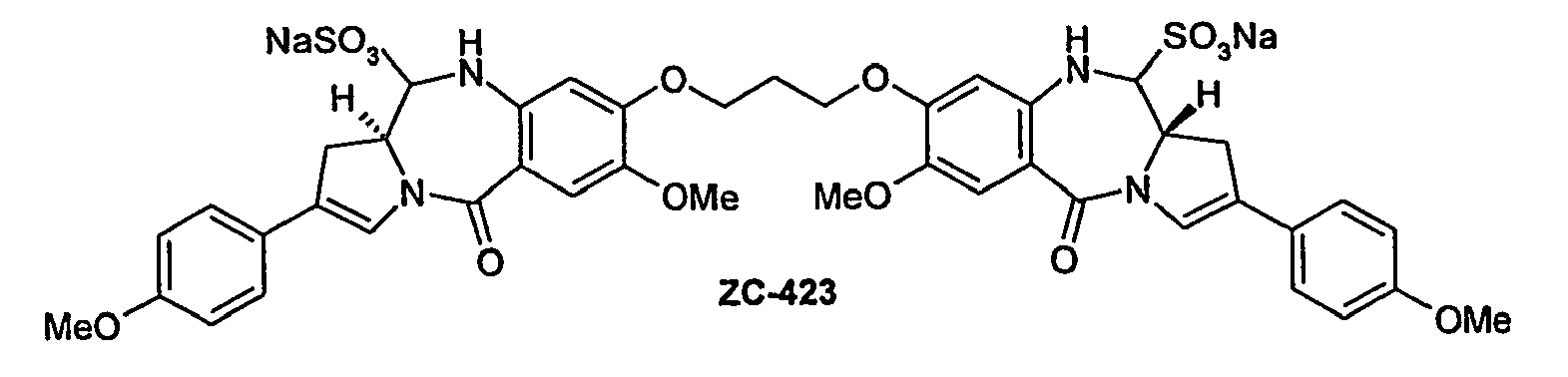
- A solution of sodium bisulphite (6.74 mg, 65 µmol) in water (1.5 mL) was added to a stirred solution of ZC-207 (24.01 mg, 32 µmol) in dichloromethane (1.5 mL). The reaction mixture was allowed to stir vigorously for 2 h, after which time the organic and aqueous layers were separated. TLC analysis (eluent-EtOAc) of the aqueous phase revealed absence of ZC-207 and presence of baseline material with strong uv absorption. The aqueous layer was lyophilised to provide the bisulphite adduct ZC-423 as a white solid (17 mg, 55%): 1H NMR (400 MHz, d6-DMSO) δ 7.42 (s, 2H, H-3), 7.38 (d, 4H, J = 8.72 Hz, 2'-H), 7.05 (s, 2H, H-6), 6.92 (d, 4H, J = 8.92 Hz, 3'-H), 6.52 (s, 2H, H-9), 5.27 (s, 2H, NH), 4.35-4.25 (m, 2H, H11a), 4.15-4.05 (m, 4H, OCH2CH2CH2O), 3.95 (d, 2H, J = 10.4 Hz, H11), 3.77 (s, 6H, OMe), 3.72 (s, 6H, OMe), 3.55-3.45 (m, 2H, H1), 3.30-3.15 (m, 2H, H1), 2.25-2.15 (m, 2H, OCH2CH2CH2O).
-

- A solution of TEA (0.15 mL, 1.05 mmol, 6.0 eq) in H2O (1 mL) and EtOH (10 mL) was added to a solution of 13 (251 mg, 0.17 mmol) in toluene (6 mL) at room temperature. To this mixture 2-naphthaleneboronic acid (77.9 mg, 0.45 mmol, 2.6 eq) and Pd(PPh3)4 (8.0 mg, 7 µmol, 0.04 eq) were added. The reaction mixture was heated at 100°C under microwave irradiation for 20 minutes when TLC (80:20 v/v EtOAc/hexane) revealed complete consumption of the starting material. Excess solvent was removed and the residue was dissolved in EtOAc (20 mL), washed with H2O (15 mL), brine (15 mL) and dried (MgSO4). Filtration and evaporation of solvent afforded the crude product which was purified by flash column chromatography (80:20 v/v hexane/EtOAc then gradient to 50:50 v/v hexane/EtOAc) to afford 17 as a yellow glass (191 mg, 81%): 1H NMR (400 MHz, CDCl3) δ 7.32-7.29 (m, 6H, Harom ), 7.61-7.58 (m, 6H, Harom ), 7.52-7.42 (m, 4H, H3 and Harom ), 7.30 (s, 2H, H6), 6.81 (s, 2H, H9), 5.98 (d, 2H, J = 8.8 Hz, H11), 5.24 (d, 2H, J = 12.0 Hz, Troc CH 2), 4.35-4.30 (m, 2H, OCH 2CH2CH 2O), 4.20-4.13 (m, 4H, Troc CH 2 and OCH 2CH2CH 2O), 4.08-4.00 (m, 2H, H11a), 3.97 (s, 6H, OCH 3 x 2), 3.50 (dd, 2H, J= 10.8, 16.6 Hz, H1), 2.98 (d, 2H, J = 16.5 Hz, H1), 2.50-2.48 (m, 2H, OCH2CH 2CH2O), 0.94 (s, 18H, TBS CH3 x 6), 0.30 and 0.28 (s x 2, 12H, TBS CH3 x 4).
-

- 10% Cd/Pb couple (455 mg, 3.71 mmol, 26 eq) was added to a rapidly stirring mixture of 17 (190 mg, 0.14 mmol), THF (3.2 mL) and 1 N NH4OAc (3.2 mL). The reaction mixture was allowed to stir for 6.5 hours when TLC showed the incomplete consumption of the starting material and formation of side products. The solids were filtered and rinsed with H2O and MeOH. Excess solvent was removed and the residue was diluted with H2O (25 mL) and DCM (25 mL). The aqueous layer was extracted with DCM (3 x 25 mL) and the organic extracts were combined, washed with brine (50 mL) and dried (MgSO4). Filtration and evaporation of solvent afforded the crude product which was purified by flash column chromatography (99:1 v/v CHCl3/MeOH then gradient to 98:2 v/v CHCl3/MeOH) to afford 18 as a yellow glass (38 mg, 36%): 1H NMR (400 MHz, CDCl3) δ 7.85 (d, 2H, J = 3.9 Hz, H11), 7.77-7.65 (m, 6H, Harm ), 7.59-7.50 (m, 6H, H3 and Harm ), 7.47 (s, 2H, H6), 7.44-7.33 (m, 4H, Harom ), 6.82 (s, 2H, H9), 4.42-4.32 (m, 2H, H11a), 4.31-4.14 (m, 4H, OCH 2CH2CH 2O), 3.89 (s, 6H, OCH 3 x 2), 3.69-3.56 (m, 2H, H1), 3.50-3.37 (m, 2H, H1), 2.45-2.29 (m, 2H, OCH2CH2CH2O).
-

- A solution of sodium bisulphite (6.67 mg, 0.064 mmol, 2.0 equiv.) in H2O (1.5 mL) was added to a solution of compound 18 (25 mg, 0.032 mmol) in dry DCM (1.5 mL). The reaction mixture was allowed to stir for 5 hours. The reaction mixture was diluted with DCM (5 mL) and H2O (5 mL). The aqueous layer was separated (without shaking the separating funnel) and dried under the freeze dryer to afford 19 as a lightweight white solid (7 mg, 22 %): 1H NMR (400 MHz, DMSO) δ 7.78-7.72 (m, 8H, Harm ), 7.68 (s, 2H, H3), 7.59-7.27 (m, 6H, Harom ), 6.92 (s, 2H, H6), 6.41 (s, 2H, H9), 5.21 (d, 2H, J = 5.2 Hz, NH ), 4.38-4.31 (m, 2H, H11a), 4.12-3.96 (m, 4H, OCH 2CH2CH 2O), 3.87 (d, 2H, J = 10.4 Hz, H11), 3.70 (s, 3H, OCH3), 3.61 (s, 3H, OCH3 ), 3.40-3.12 (m, 4H, H1), 2.28-2.22 (m, 2H, OCH2CH 2CH2O).
-

- A solution of TEA (0.11 mL, 0.82 mmol, 6.0 eq) in H2O (0.8 mL) and EtOH (5 mL) was added to a solution of 13 (197 mg, 0.14 mmol) in toluene (5 mL). To this mixture thiophene-2-boronic acid (45.5 mg, 0.36 mmol, 2.6 eq) and Pd(PPh3)4 (6.3 mg, 5 µmol, 0.04 eq) were added. The reaction mixture was allowed to stir at room temperature for 3 hours when TLC (80:20 v/v EtOAc/hexane) revealed complete consumption of the starting material. Excess solvent was removed and the residue was dissolved in EtOAc (20 mL), washed with H2O (15 mL), brine (15 mL) and dried (MgSO4) Filtration and evaporation of solvent afforded the crude product which was purified by flash column chromatography (80:20 v/v hexane/EtOAc) to afford 20 as a yellow glass (168 mg, 94%): 1H NMR (400 MHz, CDCl3) δ 7.32 (s, 2H, H3), 7.26 (s, 2H, H6), 7.24-7.19 (m, 2H, Harom ), 7.04-6.79 (m, 2H, Harom ), 6.94-6.88 (m, 2H, Harom ), 6.78 (s, 2H, H9), 5.92 (d, 2H, J = 8.9 Hz, H11), 5.24 (d, 2H, J = 12.0 Hz, Troc CH 2 ), 4.36-4.25 (m, 2H, OCH2CH2CH2O), 4.19-4.08 (m, 4H, Troc CH2 and OCH 2CH2CH 2O), 4.02-3.87 (m, 8H, H11a and OCH3 x 2), 3.37 (dd, 2H, J = 10.8, 16.6 Hz, H1), 2.85 (d, 2H, J = 16.5 Hz, H1), 2.52-2.37 (m, 2H, OCH2CH2CH2O), 0.91 (s, 18H, TBS CH 3 x 6), 0.28 and 0.25 (s x 2, 12H, TBS CH 3 x 4).
-

-

- A solution of sodium bisulphite (16.5 mg, 0.159 mmol, 2.0 equiv.) in H2O (3.5 mL) was added to a solution of compound 21 (55.0 mg, 0.079 mmol) in DCM (3.5 mL). The reaction mixture was allowed to stir for 4 hours. TLC (EtOAc) revealed complete consumption of the starting material and a product spot at the base line. The reaction mixture was diluted with DCM and H2O. The aqueous layer was separated (without shaking the separating funnel) and dried under the freeze dryer to afford 22 as a lightweight yellow solid (53.9 mg, 75 %): 1H NMR (400 MHz, DMSO) δ 7.42 (dd, 2H, J = 1.5, 4.7 Hz, Harom ), 7.33-7.30 (m, 6H, Harom ), 6.53 (s, 2H, H9), 5.30 (d, 2H, J = 3.8 Hz, NH ), 4.35-4.29 (m, 2H, H11a), 4.12-4.06 (m, 4H, OCH 2CH2CH 2O), 3.95 (d, 2H, J=10.3 Hz, H11), 3.72 (s, 6H, OCH3 x 2), 3.53-3.19 (m, 4H, H1), 2.23-2.21 (m, 2H, OCH2CH2CH2O).
-

- A solution of TEA (0.12 mL, 0.84 mmol, 6.0 eq) in H2O (0.8 mL) and EtOH (5 mL) was added to a solution of triflate 13 (202 mg, 0.14 mmol) in toluene (5 mL) at room temperature. To this mixture 6-(4,4,5,5-tetramethyl-1,3,2-dioxaborolan-2-yl) quinoline (93.0 mg, 0.36 mmol, 2.6 eq) and Pd(PPh3)4 (6.5 mg, 6 µmol, 0.04 eq) were added. The reaction mixture was heated at 100°C under microwave irradiation for 15 minutes when TLC (80:20 v/v EtOAc/hexane) revealed complete consumption of the starting material. Excess solvent was removed and the residue was dissolved in EtOAc (20 mL), washed with H2O (15 mL), brine (15 mL) and dried (MgSO4). Filtration and evaporation of solvent afforded the crude product which was purified by flash column chromatography (80:20 v/v hexane/EtOAc then gradient to 50:50 v/v hexane/EtOAc) to afford 23 as a yellow glass (126 mg, 64%): 1H NMR (400 MHz, CDCl3) δ 8.88 (dd, 2H, J = 1.6, 4.2 Hz, Harom ). 8.14 (d, 2H, J = 7.6 Hz, Harom ), 8.07 (d, 2H, J = 9.0 Hz, Harom ), 7.85 (dd, 2H, J = 1.8, 8.9 Hz, Harom ), 7.66 (s, 2H, H3), 7.55 (d, 2H, J = 1.8 Hz, H arom ), 7.41 (dd, 2H, J = 4.3, 8.3 Hz, Harom ), 7.31 (s, 2H, H6), 6.82 (s, 2H, H9), 5.98 (d, 2H, J = 8.8 Hz, H11), 5.25 (d, 2H, J = 12.1 Hz, Troc CH2 ), 4.34-4.31 (m, 2H, OCH2CH2CH2O), 4.21-4.15 (m, 4H, Troc CH 2 and OCH 2CH2CH 2O), 4.09-4.03 (m, 2H, H11a), 3.97 (s, 6H, OCH 3 x 2), 3.48 (ddd, 2H, J = 1.6, 10.4, 16.1 Hz, H1), 2.98 (dd, 2H, J = 2.4, 16.1 Hz, H1), 2.50-2.47 (m, 2H, OCH2CH2CH2O), 0.95 (s, 18H, TBS CH3 x 6), 0.32 and 0.28 (s x 2, 12H, TBS CH 3 x 4).
-

-

- A solution of TEA (0.071 mL, 0.51 mmol, 6.0 eq) in H2O (0.6 mL) and EtOH (3.5 mL) was added to a solution of triflate 13 (122 mg, 0.085 mmol) in toluene (3.5 mL) at room temperature. To this mixture 3-methoxyphenolboronic acid (33.5 mg, 0.22 mmol, 2.6 eq) and Pd(PPh3)4 (3.9 mg, 3.4 µmol, 0.04 eq) were added. The reaction mixture was heated at 100°C under microwave irradiation for 5 minutes when TLC (80:20 v/v EtOAc/hexane) revealed complete consumption of the starting material. Excess solvent was removed and the residue was dissolved in EtOAc (10 mL), washed with H2O (10 mL), brine (10 mL) and dried (MgSO4). Filtration and evaporation of solvent afforded the crude product which was purified by flash column chromatography (80:20 v/v hexane/EtOAc then gradient to 60:40 v/v hexane/EtOAc) to afford 25 as a yellow glass (66 mg, 57%): 1H NMR (400 MHz, CDCl3) δ 7.23 (s, 2H, H3), 7.05-7.00 (m, 4H, H6 and H arom), 6.70 (d, 2H, J = 8.7 Hz, Harom), 6.64 (s, 2H, Harom ), 6.67-6.64 (m, 4H, Harom and H9), 5.67 (d, 2H, J = 8.8 Hz, H11), 4.98 (d, 2H, J = 12.0 Hz, Troc CH 2 ), 4.08-4.02 (m, 2H, OCH 2CH2CH 2O), 3.92-3.84 (m, 4H, Troc CH 2 and OCH 2CH2CH 2O), 3.74-3.66 (m, 8H, H11a and OCH 3 x 2), 3.68 (s, 6H, OCH 3 x 2), 3.10 (dd, 2H, J = 10.8, 16.6 Hz, H1), 2.60 (d, 2H, J = 16.5 Hz, H1), 2.22-2.19 (m, 2H, OCH2CH 2CH2O), 0.68 (s, 18H, TBS CH 3 x 6), 0.02 and 0.00 (s x 2, 12H, TBS CH 3 x 4).
-

-

-

- A solution of TEA (0.066 mL, 0.47 mmol, 6.0 eq) in H2O (0.6 mL) and EtOH (3.5 mL) was added to a solution of triflate 13 (122 mg, 0.085 mmol) in toluene (3.5 mL) at room temperature. To this mixture 3,4-methylenedioxyphenylboronic acid (34.2 mg, 0.21 mmol, 2.6 eq) and Pd(PPh3)4 (3.6 mg, 3.2 µmol, 0.04 eq) were added. The reaction mixture was heated at 100°C under microwave irradiation for 5 minutes when TLC (80:20 v/v EtOAc/hexane) revealed complete consumption of the starting material. Excess solvent was removed and the residue was dissolved in EtOAc (10 mL), washed with H2O (10 mL), brine (10 mL) and dried (MgSO4). Filtration and evaporation of solvent afforded the crude product which was purified by flash column chromatography (80:20 v/v hexane/EtOAc then gradient to 65:35 v/v hexane/EtOAc) to afford 28 as a yellow glass (84 mg, 77%):1H NMR (400 MHz, CDCl3) δ 7.34 (s, 2H, H6), 7.26 (s, 2H, H3), 6.89 (s, 2H, H9), 6.78-6.76 (m, 4H, 0Harom ), 5.98 (s, 2H, OCH 2O), 5.89 (d, 2H, J = 8.8 Hz, H11), 5.23 (d, 2H, J = 12.0 Hz, Troc CH2 ), 4.32-4.27 (m, 2H, OCH 2CH2CH 2O), 4.18-4.09 (m, 4H, Troc CH2 and OCH 2CH2CH 2O), 3.97-3.91 (m, 8H, H11a and OCH 3 x 2), 3.30 (dd, 2H, J = 10.8, 16.6 Hz, H1), 2.76 (d, 2H, J = 16.6 Hz, H1), 2.46-2.44 (m, 2H, OCH2CH 2CH2O), 0.88 (s, 18H, TBS CH 3 x 6), 0.28 and 0.25 (s x 2, 12H, TBS CH 3 x 4).
-

-

s x 2, 2H, H6), 7.06-6.78 (m, 6H, Harm ), 6.51 (s x 2, 2H, H9), 5.27 (s, 2H, NH ), 4.32-4.26 (m, 2H, H11a), 4.17-4.07 (m, 4H, OCH2CH2CH2O), 3.93 (d, 2H, J = 10.4 Hz, H11), 3.72 (s, 6H, OCH3 x 2), 3.50-3.20 (m, 4H, H1), 2.27-2.20 (m, 2H, OCH2CH2CH2O). -

- A solution of TEA (0.072 mL, 0.52 mmol, 6.0 eq) in H2O (0.6 mL) and EtOH (3.5 mL) was added to a solution of triflate 13 (125 mg, 0.086mmol) in toluene (3.5 mL) at room temperature. To this mixture 4-fluorobenzeneboronic acid (31.6 0.22mmol, 2.6 eq) and Pd(PPh3)4 (4.0, 3.4µmol, 0.04 eq) were added. The reaction mixture was heated at 100 °C under microwave irradiation for 5 minutes when TLC (80:20 v/v EtOAc/hexane) revealed complete consumption of the starting material. Excess solvent was removed and the residue was dissolved in EtOAc (10 mL), washed with H2O (10 mL), brine (10 mL) and dried (MgSO4). Filtration and evaporation of solvent afforded the crude product which was purified by flash column chromatography (80:20 v/v hexane/EtOAc then gradient to 65:35 v/v hexane/EtOAc) to afford 31 as a yellow glass (82 mg, 71%): 1H NMR (400 MHz, CDCl3) δ 7.40 (s, 2H, H3), 7.42 (dd, 4H, J = 5.2, 8.7 Hz, Harom ), 7.28 (s, 2H, H6), 7.06 (dd, 4H, J = 8.7 Hz, Harom ). 6.70 (s, 2H, H9), 5.92 (d, 2H, J =8.8 Hz, H11), 5.22 (d, 2H, J = 12.0 Hz, Troc CH2 ), 4.32-4.29 (m, 2H, OCH2CH2CH2O), 4.19-4.10 (m, 4H, Troc CH 2 and OCH2CH2CH2O), 4.00-3.92 (m, 8H, H11a and OCH 3 x 2), 3.33 (dd, 2H, J = 10.8, 16.5 Hz, H1), 2.84 (d, 2H, J = 16.5 Hz, H1), 2.49-2.44 (m, 2H, OCH2CH 2CH2O), 0.92 (s, 18H, TBS CH3 x 6), 0.30 and 0.27 (
s x 2, 12H, TBS CH3 x 4). -

-

- A solution of sodium bisulphite (13.9 mg, 0.134 mmol, 2.0 equiv.) in H2O (3 mL) was added to a solution of compound 32 (48.0 mg, 0.067 mmol) in DCM (3 mL). The reaction mixture was allowed to stir for 2 hours. TLC (EtOAc) revealed complete consumption of the starting material and a product spot at the base line. The reaction mixture was diluted with DCM (8 mL) and H2O (8 mL). The aqueous layer was separated and lyophilized to afford 33 as a lightweight white solid (35.5 mg, 58 %): 1H NMR (400 MHz, DMSO) δ 7.56 (s, 2H, H3), 7.49 (dd, 4H, J = 5.3, 8.6 Hz, Harom ), 7.17 (dd, 4H, J = 8.7 Hz, Harom ), 7.07 (s, 2H, H6), 6.53 (s, 2H, H9), 5.28 (s, 2H, NH ), 4.36-4.30 (m, 2H, H11a), 4.17-4.09 (m, 4H, OCH 2CH2CH 2O), 3.95 (d, 2H, J = 10.4 Hz, H11), 3.73 (s, 6H, OCH 3 x 2), 3.53-3.22 (m, 4H, H1), 2.27-2.19 (m, 2H, OCH2CH 2CH2O).
-

-

- A slurry of 10% Pd-C (550 mg) in EtOAc (20 mL) was added to a solution of the nitro compound 36 (5.5 g, 5.47 mmol) in EtOAc (73 mL). The mixture was subjected to hydrogenation using Parr apparatus at 30 psi for a total of 24 hours. The mixture was degassed and analysed by TLC (EtOAc) where complete consumption of starting material was observed. The catalyst was removed by vacuum filtration through Whatman GF/F filter paper and the filtrate evaporated to provide the aniline 37 as a grey coloured foam (5.17 g, 100%): 1H NMR (400 MHz, CDCl3) δ 6.71 (s, 2H), 6.22 (s, 2H), 5.25-5.23 (m, 2H), 4.58-4.30 (m, 6H), 4.14-4.05 (m, 2H), 3.99 (t, J = 6.6 Hz, 4H), 3.79-3.73 (m, 8H), 3.69-3.54 (m, 4H), 2.40-2.33 (m, 2H), 2.16-2.08 (m, 2H), 2.00 (s, 6H), 1.94-1.87 (m, 4H), 1.68-1.60 (m, 2H), 0.89 (s, 18H), 0.05 and 0.04 (s x 2, 12H); 13C NMR (100 MHz, CDCl3) δ 170.6, 170.0, 151.5, 141.7, 141.2, 113.1, 111.0, 102.0, 73.5, 68.5, 62.6, 57.0, 56.2, 32.9, 28.7, 25.6, 22.6, 21.1, 18.1, -5.1 and -5.4; LC/MS 2.78 min (ES+) m/z (relative intensity) 946 ([M + H]+; 52), 672 (30), 399 (20), 274 (65), 166 (20).
-
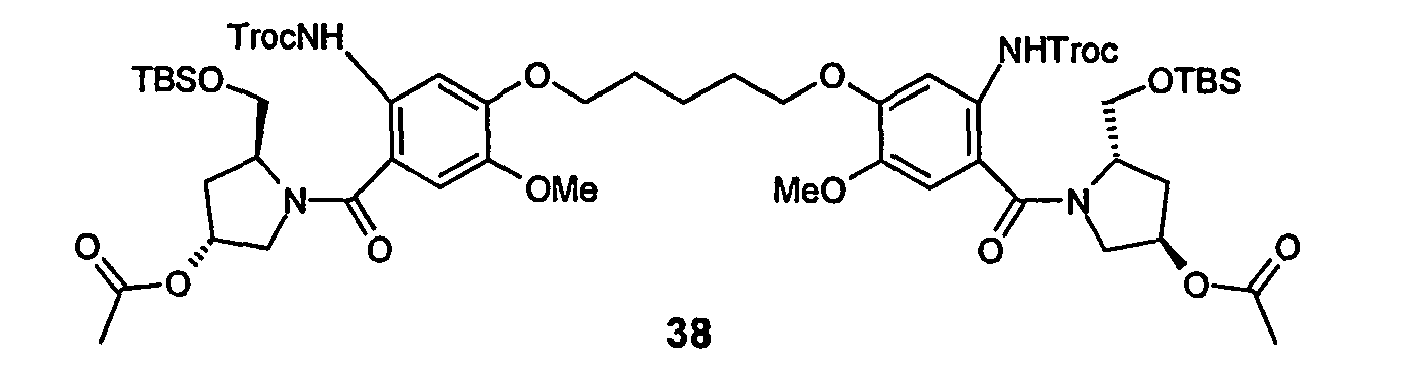
- A solution of 2,2,2-trichloroethyl chloroformate (2.63 mL, 4.05 g, 19.1 mmol) in dry DCM (45 mL) was added dropwise to a stirred solution of amine 37 (8.21 g, 8.70 mmol) and anhydrous pyridine (2.81 mL, 2.75 g, 34.8 mmol) in dry DCM (120 mL) at -10 °C (liquid N2/ethanediol). After 16 hours stirring at room temperature TLC (50:50 v/v Hexane/EtOAc) revealed complete consumption of starting material. The reaction mixture was washed with saturated NH4Cl (2 x 70 mL), saturated CuSO4 (70 mL), H2O (70 mL), brine (70 mL) and dried (MgSO4). Filtration and evaporation of the solvent yielded the Troc-carbamate 38 as a yellow foam (11.25 g, 99%): 1H NMR (400 MHz, CDCl3) δ 9.48 (br s, 1 H), 7.85 (s, 2H), 6.79 (s, 2H), 5.28-5.24 (m, 2H), 4.86-4.76 (m, 4H), 4.70-4.53 (m, 2H), 4.12 (t, J = 6.4 Hz, 4H), 4.14-4.10 (m, 2H), 3.80 (s, 6H), 3.76 (dd, 2H, J = 12.2, 3.8 Hz), 3.69-3.62 (m, 4H), 2.44-2.37 (m, 2H), 2.16 (dd, 2H, J = 14.1, 8.1 Hz), 2.10-1.92 (m, 10H), 1.72-1.65 (m, 2H), 0.90 (s, 18H), 0.06 and 0.04 (s x 2, 12H); 13C NMR (100 MHz, CDCl3) δ 170.5,169.3, 152.0, 151.1, 144.2, 132.4, 114.4, 111.8, 105.2, 95.3, 74.4, 73.4, 68.7. 62.3, 57.3, 57.2, 56.5, 32.6, 28.7, 25.8, 22.6, 21.1, 18.1, -5.4 and -5.5; LC/MS 3.23 min (ES+/ES-) m/z (M+. not observed), 472 (30), 416 (15), 302 (85), 274 (60), 198 (20), 170 (100), 142 (50), 110 (80).
-

-

- TEMPO (234 mg, 1.50 mmol) and BAIB (5.31 g, 16.5 mmol) were added to a stirred solution of bis-alcohol 39 (4.0 g, 3.75 mmol) in DCM (140 mL). The reaction mixture was allowed to stir under a nitrogen atmosphere for 24 hours at which point TLC (95:5 v/v CHCl3/MeOH) revealed conversion of starting material to product. The mixture was diluted with DCM (30 mL), washed with saturated aqueous NaHSO3 (2 x 30 mL), saturated aqueous NaHCO3 (2 x 30 mL), brine (30 mL) and dried (MgSO4). Filtration and evaporation of the solvent afforded the crude product which was purified by flash column chromatography (gradient elution: CHCl3 to 99.5:0.5 v/v CHCl3/MeOH) to provide the cyclised
product 40 as a light coloured yellow glass (1.99 g, 50%): 1H NMR (400 MHz, CDCl3) δ 7.27 (s, 2H), 6.78 (s, 2H), 5.68 (d, 2H, J = 9.7 Hz), 5.41-5.35 (m, 2H), 5.24 (d, 2H, J =12.0 Hz), 4.23 (d, 2H, J = 12.0 Hz), 4.14-3.97 (m, 6H), 3.93 (s, 6H), 3.77-3.69 (m, 4H), 2.46-2.33 (m, 4H), 2.05 (s, 6H), 2.03-1.87 (m, 4H), 1.70-1.62 (m, 2H); 13C NMR (100 MHz, CDCl3) δ 170.4, 167.5, 154.4, 150.6, 149.0, 127.3, 124.5, 113.7, 110.8, 95.0, 87.5, 75.0, 71.4, 68.8, 58.3, 56.2, 51.1, 35.8, 28.5, 22.4, 21.0. -

-

- A solution of K2CO3 (685 mg, 4.96 mmol) in H2O (15 mL) was added to a stirred solution of acetate compound 41 (1.28 g, 0.99 mmol) in MeOH (15 mL). The initial colourless solution eventually turned yellow and the formation of a white precipitate was observed. The reaction mixture was heated at reflux for 5 hours at which point TLC (EtOAc) revealed complete conversion of starting material to product. Excess solvent was removed by rotary evaporation and the mixture was carefully neutralized with 1 N HCl to pH 7. The resulting mixture was extracted with DCM (5 x 20 mL) and the combined organic layers were then washed with brine (50 mL) and dried (MgSO4). Filtration followed by removal of the solvent by evaporation in vacuo afforded the product 42 as a white solid (982 mg, 82%): 1H NMR (400 MHz, CDCl3) δ 7.19 (s, 2H), 6.72 (s, 2H), 5.75 (d, 2H, J = 9.0 Hz), 5.22 (d, 2H, J = 12.0 Hz), 4.58-4.56 (m, 2H), 4.18 (d, 2H, J = 12.0 Hz), 4.11-3.95 (m, 6H), 3.85 (s, 6H), 3.75-3.69 (m, 2H), 3.59 (dd, 2H, J = 12.7, 4.2 Hz), 2.55 (br s, 2H), 2.38-2.25 (m, 2H), 2.14-2.03 (m, 2H), 1.97-1.85 (m, 4H), 1.74-1.62 (m, 2H), 0.86 (s, 18H,), 0.22 and 0.21 (s x 2, 12H); 13C NMR (100 MHz, CDCl3) δ 168.5,153.6,150.6, 149.1, 127.9,125.3,114.0, 110.8, 95.3, 88.3, 74.7, 69.5, 68.8, 60.8, 56.0, 54.0, 38.8, 28.8, 25.6, 22.7, 17.8, -4.2 and -5.2.
-

- After stirring at -55°C for 15 minutes, a slurry of the substrate 42 (962 mg, 0.80 mmol) in dry DCM (8 mL) was added dropwise over a period of 10 minutes to the reaction mixture. After stirring for a further 1h at -55 °C, a solution of TEA (1.56 mL, 1.13 g; 11.2 mmol) in dry DCM (4 mL) was added dropwise over a period of 5 minutes to the reaction mixture. The reaction mixture was allowed to warm to 0°C and then diluted with DCM (50 mL). The organic solution was washed with cold 1 N HCl (20 mL), H2O (20 mL), brine (30 mL) and dried (MgSO4) Filtration and evaporation of the solvent in vacuo afforded the crude product which was purified by flash column chromatography (50:50 v/v Hexane/EtOAc) to afford bis-ketone 43 as a foam (550 mg, 57%): 1H NMR (400 MHz, CDCl3) δ 7.25 (s, 2H), 6.76 (s, 2H), 5.82 (d, 2H, J = 9.3 Hz), 5.22 (d, 2H, J = 12.0 Hz), 4.32 (d, 2H, J = 20.4 Hz), 4.22 (d, 2H, J = 12.0 Hz), 4.17-4.08 (m, 4H), 4.03-3.89 (m, 10H), 2.96 (dd, 2H, J = 19.6, 10.2 Hz), 2.56 (dd, 2H, J = 19.6, 2.8 Hz), 1.99-1.92 (m, 4H), 1.72-1.64 (m, 2H), 0.86 (s, 18H), 0.24 and 0.23 (s x 2, 12H); 13C NMR (100 MHz, CDCl3) δ 207.7, 168.0, 153.8, 151.0, 149.5, 127.9, 124.4, 114.1, 110.8, 95.2, 87.5, 74.8, 68.8, 58.9, 56.2, 52.9, 40.4, 28.7. 25.6, 22.8 17.8, -4.12 and -5.31.
-

-

-

-

- K562 human chronic myeloid leukaemia cells were maintained in RPM1 1640 medium supplemented with 10% fetal calf serum and 2 mM glutamine at 37°C in a humidified atmosphere containing 5% CO2 and were incubated with a specified dose of drug for 1 hour at 37°C in the dark. The incubation was terminated by centrifugation (5 min, 300 g) and the cells were washed once with drug-free medium. Following the appropriate drug treatment, the cells were transferred to 96-well microtiter plates (104 cells per well, 8 wells per sample). Plates were then kept in the dark at 37°C in a humidified atmosphere containing 5% CO2. The assay is based on the ability of viable cells to reduce a yellow soluble tetrazolium salt, 3-(4,5-dimethylthiazol-2-yl)-2,5-diphenyl-2H-tetrazolium bromide (MTT, Aldrich-Sigma), to an insoluble purple formazan precipitate. Following incubation of the plates for 4 days (to allow control cells to increase in number by approximately 10 fold), 20 µL of MTT solution (5 mg/mL in phosphate-buffered saline) was added to each well and the plates further incubated for 5 h. The plates were then centrifuged for 5 min at 300 g and the bulk of the medium pipetted from the cell pellet leaving 10-20 µL per well. DMSO (200 µL) was added to each well and the samples agitated to ensure complete mixing. The optical density was then read at a wavelength of 550 nm on a Titertek Multiscan ELISA plate reader, and a dose-response curve was constructed. For each curve, an IC50 value was read as the dose required to reduce the final optical density to 50% of the control value.
- In a modification of the above method, 5x10⁴ K562 cells (as above) were maintained in RPMI 1640 medium (Sigma) supplemented with 10% foetal calf serum (Sigma) and 20mM L-glutamine (Sigma) and 190 µL of this solution incubated with specific doses of the drug (10µL) for 96 hours at 37°C in 5% CO2. 250µg/ml (final) MTT was added to each well and the plates incubated for a further 4 hours. Absorbance was read at 450nm using an Envision plate reader (Applied Biosystems). Data was then analysed by Graphpad PRISM, and an IC50 obtained (defined as the compound concentration needed to reduce the cell population by half).
-
Compound IC50 (µM) ZC-207 0.0053a ZC-423 0.0015b a 1 hour incubation
b 96 hour incubation - The compounds to be tested were dissolved in 100% Biotech grade DMSO (Sigma) and subsequently diluted to stock concentrations of either 2 µM or 200 nM in 2% DMSO. 100 µl of the stock concentrations were serially diluted 1 in 3 in 2% DMSO in intermediate polystyrene 96 well cell culture plates (Nunc). 2% DMSO was placed in the outer columns for use as blanks, and in the 2nd or 11th column (depending on whether the top or bottom of an assay plate was to be used) for use as a control. The entire row of the intermediate plate was then transferred in triplicate to either rows B to D or E to G of a fluorescence compatible polystyrene 96 well cell culture plate (Greiner BioOne); 10µl to each well. A cell solution containing 5 x 10⁴ cells/ml was made up in phenol red free RPMI 1640 (Sigma) supplemented with 10% foetal calf serum (Sigma) and 20mM L-glutamine (Sigma). 190 µl cell solution was added to each well of the assay plate, from
columns 2 to 11. 190 µl culture media was added tocolumns 1 and 12. Plates were incubated for 96 hours at 37°C in 5% CO2. 1µM (final) rezasurin (converted to fluorescent resofurin by viable cells) was added to each well and the plates incubated for a further 4 hours. Fluorescence was read at 530-570nm excitation, 580-620nm emission using an Envision plate reader (Applied Biosystems). Data was then analysed by Graphpad PRISM, and an IC50 obtained (defined as the compound concentration needed to reduce the cell population by half). -
Compound IC50 (nM) 19 <1 22 <1 26 <1 27 <1 29 <1 30 <1 32 <1 33 <1 - A cell solution containing 5x10⁴ cells/ml of either LOXIMVI human melanoma cells or OVCAR-5 human ovarian tumour cells was made up in phenol red free RPMI 1640 (Sigma) supplemented with 10% foetal calf serum (Sigma) and 20mM L-glutamine (Sigma). 190 µl cell solution was added to each well of a fluorescence compatible polystyrene 96 well cell culture plate (Greiner BioOne), from
columns 2 to 11. 190 µl culture media was added tocolumns 1 and 12. Plates were incubated overnight at 37°C in 5% CO2. Compounds were dissolved in 100% Biotech grade DMSO (Sigma) and subsequently diluted to stock concentrations in 2% DMSO. 100 µl of the stock concentrations were serially diluted 1 in 3 in 2% DMSO in intermediate polystyrene 96 well cell culture plates (Nunc). 2% DMSO was placed in the outer columns for use as blanks, and in the 2nd or 11th column (depending on whether the top or bottom of an assay plate was to be used) for use as a control. The entire row of the intermediate plate was then transferred in triplicate, 10µl per well, to either rows B to D or E to G of the cell plate. Plates were incubated for 96 hours at 37°C in 5% CO2 1µM (final) rezasurin (converted to fluorescent resofurin by viable cells) was added to each well and the plates incubated for a further 4 hours. Fluorescence was read at 530-570nm excitation, 580-620nm emission using an Envision plate reader (Applied Biosystems). Data was then analysed by Graphpad PRISM, and an IC50 obtained (defined as the compound concentration needed to reduce the cell population by half). -
Cell line ZC-423 IC50 (nM) LOXIMVI 4.83 OVCAR-5 5.2 - The following experiments was carried out under a project licence approved by the Home Office, London, UK, and UK CCCR guidelines (Workman, P., et al., British Journal of Cancer, 77, 1-10 (1998)) were followed throughout.
- LOX IMVI (human melanomas) were grown subcutaneously in nude mice (B&K Universal, Hull, UK). Tumours were transplanted as single tumour fragments in the flank by trocar. Groups of 8 tumour-bearing mice were treated with ZC423 at the previously established single intravenous (iv) maximum tolerated dose (MTD) of 3mgkg-1 using 5% DMA/saline as the vehicle. Control mice (n=8) were treated with vehicle alone.
- Treatment commenced when tumours could be reliably measured by calipers (mean dimensions 4 x 4mm) and therapeutic effects were assessed by daily caliper measurements of the tumour and mouse weights. Tumour volumes were determined by the formula a2 x b/2 where a is the smaller and b is the larger diameter of the tumour. The results are shown in
Fig. 1 as a graphs of relative tumour volume against time (■ ZC423; ◆ Control - solvent alone). The activity of ZC423 was shown to be statistically significant when assessed by Mann-Whitney analysis (as described, for example, in Essential Statistics 2nd Edition (1989), D.G.Rees, on). -
Fig. 2 shows the results of the same test (● ZC423; ◆ Control - solvent alone) but extended over a longer period, and with a larger scale for the Mean RTV. The control group was ceased at 16 days, at which point there were no tumour free mice, compared to the treated group where all animals were tumour free at 68 days. - A study was carried out using OVCAR-5 (human ovarian tumours) under the same conditions as described above. The results are shown in
Fig. 3 (● ZC423; ◆ Control - solvent alone). In this study the control group was ceased at 32 days. - Closed-circular puc18 DNA was linearized with HindIII, then dephosphorylated, and finally 5' end labeled with [γ32P]-ATP using polynucleotide kinase. Reactions containing 10 ng of DNA and drug were carried out in aqueous 1 x TEOA (25 mM triethanolamine, 1 mM EDTA, pH 7.2) buffer at a final volume of 50 µL at 37°C. Reactions were terminated by addition of an equal volume of stop solution (0.6 M NaOAc, 20 mM EDTA, 100 µg/mL tRNA) followed by precipitation with ethanol. Following centrifugation of the samples, the supernatants were discarded and the pellets were dried by lyophilization. Samples were resuspended in 10 µL of alkaline denaturing buffer (4mg bromophenol blue, 600 mg sucrose and 40 mg NaOH) and vortexed for three minutes at room temperature. The non-denatured controls were re-suspended in 10 µL of standard sucrose loading dye (2.5 mg bromophenol blue, 2.5 mg xylene cyanol blue and 4 g sucrose). Both samples and controls were loaded directly onto an agarose gel.
- Electrophoresis was performed on a 0.8% submerged horizontal agarose gel, 20 cm in length for 16 hours at 38-40 V in 1 x TAE running buffer (2.42 g Tris Base, 0.372 g EDTA, 0.571ml glacial acetic acid). Gels were dried under vacuum for 80 minutes at 80°C on a Savant SG210D SpeedGel gel dryer onto one layer of Whatman 3MM with a layer of DE81 filter paper underneath. An autoradiograph was obtained, after overnight exposure onto FujiRX x-ray film. The film bands were quantitated using a BioRad GS-670 imaging laser densitometer. The percentage of cross-linking was calculated by measuring the total DNA in each lane (the sum of the densities for the double-stranded and single-stranded bands) relative to the amount of density of double-stranded band alone. A dose response curve was derived by plotting drug concentration against the determined percentage level of cross-linked DNA, from which was derived the amount required to cross-link 50% of the DNA (XL50).
- Solubility was determined by dissolving the test compound in the minimum amount of water to produce a saturated solution.
-
Compound IC50 (µM) 18 0.2 19 2 21 0.5 22 0.3 -
Compound Amount of compound (g) in 1L water ZC-207 Insoluble ZC-423 11 27 9 30 4 33 3
Claims (17)
- A compound of the formula I:
 R2 is an optionally substituted C5-20 aryl group;R6 and R9 are independently selected from H, R, OH, OR, SH, SR, NH2, NHR, NRR', nitro, Me3Sn and halo;where R and R' are independently selected from optionally substituted C1-12 alkyl, C3-20 heterocyclyl and C5-20 aryl groups;
R7 is selected from H, R, OH, OR, SH, SR, NH2, NHR, NHRR', nitro, Me3Sn and halo;
R" is a C3-12 alkylene group, which chain may be interrupted by one or more heteroatoms and/or aromatic rings;
X is selected from O, S, or NH;
z is 2 or 3;
M is a monovalent pharmaceutically acceptable cation;
R2', R6', R7', R9', X' and M' are selected from the same groups as R2, R6, R7, R9, X and M respectively, or M and M' may together represent a divalent pharmaceutically acceptable cation. - A compound according to claim 1, wherein X is O.
- A compound according to either claim 1 or claim 2, wherein R" represents a linear saturated C3-12 alkylene group.
- A compound according to any one of claims 1 to 3, wherein R9 is H.
- A compound according to any one of claims 1 to 4, wherein R6 is H.
- A compound according to any one of claims 1 to 5, wherein R7 is selected from H, OH and OR, where R is selected from optionally substituted C1-7 alkyl, C3-10 heterocyclyl and C5-10 aryl groups.
- A compound according to claim 6, wherein R7 is OMe or OCH2Ph.
- A compound according to any one of claims 1 to 7, wherein R2 is an optionally substituted C5-7, aryl group.
- A compound according to claim 8, wherein R2 is an optionally substituted phenyl group.
- A compound according to any one of claims 1 to 9, wherein R2 = R2' , R6 = R6', R7= R7', R9 = R9' and X = X'.
- A compound according to any one of claims 1 to 10, wherein M and M' are monovalent pharmaceutically acceptable cations.
- A compound according to claim 11, wherein M and M' are Na+.
- A compound according to any one of claims 1 to 12 wherein z is 3.
- A compound according to any one of claims 1 to 13 for use in a method of therapy.
- A pharmaceutical composition comprising a compound according to any one of claims 1 to 13, and a pharmaceutical excipient.
- The use of a compound according to any one of claims 1 to 13 in the manufacture of a medicament for the treatment of a proliferative disease.
- A compound according to any one of claims 1 to 13 for use in treating proliferative diseases.
Priority Applications (3)
| Application Number | Priority Date | Filing Date | Title |
|---|---|---|---|
| SI200630604T SI1879901T1 (en) | 2005-04-21 | 2006-04-21 | Pyrrolobenzodiazepines |
| PL06726846T PL1879901T3 (en) | 2005-04-21 | 2006-04-21 | Pyrrolobenzodiazepines |
| CY20101100248T CY1109911T1 (en) | 2005-04-21 | 2010-03-18 | PYRROLOVENZODIAZEPINES |
Applications Claiming Priority (3)
| Application Number | Priority Date | Filing Date | Title |
|---|---|---|---|
| GB0508084A GB0508084D0 (en) | 2005-04-21 | 2005-04-21 | Pyrrolobenzodiazepines |
| GB0522746A GB0522746D0 (en) | 2005-11-07 | 2005-11-07 | Pyrrolobenzodiazepines |
| PCT/GB2006/001456 WO2006111759A1 (en) | 2005-04-21 | 2006-04-21 | Pyrrolobenzodiazepines |
Publications (2)
| Publication Number | Publication Date |
|---|---|
| EP1879901A1 EP1879901A1 (en) | 2008-01-23 |
| EP1879901B1 true EP1879901B1 (en) | 2009-12-23 |
Family
ID=36589321
Family Applications (1)
| Application Number | Title | Priority Date | Filing Date |
|---|---|---|---|
| EP06726846A Expired - Lifetime EP1879901B1 (en) | 2005-04-21 | 2006-04-21 | Pyrrolobenzodiazepines |
Country Status (19)
| Country | Link |
|---|---|
| US (2) | US7612062B2 (en) |
| EP (1) | EP1879901B1 (en) |
| JP (1) | JP5061096B2 (en) |
| KR (1) | KR101396095B1 (en) |
| AT (1) | ATE452898T1 (en) |
| AU (1) | AU2006238686B2 (en) |
| BR (1) | BRPI0610284A8 (en) |
| CA (1) | CA2604805C (en) |
| CY (1) | CY1109911T1 (en) |
| DE (1) | DE602006011300D1 (en) |
| DK (1) | DK1879901T3 (en) |
| ES (1) | ES2338696T3 (en) |
| GB (1) | GB2439881C (en) |
| MX (1) | MX2007013039A (en) |
| NZ (1) | NZ563136A (en) |
| PL (1) | PL1879901T3 (en) |
| PT (1) | PT1879901E (en) |
| SI (1) | SI1879901T1 (en) |
| WO (1) | WO2006111759A1 (en) |
Families Citing this family (119)
| Publication number | Priority date | Publication date | Assignee | Title |
|---|---|---|---|---|
| JPS5079103U (en) * | 1973-11-24 | 1975-07-09 | ||
| GB9818730D0 (en) * | 1998-08-27 | 1998-10-21 | Univ Portsmouth | Collections of compounds |
| GB0404574D0 (en) * | 2004-03-01 | 2004-04-07 | Spirogen Ltd | Amino acids |
| GB0404577D0 (en) * | 2004-03-01 | 2004-04-07 | Spirogen Ltd | Pyrrolobenzodiazepines |
| CA2558195C (en) * | 2004-03-01 | 2012-11-06 | Spirogen Limited | 11-hydroxy-5h-pyrrolo[2,1-c][1,4]benzodiazepin-5-one derivatives as key intermediates for the preparation of c2 substituted pyrrolobenzodiazepines |
| EP1723152B1 (en) * | 2004-03-09 | 2015-02-11 | Spirogen Sàrl | Pyrrolobenzodiazepines |
| GB0410725D0 (en) * | 2004-05-13 | 2004-06-16 | Spirogen Ltd | Pyrrolobenzodiazepine therapeutic agents |
| EP1879901B1 (en) * | 2005-04-21 | 2009-12-23 | Spirogen Limited | Pyrrolobenzodiazepines |
| ATE427949T1 (en) | 2005-10-05 | 2009-04-15 | Spirogen Ltd | 4-A4-(5-OXO-2,3,5,11A-TETRAHYDRO-5H-PYRROLO A2, 1-CUA1,4UBENZODIAZEPINE-8-YLOXY)-BUTYRYLAMINOU-1 - PYRROLE-2-CARBONATE ALKYL ESTER DERIVATIVES AND RELATED COMPOUND FOR THE TREATMENT OF A PROLIFERATIVE DISEASE |
| KR100952137B1 (en) * | 2008-04-18 | 2010-04-09 | 실리콘 디스플레이 (주) | Stereoscopic image display device and manufacturing method thereof |
| US8633477B2 (en) | 2008-07-17 | 2014-01-21 | Pavoninekorea Inc. | Organic light-emitting diode three-dimensional image display device |
| GB0813432D0 (en) * | 2008-07-22 | 2008-08-27 | Spirogen Ltd | Pyrrolobenzodiazepines |
| GB0819095D0 (en) | 2008-10-17 | 2008-11-26 | Spirogen Ltd | Pyrrolobenzodiazepines |
| GB0819097D0 (en) * | 2008-10-17 | 2008-11-26 | Spirogen Ltd | Pyrrolobenzodiazepines |
| GB201006340D0 (en) | 2010-04-15 | 2010-06-02 | Spirogen Ltd | Synthesis method and intermediates |
| ES2623057T3 (en) * | 2010-04-15 | 2017-07-10 | Medimmune Limited | Pyrrolobenzodiazepines used to treat proliferative diseases |
| JP5870400B2 (en) | 2010-04-15 | 2016-03-01 | シアトル ジェネティクス,インコーポレーテッド | Targeted pyrrolobenzodiazepine conjugates |
| WO2011130598A1 (en) | 2010-04-15 | 2011-10-20 | Spirogen Limited | Pyrrolobenzodiazepines and conjugates thereof |
| EP3763740A1 (en) | 2011-01-26 | 2021-01-13 | Celldex Therapeutics, Inc. | Anti-kit antibodies and uses thereof |
| US20120308584A1 (en) | 2011-05-08 | 2012-12-06 | Legochem Biosciences, Inc. | Protein-active agent conjugates and method for preparing the same |
| SG11201400770SA (en) | 2011-09-20 | 2014-04-28 | Spirogen Sarl | Pyrrolobenzodiazepines as unsymmetrical dimeric pbd compounds for inclusion in targeted conjugates |
| CN103998449A (en) | 2011-10-14 | 2014-08-20 | 斯皮罗根有限公司 | Pyrrolobenzodiazepines |
| US9526798B2 (en) | 2011-10-14 | 2016-12-27 | Seattle Genetics, Inc. | Pyrrolobenzodiazepines and targeted conjugates |
| SG11201401021TA (en) | 2011-10-14 | 2014-08-28 | Spirogen Sarl | Pyrrolobenzodiazepines |
| US9102704B2 (en) | 2011-10-14 | 2015-08-11 | Spirogen Sarl | Synthesis method and intermediates useful in the preparation of pyrrolobenzodiazepines |
| MX358757B (en) | 2011-10-14 | 2018-09-03 | Seattle Genetics Inc | Pyrrolobenzodiazepines and targeted conjugates. |
| PT2750713E (en) | 2011-10-14 | 2016-01-20 | Genentech Inc | Pyrrolobenzodiazepines and conjugates thereof |
| IN2014MN02092A (en) | 2012-04-30 | 2015-09-04 | Spirogen Sarl | |
| EP2855481A1 (en) | 2012-04-30 | 2015-04-08 | UCL Business PLC | Pyrrolobenzodiazepines |
| CN104812775B (en) | 2012-07-25 | 2019-05-03 | 塞尔德克斯医疗公司 | Anti-KIT antibodies and their uses |
| US9931414B2 (en) | 2012-10-12 | 2018-04-03 | Medimmune Limited | Pyrrolobenzodiazepine-antibody conjugates |
| BR112015008251B1 (en) | 2012-10-12 | 2023-09-26 | Medimmune Limited | PYRROLOBENZODIAZEPINES, CONJUGATES THEREOF, COMPOSITION AND PHARMACEUTICAL COMPOSITION COMPRISING THE CONJUGATES, USE OF THE CONJUGATES FOR THE TREATMENT OF A PROLIFERATIVE DISEASE AND METHOD FOR PREPARING THE CONJUGATES |
| ES2649990T3 (en) | 2012-10-12 | 2018-01-16 | Medimmune Limited | Anti-CD22-pyrrolobenzodiazepine antibody conjugates |
| EP2906296B1 (en) | 2012-10-12 | 2018-03-21 | ADC Therapeutics SA | Pyrrolobenzodiazepine-antibody conjugates |
| WO2014057120A1 (en) | 2012-10-12 | 2014-04-17 | Adc Therapeutics Sàrl | Pyrrolobenzodiazepine-antibody conjugates |
| NZ707486A (en) | 2012-10-12 | 2018-09-28 | Adc Therapeutics Sa | Pyrrolobenzodiazepine - anti-psma antibody conjugates |
| US9745303B2 (en) | 2012-10-12 | 2017-08-29 | Medimmune Limited | Synthesis and intermediates of pyrrolobenzodiazepine derivatives for conjugation |
| ES2738310T3 (en) | 2012-10-12 | 2020-01-21 | Medimmune Ltd | Pyrrolobenzodiazepines and conjugates thereof |
| WO2014057114A1 (en) | 2012-10-12 | 2014-04-17 | Adc Therapeutics Sàrl | Pyrrolobenzodiazepine-anti-psma antibody conjugates |
| AU2012395148B2 (en) | 2012-11-24 | 2016-10-27 | Hangzhou Dac Biotech Co., Ltd. | Hydrophilic linkers and their uses for conjugation of drugs to cell binding molecules |
| HK1216176A1 (en) | 2012-12-21 | 2016-10-21 | Medlmmune Limited | Unsymmetrical pyrrolobenzodiazepines-dimers for use in the treatment of proliferative and autoimmune diseases |
| BR112015014669B1 (en) | 2012-12-21 | 2023-09-26 | Medimmune Limited | PYRROLOBENZODIAZEPINE COMPOUNDS, CONJUGATES COMPRISING THE SAME AND USE THEREOF TO TREAT A PROLIFERATIVE DISEASE |
| AU2014244245C1 (en) | 2013-03-13 | 2018-04-19 | Genentech, Inc. | Pyrrolobenzodiazepines and conjugates thereof |
| CN105142674B (en) | 2013-03-13 | 2018-11-13 | 麦迪穆有限责任公司 | Pyrrolobenzodiazepines and their conjugates |
| CA2905181C (en) | 2013-03-13 | 2020-06-02 | Medimmune Limited | Pyrrolobenzodiazepines and conjugates thereof for providing targeted therapy |
| EP3054985B1 (en) | 2013-10-11 | 2018-12-26 | Medimmune Limited | Pyrrolobenzodiazepine-antibody conjugates |
| EP3054986B1 (en) | 2013-10-11 | 2019-03-20 | Medimmune Limited | Pyrrolobenzodiazepine-antibody conjugates |
| GB201317982D0 (en) | 2013-10-11 | 2013-11-27 | Spirogen Sarl | Pyrrolobenzodiazepines and conjugates thereof |
| GB201317981D0 (en) | 2013-10-11 | 2013-11-27 | Spirogen Sarl | Pyrrolobenzodiazepines and conjugates thereof |
| EP3054983B1 (en) | 2013-10-11 | 2019-03-20 | Medimmune Limited | Pyrrolobenzodiazepine-antibody conjugates |
| FI3122757T3 (en) | 2014-02-28 | 2023-10-10 | Hangzhou Dac Biotech Co Ltd | Charged linkers and their uses for conjugation |
| TW202214691A (en) | 2014-03-21 | 2022-04-16 | 美商艾伯維有限公司 | Anti-egfr antibodies and antibody drug conjugates |
| SG11201608192SA (en) | 2014-04-11 | 2016-10-28 | Medimmune Llc | Bispecific her2 antibodies |
| US10188746B2 (en) | 2014-09-10 | 2019-01-29 | Medimmune Limited | Pyrrolobenzodiazepines and conjugates thereof |
| GB201416112D0 (en) | 2014-09-12 | 2014-10-29 | Medimmune Ltd | Pyrrolobenzodiazepines and conjugates thereof |
| JP2017533887A (en) | 2014-09-17 | 2017-11-16 | ジェネンテック, インコーポレイテッド | Pyrrolobenzodiazepines and their antibody disulfide conjugates |
| US20170304460A1 (en) | 2014-10-01 | 2017-10-26 | Medimmune, Llc | Method of conjugating a polypeptide |
| EP3223854A1 (en) | 2014-11-25 | 2017-10-04 | ADC Therapeutics SA | Pyrrolobenzodiazepine-antibody conjugates |
| MX2017009145A (en) | 2015-01-14 | 2017-11-22 | Bristol Myers Squibb Co | Benzodiazepine dimers, conjugates thereof, and methods of making and using. |
| KR20170102981A (en) | 2015-01-14 | 2017-09-12 | 브리스톨-마이어스 스큅 컴퍼니 | Heteroarylene-crosslinked benzodiazepine dimer, conjugates thereof, and methods of making and using |
| GB201506402D0 (en) | 2015-04-15 | 2015-05-27 | Berkel Patricius H C Van And Howard Philip W | Site-specific antibody-drug conjugates |
| GB201506411D0 (en) | 2015-04-15 | 2015-05-27 | Bergenbio As | Humanized anti-axl antibodies |
| CA2989269C (en) | 2015-06-15 | 2020-09-22 | Robert Yongxin Zhao | Hydrophilic linkers for conjugation of a cytotoxic agent or chromophore molecule to a cell-binding molecule |
| CN108391434A (en) | 2015-06-23 | 2018-08-10 | 百时美施贵宝公司 | Macrocyclic benzodiazepine* dimers, their conjugates, preparation and use |
| EP3319936B1 (en) | 2015-07-12 | 2025-12-17 | Hangzhou Dac Biotech Co., Ltd. | Bridge linkers for conjugation of cell-binding molecules |
| US9839687B2 (en) | 2015-07-15 | 2017-12-12 | Suzhou M-Conj Biotech Co., Ltd. | Acetylenedicarboxyl linkers and their uses in specific conjugation of a cell-binding molecule |
| SMT202000004T1 (en) | 2015-07-21 | 2020-03-13 | Immunogen Inc | Methods of preparing cytotoxic benzodiazepine derivatives |
| GB201601431D0 (en) | 2016-01-26 | 2016-03-09 | Medimmune Ltd | Pyrrolobenzodiazepines |
| US11414477B2 (en) | 2016-01-27 | 2022-08-16 | Medimmune, Llc | Methods for preparing antibodies with a defined glycosylation pattern |
| GB201602356D0 (en) | 2016-02-10 | 2016-03-23 | Medimmune Ltd | Pyrrolobenzodiazepine Conjugates |
| GB201602359D0 (en) | 2016-02-10 | 2016-03-23 | Medimmune Ltd | Pyrrolobenzodiazepine Conjugates |
| KR102775461B1 (en) | 2016-04-01 | 2025-02-28 | 어비디티 바이오사이언시스 인크. | Nucleic acid-polypeptide compositions and uses thereof |
| GB201607478D0 (en) | 2016-04-29 | 2016-06-15 | Medimmune Ltd | Pyrrolobenzodiazepine Conjugates |
| WO2017214458A2 (en) | 2016-06-08 | 2017-12-14 | Abbvie Inc. | Anti-cd98 antibodies and antibody drug conjugates |
| TWI762487B (en) | 2016-06-08 | 2022-05-01 | 美商艾伯維有限公司 | Anti-b7-h3 antibodies and antibody drug conjugates |
| CA3027044A1 (en) | 2016-06-08 | 2017-12-14 | Abbvie Inc. | Anti-b7-h3 antibodies and antibody drug conjugates |
| BR112018075649A2 (en) | 2016-06-08 | 2019-04-09 | Abbvie Inc. | anti-b7-h3 antibodies and antibody drug conjugates |
| EP3468598A1 (en) | 2016-06-08 | 2019-04-17 | AbbVie Inc. | Anti-cd98 antibodies and antibody drug conjugates |
| EP3522932A4 (en) | 2016-10-10 | 2020-06-24 | Cellerant Therapeutics, Inc. | Isoquinolidinobenzodiazepine (iqb)-1(chloromethyl)-2,3-dihydro-1h-benzo[e]indole (cbi) dimers |
| GB201617466D0 (en) | 2016-10-14 | 2016-11-30 | Medimmune Ltd | Pyrrolobenzodiazepine conjugates |
| AU2016429272A1 (en) | 2016-11-14 | 2019-05-02 | Hangzhou Dac Biotech Co., Ltd. | Conjugation linkers, cell binding molecule-drug conjugates containing the likers, methods of making and uses such conjugates with the linkers |
| GB201619490D0 (en) * | 2016-11-17 | 2017-01-04 | Medimmune Ltd | Pyrrolobenzodiazepine conjugates |
| TWI755450B (en) | 2016-11-23 | 2022-02-21 | 美商伊繆諾金公司 | Selective sulfonation of benzodiazepine derivatives |
| GB201702031D0 (en) | 2017-02-08 | 2017-03-22 | Medlmmune Ltd | Pyrrolobenzodiazepine-antibody conjugates |
| US11160872B2 (en) | 2017-02-08 | 2021-11-02 | Adc Therapeutics Sa | Pyrrolobenzodiazepine-antibody conjugates |
| TW201836647A (en) | 2017-04-06 | 2018-10-16 | 美商艾伯維有限公司 | Anti-prlr antibody-drug conjugates (adc) and uses thereof |
| EP3612537B1 (en) | 2017-04-18 | 2022-07-13 | Medimmune Limited | Pyrrolobenzodiazepine conjugates |
| CN110536703B (en) | 2017-04-20 | 2024-07-12 | Adc治疗有限公司 | Combination therapy using anti-AXL antibody-drug conjugates |
| AR111963A1 (en) | 2017-05-26 | 2019-09-04 | Univ California | METHOD AND MOLECULES |
| UA127900C2 (en) | 2017-06-14 | 2024-02-07 | Ейдісі Терапьютікс Са | Dosage regimes for the administration of an anti-cd19 adc |
| EP3658172A4 (en) | 2017-07-25 | 2021-05-05 | TrueBinding, Inc. | CANCER TREATMENT BY BLOCKING THE INTERACTION OF TIM-3 AND ITS LIGAND |
| RS62928B1 (en) | 2017-08-18 | 2022-03-31 | Medimmune Ltd | Pyrrolobenzodiazepine conjugates |
| SG11202001430SA (en) | 2017-09-29 | 2020-04-29 | Daiichi Sankyo Co Ltd | Antibody-pyrrolobenzodiazepine derivative conjugate |
| ES2920123T3 (en) | 2017-11-14 | 2022-08-01 | Medimmune Ltd | Pyrrolobenzodiazepine conjugates |
| GB201803342D0 (en) | 2018-03-01 | 2018-04-18 | Medimmune Ltd | Methods |
| US12060427B2 (en) | 2018-03-28 | 2024-08-13 | Mitsubishi Tanabe Pharma Corporat | Drug conjugates of cMET monoclonal binding agents, and uses thereof |
| GB201806022D0 (en) | 2018-04-12 | 2018-05-30 | Medimmune Ltd | Pyrrolobenzodiazepines and conjugates thereof |
| EP3801630A1 (en) | 2018-05-25 | 2021-04-14 | Medimmune Limited | Pyrrolobenzodiazepine conjugates |
| CN113286617A (en) | 2018-10-19 | 2021-08-20 | 免疫医疗有限公司 | Pyrrolobenzodiazepine conjugates |
| WO2020079239A1 (en) | 2018-10-19 | 2020-04-23 | Medimmune Limited | Pyrrolobenzodiazepine conjugates |
| WO2020102777A1 (en) | 2018-11-16 | 2020-05-22 | Virtuoso Binco, Inc. | Cd38 and icam1 antibodies and uses thereof |
| IL319265A (en) | 2018-12-21 | 2025-04-01 | Avidity Biosciences Inc | Anti-transferrin receptor antibodies and uses thereof |
| CN113711036B (en) | 2019-01-30 | 2025-03-18 | 真和制药有限公司 | Anti-GAL3 antibodies and uses thereof |
| ES2967878T3 (en) | 2019-03-15 | 2024-05-06 | Medimmune Ltd | Azetidobenzodiazepine dimers and conjugates comprising them for use in the treatment of cancer |
| JP7835441B2 (en) | 2019-12-06 | 2026-03-25 | トゥルーバインディング,インコーポレイテッド | Antibodies that interfere with the interaction between GAL3 and insulin receptors or integrins, and methods for using them. |
| WO2021188390A1 (en) | 2020-03-19 | 2021-09-23 | Avidity Biosciences, Inc. | Compositions and methods of treating facioscapulohumeral muscular dystrophy |
| WO2021195469A1 (en) | 2020-03-27 | 2021-09-30 | Avidity Biosciences, Inc. | Compositions and methods of treating muscle dystrophy |
| CN116157151A (en) | 2020-05-26 | 2023-05-23 | 真和制药有限公司 | Methods of treating inflammatory diseases by blocking galectin-3 |
| AR124681A1 (en) | 2021-01-20 | 2023-04-26 | Abbvie Inc | ANTI-EGFR ANTIBODY-DRUG CONJUGATES |
| GB202105187D0 (en) | 2021-04-12 | 2021-05-26 | Medimmune Ltd | Pyrrolobenzodiazepine conjugates |
| GB202105186D0 (en) | 2021-04-12 | 2021-05-26 | Medimmune Ltd | Pyrrolobenzodiazepine conjugates |
| JP2024526764A (en) | 2021-07-13 | 2024-07-19 | トゥルーバインディング,インコーポレイテッド | How to Prevent Protein Aggregation |
| US11807685B2 (en) | 2021-08-05 | 2023-11-07 | The Uab Research Foundation | Anti-CD47 antibody and uses thereof |
| MX2024003266A (en) | 2021-09-16 | 2024-04-03 | Avidity Biosciences Inc | Compositions and methods of treating facioscapulohumeral muscular dystrophy. |
| CN117980327A (en) | 2021-11-03 | 2024-05-03 | 杭州多禧生物科技有限公司 | Specific conjugation of antibodies |
| AU2022388722A1 (en) | 2021-11-09 | 2024-05-23 | Truebinding, Inc. | Methods of treating or inhibiting cardiovascular diseases |
| AU2023298568A1 (en) | 2022-06-30 | 2025-01-09 | Toray Industries, Inc. | Pharmaceutical composition for cancer treatment and/or prevention |
| WO2025096716A1 (en) | 2023-11-01 | 2025-05-08 | Incyte Corporation | Anti-mutant calreticulin (calr) antibody-drug conjugates and uses thereof |
| WO2025186833A1 (en) * | 2024-03-07 | 2025-09-12 | Council Of Scientific And Industrial Research | Dihydrobenzo[b,e]pyrroloazepines hybrids and a process for the preparation thereof |
Family Cites Families (25)
| Publication number | Priority date | Publication date | Assignee | Title |
|---|---|---|---|---|
| JPS5569587A (en) * | 1978-11-17 | 1980-05-26 | Meiji Seika Kaisha Ltd | Novel antibiotic neothramycin derivative and its preparation |
| JPS5615289A (en) * | 1979-07-17 | 1981-02-14 | Green Cross Corp:The | Novel benzodiazepinnbased compound 3 |
| JPS58180487A (en) | 1982-04-16 | 1983-10-21 | Kyowa Hakko Kogyo Co Ltd | Antibiotic dc-81 and its preparation |
| GB9205051D0 (en) | 1992-03-09 | 1992-04-22 | Cancer Res Campaign Tech | Pyrrolobenzodiazepine derivatives,their preparation,and compositions containing them |
| FR2696176B1 (en) * | 1992-09-28 | 1994-11-10 | Synthelabo | Piperidine derivatives, their preparation and their therapeutic application. |
| US6187797B1 (en) | 1996-12-23 | 2001-02-13 | Dupont Pharmaceuticals Company | Phenyl-isoxazoles as factor XA Inhibitors |
| PT1109812E (en) | 1998-08-27 | 2005-09-30 | Spirogen Ltd | PYRROLOBENZODIAZEPINAS |
| GB9818731D0 (en) | 1998-08-27 | 1998-10-21 | Univ Portsmouth | Compounds |
| GB9818730D0 (en) * | 1998-08-27 | 1998-10-21 | Univ Portsmouth | Collections of compounds |
| GB9818732D0 (en) * | 1998-08-27 | 1998-10-21 | Univ Portsmouth | Collection of compounds |
| US6909006B1 (en) * | 1999-08-27 | 2005-06-21 | Spirogen Limited | Cyclopropylindole derivatives |
| US6660856B2 (en) | 2002-03-08 | 2003-12-09 | Kaohsiung Medical University | Synthesis of pyrrolo[2,1-c][1,4]benzodiazepine analogues |
| US20040138269A1 (en) | 2002-10-11 | 2004-07-15 | Sugen, Inc. | Substituted pyrroles as kinase inhibitors |
| GB0226593D0 (en) * | 2002-11-14 | 2002-12-24 | Consultants Ltd | Compounds |
| GB0321295D0 (en) | 2003-09-11 | 2003-10-15 | Spirogen Ltd | Synthesis of protected pyrrolobenzodiazepines |
| ATE516288T1 (en) * | 2003-10-22 | 2011-07-15 | Us Gov Health & Human Serv | PYRROLOBENZODIAZEPINE DERIVATIVES, COMPOSITIONS CONTAINING SAME AND RELATED METHODS |
| GB0416511D0 (en) | 2003-10-22 | 2004-08-25 | Spirogen Ltd | Pyrrolobenzodiazepines |
| GB0404577D0 (en) * | 2004-03-01 | 2004-04-07 | Spirogen Ltd | Pyrrolobenzodiazepines |
| GB0404574D0 (en) * | 2004-03-01 | 2004-04-07 | Spirogen Ltd | Amino acids |
| GB0404578D0 (en) | 2004-03-01 | 2004-04-07 | Spirogen Ltd | Pyrrolobenzodiazepines |
| CA2558195C (en) * | 2004-03-01 | 2012-11-06 | Spirogen Limited | 11-hydroxy-5h-pyrrolo[2,1-c][1,4]benzodiazepin-5-one derivatives as key intermediates for the preparation of c2 substituted pyrrolobenzodiazepines |
| EP1723152B1 (en) * | 2004-03-09 | 2015-02-11 | Spirogen Sàrl | Pyrrolobenzodiazepines |
| GB0410725D0 (en) * | 2004-05-13 | 2004-06-16 | Spirogen Ltd | Pyrrolobenzodiazepine therapeutic agents |
| EP1879901B1 (en) | 2005-04-21 | 2009-12-23 | Spirogen Limited | Pyrrolobenzodiazepines |
| ATE427949T1 (en) * | 2005-10-05 | 2009-04-15 | Spirogen Ltd | 4-A4-(5-OXO-2,3,5,11A-TETRAHYDRO-5H-PYRROLO A2, 1-CUA1,4UBENZODIAZEPINE-8-YLOXY)-BUTYRYLAMINOU-1 - PYRROLE-2-CARBONATE ALKYL ESTER DERIVATIVES AND RELATED COMPOUND FOR THE TREATMENT OF A PROLIFERATIVE DISEASE |
-
2006
- 2006-04-21 EP EP06726846A patent/EP1879901B1/en not_active Expired - Lifetime
- 2006-04-21 ES ES06726846T patent/ES2338696T3/en not_active Expired - Lifetime
- 2006-04-21 DK DK06726846.6T patent/DK1879901T3/en active
- 2006-04-21 NZ NZ563136A patent/NZ563136A/en not_active IP Right Cessation
- 2006-04-21 WO PCT/GB2006/001456 patent/WO2006111759A1/en not_active Ceased
- 2006-04-21 AU AU2006238686A patent/AU2006238686B2/en not_active Ceased
- 2006-04-21 BR BRPI0610284A patent/BRPI0610284A8/en not_active Application Discontinuation
- 2006-04-21 CA CA2604805A patent/CA2604805C/en not_active Expired - Fee Related
- 2006-04-21 DE DE602006011300T patent/DE602006011300D1/en not_active Expired - Lifetime
- 2006-04-21 US US11/911,890 patent/US7612062B2/en not_active Expired - Fee Related
- 2006-04-21 SI SI200630604T patent/SI1879901T1/en unknown
- 2006-04-21 KR KR1020077027047A patent/KR101396095B1/en not_active Expired - Fee Related
- 2006-04-21 GB GB0720721A patent/GB2439881C/en not_active Expired - Fee Related
- 2006-04-21 PT PT06726846T patent/PT1879901E/en unknown
- 2006-04-21 MX MX2007013039A patent/MX2007013039A/en active IP Right Grant
- 2006-04-21 PL PL06726846T patent/PL1879901T3/en unknown
- 2006-04-21 JP JP2008507165A patent/JP5061096B2/en not_active Expired - Fee Related
- 2006-04-21 AT AT06726846T patent/ATE452898T1/en active
-
2009
- 2009-11-02 US US12/610,478 patent/US8633185B2/en not_active Expired - Fee Related
-
2010
- 2010-03-18 CY CY20101100248T patent/CY1109911T1/en unknown
Also Published As
| Publication number | Publication date |
|---|---|
| JP2008536905A (en) | 2008-09-11 |
| US20100113425A1 (en) | 2010-05-06 |
| GB2439881C (en) | 2011-08-10 |
| US20080167293A1 (en) | 2008-07-10 |
| WO2006111759A1 (en) | 2006-10-26 |
| DE602006011300D1 (en) | 2010-02-04 |
| GB2439881B (en) | 2009-04-08 |
| BRPI0610284A2 (en) | 2010-06-08 |
| GB0720721D0 (en) | 2007-12-05 |
| EP1879901A1 (en) | 2008-01-23 |
| US8633185B2 (en) | 2014-01-21 |
| MX2007013039A (en) | 2008-03-13 |
| CA2604805A1 (en) | 2006-10-26 |
| NZ563136A (en) | 2009-11-27 |
| BRPI0610284A8 (en) | 2017-05-09 |
| KR20080004618A (en) | 2008-01-09 |
| PL1879901T3 (en) | 2010-06-30 |
| CA2604805C (en) | 2014-05-27 |
| KR101396095B1 (en) | 2014-05-15 |
| SI1879901T1 (en) | 2010-04-30 |
| AU2006238686A1 (en) | 2006-10-26 |
| US7612062B2 (en) | 2009-11-03 |
| DK1879901T3 (en) | 2010-05-03 |
| PT1879901E (en) | 2010-03-29 |
| GB2439881A (en) | 2008-01-09 |
| JP5061096B2 (en) | 2012-10-31 |
| ES2338696T3 (en) | 2010-05-11 |
| AU2006238686B2 (en) | 2011-10-06 |
| CY1109911T1 (en) | 2014-09-10 |
| ATE452898T1 (en) | 2010-01-15 |
Similar Documents
| Publication | Publication Date | Title |
|---|---|---|
| AU2006238686B2 (en) | Pyrrolobenzodiazepines | |
| EP1720881B1 (en) | 11-hydroxy-5h-pyrrolo[2,1-c][1,4]benzodiazepin-5-one derivatives as key intermediates for the preparation of c2 substituted pyrrolobenzodiazepins | |
| EP2350080B1 (en) | Unsymmetrical pyrrolobenzodiazepine-dimers for treatment of proliferative diseases | |
| EP1723151B1 (en) | Pyrrolobenzodiazepines as key intermediates in the synthesis of dimeric cytotoxic pyrrolobenzodiazepines | |
| CN101171257A (en) | Pyrrolobenzodiazepines compound | |
| HK1154575B (en) | Unsymmetrical pyrrolobenzodiazepine-dimers for treatment of proliferative diseases |
Legal Events
| Date | Code | Title | Description |
|---|---|---|---|
| PUAI | Public reference made under article 153(3) epc to a published international application that has entered the european phase |
Free format text: ORIGINAL CODE: 0009012 |
|
| 17P | Request for examination filed |
Effective date: 20071107 |
|
| AK | Designated contracting states |
Kind code of ref document: A1 Designated state(s): AT BE BG CH CY CZ DE DK EE ES FI FR GB GR HU IE IS IT LI LT LU LV MC NL PL PT RO SE SI SK TR |
|
| DAX | Request for extension of the european patent (deleted) | ||
| GRAP | Despatch of communication of intention to grant a patent |
Free format text: ORIGINAL CODE: EPIDOSNIGR1 |
|
| GRAS | Grant fee paid |
Free format text: ORIGINAL CODE: EPIDOSNIGR3 |
|
| GRAA | (expected) grant |
Free format text: ORIGINAL CODE: 0009210 |
|
| AK | Designated contracting states |
Kind code of ref document: B1 Designated state(s): AT BE BG CH CY CZ DE DK EE ES FI FR GB GR HU IE IS IT LI LT LU LV MC NL PL PT RO SE SI SK TR |
|
| REG | Reference to a national code |
Ref country code: GB Ref legal event code: FG4D |
|
| REG | Reference to a national code |
Ref country code: CH Ref legal event code: EP |
|
| REG | Reference to a national code |
Ref country code: IE Ref legal event code: FG4D |
|
| REF | Corresponds to: |
Ref document number: 602006011300 Country of ref document: DE Date of ref document: 20100204 Kind code of ref document: P |
|
| REG | Reference to a national code |
Ref country code: RO Ref legal event code: EPE |
|
| REG | Reference to a national code |
Ref country code: PT Ref legal event code: SC4A Free format text: AVAILABILITY OF NATIONAL TRANSLATION Effective date: 20100323 |
|
| REG | Reference to a national code |
Ref country code: NL Ref legal event code: T3 |
|
| REG | Reference to a national code |
Ref country code: SE Ref legal event code: TRGR |
|
| REG | Reference to a national code |
Ref country code: GR Ref legal event code: EP Ref document number: 20100400646 Country of ref document: GR |
|
| REG | Reference to a national code |
Ref country code: DK Ref legal event code: T3 |
|
| REG | Reference to a national code |
Ref country code: ES Ref legal event code: FG2A Ref document number: 2338696 Country of ref document: ES Kind code of ref document: T3 |
|
| REG | Reference to a national code |
Ref country code: SK Ref legal event code: T3 Ref document number: E 7045 Country of ref document: SK |
|
| REG | Reference to a national code |
Ref country code: HU Ref legal event code: AG4A Ref document number: E007938 Country of ref document: HU |
|
| PLBE | No opposition filed within time limit |
Free format text: ORIGINAL CODE: 0009261 |
|
| STAA | Information on the status of an ep patent application or granted ep patent |
Free format text: STATUS: NO OPPOSITION FILED WITHIN TIME LIMIT |
|
| 26N | No opposition filed |
Effective date: 20100924 |
|
| REG | Reference to a national code |
Ref country code: CH Ref legal event code: PFUS Owner name: SPIROGEN SARL, CH Free format text: FORMER OWNER: SPIROGEN DEVELOPMENTS SARL, CH Ref country code: CH Ref legal event code: PUE Owner name: SPIROGEN DEVELOPMENTS SARL, CH Free format text: FORMER OWNER: SPIROGEN LIMITED, GB |
|
| REG | Reference to a national code |
Ref country code: PT Ref legal event code: PC4A Owner name: SPIROGEN DEVELOPMENTS SARL, CH Effective date: 20130130 |
|
| REG | Reference to a national code |
Ref country code: PT Ref legal event code: PC4A Owner name: SPIROGEN SARL, CH Effective date: 20130207 |
|
| REG | Reference to a national code |
Ref country code: CH Ref legal event code: PFUS Owner name: SPIROGEN SARL, CH Free format text: FORMER OWNER: SPIROGEN DEVELOPMENTS SARL, CH Ref country code: CH Ref legal event code: PUE Owner name: SPIROGEN DEVELOPMENTS SARL, CH Free format text: FORMER OWNER: SPIROGEN LIMITED, GB |
|
| REG | Reference to a national code |
Ref country code: ES Ref legal event code: PC2A Owner name: SPIROGEN SARL Effective date: 20130226 |
|
| REG | Reference to a national code |
Ref country code: SK Ref legal event code: PC4A Ref document number: E 7045 Country of ref document: SK Owner name: SPIROGEN DEVELOPMENTS SARL, ST-LEGIER-LA CHIE-, CH Free format text: FORMER OWNER: SPIROGEN LIMITED, HAMPSHIRE, GB Effective date: 20120719 Ref country code: SK Ref legal event code: PC4A Ref document number: E 7045 Country of ref document: SK Owner name: SPIROGEN SARL, ST-LEGIER-LA CHIESAZ, CH Free format text: FORMER OWNER: SPIROGEN DEVELOPMENTS SARL, ST-LEGIER-LA CHIE- SAZ, CH Effective date: 20130225 |
|
| REG | Reference to a national code |
Ref country code: GB Ref legal event code: 732E Free format text: REGISTERED BETWEEN 20130314 AND 20130320 |
|
| REG | Reference to a national code |
Ref country code: DE Ref legal event code: R082 Ref document number: 602006011300 Country of ref document: DE Representative=s name: LEINWEBER & ZIMMERMANN, DE Effective date: 20130218 Ref country code: DE Ref legal event code: R081 Ref document number: 602006011300 Country of ref document: DE Owner name: SPIROGEN SARL, CH Free format text: FORMER OWNER: SPIROGEN LTD., ISLE OF WIGHT, GB Effective date: 20130218 Ref country code: DE Ref legal event code: R081 Ref document number: 602006011300 Country of ref document: DE Owner name: SPIROGEN SARL, CH Free format text: FORMER OWNER: SPIROGEN LTD., ISLE OF WIGHT, HAMPSHIRE, GB Effective date: 20130218 Ref country code: DE Ref legal event code: R081 Ref document number: 602006011300 Country of ref document: DE Owner name: MEDIMMUNE LTD., GB Free format text: FORMER OWNER: SPIROGEN LTD., ISLE OF WIGHT, HAMPSHIRE, GB Effective date: 20130218 |
|
| REG | Reference to a national code |
Ref country code: EE Ref legal event code: GB1A Ref document number: E004215 Country of ref document: EE |
|
| REG | Reference to a national code |
Ref country code: GB Ref legal event code: 732E Free format text: REGISTERED BETWEEN 20130321 AND 20130327 |
|
| BECH | Be: change of holder |
Owner name: SPIROGEN S.A.R.L. Effective date: 20130409 |
|
| REG | Reference to a national code |
Ref country code: SI Ref legal event code: SP73 Owner name: SPIROGEN SARL; CH Effective date: 20130328 |
|
| REG | Reference to a national code |
Ref country code: FR Ref legal event code: TP Owner name: SPIROGEN SARL, CH Effective date: 20130402 |
|
| REG | Reference to a national code |
Ref country code: AT Ref legal event code: PC Ref document number: 452898 Country of ref document: AT Kind code of ref document: T Owner name: SPIROGEN SARL, CH Effective date: 20130424 |
|
| REG | Reference to a national code |
Ref country code: NL Ref legal event code: SD Effective date: 20130625 |
|
| REG | Reference to a national code |
Ref country code: HU Ref legal event code: GB9C Owner name: SPIROGEN SARL, CH Free format text: FORMER OWNER(S): SPIROGEN LIMITED, GB Ref country code: HU Ref legal event code: FH1C Free format text: FORMER REPRESENTATIVE(S): DR. FRANKNE MACHYTKA DAISY, GOEDOELLE, KEKES, MESZAROS & SZABO SZABADALMI ES VEDJEGY IRODA, HU Representative=s name: GOEDOELLE, KEKES, MESZAROS & SZABO SZABADALMI , HU |
|
| REG | Reference to a national code |
Ref country code: FR Ref legal event code: PLFP Year of fee payment: 10 |
|
| REG | Reference to a national code |
Ref country code: GB Ref legal event code: 732E Free format text: REGISTERED BETWEEN 20150827 AND 20150902 |
|
| REG | Reference to a national code |
Ref country code: CH Ref legal event code: PUE Owner name: MEDIMMUNE LIMITED, GB Free format text: FORMER OWNER: SPIROGEN SARL, CH |
|
| REG | Reference to a national code |
Ref country code: PT Ref legal event code: PC4A Owner name: MEDIMMUNE LIMITED, GB Effective date: 20151026 |
|
| REG | Reference to a national code |
Ref country code: DE Ref legal event code: R082 Ref document number: 602006011300 Country of ref document: DE Representative=s name: LEINWEBER & ZIMMERMANN, DE Ref country code: DE Ref legal event code: R081 Ref document number: 602006011300 Country of ref document: DE Owner name: MEDIMMUNE LTD., GB Free format text: FORMER OWNER: SPIROGEN SARL, ST-LEGIER-LA CHIESAZ, CH |
|
| REG | Reference to a national code |
Ref country code: ES Ref legal event code: PC2A Owner name: MEDIMMUNE LIMITED Effective date: 20151217 |
|
| REG | Reference to a national code |
Ref country code: SI Ref legal event code: SP73 Owner name: MEDIMMUNE LIMITED; GB Effective date: 20151111 |
|
| REG | Reference to a national code |
Ref country code: SK Ref legal event code: PC4A Ref document number: E 7045 Country of ref document: SK Owner name: MEDIMMUNE LIMITED, CAMBRIDGE, GB Free format text: FORMER OWNER: SPIROGEN SARL, ST-LEGIER-LA CHIESAZ, CH Effective date: 20160112 |
|
| REG | Reference to a national code |
Ref country code: FR Ref legal event code: CA Effective date: 20160114 Ref country code: FR Ref legal event code: TP Owner name: MEDIMMUNE LIMITED, GB Effective date: 20160114 |
|
| REG | Reference to a national code |
Ref country code: HU Ref legal event code: FH1C Free format text: FORMER REPRESENTATIVE(S): GOEDOELLE, KEKES, MESZAROS & SZABO SZABADALMI ES VEDJEGY IRODA, HU Representative=s name: GOEDOELLE, KEKES, MESZAROS & SZABO SZABADALMI , HU Ref country code: HU Ref legal event code: GB9C Owner name: MEDIMMUNE LIMITED, GB Free format text: FORMER OWNER(S): SPIROGEN LIMITED, GB; SPIROGEN SARL, CH |
|
| REG | Reference to a national code |
Ref country code: AT Ref legal event code: PC Ref document number: 452898 Country of ref document: AT Kind code of ref document: T Owner name: MEDIMMUNE LIMITED, GB Effective date: 20160303 |
|
| REG | Reference to a national code |
Ref country code: FR Ref legal event code: PLFP Year of fee payment: 11 |
|
| REG | Reference to a national code |
Ref country code: NL Ref legal event code: PD Owner name: MEDIMMUNE LLIMITED; GB Free format text: DETAILS ASSIGNMENT: VERANDERING VAN EIGENAAR(S), OVERDRACHT; FORMER OWNER NAME: SPIROGEN SARL Effective date: 20160108 |
|
| REG | Reference to a national code |
Ref country code: FR Ref legal event code: PLFP Year of fee payment: 12 |
|
| REG | Reference to a national code |
Ref country code: FR Ref legal event code: PLFP Year of fee payment: 13 |
|
| PGFP | Annual fee paid to national office [announced via postgrant information from national office to epo] |
Ref country code: DK Payment date: 20200428 Year of fee payment: 15 Ref country code: FR Payment date: 20200428 Year of fee payment: 15 Ref country code: NL Payment date: 20200428 Year of fee payment: 15 Ref country code: LU Payment date: 20200428 Year of fee payment: 15 Ref country code: EE Payment date: 20200413 Year of fee payment: 15 Ref country code: TR Payment date: 20200410 Year of fee payment: 15 Ref country code: RO Payment date: 20200409 Year of fee payment: 15 Ref country code: IE Payment date: 20200429 Year of fee payment: 15 Ref country code: DE Payment date: 20200429 Year of fee payment: 15 Ref country code: LT Payment date: 20200416 Year of fee payment: 15 Ref country code: CZ Payment date: 20200414 Year of fee payment: 15 Ref country code: CY Payment date: 20200413 Year of fee payment: 15 Ref country code: CH Payment date: 20200428 Year of fee payment: 15 Ref country code: FI Payment date: 20200428 Year of fee payment: 15 Ref country code: GR Payment date: 20200414 Year of fee payment: 15 Ref country code: ES Payment date: 20200520 Year of fee payment: 15 Ref country code: MC Payment date: 20200416 Year of fee payment: 15 Ref country code: PT Payment date: 20200413 Year of fee payment: 15 |
|
| PGFP | Annual fee paid to national office [announced via postgrant information from national office to epo] |
Ref country code: IS Payment date: 20200422 Year of fee payment: 15 Ref country code: SK Payment date: 20200414 Year of fee payment: 15 Ref country code: SE Payment date: 20200428 Year of fee payment: 15 Ref country code: HU Payment date: 20200623 Year of fee payment: 15 Ref country code: GB Payment date: 20200422 Year of fee payment: 15 Ref country code: IT Payment date: 20200430 Year of fee payment: 15 Ref country code: PL Payment date: 20200414 Year of fee payment: 15 Ref country code: BG Payment date: 20200410 Year of fee payment: 15 Ref country code: SI Payment date: 20200410 Year of fee payment: 15 Ref country code: LV Payment date: 20200414 Year of fee payment: 15 Ref country code: BE Payment date: 20200430 Year of fee payment: 15 |
|
| PGFP | Annual fee paid to national office [announced via postgrant information from national office to epo] |
Ref country code: AT Payment date: 20200428 Year of fee payment: 15 |
|
| REG | Reference to a national code |
Ref country code: DE Ref legal event code: R119 Ref document number: 602006011300 Country of ref document: DE |
|
| REG | Reference to a national code |
Ref country code: FI Ref legal event code: MAE |
|
| REG | Reference to a national code |
Ref country code: EE Ref legal event code: MM4A Ref document number: E004215 Country of ref document: EE Effective date: 20210430 |
|
| REG | Reference to a national code |
Ref country code: DK Ref legal event code: EBP Effective date: 20210430 |
|
| REG | Reference to a national code |
Ref country code: LT Ref legal event code: MM4D Effective date: 20210421 |
|
| PG25 | Lapsed in a contracting state [announced via postgrant information from national office to epo] |
Ref country code: MC Free format text: LAPSE BECAUSE OF NON-PAYMENT OF DUE FEES Effective date: 20210430 |
|
| REG | Reference to a national code |
Ref country code: SE Ref legal event code: EUG |
|
| REG | Reference to a national code |
Ref country code: NL Ref legal event code: MM Effective date: 20210501 |
|
| REG | Reference to a national code |
Ref country code: AT Ref legal event code: MM01 Ref document number: 452898 Country of ref document: AT Kind code of ref document: T Effective date: 20210421 |
|
| REG | Reference to a national code |
Ref country code: SK Ref legal event code: MM4A Ref document number: E 7045 Country of ref document: SK Effective date: 20210421 |
|
| GBPC | Gb: european patent ceased through non-payment of renewal fee |
Effective date: 20210421 |
|
| PG25 | Lapsed in a contracting state [announced via postgrant information from national office to epo] |
Ref country code: LU Free format text: LAPSE BECAUSE OF NON-PAYMENT OF DUE FEES Effective date: 20210421 |
|
| REG | Reference to a national code |
Ref country code: BE Ref legal event code: MM Effective date: 20210430 |
|
| PG25 | Lapsed in a contracting state [announced via postgrant information from national office to epo] |
Ref country code: SK Free format text: LAPSE BECAUSE OF NON-PAYMENT OF DUE FEES Effective date: 20210421 Ref country code: SE Free format text: LAPSE BECAUSE OF NON-PAYMENT OF DUE FEES Effective date: 20210422 Ref country code: HU Free format text: LAPSE BECAUSE OF NON-PAYMENT OF DUE FEES Effective date: 20210422 Ref country code: FR Free format text: LAPSE BECAUSE OF NON-PAYMENT OF DUE FEES Effective date: 20210430 Ref country code: GB Free format text: LAPSE BECAUSE OF NON-PAYMENT OF DUE FEES Effective date: 20210421 Ref country code: CZ Free format text: LAPSE BECAUSE OF NON-PAYMENT OF DUE FEES Effective date: 20210421 Ref country code: DE Free format text: LAPSE BECAUSE OF NON-PAYMENT OF DUE FEES Effective date: 20211103 Ref country code: CY Free format text: LAPSE BECAUSE OF NON-PAYMENT OF DUE FEES Effective date: 20210421 Ref country code: EE Free format text: LAPSE BECAUSE OF NON-PAYMENT OF DUE FEES Effective date: 20210430 Ref country code: AT Free format text: LAPSE BECAUSE OF NON-PAYMENT OF DUE FEES Effective date: 20210421 Ref country code: BG Free format text: LAPSE BECAUSE OF NON-PAYMENT OF DUE FEES Effective date: 20211031 Ref country code: CH Free format text: LAPSE BECAUSE OF NON-PAYMENT OF DUE FEES Effective date: 20210430 Ref country code: LI Free format text: LAPSE BECAUSE OF NON-PAYMENT OF DUE FEES Effective date: 20210430 Ref country code: LT Free format text: LAPSE BECAUSE OF NON-PAYMENT OF DUE FEES Effective date: 20210421 Ref country code: FI Free format text: LAPSE BECAUSE OF NON-PAYMENT OF DUE FEES Effective date: 20210421 Ref country code: PT Free format text: LAPSE BECAUSE OF NON-PAYMENT OF DUE FEES Effective date: 20211021 Ref country code: RO Free format text: LAPSE BECAUSE OF NON-PAYMENT OF DUE FEES Effective date: 20210421 |
|
| PG25 | Lapsed in a contracting state [announced via postgrant information from national office to epo] |
Ref country code: SI Free format text: LAPSE BECAUSE OF NON-PAYMENT OF DUE FEES Effective date: 20210422 Ref country code: LV Free format text: LAPSE BECAUSE OF NON-PAYMENT OF DUE FEES Effective date: 20210421 Ref country code: GR Free format text: LAPSE BECAUSE OF NON-PAYMENT OF DUE FEES Effective date: 20211108 |
|
| REG | Reference to a national code |
Ref country code: SI Ref legal event code: KO00 Effective date: 20220121 |
|
| PG25 | Lapsed in a contracting state [announced via postgrant information from national office to epo] |
Ref country code: NL Free format text: LAPSE BECAUSE OF NON-PAYMENT OF DUE FEES Effective date: 20210501 |
|
| PG25 | Lapsed in a contracting state [announced via postgrant information from national office to epo] |
Ref country code: IE Free format text: LAPSE BECAUSE OF NON-PAYMENT OF DUE FEES Effective date: 20210421 Ref country code: DK Free format text: LAPSE BECAUSE OF NON-PAYMENT OF DUE FEES Effective date: 20210430 |
|
| PG25 | Lapsed in a contracting state [announced via postgrant information from national office to epo] |
Ref country code: TR Free format text: LAPSE BECAUSE OF NON-PAYMENT OF DUE FEES Effective date: 20210421 |
|
| REG | Reference to a national code |
Ref country code: ES Ref legal event code: FD2A Effective date: 20220704 |
|
| PG25 | Lapsed in a contracting state [announced via postgrant information from national office to epo] |
Ref country code: ES Free format text: LAPSE BECAUSE OF NON-PAYMENT OF DUE FEES Effective date: 20210422 Ref country code: BE Free format text: LAPSE BECAUSE OF NON-PAYMENT OF DUE FEES Effective date: 20210430 |
|
| PG25 | Lapsed in a contracting state [announced via postgrant information from national office to epo] |
Ref country code: IT Free format text: LAPSE BECAUSE OF NON-PAYMENT OF DUE FEES Effective date: 20200421 |
|
| PG25 | Lapsed in a contracting state [announced via postgrant information from national office to epo] |
Ref country code: IT Free format text: LAPSE BECAUSE OF NON-PAYMENT OF DUE FEES Effective date: 20210421 |
|
| PG25 | Lapsed in a contracting state [announced via postgrant information from national office to epo] |
Ref country code: IS Free format text: LAPSE BECAUSE OF NON-PAYMENT OF DUE FEES Effective date: 20211103 |