EP1879303A1 - Wireless communication control system, radio base station and wireless communication control method - Google Patents
Wireless communication control system, radio base station and wireless communication control method Download PDFInfo
- Publication number
- EP1879303A1 EP1879303A1 EP06731686A EP06731686A EP1879303A1 EP 1879303 A1 EP1879303 A1 EP 1879303A1 EP 06731686 A EP06731686 A EP 06731686A EP 06731686 A EP06731686 A EP 06731686A EP 1879303 A1 EP1879303 A1 EP 1879303A1
- Authority
- EP
- European Patent Office
- Prior art keywords
- transmission power
- limit value
- lower limit
- control channel
- scch
- Prior art date
- Legal status (The legal status is an assumption and is not a legal conclusion. Google has not performed a legal analysis and makes no representation as to the accuracy of the status listed.)
- Withdrawn
Links
Images


Classifications
-
- H—ELECTRICITY
- H04—ELECTRIC COMMUNICATION TECHNIQUE
- H04W—WIRELESS COMMUNICATION NETWORKS
- H04W52/00—Power management, e.g. Transmission Power Control [TPC] or power classes
- H04W52/04—Transmission power control [TPC]
- H04W52/30—Transmission power control [TPC] using constraints in the total amount of available transmission power
- H04W52/32—TPC of broadcast or control channels
- H04W52/322—Power control of broadcast channels
-
- H—ELECTRICITY
- H04—ELECTRIC COMMUNICATION TECHNIQUE
- H04W—WIRELESS COMMUNICATION NETWORKS
- H04W52/00—Power management, e.g. Transmission Power Control [TPC] or power classes
- H04W52/04—Transmission power control [TPC]
- H04W52/30—Transmission power control [TPC] using constraints in the total amount of available transmission power
- H04W52/32—TPC of broadcast or control channels
- H04W52/325—Power control of control or pilot channels
Definitions
- the present invention relates to a radio communication control system, a radio base station and a radio communication control method.
- the HSDPA system is a higher speed packet transmission system for a downlink transmission in IMT-2000.
- the HSDPA system has purposes of achieving a higher peak transmission rate, a lower transmission delay, and a higher throughput and the like.
- the HSPDA system is a transmission system for performing communications by sharing one physical channel among a plurality of mobile stations in a time-division.
- the HSDPA system allocates a channel to a mobile station of better radio quality at each moment. Thus, it is possible to improve the throughput of the entire system.
- the mobile stations to perform communication by using the physical channel in each TTI must be notified.
- the notification is made to the plurality of mobile stations by using a shared control channel called HS-SCCH (High Speed-Shared Control Channel).
- a radio base station sets a transmission power to be allocated to the HS-SCCH, by adding an offset to an A-SPCH (Associated-Dedicated Physical Channel).
- the A-DPCH is dedicatedly set to each of the mobile stations (see, for example, Japanese Patent Application Laid-open Publication No. 2004-312530 ).
- the Japanese Patent Application Laid-open Publication No. 2004-312530 describes that the offset value is controlled in accordance with a communication quality (e.g., a block error rate) of the HS-SCCH. For example, when the required block error rate of the HS-SCCH is 1%, the invention of Japanese Patent Application Laid-open Publication No. 2004-312530 controls the offset value by an outer loop so that the block error rate of the HS-SCCH becomes 1%.
- a communication quality e.g., a block error rate
- the HS-SCCH is a downlink control channel in the HSDPA, and is a channel for performing a signaling relating to information of the HS-PDSCH (an HS-DSCH as a transport channel) that is transmitted 2 slots after the transmission of the HS-SCCH (see, for example, 3GPP,TS25.211).
- the information relating to the HS-DSCH includes; an ID of the mobile station to which the HS-DSCH is transmitted, transmission format information, (that is, a channelization code, a modulation scheme) a transport block size, Redundancy Version parameters in H-ARQ, or the like. (see, for example, 3GPP,TS25.212).
- the mobile station assigned to the HS-SCCH and the HS-DSCH in the TTI fails to correctly receive the HS-SCCH (i.e., when an error occurs in a demodulation or a decoding of the HS-SCCH), the mobile station cannot receive the information of the HS-SCCH, and hence, does not receive the HS-DSCH.
- the mobile station since an H-ARQ is performed in the HSDPA, when the mobile station receives the HS-SCCH and the HS-DSCH, the mobile station transmits a decoding result (OK/NG) to the radio base station at a predetermined timing, by using the HS-DPCCH.
- the HS-DPCCH is an HSDPA control channel in the uplink. Accordingly, when the mobile station fails to decode the HS-SCCH, the mobile station does not transmit the HS-DPCCH at the predetermined timing.
- the radio base station since the radio base station has transmitted the HS-SCCH and the HS-DSCH to the mobile station, the radio base station attempts to receive the HS-DPCCH. In such a case, the radio base station determines, with a certain probability, the untransmitted HS-DPCCH as being transmitted, and detects an ACK or a NACK, which are transmission acknowledgment information. When the ACK is detected, the radio base station determines that the HS-DSCH has been received correctly at the mobile station despite the fact that the HS-DSCH has not been received correctly at the mobile station. Then, the radio base station passes the data mapped to the HS-DSCH to an upper layer, and starts a transmission of the next data. This means, in other words, a retransmission in the upper layer occurs.
- the retransmission in the upper layer may occur.
- the retransmission in the upper layer affects a throughput in the HSDPA prominently when a higher throughput rate is achieved.
- the transmission power of the HS-SCCH is controlled so that the error rate of the HS-SCCH has a constant value, regardless of being at the edge of a cell or at the center of the cell, or moving at a low rate or at a high rate.
- an object of the present invention is to provide a radio communication control system, a radio base station and a radio communication control method that makes it possible to achieve a more stable and higher transmission rate by setting the quality of the HS-SCCH higher, in the environment where the high throughput rate is achievable in the HSDPA.
- a first aspect of the present invention is summarized as a radio communication control system controlling a transmission power of a shared control channel for transmitting a control signal to a plurality of mobile stations, including; a transmission power lower limit value setting section configured to set a lower limit value of the transmission power of the shared control channel, and to set the transmission power of the shared control channel at the lower limit value when the transmission power of the shared control channel is lower than the lower limit value.
- the radio communication control system of the first aspect it is possible to achieve a more stable and higher transmission rate by setting the lower limit value of the transmission power of the HS-SCCH, in an environment where a high throughput rate is achievable in an HSDPA.
- the transmission power lower limit value setting section may control the transmission power of the shared control channel by adding an offset to a transmission power of a dedicated channel to be transmitted dedicatedly to each of the plurality of mobile stations.
- the transmission power lower limit value setting section may control the offset in accordance with a quality of the shared control channel.
- the quality of the shared control channel is a block error rate of the shared control channel.
- the transmission power lower limit value setting section may set the lower limit value according to any one of a service type, a contract type, a receiver type, a cell type, and a priority class type, of each of the plurality of mobile stations.
- the receiver type may be a type according to a RAKE receiver, an equalizer, a receive diversity, an interference canceller, a maximum transmission rate, or a receivable maximum number of codes.
- a second aspect of the present invention is summarized as a radio base station controlling a transmission power of a shared control channel for transmitting a control signal to a plurality of mobile stations, including: a transmission power lower limit value setting section configured to set a lower limit value of the transmission power of the shared control channel, and to set the transmission power of the shared control channel at the lower limit value when the transmission power of the shared control channel is lower than the lower limit value.
- the radio base station of the second aspect it is possible to achieve a more stable and higher transmission rate by setting the lower limit value of the transmission power of the HS-SCCH, in an environment where a high throughput rate is achievable in an HSDPA.
- a third aspect of the present invention is summarized as a radio communication control method controlling a transmission power of a shared control channel for transmitting a control signal to a plurality of mobile stations, including: setting a lower limit value of the transmission power of the shared control channel, and setting the transmission power of the shared control channel at the lower limit value when the transmission power of the shared control channel is lower than the lower limit value.
- the radio communication control method of the third aspect it is possible to achieve a more stable and higher transmission rate by setting the lower limit value of the transmission power of the HS-SCCH, in an environment where a high throughput rate is achievable in an HSDPA.
- FIG. 1 A configuration diagram of an entire radio communication control system 10 according to the embodiment is shown in Fig. 1.
- the radio communication control system 10 according to the embodiment is provided with a radio base station device BS30 wirelessly connected to a plurality of mobile stations UE20a, 20b, 20c and 20d, and a radio network control device RNC40 controlling the radio base station device BS30.
- the number of mobile stations performing radio communication with the radio base station device BS is set at "4" in the present embodiment, but may be other than "4".
- the radio communication control system includes the radio base station device BS30 and the radio network control device RNC40 in the embodiment
- the present invention is not limited thereto.
- the present invention is also applicable to a case where the radio communication control system 10 includes only of the radio base station device BS30, or a case where the radio communication control system 10 includes only the radio network control device RNC40.
- the radio communication control system 10 controls a new transmission power of a shared control channel (hereinafter referred to as HS-SCCH) for transmitting control signals to the plurality of mobile stations UE20a, 20b, 20c and 20d, when the HSDPA system is applied in the IMT-2000 system which uses a W-CDMA system.
- HS-SCCH shared control channel
- the mobile stations UE20a, 20b, 20c and 20d are configured to perform radio communications with the base station BS30 by using the HSDPA system.
- Each mobile station reports a transmission power control command (TPC command) for controlling a transmission power of a dedicated channel (hereinafter referred to as A-DPCH) accompanying the HS-channels, to the base station BS30 by using an uplink.
- TPC command transmission power control command
- A-DPCH dedicated channel accompanying the HS-channels
- the radio communication control system 10 As shown in Fig. 2, the radio communication control system 10 according to the embodiment is provided with a plurality of A-DPCH transmission power controllers 11a, 11b, 11c and 11d; a switch 12, a transmission power lower limit value setting section 13, and an HS-SCCH transmission power controller 14.
- Fig. 2 only describes the sections for controlling and setting the transmission power of the HS-SCCH, in the radio communication control system 10.
- the A-DPCH transmission power controllers 11a, 11b, 11c and 11d are provided for each of the mobile stations UE20a, 20b, 20c and 20d, respectively.
- the A-DPCH transmission power controllers 11a, 11b, 11c and 11d control the transmission power of the corresponding mobile station UE20a, 20b, 20c or 20d by using a transmission power control command transmitted from the corresponding mobile station UE20a, 20b, 20c or 20d, respectively.
- the switch 12 is configured to transmit, to the HS-SCCH transmission power controller 14, the transmission power of the A-DPCH of the mobile station UE scheduled to be assigned to the HS-SCCH and the HS-PDSCH (or HS-DSCH, as a transport channel), together with identification information of the mobile station UE.
- the transmission power lower limit value setting section 13 sets the lower limit value of the transmission power of the HS-SCCH, and notifies the set lower limit value of the transmission power of the HS-SCCH to the HS-SCCH transmission power controller 14.
- the lower limit value of the transmission power of the HS-SCCH can be set according to a service type, a contract type, a receiver type (a RAKE receiver, an equalizer, a receive diversity, an interference canceller and capabilities of the UE (an index that is classified according to a receivable modulation scheme, a receivable maximum number of codes or a receivable maximum number of bits), or the like), a cell type, or a priority class type, of the mobile station.
- a service type a contract type
- a receiver type a RAKE receiver, an equalizer, a receive diversity, an interference canceller and capabilities of the UE (an index that is classified according to a receivable modulation scheme, a receivable maximum number of codes or a receivable maximum number of bits), or the like
- a cell type or a priority class type
- the transmission power lower limit value setting section 13 may set the lower limit value of the transmission power of the HS-SCCH at 25 dBm when a receivable maximum transmission rate of the mobile station is 3.6 Mbps, and may set the lower limit value of the transmission power of the HS-SCCH at 28 dBm when the receivable maximum transmission rate of the mobile station is 14.4 Mbps.
- the lower limit value of the transmission power of the HS-SCCH higher for the mobile station having a higher transmission rate, it is possible to maintain a high quality of the HS-SCCH for the mobile station having the higher transmission rate, and to achieve a higher transmission rate.
- the transmission power lower limit value setting section 13 may set the lower limit value of the transmission power of the HS-SCCH at 29 dBm when the mobile station has a high priority class, and may set the lower limit value of the transmission power of the HS-SCCH at 24 dBm when the mobile station has a low priority class, for example.
- the transmission power lower limit value setting section 13 may set the lower limit value of the transmission power of the HS-SCCH at 29 dBm when the mobile station has a high priority class, and may set the lower limit value of the transmission power of the HS-SCCH at 24 dBm when the mobile station has a low priority class, for example.
- the transmission power lower limit value setting section 13 may set the lower limit value of the transmission power of the HS-SCCH at 33 dBm when the service type of the mobile station is a streaming, and may set the lower limit value of the transmission power of the HS-SCCH at 27 dBm when the service type of the mobile station is a download using an FTP.
- the retransmission in the upper layer can be reduced by transmitting the HS-SCCH with a higher quality.
- a power resource can be used efficiently by transmitting the HS-SCCH with a slightly lower quality.
- the HS-SCCH transmission power controller 14 sets the transmission power of the HS-SCCH of the mobile station UE scheduled to be assigned to the HS-SCCH and the HS-DSCH in the TTI.
- the HS-SCCH transmission power controller 14 sets the transmission power of the HS-SCCH in the TTI in accordance with the transmission power of the A-DPCH associated to the HS-SCCH, and the communication quality of the HS-SCCH. Specifically, the HS-SCCH transmission power controller 14 sets the transmission power by using the Equation (1) below, for example.
- transmission power of HS - SCCH transmission power of A - DPCH + offset transmission power
- the offset transmission power is controlled in accordance with the communication quality of the HS-SCCH by using an outer loop in the following manner.
- the communication quality of the HS-SCCH can be estimated based on transmission acknowledgment information of the HS-DSCH, which is mapped to the HS-DPCCH.
- the HS-DPCCH is an HSDPA control channel in the uplink. Specifically, when the transmission acknowledgment information is an ACK or a NACK, this indicates that the HS-SCCH was correctly received, and consequently that a demodulation and a decoding of the HS-DSCH has been performed. When the transmission acknowledgment information is a DTX, this indicates that the HS-SCCH was not correctly received, and consequently that neither the demodulation nor the decoding of the HS-DSCH has been performed.
- the transmission power of the HS-SCCH can be controlled so that the block error rate of the HS-SCCH becomes the target block error rate, by using the following Equations:
- ⁇ offset power offset power - ⁇ ⁇ BLER target
- ⁇ offset power offset power + ⁇ ⁇ 1 - BLER target
- the HS-SCCH transmission power controller 14 controls the transmission power of the HS-SCCH by using the lower limit value of the transmission power of the HS-SCCH obtained from the transmission power lower limit value setting section 13, in the following manner. Specifically, when the transmission power of the HS-SCCH is lower than the lower limit value of the transmission power of the HS-SCCH, the transmission power of the HS-SCCH is set at the same value as the lower limit value of the transmission power of the HS-SCCH.
- the transmission power of the HS-SCCH is controlled in accordance with the transmission power of the A-DPCH and the communication quality of the HS-SCCH, and where a lower limitation is thereafter set to the transmission power of the HS-SCCH by using the lower limit value of the transmission power of the HS-SCCH.
- the major point of the present invention is to set the lower limitation to the transmission power of the HS-SCCH
- the method for controlling the transmission power of the HS-SCCH before setting the lower limitation on the transmission power may be a method other than the above.
- a control method other than the transmission power control method of the HS-SCCH using the transmission power of the A-DPCH and the communication quality of the HS-SCCH conceivable is a transmission power control method using radio quality information CQI in a downlink, which is notified from the mobile station.
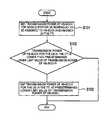
- Fig. 3 is a flowchart illustrating an example of an operation for controlling a transmission power of the HS-SCCH in the HSDPA system, applied in the IMT-2000 system which uses the W-CDMA system.
- the power control is further performed by using the lower limit value.
- step S101 the HS-SCCH transmission power controller 14 sets the transmission power of the HS-SCCH of the mobile station UE scheduled to be assigned to the HS-SCCH and the HS-DSCH in a TTI.
- step S102 the HS-SCCH transmission power controller 14 determines whether or not the transmission power of the HS-SCCH of the mobile station UE set in step S101 is lower than the lower limit value of the transmission power of the HS-SCCH set by the transmission power lower limit value setting section 13.
- the processing advances to step S103.
- the transmission power of the HS-SCCH is not lower than the lower limit value of the transmission power of the HS-SCCH, it is determined that the transmission power of the HS-SCCH does not need to be limited by the lower limit value, and hence, the processing is terminated.
- step S103 the HS-SCCH transmission power controller 14 sets the transmission power of the HS-SCCH of the mobile station UE in the TTI at the same value as the lower limit value of the transmission power of the HS-SCCH.
- the applicable range of the radio communication control system and the radio communication control method according to the present invention should not be limited to the HSDPA system, which is a high speed packet transmission system in the W-CDMA IMT-2000 system.
- the radio communication control system and the radio communication control method according to the present invention are also applicable to a high speed packet transmission system using a CDMA-TDD system, a CDMA2000 system, a 1xDEV-DO system or the like.
- the radio communication control system 10 of the present embodiment when the mobile station controls the shared control channel (the HS-SCCH), it is possible to set the quality of the HS-SCCH higher and to provide an HSDPA service having a more stable and higher transmission rate, in an environment where a high throughput rate is achievable in the HSDPA.
- the shared control channel the HS-SCCH
- the transmission power in which a 1% target error rate of the HS-SCCH is achievable, is 24 dBm in a certain part in the center of a cell
- the HS-SCCH is transmitted at 27 dBm in this part by setting the lower limit value of the HS-SCCH at 27 dBm.
- the error rate of the HS-SCCH is made to be even smaller than 1%. Consequently, it is possible to provide an HSDPA service having a small retransmission probability in an upper layer, and further a more stable and higher transmission rate.
- the transmission power of the shared control channel can be controlled by adding an offset to the transmission power of the dedicated channel to be transmitted dedicatedly to each of the mobile stations. Consequently, it is possible to control the transmission power more appropriately.
- the offset can be controlled in accordance with the quality of the shared control channel. Consequently, it is possible to set the quality of the shared control channel higher and to provide an HSDPA service having a more stable and higher transmission rate.
- the quality of the shared control channel may be a block error rate of the shared control channel.
- the transmission power lower limit value setting section 13 can set the lower limit value according to any one of a service type, a contract type, a receiver type, a cell type, and a priority class type, of the mobile station. Consequently, it is possible to set the transmission power appropriately in accordance with various applications.
- the receiver type may be a type according to a RAKE receiver, an equalizer, a receive diversity, an interference canceller, a maximum transmission rate, or a receivable maximum number of codes.
- the radio communication control system 10 being configured of the radio base station device BS30 and the radio network control device RNC40 in Fig. 1.
- the respective configurations (the A-DPCH transmission power controllers 11a, 11b, 11c and 11d, the switch 12, the transmission power lower limit value setting section 13 and the HS-SCCH transmission power controller 14) shown in Fig. 2 may be located in the radio base station device BS30.
- the respective constituent features (the A-DPCH transmission power controllers 11a, 11b, 11c and 11d, the switch 12, the transmission power lower limit value setting section 13 and the HS-SCCH transmission power controller 14) shown in Fig. 2 may be located in the radio network control device RNC40.
- the radio communication control system, the radio base station and the radio communication control method according to the present invention are useful for the techniques for achieving a more suitable and higher transmission rate.
Landscapes
- Engineering & Computer Science (AREA)
- Computer Networks & Wireless Communication (AREA)
- Signal Processing (AREA)
- Mobile Radio Communication Systems (AREA)
Abstract
A radio communication control system (10) controlling a transmission power of a shared control channel for transmitting a control signal to a plurality of mobile stations includes a transmission power lower limit value setting section (13) configured to set a lower limit value of the transmission power of the shared control channel, and to set the transmission power of the shared control channel at the lower limit value when the transmission power of the shared control channel is lower than the lower limit value.
Description
- The present invention relates to a radio communication control system, a radio base station and a radio communication control method.
- Recently, an "HSDPA (High Speed Downlink Packet Access) system" has been specified as a radio communication control system (see, for example, "3rd Generation Partnership Project" on the Internet <http://3gpp.org>). The HSDPA system is a higher speed packet transmission system for a downlink transmission in IMT-2000. The HSDPA system has purposes of achieving a higher peak transmission rate, a lower transmission delay, and a higher throughput and the like.
- The HSPDA system is a transmission system for performing communications by sharing one physical channel among a plurality of mobile stations in a time-division. The HSDPA system allocates a channel to a mobile station of better radio quality at each moment. Thus, it is possible to improve the throughput of the entire system.
- In order to perform communications by sharing one physical channel among a plurality of mobile stations in a time-division as described above, the mobile stations to perform communication by using the physical channel in each TTI (Transmission Time Interval) must be notified. In the case of the HSDPA system, the notification is made to the plurality of mobile stations by using a shared control channel called HS-SCCH (High Speed-Shared Control Channel).
- In this regard, disclosed is a method in which a radio base station sets a transmission power to be allocated to the HS-SCCH, by adding an offset to an A-SPCH (Associated-Dedicated Physical Channel). The A-DPCH is dedicatedly set to each of the mobile stations (see, for example,
Japanese Patent Application Laid-open Publication No. 2004-312530 Japanese Patent Application Laid-open Publication No. 2004-312530 Japanese Patent Application Laid-open Publication No. 2004-312530 - The HS-SCCH is a downlink control channel in the HSDPA, and is a channel for performing a signaling relating to information of the HS-PDSCH (an HS-DSCH as a transport channel) that is transmitted 2 slots after the transmission of the HS-SCCH (see, for example, 3GPP,TS25.211). Here, the information relating to the HS-DSCH includes; an ID of the mobile station to which the HS-DSCH is transmitted, transmission format information, (that is, a channelization code, a modulation scheme) a transport block size, Redundancy Version parameters in H-ARQ, or the like. (see, for example, 3GPP,TS25.212). Accordingly, when the mobile station assigned to the HS-SCCH and the HS-DSCH in the TTI fails to correctly receive the HS-SCCH (i.e., when an error occurs in a demodulation or a decoding of the HS-SCCH), the mobile station cannot receive the information of the HS-SCCH, and hence, does not receive the HS-DSCH.
- Meanwhile, since an H-ARQ is performed in the HSDPA, when the mobile station receives the HS-SCCH and the HS-DSCH, the mobile station transmits a decoding result (OK/NG) to the radio base station at a predetermined timing, by using the HS-DPCCH. Here, the HS-DPCCH is an HSDPA control channel in the uplink. Accordingly, when the mobile station fails to decode the HS-SCCH, the mobile station does not transmit the HS-DPCCH at the predetermined timing.
- However, since the radio base station has transmitted the HS-SCCH and the HS-DSCH to the mobile station, the radio base station attempts to receive the HS-DPCCH. In such a case, the radio base station determines, with a certain probability, the untransmitted HS-DPCCH as being transmitted, and detects an ACK or a NACK, which are transmission acknowledgment information. When the ACK is detected, the radio base station determines that the HS-DSCH has been received correctly at the mobile station despite the fact that the HS-DSCH has not been received correctly at the mobile station. Then, the radio base station passes the data mapped to the HS-DSCH to an upper layer, and starts a transmission of the next data. This means, in other words, a retransmission in the upper layer occurs.
- In other words, when the error in the HS-SCCH occurs, the retransmission in the upper layer may occur. In addition, it is generally known that the retransmission in the upper layer affects a throughput in the HSDPA prominently when a higher throughput rate is achieved.
- As mentioned above, according to a method for controlling the transmission power of the HS-SCCH described in
Japanese Patent Application Laid-open Publication No. 2004-312530 - However, there have been problems that the error in the HS-SCCH may lead to the retransmission in the upper layer, and that the retransmission in the upper layer may cause a deterioration of the throughput characteristics in the HSDPA, especially in the environment where the high throughput rate is achievable in the HSDPA.
- In view of the above problems, an object of the present invention is to provide a radio communication control system, a radio base station and a radio communication control method that makes it possible to achieve a more stable and higher transmission rate by setting the quality of the HS-SCCH higher, in the environment where the high throughput rate is achievable in the HSDPA.
- In order to achieve the above object, a first aspect of the present invention is summarized as a radio communication control system controlling a transmission power of a shared control channel for transmitting a control signal to a plurality of mobile stations, including; a transmission power lower limit value setting section configured to set a lower limit value of the transmission power of the shared control channel, and to set the transmission power of the shared control channel at the lower limit value when the transmission power of the shared control channel is lower than the lower limit value.
- According to the radio communication control system of the first aspect, it is possible to achieve a more stable and higher transmission rate by setting the lower limit value of the transmission power of the HS-SCCH, in an environment where a high throughput rate is achievable in an HSDPA.
- Further, the transmission power lower limit value setting section may control the transmission power of the shared control channel by adding an offset to a transmission power of a dedicated channel to be transmitted dedicatedly to each of the plurality of mobile stations.
- In addition, the transmission power lower limit value setting section may control the offset in accordance with a quality of the shared control channel.
- Moreover, the quality of the shared control channel is a block error rate of the shared control channel.
- Furthermore, the transmission power lower limit value setting section may set the lower limit value according to any one of a service type, a contract type, a receiver type, a cell type, and a priority class type, of each of the plurality of mobile stations.
- Still furthermore, the receiver type may be a type according to a RAKE receiver, an equalizer, a receive diversity, an interference canceller, a maximum transmission rate, or a receivable maximum number of codes.
- A second aspect of the present invention is summarized as a radio base station controlling a transmission power of a shared control channel for transmitting a control signal to a plurality of mobile stations, including: a transmission power lower limit value setting section configured to set a lower limit value of the transmission power of the shared control channel, and to set the transmission power of the shared control channel at the lower limit value when the transmission power of the shared control channel is lower than the lower limit value.
- According to the radio base station of the second aspect, it is possible to achieve a more stable and higher transmission rate by setting the lower limit value of the transmission power of the HS-SCCH, in an environment where a high throughput rate is achievable in an HSDPA.
- A third aspect of the present invention is summarized as a radio communication control method controlling a transmission power of a shared control channel for transmitting a control signal to a plurality of mobile stations, including: setting a lower limit value of the transmission power of the shared control channel, and setting the transmission power of the shared control channel at the lower limit value when the transmission power of the shared control channel is lower than the lower limit value.
- According to the radio communication control method of the third aspect, it is possible to achieve a more stable and higher transmission rate by setting the lower limit value of the transmission power of the HS-SCCH, in an environment where a high throughput rate is achievable in an HSDPA.
-
- [Fig.1] Fig. 1 is a configuration diagram of an entire radio communication control system according to an embodiment.
- [Fig.2] Fig. 2 is a functional block diagram of the radio communication control system according to the embodiment.
- [Fig. 3] Fig. 3 is a flowchart illustrating a radio communication control method according to the embodiment.
- Hereinafter, a description will be given of embodiments of the present invention with reference to the drawings. The same or similar reference numerals are given to the same or similar portions in the drawings below. Note that the drawings are expressed schematically.
- A description will be given of a configuration of a radio communication control system according to an embodiment of the present invention with reference to Figs. 1 and 2.
- A configuration diagram of an entire radio
communication control system 10 according to the embodiment is shown in Fig. 1. As shown in Fig. 1, the radiocommunication control system 10 according to the embodiment is provided with a radio base station device BS30 wirelessly connected to a plurality of mobile stations UE20a, 20b, 20c and 20d, and a radio network control device RNC40 controlling the radio base station device BS30. Incidentally, the number of mobile stations performing radio communication with the radio base station device BS is set at "4" in the present embodiment, but may be other than "4". - In addition, although the description is given of the case where the radio communication control system includes the radio base station device BS30 and the radio network control device RNC40 in the embodiment, the present invention is not limited thereto. The present invention is also applicable to a case where the radio
communication control system 10 includes only of the radio base station device BS30, or a case where the radiocommunication control system 10 includes only the radio network control device RNC40. - Furthermore, the radio
communication control system 10 according to the embodiment controls a new transmission power of a shared control channel (hereinafter referred to as HS-SCCH) for transmitting control signals to the plurality of mobile stations UE20a, 20b, 20c and 20d, when the HSDPA system is applied in the IMT-2000 system which uses a W-CDMA system. - Here, the mobile stations UE20a, 20b, 20c and 20d are configured to perform radio communications with the base station BS30 by using the HSDPA system. Each mobile station reports a transmission power control command (TPC command) for controlling a transmission power of a dedicated channel (hereinafter referred to as A-DPCH) accompanying the HS-channels, to the base station BS30 by using an uplink.
- As shown in Fig. 2, the radio
communication control system 10 according to the embodiment is provided with a plurality of A-DPCHtransmission power controllers switch 12, a transmission power lower limitvalue setting section 13, and an HS-SCCHtransmission power controller 14. Incidentally, Fig. 2 only describes the sections for controlling and setting the transmission power of the HS-SCCH, in the radiocommunication control system 10. - The A-DPCH
transmission power controllers transmission power controllers - In each TTI, the
switch 12 is configured to transmit, to the HS-SCCHtransmission power controller 14, the transmission power of the A-DPCH of the mobile station UE scheduled to be assigned to the HS-SCCH and the HS-PDSCH (or HS-DSCH, as a transport channel), together with identification information of the mobile station UE. - The transmission power lower limit
value setting section 13 sets the lower limit value of the transmission power of the HS-SCCH, and notifies the set lower limit value of the transmission power of the HS-SCCH to the HS-SCCHtransmission power controller 14. - Further, the lower limit value of the transmission power of the HS-SCCH can be set according to a service type, a contract type, a receiver type (a RAKE receiver, an equalizer, a receive diversity, an interference canceller and capabilities of the UE (an index that is classified according to a receivable modulation scheme, a receivable maximum number of codes or a receivable maximum number of bits), or the like), a cell type, or a priority class type, of the mobile station.
- For example, the transmission power lower limit
value setting section 13 may set the lower limit value of the transmission power of the HS-SCCH at 25 dBm when a receivable maximum transmission rate of the mobile station is 3.6 Mbps, and may set the lower limit value of the transmission power of the HS-SCCH at 28 dBm when the receivable maximum transmission rate of the mobile station is 14.4 Mbps. In such a case, by setting the lower limit value of the transmission power of the HS-SCCH higher for the mobile station having a higher transmission rate, it is possible to maintain a high quality of the HS-SCCH for the mobile station having the higher transmission rate, and to achieve a higher transmission rate. - Alternatively, the transmission power lower limit
value setting section 13 may set the lower limit value of the transmission power of the HS-SCCH at 29 dBm when the mobile station has a high priority class, and may set the lower limit value of the transmission power of the HS-SCCH at 24 dBm when the mobile station has a low priority class, for example. In such a case, by setting the lower limit value of the transmission power of the HS-SCCH higher for the mobile station having the high priority class, it is possible to maintain the high quality of the HS-SCCH for the mobile station having the high priority class, and to provide a higher quality communication. - Further, for example, the transmission power lower limit
value setting section 13 may set the lower limit value of the transmission power of the HS-SCCH at 33 dBm when the service type of the mobile station is a streaming, and may set the lower limit value of the transmission power of the HS-SCCH at 27 dBm when the service type of the mobile station is a download using an FTP. In such a case, in a service that has a high immediacy, such as the streaming, the retransmission in the upper layer can be reduced by transmitting the HS-SCCH with a higher quality. On the other hand, in a service that has a low requirement for delay, such as the download using the FTP, a power resource can be used efficiently by transmitting the HS-SCCH with a slightly lower quality. Hence, it is possible to set an appropriate lower limit value of the transmission power of the HS-SCCH for each service type. - The HS-SCCH
transmission power controller 14 sets the transmission power of the HS-SCCH of the mobile station UE scheduled to be assigned to the HS-SCCH and the HS-DSCH in the TTI. - For example, the HS-SCCH
transmission power controller 14 sets the transmission power of the HS-SCCH in the TTI in accordance with the transmission power of the A-DPCH associated to the HS-SCCH, and the communication quality of the HS-SCCH. Specifically, the HS-SCCHtransmission power controller 14 sets the transmission power by using the Equation (1) below, for example.
Here, for example, the offset transmission power is controlled in accordance with the communication quality of the HS-SCCH by using an outer loop in the following manner. - First, the communication quality of the HS-SCCH can be estimated based on transmission acknowledgment information of the HS-DSCH, which is mapped to the HS-DPCCH. The HS-DPCCH is an HSDPA control channel in the uplink. Specifically, when the transmission acknowledgment information is an ACK or a NACK, this indicates that the HS-SCCH was correctly received, and consequently that a demodulation and a decoding of the HS-DSCH has been performed. When the transmission acknowledgment information is a DTX, this indicates that the HS-SCCH was not correctly received, and consequently that neither the demodulation nor the decoding of the HS-DSCH has been performed. Accordingly, when a target block error rate of the HS-SCCH is expressed as "BLERtarget" and an arbitrary constant is expressed as "Δ", the transmission power of the HS-SCCH can be controlled so that the block error rate of the HS-SCCH becomes the target block error rate, by using the following Equations:
- When the transmission acknowledgment information is the ACK or the NACK;

- When the transmission acknowledgment information is the DTX;

- Then, the HS-SCCH
transmission power controller 14 controls the transmission power of the HS-SCCH by using the lower limit value of the transmission power of the HS-SCCH obtained from the transmission power lower limitvalue setting section 13, in the following manner. Specifically, when the transmission power of the HS-SCCH is lower than the lower limit value of the transmission power of the HS-SCCH, the transmission power of the HS-SCCH is set at the same value as the lower limit value of the transmission power of the HS-SCCH. - Hereinabove, a case has been described where the transmission power of the HS-SCCH is controlled in accordance with the transmission power of the A-DPCH and the communication quality of the HS-SCCH, and where a lower limitation is thereafter set to the transmission power of the HS-SCCH by using the lower limit value of the transmission power of the HS-SCCH. However, since the major point of the present invention is to set the lower limitation to the transmission power of the HS-SCCH, the method for controlling the transmission power of the HS-SCCH before setting the lower limitation on the transmission power may be a method other than the above. For example, as a control method other than the transmission power control method of the HS-SCCH using the transmission power of the A-DPCH and the communication quality of the HS-SCCH, conceivable is a transmission power control method using radio quality information CQI in a downlink, which is notified from the mobile station.
- Hereinafter, a description will be given of an operation of the radio
communication control system 10 according to the present embodiment with reference to Fig. 3. Fig. 3 is a flowchart illustrating an example of an operation for controlling a transmission power of the HS-SCCH in the HSDPA system, applied in the IMT-2000 system which uses the W-CDMA system. Here, the power control is further performed by using the lower limit value. - First, in step S101, the HS-SCCH
transmission power controller 14 sets the transmission power of the HS-SCCH of the mobile station UE scheduled to be assigned to the HS-SCCH and the HS-DSCH in a TTI. - Next, in step S102, the HS-SCCH
transmission power controller 14 determines whether or not the transmission power of the HS-SCCH of the mobile station UE set in step S101 is lower than the lower limit value of the transmission power of the HS-SCCH set by the transmission power lower limitvalue setting section 13. When the transmission power of the HS-SCCH is lower than the lower limit value of the transmission power of the HS-SCCH, the processing advances to step S103. When the transmission power of the HS-SCCH is not lower than the lower limit value of the transmission power of the HS-SCCH, it is determined that the transmission power of the HS-SCCH does not need to be limited by the lower limit value, and hence, the processing is terminated. - Then, in step S103, the HS-SCCH
transmission power controller 14 sets the transmission power of the HS-SCCH of the mobile station UE in the TTI at the same value as the lower limit value of the transmission power of the HS-SCCH. - It should be noted that the applicable range of the radio communication control system and the radio communication control method according to the present invention should not be limited to the HSDPA system, which is a high speed packet transmission system in the W-CDMA IMT-2000 system. The radio communication control system and the radio communication control method according to the present invention are also applicable to a high speed packet transmission system using a CDMA-TDD system, a CDMA2000 system, a 1xDEV-DO system or the like.
- According to the radio
communication control system 10 of the present embodiment, when the mobile station controls the shared control channel (the HS-SCCH), it is possible to set the quality of the HS-SCCH higher and to provide an HSDPA service having a more stable and higher transmission rate, in an environment where a high throughput rate is achievable in the HSDPA. - For example, when the transmission power, in which a 1% target error rate of the HS-SCCH is achievable, is 24 dBm in a certain part in the center of a cell, the HS-SCCH is transmitted at 27 dBm in this part by setting the lower limit value of the HS-SCCH at 27 dBm. As a result, the error rate of the HS-SCCH is made to be even smaller than 1%. Consequently, it is possible to provide an HSDPA service having a small retransmission probability in an upper layer, and further a more stable and higher transmission rate.
- In addition, the transmission power of the shared control channel can be controlled by adding an offset to the transmission power of the dedicated channel to be transmitted dedicatedly to each of the mobile stations. Consequently, it is possible to control the transmission power more appropriately.
- Moreover, the offset can be controlled in accordance with the quality of the shared control channel. Consequently, it is possible to set the quality of the shared control channel higher and to provide an HSDPA service having a more stable and higher transmission rate. Here, the quality of the shared control channel may be a block error rate of the shared control channel.
- Furthermore, the transmission power lower limit
value setting section 13 can set the lower limit value according to any one of a service type, a contract type, a receiver type, a cell type, and a priority class type, of the mobile station. Consequently, it is possible to set the transmission power appropriately in accordance with various applications. Additionally, the receiver type may be a type according to a RAKE receiver, an equalizer, a receive diversity, an interference canceller, a maximum transmission rate, or a receivable maximum number of codes. - Although the present invention has been described with the above embodiment, it is not to be understood that descriptions and drawings that constitute part of the present disclosure are intended to limit the invention. From this disclosure, various alternative embodiments, examples and operation techniques will be apparent to those skilled in the art.
- For example, an explanation has been given of the radio
communication control system 10 being configured of the radio base station device BS30 and the radio network control device RNC40 in Fig. 1. However, the respective configurations (the A-DPCHtransmission power controllers switch 12, the transmission power lower limitvalue setting section 13 and the HS-SCCH transmission power controller 14) shown in Fig. 2 may be located in the radio base station device BS30. Similarly, the respective constituent features (the A-DPCHtransmission power controllers switch 12, the transmission power lower limitvalue setting section 13 and the HS-SCCH transmission power controller 14) shown in Fig. 2 may be located in the radio network control device RNC40. - Thus, it is obvious that the present invention includes various embodiments and the like that are not described herein. Accordingly, the technical scope of the present invention is intended to be defined only by the claimed elements of the invention according to the scope of claims that is reasonably understood from the above descriptions.
- As described above, the radio communication control system, the radio base station and the radio communication control method according to the present invention are useful for the techniques for achieving a more suitable and higher transmission rate.
Claims (8)
- A radio communication control system (10) controlling a transmission power of a shared control channel for transmitting a control signal to a plurality of mobile stations, comprising;a transmission power lower limit value setting section (13) configured to set a lower limit value of the transmission power of the shared control channel, and to set the transmission power of the shared control channel at the lower limit value when the transmission power of the shared control channel is lower than the lower limit value.
- The radio communication control system according to claim 1, wherein the transmission power lower limit value setting section (13) is configured to control the transmission power of the shared control channel by adding an offset to a transmission power of a dedicated channel to be transmitted dedicatedly to each of the plurality of mobile stations.
- The radio communication control system according to claim 2, wherein the transmission power lower limit value setting section (13) is configured to control the offset in accordance with a quality of the shared control channel.
- The radio communication control system according to claim 3, wherein the quality of the shared control channel is a block error rate of the shared control channel.
- The radio communication control system according to claim 1, wherein the transmission power lower limit value setting section (13) is configured to set the lower limit value according to any one of a service type, a contract type, a receiver type, a cell type, and a priority class type, of each of the plurality of mobile stations.
- The radio communication control system according to claim 5, wherein the receiver type is a type according to a RAKE receiver, an equalizer, a receive diversity, an interference canceller, a maximum transmission rate, or a receivable maximum number of codes.
- A radio base station controlling a transmission power of a shared control channel for transmitting a control signal to a plurality of mobile stations, comprising:a transmission power lower limit value setting section (13) configured to set a lower limit value of the transmission power of the shared control channel, and to set the transmission power of the shared control channel at the lower limit value when the transmission power of the shared control channel is lower than the lower limit value.
- A radio communication control method controlling a transmission power of a shared control channel for transmitting a control signal to a plurality of mobile stations, comprising:setting a lower limit value of the transmission power of the shared control channel, and setting the transmission power of the shared control channel at the lower limit value when the transmission power of the shared control channel is lower than the lower limit value.
Applications Claiming Priority (2)
| Application Number | Priority Date | Filing Date | Title |
|---|---|---|---|
| JP2005119031A JP4713923B2 (en) | 2005-04-15 | 2005-04-15 | Wireless communication control system, wireless base station, and wireless communication control method |
| PCT/JP2006/307750 WO2006112329A1 (en) | 2005-04-15 | 2006-04-12 | Wireless communication control system, radio base station and wireless communication control method |
Publications (1)
| Publication Number | Publication Date |
|---|---|
| EP1879303A1 true EP1879303A1 (en) | 2008-01-16 |
Family
ID=37115053
Family Applications (1)
| Application Number | Title | Priority Date | Filing Date |
|---|---|---|---|
| EP06731686A Withdrawn EP1879303A1 (en) | 2005-04-15 | 2006-04-12 | Wireless communication control system, radio base station and wireless communication control method |
Country Status (5)
| Country | Link |
|---|---|
| US (1) | US8014808B2 (en) |
| EP (1) | EP1879303A1 (en) |
| JP (1) | JP4713923B2 (en) |
| CN (1) | CN101160754A (en) |
| WO (1) | WO2006112329A1 (en) |
Families Citing this family (10)
| Publication number | Priority date | Publication date | Assignee | Title |
|---|---|---|---|---|
| KR100725773B1 (en) * | 2004-08-20 | 2007-06-08 | 삼성전자주식회사 | Apparatus and method for adaptively changing uplink power control scheme according to terminal state in time division duplex mobile communication system |
| BRPI0807689A2 (en) * | 2007-02-28 | 2014-07-08 | Ntt Docomo Inc | STATION APPARATUS AND COMMUNICATION CONTROL METHOD. |
| US8369884B2 (en) | 2007-02-28 | 2013-02-05 | Ntt Docomo, Inc. | Base station apparatus and communication control method |
| US8521113B2 (en) * | 2007-04-30 | 2013-08-27 | Qualcomm Incorporated | Methods and apparatus for predicting a channel quality indicator in a communication system |
| KR101699793B1 (en) * | 2010-09-06 | 2017-02-14 | 삼성전자주식회사 | Apparatus and method for power control in broadband wireless access system |
| JP5346055B2 (en) * | 2011-04-05 | 2013-11-20 | 株式会社エヌ・ティ・ティ・ドコモ | User apparatus and method in mobile communication system |
| CN103139887B (en) * | 2011-12-02 | 2018-06-19 | 中兴通讯股份有限公司 | The power distribution method and system of High-Speed Shared Control Channel |
| US9629099B2 (en) * | 2013-01-24 | 2017-04-18 | Panasonic Intellectual Property Management Co., Ltd. | Radio communication apparatus and transmission power control method |
| JP6294002B2 (en) * | 2013-02-08 | 2018-03-14 | 株式会社Nttドコモ | Distance estimation method and user apparatus |
| EP2989733A4 (en) * | 2013-04-16 | 2017-03-08 | Telefonaktiebolaget LM Ericsson (publ) | A user equipment and a method therein for channel interference cancellation |
Family Cites Families (8)
| Publication number | Priority date | Publication date | Assignee | Title |
|---|---|---|---|---|
| JP3240998B2 (en) * | 1998-07-27 | 2001-12-25 | 日本電気株式会社 | Transmission power control circuit |
| KR100735402B1 (en) * | 2000-11-07 | 2007-07-04 | 삼성전자주식회사 | Apparatus and Method of Transmission Transmit Format Combination Indicator for Downlink Shared Channel in Asynchronous Mobile Communication System |
| JP2003143069A (en) * | 2001-10-31 | 2003-05-16 | Matsushita Electric Ind Co Ltd | Transmission power control device and transmission power control method |
| JP2004088696A (en) * | 2002-08-29 | 2004-03-18 | Toshiba Corp | Mobile wireless terminal |
| JP4288093B2 (en) * | 2003-04-09 | 2009-07-01 | 株式会社エヌ・ティ・ティ・ドコモ | Wireless communication control system and wireless communication control method |
| JP2005080080A (en) | 2003-09-02 | 2005-03-24 | Mitsubishi Electric Corp | CDMA radio base station transmission power control system |
| KR100595652B1 (en) * | 2004-02-12 | 2006-07-03 | 엘지전자 주식회사 | Apparatus and method for controlling transmit power in mobile communication terminal |
| JP4559240B2 (en) * | 2005-01-13 | 2010-10-06 | 株式会社エヌ・ティ・ティ・ドコモ | Mobile communication system, radio base station, radio network controller, and power control method |
-
2005
- 2005-04-15 JP JP2005119031A patent/JP4713923B2/en not_active Expired - Fee Related
-
2006
- 2006-04-12 US US11/911,607 patent/US8014808B2/en not_active Expired - Fee Related
- 2006-04-12 WO PCT/JP2006/307750 patent/WO2006112329A1/en not_active Ceased
- 2006-04-12 CN CNA2006800123645A patent/CN101160754A/en active Pending
- 2006-04-12 EP EP06731686A patent/EP1879303A1/en not_active Withdrawn
Non-Patent Citations (1)
| Title |
|---|
| See references of WO2006112329A1 * |
Also Published As
| Publication number | Publication date |
|---|---|
| CN101160754A (en) | 2008-04-09 |
| US8014808B2 (en) | 2011-09-06 |
| US20090215484A1 (en) | 2009-08-27 |
| JP2006303642A (en) | 2006-11-02 |
| JP4713923B2 (en) | 2011-06-29 |
| WO2006112329B1 (en) | 2007-02-08 |
| WO2006112329A1 (en) | 2006-10-26 |
Similar Documents
| Publication | Publication Date | Title |
|---|---|---|
| EP1374625B1 (en) | Transmissions in a communication system | |
| KR100832117B1 (en) | Apparatus and method for transmitting and receiving reverse transmission power offset information in mobile communication system using high speed forward packet access method | |
| EP3028509B1 (en) | Method and apparatus for avoiding power scaling in uplink data transmission | |
| EP1826922B1 (en) | Mobile communication system, mobile station, and radio base station | |
| JP4882775B2 (en) | Wireless terminal communication control method and wireless terminal | |
| AU2002304333A1 (en) | Transmissions in a communication system | |
| EP1639715A2 (en) | ADAPTIVE POWER MARGIN ADJUSTMENT FOR A 1xEV-DV SYSTEM | |
| JP2011030259A (en) | Method, apparatus, and software product for binding ul dpcch gating and enhanced ul dch to improve capacity | |
| EP2292059B1 (en) | Distribution of downlink e-dch power usage | |
| EP1790106B1 (en) | A method of controlling transmit power for retransmission packet in uplink dedicated channel | |
| US8014808B2 (en) | Radio communication control system, radio base station and radio communication control method | |
| KR101524000B1 (en) | Method and apparatus for transmitting and receiving downlink control information in a mobile communication system | |
| EP1810452B1 (en) | A method of controlling one or more terminals from a base station | |
| JP2008512936A (en) | Method and apparatus in a telecommunications system | |
| Forkel et al. | High speed downlink packet access (HSDPA)—enhanced data rates for UMTS evolution | |
| EP2045979A1 (en) | Radio communication system, radio communication method and base station | |
| AU2011224018B2 (en) | Transmissions in a communication system | |
| EP1720264A1 (en) | Method for reducing interference in a radio communication system | |
| AU2008200143B2 (en) | Transmissions in a communication system | |
| KR20050046305A (en) | Method for reporting a high-speed dedicated control channel whether is transmitted or not in communication system using high speed downlink packet access scheme | |
| KR100839244B1 (en) | Shared Control Channel Power Control Method in Mobile Communication System | |
| WO2016120452A1 (en) | Uplink physical channel multiplexing method to achieve a good coverage | |
| Ranta-Aho et al. | HSUPA principles | |
| HK1145377B (en) | Scheduled and autonomous transmission and acknowledgement | |
| HK1087265B (en) | Method, apparatus and system for scheduled and autonomous transmission and acknowledgement |
Legal Events
| Date | Code | Title | Description |
|---|---|---|---|
| PUAI | Public reference made under article 153(3) epc to a published international application that has entered the european phase |
Free format text: ORIGINAL CODE: 0009012 |
|
| 17P | Request for examination filed |
Effective date: 20071115 |
|
| AK | Designated contracting states |
Kind code of ref document: A1 Designated state(s): DE GB |
|
| DAX | Request for extension of the european patent (deleted) | ||
| RBV | Designated contracting states (corrected) |
Designated state(s): DE GB |
|
| STAA | Information on the status of an ep patent application or granted ep patent |
Free format text: STATUS: THE APPLICATION HAS BEEN WITHDRAWN |
|
| 18W | Application withdrawn |
Effective date: 20131212 |