EP1872504B1 - Verfahren und vorrichtung zum verbessern des empfangs fountain kodierter signale - Google Patents
Verfahren und vorrichtung zum verbessern des empfangs fountain kodierter signale Download PDFInfo
- Publication number
- EP1872504B1 EP1872504B1 EP05810060A EP05810060A EP1872504B1 EP 1872504 B1 EP1872504 B1 EP 1872504B1 EP 05810060 A EP05810060 A EP 05810060A EP 05810060 A EP05810060 A EP 05810060A EP 1872504 B1 EP1872504 B1 EP 1872504B1
- Authority
- EP
- European Patent Office
- Prior art keywords
- fountain
- receiver
- channel
- encoded data
- data stream
- Prior art date
- Legal status (The legal status is an assumption and is not a legal conclusion. Google has not performed a legal analysis and makes no representation as to the accuracy of the status listed.)
- Expired - Lifetime
Links
Images






Classifications
-
- H—ELECTRICITY
- H04—ELECTRIC COMMUNICATION TECHNIQUE
- H04L—TRANSMISSION OF DIGITAL INFORMATION, e.g. TELEGRAPHIC COMMUNICATION
- H04L1/00—Arrangements for detecting or preventing errors in the information received
- H04L1/02—Arrangements for detecting or preventing errors in the information received by diversity reception
- H04L1/06—Arrangements for detecting or preventing errors in the information received by diversity reception using space diversity
-
- H—ELECTRICITY
- H04—ELECTRIC COMMUNICATION TECHNIQUE
- H04L—TRANSMISSION OF DIGITAL INFORMATION, e.g. TELEGRAPHIC COMMUNICATION
- H04L1/00—Arrangements for detecting or preventing errors in the information received
- H04L1/004—Arrangements for detecting or preventing errors in the information received by using forward error control
- H04L1/0041—Arrangements at the transmitter end
Definitions
- the present invention generally relates to communications systems and, more particularly, to wireless systems, e.g., terrestrial broadcast, cellular, Wireless-Fidelity (Wi-Fi), satellite, etc.
- wireless systems e.g., terrestrial broadcast, cellular, Wireless-Fidelity (Wi-Fi), satellite, etc.
- a receiver may be able to receive the transmission of some of the channels (or signals) but not all of them.
- a terrestrial broadcast television (TV) system in the United States, a city may typically have 5 to 15 terrestrial transmitters that are geographically separated, each terrestrial transmitter broadcasting content on a particular channel (or channels).
- a TV set may only be able to receive a subset of the channels being broadcast in a given geographical area because of the geographical location of the TV set.
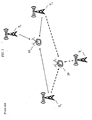
- a geographical area includes terrestrial ATSC-DTV transmission towers T 1 , T 2 , T 3 and T 4 , for broadcasting content associated with channels 1, 2, 3 and 4, respectively.
- TV set 10 is only able to receive a subset of the available channels, i.e., channels 2, 3 and 4.
- the dashed line arrows of FIG. 1 illustrate that TVset 20 is only able to receive channels 1, 2 and 4.
- data for one, or more, services is encoded using a scalable channel code and divided for transmission over N transmitters such that reception by a receiver of at least M of the transmitted signals, where M ⁇ N , enables recovery of the data by the receiver.
- M the number of transmitted signals in a defined geographical region
- reception of at least M of the other transmitted signals enables reception of the service(s).
- one, or more, services can be offered across an entire geographical area notwithstanding the existence of areas of poor, or no, reception.
- an ATSC-DTV transmitter for a TV provider transmits a digital multiplex that includes a primary channel and an auxiliary channel.
- the primary channel includes one or more high definition TV (HDTV) channels offered by the TV provider; while the auxiliary channel includes a portion of a fountain-coded data stream. Other portions of the fountain-coded data stream are transmitted by other ATSC-DTV transmitters.
- HDTV high definition TV
- an ATSC-DTV receiver comprises M tuners, where M > 1, and a fountain decoder.
- M the number of tuners, where M > 1, and a fountain decoder.
- Each tuner is tuned to a different PTC and recovers therefrom a fountain-coded data stream.
- the M recovered fountain-coded data streams are applied to the fountain decoder to provide a data stream, which represent one, or more, services.
- program content is embodied in a data-bearing signal comprising at least one carrier wave, the data bearing signal representing a plurality of packets, wherein at least some of these packets represent a portion of a fountain-coded data stream.
- FIG. 1 illustrates reception problems in a terrestrial television broadcast areas
- FIG. 2 conceptually illustrates fountain coding/decoding
- FIG. 3 illustrates terrestrial broadcast in accordance with the principles of the invention
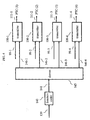
- FIG. 4 shows an illustrative block diagram of a transmitting arrangement embodying the principles of the invention
- FIG. 5 shows an illustrative flow chart in accordance with the principles of the invention for use in the transmitting arrangement of FIG. 4 ;
- FIG. 6 shows a portion of an illustrative signal format in accordance with the principles of the invention
- FIG. 7 shows an illustrative high-level block diagram of a receiver embodying the principles of the invention.
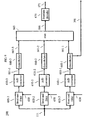
- FIGs. 8 and 9 show illustrative portions of a receiver embodying the principles of the invention.
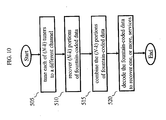
- FIG. 10 shows an illustrative flow chart for use in a receiver in accordance with the principles of the invention.
- FIGs. 11 and 12 show other illustrative embodiments in accordance with the principles of the invention.
- transmission concepts such as eight-level vestigial sideband (8-VSB), Quadrature Amplitude Modulation (QAM), scalable channel coding (e.g., fountain coding/decoding) and receiver components such as a radio-frequency (RF) front-end, or receiver section, such as a low noise block, tuners, demodulators, correlators, leak integrators and squarers is assumed.
- RF radio-frequency
- formatting and encoding methods such as Moving Picture Expert Group (MPEG)-2 Systems Standard (ISO/IEC 13818-1)
- MPEG Moving Picture Expert Group
- ISO/IEC 13818-1 ISO/IEC 13818-1
- fountain codes include LT codes (e.g., see “LT Codes,” in the Proceedings of ACM Symposium on Foundations of computer Science, 2002 ) and Raptor codes (e.g., see “ Raptor Codes,” by Amin Shokrollahi, Published Report - Digital Fountain Inc. and Laboratorie d'Algorithmique, EPLF, Lausanne, Switzerland, January 13, 2004 ). Additional information on fountain codes can also be found at "http://www.digitalfountain.com/.”
- packet as used herein is conventional, i.e., a packet also includes addressing information, error detection/correction data (e.g., a parity and/or a cyclic redundancy check (CRC) code, etc.), etc., as known in the art and is not described further herein.
- An illustrative set of k input packets, 39, is applied to fountain coder 40.
- each output packet of fountain coder 40 is generated independently and randomly as the exclusive-or (XOR) of some of the input packets.
- the encoding process defines an encoding graph (not shown) connecting output symbols to input symbols. While some of the output packets of output packet stream 41 may be lost in transmission or corrupted, an advantage of using fountain-coded data is that recovery of any J output packets enables recovery of the original set of k input packets. This is illustrated in the lower portion of FIG. 2 .
- Fountain decoder 45 receives any J output packets, 44, of the output packet stream 41.
- fountain decoder 45 decodes these packets and reproduces the original set of k input packets 39.
- data for one, or more, services is encoded using a scalable channel code and divided for transmission over N transmitters such that reception by a receiver of at least M of the transmitted signals, where M ⁇ N , enables recovery of the data by the receiver.
- M ⁇ N a scalable channel code
- a wireless system can provide improved coverage for a geographical area. If one assumes that there are N transmitters in a city, it is likely that (N-k; k>0), are reliably received by over 90% of the receivers in the field. For example, in the context of the ATSC-DTV system of FIG. 1 , if the providers agree to share any spare capacity, then this spare capacity is allocated to the above-described service, which is encoded using a scalable channel code.
- spare capacity in a PTC can be created by restricting transmission of primary channels, e.g., selecting the number of primary channels such that the requisite amount of spare capacity is created in the PTC.
- An extreme example is the transmission of only one primary channel, i.e., a signal digital ATSC-DTV channel.
- advantage can be taken of improvements in both MPEG2 encoding and the introduction of advanced codec (coder/decoder) technology (such as H.264, which is also known as AVC (Advanced Video Coding) or MPEG-4 Part 10 or VC1) to create spare capacity in a PTC.
- advanced codec coder/decoder
- H.264 which is also known as AVC (Advanced Video Coding) or MPEG-4 Part 10 or VC1
- FIG. 3 An illustrative arrangement for ATSC-DTV terrestrial broadcast in accordance with the principles of the invention is shown in FIG. 3 .
- This figure is similar to FIG. 1 except that each of the transmission towers shown in FIG. 3 transmits a signal in accordance with the principles of the invention (described below).
- a transmitter 100-1 is associated with transmission tower T 1 for transmitting a signal 111-1
- a transmitter 100-2 is associated with transmission tower T 2 for transmitting a signal 111-2
- a transmitter 100-3 is associated with transmission tower T 3 for transmitting a signal 111-3
- a transmitter 100-4 is associated with transmission tower T 4 for transmitting a signal 111-4.
- receivers as represented by TV sets 200 and 205, are adapted, in accordance with the principles of the invention, to take advantage of the transmitted signal to provide for robust reception of one, or more, services.
- TV set 200 is only able to receive a subset of the available channels, i.e., channels 2, 3 and 4. Reception for channel 1 is either too poor or nonexistent.
- the dashed line arrows of FIG. 3 illustrate that TV set 205 is only able to receive channels 1, 2 and 4 for effective viewing of the content therein.
- TV set 205 is similar to TV set 200 (described below) and is not described further herein.
- each transmission tower is illustratively associated with a particular TV provider, which transmits programming on a single channel.
- transmission tower T 1 broadcasts programming for channel 1.1
- transmission tower T 2 broadcasts programming for channel 2.1
- transmission tower T 3 broadcasts programming for channel 3.1
- transmission tower T 4 broadcasts programming for channel 4.1, where each channel number uses the ATSC major-minor channel number format as known in the art.
- transmission tower T 1 may broadcast programming for more than one channel, e.g., channels 1.1, 1.2, etc.
- a transmission tower may not be associated with a particular TV provider.
- the transmitting arrangement comprises fountain coder 140 (illustrative of scalable channel coding), demultiplexer (demux) 145 and transmitters 100-1, 100-2, 100-3 and 100-4. It should be noted that the various elements shown in FIG. 4 may not be geographically co-located. Other than the inventive concept, transmitters 100-1, 100-2, 100-3 and 100-4 form respective ATSC-DTV signals for transmission via the associated transmission towers as known in the art.
- a data stream 139 is applied to fountain coder 140. Data stream 139 represents data for one, or more, services. In the context of the ATSC-DTV system of FIG.
- Fountain coder 140 encodes the applied data and provided fountain-coded bit stream 141 to demux 145. The latter divides the fountain-coded data stream among the four transmitters. Each transmitter receives a portion of the fountain-coded data stream and non-fountain coded data (e.g., a programming guide and one, or more, HDTV channels) for transmission as an ATSC-DTV signal.
- transmitter 100-1 receives fountain-coded data portion 146-1 and non-fountain-coded data 99-1, which is transmitted, via transmission tower T 1 , via signal 111-1.
- signal 111-1 represents physical transmission channel (PTC) 1, which is a transport stream or digital multiplex conveyed at an appropriate carrier frequency, as know in the art.
- transmitter 100-2 receives fountain-coded data portion 146-2 and non-fountain-coded data 99-2, which is transmitted, via transmission tower T 2 , via signal 111-2;
- transmitter 100-3 receives fountain-coded data portion 146-3 and non-fountain-coded data 99-3, which is transmitted, via transmission tower T 3 , via signal 111-3 and
- transmitter 100-4 receives fountain-coded data portion 146-4 and non-fountain-coded data 99-4, which is transmitted, via transmission tower T 4 , via signal 111-4.
- FIG. 5 shows an illustrative flowchart in accordance with the principles of the invention for use in the transmitting arrangement of FIG. 4 .
- data representing one, or more, services is fountain encoded in step 160.
- the fountain-encoded data is distributed to N transmitters, N > 1, such that each transmitter receives a portion of the fountain-coded service.
- each of the N transmitters forms a transport stream, or digital multiplex for transmission, wherein the transport stream includes its portion of the fountain-coded service.
- the fountain-coded service is distributed among the N transmitters for transmission.
- Each PTC (111-1, 111-2, 111-3 and 111-4) represents a data-bearing signal comprising at least one carrier wave (not shown), the data bearing signal representing a plurality of packets, wherein at least some of these packets represent a portion of a fountain-coded data stream.
- each PTC represents a stream of packets 70.
- the stream of packets includes at least one Master Programming Guide (MPG) (G) packet 75, at least one content (C) packet 80 and at least one auxiliary packet (A) packet 90.
- MPG Master Programming Guide
- G Master Programming Guide
- C content
- A auxiliary packet
- the MPG includes data, or information, for each of the PTCs.
- the data associated with each PTC includes modulation format, etc., and data related to each of the programs channels that are a part of a particular PTC.
- auxiliary program channel information which includes program data and PID data similar to that found for each of the program channels except that these relate to packets conveying the services.
- Each content packet 80 comprises a packet identifier (PID) and content (video, audio and/or data).
- PID packet identifier
- content video, audio and/or data
- the content could relate to video and/or audio for a particular program channel (e.g., HDTV signals), or even data representing an executable program being downloaded to receiver 300.
- an auxiliary packet 90 represents a portion of fountain-coded data.
- auxiliary channel 90 conveys fountain-coded data portion 146-1.
- the invention it no so limited and other non-fountain coded data can also be conveyed via the auxiliary channel as well.
- TV set 200 includes a receiver 300 and a display 220.
- receiver 300 is an ATSC-compatible receiver.
- receiver 300 may also be NTSC (National Television Systems Committee)-compatible, i.e., have an NTSC mode of operation and an ATSC mode of operation such that TV set 200 is capable of displaying video content from an NTSC broadcast or an ATSC broadcast.
- NTSC National Television Systems Committee
- Receiver 300 receives broadcast signals 11 1 (e.g., via an antenna (not shown)) for processing to recover therefrom, e.g., an HDTV (high definition TV) video signal for application to display 220 for viewing video content thereon.
- broadcast signals 11 1 e.g., via an antenna (not shown)
- HDTV high definition TV
- receiver 300 is also able to recover one, or more, services even if the reception for a selected channel is either too poor or non-existent.
- Receiver 300 includes filter demodulator bank 390, forward error correction (FEC) decoder 395, transport processor 350, controller 355 and memory 360.
- FEC forward error correction
- transport processor 350 and controller 355 are each representative of one or more microprocessors and/or digital signal processors (DSPs) and may include memory for executing programs and storing data.
- memory 360 is representative of memory in receiver 300 and includes, e.g., any memory of transport processor 350 and/or controller 355.
- Control bus 301 couples various ones of the elements of FIG. 8 together as shown.
- Control bus 301 is merely representative, e.g., individual signals (in a parallel and/or serial form) may be used, etc., for conveying data and control signaling between the elements of FIG. 8 .
- receiver 300 may receive commands, e.g., program selection, via a remote control (not shown).
- signals from at least ( N-k ) transmitters can be received at any point with a defined geographical region, where k >0.
- a receiver must be able to be tuned to the number of channels it needs to derive bits from, i.e., a receiver needs to have ( N-k ) tuners.
- receiver 300 includes three tuners.
- Filter demodulator bank 390 includes three front-end filters (605-1, 605-2 and 605-3), three analog-to-digital (A/D) converters (610-1, 610-2 and 610-3), three demodulators (660-1, 660-2 and 660-3), a multiplexer (mux) 665 and fountain decoder 670 (illustrative of a scalable channel decoder).
- a received signal 111 is applied to filter demodulator bank 390.
- the received signal 111 is representative of all of the received signals being picked up by an antenna (not shown) of receiver 300.
- Front-end filter 605-3 is tuned by controller 355 of FIG.
- each front-end filter down-converts and filters received signal 111 to provide a near base-band signal of the respective PTC to an A/D converter 610 (i.e., 610-1, 610-2 and 610-3), which samples the down converted signal to convert the signal to the digital domain and provide a sequence of samples 611 (i.e., 611-1, 611-2 and 611-3) to a demodulator 660 (i.e., 660-1, 660-2 and 660-3).
- A/D converter 610 i.e., 610-1, 610-2 and 610-3
- Each demodulator performs demodulation of its respective applied signal and provides a demodulated signal 661 (i.e., 661-1, 661-2 and 661-3).
- the demodulated signals 661-1, 661-2 and 661-3 represent the recovery by the respective demodulator of the received portions of the scalable channel encoded data.
- These received portions of the scalable channel encoded data are applied to mux 665, which forms a received scalable channel encoded (e.g., a fountain-coded) data stream 666.
- the latter is applied to scalable channel decoder (e.g., fountain decoder) 670, which performs a complementary function to that of fountain coder 140 of FIG.
- Decoded data stream 671 is processed by other circuitry (not shown) of receiver 300 for providing the service(s) for use by a user.
- demodulator 660-1 of FIG. 9 also provides a demodulated signal 391.
- the latter represents the non-fountain coded data of a particular PTC and, as such, is processed as known in the art, e.g., for viewing a selected HDTV program.
- demodulated signal 391 is applied to FEC decoder 395, which provides a decoded signal 396 to transport processor 350, which distributes video, audio and data bits as represented by content signal 351 to appropriate subsequent circuitry (not shown).
- receiver 300 may additionally process signals 351 and 671 before application to display 220 and/or directly provide the content to display 220, via signal 331.
- FIG. 10 shows an illustrative flow chart for providing for a more robust reception of wireless signals in a receiver in accordance with the principles of the invention.
- a receiver e.g., controller 355 of receiver 300 tunes each of (N-k) tuners to received a different channel, where N > k > 0 .
- the receiver e.g., filter demodulator bank 390 of receiver 300 recovers N-k portions of fountain-coded data.
- the receiver e.g., mux 665 of receiver 300
- the receiver e.g., mux 665 of receiver 300
- the receiver e.g., fountain decoder 670 of receiver 300 decodes the fountain-coded data to provide data representing one, or more services.
- the receiver may additionally perform a scan to determine the number of channels that can be effectively received. If at least (N-k) of the channels can be received, then the receiver allocates each of ( N-k ) tuners to a respective one of the ( N-k ) channels (step 505 of FIG. 10 ). Adequate reception can be determined by, e.g., evaluating a received signal strength indicator (RSSI) for the received channel. If (N-k) channels cannot be received then a suitable error message is generated.
- RSSI received signal strength indicator
- an MPG by a receiver to tune to channels therein is known in the art. For example, see U.S. Patent No. 6,366,326 issued April 2, 2002 to Ozkan et al. and/or U.S. Patent No. 5,946,052 issued August 31, 1999 issued to Ozkan et al. As such, searching for, and acquisition of, an MPG is not described herein.
- receiver 300 can initially scan through each PTC listed in the MPG to determine, in the context of FIG. 3 , if at least three PTCs can be adequately received for recovery of the fountain-coded service(s).
- the inventive concept can be described as a form of spatial diversity.
- the ATSC-DTV system of FIG. 3 incorporated spatial diversity in accordance with the principles of the invention.
- the inventive concept proposes the use of a scalable or rateless channel coding scheme such as the above-mentioned fountain codes across the content in the various channels. This scheme can be overlaid over the existing modulation formats (as illustrated in the above-described ATSC-DTV system). The redundancy required to accomplish this is a function of the expected coverage area expectations in relationship to the positioning of the existing transmitters.
- FIG. 11 is similar to the arrangement shown in FIG. 3 , above, and illustrates application of the inventive concept to a cellular network, e.g., a Code Division Multiple Access (CDMA)-type system.
- cellular transmitters are adapted in accordance with the principles of the invention (described above) for transmission of one, or more, services.
- a transmitter 100-1' is associated with transmission tower T 1 for transmitting a cellular signal 111-1'
- a transmitter 100-2' is associated with transmission tower T 2 for transmitting a cellular signal 111-2'
- a transmitter 100-3' is associated with transmission tower T 3 for transmitting a cellular signal 111-3'
- a transmitter 100-4' is associated with transmission tower T 4 for transmitting a cellular signal 111-4'.
- receivers as represented by cellular endpoints 200' and 205', are adapted, in accordance with the principles of the invention, to take advantage of the transmitted signal to provide for robust reception of one, or more, services.
- FIG. 12 this figure is also similar to the arrangement shown in FIG. 3 , above, and illustrates application of the inventive concept to a Wi-Fi network, e.g., an 802.11-type system.
- Wi-Fi transmitters are adapted in accordance with the principles of the invention (described above) for transmission of one, or more, services.
- a transmitter 100-1' is associated with transmission tower T 1 for transmitting a Wi-Fi signal 111-1'
- a transmitter 100-2' is associated with transmission tower T 2 for transmitting a Wi-Fi signal 111-2'
- a transmitter 100-3' is associated with transmission tower T 3 for transmitting a Wi-Fi signal 111-3'
- a transmitter 100-4' is associated with transmission tower T 4 for transmitting a Wi-Fi signal 111-4'.
- receivers, as represented by Wi-Fi endpoints 200' (e.g., a laptop computer) and 205' are adapted, in accordance with the principles of the invention, to take advantage of the transmitted signal to provide for robust reception of one, or more, services.
- Wi-Fi endpoint 205' is representative of a hub and/or router, for routing (distributing) the service to other endpoints of a network (or subnetwork) (not shown).
- receiver 300 of FIG. 7 may be a part of a device, or box, such as a set-top box that is physically separate from the device, or box, incorporating display 220, etc.
- receiver 300 of FIG. 7 may be a part of a device, or box, such as a set-top box that is physically separate from the device, or box, incorporating display 220, etc.
- the principles of the invention are applicable to other types of communications systems, e.g., satellite, Wi-Fi, cellular, etc.
- the inventive concept was illustrated in the context of stationary receivers, the inventive concept is also applicable to mobile receivers. It is therefore to be understood that numerous modifications may be made to the illustrative embodiments and that other arrangements may be devised without departing from the scope of the present invention as defined by the appended claims.
Landscapes
- Engineering & Computer Science (AREA)
- Computer Networks & Wireless Communication (AREA)
- Signal Processing (AREA)
- Circuits Of Receivers In General (AREA)
- Two-Way Televisions, Distribution Of Moving Picture Or The Like (AREA)
- Television Systems (AREA)
- Error Detection And Correction (AREA)
- Mobile Radio Communication Systems (AREA)
Claims (6)
- Empfänger, dadurch gekennzeichnet, dass der Empfänger umfasst:M Demodulatoren (660-1, 660-2, 660-3), wobei jeder Demodulator ein unterschiedliches von M Empfangssignalen, die von N Sendern empfangen werden, demoduliert, wobei M < N ist, wobei jedes Empfangssignal einen Transportstrom repräsentiert, der einen Primärkanal und einen Hilfskanal umfasst, sodass jeder Demodulator von dem Hilfskanal seines Empfangssignals einen codierten Datenstrom liefert und wobei jeder codierte Datenstrom einen Teil eines Fountain-codierten Datenstroms repräsentiert und wobei ein Demodulator (660-1) außerdem Daten von dem Primärkanal seines Empfangssignals liefert, wobei M > 1 ist; einen Multiplexer (665) zum Bilden des Fountain-codierten Datenstroms aus den M codierten Datenströmen;einen Fountain-Decodierer (670) zur Verwendung beim Decodieren des Fountain-codierten Datenstroms zum Liefern eines decodierten Datenstroms; undeinen Transportprozessor (350) zum Verarbeiten der Daten von dem Primärkanal.
- Empfänger gemäß Anspruch 1, dadurch gekennzeichnet, dass der Primärkanal mindestens einen hochaufgelösten Fernsehkanal überträgt.
- Empfänger gemäß Anspruch 1, dadurch gekennzeichnet, dass der Primärkanal ein Advanced-Television-Systems-Committee-Digitalfernsehsignal repräsentiert.
- Verfahren zur Verwendung in einem Empfänger, dadurch gekennzeichnet, dass das Verfahren umfasst: Demodulieren (505, 510) M unterschiedlicher Empfangssignale, die von N Sendern empfangen werden, wobei M < N ist, wobei jedes Empfangssignal einen Transportstrom repräsentiert, der einen Primärkanal und einen Hilfskanal umfasst, um M codierte Datenströme von den M Hilfskanälen zu liefern; wobei jeder codierte Datenstrom einen Teil eines Fountain-codierten Datenstroms repräsentiert; und Liefern der Daten von einem ausgewählten der Primärkanäle, wobei M > 1 ist;
Bilden des Fountain-codierten Datenstroms aus den M codierten Datenströmen (515);
Decodieren des Fountain-codierten Datenstroms, um einen decodierten Datenstrom zu liefern; und Verarbeiten der Daten von dem Primärkanal. - Verfahren gemäß Anspruch 4, dadurch gekennzeichnet, dass der Primärkanal mindestens einen hochaufgelösten Fernsehkanal überträgt.
- Verfahren gemäß Anspruch 4, dadurch gekennzeichnet, dass der Primärkanal ein Advanced-Television-Systems-Committee-Digitalfernsehsignal repräsentiert.
Applications Claiming Priority (2)
| Application Number | Priority Date | Filing Date | Title |
|---|---|---|---|
| US66599505P | 2005-03-29 | 2005-03-29 | |
| PCT/US2005/037056 WO2006104517A1 (en) | 2005-03-29 | 2005-10-17 | Method and apparatus for improving reception of wireless signals using spatial redundancy |
Publications (2)
| Publication Number | Publication Date |
|---|---|
| EP1872504A1 EP1872504A1 (de) | 2008-01-02 |
| EP1872504B1 true EP1872504B1 (de) | 2009-07-29 |
Family
ID=35613897
Family Applications (1)
| Application Number | Title | Priority Date | Filing Date |
|---|---|---|---|
| EP05810060A Expired - Lifetime EP1872504B1 (de) | 2005-03-29 | 2005-10-17 | Verfahren und vorrichtung zum verbessern des empfangs fountain kodierter signale |
Country Status (8)
| Country | Link |
|---|---|
| US (1) | US8839310B2 (de) |
| EP (1) | EP1872504B1 (de) |
| JP (1) | JP4764919B2 (de) |
| KR (1) | KR101119083B1 (de) |
| CN (1) | CN101164271B (de) |
| DE (1) | DE602005015768D1 (de) |
| MY (1) | MY139679A (de) |
| WO (1) | WO2006104517A1 (de) |
Families Citing this family (13)
| Publication number | Priority date | Publication date | Assignee | Title |
|---|---|---|---|---|
| US8374087B2 (en) * | 2004-09-23 | 2013-02-12 | Sony Corporation | Reliable audio-video transmission system using multi-media diversity |
| CN101861734B (zh) * | 2007-11-14 | 2014-05-28 | 汤姆逊许可证公司 | 码增强的交错播放 |
| US8812713B1 (en) * | 2009-03-18 | 2014-08-19 | Sprint Communications Company L.P. | Augmenting media streams using mediation servers |
| WO2011071472A1 (en) * | 2009-12-09 | 2011-06-16 | Thomson Licensing | The application of fountain forward error correction codes in multi-link multi-path mobile networks |
| US9136958B2 (en) * | 2012-06-22 | 2015-09-15 | Qualcomm Incorporated | Methods and apparatus for providing hybrid unicast broadcast services |
| EP2858276A1 (de) | 2013-10-01 | 2015-04-08 | Nxp B.V. | Empfänger |
| US10873941B2 (en) * | 2014-05-16 | 2020-12-22 | Huawei Technologies Co., Ltd. | System and method for joint transmission over licensed and unlicensed bands using fountain codes |
| US9584838B2 (en) | 2014-12-30 | 2017-02-28 | The Directv Group, Inc. | Data distribution amongst transponder carriers |
| US10009152B2 (en) * | 2016-03-04 | 2018-06-26 | Huawei Technologies Co., Ltd. | System and method for rate-less multiple access |
| DE102016205054A1 (de) * | 2016-03-24 | 2017-09-28 | Fraunhofer-Gesellschaft zur Förderung der angewandten Forschung e.V. | Telegrammaufteilungsübertragungsverfahren für bidirektionale netze |
| DE102018213065A1 (de) * | 2018-08-03 | 2020-02-06 | Siemens Mobility GmbH | Fehlerkorrekturverfahren für unidirektionalen Datentransfer |
| WO2020220537A1 (en) * | 2019-05-02 | 2020-11-05 | Nokia Shanghai Bell Co., Ltd. | Controlling data transmission in wireless communication |
| DE102019123712A1 (de) * | 2019-09-04 | 2021-03-04 | WAGO Verwaltungsgesellschaft mit beschränkter Haftung | Vorrichtung mit einer fountain-code-dekodiereinheit zum rekonstruieren eines konfigurationsdatensatzes |
Family Cites Families (13)
| Publication number | Priority date | Publication date | Assignee | Title |
|---|---|---|---|---|
| US4274486A (en) * | 1979-11-16 | 1981-06-23 | Otis Engineering Corporation | Apparatus for and method of operating a well |
| US4922537A (en) * | 1987-06-02 | 1990-05-01 | Frederiksen & Shu Laboratories, Inc. | Method and apparatus employing audio frequency offset extraction and floating-point conversion for digitally encoding and decoding high-fidelity audio signals |
| US6366326B1 (en) * | 1996-08-01 | 2002-04-02 | Thomson Consumer Electronics Inc. | System for acquiring, processing, and storing video data and program guides transmitted in different coding formats |
| US5946052A (en) * | 1996-08-01 | 1999-08-31 | Thomson Consumer Electronics, Inc. | System for acquiring and processing video data and program guides transmitted in different coding formats |
| US6259739B1 (en) * | 1996-11-26 | 2001-07-10 | Matsushita Electric Industrial Co., Ltd. | Moving picture variable bit rate coding apparatus, moving picture variable bit rate coding method, and recording medium for moving picture variable bit rate coding program |
| US7243285B2 (en) * | 1998-09-23 | 2007-07-10 | Digital Fountain, Inc. | Systems and methods for broadcasting information additive codes |
| US6480547B1 (en) | 1999-10-15 | 2002-11-12 | Koninklijke Philips Electronics N.V. | System and method for encoding and decoding the residual signal for fine granular scalable video |
| US20030131303A1 (en) * | 2001-07-12 | 2003-07-10 | Samsung Electronics Co., Ltd. | Reverse transmission apparatus and method for improving transmission throughput in a data communication system |
| US6677864B2 (en) * | 2002-04-18 | 2004-01-13 | Telefonaktiebolaget L.M. Ericsson | Method for multicast over wireless networks |
| GB0212165D0 (en) * | 2002-05-27 | 2002-07-03 | Nokia Corp | A wireless system |
| US20060069550A1 (en) * | 2003-02-06 | 2006-03-30 | Dolby Laboratories Licensing Corporation | Continuous backup audio |
| JP2004312489A (ja) | 2003-04-09 | 2004-11-04 | Nippon Television Network Corp | デジタルテレビジョン信号多重伝送システムとこのシステムに用いられる多重処理装置及び分離処理装置とデジタルテレビジョン信号多重伝送方法 |
| US7394858B2 (en) * | 2003-08-08 | 2008-07-01 | Intel Corporation | Systems and methods for adaptive bit loading in a multiple antenna orthogonal frequency division multiplexed communication system |
-
2005
- 2005-10-17 EP EP05810060A patent/EP1872504B1/de not_active Expired - Lifetime
- 2005-10-17 KR KR1020077021618A patent/KR101119083B1/ko not_active Expired - Lifetime
- 2005-10-17 CN CN2005800491996A patent/CN101164271B/zh not_active Expired - Lifetime
- 2005-10-17 US US11/887,304 patent/US8839310B2/en active Active
- 2005-10-17 WO PCT/US2005/037056 patent/WO2006104517A1/en not_active Ceased
- 2005-10-17 DE DE602005015768T patent/DE602005015768D1/de not_active Expired - Lifetime
- 2005-10-17 JP JP2008504011A patent/JP4764919B2/ja not_active Expired - Lifetime
-
2006
- 2006-03-27 MY MYPI20061329A patent/MY139679A/en unknown
Also Published As
| Publication number | Publication date |
|---|---|
| EP1872504A1 (de) | 2008-01-02 |
| US20090276811A1 (en) | 2009-11-05 |
| MY139679A (en) | 2009-10-30 |
| US8839310B2 (en) | 2014-09-16 |
| KR20070118233A (ko) | 2007-12-14 |
| KR101119083B1 (ko) | 2012-03-16 |
| JP2008537663A (ja) | 2008-09-18 |
| DE602005015768D1 (de) | 2009-09-10 |
| CN101164271A (zh) | 2008-04-16 |
| WO2006104517A1 (en) | 2006-10-05 |
| CN101164271B (zh) | 2012-08-08 |
| JP4764919B2 (ja) | 2011-09-07 |
Similar Documents
| Publication | Publication Date | Title |
|---|---|---|
| US10194197B2 (en) | Broadcasting signal transmission device, broadcasting signal reception device, and method for transmitting/receiving broadcasting signal using same | |
| US20100165213A1 (en) | Apparatus and method for use in a mobile/handheld communications system | |
| CN1119900C (zh) | 接收可变的编码格式和传输通道数的系统 | |
| EP1872504B1 (de) | Verfahren und vorrichtung zum verbessern des empfangs fountain kodierter signale | |
| AU2011219954A1 (en) | Encoder and encoding method providing incremental redundancy | |
| US8934529B2 (en) | Method and apparatus for providing robust reception in a wireless communications system | |
| KR20100057013A (ko) | 채널 변경 지연이 없는 스태거캐스팅 | |
| Schafer | Terrestrial transmission of DTVB signals-the European specification | |
| GB2514083A (en) | Data processing apparatus and method | |
| SHAH et al. | Simulation Analysis of Image Transmission using Hierarchical Modulation based DVB-H System | |
| WO2007040572A1 (en) | Transmission of information on an auxiliary channel | |
| George et al. | UEP based on Proximity Pilot Subcarriers with QAM in OFDM | |
| HK1058874B (en) | Method for forming program guides | |
| HK1058874A1 (en) | Method for forming program guides | |
| HK1009225A1 (en) | A system for acquiring and processing video data and program guides transmitted in different coding formats | |
| HK1009224B (en) | A method of formatting video data | |
| HK1009225B (en) | A system for acquiring and processing video data and program guides transmitted in different coding formats | |
| HK1009578B (en) | Multipoint microwave distribution system and program guide |
Legal Events
| Date | Code | Title | Description |
|---|---|---|---|
| PUAI | Public reference made under article 153(3) epc to a published international application that has entered the european phase |
Free format text: ORIGINAL CODE: 0009012 |
|
| 17P | Request for examination filed |
Effective date: 20071003 |
|
| AK | Designated contracting states |
Kind code of ref document: A1 Designated state(s): DE FR GB |
|
| DAX | Request for extension of the european patent (deleted) | ||
| RBV | Designated contracting states (corrected) |
Designated state(s): DE FR GB |
|
| 17Q | First examination report despatched |
Effective date: 20080609 |
|
| GRAP | Despatch of communication of intention to grant a patent |
Free format text: ORIGINAL CODE: EPIDOSNIGR1 |
|
| RTI1 | Title (correction) |
Free format text: METHOD AND APPARATUS FOR IMPROVING RECEPTION OF FOUNTAIN CODED SIGNALS |
|
| GRAS | Grant fee paid |
Free format text: ORIGINAL CODE: EPIDOSNIGR3 |
|
| GRAA | (expected) grant |
Free format text: ORIGINAL CODE: 0009210 |
|
| AK | Designated contracting states |
Kind code of ref document: B1 Designated state(s): DE FR GB |
|
| REG | Reference to a national code |
Ref country code: GB Ref legal event code: FG4D |
|
| REF | Corresponds to: |
Ref document number: 602005015768 Country of ref document: DE Date of ref document: 20090910 Kind code of ref document: P |
|
| REG | Reference to a national code |
Ref country code: DE Ref legal event code: R096 Ref document number: 602005015768 Country of ref document: DE Effective date: 20090910 |
|
| REG | Reference to a national code |
Ref country code: DE Ref legal event code: R084 Ref document number: 602005015768 Country of ref document: DE Effective date: 20090825 |
|
| RAP2 | Party data changed (patent owner data changed or rights of a patent transferred) |
Owner name: THOMSON LICENSING |
|
| PLBE | No opposition filed within time limit |
Free format text: ORIGINAL CODE: 0009261 |
|
| STAA | Information on the status of an ep patent application or granted ep patent |
Free format text: STATUS: NO OPPOSITION FILED WITHIN TIME LIMIT |
|
| 26N | No opposition filed |
Effective date: 20100503 |
|
| REG | Reference to a national code |
Ref country code: DE Ref legal event code: R097 Ref document number: 602005015768 Country of ref document: DE Effective date: 20100503 |
|
| REG | Reference to a national code |
Ref country code: FR Ref legal event code: PLFP Year of fee payment: 11 |
|
| REG | Reference to a national code |
Ref country code: FR Ref legal event code: PLFP Year of fee payment: 12 |
|
| REG | Reference to a national code |
Ref country code: DE Ref legal event code: R082 Ref document number: 602005015768 Country of ref document: DE Representative=s name: DEHNS, DE Ref country code: DE Ref legal event code: R082 Ref document number: 602005015768 Country of ref document: DE Representative=s name: DEHNS PATENT AND TRADEMARK ATTORNEYS, DE Ref country code: DE Ref legal event code: R082 Ref document number: 602005015768 Country of ref document: DE Representative=s name: HOFSTETTER, SCHURACK & PARTNER PATENT- UND REC, DE |
|
| REG | Reference to a national code |
Ref country code: FR Ref legal event code: PLFP Year of fee payment: 13 |
|
| REG | Reference to a national code |
Ref country code: FR Ref legal event code: PLFP Year of fee payment: 14 |
|
| REG | Reference to a national code |
Ref country code: FR Ref legal event code: TP Owner name: THOMSON LICENSING DTV, FR Effective date: 20180830 |
|
| REG | Reference to a national code |
Ref country code: GB Ref legal event code: 732E Free format text: REGISTERED BETWEEN 20180927 AND 20181005 |
|
| REG | Reference to a national code |
Ref country code: DE Ref legal event code: R082 Ref document number: 602005015768 Country of ref document: DE Representative=s name: DEHNS, DE Ref country code: DE Ref legal event code: R081 Ref document number: 602005015768 Country of ref document: DE Owner name: INTERDIGITAL MADISON PATENT HOLDINGS, FR Free format text: FORMER OWNER: THOMSON LICENSING, BOULOGNE-BILLANCOURT, FR Ref country code: DE Ref legal event code: R082 Ref document number: 602005015768 Country of ref document: DE Representative=s name: DEHNS PATENT AND TRADEMARK ATTORNEYS, DE |
|
| P01 | Opt-out of the competence of the unified patent court (upc) registered |
Effective date: 20230514 |
|
| PGFP | Annual fee paid to national office [announced via postgrant information from national office to epo] |
Ref country code: DE Payment date: 20241029 Year of fee payment: 20 |
|
| PGFP | Annual fee paid to national office [announced via postgrant information from national office to epo] |
Ref country code: GB Payment date: 20241022 Year of fee payment: 20 |
|
| PGFP | Annual fee paid to national office [announced via postgrant information from national office to epo] |
Ref country code: FR Payment date: 20241025 Year of fee payment: 20 |
|
| REG | Reference to a national code |
Ref country code: DE Ref legal event code: R071 Ref document number: 602005015768 Country of ref document: DE |
|
| REG | Reference to a national code |
Ref country code: GB Ref legal event code: PE20 Expiry date: 20251016 |