EP1872425B1 - Ink for producing catalyst layers - Google Patents
Ink for producing catalyst layers Download PDFInfo
- Publication number
- EP1872425B1 EP1872425B1 EP06723730A EP06723730A EP1872425B1 EP 1872425 B1 EP1872425 B1 EP 1872425B1 EP 06723730 A EP06723730 A EP 06723730A EP 06723730 A EP06723730 A EP 06723730A EP 1872425 B1 EP1872425 B1 EP 1872425B1
- Authority
- EP
- European Patent Office
- Prior art keywords
- ink
- ink according
- catalyst
- ionomer
- weight
- Prior art date
- Legal status (The legal status is an assumption and is not a legal conclusion. Google has not performed a legal analysis and makes no representation as to the accuracy of the status listed.)
- Expired - Lifetime
Links
Images
Classifications
-
- H—ELECTRICITY
- H01—ELECTRIC ELEMENTS
- H01M—PROCESSES OR MEANS, e.g. BATTERIES, FOR THE DIRECT CONVERSION OF CHEMICAL ENERGY INTO ELECTRICAL ENERGY
- H01M4/00—Electrodes
- H01M4/86—Inert electrodes with catalytic activity, e.g. for fuel cells
- H01M4/90—Selection of catalytic material
- H01M4/92—Metals of platinum group
-
- H—ELECTRICITY
- H01—ELECTRIC ELEMENTS
- H01M—PROCESSES OR MEANS, e.g. BATTERIES, FOR THE DIRECT CONVERSION OF CHEMICAL ENERGY INTO ELECTRICAL ENERGY
- H01M4/00—Electrodes
- H01M4/86—Inert electrodes with catalytic activity, e.g. for fuel cells
-
- H—ELECTRICITY
- H01—ELECTRIC ELEMENTS
- H01M—PROCESSES OR MEANS, e.g. BATTERIES, FOR THE DIRECT CONVERSION OF CHEMICAL ENERGY INTO ELECTRICAL ENERGY
- H01M4/00—Electrodes
- H01M4/86—Inert electrodes with catalytic activity, e.g. for fuel cells
- H01M4/88—Processes of manufacture
-
- H—ELECTRICITY
- H01—ELECTRIC ELEMENTS
- H01M—PROCESSES OR MEANS, e.g. BATTERIES, FOR THE DIRECT CONVERSION OF CHEMICAL ENERGY INTO ELECTRICAL ENERGY
- H01M4/00—Electrodes
- H01M4/86—Inert electrodes with catalytic activity, e.g. for fuel cells
- H01M4/88—Processes of manufacture
- H01M4/8825—Methods for deposition of the catalytic active composition
- H01M4/8828—Coating with slurry or ink
-
- H—ELECTRICITY
- H01—ELECTRIC ELEMENTS
- H01M—PROCESSES OR MEANS, e.g. BATTERIES, FOR THE DIRECT CONVERSION OF CHEMICAL ENERGY INTO ELECTRICAL ENERGY
- H01M4/00—Electrodes
- H01M4/86—Inert electrodes with catalytic activity, e.g. for fuel cells
- H01M4/90—Selection of catalytic material
- H01M4/92—Metals of platinum group
- H01M4/925—Metals of platinum group supported on carriers, e.g. powder carriers
- H01M4/926—Metals of platinum group supported on carriers, e.g. powder carriers on carbon or graphite
-
- H—ELECTRICITY
- H01—ELECTRIC ELEMENTS
- H01M—PROCESSES OR MEANS, e.g. BATTERIES, FOR THE DIRECT CONVERSION OF CHEMICAL ENERGY INTO ELECTRICAL ENERGY
- H01M8/00—Fuel cells; Manufacture thereof
- H01M8/10—Fuel cells with solid electrolytes
-
- H—ELECTRICITY
- H01—ELECTRIC ELEMENTS
- H01M—PROCESSES OR MEANS, e.g. BATTERIES, FOR THE DIRECT CONVERSION OF CHEMICAL ENERGY INTO ELECTRICAL ENERGY
- H01M8/00—Fuel cells; Manufacture thereof
- H01M8/10—Fuel cells with solid electrolytes
- H01M8/1004—Fuel cells with solid electrolytes characterised by membrane-electrode assemblies [MEA]
-
- H—ELECTRICITY
- H01—ELECTRIC ELEMENTS
- H01M—PROCESSES OR MEANS, e.g. BATTERIES, FOR THE DIRECT CONVERSION OF CHEMICAL ENERGY INTO ELECTRICAL ENERGY
- H01M4/00—Electrodes
- H01M4/86—Inert electrodes with catalytic activity, e.g. for fuel cells
- H01M4/88—Processes of manufacture
- H01M4/8803—Supports for the deposition of the catalytic active composition
- H01M4/8807—Gas diffusion layers
-
- H—ELECTRICITY
- H01—ELECTRIC ELEMENTS
- H01M—PROCESSES OR MEANS, e.g. BATTERIES, FOR THE DIRECT CONVERSION OF CHEMICAL ENERGY INTO ELECTRICAL ENERGY
- H01M4/00—Electrodes
- H01M4/86—Inert electrodes with catalytic activity, e.g. for fuel cells
- H01M4/88—Processes of manufacture
- H01M4/8803—Supports for the deposition of the catalytic active composition
- H01M4/881—Electrolytic membranes
-
- Y—GENERAL TAGGING OF NEW TECHNOLOGICAL DEVELOPMENTS; GENERAL TAGGING OF CROSS-SECTIONAL TECHNOLOGIES SPANNING OVER SEVERAL SECTIONS OF THE IPC; TECHNICAL SUBJECTS COVERED BY FORMER USPC CROSS-REFERENCE ART COLLECTIONS [XRACs] AND DIGESTS
- Y02—TECHNOLOGIES OR APPLICATIONS FOR MITIGATION OR ADAPTATION AGAINST CLIMATE CHANGE
- Y02E—REDUCTION OF GREENHOUSE GAS [GHG] EMISSIONS, RELATED TO ENERGY GENERATION, TRANSMISSION OR DISTRIBUTION
- Y02E60/00—Enabling technologies; Technologies with a potential or indirect contribution to GHG emissions mitigation
- Y02E60/30—Hydrogen technology
- Y02E60/50—Fuel cells
Definitions
- the present invention relates to an ink for producing catalyst layers for electrochemical devices.
- a catalyst ink which contains at least one organic solvent having functional groups or substituents which are stable to oxidative degradation is described.
- the ink is used in the production of catalyst layers and electrodes for electrochemical devices, in particular for fuel cells, membrane fuel cells (PEMFCs, DMFCs), electrolyzers or sensors.
- PEMFCs membrane fuel cells
- DMFCs membrane fuel cells
- Fuel cells convert a fuel and an oxidant at separate locations at two electrodes into electric power, heat and water.
- As fuel it is possible to use hydrogen, a hydrogen-rich gas or methanol, while oxygen or air serves as oxidant
- the process of energy conversion in the fuel cell has a particularly high efficiency.
- fuel cells PEMFCs, SOFCs, etc
- Membrane fuel cells are particularly suitable for use in the abovementioned fields because of their compact construction, their power density and their high efficiency.
- the key component of a PEM fuel cell is the membrane-electrode assembly (MEA).
- MEA membrane-electrode assembly
- the membrane-electrode assembly has a sandwich-like structure and generally comprises five layers.
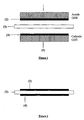
- FIG. 1 A schematic structure of a five-layer membrane-electrode assembly is shown in Figure 1 .
- the anode gas diffusion layer (1) together with the anode catalyst layer (2) forms the gas diffusion electrode (GDE) on the anode side
- the cathode gas diffusion layer (5) together with the cathode catalyst layer (4) forms the gas diffusion electrode (GDE) on the cathode side.
- the ionomer membrane (3) is located between the two GDEs.
- FIG. 2 The structure of a three-layer catalyst-coated membrane (CCM) is shown in Figure 2 .
- the catalyst layers (2) and (4) are applied directly to the membrane (3).
- the present invention describes novel catalyst-containing inks and pastes which can be used for coating various substrates (e.g. ionomer membranes, gas diffusion layers, carbon fibre nonwovens, polymer films, release films, etc.).
- substrates e.g. ionomer membranes, gas diffusion layers, carbon fibre nonwovens, polymer films, release films, etc.
- Such coated substrates are, for example, used for producing electrodes or membrane-electrode assemblies for fuel cells.
- EP 797 265 B1 describes an ink for producing membrane-electrode assemblies for fuel cells.
- Solvents used are isopropanol and glycerol.
- EP 622861 B1 discloses electrode inks containing alkoxy propanols or aryloxypropanols as organic solvents.
- EP 945 910A2 describes inks comprising two immiscible organic solvents A and B.
- solvents A use is made of monohydric or polyhydric alcohols, glycols, glycol ether alcohols, glycol ethers and mixtures thereof.
- the solvents B are nonpolar hydrocarbons or slightly polar solvents. Tertiary alcohols are not described.
- EP 309 337 A1 discloses an electrode ink containing alcohols and water.
- the ionomer is dissolved in a mixture of water and ethanol, or isopropanol.
- EP 785 588 A2 describes electrode inks containing sublimable pore formers. Cyclohexanol is used as alcoholic solvent
- EP 731 520 A1 teaches an ink comprising a catalyst, ionomer and solvent, with water being used as solvent. This ink contains no further organic components apart from the ionomer.
- EP 945 910 A2 discloses catalyst inks containing linear dialcohols (e.g. ethylene glycol, propylene glycol) and water.
- linear dialcohols e.g. ethylene glycol, propylene glycol
- WO 2004/054021 describes inks which comprise polar aprotic organic solvents.
- EP 1 378 952 A1 discloses a hydrophobic fibrous carbon gas diffusion backing which comprises a porous, conductive sheet material treated with a partially fluorinated polymer selected from the group consisting of acrylic polymers, methacrylic polymers, urethane polymers, and mixtures thereof.
- Inks which contain primary and/or secondary alcohols e.g. alkanediols, glycols or glycerol
- primary and/or secondary alcohols e.g. alkanediols, glycols or glycerol
- the primary or secondary OH groups gradually react in the ink in the presence of the catalyst and are subject to oxidative attack or degradation in the presence of atmospheric oxygen (for which even traces suffice). They can in this way be oxidized further to, for example, aldehydes, ketones and carboxylic acids. This oxidation process can lead to various degradation products in the ink.
- the oxidative degradation of alkanediols is known from the literature.
- the secondary or primary alcohol groups are in this case oxidized first.
- these intermediates can then be oxidized to, for example, oxalic acid (C 2 H 2 O 4 ), lactic acid (C 3 H 6 O 3 ), pyruvic aldehyde (C 3 H 4 O 2 ) or pyruvic acid (C 3 H 4 O 3 ), and autocondensation can finally occur to form carbon dioxide, carbon monoxide and acetic acid.
- the organic acids formed in this decomposition process can, like their salts, remain in the catalyst layer or on the surface of the catalyst. They can lead to a deterioration in performance of the catalyst layer or the membrane-electrode assembly and may have to be removed from the catalyst layers by labourious cleaning processes.
- the oxidation process described can influence the storage stability of the catalyst inks and cause a change in the viscosity of the ink during storage.
- the formation of degradation or decomposition products in the ink should be prevented.
- the catalyst layers produced therewith should have a high performance.
- the ink should considerably simplify the production process for electrodes and make post-treatment and cleaning steps for the electrode layers superfluous.
- the ink solvents should be miscible with water and/or the ionomer solution, have an appropriate boiling point and a suitable evaporation number (EN).
- the ink of the invention comprises the catalyst material together with ionomer material, water and at least one organic solvent bearing functional groups which are stable to oxidative degradation in the ink.
- the present invention relates to an ink for producing a catalyst layer for an electrochemical device, which comprises catalyst material, ionomer material, water and at least one organic solvent selected from 2,3-dimethyl-2,3-butanediol, 2,4-dimethyl-2,4-pentanediol, 2,4-dimethyl-2,4-hexanediol, and 2,5-dimethyl-2,5-hexanediol, or a mixture thereof.
- a the catalyst ink can optionally further, comprise an organic solvent selected from the class of tertiary alcohols having the general formula R 1 (R 2 ) C(OH) R 3 where
- Preferred solvents from the class of tertiary alcohols are, for example, tert-butanol, 2-methyl-2-butanol, 2-methyl-2-pentanol, 2,3-dimethyl-2-butanol, 2,3-dimethyl-2,3-butanediol, 2,4-dimethyl-2,4-pentanediol, 2,4-dimethyl-2,4-hexanediol, 2,5-dimethylhexan-2,5-diol, 3-hydroxy-3-methyl-2-butanone and 4-hydroxy-4-methyl-2-pentanone (diacetone alcohol) and mixtures thereof.
- Tertiary alcohols substituted by further functional groups have also been found to be useful.
- the skeleton of the tertiary alcohol can be modified in a targeted manner by the introduction of further suitable functional groups which should likewise be stable to oxidative attack.
- Suitable solvents from the class of aliphatic diketones are 2,3-butanedione (diacetyl), 2,3-pentanedione (ethyhmethylglyoxal), 2,4-pentanedione (acetylacetone), 2,3-hexanedione, 2,4-hexandione, 3,4-hexanedione, 2,5-hexanedione, 2,6-heptanedione, 3-methyl-2,5-hexanedione and 3-ethyl-2,5-hexanedione and mixture thereof.
- the aliphatic diketones can also be used in mixtures with the abovementioned tertiary alcohols.
- the ink solvents of the present invention should be miscible with water, preferably they should be completely miscible with water. Furthermore, the ink solvents should be miscible with the solvents of the liquid ionomer compositions used.
- Catalyst inks which contain the solvents according to the invention (tertiary alcohols as defined in claim 1 or aliphatic diketones or mixtures of diketones and tertiary alcohols have a good long-term stability.
- the viscosity of the inks is retained during storage over a relatively long period, i.e. over a number of weeks or months, and the catalytic activity of the catalyst is not impaired by degradation products in the ink. Subsequent processes for decontamination of the electrodes or the catalyst-coated membranes can be dispensed with.
- the catalyst inks display very good processing properties in spray application and screen printing. They can also be used in decal or transfer processes.
- Catalyst layers, electrodes and MEAs produced using the catalyst inks of the invention display good electrical performance values in a PEM fuel cell.
- the organic solvents used according to the invention are present in the catalyst ink in amounts of from 1 to 90% by weight, preferably from 5 to 80% by weight and particularly preferably from 10 to 50% by weight, based on the total weight of the ink.
- Further constituents of the inks are catalysts, ionomer materials and water, preferably deionized water.
- the proportion of water in the inks is in the range from 1 to 50% by weight, preferably from 5 to 25% by weight, based on the total weight of the ink.
- the ink of the invention can additionally contain additives such as binders, cosolvents, wetting agents, antifoaming agents, surfactants, anti-settling agents, preservatives, pore formers, levelling agents, stabilizers, pH modifiers and other substances.
- additives such as binders, cosolvents, wetting agents, antifoaming agents, surfactants, anti-settling agents, preservatives, pore formers, levelling agents, stabilizers, pH modifiers and other substances.
- basic agents such as sodium hydroxide (NaOH) or potassium hydroxide (KOH) can be added for buffering of the acid groups of the ionomer.
- the components precious metal containing catalyst e.g. 50% by weight Pt/C, Pt black, PtRu black, etc
- liquid ionomer composition e.g. Nafion® solution from DuPont
- deionized water e.g. deionized water
- organic solvent tertiary alcohol, aliphatic diketone or a mixture thereof
- dispersion equipment use is made of apparatuses for generating high shear forces (high-speed stirrers, roll mills, bead mills, etc.).
- the ink of the invention can be applied directly to an ionomer membrane. However, it can also be applied to commercial gas diffusion layers (e.g. carbon fibre papers, carbon fibre nonwovens, GDLs, backings) or to other substrate materials (e.g. polymer films). For this purpose, it is possible to use various coating processes such as doctor blade coating, spraying, rolling, brushing, screen printing, stencil printing or offset printing. Suitable coating processes are described, for example, in US 5,861,222 .
- the catalyst layers adhere well to all customary substrate materials, in particular to ionomer membranes.
- the ionomer membrane generally comprises proton-conducting polymer materials. Preference is given to using a tetrafluoroethylene-fluorovinyl ether copolymer bearing acid functions, in particular sulphonic acid groups. Such materials are marketed, for example, under the trade names Nafion® (DuPont) or Flemion® (Asahi Glass Co.). However, it is also possible to use other, in particular fluorine-free, ionomer materials such as sulphonated polyether ketones or aryl ketones or polybenzimidazoles. In addition ceramic membranes and other high-temperature membranes can also be used.
- the ionomer materials in the ink should be used in a liquid composition, i.e. dissolved or dispersed in a suitable solvent.
- a liquid composition i.e. dissolved or dispersed in a suitable solvent.
- Many fluorine-containing ionomer materials can be obtained in the form of an aqueous solution in various concentrations.
- the ionomer content of the solutions is usually in the range from 5 to 30% by weight, based on the total weight of the solution.
- ionomer materials supplied in the form of aqueous dispersions may also be used.
- Such dispersions are for example sold by DuPont under the name "Nafion® PFSA polymer dispersions" and usually have an ionomer content in the range from 5 to 30% by weight (based on the total weight of the dispersion).
- EWs equivalent weights
- Catalytically active components employed are the elements of the platinum group of the Periodic Table (Pt, Pd, Ag, Au, Ru, Rh, Os, Ir) or alloys thereof.
- the catalytically active metals can contain further alloying additions such as cobalt, chromium, tungsten or molybdenum.
- Use is generally made of supported catalysts (e.g.
- concentrations per unit area of from 0.05 to 5 mg of precious metal/cm 2 are possible in the reaction layers.
- the thickness of the catalyst layers after drying is about 5-100 microns, preferably 5 - 50 microns.
- a membrane-electrode assembly produced using the catalyst inks of the invention is examined in the PEM full cell test.
- the PEM fuel cell is operated using hydrogen and air (pressure: 3 bar) and the characteristic curve (voltage/current density curve) is determined. From this characteristic curve, the cell voltage at a current density of 500 m A/cm 2 is determined as a measure of the electrocatalytic performance of the cell.
- the weight ratio of catalyst/Nafion® in this ink is about 2:1.
- the ink was applied by spraying to the anode side and cathode side of a Nafion® NR 111 ionomer membrane (from DuPont, USA) in the form of a square having an edge length of 7.07 cm (active cell area: 50 cm 2 ) and subsequently dried at 90°C.
- the adhesion of the catalyst layers to the ionomer membrane was found to be very good.
- Post-treatment of the catalyst-coated membrane (CCM) to remove any decomposition products did not have to be carried out After drying, the CCM was placed between two gas diffusion layers (TGPH-060, from Toray, Japan) and measured in a PEM full cell in hydrogen/air operation.
- the ink was applied by screen printing to two gas diffusion layers (type Sigracet 21BC; from SGL, Meitingen, DE) in the form of a square having an edge length of 7.07 cm (active cell area: 50 cm 2 ) and subsequently dried. Irrigation of the electrodes to remove residues was dispensed with. An ionomer membrane (thickness: 50 microns) was placed between the two electrodes and the combination was subsequently pressed to form a five-layer membrane-electrode assembly (MEA). The total Pt loading was 0.54 mg of Pt/cm 2 . The MEA produced in this way was measured in the PEM full cell test. At a current density of 500 mA/cm 2 , a cell voltage of 700 mV was obtained (power density: 0.35 W/cm 2 ).
- the ink was applied by spraying to the anode side and cathode side of a Nafion® NR 111 ionomer membrane (from DuPont, USA) in the form of a square having an edge length of 7.07 cm (active cell area: 50 cm 2 ) and subsequently dried at 90°C.
- the adhesion of the catalyst layers to the ionomer membrane was found to be very good.
- After-treatment of the catalyst-coated membrane (CCM) to remove any decomposition products did not have to be carried out. After drying, the CCM was placed between two gas diffusion layers (TGPH-060, from Toray, Japan) and measured in a PEM full cell in hydrogen/air operation. Very good results were achieved.
- the total Pt loading was 0.44 mg of Pt/cm 2 .
- the ink made according to example 4 was stored in a sealed container for 64 days (i.e. more than 2 months) at room temperature.
- a GC analysis (using quantitative gas chromatographic methods) was run at the beginning and at the end of the storage period to detect the tert-butanol content of the ink.
- 64 days 57,1 wt.-% tert-butanol Oxidation products: none detected
Landscapes
- Chemical & Material Sciences (AREA)
- Chemical Kinetics & Catalysis (AREA)
- General Chemical & Material Sciences (AREA)
- Electrochemistry (AREA)
- Engineering & Computer Science (AREA)
- Manufacturing & Machinery (AREA)
- Materials Engineering (AREA)
- Sustainable Energy (AREA)
- Sustainable Development (AREA)
- Life Sciences & Earth Sciences (AREA)
- Inert Electrodes (AREA)
- Catalysts (AREA)
- Inks, Pencil-Leads, Or Crayons (AREA)
Description
- The present invention relates to an ink for producing catalyst layers for electrochemical devices. A catalyst ink which contains at least one organic solvent having functional groups or substituents which are stable to oxidative degradation is described. The ink is used in the production of catalyst layers and electrodes for electrochemical devices, in particular for fuel cells, membrane fuel cells (PEMFCs, DMFCs), electrolyzers or sensors.
- Fuel cells convert a fuel and an oxidant at separate locations at two electrodes into electric power, heat and water. As fuel, it is possible to use hydrogen, a hydrogen-rich gas or methanol, while oxygen or air serves as oxidant The process of energy conversion in the fuel cell has a particularly high efficiency. For this reason, fuel cells (PEMFCs, SOFCs, etc) are becomingly increasingly important for mobile, stationary and portable applications. Membrane fuel cells (PEMFCs, DMFCs, etc.) are particularly suitable for use in the abovementioned fields because of their compact construction, their power density and their high efficiency.
- The key component of a PEM fuel cell is the membrane-electrode assembly (MEA). The membrane-electrode assembly has a sandwich-like structure and generally comprises five layers.
- A schematic structure of a five-layer membrane-electrode assembly is shown in
Figure 1 . Here, the anode gas diffusion layer (1) together with the anode catalyst layer (2) forms the gas diffusion electrode (GDE) on the anode side; the cathode gas diffusion layer (5) together with the cathode catalyst layer (4) forms the gas diffusion electrode (GDE) on the cathode side. The ionomer membrane (3) is located between the two GDEs. - The structure of a three-layer catalyst-coated membrane (CCM) is shown in
Figure 2 . Here, the catalyst layers (2) and (4) are applied directly to the membrane (3). - In the production of a five-layer MEA, it is usual to apply two catalyst-coated gas diffusion layers (or gas diffusion electrodes, GDEs) to the front side and the rear side of an ionomer membrane (3) and press them together to produce an MEA. However, processes for producing MEAs using catalyst-coated ionomer membranes (CCMs) are also known. In this case, the CCMs are generally combined with the gas diffusion layers (1) and (5) which have not been coated with catalyst
- The present invention describes novel catalyst-containing inks and pastes which can be used for coating various substrates (e.g. ionomer membranes, gas diffusion layers, carbon fibre nonwovens, polymer films, release films, etc.). Such coated substrates are, for example, used for producing electrodes or membrane-electrode assemblies for fuel cells.
- Various compositions for catalyst inks are known from the patent literature.
- Thus,
EP 797 265 B1 -
US 5,869,416 describes alkylene carbonates, for example propylene carbonate, as solvents for catalyst inks. -
EP 622861 B1 -
EP 945 910A2 -
EP 309 337 A1 -
EP 785 588 A2 -
EP 731 520 A1 - Furthermore,
EP 945 910 A2 -
WO 2004/054021 describes inks which comprise polar aprotic organic solvents. -
EP 1 378 952 A1 discloses a hydrophobic fibrous carbon gas diffusion backing which comprises a porous, conductive sheet material treated with a partially fluorinated polymer selected from the group consisting of acrylic polymers, methacrylic polymers, urethane polymers, and mixtures thereof. - Inks which contain primary and/or secondary alcohols (e.g. alkanediols, glycols or glycerol) as solvents have fundamental disadvantages; in particular, they have an unsatisfactory stability. The primary or secondary OH groups gradually react in the ink in the presence of the catalyst and are subject to oxidative attack or degradation in the presence of atmospheric oxygen (for which even traces suffice). They can in this way be oxidized further to, for example, aldehydes, ketones and carboxylic acids. This oxidation process can lead to various degradation products in the ink.
- - The oxidative degradation of alkanediols is known from the literature. The secondary or primary alcohol groups are in this case oxidized first. In further stages, these intermediates can then be oxidized to, for example, oxalic acid (C2H2O4), lactic acid (C3H6O3), pyruvic aldehyde (C3H4O2) or pyruvic acid (C3H4O3), and autocondensation can finally occur to form carbon dioxide, carbon monoxide and acetic acid.
- The organic acids formed in this decomposition process can, like their salts, remain in the catalyst layer or on the surface of the catalyst. They can lead to a deterioration in performance of the catalyst layer or the membrane-electrode assembly and may have to be removed from the catalyst layers by labourious cleaning processes.
- Furthermore, the oxidation process described can influence the storage stability of the catalyst inks and cause a change in the viscosity of the ink during storage.
- It was therefore an object of the present invention to provide a catalyst ink which has a high stability in respect of decomposition reactions and a good storage stability. The formation of degradation or decomposition products in the ink should be prevented. The catalyst layers produced therewith should have a high performance. The ink should considerably simplify the production process for electrodes and make post-treatment and cleaning steps for the electrode layers superfluous. Depending on the coating methods selected, the ink solvents should be miscible with water and/or the ionomer solution, have an appropriate boiling point and a suitable evaporation number (EN).
- This object is achieved according to the invention by the provision of a catalyst ink corresponding to Claims 1 to 13. The use of the inks is described in Claims 14 to 17.
- The ink of the invention comprises the catalyst material together with ionomer material, water and at least one organic solvent bearing functional groups which are stable to oxidative degradation in the ink.
- In a first embodiment, the present invention relates to an ink for producing a catalyst layer for an electrochemical device, which comprises catalyst material, ionomer material, water and at least one organic solvent selected from 2,3-dimethyl-2,3-butanediol, 2,4-dimethyl-2,4-pentanediol, 2,4-dimethyl-2,4-hexanediol, and 2,5-dimethyl-2,5-hexanediol, or a mixture thereof.
- a the catalyst ink can optionally further, comprise an organic solvent selected from the class of tertiary alcohols having the general formula
R1 (R2) C(OH) R3
where - R1 =
- methyl, ethyl, propyl, isopropyl, butyl, isobutyl, tert-butyl, CH3(CH3)C(OH)-, CH3(CH3)C(OH)-CH2-, CH3(CH3)C(OH)-CH2-CH2-, CH3-O-, C2H5-O-, C3H7-O-, phenyl-O-, benzyl-O-, CH3-O-CH2-, C2H5-O-CH2-, C3H7-O-CH2-, CH3-CH(CH3)-O-CH2-, phenyl-O-CH2-, benzyl-O-CH2-, CH3(C-O)-CH2-, CH3(C-O)-CH2-CH2-, CH3-CH2(C=O)-CH2-, CH3-O(C=O)-CH2-, CH3CH2-O(C=O)-CH2-, HSO3-, HSO3-CH2-, HSO3-CH2-CH2 -,
- R2 =
- methyl, ethyl, propyl, isopropyl, butyl, isobutyl, -CH2-O-CH3
- R3 =
- methyl, ethyl, propyl, isopropyl, butyl, isobutyl, tert-butyl, CH3(CH3)C(OH)-, CH3(CH3)C(OH)-CH2-, CH3(CH3)C(OH)CH2-CH2-, CH3-O-, C2H5-O-, C3H7-O-, phenyl-O-, benzyl-O-, CH3-O-CH2-, C2H5-O-CH2-, C3H7-O-CH2-, CH3-CH(CH3)-O-CH2. phenyl-O-CH2-, benzyl-O-CH2-, CH3(C=O)-CH2-, CH3(C=O)-CH2-CH2-, CH3-CH2(C=O)-CH2-CH3-O(C=O)-CH2-, CH3CH2-O(C=O)-CH2-, HSO3-, HSO3-CH2-, HSO3-CH2-CH2 -.
- Preferred solvents from the class of tertiary alcohols are, for example, tert-butanol, 2-methyl-2-butanol, 2-methyl-2-pentanol, 2,3-dimethyl-2-butanol, 2,3-dimethyl-2,3-butanediol, 2,4-dimethyl-2,4-pentanediol, 2,4-dimethyl-2,4-hexanediol, 2,5-dimethylhexan-2,5-diol, 3-hydroxy-3-methyl-2-butanone and 4-hydroxy-4-methyl-2-pentanone (diacetone alcohol) and mixtures thereof.
- It has surprisingly been found that solvents from the class of tertiary alcohols are stable to oxidative degradation in the presence of the catalyst in the ink.
- Tertiary alcohols substituted by further functional groups have also been found to be useful. The skeleton of the tertiary alcohol can be modified in a targeted manner by the introduction of further suitable functional groups which should likewise be stable to oxidative attack. Suitable polar functional groups are ether (or alkoxy) groups (-O-R), keto groups (R-(C=O)-R), ester groups (R-COOR) or sulphonic acid groups (R-SO3H).
- The introduction of such additional functional groups enables the parameters polarity, solubility, miscibility with water, vapour pressure and evaporation number (EN) of the tertiary alcohol to be adjusted. At the same time, the hydrophilic OH group of the solvent molecule is retained, as a result of which good compatibility with water and the ionomer material in the ink is achieved.
- In addition, further tertiary alcohol groups in the solvent molecule are also possible, since these are likewise stable to oxidation. Such diols or triols having two or three tertiary alcohol groups in the molecule likewise give good results.
- In a second embodiment, the catalyst ink of the invention comprises at least one organic solvent having two keto groups (R-(C=O)-R) in the molecule (diketones). It has been found that the keto groups of these solvents are likewise stable to oxidative degradation in the ink. Aliphatic diketones, which have a degree of miscibility and compatibility with water and the ionomer, are particularly useful.
- Examples of suitable solvents from the class of aliphatic diketones are 2,3-butanedione (diacetyl), 2,3-pentanedione (ethyhmethylglyoxal), 2,4-pentanedione (acetylacetone), 2,3-hexanedione, 2,4-hexandione, 3,4-hexanedione, 2,5-hexanedione, 2,6-heptanedione, 3-methyl-2,5-hexanedione and 3-ethyl-2,5-hexanedione and mixture thereof.
- The aliphatic diketones can also be used in mixtures with the abovementioned tertiary alcohols.
- Generally, the ink solvents of the present invention (tertiary alcohols as defined in claim 1, aliphatic diketones or mixtures of diketones and tertiary alcohols should be miscible with water, preferably they should be completely miscible with water. Furthermore, the ink solvents should be miscible with the solvents of the liquid ionomer compositions used.
- Catalyst inks which contain the solvents according to the invention (tertiary alcohols as defined in claim 1 or aliphatic diketones or mixtures of diketones and tertiary alcohols have a good long-term stability. The viscosity of the inks is retained during storage over a relatively long period, i.e. over a number of weeks or months, and the catalytic activity of the catalyst is not impaired by degradation products in the ink. Subsequent processes for decontamination of the electrodes or the catalyst-coated membranes can be dispensed with.
- In addition, the catalyst inks display very good processing properties in spray application and screen printing. They can also be used in decal or transfer processes.
- Catalyst layers, electrodes and MEAs produced using the catalyst inks of the invention display good electrical performance values in a PEM fuel cell.
- The organic solvents used according to the invention are present in the catalyst ink in amounts of from 1 to 90% by weight, preferably from 5 to 80% by weight and particularly preferably from 10 to 50% by weight, based on the total weight of the ink. Further constituents of the inks are catalysts, ionomer materials and water, preferably deionized water. The proportion of water in the inks is in the range from 1 to 50% by weight, preferably from 5 to 25% by weight, based on the total weight of the ink.
- Apart from these components, the ink of the invention can additionally contain additives such as binders, cosolvents, wetting agents, antifoaming agents, surfactants, anti-settling agents, preservatives, pore formers, levelling agents, stabilizers, pH modifiers and other substances. Furthermore, basic agents such as sodium hydroxide (NaOH) or potassium hydroxide (KOH) can be added for buffering of the acid groups of the ionomer.
- To produce the ink of the invention, the components precious metal containing catalyst (e.g. 50% by weight Pt/C, Pt black, PtRu black, etc), liquid ionomer composition (e.g. Nafion® solution from DuPont), deionized water and the organic solvent (tertiary alcohol, aliphatic diketone or a mixture thereof) are weighed into a suitable vessel and dispersed or homogenized. As dispersion equipment, use is made of apparatuses for generating high shear forces (high-speed stirrers, roll mills, bead mills, etc.).
- The ink of the invention can be applied directly to an ionomer membrane. However, it can also be applied to commercial gas diffusion layers (e.g. carbon fibre papers, carbon fibre nonwovens, GDLs, backings) or to other substrate materials (e.g. polymer films). For this purpose, it is possible to use various coating processes such as doctor blade coating, spraying, rolling, brushing, screen printing, stencil printing or offset printing. Suitable coating processes are described, for example, in
US 5,861,222 . - After drying (generally at temperatures in the range from 50 to 150°C), the catalyst layers adhere well to all customary substrate materials, in particular to ionomer membranes.
- The ionomer membrane generally comprises proton-conducting polymer materials. Preference is given to using a tetrafluoroethylene-fluorovinyl ether copolymer bearing acid functions, in particular sulphonic acid groups. Such materials are marketed, for example, under the trade names Nafion® (DuPont) or Flemion® (Asahi Glass Co.). However, it is also possible to use other, in particular fluorine-free, ionomer materials such as sulphonated polyether ketones or aryl ketones or polybenzimidazoles. In addition ceramic membranes and other high-temperature membranes can also be used.
- Generally, the ionomer materials in the ink should be used in a liquid composition, i.e. dissolved or dispersed in a suitable solvent. Many fluorine-containing ionomer materials can be obtained in the form of an aqueous solution in various concentrations. The ionomer content of the solutions is usually in the range from 5 to 30% by weight, based on the total weight of the solution. Furthermore, ionomer materials supplied in the form of aqueous dispersions may also be used. Such dispersions are for example sold by DuPont under the name "Nafion® PFSA polymer dispersions" and usually have an ionomer content in the range from 5 to 30% by weight (based on the total weight of the dispersion).
- In addition, ionomers having different equivalent weights (EWs) are also offered by various manufacturers.
- As catalyst materials, it is possible to use all electrocatalysts known in the field of fuel cells. In the case of supported catalysts, finely divided, electrically conductive carbon is used as support, with preference being given to using carbon blacks or graphites. Catalytically active components employed are the elements of the platinum group of the Periodic Table (Pt, Pd, Ag, Au, Ru, Rh, Os, Ir) or alloys thereof. The catalytically active metals can contain further alloying additions such as cobalt, chromium, tungsten or molybdenum. Use is generally made of supported catalysts (e.g. 50% by weight Pt/C) in which the catalytically active platinum group metals have been applied in finely divided form to the surface of a conductive carbon support. However, unsupported catalysts such as platinum blacks or platinum powders having a high surface area can also be used for producing the electrode layers. Suitable electrocatalysts are described in
EP 743 092 B1 DE 44 43 701 . - Depending on the thickness of the catalyst layer, concentrations per unit area of from 0.05 to 5 mg of precious metal/cm2 are possible in the reaction layers. The thickness of the catalyst layers after drying is about 5-100 microns, preferably 5 - 50 microns.
- To determine the electrical performance in the fuel cell, a membrane-electrode assembly produced using the catalyst inks of the invention is examined in the PEM full cell test. Here, the PEM fuel cell is operated using hydrogen and air (pressure: 3 bar) and the characteristic curve (voltage/current density curve) is determined. From this characteristic curve, the cell voltage at a current density of 500 m A/cm2 is determined as a measure of the electrocatalytic performance of the cell.
- The following examples illustrate the invention:
- The following components were weighed out and homogenized by means of a dispersion apparatus:
0.75 g of supported Pt catalyst (50% Pt/C, from Umicore, Hanau) 3.25 g of Nafion® solution (11.3 % in water, from DuPont, USA) 9.00 g of water (deionized) 12.00 g of 4-hydroxy-4-methyl-2-pentanone (from Merck-Schuchardt, Hohenbrunn/Munich) 25.00 g - The weight ratio of catalyst/Nafion® in this ink is about 2:1. The ink was applied by spraying to the anode side and cathode side of a Nafion® NR 111 ionomer membrane (from DuPont, USA) in the form of a square having an edge length of 7.07 cm (active cell area: 50 cm2) and subsequently dried at 90°C. The adhesion of the catalyst layers to the ionomer membrane was found to be very good. Post-treatment of the catalyst-coated membrane (CCM) to remove any decomposition products did not have to be carried out After drying, the CCM was placed between two gas diffusion layers (TGPH-060, from Toray, Japan) and measured in a PEM full cell in hydrogen/air operation. At a current density of 500 mA/cm2, a cell voltage of 762 mV was measured (power density: 0.38 W/cm2). The total Pt loading (anode and cathode) was 0.44 mg of Pt/cm2.
- The following components were weighed out and homogenized by means of a dispersion apparatus:
3.00 g of supported Pt catalyst (50% Pt/C, from Umicore, Hanau) 13.275 g of Nafion® solution (11.3% in water, from DuPont, USA) 6.70 g of water (deionized) 17.25 g of tert-butanol (from Merck, Darmstadt) 40.225 g - The ink was applied by screen printing to two gas diffusion layers (type Sigracet 21BC; from SGL, Meitingen, DE) in the form of a square having an edge length of 7.07 cm (active cell area: 50 cm2) and subsequently dried. Irrigation of the electrodes to remove residues was dispensed with. An ionomer membrane (thickness: 50 microns) was placed between the two electrodes and the combination was subsequently pressed to form a five-layer membrane-electrode assembly (MEA). The total Pt loading was 0.54 mg of Pt/cm2. The MEA produced in this way was measured in the PEM full cell test. At a current density of 500 mA/cm2, a cell voltage of 700 mV was obtained (power density: 0.35 W/cm2).
- The following components were weighed out and homogenized:
0.50 g of supported Pt catalyst (50% Pt/C, from Umicore, Hanau) 2.20 g of Nafion® solution (11.3% in water, from DuPont, USA) 2.20 g of water (deionized) 19.60 g of 2,5-hexanedione (from Merck-Schuchardt, Hohenbrunn/Munich) 24.50 g - The ink was applied by spraying to the anode side and cathode side of a Nafion® NR 111 ionomer membrane (from DuPont, USA) in the form of a square having an edge length of 7.07 cm (active cell area: 50 cm2) and subsequently dried at 90°C. The adhesion of the catalyst layers to the ionomer membrane was found to be very good. After-treatment of the catalyst-coated membrane (CCM) to remove any decomposition products did not have to be carried out. After drying, the CCM was placed between two gas diffusion layers (TGPH-060, from Toray, Japan) and measured in a PEM full cell in hydrogen/air operation. Very good results were achieved. The total Pt loading was 0.44 mg of Pt/cm2.
- The following components were weighed out and homogenized:
5,00 g of supported Pt catalyst (50% Pt/C, from Umicore, Hanau) 22,12 g of Nafion® PFSA polymer dispersion DE 1020 (11% in water, from DuPont, USA) 100,00 g of tert-butanol (from Merck, Darmstadt) 42,88 g of water (deionized) 170,00 g - For testing of storage stability, the ink made according to example 4 was stored in a sealed container for 64 days (i.e. more than 2 months) at room temperature. A GC analysis (using quantitative gas chromatographic methods) was run at the beginning and at the end of the storage period to detect the tert-butanol content of the ink.
Begin (0 days): 58,8 wt.-% tert-butanol (based on the total weight of the ink) After 64 days: 57,1 wt.-% tert-butanol Oxidation products: none detected - This result shows that no decomposition or degradation of the ink solvent occurs. The content of tert-butanol remains nearly constant, thus documenting the high storage stability of the ink solvent.
Claims (17)
- Ink for producing a catalyst layer for an electrochemical device, which comprises catalyst material, ionomer material, water and at least one organic solvent selected from 2,3-dimathyl-2,3-butanediol, 2,4-dimethyl-2,4-pentanediol, 2,4-dimethyl-2,4-hexanediol, and 2,5-dimethyl-2,5-hexanediol, or a mixture thereof.
- Ink for producing a catalyst layer for an electrochemical device, which comprises catalyst material, ionomer material, water and at least one organic solvent bearing functional groups which are stable to oxidative degradation, wherein the organic solvent is selected from the class of aliphatic diketones.
- Ink according to Claim 2, wherein the organic solvent is elected from 2,3-butazaedione (diacetyl), 2,3-pentanedione (ethylmetliylglyoxal), 2,4-pentanedione (acetylacetone), 2,3-hexanedione, 2,4-hexanedione, 3,4-hexanedione, 2,5-hexanedione, 2,6-heptanedione, 3-methyl-2,5-hexanedione, 3-ethyl-2,5-hexanedione and a mixture thereof.
- Ink according to any of claims 1 to 3, wherein the organic solvent is a mixture of solvents from the class of tertiary alcohols and from the class of aliphatic diketones.
- Ink according to any of claims 1 to 4, wherein the organic solvent is present in the ink in an amount of from 1 to 90% by weight, preferably from 5 to 80% by weight and particularly preferably from 10 to 50% by weight, based on the total weight of the ink.
- Ink according to any of claims 1 to 5 which contains water in an amount of from 1 to 50% by weight, preferably from 5 to 25% by weight, based on the total weight of the ink.
- Ink according to any of claims 1 to 6, wherein the ionomer material comprises a tetrafluoroethylene-fluorovinyl ether copolymer bearing acid functions, in particular sulphonic acid groups.
- Ink according to any of claims 1 to 7, wherein the ionomer material is in an aqueous solution having an ionomer content of from 5 to 30% by weight (based on the total weight of the solution).
- Ink acccording to any of claims 1 to 7, wherein the ionomer material is in an aqueous dispersion having an ionomer content of from 5 to 30% by weight (based on the total weight of the dispersion)
- Ink according to any of claims 1 to 9, wherein the organic solvent is miscible with water, preferably completely miscible with water.
- Ink according to any of claims 1 to 10, wherein supported catalysts comprising finely divided, electrically conductive carbon black and, as catalytically active components, elements of the platinum group of the Periodic Table (i.e. Pt, Pd, Ag, Au, Ru, Rh, Os, Ir) or mixtures or alloys thereof are used as the catalyst material.
- Ink according to any of claims 1 to 10, wherein finely divided blacks or powders of the elements of the platinum group of the Periodic Table (i.e. Pt, Pd, Ag, Au, Ru, Rh, Os, Ir) or mixtures or alloys thereof are used as the catalyst material.
- Ink according to any of claims 1 to 12 which additionally contains an additive selected from wetting agents, antifoaming agents, surfactants, anti-settling agents, preservatives, pore formers, levelling agents, stabilizers, pH modifiers, sodium hydroxide (NaOH) and potassium hydroxide (KOH).
- Use of the ink according to any of claims 1 to 13 for producing a catalyst-coated ionomer membrane (CCM) for a fuel cell.
- Use of the ink according to any of claims 1 to 13 for producing a gas diffusion electrode (GDE) for a fuel cell.
- Use of the ink according to any of claims 1 to 13 for coating of a gas diffusion layer for an electrochemical device.
- Use of the ink according to any of claims 1. to 13 for producing a catalyst-coated substrate material.
Priority Applications (2)
| Application Number | Priority Date | Filing Date | Title |
|---|---|---|---|
| EP06723730A EP1872425B1 (en) | 2005-03-30 | 2006-03-25 | Ink for producing catalyst layers |
| EP10013185.3A EP2273591B1 (en) | 2005-03-30 | 2006-03-25 | Ink for producing catalyst layers |
Applications Claiming Priority (3)
| Application Number | Priority Date | Filing Date | Title |
|---|---|---|---|
| EP05006903 | 2005-03-30 | ||
| PCT/EP2006/002751 WO2006103035A1 (en) | 2005-03-30 | 2006-03-25 | Ink for producing catalyst layers |
| EP06723730A EP1872425B1 (en) | 2005-03-30 | 2006-03-25 | Ink for producing catalyst layers |
Related Child Applications (2)
| Application Number | Title | Priority Date | Filing Date |
|---|---|---|---|
| EP10013185.3A Division EP2273591B1 (en) | 2005-03-30 | 2006-03-25 | Ink for producing catalyst layers |
| EP10013185.3 Division-Into | 2010-10-01 |
Publications (2)
| Publication Number | Publication Date |
|---|---|
| EP1872425A1 EP1872425A1 (en) | 2008-01-02 |
| EP1872425B1 true EP1872425B1 (en) | 2012-11-28 |
Family
ID=34934584
Family Applications (2)
| Application Number | Title | Priority Date | Filing Date |
|---|---|---|---|
| EP10013185.3A Expired - Lifetime EP2273591B1 (en) | 2005-03-30 | 2006-03-25 | Ink for producing catalyst layers |
| EP06723730A Expired - Lifetime EP1872425B1 (en) | 2005-03-30 | 2006-03-25 | Ink for producing catalyst layers |
Family Applications Before (1)
| Application Number | Title | Priority Date | Filing Date |
|---|---|---|---|
| EP10013185.3A Expired - Lifetime EP2273591B1 (en) | 2005-03-30 | 2006-03-25 | Ink for producing catalyst layers |
Country Status (7)
| Country | Link |
|---|---|
| US (2) | US7906452B2 (en) |
| EP (2) | EP2273591B1 (en) |
| JP (1) | JP2008534719A (en) |
| KR (1) | KR101338892B1 (en) |
| CN (1) | CN101167211B (en) |
| CA (1) | CA2602551C (en) |
| WO (1) | WO2006103035A1 (en) |
Cited By (1)
| Publication number | Priority date | Publication date | Assignee | Title |
|---|---|---|---|---|
| WO2023170485A1 (en) * | 2022-03-10 | 2023-09-14 | Dre Motors Private Limited | Composition for catalyst ink comprising ferricyanide-ferrocyanide and process for preparing the same |
Families Citing this family (12)
| Publication number | Priority date | Publication date | Assignee | Title |
|---|---|---|---|---|
| JP5214441B2 (en) | 2006-09-13 | 2013-06-19 | 日立マクセル株式会社 | Membrane electrode assembly and polymer electrolyte fuel cell |
| EP2535971B1 (en) * | 2010-02-10 | 2018-10-24 | Showa Denko K.K. | Process for producing fuel cell electrode catalyst, process for producing transition metal oxycarbonitride, fuel cell electrode catalyst, and uses thereof |
| JP5573539B2 (en) * | 2010-09-21 | 2014-08-20 | トヨタ自動車株式会社 | Method for producing electrode for fuel cell |
| JP5705325B2 (en) | 2010-09-30 | 2015-04-22 | ユーティーシー パワー コーポレイション | Hot pressed direct deposition catalyst layer |
| EP2475034B1 (en) | 2010-12-23 | 2020-11-25 | Greenerity GmbH | Membrane electrode assemblies for PEM fuel cells |
| FR3003694B1 (en) * | 2013-03-22 | 2015-04-24 | Commissariat Energie Atomique | METHOD FOR MANUFACTURING A MEMBRANE-ELECTRODE ASSEMBLY |
| EP3440238B1 (en) | 2016-04-04 | 2021-10-27 | Dioxide Materials, Inc. | Electrolyzers having catalyst layers |
| US12418039B2 (en) | 2016-12-23 | 2025-09-16 | W. L. Gore & Associates, Inc. | Membrane electrode assembly manufacturing process |
| US11251453B2 (en) | 2016-12-23 | 2022-02-15 | W. L. Gore & Associates, Inc. | Membrane electrode assembly manufacturing process |
| KR102463959B1 (en) * | 2017-12-22 | 2022-11-04 | 더블유.엘. 고어 앤드 어소시에이트스, 인코포레이티드 | Catalyst ink containing a c5-c10 alcohol or carboxylic acid, and mea manufacturing process |
| KR102230982B1 (en) * | 2018-01-26 | 2021-03-22 | 주식회사 엘지화학 | Method for preparing catalyst layer, catalyst layer and membrane-electrode assembly and fuel cell comprising the same |
| CN114725402A (en) * | 2022-04-08 | 2022-07-08 | 安徽枡水新能源科技有限公司 | Preparation method and application of coating slurry for preparing fuel cell catalyst |
Family Cites Families (31)
| Publication number | Priority date | Publication date | Assignee | Title |
|---|---|---|---|---|
| US3442715A (en) * | 1965-03-01 | 1969-05-06 | Monsanto Res Corp | Method of making diffusion membrane electrodes from visco elastic dough |
| FR2621043B1 (en) | 1987-09-25 | 1992-01-17 | Atochem | FLUORINATED ION EXCHANGE POLYMERS CONTAINING METAL AGGREGATES IN MASS OR SURFACE AND METHOD FOR OBTAINING THEM |
| US5272017A (en) * | 1992-04-03 | 1993-12-21 | General Motors Corporation | Membrane-electrode assemblies for electrochemical cells |
| US5330860A (en) | 1993-04-26 | 1994-07-19 | E. I. Du Pont De Nemours And Company | Membrane and electrode structure |
| DE4443701C1 (en) | 1994-12-08 | 1996-08-29 | Degussa | Shell catalyst, process for its production and its use |
| GB9504713D0 (en) | 1995-03-09 | 1995-04-26 | Johnson Matthey Plc | Improved electrocatalytic material |
| DE19517598C1 (en) | 1995-05-13 | 1997-01-02 | Degussa | Platinum-aluminum alloy catalyst and its use in fuel cells |
| US5702755A (en) * | 1995-11-06 | 1997-12-30 | The Dow Chemical Company | Process for preparing a membrane/electrode assembly |
| JPH09199138A (en) | 1996-01-19 | 1997-07-31 | Toyota Motor Corp | METHOD FOR PRODUCING FUEL CELL ELECTRODE OR ELECTRODE / ELECTROLYTE MEMBRANE ASSEMBLY, AND FUEL CELL ELECTRODE |
| DE19611510A1 (en) | 1996-03-23 | 1997-09-25 | Degussa | Gas diffusion electrode for membrane fuel cells and process for their manufacture |
| JPH1064564A (en) * | 1996-08-14 | 1998-03-06 | Nkk Corp | Method for producing solid electrolyte membrane |
| DE19812592B4 (en) | 1998-03-23 | 2004-05-13 | Umicore Ag & Co.Kg | Membrane electrode unit for polymer electrolyte fuel cells, process for their production and ink |
| DE10037072A1 (en) * | 2000-07-29 | 2002-02-14 | Omg Ag & Co Kg | Membrane electrode unit for polymer electrolyte fuel cells and process for their production |
| DE10037074A1 (en) * | 2000-07-29 | 2002-02-14 | Omg Ag & Co Kg | Ink for the production of membrane electrode assemblies for PEM fuel cells |
| EP1357620A4 (en) * | 2001-03-15 | 2007-08-15 | Matsushita Electric Industrial Co Ltd | METHOD FOR PRODUCING AN ELECTROLYTIC FILM ELECTRODE COMPOUND FOR A FUEL CELL |
| US6939640B2 (en) * | 2001-09-21 | 2005-09-06 | E. I. Dupont De Nemours And Company | Anode electrocatalysts for coated substrates used in fuel cells |
| KR100964432B1 (en) * | 2001-10-24 | 2010-06-16 | 이 아이 듀폰 디 네모아 앤드 캄파니 | Continuous Preparation of Catalyst Coated Membranes |
| JP3941515B2 (en) * | 2002-01-15 | 2007-07-04 | トヨタ自動車株式会社 | Method for producing catalyst layer for fuel cell electrode and method for producing ink for producing catalyst layer for fuel cell electrode |
| WO2003061931A2 (en) * | 2002-01-22 | 2003-07-31 | E.I. Du Pont De Nemours And Company | Compression mould for making a membrane electrode assembly |
| KR20040081140A (en) * | 2002-01-22 | 2004-09-20 | 이 아이 듀폰 디 네모아 앤드 캄파니 | Unitized Membrane Electrode Assembly and Process for Its Preparation |
| US20050067345A1 (en) * | 2002-02-26 | 2005-03-31 | Prugh David Neville | Production of catalyst coated membranes |
| US20030219645A1 (en) * | 2002-04-22 | 2003-11-27 | Reichert David L. | Treated gas diffusion backings and their use in fuel cells |
| DE60230979D1 (en) * | 2002-07-31 | 2009-03-12 | Umicore Ag & Co Kg | Aqueous catalyst inks and their use in the preparation of catalyst coated substrates |
| EP1387422B1 (en) * | 2002-07-31 | 2016-04-06 | Umicore AG & Co. KG | Process for the manufacture of catalyst-coated substrates |
| US20040107869A1 (en) | 2002-12-10 | 2004-06-10 | 3M Innovative Properties Company | Catalyst ink |
| JP2006516818A (en) * | 2003-01-28 | 2006-07-06 | コンダクティブ・インクジェット・テクノロジー・リミテッド | Method for producing a conductive metal region on a substrate |
| WO2005001978A2 (en) * | 2003-05-30 | 2005-01-06 | E. I. Du Pont De Nemours And Company | Fuel cells and their components using catalysts having a high metal to support ratio |
| JP4064890B2 (en) * | 2003-07-30 | 2008-03-19 | Jsr株式会社 | Method for producing electrode paste |
| DE602004010021T2 (en) * | 2003-09-12 | 2008-09-11 | Matsushita Electric Industrial Co., Ltd., Kadoma | Ink for producing a catalyst layer, electrode and membrane-electrode assembly in which such ink is used |
| CN101816088B (en) * | 2007-06-29 | 2013-08-28 | 凸版印刷株式会社 | Membrane electrode assembly, method of manufacturing membrane electrode assembly, and solid polymer electrolyte fuel cell |
| JP5434103B2 (en) * | 2008-03-18 | 2014-03-05 | 凸版印刷株式会社 | Method for manufacturing membrane electrode assembly, membrane electrode assembly |
-
2006
- 2006-03-25 US US11/909,767 patent/US7906452B2/en active Active
- 2006-03-25 JP JP2008503414A patent/JP2008534719A/en active Pending
- 2006-03-25 EP EP10013185.3A patent/EP2273591B1/en not_active Expired - Lifetime
- 2006-03-25 EP EP06723730A patent/EP1872425B1/en not_active Expired - Lifetime
- 2006-03-25 KR KR1020077023014A patent/KR101338892B1/en not_active Expired - Lifetime
- 2006-03-25 CN CN2006800146740A patent/CN101167211B/en not_active Expired - Lifetime
- 2006-03-25 WO PCT/EP2006/002751 patent/WO2006103035A1/en not_active Ceased
- 2006-03-25 CA CA2602551A patent/CA2602551C/en not_active Expired - Lifetime
-
2011
- 2011-01-10 US US12/987,956 patent/US8198206B2/en not_active Expired - Lifetime
Cited By (1)
| Publication number | Priority date | Publication date | Assignee | Title |
|---|---|---|---|---|
| WO2023170485A1 (en) * | 2022-03-10 | 2023-09-14 | Dre Motors Private Limited | Composition for catalyst ink comprising ferricyanide-ferrocyanide and process for preparing the same |
Also Published As
| Publication number | Publication date |
|---|---|
| US8198206B2 (en) | 2012-06-12 |
| KR101338892B1 (en) | 2013-12-12 |
| CN101167211A (en) | 2008-04-23 |
| CA2602551C (en) | 2013-06-25 |
| US20110166009A1 (en) | 2011-07-07 |
| US7906452B2 (en) | 2011-03-15 |
| CA2602551A1 (en) | 2006-10-05 |
| EP2273591B1 (en) | 2017-05-31 |
| JP2008534719A (en) | 2008-08-28 |
| WO2006103035A1 (en) | 2006-10-05 |
| KR20070116083A (en) | 2007-12-06 |
| EP1872425A1 (en) | 2008-01-02 |
| US20080191161A1 (en) | 2008-08-14 |
| EP2273591A2 (en) | 2011-01-12 |
| EP2273591A3 (en) | 2011-03-30 |
| CN101167211B (en) | 2010-09-22 |
Similar Documents
| Publication | Publication Date | Title |
|---|---|---|
| US8198206B2 (en) | Ink for producing catalyst layers | |
| KR100991108B1 (en) | Inks for manufacturing membrane electrode units for PEM fuel cells | |
| US5716437A (en) | Materials for use in electrode manufacture | |
| EP1387423B1 (en) | Water-based catalyst inks and their use for manufacture of catalyst-coated substrates | |
| JP2004071564A (en) | Method for producing catalyst-coated substrate and aqueous catalyst ink for use therein | |
| CN100521317C (en) | Membrane-electrode unit for direct methanol fuel cells and method for the production thereof | |
| JP2019083085A (en) | Paste for forming electrode catalyst layer, manufacturing method, film-electrode catalyst layer conjugant, gas diffusion electrode, solid polymer fuel cell, and manufacturing method of solid polymer water electrolysis cell | |
| KR102721948B1 (en) | Highly activated oxygen evolution reaction electrode for polymer electrolyte water electrolysis | |
| JP2020023748A (en) | Method for producing platinum-supported polymer electrolyte membrane and platinum-supported polymer electrolyte membrane | |
| CA2403598C (en) | Production of low-temperature fuel cell electrodes | |
| JP2010532543A (en) | Membrane electrode assembly | |
| JP2006079904A (en) | POLYMER ELECTROLYTE FUEL CELL AND MANUFACTURING METHOD THEREOF | |
| JP2001300324A (en) | Composite catalyst, method for producing the same, and method for producing fuel cell electrode using the composite catalyst | |
| CN115651420A (en) | Perfluorosulfonic acid proton exchange membrane and preparation method and application thereof | |
| JP2020155391A (en) | Fuel cell catalyst layer and its manufacturing method | |
| JP2007048557A (en) | Manufacturing method of membrane electrode assembly |
Legal Events
| Date | Code | Title | Description |
|---|---|---|---|
| PUAI | Public reference made under article 153(3) epc to a published international application that has entered the european phase |
Free format text: ORIGINAL CODE: 0009012 |
|
| 17P | Request for examination filed |
Effective date: 20071030 |
|
| AK | Designated contracting states |
Kind code of ref document: A1 Designated state(s): AT BE BG CH CY CZ DE DK EE ES FI FR GB GR HU IE IS IT LI LT LU LV MC NL PL PT RO SE SI SK TR |
|
| DAX | Request for extension of the european patent (deleted) | ||
| 17Q | First examination report despatched |
Effective date: 20080711 |
|
| REG | Reference to a national code |
Ref country code: DE Ref legal event code: R079 Ref document number: 602006033324 Country of ref document: DE Free format text: PREVIOUS MAIN CLASS: H01M0004860000 Ipc: H01M0004920000 |
|
| RIC1 | Information provided on ipc code assigned before grant |
Ipc: H01M 4/88 20060101ALI20120309BHEP Ipc: C25B 9/10 20060101ALI20120309BHEP Ipc: H01M 8/10 20060101ALI20120309BHEP Ipc: H01M 4/92 20060101AFI20120309BHEP |
|
| RTI1 | Title (correction) |
Free format text: INK FOR PRODUCING CATALYST LAYERS |
|
| GRAP | Despatch of communication of intention to grant a patent |
Free format text: ORIGINAL CODE: EPIDOSNIGR1 |
|
| GRAS | Grant fee paid |
Free format text: ORIGINAL CODE: EPIDOSNIGR3 |
|
| GRAA | (expected) grant |
Free format text: ORIGINAL CODE: 0009210 |
|
| AK | Designated contracting states |
Kind code of ref document: B1 Designated state(s): AT BE BG CH CY CZ DE DK EE ES FI FR GB GR HU IE IS IT LI LT LU LV MC NL PL PT RO SE SI SK TR |
|
| REG | Reference to a national code |
Ref country code: GB Ref legal event code: FG4D |
|
| REG | Reference to a national code |
Ref country code: CH Ref legal event code: EP |
|
| REG | Reference to a national code |
Ref country code: AT Ref legal event code: REF Ref document number: 586572 Country of ref document: AT Kind code of ref document: T Effective date: 20121215 |
|
| REG | Reference to a national code |
Ref country code: IE Ref legal event code: FG4D |
|
| REG | Reference to a national code |
Ref country code: DE Ref legal event code: R096 Ref document number: 602006033324 Country of ref document: DE Effective date: 20130124 |
|
| REG | Reference to a national code |
Ref country code: AT Ref legal event code: MK05 Ref document number: 586572 Country of ref document: AT Kind code of ref document: T Effective date: 20121128 |
|
| REG | Reference to a national code |
Ref country code: NL Ref legal event code: VDEP Effective date: 20121128 |
|
| REG | Reference to a national code |
Ref country code: LT Ref legal event code: MG4D |
|
| PG25 | Lapsed in a contracting state [announced via postgrant information from national office to epo] |
Ref country code: LT Free format text: LAPSE BECAUSE OF FAILURE TO SUBMIT A TRANSLATION OF THE DESCRIPTION OR TO PAY THE FEE WITHIN THE PRESCRIBED TIME-LIMIT Effective date: 20121128 Ref country code: ES Free format text: LAPSE BECAUSE OF FAILURE TO SUBMIT A TRANSLATION OF THE DESCRIPTION OR TO PAY THE FEE WITHIN THE PRESCRIBED TIME-LIMIT Effective date: 20130311 Ref country code: SE Free format text: LAPSE BECAUSE OF FAILURE TO SUBMIT A TRANSLATION OF THE DESCRIPTION OR TO PAY THE FEE WITHIN THE PRESCRIBED TIME-LIMIT Effective date: 20121128 Ref country code: FI Free format text: LAPSE BECAUSE OF FAILURE TO SUBMIT A TRANSLATION OF THE DESCRIPTION OR TO PAY THE FEE WITHIN THE PRESCRIBED TIME-LIMIT Effective date: 20121128 |
|
| PG25 | Lapsed in a contracting state [announced via postgrant information from national office to epo] |
Ref country code: PT Free format text: LAPSE BECAUSE OF FAILURE TO SUBMIT A TRANSLATION OF THE DESCRIPTION OR TO PAY THE FEE WITHIN THE PRESCRIBED TIME-LIMIT Effective date: 20130328 Ref country code: BE Free format text: LAPSE BECAUSE OF FAILURE TO SUBMIT A TRANSLATION OF THE DESCRIPTION OR TO PAY THE FEE WITHIN THE PRESCRIBED TIME-LIMIT Effective date: 20121128 Ref country code: GR Free format text: LAPSE BECAUSE OF FAILURE TO SUBMIT A TRANSLATION OF THE DESCRIPTION OR TO PAY THE FEE WITHIN THE PRESCRIBED TIME-LIMIT Effective date: 20130301 Ref country code: PL Free format text: LAPSE BECAUSE OF FAILURE TO SUBMIT A TRANSLATION OF THE DESCRIPTION OR TO PAY THE FEE WITHIN THE PRESCRIBED TIME-LIMIT Effective date: 20121128 Ref country code: SI Free format text: LAPSE BECAUSE OF FAILURE TO SUBMIT A TRANSLATION OF THE DESCRIPTION OR TO PAY THE FEE WITHIN THE PRESCRIBED TIME-LIMIT Effective date: 20121128 Ref country code: LV Free format text: LAPSE BECAUSE OF FAILURE TO SUBMIT A TRANSLATION OF THE DESCRIPTION OR TO PAY THE FEE WITHIN THE PRESCRIBED TIME-LIMIT Effective date: 20121128 |
|
| PG25 | Lapsed in a contracting state [announced via postgrant information from national office to epo] |
Ref country code: AT Free format text: LAPSE BECAUSE OF FAILURE TO SUBMIT A TRANSLATION OF THE DESCRIPTION OR TO PAY THE FEE WITHIN THE PRESCRIBED TIME-LIMIT Effective date: 20121128 |
|
| PG25 | Lapsed in a contracting state [announced via postgrant information from national office to epo] |
Ref country code: BG Free format text: LAPSE BECAUSE OF FAILURE TO SUBMIT A TRANSLATION OF THE DESCRIPTION OR TO PAY THE FEE WITHIN THE PRESCRIBED TIME-LIMIT Effective date: 20130228 Ref country code: EE Free format text: LAPSE BECAUSE OF FAILURE TO SUBMIT A TRANSLATION OF THE DESCRIPTION OR TO PAY THE FEE WITHIN THE PRESCRIBED TIME-LIMIT Effective date: 20121128 Ref country code: DK Free format text: LAPSE BECAUSE OF FAILURE TO SUBMIT A TRANSLATION OF THE DESCRIPTION OR TO PAY THE FEE WITHIN THE PRESCRIBED TIME-LIMIT Effective date: 20121128 Ref country code: SK Free format text: LAPSE BECAUSE OF FAILURE TO SUBMIT A TRANSLATION OF THE DESCRIPTION OR TO PAY THE FEE WITHIN THE PRESCRIBED TIME-LIMIT Effective date: 20121128 Ref country code: CZ Free format text: LAPSE BECAUSE OF FAILURE TO SUBMIT A TRANSLATION OF THE DESCRIPTION OR TO PAY THE FEE WITHIN THE PRESCRIBED TIME-LIMIT Effective date: 20121128 |
|
| PG25 | Lapsed in a contracting state [announced via postgrant information from national office to epo] |
Ref country code: NL Free format text: LAPSE BECAUSE OF FAILURE TO SUBMIT A TRANSLATION OF THE DESCRIPTION OR TO PAY THE FEE WITHIN THE PRESCRIBED TIME-LIMIT Effective date: 20121128 Ref country code: IT Free format text: LAPSE BECAUSE OF FAILURE TO SUBMIT A TRANSLATION OF THE DESCRIPTION OR TO PAY THE FEE WITHIN THE PRESCRIBED TIME-LIMIT Effective date: 20121128 Ref country code: RO Free format text: LAPSE BECAUSE OF FAILURE TO SUBMIT A TRANSLATION OF THE DESCRIPTION OR TO PAY THE FEE WITHIN THE PRESCRIBED TIME-LIMIT Effective date: 20121128 |
|
| PLBE | No opposition filed within time limit |
Free format text: ORIGINAL CODE: 0009261 |
|
| STAA | Information on the status of an ep patent application or granted ep patent |
Free format text: STATUS: NO OPPOSITION FILED WITHIN TIME LIMIT |
|
| PG25 | Lapsed in a contracting state [announced via postgrant information from national office to epo] |
Ref country code: MC Free format text: LAPSE BECAUSE OF NON-PAYMENT OF DUE FEES Effective date: 20130331 |
|
| REG | Reference to a national code |
Ref country code: CH Ref legal event code: PL |
|
| 26N | No opposition filed |
Effective date: 20130829 |
|
| PG25 | Lapsed in a contracting state [announced via postgrant information from national office to epo] |
Ref country code: CY Free format text: LAPSE BECAUSE OF FAILURE TO SUBMIT A TRANSLATION OF THE DESCRIPTION OR TO PAY THE FEE WITHIN THE PRESCRIBED TIME-LIMIT Effective date: 20121128 |
|
| REG | Reference to a national code |
Ref country code: DE Ref legal event code: R097 Ref document number: 602006033324 Country of ref document: DE Effective date: 20130829 |
|
| REG | Reference to a national code |
Ref country code: IE Ref legal event code: MM4A |
|
| PG25 | Lapsed in a contracting state [announced via postgrant information from national office to epo] |
Ref country code: IE Free format text: LAPSE BECAUSE OF NON-PAYMENT OF DUE FEES Effective date: 20130325 Ref country code: CH Free format text: LAPSE BECAUSE OF NON-PAYMENT OF DUE FEES Effective date: 20130331 Ref country code: LI Free format text: LAPSE BECAUSE OF NON-PAYMENT OF DUE FEES Effective date: 20130331 |
|
| PG25 | Lapsed in a contracting state [announced via postgrant information from national office to epo] |
Ref country code: TR Free format text: LAPSE BECAUSE OF FAILURE TO SUBMIT A TRANSLATION OF THE DESCRIPTION OR TO PAY THE FEE WITHIN THE PRESCRIBED TIME-LIMIT Effective date: 20121128 |
|
| PG25 | Lapsed in a contracting state [announced via postgrant information from national office to epo] |
Ref country code: LU Free format text: LAPSE BECAUSE OF NON-PAYMENT OF DUE FEES Effective date: 20130325 Ref country code: HU Free format text: LAPSE BECAUSE OF FAILURE TO SUBMIT A TRANSLATION OF THE DESCRIPTION OR TO PAY THE FEE WITHIN THE PRESCRIBED TIME-LIMIT; INVALID AB INITIO Effective date: 20060325 |
|
| REG | Reference to a national code |
Ref country code: FR Ref legal event code: PLFP Year of fee payment: 11 |
|
| PG25 | Lapsed in a contracting state [announced via postgrant information from national office to epo] |
Ref country code: IS Free format text: LAPSE BECAUSE OF FAILURE TO SUBMIT A TRANSLATION OF THE DESCRIPTION OR TO PAY THE FEE WITHIN THE PRESCRIBED TIME-LIMIT Effective date: 20121128 |
|
| REG | Reference to a national code |
Ref country code: FR Ref legal event code: PLFP Year of fee payment: 12 |
|
| REG | Reference to a national code |
Ref country code: FR Ref legal event code: PLFP Year of fee payment: 13 |
|
| P01 | Opt-out of the competence of the unified patent court (upc) registered |
Effective date: 20230602 |
|
| PGFP | Annual fee paid to national office [announced via postgrant information from national office to epo] |
Ref country code: DE Payment date: 20241231 Year of fee payment: 20 |
|
| PGFP | Annual fee paid to national office [announced via postgrant information from national office to epo] |
Ref country code: FR Payment date: 20250210 Year of fee payment: 20 |
|
| PGFP | Annual fee paid to national office [announced via postgrant information from national office to epo] |
Ref country code: GB Payment date: 20250102 Year of fee payment: 20 |