EP1870226A2 - Method of making heat-resistant transparent container - Google Patents
Method of making heat-resistant transparent container Download PDFInfo
- Publication number
- EP1870226A2 EP1870226A2 EP07110439A EP07110439A EP1870226A2 EP 1870226 A2 EP1870226 A2 EP 1870226A2 EP 07110439 A EP07110439 A EP 07110439A EP 07110439 A EP07110439 A EP 07110439A EP 1870226 A2 EP1870226 A2 EP 1870226A2
- Authority
- EP
- European Patent Office
- Prior art keywords
- heat
- stretched
- stretching
- pet sheet
- temperature
- Prior art date
- Legal status (The legal status is an assumption and is not a legal conclusion. Google has not performed a legal analysis and makes no representation as to the accuracy of the status listed.)
- Granted
Links
- 238000004519 manufacturing process Methods 0.000 title claims abstract description 7
- 229920008790 Amorphous Polyethylene terephthalate Polymers 0.000 claims abstract description 104
- 238000009998 heat setting Methods 0.000 claims abstract description 68
- 238000000034 method Methods 0.000 claims abstract description 29
- 238000010438 heat treatment Methods 0.000 claims abstract description 20
- 238000003856 thermoforming Methods 0.000 claims abstract description 14
- 238000000465 moulding Methods 0.000 claims description 12
- -1 polyethylene terephthalate Polymers 0.000 claims description 7
- 229920000139 polyethylene terephthalate Polymers 0.000 claims description 6
- 239000005020 polyethylene terephthalate Substances 0.000 claims description 6
- 235000013305 food Nutrition 0.000 description 23
- 238000012360 testing method Methods 0.000 description 20
- 238000002425 crystallisation Methods 0.000 description 16
- 230000008025 crystallization Effects 0.000 description 16
- 230000001954 sterilising effect Effects 0.000 description 12
- 238000004659 sterilization and disinfection Methods 0.000 description 12
- 230000037303 wrinkles Effects 0.000 description 11
- 230000000052 comparative effect Effects 0.000 description 8
- 230000004927 fusion Effects 0.000 description 6
- 229920001155 polypropylene Polymers 0.000 description 6
- XLYOFNOQVPJJNP-UHFFFAOYSA-N water Substances O XLYOFNOQVPJJNP-UHFFFAOYSA-N 0.000 description 6
- 239000004743 Polypropylene Substances 0.000 description 5
- 238000011156 evaluation Methods 0.000 description 4
- 239000003921 oil Substances 0.000 description 4
- 239000004798 oriented polystyrene Substances 0.000 description 4
- 235000015277 pork Nutrition 0.000 description 4
- 238000007788 roughening Methods 0.000 description 4
- 230000002087 whitening effect Effects 0.000 description 4
- 239000011347 resin Substances 0.000 description 3
- 229920005989 resin Polymers 0.000 description 3
- 230000000007 visual effect Effects 0.000 description 3
- 239000004698 Polyethylene Substances 0.000 description 2
- 239000004793 Polystyrene Substances 0.000 description 2
- XAGFODPZIPBFFR-UHFFFAOYSA-N aluminium Chemical compound [Al] XAGFODPZIPBFFR-UHFFFAOYSA-N 0.000 description 2
- 229910052782 aluminium Inorganic materials 0.000 description 2
- 238000001816 cooling Methods 0.000 description 2
- 239000013078 crystal Substances 0.000 description 2
- 230000003028 elevating effect Effects 0.000 description 2
- 239000011888 foil Substances 0.000 description 2
- 238000005259 measurement Methods 0.000 description 2
- 229920000573 polyethylene Polymers 0.000 description 2
- 229920005644 polyethylene terephthalate glycol copolymer Polymers 0.000 description 2
- 229920002223 polystyrene Polymers 0.000 description 2
- 238000007789 sealing Methods 0.000 description 2
- 208000019901 Anxiety disease Diseases 0.000 description 1
- IJGRMHOSHXDMSA-UHFFFAOYSA-N Atomic nitrogen Chemical compound N#N IJGRMHOSHXDMSA-UHFFFAOYSA-N 0.000 description 1
- 240000008415 Lactuca sativa Species 0.000 description 1
- 239000000654 additive Substances 0.000 description 1
- 238000000137 annealing Methods 0.000 description 1
- 230000036506 anxiety Effects 0.000 description 1
- 230000001419 dependent effect Effects 0.000 description 1
- 239000000539 dimer Substances 0.000 description 1
- 229910001873 dinitrogen Inorganic materials 0.000 description 1
- 235000021186 dishes Nutrition 0.000 description 1
- 238000010828 elution Methods 0.000 description 1
- 239000000945 filler Substances 0.000 description 1
- 230000009477 glass transition Effects 0.000 description 1
- 238000011835 investigation Methods 0.000 description 1
- 238000002844 melting Methods 0.000 description 1
- 230000008018 melting Effects 0.000 description 1
- 239000000178 monomer Substances 0.000 description 1
- 235000012149 noodles Nutrition 0.000 description 1
- 239000005026 oriented polypropylene Substances 0.000 description 1
- 238000003825 pressing Methods 0.000 description 1
- 238000009877 rendering Methods 0.000 description 1
- 235000012045 salad Nutrition 0.000 description 1
- 238000003860 storage Methods 0.000 description 1
- 239000013638 trimer Substances 0.000 description 1
- 238000007666 vacuum forming Methods 0.000 description 1
Images


Classifications
-
- B—PERFORMING OPERATIONS; TRANSPORTING
- B29—WORKING OF PLASTICS; WORKING OF SUBSTANCES IN A PLASTIC STATE IN GENERAL
- B29C—SHAPING OR JOINING OF PLASTICS; SHAPING OF MATERIAL IN A PLASTIC STATE, NOT OTHERWISE PROVIDED FOR; AFTER-TREATMENT OF THE SHAPED PRODUCTS, e.g. REPAIRING
- B29C51/00—Shaping by thermoforming, i.e. shaping sheets or sheet like preforms after heating, e.g. shaping sheets in matched moulds or by deep-drawing; Apparatus therefor
- B29C51/04—Combined thermoforming and prestretching, e.g. biaxial stretching
-
- B—PERFORMING OPERATIONS; TRANSPORTING
- B29—WORKING OF PLASTICS; WORKING OF SUBSTANCES IN A PLASTIC STATE IN GENERAL
- B29C—SHAPING OR JOINING OF PLASTICS; SHAPING OF MATERIAL IN A PLASTIC STATE, NOT OTHERWISE PROVIDED FOR; AFTER-TREATMENT OF THE SHAPED PRODUCTS, e.g. REPAIRING
- B29C51/00—Shaping by thermoforming, i.e. shaping sheets or sheet like preforms after heating, e.g. shaping sheets in matched moulds or by deep-drawing; Apparatus therefor
- B29C51/02—Combined thermoforming and manufacture of the preform
-
- B—PERFORMING OPERATIONS; TRANSPORTING
- B29—WORKING OF PLASTICS; WORKING OF SUBSTANCES IN A PLASTIC STATE IN GENERAL
- B29C—SHAPING OR JOINING OF PLASTICS; SHAPING OF MATERIAL IN A PLASTIC STATE, NOT OTHERWISE PROVIDED FOR; AFTER-TREATMENT OF THE SHAPED PRODUCTS, e.g. REPAIRING
- B29C51/00—Shaping by thermoforming, i.e. shaping sheets or sheet like preforms after heating, e.g. shaping sheets in matched moulds or by deep-drawing; Apparatus therefor
- B29C51/002—Shaping by thermoforming, i.e. shaping sheets or sheet like preforms after heating, e.g. shaping sheets in matched moulds or by deep-drawing; Apparatus therefor characterised by the choice of material
-
- B—PERFORMING OPERATIONS; TRANSPORTING
- B29—WORKING OF PLASTICS; WORKING OF SUBSTANCES IN A PLASTIC STATE IN GENERAL
- B29C—SHAPING OR JOINING OF PLASTICS; SHAPING OF MATERIAL IN A PLASTIC STATE, NOT OTHERWISE PROVIDED FOR; AFTER-TREATMENT OF THE SHAPED PRODUCTS, e.g. REPAIRING
- B29C51/00—Shaping by thermoforming, i.e. shaping sheets or sheet like preforms after heating, e.g. shaping sheets in matched moulds or by deep-drawing; Apparatus therefor
- B29C51/04—Combined thermoforming and prestretching, e.g. biaxial stretching
- B29C51/06—Combined thermoforming and prestretching, e.g. biaxial stretching using pressure difference for prestretching
-
- B—PERFORMING OPERATIONS; TRANSPORTING
- B29—WORKING OF PLASTICS; WORKING OF SUBSTANCES IN A PLASTIC STATE IN GENERAL
- B29C—SHAPING OR JOINING OF PLASTICS; SHAPING OF MATERIAL IN A PLASTIC STATE, NOT OTHERWISE PROVIDED FOR; AFTER-TREATMENT OF THE SHAPED PRODUCTS, e.g. REPAIRING
- B29C51/00—Shaping by thermoforming, i.e. shaping sheets or sheet like preforms after heating, e.g. shaping sheets in matched moulds or by deep-drawing; Apparatus therefor
- B29C51/18—Thermoforming apparatus
- B29C51/20—Thermoforming apparatus having movable moulds or mould parts
-
- B—PERFORMING OPERATIONS; TRANSPORTING
- B29—WORKING OF PLASTICS; WORKING OF SUBSTANCES IN A PLASTIC STATE IN GENERAL
- B29C—SHAPING OR JOINING OF PLASTICS; SHAPING OF MATERIAL IN A PLASTIC STATE, NOT OTHERWISE PROVIDED FOR; AFTER-TREATMENT OF THE SHAPED PRODUCTS, e.g. REPAIRING
- B29C55/00—Shaping by stretching, e.g. drawing through a die; Apparatus therefor
- B29C55/02—Shaping by stretching, e.g. drawing through a die; Apparatus therefor of plates or sheets
- B29C55/04—Shaping by stretching, e.g. drawing through a die; Apparatus therefor of plates or sheets uniaxial, e.g. oblique
- B29C55/06—Shaping by stretching, e.g. drawing through a die; Apparatus therefor of plates or sheets uniaxial, e.g. oblique parallel with the direction of feed
-
- B—PERFORMING OPERATIONS; TRANSPORTING
- B29—WORKING OF PLASTICS; WORKING OF SUBSTANCES IN A PLASTIC STATE IN GENERAL
- B29K—INDEXING SCHEME ASSOCIATED WITH SUBCLASSES B29B, B29C OR B29D, RELATING TO MOULDING MATERIALS OR TO MATERIALS FOR MOULDS, REINFORCEMENTS, FILLERS OR PREFORMED PARTS, e.g. INSERTS
- B29K2067/00—Use of polyesters or derivatives thereof, as moulding material
-
- B—PERFORMING OPERATIONS; TRANSPORTING
- B29—WORKING OF PLASTICS; WORKING OF SUBSTANCES IN A PLASTIC STATE IN GENERAL
- B29K—INDEXING SCHEME ASSOCIATED WITH SUBCLASSES B29B, B29C OR B29D, RELATING TO MOULDING MATERIALS OR TO MATERIALS FOR MOULDS, REINFORCEMENTS, FILLERS OR PREFORMED PARTS, e.g. INSERTS
- B29K2995/00—Properties of moulding materials, reinforcements, fillers, preformed parts or moulds
- B29K2995/0018—Properties of moulding materials, reinforcements, fillers, preformed parts or moulds having particular optical properties, e.g. fluorescent or phosphorescent
- B29K2995/0026—Transparent
-
- B—PERFORMING OPERATIONS; TRANSPORTING
- B29—WORKING OF PLASTICS; WORKING OF SUBSTANCES IN A PLASTIC STATE IN GENERAL
- B29K—INDEXING SCHEME ASSOCIATED WITH SUBCLASSES B29B, B29C OR B29D, RELATING TO MOULDING MATERIALS OR TO MATERIALS FOR MOULDS, REINFORCEMENTS, FILLERS OR PREFORMED PARTS, e.g. INSERTS
- B29K2995/00—Properties of moulding materials, reinforcements, fillers, preformed parts or moulds
- B29K2995/0037—Other properties
- B29K2995/0041—Crystalline
Definitions
- This invention relates to heat-resistant transparent containers, especially food containers for convenience stores etc., wherein food is placed therein and sold, or for retort sterilization, and more particularly, relates to the heat-resistant transparent containers having heat-resistance without deformation even at 150 °C reached by heating foods containing oils by a microwave oven or at 125 °C which is a retort sterilization temperature, and having excellent transparency.
- Such a food container is composed of a container body and a cover.
- the container body is, in general, manufactured by thermoforming a sheet of polypropylene, foamed polypropylene, filler-containing polypropylene, polyethylene, foamed polyethylene, formed polystyrene, foamed heat-resistant polystyrene, amorphous polyethylene terephthalate (A-PET), etc, by a vacuum forming machine, a pressure forming machine or a vacuum-pressure forming machine.
- the cover is formed from a sheet, such as A-PET, biaxially oriented polystyrene (OPS) or polypropylene (PP) ( JP2005-329972A ).
- OPS sheet has anxiety in safty and hygiene caused by elution of residual monomer, dimer and trimer and additives. Then, they examined to improve heat resistance of A-PET which is excellent in safty and hygiene for food.
- this invention provides a method of making a heat-resistant transparent container which comprises:
- crystallinity of A-PET sheet is raised within the range capable of thermoforming, and in the secondary stretching and heat-setting process, the sheet treated in the primary stretching and heat-setting process is molded into a shape of container and crystallinity is further raised to improve heat resistance.
- the primary stretching and heat-setting process since A-PET sheet is stretched followed by heat-setting, a cheap apparatus can be applied.
- the secondary stretching and heat-setting process since a clear and heat-resistant molded body can be obtained by heat-setting in the same mold, the apparatus therefor is cheap due to not conducting double molding. Moreover, molding time can be shortened to raise productivity.
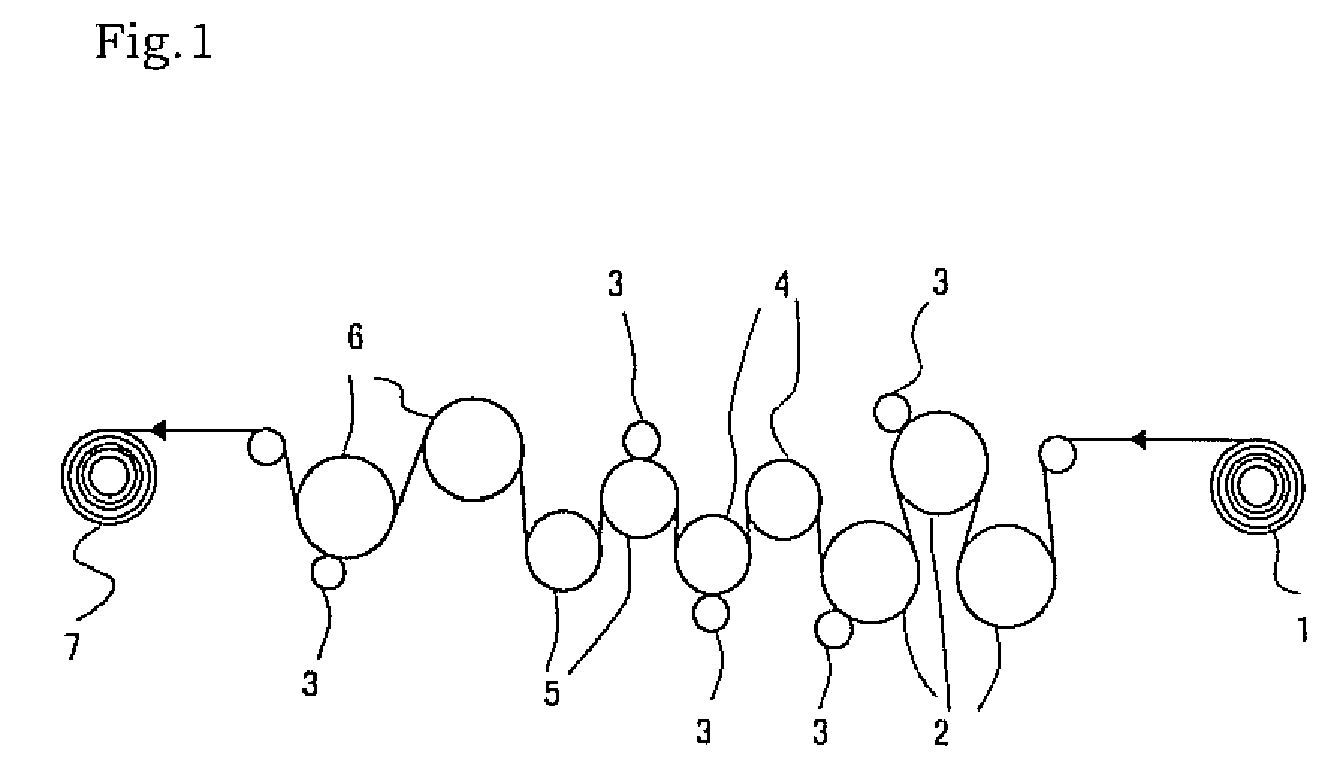
- Figure 1 is a schematic illustration of an apparatus for manufacturing a longitudinally uniaxially stretched A-PET sheet.
- Figure 2 is a schematic illustration of a thermoforming apparatus.
- Figure 3 is a perspective view of thermoformed article.
- Figure 4 is a schematic DSC chart.
- the amorphous polyethylene terephthalate (A-PET) sheet is fundamentally in non-(or slight) crystalline state having a crystallinity of approximately 5 to 7 %.
- the A-PET sheet is not stretched and is commercially available.
- a typical thickness of the A-PET sheet is 0.2 to 1.5 mm, particularly 0.3 to 1.0 mm, though it varies according to the container to be made.
- the resin of the A-PET sheet is not necessary to have a high intrinsic viscosity, when the intrinsic viscosity of the resin is 0.6 dl/g or less or the resin is obtained from flakes of recovered PET bottles, it is possible that surface conditions are not good. In these cases, a pretreatment is necessary.
- the A-PET sheet is heated and primarily stretched by uniaxial stretching.
- the A-PET sheet may be either previously molded (stocks) or molded in-line by a T-die molding machine.
- a suitable stretching temperature (surface temperature of the A-PET sheet) in the primary stretching is in the range from 90 to 120 °C, preferably 95 to 110 °C.
- the stretching temperature is lower than 90 °C, tension loaded is great while stretching the A-PET sheet, and thickness of stretched A-PET sheet tends to be not uniform caused by uneven stretching.
- the stretching temperature exceeds 120 °C, the sheet is whitened and surface roughening also occurs.
- a suitable draw ratio is 2 to 5 times, preferably 2.6 to 3.7 times.
- DSC differential scanning calorimeter
- Crystallinity becomes less than 22 %, and thermoformed article formed in the later thermoforming process is whitened.
- slip tends to occur on stretching roll during stretching, and lateral wave patterns generate caused by the presence of slipped portions and non-slipped portions.
- a typical stretching apparatus is a uniaxial stretching apparatus using heating rolls, which may be single step stretching in a short range or multiple step stretching of two or more steps.
- the primary heat-setting temperature is not specifically limited, but in view of relaxation of orientation by annealing, a preferred temperature is higher than the stretching temperature by 5 to 20 °C.
- a preferred temperature is higher than the stretching temperature by 5 to 20 °C.
- heat shrinkage of the sheet is great.
- heat-setting temperature is higher than the above range, i.e., exceeding the stretching temperature plus 20 °C, surface roughening occurs to be slightly whitened.
- More preferable temperature range is stretching temperature plus 5 °C to 15 °C, because heat shrinkage is small to render deformation on molding of thermoformed body.
- the heat-setting time is usually 1.5 to 2.0 seconds, preferably 2 to 15 seconds.
- rotational speed of heat-setting roll is made slower than the stretching roll by about 0.5 to 10 %.
- Such a primarily stretched A-PET sheet after the primarily heat-setting is preferably to have a crystallinity of 22 % or more and less than 30 %.
- the sheet treated in the primary stretching and heat-setting process desirably has a crystallinity of 22 % or more and less than 30 % .
- thermoforming in the secondary process can be achieved smoothly, and the crystallinity is brought close to the range of 30 % or more where high heat resistance is obtained in the secondary stretching and heat-setting process.
- the sheet treated in the primary stretching and heat-setting process is molded with heating in a mold of a thermoforming machine while secondary stretching is performed, followed by secondary heat-setting in the same mold.
- a suitable secondary stretching temperature i.e. molding temperature, is 80 to 130 °C, preferably 90 to 120 °C.
- the stretching temperature is lower than 80 °C, waviness occurs on thermoformed articles.
- the stretching temperature exceeds 130 °C, drawdown of the sheet increases to generate wrinkle on thermoformed articles.
- the type of the thermoforming machine may be vacuum molding type, pressure forming type or vacuum-pressure forming type.
- a suitable temperature for the secondary heat-setting is 160 °C or higher, preferably 170 °C or higher.
- the heat-setting temperature is lower than 150 °C, it is liable not to ensure heat resistance at 150 °C.
- thermoformed articles are liable to be whitened and translucent.
- the heat-setting time in the mold is 7 seconds or more, preferably 10 seconds or more.
- the heat-setting time is shorter than 7 seconds, wave-formed wrinkle tends to occur on the molded article.
- the A-PET sheet treated in the secondary stretching and heat-setting process which is a thermoformed article, has a crystallinity of 30 % or more for imparting a heat resistance to 150 °C.
- Thermoformed articles having a crystallinity of less than 30 % are inferior in heat resistance.
- the crystallinity of 30 % or more can be achieved with keeping good transparency by molding the sheet treated in the primary stretching and heat-setting process at a temperature of 80 to 130 °C while secondary stretching is carried out and then heat-setting at a temperature of 160 °C or more.
- the heat-resistant transparent container of the invention can be applied to various containers of which heat resistance and transparency are required, and is suitable for food containers, especially for the food containers heated by a microwave oven or for retort food containers.
- A-PET sheet 1 is delivered from its storage roll, and preheated to 70 to 90 °C while passing preheating rolls 2 nipped by nip rolls 3. Then, the sheet 1 is further heated to 90 to 120 °C by heating rolls 4 nipped by nip rolls 3, and stretched 2 to 5 times by stretching rolls 5 in the longitudinal direction.
- the uniaxially stretched A-PET sheet 1 is heated by heat-setting rolls 6 to a temperature higher than the temperature heated by heating rolls 4 by 5 to 20 °C to be heat-set to complete a longitudinally uniaxially stretched A-PET sheet 7.
- the longitudinally uniaxially stretched A-PET sheet 7 is located between upper heating plate 1 and lower heating plate 12 to be heated to 80 to 130 °C as the surface temperature of the sheet, and thermoformed by pressing by upper mold 13 and lower mold 14.
- the thermoformed sheet is kept for 10 seconds in the pressed state, and then, taken out. Since lower mold 14 is heated by embedded heaters 15 to 160 °C or more, the thermoformed article 16 is heat-set at 160 °C.
- a thermoformed article is shown in Figure 3.
- An A-PET sheet 0.4 mm thick (crystallinity: 6.1 % , manufactured by ATHENA-KOGYO Co., Ltd.) was stretched by a roll type uniaxially stretching machine ("T-17" type, manufactured by NIPPON SEIKO SHO, Ltd.).
- the stretching conditions were set the preheating roll temperature at 80 °C, the heating roll temperature (stretching temperature) at 95 °C, the stretching roll temperature at 80 °C and the heat-setting roll temperature at 100 °C.
- the A-PET sheet was delivered at a speed of 3 m/mim., and stretched 2.6 times by the stretching rolls 5.
- the stretched sheet was heat-set for 10.5 seconds while passing through the heat-setting rolls 6 to obtain a stretched A-PET sheet 0.15 mm thick.
- the stretched A-PET sheet was transparent and no wrinkle.
- the crystallinity determined by a differential scanning calorimeter (DSC) was 24 %, and no cold crystallization peak was observed.
- the stretched A-PET sheet was heated by heaters so that the surface temperature became 90 °C.
- the softened stretched A-PET sheet was molded by vacuum-pressure forming using a vacuum-pressure forming machine ("FKC" type, manufactured by ASANO LABORATORIES, Ltd.) at an air pressure of 0.5 MPa.
- the served mold was a cavity type aluminum mold having an upper diameter of 180 mm ⁇ 95 mm, a bottom diameter of 165 mm ⁇ 75 mm and a depth of 15 mm, and the temperature of the aluminum mold was set at 180 °C.
- the heat setting time was 10 seconds.
- thermoformed article kept the transparency of the stretched A-PET sheet, and had a shape in accordance with the mold without deformation.
- the crystallinity was 30.5 %.
- thermoformed article was subjected to heat resistance test by microwave oven heating.
- a pork cutlet was put on the thermoformed article, and heated by a microwave oven ("National NE-EZ2") at 700 W for 3 minutes.
- the surface temperature of the heated pork cutlet was measured by an infrared radiant thermometer ("SATO SK-8700II”), and found to be 157 °C. Oils pooled at the bottom of the thermoformed article.
- the thermoformed article was kept transparent without deformation.
- An A-PET sheet 0.6 mm thick (crystallinity: 6.3 %, manufactured by ATHENA-KOGYO Co., Ltd.) was stretched by the same stretching machine under the same conditions as Example 1, except that the draw ratio was 3 times to obtain a stretched A-PET sheet 0.2 mm thick.
- the stretched A-PET sheet was transparent and no wrinkle.
- the crystallinity determined by DSC was 28.9 %, and no cold crystallization peak was observed.
- the stretched A-PET sheet was molded by vacuum-pressure forming using the same apparatus and the same conditions as Example 1 to obtain a thermoformed article.
- thermoformed article kept the transparency of the stretched A-PET sheet, and had a shape in accordance with the mold without deformation.
- the crystallinity was 34.2 %.
- thermoformed article was subjected to heat resistance test under the same conditions as Example 1, and it was found that the thermoformed article was kept transparent without deformation.
- Example 2 The same A-PET sheet 0.6 mm thick (crystallinity: 6.3 %, manufactured by ATHENA-KOGYO Co., Ltd.) as Example 2 was stretched by the same stretching machine under the same conditions as Example 1, except that the draw ratio was 3.7 times to obtain a stretched A-PET sheet 0.16 mm thick.
- the stretched A-PET sheet was transparent and no wrinkle.
- the crystallinity determined by DSC was 29.1 %, and no cold crystallization peak was observed.
- the stretched A-PET sheet was molded by vacuum-pressure forming using the same apparatus and the same conditions as Example 1 to obtain a thermoformed article.
- thermoformed article kept the transparency of the stretched A-PET sheet, and had a shape in accordance with the mold without deformation.
- the crystallinity was 34.6 %.
- thermoformed article was subjected to heat resistance test under the same conditions as Example 1, and it was found that the thermoformed article was kept transparent without deformation.
- the stretched A-PET sheet was molded by vacuum-pressure forming using the same apparatus and the same conditions as Example 1, except that the heat-setting time in the mold was changed to 7.5 seconds, to obtain a thermoformed article.
- thermoformed article kept the transparency of the stretched A-PET sheet. Although slight waviness was observed on a side wall, it was not a problem as commercial value.
- the crystallinity was 34.0 %.
- thermoformed article was subjected to heat resistance test under the same conditions as Example 1, and it was found that the thermoformed article was kept transparent without deformation.
- the same stretched A-PET sheet as Example 2 was used.
- the stretched A-PET sheet was molded by vacuum-pressure forming using the same apparatus and the same conditions as Example 1, except that the surface temperature heated by the heaters was changed to 110 °C, to obtain a thermoformed article.
- thermoformed article kept the transparency of the stretched A-PET sheet, and had a shape in accordance with the mold without deformation.
- the crystallinity was 34.2 %.
- thermoformed article was subjected to heat resistance test under the same conditions as Example 1, and it was found that the thermoformed article was kept transparent without deformation.
- the same stretched A-PET sheet as Example 2 was used.
- the stretched A-PET sheet was molded by vacuum-pressure forming using the same apparatus and the same conditions as Example 1, except that the heat-setting temperature in the mold was changed to 200 °C, to obtain a thermoformed article.
- thermoformed article kept the transparency of the stretched A-PET sheet, and had a shape in accordance with the mold without deformation.
- the crystallinity was 34.9 %.
- thermoformed article was subjected to heat resistance test under the same conditions as Example 1, and it was found that the thermoformed article was kept transparent without deformation.
- the same stretched A-PET sheet as Example 2 was used.
- the stretched A-PET sheet was molded by vacuum-pressure forming using the same apparatus and the same conditions as Example 1, except that the heat-setting temperature in the mold was changed to 200 °C, and the heat-setting time in the mold was changed to 7.5 seconds, to obtain a thermoformed article.
- thermoformed article kept the transparency of the stretched A-PET sheet. Although slight waviness was observed on a side wall, it was not a problem as commercial value. The crystallinity was 33.8 %.
- thermoformed article was subjected to heat resistance test under the same conditions as Example 1, and it was found that the thermoformed article was kept transparent without deformation.
- the same stretched A-PET sheet as Example 2 was used.
- the stretched A-PET sheet was molded by vacuum-pressure forming using the same apparatus and the same conditions as Example 1, except that the heat-setting temperature in the mold was changed to 170 °C and the heat-setting time in the mold was changed to 12 seconds, to obtain a thermoformed article.
- thermoformed article kept the transparency of the stretched A-PET sheet, and had a shape in accordance with the mold without deformation.
- the crystallinity was 32.3 %.
- thermoformed article was subjected to heat resistance test under the same conditions as Example 1, and it was found that the thermoformed article was kept transparent without deformation.
- the stretched A-PET sheet was molded by vacuum-pressure forming using the same apparatus and the same conditions as Example 1, except that the surface temperature heated by the heaters was changed to 90 °C and the heat-setting temperature in the mold was changed to 170 °C and the heat-setting time in the mold was changed to 10 seconds, to obtain a thermoformed article.
- thermoformed article kept the transparency of the stretched A-PET sheet, and had a shape in accordance with the mold without deformation.
- the crystallinity was 32.0 %.
- thermoformed article was subjected to heat resistance test under the same conditions as Example 1, and it was found that the thermoformed article was kept transparent without deformation.
- Example 2 The same A-PET sheet 0.6 mm thick (crystallinity: 6.3 %, manufactured by ATHENA-KOGYO Co., Ltd.) as Example 2 was stretched by the same stretching machine under the same conditions as Example 1, except that the stretching temperature was 110 °C, the heat-setting roll temperature was 115 °C, and the draw ratio was 3 times to obtain a stretched A-PET sheet 0.2 mm thick.
- the stretched A-PET sheet was transparent and no wrinkle.
- the crystallinity determined by DSC was 28.0 %, and no cold crystallization peak was observed.
- the stretched A-PET sheet was molded by vacuum-pressure forming using the same apparatus and the same conditions as Example 1 to obtain a thermoformed article.
- thermoformed article kept the transparency of the stretched A-PET sheet, and had a shape in accordance with the mold without deformation.
- the crystallinity was 33.0 %.
- thermoformed article was subjected to heat resistance test under the same conditions as Example 1, and it was found that the thermoformed article was kept transparent without deformation.
- thermoformed article Another heat resistance test of the thermoformed article was carried out by retort sterilization.
- water was charged to concave portions of the thermoformed article so that empty portion of head space became 1 mm in depth, and sealed by a cover composed of PET 12 ⁇ m/dry bonding/A1 foil 9 ⁇ m/dry bonding/PETG 50 ⁇ m by heat sealing.
- the sealed thermoformed article charged with water was subjected to retort sterilization by hot water-standing retort system at 125 °C for 30 minutes. After cooling, the water was discharged, and transparency and deformation degree were evaluated by visual observation. The transparency was not changed from before the retort sterilization, and deformation was not found.
- Example 2 The same A-PET sheet 0.6 mm thick (crystallinity: 6.3 %, manufactured by ATHENA-KOGYO Co., Ltd.) as Example 2 was stretched by the same stretching machine under the same conditions as Example 2, except that the stretching temperature was 110 °C, and the heat-setting roll temperature was 115 °C to obtain a stretched A-PET sheet 0.2 mm thick.
- the stretched A-PET sheet was transparent and no wrinkle.
- the crystallinity determined by DSC was 28.0 %, and no cold crystallization peak was observed.
- the stretched A-PET sheet was molded by vacuum-pressure forming using the same apparatus and the same conditions as Example 1, except that the surface temperature heated by the heaters was changed to 110 °C, to obtain a thermoformed article.
- thermoformed article kept the transparency of the stretched A-PET sheet, and had a shape in accordance with the mold without deformation.
- the crystallinity was 33.0 %.
- thermoformed article was subjected to heat resistance test under the same conditions as Example 1, and it was found that the thermoformed article was kept transparent without deformation.
- Another heat resistance test was carried out by retort sterilization under the same conditions as Example 10, and found that transparency was not changed from before the retort sterilization and deformation did not occur.
- Example 1 The same A-PET sheet 0.4 mm thick (crystallinity: 6.1 % , manufactured by ATHENA-KOGYO Co., Ltd.) as Example 1 was stretched by the same stretching machine under the same conditions as Example 1, except that the draw ratio was 1.8 times to obtain a stretched A-PET sheet 0.22 mm thick.
- thermoformed article was molded by vacuum-pressure forming using the same apparatus and the same conditions as Example 1 to obtain a thermoformed article.
- the thermoformed article was turbid white to a medium degree, and its texture was inferior. As to molded conditions, waviness greatly occurred.
- the crystallinity was 21.5 %, and therefore, heat resistance test of this thermoformed article was not conducted.
- Example 2 The same A-PET sheet 0.6 mm thick (crystallinity: 6.3 %, manufactured by ATHENA-KOGYO Co., Ltd.) as Example 2 was stretched by the same stretching machine under the same conditions as Example 1, except that the draw ratio was 5.2 times to obtain a stretched A-PET sheet 0.12 mm thick.
- the crystallinity of the stretched A-PET sheet determined by DSC was 29.7 %, and crystallized more than Example 1. However, wrinkle which appeared caused by uneven stretching was generated. Since surface conditions of the stretched A-PET sheet were inferior, vacuum-pressure forming was not conducted.
- Example 2 The same A-PET sheet 0.6 mm thick (crystallinity: 6.3 %, manufactured by ATHENA-KOGYO Co., Ltd.) as Example 2 was stretched by the same stretching machine under the same conditions as Example 2, except that the stretching temperature was 80 °C to obtain a stretched A-PET sheet 0.2 mm thick.
- the crystallinity of the stretched A-PET sheet determined by DSC was 29.0 % which was almost the same as Example 2. However, surface smoothness was inferior, and good sheet was not obtained. Since surface conditions of the stretched A-PET sheet were inferior, thermoforming was not conducted.
- Example 1 The same A-PET sheet as Example 1 was stretched by the same stretching machine under the same conditions as Example 1, except that the stretching temperature was 125 °C and the heat-setting roll temperature was 130 °C to obtain a stretched A-PET sheet 0.13 mm thick.
- the crystallinity of the stretched A-PET sheet determined by DSC was 27.8 %.
- the stretched A-PET sheet was inferior in surface smoothness, and whitening occurred. Since surface conditions of the stretched A-PET sheet were inferior and whitening occurred, thermoforming was not conducted.
- the stretched A-PET sheet obtained in Example 2 was used.
- the stretched A-PET sheet was molded by vacuum-pressure forming using the same apparatus and the same conditions as Example 1, except that the heat-setting temperature in the mold was 25 °C and the heat-setting time was 60 seconds, to obtain a thermoformed article. Although the thermoformed article was transparent, molding could not be carried out in accordance with the mold. Heat resistance test of the thermoformed article was not conducted.
- the stretched A-PET sheet obtained in Example 2 was used.
- the stretched A-PET sheet was molded by vacuum-pressure forming using the same apparatus and the same conditions as Example 1, except that the heat-setting temperature in the mold was 150 °C and the heat-setting time was 20 seconds, to obtain a thermoformed article. Although the thermoformed article was transparent, molding could not be carried out in accordance with the mold. Heat resistance test of the thermoformed article was not conducted.
- the stretched A-PET sheet obtained in Example 2 was used.
- the stretched A-PET sheet was molded by vacuum-pressure forming using the same apparatus and the same conditions as Example 1, except that the heat-setting temperature in the mold was 220 °C and the heat-setting time was 5 seconds, to obtain a thermoformed article.
- the thermoformed article was turbid white to a medium degree, and had waviness greatly. Heat resistance test of the thermoformed article was not conducted.
- An A-PET sheet 0.4 mm thick was used.
- the A-PET sheet was molded by vacuum-pressure forming using the same apparatus and the same conditions as Example 1, except that the sheet heating temperature was 140 °C, the heat-setting temperature in the mold was 25 °C and the heat-setting time was 10 seconds, to obtain a thermoformed article. Although the molded conditions of the thermoformed article was good, it was slightly turbid white. The crystallinity was 13.0 %. Heat resistance test by microwave oven heating was carried out under the same conditions as Example 1, and found that the thermoformed article was greatly deformed and whitened.
- Sheet conditions of stretched A-PET sheets were evaluated. In the evaluation, sheet conditions were evaluated by whitening, wrinkle and surface roughening. The evaluation of "transparent” is that haze measured by JIS K 7105 is 4 % or less. Crystallinity was also measured.
- crystallinity quantity of heat of fusion per mole ) - ( quantity of heat of cold crystallization per mole quantity of heat of fusion of perfect crystal PET per mole 26.9 kj ⁇ 100
- thermoformed articles Molded conditions and transparency of the thermoformed article were evaluated.
- the molded conditions were evaluated by the presence of waviness even at a part of the thermoformed article and moldability, and when the thermoformed article was molded with the shape in accordance with the mold without any deformation point, the thermoformed article was evaluated good.
- the transparency was evaluated by visual observation, and to keep the transparency prior to thermoforming was good.
- the other cases were divided into the degree of white turbidity and whitening. In addition, the crystallinity was measured.
- a pork cutlet was put on a container-shaped thermoformed article, and after heating by a microwave oven at 700 W for 3 minutes, deformation degree and transparency of the thermoformed article were evaluated.
- the temperature of the pork cutlet after heating was 150 °C.
- the transparency was judged by whether the transparency before heating was kept or whitened.
- the degree of deformation was judged by observing the presence or absence of deformation visually.
- Water was charged to a container-shaped thermoformed article so that empty portion of head space become 1 mm in depth, and sealed by a cover composed of PET 12 ⁇ m/dry bonding/Al foil 9 ⁇ m/dry bonding/PETG 50 ⁇ m by heat sealing.
- the sealed container charged with water was subjected to retort sterilization at 125 °C for 30 minutes by hot water-standing retort system. After cooling, the water was discharged, and the degree of deformation and transparency were judged by visual observation.
Landscapes
- Engineering & Computer Science (AREA)
- Mechanical Engineering (AREA)
- Manufacturing & Machinery (AREA)
- Blow-Moulding Or Thermoforming Of Plastics Or The Like (AREA)
- Containers Having Bodies Formed In One Piece (AREA)
- Packages (AREA)
- Shaping By String And By Release Of Stress In Plastics And The Like (AREA)
- Package Specialized In Special Use (AREA)
Abstract
a primary stretching and heat-setting process wherein an amorphous polyethylene terephthalate sheet is heated, primarily stretched and then primarily heat-set, and
a secondary stretching and heat-setting process wherein the sheet treated in the primary stretching and heat-setting process is molded with heating in a mold of a thermoforming machine while secondary stretching is performed followed by secondary heat-setting in the same mold.
Description
- This invention relates to heat-resistant transparent containers, especially food containers for convenience stores etc., wherein food is placed therein and sold, or for retort sterilization, and more particularly, relates to the heat-resistant transparent containers having heat-resistance without deformation even at 150 °C reached by heating foods containing oils by a microwave oven or at 125 °C which is a retort sterilization temperature, and having excellent transparency.
- In food shops in convenience stores, department stores, super markets, etc., foods, such as daily dishes, noodles and salads, are placed in food containers, e.g., tray, cup or bowl, and sold. Such a food container is composed of a container body and a cover. The container body is, in general, manufactured by thermoforming a sheet of polypropylene, foamed polypropylene, filler-containing polypropylene, polyethylene, foamed polyethylene, formed polystyrene, foamed heat-resistant polystyrene, amorphous polyethylene terephthalate (A-PET), etc, by a vacuum forming machine, a pressure forming machine or a vacuum-pressure forming machine. The cover is formed from a sheet, such as A-PET, biaxially oriented polystyrene (OPS) or polypropylene (PP) (
JP2005-329972A - Recently, it is frequently conducted that foods packaged in a food container are bought and heated as it is by a microwave oven. When foods containing oils are heated together with the food container by a microwave oven, temperature of the foods is raised to around 150 °C. Accordingly, food containers are required to have high heat resistance resisting up to 150 °C. Even in the case of food not containing oils, food containers for retort foods are required to resist a retort sterilization temperature at 125 °C. Furthermore, food containers are desirably to have high transparency so that the foods packaged therein can be appreciated clearly at a look and can improve commercial value.
- However, none of the above-mentioned conventional sheets satisfies both of high heat resistance and high transparency. That is, A-PET and OPS have high transparency, but have not high heat resistance and are softened at around 80 °C. PP sheet has high heat resistance but is inferior in transparency.
- It is an object of the invention to provide a food container having high transparency and high heat resistance and a method of making such a container.
- This object is achieved by a method according to
claim 1 and an article according toclaim 5. The dependent claims define further embodiments of the method. - The inventors investigated eagerly in order to solve the above problems and noted A-PET sheet and OPS sheet having high transparency. However, OPS sheet has anxiety in safty and hygiene caused by elution of residual monomer, dimer and trimer and additives. Then, they examined to improve heat resistance of A-PET which is excellent in safty and hygiene for food.
- As a result of investigation, they found that high heat resistance capable of resisting a temperature of 150 °C can be imparted to A-PET by the crystallization through stretching and heat-setting to complete the invention.
- Thus, this invention provides a method of making a heat-resistant transparent container which comprises:
- a primary stretching and heat-setting process wherein an amorphous polyethylene terephthalate sheet is heated, primarily stretched and then primarily heat-set, and
- a secondary stretching and heat-setting process wherein the sheet treated in the primary stretching and heat-setting process is molded with heating in a mold of a thermoforming machine while secondary stretching is performed followed by secondary heat-setting in the same mold.
- In the invention, in the primary stretching and heat-setting process, crystallinity of A-PET sheet is raised within the range capable of thermoforming, and in the secondary stretching and heat-setting process, the sheet treated in the primary stretching and heat-setting process is molded into a shape of container and crystallinity is further raised to improve heat resistance. Besides, in the primary stretching and heat-setting process, since A-PET sheet is stretched followed by heat-setting, a cheap apparatus can be applied. In the secondary stretching and heat-setting process, since a clear and heat-resistant molded body can be obtained by heat-setting in the same mold, the apparatus therefor is cheap due to not conducting double molding. Moreover, molding time can be shortened to raise productivity.
- Figure 1 is a schematic illustration of an apparatus for manufacturing a longitudinally uniaxially stretched A-PET sheet.
- Figure 2 is a schematic illustration of a thermoforming apparatus.
- Figure 3 is a perspective view of thermoformed article.
- Figure 4 is a schematic DSC chart.
- The amorphous polyethylene terephthalate (A-PET) sheet is fundamentally in non-(or slight) crystalline state having a crystallinity of approximately 5 to 7 %. The A-PET sheet is not stretched and is commercially available. A typical thickness of the A-PET sheet is 0.2 to 1.5 mm, particularly 0.3 to 1.0 mm, though it varies according to the container to be made. Although the resin of the A-PET sheet is not necessary to have a high intrinsic viscosity, when the intrinsic viscosity of the resin is 0.6 dl/g or less or the resin is obtained from flakes of recovered PET bottles, it is possible that surface conditions are not good. In these cases, a pretreatment is necessary.
- In the primary stretching and heat-setting process, the A-PET sheet is heated and primarily stretched by uniaxial stretching. The A-PET sheet may be either previously molded (stocks) or molded in-line by a T-die molding machine.
- A suitable stretching temperature (surface temperature of the A-PET sheet) in the primary stretching is in the range from 90 to 120 °C, preferably 95 to 110 °C. When the stretching temperature is lower than 90 °C, tension loaded is great while stretching the A-PET sheet, and thickness of stretched A-PET sheet tends to be not uniform caused by uneven stretching. When the stretching temperature exceeds 120 °C, the sheet is whitened and surface roughening also occurs.
- A suitable draw ratio is 2 to 5 times, preferably 2.6 to 3.7 times. When the draw ratio is less than twice, cold crystallization point is observed in the measurement by a differential scanning calorimeter (DSC). Crystallinity becomes less than 22 %, and thermoformed article formed in the later thermoforming process is whitened. When the draw ratio exceeds 5 times, slip tends to occur on stretching roll during stretching, and lateral wave patterns generate caused by the presence of slipped portions and non-slipped portions.
- A typical stretching apparatus is a uniaxial stretching apparatus using heating rolls, which may be single step stretching in a short range or multiple step stretching of two or more steps.
- The primary heat-setting temperature is not specifically limited, but in view of relaxation of orientation by annealing, a preferred temperature is higher than the stretching temperature by 5 to 20 °C. When the heat-setting temperature is lower than the above range, i.e., not higher than the stretching temperature plus 5 °C, heat shrinkage of the sheet is great. When the heat-setting temperature is higher than the above range, i.e., exceeding the stretching temperature plus 20 °C, surface roughening occurs to be slightly whitened. More preferable temperature range is stretching temperature plus 5 °C to 15 °C, because heat shrinkage is small to render deformation on molding of thermoformed body.
- The heat-setting time is usually 1.5 to 2.0 seconds, preferably 2 to 15 seconds. In order to meet the relaxation of orientation of the sheet, rotational speed of heat-setting roll is made slower than the stretching roll by about 0.5 to 10 %.
- Such a primarily stretched A-PET sheet after the primarily heat-setting is preferably to have a crystallinity of 22 % or more and less than 30 %. In the crystallinity of less than 22 %, since cold crystallization point exists, it is possible to be whitened upon heating in the secondary stretching. Exceeding 30 % , thermoforming is made difficult to degrade reproducibility. The crystallinity is represented by the formula:

- The sheet treated in the primary stretching and heat-setting process desirably has a crystallinity of 22 % or more and less than 30 % . By rendering the crystallinity in the above range, thermoforming in the secondary process can be achieved smoothly, and the crystallinity is brought close to the range of 30 % or more where high heat resistance is obtained in the secondary stretching and heat-setting process.
- In the secondary stretching and heat-setting process, the sheet treated in the primary stretching and heat-setting process is molded with heating in a mold of a thermoforming machine while secondary stretching is performed, followed by secondary heat-setting in the same mold.
- The second stretching is practiced while molding. A suitable secondary stretching temperature, i.e. molding temperature, is 80 to 130 °C, preferably 90 to 120 °C. When the stretching temperature is lower than 80 °C, waviness occurs on thermoformed articles. When the stretching temperature exceeds 130 °C, drawdown of the sheet increases to generate wrinkle on thermoformed articles.
- The type of the thermoforming machine may be vacuum molding type, pressure forming type or vacuum-pressure forming type.
- After the molding in the mold, heat-setting is carried out in the same mold. A suitable temperature for the secondary heat-setting is 160 °C or higher, preferably 170 °C or higher. When the heat-setting temperature is lower than 150 °C, it is liable not to ensure heat resistance at 150 °C. Although there is no upper limit to the heat-setting temperature, when heat-setting is carried out at a temperature higher than 220 °C for a long time, thermoformed articles are liable to be whitened and translucent.
- The heat-setting time in the mold is 7 seconds or more, preferably 10 seconds or more. When the heat-setting time is shorter than 7 seconds, wave-formed wrinkle tends to occur on the molded article.
- It is necessary that the A-PET sheet treated in the secondary stretching and heat-setting process, which is a thermoformed article, has a crystallinity of 30 % or more for imparting a heat resistance to 150 °C. Thermoformed articles having a crystallinity of less than 30 % are inferior in heat resistance. The crystallinity of 30 % or more can be achieved with keeping good transparency by molding the sheet treated in the primary stretching and heat-setting process at a temperature of 80 to 130 °C while secondary stretching is carried out and then heat-setting at a temperature of 160 °C or more.
- The heat-resistant transparent container of the invention can be applied to various containers of which heat resistance and transparency are required, and is suitable for food containers, especially for the food containers heated by a microwave oven or for retort food containers.
- A process for manufacturing the heat-resistant transparent container according to the invention will be explained with reference to drawings.
- In Figure 1,
A-PET sheet 1 is delivered from its storage roll, and preheated to 70 to 90 °C while passing preheating rolls 2 nipped by nip rolls 3. Then, thesheet 1 is further heated to 90 to 120 °C by heating rolls 4 nipped by nip rolls 3, and stretched 2 to 5 times by stretchingrolls 5 in the longitudinal direction. The uniaxially stretchedA-PET sheet 1 is heated by heat-setting rolls 6 to a temperature higher than the temperature heated by heating rolls 4 by 5 to 20 °C to be heat-set to complete a longitudinally uniaxially stretchedA-PET sheet 7. - As shown in Figure 2, the longitudinally uniaxially stretched
A-PET sheet 7 is located betweenupper heating plate 1 andlower heating plate 12 to be heated to 80 to 130 °C as the surface temperature of the sheet, and thermoformed by pressing byupper mold 13 andlower mold 14. The thermoformed sheet is kept for 10 seconds in the pressed state, and then, taken out. Sincelower mold 14 is heated by embeddedheaters 15 to 160 °C or more, thethermoformed article 16 is heat-set at 160 °C. A thermoformed article is shown in Figure 3. - An A-PET sheet 0.4 mm thick (crystallinity: 6.1 % , manufactured by ATHENA-KOGYO Co., Ltd.) was stretched by a roll type uniaxially stretching machine ("T-17" type, manufactured by NIPPON SEIKO SHO, Ltd.). The stretching conditions were set the preheating roll temperature at 80 °C, the heating roll temperature (stretching temperature) at 95 °C, the stretching roll temperature at 80 °C and the heat-setting roll temperature at 100 °C. The A-PET sheet was delivered at a speed of 3 m/mim., and stretched 2.6 times by the stretching rolls 5. The stretched sheet was heat-set for 10.5 seconds while passing through the heat-setting rolls 6 to obtain a stretched A-PET sheet 0.15 mm thick.
- The stretched A-PET sheet was transparent and no wrinkle. The crystallinity determined by a differential scanning calorimeter (DSC) was 24 %, and no cold crystallization peak was observed.
- Subsequently, the stretched A-PET sheet was heated by heaters so that the surface temperature became 90 °C. The softened stretched A-PET sheet was molded by vacuum-pressure forming using a vacuum-pressure forming machine ("FKC" type, manufactured by ASANO LABORATORIES, Ltd.) at an air pressure of 0.5 MPa. The served mold was a cavity type aluminum mold having an upper diameter of 180 mm × 95 mm, a bottom diameter of 165 mm × 75 mm and a depth of 15 mm, and the temperature of the aluminum mold was set at 180 °C. The heat setting time was 10 seconds.
- The thermoformed article kept the transparency of the stretched A-PET sheet, and had a shape in accordance with the mold without deformation. The crystallinity was 30.5 %.
- The thermoformed article was subjected to heat resistance test by microwave oven heating. In the heat resistance test, a pork cutlet was put on the thermoformed article, and heated by a microwave oven ("National NE-EZ2") at 700 W for 3 minutes. The surface temperature of the heated pork cutlet was measured by an infrared radiant thermometer ("SATO SK-8700II"), and found to be 157 °C. Oils pooled at the bottom of the thermoformed article. The thermoformed article was kept transparent without deformation.
- An A-PET sheet 0.6 mm thick (crystallinity: 6.3 %, manufactured by ATHENA-KOGYO Co., Ltd.) was stretched by the same stretching machine under the same conditions as Example 1, except that the draw ratio was 3 times to obtain a stretched A-PET sheet 0.2 mm thick.
- The stretched A-PET sheet was transparent and no wrinkle. The crystallinity determined by DSC was 28.9 %, and no cold crystallization peak was observed.
- Subsequently, the stretched A-PET sheet was molded by vacuum-pressure forming using the same apparatus and the same conditions as Example 1 to obtain a thermoformed article.
- The thermoformed article kept the transparency of the stretched A-PET sheet, and had a shape in accordance with the mold without deformation. The crystallinity was 34.2 %.
- The thermoformed article was subjected to heat resistance test under the same conditions as Example 1, and it was found that the thermoformed article was kept transparent without deformation.
- The same A-PET sheet 0.6 mm thick (crystallinity: 6.3 %, manufactured by ATHENA-KOGYO Co., Ltd.) as Example 2 was stretched by the same stretching machine under the same conditions as Example 1, except that the draw ratio was 3.7 times to obtain a stretched A-PET sheet 0.16 mm thick.
- The stretched A-PET sheet was transparent and no wrinkle. The crystallinity determined by DSC was 29.1 %, and no cold crystallization peak was observed.
- Subsequently, the stretched A-PET sheet was molded by vacuum-pressure forming using the same apparatus and the same conditions as Example 1 to obtain a thermoformed article.
- The thermoformed article kept the transparency of the stretched A-PET sheet, and had a shape in accordance with the mold without deformation. The crystallinity was 34.6 %.
- The thermoformed article was subjected to heat resistance test under the same conditions as Example 1, and it was found that the thermoformed article was kept transparent without deformation.
- The same stretched A-PET sheet as Example 2 was used.
- The stretched A-PET sheet was molded by vacuum-pressure forming using the same apparatus and the same conditions as Example 1, except that the heat-setting time in the mold was changed to 7.5 seconds, to obtain a thermoformed article.
- The thermoformed article kept the transparency of the stretched A-PET sheet. Although slight waviness was observed on a side wall, it was not a problem as commercial value. The crystallinity was 34.0 %.
- The thermoformed article was subjected to heat resistance test under the same conditions as Example 1, and it was found that the thermoformed article was kept transparent without deformation.
- The same stretched A-PET sheet as Example 2 was used. The stretched A-PET sheet was molded by vacuum-pressure forming using the same apparatus and the same conditions as Example 1, except that the surface temperature heated by the heaters was changed to 110 °C, to obtain a thermoformed article.
- The thermoformed article kept the transparency of the stretched A-PET sheet, and had a shape in accordance with the mold without deformation. The crystallinity was 34.2 %.
- The thermoformed article was subjected to heat resistance test under the same conditions as Example 1, and it was found that the thermoformed article was kept transparent without deformation.
- The same stretched A-PET sheet as Example 2 was used. The stretched A-PET sheet was molded by vacuum-pressure forming using the same apparatus and the same conditions as Example 1, except that the heat-setting temperature in the mold was changed to 200 °C, to obtain a thermoformed article.
- The thermoformed article kept the transparency of the stretched A-PET sheet, and had a shape in accordance with the mold without deformation. The crystallinity was 34.9 %.
- The thermoformed article was subjected to heat resistance test under the same conditions as Example 1, and it was found that the thermoformed article was kept transparent without deformation.
- The same stretched A-PET sheet as Example 2 was used. The stretched A-PET sheet was molded by vacuum-pressure forming using the same apparatus and the same conditions as Example 1, except that the heat-setting temperature in the mold was changed to 200 °C, and the heat-setting time in the mold was changed to 7.5 seconds, to obtain a thermoformed article.
- The thermoformed article kept the transparency of the stretched A-PET sheet. Although slight waviness was observed on a side wall, it was not a problem as commercial value. The crystallinity was 33.8 %.
- The thermoformed article was subjected to heat resistance test under the same conditions as Example 1, and it was found that the thermoformed article was kept transparent without deformation.
- The same stretched A-PET sheet as Example 2 was used. The stretched A-PET sheet was molded by vacuum-pressure forming using the same apparatus and the same conditions as Example 1, except that the heat-setting temperature in the mold was changed to 170 °C and the heat-setting time in the mold was changed to 12 seconds, to obtain a thermoformed article.
- The thermoformed article kept the transparency of the stretched A-PET sheet, and had a shape in accordance with the mold without deformation. The crystallinity was 32.3 %.
- The thermoformed article was subjected to heat resistance test under the same conditions as Example 1, and it was found that the thermoformed article was kept transparent without deformation.
- The same stretched A-PET sheet as Example 2 was used.
- The stretched A-PET sheet was molded by vacuum-pressure forming using the same apparatus and the same conditions as Example 1, except that the surface temperature heated by the heaters was changed to 90 °C and the heat-setting temperature in the mold was changed to 170 °C and the heat-setting time in the mold was changed to 10 seconds, to obtain a thermoformed article.
- The thermoformed article kept the transparency of the stretched A-PET sheet, and had a shape in accordance with the mold without deformation. The crystallinity was 32.0 %.
- The thermoformed article was subjected to heat resistance test under the same conditions as Example 1, and it was found that the thermoformed article was kept transparent without deformation.
- The same A-PET sheet 0.6 mm thick (crystallinity: 6.3 %, manufactured by ATHENA-KOGYO Co., Ltd.) as Example 2 was stretched by the same stretching machine under the same conditions as Example 1, except that the stretching temperature was 110 °C, the heat-setting roll temperature was 115 °C, and the draw ratio was 3 times to obtain a stretched A-PET sheet 0.2 mm thick.
- The stretched A-PET sheet was transparent and no wrinkle. The crystallinity determined by DSC was 28.0 %, and no cold crystallization peak was observed.
- The stretched A-PET sheet was molded by vacuum-pressure forming using the same apparatus and the same conditions as Example 1 to obtain a thermoformed article.
- The thermoformed article kept the transparency of the stretched A-PET sheet, and had a shape in accordance with the mold without deformation. The crystallinity was 33.0 %.
- The thermoformed article was subjected to heat resistance test under the same conditions as Example 1, and it was found that the thermoformed article was kept transparent without deformation.
- Another heat resistance test of the thermoformed article was carried out by retort sterilization. In this heat resistance test, water was charged to concave portions of the thermoformed article so that empty portion of head space became 1 mm in depth, and sealed by a cover composed of
PET 12 µm/dry bonding/A1 foil 9 µm/dry bonding/PETG 50 µm by heat sealing. The sealed thermoformed article charged with water was subjected to retort sterilization by hot water-standing retort system at 125 °C for 30 minutes. After cooling, the water was discharged, and transparency and deformation degree were evaluated by visual observation. The transparency was not changed from before the retort sterilization, and deformation was not found. - The same A-PET sheet 0.6 mm thick (crystallinity: 6.3 %, manufactured by ATHENA-KOGYO Co., Ltd.) as Example 2 was stretched by the same stretching machine under the same conditions as Example 2, except that the stretching temperature was 110 °C, and the heat-setting roll temperature was 115 °C to obtain a stretched A-PET sheet 0.2 mm thick.
- The stretched A-PET sheet was transparent and no wrinkle. The crystallinity determined by DSC was 28.0 %, and no cold crystallization peak was observed.
- The stretched A-PET sheet was molded by vacuum-pressure forming using the same apparatus and the same conditions as Example 1, except that the surface temperature heated by the heaters was changed to 110 °C, to obtain a thermoformed article.
- The thermoformed article kept the transparency of the stretched A-PET sheet, and had a shape in accordance with the mold without deformation. The crystallinity was 33.0 %.
- The thermoformed article was subjected to heat resistance test under the same conditions as Example 1, and it was found that the thermoformed article was kept transparent without deformation. Another heat resistance test was carried out by retort sterilization under the same conditions as Example 10, and found that transparency was not changed from before the retort sterilization and deformation did not occur.
- The same A-PET sheet 0.4 mm thick (crystallinity: 6.1 % , manufactured by ATHENA-KOGYO Co., Ltd.) as Example 1 was stretched by the same stretching machine under the same conditions as Example 1, except that the draw ratio was 1.8 times to obtain a stretched A-PET sheet 0.22 mm thick.
- On the surface of this stretched A-PET sheet, wrinkle was observed. The crystallinity determined by DSC was 15.3 %, and cold crystallization peak existed.
- The stretched A-PET sheet was molded by vacuum-pressure forming using the same apparatus and the same conditions as Example 1 to obtain a thermoformed article. The thermoformed article was turbid white to a medium degree, and its texture was inferior. As to molded conditions, waviness greatly occurred. The crystallinity was 21.5 %, and therefore, heat resistance test of this thermoformed article was not conducted.
- The same A-PET sheet 0.6 mm thick (crystallinity: 6.3 %, manufactured by ATHENA-KOGYO Co., Ltd.) as Example 2 was stretched by the same stretching machine under the same conditions as Example 1, except that the draw ratio was 5.2 times to obtain a stretched A-PET sheet 0.12 mm thick.
- The crystallinity of the stretched A-PET sheet determined by DSC was 29.7 %, and crystallized more than Example 1. However, wrinkle which appeared caused by uneven stretching was generated. Since surface conditions of the stretched A-PET sheet were inferior, vacuum-pressure forming was not conducted.
- The same A-PET sheet 0.6 mm thick (crystallinity: 6.3 %, manufactured by ATHENA-KOGYO Co., Ltd.) as Example 2 was stretched by the same stretching machine under the same conditions as Example 2, except that the stretching temperature was 80 °C to obtain a stretched A-PET sheet 0.2 mm thick.
- The crystallinity of the stretched A-PET sheet determined by DSC was 29.0 % which was almost the same as Example 2. However, surface smoothness was inferior, and good sheet was not obtained. Since surface conditions of the stretched A-PET sheet were inferior, thermoforming was not conducted.
- The same A-PET sheet as Example 1 was stretched by the same stretching machine under the same conditions as Example 1, except that the stretching temperature was 125 °C and the heat-setting roll temperature was 130 °C to obtain a stretched A-PET sheet 0.13 mm thick.
- The crystallinity of the stretched A-PET sheet determined by DSC was 27.8 %. The stretched A-PET sheet was inferior in surface smoothness, and whitening occurred. Since surface conditions of the stretched A-PET sheet were inferior and whitening occurred, thermoforming was not conducted.
- The stretched A-PET sheet obtained in Example 2 was used.
- The stretched A-PET sheet was molded by vacuum-pressure forming using the same apparatus and the same conditions as Example 1, except that the heat-setting temperature in the mold was 25 °C and the heat-setting time was 60 seconds, to obtain a thermoformed article. Although the thermoformed article was transparent, molding could not be carried out in accordance with the mold. Heat resistance test of the thermoformed article was not conducted.
- The stretched A-PET sheet obtained in Example 2 was used.
- The stretched A-PET sheet was molded by vacuum-pressure forming using the same apparatus and the same conditions as Example 1, except that the heat-setting temperature in the mold was 150 °C and the heat-setting time was 20 seconds, to obtain a thermoformed article. Although the thermoformed article was transparent, molding could not be carried out in accordance with the mold. Heat resistance test of the thermoformed article was not conducted.
- The stretched A-PET sheet obtained in Example 2 was used.
- The stretched A-PET sheet was molded by vacuum-pressure forming using the same apparatus and the same conditions as Example 1, except that the heat-setting temperature in the mold was 220 °C and the heat-setting time was 5 seconds, to obtain a thermoformed article. The thermoformed article was turbid white to a medium degree, and had waviness greatly. Heat resistance test of the thermoformed article was not conducted.
- An A-PET sheet 0.4 mm thick was used.
- The A-PET sheet was molded by vacuum-pressure forming using the same apparatus and the same conditions as Example 1, except that the sheet heating temperature was 140 °C, the heat-setting temperature in the mold was 25 °C and the heat-setting time was 10 seconds, to obtain a thermoformed article. Although the molded conditions of the thermoformed article was good, it was slightly turbid white. The crystallinity was 13.0 %. Heat resistance test by microwave oven heating was carried out under the same conditions as Example 1, and found that the thermoformed article was greatly deformed and whitened.
- The results are summarized in Table 1.


- Sheet conditions of stretched A-PET sheets were evaluated. In the evaluation, sheet conditions were evaluated by whitening, wrinkle and surface roughening. The evaluation of "transparent" is that haze measured by JIS K 7105 is 4 % or less. Crystallinity was also measured.
- o transparent, X whitened, ■ wrinkle surface roughening, inferior surface smoothness
- Melting behavior of stretched sheet was measured by a differential scanning calorimeter ("DSC 220", Seiko Denshi). In the measurement, a 10 mg sample was heated at a temperature elevation speed of 10 °C/min from 20 °C to 300 °C under nitrogen gas flow at 50 ml/min. A schematic DSC chart is shown in Figure 4. When elevating temperature, a small minus peak appears at around 80 °C which indicates glass transition temperature. Then, a plus peak appears at around 120 °C which indicates cold crystallization peak, and the area shown by diagonal lines represents quantity of heat of cold crystallization. The minus peak appearing at around 255 °C indicates fusion, and the area shown by diagonal lines represents quantity of heat of fusion, since A-PET is not completely amorphous, partial crystallization occurs while elevating temperature. The crystallization is called cold crystallization. The crystallinity was determined by the following formula:

- Molded conditions and transparency of the thermoformed article were evaluated. The molded conditions were evaluated by the presence of waviness even at a part of the thermoformed article and moldability, and when the thermoformed article was molded with the shape in accordance with the mold without any deformation point, the thermoformed article was evaluated good. The transparency was evaluated by visual observation, and to keep the transparency prior to thermoforming was good. The other cases were divided into the degree of white turbidity and whitening. In addition, the crystallinity was measured.
- ⊚ good, o slight waviness, △ great waviness, X cannot molded
- ⊚ transparent, ο slightly turbid white, △ turbid white to medium degree, X whitened
- The same as the case of stretched A-PET sheet.
- A pork cutlet was put on a container-shaped thermoformed article, and after heating by a microwave oven at 700 W for 3 minutes, deformation degree and transparency of the thermoformed article were evaluated. The temperature of the pork cutlet after heating was 150 °C. The transparency was judged by whether the transparency before heating was kept or whitened. The degree of deformation was judged by observing the presence or absence of deformation visually.
- ⊚ transparent, X whitened
- ⊚ not deformed, X deformed
- Water was charged to a container-shaped thermoformed article so that empty portion of head space become 1 mm in depth, and sealed by a cover composed of
PET 12 µm/dry bonding/Al foil 9 µm/dry bonding/PETG 50 µm by heat sealing. The sealed container charged with water was subjected to retort sterilization at 125 °C for 30 minutes by hot water-standing retort system. After cooling, the water was discharged, and the degree of deformation and transparency were judged by visual observation. - ⊚ not changed from before retort sterilization, X whitened
- ⊚ not changed from before retort sterilization, X deformed
Claims (5)
- A method of making a heat-resistant transparent container which comprises:a primary stretching and heat-setting process wherein an amorphous polyethylene terephthalate sheet (1) is heated, primarily stretched and then primarily heat-set, anda secondary stretching and heat-setting process wherein the sheet treated in the primary stretching and heat-setting process is molded with heating in a mold of a thermoforming machine while secondary stretching is performed followed by secondary heat-setting in the same mold.
- The method of claim 1, wherein the primary stretching is carried out at a stretching temperature of 90 to 120 °C, at a draw ratio of 2 to 5 times and the primary heat-setting is carried out at a temperature higher than the stretching temperature by 5 to 20 °C.
- The method of claim 2, wherein the sheet treated in the primary stretching and heat-setting process has a crystallinity of 22 or more and less than 30 %.
- The method of any one of claims 1-3, wherein the molding with heating in a mold is carried out at a temperature of 80 to 130 °C, and the secondary heat-setting is carried out at a temperature of 150 °C or higher.
- A thermoformed article (16) molded from uniaxially stretched polyethylene terephthalate sheet (1), and having a crystallinity of 30 % or more.
Applications Claiming Priority (1)
| Application Number | Priority Date | Filing Date | Title |
|---|---|---|---|
| JP2006168961A JP4223520B2 (en) | 2006-06-19 | 2006-06-19 | Heat-resistant transparent container |
Publications (3)
| Publication Number | Publication Date |
|---|---|
| EP1870226A2 true EP1870226A2 (en) | 2007-12-26 |
| EP1870226A3 EP1870226A3 (en) | 2012-04-04 |
| EP1870226B1 EP1870226B1 (en) | 2013-04-03 |
Family
ID=38462527
Family Applications (1)
| Application Number | Title | Priority Date | Filing Date |
|---|---|---|---|
| EP07110439A Ceased EP1870226B1 (en) | 2006-06-19 | 2007-06-18 | Method of making heat-resistant transparent container |
Country Status (6)
| Country | Link |
|---|---|
| US (1) | US8163217B2 (en) |
| EP (1) | EP1870226B1 (en) |
| JP (1) | JP4223520B2 (en) |
| KR (1) | KR101030246B1 (en) |
| CN (1) | CN101091627B (en) |
| TW (1) | TWI433770B (en) |
Cited By (3)
| Publication number | Priority date | Publication date | Assignee | Title |
|---|---|---|---|---|
| NL1035354C2 (en) * | 2008-04-25 | 2009-10-27 | Reinier Roland | Reusable medical instruments sterilizing method, involves providing sterilization-resistant package, and packaging sterilizing reusable medical instruments in package |
| EP2497620A1 (en) | 2011-03-07 | 2012-09-12 | Nakamoto Packs Co., Ltd. | Method of making multilayer container |
| US8840826B2 (en) | 2011-03-03 | 2014-09-23 | Nakamoto Packs Co., Ltd. | Method of making multilayer container |
Families Citing this family (10)
| Publication number | Priority date | Publication date | Assignee | Title |
|---|---|---|---|---|
| JP4871745B2 (en) * | 2007-01-23 | 2012-02-08 | 中本パックス株式会社 | Retort food container manufacturing method |
| JP5166114B2 (en) * | 2008-05-20 | 2013-03-21 | 中本パックス株式会社 | Heat-resistant transparent A-PET container |
| JP5021586B2 (en) * | 2008-08-18 | 2012-09-12 | 中本パックス株式会社 | Heat-resistant transparent A-PET container and method for producing the same |
| JP5070192B2 (en) * | 2008-12-08 | 2012-11-07 | 中本パックス株式会社 | Heat-resistant transparent A-PET container |
| JP5706080B2 (en) * | 2009-10-27 | 2015-04-22 | 中本パックス株式会社 | Multilayer container manufacturing method |
| CN102672947B (en) * | 2011-03-16 | 2016-05-25 | 中本包装株式会社 | Manufacture the method for laminated vessel |
| JP5586527B2 (en) * | 2011-05-27 | 2014-09-10 | 中本パックス株式会社 | Manufacturing method of heat-resistant transparent container |
| TWI510347B (en) * | 2014-04-11 | 2015-12-01 | Chii Kae Machinery Co Ltd | Preparation of Crystallized Poly (ethylene terephthalate) Containers |
| JP6165289B1 (en) | 2016-03-24 | 2017-07-19 | 中本パックス株式会社 | Manufacturing method of heat-resistant container |
| AT525673B1 (en) * | 2022-03-25 | 2023-06-15 | Florian Bamberger | Process for making thermoformed plastic parts from polyethylene terephthalate |
Citations (1)
| Publication number | Priority date | Publication date | Assignee | Title |
|---|---|---|---|---|
| JP2005329972A (en) | 2004-05-20 | 2005-12-02 | Lining Container Kk | Packaging container and manufacturing method thereof |
Family Cites Families (14)
| Publication number | Priority date | Publication date | Assignee | Title |
|---|---|---|---|---|
| DE1479801B2 (en) * | 1964-12-03 | 1974-08-08 | Enka Glanzstoff Ag, 5600 Wuppertal | Process for the production of molded articles from polyethylene terephthalate |
| DK120505B (en) * | 1964-12-03 | 1971-06-07 | Glanzstoff Ag | Process for the preparation by the vacuum deep drawing method of moldings of polyethylene terephthalate. |
| GB1485465A (en) * | 1974-09-10 | 1977-09-14 | Teijin Ltd | Process for the production of a shaped article from a polyester film |
| US5445784A (en) * | 1984-02-15 | 1995-08-29 | Yoshino Kogyosho Co., Ltd. | Method of blow-molding biaxially-oriented polyethylene terephthalate resin bottle-shaped container |
| JPS61254326A (en) * | 1985-05-07 | 1986-11-12 | Mitsubishi Monsanto Chem Co | Manufacture of polyester molded part |
| JPH07102608B2 (en) * | 1992-01-17 | 1995-11-08 | ニッポー株式会社 | Method for manufacturing polyester molded products |
| JP3486692B2 (en) | 1992-03-30 | 2004-01-13 | 大倉工業株式会社 | Base film for in-mold transfer |
| JP2556246B2 (en) * | 1992-12-08 | 1996-11-20 | 東洋製罐株式会社 | Heat-resistant polyester container and its manufacturing method |
| JP3021262B2 (en) * | 1993-12-28 | 2000-03-15 | 積水化成品工業株式会社 | Forming method of crystalline foamed polyethylene terephthalate sheet |
| JPH0820067A (en) * | 1994-07-08 | 1996-01-23 | Dainippon Ink & Chem Inc | Method for producing saturated polyester resin sheet and molded article |
| US5843545A (en) * | 1996-01-02 | 1998-12-01 | Shell Oil Company | Polyester composition for use in thermoforming dual-ovenable trays |
| US6426128B1 (en) * | 1998-01-06 | 2002-07-30 | Hna Holdings, Inc. | Co-processable multi-layer laminates for forming high strength, haze-free, transparent articles and methods of producing same |
| US6534574B1 (en) * | 2001-03-24 | 2003-03-18 | Milliken & Company | Highly nucleated thermoplastic articles |
| JP2003220641A (en) * | 2002-01-29 | 2003-08-05 | Yoshino Kogyosho Co Ltd | Biaxially stretched blow molded bottle and its primary molded product |
-
2006
- 2006-06-19 JP JP2006168961A patent/JP4223520B2/en active Active
-
2007
- 2007-06-08 TW TW096120798A patent/TWI433770B/en active
- 2007-06-12 US US11/811,894 patent/US8163217B2/en active Active
- 2007-06-18 EP EP07110439A patent/EP1870226B1/en not_active Ceased
- 2007-06-19 KR KR1020070059945A patent/KR101030246B1/en active Active
- 2007-06-19 CN CN2007101288694A patent/CN101091627B/en active Active
Patent Citations (1)
| Publication number | Priority date | Publication date | Assignee | Title |
|---|---|---|---|---|
| JP2005329972A (en) | 2004-05-20 | 2005-12-02 | Lining Container Kk | Packaging container and manufacturing method thereof |
Cited By (3)
| Publication number | Priority date | Publication date | Assignee | Title |
|---|---|---|---|---|
| NL1035354C2 (en) * | 2008-04-25 | 2009-10-27 | Reinier Roland | Reusable medical instruments sterilizing method, involves providing sterilization-resistant package, and packaging sterilizing reusable medical instruments in package |
| US8840826B2 (en) | 2011-03-03 | 2014-09-23 | Nakamoto Packs Co., Ltd. | Method of making multilayer container |
| EP2497620A1 (en) | 2011-03-07 | 2012-09-12 | Nakamoto Packs Co., Ltd. | Method of making multilayer container |
Also Published As
| Publication number | Publication date |
|---|---|
| JP4223520B2 (en) | 2009-02-12 |
| CN101091627B (en) | 2010-07-21 |
| KR101030246B1 (en) | 2011-04-22 |
| EP1870226B1 (en) | 2013-04-03 |
| US20080042318A1 (en) | 2008-02-21 |
| TW200817168A (en) | 2008-04-16 |
| EP1870226A3 (en) | 2012-04-04 |
| CN101091627A (en) | 2007-12-26 |
| KR20070120461A (en) | 2007-12-24 |
| TWI433770B (en) | 2014-04-11 |
| US8163217B2 (en) | 2012-04-24 |
| JP2007331831A (en) | 2007-12-27 |
Similar Documents
| Publication | Publication Date | Title |
|---|---|---|
| EP1870226B1 (en) | Method of making heat-resistant transparent container | |
| CA1206316A (en) | Heat setting a thermoformed pet article utilizing a male plug as a constraint | |
| EP1301403B1 (en) | Base portion of a plastic container | |
| US8205417B2 (en) | Heat-resistant foamed polyester articles and process for their manufacture | |
| CN101939163B (en) | Laminated metal sheet for two-piece can body and two-piece laminated can body | |
| JPS6359513A (en) | Manufacture of hollow polyester molded body | |
| JP5586527B2 (en) | Manufacturing method of heat-resistant transparent container | |
| JP2012171094A (en) | Laminated sheet for thermoforming including biaxially-stretched polybutylene terephthalate-based film | |
| EP1305218B1 (en) | Plastic container having a crystallinity gradient | |
| WO2006011612A1 (en) | Polyester container excellent in resistance to heat and impact, and method for production thereof | |
| JP5021586B2 (en) | Heat-resistant transparent A-PET container and method for producing the same | |
| JP5706080B2 (en) | Multilayer container manufacturing method | |
| JP5166114B2 (en) | Heat-resistant transparent A-PET container | |
| US8840826B2 (en) | Method of making multilayer container | |
| WO2006022139A1 (en) | Biaxially oriented polyamide-based resin film and method for production thereof | |
| JP5070192B2 (en) | Heat-resistant transparent A-PET container | |
| JPS6218339B2 (en) | ||
| EP2497620B1 (en) | Method of making multilayer container | |
| JP4871745B2 (en) | Retort food container manufacturing method | |
| JP7515822B2 (en) | Paper containers | |
| JPH10291284A (en) | Laminated sheet | |
| JPS58132510A (en) | Manufacture of polyester deep drawn molded vessel | |
| EP4598729A1 (en) | A method of thermoforming plastics containers | |
| JP2023055189A (en) | Molded container and its manufacturing method | |
| GB2628673A (en) | Manufacture of thermoformed containers |
Legal Events
| Date | Code | Title | Description |
|---|---|---|---|
| PUAI | Public reference made under article 153(3) epc to a published international application that has entered the european phase |
Free format text: ORIGINAL CODE: 0009012 |
|
| AK | Designated contracting states |
Kind code of ref document: A2 Designated state(s): AT BE BG CH CY CZ DE DK EE ES FI FR GB GR HU IE IS IT LI LT LU LV MC MT NL PL PT RO SE SI SK TR |
|
| AX | Request for extension of the european patent |
Extension state: AL BA HR MK YU |
|
| PUAL | Search report despatched |
Free format text: ORIGINAL CODE: 0009013 |
|
| AK | Designated contracting states |
Kind code of ref document: A3 Designated state(s): AT BE BG CH CY CZ DE DK EE ES FI FR GB GR HU IE IS IT LI LT LU LV MC MT NL PL PT RO SE SI SK TR |
|
| AX | Request for extension of the european patent |
Extension state: AL BA HR MK RS |
|
| RIC1 | Information provided on ipc code assigned before grant |
Ipc: B29C 51/06 20060101ALN20120228BHEP Ipc: B29C 55/06 20060101ALN20120228BHEP Ipc: B65D 81/34 20060101ALN20120228BHEP Ipc: B29C 51/02 20060101AFI20120228BHEP |
|
| 17P | Request for examination filed |
Effective date: 20120920 |
|
| GRAP | Despatch of communication of intention to grant a patent |
Free format text: ORIGINAL CODE: EPIDOSNIGR1 |
|
| RIC1 | Information provided on ipc code assigned before grant |
Ipc: B29C 51/02 20060101AFI20121009BHEP Ipc: B29C 51/06 20060101ALN20121009BHEP Ipc: B65D 81/34 20060101ALN20121009BHEP Ipc: B29C 55/06 20060101ALN20121009BHEP |
|
| AKX | Designation fees paid |
Designated state(s): DE FR GB IT |
|
| GRAS | Grant fee paid |
Free format text: ORIGINAL CODE: EPIDOSNIGR3 |
|
| GRAA | (expected) grant |
Free format text: ORIGINAL CODE: 0009210 |
|
| RIN1 | Information on inventor provided before grant (corrected) |
Inventor name: KAWATA, JUN Inventor name: SHIBANO, HIROSHI Inventor name: TAKAOKA, SHIGERU |
|
| AK | Designated contracting states |
Kind code of ref document: B1 Designated state(s): DE FR GB IT |
|
| REG | Reference to a national code |
Ref country code: GB Ref legal event code: FG4D |
|
| REG | Reference to a national code |
Ref country code: DE Ref legal event code: R096 Ref document number: 602007029535 Country of ref document: DE Effective date: 20130529 |
|
| PLBE | No opposition filed within time limit |
Free format text: ORIGINAL CODE: 0009261 |
|
| STAA | Information on the status of an ep patent application or granted ep patent |
Free format text: STATUS: NO OPPOSITION FILED WITHIN TIME LIMIT |
|
| 26N | No opposition filed |
Effective date: 20140106 |
|
| REG | Reference to a national code |
Ref country code: DE Ref legal event code: R097 Ref document number: 602007029535 Country of ref document: DE Effective date: 20140106 |
|
| REG | Reference to a national code |
Ref country code: FR Ref legal event code: PLFP Year of fee payment: 10 |
|
| REG | Reference to a national code |
Ref country code: FR Ref legal event code: PLFP Year of fee payment: 11 |
|
| REG | Reference to a national code |
Ref country code: FR Ref legal event code: PLFP Year of fee payment: 12 |
|
| PGFP | Annual fee paid to national office [announced via postgrant information from national office to epo] |
Ref country code: FR Payment date: 20210427 Year of fee payment: 15 Ref country code: DE Payment date: 20210616 Year of fee payment: 15 |
|
| PGFP | Annual fee paid to national office [announced via postgrant information from national office to epo] |
Ref country code: GB Payment date: 20210616 Year of fee payment: 15 |
|
| PGFP | Annual fee paid to national office [announced via postgrant information from national office to epo] |
Ref country code: IT Payment date: 20220627 Year of fee payment: 16 |
|
| REG | Reference to a national code |
Ref country code: DE Ref legal event code: R119 Ref document number: 602007029535 Country of ref document: DE |
|
| GBPC | Gb: european patent ceased through non-payment of renewal fee |
Effective date: 20220618 |
|
| PG25 | Lapsed in a contracting state [announced via postgrant information from national office to epo] |
Ref country code: FR Free format text: LAPSE BECAUSE OF NON-PAYMENT OF DUE FEES Effective date: 20220630 |
|
| PG25 | Lapsed in a contracting state [announced via postgrant information from national office to epo] |
Ref country code: GB Free format text: LAPSE BECAUSE OF NON-PAYMENT OF DUE FEES Effective date: 20220618 Ref country code: DE Free format text: LAPSE BECAUSE OF NON-PAYMENT OF DUE FEES Effective date: 20230103 |
|
| PG25 | Lapsed in a contracting state [announced via postgrant information from national office to epo] |
Ref country code: IT Free format text: LAPSE BECAUSE OF NON-PAYMENT OF DUE FEES Effective date: 20230618 |