EP1868193A1 - Information recording and reproducing apparatus and method - Google Patents
Information recording and reproducing apparatus and method Download PDFInfo
- Publication number
- EP1868193A1 EP1868193A1 EP07107517A EP07107517A EP1868193A1 EP 1868193 A1 EP1868193 A1 EP 1868193A1 EP 07107517 A EP07107517 A EP 07107517A EP 07107517 A EP07107517 A EP 07107517A EP 1868193 A1 EP1868193 A1 EP 1868193A1
- Authority
- EP
- European Patent Office
- Prior art keywords
- mkb
- information
- recording
- encrypted
- recording medium
- Prior art date
- Legal status (The legal status is an assumption and is not a legal conclusion. Google has not performed a legal analysis and makes no representation as to the accuracy of the status listed.)
- Withdrawn
Links
- 238000000034 method Methods 0.000 title claims description 60
- 230000008569 process Effects 0.000 description 36
- 238000010586 diagram Methods 0.000 description 11
- 102100030324 Ephrin type-A receptor 3 Human genes 0.000 description 6
- 101000938351 Homo sapiens Ephrin type-A receptor 3 Proteins 0.000 description 6
- 238000007630 basic procedure Methods 0.000 description 5
- 238000012545 processing Methods 0.000 description 4
- 230000006870 function Effects 0.000 description 3
- 102100031982 Ephrin type-B receptor 3 Human genes 0.000 description 2
- 102100027844 Fibroblast growth factor receptor 4 Human genes 0.000 description 2
- 101001064458 Homo sapiens Ephrin type-B receptor 3 Proteins 0.000 description 2
- 238000012795 verification Methods 0.000 description 2
- 230000004075 alteration Effects 0.000 description 1
- 238000007796 conventional method Methods 0.000 description 1
- 238000011161 development Methods 0.000 description 1
- 230000003287 optical effect Effects 0.000 description 1
- 230000002265 prevention Effects 0.000 description 1
- 230000004044 response Effects 0.000 description 1
- 239000004065 semiconductor Substances 0.000 description 1
- 230000005236 sound signal Effects 0.000 description 1
- 230000009897 systematic effect Effects 0.000 description 1
Images



Classifications
-
- G—PHYSICS
- G11—INFORMATION STORAGE
- G11B—INFORMATION STORAGE BASED ON RELATIVE MOVEMENT BETWEEN RECORD CARRIER AND TRANSDUCER
- G11B20/00—Signal processing not specific to the method of recording or reproducing; Circuits therefor
- G11B20/00086—Circuits for prevention of unauthorised reproduction or copying, e.g. piracy
-
- G—PHYSICS
- G11—INFORMATION STORAGE
- G11B—INFORMATION STORAGE BASED ON RELATIVE MOVEMENT BETWEEN RECORD CARRIER AND TRANSDUCER
- G11B20/00—Signal processing not specific to the method of recording or reproducing; Circuits therefor
- G11B20/00086—Circuits for prevention of unauthorised reproduction or copying, e.g. piracy
- G11B20/0021—Circuits for prevention of unauthorised reproduction or copying, e.g. piracy involving encryption or decryption of contents recorded on or reproduced from a record carrier
-
- G—PHYSICS
- G11—INFORMATION STORAGE
- G11B—INFORMATION STORAGE BASED ON RELATIVE MOVEMENT BETWEEN RECORD CARRIER AND TRANSDUCER
- G11B20/00—Signal processing not specific to the method of recording or reproducing; Circuits therefor
- G11B20/00086—Circuits for prevention of unauthorised reproduction or copying, e.g. piracy
- G11B20/0021—Circuits for prevention of unauthorised reproduction or copying, e.g. piracy involving encryption or decryption of contents recorded on or reproduced from a record carrier
- G11B20/00217—Circuits for prevention of unauthorised reproduction or copying, e.g. piracy involving encryption or decryption of contents recorded on or reproduced from a record carrier the cryptographic key used for encryption and/or decryption of contents recorded on or reproduced from the record carrier being read from a specific source
- G11B20/00246—Circuits for prevention of unauthorised reproduction or copying, e.g. piracy involving encryption or decryption of contents recorded on or reproduced from a record carrier the cryptographic key used for encryption and/or decryption of contents recorded on or reproduced from the record carrier being read from a specific source wherein the key is obtained from a local device, e.g. device key initially stored by the player or by the recorder
-
- G—PHYSICS
- G11—INFORMATION STORAGE
- G11B—INFORMATION STORAGE BASED ON RELATIVE MOVEMENT BETWEEN RECORD CARRIER AND TRANSDUCER
- G11B20/00—Signal processing not specific to the method of recording or reproducing; Circuits therefor
- G11B20/00086—Circuits for prevention of unauthorised reproduction or copying, e.g. piracy
- G11B20/0021—Circuits for prevention of unauthorised reproduction or copying, e.g. piracy involving encryption or decryption of contents recorded on or reproduced from a record carrier
- G11B20/00217—Circuits for prevention of unauthorised reproduction or copying, e.g. piracy involving encryption or decryption of contents recorded on or reproduced from a record carrier the cryptographic key used for encryption and/or decryption of contents recorded on or reproduced from the record carrier being read from a specific source
- G11B20/00253—Circuits for prevention of unauthorised reproduction or copying, e.g. piracy involving encryption or decryption of contents recorded on or reproduced from a record carrier the cryptographic key used for encryption and/or decryption of contents recorded on or reproduced from the record carrier being read from a specific source wherein the key is stored on the record carrier
- G11B20/00362—Circuits for prevention of unauthorised reproduction or copying, e.g. piracy involving encryption or decryption of contents recorded on or reproduced from a record carrier the cryptographic key used for encryption and/or decryption of contents recorded on or reproduced from the record carrier being read from a specific source wherein the key is stored on the record carrier the key being obtained from a media key block [MKB]
-
- G—PHYSICS
- G11—INFORMATION STORAGE
- G11B—INFORMATION STORAGE BASED ON RELATIVE MOVEMENT BETWEEN RECORD CARRIER AND TRANSDUCER
- G11B20/00—Signal processing not specific to the method of recording or reproducing; Circuits therefor
- G11B20/00086—Circuits for prevention of unauthorised reproduction or copying, e.g. piracy
- G11B20/0021—Circuits for prevention of unauthorised reproduction or copying, e.g. piracy involving encryption or decryption of contents recorded on or reproduced from a record carrier
- G11B20/0042—Circuits for prevention of unauthorised reproduction or copying, e.g. piracy involving encryption or decryption of contents recorded on or reproduced from a record carrier the copy protection scheme being related to a specific access protection standard
- G11B20/00427—Circuits for prevention of unauthorised reproduction or copying, e.g. piracy involving encryption or decryption of contents recorded on or reproduced from a record carrier the copy protection scheme being related to a specific access protection standard advanced access content system [AACS]
-
- G—PHYSICS
- G11—INFORMATION STORAGE
- G11B—INFORMATION STORAGE BASED ON RELATIVE MOVEMENT BETWEEN RECORD CARRIER AND TRANSDUCER
- G11B20/00—Signal processing not specific to the method of recording or reproducing; Circuits therefor
- G11B20/00086—Circuits for prevention of unauthorised reproduction or copying, e.g. piracy
- G11B20/0021—Circuits for prevention of unauthorised reproduction or copying, e.g. piracy involving encryption or decryption of contents recorded on or reproduced from a record carrier
- G11B20/00485—Circuits for prevention of unauthorised reproduction or copying, e.g. piracy involving encryption or decryption of contents recorded on or reproduced from a record carrier characterised by a specific kind of data which is encrypted and recorded on and/or reproduced from the record carrier
- G11B20/00492—Circuits for prevention of unauthorised reproduction or copying, e.g. piracy involving encryption or decryption of contents recorded on or reproduced from a record carrier characterised by a specific kind of data which is encrypted and recorded on and/or reproduced from the record carrier wherein content or user data is encrypted
- G11B20/00528—Circuits for prevention of unauthorised reproduction or copying, e.g. piracy involving encryption or decryption of contents recorded on or reproduced from a record carrier characterised by a specific kind of data which is encrypted and recorded on and/or reproduced from the record carrier wherein content or user data is encrypted wherein each title is encrypted with a separate encryption key for each title, e.g. title key for movie, song or data file
-
- G—PHYSICS
- G11—INFORMATION STORAGE
- G11B—INFORMATION STORAGE BASED ON RELATIVE MOVEMENT BETWEEN RECORD CARRIER AND TRANSDUCER
- G11B20/00—Signal processing not specific to the method of recording or reproducing; Circuits therefor
- G11B20/00086—Circuits for prevention of unauthorised reproduction or copying, e.g. piracy
- G11B20/0021—Circuits for prevention of unauthorised reproduction or copying, e.g. piracy involving encryption or decryption of contents recorded on or reproduced from a record carrier
- G11B20/00485—Circuits for prevention of unauthorised reproduction or copying, e.g. piracy involving encryption or decryption of contents recorded on or reproduced from a record carrier characterised by a specific kind of data which is encrypted and recorded on and/or reproduced from the record carrier
- G11B20/00492—Circuits for prevention of unauthorised reproduction or copying, e.g. piracy involving encryption or decryption of contents recorded on or reproduced from a record carrier characterised by a specific kind of data which is encrypted and recorded on and/or reproduced from the record carrier wherein content or user data is encrypted
- G11B20/00536—Circuits for prevention of unauthorised reproduction or copying, e.g. piracy involving encryption or decryption of contents recorded on or reproduced from a record carrier characterised by a specific kind of data which is encrypted and recorded on and/or reproduced from the record carrier wherein content or user data is encrypted wherein encrypted content data is subjected to a further, iterated encryption, e.g. interwoven encryption
-
- G—PHYSICS
- G11—INFORMATION STORAGE
- G11B—INFORMATION STORAGE BASED ON RELATIVE MOVEMENT BETWEEN RECORD CARRIER AND TRANSDUCER
- G11B2220/00—Record carriers by type
- G11B2220/20—Disc-shaped record carriers
- G11B2220/21—Disc-shaped record carriers characterised in that the disc is of read-only, rewritable, or recordable type
- G11B2220/215—Recordable discs
- G11B2220/216—Rewritable discs
-
- G—PHYSICS
- G11—INFORMATION STORAGE
- G11B—INFORMATION STORAGE BASED ON RELATIVE MOVEMENT BETWEEN RECORD CARRIER AND TRANSDUCER
- G11B2220/00—Record carriers by type
- G11B2220/20—Disc-shaped record carriers
- G11B2220/21—Disc-shaped record carriers characterised in that the disc is of read-only, rewritable, or recordable type
- G11B2220/215—Recordable discs
- G11B2220/218—Write-once discs
-
- G—PHYSICS
- G11—INFORMATION STORAGE
- G11B—INFORMATION STORAGE BASED ON RELATIVE MOVEMENT BETWEEN RECORD CARRIER AND TRANSDUCER
- G11B2220/00—Record carriers by type
- G11B2220/20—Disc-shaped record carriers
- G11B2220/25—Disc-shaped record carriers characterised in that the disc is based on a specific recording technology
- G11B2220/2537—Optical discs
- G11B2220/2579—HD-DVDs [high definition DVDs]; AODs [advanced optical discs]
Definitions
- This invention relates to a method of recording or reproducing an encryption key or the like, information requested to have a high confidentiality.
- This invention further relates to a reproducing apparatus which uses stored or recorded highly confidential data.
- Such reproducing apparatuses include a recorder with a dedicated player or a reproducing function, and a personal computer provided with a DVD disc drive and a reproducing software program.
- Stream data recorded on a DVD disc or the like to be played back on such a reproducing apparatus has been encrypted to prevent the data from being copied.
- An encryption scheme conforming mostly to the CCS (Content Scramble System) method has been applied to the encrypted stream data part.
- AACS Advanced Access Content System
- a reproducing apparatus set manufacturer gets a specific key set from a key tree the licenser has, encrypts different combinations of keys, and incorporates the encrypted keys into individual reproducing apparatuses.
- MKB Media Key Block
- Km media key
- Kd device keys
- MKB Since information on unauthorized apparatuses is updated, a new MKB has to be used. Therefore, in the AACS, there are three types of MKB: Lead-in MKB embedded in the Lead-in Area of a medium, Read Write MKB stored as a file in a medium, and Device MKB stored in its internal nonvolatile memory by the apparatus itself. Of them, the latest MKB is supposed to be written over Read Write MKB.
- MKB Content protection using such MKB is a technology for effectively preventing unauthorized use of DVD media contents.
- MKB has to be updated as needed. Since the update is made by writing MKB over Read Write MKB, frequent updating of MKB leads to a decrease in the response of the system.
- An object of the invention is to reduce the number of times a medium is written into due to the updating of MKB.
- an information recording and reproducing apparatus which records information in a recording medium and reproduces information recorded in the recording medium
- the information recording and reproducing apparatus characterized by comprising: a first recording section which records in the recording medium an encrypted encryption key aggregate where at least one encryption key for encrypting each of a plurality of pieces of information has been encrypted and registered and information encrypted using the encryption key, a second recording section which records encrypted first private key information used to encrypt or decrypt the encryption key into the recording medium and which, if the encrypted encryption key aggregate has not been recorded in the recording medium, records the first private key information into the recording medium only when the encrypted encryption key aggregate is recorded in the recording medium.
- an information recording and reproducing method for an information recording and reproducing apparatus which records information in a recording medium and reproduces information recorded in the recording medium
- the information recording and reproducing method characterized by comprising: recording an encrypted encryption key aggregate where at least one encryption key for encrypting each of a plurality of pieces of information has been encrypted and registered and information encrypted using the encryption key, recording encrypted first private key information used to encrypt or decrypt the encryption key into the recording medium, wherein in the encrypted first private key information recording, if the encrypted encryption key aggregate has not been recorded in the recording medium, the first private key information is recorded into the recording medium only when the encrypted encryption key aggregate is recorded in the recording medium.
- an information recording medium such as an optical disc
- information might be requested to be encrypted and recorded.
- contents, a written work are encrypted using an encryption key to produce encrypted contents.
- the encryption key is encrypted using another encryption key to produce an encrypted key. Then, the encrypted key, together with the encrypted contents, is recorded onto a recording medium, thereby preventing illegal copying.
- DVD video uses the CSS (Content Scramble System) method licensed by the DVD CCA (DVD Copy Control Association); and reproduce-only DVD Audio uses the CPPM (Content Protection for Prerecorded Media) method.
- the CPRM Content Protection for Recordable Media
- the CPPM method and CPRM method are licensed by a specific association.
- the specific association is, for example, an association called 4C Entity or LCC.
- next-generation DVD or the like which enables high-definition images and audio signals to be recorded and reproduced is being advanced.
- a copyright protection system for a case where a high-definition work is written onto such a next-generation recording medium the introduction of a method whose security capability is higher than that in the prior art is requested.
- an encryption key is generated using a media key block (MKB) and media ID (Media 1D) present on the disc, thereby encrypting contents.
- MKB media key block
- Media 1D media ID
- the contents of the disc do not share a common encryption key and are encrypted using a separate encryption key corresponding to each content.
- FIG. 1 shows a data configuration of a medium.
- VOBs Up to 1998 video objects (VOBs), which are MPEG2 contents used in conventional DVDs, and up to 1998 stream objects (SOBs) used in a HDDV or the like can be stored in a single medium according to the standard.
- VOBs video objects
- SOBs up to 1998 stream objects
- the AACS method performs encryption using a different encryption key for each content.
- the encryption key for each content is stored in a title key file (TKF). Specifically, there are provided a video object title key file and a stream object title key file. Each of the tile key files can store 1998 title keys (Encrypted Title Keys: E-TKs).
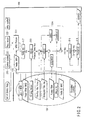
- FIG. 2 is a diagram to help explain the process of decrypting encrypted contents (E-contents) recorded in a medium.
- FIG. 2 shows information stored in a medium 100 in which contents and others have been recorded, the processing functions provided in an information recording and reproducing apparatus 200, and the flow of data between them.
- the information recording and reproducing apparatus 200 comprises a control section 210, a read section 220, and a write section 230.
- the control section 200 controls the various functions and processing operations of the information recording and reproducing apparatus 200 of FIG. 2.
- the read section 220 reads data from the medium 100 into the information recording and reproducing apparatus 200.
- the write section 230 writes data in the information recording and reproducing apparatus 200 into the medium 100.
- a Lead-IN MKB (Media Key Block) is stored in a Lead-IN area, a Read-Only area, and Read/Write MKB is stored in a User Data Area, a rewritable area.
- MKB is mathematically systematized private key information (media key block) which is obtained by encrypting a media key (Km), a base key of content encryption, using an aggregate of device keys (Kd) provided as private keys in the recording and reproducing apparatus 200 and which has been encrypted to encrypt or decrypt a title key (TK).
- Km media key
- Kd device keys
- Block S10 the versions of Lead-in MKB and Read Write MKB recorded on the medium 100 are compared with each other and the latest one is read as Media MKB. Then, in block S11, an MKB process is carried out using Device Key Set and Media MKB stored in the information recording and reproducing apparatus 200.
- Device Key Set is composed of a plurality of device keys Kd.
- MKB not only is information for generating a protected area key (Kpa) encrypted and stored, but also revoke information is included. Specifically, when there is a security hole in a certain device key set and the use of the device key Kd corresponding to the licenser is banned, revoke information on the corresponding device key Kd is written. The revoke information prevents encrypted data from being decrypted with a device having the corresponding device key Kd. Since information on the unauthorized devices is updated, a new MKB has to be used. Therefore, as described above, the latest one is used as Media MKB.
- Kpa protected area key
- a media key (Km) is generated.
- the generated media key is verified. If the result of the verification has shown that the generated media key is unauthorized, the Device Key Set is regarded as unauthorized and the process related to AACS is terminated.
- Binding Nonce cannot be copied using, for example, a Write instruction on a PC (personal computer) and can only be copied using an instruction defined in AACS. As described above, only hardware licensed by the AACS is permitted to make a copy, thereby preventing the leakage of information via the PC.
- a Kpa process an encryption process, is carried out using Km and Binding Nonce.
- AES Advanced Encryption Standard
- - G a cryptographic algorithm
- Kpa protected area key
- TKFN Title Key File Nonce
- the disc is provided with a Usage Rule File in which rules on the use of contents have been written.
- Usage Rule information as to whether the rules on use are applied, is represented as Bit information, 0 or 1.
- a read-only area of the disc Media ID has been stored.
- the Media ID is a unique ID added to each medium.
- a rewritable area Media ID MAC, Message Authentication code MAC using Media ID, has been stored.
- a process using an AES-D algorithm is carried out on the basis of the result of processing the above-described Usage Rule, Kpa, and TKFN, and the encrypted title key (T-TK) is decrypted, thereby generating a title key (TK).
- T-TK title key
- the MAC generated using Media ID stored in BCA is compared with Media ID MAC stored on the disc, thereby verifying that there is no alteration.
- the TK generated this way and the encrypted contents (E-contents) are processed using an AES-G algorithm, thereby generating a content key.
- the encrypted contents (E-contents) are decrypted, thereby generating contents.
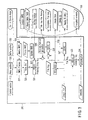
- FIG. 3 is a diagram to help explain the process of encrypting contents and recording the resulting contents onto a DVD. Since the terms used are the same as in FIG. 2, a repeated explanation will be omitted.
- the versions of Lead-in MKB and Read Write MKB recorded on the medium 100 are compared with each other and the latest one is read as Media MKB.
- the version of Media MKB and that of Device MKB held by the information recording and reproducing apparatus 200 are compared with each other. If the version of Device MKB is newer, an MKB update process is started and the value of Device MKB is updated to Read Write MKB in block S21. If the version of Media MKB is newer, whether to update the value of Device MKB is determined, depending on the set specification.
- an MKB process is carried out using the Device Key Set stored in the information recording and reproducing apparatus 200 and Media MKB.
- a media key (Km) is generated.
- the generated media key is verified. If the result of the verification has shown that the generated media key is unauthorized, the Device Key Set is regarded as unauthorized and the process related to AACS is terminated.
- a Kpa process an encryption process, is carried out.
- a protected area key Kpa
- the title key (TK) and contents are processed using an AES-G algorithm, thereby generating a content key.
- contents are encrypted, thereby generating E-contents, which are then recorded on the medium 100.
- an MAC is generated.
- the MAC is stored as Media ID MAC onto the medium 100.
- the title keys and others play a key role.
- the title key and others are recorded as a readable/writable file on the medium, if the surface of the medium becomes dirty with fingerprints or the like, there is a possibility that contents cannot be read out easily. Therefore, in AACS, the title key file (TKF) in which information including the title key and others have been stored is backed up.
- FIG. 4 is a diagram showing the structure of a title key file and that of a title key file as its backup file.
- a title key file is referred to as TKF1
- a title key file as a backup file is referred to as TKF2 or TKF3.
- TKF1 to TKF3 are stored on the medium 100.
- BN1, BN2, BN3 are random number data used to encrypt its own title key file as described above. (Generation) shows the number of times each of the title files (TKF1 to TKF3) was updated.
- TKFN1, TKFN2, TKFN3 are random numbers for generating encryption title keys (ETK1, ETK2, ETK3) of files other than its own title key file or backup file.
- a well-known algorithm such as AES (Advanced Encryption Standard) may be used.
- TKF1 is related to TKF3 and the title key (TK) is encrypted using (BN1) and the TKF3 related to TKF1 (TKFN3).
- TKF2 is related to TKF1 and the title key (TK) is encrypted using (BN2) and the TKF1 related to TKF2 (TKFN1).
- TKF3 is related to TKF2 and the title key (TK) is encrypted using (BN3) and the TKF2 related to TKF3 (TKFN2).
- the title key file TKF1 and each of the backup files TKF2, TKF3 are related to one another.
- the encrypted title keys (E-TK1, E-TK2, E-TK3) are obtained by encrypting the title key (TK) using (BN1, BN2, BN3) registered in their own files and (TKFN1, TKFN2, TKFN3) registered in related other files.
- Binding Nonce is set as data that can be read and written using only a special drive command, which prevents unauthorized copying. That is, even if TKF has been copied, since Binding Nonce attached to it has not been copied, it is possible to prevent a malicious third party from encrypting and decrypting data illegally.
- Binding Nonce and its backup data have been stored.
- BCA Breast Cutting Area
- a User Data Area on the medium management information, information on Copy Protection pointers of a video object (VOB) and a stream object (SOB), has been stored. Further stored in the User Data Area are Read/Write MKB, encrypted title key (E-TK), Media ID MAC, Usage Rule, and their backup files. Still further, up to 1998 encrypted contents can be stored in the User Data Area.
- FIG. 8 shows the structure of an encrypted title key file (E-TKF). While in FIG. 8, the structure of E-TKF in a stream object (SOB) is shown, the same structure is also used in a video object (VOB).
- SOB stream object
- VOB video object
- E-TK Encrypted title key
- KTI Title Key Information
- Each of the contents is encrypted using one of the 1998 title keys. There is no need to record an Encrypted Title Key in all of the 1998 title keys. In the unused title keys, what is obtained by encrypting a value of 0 in a TK process is written.
- Title Key File Generation a value incremented each time the file is updated has been written. As described above, the title key file includes a total of three files for backup purposes. If none of the values of the Title Key File Generation of the three files coincide with one another, this means that some failure has occurred during writing data into a file.
- MKB information on unauthorized devices has been stored. If the version of MKB is new, this means that information on new unauthorized devices has been added and registered. Accordingly, it is desirable that a newer MKB should be widely used from the viewpoint of prevention of illegal acts.
- Lead-in MKB has been recorded in the Lead-in Area, an unrewritable area on the disc.
- Lead-in MKB is data that the disc manufacturer writes each time it manufactures a disc. Therefore, on a newly manufactured disc, an MKB of a new version has been written.
- Device MKB is such data as is recorded in a nonvolatile storage area of a device by the device manufacturer that buys a device key together with the MKB. Under the current agreement, device manufacturers buy new MKBs every three months and replace the Device MKB with an MKB of a new version before shipment.
- MKB of the new version is recorded in a rewritable area of the old medium.
- the MKB stored on the disc and constantly updated to a new version is referred to as Read Write MKB.
- FIG. 9 is a flowchart to help explain the basic procedure for writing MKB onto a blank disc.
- the control section 210 acquires Device MKB stored in the nonvolatile area of the information recording and reproducing apparatus 200.
- Lead-in MKB recorded in the Lead-in area of the medium 100 is acquired.
- the version of Device MKB is compared with the version of Lead-in MKB. The version number is recorded in the beginning part of each MKB.
- Lead-in MKB is set as Read Write MKB in block T05.
- Device MKB is set as Read Write MKB in block T05.
- the title key file (TKF) is read. That is, the title key file on the medium 100 is expanded on an SDRAM.
- FIG. 11 is a flowchart to help explain the basic procedure of writing MKB into a recorded rewritable medium.
- MKB In a rewritable medium, the latest version of MKB has to be written as described above. Thus, if a reason for updating MKB occurs after the medium 100 is inserted, MKB is written on the medium 100 even if the user does not perform a TKF updating operation, such as recording, deleting, or editing.
- the control section 210 acquires the Device MKB stored in the nonvolatile area of the information recording and reproducing apparatus 200 and Lead-in MKB and Read Write MKB recorded in the Lead-in area of the medium 100. Then, if the version of the Device MKB or that of the Lead-in MKB is newer than the version of the Read Write MKB, the control section determines that Update MKB has occurred.
- the title key file (TKF) is read. That is, the title key file on the medium is expanded on the SDRAM.
- Update MKB has occurred in block S12
- the latest one of the versions of Device MKB and Lead-in MKB is written in Read Write MKG, even if the user has not performed a title key file rewriting operation (such as recording, deleting, or editing).
- the process of FIG. 11 is not applied to write-once media.
- the reason is that, if MKB is updated, the protected area key (Kpa) is updated and therefore TKF is updated.
- Kpa protected area key
- TKF TKF is updated.
- AACS of write-once media, only a blank disc is permitted to have TKF written into. Accordingly, the update of MKB is permitted on a rewritable disc, not on a write-once medium.
- Read Write MKB is prevented from being written wastefully even if contents to be protected in AACS have not been recorded, thereby reducing the number of write operations, which prevents the disc capacity from being consumed wastefully.
- the invention may be applied not only to an HD DVD in the embodiment but also to an HDD and a semiconductor flash memory.
Landscapes
- Engineering & Computer Science (AREA)
- Computer Security & Cryptography (AREA)
- Signal Processing (AREA)
- Signal Processing For Digital Recording And Reproducing (AREA)
- Storage Device Security (AREA)
Abstract
Description
- This invention relates to a method of recording or reproducing an encryption key or the like, information requested to have a high confidentiality. This invention further relates to a reproducing apparatus which uses stored or recorded highly confidential data.
- In recent years, various reproducing apparatuses capable of reproducing AV contents recorded on a disc medium, such as a DVD (Digital Versatile Disc), have been developed. Such reproducing apparatuses include a recorder with a dedicated player or a reproducing function, and a personal computer provided with a DVD disc drive and a reproducing software program. Stream data recorded on a DVD disc or the like to be played back on such a reproducing apparatus has been encrypted to prevent the data from being copied. An encryption scheme conforming mostly to the CCS (Content Scramble System) method has been applied to the encrypted stream data part. As a higher encryption scheme, AACS (Advanced Access Content System) has been proposed (refer to Jpn. Pat. Appln. KOKAI Publication No.
2005-39480 - In the AACS, to prevent unauthorized copying, data called MKB (Media Key Block) is used. MKB is mathematically systematic data obtained by encrypting a media key (Km), a base key of content encryption, using an aggregate of device keys (Kd) provided as private keys in reproducing apparatuses. Moreover, in MKB, information on unauthorized apparatuses has been recorded, thereby preventing the unauthorized apparatuses from taking out the media key (Km).
- Since information on unauthorized apparatuses is updated, a new MKB has to be used. Therefore, in the AACS, there are three types of MKB: Lead-in MKB embedded in the Lead-in Area of a medium, Read Write MKB stored as a file in a medium, and Device MKB stored in its internal nonvolatile memory by the apparatus itself. Of them, the latest MKB is supposed to be written over Read Write MKB.
- Content protection using such MKB is a technology for effectively preventing unauthorized use of DVD media contents. To maintain this functionality, MKB has to be updated as needed. Since the update is made by writing MKB over Read Write MKB, frequent updating of MKB leads to a decrease in the response of the system.
- An object of the invention is to reduce the number of times a medium is written into due to the updating of MKB.
- According to a first aspect of the invention, there is provided an information recording and reproducing apparatus which records information in a recording medium and reproduces information recorded in the recording medium, the information recording and reproducing apparatus characterized by comprising: a first recording section which records in the recording medium an encrypted encryption key aggregate where at least one encryption key for encrypting each of a plurality of pieces of information has been encrypted and registered and information encrypted using the encryption key, a second recording section which records encrypted first private key information used to encrypt or decrypt the encryption key into the recording medium and which, if the encrypted encryption key aggregate has not been recorded in the recording medium, records the first private key information into the recording medium only when the encrypted encryption key aggregate is recorded in the recording medium.
- According to a second aspect of the invention, there is provided an information recording and reproducing method for an information recording and reproducing apparatus which records information in a recording medium and reproduces information recorded in the recording medium, the information recording and reproducing method characterized by comprising: recording an encrypted encryption key aggregate where at least one encryption key for encrypting each of a plurality of pieces of information has been encrypted and registered and information encrypted using the encryption key, recording encrypted first private key information used to encrypt or decrypt the encryption key into the recording medium, wherein in the encrypted first private key information recording, if the encrypted encryption key aggregate has not been recorded in the recording medium, the first private key information is recorded into the recording medium only when the encrypted encryption key aggregate is recorded in the recording medium.
- The invention can be more fully understood from the following detailed description when taken in conjunction with the accompanying drawings, in which:
- FIG. 1 is an exemplary diagram showing a data structure in a medium according to a first embodiment of the invention;
- FIG. 2 is an exemplary diagram to help explain the process of decrypting encrypted contents recorded in a medium according to the first embodiment;
- FIG. 3 is an exemplary diagram to help explain the process of encrypting contents and recording the resulting contents onto a DVD according to the first embodiment;
- FIG. 4 is an exemplary diagram showing the structure of a title key file and that of a title key file as its backup file according to the first embodiment;
- FIG. 5 is an exemplary diagram showing data on media needed in a recording and reproducing process in the AACS according to the first embodiment;
- FIG. 6 is an exemplary diagram showing data on media needed in a recording and reproducing process in the AACS according to the first embodiment;
- FIG. 7 is an exemplary diagram showing data on media needed in a recording and reproducing process in the AACS according to the first embodiment;
- FIG. 8 is an exemplary diagram showing the structure of an encrypted title key file according to the first embodiment;
- FIG. 9 is an exemplary flowchart to help explain the basic procedure for writing MKB onto a blank disc according to the first embodiment;
- FIG. 10 is an exemplary flowchart to help explain the basic procedure for processing MKB according to the first embodiment; and
- FIG. 11 is an exemplary flowchart to help explain the basic procedure of writing MKB into a recorded rewritable medium according to he first embodiment.
- An embodiment according to the invention will be described hereinafter with reference to the accompanying drawings.
- When information is recorded onto an information recording medium, such as an optical disc, information might be requested to be encrypted and recorded. For example, in a copyright protection system, contents, a written work, are encrypted using an encryption key to produce encrypted contents. To conceal the encryption key used in encryption, the encryption key is encrypted using another encryption key to produce an encrypted key. Then, the encrypted key, together with the encrypted contents, is recorded onto a recording medium, thereby preventing illegal copying.
- In a copyright protection system related to DVDs (Digital Versatile Discs) whose market is expanding rapidly at present, the following actions have been taken: DVD video uses the CSS (Content Scramble System) method licensed by the DVD CCA (DVD Copy Control Association); and reproduce-only DVD Audio uses the CPPM (Content Protection for Prerecorded Media) method. Moreover, in a copyright protection system for contents recorded in recording media, the CPRM (Content Protection for Recordable Media) method has been used. The CPPM method and CPRM method are licensed by a specific association. The specific association is, for example, an association called 4C Entity or LCC.
- On the other hand, the development of a high-capacity next-generation DVD or the like which enables high-definition images and audio signals to be recorded and reproduced is being advanced. In a copyright protection system for a case where a high-definition work is written onto such a next-generation recording medium, the introduction of a method whose security capability is higher than that in the prior art is requested.
- A method of managing a content key in the AACS, a content protection technique used in the HD DVD (High Density Digital Versatile Disc) Video Recording format, will be explained.
- In the conventional CPRM method, an encryption key is generated using a media key block (MKB) and media ID (Media 1D) present on the disc, thereby encrypting contents. On the other hand, in the AACS method, the contents of the disc do not share a common encryption key and are encrypted using a separate encryption key corresponding to each content.
- FIG. 1 shows a data configuration of a medium.
- Up to 1998 video objects (VOBs), which are MPEG2 contents used in conventional DVDs, and up to 1998 stream objects (SOBs) used in a HDDV or the like can be stored in a single medium according to the standard.
- As described above, while in the conventional method, one encryption key was shared by all of the objects, the AACS method performs encryption using a different encryption key for each content.
- The encryption key for each content is stored in a title key file (TKF). Specifically, there are provided a video object title key file and a stream object title key file. Each of the tile key files can store 1998 title keys (Encrypted Title Keys: E-TKs).
- FIG. 2 is a diagram to help explain the process of decrypting encrypted contents (E-contents) recorded in a medium. FIG. 2 shows information stored in a
medium 100 in which contents and others have been recorded, the processing functions provided in an information recording and reproducingapparatus 200, and the flow of data between them. - The information recording and reproducing
apparatus 200 comprises acontrol section 210, aread section 220, and awrite section 230. Thecontrol section 200 controls the various functions and processing operations of the information recording and reproducingapparatus 200 of FIG. 2. Theread section 220 reads data from themedium 100 into the information recording and reproducingapparatus 200. Thewrite section 230 writes data in the information recording and reproducingapparatus 200 into themedium 100. - In the
medium 100, a Lead-IN MKB (Media Key Block) is stored in a Lead-IN area, a Read-Only area, and Read/Write MKB is stored in a User Data Area, a rewritable area. - MKB is mathematically systematized private key information (media key block) which is obtained by encrypting a media key (Km), a base key of content encryption, using an aggregate of device keys (Kd) provided as private keys in the recording and reproducing
apparatus 200 and which has been encrypted to encrypt or decrypt a title key (TK). - In block S10, the versions of Lead-in MKB and Read Write MKB recorded on the
medium 100 are compared with each other and the latest one is read as Media MKB. Then, in block S11, an MKB process is carried out using Device Key Set and Media MKB stored in the information recording and reproducingapparatus 200. Device Key Set is composed of a plurality of device keys Kd. - In the MKB, not only is information for generating a protected area key (Kpa) encrypted and stored, but also revoke information is included. Specifically, when there is a security hole in a certain device key set and the use of the device key Kd corresponding to the licenser is banned, revoke information on the corresponding device key Kd is written. The revoke information prevents encrypted data from being decrypted with a device having the corresponding device key Kd. Since information on the unauthorized devices is updated, a new MKB has to be used. Therefore, as described above, the latest one is used as Media MKB.
- By this MKB process, a media key (Km) is generated. In block S12, the generated media key is verified. If the result of the verification has shown that the generated media key is unauthorized, the Device Key Set is regarded as unauthorized and the process related to AACS is terminated.
- On the other hand, in the protect area in the begin address of the title key file (TKF), data based on random numbers connected to a file called Binding Nonce has been written. The Binding Nonce cannot be copied using, for example, a Write instruction on a PC (personal computer) and can only be copied using an instruction defined in AACS. As described above, only hardware licensed by the AACS is permitted to make a copy, thereby preventing the leakage of information via the PC.
- Next, in block S13, a Kpa process, an encryption process, is carried out using Km and Binding Nonce. In the Kpa process, AES (Advanced Encryption Standard) - G, a cryptographic algorithm, is used. As a result of the Kpa process, a protected area key (Kpa) is generated.
- Next, a title key process to generate a title key (TK) from Kpa shown in block S14 will be explained.
- In the title key file (TKF), random number data called Title Key File Nonce (TKFN) has been stored. The TKFN is random number data used to encrypt a title key in an encryption process (described later).
- In addition, the disc is provided with a Usage Rule File in which rules on the use of contents have been written. In the Usage Rule File, Usage Rule, information as to whether the rules on use are applied, is represented as Bit information, 0 or 1.
- Furthermore, in a burst cutting area (BCA), a read-only area of the disc, Media ID has been stored. The Media ID is a unique ID added to each medium. In a user data area, a rewritable area, Media ID MAC, Message Authentication code MAC using Media ID, has been stored.
- In a title key process shown in block S14, a process using an AES-D algorithm is carried out on the basis of the result of processing the above-described Usage Rule, Kpa, and TKFN, and the encrypted title key (T-TK) is decrypted, thereby generating a title key (TK). At this time, the MAC generated using Media ID stored in BCA is compared with Media ID MAC stored on the disc, thereby verifying that there is no alteration.
- In block S15, the TK generated this way and the encrypted contents (E-contents) are processed using an AES-G algorithm, thereby generating a content key. In block S16, using this content key, the encrypted contents (E-contents) are decrypted, thereby generating contents.
- FIG. 3 is a diagram to help explain the process of encrypting contents and recording the resulting contents onto a DVD. Since the terms used are the same as in FIG. 2, a repeated explanation will be omitted.
- In block S20, the versions of Lead-in MKB and Read Write MKB recorded on the medium 100 are compared with each other and the latest one is read as Media MKB. Next, the version of Media MKB and that of Device MKB held by the information recording and reproducing
apparatus 200 are compared with each other. If the version of Device MKB is newer, an MKB update process is started and the value of Device MKB is updated to Read Write MKB in block S21. If the version of Media MKB is newer, whether to update the value of Device MKB is determined, depending on the set specification. In block S22, an MKB process is carried out using the Device Key Set stored in the information recording and reproducingapparatus 200 and Media MKB. - By this MKB process, a media key (Km) is generated. In block S23, the generated media key is verified. If the result of the verification has shown that the generated media key is unauthorized, the Device Key Set is regarded as unauthorized and the process related to AACS is terminated.
- In block S24, using Km and Binding Nonce, a Kpa process, an encryption process, is carried out. As a result of the Kpa process using AES-G, a protected area key (Kpa) is generated.
- In block S25, the title key (TK) and contents are processed using an AES-G algorithm, thereby generating a content key. In block S26, using this content key, contents are encrypted, thereby generating E-contents, which are then recorded on the medium 100.
- In block S27, using Media ID and TK, an MAC is generated. The MAC is stored as Media ID MAC onto the medium 100.
- In block S28, random number data used to encrypt the title key is generated and recorded as Title Key File Nonce onto the medium.
- In block S29, on the basis of the result of the process of hashing the Usage Rule and Kpa and TK, a process using an AES-E algorithm is carried out, thereby generating an encrypted title key (E-TK), which is then stored onto the medium. In block S30, the Usage Rule is stored onto the medium 100.
- As described above, in encrypting or decrypting contents, the title keys and others play a key role. However, since the title key and others are recorded as a readable/writable file on the medium, if the surface of the medium becomes dirty with fingerprints or the like, there is a possibility that contents cannot be read out easily. Therefore, in AACS, the title key file (TKF) in which information including the title key and others have been stored is backed up.
- FIG. 4 is a diagram showing the structure of a title key file and that of a title key file as its backup file. In an explanation of the backup method, a title key file is referred to as TKF1, a title key file as a backup file is referred to as TKF2 or TKF3. TKF1 to TKF3 are stored on the medium 100.
- In each of the title key files (TKF1 to TKF3), Binding Nonce (BN1, BN2, BN3), Title Key File Generation (Generation), Title Key File Nonce (
TKFN 1 to TKEF 3), and encrypted title keys (ETK1 to ETK3) are registered. - (BN1, BN2, BN3) are random number data used to encrypt its own title key file as described above. (Generation) shows the number of times each of the title files (TKF1 to TKF3) was updated.
- (TKFN1, TKFN2, TKFN3) are random numbers for generating encryption title keys (ETK1, ETK2, ETK3) of files other than its own title key file or backup file.
- The encryption title keys (ETK1, ETK2, ETK3) are expressed by the following equations (1) to (3) :



where TK represents a title key of plain text and f indicates that a first parameter (TK) is encrypted using second parameters (BN1 to BN3) and third parameters (TKFN1 to TKFN3) as encryption keys. In the encryption process f, for example, a well-known algorithm, such as AES (Advanced Encryption Standard), may be used. - Specifically, TKF1 is related to TKF3 and the title key (TK) is encrypted using (BN1) and the TKF3 related to TKF1 (TKFN3). TKF2 is related to TKF1 and the title key (TK) is encrypted using (BN2) and the TKF1 related to TKF2 (TKFN1). TKF3 is related to TKF2 and the title key (TK) is encrypted using (BN3) and the TKF2 related to TKF3 (TKFN2).
- As described above, the title key file TKF1 and each of the backup files TKF2, TKF3 are related to one another. The encrypted title keys (E-TK1, E-TK2, E-TK3) are obtained by encrypting the title key (TK) using (BN1, BN2, BN3) registered in their own files and (TKFN1, TKFN2, TKFN3) registered in related other files.
- As described above, when three TKFs are stored and TKFN is stored in another file, even if one TKF has been destroyed due to data corruption, the corrupted data can be restored from the data in the remaining two TKFs.
- The above-described Binding Nonce is set as data that can be read and written using only a special drive command, which prevents unauthorized copying. That is, even if TKF has been copied, since Binding Nonce attached to it has not been copied, it is possible to prevent a malicious third party from encrypting and decrypting data illegally.
- Referring to FIGS. 5, 6, and 7, data on a medium needed in a recording and reproducing process in the AACS will be explained in detail.
- In a Protected Area on a medium, or a Protected Area for a file in which E-TK has been stored, Binding Nonce and its backup data have been stored.
- Moreover, in BCA (Burst Cutting Area) in a Read Only Area on the medium, Media ID has been recorded. In a Lead-In Area, Lead-in MKB has been recorded.
- In a User Data Area on the medium, management information, information on Copy Protection pointers of a video object (VOB) and a stream object (SOB), has been stored. Further stored in the User Data Area are Read/Write MKB, encrypted title key (E-TK), Media ID MAC, Usage Rule, and their backup files. Still further, up to 1998 encrypted contents can be stored in the User Data Area.
- FIG. 8 shows the structure of an encrypted title key file (E-TKF). While in FIG. 8, the structure of E-TKF in a stream object (SOB) is shown, the same structure is also used in a video object (VOB).
- In
byte 0 tobyte 15, fixed information (STKE_ID, HR_STKF_EA) for specifying a title key file has been written. Inbyte 32 andbyte 33, the version number of AACS has been written. Inbyte 128 tobyte 143, Title Key File Generation has been stored. Inbyte 144 tobyte 159, Title Key File Nonce has been stored. - In
byte 160 tobyte - Each of the contents is encrypted using one of the 1998 title keys. There is no need to record an Encrypted Title Key in all of the 1998 title keys. In the unused title keys, what is obtained by encrypting a value of 0 in a TK process is written.
- In Title Key File Generation, a value incremented each time the file is updated has been written. As described above, the title key file includes a total of three files for backup purposes. If none of the values of the Title Key File Generation of the three files coincide with one another, this means that some failure has occurred during writing data into a file.
- Next, a method of updating MKB will be explained.
- As described above, in MKB, information on unauthorized devices has been stored. If the version of MKB is new, this means that information on new unauthorized devices has been added and registered. Accordingly, it is desirable that a newer MKB should be widely used from the viewpoint of prevention of illegal acts.
- In AACS, three types of MKB are used.
- Lead-in MKB has been recorded in the Lead-in Area, an unrewritable area on the disc. Lead-in MKB is data that the disc manufacturer writes each time it manufactures a disc. Therefore, on a newly manufactured disc, an MKB of a new version has been written.
- Device MKB is such data as is recorded in a nonvolatile storage area of a device by the device manufacturer that buys a device key together with the MKB. Under the current agreement, device manufacturers buy new MKBs every three months and replace the Device MKB with an MKB of a new version before shipment.
- For example, when old media have been used with the same apparatus, the version of MKB has not been updated. Therefore, when old media are used with a newly purchased apparatus, MKB of the new version is recorded in a rewritable area of the old medium. The MKB stored on the disc and constantly updated to a new version is referred to as Read Write MKB.
- FIG. 9 is a flowchart to help explain the basic procedure for writing MKB onto a blank disc.
- In block S01, when the user turns on the power supply of the information recording and reproducing
apparatus 200, or when the user inserts a disc on which no content has been recorded, an MKB process (see FIG. 10) is executed in block S02. - In block T01 of FIG. 10, the
control section 210 acquires Device MKB stored in the nonvolatile area of the information recording and reproducingapparatus 200. In block T02, Lead-in MKB recorded in the Lead-in area of the medium 100 is acquired. In block T03, the version of Device MKB is compared with the version of Lead-in MKB. The version number is recorded in the beginning part of each MKB. - If Yes in block T04, or if the version of Lead-in MKB is new, Lead-in MKB is set as Read Write MKB in block T05.
- On the other hand, if No in block T04, or if the version of Device MKB is new, Device MKB is set as Read Write MKB in block T05.
- In block T07, MKB to be written is determined.
- Returning to FIG. 9, in block S03, the title key file (TKF) is read. That is, the title key file on the medium 100 is expanded on an SDRAM.
- Then, in block S04, whether to update Read Write MKB is determined according to a content recording operation, a content reproducing operation, a content editing operation, or a content deleting operation conducted by the user.
- If Yes in block S05, or if the title key file (TKF) and title usage file (TUF) have been recorded according to the operation performed by the user, the determined MKB is written in Read Write MKB in block S06.
- On the other hand, if No in block S05, or if the title key file and title usage file have not been recorded into, the determined MKB is not written in Read Write MKB in block S07.
- In the prior art, when the medium 100 was inserted in the information recording and reproducing
apparatus 200 and the medium was ejected without the operation of recording contents, since Read Write MKB had been generated on the SDRAM even in that state, the data was written in Read Write MKB of the medium 100. - Consequently, although MKB is intended to protect recorded contents, a file of MKB is written wastefully even if there is no content to be protected.
- Taking into account a possibility that another device, such as PC (personal computer), will use the HD DVD for another purpose, writing a file of MKB even if there is no content to be protected leads to a wasteful consumption of capacity.
- To overcome this problem, as shown in block S07 of FIG. 9, if a blank medium is inserted, a determination is made so that MKB may be written on the medium 100 only when contents have been recorded on the medium, that is, only when TKF and TUF have been recorded.
- FIG. 11 is a flowchart to help explain the basic procedure of writing MKB into a recorded rewritable medium.
- In a rewritable medium, the latest version of MKB has to be written as described above. Thus, if a reason for updating MKB occurs after the medium 100 is inserted, MKB is written on the medium 100 even if the user does not perform a TKF updating operation, such as recording, deleting, or editing.
- In block S11 of FIG. 11, when the user turns on the power supply of the information recording and reproducing
apparatus 200 and inserts a rewritable medium on which contents have been recorded, the MKB process is executed in block S12. - In the MKB process, the
control section 210 acquires the Device MKB stored in the nonvolatile area of the information recording and reproducingapparatus 200 and Lead-in MKB and Read Write MKB recorded in the Lead-in area of the medium 100. Then, if the version of the Device MKB or that of the Lead-in MKB is newer than the version of the Read Write MKB, the control section determines that Update MKB has occurred. - If Update MKB has occurred, the media key (Km) is updated. Consequently, a title key file reencrypting process, that is, a title key file recording process, occurs.
- In block S13, the title key file (TKF) is read. That is, the title key file on the medium is expanded on the SDRAM.
- Then, in block S14, the user performs an operation.
- However, since Update MKB has occurred in block S12, the latest one of the versions of Device MKB and Lead-in MKB is written in Read Write MKG, even if the user has not performed a title key file rewriting operation (such as recording, deleting, or editing).
- In the recorded rewritable medium of FIG. 11, as described in FIG. 9, when the title key file and title usage files are not recorded, Read Write MKB is not written into.
- The process of FIG. 11 is not applied to write-once media. The reason is that, if MKB is updated, the protected area key (Kpa) is updated and therefore TKF is updated. However, under AACS, of write-once media, only a blank disc is permitted to have TKF written into. Accordingly, the update of MKB is permitted on a rewritable disc, not on a write-once medium.
- According to the above-described embodiment, Read Write MKB is prevented from being written wastefully even if contents to be protected in AACS have not been recorded, thereby reducing the number of write operations, which prevents the disc capacity from being consumed wastefully.
- Furthermore, even if a disc has no Read Write MKB, comparing the version of the Lead-in MKB with that of the Device MKB enables the latest Read Write MKB to be written on a disc.
- The invention may be applied not only to an HD DVD in the embodiment but also to an HDD and a semiconductor flash memory.
Claims (8)
- An information recording and reproducing apparatus (200) which records information in a recording medium (100) and reproduces information recorded in the recording medium, the information recording and reproducing apparatus characterized by comprising:a first recording section which records in the recording medium (100) an encrypted encryption key aggregate (TKF) where at least one encryption key (TK) for encrypting each of a plurality of pieces of information (contents) has been encrypted and registered and information (E-contents) encrypted using the encryption key (TK),a second recording section which records encrypted first private key information (Read Write MKB) used to encrypt or decrypt the encryption key (TK) into the recording medium (100) and which, if the encrypted encryption key aggregate (TKF) has not been recorded in the recording medium (100), records the first private key information (Read Write MKB) into the recording medium (100) only when the encrypted encryption key aggregate (TKF) is recorded in the recording medium (200) .
- The information recording and reproducing apparatus according to claim 1, characterized by further comprising:a third recording section which records second private key information and third private key information (Lead-in MKB, Device MKB) encrypted to encrypt or decrypt the encryption key (TK) in advance are recorded in the recording medium (100) and the information recording and reproducing apparatus (200),wherein the second recording section, when the encrypted encryption key aggregate (TKF) has not been recorded in the recording medium (100), records the newer one of the versions of the second and third private key information (Lead-in MKB, Device MKB) as the first private key information (Read Write MKB) into the recording medium (100).
- The information recording and reproducing apparatus according to claim 1, characterized by further comprising:a third recording section which records second private key information and third private key information (Lead-in MKB, Device MKB) used to encrypt or decrypt the encryption key (TK) in advance are recorded into the recording medium (100) and the information recording and reproducing apparatus (200),wherein the second recording section, when the encrypted encryption key aggregate (TKF) has been recorded in the recording medium (100) and at least the version of the second or third private key information (Lead-in MKB, Device MKB) is newer than the version of the first private key information (Read Write MKB), records the newer one of the versions of the second and third private key information (Lead-in MKB, Device MKB) as the first private key information (Read Write MKB) into the recording medium (100).
- The information recording and reproducing apparatus according to claim 3, characterized in that
the second recording section, when the encrypted encryption key aggregate (TKF) has been recorded in the recording medium (100) and the recording medium (100) is a write-once medium, is prevented from recording the first private key information (Read Write MKB) into the recording medium (100). - An information recording and reproducing method for an information recording and reproducing apparatus (200) which records information in a recording medium (100) and reproduces information recorded in the recording medium, the information recording and reproducing method characterized by comprising:recording an encrypted encryption key aggregate (TKF) where at least one encryption key (TK) for encrypting each of a plurality of pieces of information (contents) has been encrypted and registered and information (E-contents) encrypted using the encryption key (TK),recording encrypted first private key information (Read Write MKB) used to encrypt or decrypt the encryption key (TK) into the recording medium (100),wherein in the encrypted first private key information recording, if the encrypted encryption key aggregate (TKF) has not been recorded in the recording medium (100), the first private key information (Read Write MKB) is recorded into the recording medium (100) only when the encrypted encryption key aggregate (TKF) is recorded in the recording medium (100).
- The information recording and reproducing method according to claim 5, characterized by further comprising:recording second private key information and third private key information (Lead-in MKB, Device MKB) encrypted to encrypt or decrypt the encryption key (TK) in advance are recorded in the recording medium (100) and the information recording and reproducing apparatus (200),wherein the encrypted first private key information recording is, when the encrypted encryption key aggregate (TKF) has not been recorded in the recording medium (100), to record the newer one of the versions of the second and third private key information (Lead-in MKB, Device MKB) as the first private key information (Read Write MKB) into the recording medium (100).
- The information recording and reproducing method according to claim 5, characterized by further comprising:recording second private key information and third private key information (Lead-in MKB, Device MKB) encrypted to encrypt or decrypt the encryption key (TK) in advance are recorded into the recording medium (100) and the information recording and reproducing apparatus (200),
wherein the encrypted first private key information recording is to record the newer one of the versions of the second and third private key information (lead-in MKB, Device MKB) as the first private key information (Read Write MKB) into the recording medium (100), when the encrypted encryption key aggregate (TKF) has been recorded in the recording medium (100) and the version of at least either second or third private key information (Lead-in MKB, Device MKB) is newer than the version of the first private key information (Read Write MKB). - The information recording and reproducing method according to claim 7, characterized in that
the encrypted first private key information recording is not to record the first private key information (Read Write MKB) into the recording medium (100) when the encrypted encryption key aggregate (TKF) has been recorded in the recording medium (100) and the recording medium (100) is a write-once medium.
Applications Claiming Priority (1)
| Application Number | Priority Date | Filing Date | Title |
|---|---|---|---|
| JP2006162669A JP4768523B2 (en) | 2006-06-12 | 2006-06-12 | Information recording / reproducing apparatus and method |
Publications (1)
| Publication Number | Publication Date |
|---|---|
| EP1868193A1 true EP1868193A1 (en) | 2007-12-19 |
Family
ID=38461184
Family Applications (1)
| Application Number | Title | Priority Date | Filing Date |
|---|---|---|---|
| EP07107517A Withdrawn EP1868193A1 (en) | 2006-06-12 | 2007-05-04 | Information recording and reproducing apparatus and method |
Country Status (4)
| Country | Link |
|---|---|
| US (1) | US7882367B2 (en) |
| EP (1) | EP1868193A1 (en) |
| JP (1) | JP4768523B2 (en) |
| CN (1) | CN101089980A (en) |
Families Citing this family (5)
| Publication number | Priority date | Publication date | Assignee | Title |
|---|---|---|---|---|
| JP4921862B2 (en) * | 2006-06-12 | 2012-04-25 | 株式会社東芝 | Information recording / reproducing apparatus and method |
| JP5025009B2 (en) * | 2008-02-15 | 2012-09-12 | 株式会社東芝 | Authentication method, host computer and recording medium |
| JP4620146B2 (en) | 2008-07-18 | 2011-01-26 | 株式会社東芝 | Information processing apparatus and authentication method |
| US9911457B2 (en) * | 2008-09-24 | 2018-03-06 | Disney Enterprises, Inc. | System and method for providing a secure content with revocable access |
| CN104113419B (en) * | 2014-07-18 | 2016-07-13 | 努比亚技术有限公司 | The authentication method of electronic signature and system |
Citations (4)
| Publication number | Priority date | Publication date | Assignee | Title |
|---|---|---|---|---|
| US20010021255A1 (en) * | 2000-03-13 | 2001-09-13 | Kabushiki Kaisha Toshiba | Content processing system and content protecting method |
| WO2003049106A2 (en) * | 2001-12-05 | 2003-06-12 | Koninklijke Philips Electronics N.V. | Method and apparatus for verifying the integrity of system data |
| EP1659584A1 (en) * | 2004-11-22 | 2006-05-24 | Kabushi Kaisha Toshiba | Copyright management method, information recording/reproducing method and device, and information recording medium and method of manufacturing the medium |
| WO2006074987A2 (en) * | 2005-01-11 | 2006-07-20 | International Business Machines Corporation | System and method for controlling acces to protected digital content by verification of a media key block |
Family Cites Families (12)
| Publication number | Priority date | Publication date | Assignee | Title |
|---|---|---|---|---|
| US5726956A (en) * | 1995-03-15 | 1998-03-10 | Sony Corporation | Apparatus and method for controlling plural disc reproducing apparatus for continous reproduction |
| US7380137B2 (en) * | 1999-07-20 | 2008-05-27 | International Business Machines Corporation | Content guard system for copy protection of recordable media |
| WO2001019017A1 (en) * | 1999-09-07 | 2001-03-15 | Sony Corporation | Contents management system, device, method, and program storage medium |
| US7111175B2 (en) * | 2000-12-28 | 2006-09-19 | Intel Corporation | Method and apparatus for verifying the integrity of a media key block |
| JP4934923B2 (en) * | 2001-08-09 | 2012-05-23 | ソニー株式会社 | Information recording apparatus, information reproducing apparatus, information recording method, information reproducing method, and computer program |
| WO2003023346A1 (en) * | 2001-09-07 | 2003-03-20 | Gebr. Gloor Ag | Pressure indicator |
| JPWO2003030167A1 (en) * | 2001-09-28 | 2005-01-20 | 松下電器産業株式会社 | Optical disc, optical disc and / or license protection system for optical disc device, optical disc device, and recording / reproducing method |
| JP3878542B2 (en) * | 2002-11-29 | 2007-02-07 | 株式会社東芝 | Recording device |
| JP2005039480A (en) | 2003-07-18 | 2005-02-10 | Toshiba Corp | Content recording method, recording medium, and content recording apparatus |
| JP4592398B2 (en) * | 2004-11-22 | 2010-12-01 | 株式会社東芝 | Information recording / reproducing method and apparatus, information recording medium |
| JP2008117342A (en) * | 2006-11-08 | 2008-05-22 | Hitachi Ltd | Controller for controlling storage system and remote copy |
| JP2009230745A (en) * | 2008-02-29 | 2009-10-08 | Toshiba Corp | Method, program, and server for backup and restore |
-
2006
- 2006-06-12 JP JP2006162669A patent/JP4768523B2/en active Active
-
2007
- 2007-05-04 EP EP07107517A patent/EP1868193A1/en not_active Withdrawn
- 2007-06-01 US US11/806,602 patent/US7882367B2/en active Active
- 2007-06-12 CN CNA2007101091084A patent/CN101089980A/en active Pending
Patent Citations (4)
| Publication number | Priority date | Publication date | Assignee | Title |
|---|---|---|---|---|
| US20010021255A1 (en) * | 2000-03-13 | 2001-09-13 | Kabushiki Kaisha Toshiba | Content processing system and content protecting method |
| WO2003049106A2 (en) * | 2001-12-05 | 2003-06-12 | Koninklijke Philips Electronics N.V. | Method and apparatus for verifying the integrity of system data |
| EP1659584A1 (en) * | 2004-11-22 | 2006-05-24 | Kabushi Kaisha Toshiba | Copyright management method, information recording/reproducing method and device, and information recording medium and method of manufacturing the medium |
| WO2006074987A2 (en) * | 2005-01-11 | 2006-07-20 | International Business Machines Corporation | System and method for controlling acces to protected digital content by verification of a media key block |
Non-Patent Citations (2)
| Title |
|---|
| INTEL CORPORATION AND OTHERS: "AACS - Recordable video book", INTERNET CITATION, 22 March 2006 (2006-03-22), XP002438246, Retrieved from the Internet <URL:http://web.archive.org/web/20060322184826/www.aacsla.com/specificatio ns/specs091/AACS Spec Recordable 0.91.pdf> [retrieved on 20070619] * |
| INTEL CORPORATION ET AL: "Advanced Access Content System (AACS) - HD DVD Recordable Book", INTERNET CITATION, 26 April 2006 (2006-04-26), XP007902864, Retrieved from the Internet <URL:http://web.archive.org/web/20060520185855/http://www.aacsla.com/speci fications/> [retrieved on 20070831] * |
Also Published As
| Publication number | Publication date |
|---|---|
| US7882367B2 (en) | 2011-02-01 |
| CN101089980A (en) | 2007-12-19 |
| US20080002828A1 (en) | 2008-01-03 |
| JP2007334939A (en) | 2007-12-27 |
| JP4768523B2 (en) | 2011-09-07 |
Similar Documents
| Publication | Publication Date | Title |
|---|---|---|
| US20080013732A1 (en) | Encryption key information holding method and encryption key information processing apparatus | |
| CN101103585B (en) | System and method for controlling access to protected digital content by verification of a media key block | |
| EA004199B1 (en) | Recordable storage medium with protected data area | |
| US20080022095A1 (en) | Information access control method and device and write-once medium | |
| KR100994772B1 (en) | How to copy and play data on a storage medium | |
| US7926115B2 (en) | Information recording and reproducing apparatus and method | |
| JP4792876B2 (en) | Information processing apparatus and information processing method | |
| JP2007294054A (en) | Digital image recording / playback device | |
| US20060136342A1 (en) | Content protection method, and information recording and reproduction apparatus using same | |
| US7882367B2 (en) | Information recording and reproducing apparatus and method | |
| US20080005031A1 (en) | Information access control method and apparatus | |
| US20080022096A1 (en) | Information access control method and apparatus | |
| JP2008035397A (en) | Cryptographic information processing method and cryptographic information processing apparatus | |
| US20080049932A1 (en) | Key information update recording method and key information update recording apparatus | |
| US20070288766A1 (en) | Information access control method and apparatus | |
| US20120002817A1 (en) | Key management method and key management device | |
| JP4894970B2 (en) | Information processing device | |
| JP4589258B2 (en) | Content storage device | |
| JP2007335035A (en) | Information access management method and apparatus, and information recording medium | |
| JP2004118911A (en) | Information recording medium recorder and reproducing apparatus | |
| JP2008010077A (en) | External storage device connection management method and apparatus |
Legal Events
| Date | Code | Title | Description |
|---|---|---|---|
| PUAI | Public reference made under article 153(3) epc to a published international application that has entered the european phase |
Free format text: ORIGINAL CODE: 0009012 |
|
| 17P | Request for examination filed |
Effective date: 20070504 |
|
| AK | Designated contracting states |
Kind code of ref document: A1 Designated state(s): AT BE BG CH CY CZ DE DK EE ES FI FR GB GR HU IE IS IT LI LT LU LV MC MT NL PL PT RO SE SI SK TR |
|
| AX | Request for extension of the european patent |
Extension state: AL BA HR MK YU |
|
| 17Q | First examination report despatched |
Effective date: 20080222 |
|
| AKX | Designation fees paid |
Designated state(s): DE FR GB |
|
| STAA | Information on the status of an ep patent application or granted ep patent |
Free format text: STATUS: THE APPLICATION IS DEEMED TO BE WITHDRAWN |
|
| 18D | Application deemed to be withdrawn |
Effective date: 20091201 |