EP1867730A1 - Process for production of optically active hydroxymethyl -substituted phenylalanine - Google Patents
Process for production of optically active hydroxymethyl -substituted phenylalanine Download PDFInfo
- Publication number
- EP1867730A1 EP1867730A1 EP06730548A EP06730548A EP1867730A1 EP 1867730 A1 EP1867730 A1 EP 1867730A1 EP 06730548 A EP06730548 A EP 06730548A EP 06730548 A EP06730548 A EP 06730548A EP 1867730 A1 EP1867730 A1 EP 1867730A1
- Authority
- EP
- European Patent Office
- Prior art keywords
- hydroxymethyl
- hydantoin
- substituted
- salt
- following formula
- Prior art date
- Legal status (The legal status is an assumption and is not a legal conclusion. Google has not performed a legal analysis and makes no representation as to the accuracy of the status listed.)
- Withdrawn
Links
- -1 hydroxymethyl -substituted phenylalanine Chemical class 0.000 title claims abstract description 60
- 238000000034 method Methods 0.000 title claims description 53
- 238000004519 manufacturing process Methods 0.000 title abstract description 23
- 108090000790 Enzymes Proteins 0.000 claims abstract description 49
- 102000004190 Enzymes Human genes 0.000 claims abstract description 45
- 229940091173 hydantoin Drugs 0.000 claims abstract description 33
- 150000003839 salts Chemical class 0.000 claims abstract description 30
- COLNVLDHVKWLRT-UHFFFAOYSA-N phenylalanine Natural products OC(=O)C(N)CC1=CC=CC=C1 COLNVLDHVKWLRT-UHFFFAOYSA-N 0.000 claims abstract description 22
- 150000002993 phenylalanine derivatives Chemical class 0.000 claims abstract description 14
- 125000002887 hydroxy group Chemical group [H]O* 0.000 claims abstract description 12
- 125000003277 amino group Chemical group 0.000 claims abstract description 11
- 239000003054 catalyst Substances 0.000 claims description 28
- 108091022884 dihydropyrimidinase Proteins 0.000 claims description 24
- 102100036238 Dihydropyrimidinase Human genes 0.000 claims description 21
- 238000006243 chemical reaction Methods 0.000 claims description 21
- 230000009467 reduction Effects 0.000 claims description 20
- KDLHZDBZIXYQEI-UHFFFAOYSA-N Palladium Chemical group [Pd] KDLHZDBZIXYQEI-UHFFFAOYSA-N 0.000 claims description 18
- 108010088443 hydantoin racemase Proteins 0.000 claims description 18
- 241001468202 Microbacterium liquefaciens Species 0.000 claims description 14
- 241000589564 Flavobacterium sp. Species 0.000 claims description 13
- 244000005700 microbiome Species 0.000 claims description 12
- 108020004511 Recombinant DNA Proteins 0.000 claims description 9
- 229910052763 palladium Inorganic materials 0.000 claims description 8
- 229910052723 transition metal Inorganic materials 0.000 claims description 8
- 150000003624 transition metals Chemical group 0.000 claims description 8
- 150000002826 nitrites Chemical class 0.000 claims description 7
- 238000005984 hydrogenation reaction Methods 0.000 claims description 5
- 229940088598 enzyme Drugs 0.000 description 36
- 239000000203 mixture Substances 0.000 description 36
- VJUNTPRQTFDQMF-UHFFFAOYSA-N 1-benzylimidazolidine-2,4-dione Chemical compound O=C1NC(=O)CN1CC1=CC=CC=C1 VJUNTPRQTFDQMF-UHFFFAOYSA-N 0.000 description 32
- COLNVLDHVKWLRT-QMMMGPOBSA-N L-phenylalanine Chemical compound OC(=O)[C@@H](N)CC1=CC=CC=C1 COLNVLDHVKWLRT-QMMMGPOBSA-N 0.000 description 27
- 108020004414 DNA Proteins 0.000 description 20
- 229960005190 phenylalanine Drugs 0.000 description 20
- 239000000243 solution Substances 0.000 description 20
- XLYOFNOQVPJJNP-UHFFFAOYSA-N water Substances O XLYOFNOQVPJJNP-UHFFFAOYSA-N 0.000 description 20
- OKKJLVBELUTLKV-UHFFFAOYSA-N Methanol Chemical compound OC OKKJLVBELUTLKV-UHFFFAOYSA-N 0.000 description 18
- 210000004027 cell Anatomy 0.000 description 16
- 108090000623 proteins and genes Proteins 0.000 description 16
- KFZMGEQAYNKOFK-UHFFFAOYSA-N Isopropanol Chemical compound CC(C)O KFZMGEQAYNKOFK-UHFFFAOYSA-N 0.000 description 15
- 239000011541 reaction mixture Substances 0.000 description 14
- UDTSPKADQGPZFS-VURMDHGXSA-N (5z)-5-benzylideneimidazolidine-2,4-dione Chemical compound N1C(=O)NC(=O)\C1=C\C1=CC=CC=C1 UDTSPKADQGPZFS-VURMDHGXSA-N 0.000 description 13
- 241000588724 Escherichia coli Species 0.000 description 13
- LFQSCWFLJHTTHZ-UHFFFAOYSA-N Ethanol Chemical compound CCO LFQSCWFLJHTTHZ-UHFFFAOYSA-N 0.000 description 13
- VEXZGXHMUGYJMC-UHFFFAOYSA-N Hydrochloric acid Chemical compound Cl VEXZGXHMUGYJMC-UHFFFAOYSA-N 0.000 description 13
- 238000006722 reduction reaction Methods 0.000 description 13
- XEKOWRVHYACXOJ-UHFFFAOYSA-N Ethyl acetate Chemical compound CCOC(C)=O XEKOWRVHYACXOJ-UHFFFAOYSA-N 0.000 description 12
- 239000013612 plasmid Substances 0.000 description 12
- COLNVLDHVKWLRT-MRVPVSSYSA-N D-phenylalanine Chemical compound OC(=O)[C@H](N)CC1=CC=CC=C1 COLNVLDHVKWLRT-MRVPVSSYSA-N 0.000 description 9
- HEMHJVSKTPXQMS-UHFFFAOYSA-M Sodium hydroxide Chemical compound [OH-].[Na+] HEMHJVSKTPXQMS-UHFFFAOYSA-M 0.000 description 9
- IAZDPXIOMUYVGZ-WFGJKAKNSA-N Dimethyl sulfoxide Chemical compound [2H]C([2H])([2H])S(=O)C([2H])([2H])[2H] IAZDPXIOMUYVGZ-WFGJKAKNSA-N 0.000 description 8
- FAPWRFPIFSIZLT-UHFFFAOYSA-M Sodium chloride Chemical compound [Na+].[Cl-] FAPWRFPIFSIZLT-UHFFFAOYSA-M 0.000 description 8
- 230000003287 optical effect Effects 0.000 description 8
- 239000002002 slurry Substances 0.000 description 8
- OKTJSMMVPCPJKN-UHFFFAOYSA-N Carbon Chemical compound [C] OKTJSMMVPCPJKN-UHFFFAOYSA-N 0.000 description 7
- 239000002253 acid Substances 0.000 description 7
- 230000015572 biosynthetic process Effects 0.000 description 7
- 239000002609 medium Substances 0.000 description 7
- 238000003786 synthesis reaction Methods 0.000 description 7
- 238000005160 1H NMR spectroscopy Methods 0.000 description 6
- IAZDPXIOMUYVGZ-UHFFFAOYSA-N Dimethylsulphoxide Chemical compound CS(C)=O IAZDPXIOMUYVGZ-UHFFFAOYSA-N 0.000 description 6
- ZMXDDKWLCZADIW-UHFFFAOYSA-N N,N-Dimethylformamide Chemical compound CN(C)C=O ZMXDDKWLCZADIW-UHFFFAOYSA-N 0.000 description 6
- BTANRVKWQNVYAZ-UHFFFAOYSA-N butan-2-ol Chemical compound CCC(C)O BTANRVKWQNVYAZ-UHFFFAOYSA-N 0.000 description 6
- 238000005516 engineering process Methods 0.000 description 6
- LPXPTNMVRIOKMN-UHFFFAOYSA-M sodium nitrite Chemical compound [Na+].[O-]N=O LPXPTNMVRIOKMN-UHFFFAOYSA-M 0.000 description 6
- OXNUZCWFCJRJSU-VIFPVBQESA-N (2s)-2-amino-3-[4-(hydroxymethyl)phenyl]propanoic acid Chemical compound OC(=O)[C@@H](N)CC1=CC=C(CO)C=C1 OXNUZCWFCJRJSU-VIFPVBQESA-N 0.000 description 5
- 108010011945 N-carbamoyl-L-amino-acid hydrolase Proteins 0.000 description 5
- 150000001875 compounds Chemical class 0.000 description 5
- 238000001914 filtration Methods 0.000 description 5
- 239000012452 mother liquor Substances 0.000 description 5
- 238000000746 purification Methods 0.000 description 5
- 239000002904 solvent Substances 0.000 description 5
- HZAXFHJVJLSVMW-UHFFFAOYSA-N 2-Aminoethan-1-ol Chemical compound NCCO HZAXFHJVJLSVMW-UHFFFAOYSA-N 0.000 description 4
- DQWHCZYENMPXJO-UHFFFAOYSA-N 5-[[4-(hydroxymethyl)phenyl]methyl]imidazolidine-2,4-dione Chemical compound C1=CC(CO)=CC=C1CC1C(=O)NC(=O)N1 DQWHCZYENMPXJO-UHFFFAOYSA-N 0.000 description 4
- 229930182832 D-phenylalanine Natural products 0.000 description 4
- 241000589565 Flavobacterium Species 0.000 description 4
- IMNFDUFMRHMDMM-UHFFFAOYSA-N N-Heptane Chemical compound CCCCCCC IMNFDUFMRHMDMM-UHFFFAOYSA-N 0.000 description 4
- UIIMBOGNXHQVGW-UHFFFAOYSA-M Sodium bicarbonate Chemical compound [Na+].OC([O-])=O UIIMBOGNXHQVGW-UHFFFAOYSA-M 0.000 description 4
- 229940024606 amino acid Drugs 0.000 description 4
- 150000001413 amino acids Chemical class 0.000 description 4
- 238000007796 conventional method Methods 0.000 description 4
- 238000006911 enzymatic reaction Methods 0.000 description 4
- 238000004128 high performance liquid chromatography Methods 0.000 description 4
- UKVIEHSSVKSQBA-UHFFFAOYSA-N methane;palladium Chemical compound C.[Pd] UKVIEHSSVKSQBA-UHFFFAOYSA-N 0.000 description 4
- PJNZSINWFSQGIN-ZDUSSCGKSA-N methyl (2s)-3-[4-(hydroxymethyl)phenyl]-2-[(2-methylpropan-2-yl)oxycarbonylamino]propanoate Chemical compound CC(C)(C)OC(=O)N[C@H](C(=O)OC)CC1=CC=C(CO)C=C1 PJNZSINWFSQGIN-ZDUSSCGKSA-N 0.000 description 4
- 239000011780 sodium chloride Substances 0.000 description 4
- 239000007858 starting material Substances 0.000 description 4
- FYSNRJHAOHDILO-UHFFFAOYSA-N thionyl chloride Chemical compound ClS(Cl)=O FYSNRJHAOHDILO-UHFFFAOYSA-N 0.000 description 4
- OBTKOWGJCLQKMO-UHFFFAOYSA-N 4-[(2,5-dioxoimidazolidin-4-ylidene)methyl]benzonitrile Chemical compound N1C(=O)NC(=O)C1=CC1=CC=C(C#N)C=C1 OBTKOWGJCLQKMO-UHFFFAOYSA-N 0.000 description 3
- BPAOXJPZNCAAFW-UHFFFAOYSA-N 5-[[4-(aminomethyl)phenyl]methyl]imidazolidine-2,4-dione;hydrochloride Chemical compound Cl.C1=CC(CN)=CC=C1CC1C(=O)NC(=O)N1 BPAOXJPZNCAAFW-UHFFFAOYSA-N 0.000 description 3
- QTBSBXVTEAMEQO-UHFFFAOYSA-N Acetic acid Chemical compound CC(O)=O QTBSBXVTEAMEQO-UHFFFAOYSA-N 0.000 description 3
- YMWUJEATGCHHMB-UHFFFAOYSA-N Dichloromethane Chemical compound ClCCl YMWUJEATGCHHMB-UHFFFAOYSA-N 0.000 description 3
- ZMANZCXQSJIPKH-UHFFFAOYSA-N Triethylamine Chemical compound CCN(CC)CC ZMANZCXQSJIPKH-UHFFFAOYSA-N 0.000 description 3
- 238000007792 addition Methods 0.000 description 3
- 230000004075 alteration Effects 0.000 description 3
- 229960000723 ampicillin Drugs 0.000 description 3
- AVKUERGKIZMTKX-NJBDSQKTSA-N ampicillin Chemical compound C1([C@@H](N)C(=O)N[C@H]2[C@H]3SC([C@@H](N3C2=O)C(O)=O)(C)C)=CC=CC=C1 AVKUERGKIZMTKX-NJBDSQKTSA-N 0.000 description 3
- 239000002585 base Substances 0.000 description 3
- 238000005119 centrifugation Methods 0.000 description 3
- 239000007810 chemical reaction solvent Substances 0.000 description 3
- 239000013078 crystal Substances 0.000 description 3
- 239000012634 fragment Substances 0.000 description 3
- 239000001963 growth medium Substances 0.000 description 3
- 230000007062 hydrolysis Effects 0.000 description 3
- 238000006460 hydrolysis reaction Methods 0.000 description 3
- 238000002955 isolation Methods 0.000 description 3
- 238000002360 preparation method Methods 0.000 description 3
- 102000004169 proteins and genes Human genes 0.000 description 3
- 230000035484 reaction time Effects 0.000 description 3
- 235000010288 sodium nitrite Nutrition 0.000 description 3
- 238000006467 substitution reaction Methods 0.000 description 3
- DYHSDKLCOJIUFX-UHFFFAOYSA-N tert-butoxycarbonyl anhydride Chemical compound CC(C)(C)OC(=O)OC(=O)OC(C)(C)C DYHSDKLCOJIUFX-UHFFFAOYSA-N 0.000 description 3
- XNHWYBHHSPUPDE-NSHDSACASA-N (2s)-2-acetamido-3-[4-(hydroxymethyl)phenyl]propanoic acid Chemical compound CC(=O)N[C@H](C(O)=O)CC1=CC=C(CO)C=C1 XNHWYBHHSPUPDE-NSHDSACASA-N 0.000 description 2
- LVEYOSJUKRVCCF-UHFFFAOYSA-N 1,3-bis(diphenylphosphino)propane Chemical compound C=1C=CC=CC=1P(C=1C=CC=CC=1)CCCP(C=1C=CC=CC=1)C1=CC=CC=C1 LVEYOSJUKRVCCF-UHFFFAOYSA-N 0.000 description 2
- 238000001644 13C nuclear magnetic resonance spectroscopy Methods 0.000 description 2
- WIIZWVCIJKGZOK-IUCAKERBSA-N 2,2-dichloro-n-[(1s,2s)-1,3-dihydroxy-1-(4-nitrophenyl)propan-2-yl]acetamide Chemical compound ClC(Cl)C(=O)N[C@@H](CO)[C@@H](O)C1=CC=C([N+]([O-])=O)C=C1 WIIZWVCIJKGZOK-IUCAKERBSA-N 0.000 description 2
- 241000186063 Arthrobacter Species 0.000 description 2
- 241000894006 Bacteria Species 0.000 description 2
- 229940104754 Bradykinin B1 receptor antagonist Drugs 0.000 description 2
- 101710090249 D-hydantoinase Proteins 0.000 description 2
- 241000233866 Fungi Species 0.000 description 2
- CPELXLSAUQHCOX-UHFFFAOYSA-N Hydrogen bromide Chemical compound Br CPELXLSAUQHCOX-UHFFFAOYSA-N 0.000 description 2
- 101710192191 L-hydantoinase Proteins 0.000 description 2
- OUYCCCASQSFEME-QMMMGPOBSA-N L-tyrosine Chemical compound OC(=O)[C@@H](N)CC1=CC=C(O)C=C1 OUYCCCASQSFEME-QMMMGPOBSA-N 0.000 description 2
- 108010000622 N-carbamoyl-D-amino acid amidohydrolase Proteins 0.000 description 2
- 239000001888 Peptone Substances 0.000 description 2
- 108010080698 Peptones Proteins 0.000 description 2
- VYPSYNLAJGMNEJ-UHFFFAOYSA-N Silicium dioxide Chemical compound O=[Si]=O VYPSYNLAJGMNEJ-UHFFFAOYSA-N 0.000 description 2
- QAOWNCQODCNURD-UHFFFAOYSA-N Sulfuric acid Chemical compound OS(O)(=O)=O QAOWNCQODCNURD-UHFFFAOYSA-N 0.000 description 2
- WYURNTSHIVDZCO-UHFFFAOYSA-N Tetrahydrofuran Chemical compound C1CCOC1 WYURNTSHIVDZCO-UHFFFAOYSA-N 0.000 description 2
- HEDRZPFGACZZDS-MICDWDOJSA-N Trichloro(2H)methane Chemical compound [2H]C(Cl)(Cl)Cl HEDRZPFGACZZDS-MICDWDOJSA-N 0.000 description 2
- 229910052783 alkali metal Inorganic materials 0.000 description 2
- KLOHDWPABZXLGI-YWUHCJSESA-M ampicillin sodium Chemical compound [Na+].C1([C@@H](N)C(=O)N[C@H]2[C@H]3SC([C@@H](N3C2=O)C([O-])=O)(C)C)=CC=CC=C1 KLOHDWPABZXLGI-YWUHCJSESA-M 0.000 description 2
- 229960001931 ampicillin sodium Drugs 0.000 description 2
- 239000007864 aqueous solution Substances 0.000 description 2
- 230000001580 bacterial effect Effects 0.000 description 2
- UREZNYTWGJKWBI-UHFFFAOYSA-M benzethonium chloride Chemical compound [Cl-].C1=CC(C(C)(C)CC(C)(C)C)=CC=C1OCCOCC[N+](C)(C)CC1=CC=CC=C1 UREZNYTWGJKWBI-UHFFFAOYSA-M 0.000 description 2
- 239000003144 bradykinin B1 receptor antagonist Substances 0.000 description 2
- 229940041514 candida albicans extract Drugs 0.000 description 2
- 238000004587 chromatography analysis Methods 0.000 description 2
- 239000013611 chromosomal DNA Substances 0.000 description 2
- 238000004440 column chromatography Methods 0.000 description 2
- 239000013613 expression plasmid Substances 0.000 description 2
- 230000014509 gene expression Effects 0.000 description 2
- WJRBRSLFGCUECM-UHFFFAOYSA-N hydantoin Chemical compound O=C1CNC(=O)N1 WJRBRSLFGCUECM-UHFFFAOYSA-N 0.000 description 2
- 239000003550 marker Substances 0.000 description 2
- 230000004048 modification Effects 0.000 description 2
- 238000012986 modification Methods 0.000 description 2
- PIBWKRNGBLPSSY-UHFFFAOYSA-L palladium(II) chloride Chemical compound Cl[Pd]Cl PIBWKRNGBLPSSY-UHFFFAOYSA-L 0.000 description 2
- 235000019319 peptone Nutrition 0.000 description 2
- 238000001556 precipitation Methods 0.000 description 2
- 238000010992 reflux Methods 0.000 description 2
- 235000017557 sodium bicarbonate Nutrition 0.000 description 2
- 229910000030 sodium bicarbonate Inorganic materials 0.000 description 2
- 159000000000 sodium salts Chemical class 0.000 description 2
- 241000894007 species Species 0.000 description 2
- 238000003756 stirring Methods 0.000 description 2
- 238000013518 transcription Methods 0.000 description 2
- 230000035897 transcription Effects 0.000 description 2
- OUYCCCASQSFEME-UHFFFAOYSA-N tyrosine Natural products OC(=O)C(N)CC1=CC=C(O)C=C1 OUYCCCASQSFEME-UHFFFAOYSA-N 0.000 description 2
- 238000002525 ultrasonication Methods 0.000 description 2
- 238000005406 washing Methods 0.000 description 2
- 239000012138 yeast extract Substances 0.000 description 2
- SDGKUVSVPIIUCF-UHFFFAOYSA-N 2,6-dimethylpiperidine Chemical compound CC1CCCC(C)N1 SDGKUVSVPIIUCF-UHFFFAOYSA-N 0.000 description 1
- WZWIQYMTQZCSKI-UHFFFAOYSA-N 4-cyanobenzaldehyde Chemical compound O=CC1=CC=C(C#N)C=C1 WZWIQYMTQZCSKI-UHFFFAOYSA-N 0.000 description 1
- PZNQZSRPDOEBMS-QMMMGPOBSA-N 4-iodo-L-phenylalanine Chemical compound OC(=O)[C@@H](N)CC1=CC=C(I)C=C1 PZNQZSRPDOEBMS-QMMMGPOBSA-N 0.000 description 1
- QCVGEOXPDFCNHA-UHFFFAOYSA-N 5,5-dimethyl-2,4-dioxo-1,3-oxazolidine-3-carboxamide Chemical compound CC1(C)OC(=O)N(C(N)=O)C1=O QCVGEOXPDFCNHA-UHFFFAOYSA-N 0.000 description 1
- 241000186361 Actinobacteria <class> Species 0.000 description 1
- 241000203809 Actinomycetales Species 0.000 description 1
- 229920001817 Agar Polymers 0.000 description 1
- 102000002322 Egg Proteins Human genes 0.000 description 1
- 108010000912 Egg Proteins Proteins 0.000 description 1
- 241000522114 Escherichia coli D9 Species 0.000 description 1
- 108700007698 Genetic Terminator Regions Proteins 0.000 description 1
- 241001299659 Halomonas aquamarina Species 0.000 description 1
- UFHFLCQGNIYNRP-UHFFFAOYSA-N Hydrogen Chemical compound [H][H] UFHFLCQGNIYNRP-UHFFFAOYSA-N 0.000 description 1
- 239000012359 Methanesulfonyl chloride Substances 0.000 description 1
- 102000016943 Muramidase Human genes 0.000 description 1
- 108010014251 Muramidase Proteins 0.000 description 1
- 108010062010 N-Acetylmuramoyl-L-alanine Amidase Proteins 0.000 description 1
- PXHVJJICTQNCMI-UHFFFAOYSA-N Nickel Chemical compound [Ni] PXHVJJICTQNCMI-UHFFFAOYSA-N 0.000 description 1
- UDTSPKADQGPZFS-SOFGYWHQSA-N O=C(/C(/N1)=C\c2ccccc2)NC1=O Chemical compound O=C(/C(/N1)=C\c2ccccc2)NC1=O UDTSPKADQGPZFS-SOFGYWHQSA-N 0.000 description 1
- 229910019142 PO4 Inorganic materials 0.000 description 1
- 108091005804 Peptidases Proteins 0.000 description 1
- 102000035195 Peptidases Human genes 0.000 description 1
- 239000007868 Raney catalyst Substances 0.000 description 1
- 229910000564 Raney nickel Inorganic materials 0.000 description 1
- 108020005091 Replication Origin Proteins 0.000 description 1
- 239000004098 Tetracycline Substances 0.000 description 1
- DTQVDTLACAAQTR-UHFFFAOYSA-M Trifluoroacetate Chemical compound [O-]C(=O)C(F)(F)F DTQVDTLACAAQTR-UHFFFAOYSA-M 0.000 description 1
- AZFNGPAYDKGCRB-XCPIVNJJSA-M [(1s,2s)-2-amino-1,2-diphenylethyl]-(4-methylphenyl)sulfonylazanide;chlororuthenium(1+);1-methyl-4-propan-2-ylbenzene Chemical compound [Ru+]Cl.CC(C)C1=CC=C(C)C=C1.C1=CC(C)=CC=C1S(=O)(=O)[N-][C@@H](C=1C=CC=CC=1)[C@@H](N)C1=CC=CC=C1 AZFNGPAYDKGCRB-XCPIVNJJSA-M 0.000 description 1
- RDHSYXFAOVTAEH-UHFFFAOYSA-N [4-(bromomethyl)phenyl]methanol Chemical compound OCC1=CC=C(CBr)C=C1 RDHSYXFAOVTAEH-UHFFFAOYSA-N 0.000 description 1
- 230000021736 acetylation Effects 0.000 description 1
- 238000006640 acetylation reaction Methods 0.000 description 1
- 238000005377 adsorption chromatography Methods 0.000 description 1
- 239000008272 agar Substances 0.000 description 1
- 150000001299 aldehydes Chemical class 0.000 description 1
- 229910052784 alkaline earth metal Inorganic materials 0.000 description 1
- 230000029936 alkylation Effects 0.000 description 1
- 238000005804 alkylation reaction Methods 0.000 description 1
- 125000004202 aminomethyl group Chemical group [H]N([H])C([H])([H])* 0.000 description 1
- 150000003863 ammonium salts Chemical class 0.000 description 1
- 210000004102 animal cell Anatomy 0.000 description 1
- 239000002220 antihypertensive agent Substances 0.000 description 1
- 229940127088 antihypertensive drug Drugs 0.000 description 1
- 239000012736 aqueous medium Substances 0.000 description 1
- 239000003125 aqueous solvent Substances 0.000 description 1
- 239000012300 argon atmosphere Substances 0.000 description 1
- 239000011324 bead Substances 0.000 description 1
- 239000000872 buffer Substances 0.000 description 1
- 159000000007 calcium salts Chemical class 0.000 description 1
- 125000001951 carbamoylamino group Chemical group C(N)(=O)N* 0.000 description 1
- 229910052799 carbon Inorganic materials 0.000 description 1
- 230000008859 change Effects 0.000 description 1
- 239000003610 charcoal Substances 0.000 description 1
- 239000003153 chemical reaction reagent Substances 0.000 description 1
- 239000003795 chemical substances by application Substances 0.000 description 1
- 229960005091 chloramphenicol Drugs 0.000 description 1
- WIIZWVCIJKGZOK-RKDXNWHRSA-N chloramphenicol Chemical compound ClC(Cl)C(=O)N[C@H](CO)[C@H](O)C1=CC=C([N+]([O-])=O)C=C1 WIIZWVCIJKGZOK-RKDXNWHRSA-N 0.000 description 1
- 229910017052 cobalt Inorganic materials 0.000 description 1
- 239000010941 cobalt Substances 0.000 description 1
- GVPFVAHMJGGAJG-UHFFFAOYSA-L cobalt dichloride Chemical compound [Cl-].[Cl-].[Co+2] GVPFVAHMJGGAJG-UHFFFAOYSA-L 0.000 description 1
- JXKOVUGCUMBODC-UHFFFAOYSA-L cobalt(2+) sulfate pentahydrate Chemical compound O.O.O.O.O.[Co+2].[O-]S([O-])(=O)=O JXKOVUGCUMBODC-UHFFFAOYSA-L 0.000 description 1
- 238000004891 communication Methods 0.000 description 1
- 238000009833 condensation Methods 0.000 description 1
- 230000005494 condensation Effects 0.000 description 1
- 238000006482 condensation reaction Methods 0.000 description 1
- 238000010276 construction Methods 0.000 description 1
- ARUVKPQLZAKDPS-UHFFFAOYSA-L copper(II) sulfate Chemical compound [Cu+2].[O-][S+2]([O-])([O-])[O-] ARUVKPQLZAKDPS-UHFFFAOYSA-L 0.000 description 1
- 229910000366 copper(II) sulfate Inorganic materials 0.000 description 1
- 238000002425 crystallisation Methods 0.000 description 1
- 230000008025 crystallization Effects 0.000 description 1
- 125000004093 cyano group Chemical group *C#N 0.000 description 1
- 230000009089 cytolysis Effects 0.000 description 1
- 238000006114 decarboxylation reaction Methods 0.000 description 1
- 238000012217 deletion Methods 0.000 description 1
- 230000037430 deletion Effects 0.000 description 1
- 238000011161 development Methods 0.000 description 1
- ISOLMABRZPQKOV-UHFFFAOYSA-N diethyl 2-acetamidopropanedioate Chemical compound CCOC(=O)C(NC(C)=O)C(=O)OCC ISOLMABRZPQKOV-UHFFFAOYSA-N 0.000 description 1
- 230000000694 effects Effects 0.000 description 1
- 210000000969 egg white Anatomy 0.000 description 1
- 235000014103 egg white Nutrition 0.000 description 1
- 239000003480 eluent Substances 0.000 description 1
- 230000032050 esterification Effects 0.000 description 1
- 238000005886 esterification reaction Methods 0.000 description 1
- 238000012869 ethanol precipitation Methods 0.000 description 1
- TWQLMAJROCNXEA-UHFFFAOYSA-N ethyl 4-(bromomethyl)benzoate Chemical compound CCOC(=O)C1=CC=C(CBr)C=C1 TWQLMAJROCNXEA-UHFFFAOYSA-N 0.000 description 1
- 238000002474 experimental method Methods 0.000 description 1
- IYWCBYFJFZCCGV-UHFFFAOYSA-N formamide;hydrate Chemical compound O.NC=O IYWCBYFJFZCCGV-UHFFFAOYSA-N 0.000 description 1
- 238000007429 general method Methods 0.000 description 1
- 239000011521 glass Substances 0.000 description 1
- 238000010438 heat treatment Methods 0.000 description 1
- 239000001257 hydrogen Substances 0.000 description 1
- 150000002431 hydrogen Chemical group 0.000 description 1
- 229910052739 hydrogen Inorganic materials 0.000 description 1
- 229910000042 hydrogen bromide Inorganic materials 0.000 description 1
- 230000003301 hydrolyzing effect Effects 0.000 description 1
- 230000033444 hydroxylation Effects 0.000 description 1
- 238000005805 hydroxylation reaction Methods 0.000 description 1
- 230000001939 inductive effect Effects 0.000 description 1
- 238000003780 insertion Methods 0.000 description 1
- 230000037431 insertion Effects 0.000 description 1
- 239000002198 insoluble material Substances 0.000 description 1
- 238000005342 ion exchange Methods 0.000 description 1
- 238000004255 ion exchange chromatography Methods 0.000 description 1
- 229960000318 kanamycin Drugs 0.000 description 1
- 229930027917 kanamycin Natural products 0.000 description 1
- SBUJHOSQTJFQJX-NOAMYHISSA-N kanamycin Chemical compound O[C@@H]1[C@@H](O)[C@H](O)[C@@H](CN)O[C@@H]1O[C@H]1[C@H](O)[C@@H](O[C@@H]2[C@@H]([C@@H](N)[C@H](O)[C@@H](CO)O2)O)[C@H](N)C[C@@H]1N SBUJHOSQTJFQJX-NOAMYHISSA-N 0.000 description 1
- 229930182823 kanamycin A Natural products 0.000 description 1
- 238000011031 large-scale manufacturing process Methods 0.000 description 1
- 239000007788 liquid Substances 0.000 description 1
- 239000004325 lysozyme Substances 0.000 description 1
- 229960000274 lysozyme Drugs 0.000 description 1
- 235000010335 lysozyme Nutrition 0.000 description 1
- SCVOEYLBXCPATR-UHFFFAOYSA-L manganese(II) sulfate pentahydrate Chemical compound O.O.O.O.O.[Mn+2].[O-]S([O-])(=O)=O SCVOEYLBXCPATR-UHFFFAOYSA-L 0.000 description 1
- 238000005259 measurement Methods 0.000 description 1
- QARBMVPHQWIHKH-UHFFFAOYSA-N methanesulfonyl chloride Chemical compound CS(Cl)(=O)=O QARBMVPHQWIHKH-UHFFFAOYSA-N 0.000 description 1
- 150000007522 mineralic acids Chemical class 0.000 description 1
- 239000012046 mixed solvent Substances 0.000 description 1
- 238000010369 molecular cloning Methods 0.000 description 1
- 230000035772 mutation Effects 0.000 description 1
- 230000007935 neutral effect Effects 0.000 description 1
- 239000003960 organic solvent Substances 0.000 description 1
- MUMZUERVLWJKNR-UHFFFAOYSA-N oxoplatinum Chemical compound [Pt]=O MUMZUERVLWJKNR-UHFFFAOYSA-N 0.000 description 1
- 239000008177 pharmaceutical agent Substances 0.000 description 1
- 239000003444 phase transfer catalyst Substances 0.000 description 1
- NBIIXXVUZAFLBC-UHFFFAOYSA-K phosphate Chemical compound [O-]P([O-])([O-])=O NBIIXXVUZAFLBC-UHFFFAOYSA-K 0.000 description 1
- 239000010452 phosphate Substances 0.000 description 1
- BASFCYQUMIYNBI-UHFFFAOYSA-N platinum Chemical compound [Pt] BASFCYQUMIYNBI-UHFFFAOYSA-N 0.000 description 1
- 229910003446 platinum oxide Inorganic materials 0.000 description 1
- XAEFZNCEHLXOMS-UHFFFAOYSA-M potassium benzoate Chemical compound [K+].[O-]C(=O)C1=CC=CC=C1 XAEFZNCEHLXOMS-UHFFFAOYSA-M 0.000 description 1
- 239000004304 potassium nitrite Substances 0.000 description 1
- 235000010289 potassium nitrite Nutrition 0.000 description 1
- 108090000765 processed proteins & peptides Proteins 0.000 description 1
- 235000019833 protease Nutrition 0.000 description 1
- 238000011084 recovery Methods 0.000 description 1
- 108091008146 restriction endonucleases Proteins 0.000 description 1
- 229920006395 saturated elastomer Polymers 0.000 description 1
- HPALAKNZSZLMCH-UHFFFAOYSA-M sodium;chloride;hydrate Chemical class O.[Na+].[Cl-] HPALAKNZSZLMCH-UHFFFAOYSA-M 0.000 description 1
- 239000000758 substrate Substances 0.000 description 1
- 239000000725 suspension Substances 0.000 description 1
- 229960002180 tetracycline Drugs 0.000 description 1
- 229930101283 tetracycline Natural products 0.000 description 1
- 235000019364 tetracycline Nutrition 0.000 description 1
- 150000003522 tetracyclines Chemical class 0.000 description 1
- YLQBMQCUIZJEEH-UHFFFAOYSA-N tetrahydrofuran Natural products C=1C=COC=1 YLQBMQCUIZJEEH-UHFFFAOYSA-N 0.000 description 1
- 238000004809 thin layer chromatography Methods 0.000 description 1
- QTKHQYWRGFZFHG-UHFFFAOYSA-N trioctylsilicon Chemical compound CCCCCCCC[Si](CCCCCCCC)CCCCCCCC QTKHQYWRGFZFHG-UHFFFAOYSA-N 0.000 description 1
- SPOMEWBVWWDQBC-UHFFFAOYSA-K tripotassium;dihydrogen phosphate;hydrogen phosphate Chemical compound [K+].[K+].[K+].OP(O)([O-])=O.OP([O-])([O-])=O SPOMEWBVWWDQBC-UHFFFAOYSA-K 0.000 description 1
- 101150019416 trpA gene Proteins 0.000 description 1
- 238000009281 ultraviolet germicidal irradiation Methods 0.000 description 1
- 210000005253 yeast cell Anatomy 0.000 description 1
Classifications
-
- C—CHEMISTRY; METALLURGY
- C07—ORGANIC CHEMISTRY
- C07D—HETEROCYCLIC COMPOUNDS
- C07D233/00—Heterocyclic compounds containing 1,3-diazole or hydrogenated 1,3-diazole rings, not condensed with other rings
- C07D233/54—Heterocyclic compounds containing 1,3-diazole or hydrogenated 1,3-diazole rings, not condensed with other rings having two double bonds between ring members or between ring members and non-ring members
- C07D233/66—Heterocyclic compounds containing 1,3-diazole or hydrogenated 1,3-diazole rings, not condensed with other rings having two double bonds between ring members or between ring members and non-ring members with hetero atoms or with carbon atoms having three bonds to hetero atoms with at the most one bond to halogen, e.g. ester or nitrile radicals, directly attached to ring carbon atoms
- C07D233/72—Two oxygen atoms, e.g. hydantoin
- C07D233/76—Two oxygen atoms, e.g. hydantoin with substituted hydrocarbon radicals attached to the third ring carbon atom
-
- C—CHEMISTRY; METALLURGY
- C07—ORGANIC CHEMISTRY
- C07B—GENERAL METHODS OF ORGANIC CHEMISTRY; APPARATUS THEREFOR
- C07B53/00—Asymmetric syntheses
-
- C—CHEMISTRY; METALLURGY
- C07—ORGANIC CHEMISTRY
- C07D—HETEROCYCLIC COMPOUNDS
- C07D233/00—Heterocyclic compounds containing 1,3-diazole or hydrogenated 1,3-diazole rings, not condensed with other rings
- C07D233/54—Heterocyclic compounds containing 1,3-diazole or hydrogenated 1,3-diazole rings, not condensed with other rings having two double bonds between ring members or between ring members and non-ring members
- C07D233/66—Heterocyclic compounds containing 1,3-diazole or hydrogenated 1,3-diazole rings, not condensed with other rings having two double bonds between ring members or between ring members and non-ring members with hetero atoms or with carbon atoms having three bonds to hetero atoms with at the most one bond to halogen, e.g. ester or nitrile radicals, directly attached to ring carbon atoms
- C07D233/72—Two oxygen atoms, e.g. hydantoin
- C07D233/76—Two oxygen atoms, e.g. hydantoin with substituted hydrocarbon radicals attached to the third ring carbon atom
- C07D233/78—Radicals substituted by oxygen atoms
-
- C—CHEMISTRY; METALLURGY
- C12—BIOCHEMISTRY; BEER; SPIRITS; WINE; VINEGAR; MICROBIOLOGY; ENZYMOLOGY; MUTATION OR GENETIC ENGINEERING
- C12P—FERMENTATION OR ENZYME-USING PROCESSES TO SYNTHESISE A DESIRED CHEMICAL COMPOUND OR COMPOSITION OR TO SEPARATE OPTICAL ISOMERS FROM A RACEMIC MIXTURE
- C12P13/00—Preparation of nitrogen-containing organic compounds
- C12P13/04—Alpha- or beta- amino acids
- C12P13/06—Alanine; Leucine; Isoleucine; Serine; Homoserine
-
- C—CHEMISTRY; METALLURGY
- C12—BIOCHEMISTRY; BEER; SPIRITS; WINE; VINEGAR; MICROBIOLOGY; ENZYMOLOGY; MUTATION OR GENETIC ENGINEERING
- C12P—FERMENTATION OR ENZYME-USING PROCESSES TO SYNTHESISE A DESIRED CHEMICAL COMPOUND OR COMPOSITION OR TO SEPARATE OPTICAL ISOMERS FROM A RACEMIC MIXTURE
- C12P41/00—Processes using enzymes or microorganisms to separate optical isomers from a racemic mixture
- C12P41/002—Processes using enzymes or microorganisms to separate optical isomers from a racemic mixture by oxidation/reduction reactions
Definitions
- the present invention relates to a production method of optically active hydroxymethyl-substituted phenylalanine.
- Optically active hydroxymethyl-substituted phenylalanine derivative is a compound useful as a pharmaceutical agent or a starting material thereof.
- an L form of 4-hydroxymethyl phenylalanine is used as an antihypertensive drug ( WO92/14706 ), and a D form thereof is used as an intermediate for bradykinin B1 receptor antagonist and the like ( JP-A-2004-525936 ).
- optically active 4-iodophenylalanine derived from optically active phenylalanine or the 4-position of optically active tyrosine trifluorate derivative derived from optically active tyrosine is converted to aldehyde, and then reduced to give optically active 4-hydroxymethyl phenylalanine
- a production method wherein the 4-position of optically active 4-iodophenylalanine derived from optically active phenylalanine or the 4-position of optically active tyrosine trifluorate derivative derived from optically active tyrosine is converted to aldehyde, and then reduced to give optically active 4-hydroxymethyl phenylalanine uses expensive trioctylsilane and 1,3-bis(diphenylphosphino)propane, it is unsuitable for large-scale synthesis ( Synthetic Communications, (1998), 28(2), 4279-4285 ).
- the present invention has been made in consideration of such actual situation wherein the problem to be solved is provision of a production method capable of conveniently obtaining optically active hydroxymethyl-substituted phenylalanine on an industrial scale; a compound useful for the production method and a method of producing the compound.
- the present inventors have conducted intensive studies in an attempt to solve the above-mentioned problems and found that optically active hydroxymethyl-substituted phenylalanine can be conveniently obtained in a high yield by reduction and hydroxylation of cyano-substituted benzylidene hydantoin as a starting material and treatment of the resulting hydroxymethyl-substituted benzylhydantoin with an enzyme, which resulted in the completion of the present invention.
- the present invention is characterized by the following.
- the production method of the present invention is shown in the following reaction scheme.
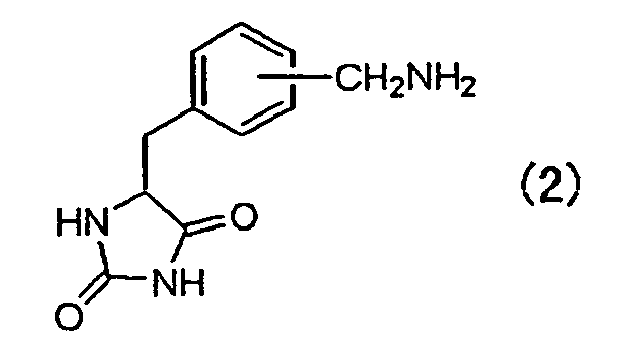
- Step 1 cyano-substituted benzylidene hydantoin represented by the above-mentioned formula (1) (hereinafter to be referred to as “benzylidene hydantoin (1)”) is reduced to give aminomethyl-substituted benzyl hydantoin represented by the above-mentioned formula (2) or a salt thereof (hereinafter to be referred to as "benzyl hydantoin (2)").
- a reduction catalyst and acid to benzylidene hydantoin (1) and allow the mixture to react with hydrogen gas in a solvent.
- substitution position of the cyano group of benzylidene hydantoin (1) may be either of the 2-position, the 3-position and the 4-position, with preference given to the 4-position.
- the reduction catalyst is not particularly limited as long as it can be used for hydrogenation, and a transition metal catalyst is preferably used.
- a transition metal catalyst is preferably used.
- the transition metal catalyst palladium catalysts such as palladium, palladium carbon, palladium black, palladium chloride and the like, as well as platinum oxide, platinum black, Raney-nickel and Raney-cobalt can be recited as examples, of which palladium catalysts such as palladium, palladium carbon, palladium black, palladium chloride and the like are particularly preferable.
- the amount of the transition metal catalyst to be used is generally 0.1-5 mol%, preferably 0.5-2 mol%, relative to benzylidene hydantoin (1).
- the acid inorganic acids such as hydrochloric acid, sulfuric acid and the like are preferably used.
- the amount of the acid to be used is generally 1.0-1.5 equivalents, preferably 1.0-1.2 equivalents, relative to benzylidene hydantoin (1).
- the solvent aqueous solvent such as water, or a mixed solvent of methanol, ethanol and the like with water can be used.
- the reaction time is generally 1-12 hr, preferably 2-9 hr. After completion of the reaction, the transition metal catalyst is filtered off, and the reaction solvent is evaporated to give benzyl hydantoin (2).
- the obtained benzyl hydantoin (2) can be isolated and purified by a conventional method such as chromatography and the like.
- benzyl hydantoin (3) hydroxymethyl-substituted benzyl hydantoin represented by the above-mentioned formula (3) (hereinafter to be referred to as "benzyl hydantoin (3)") without isolation and purification.
- Step 2 the amino group of benzyl hydantoin (2) is converted to a hydroxyl group to give benzyl hydantoin (3).
- the aminomethyl group of benzyl hydantoin (2) may be substituted at either of the 2-position, the 3-position and the 4-position, with preference given to the 4-position.
- the method of the above-mentioned conversion is not particularly limited as long as it can convert the amino group to a hydroxyl group. It is preferably performed by reaction with a nitrite salt.
- a nitrite salt alkali metal nitrite such as sodium nitrite, potassium nitrite and the like can be used, with preference given to sodium nitrite.
- the amount of the nitrite salt to be used is generally 1.0-1.5 equivalents, preferably 1.2-1.3 equivalents, relative to benzyl hydantoin (2).
- the reaction temperature is generally 95-100°C, preferably 98-100°C.
- the reaction time is generally 15-24 hr, preferably 18-22 hr.
- the above-mentioned reaction may be carried out in a solvent.
- a solvent water, ethanol/dimethylformamide and water/dimethylformamide can be mentioned, with preference given to water.
- the reaction mixture is concentrated to dryness to give benzyl hydantoin (3).
- benzyl hydantoin (3) is treated with an enzyme to give optically active hydroxymethyl-substituted phenylalanine or a salt thereof (hereinafter to be referred to as "phenylalanine (4)").
- D-hydroxymethyl-substituted phenylalanine represented by the following formula (4a) or a salt thereof (hereinafter to be referred to as "D-phenylalanine (4a)”) or L-hydroxymethyl-substituted phenylalanine represented by the following formula (4b) or a salt thereof (hereinafter to be referred to as "L-phenylalanine (4b)”) can be conveniently obtained from benzyl hydantoin (3) optically selectively in a high yield.
- an acid addition salt such as hydrochloride, hydrogen bromide, hydrosulfate, phosphate and the like, or an alkali metal salt such as sodium salt, potassium salt and the like, an alkaline earth metal salt such as calcium salt and the like, an ammonium salt and the like can be recited as examples, and hydrochloride and sodium salt can be particularly mentioned.
- the enzyme is not particularly limited as long as it can optically selectively hydrolyze benzyl hydantoin (3) to give optically active phenylalanine (4), and conventionally known enzymes derived from microorganisms such as bacteria, actinomycetes, fungi and the like or plant and animal can be used.
- hydantoin racemase, hydantoinase and carbamoylase can be mentioned, which may be used alone or in combination of two or more kinds thereof. When two or more kinds thereof are used in combination, preferable combinations of enzymes are as follows.
- benzyl hydantoin (3) is reacted with hydantoinase having optical selectivity to give either of L-(N-carbamoyl)amino acid and D-(N-carbamoyl)amino acid, and carbamoylamino acid is further reacted with carbamoylase to give optically active phenylalanine.
- optically active amino acid can be obtained using carbamoylase having optical selectivity. That is, since hydantoinase catalyzes not only hydrolyzing reaction but also dehydrating condensation reaction, an amino acid having desired steric configuration can be obtained by using hydantoin racemase and carbamoylase having optical selectivity in combination.
- At least one kind selected from the group consisting of hydantoin racemase derived from Microbacterium liquefaciens AJ3912 strain, D-hydantoinase derived from Flavobacterium sp AJ11199 strain and D-carbamoylase derived from Flavobacterium sp AJ11199 strain is desirably used.
- At least one kind selected from the group consisting of hydantoin racemase derived from Microbacterium liquefaciens AJ3912 strain, L-hydantoinase derived from Flavobacterium sp AJ11199 strain and L-carbamoylase derived from Flavobacterium sp AJ11199 strain is desirably used.
- Microbacterium liquefaciens AJ3912 strain was first deposited as Flavobacterium sp. AJ3912 (FERM-P3133) strain on June 27, 1975 at the National Institute of Bioscience and Human-Technology, Agency of Industrial Science and Technology, Ministry of International Trade and Industry but, as a result of re-identification, clarified to belong to Aureobacterium liquefaciens.
- Aureobacterium liquefaciens is classified in Microbacterium liquefaciens and deposited as Microbacterium liquefaciens AJ3912 (domestic depositary No. FERM-P3133, international depositary No. FERM-BP7643) at the International Patent Organism Depositary, National Institute of Advanced Industrial Science and Technology.
- Flavobacterium sp. AJ11199 (FERM-P4229) strain is a microorganism first deposited as Alcaligenes aquamarinus at the National Institute of Bioscience and Human-Technology, Agency of Industrial Science and Technology, Ministry of International Trade and Industry but, as a result of re-identification, clarified to belong to Flavobacterium sp. At present, it is deposited as Flavobacterium sp. AJ11199 (FERM-P4229) strain at the International Patent Organism Depositary, National Institute of Advanced Industrial Science and Technology.
- an enantiomer mixture (e.g., racemate) of benzyl hydantoin (3) to be a substrate is desirably treated under the following conditions in consideration of the enzyme activity.
- an aqueous medium such as water (e.g., ion exchange water), a buffer and the like can be generally used.
- an organic solvent such as alcohol and the like may be contained to the reaction solvent.
- the reaction temperature is generally 20°C to 50°C, preferably 30°C to 40°C. While the reaction pH depends on the optimal pH of the enzyme, neutral condition is desirable, preferably pH 5.0-9.0, more preferably 6.0-8.0.
- the reaction time is generally 15-48 hr, preferably 20-30 hr.
- the amount of the enzyme to be used is not particularly limited, but those of ordinary skill in the art can appropriately determine the amount with ease by performing a preliminary experiment under respective reaction conditions.
- the reaction mixture is acidified (e.g., pH 2) to deactivate the enzyme, treated with activated carbon etc. and filtered to remove the enzyme.
- the aforementioned enzyme may be obtained from a culture of a microorganism transformed with a recombinant DNA inserted an enzyme gene such as hydantoinase and the like (hereinafter to be referred to as "transformant").
- the recombinant DNA can be obtained, for example, by ligating a DNA fragment wherein a promoter, a DNA encoding enzyme such as hydantoinase and the like and a terminator are ligated in this order, and a vector DNA.
- the promoter is not particularly limited as long as it can promote transcription of object enzyme gene, and a promoter generally used for production of heterologous protein in Escherichia coli can be used.
- a promoter generally used for production of heterologous protein in Escherichia coli can be used.
- T7 promoter, trp promoter, lac promoter, tac promoter, PL promoter and the like can be mentioned.
- DNA encoding the enzyme for example, one isolated from chromosomal DNA of Flavobacterium sp. AJ11199 strain and one isolated from chromosomal DNA of Microbacterium liquefaciens AJ3912 strain can be used.
- a conventional method such as disruption by ultrasonication, ethanol precipitation, column chromatography and the like can be used.
- DNA two or more kinds of DNAs can be used.
- a recombinant DNA having 3 genes of hydantoinase, carbamoylase and hydantoin racemase is used.
- phenylalanine (4) can be produced. Therefore, it is efficient as compared to independent use of plural transformants.
- a terminator which is a transcription terminator sequence, is preferably linked at the downstream of an enzyme gene.
- rrnB terminator T7 terminator, fd terminator, T4 terminator, terminator of tetracycline resistant gene, terminator of Escherichia coli trpA gene and the like can be mentioned.
- rrnB terminator and the like are preferable because they improve stability of plasmid.
- a vector DNA to be ligated to a DNA fragment, wherein a DNA encoding enzyme such as hydantoinase and the like is ligated, for preparation of a recombinant DNA to be introduced into a host cell is preferably of a multi copy type.
- examples thereof include one a plasmid having a replication origin derived from Col E1, such as pUC series plasmids, pBR322 series plasmids, or derivatives thereof.
- the derivative means a plasmid obtained by alteration such as substitution, deletion, insertion, addition or inversion of base and the like.
- the alteration includes, besides the aforementioned substitution of base and the like, alteration by a mutation treatment with a mutating agent, UV irradiation and the like or an inartificial treatment and the like.
- the vector For selection of a transformant, it is preferable that the vector have a marker such as ampicillin resistance gene, kanamycin resistance gene and the like.
- the object gene amplified by PCR and the like and the multicloning site of vector DNA are cleaved with the same restriction enzyme, and the genes are ligated using, for example, a ligation kit and the like.
- the obtained recombinant DNA is introduced into a host cell to give a transformant.
- bacterial cell actinomycetal cell, yeast cell, mycotic cell, plant cell, animal cell and the like can be used. Since there are a number of findings relating to the mass production of protein, Escherichia coli (enteric bacterium) is preferable, and Escherichia coli is more preferable. Particularly, Escherichia coli JM109 strain (more preferably, DE3) is preferable.
- the obtained transformant is cultured in a medium.
- the medium is, for example, a medium generally used for cultivating Escherichia coli, such as M9-casamino acid medium, LB medium and the like.
- the culture conditions and production-inducing conditions can be appropriately determined according to the kind of the marker of a vector, host fungus and the like.
- the microorganism After recovery of microorganism by centrifugation, the microorganism is disrupted or lysed, and the produced enzyme is recovered.
- the recovered enzyme can be used as a crude enzyme solution.
- disruption for example, disruption by ultrasonication, disruption by French Press, disruption by glass beads and the like can be utilized.
- a method for lysis for example, egg-white lysozyme, peptidase treatment or a combination of these methods can be used.
- these enzymes can be purified by a general method of precipitation, filtration, column chromatography and the like before use. In this case, a purification method using an antibody of such enzyme can also be utilized.
- D-phenylalanine (4a) when D-phenylalanine (4a) is to be produced, a DNA encoding hydantoin racemase is introduced into a host cell harboring a DNA encoding D-hydantoinase and a DNA encoding D-carbamoylase to give a transformant, and an enzyme obtained by cultivating the transformant can be used.
- L-phenylalanine (4b) is to be produced, a DNA.encoding hydantoin racemase is introduced into a host cell introduced a DNA encoding L-hydantoinase and a DNA encoding L-carbamoylase to give a transformant, and an enzyme obtained by cultivating the transformant can be used.
- an enzyme gene of Arthrobacter ⁇ aurescens as described in J. Biotechnol. 86, 19-30, 2001 can be used.
- variant hydantoinase of Arthrobacter ⁇ species as described in Nature Biotechnol. 18, 317-320, 2000 may also be combined.
- optically active phenylalanine (4) can be produced by treating benzyl hydantoin (3) with an enzyme obtained from a culture.
- benzyl hydantoin (3) may be directly added to a medium containing the aforementioned transformant to give optically active phenylalanine (4), or the above-mentioned transformant may be directly added to a reaction mixture containing benzyl hydantoin (3).
- the composition and the like of the reaction mixture are not particularly limited as long as the enzyme reaction of benzyl hydantoin (3) proceeds.
- the transformant can be prepared, for example, by a method similar to the method described in Example 8 of WO03/085108 . In this case, the transformant only needs to be stood at the aforementioned temperature and pH for 8 hr-6 days.
- Optically active phenylalanine (4) accumulated in a culture medium or a reaction mixture can be recovered from the culture medium or the reaction mixture by a conventional method. For example, an appropriate combination of operations such as filtration, centrifugation, vacuum concentration, ion exchange or adsorption chromatography, crystallization and the like can be used as necessary.
- Optically active phenylalanine (4) in the culture medium or the reaction mixture can be quickly quantified by a well-known method.
- thin layer chromatography and high performance liquid chromatography (HPLC) using optical resolution column can be used.
- Benzylidene hydantoin (1) can be produced, for example, by a method similar to the method described in US-B-( US2861079 ). Specifically, as shown in the following reaction scheme, ethanolamine is added to cyano-substituted benzaldehyde and hydantoin in water and the mixture is heated. Then, precipitated crystals were separated to give benzylidene hydantoin (1).
- Optically active hydroxymethyl-substituted phenylalanine obtained by the aforementioned production method can be isolated and purified by a conventional method such as chromatography and the like, but can also be subjected to the next reaction without isolation and purification.
- optically active N-t-butoxycarbonyl-4-hydroxymethyl phenylalanine methyl ester which is a protected compound thereof, can be produced.
- Optically active N-t-butoxycarbonyl-4-hydroxymethyl phenylalanine methyl ester can be obtained by the method described in a literature ( Bioorganic & Medicinal Chemistry (2000), 8(7), 1677-1696 ).
- a hydroxyl group of the optically active N-t-butoxycarbonyl-4-hydroxymethyl phenylalanine methyl ester obtained by the above-mentioned production method is reacted with methanesulfonyl chloride based on the method described in the aforementioned JP-A-2004-525936 in a solvent such as dichloromethane, tetrahydrofuran and the like in the presence of a base such as triethylamine and the like, and then reacted with an amine compound (e.g., 2,6-dimethylpiperidine) to give an intermediate important as a bradykinin B1 receptor antagonist.
- a solvent such as dichloromethane, tetrahydrofuran and the like
- a base such as triethylamine and the like
- Hydantoin (23.7 g, 0.23 mol) and 2-aminoethanol (5.4 ml, 0.09 mol) were added to water (250 ml), and the mixture was stirred with heating at 50°C.
- 4-cyanobenzaldehyde (25.1 g, 0.18 mol) was added and the mixture was heated under reflux with stirring overnight.
- the reaction mixture was allowed to cool to room temperature and cooled with ice.
- the mixture was adjusted to pH 7 with hydrochloric acid and stirred for 1 hr.
- the slurry solution was filtered and dried under reduced pressure to give 5-(4-cyanobenzylidene)hydantoin (37.3 g). Yield 97.2%.
- the reaction mixture was adjusted to pH 2, 10% aqueous sanizol solution (9 ml) was added and the mixture was stirred at 55°C for 30 min.
- Activated carbon (Shirasagi Charcoal AW50: manufactured by Takeda Pharmaceutical Company Limited) (18 g) was added, and the mixture was further stirred for 1 hr. After celite filtration, the mother liquor was adjusted to pH 7 and concentrated under reduced pressure. To remove remaining water, 2-propanol (300 ml) was added and the mixture was further concentrated twice under reduced pressure.
- hydantoinase gene was amplified, treated with NdeI/BamHI, and ligate to pTrp4 treated with NdeI/BamHI in advance.
- E. coli JM109 was transformed with the ligation solution, and a strain having the object plasmid was selected from ampicillin resistant strains and the plasmid was named as pTrp3912H4.
- pTrp3912H4 As a template, primer SDm2 (SEQ ID NO:3) and HD down (SEQ ID NO:2), hydantoinase gene containing SD sequence was amplified and ligate to pGEM-T easy (manufactured by Promega). E. coli JM109 was transformed with the ligation solution, and a strain having the object plasmid was selected from ampicillin resistant strains and the plasmid was named as pSD-H.
- Gene segment H 1.5kb of hydantoinase gene region (gene segment H) containing SD sequence which was obtained by treating pSD-H with EcoRI/BamHI, and 1.0 kb of gene segment (gene segment C) which was obtained by treating L-carbamoylase gene amplified using genome DNA of Microbacterium liquefaciens AJ3912 strain as a template, primer CH_up (SEQ ID NO:4) and CH_down (SEQ ID NO:5) with NdeI/EcoRI, were prepared.
- Gene segment C and gene segment A were ligated to pTrp8 treated with NdeI/BamHI, E. coli JM109 was transformed, and a transformant having the object plasmid was selected from chloramphenicol resistant strains and the plasmid was named as pTrp8C-SD-H.
- Hydantoin racemase gene expression plasmid pTrp4R was introduced into E. coli JM109 having pTrp8C-SD-H to give E. coli L6 strain expressing genes encoding hydantoin racemase, hydantoinase and L-carbamoylase.
- L6 strain was cultured on LB plate (10 g/L peptone, 5 g/L yeast extract, 10 g/L sodium chloride, 20 g/L agar) containing 50 mg/L ampicillin sodium and 25 mg/L chloramphenicol at 30°C for 20 hr.
- the cell was cultivated in LB liquid medium (10 g/L peptone, 5 g/L yeast extract, 10 g/L sodium chloride) containing 50 mg/L ampicillin sodium, 25 mg/L chloramphenicol and 20 mg/L cobalt sulfate pentahydrate with reciprocal shaking at 34°C for 16 hr. And then, the bacterial cells were collected by centrifugation (8,000 g, 10 min, 4°C).
- Activated carbon (Shirasagi Charcol AW50: manufactured by Takeda Pharmaceutical Company Limited, 40 mg) was added, and the mixture was further stirred for 1 hr. After celite filtration, the mother liquor was adjusted to pH 7 and concentrated under reduced pressure. To remove remaining water, 2-propanol (0.5 ml) was added and the mixture was further concentrated twice under reduced pressure. 2-Propanol (0.6 ml) was added to the residue, and the mixture was stirred, filtered and dried under reduced pressure to give 77 mg of L-(4-hydroxymethyl)phenylalanine (including sodium chloride). (yield 69.2%)
- D-(4-Hydroxymethyl)phenylalanine methyl ester hydrochloride (10.2 g, 41.1 mmol) was added to methanol (60 ml) and water (30 ml), and the mixture was stirred and adjusted to pH 8 with 25% aqueous sodium hydroxide solution.
- Di-t-butyl dicarbonate (13.6 g) was dissolved in methanol (10 ml) and added thereto. The mixture was maintained at pH 8 or above and stirred at room temperature overnight. The reaction solution was concentrated under reduced pressure. Water (50 ml) and ethyl acetate (100 ml) were added to the residue, and the mixture was stirred, and the insoluble material was filtered off.
- optically active hydroxymethyl-substituted phenylalanine can be conveniently obtained optically selectively in a high yield.
- optically active hydroxymethyl-substituted phenylalanine can be produced industrially.
- a compound useful for the production method and a production method thereof are provided.
Landscapes
- Chemical & Material Sciences (AREA)
- Organic Chemistry (AREA)
- Engineering & Computer Science (AREA)
- Zoology (AREA)
- Life Sciences & Earth Sciences (AREA)
- Wood Science & Technology (AREA)
- Chemical Kinetics & Catalysis (AREA)
- Microbiology (AREA)
- General Chemical & Material Sciences (AREA)
- Biotechnology (AREA)
- Health & Medical Sciences (AREA)
- Biochemistry (AREA)
- Bioinformatics & Cheminformatics (AREA)
- General Engineering & Computer Science (AREA)
- General Health & Medical Sciences (AREA)
- Genetics & Genomics (AREA)
- Analytical Chemistry (AREA)
- Preparation Of Compounds By Using Micro-Organisms (AREA)
- Micro-Organisms Or Cultivation Processes Thereof (AREA)
Abstract
The present invention provides a production method of optically active hydroxymethyl-substituted phenylalanine, which includes reducing cyano-substituted benzylidene hydantoin (1) to give aminomethyl-substituted benzyl hydantoin (2) or a salt thereof, converting an amino group of the aminomethyl-substituted benzyl hydantoin (2) or a salt thereof to a hydroxyl group to give hydroxymethyl-substituted benzyl hydantoin (3), treating the hydroxymethyl-substituted benzyl hydantoin (3) with an enzyme to give D-hydroxymethyl-substituted phenylalanine (4a) or a salt thereof, or L-hydroxymethyl-substituted phenylalanine (4b) or a salt thereof.
According to the present invention, a production method capable of conveniently producing optically active hydroxymethyl-substituted phenylalanine on an industrial scale can be provided.

Description
- The present invention relates to a production method of optically active hydroxymethyl-substituted phenylalanine.
- Optically active hydroxymethyl-substituted phenylalanine derivative is a compound useful as a pharmaceutical agent or a starting material thereof. For example, an L form of 4-hydroxymethyl phenylalanine is used as an antihypertensive drug (
WO92/14706 JP-A-2004-525936 - As a conventional production method of 4-hydroxymethyl phenylalanine, for example, a method comprising, using ethyl 4-bromomethylbenzoate as a starting material, reduction, acetylation, condensation with diethyl acetamidomalonate, hydrolysis and decarboxylation, as shown in the following reaction scheme, to give N-acetyl-4-hydroxymethyl phenylalanine, which is followed by hydrolysis of N-acetyl-4-hydroxymethyl phenylalanine with acylase to give L-(4-hydroxymethyl)phenylalanine is known (Biochimica et Biophysica Acta, (1967), 148(2), 414-422). However, the starting material is expensive and difficult to obtain in large amounts, and 4-hydroxymethylbenzyl bromide of the intermediate is unstable, which renders a large-scale production difficult. In addition, hydrolysis with acylase by-produces unnecessary acetylated form (D form), making the yield only 50% at maximum.

- Moreover, according to the production method wherein 4-hydroxymethyl phenylalanine is obtained by alkylation of diphenylmethyleneglycine ester using an optically active phase-transfer catalyst, the ratio of an L form and a D form (L/D) is 4/1, showing poor stereoselectivity, which necessitates further purification (Int. J. Peptide Protein Res., (1994), 44, 457-465). Furthermore, since a production method wherein the 4-position of optically active 4-iodophenylalanine derived from optically active phenylalanine or the 4-position of optically active tyrosine trifluorate derivative derived from optically active tyrosine is converted to aldehyde, and then reduced to give optically active 4-hydroxymethyl phenylalanine uses expensive trioctylsilane and 1,3-bis(diphenylphosphino)propane, it is unsuitable for large-scale synthesis (Synthetic Communications, (1998), 28(2), 4279-4285).
- As discussed above, conventional production methods of optically active hydroxymethyl-substituted phenylalanine are associated with problems in that expensive reagent is indispensable, the obtained intermediate is unstable, the yield is low, purification is needed since the purity is low and the like. Thus, they are practically unsuitable for industrial scale production. Therefore, development of a production method capable of conveniently obtaining optically active hydroxymethyl-substituted phenylalanine on an industrial scale is desired.
- The present invention has been made in consideration of such actual situation wherein the problem to be solved is provision of a production method capable of conveniently obtaining optically active hydroxymethyl-substituted phenylalanine on an industrial scale; a compound useful for the production method and a method of producing the compound.
- The present inventors have conducted intensive studies in an attempt to solve the above-mentioned problems and found that optically active hydroxymethyl-substituted phenylalanine can be conveniently obtained in a high yield by reduction and hydroxylation of cyano-substituted benzylidene hydantoin as a starting material and treatment of the resulting hydroxymethyl-substituted benzylhydantoin with an enzyme, which resulted in the completion of the present invention.
- Accordingly, the present invention is characterized by the following.
- [1] A method of producing optically active hydroxymethyl-substituted phenylalanine comprising reducing cyano-substituted benzylidene hydantoin represented by the following formula (1)


- [2] The method of [1], wherein the reduction is performed by hydrogenation in the presence of a reduction catalyst.
- [3] The method of [2], wherein the reduction catalyst is a transition metal catalyst.
- [4] The method of [2], wherein the reduction catalyst is a palladium catalyst.
- [5] The method of any one of [1]-[4], wherein the amino group is converted to a hydroxyl group by reaction with a nitrite salt.
- [6] The method of any one of [1]-[5], wherein the enzyme is at least one kind selected from the group consisting of hydantoin racemase, hydantoinase and carbamoylase.
- [7] The method of any one of [1]-[5], wherein the enzyme is at least one kind selected from the group consisting of hydantoin racemase derived from Microbacterium liquefaciens AJ3912 strain, hydantoinase derived from Flavobacterium sp. AJ11199 strain and carbamoylase derived from Flavobacterium sp. AJ11199 strain.
- [8] The method of any one of [1]-[5], wherein the enzyme is obtained from a culture of a microorganism transformed with a recombinant DNA.
- [9] A method of producing aminomethyl-substituted benzyl hydantoin represented by the following formula (2)


- [10] The method of [9], wherein the reduction is performed by hydrogenation in the presence of a reduction catalyst.
- [11] The method of [10], wherein the reduction catalyst is a transition metal catalyst.
- [12] The method of [10], wherein the reduction catalyst is a palladium catalyst.
- [13] A method of producing hydroxymethyl-substituted benzyl hydantoin represented by the following formula (3)

- [14] The method of [13], wherein the amino group is converted to a hydroxyl group by reaction with a nitrite salt.
- [15] A method of producing optically active hydroxymethyl-substituted phenylalanine, which comprises treating hydroxymethyl-substituted benzyl hydantoin represented by the following formula (3)


- [16] The method of [15], wherein the enzyme is at least one kind selected from the group consisting of hydantoin racemase, hydantoinase and carbamoylase.
- [17] The method of [15], wherein the enzyme is at least one kind selected from the group consisting of hydantoin racemase derived from Microbacterium liquefaciens AJ3912 strain, hydantoinase derived from Flavobacterium sp. AJ11199 strain and carbamoylase derived from Flavobacterium sp. AJ11199 strain.
- [18] The method of [15], wherein the enzyme is obtained from a culture of a microorganism transformed with a recombinant DNA.
- [19] Aminomethyl-substituted benzyl hydantoin represented by the following formula (2)

- [20] Hydroxymethyl-substituted benzyl hydantoin represented by the following formula (3)

- The present invention is explained in detail in the following by referring to a preferable embodiment thereof.
- The production method of the present invention is shown in the following reaction scheme.

- In Step 1, cyano-substituted benzylidene hydantoin represented by the above-mentioned formula (1) (hereinafter to be referred to as "benzylidene hydantoin (1)") is reduced to give aminomethyl-substituted benzyl hydantoin represented by the above-mentioned formula (2) or a salt thereof (hereinafter to be referred to as "benzyl hydantoin (2)"). For the reduction reaction here, it is preferable to add a reduction catalyst and acid to benzylidene hydantoin (1) and allow the mixture to react with hydrogen gas in a solvent. As the salt of benzyl hydantoin (2), an acid addition salt such as hydrochloride, hydrosulfate, trifluoroacetate and the like can be mentioned. The substitution position of the cyano group of benzylidene hydantoin (1) may be either of the 2-position, the 3-position and the 4-position, with preference given to the 4-position.
- The reduction catalyst is not particularly limited as long as it can be used for hydrogenation, and a transition metal catalyst is preferably used. As the transition metal catalyst, palladium catalysts such as palladium, palladium carbon, palladium black, palladium chloride and the like, as well as platinum oxide, platinum black, Raney-nickel and Raney-cobalt can be recited as examples, of which palladium catalysts such as palladium, palladium carbon, palladium black, palladium chloride and the like are particularly preferable. The amount of the transition metal catalyst to be used is generally 0.1-5 mol%, preferably 0.5-2 mol%, relative to benzylidene hydantoin (1). As the acid, inorganic acids such as hydrochloric acid, sulfuric acid and the like are preferably used. The amount of the acid to be used is generally 1.0-1.5 equivalents, preferably 1.0-1.2 equivalents, relative to benzylidene hydantoin (1). As the solvent, aqueous solvent such as water, or a mixed solvent of methanol, ethanol and the like with water can be used. The reaction time is generally 1-12 hr, preferably 2-9 hr. After completion of the reaction, the transition metal catalyst is filtered off, and the reaction solvent is evaporated to give benzyl hydantoin (2). The obtained benzyl hydantoin (2) can be isolated and purified by a conventional method such as chromatography and the like. However, it can be used for the production of hydroxymethyl-substituted benzyl hydantoin represented by the above-mentioned formula (3) (hereinafter to be referred to as "benzyl hydantoin (3)") without isolation and purification.
- In Step 2, the amino group of benzyl hydantoin (2) is converted to a hydroxyl group to give benzyl hydantoin (3). The aminomethyl group of benzyl hydantoin (2) may be substituted at either of the 2-position, the 3-position and the 4-position, with preference given to the 4-position.
- The method of the above-mentioned conversion is not particularly limited as long as it can convert the amino group to a hydroxyl group. It is preferably performed by reaction with a nitrite salt. As the nitrite salt, alkali metal nitrite such as sodium nitrite, potassium nitrite and the like can be used, with preference given to sodium nitrite. The amount of the nitrite salt to be used is generally 1.0-1.5 equivalents, preferably 1.2-1.3 equivalents, relative to benzyl hydantoin (2). The reaction temperature is generally 95-100°C, preferably 98-100°C. The reaction time is generally 15-24 hr, preferably 18-22 hr. The above-mentioned reaction may be carried out in a solvent. As the solvent, water, ethanol/dimethylformamide and water/dimethylformamide can be mentioned, with preference given to water. After completion of the reaction, the reaction mixture is concentrated to dryness to give benzyl hydantoin (3).
- In Step 3, benzyl hydantoin (3) is treated with an enzyme to give optically active hydroxymethyl-substituted phenylalanine or a salt thereof (hereinafter to be referred to as "phenylalanine (4)"). As a result, D-hydroxymethyl-substituted phenylalanine represented by the following formula (4a) or a salt thereof (hereinafter to be referred to as "D-phenylalanine (4a)") or L-hydroxymethyl-substituted phenylalanine represented by the following formula (4b) or a salt thereof (hereinafter to be referred to as "L-phenylalanine (4b)") can be conveniently obtained from benzyl hydantoin (3) optically selectively in a high yield. As the salt of phenylalanine (4), D-phenylalanine (4a) and L-phenylalanine (4b), an acid addition salt such as hydrochloride, hydrogen bromide, hydrosulfate, phosphate and the like, or an alkali metal salt such as sodium salt, potassium salt and the like, an alkaline earth metal salt such as calcium salt and the like, an ammonium salt and the like can be recited as examples, and hydrochloride and sodium salt can be particularly mentioned.
- The enzyme is not particularly limited as long as it can optically selectively hydrolyze benzyl hydantoin (3) to give optically active phenylalanine (4), and conventionally known enzymes derived from microorganisms such as bacteria, actinomycetes, fungi and the like or plant and animal can be used. As such enzyme, for example, hydantoin racemase, hydantoinase and carbamoylase can be mentioned, which may be used alone or in combination of two or more kinds thereof. When two or more kinds thereof are used in combination, preferable combinations of enzymes are as follows.
- (i) hydantoinase and carbamoylase
- (ii) hydantoinase, carbamoylase and hydantoin racemase
- When two or more kinds of enzymes are used in combination, for example, benzyl hydantoin (3) is reacted with hydantoinase having optical selectivity to give either of L-(N-carbamoyl)amino acid and D-(N-carbamoyl)amino acid, and carbamoylamino acid is further reacted with carbamoylase to give optically active phenylalanine.
- Even when hydantoinase to be used does not have optical selectivity, optically active amino acid can be obtained using carbamoylase having optical selectivity. That is, since hydantoinase catalyzes not only hydrolyzing reaction but also dehydrating condensation reaction, an amino acid having desired steric configuration can be obtained by using hydantoin racemase and carbamoylase having optical selectivity in combination.
- When D-phenylalanine is to be produced, at least one kind selected from the group consisting of hydantoin racemase derived from Microbacterium liquefaciens AJ3912 strain, D-hydantoinase derived from Flavobacterium sp AJ11199 strain and D-carbamoylase derived from Flavobacterium sp AJ11199 strain is desirably used.
- When L-phenylalanine is to be produced, at least one kind selected from the group consisting of hydantoin racemase derived from Microbacterium liquefaciens AJ3912 strain, L-hydantoinase derived from Flavobacterium sp AJ11199 strain and L-carbamoylase derived from Flavobacterium sp AJ11199 strain is desirably used.
- Microbacterium liquefaciens AJ3912 strain was first deposited as Flavobacterium sp. AJ3912 (FERM-P3133) strain on June 27, 1975 at the National Institute of Bioscience and Human-Technology, Agency of Industrial Science and Technology, Ministry of International Trade and Industry but, as a result of re-identification, clarified to belong to Aureobacterium liquefaciens. At present, due to change of species name, Aureobacterium liquefaciens is classified in Microbacterium liquefaciens and deposited as Microbacterium liquefaciens AJ3912 (domestic depositary No. FERM-P3133, international depositary No. FERM-BP7643) at the International Patent Organism Depositary, National Institute of Advanced Industrial Science and Technology.
- In addition, Flavobacterium sp. AJ11199 (FERM-P4229) strain is a microorganism first deposited as Alcaligenes aquamarinus at the National Institute of Bioscience and Human-Technology, Agency of Industrial Science and Technology, Ministry of International Trade and Industry but, as a result of re-identification, clarified to belong to Flavobacterium sp. At present, it is deposited as Flavobacterium sp. AJ11199 (FERM-P4229) strain at the International Patent Organism Depositary, National Institute of Advanced Industrial Science and Technology.
- For the enzyme reaction, an enantiomer mixture (e.g., racemate) of benzyl hydantoin (3) to be a substrate is desirably treated under the following conditions in consideration of the enzyme activity. As the reaction solvent, an aqueous medium such as water (e.g., ion exchange water), a buffer and the like can be generally used. As long as the enzyme reaction is not inhibited, an organic solvent such as alcohol and the like may be contained to the reaction solvent. The reaction temperature is generally 20°C to 50°C, preferably 30°C to 40°C. While the reaction pH depends on the optimal pH of the enzyme, neutral condition is desirable, preferably pH 5.0-9.0, more preferably 6.0-8.0. The reaction time is generally 15-48 hr, preferably 20-30 hr. The amount of the enzyme to be used is not particularly limited, but those of ordinary skill in the art can appropriately determine the amount with ease by performing a preliminary experiment under respective reaction conditions. After the enzyme reaction, the reaction mixture is acidified (e.g., pH 2) to deactivate the enzyme, treated with activated carbon etc. and filtered to remove the enzyme.
- The aforementioned enzyme may be obtained from a culture of a microorganism transformed with a recombinant DNA inserted an enzyme gene such as hydantoinase and the like (hereinafter to be referred to as "transformant").
- The recombinant DNA can be obtained, for example, by ligating a DNA fragment wherein a promoter, a DNA encoding enzyme such as hydantoinase and the like and a terminator are ligated in this order, and a vector DNA.
- The promoter is not particularly limited as long as it can promote transcription of object enzyme gene, and a promoter generally used for production of heterologous protein in Escherichia coli can be used. For example, T7 promoter, trp promoter, lac promoter, tac promoter, PL promoter and the like can be mentioned.
- As the DNA encoding the enzyme, for example, one isolated from chromosomal DNA of Flavobacterium sp. AJ11199 strain and one isolated from chromosomal DNA of Microbacterium liquefaciens AJ3912 strain can be used. For isolation of DNA from microorganism, for example, a conventional method such as disruption by ultrasonication, ethanol precipitation, column chromatography and the like can be used. As such DNA, two or more kinds of DNAs can be used. For example, a recombinant DNA having 3 genes of hydantoinase, carbamoylase and hydantoin racemase is used. Thus, by simultaneous expression of 3 enzymes using one transformant, phenylalanine (4) can be produced. Therefore, it is efficient as compared to independent use of plural transformants.
- To increase the production amount, a terminator, which is a transcription terminator sequence, is preferably linked at the downstream of an enzyme gene. As such terminator, rrnB terminator, T7 terminator, fd terminator, T4 terminator, terminator of tetracycline resistant gene, terminator of Escherichia coli trpA gene and the like can be mentioned. Of these, rrnB terminator and the like are preferable because they improve stability of plasmid.
- A vector DNA to be ligated to a DNA fragment, wherein a DNA encoding enzyme such as hydantoinase and the like is ligated, for preparation of a recombinant DNA to be introduced into a host cell, is preferably of a multi copy type. Examples thereof include one a plasmid having a replication origin derived from Col E1, such as pUC series plasmids, pBR322 series plasmids, or derivatives thereof. Here, the derivative means a plasmid obtained by alteration such as substitution, deletion, insertion, addition or inversion of base and the like. The alteration includes, besides the aforementioned substitution of base and the like, alteration by a mutation treatment with a mutating agent, UV irradiation and the like or an inartificial treatment and the like. For selection of a transformant, it is preferable that the vector have a marker such as ampicillin resistance gene, kanamycin resistance gene and the like. For ligation of genes, for example, the object gene amplified by PCR and the like and the multicloning site of vector DNA are cleaved with the same restriction enzyme, and the genes are ligated using, for example, a ligation kit and the like.
- Then, the obtained recombinant DNA is introduced into a host cell to give a transformant. As the host cell, bacterial cell, actinomycetal cell, yeast cell, mycotic cell, plant cell, animal cell and the like can be used. Since there are a number of findings relating to the mass production of protein, Escherichia coli (enteric bacterium) is preferable, and Escherichia coli is more preferable. Particularly, Escherichia coli JM109 strain (more preferably, DE3) is preferable.
- Then, the obtained transformant is cultured in a medium. When a host cell is Escherichia coli, the medium is, for example, a medium generally used for cultivating Escherichia coli, such as M9-casamino acid medium, LB medium and the like. The culture conditions and production-inducing conditions can be appropriately determined according to the kind of the marker of a vector, host fungus and the like.
- After recovery of microorganism by centrifugation, the microorganism is disrupted or lysed, and the produced enzyme is recovered. The recovered enzyme can be used as a crude enzyme solution. As a method for disruption, for example, disruption by ultrasonication, disruption by French Press, disruption by glass beads and the like can be utilized. As a method for lysis, for example, egg-white lysozyme, peptidase treatment or a combination of these methods can be used. Where necessary, these enzymes can be purified by a general method of precipitation, filtration, column chromatography and the like before use. In this case, a purification method using an antibody of such enzyme can also be utilized.
- For various operations dealing with plasmid, DNA fragment, various enzymes, preparation of transformant, selection of transformant and the like, the methods described in MOLECULAR CLONING, 2nd Edition, J. Sambrook et al, 1989, COLD SPRING HARB OR LABORATORY PRESS and the like can be applied.
- Accordingly, for example, when D-phenylalanine (4a) is to be produced, a DNA encoding hydantoin racemase is introduced into a host cell harboring a DNA encoding D-hydantoinase and a DNA encoding D-carbamoylase to give a transformant, and an enzyme obtained by cultivating the transformant can be used. When L-phenylalanine (4b) is to be produced, a DNA.encoding hydantoin racemase is introduced into a host cell introduced a DNA encoding L-hydantoinase and a DNA encoding L-carbamoylase to give a transformant, and an enzyme obtained by cultivating the transformant can be used. In addition, an enzyme gene of Arthrobacter·aurescens as described in J. Biotechnol. 86, 19-30, 2001 can be used. Furthermore, variant hydantoinase of Arthrobacter·species as described in Nature Biotechnol. 18, 317-320, 2000 may also be combined.
- Then, optically active phenylalanine (4) can be produced by treating benzyl hydantoin (3) with an enzyme obtained from a culture. For enzyme treatment, benzyl hydantoin (3) may be directly added to a medium containing the aforementioned transformant to give optically active phenylalanine (4), or the above-mentioned transformant may be directly added to a reaction mixture containing benzyl hydantoin (3). The composition and the like of the reaction mixture are not particularly limited as long as the enzyme reaction of benzyl hydantoin (3) proceeds.
- The transformant can be prepared, for example, by a method similar to the method described in Example 8 of
WO03/085108 - Optically active phenylalanine (4) in the culture medium or the reaction mixture can be quickly quantified by a well-known method. For example, thin layer chromatography and high performance liquid chromatography (HPLC) using optical resolution column can be used.
- Benzylidene hydantoin (1) can be produced, for example, by a method similar to the method described in US-B-(
US2861079 ). Specifically, as shown in the following reaction scheme, ethanolamine is added to cyano-substituted benzaldehyde and hydantoin in water and the mixture is heated. Then, precipitated crystals were separated to give benzylidene hydantoin (1).
- Optically active hydroxymethyl-substituted phenylalanine obtained by the aforementioned production method can be isolated and purified by a conventional method such as chromatography and the like, but can also be subjected to the next reaction without isolation and purification. For example, optically active N-t-butoxycarbonyl-4-hydroxymethyl phenylalanine methyl ester, which is a protected compound thereof, can be produced. Optically active N-t-butoxycarbonyl-4-hydroxymethyl phenylalanine methyl ester can be obtained by the method described in a literature (Bioorganic & Medicinal Chemistry (2000), 8(7), 1677-1696). Specifically, as shown in the following reaction scheme, methanol and thionyl chloride were mixed, optically active 4-hydroxymethyl phenylalanine was added to the mixture for esterification, and the mixture was reacted with sodium hydrogencarbonate and di-tert-butyldicarbonate to give optically active N-t-butoxycarbonyl-4-hydroxymethyl phenylalanine methyl ester. In the formula, the symbol * means an asymmetric carbon.

- Furthermore, a hydroxyl group of the optically active N-t-butoxycarbonyl-4-hydroxymethyl phenylalanine methyl ester obtained by the above-mentioned production method is reacted with methanesulfonyl chloride based on the method described in the aforementioned
JP-A-2004-525936 
- The present invention is explained in detail in the following by referring to Examples, which are not to be construed as limitative.
- Hydantoin (23.7 g, 0.23 mol) and 2-aminoethanol (5.4 ml, 0.09 mol) were added to water (250 ml), and the mixture was stirred with heating at 50°C. When the solution became transparent, 4-cyanobenzaldehyde (25.1 g, 0.18 mol) was added and the mixture was heated under reflux with stirring overnight. The reaction mixture was allowed to cool to room temperature and cooled with ice. The mixture was adjusted to pH 7 with hydrochloric acid and stirred for 1 hr. The slurry solution was filtered and dried under reduced pressure to give 5-(4-cyanobenzylidene)hydantoin (37.3 g). Yield 97.2%. 1H-NMR(DMSO-d6):δ6.45(s, 1H), 7.79(d, 2H), 7.85(d, 2H)
MS(ESI): 212.1[M-H]- - Under argon atmosphere, 5-(4-cyanobenzylidene)hydantoin (19.2 g, 0.09 mol) and hydrochloric acid (7.8 ml, 0.09 mol) were added to water (384 ml), and the mixture was stirred. 5% Palladium carbon (AD, 53.1% water) (16.4 g) was added to a slurry solution, the inside of the reaction container was substituted with hydrogen, and the mixture was vigorously stirred at room temperature for 9 hr. Palladium carbon was removed by filtration, and the mother liquor was concentrated under reduced pressure until precipitation of crystals. To remove remaining water, 2-butanol (50 ml) was added and the mixture was concentrated twice under reduced pressure. 2-Butanol (100 ml) was added to the residue, and the mixture was stirred for 2 hr. A slurry solution was filtered and dried under reduced pressure to give 5-(4-aminomethylbenzyl)hydantoin hydrochloride (16.1 g) as white crystals. Yield 69.8%.
1H-NMR(DMSO-d6):δ2.95(t, 2H), 3.97(s, 2H), 4.36(t, 1H), 7.21(d, 2H), 7.40(d, 2H)
13C-NMR(DMSO): 39.25, 39.46, 39.67, 39.88, 40.09, 40.30, 40.51, 58.58, 128.96, 130.35, 175.43
MS(ESI): 220.1[M+H]+, 218.3[M-H]- - 5-(4-Aminomethylbenzyl)hydantoin hydrochloride (2.7 g, 10.6 mmol) and sodium nitrite (0.9 g, 12.7 mmol) were added to water (30 ml), and the mixture was heated under reflux with stirring overnight. The reaction mixture was allowed to cool to room temperature, adjusted to pH 2 with hydrochloric acid and the mixture was stirred for 1 hr. The reaction mixture was adjusted to pH 5 with 25% aqueous sodium hydroxide solution and the mixture was concentrated under reduced pressure. To remove remaining water, ethanol (30 ml) was added and the mixture was concentrated twice under reduced pressure. Ethanol (150 ml) was added to the residue, and the mixture was stirred. A slurry solution was filtered, and the mother liquor was concentrated under reduced pressure. 2-Propanol (15 ml) was added to the residue for slurry washing. The slurry solution was filtered and dried under reduced pressure to give 5-(4-hydroxymethylbenzyl)hydantoin (1.6 g). Yield 68.5%.
1H-NMR(DMSO-d6):δ2.91(d, 2H), 4.31(m, 1H), 4.45(d, 2H), 5.13(t, 1H), 7.12(d, 2H), 7.21(d, 2H), 7.91(s, 1H), 10.39(s, 1H)
13C-NMR(DMSO): 39.25, 39.46, 39.67, 39.88, 40.09, 40.30, 40.51, 58.77, 63.02, 126.54, 129.81
MS(ESI): 219.0 [M-H]- - 5-(4-Hydroxymethylbenzyl)hydantoin (65.3 g, 0.30 mol) and manganese sulfate pentahydrate (0.4 g) were added to water (1770 ml), and the mixture was heated to 37°C. A microorganism suspension of E. coli D9 cell obtained by the method described in Example 8 of
WO03/085108
HPLC measurement conditions for optical purity:
column: SUMICHIRAL OA-5000 (150 mm×4.6 mm)
eluent: 2 mM CuSO4/IPA=95/5, UV: 254 nm, flow rate: 1.0 ml/min, temperature: room temperature
1H-NMR(D2O):δ3.21(m,2H),3.99(m,1H),4.64(s,2H),7.33(d,2H), 7.40(d, 2H) MS(ESI): 194.3 [M-H]- - Using genome DNA of Microbacterium liquefaciens AJ3912 strain as a template, primer HD_up (SEQ ID NO:1) and HD_down (SEQ ID NO:2), hydantoinase gene was amplified, treated with NdeI/BamHI, and ligate to pTrp4 treated with NdeI/BamHI in advance. E. coli JM109 was transformed with the ligation solution, and a strain having the object plasmid was selected from ampicillin resistant strains and the plasmid was named as pTrp3912H4.
- Using pTrp3912H4 as a template, primer SDm2 (SEQ ID NO:3) and HD down (SEQ ID NO:2), hydantoinase gene containing SD sequence was amplified and ligate to pGEM-T easy (manufactured by Promega). E. coli JM109 was transformed with the ligation solution, and a strain having the object plasmid was selected from ampicillin resistant strains and the plasmid was named as pSD-H.
- 1.5kb of hydantoinase gene region (gene segment H) containing SD sequence which was obtained by treating pSD-H with EcoRI/BamHI, and 1.0 kb of gene segment (gene segment C) which was obtained by treating L-carbamoylase gene amplified using genome DNA of Microbacterium liquefaciens AJ3912 strain as a template, primer CH_up (SEQ ID NO:4) and CH_down (SEQ ID NO:5) with NdeI/EcoRI, were prepared. Gene segment C and gene segment A were ligated to pTrp8 treated with NdeI/BamHI, E. coli JM109 was transformed, and a transformant having the object plasmid was selected from chloramphenicol resistant strains and the plasmid was named as pTrp8C-SD-H.
- Hydantoin racemase gene expression plasmid pTrp4R was introduced into E. coli JM109 having pTrp8C-SD-H to give E. coli L6 strain expressing genes encoding hydantoin racemase, hydantoinase and L-carbamoylase.
- L6 strain was cultured on LB plate (10 g/L peptone, 5 g/L yeast extract, 10 g/L sodium chloride, 20 g/L agar) containing 50 mg/L ampicillin sodium and 25 mg/L chloramphenicol at 30°C for 20 hr. The cell was cultivated in LB liquid medium (10 g/L peptone, 5 g/L yeast extract, 10 g/L sodium chloride) containing 50 mg/L ampicillin sodium, 25 mg/L chloramphenicol and 20 mg/L cobalt sulfate pentahydrate with reciprocal shaking at 34°C for 16 hr. And then, the bacterial cells were collected by centrifugation (8,000 g, 10 min, 4°C).
- 5-(4-Hydroxymethylbenzyl)hydantoin (0.1 g, 0.48 mmol) and cobalt chloride (1.3 mg) were added to 0.1M buffered aqueous potassium dihydrogen phosphate-dipotassium monohydrogen phosphate solution (pH 7.2, 3 ml), and the mixture was heated to 37°C. To this aqueous solution was added the E. coli L6 cell suspentionobtained in the aforementioned step (final concentration; 4 g dried cell/L), and the mixture was stirred for 6 days. The reaction mixture was adjusted to pH 2, 10% aqueous sanizol solution (0.02 ml) was added and the mixture was stirred at 55°C for 30 min. Activated carbon (Shirasagi Charcol AW50: manufactured by Takeda Pharmaceutical Company Limited, 40 mg) was added, and the mixture was further stirred for 1 hr. After celite filtration, the mother liquor was adjusted to pH 7 and concentrated under reduced pressure. To remove remaining water, 2-propanol (0.5 ml) was added and the mixture was further concentrated twice under reduced pressure. 2-Propanol (0.6 ml) was added to the residue, and the mixture was stirred, filtered and dried under reduced pressure to give 77 mg of L-(4-hydroxymethyl)phenylalanine (including sodium chloride). (yield 69.2%)
- D-(4-Hydroxymethyl)phenylalanine (4.3 g, 21.9 mmol) was added to methanol (43 ml), cooled to 5°C and stirred. Thionyl chloride (2.7 ml, 35.0 mmol) was slowly added dropwise, and the mixture was stirred at room temperature overnight. The reaction mixture was concentrated under reduced pressure, methanol (15 ml) was added again and the mixture was concentrated under reduced pressure. Ethyl acetate (20 ml) was added to the residue for slurry washing. The solution was filtered and dried under reduced pressure to give D-(4-hydroxymethyl)phenylalanine methyl ester hydrochloride (4.3 g). Yield 79.5%.
1H-NMR(DMSO-d6):δ3.12(m, 2H), 3.68(s, 3H), 4.25(t, 1H), 4.49(s, 2H), 7.19(d, 2H), 7.28(d, 2H)
MS(ESI): 210.3 [M+H]+ - D-(4-Hydroxymethyl)phenylalanine methyl ester hydrochloride (10.2 g, 41.1 mmol) was added to methanol (60 ml) and water (30 ml), and the mixture was stirred and adjusted to pH 8 with 25% aqueous sodium hydroxide solution. Di-t-butyl dicarbonate (13.6 g) was dissolved in methanol (10 ml) and added thereto. The mixture was maintained at pH 8 or above and stirred at room temperature overnight. The reaction solution was concentrated under reduced pressure. Water (50 ml) and ethyl acetate (100 ml) were added to the residue, and the mixture was stirred, and the insoluble material was filtered off. The mother liquor was separated and the ethyl acetate layer was washed with 0.5N hydrochloric acid, saturated aqueous sodium hydrogencarbonate solution, water and saturated brine (each 100 ml). The ethyl acetate solution was concentrated under reduced pressure, heptane (50 ml) was added and concentrated again under reduced pressure. Heptane (100 ml) was added to the residue and the mixture was stirred overnight. The slurry solution was filtered and dried under reduced pressure to give D-(N-t-butoxycarbonyl)-(4-hydroxymethyl)phenylalanine methyl ester (10.2 g). Yield 79.5%.
1H-NMR(CDCl3) :δ1. 42(s, 9H), 3.08 (m, 2H), .3.71 (s, 3H), 4.66(s, 2H), 4.98(m, 1H), 7.11(d, 2H), 7.30(m, 2H)
MS(ESI): 309.9 [M+H]+ - According to the present invention, optically active hydroxymethyl-substituted phenylalanine can be conveniently obtained optically selectively in a high yield. Moreover, according to the production method of the present invention, optically active hydroxymethyl-substituted phenylalanine can be produced industrially. In addition, a compound useful for the production method and a production method thereof are provided.
- While some of the embodiments of the present invention have been described in detail in the above, those of ordinary skill in the art can enter various modifications and changes to the particular embodiments shown without substantially departing from the novel teaching and advantages of the present invention. Such modifications and changes are encompassed in the spirit and scope of the present invention as set forth in the appended claims.
- This application is based on application
No. 2005-084850 (filing date: March 23, 2005 
Claims (20)
- A method of producing optically active hydroxymethyl-substituted phenylalanine comprising reducing cyano-substituted benzylidene hydantoin represented by the following formula (1)


- The method of claim 1, wherein the reduction is performed by hydrogenation in the presence of a reduction catalyst.
- The method of claim 2, wherein the reduction catalyst is a transition metal catalyst.
- The method of claim 2, wherein the reduction catalyst is a palladium catalyst.
- The method of any one of claims 1 to 4, wherein the amino group is converted to a hydroxyl group by reaction with a nitrite salt.
- The method of any one of claims 1 to 5, wherein the enzyme is at least one kind selected from the group consisting of hydantoin racemase, hydantoinase and carbamoylase.
- The method of any one of claims 1 to 5, wherein the enzyme is at least one kind selected from the group consisting of hydantoin racemase derived from Microbacterium liquefaciens AJ3912 strain, hydantoinase derived from Flavobacterium sp. AJ11199 strain and carbamoylase derived from Flavobacterium sp. AJ11199 strain.
- The method of any one of claims 1 to 5, wherein the enzyme is obtained from a culture of a microorganism transformed with a recombinant DNA.
- A method of producing aminomethyl-substituted benzyl hydantoin represented by the following formula (2)


- The method of claim 9, wherein the reduction is performed by hydrogenation in the presence of a reduction catalyst.
- The method of claim 10, wherein the reduction catalyst is a transition metal catalyst.
- The method of claim 10, wherein the reduction catalyst is a palladium catalyst.
- A method of producing hydroxymethyl-substituted benzyl hydantoin represented by the following formula (3)


- The method of claim 13, wherein the amino group is converted to a hydroxyl group by reaction with a nitrite salt.
- A method of producing optically active hydroxymethyl-substituted phenylalanine, which comprises treating hydroxymethyl-substituted benzyl hydantoin represented by the following formula (3)


- The method of claim 15, wherein the enzyme is at least one kind selected from the group consisting of hydantoin racemase, hydantoinase and carbamoylase.
- The method of claim 15, wherein the enzyme is at least one kind selected from the group consisting of hydantoin racemase derived from Microbacterium liquefaciens AJ3912 strain, hydantoinase derived from Flavobacterium sp. AJ11199 strain and carbamoylase derived from Flavobacterium sp. AJ11199 strain.
- The method of claim 15, wherein the enzyme is obtained from a culture of a microorganism transformed with a recombinant DNA.
- Aminomethyl-substituted benzyl hydantoin represented by the following formula (2)

- Hydroxymethyl-substituted benzyl hydantoin represented by the following formula (3)

Applications Claiming Priority (2)
| Application Number | Priority Date | Filing Date | Title |
|---|---|---|---|
| JP2005084850 | 2005-03-23 | ||
| PCT/JP2006/306600 WO2006101266A1 (en) | 2005-03-23 | 2006-03-23 | Process for production of optically active hydroxymethyl -substituted phenylalanine |
Publications (1)
| Publication Number | Publication Date |
|---|---|
| EP1867730A1 true EP1867730A1 (en) | 2007-12-19 |
Family
ID=37023904
Family Applications (1)
| Application Number | Title | Priority Date | Filing Date |
|---|---|---|---|
| EP06730548A Withdrawn EP1867730A1 (en) | 2005-03-23 | 2006-03-23 | Process for production of optically active hydroxymethyl -substituted phenylalanine |
Country Status (3)
| Country | Link |
|---|---|
| EP (1) | EP1867730A1 (en) |
| JP (1) | JPWO2006101266A1 (en) |
| WO (1) | WO2006101266A1 (en) |
Families Citing this family (1)
| Publication number | Priority date | Publication date | Assignee | Title |
|---|---|---|---|---|
| WO2007040272A1 (en) * | 2005-10-06 | 2007-04-12 | Kaneka Corporation | Method for production of d-(4-aminomethyl)phenylalanine derivative |
Family Cites Families (3)
| Publication number | Priority date | Publication date | Assignee | Title |
|---|---|---|---|---|
| JPS55104890A (en) * | 1979-02-06 | 1980-08-11 | Kanegafuchi Chem Ind Co Ltd | Production of d-alpha-aminoacids |
| JP4561010B2 (en) * | 2001-07-10 | 2010-10-13 | 味の素株式会社 | DNA encoding D-hydantoin hydrolase, DNA encoding N-carbamyl-D-amino acid hydrolase, recombinant DNA containing the gene, cells transformed with the recombinant DNA, and production of proteins using the transformed cells Method and method for producing D-amino acid |
| WO2003085108A1 (en) * | 2002-04-10 | 2003-10-16 | Ajinomoto Co., Inc. | Recombinant dna having hydantoinase gene and carbamylase gene and process for producing amino acid |
-
2006
- 2006-03-23 EP EP06730548A patent/EP1867730A1/en not_active Withdrawn
- 2006-03-23 WO PCT/JP2006/306600 patent/WO2006101266A1/en not_active Ceased
- 2006-03-23 JP JP2007509381A patent/JPWO2006101266A1/en active Pending
Non-Patent Citations (1)
| Title |
|---|
| See references of WO2006101266A1 * |
Also Published As
| Publication number | Publication date |
|---|---|
| JPWO2006101266A1 (en) | 2008-09-04 |
| WO2006101266A1 (en) | 2006-09-28 |
Similar Documents
| Publication | Publication Date | Title |
|---|---|---|
| US7316916B2 (en) | DNA for encoding D-hydantoin hydrolases, DNA for encoding N-carbamyl-D-amino acid hydrolases, recombinant DNA containing the genes, cells transformed with the recombinant DNA, methods for producing proteins utilizing the transformed cells and methods for producing D-amino acids | |
| US8460902B1 (en) | DNA encoding hydantoinase, DNA encoding N-carbamyl-L-amino acid hydrolase, recombinant DNA, transformed cell, method of producing protein, and method of producing optically active amino acid | |
| CN109762832B (en) | Carboxylesterase gene, recombinant plasmid, recombinant engineering bacterium, encoding protein and application | |
| EP4139468A1 (en) | Enantioselective chemo-enzymatic synthesis of optically active amino amide compounds | |
| CN101573326B (en) | Process for production of betaine | |
| CN116121310A (en) | Method for synthesizing dexketoprofen by amidase | |
| JP4561009B2 (en) | DNA encoding D-hydantoin hydrolase, DNA encoding N-carbamyl-D-amino acid hydrolase, recombinant DNA containing the gene, cells transformed with the recombinant DNA, and production of proteins using the transformed cells Method and method for producing D-amino acid | |
| US20080241896A1 (en) | Process for production of optically active hydroxymethyl-substituted phenylalanine | |
| JP3757629B2 (en) | Process for producing optically active N-substituted azetidine-2-carboxylic acid compound | |
| JPWO2006101266A1 (en) | Process for producing optically active hydroxymethyl-substituted phenylalanine | |
| WO2024197480A1 (en) | Method for synthesizing dexketoprofen by using amidase | |
| JP2023544863A (en) | Improved method for producing 1,5-pentamethylene diisocyanate from cadaverine salt | |
| US7012152B2 (en) | Method for producing lysine derivative | |
| JP4843812B2 (en) | Method for optical resolution of racemic α-substituted heterocyclic carboxylic acids using enzymes | |
| US7629154B2 (en) | Deinococcus N-acylamino acid racemase and use of preparing L-amino acid | |
| EP1751297A2 (en) | Biosynthetic production of 4-amino-4-deoxychorismate (adc) and [3,4r]-4-amino-3-hydroxycyclohexa-1,5-diene-1-carboxylic acid (3,4-cha) | |
| CN117776984B (en) | A method for preparing a listatin intermediate | |
| WO2003085120A1 (en) | PROCESS FOR PRODUCING EITHER OPTICALLY ACTIVE N-SUBSTITUTED ß-AMINO ACID AND OPTICALLY ACTIVE N-SUBSTITUTED ß-AMINO ACID ESTER OR OPTICALLY ACTIVE N-SUBSTITUTED 2-HOMOPIPECOLIC ACID AND OPTICALLY ACTIVE N-SUBSTITUTED 2-HOMOPIPECOLIC ACID ESTER | |
| JP4652915B2 (en) | DNA involved in hydrolysis of norbornane derivatives | |
| NZ620915A (en) | Process for the enzymatic synthesis of (7s)-3,4-dimethoxybicyclo[4.2.0]octa-1,3,5-triene-7-carboxylic acid and application in the synthesis of ivabradine and salts thereof | |
| CN120608030A (en) | A highly enantioselective epoxide hydrolase mutant and its application | |
| KR19990039948A (en) | 2 Gene encoding the heat-resistant D-amino acid aminotransferase derived from the strain of the genus Bacillus sp., And a method for producing D-amino acid aminotransferase using the same | |
| JP2006217805A (en) | Process for producing optically active 2-halocarboxylic acid compound | |
| WO2008072764A1 (en) | Method for producing optically active (r)- or (s)-piperidine-3-carboxylic acid compound and (s)- or (r)-piperidine-3-carboxylic acid alkyl ester compound |
Legal Events
| Date | Code | Title | Description |
|---|---|---|---|
| PUAI | Public reference made under article 153(3) epc to a published international application that has entered the european phase |
Free format text: ORIGINAL CODE: 0009012 |
|
| 17P | Request for examination filed |
Effective date: 20071012 |
|
| AK | Designated contracting states |
Kind code of ref document: A1 Designated state(s): AT BE BG CH CY CZ DE DK EE ES FI FR GB GR HU IE IS IT LI LT LU LV MC NL PL PT RO SE SI SK TR |
|
| DAX | Request for extension of the european patent (deleted) | ||
| STAA | Information on the status of an ep patent application or granted ep patent |
Free format text: STATUS: THE APPLICATION HAS BEEN WITHDRAWN |
|
| 18W | Application withdrawn |
Effective date: 20080731 |