EP1864971A1 - Prophylactic/therapeutic agent for diabetes - Google Patents
Prophylactic/therapeutic agent for diabetes Download PDFInfo
- Publication number
- EP1864971A1 EP1864971A1 EP06731350A EP06731350A EP1864971A1 EP 1864971 A1 EP1864971 A1 EP 1864971A1 EP 06731350 A EP06731350 A EP 06731350A EP 06731350 A EP06731350 A EP 06731350A EP 1864971 A1 EP1864971 A1 EP 1864971A1
- Authority
- EP
- European Patent Office
- Prior art keywords
- group
- optionally substituted
- alkyl
- carbonyl
- substituents selected
- Prior art date
- Legal status (The legal status is an assumption and is not a legal conclusion. Google has not performed a legal analysis and makes no representation as to the accuracy of the status listed.)
- Withdrawn
Links
- 0 C*C1NC(*)*C1* Chemical compound C*C1NC(*)*C1* 0.000 description 15
- LZBKBNLQWMLABH-UHFFFAOYSA-N COc1c(CC(CCN2C(CC3)c4c3cccc4)C2=O)c(Cl)ccc1 Chemical compound COc1c(CC(CCN2C(CC3)c4c3cccc4)C2=O)c(Cl)ccc1 LZBKBNLQWMLABH-UHFFFAOYSA-N 0.000 description 2
- WLNFAHSNFAKSSN-UHFFFAOYSA-N C=CCONC(C(Cc(c(Cl)ccc1)c1Cl)(CCN1C2CCCCC2)C1=O)=O Chemical compound C=CCONC(C(Cc(c(Cl)ccc1)c1Cl)(CCN1C2CCCCC2)C1=O)=O WLNFAHSNFAKSSN-UHFFFAOYSA-N 0.000 description 1
- ATQSIIVZQZYLRF-UHFFFAOYSA-N CC(C)(C)OC(N(C)C(CCN1C2CCCCC2)C1=O)=O Chemical compound CC(C)(C)OC(N(C)C(CCN1C2CCCCC2)C1=O)=O ATQSIIVZQZYLRF-UHFFFAOYSA-N 0.000 description 1
- LJKQGULVOCVPLR-UHFFFAOYSA-N CC(C)(C)OC(NC1(CC1)C(Nc1cc(Cl)c(CC(CCN2C(C(CC(C3)C4)C5)C3CC45O)C2=O)cc1)=O)=O Chemical compound CC(C)(C)OC(NC1(CC1)C(Nc1cc(Cl)c(CC(CCN2C(C(CC(C3)C4)C5)C3CC45O)C2=O)cc1)=O)=O LJKQGULVOCVPLR-UHFFFAOYSA-N 0.000 description 1
- BEMYJEBJQWKWCO-UHFFFAOYSA-N CC(C)(CC(CC1)CCC1N(CCC1Cc(c(Cl)ccc2)c2Cl)C1=O)O Chemical compound CC(C)(CC(CC1)CCC1N(CCC1Cc(c(Cl)ccc2)c2Cl)C1=O)O BEMYJEBJQWKWCO-UHFFFAOYSA-N 0.000 description 1
- RMSKLRUZCDMDAV-UHFFFAOYSA-N CC(C)(c1ccccc1)N(CCC1Cc(c(Cl)ccc2)c2Cl)C1=O Chemical compound CC(C)(c1ccccc1)N(CCC1Cc(c(Cl)ccc2)c2Cl)C1=O RMSKLRUZCDMDAV-UHFFFAOYSA-N 0.000 description 1
- XUFKRPRYWMVEPK-UHFFFAOYSA-N CC(CCC1O)C1N(CCC1(C2)OC2C(Cc2ccccc2)N)C1=O Chemical compound CC(CCC1O)C1N(CCC1(C2)OC2C(Cc2ccccc2)N)C1=O XUFKRPRYWMVEPK-UHFFFAOYSA-N 0.000 description 1
- PYSLJXCHWJFBQZ-UHFFFAOYSA-N CC(CCC1O)C1N(CCC1(C2)OC2C(Cc2ccccc2)NC(C2C(C3OC3N3CCOCC3)C3C=CC2C3)=O)C1=O Chemical compound CC(CCC1O)C1N(CCC1(C2)OC2C(Cc2ccccc2)NC(C2C(C3OC3N3CCOCC3)C3C=CC2C3)=O)C1=O PYSLJXCHWJFBQZ-UHFFFAOYSA-N 0.000 description 1
- QYSUZSFQQMICAK-UHFFFAOYSA-N CC(N(CC1)CCC1N(CCC1Cc(c(Cl)ccc2)c2Cl)C1=O)=O Chemical compound CC(N(CC1)CCC1N(CCC1Cc(c(Cl)ccc2)c2Cl)C1=O)=O QYSUZSFQQMICAK-UHFFFAOYSA-N 0.000 description 1
- HRQDMDMIHBREAM-UHFFFAOYSA-N CC(c1ccccc1)N(CCN1c2ccccc2)C1=O Chemical compound CC(c1ccccc1)N(CCN1c2ccccc2)C1=O HRQDMDMIHBREAM-UHFFFAOYSA-N 0.000 description 1
- ZLPHBUGGXRQICH-UHFFFAOYSA-N CCCC(N(CC1)CCN1c1ccc(CC(CCN2C3CCCCC3)C2=O)c(Cl)c1)=O Chemical compound CCCC(N(CC1)CCN1c1ccc(CC(CCN2C3CCCCC3)C2=O)c(Cl)c1)=O ZLPHBUGGXRQICH-UHFFFAOYSA-N 0.000 description 1
- RNVFZVZELPVDTP-UHFFFAOYSA-N CN(Cc1ccccc1)C(C(CCN1C2CCCCC2)C1=O)=O Chemical compound CN(Cc1ccccc1)C(C(CCN1C2CCCCC2)C1=O)=O RNVFZVZELPVDTP-UHFFFAOYSA-N 0.000 description 1
- SHKBGVDDBBFFDF-UHFFFAOYSA-N CN(Cc1ccccc1)C(COc1cc(Cl)c(CC(CCN2C(C(CC(C3)C4)C5)C3CC45O)C2=O)cc1)=O Chemical compound CN(Cc1ccccc1)C(COc1cc(Cl)c(CC(CCN2C(C(CC(C3)C4)C5)C3CC45O)C2=O)cc1)=O SHKBGVDDBBFFDF-UHFFFAOYSA-N 0.000 description 1
- NBPJVCIMAOUZLN-UHFFFAOYSA-N CN(Cc1ccccc1)C(c1ccc(CC(CCN2C3CCCCC3)C2=O)cc1)=O Chemical compound CN(Cc1ccccc1)C(c1ccc(CC(CCN2C3CCCCC3)C2=O)cc1)=O NBPJVCIMAOUZLN-UHFFFAOYSA-N 0.000 description 1
- UTCNMSQRRUEOLL-UHFFFAOYSA-N COC(c1c(CC(CCN2C3CCCCC3)C2=O)cccc1)=O Chemical compound COC(c1c(CC(CCN2C3CCCCC3)C2=O)cccc1)=O UTCNMSQRRUEOLL-UHFFFAOYSA-N 0.000 description 1
- CTNGTUVDYWNLHM-UHFFFAOYSA-N COCOc(c(Cl)c(C(C(CCN1C2CCCCC2)C1=O)O)cc1)c1OC Chemical compound COCOc(c(Cl)c(C(C(CCN1C2CCCCC2)C1=O)O)cc1)c1OC CTNGTUVDYWNLHM-UHFFFAOYSA-N 0.000 description 1
- GDTXJOWCKZFMHI-UHFFFAOYSA-N COCOc(c(OC)cc(Cl)c1C=O)c1Cl Chemical compound COCOc(c(OC)cc(Cl)c1C=O)c1Cl GDTXJOWCKZFMHI-UHFFFAOYSA-N 0.000 description 1
- GLYFJSQZDHJCGS-UHFFFAOYSA-O COC[OH+]c(c(N)c(C=O)cc1)c1OC Chemical compound COC[OH+]c(c(N)c(C=O)cc1)c1OC GLYFJSQZDHJCGS-UHFFFAOYSA-O 0.000 description 1
- SUGGGLXATXHJCZ-UHFFFAOYSA-N COc1c(CC(CCN2C3CCCCC3)C2=O)cccc1 Chemical compound COc1c(CC(CCN2C3CCCCC3)C2=O)cccc1 SUGGGLXATXHJCZ-UHFFFAOYSA-N 0.000 description 1
- JNBDUSSXQWTSHO-UHFFFAOYSA-N COc1c(CCCC2N(CCC3Cc(ccc(Cl)c4)c4Cl)C3=O)c2ccc1 Chemical compound COc1c(CCCC2N(CCC3Cc(ccc(Cl)c4)c4Cl)C3=O)c2ccc1 JNBDUSSXQWTSHO-UHFFFAOYSA-N 0.000 description 1
- SKRCBKKYOUMGOO-UHFFFAOYSA-N COc1c(CCCC2N(CCC3Cc(ccc(O)c4)c4Cl)C3=O)c2ccc1 Chemical compound COc1c(CCCC2N(CCC3Cc(ccc(O)c4)c4Cl)C3=O)c2ccc1 SKRCBKKYOUMGOO-UHFFFAOYSA-N 0.000 description 1
- SEALLTURGSOVEF-UHFFFAOYSA-N COc1ccc(CC(CCN2C3CCCCC3)C2=O)cc1 Chemical compound COc1ccc(CC(CCN2C3CCCCC3)C2=O)cc1 SEALLTURGSOVEF-UHFFFAOYSA-N 0.000 description 1
- AHSAEXXUCHUGQP-UHFFFAOYSA-N COc1ccc(CNC(COc2cc(Cl)c(CC(CCN3C(C(CC(C4)C5)C6)C4CC56O)C3=O)cc2)=O)cc1 Chemical compound COc1ccc(CNC(COc2cc(Cl)c(CC(CCN3C(C(CC(C4)C5)C6)C4CC56O)C3=O)cc2)=O)cc1 AHSAEXXUCHUGQP-UHFFFAOYSA-N 0.000 description 1
- CZAGVBKUYLHFKB-UHFFFAOYSA-N CSc1ccc(CC(CCN2C3CCCCC3)C2=O)cc1 Chemical compound CSc1ccc(CC(CCN2C3CCCCC3)C2=O)cc1 CZAGVBKUYLHFKB-UHFFFAOYSA-N 0.000 description 1
- RNPZUDYWCMEDJF-NNJIEVJOSA-N C[C@H](c1ccccc1)N(CCC1Cc(cccc2)c2OC)C1=O Chemical compound C[C@H](c1ccccc1)N(CCC1Cc(cccc2)c2OC)C1=O RNPZUDYWCMEDJF-NNJIEVJOSA-N 0.000 description 1
- UBPLVDWJPQPZAU-UHFFFAOYSA-N Cc1c(CC(CCN2C(C(CC(C3)C4)C5)C3CC45O)C2=O)ccc(NC(Nc(cc2)ccc2OC(F)(F)F)=O)c1 Chemical compound Cc1c(CC(CCN2C(C(CC(C3)C4)C5)C3CC45O)C2=O)ccc(NC(Nc(cc2)ccc2OC(F)(F)F)=O)c1 UBPLVDWJPQPZAU-UHFFFAOYSA-N 0.000 description 1
- AMYVDJHLYSVHMU-UHFFFAOYSA-N Cc1c(CN(CCC2C(c(c(Cl)ccc3)c3Cl)=O)C2=O)cccc1 Chemical compound Cc1c(CN(CCC2C(c(c(Cl)ccc3)c3Cl)=O)C2=O)cccc1 AMYVDJHLYSVHMU-UHFFFAOYSA-N 0.000 description 1
- ILAZYRFUUXTVFG-UHFFFAOYSA-N Cc1c(CN(CCN2Cc(cc3)ccc3C#N)C2=O)cccc1 Chemical compound Cc1c(CN(CCN2Cc(cc3)ccc3C#N)C2=O)cccc1 ILAZYRFUUXTVFG-UHFFFAOYSA-N 0.000 description 1
- IPOVMRYAEKTNFP-UHFFFAOYSA-N Cc1c(CN(CCN2Cc(cccc3)c3Cl)C2=O)cccc1 Chemical compound Cc1c(CN(CCN2Cc(cccc3)c3Cl)C2=O)cccc1 IPOVMRYAEKTNFP-UHFFFAOYSA-N 0.000 description 1
- FOFDAVBAMMIHFW-UHFFFAOYSA-N Cc1c(CN(CCN2Cc3cnccc3)C2=O)cccc1 Chemical compound Cc1c(CN(CCN2Cc3cnccc3)C2=O)cccc1 FOFDAVBAMMIHFW-UHFFFAOYSA-N 0.000 description 1
- IMYQDXNDSUQGFU-UHFFFAOYSA-N Cc1ccc(CN(CCCC2Cc(c(Cl)ccc3)c3Cl)C2=O)cc1 Chemical compound Cc1ccc(CN(CCCC2Cc(c(Cl)ccc3)c3Cl)C2=O)cc1 IMYQDXNDSUQGFU-UHFFFAOYSA-N 0.000 description 1
- JBUMIRDMYWUSHW-UHFFFAOYSA-N Cc1cccc(C)c1CC(CCN1C2CCC(CC(N)=O)CC2)C1=O Chemical compound Cc1cccc(C)c1CC(CCN1C2CCC(CC(N)=O)CC2)C1=O JBUMIRDMYWUSHW-UHFFFAOYSA-N 0.000 description 1
- UDAUPWYSKKQIEB-UHFFFAOYSA-N NCOc1c(CC(CCN2C3CCCCC3)C2=O)cccc1 Chemical compound NCOc1c(CC(CCN2C3CCCCC3)C2=O)cccc1 UDAUPWYSKKQIEB-UHFFFAOYSA-N 0.000 description 1
- DYGJSBWIHQIWFU-UHFFFAOYSA-N O=C(C(CCN1C2CCCCC2)C1=O)C1=CC=C(CN2CCCCC2)CC1 Chemical compound O=C(C(CCN1C2CCCCC2)C1=O)C1=CC=C(CN2CCCCC2)CC1 DYGJSBWIHQIWFU-UHFFFAOYSA-N 0.000 description 1
- XNTTWHPBOKKDCR-UHFFFAOYSA-N O=C(C(CCN1C2CCCCC2)C1=O)c1ccc(CCl)cc1 Chemical compound O=C(C(CCN1C2CCCCC2)C1=O)c1ccc(CCl)cc1 XNTTWHPBOKKDCR-UHFFFAOYSA-N 0.000 description 1
- QAOQIAZYDXOOSJ-UHFFFAOYSA-N O=C(C(Cc(ccc(F)c1)c1Cl)CC1)N1C1CCCCC1 Chemical compound O=C(C(Cc(ccc(F)c1)c1Cl)CC1)N1C1CCCCC1 QAOQIAZYDXOOSJ-UHFFFAOYSA-N 0.000 description 1
- TXTRUWUQIZDBSM-UHFFFAOYSA-N O=C(C(Cc(ccc(OCCCOCc1ccccc1)c1)c1Cl)CC1)N1C1CCCCC1 Chemical compound O=C(C(Cc(ccc(OCCCOCc1ccccc1)c1)c1Cl)CC1)N1C1CCCCC1 TXTRUWUQIZDBSM-UHFFFAOYSA-N 0.000 description 1
- GGOSIIKHSHSIFV-UHFFFAOYSA-N O=C(N(Cc(c(Cl)ccc1)c1Cl)CC1)N1C(CC1)CCC1=O Chemical compound O=C(N(Cc(c(Cl)ccc1)c1Cl)CC1)N1C(CC1)CCC1=O GGOSIIKHSHSIFV-UHFFFAOYSA-N 0.000 description 1
- LGGHNXRNKNDDFM-UHFFFAOYSA-N O=C1N(Cc(c(Cl)ccc2)c2Cl)CCC1c1ccccc1 Chemical compound O=C1N(Cc(c(Cl)ccc2)c2Cl)CCC1c1ccccc1 LGGHNXRNKNDDFM-UHFFFAOYSA-N 0.000 description 1
- OZFHDQSBTWDIKR-UHFFFAOYSA-N OC(C1)(CC2C3)C3(C3)C1CC3C2N(CCC1Cc(ccc(O)c2)c2Cl)C1=O Chemical compound OC(C1)(CC2C3)C3(C3)C1CC3C2N(CCC1Cc(ccc(O)c2)c2Cl)C1=O OZFHDQSBTWDIKR-UHFFFAOYSA-N 0.000 description 1
- UDRIWECQKHMFEK-UHFFFAOYSA-N OC(CC(CC1C2)C2C2)CC2C1N(CCC1Cc(ccc(OCC(NCc2cccc(Cl)c2)=O)c2)c2Cl)C1=O Chemical compound OC(CC(CC1C2)C2C2)CC2C1N(CCC1Cc(ccc(OCC(NCc2cccc(Cl)c2)=O)c2)c2Cl)C1=O UDRIWECQKHMFEK-UHFFFAOYSA-N 0.000 description 1
- LMEQJMLZXFSWQJ-UHFFFAOYSA-N OC(CC1)CCC1C(Nc1cc(Cl)c(CC(CCN2C(C(CC(C3)C4)C5)C3CC45O)C2=O)cc1)=O Chemical compound OC(CC1)CCC1C(Nc1cc(Cl)c(CC(CCN2C(C(CC(C3)C4)C5)C3CC45O)C2=O)cc1)=O LMEQJMLZXFSWQJ-UHFFFAOYSA-N 0.000 description 1
- GPMSJOGDVDECCJ-UHFFFAOYSA-N OC(CC1)CCC1N(CCC1Cc(c(Cl)ccc2)c2Cl)C1=O Chemical compound OC(CC1)CCC1N(CCC1Cc(c(Cl)ccc2)c2Cl)C1=O GPMSJOGDVDECCJ-UHFFFAOYSA-N 0.000 description 1
- HBUJSUNRZUOPHE-UHFFFAOYSA-N OC1(CC2CC(C3)C1)CC3C2N(CCC1Cc(ccc(N(CCN2Cc3ncccc3)C2=O)c2)c2Cl)C1=O Chemical compound OC1(CC2CC(C3)C1)CC3C2N(CCC1Cc(ccc(N(CCN2Cc3ncccc3)C2=O)c2)c2Cl)C1=O HBUJSUNRZUOPHE-UHFFFAOYSA-N 0.000 description 1
- LQMBKZKVVLKLNI-UHFFFAOYSA-N OC1(CC2CC(C3)C1)CC3C2N(CCC1Cc(ccc(OCC(NCc2ccccc2)=O)c2)c2Cl)C1=O Chemical compound OC1(CC2CC(C3)C1)CC3C2N(CCC1Cc(ccc(OCC(NCc2ccccc2)=O)c2)c2Cl)C1=O LQMBKZKVVLKLNI-UHFFFAOYSA-N 0.000 description 1
- PZHODLCVWLJZJD-UHFFFAOYSA-N OC1(CC2CC(C3)C1)CC3C2N(CCC1Cc(ccc(OCc2c[s]cn2)c2)c2Cl)C1=O Chemical compound OC1(CC2CC(C3)C1)CC3C2N(CCC1Cc(ccc(OCc2c[s]cn2)c2)c2Cl)C1=O PZHODLCVWLJZJD-UHFFFAOYSA-N 0.000 description 1
- UUALQEZGXUDSQH-UHFFFAOYSA-N OC1(CC2CC(C3)C1)CC3C2N(CCC1Cc(ccc(OCc2cc(C(O)=O)ccc2)c2)c2Cl)C1=O Chemical compound OC1(CC2CC(C3)C1)CC3C2N(CCC1Cc(ccc(OCc2cc(C(O)=O)ccc2)c2)c2Cl)C1=O UUALQEZGXUDSQH-UHFFFAOYSA-N 0.000 description 1
- HBNCGKVTLZZPCJ-UHFFFAOYSA-N OCC(CC1)CCC1N(CCC1Cc(ccc(Cl)c2)c2Cl)C1=O Chemical compound OCC(CC1)CCC1N(CCC1Cc(ccc(Cl)c2)c2Cl)C1=O HBNCGKVTLZZPCJ-UHFFFAOYSA-N 0.000 description 1
- KIUILRIYPNYYAL-VDKWNJCJSA-N OCC[C@@H](C1)[N]2(CC3C2)CC1C3N(CCC1Cc(ccc(N(CCN2Cc3ccccc3)C2=O)c2)c2Cl)C1=O Chemical compound OCC[C@@H](C1)[N]2(CC3C2)CC1C3N(CCC1Cc(ccc(N(CCN2Cc3ccccc3)C2=O)c2)c2Cl)C1=O KIUILRIYPNYYAL-VDKWNJCJSA-N 0.000 description 1
- JVTCZRIWRAFPGL-UHFFFAOYSA-N Oc1c(CCCC2N(CCC3Cc(ccc(Cl)c4)c4Cl)C3=O)c2ccc1 Chemical compound Oc1c(CCCC2N(CCC3Cc(ccc(Cl)c4)c4Cl)C3=O)c2ccc1 JVTCZRIWRAFPGL-UHFFFAOYSA-N 0.000 description 1
Classifications
-
- C—CHEMISTRY; METALLURGY
- C07—ORGANIC CHEMISTRY
- C07D—HETEROCYCLIC COMPOUNDS
- C07D211/00—Heterocyclic compounds containing hydrogenated pyridine rings, not condensed with other rings
- C07D211/04—Heterocyclic compounds containing hydrogenated pyridine rings, not condensed with other rings with only hydrogen or carbon atoms directly attached to the ring nitrogen atom
- C07D211/68—Heterocyclic compounds containing hydrogenated pyridine rings, not condensed with other rings with only hydrogen or carbon atoms directly attached to the ring nitrogen atom having one double bond between ring members or between a ring member and a non-ring member
- C07D211/72—Heterocyclic compounds containing hydrogenated pyridine rings, not condensed with other rings with only hydrogen or carbon atoms directly attached to the ring nitrogen atom having one double bond between ring members or between a ring member and a non-ring member with hetero atoms or with carbon atoms having three bonds to hetero atoms, with at the most one bond to halogen, directly attached to ring carbon atoms
- C07D211/74—Oxygen atoms
- C07D211/76—Oxygen atoms attached in position 2 or 6
-
- A—HUMAN NECESSITIES
- A61—MEDICAL OR VETERINARY SCIENCE; HYGIENE
- A61P—SPECIFIC THERAPEUTIC ACTIVITY OF CHEMICAL COMPOUNDS OR MEDICINAL PREPARATIONS
- A61P1/00—Drugs for disorders of the alimentary tract or the digestive system
- A61P1/04—Drugs for disorders of the alimentary tract or the digestive system for ulcers, gastritis or reflux esophagitis, e.g. antacids, inhibitors of acid secretion, mucosal protectants
-
- A—HUMAN NECESSITIES
- A61—MEDICAL OR VETERINARY SCIENCE; HYGIENE
- A61P—SPECIFIC THERAPEUTIC ACTIVITY OF CHEMICAL COMPOUNDS OR MEDICINAL PREPARATIONS
- A61P1/00—Drugs for disorders of the alimentary tract or the digestive system
- A61P1/06—Anti-spasmodics, e.g. drugs for colics, esophagic dyskinesia
-
- A—HUMAN NECESSITIES
- A61—MEDICAL OR VETERINARY SCIENCE; HYGIENE
- A61P—SPECIFIC THERAPEUTIC ACTIVITY OF CHEMICAL COMPOUNDS OR MEDICINAL PREPARATIONS
- A61P1/00—Drugs for disorders of the alimentary tract or the digestive system
- A61P1/12—Antidiarrhoeals
-
- A—HUMAN NECESSITIES
- A61—MEDICAL OR VETERINARY SCIENCE; HYGIENE
- A61P—SPECIFIC THERAPEUTIC ACTIVITY OF CHEMICAL COMPOUNDS OR MEDICINAL PREPARATIONS
- A61P1/00—Drugs for disorders of the alimentary tract or the digestive system
- A61P1/16—Drugs for disorders of the alimentary tract or the digestive system for liver or gallbladder disorders, e.g. hepatoprotective agents, cholagogues, litholytics
-
- A—HUMAN NECESSITIES
- A61—MEDICAL OR VETERINARY SCIENCE; HYGIENE
- A61P—SPECIFIC THERAPEUTIC ACTIVITY OF CHEMICAL COMPOUNDS OR MEDICINAL PREPARATIONS
- A61P1/00—Drugs for disorders of the alimentary tract or the digestive system
- A61P1/18—Drugs for disorders of the alimentary tract or the digestive system for pancreatic disorders, e.g. pancreatic enzymes
-
- A—HUMAN NECESSITIES
- A61—MEDICAL OR VETERINARY SCIENCE; HYGIENE
- A61P—SPECIFIC THERAPEUTIC ACTIVITY OF CHEMICAL COMPOUNDS OR MEDICINAL PREPARATIONS
- A61P11/00—Drugs for disorders of the respiratory system
-
- A—HUMAN NECESSITIES
- A61—MEDICAL OR VETERINARY SCIENCE; HYGIENE
- A61P—SPECIFIC THERAPEUTIC ACTIVITY OF CHEMICAL COMPOUNDS OR MEDICINAL PREPARATIONS
- A61P11/00—Drugs for disorders of the respiratory system
- A61P11/04—Drugs for disorders of the respiratory system for throat disorders
-
- A—HUMAN NECESSITIES
- A61—MEDICAL OR VETERINARY SCIENCE; HYGIENE
- A61P—SPECIFIC THERAPEUTIC ACTIVITY OF CHEMICAL COMPOUNDS OR MEDICINAL PREPARATIONS
- A61P13/00—Drugs for disorders of the urinary system
- A61P13/10—Drugs for disorders of the urinary system of the bladder
-
- A—HUMAN NECESSITIES
- A61—MEDICAL OR VETERINARY SCIENCE; HYGIENE
- A61P—SPECIFIC THERAPEUTIC ACTIVITY OF CHEMICAL COMPOUNDS OR MEDICINAL PREPARATIONS
- A61P13/00—Drugs for disorders of the urinary system
- A61P13/12—Drugs for disorders of the urinary system of the kidneys
-
- A—HUMAN NECESSITIES
- A61—MEDICAL OR VETERINARY SCIENCE; HYGIENE
- A61P—SPECIFIC THERAPEUTIC ACTIVITY OF CHEMICAL COMPOUNDS OR MEDICINAL PREPARATIONS
- A61P15/00—Drugs for genital or sexual disorders; Contraceptives
-
- A—HUMAN NECESSITIES
- A61—MEDICAL OR VETERINARY SCIENCE; HYGIENE
- A61P—SPECIFIC THERAPEUTIC ACTIVITY OF CHEMICAL COMPOUNDS OR MEDICINAL PREPARATIONS
- A61P19/00—Drugs for skeletal disorders
- A61P19/02—Drugs for skeletal disorders for joint disorders, e.g. arthritis, arthrosis
-
- A—HUMAN NECESSITIES
- A61—MEDICAL OR VETERINARY SCIENCE; HYGIENE
- A61P—SPECIFIC THERAPEUTIC ACTIVITY OF CHEMICAL COMPOUNDS OR MEDICINAL PREPARATIONS
- A61P19/00—Drugs for skeletal disorders
- A61P19/06—Antigout agents, e.g. antihyperuricemic or uricosuric agents
-
- A—HUMAN NECESSITIES
- A61—MEDICAL OR VETERINARY SCIENCE; HYGIENE
- A61P—SPECIFIC THERAPEUTIC ACTIVITY OF CHEMICAL COMPOUNDS OR MEDICINAL PREPARATIONS
- A61P19/00—Drugs for skeletal disorders
- A61P19/08—Drugs for skeletal disorders for bone diseases, e.g. rachitism, Paget's disease
-
- A—HUMAN NECESSITIES
- A61—MEDICAL OR VETERINARY SCIENCE; HYGIENE
- A61P—SPECIFIC THERAPEUTIC ACTIVITY OF CHEMICAL COMPOUNDS OR MEDICINAL PREPARATIONS
- A61P19/00—Drugs for skeletal disorders
- A61P19/08—Drugs for skeletal disorders for bone diseases, e.g. rachitism, Paget's disease
- A61P19/10—Drugs for skeletal disorders for bone diseases, e.g. rachitism, Paget's disease for osteoporosis
-
- A—HUMAN NECESSITIES
- A61—MEDICAL OR VETERINARY SCIENCE; HYGIENE
- A61P—SPECIFIC THERAPEUTIC ACTIVITY OF CHEMICAL COMPOUNDS OR MEDICINAL PREPARATIONS
- A61P21/00—Drugs for disorders of the muscular or neuromuscular system
- A61P21/04—Drugs for disorders of the muscular or neuromuscular system for myasthenia gravis
-
- A—HUMAN NECESSITIES
- A61—MEDICAL OR VETERINARY SCIENCE; HYGIENE
- A61P—SPECIFIC THERAPEUTIC ACTIVITY OF CHEMICAL COMPOUNDS OR MEDICINAL PREPARATIONS
- A61P25/00—Drugs for disorders of the nervous system
-
- A—HUMAN NECESSITIES
- A61—MEDICAL OR VETERINARY SCIENCE; HYGIENE
- A61P—SPECIFIC THERAPEUTIC ACTIVITY OF CHEMICAL COMPOUNDS OR MEDICINAL PREPARATIONS
- A61P27/00—Drugs for disorders of the senses
- A61P27/02—Ophthalmic agents
-
- A—HUMAN NECESSITIES
- A61—MEDICAL OR VETERINARY SCIENCE; HYGIENE
- A61P—SPECIFIC THERAPEUTIC ACTIVITY OF CHEMICAL COMPOUNDS OR MEDICINAL PREPARATIONS
- A61P27/00—Drugs for disorders of the senses
- A61P27/02—Ophthalmic agents
- A61P27/12—Ophthalmic agents for cataracts
-
- A—HUMAN NECESSITIES
- A61—MEDICAL OR VETERINARY SCIENCE; HYGIENE
- A61P—SPECIFIC THERAPEUTIC ACTIVITY OF CHEMICAL COMPOUNDS OR MEDICINAL PREPARATIONS
- A61P29/00—Non-central analgesic, antipyretic or antiinflammatory agents, e.g. antirheumatic agents; Non-steroidal antiinflammatory drugs [NSAID]
-
- A—HUMAN NECESSITIES
- A61—MEDICAL OR VETERINARY SCIENCE; HYGIENE
- A61P—SPECIFIC THERAPEUTIC ACTIVITY OF CHEMICAL COMPOUNDS OR MEDICINAL PREPARATIONS
- A61P3/00—Drugs for disorders of the metabolism
- A61P3/04—Anorexiants; Antiobesity agents
-
- A—HUMAN NECESSITIES
- A61—MEDICAL OR VETERINARY SCIENCE; HYGIENE
- A61P—SPECIFIC THERAPEUTIC ACTIVITY OF CHEMICAL COMPOUNDS OR MEDICINAL PREPARATIONS
- A61P3/00—Drugs for disorders of the metabolism
- A61P3/06—Antihyperlipidemics
-
- A—HUMAN NECESSITIES
- A61—MEDICAL OR VETERINARY SCIENCE; HYGIENE
- A61P—SPECIFIC THERAPEUTIC ACTIVITY OF CHEMICAL COMPOUNDS OR MEDICINAL PREPARATIONS
- A61P3/00—Drugs for disorders of the metabolism
- A61P3/08—Drugs for disorders of the metabolism for glucose homeostasis
- A61P3/10—Drugs for disorders of the metabolism for glucose homeostasis for hyperglycaemia, e.g. antidiabetics
-
- A—HUMAN NECESSITIES
- A61—MEDICAL OR VETERINARY SCIENCE; HYGIENE
- A61P—SPECIFIC THERAPEUTIC ACTIVITY OF CHEMICAL COMPOUNDS OR MEDICINAL PREPARATIONS
- A61P31/00—Antiinfectives, i.e. antibiotics, antiseptics, chemotherapeutics
-
- A—HUMAN NECESSITIES
- A61—MEDICAL OR VETERINARY SCIENCE; HYGIENE
- A61P—SPECIFIC THERAPEUTIC ACTIVITY OF CHEMICAL COMPOUNDS OR MEDICINAL PREPARATIONS
- A61P35/00—Antineoplastic agents
-
- A—HUMAN NECESSITIES
- A61—MEDICAL OR VETERINARY SCIENCE; HYGIENE
- A61P—SPECIFIC THERAPEUTIC ACTIVITY OF CHEMICAL COMPOUNDS OR MEDICINAL PREPARATIONS
- A61P43/00—Drugs for specific purposes, not provided for in groups A61P1/00-A61P41/00
-
- A—HUMAN NECESSITIES
- A61—MEDICAL OR VETERINARY SCIENCE; HYGIENE
- A61P—SPECIFIC THERAPEUTIC ACTIVITY OF CHEMICAL COMPOUNDS OR MEDICINAL PREPARATIONS
- A61P7/00—Drugs for disorders of the blood or the extracellular fluid
-
- A—HUMAN NECESSITIES
- A61—MEDICAL OR VETERINARY SCIENCE; HYGIENE
- A61P—SPECIFIC THERAPEUTIC ACTIVITY OF CHEMICAL COMPOUNDS OR MEDICINAL PREPARATIONS
- A61P9/00—Drugs for disorders of the cardiovascular system
-
- A—HUMAN NECESSITIES
- A61—MEDICAL OR VETERINARY SCIENCE; HYGIENE
- A61P—SPECIFIC THERAPEUTIC ACTIVITY OF CHEMICAL COMPOUNDS OR MEDICINAL PREPARATIONS
- A61P9/00—Drugs for disorders of the cardiovascular system
- A61P9/08—Vasodilators for multiple indications
-
- A—HUMAN NECESSITIES
- A61—MEDICAL OR VETERINARY SCIENCE; HYGIENE
- A61P—SPECIFIC THERAPEUTIC ACTIVITY OF CHEMICAL COMPOUNDS OR MEDICINAL PREPARATIONS
- A61P9/00—Drugs for disorders of the cardiovascular system
- A61P9/10—Drugs for disorders of the cardiovascular system for treating ischaemic or atherosclerotic diseases, e.g. antianginal drugs, coronary vasodilators, drugs for myocardial infarction, retinopathy, cerebrovascula insufficiency, renal arteriosclerosis
-
- A—HUMAN NECESSITIES
- A61—MEDICAL OR VETERINARY SCIENCE; HYGIENE
- A61P—SPECIFIC THERAPEUTIC ACTIVITY OF CHEMICAL COMPOUNDS OR MEDICINAL PREPARATIONS
- A61P9/00—Drugs for disorders of the cardiovascular system
- A61P9/12—Antihypertensives
-
- C—CHEMISTRY; METALLURGY
- C07—ORGANIC CHEMISTRY
- C07D—HETEROCYCLIC COMPOUNDS
- C07D207/00—Heterocyclic compounds containing five-membered rings not condensed with other rings, with one nitrogen atom as the only ring hetero atom
- C07D207/02—Heterocyclic compounds containing five-membered rings not condensed with other rings, with one nitrogen atom as the only ring hetero atom with only hydrogen or carbon atoms directly attached to the ring nitrogen atom
- C07D207/18—Heterocyclic compounds containing five-membered rings not condensed with other rings, with one nitrogen atom as the only ring hetero atom with only hydrogen or carbon atoms directly attached to the ring nitrogen atom having one double bond between ring members or between a ring member and a non-ring member
- C07D207/22—Heterocyclic compounds containing five-membered rings not condensed with other rings, with one nitrogen atom as the only ring hetero atom with only hydrogen or carbon atoms directly attached to the ring nitrogen atom having one double bond between ring members or between a ring member and a non-ring member with hetero atoms or with carbon atoms having three bonds to hetero atoms with at the most one bond to halogen, e.g. ester or nitrile radicals, directly attached to ring carbon atoms
- C07D207/24—Oxygen or sulfur atoms
- C07D207/26—2-Pyrrolidones
-
- C—CHEMISTRY; METALLURGY
- C07—ORGANIC CHEMISTRY
- C07D—HETEROCYCLIC COMPOUNDS
- C07D207/00—Heterocyclic compounds containing five-membered rings not condensed with other rings, with one nitrogen atom as the only ring hetero atom
- C07D207/46—Heterocyclic compounds containing five-membered rings not condensed with other rings, with one nitrogen atom as the only ring hetero atom with hetero atoms directly attached to the ring nitrogen atom
- C07D207/50—Nitrogen atoms
-
- C—CHEMISTRY; METALLURGY
- C07—ORGANIC CHEMISTRY
- C07D—HETEROCYCLIC COMPOUNDS
- C07D223/00—Heterocyclic compounds containing seven-membered rings having one nitrogen atom as the only ring hetero atom
- C07D223/02—Heterocyclic compounds containing seven-membered rings having one nitrogen atom as the only ring hetero atom not condensed with other rings
- C07D223/06—Heterocyclic compounds containing seven-membered rings having one nitrogen atom as the only ring hetero atom not condensed with other rings with hetero atoms or with carbon atoms having three bonds to hetero atoms with at the most one bond to halogen, e.g. ester or nitrile radicals, directly attached to ring carbon atoms
- C07D223/08—Oxygen atoms
- C07D223/10—Oxygen atoms attached in position 2
-
- C—CHEMISTRY; METALLURGY
- C07—ORGANIC CHEMISTRY
- C07D—HETEROCYCLIC COMPOUNDS
- C07D233/00—Heterocyclic compounds containing 1,3-diazole or hydrogenated 1,3-diazole rings, not condensed with other rings
- C07D233/04—Heterocyclic compounds containing 1,3-diazole or hydrogenated 1,3-diazole rings, not condensed with other rings having one double bond between ring members or between a ring member and a non-ring member
- C07D233/28—Heterocyclic compounds containing 1,3-diazole or hydrogenated 1,3-diazole rings, not condensed with other rings having one double bond between ring members or between a ring member and a non-ring member with hetero atoms or with carbon atoms having three bonds to hetero atoms with at the most one bond to halogen, e.g. ester or nitrile radicals, directly attached to ring carbon atoms
- C07D233/30—Oxygen or sulfur atoms
- C07D233/32—One oxygen atom
- C07D233/34—Ethylene-urea
-
- C—CHEMISTRY; METALLURGY
- C07—ORGANIC CHEMISTRY
- C07D—HETEROCYCLIC COMPOUNDS
- C07D233/00—Heterocyclic compounds containing 1,3-diazole or hydrogenated 1,3-diazole rings, not condensed with other rings
- C07D233/04—Heterocyclic compounds containing 1,3-diazole or hydrogenated 1,3-diazole rings, not condensed with other rings having one double bond between ring members or between a ring member and a non-ring member
- C07D233/28—Heterocyclic compounds containing 1,3-diazole or hydrogenated 1,3-diazole rings, not condensed with other rings having one double bond between ring members or between a ring member and a non-ring member with hetero atoms or with carbon atoms having three bonds to hetero atoms with at the most one bond to halogen, e.g. ester or nitrile radicals, directly attached to ring carbon atoms
- C07D233/30—Oxygen or sulfur atoms
- C07D233/32—One oxygen atom
- C07D233/36—One oxygen atom with hydrocarbon radicals, substituted by nitrogen atoms, attached to ring nitrogen atoms
-
- C—CHEMISTRY; METALLURGY
- C07—ORGANIC CHEMISTRY
- C07D—HETEROCYCLIC COMPOUNDS
- C07D235/00—Heterocyclic compounds containing 1,3-diazole or hydrogenated 1,3-diazole rings, condensed with other rings
- C07D235/02—Heterocyclic compounds containing 1,3-diazole or hydrogenated 1,3-diazole rings, condensed with other rings condensed with carbocyclic rings or ring systems
- C07D235/04—Benzimidazoles; Hydrogenated benzimidazoles
- C07D235/24—Benzimidazoles; Hydrogenated benzimidazoles with hetero atoms or with carbon atoms having three bonds to hetero atoms with at the most one bond to halogen, e.g. ester or nitrile radicals, directly attached in position 2
- C07D235/26—Oxygen atoms
-
- C—CHEMISTRY; METALLURGY
- C07—ORGANIC CHEMISTRY
- C07D—HETEROCYCLIC COMPOUNDS
- C07D239/00—Heterocyclic compounds containing 1,3-diazine or hydrogenated 1,3-diazine rings
- C07D239/02—Heterocyclic compounds containing 1,3-diazine or hydrogenated 1,3-diazine rings not condensed with other rings
- C07D239/06—Heterocyclic compounds containing 1,3-diazine or hydrogenated 1,3-diazine rings not condensed with other rings having one double bond between ring members or between a ring member and a non-ring member
- C07D239/08—Heterocyclic compounds containing 1,3-diazine or hydrogenated 1,3-diazine rings not condensed with other rings having one double bond between ring members or between a ring member and a non-ring member with hetero atoms directly attached in position 2
- C07D239/10—Oxygen or sulfur atoms
-
- C—CHEMISTRY; METALLURGY
- C07—ORGANIC CHEMISTRY
- C07D—HETEROCYCLIC COMPOUNDS
- C07D401/00—Heterocyclic compounds containing two or more hetero rings, having nitrogen atoms as the only ring hetero atoms, at least one ring being a six-membered ring with only one nitrogen atom
- C07D401/02—Heterocyclic compounds containing two or more hetero rings, having nitrogen atoms as the only ring hetero atoms, at least one ring being a six-membered ring with only one nitrogen atom containing two hetero rings
- C07D401/04—Heterocyclic compounds containing two or more hetero rings, having nitrogen atoms as the only ring hetero atoms, at least one ring being a six-membered ring with only one nitrogen atom containing two hetero rings directly linked by a ring-member-to-ring-member bond
-
- C—CHEMISTRY; METALLURGY
- C07—ORGANIC CHEMISTRY
- C07D—HETEROCYCLIC COMPOUNDS
- C07D401/00—Heterocyclic compounds containing two or more hetero rings, having nitrogen atoms as the only ring hetero atoms, at least one ring being a six-membered ring with only one nitrogen atom
- C07D401/02—Heterocyclic compounds containing two or more hetero rings, having nitrogen atoms as the only ring hetero atoms, at least one ring being a six-membered ring with only one nitrogen atom containing two hetero rings
- C07D401/06—Heterocyclic compounds containing two or more hetero rings, having nitrogen atoms as the only ring hetero atoms, at least one ring being a six-membered ring with only one nitrogen atom containing two hetero rings linked by a carbon chain containing only aliphatic carbon atoms
-
- C—CHEMISTRY; METALLURGY
- C07—ORGANIC CHEMISTRY
- C07D—HETEROCYCLIC COMPOUNDS
- C07D401/00—Heterocyclic compounds containing two or more hetero rings, having nitrogen atoms as the only ring hetero atoms, at least one ring being a six-membered ring with only one nitrogen atom
- C07D401/02—Heterocyclic compounds containing two or more hetero rings, having nitrogen atoms as the only ring hetero atoms, at least one ring being a six-membered ring with only one nitrogen atom containing two hetero rings
- C07D401/10—Heterocyclic compounds containing two or more hetero rings, having nitrogen atoms as the only ring hetero atoms, at least one ring being a six-membered ring with only one nitrogen atom containing two hetero rings linked by a carbon chain containing aromatic rings
-
- C—CHEMISTRY; METALLURGY
- C07—ORGANIC CHEMISTRY
- C07D—HETEROCYCLIC COMPOUNDS
- C07D401/00—Heterocyclic compounds containing two or more hetero rings, having nitrogen atoms as the only ring hetero atoms, at least one ring being a six-membered ring with only one nitrogen atom
- C07D401/02—Heterocyclic compounds containing two or more hetero rings, having nitrogen atoms as the only ring hetero atoms, at least one ring being a six-membered ring with only one nitrogen atom containing two hetero rings
- C07D401/12—Heterocyclic compounds containing two or more hetero rings, having nitrogen atoms as the only ring hetero atoms, at least one ring being a six-membered ring with only one nitrogen atom containing two hetero rings linked by a chain containing hetero atoms as chain links
-
- C—CHEMISTRY; METALLURGY
- C07—ORGANIC CHEMISTRY
- C07D—HETEROCYCLIC COMPOUNDS
- C07D403/00—Heterocyclic compounds containing two or more hetero rings, having nitrogen atoms as the only ring hetero atoms, not provided for by group C07D401/00
- C07D403/02—Heterocyclic compounds containing two or more hetero rings, having nitrogen atoms as the only ring hetero atoms, not provided for by group C07D401/00 containing two hetero rings
- C07D403/04—Heterocyclic compounds containing two or more hetero rings, having nitrogen atoms as the only ring hetero atoms, not provided for by group C07D401/00 containing two hetero rings directly linked by a ring-member-to-ring-member bond
-
- C—CHEMISTRY; METALLURGY
- C07—ORGANIC CHEMISTRY
- C07D—HETEROCYCLIC COMPOUNDS
- C07D403/00—Heterocyclic compounds containing two or more hetero rings, having nitrogen atoms as the only ring hetero atoms, not provided for by group C07D401/00
- C07D403/02—Heterocyclic compounds containing two or more hetero rings, having nitrogen atoms as the only ring hetero atoms, not provided for by group C07D401/00 containing two hetero rings
- C07D403/06—Heterocyclic compounds containing two or more hetero rings, having nitrogen atoms as the only ring hetero atoms, not provided for by group C07D401/00 containing two hetero rings linked by a carbon chain containing only aliphatic carbon atoms
-
- C—CHEMISTRY; METALLURGY
- C07—ORGANIC CHEMISTRY
- C07D—HETEROCYCLIC COMPOUNDS
- C07D403/00—Heterocyclic compounds containing two or more hetero rings, having nitrogen atoms as the only ring hetero atoms, not provided for by group C07D401/00
- C07D403/02—Heterocyclic compounds containing two or more hetero rings, having nitrogen atoms as the only ring hetero atoms, not provided for by group C07D401/00 containing two hetero rings
- C07D403/10—Heterocyclic compounds containing two or more hetero rings, having nitrogen atoms as the only ring hetero atoms, not provided for by group C07D401/00 containing two hetero rings linked by a carbon chain containing aromatic rings
-
- C—CHEMISTRY; METALLURGY
- C07—ORGANIC CHEMISTRY
- C07D—HETEROCYCLIC COMPOUNDS
- C07D403/00—Heterocyclic compounds containing two or more hetero rings, having nitrogen atoms as the only ring hetero atoms, not provided for by group C07D401/00
- C07D403/02—Heterocyclic compounds containing two or more hetero rings, having nitrogen atoms as the only ring hetero atoms, not provided for by group C07D401/00 containing two hetero rings
- C07D403/12—Heterocyclic compounds containing two or more hetero rings, having nitrogen atoms as the only ring hetero atoms, not provided for by group C07D401/00 containing two hetero rings linked by a chain containing hetero atoms as chain links
-
- C—CHEMISTRY; METALLURGY
- C07—ORGANIC CHEMISTRY
- C07D—HETEROCYCLIC COMPOUNDS
- C07D405/00—Heterocyclic compounds containing both one or more hetero rings having oxygen atoms as the only ring hetero atoms, and one or more rings having nitrogen as the only ring hetero atom
- C07D405/02—Heterocyclic compounds containing both one or more hetero rings having oxygen atoms as the only ring hetero atoms, and one or more rings having nitrogen as the only ring hetero atom containing two hetero rings
- C07D405/04—Heterocyclic compounds containing both one or more hetero rings having oxygen atoms as the only ring hetero atoms, and one or more rings having nitrogen as the only ring hetero atom containing two hetero rings directly linked by a ring-member-to-ring-member bond
-
- C—CHEMISTRY; METALLURGY
- C07—ORGANIC CHEMISTRY
- C07D—HETEROCYCLIC COMPOUNDS
- C07D405/00—Heterocyclic compounds containing both one or more hetero rings having oxygen atoms as the only ring hetero atoms, and one or more rings having nitrogen as the only ring hetero atom
- C07D405/02—Heterocyclic compounds containing both one or more hetero rings having oxygen atoms as the only ring hetero atoms, and one or more rings having nitrogen as the only ring hetero atom containing two hetero rings
- C07D405/10—Heterocyclic compounds containing both one or more hetero rings having oxygen atoms as the only ring hetero atoms, and one or more rings having nitrogen as the only ring hetero atom containing two hetero rings linked by a carbon chain containing aromatic rings
-
- C—CHEMISTRY; METALLURGY
- C07—ORGANIC CHEMISTRY
- C07D—HETEROCYCLIC COMPOUNDS
- C07D405/00—Heterocyclic compounds containing both one or more hetero rings having oxygen atoms as the only ring hetero atoms, and one or more rings having nitrogen as the only ring hetero atom
- C07D405/02—Heterocyclic compounds containing both one or more hetero rings having oxygen atoms as the only ring hetero atoms, and one or more rings having nitrogen as the only ring hetero atom containing two hetero rings
- C07D405/12—Heterocyclic compounds containing both one or more hetero rings having oxygen atoms as the only ring hetero atoms, and one or more rings having nitrogen as the only ring hetero atom containing two hetero rings linked by a chain containing hetero atoms as chain links
-
- C—CHEMISTRY; METALLURGY
- C07—ORGANIC CHEMISTRY
- C07D—HETEROCYCLIC COMPOUNDS
- C07D409/00—Heterocyclic compounds containing two or more hetero rings, at least one ring having sulfur atoms as the only ring hetero atoms
- C07D409/02—Heterocyclic compounds containing two or more hetero rings, at least one ring having sulfur atoms as the only ring hetero atoms containing two hetero rings
- C07D409/04—Heterocyclic compounds containing two or more hetero rings, at least one ring having sulfur atoms as the only ring hetero atoms containing two hetero rings directly linked by a ring-member-to-ring-member bond
-
- C—CHEMISTRY; METALLURGY
- C07—ORGANIC CHEMISTRY
- C07D—HETEROCYCLIC COMPOUNDS
- C07D409/00—Heterocyclic compounds containing two or more hetero rings, at least one ring having sulfur atoms as the only ring hetero atoms
- C07D409/02—Heterocyclic compounds containing two or more hetero rings, at least one ring having sulfur atoms as the only ring hetero atoms containing two hetero rings
- C07D409/10—Heterocyclic compounds containing two or more hetero rings, at least one ring having sulfur atoms as the only ring hetero atoms containing two hetero rings linked by a carbon chain containing aromatic rings
-
- C—CHEMISTRY; METALLURGY
- C07—ORGANIC CHEMISTRY
- C07D—HETEROCYCLIC COMPOUNDS
- C07D413/00—Heterocyclic compounds containing two or more hetero rings, at least one ring having nitrogen and oxygen atoms as the only ring hetero atoms
- C07D413/02—Heterocyclic compounds containing two or more hetero rings, at least one ring having nitrogen and oxygen atoms as the only ring hetero atoms containing two hetero rings
- C07D413/10—Heterocyclic compounds containing two or more hetero rings, at least one ring having nitrogen and oxygen atoms as the only ring hetero atoms containing two hetero rings linked by a carbon chain containing aromatic rings
-
- C—CHEMISTRY; METALLURGY
- C07—ORGANIC CHEMISTRY
- C07D—HETEROCYCLIC COMPOUNDS
- C07D413/00—Heterocyclic compounds containing two or more hetero rings, at least one ring having nitrogen and oxygen atoms as the only ring hetero atoms
- C07D413/02—Heterocyclic compounds containing two or more hetero rings, at least one ring having nitrogen and oxygen atoms as the only ring hetero atoms containing two hetero rings
- C07D413/12—Heterocyclic compounds containing two or more hetero rings, at least one ring having nitrogen and oxygen atoms as the only ring hetero atoms containing two hetero rings linked by a chain containing hetero atoms as chain links
-
- C—CHEMISTRY; METALLURGY
- C07—ORGANIC CHEMISTRY
- C07D—HETEROCYCLIC COMPOUNDS
- C07D417/00—Heterocyclic compounds containing two or more hetero rings, at least one ring having nitrogen and sulfur atoms as the only ring hetero atoms, not provided for by group C07D415/00
- C07D417/02—Heterocyclic compounds containing two or more hetero rings, at least one ring having nitrogen and sulfur atoms as the only ring hetero atoms, not provided for by group C07D415/00 containing two hetero rings
- C07D417/12—Heterocyclic compounds containing two or more hetero rings, at least one ring having nitrogen and sulfur atoms as the only ring hetero atoms, not provided for by group C07D415/00 containing two hetero rings linked by a chain containing hetero atoms as chain links
-
- C—CHEMISTRY; METALLURGY
- C07—ORGANIC CHEMISTRY
- C07F—ACYCLIC, CARBOCYCLIC OR HETEROCYCLIC COMPOUNDS CONTAINING ELEMENTS OTHER THAN CARBON, HYDROGEN, HALOGEN, OXYGEN, NITROGEN, SULFUR, SELENIUM OR TELLURIUM
- C07F7/00—Compounds containing elements of Groups 4 or 14 of the Periodic Table
- C07F7/02—Silicon compounds
- C07F7/08—Compounds having one or more C—Si linkages
- C07F7/18—Compounds having one or more C—Si linkages as well as one or more C—O—Si linkages
- C07F7/1804—Compounds having Si-O-C linkages
Definitions
- the present invention relates to a 11 ⁇ -hydroxysteroid dehydrogenase 1 inhibitor useful as a pharmaceutical agent such as agents for the prophylaxis or treatment of diabetes, insulin resistance, obesity, abnormal lipid metabolism, hypertension and the like, and the like.
- 11 ⁇ -Hydroxysteroid dehydrogenase (sometimes to be abbreviated as 11 ⁇ -HSD1 in the present specification) is an enzyme that converts inactive glucocorticoids (cortisone or other 11-keto steroid) to active glucocorticoid (cortisol or other 11 ⁇ -hydroxysteroid), and responsible for regeneration of glucocorticoids in the tissue ( Endocrinol 142:1371-1376, 2001 ).
- glucocorticoid not only promotes gluconeogenesis but also suppresses glycolysis in the liver; suppresses sugar uptake in fat, promotes lipolysis to increase free fatty acid; suppresses sugar uptake in muscle; and the like ( Nippon Rinsho 60:280-285, 2002 ).
- 11 ⁇ -HSD1 deficient mouse shows degraded gluconeogenesis and glycogenolysis in the liver during fasting, resistance to blood glucose increase during breeding on a high fat feed ( Proc Natl Acad Sci USA 94:14924-14929, 1997 ), and decreased plasma triglyceride and increased HDL cholesterol ( J Biol Chem 276:41293-41300, 2001 ), 11 ⁇ -HSD1 inhibitor is expected to improve hyperglycemia, obesity, abnormal lipid metabolism, hypertension, metabolic syndrome (state concurrently associated with at least one of type 2 diabetes, impaired glucose tolerance and insulin resistance, and at least two from obesity, abnormal lipid metabolism, hypertension and microalbuminuria) and the like.
- the purpose of the present invention is to provide a 11 ⁇ -hydroxysteroid dehydrogenase 1 inhibitor which is useful as a pharmaceutical agent such as agents for the prophylaxis or treatment of diabetes, insulin resistance, obesity, abnormal lipid metabolism, hypertension and the like, and the like.
- the present invention relates to
- the 11 ⁇ -hydroxysteroid dehydrogenase 1 inhibitor of the present invention has a superior activity, and useful as a pharmaceutical agent such as agent for the prophylaxis or treatment of diabetes, insulin resistance, obesity, abnormal lipid metabolism, hypertension and the like, and the like.
- halogen atom means fluorine atom, chlorine atom, bromine atom or iodine atom.
- C 1-3 alkylenedioxy group means methylenedioxy, ethylenedioxy, trimethylenedioxy or the like.
- C 1-6 alkyl group means methyl, ethyl, propyl, isopropyl, butyl, isobutyl, sec-butyl, tert-butyl, pentyl, isopentyl, neopentyl, 1-ethylpropyl, hexyl, isohexyl, 1,1-dimethylbutyl, 2,2-dimethylbutyl, 3,3-dimethylbutyl, 2-ethylbutyl or the like.
- C 1-6 alkoxy group means methoxy, ethoxy, propoxy, isopropoxy, butoxy, isobutoxy, sec-butoxy, tert-butoxy or the like.
- C 2-6 alkenyloxy group means ethenyloxy, 1-propenyloxy, 2-propenyloxy, 1-butenyloxy, 2-butenyloxy, 3-butenyloxy, 1-pentenyloxy, 2-pentenyloxy, 3-pentenyloxy, 4-pentenyloxy, 1-hexenyloxy, 3-hexenyloxy, 5-hexenyloxy or the like.
- C 1-6 alkoxy-carbonyl group means methoxycarbonyl, ethoxycarbonyl, propoxycarbonyl, tert-butoxycarbonyl or the like.
- C 1-6 alkyl-carbonyl group means acetyl, propanoyl, butanoyl, 2-methylpropanoyl, pentanoyl, 3-methylbutanoyl or the like.
- C 1-6 alkylsulfonyl group means methylsulfonyl, ethylsulfonyl, propylsulfonyl, isopropylsulfonyl, butylsulfonyl or the like.
- X is N or CR 3 (R 3 is a hydrogen atom or a substituent). X is preferably CR 3 (R 3 is a hydrogen atom or a substituent).
- an "optionally substituted hydrocarbon group”, an “optionally substituted heterocyclic group”, an “optionally substituted hydroxy group”, an “optionally substituted mercapto group”, an “optionally substituted amino group”, a “cyano group”, a “nitro group”, an “acyl group”, a “halogen atom” and the like can be mentioned.
- hydrocarbon group of the aforementioned “optionally substituted hydrocarbon group”
- a C 1-10 alkyl group for example, a C 1-10 alkyl group, a C 2-10 alkenyl group, a C 2-10 alkynyl group, a C 3-10 cycloalkyl group, a C 3-10 cycloalkenyl group, a C 4-10 cycloalkadienyl group, a C 6-14 aryl group, a C 7-13 aralkyl group, a C 8-13 arylalkenyl group, a C 3-10 cycloalkyl-C 1-6 alkyl group and the like can be mentioned.
- C 1-10 alkyl group for example, methyl, ethyl, propyl, isopropyl, butyl, isobutyl, sec-butyl, tert-butyl, pentyl, isopentyl, neopentyl, 1-ethylpropyl, hexyl, isohexyl, 1,1-dimethylbutyl, 2,2-dimethylbutyl, 3,3-dimethylbutyl, 2-ethylbutyl, heptyl, octyl, nonyl, decyl and the like can be mentioned.
- C 2-10 alkenyl group for example, ethenyl, 1-propenyl, 2-propenyl, 2-methyl-1-propenyl, 1-butenyl, 2-butenyl, 3-butenyl, 3-methyl-2-butenyl, 1-pentenyl, 2-pentenyl, 3-pentenyl, 4-pentenyl, 4-methyl-3-pentenyl, 1-hexenyl, 3-hexenyl, 5-hexenyl, 1-heptenyl, 1-octenyl and the like can be mentioned.
- C 2-10 alkynyl group for example, ethynyl, 1-propynyl, 2-propynyl, 1-butynyl, 2-butynyl, 3-butynyl, 1-pentynyl, 2-pentynyl, 3-pentynyl, 4-pentynyl, 1-hexynyl, 2-hexynyl, 3-hexynyl, 4-hexynyl, 5-hexynyl, 1-heptynyl, 1-octynyl and the like can be mentioned.
- C 3-10 cycloalkyl group for example, cyclopropyl, cyclobutyl, cyclopentyl, cyclohexyl, cycloheptyl, cyclooctyl and the like can be mentioned.
- C 3-10 cycloalkenyl group for example, 2-cyclopenten-1-yl, 3-cyclopenten-1-yl, 1-cyclohexen-1-yl, 2-cyclohexen-1-yl, 3-cyclohexen-1-yl and the like can be mentioned.
- C 4-10 cycloalkadienyl group for example, 2,4-cyclopentadien-1-yl, 2,4-cyclohexadien-1-yl, 2,5-cyclohexadien-1-yl and the like can be mentioned.
- C 3-10 cycloalkyl group, C 3-10 cycloalkenyl group and C 4-10 cycloalkadienyl group are each optionally condensed with a benzene ring, and as such fused ring groups, for example, indanyl, dihydronaphthyl, tetrahydronaphthyl, fluorenyl and the like can be mentioned.
- a C 7-10 cross-linked hydrocarbon group such as bicyclo[2.2.1]heptyl(norbornanyl), bicyclo[2.2.2]octyl, bicyclo[3.2.1]octyl, bicyclo[3.2.2]nonyl, bicyclo[3.3.1]nonyl, bicyclo[4.2.1]nonyl, bicyclo[4.3.1]decyl, adamantyl and the like, and the like can be mentioned.
- phenyl, naphthyl, anthryl, phenanthryl, acenaphthyl, biphenylyl and the like can be mentioned.
- phenyl, 1-naphthyl, 2-naphthyl and the like are preferable.
- C 7-13 aralkyl group for example, benzyl, phenethyl, naphthylmethyl, biphenylylmethyl and the like can be mentioned.
- C 8-13 arylalkenyl group for example, styryl and the like can be mentioned.
- C 3-10 cycloalkyl-C 1-6 alkyl group for example, cyclohexylmethyl and the like can be mentioned.
- the C 1-10 alkyl group, C 2-10 alkenyl group and C 2-10 alkynyl group exemplified as the aforementioned "hydrocarbon group” optionally have 1 to 3 substituents at substitutable positions.
- nitrogen-containing heterocycle of the “optionally substituted nitrogen-containing heterocycle” formed by R 6 and R 7 together with the adjacent nitrogen atom
- a 5- to 7-membered nitrogen-containing heterocycle containing, as a ring-constituting atom besides carbon atoms, at least one nitrogen atom and optionally further containing one or two heteroatoms selected from an oxygen atom, a sulfur atom and a nitrogen atom can be mentioned.
- pyrrolidine, imidazolidine, pyrazolidine, piperidine, piperazine, morpholine, thiomorpholine and the like can be mentioned.
- the nitrogen-containing heterocycle optionally has 1 to 3 (preferably 1 or 2) substituents at substitutable positions. As such substituents,
- the C 3-10 cycloalkyl group, C 3-10 cycloalkenyl group, C 4-10 cycloalkadienyl group, C 6-14 aryl group, C 7-13 aralkyl group, C 8-13 arylalkenyl group, C 3-10 cycloalkyl-C 1-6 alkyl group and C 7-10 cross-linked hydrocarbon group exemplified as the aforementioned "hydrocarbon group” optionally have 1 to 5, preferably 1 to 3, substituents at substitutable positions.
- heterocyclic group of the aforementioned “optionally substituted heterocyclic group”, an aromatic heterocyclic group and a non-aromatic heterocyclic group can be mentioned.
- aromatic heterocyclic group for example, a 4- to 7-membered (preferably 5- or 6-membered) monocyclic aromatic heterocyclic group containing, as a ring-constituting atom besides carbon atoms, 1 to 4 heteroatoms selected from an oxygen atom, a sulfur atom and a nitrogen atom, and a fused aromatic heterocyclic group can be mentioned.
- fused aromatic heterocyclic group for example, a group derived from a fused ring wherein a ring constituting the 4- to 7- membered monocyclic aromatic heterocyclic group, and 1 or 2 rings selected from a 5- or 6-membered ring containing 1 or 2 nitrogen atoms, a 5-membered ring containing one sulfur atom, a benzene ring and the like are fused, and the like can be mentioned.
- aromatic heterocyclic group monocyclic aromatic heterocyclic groups such as furyl (e.g., 2-furyl, 3-furyl), thienyl (e.g., 2-thienyl, 3-thienyl), pyridyl (e.g., 2-pyridyl, 3-pyridyl, 4-pyridyl), pyrimidinyl (e.g., 2-pyrimidinyl, 4-pyrimidinyl, 5-pyrimidinyl, 6-pyrimidinyl), pyridazinyl (e.g., 3-pyridazinyl, 4-pyridazinyl), pyrazinyl (e.g., 2-pyrazinyl), pyrrolyl (e.g., 1-pyrrolyl, 2-pyrrolyl, 3-pyrrolyl), imidazolyl (e.g., 1-imidazolyl, 2-imidazolyl, 4-imidazolyl, 5-imidazolyl),
- non-aromatic heterocyclic group for example, a 4-to 7-membered (preferably 5- or 6-membered) monocyclic non-aromatic heterocyclic group containing, as a ring-constituting atom besides carbon atoms, 1 to 4 heteroatoms selected from an oxygen atom, a sulfur atom and a nitrogen atom, and a fused non-aromatic heterocyclic group can be mentioned.
- fused non-aromatic heterocyclic group for example, a group derived from a fused ring wherein a ring constituting the 4- to 7- membered monocyclic non-aromatic heterocyclic group, and 1 or 2 rings selected from a 5- or 6-membered ring containing 1 or 2 nitrogen atoms, a 5-membered ring containing one sulfur atom, a benzene ring and the like are fused, and the like can be mentioned.
- pyrrolidinyl e.g., 1-pyrrolidinyl
- piperidinyl e.g., piperidino, 2-piperidinyl, 3-piperidinyl, 4-piperidinyl
- morpholinyl e.g., morpholino
- thiomorpholinyl e.g., thiomorpholino
- piperazinyl e.g., 1-piperazinyl, 2-piperazinyl, 3-piperazinyl
- hexamethyleniminyl e.g., hexamethylenimin-1-yl
- oxazolidinyl e.g., oxazolidin-3-yl
- oxazolinyl e.g., oxazolin-3-yl
- thiazolidinyl e.g., thiazolidin-3-yl
- thiazolinyl e.g., thiazolid
- heterocyclic group of the aforementioned “optionally substituted heterocyclic group” optionally has 1 to 3 substituents at substitutable positions.
- substituents for example, those exemplified as the substituents which the C 3-10 cycloalkyl and the like exemplified as the "hydrocarbon group” of the aforementioned “optionally substituted hydrocarbon group” optionally has, can be mentioned.
- C 1-10 alkyl group C 2-10 alkenyl group, C 3-10 cycloalkyl group, C 3-10 cycloalkenyl group, C 6-14 aryl group, C 7-13 aralkyl group and C 8-13 arylalkenyl group
- hydrocarbon group of the aforementioned “optionally substituted hydrocarbon group”
- a 5 or 6-membered aromatic heterocyclic group a 5 or 6-membered cyclic group, from among the “aromatic heterocyclic groups” exemplified as the “heterocyclic group” of the aforementioned “optionally substituted heterocyclic group", can be mentioned.
- fused aromatic heterocyclic group a fused cyclic group, from among the “aromatic heterocyclic groups” exemplified as the “heterocyclic group” of the aforementioned “optionally substituted heterocyclic group", can be mentioned.
- C 1-10 alkyl group, C 2-10 alkenyl group, C 3-10 cycloalkyl group, C 3-10 cycloalkenyl group, C 6-14 aryl group, C 7-13 13 aralkyl group, C 8-13 arylalkenyl group, C 1-6 alkyl-carbonyl group, 5 or 6-membered aromatic heterocyclic group and fused aromatic heterocyclic group optionally have 1 to 3 substituents at substitutable positions.
- substituents of the C 3-10 cycloalkyl group C 3-10 cycloalkenyl group, C 6-14 aryl group, C 7-13 aralkyl group, C 8-13 arylalkenyl group, 5 or 6-membered aromatic heterocyclic group and fused aromatic heterocyclic group, those exemplified as the substituents which the C 3-10 cycloalkyl and the like exemplified as the "hydrocarbon group" of the aforementioned "optionally substituted hydrocarbon group” optionally has, can be mentioned.
- a mercapto group for example, a mercapto group optionally substituted by a substituent selected from a C 1-10 alkyl group, a C 2-10 alkenyl group, a C 3-10 cycloalkyl group, a C 3-10 cycloalkenyl group, a C 6-14 aryl group, a C 7-13 aralkyl group, a C 8-13 arylalkenyl group, a C 1-6 alkyl-carbonyl group, a 5 or 6-membered aromatic heterocyclic group, a fused aromatic heterocyclic group and the like, each of which is optionally substituted, can be mentioned.
- a substituent selected from a C 1-10 alkyl group, a C 2-10 alkenyl group, a C 3-10 cycloalkyl group, a C 3-10 cycloalkenyl group, a C 6-14 aryl group, a C 7-13 aralkyl group, a C 8-13 arylalken
- C 1-10 alkyl group C 2-10 alkenyl group, C 3-10 cycloalkyl group, C 3-10 cycloalkenyl group, C 6-14 aryl group,
- C 1-10 alkyl group, C 2-10 alkenyl group, C 3-10 cycloalkyl group, C 3-10 cycloalkenyl group, C 6-14 aryl group, C 7-13 aralkyl group and C 8-13 arylalkenyl group optionally have 1 to 3 substituents at substitutable positions.
- substituents of the C 3-10 cycloalkyl group C 3-10 cycloalkenyl group, C 6-14 aryl group, C 7-13 aralkyl group and C 8-13 arylalkenyl group, those exemplified as the substituents which the C 3-10 cycloalkyl and the like exemplified as the "hydrocarbon group" of the aforementioned "optionally substituted hydrocarbon group” optionally has, can be mentioned.
- acyl group which is exemplified as the "substituent” for R 3 , for example, a group represented by the formula: -COR a , -CO-OR a , -SO 2 R a , -SOR a , -CO-NR a' R b' or -CS-NR a' R b' wherein R a is a hydrogen atom, an optionally substituted hydrocarbon group or an optionally substituted heterocyclic group, and R a' and R b' are the same or different and each is a hydrogen atom, an optionally substituted hydrocarbon group, an optionally substituted heterocyclic group or an optionally substituted hydroxy group, or R a' and R b' optionally form, together with the adjacent nitrogen atom, an optionally substituted nitrogen-containing heterocycle, and the like can be mentioned.
- nitrogen-containing heterocycle of the "optionally substituted nitrogen-containing heterocycle” formed by R a' and R b' together with the adjacent nitrogen atom
- a 5- to 7-membered nitrogen-containing heterocycle containing, as a ring-constituting atom besides carbon atoms, at least one nitrogen atom and optionally further containing one or two heteroatoms selected from an oxygen atom, a sulfur atom and a nitrogen atom
- pyrrolidine, imidazolidine, pyrazolidine, piperidine, piperazine, morpholine, thiomorpholine, oxopiperazine and the like can be mentioned.
- the nitrogen-containing heterocycle optionally has 1 to 3 (preferably 1 or 2) substituents at substitutable positions.
- substituents those exemplified as the substituents which the C 3-10 cycloalkyl group and the like exemplified as the "hydrocarbon group" of the aforementioned “optionally substituted hydrocarbon group” optionally has, can be mentioned.
- R 3 is preferably a hydrogen atom; a C 1-6 alkyl group; a C 6-14 aryl group; a C 7-13 aralkyl group optionally substituted by 1 to 3 substituents selected from a halogen atom, a C 1-6 alkyl group and a C 1-6 alkoxy group; a carboxyl group; a carbamoyl group; a C 1-6 alkoxy-carbonyl group; or a carbamoyl group mono- or di-substituted by substituent(s) selected from a C 1-6 alkyl group, a C 7-13 aralkyl group and a C 2-6 alkenyloxy group, more preferably a hydrogen atom; a C 1-6 alkyl group; a C 6-14 aryl group; or a C 7-13 aralkyl group optionally substituted by 1 to 3 substituents selected from a halogen atom, a C 1-6 alkyl group and a C 1-6 alkoxy
- X is preferably CH.
- R 1 is an optionally substituted cyclic group
- R 2 is a hydrogen atom or an optionally substituted cyclic group.
- cyclic group of the "optionally substituted cyclic group” for R 1 or R 2 for example, an aromatic group, a non-aromatic cyclic group and the like can be mentioned.
- aromatic group for example, an aromatic hydrocarbon group, an aromatic heterocyclic group and the like can be mentioned.
- aromatic hydrocarbon group for example, a C 6-14 aryl group and the like can be mentioned.
- C 6-14 aryl group those exemplified as the "substituent” for R 3 can be mentioned.
- aromatic heterocyclic group those exemplified as the "substituent” for R 3 can be mentioned.
- non-aromatic cyclic group for example, a non-aromatic cyclic hydrocarbon group, a non-aromatic heterocyclic group and the like can be mentioned.
- non-aromatic cyclic hydrocarbon group for example, a C 3-10 cycloalkyl group, a C 3-10 cycloalkenyl group, a C 4-10 cycloalkadienyl group, a C 7-10 cross-linked hydrocarbon group and the like, each of which is optionally condensed with a benzene ring, can be mentioned.
- a C 3-10 cycloalkyl group for example, a C 3-10 cycloalkenyl group, a C 4-10 cycloalkadienyl group, a C 7-10 cross-linked hydrocarbon group and the like, each of which is optionally condensed with a benzene ring
- substituted for R 3
- non-aromatic heterocyclic group those exemplified as the "substituent" for R 3 can be mentioned.
- the "cyclic group" of the "optionally substituted cyclic group” for R 1 or R 2 is preferably a C 6-14 aryl group, a C 3-10 cycloalkyl group optionally condensed with a benzene ring, an aromatic heterocyclic group, a non-aromatic heterocyclic group, a C 7-10 cross-linked hydrocarbon group (preferably norbornanyl, adamantyl) or the like.
- the "cyclic group" of the "optionally substituted cyclic group” for R 1 is more preferably a C 6-14 aryl group (preferably phenyl), a C 3-6 cycloalkyl group optionally condensed with a benzene ring (preferably cyclopropyl, cyclohexyl, indanyl, tetrahydronaphthyl), a 6-membered aromatic heterocyclic group (preferably pyridyl, oxadiazolyl), a 6-membered non-aromatic heterocyclic group (preferably piperidinyl, tetrahydropyranyl, tetrahydrothiopyranyl, 1-oxidotetrahydrothiopyranyl, 1,1-dioxidotetrahydrothiopyranyl, morpholinyl), a 5- or 6-membered non-aromatic heterocyclic group condensed with a benzene ring (preferably dihydroindolyl),
- the "cyclic group" of the "optionally substituted cyclic group” for R 2 is more preferably a C 6-14 aryl group (preferably phenyl, naphthyl), a C 3-6 cycloalkyl group (preferably cyclopropyl, cyclohexyl), a C 3-6 cycloalkenyl group (preferably cyclohexenyl), a 5- or 6-membered aromatic heterocyclic group (preferably pyridyl, imidazolyl, pyrazolyl), a 6-membered non-aromatic heterocyclic group (preferably piperidinyl), a 5- or 6-membered non-aromatic heterocyclic group condensed with a benzene ring (preferably tetrahydroquinolinyl, tetrahydroisoquinolinyl) or the like, further more preferably a C 6-14 aryl group (preferably phenyl, naphthyl), particularly preferably a phenyl group
- R 2 is preferably a phenyl group having a substituent at the para-position.
- the phenyl group of the "phenyl group having a substituent at the para-position” optionally further has 1 to 3 substituents, besides the substituent at the para-position.
- the "cyclic group" of the "optionally substituted cyclic group” for R 1 or R 2 optionally has 1 to 5, preferably 1 to 3, substituents at substitutable positions.
- substituents those exemplified as the substituents which the C 3-10 cycloalkyl group and the like exemplified as the aforementioned "substituent” for R 3 optionally has, can be mentioned.
- R 1 is preferably a C 6-14 aryl group (preferably phenyl), a C 3-6 cycloalkyl group optionally condensed with a benzene ring (preferably cyclopropyl, cyclohexyl, indanyl, tetrahydronaphthyl), a 6-membered aromatic heterocyclic group (preferably pyridyl, oxadiazolyl), a 6-membered non-aromatic heterocyclic group (preferably piperidinyl, tetrahydropyranyl, tetrahydrothiopyranyl, 1-oxidotetrahydrothiopyranyl, 1,1-dioxidotetrahydrothiopyranyl, morpholinyl), a 5- or 6-membered non-aromatic heterocyclic group condensed with a benzene ring (preferably dihydroindolyl), a C 7-10 cross-linked hydrocarbon group (preferably norbornanyl, adam
- R 1 is more preferably a C 6-14 aryl group (preferably phenyl), a C 3-6 cycloalkyl group optionally condensed with a benzene ring (preferably cyclohexyl, cyclopropyl, indanyl, tetrahydronaphthyl), a 6-membered aromatic heterocyclic group (preferably pyridyl), a 6-membered non-aromatic heterocyclic group (preferably piperidinyl, tetrahydropyranyl, tetrahydrothiopyranyl, 1-oxidotetrahydrothiopyranyl, 1,1-dioxidotetrahydrothiopyranyl, morpholinyl), a 5- or 6-membered non-aromatic heterocyclic group condensed with a benzene ring (preferably dihydroindolyl), a C 7-10 cross-linked hydrocarbon group (preferably norbornanyl, adamantyl) or the like
- R 1 is particularly preferably a C 6-14 aryl group (preferably phenyl), a C 3-6 cycloalkyl group optionally condensed with a benzene ring (preferably cyclohexyl, cyclopropyl, indanyl, tetrahydronaphthyl), a 6-membered aromatic heterocyclic group (preferably pyridyl), a 6-membered non-aromatic heterocyclic group (preferably piperidinyl, tetrahydropyranyl, tetrahydrothiopyranyl, 1-oxidotetrahydrothiopyranyl, 1,1-dioxidotetrahydrothiopyranyl), norbornanyl, adamantly or the like, each of which is optionally substituted by 1 to 3 substituents selected from
- R 2 is a hydrogen atom or an optionally substituted cyclic group, preferably an optionally substituted cyclic group, more preferably a C 6-14 aryl group (preferably phenyl, naphthyl), a C 3-6 cycloalkyl group (preferably cyclopropyl, cyclohexyl), a C 3-6 cycloalkenyl group (preferably cyclohexenyl), a 5- or 6-membered aromatic heterocyclic group (preferably pyridyl, imidazolyl, pyrazolyl), a 6-membered non-aromatic heterocyclic group (preferably piperidinyl), a 5- or 6-membered non-aromatic heterocyclic group condensed with a benzene ring (preferably tetrahydroquinolinyl, tetrahydroisoquinolinyl) or the like, each of which is optionally substituted by 1 to 5 (preferably 1 to 3) substituents selected from
- R 2 is more preferably a C 6-14 aryl group (preferably phenyl, naphthyl), a C 3-6 cycloalkyl group (preferably cyclopropyl, cyclohexyl), a C 3-6 cycloalkenyl group (preferably cyclohexenyl), a 5- or 6-membered aromatic heterocyclic group (preferably pyridyl, imidazolyl, pyrazolyl), a 6-membered non-aromatic heterocyclic group (preferably piperidinyl) or the like, each of which is optionally substituted by 1 to 5 (preferably 1 to 3) substituents selected from
- R 2 is particularly preferably a C 6-14 aryl group (preferably phenyl, naphthyl), a C 3-6 cycloalkyl group (preferably cyclopropyl, cyclohexyl), a 5- or 6-membered aromatic heterocyclic group (preferably pyridyl, imidazolyl), a 6-membered non-aromatic heterocyclic group (preferably piperidinyl) or the like, each of which is optionally substituted by 1 to 3 substituents selected from
- L 1 and L 2 are the same or different and each is (1) a bond, (2) an optionally substituted divalent aliphatic hydrocarbon group, or (3) a group represented by the formula: -(akn 1 ) m -Y-(akn 2 ) n - (akn 1 and akn 2 are the same or different and each is an optionally substituted C 1-6 alkylene group; m and n are the same or different and each is 0 or 1; and Y is -O-, -S-, -SO-, -SO 2 -, -NR 4 -, -SO 2 NR 4 - or -NR 4 SO 2 - (R 4 is a hydrogen atom or optionally substituted C 1-6 alkyl group).
- divalent aliphatic hydrocarbon group of the "optionally substituted divalent aliphatic hydrocarbon group” for L 1 or L 2 , for example, a divalent hydrocarbon group having 1 to 10 carbon atoms can be mentioned, and specifically,
- the divalent aliphatic hydrocarbon group is preferably a C 1-10 alkylene group or the like, more preferably a C 1-6 alkylene group or the like, particularly preferably -CH 2 -, -CH(CH 3 )-, -C(CH 3 ) 2 -, -(CH 2 ) 2 C(CH 3 ) 2 - or the like.
- the "divalent aliphatic hydrocarbon group" of the "optionally substituted divalent aliphatic hydrocarbon group" for L 1 or L 2 optionally has 1 to 3 substituents at substitutable positions.
- substituents those exemplified as the substituents which the C 1-10 alkyl group and the like exemplified as the aforementioned "substituent” for R 3 optionally has, can be mentioned.
- an oxo group, a hydroxy group, a C 3-10 cycloalkyl group (preferably cyclopropyl), a hydroxyimino group optionally substituted by a C 1-6 alkyl group (preferably hydroxyimino, methoxyimino) and the like can be mentioned.
- C 1-6 alkylene group of the "optionally substituted C 1-6 alkylene group” for akn 1 or akn 2
- an alkylene group having 1 to 6 carbon atoms from among the C 1-10 alkylene groups exemplified as the "divalent aliphatic hydrocarbon group” of the aforementioned “optionally substituted divalent aliphatic hydrocarbon group”
- Akn 1 and akn 2 are each preferably a C 1-3 alkylene group.
- the "C 1-6 alkylene group" of the "optionally substituted C 1-6 alkylene group” for akn 1 or akn 2 optionally has 1 to 3 substituents at substitutable positions.
- substituents those exemplified as the substituents which the C 1-10 alkyl group and the like exemplified as the aforementioned "substituent” for R 3 optionally has, can be mentioned.
- an oxo group and the like can be mentioned.
- C 1-6 alkyl group" of the "optionally substituted C 1-6 alkyl group” for R 4 is preferably methyl.
- the "C 1-6 alkyl group" of the "optionally substituted C 1-6 alkyl group” for R 4 optionally has 1 to 3 substituents at substitutable positions.
- substituents those exemplified as the substituents which the C 1-10 alkyl group and the like exemplified as the aforementioned "substituent” for R 3 optionally has, can be mentioned.
- R 4 is preferably a hydrogen atom, or a C 1-6 alkyl group optionally substituted by 1 or 2 substituents selected from an oxo group, a C 1-6 alkoxy group and the like, more preferably a hydrogen atom or a C 1-6 alkyl group.
- Y is preferably -O-, -NR 4 - (R 4 is preferably a hydrogen atom or a C 1-6 alkyl group), -S-, -SO-, -SO 2 - or the like.
- L 1 and L 2 are the same or different and each is preferably a bond; a C 1-6 alkylene group optionally substituted by substituent(s) selected from an oxo group, a hydroxy group, a C 3-10 cycloalkyl group (preferably cyclopropyl), a hydroxyimino group optionally substituted by a C 1-6 alkyl group (preferably hydroxyimino, methoxyimino) and the like; -(akn 1 ) m -O-(akn 2 ) n - (akn 1 and akn 2 are each a C 1-3 alkylene group optionally substituted by an oxo group and the like, and m and n are the same or different and each is 0 or 1); -(akn 1 ) m -NR 4 -(akn 2 ) n - (R 4 is a hydrogen atom or a C 1-6 alkyl group, akn 1 and akn 2 are each a C
- L 1 and L 2 are the same or different and each is more preferably a bond; a C 1-6 alkylene group optionally substituted by substituent(s) selected from an oxo group, a hydroxy group, a C 3-10 cycloalkyl group (preferably cyclopropyl), a hydroxyimino group optionally substituted by a C 1-6 alkyl group (preferably hydroxyimino, methoxyimino) and the like; -(akn 1 ) m -O-(akn 2 ) n - (akn 1 and akn 2 are each a C 1-3 alkylene group optionally substituted by an oxo group and the like, and m and n are the same or different and each is 0 or 1); -(akn 1 ) m -NR 4 -(akn 2 ) n - (R 4 is a hydrogen atom or a C 1-6 alkyl group, akn 1 and akn 2 are each a C
- L 1 is more preferably a bond; a C 1-6 alkylene group (preferably -CH 2 -, -CH(CH 3 )-, -C(CH 3 ) 2 -, - (CH 2 ) 2 C (CH 3 ) 2 -) optionally substituted by C 3-10 cycloalkyl group (s) (preferably cyclopropyl); -(akn 1 ) m -NR 4 -(akn 2 ) n - (R 4 is a hydrogen atom or a C 1-6 alkyl group, akn 1 and akn 2 are each a C 1-3 alkylene group optionally substituted by an oxo group and the like, and m and n are the same or different and each is 0 or 1); or the like.
- a C 1-6 alkylene group preferably -CH 2 -, -CH(CH 3 )-, -C(CH 3 ) 2 -, - (CH 2 ) 2 C (CH 3
- L 1 is further more preferably a bond; a C 1-6 alkylene group (preferably -CH 2 -, -CH(CH 3 )-, -C(CH 3 ) 2 -, -(CH 2 ) 2 C(CH 3 ) 2 -) ; or the like.
- L 1 is particularly preferably a bond.
- L 2 is more preferably a bond; a C 1-6 alkylene group optionally substituted by substituent(s) selected from an oxo group, a hydroxy group, a hydroxyimino group optionally substituted by a C 1-6 alkyl group (preferably hydroxyimino, methoxyimino) and the like; -(akn 1 ) m -O-(akn 2 ) n -(akn 1 and akn 2 are each a C 1-3 alkylene group optionally substituted by an oxo group and the like, and m and n are the same or different and each is 0 or 1); -(akn 1 ) m -NR 4 -(akn 2 ) n - (R 4 is a hydrogen atom or a C 1-6 alkyl group, akn 1 and akn 2 are each a C 1-3 alkylene group optionally substituted by an oxo group and the like, and m and n are the same or
- L 2 is further more preferably a bond; a C 1-6 alkylene group optionally substituted by substituent(s) selected from an oxo group, a hydroxy group, a hydroxyimino group optionally substituted by a C 1-6 alkyl group (preferably hydroxyimino, methoxyimino) and the like; -(akn 1 ) m -O-(akn 2 ) n - (akn 1 and akn 2 are each a C 1-3 alkylene group optionally substituted by an oxo group and the like, and m and n are the same or different and each is 0 or 1); -(akn 1 ) m -NR 4 -(akn 2 ) n - (R 4 is a hydrogen atom or a C 1-6 alkyl group, akn 1 and akn 2 are each a C 1-3 alkylene group optionally substituted by an oxo group and the like, and m and n are the same
- L 2 is particularly preferably a C 1-6 alkylene group.
- Ring A is an optionally substituted 4- to 7-membered nitrogen-containing non-aromatic heterocycle wherein the non-aromatic heterocycle is optionally condensed with an optionally substituted ring.
- a 4- to 7-membered nitrogen-containing (preferably 5- or 6-membered) non-aromatic heterocycle containing, as a ring-constituting atom besides carbon atoms, at least one nitrogen atom and optionally further containing one or two heteroatoms selected from an oxygen atom, a sulfur atom and a nitrogen atom can be mentioned.
- non-aromatic heterocycle a ring containing at least one nitrogen atom, from among the rings corresponding to "the non-aromatic heterocyclic groups" exemplified as the aforementioned “substituent” for R 3 , can be mentioned.
- pyrrolidine, pyrazolidine, piperidine, morpholine, thiomorpholine, piperazine, oxazolidine, thiazolidine, imidazolidine, oxadiazolidine, thiadiazolidine, tetrahydropyrimidine, hexahydropyrimidine, hexamethylenimine and the like can be mentioned.
- pyrrolidine, imidazolidine, piperidine, hexahydropyrimidine and the like are preferable, and pyrrolidine is particularly preferable.
- the 4- to 7-membered nitrogen-containing non-aromatic heterocycle is optionally condensed with an optionally substituted ring, and as the ring, benzene, a C 3-10 cycloalkane, a 5- to 7-membered aromatic heterocycle and a 5- to 7-membered non-aromatic heterocycle can be mentioned.
- C 3-10 cycloalkane for example, cyclopentane, cyclohexane, cycloheptane and the like can be mentioned.
- the "5- to 7-membered aromatic heterocycle” for example, a 5- to 7-membered aromatic heterocycle containing, as a ring-constituting atom besides carbon atoms, 1 to 4 heteroatoms selected from an oxygen atom, a sulfur atom and a nitrogen atom can be mentioned.
- oxadiazole e.g., 1,2,4-oxadiazole, 1,3,4-oxadiazole
- thiadiazole e.g., 1,2,4-thiadiazole, 1,3,4-thiadiazole
- the "5- to 7-membered non-aromatic heterocycle” for example, a 5- to 7-membered non-aromatic heterocycle containing, as a ring-constituting atom besides carbon atoms, 1 to 4 heteroatoms selected from an oxygen atom, a sulfur atom and a nitrogen atom can be mentioned.
- pyrrolidine, imidazoline, pyrazolidine, pyrazoline, piperidine, piperazine, hexamethylenimine, imidazolidine, dioxole, dioxolan, dihydrooxadiazole (e.g., 4,5-dihydro-1,2,4-oxadiazole), oxazolidine (e.g., 1,3-oxazolidine), tetrahydropyran, morpholine, thiomorpholine, dioxazole, oxazolidine, oxadiazoline, thiazolidine, thiadiazoline, triazoline, dithiazole and the like can be mentioned.
- fused ring for example, dihydroindole, dihydroisoindole, dihydroquinoline, tetrahydroquinoline, dihydroisoquinoline, tetrahydroisoquinoline and the like can be mentioned.
- the 4- to 7-membered nitrogen-containing non-aromatic heterocycle for ring A is substituted by an oxo group on the carbon atom between the ring-constituting nitrogen atom and X (X is N or CR 3 ).
- the 4- to 7-membered nitrogen-containing non-aromatic heterocycle optionally has, besides the oxo group, -L 1 -R 1 and -L 2 -R 2 (the symbols in the formula are as defined above), 1 to 3 substituents at substitutable positions.
- substituents those exemplified as the aforementioned "substituent" for R 3 and oxo group can be mentioned.
- substituents of the "optionally substituted ring" with which the 4- to 7-membered nitrogen-containing non-aromatic heterocycleoptionally is condensed those exemplified as the substituents which the C 3-10 cycloalkyl group and the like exemplified as the aforementioned "substituent" for R 3 optionally has, can be mentioned.
- Ring A is preferably a 5- or 6-membered non-aromatic heterocycle (preferably pyrrolidine, imidazolidine, piperidine, hexahydropyrimidine, hexamethylenimine) optionally substituted by 1 to 3 substituents selected from a C 1-6 alkyl group optionally substituted by 1 to 3 substituents selected from a hydroxy group, a C 6-14 aryloxy group and a C 1-6 alkyl-carbamoyloxy group; a hydroxy group; an oxo group; a carboxyl group; an amino group optionally mono- or di-substituted by C 1-6 alkoxy-carbonyl group(s); a C 1-6 alkoxy-carbonyl group; and the like, more preferably a 5- or 6-membered non-aromatic heterocycle (preferably pyrrolidine, imidazolidine, piperidine, hexahydropyrimidine) optionally substituted by 1 to 3 substituents selected from a
- compound (I) As preferable examples of compound (I), the following compounds can be mentioned.
- R 1 is a C 6-14 aryl group (preferably phenyl), a C 3-6 cycloalkyl group optionally condensed with a benzene ring (preferably cyclopropyl, cyclohexyl, indanyl, tetrahydronaphthyl), a 6-membered aromatic heterocyclic group (preferably pyridyl, oxadiazolyl), a 6-membered non-aromatic heterocyclic group (preferably piperidinyl, tetrahydropyranyl, tetrahydrothiopyranyl, 1-oxidotetrahydrothiopyranyl, 1,1-dioxidotetrahydrothiopyranyl, morpholinyl), a 5- or 6-membered non-aromatic heterocyclic group condensed with a benzene ring (preferably dihydroindolyl), or a C 7-10 cross-linked hydrocarbon group (preferably norbornanyl,
- R 2 is a hydrogen atom; or a C 6-14 aryl group (preferably phenyl, naphthyl), a C 3-6 cycloalkyl group (preferably cyclopropyl, cyclohexyl), a C 3-6 cycloalkenyl group (preferably cyclohexenyl), a 5- or 6-membered aromatic heterocyclic group (preferably pyridyl, imidazolyl, pyrazolyl), a 6-membered non-aromatic heterocyclic group (preferably piperidinyl), or a 5- or 6-membered non-aromatic heterocyclic group condensed with a benzene ring (preferably tetrahydroquinolinyl, tetrahydroisoquinolinyl), each of which is optionally substituted by 1 to 5 (preferably 1 to 3) substituents selected from
- X is N or CR 3 (R 3 is a hydrogen atom; a C 1-6 alkyl group; a C 6-14 aryl group; a C 7-13 aralkyl group optionally substituted by 1 to 3 substituents selected from a halogen atom, a C 1-6 alkyl group and a C 1-6 alkoxy group; a carboxyl group; a carbamoyl group; a C 1-6 alkoxy-carbonyl group; or a carbamoyl group mono- or di-substituted by substituent(s) selected from a C 1-6 alkyl group, a C 7-13 aralkyl group and a C 2-6 alkenyloxy group);
- L 1 is a bond; a C 1-6 alkylene group (preferably -CH 2 -, -CH(CH 3 )-, -C(CH 3 ) 2 -, -(CH 2 ) 2 C(CH 3 ) 2 -) optionally substituted by C 3-10 cycloalkyl group (s) (preferably cyclopropyl); or -(akn 1 ) m -NR 4 -(akn 2 ) n - (R 4 is a hydrogen atom or a C 1-6 alkyl group, akn 1 and akn 2 are each a C 1-3 alkylene group optionally substituted by oxo group(s), and m and n are the same or different and each is 0 or 1);
- L 2 is a bond; a C 1-6 alkylene group optionally substituted by substituent(s) selected from an oxo group, a hydroxy group and a hydroxyimino group optionally substituted by a C 1-6 alkyl group (preferably hydroxyimino, methoxyimino); -(akn 1 ) m -O- (akn 2 ) n - (akn 1 and akn 2 are each a C 1-3 alkylene group optionally substituted by oxo group(s), and m and n are the same or different and each is 0 or 1); -(akn 1 ) m -NR 4 -(akn 2 ) n - (R 4 is a hydrogen atom or a C 1-6 alkyl group, akn 1 and akn 2 are each a C 1-3 alkylene group optionally substituted by oxo group(s), and m and n are the same or different and each is 0 or 1); -
- ring A is a 5- or 6-membered non-aromatic heterocycle (preferably pyrrolidine, imidazolidine, piperidine, hexahydropyrimidine, hexamethylenimine) optionally substituted by 1 to 3 substituents selected from a C 1-6 alkyl group optionally substituted by 1 to 3 substituents selected from a hydroxy group, a C 6-14 aryloxy group and a C 1-6 alkyl-carbamoyloxy group; a hydroxy group; an oxo group; a carboxyl group; an amino group optionally mono- or di-substituted by C 1-6 alkoxy-carbonyl group(s); and a C 1-6 alkoxy-carbonyl group.
- substituents selected from a C 1-6 alkyl group optionally substituted by 1 to 3 substituents selected from a hydroxy group, a C 6-14 aryloxy group and a C 1-6 alkyl-carbamoyloxy group;
- R 1 is a C 6-14 aryl group (preferably phenyl), a C 3-6 cycloalkyl group optionally condensed with a benzene ring (preferably cyclohexyl, cyclopropyl, indanyl, tetrahydronaphthyl), a 6-membered aromatic heterocyclic group (preferably pyridyl), a 6-membered non-aromatic heterocyclic group (preferably piperidinyl, tetrahydropyranyl, tetrahydrothiopyranyl, 1-oxidotetrahydrothiopyranyl, 1,1-dioxidotetrahydrothiopyranyl, morpholinyl), a 5- or 6-membered non-aromatic heterocyclic group condensed with a benzene ring (preferably dihydroindolyl), or a C 7-10 cross-linked hydrocarbon group (preferably norbornanyl, adamantyl), each of
- R 2 is a hydrogen atom; or a C 6-14 aryl group (preferably phenyl, naphthyl), a C 3-6 cycloalkyl group (preferably cyclopropyl, cyclohexyl), a C 3-6 cycloalkenyl group (preferably cyclohexenyl), a 5- or 6-membered aromatic heterocyclic group (preferably pyridyl, imidazolyl, pyrazolyl), or a 6-membered non-aromatic heterocyclic group (preferably piperidinyl), each of which is optionally substituted by 1 to 5 (preferably 1 to 3) substituents selected from
- X is N or CR 3 (R 3 is a hydrogen atom; a C 1-6 alkyl group; a C 6-14 aryl group; a C 7-13 aralkyl group optionally substituted by 1 to 3 substituents selected from a halogen atom, a C 1-6 alkyl group and a C 1-6 alkoxy group; a carboxyl group; a carbamoyl group; a C 1-6 alkoxy-carbonyl group; or a carbamoyl group mono- or di-substituted by substituent(s) selected from a C 1-6 alkyl group, a C 7-13 aralkyl group and a C 2-6 alkenyloxy group);
- L 1 is a bond; a C 1-6 alkylene group (preferably -CH 2 -, -CH(CH 3 )-, -C(CH 3 ) 2 -) optionally substituted by C 3-10 cycloalkyl group(s) (preferably cyclopropyl); or -(akn 1 ) m -NR 4 -(akn 2 ) n - (R 4 is a hydrogen atom or a C 1-6 alkyl group, akn 1 and akn 2 are each a C 1-3 alkylene group optionally substituted by oxo group(s), and m and n are the same or different and each is 0 or 1);
- L 2 is a bond; a C 1-6 alkylene group optionally substituted by substituent(s) selected from an oxo group, a hydroxy group and a hydroxyimino group optionally substituted by a C 1-6 alkyl group (preferably hydroxyimino, methoxyimino); -(akn 1 ) m -O-(akn 2 ) n - (akn 1 and akn 2 are each a C 1-3 alkylene group optionally substituted by oxo group(s), and m and n are the same or different and each is 0 or 1); or -(akn 1 ) m -NR 4 -(akn 2 ) n - (R 4 is a hydrogen atom or a C 1-6 alkyl group, akn 1 and akn 2 are each a C 1-3 alkylene group optionally substituted by oxo group(s), and m and n are the same or different and each is 0 or 1); and
- ring A is a 5- or 6-membered non-aromatic heterocycle (preferably pyrrolidine, imidazolidine, piperidine, hexahydropyrimidine, hexamethylenimine) optionally substituted by 1 to 3 substituents selected from a C 1-6 alkyl group optionally substituted by 1 to 3 substituents selected from a hydroxy group, a C 6-14 aryloxy group and a C 1-6 alkyl-carbamoyloxy group; a hydroxy group; an oxo group; a carboxyl group; an amino group optionally mono- or di-substituted by C 1-6 alkoxy-carbonyl group(s); and a C 1-6 alkoxy-carbonyl group.
- substituents selected from a C 1-6 alkyl group optionally substituted by 1 to 3 substituents selected from a hydroxy group, a C 6-14 aryloxy group and a C 1-6 alkyl-carbamoyloxy group;
- R 1 is a C 6-14 aryl group (preferably phenyl), a C 3-6 cycloalkyl group optionally condensed with a benzene ring (preferably cyclohexyl, cyclopropyl, indanyl, tetrahydronaphthyl), a 6-membered aromatic heterocyclic group (preferably pyridyl), a 6-membered non-aromatic heterocyclic group (preferably piperidinyl, tetrahydropyranyl, tetrahydrothiopyranyl, 1-oxidotetrahydrothiopyranyl, 1,1-dioxidotetrahydrothiopyranyl), norbornanyl or adamantly, each of which is optionally substituted by 1 to 3 substituents selected from
- R 2 is a hydrogen atom; or a C 6-14 aryl group (preferably phenyl, naphthyl), a C 3-6 cycloalkyl group (preferably cyclopropyl, cyclohexyl), a 5- or 6-membered aromatic heterocyclic group (preferably pyridyl, imidazolyl), or a 6-membered non-aromatic heterocyclic group (preferably piperidinyl), each of which is optionally substituted by 1 to 3 substituents selected from
- X is N or CR 3 (R 3 is a hydrogen atom; a C 1-6 alkyl group; a C 6-14 aryl group; or a C 7-13 aralkyl group optionally substituted by 1 to 3 substituents selected from a halogen atom, a C 1-6 alkyl group and a C 1-6 alkoxy group);
- L 1 is a bond; a C 1-6 alkylene group (preferably -CH 2 -, -CH(CH 3 )-, -C(CH 3 ) 2 -) optionally substituted by C 3-10 cycloalkyl group(s) (preferably cyclopropyl); or -(akn 1 ) m -NR 4 -(akn 2 ) n - (R 4 is a hydrogen atom or a C 1-6 alkyl group, akn 1 and akn 2 are each a C l - 3 alkylene group optionally substituted by oxo group(s), and m and n are the same or different and each is 0 or 1);
- L 2 is a bond; a C 1-6 alkylene group optionally substituted by substituent(s) selected from an oxo group, a hydroxy group and a hydroxyimino group optionally substituted by a C 1-6 alkyl group (preferably hydroxyimino, methoxyimino); -(akn 1 ) m O-(akn 2 )n- (akn 1 and akn 2 are each a C 1-3 alkylene group optionally substituted by oxo group(s), and m and n are the same or different and each is 0 or 1); or -(akn 1 ) m -NR 4 -(akn 2 ) n - (R 4 is a hydrogen atom or a C 1-6 alkyl group, akn 1 and akn 2 are each a C 1-3 alkylene group optionally substituted by oxo group(s), and m and n are the same or different and each is 0 or 1); and ring A is
- R 1a is an optionally substituted non-aromatic cyclic group provided that the non-aromatic cyclic group should not be 4,5 ⁇ -epoxymorphinanyl group, and the non-aromatic cyclic group should not have, as a substituent, a group represented by R ' -E- (E is -S (O) t -CHR e -, -CHR e NR e -, -C(O)-NR e -, -NR e -C(O)NR e -, -SO 2 -NR e - or -NR e -SO 2 NR e - (t is an integer of 0 to 2; and R e is a hydrogen atom or a C 1-3 alkyl group); and R' is an optionally substituted C 6-10 aryl group or an optionally substituted 5- to 10-membered aromatic heterocyclic group); R 2a
- non-aromatic cyclic group of the “optionally substituted non-aromatic cyclic group” for R 1a those similar to the “non-aromatic cyclic group” exemplified as the “cyclic group” of the aforementioned “optionally substituted cyclic group” for R 1 can be mentioned.
- the non-aromatic cyclic group should not contain 4,5a-epoxymorphinanyl group.
- non-aromatic cyclic group of the "optionally substituted non-aromatic cyclic group” for R 1a is preferably a C 3-10 cycloalkyl group optionally condensed with a benzene ring, a non-aromatic heterocyclic group, a C 7-10 cross-linked hydrocarbon group (preferably norbornanyl, adamantyl) or the like, more preferably a C 3-6 cycloalkyl group optionally condensed with a benzene ring (preferably cyclopropyl, cyclohexyl, indanyl, tetrahydronaphthyl), a 6-membered non-aromatic heterocyclic group (preferably piperidinyl, tetrahydropyranyl, tetrahydrothiopyranyl, 1-oxidotetrahydrothiopyranyl, 1,1-dioxidotetrahydrothiopyranyl, morpholinyl), a 5-
- the "cyclic group" of the "optionally substituted cyclic group” for R 2a is preferably a C 6-14 aryl group (preferably phenyl, naphthyl), a C 3-6 cycloalkyl group (preferably cyclopropyl, cyclohexyl), a C 3-6 cycloalkenyl group (preferably cyclohexenyl), a 5- or 6-membered aromatic heterocyclic group (preferably pyridyl, imidazolyl, pyrazolyl), a 6-membered non-aromatic heterocyclic group (preferably piperidinyl), a 5- or 6-membered non-aromatic heterocyclic group condensed with a benzene ring (preferably tetrahydroquinolinyl, tetrahydroisoquinolinyl) or the like, more preferably a C 6-14 aryl group (preferably phenyl, naphthyl), particularly preferably a phenyl group.
- non-aromatic cyclic group" of the "optionally substituted non-aromatic cyclic group” for R 1a and the "cyclic group” of the “optionally substituted cyclic group” for R 2a optionally have 1 to 5, preferably 1 to 3, substituents at substitutable positions.
- substituents those exemplified as preferable substituents of the "cyclic group” of the aforementioned “optionally substituted cyclic group” for R 1 or R 2 can be mentioned.
- non-aromatic cyclic group of the "optionally substituted non-aromatic cyclic group” for R 1a should not have, as a substituent, a group represented by R'-E- (E is -S(O) t -CHR e -, -CHR e NR e -, -C(O)-NR e -, -NR e -C(O)NR e -, -SO 2 -NR e - or -NR e -SO 2 NR e - (t is an integer of 0 to 2; and R e is a hydrogen atom or a C 1-3 alkyl group); and R' is an optionally substituted C 6-10 aryl group or an optionally substituted 5- to 10-membered aromatic heterocyclic group).
- R 1a is preferably a C 3-6 cycloalkyl group optionally condensed with a benzene ring (preferably cyclopropyl, cyclohexyl, indanyl, tetrahydronaphthyl), a 6-membered non-aromatic heterocyclic group (preferably piperidinyl, tetrahydropyranyl, tetrahydrothiopyranyl, 1-oxidotetrahydrothiopyranyl, 1,1-dioxidotetrahydrothiopyranyl, morpholinyl), a 5- or 6-membered non-aromatic heterocyclic group condensed with a benzene ring (preferably dihydroindolyl), a C 7-10 cross-linked hydrocarbon group (preferably norbornanyl, adamantyl) or the like, each of which is optionally substituted by 1 to 5 (preferably 1 to 3) substituents selected from
- R 1a is more preferably a C 3-6 cycloalkyl group optionally condensed with a benzene ring (preferably cyclopropyl, cyclohexyl, indanyl, tetrahydronaphthyl), a 6-membered non-aromatic heterocyclic group (preferably piperidinyl, tetrahydropyranyl, tetrahydrothiopyranyl, 1-oxidotetrahydrothiopyranyl, 1,1-dioxidotetrahydrothiopyranyl, morpholinyl), a 5- or 6-membered non-aromatic heterocyclic group condensed with a benzene ring (preferably dihydroindolyl), a C 7-10 cross-linked hydrocarbon group (preferably norbornanyl, adamantyl) or the like, each of which is optionally substituted by 1 to 5 (preferably 1 to 3) substituents selected from
- R 1a is particularly preferably a C 3-6 cycloalkyl group (preferably cyclohexyl) or a C 7-10 cross-linked hydrocarbon group (preferably adamantyl), each of which is optionally substituted by 1 to 5 (preferably 1 to 3) substituents selected from
- R 2a is preferably a C 6-14 aryl group (preferably phenyl, naphthyl), a C 3-6 cycloalkyl group (preferably cyclopropyl, cyclohexyl), a C 3-6 cycloalkenyl group (preferably cyclohexenyl), a 5- or 6-membered aromatic heterocyclic group (preferably pyridyl, imidazolyl, pyrazolyl), a 6-membered non-aromatic heterocyclic group (preferably piperidinyl), a 5- or 6-membered non-aromatic heterocyclic group condensed with a benzene ring (preferably tetrahydroquinolinyl, tetrahydroisoquinolinyl) or the like, each of which is optionally substituted by 1 to 5 (preferably 1 to 3) substituents selected from
- R 2a is preferably a phenyl group having a substituent at the para-position.
- the phenyl group of the "phenyl group having a substituent at the para-position” optionally further has 1 to 3 substituents, besides the substituent at the para-position.
- substituents other than the substituent at the para-position those exemplified as preferable substituents of the "cyclic group” of the aforementioned “optionally substituted cyclic group” for R 1 or R 2 can be mentioned.
- the substituent at the para-position is selected from the following.
- L 2a is preferably a C 1-6 alkylene group optionally substituted by substituent(s) selected from an oxo group, a hydroxyimino group optionally substituted by a C 1-6 alkyl group (preferably hydroxyimino, methoxyimino) and the like; -(akn 1 ) m -O-(akn 2 ) n - (akn 1 and akn 2 are each a C 1-3 alkylene group optionally substituted by an oxo group and the like, and m and n are the same or different and each is 0 or 1); -(akn 1 ) m -NR 4 -(akn 2 ) n -(R 4 is a hydrogen atom or a C 1-6 alkyl group, akn 1 and akn 2 are each a C 1-3 alkylene group optionally substituted by an oxo group and the like, and m and n are the same or different and each is 0 or 1);
- L 2a is more preferably a C 1-6 alkylene group optionally substituted by substituent(s) selected from an oxo group, a hydroxyimino group optionally substituted by a C 1-6 alkyl group (preferably hydroxyimino, methoxyimino) and the like; -(akn 1 ) m -O-(akn 2 ) n - (akn 1 and akn 2 are each a C 1-3 alkylene group optionally substituted by an oxo group and the like, and m and n are the same or different and each is 0 or 1); -(akn 1 ) m -NR 4 -(akn 2 ) n - (R 4 is a hydrogen atom or a C 1-6 alkyl group, akn 1 and akn 2 are each a C 1-3 alkylene group optionally substituted by an oxo group and the like, and m and n are the same or different and each is 0 or 1);
- L 2a is particularly preferably a C 1-6 alkylene group.
- R 3a is preferably a hydrogen atom; a carboxyl group; a carbamoyl group; a C 1-6 alkoxy-carbonyl group; a carbamoyl group mono- or di-substituted substituent(s) selected from a C 1-6 alkyl group, a C 7-13 aralkyl group and a C 2-6 alkenyloxy group or the like, more preferably a hydrogen atom.
- R 4a and R 5a are the same or different and each is preferably a hydrogen atom; a C 1-6 alkyl group optionally substituted by 1 to 3 substituents selected from a hydroxy group, a C 6-14 aryloxy group (e.g., phenoxy) and a C 1-6 alkyl-carbamoyloxy group (e.g., ethylcarbamoyloxy); a hydroxy group; a carboxyl group; an amino group optionally mono- or di-substituted by C 1-6 alkoxycarbonyl group(s); a C 1-6 alkoxy-carbonyl group or the like.
- R 4a is more preferably a hydrogen atom; a C 1-6 alkyl group optionally substituted by 1 to 3 substituents selected from a hydroxy group, a C 6-14 aryloxy group (e.g., phenoxy) and a C 1-6 alkyl-carbamoyloxy group (e.g., ethylcarbamoyloxy); a hydroxy group; a carboxyl group; an amino group optionally mono- or di-substituted by C 1-6 alkoxy-carbonyl group(s); a C 1-6 alkoxy-carbonyl group or the like, particularly preferably a hydrogen atom.
- R 5a is more preferably a hydrogen atom; a carboxyl group; a C 1-6 alkoxy-carbonyl group or the like, particularly preferably a hydrogen atom.
- compound (2a) is preferable.
- non-aromatic cyclic group" of the "optionally substituted non-aromatic cyclic group" for R 1a' is selected from a C 3-6 cycloalkyl group optionally condensed with a benzene ring, a 6-membered non-aromatic heterocyclic group, a 5- or 6-membered non-aromatic heterocyclic group condensed with a benzene ring, and a C 7-10 cross-linked hydrocarbon group, and as these, those similar to the "non-aromatic cyclic group” exemplified as the "cyclic group” of the aforementioned "optionally substituted cyclic group” for R 1 can be mentioned.
- the C 3-6 cycloalkyl group optionally condensed with a benzene ring is preferably cyclopropyl, cyclohexyl, indanyl, tetrahydronaphthyl or the like
- the 6-membered non-aromatic heterocyclic group is preferably piperidinyl, tetrahydropyranyl, tetrahydrothiopyranyl, 1-oxidotetrahydrothiopyranyl, 1,1-dioxidotetrahydrothiopyranyl, morpholinyl or the like
- the 5- or 6-membered non-aromatic heterocyclic group condensed with a benzene ring is preferably dihydroindolyl or the like
- the C 7-10 cross-linked hydrocarbon group is preferably norbornanyl, adamantly or the like.
- non-aromatic cyclic group" of the "optionally substituted non-aromatic cyclic group" for R 1a' is particularly preferably a C 3-6 cycloalkyl group (preferably cyclohexyl), a C 7-10 cross-linked hydrocarbon group (preferably adamantyl) or the like.
- non-aromatic cyclic group" of the "optionally substituted non-aromatic cyclic group” for R 1a' optionally has 1 to 5, preferably 1 to 3, substituents at substitutable positions.
- substituents those exemplified as the substituent of the aforementioned “optionally substituted cyclic group” for R 1 or R 2 can be mentioned.
- non-aromatic cyclic group of the "optionally substituted non-aromatic cyclic group” for R 1a' should not have, as a substituent, a group represented by R'-E- (E is -S(O) t -CHR e -, -CHR e NR e -, -C(O)-NR e -, -NR e -C(O)NR e -, -SO 2 -NR e - or -NR e -SO 2 NR e - (t is an integer of 0 to 2; and R e is a hydrogen atom or a C 1-3 alkyl group); and R' is an optionally substituted C 6-10 aryl group or an optionally substituted 5- to 10-membered aromatic heterocyclic group).
- R 1a' is preferably a C 3-6 cycloalkyl group optionally condensed with a benzene ring (preferably cyclopropyl, cyclohexyl, indanyl, tetrahydronaphthyl), a 6-membered non-aromatic heterocyclic group (preferably piperidinyl, tetrahydropyranyl, tetrahydrothiopyranyl, 1-oxidotetrahydrothiopyranyl, 1,1-dioxidotetrahydrothiopyranyl, morpholinyl), a 5- or 6-membered non-aromatic heterocyclic group condensed with a benzene ring (preferably dihydroindolyl), a C 7-10 cross-linked hydrocarbon group (preferably norbornanyl, adamantyl) or the like, each of which is optionally substituted by 1 to 5 (preferably 1 to 3) substituents selected from
- R 1a' is particularly preferably a C 3-6 cycloalkyl group (preferably cyclohexyl), a C 7-10 cross-linked hydrocarbon group (preferably adamantyl) or the like, each of which is optionally substituted by 1 or 2 substituents selected from
- R 1a' cyclohexyl having, at the 4-position
- R 2a' is preferably a C 6-14 aryl group (preferably phenyl, naphthyl), a C 3-6 cycloalkyl group (preferably cyclopropyl, cyclohexyl), a C 3-6 cycloalkenyl group (preferably cyclohexenyl), a 5- or 6-membered aromatic heterocyclic group (preferably pyridyl, imidazolyl, pyrazolyl) or the like, each of which is optionally substituted by 1 to 5 (preferably 1 to 3) substituents selected from
- R 2a' is preferably a phenyl group having a substituent at the para-position.
- the substituent is selected from the following.
- the phenyl group of the "phenyl group having a substituent at the para-position” optionally further has 1 to 3 substituents, besides the substituent at the para-position.
- substituents other than the substituent at the para-position those exemplified as preferable substituents of the "cyclic group” of the aforementioned “optionally substituted cyclic group” for R 1 or R 2 can be mentioned.
- the substituents other than the substituent at the para-position" is preferably 1 to 3 substituents selected from
- L 2a' is preferably -CH 2 -, -CH(CH 3 )-, -C(CH 3 ) 2 -, -(CH 2 ) 2 C(CH 3 ) 2 - or the like, more preferably -CH 2 -.
- R 1a' is a C 3-6 cycloalkyl group optionally condensed with a benzene ring (particularly preferably cyclohexyl) and optionally substituted by 1 to 5 (preferably 1 to 3) substituents selected from
- R 2a ' is a cyclic group [provided that the cyclic group is selected from a C 6-14 aryl group, (preferably phenyl, naphthyl), a C 3-6 cycloalkyl group (preferably cyclopropyl, cyclohexyl), a C 3-6 cycloalkenyl group (preferably cyclohexenyl) and a 5- or 6-membered aromatic heterocyclic group (preferably pyridyl, imidazolyl, pyrazolyl), preferably a C 6-14 aryl group (preferably phenyl)], which is optionally substituted by 1 to 5 (preferably 1 to 3) substituents selected from
- R 1a' is a C 7-10 cross-linked hydrocarbon group (particularly preferably adamantyl) optionally substituted by 1 to 5 (preferably 1 to 3) substituents selected from;
- R 2a' is a C 6-14 aryl group (preferably phenyl) optionally substituted by 1 to 5 (preferably 1 to 3) substituents selected from
- R 2a' is a phenyl group having, at the para-position, a substituent selected from
- R 2a' is a phenyl group having, at the para-position, a substituent selected from
- salts of compound (1), compound (2) and compound (2a) (hereinafter to be collectively abbreviated as the compound of the present invention), a pharmacologically acceptable salt is preferable.
- a salt with inorganic base, a salt with organic base, a salt with inorganic acid, a salt with organic acid, a salt with basic or acidic amino acid and the like can be mentioned.
- salts with inorganic base include alkali metal salts such as sodium salt, potassium salt and the like; alkaline earth metal salts such as calcium salt, magnesium salt and the like; and aluminum salts; ammonium salts and the like.
- salts with organic bases salts with trimethylamine, triethylamine, pyridine, picoline, ethanolamine, diethanolamine, triethanolamine, dicyclohexylamine, N,N-dibenzylethylenediamine and the like can be mentioned.
- salts with inorganic acids salts with hydrochloric acid, hydrobromic acid, nitric acid, sulfuric acid, phosphoric acid and the like can be mentioned.
- salts with organic acids salts with formic acid, acetic acid, trifluoroacetic acid, fumaric acid, oxalic acid, tartaric acid, maleic acid, citric acid, succinic acid, malic acid, methanesulfonic acid, benzenesulfonic acid, p-toluenesulfonic acid and the like can be mentioned.
- salts with basic amino acid salts with arginine, lysin, ornithine and the like.
- salts with acidic amino acids salts with aspartic acid, glutamic acid and the like can be mentioned.
- a prodrug of the compound of the present invention means a compound which is converted to the present invention with a reaction due to an enzyme, an gastric acid, etc. under the physiological condition in the living body, that is, a compound which is converted to the compound of the present invention with oxidation, reduction, hydrolysis, etc. according to an enzyme; a compound which is converted to the compound of the present invention by hydrolysis etc. due to gastric acid, etc.
- a prodrug of the compound of the present invention may be a compound obtained by subjecting an amino group in the compound of the present invention to an acylation, alkylation or phosphorylation (e.g., a compound obtained by subjecting an amino group in the compound of the present invention to an eicosanoylation, alanylation, pentylaminocarbonylation, (5-methyl-2-oxo-1,3-dioxolen-4-yl)methoxycarbonylation, tetrahydrofuranylation, pyrrolidylmethylation, pivaloyloxymethylation or tert-butylation, etc.); a compound obtained by subjecting a hydroxy group in the compound of the present invention to an acylation, alkylation, phosphorylation or boration (e.g., a compound obtained by subjecting an hydroxy group in the compound of the present invention to an acetylation, palmitoylation, propanoylation, pivaloylation, succinylation,
- a prodrug of the compound of the present invention may also be one which is converted into the present invention under a physiological condition, such as those described in IYAKUHIN no KAIHATSU (Development of Pharmaceuticals), Vol. 7, Design of Molecules, p.163-198, Published by HIROKAWA SHOTEN (1990 ).
- the compound of the present invention may be labeled with an isotope (e.g., 3 H, 14 C, 35 S, 125 I etc.) and the like.
- an isotope e.g., 3 H, 14 C, 35 S, 125 I etc.
- the compound of the present invention may be a non-hydrate or hydrate.
- the compound of the present invention or a prodrug thereof shows low toxicity and can be used as an agent for the prophylaxis or treatment of various diseases to be mentioned later for mammals (e.g., humans, mice, rats, rabbits, dogs, cats, bovines, horses, bovines, pigs, monkeys etc.) as they are or by admixing with a pharmacologically acceptable carrier and the like to give a pharmaceutical composition.
- mammals e.g., humans, mice, rats, rabbits, dogs, cats, bovines, horses, bovines, pigs, monkeys etc.
- organic or inorganic carriers conventionally used as materials for pharmaceutical preparations are used as a pharmacologically acceptable carrier, which are added as excipient, lubricant, binder and disintegrant for solid preparations; or solvent, solubilizing agent, suspending agent, isotonicity agent, buffer and soothing agent for liquid preparations, and the like.
- an additive for pharmaceutical preparations such as preservative, antioxidant, coloring agent, sweetening agent and the like can be used.
- excipient examples include lactose, sucrose, D-mannitol, D-sorbitol, starch, ⁇ -starch, dextrin, crystalline cellulose, low-substituted hydroxypropylcellulose, sodium carboxymethylcellulose, gum acacia, pullulan, light anhydrous silicic acid, synthetic aluminum silicate, magnesium aluminate metasilicate and the like.
- Preferred examples of the lubricant include magnesium stearate, calcium stearate, talc, colloidal silica and the like.
- binder examples include ⁇ -starch, saccharose, gelatin, gum acacia, methylcellulose, carboxymethylcellulose, sodium carboxymethylcellulose, crystalline cellulose, sucrose, D-mannitol, trehalose, dextrin, pullulan, hydroxypropylcellulose, hydroxypropylmethylcellulose, polyvinylpyrrolidone and the like.
- disintegrant examples include lactose, sucrose, starch, carboxymethylcellulose, calcium carboxymethylcellulose, sodium croscarmellose, sodium carboxymethylstarch, light anhydrous silicic acid, low-substituted hydroxypropylcellulose and the like.
- the solvent include water for injection, physiological brine, Ringer's solution, alcohol, propylene glycol, polyethylene glycol, sesame oil, corn oil, olive oil, cottonseed oil and the like.
- solubilizing agents include polyethylene glycol, propylene glycol, D-mannitol, trehalose, benzyl benzoate, ethanol, trisaminomethane, cholesterol, triethanolamine, sodium carbonate, sodium citrate, sodium salicylate, sodium acetate and the like.
- suspending agent examples include surfactants such as stearyltriethanolamine, sodium lauryl sulfate, lauryl aminopropionate, lecithin, benzalkonium chloride, benzethonium chloride, glyceryl monostearate and the like; hydrophilic polymers such as polyvinyl alcohol, polyvinylpyrrolidone, sodium carboxymethylcellulose, methylcellulose, hydroxymethylcellulose, hydroxyethylcellulose, hydroxypropylcellulose and the like; polysorbates, polyoxyethylene hydrogenated castor oil and the like.
- surfactants such as stearyltriethanolamine, sodium lauryl sulfate, lauryl aminopropionate, lecithin, benzalkonium chloride, benzethonium chloride, glyceryl monostearate and the like
- hydrophilic polymers such as polyvinyl alcohol, polyvinylpyrrolidone, sodium carboxymethylcellulose, methylcellulose, hydroxymethylcellulose, hydroxyeth
- Preferred examples of the isotonicity agent include sodium chloride, glycerol, D-mannitol, D-sorbitol, glucose and the like.
- buffers such as phosphate, acetate, carbonate, citrate and the like.
- Preferred examples of the soothing agent include benzyl alcohol and the like.
- Preferred examples of the preservative include p-oxybenzoates, chlorobutanol, benzyl alcohol, phenethyl alcohol, dehydroacetic acid, sorbic acid and the like.
- Preferred examples of the antioxidant include sulfite, ascorbate and the like.
- the coloring agent include water-soluble edible tar pigments (e.g., foodcolors such as Food Color Red Nos. 2 and 3, Food Color Yellow Nos. 4 and 5, Food Color Blue Nos. 1 and 2 and the like), water insoluble lake pigments (e.g., aluminum salt of the aforementioned water-soluble edible tar pigment), natural pigments (e.g., beta carotene, chlorophil, red iron oxide) and the like.
- water-soluble edible tar pigments e.g., foodcolors such as Food Color Red Nos. 2 and 3, Food Color Yellow Nos. 4 and 5, Food Color Blue Nos. 1 and 2 and the like
- water insoluble lake pigments e.g., aluminum salt of the aforementioned water-soluble edible tar pigment
- natural pigments e.g., beta carotene, chlorophil, red iron oxide
- sweetening agent examples include saccharin sodium, dipotassium glycyrrhizinate, aspartame, stevia and the like.
- the dosage form of the aforementioned pharmaceutical composition is, for example, an oral agent such as tablets (inclusive of sublingual tablets and orally disintegrable tablets), capsules (inclusive of soft capsules and microcapsules), granules, powders, troches, syrups, emulsions, suspensions and the like; or a parenteral agent such as injections (e.g., subcutaneous injections, intravenous injections, intramuscular injections, intraperitoneal injections, drip infusions), external agents (e.g., transdermal preparations, ointments), suppositories (e.g., rectal suppositories, vaginal suppositories), pellets, nasal preparations, pulmonary preparations (inhalations), ophthalmic preparations and the like. These may be administered safely via an oral or parenteral route.
- an oral agent such as tablets (inclusive of sublingual tablets and orally disintegrable tablets), capsules (inclusive of soft capsules and microcapsules),
- agents may be controlled-release preparations such as rapid-release preparations and sustained-release preparations (e.g., sustained-release microcapsules).
- the pharmaceutical composition can be produced according to a method conventionally used in the field of pharmaceutical preparation, such as the method described in Japan Pharmacopoeia and the like.
- the content of the compound of the present invention in the pharmaceutical composition varies depending on the dosage form, dose of the compound of the present invention and the like, it is, for example, about 0.1 to 100 wt%.
- the compound of the present invention has a superior 11 ⁇ -HSD1 inhibitory action, and can be used as an agent for the prophylaxis or treatment of various diseases for mammals (e.g., human, bovine, horse, dog, cat, monkey, mouse, rat, specifically human).
- various diseases for mammals e.g., human, bovine, horse, dog, cat, monkey, mouse, rat, specifically human.
- the compound of the present invention has a selective 11 ⁇ -HSD1 inhibitory action, it shows low toxicity (e.g., acute toxicity, chronic toxicity, cardiotoxicity, carcinogenic, genetic toxicity), which causes fewer side effects.
- the compound of the present invention can be used as an agent for the prophylaxis or treatment of diabetes (e.g., type-1 diabetes, type-2 diabetes, gestational diabetes etc.); an agent for the prophylaxis or treatment of hyperlipidemia (e.g., hypertriglyceridemia, hypercholesterolemia, hypo-HDL-emia, postprandial hyperlipidemia etc.); an agent for the prophylaxis or treatment of arteriosclerosis; an agent for the prophylaxis or treatment of impaired glucose tolerance (IGT); and an agent for preventing progression of impaired glucose tolerance into diabetes.
- diabetes e.g., type-1 diabetes, type-2 diabetes, gestational diabetes etc.
- hyperlipidemia e.g., hypertriglyceridemia, hypercholesterolemia, hypo-HDL-emia, postprandial hyperlipidemia etc.
- arteriosclerosis e.g., arteriosclerosis
- ITT impaired glucose tolerance
- an agent for preventing progression of impaired glucose tolerance into diabetes e.g., type
- diabetes is a condition showing any of a fasting blood glucose level (glucose concentration of intravenous plasma) of not less than 126 mg/dl, a 75 g oral glucose tolerance test (75 g OGTT) 2 h level (glucose concentration of intravenous plasma) of not less than 200 mg/dl, and a non-fasting blood glucose level (glucose concentration of intravenous plasma) of not less than 200 mg/dl.
- a condition not falling under the above-mentioned diabetes and different from "a condition showing a fasting blood glucose level (glucose concentration of intravenous plasma) of less than 110 mg/dl or a 75 g oral glucose tolerance test (75 g OGTT) 2 h level (glucose concentration of intravenous plasma) of less than 140 mg/dl" (normal type) is called a "borderline type”.
- ADA American Diabetes Association
- diabetes is a condition showing a fasting blood glucose level (glucose concentration of intravenous plasma) of not less than 126 mg/dl and a 75 g oral glucose tolerance test 2 h level (glucose concentration of intravenous plasma) of not less than 200 mg/dl.
- impaired glucose tolerance is a condition showing a fasting blood glucose level (glucose concentration of intravenous plasma) of less than 126 mg/dl and a 75 g oral glucose tolerance test 2 h level (glucose concentration of intravenous plasma) of not less than 140 mg/dl and less than 200 mg/dl.
- a condition showing a fasting blood glucose level (glucose concentration of intravenous plasma) of not less than 110 mg/dl and less than 126 mg/dl is called IFG (Impaired Fasting Glucose).
- IFG Impaired Fasting Glucose
- IFG Impaired Fasting Glycemia
- the compound of the present invention can also be used as an agent for the prophylaxis or treatment of diabetes, borderline type, impaired glucose tolerance, IFG (Impaired Fasting Glucose) and IFG (Impaired Fasting Glycemia), as determined according to the above-mentioned new diagnostic criteria. Moreover, the compound of the present invention can prevent progress of borderline type, impaired glucose tolerance, IFG (Impaired Fasting Glucose) or IFG (Impaired Fasting Glycemia) into diabetes.
- the compound of the present invention can also be used as an agent for the prophylaxis or treatment of, for example, diabetic complications [e.g., neuropathy, nephropathy, retinopathy, cataract, macroangiopathy, osteopenia, hyperosmolar diabetic coma, infectious disease (e.g., respiratory infection, urinary tract infection, gastrointestinal infection, dermal soft tissue infections, inferior limb infection etc.), diabetic gangrene, xerostomia, hypacusis, cerebrovascular disorder, peripheral blood circulation disorder etc.], obesity, osteoporosis, cachexia (e.g., cancerous cachexia, tuberculous cachexia, diabetic cachexia, blood disease cachexia, endocrine disease cachexia, infectious disease cachexia or cachexia due to acquired immunodeficiency syndrome), fatty liver, hypertension, polycystic ovary syndrome, kidney disease (e.g., diabetic nephropathy, glomerular nephritis, glomerulosclerosis, ne
- the compound of the present invention can also be used for improvement of insulin resistance, decrease of visceral fat, suppression of accumulation of visceral fat, improvement of sugar metabolism, improvement of lipid metabolism, suppression of oxidative LDL production, improvement of lipoprotein metabolism, improvement of coronary metabolism, prophylaxis or treatment of cardiovascular complication, prophylaxis or treatment of heart failure complication, lowering of blood remnant, prophylaxis or treatment of anovulation, prophylaxis or treatment of hirsutism, prophylaxis or treatment of hyperandrogenism, improvement of pancreatic ( ⁇ cell) function, regeneration of pancreas ( ⁇ cell), promotion of regeneration of pancreas ( ⁇ cell) and the like.
- the compound of the present invention can also be used for the secondary prevention and suppression of progression of various diseases mentioned above (e.g., cardiovascular event such as myocardial infarction etc.).
- cardiovascular event such as myocardial infarction etc.
- the dose of the compound of the present invention varies depending on the administration subject, administration route, target disease, condition and the like, the compound of the present invention is generally given in a single dose of about 0.01-100 mg/kg body weight, preferably 0.05-30 mg/kg body weight, more preferably 0.1-10 mg/kg body weight, in the case of, for example, oral administration to adult diabetic patients. This dose is desirably given 1 to 3 times a day.
- the compound of the present invention can be used in combination with drugs such as a therapeutic agent for diabetes, a therapeutic agent for diabetic complications, a therapeutic agent for hyperlipidemia, an antihypertensive agent, an antiobestic agent, a diuretic, a chemotherapeutic agent, an immunotherapeutic agent, an antithrombotic agent, a therapeutic agent for osteoporosis, a antidementia agent, an erectile dysfunction improver, a therapeutic agent for pollakiuria or urinary incontinence, a therapeutic agent for dysuria and the like (hereinafter to be referred to as a combination drug).
- drugs such as a therapeutic agent for diabetes, a therapeutic agent for diabetic complications, a therapeutic agent for hyperlipidemia, an antihypertensive agent, an antiobestic agent, a diuretic, a chemotherapeutic agent, an immunotherapeutic agent, an antithrombotic agent, a therapeutic agent for osteoporosis, a antidementia agent, an erect
- the compound of the present invention and a combination drug may be administered as two kinds of preparations each containing an active ingredient, or may be administered as a single preparation containing both active ingredients.
- the dose of the combination drug can be determined as appropriate based on the dose clinically employed.
- the proportion of the compound of the present invention and the combination drug can be appropriately determined depending on the administration subject, administration route, target disease, condition, combination and the like.
- the combination drug is used in an amount of 0.01-100 parts by weight per 1 part by weight of the compound of the present invention.
- insulin preparations e.g., animal insulin preparations extracted from pancreas of bovine and swine; human insulin preparations genetically synthesized using Escherichia coli, yeast; zinc insulin; protamine zinc insulin; fragment or derivative of insulin (e.g., INS-1 etc.), oral insulin preparation and the like
- insulin sensitizers e.g., pioglitazone or a salt thereof (preferably hydrochloride), rosiglitazone or a salt thereof (preferably maleate), Reglixane (JTT-501), Netoglitazone (MCC-555), DRF-2593, KRP-297, R-119702, Rivoglitazone (CS-011), FK-614, compounds described in WO99/58510 (e.g., (E)-4-[4-(5-methyl-2-phenyl-4-oxazolylmethoxy)benzyloxyimino]-4-phenylbutyric acid), compounds described in WO01
- aldose reductase inhibitors e.g., Tolrestat, Epalrestat, Zenarestat, Zopolrestat, Minalrestat, Fidarestat (SNK-860), ranirestst (AS-3201) and CT-112
- neurotrophic factors and increasing drugs thereof e.g., NGF, NT-3, BDNF, neurotrophin production-secretion promoters described in WO01/14372 (e.g., 4-(4-chlorophenyl)-2-(2-methyl-1-imidazolyl)-5-[3-(2-methylphenoxy)propyl]oxazole)
- stimulators e.g., Y-128
- PKC inhibitors e.g., ruboxistaurin mesylate; LY-333531
- AGE inhibitors e.g., ALT-946, pimagedine, N-phenacylthiazolium bromide (ALT-766), ALT-711, EXO
- HMG-CoA reductase inhibitors e.g., pravastatin, simvastatin, lovastatin, atorvastatin, fluvastatin, pitavastatin, rosuvastatin and salts thereof (e.g., sodium salt, calcium salt)
- squalene synthase inhibitors e.g., compounds described in WO97/10224 , such as N-[[(3R,5S)-1-(3-acetoxy-2,2-dimethylpropyl)-7-chloro-5-(2,3-dimethoxyphenyl)-2-oxo-1,2,3,5-tetrahydro-4,1-benzoxazepin-3-yl]acetyl]piperidine-4-acetic acid
- fibrate compounds e.g., bezafibrate, clofibrate, simfibrate, clinofibrate
- ACAT inhibitors e.g., ACAT inhibitors (e.
- antihypertensive agents examples include angiotensin converting enzyme inhibitors (e.g., captopril, enalapril, delapril), angiotensin II antagonists (e.g., candesartan cilexetil, losartan, eprosartan, valsartan, telmisartan, irbesartan, tasosartan, 1-[[2'-(2,5-dihydro-5-oxo-4H-1,2,4-oxadiazol-3-yl)biphenyl-4-yl]methyl]-2-ethoxy-1H-benzimidazole-7-carboxylic acid), calcium antagonists (e.g., manidipine, nifedipine, amlodipine, efonidipine, nicardipine), potassium channel openers (e.g., levcromakalim, L-27152, AL 0671, NIP-121), clonidine
- antiobesity agents examples include antiobesity agents acting on the central nervous system (e.g., dexfenfluramine, fenfluramine, phentermine, sibutramine, amfepramone, dexamphetamine, mazindol, phenylpropanolamine, clobenzorex; MCH receptor antagonists (e.g., SB-568849; SNAP-7941; compounds described in WO01/82925 and WO01/87834 ); neuropeptide Y antagonists (e.g., CP-422935); cannabinoid receptor antagonists (e.g., SR-141716, SR-147778); ghrelin antagonists; pancreatic lipase inhibitors (e.g., orlistat, ATL-962), ⁇ 3 agonists (e.g., AJ-9677), peptide anorexiants (e.g., leptin, CNTF (Ciliary Neurotropic
- diuretics examples include xanthine derivatives (e.g., sodium salicylate and theobromine, calcium salicylate and theobromine), thiazide preparations (e.g., ethiazide, cyclopenthiazide, trichloromethiazide, hydrochlorothiazide, hydroflumethiazide, benzylhydrochlorothiazide, penflutizide, polythiazide, methyclothiazide), antialdosterone preparations (e.g., spironolactone, triamterene), carbonate dehydratase inhibitors (e.g., acetazolamide), chlorobenzenesulfonamide preparations (e.g., chlortalidone, mefruside, indapamide), azosemide, isosorbide, etacrynic acid, piretanide, bumetanide, furosemide and the like.
- chemotherapeutic agents examples include alkylating agents (e.g., cyclophosphamide, ifosfamide), metabolic antagonists (e.g., methotrexate, 5-fluorouracil and derivatives thereof), antitumor antibiotics (e.g., mitomycin, adriamycin), plant-derived antitumor agents (e.g., vincristine, vindesine, Taxol), cisplatin, carboplatin, etoposide and the like.
- alkylating agents e.g., cyclophosphamide, ifosfamide
- metabolic antagonists e.g., methotrexate, 5-fluorouracil and derivatives thereof
- antitumor antibiotics e.g., mitomycin, adriamycin
- plant-derived antitumor agents e.g., vincristine, vindesine, Taxol
- cisplatin carboplatin, e
- immunotherapeutic agents examples include microorganism or bacterial components (e.g., muramyl dipeptide derivatives, Picibanil), polysaccharides having immunity potentiating activity (e.g., lentinan, schizophyllan, krestin), cytokines obtained by genetic engineering techniques (e.g., interferon, interleukin (IL)), colony stimulating factors (e.g., granulocyte colony stimulating factor, erythropoietin) and the like, with preference given to interleukins such as IL-1, IL-2, IL-12 and the like.
- IL-1 interleukin
- IL-12 interleukin
- antithrombotic agents examples include heparin (e.g., heparin sodium, heparin calcium, dalteparin sodium), warfarins (e.g., warfarin potassium), anti-thrombin drugs (e.g., aragatroban), thrombolytic agents (e.g., urokinase, tisokinase,reteplase, nateplase, monteplase, pamiteplase), platelet aggregation inhibitors (e.g., ticlopidine hydrochloride, cilostazol, ethyl icosapentate, beraprost sodium, sarpogrelate hydrochloride) and the like.
- heparin e.g., heparin sodium, heparin calcium, dalteparin sodium
- warfarins e.g., warfarin potassium
- anti-thrombin drugs e.g., aragatroban
- Examples of the therapeutic agents for osteoporosis include alfacalcidol, calcitriol, elcatonin, calcitonin salmon, estriol, ipriflavone, pamidronate disodium, alendronate sodium hydrate, reminderonate disodium, risedronate disodium and the like.
- antidementia agents examples include tacrine, donepezil, rivastigmine, galanthamine and the like.
- erectile dysfunction improvers examples include apomorphine, sildenafil citrate and the like.
- Examples of the therapeutic agents for pollakiuria or urinary incontinence include flavoxate hydrochloride, oxybutynin hydrochloride, propiverine hydrochloride and the like.
- Examples of the therapeutic agents for dysuria include acetylcholine esterase inhibitors (e.g., distigmine) and the like.
- drugs having a cachexia-improving action established in animal models and clinical situations such as cyclooxygenase inhibitors (e.g., indomethacin), progesterone derivatives (e.g., megestrol acetate), glucosteroids (e.g., dexamethasone), metoclopramide agents, tetrahydrocannabinol agents, fat metabolism improving agents (e.g., eicosapentanoic acid), growth hormones, IGF-1, or antibodies to a cachexia-inducing factor such as TNF- ⁇ , LIF, IL-6, oncostatin M and the like, can be used in combination with the compound of the present invention.
- cyclooxygenase inhibitors e.g., indomethacin
- progesterone derivatives e.g., megestrol acetate
- glucosteroids e.g., dexamethasone
- metoclopramide agents e
- the combination drug is preferably insulin preparation, insulin sensitizer, ⁇ -glucosidase inhibitor, biguanide, insulin secretagogue (preferably sulfonylurea) and the like.
- Two or more kinds of the above-mentioned combination drugs may be used in an appropriate combination.
- the amount thereof can be reduced within a safe range in consideration of counteraction of these agents.
- the dose of an insulin sensitizer, an insulin secretagogue (preferably a sulfonylurea) and a biguanide can be reduced as compared with the normal dose. Therefore, an adverse effect which may be caused by these agents can be prevented safely.
- the dose of the therapeutic agent for diabetic complications, therapeutic agent for hyperlipemia and antihypertensive agent can be reduced whereby an adverse effect which may be caused by these agents can be prevented effectively.
- the compound of the present invention can be produced according to a method known per se, for example, the method shown by the following production methods 1 to 5 or a method analogous thereto.
- Z 1 is a leaving group, and specifically, a halogen atom (preferably chlorine, bromine, iodine), a hydroxy group, an optionally halogenated C 1-6 alkylsulfonyloxy group (e.g., methanesulfonyloxy, ethanesulfonyloxy, trifluoromethanesulfonyloxy), a C 1-6 alkylthio group (e.g., methylthio, ethylthio) and the like can be mentioned.
- a halogen atom preferably chlorine, bromine, iodine
- C 1-6 alkylsulfonyloxy group e.g., methanesulfonyloxy, ethanesulfonyloxy, trifluoromethanesulfonyloxy
- C 1-6 alkylthio group e.g., methylthio, ethylthio
- Z 2 is a leaving group, and specifically, a halogen atom (preferably chlorine, bromine), a hydroxy group; a group capable of forming an active ester group, such as a phenyloxy group (e.g., phenyloxy, 2,3,4,5,6-pentachlorophenyloxy, 4-nitrophenyloxy), a (succinimido-1-yl)oxy group, a (benzothiazol-2-yl)thio group and the like, each of which optionally has electron attractive group(s) (e.g., a halogen, a nitro group), and the like can be mentioned.
- a halogen atom preferably chlorine, bromine
- a hydroxy group a group capable of forming an active ester group, such as a phenyloxy group (e.g., phenyloxy, 2,3,4,5,6-pentachlorophenyloxy, 4-nitrophenyloxy), a (succinimido-1-
- Z 3 is a leaving group, and specifically, a halogen atom (preferably chlorine, bromine, iodine), a hydroxy group, an optionally halogenated C 1-6 alkylsulfonyloxy group (e.g., methanesulfonyloxy, ethanesulfonyloxy, trifluoromethanesulfonyloxy), a C 1-6 alkylthio group (e.g., methylthio, ethylthio) and the like can be mentioned.
- a halogen atom preferably chlorine, bromine, iodine
- C 1-6 alkylsulfonyloxy group e.g., methanesulfonyloxy, ethanesulfonyloxy, trifluoromethanesulfonyloxy
- C 1-6 alkylthio group e.g., methylthio, ethylthio
- L 2 is a carbonyl group
- Z 3 a hydrogen atom, a C 1-6 alkyl group (in the case, L 2 is optionally bonded to R 2 to form a ring), a C 1-6 alkoxy group and the like can be mentioned.
- M is a metal, and specifically, magnesium, lithium, zinc and the like can be mentioned.
- R A1 and R A2 are each a hydrogen atom or a substituent.
- substituents those similar to the aforementioned “substituent” for R 3 , and those similar to the substituents which the "4- to 7-membered nitrogen-containing non-aromatic heterocycle" of the "optionally substituted 4- to 7-membered nitrogen-containing non-aromatic heterocycle" for ring A optionally has, can be mentioned.
- R c is those similar to the optionally substituted hydrocarbon group exemplified as the aforementioned R a .
- P is an integer of 1 to 4.
- q is an integer of 0 to 3.
- r is an integer of 0 to 2.
- s is an integer of 1 to 3.
- compound (V) can be produced, for example, according to the following method.
- compound (V) can be produced by reacting compound (I) with compound (II) to give compound (III), subjecting compound (III) to cyclization with a base to give compound (IV), and reacting compound (IV) with a compound represented by R 2 -L 2 -Z 3 in the presence of a base.
- Compound (I) is a primary amine, a substituted hydrazine or the like, and it is commercially available.
- compound (I) can be also produced according to a method known per se such as reductive amination and the like (e.g., the methods described in Tetrahedron Letters, 42, 4257 (2001 ); Journal of the Organic Chemistry, 46, 4376 (1981 ); Jikken Kagaku Kouza, the fourth edition, vol. 20, page 279 (1992) (Maruzen Press ); and the like).
- Compound (II) is, for example, commercially available as a carboxylic acid, a carboxylic halide and the like.
- compound (II) can be also produced according to a method known per se such as an activation of a carboxylic acid, and the like (the methods described in Jikken Kagaku Kouza, the fourth edition, vol. 22, pages 1, 115 (1992) (Maruzen Press ); and the like).
- the reaction can be carried out in the presence of a base.
- a base for example, amines (e.g., triethylamine, N,N-diisopropylethylamine, pyridine, 4-dimethylaminopyridine), alkali metal carbonates (e.g., potassium carbonate, sodium carbonate, cesium carbonate) and the like can be mentioned.
- alkali metal carbonates e.g., potassium carbonate, sodium carbonate, cesium carbonate
- the amount of the base to be used is generally 0.1 to 100 equivalents, preferably 1 to 10 equivalents, per 1 equivalent of compound (I).
- This reaction is carried out, for example, in a solvent such as an ether solvent, a halogenated hydrocarbon solvent, a nitrile solvent, pyridine, an aromatic solvent, an ester solvent, an amide solvent and the like.
- a solvent such as an ether solvent, a halogenated hydrocarbon solvent, a nitrile solvent, pyridine, an aromatic solvent, an ester solvent, an amide solvent and the like.
- solvents may be used in a mixture at an appropriate ratio.
- tetrahydrofuran, dichloromethane, pyridine and the like are preferable.
- the reaction temperature is generally about 0°C to 100°C, preferably 0 to 40°C.
- the reaction time is, for example, 0.5 hr to 1 day.
- the reaction can be carried out with a condensing agent (e.g., 1-ethyl-3-(3'-dimethylaminopropyl)carbodiimide (EDCI), 1,3-dicyclohexylcarbodiimide (DCC), bis(2-oxo-3-oxazolidinyl)phosphinic chloride (BOP-Cl), (benzotriazol-1-yloxy)tripyrrolidinophosphonium hexafluorophosphate (PyBOP)).
- a condensing agent e.g., 1-ethyl-3-(3'-dimethylaminopropyl)carbodiimide (EDCI), 1,3-dicyclohexylcarbodiimide (DCC), bis(2-oxo-3-oxazolidinyl)phosphinic chloride (BOP-Cl), (benzotriazol-1-yloxy)tripyrrolidinophosphonium hexaflu
- EDCI EDCI, BOP-Cl, PyBOP and the like are preferable.
- the amount of the condensing agent to be used is generally 1 to 10 equivalents, preferably 1 to 3 equivalents, per 1 equivalent of compound (I).
- an additive such as N-hydroxysuccinimide (HOSu), N-hydroxybenzotriazole (HOBt), amines (e.g., triethylamine, N,N-diisopropylethylamine, pyridine, 4-dimethylaminopyridine) and the like can be used together with a condensing agent to improve the reaction efficiency.
- HOSu N-hydroxysuccinimide
- HOBt N-hydroxybenzotriazole
- amines e.g., triethylamine, N,N-diisopropylethylamine, pyridine, 4-dimethylaminopyridine
- the amount of the additive to be used is generally 0.1 to 100 equivalents, preferably 0.1 to 10 equivalents, per 1 equivalent of compound (I).
- This reaction is generally carried out in an inert solvent (e.g., an ether solvent, a halogenated hydrocarbon solvent, a nitrile solvent, an amide solvent).
- an inert solvent e.g., an ether solvent, a halogenated hydrocarbon solvent, a nitrile solvent, an amide solvent.
- solvents may be used in a mixture at an appropriate ratio.
- tetrahydrofuran, dichloromethane, acetonitrile and the like are preferable.
- the reaction temperature is generally about 0°C to 100°C, preferably 0°C to 40°C.
- the reaction time is, for example, 0.5 hr to 3 days.
- the reaction can be carried out in the presence of a base.
- a base for example, amines (e.g., triethylamine, N,N-diisopropylethylamine, pyridine, 4-dimethylaminopyridine), alkali metal carbonates (e.g., potassium carbonate, sodium carbonate, cesium carbonate) and the like can be mentioned.
- amines e.g., triethylamine, N,N-diisopropylethylamine, pyridine, 4-dimethylaminopyridine
- alkali metal carbonates e.g., potassium carbonate, sodium carbonate, cesium carbonate
- the amount of the base to be used is generally 0.1 to 100 equivalents, preferably 1 to 10 equivalents, per 1 equivalent of compound (I).
- This reaction is carried out, for example, in a solvent such as an ether solvent, a halogenated hydrocarbon solvent, a nitrile solvent, pyridine, an aromatic solvent, an ester solvent, an amide solvent and the like.
- a solvent such as an ether solvent, a halogenated hydrocarbon solvent, a nitrile solvent, pyridine, an aromatic solvent, an ester solvent, an amide solvent and the like.
- solvents may be used in a mixture at an appropriate ratio.
- tetrahydrofuran, dichloromethane, pyridine and the like are preferable.
- the reaction temperature is generally about 0°C to 100°C, preferably 0 to 40°C.
- the reaction time is, for example, 0.5 hr to 1 day.
- alkali metal hydrides e.g., sodium hydride, potassium hydride
- organic lithium amides e.g., lithium diisopropylamide, lithium dicyclohexylamide, lithium bis(trimethylsilyl)amide
- amines e.g., triethylamine, pyridine, 4-dimethylaminopyridine, N,N-diisopropylethylamine, 1,8-diazabicyclo[5.4.0]undec-7-ene (DBU)
- alkali metal hydroxides e.g., sodium hydroxide, potassium hydroxide
- alkali metal carbonates e.g., potassium carbonate, sodium carbonate
- alkali metal C 1-6 alkoxides e.g., sodium methoxide, sodium ethoxide, potassium tert-butoxide
- alkali metal hydrides such as sodium hydride and the like
- organic lithium amides e.g., lithium
- the amount of the base to be used is generally 1 to 10 equivalents, preferably 1 to 3 equivalents, per 1 equivalent of compound (III).
- an additive such as sodium iodide, potassium iodide and the like can be used together with a base.
- the amount of the additive to be used is generally 0.1 to 3 equivalents, preferably 0.1 to 1 equivalent, per 1 equivalent of compound (III).
- This reaction is carried out, for example, in a solvent such as an amide solvent, an ether solvent, a halogenated hydrocarbon solvent, a nitrile solvent, an aromatic solvent and the like.
- a solvent such as an amide solvent, an ether solvent, a halogenated hydrocarbon solvent, a nitrile solvent, an aromatic solvent and the like.
- These solvents may be used in a mixture at an appropriate ratio.
- N,N-dimethylformamide, tetrahydrofuran, xylene and the like are preferable.
- the reaction temperature is generally -78°C to 100°C, preferably 0°C to 80°C.
- the reaction time is, for example, 0.5 hr to 3 days.
- compound (IV) when Z 1 of compound (III) is a hydroxy group, compound (IV) can be also produced by converting the hydroxy group to a halogen atom with a halogenating reagent, and reacting the resulting compound according to the aforementioned method.
- halogenating reagent for example, thionyl chloride, thionyl bromide, phosphorus trichloride, phosphorus pentachloride, phosphorus oxychloride, carbon tetrabromide and the like can be mentioned.
- the amount of the halogenating reagent to be used is generally 1 to 100 equivalents, preferably 1 to 10 equivalents, per 1 equivalent of compound (III).
- This reaction is generally carried out in an inert solvent (e.g., an ether solvent, a halogenated hydrocarbon solvent, an aromatic solvent etc.) or without a solvent.
- solvents may be used in a mixture at an appropriate ratio.
- tetrahydrofuran, toluene, carbon tetrachloride and the like are preferable.
- the reaction temperature is generally -20°C to 200°C, preferably 0°C to 100°C.
- the reaction time is, for example, 0.5 hr to 16 hr.
- compound (IV) can be also produced by converting the hydroxy group to an optionally halogenated C 1-6 alkylsulfonyloxy group and the like with an optionally halogenated C 1-6 alkylsulfonyl chloride (e.g., methanesulfonyl chloride, ethanesulfonyl chloride, trifluoromethanesulfonyl chloride) and the like, and reacting the resulting compound according to the aforementioned method.
- an optionally halogenated C 1-6 alkylsulfonyl chloride e.g., methanesulfonyl chloride, ethanesulfonyl chloride, trifluoromethanesulfonyl chloride
- the amount of the optionally halogenated C 1-6 alkylsulfonyl chloride to be used is generally 1 to 100 equivalents, preferably 1 to 10 equivalents, per 1 equivalent of compound (III).
- This reaction is generally carried out in an inert solvent (e.g., an ether solvent, a halogenated hydrocarbon solvent, an aromatic solvent etc.) or without a solvent.
- solvents may be used in a mixture at an appropriate ratio.
- tetrahydrofuran, toluene, carbon tetrachloride and the like are preferable.
- amines e.g., triethylamine, N,N-diisopropylethylamine, pyridine, 4-dimethylaminopyridine
- alkali metal carbonates e.g., potassium carbonate, sodium carbonate, cesium carbonate
- triethylamine, N,N-diisopropylethylamine, pyridine, 4-dimethylaminopyridine and the like are preferable.
- the reaction temperature is generally -20°C to 200°C, preferably 0°C to 100°C.
- the reaction time is, for example, 0.5 hr to 16 hr.
- compound (IV) can be also produced according to the Mitsunobu reaction (e.g., the methods described in Tetrahedron Letters, 34, 1639 (1993 ), Tetrahedron Letters, 35, 5081 (1994 ), Tetrahedron Letters, 36, 2531 (1995 ), Tetrahedron Letters, 37, 2549 (1996 ), Journal of the Medicinal Chemistry, 44, 2933 (2001 ); and the like).
- Mitsunobu reaction e.g., the methods described in Tetrahedron Letters, 34, 1639 (1993 ), Tetrahedron Letters, 35, 5081 (1994 ), Tetrahedron Letters, 36, 2531 (1995 ), Tetrahedron Letters, 37, 2549 (1996 ), Journal of the Medicinal Chemistry, 44, 2933 (2001 ); and the like).
- compound (IV) can be produced by converting compound (III) to a sulfonium salt with an alkylating agent such as methyl iodide and the like, according to a method known per se (e.g., the methods described in Journal of the Medicinal Chemistry, 44, 2933 (2001 ); and the like), and subjecting the resulting compound to cyclization with a base.
- an alkylating agent such as methyl iodide and the like
- organic lithium amides e.g., lithium diisopropylamide, lithium dicyclohexylamide, lithium bis(trimethylsilyl)amide
- alkali metal hydrides e.g., sodium hydride, potassium hydride
- amines e.g., pyridine, 4-dimethylaminopyridine, N,N-diisopropylethylamine, 1,8-diazabicyclo[5.4.0]undec-7-ene (DBU)
- alkali metal hydroxides e.g., sodium hydroxide, potassium hydroxide
- alkali metal carbonates e.g., potassium carbonate, sodium carbonate
- alkali metal C 1-6 alkoxides e.g., sodium methoxide, sodium ethoxide, potassium tert-butoxide
- organic lithium amides such as lithium bis(trimethylsilyl)amide and the like, and alkali metal
- the amount of the base to be used is generally 1 to 10 equivalents, preferably 1 to 3 equivalents, per 1 equivalent of compound (III).
- This reaction is carried out, for example, in a solvent such as an amide solvent, an ether solvent, a halogenated hydrocarbon solvent, a nitrile solvent, pyridine, hexamethylphosphorotriamide and the like.
- a solvent such as an amide solvent, an ether solvent, a halogenated hydrocarbon solvent, a nitrile solvent, pyridine, hexamethylphosphorotriamide and the like.
- solvents may be used in a mixture at an appropriate ratio.
- N,N-dimethylformamide, tetrahydrofuran, hexamethylphosphorotriamide and the like are preferable.
- the reaction temperature is generally -78°C to 150°C, preferably 0°C to 80°C.
- the reaction time is, for example, 0.5 hr to 3 days.
- compound (V) can be produced by reacting compound (IV) with a compound represented by R 2 -L 2 -Z 3 in the presence of a base.
- R 2 -L 2 -Z 3 is, for example, an electrophilic reagent such as a halogenated alkyl, an aldehyde, a ketone, an ester, an acid halide, an acid anhydride and the like. These are commercially available. Alternatively, it can be also produced according to method known per se (e.g., the methods described in Jikken Kagaku Kouza, the fourth edition, vol. 19, pages 416, 460 (1992) (Maruzen Press ); Jikken Kagaku Kouza, the fourth edition, vol. 21, pages 1, 149 (1992) (Maruzen Press ); Jikken Kagaku Kouza, the fourth edition, vol. 22, pages 43, 115, 127 (1992) (Maruzen Press ); and the like).
- an electrophilic reagent such as a halogenated alkyl, an aldehyde, a ketone, an ester, an acid halide, an acid anhydride and the like.
- the amount of the compound R 2 -L 2 -Z to be used is generally 1 to 10 equivalents, preferably 1 to 3 equivalents, per 1 equivalent of compound (IV).
- organic lithium amides e.g., lithium diisopropylamide, lithium dicyclohexylamide, lithium bis(trimethylsilyl)amide
- alkali metal hydrides e.g., sodium hydride, potassium hydride
- alkali metal hydroxides e.g., sodium hydroxide, potassium hydroxide
- alkali metal C 1-6 alkoxides e.g., sodium methoxide, sodium ethoxide, potassium tert-butoxide
- organic lithium amides such as lithium diisopropylamide, lithium bis(trimethylsilyl)amide and the like are preferable.
- the amount of the base to be used is generally 1 to 10 equivalents, preferably 1 to 3 equivalents, per 1 equivalent of compound (IV).
- This reaction is generally carried out in an inert solvent (e.g., an ether solvent, an aromatic solvent, hexamethylphosphorotriamide etc.).
- an inert solvent e.g., an ether solvent, an aromatic solvent, hexamethylphosphorotriamide etc.
- solvents may be used in a mixture at an appropriate ratio.
- tetrahydrofuran, toluene, hexamethylphosphorotriamide and the like are preferable.
- the reaction temperature is generally -78°C to 100°C, preferably -78°C to 30°C.
- the reaction time is, for example, 0.5 hr to 16 hr.
- compound (VIII) can be produced, for example, according to the following method.
- compound (VIII) can be produced by reacting compound (I) with compound (VI) to give compound (VII), and subjecting compound (VII) to cyclization with a base.
- Compound (VII) can be produced, for example, in the same manner as in the production of compound (III) wherein Z 2 is a hydroxy group, in the aforementioned Production method 1a.
- compound (VIII) when Z 1 of compound (VII) is a hydroxy group, compound (VIII) can be produced, in the same manner as in the production of compound (IV) in the aforementioned Production method 1a, by converting the hydroxy group to a halogen atom or an optionally halogenated C 1-6 alkylsulfonyloxy group, and subjecting the resulting compound to cyclization with a base.
- compound (VIII) can be also produced by subjecting compound (VII) to the aforementioned Mitsunobu reaction.
- compound (VIII) can be produced in the same manner as in the production of compound (IV) wherein Z 1 is a C 1-6 alkylthio group, in the aforementioned Production method 1a.
- Compound (VIII) can be also produced, for example, according to the following method.
- compound (VIII) can be produced by reacting compound (IX) with a compound represented by R 1 -L 1 -Z 3 in the presence of a base to give compound (X), and reacting the obtained compound (X) with a compound represented by R 2 -L 2 -Z 3 in the presence of a base.
- Compound (X) can be produced by reacting compound (IX) with a compound represented by R 1 -L 1 -Z 3 in the presence of a base.
- Compound (IX) is commercially available, or can be also produced according to a method known per se (e.g., the methods described in Jikken Kagaku Kouza, the fourth edition, vol.22, page 182 (1992) (Maruzen Press ); and the like).
- R 1 -L 1 -Z 3 may be, for example, a halogenated alkyl and the like, and it is commercially available, or can be also produced according to a method known per se (e.g., the methods described in Jikken Kagaku Kouza, the fourth edition, vol. 19, pages 416, 460 (1992) (Maruzen Press ); and the like).
- the amount of the compound R 1 -L 1 -Z 3 to be used is generally 1 to 10 equivalents, preferably 1 to 3 equivalents, per 1 equivalent of compound (IX).
- alkali metal hydrides e.g., sodium hydride, potassium hydride
- amines e.g., pyridine, 4-dimethylaminopyridine, N,N-diisopropylethylamine, 1,8-diazabicyclo[5.4.0]undec-7-ene (DBU)
- alkali metal hydroxides e.g., sodium hydroxide, potassium hydroxide
- alkali metal carbonates e.g., potassium carbonate, sodium carbonate
- alkali metal C 1-6 alkoxides e.g., sodium methoxide, sodium ethoxide, potassium tert-butoxide
- alkali metal hydrides such as sodium hydride and the like
- alkali metal carbonates such as potassium carbonate and the like are preferable.
- the amount of the base to be used is generally 1 to 10 equivalents, preferably 1 to 3 equivalents, per 1 equivalent of compound (IX).
- This reaction is carried out, for example, in a solvent such as an amide solvent, an ether solvent, a halogenated hydrocarbon solvent, a nitrile solvent, pyridine, an aromatic solvent, water-containing acetone and the like.
- a solvent such as an amide solvent, an ether solvent, a halogenated hydrocarbon solvent, a nitrile solvent, pyridine, an aromatic solvent, water-containing acetone and the like.
- solvents may be used in a mixture at an appropriate ratio.
- N,N-dimethylformamide, tetrahydrofuran and the like are preferable.
- the reaction temperature is generally 0°C to 150°C, preferably 0°C to 100°C.
- the reaction time is, for example, 0.5 hr to 3 days.
- R 1 -L 1 -Z 3 is a tertiary alkyl halide such as 1-bromoadamantane and the like
- compound (X) can be also produced according to a method known per se such as an alkylation reaction by activation of a tertiary alkyl halide with a silver salt (e.g., silver sulfate), and the like (e.g., the methods described in Journal of the Medicinal Chemistry, 14, 535 (1971 ); and the like).
- a silver salt e.g., silver sulfate
- Compound (VIII) can be produced using compound (X) and in the same manner as in the production of compound (V) in the aforementioned Production method 1a.
- Compound (VIII) can be also produced, for example, according to the following method.
- compound (VIII) can be produced by reacting compound (XI) with a compound represented by R 2 -L 2 -Z 3 in the presence of a base to give compound (XII), and reacting compound (XII) with compound (I).
- compound (VIII) can be produced by reacting compound (XII) with ammonia to give compound (XIII), and reacting the obtained compound (XIII) with a compound represented by R 1 -L 1 -Z 3 in the presence of a base.
- Compound (XI) is commercially available, or can be also produced according to a method known per se (e.g., the methods described in Jikken Kagaku Kouza, the fourth edition, vol. 22, page 83, (1992) (Maruzen Press ); and the like).
- Compound (XII) is commercially available, or can be produced using compound (XI) and in the same manner as in the production of compound (V) in the aforementioned Production method 1a.
- compound (XII) can be also produced according to a method known per se (e.g., the methods described in Journal of the Medicinal Chemistry, 35, 285 (1992 ); Jikken Kagaku Kouza, the fourth edition, vol. 22, page 83, (1992) (Maruzen Press ); and the like).
- Compound (VIII) can be produced according to a method known per se such as ring opening-cyclization reaction of compound (XII) using compound (I), and the like (e.g., the methods described in Tetrahedron Asymmetry, 10, 3877 (1999 ); and the like).
- compound (VIII) can be also produced using compound (XIII) and in the same manner as in the production of compound (X) in the aforementioned Production method 2.
- Compound (XIII) can be produced according to a method known per se such as ring opening-cyclization reaction of compound (XII) using ammonia, and the like (e.g., the methods described in Journal of the Medicinal Chemistry, 35, 285 (1992 ); and the like).
- compound (XVII) can be produced, for example, according to the following method.
- compound (XVII) can be produced by reacting compound (XIV) with a compound represented by R 2 -L 2 -Z 3 in the presence of a base to give compound (XV); and converting compound (XV) to compound (XVI) by decarboxylation, then reacting compound (XVI) with a compound represented by R 1 -L 1 -Z 3 in the presence of a base, or directly reacting compound (XV) with a compound represented by R 1 -L 1 -Z 3 in the presence of a base.
- Compound (XIV) is commercially available, or can be produced according to a method known per se (e.g., the methods described in Jikken Kagaku Kouza, the fourth edition, vol. 22, page 182, (1992) (Maruzen Press ); and the like).
- Compound (XV) can be produced by reacting compound (XIV) with a compound represented by R 2 -L 2 -Z 3 in the presence of a base.
- R 2 -L 2 -Z 3 is, for example, an electrophilic reagent such as a halogenated alkyl and the like, and it is commercially available, or can be produced according to a method known per se (e.g., the methods described in Jikken Kagaku Kouza, the fourth edition, vol. 19, pages 416, 460, (1992) (Maruzen Press ); and the like).
- organic lithium amides e.g., lithium diisopropylamide, lithium dicyclohexylamide, lithium bis(trimethylsilyl)amide
- alkali metal hydrides e.g., sodium hydride, potassium hydride
- alkali metal hydroxides e.g., sodium hydroxide, potassium hydroxide
- alkali metal C 1-6 alkoxides e.g., sodium methoxide, sodium ethoxide, potassium tert-butoxide
- alkali metal C 1-6 alkoxides such as sodium methoxide and the like are preferable.
- the amount of the base to be used is generally 1 to 10 equivalents, preferably 1 to 3 equivalents, per 1 equivalent of compound (XIV).
- This reaction is generally carried out in an inert solvent (e.g., an ether solvent, an aromatic solvent etc.). These solvents may be used in a mixture at an appropriate ratio. Of these, tetrahydrofuran, 1,2-dimethoxyethane and the like are preferable.
- an inert solvent e.g., an ether solvent, an aromatic solvent etc.
- the amount of the R 2 -L 2 -Z 3 to be used is generally 1 to 10 equivalents, preferably 1 to 3 equivalents, per 1 equivalent of compound (XIV).
- the reaction temperature is generally 0°C to 100°C, preferably 30°C to 80°C.
- the reaction time is, for example, 0.5 hr to 16 hr.
- Compound (XVI) can be produced by subjecting compound (XV) to decarboxylation under an acidic or basic condition, according to a method known per se (e.g., the methods described in Tetrahedron, 48, 2761 (1992 ); and the like).
- Compound (XVII) can be produced using compound (XV) or compound (XVI) and in the same manner as in the production of compound (X) in the aforementioned Production method 2.
- compound (XX) and compound (XXI) can be produced, for example, according to the following method.
- compound (XX) can be produced by reacting compound (I) with compound (XVIII), i.e., 6,6-dimethyl-5,7-dioxaspiro[2.5]octane-4,8-dione to give compound (XIX), and subjecting compound (XIX) to dehydration condensation with an amine.
- compound (XVIII) i.e., 6,6-dimethyl-5,7-dioxaspiro[2.5]octane-4,8-dione
- Compound (XXI) can be produced by subjecting compound (XIX) to esterification, and reacting the resulting compound with a compound represented by R 2 -L 2 -Z 3 in the presence of a base; or by subjecting compound (XIX) to decarboxylation, and reacting the resulting compound with a compound represented by R 2 -L 2 -Z 3 in the presence of a base.
- Compound (XIX) can be produced using compound (I) and compound (XVIII) according to a method known per se (e.g., the methods described in Journal of the Medicinal Chemistry, 47, 530 (2004 ); and the like).
- Compound (XX) can be produced using compound (XIX) and a primary or secondary amine and in the same manner as in the production of compound (III) in the aforementioned Production method 1a (L 2 is -CONH-(akn 2 )n-).
- compound (XXI) wherein R A3 is COOR c can be produced by subjecting compound (XIX) to esterification according to a method known per se (e.g., the methods described in Jikken Kagaku Kouza, the fourth edition, vol. 22, page 43 (1992) (Maruzen Press ); and the like), and reacting the resulting compound in the same manner as in the production of compound (XV) in the aforementioned Production method 4a.
- a method known per se e.g., the methods described in Jikken Kagaku Kouza, the fourth edition, vol. 22, page 43 (1992) (Maruzen Press ); and the like
- Compound (XXI) wherein R A3 is a hydrogen atom can be also produced by subjecting compound (XIX) to decarboxylation under an acidic or basic condition, according to a method known per se (e.g., the methods described in Tetrahedron, 48, 2761 (1992 ); and the like), and reacting the resulting compound in the same manner as in the production of compound (V) in the aforementioned Production method 1a.
- a method known per se e.g., the methods described in Tetrahedron, 48, 2761 (1992 ); and the like
- compound (XXIV) can be produced, for example, according to the following method.
- compound (XXIV) can be produced by reacting compound (XXII) with a compound represented by R 1 -L 1 -Z 3 in the presence of a base to give compound (XXIII), and reacting compound (XXIII) with a compound represented by R 2 -L 2 -Z 3 in the presence of a base.
- Compound (XXII) is commercially available, or can be also produced according to a method known per se (e.g., the methods described in Journal of the Medicinal Chemistry, 42, 2870 (1999 ); and the like).
- Compound (XXIII) can be produced using compound (XXII) and in the same manner as in the production of compound (X) in the aforementioned Production method 2.
- compound (XXIII) is commercially available, or can be produced according to a method known per se (e.g., the methods described in Journal of the Organic Chemistry, 64, 2941 (1999 ); and the like).
- Compound (XXIV) can be produced using compound (XXIII) and in the same manner as in the production of compound (X) in the aforementioned Production method 2.
- compound (XXVIII) can be produced, for example, according to the following method.
- compound (XXVIII) can be produced by reacting compound (XXV) with a compound represented by R 1 -L 1 -Z 3 in the presence of a base to give compound (XXVI); reacting compound (XXVI) with a compound represented by R 2 -L 2 -Z 3 in the presence of a base to give compound (XXVII); and reacting compound (XXVII) with an organic metal reagent represented by R A2 -M, or subjecting compound (XXVII) to a reduction reaction.
- Compound (XXV) is commercially available, or can be also produced according to a method known per se (e.g., the methods described in Journal of the Organic Chemistry, 30, 3414 (1965 ); and the like).
- Compound (XXVI) can be produced using compound (XXV) and in the same manner as in the production of compound (X) in the aforementioned Production method 2.
- compound (XXVI) is commercially available, or can be also produced according to a method known per se (e.g., the methods described in Journal of the Organic Chemistry, 30, 3414 (1965 ); and the like).
- Compound (XXVII) can be produced using compound (XXVI) and in the same manner as in the production of compound (X) in the aforementioned Production method 2.
- Compound (XXVIII) can be produced by reacting compound (XXVII) with an organic metal reagent represented by R A2 -M, or subjecting compound (XXVII) to a reduction reaction.
- compound (XXVIII) wherein R A2 is an alkyl group can be produced by reacting compound (XXVII) with an organic metal reagent (R A2 -M).
- organic metal reagent for example, Grignard reagents (e.g., methylmagnesium bromide, ethylmagnesium bromide, isopropylmagnesium bromide), organic lithium reagents (e.g., methyllithium, butyllithium), organic zinc reagents (e.g., zinc dimethyl, zinc diethyl) and the like can be used, and Grignard reagents such as methylmagnesium bromide and the like, and organic lithium reagents such as methyllithium and the like are preferable.
- Grignard reagents e.g., methylmagnesium bromide, ethylmagnesium bromide, isopropylmagnesium bromide
- organic lithium reagents e.g., methyllithium, butyllithium
- organic zinc reagents e.g., zinc dimethyl, zinc diethyl
- Grignard reagents such as
- the amount of the organic metal reagent to be used is generally 1 to 10 equivalents, preferably 1 to 5 equivalents, per 1 equivalent of compound (XXVII).
- This reaction is carried out, for example, in a solvent such as an ether solvent, an aromatic solvent and the like.
- solvents may be used in a mixture at an appropriate ratio.
- tetrahydrofuran, toluene and the like are preferable.
- the reaction temperature is generally -78°C to 100°C, preferably 0°C to 50°C.
- the reaction time is, for example, 0.5 hr to 1 day.
- Compound (XXVIII) wherein R A2 is a hydrogen atom can be produced by subjecting compound (XXVII) to a reduction reaction.
- the reduction reaction is generally carried out with a reducing agent.
- a reducing agent for example, metal hydrogen complex compounds (e.g., sodium borohydride, lithium borohydride, lithium aluminum hydride), metal hydrides (e.g., diisobutylaluminum hydride, tri-n-butyltin hydride) and the like can be mentioned. Lithium aluminum hydride is preferable.
- the amount of the reducing agent to be used is generally 1 to 10 equivalents, preferably 1 to 5 equivalents, per 1 of equivalent compound (XXVII).
- This reaction is carried out, for example, in a solvent such as an ether solvent, an aromatic solvent, an alcohol solvent and the like. These solvents may be used in a mixture at an appropriate ratio. Tetrahydrofuran and the like are preferable.
- the reaction temperature is generally -78°C to 100°C, preferably 0°C to 50°C.
- the reaction time is, for example, 0.5 hr to 7 days.
- ether solvent means the following.
- ether solvent for example, diethyl ether, tetrahydrofuran (THF), 1,4-dioxane, 1,2-dimethoxyethane and the like can be mentioned.
- halogenated hydrocarbon solvent for example, dichloromethane, chloroform, 1,2-dichloroethane, carbon tetrachloride and the like can be mentioned.
- aromatic solvent for example, benzene, toluene, xylene, pyridine and the like can be mentioned.
- nitrile solvent for example, acetonitrile, propionitrile and the like can be mentioned.
- ester solvent for example, ethyl acetate, methyl acetate and the like can be mentioned.
- amide solvent for example, N,N-dimethylformamide (DMF), N,N-dimethylacetamide, N-methylpyrrolidone and the like can be mentioned.
- ketone solvent for example, acetone, methyl ethyl ketone and the like can be mentioned.
- sulfoxide solvent for example, dimethyl sulfoxide (DMSO) and the like can be mentioned.
- alcohol solvent for example, methanol, ethanol, isopropanol, tert-butanol and the like can be mentioned.
- the starting compound when the starting compound has an amino group, a carboxyl group, a hydroxy group or a carbonyl group as a substituent, a protecting group generally used in peptide chemistry and the like may be introduced into these groups. By removing the protecting group as necessary after the reaction, the objective compound can be obtained.
- amino-protecting group examples include a formyl group; a C 1-6 alkyl-carbonyl group, a C 1-6 alkoxy-carbonyl group, a benzoyl group, a C 7-13 aralkyl-carbonyl group (e.g., benzylcarbonyl), a C 7-13 aralkyloxy-carbonyl group (e.g., benzyloxycarbonyl, 9-fluorenylmethoxycarbonyl), a trityl group, a phthaloyl group, an N,N-dimethylaminomethylene group, a tri-substituted silyl group (e.g., trimethylsilyl, triethylsilyl, dimethylphenylsilyl, tert-butyldimethylsilyl, tert-butyldiethylsilyl), a C 2-6 alkenyl group (e.g., 1-allyl) and the like can be mentioned
- Examples of the carboxyl-protecting group include a C 1-6 alkyl group, a C 7-20 aralkyl group (e.g., benzyl, trityl), a phenyl group, a tri-substituted silyl group (e.g., trimethylsilyl, triethylsilyl, dimethylphenylsilyl, tert-butyldimethylsilyl, tert-butyldiethylsilyl), a C 2-6 alkenyl group (e.g., 1-allyl) and the like. These groups are optionally substituted by 1 to 3 substituents selected from a halogen atom, a C 1-6 alkoxy group, a nitro group and the like.
- hydroxy-protecting group examples include a C 1-6 alkyl group, a phenyl group, a trityl group, a C 7-13 aralkyl group (e.g., benzyl), a formyl group, a C 1-6 alkyl-carbonyl group, a benzoyl group, a C 7-13 aralkyl-carbonyl group (e.g., benzylcarbonyl), a 2-tetrahydropyranyl group, a 2-tetrahydrofuranyl group, a tri-substituted silyl group (e.g., trimethylsilyl, triethylsilyl, dimethylphenylsilyl, tert-butyldimethylsilyl, tert-butyldiethylsilyl), a C 2-6 alkenyl group (e.g., 1-allyl) and the like can be mentioned. These groups are optionally substituted by 1 to 3 substituent
- Examples of the carbonyl-protecting group include a cyclic acetal (e.g., 1,3-dioxane), a non-cyclic acetal (e.g., a di-C 1-6 alkylacetal) and the like can be mentioned.
- a cyclic acetal e.g., 1,3-dioxane
- a non-cyclic acetal e.g., a di-C 1-6 alkylacetal
- a method known per se for example, a method described in Protective Groups in Organic Synthesis, John Wiley and Sons (1980 ) and the like can be mentioned.
- employed is a method using acid, base, UV light, hydrazine, phenyl hydrazine, sodium N-methyldithiocarbamate, tetrabutylammonium fluoride, palladium acetate, trialkylsilyl halide (e.g., trimethylsilyl iodide, trimethylsilyl bromide and the like) and the like, reduction and the like.
- the compound of the present invention obtained according to the above-mentioned production method can be isolated and purified by a known means, for example, solvent extraction, liquid conversion, phase transfer, crystallization, recrystallization, chromatography and the like.
- various starting material compounds used in each of the above-mentioned production methods can be isolated and purified by a known means such as those mentioned above and the like.
- the starting material compounds may be directly used in the form of a reaction mixture without isolation as the starting materials of the next step.
- the compound of the present invention when the starting material compound can form a salt, the compound may also be used in the form of a salt.
- a salt those similar to the salts of the aforementioned compound of the present invention can be mentioned.
- the compound of the present invention contains an optical isomer, a stereoisomer, a positional isomer or a rotational isomer, these are encompassed in the compound of the present invention, and obtained as a single product according to a synthetic method and separation method known per se.
- an optical isomer and an optical isomer resolved from this compound are also encompassed in the compound of the present invention.
- the compound of the present invention may be in the form of a crystal.
- the crystal of the compound of the present invention (hereinafter sometimes to be abbreviated as the crystal of the present invention) can be produced by crystallization of the compound of the present invention according to a crystallization method known per se .
- the melting point refers to that measured using, for example, micromelting point measuring apparatus (Yanako, MP-500D or Buchi, B-545) or DSC (differential scanning calorimetry) device (SEIKO, EXSTAR6000) and the like.
- melting points vary depending on measurement apparatuses, measurement conditions and the like.
- the crystal in the present specification may show a different melting point described in the present specification, as long as it is within general error range.
- the crystal of the present invention is superior in physicochemical properties (e.g., melting point, solubility, stability and the like) and biological properties (e.g., pharmacokinetics (absorption, distribution, metabolism, excretion), efficacy expression and the like), and is extremely useful as a pharmaceutical agent.
- physicochemical properties e.g., melting point, solubility, stability and the like
- biological properties e.g., pharmacokinetics (absorption, distribution, metabolism, excretion), efficacy expression and the like
- room temperature means a temperature of from 1 to 30°C.
- % means wt%.
- the "less polar product” and “more polar product” mean the following.
- the reaction mixture is purified by silica gel column chromatography, a mixture of two isomers eluted earlier using a solvent system having low polarity is referred to as the "less polar product” and a mixture of two isomers eluted later using a solvent system having high polarity is referred to as the "more polar product”.
- Human 11 ⁇ HSD1 gene was cloned by PCR reaction using human liver cDNA (Clontech, QUICK-Clone cDNA) as a template and the following primer sets prepared in reference to the base sequence of human 11 ⁇ HSD1 gene reported by Tannin, G.M. et al. (J. Biol. Chem., 266(25), 16653-16658 (1991) ).
- PCR reaction was conducted according to the protocol attached to Pyrobest polymerase (Takara). The obtained PCR product was electrophoresed on agarose gel (1%). A 0.9 kb DNA fragment containing 11 ⁇ HSD1 gene was recovered from the gel, and then digested with restriction enzymes EcoRI and PstI. The DNA treated with the restriction enzymes was electrophoresed on agarose gel (1%), and the obtained two fragments were recovered and ligated to plasmid pFASTBAC1 (Invitrogen) digested with restriction enzymes EcoRI and PstI to give expression plasmid pFB-hHSD1. The base sequence of the insertion fragment was confirmed and found to be identical with the object sequence. Using BAC-TO-BAC Baculovirus Expression System (Invitrogen), virus stock BAC-HHSD1 of recombinant Baculovirus was prepared. Reference Example 2a
- Sf-21 cells (Invitrogen) were inoculated at 1x10 6 cells/ml to Sf-900 II SFM medium (Invitrogen) (150 mL) containing 10% fetal bovine serum and cultured at 27°C for 24 hr.
- Recombinant Baculovirus BAC-HHSD1 (1.0 ml) obtained in Reference Example 1a was added to the culture and the cells were further cultured for 72 hr. The cells were separated from the culture medium by centrifugation (2000 rpm, 10 min) and washed twice with PBS.
- the cells were suspended in a buffer (100 mM sucrose, 50 mM potassium chloride, 40 mM potassium dihydrogen phosphate, 30 mM ethylenediamine tetraacetic acid (EDTA), 1X Protease inhibitor complete EDTA Free (Roche) pH 7.2, 15 ml) and disrupted by 3 times of treatment in a homogenizer (POLYTRON) (20000 rpm, 30 sec).
- POLYTRON homogenizer
- the microsome fraction obtained by centrifugation (35000 rpm, 60 min) was suspended in 10 mL of a buffer (PBS containing 5% glycerol).
- the obtained suspension was subjected to a treatment in a homogenizer (POLYTRON) (10000 rpm, 10 sec) and preserved at -80°C.
- POLYTRON homogenizer
- the obtained microsome fraction was used as the human 11 ⁇ HSD1 enzyme in the below-mentioned Experimental Example.
- the obtained white substance was suspended in brine containing 1N hydrochloric acid (250 mL), and the mixture was extracted with ethyl acetate-tetrahydrofuran (3:1, v/v). The aqueous layer was extracted again with ethyl acetate, and the organic layers were combined, washed with saturated brine, and dried over anhydrous magnesium sulfate.
- the obtained residue was dissolved in N,N-dimethylformamide (10 mL), methyl iodide (0.42 g) and sodium hydride (0.12 g) were added successively under ice-cooling, and the mixture was stirred at room temperature for 30 min.
- the reaction mixture was poured into water (40 mL), and the mixture was extracted with ethyl acetate (40 mL). The ethyl acetate layer was washed with water and saturated brine, and dried over anhydrous magnesium sulfate. The solvent was evaporated under reduced pressure.
- the obtained residue was dissolved in ethanol (10 mL), 2N sodium hydroxide (2 mL) was added thereto, and the mixture was stirred at room temperature for 24 hr.
- the reaction mixture was concentrated under reduced pressure, and the obtained residue was partitioned between ethyl acetate (30 mL) and water (30 mL). The ethyl acetate layer was washed with saturated brine, and dried over anhydrous magnesium sulfate. The solvent was evaporated under reduced pressure, and the obtained residue was dissolved in tetrahydrofuran (5 mL). Thionyl chloride (0.49 g) was added dropwise to the solution under ice-cooling, and the mixture was stirred at 0°C for 10 min, and then at room temperature for 30 min. The reaction mixture was evaporated under reduced pressure to give the title compound (0.54 g, 61%) as a pale-yellow oil.
- reaction mixture was extracted with dichloromethane (50 mL), and the extract was washed with water and saturated brine, and dried over anhydrous magnesium sulfate.
- the solvent was evaporated under reduced pressure, and the obtained residue was subjected to silica gel column chromatography (hexane-ethyl acetate 9:1) to give a mixture (3:1) of (2,6-dichloro-4-methoxyphenyl)methanol and (2,4-dichloro-6-methoxyphenyl)methanol.
- Example 255A the title compound was obtained from 1-(2-hydroxy-1,1-dimethylethyl)pyrrolidin-2-one and ⁇ ,2,6-trichlorotoluene.
- Triethylamine (13.8 mL) was added to the reaction solution, and the mixture was allowed to warm to room temperature, washed successively with water and saturated brine, and dried over magnesium sulfate. The solvent was evaporated under reduced pressure, and the residue was subjected to silica gel column chromatography (hexane-ethyl acetate 4:1) to give the title compound (5.40 g) as colorless plate crystals.
- Example 516A In the same manner as in Example 516A, the title compound was obtained from 2-[3-(2,6-dichlorobenzyl)-2-oxopyrrolidin-1-yl]-2-methylpropanal obtained in Reference Example 44A and (carboethoxymethyl)triphenylphosphine bromide.
- Example 527A the title compound was obtained from ethyl (2E)-4-[3-(2,6-dichlorobenzyl)-2-oxopyrrolidin-1-yl]-4-methylpenta-2-enoate obtained in Reference Example 45A.
- Example 155A the title compound was obtained from ethyl 4-[3-(2,6-dichlorobenzyl)-2-oxopyrrolidin-1-yl]-4-methylpentanoate obtained in Reference Example 46A.
- 1H NMR 300 MHz, CDCl 3 ) ⁇ ppm 1.38 (s, 6 H), 1.77-1.97 (m, 2 H), 2.20-2.44 (m, 4 H), 2.81-2.96 (m, 1 H), 2.97-3.10 (m, 1 H), 3.20-3.35 (m, 1 H), 3.38-3.52 (m, 2 H), 7.04-7.15 (m, 1 H), 7.27-7.32 (m, 2 H).
- Example 1A In the same manner as in Example 1A, the title compound was obtained from 1-benzylpyrrolidin-2-one and ⁇ ,2,6-trichlorotoluene.
- Example 1A the title compound was obtained from 1-(1-methyl-1-phenylethyl)pyrrolidin-2-one obtained in Reference Example 3A and ⁇ -bromo-o-xylene.
- 1H NMR 300 MHz, CDCl 3 ) ⁇ ppm 1.60-1.72 (m, 1 H), 1.75 (s, 3 H), 1.78 (s, 3 H), 1.91-2.04 (m, 1 H), 2.32 (s, 3 H), 2.47-2.60 (m, 1 H), 2.61-2.75 (m, 1 H), 3.23-3.37 (m, 3 H), 7.06-7.17 (m, 4 H), 7.19-7.27 (m, 1 H), 7.28-7.41 (m, 4 H).
- Example 1A the title compound was obtained from 1-(1-methyl-1-phenylethyl)pyrrolidin-2-one obtained in Reference Example 3A and ⁇ ,2,6-trichlorotoluene.
- Example 1A In the same manner as in Example 1A, the title compound was obtained from 1-(cyclohexylmethyl)pyrrolidin-2-one and ⁇ -bromo-o-xylene.
- 1H NMR 300 MHz, CDCl 3 ) ⁇ ppm 0.76-1.08 (m, 2 H), 1.07-1.29 (m, 2 H), 1.54-1.82 (m, 4 H), 1.79-2.03 (m, 2 H), 2.25-2.32 (m, 3 H), 2.39-2.70 (m, 2 H), 2.99-3.37 (m, 3 H), 3.59-3.84 (m, 2 H), 4.57 (d like, 2 H), 6.91-7.09 (m, 2 H), 7.09-7.25 (m, 3 H).
- Example 1A the title compound was obtained from 1-(cyclohexylmethyl)pyrrolidin-2-one and ⁇ ,2,6-trichlorotoluene.
- 1H NMR 300 MHz, CDCl 3 ) ⁇ ppm 0.73-0.99 (m, 2 H), 1.03-1.31 (m, 2 H), 1.43-1.82 (m, 6 H), 1.86-2.04 (m, 2 H), 2.44-2.82 (m, 2 H), 2.90-3.09 (m, 2 H), 3.70 (s, 2 H), 4.74-5.07 (m, 2 H), 7.11-7.24 (m, 1 H), 7.29-7.43 (m, 2 H).
- Example 1A In the same manner as in Example 1A, the title compound was obtained from 1-cyclohexylpyrrolidin-2-one and ⁇ -bromo-o-xylene.
- 1H NMR 300 MHz, CDCl 3 ) ⁇ ppm 0.97-1.19 (m, 1 H), 1.28-1.52 (m, 4 H), 1.56-1.89 (m, 6 H), 1.90-2.12 (m, 1 H), 2.34 (s, 3 H), 2.44-2.60 (m, 1 H), 2.62-2.82 (m, 1 H), 3.09-3.29 (m, 2 H), 3.27-3.43 (m, 1 H), 3.86-4.05 (m, 1 H), 7.02-7.21 (m, 4 H).
- Example 1A In the same manner as in Example 1A, the title compound was obtained from 1-cyclohexylpyrrolidin-2-one and ⁇ ,2,6-trichlorotoluene.
- Example 1A the title compound was obtained from 1-(2,6-dichlorobenzyl)pyrrolidin-2-one obtained in Reference Example 2A and ⁇ -bromo-o-xylene.
- Example 1A In the same manner as in Example 1A, the title compound was obtained from 1-[(1R)-1-phenylethyl]pyrrolidin-2-one and ⁇ -bromo-o-xylene.
- Example 1A In the same manner as in Example 1A, the title compound was obtained from 1-[(1R)-1-phenylethyl]pyrrolidin-2-one and ⁇ -bromo-o-xylene.
- Example 1A In the same manner as in Example 1A, the title compound was obtained from 1-[(1S)-1-phenylethyl]pyrrolidin-2-one and ⁇ ,2,6-trichlorotoluene.
- Example 1A In the same manner as in Example 1A, the title compound was obtained from 1-[(1S)-1-phenylethyl]pyrrolidin-2-one and ⁇ ,2,6-trichlorotoluene.
- Example 1A In the same manner as in Example 1A, the title compound was obtained from 1-[(1R)-1-phenylethyl]pyrrolidin-2-one and 2,6-dichlorobenzaldehyde.
- 1H NMR 300 MHz, CDCl 3 ) ⁇ ppm 1.52-1.63 (m, 3 H), 1.62-1.87 (m, 2 H), 2.79-3.08 (m, 1 H), 3.19-3.41 (m, 1 H), 3.56-3.78 (m, 1 H), 5.28-5.45 (m, 1 H), 5.46-5.61 (m, 1 H), 5.60-5.78 (m, 1 H), 7.09-7.20 (m, 1 H), 7.27-7.44 (m, 7 H).
- Example 1A the title compound was obtained from 1-[(1R)-1-phenylethyl]pyrrolidin-2-one and ⁇ ,2,6-trichlorotoluene.
- Example 1A In the same manner as in Example 1A, the title compound was obtained from 1-[(1R)-1-phenylethyl]pyrrolidin-2-one and ⁇ ,2,6-trichlorotoluene.
- Example 12A In the same manner as in Example 1A, the title compound was obtained from 1-[(1R)-1-phenylethyl]pyrrolidin-2-one and tert-butyl [4-(bromomethyl)phenyl](methyl)carbamate obtained in Reference Example 12A.
- Example 12A In the same manner as in Example 1A, the title compound was obtained from 1-[(1R)-1-phenylethyl]pyrrolidin-2-one and tert-butyl [4-(bromomethyl)phenyl](methyl)carbamate obtained in Reference Example 12A.
- Example 20A In the same manner as in Example 20A, the title compound was obtained from tert-butyl (methyl)[4-( ⁇ 2-oxo-1-[(1R)-1-phenylethyl]pyrrolidin-3-yl ⁇ methyl)phenyl]carbamate obtained in Example 19A.
- Example 22A In the same manner as in Example 22A, the title compound was obtained from 3-[4-(methylamino)benzyl]-1-[(1R)-1-phenylethyl]pyrrolidin-2-one obtained in Example 21A.
- Example 16A In the same manner as in Example 1A, the title compound was obtained from 3-(2,6-dichlorobenzyl)-1-[(1R)-1-phenylethyl]pyrrolidin-2-one and methyl iodide obtained in Example 16A.
- Example 1A In the same manner as in Example 1A, the title compound was obtained from 1-(4-methoxyphenyl)pyrrolidin-2-one and ⁇ -bromo-o-xylene.
- Example 1A In the same manner as in Example 1A, the title compound was obtained from 1-(4-methoxyphenyl)pyrrolidin-2-one and ⁇ ,2,6-trichlorotoluene.
- Example 1A the title compound was obtained from 1-(1,4-dioxaspiro[4.5]dec-8-yl)pyrrolidin-2-one and ⁇ ,2,6-trichlorotoluene.
- Example 29A 3-(2,6-Dichlorobenzyl)-1-(4-hydroxycyclohexyl)pyrrolidin-2-one obtained in Example 29A was subjected to resolution with normal phase chiral HPLC (manufactured by Daicel Chemical Industries, Ltd., chiralpak AD (trade name), 50 mmID X 500 mmL, hexane-ethanol 85:15) to give the title compound.
- normal phase chiral HPLC manufactured by Daicel Chemical Industries, Ltd., chiralpak AD (trade name), 50 mmID X 500 mmL, hexane-ethanol 85:15
- Example 29A 3-(2,6-Dichlorobenzyl)-1-(4-hydroxycyclohexyl)pyrrolidin-2-one obtained in Example 29A was subjected to resolution with normal phase chiral HPLC (manufactured by Daicel Chemical Industries, Ltd., chiralpak AD (trade name), 50 mmID X 500 mmL, hexane-ethanol 85:15) to give the title compound.
- normal phase chiral HPLC manufactured by Daicel Chemical Industries, Ltd., chiralpak AD (trade name), 50 mmID X 500 mmL, hexane-ethanol 85:15
- Example 29A 3-(2,6-Dichlorobenzyl)-1-(4-hydroxycyclohexyl)pyrrolidin-2-one obtained in Example 29A was subjected to resolution with normal phase chiral HPLC (manufactured by Daicel Chemical Industries, Ltd., chiralpak AD (trade name), 50 mmID X 500 mmL, hexane-ethanol 85:15) to give the title compound.
- normal phase chiral HPLC manufactured by Daicel Chemical Industries, Ltd., chiralpak AD (trade name), 50 mmID X 500 mmL, hexane-ethanol 85:15
- Example 29A 3-(2,6-Dichlorobenzyl)-1-(4-hydroxycyclohexyl)pyrrolidin-2-one obtained in Example 29A was subjected to resolution with normal phase chiral HPLC (manufactured by Daicel Chemical Industries, Ltd., chiralpak AD (trade name), 50 mmID X 500 mmL, hexane-ethanol 85:15) to give the title compound.
- normal phase chiral HPLC manufactured by Daicel Chemical Industries, Ltd., chiralpak AD (trade name), 50 mmID X 500 mmL, hexane-ethanol 85:15
- Example 30A 3-(2,6-Dichlorobenzyl)-1-(4-hydroxy-4-methylcyclohexyl)pyrrolidin-2-one obtained in Example 30A was subjected to resolution with normal phase chiral HPLC (manufactured by Daicel Chemical Industries, Ltd., chiralpak AD (trade name), 50 mmID X 500 mmL, hexane-ethanol 85:15) to give the title compound.
- normal phase chiral HPLC manufactured by Daicel Chemical Industries, Ltd., chiralpak AD (trade name), 50 mmID X 500 mmL, hexane-ethanol 85:15
- Example 30A 3-(2,6-Dichlorobenzyl)-1-(4-hydroxy-4-methylcyclohexyl)pyrrolidin-2-one obtained in Example 30A was subjected to resolution with normal phase chiral HPLC (manufactured by Daicel Chemical Industries, Ltd., chiralpak AD (trade name), 50 mmID X 500 mmL, hexane-ethanol 85:15) to give the title compound.
- normal phase chiral HPLC manufactured by Daicel Chemical Industries, Ltd., chiralpak AD (trade name), 50 mmID X 500 mmL, hexane-ethanol 85:15
- Example 30A 3-(2,6-Dichlorobenzyl)-1-(4-hydroxy-4-methylcyclohexyl)pyrrolidin-2-one obtained in Example 30A was subjected to resolution with normal phase chiral HPLC (manufactured by Daicel Chemical Industries, Ltd., chiralpak AD (trade name), 50 mmID X 500 mmL, hexane-ethanol 85:15) to give the title compound.
- normal phase chiral HPLC manufactured by Daicel Chemical Industries, Ltd., chiralpak AD (trade name), 50 mmID X 500 mmL, hexane-ethanol 85:15
- Example 30A 3-(2,6-Dichlorobenzyl)-1-(4-hydroxy-4-methylcyclohexyl)pyrrolidin-2-one obtained in Example 30A was subjected to resolution with normal phase chiral HPLC (manufactured by Daicel Chemical Industries, Ltd., chiralpak AD (trade name), 50 mmID X 500 mmL, hexane-ethanol 85:15) to give the title compound.
- normal phase chiral HPLC manufactured by Daicel Chemical Industries, Ltd., chiralpak AD (trade name), 50 mmID X 500 mmL, hexane-ethanol 85:15
- Example 1A the title compound was obtained from ethyl 4-(2-oxopyrrolidin-1-yl)piperidine-1-carboxylate obtained in Reference Example 7A and ⁇ ,2,6-trichlorotoluene.
- Example 22A In the same manner as in Example 22A, the title compound was obtained from 3-(2,6-dichlorobenzyl)-1-(piperidin-4-yl)pyrrolidin-2-one obtained in Example 40A and acetyl chloride.
- Example 22A In the same manner as in Example 22A, the title compound was obtained from 3-(2,6-dichlorobenzyl)-1-(piperidin-4-yl)pyrrolidin-2-one obtained in Example 40A and methanesulfonyl chloride.
- Example 1A In the same manner as in Example 1A, the title compound was obtained from 1-(2,3-dihydro-1H-inden-1-yl)pyrrolidin-2-one 1-(1,2,3,4-tetrahydronaphthalen-1-yl)pyrrolidin-2-one obtained in Reference Example 5A and ⁇ -bromo-o-xylene.
- Example 1A the title compound was obtained from 1-(2,3-dihydro-1H-inden-1-yl)pyrrolidin-2-one obtained in Reference Example 5A and ⁇ ,2,6-trichlorotoluene.
- 1H NMR 300 MHz, CDCl 3 ) ⁇ ppm 1.75-2.11 (m, 3 H), 2.30-2.58 (m, 1 H), 2.83-3.27 (m, 6 H), 3.47-3.70 (m, 1 H), 5.76-5.91 (m, 1 H), 7.06-7.15 (m, 1 H), 7.14-7.28 (m, 4 H), 7.28-7.37 (m, 2 H).
- Example 1A the title compound was obtained from 1-(1,2,3,4-tetrahydronaphthalen-1-yl)pyrrolidin-2-one obtained in Reference Example 6A and ⁇ -bromo-o-xylene.
- Example 1A the title compound was obtained from 1-(1,2,3,4-tetrahydronaphthalen-1-yl)pyrrolidin-2-one obtained in Reference Example 6A and ⁇ , 2, 6-trichlorotoluene.
- Example 1A In the same manner as in Example 1A, the title compound was obtained from 1-(2,6-dichlorobenzyl)pyrrolidin-2-one obtained in Reference Example 2A and methyl 2-methylbenzoate.
- Example 48A In the same manner as in Example 48A, the title compound was obtained from 1-(2,6-dichlorobenzyl)-3-(2-methylbenzoyl)pyrrolidin-2-one obtained in Example 47A and O-methylhydroxylamine hydrochloride.
- Example 1A the title compound was synthesized from 1-(1-adamantyl)pyrrolidin-2-one and ⁇ ,2,6-trichlorotoluene.
- 1H NMR 300 MHz, CDCl 3 ) ⁇ ppm 1.62-1.95 (m, 8 H), 2.04-2.24 (m, 9 H), 2.75-2.90 (m, 1 H), 2.95-3.07 (m, 1 H), 3.18-3.33 (m, 1 H), 3.40-3.53 (m, 2 H), 7.03-7.13 (m, 1 H), 7.26-7.32 (m, 2 H).
- Example 1A the title compound was synthesized from 1-(1-adamantyl)pyrrolidin-2-one and ⁇ -bromo-o-xylene.
- 1H NMR 300 MHz, CDCl 3 ) ⁇ ppm 1.49-1.79 (m, 7 H), 1.85-2.04 (m, 1 H), 2.04-2.26 (m, 9 H), 2.33 (s, 3 H), 2.42-2.79 (m, 2 H), 3.19-3.47 (m, 3 H), 7.03-7.20 (m, 4 H).
- Example 1A the title compound was synthesized from 1-(1-adamantyl)pyrrolidin-2-one and ⁇ -bromo-o-xylene.
- Example 1A In the same manner as in Example 1A, the title compound was obtained from 1-(tetrahydro-2H-pyran-4-yl)pyrrolidin-2-one obtained in Reference Example 8A and 2-methoxybenzyl bromide.
- Example 1A the title compound was obtained from 1-(tetrahydro-2H-pyran-4-yl)pyrrolidin-2-one obtained in Reference Example 8A and ⁇ ,2,6-trichlorotoluene.
- 1H NMR 300 MHz, CDCl 3 ) ⁇ ppm 1.59-2.11 (m, 6 H), 2.84-3.13 (m, 2 H), 3.12-3.29 (m, 1 H), 3.30-3.41 (m, 1 H), 3.42-3.60 (m, 3 H), 3.94-4.11 (m, 2 H), 4.15-4.36 (m, 1 H), 7.08-7.16 (m, 1 H), 7.28-7.36 (m, 2 H).
- Example 1A the title compound was obtained from 1-(tetrahydro-2H-thiopyran-4-yl)pyrrolidin-2-one obtained in Reference Example 9A and ⁇ ,2,6-trichlorotoluene.
- Example 62A In the same manner as in Example 62A, to give the title compound (0.27 g, 82%) was obtained as a colorless solid from 3-(2,6-dichlorobenzyl)-1-(tetrahydro-2H-thiopyran-4-yl)pyrrolidin-2-one obtained in Example 61A (0.30 g) and m-chloroperbenzoic acid (hydroscopic, 0.56 g).
- Example 1A the title compound was obtained from 1-(2, 3-dihydro-1H-inden-1-yl)pyrrolidin-2-one obtained in Reference Example 5A and 2-methoxybenzyl chloride.
- Example 1A the title compound was obtained from 1-(2,3-dihydro-1H-inden-1-yl)pyrrolidin-2-one obtained in Reference Example 5A and 2-methoxybenzyl chloride.
- Example 68A N-(2-chlorophenyl)-1-cyclohexyl-2-oxopyrrolidine-3-carboxamide
- Example 68A the title compound was obtained from 1-cyclohexyl-2-oxopyrrolidine-3-carboxylic acid obtained in Reference Example 10A and 2-methoxy-N-methylaniline.
- Example 68A the title compound was obtained from 1-cyclohexyl-2-oxopyrrolidine-3-carboxylic acid obtained in Reference Example 10A and N-methylbenzylamine.
- Example 70A In the same manner as in Example 70A, the title compound was obtained from 1-cyclohexyl-2-oxopyrrolidine-3-carboxylic acid obtained in Reference Example 10A and 2-(2-chlorophenyl)ethylamine.
- Example 68A the title compound was obtained from 1-cyclohexyl-2-oxopyrrolidine-3-carboxylic acid obtained in Reference Example 10A and N-methylphenethylamine.
- 1H NMR 300 MHz, CDCl 3 ) ⁇ ppm 0.97-1.20 (m, 1 H), 1.20-1.47 (m, 4 H), 1.57-1.89 (m, 5 H), 1.98-2.40 (m, 1 H), 2.45-2.65 (m, 1 H), 2.76-2.96 (m, 2 H), 2.99 (s, 1 H), 3.10-3.23 (m, 2 H), 3.23-3.37 (m, 1 H), 3.36-3.97 (m, 4 H), 4.06-4.30 (m, 1 H), 7.10-7.38 (m, 5 H).
- Example 68A the title compound was obtained from 1-cyclohexyl-2-oxopyrrolidine-3-carboxylic acid obtained in Reference Example 10A and 4-(2-methylphenyl)piperidine.
- Example 1A In the same manner as in Example 1A, the title compound was obtained from 1-(2,3-dihydro-1H-inden-1-yl)pyrrolidin-2-one obtained in Reference Example 5A and methyl 1-methyl-1H-imidazole-2-carboxylate.
- Example 1A the title compound was synthesized from 1-(2,3-dihydro-1H-inden-1-yl)pyrrolidin-2-one obtained in Reference Example 5A and methyl 1-methyl-4-phenyl-1H-imidazole-2-carboxylate.
- Example 1A In the same manner as in Example 1A, the title compound was obtained from 1-(1-adamantyl)pyrrolidin-2-one and methyl 1-methyl-1H-imidazole-2-carboxylate.
- Example 1A In the same manner as in Example 1A, the title compound was obtained from 1-(1-adamantyl)pyrrolidin-2-one and methyl 1-methyl-4-phenyl-1H-imidazole-2-carboxylate.
- Example 1A the title compound was obtained from 1-(2,3-dihydro-1H-inden-1-yl)pyrrolidin-2-one obtained in Reference Example 5A and 2-chloro-4-fluorobenzyl bromide.
- Example 80A 3-(2-chloro-4-fluorobenzyl)-1-(2,3-dihydro-1H-inden-1-yl)pyrrolidin-2-one (more polar product)
- Example 1A In the same manner as in Example 1A, the title compound was obtained from 1-(2,3-dihydro-1H-inden-1-yl)pyrrolidin-2-one obtained in Reference Example 5A and 2-chloro-4-fluorobenzyl bromide.
- Example 1A In the same manner as in Example 1A, the title compound was obtained from 1-(1-adamantyl)pyrrolidin-2-one and 2-methoxybenzyl bromide.
- 1H NMR 300 MHz, CDCl 3 ) ⁇ ppm 1.52-1.98 (m, 8 H), 2.14 (s, 9 H), 2.44-2.60 (m, 1 H), 2.60-2.80 (m, 1 H), 3.12-3.42 (m, 3 H), 3.81 (s, 3 H), 6.79-6.95 (m, 2 H), 7.07-7.25 (m, 2 H).
- Example 1A In the same manner as in Example 1A, the title compound was obtained from 1-(1-adamantyl)pyrrolidin-2-one and 2-chloro-4-fluorobenzyl bromide.
- Example 1A the title compound was obtained from 1-(1,4-dioxaspiro[4.5]dec-8-yl)pyrrolidin-2-one and 2-chloro-4-fluorobenzyl bromide.
- Example 83A the title compound was obtained from 3-(2-chloro-4-fluorobenzyl)-1-(1,4-dioxaspiro[4.5]dec-8-yl)pyrrolidin-2-one obtained in Example 83A.
- Example 29A In the same manner as in Example 29A, the title compound was obtained from 3-(2-chloro-4-fluorobenzyl)-1-(4-oxocyclohexyl)pyrrolidin-2-one obtained in Example 84A.
- Example 30A In the same manner as in Example 30A, the title compound was obtained from 3-(2-chloro-4-fluorobenzyl)-1-(4-oxocyclohexyl)pyrrolidin-2-one obtained in Example 84A.
- Example 30A In the same manner as in Example 30A, the title compound was obtained from 3-(2-chloro-4-fluorobenzyl)-1-(4-oxocyclohexyl)pyrrolidin-2-one obtained in Example 84A.
- Example 56A In the same manner as in Example 56A, the title compound was obtained from tert-butyl (1-cyclohexyl-2-oxopyrrolidin-3-yl)carbamate obtained in Reference Example 11A and benzyl bromide.
- 1H NMR 300 MHz, CDCl 3 ) ⁇ ppm 0.96-1.19 (m, 1 H), 1.18-1.56 (m, 13 H), 1.56-2.27 (m, 7 H), 2.96-3.36 (m, 2 H), 3.82-4.06 (m, 1 H), 4.34 (s, 1 H), 4.42-4.83 (m, 2 H), 7.16-7.40 (m, 5 H).
- Example 20A In the same manner as in Example 20A, the title compound was obtained from tert-butyl (benzyl)(1-cyclohexyl-2-oxopyrrolidin-3-yl)carbamate obtained in Example 88A.
- Example 56A the title compound was obtained from tert-butyl (1-cyclohexyl-2-oxopyrrolidin-3-yl)carbamate obtained in Reference Example 11A and ⁇ ,2,6-trichlorotoluene.
- Example 90A the title compound was obtained from tert-butyl (1-cyclohexyl-2-oxopyrrolidin-3-yl)(2,6-dichlorobenzyl)carbamate obtained in Example 90A.
- Example 56A In the same manner as in Example 56A, the title compound was obtained from tert-butyl (1-cyclohexyl-2-oxopyrrolidin-3-yl)carbamate obtained in Reference Example 11A and methyl iodide.
- Example 20A In the same manner as in Example 20A, the title compound was obtained from tert-butyl (l-cyclohexyl-2-oxopyrrolidin-3-yl)(methyl)carbamate obtained in Example 92A.
- Example 68A the title compound was obtained from 1-cyclohexyl-3-(methylamino)pyrrolidin-2-one hydrochloride obtained in Example 93A and 2,6-dichlorobenzoic acid.
- Example 1A the title compound was synthesized from 1-[methyl(phenyl)amino]pyrrolidin-2-one and ⁇ -bromo-o-xylene.
- Example 1A the title compound was synthesized from 1-[methyl(phenyl)amino]pyrrolidin-2-one and ⁇ ,2,6-trichlorotoluene.
- Example 1A In the same manner as in Example 1A, the title compound was obtained from 1-[(1R)-1-phenylethyl] pyrrolidin-2-one and benzyl bromide.
- Example 1A In the same manner as in Example 1A, the title compound was obtained from 1-[(1R)-1-phenylethyl]pyrrolidin-2-one and benzyl bromide.
- Example 1A In the same manner as in Example 1A, the title compound was obtained from 1-[(1R)-1-phenylethyl]pyrrolidin-2-one and 2-methoxybenzyl chloride.
- Example 1A In the same manner as in Example 1A, the title compound was obtained from 1-[(1R)-1-phenylethyl]pyrrolidin-2-one and 2-methoxybenzyl chloride.
- Example 1A In the same manner as in Example 1A, the title compound was obtained from 1-[(1R)-1-phenylethyl]pyrrolidin-2-one and 2,6-difluorobenzyl chloride.
- Example 1A the title compound was obtained from 1-[(1R)-1-phenylethyl]pyrrolidin-2-one and 2,6-difluorobenzyl chloride.
- Example 1A In the same manner as in Example 1A, the title compound was obtained from 1-[(1R)-1-phenylethyl]pyrrolidin-2-one and 2-trifluoromethylbenzyl chloride.
- Example 105A 1-[(1R)-1-phenylethyl]-3-[2-(trifluoromethyl)benzyl]pyrrolidin-2-one (more polar product)
- Example 1A In the same manner as in Example 1A, the title compound was obtained from 1-[(1R)-1-phenylethyl]pyrrolidin-2-one and 2-trifluoromethylbenzyl chloride.
- Example 1A In the same manner as in Example 1A, the title compound was obtained from 1-(1-methyl-1-phenylethyl)pyrrolidin-2-one obtained in Reference Example 3A and 2,6-difluorobenzyl chloride.
- 1H NMR 300 MHz, CDCl 3 ) ⁇ ppm 1.60-1.83 (m, 7 H), 1.87-2.03 (m, 1 H), 2.58-2.81 (m, 2 H), 3.15-3.40 (m, 3 H), 6.76-6.95 (m, 2 H), 7.05-7.38 (m, 6 H).
- Example 1A the title compound was obtained from 1-(1-methyl-1-phenylethyl)pyrrolidin-2-one obtained in Reference Example 3A and 2-trifluoromethylbenzyl chloride.
- 1H NMR 300 MHz, CDCl 3 ) ⁇ ppm 1.49-1.69 (m, 1 H), 1.74 (s, 3 H), 1.78 (s, 3 H), 1.87-2.04 (m, 1 H), 2.68-2.82 (m, 1 H), 2.82-2.97 (m, 1 H), 3.22-3.32 (m, 2 H), 3.32-3.44 (m, 1 H), 7.18-7.28 (m, 2 H), 7.28-7.35 (m, 4 H), 7.36-7.50 (m, 2 H), 7.57-7.67 (m, 1 H).
- Example 1A In the same manner as in Example 1A, the title compound was obtained from 1-cyclohexylpyrrolidin-2-one and 2,6-difluorobenzyl chloride.
- 1H NMR 300 MHz, CDCl 3 ) ⁇ ppm 0.97-1.18 (m, 1 H), 1.23-1.51 (m, 4 H), 1.60-1.86 (m, 6 H), 1.90-2.08 (m, 1 H), 2.59-2.84 (m, 2 H), 3.07-3.35 (m, 3 H), 3.85-4.07 (m, 1 H), 6.77-6.96 (m, 2 H), 7.07-7.23 (m, 1 H).
- Example 110A 3-[4-(chloromethyl)benzoyl]-1-cyclohexylpyrrolidin-2-one
- Example 1A In the same manner as in Example 1A, the title compound was obtained from 1-cyclohexylpyrrolidin-2-one and 2-methoxybenzyl chloride.
- Example 1A In the same manner as in Example 1A, the title compound was obtained from 1-cyclohexylpyrrolidin-2-one and 3-methoxybenzyl chloride.
- 1H NMR 300 MHz, CDCl 3 ) ⁇ ppm 0.96-1.20 (m, 1 H), 1.21-1.50 (m, 4 H), 1.59-1.87 (m, 6 H), 1.93-2.13 (m, 1 H), 2.53-2.84 (m, 2 H), 3.04-3.27 (m, 3 H), 3.79 (s, 3 H), 3.88-4.05 (m, 1 H), 6.68-6.84 (m, 3 H), 7.12-7.25 (m, 1 H).
- Example 1A In the same manner as in Example 1A, the title compound was obtained from 1-cyclohexylpyrrolidin-2-one and 4-methoxybenzyl chloride.
- Example 1A In the same manner as in Example 1A, the title compound was obtained from 1-cyclohexylpyrrolidin-2-one and 4-bromobenzyl bromide.
Landscapes
- Organic Chemistry (AREA)
- Chemical & Material Sciences (AREA)
- Health & Medical Sciences (AREA)
- Pharmacology & Pharmacy (AREA)
- Nuclear Medicine, Radiotherapy & Molecular Imaging (AREA)
- Veterinary Medicine (AREA)
- Chemical Kinetics & Catalysis (AREA)
- General Chemical & Material Sciences (AREA)
- Medicinal Chemistry (AREA)
- Life Sciences & Earth Sciences (AREA)
- Public Health (AREA)
- General Health & Medical Sciences (AREA)
- Animal Behavior & Ethology (AREA)
- Engineering & Computer Science (AREA)
- Bioinformatics & Cheminformatics (AREA)
- Physical Education & Sports Medicine (AREA)
- Rheumatology (AREA)
- Diabetes (AREA)
- Orthopedic Medicine & Surgery (AREA)
- Heart & Thoracic Surgery (AREA)
- Cardiology (AREA)
- Hematology (AREA)
- Pulmonology (AREA)
- Urology & Nephrology (AREA)
- Obesity (AREA)
- Ophthalmology & Optometry (AREA)
- Neurology (AREA)
- Endocrinology (AREA)
- Pain & Pain Management (AREA)
- Biomedical Technology (AREA)
- Otolaryngology (AREA)
- Communicable Diseases (AREA)
- Oncology (AREA)
- Emergency Medicine (AREA)
- Gastroenterology & Hepatology (AREA)
- Vascular Medicine (AREA)
- Neurosurgery (AREA)
- Child & Adolescent Psychology (AREA)
- Immunology (AREA)
- Reproductive Health (AREA)
Abstract
Description
- The present invention relates to a 11β-hydroxysteroid dehydrogenase 1 inhibitor useful as a pharmaceutical agent such as agents for the prophylaxis or treatment of diabetes, insulin resistance, obesity, abnormal lipid metabolism, hypertension and the like, and the like.
- 11β-Hydroxysteroid dehydrogenase (sometimes to be abbreviated as 11β-HSD1 in the present specification) is an enzyme that converts inactive glucocorticoids (cortisone or other 11-keto steroid) to active glucocorticoid (cortisol or other 11β-hydroxysteroid), and responsible for regeneration of glucocorticoids in the tissue (Endocrinol 142:1371-1376, 2001). In recent years, it has been reported that a mouse that highly expresses 11β-HSD1 fat-specifically has diabetes, impaired glucose tolerance, insulin resistance, obesity, abnormal lipid metabolism (increase in serum triglyceride and free fatty acid), hypertension and the like (Science 294:2166-2170, 2001; J Clin Invest 112:83-90, 2003), and suggested that excess active glucocorticoids produced by 11β-HSD1 causes the onset of the aforementioned pathologies.
- In addition, a report has documented that glucocorticoid not only promotes gluconeogenesis but also suppresses glycolysis in the liver; suppresses sugar uptake in fat, promotes lipolysis to increase free fatty acid; suppresses sugar uptake in muscle; and the like (Nippon Rinsho 60:280-285, 2002).
- Moreover, since 11β-HSD1 deficient mouse shows degraded gluconeogenesis and glycogenolysis in the liver during fasting, resistance to blood glucose increase during breeding on a high fat feed (Proc Natl Acad Sci USA 94:14924-14929, 1997), and decreased plasma triglyceride and increased HDL cholesterol (J Biol Chem 276:41293-41300, 2001), 11β-HSD1 inhibitor is expected to improve hyperglycemia, obesity, abnormal lipid metabolism, hypertension, metabolic syndrome (state concurrently associated with at least one of type 2 diabetes, impaired glucose tolerance and insulin resistance, and at least two from obesity, abnormal lipid metabolism, hypertension and microalbuminuria) and the like.
- As a 11β-hydroxysteroid dehydrogenase 1 inhibitor, the following compound has been reported.
- (1) A compound represented by the formula:

R1 and R2: the one of them is R5-SO2-N(R4)-L- (R4: H or a hydrocarbon group; R5: a hydrocarbon group; and L: an optionally substituted linker group), or they in combination form a ring substituted by R5-SO2-N (R4)-L-;
R3: H or a substituent (an oxo group etc.); and
X : S, O, NR6 or C(R7) (R8) (R6, R7 and R8 : H or a hydrocarbon group (see, for example,W02004/037251 ).
As a compound having pyrrolidinone ring, the following compound has been reported. - (2) A compound represented by the formula:

ring B: a saturated or partially saturated C3-8 cycloalkyl, or a saturated or partially saturated 3- to 7-membered heterocycle, each of which is optionally substituted by R5 in the number of 0 to 2 (R5: H, O, C1-6 alkyl etc.);
X: O or S;
Z: a bond or (CR15R15)1 (R15: H, C1-4 alkyl, OH etc.; and 1: 1-3); R2: a C6-10 aryl optionally substituted by R7 in the number of 0 to 5 (R7: a C1-8 alkyl, Cl, OH etc.), and the like;
s: 0 or 1;
n: 0-3;
R10: H and the like;
R11: H and the like;
R12: H and the like;
R1: a C6-10 aryl substituted by R6 in the number of 0 to 5, or a 5- to 10-membered aromatic heterocyclic group substituted by R6 in the number of 0 to 5 (R6: a C1-8 alkyl etc.); and
E: -S(O)p-CHRe-, -CHReNRe-, -C(O)-NRe-, -NRe-C(O)NRe-, -SO2-NRe- or -NRe-SO2NRe- (p: 0-2; and Re: H or a C1-3 alkyl),
which is useful as a chemokine receptor modulator (see, for example,US 2004/0186140 ). - (3) A compound represented by the formula:

W02004/033457 ). - (4) A compound represented by the formula:

A: CH2 and the like;
B: CH2 and the like;
D: N-R" (R": H, a C3-7 cycloalkyl etc.) and the like; and
X1 and X2: H and the like,
which is useful as a cyclooxygenase (COX) inhibitor (see, for example,USP 6004994 ). - (5) A compound represented by the formula:

USP 5811462 ). - (6) A compound represented by the formula:

R9: H or -(C(R10)(R10))n-R11 (R10: H etc.; R11: H, an optionally substituted C6-10 aryl etc.; and n: 0-5) and the like;
Q: -CH(OH)-CH2- or -CH(NHR13)-CH2-;
Z: O, S and NH; and
J: R14 (R14: H, an optionally substituted C1-6 alkyl etc.), or -(C(R14) (R17))n-R17 (R17: H, an optionally substituted aryl, an optionally substituted heterocycle, an optionally substituted saturated or unsaturated 5- to 7-membered carbon ring etc.), which is useful as a HIV protease inhibitor (see, for example,EP 550924 - (7) A compound represented by formula:

Z: O, S, OH, a C1-10 alkylthio, (H,H) and the like;
X: CH2CH2, NR1, CHR1 (R1: H, a C1-6 alkylphenyl etc.) and the like; R2: naphthyl, phenyl, a C1-6 alkylphenyl, 1-adamantyl, a C3-10 cycloalkyl and the like; and
R3 and R4: benzyl, H, Ph, a CN-substituted C1-6 alkyl, Het-CH2 and the like,
which is useful as a neurotransmitter release enhancer (see, for example,WO95/29909 - (8) The following compound (see, for example, Synthesis (1996),(8), pages 941-948).

- (9) A compound represented by the formula:

R1: a C1-12 alkyl, a hydrogenated fused polycyclic C9-15 hydrocarbon, or a hydrogenated phenyl which is optionally substituted;
R2: H or a C1-12 alkyl;
k: 1-3;
E1-E10: H, OH and the like;
F1and F2: H, OH and the like; and
i: 4, 6-9,
which is a sigma receptor ligand and useful as a agent for the prophylaxis or treatment of mental disease, ischemic brain diseases and the like (see, for example,EP 0668275 ). - However, none of the above-mentioned prior art reports on the compound of the present invention.
- The purpose of the present invention is to provide a 11β-hydroxysteroid dehydrogenase 1 inhibitor which is useful as a pharmaceutical agent such as agents for the prophylaxis or treatment of diabetes, insulin resistance, obesity, abnormal lipid metabolism, hypertension and the like, and the like.
- The present invention relates to
- [1] a 11β-hydroxysteroid dehydrogenase 1 inhibitor comprising a compound represented by the formula (1):

R1 is an optionally substituted cyclic group;
R2 is a hydrogen atom or an optionally substituted cyclic group; X is N or CR3 (R3 is a hydrogen atom or a substituent);
L1 and L2 are the same or different and each is a bond, an optionally substituted divalent aliphatic hydrocarbon group, or a group represented by the formula: -(akn1)m-Y-(akn2)n- (akn1 and akn2 are the same or different and each is an optionally substituted C1-6 alkylene group; m and n are the same or different and each is 0 or 1; and Y is -O-, -S-, -SO-, -SO2-, -NR4-, -SO2NR4- or -NR4SO2- (R4 is a hydrogen atom or an optionally substituted C1-6 alkyl group); and ring A is an optionally substituted 4- to 7-membered nitrogen-containing non-aromatic heterocycle wherein the non-aromatic heterocycle is optionally condensed with an optionally substituted ring,
or a salt thereof (hereinafter to be abbreviated as compound (1)), or a prodrug thereof; - [2] the agent of the above-mentioned [1], wherein the cyclic group for R1 is a C3-6 cycloalkyl group;
- [3] use of compound (1) or a prodrug thereof for the production of a 11β-hydroxysteroid dehydrogenase 1 inhibitor;
- [4] a method of inhibiting 11β-hydroxysteroid dehydrogenase 1 in a mammal, which comprises administering compound (1) or a prodrug thereof to the mammal;
- [5] a compound represented by the formula (2a):

R1a' is an optionally substituted non-aromatic cyclic group provided that the non-aromatic cyclic group should be selected from a C3-6 cycloalkyl group optionally condensed with a benzene ring, a 6-membered non-aromatic heterocyclic group, a 5- or 6-membered non-aromatic heterocyclic group condensed with a benzene ring, and a C7-10 cross-linked hydrocarbon group; and
the non-aromatic cyclic group should not have, as a substituent, a group represented by R'-E- (E is -S(O)t-CHRe-, -CHReNRe-, -C(O)-NRe-, -NRe-C (O) NRe-, -SO2-NRe- or -NRe-SO2NRe-(t is an integer of 0 to 2; and Re is a hydrogen atom or a C1-3 alkyl group); and R' is an optionally substituted C6-10 aryl group or an optionally substituted 5- to 10-membered aromatic heterocyclic group);
R2a' is an optionally substituted cyclic group (provided that the cyclic group should not be a non-aromatic heterocyclic group); L2a' is a C1-6 alkylene group;
R3a is a hydrogen atom, an optionally substituted hydroxy group, an optionally substituted mercapto group, an optionally substituted amino group or an acyl group;
R4a and R5a are the same or different and each is a hydrogen atom or a substituent, or a salt thereof (hereinafter to be abbreviated as compound (2a)); - [6] compound (2a) wherein the non-aromatic cyclic group for R1a' is a C3-6 cycloalkyl group;
- [7] compound (2a) wherein R1a' is a C3-6 cycloalkyl group optionally condensed with a benzene ring, a 6-membered non-aromatic heterocyclic group, a 5- or 6-membered non-aromatic heterocyclic group condensed with a benzene ring, or a C7-10 cross-linked hydrocarbon group, each of which is optionally substituted by 1 to 5 substituents selected from
- (1) a halogen atom;
- (2) a hydroxy group;
- (3) a cyano group;
- (4) a nitro group;
- (5) a carboxyl group;
- (6) a carbamoyl group;
- (7) an oxo group;
- (8) a C1-3 alkylenedioxy group;
- (9) a C1-6 alkyl group optionally substituted by 1 to 3 substituents selected from the following (i) to (vii)
- (i) a halogen atom,
- (ii) a carboxyl group,
- (iii) a hydroxy group,
- (iv) a C1-6 alkoxy-carbonyl group,
- (v) a carbamoyl group optionally mono- or di-substituted by substituent (s) selected from a C6-14 aryl group and a C7-13 aralkyl group,
- (vi) an aromatic heterocyclic group optionally substituted by C6-14 aryl group(s) optionally substituted by 1 to 3 halogen atoms, and
- (vii) a non-aromatic heterocyclyl-carbonyl group;
- (10) a C2-6 alkenyl group optionally substituted by 1 to 3 substituents selected from a carboxyl group and a C1-6 alkoxy-carbonyl group;
- (11) a C2-6 alkynyl group;
- (12) a C6-14 aryl group optionally substituted by 1 to 3 halogen atoms;
- (13) a C7-13 aralkyl group;
- (14) a C1-6 alkoxy group optionally substituted by 1 to 3 halogen atoms;
- (15) an amino group optionally mono- or di-substituted by C1-6 alkyl group(s);
- (16) a C1-6 alkyl-carbonyl group;
- (17) a C1-6 alkoxy-carbonyl group;
- (18) a C7-13 aralkyloxy-carbonyl group;
- (19) a C1-6 alkylsulfinyl group;
- (20) a C1-6 alkylsulfonyl group;
- (21) a non-aromatic heterocyclic group; and
- (22) a formyl group;
- [8] compound (2a) wherein the cyclic group for R2a' is a C6-14 aryl group;
- [9] compound (2a) wherein the non-aromatic cyclic group for R1a' is a C7-10 cross-linked hydrocarbon group, and R2a' is a phenyl group having a substituent at the para-position;
- [10] compound (2a) of the above-mentioned [9], wherein the substituent which the phenyl group has at the para-position,
- (1) a nitro group;
- (2) a carboxyl group;
- (3) a C1-3 alkylenedioxy group;
- (4) a C1-6 alkyl group substituted by 1 to 3 substituents selected from the following (i) to (viii)
- (i) a carboxyl group,
- (ii) a hydroxy group,
- (iii) a C1-6 alkoxy-carbonyl group,
- (iv) a carbamoyl group optionally mono- or di-substituted by substituent (s) selected from a C6-14 aryl group and a C7-13 aralkyl group,
- (v) an amino group optionally mono- or di-substituted by C1-6 alkyl-carbonyl group(s),
- (vi) an aromatic heterocyclic group optionally substituted by C6-14 aryl group(s) optionally substituted by 1 to 3 halogen atoms,
- (vii) a non-aromatic heterocyclic group, and
- (viii) a non-aromatic heterocyclyl-carbonyl group optionally substituted by 1 to 3 C1-6 alkoxy-carbonyl groups;
- (5) a C2-6 alkenyl group optionally substituted by 1 to 3 substituents selected from a carboxyl group and a C1-6 alkoxy-carbonyl group;
- (6) a C2-6 alkynyl group optionally substituted by 1 to 3 hydroxy groups;
- (7) a C6-14 aryl group optionally substituted by 1 to 3 substituents selected from the following (i) to (ix)
- (i) a C1-6 alkyl group optionally substituted by 1 to 3 substituents selected from a hydroxy group and a halogen atom,
- (ii) a formyl group,
- (iii) a cyano group,
- (iv) a carboxyl group,
- (v) a carbamoyl group,
- (vi) a halogen atom,
- (vii) a C1-6 alkyl-carbonyl group,
- (viii) a C1-6 alkylsulfonyl group, and
- (ix) an amino group optionally mono- or di-substituted by substituent(s) selected from a C1-6 alkyl-carbonyl group and a C1-6 alkylsulfonyl group;
- (8) a C7-13 aralkyl group;
- (9) an aromatic heterocyclic group optionally substituted by 1 to 3 substituents selected from the following (i) to (v)
- (i) a C1-6 alkyl group optionally substituted by 1 to 3 hydroxy groups,
- (ii) a carboxyl group,
- (iii) a C3-10 cycloalkyl group,
- (iv) a halogen atom, and
- (v) a formyl group;
- (10) a non-aromatic heterocyclic group optionally substituted by 1 to 3 substituents selected from the following (i) to (iii)
- (i) a C1-6 alkyl group optionally substituted by 1 to 3 substituents selected from
- (a) a hydroxy group,
- (b) a C6-14 aryl group optionally substituted by 1 to 3 substituents selected from a C1-6 alkyl group optionally substituted by 1 to 3 halogen atoms and a halogen atom, and
- (c) an aromatic heterocyclic group,
- (ii) an oxo group, and
- (iii) a C1-6 alkyl-carbonyl group;
- (i) a C1-6 alkyl group optionally substituted by 1 to 3 substituents selected from
- (11) a C1-6 alkoxy group substituted by 1 to 3 substituents selected from the following (i) to (xii)
- (i) a cyano group,
- (ii) a carboxyl group,
- (iii) an amino group optionally mono- or di-substituted by substituent(s) selected from
- (a) a C1-6 alkyl group,
- (b) a C1-6 alkoxy-carbonyl group,
- (c) a C6-14 aryl-carbonyl group optionally substituted by C1-6 alkyl group(s) optionally substituted by 1 to 3 halogen atoms, and
- (d) a C6-14 arylsulfonyl group,
- (iv) a C6-14 aryloxy group,
- (v) a C7-13 aralkyloxy group optionally substituted by 1 to 3 halogen atoms,
- (vi) a C1-6 alkyl-carbonyl group,
- (vii) a C1-6 alkoxy-carbonyl group,
- (viii) a carbamoyl group optionally mono- or di-substituted by substituent(s) selected from
- (a) a C1-6 alkyl group optionally substituted by 1 to 3 substituents selected from
- (a-1) a C6-14 aryl group optionally substituted by 1 to 3 substituents selected from a C1-6 alkyl group optionally substituted by 1 to 3 halogen atoms, a halogen atom and a C1-6 alkoxy group,
- (a-2) an aromatic heterocyclic group, and
- (a-3) a C3-10 cycloalkyl group,
- (b) a C3-10 cycloalkyl group,
- (c) a C6-14 aryl group optionally substituted by 1 to 3 substituents selected from
- (c-1) a halogen atom, and
- (c-2) a C1-6 alkyl group optionally substituted by 1 to 3 halogen atoms, and
- (d) a C6-14 arylsulfonyl group optionally substituted by C1-6 alkyl group(s) optionally substituted by 1 to 3 halogen atoms,
- (a) a C1-6 alkyl group optionally substituted by 1 to 3 substituents selected from
- (ix) an aromatic heterocyclic group optionally substituted by 1 to 3 substituents selected from
- (a) a C1-6 alkyl group optionally substituted by 1 to 3 substituents selected from a hydroxy group and a halogen atom,
- (b) a C6-14 aryl group optionally substituted by 1 to 3 halogen atoms,
- (c) a carboxyl group, and
- (d) a C1-6 alkoxy-carbonyl group,
- (x) an aromatic heterocyclyl-oxy group optionally substituted by C1-6 alkyl group(s) optionally substituted by 1 to 3 halogen atoms,
- (xi) a non-aromatic heterocyclic group optionally substituted by 1 to 3 substituents selected from
- (a) a C3-10 cycloalkyl group, and
- (b) an oxo group, and
- (xii) a C1-6 alkoxy group;
- (12) a C2-6 alkynyloxy group;
- (13) a C3-10 cycloalkyl-C1-6 alkyloxy group;
- (14) a C1-6 alkylthio group;
- (15) an amino group optionally mono- or di-substituted by substituent(s) selected from the following (i) to (xvii)
- (i) a C1-6 alkyl group optionally substituted by 1 to 3 substituents selected from a hydroxy group and a C1-6 alkoxy-carbonyl group,
- (ii) a C6-14 aryl group,
- (iii) a C7-13 aralkyl group,
- (iv) a C1-6 alkyl-carbonyl group optionally substituted by 1 to 3 substituents selected from
- (a) a hydroxy group,
- (b) a carboxyl group,
- (c) a C6-14 aryl group,
- (d) a C1-6 alkoxy-carbonyl group,
- (e) a C1-6 alkyl-carbonyloxy group,
- (f) a C6-14 arylsulfonyl group,
- (g) an amino group optionally mono- or di-substituted by substituent(s) selected from a C1-6 alkoxy-carbonyl group, a C6-14 aryl-carbonyl group and a C6-14 arylsulfonyl group,
- (h) a halogen atom, and
- (i) an aromatic heterocyclic group,
- (v) a C1-6 alkoxy-carbonyl group,
- (vi) a C6-14 aryl-carbonyl group optionally substituted by 1 to 3 substituents selected from
- (a) a C1-6 alkyl group optionally substituted by 1 to 3 halogen atoms, and
- (b) a sulfamoyl group,
- (vii) a C7-13 aralkyl-carbonyl group,
- (viii) a C3-10 cycloalkyl-carbonyl group optionally substituted by 1 to 3 substituents selected from
- (a) a hydroxy group,
- (b) a carboxyl group,
- (c) a C1-6 alkoxy-carbonyl group,
- (d) an amino group optionally mono- or di-substituted by substituent(s) selected from a C1-6 alkoxy-carbonyl group, a C6-14 aryl-carbonyl group and a C6-14 arylsulfonyl group,
- (e) an oxo group, and
- (f) a C1-6 alkyl group optionally substituted by 1 to 3 hydroxy groups,
- (ix) an aromatic heterocyclyl-carbonyl group optionally substituted by C1-6 alkyl group(s) optionally substituted by 1 to 3 hydroxy groups,
- (x) a C1-6 alkylsulfonyl group optionally substituted by 1 to 3 substituents selected from a non-aromatic heterocyclic group optionally substituted by oxo group(s) and a halogen atom,
- (xi) a C6-14 arylsulfonyl group optionally substituted by 1 to 3 substituents selected from a C1-6 alkyl group optionally substituted by 1 to 3 halogen atoms and a halogen atom,
- (xii) a C7-13 aralkylsulfonyl group,
- (xiii) a C3-10 cycloalkylsulfonyl group,
- (xiv) an aromatic heterocyclyl-sulfonyl group optionally substituted by 1 to 3 C1-6 alkyl group(s),
- (xv) -CONR6R7
wherein
R6 and R7 are the same or different and each is selected from the following (a) to (f),- (a) a hydrogen atom,
- (b) a C1-6 alkyl group optionally substituted by 1 to 3 substituents selected from the following (b-1) to (b-4)
- (b-1) a hydroxy group,
- (b-2) a carboxyl group,
- (b-3) a C1-6 alkoxy-carbonyl group, and
- (b-4) a carbamoyl group optionally mono- or di-substituted by C1-6 alkyl group (s),
- (c) a C6-14 aryl group optionally substituted by 1 to 3 substituents selected from the following (c-1) to (c-5)
- (c-1) a C1-6 alkyl group optionally substituted by 1 to 3 substituents selected from a hydroxy group and a halogen atom,
- (c-2) a carboxyl group,
- (c-3) a C1-6 alkoxy-carbonyl group,
- (c-4) a carbamoyl group, and
- (c-5) a C1-6 alkoxy group optionally substituted by 1 to 3 halogen atoms,
- (d) a C7-13 aralkyl group,
- (e) a C1-6 alkoxy group, and
- (f) a C7-13 aralkyloxy group, or R6 and R7 form, together with the adjacent nitrogen atom, an optionally substituted nitrogen-containing heterocycle,
- (xvi) a sulfamoyl group optionally mono- or di-substituted by C1-6 alkyl group(s) optionally substituted by 1 to 3 C3-10 cycloalkyl groups, and
- (xvii) a non-aromatic heterocyclyl-carbonyl group optionally substituted by 1 to 3 substituents selected from
- (a) a carboxyl group,
- (b) a C1-6 alkoxy-carbonyl group, and
- (c) a C7-13 aralkyl group optionally substituted by C1-6 alkyl group(s) optionally substituted by 1 to 3 halogen atoms;
- (16) a C1-6 alkyl-carbonyl group;
- (17) a C1-6 alkoxy-carbonyl group;
- (18) a C7-13 aralkyloxy-carbonyl group;
- (19) a C1-6 alkylsulfinyl group;
- (20) a C1-6 alkylsulfonyl group;
- (21) a carbamoyl group optionally mono- or di-substituted by substituent(s) selected from a C1-6 alkyl group, a C6-14 aryl group, a C7-13 aralkyl group and an aromatic heterocyclyl-C1-6 alkyl group;
- (22) a C6-14 aryloxy group;
- (23) a C7-13 aralkyloxy group substituted by 1 to 3 substituents selected from a C1-6 alkyl group substituted by 1 to 3 hydroxy groups, a carboxyl group and a C1-6 alkoxy-carbonyl group;
- (24) an aromatic heterocyclyl-oxy group optionally substituted by 1 to 3 substituents selected from a C1-6 alkyl group optionally substituted by 1 to 3 halogen atoms and a halogen atom;
- (25) a tri-C1-6 alkyl-silyloxy group;
- (26) a formyl group; and
- (27) a C1-6 alkylsulfonyloxy group optionally substituted by 1 to 3 halogen atoms;
- [11] compound (2a) wherein R3a is a hydrogen atom;
- [12] compound (2a) wherein R4a is a hydrogen atom;
- [13] compound (2a) wherein R5a is a hydrogen atom;
- [14] compound (2a) which is
3-(2,4-dichlorobenzyl)-1-(4-hydroxy-4-methylcyclohexyl)pyrrolidin-2-one;
N-(3-chloro-4-{[1-(5-hydroxy-2-adamantyl)-2-oxopyrrolidin-3-yl]methyl}phenyl)-N'-[4-(hydroxymethyl)phenyl]urea;
N-(3'-chloro-4'-{[1-(5-hydroxy-2-adamantyl)-2-oxopyrrolidin-3-yl,]methyl}biphenyl-3-yl)methanesulfonamide; 1-(3-chloro-4-{[1-(5-hydroxy-2-adamantyl)-2-oxopyrrolidin-3-yl]methyl}phenyl)-3-[4-(trifluoromethyl)benzyl]imidazolidin-2-one;
2-(3-chloro-4-([1-(4-hydroxy-4-methylcyclohexyl)-2-oxopyrrolidin-3-yl]methyl}phenoxy)-N-[4-(trifluoromethyl)benzyl]acetamide;
3-(2-chloro-4-([3-(4-fluorophenyl)-1,2,4-oxadiazol-5-yl]methoxy}benzyl)-1-(4-hydroxy-4-methylcyclohexyl)pyrrolidin-2-one;
3-{[3-chloro-3'-(hydroxymethyl)biphenyl-4-yl]methyl}-1-(4-hydroxy-4-methylcyclohexyl)pyrrolidin-2-one;
or a salt thereof; - [15] a pharmaceutical agent comprising compound (2a);
- [16] the pharmaceutical agent of the above-mentioned [15], which is an agent for the prophylaxis or treatment of diabetes, obesity or arteriosclerosis;
- The 11β-hydroxysteroid dehydrogenase 1 inhibitor of the present invention has a superior activity, and useful as a pharmaceutical agent such as agent for the prophylaxis or treatment of diabetes, insulin resistance, obesity, abnormal lipid metabolism, hypertension and the like, and the like.
- In the present specification, unless otherwise specified, the "halogen atom" means fluorine atom, chlorine atom, bromine atom or iodine atom.
- In the present specification, unless otherwise specified, the "C1-3 alkylenedioxy group" means methylenedioxy, ethylenedioxy, trimethylenedioxy or the like.
- In the present specification, unless otherwise specified, the "C1-6 alkyl group" means methyl, ethyl, propyl, isopropyl, butyl, isobutyl, sec-butyl, tert-butyl, pentyl, isopentyl, neopentyl, 1-ethylpropyl, hexyl, isohexyl, 1,1-dimethylbutyl, 2,2-dimethylbutyl, 3,3-dimethylbutyl, 2-ethylbutyl or the like.
- In the present specification, unless otherwise specified, the "C1-6 alkoxy group" means methoxy, ethoxy, propoxy, isopropoxy, butoxy, isobutoxy, sec-butoxy, tert-butoxy or the like.
- In the present specification, unless otherwise specified, the "C2-6 alkenyloxy group" means ethenyloxy, 1-propenyloxy, 2-propenyloxy, 1-butenyloxy, 2-butenyloxy, 3-butenyloxy, 1-pentenyloxy, 2-pentenyloxy, 3-pentenyloxy, 4-pentenyloxy, 1-hexenyloxy, 3-hexenyloxy, 5-hexenyloxy or the like.
- In the present specification, unless otherwise specified, the "C1-6 alkoxy-carbonyl group" means methoxycarbonyl, ethoxycarbonyl, propoxycarbonyl, tert-butoxycarbonyl or the like.
- In the present specification, unless otherwise specified, the "C1-6 alkyl-carbonyl group" means acetyl, propanoyl, butanoyl, 2-methylpropanoyl, pentanoyl, 3-methylbutanoyl or the like.
- In the present specification, unless otherwise specified, the "C1-6 alkylsulfonyl group" means methylsulfonyl, ethylsulfonyl, propylsulfonyl, isopropylsulfonyl, butylsulfonyl or the like.
- Each symbol in the formula (1) is described in detail in the following.
- X is N or CR3 (R3 is a hydrogen atom or a substituent). X is preferably CR3 (R3 is a hydrogen atom or a substituent).
- As the substituent for R3, an "optionally substituted hydrocarbon group", an "optionally substituted heterocyclic group", an "optionally substituted hydroxy group", an "optionally substituted mercapto group", an "optionally substituted amino group", a "cyano group", a "nitro group", an "acyl group", a "halogen atom" and the like can be mentioned.
- As the "hydrocarbon group" of the aforementioned "optionally substituted hydrocarbon group", for example, a C1-10 alkyl group, a C2-10 alkenyl group, a C2-10 alkynyl group, a C3-10 cycloalkyl group, a C3-10 cycloalkenyl group, a C4-10 cycloalkadienyl group, a C6-14 aryl group, a C7-13 aralkyl group, a C8-13 arylalkenyl group, a C3-10 cycloalkyl-C1-6 alkyl group and the like can be mentioned.
- As used herein, as the C1-10 alkyl group, for example, methyl, ethyl, propyl, isopropyl, butyl, isobutyl, sec-butyl, tert-butyl, pentyl, isopentyl, neopentyl, 1-ethylpropyl, hexyl, isohexyl, 1,1-dimethylbutyl, 2,2-dimethylbutyl, 3,3-dimethylbutyl, 2-ethylbutyl, heptyl, octyl, nonyl, decyl and the like can be mentioned.
- As the C2-10 alkenyl group, for example, ethenyl, 1-propenyl, 2-propenyl, 2-methyl-1-propenyl, 1-butenyl, 2-butenyl, 3-butenyl, 3-methyl-2-butenyl, 1-pentenyl, 2-pentenyl, 3-pentenyl, 4-pentenyl, 4-methyl-3-pentenyl, 1-hexenyl, 3-hexenyl, 5-hexenyl, 1-heptenyl, 1-octenyl and the like can be mentioned.
- As the C2-10 alkynyl group, for example, ethynyl, 1-propynyl, 2-propynyl, 1-butynyl, 2-butynyl, 3-butynyl, 1-pentynyl, 2-pentynyl, 3-pentynyl, 4-pentynyl, 1-hexynyl, 2-hexynyl, 3-hexynyl, 4-hexynyl, 5-hexynyl, 1-heptynyl, 1-octynyl and the like can be mentioned.
- As the C3-10 cycloalkyl group, for example, cyclopropyl, cyclobutyl, cyclopentyl, cyclohexyl, cycloheptyl, cyclooctyl and the like can be mentioned.
- As the C3-10 cycloalkenyl group, for example, 2-cyclopenten-1-yl, 3-cyclopenten-1-yl, 1-cyclohexen-1-yl, 2-cyclohexen-1-yl, 3-cyclohexen-1-yl and the like can be mentioned.
- As the C4-10 cycloalkadienyl group, for example, 2,4-cyclopentadien-1-yl, 2,4-cyclohexadien-1-yl, 2,5-cyclohexadien-1-yl and the like can be mentioned.
- The above-mentioned C3-10 cycloalkyl group, C3-10 cycloalkenyl group and C4-10 cycloalkadienyl group are each optionally condensed with a benzene ring, and as such fused ring groups, for example, indanyl, dihydronaphthyl, tetrahydronaphthyl, fluorenyl and the like can be mentioned. In addition, as the aforementioned hydrocarbon group, a C7-10 cross-linked hydrocarbon group such as bicyclo[2.2.1]heptyl(norbornanyl), bicyclo[2.2.2]octyl, bicyclo[3.2.1]octyl, bicyclo[3.2.2]nonyl, bicyclo[3.3.1]nonyl, bicyclo[4.2.1]nonyl, bicyclo[4.3.1]decyl, adamantyl and the like, and the like can be mentioned.
- As the C6-14 aryl group, for example, phenyl, naphthyl, anthryl, phenanthryl, acenaphthyl, biphenylyl and the like can be mentioned. Of these, phenyl, 1-naphthyl, 2-naphthyl and the like are preferable.
- As the C7-13 aralkyl group, for example, benzyl, phenethyl, naphthylmethyl, biphenylylmethyl and the like can be mentioned.
- As the C8-13 arylalkenyl group, for example, styryl and the like can be mentioned.
- As the C3-10 cycloalkyl-C1-6 alkyl group, for example, cyclohexylmethyl and the like can be mentioned.
- The C1-10 alkyl group, C2-10 alkenyl group and C2-10 alkynyl group exemplified as the aforementioned "hydrocarbon group" optionally have 1 to 3 substituents at substitutable positions.
- As such substituents, for example,
- (1) a C3-10 cycloalkyl group (e.g., cyclopropyl, cyclohexyl);
- (2) a C6-14 aryl group (e.g., phenyl, naphthyl) optionally substituted by 1 to 3 substituents selected from the following (i) to (xi)
- (i) a C1-6 alkyl group optionally substituted by 1 to 3 substituents selected from a hydroxy group and a halogen atom,
- (ii) a hydroxy group,
- (iii) a formyl group,
- (iv) a cyano group,
- (v) a carboxyl group,
- (vi) a carbamoyl group,
- (vii) a halogen atom,
- (viii) a C1-6 alkoxy group,
- (ix) a C1-6 alkyl-carbonyl group,
- (x) a C1-6 alkylsulfonyl group, and
- (xi) an amino group optionally mono- or di-substituted by substituent(s) selected from a C1-6 alkyl-carbonyl group and a C1-6 alkylsulfonyl group;
- (3) an aromatic heterocyclic group (e.g., thienyl, furyl, pyridyl, oxazolyl, thiazolyl, tetrazolyl, oxadiazolyl, pyrazinyl, pyrimidinyl, quinolyl, indolyl) optionally substituted by 1 to 3 substituents selected from the following (i) to (ix)
- (i) a C1-6 alkyl group optionally substituted by 1 to 3 substituents selected from a halogen atom and a hydroxy group,
- (ii) a hydroxy group,
- (iii) a carboxyl group,
- (iv) a C1-6 alkoxy group,
- (v) a C3-10 cycloalkyl group (e.g., cyclopropyl),
- (vi) a halogen atom,
- (vii) a C1-6 alkylsulfonyl group,
- (viii) a C1-6 alkyl-carbonyl group, and
- (ix) a formyl group;
- (4) a non-aromatic heterocyclic group (e.g., tetrahydrofuryl, morpholinyl, thiomorpholinyl, piperidinyl, pyrrolidinyl, piperazinyl, dioxolyl, dioxolanyl, 1,3-dihydro-2-benzofuranyl, thiazolidinyl, oxazolidinyl, imidazolidinyl) optionally substituted by 1 to 3 substituents selected from the following (i) to (vii)
- (i) a C1-6 alkyl group optionally substituted by 1 to 3 substituents selected from
- (a) a halogen atom,
- (b) a hydroxy group,
- (c) a C6-14 aryl group optionally substituted by 1 to 3 substituents selected from a C1-6 alkyl group optionally substituted by 1 to 3 halogen atoms and a halogen atom, and
- (d) an aromatic heterocyclic group (e.g., pyridyl),
- (ii) a hydroxy group,
- (iii) a C1-6 alkoxy group,
- (iv) an oxo group,
- (v) a halogen atom,
- (vi) a C1-6 alkylsulfonyl group, and
- (vii) a C1-6 alkyl-carbonyl group;
- (i) a C1-6 alkyl group optionally substituted by 1 to 3 substituents selected from
- (5) an amino group optionally mono- or di-substituted by substituent(s) selected from the following (i) to (xvii)
- (i) a C1-6 alkyl group optionally substituted by 1 to 3 substituents selected from a hydroxy group and a C1-6 alkoxy-carbonyl group,
- (ii) a C6-14 aryl group (e.g., phenyl),
- (iii) a C7-13 aralkyl group (e.g., benzyl),
- (iv) a C1-6 alkyl-carbonyl group optionally substituted by 1 to 3 substituents selected from
- (a) a hydroxy group,
- (b) a carboxyl group,
- (c) a C6-14 aryl group (e.g., phenyl),
- (d) a C1-6 alkoxy-carbonyl group,
- (e) a C1-6 alkyl-carbonyloxy group (e.g., acetyloxy, tert-butylcarbonyloxy),
- (f) a C6-14 arylsulfonyl group (e.g., phenylsulfonyl),
- (g) an amino group optionally mono- or di-substituted by substituent(s) selected from a C1-6 alkoxy-carbonyl group, a C6-14 aryl-carbonyl group and a C6-14 arylsulfonyl group,
- (h) a halogen atom, and
- (i) an aromatic heterocyclic group (e.g., pyridyl),
- (v) a C1-6 alkoxy-carbonyl group,
- (vi) a C6-14 aryl-carbonyl group (e.g., benzoyl) optionally substituted by 1 to 3 substituents selected from
- (a) a C1-6 alkyl group optionally substituted by 1 to 3 halogen atoms, and
- (b) a sulfamoyl group,
- (vii) a C7-13 aralkyl-carbonyl group (e.g., benzylcarbonyl, phenethylcarbonyl),
- (viii) a C3-10 cycloalkyl-carbonyl group (e.g., cyclopropylcarbonyl, cyclohexylcarbonyl) optionally substituted by 1 to 3 substituents selected from
- (a) a hydroxy group,
- (b) a carboxyl group,
- (c) a C1-6 alkoxy-carbonyl group,
- (d) an amino group optionally mono- or di-substituted by a C1-6 alkoxy-carbonyl group, a C6-14 aryl-carbonyl group and a C6-14 arylsulfonyl group,
- (e) an oxo group, and
- (f) a C1-6 alkyl group optionally substituted by 1 to 3 hydroxy groups,
- (ix) an aromatic heterocyclyl-carbonyl group (e.g., furoyl) optionally substituted by C1-6 alkyl(s) group optionally substituted by 1 to 3 hydroxy groups,
- (x) a C1-6 alkylsulfonyl group optionally substituted by 1 to 3 substituents selected from a non-aromatic heterocyclic group (e.g., 1,3-dihydro-2H-isoindol-2-yl group) optionally substituted by oxo group(s) and a halogen atom,
- (xi) a C6-14 arylsulfonyl group (e.g., benzenesulfonyl, toluenesulfonyl, 1-naphthalenesulfonyl, 2-naphthalenesulfonyl) optionally substituted by 1 to 3 substituents selected from a C1-6 alkyl group optionally substituted by 1 to 3 halogen atoms and a halogen atom,
- (xii) a C7-13 aralkylsulfonyl group (e.g., benzylsulfonyl),
- (xiii) a C3-10 cycloalkylsulfonyl group (e.g., cyclopropylsulfonyl),
- (xiv) an aromatic heterocyclyl-sulfonyl group (e.g., isoxazolylsulfonyl) optionally substituted by 1 to 3 C1-6 alkyl groups,
- (xv) -CONR6R7
wherein
R6 and R7 are the same or different and each is selected from the following (a) to (f),- (a) a hydrogen atom,
- (b) a C1-6 alkyl group optionally substituted by 1 to 3 substituents selected from the following (b-1) to (b-4)
- (b-1) a hydroxy group,
- (b-2) a carboxyl group,
- (b-3) a C1-6 alkoxy-carbonyl group, and
- (b-4) a carbamoyl group optionally mono- or di-substituted by C1-6 alkyl group (s) (e.g., methylcarbamoyl),
- (c) a C6-14 aryl group (e.g., phenyl, 1-naphthyl, 2-nathpthyl) optionally substituted by 1 to 3 substituents selected from the following (c-1) to (c-5)
- (c-1) a C1-6 alkyl group optionally substituted by 1 to 3 substituents selected from a hydroxy group and a halogen atom,
- (c-2) a carboxyl group,
- (c-3) a C1-6 alkoxy-carbonyl group,
- (c-4) a carbamoyl group, and
- (c-5) a C1-6 alkoxy group optionally substituted by 1 to 3 halogen atoms,
- (d) a C7-13 aralkyl group (e.g., benzyl),
- (e) a C1-6 alkoxy group, and
- (f) a C7-13 aralkyloxy group (e.g., benzyloxy), or R6 and R7 form, together with the adjacent nitrogen atom, an optionally substituted nitrogen-containing heterocycle (e.g., pyrrolidine),
- (xvi) a sulfamoyl group optionally mono- or di-substituted by C1-6 alkyl group (s) optionally substituted by 1 to 3 C3-10 cycloalkyl groups, and
- (xvii) a non-aromatic heterocyclyl-carbonyl group (e.g., piperazinylcarbonyl) optionally substituted by 1 to 3 substituents selected from
- (a) a carboxyl group,
- (b) a C1-6 alkoxy-carbonyl group, and
- (c) a C7-13 aralkyl group optionally substituted by C1-6 alkyl group(s) optionally substituted by 1 to 3 halogen atoms;
- (6) an amidino group;
- (7) a C1-6 alkyl-carbonyl group optionally substituted by 1 to 3 halogen atoms;
- (8) a C1-6 alkoxy-carbonyl group optionally substituted by 1 to 3 halogen atoms;
- (9) a C7-13 aralkyloxy-carbonyl group (e.g., benzyloxycarbonyl);
- (10) a C1-6 alkylsulfonyl group optionally substituted by 1 to 3 halogen atoms;
- (11) a carbamoyl group optionally mono- or di-substituted by substituent(s) selected from the following (i) to (iv)
- (i) a C1-6 alkyl group optionally substituted by 1 to 3 halogen atoms,
- (ii) a C6-14 aryl group (e.g., phenyl),
- (iii) a C7-13 aralkyl group (e.g., benzyl), and
- (iv) an aromatic heterocyclyl-C1-6 alkyl group (e.g., furfuryl);
- (12) a thiocarbamoyl group optionally mono- or di-substituted by C1-6 alkyl group(s) optionally substituted by 1 to 3 halogen atoms;
- (13) a sulfamoyl group optionally mono- or di-substituted by C1-6 alkyl group(s) optionally substituted by 1 to 3 halogen atoms;
- (14) a carboxyl group;
- (15) a hydroxy group;
- (16) a C1-6 alkoxy group optionally substituted by 1 to 3 substituents selected from the following (i) to (xiv)
- (i) a halogen atom,
- (ii) a hydroxy group,
- (iii) a cyano group,
- (iv) a carboxyl group,
- (v) an amino group optionally mono- or di-substituted by substituent(s) selected from
- (a) a C1-6 alkyl group,
- (b) a C1-6 alkoxy-carbonyl group,
- (c) a C6-14 aryl-carbonyl group optionally substituted by C1-6 alkyl group(s) optionally substituted by 1 to 3 halogen atoms, and
- (d) a C6-14 arylsulfonyl group,
- (vi) a C6-14 aryloxy group (e.g., phenoxy),
- (vii) a C7-13 aralkyloxy group (e.g., benzyloxy) optionally substituted by 1 to 3 halogen atoms,
- (viii) a C1-6 alkyl-carbonyl group,
- (ix) a C1-6 alkoxy-carbonyl group,
- (x) a carbamoyl group optionally mono- or di-substituted by substituent(s) selected from
- (a) a C1-6 alkyl group optionally substituted by 1 to 3 substituents selected from
- (a-1) a C6-14 aryl group (e.g., phenyl) optionally substituted by 1 to 3 substituents selected from a C1-6 alkyl group optionally substituted by 1 to 3 halogen atoms, a halogen atom and a C1-6 alkoxy group,
- (a-2) an aromatic heterocyclic group (e.g., pyridyl, furyl), and
- (a-3) a C3-10 cycloalkyl group (e.g., cyclopropyl),
- (b) a C3-10 cycloalkyl group (e.g., cyclopropyl),
- (c) a C6-14 aryl group (e.g., phenyl) optionally substituted by 1 to 3 substituents selected from
- (c-1) a halogen atom, and
- (c-2) a C1-6 alkyl group optionally substituted by 1 to 3 halogen atoms, and
- (d) a C6-14 arylsulfonyl group (e.g., phenylsulfonyl) optionally substituted by C1-6 alkyl group(s) optionally substituted by 1 to 3 halogen atoms,
- (a) a C1-6 alkyl group optionally substituted by 1 to 3 substituents selected from
- (xi) an aromatic heterocyclic group (e.g., oxazolyl, thiazolyl, imidazolyl, benzothiazolyl, oxadiazolyl) optionally substituted by 1 to 3 substituents selected from
- (a) a C1-6 alkyl group optionally substituted by 1 to 3 substituents selected from a hydroxy group and a halogen atom,
- (b) a C6-14 aryl group (e.g., phenyl) optionally substituted by 1 to 3 halogen atoms,
- (c) a carboxyl group, and
- (d) a C1-6 alkoxy-carbonyl group,
- (xii) an aromatic heterocyclyl-oxy group (e.g., pyridyloxy) optionally substituted by C1-6 alkyl group(s) optionally substituted by 1 to 3 halogen atoms,
- (xiii) a non-aromatic heterocyclic group (e.g., pyrrolidinyl, morpholinyl, dihydroisoindolyl) optionally substituted by 1 to 3 substituents selected from
- (a) a C3-10 cycloalkyl group (e.g., cyclopropyl), and
- (b) an oxo group, and
- (xiv) a C1-6 alkoxy group;
- (17) a C2-6 alkenyloxy group optionally substituted by 1 to 3 halogen atoms;
- (18) a C2-6 alkynyloxy group (e.g., ethynyloxy, 2-propynyloxy) optionally substituted by 1 to 3 halogen atoms;
- (19) a C3-10 cycloalkyloxy group (e.g., cyclohexyloxy);
- (20) a C7-13 aralkyloxy group (e.g., benzyloxy) optionally substituted by 1 to 3 substituents selected from the following (i) to (iii)
- (i) a C1-6 alkyl group optionally substituted by 1 to 3 hydroxy groups,
- (ii) a carboxyl group, and
- (iii) a C1-6 alkoxy-carbonyl group;
- (21) a C6-14 aryloxy group (e.g., phenyloxy, naphthyloxy);
- (22) an aromatic heterocyclyl-oxy group (e.g., pyridyloxy) optionally substituted by 1 to 3 substituents selected from the following (i) to (ii)
- (i) a C1-6 alkyl group optionally substituted by 1 to 3 halogen atoms, and
- (ii) a halogen atom;
- (23) a C1-6 alkyl-carbonyloxy group (e.g., acetyloxy, tert-butylcarbonyloxy);
- (24) a mercapto group;
- (25) a C1-6 alkylthio group (e.g., methylthio, ethylthio) optionally substituted by 1 to 3 halogen atoms;
- (26) a C7-13 aralkylthio group (e.g., benzylthio);
- (27) a C6-14 arylthio group (e.g., phenylthio, naphthylthio);
- (28) a sulfo group;
- (29) a cyano group;
- (30) an azido group;
- (31) a nitro group;
- (32) a nitroso group;
- (33) a halogen atom;
- (34) a C1-6 alkylsulfinyl group (e.g., methylsulfinyl);
- (35) an oxo group;
- (36) a C3-10 cycloalkyl-C1-6 alkyloxy group (e.g., cyclopropylmethyloxy);
- (37) a C1-3 alkylenedioxy group;
- (38) a hydroxyimino group optionally substituted by a C1-6 alkyl group;
- (39) a tri-C1-6 alkyl-silyloxy group (e.g., trimethylsilyloxy, triethylsilyloxy, tert-butyldimethylsilyloxy);
- (40) a formyl group;
- (41) a C1-6 alkylsulfonyloxy group optionally substituted by 1 to 3 halogen atoms;
- As the "nitrogen-containing heterocycle" of the "optionally substituted nitrogen-containing heterocycle" formed by R6 and R7 together with the adjacent nitrogen atom, for example, a 5- to 7-membered nitrogen-containing heterocycle containing, as a ring-constituting atom besides carbon atoms, at least one nitrogen atom and optionally further containing one or two heteroatoms selected from an oxygen atom, a sulfur atom and a nitrogen atom can be mentioned. As preferable examples of the nitrogen-containing heterocycle, pyrrolidine, imidazolidine, pyrazolidine, piperidine, piperazine, morpholine, thiomorpholine and the like can be mentioned.
- The nitrogen-containing heterocycle optionally has 1 to 3 (preferably 1 or 2) substituents at substitutable positions. As such substituents,
- (i) a C1-6 alkyl group optionally substituted by 1 to 3 halogen atoms,
- (ii) a hydroxy group,
- (iii) a C1-6 alkoxy group,
- (iv) an oxo group,
- (v) a halogen atom
- The C3-10 cycloalkyl group, C3-10 cycloalkenyl group, C4-10 cycloalkadienyl group, C6-14 aryl group, C7-13 aralkyl group, C8-13 arylalkenyl group, C3-10 cycloalkyl-C1-6 alkyl group and C7-10 cross-linked hydrocarbon group exemplified as the aforementioned "hydrocarbon group" optionally have 1 to 5, preferably 1 to 3, substituents at substitutable positions.
- As such substituents, for example,
- (1) those exemplified as the substituents of the aforementioned C1-10 alkyl group and the like;
- (2) a C1-6 alkyl group optionally substituted by 1 to 3 substituents selected from the following (i) to (xii)
- (i) a halogen atom,
- (ii) a carboxyl group,
- (iii) a hydroxy group,
- (iv) a C1-6 alkoxy-carbonyl group,
- (v) a C1-6 alkyl-carbonyloxy group (e.g., acetyloxy, tert-butylcarbonyloxy),
- (vi) a C6-14 aryloxy group (e.g., phenoxy),
- (vii) a C1-6 alkyl-carbamoyloxy group (e.g., ethylcarbamoyloxy),
- (viii) a carbamoyl group optionally mono- or di-substituted by substituent(s) selected from a C6-14 aryl group (e.g., phenyl) and a C7-13 aralkyl group (e.g., benzyl),
- (ix) an amino group optionally mono- or di-substituted by C1-6 alkyl-carbonyl group(s),
- (x) an aromatic heterocyclic group (e.g., oxadiazolyl) optionally substituted by C6-14 aryl group(s) (e.g., phenyl) optionally substituted by 1 to 3 halogen atoms,
- (xi) a non-aromatic heterocyclic group (e.g., piperidino), and
- (xii) a non-aromatic heterocyclyl-carbonyl group (e.g., pyrrolidinylcarbonyl, piperazinylcarbonyl) optionally substituted by 1 to 3 C1-6 alkoxy-carbonyl groups;
- (3) a C2-6 alkenyl group (e.g., ethenyl, 1-propenyl) optionally substituted by 1 to 3 substituents selected from the following (i) to (v)
- (i) a halogen atom,
- (ii) a carboxyl group,
- (iii) a hydroxy group,
- (iv) a C1-6 alkoxy-carbonyl group, and
- (v) a carbamoyl group;
- (4) a C2-6 alkynyl group (e.g., ethynyl, 1-propynyl) optionally substituted by 1 to 3 substituents selected from the following (i) to (v)
- (i) a halogen atom,
- (ii) a carboxyl group,
- (iii) a hydroxy group,
- (iv) a C1-6 alkoxy-carbonyl group, and
- (v) a carbamoyl group;
- (5) a C7-13 aralkyl group (e.g., benzyl) optionally substituted by 1 to 3 substituents selected from the following (i) to (vi)
- (i) a C1-6 alkyl group optionally substituted by 1 to 3 substituents selected from a halogen atom and a hydroxy group,
- (ii) a hydroxy group,
- (iii) a C1-6 alkoxy group,
- (iv) a halogen atom,
- (v) a C1-6 alkylsulfonyl group, and
- (vi) a C1-6 alkyl-carbonyl group;
- As the "heterocyclic group" of the aforementioned "optionally substituted heterocyclic group", an aromatic heterocyclic group and a non-aromatic heterocyclic group can be mentioned.
- As used herein, as the aromatic heterocyclic group, for example, a 4- to 7-membered (preferably 5- or 6-membered) monocyclic aromatic heterocyclic group containing, as a ring-constituting atom besides carbon atoms, 1 to 4 heteroatoms selected from an oxygen atom, a sulfur atom and a nitrogen atom, and a fused aromatic heterocyclic group can be mentioned. As the fused aromatic heterocyclic group, for example, a group derived from a fused ring wherein a ring constituting the 4- to 7- membered monocyclic aromatic heterocyclic group, and 1 or 2 rings selected from a 5- or 6-membered ring containing 1 or 2 nitrogen atoms, a 5-membered ring containing one sulfur atom, a benzene ring and the like are fused, and the like can be mentioned.
- As preferable examples of the aromatic heterocyclic group, monocyclic aromatic heterocyclic groups such as furyl (e.g., 2-furyl, 3-furyl), thienyl (e.g., 2-thienyl, 3-thienyl), pyridyl (e.g., 2-pyridyl, 3-pyridyl, 4-pyridyl), pyrimidinyl (e.g., 2-pyrimidinyl, 4-pyrimidinyl, 5-pyrimidinyl, 6-pyrimidinyl), pyridazinyl (e.g., 3-pyridazinyl, 4-pyridazinyl), pyrazinyl (e.g., 2-pyrazinyl), pyrrolyl (e.g., 1-pyrrolyl, 2-pyrrolyl, 3-pyrrolyl), imidazolyl (e.g., 1-imidazolyl, 2-imidazolyl, 4-imidazolyl, 5-imidazolyl), pyrazolyl (e.g., 1-pyrazolyl, 3-pyrazolyl, 4-pyrazolyl), thiazolyl (e.g., 2-thiazolyl, 4-thiazolyl, 5-thiazolyl), isothiazolyl (e.g., 4-isothiazolyl), oxazolyl (e.g., 2-oxazolyl, 4-oxazolyl, 5-oxazolyl), isoxazolyl, oxadiazolyl (e.g., 1,2,4-oxadiazol-5-yl, 1,3,4-oxadiazol-2-yl), thiadiazolyl (e.g., 1,3,4-thiadiazol-2-yl), triazolyl (e.g., 1,2,4-triazol-1-yl, 1,2,4-triazol-3-yl, 1,2,3-triazol-1-yl, 1,2,3-triazol-2-yl, 1,2,3-triazol-4-yl), tetrazolyl (e.g., tetrazol-1-yl, tetrazol-5-yl), triazinyl (e.g., 1,2,4-triazin-3-yl, 1,2,4-triazin-5-yl, 1,2,4-triazin-6-yl) and the like; fused aromatic heterocyclic groups such as quinolyl (e.g., 2-quinolyl, 3-quinolyl, 4-quinolyl, 6-quinolyl), isoquinolyl (e.g., 3-isoquinolyl), quinazolyl (e.g., 2-quinazolyl, 4-quinazolyl), quinoxalyl (e.g., 2-quinoxalyl, 6-quinoxalyl), benzofuryl (e.g., 2-benzofuryl, 3-benzofuryl), benzothienyl (e.g., 2-benzothienyl, 3-benzothienyl), benzoxazolyl (e.g., 2-benzoxazolyl), benzisoxazolyl (e.g., 7-benzisoxazolyl), benzothiazolyl (e.g., 2-benzothiazolyl), benzimidazolyl (e.g., benzimidazol-1-yl, benzimidazol-2-yl, benzimidazol-5-yl), benzotriazolyl (e.g., 1H-1,2,3-benzotriazol-5-yl), indolyl (e.g., indol-1-yl, indol-2-yl, indol-3-yl, indol-5-yl), indazolyl (e.g., 1H-indazol-3-yl), pyrrolopyrazinyl (e.g., 1H-pyrrolo[2,3-b]pyrazin-2-yl, 1H-pyrrolo[2,3-b]pyrazin-6-yl), imidazopyridinyl (e.g., 1H-imidazo[4,5-b]pyridin-2-yl, 1H-imidazo[4,5-c]pyridin-2-yl, 2H-imidazo [1,2-a] pyridin-3-yl), imidazopyrazinyl (e.g., 1H-imidazo[4,5-b]pyrazin-2-yl), pyrazolopyridinyl (e.g., 1H-pyrazolo[4,3-c]pyridin-3-yl), pyrazolothienyl (e.g., 2H-pyrazolo[3,4-b]thiophen-2-yl), pyrazolotriazinyl (e.g., pyrazolo[5,1-c] [1,2,4] triazin-3-yl) and the like;
and the like can be mentioned. - As the non-aromatic heterocyclic group, for example, a 4-to 7-membered (preferably 5- or 6-membered) monocyclic non-aromatic heterocyclic group containing, as a ring-constituting atom besides carbon atoms, 1 to 4 heteroatoms selected from an oxygen atom, a sulfur atom and a nitrogen atom, and a fused non-aromatic heterocyclic group can be mentioned. As the fused non-aromatic heterocyclic group, for example, a group derived from a fused ring wherein a ring constituting the 4- to 7- membered monocyclic non-aromatic heterocyclic group, and 1 or 2 rings selected from a 5- or 6-membered ring containing 1 or 2 nitrogen atoms, a 5-membered ring containing one sulfur atom, a benzene ring and the like are fused, and the like can be mentioned.
- As preferable examples of the non-aromatic heterocyclic group, pyrrolidinyl (e.g., 1-pyrrolidinyl), piperidinyl (e.g., piperidino, 2-piperidinyl, 3-piperidinyl, 4-piperidinyl), morpholinyl (e.g., morpholino), thiomorpholinyl (e.g., thiomorpholino), piperazinyl (e.g., 1-piperazinyl, 2-piperazinyl, 3-piperazinyl), hexamethyleniminyl (e.g., hexamethylenimin-1-yl), oxazolidinyl (e.g., oxazolidin-3-yl), oxazolinyl (e.g., oxazolin-3-yl), thiazolidinyl (e.g., thiazolidin-3-yl), thiazolinyl (e.g., thiazolin-3-yl), imidazolidinyl (e.g., imidazolidin-3-yl), imidazolinyl (e.g., imidazolin-3-yl), dihydroindolyl (e.g., 2,3-dihydro-1H-indol-1-yl), dihydroisoindolyl (e.g., 1,3-dihydro-2H-isoindol-2-yl), dioxolyl (e.g., 1,3-dioxol-4-yl), dioxolanyl (e.g., 1,3-dioxolan-4-yl), dihydrooxadiazolyl (e.g., 4,5-dihydro-1,2,4-oxadiazol-3-yl), 2-thioxo-1,3-oxazolidin-5-yl, tetrahydropyranyl (e.g., 4-tetrahydropyranyl), tetrahydrothiopyranyl (e.g., 4-tetrahydrothiopyranyl), 1-oxidotetrahydrothiopyranyl (e.g., 1-oxidotetrahydrothiopyran-4-yl), 1,1-dioxidotetrahydrothiopyranyl (e.g., 1,1-dioxidotetrahydrothiopyran-4-yl), dihydrobenzofuranyl (e.g., 2,3-dihydro-1-benzofuran-5-yl), dihydrobenzodioxine (e.g., 2,3-dihydro-1,4-benzodioxine), dihydrobenzoxazepine (e.g., 3,4-dihydro-2H-1,5-benzoxazepine), 4,5,6,7-tetrahydro-1-benzofuranyl (e.g., 4,5,6,7-tetrahydro-1-benzofuran-3-yl), chromenyl (e.g., 4H-chromen-2-yl, 2H-chromen-3-yl), dihydroquinolinyl (e.g., 1,2-dihydroquinolin-4-yl), tetrahydroquinolinyl (e.g., 1,2,3,4-tetrahydroquinolin-4-yl), dihydroisoquinolinyl (e.g., 1,2-dihydroisoquinolin-4-yl), tetrahydroisoquinolinyl (e.g., 1,2,3,4-tetrahydroisoquinolin-4-yl), dihydrophthalazinyl (e.g., 1,4-dihydrophthalazin-4-yl), pyrazolidinyl (e.g., pyrazolidin-1-yl), tetrahydropyrimidinyl and the like can be mentioned.
- The "heterocyclic group" of the aforementioned "optionally substituted heterocyclic group" optionally has 1 to 3 substituents at substitutable positions. As such substituents, for example, those exemplified as the substituents which the C3-10 cycloalkyl and the like exemplified as the "hydrocarbon group" of the aforementioned "optionally substituted hydrocarbon group" optionally has, can be mentioned.
- As the aforementioned "optionally substituted hydroxy group", for example, a hydroxy group optionally substituted by a substituent selected from a C1-10 alkyl group, a C2-10 alkenyl group, a C3-10 cycloalkyl group, a C3-10 cycloalkenyl group, a C6-14 aryl group, a C7-13 aralkyl group, a C8-13 arylalkenyl group, a C1-6 alkyl-carbonyl group, a 5- or 6-membered aromatic heterocyclic group, a fused aromatic heterocyclic group and the like, each of which is optionally substituted, can be mentioned.
- As used herein, as the C1-10 alkyl group, C2-10 alkenyl group, C3-10 cycloalkyl group, C3-10 cycloalkenyl group, C6-14 aryl group, C7-13 aralkyl group and C8-13 arylalkenyl group, those exemplified as the "hydrocarbon group" of the aforementioned "optionally substituted hydrocarbon group" can be mentioned.
- As the 5 or 6-membered aromatic heterocyclic group, a 5 or 6-membered cyclic group, from among the "aromatic heterocyclic groups" exemplified as the "heterocyclic group" of the aforementioned "optionally substituted heterocyclic group", can be mentioned.
- As the fused aromatic heterocyclic group, a fused cyclic group, from among the "aromatic heterocyclic groups" exemplified as the "heterocyclic group" of the aforementioned "optionally substituted heterocyclic group", can be mentioned.
- The aforementioned C1-10 alkyl group, C2-10 alkenyl group, C3-10 cycloalkyl group, C3-10 cycloalkenyl group, C6-14 aryl group, C7-13 13 aralkyl group, C8-13 arylalkenyl group, C1-6 alkyl-carbonyl group, 5 or 6-membered aromatic heterocyclic group and fused aromatic heterocyclic group optionally have 1 to 3 substituents at substitutable positions.
- As the substituents of the C1-10 alkyl group, C2-10 alkenyl group and C1-6 alkyl-carbonyl group, those exemplified as the substituents which the C1-10 alkyl and the like exemplified as the "hydrocarbon group" of the aforementioned "optionally substituted hydrocarbon group" optionally has, can be mentioned.
- As the substituents of the C3-10 cycloalkyl group, C3-10 cycloalkenyl group, C6-14 aryl group, C7-13 aralkyl group, C8-13 arylalkenyl group, 5 or 6-membered aromatic heterocyclic group and fused aromatic heterocyclic group, those exemplified as the substituents which the C3-10 cycloalkyl and the like exemplified as the "hydrocarbon group" of the aforementioned "optionally substituted hydrocarbon group" optionally has, can be mentioned.
- As the aforementioned "optionally substituted mercapto group", for example, a mercapto group optionally substituted by a substituent selected from a C1-10 alkyl group, a C2-10 alkenyl group, a C3-10 cycloalkyl group, a C3-10 cycloalkenyl group, a C6-14 aryl group, a C7-13 aralkyl group, a C8-13 arylalkenyl group, a C1-6 alkyl-carbonyl group, a 5 or 6-membered aromatic heterocyclic group, a fused aromatic heterocyclic group and the like, each of which is optionally substituted, can be mentioned.
- As the substituents, those exemplified as the substituents of the aforementioned "optionally substituted hydroxy group" can be mentioned.
- As the aforementioned "optionally substituted amino group", for example, an amino group optionally mono- or di-substituted by substituent(s) selected from a C1-10 alkyl group, a C2-10 alkenyl group, a C3-10 cycloalkyl group, a C3-10 cycloalkenyl group, a C6-14 aryl group, a C7-13 aralkyl group and a C8-13 arylalkenyl group, each of which is optionally substituted; an acyl group and the like, can be mentioned.
- As used herein, as the C1-10 alkyl group, C2-10 alkenyl group, C3-10 cycloalkyl group, C3-10 cycloalkenyl group, C6-14 aryl group,
- C7-13 aralkyl group and C8-13 arylalkenyl group, those exemplified as the "hydrocarbon group" of the aforementioned "optionally substituted hydrocarbon group" can be mentioned.
- The aforementioned C1-10 alkyl group, C2-10 alkenyl group, C3-10 cycloalkyl group, C3-10 cycloalkenyl group, C6-14 aryl group, C7-13 aralkyl group and C8-13 arylalkenyl group optionally have 1 to 3 substituents at substitutable positions.
- As the substituents of the C1-10 alkyl group and C2-10 alkenyl group, those exemplified as the substituents which the C1-10 alkyl and the like exemplified as the "hydrocarbon group" of the aforementioned "optionally substituted hydrocarbon group" optionally has, can be mentioned.
- As the substituents of the C3-10 cycloalkyl group, C3-10 cycloalkenyl group, C6-14 aryl group, C7-13 aralkyl group and C8-13 arylalkenyl group, those exemplified as the substituents which the C3-10 cycloalkyl and the like exemplified as the "hydrocarbon group" of the aforementioned "optionally substituted hydrocarbon group" optionally has, can be mentioned.
- As the "acyl group" exemplified as the substituent of the "optionally substituted amino group", those similar to the "acyl group" below, which is exemplified as the "substituent" for R3 can be mentioned.
- As the "acyl group" which is exemplified as the "substituent" for R3, for example, a group represented by the formula: -CORa, -CO-ORa, -SO2Ra, -SORa, -CO-NRa' Rb' or -CS-NRa'Rb' wherein Ra is a hydrogen atom, an optionally substituted hydrocarbon group or an optionally substituted heterocyclic group, and Ra' and Rb' are the same or different and each is a hydrogen atom, an optionally substituted hydrocarbon group, an optionally substituted heterocyclic group or an optionally substituted hydroxy group, or Ra' and Rb' optionally form, together with the adjacent nitrogen atom, an optionally substituted nitrogen-containing heterocycle, and the like can be mentioned.
- As the "optionally substituted hydrocarbon group" and "optionally substituted heterocyclic group" for Ra, Ra' or Rb,, those similar to the "optionally substituted hydrocarbon group" and "optionally substituted heterocyclic group", which are exemplified as the "substituent" for R3, can be mentioned. As the "optionally substituted hydroxy group" for Ra' or Rb', those similar to the "optionally substituted hydroxy group" exemplified as the "substituent" for R3 can be mentioned.
- As the "nitrogen-containing heterocycle" of the "optionally substituted nitrogen-containing heterocycle" formed by Ra' and Rb' together with the adjacent nitrogen atom, for example, a 5- to 7-membered nitrogen-containing heterocycle containing, as a ring-constituting atom besides carbon atoms, at least one nitrogen atom and optionally further containing one or two heteroatoms selected from an oxygen atom, a sulfur atom and a nitrogen atom can be mentioned. As preferable examples of the nitrogen-containing heterocycle, pyrrolidine, imidazolidine, pyrazolidine, piperidine, piperazine, morpholine, thiomorpholine, oxopiperazine and the like can be mentioned.
- The nitrogen-containing heterocycle optionally has 1 to 3 (preferably 1 or 2) substituents at substitutable positions. As such substituents, those exemplified as the substituents which the C3-10 cycloalkyl group and the like exemplified as the "hydrocarbon group" of the aforementioned "optionally substituted hydrocarbon group" optionally has, can be mentioned.
- As preferable examples of the "acyl group",
- (1) a formyl group;
- (2) a carboxyl group;
- (3) a carbamoyl group;
- (4) a C1-6 alkyl-carbonyl group;
- (5) a C1-6 alkoxy-carbonyl group optionally substituted by 1 to 3 substituents selected from a carboxyl group, a carbamoyl group, a thiocarbamoyl group, a C1-6 alkoxy-carbonyl group and a C1-6 alkyl-carbonyloxy group (e.g., methoxycarbonyl, ethoxycarbonyl, propoxycarbonyl, tert-butoxycarbonyl; carboxymethoxycarbonyl, carboxyethoxycarbonyl, carboxybutoxycarbonyl; carbamoylmethoxycarbonyl; thiocarbamoylmethoxycarbonyl; ethoxycarbonylmethoxycarbonyl, ethoxycarbonylethoxycarbonyl, methoxycarbonylbutoxycarbonyl, ethoxycarbonylbutoxycarbonyl; tert-butylcarbonyloxymethoxycarbonyl);
- (6) a C3-10 cycloalkyl-carbonyl group (e.g., cyclopentylcarbonyl, cyclohexylcarbonyl);
- (7) a C6-14 aryl-carbonyl group (e.g., benzoyl, 1-naphthoyl, 2-naphthoyl) optionally substituted by 1 to 3 substituents selected from a halogen atom, a cyano group, a C1-6 alkyl group optionally substituted by 1 to 3 halogen atoms, a C1-6 alkoxy group, a carboxyl group, a C1-6 alkoxy-carbonyl group, an aromatic heterocyclic group (e.g., tetrazolyl, oxadiazolyl), a non-aromatic heterocyclic group (e.g., oxooxadiazolyl) and a carbamoyl group;
- (8) a C6-14 aryloxy-carbonyl group (e.g., phenyloxycarbonyl, naphthyloxycarbonyl) optionally substituted by 1 to 3 substituents selected from a carboxyl group, a C1-6 alkoxy-carbonyl group and a carbamoyl group;
- (9) a C7-13 aralkyloxy-carbonyl group optionally substituted by 1 to 3 substituents selected from a carboxyl group, a carbamoyl group, a thiocarbamoyl group, a C1-6 alkoxy-carbonyl group, a halogen atom, a cyano group, a nitro group, a C1-6 alkoxy group, a C1-6 alkylsulfonyl group and a C1-6 alkyl group (e.g., benzyloxycarbonyl, phenethyloxycarbonyl; carboxybenzyloxycarbonyl; methoxycarbonylbenzyloxycarbonyl; biphenylylmethoxycarbonyl);
- (10) a carbamoyl group mono- or di-substituted by substituent(s) selected from a C1-6 alkyl group optionally substituted by 1 to 3 substituents selected from a halogen atom and a C1-6 alkoxy group, a C7-13 aralkyl group and a C2-6 alkenyloxy group (e.g., methylcarbamoyl, ethylcarbamoyl, dimethylcarbamoyl, diethylcarbamoyl, ethylmethylcarbamoyl, propylcarbamoyl, isopropylcarbamoyl, butylcarbamoyl, isobutylcarbamoyl, trifluoroethylcarbamoyl, N-methoxyethyl-N-methylcarbamoyl, benzylcarbamoyl, 2-propenyloxycarbamoyl);
- (11) a C1-6 alkylsulfonyl group optionally substituted by 1 to 3 substituents selected from a carboxyl group, a carbamoyl group and a C1-6 alkoxy-carbonyl group (e.g., methylsulfonyl, carboxymethylsulfonyl);
- (12) a C1-6 alkylsulfinyl group (e.g., methylsulfinyl);
- (13) a thiocarbamoyl group;
- (14) a C7-13 aralkyl-carbonyl group (e.g., benzylcarbonyl, phenethylcarbonyl);
- (15) an aromatic heterocycle (e.g., furyl, thienyl, oxazolyl, thiazolyl, isoxazolyl, isothiazolyl, pyrazolyl, pyridyl, pyrazinyl, benzofuryl, benzothienyl, quinoxalinyl)-carbonyl group optionally substituted by 1 to 3 substituents selected from a C1-6 alkyl group, a C6-14 aryl group, a C7-13 aralkyl group, a C1-6 alkoxy group, a carboxyl group, a C1-6 alkoxy-carbonyl group and a carbamoyl group (e.g., furylcarbonyl, thienylcarbonyl, thiazolylcarbonyl, pyrazolylcarbonyl, pyridylcarbonyl, pyrazinylcarbonyl, benzofurylcarbonyl, benzothienylcarbonyl, quinoxalinylcarbonyl);
- R3 is preferably
a hydrogen atom;
a C1-6 alkyl group;
a C6-14 aryl group;
a C7-13 aralkyl group optionally substituted by 1 to 3 substituents selected from a halogen atom, a C1-6 alkyl group and a C1-6 alkoxy group;
a carboxyl group;
a carbamoyl group;
a C1-6 alkoxy-carbonyl group; or
a carbamoyl group mono- or di-substituted by substituent(s) selected from a C1-6 alkyl group, a C7-13 aralkyl group and a C2-6 alkenyloxy group,
more preferably
a hydrogen atom;
a C1-6 alkyl group;
a C6-14 aryl group; or
a C7-13 aralkyl group optionally substituted by 1 to 3 substituents selected from a halogen atom, a C1-6 alkyl group and a C1-6 alkoxy group,
particularly preferably a hydrogen atom. - X is preferably CH.
- R1 is an optionally substituted cyclic group, and R2 is a hydrogen atom or an optionally substituted cyclic group.
- As the "cyclic group" of the "optionally substituted cyclic group" for R1 or R2, for example, an aromatic group, a non-aromatic cyclic group and the like can be mentioned.
- As the aromatic group, for example, an aromatic hydrocarbon group, an aromatic heterocyclic group and the like can be mentioned.
- As the aromatic hydrocarbon group, for example, a C6-14 aryl group and the like can be mentioned. As the C6-14 aryl group, those exemplified as the "substituent" for R3 can be mentioned. As the aromatic heterocyclic group, those exemplified as the "substituent" for R3 can be mentioned.
- As the non-aromatic cyclic group, for example, a non-aromatic cyclic hydrocarbon group, a non-aromatic heterocyclic group and the like can be mentioned.
- As the non-aromatic cyclic hydrocarbon group, for example, a C3-10 cycloalkyl group, a C3-10 cycloalkenyl group, a C4-10 cycloalkadienyl group, a C7-10 cross-linked hydrocarbon group and the like, each of which is optionally condensed with a benzene ring, can be mentioned. As these, those exemplified as the "substituent" for R3 can be mentioned.
- As the non-aromatic heterocyclic group, those exemplified as the "substituent" for R3 can be mentioned.
- The "cyclic group" of the "optionally substituted cyclic group" for R1 or R2 is preferably a C6-14 aryl group, a C3-10 cycloalkyl group optionally condensed with a benzene ring, an aromatic heterocyclic group, a non-aromatic heterocyclic group, a C7-10 cross-linked hydrocarbon group (preferably norbornanyl, adamantyl) or the like.
- The "cyclic group" of the "optionally substituted cyclic group" for R1 is more preferably a C6-14 aryl group (preferably phenyl), a C3-6 cycloalkyl group optionally condensed with a benzene ring (preferably cyclopropyl, cyclohexyl, indanyl, tetrahydronaphthyl), a 6-membered aromatic heterocyclic group (preferably pyridyl, oxadiazolyl), a 6-membered non-aromatic heterocyclic group (preferably piperidinyl, tetrahydropyranyl, tetrahydrothiopyranyl, 1-oxidotetrahydrothiopyranyl, 1,1-dioxidotetrahydrothiopyranyl, morpholinyl), a 5- or 6-membered non-aromatic heterocyclic group condensed with a benzene ring (preferably dihydroindolyl), a C7-10 cross-linked hydrocarbon group (preferably norbornanyl, adamantyl) or the like, particularly preferably a C3-6 cycloalkyl group (preferably cyclopropyl, cyclohexyl), a C7-10 cross-linked hydrocarbon group (preferably norbornanyl, adamantyl) or the like.
- The "cyclic group" of the "optionally substituted cyclic group" for R2 is more preferably a C6-14 aryl group (preferably phenyl, naphthyl), a C3-6 cycloalkyl group (preferably cyclopropyl, cyclohexyl), a C3-6 cycloalkenyl group (preferably cyclohexenyl), a 5- or 6-membered aromatic heterocyclic group (preferably pyridyl, imidazolyl, pyrazolyl), a 6-membered non-aromatic heterocyclic group (preferably piperidinyl), a 5- or 6-membered non-aromatic heterocyclic group condensed with a benzene ring (preferably tetrahydroquinolinyl, tetrahydroisoquinolinyl) or the like, further more preferably a C6-14 aryl group (preferably phenyl, naphthyl), particularly preferably a phenyl group.
- When the "cyclic group" of the "optionally substituted cyclic group" for R1 is a C7-10 cross-linked hydrocarbon group, R2 is preferably a phenyl group having a substituent at the para-position. The phenyl group of the "phenyl group having a substituent at the para-position" optionally further has 1 to 3 substituents, besides the substituent at the para-position.
- The "cyclic group" of the "optionally substituted cyclic group" for R1 or R2 optionally has 1 to 5, preferably 1 to 3, substituents at substitutable positions. As such substituents, those exemplified as the substituents which the C3-10 cycloalkyl group and the like exemplified as the aforementioned "substituent" for R3 optionally has, can be mentioned.
- As preferable substituents,
- (1) a halogen atom;
- (2) a hydroxy group;
- (3) a cyano group;
- (4) a nitro group;
- (5) a carboxyl group;
- (6) an oxo group;
- (7) a C1-3 alkylenedioxy group;
- (8) a C1-6 alkyl group optionally substituted by 1 to 3 substituents selected from the following (i) to (ix)
- (i) a halogen atom,
- (ii) a carboxyl group,
- (iii) a hydroxy group,
- (iv) a C1-6 alkoxy-carbonyl group,
- (v) a carbamoyl group optionally mono- or di-substituted by substituent(s) selected from a C6-14 aryl group (e.g., phenyl) and a C7-13 aralkyl group (e.g., benzyl),
- (vi) an amino group optionally mono- or di-substituted by C1-6 alkyl-carbonyl group(s),
- (vii) an aromatic heterocyclic group (e.g., oxadiazolyl) optionally substituted by C6-14 aryl group(s) (e.g., phenyl) optionally substituted by 1 to 3 halogen atoms,
- (viii) a non-aromatic heterocyclic group (e.g., piperidino), and
- (ix) a non-aromatic heterocyclyl-carbonyl group (e.g., pyrrolidinylcarbonyl, piperazinylcarbonyl) optionally substituted by 1 to 3 C1-6 alkoxy-carbonyl groups;
- (9) a C2-6 alkenyl group (e.g., ethenyl, 1-propenyl) optionally substituted by 1 to 3 substituents selected from a carboxyl group and a C1-6 alkoxy-carbonyl group;
- (10) a C2-6 alkynyl group (e.g., ethynyl, 1-propynyl) optionally substituted by 1 to 3 hydroxy groups;
- (11) a C6-14 aryl group (e.g., phenyl, naphthyl) optionally substituted by 1 to 3 substituents selected from the following (i) to (ix)
- (i) a C1-6 alkyl group optionally substituted by 1 to 3 substituents selected from a hydroxy group and a halogen atom,
- (ii) a formyl group,
- (iii) a cyano group,
- (iv) a carboxyl group,
- (v) a carbamoyl group,
- (vi) a halogen atom,
- (vii) a C1-6 alkyl-carbonyl group,
- (viii) a C1-6 alkylsulfonyl group, and
- (ix) an amino group optionally mono- or di-substituted by substituent(s) selected from a C1-6 alkyl-carbonyl group and a C1-6 alkylsulfonyl group;
- (12) a C7-13 aralkyl group (e.g., benzyl);
- (13) an aromatic heterocyclic group (e.g., furyl, thienyl, oxadiazolyl, pyridyl, pyrimidinyl) optionally substituted by 1 to 3 substituents selected from the following (i) to (v)
- (i) a C1-6 alkyl group optionally substituted by 1 to 3 hydroxy groups,
- (ii) a carboxyl group,
- (iii) a C3-10 cycloalkyl group (e.g., cyclopropyl),
- (iv) a halogen atom, and
- (v) a formyl group;
- (14) a non-aromatic heterocyclic group (e.g., piperazinyl, oxazolidinyl, pyrrolidinyl, imidazolidinyl) optionally substituted by 1 to 3 substituents selected from the following (i) to (iii)
- (i) a C1-6 alkyl group optionally substituted by 1 to 3 substituents selected from
- (a) a hydroxy group,
- (b) a C6-14 aryl group optionally substituted by 1 to 3 substituents selected from a C1-6 alkyl group optionally substituted by 1 to 3 halogen atoms and a halogen atom, and
- (c) an aromatic heterocyclic group (e.g., pyridyl),
- (ii) an oxo group, and
- (iii) a C1-6 alkyl-carbonyl group;
- (i) a C1-6 alkyl group optionally substituted by 1 to 3 substituents selected from
- (15) a C1-6 alkoxy group optionally substituted by 1 to 3 substituents selected from the following (i) to (xiv)
- (i) a halogen atom,
- (ii) a hydroxy group,
- (iii) a cyano group,
- (iv) a carboxyl group,
- (v) an amino group optionally mono- or di-substituted by substituent(s) selected from
- (a) a C1-6 alkyl group,
- (b) a C1-6 alkoxy-carbonyl group,
- (c) a C6-14 aryl-carbonyl group optionally substituted by C1-6 alkyl group(s) optionally substituted by 1 to 3 halogen atoms, and
- (d) a C6-14 arylsulfonyl group,
- (vi) a C6-14 aryloxy group (e.g., phenoxy),
- (vii) a C7-13 aralkyloxy group (e.g., benzyloxy) optionally substituted by 1 to 3 halogen atoms,
- (viii) a C1-6 alkyl-carbonyl group,
- (ix) a C1-6 alkoxy-carbonyl group,
- (x) a carbamoyl group optionally mono- or di-substituted by substituent(s) selected from
- (a) a C1-6 alkyl group optionally substituted by 1 to 3 substituents selected from
- (a-1) a C6-14 aryl group (e.g., phenyl) optionally substituted by 1 to 3 substituents selected from a C1-6 alkyl group optionally substituted by 1 to 3 halogen atoms, a halogen atom and a C1-6 alkoxy group,
- (a-2) an aromatic heterocyclic group (e.g., pyridyl, furyl), and
- (a-3) a C3-10 cycloalkyl group (e.g., cyclopropyl),
- (b) a C3-10 cycloalkyl group (e.g., cyclopropyl),
- (c) a C6-14 aryl group (e.g., phenyl) optionally substituted by 1 to 3 substituents selected from
- (c-1) a halogen atom, and
- (c-2) a C1-6 alkyl group optionally substituted by 1 to 3 halogen atoms, and
- (d) a C6-14 arylsulfonyl group (e.g., phenylsulfonyl) optionally substituted by C1-6 alkyl group(s) optionally substituted by 1 to 3 halogen atoms,
- (a) a C1-6 alkyl group optionally substituted by 1 to 3 substituents selected from
- (xi) an aromatic heterocyclic group (e.g., oxazolyl, thiazolyl, imidazolyl, benzothiazolyl, oxadiazolyl) optionally substituted by 1 to 3 substituents selected from
- (a) a C1-6 alkyl group optionally substituted by 1 to 3 substituents selected from a hydroxy group and a halogen atom,
- (b) a C6-14 aryl group (e.g., phenyl) optionally substituted by 1 to 3 halogen atoms,
- (c) a carboxyl group, and
- (d) a C1-6 alkoxy-carbonyl group,
- (xii) an aromatic heterocyclyl-oxy group (e.g., pyridyloxy) optionally substituted by C1-6 alkyl group(s) optionally substituted by 1 to 3 halogen atoms,
- (xiii) a non-aromatic heterocyclic group (e.g., pyrrolidinyl, morpholinyl, dihydroisoindolyl) optionally substituted by 1 to 3 substituents selected from
- (a) a C3-10 cycloalkyl group (e.g., cyclopropyl), and
- (b) an oxo group, and
- (xiv) a C1-6 alkoxy group;
- (16) a C2-6 alkynyloxy group (e.g., ethynyloxy, 2-propynyloxy);
- (17) a C3-10 cycloalkyl-C1-6 alkyloxy group (e.g., cyclopropylmethyloxy);
- (18) a C1-6 alkylthio group (e.g., methylthio, ethylthio);
- (19) an amino group optionally mono- or di-substituted by substituent(s) selected from the following (i) to (xvii)
- (i) a C1-6 alkyl group optionally substituted by 1 to 3 substituents selected from a hydroxy group and a C1-6 alkoxy-carbonyl group,
- (ii) a C6-14 aryl group (e.g., phenyl),
- (iii) a C7-13 aralkyl group (e.g., benzyl),
- (iv) a C1-6 alkyl-carbonyl group optionally substituted by 1 to 3 substituents selected from
- (a) a hydroxy group,
- (b) a carboxyl group,
- (c) a C6-14 aryl group (e.g., phenyl),
- (d) a C1-6 alkoxy-carbonyl group,
- (e) a C1-6 alkyl-carbonyloxy group (e.g., acetyloxy, tert-butylcarbonyloxy),
- (f) a C6-14 arylsulfonyl group (e.g., phenylsulfonyl),
- (g) an amino group optionally mono- or di-substituted by substituent(s) selected from a C1-6 alkoxy-carbonyl group, a C6-14 aryl-carbonyl group and a C6-14 arylsulfonyl group,
- (h) a halogen atom, and
- (i) an aromatic heterocyclic group (e.g., pyridyl),
- (v) a C1-6 alkoxy-carbonyl group,
- (vi) a C6-14-aryl-carbonyl group (e.g., benzoyl) optionally substituted by 1 to 3 substituents selected from
- (a) a C1-6 alkyl group optionally substituted by 1 to 3 halogen atoms, and
- (b) a sulfamoyl group,
- (vii) a C7-13 aralkyl-carbonyl group (e.g., benzylcarbonyl, phenethylcarbonyl),
- (viii) a C3-10 cycloalkyl-carbonyl group (e.g., cyclopropylcarbonyl, cyclohexylcarbonyl) optionally substituted by 1 to 3 substituents selected from
- (a) a hydroxy group,
- (b) a carboxyl group,
- (c) a C1-6 alkoxy-carbonyl group,
- (d) an amino group optionally mono- or di-substituted by substituent(s) selected from a C1-6 alkoxy-carbonyl group, a C6-14 aryl-carbonyl group and a C6-14 arylsulfonyl group,
- (e) an oxo group, and
- (f) a C1-6 alkyl group optionally substituted by 1 to 3 hydroxy groups,
- (ix) an aromatic heterocyclyl-carbonyl group (e.g., furoyl) optionally substituted by C1-6 alkyl group(s) optionally substituted by 1 to 3 hydroxy groups,
- (x) a C1-6 alkylsulfonyl group optionally substituted by 1 to 3 substituents selected from a non-aromatic heterocyclic group (e.g., 1,3-dihydro-2H-isoindol-2-yl group) optionally substituted by oxo group(s) and a halogen atom,
- (xi) a C6-14 arylsulfonyl group (e.g., benzenesulfonyl, toluenesulfonyl, 1-naphthalenesulfonyl, 2-naphthalenesulfonyl) optionally substituted by 1 to 3 substituents selected from a C1-6 alkyl group optionally substituted by 1 to 3 halogen atoms and a halogen atom,
- (xii) a C7-13 aralkylsulfonyl group (e.g., benzylsulfonyl),
- (xiii) a C3-10 cycloalkylsulfonyl group (e.g., cyclopropylsulfonyl),
- (xiv) an aromatic heterocyclyl-sulfonyl group (e.g., isoxazolylsulfonyl) optionally substituted by 1 to 3 C1-6 alkyl groups,
- (xv) -CONR6R7
wherein
R6 and R7 are the same or different and each is selected from the following (a) to (f),- (a) a hydrogen atom,
- (b) a C1-6 alkyl group optionally substituted by 1 to 3 substituents selected from the following (b-1) to (b-4)
- (b-1) a hydroxy group,
- (b-2) a carboxyl group,
- (b-3) a C1-6 alkoxy-carbonyl group, and
- (b-4) a carbamoyl group optionally mono- or di-substituted by C1-6 alkyl group(s) (e.g., methylcarbamoyl),
- (c) a C6-14 aryl group (e.g., phenyl, 1-naphthyl, 2-nathpthyl) optionally substituted by 1 to 3 substituents selected from the following (c-1) to (c-5)
- (c-1) a C1-6 alkyl group optionally substituted by 1 to 3 substituents selected from a hydroxy group and a halogen atom,
- (c-2) a carboxyl group,
- (c-3) a C1-6 alkoxy-carbonyl group,
- (c-4) a carbamoyl group, and
- (c-5) a C1-6 alkoxy group optionally substituted by 1 to 3 halogen atoms,
- (d) a C7-13 aralkyl group (e.g., benzyl),
- (e) a C1-6 alkoxy group, and
- (f) a C7-13 aralkyloxy group (e.g., benzyloxy), or R6 and R7 form, together with the adjacent nitrogen atom, an optionally substituted nitrogen-containing heterocycle (e.g., pyrrolidine),
- (xvi) a sulfamoyl group optionally mono- or di-substituted by C1-6 alkyl group(s) optionally substituted by 1 to 3 C3-10. cycloalkyl groups, and
- (xvii) a non-aromatic heterocyclyl-carbonyl group (e.g., piperazinylcarbonyl) optionally substituted by 1 to 3 substituents selected from
- (a) a carboxyl group,
- (b) a C1-6 alkoxy-carbonyl group, and
- (c) a C7-13 aralkyl group optionally substituted by C1-6 alkyl group(s) optionally substituted by 1 to 3 halogen atoms;
- (20) a C1-6 alkyl-carbonyl group;
- (21) a C1-6 alkoxy-carbonyl group;
- (22) a C7-13 aralkyloxy-carbonyl group (e.g., benzyloxycarbonyl);
- (23) a C1-6 alkylsulfinyl group (e.g., methylsulfinyl);
- (24) a C1-6 alkylsulfonyl group;
- (25) a carbamoyl group optionally mono- or di-substituted by substituent (s) selected from a C1-6 alkyl group, a C6-14 aryl group (e.g., phenyl), a C7-13 aralkyl group (e.g., benzyl) and an aromatic heterocyclyl-C1-6 alkyl group (e.g., furfuryl);
- (26) a C6-14 aryloxy group (e.g., phenoxy);
- (27) a C7-13 aralkyloxy group (e.g., benzyloxy) optionally substituted by 1 to 3 substituents selected from a C1-6 alkyl group optionally substituted by 1 to 3 hydroxy groups, a carboxyl group and a C1-6 alkoxy-carbonyl group;
- (28) an aromatic heterocyclyl-oxy group (e.g., pyridyloxy) optionally substituted by 1 to 3 substituents selected from a C1-6 alkyl group optionally substituted by 1 to 3 halogen atoms and a halogen atom;
- (29) a tri-C1-6 alkyl-silyloxy group (e.g., trimethylsilyloxy, triethylsilyloxy, tert-butyldimethylsilyloxy);
- (30) a formyl group;
- (31) a C1-6 alkylsulfonyloxy group optionally substituted by 1 to 3 halogen atoms;
- As more preferable substituents,
- (1) a halogen atom;
- (2) a hydroxy group;
- (3) a cyano group;
- (4) a nitro group;
- (5) a carboxyl group;
- (6) an oxo group;
- (7) a C1-3 alkylenedioxy group;
- (8) a C1-6 alkyl group optionally substituted by 1 to 3 substituents selected from a halogen atom, a hydroxy group, an amino group, a C1-6 alkyl-carbonylamino group (e.g., acetylamino) and a non-aromatic heterocyclic group (e.g., piperidino);
- (9) a C2-6 alkenyl group (e.g., ethenyl, 1-propenyl) optionally substituted by 1 to 3 C1-6 alkoxy-carbonyl groups;
- (10) a C2-6 alkynyl group (e.g., ethynyl, 1-propynyl) optionally substituted by 1 to 3 hydroxy groups;
- (11) a C6-14 aryl group (e.g., phenyl, naphthyl) optionally substituted by 1 to 3 substituents selected from a C1-6 alkyl group and a C1-6 alkylsulfonyl group;
- (12) a C7-13 aralkyl group (e.g., benzyl);
- (13) an aromatic heterocyclic group (e.g., furyl, pyridyl, pyrimidinyl);
- (14) a non-aromatic heterocyclic group (e.g., piperazinyl, oxazolidinyl) optionally substituted by 1 to 3 substituents selected from a C1-6 alkyl group optionally substituted by 1 to 3 hydroxy groups, an oxo group and a C1-6 alkyl-carbonyl group;
- (15) a C1-6 alkoxy group optionally substituted by 1 to 3 substituents selected from the following (i) to (x)
- (i) a halogen atom,
- (ii) a hydroxy group,
- (iii) a cyano group,
- (iv) a carboxyl group,
- (v) a C1-6 alkoxy group,
- (vi) a C7-13 aralkyloxy group (e.g., benzyloxy),
- (vii) a C1-6 alkyl-carbonyl group,
- (viii) a C1-6 alkoxy-carbonyl group,
- (ix) a carbamoyl group optionally mono- or di-substituted by C1-6 alkyl group(s) (e.g., methylcarbamoyl, dimethylcarbamoyl, diethylcarbamoyl), and
- (x) a non-aromatic heterocyclic group (e.g., pyrrolidinyl);
- (16) a C2-6 alkynyloxy group (e.g., ethynyloxy, 2-propynyloxy);
- (17) a C3-10 cycloalkyl-C1-6 alkyloxy group (e.g., cyclopropylmethyloxy);
- (18) a C1-6 alkylthio group (e.g., methylthio, ethylthio);
- (19) an amino group optionally mono- or di-substituted by substituent(s) selected from the following (i) to (xi)
- (i) a C1-6 alkyl group optionally substituted by 1 to 3 substituents selected from a hydroxy group and a C1-6 alkoxy-carbonyl group,
- (ii) a C6-14 aryl group (e.g., phenyl),
- (iii) a C7-13 aralkyl group (e.g., benzyl),
- (iv) a C1-6 alkyl-carbonyl group optionally substituted by 1 to 3 substituents selected from a hydroxy group and a C1-6 alkyl-carbonyloxy group (e.g., acetyloxy, tert-butylcarbonyloxy),
- (v) a C1-6 alkoxy-carbonyl group,
- (vi) a C6-14 aryl-carbonyl group (e.g., benzoyl),
- (vii) a C7-13 aralkyl-carbonyl group (e.g., benzylcarbonyl, phenethylcarbonyl),
- (viii) a C1-6 alkylsulfonyl group optionally substituted by 1,3-dioxo-1,3-dihydro-2H-isoindol-2-yl group,
- (ix) a C6-14 arylsulfonyl group (e.g., benzenesulfonyl, toluenesulfonyl, 1-naphthalenesulfonyl, 2-naphthalenesulfonyl),
- (x) a C7-13 aralkylsulfonyl group (e.g., benzylsulfonyl), and
- (xi) -CONR6R7
wherein
R6 and R7 are the same or different and each is selected from the following (a) to (f),- (a) a hydrogen atom,
- (b) a C1-6 alkyl group optionally substituted by 1 to 3 substituents selected from the following (b-1) to (b-4)
- (b-1) a hydroxy group,
- (b-2) a carboxyl group,
- (b-3) a C1-6 alkoxy-carbonyl group, and
- (b-4) a carbamoyl group optionally mono- or di-substituted by C1-6 alkyl group(s) (e.g., methylcarbamoyl),
- (c) a C6-14 aryl group (e.g., phenyl, 1-naphthyl, 2-nathpthyl),
- (d) a C7-13 aralkyl group (e.g., benzyl),
- (e) a C1-6 alkoxy group, and
- (f) a C7-13 aralkyloxy group (e.g., benzyloxy), or R6 and R7 form, together with the adjacent nitrogen atom, an optionally substituted nitrogen-containing heterocycle (e.g., pyrrolidine),
- (20) a C1-6 alkyl-carbonyl group;
- (21) a C1-6 alkoxy-carbonyl group;
- (22) a C7-13 aralkyloxy-carbonyl group (e.g., benzyloxycarbonyl);
- (23) a C1-6 alkylsulfinyl group (e.g., methylsulfinyl);
- (24) a C1-6 alkylsulfonyl group;
- (25) a carbamoyl group optionally mono- or di-substituted by substituent(s) selected from a C1-6 alkyl group, a C6-14 aryl group (e.g., phenyl), a C7-13 aralkyl group (e.g., benzyl) and an aromatic heterocyclyl-C1-6 alkyl group (e.g., furfuryl);
- (26) a C7-13 aralkyloxy group (e.g., benzyloxy) optionally substituted by 1 to 3 substituents selected from a C1-6 alkyl group optionally substituted by 1 to 3 hydroxy groups, a carboxyl group and a C1-6 alkoxy-carbonyl group;
- (27) an aromatic heterocyclyl-oxy group (e.g., pyridyloxy) optionally substituted by 1 to 3 substituents selected from a C1-6 alkyl group optionally substituted by 1 to 3 halogen atoms and a halogen atom;
- (28) a tri-C1-6 alkyl-silyloxy group (e.g., trimethylsilyloxy, triethylsilyloxy, tert-butyldimethylsilyloxy);
- As particularly preferable substituents,
- (1) a halogen atom;
- (2) a hydroxy group;
- (3) a cyano group;
- (4) a nitro group;
- (5) a carboxyl group;
- (6) an oxo group;
- (7) a C1-3 alkylenedioxy group;
- (8) a C1-6 alkyl group optionally substituted by 1 to 3 substituents selected from a halogen atom, a hydroxy group and a non-aromatic heterocyclic group (e.g., piperidino);
- (9) a C6-14 aryl group (e.g., phenyl, naphthyl) optionally substituted by 1 to 3 C1-6 alkyl groups;
- (10) a C1-6 alkoxy group optionally substituted by 1 to 3 halogen atoms;
- (11) a C3-10 cycloalkyl-C1-6 alkyloxy group (e.g., cyclopropylmethyloxy);
- (12) a C1-6 alkylthio group (e.g., methylthio, ethylthio);
- (13) an amino group optionally substituted by 1 or 2 substituents selected from a C1-6 alkyl group, a C1-6 alkyl-carbonyl group, a C1-6 alkoxy-carbonyl group, a C6-14 aryl-carbonyl group (e.g., benzoyl), a C7-13 aralkyl-carbonyl group (e.g., benzylcarbonyl, phenethylcarbonyl), a C1-6 alkyl-aminocarbonyl group (e.g., methylaminocarbonyl, ethylaminocarbonyl), a C6-14 aryl-aminocarbonyl group (e.g., phenylaminocarbonyl, 1-naphthylaminocarbonyl, 2-naphthylaminocarbonyl), a C7-13 aralkyl-aminocarbonyl group (e.g., benzylaminocarbonyl), a C1-6 alkylsulfonyl group, a C6-14 arylsulfonyl group (e.g., benzenesulfonyl, toluenesulfonyl, 1-naphthalenesulfonyl, 2-naphthalenesulfonyl) and a C7-13 aralkylsulfonyl group (e.g., benzylsulfonyl);
- (14) a C1-6 alkyl-carbonyl group;
- (15) a C1-6 alkoxy-carbonyl group;
- (16) a C1-6 alkylsulfinyl group (e.g., methylsulfinyl);
- (17) a C1-6 alkylsulfonyl group;
- (18) a carbamoyl group optionally mono- or di-substituted by substituent(s) selected from a C1-6 alkyl group, a C6-14 aryl group (e.g., phenyl), a C7-13 aralkyl group (e.g., benzyl) and an aromatic heterocyclyl-C1-6 alkyl group (e.g., furfuryl);
- (19) a C7-13 aralkyloxy group (e.g., benzyloxy) ;
- R1 is preferably a C6-14 aryl group (preferably phenyl), a C3-6 cycloalkyl group optionally condensed with a benzene ring (preferably cyclopropyl, cyclohexyl, indanyl, tetrahydronaphthyl), a 6-membered aromatic heterocyclic group (preferably pyridyl, oxadiazolyl), a 6-membered non-aromatic heterocyclic group (preferably piperidinyl, tetrahydropyranyl, tetrahydrothiopyranyl, 1-oxidotetrahydrothiopyranyl, 1,1-dioxidotetrahydrothiopyranyl, morpholinyl), a 5- or 6-membered non-aromatic heterocyclic group condensed with a benzene ring (preferably dihydroindolyl), a C7-10 cross-linked hydrocarbon group (preferably norbornanyl, adamantyl) or the like, each of which is optionally substituted by 1 to 5 (preferably 1 to 3) substituents selected from
- (1) a halogen atom;
- (2) a hydroxy group;
- (3) a cyano group;
- (4) a nitro group;
- (5) a carboxyl group;
- (6) an oxo group;
- (7) a C1-3 alkylenedioxy group;
- (8) a C1-6 alkyl group optionally substituted by 1 to 3 substituents selected from the following (i) to (ix)
- (i) a halogen atom,
- (ii) a carboxyl group,
- (iii) a hydroxy group,
- (iv) a C1-6 alkoxy-carbonyl group,
- (v) a carbamoyl group optionally mono- or di-substituted by substituent(s) selected from a C6-14 aryl group (e.g., phenyl) and a C7-13 aralkyl group (e.g., benzyl),
- (vi) an amino group optionally mono- or di-substituted by C1-6 alkyl-carbonyl group(s),
- (vii) an aromatic heterocyclic group (e.g., oxadiazolyl) optionally substituted by C6-14 aryl group(s) (e.g., phenyl) optionally substituted by 1 to 3 halogen atoms,
- (viii) a non-aromatic heterocyclic group (e.g., piperidino), and
- (ix) a non-aromatic heterocyclyl-carbonyl group (e.g., pyrrolidinylcarbonyl, piperazinylcarbonyl) optionally substituted by 1 to 3 C1-6 alkoxy-carbonyl groups;
- (9) a C2-6 alkenyl group (e.g., ethenyl, 1-propenyl) optionally substituted by 1 to 3 substituents selected from a carboxyl group and a C1-6 alkoxy-carbonyl group;
- (10) a C2-6 alkynyl group (e.g., ethynyl, 1-propynyl) optionally substituted by 1 to 3 hydroxy groups;
- (11) a C6-14 aryl group (e.g., phenyl, naphthyl) optionally substituted by 1 to 3 substituents selected from the following (i) to (ix)
- (i) a C1-6 alkyl group optionally substituted by 1 to 3 substituents selected from a hydroxy group and a halogen atom,
- (ii) a formyl group,
- (iii) a cyano group,
- (iv) a carboxyl group,
- (v) a carbamoyl group,
- (vi) a halogen atom,
- (vii) a C1-6 alkyl-carbonyl group,
- (viii) a C1-6 alkylsulfonyl group, and
- (ix) an amino group optionally mono- or di-substituted by substituent(s) selected from a C1-6 alkyl-carbonyl group and a C1-6 alkylsulfonyl group;
- (12) a C7-13 aralkyl group (e.g., benzyl);
- (13) an aromatic heterocyclic group (e.g., furyl, thienyl, oxadiazolyl, pyridyl, pyrimidinyl) optionally substituted by 1 to 3 substituents selected from the following (i) to (v)
- (i) a C1-6 alkyl group optionally substituted by 1 to 3 hydroxy groups,
- (ii) a carboxyl group,
- (iii) a C3-10 cycloalkyl group (e.g., cyclopropyl),
- (iv) a halogen atom, and
- (v) a formyl group;
- (14) a non-aromatic heterocyclic group (e.g., piperazinyl, oxazolidinyl, pyrrolidinyl, imidazolidinyl) optionally substituted by 1 to 3 substituents selected from the following (i) to (iii)
- (i) a C1-6 alkyl group optionally substituted by 1 to 3 substituents selected from
- (a) a hydroxy group,
- (b) a C6-14 aryl group optionally substituted by 1 to 3 substituents selected from a C1-6 alkyl group optionally substituted by 1 to 3 halogen atoms and a halogen atom, and
- (c) an aromatic heterocyclic group (e.g., pyridyl),
- (ii) an oxo group, and
- (iii) a C1-6 alkyl-carbonyl group;
- (i) a C1-6 alkyl group optionally substituted by 1 to 3 substituents selected from
- (15) a C1-6 alkoxy group optionally substituted by 1 to 3 substituents selected from the following (i) to (xiv)
- (i) a halogen atom,
- (ii) a hydroxy group,
- (iii) a cyano group,
- (iv) a carboxyl group,
- (v) an amino group optionally mono- or di-substituted by substituent(s) selected from
- (a) a C1-6 alkyl group,
- (b) a C1-6 alkoxy-carbonyl group,
- (c) a C6-14 aryl-carbonyl group optionally substituted by C1-6 alkyl group(s) optionally substituted by 1 to 3 halogen atoms, and
- (d) a C6-14 arylsulfonyl group,
- (vi) a C6-14 aryloxy group (e.g., phenoxy),
- (vii) a C7-13 aralkyloxy group (e.g., benzyloxy) optionally substituted by 1 to 3 halogen atoms,
- (viii) a C1-6 alkyl-carbonyl group,
- (ix) a C1-6 alkoxy-carbonyl group,
- (x) a carbamoyl group optionally mono- or di-substituted by substituent(s) selected from
- (a) a C1-6 alkyl group optionally substituted by 1 to 3 substituents selected from
- (a-1) a C6-14 aryl group (e.g., phenyl) optionally substituted by 1 to 3 substituents selected from a C1-6 alkyl group optionally substituted by 1 to 3 halogen atoms, a halogen atom and a C1-6 alkoxy group,
- (a-2) an aromatic heterocyclic group (e.g., pyridyl, furyl), and
- (a-3) a C3-10 cycloalkyl group (e.g., cyclopropyl),
- (b) a C3-10 cycloalkyl group (e.g., cyclopropyl),
- (c) a C6-14 aryl group (e.g., phenyl) optionally substituted by 1 to 3 substituents selected from
- (c-1) a halogen atom, and
- (c-2) a C1-6 alkyl group optionally substituted by 1 to 3 halogen atoms, and
- (d) a C6-14 arylsulfonyl group (e.g., phenylsulfonyl) optionally substituted by C1-6 alkyl group(s) optionally substituted by 1 to 3 halogen atoms,
- (a) a C1-6 alkyl group optionally substituted by 1 to 3 substituents selected from
- (xi) an aromatic heterocyclic group (e.g., oxazolyl, thiazolyl, imidazolyl, benzothiazolyl, oxadiazolyl) optionally substituted by 1 to 3 substituents selected from
- (a) a C1-6 alkyl group optionally substituted by 1 to 3 substituents selected from a hydroxy group and a halogen atom,
- (b) a C6-14 aryl group (e.g., phenyl) optionally substituted by 1 to 3 halogen atoms,
- (c) a carboxyl group, and
- (d) a C1-6 alkoxy-carbonyl group,
- (xii) an aromatic heterocyclyl-oxy group (e.g., pyridyloxy) optionally substituted by C1-6 alkyl group(s) optionally substituted by 1 to 3 halogen atoms,
- (xiii) a non-aromatic heterocyclic group (e.g., pyrrolidinyl, morpholinyl, dihydroisoindolyl) optionally substituted by 1 to 3 substituents selected from
- (a) a C3-10 cycloalkyl group (e.g., cyclopropyl), and
- (b) an oxo group, and
- (xiv) a C1-6 alkoxy group;
- (16) a C2-6 alkynyloxy group (e.g., ethynyloxy, 2-propynyloxy);
- (17) a C3-10 cycloalkyl-C1-6 alkyloxy group (e.g., cyclopropylmethyloxy);
- (18) a C1-6 alkylthio group (e.g., methylthio, ethylthio);
- (19) an amino group optionally mono- or di-substituted by substituent(s) selected from the following (i) to (xvii)
- (i) a C1-6 alkyl group optionally substituted by 1 to 3 substituents selected from a hydroxy group and a C1-6 alkoxy-carbonyl group,
- (ii) a C6-14 aryl group (e.g., phenyl),
- (iii) a C7-13 aralkyl group (e.g., benzyl),
- (iv) a C1-6 alkyl-carbonyl group optionally substituted by 1 to 3 substituents selected from
- (a) a hydroxy group,
- (b) a carboxyl group,
- (c) a C6-14 aryl group (e.g., phenyl),
- (d) a C1-6 alkoxy-carbonyl group,
- (e) a C1-6 alkyl-carbonyloxy group (e.g., acetyloxy, tert-butylcarbonyloxy),
- (f) a C6-14 arylsulfonyl group (e.g., phenylsulfonyl),
- (g) an amino group optionally mono- or di-substituted by substituent(s) selected from a C1-6 alkoxy-carbonyl group, a C6-14 aryl-carbonyl group and a C6-14 arylsulfonyl group,
- (h) a halogen atom, and
- (i) an aromatic heterocyclic group (e.g., pyridyl),
- (v) a C1-6 alkoxy-carbonyl group,
- (vi) a C6-14 aryl-carbonyl group (e.g., benzoyl) optionally substituted by 1 to 3 substituents selected from
- (a) a C1-6 alkyl group optionally substituted by 1 to 3 halogen atoms, and
- (b) a sulfamoyl group,
- (vii) a C7-13 aralkyl-carbonyl group (e.g., benzylcarbonyl, phenethylcarbonyl),
- (viii) a C3-10 cycloalkyl-carbonyl group (e.g., cyclopropylcarbonyl, cyclohexylcarbonyl) optionally substituted by 1 to 3 substituents selected from
- (a) a hydroxy group,
- (b) a carboxyl group,
- (c) a C1-6 alkoxy-carbonyl group,
- (d) an amino group optionally mono- or di-substituted by substituent(s) selected from a C1-6 alkoxy-carbonyl group, a C6-14 aryl-carbonyl group and a C6-14 arylsulfonyl group,
- (e) an oxo group, and
- (f) a C1-6 alkyl group optionally substituted by 1 to 3 hydroxy groups,
- (ix) an aromatic heterocyclyl-carbonyl group (e.g., furoyl) optionally substituted by C1-6 alkyl group(s) optionally substituted by 1 to 3 hydroxy groups,
- (x) a C1-6 alkylsulfonyl group optionally substituted by 1 to 3 substituents selected from a non-aromatic heterocyclic group (e.g., 1,3-dihydro-2H-isoindol-2-yl group) optionally substituted by oxo group(s) and a halogen atom,
- (xi) a C6-14 arylsulfonyl group (e.g., benzenesulfonyl, toluenesulfonyl, 1-naphthalenesulfonyl, 2-naphthalenesulfonyl) optionally substituted by 1 to 3 substituents selected from a C1-6 alkyl group optionally substituted by 1 to 3 halogen atoms and a halogen atom,
- (xii) a C7-13 aralkylsulfonyl group (e.g., benzylsulfonyl),
- (xiii) a C3-10 cycloalkylsulfonyl group (e.g., cyclopropylsulfonyl),
- (xiv) an aromatic heterocyclyl-sulfonyl group (e.g., isoxazolylsulfonyl) optionally substituted by 1 to 3 C1-6 alkyl groups,
- (xv) -CONR6R7
wherein
R6 and R7 are the same or different and each is selected from the following (a) to (f),- (a) a hydrogen atom,
- (b) a C1-6 alkyl group optionally substituted by 1 to 3 substituents selected from the following (b-1) to (b-4)
- (b-1) a hydroxy group,
- (b-2) a carboxyl group,
- (b-3) a C1-6 alkoxy-carbonyl group, and
- (b-4) a carbamoyl group optionally mono- or di-substituted by C1-6 alkyl group(s) (e.g., methylcarbamoyl),
- (c) a C6-14 aryl group (e.g., phenyl, 1-naphthyl, 2-nathpthyl) optionally substituted by 1 to 3 substituents selected from the following (c-1) to (c-5)
- (c-1) a C1-6 alkyl group optionally substituted by 1 to 3 substituents selected from a hydroxy group and a halogen atom,
- (c-2) a carboxyl group,
- (c-3) a C1-6 alkoxy-carbonyl group,
- (c-4) a carbamoyl group, and
- (c-5) a C1-6 alkoxy group optionally substituted by 1 to 3 halogen atoms,
- (d) a C7-13 aralkyl group (e.g., benzyl),
- (e) a C1-6 alkoxy group, and
- (f) a C7-13 aralkyloxy group (e.g., benzyloxy), or R6 and R7 form, together with the adjacent nitrogen atom, an optionally substituted nitrogen-containing heterocycle (e.g., pyrrolidine),
- (xvi) a sulfamoyl group optionally mono- or di-substituted by C1-6 alkyl group (s) optionally substituted by 1 to 3 C3-10 cycloalkyl groups, and
- (xvii) a non-aromatic heterocyclyl-carbonyl group (e.g., piperazinylcarbonyl) optionally substituted by 1 to 3 substituents selected from
- (a) a carboxyl group,
- (b) a C1-6 alkoxy-carbonyl group, and
- (c) a C7-13 aralkyl group optionally substituted by C1-6 alkyl group(s) optionally substituted by 1 to 3 halogen atoms;
- (20) a C1-6 alkyl-carbonyl group;
- (21) a C1-6 alkoxy-carbonyl group;
- (22) a C7-13 aralkyloxy-carbonyl group (e.g., benzyloxycarbonyl);
- (23) a C1-6 alkylsulfinyl group (e.g., methylsulfinyl);
- (24) a C1-6 alkylsulfonyl group;
- (25) a carbamoyl group optionally mono- or di-substituted by substituent (s) selected from a C1-6 alkyl group, a C6-14 aryl group (e.g., phenyl), a C7-13 aralkyl group (e.g., benzyl) and an aromatic heterocyclyl-C1-6 alkyl group (e.g., furfuryl);
- (26) a C6-14 aryloxy group (e.g., phenoxy);
- (27) a C7-13 aralkyloxy group (e.g., benzyloxy) optionally substituted by 1 to 3 substituents selected from a C1-6 alkyl group optionally substituted by 1 to 3 hydroxy groups, a carboxyl group and a C1-6 alkoxy-carbonyl group;
- (28) an aromatic heterocyclyl-oxy group (e.g., pyridyloxy) optionally substituted by 1 to 3 substituents selected from a C1-6 alkyl group optionally substituted by 1 to 3 halogen atoms and a halogen atom;
- (29) a tri-C1-6 alkyl-silyloxy group (e.g., trimethylsilyloxy, triethylsilyloxy, tert-butyldimethylsilyloxy);
- (30) a formyl group;
- (31) a C1-6 alkylsulfonyloxy group optionally substituted by 1 to 3 halogen atoms;
and the like. - R1 is more preferably a C6-14 aryl group (preferably phenyl), a C3-6 cycloalkyl group optionally condensed with a benzene ring (preferably cyclohexyl, cyclopropyl, indanyl, tetrahydronaphthyl), a 6-membered aromatic heterocyclic group (preferably pyridyl), a 6-membered non-aromatic heterocyclic group (preferably piperidinyl, tetrahydropyranyl, tetrahydrothiopyranyl, 1-oxidotetrahydrothiopyranyl, 1,1-dioxidotetrahydrothiopyranyl, morpholinyl), a 5- or 6-membered non-aromatic heterocyclic group condensed with a benzene ring (preferably dihydroindolyl), a C7-10 cross-linked hydrocarbon group (preferably norbornanyl, adamantyl) or the like, each of which is optionally substituted by 1 to 5 (preferably 1 to 3) substituents selected from
- (1) a halogen atom;
- (2) a hydroxy group;
- (3) a cyano group;
- (4) a nitro group;
- (5) a carboxyl group;
- (6) an oxo group;
- (7) a C1-3 alkylenedioxy group;
- (8) a C1-6 alkyl group optionally substituted by 1 to 3 substituents selected from a halogen atom, a hydroxy group, an amino group, a C1-6 alkyl-carbonylamino group (e.g., acetylamino) and a non-aromatic heterocyclic group (e.g., piperidino);
- (9) a C2-6 alkenyl group (e.g., ethenyl, 1-propenyl) optionally substituted by 1 to 3 C1-6 alkoxy-carbonyl groups;
- (10) a C2-6 alkynyl group (e.g., ethynyl, 1-propynyl) optionally substituted by 1 to 3 hydroxy groups;
- (11) a C6-14 aryl group (e.g., phenyl, naphthyl) optionally substituted by 1 to 3 substituents selected from a C1-6 alkyl group and a C1-6 alkylsulfonyl group;
- (12) a C7-13 aralkyl group (e.g., benzyl);
- (13) an aromatic heterocyclic group (e.g., furyl, pyridyl, pyrimidinyl);
- (14) a non-aromatic heterocyclic group (e.g., piperazinyl, oxazolidinyl) optionally substituted by 1 to 3 substituents selected from a C1-6 alkyl group optionally substituted by 1 to 3 hydroxy groups, an oxo group and a C1-6 alkyl-carbonyl group;
- (15) a C1-6 alkoxy group optionally substituted by 1 to 3 substituents selected from the following (i) to (x)
- (i) a halogen atom,
- (ii) a hydroxy group,
- (iii) a cyano group,
- (iv) a carboxyl group,
- (v) a C1-6 alkoxy group,
- (vi) a C7-13 aralkyloxy group (e.g., benzyloxy),
- (vii) a C1-6 alkyl-carbonyl group,
- (viii) a C1-6 alkoxy-carbonyl group,
- (ix) a carbamoyl group optionally mono- or di-substituted by C1-6 alkyl group(s) (e.g., methylcarbamoyl, dimethylcarbamoyl, diethylcarbamoyl), and
- (x) a non-aromatic heterocyclic group (e.g., pyrrolidinyl);
- (16) a C2-6 alkynyloxy group (e.g., ethynyloxy, 2-propynyloxy);
- (17) a C3-10 cycloalkyl-C1-6 alkyloxy group (e.g., cyclopropylmethyloxy);
- (18) a C1-6 alkylthio group (e.g., methylthio, ethylthio);
- (19) an amino group optionally mono- or di-substituted by substituent(s) selected from the following (i) to (xi)
- (i) a C1-6 alkyl group optionally substituted by 1 to 3 substituents selected from a hydroxy group and a C1-6 alkoxy-carbonyl group,
- (ii) a C6-14 aryl group (e.g., phenyl),
- (iii) a C7-13 aralkyl group (e.g., benzyl),
- (iv) a C1-6 alkyl-carbonyl group optionally substituted by 1 to 3 substituents selected from a hydroxy group and a C1-6 alkyl-carbonyloxy group (e.g., acetyloxy, tert-butylcarbonyloxy),
- (v) a C1-6 alkoxy-carbonyl group,
- (vi) a C6-14 aryl-carbonyl group (e.g., benzoyl),
- (vii) a C7-13 aralkyl-carbonyl group (e.g., benzylcarbonyl, phenethylcarbonyl),
- (viii) a C1-6 alkylsulfonyl group optionally substituted by 1,3-dioxo-1,3-dihydro-2H-isoindol-2-yl group,
- (ix) a C6-14 arylsulfonyl group (e.g., benzenesulfonyl, toluenesulfonyl, 1-naphthalenesulfonyl, 2-naphthalenesulfonyl),
- (x) a C7-13 aralkylsulfonyl group (e.g., benzylsulfonyl), and
- (xi) -CONR6R7
wherein
R6 and R7 are the same or different and each is selected from the following (a) to (f),- (a) a hydrogen atom,
- (b) a C1-6 alkyl group optionally substituted by 1 to 3 substituents selected from the following (b-1) to (b-4)
- (b-1) a hydroxy group,
- (b-2) a carboxyl group,
- (b-3) a C1-6 alkoxy-carbonyl group, and
- (b-4) a carbamoyl group optionally mono- or di-substituted by C1-6 alkyl group(s) (e.g., methylcarbamoyl),
- (c) a C6-14 aryl group (e.g., phenyl, 1-naphthyl, 2-nathpthyl),
- (d) a C7-13 aralkyl group (e.g., benzyl),
- (e) a C1-6 alkoxy group, and
- (f) a C7-13 aralkyloxy group (e.g., benzyloxy), or R6 and R7 form, together with the adjacent nitrogen atom, an optionally substituted nitrogen-containing heterocycle (e.g., pyrrolidine),
- (20) a C1-6 alkyl-carbonyl group;
- (21) a C1-6 alkoxy-carbonyl group;
- (22) a C7-13 aralkyloxy-carbonyl group (e.g., benzyloxycarbonyl);
- (23) a C1-6 alkylsulfinyl group (e.g., methylsulfinyl);
- (24) a C1-6 alkylsulfonyl group;
- (25) a carbamoyl group optionally mono- or di-substituted by substituent(s) selected from a C1-6 alkyl group, a C6-14 aryl group (e.g., phenyl), a C7-13 aralkyl group (e.g., benzyl) and an aromatic heterocyclyl-C1-6 alkyl group (e.g., furfuryl);
- (26) a C7-13 aralkyloxy group (e.g., benzyloxy) optionally substituted by 1 to 3 substituents selected from a C1-6 alkyl group optionally substituted by 1 to 3 hydroxy groups, a carboxyl group and a C1-6 alkoxy-carbonyl group;
- (27) an aromatic heterocyclyl-oxy group (e.g., pyridyloxy) optionally substituted by 1 to 3 substituents selected from a C1-6 alkyl group optionally substituted by 1 to 3 halogen atoms and a halogen atom;
- (28) a tri-C1-6 alkyl-silyloxy group (e.g., trimethylsilyloxy, triethylsilyloxy, tert-butyldimethylsilyloxy);
- R1 is particularly preferably a C6-14 aryl group (preferably phenyl), a C3-6 cycloalkyl group optionally condensed with a benzene ring (preferably cyclohexyl, cyclopropyl, indanyl, tetrahydronaphthyl), a 6-membered aromatic heterocyclic group (preferably pyridyl), a 6-membered non-aromatic heterocyclic group (preferably piperidinyl, tetrahydropyranyl, tetrahydrothiopyranyl, 1-oxidotetrahydrothiopyranyl, 1,1-dioxidotetrahydrothiopyranyl), norbornanyl, adamantly or the like, each of which is optionally substituted by 1 to 3 substituents selected from
- (1) a halogen atom;
- (2) a hydroxy group;
- (3) a cyano group;
- (4) a nitro group;
- (5) a carboxyl group;
- (6) an oxo group;
- (7) a C1-3 alkylenedioxy group;
- (8) a C1-6 alkyl group optionally substituted by 1 to 3 substituents selected from a halogen atom, a hydroxy group and a non-aromatic heterocyclic group (e.g., piperidino);
- (9) a C6-14 aryl group (e.g., phenyl, naphthyl) optionally substituted by 1 to 3 C1-6 alkyl groups;
- (10) a C1-6 alkoxy group optionally substituted by 1 to 3 halogen atoms;
- (11) a C3-10 cycloalkyl-C1-6 alkyloxy group (e.g., cyclopropylmethyloxy);
- (12) a C1-6 alkylthio group (e.g., methylthio, ethylthio);
- (13) an amino group optionally mono- or di-substituted by substituent(s) selected from a C1-6 alkyl group, a C1-6 alkyl-carbonyl group, a C1-6 alkoxy-carbonyl group, a C6-14 aryl-carbonyl group (e.g., benzoyl), a C7-13 aralkyl-carbonyl group (e.g., benzylcarbonyl, phenethylcarbonyl), a C1-6 alkyl-aminocarbonyl group (e.g., methylaminocarbonyl, ethylaminocarbonyl), a C6-14 aryl-aminocarbonyl group (e.g., phenylaminocarbonyl, 1-naphthylaminocarbonyl, 2-naphthylaminocarbonyl), a C7-13 aralkyl-aminocarbonyl group (e.g., benzylaminocarbonyl), a C1-6 alkylsulfonyl group, a C6-14 arylsulfonyl group (e.g., benzenesulfonyl, toluenesulfonyl, 1-naphthalenesulfonyl, 2-naphthalenesulfonyl) and a C7-13 aralkylsulfonyl group (e.g., benzylsulfonyl);
- (14) a C1-6 alkyl-carbonyl group;
- (15) a C1-6 alkoxy-carbonyl group;
- (16) a C1-6 alkylsulfinyl group (e.g., methylsulfinyl);
- (17) a C1-6 alkylsulfonyl group;
- (18) a carbamoyl group optionally mono- or di-substituted by substituent (s) selected from a C1-6 alkyl group, a C6-14 aryl group (e.g., phenyl), a C7-13 aralkyl group (e.g., benzyl) and an aromatic heterocyclyl-C1-6 alkyl group (e.g., furfuryl);
- (19) a C7-13 aralkyloxy group (e.g., benzyloxy) ;
- R2 is a hydrogen atom or an optionally substituted cyclic group, preferably an optionally substituted cyclic group, more preferably a C6-14 aryl group (preferably phenyl, naphthyl), a C3-6 cycloalkyl group (preferably cyclopropyl, cyclohexyl), a C3-6 cycloalkenyl group (preferably cyclohexenyl), a 5- or 6-membered aromatic heterocyclic group (preferably pyridyl, imidazolyl, pyrazolyl), a 6-membered non-aromatic heterocyclic group (preferably piperidinyl), a 5- or 6-membered non-aromatic heterocyclic group condensed with a benzene ring (preferably tetrahydroquinolinyl, tetrahydroisoquinolinyl) or the like, each of which is optionally substituted by 1 to 5 (preferably 1 to 3) substituents selected from
- (1) a halogen atom;
- (2) a hydroxy group;
- (3) a cyano group;
- (4) a nitro group;
- (5) a carboxyl group;
- (6) an oxo group;
- (7) a C1-3 alkylenedioxy group;
- (8) a C1-6 alkyl group optionally substituted by 1 to 3 substituents selected from the following (i) to (ix)
- (i) a halogen atom,
- (ii) a carboxyl group,
- (iii) a hydroxy group,
- (iv) a C1-6 alkoxy-carbonyl group,
- (v) a carbamoyl group optionally mono- or di-substituted by substituent(s) selected from a C6-14 aryl group (e.g., phenyl) and a C7-13 aralkyl group (e.g., benzyl),
- (vi) an amino group optionally mono- or di-substituted by C1-6 alkyl-carbonyl group(s),
- (vii) an aromatic heterocyclic group (e.g., oxadiazolyl) optionally substituted by C6-14 aryl group(s) (e.g., phenyl) optionally substituted by 1 to 3 halogen atoms,
- (viii) a non-aromatic heterocyclic group (e.g., piperidino), and
- (ix) a non-aromatic heterocyclyl-carbonyl group (e.g., pyrrolidinylcarbonyl, piperazinylcarbonyl) optionally substituted by 1 to 3 C1-6 alkoxy-carbonyl groups;
- (9) a C2-6 alkenyl group (e.g., ethenyl, 1-propenyl) optionally substituted by 1 to 3 substituents selected from a carboxyl group and a C1-6 alkoxy-carbonyl group;
- (10) a C2-6 alkynyl group (e.g., ethynyl, 1-propynyl) optionally substituted by 1 to 3 hydroxy groups;
- (11) a C6-14 aryl group (e.g., phenyl, naphthyl) optionally substituted by 1 to 3 substituents selected from the following (i) to (ix)
- (i) a C1-6 alkyl group optionally substituted by 1 to 3 substituents selected from a hydroxy group and a halogen atom,
- (ii) a formyl group,
- (iii) a cyano group,
- (iv) a carboxyl group,
- (v) a carbamoyl group,
- (vi) a halogen atom,
- (vii) a C1-6 alkyl-carbonyl group,
- (viii) a C1-6 alkylsulfonyl group, and
- (ix) an amino group optionally mono- or di-substituted by substituent(s) selected from a C1-6 alkyl-carbonyl group and a C1-6 alkylsulfonyl group;
- (12) a C7-13 aralkyl group (e.g., benzyl);
- (13) an aromatic heterocyclic group (e.g., furyl, thienyl, oxadiazolyl, pyridyl, pyrimidinyl) optionally substituted by 1 to 3 substituents selected from the following (i) to (v)
- (i) a C1-6 alkyl group optionally substituted by 1 to 3 hydroxy groups,
- (ii) a carboxyl group,
- (iii) a C3-10 cycloalkyl group (e.g., cyclopropyl),
- (iv) a halogen atom, and
- (v) a formyl group;
- (14) a non-aromatic heterocyclic group (e.g., piperazinyl, oxazolidinyl, pyrrolidinyl, imidazolidinyl) optionally substituted by 1 to 3 substituents selected from the following (i) to (iii)
- (i) a C1-6 alkyl group optionally substituted by 1 to 3 substituents selected from
- (a) a hydroxy group,
- (b) a C6-14 aryl group optionally substituted by 1 to 3 substituents selected from a C1-6 alkyl group optionally substituted by 1 to 3 halogen atoms and a halogen atom, and
- (c) an aromatic heterocyclic group (e.g., pyridyl),
- (ii) an oxo group, and
- (iii) a C1-6 alkyl-carbonyl group;
- (i) a C1-6 alkyl group optionally substituted by 1 to 3 substituents selected from
- (15) a C1-6 alkoxy group optionally substituted by 1 to 3 substituents selected from the following (i) to (xiv)
- (i) a halogen atom,
- (ii) a hydroxy group,
- (iii) a cyano group,
- (iv) a carboxyl group,
- (v) an amino group optionally mono- or di-substituted by substituent(s) selected from
- (a) a C1-6 alkyl group,
- (b) a C1-6 alkoxy-carbonyl group,
- (c) a C6-14 aryl-carbonyl group optionally substituted by C1-6 alkyl group(s) optionally substituted by 1 to 3 halogen atoms, and
- (d) a C6-14 arylsulfonyl group,
- (vi) a C6-14 aryloxy group (e.g., phenoxy),
- (vii) a C7-13 aralkyloxy group (e.g., benzyloxy) optionally substituted by 1 to 3 halogen atoms,
- (viii) a C1-6 alkyl-carbonyl group,
- (ix) a C1-6 alkoxy-carbonyl group,
- (x) a carbamoyl group optionally mono- or di-substituted by substituent(s) selected from
- (a) a C1-6 alkyl group optionally substituted by 1 to 3 substituents selected from
- (a-1) a C6-14 aryl group (e.g., phenyl) optionally substituted by 1 to 3 substituents selected from a C1-6 alkyl group optionally substituted by 1 to 3 halogen atoms, a halogen atom and a C1-6 alkoxy group,
- (a-2) an aromatic heterocyclic group (e.g., pyridyl, furyl), and
- (a-3) a C3-10 cycloalkyl group (e.g., cyclopropyl),
- (b) a C3-10 cycloalkyl group (e.g., cyclopropyl),
- (c) a C6-14 aryl group (e.g., phenyl) optionally substituted by 1 to 3 substituents selected from
- (c-1) a halogen atom, and
- (c-2) a C1-6 alkyl group optionally substituted by 1 to 3 halogen atoms, and
- (d) a C6-14 arylsulfonyl group (e.g., phenylsulfonyl) optionally substituted by C1-6 alkyl group(s) optionally substituted by 1 to 3 halogen atoms,
- (a) a C1-6 alkyl group optionally substituted by 1 to 3 substituents selected from
- (xi) an aromatic heterocyclic group (e.g., oxazolyl, thiazolyl, imidazolyl, benzothiazolyl, oxadiazolyl) optionally substituted by 1 to 3 substituents selected from
- (a) a C1-6 alkyl group optionally substituted by 1 to 3 substituents selected from a hydroxy group and a halogen atom,
- (b) a C6-14 aryl group (e.g., phenyl) optionally substituted by 1 to 3 halogen atoms,
- (c) a carboxyl group, and
- (d) a C1-6 alkoxy-carbonyl group,
- (xii) an aromatic heterocyclyl-oxy group (e.g., pyridyloxy) optionally substituted by C1-6 alkyl group(s) optionally substituted by 1 to 3 halogen atoms,
- (xiii) a non-aromatic heterocyclic group (e.g., pyrrolidinyl, morpholinyl, dihydroisoindolyl) optionally substituted by 1 to 3 substituents selected from
- (a) a C3-10 cycloalkyl group (e.g., cyclopropyl), and
- (b) an oxo group, and
- (xiv) a C1-6 alkoxy group;
- (16) a C2-6 alkynyloxy group (e.g., ethynyloxy, 2-propynyloxy);
- (17) a C3-10 cycloalkyl-C1-6 alkyloxy group (e.g., cyclopropylmethyloxy);
- (18) a C1-6 alkylthio group (e.g., methylthio, ethylthio);
- (19) an amino group optionally mono- or di-substituted by substituent(s) selected from the following (i) to (xvii)
- (i) a C1-6 alkyl group optionally substituted by 1 to 3 substituents selected from a hydroxy group and a C1-6 alkoxy-carbonyl group,
- (ii) a C6-14 aryl group (e.g., phenyl),
- (iii) a C7-13 aralkyl group (e.g., benzyl),
- (iv) a C1-6 alkyl-carbonyl group optionally substituted by 1 to 3 substituents selected from
- (a) a hydroxy group,
- (b) a carboxyl group,
- (c) a C6-14 aryl group (e.g., phenyl),
- (d) a C1-6 alkoxy-carbonyl group,
- (e) a C1-6 alkyl-carbonyloxy group (e.g., acetyloxy, tert-butylcarbonyloxy),
- (f) a C6-14 arylsulfonyl group (e.g., phenylsulfonyl),
- (g) an amino group optionally mono- or di-substituted by substituent(s) selected from a C1-6 alkoxy-carbonyl group, a C6-14 aryl-carbonyl group and a C6-14 arylsulfonyl group,
- (h) a halogen atom, and
- (i) an aromatic heterocyclic group (e.g., pyridyl),
- (v) a C1-6 alkoxy-carbonyl group,
- (vi) a C6-14 aryl-carbonyl group (e.g., benzoyl) optionally substituted by 1 to 3 substituents selected from
- (a) a C1-6 alkyl group optionally substituted by 1 to 3 halogen atoms, and
- (b) a sulfamoyl group,
- (vii) a C7-13 aralkyl-carbonyl group (e.g., benzylcarbonyl, phenethylcarbonyl),
- (viii) a C3-10 cycloalkyl-carbonyl group (e.g., cyclopropylcarbonyl, cyclohexylcarbonyl) optionally substituted by 1 to 3 substituents selected from
- (a) a hydroxy group,
- (b) a carboxyl group,
- (c) a C1-6 alkoxy-carbonyl group,
- (d) an amino group optionally mono- or di-substituted by substituent(s) selected from a C1-6 alkoxy-carbonyl group, a C6-14 aryl-carbonyl group and a C6-14 arylsulfonyl group,
- (e) an oxo group, and
- (f) a C1-6 alkyl group optionally substituted by 1 to 3 hydroxy groups,
- (ix) an aromatic heterocyclyl-carbonyl group (e.g., furoyl) optionally substituted by C1-6 alkyl group(s) optionally substituted by 1 to 3 hydroxy groups,
- (x) a C1-6 alkylsulfonyl group optionally substituted by 1 to 3 substituents selected from a non-aromatic heterocyclic group (e.g., 1,3-dihydro-2H-isoindol-2-yl group) optionally substituted by oxo group(s) and a halogen atom,
- (xi) a C6-14 arylsulfonyl group (e.g., benzenesulfonyl, toluenesulfonyl, 1-naphthalenesulfonyl, 2-naphthalenesulfonyl) optionally substituted by 1 to 3 substituents selected from a C1-6 alkyl group optionally substituted by 1 to 3 halogen atoms and a halogen atom,
- (xii) a C7-13 aralkylsulfonyl group (e.g., benzylsulfonyl),
- (xiii) a C3-10 cycloalkylsulfonyl group (e.g., cyclopropylsulfonyl),
- (xiv) an aromatic heterocyclyl-sulfonyl group (e.g., isoxazolylsulfonyl) optionally substituted by 1 to 3 C1-6 alkyl groups,
- (xv) -CONR6R7
wherein
R6 and R7 are the same or different and each is selected from the following (a) to (f),- (a) a hydrogen atom,
- (b) a C1-6 alkyl group optionally substituted by 1 to 3 substituents selected from the following (b-1) to (b-4)
- (b-1) a hydroxy group,
- (b-2) a carboxyl group,
- (b-3) a C1-6 alkoxy-carbonyl group, and
- (b-4) a carbamoyl group optionally mono- or di-substituted by C1-6 alkyl group(s) (e.g., methylcarbamoyl),
- (c) a C6-14 aryl group (e.g., phenyl, 1-naphthyl, 2-nathpthyl) optionally substituted by 1 to 3 substituents selected from the following (c-1) to (c-5)
- (c-1) a C1-6 alkyl group optionally substituted by 1 to 3 substituents selected from a hydroxy group and a halogen atom,
- (c-2) a carboxyl group,
- (c-3) a C1-6 alkoxy-carbonyl group,
- (c-4) a carbamoyl group, and
- (c-5) a C1-6 alkoxy group optionally substituted by 1 to 3 halogen atoms,
- (d) a C7-13 aralkyl group (e.g., benzyl),
- (e) a C1-6 alkoxy group, and
- (f) a C7-13 aralkyloxy group (e.g., benzyloxy), or R6 and R7 form, together with the adjacent nitrogen atom, an optionally substituted nitrogen-containing heterocycle (e.g., pyrrolidine),
- (xvi) a sulfamoyl group optionally mono- or di-substituted by C1-6 alkyl group (s) optionally substituted by 1 to 3 C3-10 cycloalkyl groups, and
- (xvii) a non-aromatic heterocyclyl-carbonyl group (e.g., piperazinylcarbonyl) optionally substituted by 1 to 3 substituents selected from
- (a) a carboxyl group,
- (b) a C1-6 alkoxy-carbonyl group, and
- (c) a C7-13 aralkyl group optionally substituted by C1-6 alkyl group(s) optionally substituted by 1 to 3 halogen atoms;
- (20) a C1-6 alkyl-carbonyl group;
- (21) a C1-6 alkoxy-carbonyl group;
- (22) a C7-13 aralkyloxy-carbonyl group (e.g., benzyloxycarbonyl);
- (23) a C1-6 alkylsulfinyl group (e.g., methylsulfinyl);
- (24) a C1-6 alkylsulfonyl group;
- (25) a carbamoyl group optionally mono- or di-substituted by substituent(s) selected from a C1-6 alkyl group, a C6-14 aryl group (e.g., phenyl), a C7-13 aralkyl group (e.g., benzyl) and an aromatic heterocyclyl-C1-6 alkyl group (e.g., furfuryl);
- (26) a C6-14 aryloxy group (e.g., phenoxy) ;
- (27) a C7-13 aralkyloxy group (e.g., benzyloxy) optionally substituted by 1 to 3 substituents selected from a C1-6 alkyl group optionally substituted by 1 to 3 hydroxy groups, a carboxyl group and a C1-6 alkoxy-carbonyl group;
- (28) an aromatic heterocyclyl-oxy group (e.g., pyridyloxy) optionally substituted by 1 to 3 substituents selected from a C1-6 alkyl group optionally substituted by 1 to 3 halogen atoms and a halogen atom;
- (29) a tri-C1-6 alkyl-silyloxy group (e.g., trimethylsilyloxy, triethylsilyloxy, tert-butyldimethylsilyloxy);
- (30) a formyl group;
- (31) a C1-6 alkylsulfonyloxy group optionally substituted by 1 to 3 halogen atoms;
- R2 is more preferably a C6-14 aryl group (preferably phenyl, naphthyl), a C3-6 cycloalkyl group (preferably cyclopropyl, cyclohexyl), a C3-6 cycloalkenyl group (preferably cyclohexenyl), a 5- or 6-membered aromatic heterocyclic group (preferably pyridyl, imidazolyl, pyrazolyl), a 6-membered non-aromatic heterocyclic group (preferably piperidinyl) or the like, each of which is optionally substituted by 1 to 5 (preferably 1 to 3) substituents selected from
- (1) a halogen atom;
- (2) a hydroxy group;
- (3) a cyano group;
- (4) a nitro group;
- (5) a carboxyl group;
- (6) an oxo group;
- (7) a C1-3 alkylenedioxy group;
- (8) a C1-6 alkyl group optionally substituted by 1 to 3 substituents selected from a halogen atom, a hydroxy group, an amino group, a C1-6 alkyl-carbonylamino group (e.g., acetylamino) and a non-aromatic heterocyclic group (e.g., piperidino);
- (9) a C2-6 alkenyl group (e.g., ethenyl, 1-propenyl) optionally substituted by 1 to 3 C1-6 alkoxy-carbonyl groups;
- (10) a C2-6 alkynyl group (e.g., ethynyl, 1-propynyl) optionally substituted by 1 to 3 hydroxy groups;
- (11) a C6-14 aryl group (e.g., phenyl, naphthyl) optionally substituted by 1 to 3 substituents selected from a C1-6 alkyl group and a C1-6 alkylsulfonyl group;
- (12) a C7-13 aralkyl group (e.g., benzyl);
- (13) an aromatic heterocyclic group (e.g., furyl, pyridyl, pyrimidinyl);
- (14) a non-aromatic heterocyclic group (e.g., piperazinyl, oxazolidinyl) optionally substituted by 1 to 3 substituents selected from a C1-6 alkyl group optionally substituted by 1 to 3 hydroxy groups, an oxo group and a C1-6 alkyl-carbonyl group;
- (15) a C1-6 alkoxy group optionally substituted by 1 to 3 substituents selected from the following (i) to (x)
- (i) a halogen atom,
- (ii) a hydroxy group,
- (iii) a cyano group,
- (iv) a carboxyl group,
- (v) a C1-6 alkoxy group,
- (vi) a C7-13 aralkyloxy group (e.g., benzyloxy),
- (vii) a C1-6 alkyl-carbonyl group,
- (viii) a C1-6 alkoxy-carbonyl group,
- (ix) a carbamoyl group optionally mono- or di-substituted by C1-6 alkyl group(s) (e.g., methylcarbamoyl, dimethylcarbamoyl, diethylcarbamoyl), and
- (x) a non-aromatic heterocyclic group (e.g., pyrrolidinyl);
- (16) a C2-6 alkynyloxy group (e.g., ethynyloxy, 2-propynyloxy);
- (17) a C3-10 cycloalkyl-C1-6 alkyloxy group (e.g., cyclopropylmethyloxy);
- (18) a C1-6 alkylthio group (e.g., methylthio, ethylthio);
- (19) an amino group optionally mono- or di-substituted by substituent(s) selected from the following (i) to (xi)
- (i) a C1-6 alkyl group optionally substituted by 1 to 3 substituents selected from a hydroxy group and a C1-6 alkoxy-carbonyl group,
- (ii) a C6-14 aryl group (e.g., phenyl),
- (iii) a C7-13 aralkyl group (e.g., benzyl),
- (iv) a C1-6 alkyl-carbonyl group optionally substituted by 1 to 3 substituents selected from a hydroxy group and a C1-6 alkyl-carbonyloxy group (e.g., acetyloxy, tert-butylcarbonyloxy),
- (v) a C1-6 alkoxy-carbonyl group,
- (vi) a C6-14 aryl-carbonyl group (e.g., benzoyl),
- (vii) a C7-13 aralkyl-carbonyl group (e.g., benzylcarbonyl, phenethylcarbonyl),
- (viii) a C1-6 alkylsulfonyl group optionally substituted by 1, 3-dioxo-1, 3-dihydro-2H-isoindol-2-yl group,
- (ix) a C6-14 arylsulfonyl group (e.g., benzenesulfonyl, toluenesulfonyl, 1-naphthalenesulfonyl, 2-naphthalenesulfonyl),
- (x) a C7-13 aralkylsulfonyl group (e.g., benzylsulfonyl), and
- (xi) -CONR6R7
wherein
R6 and R7 are the same or different and each is selected from the following (a) to (f),- (a) a hydrogen atom,
- (b) a C1-6 alkyl group optionally substituted by 1 to 3 substituents selected from the following (b-1) to (b-4)
- (b-1) a hydroxy group,
- (b-2) a carboxyl group,
- (b-3) a C1-6 alkoxy-carbonyl group, and
- (b-4) a carbamoyl group optionally mono- or di-substituted by C1-6 alkyl group(s) (e.g., methylcarbamoyl),
- (c) a C6-14 aryl group (e.g., phenyl, 1-naphthyl, 2-nathpthyl),
- (d) a C7-13 aralkyl group (e.g., benzyl),
- (e) a C1-6 alkoxy group, and
- (f) a C7-13 aralkyloxy group (e.g., benzyloxy), or R6 and R7 form, together with the adjacent nitrogen atom, an optionally substituted nitrogen-containing heterocycle (e.g., pyrrolidine),
- (20) a C1-6 alkyl-carbonyl group;
- (21) a C1-6 alkoxy-carbonyl group;
- (22) a C7-13 aralkyloxy-carbonyl group (e.g., benzyloxycarbonyl);
- (23) a C1-6 alkylsulfinyl group (e.g., methylsulfinyl);
- (24) a C1-6 alkylsulfonyl group;
- (25) a carbamoyl group optionally mono- or di-substituted by substituent(s) selected from a C1-6 alkyl group, a C6-14 aryl group (e.g., phenyl), a C7-13 aralkyl group (e.g., benzyl) and an aromatic heterocyclyl-C1-6 alkyl group (e.g., furfuryl);
- (26) a C7-13 aralkyloxy group (e.g., benzyloxy) optionally substituted by 1 to 3 substituents selected from a C1-6 alkyl group optionally substituted by 1 to 3 hydroxy groups, a carboxyl group and a C1-6 alkoxy-carbonyl group;
- (27) an aromatic heterocyclyl-oxy group (e.g., pyridyloxy) optionally substituted by 1 to 3 substituents selected from a C1-6 alkyl group optionally substituted by 1 to 3 halogen atoms and a halogen atom;
- (28) a tri-C1-6 alkyl-silyloxy group (e.g., trimethylsilyloxy, triethylsilyloxy, tert-butyldimethylsilyloxy);
- R2 is particularly preferably a C6-14 aryl group (preferably phenyl, naphthyl), a C3-6 cycloalkyl group (preferably cyclopropyl, cyclohexyl), a 5- or 6-membered aromatic heterocyclic group (preferably pyridyl, imidazolyl), a 6-membered non-aromatic heterocyclic group (preferably piperidinyl) or the like, each of which is optionally substituted by 1 to 3 substituents selected from
- (1) a halogen atom;
- (2) a hydroxy group;
- (3) a cyano group;
- (4) a nitro group;
- (5) a carboxyl group;
- (6) an oxo group;
- (7) a C1-3 alkylenedioxy group;
- (8) a C1-6 alkyl group optionally substituted by 1 to 3 substituents selected from a halogen atom, a hydroxy group and a non-aromatic heterocyclic group (e.g., piperidino);
- (9) a C6-14 aryl group (e.g., phenyl, naphthyl) optionally substituted by 1 to 3 C1-6 alkyl groups;
- (10) a C1-6 alkoxy group optionally substituted by 1 to 3 halogen atoms;
- (11) a C3-10 cycloalkyl-C1-6 alkyloxy group (e.g., cyclopropylmethyloxy);
- (12) a C1-6 alkylthio group (e.g., methylthio, ethylthio);
- (13) an amino group optionally mono- or di-substituted by substituent(s) selected from a C1-6 alkyl group, a C1-6 alkyl-carbonyl group, a C1-6 alkoxy-carbonyl group, a C6-14 aryl-carbonyl group (e.g., benzoyl), a C7-13 aralkyl-carbonyl group (e.g., benzylcarbonyl, phenethylcarbonyl), a C1-6 alkyl-aminocarbonyl group (e.g., methylaminocarbonyl, ethylaminocarbonyl), a C6-14 aryl-aminocarbonyl group (e.g., phenylaminocarbonyl, 1-naphthylaminocarbonyl, 2-naphthylaminocarbonyl), a C7-13 aralkyl-aminocarbonyl group (e.g., benzylaminocarbonyl), a C1-6 alkylsulfonyl group (e.g., methylsulfonyl, ethylsulfonyl, isopropylsulfonyl), a C6-14 arylsulfonyl group (e.g., benzenesulfonyl, toluenesulfonyl, 1-naphthalenesulfonyl, 2-naphthalenesulfonyl) and a C7-13 aralkylsulfonyl group (e.g., benzylsulfonyl);
- (14) a C1-6 alkyl-carbonyl group;
- (15) a C1-6 alkoxy-carbonyl group;
- (16) a C1-6 alkylsulfinyl group (e.g. , methylsulfinyl);
- (17) a C1-6 alkylsulfonyl group;
- (18) a carbamoyl group optionally mono- or di-substituted by substituent(s) selected from a C1-6 alkyl group, a C6-14 aryl group (e.g., phenyl), a C7-13 aralkyl group (e.g., benzyl) and an aromatic heterocyclyl-C1-6 alkyl group (e.g., furfuryl);
- (19) a C7-13 aralkyloxy group (e.g., benzyloxy);
- L1 and L2 are the same or different and each is (1) a bond, (2) an optionally substituted divalent aliphatic hydrocarbon group, or (3) a group represented by the formula: -(akn1)m-Y-(akn2)n- (akn1 and akn2 are the same or different and each is an optionally substituted C1-6 alkylene group; m and n are the same or different and each is 0 or 1; and Y is -O-, -S-, -SO-, -SO2-, -NR4-, -SO2NR4- or -NR4SO2- (R4 is a hydrogen atom or optionally substituted C1-6 alkyl group).
- As the "divalent aliphatic hydrocarbon group" of the "optionally substituted divalent aliphatic hydrocarbon group" for L1 or L2, for example, a divalent hydrocarbon group having 1 to 10 carbon atoms can be mentioned, and specifically,
- (1) a C1-10 alkylene group (e.g., -CH2-, - (CH2)2-, -(CH2)3-, -CH2)4-, -(CH2)5-, -(CH2)6-, -CH(CH3)-, -C(CH3)2-, -CH(C2H5)-, -CH(CH3))2-, -(CH2)2C(CH3)2-, -(CH2)3C(CH3)2-, -C(C2H5)2-, -CH2-C(CH3)(C2H5)-);
- (2) a C2-10 alkenylene group (e.g., -CH=CH-, -CH2-CH=CH-, -CH=CH-CH2-, -CH=CH-CH2-CH2-, -C(CH3)2-CH=CH-,-CH2-CH=CH-CH2-, -CH2-CH2-CH=CH-, -CH=CH-CH=CH-, -CH=CH-CH2-CH2-CH2-);
- (3) a C2-10 alkynylene group (e.g., -C≡C-, -CH2-C≡C-, -CH2-C≡C-CH2-CH2-);
- The divalent aliphatic hydrocarbon group is preferably a C1-10 alkylene group or the like, more preferably a C1-6 alkylene group or the like, particularly preferably -CH2-, -CH(CH3)-, -C(CH3)2-, -(CH2)2C(CH3)2- or the like.
- The "divalent aliphatic hydrocarbon group" of the "optionally substituted divalent aliphatic hydrocarbon group" for L1 or L2 optionally has 1 to 3 substituents at substitutable positions. As such substituents, those exemplified as the substituents which the C1-10 alkyl group and the like exemplified as the aforementioned "substituent" for R3 optionally has, can be mentioned. As preferable substituents, an oxo group, a hydroxy group, a C3-10 cycloalkyl group (preferably cyclopropyl), a hydroxyimino group optionally substituted by a C1-6 alkyl group (preferably hydroxyimino, methoxyimino) and the like can be mentioned.
- As the "C1-6 alkylene group" of the "optionally substituted C1-6 alkylene group" for akn1 or akn2, an alkylene group having 1 to 6 carbon atoms, from among the C1-10 alkylene groups exemplified as the "divalent aliphatic hydrocarbon group" of the aforementioned "optionally substituted divalent aliphatic hydrocarbon group", can be mentioned. Akn1 and akn2 are each preferably a C1-3 alkylene group.
- The "C1-6 alkylene group" of the "optionally substituted C1-6 alkylene group" for akn1 or akn2 optionally has 1 to 3 substituents at substitutable positions. As such substituents, those exemplified as the substituents which the C1-10 alkyl group and the like exemplified as the aforementioned "substituent" for R3 optionally has, can be mentioned. As preferable substituents, an oxo group and the like can be mentioned.
- The "C1-6 alkyl group" of the "optionally substituted C1-6 alkyl group" for R4 is preferably methyl.
- The "C1-6 alkyl group" of the "optionally substituted C1-6 alkyl group" for R4 optionally has 1 to 3 substituents at substitutable positions. As such substituents, those exemplified as the substituents which the C1-10 alkyl group and the like exemplified as the aforementioned "substituent" for R3 optionally has, can be mentioned.
- R4 is preferably a hydrogen atom, or a C1-6 alkyl group optionally substituted by 1 or 2 substituents selected from an oxo group, a C1-6 alkoxy group and the like, more preferably a hydrogen atom or a C1-6 alkyl group.
- Y is preferably -O-, -NR4- (R4 is preferably a hydrogen atom or a C1-6 alkyl group), -S-, -SO-, -SO2- or the like.
- L1 and L2 are the same or different and each is preferably a bond;
a C1-6 alkylene group optionally substituted by substituent(s) selected from an oxo group, a hydroxy group, a C3-10 cycloalkyl group (preferably cyclopropyl), a hydroxyimino group optionally substituted by a C1-6 alkyl group (preferably hydroxyimino, methoxyimino) and the like;
-(akn1)m-O-(akn2)n- (akn1 and akn2 are each a C1-3 alkylene group optionally substituted by an oxo group and the like, and m and n are the same or different and each is 0 or 1);
-(akn1)m-NR4-(akn2)n- (R4 is a hydrogen atom or a C1-6 alkyl group, akn1 and akn2 are each a C1-3 alkylene group optionally substituted by an oxo group and the like, and m and n are the same or different and each is 0 or 1);
-(akn1)m-S-(akn2)n- (akn1 and akn2 are each a C1-3 alkylene group optionally substituted by an oxo group and the like, and m and n are the same or different and each is 0 or 1);
-(akn1)m-SO-(akn2)n- (akn1 and akn2 are each a C1-3 alkylene group optionally substituted by an oxo group and the like, and m and n are the same or different and each is 0 or 1);
-(akn1)m-SO2-(akn2)n- (akn1 and akn2 are each a C1-3 alkylene group optionally substituted by an oxo group and the like, and m and n are the same or different and each is 0 or 1);
or the like. - L1 and L2 are the same or different and each is more preferably
a bond;
a C1-6 alkylene group optionally substituted by substituent(s) selected from an oxo group, a hydroxy group, a C3-10 cycloalkyl group (preferably cyclopropyl), a hydroxyimino group optionally substituted by a C1-6 alkyl group (preferably hydroxyimino, methoxyimino) and the like;
-(akn1)m-O-(akn2)n- (akn1 and akn2 are each a C1-3 alkylene group optionally substituted by an oxo group and the like, and m and n are the same or different and each is 0 or 1);
-(akn1)m-NR4-(akn2)n- (R4 is a hydrogen atom or a C1-6 alkyl group, akn1 and akn2 are each a C1-3 alkylene group optionally substituted by an oxo group and the like, and m and n are the same or different and each is 0 or 1);
or the like. - L1 is more preferably
a bond;
a C1-6 alkylene group (preferably -CH2-, -CH(CH3)-, -C(CH3)2-, - (CH2)2C (CH3)2-) optionally substituted by C3-10 cycloalkyl group (s) (preferably cyclopropyl);
-(akn1)m-NR4-(akn2)n- (R4 is a hydrogen atom or a C1-6 alkyl group, akn1 and akn2 are each a C1-3 alkylene group optionally substituted by an oxo group and the like, and m and n are the same or different and each is 0 or 1);
or the like. - L1 is further more preferably
a bond;
a C1-6 alkylene group (preferably -CH2-, -CH(CH3)-, -C(CH3)2-, -(CH2)2C(CH3)2-) ;
or the like. - L1 is particularly preferably a bond.
- L2 is more preferably
a bond;
a C1-6 alkylene group optionally substituted by substituent(s) selected from an oxo group, a hydroxy group, a hydroxyimino group optionally substituted by a C1-6 alkyl group (preferably hydroxyimino, methoxyimino) and the like;
-(akn1)m-O-(akn2)n-(akn1 and akn2 are each a C1-3 alkylene group optionally substituted by an oxo group and the like, and m and n are the same or different and each is 0 or 1);
-(akn1)m-NR4-(akn2)n- (R4 is a hydrogen atom or a C1-6 alkyl group, akn1 and akn2 are each a C1-3 alkylene group optionally substituted by an oxo group and the like, and m and n are the same or different and each is 0 or 1);
-(akn1)m-S-(akn2)n- (akn1 and akn2 are each a C1-3 alkylene group optionally substituted by an oxo group and the like, and m and n are the same or different and each is 0 or 1);
-(akn1)m-SO-(akn2)n- (akn1 and akn2 are each a C1-3 alkylene group optionally substituted by an oxo group and the like, and m and n are the same or different and each is 0 or 1);
-(akn1)m-SO2-(akn2)n- (akn1 and akn2 are each a C1-3 alkylene group optionally substituted by an oxo group and the like, and m and n are the same or different and each is 0 or 1);
or the like. - L2 is further more preferably
a bond;
a C1-6 alkylene group optionally substituted by substituent(s) selected from an oxo group, a hydroxy group, a hydroxyimino group optionally substituted by a C1-6 alkyl group (preferably hydroxyimino, methoxyimino) and the like;
-(akn1)m-O-(akn2)n- (akn1 and akn2 are each a C1-3 alkylene group optionally substituted by an oxo group and the like, and m and n are the same or different and each is 0 or 1);
-(akn1)m-NR4-(akn2)n- (R4 is a hydrogen atom or a C1-6 alkyl group, akn1 and akn2 are each a C1-3 alkylene group optionally substituted by an oxo group and the like, and m and n are the same or different and each is 0 or 1);
or the like. - L2 is particularly preferably a C1-6 alkylene group.
- Ring A is an optionally substituted 4- to 7-membered nitrogen-containing non-aromatic heterocycle wherein the non-aromatic heterocycle is optionally condensed with an optionally substituted ring.
- As the "4- to 7-membered nitrogen-containing non-aromatic heterocycle" of the "optionally substituted 4- to 7-membered nitrogen-containing non-aromatic heterocycle" for ring A, for example, a 4- to 7-membered nitrogen-containing (preferably 5- or 6-membered) non-aromatic heterocycle containing, as a ring-constituting atom besides carbon atoms, at least one nitrogen atom and optionally further containing one or two heteroatoms selected from an oxygen atom, a sulfur atom and a nitrogen atom can be mentioned. As the non-aromatic heterocycle, a ring containing at least one nitrogen atom, from among the rings corresponding to "the non-aromatic heterocyclic groups" exemplified as the aforementioned "substituent" for R3, can be mentioned.
- As preferable examples of the 4- to 7-membered nitrogen-containing non-aromatic heterocycle, pyrrolidine, pyrazolidine, piperidine, morpholine, thiomorpholine, piperazine, oxazolidine, thiazolidine, imidazolidine, oxadiazolidine, thiadiazolidine, tetrahydropyrimidine, hexahydropyrimidine, hexamethylenimine and the like can be mentioned. Of these, pyrrolidine, imidazolidine, piperidine, hexahydropyrimidine and the like are preferable, and pyrrolidine is particularly preferable.
- The 4- to 7-membered nitrogen-containing non-aromatic heterocycle is optionally condensed with an optionally substituted ring, and as the ring, benzene, a C3-10 cycloalkane, a 5- to 7-membered aromatic heterocycle and a 5- to 7-membered non-aromatic heterocycle can be mentioned.
- As the "C3-10 cycloalkane", for example, cyclopentane, cyclohexane, cycloheptane and the like can be mentioned.
- As the "5- to 7-membered aromatic heterocycle", for example, a 5- to 7-membered aromatic heterocycle containing, as a ring-constituting atom besides carbon atoms, 1 to 4 heteroatoms selected from an oxygen atom, a sulfur atom and a nitrogen atom can be mentioned.
- Specifically, for example, furan, thiophene, pyridine, pyrimidine, pyridazine, pyrazine, pyrrole, imidazole, pyrazole, thiazole, isothiazole, oxazole, isoxazole, oxadiazole (e.g., 1,2,4-oxadiazole, 1,3,4-oxadiazole), thiadiazole (e.g., 1,2,4-thiadiazole, 1,3,4-thiadiazole), triazole (e.g., 1,2,4-triazole, 1,2,3-triazole), tetrazole, triazine (e.g., 1,2,4-triazine) and the like can be mentioned.
- As the "5- to 7-membered non-aromatic heterocycle", for example, a 5- to 7-membered non-aromatic heterocycle containing, as a ring-constituting atom besides carbon atoms, 1 to 4 heteroatoms selected from an oxygen atom, a sulfur atom and a nitrogen atom can be mentioned.
- Specifically, for example, pyrrolidine, imidazoline, pyrazolidine, pyrazoline, piperidine, piperazine, hexamethylenimine, imidazolidine, dioxole, dioxolan, dihydrooxadiazole (e.g., 4,5-dihydro-1,2,4-oxadiazole), oxazolidine (e.g., 1,3-oxazolidine), tetrahydropyran, morpholine, thiomorpholine, dioxazole, oxazolidine, oxadiazoline, thiazolidine, thiadiazoline, triazoline, dithiazole and the like can be mentioned.
- As such fused ring, for example, dihydroindole, dihydroisoindole, dihydroquinoline, tetrahydroquinoline, dihydroisoquinoline, tetrahydroisoquinoline and the like can be mentioned.
- The 4- to 7-membered nitrogen-containing non-aromatic heterocycle for ring A is substituted by an oxo group on the carbon atom between the ring-constituting nitrogen atom and X (X is N or CR3). The 4- to 7-membered nitrogen-containing non-aromatic heterocycle optionally has, besides the oxo group, -L1-R1 and -L2-R2 (the symbols in the formula are as defined above), 1 to 3 substituents at substitutable positions. As such substituents those exemplified as the aforementioned "substituent" for R3 and oxo group can be mentioned.
- As the substituents of the "optionally substituted ring" with which the 4- to 7-membered nitrogen-containing non-aromatic heterocycleoptionally is condensed, those exemplified as the substituents which the C3-10 cycloalkyl group and the like exemplified as the aforementioned "substituent" for R3 optionally has, can be mentioned.
- Ring A is preferably a 5- or 6-membered non-aromatic heterocycle (preferably pyrrolidine, imidazolidine, piperidine, hexahydropyrimidine, hexamethylenimine) optionally substituted by 1 to 3 substituents selected from
a C1-6 alkyl group optionally substituted by 1 to 3 substituents selected from a hydroxy group, a C6-14 aryloxy group and a C1-6 alkyl-carbamoyloxy group;
a hydroxy group;
an oxo group;
a carboxyl group;
an amino group optionally mono- or di-substituted by C1-6 alkoxy-carbonyl group(s);
a C1-6 alkoxy-carbonyl group;
and the like,
more preferably a 5- or 6-membered non-aromatic heterocycle (preferably pyrrolidine, imidazolidine, piperidine, hexahydropyrimidine) optionally substituted by 1 to 3 substituents selected from a C1-6 alkyl group, a hydroxy group, an oxo group and the like,
particularly preferably a unsubstituted 5- or 6-membered non-aromatic heterocycle (preferably pyrrolidine, imidazolidine, piperidine, hexahydropyrimidine; more preferably pyrrolidine). - As preferable examples of compound (I), the following compounds can be mentioned.
- A compound wherein
R1 is a C6-14 aryl group (preferably phenyl), a C3-6 cycloalkyl group optionally condensed with a benzene ring (preferably cyclopropyl, cyclohexyl, indanyl, tetrahydronaphthyl), a 6-membered aromatic heterocyclic group (preferably pyridyl, oxadiazolyl), a 6-membered non-aromatic heterocyclic group (preferably piperidinyl, tetrahydropyranyl, tetrahydrothiopyranyl, 1-oxidotetrahydrothiopyranyl, 1,1-dioxidotetrahydrothiopyranyl, morpholinyl), a 5- or 6-membered non-aromatic heterocyclic group condensed with a benzene ring (preferably dihydroindolyl), or a C7-10 cross-linked hydrocarbon group (preferably norbornanyl, adamantyl), each of which is optionally substituted by 1 to 5 (preferably 1 to 3) substituents selected from - (1) a halogen atom;
- (2) a hydroxy group;
- (3) a cyano group;
- (4) a nitro group;
- (5) a carboxyl group;
- (6) an oxo group;
- (7) a C1-3 alkylenedioxy group;
- (8) a C1-6 alkyl group optionally substituted by 1 to 3 substituents selected from the following (i) to (ix)
- (i) a halogen atom,
- (ii) a carboxyl group,
- (iii) a hydroxy group,
- (iv) a C1-6 alkoxy-carbonyl group,
- (v) a carbamoyl group optionally mono- or di-substituted by substituent(s) selected from a C6-14 aryl group (e.g., phenyl) and a C7-13 aralkyl group (e.g., benzyl),
- (vi) an amino group optionally mono- or di-substituted by C1-6 alkyl-carbonyl group(s),
- (vii) an aromatic heterocyclic group (e.g., oxadiazolyl) optionally substituted by C6-14 aryl group(s) (e.g., phenyl) optionally substituted by 1 to 3 halogen atoms,
- (viii) a non-aromatic heterocyclic group (e.g., piperidino), and
- (ix) a non-aromatic heterocyclyl-carbonyl group (e.g., pyrrolidinylcarbonyl, piperazinylcarbonyl) optionally substituted by 1 to 3 C1-6 alkoxy-carbonyl groups;
- (9) a C2-6 alkenyl group (e.g., ethenyl, 1-propenyl) optionally substituted by 1 to 3 substituents selected from a carboxyl group and a C1-6 alkoxy-carbonyl group;
- (10) a C2-6 alkynyl group (e.g., ethynyl, 1-propynyl) optionally substituted by 1 to 3 hydroxy groups;
- (11) a C6-14 aryl group (e.g., phenyl, naphthyl) optionally substituted by 1 to 3 substituents selected from the following (i) to (ix)
- (i) a C1-6 alkyl group optionally substituted by 1 to 3 substituents selected from a hydroxy group and a halogen atom,
- (ii) a formyl group,
- (iii) a cyano group,
- (iv) a carboxyl group,
- (v) a carbamoyl group,
- (vi) a halogen atom,
- (vii) a C1-6 alkyl-carbonyl group,
- (viii) a C1-6 alkylsulfonyl group, and
- (ix) an amino group optionally mono- or di-substituted by substituent(s) selected from a C1-6 alkyl-carbonyl group and a C1-6 alkylsulfonyl group;
- (12) a C7-13 aralkyl group (e.g., benzyl);
- (13) an aromatic heterocyclic group (e.g., furyl, thienyl, oxadiazolyl, pyridyl, pyrimidinyl) optionally substituted by 1 to 3 substituents selected from the following (i) to (v)
- (i) a C1-6 alkyl group optionally substituted by 1 to 3 hydroxy groups,
- (ii) a carboxyl group,
- (iii) a C3-10 cycloalkyl group (e.g., cyclopropyl),
- (iv) a halogen atom, and
- (v) a formyl group;
- (14) a non-aromatic heterocyclic group (e.g., piperazinyl, oxazolidinyl, pyrrolidinyl, imidazolidinyl) optionally substituted by 1 to 3 substituents selected from the following (i) to (iii)
- (i) a C1-6 alkyl group optionally substituted by 1 to 3 substituents selected from
- (a) a hydroxy group,
- (b) a C6-14 aryl group optionally substituted by 1 to 3 substituents selected from a C1-6 alkyl group optionally substituted by 1 to 3 halogen atoms and a halogen atom, and
- (c) an aromatic heterocyclic group (e.g., pyridyl),
- (ii) an oxo group, and
- (iii) a C1-6 alkyl-carbonyl group;
- (i) a C1-6 alkyl group optionally substituted by 1 to 3 substituents selected from
- (15) a C1-6 alkoxy group optionally substituted by 1 to 3 substituents selected from the following (i) to (xiv)
- (i) a halogen atom,
- (ii) a hydroxy group,
- (iii) a cyano group,
- (iv) a carboxyl group,
- (v) an amino group optionally mono- or di-substituted by substituent(s) selected from
- (a) a C1-6 alkyl group,
- (b) a C1-6 alkoxy-carbonyl group,
- (c) a C6-14 aryl-carbonyl group optionally substituted by C1-6 alkyl group(s) optionally substituted by 1 to 3 halogen atoms, and
- (d) a C6-14 arylsulfonyl group,
- (vi) a C6-14 aryloxy group (e.g., phenoxy),
- (vii) a C7-13 aralkyloxy group (e.g., benzyloxy) optionally substituted by 1 to 3 halogen atoms,
- (viii) a C1-6 alkyl-carbonyl group,
- (ix) a C1-6 alkoxy-carbonyl group,
- (x) a carbamoyl group optionally mono- or di-substituted by substituent(s) selected from
- (a) a C1-6 alkyl group optionally substituted by 1 to 3 substituents selected from
- (a-1) a C6-14 aryl group (e.g., phenyl) optionally substituted by 1 to 3 substituents selected from a C1-6 alkyl group optionally substituted by 1 to 3 halogen atoms, a halogen atom and a C1-6 alkoxy group,
- (a-2) an aromatic heterocyclic group (e.g., pyridyl, furyl), and
- (a-3) a C3-10 cycloalkyl group (e.g., cyclopropyl),
- (b) a C3-10 cycloalkyl group (e.g., cyclopropyl),
- (c) a C6-14 aryl group (e.g., phenyl) optionally substituted by 1 to 3 substituents selected from
- (c-1) a halogen atom, and
- (c-2) a C1-6 alkyl group optionally substituted by 1 to 3 halogen atoms, and
- (d) a C6-14 arylsulfonyl group (e.g., phenylsulfonyl) optionally substituted by C1-6 alkyl group(s) optionally substituted by 1 to 3 halogen atoms,
- (a) a C1-6 alkyl group optionally substituted by 1 to 3 substituents selected from
- (xi) an aromatic heterocyclic group (e.g., oxazolyl, thiazolyl, imidazolyl, benzothiazolyl, oxadiazolyl) optionally substituted by 1 to 3 substituents selected from
- (a) a C1-6 alkyl group optionally substituted by 1 to 3 substituents selected from a hydroxy group and a halogen atom,
- (b) a C6-14 aryl group (e.g., phenyl) optionally substituted by 1 to 3 halogen atoms,
- (c) a carboxyl group, and
- (d) a C1-6 alkoxy-carbonyl group,
- (xii) an aromatic heterocyclyl-oxy group (e.g., pyridyloxy) optionally substituted by C1-6 alkyl group(s) optionally substituted by 1 to 3 halogen atoms,
- (xiii) a non-aromatic heterocyclic group (e.g., pyrrolidinyl, morpholinyl, dihydroisoindolyl) optionally substituted by 1 to 3 substituents selected from
- (a) a C3-10cycloalkyl group (e.g., cyclopropyl), and
- (b) an oxo group, and
- (xiv) a C1-6 alkoxy group;
- (16) a C2-6 alkynyloxy group (e.g., ethynyloxy, 2-propynyloxy);
- (17) a C3-10 cycloalkyl-C1-6 alkyloxy group (e.g., cyclopropylmethyloxy);
- (18) a C1-6 alkylthio group (e.g., methylthio, ethylthio);
- (19) an amino group optionally mono- or di-substituted by substituent(s) selected from the following (i) to (xvii)
- (i) a C1-6 alkyl group optionally substituted by 1 to 3 substituents selected from a hydroxy group and a C1-6 alkoxy-carbonyl group,
- (ii) a C6-14 aryl group (e.g., phenyl),
- (iii) a C7-13 aralkyl group (e.g., benzyl),
- (iv) a C1-6 alkyl-carbonyl group optionally substituted by 1 to 3 substituents selected from
- (a) a hydroxy group,
- (b) a carboxyl group,
- (c) a C6-14 aryl group (e.g., phenyl),
- (d) a C1-6 alkoxy-carbonyl group,
- (e) a C1-6 alkyl-carbonyloxy group (e.g., acetyloxy, tert-butylcarbonyloxy),
- (f) a C6-14 arylsulfonyl group (e.g., phenylsulfonyl),
- (g) an amino group optionally mono- or di-substituted by substituent(s) selected from a C1-6 alkoxy-carbonyl group, a C6-14 aryl-carbonyl group and a C6-14 arylsulfonyl group,
- (h) a halogen atom, and
- (i) an aromatic heterocyclic group (e.g., pyridyl),
- (v) a C1-6 alkoxy-carbonyl group,
- (vi) a C6-14 aryl-carbonyl group (e.g., benzoyl) optionally substituted by 1 to 3 substituents selected from
- (a) a C1-6 alkyl group optionally substituted by 1 to 3 halogen atoms, and
- (b) a sulfamoyl group,
- (vii) a C7-13 aralkyl-carbonyl group (e.g., benzylcarbonyl, phenethylcarbonyl),
- (viii) a C3-10 cycloalkyl-carbonyl group (e.g., cyclopropylcarbonyl, cyclohexylcarbonyl) optionally substituted by 1 to 3 substituents selected from
- (a) a hydroxy group,
- (b) a carboxyl group,
- (c) a C1-6 alkoxy-carbonyl group,
- (d) an amino group optionally mono- or di-substituted by substituent(s) selected from a C1-6 alkoxy-carbonyl group, a C6-14 aryl-carbonyl group and a C6-14 arylsulfonyl group,
- (e) an oxo group, and
- (f) a C1-6 alkyl group optionally substituted by 1 to 3 hydroxy groups,
- (ix) an aromatic heterocyclyl-carbonyl group (e.g., furoyl) optionally substituted by C1-6 alkyl group(s) optionally substituted by 1 to 3 hydroxy groups,
- (x) a C1-6 alkylsulfonyl group optionally substituted by 1 to 3 substituents selected from a non-aromatic heterocyclic group (e.g., 1,3-dihydro-2H-isoindol-2-yl group) optionally substituted by oxo group(s) and a halogen atom,
- (xi) a C6-14 arylsulfonyl group (e.g., benzenesulfonyl, toluenesulfonyl, 1-naphthalenesulfonyl, 2-naphthalenesulfonyl) optionally substituted by 1 to 3 substituents selected from a C1-6 alkyl group optionally substituted by 1 to 3 halogen atoms and a halogen atom,
- (xii) a C7-13 aralkylsulfonyl group (e.g., benzylsulfonyl),
- (xiii) a C3-10 cycloalkylsulfonyl group (e.g., cyclopropylsulfonyl),
- (xiv) an aromatic heterocyclyl-sulfonyl group (e.g., isoxazolylsulfonyl) optionally substituted by 1 to 3 C1-6 alkyl groups,
- (xv) -CONR6R7
wherein
R6 and R7 are the same or different and each is selected from the following (a) to (f),- (a) a hydrogen atom,
- (b) a C1-6 alkyl group optionally substituted by 1 to 3 substituents selected from the following (b-1) to (b-4)
- (b-1) a hydroxy group,
- (b-2) a carboxyl group,
- (b-3) a C1-6 alkoxy-carbonyl group, and
- (b-4) a carbamoyl group optionally mono- or di-substituted by C1-6 alkyl group(s) (e.g., methylcarbamoyl),
- (c) a C6-14 aryl group (e.g., phenyl, 1-naphthyl, 2-nathpthyl) optionally substituted by 1 to 3 substituents selected from the following (c-1) to (c-5)
- (c-1) a C1-6 alkyl group optionally substituted by 1 to 3 substituents selected from a hydroxy group and a halogen atom,
- (c-2) a carboxyl group,
- (c-3) a C1-6 alkoxy-carbonyl group,
- (c-4) a carbamoyl group, and
- (c-5) a C1-6 alkoxy group optionally substituted by 1 to 3 halogen atoms,
- (d) a C7-13 aralkyl group (e.g., benzyl),
- (e) a C1-6 alkoxy group, and
- (f) a C7-13 aralkyloxy group (e.g., benzyloxy), or R6 and R7 form, together with the adjacent nitrogen atom, an optionally substituted nitrogen-containing heterocycle (e.g., pyrrolidine),
- (xvi) a sulfamoyl group optionally mono- or di-substituted by C1-6 alkyl group(s) optionally substituted by 1 to 3 C3-10 cycloalkyl groups, and
- (xvii) a non-aromatic heterocyclyl-carbonyl group (e.g., piperazinylcarbonyl) optionally substituted by 1 to 3 substituents selected from
- (a) a carboxyl group,
- (b) a C1-6 alkoxy-carbonyl group, and
- (c) a C7-13 aralkyl group optionally substituted by C1-6 alkyl group(s) optionally substituted by 1 to 3 halogen atoms;
- (20) a C1-6 alkyl-carbonyl group;
- (21) a C1-6 alkoxy-carbonyl group;
- (22) a C7-13 aralkyloxy-carbonyl group (e.g., benzyloxycarbonyl);
- (23) a C1-6 alkylsulfinyl group (e.g., methylsulfinyl);
- (24) a C1-6 alkylsulfonyl group;
- (25) a carbamoyl group optionally mono- or di-substituted by substituent(s) selected from a C1-6 alkyl group, a C6-14 aryl group (e.g., phenyl), a C7-13 aralkyl group (e.g., benzyl) and an aromatic heterocyclyl-C1-6 alkyl group (e.g., furfuryl);
- (26) a C6-14 aryloxy group (e.g., phenoxy);
- (27) a C7-13 aralkyloxy group (e.g., benzyloxy) optionally substituted by 1 to 3 substituents selected from a C1-6 alkyl group optionally substituted by 1 to 3 hydroxy groups, a carboxyl group and a C1-6 alkoxy-carbonyl group;
- (28) an aromatic heterocyclyl-oxy group (e.g., pyridyloxy) optionally substituted by 1 to 3 substituents selected from a C1-6 alkyl group optionally substituted by 1 to 3 halogen atoms and a halogen atom;
- (29) a tri-C1-6 alkyl-silyloxy group (e.g., trimethylsilyloxy, triethylsilyloxy, tert-butyldimethylsilyloxy);
- (30) a formyl group; and
- (31) a C1-6 alkylsulfonyloxy group optionally substituted by 1 to 3 halogen atoms;
- R2 is a hydrogen atom; or a C6-14 aryl group (preferably phenyl, naphthyl), a C3-6 cycloalkyl group (preferably cyclopropyl, cyclohexyl), a C3-6 cycloalkenyl group (preferably cyclohexenyl), a 5- or 6-membered aromatic heterocyclic group (preferably pyridyl, imidazolyl, pyrazolyl), a 6-membered non-aromatic heterocyclic group (preferably piperidinyl), or a 5- or 6-membered non-aromatic heterocyclic group condensed with a benzene ring (preferably tetrahydroquinolinyl, tetrahydroisoquinolinyl), each of which is optionally substituted by 1 to 5 (preferably 1 to 3) substituents selected from
- (1) a halogen atom;
- (2) a hydroxy group;
- (3) a cyano group;
- (4) a nitro group;
- (5) a carboxyl group;
- (6) an oxo group;
- (7) a C1-3 alkylenedioxy group;
- (8) a C1-6 alkyl group optionally substituted by 1 to 3 substituents selected from the following (i) to (ix)
- (i) a halogen atom,
- (ii) a carboxyl group,
- (iii) a hydroxy group,
- (iv) a C1-6 alkoxy-carbonyl group,
- (v) a carbamoyl group optionally mono- or di-substituted by substituent(s) selected from a C6-14 aryl group (e.g., phenyl) and a C7-13 aralkyl group (e.g., benzyl),
- (vi) an amino group optionally mono- or di-substituted by C1-6 alkyl-carbonyl group(s),
- (vii) an aromatic heterocyclic group (e.g., oxadiazolyl) optionally substituted by C6-14 aryl group(s) (e.g., phenyl) optionally substituted by 1 to 3 halogen atoms,
- (viii) a non-aromatic heterocyclic group (e.g., piperidino), and
- (ix) a non-aromatic heterocyclyl-carbonyl group (e.g., pyrrolidinylcarbonyl, piperazinylcarbonyl) optionally substituted by 1 to 3 C1-6 alkoxy-carbonyl groups;
- (9) a C2-6 alkenyl group (e.g., ethenyl, 1-propenyl) optionally substituted by 1 to 3 substituents selected from a carboxyl group and a C1-6 alkoxy-carbonyl group;
- (10) a C2-6 alkynyl group (e.g., ethynyl, 1-propynyl) optionally substituted by 1 to 3 hydroxy groups;
- (11) a C6-14 aryl group (e.g., phenyl, naphthyl) optionally substituted by 1 to 3 substituents selected from the following (i) to (ix)
- (i) a C1-6 alkyl group optionally substituted by 1 to 3 substituents selected from a hydroxy group and a halogen atom,
- (ii) a formyl group,
- (iii) a cyano group,
- (iv) a carboxyl group,
- (v) a carbamoyl group,
- (vi) a halogen atom,
- (vii) a C1-6 alkyl-carbonyl group,
- (viii) a C1-6 alkylsulfonyl group, and
- (ix) an amino group optionally mono- or di-substituted by substituent(s) selected from a C1-6 alkyl-carbonyl group and a C1-6 alkylsulfonyl group;
- (12) a C7-13 aralkyl group (e.g., benzyl);
- (13) an aromatic heterocyclic group (e.g., furyl, thienyl, oxadiazolyl, pyridyl, pyrimidinyl) optionally substituted by 1 to 3 substituents selected from the following (i) to (v)
- (i) a C1-6 alkyl group optionally substituted by 1 to 3 hydroxy groups,
- (ii) a carboxyl group,
- (iii) a C3-10 cycloalkyl group (e.g., cyclopropyl),
- (iv) a halogen atom, and
- (v) a formyl group;
- (14) a non-aromatic heterocyclic group (e.g., piperazinyl, oxazolidinyl, pyrrolidinyl, imidazolidinyl) optionally substituted by 1 to 3 substituents selected from the following (i) to (iii)
- (i) a C1-6 alkyl group optionally substituted by 1 to 3 substituents selected from
- (a) a hydroxy group,
- (b) a C6-14 aryl group optionally substituted by 1 to 3 substituents selected from a C1-6 alkyl group optionally substituted by 1 to 3 halogen atoms and a halogen atom, and
- (c) an aromatic heterocyclic group (e.g., pyridyl),
- (ii) an oxo group, and
- (iii) a C1-6 alkyl-carbonyl group;
- (i) a C1-6 alkyl group optionally substituted by 1 to 3 substituents selected from
- (15) a C1-6 alkoxy group optionally substituted by 1 to 3 substituents selected from the following (i) to (xiv)
- (i) a halogen atom,
- (ii) a hydroxy group,
- (iii) a cyano group,
- (iv) a carboxyl group,
- (v) an amino group optionally mono- or di-substituted by substituent(s) selected from
- (a) a C1-6 alkyl group,
- (b) a C1-6 alkoxy-carbonyl group,
- (c) a C6-14 aryl-carbonyl group optionally substituted by C1-6 alkyl group(s) optionally substituted by 1 to 3 halogen atoms, and
- (d) a C6-14 arylsulfonyl group,
- (vi) a C6-14 aryloxy group (e.g., phenoxy),
- (vii) a C7-13 aralkyloxy group (e.g., benzyloxy) optionally substituted by 1 to 3 halogen atoms,
- (viii) a C1-6 alkyl-carbonyl group,
- (ix) a C1-6 alkoxy-carbonyl group,
- (x) a carbamoyl group optionally mono- or di-substituted by substituent(s) selected from
- (a) a C1-6 alkyl group optionally substituted by 1 to 3 substituents selected from
- -(a-1) a C6-14 aryl group (e.g., phenyl) optionally substituted by 1 to 3 substituents selected from a C1-6 alkyl group optionally substituted by 1 to 3 halogen atoms, a halogen atom and a C1-6 alkoxy group,
- (a-2) an aromatic heterocyclic group (e.g., pyridyl, furyl), and
- (a-3) a C3-10 cycloalkyl group (e.g., cyclopropyl),
- (b) a C3-10 cycloalkyl group (e.g., cyclopropyl),
- (c) a C6-14 aryl group (e.g., phenyl) optionally substituted by 1 to 3 substituents selected from
- (c-1) a halogen atom, and
- (c-2) a C1-6 alkyl group optionally substituted by 1 to 3 halogen atoms, and
- (d) a C6-14 arylsulfonyl group (e.g., phenylsulfonyl) optionally substituted by C1-6 alkyl group(s) optionally substituted by 1 to 3 halogen atoms,
- (a) a C1-6 alkyl group optionally substituted by 1 to 3 substituents selected from
- (xi) an aromatic heterocyclic group (e.g., oxazolyl, thiazolyl, imidazolyl, benzothiazolyl, oxadiazolyl) optionally substituted by 1 to 3 substituents selected from
- (a) a C1-6 alkyl group optionally substituted by 1 to 3 substituents selected from a hydroxy group and a halogen atom,
- (b) a C6-14 aryl group (e.g., phenyl) optionally substituted by 1 to 3 halogen atoms,
- (c) a carboxyl group, and
- (d) a C1-6 alkoxy-carbonyl group,
- (xii) an aromatic heterocyclyl-oxy group (e.g., pyridyloxy) optionally substituted by C1-6 alkyl group(s) optionally substituted by 1 to 3 halogen atoms,
- (xiii) a non-aromatic heterocyclic group (e.g., pyrrolidinyl, morpholinyl, dihydroisoindolyl) optionally substituted by 1 to 3 substituents selected from
- (a) a C3-10 cycloalkyl group (e.g., cyclopropyl), and
- (b) an oxo group, and
- (xiv) a C1-6 alkoxy group;
- (16) a C2-6 alkynyloxy group (e.g., ethynyloxy, 2-propynyloxy);
- (17) a C3-10 cycloalkyl-C1-6 alkyloxy group (e.g., cyclopropylmethyloxy);
- (18) a C1-6 alkylthio group (e.g., methylthio, ethylthio);
- (19) an amino group optionally mono- or di-substituted by substituent(s) selected from the following (i) to (xvii)
- (i) a C1-6 alkyl group optionally substituted by 1 to 3 substituents selected from a hydroxy group and a C1-6 alkoxy-carbonyl group,
- (ii) a C6-14 aryl group (e.g., phenyl),
- (iii) a C7-13 aralkyl group (e.g., benzyl),
- (iv) a C1-6 alkyl-carbonyl group optionally substituted by 1 to 3 substituents selected from
- (a) a hydroxy group,
- (b) a carboxyl group,
- (c) a C6-14 aryl group (e.g., phenyl),
- (d) a C1-6 alkoxy-carbonyl group,
- (e) a C1-6 alkyl-carbonyloxy group (e.g., acetyloxy, tert-butylcarbonyloxy),
- (f) a C6-14 arylsulfonyl group (e.g., phenylsulfonyl),
- (g) an amino group optionally mono- or di-substituted by substituent(s) selected from a C1-6 alkoxy-carbonyl group, a C6-14 aryl-carbonyl group and a C6-14 arylsulfonyl group,
- (h) a halogen atom, and
- (i) an aromatic heterocyclic group (e.g., pyridyl),
- (v) a C1-6 alkoxy-carbonyl group,
- (vi) a C6-14 aryl-carbonyl group (e.g., benzoyl) optionally substituted by 1 to 3 substituents selected from
- (a) a C1-6 alkyl group optionally substituted by 1 to 3 halogen atoms, and
- (b) a sulfamoyl group,
- (vii) a C7-13 aralkyl-carbonyl group (e.g., benzylcarbonyl, phenethylcarbonyl),
- (viii) a C3-10 cycloalkyl-carbonyl group (e.g., cyclopropylcarbonyl, cyclohexylcarbonyl) optionally substituted by 1 to 3 substituents selected from
- (a) a hydroxy group,
- (b) a carboxyl group,
- (c) a C1-6 alkoxy-carbonyl group,
- (d) an amino group optionally mono- or di-substituted by substituent(s) selected from a C1-6 alkoxy-carbonyl group, a C6-14 aryl-carbonyl group and a C6-14 arylsulfonyl group,
- (e) an oxo group, and
- (f) a C1-6 alkyl group optionally substituted by 1 to 3 hydroxy groups,
- (ix) an aromatic heterocyclyl-carbonyl group (e.g., furoyl) optionally substituted by C1-6 alkyl group(s) optionally substituted by 1 to 3 hydroxy groups,
- (x) a C1-6 alkylsulfonyl group optionally substituted by 1 to 3 substituents selected from a non-aromatic heterocyclic group (e.g., 1,3-dihydro-2H-isoindol-2-yl group) optionally substituted by oxo group(s) and a halogen atom,
- (xi) a C6-14 arylsulfonyl group (e.g., benzenesulfonyl, toluenesulfonyl, 1-naphthalenesulfonyl, 2-naphthalenesulfonyl) optionally substituted by 1 to 3 substituents selected from a C1-6 alkyl group optionally substituted by 1 to 3 halogen atoms and a halogen atom,
- (xii) a C7-13 aralkylsulfonyl group (e.g., benzylsulfonyl),
- (xiii) a C3-10 cycloalkylsulfonyl group (e.g., cyclopropylsulfonyl),
- (xiv) an aromatic heterocyclyl-sulfonyl group (e.g., isoxazolylsulfonyl) optionally substituted by 1 to 3 C1-6 alkyl groups,
- (xv) -CONR6R7
wherein
R6 and R7 are the same or different and each is selected from the following (a) to (f),- (a) a hydrogen atom,
- (b) a C1-6 alkyl group optionally substituted by 1 to 3 substituents selected from the following (b-1) to (b-4)
- (b-1) a hydroxy group,
- (b-2) a carboxyl group,
- (b-3) a C1-6 alkoxy-carbonyl group, and
- (b-4) a carbamoyl group optionally mono- or di-substituted by C1-6 alkyl group(s) (e.g., methylcarbamoyl),
- (c) a C6-14 aryl group (e.g., phenyl, 1-naphthyl, 2-nathpthyl) optionally substituted by 1 to 3 substituents selected from the following (c-1) to (c-5)
- (c-1) a C1-6 alkyl group optionally substituted by 1 to 3 substituents selected from a hydroxy group and a halogen atom,
- (c-2) a carboxyl group,
- (c-3) a C1-6 alkoxy-carbonyl group,
- (c-4) a carbamoyl group, and
- (c-5) a C1-6 alkoxy group optionally substituted by 1 to 3 halogen atoms,
- (d) a C7-13 aralkyl group (e.g., benzyl),
- (e) a C1-6 alkoxy group, and
- (f) a C7-13 aralkyloxy group (e.g., benzyloxy), or R6 and R7 form, together with the adjacent nitrogen atom, an optionally substituted nitrogen-containing heterocycle (e.g., pyrrolidine),
- (xvi) a sulfamoyl group optionally mono- or di-substituted by C1-6 alkyl group (s) optionally substituted by 1 to 3 C3-10 cycloalkyl groups, and
- (xvii) a non-aromatic heterocyclyl-carbonyl group (e.g., piperazinylcarbonyl) optionally substituted by 1 to 3 substituents selected from
- (a) a carboxyl group,
- (b) a C1-6 alkoxy-carbonyl group, and
- (c) a C7-13 aralkyl group optionally substituted by C1-6 alkyl group(s) optionally substituted by 1 to 3 halogen atoms;
- (20) a C1-6 alkyl-carbonyl group;
- (21) a C1-6 alkoxy-carbonyl group;
- (22) a C7-13 aralkyloxy-carbonyl group (e.g., benzyloxycarbonyl);
- (23) a C1-6 alkylsulfinyl group (e.g., methylsulfinyl);
- (24) a C1-6 alkylsulfonyl group;
- (25) a carbamoyl group optionally mono- or di-substituted by substituent(s) selected from a C1-6 alkyl group, a C6-14 aryl group (e.g., phenyl), a C7-13 aralkyl group (e.g., benzyl) and an aromatic heterocyclyl-C1-6 alkyl group (e.g., furfuryl);
- (26) a C6-14 aryloxy group (e.g., phenoxy);
- (27) a C7-13 aralkyloxy group (e.g., benzyloxy) optionally substituted by 1 to 3 substituents selected from a C1-6 alkyl group optionally substituted by 1 to 3 hydroxy groups, a carboxyl group and a C1-6 alkoxy-carbonyl group;
- (28) an aromatic heterocyclyl-oxy group (e.g., pyridyloxy) optionally substituted by 1 to 3 substituents selected from a C1-6 alkyl group optionally substituted by 1 to 3 halogen atoms and a halogen atom;
- (29) a tri-C1-6 alkyl-silyloxy group (e.g., trimethylsilyloxy, triethylsilyloxy, tert-butyldimethylsilyloxy);
- (30) a formyl group; and
- (31) a C1-6 alkylsulfonyloxy group optionally substituted by 1 to 3 halogen atoms;
- X is N or CR3 (R3 is
a hydrogen atom;
a C1-6 alkyl group;
a C6-14 aryl group;
a C7-13 aralkyl group optionally substituted by 1 to 3 substituents selected from a halogen atom, a C1-6 alkyl group and a C1-6 alkoxy group;
a carboxyl group;
a carbamoyl group;
a C1-6 alkoxy-carbonyl group; or
a carbamoyl group mono- or di-substituted by substituent(s) selected from a C1-6 alkyl group, a C7-13 aralkyl group and a C2-6
alkenyloxy group); - L1 is
a bond;
a C1-6 alkylene group (preferably -CH2-, -CH(CH3)-, -C(CH3)2-, -(CH2)2C(CH3)2-) optionally substituted by C3-10 cycloalkyl group (s) (preferably cyclopropyl); or -(akn1)m-NR4-(akn2)n- (R4 is a hydrogen atom or a C1-6 alkyl group, akn1 and akn2 are each a C1-3 alkylene group optionally substituted by oxo group(s), and m and n are the same or different and each is 0 or 1); - L2 is
a bond;
a C1-6 alkylene group optionally substituted by substituent(s) selected from an oxo group, a hydroxy group and a hydroxyimino group optionally substituted by a C1-6 alkyl group (preferably hydroxyimino, methoxyimino);
-(akn1)m-O- (akn2)n- (akn1 and akn2 are each a C1-3 alkylene group optionally substituted by oxo group(s), and m and n are the same or different and each is 0 or 1);
-(akn1)m-NR4-(akn2)n- (R4 is a hydrogen atom or a C1-6 alkyl group, akn1 and akn2 are each a C1-3 alkylene group optionally substituted by oxo group(s), and m and n are the same or different and each is 0 or 1);
-(akn1)m-S-(akn2)n- (akn1 and akn2 are each a C1-3 alkylene group optionally substituted by oxo group(s), and m and n are the same or different and each is 0 or 1);
-(akn1)m-SO-(akn2)n- (akn1 and akn2 are each a C1-3 alkylene group optionally substituted by oxo group(s), and m and n are the same or different and each is 0 or 1); or
-(akn1)m-SO2-(akn2)n- (akn1 and akn2 are each a C1-3 alkylene group optionally substituted by a oxo group(s), and m and n are the same or different and each is 0 or 1); and - ring A is a 5- or 6-membered non-aromatic heterocycle (preferably pyrrolidine, imidazolidine, piperidine, hexahydropyrimidine, hexamethylenimine) optionally substituted by 1 to 3 substituents selected from
a C1-6 alkyl group optionally substituted by 1 to 3 substituents selected from a hydroxy group, a C6-14 aryloxy group and a C1-6 alkyl-carbamoyloxy group;
a hydroxy group;
an oxo group;
a carboxyl group;
an amino group optionally mono- or di-substituted by C1-6 alkoxy-carbonyl group(s); and
a C1-6 alkoxy-carbonyl group. - A compound wherein
R1 is a C6-14 aryl group (preferably phenyl), a C3-6 cycloalkyl group optionally condensed with a benzene ring (preferably cyclohexyl, cyclopropyl, indanyl, tetrahydronaphthyl), a 6-membered aromatic heterocyclic group (preferably pyridyl), a 6-membered non-aromatic heterocyclic group (preferably piperidinyl, tetrahydropyranyl, tetrahydrothiopyranyl, 1-oxidotetrahydrothiopyranyl, 1,1-dioxidotetrahydrothiopyranyl, morpholinyl), a 5- or 6-membered non-aromatic heterocyclic group condensed with a benzene ring (preferably dihydroindolyl), or a C7-10 cross-linked hydrocarbon group (preferably norbornanyl, adamantyl), each of which is optionally substituted by 1 to 5 (preferably 1 to 3) substituents selected from - (1) a halogen atom;
- (2) a hydroxy group;
- (3) a cyano group;
- (4) a nitro group;
- (5) a carboxyl group;
- (6) an oxo group;
- (7) a C1-3 alkylenedioxy group;
- (8) a C1-6 alkyl group optionally substituted by 1 to 3 substituents selected from a halogen atom, a hydroxy group, an amino group, a C1-6 alkyl-carbonylamino group (e.g., acetylamino) and a non-aromatic heterocyclic group (e.g., piperidino);
- (9) a C2-6 alkenyl group (e.g., ethenyl, 1-propenyl) optionally substituted by 1 to 3 C1-6 alkoxy-carbonyl groups;
- (10) a C2-6 alkynyl group (e.g., ethynyl, 1-propynyl) optionally substituted by 1 to 3 hydroxy groups;
- (11) a C6-14 aryl group (e.g., phenyl, naphthyl) optionally substituted by 1 to 3 substituents selected from a C1-6 alkyl group and a C1-6 alkylsulfonyl group;
- (12) a C7-13 aralkyl group (e.g., benzyl);
- (13) an aromatic heterocyclic group (e.g., furyl, pyridyl, pyrimidinyl);
- (14) a non-aromatic heterocyclic group (e.g., piperazinyl, oxazolidinyl) optionally substituted by 1 to 3 substituents selected from a C1-6 alkyl group optionally substituted by 1 to 3 hydroxy groups, an oxo group and a C1-6 alkyl-carbonyl group;
- (15) a C1-6 alkoxy group optionally substituted by 1 to 3 substituents selected from the following (i) to (x)
- (i) a halogen atom,
- (ii) a hydroxy group,
- (iii) a cyano group,
- (iv) a carboxyl group,
- (v) a C1-6 alkoxy group,
- (vi) a C7-13 aralkyloxy group (e.g., benzyloxy),
- (vii) a C1-6 alkyl-carbonyl group,
- (viii) a C1-6 alkoxy-carbonyl group,
- (ix) a carbamoyl group optionally mono- or di-substituted by C1-6 alkyl group(s) (e.g., methylcarbamoyl, dimethylcarbamoyl, diethylcarbamoyl), and
- (x) a non-aromatic heterocyclic group (e.g., pyrrolidinyl);
- (16) a C2-6 alkynyloxy group (e.g., ethynyloxy, 2-propynyloxy);
- (17) a C3-10 cycloalkyl-C1-6 alkyloxy group (e.g., cyclopropylmethyloxy);
- (18) a C1-6 alkylthio group (e.g., methylthio, ethylthio);
- (19) an amino group optionally mono- or di-substituted by substituent(s) selected from the following (i) to (xi)
- (i) a C1-6 alkyl group optionally substituted by 1 to 3 substituents selected from a hydroxy group and a C1-6 alkoxy-carbonyl group,
- (ii) a C6-14 aryl group (e.g., phenyl),
- (iii) a C7-13 aralkyl group (e.g., benzyl),
- (iv) a C1-6 alkyl-carbonyl group optionally substituted by 1 to 3 substituents selected from a hydroxy group and a C1-6 alkyl-carbonyloxy group (e.g., acetyloxy, tert-butylcarbonyloxy),
- (v) a C1-6 alkoxy-carbonyl group,
- (vi) a C6-14 aryl-carbonyl group (e.g., benzoyl),
- (vii) a C7-13 aralkyl-carbonyl group (e.g., benzylcarbonyl, phenethylcarbonyl),
- (viii) a C1-6 alkylsulfonyl group optionally substituted by 1,3-dioxo-1,3-dihydro-2H-isoindol-2-yl group,
- (ix) a C6-14 arylsulfonyl group (e.g., benzenesulfonyl, toluenesulfonyl, 1-naphthalenesulfonyl, 2-naphthalenesulfonyl),
- (x) a C7-13 aralkylsulfonyl group (e.g., benzylsulfonyl), and
- (xi) -CONR6R7
wherein
R6 and R7 are the same or different and each is selected from the following (a) to (f),- (a) a hydrogen atom,
- (b) a C1-6 alkyl group optionally substituted by 1 to 3 substituents selected from the following (b-1) to (b-4)
- (b-1) a hydroxy group,
- (b-2) a carboxyl group,
- (b-3) a C1-6 alkoxy-carbonyl group, and
- (n-4) a carbamoyl group optionally mono- or di-substituted by C1-6 alkyl group(s) (e.g., methylcarbamoyl),
- (c) a C6-14 aryl group (e.g., phenyl, 1-naphthyl, 2-nathpthyl),
- (d) a C7-13 aralkyl group (e.g., benzyl),
- (e) a C1-6 alkoxy group, and
- (f) a C7-13 aralkyloxy group (e.g., benzyloxy), or R6 and R7 form, together with the adjacent nitrogen atom, an optionally substituted nitrogen-containing heterocycle (e.g., pyrrolidine),
- (20) a C1-6 alkyl-carbonyl group;
- (21) a C1-6 alkoxy-carbonyl group;
- (22) a C7-13 aralkyloxy-carbonyl group (e.g., benzyloxycarbonyl);
- (23) a C1-6 alkylsulfinyl group (e.g., methylsulfinyl);
- (24) a C1-6 alkylsulfonyl group;
- (25) a carbamoyl group optionally mono- or di-substituted by substituent(s) selected from a C1-6 alkyl group, a C6-14 aryl group (e.g., phenyl), a C7-13 aralkyl group (e.g., benzyl) and an aromatic heterocyclyl-C1-6 alkyl group (e.g., furfuryl);
- (26) a C7-13 aralkyloxy group (e.g., benzyloxy) optionally substituted by 1 to 3 substituents selected from a C1-6 alkyl group optionally substituted by 1 to 3 hydroxy groups, a carboxyl group and a C1-6 alkoxy-carbonyl group;
- (27) an aromatic heterocyclyl-oxy group (e.g., pyridyloxy) optionally substituted by 1 to 3 substituents selected from a C1-6 alkyl group optionally substituted by 1 to 3 halogen atoms and a halogen atom; and
- (28) a tri-C1-6 alkyl-silyloxy group (e.g., trimethylsilyloxy, triethylsilyloxy, tert-butyldimethylsilyloxy);
- R2 is a hydrogen atom; or a C6-14 aryl group (preferably phenyl, naphthyl), a C3-6 cycloalkyl group (preferably cyclopropyl, cyclohexyl), a C3-6 cycloalkenyl group (preferably cyclohexenyl), a 5- or 6-membered aromatic heterocyclic group (preferably pyridyl, imidazolyl, pyrazolyl), or a 6-membered non-aromatic heterocyclic group (preferably piperidinyl), each of which is optionally substituted by 1 to 5 (preferably 1 to 3) substituents selected from
- (1) a halogen atom;
- (2) a hydroxy group;
- (3) a cyano group;
- (4) a nitro group;
- (5) a carboxyl group;
- (6) an oxo group;
- (7) a C1-3 alkylenedioxy group;
- (8) a C1-6 alkyl group optionally substituted by 1 to 3 substituents selected from a halogen atom, a hydroxy group, an amino group, a C1-6 alkyl-carbonylamino group (e.g., acetylamino) and a non-aromatic heterocyclic group (e.g., piperidino);
- (9) a C2-6 alkenyl group (e.g., ethenyl, 1-propenyl) optionally substituted by 1 to 3 C1-6 alkoxy-carbonyl groups;
- (10) a C2-6 alkynyl group (e.g., ethynyl, 1-propynyl) optionally substituted by 1 to 3 hydroxy groups;
- (11) a C6-14 aryl group (e.g., phenyl, naphthyl) optionally substituted by 1 to 3 substituents selected from a C1-6 alkyl group and a C1-6 alkylsulfonyl group;
- (12) a C7-13 aralkyl group (e.g., benzyl);
- (13) an aromatic heterocyclic group (e.g., furyl, pyridyl, pyrimidinyl);
- (14) a non-aromatic heterocyclic group (e.g., piperazinyl, oxazolidinyl) optionally substituted by 1 to 3 substituents selected from a C1-6 alkyl group optionally substituted by 1 to 3 hydroxy groups, an oxo group and a C1-6 alkyl-carbonyl group;
- (15) a C1-6 alkoxy group optionally substituted by 1 to 3 substituents selected from the following (i) to (x)
- (i) a halogen atom,
- (ii) a hydroxy group,
- (iii) a cyano group,
- (iv) a carboxyl group,
- (v) a C1-6 alkoxy group,
- (vi) a C7-13 aralkyloxy group (e.g., benzyloxy),
- (vii) a C1-6 alkyl-carbonyl group,
- (viii) a C1-6 alkoxy-carbonyl group,
- (ix) a carbamoyl group optionally mono- or di-substituted by C1-6 alkyl group(s) (e.g., methylcarbamoyl; dimethylcarbamoyl, diethylcarbamoyl), and
- (x) a non-aromatic heterocyclic group (e.g., pyrrolidinyl);
- (16) a C2-6 alkynyloxy group (e.g., ethynyloxy, 2-propynyloxy);
- (17) a C3-10 cycloalkyl-C1-6 alkyloxy group (e.g., cyclopropylmethyloxy);
- (18) a C1-6 alkylthio group (e.g., methylthio, ethylthio);
- (19) an amino group optionally mono- or di-substituted by substituent(s) selected from the following (i) to (xi)
- (i) a C1-6 alkyl group optionally substituted by 1 to 3 substituents selected from a hydroxy group and a C1-6 alkoxy-carbonyl group,
- (ii) a C6-14 aryl group (e.g., phenyl),
- (iii) a C7-13 aralkyl group (e.g., benzyl),
- (iv) a C1-6 alkyl-carbonyl group optionally substituted by 1 to 3 substituents selected from a hydroxy group and a C1-6 alkyl-carbonyloxy group (e.g., acetyloxy, tert-butylcarbonyloxy),
- (v) a C1-6 alkoxy-carbonyl group,
- (vi) a C6-14 aryl-carbonyl group (e.g., benzoyl),
- (vii) a C7-13 aralkyl-carbonyl group (e.g., benzylcarbonyl, phenethylcarbonyl),
- (viii) a C1-6 alkylsulfonyl group optionally substituted by 1,3-dioxo-1,3-dihydro-2H-isoindol-2-yl group,
- (ix) a C6-14 arylsulfonyl group (e.g., benzenesulfonyl, toluenesulfonyl, 1-naphthalenesulfonyl, 2-naphthalenesulfonyl),
- (x) a C7-13 aralkylsulfonyl group (e.g., benzylsulfonyl), and
- (xi) -CONR6R7
wherein
R6 and R7 are the same or different and each is selected from the following (a) to (f),- (a) a hydrogen atom,
- (b) a C1-6 alkyl group optionally substituted by 1 to 3 substituents selected from the following (b-1) to (b-4)
- (b-1) a hydroxy group,
- (b-2) a carboxyl group,
- (b-3) a C1-6 alkoxy-carbonyl group, and
- (b-4) a carbamoyl group optionally mono- or di-substituted by C1-6 alkyl group(s) (e.g., methylcarbamoyl),
- (c) a C6-14 aryl group (e.g., phenyl, 1-naphthyl, 2-nathpthyl),
- (d) a C7-13 aralkyl group (e.g., benzyl),
- (e) a C1-6 alkoxy group, and
- (f) a C7-13 aralkyloxy group (e.g., benzyloxy), or R6 and R7 form, together with the adjacent nitrogen atom, an optionally substituted nitrogen-containing heterocycle (e.g., pyrrolidine),
- (20) a C1-6 alkyl-carbonyl group;
- (21) a C1-6 alkoxy-carbonyl group;
- (22) a C7-13 aralkyloxy-carbonyl group (e.g., benzyloxycarbonyl);
- (23) a C1-6 alkylsulfinyl group (e.g., methylsulfinyl);
- (24) a C1-6 alkylsulfonyl group;
- (25) a carbamoyl group optionally mono- or di-substituted by substituent (s) selected from a C1-6 alkyl group, a C6-14 aryl group (e.g., phenyl), a C7-13 aralkyl group (e.g., benzyl) and an aromatic heterocyclyl-C1-6 alkyl group (e.g., furfuryl);
- (26) a C7-13 aralkyloxy group (e.g., benzyloxy) optionally substituted by 1 to 3 substituents selected from a C1-6 alkyl group optionally substituted by 1 to 3 hydroxy groups, a carboxyl group and a C1-6 alkoxy-carbonyl group;
- (27) an aromatic heterocyclyl-oxy group (e.g., pyridyloxy) optionally substituted by 1 to 3 substituents selected from a C1-6 alkyl group optionally substituted by 1 to 3 halogen atoms and a halogen atom; and
- (28) a tri-C1-6 alkyl-silyloxy group (e.g., trimethylsilyloxy, triethylsilyloxy, tert-butyldimethylsilyloxy);
- X is N or CR3 (R3 is
a hydrogen atom;
a C1-6 alkyl group;
a C6-14 aryl group;
a C7-13 aralkyl group optionally substituted by 1 to 3 substituents selected from a halogen atom, a C1-6 alkyl group and a C1-6 alkoxy group;
a carboxyl group;
a carbamoyl group;
a C1-6 alkoxy-carbonyl group; or
a carbamoyl group mono- or di-substituted by substituent(s) selected from a C1-6 alkyl group, a C7-13 aralkyl group and a C2-6 alkenyloxy group); - L1 is
a bond;
a C1-6 alkylene group (preferably -CH2-, -CH(CH3)-, -C(CH3)2-) optionally substituted by C3-10 cycloalkyl group(s) (preferably cyclopropyl); or -(akn1)m-NR4-(akn2)n- (R4 is a hydrogen atom or a C1-6 alkyl group, akn1 and akn2 are each a C1-3 alkylene group optionally substituted by oxo group(s), and m and n are the same or different and each is 0 or 1); - L2 is
a bond;
a C1-6 alkylene group optionally substituted by substituent(s) selected from an oxo group, a hydroxy group and a hydroxyimino group optionally substituted by a C1-6 alkyl group (preferably hydroxyimino, methoxyimino);
-(akn1)m-O-(akn2)n- (akn1 and akn2 are each a C1-3 alkylene group optionally substituted by oxo group(s), and m and n are the same or different and each is 0 or 1); or
-(akn1)m-NR4-(akn2)n- (R4 is a hydrogen atom or a C1-6 alkyl group, akn1 and akn2 are each a C1-3 alkylene group optionally substituted by oxo group(s), and m and n are the same or different and each is 0 or 1); and - ring A is a 5- or 6-membered non-aromatic heterocycle (preferably pyrrolidine, imidazolidine, piperidine, hexahydropyrimidine, hexamethylenimine) optionally substituted by 1 to 3 substituents selected from
a C1-6 alkyl group optionally substituted by 1 to 3 substituents selected from a hydroxy group, a C6-14 aryloxy group and a C1-6 alkyl-carbamoyloxy group;
a hydroxy group;
an oxo group;
a carboxyl group;
an amino group optionally mono- or di-substituted by C1-6 alkoxy-carbonyl group(s); and
a C1-6 alkoxy-carbonyl group. - A compound wherein
R1 is a C6-14 aryl group (preferably phenyl), a C3-6 cycloalkyl group optionally condensed with a benzene ring (preferably cyclohexyl, cyclopropyl, indanyl, tetrahydronaphthyl), a 6-membered aromatic heterocyclic group (preferably pyridyl), a 6-membered non-aromatic heterocyclic group (preferably piperidinyl, tetrahydropyranyl, tetrahydrothiopyranyl, 1-oxidotetrahydrothiopyranyl, 1,1-dioxidotetrahydrothiopyranyl), norbornanyl or adamantly, each of which is optionally substituted by 1 to 3 substituents selected from - (1) a halogen atom;
- (2) a hydroxy group;
- (3) a cyano group;
- (4) a nitro group;
- (5) a carboxyl group;
- (6) an oxo group;
- (7) a C1-3 alkylenedioxy group;
- (8) a C1-6 alkyl group optionally substituted by 1 to 3 substituents selected from a halogen atom, a hydroxy group and a non-aromatic heterocyclic group (e.g., piperidino);
- (9) a C6-14 aryl group (e.g., phenyl, naphthyl) optionally substituted by 1 to 3 C1-6 alkyl groups;
- (10) a C1-6 alkoxy group optionally substituted by 1 to 3 halogen atoms;
- (11) a C3-10 cycloalkyl-C1-6 alkyloxy group (e.g., cyclopropylmethyloxy);
- (12) a C1-6 alkylthio group (e.g., methylthio, ethylthio);
- (13) an amino group optionally mono- or di-substituted by substituent (s) selected from a C1-6 alkyl group, a C1-6 alkyl-carbonyl group (e.g., acetyl, 2-methylpropanoyl, 3-methylbutanoly), a C1-6 alkoxy-carbonyl group, a C6-14 aryl-carbonyl group (e.g., benzoyl), a C7-13 aralkyl-carbonyl group (e.g., benzylcarbonyl, phenethylcarbonyl), a C1-6 alkyl-aminocarbonyl group (e.g., methylaminocarbonyl, ethylaminocarbonyl), a C6-14 aryl-aminocarbonyl group (e.g., phenylaminocarbonyl, 1-naphthylaminocarbonyl, 2-naphthylaminocarbonyl), a C7-13 aralkyl-aminocarbonyl group (e.g., benzylaminocarbonyl), a C1-6 alkylsulfonyl group, a C6-14 arylsulfonyl group (e.g., benzenesulfonyl, toluenesulfonyl, 1-naphthalenesulfonyl, 2-naphthalenesulfonyl) and a C7-13 aralkylsulfonyl group (e.g., benzylsulfonyl);
- (14) a C1-6 alkyl-carbonyl group (e.g., acetyl, 2-methylpropanoyl, 3-methylbutanoly);
- (15) a C1-6 alkoxy-carbonyl group;
- (16) a C1-6 alkylsulfinyl group (e.g., methylsulfinyl);
- (17) a C1-6 alkylsulfonyl group (e.g., methylsulfonyl);
- (18) a carbamoyl group optionally mono- or di-substituted by substituent (s) selected from a C1-6 alkyl group, a C6-14 aryl group (e.g., phenyl), a C7-13 aralkyl group (e.g., benzyl) and an aromatic heterocyclyl-C1-6 alkyl group (e.g., furfuryl); and
- (19) a C7-13 aralkyloxy group (e.g., benzyloxy) ;
- R2 is a hydrogen atom; or a C6-14 aryl group (preferably phenyl, naphthyl), a C3-6 cycloalkyl group (preferably cyclopropyl, cyclohexyl), a 5- or 6-membered aromatic heterocyclic group (preferably pyridyl, imidazolyl), or a 6-membered non-aromatic heterocyclic group (preferably piperidinyl), each of which is optionally substituted by 1 to 3 substituents selected from
- (1) a halogen atom;
- (2) a hydroxy group;
- (3) a cyano group;
- (4) a nitro group;
- (5) a carboxyl group;
- (6) an oxo group;
- (7) a C1-3 alkylenedioxy group;
- (8) a C1-6 alkyl group optionally substituted by 1 to 3 substituents selected from a halogen atom, a hydroxy group and a non-aromatic heterocyclic group (e.g., piperidino);
- (9) a C6-14 aryl group (e.g., phenyl, naphthyl) optionally substituted by 1 to 3 C1-6 alkyl groups;
- (10) a C1-6 alkoxy group optionally substituted by 1 to 3 halogen atoms;
- (11) a C3-10 cycloalkyl-C1-6 alkyloxy group (e.g., cyclopropylmethyloxy);
- (12) a C1-6 alkylthio group (e.g., methylthio, ethylthio);
- (13) an amino group optionally mono- or di-substituted by substituent(s) selected from a C1-6 alkyl group, a C1-6 alkyl-carbonyl group (e.g., acetyl, 2-methylpropanoyl, 3-methylbutanoly), a C1-6 alkoxy-carbonyl group, a C6-14 aryl-carbonyl group (e.g., benzoyl), a C7-13 aralkyl-carbonyl group (e.g., benzylcarbonyl, phenethylcarbonyl), a C1-6 alkyl-aminocarbonyl group (e.g., methylaminocarbonyl, ethylaminocarbonyl), a C6-14 aryl-aminocarbonyl group (e.g., phenylaminocarbonyl, 1-naphthylaminocarbonyl, 2-naphthylaminocarbonyl), a C7-13 aralkyl-aminocarbonyl group (e.g., benzylaminocarbonyl), a C1-6 alkylsulfonyl group (e.g., methylsulfonyl, ethylsulfonyl, isopropylsulfonyl), a C6-14 arylsulfonyl group (e.g., benzenesulfonyl, toluenesulfonyl, 1-naphthalenesulfonyl, 2-naphthalenesulfonyl) and a C7-13 aralkylsulfonyl group (e.g., benzylsulfonyl);
- (14) a C1-6 alkyl-carbonyl group (e.g., acetyl, 2-methylpropanoyl, 3-methylbutanoly);
- (15) a C1-6 alkoxy-carbonyl group;
- (16) a C1-6 alkylsulfinyl group (e.g., methylsulfinyl);
- (17) a C1-6 alkylsulfonyl group (e.g., methylsulfonyl);
- (18) a carbamoyl group optionally mono- or di-substituted by substituent (s) selected from a C1-6 alkyl group, a C6-14 aryl group (e.g., phenyl), a C7-13 aralkyl group (e.g., benzyl) and an aromatic heterocyclyl-C1-6 alkyl group (e.g., furfuryl); and
- (19) a C7-13 aralkyloxy group (e.g., benzyloxy);
- X is N or CR3 (R3 is
a hydrogen atom;
a C1-6 alkyl group;
a C6-14 aryl group; or
a C7-13 aralkyl group optionally substituted by 1 to 3 substituents selected from a halogen atom, a C1-6 alkyl group and a C1-6 alkoxy group); - L1 is
a bond;
a C1-6 alkylene group (preferably -CH2-, -CH(CH3)-, -C(CH3)2-) optionally substituted by C3-10 cycloalkyl group(s) (preferably cyclopropyl); or -(akn1)m-NR4-(akn2)n- (R4 is a hydrogen atom or a C1-6 alkyl group, akn1 and akn2 are each a Cl-3 alkylene group optionally substituted by oxo group(s), and m and n are the same or different and each is 0 or 1); - L2 is
a bond;
a C1-6 alkylene group optionally substituted by substituent(s) selected from an oxo group, a hydroxy group and a hydroxyimino group optionally substituted by a C1-6 alkyl group (preferably hydroxyimino, methoxyimino);
-(akn1)mO-(akn2)n- (akn1 and akn2 are each a C1-3 alkylene group optionally substituted by oxo group(s), and m and n are the same or different and each is 0 or 1); or
-(akn1)m-NR4-(akn2)n- (R4 is a hydrogen atom or a C1-6 alkyl group, akn1 and akn2 are each a C1-3 alkylene group optionally substituted by oxo group(s), and m and n are the same or different and each is 0 or 1); and
ring A is a 5- or 6-membered non-aromatic heterocycle (preferably pyrrolidine, imidazolidine, piperidine, hexahydropyrimidine) optionally substituted by 1 to 3 substituents selected from a C1-6 alkyl group, a hydroxy group and an oxo group. - Of compound (1), a compound represented by the following the formula (2):

R1a is an optionally substituted non-aromatic cyclic group provided that the non-aromatic cyclic group should not be 4,5α-epoxymorphinanyl group, and the non-aromatic cyclic group should not have, as a substituent, a group represented by R'-E- (E is -S (O)t-CHRe-, -CHReNRe-, -C(O)-NRe-, -NRe-C(O)NRe-, -SO2-NRe- or -NRe-SO2NRe- (t is an integer of 0 to 2; and Re is a hydrogen atom or a C1-3 alkyl group); and R' is an optionally substituted C6-10 aryl group or an optionally substituted 5- to 10-membered aromatic heterocyclic group);
R2a is an optionally substituted cyclic group;
L2a is an optionally substituted divalent aliphatic hydrocarbon group (provided that the divalent aliphatic hydrocarbon group should not have a hydroxy group as a substituent), or a group represented by -(akn1)m-Y-(akn2)n- (akn1 and akn2 are the same or different and each is an optionally substituted C1-6 alkylene group; m and n are the same or different and each is 0 or 1; and Y is -O-, -S-, -SO-, -SO2-, -NR4-, -SO2NR4- or -NR4SO2- (R4 is a hydrogen atom or an optionally substituted C1-6 alkyl group));
R3a is a hydrogen atom, an optionally substituted hydroxy group, an optionally substituted mercapto group, an optionally substituted amino group or an acyl group; and
R4a and R5a are the same or different and each is a hydrogen atom or a substituent,
or a salt thereof (hereinafter to be abbreviated as compound (2)) is one of preferable embodiments of the present invention. - Each symbol in the formula (2) is described in detail in the following.
- As the "non-aromatic cyclic group" of the "optionally substituted non-aromatic cyclic group" for R1a, those similar to the "non-aromatic cyclic group" exemplified as the "cyclic group" of the aforementioned "optionally substituted cyclic group" for R1 can be mentioned. However, the non-aromatic cyclic group should not contain 4,5a-epoxymorphinanyl group.
- The "non-aromatic cyclic group" of the "optionally substituted non-aromatic cyclic group" for R1a is preferably a C3-10 cycloalkyl group optionally condensed with a benzene ring, a non-aromatic heterocyclic group, a C7-10 cross-linked hydrocarbon group (preferably norbornanyl, adamantyl) or the like, more preferably a C3-6 cycloalkyl group optionally condensed with a benzene ring (preferably cyclopropyl, cyclohexyl, indanyl, tetrahydronaphthyl), a 6-membered non-aromatic heterocyclic group (preferably piperidinyl, tetrahydropyranyl, tetrahydrothiopyranyl, 1-oxidotetrahydrothiopyranyl, 1,1-dioxidotetrahydrothiopyranyl, morpholinyl), a 5- or 6-membered non-aromatic heterocyclic group condensed with a benzene ring (preferably dihydroindolyl), a C7-10 cross-linked hydrocarbon group (preferably norbornanyl, adamantyl) or the like, particularly preferably a C3-6 cycloalkyl group (preferably cyclohexyl), a C7-10 cross-linked hydrocarbon group (preferably adamantyl) or the like.
- As the "cyclic group" of the "optionally substituted cyclic group" for R2a, those similar to the "cyclic group" of the aforementioned "optionally substituted cyclic group" for R2 can be mentioned.
- The "cyclic group" of the "optionally substituted cyclic group" for R2a is preferably a C6-14 aryl group (preferably phenyl, naphthyl), a C3-6 cycloalkyl group (preferably cyclopropyl, cyclohexyl), a C3-6 cycloalkenyl group (preferably cyclohexenyl), a 5- or 6-membered aromatic heterocyclic group (preferably pyridyl, imidazolyl, pyrazolyl), a 6-membered non-aromatic heterocyclic group (preferably piperidinyl), a 5- or 6-membered non-aromatic heterocyclic group condensed with a benzene ring (preferably tetrahydroquinolinyl, tetrahydroisoquinolinyl) or the like, more preferably a C6-14 aryl group (preferably phenyl, naphthyl), particularly preferably a phenyl group.
- The "non-aromatic cyclic group" of the "optionally substituted non-aromatic cyclic group" for R1a and the "cyclic group" of the "optionally substituted cyclic group" for R2a optionally have 1 to 5, preferably 1 to 3, substituents at substitutable positions. As such substituents, those exemplified as preferable substituents of the "cyclic group" of the aforementioned "optionally substituted cyclic group" for R1 or R2 can be mentioned.
- As more preferable substituents,
- (1) a halogen atom;
- (2) a hydroxy group;
- (3) a cyano group;
- (4) a nitro group;
- (5) a carboxyl group;
- (6) an oxo group;
- (7) a C1-3 alkylenedioxy group;
- (8) a C1-6 alkyl group optionally substituted by 1 to 3 substituents selected from a halogen atom, a hydroxy group, an amino group, a C1-6 alkyl-carbonylamino group (e.g., acetylamino) and a non-aromatic heterocyclic group (e.g., piperidino);
- (9) a C2-6 alkenyl group (e.g., ethenyl, 1-propenyl) optionally substituted by 1 to 3 C1-6 alkoxy-carbonyl groups;
- (10) a C2-6 alkynyl group (e.g., ethynyl, 1-propynyl) optionally substituted by 1 to 3 hydroxy groups;
- (11) a C6-14 aryl group (e.g., phenyl, naphthyl) optionally substituted by 1 to 3 substituents selected from a C1-6 alkyl group and a C1-6 alkylsulfonyl group;
- (12) a C7-13 aralkyl group (e.g., benzyl);
- (13) an aromatic heterocyclic group (e.g., furyl, pyridyl, pyrimidinyl);
- (14) a non-aromatic heterocyclic group (e.g., piperazinyl, oxazolidinyl) optionally substituted by 1 to 3 substituents selected from a C1-6 alkyl group optionally substituted by 1 to 3 hydroxy groups, an oxo group and a C1-6 alkyl-carbonyl group;
- (15) a C1-6 alkoxy group optionally substituted by 1 to 3 substituents selected from the following (i) to (x)
- (i) a halogen atom,
- (ii) a hydroxy group,
- (iii) a cyano group,
- (iv) a carboxyl group,
- (v) a C1-6 alkoxy group,
- (vi) a C7-13 aralkyloxy group (e.g., benzyloxy),
- (vii) a C1-6 alkyl-carbonyl group,
- (viii) a C1-6 alkoxy-carbonyl group,
- (ix) a carbamoyl group optionally mono- or di-substituted by C1-6 alkyl group(s) (e.g., methylcarbamoyl, dimethylcarbamoyl, diethylcarbamoyl), and
- (x) a non-aromatic heterocyclic group (e.g., pyrrolidinyl);
- (16) a C2-6 alkynyloxy group (e.g., ethynyloxy, 2-propynyloxy);
- (17) a C3-10 cycloalkyl-C1-6 alkyloxy group (e.g., cyclopropylmethyloxy);
- (18) a C1-6 alkylthio group (e.g., methylthio, ethylthio);
- (19) an amino group optionally mono- or di-substituted by substituent(s) selected from the following (i) to (xi)
- (i) a C1-6 alkyl group optionally substituted by 1 to 3 substituents selected from a hydroxy group and a C1-6 alkoxy-carbonyl group,
- (ii) a C6-14 aryl group (e.g., phenyl),
- (iii) a C7-13 aralkyl group (e.g., benzyl),
- (iv) a C1-6 alkyl-carbonyl group optionally substituted by 1 to 3 substituents selected from a hydroxy group and a C1-6 alkyl-carbonyloxy group (e.g., acetyloxy, tert-butylcarbonyloxy),
- (v) a C1-6 alkoxy-carbonyl group,
- (vi) a C6-14 aryl-carbonyl group (e.g., benzoyl),
- (vii) a C7-13 aralkyl-carbonyl group (e.g., benzylcarbonyl, phenethylcarbonyl),
- (viii) a C1-6 alkylsulfonyl group optionally substituted by 1,3-dioxo-1,3-dihydro-2H-isoindol-2-yl group,
- (ix) a C6-14 arylsulfonyl group (e.g., benzenesulfonyl, toluenesulfonyl, 1-naphthalenesulfonyl, 2-naphthalenesulfonyl),
- (x) a C7-13 aralkylsulfonyl group (e.g., benzylsulfonyl), and
- (xi) -CONR6R7
wherein
R6 and R7 are the same or different and each is selected from the following (a) to (f),- (a) a hydrogen atom,
- (b) a C1-6 alkyl group optionally substituted by 1 to 3 substituents selected from the following (b-1) to (b-4)
- (b-1) a hydroxy group,
- (b-2) a carboxyl group,
- (b-3) a C1-6 alkoxy-carbonyl group, and
- (b-4) a carbamoyl group optionally mono- or di-substituted by C1-6 alkyl group (s) (e.g., methylcarbamoyl),
- (c) a C6-14 aryl group (e.g., phenyl, 1-naphthyl, 2-nathpthyl),
- (d) a C7-13 aralkyl group (e.g., benzyl),
- (e) a C1-6 alkoxy group, and
- (f) a C7-13 aralkyloxy group (e.g., benzyloxy), or R6 and R7 form, together with the adjacent nitrogen atom, an optionally substituted nitrogen-containing heterocycle (e.g., pyrrolidine),
- (20) a C1-6 alkyl-carbonyl group;
- (21) a C1-6 alkoxy-carbonyl group;
- (22) a C7-13 aralkyloxy-carbonyl group (e.g., benzyloxycarbonyl);
- (23) a C1-6 alkylsulfinyl group (e.g., methylsulfinyl);
- (24) a C1-6 alkylsulfonyl group;
- (25) a carbamoyl group optionally mono- or di-substituted by substituent(s) selected from a C1-6 alkyl group, a C6-14 aryl group (e.g., phenyl), a C7-13 aralkyl group (e.g., benzyl) and an aromatic heterocyclyl-C1-6 alkyl group (e.g., furfuryl);
- (26) a C7-13 aralkyloxy group (e.g., benzyloxy) optionally substituted by 1 to 3 substituents selected from a C1-6 alkyl group optionally substituted by 1 to 3 hydroxy groups, a carboxyl group and a C1-6 alkoxy-carbonyl group;
- (27) an aromatic heterocyclyl-oxy group (e.g., pyridyloxy) optionally substituted by 1 to 3 substituents selected from a C1-6 alkyl group optionally substituted by 1 to 3 halogen atoms and a halogen atom;
- (28) a tri-C1-6 alkyl-silyloxy group (e.g., trimethylsilyloxy, triethylsilyloxy, tert-butyldimethylsilyloxy);
- As particularly preferable substituents,
- (1) a halogen atom;
- (2) a hydroxy group;
- (3) a cyano group;
- (4) a nitro group;
- (5) a carboxyl group;
- (6) an oxo group;
- (7) a C1-3 alkylenedioxy group;
- (8) a C1-6 alkyl group optionally substituted by 1 to 3 substituents selected from a halogen atom, a hydroxy group and a non-aromatic heterocyclic group (e.g., piperidino);
- (9) a C6-14 aryl group (e.g., phenyl, naphthyl) optionally substituted by 1 to 3 C1-6 alkyl groups;
- (10) a C1-6 alkoxy group optionally substituted by 1 to 3 halogen atoms;
- (11) a C3-10 cycloalkyl-C1-6 alkyloxy group (e.g., cyclopropylmethyloxy);
- (12) a C1-6 alkylthio group (e.g., methylthio, ethylthio);
- (13) an amino group optionally mono- or di-substituted by substituent(s) selected from a C1-6 alkyl group, a C1-6 alkyl-carbonyl group, a C1-6 alkoxy-carbonyl group, a C6-14 aryl-carbonyl group (e.g., benzoyl), a C7-13 aralkyl-carbonyl group (e.g., benzylcarbonyl, phenethylcarbonyl), a C1-6 alkyl-aminocarbonyl group (e.g., methylaminocarbonyl, ethylaminocarbonyl), a C6-14 aryl-aminocarbonyl group (e.g., phenylaminocarbonyl, 1-naphthylaminocarbonyl, 2-naphthylaminocarbonyl), a C7-13 aralkyl-aminocarbonyl group (e.g., benzylaminocarbonyl), a C1-6 alkylsulfonyl group, a C6-14 arylsulfonyl group (e.g., benzenesulfonyl, toluenesulfonyl, 1-naphthalenesulfonyl, 2-naphthalenesulfonyl) and a C7-13 aralkylsulfonyl group (e.g., benzylsulfonyl);
- (14) a C1-6 alkyl-carbonyl group;
- (15) a C1-6 alkoxy-carbonyl group;
- (16) a C1-6 alkylsulfinyl group (e.g., methylsulfinyl);
- (17) a C1-6 alkylsulfonyl group;
- (18) a carbamoyl group optionally mono- or di-substituted by substituent (s) selected from a C1-6 alkyl group, a C6-14 aryl group (e.g., phenyl), a C7-13 aralkyl group (e.g., benzyl) and an aromatic heterocyclyl-C1-6 alkyl group (e.g., furfuryl);
- (19) a C7-13 aralkyloxy group (e.g., benzyloxy);
- The "non-aromatic cyclic group" of the "optionally substituted non-aromatic cyclic group" for R1a should not have, as a substituent, a group represented by R'-E- (E is -S(O)t-CHRe-, -CHReNRe-, -C(O)-NRe-, -NRe-C(O)NRe-, -SO2-NRe- or -NRe-SO2NRe- (t is an integer of 0 to 2; and Re is a hydrogen atom or a C1-3 alkyl group); and R' is an optionally substituted C6-10 aryl group or an optionally substituted 5- to 10-membered aromatic heterocyclic group).
- R1a is preferably a C3-6 cycloalkyl group optionally condensed with a benzene ring (preferably cyclopropyl, cyclohexyl, indanyl, tetrahydronaphthyl), a 6-membered non-aromatic heterocyclic group (preferably piperidinyl, tetrahydropyranyl, tetrahydrothiopyranyl, 1-oxidotetrahydrothiopyranyl, 1,1-dioxidotetrahydrothiopyranyl, morpholinyl), a 5- or 6-membered non-aromatic heterocyclic group condensed with a benzene ring (preferably dihydroindolyl), a C7-10 cross-linked hydrocarbon group (preferably norbornanyl, adamantyl) or the like, each of which is optionally substituted by 1 to 5 (preferably 1 to 3) substituents selected from
- (1) a halogen atom;
- (2) a hydroxy group;
- (3) a cyano group;
- (4) a nitro group;
- (5) a carboxyl group;
- (6) a carbamoyl group;
- (7) an oxo group;
- (8) a C1-3 alkylenedioxy group;
- (9) a C1-6 alkyl group optionally substituted by 1 to 3 substituents selected from the following (i) to (vii)
- (i) a halogen atom,
- (ii) a carboxyl group,
- (iii) a hydroxy group,
- (iv) a C1-6 alkoxy-carbonyl group,
- (v) a carbamoyl group optionally mono- or di-substituted by substituent(s) selected from a C6-14 aryl group (e.g., phenyl) and a C7-13 aralkyl group (e.g., benzyl),
- (vi) an aromatic heterocyclic group (e.g., oxadiazolyl) optionally substituted by C6-14 aryl group(s) (e.g., phenyl) optionally substituted by 1 to 3 halogen atoms, and
- (vii) a non-aromatic heterocyclyl-carbonyl group (e.g., pyrrolidinylcarbonyl);
- (10) a C2-6 alkenyl group (e.g., ethenyl, 1-propenyl) optionally substituted by 1 to 3 substituents selected from a carboxyl group and a C1-6 alkoxy-carbonyl group;
- (11) a C2-6 alkynyl group (e.g., ethynyl, 1-propynyl);
- (12) a C6-14 aryl group (e.g., phenyl) optionally substituted by 1 to 3 halogen atoms;
- (13) a C7-13 aralkyl group (e.g., benzyl);
- (14) a C1-6 alkoxy group optionally substituted by 1 to 3 halogen atoms;
- (15) an amino group optionally mono- or di-substituted by C1-6 alkyl group(s);
- (16) a C1-6 alkyl-carbonyl group;
- (17) a C1-6 alkoxy-carbonyl group;
- (18) a C7-13 aralkyloxy-carbonyl group (e.g., benzyloxycarbonyl);
- (19) a C1-6 alkylsulfinyl group (e.g., methylsulfinyl);
- (20) a C1-6 alkylsulfonyl group;
- (21) a non-aromatic heterocyclic group (e.g., piperidinyl);
- (22) a formyl group;
- R1a is more preferably a C3-6 cycloalkyl group optionally condensed with a benzene ring (preferably cyclopropyl, cyclohexyl, indanyl, tetrahydronaphthyl), a 6-membered non-aromatic heterocyclic group (preferably piperidinyl, tetrahydropyranyl, tetrahydrothiopyranyl, 1-oxidotetrahydrothiopyranyl, 1,1-dioxidotetrahydrothiopyranyl, morpholinyl), a 5- or 6-membered non-aromatic heterocyclic group condensed with a benzene ring (preferably dihydroindolyl), a C7-10 cross-linked hydrocarbon group (preferably norbornanyl, adamantyl) or the like, each of which is optionally substituted by 1 to 5 (preferably 1 to 3) substituents selected from
- (1) a halogen atom;
- (2) a hydroxy group;
- (3) a cyano group;
- (4) a nitro group;
- (5) a carboxyl group;
- (6) an oxo group;
- (7) a C1-3 alkylenedioxy group;
- (8) a C1-6 alkyl group optionally substituted by 1 to 3 substituents selected from a halogen atom and a hydroxy group;
- (9) a C2-6 alkynyl group (e.g., ethynyl, 1-propynyl);
- (10) a C7-13 aralkyl group (e.g., benzyl);
- (11) a C1-6 alkoxy group optionally substituted by 1 to 3 halogen atoms;
- (12) an amino group optionally mono- or di-substituted by C1-6 alkyl group(s);
- (13) a C1-6 alkyl-carbonyl group;
- (14) a C1-6 alkoxy-carbonyl group;
- (15) a C7-13 aralkyloxy-carbonyl group (e.g., benzyloxycarbonyl);
- (16) a C1-6 alkylsulfinyl group (e.g., methylsulfinyl);
- (17) a C1-6 alkylsulfonyl group;
- R1a is particularly preferably a C3-6 cycloalkyl group (preferably cyclohexyl) or a C7-10 cross-linked hydrocarbon group (preferably adamantyl), each of which is optionally substituted by 1 to 5 (preferably 1 to 3) substituents selected from
- (1) a hydroxy group;
- (2) an oxo group;
- (3) a C1-3 alkylenedioxy group;
- (4) a C1-6 alkyl group optionally substituted by 1 to 3 substituents selected from a halogen atom and a hydroxy group;
- (5) a C2-6 alkynyl group (e.g., ethynyl, 1-propynyl);
- (6) a C1-6 alkoxy group optionally substituted by 1 to 3 halogen atoms;
- (7) an amino group optionally mono- or di-substituted by C1-6 alkyl group(s);
- R2a is preferably a C6-14 aryl group (preferably phenyl, naphthyl), a C3-6 cycloalkyl group (preferably cyclopropyl, cyclohexyl), a C3-6 cycloalkenyl group (preferably cyclohexenyl), a 5- or 6-membered aromatic heterocyclic group (preferably pyridyl, imidazolyl, pyrazolyl), a 6-membered non-aromatic heterocyclic group (preferably piperidinyl), a 5- or 6-membered non-aromatic heterocyclic group condensed with a benzene ring (preferably tetrahydroquinolinyl, tetrahydroisoquinolinyl) or the like, each of which is optionally substituted by 1 to 5 (preferably 1 to 3) substituents selected from
- (1) a halogen atom;
- (2) a hydroxy group;
- (3) a cyano group;
- (4) a nitro group;
- (5) a carboxyl group;
- (6) an oxo group;
- (7) a C1-3 alkylenedioxy group;
- (8) a C1-6 alkyl group optionally substituted by 1 to 3 substituents selected from the following (i) to (ix)
- (i) a halogen atom,
- (ii) a carboxyl group,
- (iii) a hydroxy group,
- (iv) a C1-6 alkoxy-carbonyl group,
- (v) a carbamoyl group optionally mono- or di-substituted by substituent(s) selected from a C6-14 aryl group (e.g., phenyl) and a C7-13 aralkyl group (e.g., benzyl),
- (vi) an amino group optionally mono- or di-substituted by C1-6 alkyl-carbonyl group(s),
- (vii) an aromatic heterocyclic group (e.g., oxadiazolyl) optionally substituted by C6-14 aryl group(s) (e.g., phenyl) optionally substituted by 1 to 3 halogen atoms,
- (viii) a non-aromatic heterocyclic group (e.g., piperidino), and
- (ix) a non-aromatic heterocyclyl-carbonyl group (e.g., pyrrolidinylcarbonyl, piperazinylcarbonyl) optionally substituted by 1 to 3 C1-6 alkoxy-carbonyl groups;
- (9) a C2-6 alkenyl group (e.g., ethenyl, 1-propenyl) optionally substituted by 1 to 3 substituents selected from a carboxyl group and a C1-6 alkoxy-carbonyl group;
- (10) a C2-6 alkynyl group (e.g., ethynyl, 1-propynyl) optionally substituted by 1 to 3 hydroxy groups;
- (11) a C6-14 aryl group (e.g., phenyl, naphthyl) optionally substituted by 1 to 3 substituents selected from the following (i) to (ix)
- (i) a C1-6 alkyl group optionally substituted by 1 to 3 substituents selected from a hydroxy group and a halogen atom,
- (ii) a formyl group,
- (iii) a cyano group,
- (iv) a carboxyl group,
- (v) a carbamoyl group,
- (vi) a halogen atom,
- (vii) a C1-6 alkyl-carbonyl group,
- (viii) a C1-6 alkylsulfonyl group, and
- (ix) an amino group optionally mono- or di-substituted by substituent(s) selected from a C1-6 alkyl-carbonyl group and a C1-6 alkylsulfonyl group;
- (12) a C7-13 aralkyl group (e.g., benzyl);
- (13) an aromatic heterocyclic group (e.g., furyl, thienyl, oxadiazolyl, pyridyl, pyrimidinyl) optionally substituted by 1 to 3 substituents selected from the following (i) to (v)
- (i) a C1-6 alkyl group optionally substituted by 1 to 3 hydroxy groups,
- (ii) a carboxyl group,
- (iii) a C3-10 cycloalkyl group (e.g., cyclopropyl),
- (iv) a halogen atom, and
- (v) a formyl group;
- (14) a non-aromatic heterocyclic group (e.g., piperazinyl, oxazolidinyl, pyrrolidinyl, imidazolidinyl) optionally substituted by 1 to 3 substituents selected from the following (i) to (iii)
- (i) a C1-6 alkyl group optionally substituted by 1 to 3 substituents selected from
- (a) a hydroxy group,
- (b) a C6-14 aryl group optionally substituted by 1 to 3 substituents selected from a C1-6 alkyl group optionally substituted by 1 to 3 halogen atoms and a halogen atom, and
- (c) an aromatic heterocyclic group (e.g., pyridyl),
- (ii) an oxo group, and
- (iii) a C1-6 alkyl-carbonyl group;
- (i) a C1-6 alkyl group optionally substituted by 1 to 3 substituents selected from
- (15) a C1-6 alkoxy group optionally substituted by 1 to 3 substituents selected from the following (i) to (xiv)
- (i) a halogen atom,
- (ii) a hydroxy group,
- (iii) a cyano group,
- (iv) a carboxyl group,
- (v) an amino group optionally mono- or di-substituted by substituent(s) selected from
- (a) a C1-6 alkyl group,
- (b) a C1-6 alkoxy-carbonyl group,
- (c) a C6-14 aryl-carbonyl group optionally substituted by C1-6 alkyl group(s) optionally substituted by 1 to 3 halogen atoms, and
- (d) a C6-14 arylsulfonyl group,
- (vi) a C6-14 aryloxy group (e.g., phenoxy),
- (vii) a C7-13 aralkyloxy group (e.g., benzyloxy) optionally substituted by 1 to 3 halogen atoms,
- (viii) a C1-6 alkyl-carbonyl group,
- (ix) a C1-6 alkoxy-carbonyl group,
- (x) a carbamoyl group optionally mono- or di-substituted by substituent(s) selected from
- (a) a C1-6 alkyl group optionally substituted by 1 to 3 substituents selected from
- (a-1) a C6-14 aryl group (e.g., phenyl) optionally substituted by 1 to 3 substituents selected from a C1-6 alkyl group optionally substituted by 1 to 3 halogen atoms, a halogen atom and a C1-6 alkoxy group,
- (a-2) an aromatic heterocyclic group (e.g., pyridyl, furyl), and
- (a-3) a C3-10 cycloalkyl group (e.g., cyclopropyl),
- (b) a C3-10 cycloalkyl group (e.g., cyclopropyl),
- (c) a C6-14 aryl group (e.g., phenyl) optionally substituted by 1 to 3 substituents selected from
- (c-1) a halogen atom, and
- (c-2) a C1-6 alkyl group optionally substituted by 1 to 3 halogen atoms, and
- (d) a C6-14 arylsulfonyl group (e.g., phenylsulfonyl) optionally substituted by C1-6 alkyl group(s) optionally substituted by 1 to 3 halogen atoms,
- (a) a C1-6 alkyl group optionally substituted by 1 to 3 substituents selected from
- (xi) an aromatic heterocyclic group (e.g., oxazolyl, thiazolyl, imidazolyl, benzothiazolyl, oxadiazolyl) optionally substituted by 1 to 3 substituents selected from
- (a) a C1-6 alkyl group optionally substituted by 1 to 3 substituents selected from a hydroxy group and a halogen atom,
- (b) a C6-14 aryl group (e.g., phenyl) optionally substituted by 1 to 3 halogen atoms,
- (c) a carboxyl group, and
- (d) a C1-6 alkoxy-carbonyl group,
- (xii) an aromatic heterocyclyl-oxy group (e.g., pyridyloxy) optionally substituted by C1-6 alkyl group(s) optionally substituted by 1 to 3 halogen atoms,
- (xiii) a non-aromatic heterocyclic group (e.g., pyrrolidinyl, morpholinyl, dihydroisoindolyl) optionally substituted by 1 to 3 substituents selected from
- (a) a C3-10 cycloalkyl group (e.g., cyclopropyl), and
- (b) an oxo group, and
- (xiv) a C1-6 alkoxy group;
- (16) a C2-6 alkynyloxy group (e.g., ethynyloxy, 2-propynyloxy);
- (17) a C3-10 cycloalkyl-C1-6 alkyloxy group (e.g., cyclopropylmethyloxy);
- (18) a C1-6 alkylthio group (e.g., methylthio, ethylthio);
- (19) an amino group optionally mono- or di-substituted by substituent(s) selected from the following (i) to (xvii)
- (i) a C1-6 alkyl group optionally substituted by 1 to 3 substituents selected from a hydroxy group and a C1-6 alkoxy-carbonyl group,
- (ii) a C6-14 aryl group (e.g., phenyl),
- (iii) a C7-13 aralkyl group (e.g., benzyl),
- (iv) a C1-6 alkyl-carbonyl group optionally substituted by 1 to 3 substituents selected from
- (a) a hydroxy group,
- (b) a carboxyl group,
- (c) a C6-14 aryl group (e.g., phenyl),
- (d) a C1-6 alkoxy-carbonyl group,
- (e) a C1-6 alkyl-carbonyloxy group (e.g., acetyloxy, tert-butylcarbonyloxy),
- (f) a C6-14 arylsulfonyl group (e.g., phenylsulfonyl),
- (g) an amino group optionally mono- or di-substituted by substituent(s) selected from a C1-6 alkoxy-carbonyl group, a C6-14 aryl-carbonyl group and a C6-14 arylsulfonyl group,
- (h) a halogen atom, and
- (i) an aromatic heterocyclic group (e.g., pyridyl),
- (v) a C1-6 alkoxy-carbonyl group,
- (vi) a C6-14 aryl-carbonyl group (e.g., benzoyl) optionally substituted by 1 to 3 substituents selected from
- (a) a C1-6 alkyl group optionally substituted by 1 to 3 halogen atoms, and
- (b) a sulfamoyl group,
- (vii) a C7-13 aralkyl-carbonyl group (e.g., benzylcarbonyl, phenethylcarbonyl),
- (viii) a C3-10 cycloalkyl-carbonyl group (e.g., cyclopropylcarbonyl, cyclohexylcarbonyl) optionally substituted by 1 to 3 substituents selected from
- (a) a hydroxy group,
- (b) a carboxyl group,
- (c) a C1-6 alkoxy-carbonyl group,
- (d) an amino group optionally mono- or di-substituted by substituent(s) selected from a C1-6 alkoxy-carbonyl group, a C6-14 aryl-carbonyl group and a C6-14 arylsulfonyl group,
- (e) an oxo group, and
- (f) a C1-6 alkyl group optionally substituted by 1 to 3 hydroxy groups,
- (ix) an aromatic heterocyclyl-carbonyl group (e.g., furoyl) optionally substituted by C1-6 alkyl group(s) optionally substituted by 1 to 3 hydroxy groups,
- (x) a C1-6 alkylsulfonyl group optionally substituted by 1 to 3 substituents selected from a non-aromatic heterocyclic group (e.g., 1,3-dihydro-2H-isoindol-2-yl group) optionally substituted by oxo group(s) and a halogen atom,
- (xi) a C6-14 arylsulfonyl group (e.g., benzenesulfonyl, toluenesulfonyl, 1-naphthalenesulfonyl, 2-naphthalenesulfonyl) optionally substituted by 1 to 3 substituents selected from a C1-6 alkyl group optionally substituted by 1 to 3 halogen atoms and a halogen atom,
- (xii) a C7-13 aralkylsulfonyl group (e.g., benzylsulfonyl),
- (xiii) a C3-10 cycloalkylsulfonyl group (e.g., cyclopropylsulfonyl),
- (xiv) an aromatic heterocyclyl-sulfonyl group (e.g., isoxazolylsulfonyl) optionally substituted by 1 to 3 C1-6 alkyl groups,
- (xv) -CONR6R7
wherein
R6 and R7 are the same or different and each is selected from the following (a) to (f),- (a) a hydrogen atom,
- (b) a C1-6 alkyl group optionally substituted by 1 to 3 substituents selected from the following (b-1) to (b-4)
- (b-1) a hydroxy group,
- (b-2) a carboxyl group,
- (b-3) a C1-6 alkoxy-carbonyl group, and
- (b-4) a carbamoyl group optionally mono- or di-substituted by C1-6 alkyl group(s) (e.g., methylcarbamoyl),
- (c) a C6-14 aryl group (e.g., phenyl, 1-naphthyl, 2-nathpthyl) optionally substituted by 1 to 3 substituents selected from the following (c-1) to (c-5)
- (c-1) a C1-6 alkyl group optionally substituted by 1 to 3 substituents selected from a hydroxy group and a halogen atom,
- (c-2) a carboxyl group,
- (c-3) a C1-6 alkoxy-carbonyl group,
- (c-4) a carbamoyl group, and
- (c-5) a C1-6 alkoxy group optionally substituted by 1 to 3 halogen atoms,
- (d) a C7-13 aralkyl group (e.g., benzyl),
- (e) a C1-6 alkoxy group, and
- (f) a C7-13 aralkyloxy group (e.g., benzyloxy), or R6 and R7 form, together with the adjacent nitrogen atom, an optionally substituted nitrogen-containing heterocycle (e.g., pyrrolidine),
- (xvi) a sulfamoyl group optionally mono- or di-substituted by C1-6 alkyl group(s) optionally substituted by 1 to 3 C3-10 cycloalkyl groups, and
- (xvii) a non-aromatic heterocyclyl-carbonyl group (e.g., piperazinylcarbonyl) optionally substituted by 1 to 3 substituents selected from
- (a) a carboxyl group,
- (b) a C1-6 alkoxy-carbonyl group, and
- (c) a C7-13 aralkyl group optionally substituted by C1-6 alkyl group(s) optionally substituted by 1 to 3 halogen atoms;
- (20) a C1-6 alkyl-carbonyl group;
- (21) a C1-6 alkoxy-carbonyl group;
- (22) a C7-13 aralkyloxy-carbonyl group (e.g., benzyloxycarbonyl);
- (23) a C1-6 alkylsulfinyl group (e.g., methylsulfinyl);
- (24) a C1-6 alkylsulfonyl group;
- (25) a carbamoyl group optionally mono- or di-substituted by substituent(s) selected from a C1-6 alkyl group, a C6-14 aryl group (e.g., phenyl), a C7-13 aralkyl group (e.g., benzyl) and an aromatic heterocyclyl-C1-6 alkyl group (e.g., furfuryl);
- (26) a C6-14 aryloxy group (e.g., phenoxy) ;
- (27) a C7-13 aralkyloxy group (e.g., benzyloxy) optionally substituted by 1 to 3 substituents selected from a C1-6 alkyl group optionally substituted by 1 to 3 hydroxy groups, a carboxyl group and a C1-6 alkoxy-carbonyl group;
- (28) an aromatic heterocyclyl-oxy group (e.g., pyridyloxy) optionally substituted by 1 to 3 substituents selected from a C1-6 alkyl group optionally substituted by 1 to 3 halogen atoms and a halogen atom;
- (29) a tri-C1-6 alkyl-silyloxy group (e.g., trimethylsilyloxy, triethylsilyloxy, tert-butyldimethylsilyloxy);
- (30) a formyl group;
- (31) a C1-6 alkylsulfonyloxy group optionally substituted by 1 to 3 halogen atoms;
and the like. - When the "non-aromatic cyclic group" of the "optionally substituted non-aromatic cyclic group" for R1a is a C7-10 cross-linked hydrocarbon group (preferably norbornanyl, adamantyl), R2a is preferably a phenyl group having a substituent at the para-position. The phenyl group of the "phenyl group having a substituent at the para-position" optionally further has 1 to 3 substituents, besides the substituent at the para-position. As the substituents other than the substituent at the para-position, those exemplified as preferable substituents of the "cyclic group" of the aforementioned "optionally substituted cyclic group" for R1 or R2 can be mentioned. The substituent at the para-position is selected from the following.
- (1) a nitro group;
- (2) a carboxyl group;
- (3) a C1-3 alkylenedioxy group;
- (4) a C1-6 alkyl group substituted by 1 to 3 substituents selected from the following (i) to (viii)
- (i) a carboxyl group,
- (ii) a hydroxy group,
- (iii) a C1-6 alkoxy-carbonyl group,
- (iv) a carbamoyl group optionally mono- or di-substituted by substituent(s) selected from a C6-14 aryl group (e.g., phenyl) and a C7-13 aralkyl group (e.g., benzyl),
- (v) an amino group optionally mono- or di-substituted by C1-6 alkyl-carbonyl group(s),
- (vi) an aromatic heterocyclic group (e.g., oxadiazolyl) optionally substituted by C6-14 aryl group(s) (e.g., phenyl) optionally substituted by 1 to 3 halogen atoms,
- (vii) a non-aromatic heterocyclic group (e.g., piperidino), and
- (viii) a non-aromatic heterocyclyl-carbonyl group (e.g., pyrrolidinylcarbonyl, piperazinylcarbonyl) optionally substituted by 1 to 3 C1-6 alkoxy-carbonyl groups;
- (5) a C2-6 alkenyl group (e.g., ethenyl, 1-propenyl) optionally substituted by 1 to 3 substituents selected from a carboxyl group and a C1-6 alkoxy-carbonyl group;
- (6) a C2-6 alkynyl group (e.g., ethynyl, 1-propynyl) optionally substituted by 1 to 3 hydroxy groups;
- (7) a C6-14 aryl group (e.g., phenyl, naphthyl) optionally substituted by 1 to 3 substituents selected from the following (i) to (ix)
- (i) a C1-6 alkyl group optionally substituted by 1 to 3 substituents selected from a hydroxy group and a halogen atom,
- (ii) a formyl group,
- (iii) a cyano group,
- (iv) a carboxyl group,
- (v) a carbamoyl group,
- (vi) a halogen atom,
- (vii) a C1-6 alkyl-carbonyl group,
- (viii) a C1-6 alkylsulfonyl group, and
- (ix) an amino group optionally mono- or di-substituted by substituent(s) selected from a C1-6 alkyl-carbonyl group and a C1-6 alkylsulfonyl group;
- (8) a C7-13 aralkyl group (e.g., benzyl);
- (9) an aromatic heterocyclic group (e.g., furyl, thienyl, oxadiazolyl, pyridyl, pyrimidinyl) optionally substituted by 1 to 3 substituents selected from the following (i) to (v)
- (i) a C1-6 alkyl group optionally substituted by 1 to 3 hydroxy groups,
- (ii) a carboxyl group,
- (iii) a C3-10 cycloalkyl group (e.g., cyclopropyl),
- (iv) a halogen atom, and
- (v) a formyl group;
- (10) a non-aromatic heterocyclic group (e.g., piperazinyl, oxazolidinyl, pyrrolidinyl, imidazolidinyl) optionally substituted by 1 to 3 substituents selected from the following (i) to (iii)
- (i) a C1-6 alkyl group optionally substituted by 1 to 3 substituents selected from
- (a) a hydroxy group,
- (b) a C6-14 aryl group optionally substituted by 1 to 3 substituents selected from a C1-6 alkyl group optionally substituted by 1 to 3 halogen atoms and a halogen atom, and
- (c) an aromatic heterocyclic group (e.g., pyridyl),
- (ii) an oxo group, and
- (iii) a C1-6 alkyl-carbonyl group;
- (i) a C1-6 alkyl group optionally substituted by 1 to 3 substituents selected from
- (11) a C1-6 alkoxy group substituted by 1 to 3 substituents selected from the following (i) to (xii)
- (i) a cyano group,
- (ii) a carboxyl group,
- (iii) an amino group optionally mono- or di-substituted by substituent(s) selected from
- (a) a C1-6 alkyl group,
- (b) a C1-6 alkoxy-carbonyl group,
- (c) a C6-14 aryl-carbonyl group optionally substituted by C1-6 alkyl group(s) optionally substituted by 1 to 3 halogen atoms, and
- (d) a C6-14 arylsulfonyl group,
- (iv) a C6-14 aryloxy group (e.g., phenoxy),
- (v) a C7-13 aralkyloxy group (e.g., benzyloxy) optionally substituted by 1 to 3 halogen atoms,
- (vi) a C1-6 alkyl-carbonyl group,
- (vii) a C1-6 alkoxy-carbonyl group,
- (viii) a carbamoyl group optionally mono- or di-substituted by substituent(s) selected from
- (a) a C1-6 alkyl group optionally substituted by 1 to 3 substituents selected from
- (a-1) a C6-14 aryl group (e.g., phenyl) optionally substituted by 1 to 3 substituents selected from a C1-6 alkyl group optionally substituted by 1 to 3 halogen atoms, a halogen atom and a C1-6 alkoxy group,
- (a-2) an aromatic heterocyclic group (e.g., pyridyl, furyl), and
- (a-3) a C3-10 cycloalkyl group (e.g., cyclopropyl),
- (b) a C3-10 cycloalkyl group (e.g., cyclopropyl),
- (c) a C6-14 aryl group (e.g., phenyl) optionally substituted by 1 to 3 substituents selected from
- (c-1) a halogen atom, and
- (c-2) a C1-6 alkyl group optionally substituted by 1 to 3 halogen atoms, and
- (d) a C6-14 arylsulfonyl group (e.g., phenylsulfonyl) optionally substituted by C1-6 alkyl group(s) optionally substituted by 1 to 3 halogen atoms,
- (a) a C1-6 alkyl group optionally substituted by 1 to 3 substituents selected from
- (ix) an aromatic heterocyclic group (e.g., oxazolyl, thiazolyl, imidazolyl, benzothiazolyl, oxadiazolyl) optionally substituted by 1 to 3 substituents selected from
- (a) a C1-6 alkyl group optionally substituted by 1 to 3 substituents selected from a hydroxy group and a halogen atom,
- (b) a C6-14 aryl group (e.g., phenyl) optionally substituted by 1 to 3 halogen atoms,
- (c) a carboxyl group, and
- (d) a C1-6 alkoxy-carbonyl group,
- (x) an aromatic heterocyclyl-oxy group (e.g., pyridyloxy) optionally substituted by C1-6 alkyl group(s) optionally substituted by 1 to 3 halogen atoms,
- (xi) a non-aromatic heterocyclic group (e.g., pyrrolidinyl, morpholinyl, dihydroisoindolyl) optionally substituted by 1 to 3 substituents selected from
- (a) a C3-10 cycloalkyl group (e.g., cyclopropyl), and
- (b) an oxo group, and
- (xii) a C1-6 alkoxy group;
- (12) a C2-6 alkynyloxy group (e.g., ethynyloxy, 2-propynyloxy);
- (13) a C3-10 cycloalkyl-C1-6 alkyloxy group (e.g., cyclopropylmethyloxy);
- (14) a C1-6 alkylthio group (e.g., methylthio, ethylthio);
- (15) an amino group optionally mono- or di-substituted by substituent(s) selected from the following (i) to (xvii)
- (i) a C1-6 alkyl group optionally substituted by 1 to 3 substituents selected from a hydroxy group and a C1-6 alkoxy-carbonyl group,
- (ii) a C6-14 aryl group (e.g., phenyl),
- (iii) a C7-13 aralkyl group (e.g., benzyl),
- (iv) a C1-6 alkyl-carbonyl group optionally substituted by 1 to 3 substituents selected from
- (a) a hydroxy group,
- (b) a carboxyl group,
- (c) a C6-14 aryl group (e.g., phenyl),
- (d) a C1-6 alkoxy-carbonyl group,
- (e) a C1-6 alkyl-carbonyloxy group (e.g., acetyloxy, tert-butylcarbonyloxy),
- (f) a C6-14 arylsulfonyl group (e.g., phenylsulfonyl),
- (g) an amino group optionally mono- or di-substituted by substituent(s) selected from a C1-6 alkoxy-carbonyl group, a C6-14 aryl-carbonyl group and a C6-14 arylsulfonyl group,
- (h) a halogen atom, and
- (i) an aromatic heterocyclic group (e.g., pyridyl),
- (v) a C1-6 alkoxy-carbonyl group,
- (vi) a C6-14 aryl-carbonyl group (e.g., benzoyl) optionally substituted by 1 to 3 substituents selected from
- (a) a C1-6 alkyl group optionally substituted by 1 to 3 halogen atoms, and
- (b) a sulfamoyl group,
- (vii) a C7-13 aralkyl-carbonyl group (e.g., benzylcarbonyl, phenethylcarbonyl),
- (viii) a C3-10 cycloalkyl-carbonyl group (e.g., cyclopropylcarbonyl, cyclohexylcarbonyl) optionally substituted by 1 to 3 substituents selected from
- (a) a hydroxy group,
- (b) a carboxyl group,
- (c) a C1-6 alkoxy-carbonyl group,
- (d) an amino group optionally mono- or di-substituted by substituent(s) selected from a C1-6 alkoxy-carbonyl group, a C6-14 aryl-carbonyl group and a C6-14 arylsulfonyl group,
- (e) an oxo group, and
- (f) a C1-6 alkyl group optionally substituted by 1 to 3 hydroxy groups,
- (ix) an aromatic heterocyclyl-carbonyl group (e.g., furoyl) optionally substituted by C1-6 alkyl group(s) optionally substituted by 1 to 3 hydroxy groups,
- (x) a C1-6 alkylsulfonyl group optionally substituted by 1 to 3 substituents selected from a non-aromatic heterocyclic group (e.g., 1,3-dihydro-2H-isoindol-2-yl group) optionally substituted by oxo group(s) and a halogen atom,
- (xi) a C6-14 arylsulfonyl group (e.g., benzenesulfonyl, toluenesulfonyl, 1-naphthalenesulfonyl, 2-naphthalenesulfonyl) optionally substituted by 1 to 3 substituents selected from a C1-6 alkyl group optionally substituted by 1 to 3 halogen atoms and a halogen atom,
- (xii) a C7-13 aralkylsulfonyl group (e.g., benzylsulfonyl),
- (xiii) a C3-10 cycloalkylsulfonyl group (e.g., cyclopropylsulfonyl),
- (xiv) an aromatic heterocyclyl-sulfonyl group (e.g., isoxazolylsulfonyl) optionally substituted by 1 to 3 C1-6 alkyl groups,
- (xv) -CONR6R7
wherein
R6 and R7 are the same or different and each is selected from the following (a) to (f),- (a) a hydrogen atom,
- (b) a C1-6 alkyl group optionally substituted by 1 to 3 substituents selected from the following (b-1) to (b-4)
- (b-1) a hydroxy group,
- (b-2) a carboxyl group,
- (b-3) a C1-6 alkoxy-carbonyl group, and
- (b-4) a carbamoyl group optionally mono- or di-substituted by C1-6 alkyl group(s) (e.g., methylcarbamoyl),
- (c) a C6-14 aryl group (e.g., phenyl, 1-naphthyl, 2-nathpthyl) optionally substituted by 1 to 3 substituents selected from the following (c-1) to (c-5)
- (c-1) a C1-6 alkyl group optionally substituted by 1 to 3 substituents selected from a hydroxy group and a halogen atom,
- (c-2) a carboxyl group,
- (c-3) a C1-6 alkoxy-carbonyl group,
- (c-4) a carbamoyl group, and
- (c-5) a C1-6 alkoxy group optionally substituted by 1 to 3 halogen atoms,
- (d) a C7-13 aralkyl group (e.g., benzyl),
- (e) a C1-6 alkoxy group, and
- (f) a C7-13 aralkyloxy group (e.g., benzyloxy), or R6 and R7 form, together with the adjacent nitrogen atom, an optionally substituted nitrogen-containing heterocycle (e.g., pyrrolidine),
- (xvi) a sulfamoyl group optionally mono- or di-substituted by C1-6 alkyl group (s) optionally substituted by 1 to 3 C3-10 cycloalkyl groups, and
- (xvii) a non-aromatic heterocyclyl-carbonyl group (e.g., piperazinylcarbonyl) optionally substituted by 1 to 3 substituents selected from
- (a) a carboxyl group,
- (b) a C1-6 alkoxy-carbonyl group, and
- (c) a C7-13 aralkyl group optionally substituted by C1-6 alkyl group(s) optionally substituted by 1 to 3 halogen atoms;
- (16) a C1-6 alkyl-carbonyl group;
- (17) a C1-6 alkoxy-carbonyl group;
- (18) a C7-13 aralkyloxy-carbonyl group (e.g., benzyloxycarbonyl);
- (19) a C1-6 alkylsulfinyl group (e.g., methylsulfinyl);
- (20) a C1-6 alkylsulfonyl group;
- (21) a carbamoyl group optionally mono- or di-substituted by substituent(s) selected from a C1-6 alkyl group, a C6-14 aryl group (e.g., phenyl), a C7-13 aralkyl group (e.g., benzyl) and an aromatic heterocyclyl-C1-6 alkyl group (e.g., furfuryl);
- (22) a C6-14 aryloxy group (e.g., phenoxy);
- (23) a C7-13 aralkyloxy group (e.g., benzyloxy) substituted by 1 to 3 substituents selected from a C1-6 alkyl group substituted by 1 to 3 hydroxy groups, a carboxyl group and a C1-6 alkoxy-carbonyl group;
- (24) an aromatic heterocyclyl-oxy group (e.g., pyridyloxy) optionally substituted by 1 to 3 substituents selected from a C1-6 alkyl group optionally substituted by 1 to 3 halogen atoms and a halogen atom;
- (25) a tri-C1-6 alkyl-silyloxy group (e.g., trimethylsilyloxy, triethylsilyloxy, tert-butyldimethylsilyloxy);
- (26) a formyl group;
- (27) a C1-6 alkylsulfonyloxy group optionally substituted by 1 to 3 halogen atoms;
- The "optionally substituted divalent aliphatic hydrocarbon group" and "-(akn1)m-Y-(akn2)n-" for L2a, those similar to the "optionally substituted divalent aliphatic hydrocarbon group" and "-(akn1)m-Y-(akn2)n-" for L1 or L2 can be mentioned. Provided that when L2a is a divalent aliphatic hydrocarbon group, the divalent aliphatic hydrocarbon group should not have a hydroxy group as a substituent.
- L2a is preferably
a C1-6 alkylene group optionally substituted by substituent(s) selected from an oxo group, a hydroxyimino group optionally substituted by a C1-6 alkyl group (preferably hydroxyimino, methoxyimino) and the like;
-(akn1)m-O-(akn2)n- (akn1 and akn2 are each a C1-3 alkylene group optionally substituted by an oxo group and the like, and m and n are the same or different and each is 0 or 1);
-(akn1)m-NR4-(akn2)n-(R4is a hydrogen atom or a C1-6 alkyl group, akn1 and akn2 are each a C1-3 alkylene group optionally substituted by an oxo group and the like, and m and n are the same or different and each is 0 or 1);
-(akn1)m-S-(akn2)n- (akn1 and akn2 are each a C1-3 alkylene group optionally substituted by an oxo group and the like, and m and n are the same or different and each is 0 or 1);
-(akn1)m-SO-(akn2)n- (akn1 and akn2 are each a C1-3 alkylene group optionally substituted by an oxo group and the like, and m and n are the same or different and each is 0 or 1);
-(akn1)m-SO2-(akn2)n- (akn1 and akn2 are each a C1-3 alkylene group optionally substituted by an oxo group and the like, and m and n are the same or different and each is 0 or 1);
or the like. - L2a is more preferably
a C1-6 alkylene group optionally substituted by substituent(s) selected from an oxo group, a hydroxyimino group optionally substituted by a C1-6 alkyl group (preferably hydroxyimino, methoxyimino) and the like;
-(akn1)m-O-(akn2)n- (akn1 and akn2 are each a C1-3 alkylene group optionally substituted by an oxo group and the like, and m and n are the same or different and each is 0 or 1);
-(akn1)m-NR4-(akn2)n- (R4 is a hydrogen atom or a C1-6 alkyl group, akn1 and akn2 are each a C1-3 alkylene group optionally substituted by an oxo group and the like, and m and n are the same or different and each is 0 or 1);
or the like. - L2a is particularly preferably a C1-6 alkylene group.
- As the "optionally substituted hydroxy group", "optionally substituted mercapto group", "optionally substituted amino group" and "acyl group" for R3a, those similar to the "optionally substituted hydroxy group", "optionally substituted mercapto group", "optionally substituted amino group" and "acyl group" exemplified as the aforementioned "substituent" for R3 can be mentioned.
- R3a is preferably
a hydrogen atom;
a carboxyl group;
a carbamoyl group;
a C1-6 alkoxy-carbonyl group;
a carbamoyl group mono- or di-substituted substituent(s) selected from a C1-6 alkyl group, a C7-13 aralkyl group and a C2-6 alkenyloxy group
or the like, more preferably a hydrogen atom. - As the "substituent" for R4a or R5a, those similar to the aforementioned "substituent" for R3 can be mentioned.
- R4a and R5a are the same or different and each is
preferably
a hydrogen atom;
a C1-6 alkyl group optionally substituted by 1 to 3 substituents selected from a hydroxy group, a C6-14 aryloxy group (e.g., phenoxy) and a C1-6 alkyl-carbamoyloxy group (e.g.,
ethylcarbamoyloxy);
a hydroxy group;
a carboxyl group;
an amino group optionally mono- or di-substituted by C1-6 alkoxycarbonyl group(s);
a C1-6 alkoxy-carbonyl group
or the like. - R4a is more preferably
a hydrogen atom;
a C1-6 alkyl group optionally substituted by 1 to 3 substituents selected from a hydroxy group, a C6-14 aryloxy group (e.g., phenoxy) and a C1-6 alkyl-carbamoyloxy group (e.g.,
ethylcarbamoyloxy);
a hydroxy group;
a carboxyl group;
an amino group optionally mono- or di-substituted by C1-6 alkoxy-carbonyl group(s);
a C1-6 alkoxy-carbonyl group
or the like, particularly preferably a hydrogen atom. - R5a is more preferably
a hydrogen atom;
a carboxyl group;
a C1-6 alkoxy-carbonyl group
or the like, particularly preferably a hydrogen atom. - Of compound (2), compound (2a) is preferable.
- Each symbol in the formula (2a) is described in detail in the following.
- The "non-aromatic cyclic group" of the "optionally substituted non-aromatic cyclic group" for R1a' is selected from a C3-6 cycloalkyl group optionally condensed with a benzene ring, a 6-membered non-aromatic heterocyclic group, a 5- or 6-membered non-aromatic heterocyclic group condensed with a benzene ring, and a C7-10 cross-linked hydrocarbon group, and as these, those similar to the "non-aromatic cyclic group" exemplified as the "cyclic group" of the aforementioned "optionally substituted cyclic group" for R1 can be mentioned.
- The C3-6 cycloalkyl group optionally condensed with a benzene ring is preferably cyclopropyl, cyclohexyl, indanyl, tetrahydronaphthyl or the like, the 6-membered non-aromatic heterocyclic group is preferably piperidinyl, tetrahydropyranyl, tetrahydrothiopyranyl, 1-oxidotetrahydrothiopyranyl, 1,1-dioxidotetrahydrothiopyranyl, morpholinyl or the like, the 5- or 6-membered non-aromatic heterocyclic group condensed with a benzene ring is preferably dihydroindolyl or the like, and the C7-10 cross-linked hydrocarbon group is preferably norbornanyl, adamantly or the like.
- The "non-aromatic cyclic group" of the "optionally substituted non-aromatic cyclic group" for R1a' is particularly preferably a C3-6 cycloalkyl group (preferably cyclohexyl), a C7-10 cross-linked hydrocarbon group (preferably adamantyl) or the like.
- The "non-aromatic cyclic group" of the "optionally substituted non-aromatic cyclic group" for R1a' optionally has 1 to 5, preferably 1 to 3, substituents at substitutable positions. As such substituents, those exemplified as the substituent of the aforementioned "optionally substituted cyclic group" for R1 or R2 can be mentioned. However, the "non-aromatic cyclic group" of the "optionally substituted non-aromatic cyclic group" for R1a' should not have, as a substituent, a group represented by R'-E- (E is -S(O)t-CHRe-, -CHReNRe-, -C(O)-NRe-, -NRe-C(O)NRe-, -SO2-NRe- or -NRe-SO2NRe- (t is an integer of 0 to 2; and Re is a hydrogen atom or a C1-3 alkyl group); and R' is an optionally substituted C6-10 aryl group or an optionally substituted 5- to 10-membered aromatic heterocyclic group).
- As preferable substituents,
- (1) a halogen atom;
- (2) a hydroxy group;
- (3) a cyano group;
- (4) a nitro group;
- (5) a carboxyl group;
- (6) a carbamoyl group;
- (7) an oxo group;
- (8) a C1-3 alkylenedioxy group;
- (9) a C1-6 alkyl group optionally substituted by 1 to 3 substituents selected from the following (i) to (vii)
- (i) a halogen atom,
- (ii) a carboxyl group,
- (iii) a hydroxy group,
- (iv) a C1-6 alkoxy-carbonyl group,
- (v) a carbamoyl group optionally mono- or di-substituted by substituent (s) selected from a C6-14 aryl group (e.g., phenyl) and a C7-13 aralkyl group (e.g., benzyl),
- (vi) an aromatic heterocyclic group (e.g., oxadiazolyl) optionally substituted by C6-14 aryl group(s) (e.g., phenyl) optionally substituted by 1 to 3 halogen atoms, and
- (vii) a non-aromatic heterocyclyl-carbonyl group (e.g., pyrrolidinylcarbonyl);
- (10) a C2-6 alkenyl group (e.g., ethenyl, 1-propenyl) optionally substituted by 1 to 3 substituents selected from a carboxyl group and a C1-6 alkoxy-carbonyl group;
- (11) a C2-6 alkynyl group (e.g., ethynyl, 1-propynyl);
- (12) a C6-14 aryl group (e.g., phenyl) optionally substituted by 1 to 3 halogen atoms;
- (13) a C7-13 aralkyl group (e.g., benzyl);
- (14) a C1-6 alkoxy group optionally substituted by 1 to 3 halogen atoms;
- (15) an amino group optionally mono- or di-substituted by C1-6 alkyl group(s);
- (16) a C1-6 alkyl-carbonyl group;
- (17) a C1-6 alkoxy-carbonyl group;
- (18) a C7-13 aralkyloxy-carbonyl group (e.g., benzyloxycarbonyl);
- (19) a C1-6 alkylsulfinyl group (e.g., methylsulfinyl);
- (20) a C1-6 alkylsulfonyl group;
- (21) a non-aromatic heterocyclic group (e.g., piperidinyl);
- (22) a formyl group;
- R1a' is preferably a C3-6 cycloalkyl group optionally condensed with a benzene ring (preferably cyclopropyl, cyclohexyl, indanyl, tetrahydronaphthyl), a 6-membered non-aromatic heterocyclic group (preferably piperidinyl, tetrahydropyranyl, tetrahydrothiopyranyl, 1-oxidotetrahydrothiopyranyl, 1,1-dioxidotetrahydrothiopyranyl, morpholinyl), a 5- or 6-membered non-aromatic heterocyclic group condensed with a benzene ring (preferably dihydroindolyl), a C7-10 cross-linked hydrocarbon group (preferably norbornanyl, adamantyl) or the like, each of which is optionally substituted by 1 to 5 (preferably 1 to 3) substituents selected from
- (1) a halogen atom;
- (2) a hydroxy group;
- (3) a cyano group;
- (4) a nitro group;
- (5) a carboxyl group;
- (6) a carbamoyl group;
- (7) an oxo group;
- (8) a C1-3 alkylenedioxy group;
- (9) a C1-6 alkyl group optionally substituted by 1 to 3 substituents selected from the following (i) to (vii)
- (i) a halogen atom,
- (ii) a carboxyl group,
- (iii) a hydroxy group,
- (iv) a C1-6 alkoxy-carbonyl group,
- (v) a carbamoyl group optionally mono- or di-substituted by substituent(s) selected from a C6-14 aryl group (e.g., phenyl) and a C7-13 aralkyl group (e.g., benzyl),
- (vi) an aromatic heterocyclic group (e.g., oxadiazolyl) optionally substituted by C6-14 aryl group(s) (e.g., phenyl) optionally substituted by 1 to 3 halogen atoms, and
- (vii) a non-aromatic heterocyclyl-carbonyl group (e.g., pyrrolidinylcarbonyl);
- (10) a C2-6 alkenyl group (e.g., ethenyl, 1-propenyl) optionally substituted by 1 to 3 substituents selected from a carboxyl group and a C1-6 alkoxy-carbonyl group;
- (11) a C2-6 alkynyl group (e.g., ethynyl, 1-propynyl) ;
- (12) a C6-14 aryl group (e.g., phenyl) optionally substituted by 1 to 3 halogen atoms;
- (13) a C7-13 aralkyl group (e.g., benzyl);
- (14) a C1-6 alkoxy group optionally substituted by 1 to 3 halogen atoms;
- (15) an amino group optionally mono- or di-substituted by C1-6 alkyl group(s);
- (16) a C1-6 alkyl-carbonyl group;
- (17) a C1-6 alkoxy-carbonyl group;
- (18) a C7-13 aralkyloxy-carbonyl group (e.g., benzyloxycarbonyl);
- (19) a C1-6 alkylsulfinyl group (e.g., methylsulfinyl);
- (20) a C1-6 alkylsulfonyl group;
- (21) a non-aromatic heterocyclic group (e.g., piperidinyl);
- (22) a formyl group;
- R1a' is particularly preferably a C3-6 cycloalkyl group (preferably cyclohexyl), a C7-10 cross-linked hydrocarbon group (preferably adamantyl) or the like, each of which is optionally substituted by 1 or 2 substituents selected from
- (1) a hydroxy group;
- (2) a C1-6 alkyl group optionally substituted by hydroxy group(s) (preferably methyl, hydroxymethyl);
- As particularly preferable specific examples of R1a', cyclohexyl having, at the 4-position,
- (1) a hydroxy group, and/or
- (2) a C1-6 alkyl group optionally substituted by hydroxy group(s) (preferably methyl, hydroxymethyl);
- (1) a hydroxy group, and/or
- (2) a C1-6 alkyl group optionally substituted by hydroxy group(s) (preferably methyl, hydroxymethyl); and
- (1) a hydroxy group, and/or
- (2) a C1-6 alkyl group optionally substituted by hydroxy group(s) (preferably methyl, hydroxymethyl);
- As the "optionally substituted cyclic group (provided that the cyclic group should not be a non-aromatic heterocyclic group)" for R2a', a group wherein the "cyclic group" is not a non-aromatic heterocyclic group, from among those exemplified as the aforementioned "optionally substituted cyclic groups" for R2a, can be mentioned.
- R2a' is preferably a C6-14 aryl group (preferably phenyl, naphthyl), a C3-6 cycloalkyl group (preferably cyclopropyl, cyclohexyl), a C3-6 cycloalkenyl group (preferably cyclohexenyl), a 5- or 6-membered aromatic heterocyclic group (preferably pyridyl, imidazolyl, pyrazolyl) or the like, each of which is optionally substituted by 1 to 5 (preferably 1 to 3) substituents selected from
- (1) a halogen atom;
- (2) a hydroxy group;
- (3) a cyano group;
- (4) a nitro group;
- (5) a carboxyl group;
- (6) an oxo group;
- (7) a C1-3 alkylenedioxy group;
- (8) a C1-6 alkyl group optionally substituted by 1 to 3 substituents selected from the following (i) to (ix)
- (i) a halogen atom,
- (ii) a carboxyl group,
- (iii) a hydroxy group,
- (iv) a C1-6 alkoxy-carbonyl group,
- (v) a carbamoyl group optionally mono- or di-substituted by substituent(s) selected from a C6-14 aryl group (e.g., phenyl) and a C7-13 aralkyl group (e.g., benzyl),
- (vi) an amino group optionally mono- or di-substituted by C1-6 alkyl-carbonyl group(s),
- (vii) an aromatic heterocyclic group (e.g., oxadiazolyl) optionally substituted by C6-14 aryl group(s) (e.g., phenyl) optionally substituted by 1 to 3 halogen atoms,
- (viii) a non-aromatic heterocyclic group (e.g., piperidino), and
- (ix) a non-aromatic heterocyclyl-carbonyl group (e.g., pyrrolidinylcarbonyl, piperazinylcarbonyl) optionally substituted by 1 to 3 C1-6 alkoxy-carbonyl groups;
- (9) a C2-6 alkenyl group (e.g., ethenyl, 1-propenyl) optionally substituted by 1 to 3 substituents selected from a carboxyl group and a C1-6 alkoxy-carbonyl group;
- (10) a C2-6 alkynyl group (e.g., ethynyl, 1-propynyl) optionally substituted by 1 to 3 hydroxy groups;
- (11) a C6-14 aryl group (e.g., phenyl, naphthyl) optionally substituted by 1 to 3 substituents selected from the following (i) to (ix)
- (i) a C1-6 alkyl group optionally substituted by 1 to 3 substituents selected from a hydroxy group and a halogen atom,
- (ii) a formyl group,
- (iii) a cyano group,
- (iv) a carboxyl group,
- (v) a carbamoyl group,
- (vi) a halogen atom,
- (vii) a C1-6 alkyl-carbonyl group,
- (viii) a C1-6 alkylsulfonyl group, and
- (ix) an amino group optionally mono- or di-substituted by substituent(s) selected from a C1-6 alkyl-carbonyl group and a C1-6 alkylsulfonyl group;
- (12) a C7-13 aralkyl group (e.g., benzyl);
- (13) an aromatic heterocyclic group (e.g., furyl, thienyl, oxadiazolyl, pyridyl, pyrimidinyl) optionally substituted by 1 to 3 substituents selected from the following (i) to (v)
- (i) a C1-6 alkyl group optionally substituted by 1 to 3 hydroxy groups,
- (ii) a carboxyl group,
- (iii) a C3-10 cycloalkyl group (e.g., cyclopropyl),
- (iv) a halogen atom, and
- (v) a formyl group;
- (14) a non-aromatic heterocyclic group (e.g., piperazinyl, oxazolidinyl, pyrrolidinyl, imidazolidinyl) optionally substituted by 1 to 3 substituents selected from the following (i) to (iii)
- (i) a C1-6 alkyl group optionally substituted by 1 to 3 substituents selected from
- (a) a hydroxy group,
- (b) a C6-14 aryl group optionally substituted by 1 to 3 substituents selected from a C1-6 alkyl group optionally substituted by 1 to 3 halogen atoms and a halogen atom, and
- (c) an aromatic heterocyclic group (e.g., pyridyl),
- (ii) an oxo group, and
- (iii) a C1-6 alkyl-carbonyl group;
- (i) a C1-6 alkyl group optionally substituted by 1 to 3 substituents selected from
- (15) a C1-6 alkoxy group optionally substituted by 1 to 3 substituents selected from the following (i) to (xiv)
- (i) a halogen atom,
- (ii) a hydroxy group,
- (iii) a cyano group,
- (iv) a carboxyl group,
- (v) an amino group optionally mono- or di-substituted by substituent(s) selected from
- (a) a C1-6 alkyl group,
- (b) a C1-6 alkoxy-carbonyl group,
- (c) a C6-14 aryl-carbonyl group optionally substituted by C1-6 alkyl group(s) optionally substituted by 1 to 3 halogen atoms, and
- (d) a C6-14 arylsulfonyl group,
- (vi) a C6-14 aryloxy group (e.g., phenoxy),
- (vii) a C7-13 aralkyloxy group (e.g., benzyloxy) optionally substituted by 1 to 3 halogen atoms,
- (viii) a C1-6 alkyl-carbonyl group,
- (ix) a C1-6 alkoxy-carbonyl group,
- (x) a carbamoyl group optionally mono- or di-substituted by substituent(s) selected from
- (a) a C1-6 alkyl group optionally substituted by 1 to 3 substituents selected from
- (a-1) a C6-14 aryl group (e.g., phenyl) optionally substituted by 1 to 3 substituents selected from a C1-6 alkyl group optionally substituted by 1 to 3 halogen atoms, a halogen atom and a C1-6 alkoxy group,
- (a-2) an aromatic heterocyclic group (e.g., pyridyl, furyl), and
- (a-3) a C3-10 cycloalkyl group (e.g., cyclopropyl),
- (b) a C3-10 cycloalkyl group (e.g., cyclopropyl),
- (c) a C6-14 aryl group (e.g., phenyl) optionally substituted by 1 to 3 substituents selected from
- (c-1) a halogen atom, and
- (c-2) a C1-6 alkyl group optionally substituted by 1 to 3 halogen atoms, and
- (d) a C6-14 arylsulfonyl group (e.g., phenylsulfonyl) optionally substituted by C1-6 alkyl group(s) optionally substituted by 1 to 3 halogen atoms,
- (a) a C1-6 alkyl group optionally substituted by 1 to 3 substituents selected from
- (xi) an aromatic heterocyclic group (e.g., oxazolyl, thiazolyl, imidazolyl, benzothiazolyl, oxadiazolyl) optionally substituted by 1 to 3 substituents selected from
- (a) a C1-6 alkyl group optionally substituted by 1 to 3 substituents selected from a hydroxy group and a halogen atom,
- (b) a C6-14 aryl group (e.g., phenyl) optionally substituted by 1 to 3 halogen atoms,
- (c) a carboxyl group, and
- (d) a C1-6 alkoxy-carbonyl group,
- (xii) an aromatic heterocyclyl-oxy group (e.g., pyridyloxy) optionally substituted by C1-6 alkyl group(s) optionally substituted by 1 to 3 halogen atoms,
- (xiii) a non-aromatic heterocyclic group (e.g., pyrrolidinyl, morpholinyl, dihydroisoindolyl) optionally substituted by 1 to 3 substituents selected from
- (a) a C3-10 cycloalkyl group (e.g., cyclopropyl), and
- (b) an oxo group, and
- (xiv) a C1-6 alkoxy group;
- (16) a C2-6 alkynyloxy group (e.g., ethynyloxy, 2-propynyloxy);
- (17) a C3-10 cycloalkyl-C1-6 alkyloxy group (e.g., cyclopropylmethyloxy);
- (18) a C1-6 alkylthio group (e.g., methylthio, ethylthio);
- (19) an amino group optionally mono- or di-substituted by substituent(s) selected from the following (i) to (xvii)
- (i) a C1-6 alkyl group optionally substituted by 1 to 3 substituents selected from a hydroxy group and a C1-6 alkoxy-carbonyl group,
- (ii) a C6-14 aryl group (e.g., phenyl),
- (iii) a C7-13 aralkyl group (e.g., benzyl),
- (iv) a C1-6 alkyl-carbonyl group optionally substituted by 1 to 3 substituents selected from
- (a) a hydroxy group,
- (b) a carboxyl group,
- (c) a C6-14 aryl group (e.g., phenyl),
- (d) a C1-6 alkoxy-carbonyl group,
- (e) a C1-6 alkyl-carbonyloxy group (e.g., acetyloxy, tert-butylcarbonyloxy),
- (f) a C6-14 arylsulfonyl group (e.g., phenylsulfonyl),
- (g) an amino group optionally mono- or di-substituted by substituent(s) selected from a C1-6 alkoxy-carbonyl group, a C6-14 aryl-carbonyl group and a C6-14 arylsulfonyl group,
- (h) a halogen atom, and
- (i) an aromatic heterocyclic group (e.g., pyridyl),
- (v) a C1-6 alkoxy-carbonyl group,
- (vi) a C6-14 aryl-carbonyl group (e.g., benzoyl) optionally substituted by 1 to 3 substituents selected from
- (a) a C1-6 alkyl group optionally substituted by 1 to 3 halogen atoms, and
- (b) a sulfamoyl group,
- (vii) a C7-13 aralkyl-carbonyl group (e.g., benzylcarbonyl, phenethylcarbonyl),
- (viii) a C3-10 cycloalkyl-carbonyl group (e.g., cyclopropylcarbonyl, cyclohexylcarbonyl) optionally substituted by 1 to 3 substituents selected from
- (a) a hydroxy group,
- (b) a carboxyl group,
- (c) a C1-6 alkoxy-carbonyl group,
- (d) an amino group optionally mono- or di-substituted by substituent(s) selected from a C1-6 alkoxy-carbonyl group, a C6-14 aryl-carbonyl group and a C6-14 arylsulfonyl group,
- (e) an oxo group, and
- (f) a C1-6 alkyl group optionally substituted by 1 to 3 hydroxy groups,
- (ix) an aromatic heterocyclyl-carbonyl group (e.g., furoyl) optionally substituted by C1-6 alkyl group(s) optionally substituted by 1 to 3 hydroxy groups,
- (x) a C1-6 alkylsulfonyl group optionally substituted by 1 to 3 substituents selected from a non-aromatic heterocyclic group (e.g., 1,3-dihydro-2H-isoindol-2-yl group) optionally substituted by oxo group(s) and a halogen atom,
- (xi) a C6-14 arylsulfonyl group (e.g., benzenesulfonyl, toluenesulfonyl, 1-naphthalenesulfonyl, 2-naphthalenesulfonyl) optionally substituted by 1 to 3 substituents selected from a C1-6 alkyl group optionally substituted by 1 to 3 halogen atoms and a halogen atom,
- (xii) a C7-13 aralkylsulfonyl group (e.g., benzylsulfonyl),
- (xiii) a C3-10 cycloalkylsulfonyl group (e.g., cyclopropylsulfonyl),
- (xiv) an aromatic heterocyclyl-sulfonyl group (e.g., isoxazolylsulfonyl) optionally substituted by 1 to 3 C1-6 alkyl groups,
- (xv) -CONR6R7
wherein
R6 and R7 are the same or different and each is selected from the following (a) to (f),- (a) a hydrogen atom,
- (b) a C1-6 alkyl group optionally substituted by 1 to 3 substituents selected from the following (b-1) to (b-4)
- (b-1) a hydroxy group,
- (b-2) a carboxyl group,
- (b-3) a C1-6 alkoxy-carbonyl group, and
- (b-4) a carbamoyl group optionally mono- or di-substituted by C1-6 alkyl group(s) (e.g., methylcarbamoyl),
- (c) a C6-14 aryl group (e.g., phenyl, 1-naphthyl, 2-nathpthyl) optionally substituted by 1 to 3 substituents selected from the following (c-1) to (c-5)
- (c-1) a C1-6 alkyl group optionally substituted by 1 to 3 substituents selected from a hydroxy group and a halogen atom,
- (c-2) a carboxyl group,
- (c-3) a C1-6 alkoxy-carbonyl group,
- (c-4) a carbamoyl group, and
- (c-5) a C1-6 alkoxy group optionally substituted by 1 to 3 halogen atoms,
- (d) a C7-13 aralkyl group (e.g., benzyl),
- (e) a C1-6 alkoxy group, and
- (f) a C7-13 aralkyloxy group (e.g., benzyloxy), or R6 and R7 form, together with the adjacent nitrogen atom, an optionally substituted nitrogen-containing heterocycle (e.g., pyrrolidine),
- (xvi) a sulfamoyl group optionally mono- or di-substituted by C1-6 alkyl group (s) optionally substituted by 1 to 3 C3-10 cycloalkyl groups, and
- (xvii) a non-aromatic heterocyclyl-carbonyl group (e.g., piperazinylcarbonyl) optionally substituted by 1 to 3 substituents selected from
- (a) a carboxyl group,
- (b) a C1-6 alkoxy-carbonyl group, and
- (c) a C7-13 aralkyl group optionally substituted by C1-6 alkyl group(s) optionally substituted by 1 to 3 halogen atoms;
- (20) a C1-6 alkyl-carbonyl group;
- (21) a C1-6 alkoxy-carbonyl group;
- (22) a C7-13 aralkyloxy-carbonyl group (e.g., benzyloxycarbonyl);
- (23) a C1-6 alkylsulfinyl group (e.g., methylsulfinyl);
- (24) a C1-6 alkylsulfonyl group;
- (25) a carbamoyl group optionally mono- or di-substituted by substituent(s) selected from a C1-6 alkyl group, a C6-14 aryl group (e.g., phenyl), a C7-13 aralkyl group (e.g., benzyl) and an aromatic heterocyclyl-C1-6 alkyl group (e.g., furfuryl);
- (26) a C6-14 aryloxy group (e.g., phenoxy);
- (27) a C7-13 aralkyloxy group (e.g., benzyloxy) optionally substituted by 1 to 3 substituents selected from a C1-6 alkyl group optionally substituted by 1 to 3 hydroxy groups, a carboxyl group and a C1-6 alkoxy-carbonyl group;
- (28) an aromatic heterocyclyl-oxy group (e.g., pyridyloxy) optionally substituted by 1 to 3 substituents selected from a C1-6 alkyl group optionally substituted by 1 to 3 halogen atoms and a halogen atom;
- (29) a tri-C1-6 alkyl-silyloxy group (e.g., trimethylsilyloxy, triethylsilyloxy, tert-butyldimethylsilyloxy);
- (30) a formyl group;
- (31) a C1-6 alkylsulfonyloxy group optionally substituted by 1 to 3 halogen atoms;
- When the "non-aromatic cyclic group" of the "optionally substituted non-aromatic cyclic group" for R1a' is a C7-10 cross-linked hydrocarbon group (preferably norbornanyl, adamantyl), R2a' is preferably a phenyl group having a substituent at the para-position. The substituent is selected from the following.
- (1) a nitro group;
- (2) a carboxyl group;
- (3) a C1-3 alkylenedioxy group;
- (4) a C1-6 alkyl group substituted by 1 to 3 substituents selected from the following (i) to (viii)
- (i) a carboxyl group,
- (ii) a hydroxy group,
- (iii) a C1-6 alkoxy-carbonyl group,
- (iv) a carbamoyl group optionally mono- or di-substituted by substituent(s) selected from a C6-14 aryl group (e.g., phenyl) and a C7-13 aralkyl group (e.g., benzyl),
- (v) an amino group optionally mono- or di-substituted by C1-6 alkyl-carbonyl group(s),
- (vi) an aromatic heterocyclic group (e.g., oxadiazolyl) optionally substituted by C6-14 aryl group(s) (e.g., phenyl) optionally substituted by 1 to 3 halogen atoms,
- (vii) a non-aromatic heterocyclic group (e.g., piperidino), and
- (viii) a non-aromatic heterocyclyl-carbonyl group (e.g., pyrrolidinylcarbonyl, piperazinylcarbonyl) optionally substituted by 1 to 3 C1-6 alkoxy-carbonyl groups;
- (5) a C2-6 alkenyl group (e.g., ethenyl, 1-propenyl) optionally substituted by 1 to 3 substituents selected from a carboxyl group and a C1-6 alkoxy-carbonyl group;
- (6) a C2-6 alkynyl group (e.g., ethynyl, 1-propynyl) optionally substituted by 1 to 3 hydroxy groups;
- (7) a C6-14 aryl group (e.g., phenyl, naphthyl) optionally substituted by 1 to 3 substituents selected from the following (i) to (ix)
- (i) a C1-6 alkyl group optionally substituted by 1 to 3 substituents selected from a hydroxy group and a halogen atom,
- (ii) a formyl group,
- (iii) a cyano group,
- (iv) a carboxyl group,
- (v) a carbamoyl group,
- (vi) a halogen atom,
- (vii) a C1-6 alkyl-carbonyl group,
- (viii) a C1-6 alkylsulfonyl group, and
- (ix) an amino group optionally mono- or di-substituted by substituent(s) selected from a C1-6 alkyl-carbonyl group and a C1-6 alkylsulfonyl group;
- (8) a C7-13 aralkyl group (e.g., benzyl);
- (9) an aromatic heterocyclic group (e.g., furyl, thienyl, oxadiazolyl, pyridyl, pyrimidinyl) optionally substituted by 1 to 3 substituents selected from the following (i) to (v)
- (i) a C1-6 alkyl group optionally substituted by 1 to 3 hydroxy groups,
- (ii) a carboxyl group,
- (iii) a C3-10 cycloalkyl group (e.g., cyclopropyl),
- (iv) a halogen atom, and
- (v) a formyl group;
- (10) a non-aromatic heterocyclic group (e.g., piperazinyl, oxazolidinyl, pyrrolidinyl, imidazolidinyl) optionally substituted by 1 to 3 substituents selected from the following (i) to (iii)
- (i) a C1-6 alkyl group optionally substituted by 1 to 3 substituents selected from
- (a) a hydroxy group,
- (b) a C6-14 aryl group optionally substituted by 1 to 3 substituents selected from a C1-6 alkyl group optionally substituted by 1 to 3 halogen atoms and a halogen atom, and
- (c) an aromatic heterocyclic group (e.g., pyridyl),
- (ii) an oxo group, and
- (iii) a C1-6 alkyl-carbonyl group;
- (i) a C1-6 alkyl group optionally substituted by 1 to 3 substituents selected from
- (11) a C1-6 alkoxy group substituted by 1 to 3 substituents selected from the following (i) to (xii)
- (i) a cyano group,
- (ii) a carboxyl group,
- (iii) an amino group optionally mono- or di-substituted by substituent(s) selected from
- (a) a C1-6 alkyl group,
- (b) a C1-6 alkoxy-carbonyl group,
- (c) a C6-14 aryl-carbonyl group optionally substituted by C1-6 alkyl group(s) optionally substituted by 1 to 3 halogen atoms, and
- (d) a C6-14 arylsulfonyl group,
- (iv) a C6-14 aryloxy group (e.g., phenoxy),
- (v) a C7-13 aralkyloxy group (e.g., benzyloxy) optionally substituted by 1 to 3 halogen atoms,
- (vi) a C1-6 alkyl-carbonyl group,
- (vii) a C1-6 alkoxy-carbonyl group,
- (viii) a carbamoyl group optionally mono- or di-substituted by substituent(s) selected from
- (a) a C1-6 alkyl group optionally substituted by 1 to 3 substituents selected from
- (a-1) a C6-14 aryl group (e.g., phenyl) optionally substituted by 1 to 3 substituents selected from a C1-6 alkyl group optionally substituted by 1 to 3 halogen atoms, a halogen atom and a C1-6 alkoxy group,
- (a-2) an aromatic heterocyclic group (e.g., pyridyl, furyl), and
- (a-3) a C3-10 cycloalkyl group (e.g., cyclopropyl),
- (b) a C3-10 cycloalkyl group (e.g., cyclopropyl),
- (c) a C6-14 aryl group (e.g., phenyl) optionally substituted by 1 to 3 substituents selected from
- (c-1) a halogen atom, and
- (c-2) a C1-6 alkyl group optionally substituted by 1 to 3 halogen atoms, and
- (d) a C6-14 arylsulfonyl group (e.g., phenylsulfonyl) optionally substituted by C1-6 alkyl group(s) optionally substituted by 1 to 3 halogen atoms,
- (a) a C1-6 alkyl group optionally substituted by 1 to 3 substituents selected from
- (ix) an aromatic heterocyclic group (e.g., oxazolyl, thiazolyl, imidazolyl, benzothiazolyl, oxadiazolyl) optionally substituted by 1 to 3 substituents selected from
- (a) a C1-6 alkyl group optionally substituted by 1 to 3 substituents selected from a hydroxy group and a halogen atom,
- (b) a C6-14 aryl group (e.g., phenyl) optionally substituted by 1 to 3 halogen atoms,
- (c) a carboxyl group, and
- (d) a C1-6 alkoxy-carbonyl group,
- (x) an aromatic heterocyclyl-oxy group (e.g., pyridyloxy) optionally substituted by C1-6 alkyl group(s) optionally substituted by 1 to 3 halogen atoms,
- (xi) a non-aromatic heterocyclic group (e.g., pyrrolidinyl, morpholinyl, dihydroisoindolyl) optionally substituted by 1 to 3 substituents selected from
- (a) a C3-10 cycloalkyl group (e.g., cyclopropyl), and
- (b) an oxo group, and
- (xii) a C1-6 alkoxy group;
- (12) a C2-6 alkynyloxy group (e.g., ethynyloxy, 2-propynyloxy);
- (13) a C3-10 cycloalkyl-C1-6 alkyloxy group (e.g., cyclopropylmethyloxy);
- (14) a C1-6 alkylthio group (e.g., methylthio, ethylthio);
- (15) an amino group optionally mono- or di-substituted by substituent(s) selected from the following (i) to (xvii)
- (i) a C1-6 alkyl group optionally substituted by 1 to 3 substituents selected from a hydroxy group and a C1-6 alkoxy-carbonyl group,
- (ii) a C6-14 aryl group (e.g., phenyl),
- (iii) a C7-13 aralkyl group (e.g., benzyl),
- (iv) a C1-6 alkyl-carbonyl group optionally substituted by 1 to 3 substituents selected from
- (a) a hydroxy group,
- (b) a carboxyl group,
- (c) a C6-14 aryl group (e.g., phenyl),
- (d) a C1-6 alkoxy-carbonyl group,
- (e) a C1-6 alkyl-carbonyloxy group (e.g., acetyloxy, tert-butylcarbonyloxy),
- (f) a C6-14 arylsulfonyl group (e.g., phenylsulfonyl),
- (g) an amino group optionally mono- or di-substituted by substituent(s) selected from a C1-6 alkoxy-carbonyl group, a C6-14 aryl-carbonyl group and a C6-14 arylsulfonyl group,
- (h) a halogen atom, and
- (i) an aromatic heterocyclic group (e.g., pyridyl),
- (v) a C1-6 alkoxy-carbonyl group,
- (vi) a C6-14 aryl-carbonyl group (e.g., benzoyl) optionally substituted by 1 to 3 substituents selected from
- (a) a C1-6 alkyl group optionally substituted by 1 to 3 halogen atoms, and
- (b) a sulfamoyl group,
- (vii) a C7-13 aralkyl-carbonyl group (e.g., benzylcarbonyl, phenethylcarbonyl),
- (viii) a C3-10 cycloalkyl-carbonyl group (e.g., cyclopropylcarbonyl, cyclohexylcarbonyl) optionally substituted by 1 to 3 substituents selected from
- (a) a hydroxy group,
- (b) a carboxyl group,
- (c) a C1-6 alkoxy-carbonyl group,
- (d) an amino group optionally mono- or di-substituted by substituent(s) selected from a C1-6 alkoxy-carbonyl group, a C6-14 aryl-carbonyl group and a C6-14 arylsulfonyl group,
- (e) an oxo group, and
- (f) a C1-6 alkyl group optionally substituted by 1 to 3 hydroxy groups,
- (ix) an aromatic heterocyclyl-carbonyl group (e.g., furoyl) optionally substituted by C1-6 alkyl group(s) optionally substituted by 1 to 3 hydroxy groups,
- (x) a C1-6 alkylsulfonyl group optionally substituted by 1 to 3 substituents selected from a non-aromatic heterocyclic group (e.g., 1,3-dihydro-2H-isoindol-2-yl group) optionally substituted by oxo group(s) and a halogen atom,
- (xi) a C6-14 arylsulfonyl group (e.g., benzenesulfonyl, toluenesulfonyl, 1-naphthalenesulfonyl, 2-naphthalenesulfonyl) optionally substituted by 1 to 3 substituents selected from a C1-6 alkyl group optionally substituted by 1 to 3 halogen atoms and a halogen atom,
- (xii) a C7-13 aralkylsulfonyl group (e.g., benzylsulfonyl),
- (xiii) a C3-10 cycloalkylsulfonyl group (e.g., cyclopropylsulfonyl),
- (xiv) an aromatic heterocyclyl-sulfonyl group (e.g., isoxazolylsulfonyl) optionally substituted by 1 to 3 C1-6 alkyl groups,
- (xv) -CONR6R7
wherein
R6 and R7 are the same or different and each is selected from the following (a) to (f),- (a) a hydrogen atom,
- (b) a C1-6 alkyl group optionally substituted by 1 to 3 substituents selected from the following (b-1) to (b-4)
- (b-1) a hydroxy group,
- (b-2) a carboxyl group,
- (b-3) a C1-6 alkoxy-carbonyl group, and
- (b-4) a carbamoyl group optionally mono- or di-substituted by C1-6 alkyl group(s) (e.g., methylcarbamoyl),
- (c) a C6-14 aryl group (e.g., phenyl, 1-naphthyl, 2-nathpthyl) optionally substituted by 1 to 3 substituents selected from the following (c-1) to (c-5)
- (c-1) a C1-6 alkyl group optionally substituted by 1 to 3 substituents selected from a hydroxy group and a halogen atom,
- (c-2) a carboxyl group,
- (c-3) a C1-6 alkoxy-carbonyl group,
- (c-4) a carbamoyl group, and
- (c-5) a C1-6 alkoxy group optionally substituted by 1 to 3 halogen atoms,
- (d) a C7-13 aralkyl group (e.g., benzyl),
- (e) a C1-6 alkoxy group, and
- (f) a C7-13 aralkyloxy group (e.g., benzyloxy), or R6 and R7 form, together with the adjacent nitrogen atom, an optionally substituted nitrogen-containing heterocycle (e.g., pyrrolidine),
- (xvi) a sulfamoyl group optionally mono- or di-substituted by C1-6 alkyl group(s) optionally substituted by 1 to 3 C3-10 cycloalkyl groups, and
- (xvii) a non-aromatic heterocyclyl-carbonyl group (e.g., piperazinylcarbonyl) optionally substituted by 1 to 3 substituents selected from
- (a) a carboxyl group,
- (b) a C1-6 alkoxy-carbonyl group, and
- (c) a C7-13 aralkyl group optionally substituted by C1-6 alkyl group(s) optionally substituted by 1 to 3 halogen atoms;
- (16) a C1-6 alkyl-carbonyl group;
- (17) a C1-6 alkoxy-carbonyl group;
- (18) a C7-13 aralkyloxy-carbonyl group (e.g., benzyloxycarbonyl);
- (19) a C1-6 alkylsulfinyl group (e.g., methylsulfinyl);
- (20) a C1-6 alkylsulfonyl group;
- (21) a carbamoyl group optionally mono- or di-substituted by substituent(s) selected from a C1-6 alkyl group, a C6-14 aryl group (e.g., phenyl), a C7-13 aralkyl group (e.g., benzyl) and an aromatic heterocyclyl-C1-6 alkyl group (e.g., furfuryl);
- (22) a C6-14 aryloxy group (e.g., phenoxy);
- (23) a C7-13 aralkyloxy group (e.g., benzyloxy) substituted by 1 to 3 substituents selected from a C1-6 alkyl group substituted by 1 to 3 hydroxy groups, a carboxyl group and a C1-6 alkoxy-carbonyl group;
- (24) an aromatic heterocyclyl-oxy group (e.g., pyridyloxy) optionally substituted by 1 to 3 substituents selected from a C1-6 alkyl group optionally substituted by 1 to 3 halogen atoms and a halogen atom;
- (25) a tri-C1-6 alkyl-silyloxy group (e.g., trimethylsilyloxy, triethylsilyloxy, tert-butyldimethylsilyloxy);
- (26) a formyl group;
- (27) a C1-6 alkylsulfonyloxy group optionally substituted by 1 to 3 halogen atoms;
- As the aforementioned substituent at the para-position, the following substituents are particularly preferable.
- (1) a C6-14 aryl group (e.g., phenyl, naphthyl) optionally substituted by 1 to 3 substituents selected from the following (i) to (ix)
- (i) a C1-6 alkyl group optionally substituted by 1 to 3 substituents selected from a hydroxy group and a halogen atom,
- (ii) a formyl group,
- (iii) a cyano group,
- (iv) a carboxyl group,
- (v) a carbamoyl group,
- (vi) a halogen atom,
- (vii) a C1-6 alkyl-carbonyl group,
- (viii) a C1-6 alkylsulfonyl group, and
- (ix) an amino group optionally mono- or di-substituted by substituent(s) selected from a C1-6 alkyl-carbonyl group and a C1-6 alkylsulfonyl group;
- (2) a non-aromatic heterocyclic group (e.g., piperazinyl, oxazolidinyl, pyrrolidinyl, imidazolidinyl) optionally substituted by 1 to 3 substituents selected from the following (i) to (iii)
- (i) a C1-6 alkyl group optionally substituted by 1 to 3 substituents selected from
- (a) a hydroxy group,
- (b) a C6-14 aryl group optionally substituted by 1 to 3 substituents selected from a C1-6 alkyl group optionally substituted by 1 to 3 halogen atoms and a halogen atom, and
- (c) an aromatic heterocyclic group (e.g., pyridyl),
- (ii) an oxo group, and
- (iii) a C1-6 alkyl-carbonyl group;
- (i) a C1-6 alkyl group optionally substituted by 1 to 3 substituents selected from
- (3) a C1-6 alkoxy group substituted by 1 to 3 substituents selected from the following (i) to (xii)
- (i) a cyano group,
- (ii) a carboxyl group,
- (iii) an amino group optionally mono- or di-substituted by substituent(s) selected from
- (a) a C1-6 alkyl group,
- (b) a C1-6 alkoxy-carbonyl group,
- (c) a C6-14 aryl-carbonyl group optionally substituted by C1-6 alkyl group(s) optionally substituted by 1 to 3 halogen atoms, and
- (d) a C6-14 arylsulfonyl group,
- (iv) a C6-14 aryloxy group (e.g., phenoxy),
- (v) a C7-13 aralkyloxy group (e.g., benzyloxy) optionally substituted by 1 to 3 halogen atoms,
- (vi) a C1-6 alkyl-carbonyl group,
- (vii) a C1-6 alkoxy-carbonyl group,
- (viii) a carbamoyl group optionally mono- or di-substituted by substituent(s) selected from
- (a) a C1-6 alkyl group optionally substituted by 1 to 3 substituents selected from
- (a-1) a C6-14 aryl group (e.g., phenyl) optionally substituted by 1 to 3 substituents selected from a C1-6 alkyl group optionally substituted by 1 to 3 halogen atoms, a halogen atom and a C1-6 alkoxy group,
- (a-2) an aromatic heterocyclic group (e.g., pyridyl, furyl), and
- (a-3) a C3-10 cycloalkyl group (e.g., cyclopropyl),
- (b) a C3-10 cycloalkyl group (e.g. , cyclopropyl),
- (c) a C6-14 aryl group (e.g., phenyl) optionally substituted by 1 to 3 substituents selected from
- (c-1) a halogen atom, and
- (c-2) a C1-6 alkyl group optionally substituted by 1 to 3 halogen atoms, and
- (d) a C6-14 arylsulfonyl group (e.g., phenylsulfonyl) optionally substituted by C1-6 alkyl group(s) optionally substituted by 1 to 3 halogen atoms,
- (a) a C1-6 alkyl group optionally substituted by 1 to 3 substituents selected from
- (ix) an aromatic heterocyclic group (e.g., oxazolyl, thiazolyl, imidazolyl, benzothiazolyl, oxadiazolyl) optionally substituted by 1 to 3 substituents selected from
- (a) a C1-6 alkyl group optionally substituted by 1 to 3 substituents selected from a hydroxy group and a halogen atom,
- (b) a C6-14 aryl group (e.g., phenyl) optionally substituted by 1 to 3 halogen atoms,
- (c) a carboxyl group, and
- (d) a C1-6 alkoxy-carbonyl group,
- (x) an aromatic heterocyclyl-oxy group (e.g., pyridyloxy) optionally substituted by C1-6 alkyl group(s) optionally substituted by 1 to 3 halogen atoms,
- (xi) a non-aromatic heterocyclic group (e.g., pyrrolidinyl, morpholinyl, dihydroisoindolyl) optionally substituted by 1 to 3 substituents selected from
- (a) a C3-10 cycloalkyl group (e.g., cyclopropyl), and
- (b) an oxo group, and
- (xii) a C1-6 alkoxy group; and
- (4) an amino group optionally mono- or di-substituted by substituent(s) selected from the following (i) to (xvii)
- (i) a C1-6 alkyl group optionally substituted by 1 to 3 substituents selected from a hydroxy group and a C1-6 alkoxy-carbonyl group,
- (ii) a C6-14 aryl group (e.g., phenyl),
- (iii) a C7-13 aralkyl group (e.g., benzyl),
- (iv) a C1-6 alkyl-carbonyl group optionally substituted by 1 to 3 substituents selected from
- (a) a hydroxy group,
- (b) a carboxyl group,
- (c) a C6-14 aryl group (e.g., phenyl),
- (d) a C1-6 alkoxy-carbonyl group,
- (e) a C1-6 alkyl-carbonyloxy group (e.g., acetyloxy, tert-butylcarbonyloxy),
- (f) a C6-14 arylsulfonyl group (e.g., phenylsulfonyl),
- (g) an amino group optionally mono- or di-substituted by substituent(s) selected from a C1-6 alkoxy-carbonyl group, a C6-14 aryl-carbonyl group and a C6-14 arylsulfonyl group,
- (h) a halogen atom, and
- (i) an aromatic heterocyclic group (e.g., pyridyl),
- (v) a C1-6 alkoxy-carbonyl group,
- (vi) a C6-14 aryl-carbonyl group (e.g., benzoyl) optionally substituted by 1 to 3 substituents selected from
- (a) a C1-6 alkyl group optionally substituted by 1 to 3 halogen atoms, and
- (b) a sulfamoyl group,
- (vii) a C7-13 aralkyl-carbonyl group (e.g., benzylcarbonyl, phenethylcarbonyl),
- (viii) a C3-10 cycloalkyl-carbonyl group (e.g., cyclopropylcarbonyl, cyclohexylcarbonyl) optionally substituted by 1 to 3 substituents selected from
- (a) a hydroxy group,
- (b) a carboxyl group,
- (c) a C1-6 alkoxy-carbonyl group,
- (d) an amino group optionally mono- or di-substituted by substituent(s) selected from a C1-6 alkoxy-carbonyl group, a C6-14 aryl-carbonyl group and a C6-14 arylsulfonyl group,
- (e) an oxo group, and
- (f) a C1-6 alkyl group optionally substituted by 1 to 3 hydroxy groups,
- (ix) an aromatic heterocyclyl-carbonyl group (e.g., furoyl) optionally substituted by C1-6 alkyl group(s) optionally substituted by 1 to 3 hydroxy groups,
- (x) a C1-6 alkylsulfonyl group optionally substituted by 1 to 3 substituents selected from a non-aromatic heterocyclic group (e.g., 1,3-dihydro-2H-isoindol-2-yl group) optionally substituted by oxo group(s) and a halogen atom,
- (xi) a C6-14 arylsulfonyl group (e.g., benzenesulfonyl, toluenesulfonyl, 1-naphthalenesulfonyl, 2-naphthalenesulfonyl) optionally substituted by 1 to 3 substituents selected from a C1-6 alkyl group optionally substituted by 1 to 3 halogen atoms and a halogen atom,
- (xii) a C7-13 aralkylsulfonyl group (e.g., benzylsulfonyl),
- (xiii) a C3-10 cycloalkylsulfonyl group (e.g., cyclopropylsulfonyl),
- (xiv) an aromatic heterocyclyl-sulfonyl group (e.g., isoxazolylsulfonyl) optionally substituted by 1 to 3 C1-6 alkyl groups,
- (xv) -CONR6R7
wherein
R6 and R7 are the same or different and each is selected from the following (a) to (f),- (a) a hydrogen atom,
- (b) a C1-6 alkyl group optionally substituted by 1 to 3 substituents selected from the following (b-1) to (b-4)
- (b-1) a hydroxy group,
- (b-2) a carboxyl group,
- (b-3) a C1-6 alkoxy-carbonyl group, and
- (b-4) a carbamoyl group optionally mono- or di-substituted by C1-6 alkyl group(s) (e.g., methylcarbamoyl),
- (c) a C6-14 aryl group (e.g., phenyl, 1-naphthyl, 2-nathpthyl) optionally substituted by 1 to 3 substituents selected from the following (c-1) to (c-5)
- (c-1) a C1-6 alkyl group optionally substituted by 1 to 3 substituents selected from a hydroxy group and a halogen atom,
- (c-2) a carboxyl group,
- (c-3) a C1-6 alkoxy-carbonyl group,
- (c-4) a carbamoyl group, and
- (c-5) a C1-6 alkoxy group optionally substituted by 1 to 3 halogen atoms,
- (d) a C7-13 aralkyl group (e.g., benzyl),
- (e) a C1-6 alkoxy group, and
- (f) a C7-13 aralkyloxy group (e.g., benzyloxy), or R6 and R7 form, together with the adjacent nitrogen atom, an optionally substituted nitrogen-containing heterocycle (e.g., pyrrolidine),
- (xvi) a sulfamoyl group optionally mono- or di-substituted by C1-6 alkyl group (s) optionally substituted by 1 to 3 C3-10 cycloalkyl groups, and
- (xvii) a non-aromatic heterocyclyl-carbonyl group (e.g., piperazinylcarbonyl) optionally substituted by 1 to 3 substituents selected from
- (a) a carboxyl group,
- (b) a C1-6 alkoxy-carbonyl group, and
- (c) a C7-13 aralkyl group optionally substituted by C1-6 alkyl group(s) optionally substituted by 1 to 3 halogen atoms.
- The phenyl group of the "phenyl group having a substituent at the para-position" optionally further has 1 to 3 substituents, besides the substituent at the para-position. As the substituents other than the substituent at the para-position, those exemplified as preferable substituents of the "cyclic group" of the aforementioned "optionally substituted cyclic group" for R1 or R2 can be mentioned. The substituents other than the substituent at the para-position" is preferably 1 to 3 substituents selected from
- (1) a halogen atom;
- (2) a hydroxy group; and
- (3) a C1-6 alkoxy group.
- As the "C1-6 alkylene group" for L2a' , those exemplified as the "aliphatic hydrocarbon group" of the "optionally substituted divalent aliphatic hydrocarbon group" for L1 or L2 can be mentioned.
- L2a' is preferably -CH2-, -CH(CH3)-, -C(CH3)2-, -(CH2)2C(CH3)2- or the like, more preferably -CH2-.
- As preferable specific examples of compound (2a), the following compounds can be mentioned.
- Compound (2a) wherein
R1a' is a C3-6 cycloalkyl group optionally condensed with a benzene ring (particularly preferably cyclohexyl) and optionally substituted by 1 to 5 (preferably 1 to 3) substituents selected from - (1) a halogen atom;
- (2) a hydroxy group;
- (3) a cyano group;
- (4) a nitro group;
- (5) a carboxyl group;
- (6) a carbamoyl group;
- (7) an oxo group;
- (8) a C1-3 alkylenedioxy group;
- (9) a C1-6 alkyl group optionally substituted by 1 to 3 substituents selected from the following (i) to (vii)
- (i) a halogen atom,
- (ii) a carboxyl group,
- (iii) a hydroxy group,
- (iv) a C1-6 alkoxy-carbonyl group,
- (v) a carbamoyl group optionally mono- or di-substituted by substituent(s) selected from a C6-14 aryl group (e.g., phenyl) and a C7-13 aralkyl group (e.g., benzyl),
- (vi) an aromatic heterocyclic group (e.g., oxadiazolyl) optionally substituted by C6-14 aryl group(s) (e.g., phenyl) optionally substituted by 1 to 3 halogen atoms, and
- (vii) a non-aromatic heterocyclyl-carbonyl group (e.g., pyrrolidinylcarbonyl);
- (10) a C2-6 alkenyl group (e.g., ethenyl, 1-propenyl) optionally substituted by 1 to 3 substituents selected from a carboxyl group and a C1-6 alkoxy-carbonyl group;
- (11) a C2-6 alkynyl group (e.g., ethynyl, 1-propynyl);
- (12) a C6-14 aryl group (e.g., phenyl) optionally substituted by 1 to 3 halogen atoms;
- (13) a C7-13 aralkyl group (e.g., benzyl);
- (14) a C1-6 alkoxy group optionally substituted by 1 to 3 halogen atoms;
- (15) an amino group optionally mono- or di-substituted by C1-6 alkyl group(s);
- (16) a C1-6 alkyl-carbonyl group;
- (17) a C1-6 alkoxy-carbonyl group;
- (18) a C7-13 aralkyloxy-carbonyl group (e.g., benzyloxycarbonyl);
- (19) a C1-6 alkylsulfinyl group (e.g., methylsulfinyl);
- (20) a C1-6 alkylsulfonyl group;
- (21) a non-aromatic heterocyclic group (e.g., piperidinyl); and
- (22) a formyl group;
- R2a' is a cyclic group [provided that the cyclic group is selected from a C6-14 aryl group, (preferably phenyl, naphthyl), a C3-6 cycloalkyl group (preferably cyclopropyl, cyclohexyl), a C3-6 cycloalkenyl group (preferably cyclohexenyl) and a 5- or 6-membered aromatic heterocyclic group (preferably pyridyl, imidazolyl, pyrazolyl), preferably a C6-14 aryl group (preferably phenyl)], which is optionally substituted by 1 to 5 (preferably 1 to 3) substituents selected from
- (1) a halogen atom;
- (2) a hydroxy group;
- (3) a cyano group;
- (4) a nitro group;
- (5) a carboxyl group;
- (6) an oxo group;
- (7) a C1-3 alkylenedioxy group;
- (8) a C1-6 alkyl group optionally substituted by 1 to 3 substituents selected from the following (i) to (ix)
- (i) a halogen atom,
- (ii) a carboxyl group,
- (iii) a hydroxy group,
- (iv) a C1-6 alkoxy-carbonyl group,
- (v) a carbamoyl group optionally mono- or di-substituted by substituent(s) selected from a C6-14 aryl group (e.g., phenyl) and a C7-13 aralkyl group (e.g., benzyl),
- (vi) an amino group optionally mono- or di-substituted by C1-6 alkyl-carbonyl group(s),
- (vii) an aromatic heterocyclic group (e.g., oxadiazolyl) optionally substituted by C6-14 aryl group(s) (e.g., phenyl) optionally substituted by 1 to 3 halogen atoms,
- (viii) a non-aromatic heterocyclic group (e.g., piperidino), and
- (ix) a non-aromatic heterocyclyl-carbonyl group (e.g., pyrrolidinylcarbonyl, piperazinylcarbonyl) optionally substituted by 1 to 3 C1-6 alkoxy-carbonyl groups;
- (9) a C2-6 alkenyl group (e.g., ethenyl, 1-propenyl) optionally substituted by 1 to 3 substituents selected from a carboxyl group and a C1-6 alkoxy-carbonyl group;
- (10) a C2-6 alkynyl group (e.g., ethynyl, 1-propynyl) optionally substituted by 1 to 3 hydroxy groups;
- (11) a C6-14 aryl group (e.g., phenyl, naphthyl) optionally substituted by 1 to 3 substituents selected from the following (i) to (ix)
- (i) a C1-6 alkyl group optionally substituted by 1 to 3 substituents selected from a hydroxy group and a halogen atom,
- (ii) a formyl group,
- (iii) a cyano group,
- (iv) a carboxyl group,
- (v) a carbamoyl group,
- (vi) a halogen atom,
- (vii) a C1-6 alkyl-carbonyl group,
- (viii) a C1-6 alkylsulfonyl group, and
- (ix) an amino group optionally mono- or di-substituted by substituent(s) selected from a C1-6 alkyl-carbonyl group and a C1-6 alkylsulfonyl group;
- (12) a C7-13 aralkyl group (e.g., benzyl);
- (13) an aromatic heterocyclic group (e.g., furyl, thienyl, oxadiazolyl, pyridyl, pyrimidinyl) optionally substituted by 1 to 3 substituents selected from the following (i) to (v)
- (i) a C1-6 alkyl group optionally substituted by 1 to 3 hydroxy groups,
- (ii) a carboxyl group,
- (iii) a C3-10 cycloalkyl group (e.g., cyclopropyl),
- (iv) a halogen atom, and
- (v) a formyl group;
- (14) a non-aromatic heterocyclic group (e.g., piperazinyl, oxazolidinyl, pyrrolidinyl, imidazolidinyl) optionally substituted by 1 to 3 substituents selected from the following (i) to (iii)
- (i) a C1-6 alkyl group optionally substituted by 1 to 3 substituents selected from
- (a) a hydroxy group,
- (b) a C6-14 aryl group optionally substituted by 1 to 3 substituents selected from a C1-6 alkyl group optionally substituted by 1 to 3 halogen atoms and a halogen atom, and
- (c) an aromatic heterocyclic group (e.g., pyridyl),
- (ii) an oxo group, and
- (iii) a C1-6 alkyl-carbonyl group;
- (i) a C1-6 alkyl group optionally substituted by 1 to 3 substituents selected from
- (15) a C1-6 alkoxy group optionally substituted by 1 to 3 substituents selected from the following (i) to (xiv)
- (i) a halogen atom,
- (ii) a hydroxy group,
- (iii) a cyano group,
- (iv) a carboxyl group,
- (v) an amino group optionally mono- or di-substituted by substituent(s) selected from
- (a) a C1-6 alkyl group,
- (b) a C1-6 alkoxy-carbonyl group,
- (c) a C6-14 aryl-carbonyl group optionally substituted by C1-6 alkyl group(s) optionally substituted by 1 to 3 halogen atoms, and
- (d) a C6-14 arylsulfonyl group,
- (vi) a C6-14 aryloxy group (e.g., phenoxy),
- (vii) a C7-13 aralkyloxy group (e.g., benzyloxy) optionally substituted by 1 to 3 halogen atoms,
- (viii) a C1-6 alkyl-carbonyl group,
- (ix) a C1-6 alkoxy-carbonyl group,
- (x) a carbamoyl group optionally mono- or di-substituted by substituent(s) selected from
- (a) a C1-6 alkyl group optionally substituted by 1 to 3 substituents selected from
- (a-1) a C6-14 aryl group (e.g., phenyl) optionally substituted by 1 to 3 substituents selected from a C1-6 alkyl group optionally substituted by 1 to 3 halogen atoms, a halogen atom and a C1-6 alkoxy group,
- (a-2) an aromatic heterocyclic group (e.g., pyridyl, furyl), and
- (a-3) a C3-10 cycloalkyl group (e.g., cyclopropyl),
- (b) a C3-10 cycloalkyl group (e.g., cyclopropyl),
- (c) a C6-14 aryl group (e.g., phenyl) optionally substituted by 1 to 3 substituents selected from
- (c-1) a halogen atom, and
- (c-2) a C1-6 alkyl group optionally substituted by 1 to 3 halogen atoms, and
- (d) a C6-14 arylsulfonyl group (e.g., phenylsulfonyl) optionally substituted by C1-6 alkyl group(s) optionally substituted by 1 to 3 halogen atoms,
- (a) a C1-6 alkyl group optionally substituted by 1 to 3 substituents selected from
- (xi) an aromatic heterocyclic group (e.g., oxazolyl, thiazolyl, imidazolyl, benzothiazolyl, oxadiazolyl) optionally substituted by 1 to 3 substituents selected from
- (a) a C1-6 alkyl group optionally substituted by 1 to 3 substituents selected from a hydroxy group and a halogen atom,
- (b) a C6-14 aryl group (e.g., phenyl) optionally substituted by 1 to 3 halogen atoms,
- (c) a carboxyl group, and
- (d) a C1-6 alkoxy-carbonyl group,
- (xii) an aromatic heterocyclyl-oxy group (e.g., pyridyloxy) optionally substituted by C1-6 alkyl group(s) optionally substituted by 1 to 3 halogen atoms,
- (xiii) a non-aromatic heterocyclic group (e.g., pyrrolidinyl, morpholinyl, dihydroisoindolyl) optionally substituted by 1 to 3 substituents selected from
- (a) a C3-10 cycloalkyl group (e.g., cyclopropyl), and
- (b) an oxo group, and
- (xiv) a C1-6 alkoxy group;
- (16) a C2-6 alkynyloxy group (e.g., ethynyloxy, 2-propynyloxy);
- (17) a C3-10 cycloalkyl-C1-6 alkyloxy group (e.g., cyclopropylmethyloxy);
- (18) a C1-6 alkylthio group (e.g., methylthio, ethylthio);
- (19) an amino group optionally mono- or di-substituted by substituent(s) selected from the following (i) to (xvii)
- (i) a C1-6 alkyl group optionally substituted by 1 to 3 substituents selected from a hydroxy group and a C1-6 alkoxy-carbonyl group,
- (ii) a C6-14 aryl group (e.g., phenyl),
- (iii) a C7-13 aralkyl group (e.g., benzyl),
- (iv) a C1-6 alkyl-carbonyl group optionally substituted by 1 to 3 substituents selected from
- (a) a hydroxy group,
- (b) a carboxyl group,
- (c) a C6-14 aryl group (e.g., phenyl),
- (d) a C1-6 alkoxy-carbonyl group,
- (e) a C1-6 alkyl-carbonyloxy group (e.g., acetyloxy, tert-butylcarbonyloxy),
- (f) a C6-14 arylsulfonyl group (e.g., phenylsulfonyl),
- (g) an amino group optionally mono- or di-substituted by substituent(s) selected from a C1-6 alkoxy-carbonyl group, a C6-14 aryl-carbonyl group and a C6-14 arylsulfonyl group,
- (h) a halogen atom, and
- (i) an aromatic heterocyclic group (e.g., pyridyl),
- (v) a C1-6 alkoxy-carbonyl group,
- (vi) a C6-14 aryl-carbonyl group (e.g., benzoyl) optionally substituted by 1 to 3 substituents selected from
- (a) a C1-6 alkyl group optionally substituted by 1 to 3 halogen atoms, and
- (b) a sulfamoyl group,
- (vii) a C7-13 aralkyl-carbonyl group (e.g., benzylcarbonyl, phenethylcarbonyl),
- (viii) a C3-10 cycloalkyl-carbonyl group (e.g., cyclopropylcarbonyl, cyclohexylcarbonyl) optionally substituted by 1 to 3 substituents selected from
- (a) a hydroxy group,
- (b) a carboxyl group,
- (c) a C1-6 alkoxy-carbonyl group,
- (d) an amino group optionally mono- or di-substituted by substituent(s) selected from a C1-6 alkoxy-carbonyl group, a C6-14 aryl-carbonyl group and a C6-14 arylsulfonyl group,
- (e) an oxo group, and
- (f) a C1-6 alkyl group optionally substituted by 1 to 3 hydroxy groups,
- (ix) an aromatic heterocyclyl-carbonyl group (e.g., furoyl) optionally substituted by C1-6 alkyl group(s) optionally substituted by 1 to 3 hydroxy groups,
- (x) a C1-6 alkylsulfonyl group optionally substituted by 1 to 3 substituents selected from a non-aromatic heterocyclic group (e.g., 1,3-dihydro-2H-isoindol-2-yl group) optionally substituted by oxo group(s) and a halogen atom,
- (xi) a C6-14 arylsulfonyl group (e.g., benzenesulfonyl, toluenesulfonyl, 1-naphthalenesulfonyl, 2-naphthalenesulfonyl) optionally substituted by 1 to 3 substituents selected from a C1-6 alkyl group optionally substituted by 1 to 3 halogen atoms and a halogen atom,
- (xii) a C7-13 aralkylsulfonyl group (e.g., benzylsulfonyl),
- (xiii) a C3-10 cycloalkylsulfonyl group (e.g., cyclopropylsulfonyl),
- (xiv) an aromatic heterocyclyl-sulfonyl group (e.g., isoxazolylsulfonyl) optionally substituted by 1 to 3 C1-6 alkyl groups,
- (xv) -CONR6R7
wherein
R6 and R7 are the same or different and each is selected from the following (a) to (f),- (a) a hydrogen atom,
- (b) a C1-6 alkyl group optionally substituted by 1 to 3 substituents selected from the following (b-1) to (b-4)
- (b-1) a hydroxy group,
- (b-2) a carboxyl group,
- (b-3) a C1-6 alkoxy-carbonyl group, and
- (b-4) a carbamoyl group optionally mono- or di-substituted by C1-6 alkyl group(s) (e.g., methylcarbamoyl),
- (c) a C6-14 aryl group (e.g., phenyl, 1-naphthyl, 2-nathpthyl) optionally substituted by 1 to 3 substituents selected from the following (c-1) to (c-5)
- (c-1) a C1-6 alkyl group optionally substituted by 1 to 3 substituents selected from a hydroxy group and a halogen atom,
- (c-2) a carboxyl group,
- (c-3) a C1-6 alkoxy-carbonyl group,
- (c-4) a carbamoyl group, and
- (c-5) a C1-6 alkoxy group optionally substituted by 1 to 3 halogen atoms,
- (d) a C7-13 aralkyl group (e.g., benzyl),
- (e) a C1-6 alkoxy group, and
- (f) a C7-13 aralkyloxy group (e.g., benzyloxy), or R6 and R7 form, together with the adjacent nitrogen atom, an optionally substituted nitrogen-containing heterocycle (e.g., pyrrolidine),
- (xvi) a sulfamoyl group optionally mono- or di-substituted by C1-6 alkyl group (s) optionally substituted by 1 to 3 C3-10 cycloalkyl groups, and
- (xvii) a non-aromatic heterocyclyl-carbonyl group (e.g., piperazinylcarbonyl) optionally substituted by 1 to 3 substituents selected from
- (a) a carboxyl group,
- (b) a C1-6 alkoxy-carbonyl group, and
- (c) a C7-13 aralkyl group optionally substituted by C1-6. alkyl group(s) optionally substituted by 1 to 3 halogen atoms;
- (20) a C1-6 alkyl-carbonyl group;
- (21) a C1-6 alkoxy-carbonyl group;
- (22) a C7-13 aralkyloxy-carbonyl group (e.g., benzyloxycarbonyl);
- (23) a C1-6 alkylsulfinyl group (e.g., methylsulfinyl);
- (24) a C1-6 alkylsulfonyl group;
- (25) a carbamoyl group optionally mono- or di-substituted by substituent(s) selected from a C1-6 alkyl group, a C6-14 aryl group (e.g., phenyl), a C7-13 aralkyl group (e.g., benzyl) and an aromatic heterocyclyl-C1-6 alkyl group (e.g., furfuryl);
- (26) a C6-14 aryloxy group (e.g., phenoxy);
- (27) a C7-13 aralkyloxy group (e.g., benzyloxy) optionally substituted by 1 to 3 substituents selected from a C1-6 alkyl group optionally substituted by 1 to 3 hydroxy groups, a carboxyl group and a C1-6 alkoxy-carbonyl group;
- (28) an aromatic heterocyclyl-oxy group (e.g., pyridyloxy) optionally substituted by 1 to 3 substituents selected from a C1-6 alkyl group optionally substituted by 1 to 3 halogen atoms and a halogen atom;
- (29) a tri-C1-6 alkyl-silyloxy group (e.g., trimethylsilyloxy, triethylsilyloxy, tert-butyldimethylsilyloxy);
- (30) a formyl group; and
- (31) a C1-6 alkylsulfonyloxy group optionally substituted by 1 to 3 halogen atoms; and
- Compound (2a) wherein
R1a' is a C7-10 cross-linked hydrocarbon group (particularly preferably adamantyl) optionally substituted by 1 to 5 (preferably 1 to 3) substituents selected from; - (1) a halogen atom;
- (2) a hydroxy group;
- (3) a cyano group;
- (4) a nitro group;
- (5) a carboxyl group;
- (6) a carbamoyl group;
- (7) an oxo group;
- (8) a C1-3 alkylenedioxy group;
- (9) a C1-6 alkyl group optionally substituted by 1 to 3 substituents selected from the following (i) to (vii)
- (i) a halogen atom,
- (ii) a carboxyl group,
- (iii) a hydroxy group,
- (iv) a C1-6 alkoxy-carbonyl group,
- (v) a carbamoyl group optionally mono- or di-substituted by substituent(s) selected from a C6-14 aryl group (e.g., phenyl) and a C7-13 aralkyl group (e.g., benzyl),
- (vi) an aromatic heterocyclic group (e.g., oxadiazolyl) optionally substituted by C6-14 aryl group(s) (e.g., phenyl) optionally substituted by 1 to 3 halogen atoms, and
- (vii) a non-aromatic heterocyclyl-carbonyl group (e.g., pyrrolidinylcarbonyl);
- (10) a C2-6 alkenyl group (e.g., ethenyl, 1-propenyl) optionally substituted by 1 to 3 substituents selected from a carboxyl group and a C1-6 alkoxy-carbonyl group;
- (11) a C2-6 alkynyl group (e.g., ethynyl, 1-propynyl);
- (12) a C6-14 aryl group (e.g., phenyl) optionally substituted by 1 to 3 halogen atoms;
- (13) a C7-13 aralkyl group (e.g., benzyl);
- (14) a C1-6 alkoxy group optionally substituted by 1 to 3 halogen atoms;
- (15) an amino group optionally mono- or di-substituted by C1-6 alkyl group(s);
- (16) a C1-6 alkyl-carbonyl group;
- (17) a C1-6 alkoxy-carbonyl group;
- (18) a C7-13 aralkyloxy-carbonyl group (e.g., benzyloxycarbonyl);
- (19) a C1-6 alkylsulfinyl group (e.g., methylsulfinyl);
- (20) a C1-6 alkylsulfonyl group;
- (21) a non-aromatic heterocyclic group (e.g., piperidinyl); and
- (22) a formyl group;
- R2a' is a C6-14 aryl group (preferably phenyl) optionally substituted by 1 to 5 (preferably 1 to 3) substituents selected from
- (1) a halogen atom;
- (2) a hydroxy group;
- (3) a cyano group;
- (4) a nitro group;
- (5) a carboxyl group;
- (6) an oxo group;
- (7) a C1-3 alkylenedioxy group;
- (8) a C1-6 alkyl group optionally substituted by 1 to 3 substituents selected from the following (i) to (ix)
- (i) a halogen atom,
- (ii) a carboxyl group,
- (iii) a hydroxy group,
- (iv) a C1-6 alkoxy-carbonyl group,
- (v) a carbamoyl group optionally mono- or di-substituted by substituent(s) selected from a C6-14 aryl group (e.g., phenyl) and a C7-13 aralkyl group (e.g., benzyl),
- (vi) an amino group optionally mono- or di-substituted by C1-6 alkyl-carbonyl group(s),
- (vii) an aromatic heterocyclic group (e.g., oxadiazolyl) optionally substituted by C6-14 aryl group (s) (e.g., phenyl) optionally substituted by 1 to 3 halogen atoms,
- (viii) a non-aromatic heterocyclic group (e.g., piperidino), and
- (ix) a non-aromatic heterocyclyl-carbonyl group (e.g., pyrrolidinylcarbonyl, piperazinylcarbonyl) optionally substituted by 1 to 3 C1-6 alkoxy-carbonyl groups;
- (9) a C2-6 alkenyl group (e.g., ethenyl, 1-propenyl) optionally substituted by 1 to 3 substituents selected from a carboxyl group and a C1-6 alkoxy-carbonyl group;
- (10) a C2-6 alkynyl group (e.g., ethynyl, 1-propynyl) optionally substituted by 1 to 3 hydroxy groups;
- (11) a C6-14 aryl group (e.g., phenyl, naphthyl) optionally substituted by 1 to 3 substituents selected from the following (i) to (ix)
- (i) a C1-6 alkyl group optionally substituted by 1 to 3 substituents selected from a hydroxy group and a halogen atom,
- (ii) a formyl group,
- (iii) a cyano group,
- (iv) a carboxyl group,
- (v) a carbamoyl group,
- (vi) a halogen atom,
- (vii) a C1-6 alkyl-carbonyl group,
- (viii) a C1-6 alkylsulfonyl group, and
- (ix) an amino group optionally mono- or di-substituted by substituent(s) selected from a C1-6 alkyl-carbonyl group and a C1-6 alkylsulfonyl group;
- (12) a C7-13 aralkyl group (e.g., benzyl);
- (13) an aromatic heterocyclic group (e.g., furyl, thienyl, oxadiazolyl, pyridyl, pyrimidinyl) optionally substituted by 1 to 3 substituents selected from the following (i) to (v)
- (i) a C1-6 alkyl group optionally substituted by 1 to 3 hydroxy groups,
- (ii) a carboxyl group,
- (iii) a C3-10 cycloalkyl group (e.g., cyclopropyl),
- (iv) a halogen atom, and
- (v) a formyl group;
- (14) a non-aromatic heterocyclic group (e.g., piperazinyl, oxazolidinyl, pyrrolidinyl, imidazolidinyl) optionally substituted by 1 to 3 substituents selected from the following (i) to (iii)
- (i) a C1-6 alkyl group optionally substituted by 1 to 3 substituents selected from
- (a) a hydroxy group,
- (b) a C6-14 aryl group optionally substituted by 1 to 3 substituents selected from a C1-6 alkyl group optionally substituted by 1 to 3 halogen atoms and a halogen atom, and
- (c) an aromatic heterocyclic group (e.g., pyridyl),
- (ii) an oxo group, and
- (iii) a C1-6 alkyl-carbonyl group;
- (i) a C1-6 alkyl group optionally substituted by 1 to 3 substituents selected from
- (15) a C1-6 alkoxy group optionally substituted by 1 to 3 substituents selected from the following (i) to (xiv)
- (i) a halogen atom,
- (ii) a hydroxy group,
- (iii) a cyano group,
- (iv) a carboxyl group,
- (v) an amino group optionally mono- or di-substituted by substituent(s) selected from
- (a) a C1-6 alkyl group,
- (b) a C1-6 alkoxy-carbonyl group,
- (c) a C6-14 aryl-carbonyl group optionally substituted by C1-6 alkyl group(s) optionally substituted by 1 to 3 halogen atoms, and
- (d) a C6-14 arylsulfonyl group,
- (vi) a C6-14 aryloxy group (e.g., phenoxy),
- (vii) a C7-13 aralkyloxy group (e.g., benzyloxy) optionally substituted by 1 to 3 halogen atoms,
- (viii) a C1-6 alkyl-carbonyl group,
- (ix) a C1-6 alkoxy-carbonyl group,
- (x) a carbamoyl group optionally mono- or di-substituted by substituent(s) selected from
- (a) a C1-6 alkyl group optionally substituted by 1 to 3 substituents selected from
- (a-1) a C6-14 aryl group (e.g., phenyl) optionally substituted by 1 to 3 substituents selected from a C1-6 alkyl group optionally substituted by 1 to 3 halogen atoms, a halogen atom and a C1-6 alkoxy group,
- (a-2) an aromatic heterocyclic group (e.g., pyridyl, furyl), and
- (a-3) a C3-10 cycloalkyl group (e.g., cyclopropyl),
- (b) a C3-10 cycloalkyl group (e.g., cyclopropyl),
- (c) a C6-14 aryl group (e.g., phenyl) optionally substituted by 1 to 3 substituents selected from
- (c-1) a halogen atom, and
- (c-2) a C1-6 alkyl group optionally substituted by 1 to 3 halogen atoms, and
- (d) a C6-14 arylsulfonyl group (e.g., phenylsulfonyl) optionally substituted by C1-6 alkyl group(s) optionally substituted by 1 to 3 halogen atoms,
- (a) a C1-6 alkyl group optionally substituted by 1 to 3 substituents selected from
- (xi) an aromatic heterocyclic group (e.g., oxazolyl, thiazolyl, imidazolyl, benzothiazolyl, oxadiazolyl) optionally substituted by 1 to 3 substituents selected from
- (a) a C1-6 alkyl group optionally substituted by 1 to 3 substituents selected from a hydroxy group and a halogen atom,
- (b) a C6-14 aryl group (e.g., phenyl) optionally substituted by 1 to 3 halogen atoms,
- (c) a carboxyl group, and
- (d) a C1-6 alkoxy-carbonyl group,
- (xii) an aromatic heterocyclyl-oxy group (e.g., pyridyloxy) optionally substituted by C1-6 alkyl group(s) optionally substituted by 1 to 3 halogen atoms,
- (xiii) a non-aromatic heterocyclic group (e.g., pyrrolidinyl, morpholinyl, dihydroisoindolyl) optionally substituted by 1 to 3 substituents selected from
- (a) a C3-10 cycloalkyl group (e.g., cyclopropyl), and
- (b) an oxo group, and
- (xiv) a C1-6 alkoxy group;
- (16) a C2-6 alkynyloxy group (e.g., ethynyloxy, 2-propynyloxy);
- (17) a C3-10 cycloalkyl-C1-6 alkyloxy group (e.g., cyclopropylmethyloxy);
- (18) a C1-6 alkylthio group (e.g., methylthio, ethylthio);
- (19) an amino group optionally mono- or di-substituted by substituent(s) selected from the following (i) to (xvii)
- (i) a C1-6 alkyl group optionally substituted by 1 to 3 substituents selected from a hydroxy group and a C1-6 alkoxy-carbonyl group,
- (ii) a C6-14 aryl group (e.g., phenyl),
- (iii) a C7-13 aralkyl group (e.g., benzyl),
- (iv) a C1-6 alkyl-carbonyl group optionally substituted by 1 to 3 substituents selected from
- (a) a hydroxy group,
- (b) a carboxyl group,
- (c) a C6-14 aryl group (e.g., phenyl),
- (d) a C1-6 alkoxy-carbonyl group,
- (e) a C1-6 alkyl-carbonyloxy group (e.g., acetyloxy, tert-butylcarbonyloxy),
- (f) a C6-14 arylsulfonyl group (e.g., phenylsulfonyl),
- (g) an amino group optionally mono- or di-substituted by substituent(s) selected from a C1-6 alkoxy-carbonyl group, a C6-14 aryl-carbonyl group and a C6-14 arylsulfonyl group,
- (h) a halogen atom, and
- (i) an aromatic heterocyclic group (e.g., pyridyl),
- (v) a C1-6 alkoxy-carbonyl group,
- (vi) a C6-14 aryl-carbonyl group (e.g., benzoyl) optionally substituted by 1 to 3 substituents selected from
- (a) a C1-6 alkyl group optionally substituted by 1 to 3 halogen atoms, and
- (b) a sulfamoyl group,
- (vii) a C7-13 aralkyl-carbonyl group (e.g., benzylcarbonyl, phenethylcarbonyl),
- (viii) a C3-10 cycloalkyl-carbonyl group (e.g., cyclopropylcarbonyl, cyclohexylcarbonyl) optionally substituted by 1 to 3 substituents selected from
- (a) a hydroxy group,
- (b) a carboxyl group,
- (c) a C1-6 alkoxy-carbonyl group,
- (d) an amino group optionally mono- or di-substituted by substituent(s) selected from a C1-6 alkoxy-carbonyl group, a C6-14 aryl-carbonyl group and a C6-14 arylsulfonyl group,
- (e) an oxo group, and
- (f) a C1-6 alkyl group optionally substituted by 1 to 3 hydroxy groups,
- (ix) an aromatic heterocyclyl-carbonyl group (e.g., furoyl) optionally substituted by C1-6 alkyl group(s) optionally substituted by 1 to 3 hydroxy groups,
- (x) a C1-6 alkylsulfonyl group optionally substituted by 1 to 3 substituents selected from a non-aromatic heterocyclic group (e.g., 1,3-dihydro-2H-isoindol-2-yl group) optionally substituted by oxo group(s) and a halogen atom,
- (xi) a C6-14 arylsulfonyl group (e.g., benzenesulfonyl, toluenesulfonyl, 1-naphthalenesulfonyl, 2-naphthalenesulfonyl) optionally substituted by 1 to 3 substituents selected from a C1-6 alkyl group optionally substituted by 1 to 3 halogen atoms and a halogen atom,
- (xii) a C7-13 aralkylsulfonyl group (e.g., benzylsulfonyl),
- (xiii) a C3-10 cycloalkylsulfonyl group (e.g., cyclopropylsulfonyl),
- (xiv) an aromatic heterocyclyl-sulfonyl group (e.g., isoxazolylsulfonyl) optionally substituted by 1 to 3 C1-6 alkyl groups,
- (xv) -CONR6R7
wherein
R6 and R7 are the same or different and each is selected from the following (a) to (f),- (a) a hydrogen atom,
- (b) a C1-6 alkyl group optionally substituted by 1 to 3 substituents selected from the following (b-1) to (b-4)
- (b-1) a hydroxy group,
- (b-2) a carboxyl group,
- (b-3) a C1-6 alkoxy-carbonyl group, and
- (b-4) a carbamoyl group optionally mono- or di-substituted by C1-6 alkyl group (s) (e.g., methylcarbamoyl),
- (c) a C6-14 aryl group (e.g., phenyl, 1-naphthyl, 2-nathpthyl) optionally substituted by 1 to 3 substituents selected from the following (c-1) to (c-5)
- (c-1) a C1-6 alkyl group optionally substituted by 1 to 3 substituents selected from a hydroxy group and a halogen atom,
- (c-2) a carboxyl group,
- (c-3) a C1-6 alkoxy-carbonyl group,
- (c-4) a carbamoyl group, and
- (c-5) a C1-6 alkoxy group optionally substituted by 1 to 3 halogen atoms,
- (d) a C7-13 aralkyl group (e.g., benzyl),
- (e) a C1-6 alkoxy group, and
- (f) a C7-13 aralkyloxy group (e.g., benzyloxy), or R6 and R7 form, together with the adjacent nitrogen atom, an optionally substituted nitrogen-containing heterocycle (e.g., pyrrolidine),
- (xvi) a sulfamoyl group optionally mono- or di-substituted by C1-6 alkyl group (s) optionally substituted by 1 to 3 C3-10 cycloalkyl groups, and
- (xvii) a non-aromatic heterocyclyl-carbonyl group (e.g., piperazinylcarbonyl) optionally substituted by 1 to 3 substituents selected from
- (a) a carboxyl group,
- (b) a C1-6 alkoxy-carbonyl group, and
- (c) a C7-13 aralkyl group optionally substituted by C1-6 alkyl group(s) optionally substituted by 1 to 3 halogen atoms;
- (20) a C1-6 alkyl-carbonyl group;
- (21) a C1-6 alkoxy-carbonyl group;
- (22) a C7-13 aralkyloxy-carbonyl group (e.g., benzyloxycarbonyl);
- (23) a C1-6 alkylsulfinyl group (e.g., methylsulfinyl);
- (24) a C1-6 alkylsulfonyl group;
- (25) a carbamoyl group optionally mono- or di-substituted by substituent (s) selected from a C1-6 alkyl group, a C6-14 aryl group (e.g., phenyl), a C7-13 aralkyl group (e.g., benzyl) and an aromatic heterocyclyl-C1-6 alkyl group (e.g., furfuryl);
- (26) a C6-14 aryloxy group (e.g., phenoxy);
- (27) a C7-13 aralkyloxy group (e.g., benzyloxy) optionally substituted by 1 to 3 substituents selected from a C1-6 alkyl group optionally substituted by 1 to 3 hydroxy groups, a carboxyl group and a C1-6 alkoxy-carbonyl group;
- (28) an aromatic heterocyclyl-oxy group (e.g., pyridyloxy) optionally substituted by 1 to 3 substituents selected from a C1-6 alkyl group optionally substituted by 1 to 3 halogen atoms and a halogen atom;
- (29) a tri-C1-6 alkyl-silyloxy group (e.g., trimethylsilyloxy, triethylsilyloxy, tert-butyldimethylsilyloxy);
- (30) a formyl group; and
- (31) a C1-6 alkylsulfonyloxy group optionally substituted by 1 to 3 halogen atoms; and
- Compound E wherein
R2a' is a phenyl group having, at the para-position, a substituent selected from - (1) a nitro group;
- (2) a carboxyl group;
- (3) a C1-3 alkylenedioxy group;
- (4) a C1-6 alkyl group substituted by 1 to 3 substituents selected from the following (i) to (viii)
- (i) a carboxyl group,
- (ii) a hydroxy group,
- (iii) a C1-6 alkoxy-carbonyl group,
- (iv) a carbamoyl group optionally mono- or di-substituted by substituent(s) selected from a C6-14 aryl group (e.g., phenyl) and a C7-13 aralkyl group (e.g., benzyl),
- (v) an amino group optionally mono- or di-substituted by C1-6 alkyl-carbonyl group(s),
- (vi) an aromatic heterocyclic group (e.g., oxadiazolyl) optionally substituted by C6-14 aryl group (s) (e.g., phenyl) optionally substituted by 1 to 3 halogen atoms,
- (vii) a non-aromatic heterocyclic group (e.g., piperidino), and
- (viii) a non-aromatic heterocyclyl-carbonyl group (e.g., pyrrolidinylcarbonyl, piperazinylcarbonyl) optionally substituted by 1 to 3 C1-6 alkoxy-carbonyl groups;
- (5) a C2-6 alkenyl group (e.g., ethenyl, 1-propenyl) optionally substituted by 1 to 3 substituents selected from a carboxyl group and a C1-6 alkoxy-carbonyl group;
- (6) a C2-6 alkynyl group (e.g., ethynyl, 1-propynyl) optionally substituted by 1 to 3 hydroxy groups;
- (7) a C6-14 aryl group (e.g., phenyl, naphthyl) optionally substituted by 1 to 3 substituents selected from the following (i) to (ix)
- (i) a C1-6 alkyl group optionally substituted by 1 to 3 substituents selected from a hydroxy group and a halogen atom,
- (ii) a formyl group,
- (iii) a cyano group,
- (iv) a carboxyl group,
- (v) a carbamoyl group,
- (vi) a halogen atom,
- (vii) a C1-6 alkyl-carbonyl group,
- (viii) a C1-6 alkylsulfonyl group, and
- (ix) an amino group optionally mono- or di-substituted by substituent(s) selected from a C1-6 alkyl-carbonyl group and a C1-6 alkylsulfonyl group;
- (8) a C7-13 aralkyl group (e.g., benzyl);
- (9) an aromatic heterocyclic group (e.g., furyl, thienyl, oxadiazolyl, pyridyl, pyrimidinyl) optionally substituted by 1 to 3 substituents selected from the following (i) to (v)
- (i) a C1-6 alkyl group optionally substituted by 1 to 3 hydroxy groups,
- (ii) a carboxyl group,
- (iii) a C3-10 cycloalkyl group (e.g., cyclopropyl),
- (iv) a halogen atom, and
- (v) a formyl group;
- (10) a non-aromatic heterocyclic group (e.g., piperazinyl, oxazolidinyl, pyrrolidinyl, imidazolidinyl) optionally substituted by 1 to 3 substituents selected from the following (i) to (iii)
- (i) a C1-6 alkyl group optionally substituted by 1 to 3 substituents selected from
- (a) a hydroxy group,
- (b) a C6-14 aryl group optionally substituted by 1 to 3 substituents selected from a C1-6 alkyl group optionally substituted by 1 to 3 halogen atoms and a halogen atom, and
- (c) an aromatic heterocyclic group (e.g., pyridyl),
- (ii) an oxo group, and
- (iii) a C1-6 alkyl-carbonyl group;
- (i) a C1-6 alkyl group optionally substituted by 1 to 3 substituents selected from
- (11) a C1-6 alkoxy group substituted by 1 to 3 substituents selected from the following (i) to (xii)
- (i) a cyano group,
- (ii) a carboxyl group,
- (iii) an amino group optionally mono- or di-substituted by substituent(s) selected from
- (a) a C1-6 alkyl group,
- (b) a C1-6 alkoxy-carbonyl group,
- (c) a C6-14 aryl-carbonyl group optionally substituted by C1-6 alkyl group(s) optionally substituted by 1 to 3 halogen atoms, and
- (d) a C6-14 arylsulfonyl group,
- (iv) a C6-14 aryloxy group (e.g., phenoxy),
- (v) a C7-13 aralkyloxy group (e.g., benzyloxy) optionally substituted by 1 to 3 halogen atoms,
- (vi) a C1-6 alkyl-carbonyl group,
- (vii) a C1-6 alkoxy-carbonyl group,
- (viii) a carbamoyl group optionally mono- or di-substituted by substituent(s) selected from
- (a) a C1-6 alkyl group optionally substituted by 1 to 3 substituents selected from
- (a-1) a C6-14 aryl group (e.g., phenyl) optionally substituted by 1 to 3 substituents selected from a C1-6 alkyl group optionally substituted by 1 to 3 halogen atoms, a halogen atom and a C1-6 alkoxy group,
- (a-2) an aromatic heterocyclic group (e.g., pyridyl, furyl), and
- (a-3) a C3-10 cycloalkyl group (e.g., cyclopropyl),
- (b) a C3-10 cycloalkyl group (e.g., cyclopropyl),
- (c) a C6-14 aryl group (e.g., phenyl) optionally substituted by 1 to 3 substituents selected from
- (c-1) a halogen atom, and
- (c-2) a C1-6 alkyl group optionally substituted by 1 to 3 halogen atoms, and
- (d) a C6-14 arylsulfonyl group (e.g., phenylsulfonyl) optionally substituted by C1-6 alkyl group(s) optionally substituted by 1 to 3 halogen atoms,
- (a) a C1-6 alkyl group optionally substituted by 1 to 3 substituents selected from
- (ix) an aromatic heterocyclic group (e.g., oxazolyl, thiazolyl, imidazolyl, benzothiazolyl, oxadiazolyl) optionally substituted by 1 to 3 substituents selected from
- (a) a C1-6 alkyl group optionally substituted by 1 to 3 substituents selected from a hydroxy group and a halogen atom,
- (b) a C6-14 aryl group (e.g., phenyl) optionally substituted by 1 to 3 halogen atoms,
- (c) a carboxyl group, and
- (d) a C1-6 alkoxy-carbonyl group,
- (x) an aromatic heterocyclyl-oxy group (e.g., pyridyloxy) optionally substituted by C1-6 alkyl group(s) optionally substituted by 1 to 3 halogen atoms,
- (xi) a non-aromatic heterocyclic group (e.g., pyrrolidinyl, morpholinyl, dihydroisoindolyl) optionally substituted by 1 to 3 substituents selected from
- (a) a C3-10 cycloalkyl group (e.g., cyclopropyl), and
- (b) an oxo group, and
- (xii) a C1-6 alkoxy group;
- (12) a C2-6 alkynyloxy group (e.g., ethynyloxy, 2-propynyloxy);
- (13) a C3-10 cycloalkyl-C1-6 alkyloxy group (e.g., cyclopropylmethyloxy);
- (14) a C1-6 alkylthio group (e.g., methylthio, ethylthio);
- (15) an amino group optionally mono- or di-substituted by substituent(s) selected from the following (i) to (xvii)
- (i) a C1-6 alkyl group optionally substituted by 1 to 3 substituents selected from a hydroxy group and a C1-6 alkoxy-carbonyl group,
- (ii) a C6-14 aryl group (e.g., phenyl),
- (iii) a C7-13 aralkyl group (e.g., benzyl),
- (iv) a C1-6 alkyl-carbonyl group optionally substituted by 1 to 3 substituents selected from
- (a) a hydroxy group,
- (b) a carboxyl group,
- (c) a C6-14 aryl group (e.g., phenyl),
- (d) a C1-6 alkoxy-carbonyl group,
- (e) a C1-6 alkyl-carbonyloxy group (e.g., acetyloxy, tert-butylcarbonyloxy),
- (f) a C6-14 arylsulfonyl group (e.g., phenylsulfonyl),
- (g) an amino group optionally mono- or di-substituted by substituent(s) selected from a C1-6 alkoxy-carbonyl group, a C6-14 aryl-carbonyl group and a C6-14 arylsulfonyl group,
- (h) a halogen atom, and
- (i) an aromatic heterocyclic group (e.g., pyridyl),
- (v) a C1-6 alkoxy-carbonyl group,
- (vi) a C6-14 aryl-carbonyl group (e.g., benzoyl) optionally substituted by 1 to 3 substituents selected from
- (a) a C1-6 alkyl group optionally substituted by 1 to 3 halogen atoms, and
- (b) a sulfamoyl group,
- (vii) a C7-13 aralkyl-carbonyl group (e.g., benzylcarbonyl, phenethylcarbonyl),
- (viii) a C3-10 cycloalkyl-carbonyl group (e.g., cyclopropylcarbonyl, cyclohexylcarbonyl) optionally substituted by 1 to 3 substituents selected from
- (a) a hydroxy group,
- (b) a carboxyl group,
- (c) a C1-6 alkoxy-carbonyl group,
- (d) an amino group optionally mono- or di-substituted by substituent(s) selected from a C1-6 alkoxy-carbonyl group, a C6-14 aryl-carbonyl group and a C6-14 arylsulfonyl group,
- (e) an oxo group, and
- (f) a C1-6 alkyl group optionally substituted by 1 to 3 hydroxy groups,
- (ix) an aromatic heterocyclyl-carbonyl group (e.g., furoyl) optionally substituted by C1-6 alkyl group(s) optionally substituted by 1 to 3 hydroxy groups,
- (x) a C1-6 alkylsulfonyl group optionally substituted by 1 to 3 substituents selected from a non-aromatic heterocyclic group (e.g., 1,3-dihydro-2H-isoindol-2-yl group) optionally substituted by oxo group(s) and a halogen atom,
- (xi) a C6-14 arylsulfonyl group (e.g., benzenesulfonyl, toluenesulfonyl, 1-naphthalenesulfonyl, 2-naphthalenesulfonyl) optionally substituted by 1 to 3 substituents selected from a C1-6 alkyl group optionally substituted by 1 to 3 halogen atoms and a halogen atom,
- (xii) a C7-13 aralkylsulfonyl group (e.g., benzylsulfonyl),
- (xiii) a C3-10 cycloalkylsulfonyl group (e.g., cyclopropylsulfonyl),
- (xiv) an aromatic heterocyclyl-sulfonyl group (e.g., isoxazolylsulfonyl) optionally substituted by 1 to 3 C1-6 alkyl groups,
- (xv) -CONR6R7
wherein
R6 and R7 are the same or different and each is selected from the following (a) to (f),- (a) a hydrogen atom,
- (b) a C1-6 alkyl group optionally substituted by 1 to 3 substituents selected from the following (b-1) to (b-4)
- (b-1) a hydroxy group,
- (b-2) a carboxyl group,
- (b-3) a C1-6 alkoxy-carbonyl group, and
- (b-4) a carbamoyl group optionally mono- or di-substituted by C1-6 alkyl group(s) (e.g., methylcarbamoyl),
- (c) a C6-14 aryl group (e.g., phenyl, 1-naphthyl, 2-nathpthyl) optionally substituted by 1 to 3 substituents selected from the following (c-1) to (c-5)
- (c-1) a C1-6 alkyl group optionally substituted by 1 to 3 substituents selected from a hydroxy group and a halogen atom,
- (c-2) a carboxyl group,
- (c-3) a C1-6 alkoxy-carbonyl group,
- (c-4) a carbamoyl group, and
- (c-5) a C1-6 alkoxy group optionally substituted by 1 to 3 halogen atoms,
- (d) a C7-13 aralkyl group (e.g., benzyl),
- (e) a C1-6 alkoxy group, and
- (f) a C7-13 aralkyloxy group (e.g., benzyloxy), or R6 and R7 form, together with the adjacent nitrogen atom, an optionally substituted nitrogen-containing heterocycle (e.g., pyrrolidine),
- (xvi) a sulfamoyl group optionally mono- or di-substituted by C1-6 alkyl group (s) optionally substituted by 1 to 3 C3-10 cycloalkyl groups, and
- (xvii) a non-aromatic heterocyclyl-carbonyl group (e.g., piperazinylcarbonyl) optionally substituted by 1 to 3 substituents selected from
- (a) a carboxyl group,
- (b) a C1-6 alkoxy-carbonyl group, and
- (c) a C7-13 aralkyl group optionally substituted by C1-6 alkyl group(s) optionally substituted by 1 to 3 halogen atoms;
- (16) a C1-6 alkyl-carbonyl group;
- (17) a C1-6 alkoxy-carbonyl group;
- (18) a C7-13 aralkyloxy-carbonyl group (e.g., benzyloxycarbonyl);
- (19) a C1-6 alkylsulfinyl group (e.g., methylsulfinyl);
- (20) a C1-6 alkylsulfonyl group;
- (21) a carbamoyl group optionally mono- or di-substituted by substituent(s) selected from a C1-6 alkyl group, a C6-14 aryl group (e.g., phenyl), a C7-13 aralkyl group (e.g., benzyl) and an aromatic heterocyclyl-C1-6 alkyl group (e.g., furfuryl);
- (22) a C6-14 aryloxy group (e.g., phenoxy);
- (23) a C7-13 aralkyloxy group (e.g., benzyloxy) substituted by 1 to 3 substituents selected from a C1-6 alkyl group substituted by 1 to 3 hydroxy groups, a carboxyl group and a C1-6 alkoxy-carbonyl group;
- (24) an aromatic heterocyclyl-oxy group (e.g., pyridyloxy) optionally substituted by 1 to 3 substituents selected from a C1-6 alkyl group optionally substituted by 1 to 3 halogen atoms and a halogen atom;
- (25) a tri-C1-6 alkyl-silyloxy group (e.g., trimethylsilyloxy, triethylsilyloxy, tert-butyldimethylsilyloxy);
- (26) a formyl group; and
- (27) a C1-6 alkylsulfonyloxy group optionally substituted by 1 to 3 halogen atoms; and
- (1) a halogen atom;
- (2) a hydroxy group;
- (3) a cyano group;
- (4) a nitro group;
- (5) a carboxyl group;
- (6) an oxo group;
- (7) a C1-3 alkylenedioxy group;
- (8) a C1-6 alkyl group optionally substituted by 1 to 3 substituents selected from the following (i) to (ix)
- (i) a halogen atom,
- (ii) a carboxyl group,
- (iii) a hydroxy group,
- (iv) a C1-6 alkoxy-carbonyl group,
- (v) a carbamoyl group optionally mono- or di-substituted by substituent(s) selected from a C6-14 aryl group (e.g., phenyl) and a C7-13 aralkyl group (e.g., benzyl),
- (vi) an amino group optionally mono- or di-substituted by C1-6 alkyl-carbonyl group(s),
- (vii) an aromatic heterocyclic group (e.g., oxadiazolyl) optionally substituted by C6-14 aryl group (s) (e.g., phenyl) optionally substituted by 1 to 3 halogen atoms,
- (viii) a non-aromatic heterocyclic group (e.g., piperidino), and
- (ix) a non-aromatic heterocyclyl-carbonyl group (e.g., pyrrolidinylcarbonyl, piperazinylcarbonyl) optionally substituted by 1 to 3 C1-6 alkoxy-carbonyl groups;
- (9) a C2-6 alkenyl group (e.g., ethenyl, 1-propenyl) optionally substituted by 1 to 3 substituents selected from a carboxyl group and a C1-6 alkoxy-carbonyl group;
- (10) a C2-6 alkynyl group (e.g., ethynyl, 1-propynyl) optionally substituted by 1 to 3 hydroxy groups;
- (11) a C6-14 aryl group (e.g., phenyl, naphthyl) optionally substituted by 1 to 3 substituents selected from the following (i) to (ix)
- (i) a C1-6 alkyl group optionally substituted by 1 to 3 substituents selected from a hydroxy group and a halogen atom,
- (ii) a formyl group,
- (iii) a cyano group,
- (iv) a carboxyl group,
- (v) a carbamoyl group,
- (vi) a halogen atom,
- (vii) a C1-6 alkyl-carbonyl group,
- (viii) a C1-6 alkylsulfonyl group, and
- (ix) an amino group optionally mono- or di-substituted by substituent(s) selected from a C1-6 alkyl-carbonyl group and a C1-6 alkylsulfonyl group;
- (12) a C7-13 aralkyl group (e.g., benzyl);
- (13) an aromatic heterocyclic group (e.g., furyl, thienyl, oxadiazolyl, pyridyl, pyrimidinyl) optionally substituted by 1 to 3 substituents selected from the following (i) to (v)
- (i) a C1-6 alkyl group optionally substituted by 1 to 3 hydroxy groups,
- (ii) a carboxyl group,
- (iii) a C3-10 cycloalkyl group (e.g., cyclopropyl),
- (iv) a halogen atom, and
- (v) a formyl group;
- (14) a non-aromatic heterocyclic group (e.g., piperazinyl, oxazolidinyl, pyrrolidinyl, imidazolidinyl) optionally substituted by 1 to 3 substituents selected from the following (i) to (iii)
- (i) a C1-6 alkyl group optionally substituted by 1 to 3 substituents selected from
- (a) a hydroxy group,
- (b) a C6-14 aryl group optionally substituted by 1 to 3 substituents selected from a C1-6 alkyl group optionally substituted by 1 to 3 halogen atoms and a halogen atom, and
- (c) an aromatic heterocyclic group (e.g., pyridyl),
- (ii) an oxo group, and
- (iii) a C1-6 alkyl-carbonyl group;
- (i) a C1-6 alkyl group optionally substituted by 1 to 3 substituents selected from
- (15) a C1-6 alkoxy group optionally substituted by 1 to 3 substituents selected from the following (i) to (xiv)
- (i) a halogen atom,
- (ii) a hydroxy group,
- (iii) a cyano group,
- (iv) a carboxyl group,
- (v) an amino group optionally mono- or di-substituted by substituent(s) selected from
- (a) a C1-6 alkyl group,
- (b) a C1-6 alkoxy-carbonyl group,
- (c) a C6-14 aryl-carbonyl group optionally substituted by C1-6 alkyl group(s) optionally substituted by 1 to 3 halogen atoms, and
- (d) a C6-14 arylsulfonyl group,
- (vi) a C6-14 aryloxy group (e.g., phenoxy),
- (vii) a C7-13 aralkyloxy group (e.g., benzyloxy) optionally substituted by 1 to 3 halogen atoms,
- (viii) a C1-6 alkyl-carbonyl group,
- (ix) a C1-6 alkoxy-carbonyl group,
- (x) a carbamoyl group optionally mono- or di-substituted by substituent(s) selected from
- (a) a C1-6 alkyl group optionally substituted by 1 to 3 substituents selected from
- (a-1) a C6-14 aryl group (e.g., phenyl) optionally substituted by 1 to 3 substituents selected from a C1-6 alkyl group optionally substituted by 1 to 3 halogen atoms, a halogen atom and a C1-6 alkoxy group,
- (a-2) an aromatic heterocyclic group (e.g., pyridyl, furyl), and
- (a-3) a C3-10 cycloalkyl group (e.g., cyclopropyl),
- (b) a C3-10 cycloalkyl group (e.g., cyclopropyl),
- (c) a C6-14 aryl group (e.g., phenyl) optionally substituted by 1 to 3 substituents selected from
- (c-1) a halogen atom, and
- (c-2) a C1-6 alkyl group optionally substituted by 1 to 3 halogen atoms, and
- (d) a C6-14 arylsulfonyl group (e.g., phenylsulfonyl) optionally substituted by C1-6 alkyl group(s) optionally substituted by 1 to 3 halogen atoms,
- (a) a C1-6 alkyl group optionally substituted by 1 to 3 substituents selected from
- (xi) an aromatic heterocyclic group (e.g., oxazolyl, thiazolyl, imidazolyl, benzothiazolyl, oxadiazolyl) optionally substituted by 1 to 3 substituents selected from
- (a) a C1-6 alkyl group optionally substituted by 1 to 3 substituents selected from a hydroxy group and a halogen atom,
- (b) a C6-14 aryl group (e.g., phenyl) optionally substituted by 1 to 3 halogen atoms,
- (c) a carboxyl group, and
- (d) a C1-6 alkoxy-carbonyl group,
- (xii) an aromatic heterocyclyl-oxy group (e.g., pyridyloxy) optionally substituted by C1-6 alkyl group(s) optionally substituted by 1 to 3 halogen atoms,
- (xiii) a non-aromatic heterocyclic group (e.g., pyrrolidinyl, morpholinyl, dihydroisoindolyl) optionally substituted by 1 to 3 substituents selected from
- (a) a C3-10 cycloalkyl group (e.g., cyclopropyl), and
- (b) an oxo group, and
- (xiv) a C1-6 alkoxy group;
- (16) a C2-6 alkynyloxy group (e.g., ethynyloxy, 2-propynyloxy);
- (17) a C3-10 cycloalkyl-C1-6 alkyloxy group (e.g., cyclopropylmethyloxy);
- (18) a C1-6 alkylthio group (e.g., methylthio, ethylthio);
- (19) an amino group optionally mono- or di-substituted by substituent(s) selected from the following (i) to (xvii)
- (i) a C1-6 alkyl group optionally substituted by 1 to 3 substituents selected from a hydroxy group and a C1-6 alkoxy-carbonyl group,
- (ii) a C6-14 aryl group (e.g., phenyl),
- (iii) a C7-13 aralkyl group (e.g., benzyl),
- (iv) a C1-6 alkyl-carbonyl group optionally substituted by 1 to 3 substituents selected from
- (a) a hydroxy group,
- (b) a carboxyl group,
- (c) a C6-14 aryl group (e.g., phenyl),
- (d) a C1-6 alkoxy-carbonyl group,
- (e) a C1-6 alkyl-carbonyloxy group (e.g., acetyloxy, tert-butylcarbonyloxy),
- (f) a C6-14 arylsulfonyl group (e.g., phenylsulfonyl),
- (g) an amino group optionally mono- or di-substituted by substituent(s) selected from a C1-6 alkoxy-carbonyl group, a C6-14 aryl-carbonyl group and a C6-14 arylsulfonyl group,
- (h) a halogen atom, and
- (i) an aromatic heterocyclic group (e.g., pyridyl),
- (v) a C1-6 alkoxy-carbonyl group,
- (vi) a C6-14 aryl-carbonyl group (e.g., benzoyl) optionally substituted by 1 to 3 substituents selected from
- (a) a C1-6 alkyl group optionally substituted by 1 to 3 halogen atoms, and
- (b) a sulfamoyl group,
- (vii) a C7-13 aralkyl-carbonyl group (e.g., benzylcarbonyl, phenethylcarbonyl),
- (viii) a C3-10 cycloalkyl-carbonyl group (e.g., cyclopropylcarbonyl, cyclohexylcarbonyl) optionally substituted by 1 to 3 substituents selected from
- (a) a hydroxy group,
- (b) a carboxyl group,
- (c) a C1-6 alkoxy-carbonyl group,
- (d) an amino group optionally mono- or di-substituted by substituent(s) selected from a C1-6 alkoxy-carbonyl group, a C6-14 aryl-carbonyl group and a C6-14 arylsulfonyl group,
- (e) an oxo group, and
- (f) a C1-6 alkyl group optionally substituted by 1 to 3 hydroxy groups,
- (ix) an aromatic heterocyclyl-carbonyl group (e.g., furoyl) optionally substituted by C1-6 alkyl group(s) optionally substituted by 1 to 3 hydroxy groups,
- (x) a C1-6 alkylsulfonyl group optionally substituted by 1 to 3 substituents selected from a non-aromatic heterocyclic group (e.g., 1,3-dihydro-2H-isoindol-2-yl group) optionally substituted by oxo group(s) and a halogen atom,
- (xi) a C6-14 arylsulfonyl group (e.g., benzenesulfonyl, toluenesulfonyl, 1-naphthalenesulfonyl, 2-naphthalenesulfonyl) optionally substituted by 1 to 3 substituents selected from a C1-6 alkyl group optionally substituted by 1 to 3 halogen atoms and a halogen atom,
- (xii) a C7-13 aralkylsulfonyl group (e.g., benzylsulfonyl),
- (xiii) a C3-10 cycloalkylsulfonyl group (e.g., cyclopropylsulfonyl),
- (xiv) an aromatic heterocyclyl-sulfonyl group (e.g., isoxazolylsulfonyl) optionally substituted by 1 to 3 C1-6 alkyl groups,
- (xv) -CONR6R7
wherein
R6 and R7 are the same or different and each is selected from the following (a) to (f),- (a) a hydrogen atom,
- (b) a C1-6 alkyl group optionally substituted by 1 to 3 substituents selected from the following (b-1) to (b-4)
- (b-1) a hydroxy group,
- (b-2) a carboxyl group,
- (b-3) a C1-6 alkoxy-carbonyl group, and
- (b-4) a carbamoyl group optionally mono- or di-substituted by C1-6 alkyl group(s) (e.g., methylcarbamoyl),
- (c) a C6-14 aryl group (e.g., phenyl, 1-naphthyl, 2-nathpthyl) optionally substituted by 1 to 3 substituents selected from the following (c-1) to (c-5)
- (c-1) a C1-6 alkyl group optionally substituted by 1 to 3 substituents selected from a hydroxy group and a halogen atom,
- (c-2) a carboxyl group,
- (c-3) a C1-6 alkoxy-carbonyl group,
- (c-4) a carbamoyl group, and
- (c-5) a C1-6 alkoxy group optionally substituted by 1 to 3 halogen atoms,
- (d) a C7-13 aralkyl group (e.g., benzyl),
- (e) a C1-6 alkoxy group, and
- (f) a C7-13 aralkyloxy group (e.g., benzyloxy), or R6 and R7 form, together with the adjacent nitrogen atom, an optionally substituted nitrogen-containing heterocycle (e.g., pyrrolidine),
- (xvi) a sulfamoyl group optionally mono- or di-substituted by C1-6 alkyl group (s) optionally substituted by 1 to 3 C3-10 cycloalkyl groups, and
- (xvii) a non-aromatic heterocyclyl-carbonyl group (e.g., piperazinylcarbonyl) optionally substituted by 1 to 3 substituents selected from
- (a) a carboxyl group,
- (b) a C1-6 alkoxy-carbonyl group, and
- (c) a C7-13 aralkyl group optionally substituted by C1-6 alkyl group(s) optionally substituted by 1 to 3 halogen atoms;
- (20) a C1-6 alkyl-carbonyl group;
- (21) a C1-6 alkoxy-carbonyl group;
- (22) a C7-13 aralkyloxy-carbonyl group (e.g., benzyloxycarbonyl);
- (23) a C1-6 alkylsulfinyl group (e.g., methylsulfinyl);
- (24) a C1-6 alkylsulfonyl group;
- (25) a carbamoyl group optionally mono- or di-substituted by substituent (s) selected from a C1-6 alkyl group, a C6-14 aryl group (e.g., phenyl), a C7-13 aralkyl group (e.g., benzyl) and an aromatic heterocyclyl-C1-6 alkyl group (e.g., furfuryl);
- (26) a C6-14 aryloxy group (e.g., phenoxy);
- (27) a C7-13 aralkyloxy group (e.g., benzyloxy) optionally substituted by 1 to 3 substituents selected from a C1-6 alkyl group optionally substituted by 1 to 3 hydroxy groups, a carboxyl group and a C1-6 alkoxy-carbonyl group;
- (28) an aromatic heterocyclyl-oxy group (e.g., pyridyloxy) optionally substituted by 1 to 3 substituents selected from a C1-6 alkyl group optionally substituted by 1 to 3 halogen atoms and a halogen atom;
- (29) a tri-C1-6 alkyl-silyloxy group (e.g., trimethylsilyloxy, triethylsilyloxy, tert-butyldimethylsilyloxy);
- (30) a formyl group; and
- (31) a C1-6 alkylsulfonyloxy group optionally substituted by 1 to 3 halogen atoms.
- Compound F wherein
R2a' is a phenyl group having, at the para-position, a substituent selected from - (1) a C6-14 aryl group (e.g., phenyl, naphthyl) optionally substituted by 1 to 3 substituents selected from the following (i) to (ix)
- (i) a C1-6 alkyl group optionally substituted by 1 to 3 substituents selected from a hydroxy group and a halogen atom,
- (ii) a formyl group,
- (iii) a cyano group,
- (iv) a carboxyl group,
- (v) a carbamoyl group,
- (vi) a halogen atom,
- (vii) a C1-6 alkyl-carbonyl group,
- (viii) a C1-6 alkylsulfonyl group, and
- (ix) an amino group optionally mono- or di-substituted by substituent(s) selected from a C1-6 alkyl-carbonyl group and a C1-6 alkylsulfonyl group;
- (2) a non-aromatic heterocyclic group (e.g., piperazinyl, oxazolidinyl, pyrrolidinyl, imidazolidinyl) optionally substituted by 1 to 3 substituents selected from the following (i) to (iii)
- (i) a C1-6 alkyl group optionally substituted by 1 to 3 substituents selected from
- (a) a hydroxy group,
- (b) a C6-14 aryl group optionally substituted by 1 to 3 substituents selected from a C1-6 alkyl group optionally substituted by 1 to 3 halogen atoms and a halogen atom, and
- (c) an aromatic heterocyclic group (e.g., pyridyl),
- (ii) an oxo group, and
- (iii) a C1-6 alkyl-carbonyl group;
- (i) a C1-6 alkyl group optionally substituted by 1 to 3 substituents selected from
- (3) a C1-6 alkoxy group substituted by 1 to 3 substituents selected from the following (i) to (xii)
- (i) a cyano group,
- (ii) a carboxyl group,
- (iii) an amino group optionally mono- or di-substituted by substituent(s) selected from
- (a) a C1-6 alkyl group,
- (b) a C1-6 alkoxy-carbonyl group,
- (c) a C6-14 aryl-carbonyl group optionally substituted by C1-6 alkyl group(s) optionally substituted by 1 to 3 halogen atoms, and
- (d) a C6-14 arylsulfonyl group,
- (iv) a C6-14 aryloxy group (e.g., phenoxy),
- (v) a C7-13 aralkyloxy group (e.g., benzyloxy) optionally substituted by 1 to 3 halogen atoms,
- (vi) a C1-6 alkyl-carbonyl group,
- (vii) a C1-6 alkoxy-carbonyl group,
- (viii) a carbamoyl group optionally mono- or di-substituted by substituent(s) selected from
- (a) a C1-6 alkyl group optionally substituted by 1 to 3 substituents selected from
- (a-1) a C6-14 aryl group (e.g., phenyl) optionally substituted by 1 to 3 substituents selected from a C1-6 alkyl group optionally substituted by 1 to 3 halogen atoms, a halogen atom and a C1-6 alkoxy group,
- (a-2) an aromatic heterocyclic group (e.g., pyridyl, furyl), and
- (a-3) a C3-10 cycloalkyl group (e.g., cyclopropyl),
- (b) a C3-10 cycloalkyl group (e.g., cyclopropyl),
- (c) a C6-14 aryl group (e.g., phenyl) optionally substituted by 1 to 3 substituents selected from
- (c-1) a halogen atom, and
- (c-2) a C1-6 alkyl group optionally substituted by 1 to 3 halogen atoms, and
- (d) a C6-14 arylsulfonyl group (e.g., phenylsulfonyl) optionally substituted by C1-6 alkyl group(s) optionally substituted by 1 to 3 halogen atoms,
- (a) a C1-6 alkyl group optionally substituted by 1 to 3 substituents selected from
- (ix) an aromatic heterocyclic group (e.g., oxazolyl, thiazolyl, imidazolyl, benzothiazolyl, oxadiazolyl) optionally substituted by 1 to 3 substituents selected from
- (a) a C1-6 alkyl group optionally substituted by 1 to 3 substituents selected from a hydroxy group and a halogen atom,
- (b) a C6-14 aryl group (e.g., phenyl) optionally substituted by 1 to 3 halogen atoms,
- (c) a carboxyl group, and
- (d) a C1-6 alkoxy-carbonyl group,
- (x) an aromatic heterocyclyl-oxy group (e.g., pyridyloxy) optionally substituted by C1-6 alkyl group(s) optionally substituted by 1 to 3 halogen atoms,
- (xi) a non-aromatic heterocyclic group (e.g., pyrrolidinyl, morpholinyl, dihydroisoindolyl) optionally substituted by 1 to 3 substituents selected from
- (a) a C3-10 cycloalkyl group (e.g., cyclopropyl), and
- (b) an oxo group, and
- (xii) a C1-6 alkoxy group; and
- (4) an amino group optionally mono- or di-substituted by substituent(s) selected from the following (i) to (xvii)
- (i) a C1-6 alkyl group optionally substituted by 1 to 3 substituents selected from a hydroxy group and a C1-6 alkoxy-carbonyl group,
- (ii) a C6-14 aryl group (e.g., phenyl),
- (iii) a C7-13 aralkyl group (e.g., benzyl),
- (iv) a C1-6 alkyl-carbonyl group optionally substituted by 1 to 3 substituents selected from
- (a) a hydroxy group,
- (b) a carboxyl group,
- (c) a C6-14 aryl group (e.g., phenyl),
- (d) a C1-6 alkoxy-carbonyl group,
- (e) a C1-6 alkyl-carbonyloxy group (e.g., acetyloxy, tert-butylcarbonyloxy),
- (f) a C6-14 arylsulfonyl group (e.g., phenylsulfonyl),
- (g) an amino group optionally mono- or di-substituted by substituent(s) selected from a C1-6 alkoxy-carbonyl group, a C6-14 aryl-carbonyl group and a C6-14 arylsulfonyl group,
- (h) a halogen atom, and
- (i) an aromatic heterocyclic group (e.g., pyridyl),
- (v) a C1-6 alkoxy-carbonyl group,
- (vi) a C6-14 aryl-carbonyl group (e.g., benzoyl) optionally substituted by 1 to 3 substituents selected from
- (a) a C1-6 alkyl group optionally substituted by 1 to 3 halogen atoms, and
- (b) a sulfamoyl group,
- (vii) a C7-13 aralkyl-carbonyl group (e.g., benzylcarbonyl, phenethylcarbonyl),
- (viii) a C3-10 cycloalkyl-carbonyl group (e.g., cyclopropylcarbonyl, cyclohexylcarbonyl) optionally substituted by 1 to 3 substituents selected from
- (a) a hydroxy group,
- (b) a carboxyl group,
- (c) a C1-6 alkoxy-carbonyl group,
- (d) an amino group optionally mono- or di-substituted by substituent(s) selected from a C1-6 alkoxy-carbonyl group, a C6-14 aryl-carbonyl group and a C6-14 arylsulfonyl group,
- (e) an oxo group, and
- (f) a C1-6 alkyl group optionally substituted by 1 to 3 hydroxy groups,
- (ix) an aromatic heterocyclyl-carbonyl group (e.g., furoyl) optionally substituted by C1-6 alkyl group(s) optionally substituted by 1 to 3 hydroxy groups,
- (x) a C1-6 alkylsulfonyl group optionally substituted by 1 to 3 substituents selected from a non-aromatic heterocyclic group (e.g., 1,3-dihydro-2H-isoindol-2-yl group) optionally substituted by oxo group(s) and a halogen atom,
- (xi) a C6-14 arylsulfonyl group (e.g., benzenesulfonyl, toluenesulfonyl, 1-naphthalenesulfonyl, 2-naphthalenesulfonyl) optionally substituted by 1 to 3 substituents selected from a C1-6 alkyl group optionally substituted by 1 to 3 halogen atoms and a halogen atom,
- (xii) a C7-13 aralkylsulfonyl group (e.g., benzylsulfonyl),
- (xiii) a C3-10 cycloalkylsulfonyl group (e.g., cyclopropylsulfonyl),
- (xiv) an aromatic heterocyclyl-sulfonyl group (e.g., isoxazolylsulfonyl) optionally substituted by 1 to 3 C1-6 alkyl groups,
- (xv) -CONR6R7
wherein
R6 and R7 are the same or different and each is selected from the following (a) to (f),- (a) a hydrogen atom,
- (b) a C1-6 alkyl group optionally substituted by 1 to 3 substituents selected from the following (b-1) to (b-4)
- (b-1) a hydroxy group,
- (b-2) a carboxyl group,
- (b-3) a C1-6 alkoxy-carbonyl group, and
- (b-4) a carbamoyl group optionally mono- or di-substituted by C1-6 alkyl group(s) (e.g., methylcarbamoyl),
- (c) a C6-14 aryl group (e.g., phenyl, 1-naphthyl, 2-nathpthyl) optionally substituted by 1 to 3 substituents selected from the following (c-1) to (c-5)
- (c-1) a C1-6 alkyl group optionally substituted by 1 to 3 substituents selected from a hydroxy group and a halogen atom,
- (c-2) a carboxyl group,
- (c-3) a C1-6 alkoxy-carbonyl group,
- (c-4) a carbamoyl group, and
- (c-5) a C1-6 alkoxy group optionally substituted by 1 to 3 halogen atoms,
- (d) a C7-13 aralkyl group (e.g., benzyl),
- (e) a C1-6 alkoxy group, and
- (f) a C7-13 aralkyloxy group (e.g., benzyloxy), or R6 and R7 form, together with the adjacent nitrogen atom, an optionally substituted nitrogen-containing heterocycle (e.g., pyrrolidine),
- (xvi) a sulfamoyl group optionally mono- or di-substituted by C1-6 alkyl group (s) optionally substituted by 1 to 3 C3-10 cycloalkyl groups, and
- (xvii) a non-aromatic heterocyclyl-carbonyl group (e.g., piperazinylcarbonyl) optionally substituted by 1 to 3 substituents selected from
- (a) a carboxyl group,
- (b) a C1-6 alkoxy-carbonyl group, and
- (c) a C7-13 aralkyl group optionally substituted by C1-6 alkyl group(s) optionally substituted by 1 to 3 halogen atoms; and
- (1) a halogen atom;
- (2) a hydroxy group; and
- (3) a C1-6 alkoxy group.
- 3-(2,4-dichlorobenzyl)-1-(4-hydroxy-4-methylcyclohexyl)pyrrolidin-2-one (Example 412A, Example 413A);
N-(3-chloro-4-{[1-(5-hydroxy-2-adamantyl)-2-oxopyrrolidin-3-yl]methyl}phenyl)-N'-[4-(hydroxymethyl)phenyl]urea (Example 468A);
N-(3'-chloro-4'-{[1-(5-hydroxy-2-adamantyl)-2-oxopyrrolidin-3-yl]methyl}biphenyl-3-yl)methanesulfonamide (Example 470A);
1-(3-chloro-4-{[1-(5-hydroxy-2-adamantyl)-2-oxopyrrolidin-3-yl]methyl}phenyl)-3-[4-(trifluoromethyl)benzyl]imidazolidin-2-one (Example 510A);
2-(3-chloro-4-{[1-(4-hydroxy-4-methylcyclohexyl)-2-oxopyrrolidin-3-yl]methyl}phenoxy)-N-[4-(trifluoromethyl)benzyl]acetamide (Example 602A, Example 603A);
3-(2-chloro-4-{[3-(4-fluorophenyl)-1,2,4-oxadiazol-5-yl]methoxy}benzyl)-1-(4-hydroxy-4-methylcyclohexyl)pyrrolidin-2-one (Example 619A);
3-{[3-chloro-3'-(hydroxymethyl)biphenyl-4-yl]methyl}-1-(4-hydroxy-4-methylcyclohexyl)pyrrolidin-2-one (Example 654A);
or a salt thereof. - As salts of compound (1), compound (2) and compound (2a) (hereinafter to be collectively abbreviated as the compound of the present invention), a pharmacologically acceptable salt is preferable. As such salts, for example, a salt with inorganic base, a salt with organic base, a salt with inorganic acid, a salt with organic acid, a salt with basic or acidic amino acid and the like can be mentioned.
- Preferable examples of salts with inorganic base include alkali metal salts such as sodium salt, potassium salt and the like; alkaline earth metal salts such as calcium salt, magnesium salt and the like; and aluminum salts; ammonium salts and the like.
- As preferable examples of the salts with organic bases, salts with trimethylamine, triethylamine, pyridine, picoline, ethanolamine, diethanolamine, triethanolamine, dicyclohexylamine, N,N-dibenzylethylenediamine and the like can be mentioned.
- As preferable examples of the salts with inorganic acids, salts with hydrochloric acid, hydrobromic acid, nitric acid, sulfuric acid, phosphoric acid and the like can be mentioned.
- As preferable examples of the salts with organic acids, salts with formic acid, acetic acid, trifluoroacetic acid, fumaric acid, oxalic acid, tartaric acid, maleic acid, citric acid, succinic acid, malic acid, methanesulfonic acid, benzenesulfonic acid, p-toluenesulfonic acid and the like can be mentioned.
- As preferable examples of the salts with basic amino acid, salts with arginine, lysin, ornithine and the like.
- As preferable examples of the salts with acidic amino acids, salts with aspartic acid, glutamic acid and the like can be mentioned.
- A prodrug of the compound of the present invention means a compound which is converted to the present invention with a reaction due to an enzyme, an gastric acid, etc. under the physiological condition in the living body, that is, a compound which is converted to the compound of the present invention with oxidation, reduction, hydrolysis, etc. according to an enzyme; a compound which is converted to the compound of the present invention by hydrolysis etc. due to gastric acid, etc. A prodrug of the compound of the present invention may be a compound obtained by subjecting an amino group in the compound of the present invention to an acylation, alkylation or phosphorylation (e.g., a compound obtained by subjecting an amino group in the compound of the present invention to an eicosanoylation, alanylation, pentylaminocarbonylation, (5-methyl-2-oxo-1,3-dioxolen-4-yl)methoxycarbonylation, tetrahydrofuranylation, pyrrolidylmethylation, pivaloyloxymethylation or tert-butylation, etc.); a compound obtained by subjecting a hydroxy group in the compound of the present invention to an acylation, alkylation, phosphorylation or boration (e.g., a compound obtained by subjecting an hydroxy group in the compound of the present invention to an acetylation, palmitoylation, propanoylation, pivaloylation, succinylation, fumarylation, alanylation or dimethylaminomethylcarbonylation, etc.); a compound obtained by subjecting a carboxyl group in the compound of the present invention to an esterification or amidation (e.g., a compound obtained by subjecting a carboxyl group in the compound of the present invention to an ethyl esterification, phenyl esterification, carboxymethyl esterification, dimethylaminomethyl esterification, pivaloyloxymethyl esterification, ethoxycarbonyloxyethyl esterification, phthalidyl esterification, (5-methyl-2-oxo-1,3-dioxolen-4-yl)methyl esterification, cyclohexyloxycarbonylethyl esterification or methylamidation, etc.) and the like. Any of these compounds can be produced from the compound of the present invention by a method known per se.
- A prodrug of the compound of the present invention may also be one which is converted into the present invention under a physiological condition, such as those described in IYAKUHIN no KAIHATSU (Development of Pharmaceuticals), Vol. 7, Design of Molecules, p.163-198, Published by HIROKAWA SHOTEN (1990).
- The compound of the present invention may be labeled with an isotope (e.g., 3H, 14C, 35S, 125I etc.) and the like.
- Furthermore, the compound of the present invention may be a non-hydrate or hydrate.
- The compound of the present invention or a prodrug thereof (hereinafter sometimes to be abbreviated as the compound of the present invention) shows low toxicity and can be used as an agent for the prophylaxis or treatment of various diseases to be mentioned later for mammals (e.g., humans, mice, rats, rabbits, dogs, cats, bovines, horses, bovines, pigs, monkeys etc.) as they are or by admixing with a pharmacologically acceptable carrier and the like to give a pharmaceutical composition.
- Here, various organic or inorganic carriers conventionally used as materials for pharmaceutical preparations are used as a pharmacologically acceptable carrier, which are added as excipient, lubricant, binder and disintegrant for solid preparations; or solvent, solubilizing agent, suspending agent, isotonicity agent, buffer and soothing agent for liquid preparations, and the like. Where necessary, an additive for pharmaceutical preparations such as preservative, antioxidant, coloring agent, sweetening agent and the like can be used.
- Preferable examples of the excipient include lactose, sucrose, D-mannitol, D-sorbitol, starch, α-starch, dextrin, crystalline cellulose, low-substituted hydroxypropylcellulose, sodium carboxymethylcellulose, gum acacia, pullulan, light anhydrous silicic acid, synthetic aluminum silicate, magnesium aluminate metasilicate and the like.
- Preferred examples of the lubricant include magnesium stearate, calcium stearate, talc, colloidal silica and the like.
- Preferable examples of the binder include α-starch, saccharose, gelatin, gum acacia, methylcellulose, carboxymethylcellulose, sodium carboxymethylcellulose, crystalline cellulose, sucrose, D-mannitol, trehalose, dextrin, pullulan, hydroxypropylcellulose, hydroxypropylmethylcellulose, polyvinylpyrrolidone and the like.
- Preferable examples of the disintegrant include lactose, sucrose, starch, carboxymethylcellulose, calcium carboxymethylcellulose, sodium croscarmellose, sodium carboxymethylstarch, light anhydrous silicic acid, low-substituted hydroxypropylcellulose and the like.
- Preferable examples of the solvent include water for injection, physiological brine, Ringer's solution, alcohol, propylene glycol, polyethylene glycol, sesame oil, corn oil, olive oil, cottonseed oil and the like.
- Preferred examples of the solubilizing agents include polyethylene glycol, propylene glycol, D-mannitol, trehalose, benzyl benzoate, ethanol, trisaminomethane, cholesterol, triethanolamine, sodium carbonate, sodium citrate, sodium salicylate, sodium acetate and the like.
- Preferred examples of the suspending agent include surfactants such as stearyltriethanolamine, sodium lauryl sulfate, lauryl aminopropionate, lecithin, benzalkonium chloride, benzethonium chloride, glyceryl monostearate and the like; hydrophilic polymers such as polyvinyl alcohol, polyvinylpyrrolidone, sodium carboxymethylcellulose, methylcellulose, hydroxymethylcellulose, hydroxyethylcellulose, hydroxypropylcellulose and the like; polysorbates, polyoxyethylene hydrogenated castor oil and the like.
- Preferred examples of the isotonicity agent include sodium chloride, glycerol, D-mannitol, D-sorbitol, glucose and the like.
- Preferred examples of the buffer include buffers such as phosphate, acetate, carbonate, citrate and the like.
- Preferred examples of the soothing agent include benzyl alcohol and the like.
- Preferred examples of the preservative include p-oxybenzoates, chlorobutanol, benzyl alcohol, phenethyl alcohol, dehydroacetic acid, sorbic acid and the like.
- Preferred examples of the antioxidant include sulfite, ascorbate and the like.
- Preferable examples of the coloring agent include water-soluble edible tar pigments (e.g., foodcolors such as Food Color Red Nos. 2 and 3, Food Color Yellow Nos. 4 and 5, Food Color Blue Nos. 1 and 2 and the like), water insoluble lake pigments (e.g., aluminum salt of the aforementioned water-soluble edible tar pigment), natural pigments (e.g., beta carotene, chlorophil, red iron oxide) and the like.
- Preferable examples of the sweetening agent include saccharin sodium, dipotassium glycyrrhizinate, aspartame, stevia and the like.
- The dosage form of the aforementioned pharmaceutical composition is, for example, an oral agent such as tablets (inclusive of sublingual tablets and orally disintegrable tablets), capsules (inclusive of soft capsules and microcapsules), granules, powders, troches, syrups, emulsions, suspensions and the like; or a parenteral agent such as injections (e.g., subcutaneous injections, intravenous injections, intramuscular injections, intraperitoneal injections, drip infusions), external agents (e.g., transdermal preparations, ointments), suppositories (e.g., rectal suppositories, vaginal suppositories), pellets, nasal preparations, pulmonary preparations (inhalations), ophthalmic preparations and the like. These may be administered safely via an oral or parenteral route.
- These agents may be controlled-release preparations such as rapid-release preparations and sustained-release preparations (e.g., sustained-release microcapsules).
- The pharmaceutical composition can be produced according to a method conventionally used in the field of pharmaceutical preparation, such as the method described in Japan Pharmacopoeia and the like.
- While the content of the compound of the present invention in the pharmaceutical composition varies depending on the dosage form, dose of the compound of the present invention and the like, it is, for example, about 0.1 to 100 wt%.
- The compound of the present invention has a superior 11β-HSD1 inhibitory action, and can be used as an agent for the prophylaxis or treatment of various diseases for mammals (e.g., human, bovine, horse, dog, cat, monkey, mouse, rat, specifically human). In addition, as the compound of the present invention has a selective 11β-HSD1 inhibitory action, it shows low toxicity (e.g., acute toxicity, chronic toxicity, cardiotoxicity, carcinogenic, genetic toxicity), which causes fewer side effects.
- The compound of the present invention can be used as an agent for the prophylaxis or treatment of diabetes (e.g., type-1 diabetes, type-2 diabetes, gestational diabetes etc.); an agent for the prophylaxis or treatment of hyperlipidemia (e.g., hypertriglyceridemia, hypercholesterolemia, hypo-HDL-emia, postprandial hyperlipidemia etc.); an agent for the prophylaxis or treatment of arteriosclerosis; an agent for the prophylaxis or treatment of impaired glucose tolerance (IGT); and an agent for preventing progression of impaired glucose tolerance into diabetes.
- For diagnostic criteria of diabetes, Japan Diabetes Society reported new diagnostic criteria in 1999.
- According to this report, diabetes is a condition showing any of a fasting blood glucose level (glucose concentration of intravenous plasma) of not less than 126 mg/dl, a 75 g oral glucose tolerance test (75 g OGTT) 2 h level (glucose concentration of intravenous plasma) of not less than 200 mg/dl, and a non-fasting blood glucose level (glucose concentration of intravenous plasma) of not less than 200 mg/dl. A condition not falling under the above-mentioned diabetes and different from "a condition showing a fasting blood glucose level (glucose concentration of intravenous plasma) of less than 110 mg/dl or a 75 g oral glucose tolerance test (75 g OGTT) 2 h level (glucose concentration of intravenous plasma) of less than 140 mg/dl" (normal type) is called a "borderline type".
- In addition, ADA (American Diabetes Association) reported new diagnostic criteria of diabetes in 1997 and WHO in 1998.
- According to these reports, diabetes is a condition showing a fasting blood glucose level (glucose concentration of intravenous plasma) of not less than 126 mg/dl and a 75 g oral glucose tolerance test 2 h level (glucose concentration of intravenous plasma) of not less than 200 mg/dl.
- According to the above-mentioned reports, impaired glucose tolerance is a condition showing a fasting blood glucose level (glucose concentration of intravenous plasma) of less than 126 mg/dl and a 75 g oral glucose tolerance test 2 h level (glucose concentration of intravenous plasma) of not less than 140 mg/dl and less than 200 mg/dl. According to the report of ADA, a condition showing a fasting blood glucose level (glucose concentration of intravenous plasma) of not less than 110 mg/dl and less than 126 mg/dl is called IFG (Impaired Fasting Glucose). According to the report of WHO, among the IFG (Impaired Fasting Glucose), a condition showing a 75 g oral glucose tolerance test 2 h level (glucose concentration of intravenous plasma) of less than 140 mg/dl is called IFG (Impaired Fasting Glycemia).
- The compound of the present invention can also be used as an agent for the prophylaxis or treatment of diabetes, borderline type, impaired glucose tolerance, IFG (Impaired Fasting Glucose) and IFG (Impaired Fasting Glycemia), as determined according to the above-mentioned new diagnostic criteria. Moreover, the compound of the present invention can prevent progress of borderline type, impaired glucose tolerance, IFG (Impaired Fasting Glucose) or IFG (Impaired Fasting Glycemia) into diabetes.
- The compound of the present invention can also be used as an agent for the prophylaxis or treatment of, for example, diabetic complications [e.g., neuropathy, nephropathy, retinopathy, cataract, macroangiopathy, osteopenia, hyperosmolar diabetic coma, infectious disease (e.g., respiratory infection, urinary tract infection, gastrointestinal infection, dermal soft tissue infections, inferior limb infection etc.), diabetic gangrene, xerostomia, hypacusis, cerebrovascular disorder, peripheral blood circulation disorder etc.], obesity, osteoporosis, cachexia (e.g., cancerous cachexia, tuberculous cachexia, diabetic cachexia, blood disease cachexia, endocrine disease cachexia, infectious disease cachexia or cachexia due to acquired immunodeficiency syndrome), fatty liver, hypertension, polycystic ovary syndrome, kidney disease (e.g., diabetic nephropathy, glomerular nephritis, glomerulosclerosis, nephrotic syndrome, hypertensive nephrosclerosis, end stage kidney disease etc.), muscular dystrophy, myocardial infarction, angina pectoris, cerebrovascular accident (e.g., cerebral infarction, cerebral apoplexy), abnormal sugar metabolism, abnormal lipid metabolism, insulin resistance syndrome, Syndrome X, metabolic syndrome (state concurrently associated with at least one of type 2 diabetes, impaired glucose tolerance and insulin resistance, and at least two from obesity, abnormal lipid metabolism, hypertension and trace albumin urine), Cushing's syndrome, hyperinsulinemia, hyperinsulinemia-induced sensory disorder, tumor (e.g., leukemia, breast cancer, prostate cancer, skin cancer), irritable bowel syndrome, acute or chronic diarrhea, inflammatory diseases (e.g., chronic rheumatoid arthritis, spondylitis deformans, osteoarthritis, lumbago, gout, postoperative or traumatic inflammation, swelling, neuralgia, pharyngolaryngitis, cystitis, hepatitis (inclusive of non-alcoholic steatohepatitis), pneumonia, pancreatitis, inflammatory bowel disease, ulcerative colitis, stomach mucous membrane injury (including stomach mucous membrane injury caused by aspirin)), visceral obesity syndrome and the like.
- The compound of the present invention can also be used for improvement of insulin resistance, decrease of visceral fat, suppression of accumulation of visceral fat, improvement of sugar metabolism, improvement of lipid metabolism, suppression of oxidative LDL production, improvement of lipoprotein metabolism, improvement of coronary metabolism, prophylaxis or treatment of cardiovascular complication, prophylaxis or treatment of heart failure complication, lowering of blood remnant, prophylaxis or treatment of anovulation, prophylaxis or treatment of hirsutism, prophylaxis or treatment of hyperandrogenism, improvement of pancreatic (β cell) function, regeneration of pancreas (β cell), promotion of regeneration of pancreas (β cell) and the like.
- The compound of the present invention can also be used for the secondary prevention and suppression of progression of various diseases mentioned above (e.g., cardiovascular event such as myocardial infarction etc.).
- While the dose of the compound of the present invention varies depending on the administration subject, administration route, target disease, condition and the like, the compound of the present invention is generally given in a single dose of about 0.01-100 mg/kg body weight, preferably 0.05-30 mg/kg body weight, more preferably 0.1-10 mg/kg body weight, in the case of, for example, oral administration to adult diabetic patients. This dose is desirably given 1 to 3 times a day.
- The compound of the present invention can be used in combination with drugs such as a therapeutic agent for diabetes, a therapeutic agent for diabetic complications, a therapeutic agent for hyperlipidemia, an antihypertensive agent, an antiobestic agent, a diuretic, a chemotherapeutic agent, an immunotherapeutic agent, an antithrombotic agent, a therapeutic agent for osteoporosis, a antidementia agent, an erectile dysfunction improver, a therapeutic agent for pollakiuria or urinary incontinence, a therapeutic agent for dysuria and the like (hereinafter to be referred to as a combination drug). In this case, the timing of administration of the compound of the present invention and a combination drug is not limited. These may be simultaneously administered to an administration subject or administered in a staggered manner. Moreover, the compound of the present invention and a combination drug may be administered as two kinds of preparations each containing an active ingredient, or may be administered as a single preparation containing both active ingredients.
- The dose of the combination drug can be determined as appropriate based on the dose clinically employed. The proportion of the compound of the present invention and the combination drug can be appropriately determined depending on the administration subject, administration route, target disease, condition, combination and the like. When, for example, the administration subject is human, the combination drug is used in an amount of 0.01-100 parts by weight per 1 part by weight of the compound of the present invention.
- Examples of the therapeutic agents for diabetes include insulin preparations (e.g., animal insulin preparations extracted from pancreas of bovine and swine; human insulin preparations genetically synthesized using Escherichia coli, yeast; zinc insulin; protamine zinc insulin; fragment or derivative of insulin (e.g., INS-1 etc.), oral insulin preparation and the like), insulin sensitizers (e.g., pioglitazone or a salt thereof (preferably hydrochloride), rosiglitazone or a salt thereof (preferably maleate), Reglixane (JTT-501), Netoglitazone (MCC-555), DRF-2593, KRP-297, R-119702, Rivoglitazone (CS-011), FK-614, compounds described in
WO99/58510 WO01/38325 WO01/25228 WO03/42204 WO98/44921 WO98/45285 WO99/22735 - Examples of the therapeutic agents for diabetic complications include aldose reductase inhibitors (e.g., Tolrestat, Epalrestat, Zenarestat, Zopolrestat, Minalrestat, Fidarestat (SNK-860), ranirestst (AS-3201) and CT-112), neurotrophic factors and increasing drugs thereof (e.g., NGF, NT-3, BDNF, neurotrophin production-secretion promoters described in
WO01/14372 - Examples of the therapeutic agents for hyperlipidemia include HMG-CoA reductase inhibitors (e.g., pravastatin, simvastatin, lovastatin, atorvastatin, fluvastatin, pitavastatin, rosuvastatin and salts thereof (e.g., sodium salt, calcium salt)), squalene synthase inhibitors (e.g., compounds described in
WO97/10224 - Examples of the antihypertensive agents include angiotensin converting enzyme inhibitors (e.g., captopril, enalapril, delapril), angiotensin II antagonists (e.g., candesartan cilexetil, losartan, eprosartan, valsartan, telmisartan, irbesartan, tasosartan, 1-[[2'-(2,5-dihydro-5-oxo-4H-1,2,4-oxadiazol-3-yl)biphenyl-4-yl]methyl]-2-ethoxy-1H-benzimidazole-7-carboxylic acid), calcium antagonists (e.g., manidipine, nifedipine, amlodipine, efonidipine, nicardipine), potassium channel openers (e.g., levcromakalim, L-27152, AL 0671, NIP-121), clonidine and the like.
- Examples of the antiobesity agents include antiobesity agents acting on the central nervous system (e.g., dexfenfluramine, fenfluramine, phentermine, sibutramine, amfepramone, dexamphetamine, mazindol, phenylpropanolamine, clobenzorex; MCH receptor antagonists (e.g., SB-568849; SNAP-7941; compounds described in
WO01/82925 WO01/87834 - Examples of the diuretics include xanthine derivatives (e.g., sodium salicylate and theobromine, calcium salicylate and theobromine), thiazide preparations (e.g., ethiazide, cyclopenthiazide, trichloromethiazide, hydrochlorothiazide, hydroflumethiazide, benzylhydrochlorothiazide, penflutizide, polythiazide, methyclothiazide), antialdosterone preparations (e.g., spironolactone, triamterene), carbonate dehydratase inhibitors (e.g., acetazolamide), chlorobenzenesulfonamide preparations (e.g., chlortalidone, mefruside, indapamide), azosemide, isosorbide, etacrynic acid, piretanide, bumetanide, furosemide and the like.
- Examples of the chemotherapeutic agents include alkylating agents (e.g., cyclophosphamide, ifosfamide), metabolic antagonists (e.g., methotrexate, 5-fluorouracil and derivatives thereof), antitumor antibiotics (e.g., mitomycin, adriamycin), plant-derived antitumor agents (e.g., vincristine, vindesine, Taxol), cisplatin, carboplatin, etoposide and the like. Of these, Furtulon or NeoFurtulon, which are 5-fluorouracil derivatives, and the like are preferable.
- Examples of the immunotherapeutic agents include microorganism or bacterial components (e.g., muramyl dipeptide derivatives, Picibanil), polysaccharides having immunity potentiating activity (e.g., lentinan, schizophyllan, krestin), cytokines obtained by genetic engineering techniques (e.g., interferon, interleukin (IL)), colony stimulating factors (e.g., granulocyte colony stimulating factor, erythropoietin) and the like, with preference given to interleukins such as IL-1, IL-2, IL-12 and the like.
- Examples of the antithrombotic agents include heparin (e.g., heparin sodium, heparin calcium, dalteparin sodium), warfarins (e.g., warfarin potassium), anti-thrombin drugs (e.g., aragatroban), thrombolytic agents (e.g., urokinase, tisokinase, alteplase, nateplase, monteplase, pamiteplase), platelet aggregation inhibitors (e.g., ticlopidine hydrochloride, cilostazol, ethyl icosapentate, beraprost sodium, sarpogrelate hydrochloride) and the like.
- Examples of the therapeutic agents for osteoporosis include alfacalcidol, calcitriol, elcatonin, calcitonin salmon, estriol, ipriflavone, pamidronate disodium, alendronate sodium hydrate, incadronate disodium, risedronate disodium and the like.
- Examples of the antidementia agents include tacrine, donepezil, rivastigmine, galanthamine and the like.
- Examples of the erectile dysfunction improvers include apomorphine, sildenafil citrate and the like.
- Examples of the therapeutic agents for pollakiuria or urinary incontinence include flavoxate hydrochloride, oxybutynin hydrochloride, propiverine hydrochloride and the like.
- Examples of the therapeutic agents for dysuria include acetylcholine esterase inhibitors (e.g., distigmine) and the like.
- Furthermore, drugs having a cachexia-improving action established in animal models and clinical situations, such as cyclooxygenase inhibitors (e.g., indomethacin), progesterone derivatives (e.g., megestrol acetate), glucosteroids (e.g., dexamethasone), metoclopramide agents, tetrahydrocannabinol agents, fat metabolism improving agents (e.g., eicosapentanoic acid), growth hormones, IGF-1, or antibodies to a cachexia-inducing factor such as TNF-α, LIF, IL-6, oncostatin M and the like, can be used in combination with the compound of the present invention.
- The combination drug is preferably insulin preparation, insulin sensitizer, α-glucosidase inhibitor, biguanide, insulin secretagogue (preferably sulfonylurea) and the like.
- Two or more kinds of the above-mentioned combination drugs may be used in an appropriate combination.
- When the compound of the present invention is used in combination with a combination drug, the amount thereof can be reduced within a safe range in consideration of counteraction of these agents. Particularly, the dose of an insulin sensitizer, an insulin secretagogue (preferably a sulfonylurea) and a biguanide can be reduced as compared with the normal dose. Therefore, an adverse effect which may be caused by these agents can be prevented safely. In addition, the dose of the therapeutic agent for diabetic complications, therapeutic agent for hyperlipemia and antihypertensive agent can be reduced whereby an adverse effect which may be caused by these agents can be prevented effectively.
- Hereinafter the production methods of the compound of the present invention are explained.
- The compound of the present invention can be produced according to a method known per se, for example, the method shown by the following production methods 1 to 5 or a method analogous thereto.
- Each symbol of the compounds in the schematic drawings of the reaction schemes is as defined above unless particularly described. Z1, Z2, Z3, M, RA1 and RA2 are as defined in the following.
- Z1 is a leaving group, and specifically, a halogen atom (preferably chlorine, bromine, iodine), a hydroxy group, an optionally halogenated C1-6 alkylsulfonyloxy group (e.g., methanesulfonyloxy, ethanesulfonyloxy, trifluoromethanesulfonyloxy), a C1-6 alkylthio group (e.g., methylthio, ethylthio) and the like can be mentioned.
- Z2 is a leaving group, and specifically, a halogen atom (preferably chlorine, bromine), a hydroxy group; a group capable of forming an active ester group, such as a phenyloxy group (e.g., phenyloxy, 2,3,4,5,6-pentachlorophenyloxy, 4-nitrophenyloxy), a (succinimido-1-yl)oxy group, a (benzothiazol-2-yl)thio group and the like, each of which optionally has electron attractive group(s) (e.g., a halogen, a nitro group), and the like can be mentioned.
- Z3 is a leaving group, and specifically, a halogen atom (preferably chlorine, bromine, iodine), a hydroxy group, an optionally halogenated C1-6 alkylsulfonyloxy group (e.g., methanesulfonyloxy, ethanesulfonyloxy, trifluoromethanesulfonyloxy), a C1-6 alkylthio group (e.g., methylthio, ethylthio) and the like can be mentioned. When L2 is a carbonyl group, as Z3, a hydrogen atom, a C1-6 alkyl group (in the case, L2 is optionally bonded to R2 to form a ring), a C1-6 alkoxy group and the like can be mentioned.
- M is a metal, and specifically, magnesium, lithium, zinc and the like can be mentioned.
- RA1 and RA2 are each a hydrogen atom or a substituent. As the substituent, those similar to the aforementioned "substituent" for R3, and those similar to the substituents which the "4- to 7-membered nitrogen-containing non-aromatic heterocycle" of the "optionally substituted 4- to 7-membered nitrogen-containing non-aromatic heterocycle" for ring A optionally has, can be mentioned.
- Rc is those similar to the optionally substituted hydrocarbon group exemplified as the aforementioned Ra.
- P is an integer of 1 to 4.
- q is an integer of 0 to 3.
- r is an integer of 0 to 2.
- s is an integer of 1 to 3.
- Of the compound of the present invention, compound (V) can be produced, for example, according to the following method.

- In this production method, compound (V) can be produced by reacting compound (I) with compound (II) to give compound (III), subjecting compound (III) to cyclization with a base to give compound (IV), and reacting compound (IV) with a compound represented by R2-L2-Z3 in the presence of a base.
- Compound (I) is a primary amine, a substituted hydrazine or the like, and it is commercially available. Alternatively, compound (I) can be also produced according to a method known per se such as reductive amination and the like (e.g., the methods described in Tetrahedron Letters, 42, 4257 (2001); Journal of the Organic Chemistry, 46, 4376 (1981); Jikken Kagaku Kouza, the fourth edition, vol. 20, page 279 (1992) (Maruzen Press); and the like).
- Compound (II) is, for example, commercially available as a carboxylic acid, a carboxylic halide and the like. Alternatively, compound (II) can be also produced according to a method known per se such as an activation of a carboxylic acid, and the like (the methods described in Jikken Kagaku Kouza, the fourth edition, vol. 22, pages 1, 115 (1992) (Maruzen Press); and the like).
- In the production of compound (III), when Z2 is a halogen atom, the reaction can be carried out in the presence of a base. As the base, for example, amines (e.g., triethylamine, N,N-diisopropylethylamine, pyridine, 4-dimethylaminopyridine), alkali metal carbonates (e.g., potassium carbonate, sodium carbonate, cesium carbonate) and the like can be mentioned. Of these, triethylamine, N,N-diisopropylethylamine, pyridine, 4-dimethylaminopyridine and the like are preferable.
- The amount of the base to be used is generally 0.1 to 100 equivalents, preferably 1 to 10 equivalents, per 1 equivalent of compound (I).
- This reaction is carried out, for example, in a solvent such as an ether solvent, a halogenated hydrocarbon solvent, a nitrile solvent, pyridine, an aromatic solvent, an ester solvent, an amide solvent and the like. These solvents may be used in a mixture at an appropriate ratio. Of these, tetrahydrofuran, dichloromethane, pyridine and the like are preferable.
- The reaction temperature is generally about 0°C to 100°C, preferably 0 to 40°C.
- The reaction time is, for example, 0.5 hr to 1 day.
- In the production of compound (III), when Z2 is a hydroxy group, the reaction can be carried out with a condensing agent (e.g., 1-ethyl-3-(3'-dimethylaminopropyl)carbodiimide (EDCI), 1,3-dicyclohexylcarbodiimide (DCC), bis(2-oxo-3-oxazolidinyl)phosphinic chloride (BOP-Cl), (benzotriazol-1-yloxy)tripyrrolidinophosphonium hexafluorophosphate (PyBOP)).
- Of these, EDCI, BOP-Cl, PyBOP and the like are preferable.
- The amount of the condensing agent to be used is generally 1 to 10 equivalents, preferably 1 to 3 equivalents, per 1 equivalent of compound (I).
- In this reaction, an additive such as N-hydroxysuccinimide (HOSu), N-hydroxybenzotriazole (HOBt), amines (e.g., triethylamine, N,N-diisopropylethylamine, pyridine, 4-dimethylaminopyridine) and the like can be used together with a condensing agent to improve the reaction efficiency.
- The amount of the additive to be used is generally 0.1 to 100 equivalents, preferably 0.1 to 10 equivalents, per 1 equivalent of compound (I).
- This reaction is generally carried out in an inert solvent (e.g., an ether solvent, a halogenated hydrocarbon solvent, a nitrile solvent, an amide solvent). These solvents may be used in a mixture at an appropriate ratio. Of these, tetrahydrofuran, dichloromethane, acetonitrile and the like are preferable.
- The reaction temperature is generally about 0°C to 100°C, preferably 0°C to 40°C.
- The reaction time is, for example, 0.5 hr to 3 days.
- In the production of compound (III), when Z2 is a group capable of forming an active ester group, such as a phenyloxy group, a (succinimido-1-yl)oxy group, a (benzothiazol-2-yl)thio group and the like, the reaction can be carried out in the presence of a base. As the base, for example, amines (e.g., triethylamine, N,N-diisopropylethylamine, pyridine, 4-dimethylaminopyridine), alkali metal carbonates (e.g., potassium carbonate, sodium carbonate, cesium carbonate) and the like can be mentioned. Of these, triethylamine, N,N-diisopropylethylamine, pyridine, 4-dimethylaminopyridine and the like are preferable.
- The amount of the base to be used is generally 0.1 to 100 equivalents, preferably 1 to 10 equivalents, per 1 equivalent of compound (I).
- This reaction is carried out, for example, in a solvent such as an ether solvent, a halogenated hydrocarbon solvent, a nitrile solvent, pyridine, an aromatic solvent, an ester solvent, an amide solvent and the like. These solvents may be used in a mixture at an appropriate ratio. Of these, tetrahydrofuran, dichloromethane, pyridine and the like are preferable.
- The reaction temperature is generally about 0°C to 100°C, preferably 0 to 40°C.
- The reaction time is, for example, 0.5 hr to 1 day.
- In the production of compound (IV), when Z1 of compound (III) is a halogen atom or an optionally halogenated C1-6 alkylsulfonyloxy group, the reaction can be carried out with a base.
- As the base, for example, alkali metal hydrides (e.g., sodium hydride, potassium hydride), organic lithium amides (e.g., lithium diisopropylamide, lithium dicyclohexylamide, lithium bis(trimethylsilyl)amide), amines (e.g., triethylamine, pyridine, 4-dimethylaminopyridine, N,N-diisopropylethylamine, 1,8-diazabicyclo[5.4.0]undec-7-ene (DBU)), alkali metal hydroxides (e.g., sodium hydroxide, potassium hydroxide), alkali metal carbonates (e.g., potassium carbonate, sodium carbonate), alkali metal C1-6 alkoxides (e.g., sodium methoxide, sodium ethoxide, potassium tert-butoxide) and the like can be mentioned. Of these, alkali metal hydrides such as sodium hydride and the like, and organic lithium amides such as lithium bis(trimethylsilyl)amide and the like are preferable.
- The amount of the base to be used is generally 1 to 10 equivalents, preferably 1 to 3 equivalents, per 1 equivalent of compound (III).
- In addition, an additive such as sodium iodide, potassium iodide and the like can be used together with a base. The amount of the additive to be used is generally 0.1 to 3 equivalents, preferably 0.1 to 1 equivalent, per 1 equivalent of compound (III).
- This reaction is carried out, for example, in a solvent such as an amide solvent, an ether solvent, a halogenated hydrocarbon solvent, a nitrile solvent, an aromatic solvent and the like. These solvents may be used in a mixture at an appropriate ratio. Of these, N,N-dimethylformamide, tetrahydrofuran, xylene and the like are preferable.
- The reaction temperature is generally -78°C to 100°C, preferably 0°C to 80°C.
- The reaction time is, for example, 0.5 hr to 3 days.
- In the production of compound (IV), when Z1 of compound (III) is a hydroxy group, compound (IV) can be also produced by converting the hydroxy group to a halogen atom with a halogenating reagent, and reacting the resulting compound according to the aforementioned method.
- As the halogenating reagent, for example, thionyl chloride, thionyl bromide, phosphorus trichloride, phosphorus pentachloride, phosphorus oxychloride, carbon tetrabromide and the like can be mentioned.
- The amount of the halogenating reagent to be used is generally 1 to 100 equivalents, preferably 1 to 10 equivalents, per 1 equivalent of compound (III).
- This reaction is generally carried out in an inert solvent (e.g., an ether solvent, a halogenated hydrocarbon solvent, an aromatic solvent etc.) or without a solvent. These solvents may be used in a mixture at an appropriate ratio. Of these, tetrahydrofuran, toluene, carbon tetrachloride and the like are preferable.
- The reaction temperature is generally -20°C to 200°C, preferably 0°C to 100°C.
- The reaction time is, for example, 0.5 hr to 16 hr.
- When Z1 of compound (III) is a hydroxy group, compound (IV) can be also produced by converting the hydroxy group to an optionally halogenated C1-6 alkylsulfonyloxy group and the like with an optionally halogenated C1-6 alkylsulfonyl chloride (e.g., methanesulfonyl chloride, ethanesulfonyl chloride, trifluoromethanesulfonyl chloride) and the like, and reacting the resulting compound according to the aforementioned method.
- The amount of the optionally halogenated C1-6 alkylsulfonyl chloride to be used is generally 1 to 100 equivalents, preferably 1 to 10 equivalents, per 1 equivalent of compound (III).
- This reaction is generally carried out in an inert solvent (e.g., an ether solvent, a halogenated hydrocarbon solvent, an aromatic solvent etc.) or without a solvent. These solvents may be used in a mixture at an appropriate ratio. Of these, tetrahydrofuran, toluene, carbon tetrachloride and the like are preferable.
- In the reaction of compound (III) with an optionally halogenated C1-6 alkylsulfonyl chloride, a base can be used as necessary.
- As the base, for example, amines (e.g., triethylamine, N,N-diisopropylethylamine, pyridine, 4-dimethylaminopyridine), alkali metal carbonates (e.g., potassium carbonate, sodium carbonate, cesium carbonate) and the like can be mentioned. Of these, triethylamine, N,N-diisopropylethylamine, pyridine, 4-dimethylaminopyridine and the like are preferable.
- The reaction temperature is generally -20°C to 200°C, preferably 0°C to 100°C.
- The reaction time is, for example, 0.5 hr to 16 hr.
- When Z1 of compound (III) is a hydroxy group, compound (IV) can be also produced according to the Mitsunobu reaction (e.g., the methods described in Tetrahedron Letters, 34, 1639 (1993), Tetrahedron Letters, 35, 5081 (1994), Tetrahedron Letters, 36, 2531 (1995), Tetrahedron Letters, 37, 2549 (1996), Journal of the Medicinal Chemistry, 44, 2933 (2001); and the like).
- When Z1 of compound (III) is a C1-6 alkylthio group, compound (IV) can be produced by converting compound (III) to a sulfonium salt with an alkylating agent such as methyl iodide and the like, according to a method known per se (e.g., the methods described in Journal of the Medicinal Chemistry, 44, 2933 (2001); and the like), and subjecting the resulting compound to cyclization with a base.
- As the base, for example, organic lithium amides (e.g., lithium diisopropylamide, lithium dicyclohexylamide, lithium bis(trimethylsilyl)amide), alkali metal hydrides (e.g., sodium hydride, potassium hydride), amines (e.g., pyridine, 4-dimethylaminopyridine, N,N-diisopropylethylamine, 1,8-diazabicyclo[5.4.0]undec-7-ene (DBU)), alkali metal hydroxides (e.g., sodium hydroxide, potassium hydroxide), alkali metal carbonates (e.g., potassium carbonate, sodium carbonate), alkali metal C1-6 alkoxides (e.g., sodium methoxide, sodium ethoxide, potassium tert-butoxide) and the like can be mentioned. Of these, organic lithium amides such as lithium bis(trimethylsilyl)amide and the like, and alkali metal hydrides such as sodium hydride and the like are preferable.
- The amount of the base to be used is generally 1 to 10 equivalents, preferably 1 to 3 equivalents, per 1 equivalent of compound (III).
- This reaction is carried out, for example, in a solvent such as an amide solvent, an ether solvent, a halogenated hydrocarbon solvent, a nitrile solvent, pyridine, hexamethylphosphorotriamide and the like. These solvents may be used in a mixture at an appropriate ratio. Of these, N,N-dimethylformamide, tetrahydrofuran, hexamethylphosphorotriamide and the like are preferable.
- The reaction temperature is generally -78°C to 150°C, preferably 0°C to 80°C.
- The reaction time is, for example, 0.5 hr to 3 days.
- compound (V) can be produced by reacting compound (IV) with a compound represented by R2-L2-Z3 in the presence of a base.
- R2-L2-Z3 is, for example, an electrophilic reagent such as a halogenated alkyl, an aldehyde, a ketone, an ester, an acid halide, an acid anhydride and the like. These are commercially available. Alternatively, it can be also produced according to method known per se (e.g., the methods described in Jikken Kagaku Kouza, the fourth edition, vol. 19, pages 416, 460 (1992) (Maruzen Press); Jikken Kagaku Kouza, the fourth edition, vol. 21, pages 1, 149 (1992) (Maruzen Press); Jikken Kagaku Kouza, the fourth edition, vol. 22, pages 43, 115, 127 (1992) (Maruzen Press); and the like).
- The amount of the compound R2-L2-Z to be used is generally 1 to 10 equivalents, preferably 1 to 3 equivalents, per 1 equivalent of compound (IV).
- As the base, for example, organic lithium amides (e.g., lithium diisopropylamide, lithium dicyclohexylamide, lithium bis(trimethylsilyl)amide), alkali metal hydrides (e.g., sodium hydride, potassium hydride), alkali metal hydroxides (e.g., sodium hydroxide, potassium hydroxide), alkali metal C1-6 alkoxides (e.g., sodium methoxide, sodium ethoxide, potassium tert-butoxide) and the like can be mentioned. Of these, organic lithium amides such as lithium diisopropylamide, lithium bis(trimethylsilyl)amide and the like are preferable.
- The amount of the base to be used is generally 1 to 10 equivalents, preferably 1 to 3 equivalents, per 1 equivalent of compound (IV).
- This reaction is generally carried out in an inert solvent (e.g., an ether solvent, an aromatic solvent, hexamethylphosphorotriamide etc.). These solvents may be used in a mixture at an appropriate ratio. Of these, tetrahydrofuran, toluene, hexamethylphosphorotriamide and the like are preferable.
- The reaction temperature is generally -78°C to 100°C, preferably -78°C to 30°C.
- The reaction time is, for example, 0.5 hr to 16 hr.
- Of the compound of the present invention, compound (VIII) can be produced, for example, according to the following method.

- In this production method, compound (VIII) can be produced by reacting compound (I) with compound (VI) to give compound (VII), and subjecting compound (VII) to cyclization with a base.
- Compound (VII) can be produced, for example, in the same manner as in the production of compound (III) wherein Z2 is a hydroxy group, in the aforementioned Production method 1a.
- In the production of compound (VIII), when Z1 of compound (VII) is a hydroxy group, compound (VIII) can be produced, in the same manner as in the production of compound (IV) in the aforementioned Production method 1a, by converting the hydroxy group to a halogen atom or an optionally halogenated C1-6 alkylsulfonyloxy group, and subjecting the resulting compound to cyclization with a base. Alternatively, compound (VIII) can be also produced by subjecting compound (VII) to the aforementioned Mitsunobu reaction.
- When Z1 of compound (VII) is a C1-6 alkylthio group, compound (VIII) can be produced in the same manner as in the production of compound (IV) wherein Z1 is a C1-6 alkylthio group, in the aforementioned Production method 1a.
- Compound (VIII) can be also produced, for example, according to the following method.

- In this production method, compound (VIII) can be produced by reacting compound (IX) with a compound represented by R1-L1-Z3 in the presence of a base to give compound (X), and reacting the obtained compound (X) with a compound represented by R2-L2-Z3 in the presence of a base.
- Compound (X) can be produced by reacting compound (IX) with a compound represented by R1-L1-Z3 in the presence of a base.
- Compound (IX) is commercially available, or can be also produced according to a method known per se (e.g., the methods described in Jikken Kagaku Kouza, the fourth edition, vol.22, page 182 (1992) (Maruzen Press); and the like).
- R1-L1-Z3 may be, for example, a halogenated alkyl and the like, and it is commercially available, or can be also produced according to a method known per se (e.g., the methods described in Jikken Kagaku Kouza, the fourth edition, vol. 19, pages 416, 460 (1992) (Maruzen Press); and the like).
- The amount of the compound R1-L1-Z3 to be used is generally 1 to 10 equivalents, preferably 1 to 3 equivalents, per 1 equivalent of compound (IX).
- As the base, for example, alkali metal hydrides (e.g., sodium hydride, potassium hydride), amines (e.g., pyridine, 4-dimethylaminopyridine, N,N-diisopropylethylamine, 1,8-diazabicyclo[5.4.0]undec-7-ene (DBU)), alkali metal hydroxides (e.g., sodium hydroxide, potassium hydroxide), alkali metal carbonates (e.g., potassium carbonate, sodium carbonate), alkali metal C1-6 alkoxides (e.g., sodium methoxide, sodium ethoxide, potassium tert-butoxide) and the like can be mentioned. Of these, alkali metal hydrides such as sodium hydride and the like, and alkali metal carbonates such as potassium carbonate and the like are preferable.
- The amount of the base to be used is generally 1 to 10 equivalents, preferably 1 to 3 equivalents, per 1 equivalent of compound (IX).
- This reaction is carried out, for example, in a solvent such as an amide solvent, an ether solvent, a halogenated hydrocarbon solvent, a nitrile solvent, pyridine, an aromatic solvent, water-containing acetone and the like. These solvents may be used in a mixture at an appropriate ratio. Of these, N,N-dimethylformamide, tetrahydrofuran and the like are preferable.
- The reaction temperature is generally 0°C to 150°C, preferably 0°C to 100°C.
- The reaction time is, for example, 0.5 hr to 3 days.
- When R1-L1-Z3 is a tertiary alkyl halide such as 1-bromoadamantane and the like, compound (X) can be also produced according to a method known per se such as an alkylation reaction by activation of a tertiary alkyl halide with a silver salt (e.g., silver sulfate), and the like (e.g., the methods described in Journal of the Medicinal Chemistry, 14, 535 (1971); and the like).
- Compound (VIII) can be produced using compound (X) and in the same manner as in the production of compound (V) in the aforementioned Production method 1a.
- Compound (VIII) can be also produced, for example, according to the following method.

- In this production method, compound (VIII) can be produced by reacting compound (XI) with a compound represented by R2-L2-Z3 in the presence of a base to give compound (XII), and reacting compound (XII) with compound (I). Alternatively, compound (VIII) can be produced by reacting compound (XII) with ammonia to give compound (XIII), and reacting the obtained compound (XIII) with a compound represented by R1-L1-Z3 in the presence of a base.
- Compound (XI) is commercially available, or can be also produced according to a method known per se (e.g., the methods described in Jikken Kagaku Kouza, the fourth edition, vol. 22, page 83, (1992) (Maruzen Press); and the like).
- Compound (XII) is commercially available, or can be produced using compound (XI) and in the same manner as in the production of compound (V) in the aforementioned Production method 1a. Alternatively, compound (XII) can be also produced according to a method known per se (e.g., the methods described in Journal of the Medicinal Chemistry, 35, 285 (1992); Jikken Kagaku Kouza, the fourth edition, vol. 22, page 83, (1992) (Maruzen Press); and the like).
- Compound (VIII) can be produced according to a method known per se such as ring opening-cyclization reaction of compound (XII) using compound (I), and the like (e.g., the methods described in Tetrahedron Asymmetry, 10, 3877 (1999); and the like).
- Alternatively, compound (VIII) can be also produced using compound (XIII) and in the same manner as in the production of compound (X) in the aforementioned Production method 2.
- Compound (XIII) can be produced according to a method known per se such as ring opening-cyclization reaction of compound (XII) using ammonia, and the like (e.g., the methods described in Journal of the Medicinal Chemistry, 35, 285 (1992); and the like).
- Of the compound of the present invention, compound (XVII) can be produced, for example, according to the following method.

- In this production method, compound (XVII) can be produced by reacting compound (XIV) with a compound represented by R2-L2-Z3 in the presence of a base to give compound (XV); and converting compound (XV) to compound (XVI) by decarboxylation, then reacting compound (XVI) with a compound represented by R1-L1-Z3 in the presence of a base, or directly reacting compound (XV) with a compound represented by R1-L1-Z3 in the presence of a base.
- Compound (XIV) is commercially available, or can be produced according to a method known per se (e.g., the methods described in Jikken Kagaku Kouza, the fourth edition, vol. 22, page 182, (1992) (Maruzen Press); and the like).
- Compound (XV) can be produced by reacting compound (XIV) with a compound represented by R2-L2-Z3 in the presence of a base.
- R2-L2-Z3 is, for example, an electrophilic reagent such as a halogenated alkyl and the like, and it is commercially available, or can be produced according to a method known per se (e.g., the methods described in Jikken Kagaku Kouza, the fourth edition, vol. 19, pages 416, 460, (1992) (Maruzen Press); and the like).
- As the base, for example, organic lithium amides (e.g., lithium diisopropylamide, lithium dicyclohexylamide, lithium bis(trimethylsilyl)amide), alkali metal hydrides (e.g., sodium hydride, potassium hydride), alkali metal hydroxides (e.g., sodium hydroxide, potassium hydroxide), alkali metal C1-6 alkoxides (e.g., sodium methoxide, sodium ethoxide, potassium tert-butoxide) and the like can be mentioned. Of these, alkali metal C1-6 alkoxides such as sodium methoxide and the like are preferable.
- The amount of the base to be used is generally 1 to 10 equivalents, preferably 1 to 3 equivalents, per 1 equivalent of compound (XIV).
- This reaction is generally carried out in an inert solvent (e.g., an ether solvent, an aromatic solvent etc.). These solvents may be used in a mixture at an appropriate ratio. Of these, tetrahydrofuran, 1,2-dimethoxyethane and the like are preferable.
- The amount of the R2-L2-Z3 to be used is generally 1 to 10 equivalents, preferably 1 to 3 equivalents, per 1 equivalent of compound (XIV).
- The reaction temperature is generally 0°C to 100°C, preferably 30°C to 80°C.
- The reaction time is, for example, 0.5 hr to 16 hr.
- Compound (XVI) can be produced by subjecting compound (XV) to decarboxylation under an acidic or basic condition, according to a method known per se (e.g., the methods described in Tetrahedron, 48, 2761 (1992); and the like).
- Compound (XVII) can be produced using compound (XV) or compound (XVI) and in the same manner as in the production of compound (X) in the aforementioned Production method 2.
- Of the compound of the present invention, compound (XX) and compound (XXI) can be produced, for example, according to the following method.

- In this production method, compound (XX) can be produced by reacting compound (I) with compound (XVIII), i.e., 6,6-dimethyl-5,7-dioxaspiro[2.5]octane-4,8-dione to give compound (XIX), and subjecting compound (XIX) to dehydration condensation with an amine. Compound (XXI) can be produced by subjecting compound (XIX) to esterification, and reacting the resulting compound with a compound represented by R2-L2-Z3 in the presence of a base; or by subjecting compound (XIX) to decarboxylation, and reacting the resulting compound with a compound represented by R2-L2-Z3 in the presence of a base.
- Compound (XIX) can be produced using compound (I) and compound (XVIII) according to a method known per se (e.g., the methods described in Journal of the Medicinal Chemistry, 47, 530 (2004); and the like).
- Compound (XX) can be produced using compound (XIX) and a primary or secondary amine and in the same manner as in the production of compound (III) in the aforementioned Production method 1a (L2 is -CONH-(akn2)n-).
- For example, compound (XXI) wherein RA3 is COORc can be produced by subjecting compound (XIX) to esterification according to a method known per se (e.g., the methods described in Jikken Kagaku Kouza, the fourth edition, vol. 22, page 43 (1992) (Maruzen Press); and the like), and reacting the resulting compound in the same manner as in the production of compound (XV) in the aforementioned Production method 4a. Compound (XXI) wherein RA3 is a hydrogen atom can be also produced by subjecting compound (XIX) to decarboxylation under an acidic or basic condition, according to a method known per se (e.g., the methods described in Tetrahedron, 48, 2761 (1992); and the like), and reacting the resulting compound in the same manner as in the production of compound (V) in the aforementioned Production method 1a.
- Of the compound of the present invention, compound (XXIV) can be produced, for example, according to the following method.

- In this production method, compound (XXIV) can be produced by reacting compound (XXII) with a compound represented by R1-L1-Z3 in the presence of a base to give compound (XXIII), and reacting compound (XXIII) with a compound represented by R2-L2-Z3 in the presence of a base.
- Compound (XXII) is commercially available, or can be also produced according to a method known per se (e.g., the methods described in Journal of the Medicinal Chemistry, 42, 2870 (1999); and the like).
- Compound (XXIII) can be produced using compound (XXII) and in the same manner as in the production of compound (X) in the aforementioned Production method 2. Alternatively, compound (XXIII) is commercially available, or can be produced according to a method known per se (e.g., the methods described in Journal of the Organic Chemistry, 64, 2941 (1999); and the like).
- Compound (XXIV) can be produced using compound (XXIII) and in the same manner as in the production of compound (X) in the aforementioned Production method 2.
- Of the compound of the present invention, compound (XXVIII) can be produced, for example, according to the following method.

- In this production method, compound (XXVIII) can be produced by reacting compound (XXV) with a compound represented by R1-L1-Z3 in the presence of a base to give compound (XXVI); reacting compound (XXVI) with a compound represented by R2-L2-Z3 in the presence of a base to give compound (XXVII); and reacting compound (XXVII) with an organic metal reagent represented by RA2-M, or subjecting compound (XXVII) to a reduction reaction.
- Compound (XXV) is commercially available, or can be also produced according to a method known per se (e.g., the methods described in Journal of the Organic Chemistry, 30, 3414 (1965); and the like).
- Compound (XXVI) can be produced using compound (XXV) and in the same manner as in the production of compound (X) in the aforementioned Production method 2. Alternatively, compound (XXVI) is commercially available, or can be also produced according to a method known per se (e.g., the methods described in Journal of the Organic Chemistry, 30, 3414 (1965); and the like).
- Compound (XXVII) can be produced using compound (XXVI) and in the same manner as in the production of compound (X) in the aforementioned Production method 2.
- Compound (XXVIII) can be produced by reacting compound (XXVII) with an organic metal reagent represented by RA2-M, or subjecting compound (XXVII) to a reduction reaction.
- For example, compound (XXVIII) wherein RA2 is an alkyl group can be produced by reacting compound (XXVII) with an organic metal reagent (RA2-M).
- As the organic metal reagent, for example, Grignard reagents (e.g., methylmagnesium bromide, ethylmagnesium bromide, isopropylmagnesium bromide), organic lithium reagents (e.g., methyllithium, butyllithium), organic zinc reagents (e.g., zinc dimethyl, zinc diethyl) and the like can be used, and Grignard reagents such as methylmagnesium bromide and the like, and organic lithium reagents such as methyllithium and the like are preferable.
- The amount of the organic metal reagent to be used is generally 1 to 10 equivalents, preferably 1 to 5 equivalents, per 1 equivalent of compound (XXVII).
- This reaction is carried out, for example, in a solvent such as an ether solvent, an aromatic solvent and the like.
- These solvents may be used in a mixture at an appropriate ratio. Of these, tetrahydrofuran, toluene and the like are preferable.
- The reaction temperature is generally -78°C to 100°C, preferably 0°C to 50°C.
- The reaction time is, for example, 0.5 hr to 1 day.
- Compound (XXVIII) wherein RA2 is a hydrogen atom can be produced by subjecting compound (XXVII) to a reduction reaction.
- The reduction reaction is generally carried out with a reducing agent. As the reducing agent, for example, metal hydrogen complex compounds (e.g., sodium borohydride, lithium borohydride, lithium aluminum hydride), metal hydrides (e.g., diisobutylaluminum hydride, tri-n-butyltin hydride) and the like can be mentioned. Lithium aluminum hydride is preferable.
- The amount of the reducing agent to be used is generally 1 to 10 equivalents, preferably 1 to 5 equivalents, per 1 of equivalent compound (XXVII).
- This reaction is carried out, for example, in a solvent such as an ether solvent, an aromatic solvent, an alcohol solvent and the like. These solvents may be used in a mixture at an appropriate ratio. Tetrahydrofuran and the like are preferable.
- The reaction temperature is generally -78°C to 100°C, preferably 0°C to 50°C.
- The reaction time is, for example, 0.5 hr to 7 days.
- In the above-mentioned production method, the "ether solvent", "halogenated hydrocarbon solvent", "aromatic solvent", "nitrile solvent", "ester solvent", "amide solvent", "ketone solvent", "sulfoxide solvent" and "alcohol solvent" mean the following.
- As the aforementioned "ether solvent", for example, diethyl ether, tetrahydrofuran (THF), 1,4-dioxane, 1,2-dimethoxyethane and the like can be mentioned.
- As the aforementioned "halogenated hydrocarbon solvent", for example, dichloromethane, chloroform, 1,2-dichloroethane, carbon tetrachloride and the like can be mentioned.
- As the aforementioned "aromatic solvent", for example, benzene, toluene, xylene, pyridine and the like can be mentioned.
- As the aforementioned "nitrile solvent", for example, acetonitrile, propionitrile and the like can be mentioned.
- As the aforementioned "ester solvent", for example, ethyl acetate, methyl acetate and the like can be mentioned.
- As the aforementioned "amide solvent", for example, N,N-dimethylformamide (DMF), N,N-dimethylacetamide, N-methylpyrrolidone and the like can be mentioned.
- As the aforementioned "ketone solvent", for example, acetone, methyl ethyl ketone and the like can be mentioned.
- As the aforementioned "sulfoxide solvent", for example, dimethyl sulfoxide (DMSO) and the like can be mentioned.
- As the aforementioned "alcohol solvent", for example, methanol, ethanol, isopropanol, tert-butanol and the like can be mentioned.
- In the production of the compound of the present invention, when the starting compound has an amino group, a carboxyl group, a hydroxy group or a carbonyl group as a substituent, a protecting group generally used in peptide chemistry and the like may be introduced into these groups. By removing the protecting group as necessary after the reaction, the objective compound can be obtained.
- Examples of the amino-protecting group include a formyl group; a C1-6 alkyl-carbonyl group, a C1-6 alkoxy-carbonyl group, a benzoyl group, a C7-13 aralkyl-carbonyl group (e.g., benzylcarbonyl), a C7-13 aralkyloxy-carbonyl group (e.g., benzyloxycarbonyl, 9-fluorenylmethoxycarbonyl), a trityl group, a phthaloyl group, an N,N-dimethylaminomethylene group, a tri-substituted silyl group (e.g., trimethylsilyl, triethylsilyl, dimethylphenylsilyl, tert-butyldimethylsilyl, tert-butyldiethylsilyl), a C2-6 alkenyl group (e.g., 1-allyl) and the like can be mentioned. These groups are optionally substituted by 1 to 3 substituents selected from a halogen atom, a C1-6 alkoxy group, a nitro group and the like.
- Examples of the carboxyl-protecting group include a C1-6 alkyl group, a C7-20 aralkyl group (e.g., benzyl, trityl), a phenyl group, a tri-substituted silyl group (e.g., trimethylsilyl, triethylsilyl, dimethylphenylsilyl, tert-butyldimethylsilyl, tert-butyldiethylsilyl), a C2-6 alkenyl group (e.g., 1-allyl) and the like. These groups are optionally substituted by 1 to 3 substituents selected from a halogen atom, a C1-6 alkoxy group, a nitro group and the like.
- Examples of the hydroxy-protecting group include a C1-6 alkyl group, a phenyl group, a trityl group, a C7-13 aralkyl group (e.g., benzyl), a formyl group, a C1-6 alkyl-carbonyl group, a benzoyl group, a C7-13 aralkyl-carbonyl group (e.g., benzylcarbonyl), a 2-tetrahydropyranyl group, a 2-tetrahydrofuranyl group, a tri-substituted silyl group (e.g., trimethylsilyl, triethylsilyl, dimethylphenylsilyl, tert-butyldimethylsilyl, tert-butyldiethylsilyl), a C2-6 alkenyl group (e.g., 1-allyl) and the like can be mentioned. These groups are optionally substituted by 1 to 3 substituents selected from a halogen atom, a C1-6 alkyl group, a C1-6 alkoxy group, a nitro group and the like.
- Examples of the carbonyl-protecting group include a cyclic acetal (e.g., 1,3-dioxane), a non-cyclic acetal (e.g., a di-C1-6 alkylacetal) and the like can be mentioned.
- For introduction or elimination of the above-mentioned protecting group, a method known per se, for example, a method described in Protective Groups in Organic Synthesis, John Wiley and Sons (1980) and the like can be mentioned. For example, employed is a method using acid, base, UV light, hydrazine, phenyl hydrazine, sodium N-methyldithiocarbamate, tetrabutylammonium fluoride, palladium acetate, trialkylsilyl halide (e.g., trimethylsilyl iodide, trimethylsilyl bromide and the like) and the like, reduction and the like.
- The compound of the present invention obtained according to the above-mentioned production method can be isolated and purified by a known means, for example, solvent extraction, liquid conversion, phase transfer, crystallization, recrystallization, chromatography and the like. In addition, various starting material compounds used in each of the above-mentioned production methods can be isolated and purified by a known means such as those mentioned above and the like. Alternatively, the starting material compounds may be directly used in the form of a reaction mixture without isolation as the starting materials of the next step.
- For the production of the compound of the present invention, when the starting material compound can form a salt, the compound may also be used in the form of a salt. As such salt, those similar to the salts of the aforementioned compound of the present invention can be mentioned.
- When the compound of the present invention contains an optical isomer, a stereoisomer, a positional isomer or a rotational isomer, these are encompassed in the compound of the present invention, and obtained as a single product according to a synthetic method and separation method known per se. For example, an optical isomer and an optical isomer resolved from this compound are also encompassed in the compound of the present invention.
- The compound of the present invention may be in the form of a crystal.
- The crystal of the compound of the present invention (hereinafter sometimes to be abbreviated as the crystal of the present invention) can be produced by crystallization of the compound of the present invention according to a crystallization method known per se.
- In the present specification, the melting point refers to that measured using, for example, micromelting point measuring apparatus (Yanako, MP-500D or Buchi, B-545) or DSC (differential scanning calorimetry) device (SEIKO, EXSTAR6000) and the like.
- In general, melting points vary depending on measurement apparatuses, measurement conditions and the like. The crystal in the present specification may show a different melting point described in the present specification, as long as it is within general error range.
- The crystal of the present invention is superior in physicochemical properties (e.g., melting point, solubility, stability and the like) and biological properties (e.g., pharmacokinetics (absorption, distribution, metabolism, excretion), efficacy expression and the like), and is extremely useful as a pharmaceutical agent.
- The present invention is explained in more detail by way of the following Examples, Formulation Examples and Experimental Examples, which do not limit the present invention and may be changed without departing from the scope of the present invention.
- Abbreviations in the Reference Example and Examples have the following meanings:
- s: singlet, d: doublet, t: triplet, q: quartet, m: multiplet, brs: broad singlet, J: coupling constant
- In the Reference Examples and Examples, room temperature means a temperature of from 1 to 30°C. Unless otherwise specified, % means wt%.
- In the following Examples, the "less polar product" and "more polar product" mean the following. When four steric isomers are present as the reaction products and the reaction mixture is purified by silica gel column chromatography, a mixture of two isomers eluted earlier using a solvent system having low polarity is referred to as the "less polar product" and a mixture of two isomers eluted later using a solvent system having high polarity is referred to as the "more polar product".
- Moreover, genetic manipulation methods described in Reference Examples below are based on the methods described in Maniatis et al., Molecular Cloning, Cold Spring Harbor Laboratory, 1989, and the appended protocol of reagents. SEQ ID NOs in the sequence listing in the present specification show the following sequences.
- The base sequence of the primer used for PCR reaction in the following Reference Example 1a.
- The base sequence of the primer used for PCR reaction in the following Reference Example 1a.
- Human 11βHSD1 gene was cloned by PCR reaction using human liver cDNA (Clontech, QUICK-Clone cDNA) as a template and the following primer sets prepared in reference to the base sequence of human 11βHSD1 gene reported by Tannin, G.M. et al. (J. Biol. Chem., 266(25), 16653-16658 (1991)).
-
- 5'-AAAGAATTCGCCATGGCTTTTATGAAAAAATATCTCCTCCC-3' (SEQ ID NO: 1)
-
- 5'-AAAACTGCAGCTACTTGTTTATGAATCTGTCCAT-3' (SEQ ID NO: 2)
- PCR reaction was conducted according to the protocol attached to Pyrobest polymerase (Takara). The obtained PCR product was electrophoresed on agarose gel (1%). A 0.9 kb DNA fragment containing 11βHSD1 gene was recovered from the gel, and then digested with restriction enzymes EcoRI and PstI. The DNA treated with the restriction enzymes was electrophoresed on agarose gel (1%), and the obtained two fragments were recovered and ligated to plasmid pFASTBAC1 (Invitrogen) digested with restriction enzymes EcoRI and PstI to give expression plasmid pFB-hHSD1. The base sequence of the insertion fragment was confirmed and found to be identical with the object sequence. Using BAC-TO-BAC Baculovirus Expression System (Invitrogen), virus stock BAC-HHSD1 of recombinant Baculovirus was prepared. Reference Example 2a
- Sf-21 cells (Invitrogen) were inoculated at 1x10⁶ cells/ml to Sf-900 II SFM medium (Invitrogen) (150 mL) containing 10% fetal bovine serum and cultured at 27°C for 24 hr. Recombinant Baculovirus BAC-HHSD1 (1.0 ml) obtained in Reference Example 1a was added to the culture and the cells were further cultured for 72 hr. The cells were separated from the culture medium by centrifugation (2000 rpm, 10 min) and washed twice with PBS.
- The cells were suspended in a buffer (100 mM sucrose, 50 mM potassium chloride, 40 mM potassium dihydrogen phosphate, 30 mM ethylenediamine tetraacetic acid (EDTA), 1X Protease inhibitor complete EDTA Free (Roche) pH 7.2, 15 ml) and disrupted by 3 times of treatment in a homogenizer (POLYTRON) (20000 rpm, 30 sec). The microsome fraction obtained by centrifugation (35000 rpm, 60 min) was suspended in 10 mL of a buffer (PBS containing 5% glycerol). The obtained suspension was subjected to a treatment in a homogenizer (POLYTRON) (10000 rpm, 10 sec) and preserved at -80°C. The obtained microsome fraction was used as the human 11βHSD1 enzyme in the below-mentioned Experimental Example.
-

- To a mixture of 2-pyrrolidone (5.0 g), α-bromo-o-xylene (9.9 g) and N,N-dimethylformamide (100 mL) was added 60% sodium hydride (2.35 g), and the mixture was stirred at room temperature for 1 hr. Water was added to the reaction mixture, and the mixture was extracted with ethyl acetate. The extract was washed successively with water and saturated brine, and dried over anhydrous magnesium sulfate. The solvent was evaporated under reduced pressure, and the residue was subjected to silica gel column chromatography (hexane-ethyl acetate 4:1-1:1) to give the title compound (6.90 g, 68%) as a colorless solid.
1H NMR (300 MHz, CDCl3) δ ppm 1.80-2.13 (m, 2 H), 2.30 (s, 3 H), 2.45 (t, J=8.1 Hz, 2 H), 3.09-3.35 (m, 2 H), 4.47 (s, 2 H), 7.05-7.23 (m, 4 H). -

- In the same manner as in Reference Example 1A, the title compound was obtained from 2-pyrrolidone and α,2,6-trichlorotoluene.
1H NMR (300 MHz, CDCl3) δ ppm 1.86-2.02 (m, 2 H), 2.41 (t, J=8.1 Hz, 2 H), 3.02-3.23 (m, 2 H), 4.81 (s, 2 H), 7.15-7.25 (m, 1 H), 7.29-7.41 (m, 2 H). -

- To a mixture of cumylamine (5.0 g), triethylamine (5.6 mL) and tetrahydrofuran (200 mL) was added a solution of 4-chlorobutyryl chloride (5.74 g) in tetrahydrofuran (50 mL) at 0°C, and the mixture was stirred at room temperature for 3 hr. The precipitate was removed by filtration, the filtrate was concentrated under reduced pressure, and the obtained residue was partitioned between ethyl acetate and water. The ethyl acetate layer was washed successively with 10% aqueous sodium bicarbonate and saturated brine, and dried over anhydrous magnesium sulfate, and the solvent was evaporated under reduced pressure to give a colorless solid (6.68 g). To a mixture of this solid (4.89 g) and N,N-dimethylformamide (50 mL) was added 60% sodium hydride (1.6 g), and the mixture was stirred at room temperature for 1 hr. Water was added to the reaction solution, and the mixture was extracted with ethyl acetate. The extract was washed successively with water and saturated brine, and dried over anhydrous magnesium sulfate. The solvent was evaporated under reduced pressure, and the residue was subjected to silica gel column chromatography (hexane-ethyl acetate 4:1-1:1) to give the title compound (3.0 g, 74%) as a colorless oil. 1H NMR (300 MHz, CDCl3)δ ppm 1.75 (s, 6 H), 1.89-2.03 (m, 2 H), 2.38 (t, J=8.1 Hz, 2 H), 3.35-3.46 (m, 2 H), 7.16-7.28 (m, 1 H), 7.32 (d, J=4.5 Hz, 4 H).
-

- In the same manner as in Reference Example 3A, the title compound was obtained from 1-phenylcyclopropanamine and 4-chlorobutyryl chloride.
1H NMR (300 MHz, CDCl3) δ ppm 1.38-1.49 (m, 4 H), 1.62-2.06 (m, 2 H), 2.41 (t, J=8.1 Hz, 2 H), 3.40-3.44 (m, 2 H), 7.19-7.33 (m, 5 H). -

- In the same manner as in Reference Example 3A, the title compound was obtained from 1-aminoindane and 4-chlorobutyryl chloride.
1H NMR (300 MHz, CDCl3)δ ppm 1.81-2.12 (m, 3 H), 2.27-2.64 (m, 3 H), 2.74 -3.14 (m, 3 H), 3.11-3.32 (m, 1 H), 5.80 (t, J=7.7 Hz, 1 H), 7.02-7.43 (m, 4H). -

- In the same manner as in Reference Example 3A, the title compound was obtained from 1,2,3,4-tetrahydro-1-naphthylamine and 4-chlorobutyryl chloride.
1H NMR (300 MHz, CDCl3)δ ppm 1.71-2.11 (m, 6 H), 2.43-2.56 (m, 2 H), 2.69 -2.86 (m, 2 H), 2.96-3.12 (m, 1 H), 3.18-3.34 (m, 1 H), 5.34-5.53 (m, 1 H), 6.95-7.06 (m, 1 H), 7.06-7.22 (m, 3 H). Reference Example 7A ethyl 4-(2-oxopyrrolidin-1-yl)piperidine-1-carboxylate
- In the same manner as in Reference Example 3A, the title compound was obtained from ethyl 4-aminopiperidine-1-carboxylate and 4-chlorobutyryl chloride.
1H NMR (300 MHz, CDCl3)δ ppm 1.26 (t, J=7.1 Hz, 3 H), 1.48-1.76 (m, 4 H), 1.92-2.11 (m, 2 H), 2.35-2.47 (m, 2 H), 2.73-2.93 (m, 2 H), 3.27-3.37 (m, 2H), 4.02-4.37 (m, 5 H). -

- In the same manner as in Reference Example 3A, the title compound was obtained from tetrahydro-2H-pyran-4-amine and 4-chlorobutyryl chloride.
1H NMR (300 MHz, CDCl3) δ ppm 1.54-1.66 (m, 2 H), 1.67-1.85 (m, 2 H), 1.93 -2.10 (m, 2 H), 2.33-2.47 (m, 2 H), 3.30-3.42 (m, 2 H), 3.43-3.56 (m, 2 H), 4.02 (dd, J=11.6, 4.6 Hz, 2 H), 4.15-4.30 (m, 1 H). -

- In the same manner as in Reference Example 3A, the title compound was obtained from tetrahydro-2H-thiopyran-4-amine and 4-chlorobutyryl chloride.
1H NMR (300 MHz, CDCl3) δ ppm 1.71-1.89 (m, 2 H), 1.90-2.09 (m, 4 H), 2.29 -2.47 (m, 2 H), 2.59-2.73 (m, 2 H), 2.73-2.92 (m, 2 H), 3.28-3.41 (m, 2 H), 3.86-4.05 (m, 1 H). -

- A mixture of cyclohexylamine (9.52 g), 6,6-dimethyl-5,7-dioxaspiro[2.5]octane-4,8-dione (10.0 g) and acetonitrile (150 mL) was stirred at 65°C for 2 hr under nitrogen atmosphere. Cyclohexylamine (0.5 mL) was added to the solution, and the mixture was stirred at 65°C for 3 hr, and then at room temperature for 48 hr. The precipitate was collected by filtration, and dissolved in water. This solution was adjusted with hydrochloric acid to pH 2, and extracted with ethyl acetate. The extract was washed with saturated brine, and dried over anhydrous magnesium sulfate, and the solvent was evaporated under reduced pressure to give the title compound (9.36 g, 75%) as a colorless solid.
1H NMR (300 MHz, CDCl3) δ ppm 1.09-1.18 (m, 1 H), 1.31-1.49 (m, 4 H), 1.70-1.85 (m, 4 H), 2.21-2.35 (m, 1 H), 2.40-2.51 (m, 1 H), 3.32-3.89 (m, 4 H), 3.92 -3.93 (m, 1 H). -

- A mixture of cyclohexylamine (4.3 g), Boc-DL-methionine (12.0 g), 1-ethyl-3-(3'-dimethylaminopropyl)carbodiimide (9.2 g), N-hydroxybenzotriazole (6.5 g) and acetonitrile (200 mL) was stirred at room temperature for 16 hr. Water was added to the reaction solution, and the mixture was extracted with ethyl acetate. The ethyl acetate layer was washed successively with water and saturated brine, and dried over anhydrous magnesium sulfate, and the solvent was evaporated under reduced pressure. The obtained residue was subjected to silica gel column chromatography (hexane-ethyl acetate 1:1) to give a colorless solid (13.2 g). A mixture of this solid and methyl iodide (100 mL) was stirred at room temperature for 48 hr under nitrogen atmosphere. The reaction solution was concentrated under reduced pressure, and the obtained solid was dissolved in tetrahydrofuran (500 mL). Lithium bis(trimethylsilyl)amide (1.1 mol/L, a tetrahydrofuran solution, 36.2 mL) was added to the solution at 0°C under nitrogen atmosphere, and the mixture was stirred for 3 hr. Saturated aqueous ammonium chloride (30 mL) was added to the reaction solution, and the mixture was concentrated under reduced pressure. The residue was partitioned between ethyl acetate and water, and the ethyl acetate layer was washed with saturated brine, and dried over anhydrous magnesium sulfate. The solvent was evaporated under reduced pressure, and the residue was subjected to silica gel column chromatography (hexane-ethyl acetate 9:1-1:1) to give the title compound (2.79 g, 25%) as a colorless solid.
1H NMR (300 MHz, CDCl3) δ ppm 1.00-1.52 (m, 5 H), 1.45 (s, 9 H), 1.61-1.88 (m, 6 H), 2.53-2.73 (m, 1 H), 3.14-3.41 (m, 2 H), 3.84-4.03 (m, 1 H), 4.06-4.29 (m, 1 H), 4.97-5.25 (m, 1 H). -
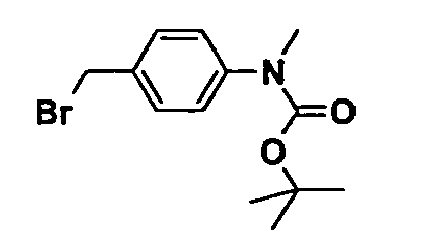
- A mixture of p-toluidine (10.7 g), di-tert-butyl dicarbonate (24.0 g) and tetrahydrofuran (300 mL) was heated under reflux for 2 hr. The reaction solution was concentrated under reduced pressure, and the residue was dissolved in ethyl acetate. This solution was washed successively with 1 M aqueous citric acid solution and saturated brine, and dried over anhydrous magnesium sulfate. The solvent was evaporated under reduced pressure, and the residue was subjected to silica gel column chromatography to give a colorless solid from a fraction eluted with hexane-ethyl acetate (4:1). To a mixture of this compound, methyl iodide (21.3 g) and N,N-dimethylformamide (300 mL) was added 60% sodium hydride (6.0 g), and the mixture was stirred at room temperature for 2 hr. Water was added to the reaction solution, and the mixture was extracted with ethyl acetate. The ethyl acetate layer was washed successively with water and saturated brine, and dried over anhydrous magnesium sulfate. The solvent was evaporated under reduced pressure to give a yellow oil. A mixture of this oil (5.0 g), N-bromosuccinimide (4.42 g), azobisisobutyronitrile (0.4 g) and carbon tetrachloride (90 mL) was heated under reflux for 20 min. The reaction solution was filtrated, and the filtrate was concentrated under reduced pressure. The obtained residue was subjected to silica gel column chromatography (hexane-ethyl acetate 95:1-7:3) to give the title compound (4.71 g, 71%) as a yellow solid.
1H NMR (300 MHz, CDCl3) δ ppm 1.46 (s, 9 H), 3.26 (s, 3 H), 4.49 (s, 2 H), 7.18-7.25 (m, 2 H), 7.31-7.37 (m, 2 H). -

- A mixture of cyclohexylamine (31 g), 6,6-dimethyl-5,7-dioxaspiro[2.5]octane-4,8-dione (31.3 g) and acetonitrile (450 mL) was stirred at 65°C for 2 hr. Cyclohexylamine (5.5 g) was added, and the mixture was stirred at 65°C for 1.5 hr, and then at room temperature for 14 hr. The white precipitate in the reaction mixture was collected by filtration, and washed with acetonitrile-diisopropyl ether. The obtained white substance was suspended in brine containing 1N hydrochloric acid (250 mL), and the mixture was extracted with ethyl acetate-tetrahydrofuran (3:1, v/v). The aqueous layer was extracted again with ethyl acetate, and the organic layers were combined, washed with saturated brine, and dried over anhydrous magnesium sulfate.
- The solvent was evaporated under reduced pressure, and the residue was washed with diisopropyl ether to give 1-cyclohexyl-2-oxopyrrolidine-3-carboxylic acid (25.6 g, 66%) as white crystals. A mixture of the obtained carboxylic acid (15 g), concentrated sulfuric acid (0.7 mL) and methanol (500 mL) was heated under reflux for 18 hr. After cooling, the reaction mixture was concentrated under reduced pressure, saturated aqueous sodium hydrogencarbonate was added to the residue, and the mixture extracted with ethyl acetate. The organic layer was washed with saturated brine, and dried over anhydrous magnesium sulfate. The solvent was evaporated under reduced pressure, and the residue was crystallized from diisopropyl ether-hexane to give the title compound (13.4 g, 84%) as colorless crystals.
1H NMR (300 MHz, CDCl3) δ ppm 1.06-1.16 (m, 1H), 1.29-1.44 (m, 4H), 1.64-1.80 (m, 5H), 2.16-2.28 (m, 1H), 2.31-2.42 (m, 1H), 3.28-3.35 (m, 1 H), 3.42-3.52 (m, 2H), 3.77 (s, 3H), 3.89-3.96 (m, 1H). -

- A mixture of cyclohexylamine (12 g), dimethyl itaconate (21.1 g) and methanol (80 mL) was heated under reflux for 16 hr. After cooling, the reaction mixture was concentrated under reduced pressure, diluted hydrochloric acid was added to the residue, and the mixture was extracted with ethyl acetate. The organic layer was washed with saturated brine, and dried over anhydrous magnesium sulfate. The solvent was evaporated under reduced pressure, and the residue was subjected to silica gel column chromatography (hexane-ethyl acetate 2:3-1:4) to give the title compound (22.3 g, 82%) as a pale-yellow oil.
1H NMR (300 MHz, CDCl3)δppm 1.05-1.15 (m, 1H), 1.29-1.46 (m, 4H), 1.64-1.72 (m, 3H), 1.78-1.82 (m, 2H), 2.60-2.76 (m, 2H), 3.14-3.25 (m, 1H), 3.49- 3.59 (m, 2H), 3.74 (s, 3H), 3.89-4.00 (m, 1H). -

- A mixture of 1-bromoadamantane (7.50 g), ethyl 2-oxopyrrolidine-5-carboxylate (16.4 g), silver sulfate (10.9 g) and N-methylpyrrolidone (5 mL) was stirred at 60°C for 1.5 hr, and then at 95°C for 6 hr. After cooling, ethyl acetate was added to the reaction mixture, the pale-green insoluble substance was filtrated through celite, and washed with ethyl acetate. Water was added to the filtrate, and the mixture was extracted with ethyl acetate. The organic layer was washed with saturated brine, and dried over anhydrous magnesium sulfate. The solvent was evaporated under reduced pressure, and the residue was subjected to silica gel column chromatography (hexane-ethyl acetate 3:2-2:3) to give the title compound (4.14 g, 41%) as a pale-yellow oil.
1H NMR (300 MHz, CDCl3) δ ppm 1.31 (t, J=7.2 Hz, 3H), 1.63-1.72 (m, 6H), 1.88-1.97 (m, 1H), 2.05-2.08 (m, 6H), 2.13-2.31 (m, 5H), 2.48-2.62 (m, 1H), 4.24 (q, J=7.2 Hz, 2H), 4.35-4.39 (m, 1H). -

- In the same manner as in Reference Example 15A, the title compound was obtained from 1-bromoadamantane and (4S)-4-hydroxypyrrolidin-2-one.
1H NMR (300 MHz, CDCl3) δ ppm 1.57-1.64 (m, 6 H), 1.68-1.76 (m, 6 H), 2.16 (m, 3 H), 2.27-2.35 (dd, J=17.1, 6.0 Hz, 1 H), 2.49-2.58 (dd, J=17.1, 9.0 Hz, 1 H), 3.22-3.26 (dd, J=9.6, 4.8 Hz, 1 H), 3.54-3.60 (dd, J=9.9, 7.2 Hz, 1 H), 4.57 (quint, J=6.0 Hz, 1 H), 5.72 (br, 1 H). -

- A mixture of methyl 1-cyclohexyl-5-oxopyrrolidine-3-carboxylate obtained in Reference Example 14A (1.58 g) and ethanol (30 mL) was added to sodium borohydride (2.66 g) over 2 hr at 0°C, and the mixture was stirred at room temperature for 14 hr. Water was added to the reaction solution, and the mixture was extracted with ethyl acetate. The ethyl acetate layer was washed with saturated brine, and dried over anhydrous magnesium sulfate. The solvent was evaporated under reduced pressure, and the residue was crystallized from hexane-ethyl acetate to give the title compound (1.30 g, 94%) as a colorless solid.
1H NMR (300 MHz, CDCl3) δ ppm 1.10 (m, 1 H), 1.29-1.39 (m, 4 H), 1.68-1.76 (m, 4 H), 2.03 (m, 1 H), 2.18-2.24 (t, J=9.0 Hz, 1 H), 2.47-2.53 (m, 2 H), 2.74 (m, 1 H), 3.18-3.22 (m, 1 H), 3.43-3.48 (t, J=7.5 Hz, 1 H), 3.52-3.61 (m, 2 H), 3.91 (m, 1 H). -

- In the same manner as in Reference Example 15A, the title compound was obtained from methyl 3-bromoadamantane-1-carboxylate and 2-pyrrolidinone.
1H NMR (300 MHz, CDCl3) δ ppm 1.64-1.68 (m, 2 H), 1.80-1.96 (m, 6 H), 2.07-2.37 (m, 10 H), 3.39-3.48 (m, 2 H), 3.65 (s, 3 H). - Reference Example 19A 1-[3-(hydroxymethyl)-1-adamantyl]pyrrolidin-2-one

- To a mixture of methyl 3-(2-oxopyrrolidin-1-yl)adamantane-1-carboxylate obtained in Reference Example 18A (2.7 g) and tetrahydrofuran (40 mL) was added lithium borohydride (1.63 g) at 0°C, and the mixture was stirred at room temperature for 3 hr. Water was added to the reaction mixture, and the mixture was extracted with ethyl acetate. The ethyl acetate layer was washed with saturated brine, and dried over anhydrous magnesium sulfate. The solvent was evaporated under reduced pressure, and the residue was crystallized from hexane-ethyl acetate to give the title compound (2.2 g, 91%) as a colorless solid.
1H NMR (300 MHz, CDCl3)δ ppm 1.43-1.60 (m, 6 H), 1.67-1.75 (m, 2 H), 1.84-1.94 (m, 3 H), 2.09 (m, 4 H), 2.18 (m, 2 H), 2.30-2.36 (m, 2 H), 3.26-3.28 (m, 2 H), 3.43-3.48 (m, 2 H). - Reference Example 20A 1-(2,3-dihydro-1H-indol-1-yl)pyrrolidin-2-one

- In the same manner as in Reference Example 3A, the title compound was obtained from indolin-1-amine and 4-chlorobutyryl chloride.
1H NMR (300 MHz, CDCl3) δ ppm 2.09-2.16 (m, 2 H), 2.43-2.51 (m, 2 H), 3.05-3.07 (m, 2 H), 3.39-3.46 (m, 2 H), 3.57 (m, 2 H), 6.48-6.52 (m, 1 H), 6.80-6.87 (m, 2 H), 7.06-7.12 (m, 2 H). -

- In the same manner as in Reference Example 3A, the title compound was obtained from 6-methoxyindan-1-amine and 4-chlorobutyryl chloride.
1H NMR (300 MHz, CDCl3) δ ppm 1.87-2.05 (m, 3 H), 2.31-2.51 (m, 3 H), 2.82-2.94 (m, 2 H), 2.98-3.10 (m, 1 H), 3.17-3.29 (m, 1 H), 3.78 (s, 3 H), 5.72-5. 80 (t, J=7.8 Hz, 1 H), 6. 56 (d, J=2.2 Hz, 1 H), 6. 77-6. 83 (dd, J=8.8, 2.2 Hz, 1 H), 7.12-7.16 (d, J=8.8 Hz, 1 H). - Reference Example 22A 1-(piperidin-1-yl)pyrrolidin-2-one

- In the same manner as in Reference Example 3A, the title compound was obtained from piperidin-1-amine and 4-chlorobutyryl chloride.
1H NMR (300 MHz, CDCl3) δ ppm 1.37-1.44 (m, 2 H), 1.67-1.75 (m, 4 H), 1.96-2.09 (m, 2 H), 2.30-2.36 (m, 2 H), 2.88-2.92 (m, 4 H), 3.42-3.47 (m, 2 H). -

- In the same manner as in Reference Example 3A, the title compound was obtained from morpholin-4-amine and 4-chlorobutyryl chloride.
1H NMR (300 MHz, CDCl3) δ ppm 1.98-2.07 (m, 2 H), 2.33-2.38 (m, 2 H), 2.96-2.99 (m, 4 H), 3.44-3.49 (m, 2 H), 3.81-3.84 (m, 4 H). Reference Example 24A 2-chloro-4-(methoxymethoxy)benzyl bromide
- To a solution of 3-chloro-4-methylphenol (25 g) in tetrahydrofuran (200 mL) was added sodium hydride (60% oil; 10.5 g) by small portions under ice-cooling. The mixture was stirred at 0°C for 2.5 hr, and chloromethyl methyl ether (20 mL) was gradually added dropwise. The reaction mixture was stirred at 0°C for 30 min, and then at room temperature 1.5 hr. Saturated aqueous ammonium chloride was added to the reaction mixture under ice-cooling, and the mixture was extracted with ethyl acetate. The organic layer was washed with saturated brine, and dried over anhydrous magnesium sulfate. The solvent was evaporated under reduced pressure, and the residue was subjected to silica gel column chromatography (hexane-ethyl acetate 95:5-9:1) to give 2-chloro-4-methoxymethoxytoluene (30.2 g, 93%) as a colorless oil. A mixture of the obtained 2-chloro-4-methoxymethoxytoluene (30.2 g), N-bromosuccinimide (30.2 g), α,α'-azobisisobutyronitrile (2.65 g) and carbon tetrachloride (120 mL) was stirred at 100°C for 1.5 hr. After cooling, the white insoluble substance was filtrated, and washed with a small amount of dichloromethane. The filtrate was concentrated under reduced pressure, and the residue was dissolved in ethyl acetate. The organic layer was washed with saturated aqueous sodium hydrogencarbonate. The aqueous layer was extracted again with ethyl acetate, and the organic layers were combined, washed with saturated brine, and dried over anhydrous magnesium sulfate. The solvent was evaporated under reduced pressure, and the residue was subjected to silica gel column chromatography (hexane-ethyl acetate 98:2-9:1) to give the title compound (11.3 g, 26%) as a pale-brown oil.
1H NMR (300 MHz, CDCl3) δ ppm 3.47 (s, 3H), 4.58 (s, 2H), 5.16 (s, 2H), 6.92 (dd, J=8.4, 2.4 Hz, 1H), 7.10 (d, J=2.4 Hz, 1H), 7.34 (d, J=8.4 Hz, 1H) . -

- In the same manner as in Reference Example 3A, the title compound was obtained from (1S)-indan-1-amine and 4-chlorobutyryl chloride.
1H NMR (300 MHz, CDCl3)δ ppm 1.84-2.07 (m, 3 H), 2.31-2.54 (m, 3 H), 2.82-3.10 (m, 3 H), 3.14-3.28 (m, 1 H), 5.80 (t, J=7.6 Hz, 1 H), 7.05-7.33 (m, 4 H). -

- In the same manner as in Reference Example 3A, the title compound was obtained from (1R)-indan-1-amine and 4-chlorobutyryl chloride.
1H NMR (300 MHz, CDCl3) δ ppm 1.86-2.07 (m, 3 H), 2.32-2.53 (m, 3 H), 2.83-3.09 (m, 3 H), 3.15-3.27 (m, 1 H), 5.80 (t, J=7.6 Hz, 1 H), 7.04-7.35 (m, 4 H). - Reference Example 27A 1-[(1S, 2R)-2-hydroxy-2, 3-dihydro-1H-inden-1-yl]pyrrolidin-2-one

- In the same manner as in Reference Example 3A, the title compound was obtained from (1S,2R)-1-aminoindan-2-ol and 4-chlorobutyryl chloride.
1H NMR (300 MHz, CDCl3) δ ppm 1.80-2.11 (m, 2 H), 2.39-2.60 (m, 2 H), 2.84-3.12 (m, 2 H), 3.14-3.41 (m, 3 H), 4.73-4.88 (m, 1 H), 5.48 (d, J=6.8 Hz, 1 H), 7.16-7.35 (m, 4H). -

- To a solution of 1-[(1S,2R)-2-hydroxy-2,3-dihydro-1H-inden-1-yl]pyrrolidin-2-one obtained in Reference Example 27A (724 mg) and imidazole (295 mg) in N,N-dimethylformamide (1 mL) was added tert-butyldimethylchlorosilane (603 mg), and the mixture was stirred at 50°C for 1 hr. Water was added to the reaction mixture, and the mixture was extracted with ethyl acetate. The organic layer was washed with saturated brine, and dried over anhydrous magnesium sulfate. The solvent was evaporated under reduced pressure, and the residue was subjected to silica gel column chromatography (hexane-ethyl acetate 95:5-85:15) to give the title compound (1.03 g, 93%) as a colorless oil.
1H NMR (300 MHz, CDCl3) δ ppm 0.00 (s, 3 H), 0.04 (s, 3 H), 0.80 (s, 9 H), 1.65-1.99 (m, 2 H), 2.28-2.41 (m, 1 H), 2.73-2.96 (m, 2 H), 3.11 (dd, J=16.2, 7.5 Hz, 1 H), 3.25-3.41 (m, 1 H), 4.56-4.69 (m, 1H), 5.49 (d, J=7.2 Hz, 1 H), 7.07-7.23 (m, 4 H). -

- A mixture of tert-butyl [3-chloro-4-(hydroxymethyl)phenyl]carbamate (0.79 g), acetyl chloride (0.26 g), triethylamine (0.48 mL) and tetrahydrofuran (10 mL) was stirred at room temperature for 1 hr. The reaction mixture was partitioned between ethyl acetate (40 mL) and water (40 mL), the ethyl acetate layer was washed with saturated brine, and dried over anhydrous magnesium sulfate, and the solvent was evaporated under reduced pressure. The obtained residue was dissolved in N,N-dimethylformamide (10 mL), methyl iodide (0.42 g) and sodium hydride (0.12 g) were added successively under ice-cooling, and the mixture was stirred at room temperature for 30 min. The reaction mixture was poured into water (40 mL), and the mixture was extracted with ethyl acetate (40 mL). The ethyl acetate layer was washed with water and saturated brine, and dried over anhydrous magnesium sulfate. The solvent was evaporated under reduced pressure. The obtained residue was dissolved in ethanol (10 mL), 2N sodium hydroxide (2 mL) was added thereto, and the mixture was stirred at room temperature for 24 hr. The reaction mixture was concentrated under reduced pressure, and the obtained residue was partitioned between ethyl acetate (30 mL) and water (30 mL). The ethyl acetate layer was washed with saturated brine, and dried over anhydrous magnesium sulfate. The solvent was evaporated under reduced pressure, and the obtained residue was dissolved in tetrahydrofuran (5 mL). Thionyl chloride (0.49 g) was added dropwise to the solution under ice-cooling, and the mixture was stirred at 0°C for 10 min, and then at room temperature for 30 min. The reaction mixture was evaporated under reduced pressure to give the title compound (0.54 g, 61%) as a pale-yellow oil.
1H NMR (300 MHz, CDCl3)δppm 1.47 (s, 9 H), 3.26 (s, 3 H), 4.68 (s, 2 H), 7.18 (dd, J=8.3, 2.3 Hz, 1 H), 7.34 (d, J=2.3 Hz, 1 H), 7.40 (d, J=8.3 Hz, 1 H). -

- In the same manner as in Reference Example 3A, the title compound was obtained from trans-4-aminocyclohexanol and 4-chlorobutyryl chloride.
1H NMR (300 MHz, CDCl3) δ ppm 1.45-1.60 (m, 2 H), 1.70-1.86 (m, 2 H), 1.90-2.20 (m, 7 H), 2.39 (t, J=8.1 Hz, 2 H), 3.25-3.40 (m, 2 H), 3.88-4.15 (m, 1 H), 4.54-4.80 (m, 1 H). - Reference Example 31A 1-(4-methoxycyclohexyl)pyrrolidin-2-one (a mixture of cis and trans)

- In the same manner as in Reference Example 3A, the title compound was obtained from 4-methoxycyclohexanamine and 4-chlorobutyryl chloride.
1H NMR (300 MHz, CDCl3) δ ppm 1.25-1.58 (m, 4 H), 1.63-1.83 (m, 2 H), 1.89-2.19 (m, 4 H), 2.32-2.44 (m, 2 H), 3.31 and 3.34 (s, 3 H), 3.32-3.40 (m, 2 H), 3.41-3.47 (m, 1 H), 3.88-4.09 (m, 1 H). Reference Example 32A benzyl 3-(2-oxopyrrolidin-1-yl)piperidine-1-carboxylate
- In the same manner as in Reference Example 3A, the title compound was obtained from benzyl 3-aminopiperidine-1-carboxylate and 4-chlorobutyryl chloride.
1H NMR (300 MHz, CDCl3) δ ppm 1.43-1.92 (m, 5 H), 1.92-2.12 (m, 2 H), 2.29-2.47 (m, 2 H), 2.54-2.96 (m, 2 H), 3.22-3.50 (m, 2 H), 3.87-4.23 (m, 2 H), 4.98-5.34 (m, 2 H), 7.28-7.46 (m, 5 H). - Reference Example 33A 1-[(1R,2R,4S)-bicyclo[2.2.1]hept-2-yl]pyrrolidin-2-one

- In the same manner as in Reference Example 3A, the title compound was obtained from (1R,2R,4S)-bicyclo[2.2.1]heptan-2-amine and 4-chlorobutyryl chloride.
1H NMR (300 MHz, CDCl3) δ ppm 1.04-1.61 (m, 7 H), 1.66-1.82 (m, 1 H), 1.84-2.09 (m, 2 H), 2.18 (s, 1 H), 2.23-2.45 (m, 3 H), 3.24-3.53 (m, 2 H), 4.05 (dd, J=8.4, 5.2 Hz, 1 H). - Reference Example 34A 1-[4-(hydroxymethyl)cyclohexyl]pyrrolidin-2-one (a mixture of cis-form and trans-form)

- In the same manner as in Reference Example 3A, the title compound was obtained from (4-aminocyclohexyl)methanol and 4-chlorobutyryl chloride.
- LC-MS (ESI+); m/z 198 (M+H)+
-

- A mixture of 2-chloro-3-hydroxy-4-methoxybenzaldehyde (8.5 g), chloromethyl methyl ether (4.0 g), sodium hydride (60% oil; 2.0 g) and N,N-dimethylformamide (200 mL) was stirred at 0°C for 1 hr. The reaction mixture was poured into water (500 mL), and the mixture was extracted with ethyl acetate (500 mL). The ethyl acetate layer was washed with water, 1N sodium hydroxide and saturated brine, and dried over anhydrous magnesium sulfate. The solvent was evaporated under reduced pressure, and the residue was purified by silica gel column chromatography (hexane-ethyl acetate 4:1) to give the title compound (10.4 g, 99%) as a colorless solid.
1H NMR (300 MHz, CDCl3) δ ppm 3.67 (s, 3 H), 3.95 (s, 3 H), 5.19 (s, 2 H), 6. 93 (d, J=8. 9 Hz, 1 H), 7.75 (d, J=8. 9 Hz, 1 H), 10.36 (s, 1 H). -

- In the same manner as in Reference Example 35A, the title compound was obtained from 2,6-dichloro-3-hydroxy-4-methoxybenzaldehyde.
1H NMR (300 MHz, CDCl3) δ ppm 3.65 (s, 3 H), 3.94 (s, 3 H), 5.17 (s, 2 H), 6.92 (s, 1 H), 10.41 (s, 1H). -

- In the same manner as in Reference Example 3A, the title compound was obtained from 5-methoxy-1,2,3,4-tetrahydronaphthalen-1-amine.
1H NMR (300 MHz, CDCl3) δ ppm 1.73-1.80 (m, 2 H), 1.91-2.08 (m, 4 H), 2.47-2.56 (m, 3 H), 2.75-2.82 (m, 1 H), 3.02-3.09 (m, 1 H), 3.20-3.29 (m, 1 H), 3.82 (s, 3 H), 5.37-5.41 (m, 1 H), 6.63-6.66 (d, J=7.8 Hz, 1 H), 6.70-6.73 (d, J=8.1 Hz, 1 H), 7.09-7.15 (d, J=7.8 Hz, 1 H). - Reference Example 38A 1-(5-hydroxy-2-adamantyl)pyrrolidin-2-one

- In the same manner as in Reference Example 3A, the title compound was obtained from 4-aminoadamantan-1-ol hydrochloride.
1H NMR (300 MHz, CDCl3)δ ppm 1.46-1.59 (m, 2 H), 1.59-2.12 (m, 11 H), 2.18 (d, J=3.0 Hz, 1 H), 2.32-2.51 (m, 4 H), 3.64 (t, J=6.9 Hz, 2 H), 3.92 (s, 1 H).
LC/MS (ESI+); m/z 236 (M+H)+ -

-

- A mixture of 3,5-dichloroanisole (5.0 g), paraformaldehyde (1.1 g), concentrated hydrochloric acid (50 mL) and concentrated sulfuric acid (0.5 mL) was stirred at 60°C for 16 hr. The reaction mixture was poured into ice, and the mixture was extracted with diethyl ether (100 mL). The extract was washed successively with water, saturated sodium hydrogencarbonate solution and saturated brine, and dried over anhydrous magnesium sulfate. The solvent was evaporated under reduced pressure, and a mixture of the obtained pale-yellow oil (6.57 g), 1N sodium hydroxide (56 mL) and dioxane (28 mL) was heated under reflux for 3 hr. The reaction mixture was extracted with dichloromethane (50 mL), and the extract was washed with water and saturated brine, and dried over anhydrous magnesium sulfate. The solvent was evaporated under reduced pressure, and the obtained residue was subjected to silica gel column chromatography (hexane-ethyl acetate 9:1) to give a mixture (3:1) of (2,6-dichloro-4-methoxyphenyl)methanol and (2,4-dichloro-6-methoxyphenyl)methanol.
- 1H NMR (300 MHz, CDCl3) δ ppm 1.95 (t, J=6.8 Hz, 1 H), 3.80 (s, 3H), 4.89 (d, J=6.8 Hz, 2 H), 6.88 (s, 2 H).
- 1H NMR (300 MHz, CDCl3) δ ppm 2.20 (t, J=6.8 Hz, 1 H), 3.88 (s, 3H), 4.81 (d, J=6.8 Hz, 2 H), 6.81 (s, 1 H), 7.04 (s, 1 H). Reference Example 41A 1,3-dichloro-2-(chloromethyl)-5-methoxybenzene and

-

- To a solution of a mixture (1.50 g, 3:1) of (2,6-dichloro-4-methoxyphenyl)methanol obtained in Reference Example 39A and (2,4-dichloro-6-methoxyphenyl)methanol obtained in Reference Example 40A in tetrahydrofuran (30 mL) was added thionyl chloride (1.06 g) under ice-cooling, and the mixture was stirred at room temperature for 1 hr. The reaction solution was poured into saturated sodium hydrogencarbonate solution (60 mL), and the mixture was extracted with ethyl acetate (50 mL). The extract was washed with saturated brine, and dried over anhydrous magnesium sulfate, and the solvent was evaporated under reduced pressure to give a mixture (1.57 g, 96%, 3:1) of 1,3-dichloro-2-(chloromethyl)-5-methoxybenzene and 1,5-dichloro-2-(chloromethyl)-3-methoxybenzene, as a colorless solid.
- 1H NMR (300 MHz, CDCl3) δ ppm 3.80 (s, 3 H), 4.82 (s, 2 H), 4.89 (d, J=6.8 Hz, 2 H), 6.90 (s, 2 H).
- 1H NMR (300 MHz, CDCl3)δ ppm 3.89 (s, 3 H), 4.75 (s, 2 H), 4.89 (d, J=6.8 Hz, 2 H), 6.81 (s, 1 H), 7.04 (s, 1 H).
-

- In the same manner as in Example 255A, the title compound was obtained from 1-(2-hydroxy-1,1-dimethylethyl)pyrrolidin-2-one and α,2,6-trichlorotoluene.
1H NMR (300 MHz, CDCl3) δ ppm 1.27 (s, 3 H), 1.30 (s, 3 H), 1.77-2.08 (m, 2 H), 2.84-3.16 (m, 2 H), 3.23-3.39 (m, 1 H), 3.40-3.57 (m, 2 H), 3.71-3.84 (m, 2 H), 5.16 (t, J=7.0 Hz, 1 H), 7.00-7.20 (m, 1 H), 7.30 (d, J=8.3 Hz, 2 H). -

- To a mixture of oxalyl chloride (1.96 mL) and dichloromethane (100 mL) was added dimethyl sulfoxide (1.54 mL) at -78°C, and the mixture was stirred for 5 min. A solution of 3-(2,6-dichlorobenzyl)-1-(2-hydroxy-1,1-dimethylethyl)pyrrolidin-2-one obtained in Reference Example 43A (6.20 g) in dichloromethane (20 mL) was added dropwise to the mixture, and the mixture was stirred at -78°C for 20 min. Triethylamine (13.8 mL) was added to the reaction solution, and the mixture was allowed to warm to room temperature, washed successively with water and saturated brine, and dried over magnesium sulfate. The solvent was evaporated under reduced pressure, and the residue was subjected to silica gel column chromatography (hexane-ethyl acetate 4:1) to give the title compound (5.40 g) as colorless plate crystals.
1H NMR (300 MHz, CDCl3) δ ppm 1.31 (s, 3 H), 1.33 (s, 3 H), 1.94-2.14 (m, 2 H), 2.87-3.16 (m, 2 H), 3.24-3.37 (m, 1 H), 3.39-3.51 (m, 2 H), 7.04-7.17 (m, 1 H), 7.28-7.35 (m, 2 H), 9.55 (s, 1 H). -

- In the same manner as in Example 516A, the title compound was obtained from 2-[3-(2,6-dichlorobenzyl)-2-oxopyrrolidin-1-yl]-2-methylpropanal obtained in Reference Example 44A and (carboethoxymethyl)triphenylphosphine bromide.
1H NMR (300 MHz, CDCl3) δ ppm 1.30 (t, J=7.1 Hz, 3 H), 1.53 (d, J=2.1 Hz, 6 H), 1.77-1.99 (m, 2 H), 2.78-2.97 (m, 1 H), 2.97-3.12 (m, 1 H), 3.21-3.35 (m, 1 H), 3.36-3.54 (m, 2 H), 4.20 (q, J=7.2 Hz, 2 H), 5.83 (d, J=15.8 Hz, 1 H), 7.02-7.16 (m, 2 H), 7.29 (d, J=7.9 Hz, 2 H). -

- In the same manner as in Example 527A, the title compound was obtained from ethyl (2E)-4-[3-(2,6-dichlorobenzyl)-2-oxopyrrolidin-1-yl]-4-methylpenta-2-enoate obtained in Reference Example 45A.
1H NMR (300 MHz, CDCl3) δ ppm 1.26 (t, J=7.2 Hz, 3 H), 1.36-1.41 (m, 6 H), 1.75-1.95 (m, 2 H), 2.15-2.38 (m, 4 H), 2.77-2.93 (m, 1 H), 2.95-3.08 (m, 1 H), 3.17-3.32 (m, 1 H), 3.36-3.51 (m, 2 H), 4.13 (q, J=7.2 Hz, 2 H), 6.97-7.15 (m, 1 H), 7.27-7.33 (m, 2 H). -

- In the same manner as in Example 155A, the title compound was obtained from ethyl 4-[3-(2,6-dichlorobenzyl)-2-oxopyrrolidin-1-yl]-4-methylpentanoate obtained in Reference Example 46A.
1H NMR (300 MHz, CDCl3) δ ppm 1.38 (s, 6 H), 1.77-1.97 (m, 2 H), 2.20-2.44 (m, 4 H), 2.81-2.96 (m, 1 H), 2.97-3.10 (m, 1 H), 3.20-3.35 (m, 1 H), 3.38-3.52 (m, 2 H), 7.04-7.15 (m, 1 H), 7.27-7.32 (m, 2 H). -

- To a solution of cyclopropanecarboxylic acid (1.17 g) in dichloromethane (60 mL) was added 1,1'-carbonyldiimidazole (2.24 g), and the mixture was stirred at room temperature for 5 hr. 3-Chloro-4-methylbenzamidoxime (2.51 g) was added to the mixture, and the reaction mixture was stirred at room temperature for 18 hr, and concentrated under reduced pressure. The residue was suspended in toluene (100 mL), and the suspension was heated under reflux for 21 hr. After cooling, water was added to the reaction mixture, and the mixture was extracted with ethyl acetate. The organic layer was washed with saturated brine, and dried over anhydrous magnesium sulfate.
- The solvent was evaporated under reduced pressure, the residue was subjected to silica gel column chromatography (hexane-ethyl acetate 95:5-9:1), and the obtained crystals were recrystallized from hexane to give 3-(3-chloro-4-methylphenyl)-5-cyclopropyl-1,2,4-oxadiazol (2.12 g, 66%) as colorless crystals.
1H NMR (300 MHz, CDCl3) δ ppm 1.22-1.34 (m, 4 H), 2.21-2.29 (m, 1 H), 2.42 (s, 3 H), 7.31 (d, J=7.8 Hz, 1 H), 7.81 (dd, J=7.8, 1.8 Hz, 1 H), 8.02 (d, J=1.8 Hz, 1 H). - A mixture of the obtained 3-(3-chloro-4-methylphenyl)-5-cyclopropyl-1,2,4-oxadiazol (1.50 g), N-bromosuccinimide (1.15 g), α,α'-azobisisobutyronitrile (0.12 g) and carbon tetrachloride (10 mL) was heated under reflux for 1.5 hr. α,α'-Azobisisobutyronitrile (0.12 g) was added, and the mixture was further heated under reflux for 1.5 hr. After cooling, the reaction mixture was concentrated under reduced pressure, and residue was partitioned between ethyl acetate and water. The aqueous layer was extracted again with ethyl acetate, and the organic layers were combined, washed with saturated brine, and dried over anhydrous magnesium sulfate. The solvent was evaporated under reduced pressure, and the residue was subjected to silica gel column chromatography (hexane-ethyl acetate 97:3-9:1) to give the title compound (1.34 g, 66%) as a white solid.
1H NMR (300 MHz, CDCl3) δ ppm 1.23-1.35 (m, 4 H), 2.21-2.30 (m, 1 H), 4.61 (s, 2 H), 7.53 (d, J=7.8 Hz, 1 H), 7.92 (dd, J=7.8, 1.5 Hz, 1 H), 8.08 (d, J=1.5 Hz, 1 H). -

- To a mixture of ethyleneurea (10 g), α-bromo-o-xylene (10.7 g) and N,N-dimethylformamide (150 mL) was added 60% sodium hydride (4.65 g), and the mixture was stirred at room temperature for 1 hr. Water was added to the reaction solution, and the mixture was extracted with ethyl acetate. The ethyl acetate layer was washed successively with water and saturated brine, and dried over anhydrous magnesium sulfate, and the solvent was evaporated under reduced pressure. The residue was subjected to silica gel column chromatography to give the title compound (3.43 g, 32%) as a colorless solid from a fraction eluted with ethyl acetate.
1H NMR (300 MHz, CDCl3) δ ppm 2.34 (s, 3 H), 3.17-3.33 (m, 2 H), 3.35-3.49 (m, 2 H), 4.38 (s, 2 H), 4.81 (s, 1 H), 7.09-7.24 (m, 4 H). -

- A mixture of hydantoin (5.0 g), α-bromo-o-xylene (9.25 g), potassium carbonate (6.91 g) and acetone-water (5:2) was heated under reflux for 5 hr. The reaction solution was concentrated under reduced pressure, and the residue was partitioned between ethyl acetate-water. The ethyl acetate layer was washed with saturated brine, and dried over anhydrous magnesium sulfate. The solvent was evaporated under reduced pressure, and the obtained colorless solid was recrystallized from ethyl acetate-hexane to give the title compound (6.95 g, 68%) as a colorless solid.
LC/MS (ESI+); m/z 205 (M+H)+
Reference Example 3B 1-(morpholin-4-yl)imidazolidin-2-one
- To a solution (240 mL) of morpholin-4-amine (6.12 g) in tetrahydrofuran was added dropwise 1-chloro-2-isocyanatoethane (6.65 g) at room temperature, and the mixture was stirred at room temperature 30 min. Then, potassium tert-butoxide (8.75 g) was added to the reaction mixture, and the mixture was stirred at room temperature for 30 min. Water was added to the reaction mixture, and the mixture was extracted with ethyl acetate. The ethyl acetate layer was washed successively with water and saturated brine, and dried over anhydrous magnesium sulfate, and the solvent was evaporated under reduced pressure. The residue was recrystallized from ethyl acetate-hexane solvent to give the title compound (3.2 g, 31%) as a colorless solid.
1H NMR (300 MHz, CDCl3) δ ppm 2.29-2.95 (m, 4 H), 3.37-3.42 (m, 2 H), 3.47-3.52 (m, 2 H), 3.81 -3.84 (m, 4 H), 5.53 (m, 1 H). Reference Example 4B 1-(2,3-dihydro-1H-inden-1-yl)imidazolidin-2-one
- In the same manner as in Reference Example 3B, the title compound was obtained from indan-1-amine and 1-chloro-2-isocyanatoethane.
1H NMR (300 MHz, CDCl3) δ ppm 1.94-2.03 (m, 1 H), 2.33-2.44 (m, 1 H), 2.86-3.02 (m, 2 H), 3.06-3.14 (m, 1 H), 3.24-3.32 (m, 1 H), 3.41-3.44 (m, 2 H), 4.79 (m, 1 H), 5.57-5.62 (t, J=7.5 Hz, 1 H), 7.21-7.26 (m, 4 H). -

- In the same manner as in Reference Example 3B, the title compound was obtained from [(1R,2R,4R)-bicyclo[2.2.1]heptan-2-amine and 1-chloro-2-isocyanatoethane.
1H NMR (300 MHz, CDCl3) δ ppm 1.12-1.21 (m, 3 H), 1.32-1.49 (m, 5 H), 2.22 (m, 1 H), 2.30 (m, 1 H), 3.33-3.49 (m, 4 H), 3.81-3.86 (m, 1 H), 4.34 (m, 1 H). -

- In the same manner as in Reference Example 3B, the title compound was obtained from indolin-1-amine and 1-chloro-2-isocyanatoethane.
1H NMR (300 MHz, CDCl3) δ ppm 3.02-3.08 (t, J=8.1 Hz, 2 H), 3.50 (m, 4 H), 3.57 (m, 2 H), 5.57 (br, 1H), 6.63-6.66 (m, 1 H), 6.80 -6.86 (m, 1 H), 7.09-7.14 (m, 2 H). - Reference Example 7B 1-[1-(1-adamantyl)ethyl]imidazolidin-2-one

- In the same manner as in Reference Example 3B, the title compound was obtained from 1-(1-adamantyl)ethanamine and 1-chloro-2-isocyanatoethane.
1H NMR (300 MHz, CDCl3) δ ppm 1.06-1.09 (d, J=7.5 Hz, 3 H), 1.54-1. 72 (m, 12 H), 1.98 (m, 3 H), 3.33 -3.53 (m, 4 H), 3.57-3.62 (m, 1 H), 4.41 (br, 1 H). -

- A mixture of ethyl 2-oxo-3-piperidinecarboxylate (3.42 g, 0.02 mol), 20% ethanol solution (6.81 mL, 0.02 mol) of sodium ethylate and ethanol (20 mL) was stirred at room temperature for 5 min. 2,6-Dichlorobenzyl bromide (4.80 g, 0.02 mol) was added, and the mixture was stirred at 70°C for 2 hr. The reaction mixture was poured into water, and the mixture was extracted with ethyl acetate. The ethyl acetate layer was washed with saturated brine, and dried over anhydrous magnesium sulfate.
- The solvent was evaporated under reduced pressure, and isopropyl ether-hexane solution was added to the residue. The resulting crystals were collected by filtration, and washed with hexane to give the title compound (4.60 g, 70%) as a white powder.
1H NMR (300 MHz, CDCl3) δ ppm 1.24 (t, J=7.2Hz, 3 H), 1.60-1.75 (m, 2 H), 1.85-1.94 (m, 1 H), 2.16-2.24 (m, 1 H), 3.25-3.33 (m, 2 H), 3.60 (d, J=14.8 Hz, 1 H), 4.21 (d, J=14.8 Hz, 1 H), 4.15-4.28 (m, 2 H), 5.91 (brs, 1 H), 7.11 (t, J=8.0 Hz, 1 H), 7.29 (d, J=8.0 Hz, 2 H). -

- A mixture of ethyl 3-(2,6-dichlorobenzyl)-2-oxopiperidine-3-carboxylate obtained in Reference Example 1C (4.50 g, 0.014 mol), 1N aqueous sodium hydroxide solution (20 mL) and ethanol (20 mL) was stirred at room temperature for 10 hr. The reaction mixture was concentrated, and 1N hydrochloric acid (22 mL) was added to the residue. The resulting precipitate was collected by filtration, wash successively with water and hexane, and dried. The obtained white powder was heated at 130°C for 30 min, and isopropyl ether-hexane solution was added, and the resulting precipitate was collected by filtration, washed with hexane, and dried to give the title compound (1.52 g, 76%) as a white powder.
1H NMR (300 MHz, CDCl3) δ ppm 1.55-1.70 (m, 3 H), 1.85-1.95 (m, 1 H), 2. 75-2. 85 (m, 1 H), 3. 10 (dd, J=13.8, 11.6 Hz, 1 H), 3.25-3.35 (m, 2 H), 3.71 (dd, J=13.8, 4.4 Hz, 1H), 5.75 (brs, 1H), 7.10 (t, J=8.0 Hz, 1 H), 7.30 (d, J=8.0 Hz, 2 H). -

- To a mixture of tetrahydro-2-pyrimidinone (11.6 g), α-bromo-o-xylene (10.7 g) and N,N-dimethylformamide (150 mL) was added sodium hydride (4.65 g), and the mixture was stirred at room temperature for 1 hr. Water was added to the reaction solution, and the mixture was extracted with ethyl acetate. The ethyl acetate layer was washed successively with water and saturated brine, and dried over anhydrous magnesium sulfate, and the solvent was evaporated under reduced pressure. The residue was subjected to silica gel column chromatography (ethyl acetate-ethyl acetate-methanol 20:1) to give the title compound (1.58 g, 13%) as a colorless solid.
1H NMR (300 MHz, CDCl3) δ ppm 1.84-1.97 (m, 2 H), 2.31 (s, 3 H), 3.05-3.18 (m, 2 H), 3.25-3.47 (m, 2 H), 4.58 (s, 2 H), 5.12 (s, 1 H), 7.09-7.22 (m, 4 H). - Example 1A 3-(2,6-dichlorobenzyl)-1-(2-methylbenzyl)pyrrolidin-2-one
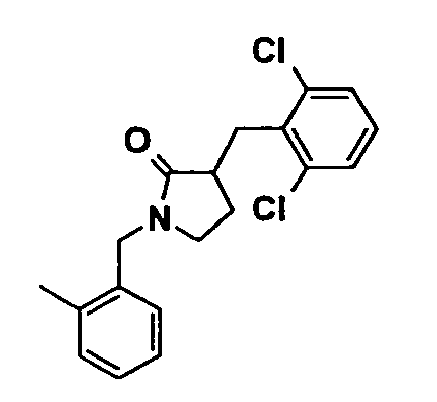
- To a mixture of 1-(2-methylbenzyl)pyrrolidin-2-one obtained in Reference Example 1A (0.50 g) and tetrahydrofuran (10 mL) was added lithium diisopropylamide (tetrahydrofuran solution, 2 M, 1.32 mL) at -78°C under nitrogen atmosphere, and the mixture was stirred for 10 min. A solution of α,2,6-trichlorotoluene (0.52 g) in tetrahydrofuran (5 mL) was added to the obtained solution, and the mixture was further stirred at -78°C for 10 min, and allowed to warm to room temperature. 10% Aqueous ammonium chloride was added to the reaction solution, and the mixture was extracted with ethyl acetate. The ethyl acetate layer was washed with saturated brine, and dried over anhydrous magnesium sulfate. The solvent was evaporated under reduced pressure, and the residue was subjected to silica gel column chromatography (hexane-ethyl acetate 9:1-4:1) to give the title compound (0.74 g, 80%) as a colorless solid.
1H NMR (300 MHz, CDCl3) δ ppm 1.83-1.98 (m, 2 H), 2.33 (s, 3 H), 2.91-3.12 (m, 3 H), 3.13-3.30 (m, 1 H), 3.43-3.63 (m, 1 H), 4.51 (s, 2 H), 7.04-7.14 (m, 1 H), 7.14-7.23 (m, 4 H), 7.27-7.35 (m, 2 H). -

- In the same manner as in Example 1A, the title compound was obtained from 1-benzylpyrrolidin-2-one and α,2,6-trichlorotoluene.
1H NMR (300 MHz, CDCl3) δ ppm 1.83-2.03 (m, 2 H), 2.91-3.33 (m, 4 H), 3.54 (dd, J=13.0, 4.1 Hz, 1 H), 4.38-4.60 (m, 2 H), 7.02-7.18 (m, 1 H), 7.20-7.46 (m, 7 H). -

- In the same manner as in Example 1A, the title compound was obtained from 1-[(1R)-1-phenylethyl]pyrrolidin-2-one and α,2,6-trichlorotoluene.
LC-MS (ESI+);m/z 508 (M+H)+ -

- In the same manner as in Example 1A, the title compound was obtained from 1-(1-methyl-1-phenylethyl)pyrrolidin-2-one obtained in Reference Example 3A and α-bromo-o-xylene.
1H NMR (300 MHz, CDCl3) δ ppm 1.60-1.72 (m, 1 H), 1.75 (s, 3 H), 1.78 (s, 3 H), 1.91-2.04 (m, 1 H), 2.32 (s, 3 H), 2.47-2.60 (m, 1 H), 2.61-2.75 (m, 1 H), 3.23-3.37 (m, 3 H), 7.06-7.17 (m, 4 H), 7.19-7.27 (m, 1 H), 7.28-7.41 (m, 4 H). - Example 5A 3-(2,6-dichlorobenzyl)-1-(1-methyl-1-phenylethyl)pyrrolidin-2-one

- In the same manner as in Example 1A, the title compound was obtained from 1-(1-methyl-1-phenylethyl)pyrrolidin-2-one obtained in Reference Example 3A and α,2,6-trichlorotoluene.
1H NMR (300 MHz, CDCl3) δ ppm 1.77 (s, 3 H), 1.80 (s, 3 H), 1.82-1.93 (m, 2 H), 2.82-2.97 (m, 1 H), 2.99-3.12 (m, 1 H), 3.18-3.29 (m, 1 H), 3.30-3.40 (m, 1 H), 3.45 (dd, J=13.4, 4.1 Hz, 1 H), 7.03-7.14 (m, 1 H), 7.19-7.28 (m, 2 H), 7.28-7.41 (m, 5 H). - Example 6A 1-(cyclohexylmethyl)-3-(2-methylbenzyl)pyrrolidin-2-one

- In the same manner as in Example 1A, the title compound was obtained from 1-(cyclohexylmethyl)pyrrolidin-2-one and α-bromo-o-xylene.
1H NMR (300 MHz, CDCl3) δ ppm 0.76-1.08 (m, 2 H), 1.07-1.29 (m, 2 H), 1.54-1.82 (m, 4 H), 1.79-2.03 (m, 2 H), 2.25-2.32 (m, 3 H), 2.39-2.70 (m, 2 H), 2.99-3.37 (m, 3 H), 3.59-3.84 (m, 2 H), 4.57 (d like, 2 H), 6.91-7.09 (m, 2 H), 7.09-7.25 (m, 3 H). -

- In the same manner as in Example 1A, the title compound was obtained from 1-(cyclohexylmethyl)pyrrolidin-2-one and α,2,6-trichlorotoluene.
1H NMR (300 MHz, CDCl3) δ ppm 0.73-0.99 (m, 2 H), 1.03-1.31 (m, 2 H), 1.43-1.82 (m, 6 H), 1.86-2.04 (m, 2 H), 2.44-2.82 (m, 2 H), 2.90-3.09 (m, 2 H), 3.70 (s, 2 H), 4.74-5.07 (m, 2 H), 7.11-7.24 (m, 1 H), 7.29-7.43 (m, 2 H). - Example 8A 1-cyclohexyl-3-(2-methylbenzyl)pyrrolidin-2-one

- In the same manner as in Example 1A, the title compound was obtained from 1-cyclohexylpyrrolidin-2-one and α-bromo-o-xylene.
1H NMR (300 MHz, CDCl3) δ ppm 0.97-1.19 (m, 1 H), 1.28-1.52 (m, 4 H), 1.56-1.89 (m, 6 H), 1.90-2.12 (m, 1 H), 2.34 (s, 3 H), 2.44-2.60 (m, 1 H), 2.62-2.82 (m, 1 H), 3.09-3.29 (m, 2 H), 3.27-3.43 (m, 1 H), 3.86-4.05 (m, 1 H), 7.02-7.21 (m, 4 H). - Example 9A 1-cyclohexyl-3-(2,6-dichlorobenzyl)pyrrolidin-2-one

- In the same manner as in Example 1A, the title compound was obtained from 1-cyclohexylpyrrolidin-2-one and α,2,6-trichlorotoluene.
1H NMR (300 MHz, CDCl3) δ ppm 0.92-1.23 (m, 1 H), 1.24-1.52 (m, 4 H), 1.61-2.01 (m, 7 H), 2.84-2.98 (m, 1 H), 2.98-3.11 (m, 1 H), 3.11-3.27 (m, 1 H), 3.26-3.40 (m, 1 H), 3.49 (dd, J=13.2, 4.3 Hz, 1 H), 3.80-4.13 (m, 1 H), 7.00-7.19 (m, 1 H), 7.27-7.36 (m, 2 H). -

- In the same manner as in Example 1A, the title compound was obtained from 1-(2,6-dichlorobenzyl)pyrrolidin-2-one obtained in Reference Example 2A and α-bromo-o-xylene.
1H NMR (300 MHz, CDCl3) δ ppm 1.55-1.76 (m, 1 H), 1.89-2.03 (m, 1 H), 2.34 (s, 3 H), 2.49-2.66 (m, 1 H), 2.67-2.81 (m, 1 H), 2.96-3.11 (m, 2 H), 3.38 (dd, J=14.1, 3.8 Hz, 1 H), 4.73-4.97 (m, 2 H), 7.05-7.24 (m, 5 H), 7.30-7.39 (m, 2 H). -

- In the same manner as in Example 1A, the title compound was obtained from 1-[(1R)-1-phenylethyl]pyrrolidin-2-one and α-bromo-o-xylene.
1H NMR (300 MHz, CDCl3) δ ppm 1.53 (d, J=7.2 Hz, 3 H), 1.59-1.80 (m, 1 H), 1.85-2.05 (m, 1 H), 2.35 (s, 3 H), 2.51-2.65 (m, 1 H), 2.65-2.76 (m, 1 H), 2.76-2.90 (m, 1 H), 3.10-3.28 (m, 1 H), 3.37 (dd, J=13.9, 3.6 Hz, 1 H), 5.54 (q, J=7.2 Hz, 1 H), 7.03-7.20 (m, 4 H), 7.21-7.44 (m, 5 H). -

- In the same manner as in Example 1A, the title compound was obtained from 1-[(1R)-1-phenylethyl]pyrrolidin-2-one and α-bromo-o-xylene.
1H NMR (300 MHz, CDCl3) δ ppm 1.53 (d, J=7.2 Hz, 3 H), 1.55-1.62 (m, 1 H), 1.90-2.11 (m, 1 H), 2.33 (s, 3 H), 2.54 (dd, J=14.1, 10.4 Hz, 1 H), 2.66-2.82 (m, 1 H), 2.86-2.98 (m, 1 H), 3.11-3.27 (m, 1 H), 3.38 (dd, J=14.1, 3.8 Hz, 1 H), 5.52 (q, J=7.2 Hz, 1 H), 7.05-7.20 (m, 4 H), 7.22-7.42 (m, 5 H). -

- In the same manner as in Example 1A, the title compound was obtained from 1-[(1S)-1-phenylethyl]pyrrolidin-2-one and α,2,6-trichlorotoluene.
1H NMR (300 MHz, CDCl3) δ ppm 1. 57 (d, J=7.2 Hz, 3 H), 1.81-1.94 (m, 2 H), 2.78-2.90 (m, 1 H), 2.89-3.01 (m, 1 H), 3.02-3.15 (m, 1 H), 3. 25-3. 38 (m, 1 H), 3. 51 (dd, J=13. 4, 4.7 Hz, 1 H), 5. 54 (q, J=7.2 Hz, 1 H), 6.98-7.16 (m, 1 H), 7.19-7.41 (m, 7 H). -

- In the same manner as in Example 1A, the title compound was obtained from 1-[(1S)-1-phenylethyl]pyrrolidin-2-one and α,2,6-trichlorotoluene.
1H NMR (300 MHz, CDCl3)δ ppm 1.52 (d, J=7.2 Hz, 3 H), 1.70-2.00 (m, 2 H), 2.90-3.11 (m, 3 H), 3.12-3.24 (m, 1 H), 3.50-3.59 (m, 1 H), 5.51 (q, J=7.2 Hz, 1 H), 7.05-7.13 (m, 1 H), 7.22-7.41 (m, 7 H). -

- In the same manner as in Example 1A, the title compound was obtained from 1-[(1R)-1-phenylethyl]pyrrolidin-2-one and 2,6-dichlorobenzaldehyde.
1H NMR (300 MHz, CDCl3) δ ppm 1.52-1.63 (m, 3 H), 1.62-1.87 (m, 2 H), 2.79-3.08 (m, 1 H), 3.19-3.41 (m, 1 H), 3.56-3.78 (m, 1 H), 5.28-5.45 (m, 1 H), 5.46-5.61 (m, 1 H), 5.60-5.78 (m, 1 H), 7.09-7.20 (m, 1 H), 7.27-7.44 (m, 7 H). -

- In the same manner as in Example 1A, the title compound was obtained from 1-[(1R)-1-phenylethyl]pyrrolidin-2-one and α,2,6-trichlorotoluene.
1H NMR (300 MHz, CDCl3) δ ppm 1.57 (d, J=7.2 Hz, 3 H), 1.80-1.93 (m, 2 H), 2.76-2.89 (m, 1 H), 2.89-3.01 (m, 1 H), 3.03-3.16 (m, 1 H), 3.27-3.37 (m, 1 H), 3.51 (dd, J=13.4, 4.7 Hz, 1 H), 5.54 (q, J=7.2 Hz, 1 H), 7.05-7.15 (m, 1 H), 7.21-7.39 (m, 7 H). -
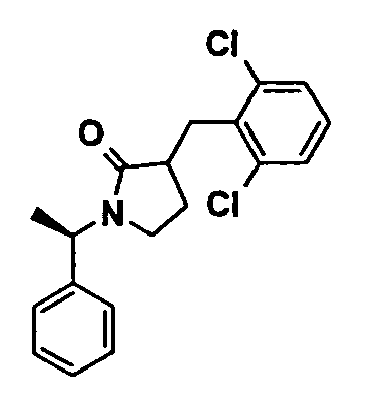
- In the same manner as in Example 1A, the title compound was obtained from 1-[(1R)-1-phenylethyl]pyrrolidin-2-one and α,2,6-trichlorotoluene.
1H NMR (300 MHz, CDCl3) δ ppm 1.52 (d, J=7.2 Hz, 3 H), 1.73-1.86 (m, 1 H), 1.85-1.99 (m, 1 H), 2.89-3.11 (m, 3 H), 3.11-3.26 (m, 1 H), 3.48-3.60 (m, 1 H), 5.52 (q, J=7.2 Hz, 1 H), 7.04-7.14 (m, 1 H), 7.23-7.44 (m, 7 H). -

- In the same manner as in Example 1A, the title compound was obtained from 1-[(1R)-1-phenylethyl]pyrrolidin-2-one and tert-butyl [4-(bromomethyl)phenyl](methyl)carbamate obtained in Reference Example 12A.
1H NMR (300 MHz, CDCl3) δ ppm 1.44 (s, 9 H), 1.43-1.49 (m, 3 H), 1.70 (d, J=7.9 Hz, 1 H), 1.83-2.02 (m, 1 H), 2.63-2.87 (m, 3 H), 2.97-3.13 (m, 1 H), 3.13-3.24 (m, 1 H), 3.24 (s, 3 H), 5.51 (q, J=6.8 Hz, 1 H), 7.08-7.23 (m, 4 H), 7.21-7.40 (m, 5 H). -

- In the same manner as in Example 1A, the title compound was obtained from 1-[(1R)-1-phenylethyl]pyrrolidin-2-one and tert-butyl [4-(bromomethyl)phenyl](methyl)carbamate obtained in Reference Example 12A.
1H NMR (300 MHz, CDCl3) δ ppm 1.44 (s, 9 H), 1.47-1.69 (m, 6 H), 1.89-2.11 (m, 1 H), 2.55-2.89 (m, 2 H), 3.08-3.27 (m, 1 H), 3.23 (s, 3 H), 5.50 (q, J=6.7 Hz, 1 H), 7.01-7.20 (m, 3 H), 7.17-7.43 (m, 6 H). -

- A mixture of tert-butyl (methyl) [4-({2-oxo-1-[(1R)-1-phenylethyl]pyrrolidin-3-yl}methyl)phenyl]carbamate obtained in Example 18A (0.47 g), 4N hydrogen chloride-ethyl acetate (2 mL) and ethyl acetate (3 mL) was stirred at room temperature for 3 hr. Saturated aqueous sodium hydrogencarbonate was added to the reaction solution, and the mixture was extracted with ethyl acetate. The extract was dried over anhydrous magnesium sulfate, and concentrated under reduced pressure. The residue was subjected to silica gel column chromatography (hexane-ethyl acetate 9:1-2:3) to give the title compound (0.28 g, 79%) as a pale-yellow oil.
1H NMR (300 MHz, CDCl3) δ ppm 1.45 (d, J=7.2 Hz, 3 H), 1.64-1.77 (m, 1 H), 1.84-2.02 (m, 1 H), 2.60-2.71 (m, 2 H), 2.72-2.80 (m, 1 H), 2.82 (s, 3 H), 2.97-3.14 (m, 2 H), 3.63 (s, 1H), 5.51 (q, J=7.2 Hz, 1 H), 6.49-6.60 (m, 2 H), 6.99-7.10 (m, 2 H), 7.21-7.39 (m, 5 H). - Example 21A 3-[4-(methylamino)benzyl]-1-[(1R)-1-phenylethyl]pyrrolidin-2-one (more polar product)

- In the same manner as in Example 20A, the title compound was obtained from tert-butyl (methyl)[4-({2-oxo-1-[(1R)-1-phenylethyl]pyrrolidin-3-yl}methyl)phenyl]carbamate obtained in Example 19A.
1H NMR (300 MHz, CDCl3) δ ppm 1.50 (d, J=7.2 Hz, 3 H), 1.54-1.72 (m, 1 H), 1.89-2.10 (m, 1 H), 2.52-2.65 (m, 1 H), 2.65-2.87 (m, 2 H), 2.82 (s, 3 H), 3.04-3.21 (m, 2 H), 3.61 (s, 1 H), 5.49 (q, J=7.2 Hz, 1 H), 6.46-6.58 (m, 2 H), 6.97-7.05(m, 2 H), 7.18-7.37 (m, 5 H). -

- A mixture of 3-(4-(methylamino)benzyl)-1-[(1R)-1-phenylethyl]pyrrolidin-2-one obtained in Example 20A (0.25 g), acetyl chloride (0.07 g), triethylamine (0.12 mL) and tetrahydrofuran (8 mL) was stirred at room temperature for 1 hr. Saturated aqueous sodium hydrogencarbonate was added to the reaction solution, and the mixture was extracted with ethyl acetate. The ethyl acetate layer was washed with saturated brine, and dried over anhydrous magnesium sulfate. The solvent was evaporated under reduced pressure, and the residue was subjected to silica gel column chromatography (hexane-ethyl acetate 1:1-ethyl acetate) to give the title compound (0.20 g, 70%) as a pale-yellow amorphous form.
1H NMR (300 MHz, CDCl3)δ ppm 1.47 (d, J=7.2 Hz, 3 H), 1.60-1.75 (m, 1 H), 1.86 (s, 3 H), 1.93-2.13 (m, 1 H), 2.65-2.90 (m, 3 H), 2.96-3.16 (m, 1 H), 3.16-3.32 (m, 1 H), 3.24 (s, 3 H), 5.51 (q, J=7.2 Hz, 1 H), 7.10 (d, J=8.3 Hz, 2H), 7.20-7.43 (m, 7 H). Example 23A N-methyl-N-[4-({2-oxo-1-[(1R)-1-phenylethyl]pyrrolidin-3-yl}methyl)phenyl]acetamide (more polar product)
- In the same manner as in Example 22A, the title compound was obtained from 3-[4-(methylamino)benzyl]-1-[(1R)-1-phenylethyl]pyrrolidin-2-one obtained in Example 21A.
1H NMR (300 MHz, CDCl3) δ ppm 1.52 (d, J=7 .2 Hz, 3 H), 1. 53-1. 66 (m, 1 H), 1. 83 (s, 3 H), 1. 96-2. 12 (m, 1 H), 2. 69-2. 87 (m, 3 H), 3.12-3.29 (m, 2 H), 3.23 (s, 3 H), 5. 50 (q, J=7 . 2 Hz, 1 H), 7.05 (d, J=8.1 Hz, 2 H), 7.18-7.37 (m, 7 H). -

- In the same manner as in Example 1A, the title compound was obtained from 3-(2,6-dichlorobenzyl)-1-[(1R)-1-phenylethyl]pyrrolidin-2-one and methyl iodide obtained in Example 16A.
LC-MS (ESI+); m/z 362 (M+H)+ -

- In the same manner as in Example 1A, the title compound was obtained from 1-(4-methoxyphenyl)pyrrolidin-2-one and α-bromo-o-xylene.
1H NMR (300 MHz, CDCl3) δ ppm 1.77-1.94 (m, 1 H), 2.09-2.27 (m, 1 H), 2.37 (s, 3 H), 2.67 (dd, J=14.1, 10.4 Hz, 1 H), 2.83-2.99 (m, 1 H), 3.43 (dd, J=14.1, 3.8 Hz, 1 H), 3.66-3.75 (m, 2 H), 3.81 (s, 3 H), 6.87-6.96 (m, 2 H), 7.11-7.22 (m, 4 H), 7.49-7.59 (m, 2 H). -

- In the same manner as in Example 1A, the title compound was obtained from 1-(4-methoxyphenyl)pyrrolidin-2-one and α,2,6-trichlorotoluene.
1H NMR (300 MHz, CDCl3) δ ppm 1.93-2.19 (m, 2 H), 3.00-3.28 (m, 2 H), 3.50-3.64 (m, 1 H), 3.64-3.93 (m, 2 H), 3.81 (s, 3 H), 6.84-6.99 (m, 2 H), 7.04-7.18 (m, 1 H), 7.32 (d, J=7.9 Hz, 2 H), 7.49-7.74 (m, 2 H). -

- In the same manner as in Example 1A, the title compound was obtained from 1-(1,4-dioxaspiro[4.5]dec-8-yl)pyrrolidin-2-one and α,2,6-trichlorotoluene.
1H NMR (300 MHz, CDCl3) δ ppm 1.64-2.02 (m, 10 H), 2.84-2.98 (m, 1 H), 2.98-3.10 (m, 1 H), 3.12-3.25 (m, 1 H), 3.27-3.42 (m, 1 H), 3.49 (dd, J=13.2, 4.3 Hz, 1 H), 3.95 (s, 4 H), 4.00-4.18 (m, 1 H), 7.04-7.16 (m, 1 H), 7.27-7.33 (m, 2 H). -

- A mixture of 3-(2,6-dichlorobenzyl)-1-(1,4-dioxaspiro[4.5]dec-8-yl)pyrrolidin-2-one obtained in Example 27A (0.67 g), 2N hydrochloric acid (1.74 mL) and tetrahydrofuran (15 mL) was stirred at 60°C for 3 hr. Saturated aqueous sodium hydrogencarbonate was added to the reaction solution, and the mixture was extracted with ethyl acetate. The ethyl acetate layer was washed with saturated brine, and dried over anhydrous magnesium sulfate. The solvent was evaporated under reduced pressure. The residue was triturated with hexane-ethyl acetate to give the title compound (0.53 g, 90%) as a colorless powder.
1H NMR (300 MHz, CDCl3) δ ppm 1.77-2.19 (m, 6 H), 2.37-2.66 (m, 4 H), 2.88-3.12 (m, 2 H), 3.12-3.26 (m, 1 H), 3.28-3.41 (m, 1 H), 3.50 (dd, J=13.0, 4.3 Hz, 1 H), 4.37-4.59 (m, 1 H), 7.05-7.16 (m, 1 H), 7.31 (d, J=7.9 Hz, 2 H). -

- A mixture of 3-(2,6-dichlorobenzyl)-1-(4-oxocyclohexyl)pyrrolidin-2-one obtained in Example 28A (0.18 g), sodium borohydride (0.04 g) and methanol (5 mL) was stirred at room temperature for 1 hr. The reaction solution was concentrated under reduced pressure, and the residue was partitioned between water-ethyl acetate. The ethyl acetate layer was washed with saturated brine, and dried over anhydrous magnesium sulfate. The solvent was evaporated under reduced pressure, and the residue was subjected to silica gel column chromatography (ethyl acetate) to give the title compound (0.14 g, 77%) as a colorless powder.
LC-MS (ESI+); m/z 342 (M)+ -
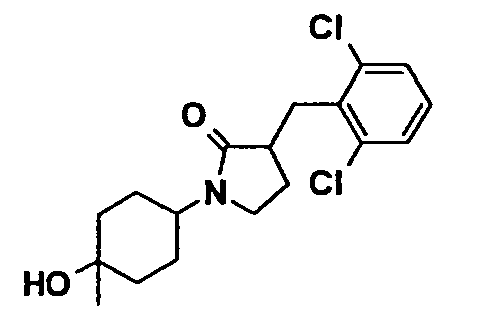
- A mixture of 3-(2,6-dichlorobenzyl)-1-(4-oxocyclohexyl)pyrrolidin-2-one obtained in Example 28A (0.17 g), methylmagnesium bromide (3 M tetrahydrofuran solution, 0.33 mL) and tetrahydrofuran (10 mL) was stirred at room temperature for 1 hr. Saturated aqueous ammonium chloride was added to the reaction solution, and the mixture was extracted with ethyl acetate. The ethyl acetate layer was washed with saturated brine, and dried over anhydrous magnesium sulfate. The solvent was evaporated under reduced pressure, and the residue was subjected to silica gel column chromatography (ethyl acetate) to give the title compound (0.17 g, 95%) as a colorless powder.
LC-MS (ESI+); m/z 356 (M)+ -

- 3-(2,6-Dichlorobenzyl)-1-(4-hydroxycyclohexyl)pyrrolidin-2-one obtained in Example 29A was subjected to resolution with normal phase chiral HPLC (manufactured by Daicel Chemical Industries, Ltd., chiralpak AD (trade name), 50 mmID X 500 mmL, hexane-ethanol 85:15) to give the title compound.
1H NMR (300 MHz, CDCl3) δ ppm 1.22-1.27 (m, 2 H), 1.52-1.97 (m, 8 H), 2.91- 3.09 (m, 2 H), 3.18-3.26 (m, 1 H), 3.35-3.52 (m, 2 H), 3.98-4.08 (m, 2 H), 7.07-7.12 (m, 1 H), 7.29 (d, J=7.8 Hz, 2 H). -

- 3-(2,6-Dichlorobenzyl)-1-(4-hydroxycyclohexyl)pyrrolidin-2-one obtained in Example 29A was subjected to resolution with normal phase chiral HPLC (manufactured by Daicel Chemical Industries, Ltd., chiralpak AD (trade name), 50 mmID X 500 mmL, hexane-ethanol 85:15) to give the title compound.
1H NMR (300 MHz, CDCl3) δ ppm 1.22-1.27 (m, 2 H), 1.37-2.07 (m, 8 H), 2.86-3.07 (m, 2 H), 3.13-3.21 (m, 1 H), 3.28-3.35 (m, 1 H), 3.45-3.60 (m, 2 H), 3.95-4.02 (m, 1 H), 7.07-7.12 (m, 1 H), 7.29 (d, J=7.8 Hz, 2 H). -

- 3-(2,6-Dichlorobenzyl)-1-(4-hydroxycyclohexyl)pyrrolidin-2-one obtained in Example 29A was subjected to resolution with normal phase chiral HPLC (manufactured by Daicel Chemical Industries, Ltd., chiralpak AD (trade name), 50 mmID X 500 mmL, hexane-ethanol 85:15) to give the title compound.
1H NMR (300 MHz, CDCl3) δ ppm 1.22-1.30 (m, 2 H), 1.40-2.07 (m, 8 H), 2.90-3.08 (m, 2 H), 3.13-3.21 (m, 1 H), 3.28-3.35 (m, 1 H), 3.45-3.59 (m, 2 H), 3.95-4.03 (m, 1 H), 7.07-7.13 (m, 1 H), 7.30 (d, J=8.1 Hz, 2 H). -

- 3-(2,6-Dichlorobenzyl)-1-(4-hydroxycyclohexyl)pyrrolidin-2-one obtained in Example 29A was subjected to resolution with normal phase chiral HPLC (manufactured by Daicel Chemical Industries, Ltd., chiralpak AD (trade name), 50 mmID X 500 mmL, hexane-ethanol 85:15) to give the title compound.
1H NMR (300 MHz, CDCl3) δ ppm 1.22-1.25 (m, 2 H), 1.43-1.97 (m, 8 H), 2.91-3.08 (m, 2 H), 3.18-3.26 (m, 1 H), 3.35-3.52 (m, 2 H), 3.97-4.08 (m, 2 H), 7.07-7.12 (m, 1 H), 7.29 (d, J=8.1 Hz, 2 H). -

- 3-(2,6-Dichlorobenzyl)-1-(4-hydroxy-4-methylcyclohexyl)pyrrolidin-2-one obtained in Example 30A was subjected to resolution with normal phase chiral HPLC (manufactured by Daicel Chemical Industries, Ltd., chiralpak AD (trade name), 50 mmID X 500 mmL, hexane-ethanol 85:15) to give the title compound.
1H NMR (300 MHz, CDCl3) δ ppm 1.03 (s, 1 H), 1.25 (s, 3 H), 1.44-1.64 (m, 4 H), 1.64-2.11 (m, 6 H), 2.78-3.14 (m, 2 H), 3.13-3.29 (m, 1 H), 3.32-3.44 (m, 1 H), 3.49 (dd, J=13.2, 4.1 Hz, 1 H), 3.90-4.05 (m, 1 H), 7.00-7.18 (m, 1 H), 7.23-7.37 (m, 2 H). -

- 3-(2,6-Dichlorobenzyl)-1-(4-hydroxy-4-methylcyclohexyl)pyrrolidin-2-one obtained in Example 30A was subjected to resolution with normal phase chiral HPLC (manufactured by Daicel Chemical Industries, Ltd., chiralpak AD (trade name), 50 mmID X 500 mmL, hexane-ethanol 85:15) to give the title compound.
1H NMR (300 MHz, CDCl3) δ ppm 1.29 (s, 3 H), 1.44 (s, 1 H), 1.49-2.09 (m, 10 H), 2.80-3.12 (m, 2 H), 3.13-3.27 (m, 1 H), 3.28-3.41 (m, 1 H), 3.49 (dd, J=13.2, 4.3 Hz, 1 H), 3.86-4.10 (m, 1 H), 7.02-7.16 (m, 1 H), 7.30 (d, J=8.3 Hz, 2 H). -
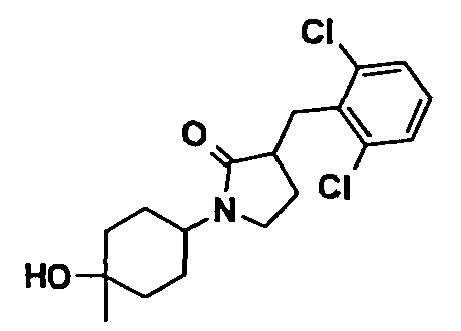
- 3-(2,6-Dichlorobenzyl)-1-(4-hydroxy-4-methylcyclohexyl)pyrrolidin-2-one obtained in Example 30A was subjected to resolution with normal phase chiral HPLC (manufactured by Daicel Chemical Industries, Ltd., chiralpak AD (trade name), 50 mmID X 500 mmL, hexane-ethanol 85:15) to give the title compound.
1H NMR (300 MHz, CDCl3) δ ppm 1.06 (s, 1 H), 1.21-1.28 (m, 1 H), 1.25 (s, 3 H), 1.46-2.03 (m, 9 H), 2.85-2.99 (m, 1 H), 2.99-3.11 (m, 1 H), 3.15-3.29 (m, 1 H), 3.31-3.44 (m, 1 H), 3.49 (dd, J=13.2, 4.3 Hz, 1 H), 3.89-4.05 (m, 1 H), 7.04-7.15 (m, 1 H), 7.27-7.34 (m, 2 H). -

- 3-(2,6-Dichlorobenzyl)-1-(4-hydroxy-4-methylcyclohexyl)pyrrolidin-2-one obtained in Example 30A was subjected to resolution with normal phase chiral HPLC (manufactured by Daicel Chemical Industries, Ltd., chiralpak AD (trade name), 50 mmID X 500 mmL, hexane-ethanol 85:15) to give the title compound.
1H NMR (300 MHz, CDCl3) δ ppm 1.29 (s, 3 H), 1.38 (s, 1 H), 1.45-2.03 (m, 10 H), 2.84-3.09 (m, 2 H), 3.14-3.27 (m, 1 H), 3.29-3.41 (m, 1 H), 3.49 (dd, J=13.2, 4.3 Hz, 1 H), 3.83-4.08 (m, 1 H), 7.04-7.17 (m, 1 H), 7.27-7.33 (m, 2 H). -

- In the same manner as in Example 1A, the title compound was obtained from ethyl 4-(2-oxopyrrolidin-1-yl)piperidine-1-carboxylate obtained in Reference Example 7A and α,2,6-trichlorotoluene.
1H NMR (300 MHz, CDCl3) δ ppm 1.26 (t, J=7.1 Hz, 3 H), 1.43-1.79 (m, 4 H), 1.79-2.13 (m, 2 H), 2.74-3.10 (m, 4 H), 3.10-3.23 (m, 1 H), 3.24-3.38 (m, 1 H), 3.49 (dd, J=13.2, 4.3 Hz, 1 H), 4.07-4.40 (m, 5 H), 7.03-7.16 (m, 1 H), 7.30 (d, J=8.1 Hz, 2 H). Example 40A 3-(2,6-dichlorobenzyl)-1-(piperidin-4-yl)pyrrolidin-2-one
- A mixture of ethyl 4-[3-(2,6-dichlorobenzyl)-2-oxopyrrolidin-1-yl]piperidine-1-carboxylate obtained in Example 39A (2.0 g), trimethylsilyl iodide (5.0 g) and chloroform (20 mL) was stirred at 60°C for 16 hr. Methanol (2 mL), 10% sodium thiosulfate solution (20 mL) and 1N sodium hydroxide solution (10 mL) were added successively to the reaction solution, and the mixture was extracted with ethyl acetate. The ethyl acetate layer was washed with saturated aqueous sodium hydrogencarbonate and saturated brine, and dried over anhydrous magnesium sulfate. The solvent was evaporated under reduced pressure to give the title compound (1.1 g, 67%) as a yellow solid.
1H NMR (300 MHz, CDCl3) δ ppm 1.77-2.09 (m, 6 H), 2.82-3.12 (m, 4 H), 3.17-3.29 (m, 1 H), 3.33-3.56 (m, 4 H), 4.09-4.29 (m, 2 H), 7.05-7.15 (m, 1 H), 7.30 (d, J=8.1 Hz, 2 H). -

- In the same manner as in Example 22A, the title compound was obtained from 3-(2,6-dichlorobenzyl)-1-(piperidin-4-yl)pyrrolidin-2-one obtained in Example 40A and acetyl chloride.
1H NMR (300 MHz, CDCl3) δ ppm 1.48-1.68 (m, 2 H), 1.68-2.03 (m, 4 H), 2.11 (d like, 3 H), 2.51-2.69 (m, 1 H), 2.87-3.24 (m, 4 H), 3.25-3.38 (m, 1 H), 3.49 (dd, J=13.2, 4.3 Hz, 1 H), 3.82-3.96 (m, 1 H), 4.12-4.32 (m, 1 H), 4.67-4.86 (m, 1 H), 7.05-7.15 (m, 1 H), 7.30 (d, J=8.1 Hz, 2 H). -

- In the same manner as in Example 22A, the title compound was obtained from 3-(2,6-dichlorobenzyl)-1-(piperidin-4-yl)pyrrolidin-2-one obtained in Example 40A and methanesulfonyl chloride.
1H NMR (300 MHz, CDCl3) δ ppm 1.72-2.09 (m, 6 H), 2.68-2.86 (m, 2 H), 2.80 (s, 3 H), 2.87-3.12 (m, 2 H), 3.12-3.27 (m, 1 H), 3.26-3.41 (m, 1 H), 3.48 (dd, J=13.0, 4.3 Hz, 1 H), 3.81-4.02 (m, 2 H), 4.03-4.24 (m, 1 H), 7.04-7.16 (m, 1 H), 7.30 (d, J=7.9 Hz, 2 H). -

- In the same manner as in Example 1A, the title compound was obtained from 1-(2,3-dihydro-1H-inden-1-yl)pyrrolidin-2-one 1-(1,2,3,4-tetrahydronaphthalen-1-yl)pyrrolidin-2-one obtained in Reference Example 5A and α-bromo-o-xylene.
1H NMR (300 MHz, CDCl3) δ ppm 1.59-1.77 (m, 1 H), 1.86-2.09 (m, 2 H), 2.30-2.50 (m, 1 H), 2.37 (s, 3 H), 2.52-2.69 (m, 1 H), 2.70-3.19 (m, 5 H), 3.31-3.54 (m, 1 H), 5.75-5.92 (m, 1 H), 6.98-7.32 (m, 8 H). - Example 44A 3-(2,6-dichlorobenzyl)-1-(2,3-dihydro-1H-inden-1-yl)pyrrolidin-2-one

- In the same manner as in Example 1A, the title compound was obtained from 1-(2,3-dihydro-1H-inden-1-yl)pyrrolidin-2-one obtained in Reference Example 5A and α,2,6-trichlorotoluene.
1H NMR (300 MHz, CDCl3) δ ppm 1.75-2.11 (m, 3 H), 2.30-2.58 (m, 1 H), 2.83-3.27 (m, 6 H), 3.47-3.70 (m, 1 H), 5.76-5.91 (m, 1 H), 7.06-7.15 (m, 1 H), 7.14-7.28 (m, 4 H), 7.28-7.37 (m, 2 H). - Example 45A 3-(2-methylbenzyl)-1-(1,2,3,4-tetrahydronaphthalen-1-yl)pyrrolidin-2-one

- In the same manner as in Example 1A, the title compound was obtained from 1-(1,2,3,4-tetrahydronaphthalen-1-yl)pyrrolidin-2-one obtained in Reference Example 6A and α-bromo-o-xylene.
1H NMR (300 MHz, CDCl3) δ ppm 1.61-2.15 (m, 6 H), 2.38 (s, 3 H), 2.53-2.71 (m, 1 H), 2.72-3.01 (m, 4 H), 3.02-3.19 (m, 1 H), 3.39 (dd, J=14.1, 3.8 Hz, 1 H), 5.35-5.57 (m, 1 H), 6.91-7.03 (m, 1 H), 7.03-7.23 (m, 7 H). -

- In the same manner as in Example 1A, the title compound was obtained from 1-(1,2,3,4-tetrahydronaphthalen-1-yl)pyrrolidin-2-one obtained in Reference Example 6A and α, 2, 6-trichlorotoluene.
1H NMR (300 MHz, CDCl3) δ ppm 1.75-2.20 (m, 6 H), 2.72-2.87 (m, 2 H), 2.86-3.02 (m, 1 H), 2.99-3.16 (m, 2 H), 3.18-3.33 (m, 1 H), 3.45-3.69 (m, 1 H), 5.36-5.55 (m, 1 H), 6.93-7.03 (m, 1 H), 7.05-7.20 (m, 4 H), 7.31 (d, J=8.1 Hz, 2 H). -

- In the same manner as in Example 1A, the title compound was obtained from 1-(2,6-dichlorobenzyl)pyrrolidin-2-one obtained in Reference Example 2A and methyl 2-methylbenzoate. 1H NMR (300 MHz, CDCl3) δ ppm 2.07-2.26 (m, 1 H), 2.44-2.59 (m, 1 H), 2.51 (s, 3 H), 3.10-3.24 (m, 1 H), 3.32-3.46 (m, 1 H), 4.42 (dd, J=9.2, 5.3 Hz, 1 H), 4.75-4.94 (m, 2 H), 7.14-7.29 (m, 2 H), 7.28-7.49 (m, 4 H), 8.02 (dd, J=7.5, 0.9 Hz, 1 H).
-
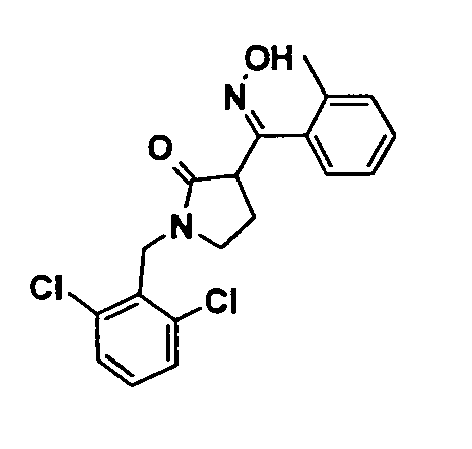
- A mixture of 1-(2,6-dichlorobenzyl)-3-(2-methylbenzoyl)pyrrolidin-2-one obtained in Example 47A (0.38 g), hydroxylamine hydrochloride (0.24 g), sodium acetate (0.26 g) and ethanol-water (4:1, 15 mL) was stirred at 80°C for 16 hr under nitrogen atmosphere. The reaction solution was concentrated under reduced pressure, and the residue was partitioned between ethyl acetate-water. The ethyl acetate layer was washed with saturated brine, and dried over anhydrous magnesium sulfate, and the solvent was evaporated under reduced pressure. The residue was subjected to silica gel column chromatography (hexane-ethyl acetate 95:5-2:3) to give the title compound (0.33 g, 83%) as a colorless solid.
LC-MS (ESI+); m/z 377 (M)+ -

- In the same manner as in Example 48A, the title compound was obtained from 1-(2,6-dichlorobenzyl)-3-(2-methylbenzoyl)pyrrolidin-2-one obtained in Example 47A and O-methylhydroxylamine hydrochloride.
1H NMR (300 MHz, CDCl3) δ ppm 2.07-2.32 (m, 2 H), 2.40 (s, 3 H), 3.15 (dd, J=8.1, 6.0 Hz, 2 H), 3.93-4.07 (m, 1 H), 3.95 (s, 3 H), 4.67-4.75 (d like, 1 H), 4.85-4.94 (d like, 1 H), 7.11-7.40 (m, 7 H). -

- In the same manner as in Example 1A, the title compound was obtained from 1-(2-methylbenzyl)pyrrolidin-2-one obtained in Reference Example 1A and methyl 2,6-dichlorobenzoate.
LC-MS (ESI+); m/z 362 (M)+ -

- In the same manner as in Example 1A, the title compound was synthesized from 1-(1-adamantyl)pyrrolidin-2-one and α,2,6-trichlorotoluene.
1H NMR (300 MHz, CDCl3) δ ppm 1.62-1.95 (m, 8 H), 2.04-2.24 (m, 9 H), 2.75-2.90 (m, 1 H), 2.95-3.07 (m, 1 H), 3.18-3.33 (m, 1 H), 3.40-3.53 (m, 2 H), 7.03-7.13 (m, 1 H), 7.26-7.32 (m, 2 H). - Example 52A 1-(1-adamantyl)-3-(2-methylbenzyl)pyrrolidin-2-one

- In the same manner as in Example 1A, the title compound was synthesized from 1-(1-adamantyl)pyrrolidin-2-one and α-bromo-o-xylene.
1H NMR (300 MHz, CDCl3) δ ppm 1.49-1.79 (m, 7 H), 1.85-2.04 (m, 1 H), 2.04-2.26 (m, 9 H), 2.33 (s, 3 H), 2.42-2.79 (m, 2 H), 3.19-3.47 (m, 3 H), 7.03-7.20 (m, 4 H). - Example 53A 1-(1-adamantyl)-3,3-bis(2-methylbenzyl)pyrrolidin-2-one

- In the same manner as in Example 1A, the title compound was synthesized from 1-(1-adamantyl)pyrrolidin-2-one and α-bromo-o-xylene.
1H NMR (300 MHz, CDCl3) δ ppm 1.61-1.74 (m, 8 H), 1.92-2.07 (m, 9 H), 2.28 (s, 6 H), 2.58 (t, J=7.0 Hz, 2 H), 2.80 (d, J=13.6 Hz, 2 H), 3.10 (d, J=13.6 Hz, 2 H), 7.03-7.18 (m, 6 H), 7.25-7.34 (m, 2 H). -

- In the same manner as in Example 1A, the title compound was obtained from 1-(tetrahydro-2H-pyran-4-yl)pyrrolidin-2-one obtained in Reference Example 8A and 2-methoxybenzyl bromide.
1H NMR (300 MHz, CDCl3) δ ppm 1.51-1.81 (m, 5 H), 1.89-2.03 (m, 1 H), 2.58 (dd, J=13.4, 10.0 Hz, 1 H), 2.74-2.87 (m, 1 H), 3.12-3.21 (m, 2 H), 3.31 (dd, J=13.4, 4.1 Hz, 1 H), 3.44-3.55 (m, 2 H), 3.82 (s, 3 H), 3.98-4.03 (m, 2 H), 4.16-4.30 (m, 1 H), 6.82-6.92 (m, 2 H), 7.12-7.24 (m, 2 H). -

- In the same manner as in Example 1A, the title compound was obtained from 1-(tetrahydro-2H-pyran-4-yl)pyrrolidin-2-one obtained in Reference Example 8A and α,2,6-trichlorotoluene.
1H NMR (300 MHz, CDCl3) δ ppm 1.59-2.11 (m, 6 H), 2.84-3.13 (m, 2 H), 3.12-3.29 (m, 1 H), 3.30-3.41 (m, 1 H), 3.42-3.60 (m, 3 H), 3.94-4.11 (m, 2 H), 4.15-4.36 (m, 1 H), 7.08-7.16 (m, 1 H), 7.28-7.36 (m, 2 H). -

- To a mixture of 3-phenylpyrrolidin-2-one (0.25 g), cyclopropylmethyl bromide (0.23 g) and N,N-dimethylformamide (8 mL) was added 60% sodium hydride (74 mg), and the mixture was stirred at room temperature for 1 hr. Water was added to the reaction solution, and the mixture was extracted with ethyl acetate. The extract was washed successively with water and saturated brine, and dried over anhydrous magnesium sulfate. The solvent was evaporated under reduced pressure, and the residue was subjected to silica gel column chromatography (hexane-ethyl acetate 9:1-3:7) to give the title compound (0.10 g, 30%) as a pale-yellow oil.
1H NMR (300 MHz, CDCl3) δ ppm 0.22-0.30 (m, 2 H), 0.50-0.60 (m, 2 H), 0.90-1.06 (m, 1 H), 2.02-2.22 (m, 1 H), 2.46-2.62 (m, 1 H), 3.19-3.28 (m, 2 H), 3.45-3.74 (m, 3 H), 7.20-7.39 (m, 5 H). - Example 57A 1-(2-methylbenzyl)-3-phenylpyrrolidin-2-one

- In the same manner as in Reference Example 1A, the title compound was obtained from 3-phenylpyrrolidin-2-one and α-bromo-o-xylene.
1H NMR (300 MHz, CDCl3) δ ppm 2.00-2.20 (m, 1 H), 2.33 (s, 3 H), 2.41-2.57 (m, 1 H), 3.18-3.38 (m, 2 H), 3.73 (t, J=8.9 Hz, 1 H), 4.44 (d, J=14.7 Hz, 1 H), 4.63-4.73 (m, 1 H), 7.16-7.39 (m, 9 H). -

- In the same manner as in Reference Example 1A, the title compound was obtained from 3-phenylpyrrolidin-2-one and α,2,6-trichlorotoluene.
1H NMR (300 MHz, CDCl3) δ ppm 2.22-2.50 (m, 2 H), 2.98-3.18 (m, 2 H), 3.25-3.40 (m, 1 H), 4.80-4.95 (m, 1 H), 4.96-5.16 (m, 1 H), 7.19-7.56 (m, 8 H). -

- In the same manner as in Reference Example 1A, the title compound was obtained from 3-phenylpyrrolidin-2-one and α-bromo-o-xylene.
1H NMR (300 MHz, CDCl3)δ ppm 2.03-2.14 (m, 1 H), 2.17 (s, 3 H x2), 2.29-2.45 (m, 1 H), 2.71-2.82 (m, 1 H), 2.86-3.00 (m, 1 H), 3.20 (d, J=13.9 Hz, 1 H), 3.36-3.52 (m, 1 H), 4.31-4.45 (m, 1 H), 4.48-4.63 (m, 1 H), 6.90 (d, J=7.5 Hz, 1 H), 6.99-7.21 (m, 6 H), 7.20-7.41 (m, 4 H), 7.45-7.57 (m, 2 H). - Example 60A 1,3-bis(2,6-dichlorobenzyl)-3-phenylpyrrolidin-2-one
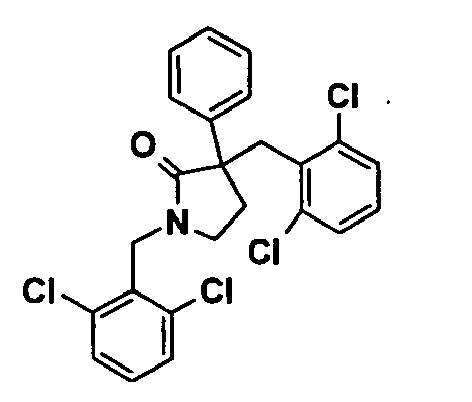
- In the same manner as in Reference Example 1A, the title compound was obtained from 3-phenylpyrrolidin-2-one and α,2,6-trichlorotoluene.
1H NMR (300 MHz, CDCl3) δ ppm 2.27-2.53 (m, 2 H), 2.72-3.01 (m, 2 H), 3.63-3.78 (m, 2 H), 4.78-4.94 (m, 2 H), 6.98-7.35 (m, 9 H), 7.37-7.51 (m, 2 H). - Example 61A 3-(2,6-dichlorobenzyl)-1-(tetrahydro-2H-thiopyran-4-yl)pyrrolidin-2-one

- In the same manner as in Example 1A, the title compound was obtained from 1-(tetrahydro-2H-thiopyran-4-yl)pyrrolidin-2-one obtained in Reference Example 9A and α,2,6-trichlorotoluene. 1H NMR (300 MHz, CDCl3) δ ppm 1.68-2.14 (m, 6 H), 2.57-2.75 (m, 2 H), 2.76-3.11 (m, 4 H), 3.14-3.26 (m, 1 H), 3.28-3.42 (m, 1 H), 3.48 (dd, J=13.2, 4.3 Hz, 1 H), 3.91-4.07 (m, 1 H), 7.04-7.18 (m, 1 H), 7.27-7.35 (m, 2 H).
-

- 3-(2,6-dichlorobenzyl)-1-(tetrahydro-2H-thiopyran-4-yl)pyrrolidin-2-one obtained in Example 61A (0.30 g), m-chloroperbenzoic acid (hydroscopic, 0.28 g) and dichloromethane (15 mL) were stirred at 0°C for 30 min. 10% Sodium thiosulfate was added to the reaction solution, and the mixture was stirred for 20 min, and extracted with dichloromethane. The dichloromethane layer was washed successively with 10% aqueous sodium bicarbonate and saturated brine, and dried over anhydrous magnesium sulfate. The solvent was evaporated under reduced pressure, and the residue was subjected to silica gel column chromatography (ethyl acetate-methanol 10:1) to give the title compound (0.13 g, 42%) as a colorless solid.
1H NMR (300 MHz, CDCl3) δ ppm 1.65-1.83 (m, 1 H), 1.85-2.22 (m, 3 H), 2.45-2.72 (m, 3 H), 2.75-3.60 (m, 8 H), 4.04-4.34 (m, 1 H), 7.03-7.16 (m, 1 H), 7.30 (d, J=7.9 Hz, 2 H). - Example 63A 3-(2,6-dichlorobenzyl)-1-(1,1-dioxidotetrahydro-2H-thiopyran-4-yl)pyrrolidin-2-one

- In the same manner as in Example 62A, to give the title compound (0.27 g, 82%) was obtained as a colorless solid from 3-(2,6-dichlorobenzyl)-1-(tetrahydro-2H-thiopyran-4-yl)pyrrolidin-2-one obtained in Example 61A (0.30 g) and m-chloroperbenzoic acid (hydroscopic, 0.56 g).
1H NMR (300 MHz, CDCl3) δ ppm 1.80-2.20 (m, 4 H), 2.22-2.52 (m, 2 H), 2.85-3.30 (m, 7 H), 3.32-3.53 (m, 2 H), 4.17-4.40 (m, 1 H), 7.06-7.18 (m, 1 H), 7.28-7.37 (m, 2 H). -

- A mixture of 3-(2,6-dichlorobenzyl)-1-(piperidin-4-yl)pyrrolidin-2-one obtained in Example 40A (0.25 g), ethyl iodide (0.12 g), triethylamine (0.11 mL) and N,N-dimethylformamide (3 mL) was stirred at room temperature for 1 day. Water was added to the reaction solution, and the mixture was extracted with ethyl acetate. The extract was washed successively with water and saturated brine, and dried over anhydrous magnesium sulfate. The solvent was evaporated under reduced pressure, and the residue was subjected to silica gel column chromatography (hexane-ethyl acetate 1:1) to give the title compound (0.11 g, 41%) as a pale-brown solid.
1H NMR (300 MHz, CDCl3) δ ppm 1.09 (t, J=7.2 Hz, 3 H), 1.65-2.12 (m, 8 H), 2.42 (q, J=7.2 Hz, 2 H), 2.85-3.08 (m, 4H), 3.12-3.26 (m, 1 H), 3.29-3.42 (m, 1 H), 3.49 (dd, J=13.2, 4.3 Hz, 1 H), 3.96-4.12 (m, 1 H), 7.05-7.13 (m, 1 H), 7.27-7.35 (m, 2 H). Example 65A 1-(2,3-dihydro-1H-inden-1-yl)-3-(2-methoxybenzyl)pyrrolidin-2-one (less polar product)
- In the same manner as in Example 1A, the title compound was obtained from 1-(2, 3-dihydro-1H-inden-1-yl)pyrrolidin-2-one obtained in Reference Example 5A and 2-methoxybenzyl chloride.
1H NMR (300 MHz, CDCl3) δ ppm 1.62-1.79 (m, 1 H), 1.82-2.01 (m, 2 H), 2. 30-2. 48 (m, 1 H), 2.64 (dd, J=13. 4, 10.0 Hz, 1 H), 2.79-3.08 (m, 5 H), 3. 37 (dd, J=13. 4, 4. 1 Hz, 1 H), 3. 82 (s, 3 H), 5. 83 (t, J=7.6 Hz, 1 H), 6.82-6.92 (m, 2 H), 7.08-7.25 (m, 6 H). -

- In the same manner as in Example 1A, the title compound was obtained from 1-(2,3-dihydro-1H-inden-1-yl)pyrrolidin-2-one obtained in Reference Example 5A and 2-methoxybenzyl chloride.
1H NMR (300 MHz, CDCl3) δ ppm 1.57-1.74 (m, 1 H), 1.85-2.02 (m, 2 H), 2.30-2.46 (m, 1 H), 2.64 (dd, J=13.6, 10.2 Hz, 1 H), 2.81-3.12 (m, 5 H), 3.42 (dd, J=13.6, 4. 1 Hz, 1 H), 3.82 (s, 3 H), 5.81 (t, J=7.8 Hz, 1 H), 6.81-6.94 (m, 2 H), 7.05 (d, J=7.2 Hz, 1 H), 7.14-7.25 (m, 5 H) . - Example 67A 3-(2-methoxybenzyl)-1-(1,2,3,4-tetrahydronaphthalen-1-yl)pyrrolidin-2-one

- In the same manner as in Example 1A, the title compound was obtained from 1-(1,2,3,4-tetrahydronaphthalen-1-yl)pyrrolidin-2-one obtained in Reference Example 6A and 2-methoxybenzyl chloride.
1H NMR (300 MHz, CDCl3) δ ppm 1.61-2.03 (m, 6 H), 2.59-3.16 (m, 6 H), 3.37 (dd, J=13.5, 4.2 Hz, 1 H), 3.83 (s, 3 H), 5.45 (dd, J=9.1, 5.4 Hz, 1 H), 6.81-7.03 (m, 3 H), 7.04-7.25 (m, 5 H). Example 68A N-(2-chlorophenyl)-1-cyclohexyl-2-oxopyrrolidine-3-carboxamide
- A mixture of 1-cyclohexyl-2-oxopyrrolidine-3-carboxylic acid obtained in Reference Example 10A (0.70 g), 2-chloroaniline (0.47 g), bis(2-oxo-3-oxazolidinyl)phosphinic chloride (0.93 g), triethylamine (1.0 mL) and dichloromethane (20 mL) was stirred at room temperature for 16 hr. The reaction solution was concentrated, and the residue was partitioned between ethyl acetate-water. The ethyl acetate layer was washed successively with 2N hydrochloric acid and saturated brine, and dried over anhydrous magnesium sulfate, and the solvent was evaporated under reduced pressure to give the title compound (0.94 g, 89%) as a colorless solid.
1H NMR (300 MHz, CDCl3) δ ppm 1.00-1.23 (m, 1 H), 1.27-1.50 (m, 4 H), 1.61-1.96 (m, 5 H), 2.33-2.58 (m, 2 H), 3.28-3.45 (m, 2 H), 3.52 (t, J=9.6 Hz, 1 H), 3.92-4.12 (m, 1 H), 6.95-7.07 (m, 1 H), 7.18-7.32 (m, 1 H), 7.38 (dd, J=8.3, 1.5 Hz, 1 H), 8.41 (dd, J=8.3, 1.5 Hz, 1 H), 10.40 (s, 1 H). -

- In the same manner as in Example 68A, the title compound was obtained from 1-cyclohexyl-2-oxopyrrolidine-3-carboxylic acid obtained in Reference Example 10A and 2-methoxy-N-methylaniline.
1H NMR (300 MHz, CDCl3) δ ppm 1.08 (t, J=11.7 Hz, 1 H), 1.20-1.45 (m, 5 H), 1.53-1.83 (m, 4 H), 1.83-2.00 (m, 1 H), 2.32-2.51 (m, 1 H), 3.08-3.27 (m, 1 H), 3.22 (s, 3 H), 3.32 (dd, J=9.2, 6.6 Hz, 1 H), 3.42-3.53 (m, 1 H), 3.76-3.96 (m, 1 H), 3.82 (s, 3 H), 6.87-7.12 (m, 2 H), 7.28-7.41 (m, 1 H), 7.61 (dd, J=7.7, 1.7 Hz, 1 H). - Example 70A 1-cyclohexyl-N-(2,6-dichlorobenzyl)-2-oxopyrrolidine-3-carboxamide

- A mixture of 1-cyclohexyl-2-oxopyrrolidine-3-carboxylic acid obtained in Reference Example 10A (0.70 g), 2,6-dichlorobenzylamine (0.64 g), 1-ethyl-3-(3'-dimethylaminopropyl)carbodiimide (0.70 g), N-hydroxybenzotriazole (0.49 g) and acetonitrile (20 mL) was stirred at room temperature for 16 hr. Water was added to the reaction solution, and the mixture was extracted with ethyl acetate. The ethyl acetate layer was washed successively with 2N hydrochloric acid, 10% aqueous sodium bicarbonate and saturated brine, was dried over anhydrous magnesium sulfate, and the solvent was evaporated under reduced pressure to give the title compound (1.09 g, 89%) as a colorless solid.
1H NMR (300 MHz, CDCl3) δ ppm 0.99-1.21 (m, 1 H), 1.25-1.46 (m, 4 H), 1.61-1.89 (m, 5 H), 2.22-2.53 (m, 2 H), 3.20-3.44 (m, 3 H), 3.81-4.00 (m, 1 H), 4.64 (dd, J=13.9, 4.9 Hz, 1 H), 4.93 (dd, J=13.9, 6.4 Hz, 1 H), 7.10-7.22 (m, 1 H), 7.28-7.38 (m, 2 H), 8.05-8.18 (m, 1 H). -

- In the same manner as in Example 68A, the title compound was obtained from 1-cyclohexyl-2-oxopyrrolidine-3-carboxylic acid obtained in Reference Example 10A and N-methylbenzylamine.
1H NMR (300 MHz, CDCl3) δ ppm 0.95-1.24 (m, 1 H), 1.23-1.48 (m, 4 H), 1.60-1.91 (m, 5 H), 1.94-2.24 (m, 1 H), 2.53-2.74 (m, 1 H), 2.99 (s, 1 H), 3.18 (s, 2 H), 3.21-3.41 (m, 1 H), 3.46-3.62 (m, 1 H), 3.64-4.04 (m, 2 H), 4.44 and 5.41 (d, J=17.3 Hz, 1 H), 4.65 (s, 1 H), 7.14-7.47 (m, 5 H). -

- In the same manner as in Example 70A, the title compound was obtained from 1-cyclohexyl-2-oxopyrrolidine-3-carboxylic acid obtained in Reference Example 10A and 2-(2-chlorophenyl)ethylamine.
1H NMR (300 MHz, CDCl3) δ ppm 0.98-1.21 (m, 1 H), 1.28-1.50 (m, 4 H), 1.56-1.95 (m, 5 H), 2.19-2.50 (m, 2 H), 2.98 (t, J=7.3 Hz, 2 H), 3.17-3.30 (m, 2 H), 3.30-3.42 (m, 1 H), 3.42-3.69 (m, 2 H), 3.77-3.96 (m, 1 H), 7.10-7.29 (m, 3 H), 7.29-7.40 (m, 1 H), 7.73 (s, 1 H). -

- In the same manner as in Example 68A, the title compound was obtained from 1-cyclohexyl-2-oxopyrrolidine-3-carboxylic acid obtained in Reference Example 10A and N-methylphenethylamine.
1H NMR (300 MHz, CDCl3) δ ppm 0.97-1.20 (m, 1 H), 1.20-1.47 (m, 4 H), 1.57-1.89 (m, 5 H), 1.98-2.40 (m, 1 H), 2.45-2.65 (m, 1 H), 2.76-2.96 (m, 2 H), 2.99 (s, 1 H), 3.10-3.23 (m, 2 H), 3.23-3.37 (m, 1 H), 3.36-3.97 (m, 4 H), 4.06-4.30 (m, 1 H), 7.10-7.38 (m, 5 H). -

- In the same manner as in Example 68A, the title compound was obtained from 1-cyclohexyl-2-oxopyrrolidine-3-carboxylic acid obtained in Reference Example 10A and 4-(2-methylphenyl)piperidine.
1H NMR (300 MHz, CDCl3) δ ppm 1.00-1.23 (m, 1 H), 1.37 (t like, 4 H), 1.59-1.97 (m, 8 H), 2.00-2.22 (m, 2 H), 2.36 (d, J=1.3 Hz, 3 H), 2.57-2.84 (m, 2 H), 2.88-3.08 (m, 1 H), 3.08-3.43 (m, 2 H), 3.47-3.62 (m, 1 H), 3.74-3.98 (m, 2 H), 4.38-4.57 (m, 1 H), 4.73-4.94 (m, 1 H), 7.05-7.21 (m, 3 H), 7.22-7.30 (m, 1 H). -

- In the same manner as in Example 1A, the title compound was obtained from 1-(2,3-dihydro-1H-inden-1-yl)pyrrolidin-2-one obtained in Reference Example 5A and methyl 1-methyl-1H-imidazole-2-carboxylate.
LC-MS (ESI+); m/z 310 (M+H)+ -

- In the same manner as in Example 1A, the title compound was synthesized from 1-(2,3-dihydro-1H-inden-1-yl)pyrrolidin-2-one obtained in Reference Example 5A and methyl 1-methyl-4-phenyl-1H-imidazole-2-carboxylate.
1H NMR (300 MHz, CDCl3) δ ppm 1.94-2.14 (m, 1 H), 2.29-2.55 (m, 3 H), 2.83-3.11 (m, 2 H), 3.17-3.37 (m, 2 H), 4.09 (s, 3 H), 5.17 (dd, J=9.2, 7.9 Hz, 1 H), 5.82 (t, J=7.9 Hz, 1 H), 7.11-7.35 (m, 5 H), 7.34-7.50 (m, 3 H), 7.75-7.87 (m, 2 H). -

- In the same manner as in Example 1A, the title compound was obtained from 1-(1-adamantyl)pyrrolidin-2-one and methyl 1-methyl-1H-imidazole-2-carboxylate.
1H NMR (300 MHz, CDCl3) δ ppm 1.60-1.82 (m, 8 H), 2.01-2.27 (m, 10 H), 2.28-2.48 (m, 1 H), 3.39-3.54 (m, 1 H), 3.56-3.69 (m, 1 H), 4.00 (s, 1 H), 4.99 (dd, J=9.3, 8.0 Hz, 1 H), 7.04 (s, 1 H), 7.20 (s, 1 H). -

- In the same manner as in Example 1A, the title compound was obtained from 1-(1-adamantyl)pyrrolidin-2-one and methyl 1-methyl-4-phenyl-1H-imidazole-2-carboxylate.
1H NMR (300 MHz, CDCl3) δ ppm 1.60-1.82 (m, 7 H), 2.04-2.47 (m, 10 H), 3.44-3.59 (m, 1 H), 3.62-3.75 (m, 1 H), 4.04 (s, 3 H), 5.07 (dd, J=9.4, 7.7 Hz, 1 H), 7.23-7.45 (m, 4 H), 7.73-7.87 (m, 2 H). -

- In the same manner as in Example 1A, the title compound was obtained from 1-(2,3-dihydro-1H-inden-1-yl)pyrrolidin-2-one obtained in Reference Example 5A and 2-chloro-4-fluorobenzyl bromide.
1H NMR (300 MHz, CDCl3) δ ppm 1.62-1.79 (m, 1 H), 1.81-2.14 (m, 2 H), 2.28-2.54 (m, 1 H), 2.72-3.10 (m, 6 H), 3.28-3.55 (m, 1 H), 5.82 (t, J=7.6 Hz, 1 H), 6.87-6.98 (m, 1 H), 7.05-7.36 (m, 6 H). -

- In the same manner as in Example 1A, the title compound was obtained from 1-(2,3-dihydro-1H-inden-1-yl)pyrrolidin-2-one obtained in Reference Example 5A and 2-chloro-4-fluorobenzyl bromide.
1H NMR (300 MHz, CDCl3) δ ppm 1.57-1.78 (m, 1 H), 1.84-2.10 (m, 2 H), 2.29-2.51 (m, 1 H), 2.76-3.03 (m, 5 H), 3.03-3.19 (m, 1 H), 3.32-3.51 (m, 1 H), 5.80 (t, J=7.7 Hz, 1 H), 6.87-6.99 (m, 1 H), 7.03 (d, J=7.2 Hz, 1 H), 7.07-7.28 (m, 4 H), 7.31 (dd, J=8.6, 6.1 Hz, 1 H). - Example 81A 1-(1-adamantyl)-3-(2-methoxybenzyl)pyrrolidin-2-one
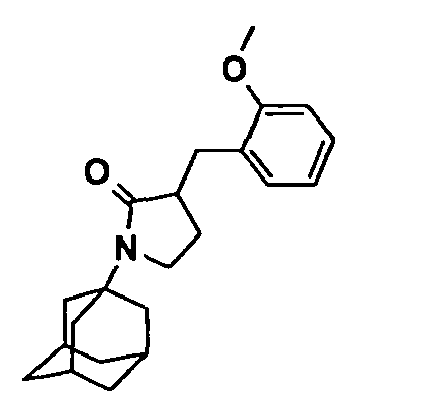
- In the same manner as in Example 1A, the title compound was obtained from 1-(1-adamantyl)pyrrolidin-2-one and 2-methoxybenzyl bromide.
1H NMR (300 MHz, CDCl3) δ ppm 1.52-1.98 (m, 8 H), 2.14 (s, 9 H), 2.44-2.60 (m, 1 H), 2.60-2.80 (m, 1 H), 3.12-3.42 (m, 3 H), 3.81 (s, 3 H), 6.79-6.95 (m, 2 H), 7.07-7.25 (m, 2 H). -

- In the same manner as in Example 1A, the title compound was obtained from 1-(1-adamantyl)pyrrolidin-2-one and 2-chloro-4-fluorobenzyl bromide.
1H NMR (300 MHz, CDCl3) δ ppm 1.50-1.77 (m, 7 H), 1.84-2.01 (m, 1 H), 2.03-2.26 (m, 8 H), 2.59-2.83 (m, 2 H), 3.19-3.44 (m, 3 H), 6.82-6.99 (m, 1 H), 7.10 (dd, J=8.5, 2.6 Hz, 1 H), 7.18-7.31 (m, 2 H). -

- In the same manner as in Example 1A, the title compound was obtained from 1-(1,4-dioxaspiro[4.5]dec-8-yl)pyrrolidin-2-one and 2-chloro-4-fluorobenzyl bromide.
1H NMR (300 MHz, CDCl3) δ ppm 1.60-1.90 (m, 9 H), 1.93-2.12 (m, 1 H), 2.69-2.86 (m, 2 H), 3.12-3.40 (m, 3 H), 3.94 (s, 4 H), 4.05 (dd, J=10.8, 3.1 Hz, 1 H), 6.84-6.97 (m, 1 H), 7.10 (dd, J=8.7, 2.6 Hz, 1 H), 7.19-7.32 (m, 1 H). -

- In the same manner as in Example 28A, the title compound was obtained from 3-(2-chloro-4-fluorobenzyl)-1-(1,4-dioxaspiro[4.5]dec-8-yl)pyrrolidin-2-one obtained in Example 83A.
1H NMR (300 MHz, CDCl3) δ ppm 1.63-2.19 (m, 6 H), 2.36-2.63 (m, 4 H), 2.70-2.91 (m, 2 H), 3.15-3.28 (m, 2 H), 3.27-3.43 (m, 1 H), 4.39-4.61 (m, 1 H), 6.85-7.00 (m, 1 H), 7.12 (dd, J=8.5, 2.6 Hz, 1 H), 7.20-7.36 (m, 1 H). -

- In the same manner as in Example 29A, the title compound was obtained from 3-(2-chloro-4-fluorobenzyl)-1-(4-oxocyclohexyl)pyrrolidin-2-one obtained in Example 84A.
LC-MS (ESI+); m/z 326 (M+H)+ -

- In the same manner as in Example 30A, the title compound was obtained from 3-(2-chloro-4-fluorobenzyl)-1-(4-oxocyclohexyl)pyrrolidin-2-one obtained in Example 84A.
LC-MS (ESI+); m/z 340 (M+H)+ -

- In the same manner as in Example 30A, the title compound was obtained from 3-(2-chloro-4-fluorobenzyl)-1-(4-oxocyclohexyl)pyrrolidin-2-one obtained in Example 84A.
LC-MS (ESI+); m/z 340 (M+H)+ -
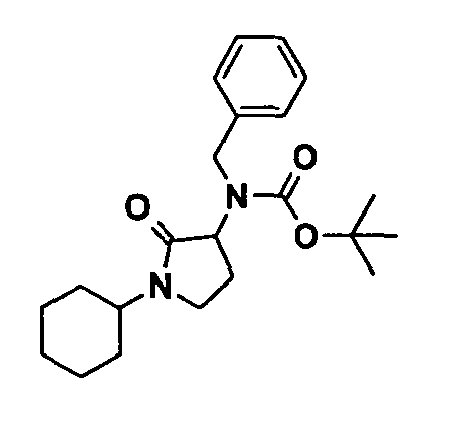
- In the same manner as in Example 56A, the title compound was obtained from tert-butyl (1-cyclohexyl-2-oxopyrrolidin-3-yl)carbamate obtained in Reference Example 11A and benzyl bromide.
1H NMR (300 MHz, CDCl3)δ ppm 0.96-1.19 (m, 1 H), 1.18-1.56 (m, 13 H), 1.56-2.27 (m, 7 H), 2.96-3.36 (m, 2 H), 3.82-4.06 (m, 1 H), 4.34 (s, 1 H), 4.42-4.83 (m, 2 H), 7.16-7.40 (m, 5 H). -

- In the same manner as in Example 20A, the title compound was obtained from tert-butyl (benzyl)(1-cyclohexyl-2-oxopyrrolidin-3-yl)carbamate obtained in Example 88A.
1H NMR (300 MHz, CDCl3) δ ppm 0.92-1.21 (m, 1 H), 1.21-1.56 (m, 4 H), 1.64 (s, 2 H), 1.81 (d like, 3 H), 2.27 (d, J=4.9 Hz, 1 H), 2.44 (d, J=7.5 Hz, 1 H), 3.10-3.29 (m, 1 H), 3.46-3.73 (m, 2 H), 3.79-4.00 (m, 1 H), 4.30-4.54 (m, 2 H), 7.29-7.50 (m, 3 H), 7.67-7.80 (m, 2 H), 10.22 (s, 1 H). -

- In the same manner as in Example 56A, the title compound was obtained from tert-butyl (1-cyclohexyl-2-oxopyrrolidin-3-yl)carbamate obtained in Reference Example 11A and α,2,6-trichlorotoluene.
1H NMR (300 MHz, CDCl3) δ ppm 1.29-1.53 (m, 12 H), 1.54-1.90 (m, 7 H), 2.06-2.28 (m, 1 H), 3.02 (q, J=8.6 Hz, 1 H), 3.14-3.42 (m, 1 H), 3.43-3.73 (m, 1 H), 3.91 (t, J=10.5 Hz, 1 H), 4.79-4.94 (m, 2 H), 5.13 (d, J=13.9 Hz, 1 H), 7.12-7.23 (m, 1 H), 7.30-7.40 (m, 2 H) . -

- In the same manner as in Example 20A, the title compound was obtained from tert-butyl (1-cyclohexyl-2-oxopyrrolidin-3-yl)(2,6-dichlorobenzyl)carbamate obtained in Example 90A.
1H NMR (300 MHz, CDCl3) δ ppm 1.21-1.53 (m, 4 H), 1.58-1.97 (m, 6 H), 2.32-2.56 (m, 1 H), 2.76-3.03 (m, 1 H), 3.19-3.38 (m, 1 H), 3.62 (t, J=8.6 Hz, 2 H), 3.77-3.97 (m, 1 H), 4.59-4.72 (m, 1 H), 4.76-4.90 (m, 1 H), 7.30-7.39 (m, 1 H), 7.39-7.47 (m, 2 H). Example 92A tert-butyl (1-cyclohexyl-2-oxopyrrolidin-3-yl)(methyl)carbamate
- In the same manner as in Example 56A, the title compound was obtained from tert-butyl (1-cyclohexyl-2-oxopyrrolidin-3-yl)carbamate obtained in Reference Example 11A and methyl iodide.
1H NMR (300 MHz, CDCl3) δ ppm 0.96-1.22 (m, 1 H), 1.30-1.53 (m, 4 H), 1.44-1.50 (m, 9 H), 1.59-1.86 (m, 6 H), 2.27 (d, J=7.2 Hz, 1 H), 2.78 (d like, 3 H), 3.12-3.42 (m, 2 H), 3.85-4.05 (m, 1 H), 4.45-5.01 (m, 1 H). -

- In the same manner as in Example 20A, the title compound was obtained from tert-butyl (l-cyclohexyl-2-oxopyrrolidin-3-yl)(methyl)carbamate obtained in Example 92A.
1H NMR (300 MHz, CDCl3) δ ppm 1.01-1.56 (m, 5 H), 1.59-1.92 (m, 5 H), 2.50 (d, J=6.4 Hz, 2 H), 2.87 (s, 3 H), 3.25-3.40 (m, 1 H), 3.53-3.66 (m, 1 H), 3.79-3.98 (m, 1 H), 4.10 (t, J=8.0 Hz, 1 H), 9.78 (s, 1 H). -

- A mixture of 1-cyclohexyl-3-(methylamino)pyrrolidin-2-one hydrochloride obtained in Example 93A (0.23 g), α, 2, 6-trichlorotoluene (0.22 g), potassium carbonate (0.29 g), potassium iodide (0.18 g) and N,N-dimethylformamide (10 mL) was stirred at room temperature for 16 hr. Water was added to the reaction solution, and the mixture was extracted with ethyl acetate. The ethyl acetate layer was washed with water and saturated brine, and dried over anhydrous magnesium sulfate, and the solvent was evaporated under reduced pressure. The residue was subjected to NH-silica gel column chromatography (hexane-ethyl acetate 9:1) to give the title compound (0.32 g, 90%) as a colorless solid.
1H NMR (300 MHz, CDCl3) δ ppm 0.97-1.21 (m, 1 H), 1.25-1.51 (m, 4 H), 1.62-1.88 (m, 5 H), 1.98-2.28 (m, 2 H), 2. 33 (s, 3 H), 3.18-3.41 (m, 2 H), 3.70 (dd, J=9.0, 7.9 Hz, 1 H), 3.90-4.05 (m, 1 H), 4.05-4.13 (m, 1 H), 4.17-4.25 (m, 1 H), 7.08-7.18 (m, 1 H), 7.27-7.33 (m, 2 H). - Example 95A 2,6-dichloro-N-(1-cyclohexyl-2-oxopyrrolidin-3-yl)-N-methylbenzamide

- In the same manner as in Example 68A, the title compound was obtained from 1-cyclohexyl-3-(methylamino)pyrrolidin-2-one hydrochloride obtained in Example 93A and 2,6-dichlorobenzoic acid.
1H NMR (300 MHz, CDCl3) δ ppm 1.00-1.25 (m, 1 H), 1.28-1.52 (m, 4 H), 1.62-1.89 (m, 5 H), 1.96-2.14 (m, 1 H), 2.41-2.55 (m, 1 H), 2.80 (s, 3 H), 3.27-3.50 (m, 2 H), 3.90-4.05 (m, 1 H), 5.34 (t, J=9.4 Hz, 1 H), 7.20-7.29 (m, 1 H), 7.29-7.39 (m, 2 H). -

- In the same manner as in Example 1A, the title compound was synthesized from 1-[methyl(phenyl)amino]pyrrolidin-2-one and α-bromo-o-xylene.
1H NMR (300 MHz, CDCl3) δ ppm 1.72-1.94 (m, 1 H), 2.08-2.25 (m, 1 H), 2.37 (s, 3 H), 2.64-2.87 (m, 2 H), 3.15 (s, 3 H), 3.26-3.51 (m, 3 H), 6.63-6.76 (m, 2 H), 6.87 (t, J=7.3 Hz, 1 H), 7.06-7.33 (m, 6 H). -

- In the same manner as in Example 1A, the title compound was synthesized from 1-[methyl(phenyl)amino]pyrrolidin-2-one and α,2,6-trichlorotoluene.
1H NMR (300 MHz, CDCl3) δ ppm 1.93-2.14 (m, 2 H), 2.92-3.11 (m, 1 H), 3.11-3.28 (m, 1 H), 3.17 (s, 3 H), 3.31-3.49 (m, 2 H), 3.56 (dd, J=13.6, 4.7 Hz, 1 H), 6.70-6.80 (m, 2 H), 6.88 (t, J=7.3 Hz, 1 H), 7.06-7.19 (m, 1 H), 7.20-7.38 (m, 4 H). -

- In the same manner as in Example 1A, the title compound was obtained from 1-[(1R)-1-phenylethyl] pyrrolidin-2-one and benzyl bromide.
1H NMR (300 MHz, CDCl3) δ ppm 1.45 (d, J=7.2 Hz, 3 H), 1.61-1.77 (m, 1 H), 1.86-2.03 (m, 1 H), 2.63-2.86 (m, 3 H), 2.97-3.11 (m, 1 H), 3.15-3.30 (m, 1 H), 5.51 (q, J=7.2 Hz, 1 H), 7.02-7.55 (m, 10 H). -

- In the same manner as in Example 1A, the title compound was obtained from 1-[(1R)-1-phenylethyl]pyrrolidin-2-one and benzyl bromide.
1H NMR (300 MHz, CDCl3) δ ppm 1.51 (d, J=7.1 Hz, 3 H), 1.55-1.70 (m, 1 H), 1.91-2.04 (m, 1 H), 2.58-2.94 (m, 3 H), 3.07-3.38 (m, 2 H), 5.50 (q, J=7.1 Hz, 1 H), 6.87-7.54 (m, 10 H). -
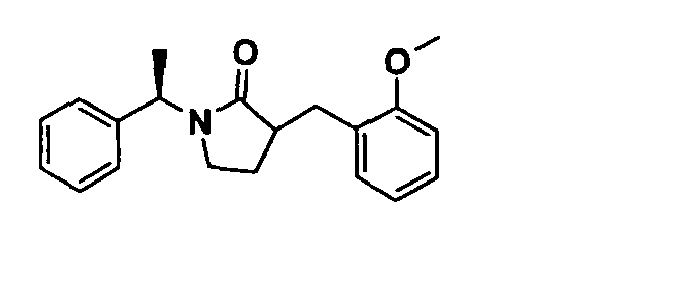
- In the same manner as in Example 1A, the title compound was obtained from 1-[(1R)-1-phenylethyl]pyrrolidin-2-one and 2-methoxybenzyl chloride.
1H NMR (300 MHz, CDCl3) δ ppm 1.50 (d, J=7.1 Hz, 3 H), 1.59-1.75 (m, 1 H), 1.76-1.96 (m, 1 H), 2.51-2.69 (m, 1 H), 2.68-2.92 (m, 2 H), 3.02-3.21 (m, 1 H), 3.26-3.43 (m, 1 H), 3.81 (s, 3 H), 5.53 (q, J=7.1 Hz, 1 H), 6.77-6.98 (m, 2 H), 7.11-7.41 (m, 7 H). -

- In the same manner as in Example 1A, the title compound was obtained from 1-[(1R)-1-phenylethyl]pyrrolidin-2-one and 2-methoxybenzyl chloride.
1H NMR (300 MHz, CDCl3) δ ppm 1.51 (d, J=7.0 Hz, 3 H), 1.56-1.70 (m, 1 H), 1.77-2.06 (m, 1 H), 2.57 (m, 1 H), 2.74-2.98 (m, 2 H), 3.05-3.23 (m, 1 H), 3.29-3.48 (m, 1 H), 3.80 (s, 3 H), 5.51 (q, J=7.0 Hz, 1 H), 6.68-6.95 (m, 2 H), 7.03-7.50 (m, 7 H). -

- In the same manner as in Example 1A, the title compound was obtained from 1-[(1R)-1-phenylethyl]pyrrolidin-2-one and 2,6-difluorobenzyl chloride.
1H NMR (300 MHz, CDCl3) δ ppm 1.53 (d, J=7.3 Hz, 3 H), 1.66-1.83 (m, 1 H), 1.83-2.01 (m, 1 H), 2.63-2.90 (m, 3 H), 3.16-3.39 (m, 2 H), 5.53 (q, J=7.3 Hz, 1 H), 6.75-6.96 (m, 2 H), 7.09-7.23 (m, 1 H), 7.22-7.39 (m, 5 H). -

- In the same manner as in Example 1A, the title compound was obtained from 1-[(1R)-1-phenylethyl]pyrrolidin-2-one and 2,6-difluorobenzyl chloride.
1H NMR (300 MHz, CDCl3) δ ppm 1.52 (d, J=7.1 Hz, 3 H), 1.56-1.73 (m, 1 H), 1.85-2.06 (m, 1 H), 2.59-2.86 (m, 2 H), 2.86-3.00 (m, 1 H), 3.08-3.25 (m, 1 H), 3.27-3.41 (m, 1 H), 5.50 (q, J=7.1 Hz, 1 H), 6.73-6.95 (m, 2 H), 7.07-7.21 (m, 1 H), 7.22-7.43 (m, 5 H). -
- In the same manner as in Example 1A, the title compound was obtained from 1-[(1R)-1-phenylethyl]pyrrolidin-2-one and 2-trifluoromethylbenzyl chloride.
1H NMR (300 MHz, CDCl3) δ ppm 1.47-1.70 (m, 4 H), 1.85-2.02 (m, 1 H), 2.69-2.98 (m, 3 H), 3.14-3.28 (m, 1 H), 3.39-3.54 (m, 1 H), 5.54 (q, J=7.1 Hz, 1 H), 7.20-7.38 (m, 6 H), 7.40-7.55 (m, 2 H), 7.63 (d, J=7.7 Hz, 1 H) . -

- In the same manner as in Example 1A, the title compound was obtained from 1-[(1R)-1-phenylethyl]pyrrolidin-2-one and 2-trifluoromethylbenzyl chloride.
1H NMR (300 MHz, CDCl3) δ ppm 1.42-1.57 (m, 5 H), 1.91-2.04 (m, 1 H), 2.76-2.99 (m, 3 H), 3.09-3.26 (m, 1 H), 3.41-3.56 (m, 1 H), 7.20-7.39 (m, 6 H), 7.40-7.48 (m, 2 H), 7.62 (d, J=7.9 Hz, 1 H). -

- In the same manner as in Example 1A, the title compound was obtained from 1-(1-methyl-1-phenylethyl)pyrrolidin-2-one obtained in Reference Example 3A and 2,6-difluorobenzyl chloride.
1H NMR (300 MHz, CDCl3) δ ppm 1.60-1.83 (m, 7 H), 1.87-2.03 (m, 1 H), 2.58-2.81 (m, 2 H), 3.15-3.40 (m, 3 H), 6.76-6.95 (m, 2 H), 7.05-7.38 (m, 6 H). -

- In the same manner as in Example 1A, the title compound was obtained from 1-(1-methyl-1-phenylethyl)pyrrolidin-2-one obtained in Reference Example 3A and 2-trifluoromethylbenzyl chloride.
1H NMR (300 MHz, CDCl3) δ ppm 1.49-1.69 (m, 1 H), 1.74 (s, 3 H), 1.78 (s, 3 H), 1.87-2.04 (m, 1 H), 2.68-2.82 (m, 1 H), 2.82-2.97 (m, 1 H), 3.22-3.32 (m, 2 H), 3.32-3.44 (m, 1 H), 7.18-7.28 (m, 2 H), 7.28-7.35 (m, 4 H), 7.36-7.50 (m, 2 H), 7.57-7.67 (m, 1 H). -

- In the same manner as in Example 1A, the title compound was obtained from 1-cyclohexylpyrrolidin-2-one and 2,6-difluorobenzyl chloride.
1H NMR (300 MHz, CDCl3) δ ppm 0.97-1.18 (m, 1 H), 1.23-1.51 (m, 4 H), 1.60-1.86 (m, 6 H), 1.90-2.08 (m, 1 H), 2.59-2.84 (m, 2 H), 3.07-3.35 (m, 3 H), 3.85-4.07 (m, 1 H), 6.77-6.96 (m, 2 H), 7.07-7.23 (m, 1 H). -

- In the same manner as in Example 1A, the title compound was obtained from 1-cyclohexylpyrrolidin-2-one and 2-trifluoromethylbenzyl chloride.
1H NMR (300 MHz, CDCl3) δ ppm 0.95-1.19 (m, 1 H), 1.23-1.47 (m, 4 H), 1.56-1.86 (m, 6 H), 1.92-2.08 (m, 1 H), 2.69-2.94 (m, 2 H), 3.10-3.28 (m, 2 H), 3.36-3.48 (m, 1 H), 3.88-4.04 (m, 1 H), 7.28-7.35 (m, 1 H), 7.40-7.51 (m, 2 H), 7.59-7.66 (m, 1 H). Example 110A 3-[4-(chloromethyl)benzoyl]-1-cyclohexylpyrrolidin-2-one
- In the same manner as in Example 1A, the title compound was obtained from 1-cyclohexylpyrrolidin-2-one and methyl 4-(chloromethyl)benzoate,
1H NMR (300 MHz, CDCl3) δ ppm 1.04-1.47 (m, 6 H), 1.62-1.87 (m, 6 H), 2.13-2.30 (m, 1 H), 2.54-2.68 (m, 1 H), 3.33-3.44 (m, 1 H), 3.50-3.62 (m, 1 H), 3.80-3.94 (m, 1 H), 4.45 (dd, J=9.2, 4.9 Hz, 1 H), 4.62 (s, 2 H), 7.50 (d, J=8.5 Hz, 1 H), 8.14 (d, J=8.5 Hz, 1 H). -

- In the same manner as in Example 1A, the title compound was obtained from 1-cyclohexylpyrrolidin-2-one and 2-methoxybenzyl chloride.
1H NMR (300 MHz, CDCl3) δ ppm 0.97-1.17 (m, 1 H), 1.27-1.49 (m, 4 H), 1.58-1.84 (m, 6 H), 1.86-2.00 (m, 1 H), 2.57 (dd, J=13.6, 10.1 Hz, 1 H), 2.70-2.86 (m, 1 H), 3.11-3.21 (m, 2 H), 3.31 (dd, J=13.6, 4.1 Hz, 1 H), 3.81 (s, 3 H), 3.87-4.04 (m, 1 H), 6.77-6.93 (m, 2 H), 7.11-7.23 (m, 2 H). -

- In the same manner as in Example 1A, the title compound was obtained from 1-cyclohexylpyrrolidin-2-one and 3-methoxybenzyl chloride.
1H NMR (300 MHz, CDCl3) δ ppm 0.96-1.20 (m, 1 H), 1.21-1.50 (m, 4 H), 1.59-1.87 (m, 6 H), 1.93-2.13 (m, 1 H), 2.53-2.84 (m, 2 H), 3.04-3.27 (m, 3 H), 3.79 (s, 3 H), 3.88-4.05 (m, 1 H), 6.68-6.84 (m, 3 H), 7.12-7.25 (m, 1 H). -

- In the same manner as in Example 1A, the title compound was obtained from 1-cyclohexylpyrrolidin-2-one and 4-methoxybenzyl chloride.
1H NMR (300 MHz, CDCl3) δ ppm 0.96-1.49 (m, 5 H), 1.54-1.86 (m, 6 H), 1.89-2.13 (m, 1 H), 2.58-2.78 (m, 2 H), 3.00-3.22 (m, 3 H), 3.78 (s, 3 H), 3.85-4.04 (m, 1 H), 6.82 (d, J=8.7 Hz, 2 H), 7.12 (d, J=8.7 Hz, 2 H). -

- In the same manner as in Example 1A, the title compound was obtained from 1-cyclohexylpyrrolidin-2-one and 4-bromobenzyl bromide.
1H NMR (300 MHz, CDCl3) δ ppm 0.99-1.18 (m, 1 H), 1.18-1.50 (m, 4 H), 1.50-1.87 (m, 6 H), 1.89-2.20 (m, 1 H), 2.53-2.83 (m, 2 H), 2.99-3.36 (m, 3 H), 3.75-4.10 (m, 1 H), 7.08 (d, J=8.3 Hz, 2 H), 7.39 (d, J=8.3 Hz, 2 H). -

- A mixture of 3-(4-bromobenzyl)-1-cyclohexylpyrrolidin-2-one obtained in Example 114A (1.37 g), palladium acetate (45 mg), 1,1'-bis(diphenylphosphino)ferrocene (0.11 g), triethylamine (0.62 mL), methanol (32 mL) and tetrahydrofuran (32 mL) was stirred at 100°C for 8 hr under carbon monoxide atmosphere (0.2 Mpa). The insoluble substance was removed, water was added to the filtrate, and the mixture was extracted with ethyl acetate. The ethyl acetate layer was washed with saturated brine, and dried over anhydrous magnesium sulfate. The solvent was evaporated under reduced pressure, and the residue was subjected to silica gel column chromatography (hexane-ethyl acetate 9:1-3:2) to give the title compound (0.03 g, 2%) as a brown oil.
1H NMR (300 MHz, CDCl3) δ ppm 0.91-1.51 (m, 5 H), 1.53-1.87 (m, 6 H), 1.88-2.19 (m, 1 H), 2.63-2.89 (m, 2 H), 2.98-3.39 (m, 3 H), 3.74-4.10 (m, 4 H), 7.28 (d, J=7.8 Hz, 2 H), 7.95 (d, J=7.8 Hz, 2 H). - Example 116A 1-cyclohexyl-3-[4-(piperidin-1-ylmethyl)benzoyl]pyrrolidin-2-one

- A mixture of 3-[4-(chloromethyl)benzoyl]-1-cyclohexylpyrrolidin-2-one obtained in Example 110A (0.17 g), piperidine (0.18 mL), potassium iodide (88 mg) and ethyl acetate (7 mL) was stirred at room temperature for 16 hr. The reaction mixture was extracted with water and ethyl acetate, and the ethyl acetate layer was washed with saturated brine, and dried over anhydrous magnesium sulfate. The solvent was evaporated under reduced pressure, and the residue was subjected to NH-silica gel column chromatography (hexane-ethyl acetate 9:1-3:2) to give the title compound (0.14 g, 72%) as an orange powder.
1H NMR (300 MHz, CDCl3)δ ppm 1.03-1.50 (m, 8 H), 1.50-1.89 (m, 8 H), 2.12-2.28 (m, 1 H), 2.30-2.43 (m, 4 H), 2.50-2.69 (m, 1 H), 3.29-3.46 (m, 1 H), 3.47-3.63 (m, 3 H), 3.81-3.96 (m, 1 H), 4.46 (dd, J=9.1, 4.8 Hz, 1 H), 7.44 (d, J=8.3 Hz, 2 H), 8.07 (d, J=8.3 Hz, 2 H). -

- In the same manner as in Example 1A, the title compound was obtained from 1-(2,6-dichlorobenzyl)pyrrolidin-2-one obtained in Reference Example 2A and 2-methoxybenzyl chloride.
1H NMR (300 MHz, CDCl3) δ ppm 1.55-1.75 (m, 1 H), 1.79-1.95 (m, 1 H), 2.53-2.66 (m, 1 H), 2.74-2.90 (m, 1 H), 2.92-3.07 (m, 2 H), 3.30-3.42 (m, 1 H), 3.80 (s, 3 H), 4.75-4.90 (m, 2 H), 6.80-6.93 (m, 2 H), 7.09-7.40 (m, 5 H). -

- To a mixture of 1-(2,6-dichlorobenzyl)pyrrolidin-2-one obtained in Reference Example 2A (0.72 g) and tetrahydrofuran (20 mL) was added lithium bis(trimethylsilyl)amide (1.1 M tetrahydrofuran solution, 2.95 mL) at -78°C under nitrogen atmosphere, and the mixture was stirred at -78°C for 1 hr. Boron trifluoride ether complex (0.37 mL) and cyclohexanone (0.40 mL) were added to the reaction mixture at -78°C, and the mixture was stirred at -78°C for 3 hr. Saturated aqueous ammonium chloride and water was added to the reaction mixture, and the mixture was extracted with ethyl acetate. The ethyl acetate layer was washed with saturated brine, and dried over anhydrous magnesium sulfate. The solvent was evaporated under reduced pressure, and the residue was subjected to silica gel column chromatography (hexane-ethyl acetate 85:15) to give the title compound (0.36 g, 35%) as a colorless powder.
1H NMR (300 MHz, CDCl3) δ ppm 0.96-1.21 (m, 1 H), 1.23-1.42 (m, 2 H), 1.42-1.88 (m, 8 H), 1.92-2.10 (m, 1 H), 2.59 (t, J=9.8 Hz, 1 H), 2.97-3.19 (m, 2 H), 4.41-4.51 (m, 1 H), 4.66 (d, J=14.0 Hz, 1 H), 4.94 (d, J=14.0 Hz, 1 H), 7.14-7.40 (m, 3 H). -

- In the same manner as in Example 1A, the title compound was obtained from 1-cyclohexylpyrrolidin-2-one and 2-chloromethylnaphthalene.
1H NMR (300 MHz, CDCl3) δ ppm 0.93-1.49 (m, 5 H), 1.56-1.88 (m, 8 H), 1.92-2.13 (m, 1 H), 2.73-2.91 (m, 2 H), 3.30-3.47 (m, 1 H), 3.87-4.07 (m, 1 H), 7.32-7.53 (m, 3 H), 7.64 (brs, 1 H), 7.71-7.88 (m, 3 H). -

- In the same manner as in Example 1A, the title compound was obtained from 1-cyclohexylpyrrolidin-2-one and 1-chloromethylnaphthalene.
1H NMR (300 MHz, CDCl3) δ ppm 1.19-1.52 (m, 5 H), 1.62-2.02 (m, 7 H), 2.76-2.97 (m, 2 H), 3.04-3.29 (m, 2 H), 3.84-4.06 (m, 2 H), 7.30-7.43 (m, 2 H), 7.43-7.59 (m, 2 H), 7.74 (d, J=7.9 Hz, 1 H), 7.81-7.90 (m, 1 H), 8.15 (d, J=8.3 Hz, 1 H). -

- In the same manner as in Example 1A, the title compound was obtained from 1-cyclohexylpyrrolidin-2-one and 2-chlorobenzyl bromide.
1H NMR (300 MHz, CDCl3) δ ppm 0.97-1.50 (m, 5 H), 1.54-1.86 (m, 6 H), 1.88-2.09 (m, 1 H), 2.68-2.92 (m, 2 H), 3.07-3.27 (m, 2 H), 3.29-3.49 (m, 1 H), 3.84-4.04 (m, 1 H), 7.07-7.43 (m, 4 H). - Example 122A 3-(3-chlorobenzyl)-1-cyclohexylpyrrolidin-2-one

- In the same manner as in Example 1A, the title compound was obtained from 1-cyclohexylpyrrolidin-2-one and 3-chlorobenzyl bromide.
1H NMR (300 MHz, CDCl3) δ ppm 1.20-1.49 (m, 4 H), 1.53-1.86 (m, 6 H), 1.95-2.11 (m, 1 H), 2.57-2.79 (m, 2 H), 3.02-3.24 (m, 3 H), 3.86-4.03 (m, 1 H), 7.05-7.13 (m, 1 H), 7.16-7.24 (m, 3 H), 7.26 (s, 1 H). -

- In the same manner as in Example 1A, the title compound was obtained from 1-cyclohexylpyrrolidin-2-one and 4-chlorobenzyl bromide.
1H NMR (300 MHz, CDCl3) δ ppm 0.83-1.18 (m, 1 H), 1.19-1.49 (m, 5 H), 1.53-1.86 (m, 5 H), 1.90-2.11 (m, 1 H), 2.59-2.75 (m, 2 H), 3.01-3.27 (m, 3 H), 3.81-4.03 (m, 1 H), 7.09-7.18 (m, 2 H), 7.20-7.28 (m, 2 H). -
- In the same manner as in Example 1A, the title compound was obtained from 1-cyclohexylpyrrolidin-2-one and 3-methylbenzyl bromide.
1H NMR (300 MHz, CDCl3) δ ppm 1.21-1.50 (m, 5 H), 1.52-1.85 (m, 6 H), 1.91-2.11 (m, 1 H), 2.32 (s, 3 H), 2.54-2.79 (m, 2 H), 2.99-3.24 (m, 3 H), 3.85-4.03 (m, 1 H), 6.92-7.07 (m, 3 H), 7.09-7.22 (m, 1 H). -

- In the same manner as in Example 1A, the title compound was obtained from 1-cyclohexylpyrrolidin-2-one and 4-methylbenzyl bromide.
1H NMR (300 MHz, CDCl3) δ ppm 1.15-1.50 (m, 4 H), 1.53-1.85 (m, 7 H), 1.88-2.11 (m, 1 H), 2.31 (s, 3 H), 2.43-2.82 (m, 2 H), 2.98-3.28 (m, 3 H), 3.82-4.03 (m, 1 H), 7.01-7.16 (m, 4 H). -

- In the same manner as in Example 1A, the title compound was obtained from 1-cyclohexylpyrrolidin-2-one and 4-(methylthio)benzyl chloride.
1H NMR (300 MHz, CDCl3) δ ppm 1.23-1.46 (m, 6 H), 1.56-1.83 (m, 6 H), 1.92-2.10 (m, 1 H), 2.46 (s, 3 H), 2.57-2.75 (m, 2 H), 3.03-3.23 (m, 3 H), 7.08-7.23 (m, 4 H). -

- To a mixture of 1-cyclohexyl-3-[4-(methylthio)benzyl]pyrrolidin-2-one obtained in Example 126A (0.31 g) and tetrahydrofuran (5 mL) was added a mixture of Oxone (trade name)-persulfate compound (0.34 g) and water (5 mL) under ice-cooling, and the mixture was stirred for 30 min under ice-cooling, and then at room temperature for 1 hr. Aqueous sodium hydrogen sulfite and water were added to the reaction mixture, and the mixture was extracted with ethyl acetate. The ethyl acetate layer was washed with saturated brine, and dried over anhydrous magnesium sulfate. The solvent was evaporated under reduced pressure, and the residue was subjected to silica gel column chromatography (ethyl acetate-ethyl acetate-methanol 85:15) to give the title compound (0.22 g, 68%) as a colorless solid.
1H NMR (300 MHz, CDCl3) δ ppm 0.98-1.48 (m, 5 H), 1.54-1.86 (m, 6 H), 1.95-2.13 (m, 1 H), 2.72 (s, 3 H), 2.74-2.86 (m, 2 H), 3.02-3.33 (m, 3 H), 3.78-4.04 (m, 1 H), 7.39 (d, J=8.2 Hz, 2 H), 7.58 (d, J=8.2 Hz, 2 H). - Example 128A 1-cyclohexyl-3-[4-(methylsulfonyl)benzyl]pyrrolidin-2-one

- In the same manner as in Example 127A, the title compound was obtained from 1-cyclohexyl-3-[4-(methylsulfinyl)benzyl]pyrrolidin-2-one obtained in Example 127A.
1H NMR (300 MHz, CDCl3) δ ppm 1.01-1.49 (m, 5 H), 1.54-1.84 (m, 6 H), 1.92-2.14 (m, 1 H), 2.64-2.89 (m, 2 H), 3.05 (s, 3 H), 3.10-3.37 (m, 3 H), 3.81-4.02 (m, 1 H), 7.42 (d, J=8.3 Hz, 2 H), 7.80-7.92 (m, 2 H). -

- A mixture of methyl 4-[(1-cyclohexyl-2-oxopyrrolidin-3-yl)methyl]benzoate obtained in Example 115A (1.30 g), ethanol (30 mL) and 1N aqueous sodium hydroxide (6.2 mL) was heated under reflux for 2 hr. The reaction mixture was concentrated, and the residue was partitioned between ethyl acetate-water. The aqueous layer was washed with ethyl acetate, 1N hydrochloric acid (6.5 mL) was added, and the mixture was extracted with ethyl acetate. The ethyl acetate layer was washed with saturated brine, and dried over anhydrous magnesium sulfate. The solvent was evaporated under reduced pressure to give the title compound (1.30 g, 100%) as a colorless powder.
1H NMR (300 MHz, CDCl3) δ ppm 0.95-1.51 (m, 5 H), 1.50-1.89 (m, 7 H), 1.91-2.15 (m, 1 H), 2.65-2.92 (m, 2 H), 3.02-3.41 (m, 3 H), 3.82-4.10 (m, 1 H), 7.32 (d, J=8.2 Hz, 2 H), 8.02 (d, J=8.2 Hz, 2 H). -

- In the same manner as in Example 1A, the title compound was obtained from 1-(2,6-dichlorobenzyl)pyrrolidin-2-one obtained in Reference Example 2A and 4-methoxybenzyl chloride. 1H NMR (300 MHz, CDCl3) δ ppm 1.50-1.76 (m, 1 H), 1.85-2.03 (m, 1 H), 2.52-2.80 (m, 2 H), 2.84-3.09 (m, 2 H), 3.10-3.30 (m, 1 H), 3.78 (s, 3 H), 4.69-4.94 (m, 2 H), 6.72-6.93 (m, 2 H), 7.02-7.44 (m, 5 H).
-

- In the same manner as in Example 1A, the title compound was obtained from 1-(2,6-dichlorobenzyl)pyrrolidin-2-one obtained in Reference Example 2A and 4-methoxybenzyl chloride.
1H NMR (300 MHz, CDCl3) δ ppm 1.76 (t, J=7.1 Hz, 2 H), 2.12 (t, J=7.1 Hz, 2 H), 2.57 (d, J=13.5 Hz, 2 H), 3.14 (d, J=13.5 Hz, 2 H), 3.65-3.88 (m, 6 H), 4.55 (s, 2 H), 6.71-6.87 (m, 4 H), 6.99-7.25 (m, 7 H). -

- In the same manner as in Example 1A, the title compound was obtained from 1-cyclohexylpyrrolidin-2-one and benzyl bromide.
1H NMR (300 MHz, CDCl3) δ ppm 1.00-1.50 (m, 5 H), 1.54-1.84 (m, 6 H), 1.89-2.10 (m, 1 H), 2.51-2.81 (m, 2 H), 2.94-3.39 (m, 3 H), 3.80-4.11 (m, 1 H), 6.95-7.57 (m, 5 H). -

- In the same manner as in Example 70A, the title compound was obtained from 4-[(1-cyclohexyl-2-oxopyrrolidin-3-yl)methyl]benzoic acid obtained in Example 129A and methylamine (2.0 M tetrahydrofuran solution).
1H NMR (300 MHz, CDCl3) δ ppm 0.95-1.48 (m, 5 H), 1.53-1.84 (m, 6 H), 1.93-2.07 (m, 1 H), 2.64-2.84 (m, 2 H), 3.01 (d, J=4.9 Hz, 3 H), 3.05-3.31 (m, 3 H), 3.81-4.06 (m, 1 H), 6.18 (s, 1 H), 7.10-7.34 (d, J=8.2 Hz, 2 H), 7.68 (d, J=8.2 Hz, 2 H). -

- In the same manner as in Example 70A, the title compound was obtained from 4-[(1-cyclohexyl-2-oxopyrrolidin-3-yl)methyl]benzoic acid obtained in Example 129A and dimethylamine (2.0 M tetrahydrofuran solution).
1H NMR (300 MHz, CDCl3) δ ppm 0.99-1.48 (m, 5 H), 1.54-1.84 (m, 6 H), 1.93-2.08 (m, 1 H), 2.64-2.80 (m, 2 H), 2.93-3.27 (m, 9 H), 3.84-4.01 (m, 1 H), 7.17-7.28 (m, 2 H), 7.28-7.41 (m, 2 H). - Example 135A 4-[(1-cyclohexyl-2-oxopyrrolidin-3-yl)methyl]-N-phenylbenzamide

- In the same manner as in Example 70A, the title compound was obtained from 4-[(1-cyclohexyl-2-oxopyrrolidin-3-yl)methyl]benzoic acid obtained in Example 129A and aniline.
1H NMR (300 MHz, CDCl3) δ ppm 1.03-1.42 (m, 5 H), 1.60-1.85 (m, 6 H), 1.95-2.10 (m, 1 H), 2.67-2.84 (m, 2 H), 3.06-3.30 (m, 3 H), 3.84-4.01 (m, 1 H), 7.11-7.19 (m, 1 H), 7.30-7.43 (m, 4 H), 7.61-7.68 (m, 2 H), 7.80 (d, J=8.3 Hz, 2 H), 7.85 (s, 1 H). Example 136A N-benzyl-4-[(1-cyclohexyl-2-oxopyrrolidin-3-yl)methyl]benzamide
- In the same manner as in Example 70A, the title compound was obtained from 4-[(1-cyclohexyl-2-oxopyrrolidin-3-yl)methyl]benzoic acid obtained in Example 129A and benzylamine.
1H NMR (300 MHz, CDCl3) δ ppm 0.98-1.47 (m, 5 H), 1.48-1.84 (m, 6 H), 1.90-2.10 (m, 1 H), 2.58-2.82 (m, 2 H), 2.96-3.34 (m, 3 H), 3.81-4.05 (m, 1 H), 4.65 (d, J=5.7 Hz, 2 H), 6.30-6.47 (m, 1 H), 7.14-7.44 (m, 7 H), 7.71 (d, J=8.3 Hz, 2 H). -
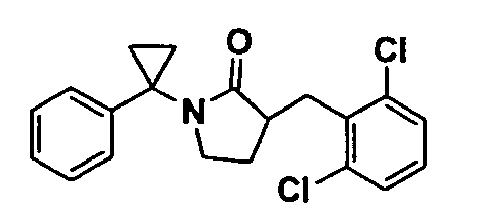
- In the same manner as in Example 1A, the title compound was obtained from 1-(1-phenylcyclopropyl)pyrrolidin-2-one obtained in Reference Example 4A and α,2,6-trichlorotoluene.
1H NMR (300 MHz, CDCl3) δ ppm 1.10-1.54 (m, 4 H), 1.78-1.99 (m, 2 H), 2.81-3.15 (m, 2 H), 3.18-3.60 (m, 3 H), 7.02-7.15 (m, 1 H), 7.16-7.40 (m, 7 H). -
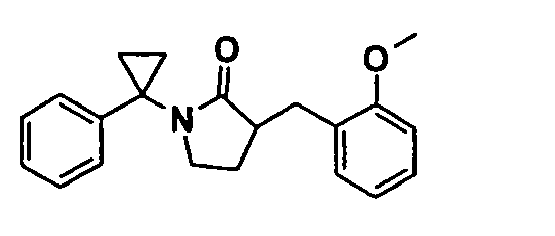
- In the same manner as in Example 1A, the title compound was obtained from 1-(1-phenylcyclopropyl)pyrrolidin-2-one obtained in Reference Example 4A and 2-methoxybenzyl chloride.
1H NMR (300 MHz, CDCl3) δ ppm 1.15-1.49 (m, 4 H), 1.62-1.83 (m, 1 H), 1.84-2.02 (m, 1 H), 2.51-2.72 (m, 1 H), 2.71-2.93 (m, 1 H), 3.12-3.44 (m, 3 H), 3.81 (s, 3 H), 6.78-6.94 (m, 2 H), 7.09-7.45 (m, 7 H). -

- In the same manner as in Example 1A, the title compound was obtained from 1-(1-methyl-1-phenylethyl)pyrrolidin-2-one obtained in Reference Example 3A and 2-methoxybenzyl chloride.
1H NMR (300 MHz, CDCl3) δ ppm 1.59-1.70 (m, 1 H), 1.74 (s, 3 H), 1.75 (s, 3 H), 1.78-2.02 (m, 1 H), 2.49-2.64 (m, 1 H), 2.67-2.89 (m, 1 H), 3.14-3. 38 (m, 3 H), 3. 80 (s, 3 H), 6.77-6.97 (m, 2 H), 7.09-7.27 (m, 3 H), 7.26-7.38 (m, 4 H). -

- A mixture of 1-cyclohexyl-3-(2-methoxybenzyl)pyrrolidin-2-one obtained in Example 111A (40 mg) and dichloromethane (5 mL) was cooled to -78°C, boron tribromide (1.0 M dichloromethane solution, 0.42 mL) was added, and the mixture was stirred at -78°C for 15 min, and then at 0°C for 1 hr. Saturated aqueous ammonium chloride was added to the reaction mixture, and the mixture was adjusted with 0.1N aqueous sodium hydroxide solution to pH 6, and extracted with dichloromethane. The dichloromethane layer was washed with saturated brine, and dried over anhydrous magnesium sulfate. The solvent was evaporated under reduced pressure, and the residue was subjected to silica gel column chromatography (hexane-ethyl acetate 7:3) to give the title compound (0.04 g, 100%) as a colorless powder.
1H NMR (300 MHz, CDCl3) δ ppm 0.97-1.44 (m, 6 H), 1.49-1.96 (m, 5 H), 2.14-2.36 (m, 1 H), 2.72-2.92 (m, 2 H), 2.96-3.11 (m, 1 H), 3.15-3.35 (m, 2 H), 3.78-4.00 (m, 1 H), 6.73-6.85 (m, 1 H), 6.89-7.06 (m, 2 H), 7.06-7.20 (m, 1 H), 9.21 (s, 1 H). -

- In the same manner as in Example 1A, the title compound was obtained from 1-cyclohexylpyrrolidin-2-one and 2-trifluoromethoxybenzyl bromide.
1H NMR (300 MHz, CDCl3) δ ppm 0.98-1.50 (m, 5 H), 1.54-1.73 (m, 4 H), 1.73-1.85 (m, 2 H), 1.92-2.09 (m, 1H), 2.64-2.82 (m, 2 H), 3.09-3.21 (m, 2 H), 3.21-3.35 (m, 1 H), 3.87-4.03 (m, 1 H), 7.17-7.25 (m, 3 H), 7.29-7.40 (m, 1 H). -

- To a mixture of 1-cyclohexyl-3-(2-hydroxybenzyl)pyrrolidin-2-one obtained in Example 140A (0.25 g) and N,N-dimethylformamide (5 mL) was added 60% sodium hydride (27 mg), and the mixture was stirred at room temperature for 5 min. Ethyl iodide (69 µL) was added to the reaction solution, and the mixture was stirred at room temperature for 2 days. Water was added to the reaction solution, and the mixture was extracted with ethyl acetate. The ethyl acetate layer was washed with saturated brine, and dried over anhydrous magnesium sulfate, and the solvent was evaporated under reduced pressure. The residue was subjected to silica gel column chromatography (hexane-ethyl acetate 3:1) to give the title compound (0.11 g, 39%) as a colorless solid.
1H NMR (300 MHz, CDCl3) δ ppm 1.01-1.21 (m, 1 H), 1.20-1.50 (m, 7 H), 1.54-1.84 (m, 6 H), 1.84-2.05 (m, 1 H), 2.52-2.69 (m, 1 H), 2.68-2.89 (m, 1 H), 3.07-3.21 (m, 2 H),3.21-3.38 (m, 1 H), 3.79-4.15 (m, 3 H), 6.69-6.95 (m, 2 H), 7.08-7.22 (m, 2 H). Example 143A 1-cyclohexyl-3-[2-(cyclopropylmethoxy)benzyl]pyrrolidin-2-one
- In the same manner as in Example 142A, the title compound was obtained from 1-cyclohexyl-3-(2-hydroxybenzyl)pyrrolidin-2-one obtained in Example 140A and cyclopropylmethyl bromide.
1H NMR (300 MHz, CDCl3) δ ppm 0.18-0.42 (m, 2 H), 0.53-0.73 (m, 2 H), 0.85-1.19 (m, 1 H), 1.19-1.49 (m, 5 H), 1.55-1.84 (m, 6 H), 1.87-2.06 (m, 1 H), 2.52-2.93 (m, 2 H), 2.97-3.40 (m, 3 H), 3.81 (d, J=6.8 Hz, 2 H), 3.88-4.13 (m, 1H), 6.70-7.00 (m, 2 H), 7.00-7.24 (m, 2 H). -

- In the same manner as in Example 1A, the title compound was obtained from 1-cyclohexylpyrrolidin-2-one and 2-bromobenzyl bromide.
1H NMR (300 MHz, CDCl3)δ ppm 1.02-1.18 (m, 1 H), 1.20-1.54 (m, 4 H), 1.61-1.88 (m, 6 H), 1.90-2.09 (m, 1 H), 2.70-2.97 (m, 2 H), 3.05-3.30 (m, 2 H), 3.33-3.51 (m, 1 H), 3.86-4.09 (m, 1 H), 6.97-7.15 (m, 1 H), 7.19-7.36 (m, 2 H), 7.45-7.66 (m, 1 H). Example 145A N-benzyl-4-[(1-cyclohexyl-2-oxopyrrolidin-3-yl)methyl]-N-methylbenzamide
- In the same manner as in Example 70A, the title compound was obtained from 4-[(1-cyclohexyl-2-oxopyrrolidin-3-yl)methyl]benzoic acid obtained in Example 129A and N-methylbenzylamine.
1H NMR (300 MHz, CDCl3) δ ppm 1.15-1.47 (m, 5 H), 1.63 (s, 6 H), 1.89-2.17 (m, 1 H), 2.62-3.36 (m, 8 H), 3.78-4.06 (m, 1 H), 4.41-4.85 (m, 2 H), 7.13-7.41 (m, 9 H). -

- In the same manner as in Example 70A, the title compound was obtained from 4-[(1-cyclohexyl-2-oxopyrrolidin-3-yl)methyl]benzoic acid obtained in Example 129A and furfurylamine.
1H NMR (300 MHz, CDCl3) δ ppm 1.29-1.47 (m, 5 H), 1.51-1.83 (m, 7 H), 1.90-2.03 (m, 1 H), 2.66-2.81 (m, 2 H), 3.01-3.28 (m, 3 H), 3.82-4.04 (m, 1 H), 4.64 (d, J=5.5 Hz, 2 H), 6.26-6.43 (m, 3 H), 7.29 (s, 1 H), 7.27-7.31 (m, 1 H), 7.34-7.42 (m, 1 H), 7.70 (d, J=8.3 Hz, 1 H). -

- In the same manner as in Example 1A, the title compound was obtained from 1-cyclohexylpyrrolidin-2-one and methyl 2,6-dimethoxybenzoate.
1H NMR (300 MHz, CDCl3) δ ppm 1.21-1.45 (m, 4 H), 1.58-1.83 (m, 6 H), 2.06-2.20 (m, 1 H), 2.52-2.66 (m, 1 H), 3.22-3.50 (m, 2 H), 3.73-3.94 (m, 7 H), 4.05 (dd, J=9.3, 4.6 Hz, 1 H), 6.51-6.61 (m, 2 H), 7.24-7.32 (m, 1 H). -

- To a mixture of 1-cyclohexyl-3-(2, 6-dimethoxybenzoyl)pyrrolidin-2-one obtained in Example 147A (76 mg) and dichloromethane (5 mL) was added dropwise trifluoromethanesulfonic acid (81 µL) under ice-cooling, and then triethylsilane (0.10 mL) was added dropwise. The reaction mixture was added at room temperature for 2 hr, saturated sodium hydrogencarbonate was added, and the mixture was extracted with dichloromethane. The dichloromethane layer was washed with saturated brine, and dried over anhydrous magnesium sulfate, and the solvent was evaporated under reduced pressure. The residue was subjected to silica gel column chromatography (hexane-ethyl acetate 9:1-3:2) to give the title compound (0.04 g, 61%) as an oil.
1H NMR (300 MHz, CDCl3) δ ppm 0.96-1.52 (m, 5 H), 1.59-1.92 (m, 7 H), 2.71-2.86 (m, 2 H), 3.05-3.20 (m, 2 H), 3.21-3.40 (m, 1 H), 3.75-3.84 (m, 6 H), 3.87-4.08 (m, 1 H), 6.53 (d, J=8.5 Hz, 2 H), 7.14 (t, J=8.3 Hz, 1 H). - Example 149A 3-[2-(benzyloxy)benzyl]-1-cyclohexylpyrrolidin-2-one

- In the same manner as in Example 142A, the title compound was obtained from 1-cyclohexyl-3-(2-hydroxybenzyl)pyrrolidin-2-one obtained in Example 140A and benzyl bromide.
1H NMR (300 MHz, CDCl3) δ ppm 1.00-1.15 (m, 1 H), 1.18-1.48 (m, 4 H), 1.55-1.83 (m, 6 H), 1.83-2.00 (m, 1 H), 2.60-2.90 (m, 2 H), 3.02-3.22 (m, 2 H), 3.24-3.43 (m, 1 H), 3.81-4.10 (m, 1 H), 5.02-5.15 (m, 2 H), 6.81-6.96 (m, 2 H), 7.09-7.24 (m, 2 H), 7.27-7.50 (m, 5 H). -

- In the same manner as in Example 115A, the title compound was obtained from 3-(2-bromobenzyl)-1-cyclohexylpyrrolidin-2-one obtained in Example 144A.
1H NMR (300 MHz, CDCl3) δ ppm 0.98-1.49 (m, 5 H), 1.62-1.84 (m, 6 H), 1.91-2.03 (m, 1 H), 2.66-2.85 (m, 1 H), 3.01 (m, 1 H), 3.08-3.25 (m, 2 H), 3. 52-3. 63 (m, 1 H), 3. 88-4. 04 (m, 1H), 3. 90 (s, 3H), 7.21-7.37 (m, 2 H), 7.38-7.46 (m, 1 H), 7.87 (m, 1 H). -

- In the same manner as in Example 1A, the title compound was obtained from 1-cyclohexylpyrrolidin-2-one and 2-chloro-4-fluorobenzyl bromide.
1H NMR (300 MHz, CDCl3) δ ppm 0.97-1.51 (m, 5 H), 1.55-1.88 (m, 6 H), 1.90-2.11 (m, 1 H), 2.65-2.88 (m, 2 H), 3.09-3.24 (m, 2 H), 3.24-3.41 (m, 1 H), 3.83-4.05 (m, 1 H), 6.83-6.99 (m, 1 H), 7.05-7.14 (m, 1 H), 7.20-7.32 (m, 1 H). -

- In the same manner as in Example 1A, the title compound was obtained from 1-cyclohexylpyrrolidin-2-one and 4-fluoro-2-methoxybenzyl chloride.
1H NMR (300 MHz, CDCl3) δ ppm 1.00-1.46 (m, 5 H), 1.57-1.73 (m, 4 H), 1.72-1.85 (m, 2 H), 1.85-2.05 (m, 1 H), 2.49-2.62 (m, 1 H), 2.69-2.85 (m, 1 H), 3.11-3.19 (m, 2 H), 3.19-3.28 (m, 1 H), 3.79 (s, 3 H), 3.86-4.07 (m, 1 H), 6.47-6.64 (m, 2 H), 7.01-7.15 (m, 1 H). - Example 153A 1-cyclohexyl-3-(pyridin-2-ylmethyl)pyrrolidin-2-one

- In the same manner as in Example 1A, the title compound was obtained from 1-cyclohexylpyrrolidin-2-one and 2-(bromomethyl)pyridine.
1H NMR (300 MHz, CDCl3) δ ppm 0.97-1.47 (m, 6 H), 1.53-1.90 (m, 6 H), 1.97-2.22 (m, 1 H), 2.71-3.06 (m, 2 H), 3.07-3.26 (m, 2 H), 3.28-3.42 (m, 1 H), 3.80-4.04 (m, 1 H), 7.05-7.26 (m, 2 H), 7.50-7.69 (m, 1 H). -

- To a solution of methyl 1-cyclohexyl-2-oxopyrrolidine-3-carboxylate obtained in Reference Example 13A (3.0 g) in tetrahydrofuran (40 mL) was added sodium hydride (60% oil; 0.56 g) by small portions under ice-cooling. This mixture was stirred at 0°C for 1 hr, α,2,6-trichlorotoluene (3.12 g) was added, and the reaction mixture was further stirred at room temperature for 4 hr. Saturated aqueous ammonium chloride was added to the reaction mixture under ice-cooling, and the mixture was extracted with ethyl acetate. The organic layer was washed with saturated brine, and dried over anhydrous magnesium sulfate. The solvent was evaporated under reduced pressure, and the residue was subjected to silica gel column chromatography (hexane-ethyl acetate 4:1-7:3) to give the title compound (2.83 g, 55%) as a white solid. Recrystallization from ethyl acetate-ether gave colorless crystals (1.36 g).
1H NMR (300 MHz, CDCl3) δ ppm 1.00-1.12 (m, 1 H), 1.20-1.45 (m, 4 H), 1.64-1.87 (m, 6 H), 2.36-2.44 (m, 1 H), 2.90-2.97 (m, 1 H), 3.20-3.28 (m, 1 H), 3.72-3.99 (m, 3 H), 3.77 (s, 3 H), 7.12 (t, J=8.1 Hz, 1 H), 7.29 (d, J=7.8 Hz, 2 H). -
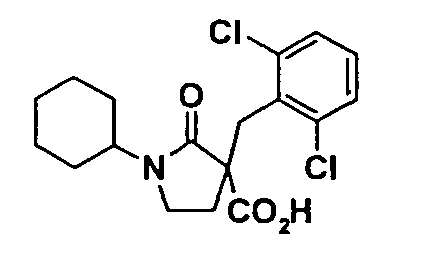
- To a solution of methyl 1-cyclohexyl-3-(2,6-dichlorobenzyl)-2-oxopyrrolidine-3-carboxylate obtained in Example 154A (1.35 g) in methanol (20 mL) was added 2N sodium hydroxide (9 mL), and the mixture was stirred at room temperature for 4 hr. 6N Hydrochloric acid (3.5 mL) was added to the reaction mixture under ice-cooling, and the mixture was extracted with ethyl acetate. The organic layer was washed with saturated brine, and dried over anhydrous magnesium sulfate.
- The solvent was evaporated under reduced pressure, and the residue was recrystallized from ethyl acetate to give the title compound (0.84 g, 64%) as white crystals.
1H NMR (300 MHz, CDCl3)δ ppm 1.05-1.14 (m, 1 H), 1.24-1.45 (m, 4 H), 1.67-1.84 (m, 5 H), 2.36-2.41 (m, 2 H), 3.10-3.19 (m, 1 H), 3.26-3.33 (m, 1 H), 3.54, 3.59 (ABq, J=14.1 Hz, 2 H), 3.87-3.96 (m, 1 H), 7.16 (t, J=7.4 Hz, 1 H), 7.32 (d, J=7.8 Hz, 2 H). -

- To a solution of 1-cyclohexyl-3-(2,6-dichlorobenzyl)-2-oxopyrrolidine-3-carboxylic acid obtained in Example 155A (0.20 g) in tetrahydrofuran (5 mL) were successively added oxalyl chloride (50 µL) and N,N-dimethylformamide (1 drop). The reaction mixture was stirred at room temperature for 2 hr, and the solvent was evaporated under reduced pressure. Toluene was added to the residue and the solvent was evaporated under reduced pressure, which operation was repeated twice. To a solution (5 mL) of the obtained residue in tetrahydrofuran was added 2 M methylamine-tetrahydrofuran solution (3 mL) under ice-cooling. The mixture was stirred at room temperature for 4 hr, water was added to the reaction mixture, and the mixture was extracted with ethyl acetate. The organic layer was washed with saturated brine, and dried over anhydrous magnesium sulfate. The solvent was evaporated under reduced pressure, and the residue was subjected to silica gel column chromatography (hexane-ethyl acetate 3:2-1:1) to give the title compound (85 mg, 41%) as a colorless oil.
1H NMR (300 MHz, CDCl3) δ ppm 1.05-1.15 (m, 1 H), 1.24-1.44 (m, 4 H), 1.65-1.83 (m, 5 H), 2.17-2.25 (m, 1 H), 2.46-2.56 (m, 1 H), 2.76 (d, J=5.1 Hz, 3 H), 3.12-3.27 (m, 2 H), 3.49 (s, 2 H), 3.84-3.93 (m, 1 H), 7.11 (t, J=7.4 Hz, 1 H), 7.28 (d, J=7.8Hz, 2 H), 7.81 (d, J=5.1 Hz, 1 H). -

- In the same manner as in Example 156A, the title compound was obtained from 1-cyclohexyl-3-(2,6-dichlorobenzyl)-2-oxopyrrolidine-3-carboxylic acid obtained in Example 155A and benzylamine.
1H NMR (300 MHz, CDCl3) δ ppm 1.02-1.14 (m, 1 H), 1.24-1.43 (m, 4 H), 1.64-1.81 (m, 5 H), 2.16-2.24 (m, 1 H), 2.50-2.60 (m, 1 H), 3.09-3.27 (m, 2 H), 3.51, 3.56 (ABq, J=14.9 Hz, 2 H), 3.83-3.92 (m, 1 H), 4.37, 4.46 (dABq, J=15.0, 5.4 Hz, 2 H), 7.09 (t, J=7.9 Hz, 1 H), 7.20-7.31 (m, 7 H), 8.22 (t, J=5.1 Hz, 1 H). -

- In the same manner as in Example 156A, the title compound was obtained from 1-cyclohexyl-3-(2,6-dichlorobenzyl)-2-oxopyrrolidine-3-carboxylic acid obtained in Example 155A and O-allylhydroxylamine hydrochloride.
1H NMR (300 MHz, CDCl3) δ ppm 1.05-1.14 (m, 1 H), 1.20-1.43 (m, 4 H), 1.61-1.79 (m, 5 H), 2.16-2.24 (m, 1 H), 2.45-2.56 (m, 1 H), 3.02-3.10 (m, 1 H), 3.19-3.26 (m, 1 H), 3.51, 3.57 (ABq, J=14.1 Hz, 2 H), 3.82-3.91 (m, 1 H), 4.33-4.45 (m, 2 H), 5.26-5.32 (m, 2 H), 5.89-6.03 (m, 1 H), 7.13 (t, J=7.2 Hz, 1 H), 7.29 (d, J=7.5 Hz, 2 H). - Example 159A 1-[(1R,2R,4S)-bicyclo[2.2.1]hept-2-yl]-3-(2,6-dichlorobenzyl)pyrrolidin-2-one

- In the same manner as in Example 1A, the title compound was obtained from 1-[(1R,2R,4S)-bicyclo[2.2.1]hept-2-yl]pyrrolidin-2-one obtained in Reference Example 33A and α, 2, 6-trichlorotoluene.
1H NMR (300 MHz, CDCl3) δ ppm 1.12-1.55 (m, 7 H), 1.64-1.98 (m, 3 H), 2.12-2.38 (m, 2 H), 2.81-3.11 (m, 2 H), 3.12-3.30 (m, 1 H), 3.31-3.56 (m, 2 H), 4.01-4.16 (m, 1 H), 7.03-7.14 (m, 1 H), 7.29 (d, J=7.9 Hz, 2 H). -

- A mixture of methyl 2-[(1-cyclohexyl-2-oxopyrrolidin-3-yl)methyl]benzoate obtained in Example 150A (0.22 g) and tetrahydrofuran (10 mL) was cooled to 0°C, methyllithium (1.2 M diethyl ether solution, 1.8 mL) was added, and the mixture was stirred at this temperature for 1 hr. Saturated aqueous ammonium chloride was added to the reaction mixture, and the mixture was extracted with ethyl acetate. The ethyl acetate layer was washed with saturated brine, dried over anhydrous magnesium sulfate, and concentrated under reduced pressure. The obtained residue was subjected to silica gel column chromatography with ethyl acetate-hexane to give the title compound (0.021 g, 10%) as an oil.
1H NMR (300 MHz, CDCl3) δ ppm 0.97-1.19 (m, 1 H), 1.21-1.49 (m, 4 H), 1.58-1.84 (m, 6 H), 1.90-2.08 (m, 1 H), 2.59 (s, 3 H), 2.68-2.84 (m, 1 H), 2.99 (dd, J=13.4, 8.5 Hz, 1 H), 3.08-3.27 (m, 2 H), 3.37 (dd, J=13.4, 5.5 Hz, 1 H), 3.82-4.03 (m, 1 H), 7.22-7.33 (m, 1 H), 7.34-7.45 (m, 2 H), 7.60-7.69 (m, 1 H). -

- In the same manner as in Example 129A, the title compound was obtained from methyl 2-[(1-cyclohexyl-2-oxopyrrolidin-3-yl)methyl]benzoate obtained in Example 150A.
1H NMR (300 MHz, DMSO-d6) δ ppm 0.95-1.15 (m, 1 H), 1.18-1.45 (m, 4 H), 1.46-1.65 (m, 4 H), 1.66-1.87 (m, 3 H), 2.58-2.72 (m, 1 H), 2.71-2.85 (m, 1 H), 3.02-3.23 (m, 2 H), 3.44-3.56 (m, 1 H), 3.63-3.79 (m, 1 H), 7.22-7.37 (m, 2 H), 7.38-7.53 (m, 1 H), 7.50-8.04 (m, 1 H), 12.91 (s, 1H). -

- In the same manner as in Example 156A, the title compound was obtained from 2-[(1-cyclohexyl-2-oxopyrrolidin-3-yl)methyl]benzoic acid obtained in Example 161A and methylamine.
1H NMR (300 MHz, CDCl3) δ ppm 1.00-1.15 (m, 1 H), 1.24-1.44 (m, 4 H), 1.56-1.70 (m, 3 H), 1.73-1.88 (m, 3 H), 2.05-2.16 (m, 1 H), 2.78-2.90 (m, 2 H), 2.97 (d, J=4.9 Hz, 3 H), 3.13-3.29 (m, 3 H), 3.83-3.97 (m, 1 H), 6.61 (brs, 1 H), 7.18-7.40 (m, 4 H). Example 163A methyl 3-benzyl-l-cyclohexyl-2-oxopyrrolidine-3-carboxylate
- To a solution of methyl 1-cyclohexyl-2-oxopyrrolidine-3-carboxylate obtained in Reference Example 13A (0.20 g) in tetrahydrofuran (10 mL) was added sodium methoxide (50 mg), and the mixture was stirred at room temperature for 5 min. Benzyl bromide (0.16 mL) was added, and the mixture was stirred overnight at room temperature. The reaction mixture was concentrated under reduced pressure, ethyl acetate and water were added, and the mixture was extracted with ethyl acetate. The ethyl acetate layer was washed with saturated brine, dried over anhydrous magnesium sulfate, and concentrated. The obtained residue was silica gel column chromatography with ethyl acetate-hexane (1:3-1:2) to give the title compound (0.32 g, quantitative) as an orange oil.
1H NMR (300 MHz, CDCl3) δ ppm 0.93-1.86 (m, 8 H), 2.35-2.49 (m, 1 H), 2.90-2.99 (m, 1 H), 3.12-3.42 (m, 2 H), 3.51-3.59 (m, 1 H), 3.70-3.79 (m, 2 H), 3.75-3.76 (m, 3 H), 3.84-4.01 (m, 1 H), 7.17-7.54 (m, 5 H), 7.83-7.88 (m, 1 H). -

- In the same manner as in Example 1A, the title compound was obtained from 1-cyclohexylpyrrolidin-2-one and 2-cyanobenzyl bromide.
1H NMR (300 MHz, CDCl3) δ ppm 0.94-1.19 (m, 1 H), 1.21-1.50 (m, 4 H), 1.58-1.89 (m, 6 H), 1.99-2.14 (m, 1 H), 2.68-2.88 (m, 1 H), 2.93-3.08 (dd, J=14.0, 8.7 Hz, 1 H), 3.12-3.25 (m, 2 H), 3.37 (dd, J=14.0, 5.0 Hz, 1 H), 3.84-4.02 (m, 1 H), 7.28-7.37 (m, 1 H), 7.41-7.47 (m, 1 H), 7.49-7.58 (m, 1 H), 7.57-7.68 (m, 1 H). -

- To a solution of 2-[(1-cyclohexyl-2-oxopyrrolidin-3-yl)methyl]benzonitrile obtained in Example 164A (1.02 g) and anhydrous cobalt (II) chloride (0.94 g) in methanol (25 mL) was added sodium borohydride (1.52 g), and the mixture was stirred at room temperature 8 hr. Water was added to the reaction mixture, the mixture was filtrated through celite, and the filtrate was extracted with ethyl acetate. The ethyl acetate layer was washed with saturated brine, dried over anhydrous magnesium sulfate, and concentrated under reduced pressure. The obtained residue was silica gel column chromatography with methanol-ethyl acetate (0:100-5:95) to give the title compound (0.32 g, 31%) as a yellow oil.
1H NMR (300 MHz, CDCl3) δ ppm 1.04-1.17 (m, 1 H), 1.29-1.47 (m, 4 H), 1.61-1.85 (m, 6 H), 1.99-2.10 (m, 1 H), 2.54-2.65 (m, 1 H), 2.67-2.79 (m, 1 H), 3.13-3.29 (m, 2 H), 3.38 (dd, J=13.9, 3.6 Hz, 1 H), 3.89-4.02 (m, 3 H), 7.17-7.25 (m, 3 H), 7.33-7.39 (m, 1 H). -

- In the same manner as in Example 163A, the title compound was obtained from methyl 1-cyclohexyl-2-oxopyrrolidine-3-carboxylate obtained in Reference Example 13A and 2-nitrobenzyl bromide.
1H NMR (300 MHz, CDCl3) δ ppm 0.98-1.85 (m, 13 H), 3.52-3.59 (m, 1 H), 3.71-3.78 (m, 1 H), 3.75 (s, 3 H), 3.85-3.97 (m, 1 H), 7.34-7.41 (m, 1 H), 7.44-7.54 (m, 2 H), 7.78-7.93 (m, 1 H). -

- In the same manner as in Example 129A, the title compound was obtained from methyl 1-cyclohexyl-3-(2-nitrobenzyl)-2-oxopyrrolidine-3-carboxylate obtained in Example 166A.
1H NMR (300 MHz, CDCl3) δ ppm 1.01-1.18 (m, 1 H), 1.24-1.47 (m, 4 H), 1.63-1.75 (m, 2 H), 1.76-1.88 (m, 3 H), 2.11-2.21 (m, 1 H), 2.35-2.47 (m, 1 H), 3.22-3.39 (m, 3 H), 3.78-3.92 (m, 2 H), 7.36-7.41 (m, 1 H), 7.42-7.49 (m, 1 H), 7.52-7.63 (m, 1 H), 7.94-8.03 (m, 1 H), 11.04 (brs, 1 H). -

- A solution of 1-cyclohexyl-3-(2-nitrobenzyl)-2-oxopyrrolidine-3-carboxylic acid obtained in Example 167A (0.26 g) in dioxane (10 mL) was heated under reflux overnight. After cooling, the reaction mixture was concentrated under reduced pressure, diisopropyl ether was added, and the insoluble substance was filtered off. The filtrate was concentrated, and the residue was recrystallized from hexane-diisopropyl ether to give the title compound (92 mg, 41%) as a yellow solid.
1H NMR (300 MHz, CDCl3) δ ppm 0.98-1.18 (m, 1 H), 1.23-1.49 (m, 4 H), 1.57-1.87 (m, 6 H), 2.02-2.16 (m, 1 H), 2.69-2.89 (m, 1 H), 3.04 (dd, J=13.8, 7.8 Hz, 1 H), 3.12-3.31 (m, 2 H), 3.43 (dd, J=13.8, 5.7 Hz, 1H), 3.81-4.02 (m, 1H), 7.31-7.41 (m, 1H), 7.44-7.58 (m, 2 H), 7.88 (d, J=7.9 Hz, 1 H). -

- In the same manner as in Example 142A, the title compound was obtained from 1-cyclohexyl-3-(2-hydroxybenzyl)pyrrolidin-2-one obtained in Example 140A and methyl bromoacetate.
1H NMR (300 MHz, CDCl3) δ ppm 1.01-1.14 (m, 1 H), 1.25-1.46 (m, 5 H), 1.63-1.80 (m, 5 H), 1.91-2.02 (m, 1 H), 2.64-2.72 (m, 1 H), 2.79-2.89 (m, 1 H), 3.10-3.23 (m, 2 H), 3.30-3.36 (m, 1 H), 3.79 (s, 3 H), 3.90-4.00 (m, 1 H), 4.65-4.67 (m, 2 H), 6.70 (d, J=8.1 Hz, 1 H), 6.89-6.95 (m, 1 H), 7.11-7.24 (m, 2 H). -

- Methyl {2-[(1-cyclohexyl-2-oxopyrrolidin-3-yl)methyl]phenoxy}acetate obtained in Example 169A (0.25 g) was dissolved in a mixed solvent of tetrahydrofuran (8 mL) and ethanol (2 mL), lithium borohydride (19 mg) was added, and the mixture was stirred overnight at room temperature. Water and ethyl acetate were added successively to the reaction mixture acetone, and the mixture was extracted with ethyl acetate. The ethyl acetate layer was washed with saturated brine, dried over anhydrous magnesium sulfate, and concentrated under reduced pressure. The obtained residue was silica gel column chromatography with ethyl acetate-hexane (30:70-100:0) to give the title compound (0.11 g, 42%) as a white solid.
1H NMR (300 MHz, CDCl3) δ ppm 1.00-1.47 (m, 5 H), 1.51-1.83 (m, 6 H), 1.99-2.13 (m, 1 H), 2.66-2.86 (m, 2 H), 2.91-3.01 (m, 1 H), 3.08-3.19 (m, 2 H), 3.86-4.08 (m, 5 H), 4.34-4.42 (m, 1 H), 6.79-6.91 (m, 2 H), 7.12-7.24 (m, 2 H). -

- In the same manner as in Example 129A, the title compound was obtained from methyl {2-[(1-cyclohexyl-2-oxopyrrolidin-3-yl)methyl]phenoxy}acetate obtained in Example 169A.
1H NMR (300 MHz, DMSO-d6) δ ppm 0.99-1.45 (m, 5 H), 1.48-1.66 (m, 4 H), 1.69-1.92 (m, 3 H), 2.37-2.48 (m, 1 H), 2.63-2.76 (m, 1 H), 3.06-3.24 (m, 3 H), 3.67-3.79 (m, 1 H), 4.69 (s, 2 H), 6.81-6.90 (m, 2 H), 7.08-7.21 (m, 2 H), 12.94 (brs, 1 H). -

- In the same manner as in Example 70A, the title compound was obtained from {2-[(1-cyclohexyl-2-oxopyrrolidin-3-yl)methyl]phenoxy}acetic acid obtained in Example 171A and methylamine.
1H NMR (300 MHz, CDCl3) δ ppm 1.00-1.16 (m, 1 H), 1.24-1.44 (m, 4 H), 1.60-1.85 (m, 6 H), 2.04-2.19 (m, 1 H), 2.52-2.61 (m, 1 H), 2.63-2.72 (m, 1 H), 2.96 (d, J=4.9 Hz, 3 H), 3.12-3.26 (m, 2 H), 3.36 (m, 1 H), 3.83-3.96 (m, 1 H), 4.42-4.54 (m, 2 H), 6.77-6.82 (m, 1 H), 6.90-6.97 (m, 1 H), 7.14-7.26 (m, 2 H), 7.94 (brs, 1 H). -

- In the same manner as in Example 70A, the title compound was obtained from 12-[(1-cyclohexyl-2-oxopyrrolidin-3-yl)methyl]phenoxy}acetic acid obtained in Example 171A and dimethylamine.
1H NMR (300 MHz, CDCl3) δ ppm 1.02-1.17 (m, 1 H), 1.28-1.47 (m, 4 H), 1.60-1.84 (m, 6 H), 1.88-2.03 (m, 1 H), 2.54-2.64 (m, 1 H), 2.74-2.89 (m, 1 H), 2.99 (s, 3 H), 3.12 (s, 3 H), 3.13-3.24 (m, 2 H), 3.32-3.39 (m, 1H), 3.87-4.01 (m, 1H), 4.71 (s, 2 H), 6.81-6.85 (m, 1 H), 6.88-6.94 (m, 1 H), 7.13-7.21 (m, 2 H). Example 174A {2-[(1-cyclohexyl-2-oxopyrrolidin-3-yl)methyl]phenoxy}acetonitrile
- In the same manner as in Example 142A, the title compound was obtained from 1-cyclohexyl-3-(2-hydroxybenzyl)pyrrolidin-2-one obtained in Example 140A and bromoacetonitrile.
1H NMR (300 MHz, CDCl3) δ ppm 1.03-1.15 (m, 1 H), 1.23-1.43 (m, 5 H), 1.58-1.83 (m, 6 H), 1.92-2.03 (m, 1 H), 2.57-2.65 (m, 1 H), 2.69-2.80 (m, 1 H), 3.14-3.20 (m, 1 H), 3.27-3.35 (m, 1 H), 3.89-4.00 (m, 1 H), 4.75-4.87 (m, 2 H), 6.94 (d, J=8.1 Hz, 1 H), 6.99-7.04 (m, 1 H), 7.22-7.28 (m, 2 H). -

- In the same manner as in Example 1A, the title compound was obtained from 1-cyclohexylpyrrolidin-2-one and 2-chloro-6-methoxybenzyl bromide.
1H NMR (300 MHz, CDCl3) δ ppm 1.01-1.18 (m, 1 H), 1.22-1.49 (m, 5 H), 1.66-1.91 (m, 6 H), 2.78-2.94 (m, 2 H), 3.08-3.21 (m, 1 H), 3.23-3.38 (m, 2 H), 3.82 (s, 3 H), 3.90-4.03 (m, 1 H), 6.76 (m, 1 H), 6.97 (m, 1 H), 7.11 (t, J=8.1 Hz, 1 H). -

- In the same manner as in Example 1A, the title compound was obtained from 1-cyclohexylpyrrolidin-2-one and 2-chloro-4-methoxybenzyl bromide.
1H NMR (300 MHz, CDCl3) δ ppm 1.01-1.17 (m, 1 H), 1.24-1.48 (m, 4 H), 1.62-1.85 (m, 6 H), 1.91-2.06 (m, 1 H), 2.67-2.84 (m, 2 H), 3.13-3.22 (m, 2 H), 3.23-3.36 (m, 1 H), 3.78 (s, 3 H), 3.83-4.05 (m, 1 H), 6.74 (dd, J=8.6, 2.6 Hz, 1 H), 6.90 (d, J=2. 6 Hz, 1 H), 7.18 (d, J=8.6 Hz, 1 H). -

- In the same manner as in Example 140A, the title compound was obtained from 3-(2-chloro-6-methoxybenzyl)-1-cyclohexylpyrrolidin-2-one obtained in Example 175A.
1H NMR (300 MHz, CDCl3) δ ppm 0.97-1.18 (m, 1 H), 1.21-1.48 (m, 4 H), 1.62-1.72 (m, 3 H), 1.72-1.91 (m, 3 H), 2.33-2.46 (m, 1 H), 2.66-2.81 (m, 1 H), 2.97-3.16 (m, 2 H), 3.18-3.39 (m, 2 H), 3.84-4.00 (m, 1 H), 6.80-6.95 (m, 2 H), 7.04 (t, J=8.0 Hz, 1 H), 9.92 (s, 1 H). -

- In the same manner as in Example 142A, the title compound was obtained from 3-(2-chloro-6-hydroxybenzyl)-1-cyclohexylpyrrolidin-2-one obtained in Example 177A and ethyl iodide.
1H NMR (300 MHz, CDCl3) δ ppm 0.81-0.93 (m, 1 H), 1.01-1.48 (m, 6 H), 1.42 (t, J=7.0 Hz, 3 H), 1.65-1.94 (m, 5 H), 2.78-2.94 (m, 2 H), 3.10-3.19 (m, 1 H), 3.26-3.36 (m, 2 H), 3.91-4.01 (m, 1 H), 4.03 (q, J=7.0 Hz, 2 H), 6.74 (d, J=8.0 Hz, 1 H), 6.90-7.00 (d, J=8.0 Hz, 1 H), 7.08 (t, J=8.0 Hz, 1 H). -

- In the same manner as in Example 142A, the title compound was obtained from 3-(2-chloro-6-hydroxybenzyl)-1-cyclohexylpyrrolidin-2-one obtained in Example 177A and bromoacetonitrile.
1H NMR (300 MHz, CDCl3) δ ppm 1.02-1.18 (m, 1 H), 1.26-1.49 (m, 4 H), 1.64-1.84 (m, 6 H), 1.87-1.99 (m, 1 H), 2.73-2.92 (m, 2 H), 3.12-3.22 (m, 1 H), 3.27-3.39 (m, 2 H), 3.86-4.01 (m, 1 H), 4.81-4.85 (m, 2 H), 6.84-6.90 (m, 1 H), 7.10-7.23 (m, 2 H). -

- In the same manner as in Example 142A, the title compound was obtained from 3-(2-chloro-6-hydroxybenzyl)-1-cyclohexylpyrrolidin-2-one obtained in Example 177A and bromoethyl methyl ether.
1H NMR (300 MHz, CDCl3) δ ppm 1.00-1.17 (m, 1 H), 1.29-1.48 (m, 4 H), 1.62-1.91 (m, 7 H), 2.82-2.97 (m, 2 H), 3.10-3.20 (m, 1 H), 3.27-3.36 (m, 2 H), 3.44 (s, 3 H), 3.73-3.79 (m, 2 H), 3.91-4.02 (m, 1 H), 4.08-4.14 (m, 2 H), 6.72-6.79 (m, 1 H), 6.96-7.02 (m, 1 H), 7.05-7.13 (m, 1 H). -

- In the same manner as in Example 142A, the title compound was obtained from 3-(2-chloro-6-hydroxybenzyl)-1-cyclohexylpyrrolidin-2-one obtained in Example 177A and bromoacetone.
1H NMR (300 MHz, CDCl3) δ ppm 1.04-1.17 (m, 1 H), 1.29-1.47 (m, 4 H), 1.62-1.99 (m, 7 H), 2.35 (s, 3 H), 2.79-2.99 (m, 2 H), 3.11-3.23 (m, 1 H), 3.28-3.38 (m, 1 H), 3.39-3.48 (m, 1 H), 3.88-4.03 (m, 1 H), 4.54 (s, 2 H), 6.54-6.64 (m, 1 H), 7.01-7.15 (m, 2 H). -

- In the same manner as in Example 1A, the title compound was obtained from 1-cyclohexylpyrrolidin-2-one and 2-chloro-4-(methoxymethoxy)benzyl bromide obtained in Reference Example 24A.
1H NMR (300 MHz, CDCl3) δ ppm 1.02-1.16 (m, 1 H), 1.28-1.44 (m, 4 H), 1.60-1.84 (m, 6 H), 1.93-2.03 (m, 1 H), 2.68-2.82 (m, 2 H), 3.14-3.24 (m, 2 H), 3.27-3.34 (m, 1 H), 3.47 (s, 3 H), 3.87-4.01 (m, 1 H), 5.13 (s, 2 H), 6.87 (dd, J=8. 5, 2.6 Hz, 1 H), 7.07 (d, J=2.6 Hz, 1 H), 7.18 (d, J=8.5 Hz, 1 H). -

- To a solution of 3-[2-chloro-4-(methoxymethoxy)benzyl]-1-cyclohexylpyrrolidin-2-one obtained in Example 182A (0.30 g) in tetrahydrofuran (5 mL) was added concentrated hydrochloric acid (1 mL), and the mixture was stirred at room temperature for 2 hr. Ethyl acetate and water were added to the reaction mixture, and the mixture was extracted with ethyl acetate. The ethyl acetate layer was washed with saturated brine, dried over anhydrous magnesium sulfate, and concentrated under reduced pressure. The obtained residue was recrystallized from hexane-ethyl acetate to give the title compound (0.17 g, 65%) as a white solid.
1H NMR (300 MHz, CDCl3) δ ppm 0.99-1.17 (m, 1 H), 1.23-1.46 (m, 4 H), 1.62-1.83 (m, 6 H), 1.96-2.09 (m, 1 H), 2.69-2.86 (m, 2 H), 3.16-3.28 (m, 3 H), 3.87-4.01 (m, 1 H), 6.67 (dd, J=8.3, 2.5 Hz, 1 H), 6.75 (s, 1 H), 6.88 (d, J=2.5 Hz, 1 H), 7.08 (d, J=8.3 Hz, 1 H). -

- In the same manner as in Example 142A, the title compound was obtained from 3-(2-chloro-4-hydroxybenzyl)-1-cyclohexylpyrrolidin-2-one obtained in Example 183A and bromoacetonitrile.
1H NMR (300 MHz, CDCl3) δ ppm 0.99-1.19 (m, 1 H), 1.24-1.49 (m, 4 H), 1.60-1.85 (m, 6 H), 1.93-2.09 (m, 1 H), 2.70-2.83 (m, 2 H), 3.13-3.23 (m, 2 H), 3.25-3.37 (m, 1 H), 3.89-4.01 (m, 1 H), 4.75 (s, 2 H), 6.81-6.86 (m, 1 H), 6.99-7.03 (m, 1 H), 7.24-7.27 (m, 1 H). -

- In the same manner as in Example 142A, the title compound was obtained from 3-(2-chloro-4-hydroxybenzyl)-1-cyclohexylpyrrolidin-2-one obtained in Example 183A and cyclopropylmethyl bromide.
1H NMR (300 MHz, CDCl3)δ ppm 0.29-0.38 (m, 2 H), 0.59-0.69 (m, 2 H), 0.98-1.17 (m, 1 H), 1.18-1.49 (m, 5 H), 1.60-1.84 (m, 6 H), 1.90-2.07 (m, 1 H), 2.68-2.82 (m, 2 H), 3.11-3.22 (m, 2 H), 3.23-3.35 (m, 1 H), 3.76 (d, J=7.0 Hz, 2 H), 3.88-4.04 (m, 1 H), 6.74 (dd, J=8.6, 2.5 Hz, 1 H), 6.90 (d, J=2.5 Hz, 1 H), 7.16 (d, J=8.6 Hz, 1 H). -
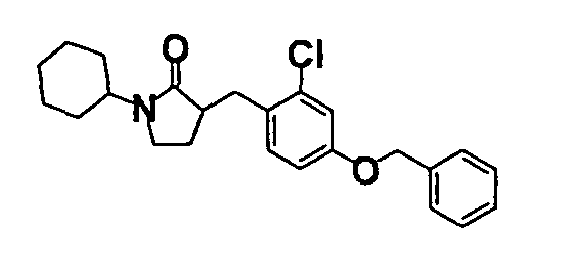
- In the same manner as in Example 142A, the title compound was obtained from 3-(2-chloro-4-hydroxybenzyl)-1-cyclohexylpyrrolidin-2-one obtained in Example 183A and benzyl bromide.
1H NMR (300 MHz, CDCl3)δ ppm 1.00-1.16 (m, 1 H), 1.24-1.48 (m, 4 H), 1.61-1.84 (m, 6 H), 1.93-2.06 (m, 1 H), 2.68-2.82 (m, 2 H), 3.12-3.23 (m, 2 H), 3.23-3.35 (m, 1 H), 3.87-4.02 (m, 1 H), 5.02 (s, 2 H), 6.81 (dd, J=8.5, 2.6 Hz, 1 H), 6.99 (d, J=2.6 Hz, 1 H), 7.18 (d, J=8.5 Hz, 1 H), 7.30-7.44 (m, 5 H). -
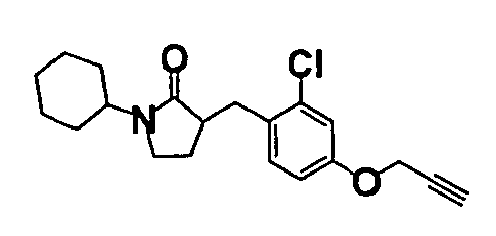
- In the same manner as in Example 142A, the title compound was obtained from 3-(2-chloro-4-hydroxybenzyl)-1-cyclohexylpyrrolidin-2-one obtained in Example 183A and propargyl bromide.
1H NMR (300 MHz, CDCl3)δ ppm 1.00-1.16 (m, 1 H), 1.24-1.47 (m, 4 H), 1.62-1.84 (m, 6 H), 1.93-2.06 (m, 1 H), 2.52-2.55 (t, J=2.4 Hz, 1 H), 2.69-2.83 (m, 2 H), 3.12-3.23 (m, 2 H), 3.24-3.36 (m, 1 H), 3.88-4.01 (m, 1H), 4.66 (d, J=2.4 Hz, 2 H), 6.82 (dd, J=8.5, 2.6 Hz, 1 H), 6.99 (d, J=2.6 Hz, 1 H), 7.20 (d, J=8.5 Hz, 1 H) . -

- In the same manner as in Example 1A, the title compound was obtained from 1-[(1R,2R,4S)-bicyclo[2.2.1] hept-2-yl]pyrrolidin-2-one obtained in Reference Example 33A and 2,4-dichlorobenzyl chloride.
1H NMR (300 MHz, CDCl3) δ ppm 1.08-1.27 (m, 2 H), 1.28-1.55 (m, 5 H), 1.61-1.81 (m, 2 H), 1.88-2.09 (m, 1 H), 2.16 (s, 1 H), 2.31 (s, 1 H), 2.65-2.85 (m, 2 H), 3.12-3.40 (m, 3 H), 3.96-4.12 (m, 1 H), 7.10-7.26 (m, 2 H), 7.37 (d, J=1.7 Hz, 1 H). -

- In the same manner as in Example 1A, the title compound was obtained from 1-cyclohexylpyrrolidin-2-one and 4-tert-butoxycarbonyl-2-methoxybenzyl bromide.
1H NMR (300 MHz, CDCl3) δ ppm 1.20-1.49 (m, 5 H), 1.52-1.81 (m, 15 H), 1.84-1.98 (m, 1 H), 2.57-2.68 (m, 1 H), 2.72-2.85 (m, 1 H), 3.06-3.24 (m, 2 H), 3.28-3.37 (m, 1 H), 3.86 (s, 3 H), 3.88-4.01 (m, 1 H), 7.19 (d, J=7.7 Hz, 1 H), 7.47 (d, J=1.6 Hz, 1 H), 7.48-7.54 (dd, J=7.7, 1.6 Hz, 1 H). -

- In the same manner as in Example 1A, the title compound was obtained from 1-cyclohexylpyrrolidin-2-one and 3-(chloromethyl)pyridine hydrochloride.
1H NMR (300 MHz, CDCl3) δ ppm 1.02-1.49 (m, 6 H), 1.60-1.86 (m, 6 H), 1.96-2.14 (m, 1 H), 2.65-2.83 (m, 2 H), 3.01-3.27 (m, 3 H), 3.86-4.03 (m, 1 H), 7.17-7.24 (m, 1 H), 7.48-7.65 (m, 1 H), 8.46 (s, 1 H). -

- In the same manner as in Example 1A, the title compound was obtained from 1-cyclohexylpyrrolidin-2-one and 4-(chloromethyl)pyridine hydrochloride.
1H NMR (300 MHz, CDCl3) δ ppm 0.95-1.55 (m, 5 H), 1.55-1.88 (m, 6 H), 1.96-2.17 (m, 1 H), 2.59-2.87 (m, 2 H), 3.00-3.32 (m, 3 H), 3.75-4.10 (m, 1 H), 7.07-7.22 (m, 2 H), 8.43-8.58 (m, 2 H). -

- In the same manner as in Example 1A, the title compound was obtained from 1-cyclohexylpyrrolidin-2-one and 2-fluorobenzyl chloride.
1H NMR (300 MHz, CDCl3) δ ppm 1.01-1.16 (m, 1 H), 1.24-1.47 (m, 4 H), 1.58-1.73 (m, 4 H), 1.73-1.84 (m, 2 H), 1.95-2.08 (m, 1 H), 2.66-2.80 (m, 2 H), 3.13-3.19 (m, 2 H), 3.20-3.32 (m, 1 H), 3.87-4.03 (m, 1 H), 6.96-7.10 (m, 2 H), 7.13-7.29 (m, 2 H). -

- In the same manner as in Example 1A, the title compound was obtained from 1-cyclohexylpyrrolidin-2-one and 4-bromo-2-chlorobenzyl bromide.
1H NMR (300 MHz, CDCl3) δ ppm 1.03-1.16 (m, 1 H), 1.23-1.48 (m, 4 H), 1.59-1.73 (m, 4 H), 1.74-1.84 (m, 2 H), 1.94-2.08 (m, 1 H), 2.70-2.84 (m, 2 H), 3.12-3.25 (m, 2 H), 3.25-3.37 (m, 1 H), 3.87-4.00 (m, 1 H), 7.17 (d, J=8.3 Hz, 1 H), 7.31 (dd, J=8.3, 2.1 Hz, 1 H), 7.52 (d, J=2.1 Hz, 1 H). -

- In the same manner as in Example 1A, the title compound was obtained from 1-cyclohexylpyrrolidin-2-one and 2-phenylethyl bromide.
1H NMR (300 MHz, CDCl3) δ ppm 0.99-1.18 (m, 1 H), 1.25-1.48 (m, 4 H), 1.56-1.83 (m, 7 H), 2.10-2.29 (m, 2 H), 2.31-2.46 (m, 1 H), 2.61-2.81 (m, 2 H), 3.15-3.35 (m, 2 H), 3.86-4.02 (m, 1 H), 7.13-7.32 (m, 5 H). -

- In the same manner as in Example 1A, the title compound was obtained from 1-cyclohexylpyrrolidin-2-one and 2-(2-chlorophenyl)ethyl bromide.
1H NMR (300 MHz, CDCl3) δ ppm 1.00-1.18 (m, 1 H), 1.26-1.47 (m, 4 H), 1.59-1.84 (m, 7 H), 2.10-2.28 (m, 2 H), 2.38-2.50 (m, 1 H), 2.74-2.91 (m, 2 H), 3.19-3.36 (m, 2 H), 3.88-3.99 (m, 1 H), 7.09-7.21 (m, 2 H), 7.25-7.35 (m, 2 H). -

- In the same manner as in Example 1A, the title compound was obtained from 1-cyclohexylpyrrolidin-2-one and tert-butyl [3-chloro-4-(chloromethyl)phenyl](methyl)carbamate obtained in Reference Example 29A.
1H NMR (300 MHz, CDCl3) δ ppm 1.01-1.16 (m, 1 H), 1.24-1.43 (m, 4 H), 1.46 (s, 9 H), 1.62-1.84 (m, 6 H), 1.93-2.07 (m, 1 H), 2.70-2.85 (m, 2 H), 3.12-3.27 (m, 2 H), 3.23 (s, 3 H), 3.28-3.40 (m, 1 H), 3.87-4.02 (m, 1 H), 7.08 (dd, J=8.3, 2.1 Hz, 1 H), 7.20-7.29 (m, 2 H) . -

- In the same manner as in Example 1A, the title compound was obtained from 1-cyclohexylpyrrolidin-2-one and 2-methylthiobenzyl chloride.
1H NMR (300 MHz, CDCl3) δ ppm 1.00-1.17 (m, 1 H), 1.23-1.47 (m, 4 H), 1.63-1.83 (m, 6 H), 1.91-2.03 (m, 1 H), 2.45 (s, 3 H), 2.69-2.78 (m, 1 H), 2.78-2.90 (m, 1 H), 3.11-3.26 (m, 2 H), 3.34-3.41 (m, 1 H), 3.90-4.02 (m, 1 H), 7.05-7.14 (m, 1 H), 7.17-7.22 (m, 3 H). -

- In the same manner as in Example 127A, the title compound was obtained from 1-cyclohexyl-3-[2-(methylthio)benzyl]pyrrolidin-2-one obtained in Example 197A.
1H NMR (300 MHz, CDCl3) δ ppm 1.03-1.18 (m, 1 H), 1.23-1.49 (m, 4 H), 1.63-1.85 (m, 6 H), 1.98-2.14 (m, 1 H), 2.62-2.83 (m, 2 H), 2.70 (s, 3H), 3.18-3.37 (m, 3 H), 3.89-4.01 (m, 1 H), 7.29-7.35 (m, 1 H), 7.42-7.52 (m, 2 H), 7.94-8.05 (m, 1 H). -

- In the same manner as in Example 127A, the title compound was obtained from 1-cyclohexyl-3-[2-(methylthio)benzyl]pyrrolidin-2-one obtained in Example 197A.
1H NMR (300 MHz, CDCl3) δ ppm 1.03-1.15 (m, 1 H), 1.23-1.46 (m, 4 H), 1.57-1.83 (m, 6 H), 1.96-2.07 (m, 1 H), 2.74 (s, 3 H), 2.76-2.96 (m, 2 H), 3.10-3.19 (m, 2 H), 3.24-3.31 (m, 1 H), 3.89-3.99 (m, 1 H), 7.23-7.27 (m, 1 H), 7.37-7.44 (m, 1 H), 7.46-7.52 (m, 1 H), 8.00-8.04 (m, 1 H). -

- In the same manner as in Example 127A, the title compound was obtained from 1-cyclohexyl-3-[2-(methylthio)benzyl]pyrrolidin-2-one obtained in Example 197A.
1H NMR (300 MHz, CDCl3) δ ppm 1.00-1.17 (m, 1 H), 1.29-1.47 (m, 4 H), 1.63-1.84 (m, 6 H), 1.96-2.08 (m, 2 H), 2.85-2.97 (m, 1 H), 3.10 (s, 3 H), 3.13-3.31 (m, 3 H), 3.53 (dd, J=13.9, 5.3 Hz, 1 H), 3.88-4.00 (m, 1 H), 7.37-7.44 (m, 1 H), 7.49-7.60 (m, 1 H), 8.07 (m, 1 H). -

- In the same manner as in Example 1A, the title compound was obtained from 1-cyclohexylpyrrolidin-2-one and 2-chloro-4-trifluoromethylbenzyl chloride.
1H NMR (300 MHz, CDCl3) δ ppm 1.03-1.17 (m, 1 H), 1.26-1.47 (m, 4 H), 1.61-1.74 (m, 4 H), 1.74-1.85 (m, 2 H), 1.97-2.11 (m, 1 H), 2.75-2.91 (m, 2 H), 3.14-3.29 (m, 2 H), 3.34-3.46 (m, 1 H), 3.89-4.03 (m, 1 H), 7.40-7.47 (m, 2 H), 7.62 (brs, 1 H). -

- In the same manner as in Example 1A, the title compound was obtained from 1-cyclohexylpyrrolidin-2-one and 2,4-dichlorobenzyl chloride.
1H NMR (300 MHz, CDCl3) δ ppm 0.98-1.18 (m, 1 H), 1.22-1.48 (m, 4 H), 1.57-1.85 (m, 6 H), 1.93-2.09 (m, 1 H), 2.69-2.85 (m, 2 H), 3.13-3.26 (m, 2 H), 3.27-3.38 (m, 1 H), 3.88-4.00 (m, 1 H), 7.14-7.19 (dd, J=8.3, 2.1 Hz, 1 H), 7.20-7.25 (d, J=8.3 Hz, 1 H), 7.37 (d, J=2.1 Hz, 1 H). -

- In the same manner as in Example 1A, the title compound was obtained from 1-(1,4-dioxaspiro[4.5]dec-8-yl)pyrrolidin-2-one and 4-bromo-2-chlorobenzyl bromide.
1H NMR (300 MHz, CDCl3) δ ppm 1.59-1.84 (m, 9 H), 1.96-2.09 (m, 1 H), 2.71-2.84 (m, 2 H), 3.14-3.36 (m, 3 H), 3.90-3.96 (m, 4 H), 3.99-4.11 (m, 1 H), 7.16 (d, J=8.3 Hz, 1 H), 7.31 (dd, J=8.3, 2.0 Hz, 1 H), 7.51 (d, J=2.0 Hz, 1 H). -

- A mixture of 1-cyclohexyl-3-(2-nitrobenzyl)pyrrolidin-2-one obtained in Example 168A (0.17 g), 10% palladium-carbon (0.02 g), water (0.02 g) and ethanol (5 mL) was stirred at room temperature for 5 hr under hydrogen atmosphere. After the reaction system was substituted with nitrogen, the reaction mixture was filtrated through celite. The filtrate was concentrated under reduced pressure, ethyl acetate and water were added to the residue, and the mixture was extracted with ethyl acetate. The ethyl acetate layer was washed with saturated brine, dried over anhydrous magnesium sulfate, and concentrated under reduced pressure. The obtained residue was recrystallized from hexane-diisopropyl ether to give the title compound (90 mg, 60%) as a white solid.
1H NMR (300 MHz, CDCl3) δ ppm 1.00-1.16 (m, 1 H), 1.24-1.47 (m, 4 H), 1.57-1.85 (m, 7 H), 2.03-2.18 (m, 1 H), 2.62-2.72 (m, 1 H), 2.72-2.84 (m, 1 H), 3.05 (dd, J=14.1, 3.8 Hz, 1 H), 3.13-3.23 (m, 2 H), 3.84-3.97 (m, 1 H), 4.06 (s, 2 H), 6.63-6.71 (m, 2 H), 6.96-7.08 (m, 2 H). -

- In the same manner as in Example 22A, the title compound was obtained from 3-(2-aminobenzyl)-1-cyclohexylpyrrolidin-2-one obtained in Example 204A and acetyl chloride.
1H NMR (300 MHz, CDCl3) δ ppm 0.96-1.13 (m, 1 H), 1.19-1.54 (m, 5 H), 1.66 (s, 1 H), 1.71-1.92 (m, 4 H), 2.15-2.24 (m, 1 H), 2.26 (s, 3 H), 2.71-2.91 (m, 2 H), 3.03-3.26 (m, 3 H), 3.79-3.93 (m, 1 H), 6.99-7.13 (m, 2 H), 7.18-7.26 (m, 1 H), 7.89 (d, J=7.9 Hz, 1 H), 9.72 (s, 1 H). -

- In the same manner as in Example 22A, the title compound was obtained from 3-(2-aminobenzyl)-1-cyclohexylpyrrolidin-2-one obtained in Example 204A and benzoyl chloride.
1H NMR (300 MHz, CDCl3) δ ppm 0.93-1.45 (m, 6 H), 1.62-1.83 (m, 3 H), 1.86-2.04 (m, 1 H), 2.14-2.30 (m, 1 H), 2.75-2.96 (m, 2 H), 3.06-3.28 (m, 3 H), 3.78-3.94 (m, 1 H), 7.06-7.21 (m, 2 H), 7.24-7.33 (m, 2 H), 7.46-7.57 (m, 3 H), 7.77-7.86 (m, 1 H), 8.17-8.26 (m, 2 H), 10.31 (s, 1 H). -

- In the same manner as in Example 22A, the title compound was obtained from 3-(2-aminobenzyl)-1-cyclohexylpyrrolidin-2-one obtained in Example 204A and phenylacetyl chloride.
1H NMR (300 MHz, CDCl3) δ ppm 0.96-1.16 (m, 1 H), 1.17-1.55 (m, 5 H), 1.60-1.84 (m, 5 H), 2.08-2.22 (m, 1 H), 2.64-2.84 (m, 2 H), 2.90-3.01 (m, 1 H), 3.06-3.25 (m, 2 H), 3.79 (s, 2 H), 3.82-3.97 (m, 1 H), 6.96-7.13 (m, 2 H), 7.15-7.28 (m, 2 H), 7.29-7.40 (m, 2 H), 7.49 (d, J=7.2 Hz, 2 H), 7.89 (d, J=8.1 Hz, 1 H), 9.62 (s, 1 H). -

- In the same manner as in Example 22A, the title compound was obtained from 3-(2-aminobenzyl)-1-cyclohexylpyrrolidin-2-one obtained in Example 204A and methanesulfonyl chloride.
1H NMR (300 MHz, CDCl3) δ ppm 0.98-1.14 (m, 1 H), 1.19-1.42 (m, 4 H), 1.44-1.90 (m, 6 H), 2.17-2.30 (m, 1 H), 2.71-2.82 (m, 1 H), 2.89-2.97 (m, 1 H), 3.02 (s, 3 H), 3.03-3.11 (m, 1 H), 3.16-3.24 (m, 2 H), 3.84-3.99 (m, 1 H), 7.07-7.17 (m, 2 H), 7.20-7.29 (m, 1 H), 7.50-7.55 (m, 1 H), 9.74 (s, 1 H). -

- A solution of methyl 2-[(1-cyclohexyl-2-oxopyrrolidin-3-yl)methyl]benzoate obtained in Example 150A (0.11 g) in dichloromethane (5 mL) was cooled to -20°C, and diisobutylaluminum hydride (1.0 M hexane solution, 1.23 mL) was gradually added dropwise. The reaction mixture was stirred at room temperature for 4 hr, saturated aqueous sodium potassium (+)-tartrate was added, and the mixture was further stirred at room temperature overnight. The reaction mixture was extracted with dichloromethane, the dichloromethane layer was washed with saturated brine, dried over anhydrous magnesium sulfate, and concentrated under reduced pressure. The obtained residue was silica gel column chromatography with methanol-ethyl acetate (3:97) to give the title compound (31mg, 31%) as an oil.
1H NMR (300 MHz, CDCl3) δ ppm 0.98-1.15 (m, 1 H), 1.23-1.46 (m, 4 H), 1.60-1.71 (m, 2 H), 1.72-1.84 (m, 3 H), 1.90 (brs, 1 H), 2.09-2.22 (m, 1 H), 2.65-2.84 (m, 2 H), 3.14-3.38 (m, 4 H), 3.85-3.97 (m, 1 H), 4.63-4.81 (m, 2 H), 7.17-7.26 (m, 3 H), 7.33-7.43 (m, 1 H). -

- To a solution of 3-(2-aminobenzyl)-1-cyclohexylpyrrolidin-2-one obtained in Example 204A (0.19 g) in toluene (5 mL) was added ethyl isocyanate (61 µL) under nitrogen atmosphere, and the mixture was stirred at room temperature for 3 hr, then at 50°C for 3 hr, and then at 100°C for 3 hr. After cooling, ethyl acetate and water were added to the reaction mixture, and the mixture was extracted with ethyl acetate. The ethyl acetate layer was washed with saturated brine, dried over anhydrous magnesium sulfate, and concentrated under reduced pressure. The obtained residue was NH-silica gel column chromatography with ethyl acetate-hexane to give the title compound (0.16 g, 65%) as an amorphous form.
1H NMR (300 MHz, CDCl3) δ ppm 1.01-1.14 (m, 1 H), 1.18 (t, J=7.2 Hz, 3 H), 1.24-1.45 (m, 4 H), 1.53-1.86 (m, 6 H), 2.13-2.25 (m, 1 H), 2.65-2.76 (m, 1 H), 2.86-3.03 (m, 2 H), 3.16-3.24 (m, 2 H), 3.26-3.37 (m, 2 H), 3.82-3.95 (m, 1 H), 5.11-5.18 (m, 1 H), 6.87-6.94 (m, 1 H), 7.01-7.06 (m, 1 H), 7.16-7.24 (m, 1 H), 8.05 (d, J=8.1 Hz, 1H), 8.26 (s, 1H) . -

- To a solution of N-{2-[(1-cyclohexyl-2-oxopyrrolidin-3-yl)methyl]phenyl}acetamide obtained in Example 205A (0.26 g) in N,N-dimethylformaldehyde (5 mL) were added successively 60% sodium hydride (40 mg) and methyl iodide (0.15 mL), and the mixture was stirred at room temperature for 10 hr. The reaction mixture was concentrated under reduced pressure, ethyl acetate and water were added to the residue, and the mixture was extracted with ethyl acetate. The ethyl acetate layer was washed with saturated brine, dried over anhydrous magnesium sulfate, and concentrated under reduced pressure. The obtained residue was NH-silica gel column chromatography with ethyl acetate-hexane (25:75-75:25) to give the title compound (0.20 g, 75%) as an oil.
1H NMR (300 MHz, CDCl3) δ ppm 1.03-1.18 (m, 1 H), 1.21-1.46 (m, 4 H), 1.60-1.87 (m, 9 H), 1.98-2.18 (m, 1 H), 2.46-2.68 (m, 1 H), 2.72-2.89 (m, 1 H), 3.13-3.35 (m, 6 H), 3.90-4.02 (m, 1 H), 7.08-7.15 (m, 1 H), 7.22-7.44 (m, 3 H). -

- In the same manner as in Example 22A, the title compound was obtained from 3-[2-(aminomethyl)benzyl]-1-cyclohexylpyrrolidin-2-one obtained in Example 165A and acetyl chloride.
1H NMR (300 MHz, CDCl3) δ ppm 1.03-1.15 (m, 1 H), 1.28-1.48 (m, 4 H), 1.60-1.85 (m, 6 H), 1.97 (s, 3 H), 2.14-2.27 (m, 1 H), 2.65-2.79 (m, 2 H), 3.14-3.33 (m, 3 H), 3.84-3.97 (m, 1 H), 4.36-4.53 (m, 2 H), 6.85 (brs, 1 H), 7.14-7.24 (m, 3 H), 7.29-7.38 (m, 1 H). -

- In the same manner as in Example 20A, the title compound was obtained from tert-butyl 13-chloro-4-[(1-cyclohexyl-2-oxopyrrolidin-3-yl)methyl]phenyl}(methyl)carbamate obtained in Example 196A.
1H NMR (300 MHz, CDCl3)δ ppm 1.04-1.14 (m, 1 H), 1.26-1.44 (m, 4 H), 1.64-1.80 (m, 6 H), 1.92-2.05 (m, 1 H), 2.63-2.78 (m, 1 H), 2.80 (s, 3 H), 3.06-3.27 (m, 4 H), 3.71 (brs, 1 H), 3.91-3.98 (m, 1 H), 6.51 (dd, J=8.1, 2.4 Hz, 1 H), 6.59 (d, J=2.4 Hz, 1 H), 7.05 (d, J=8.1 Hz, 1 H). -

- In the same manner as in Example 22A, the title compound was obtained from 3-[2-chloro-4-(methylamino)benzyl]-1-cyclohexylpyrrolidin-2-one obtained in Example 213A and acetyl chloride.
1H NMR (300 MHz, CDCl3) δ ppm 1.01-1.18 (m, 1 H), 1.25-1.49 (m, 4 H), 1.63-1.83 (m, 6 H); 1.89 (s, 3 H), 1.98-2.16 (m, 1 H), 2.73-2.90 (m, 2 H), 3.12-3.28 (m, 5 H), 3.30-3.44 (m, 1 H), 3.87-4.03 (m, 1 H), 7.03 (dd, J=8.0, 2.0 Hz, 1 H), 7.22 (d, J=1.9 Hz, 1 H), 7.35 (d, J=8.1 Hz, 1 H). -

- To a solution of 3-(4-bromo-2-chlorobenzyl)-1-cyclohexylpyrrolidin-2-one obtained in Example 193A (0.26 g), tris(dibenzylideneacetone)dipalladium (37 mg), 2-(dicyclohexylphosphino)-2',4',6'-triisopropyl-1,1'-biphenyl (38 mg) and potassium tert-butoxide (0.10 g) in tert-butyl alcohol (5 mL) was added benzophenonimine (0.15 mL) under argon atmosphere, and the mixture was heated under reflux overnight. After cooling, saturated aqueous ammonium chloride was added to the reaction mixture, and the mixture was extracted with ethyl acetate. The ethyl acetate layer was washed with saturated brine, dried over anhydrous magnesium sulfate, and concentrated under reduced pressure. The obtained residue was subjected to silica gel column chromatography with ethyl acetate-hexane (10:90-40:60) to give 3-{2-chloro-4-[(diphenylmethylene)amino]benzyl}-1-cyclohexylpyrrolidin-2-one (0.27 g, 81%) as an oil. The obtained compound (0.25 g) was dissolved in methanol (5 mL), sodium acetate (0.10 g) and hydroxylamine hydrochloride (65 mg) were added, and the mixture was stirred at room temperature for 1 hr. 1N Sodium hydroxide, ethyl acetate and water were added to the reaction mixture, and the mixture was extracted with ethyl acetate. The ethyl acetate layer was washed with saturated brine, dried over anhydrous magnesium sulfate, and concentrated under reduced pressure. The obtained residue was subjected to silica gel column chromatography with ethyl acetate-hexane (30:70-80:20.), and the obtained crystals were recrystallized from hexane-ethyl acetate to give the title compound (64 mg, 40%) as a white solid.
1H NMR (300 MHz, CDCl3) δ ppm 0.99-1.15 (m, 1 H), 1.23-1.46 (m, 4 H), 1.60-1.85 (m, 6 H), 1.90-2.04 (m, 1 H), 2.62-2.81 (m, 2 H), 3.10-3.29 (m, 3 H), 3.63 (brs, 2 H), 3.87-4.01 (m, 1 H), 6.51 (dd, J=8.2, 2.4 Hz, 1 H), 6.69 (d, J=2.4 Hz, 1 H), 7.04 (d, - J=8.2 Hz, 1 H).
-

- A solution of 3-[2-chloro-6-(2-oxopropoxy)benzyl]-1-cyclohexylpyrrolidin-2-one obtained in Example 181A (0.10 g) in tetrahydrofuran (5 mL) was cooled to 0°C, methylmagnesium bromide (3.0 M ether solution, 0.27 mL) was added, and the mixture was stirred at 0°C for 1 hr, and then at room temperature for 4.5 hr. Ethyl acetate and saturated aqueous ammonium chloride were added to the reaction mixture, and the mixture was extracted with ethyl acetate. The ethyl acetate layer was washed with saturated brine, dried over anhydrous magnesium sulfate, and concentrated under reduced pressure. The obtained residue was subjected to silica gel column chromatography with 2-butanone-hexane (1:3), and purified by normal phase high performance liquid chromatography to give the title compound (25 mg, 24%) as an oil.
1H NMR (300 MHz, CDCl3) δ ppm 0.97-1.17 (m, 1 H), 1.23-1.39 (m, 5 H), 1.33 (s, 3 H), 1.43 (s, 3 H), 1.60-1.82 (m, 5 H), 1.85-2.00 (m, 1 H), 2.05-2.22 (m, 1 H), 2.56-2.71 (m, 1 H), 2.91 (m, 1 H), 3.12-3.31 (m, 2 H), 3.47 (m, 1 H), 3.69-3.84 (m, 2 H), 3.91-4.04 (m, 1 H), 6.68-6.75 (m, 1 H), 6.94-7.00 (m, 1 H), 7.10 (t, J=8.2 Hz, 1 H). -

- A mixture of 3-[2-chloro-4-(methylamino)benzyl]-1-cyclohexylpyrrolidin-2-one obtained in Example 213A (0.13 g), concentrated sulfuric acid (28µL), 37% aqueous formic acid (92 mL) and water (1.5 mL) was cooled to 0°C, a solution of sodium borohydride in tetrahydrofuran (5 mL) was added, and the mixture was stirred at room temperature overnight. 1N Aqueous sodium hydroxide solution was added to the reaction mixture, ethyl acetate and water were added, and the mixture was extracted with ethyl acetate. The ethyl acetate layer was washed with saturated brine, dried over anhydrous magnesium sulfate, and concentrated under reduced pressure. The residue was recrystallized from ethyl acetate-hexane to give the title compound (77 mg, 56%) as a pale-brown solid.
1H NMR (300 MHz, CDCl3) δ ppm 1.01-1.15 (m, 1 H), 1.25-1.47 (m, 4 H), 1.61-1.84 (m, 6 H), 1.91-2.04 (m, 1 H), 2.64-2.81 (m, 2 H), 2.91 (s, 6 H), 3.11-3.21 (m, 2 H), 3.22-3.29 (m, 1 H), 3.89-4.01 (m, 1 H), 6.56 (dd, J=8.6, 2.6 Hz, 1 H), 6.69 (d, J=2.6 Hz, 1 H), 7.10 (d, J=8.6 Hz, 1 H). -

- A mixture of 3-(4-bromo-2-chlorobenzyl)-1-cyclohexylpyrrolidin-2-one obtained in Example 193A (0.30 g), phenylboronic acid (0.15 g), 2 M aqueous sodium hydrogencarbonate (0.81 mL), tetrakis(triphenylphosphine)palladium (19 mg) and 1,2-dimethoxyethane (5 mL) was stirred overnight at 90°C under nitrogen atmosphere. Ethyl acetate and water were added to the reaction mixture, and the mixture was extracted with ethyl acetate. The ethyl acetate layer was washed with saturated brine, dried over anhydrous magnesium sulfate, and concentrated under reduced pressure. The residue was subjected to silica gel column chromatography with ethyl acetate-hexane (10:90-40:60), and the obtained solid was recrystallized from ethyl acetate-hexane to give the title compound (0.14g, 48%) as a white solid.
1H NMR (300 MHz, CDCl3) δ ppm 1.00-1.18 (m, 1 H), 1.25-1.49 (m, 4 H), 1.62-1.86 (m, 6 H), 1.97-2.12 (m, 1 H), 2.78-2.91 (m, 2 H), 3.14-3.30 (m, 2 H), 3.35-3.47 (m, 1 H), 3.91-4.03 (m, 1 H), 7.32-7.47 (m, 5 H), 7.53-7.60 (m, 3 H). -

- In the same manner as in Example 218A, the title compound was obtained from 3-(4-bromo-2-chlorobenzyl)-1-cyclohexylpyrrolidin-2-one obtained in Example 193A and 4-pyridylboronic acid.
1H NMR (300 MHz, CDCl3) δ ppm 0.99-1.19 (m, 1 H), 1.24-1.49 (m, 4 H), 1.63-1.87 (m, 6 H), 1.99-2.13 (m, 1 H), 2.78-2.92 (m, 2 H), 3.15-3.30 (m, 2 H), 3.35-3.47 (m, 1 H), 3.90-4.03 (m, 1 H), 7.39-7.50 (m, 4 H), 7.62-7.66 (m, 1 H), 8.65-8.69 (m, 2 H). -

- In the same manner as in Example 218A, the title compound was obtained from 3-(4-bromo-2-chlorobenzyl)-1-cyclohexylpyrrolidin-2-one obtained in Example 193A and 4-methylsulfonylphenylboronic acid.
1H NMR (300 MHz, CDCl3) δ ppm 0.99-1.18 (m, 1 H), 1.25-1.51 (m, 4 H), 1.63-1.87 (m, 6 H), 2.00-2.16 (m, 1 H), 2.79-2.93 (m, 2 H), 3.10 (s, 3 H), 3.17-3.33 (m, 2 H), 3.34-3.48 (m, 1 H), 3.88-4.05 (m, 1 H), 7.38-7.47 (m, 2 H), 7.58-7.64 (m, 1 H), 7.70-7.78 (m, 2 H), 7.97-8.05 (m, 2 H). -

- To a solution of 3-(4-bromo-2-chlorobenzyl)-1-cyclohexylpyrrolidin-2-one obtained in Example 193A (0.25 g), tris(dibenzylideneacetone)dipalladium (30 mg), 2-(dicyclohexylphosphino)-2',4',6'-triisopropyl-1,1'-biphenyl (32 mg) and potassium tert-butoxide (98 mg) in tert-butyl alcohol (5 mL) was added N-methylbenzylamine (0.11 mL) under argon atmosphere, and the mixture was heated under reflux overnight. After cooling, saturated aqueous ammonium chloride was added to the reaction mixture, and the mixture was extracted with ethyl acetate. The ethyl acetate layer was washed with saturated brine, dried over anhydrous magnesium sulfate, and concentrated under reduced pressure. The residue was subjected to silica gel column chromatography with ethyl acetate-hexane (10:90-40:60) to give the title compound (0.20 g, 73%) as a brown oil.
1H NMR (300 MHz, CDCl3) δ ppm 1.03-1.16 (m, 1 H), 1.28-1.43 (m, 4 H), 1.62-1.84 (m, 6 H), 1.91-2.04 (m, 1 H), 2.62-2.81 (m, 2 H), 2.96-3.00 (m, 3 H), 3.11-3.31 (m, 3 H), 3.88-4.01 (m, 1 H), 4.49 (s, 2 H), 6.56 (dd, J=8.6, 2.7 Hz, 1 H), 6.72 (d, J=2.7 Hz, 1 H), 7.07 (d, J=8.6 Hz, 1 H), 7.17-7.37 (m, 5 H). -

- To a solution of 3-(4-bromo-2-chlorobenzyl)-1-cyclohexylpyrrolidin-2-one obtained in Example 193A (0.25 g), tris(dibenzylideneacetone)dipalladium (25 mg), 2-(dicyclohexylphosphino)-2',4',6'-triisopropyl-1,1'-biphenyl (26 mg) and cesium carbonate (0.31 g) in toluene (5 mL) was added 2-oxazolidone (58 mg), and the mixture was heated under reflux overnight. After cooling, saturated aqueous ammonium chloride was added to the reaction mixture, and the mixture was extracted with ethyl acetate. The ethyl acetate layer was washed with saturated brine, dried over anhydrous magnesium sulfate, and concentrated under reduced pressure. The obtained residue was filtrated through silica gel, and recrystallized from hexane-ethyl acetate to give the title compound (0.11 g, 45%) as a pale-yellow solid.
1H NMR (300 MHz, CDCl3) δ ppm 1.02-1.17 (m, 1 H), 1.23-1.44 (m, 4 H), 1.61-1.84 (m, 6 H), 1.94-2.05 (m, 1 H), 2.72-2.85 (m, 2 H), 3.13-3.27 (m, 2 H), 3.28-3.39 (m, 1 H), 3.88-3.99 (m, 1 H), 3.99-4.07 (m, 2 H), 4.45-4.53 (m, 2 H), 7.27-7.31 (d, J=8.6 Hz, 1 H), 7.35-7.41 (dd, J=8.6, 2.4 Hz, 1 H), 7.59 (d, J=2.4 Hz, 1 H). -

- In the same manner as in Example 221A, the title compound was obtained from 3-(4-bromo-2-chlorobenzyl)-1-cyclohexylpyrrolidin-2-one obtained in Example 193A and aniline.
1H NMR (300 MHz, CDCl3) δ ppm 1.02-1.16 (m, 1 H), 1.24-1.46 (m, 5 H), 1.61-1.83 (m, 6 H), 1.90-2.03 (m, 1 H), 2.61-2.80 (m, 2 H), 3.12-3.29 (m, 3 H), 4.22-4.33 (m, 2 H), 6.64 (m, 1 H), 6.98-7.07 (m, 1 H), 7.27-7.37 (m, 5 H). -

- In the same manner as in Example 221A, the title compound was obtained from 3-(4-bromo-2-chlorobenzyl)-1-cyclohexylpyrrolidin-2-one obtained in Example 193A and benzylamine.
1H NMR (300 MHz, CDCl3) δ ppm 1.02-1.16 (m, 1 H), 1.24-1.46 (m, 5 H), 1.61-1.83 (m, 6 H), 1.90-2.03 (m, 1 H), 2.61-2.80 (m, 2 H), 3.12-3.29 (m, 3 H), 3.87-4.07 (m, 2 H), 4.22-4.33 (m, 2 H), 6.64 (m, 1 H), 6.98-7.07 (m, 1 H), 7.27-7.37 (m, 5 H). -

- In the same manner as in Example 221A, the title compound was obtained from 3-(4-bromo-2-chlorobenzyl)-1-cyclohexylpyrrolidin-2-one obtained in Example 193A and 2-(N-methylamino)ethanol.
1H NMR (300 MHz, CDCl3) δ ppm 1.01-1.18 (m, 1 H), 1.23-1.49 (m, 4 H), 1.58-1.85 (m, 7 H), 1.89-2.07 (m, 1 H), 2.62-2.82 (m, 2 H), 2.94 (s, 3 H), 3.14-3.30 (m, 3 H), 3.44 (t, J=5.7 Hz, 2 H), 3.81 (t, J=5.7 Hz, 2 H), 3.88-4.02 (m, 1 H), 6.62 (dd, J=8.6, 2.7 Hz, 1 H), 6.75 (d, J=2.7 Hz, 1 H), 7.10 (d, J=8.6 Hz, 1 H). -

- In the same manner as in Example 221A, the title compound was obtained from 3-(4-bromo-2-chlorobenzyl)-1-cyclohexylpyrrolidin-2-one obtained in Example 193A and N-acetylpiperazine.
1H NMR (300 MHz, CDCl3) δ ppm 1.03-1.16 (m, 1 H), 1.24-1.46 (m, 4 H), 1.61-1.84 (m, 6 H), 1.92-2.04 (m, 1 H), 2.14 (s, 3 H), 2.66-2.80 (m, 2 H), 3.08-3.33 (m, 7 H), 3.56-3.64 (m, 2 H), 3.71-3.80 (m, 2 H), 3.87-4.03 (m, 1 H), 6.75 (dd, J=8.5, 2.5 Hz, 1 H), 6.89 (d, J=2.5 Hz, 1 H), 7.17 (d, J=8.5 Hz, 1 H). -

- In the same manner as in Example 221A, the title compound was obtained from 3-(4-bromo-2-chlorobenzyl)-1-cyclohexylpyrrolidin-2-one obtained in Example 193A and N-(2-hydroxyethyl)piperazine.
1H NMR (300 MHz, CDCl3) δ ppm 1.03-1.17 (m, 1 H), 1.22-1.47 (m, 5 H), 1.61-2.06 (m, 7 H), 2.57-2.80 (m, 8 H), 3.13-3.22 (m, 6 H), 3.23-3.31 (m, 1 H), 3.62-3.71 (m, 2 H), 3.87-4.01 (m, 1 H), 6.75 (dd, J=8.7, 2.6 Hz, 1 H), 6.88 (d, J=2.6 Hz, 1 H), 7.14 (d, J=8.7 Hz, 1 H). -

- In the same manner as in Example 118A, the title compound was obtained from 1-cyclohexylpyrrolidin-2-one and 2,4-dimethoxybenzaldehyde.
1H NMR (300 MHz, CDCl3) δ ppm 0.97-1.16 (m, 1 H), 1.19-1.46 (m, 4 H), 1.63-1.83 (m, 4 H), 1.84-1.99 (m, 1 H), 2.99-3.08 (m, 1 H), 3.15 (m, 2 H), 3.27-3.32 (m, 1 H), 3.79 (s, 3 H), 3.80 (s, 3 H), 3.86-4.05 (m, 1 H), 5.50-5.54 (m, 1 H), 6.43 (d, J=2.4 Hz, 1 H), 6.48 (dd, J=8.5, 2.4 Hz, 1 H), 7.34 (d, J=8.5 Hz, 1 H). -

- In the same manner as in Example 210A, the title compound was obtained from 3-(4-amino-2-chlorobenzyl)-1-cyclohexylpyrrolidin-2-one obtained in Example 215A and ethyl isocyanate.
1H NMR (300 MHz, CDCl3) δ ppm 1.02-1.19 (m, 1 H), 1.15 (t, J=7.3 Hz, 3 H), 1.23-1.46 (m, 4 H), 1.60-1.87 (m, 6 H), 1.93-2.09 (m, 1 H), 2.67-2.86 (m, 2 H), 3.14-3.34 (m, 5 H), 3.82-4.01 (m, 1 H), 5.22-5.25 (m, 1 H), 7.01-7.16 (m, 3 H), 7.43 (d, J=1.9 Hz, 1 H). -

- In the same manner as in Example 22A, the title compound was obtained from 3-(4-amino-2-chlorobenzyl)-1-cyclohexylpyrrolidin-2-one obtained in Example 215A and methanesulfonyl chloride.
1H NMR (300 MHz, CDCl3) δ ppm 1.00-1.19 (m, 1 H), 1.23-1.47 (m, 4 H), 1.56-1.87 (m, 6 H), 1.96-2.12 (m, 1 H), 2.71-2.86 (m, 2 H), 3.02 (s, 3 H), 3.14-3.36 (m, 3 H), 3.86-4.02 (m, 1 H), 6.86 (s, 1 H), 7.01-7.08 (m, 1 H), 7.23-7.31 (m, 3 H). -

- In the same manner as in Example 22A, the title compound was obtained from 3-(4-amino-2-chlorobenzyl)-1-cyclohexylpyrrolidin-2-one obtained in Example 215A and methanesulfonyl chloride.
1H NMR (300 MHz, CDCl3) δ ppm 1.02-1.17 (m, 1 H), 1.28-1.47 (m, 4 H), 1.61-1.87 (m, 6 H), 2.01-2.13 (m, 1 H), 2.73-2.87 (m, 2 H), 3.14-3.27 (m, 2 H), 3.34-3.47 (m, 1 H), 3.40-3.41 (m, 6 H), 3.85-4.01 (m, 1 H), 7.20 (dd, J=8.3, 2.3 Hz, 1 H), 7.37-7.43 (m, 2 H). -

- In the same manner as in Example 22A, the title compound was obtained from 3-(4-amino-2-chlorobenzyl)-1-cyclohexylpyrrolidin-2-one obtained in Example 215A and benzenesulfonyl chloride.
1H NMR (300 MHz, CDCl3) δ ppm 1.00-1.17 (m, 1 H), 1.23-1.46 (m, 4 H), 1.56-1.84 (m, 6 H), 1.90-2.04 (m, 1 H), 2.66-2.85 (m, 2 H), 3.14-3.29 (m, 3 H), 3.86-4.00 (m, 1 H), 6.88 (dd, J=8.3, 2.3 Hz, 1 H), 7.09-7.16 (m, 3 H), 7.40-7.49 (m, 2 H), 7.51-7.60 (m, 1 H), 7.74-7.84 (m, 2 H). -

- In the same manner as in Example 22A, the title compound was obtained from 3-(4-amino-2-chlorobenzyl)-1-cyclohexylpyrrolidin-2-one obtained in Example 215A and benzenesulfonyl chloride.
1H NMR (300 MHz, CDCl3) δ ppm 1.02-1.17 (m, 1 H), 1.29-1.47 (m, 4 H), 1.61-1.87 (m, 6 H), 1.99-2.14 (m, 1 H), 2.73-2.89 (m, 2 H), 3.15-3.27 (m, 2 H), 3.34-3.47 (m, 1 H), 3.88-4.03 (m, 1 H), 6.85 (dd, J=8.2, 2.2 Hz, 1 H), 7.03 (d, J=2.3 Hz, 1 H), 7.26-7.31 (m, 1 H), 7.52-7.62 (m, 4 H), 7.65-7.75 (m, 2 H), 7.89-7.99 (m, 4 H) . -

- In the same manner as in Example 22A, the title compound was obtained from 3-(4-amino-2-chlorobenzyl)-1-cyclohexylpyrrolidin-2-one obtained in Example 215A and benzoyl chloride.
1H NMR (300 MHz, CDCl3) δ ppm 1.00-1.17 (m, 1 H), 1.24-1.45 (m, 4 H), 1.61-1.85 (m, 6 H), 1.93-2.07 (m, 1 H), 2.71-2.86 (m, 2 H), 3.12-3.26 (m, 2 H), 3.27-3.40 (m, 1 H), 3.87-4.01 (m, 1 H), 7.24 (d, J=8.3 Hz, 1 H), 7.39-7.60 (m, 4 H), 7.81 (d, J=2.3 Hz, 1 H), 7.85-7.90 (m, 2 H), 8.05 (s, 1 H). -

- In the same manner as in Example 22A, the title compound was obtained from 3-(4-amino-2-chlorobenzyl)-1-cyclohexylpyrrolidin-2-one obtained in Example 215A and 2-(N-phthaloylamino)ethylsulfonyl chloride.
1H NMR (300 MHz, CDCl3) δ ppm 1.03-1.16 (m, 1 H), 1.28-1.47 (m, 4 H), 1.60-1.84 (m, 6 H), 1.95-2.08 (m, 1 H), 2.67-2.83 (m, 2 H), 3.14-3.32 (m, 3 H), 3.44-3.51 (m, 2 H), 3.89-4.01 (m, 1 H), 4.07-4.14 (m, 2 H), 7.12-7.17 (dd, J=8.3, 2.2 Hz, 1 H), 7.21-7.25 (d, J=8.3, 1 H), 7.32 (d, J=2.2 Hz, 1 H), 7.50 (s, 1 H), 7.70-7.79 (m, 2 H), 7.82-7.88 (m, 2 H). -

- In the same manner as in Example 22A, the title compound was obtained from 3-(4-amino-2-chlorobenzyl)-1-cyclohexylpyrrolidin-2-one obtained in Example 215A and 2-acetoxyacetyl chloride.
1H NMR (300 MHz, CDCl3) δ ppm 1.03-1.17 (m, 1 H), 1.26-1.45 (m, 4 H), 1.61-1.86 (m, 6 H), 1.94-2.07 (m, 1 H), 2.24 (s, 3 H), 2.72-2.85 (m, 2 H), 3.13-3.26 (m, 2 H), 3.26-3.40 (m, 1 H), 3.85-4.02 (m, 1 H), 4.68 (s, 2 H), 7.21-7.26 (d, J=8.3 Hz, 1 H), 7.30-7.37 (dd, J=8.3, 2.2 Hz, 1 H), 7.67 (d, J=2.2 Hz, 1 H), 7.94 (brs, 1 H). -
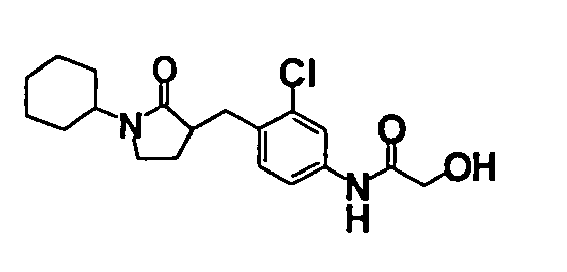
- To a solution of 2-({3-chloro-4-[(1-cyclohexyl-2-oxopyrrolidin-3-yl)methyl]phenyl}amino)-2-oxoethyl acetate obtained in Example 236A (0.20 g) in tetrahydrofuran (5 mL) was added 2N aqueous potassium hydroxide solution (0.98 mL), and the mixture was stirred overnight at room temperature. 1N Hydrochloric acid was added to the reaction mixture, and the mixture was extracted with ethyl acetate. The ethyl acetate layer was washed with saturated brine, dried over anhydrous magnesium sulfate, and concentrated under reduced pressure to give the title compound (0.17 g, 95%) as a white solid.
1H NMR (300 MHz, CDCl3) δ ppm 1.02-1.18 (m, 1 H), 1.29-1.46 (m, 4 H), 1.60-1.85 (m, 6 H), 1.95-2.09 (m, 1 H), 2.66-2.85 (m, 2 H), 3.15-3.32 (m, 3 H), 3.85-3.98 (m, 1 H), 3.98-4.05 (m, 1 H), 4.16-4.25 (m, 2 H), 7.15 (d, J=8.4 Hz, 1 H), 7.27-7.31 (dd, J=8.4, 2.2 Hz, 1 H), 7.68 (d, J=2.2 Hz, 1 H), 8.53 (s, 1 H). -

- To a solution of 3-(4-amino-2-chlorobenzyl)-1-cyclohexylpyrrolidin-2-one obtained in Example 215A (0.60 g) in pyridine (3 mL) was added ethyl isocyanatoacetate (0.33 mL), and the mixture was stirred at 50°C for 3 hr. After cooling, the reaction mixture was concentrated, 1N hydrochloric acid and ethyl acetate were added, and the mixture was extracted with ethyl acetate. The ethyl acetate layer was washed with saturated brine, dried over anhydrous magnesium sulfate, and concentrated under reduced pressure. The obtained residue was recrystallized from hexane-tetrahydrofuran to give the title compound (0.76 g, 89%) as a white solid.
1H NMR (300 MHz, DMSO-d6)δ ppm 0.99-1.15 (m, 1 H), 1.20 (t, J=7.2 Hz, 3 H), 1.18-1.46 (m, 5 H), 1.24-1.46 (m, 4 H), 1.68-1.79 (m, 2 H), 1.83-1.96 (m, 1 H), 2.56-2.70 (m, 1 H), 3.08-3.26 (m, 3 H), 3.66-3.79 (m, 1 H), 3.85 (d, J=5.8 Hz, 2 H), 4.11 (q, J=7.2 Hz, 2 H), 6.52 (t, J=5.8 Hz, 1 H), 7.09-7.24 (m, 2 H), 7.65 (d, J=2.1 Hz, 1 H), 8.96 (s, 1 H). -

- In the same manner as in Example 129A, the title compound was obtained from ethyl N-[({3-chloro-4-[(1-cyclohexyl-2-oxopyrrolidin-3-yl)methyl]phenyl}amino)carbonyl]glycinate obtained in Example 238A.
1H NMR (300 MHz, DMSO-d6) δ ppm 0.97-1.17 (m, 1 H), 1.19-1.46 (m, 4 H), 1.48-1.65 (m, 4 H), 1.68-1.80 (m, 2 H), 1.81-1.96 (m, 1 H), 2.55-2.70 (m, 1 H), 3.07-3.27 (m, 4 H), 3.34 (brs, 1 H), 3.66-3.79 (m, 3 H), 6.48 (t, J=5.4 Hz, 1H), 7.07-7.25 (m, 2 H), 7.66 (s, 1 H), 9.00 (s, 1 H). -
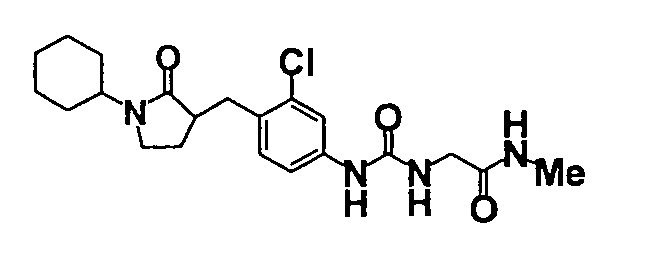
- In the same manner as in Example 70A, the title compound was obtained from N-[({3-chloro-4-[(1-cyclohexyl-2-oxopyrrolidin-3-yl)methyl]phenyl}amino)carbonyl]glycine obtained in Example 239A and methylamine.
1H NMR (300 MHz, DMSO-d6) δ ppm 1.00-1.16 (m, 1 H), 1.21-1.43 (m, 4 H), 1.46-1.64 (m, 4 H), 1.68-1.79 (m, 2 H), 1.81-1.95 (m, 1 H), 2.46-2.55 (m, 1 H), 2.56-2.69 (m, 1 H), 2.60 (d, J=4.7 Hz, 3 H), 3.07-3.25 (m, 3 H), 3.68 (d, J=5.4 Hz, 2 H), 3.70-3.78 (m, 1 H), 6.38 (t, J=5.4 Hz, 1 H), 7.11 (dd, J=8.4, 2.1 Hz, 1 H), 7.19 (d, J=8.4 Hz, 1 H), 7.65 (d, J=2.1 Hz, 1 H), 7.81-7.91 (m, 1 H), 8.90 (s, 1 H). -

- To a solution of 3-(4-amino-2-chlorobenzyl)-1-cyclohexylpyrrolidin-2-one obtained in Example 215A (0.20 g) in N,N-dimethylformamide (3 mL) was added N,N'-carbonyldiimidazole (0.21 g), and the mixture was stirred overnight at room temperature. Then, O-methylhydroxyammonium chloride (0.27 g) and diisopropylethylamine (0.57 mL) were added, and the mixture was stirred at room temperature for 2 days. The reaction mixture was concentrated under reduced pressure, ethyl acetate and water were added, and the mixture was extracted with ethyl acetate. The ethyl acetate layer was washed with saturated brine, dried over anhydrous magnesium sulfate, and concentrated under reduced pressure. The obtained residue was subjected to silica gel column chromatography with ethyl acetate-hexane (50:50-100:0), and the obtained crystals were recrystallized from hexane-ethyl acetate to give the title compound (0.12 g, 49%) as a white solid.
1H NMR (300 MHz, CDCl3) δ ppm 1.00-1.19 (m, 1 H), 1.24-1.48 (m, 4 H), 1.60-1.85 (m, 6 H), 1.92-2.06 (m, 1 H), 2.71-2.84 (m, 2 H), 3. 12-3.25 (m, 2 H), 3.26-3. 39 (m, 1 H), 3. 79 (s, 3 H), 3. 88-4. 01 (m, 1 H), 7.19-7.30 (m, 2 H), 7.35 (brs, 1 H), 7.54 (brs, 1 H), 7.60 (d, J=2.1 Hz, 1 H). -

- In the same manner as in Example 241A, the title compound was obtained from 3-(4-amino-2-chlorobenzyl)-1-cyclohexylpyrrolidin-2-one obtained in Example 215A and pyrrolidine.
1H NMR (300 MHz, CDCl3) δ ppm 1.02-1.15 (m, 1 H), 1.23-1.45 (m, 4 H), 1.60-1.83 (m, 6 H), 1.91-2.03 (m, 5 H), 2.68-2.82 (m, 2 H), 3.11-3.23 (m, 2 H), 3.25-3.36 (m, 1 H), 3.41-3.49 (m, 4 H), 3.88-4.00 (m, 1 H), 6.21 (brs, 1 H), 7.12-7.22 (m, 2 H), 7.55 (d, J=1.9 Hz, 1 H). -

- In the same manner as in Example 241A, the title compound was obtained from 3-(4-amino-2-chlorobenzyl)-1-cyclohexylpyrrolidin-2-one obtained in Example 215A and 2-aminoethanol.
1H NMR (300 MHz, CDCl3) δ ppm 1.00-1.16 (m, 1 H), 1.25-1.44 (m, 5 H), 1.59-1.84 (m, 6 H), 1.93-2.04 (m, 1 H), 2.62-2.83 (m, 2 H), 3.11-3.29 (m, 3 H), 3.29-3.39 (m, 2 H), 3.63-3.71 (m, 2 H), 3.80-3.95 (m, 1 H), 6.14 (t, J=5.4 Hz, 1 H), 6.98-7.12 (m, 2 H), 7.35 (d, J=1.9 Hz, 1H), 8.05 (s, 1H). -

- In the same manner as in Example 241A, the title compound was obtained from 3-(4-amino-2-chlorobenzyl)-1-cyclohexylpyrrolidin-2-one obtained in Example 215A and O-benzylhydroxylammonium chloride.
1H NMR (300 MHz, CDCl3) δ ppm 0.99-1.16 (m, 1 H), 1.23-1.48 (m, 4 H), 1.60-1.85 (m, 6 H), 1.90-2.04 (m, 1 H), 2.68-2.82 (m, 2 H), 3.12-3.24 (m, 2 H), 3.25-3.36 (m, 1 H), 3.88-4.00 (m, 1 H), 4.88 (s, 2 H), 7.06-7.12 (m, 1 H), 7.15-7.20 (m, 1 H), 7.22 (s, 1 H), 7.32-7.37 (m, 1 H), 7.39-7.47 (m, 6 H). -

- A solution of 3-(4-bromo-2-chlorobenzyl)-1-cyclohexylpyrrolidin-2-one obtained in Example 193A (0.20 g), 2-(tributylstannyl)pyridine (0.24g) and tetrakis(triphenylphosphine)palladium (31 mg) in toluene (5 mL) was heated under reflux overnight under nitrogen atmosphere. After cooling, water and ethyl acetate were added to the reaction mixture, and the mixture was extracted with ethyl acetate. The ethyl acetate layer was washed with saturated brine, dried over anhydrous magnesium sulfate, and concentrated under reduced pressure. The obtained residue was silica gel column chromatography with ethyl acetate-hexane (25:75-75:25) to give the title compound (0.11 g, 77%) as an oil.
1H NMR (300 MHz, CDCl3) δ ppm 0.96-1.17 (m, 1 H), 1.20-1.49 (m, 4 H), 1.57-1.85 (m, 6 H), 1.87-2.11 (m, 1 H), 2.78-2.91 (m, 2 H), 3.13-3.28 (m, 2 H), 3.36-3.50 (m, 1 H), 3.88-4.03 (m, 1 H), 7.19-7.30 (m, 1 H), 7.38 (d, J=7.9 Hz, 1 H), 7.66-7.84 (m, 3 H), 8.03 (d, J=1.9 Hz, 1 H), 8.63-8.71 (m, 1 H). -

- In the same manner as in Example 245A, the title compound was obtained from 3-(4-bromo-2-chlorobenzyl)-1-cyclohexylpyrrolidin-2-one obtained in Example 193A and 3-(tributylstannyl)pyridine.
1H NMR (300 MHz, CDCl3) δ ppm 1.01-1.17 (m, 1 H), 1.25-1.48 (m, 4 H), 1.61-1.86 (m, 6 H), 1.99-2.12 (m, 1 H), 2.79-2.91 (m, 2 H), 3.16-3.30 (m, 2 H), 3.36-3.47 (m, 1 H), 3.90-4.03 (m, 1 H), 7.34-7.42 (m, 3 H), 7.58 (brs, 1 H), 7.81-7.88 (m, 1 H), 8.57-8.64 (m, 1 H), 8.79-8.84 (m, 1 H). -

- In the same manner as in Example 245A, the title compound was obtained from 3-(4-bromo-2-chlorobenzyl)-1-cyclohexylpyrrolidin-2-one obtained in Example 193A and 2-(tributylstannyl)furan.
1H NMR (300 MHz, CDCl3) δ ppm 1.00-1.16 (m, 1 H), 1.25-1.48 (m, 4 H), 1.61-1.84 (m, 6 H), 1.93-2.08 (m, 1 H), 2.75-2.88 (m, 2 H), 3.12-3.26 (m, 2 H), 3.32-3.43 (m, 1 H), 3.85-4.02 (m, 1 H), 6.47 (dd, J=3. 4, 1.9 Hz, 1 H), 6.62-6.65 (m, 1 H), 7.28 (d, J=7.9 Hz, 1 H), 7.45-7.47 (m, 1 H), 7.45-7.50 (m, 1 H), 7.66 (d, J=1.7 Hz, 1 H). -
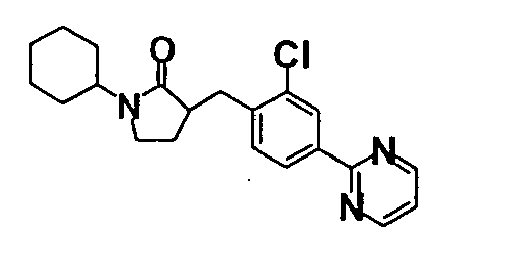
- In the same manner as in Example 245A, the title compound was obtained from 3-(4-bromo-2-chlorobenzyl)-1-cyclohexylpyrrolidin-2-one obtained in Example 193A and 2-(tributylstannyl)pyrimidine.
1H NMR (300 MHz, CDCl3) δ ppm 0.99-1.19 (m, 1 H), 1.22-1.51 (m, 4 H), 1.59-1.86 (m, 6 H), 1.93-2.09 (m, 1 H), 2.80-2.93 (m, 2 H), 3.12-3.30 (m, 2 H), 3.40-3.52 (m, 1 H), 3.88-4.05 (m, 1 H), 7.21 (t, J=4.9 Hz, 1 H), 7.40 (d, J=8.1 Hz, 1 H), 8.25 (dd, J=8.1, 1.8 Hz, 1H), 8.46 (d, J=1.8 Hz, 1H), 8.80 (d, J=4.9 Hz, 2 H). -

- 3-(4-Bromo-2-chlorobenzyl)-1-cyclohexylpyrrolidin-2-one obtained in Example 193A (0.30 g), copper (II) cyanide (52 mg) and tetrakis(triphenylphosphine)palladium (0.99 g) were dissolved in N,N-dimethylformamide (5 mL), and the mixture was heated under reflux overnight under nitrogen atmosphere. After cooling, the reaction mixture was filtrated, ethyl acetate and water were added to the filtrate, and the mixture was extracted with ethyl acetate. The ethyl acetate layer was washed with saturated brine, dried over anhydrous magnesium sulfate, and concentrated under reduced pressure. The obtained residue was silica gel column chromatography with ethyl acetate-hexane (50:50-100:0) to give the title compound (80 mg, 31%) as a white solid.
1H NMR (300 MHz, CDCl3) δ ppm 0.98-1.18 (m, 1 H), 1.24-1.48 (m, 4 H), 1.57-1.94 (m, 6 H), 2.00-2.13 (m, 1 H), 2.74-2.93 (m, 2 H), 3.15-3.30 (m, 2 H), 3.32-3.45 (m, 1 H), 3.86-4.00 (m, 1 H), 7.44 (d, J=8.0 Hz, 1 H), 7.49 (dd, J=8.0, 1.5 Hz, 1 H), 7.65 (d, J=1.5 Hz, 1 H). -
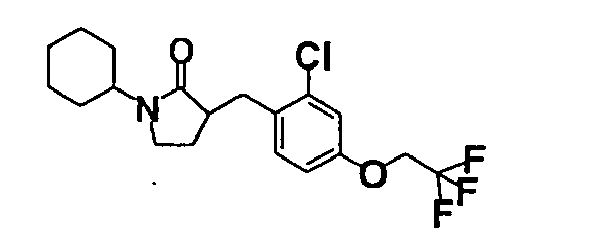
- To a solution of 3-(2-chloro-4-hydroxybenzyl)-1-cyclohexylpyrrolidin-2-one obtained in Example 183A (0.20 g) in N,N-dimethylformamide (5 mL) were added cesium carbonate (0.42 g) and 2-bromo-1,1,1-trifluoroethane (0.12 mL), and the mixture was stirred at room temperature for 2 hr. Then, 2-bromo-1,1,1-trifluoroethane (0.60 mL) was further added, and the mixture was stirred overnight at 60°C. After cooling, the reaction mixture was concentrated under reduced pressure, ethyl acetate and water were added, and the mixture was extracted with ethyl acetate. The ethyl acetate layer was washed with saturated brine, dried over anhydrous magnesium sulfate, and concentrated under reduced pressure. The obtained residue was silica gel column chromatography with ethyl acetate-hexane (10:90-40:60) to give the title compound (64 mg, 25%) as a white solid.
1H NMR (300 MHz, CDCl3) δ ppm 1.03-1.16 (m, 1 H), 1.23-1.47 (m, 4 H), 1.62-1.74 (m, 4 H), 1.74-1.85 (m, 2 H), 1.93-2.07 (m, 1 H), 2.70-2.83 (m, 2 H), 3.13-3.24 (m, 2 H), 3.24-3.36 (m, 1 H), 3.88-4.01 (m, 1 H), 4.32 (q, J=8.1 Hz, 2 H), 6.79 (dd, J=8.7, 2.7 Hz, 1H), 6.97 (d, J=2. 6 Hz, 1H), 7.23 (d, J=8.7 Hz, 1H). -

- The compound which as obtained in the same manner as in Example 118A from 1-(4-methoxybenzyl)pyrrolidin-2-one and cyclohexane-1,4-dione monoethyleneketal, was subjected to hydrolysis in the same manner as in Example 28A to give the title compound.
1H NMR (300 MHz, CDCl3) δ ppm 1.58-1.98 (m, 4 H), 1.95-2.16 (m, 2 H), 2.16-2.34 (m, 2 H), 2.67-3.05 (m, 3 H), 3.09-3.29 (m, 2 H), 3.80 (s, 3 H), 4.26-4.56 (m, 2 H), 5.17 (d, J=2.1 Hz, 1 H), 6.79-6.94 (m, 2 H), 7.07-7.22 (m, 2 H). -

- A solution of 3-(4-bromo-2-chlorobenzyl)-1-cyclohexylpyrrolidin-2-one obtained in Example 193A (0.20 g), tetrakis(triphenylphosphine)palladium (58 mg) and propargyl alcohol (63 µL) in piperidine (5 mL) was stirred at 80°C for 2 hr under argon atmosphere. After cooling, saturated aqueous ammonium chloride, water and ethyl acetate were added to the reaction mixture, and the mixture was extracted with ethyl acetate. The ethyl acetate layer was washed with saturated brine, dried over anhydrous magnesium sulfate, and concentrated under reduced pressure. The obtained residue was silica gel column chromatography with ethyl acetate-hexane (25:75-75:25) to give the title compound (0.14 g, 77%) as a brown oil.
1H NMR (300 MHz, CDCl3) δ ppm 1.00-1.15 (m, 1 H), 1.31-1.47 (m, 4 H), 1.58-1.73 (m, 4 H), 1.74-1.89 (m, 3 H), 1.93-2.04 (m, 1 H), 2.73-2.86 (m, 2 H), 3.15-3.24 (m, 2 H), 3.31-3.42 (m, 1 H), 3.85-4.02 (m, 1 H), 4.49 (d, J=6.0 Hz, 2 H), 7.23 (brs, 2 H), 7.43 (brs, 1H). -

- A solution of 3-(4-bromo-2-chlorobenzyl)-1-cyclohexylpyrrolidin-2-one obtained in Example 193A (0.20 g), ethyl acrylate (0.071 mL), palladium acetate (6.1mg), tri(o-tolyl)phosphine (16 mg) and N,N-diisopropylethylamine (0.70 mL) in N,N-dimethylformamide (3 mL) was stirred overnight at 115°C under argon atmosphere. After cooling, 1N hydrochloric acid and ethyl acetate were added, and the mixture was extracted with ethyl acetate. The ethyl acetate layer was washed with saturated brine, dried over anhydrous magnesium sulfate, and concentrated under reduced pressure. The obtained residue was silica gel column chromatography with ethyl acetate-hexane (20:80-70:30) to give the title compound (0.15 g, 71%) as yellow crystals.
1H NMR (300 MHz, CDCl3) δ ppm 1.02-1.15 (m, 1 H), 1.24-1.43 (m, 4 H), 1.34 (t, J=7.2 Hz, 3 H), 1.62-1.84 (m, 6 H), 1.96-2.09 (m, 1 H), 2.74-2.87 (m, 2 H), 3.13-3.27 (m, 2 H), 3.31-3.43 (m, 1 H), 3.87-4.03 (m, 1 H), 4.26 (q, J=7.2 Hz, 2 H), 6.40 (d, J=16.0 Hz, 1 H), 7.28-7.38 (m, 2 H), 7.51 (s, 1 H), 7.58 (d, J=16.0 Hz, 1 H). -

- In the same manner as in Example 28A, the title compound was obtained from 3-(4-bromo-2-chlorobenzyl)-1-(1,4-dioxaspiro[4.5]dec-8-yl)pyrrolidin-2-one obtained in Example 203A.
1H NMR (300 MHz, CDCl3) δ ppm 1.65-1.78 (m, 1 H), 1.79-1.94 (m, 2 H), 1.95-2.13 (m, 3 H), 2.38-2.62 (m, 4 H), 2.73-2.88 (m, 2 H), 3.14-3.26 (m, 2 H), 3.27-3.39 (m, 1 H), 4.41-4.55 (m, 1 H), 7.16 (d, J=8.3 Hz, 1 H), 7.33 (dd, J=8.3, 2.1 Hz, 1 H), 7.53 (d, J=2.1 Hz, 1 H). -

- To a mixture of (4S)-1-(1-adamantyl)-4-hydroxypyrrolidin-2-one obtained in Reference Example 16A (0.235 g) and tetrahydrofuran (5 mL) was added lithium diisopropylamide (1.8 M tetrahydrofuran solution, 1.2 mL) at -78°C under nitrogen atmosphere, and the mixture was stirred for 1 hr.
- N,N,N',N',N",N"-Hexamethylphosphoric triamide (1 mL) was added, and the mixture was stirred for 30 min. A solution of α,2,6-trichlorotoluene (0.46 g) in tetrahydrofuran (2 mL) was added to the obtained solution, and the mixture was further stirred at -78°C for 1 hr, and then at -40°C for 16 hr. Water was added to the reaction mixture, and the mixture was extracted with ethyl acetate. The ethyl acetate layer was washed with saturated brine, and dried over anhydrous magnesium sulfate. The solvent was evaporated under reduced pressure, and the residue was subjected to silica gel column chromatography (hexane-ethyl acetate 9:1-1:1) to give the title compound (0.133 g, 34%) as a colorless solid.
1H NMR (300 MHz, CDCl3) δ ppm 1.53-1.69 (m, 12 H), 2.12-2.17 (m, 3 H), 2.36-2.44 (dd, J=16.8, 6.0 Hz, 1 H), 2.59-2.67 (dd, J=16.8, 7.8 Hz, 1 H), 2.97-3.03 (dd, J=10.2, 5.4 Hz, 1 H), 3.32-3.29 (m, 1 H), 4.41 (quint, J=6.6 Hz, 1 H), 4.73-4.89 (q, J=13.8 Hz, 2 H), 7.18-7.23 (m, 1 H), 7.28-7.35 (m, 2 H). -

- In the same manner as in Example 255A, the title compound was obtained from (4S)-1-(1-adamantyl)-4-hydroxypyrrolidin-2-one obtained in Reference Example 16A and 2-chloro-1-(chloromethyl)-4-fluorobenzene.
1H NMR (300 MHz, CDCl3) δ ppm 1.53-1.61 (m, 6 H), 1.69-1.70 (m, 6 H), 2.14 (m, 3 H), 2.36-2.48 (m, 1 H), 2.61-2.73 (m, 1 H), 3.14-3.21 (dd, J=10.2, 4.4 Hz, 1 H), 3.44-3.52 (dd, J=10.0, 6.6 Hz, 1 H), 4.43-4.49 (m, 1 H), 4.50-4.65 (q, J=15.4 Hz, 2 H), 6.92-7.01 (m, 1 H), 7.09-7.14 (dd, J=8.4, 2.6 Hz, 1 H), 7.29-7.35 (dd, J=8.4, 5.8 Hz, 1 H). -

- In the same manner as in Example 255A, the title compound was obtained from (4S)-1-(1-adamantyl)-4-hydroxypyrrolidin-2-one obtained in Reference Example 16A and 1-(bromomethyl)-2-chloro-4-methoxybenzene.
1H NMR (300 MHz, CDCl3) δ ppm 1.55-1.62 (m, 6 H), 1.68-1.69 (m, 6 H), 2.13 (m, 3 H), 2.37-2.45 (dd, J=16.8, 5.1 Hz, 1 H), 2.60-2.69 (dd, J=16.8, 7.8 Hz, 1 H), 3.12-3.17 (dd, J=10.2, 4.8 Hz, 1 H), 3.41-3.47 (m, 1 H), 3.79 (s, 3 H), 4.42-4.46 (m, 1 H), 4.53 (s, 2 H), 6. 76-6. 80 (dd, J=8.4, 2.4 Hz, 1 H), 6.91 (d, J=2.4 Hz, 1 H), 7.22-7.25 (d, J=8.4 Hz, 1 H). -

- In the same manner as in Example 255A, the title compound was obtained from 1-cyclohexyl-4-(hydroxymethyl)pyrrolidin-2-one obtained in Reference Example 17A and α,2,6-trichlorotoluene.
1H NMR (300 MHz, CDCl3) δ ppm 1.11 (m, 1 H), 1.26-1.44 (m, 5 H), 1.66-1.78 (m, 5 H), 2.35-2.41 (m, 1 H), 2.75-2.83 (m, 1 H), 3.10-3.20 (m, 2 H), 3.22-3.26 (m, 1 H), 3.29-3.36 (m, 1 H), 3.46-3.52 (m, 2 H), 3.96 (m, 1 H), 7.08-7.14 (m, 1 H), 7.26-7.31 (m, 2 H). -
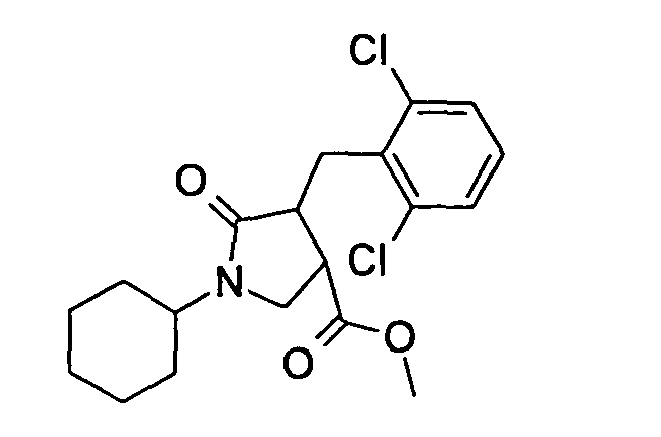
- To a mixture of 1-cyclohexyl-3-(2,6-dichlorobenzyl)-4-(hydroxymethyl)pyrrolidin-2-one obtained in Example 258A (1.07 g), triethylamine (1.25 mL), dimethyl sulfoxide (0.70 mL) and dichloromethane (15 mL) was added sulfur trioxide pyridine complex (1.43 g) at 0°C, and the mixture was stirred at room temperature for 4 hr. Water was added to the reaction mixture, and the mixture was extracted with ethyl acetate. The ethyl acetate layer was washed with saturated brine, and dried over anhydrous magnesium sulfate. The solvent was evaporated under reduced pressure. N-Iodosuccinimide (1.69 g), potassium carbonate (1.04 g) and methanol (30 mL) were added to the obtained residue, and the mixture was stirred at room temperature for 16 hr under shading. Water was added to the reaction mixture, and the mixture was extracted with ethyl acetate. The ethyl acetate layer was washed with saturated brine, and dried over anhydrous magnesium sulfate. The solvent was evaporated under reduced pressure. The obtained residue was subjected to silica gel column chromatography (hexane-ethyl acetate 19:1-4:1) to give the title compound (0.22 g, 19%) as a pale-yellow solid.
1H NMR (300 MHz, CDCl3) δ ppm 1.11 (m, 1 H), 1.31-1.49 (m, 4 H), 1.66-1.78 (m, 5 H), 3.04-3.22 (m, 2 H), 3.41 (s, 3 H), 3.43-3.65 (m, 4 H), 3.97 (m, 1 H), 7.06-7.31 (m, 3 H). -

- In the same manner as in Example 155A, the title compound was obtained from methyl 1-cyclohexyl-4-(2,6-dichlorobenzyl)-5-oxopyrrolidine-3-carboxylate obtained in Example 259A.
1H NMR (300 MHz, CDCl3) δ ppm 1.10 (m, 1 H), 1.26-1.38 (m, 4 H), 1.65-1.80 (m, 5 H), 3.02-3.15 (m, 2 H), 3.33-3.41 (m, 2 H), 3.43-3.61 (m, 2 H), 3.95 (m, 1 H), 7.04-7.09 (t, J=8.4 Hz, 1H), 7.24-7.27 (m, 2 H). -

- A mixture of 1-cyclohexyl-3-(2,6-dichlorobenzyl)-4-(hydroxymethyl)pyrrolidin-2-one obtained in Example 258A (0.200 g), ethyl isocyanate (0.071 g) and pyridine (3 mL) was stirred at 60°C for 16 hr. The reaction mixture was concentrated under reduced pressure, and the obtained residue was subjected to silica gel column chromatography (hexane-ethyl acetate 19:1-4:1) to give the title compound (0.180 g, 75%) as a colorless liquid.
1H NMR (300 MHz, CDCl3) δ ppm 1.04-1.15 (m, 1 H), 1.09 (t, J=7.2 Hz, 3 H), 1.28-1.47 (m, 4 H), 1.66-1.78 (m, 5 H), 2.46-2.50 (m, 1 H), 2.91-3.00 (m, 1 H), 3.06-3.18 (m, 4 H), 3.42-3.56 (m, 2 H), 3.67-3.80 (m, 2 H), 3.95 (m, 1 H), 4.68 (m, 1H), 7.09-7.18 (m, 1 H), 7.22-7.31 (m, 2 H). -

- A mixture of 1-cyclohexyl-4-(2,6-dichlorobenzyl)-5-oxopyrrolidine-3-carboxylic acid obtained in Example 260A (0.290 g), diphenylphosphoryl azide (0.220 g), triethylamine (0.112 mL) and tert-butanol (20 mL) was stirred at 90°C for 16 hr. The solvent was evaporated under reduced pressure. The obtained residue was subjected to silica gel column chromatography (hexane-ethyl acetate 19:1-3:1) to give the title compound (0.330 g, 96%) as a colorless solid.
1H NMR (300 MHz, CDCl3) δ ppm 1.09-1.13 (m, 1 H), 1.23-1.40 (m, 4 H), 1.35 (s, 9 H), 1.64-1.79 (m, 5 H), 2.81-2.89 (m, 1 H), 2.99-3.05 (m, 1 H), 3.11-3.19 (m, 1 H), 3.46-3.53 (dd, J=14.1, 5.4 Hz, 1 H), 3.66-3.72 (m, 1 H), 3.97-4.01 (m, 1 H), 4.06-4.11 (m, 1H), 4.27 (m, 1H), 7.08-7.13 (m, 1 H), 7.28-7.33 (m, 2 H). -

- A solution of methyl 1-cyclohexyl-4-(2,6-dichlorobenzyl)-5-oxopyrrolidine-3-carboxylate obtained in Example 259A (0.24 g) in tetrahydrofuran (15 mL) was cooled to 10°C, and methyllithium (1.0 M ether solution, 1.9 mL) was added dropwise thereto. The reaction mixture was stirred at room temperature for 2 hr, water was added, and the mixture was extracted with ethyl acetate.
- The organic layer was washed with saturated brine, and dried over magnesium sulfate, and the solvent was evaporated under reduced pressure. The obtained residue was subjected to silica gel column chromatography (hexane-ethyl acetate 9:1-1:1) to give the title compound (0.216 g, 90%) as a colorless solid.
1H NMR (300 MHz, CDCl3) δ ppm 0.87 (s, 3 H), 0.98 (s, 3 H), 1.03-1.16 (m, 1 H), 1.35-1.51 (m, 4 H), 1.65-1.86 (m, 6 H), 1.92-2.02 (m, 1 H), 2.76-2.82 (m, 2 H), 3.02-3.11 (m, 1 H), 3.35-3.53 (m, 3 H), 3.90-3.97 (m, 1 H), 7.08-7.13 (m, 1 H), 7.28-7.30 (m, 2 H) . -

- In the same manner as in Example 20A, the title compound was obtained from tert-butyl [1-cyclohexyl-4-(2,6-dichlorobenzyl)-5-oxopyrrolidin-3-yl]carbamate obtained in Example 262A.
1H NMR (300 MHz, DMSO-d6) δ ppm 1.03-1.15 (m, 1 H), 1.22-1.41 (m, 4 H), 1.58-1.78 (m, 5 H), 2.81-2.86 (m, 1 H), 3.01-3.18 (m, 2 H), 3.43-3.47 (m, 2 H), 3.62-3.81 (m, 3 H), 7.27-7.33 (t, J=8.4 Hz, 1 H), 7.44-7.47 (m, 2 H), 8.55 (br, 3 H). -

- In the same manner as in Example 255A, the title compound was obtained from 1-cyclohexyl-4-(hydroxymethyl)pyrrolidin-2-one obtained in Reference Example 17A and 2-chloro-6-methoxybenzyl bromide.
1H NMR (300 MHz, CDCl3) δ ppm 1.07-1.11 (m, 1 H), 1.34-1.44 (m, 5 H), 1.66-1.76 (m, 5 H), 2.26-2.32 (m, 1 H), 2.64-2.71 (m, 1 H), 2.91-2.99 (m, 1 H), 3.07-3.12 (m, 1 H), 3.17-3.24 (m, 2 H), 3.30-3.36 (dd, J=13.5, 4.8 Hz, 1 H), 3.42-3.48 (m, 1 H), 3.82 (s, 3H), 3.96 (m,1H), 6.75-6.78 (d, J=8.1 Hz, 1H), 6.96-6.99 (d, J=8.1 Hz, 1 H), 7.09-7.15 (t, J=8.1 Hz, 1 H). -

- In the same manner as in Example 140A, the title compound was obtained from 3-(2-chloro-6-methoxybenzyl)-1-cyclohexyl-4-(hydroxymethyl)pyrrolidin-2-one obtained in Example 265A.
LC/MS (ESI+); m/z 338 (M+H)+ -

- To a mixture of 1-cyclohexyl-3-(2,6-dichlorobenzyl)-4-(hydroxymethyl)pyrrolidin-2-one obtained in Example 258A (0.748 g), phenol (0.237 g), triphenylphosphine (0.661 g) and tetrahydrofuran (5 mL) was added diethyl azodicarboxylate (40% toluene solution, 1.08 g), and the mixture was stirred at room temperature for 16 hr. The solvent was evaporated under reduced pressure, and the residue was subjected to silica gel column chromatography (hexane-ethyl acetate 9:1-1:1) to give the title compound (0.617 g, 68%) as a colorless liquid.
1H NMR (300 MHz, CDCl3) δ ppm 1.07-1.11 (m, 1 H), 1.33-1.44 (m, 4 H), 1.65-1.83 (m, 5 H), 2.60-2.66 (m, 1 H), 3.06-3.30 (m, 3 H), 3.46-3.65 (m, 4 H), 3.99 (m, 1 H), 6.65-6.68 (m, 2H), 7.04-7.10 (m, 1 H), 7.17-7.27 (m, 4 H). -

- In the same manner as in Example 1A, the title compound was obtained from 1-cyclohexylpyrrolidin-2-one and 4-bromo-2-fluorobenzyl bromide.
1H NMR (300 MHz, CDCl3) δ ppm 0.97-1.18 (m, 1 H), 1.21-1.49 (m, 4 H), 1.53-1.92 (m, 6 H), 1.93-2.12 (m, 1 H), 2.61-2.78 (m, 2 H), 3.10-3.26 (m, 3 H), 3.82-4.02 (m, 1 H), 7.08-7.25 (m, 3 H). -

- In the same manner as in Example 218A, the title compound was obtained from 3-(4-bromo-2-fluorobenzyl)-1-cyclohexylpyrrolidin-2-one obtained in Example 268A and phenylboronic acid.
1H NMR (300 MHz, CDCl3) δ ppm 1.05-1.09 (m, 1 H), 1.23-1.41 (m; 4 H), 1.64-1.76 (m, 6 H), 2.02-2.09 (m, 1H), 2.71-2.80 (m, 2H), 3.16-3.22 (m, 2H), 3.26-3.29 (m, 1 H), 3.91-3.95 (m, 1 H), 7.23-7.40 (m, 4 H), 7.43-7.45 (m, 2 H), 7.54-7.56 (m, 2 H). -

- In the same manner as in Example 255A, the title compound was obtained from 1-[3-(hydroxymethyl)-1-adamantyl]pyrrolidin-2-one obtained in Reference Example 19A and α,2,6-trichlorotoluene.
1H NMR (300 MHz, CDCl3) δ ppm 1.43-2.21 (m, 17 H), 2.81-2.88 (m, 1 H), 2.96-3.04 (m, 1 H), 3.23-3.31 (m, 3 H), 3.42-3.50 (m, 2 H), 7.05-7.11 (t, J=7.8 Hz, 1 H), 7.27-7.30 (d, J=8.1 Hz, 2 H). -

- In the same manner as in Example 259A, the title compound was obtained from 3-(2,6-dichlorobenzyl)-1-[3-(hydroxymethyl)-1-adamantyl]pyrrolidin-2-one obtained in Example 270A.
1H NMR (300 MHz, CDCl3) δ ppm 1.53-1.73 (m, 4 H), 1.77-1.91 (m, 3 H), 1.99 (m, 1 H), 2.05-2.23 (m, 6 H), 2.81-2.88 (m, 1 H), 2.96-3.05 (m, 1 H), 3.23-3.29 (m, 2 H), 3.32 (s, 3H), 3.66 (s, 1H), 3.70 (s, 1 H), 7.06-7.11 (m, 1 H), 7.27-7.30 (m, 2 H). -

- In the same manner as in Example 155A, the title compound was obtained from methyl 3-[3-(2, 6-dichlorobenzyl)-2-oxopyrrolidin-1-yl]adamantane-1-carboxylate obtained in Example 271A.
1H NMR (300 MHz, CDCl3) δ ppm 1.62-1.79 (m, 6 H), 1.80-1.97 (m, 2 H), 2.11-2.23 (m, 6 H), 2.23-2.31 (m, 2 H), 2.87-2.99 (m, 1 H), 3.02 (m, 1 H), 3.29-3.35 (m, 1H), 3.37-3.45 (m, 1H), 3.48-3.55 (m, 1H), 7.07-7.12 (m, 1 H), 7.27-7.30 (m, 2 H), 9.36 (s, 1 H). -

- In the same manner as in Example 263A, the title compound was obtained from methyl 3-[3-(2,6-dichlorobenzyl)-2-oxopyrrolidin-1-yl]adamantane-1-carboxylate obtained in Example 271A.
1H NMR (300 MHz, CDCl3) δ ppm 1.18 (s, 6 H), 1.43-1.74 (m, 6 H), 1.77-1.92 (m, 2 H), 2.00-2.31 (m, 8 H), 2.90-3.07 (m, 2 H), 3.29-3.55 (m, 3 H), 4.56 (br, 1 H), 7.07-7.12 (m, 1 H), 7.27-7.30 (m, 2 H). -

- In the same manner as in Example 1A, the title compound was obtained from 1-(piperidin-1-yl)pyrrolidin-2-one obtained in Reference Example 22A and α,2,6-trichlorotoluene.
1H NMR (300 MHz, CDCl3) δ ppm 1.39-1.45 (m, 2 H), 1.66-1.74 (m, 4 H), 1.81-1.94 (m, 2 H), 2.82-2.88 (m, 1 H), 2.91-3.04 (m, 4 H), 3.27-3.35 (m, 1 H), 3.41-3.49 (m, 2 H), 7.07-7.12 (m, 1 H), 7.27-7.30 (m, 2 H). -
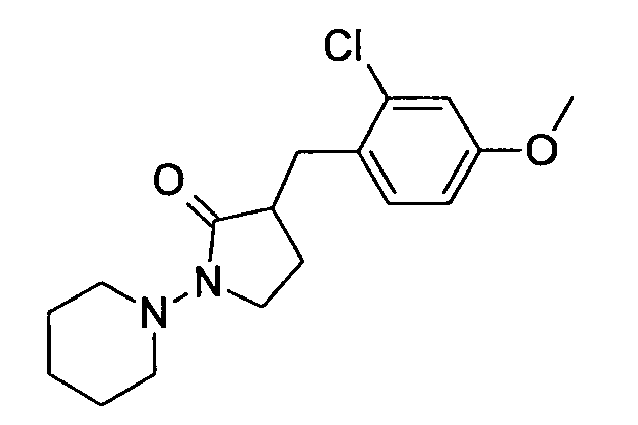
- In the same manner as in Example 1A, the title compound was obtained from 1-(piperidin-1-yl)pyrrolidin-2-one obtained in Reference Example 22A and 2-chloro-4-methoxybenzyl bromide.
1H NMR (300 MHz, CDCl3) δ ppm 1.40-1.43 (m, 2 H), 1.65-1.75 (m, 5 H), 1.94-2.01 (m, 1 H), 2.66-2.79 (m, 2 H), 2.85-2.97 (m, 4 H), 3.23-3.32 (m, 3 H), 3.77 (s, 3 H), 6.72-6.76 (dd, J=8.7, 2.4 Hz, 1 H), 6.89 (d, J=2.4 Hz, 1 H), 7.17-7.20 (d, J=8.7 Hz, 1 H). Example 276A 3-[2-chloro-4-(trifluoromethyl)benzyl]-1-(piperidin-1-yl)pyrrolidin-2-one
- In the same manner as in Example 1A, the title compound was obtained from 1-(piperidin-1-yl)pyrrolidin-2-one obtained in Reference Example 22A and 2-chloro-4-(trifluoromethyl)benzyl chloride.
1H NMR (300 MHz, CDCl3) δ ppm 1.35-1.46 (m, 2 H), 1.58-1.77 (m, 5 H), 1.96-2.12 (m, 1 H), 2.67-2.84 (m, 2 H), 2.89-2.94 (m, 4 H), 3.30-3.42 (m, 3 H), 7.44 (m, 2 H), 7.62 (s, 1 H). -

- In the same manner as in Example 1A, the title compound was obtained from 1-(morpholin-4-yl)pyrrolidin-2-one obtained in Reference Example 23A and α,2,6-trichlorotoluene.
1H NMR (300 MHz, CDCl3) δ ppm 1.82-1.97 (m, 3 H), 2.85-2.94 (m, 1 H), 3.01-3.09 (m, 4 H), 3.29-3.37 (m, 1 H), 3.43-3.50 (m, 2 H), 3.80-3.83 (m, 4 H), 7.08-7.13 (m, 1 H), 7.28-7.31 (m, 2 H). -

- In the same manner as in Example 1A, the title compound was obtained from 1-(piperidin-1-yl)pyrrolidin-2-one obtained in Reference Example 22A and α,2,4-trichlorotoluene.
1H NMR (300 MHz, CDCl3) δ ppm 1.36-1.44 (m, 2 H), 1.60-1.73 (m, 5 H), 1.96-2.06 (m, 1 H), 2.65-2.76 (m, 2 H), 2.79-2.96 (m, 4 H), 3.25-3.34 (m, 3 H), 7.14-7.18 (m, 4 H), 7.23-7.26 (m, 1 H), 7.35 (m, 1 H). -

- In the same manner as in Example 1A, the title compound was obtained from 1-(2,3-dihydro-1H-indol-1-yl)pyrrolidin-2-one obtained in Reference Example 20A and α,2,6-trichlorotoluene. 1H NMR (300 MHz, CDCl3) δ ppm 1.97-2.06 (m, 2 H), 3.04-3.21 (m, 4 H), 3.30-3.46 (m, 2 H), 3.52-3.63 (m, 3 H), 6.52-6.55 (m, 1 H), 6.81-6.86 (m, 1 H), 7.09-7.14 (m, 3 H), 7.26-7.32 (m, 2 H).
-

- In the same manner as in Example 1A, the title compound was obtained from 1-(2,3-dihydro-1H-indol-1-yl)pyrrolidin-2-one obtained in Reference Example 20A and α,2,4-trichlorotoluene.
1H NMR (300 MHz, CDCl3) δ ppm 2.18-2.28 (m, 1 H), 2.56-2.62 (dd, J=13.5, 5.7 Hz, 1 H), 3.00-3.07 (m, 2 H), 3.15-3.29 (m, 2 H), 3.50-3.54 (d, J=12.3 Hz, 2 H), 3.45-3.66 (m, 2 H), 5.92 (br, 1H), 6.02 (br, 1H), 6.58-6.32 (t, J=7.2 Hz, 1 H), 6.85-6.91 (m, 2 H), 6.98-7.01 (dd, J=8.4, 2.4 Hz, 1 H), 7.06-7.09 (dd, J=7.2, 0.9 Hz, 1 H), 7.34 (d, J=2.1 Hz, 1 H). -

- In the same manner as in Example 1A, the title compound was obtained from 1-(2,3-dihydro-1H-indol-1-yl)pyrrolidin-2-one obtained in Reference Example 20A and α,2,4-trichlorotoluene.
1H NMR (300 MHz, CDCl3) δ ppm 1.74-1.87 (m, 1 H), 2.07-2.18 (m, 1 H), 2.81-2.94 (m, 2 H), 3.02-3.08 (t, J=7.8 Hz, 2 H), 3.25-3.43 (m, 3 H), 3.56 (br, 2 H), 6.38-6.41 (d, J=7.8 Hz, 1H), 6.81-6.86 (t, J=7.2 Hz, 1 H), 7.05-7.13 (m, 2 H), 7.17-7.20 (m, 1 H), 7.26-7.28 (m, 1H), 7.38 (d, J=2.1 Hz, 1 H). -

- In the same manner as in Example 1A, the title compound was obtained from 1-(2,3-dihydro-1H-indol-1-yl)pyrrolidin-2-one obtained in Reference Example 20A and 2-chloro-4-(trifluoromethyl)benzyl chloride.
1H NMR (300 MHz, CDCl3) δ ppm 1.79-1.90 (m, 1 H), 2.12-2.21 (m, 1 H), 2.88-3.09 (m, 4 H), 3.27-3.60 (m, 5 H), 6.38-6.41 (d, J=7.5 Hz, 1 H), 6.82-6.87 (m, 1H), 7.05-7.14 (m, 2 H), 7.48 (s, 2 H), 7.65 (s, 1 H). -

- In the same manner as in Example 1A, the title compound was obtained from 1-(6-methoxy-2,3-dihydro-1H-inden-1-yl)pyrrolidin-2-one obtained in Reference Example 21A and α,2,4-trichlorotoluene.
1H NMR (300 MHz, CDCl3) δ ppm 1.60-1.75 (m, 2 H), 1.87-2.01 (m, 1 H), 2.33-2.47 (m, 1 H), 2.75-2.90 (m, 5 H), 2.93-3.44 (m, 1 H), 3.76 (s, 3 H), 5.72-5.81 (m, 1 H), 6.53-6.64 (dd, J=20.0, 2.2 Hz, 1 H), 6.76-6.82 (dd, J=8.8, 2.6 Hz, 1 H), 7.11-7.32 (m, 3 H), 7. 38 (d, J=1.2 Hz, 1 H). -

- In the same manner as in Example 140A, the title compound was obtained from 3-(2,4-dichlorobenzyl)-1-(6-methoxy-2,3-dihydro-1H-inden-1-yl)pyrrolidin-2-one obtained in Example 283A.
1H NMR (300 MHz, CDCl3) δ ppm 1.60-1.76 (m, 1 H), 1.83-2.00 (m, 2 H), 2.33-2.42 (m, 1 H), 2.65 -2.90 (m, 5 H), 2.94-3.18 (m, 1 H), 3.35-3.45 (m, 1 H), 5.69-5.81 (m, 1 H), 6.66 (m, 1 H), 6.78-6.92 (m, 2 H), 7.04-7.20 (m, 3 H), 7.32 (m, 1 H). -

- To a mixture of 1-ethynylcyclohexanamine (5.0 g), triethylamine (5.85 mL) and tetrahydrofuran (200 mL) was added a solution of 4-chlorobutyryl chloride (5.78 g) in tetrahydrofuran (50 mL) at 0°C, and the mixture was stirred at room temperature for 3 hr. The precipitate was removed by filtration, and the filtrate was concentrated under reduced pressure. The obtained residue was partitioned between ethyl acetate and water. The ethyl acetate layer was washed successively with 10% aqueous sodium bicarbonate and saturated brine, and dried over anhydrous magnesium sulfate, and the solvent was evaporated under reduced pressure to give a colorless solid (8.6 g). To a mixture of this solid (6.0 g) and N,N-dimethylformamide (50 mL) was added sodium hydride (60% oil, 1.2 g), and the mixture was stirred at room temperature for 1 hr. Water was added to the reaction mixture, and the mixture was extracted with ethyl acetate. The extract was washed successively with water and saturated brine, and dried over anhydrous magnesium sulfate. The solvent was evaporated under reduced pressure to give a colorless oil (4.0 g). To a mixture of this oil (0.5 g) and tetrahydrofuran (10 mL) was added lithium diisopropylamide (1.8 M tetrahydrofuran solution, 1.45 mL) at -78°C under nitrogen atmosphere, and the mixture was stirred for 10 min. A solution of α,2,6-trichlorotoluene (0.508 g) in tetrahydrofuran (5 mL) was added to the obtained solution, and the mixture was further stirred at -78°C for 10 min, and allowed to warm to room temperature. 10% Aqueous ammonium chloride was added to the reaction solution, and the mixture was extracted with ethyl acetate. The ethyl acetate layer was washed with saturated brine, and dried over anhydrous magnesium sulfate. The solvent was evaporated under reduced pressure, and the residue was subjected to silica gel column chromatography (hexane-ethyl acetate 9:1-4:1) to give the title compound (0.078 g, 7%) as a colorless solid.
1H NMR (300 MHz, CDCl3) δ ppm 1.24-1.28 (m, 1 H), 1.59-1.68 (m, 5 H), 1.82-1.95 (m, 2 H), 2.01 -2.09 (m, 2 H), 2.22-2.38 (m, 2 H), 2.48 (s, 1H), 2.84-2.95 (m, 1 H), 3.03-3.09 (m, 1 H), 3.36-3.49 (m, 2 H), 3.55-3.67 (m, 1 H), 7.06-7.13 (m, 1 H), 7.27-7.35 (m, 2 H). -

- In the same manner as in Example 1A, the title compound was obtained from 1-((1S,2R)-2-{[tert-butyl(dimethyl)silyl]oxy}-2,3-dihydro-1H-inden-1-yl)pyrrolidin-2-one obtained in Reference Example 28A and 2,6-dichlorobenzyl chloride.
1H NMR (300 MHz, CDCl3) δ ppm 0.09 (s, 3 H), 0.13 (s, 3 H), 0.88 (s, 9 H), 1.66-1.95 (m, 2 H), 2.79-3.32 (m, 6 H), 3.59 (dd, J=13.3, 3.9 Hz, 1 H), 4.64-4.76 (m, 1H), 5.60 (d, J=7.2 Hz, 1 H), 7.03-7.14 (m, 1 H), 7.17-7.34 (m, 6 H). -

- In the same manner as in Example 1A, the title compound was obtained from 1-[(1S)-2,3-dihydro-1H-inden-1-yl]pyrrolidin-2-one obtained in Reference Example 25A and 2,6-dichlorobenzyl chloride.
1H NMR (300 MHz, CDCl3) δ ppm 1.81- 2.09 (m, 3 H), 2.37-2.53 (m, 1 H), 2.85-3.24 (m, 6 H), 3.45-3.60 (m, 1 H), 5.84 (t, J=7.6 Hz, 1 H), 7.04-7.35 (m, 7 H). -

- In the same manner as in Example 1A, the title compound was obtained from 1-[(1S)-2,3-dihydro-1H-inden-1-yl]pyrrolidin-2-one obtained in Reference Example 25A and 2,6-dichlorobenzyl chloride.
1H NMR (300 MHz, CDCl3) δ ppm 1.76- 2.03 (m, 3 H), 2.32-2.48 (m, 1 H), 2.82-3.20 (m, 6 H), 3.54-3.66 (m, 1 H), 5.83 (t, J=7.8 Hz, 1 H), 7.01-7.40 (m, 7 H). -

- In the same manner as in Example 1A, the title compound was obtained from 1-(2,3-dihydro-1H-inden-1-yl)pyrrolidin-2-one obtained in Reference Example 5A and methyl 2,6-dichlorobenzoate.
LC-MS (ESI+) ; m/z 374 (M)+ -

- In the same manner as in Example 1A, the title compound was obtained from 1-[(1R)-2,3-dihydro-1H-inden-1-yl]pyrrolidin-2-one obtained in Reference Example 26A and 2,6-dichlorobenzyl chloride.
1H NMR (300 MHz, CDCl3) δ ppm 1.79-2.08 (m, 3 H), 2.37-2.54 (m, 1 H), 2.83-3.26 (m, 6 H), 3.45-3.62 (m, 1 H), 5.84 (t, J=7.6 Hz, 1 H), 7.04-7.35 (m, 7 H). -

- In the same manner as in Example 1A, the title compound was obtained from 1-[(1R)-2,3-dihydro-1H-inden-1-yl]pyrrolidin-2-one obtained in Reference Example 26A and 2,6-dichlorobenzyl chloride.
1H NMR (300 MHz, CDCl3) δ ppm 1.75-2.04 (m, 3 H), 2.32-2.48 (m, 1 H), 2.83-3.20 (m, 6 H), 3.60 (dd, J=13.2, 4.1 Hz, 1 H), 5.83 (t, J=7.7 Hz, 1 H), 7.06-7.35 (m, 7 H). -

- In the same manner as in Example 1A, the title compound was obtained from 1-(2,3-dihydro-1H-inden-1-yl)pyrrolidin-2-one obtained in Reference Example 5A and 2,6-dimethylbenzyl chloride.
1H NMR (300 MHz, CDCl3) δ ppm 1.63-1.80 (m, 1 H), 1.89-2.07 (m, 2 H), 2.38 (s, 6 H), 2.39-2.54 (m, 1 H), 2.67-2.83 (m, 2 H), 2.84-3.20 (m, 4 H), 3.28-3.44 (m, 1 H), 5.85 (t, J=7.6 Hz, 1 H), 6.99-7.05 (m, 3 H), 7.08-7.28 (m, 4 H). -

- In the same manner as in Example 1A, the title compound was obtained from 1-(2,3-dihydro-1H-inden-1-yl)pyrrolidin-2-one obtained in Reference Example 5A and 2,6-dimethylbenzyl chloride.
1H NMR (300 MHz, CDCl3) δ ppm 1.62-1.76 (m, 1 H), 1.87-2.07 (m, 2 H), 2.38 (s, 6 H), 2.31-2.48 (m, 1 H), 2.62-2.83 (m, 2 H), 2.85-3.13 (m, 4 H), 3.35-3.48 (m, 1 H), 5.83 (t, J=7.7 Hz, 1 H), 7.00-7.05 (m, 3 H), 7.13-7.29 (m, 4 H). -

- In the same manner as in Example 1A, the title compound was obtained from 1-(2,3-dihydro-1H-inden-1-yl)pyrrolidin-2-one obtained in Reference Example 5A and 4-chloro-2-isopropoxybenzyl chloride.
1H NMR (300 MHz, CDCl3) δ ppm 1.35 (d, J=5.8 Hz, 6 H), 1.61-1.76 (m, 1 H), 1.81-1.98 (m, 2 H), 2.31-2.47 (m, 1 H), 2.64 (dd, J=13.4, 9.4 Hz, 1 H), 2.78-3.06 (m, 5 H), 3.25 (dd, J=13.4, 4.3 Hz, 1 H), 4.45-4.60 (m, 1 H), 5.81 (t, J=7.6 Hz, 1 H), 6.79-6.87 (m, 2 H), 7.07-7.28 (m, 5 H). -

- In the same manner as in Example 1A, the title compound was obtained from 1-(2,3-dihydro-1H-inden-1-yl)pyrrolidin-2-one obtained in Reference Example 5A and 4-chloro-2-isopropoxybenzyl chloride.
1H NMR (300 MHz, CDCl3) δ ppm 1.33 (d, J=5.8 Hz, 6 H), 1.58-1.70 (m, 1 H), 1.85-2.01 (m, 2 H), 2.31-2.46 (m, 1 H), 2.59-2.71 (m, 1 H), 2.76-3.12 (m, 5 H), 3.30 (dd, J=13.5, 4.2 Hz, 1 H), 4.45-4.59 (m, 1 H), 5.80 (t, J=7.8 Hz, 1 H), 6.80-6.89 (m, 2 H), 6.96-7.04 (m, 1 H), 7.10-7.29 (m, 4 H). -

- In the same manner as in Example 1A, the title compound was obtained from 1-(2,3-dihydro-1H-inden-1-yl)pyrrolidin-2-one obtained in Reference Example 5A and 4-chloro-2-methylbenzyl chloride.
1H NMR (300 MHz, CDCl3) δ ppm 1.60-1.72 (m, 1 H), 1.85-2.07 (m, 2 H), 2.34 (s, 3 H), 2.35-2.50 (m, 1 H), 2.53-2.66 (m, 1 H), 2.70-3.11 (m, 5 H), 3.32 (dd, J=14.2, 4.1 Hz, 1 H), 5.83 (t, J=7.5 Hz, 1 H), 7.06-7.29 (m, 7 H). -

- In the same manner as in Example 1A, the title compound was obtained from 1-(2,3-dihydro-1H-inden-1-yl)pyrrolidin-2-one obtained in Reference Example 5A and 4-chloro-2-methylbenzyl chloride.
1H NMR (300 MHz, CDCl3) δ ppm 1.51-1.69 (m, 1 H), 1.85-2.11 (m, 2 H), 2.33 (s, 3 H), 2.35-2.46 (m, 1 H), 2.55-2.81 (m, 2 H), 2.83-3.17 (m, 4 H), 3.37 (dd, J=14.0, 3.7 Hz, 1 H), 5.81 (t, J=7.7 Hz, 1 H), 7.01-7.30 (m, 7 H). -

- In the same manner as in Example 1A, the title compound was obtained from 1-(2,3-dihydro-1H-inden-1-yl)pyrrolidin-2-one obtained in Reference Example 5A and 2-chloro-4-methoxybenzyl chloride.
1H NMR (300 MHz, CDCl3) δ ppm 1.64-1.81 (m, 1 H), 1.82-2.04 (m, 2 H), 2.31-2.49 (m, 1 H), 2.71-3.10 (m, 6 H), 3.35 (dd, J=13.2, 4.0 Hz, 1 H), 3.78 (s, 3H), 5.82 (t, J=7.6 Hz, 1 H), 6.76 (dd, J=8.5, 2.6 Hz, 1 H), 6.87-6.94 (m, 1 H), 7.07-7.29 (m, 5 H). -

- In the same manner as in Example 1A, the title compound was obtained from 1-(2,3-dihydro-1H-inden-1-yl)pyrrolidin-2-one obtained in Reference Example 5A and 2-chloro-4-methoxybenzyl chloride.
1H NMR (300 MHz, CDCl3) δ ppm 1.61-1.75 (m, 1 H), 1.86-2.06 (m, 2 H), 2.30-2.47 (m, 1 H), 2.74-3.15 (m, 6 H), 3.32-3.48 (m, 1 H), 3.79 (s, 3H), 5.80 (t, J=7.7 Hz, 1 H), 6.77 (dd, J=8.5, 2.6 Hz, 1 H), 6.92 (d, J=2.6 Hz, 1 H), 7.00-7.08 (m, 1 H), 7.14-7.28 (m, 4 H). -

- In the same manner as in Example 1A, the title compound was obtained from 1-(2,3-dihydro-1H-inden-1-yl)pyrrolidin-2-one obtained in Reference Example 5A and 2-chloro-4-(methoxymethoxy)benzyl bromide obtained in Reference Example 24A.
1H NMR (300 MHz, CDCl3) δ ppm 1.65-1.80 (m, 1 H), 1.84-2.04 (m, 2 H), 2.33-2.48 (m, 1 H), 2.73-3.09 (m, 6 H), 3.36 (dd, J=13.4, 4.0 Hz, 1 H), 3.47 (s, 3 H), 5.14 (s, 2 H), 5.82 (t, J=7.6 Hz, 1 H), 6.89 (dd, J=8.5, 2.6 Hz, 1 H), 7.05-7.29 (m, 6 H). -

- In the same manner as in Example 1A, the title compound was obtained from 1-(2,3-dihydro-1H-inden-1-yl)pyrrolidin-2-one obtained in Reference Example 5A and 2-chloro-4-(methoxymethoxy)benzyl bromide obtained in Reference Example 24A.
1H NMR (300 MHz, CDCl3) δ ppm 1.60-1.74 (m, 1 H), 1.86-2.07 (m, 2 H), 2.31-2.46 (m, 1 H), 2.74-3.14 (m, 6 H), 3.35-3.45 (m, 1 H), 3.48 (s, 3H), 5.15 (s, 2 H), 5.81 (t, J=7.8 Hz, 1 H), 6.90 (dd, J=8.4, 2.6 Hz, 1 H), 7.02-7.10 (m, 2 H), 7.14-7.28 (m, 4 H). -
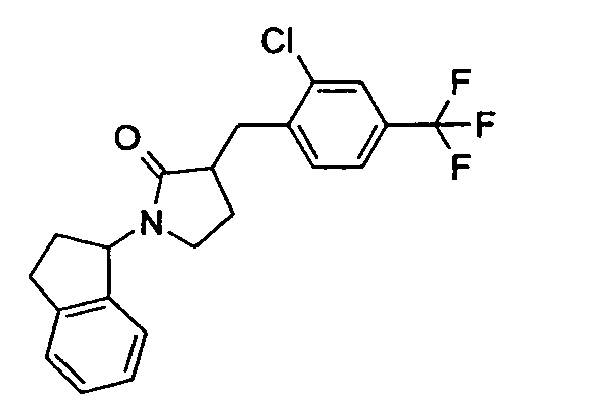
- In the same manner as in Example 1A, the title compound was obtained from 1-(2,3-dihydro-1H-inden-1-yl)pyrrolidin-2-one obtained in Reference Example 5A and 2-chloro-4-(trifluoromethyl)benzyl chloride.
1H NMR (300 MHz, CDCl3) δ ppm 1.62-1.80 (m, 1 H), 1.84-2.10 (m, 2 H), 2.33-2.51 (m, 1 H), 2.82-3.13 (m, 6 H), 3.38-3.55 (m, 1 H), 5.82 (t, J=7.5 Hz, 1 H), 7.07-7.29 (m, 4 H), 7.43-7.48 (m, 2 H), 7.64 (brs, 1 H). -

- In the same manner as in Example 1A, the title compound was obtained from 1-(2,3-dihydro-1H-inden-1-yl)pyrrolidin-2-one obtained in Reference Example 5A and 2,4-dichlorobenzyl chloride.
1H NMR (300 MHz, CDCl3) δ ppm 1.61-1.77 (m, 1 H), 1.82-2.08 (m, 2 H), 2.32-2.50 (m, 1 H), 2.76-3.11 (m, 6 H), 3.29-3.47 (m, 1 H), 5.82 (t, J=7.5 Hz, 1 H), 7.05-7.32 (m, 6 H), 7.38 (d, J=2.1 Hz, 1 H). -

- In the same manner as in Example 1A, the title compound was obtained from 1-(2,3-dihydro-1H-inden-1-yl)pyrrolidin-2-one obtained in Reference Example 5A and 2-chloro-6-methoxybenzyl chloride.
1H NMR (300 MHz, CDCl3) δ ppm 1.73-2.08 (m, 3 H), 2.37-2.52 (m, 1 H), 2.83-3.21 (m, 6 H), 3.31-3.45 (m, 1 H), 3.84 (s, 3H), 5.84 (t, J=7.7 Hz, 1H), 6.72-6.81 (m, 1H), 6.98 (dd, J=8.1, 1.1 Hz, 1 H), 7.06-7.30 (m, 5 H). -

- In the same manner as in Example 1A, the title compound was obtained from 1-(2,3-dihydro-1H-inden-1-yl)pyrrolidin-2-one obtained in Reference Example 5A and 2-chloro-6-methoxybenzyl chloride.
1H NMR (300 MHz, CDCl3) δ ppm 1.65-2.12 (m, 3 H), 2.29-2.51 (m, 1 H), 2.81-3.14 (m, 6 H), 3.40-3.49 (m, 1 H), 3.82 (s, 3H), 5.83 (t, J=7.8 Hz, 1 H), 6. 77 (d, J=8.1 Hz, 1 H) , 6.94-7.02 (m, 1H), 7.06-7.28 (m, 5 H). -

- In the same manner as in Example 1A, the title compound was obtained from 1-(2,3-dihydro-1H-inden-1-yl)pyrrolidin-2-one obtained in Reference Example 5A and 4-bromo-2-chlorobenzyl bromide.
1H NMR (300 MHz, CDCl3) δ ppm 1.63-1.78 (m, 1 H), 1.82-2.08 (m, 2 H), 2.31-2.50 (m, 1 H), 2.74-3.11 (m, 6 H), 3.28-3.46 (m, 1 H), 5.82 (t, J=7.6 Hz, 1 H), 7.04-7.38 (m, 6 H), 7.53 (d, J=1.9 Hz, 1 H). -
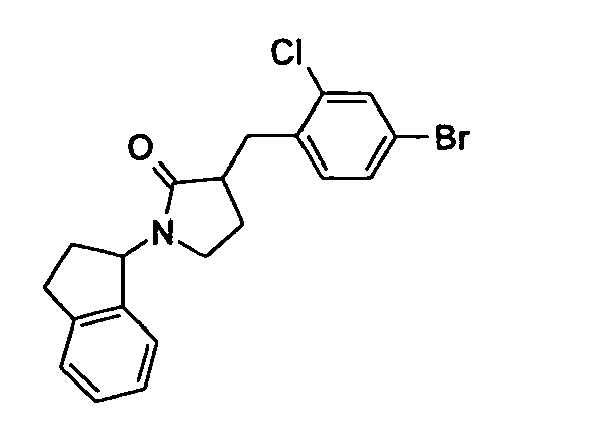
- In the same manner as in Example 1A, the title compound was obtained from 1-(2,3-dihydro-1H-inden-1-yl)pyrrolidin-2-one obtained in Reference Example 5A and 4-bromo-2-chlorobenzyl bromide.
1H NMR (300 MHz, CDCl3) δ ppm 1.58-1.70 (m, 1 H), 1.82-2.11 (m, 2 H), 2.29-2.48 (m, 1 H), 2.74-3.17 (m, 6 H), 3.32-3.50 (m, 1 H), 5.79 (t, J=7.7 Hz, 1 H), 6.98-7.06 (m, 1 H), 7.14-7.29 (m, 4 H), 7.31-7.39 (m, 1 H), 7.53 (d, J=2.1 Hz, 1 H). -

- In the same manner as in Example 1A, the title compound was obtained from 1-[(1S)-2,3-dihydro-1H-inden-1-yl]pyrrolidin-2-one obtained in Reference Example 25A and 2,6-dimethylbenzyl chloride.
1H NMR (300 MHz, CDCl3) δ ppm 1.63- 1.79 (m, 1 H), 1.89-2.06 (m, 2 H), 2.38 (s, 6 H), 2.40-2.53 (m, 1 H), 2.68-2.82 (m, 2 H), 2.84-3.18 (m, 4 H), 3.29-3.42 (m, 1 H), 5.85 (t, J=7.6 Hz, 1 H), 6.98-7.06 (m, 3 H), 7.08-7.29 (m, 4 H). -

- In the same manner as in Example 1A, the title compound was obtained from 1-[(1S)-2,3-dihydro-1H-inden-1-yl]pyrrolidin-2-one obtained in Reference Example 25A and 2,6-dimethylbenzyl chloride.
1H NMR (300 MHz, CDCl3) δ ppm 1.60- 1.76 (m, 1 H), 1.85-2.07 (m, 2 H), 2.30-2.47 (m, 7 H), 2.63-3.13 (m, 6 H), 3.36-3.48 (m, 1 H), 5.83 (t, J=7.7 Hz, 1 H), 6.98-7.07 (m, 3 H), 7.13-7.28 (m, 4 H) . -

- In the same manner as in Example 1A, the title compound was obtained from 1-[(1S)-2,3-dihydro-1H-inden-1-yl]pyrrolidin-2-one obtained in Reference Example 25A and 2-chloro-4-methoxybenzyl chloride.
1H NMR (300 MHz, CDCl3) δ ppm 1.64-2.05 (m, 3 H), 2.32-2.49 (m, 1 H), 2.72-3.08 (m, 6 H), 3.35 (dd, J=13.3, 4.1 Hz, 1 H), 3.78 (s, 3H), 5.82 (t, J=7.6 Hz, 1 H), 6.76 (dd, J=8.6, 2.6 Hz, 1 H), 6.92 (d, J=2.6 Hz, 1 H), 7.06-7.29 (m, 5 H). -

- In the same manner as in Example 1A, the title compound was obtained from 1-[(1S)-2,3-dihydro-1H-inden-1-yl]pyrrolidin-2-one obtained in Reference Example 25A and 2-chloro-4-methoxybenzyl chloride.
1H NMR (300 MHz, CDCl3) δ ppm 1.56-1.75 (m, 1 H), 1.85-2.07 (m, 2 H), 2.30-2.46 (m, 1 H), 2.74-3.15 (m, 6 H), 3.33-3.47 (m, 1 H), 3.79 (s, 3H), 5.80 (t, J=7.7 Hz, 1 H), 6.77 (dd, J=8.5, 2.6 Hz, 1 H), 6.92 (d, J=2.6 Hz, 1 H), 7.00-7.08 (m, 1 H), 7.14-7.29 (m, 4 H). -
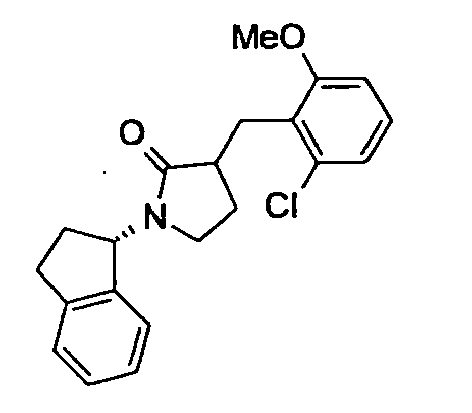
- In the same manner as in Example 1A, the title compound was obtained from 1-[(1S)-2,3-dihydro-1H-inden-1-yl]pyrrolidin-2-one obtained in Reference Example 25A and 2-chloro-6-methoxybenzyl chloride.
1H NMR (300 MHz, CDCl3) δ ppm 1.72-2.08 (m, 3 H), 2.36-2.52 (m, 1 H), 2.81-3.21 (m, 6 H), 3.30-3.45 (m, 1 H), 3.84 (s, 3H), 5.84 (t, J=7. 7 Hz, 1 H), 6.77 (d, J=8. 3 Hz, 1 H), 6.94-7.03 (m, 1 H), 7.06-7.29 (m, 5 H). -

- In the same manner as in Example 1A, the title compound was obtained from 1-[(1S)-2,3-dihydro-1H-inden-1-yl]pyrrolidin-2-one obtained in Reference Example 25A and 2-chloro-6-methoxybenzyl chloride.
1H NMR (300 MHz, CDCl3) δ ppm 1.67-2.03 (m, 3 H), 2.30-2.47 (m, 1 H), 2.81-3.12 (m, 6 H), 3.35-3.53 (m, 1 H), 3.83 (s, 3H), 5.83 (t, J=7.9 Hz, 1 H), 6.77 (d, J=8.1 Hz, 1 H), 6.93-7.03 (m, 1 H), 7.06-7.31 (m, 5 H). -

- In the same manner as in Example 140A, the title compound was obtained from 3-(2-chloro-6-methoxybenzyl)-1-[(1S)-2,3-dihydro-1H-inden-1-yl]pyrrolidin-2-one obtained in Example 312A.
1H NMR (300 MHz, CDCl3) δ ppm 1.76-2.05 (m, 3 H), 2.29-2.53 (m, 2 H), 2.75-3.24 (m, 7 H), 5.68-5.85 (m, 1 H), 6.80-7.36 (m, 7 H), 9.83 (s, 1 H). -

- In the same manner as in Example 140A, the title compound was obtained from 3-(2-chloro-6-methoxybenzyl)-1-[(1S)-2,3-dihydro-1H-inden-1-yl]pyrrolidin-2-one obtained in Example 313A.
1H NMR (300 MHz, CDCl3) δ ppm 1.70-2.01 (m, 3 H), 2.21-2.52 (m, 2 H), 2.70-3.34 (m, 7 H), 5.76 (t, J=7.7 Hz, 1 H), 6.75-7.36 (m, 7 H), 9.82 (brs, 1 H). -

- In the same manner as in Example 140A, the title compound was obtained from 3-(2-chloro-4-methoxybenzyl)-1-[(1S)-2,3-dihydro-1H-inden-1-yl]pyrrolidin-2-one obtained in Example 310A.
1H NMR (300 MHz, CDCl3) δ ppm 1.66-2.09 (m, 3 H), 2.30-2.50 (m, 1 H), 2.66-2.50 (m, 1 H), 2.66-3.14 (m, 6 H), 3.29 (dd, J=13.8, 4.9 Hz, 1 H), 5.80 (t, J=7.5 Hz, 1 H), 6.72 (dd, J=8.3, 2.5 Hz, 1 H), 6.92 (d, J=2.5 Hz, 1 H), 7.03-7.30 (m, 5 H). -

- In the same manner as in Example 140A, the title compound was obtained from 3-(2-chloro-4-methoxybenzyl)-1-[(1S)-2,3-dihydro-1H-inden-1-yl]pyrrolidin-2-one obtained in Example 311A.
1H NMR (300 MHz, CDCl3) δ ppm 1.58-1.80 (m, 1 H), 1.85-2.11 (m, 2 H), 2.30-2.49 (m, 1 H), 2.70-3.19 (m, 6 H), 3.33 (dd, J=13.6, 4.5 Hz, 1 H), 5.79 (t, J=7.6 Hz, 1 H), 6.73 (dd, J=8.4, 2.5 Hz, 1 H), 6.93 (d, J=2.5 Hz, 1 H), 6.99-7.30 (m, 5 H). -

- To a solution of 3-(2-chloro-6-hydroxybenzyl)-1-[(1S)-2,3-dihydro-1H-inden-1-yl]pyrrolidin-2-one obtained in Example 314A (342 mg) in N,N-dimethylformamide (7 mL) were added propargyl bromide (227 µL) and potassium carbonate (207 mg), and the mixture was stirred at 50°C for 2 hr. Water was added to the reaction mixture, and the mixture was extracted with ethyl acetate. The organic layer was washed with saturated brine, and dried over anhydrous magnesium sulfate. The solvent was evaporated under reduced pressure, and the residue was subjected to silica gel column chromatography (hexane-ethyl acetate 95:5-85:15) to give the title compound (297 mg, 78%) as a colorless oil.
1H NMR (300 MHz, CDCl3) δ ppm 1.71-2.10 (m, 3 H), 2.36-2.54 (m, 2 H), 2.80-3.24 (m, 6 H), 3.30-3.47 (m, 1 H), 4.75 (d, J=2.3 Hz, 2 H), 5.84 (t, J=7.7 Hz, 1 H), 6.91 (d, J=8.1 Hz, 1 H), 7.00-7.07 (m, 1 H), 7.08-7.30 (m, 5 H). -

- In the same manner as in Example 318A, the title compound was obtained from 3-(2-chloro-6-hydroxybenzyl)-1-[(1S)-2,3-dihydro-1H-inden-1-yl]pyrrolidin-2-one obtained in Example 314A and (bromomethyl)cyclopropane.
1H NMR (300 MHz, CDCl3) δ ppm 0.24-0.44 (m, 2 H), 0.52-0.70 (m, 2 H), 1.16-1.39 (m, 1 H), 1.72-2.11 (m, 3 H), 2.35-2.55 (m, 1 H), 2.78-3.48 (m, 7 H), 3.72-3.90 (m, 2 H), 5.85 (t, J=7.6 Hz, 1 H), 6.72 (d, J=8.1 Hz, 1H), 6.92-7.31 (m, 6 H). -
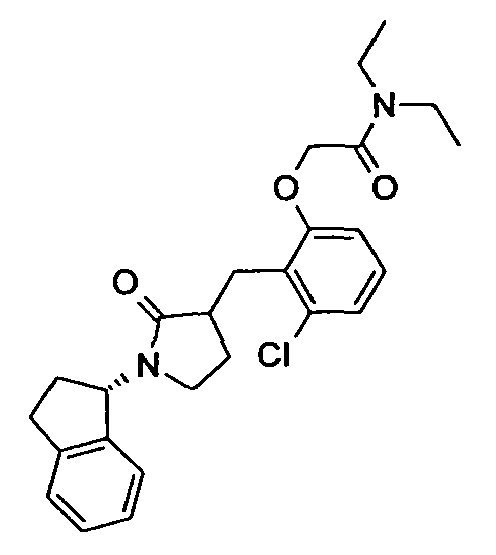
- In the same manner as in Example 318A, the title compound was obtained from 3-(2-chloro-6-hydroxybenzyl)-1-[(1S)-2, 3-dihydro-1H-inden-1-yl]pyrrolidin-2-one obtained in Example 314A and 2-chloro-N, N-diethylacetamide.
1H NMR (300 MHz, CDCl3) δ ppm 1.15 (t, J=7.1 Hz, 3 H), 1.23 (t, J=7.1 Hz, 3 H), 1.75-2.08 (m, 3 H), 2.35-2.51 (m, 1 H), 2.81-3.09 (m, 5 H), 3.10-3.21 (m, 1 H), 3.33-3.49 (m, 5 H), 4.73 (s, 2 H), 5.83 (t, J=7.7 Hz, 1 H), 6.70-6.78 (m, 1 H), 6.97-7.29 (m, 6 H). -

- In the same manner as in Example 318A, the title compound was obtained from 3-(2-chloro-4-hydroxybenzyl)-1-[(1S)-2,3-dihydro-1H-inden-1-yl]pyrrolidin-2-one obtained in Example 316A and 2-chloro-N,N-diethylacetamide.
1H NMR (300 MHz, CDCl3) δ ppm 1.15 (t, J=7.1 Hz, 3 H), 1.23 (t, J=7.1 Hz, 3 H), 1.64-1.79 (m, 1 H), 1.83-2.04 (m, 2 H), 2.31-2.48 (m, 1 H), 2.71-3.08 (m, 6 H), 3.29-3.47 (m, 5 H), 4.64 (s, 2 H), 5.82 (t, J=7.6 Hz, 1 H), 6.82 (dd, J=8.5, 2.6 Hz, 1 H), 6.96 (d, J=2.6 Hz, 1 H), 7.06-7.29 (m, 5 H). -

- To a solution of 1-((1S,2R)-2-{[tert-butyl(dimethyl)silyl]oxy}-2,3-dihydro-1H-inden-1-yl)-3-(2,6-dichlorobenzyl)pyrrolidin-2-one obtained in Example 286A (240 mg) in tetrahydrofuran (10 mL) was added tetra-n-butylammonium fluoride (1.0 M tetrahydrofuran solution, 1.0 mL), and the mixture was stirred at room temperature for 2 hr. The solvent was evaporated under reduced pressure, and the residue was subjected to silica gel column chromatography (hexane-ethyl acetate 9:1-1:1) to give the title compound (164 mg, 89%) as a pale-yellow oil.
1H NMR (300 MHz, CDCl3) δ ppm 1.67-2.01 (m, 2 H), 2.76-3.34 (m, 7 H), 3.46-3.61 (m, 1 H), 4.74-4.88 (m, 1 H), 5.51 (d, J=6.6 Hz, 1 H), 7.04-7.14 (m, 1 H), 7.22-7.35 (m, 6 H). -

- In the same manner as in Example 1A, the title compound was obtained from 1-(2,3-dihydro-1H-inden-1-yl)pyrrolidin-2-one obtained in Reference Example 5A and methyl 3-methoxy-1-methyl-1H-pyrazole-5-carboxylate.
LC-MS (ESI+); m/z 340 (M+H)+ -

- In the same manner as in Example 1A, the title compound was obtained from 1-(2,3-dihydro-1H-inden-1-yl)pyrrolidin-2-one obtained in Reference Example 5A and methyl 3-benzyloxy-1-methyl-1H-pyrazole-5-carboxylate.
LC-MS (ESI+); m/z 416 (M+H)+ -

- To a solution of 1-(2,3-dihydro-1H-inden-1-yl)-3-[(3-methoxy-1-methyl-1H-pyrazol-5-yl)carbonyl]pyrrolidin-2-one obtained in Example 323A (479 mg) in methanol (10 mL) was added sodium borohydride (53 mg), and the mixture was stirred at room temperature for 15 min. The solvent was evaporated under reduced pressure, and the residue was extracted with ethyl acetate. The organic layer was washed with saturated brine, and dried over anhydrous magnesium sulfate. The solvent was evaporated under reduced pressure, and the residue was recrystallized from hexane-ethyl acetate to give the title compound (162 mg, 34%) as a colorless prism.
LC-MS (ESI+); m/z 342 (M+H)+ -

- In the same manner as in Example 318A, the title compound was obtained from 3-(2-chloro-6-hydroxybenzyl)-1-cyclohexylpyrrolidin-2-one obtained in Example 177A and 2-chloro-N,N-diethylacetamide.
1H NMR (300 MHz, CDCl3) δ ppm 1.13 (t, J=7.1 Hz, 3 H), 1.21 (t, J=7.1 Hz, 3 H), 1.27-1.48 (m, 4 H), 1.58-1.98 (m, 8 H), 2.82-2.99 (m, 2 H), 3.08-3.22 (m, 1 H), 3.24-3.48 (m, 6 H), 3.87-4.02 (m, 1 H), 4.71 (s, 2 H), 6.70-6.78 (m, 1 H), 6.96-7.14 (m, 6 H). -
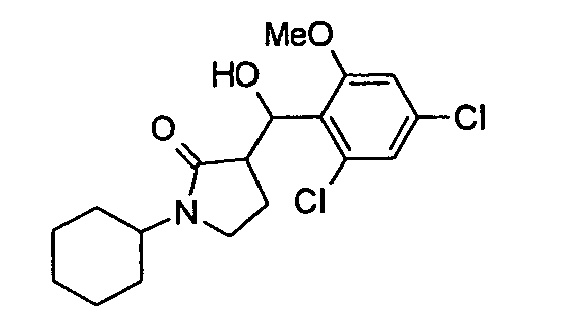
- In the same manner as in Example 1A, the title compound was obtained from 1-cyclohexylpyrrolidin-2-one and 2,4-dichloro-6-methoxybenzaldehyde.
1H NMR (300 MHz, CDCl3) δ ppm 1.00-1.20 (m, 1 H), 1.29-1.57 (m, 5 H), 1.62-1.90 (m, 6 H), 3.16-3.39 (m, 2 H), 3.42-3.56 (m, 1 H), 3.86 (s, 3 H), 3.89-4.04 (m, 1 H), 5.17 (d, J=2.1 Hz, 1 H), 5.40 (dd, J=10.0, 2.1 Hz, 1 H), 6.81 (d, J=1.9 Hz, 1 H), 7.02 (d, J=1.9 Hz, 1 H). -

- In the same manner as in Example 1A, the title compound was obtained from 1-cyclohexylpyrrolidin-2-one and 2,4-dichloro-6-methoxybenzaldehyde.
1H NMR (300 MHz, CDCl3) δ ppm 0.97-1.17 (m, 1 H), 1.22-1.46 (m, 4 H), 1.60-1.85 (m, 5 H), 2.03-2.28 (m, 2 H), 2.92-3.04 (m, 1 H), 3.18-3.42 (m, 2 H), 3.80-3.94 (m, 2 H), 3.89 (s, 3 H), 5.34 (dd, J=11.1, 7.9 Hz, 1 H), 6.82 (d, J=1.9 Hz, 1 H), 7.03 (d, J=1.9 - Hz, 1 H).
-

- To a solution of 1-cyclohexyl-3-[(2, 4-dichloro-6-methoxyphenyl)(hydroxy)methyl]pyrrolidin-2-one obtained in Example 327A (168 mg) in trifluoroacetic acid (2 mL) was added triethylsilane (216 µL) at room temperature, and the mixture was stirred for 24 hr. The solvent was evaporated under reduced pressure, and the residue was extracted with ethyl acetate. The organic layer was washed with saturated brine, and dried over anhydrous magnesium sulfate. The solvent was evaporated under reduced pressure, and the residue was recrystallized from hexane-ethyl acetate to give the title compound (113 mg, 70%) as a colorless prism.
1H NMR (300 MHz, CDCl3) δ ppm 0.99-1.18 (m, 1 H), 1.23-1.50 (m, 5 H), 1.60-1.94 (m, 6 H), 2.71-2.89 (m, 2 H), 3.09-3.36 (m, 3 H), 3.82 (s, 3 H), 3.88-4.03 (m, 1 H), 6.75 (d, J=1.9 Hz, 1 H), 7.00 (d, J=1.9 Hz, 1 H). -

- In the same manner as in Example 1A, the title compound was obtained from 1-cyclohexylpyrrolidin-2-one and 2-chloro-4-methoxy-3-(methoxymethoxy)benzaldehyde obtained in Reference Example 35A.
1H NMR (300 MHz, CDCl3) δ ppm 0.99-1.21 (m, 1 H), 1.26-1.51 (m, 4 H), 1.62-1.89 (m, 7 H), 2.62-2.78 (m, 1 H), 3.11-3.25 (m, 1 H), 3.26-3.37 (m, 1 H), 3.64 (s, 3 H), 3.86 (s, 3 H), 3.89-4.03 (m, 1 H), 5.10-5.19 (m, 2 H), 5.25 (d, J=9.8 Hz, 1 H), 5.70 (s, 1 H), 6.91 (d, J=8.9 Hz, 1 H), 7.34 (d, J=8.9 Hz, 1 H). -

- In the same manner as in Example 1A, the title compound was obtained from 1-cyclohexylpyrrolidin-2-one and 2-chloro-4-methoxy-3-(methoxymethoxy)benzaldehyde obtained in Reference Example 35A.
1H NMR (300 MHz, CDCl3) δ ppm 0.97-1.19 (m, 1 H), 1.22-1.48 (m, 4 H), 1.63-1.97 (m, 7 H), 3.03-3.25 (m, 3 H), 3.58 (d, J=5.5 Hz, 1 H), 3.64 (s, 3 H), 3.85 (s, 3 H), 3.89-4.02 (m, 1 H), 5.16 (s, 2 H), 5.62 (dd, J=5.5, 3.8 Hz, 1 H), 6.86 (d, J=8.7 Hz, 1 H), 7.31 (d, J=8.7 Hz, 1 H). -

- In the same manner as in Example 329A, the title compound was obtained from 3-{[2-chloro-4-methoxy-3-(methoxymethoxy)phenyl](hydroxy)methyl}-1-cyclohexylpyrrolidin-2-one obtained in Example 331A.
1H NMR (300 MHz, CDCl3) δ ppm 0.98-1.18 (m, 1 H), 1.22-1.49 (m, 4 H), 1.58-1.87 (m, 6 H), 1.90-2.04 (m, 1 H), 2.65-2.85 (m, 2 H), 3.10-3.26 (m, 2 H), 3.37-3.38 (m, 1 H), 3.89 (s, 3 H), 3.90-4.02 (m, 1 H), 5.92 (s, 1 H), 6.69-6.75 (m, 1 H), 6.76-6.82 (m, 1 H). -

- In the same manner as in Example 1A, the title compound was obtained from 1-cyclohexylpyrrolidin-2-one and 2,6-dichloro-4-methoxybenzaldehyde.
1H NMR (300 MHz, CDCl3) δ ppm 0.99-1.21 (m, 1 H), 1.26-1.50 (m, 4 H), 1.51-1.90 (m, 7 H), 3.15-3.39 (m, 2 H), 3.53-3.69 (m, 1 H), 3.79 (s, 3 H), 3. 88-4. 05 (m, 1 H), 5. 38 (s, 1 H), 5.52 (d, J=10.4 Hz, 1 H), 6.87 (s, 2 H). -

- In the same manner as in Example 1A, the title compound was obtained from 1-cyclohexylpyrrolidin-2-one and 2,6-dichloro-4-methoxy-3-(methoxymethoxy)benzaldehyde obtained in Reference Example 36A.
1H NMR (300 MHz, CDCl3) δ ppm 1.00-1.21 (m, 1 H), 1.23-1.51 (m, 4 H), 1.54-1.90 (m, 7 H), 3.16-3.38 (m, 2 H), 3.54-3.73 (m, 4 H), 3.65 (s, 3 H), 3.90-4.04 (m, 1 H), 5.13 (s, 2 H), 5.34-5.44 (m, 1H), 5.54 (d, J=10.4 Hz, 1H), 6.87 (s, 1H). -

- In the same manner as in Example 1A, the title compound was obtained from 1-cyclohexylpyrrolidin-2-one and 2,6-dichloro-4-methoxy-3-(methoxymethoxy)benzaldehyde obtained in Reference Example 36A.
1H NMR (300 MHz, CDCl3) δ ppm 1.01-1.21 (m, 1 H), 1.27-1.49 (m, 4 H), 1.59-1.89 (m, 7 H), 3.16-3.40 (m, 2 H), 3.55-3.71 (m, 4 H), 3.85 (s, 3 H), 3.89-4.04 (m, 1 H), 5.13 (s, 2 H), 5.38 (brs, 1 H), 5.54 (d, J=10.7 Hz, 1 H), 6.87 (s, 1 H). -

- In the same manner as in Example 329A, the title compound was obtained from 1-cyclohexyl-3-{[2,6-dichloro-4-methoxy-3-(methoxymethoxy)phenyl](hydroxy)methyl}pyrrolidin-2-one obtained in Example 335A.
1H NMR (300 MHz, CDCl3) δ ppm 0.98-1.18 (m, 1 H), 1.23-1.50 (m, 4 H), 1.62-1.99 (m, 7 H), 2.79-3.02 (m, 2 H), 3.10-3.24 (m, 1 H), 3.27-3.47 (m, 2 H), 3.84-4.03 (m, 4 H), 5.84 (s, 1 H), 6.84 (s, 1 H). -

- In the same manner as in Example 318A, the title compound was obtained from 3-(2-chloro-4-hydroxybenzyl)-1-cyclohexylpyrrolidin-2-one obtained in Example 183A and 2-chloro-N,N-diethylacetamide.
1H NMR (300 MHz, CDCl3) δ ppm 0.98-1.48 (m, 11 H), 1.58-1.85 (m, 6 H), 1.92-2.06 (m, 1 H), 2.66-2.84 (m, 2 H), 3.11-3.47 (m, 7 H), 3.86-4.02 (m, 1 H), 4.63 (s, 2 H), 6.80 (dd, J=8.5, 2.6 Hz, 1H), 6.94 (d, J=2.6 Hz, 1H), 7.18 (d, J=8.5 Hz, 1H). -

- To a solution of 3-(2-chloro-4-hydroxybenzyl)-1-cyclohexylpyrrolidin-2-one obtained in Example 183A (308 mg), 2-methoxyethanol (118 µL) and n-tributylphosphine (500 µL) in tetrahydrofuran (5 mL) was added 1,1'-azodicarbonyldipiperidine (505 mg) at 50°C, and the mixture was stirred for 1.5 hr. The solvent was evaporated under reduced pressure, the residue was washed with diisopropyl ether, and filtrated, and the filtrate was concentrated. The residue was subjected to silica gel column chromatography (hexane-ethyl acetate 95:5-75:25) to give the title compound (261 mg, 71%) as a colorless oil.
1H NMR (300 MHz, CDCl3) δ ppm 0.98-1.17 (m, 1 H), 1.22-1.49 (m, 4 H), 1.54-1.86 (m, 6 H), 1.90-2.07 (m, 1 H), 2.66-2.84 (m, 2 H), 3.12-3.36 (m, 3 H), 3.45 (s, 3 H), 3.69-3.77 (m, 2 H), 3.87-4.01 (m, 1 H), 4.03-4.13 (m, 2 H), 6.77 (dd, J=8.5, 2.6 Hz, 1 H), 6.94 (d, J=2.6 Hz, 1 H), 7.17 (d, J=8.5 Hz, 1 H). -

- In the same manner as in Example 338A, the title compound was obtained from 3-(2-chloro-4-hydroxybenzyl)-1-cyclohexylpyrrolidin-2-one obtained in Example 183A and 2-benzyloxyethanol.
1H NMR (300 MHz, CDCl3) δ ppm 0.96-1.18 (m, 1 H), 1.22-1.49 (m, 4 H), 1.49-1.86 (m, 6 H), 1.89-2.05 (m, 1 H), 2.66-2.84 (m, 2 H), 3.10-3.38 (m, 3 H), 3.75-3.85 (m, 2 H), 3.87-4.01 (m, 1 H), 4.06-4.16 (m, 2 H), 4. 63 (s, 2 H), 6.77 (dd, J=8.5, 2.6 Hz, 1 H), 6.93 (d, J=2.6 Hz, 1 H), 7.16 (d, J=8.5 Hz, 1 H), 7.24-7.39 (m, 5 H). -
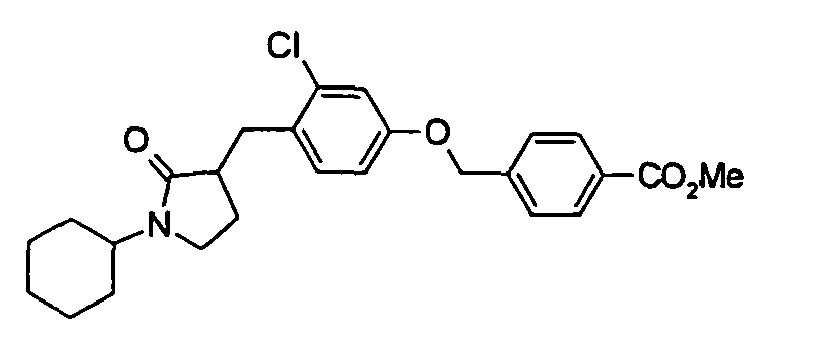
- In the same manner as in Example 318A, the title compound was obtained from 3-(2-chloro-4-hydroxybenzyl)-1-cyclohexylpyrrolidin-2-one obtained in Example 183A and methyl 4-(bromomethyl)benzoate.
1H NMR (300 MHz, CDCl3) δ ppm 0.96-1.16 (m, 1 H), 1.22-1.49 (m, 4 H), 1.56-1.85 (m, 6 H), 1.92-2.07 (m, 1 H), 2.67-2.83 (m, 2 H), 3.31-3.36 (m, 3 H), 3.87-4.03 (m, 4 H), 5.09 (s, 2 H), 6.80 (dd, J=8.5, 2.6 Hz, 1 H), 6.98 (d, J=2.6 Hz, 1 H), 7.19 (d, J=8.5 Hz, 1 H), 7.48 (d, J=8.2 Hz, 2 H), 8.06 (d, J=8.2 Hz, 2 H). -

- In the same manner as in Example 318A, the title compound was obtained from 3-(2-chloro-4-hydroxybenzyl)-1-cyclohexylpyrrolidin-2-one obtained in Example 183A and methyl bromoacetate.
1H NMR (300 MHz, CDCl3) δ ppm 0.99-1.19 (m, 1 H), 1.21-1.49 (m, 4 H), 1.56-1.87 (m, 6 H), 1.92-2.08 (m, 1 H), 2.67-2.83 (m, 2 H), 3.11-3.36 (m, 3 H), 3.81 (s, 3 H), 3.87-4.03 (m, 1 H), 4.60 (s, 2 H), 6.75 (dd, J=8.5, 2.7 Hz, 1 H), 6.92 (d, J=2.7 Hz, 1 H), 7.20 (d, J=8.5 Hz, 1 H). -
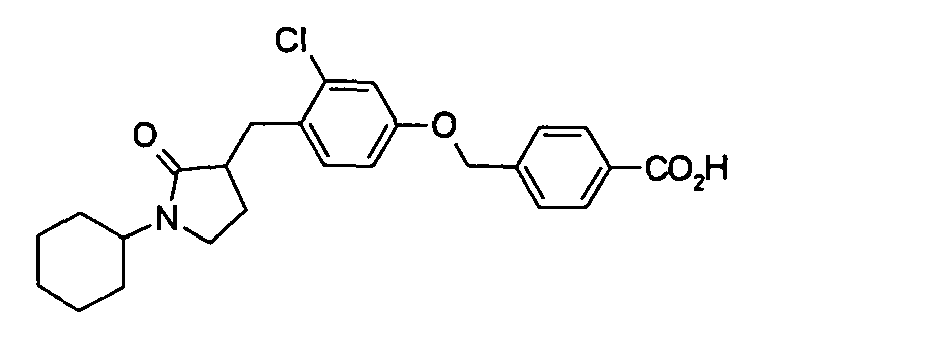
- In the same manner as in Example 129A, the title compound was obtained from methyl 4-({3-chloro-4-[(1-cyclohexyl-2-oxopyrrolidin-3-yl)methyl]phenoxy}methyl)benzoate obtained in Example 340A.
1H NMR (300 MHz, CDCl3) δ ppm 0.96-1.96 (m, 12 H), 2.54-2.70 (m, 1 H), 3.03-3.80 (m, 5 H), 5.20 (s, 2 H), 6.94 (dd, J=8.5, 2.5 Hz, 1 H), 7.11 (d, J=2.5 Hz, 1 H), 7.27 (d, J=8.5 Hz, 1 H), 7.54 (d, J=8.3 Hz, 2 H), 7.96 (d, J=8.3 Hz, 2 H). -

- In the same manner as in Example 129A, the title compound was obtained from methyl {3-chloro-4-[(1-cyclohexyl-2-oxopyrrolidin-3-yl)methyl]phenoxy}acetate obtained in Example 341A.
1H NMR (300 MHz, CDCl3) δ ppm 0.99-1.17 (m, 1 H), 1.18-1.66 (m, 8 H), 1.67-1.80 (m, 2 H), 1.81-1.97 (m, 1 H), 2.53-2.71 (m, 1 H), 3.04-3.27 (m, 3 H), 3.54-3.82 (m, 2 H), 4.69 (s, 2 H), 6.85 (dd, J=8.5, 2.7 Hz, 1 H), 6.99 (d, J=2.7 Hz, 1 H), 7.26 (d, J=8.5 Hz, 1 H), 13.07 (brs, 1 H). -

- In the same manner as in Example 140A, the title compound was obtained from 3-{4-[2-(benzyloxy)ethoxy]-2-chlorobenzyl)-1-cyclohexylpyrrolidin-2-one obtained in Example 339A.
1H NMR (300 MHz, CDCl3) δ ppm 0.96-1.19 (m, 1 H), 1.22-1.49 (m, 4 H), 1.55-1.87 (m, 5 H), 1.89-2.13 (m, 2 H), 2.67-2.83 (m, 2 H), 3.11-3.36 (m, 3 H), 3.86-4.10 (m, 5 H), 6.76 (dd, J=8.5, 2.5 Hz, 1 H), 6.93 (d, J=2.5 Hz, 1 H), 7.18 (d, J=8.5 Hz, 1 H). -

- In the same manner as in Example 142A, the title compound was obtained from 3-(2-chloro-4-hydroxybenzyl)-1-cyclohexylpyrrolidin-2-one obtained in Example 183A and 2,3-dichloro-5-(trifluoromethyl)pyridine.
1H NMR (300 MHz, CDCl3) δ ppm 0.96-1.18 (m, 1 H), 1.23-1.50 (m, 4 H), 1.57-1.88 (m, 6 H), 1.98-2.14 (m, 1 H), 2.74-2.90 (m, 2 H), 3.13-3.29 (m, 2 H), 3.32-3.46 (m, 1 H), 3.88-4.04 (m, 1 H), 7.03 (dd, J=8.5, 2.5 Hz, 1 H), 7.22 (d, J=2.5 Hz, 1 H), 7.36 (d, J=8.5 Hz, 1 H), 7.95-8.01 (m, 1 H), 8.25-8.31 (m, 1 H). -

- In the same manner as in Example 318A, the title compound was obtained from 3-(2-chloro-4-hydroxybenzyl)-1-cyclohexylpyrrolidin-2-one obtained in Example 183A and methyl 3-(bromomethyl)benzoate.
1H NMR (300 MHz, CDCl3) δ ppm 0.98-1.17 (m, 1 H), 1.22-1.48 (m, 4 H), 1.57-1.85 (m, 6 H), 1.91-2.07 (m, 1 H), 2.67-2.84 (m, 2 H), 3.12-3.37 (m, 3 H), 3.86-4.03 (m, 4 H), 5.06 (s, 2 H), 6.81 (dd, J=8.5, 2.6 Hz, 1 H), 7.00 (d, J=2.6 Hz, 1 H), 7.19 (d, J=8.5 Hz, 1 H), 7.42-7.53 (m, 1 H), 7.57-7.67 (m, 1H), 7.97-8.14 (m, 2 H). Example 347A 3-(2-chloro-5-methoxybenzyl)-1-cyclohexylpyrrolidin-2-one
- In the same manner as in Example 1A, the title compound was obtained from 1-cyclohexylpyrrolidin-2-one and 2-chloro-5-methoxybenzyl bromide.
1H NMR (300 MHz, CDCl3) δ ppm 1.00-1.17 (m, 1 H), 1.24-1.49 (m, 4 H), 1.57-1.85 (m, 6 H), 1.93-2.07 (m, 1 H), 2.68-2.86 (m, 2 H), 3.12-3.39 (m, 3 H), 3.77 (s, 3 H), 3.88-4.02 (m, 1 H), 6.70 (dd, J=8.8, 3.1 Hz, 1 H), 6.83 (d, J=3.1 Hz, 1 H), 7.24 (d, J=8.8 Hz, 1 H). -

- In the same manner as in Example 129A, the title compound was obtained from methyl 3-({3-chloro-4-[(1-cyclohexyl-2-oxopyrrolidin-3-yl)methyl]phenoxy}methyl)benzoate obtained in Example 346A.
1H NMR (300 MHz, CDCl3) δ ppm 0.97-1.18 (m, 1 H), 1.22-1.50 (m, 4 H), 1.57-1.86 (m, 6 H), 1.91-2.09 (m, 1 H), 2.67-2.88 (m, 2 H), 3.11-3.37 (m, 3 H), 3.88-4.04 (m, 1 H), 5.08 (s, 2 H), 6.82 (dd, J=8.5, 2.6 Hz, 1 H), 7.00 (d, J=2.6 Hz, 1 H), 7.20 (d, J=8.5 Hz, 1 H), 7.44-7.56 (m, 1 H), 7.61-7.70 (m, 1H), 8.02-8.20 (m, 2 H). -

- In the same manner as in Example 140A, the title compound was obtained from 3-(2-chloro-5-methoxybenzyl)-1-cyclohexylpyrrolidin-2-one obtained in Example 347A.
1H NMR (300 MHz, CDCl3) δ ppm 0.96-1.17 (m, 1 H), 1.20-1.44 (m, 4 H), 1.58-1.90 (m, 6 H), 1.97-2.14 (m, 1 H), 2.79-2.95 (m, 2 H), 3.06-3.28 (m, 3 H), 3.87-4.02 (m, 1 H), 6.69 (dd, J=8.6, 3.0 Hz, 1 H), 6.96 (d, J=3.0 Hz, 1 H), 7.16 (d, J=8.6 Hz, 1 H). -

- In the same manner as in Example 338A, the title compound was obtained from 3-(2-chloro-5-hydroxybenzyl)-1-cyclohexylpyrrolidin-2-one obtained in Example 349A and 2-methoxyethanol.
1H NMR (300 MHz, CDCl3) δ ppm 0.97-1.18 (m, 1 H), 1.22-1.50 (m, 4 H), 1.52-1.86 (m, 6 H), 1.91-2.07 (m, 1 H), 2.65-2.86 (m, 2 H), 3.10-3.27 (m, 2 H), 3.28-3.39 (m, 1 H), 3.45 (s, 3 H), 3.68-3.77 (m, 2 H), 3.88-4.01 (m, 1 H), 4.02-4.10 (m, 2 H), 6.73 (dd, J=8.9, 3.0 Hz, 1 H), 6.86 (d, J=3.0 Hz, 1 H), 7.23 (d, J=8.9 Hz, 1 H). -

- In the same manner as in Example 318A, the title compound was obtained from 3-(2-chloro-5-hydroxybenzyl)-1-cyclohexylpyrrolidin-2-one obtained in Example 349A and methyl 2-bromoacetate.
1H NMR (300 MHz, CDCl3) δ ppm 0.97-1.19 (m, 1 H), 1.22-1.50 (m, 4 H), 1.55-1.87 (m, 6 H), 1.92-2.08 (m, 1 H), 2.65-2.86 (m, 2 H), 3.11-3.41 (m, 3 H), 3.81 (s, 3 H), 3.88-4.02 (m, 1 H), 4.60 (s, 2 H), 6.71 (dd, J=8.7, 3.0 Hz, 1 H), 6.85 (d, J=3.0 Hz, 1 H), 7.20-7.29 (m, 1 H). -

- In the same manner as in Example 129A, the title compound was obtained from methyl {4-chloro-3-[(1-cyclohexyl-2-oxopyrrolidin-3-yl)methyl]phenoxy}acetate obtained in Example 351A.
1H NMR (300 MHz, CDCl3) δ ppm 0.96-1.19 (m, 1 H), 1.20-1.50 (m, 4 H), 1.54-1.93 (m, 6 H), 1.95-2.14 (m, 1 H), 2.77-2.96 (m, 2 H), 3.11-3.33 (m, 3 H), 3.85-4.03 (m, 1 H), 4.62 (s, 2 H), 6.77 (dd, J=8.7, 3.1 Hz, 1 H), 6.96 (d, J=3.1 Hz, 1 H), 7.23 (d, J=8.7 Hz, 1 H). -

- In the same manner as in Example 338A, the title compound was obtained from 3-(2-chloro-4-hydroxybenzyl)-1-cyclohexylpyrrolidin-2-one obtained in Example 183A and 3-(benzyloxy)propanol.
1H NMR (300 MHz, CDCl3) δ ppm 0.95-1.20 (m, 1 H), 1.22-1.50 (m, 4 H), 1.53-1.87 (m, 6 H), 1.91-2.15 (m, 3 H), 2.66-2.84 (m, 2 H), 3.10-3.36 (m, 3 H), 3.64 (t, J=6.1 Hz, 2 H), 3.87-4.01 (m, 1 H), 4.04 (t, J=6.2 Hz, 2 H), 4.52 (s, 2 H), 6.73 (dd, J=8.5, 2.6 Hz, 1 H), 6.90 (d, J=2.6 Hz, 1 H), 7.16 (d, J=8.5 Hz, 1 H), 7.24-7.37 (m, 5 H). -

- In the same manner as in Reference Example 19A, the title compound was obtained from methyl 4-({3-chloro-4-[(1-cyclohexyl-2-oxopyrrolidin-3-yl)methyl]phenoxy}methyl)benzoate obtained in Example 340A.
1H NMR (300 MHz, CDCl3) δ ppm 0.97-1.17 (m, 1 H), 1.22-1.51 (m, 4 H), 1.54-1.87 (m, 7 H), 1.91-2.06 (m, 1 H), 2.65-2.83 (m, 2 H), 3.09-3.36 (m, 3 H), 3.86-4.01 (m, 1 H), 4.72 (d, J=5.3 Hz, 2 H), 5.02 (s, 2 H), 6.80 (dd, J=8.5, 2.6 Hz, 1 H), 6.98 (d, J=2.6 Hz, 1 H), 7.17 (d, J=8.5 Hz, 1 H), 7.36-7.45 (m, 4 H). -
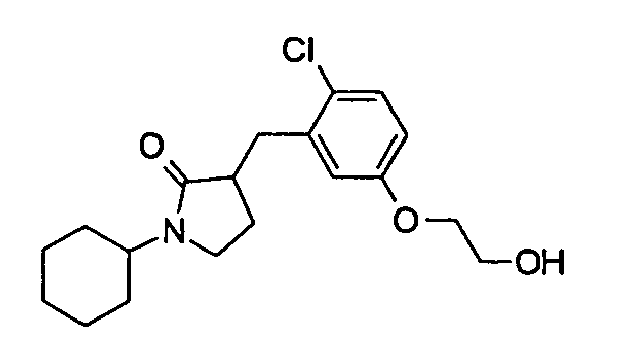
- In the same manner as in Example 354A, the title compound was obtained from methyl {4-chloro-3-[(1-cyclohexyl-2-oxopyrrolidin-3-yl)methyl]phenoxy}acetate obtained in Example 351A.
1H NMR (300 MHz, CDCl3) δ ppm 0.98-1.19 (m, 1 H), 1.21-1.52 (m, 4 H), 1.54-1.86 (m, 6 H), 1.94-2.18 (m, 2 H), 2.68-2.87 (m, 2 H), 3.10-3.41 (m, 3 H), 3.84-4.10 (m, 5 H), 6.72 (dd, J=8.7, 3.0 Hz, 1H), 6.87 (d, J=3.0 Hz, 1H), 7.24 (d, J=8.7 Hz, 1H). -

- In the same manner as in Example 338A, the title compound was obtained from 3-(2-chloro-4-hydroxybenzyl)-1-cyclohexylpyrrolidin-2-one obtained in Example 183A and 2-isopropoxyethanol.
1H NMR (300 MHz, CDCl3) δ ppm 0.94-1.18 (m, 1 H), 1.20 (d, J=6.2 Hz, 6 H), 1.24-1.49 (m, 4 H), 1.58-1.86 (m, 6 H), 1.90-2.05 (m, 1 H), 2.66-2.83 (m, 2 H), 3.12-3.35 (m, 3 H), 3.60-3.79 (m, 3 H), 3.87-4.01 (m, 1 H), 4.02-4.11 (m, 2 H), 6.76 (dd, J=8.5, 2.6 Hz, 1 H), 6.93 (d, J=2.6 Hz, 1 H), 7.16 (d, J=8.5 Hz, 1 H). -
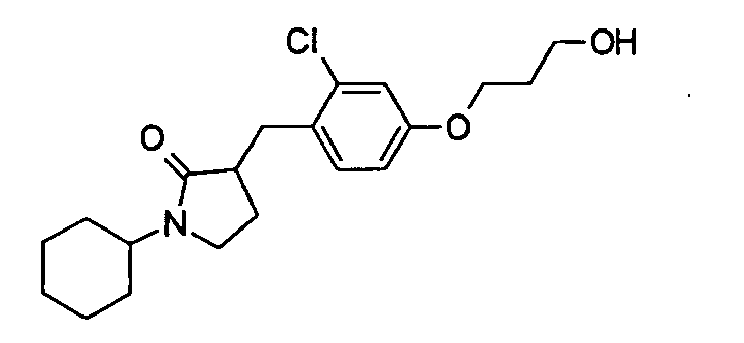
- In the same manner as in Example 140A, the title compound was obtained from 3-{4-[3-(benzyloxy)propoxy]-2-chlorobenzyl}-1-cyclohexylpyrrolidin-2-one obtained in Example 353A.
1H NMR (300 MHz, CDCl3) δ ppm 0.98-1.18 (m, 1 H), 1.22-1.49 (m, 4 H), 1.54-1.88 (m, 6 H), 1.91-2.13 (m, 3 H), 2.66-2.84 (m, 2 H), 3.11-3.36 (m, 3 H), 3.80-4.03 (m, 3 H), 4.09 (t, J=5.9 Hz, 2 H), 6. 75 (dd, J=8. 5, 2.6 Hz, 1 H), 6.92 (d, J=2.6 Hz, 1 H), 7.17 (d, J=8.5 Hz, 1 H). -

- In the same manner as in Example 338A, the title compound was obtained from 3-(2-chloro-4-hydroxybenzyl)-1-cyclohexylpyrrolidin-2-one obtained in Example 183A and 2-(pyrrolidin-1-yl)ethanol.
1H NMR (300 MHz, CDCl3) δ ppm 1.02-1.17 (m, 1 H), 1.22-1.89 (m, 14 H), 1. 90-2. 05 (m, 1 H), 2. 55-2. 82 (m, 6 H), 2.88 (t, J=5. 9 Hz, 2 H), 3.12-3.35 (m, 3 H), 3.86-4.01 (m, 1 H), 4.06 (t, J=5.9 Hz, 2 H), 6.76 (dd, J=8 . 5, 2.6 Hz, 1 H), 6.92 (d, J=2.6 Hz, 1 H), 7.16 (d, J=8.5 Hz, 1 H). -

- In the same manner as in Example 1A, the title compound was obtained from 1-(1,4-dioxaspiro[4.5]dec-8-yl)pyrrolidin-2-one and 2-chloro-4-(methoxymethoxy)benzyl bromide obtained in Reference Example 24A.
1H NMR (300 MHz, CDCl3) δ ppm 1.57-1.88 (m, 9 H), 1.93-2.09 (m, 1 H), 2.66-2.84 (m, 2 H), 3.12-3.36 (m, 3 H), 3.47 (s, 3 H), 3.94 (s, 4 H), 3.99-4.12 (m, 1 H), 5.13 (s, 2 H), 6.87 (dd, J=8.5, 2.5 Hz, 1 H), 7.07 (d, J=2.5 Hz, 1 H), 7.17 (d, J=8.5 Hz, 1 H). -

- In the same manner as in Example 28A, the title compound was obtained from 3-[2-chloro-4-(methoxymethoxy)benzyl]-1-(1,4-dioxaspiro[4.5]dec-8-yl)pyrrolidin-2-one obtained in Example 359A.
1H NMR (300 MHz, CDCl3) δ ppm 1.72 -2.15 (m, 6 H), 2.36-2.60 (m, 4 H), 2.68-2.90 (m, 2 H), 3.14-3.31 (m, 3 H), 4.47 (tt, J=12.0, 3.8 Hz, 1 H), 6.68 (dd, J=8.3, 2.5 Hz, 1 H), 6.81 (brs, 1 H), 6.89 (d, J=2.5 Hz, 1 H), 7.09 (d, J=8.3 Hz, 1 H). -

- To a solution of 1-(1-adamantyl)-5-oxoproline ethyl ester obtained in Reference Example 15A (291 mg) in tetrahydrofuran (10 mL) was added lithium bis(trimethylsilyl)amide (1.1 M tetrahydrofuran solution, 2.0 mL) at -78°C under argon stream, and the mixture was stirred for 20 min. A solution of 2,6-dichlorobenzyl chloride (215 mg) in tetrahydrofuran (5 mL) was added to the reaction mixture, and the mixture was further stirred for 1 hr. Saturated aqueous ammonium chloride was added to the reaction mixture, and the mixture was extracted with ethyl acetate. The organic layer was washed with saturated brine, and dried over anhydrous magnesium sulfate. The solvent was evaporated under reduced pressure, the residue was subjected to silica gel column chromatography (hexane-ethyl acetate 95:5-75:25), and the obtained oil was recrystallized from hexane-ethyl acetate to give the title compound (124 mg, 28%) as a colorless prism.
1H NMR (300 MHz, CDCl3) δ ppm 1.26 (t, J=7.2 Hz, 3 H), 1.60 -1.76 (m, 6 H), 1.84-1.95 (m, 1 H), 2.03-2.28 (m, 10 H), 2.90-3.10 (m, 2 H), 3.49-3.60 (m, 1 H), 4.10-4.24 (m, 2 H), 4.30 (d, J=9.2 Hz, 1 H), 7.03-7.14 (m, 1 H), 7.23-7.32 (m, 2 H). -
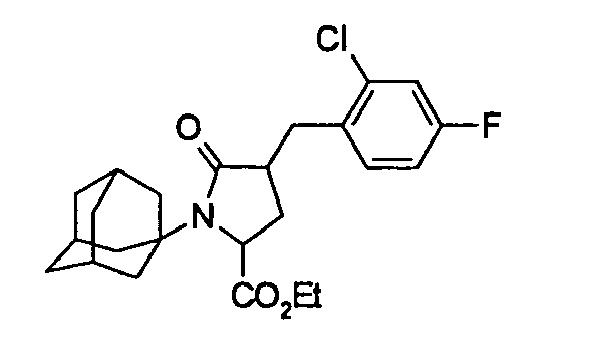
- In the same manner as in Example 361A, the title compound was obtained from 1-(1-adamantyl)-5-oxoproline ethyl ester obtained in Reference Example 15A and 2-chloro-4-fluorobenzyl bromide.
1H NMR (300 MHz, CDCl3) δ ppm 1.28 (t, J=7.2 Hz, 3 H), 1.59 -1.75 (m, 6 H), 1.80-2.25 (m, 11 H), 2.68-2.81 (m, 1 H), 2.83-2.99 (m, 1 H), 3.30 (dd, J=13.9, 4.5 Hz, 1 H), 4.12-4.29 (m, 3 H), 6.91 (td, J=8.3, 2.6 Hz, 1 H), 7.09 (dd, J=8.5, 2.6 Hz, 1 H), 7.20-7.31 (m, 1 H). -

- In the same manner as in Example 361A, the title compound was obtained from 1-(1-adamantyl)-5-oxoproline ethyl ester obtained in Reference Example 15A and 2-chloro-6-methoxybenzyl bromide.
1H NMR (300 MHz, CDCl3) δ ppm 1.25 (t, J=7.2 Hz, 3 H), 1.59 -1.89 (m, 7 H), 2.01-2.29 (m, 10 H), 2.72-2.85 (m, 1 H), 2.87-3.02 (m, 1 H), 3.39 (dd, J=13.0, 3.6 Hz, 1 H), 3.81 (s, 3 H), 4.08-4.22 (m, 2 H), 4.28 (d, J=9.0 Hz, 1 H), 6.70-6.77 (m, 1 H), 6.91-7.00 (m, 1 H), 7.05-7.14 (m, 1 H). -

- In the same manner as in Example 1A, the title compound was obtained from 1-(2,3-dihydro-1H-inden-1-yl)pyrrolidin-2-one obtained in Reference Example 5A and tert-butyl [3-chloro-4-(chloromethyl)phenyl](methyl)carbamate obtained in Reference Example 29A.
1H NMR (300 MHz, CDCl3) δ ppm 1.46 (s, 9 H), 1.59-2.03 (m, 3 H), 2.30-2.52 (m, 1 H), 2.72-3.17 (m, 6 H), 3.20-3.29 (m, 3 H), 3.33-3.53 (m, 1 H), 5.73-5.90 (m, 1 H), 7.01-7.15 (m, 2 H), 7.14-7.33 (m, 5 H). -

- In the same manner as in Example 20A, the title compound was obtained from tert-butyl (3-chloro-4-{[1-(2,3-dihydro-1H-inden-1-yl)-2-oxopyrrolidin-3-yl]methyl}phenyl)(methyl)carbamate obtained in Example 364A.
1H NMR (300 MHz, CDCl3) δ ppm 1.60 (dd, J=12.7, 8.5 Hz, 1 H), 1.82-2.05 (m, 2 H), 2.25 (dd, J=8.5, 4.3 Hz, 1 H), 2.47-2.64 (overlapping, 3 H), 2.63-3.02 (m, 6 H), 3.02-3.24 (m, 2 H), 5.60 (t, J=7.6 Hz, 1 H), 6.68 (d, J=7.7 Hz, 1 H), 6.79 (s, 1 H), 7.08 (d, J=7.0 Hz, 1 H), 7.12-7.33 (m, 4 H). -

- In the same manner as in Example 1A, the title compound was obtained from 1-(1-adamantyl)pyrrolidin-2-one and 4-fluoro-2-methoxybenzyl chloride.
1H NMR (300 MHz, CDCl3) δ ppm 1.46-1.77 (m, 6 H), 1.77-1.95 (m, 1 H), 2.02-2.21 (m, 10 H), 2.43-2.57 (m, 1 H), 2.56-2.74 (m, 1 H), 3.14-3.41 (m, 3 H), 3.79 (s, 3 H), 6.52-6.61 (m, 2 H), 7.08 (dd, J=8. 9, 6.9 Hz, 1 H) . -

- In the same manner as in Example 1A, the title compound was obtained from 1-(1-adamantyl)pyrrolidin-2-one and tert-butyl [3-chloro-4-(chloromethyl)phenyl](methyl)carbamate obtained in Reference Example 29A.
1H NMR (300 MHz, CDCl3) δ ppm 1.46 (s, 9 H), 1.58-1.76 (m, 8 H), 1.83-2.00 (m, 1 H), 2.04-2.23 (m, 8 H), 2.66-2.78 (m, 2 H), 3.20-3.44 (m, 3 H), 3.23 (s, 3 H), 7.08 (dd, J=8.3, 2.3 Hz, 1 H), 7.21 (d, J=8.3 Hz, 1 H), 7.26 (m, 1 H). -

- In the same manner as in Example 20A, the title compound was obtained from tert-butyl (4-{[1-(1-adamantyl)-2-oxopyrrolidin-3-yl]methyl}-3-chlorophenyl)(methyl)carbamate obtained in Example 367A.
1H NMR (300 MHz, CDCl3) δ ppm 1.39-1.71 (m, 8 H), 1.72-1.89 (m, 1 H), 1.95-2.19 (m, 8 H), 2.39-2.63 (m, 2 H), 2.74 (s, 3 H), 2.97-3.15 (m, 1 H), 3.15-3.47 (m, 2 H), 6.82 (d like, 1 H), 6.94 (s, 1 H), 7.21 (d like, 1 H). -

- In the same manner as in Reference Example 1A, the title compound was obtained from 1-(1-adamantyl)-3-[2-chloro-4-(methylamino)benzyl]pyrrolidin-2-one obtained in Example 368A and methyl iodide.
1H NMR (300 MHz, CDCl3) δ ppm 1.51-1.82 (m, 8 H), 1.82-1.99 (m, 1 H), 2.02-2.21 (m, 8 H), 2.54-2.71 (m, 2 H), 2.91 (s, 6 H), 3.17-3.44 (m, 3 H), 6.56 (dd, J=8.5, 2.6 Hz, 1 H), 6.69 (d, J=2.6 Hz, 1 H), 7.10 (d, J=8.5 Hz, 1 H). -

- In the same manner as in Example 255A, the title compound was obtained from 1-(trans-4-hydroxycyclohexyl)pyrrolidin-2-one obtained in Reference Example 30A and α,2,6-trichlorotoluene.
1H NMR (300 MHz, CDCl3) δ ppm 1.34-1.63 (m, 5 H), 1.67-2.18 (m, 6 H), 2.84-3.10 (m, 2 H), 3.10-3.24 (m, 1 H), 3.25-3.39 (m, 1 H), 3.48 (dd, J=13.2, 4.3 Hz, 1 H), 3.53-3.68 (m, 1 H), 3.89-4.06 (m, 1 H), 7.01-7.17 (m, 1 H), 7.29 (d, J=7.9 Hz, 2 H). -
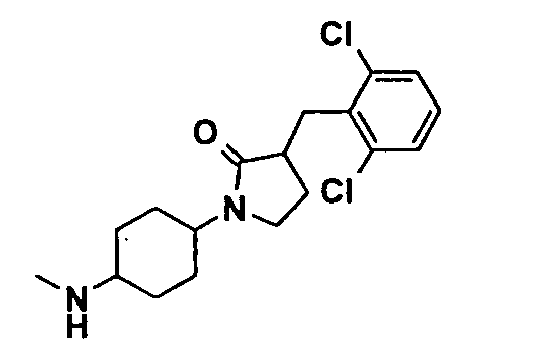
- A mixture of 3-(2,6-dichlorobenzyl)-1-(4-oxocyclohexyl)pyrrolidin-2-one obtained in Example 28A, methylamine (40% methanol solution, 0.16 g), sodium triacetoxyborohydride (0.75 g), acetic acid (0.13 g) and dichloromethane (20 mL) was stirred at room temperature for 16 hr. The reaction solution was concentrated, and the residue was partitioned between ethyl acetate and 10% aqueous sodium bicarbonate. The ethyl acetate layer was dried over anhydrous magnesium sulfate. The solvent was evaporated under reduced pressure, and the residue was recrystallized from ethyl acetate to give the title compound (0.04 g, 6%).
LC-MS (ESI+); m/z 355 (M)+ -

- 3-(2,6-Dichlorobenzyl)-1-[4-(methylamino)cyclohexyl]pyrrolidin-2-one obtained in Example 371A was converted to hydrochloride with 4N hydrogen chloride-ethyl acetate to give the title compound.
LC-MS (ESI+); m/z 355 (M)+ -

- In the same manner as in Example 1A, the title compound was obtained from 1-(1,4-dioxaspiro[4.5]dec-8-yl)pyrrolidin-2-one and 2-chlorobenzyl bromide.
1H NMR (300 MHz, CDCl3) δ ppm 1.61-1.87 (m, 9 H), 1.91-2.10 (m, 1 H), 2.75-2.89 (m, 2 H), 3.08-3.30 (m, 2 H), 3.39 (d like, 1 H), 3.87-3.98 (m, 4 H), 3.99-4.18 (m, 1 H), 7.08-7.23 (m, 2 H), 7.23-7.31 (m, 1 H), 7.31-7.39 (m, 1 H). -

- In the same manner as in Example 28A, the title compound was obtained from 3-(2-chlorobenzyl)-1-(1,4-dioxaspiro[4.5]dec-8-yl)pyrrolidin-2-one obtained in Example 373A.
1H NMR (300 MHz, CDCl3) δ ppm 1.66-2.15 (m, 6 H), 2.37-2.61 (m, 4 H), 2.73-2.96 (m, 2 H), 3.13-3.27 (m, 2 H), 3.34-3.51 (m, 1 H), 4.38-4.59 (m, 1 H), 7.10-7.24 (m, 2 H), 7.26-7.31 (m, 1 H), 7.33-7.41 (m, 1 H). -

- The reaction product (a mixture of four steric isomers) which was obtained in the same manner as in Example 30A from 3-(2-chlorobenzyl)-1-(4-oxocyclohexyl)pyrrolidin-2-one obtained in Example 374A was subjecting to silica gel column chromatography (hexane-ethyl acetate 2:3-ethyl acetate 100%) to give the title compound (Example 375A: less polar product) as a mixture of two steric isomers eluted earlier, and then to give the title compound (Example 376A: more polar product) as a mixture of two steric isomers eluted later.
- 1H NMR (300 MHz, CDCl3) δ ppm 1.03 (d, J=4.5 Hz, 1 H), 1.25 (s, 3 H), 1.41-1.91 (m, 9 H), 1.91-2.10 (m, 1 H), 2.69-2.92 (m, 2 H), 3.11-3.31 (m, 2 H), 3.32-3.50 (m, 1 H), 3.87-4.05 (m, 1 H), 7.09-7.23 (m, 2 H), 7.22-7.31 (m, 1 H), 7.31-7.41 (m, 1 H).
- 1H NMR (300 MHz, CDCl3)δ ppm 1.27 (s, 3 H), 1.40 (s, 1 H), 1.42-1.86 (m, 9 H), 1.90-2.12 (m, 1 H), 2.70-2.93 (m, 2 H), 3.10-3.29 (m, 2 H), 3.28-3.51 (m, 1 H), 3.83-4.13 (m, 1 H), 7.08-7.23 (m, 2 H), 7.23-7.31 (m, 1 H), 7.31-7.42 (m, 1 H).
-

- In the same manner as in Example 1A, the title compound was obtained from 1-(1,4-dioxaspiro[4.5]dec-8-yl)pyrrolidin-2-one and 2-chloro-4-methoxybenzyl bromide.
1H NMR (300 MHz, CDCl3) δ ppm 1.59-1.87 (m, 9 H), 1.92-2.09 (m, 1 H), 2.63-2.88 (m, 2 H), 3.13-3.39 (m, 3 H), 3.78 (s, 3 H), 3.94 (s, 4 H), 4.05 (s, 1 H), 6.74 (dd, J=8.6, 2.5 Hz, 1 H), 6.90 (d, J=2.5 Hz, 1 H), 7.17 (d, J=8.6 Hz, 1 H). -

- In the same manner as in Example 28A, the title compound was obtained from 3-(2-chloro-4-methoxybenzyl)-1-(1,4-dioxaspiro[4.5]dec-8-yl)pyrrolidin-2-oneobtained in Example 377A.
1H NMR (300 MHz, CDCl3) δ ppm 1.65-2.15 (m, 6 H), 2.36-2.64 (m, 4 H), 2.67-2.91 (m, 2 H), 3.12-3.23 (m, 2 H), 3.26-3.38 (m, 1 H), 3.78 (s, 3 H), 4.38-4.60 (m, 1 H), 6.75 (dd, J=8.7, 2.6 Hz, 1 H), 6. 91 (d, J=2.6 Hz, 1 H), 7.17 (d, J=8. 7 Hz, 1 H). -

- In the same manner as in Example 30A, the title compound was obtained from 3-(2-chloro-4-methoxybenzyl)-1-(4-oxocyclohexyl)pyrrolidin-2-one obtained in Example 378A.
LC-MS (ESI+); m/z 352 (M+H)+ -

- In the same manner as in Example 118A, the title compound was obtained from 1-benzylpyrrolidinone and cyclohexanone.
1H NMR (300 MHz, CDCl3) δ ppm 0.97-1.22 (m, 1 H), 1.21-1.45 (m, 2 H), 1.43-1.93 (m, 8 H), 1.96-2.23 (m, 1 H), 2.62 (m, 1 H), 3.18 (m, 2 H), 4.26-4.66 (m, 3 H), 7.12-7.43 (m, 5 H). -

- A mixture of 1-benzyl-3-(1-hydroxycyclohexyl)pyrrolidin-2-one obtained in Example 380A (5.0 g), p-toluenesulfonic acid monohydrate (0.70 g) and toluene (100 mL) was heated under reflux while dehydrating using Dean-Stark. The reaction mixture was concentrated under reduced pressure, and the residue was partitioned between ethyl acetate (50 mL) and 10% aqueous sodium bicarbonate (50 mL). The ethyl acetate layer was washed with saturated brine, and dried over anhydrous magnesium sulfate. The solvent was evaporated under reduced pressure, and the residue was subjected to silica gel column chromatography (hexane-ethyl acetate 7:3) to give the title compound (3.34 g, 71%).
1H NMR (300 MHz, CDCl3) δ ppm 1.42-1.79 (m, 4H), 1.80-2.30 (m, 6 H), 3.09 (t, J=8.6 Hz, 1 H), 3.14-3.31 (m, 2 H), 4.36-4.45 (m, 1 H), 4.50-4.60 (m, 1 H), 5.61 (s, 1 H), 7.15-7.43 (m, 5 H). -

- A mixture of 1-benzyl-3-(cyclohex-1-en-1-yl)pyrrolidin-2-one obtained in Example 381A (0.5 g), 10% palladium-carbon (0.1 g) and methanol (15 mL) was stirred at room temperature for 16 hr under hydrogen atmosphere. The reaction solution was filtrated through celite, and the filtrate was concentrated under reduced pressure. The residue was subjected to silica gel column chromatography (hexane-ethyl acetate 1:1) to give the title compound (0.44 g, 87%).
1H NMR (300 MHz, CDCl3) δ ppm 0.96-1.43 (m, 5 H), 1.56 (s, 1 H), 1.62-2.19 (m, 7 H), 2.34-2.53 (m, 1 H), 3.14 (dd, J=7.8, 6.3 Hz, 2 H), 4.32-4.43 (m, 1 H), 4.47-4.56 (m, 1 H), 7.14-7.39 (m, 5 H). -

- In the same manner as in Example 118A, the title compound was obtained from 1-(4-methoxybenzyl)pyrrolidin-2-one and cyclohexanone.
1H NMR (300 MHz, CDCl3) δ ppm 1.02-1.19 (m, 1 H), 1.26-1.43 (m, 2 H), 1.51 (m, 3 H), 1.59-1.87 (m, 5 H), 1.97-2.13 (m, 1 H), 2.60 (m, 1 H), 3.16 (m, 2 H), 3.80 (s, 3 H), 4.26-4.36 (m, 1 H), 4.40-4.50 (m, 1 H), 4.52 (d, J=1.9 Hz, 1 H), 6.81-6.91 (m, 2 H), 7.10-7.19 (m, 2 H). -

- In the same manner as in Example 381A, the title compound was obtained from 3-(1-hydroxycyclohexyl)-1-(4-methoxybenzyl)pyrrolidin-2-one obtained in Example 383A.
1H NMR (300 MHz, CDCl3) δ ppm 1.48-1.75 (m, 4 H), 1.79-2.25 (m, 6 H), 3.00-3.11 (m, 1 H), 3.10-3.28 (m, 2 H), 3.80 (s, 3 H), 4.29-4.37 (m, 1 H), 4.41-4.52 (m, 1 H), 5.60 (s, 1 H), 6.80-6.90 (m, 2 H), 7.12-7.21 (m, 2 H). -

- In the same manner as in Example 382A, the title compound was obtained from 3-(cyclohex-1-en-1-yl)-1-(4-methoxybenzyl)pyrrolidin-2-one obtained in Example 384A.
1H NMR (300 MHz, CDCl3) δ ppm 0.97-1.41 (m, 5 H), 1.46-1.59 (m, 1 H), 1.62-2.05 (m, 7 H), 2.34-2.49 (m, 1 H), 3.12 (m, 2 H), 3.79 (s, 3 H), 4.25-4.36 (m, 1 H), 4.39-4.53 (m, 1 H), 6.80-6.89 (m, 2 H), 7.08-7.20 (m, 2 H). -

- In the same manner as in Example 1A, the title compound was obtained from 1-(4-methoxybenzyl)pyrrolidin-2-one and α, 2, 6-trichlorotoluene.
1H NMR (300 MHz, CDCl3) δ ppm 1.80-1.99 (m, 2 H), 2.86-3.33 (m, 4 H), 3.53 (dd, J=13.1, 4.2 Hz, 1 H), 3.80 (s, 3 H), 4.31-4.54 (m, 2 H), 6.79-6.94 (m, 2 H), 7.04-7.16 (m, 1 H), 7.15-7.23 (m, 2 H), 7.26-7.33 (m, 2 H). -
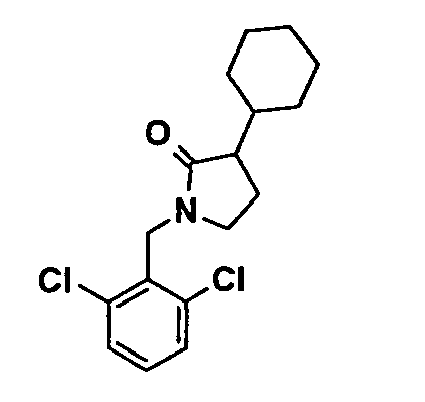
- A mixture of 3-cyclohexyl-1-(4-methoxybenzyl)pyrrolidin-2-one obtained in Example 385A (3.80 g), diammonium cerium (IV) nitrate (21.7 g), acetonitrile (80 mL) and water (20 mL) was stirred for 2 hr under ice-cooling. The reaction mixture was partitioned between ethyl acetate (300 mL) and saturated brine (80 mL), and the ethyl acetate layer was dried over anhydrous magnesium sulfate. The solvent was evaporated under reduced pressure, and the residue was subjected to silica gel column chromatography (hexane-ethyl acetate 9:1-3:2) to give 3-cyclohexylpyrrolidin-2-one (1.28 g, 58%) as a colorless solid. In the same manner as in Example 56A, the title compound was obtained from this compound and α,2,6-trichlorotoluene.
1H NMR (300 MHz, CDCl3) δ ppm 0.95-1.20 (m, 3 H), 1.19-1.42 (m, 2 H), 1.47-1.82 (m, 6 H), 1.81-2.00 (m, 2 H), 2.31-2.47 (m, 1 H), 2.95-3.13 (m, 2 H), 4.68 (d, J=13. 9 Hz, 1 H), 4.92 (d, J=13. 9 Hz, 1 H), 7.13-7.24 (m, 1 H), 7.29-7.38 (m, 2 H). -

- The reaction product (a mixture of four steric isomers) which was obtained in the same manner as in Example 1A from 1-(4-methoxycyclohexyl)pyrrolidin-2-one (a mixture of cis and trans) obtained in Reference Example 31A and α,2,6-trichlorotoluene was subjected to silica gel column chromatography (hexane-ethyl acetate 4:1-3:7) to give the title compound (Example 388A: less polar product) as a mixture of two steric isomers eluted earlier, and then to give the title compound (Example 389A: more polar product) as a mixture of two steric isomers eluted later.
- 1H NMR (300 MHz, CDCl3) δ ppm 1.38-1.61 (m, 4 H), 1.63-2.12 (m, 6 H), 2.83-3.10 (m, 2 H), 3.14-3.26 (m, 1 H), 3.31 (s, 3 H), 3.32-3.41 (m, 1 H), 3.41-3.54 (m, 2 H), 3.94-4.10 (m, 1 H), 7.03-7.14 (m, 1 H), 7.23-7.32 (m, 2 H).
- 1H NMR (300 MHz, CDCl3) δ ppm 1.26-1.59 (m, 4 H), 1.71-2.03 (m, 4 H), 2.04-2.21 (m, 2 H), 2.82-3.24 (m, 4 H), 3.30 (m, 1 H), 3.35 (s, 3 H), 3.48 (m, 1 H), 3.90-4.05 (m, 1 H), 7.05-7.14 (m, 1 H), 7.29 (m, 2 H).
-

- The reaction product (a mixture of four diastereomers) which was obtained in the same manner as in Example 1A from benzyl 3-(2-oxopyrrolidin-1-yl)piperidine-1-carboxylate obtained in Reference Example 32A and α,2,6-trichlorotoluene was subjected to silica gel column chromatography (hexane-ethyl acetate 9:1-1:1) to give the title compound (Example 390A: less polar product) as a mixture of two diastereomers, and then to give the title compound (Example 391A: more polar product) as a mixture of two diastereomers eluted later.
Example 390A (less polar product)
LC-MS (ESI+); m/z 461 (M)+ - LC-MS (ESI+); m/z 461 (M)+
-

- Benzyl 3-[3-(2,6-dichlorobenzyl)-2-oxopyrrolidin-1-yl]piperidine-1-carboxylate obtained in Examples 390A and 391A (a mixture of four diastereomers, 2.86 g) was dissolved in acetic acid (5 mL) and hydrobromic acid (48%, 20 mL), and the mixture was stirred at room temperature for 24 hr. The reaction mixture was poured into ice water (50 mL), and the organic layer was washed with diethyl ether (100 mL). The aqueous layer was adjusted with 8N sodium hydroxide to pH 10, and the mixture was extracted with ethyl acetate (100 mL). The ethyl acetate layer was washed with 10% aqueous sodium bicarbonate and saturated brine, and dried over anhydrous magnesium sulfate. The solvent was evaporated under reduced pressure, and the obtained colorless solid was recrystallized from hexane-ethyl acetate to give the title compound (1.00 g, 49%).
LC-MS (ESI+); m/z 327 (M)+ -

- To a mixture of 3-(2,6-dichlorobenzyl)-1-(piperidin-3-yl)pyrrolidin-2-one obtained in Example 392A (0.15 g), formaldehyde (36%, 57 mg), acetic acid (55 mg) and dichloromethane (5 mL) was added sodium triacetoxyborohydride (0.19 g), and the mixture was stirred at room temperature for 3 hr. The reaction mixture was partitioned between ethyl acetate and 10% aqueous sodium bicarbonate, and the ethyl acetate layer was washed with saturated brine, and dried over anhydrous magnesium sulfate. The solvent was evaporated under reduced pressure, and the residue was purified by NH-silica gel column chromatography (ethyl acetate) to give a colorless amorphous form. This was treated with hydrogen chloride-ethyl acetate, and the obtained colorless solid was triturated with diethyl ether to give the title compound (0.13 g, 75%) as a colorless powder.
LC-MS (ESI+); m/z 341 (M)+ -
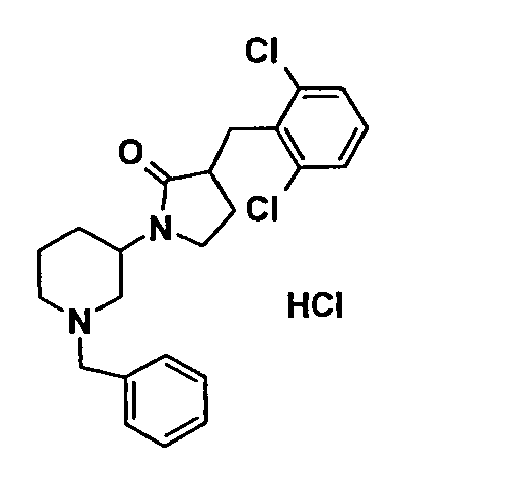
- In the same manner as in Example 94A, the title compound was obtained from 3-(2,6-dichlorobenzyl)-1-(piperidin-3-yl)pyrrolidin-2-one obtained in Example 392A and benzyl bromide. LC-MS (ESI+); m/z 417 (M)+
-

- In the same manner as in Example 22A, the title compound was obtained from 3-(2,6-dichlorobenzyl)-1-(piperidin-3-yl)pyrrolidin-2-one obtained in Example 392A and acetyl chloride.
LC-MS (ESI+); m/z 369 (M)+ -

- In the same manner as in Example 22A, the title compound was obtained from 3-(2,6-dichlorobenzyl)-1-(piperidin-3-yl)pyrrolidin-2-one obtained in Example 392A and methanesulfonyl chloride.
LC-MS (ESI+); m/z 405 (M)+ -

- In the same manner as in Example 1A, the title compound was obtained from 1-(1,4-dioxaspiro[4.5]dec-8-yl)pyrrolidin-2-one and 2-chloro-4-(trifluoromethyl)benzyl chloride.
1H NMR (300 MHz, CDCl3) δ ppm 1.60-1.87 (m, 9 H), 1.94-2.19 (m, 1 H), 2.77-2.94 (m, 2 H), 3.13-3.31 (m, 2 H), 3.41 (d, J=9.0 Hz, 1 H), 3.92-3.98 (m, 4 H), 4.05 (s, 1 H), 7.44 (d, J=1.7 Hz, 2 H), 7.62 (s, 1 H). -

- In the same manner as in Example 1A, the title compound was obtained from 1-(1,4-dioxaspiro[4.5]dec-8-yl)pyrrolidin-2-one and 2,4-dichlorobenzyl chloride.
1H NMR (300 MHz, CDCl3) δ ppm 1.59-1.88 (m, 9 H), 1.94-2.13 (m, 1 H), 2.66-2.91 (m, 2 H), 3.10-3.44 (m, 3 H), 3.94 (s, 4 H), 4.04 (s, 1 H), 7.07-7.25 (m, 2 H), 7.37 (d, J=2.1 Hz, 1 H). -

- In the same manner as in Example 28A, the title compound was obtained from 3-[2-chloro-4-(trifluoromethyl)benzyl]-1-(1,4-dioxaspiro[4.5]dec-8-yl)pyrrolidin-2-one obtained in Example 397A.
1H NMR (300 MHz, CDCl3) δ ppm 1.63-2.20 (m, 6 H), 2.34-2.64 (m, 4 H), 2.77-2.97 (m, 2 H), 3.15-3.33 (m, 2 H), 3.35-3.53 (m, 1 H), 4.38-4.59 (m, 1 H), 7.37-7.52 (m, 2 H), 7.64 (s, 1 H). -

- In the same manner as in Example 28A, the title compound was obtained from 3-(2,4-dichlorobenzyl)-1-(1,4-dioxaspiro[4.5]dec-8-yl)pyrrolidin-2-one obtained in Example 398A.
1H NMR (300 MHz, CDCl3) δ ppm 1.63-2.18 (m, 6 H), 2.33-2.64 (m, 4 H), 2.71-2.92 (m, 2 H), 3.12-3.28 (m, 2 H), 3.27-3.42 (m, 1 H), 4.37-4.58 (m, 1 H), 7.12-7.25 (m, 2 H), 7.38 (d, J=2.1 Hz, 1 H). -
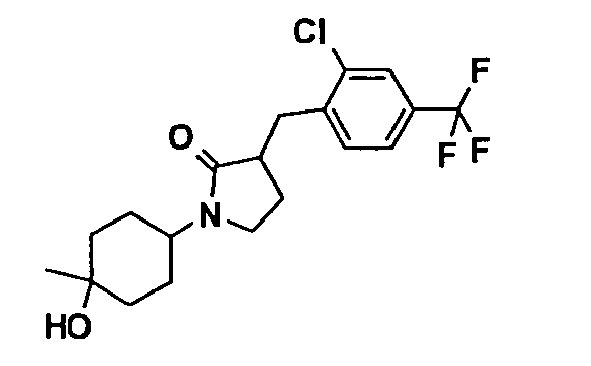
- In the same manner as in Example 30A, the title compound was obtained from 3-[2-chloro-4-(trifluoromethyl)benzyl]-1-(4-oxocyclohexyl)pyrrolidin-2-one obtained in Example 399A.
LC-MS (ESI+); m/z 390 (M)+ -
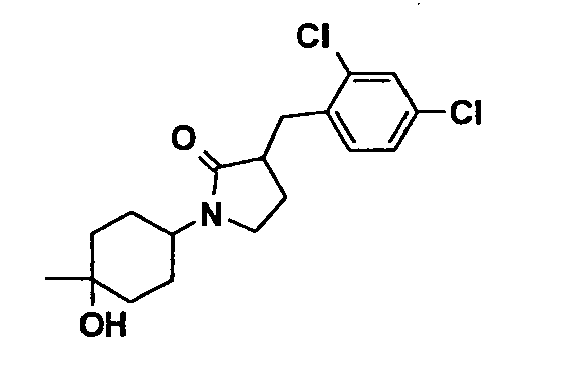
- In the same manner as in Example 263A, the title compound was obtained from 3-(2,4-dichlorobenzyl)-1-(4-oxocyclohexyl)pyrrolidin-2-one obtained in Example 400A.
LC-MS (ESI+); m/z 356 (M)+ -
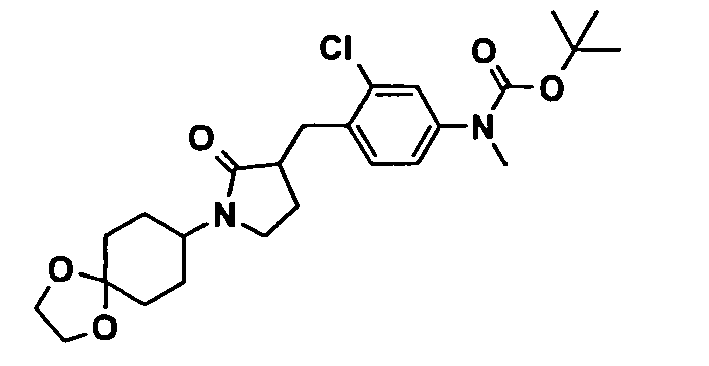
- In the same manner as in Example 1A, the title compound was obtained from 1-(1,4-dioxaspiro[4.5]dec-8-yl)pyrrolidin-2-one and tert-butyl [3-chloro-4-(chloromethyl)phenyl](methyl)carbamate obtained in Reference Example 29A.
1H NMR (300 MHz, CDCl3) δ ppm 1.46 (s, 9 H), 1.61-1.87 (m, 9 H), 1.93-2.10 (m, 1 H), 2.68-2.86 (m, 2 H), 3.10-3.30 (m, 2 H), 3.23 (s, 3H), 3.34 (d, J=9.6 Hz, 1 H), 3.94 (s, 4 H), 4.06 (s, 1 H), 7.02-7.12 (m, 1 H), 7.22 (d, J=8.3 Hz, 1 H), 7.24-7.30 (m, 1 H). Example 404A methyl N-(3-chloro-4-{[2-oxo-1-(4-oxocyclohexyl)pyrrolidin-3-yl]methyl}phenyl)-N-methyl glycinate
- In the same manner as in Example 28A, a colorless amorphous form was obtained from tert-butyl (3-chloro-4-{[1-(1,4-dioxaspiro[4.5]dec-8-yl)-2-oxopyrrolidin-3-yl]methyl}phenyl)(methyl)carbamate obtained in Example 403A (1.29 g). In the same manner as in Example 20A, a colorless solid was obtained from this compound. This was triturated with diethyl ether to give a colorless powder (0.90 g). In the same manner as in Example 94A, the title compound was obtained from the obtained product and methyl bromoacetate.
1H NMR (300 MHz, CDCl3) δ ppm 1.59-2.14 (m, 6 H), 2.33-2.61 (m, 4 H), 2.62-2.88 (m, 2 H), 3.03 (s, 3 H), 3.10-3.39 (m, 3 H), 3.73 (s, 3 H), 4.04 (s, 2 H), 4.36-4.60 (m, 1 H), 6.50 (dd, J=8.7, 2.6 Hz, 1 H), 6.67 (d, J=2.6 Hz, 1 H), 7.09 (d, J=8.7 Hz, 1 H). -
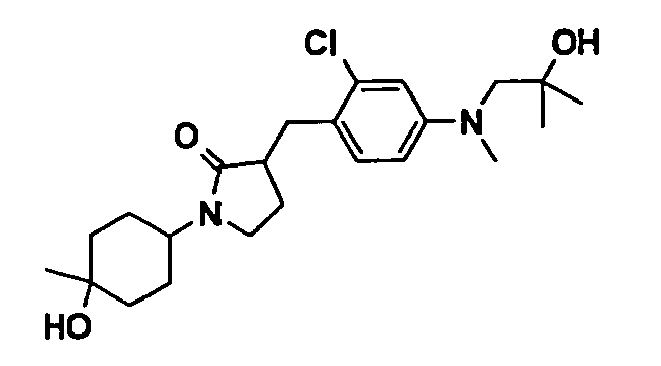
- In the same manner as in Example 263A, the title compound was obtained from methyl N-(3-chloro-4-{[2-oxo-1-(4-oxocyclohexyl)pyrrolidin-3-yl]methyl}phenyl)-N-methyl glycinate obtained in Example 404A.
LC-MS (ESI+); m/z 423 (M)+ -

- In the same manner as in Example 387A, the title compound was obtained from 3-cyclohexyl-1-(4-methoxybenzyl)pyrrolidin-2-one obtained in Example 385A and 2,4-dichlorobenzyl chloride.
1H NMR (300 MHz, CDCl3) δ ppm 0.95-1.22 (m, 3 H), 1.20-1.43 (m, 2 H), 1.42-1.59 (m, 1 H), 1.60-2.13 (m, 6 H), 2.34-2.53 (m, 1 H), 3.11-3.26 (m, 2 H), 4.41-4.54 (m, 1 H), 4.55-4.69 (m, 2 H), 7.16-7.25 (m, 2 H), 7.38 (s, 1 H). -

- In the same manner as in Example 255A, the title compound was obtained from 1-[4-(hydroxymethyl)cyclohexyl]pyrrolidin-2-one obtained in Reference Example 34A and α,2,6-trichlorotoluene.
LC-MS (ESI+); m/z 356 (M)+ -

- 1-Cyclohexyl-3-(2-methoxybenzyl)pyrrolidin-2-one (racemate) obtained in Example 111A was subjected to optical resolution with normal phase chiral high performance liquid chromatography (manufactured by Daicel Chemical Industries, Ltd., chiralpak AD (trade name), 50 mmID X 500 mmL, hexane-ethanol 90:10) to give the title compound (Example 408A) from a fraction with a retention time of 9 min and the title compound (Example 409A) from a fraction with a retention time of 12 min. Example 408A (retention time 9 min)
1H NMR (300 MHz, CDCl3) δ ppm 0.97-1.17 (m, 1 H), 1.27-1.49 (m, 4 H), 1.58-1.84 (m, 6 H), 1.86-2.00 (m, 1 H), 2.57 (dd, J=13.6, 10.1 Hz, 1 H), 2.70-2.86 (m, 1 H), 3.11-3.21 (m, 2 H), 3.31 (dd, J=13.6, 4.1 Hz, 1 H), 3.81 (s, 3 H), 3.87-4.04 (m, 1 H), 6.77-6.93 (m, 2 H), 7.11-7.23 (m, 2 H). Example 409A (retention time 12 min)
1H NMR (300 MHz, CDCl3) δ ppm 0.97-1.17 (m, 1 H), 1.27-1.49 (m, 4 H), 1.58-1.84 (m, 6 H), 1.86-2.00 (m, 1 H), 2.57 (dd, J=13.6, 10.1 Hz, 1 H), 2.70-2.86 (m, 1 H), 3.11-3.21 (m, 2 H), 3.31 (dd, J=13.6, 4.1 Hz, 1 H), 3.81 (s, 3 H), 3.87-4.04 (m, 1 H), 6.77-6.93 (m, 2 H), 7.11-7.23 (m, 2 H). -

- 3-(2-Chloro-4-methoxybenzyl)-1-(4-hydroxy-4-methylcyclohexyl)pyrrolidin-2-one (a mixture of four steric isomers) obtained in Example 379A was subjected to optical resolution with normal phase chiral high performance liquid chromatography (manufactured by Daicel Chemical Industries, Ltd., Chiralcel OJ (trade name), 50 mmID X 500 mmL, hexane-ethanol 85:15, retention time 22 min), and purified (manufactured by Daicel Chemical Industries, Ltd., chiralpak AD (trade name), 50 mmID X 500 mmL, hexane-ethanol 85:15, retention time 150 min) to give the title compound.
1H NMR (300 MHz, CDCl3) δ ppm 1.27 (s, 3 H), 1.39-1.84 (m, 10 H), 1.90-2.11 (m, 1 H), 2.64-2.85 (m, 2 H), 3.13-3.24 (m, 2 H), 3.24-3.35 (m, 1 H), 3.78 (s, 3 H), 3.89-4.06 (m, 1 H), 6.75 (dd, J=8.5, 2.6 Hz, 1 H), 6.91 (d, J=2.6 Hz, 1 H), 7.17 (d, J=8.5 Hz, 1 H) . -

- 3-(2-Chloro-4-methoxybenzyl)-1-(4-hydroxy-4-methylcyclohexyl)pyrrolidin-2-one (a mixture of four steric isomers) obtained in Example 379A was subjected to optical resolution with normal phase chiral high performance liquid chromatography (manufactured by Daicel Chemical Industries, Ltd., Chiralcel OJ (trade name), 50 mmID X 500 mmL, hexane-ethanol 85:15, retention time 35 min) to give the title compound.
1H NMR (300 MHz, CDCl3)δ ppm 1.27 (s, 3 H), 1.39-1.86 (m, 10 H), 1.90-2.12 (m, 1 H), 2.62-2.86 (m, 2 H), 3.13-3.24 (m, 2 H), 3.24-3.36 (m, 1 H), 3.78 (s, 3 H), 3.91-4.07 (m, 1 H), 6.75 (dd, J=8.5, 2.6 Hz, 1 H), 6.91 (d, J=2.6 Hz, 1 H), 7.17 (d, J=8.5 Hz, 1 H). -

- 3-(2,4-Dichlorobenzyl)-1-(4-hydroxy-4-methylcyclohexyl)pyrrolidin-2-one (a mixture of four steric isomers) obtained in Example 402A was subjected to optical resolution with normal phase chiral high performance liquid chromatography (manufactured by Daicel Chemical Industries, Ltd., Chiralcel OJ (trade name), 50 mmID X 500 mmL, hexane-ethanol 85:15, retention time 18 min), and purified by normal phase chiral high performance liquid chromatography (SUMICHIRAL OA (trade name) manufactured by Sumika Chemical Analysis Service, Ltd., 20 mmID X 250 mmL, hexane-ethanol 85:15, retention time 4.16 min) to give the title compound.
1H NMR (300 MHz, CDCl3) δ ppm 1.27 (s, 3 H), 1.38-1.86 (m, 10 H), 1.94-2.12 (m, 1 H), 2.69-2.89 (m, 2 H), 3.11-3.41 (m, 3 H), 3.88-4.06 (m, 1 H), 7.11-7.25 (m, 2 H), 7.37 (d, J=2.1 Hz, 1 H). -

- 3-(2,4-Dichlorobenzyl)-1-(4-hydroxy-4-methylcyclohexyl)pyrrolidin-2-one (a mixture of four steric isomers) obtained in Example 402A was subjected to optical resolution with normal phase chiral high performance liquid chromatography (manufactured by Daicel Chemical Industries, Ltd., Chiralcel OJ (trade name), 50 mmID X 500 mmL, hexane-ethanol 85:15, retention time 27 min) to give the title compound.
1H NMR (300 MHz, CDCl3) δ ppm 1.27 (s, 3 H), 1.41-1.85 (m, 10 H), 1.95-2.10 (m, 1 H), 2.71-2.87 (m, 2 H), 3.13-3.26 (m, 2 H), 3.26-3.41 (m, 1 H), 3.87-4.06 (m, 1 H), 7.12-7.25 (m, 2 H), 7.37 (d, J=1.9 Hz, 1 H). -

- 3-(2,4-Dichlorobenzyl)-1-(4-hydroxy-4-methylcyclohexyl)pyrrolidin-2-one (a mixture of four steric isomers) obtained in Example 402A was subjected to optical resolution with normal phase chiral high performance liquid chromatography (manufactured by Daicel Chemical Industries, Ltd., Chiralcel OJ (trade name), 50 mmID X 500 mmL, hexane-ethanol 85:15, retention time 18 min), and purified by normal phase chiral high performance liquid chromatography (SUMICHIRAL OA (trade name) manufactured by Sumika Chemical Analysis Service, Ltd., 20 mmID X 250 mmL, hexane-ethanol 85:15, retention time 4.09 min) to give the title compound.
1H NMR (300 MHz, CDCl3) δ ppm 1.01 (s, 1 H), 1.25 (s, 3 H), 1.41-1.90 (m, 9 H), 1.92-2.10 (m, 1 H), 2.68-2.86 (m, 2 H), 3.14-3.40 (m, 3 H), 3.82-4.04 (m, 1 H), 7.12-7.25 (m, 2 H), 7.37 (d, J=1.9 Hz, 1 H). -

- 3-(2,4-Dichlorobenzyl)-1-(4-hydroxy-4-methylcyclohexyl)pyrrolidin-2-one (a mixture of four steric isomers) obtained in Example 402A was subjected to optical resolution with normal phase chiral high performance liquid chromatography (manufactured by Daicel Chemical Industries, Ltd., Chiralcel OJ (trade name), 50 mmID X 500 mmL, hexane-ethanol 85:15, retention time 23 min) to give the title compound.
1H NMR (300 MHz, CDCl3) δ ppm 1.01 (s, 1 H), 1.25 (s, 3 H), 1.37-1.92 (m, 9 H), 1.93-2.15 (m, 1 H), 2.68-2.88 (m, 2 H), 3.14-3.41 (m, 3 H), 3.83-4.07 (m, 1 H), 7.12-7.25 (m, 2 H), 7.37 (d, J=1.9 Hz, 1 H). -

- 3-(2-Chlorobenzyl)-1-(4-hydroxy-4-methylcyclohexyl)pyrrolidin-2-one (less polar product) obtained in Example 375A was subjected to optical resolution with normal phase chiral high performance liquid chromatography (manufactured by Daicel Chemical Industries, Ltd., chiralpak AD (trade name), 50 mmID X 500 mmL, hexane-ethanol 1:1) to give the title compound (Example 416A) from a fraction with a retention time of 24 min and the title compound (Example 417A) from a fraction with a retention time of 66 min.
- 1H NMR (300 MHz, CDCl3) δ ppm 1.05 (s, 1 H), 1.25 (s, 3 H), 1.41-1.91 (m, 9 H), 1.92-2.13 (m, 1 H), 2.68-2.96 (m, 2 H), 3.12-3.32 (m, 2 H), 3.34-3.47 (m, 1 H), 3.86-4.07 (m, 1 H), 7.06-7.23 (m, 2 H), 7.23-7.30 (m, 1 H), 7.35 (dd, J=7.2, 1.9 Hz, 1 H). Example 417A (retention time 66 min)
1H NMR (300 MHz, CDCl3)δ ppm 1.04 (s, 1 H), 1.25 (s, 3 H), 1.39-1.90 (m, 9 H), 1.91-2.10 (m, 1 H), 2.69-2.95 (m, 2 H), 3.14-3.32 (m, 2 H), 3.35-3.46 (m, 1 H), 3.82-4.09 (m, 1 H), 7.10-7.24 (m, 2 H), 7.23-7.31 (m, 1 H), 7.35 (dd, J=7.3, 2.0 Hz, 1 H). -
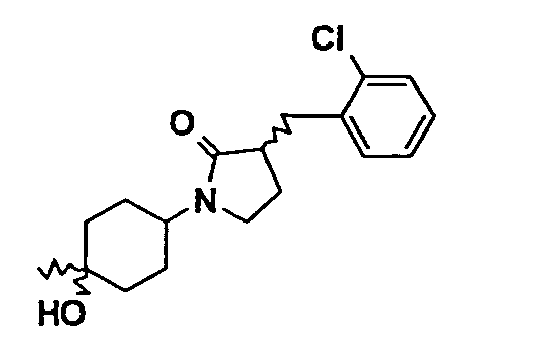
- 3-(2-Chlorobenzyl)-1-(4-hydroxy-4-methylcyclohexyl)pyrrolidin-2-one (more polar product) obtained in Example 376A was subjected to optical resolution with normal phase chiral high performance liquid chromatography (manufactured by Daicel Chemical Industries, Ltd., chiralpak AD (trade name), 50 mmID X 500 mmL, hexane-isopropanol 9:1) to give the title compound (Example 418A) from a fraction with a retention time of 90 min and the title compound (Example 419A) from a fraction with a retention time of 114 min.
- 1H NMR (300 MHz, CDCl3)δ ppm 1.26-1.30 (m, 3 H), 1.41-1.86 (m, 10 H), 1.92-2.12 (m, 1 H), 2.70-2.91 (m, 2 H), 3.09-3.27 (m, 2 H), 3.31-3.49 (m, 1 H), 3.90-4.09 (m, 1 H), 7.08-7.23 (m, 2 H), 7.23-7.31 (m, 1 H), 7.30-7.40 (m, 1 H).
- 1H NMR (300 MHz, CDCl3)δppm 1.27 (s, 3 H), 1.42-1.85 (m, 10 H), 1.91-2.10 (m, 1 H), 2.67-2.93 (m, 2 H), 3.14-3.27 (m, 2 H), 3.32-3.49 (m, 1 H), 3.90-4.09 (m, 1 H), 7.09-7.23 (m, 2 H), 7.23-7.31 (m, 1 H), 7.35 (dd, J=7.0, 2.1 Hz, 1 H).
-

- 3-(2-Chloro-4-fluorobenzyl)-1-(4-hydroxy-4-methylcyclohexyl)pyrrolidin-2-one (less polar product) obtained in Example 86A was subjected to optical resolution with normal phase chiral high performance liquid chromatography (manufactured by Daicel Chemical Industries, Ltd., chiralpak AD (trade name), 50 mmID X 500 mmL, hexane-2-propanol 4:1) to give the title compound (Example 420A) from a fraction with a retention time of 14 min and the title compound (Example 421A) from a fraction with a retention time of 24 min.
- 1H NMR (300 MHz, CDCl3) δ ppm 1.25 (s, 3 H), 1.40-1.89 (m, 9 H), 1.94-2.11 (m, 1 H), 2.68-2.87 (m, 2 H), 3.13-3.43 (m, 3 H), 3.86-4.03 (m, 1 H), 6.83-6.99 (m, 1 H), 7.10 (dd, J=8.5, 2.6 Hz, 1 H), 7.18-7.32 (m, 1 H).
- 1H NMR (300 MHz, CDCl3) δ ppm 1.25 (s, 3 H), 1.40-1.91 (m, 9 H), 1.93-2.17 (m, 1 H), 2.67-2.88 (m, 2 H), 3.11-3.44 (m, 3 H), 3.83-4.03 (m, 1 H), 6.83-6.98 (m, 1 H), 7.10 (dd, J=8.7, 2.6 Hz, 1H), 7.21-7.29 (m, 1H).
- Example 422A 3-(2-chloro-4-fluorobenzyl)-1-(4-hydroxy-4-methylcyclohexyl)pyrrolidin-2-one (an optically active form, retention time 18 min) Example 423A 3-(2-chloro-4-fluorobenzyl)-1-(4-hydroxy-4-methylcyclohexyl)pyrrolidin-2-one (an optically active form, retention time 26 min)

- 3-(2-Chloro-4-fluorobenzyl)-1-(4-hydroxy-4-methylcyclohexyl)pyrrolidin-2-one (more polar product) obtained in Example 87A was subjected to optical resolution with normal phase chiral high performance liquid chromatography (manufactured by Daicel Chemical Industries, Ltd., chiralpak AD (trade name), 50 mmID X 500 mmL, hexane-2-propanol 4:1) to give the title compound (Example 422A) from a fraction with a retention time of 18 min and the title compound (Example 423A) from a fraction with a retention time of 26 min.
- 1H NMR (300 MHz, CDCl3) δ ppm 1.25 (s, 3 H), 1.36-1.91 (m, 9 H), 1.93-2.11 (m, 1 H), 2.68-2.89 (m, 2 H), 3.10-3.42 (m, 3 H), 3.82-4.08 (m, 1H), 6.84-6.99 (m, 1 H), 7.10 (dd, J=8.5, 2.6 Hz, 1 H), 7.19-7.35 (m, 1 H).
- 1H NMR (300 MHz, CDCl3) δ ppm 1.27 (s, 3 H), 1.41-1.87 (m, 9 H), 1.92-2.16 (m, 1 H), 2.65-2.91 (m, 2 H), 3.14-3.25 (m, 2 H), 3.25-3.43 (m, 1 H), 3.82-4.08 (m, 1 H), 6.81-7.01 (m, 1H), 7.11 (dd, J=8.5, 2.6 Hz, 1 H), 7.17-7.34 (m, 1 H).
-

- In the same manner as in Example 1A, the title compound was obtained from 1-(5-methoxy-1,2,3,4-tetrahydronaphthalen-1-yl)pyrrolidin-2-one obtained in Reference Example 37A and α,2,6-trichlorotoluene.
1H NMR (300 MHz, CDCl3) δ ppm 1.66-2.09 (m, 6 H), 2.45-2.62 (m, 1 H), 2.72-2.86 (m, 1 H), 2.88-3.14 (m, 3 H), 3.14-3.28 (m, 1 H), 3.46-3.69 (m, 1 H), 3.77-3.87 (s, 3 H), 5.33-5.51 (m, 1 H), 6.57-6.77 (m, 2 H), 7.05-7.20 (m, 2 H), 7.25-7.33 (m, 2 H). -

- In the same manner as in Example 140A, the title compound was obtained from 3-(2,6-dichlorobenzyl)-1-(5-methoxy-1,2,3,4-tetrahydronaphthalen-1-yl)pyrrolidin-2-one obtained in Example 424A.
1H NMR (300 MHz, CDCl3) δ ppm 1.67-2.12 (m, 6 H), 2.33-2.85 (m, 2 H), 2.86-3.41 (m, 4 H), 3.42-3.68 (m, 1 H), 5.33-5.56 (m, 1 H), 5.92-5.56 (m, 1 H), 5.92-6.23 (m, 1 H), 6.44-7.17 (m, 4 H), 7.21-7.38 (m, 2 H). -

- In the same manner as in Example 1A, the title compound was obtained from 1-(5-methoxy-1,2,3,4-tetrahydronaphthalen-1-yl)pyrrolidin-2-one obtained in Reference Example 37A and α,2,4-trichlorotoluene.
1H NMR (300 MHz, CDCl3) δ ppm 1.67-1.82 (m, 2 H), 1.91-2.04 (m, 2 H), 2.52-2.55 (m, 1 H), 2.75-2.98 (m, 4 H), 3.03-3.11 (m, 1 H), 3.35-3.41 (dd, J=12.9, 3.9 Hz, 1 H), 3.81 (s, 3 H), 5.39-5.44 (m, 1 H), 6.58-6.60 (d, J=7.5 Hz, 1 H), 6.69-6.71 (d, J=8.4 Hz, 1 H), 7.08-7.13 (m, 1 H), 7.17-7.25 (m, 1 H), 7.26-7.31 (m, 1 H), 7.37-7.39 (m, 1 H). -

- In the same manner as in Example 140A, the title compound was obtained from 3-(2,4-dichlorobenzyl)-1-(5-methoxy-1,2,3,4-tetrahydronaphthalen-1-yl)pyrrolidin-2-one obtained in Example 426A.
LC/MS (ESI+); m/z 390 (M+H)+ -

- In the same manner as in Example 255A, the title compound was obtained from 1-(5-hydroxy-2-adamantyl)pyrrolidin-2-one obtained in Reference Example 38A and α,2,6-trichlorotoluene.
1H NMR (300 MHz, CD3OD) δ ppm 1.61-2.03 (m, 12 H), 2.11 (m, 1 H), 2.45-2.52 (m, 2 H), 2.91-3.09 (m, 2 H), 3.37-3.43 (m, 1 H), 3.54-3.62 (m, 1 H), 3.72-3.81 (m, 1 H), 4.87 (m, 1 H), 7.17-7.23 (m, 1 H), 7.33-7.38 (m, 2 H). -

- In the same manner as in Example 255A, the title compound was obtained from 1-(5-hydroxy-2-adamantyl)pyrrolidin-2-one obtained in Reference Example 38A and α,2,6-trichlorotoluene.
1H NMR (300 MHz, CDCl3) δ ppm 1.57 (m, 2H), 1.78-2.04 (m, 10 H), 2.19-2.30 (m, 2 H), 2.46-2.50 (m, 2 H), 2.89-2.95 (m, 1 H), 2.99-3.07 (t, J=11.1 Hz, 1 H), 3.44-3.50 (m, 2 H), 3.62-3.69 (m, 1 H), 3.95 (m, 1 H), 7.07-7.12 (m, 1 H), 7.23-7.31 (m, 2 H). -

- In the same manner as in Example 255A, the title compound was obtained from 1-(5-hydroxy-2-adamantyl)pyrrolidin-2-one obtained in Reference Example 38A and 2-chloro-4-(methoxymethoxy)benzyl bromide obtained in Reference Example 24A.
1H NMR (300 MHz, CDCl3) δ ppm 1.50-1.54 (m, 2 H), 1.70-1.79 (m, 9 H), 1.90-1.94 (m, 2 H), 2.18 (m, 1H), 2.43-2.47 (m, 2 H), 2.72-2.78 (m, 2 H), 3.28-3.31 (m, 1 H), 3.42-3.53 (m, 2 H), 3.47 (s, 3 H), 3.92 (s, 1 H), 5.14 (s, 2 H), 6.86-6.89 (dd, J=8.4, 2.4 Hz, 1 H), 7.07-7.08 (d, J=2.4 Hz, 1 H), 7.16-7.19 (d, J=8.4 Hz, 1 H). -

- In the same manner as in Example 183A, the title compound was obtained from 3-[2-chloro-4-(methoxymethoxy)benzyl]-1-(5-hydroxy-2-adamantyl)pyrrolidin-2-oneobtained in Example 430A.
1H NMR (300 MHz, DMSO-d6) δ ppm 1.37-1.41 (m, 2 H), 1.52-1.76 (m, 9 H), 1.84-1.94 (m, 2 H), 2.03 (br, 1H), 2.27-2.34 (m, 2 H), 2.43-2.64 (m, 2 H), 3.05-3.11 (dd, J=13.2, 3.9 Hz, 1 H), 3.35-3.51 (m, 2 H), 3.69 (s, 1 H), 4.10 (br, 1 H), 6.64-6.67 (dd, J=8.4, 2.7 Hz, 1 H), 6.78 (d, J=2.7 Hz, 1 H), 7.11-7.14 (d, J=8.4 Hz, 1 H), 9.67 (br, 1 H). -

- In the same manner as in Example 1A, the title compound was obtained from 1-(5-methoxy-1,2,3,4-tetrahydronaphthalen-1-yl)pyrrolidin-2-one obtained in Reference Example 37A and 2-chloro-4-(methoxymethoxy)benzyl bromide obtained in Reference Example 24A.
1H NMR (300 MHz, CDCl3) δ ppm 1.65-1.81 (m, 3 H), 1.89-2.02 (m, 3 H), 2.48-2.54 (m, 1 H), 2.79-2.96 (m, 4 H), 3.02-3.10 (m, 1 H), 3.32-3.38 (dd, J=13.5, 4.2 Hz, 1 H), 3.47 (d, J=3.0 Hz, 3 H), 3.81 (s, 3 H), 5.14 (d, J=3.0 Hz, 2 H), 5.40-5.43 (m, 1 H), 6.54-6.61 (m, 1 H), 6.68-6.70 (d, J=8.1 Hz, 1 H), 6.86-6.92 (m, 1 H), 7.05-7.12 (m, 2 H), 7.19-7.25 (m, 1 H). -

- In the same manner as in Example 183A, the title compound was obtained from 3-[2-chloro-4-(methoxymethoxy)benzyl]-1-(5-methoxy-1,2,3,4-tetrahydronaphthalen-1-yl)pyrrolidin-2-oneobtained in Example 432A.
1H NMR (300 MHz, CDCl3) δ ppm 1.73-1.86 (m, 3 H), 1.92-1.95 (m, 3 H), 2.47-2.52 (m, 1 H), 2.73-2.84 (m, 2 H), 2.90-2.97 (m, 2 H), 3.03-3.11 (m, 1 H), 3.27-3.32 (dd, J=13.8, 4.5 Hz, 1 H), 3.79 (s, 3 H), 5.39 (m, 1 H), 6.50-6.59 (m, 1 H), 6.65-6.77 (m, 2 H), 6.92 (m, 1 H), 7.04-7.12 (m, 2 H), 7.81 (m, 1 H). -

- In the same manner as in Example 1A, the title compound was obtained from 1-(piperidin-1-yl)pyrtolidin-2-one obtained in Reference Example 22A and 2-chloro-4-(methoxymethoxy)benzyl bromide obtained in Reference Example 24A.
1H NMR (300 MHz, CDCl3) δ ppm 1.36-1.44 (m, 2 H), 1.63-1.75 (m, 5 H), 1.93-2.04 (m, 1 H), 2.64-2.79 (m, 2 H), 2.86-2.98 (m, 4 H), 3.22-3.33 (m, 3 H), 3.46 (m, 3 H), 5.31 (m, 2 H), 6.48-6.88 (dd, J=8.7, 2.4 Hz, 1 H), 7.05-7.06 (d, J=2.4 Hz, 1 H), 7.17-7.20 (d, J=8.7 Hz, 1 H). -

- In the same manner as in Example 1A, the title compound was obtained from 1-(2,3-dihydro-1H-indol-1-yl)pyrrolidin-2-one obtained in Reference Example 20A and 2-chloro-4-(methoxymethoxy)benzyl bromide obtained in Reference Example 24A.
1H NMR (300 MHz, CDCl3) δ ppm 1.81-1.88 (m, 1 H), 2.04-2.14 (m, 1 H), 2.82-2.91 (m, 2 H), 3.03-3.08 (t, J=7.8 Hz, 1 H), 3.23-3.42 (m, 4 H), 3. 50 (s, 3 H), 3.52-3. 54 (m, 1 H), 5. 13 (d, J=3. 3 Hz, 2 H), 6.40-6.43 (d, J=7.5 Hz, 1 H), 6.88-6.91 (dd, J=8.4, 2.7 Hz, 1 H), 7.05-7.09 (m, 3 H), 7.21-7.24 (d, J=8.4 Hz, 1 H). -
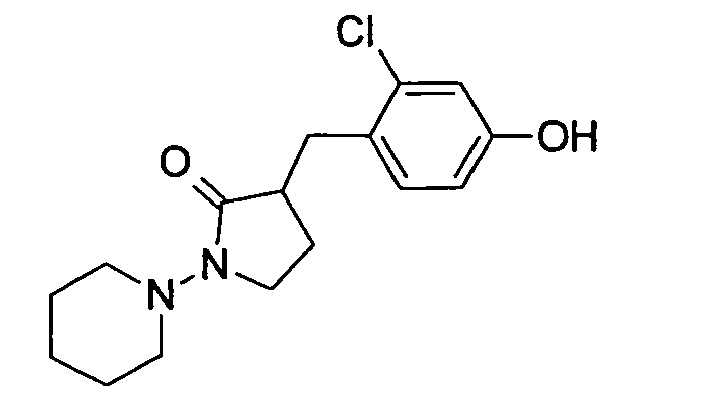
- In the same manner as in Example 183A, the title compound was obtained from 3-[2-chloro-4-(methoxymethoxy)benzyl]-1-(piperidin-1-yl)pyrrolidin-2-one obtained in Example 434A.
1H NMR (300 MHz, CDCl3) δ ppm 1.36 (m, 2 H), 1.66-1.73 (m, 3 H), 1.74-1.92 (m, 2 H), 1.96-2.05 (m, 1 H), 2.68-2.77 (m, 1 H), 2.82 (m, 2 H), 3.21-3.27 (q, J=9.3 Hz, 1 H), 3.30-3.35 (m, 1 H), 3.54-3.59 (t, J=6.6 Hz, 2 H), 3.67-3.71 (t, J=6.3 Hz, 2 H), 5.80 (br, 1 H), 6.69-6.73 (dd, J=8.4, 2.7 Hz, 1 H), 6.92 (d, J=2.7 Hz, 1 H), 7.02-7.05 (d, J=8.4 Hz, 1 H). -

- In the same manner as in Example 140A, the title compound was obtained from 3-(2-chloro-4-hydroxybenzyl)-1-(5-methoxy-1,2,3,4-tetrahydronaphthalen-1-yl)pyrrolidin-2-one obtained in Example 433A.
1H NMR (300 MHz, DMSO-d6)δ ppm 1.49-1.78 (m, 4 H), 1.84-1.99 (m, 2 H), 2.38-2.85 (m, 5 H), 3.03-3.23 (m, 2 H), 5.12-5.14 (m, 1 H), 6.31-6.37 (m, 1 H), 6.64-6.71 (m, 2 H), 6.81-6.82 (m, 1 H), 6.89-6.96 (m, 1 H), 7.11-7.28 (m, 1 H), 9.31 (br, 1 H), 9.71 (br, 1 H). -

- In the same manner as in Example 255A, the title compound was obtained from 1-(5-hydroxy-2-adamantyl)pyrrolidin-2-one obtained in Reference Example 38A and α,2,4-trichlorotoluene. 1H NMR (300 MHz, CDCl3) δ ppm 1.50-1.54 (m, 2 H), 1.66-1.78 (m, 7 H), 1.91 -1.95 (m, 2 H), 2.00-2.10 (m, 1 H), 2.17 (m, 2 H), 2.42-2.44 (m, 2 H), 2.72-2.81 (m, 2 H), 3.27-3.35 (m, 1 H), 3.41-3.58 (m, 2 H), 3.92 (s, 1 H), 7.14-7.23 (m, 2 H), 7.35 (d, J=2.1 Hz, 1 H).
-

- In the same manner as in Example 255A, the title compound was obtained from 1-(5-hydroxy-2-adamantyl)pyrrolidin-2-one obtained in Reference Example 38A and (1-bromoethyl)benzene. LC/MS (ESI+); m/z 340 (M+H)+
-

- In the same manner as in Example 255A, the title compound was obtained from 1-(5-hydroxy-2-adamantyl)pyrrolidin-2-one obtained in Reference Example 38A and 1-(bromomethyl)-2-chloro-4-fluorobenzene.
1H NMR (300 MHz, CDCl3) δ ppm 1.47-1.54 (m, 2 H), 1.60-1.76 (m, 7 H), 1.82 -1.99 (m, 3 H), 2.04-2.10 (m, 2 H), 2.42-2.46 (m, 2 H), 2.74-2.81 (m, 2 H), 3.26-3.35 (q, J=9.0 Hz, 1 H), 3.40-3.57 (m, 2 H), 3.91 (s, 1 H), 6.88-6.94 (m, 1 H), 7.08-7.12 (m, 1 H), 7.25-7.27 (m, 1 H). -

- In the same manner as in Example 255A, the title compound was obtained from 1-(5-hydroxy-2-adamantyl)pyrrolidin-2-one obtained in Reference Example 38A and 4-bromo-1-(bromomethyl)-2-chlorobenzene.
LC/MS (ESI+); m/z 438, 440 (M+H)+ -

- In the same manner as in Example 215A, the title compound was obtained from 3-(4-bromo-2-chlorobenzyl)-1-(5-hydroxy-2-adamantyl)pyrrolidin-2-one obtained in Example 441A.
LC/MS (ESI+); m/z 375, 377 (M+H)+ -

- In the same manner as in Example 22A, the title compound was obtained from 3-(4-amino-2-chlorobenzyl)-1-(5-hydroxy-2-adamantyl)pyrrolidin-2-one obtained in Example 442A and methanesulfonyl chloride.
1H NMR (300 MHz, DMSO-d6) δ ppm 1.38-1.42 (m, 2 H), 1.61-1.72 (m, 9 H), 1.90 (m, 1 H), 2.04 (m, 1 H), 2.28-2.34 (m, 2 H), 2.54-2.62 (m, 2 H), 3.01 (s, 3 H), 3.12-3.15 (m, 1 H), 3.34-3.42 (m, 1 H), 3.48-3.51 (m, 1 H), 3.70 (s, 1 H), 4.45 (s, 1 H), 7.08-7.11 (d, J=7.5 Hz, 1 H), 7.23 (s, 1 H), 7.31-7.33 (d, J=8.1 Hz, 1H), 9.89 (s, 1H). -

- To a solution of 3-(4-amino-2-chlorobenzyl)-1-(5-hydroxy-2-adamantyl)pyrrolidin-2-one obtained in Example 442A (0.13 g) in tetrahydrofuran (3 mL) was added 2-chloroethyl isocyanate (42.2 mg), and the mixture was stirred at room temperature for 3 hr. After completion of the reaction, ethyl acetate and water were added to the reaction mixture, and the mixture was extracted with ethyl acetate. The ethyl acetate layer was washed with saturated brine, dried over anhydrous magnesium sulfate, and concentrated under reduced pressure. The obtained residue was dissolved in N,N-dimethylformamide (3 mL), sodium hydride was added to the reaction mixture at 0°C, and the mixture was stirred at room temperature for 3 hr. After completion of the reaction, ethyl acetate and water were added to the reaction mixture, and the mixture was extracted with ethyl acetate. The ethyl acetate layer was washed with saturated brine, dried over anhydrous magnesium sulfate, and concentrated under reduced pressure. The obtained residue was dissolved in ethyl acetate, and recrystallized to give the title compound (0.083 g, 54%) as colorless crystals.
1H NMR (300 MHz, DMSO-d6) δ ppm 1.38-1.42 (m, 2 H), 1.53-1.72 (m, 9 H), 1.85-1.92 (m, 1 H), 2.04 (m, 1 H), 2.28-2.34 (m, 2 H), 2.54-2.65 (m, 2 H), 3.11-3.16 (dd, J=12.9, 3.6 Hz, 1 H), 3.37-3.44 (m, 3 H), 3.46-3.54 (m, 1 H), 3.70 (s, 1 H), 3.79-3.85 (m, 2 H), 4.45 (s, 1 H), 7.08 (s, 1 H), 7.31-7.34 (m, 2 H), 7.75 (d, J=2.4 Hz, 1 H). -

- To a solution of 3-(4-amino-2-chlorobenzyl)-1-(5-hydroxy-2-adamantyl)pyrrolidin-2-one obtained in Example 442A (0.13 g) in tetrahydrofuran (3 mL) was added ethyl isocyanatoacetate (51.6 mg), and the mixture was stirred at room temperature for 3 hr. After completion of the reaction, ethyl acetate and water were added to the reaction mixture, and the mixture was extracted with ethyl acetate. The ethyl acetate layer was washed with saturated brine, dried over anhydrous magnesium sulfate, and concentrated under reduced pressure. A mixture of the obtained residue, methanol (3 mL), tetrahydrofuran (3 mL) and 4N aqueous sodium hydroxide solution (1 mL) was stirred at room temperature for 1 hr. The reaction mixture was concentrated, and the residue was partitioned between ethyl acetate-water. The aqueous layer was washed with ethyl acetate, 6N hydrochloric acid (1.5 mL) was added, and the mixture was extracted with ethyl acetate. The ethyl acetate layer was washed with saturated brine, and dried over anhydrous magnesium sulfate. The solvent was evaporated under reduced pressure to give the title compound (92 mg, 55%) as colorless crystals.
1H NMR (300 MHz, CDCl3) δ ppm 1.38-1.41 (m, 2 H), 1.60-1.76 (m, 9 H), 1.89 (m, 1 H), 2.04 (m, 1 H), 2.28-2.34 (m, 2 H), 2.50-2.55 (m, 1 H), 2.60-2.61 (m, 1 H), 3.08-3.14 (dd, J=13.5, 3.6 Hz, 1 H), 3.39-3.54 (m, 2 H), 3.70 (s, 1 H), 3.77 (s, 2 H), 6.42 (m, 2 H), 7.11-7.20 (m, 3 H), 7.64 (d, J=1.8 Hz, 1 H), 8.92 (s, 1 H). -

- In the same manner as in Example 218A, the title compound was obtained from 3-(4-bromo-2-chlorobenzyl)-1-(5-hydroxy-2-adamantyl)pyrrolidin-2-one obtained in Example 441A and 4-carboxyphenylboronic acid.
1H NMR (300 MHz, DMSO-d6)δ ppm 1.39-1.43 (m, 2 H), 1.61-1.76 (m, 9 H), 1.94 -1.99 (m, 1 H), 2.04 (m, 1 H), 2.30-2.35 (m, 2 H), 2.62-2.69 (m, 2 H), 3.23-3.26 (m, 1 H), 3.38-3.44 (m, 1 H), 3.46-3.57 (m, 1 H), 3.72 (s, 1 H), 4.45 (s, 1 H), 7.47-7.50 (d, J=8.1 Hz, 1 H), 7.65-7.67 (d, J=7.8 Hz, 1 H), 7.81-7.84 (d, J=9.0 Hz, 3 H), 7.99-8.02 (d, J=8.4 Hz, 3 H), 13.03 (br, 1 H). -

- A mixture of 3-(4-bromo-2-chlorobenzyl)-1-(5-hydroxy-2-adamantyl)pyrrolidin-2-one obtained in Example 441A (0.38 g), (5-formyl-2-furyl)boronic acid (0.175 g), 2 M aqueous sodium hydrogencarbonate solution (0.81mL), tetrakis(triphenylphosphine)palladium (19 mg) and 1,2-dimethoxyethane (5 mL) was stirred overnight at 90°C under nitrogen atmosphere. Ethyl acetate and water were added to the reaction mixture, and the mixture was extracted with ethyl acetate. The ethyl acetate layer was washed with saturated brine, dried over anhydrous magnesium sulfate, and concentrated under reduced pressure. The residue was subjected to silica gel column chromatography with ethyl acetate-hexane (10:90-100:0), and the obtained solid was recrystallized from ethyl acetate-hexane to give a colorless solid (0.18 g). A mixture of the obtained colorless solid (0.18 g), sodium borohydride (0.019 g), tetrahydrofuran (2 mL) and methanol (2 mL) was stirred at room temperature for 1 hr. The reaction solution was concentrated under reduced pressure, and the residue was partitioned between water-ethyl acetate. The ethyl acetate layer was washed with saturated brine, and dried over anhydrous magnesium sulfate.
- The solvent was evaporated under reduced pressure, and the residue was subjected to silica gel column chromatography (ethyl acetate) to give the title compound (0.071 g, 37%) as a colorless powder.
1H NMR (300 MHz, CDCl3) δ ppm 1.48-1.53 (m, 2 H), 1.69-1.76 (m, 8 H), 1.90 -1.94 (m, 2 H), 1.98-2.02 (m, 1 H), 2.16 (m, 1 H), 2.41-2.44 (m, 3 H), 2.72-2.82 (m, 2 H), 3.31-3.34 (m, 1 H), 3.39-3.53 (m, 2 H), 3.92 (s, 1 H), 4.66 (s, 2 H), 6.36-6.37 (d, J=3.3 Hz, 1 H), 6. 55-6. 58 (m, 1 H), 7 . 22-7 . 25 (d, J=8 .1 Hz, 1 H), 7.42-7.45 (dd, J=7.8, 1.5 Hz, 1 H), 7.64 (d, J=1.8 Hz, 1 H). -

- A mixture of 3-(4-bromo-2-chlorobenzyl)-1-(5-hydroxy-2-adamantyl)pyrrolidin-2-one obtained in Example 441A (0.38 g), (5-formyl-2-furyl)boronic acid (0.175 g), 2 M aqueous sodium hydrogencarbonate (0.81 mL), tetrakis(triphenylphosphine)palladium (19 mg) and 1,2-dimethoxyethane (5 mL) was stirred overnight at 90°C under nitrogen atmosphere. Ethyl acetate and water were added to the reaction mixture, and the mixture was extracted with ethyl acetate. The ethyl acetate layer was washed with saturated brine, dried over anhydrous magnesium sulfate, and concentrated under reduced pressure. The residue was subjected to silica gel column chromatography with ethyl acetate-hexane (10:90-100:0), and the obtained solid was recrystallized from ethyl acetate-hexane to give a colorless solid (0.18 g). A mixture of the obtained colorless solid (0.18 g), N-iodosuccinimide (0.304 g), potassium carbonate (0.187 g) and methanol (10 mL) was stirred at room temperature for 16 hr under shading. Water was added to the reaction solution, and the mixture was extracted with ethyl acetate. The ethyl acetate layer was washed with saturated brine, and dried over anhydrous magnesium sulfate. The solvent was evaporated under reduced pressure. The residue was subjected to silica gel column chromatography with ethyl acetate-hexane (10:90-100:0) to give a colorless solid (0.13 g). A mixture of the obtained colorless solid (0.13 g), methanol (3 mL), tetrahydrofuran (3 mL) and 8N aqueous sodium hydroxide solution (1 mL) was stirred at room temperature for 1 hr. The reaction mixture was concentrated, and the residue was partitioned between ethyl acetate-water. The aqueous layer was washed with ethyl acetate, 6N hydrochloric acid (2 mL) was added, and the mixture was extracted with ethyl acetate. The ethyl acetate layer was washed with saturated brine, and dried over anhydrous magnesium sulfate. The solvent was evaporated under reduced pressure to give the title compound (109 mg, 44%) as colorless crystals.
1H NMR (300 MHz, DMSO-d6) δ ppm 1.39-1.43 (m, 2 H), 1.62-1.74 (m, 9 H), 1.94 -2.05 (m, 2 H), 2.30-2.36 (m, 2 H), 2.51 (m, 1 H), 2.65-2.69 (m, 2 H), 3.21-3.25 (d, J=11.4 Hz, 1 H), 3.41-3.44 (m, 1H), 3.51-3.54 (m, 1H), 3.72 (s, 1H), 7.24 (d, J=3.0 Hz, 1 H), 7.33 (d, J=3.0 Hz, 1 H), 7.48-7.50 (d, J=8.1 Hz, 1 H), 7.70-7.72 (d, J=8.1 Hz, 1 H), 7.87 (s, 1 H). -

- In the same manner as in Example 255A, the title compound was obtained from 1-(5-hydroxy-2-adamantyl)pyrrolidin-2-one obtained in Reference Example 38A and 3-(4-bromomethyl-3-chlorophenyl)-5-cyclopropyl-1,2,4-oxadiazol obtained in Reference Example 48A.
LC/MS (ESI+); m/z 468, 470 (M+H)+ -

- In the same manner as in Example 218A, the title compound was obtained from 3-(4-bromo-2-chlorobenzyl)-1-(5-hydroxy-2-adamantyl)pyrrolidin-2-one obtained in Example 441A and {4-[(methylsulfonyl)amino]phenyl}boronic acid.
LC/MS (ESI+); m/z 529, 531 (M+H)+ -

- In the same manner as in Example 218A, the title compound was obtained from 3-(4-bromo-2-chlorobenzyl)-1-(5-hydroxy-2-adamantyl)pyrrolidin-2-one obtained in Example 441A and (4-fluorophenyl)boronic acid.
1H NMR (300 MHz, CDCl3) δ ppm 1.50-1.55 (m, 2 H), 1.73-1.83 (m, 8 H), 1.92 -1.96 (m, 2 H), 2.12-2.17 (m, 2 H), 2.43-2.47 (m, 2 H), 2.77-2.86 (m, 2 H), 3.34-3.59 (m, 3 H), 3.95 (s, 1 H), 7.08-7.15 (m, 2 H), 7.31-7.37 (m, 2 H), 7.47-7.53 (m, 3 H). -

- In the same manner as in Example 218A, the title compound was obtained from 3-(4-bromo-2-chlorobenzyl)-1-(5-hydroxy-2-adamantyl)pyrrolidin-2-one obtained in Example 441A and (5-chloro-2-thienyl)boronic acid.
1H NMR (300 MHz, CDCl3) δ ppm 1.50-1.54 (m, 2 H), 1.67-1.79 (m, 8 H), 1.91 -2.12(m, 3 H), 2.17 (m, 1 H), 2.42-2.46 (m, 2 H), 2.73-2.84 (m, 2 H), 3.30-3.58 (m, 3 H), 3.92 (s, 1 H), -6.87-6.88 (d, J=3.9 Hz, 1 H), 7.03-7.04 (d, J=3.9 Hz, 1 H), 7.25-7.32 (m, 2 H), 7.48 (d, J=1.2 Hz, 1H). -

- In the same manner as in Example 22A, the title compound was obtained from 3-(4-amino-2-chlorobenzyl)-1-(5-hydroxy-2-adamantyl)pyrrolidin-2-one obtained in Example 442A and cyclopropanesulfonyl chloride.
1H NMR (300 MHz, CDCl3) δ ppm 0.92-0.99 (m, 2 H), 1.14-1.19 (m, 2 H), 1.50-1.54 (m, 2 H), 1.67-1.76 (m, 8 H), 2.17 (m, 2 H), 2.40-2.54 (m, 3 H), 2.71-2.82 (m, 2 H), 3.28-3.31 (m, 1 H), 3.43-3.60 (m, 2 H), 3.93 (s, 1 H), 7.11-7.15 (dd, J=8.1, 2.1 Hz, 1 H), 7.20-7.23 (m, 1 H), 7.34 (d, J=1.8 Hz, 1 H), 7.86 (br, 1 H). Example 454A N-(3-chloro-4-{[1-(5-hydroxy-2-adamantyl)-2-oxopyrrolidin-3-yl]methyl}phenyl)-3,5-dimethylisoxazole-4-sulfonamide
- In the same manner as in Example 22A, the title compound was obtained from 3-(4-amino-2-chlorobenzyl)-1-(5-hydroxy-2-adamantyl)pyrrolidin-2-one obtained in Example 442A and 3,5-dimethylisoxazole-4-sulfonyl chloride.
1H NMR (300 MHz, CDCl3) δ ppm 1.51-1.55 (m, 2 H), 1.76 (m, 8 H), 1.87 -1.91 (m, 2 H), 2.18 (m, 1 H), 2.31 (s, 3 H), 2.47 (m, 2 H), 2.52 (s, 3 H), 2.76-2.87 (m, 2 H), 3.21-3.26 (m, 2 H), 3.50-3.59 (m, 2 H), 3.92 (s, 1 H), 6.90-6.93 (dd, J=8.4, 2.7 Hz, 1 H), 7.16-7.20 (m, 2 H), 8.16 (s, 1 H). -

- In the same manner as in Example 210A, the title compound was obtained from 3-(4-amino-2-chlorobenzyl)-1-(5-hydroxy-2-adamantyl)pyrrolidin-2-one obtained in Example 442A and (isothiocyanatomethyl)cyclopropane.
LC/MS (ESI+); m/z 488, 490 (M+H)+ -

- In the same manner as in Example 22A, the title compound was obtained from 3-(4-amino-2-chlorobenzyl)-1-(5-hydroxy-2-adamantyl)pyrrolidin-2-one obtained in Example 442A and benzoyl chloride.
1H NMR (300 MHz, CDCl3) δ ppm 1.42-1.51 (m, 2 H), 1.65-1.88 (m, 9 H), 1.96 -2.00 (m, 1 H), 2.15 (m, 1 H), 2.23 (m, 1 H), 2.37-2.41 (m, 2 H), 2.66-2.75 (m, 2 H), 3.22-3.31 (q, J=9.0 Hz, 1 H), 3.39-3.56 (m, 2 H), 3.88 (s, 1 H), 7.13-7.16 (d, J=8.4 Hz, 1 H), 7.38-7.53 (m, 4 H), 7.81 (d, J=2.1 Hz, 1 H), 7.86-7.88 (m, 2 H), 8.79 (s, 1 H). -

- In the same manner as in Example 68A, the title compound was obtained from 3-(4-amino-2-chlorobenzyl)-1-(5-hydroxy-2-adamantyl)pyrrolidin-2-one obtained in Example 442A and 1-(ethoxycarbonyl)cyclopropanecarboxylic acid.
1H NMR (300 MHz, CDCl3) δ ppm 1.26-1.30 (t, J=7.2 Hz, 3 H), 1.45-1. 53 (m, 3 H), 1.63-1.81 (m, 11 H), 1.93 -1.96 (m, 2 H), 1. 98 - 2.05 (m, 1 H), 2.17 (br, 1 H), 2.43-2.47 (m, 2 H), 2.71-2.88 (m, 2 H), 3.28-3.55 (m, 3 H), 3.91 (s, 1 H), 4.16-4.23 (q, J=7.2 Hz, 2 H), 7.18-7.21 (d, J=8.1 Hz, 1 H), 7.30-7.33 (dd, J=8.1, 2.1 Hz, 1 H), 7. 74 (d, J=2. 1 Hz, 1 H), 10.92 (s, 1 H). -

- In the same manner as in Reference Example 19A, the title compound was obtained from Ethyl 1-{[(3-chloro-4-{[1-(5-hydroxy-2-adamantyl)-2-oxopyrrolidin-3-yl]methyl}phenyl)amino]carbonyl}cyclopropanecarboxylate obtained in Example 457A.
1H NMR (300 MHz, CDCl3) δ ppm 0.72-0.76 (m, 2 H), 1.28-1.31 (m, 2 H), 1.48-1.53 (m, 2 H), 1.66-1.75 (m, 8 H), 1.88 -1.92 (m, 2 H), 1.96-1.99 (m, 1 H), 2.16 (br, 1H), 2.40 (m, 2 H), 2.69-2.75 (m, 2 H), 3.24-3.29 (m, 1 H), 3.43-3.53 (m, 2 H), 3.74 (s, 2 H), 3.90 (s, 1 H), 4.21 (br, 1 H), 7.09-7.12 (d, J=8.1 Hz, 1 H), 7.20-7.24 (dd, J=8.1, 2.1 Hz, 1 H), 7.67 (d, J=2.1 Hz, 1 H), 9.44 (s, 1 H). -
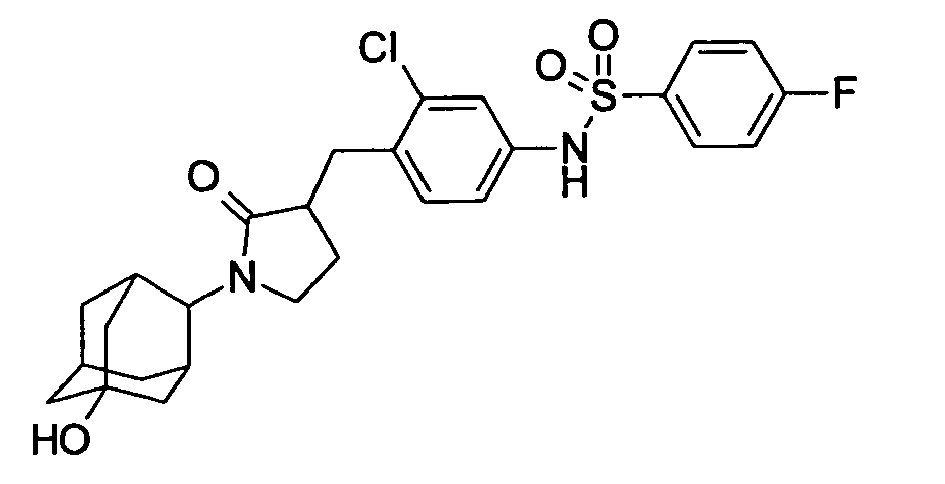
- In the same manner as in Example 22A, the title compound was obtained from 3-(4-amino-2-chlorobenzyl)-1-(5-hydroxy-2-adamantyl)pyrrolidin-2-one obtained in Example 442A and 4-fluorobenzenesulfonyl chloride.
1H NMR (300 MHz, CDCl3) δ ppm 1.49-1.53 (m, 2 H), 1.72-1.80 (m, 8 H), 1.88-1.92 (m, 2 H), 1.98-2.09 (m, 1 H), 2.17 (br, 1 H), 2.41 (m, 2 H), 2.67-2.82 (m, 2 H), 3.20-3.26 (dd, J=12.6, 3.9 Hz, 1 H), 3.39-3.57 (m, 2 H), 3.92 (s, 1 H), 6.90-6.97 (dd, J=8.1, 1.8 Hz, 1 H), 7.04-7.22 (m, 4 H), 7.74-7.83 (m, 2 H), 7.93-7.97 (m, 1 H). -

- In the same manner as in Reference Example 3A, the title compound was obtained from 3-(4-amino-2-chlorobenzyl)-1-(5-hydroxy-2-adamantyl)pyrrolidin-2-one obtained in Example 442A.
1H NMR (300 MHz, CDCl3) δ ppm 1.50-1.54 (m, 2 H), 1.68-1.84 (m, 8 H), 1.90-1.94 (m, 2 H), 1.98-2.08 (m, 1 H), 2.12-2.22 (m, 3 H), 2.43-2.47 (m, 2 H), 2.58-2.64 (t, J=7.8 Hz, 2 H), 2.75-2.80 (m, 2 H), 3.29-3.40 (q, J=9.0 Hz, 1 H), 3.43-3.56 (m, 2 H), 3.81-3.85 (t, J=6.9 Hz, 2 H), 3.92 (s, 1 H), 7.24-7.28 (d, J=8.1 Hz, 1 H), 7.44-7.48 (dd, J=8.1, 2.1 Hz, 1 H), 7.68 (d, J=2.1 Hz, 1 H). -

- In the same manner as in Example 68A, the title compound was obtained from 3-(4-amino-2-chlorobenzyl)-1-(5-hydroxy-2-adamantyl)pyrrolidin-2-one obtained in Example 442A and 1-[(tert-butoxycarbonyl)amino]cyclopropanecarboxylic acid.
1H NMR (300 MHz, CDCl3) δ ppm 1.08-1.12 (m, 2 H), 1.49 (s, 9 H), 1.53 (m, 2 H), 1.63-1.67 (m, 2 H), 1.70-1.78 (m, 8 H), 1.89-1.93 (m, 2 H), 1.96-2.02 (m, 1 H), 2.17 (br, 1 H), 2.43-2.47 (m, 2 H), 2.71-2.80 (m, 2 H), 3.27-3.35 (m, 1 H), 3.39-3.55 (m, 2 H), 3.91 (s, 1 H), 5.23 (br, 1 H), 7.16-7.24 (m, 2 H), 7.66 (s, 1 H), 8.47 (br, 1 H). -

- In the same manner as in Example 20A, the title compound was obtained from tert-butyl (1-{[(3-chloro-4-{[1-(5-hydroxy-2-adamantyl)-2-oxopyrrolidin-3-yl]methyl}phenyl)amino]carbonyl}cyclopropyl)carbamate obtained in Example 461A.
1H NMR (300 MHz, DMSO-d6) δ ppm 1.38-1.40 (m, 5 H), 1.59-1.72 (m, 10 H), 1.89 (m, 1 H), 2.04 (br, 1 H), 2.28-2.34 (m, 2 H), 2.50-2.64 (m, 2 H), 3.12-3.17 (dd, J=13.2, 3.6 Hz, 1 H), 3.39-3.44 (m, 1 H), 3.49-3.54 (m, 1 H), 3.70 (s, 1 H), 3.76 (br, 1 H), 7.30-7.33 (d, J=8.4 Hz, 1 H), 7.51-7.54 (dd, J=8.4, 2.1 Hz, 1 H), 7. 77 (d, J=2.4 Hz, 1 H), 8.80 (br, 3 H), 9.69 (s, 1 H). -

- In the same manner as in Example 68A, the title compound was obtained from 3-(4-amino-2-chlorobenzyl)-1-(5-hydroxy-2-adamantyl)pyrrolidin-2-one obtained in Example 442A and 4-oxocyclohexanecarboxylic acid.
1H NMR (300 MHz, CDCl3) δ ppm 1.50-1.55 (m, 2 H), 1.77-1.92 (m, 10 H), 2.05-2.22 (m, 6 H), 2.31-2.42 (m, 4 H), 2.55-2.60 (m, 2 H), 2.69-2.80 (m, 3 H), 3.26-3.29 (q, J=8.4 Hz, 1 H), 3.44-3.58 (m, 2 H), 3.92 (s, 1 H), 7.17-7.20 (d, J=8.1 Hz, 1 H), 7.27-7.31 (m, 1 H), 7. 70 (d, J=1.8 Hz, 1 H), 8.06 (s, 1 H). -

- In the same manner as in Example 68A, the title compound was obtained from 3-(4-amino-2-chlorobenzyl)-1-(5-hydroxy-2-adamantyl)pyrrolidin-2-one obtained in Example 442A and (phenylsulfonyl)acetic acid.
1H NMR (300 MHz, CDCl3) δ ppm 1.49-1.54 (m, 2 H), 1.64-1.93 (m, 10 H), 2.01 -2.08 (m, 1 H), 2.18 (br, 1 H), 2.42-2.45 (m, 2 H), 2.72-2.81 (q, J=9.3 Hz, 2 H), 3.28-3.31 (q, J=9.0 Hz, 1 H), 3.42-3.56 (m, 2 H), 3.93 (s, 1 H), 4.20 (s, 2 H), 6.98 (s, 1 H), 7.18-7.20 (d, J=6.9 Hz, 1 H), 7.27-7.30 (m, 1 H), 7.58-7.68 (m, 2 H), 7.70-7.73 (m, 1 H), 7.91-7.94 (m, 2 H), 8.94 (s, 1 H). -
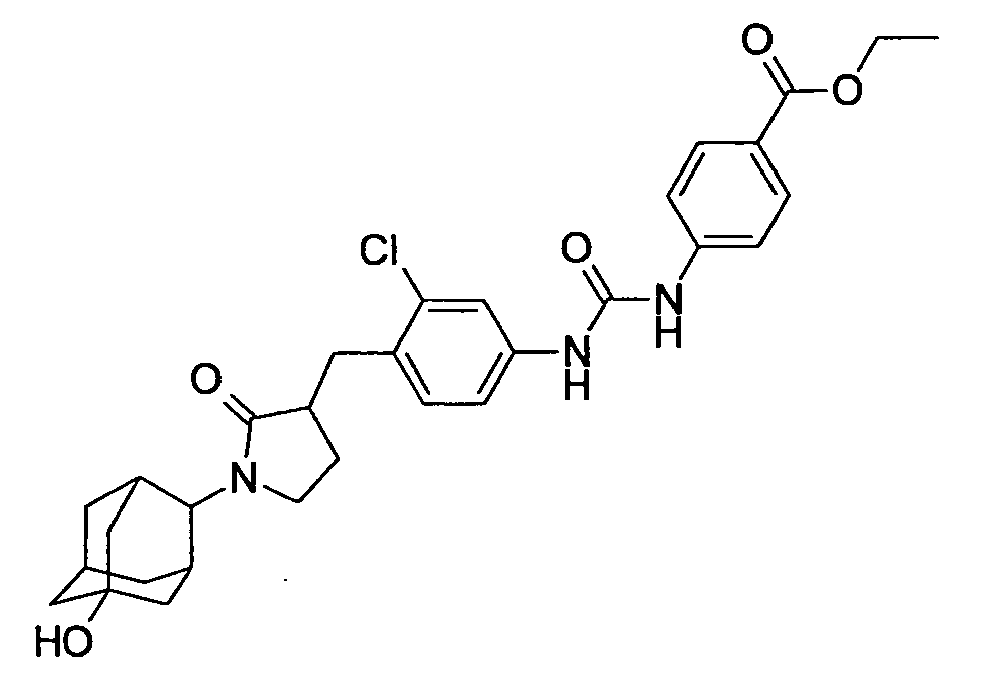
- In the same manner as in Example 210A, the title compound was obtained from 3-(4-amino-2-chlorobenzyl)-1-(5-hydroxy-2-adamantyl)pyrrolidin-2-one obtained in Example 442A and ethyl 4-isocyanatobenzoate.
1H NMR (300 MHz, CDCl3) δ ppm 1.36-1.39 (t, J=6.9 Hz, 3 H), 1.49-1.53 (m, 2 H), 1.75-1.86 (m, 10 H), 2.08-2.12 (m, 1 H), 2.17 (br, 1 H), 2.36-2.40 (m, 2 H), 2.70-2.82 (m, 2 H), 3.15-3.17 (m, 2 H), 3.49-3.60 (m, 2 H), 3.92 (s, 1 H), 4.28-4.36 (q, J=6.9 Hz, 2 H), 7.03 (s, 1 H), 7.40-7.44 (m, 3 H), 7.90-7.93 (d, J=8.7 Hz, 2 H), 8.08 (s, 1 H), 8.29 (s, 1 H). -

- A mixture of 3-(4-amino-2-chlorobenzyl)-1-(5-hydroxy-2-adamantyl)pyrrolidin-2-one obtained in Example 442A (0.133 g), 5-formyl-2-furancarboxylic acid (0.076 g), bis(2-oxo-3-oxazolidinyl)phosphinic chloride (0.183 g), triethylamine (0.139 mL) and dichloromethane (2 mL) was stirred at room temperature for 16 hr. The reaction solution was concentrated, and the residue was partitioned between ethyl acetate-water. The ethyl acetate layer was washed successively with 2N hydrochloric acid and saturated brine, and dried over anhydrous magnesium sulfate, and the solvent was evaporated under reduced pressure to give a colorless solid. A mixture of the obtained colorless solid, sodium borohydride (0.038 g), tetrahydrofuran (3 mL) and methanol (1 mL) was stirred at room temperature for 1 hr. The reaction solution was concentrated under reduced pressure, and the residue was partitioned between water-ethyl acetate. The ethyl acetate layer was washed with saturated brine, and dried over anhydrous magnesium sulfate. The solvent was evaporated under reduced pressure, and the residue was subjected to silica gel column chromatography (ethyl acetate) to give the title compound (0.048 g, 26%) as a colorless powder.
1H NMR (300 MHz, CD3OD) δ ppm 1.14-1.20 (m, 2 H), 1.51 -1.55 (m, 2 H), 1.74 (m, 5 H), 1.85 -1.89 (m, 4 H), 2.01-2.06 (m, 1 H), 2.13 (br, 1 H), 2.37-2.42 (m, 2 H), 2.68-2.82 (m, 2 H), 3.30 (m, 1 H), 3.45-3.62 (m, 3 H), 3.89 (s, 1 H), 4.62 (s, 2 H), 6.50 (s, 1 H), 7.20 (m, 1 H), 7.27-7.30 (d, J=8.7 Hz, 1 H), 7.51-7.55 (dd, J=8 . 4, 1.2 Hz, 1 H), 7.67 (d, J=1.2 Hz, 1 H) . -

- In the same manner as in Example 29A, the title compound was obtained from N-(3-chloro-4-{[1-(5-hydroxy-2-adamantyl)-2-oxopyrrolidin-3-yl]methyl}phenyl)-4-oxocyclohexanecarboxamide obtained in Example 463A.
1H NMR (300 MHz, CD3OD) δ ppm 1.26-1.36 (m, 2 H), 1.50-1.65 (m, 7 H), 1.74-1.79 (m, 6 H), 1.85-1.93 (m, 7 H), 1.96-2.03 (m, 1 H), 2.13 (br, 1 H), 2.29-2.40 (m, 3 H), 2.65-2.73 (m, 1 H), 2.79-2.83 (m, 1 H), 3.25-3.30 (m, 1 H), 3.47-3.61 (m, 3 H), 3.88 (s, 1 H), 7.21-7.24 (d, J=8.1 Hz, 1 H), 7.32-7.36 (dd, J=8.4, 2.1 Hz, 1 H), 7.74 (d, J=2.1 Hz, 1 H). -

- In the same manner as in Reference Example 19A, the title compound was obtained from ethyl 4-({[(3-chloro-4-{[1-(5-hydroxy-2-adamantyl)-2-oxopyrrolidin-3-yl]methyl}phenyl)amino]carbonyl}amino)benzoate obtained in Example 465A.
1H NMR (300 MHz, DMSO-d6) δ ppm 1.38-1.42 (m, 2 H), 1.61-1.72 (m, 10 H), 1.90-1.93 (m, 1 H), 2.04 (m, 1 H), 2.28-2.35 (m, 2 H), 2.49 (m, 1 H), 2.61-2.63 (m, 1 H), 3.10-3.17 (dd, J=13.5, 3.6 Hz, 1 H), 3.39-3.42 (q, J=8.4 Hz, 1 H), 3.48-3.51 (m, 1 H), 3.70 (s, 1 H), 4.40-4.42 (d, J=5.7 Hz, 2 H), 5.04-5.08 (t, J=5.7 Hz, 1 H), 7.17-7.25 (m, 4 H), 7.37-7.40 (d, J=8.7 Hz, 2 H), 7.69 (d, J=1.8 Hz, 1 H), 8.76 (s, 1 H), 8.86 (s, 1 H). -

- In the same manner as in Example 155A, the title compound was obtained from ethyl 4-({[(3-chloro-4-([1-(5-hydroxy-2-adamantyl)-2-oxopyrrolidin-3-yl]methyl}phenyl)amino]carbonyl}amino)benzoate obtained in Example 465A.
1H NMR (300 MHz, DMSO-d6) δ ppm 1.38-1.42 (m, 2 H), 1.60-1.72 (m, 10 H), 2.04 (m, 1 H), 2.28 -2.34 (m, 2 H), 2.51 (m, 1 H), 2.54-2.66 (m, 1 H), 3.11-3.17 (dd, J=13.2, 3.9 Hz, 1 H), 3.34-3.56 (m, 2 H), 3.71 (s, 1 H), 6.05 (br, 1 H), 7.20-7.28 (m, 2 H), 7.54-7.57 (d, J=8.7 Hz, 2 H), 7.70 (d, J=1.5 Hz, 1 H), 7.84-7.87 (d, J=9.0 Hz, 2 H), 8.95 (s, 1H), 9.14 (s, 1H). -
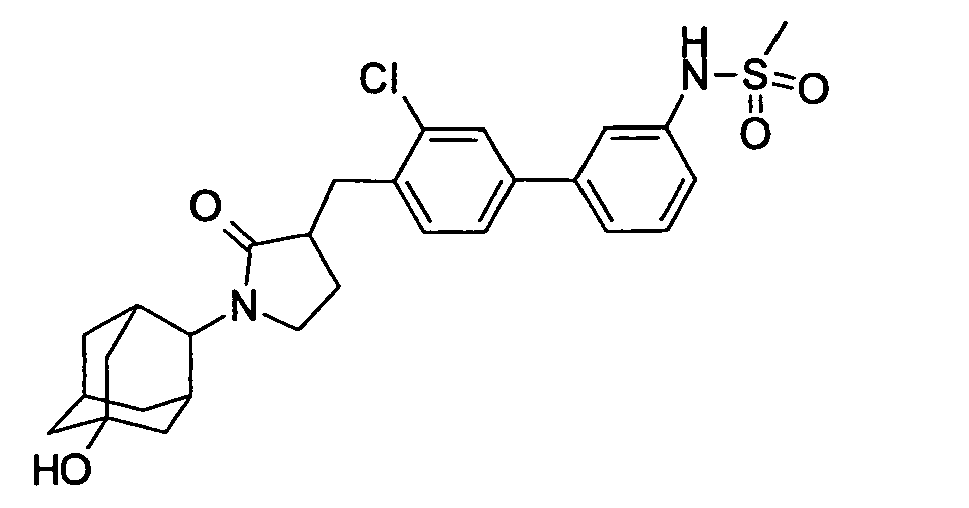
- In the same manner as in Example 218A, the title compound was obtained from 3-(4-bromo-2-chlorobenzyl)-1-(5-hydroxy-2-adamantyl)pyrrolidin-2-one obtained in Example 441A and N-[3-(4, 4, 5, 5-tetramethyl-1, 3, 2-dioxaboloran-2-yl)phenyl]methanesulfonamide.
1H NMR (300 MHz, DMSO-d6) δ ppm 1.38-1.43 (m, 2 H), 1.61-1.73 (m, 10 H), 1.94-1.99 (m, 1 H), 2.04 (br, 1 H), 2.29 -2.36 (m, 2 H), 2.61-2.73 (m, 2 H), 3.04 (s, 3 H), 3.21-3.26 (dd, J=12.3, 3.0 Hz, 1 H), 3.37-3.46 (m, 1 H), 3.50-3.54 (m, 1 H), 4.45 (s, 1 H), 7.20-7.24 (m, 1 H), 7.41-7.53 (m, 5 H), 7.64 (d, J=0.9 Hz, 1 H), 9.84 (s, 1 H). -

- In the same manner as in Example 218A, the title compound was obtained from 3-(4-bromo-2-chlorobenzyl)-1-(5-hydroxy-2-adamantyl)pyrrolidin-2-one obtained in Example 441A and [4-(aminocarbonyl)phenyl]boronic acid.
1H NMR (300 MHz, DMSO-d6) δ ppm 1.39-1.43 (m, 2 H), 1.62-1.73 (m, 10 H), 1.94-1.99 (m, 1 H), 2.04 (br, 1 H), 2.30 -2.36 (m, 2 H), 2.61-2.74 (m, 2 H), 3.04 (s, 3 H), 3.23-3.26 (m, 1 H), 3.41-3.52 (m, 1 H), 3.54-3.56 (m, 1 H), 3.72 (s, 1 H), 4.45 (s, 1H), 7.42 (s, 1 H), 7.46-7.49 (d, J=8.1 Hz, 1 H), 7.64-7.67 (d, J=7.8 Hz, 1 H), 7.77-7.80 (m, 2 H), 7.94-7.97 (d, J=8.1 Hz, 2 H), 8.05 (s, 1 H). -

- In the same manner as in Example 215A, the title compound was obtained from 3-(4-bromo-2-chlorobenzyl)-1-(1,4-dioxaspiro[4.5]dec-8-yl)pyrrolidin-2-one obtained in Example 203A.
1H NMR (300 MHz, CDCl3) δ ppm 1.64-1.78 (m, 9 H), 1.95-2.04 (m, 1 H), 2.63-2.76 (m, 2 H), 3.15-3.27 (m, 3 H), 3.66 (br, 2 H), 3.94 (s, 4 H), 4.04 (m, 1 H), 6.48-6.52 (dd, J=8.4, 2.4 Hz, 1 H), 6.68-6.69 (d, J=2.4 Hz, 1 H), 7.00-7.03 (d, J=8.4 Hz, 1 H). -

- In the same manner as in Example 28A, the title compound was obtained from 3-(4-amino-2-chlorobenzyl)-1-(1,4-dioxaspiro[4.5]dec-8-yl)pyrrolidin-2-one obtained in Example 472A.
1H NMR (300 MHz, CDCl3) δ ppm 1.67-1.91 (m, 4 H), 1.97-2.01 (m, 2 H), 2.41-2.58 (m, 4 H), 2.65-2.80 (m, 2 H), 3.15-3.20 (m, 2 H), 3.23-3.29 (dd, J=13.5, 3.9 Hz, 1 H), 3.66 (br, 1 H), 4.43-4.51 (m, 1 H), 6.49-6.52 (dd, J=8.1, 2.4 Hz, 1 H), 6.69-6.70 (d, J=2.4 Hz, 1 H), 7.01-7.03 (d, J=8.1 Hz, 1H). -

- In the same manner as in Example 22A, the title compound was obtained from 3-(4-amino-2-chlorobenzyl)-1-(4-oxocyclohexyl)pyrrolidin-2-one obtained in Example 473A and methanesulfonyl chloride.
LC/MS (ESI+); m/z 399, 401 (M+H)+ -

- In the same manner as in Example 263A, the title compound was obtained from N-(3-chloro-4-{[2-oxo-1-(4-oxocyclohexyl)pyrrolidin-3-yl]methyl}phenyl)methanesulfonamide obtained in Example 474A and methyl lithium.
1H NMR (300 MHz, CDCl3) δ ppm 1.24, 1.27 (each s, 3 H), 1.50-1.74 (m, 9 H), 2.05-2.09 (m, 2 H), 2.69-2.85 (m, 2 H), 3.00 (s, 3 H), 3.22-3.31 (m, 3 H), 3.93-3.98 (m, 1 H), 7.10-7.13 (dd, J=8.1, 2.1 Hz, 1 H), 7.21-7.23 (d, J=8.1 Hz, 1 H), 7.33 (d, J=2.1 Hz, 1 H), 8.37 (br, 1 H). -

- A mixture of 3-(4-amino-2-chlorobenzyl)-1-(4-oxocyclohexyl)pyrrolidin-2-one obtained in Example 473A (0.50 g), trifluoroacetic anhydride (0.357 g) and dichloromethane (20 mL) was stirred at room temperature for 16 hr. Water was added to the reaction solution, and the mixture was extracted with ethyl acetate. The ethyl acetate layer was washed with saturated brine, and dried over anhydrous magnesium sulfate, and the solvent was evaporated under reduced pressure to give the title compound (0.58 g, 89%) as a colorless solid.
LC/MS (ESI+); m/z 417, 419 (M+H)+ -
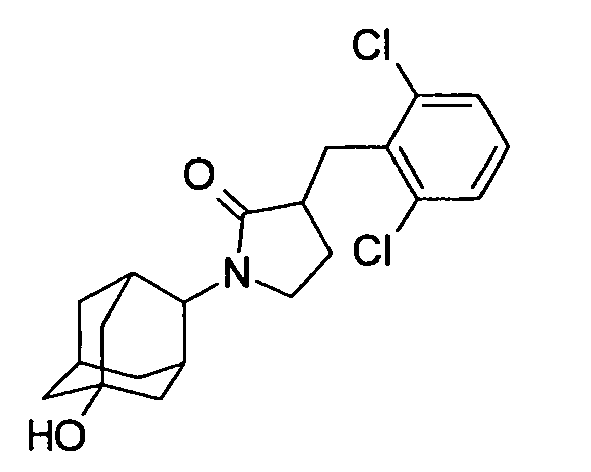
- 3-(2,6-Dichlorobenzyl)-1-(5-hydroxy-2-adamantyl)pyrrolidin-2-one (a mixture of two steric isomers) obtained in Example 429A was subjected to optical resolution with normal phase chiral high performance liquid chromatography (manufactured by Daicel Chemical Industries, Ltd., Chiralpak AS (trade name), 50 mmID X 500 mmL, hexane-2-propanol 85:15, retention time 29 min) to give the title compound.
LC/MS (ESI+); m/z 394, 396 (M+H)+ -

- 3-(2,6-Dichlorobenzyl)-1-(5-hydroxy-2-adamantyl)pyrrolidin-2-one (a mixture of two steric isomers) obtained in Example 429A was subjected to optical resolution with normal phase chiral high performance liquid chromatography (manufactured by Daicel Chemical Industries, Ltd., Chiralpak AS (trade name), 50 mmID X 500 mmL, hexane-2-propanol 85:15, retention time 40 min) to give the title compound.
LC/MS (ESI+); m/z 394, 396 (M+H)+ -

- 3-(2-Chloro-4-hydroxybenzyl)-1-(5-hydroxy-2-adamantyl)pyrrolidin-2-one (a mixture of two steric isomers) obtained in Example 431A was subjected to optical resolution with normal phase chiral high performance liquid chromatography (manufactured by Daicel Chemical Industries, Ltd., Chiralpak AS (trade name), 50 mmID X 500 mmL, hexane-2-propanol 75:25, retention time for 20 min) to give the title compound.
LC/MS (ESI+); m/z 376, 378 (M+H)+ -

- 3-(2-Chloro-4-hydroxybenzyl)-1-(5-hydroxy-2-adamantyl)pyrrolidin-2-one (a mixture of two steric isomers) obtained in Example 431A was subjected to optical resolution with normal phase chiral high performance liquid chromatography (manufactured by Daicel Chemical Industries, Ltd., Chiralpak AS (trade name), 50 mmID X 500 mmL, hexane-2-propanol 75:25, retention time 45 min) to give the title compound.
LC/MS (ESI+); m/z 376, 378 (M+H)+ -

- N-(3-Chloro-4-{[1-(5-hydroxy-2-adamantyl)-2-oxopyrrolidin-3-yl]methyl}phenyl)methanesulfonamide (a mixture of two steric isomers) obtained in Example 443A was subjected to optical resolution normal phase chiral high performance liquid chromatography (manufactured by Daicel Chemical Industries, Ltd., chiralpak AD (trade name), 50 mmID X 500 mmL, hexane-ethanol 50:50, retention time 32 min) to give the title compound.
LC/MS (ESI+); m/z 453, 455 (M+H)+ -

- N-(3-Chloro-4-{[1-(5-hydroxy-2-adamantyl)-2-oxopyrrolidin-3-yl]methyl}phenyl)methanesulfonamide (a mixture of two steric isomers) obtained in Example 443A was subjected to optical resolution normal phase chiral high performance liquid chromatography (manufactured by Daicel Chemical Industries, Ltd., chiralpak AD (trade name), 50 mmID X 500 mmL, hexane-ethanol 50:50, retention time 39 min) to give the title compound.
LC/MS (ESI+); m/z 453, 455 (M+H)+ -

- In the same manner as in Example 70A, the title compound was obtained from 4-({[(3-chloro-4-{[1-(5-hydroxy-2-adamantyl)-2-oxopyrrolidin-3-yl]methyl}phenyl)amino]carbonyl}amino)benzoic acid obtained in Example 469A and ammonium 1H-1,2,3-benzotriazol-1-ol.
1H NMR (300 MHz, CD3OD)δ ppm 1.51-1.55 (m, 2 H), 1.75-1.86 (m, 10 H), 1.96-2.04 (m, 1 H), 2.13 (br, 1 H), 2.36-2.41 (m, 2 H), 2.64-2.69 (dd, J=9.6, 3.9 Hz, 1 H), 2.79-2.83 (m, 1 H), 3.25-3.31 (m, 1 H), 3.52-3.61 (m, 2 H), 3.88 (s, 1 H), 4.89 (m, 4 H), 7.22 (m, 2 H), 7.52-7.55 (d, J=8.7 Hz, 2 H), 7.64 (s, 1 H), 7.81-7.83 (d, J=9.0 Hz, 2 H). -

- In the same manner as in Example 22A, the title compound was obtained from 1-amino-N-(3-chloro-4-1[1-(5-hydroxy-2-adamantyl)-2-oxopyrrolidin-3-yl]methyl}phenyl)cyclopropanecarboxamide hydrochloride obtained in Example 462A and benzoyl chloride.
1H NMR (300 MHz, CDCl3) δ ppm 1.16-1.19 (m, 2 H), 1.47-1.51 (m, 4 H), 1.59-1.89 (m, 10 H), 1.93-2.01 (m, 1 H), 2.15 (m, 1 H), 2.38-2.41 (m, 2 H), 2.59-2.72 (m, 2 H), 3.21-3.26 (dd, J=12.9, 3.3 Hz, 1 H), 3.38-3.46 (q, J=8.7 Hz, 1 H), 3.47-3.54 (m, 1 H), 3.87 (s, 1 H), 7.03-7.06 (d, J=8.4 Hz, 1 H), 7.18-7.21 (m, 1 H), 7.39-7.44 (m, 1 H), 7.50-7.54 (m, 2 H), 7.86-7.92 (m, 3 H), 8.98 (s, 1 H). -

- In the same manner as in Example 22A, the title compound was obtained from 1-amino-N-(3-chloro-4-{[1-(5-hydroxy-2-adamantyl)-2-oxopyrrolidin-3-yl]methyl}phenyl)cyclopropanecarboxamide hydrochloride obtained in Example 462A and phenylsulfonyl chloride.
1H NMR (300 MHz, CDCl3) δ ppm 0.94-0.98 (m, 2 H), 1.44-1.54 (m, 4 H), 1.62-1.76 (m, 8 H), 1.89-1.92 (m, 2 H), 1.98-2.01 (m, 1 H), 2.17 (br, 1 H), 2.43 (m, 2 H), 2.67-2.82 (m, 2 H), 3.27-3.32 (dd, J=12.9, 3.6 Hz, 1 H), 3.44-3.56 (m, 2 H), 3.93 (s, 1 H), 7.09-7.21 (m, 3 H), 7.46-7.55 (m, 4 H), 7.86-7.89 (d, J=7.2 Hz, 2 H), 8.83 (s, 1 H). -

- To a mixture of 1-[3-(hydroxymethyl)-1-adamantyl]pyrrolidin-2-one obtained in Reference Example 19A (4.0 g) and tetrahydrofuran (40 mL) was added lithium diisopropylamide (1.8 M tetrahydrofuran solution, 19.6 mL) at -78°C under nitrogen atmosphere, and the mixture was stirred for 1 hr. N,N,N',N',N",N"-Hexamethylphosphoric triamide (15 mL) was added, and the mixture was stirred for 30 min. A solution of 2-chloro-4-(methoxymethoxy)benzyl bromide obtained in Reference Example 24A (4.25 g) in tetrahydrofuran (3 mL) was added to the obtained solution, and the mixture was further stirred at -78°C for 1 hr, and then at -40°C for 16 hr. Water was added to the reaction mixture, and the mixture was extracted with ethyl acetate. The ethyl acetate layer was washed with saturated brine, and dried over anhydrous magnesium sulfate. The solvent was evaporated under reduced pressure, and the residue was subjected to silica gel column chromatography (hexane-ethyl acetate 9:1-1:1) to give a colorless oil (1.9 g). Then, a mixture of the colorless oil (1.9 g), 6N hydrochloric acid (10 mL), tetrahydrofuran (20 mL) and methanol (20 mL) was stirred at 60°C for 3 hr. The reaction solution was extracted with ethyl acetate. The ethyl acetate layer was washed with saturated brine, and dried over anhydrous magnesium sulfate. The solvent was evaporated under reduced pressure. The residue was triturated with hexane-ethyl acetate to give the title compound (1.1 g, 18%) as a colorless powder.
1H NMR NMR (300 MHz, CDCl3) δ ppm 1.42-1.71 (m, 10 H), 1.88-2.05 (m, 7 H), 2.19 (m, 2 H), 2.66-2.76 (m, 2 H), 3.18-3.21 (m, 1 H), 3.27 (s, 2 H), 3.29-3.35 (m, 1 H), 6.67-6.70 (dd, J=8.7, 2.4 Hz, 1 H), 6.88 (d, J=2.4 Hz, 1 H), 7.04-7.07 (d, J=8.7 Hz, 1 H). -

- In the same manner as in Example 22A, the title compound was obtained from 3-(4-amino-2-chlorobenzyl)-1-(5-hydroxy-2-adamantyl)pyrrolidin-2-one obtained in Example 442A and trifluoromethanesulfonyl chloride.
1H NMR (300 MHz, CDCl3)δ ppm 1.51-1.55 (m, 2 H), 1.76-1.86 (m, 10 H), 2.02-2.07 (m, 1 H), 2.13 (m, 1 H), 2.37-2.41 (m, 2 H), 2.73-2. 84 (m, 2 H), 3.30-3.32 (m, 1 H), 3.57-3.60 (m, 2 H), 3.89 (s, 1 H), 7.14-7.21 (m, 2 H), 7.32-7.36 (m, 2 H). -

- In the same manner as in Example 22A, the title compound was obtained from 3-(4-amino-2-chlorobenzyl)-1-(5-hydroxy-2-adamantyl)pyrrolidin-2-one obtained in Example 442A and 4-(trifluoromethyl)benzoyl chloride.
1H NMR (300 MHz, CDCl3) δ ppm 1.47-1.51 (m, 2 H), 1.69-1.86 (m, 9 H), 1.97-2.09 (m, 1 H), 2.15 (br, 1 H), 2.35-2.40 (m, 2 H), 2.48 (m, 1 H), 2.65-2.74 (m, 2 H), 3.18-3.27 (q, J=9.6 Hz, 1 H), 3.42-3.50 (m, 1 H), 3.53-3.60 (m, 1 H), 3.87 (s, 1 H), 7.12-7.15 (d, J=9.0 Hz, 1 H), 7.50-7.53 (dd, J=8.4; 2.1 Hz, 1 H), 7.63-7.66 (d, J=8.4 Hz, 2 H), 7.81 (d, J=2.1 Hz, 1 H), 8.00-8.02 (d, J=8.4 Hz, 2 H), 9.43 (s, 1 H). -

- In the same manner as in Example 22A, the title compound was obtained from 3-(4-amino-2-chlorobenzyl)-1-(5-hydroxy-2-adamantyl)pyrrolidin-2-one obtained in Example 442A and 4-(trifluoromethyl)benzenesulfonyl chloride.
1H NMR (300 MHz, CDCl3) δ ppm 1.49-1.53 (m, 2 H), 1.66-1.76 (m, 8 H), 1.88-1.96 (m, 3 H), 2.17 (br, 1 H), 2.39-2.42 (m, 2 H), 2.66-2.81 (m, 2 H), 3.19-3.25 (dd, J=12.9, 4.5 Hz, 1 H), 3.44-3.59 (m, 2 H), 3.93 (s, 1 H), 6.93-6.96 (dd, J=8.1, 2.1 Hz, 1 H), 7.10-7.13 (d, J=8.1 Hz, 1 H), 7.17-7.18 (d, J=2.1 Hz, 1 H), 7.66-7.00 (m, 2 H), 7.90-7.93 (d, J=8.1 Hz, 2 H), 8.53 (br, 1 H). -

- In the same manner as in Example 68A, the title compound was obtained from 3-(4-amino-2-chlorobenzyl)-1-(5-hydroxy-2-adamantyl)pyrrolidin-2-one obtained in Example 442A and 4-(aminosulfonyl)benzoic acid.
LC/MS (ESI+); m/z 558, 560 (M+H)+ -

- In the same manner as in Example 68A, the title compound was obtained from 3-(4-amino-2-chlorobenzyl)-1-(5-hydroxy-2-adamantyl)pyrrolidin-2-one obtained in Example 442A and 1-(tert-butoxycarbonyl)piperidine-4-carboxylic acid.
LC/MS (ESI+); m/z 530, 532 (M-55)+ -
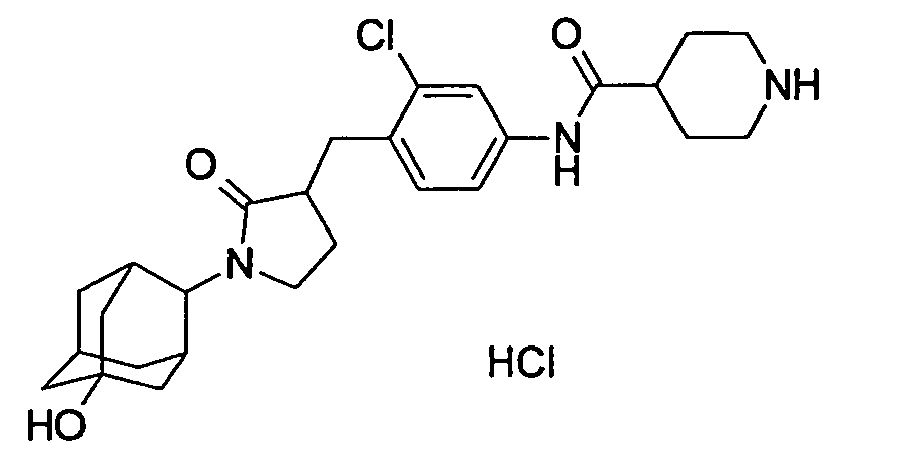
- In the same manner as in Example 20A, the title compound was obtained from tert-butyl 4-{[(3-chloro-4-{[1-(5-hydroxy-2-adamantyl)-2-oxopyrrolidin-3-yl]methyl}phenyl)amino]carbonyl}piperidine-1-carboxylate obtained in Example 491A.
LC/MS (ESI+); m/z 486, 488 (M+H)+ -

- In the same manner as in Example 64A, the title compound was obtained from N-(3-chloro-4-{[1-(5-hydroxy-2-adamantyl)-2-oxopyrrolidin-3-yl]methyl}phenyl)piperidine-4-carboxamide hydrochloride obtained in Example 492A and 1-(bromomethyl)-4-(trifluoromethyl)benzene.
1H NMR (300 MHz, CDCl3) δ ppm 1.49-1.53 (m, 2 H), 1.64 (m, 8 H), 1.75 (m, 4 H), 1.89-1.92 (m, 5 H), 2.05 (m, 1 H), 2.17 (br, 1 H), 2.45 (m, 2 H), 2.73-2.77 (m, 2 H), 2.88-2.96 (m, 2 H), 3.29 (m, 1 H), 3.41-3.54 (m, 2 H), 3.56 (s, 2 H), 3.90 (s, 1 H), 7.14 (m, 1 H), 7.19-7.25 (m, 2 H), 7.43-7.46 (d, J=8.1 Hz, 2 H), 7.55-7.58 (d, J=8.4 Hz, 2 H), 7.68 (d, J=2.1 Hz, 1 H). -

- In the same manner as in Reference Example 1A, the title compound was obtained from N-(3-chloro-4-{[1-(5-hydroxy-2-adamantyl)-2-oxopyrrolidin-3-yl]methyl}phenyl)-4-(trifluoromethyl)benzamide obtained in Example 488A and methyl iodide.
1H NMR (300 MHz, CDCl3) δ ppm 1.50-1.57 (m, 2 H), 1.76-1.82 (m, 8 H), 1.89-1.93 (m, 3 H), 2.18 (br, 1 H), 2.43 (m, 2 H), 2.70-2.75 (m, 2 H), 3.27-3.42 (q, J=8.7 Hz, 1 H), 3.42-3.53 (m, 2 H), 3.47 (s, 3 H), 3.90 (s, 1 H), 6.81-6.83 (d, J=8.1 Hz, 1 H), 7.11-7.15 (m, 2 H), 7.39-7.48 (m, 4 H). -

- In the same manner as in Example 210A, the title compound was obtained from 3-(4-amino-2-chlorobenzyl)-1-(5-hydroxy-2-adamantyl)pyrrolidin-2-one obtained in Example 442A and ethyl 1-isocyanato-4-(trifluoromethyl)benzene.
1H NMR (300 MHz, CDCl3) δ ppm 1.47-1.51 (m, 2 H), 1.68-1.76 (m, 8 H), 1.80 (m, 1 H), 1.85-1.87 (m, 2 H), 2.15 (br, 1 H), 2.38 (m, 2 H), 2.71-2.81 (m, 2 H), 3.19-3.21 (m, 1 H), 3.46-3.56 (m, 2 H), 3.91 (s, 1 H), 7.05-7.16 (m, 3 H), 7.45-7.55 (m, 4 H), 7.97-8.00 (d, J=8.4 Hz, 1 H), 8.57 (s, 1 H). -

- In the same manner as in Example 210A, the title compound was obtained from 3-(4-amino-2-chlorobenzyl)-1-(5-hydroxy-2-adamantyl)pyrrolidin-2-one obtained in Example 442A and ethyl 1-isocyanato-3-(trifluoromethyl)benzene.
1H NMR (300 MHz, CD3OD) δ ppm 1.51-1.55 (m, 2 H), 1.74-1.86 (m, 10 H), 1.99-2.06 (m, 1 H), 2.13 (br, 1 H), 2.36-2.41 (m, 2 H), 2.64-2.72 (m, 1 H), 2.79-2.83 (m, 1 H), 3.25-3.32 (m, 1 H), 3.51-3.61 (m, 2 H), 3.89 (s, 1 H), 7.15-7.33 (m, 5 H), 7.42-7.47 (t, J=7.5 Hz, 1 H), 7.57-7.60 (d, J=7.5 Hz, 1 H), 7.63 (s, 1 H), 7.86 (s, 1 H). -

- In the same manner as in Example 68A, the title compound was obtained from 3-(4-amino-2-chlorobenzyl)-1-(5-hydroxy-2-adamantyl)pyrrolidin-2-one obtained in Example 442A and (pyridin-3-yl)acetic acid.
1H NMR (300 MHz, CD3OD) δ ppm 1.49-1.54 (m, 2 H), 1.69-1.88 (m, 10 H), 1.97-2.07 (m, 1 H), 2.13 (m, 1 H), 2.35-2.39 (m, 2 H), 2.65-2.83 (m, 2 H), 3.25-3.34 (m, 1 H), 3.48-3.63 (m, 2 H), 3.74 (s, 2 H), 3.87 (s, 1 H), 7.23-7.25 (d, J=8.1 Hz, 1 H), 7.34-7.45 (m, 2 H), 7.74 (d, J=2.1 Hz, 1 H), 7.82-7.84 (d, J=7.8 Hz, 1 H), 8.43 (m, 1 H), 8.50 (s, 1 H). -

- In the same manner as in Example 218A, the title compound was obtained from 3-(4-bromo-2-chlorobenzyl)-1-(5-hydroxy-2-adamantyl)pyrrolidin-2-one obtained in Example 441A and [3-(trifluoromethyl)phenyl]boronic acid.
1H NMR (300 MHz, CDCl3) δ ppm 1.51-1.55 (m, 2 H), 1.71-1.80 (m, 8 H), 1.92-1.96 (m, 2 H), 2.07-2.15 (m, 1 H), 2.18 (br, 2 H), 2.44-2.48 (m, 2 H), 2.82-2.89 (m, 2 H), 3.36-3.51 (m, 2 H), 3.54-3.60 (m, 1 H), 3.95 (s, 1 H), 7.36-7.43 (m, 2 H), 7.49-7.63 (m, 3 H), 7.71-7.73 (d, J=7.5 Hz, 1 H), 7.78 (s, 1 H). -

- In the same manner as in Example 210A, the title compound was obtained from 3-(4-amino-2-chlorobenzyl)-1-(5-hydroxy-2-adamantyl)pyrrolidin-2-one obtained in Example 442A and 1-isocyanato-4-(trifluoromethoxy)benzene.
1H NMR (300 MHz, DMSO-d6) δ ppm 1.38-1.42 (m, 2 H), 1.60-1.73 (m, 9 H), 1.90-1.93 (m, 1 H), 2.04 (br, 1 H), 2.28-2.34 (m, 2 H), 2.49-2.53 (m, 1 H), 2.58-2.66 (m, 1 H), 3.11-3.16 (dd, J=13.5, 3.6 Hz, 1 H), 3.37-3.45 (q, J=7.2 Hz, 1 H), 3.48-3.50 (m, 2 H), 3.71 (s, 1H), 4.44 (d, J=1.5 Hz, 1H), 7.19-7.33 (m, 4 H), 7.53-7.56 (m, 2 H), 7.69 (d, J=1.8 Hz, 1 H), 8.87 (s, 1 H), 8.95 (s, 1H). -

- In the same manner as in Example 68A, the title compound was obtained from 3-(4-amino-2-chlorobenzyl)-1-(5-hydroxy-2-adamantyl)pyrrolidin-2-one obtained in Example 442A and N-(tert-butoxycarbonyl)glycine.
1H NMR (300 MHz, CDCl3) δ ppm 1.42-1.53 (m, 2 H), 1.47 (s, 9 H), 1.68-1.93 (m, 10 H), 1.99 -2.05 (m, 1 H), 2.17 (br, 1 H), 2.41-2.45 (m, 2 H), 2.71-2.79 (m, 2 H), 3.28-3.31 (q, J=9.0 Hz, 1 H), 3.41-3.56 (m, 2 H), 3.91-3.93 (m, 3 H), 5.41 (m, 1 H), 7.17-7.20 (m, 1 H), 7.26-7.30 (m, 1 H), 7.64-7.65 (d, J=2.1 Hz, 1 H), 8.56 (br, 1 H). -

- In the same manner as in Example 20A, the title compound was obtained from tert-butyl {2-[(3-chloro-4-{[1-(5-hydroxy-2-adamantyl)-2-oxopyrrolidin-3-yl]methyl}phenyl)amino]-2-oxoethyl}carbamate obtained in Example 500A.
LC/MS (ESI+); m/z 432, 434 (M+H)+ -

- In the same manner as in Reference Example 1A, the title compound was obtained from 1-(3-chloro-4-{[1-(5-hydroxy-2-adamantyl)-2-oxopyrrolidin-3-yl]methyl}phenyl)imidazolidin-2-one obtained in Example 444A and 2-(bromomethyl)pyridine hydrobromide.
1H NMR (300 MHz, CDCl3) δ ppm 1.45-1.53 (m, 2 H), 1.68-1.82 (m, 8 H), 1.90-1.93 (m, 2 H), 1.96-2.06 (m, 1 H), 2.17 (br, 1 H), 2.42-2.47 (m, 2 H), 2.70-2.79 (m, 2 H), 3.30-3.33 (q, J=9.3 Hz, 1 H), 3.42-3.45 (m, 1 H), 3.48-3.56 (m, 3 H), 3.78-3.83 (m, 2 H), 3.91 (s, 1 H), 4.60 (s, 2 H), 7.15-7.22 (m, 2 H), 7.34-7.47 (m, 2 H), 7.64-7.71 (m, 2 H), 8.54-8.56 (m, 1 H). -

- In the same manner as in Example 22A, the title compound was obtained from N-(3-chloro-4-{[1-(5-hydroxy-2-adamantyl)-2-oxopyrrolidin-3-yl]methyl}phenyl)glycinamide hydrochloride obtained in Example 501A and benzoyl chloride.
1H NMR (300 MHz, CD3OD) δ ppm 1.51-1.55 (m, 2 H), 1.74-1.89 (m, 10 H), 2.01-2.08 (m, 1 H), 2.13 (br, 1 H), 2.36-2.41 (m, 2 H), 2.66-2.74 (m, 1 H), 2.80-2.84 (m, 1 H), 3.19-3.30 (m, 1 H), 3.47-3.61 (m, 2 H), 3.88 (s, 1 H), 4.18 (s, 1 H), 7.18-7.26 (m, 1 H), 7.36-7.40 (dd, J =8.1, 2.1 Hz, 1 H), 7.44-7.58 (m, 4 H), 7.76 (d, J=2.1 Hz, 1 H), 7.87-7.90 (m, 2 H). -

- In the same manner as in Example 22A, the title compound was obtained from 3-(4-amino-2-chlorobenzyl)-1-(5-hydroxy-2-adamantyl)pyrrolidin-2-one obtained in Example 442A and phenylacetyl chloride.
1H NMR (300 MHz, CD3OD) δ ppm 1.49-1.54 (m, 2 H), 1.72-1.89 (m, 10 H), 1.94-2.05 (m, 1 H), 2.14 (m, 1 H), 2.35-2.39 (m, 2 H), 2.65-2.82 (m, 2 H), 3.25-3.32 (m, 1 H), 3.50-3.60 (m, 2 H), 3.64 (s, 2 H), 3.87 (s, 1 H), 4.85 (m, 1 H), 7.20-7.37 (m, 7 H), 7.74 (d, J=2.1 Hz, 1 H). -

- In the same manner as in Example 22A, the title compound was obtained from 3-(4-amino-2-chlorobenzyl)-1-(5-hydroxy-2-adamantyl)pyrrolidin-2-one obtained in Example 442A and acetyl chloride.
1H NMR (300 MHz, CD3OD) δ ppm 1.51-1.55 (m, 2 H), 1.72-1.79 (m, 6 H), 1.86-1.89 (m, 4 H), 1.98-2.05 (m, 1 H), 2.16 (s, 3 H), 2.36 (br, 1 H), 2.36-2.40 (m, 2 H), 2.65-2.72 (m, 1 H), 2.79-2.83 (m, 1H), 3.25-3.30 (m, 1H), 3.51-3.61 (m, 2 H), 3.88 (s, 1H), 4.87 (s, 1 H), 7.21-7.24 (d, J=8.4 Hz, 1 H), 7.31-7.35 (dd, J=8.4, 2.1 Hz, 1 H), 7.73 (d, J=2.1 Hz, 1 H). -

- In the same manner as in Example 255A, the title compound was obtained from 1-[3-(hydroxymethyl)-1-adamantyl]pyrrolidin-2-one obtained in Reference Example 19A and 4-bromo-1-(bromomethyl)-2-chlorobenzene.
LC/MS (ESI+); m/z 454, 456 (M+H)+ -
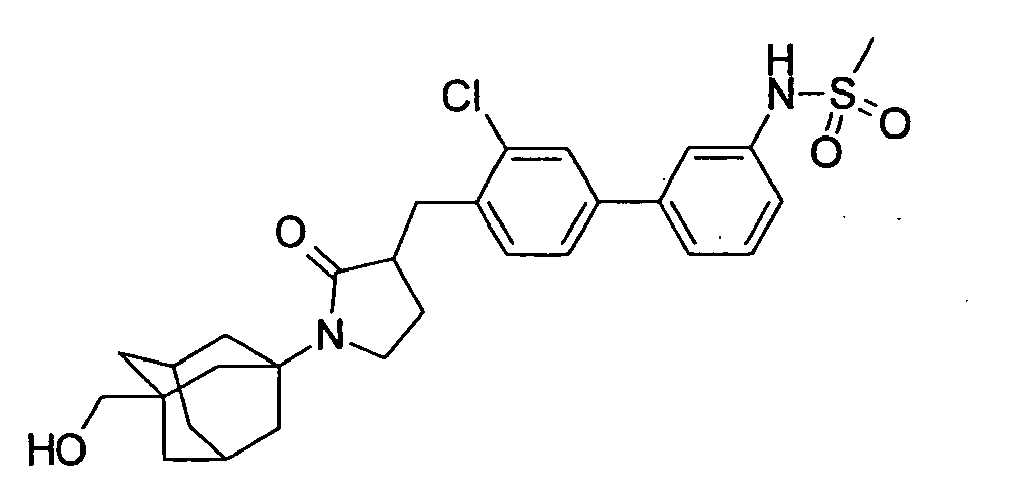
- In the same manner as in Example 218A, the title compound was obtained from 3-(4-bromo-2-chlorobenzyl)-1-[3-(hydroxymethyl)-1-adamantyl]pyrrolidin-2-one obtained in Example 506A and N-[3-(4,4,5,5-tetramethyl-1,3,2-dioxaboloran-2-yl)phenyl]methanesulfonamide.
1H NMR NMR (300 MHz, CDCl3) δ ppm 1.41-1.69 (m, 8 H), 1.89-2.09 (m, 8 H), 2.18 (m, 2 H), 2.73-2.79 (m, 2 H), 3.02 (s, 3 H), 3.26 (s, 2 H), 3.29-3.39 (m, 2 H), 7.25-7.38 (m, 4 H), 7.41-7.48 (m, 1 H), 7.51-7.54 (m, 1 H), 7.62-7.69 (m, 1 H), 7.98 (br, 1 H). Example 508A N-(3-chloro-4-{[1-(5-hydroxy-2-adamantyl)-2-oxopyrrolidin-3-yl]methyl}phenyl)-1-phenylmethanesulfonamide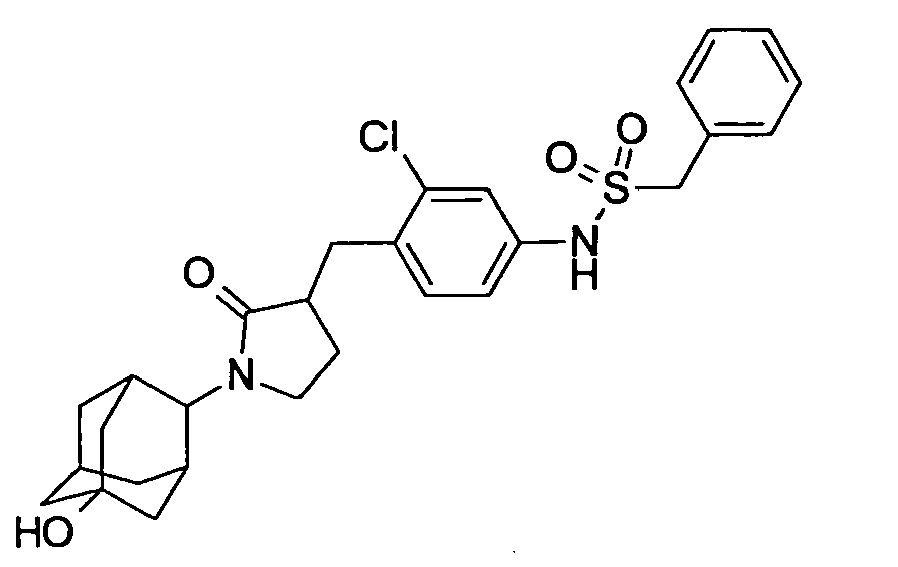
- In the same manner as in Example 22A, the title compound was obtained from 3-(4-amino-2-chlorobenzyl)-1-(5-hydroxy-2-adamantyl)pyrrolidin-2-one obtained in Example 442A and phenylmethanesulfonyl chloride.
1H NMR (300 MHz, CDCl3) δ ppm 1.49-1.53 (m, 2 H), 1.69-1.78 (m, 8 H), 1.88-1.91 (m, 2 H), 2.02-2.08 (m, 1 H), 2.17 (br, 1 H), 2.40-2.45 (m, 2 H), 2.70-2.78 (m, 2 H), 3.23-3.29 (q, J=8.7 Hz, 1 H), 3.41-3.57 (m, 2 H), 3.90 (s, 1 H), 4.32 (s, 2 H), 6.95-6.99 (dd, J=8.4, 2.1 Hz, 1 H), 7.15-7.48 (m, 8 H). -

- In the same manner as in Reference Example 1A, the title compound was obtained from 1-(3-chloro-4-{[1-(5-hydroxy-2-adamantyl)-2-oxopyrrolidin-3-yl]methyl}phenyl)imidazolidin-2-one obtained in Example 444A and benzyl bromide.
1H NMR (300 MHz, CDCl3) δ ppm 1.45-1.53 (m, 2 H), 1.68-1.94 (m, 10 H), 1.97-2.04 (m, 1 H), 2.17 (br, 1 H), 2.42-2.46 (m, 2 H), 2.70-2.79 (m, 2 H), 3.30-3.55 (m, 5 H), 3.72-3.77 (t, J=7.2 Hz, 2 H), 3.92 (s, 1 H), 4.66 (s, 2 H), 7.19-7.41 (m, 7 H), 7.64 (d, J=2.1 Hz, 1 H). -
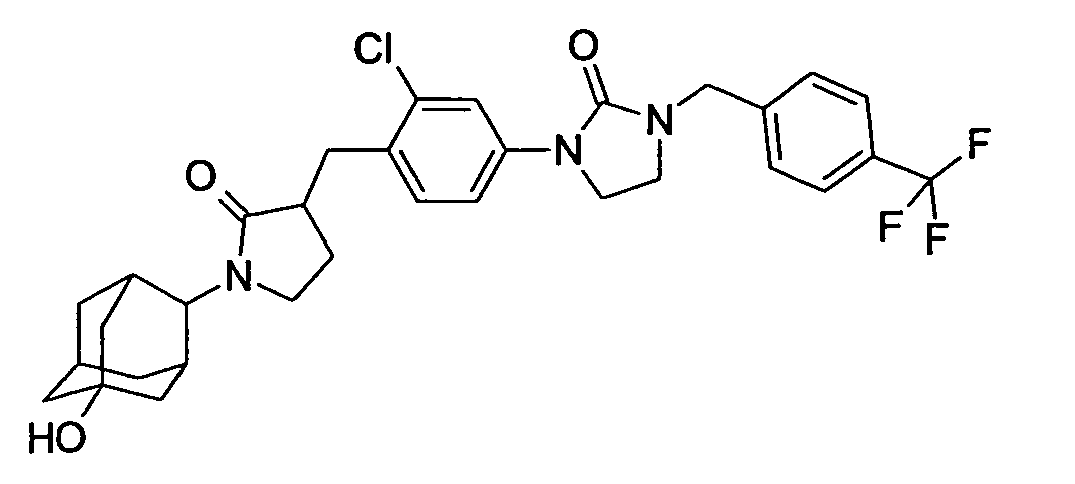
- In the same manner as in Reference Example 1A, the title compound was obtained from 1-(3-chloro-4-{[1-(5-hydroxy-2-adamantyl)-2-oxopyrrolidin-3-yl]methyl}phenyl)imidazolidin-2-one obtained in Example 444A and 1-(bromomethyl)-4-(trifluoromethyl)benzene.
1H NMR (300 MHz, CDCl3) δ ppm 1.50-1.54 (m, 2 H), 1.76-2.04 (m, 10 H), 2.17 (br, 1 H), 2.43-2.46 (m, 2 H), 2.74-2.79 (m, 2 H), 3.30-3.54 (m, 6 H), 3.76-3.82 (t, J=8.7 Hz, 2 H), 3.92 (s, 1 H), 4.52 (s, 2 H), 7.21-7.24 (d, J=8.7 Hz, 1 H), 7.37-7.44 (m, 3 H), 7.59-7.65 (m, 3 H). -

- In the same manner as in Reference Example 1A, the title compound was obtained from 1-(3-chloro-4-{[1-(5-hydroxy-2-adamantyl)-2-oxopyrrolidin-3-yl]methyl}phenyl)imidazolidin-2-one obtained in Example 444A and 3-(chloromethyl)pyridine hydrochloride.
1H NMR (300 MHz, CDCl3) δ ppm 1.49-1.53 (m, 2 H), 1.68-1.76 (m, 8 H), 1.90-1.94 (m, 2 H), 1.98-2.07 (m, 1 H), 2.16 (br, 1 H), 2.42-2.45 (m, 2 H), 2.70-2.79 (m, 2 H), 3.30-3.53 (m, 6 H), 3.77-3.81 (m, 2 H), 3.91 (s, 1 H), 4.48 (s, 2 H), 7.19-7.23 (m, 1 H), 7.28-7.30 (m, 1 H), 7.32-7.45 (m, 1 H), 7.63 (d, J=2.1 Hz, 1 H), 7.67-7.70 (m, 1 H), 8.55 (s, 2 H). -

- In the same manner as in Example 371A, the title compound was obtained from 3-(2,6-dichlorobenzyl)-1-(4-oxocyclohexyl)pyrrolidin-2-one obtained in Example 28A and pyrrolidine.
1H NMR (300 MHz, CDCl3) δ ppm 1.34-1.62 (m, 4 H), 1.68-2.18 (m, 11 H), 2.33-2.65 (m, 4 H), 2.82-3.10 (m, 2 H), 3.11-3.57 (m, 3 H), 3.90-4.08 (m, 1 H), 7.09 (t, J=8.1 Hz, 1 H), 7.24-7.33 (m, 2 H). -

- The reaction product (a mixture of four steric isomers) which was obtained in the same manner as in Example 30A from 3-(2,6-dichlorobenzyl)-1-(4-oxocyclohexyl)pyrrolidin-2-one obtained in Example 28A and ethylmagnesium bromide, was subjected to silica gel column chromatography (hexane-ethyl acetate 4:1, ethyl acetate) to give the title compound (Example 513A: less polar product) as a mixture of two steric isomers eluted earlier, and then to give the title compound (Example 514A: more polar product) as a mixture of two steric isomers eluted later.
-

- In the same manner as in Example 30A, the title compound was obtained from 3-(2,6-dichlorobenzyl)-1-(4-oxocyclohexyl)pyrrolidin-2-one obtained in Example 28A and phenylmagnesium bromide.
1H NMR (300 MHz, CDCl3) δ ppm 1.33-2.13 (m, 8 H), 2.44-2.66 (m, 2 H), 2.80-2.95 (m, 1 H), 2.94-3.07 (m, 2 H), 3.08-3.19 (m, 1 H), 3.39-3.53 (m, 1 H), 4.08-4.25 (m, 1 H), 7.00-7.13 (m, 1 H), 7.26 (s, 1 H), 7.28-7.35 (m, 2 H), 7.36-7.45 (m, 2 H), 7.52-7.61 (m, 2 H). -

- A mixture of 3-(2,6-dichlorobenzyl)-1-(4-oxocyclohexyl)pyrrolidin-2-one obtained in Example 28A (1.50 g), (carboethoxymethyl)triphenylphosphine bromide (5.68 g), sodium ethoxide (4.94 g) and ethanol (40 mL) was stirred at 90°C for 16 hr. The reaction mixture was concentrated under reduced pressure, and the residue was subjected to silica gel column chromatography (hexane-ethyl acetate 95:5-1:1) to give the title compound (1.60 g, 88%) as a yellow oil.
1H NMR (300 MHz, CDCl3) δ ppm 1.23-1.30 (m, 3 H), 1.51-2.09 (m, 5 H), 2.09-2.42 (m, 3 H), 2.86-3.55 (m, 7 H), 4.08-4.19 (m, 2 H), 4.20-4.34 (m, 1 H), 5.45-5.69 (m, 1 H), 7.03-7.15 (m, 1 H), 7.29 (d, J=7.9 Hz, 2 H). -

- In the same manner as in Example 155A, the title compound was obtained from ethyl {4-[3-(2,6-dichlorobenzyl)-2-oxopyrrolidin-1-yl]cyclohexylidene}acetate obtained in Example 516A.
1H NMR (300 MHz, CDCl3) δ ppm 1.67-2.08 (m, 5 H), 2.09-2.45 (m, 3 H), 2.83-3.13 (m, 3 H), 3.13-3.25 (m, 1 H), 3.25-3.43 (m, 1 H), 3.49 (dd, J=13.0, 4.0 Hz, 1 H), 3.68-3.82 (m, 1 H), 4.18-4.35 (m, 1 H), 5.58 (d, J=2.8 Hz, 1 H), 7.01-7.16 (m, 1 H), 7.28-7.31 (m, 2 H). -

LC-MS (ESI+); m/z 412 (M+H)+ -

- In the same manner as in Example 155A, the title compound was obtained from ethyl {4-[3-(2,6-dichlorobenzyl)-2-oxopyrrolidin-1-yl]cyclohexyl}acetate obtained in Example 518A.
1H NMR (300 MHz, CDCl3) δ ppm 1.07-1.33 (m, 2 H), 1.39-2.05 (m, 8 H), 2.27 (d, J=7.0 Hz, 1 H), 2.40-2.48 (m, 1 H), 2.85-3.11 (m, 2 H), 3.12-3.53 (m, 4 H), 3.87-4.05 (m, 1 H), 7.00-7.17 (m, 1 H), 7.29 (d, J=7.9 Hz, 2 H). -

- In the same manner as in Example 263A, the title compound was obtained from ethyl {4-[3-(2,6-dichlorobenzyl)-2-oxopyrrolidin-1-yl]cyclohexyl}acetate obtained in Example 518A and methyl lithium.
1H NMR (300 MHz, CDCl3) δ ppm 1.08-1.34 (m, 8 H), 1.36-2.01 (m, 12 H), 2.84-3.10 (m, 2 H), 3.12-3.42 (m, 2 H), 3.49 (dd, J=13.1, 4.2 Hz, 1 H), 3.86-4.04 (m, 1 H), 7.03-7.16 (m, 1 H), 7.29 (d, J=7.9 Hz, 2 H). -

- In the same manner as in Example 70A, the title compound was obtained from {4-[3-(2,6-dichlorobenzyl)-2-oxopyrrolidin-1-yl]cyclohexyl}acetic acid obtained in Example 519A and pyrrolidine.
1H NMR (300 MHz, CDCl3) δ ppm 0.98-1.32 (m, 1 H), 1.39-2.02 (m, 13 H), 2.16 (d, J=6.4 Hz, 1 H), 2.34 (s, 2 H), 2.80-3.10 (m, 2 H), 3.11-3.57 (m, 7 H), 3.81-4.05 (m, 1 H), 7.02-7.16 (m, 1 H), 7.29 (d, J=8.1 Hz, 2 H). -

- In the same manner as in Example 70A, the title compound was obtained from {4-[3-(2,6-dichlorobenzyl)-2-oxopyrrolidin-1-yl]cyclohexyl}acetic acid obtained in Example 519A and aniline.
1H NMR (300 MHz, CDCl3) δ ppm 1.07-1.28 (m, 1 H), 1.41-2.03 (m, 10 H), 2.26 (d, J=6.6 Hz, 1 H), 2.31-2.52 (m, 2 H), 2.80-3.13 (m, 2 H), 3.10-3.56 (m, 3 H), 3.72-4.08 (m, 1 H), 7.00-7.16 (m, 2 H), 7.27-7.43 (m, 4 H), 7.54 (t, J=8.1 Hz, 2 H). -

- In the same manner as in Example 70A, the title compound was obtained from {4-[3-(2,6-dichlorobenzyl)-2-oxopyrrolidin-1-yl]cyclohexyl}acetic acid obtained in Example 519A and benzylamine.
1H NMR (300 MHz, CDCl3) δ ppm 0.99-1.25 (m, 1 H), 1.36-2.01 (m, 10 H), 2.11 (d, J=6.6 Hz, 1 H), 2.30 (s, 2 H), 2.80-3.09 (m, 2 H), 3.10-3.27 (m, 1 H), 3.27-3.55 (m, 2 H), 3.80-4.04 (m, 1 H), 4.44 (d, J=5.7 Hz, 1 H), 5.76-6.18 (m, 1 H), 7.03-7.14 (m, 1 H), 7.19-7.38 (m, 7 H). -

- In the same manner as in Example 70A, the title compound was obtained from {4-[3-(2,6-dichlorobenzyl)-2-oxopyrrolidin-1-yl]cyclohexyl}acetic acid obtained in Example 519A and ammonia (25% solution).
1H NMR (300 MHz, CDCl3) δ ppm 1.03-1.32 (m, 1 H), 1.37-1.79 (m, 8 H), 1.79-2.03 (m, 3 H), 2.16-2.38 (m, 2 H), 2.82-3.10 (m, 2 H), 3.13-3.43 (m, 2 H), 3.48 (dd, J=13.1, 4.4 Hz, 1 H), 3.81-4.04 (m, 1 H), 5.38 (br d like, 1 H), 7.04-7.15 (m, 1 H), 7.29 (d, J=8.0 Hz, 2 H). -

- A mixture of {4-[3-(2,6-dichlorobenzyl)-2-oxopyrrolidin-1-yl]cyclohexyl}acetic acid obtained in Example 519A (0.5 g), 1,1'-carbonylbis-1H-imidazole (0.32 g) and dichloromethane (10 mL) was stirred at room temperature for 1 hr. 4-Fluorobenzamidoxime (0.60 g) was added to the reaction solution, the mixture was further stirred at room temperature for 16 hr, and the reaction mixture was concentrated under reduced pressure. The residue was heated under reflux in toluene (15 mL) for 16 hr, the reaction mixture was concentrated under reduced pressure, and the residue was subjected to silica gel column chromatography (hexane-ethyl acetate 95:5-1:1) to give the title compound (0.45 g, 69%) as a colorless solid.
1H NMR (300 MHz, CDCl3) δ ppm 1.21-2.08 (m, 10 H), 2.37-2.54 (m, 1 H), 2.82-3.11 (m, 4 H), 3.12-3.57 (m, 3 H), 3.88-4.11 (m, 1 H), 7.02-7.23 (m, 3 H), 7.27-7.34 (m, 2 H), 8.07 (dd, J=8.3, 5.3 Hz, 2 H). -

- In the same manner as in Example 525A, the title compound was obtained from 4-[3-(2,6-dichlorobenzyl)-2-oxopyrrolidin-1-yl]-4-methylpentanoic acid obtained in Reference Example 47A and 4-fluorobenzamidoxime.
1H NMR (300 MHz, CDCl3) δ ppm 1.44 (s, 6 H), 1.71-1.97 (m, 2 H), 2.33-2.69 (m, 2 H), 2.75-3.10 (m, 4 H), 3.19-3.37 (m, 1 H), 3.37-3.52 (m, 2 H), 7.00-7.21 (m, 3 H), 7.22-7.33 (m, 2 H), 7.98-8.13 (m, 2 H). -

- To a solution of ethyl (2E)-3-{3-chloro-4-[(1-cyclohexyl-2-oxopyrrolidin-3-yl)methyl]phenyl}acrylate obtained in Example 253A (1.92 g) in ethyl acetate (80 mL) was added platinum oxide (0.057 g), and the mixture was stirred at room temperature for 12 hr under hydrogen atmosphere. The reaction mixture was filtrated, the solvent was evaporated under reduced pressure, and the residue was subjected to silica gel column chromatography (hexane-ethyl acetate 9:1-3:2) to give the title compound (1.67 g, 87%) as a colorless oil.
1H NMR (300 MHz, CDCl3) δ ppm 0.97-1.16 (m, 1 H), 1.24 (t, J=7.0 Hz, 3 H), 1.28-1.50 (m, 4 H), 1.51-1.85 (m, 6 H), 1.90-2.06 (m, 1 H), 2.52-2.65 (m, 2 H), 2.67-2.82 (m, 2 H), 2.83-2.95 (m, 2 H), 3.08-3.26 (m, 2 H), 3.26-3.39 (m, 1 H), 3.85-4.02 (m, 1 H), 4.13 (q, J=7.2 Hz, 2 H), 7.02 (dd, J=8.0, 1.5 Hz, 1 H), 7.16-7.22 (m, 2 H). -
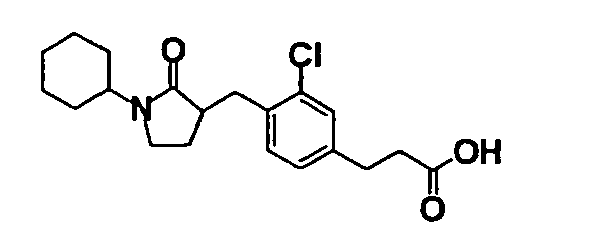
- In the same manner as in Example 155A, the title compound was obtained from ethyl 3-{3-chloro-4-[(1-cyclohexyl-2-oxopyrrolidin-3-yl)methyl]phenyl}propanoate obtained in Example 527A.
1H NMR (300 MHz, CDCl3) δ ppm 0.96-1.19 (m, 1 H), 1.19-1.49 (m, 5 H), 1.51-1.88 (m, 6 H), 1.88-2.09 (m, 1 H), 2.57-2.86 (m, 4 H), 2.91 (t, J=7.5 Hz, 2 H), 3.07-3.37 (m, 3 H), 3.82-4.07 (m, J=4.0 Hz, 1 H), 7.03 (dd, J=7.8, 1.8 Hz, 1 H), 7.16 (d, J=7.9 Hz, 1 H), 7.21 (d, J=1.7 Hz, 1 H). -

- To a solution of 3-{3-chloro-4-[(1-cyclohexyl-2-oxopyrrolidin-3-yl)methyl]phenyl}propanoic acid obtained in Example 528A (0.21 g) in tetrahydrofuran (5 mL) was added thionyl chloride (0.21 g), and the mixture was heated under reflux for 3 hr. The reaction mixture was concentrated under reduced pressure, and tetrahydrofuran (5 mL) was added to the obtained residue An aqueous solution (5 mL) of lithium borohydride (0.11 g) was added dropwise at 0°C, and the mixture was stirred for 3 hr while allowing to warm to room temperature. Water was added to the reaction mixture, and the mixture was extracted with ethyl acetate. The extract was dried over anhydrous magnesium sulfate, and the solvent was evaporated under reduced pressure. The residue was subjected to silica gel column chromatography (hexane-ethyl acetate 1:1, ethyl acetate), and the obtained solid was recrystallized from ethyl acetate to give the title compound (0.062 g, 31%) as a white powder.
1H NMR (300 MHz, CDCl3)δ ppm 1.13 (d, J=6.0 Hz, 1 H), 1.22-2.10 (m, 14 H), 2.58-2.98 (m, 5 H), 3.08-3.40 (m, 3 H), 3.67 (t, J=6.4 Hz, 1 H), 3.95 (s, 1 H), 6.98-7.07 (m, 1 H), 7.14-7.23 (m, 2 H). -

- In the same manner as in Example 70A, the title compound was obtained from 3-{3-chloro-4-[(1-cyclohexyl-2-oxopyrrolidin-3-yl)methyl]phenyl}propanoic acid obtained in Example 528A and saturated aqueous ammonia.
1H NMR (300 MHz, DMSO-d6) δ ppm 1.09 (s, 1 H), 1.18-1.47 (m, 4 H), 1.47-1.65 (m, 4 H), 1.74 (d, J=11.7 Hz, 2 H), 1.81-1.96 (m, 1 H), 2.34 (t, J=7.6 Hz, 2 H), 2.55-2.70 (m, 2 H), 2.77 (t, J=7.5 Hz, 2 H), 3.06-3.28 (m, 3 H), 3.73 (s, 1 H), 6.77 (s, 1 H), 7.10 (dd, J=7.8, 1.6 Hz, 1H), 7.19-7.35 (m, 3 H). -

- In the same manner as in Example 70A, the title compound was obtained from 3-{3-chloro-4-[(1-cyclohexyl-2-oxopyrrolidin-3-yl)methyl]phenyl}propanoic acid obtained in Example 528A and pyrrolidine.
1H NMR (300 MHz, CDCl3) δ ppm 0.95-1.19 (m, J=3.4 Hz, 1 H), 1.20-1.49 (m, 4 H), 1.60-2.11 (m, 11 H), 2.53 (t, J=7.8 Hz, 2 H), 2.66-2.85 (m, 2 H), 2.86-3.01 (m, 2 H), 3.09-3.26 (m, 2 H), 3.26-3.39 (m, 3 H), 3.47 (t, J=6.6 Hz, 2 H), 3.85-4.04 (m, 1 H), 7.04 (d, J=8.0 Hz, 1 H), 7.14-7.23 (m, 2 H). -

- In the same manner as in Example 255A, the title compound was obtained from 1-[4-(hydroxymethyl)cyclohexyl]pyrrolidin-2-one obtained in Reference Example 34A and 2,4-dichlorobenzyl chloride.
LC-MS (ESI+); m/z 456 (M)+ -

- In the same manner as in Reference Example 44A, the title compound was obtained from 3-(2,4-dichlorobenzyl)-1-[4-(hydroxymethyl)cyclohexyl]pyrrolidin-2-one obtained in Example 532A.
1H NMR (300 MHz, CDCl3) δ ppm 1.28-1.91 (m, 6 H), 1.92-2.21 (m, 2 H), 2.22-2.38 (m, 2 H), 2.48 (t, J=5.6 Hz, 1 H), 2.65-2.87 (m, 2 H), 3.04-3.42 (m, 3 H), 3.88-4.05 (m, 1 H), 7.10-7.25 (m, 2 H), 7. 37 (t, J=2.1 Hz, 1 H), 9. 62 and 9.70 (s, 1 H). -
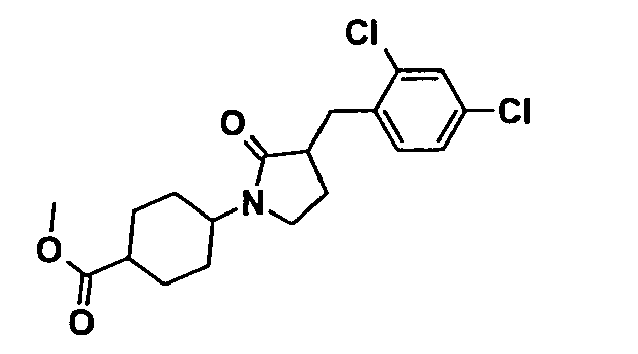
- In the same manner as in the second step of Example 259A, the title compound was obtained from 4-[3-(2,4-dichlorobenzyl)-2-oxopyrrolidin-1-yl]cyclohexanecarbaldehyde obtained in Example 533A, N-iodosuccinimide, potassium carbonate and methanol.
1H NMR (300 MHz, CDCl3) δ ppm 1.29-1.88 (m, 8 H), 1.95-2.15 (m, 2 H), 2.14-2.30 (m, 1 H), 2.66-2.85 (m, 2 H), 3.11-3.24 (m, 2 H), 3.25-3.38 (m, 1 H), 3.67 (s, 3 H), 3.87-4.06 (m, 1 H), 7.13-7.25 (m, 2 H), 7.37 (d, J=2.1 Hz, 1 H). -

- In the same manner as in Example 155A, the title compound was obtained from methyl 4-[3-(2,4-dichlorobenzyl)-2-oxopyrrolidin-1-yl]cyclohexanecarboxylate obtained in Example 534A.
1H NMR (300 MHz, DMSO-d6) δ ppm 1.26-1.68 (m, 7 H), 1.83-2.02 (m, 3 H), 2.04-2.20 (m, 1 H), 2.55-2.79 (m, 2 H), 3.02-3.46 (m, 3 H), 3.60-3.79 (m, 1 H), 7.31-7.46 (m, 2 H), 7.58 (d, J=1.9 Hz, 1 H), 12.17 (s, 1 H). -

- In the same manner as in Example 30A, the title compound was obtained from 4-[3-(2,4-dichlorobenzyl)-2-oxopyrrolidin-1-yl]cyclohexanecarbaldehyde obtained in Example 533A and methylmagnesium bromide.
LC-MS (ESI+); m/z 370 (M+H)+ -

- In the same manner as in Example 70A, the title compound was obtained from 4-[3-(2,4-dichlorobenzyl)-2-oxopyrrolidin-1-yl]cyclohexanecarboxylic acid obtained in Example 535A and ammonia (25% solution).
1H NMR (300 MHz, CDCl3) δ ppm 1.36-1.91 (m, 8 H), 1.94-2.18 (m, 3 H), 2.70-2.85 (m, 2 H), 3.14-3.26 (m, 2 H), 3.26-3.40 (m, 1 H), 3.86-4.05 (m, 1 H), 5.30-5.42 (m, 2 H), 7.12-7.25 (m, 2 H), 7.37 (d, J=1. 9 Hz, 1 H). -

- In the same manner as in Example 1A, the title compound was obtained from 1-(1,4-dioxaspiro[4.5]dec-8-yl)pyrrolidin-2-one and 2-chloro-4-(methoxymethoxy)benzyl bromide obtained in Reference Example 24A.
1H NMR (300 MHz, CDCl3) δ ppm 1.57-1.88 (m, 9 H), 1.93-2.09 (m, 1 H), 2.66-2.84 (m, 2 H), 3.12-3.36 (m, 3 H), 3.47 (s, 3 H), 3.94 (s, 4 H), 3.99-4.12 (m, 1 H), 5.13 (s, 2 H), 6.87 (dd, J=8.5, 2.5 Hz, 1 H), 7.07 (d, J=2.5 Hz, 1 H), 7.17 (d, J=8.5Hz, 1 H). -

- In the same manner as in Example 28A, the title compound was obtained from 3-[2-chloro-4-(methoxymethoxy)benzyl]-1-(1,4-dioxaspiro[4.5]dec-8-yl)pyrrolidin-2-one obtained in Example 538A.
1H NMR (300 MHz, CDCl3) δ ppm 1.72-2.15 (m, 6 H), 2.36-2.60 (m, 4 H), 2.68-2.90 (m, 2 H), 3.14-3.31 (m, 3 H), 4.47 (tt, J=12.0, 3.8 Hz, 1 H), 6.68 (dd, J=8.3, 2.5 Hz, 1 H), 6.81 (brs, 1 H), 6.89 (d, J=2.5 Hz, 1 H), 7.09 (d, J=8.3 Hz, 1 H). -

- To a solution of 3-(2-chloro-4-hydroxybenzyl)-1-(4-oxocyclohexyl)pyrrolidin-2-one obtained in Example 539A (643 mg) in N,N-dimethylformamide (1 mL) were added tert-butyl(chloro)diphenylsilane (572 µL) and imidazole (150 mg), and the mixture was stirred at 60°C for 1 hr. Water was added to the reaction mixture, and the mixture was extracted with ethyl acetate. The organic layer was washed with saturated brine, and dried over anhydrous magnesium sulfate. The solvent was evaporated under reduced pressure, and the residue was subjected to silica gel column chromatography (hexane-ethyl acetate 95:5-75:25) to give the title compound (673 mg, 60%) as a colorless oil.
1H NMR (300 MHz, CDCl3) δ ppm 1.09 (s, 9 H), 1.62-2.06 (m, 6 H), 2.32-2.59 (m, 4 H), 2.59-2.81 (m, 2 H), 3.01-3.31 (m, 3 H), 4.43 (tt, J=12.0, 3.9 Hz, 1 H), 6.49 (dd, J=8.4, 2.5 Hz, 1 H), 6.86 (d, J=2.5 Hz, 1 H), 6.91 (d, J=8.4 Hz, 1 H), 7.32-7.48 (m, 6 H), 7.64-7.72 (m, 4 H). -

- To a solution of 2,6-di-tert-butyl-4-methylphenol (608 mg) in toluene (5 mL) was added trimethylaluminum (2.0 M hexane solution, 0.7 mL) at room temperature, and the mixture was stirred for 1 hr. This reaction mixture was cooled to -78°C, and a solution of 3-(4-{[tert-butyl(diphenyl)silyl]oxy}-2-chlorobenzyl)-1-(4-oxocyclohexyl)pyrrolidin-2-one obtained in Example 540A (260 mg) in tetrahydrofuran (3 mL) was added. Methyllithium (1.5 M tetrahydrofuran solution, 0.7 mL) was added dropwise to the reaction mixture, and the mixture was stirred for 3 hr. 1N Hydrochloric acid was added to the reaction mixture, and the mixture was extracted with ethyl acetate. The organic layer was washed with saturated brine, and dried over anhydrous magnesium sulfate. The solvent was evaporated under reduced pressure, and the residue was subjected to silica gel column chromatography (hexane-ethyl acetate 95:5-1:4) to give the title compound (188 mg, 70%) as a colorless oil.
- Recrystallization from hexane-diethyl ether gave colorless crystals.
1H NMR (300 MHz, CDCl3)δ ppm 1.09 (s, 9 H), 1.26 (s, 3 H), 1.36 (s, 1 H), 1.42-1.79 (m, 9 H), 1.86-2.01 (m, 1 H), 2.57-2.79 (m, 2 H), 3.04-3.29 (m, 3 H), 3.86-4.01 (m, 1 H), 6.50 (dd, J=8.3, 2.5 Hz, 1 H), 6.84 (d, J=2.5 Hz, 1 H), 6.91 (d, J=8.3Hz, 1 H), 7.32-7.48 (m, 6 H), 7.63-7.74 (m, 4 H). -

- In the same manner as in Example 155A, the title compound was obtained from 3-(4-{[tert-butyl(diphenyl)silyl]oxy}-2-chlorobenzyl)-1-(4-hydroxy-4-methylcyclohexyl)pyrrolidin-2-one obtained in Example 541A.
1H NMR (300 MHz, DMSO-d6) δ ppm 1.12 (s, 3 H), 1.36-1.63 (m, 9 H), 1.80-1.94 (m, 1 H), 2.40-2.67 (m, 2 H), 3.02-3.27 (m, 3 H), 3.63-3.78 (m, 1 H), 4.35 (s, 1 H), 6.66 (dd, J=8.5, 2.5 Hz, 1 H), 6.79 (d, J=2.5 Hz, 1 H), 7.13 (d, J=8.5 Hz, 1 H), 9.70 (brs, 1 H). -
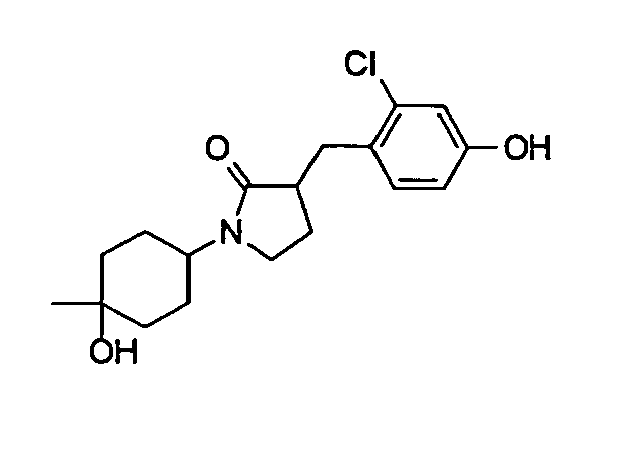
- 3-(2-Chloro-4-hydroxybenzyl)-1-(4-hydroxy-4-methylcyclohexyl)pyrrolidin-2-one (a mixture of two steric isomers) obtained in Example 542A was subjected to optical resolution with normal phase chiral high performance liquid chromatography (manufactured by Daicel Chemical Industries, Ltd., Chiralcel OJ (trade name), 50 mmID X 500 mmL, hexane-ethanol 85:15) to give the title compound (Example 543A) from a fraction with a retention time of 15 min and the title compound (Example 544A) from a fraction with a retention time of 18 min. Example 543A (retention time 15 min)
1H NMR (300 MHz, DMSO-d6) δ ppm 1.12 (s, 3 H), 1.36-1.64 (m, 9 H), 1.79-1.94 (m, 1 H), 2.39-2.67 (m, 2 H), 3.02-3.28 (m, 3 H), 3.62-3.77 (m, 1 H), 4.36 (s, 1 H), 6.66 (dd, J=8.4, 2.5 Hz, 1 H), 6.79 (d, J=2.5 Hz, 1 H), 7.13 (d, J=8.4 Hz, 1 H), 9.70 (brs, 1 H). - 1H NMR (300 MHz, DMSO-d6) δ ppm 1.12 (s, 3 H), 1.37-1.64 (m, 9 H), 1.79-1.94 (m, 1 H), 2.40-2.67 (m, 2 H), 3.01-3.28 (m, 3 H), 3.62-3.77 (m, 1 H), 4.36 (s, 1 H), 6.66 (dd, J=8.3, 2.5 Hz, 1 H), 6.79 (d, J=2.5 Hz, 1 H), 7.13 (d, J=8.3 Hz, 1 H), 9.70 (brs, 1 H).
-

- In the same manner as in Example 338A, the title compound was obtained from 3-(2-chloro-4-hydroxybenzyl)-1-cyclohexylpyrrolidin-2-one obtained in Example 183A and 2-morpholinoethanol.
1H NMR (300 MHz, CDCl3) δ ppm 0.99-1.17 (m, 1 H), 1.26-1.48 (m, 4 H), 1.57-1.86 (m, 6 H), 1.93-2.07 (m, 1 H), 2.67-2.83 (m, 2 H), 3.11-3.35 (m, 5 H), 3.37-3.49 (m, 4 H), 3.86-4.13 (m, 5 H), 4.37-4.48 (m, 2 H), 6.73 (dd, J=8.5, 2.6 Hz, 1 H), 6.90 (d, J=2.6 Hz, 1 H), 7.21 (d, J=8.5 Hz, 1 H). -
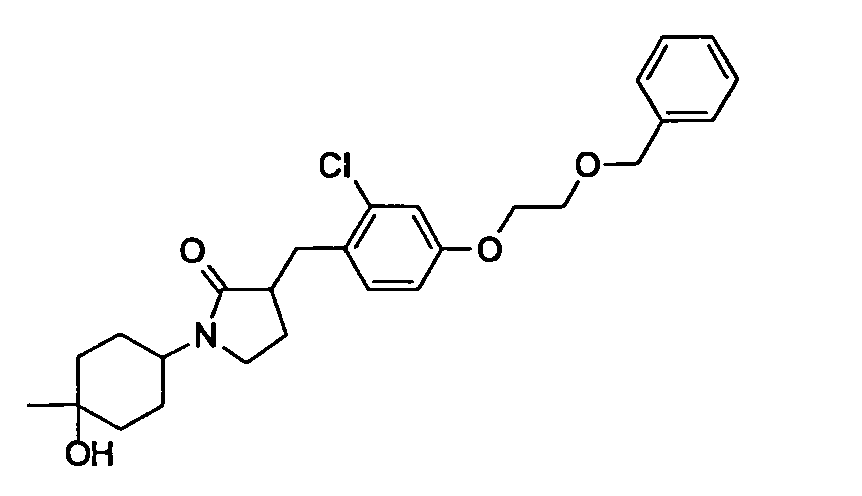
- In the same manner as in Example 338A, the title compound was obtained from 3-(2-chloro-4-hydroxybenzyl)-1-(4-hydroxy-4-methylcyclohexyl)pyrrolidin-2-one obtained in Example 542A and 2-benzyloxyethanol.
1H NMR (300 MHz, CDCl3) δ ppm 1.27 (s, 3 H), 1.30-1.84 (m, 10 H), 1.90-2.09 (m, 1 H), 2.66-2.84 (m, 2 H), 3.10-3.37 (m, 3 H), 3.76-3.85 (m, 2 H), 3.89-4.15 (m, 3 H), 4.62 (s, 2 H), 6.77 (dd, J=8.5, 2.5 Hz, 1 H), 6.94 (d, J=2.5 Hz, 1 H), 7.16 (d, J=8.5 Hz, 1 H), 7.22-7.41 (m, 5 H). -
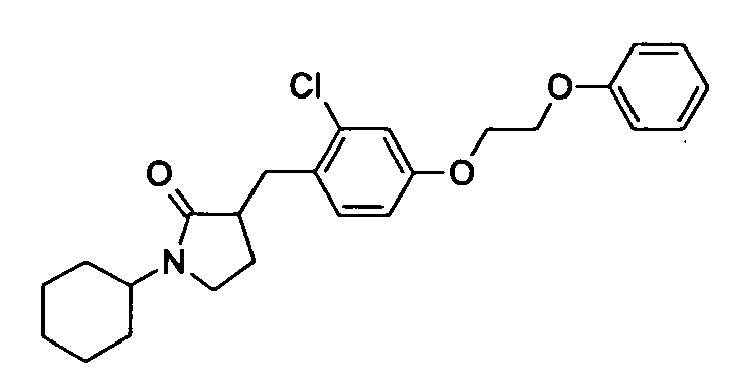
- In the same manner as in Example 338A, the title compound was obtained from 3-[2-chloro-4-(2-hydroxyethoxy)benzyl]-1-cyclohexylpyrrolidin-2-one obtained in Example 344A and phenol.
1H NMR (300 MHz, CDCl3) δ ppm 0.96-1.17 (m, 1 H), 1.20-1.50 (m, 4 H), 1.57-1.86 (m, 6 H), 1.90-2.08 (m, 1 H), 2.64-2.87 (m, 2 H), 3.09-3.39 (m, 3 H), 3.88-4.01 (m, 1 H), 4.25-4.34 (m, 4 H), 6.80 (dd, J=8.5, 2.5 Hz, 1 H), 6.90-7.02 (m, 4 H), 7.19 (d, J=8.5 Hz, 1 H), 7.24-7.35 (m, 2 H). -

- In the same manner as in Example 318A, the title compound was obtained from 3-(2-chloro-4-hydroxybenzyl)-1-(4-hydroxy-4-methylcyclohexyl)pyrrolidin-2-one obtained in Example 542A and methyl 4-(bromomethyl)benzoate.
1H NMR (300 MHz, CDCl3) δ ppm 1.27 (s, 3 H), 1.34-1.82 (m, 10 H), 1.93-2.09 (m, 1 H), 2.67-3.00 (m, 2 H), 3.12-3.36 (m, 3 H), 3.86-4.05 (m, 4 H), 5.09 (s, 2 H), 6.80 (dd, J=8.5, 2.6 Hz, 1 H), 6.98 (d, J=2.6 Hz, 1 H), 7.18 (d, J=8.5 Hz, 1 H), 7.48 (d, J=8.2 Hz, 2 H), 8.06 (d, J=8.2 Hz, 2 H). -

- In the same manner as in Example 338A, the title compound was obtained from 3-(2-chloro-4-hydroxybenzyl)-1-cyclohexylpyrrolidin-2-one obtained in Example 183A and 2-cyclopropylethanol.
1H NMR (300 MHz, CDCl3) δ ppm 0.06-0.17 (m, 2 H), 0.41-0.54 (m, 2 H), 0.76-0.91 (m, 1 H), 0.99-1.18 (m, 1 H), 1.22-1.50 (m, 4 H), 1.57-1.86 (m, 8 H), 1.90-2.07 (m, 1 H), 2.66-2.83 (m, 2 H), 3.10-3.36 (m, 3 H), 3.85-4.05 (m, 3 H), 6.74 (dd, J=8.5, 2.6 Hz, 1 H), 6.91 (d, J=2.6 Hz, 1 H), 7.16 (d, J=8.5 Hz, 1 H). -

- In the same manner as in Reference Example 19A, the title compound was obtained from methyl 4-[(3-chloro-4-{[1-(4-hydroxy-4-methylcyclohexyl)-2-oxopyrrolidin-3-yl]methyl}phenoxy)methyl]benzoate obtained in Example 548A.
1H NMR (300 MHz, CDCl3) δ ppm 1.25 (s, 3 H), 1.51-1.81 (m, 9 H), 1.91-2.06 (m, 1 H), 2.58-2.71 (m, 2 H), 2.73-2.87 (m, 1 H), 3.19-3.36 (m, 3 H), 3.77-3.93 (m, 1 H), 4.60 (s, 2 H), 5.06 (s, 2 H), 6.88 (dd, J=8.5, 2.6 Hz, 1 H), 7.02 (d, J=2.6 Hz, 1 H), 7.20 (d, J=8.5 Hz, 1 H), 7.32-7.44 (m, 4 H). -

- In the same manner as in Example 318A, the title compound was obtained from 3-(2-chloro-4-hydroxybenzyl)-1-(4-hydroxy-4-methylcyclohexyl)pyrrolidin-2-one obtained in Example 542A and methyl bromoacetate.
1H NMR (300 MHz, CDCl3) δ ppm 1.27 (s, 3 H), 1.41-1.81 (m, 10 H), 1.94-2.08 (m, 1 H), 2.67-2.82 (m, 2 H), 3.15-3.36 (m, 3 H), 3.81 (s, 3 H), 3.91-4.04 (m, 1 H), 4.60 (s, 2 H), 6.75 (dd, J=8.5, 2.6 Hz, 1 H), 6.92 (d, J=2.6 Hz, 1 H), 7.19 (d, J=8.5 Hz, 1 H). -

- In the same manner as in Reference Example 19A, the title compound was obtained from methyl (3-chloro-4-{[1-(4-hydroxy-4-methylcyclohexyl)-2-oxopyrrolidin-3-yl]methyl}phenoxy)acetate obtained in Example 551A.
1H NMR (300 MHz, CDCl3) δ ppm 1.27 (s, 3 H), 1.41-1.82 (m, 10 H), 1.93-2.12 (m, 2 H), 2.67-2.82 (m, 2 H), 3.13-3.36 (m, 3 H), 3.90-4.10 (m, 5 H), 6.77 (dd, J=8.5, 2.6 Hz, 1 H), 6.93 (d, J=2.6 Hz, 1 H), 7.18 (d, J=8.5 Hz, 1 H). -

- In the same manner as in Example 142A, the title compound was obtained from 3-[2-chloro-4-(2-hydroxyethoxy)benzyl]-1-cyclohexylpyrrolidin-2-one obtained in Example 344A and 2-chloro-5-(trifluoromethyl)pyridine.
1H NMR (300 MHz, CDCl3) δ ppm 0.98-1.17 (m, 1 H), 1.22-1.49 (m, 4 H), 1.57-1.86 (m, 6 H), 1.91-2.06 (m, 1 H), 2.67-2.83 (m, 2 H), 3.10-3.36 (m, 3 H), 3.87-4.01 (m, 1 H), 4.24-4.35 (m, 2 H), 4.72-4.77 (m, 2 H), 6.79 (dd, J=8.5, 2.6 Hz, 1 H), 6.88 (d, J=8.8 Hz, 1 H), 6.97 (d, J=2.6 Hz, 1 H), 7.19 (d, J=8.5 Hz, 1 H), 7.79 (dd, J=8.8, 2.5 Hz, 1 H), 8.39-8.47 (m, 1 H). -

- In the same manner as in Example 338A, the title compound was obtained from 3-(2-chloro-4-hydroxybenzyl)-1-(4-hydroxy-4-methylcyclohexyl)pyrrolidin-2-one obtained in Example 542A and 2-isopropoxyethanol.
1H NMR (300 MHz, CDCl3) δ ppm 1.20 (d, J=6.2 Hz, 6 H), 1.27 (s, 3 H), 1.34-1.85 (m, 11 H), 1.91-2.08 (m, 1 H), 2.66-2.84 (m, 2 H), 3.11-3.37 (m, 2 H), 3.56-3.82 (m, 3 H), 3.89-4.16 (m, 3 H), 6.76 (dd, J=8.5, 2.6 Hz, 1 H), 6.94 (d, J=2.6 Hz, 1 H), 7.15 (d, J=8.5 Hz, 1 H). -

- In the same manner as in Example 338A, the title compound was obtained from 3-(2-chloro-4-hydroxybenzyl)-1-cyclohexylpyrrolidin-2-one obtained in Example 183A and 2-(2-hydroxyethyl)-1H-isoindole-1,3(2H)-dione.
1H NMR (300 MHz, CDCl3) δ ppm 0.97-1.16 (m, 1 H), 1.22-1.48 (m, 4 H), 1.53-1.65 (m, 6 H), 1.87-2.01 (m, 1 H), 2.62-2.80 (m, 2 H), 3.08-3.33 (m, 3 H), 3.86-4.01 (m, 1 H), 4.03-4.25 (m, 4 H), 6.71 (dd, J=8.5, 2.6 Hz, 1 H), 6.89 (d, J=2.6 Hz, 1 H), 7.13 (d, J=8.5 Hz, 1 H), 7.68-7.78 (m, 2 H), 7.82-7.91 (m, 2 H). -

- In the same manner as in Example 338A, the title compound was obtained from 3-(2-chloro-4-hydroxybenzyl)-1-cyclohexylpyrrolidin-2-one obtained in Example 183A and 2-(1H-imidazol-1-yl)ethanol.
1H NMR (300 MHz, CDCl3) δ ppm 1.02-1.17 (m, 1 H), 1.28-1.49 (m, 4 H), 1.53-1.86 (m, 7 H), 1.91-2.04 (m, 1 H), 2.66-2.83 (m, 2 H), 3.10-3.35 (m, 3 H), 3.87-4.00 (m, 1 H), 4.14-4.22 (m, 2 H), 4.32 (t, J=5.0 Hz, 2 H), 6. 70 (dd, J=8. 5, 2.5 Hz, 1 H), 6.88 (d, J=2.5 Hz, 1 H), 7.05 (d, J=13.6 Hz, 2 H), 7.18 (d, J=8.5 Hz, 1 H), 7.58 (brs, 1 H). -

- In the same manner as in Example 318A, the title compound was obtained from 3-(2-chloro-4-hydroxybenzyl)-1-(4-hydroxy-4-methylcyclohexyl)pyrrolidin-2-one obtained in Example 542A and 2-iodopropane.
1H NMR (300 MHz, CDCl3) δ ppm 1.27 (s, 3 H), 1.32 (d, J=6.0 Hz, 6 H), 1.42-1.82 (m, 10 H), 1.93-2.09 (m, 1 H), 2.64-2.85 (m, 2 H), 3.13-3.35 (m, 3 H), 3.91-4.05 (m, 1 H), 4.41-4.56 (m, 1 H), 6.72 (dd, J=8.5, 2.5 Hz, 1 H), 6.89 (d, J=2.5 Hz, 1 H), 7.14 (d, J=8.5 Hz, 1 H). -

- To a solution of 2-(2-{3-chloro-4-[(1-cyclohexyl-2-oxopyrrolidin-3-yl)methyl]phenoxy}ethyl)-1H-isoindole-1,3(2H)-dione obtained in Example 555A (240 mg) in ethanol (5 mL) was added hydrazine monohydrate (28 mg), and the mixture was heated under reflux for 1.5 hr. The reaction mixture was filtrated, and the filtrate was concentrated. To a solution of the residue in ethyl acetate (1 mL) was added 4N hydrogen chloride-ethyl acetate (125 µL), and the mixture was stirred. The precipitated crystals were collected by filtration to give the title compound (82 mg, 42%) as pale-yellow crystals.
1H NMR (300 MHz, CDCl3) δ ppm 0.97-1.16 (m, 1 H), 1.17-1.80 (m, 10 H), 1.81-1.96 (m, 1 H), 2.52-2.72 (m, 2 H), 3.07-3.27 (m, 5 H), 3.64-3.80 (m, 1 H), 4.18 (t, J=5.1 Hz, 2 H), 6.92 (dd, J=8.5, 2.6 Hz, 1 H), 7.06 (d, J=2.6 Hz, 1 H), 7.30 (d, J=8.5 Hz, 1 H), 8.16 (brs, 1 H). -

- In the same manner as in Example 142A, the title compound was obtained from 3-[2-chloro-4-(2-hydroxyethoxy)benzyl]-1-cyclohexylpyrrolidin-2-one obtained in Example 344A and 1-(bromomethyl)-2-chloro-4-fluorobenzene.
1H NMR (300 MHz, CDCl3) δ ppm 1.00-1.18 (m, 1 H), 1.22-1.49 (m, 4 H), 1.52-1.85 (m, 6 H), 1.90-2.06 (m, 1 H), 2.66-2.83 (m, 2 H), 3.10-3.36 (m, 3 H), 3.83-4.02 (m, 3 H), 4.10-4.18 (m, 2 H), 4.67 (s, 2 H), 6.77 (dd, J=8.6, 2.5 Hz, 1 H), 6.90-7.03 (m, 2 H), 7.11 (d, J=8.5, 2.6 Hz, 1 H), 7.17 (d, J=8.5 Hz, 1 H), 7.48 (dd, J=8.5, 6.2 Hz, 1 H). -

- In the same manner as in Example 318A, the title compound was obtained from 3-(2-chloro-4-hydroxybenzyl)-1-(4-hydroxy-4-methylcyclohexyl)pyrrolidin-2-one obtained in Example 542A and (bromomethyl)cyclopropane.
1H NMR (300 MHz, CDCl3) δ ppm 0.28-0.38 (m, 2 H), 0.59-0.70 (m, 2 H), 1.17-1.33 (m, 4 H), 1.41-1.82 (m, 10 H), 1.93-2.07 (m, 1 H), 2.66-2.84 (m, 2 H), 3.12-3.35 (m, 3 H), 3.76 (d, J=7.0 Hz, 1 H), 3. 91-4 . 06 (m, 1 H), 6.74 (dd, J=8.5, 2.6 Hz, 1 H), 6.90 (d, J=2.6 Hz, 1 H), 7.15 (d, J=8.5 Hz, 1 H). -

- In the same manner as in Example 142A, the title compound was obtained from 3-(2-chloro-4-hydroxybenzyl)-1-(4-hydroxy-4-methylcyclohexyl)pyrrolidin-2-one obtained in Example 542A and 2-chloro-5-(trifluoromethyl)pyridine.
1H NMR (300 MHz, CDCl3) δ ppm 1.28 (s, 3 H), 1.42-1.85 (m, 10 H), 2.01-2.16 (m, 1 H), 2.72-2.92 (m, 2 H), 3.14-3.48 (m, 3 H), 3.90-4.08 (m, 1 H), 6.97-7.08 (m, 2 H), 7.20 (d, J=2.3 Hz, 1 H), 7.34 (d, J=8.5 Hz, 1 H), 7.92 (dd, J=8.5, 2.5 Hz, 1 H), 8.39-8.48 (m, 1 H). -

- In the same manner as in Example 155A, the title compound was obtained from methyl 4-[(3-chloro-4-{[1-(4-hydroxy-4-methylcyclohexyl)-2-oxopyrrolidin-3-yl]methyl}phenoxy)methyl]benzoate obtained in Example 548A.
1H NMR (300 MHz, DMSO-d6) δ ppm 1.13 (s, 3 H), 1.35-1.65 (m, 9 H), 1.81-1.95 (m, 1 H), 2.53-2.68 (m, 1 H), 3.04-3.28 (m, 4 H), 3.63-3.79 (m, 1 H), 4.35 (brs, 1 H), 5.20 (s, 2 H), 6.95 (dd, J=8.5, 2.6 Hz, 1 H), 7.11 (d, J=2.6 Hz, 1 H), 7.27 (d, J=8.5 Hz, 1 H), 7.55 (d, J=8.3 Hz, 2 H), 7.96 (d, J=8.3 Hz, 2 H). -
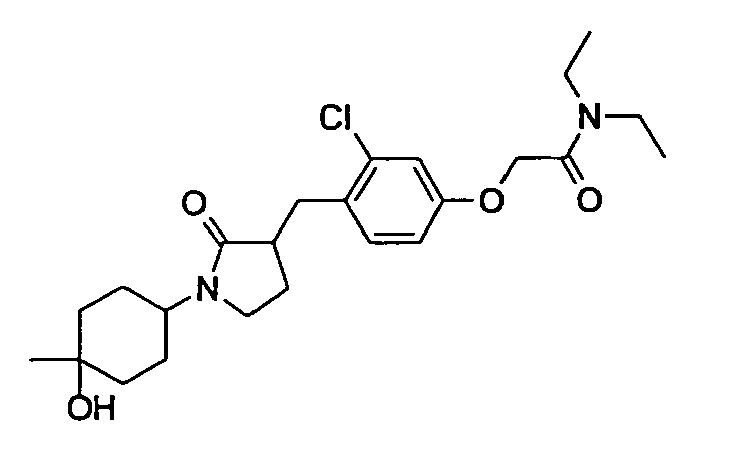
- In the same manner as in Example 318A, the title compound was obtained from 3-(2-chloro-4-hydroxybenzyl)-1-(4-hydroxy-4-methylcyclohexyl)pyrrolidin-2-one obtained in Example 542A and 2-chloro-N,N-diethylacetamide.
1H NMR (300 MHz, CDCl3) δ ppm 1.15 (t, J=7.1 Hz, 3 H), 1.24 (t, J=7.2 Hz, 3 H), 1.27 (s, 3 H), 1.46-1.82 (m, 7 H), 1.94-2.09(m, 1 H), 2.66-3.01 (m, 5 H), 3.16-3.48 (m, 7 H), 3.90-4.05 (m, 1 H), 4.62 (s, 2 H), 6.79 (dd, J=8.5, 2.6 Hz, 1 H), 6.94 (d, J=2.6 Hz, 1 H), 7.17 (d, J=8.5 Hz, 1 H). -
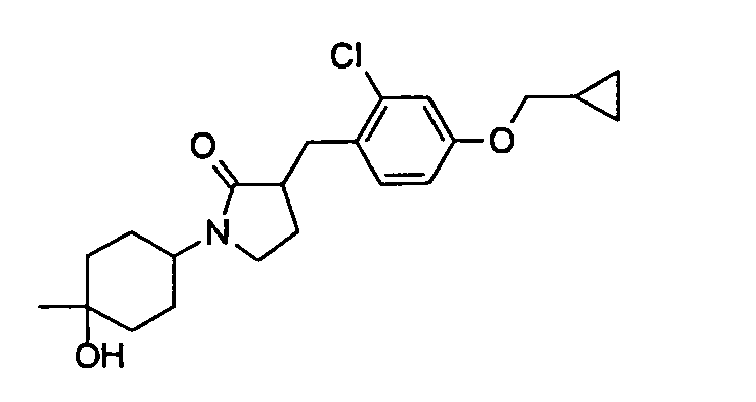
- In the same manner as in Example 318A, the title compound was obtained from 3-(2-chloro-4-hydroxybenzyl)-1-(4-hydroxy-4-methylcyclohexyl)pyrrolidin-2-one obtained in Example 543A and (bromomethyl)cyclopropane.
1H NMR (300 MHz, CDCl3) δ ppm 0.29-0.38 (m, 2 H), 0.60-0.69 (m, 2 H), 1.17-1.32 (m, 4 H), 1.42-1.82 (m, 10 H), 1.93-2.07 (m, 1 H), 2.66-2.84 (m, 2 H), 3.14-3.35 (m, 3 H), 3.76 (d, J=7.0 Hz, 1 H), 3.91-4.05 (m, 1 H), 6.74 (dd, J=8.5, 2.6 Hz, 1 H), 6.90 (d, J=2.6 Hz, 1 H), 7.15 (d, J=8.5 Hz, 1 H). -
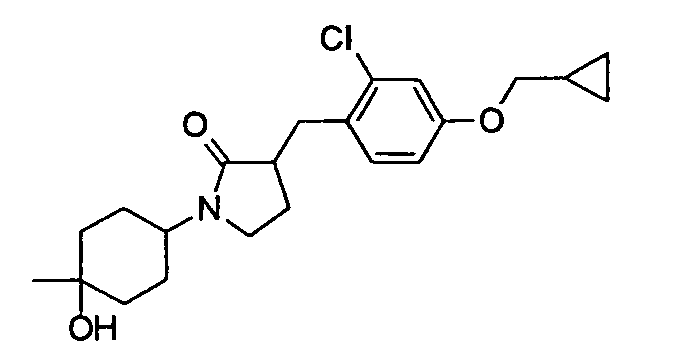
- In the same manner as in Example 318A, the title compound was obtained from 3-(2-chloro-4-hydroxybenzyl)-1-(4-hydroxy-4-methylcyclohexyl)pyrrolidin-2-one obtained in Example 544A and (bromomethyl)cyclopropane.
1H NMR (300 MHz, CDCl3) δ ppm 0.29-0.38 (m, 2 H), 0.58-0.69 (m, 2 H), 1.17-1.33 (m, 4 H), 1.43-1.82 (m, 10 H), 1.93-2.07 (m, 1 H), 2.65-2.83 (m, 2 H), 3.13-3.34 (m, 3 H), 3.76 (d, J=7.0 Hz, 1 H), 3.90-4.06 (m, 1 H), 6.74 (dd, J=8.5, 2.6 Hz, 1 H), 6.90 (d, J=2.6 Hz, 1 H), 7.15 (d, J=8.5 Hz, 1 H). -

- In the same manner as in Example 338A, the title compound was obtained from 3-(2-chloro-4-hydroxybenzyl)-1-(4-hydroxy-4-methylcyclohexyl)pyrrolidin-2-one obtained in Example 542A and 1-cyclohexyl-4-(hydroxymethyl)pyrrolidin-2-one obtained in Reference Example 17A.
1H NMR (300 MHz, CDCl3) δ ppm 1.01-1.18 (m, 1 H), 1.20-1.87 (m, 22 H), 1.94-2.10 (m, 1 H), 2.29 (dd, J=16.8, 5.8 Hz, 1 H), 2.54-2.87 (m, 4 H), 3.12-3.34 (m, 4 H), 3.55 (dd, J=10.0, 7.9 Hz, 1 H), 3.78-4.05 (m, 4 H), 6.72 (dd, J=8.5, 2.5 Hz, 1 H), 6.89 (d, J=2.5 Hz, 1 H), 7.18 (d, J=8.5 Hz, 1 H). -
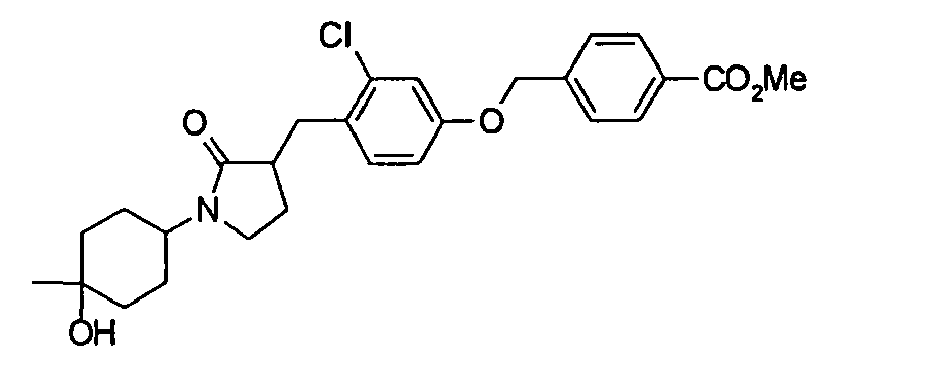
- In the same manner as in Example 318A, the title compound was obtained from 3-(2-chloro-4-hydroxybenzyl)-1-(4-hydroxy-4-methylcyclohexyl)pyrrolidin-2-one obtained in Example 543A and methyl 4-(bromomethyl)benzoate.
1H NMR (300 MHz, CDCl3) δ ppm 1.27 (s, 3 H), 1.39-1.82 (m, 10 H), 1.93-2.09 (m, 1 H), 2.68-3.83 (m, 2 H), 3.13-3.35 (m, 3 H), 3.88-4.05 (m, 4 H), 5.09 (s, 2 H), 6.80 (dd, J=8.5, 2.6 Hz, 1 H), 6.98 (d, J=2.6 Hz, 1 H), 7.18 (d, J=8.5 Hz, 1 H), 7.48 (d, J=8.1 Hz, 2 H), 7.99-8.10 (m, 2 H). -

- In the same manner as in Reference Example 19A, the title compound was obtained from methyl 4-[(3-chloro-4-{[1-(4-hydroxy-4-methylcyclohexyl)-2-oxopyrrolidin-3-yl]methyl}phenoxy)methyl]benzoate obtained in Example 567A.
1H NMR (300 MHz, CDCl3) δ ppm 1.27 (s, 3 H), 1.37-1.85 (m, 11 H), 1.94-2.08 (m, 1 H), 2.65-2.84 (m, 2 H), 3.13-3.35 (m, 3 H), 3.93-4.04 (m, 1 H), 4.71 (d, J=5.7 Hz, 2 H), 5.02 (s, 2 H), 6.80 (dd, J=8.6, 2.5 Hz, 1 H), 6.99 (d, J=2.5 Hz, 1 H), 7.16 (d, J=8.6 Hz, 1 H), 7.35-7.44 (m, 4 H). -

- In the same manner as in Example 338A, the title compound was obtained from 3-(2-chloro-4-hydroxybenzyl)-1-(4-hydroxy-4-methylcyclohexyl)pyrrolidin-2-one obtained in Example 542A and 2-morpholinoethanol.
LC-MS (ESI+) ; m/z 451(M+) -

- Methyl (3-chloro-4-{[1-(4-hydroxy-4-methylcyclohexyl)-2-oxopyrrolidin-3-yl]methyl}phenoxy)acetate obtained in Example 551A (112 mg) and 1-[4-(trifluoromethyl)phenyl]methanamine (58 µL) were stirred at 175°C for 13 hr. The reaction mixture was recrystallized from hexane-ethyl acetate to give the title compound (67 mg, 44%).
1H NMR (300 MHz, CDCl3) δ ppm 1.27 (s, 3 H), 1.33-1.83 (m, 10 H), 1.94-2.08 (m, 1 H), 2.68-2.83 (m, 2 H), 3.12-3.36 (m, 3 H), 3.90-4.04 (m, 1 H), 4.53 (s, 2 H), 4.60 (d, J=6.2 Hz, 2 H), 6.76 (dd, J=8.5, 2.7 Hz, 1 H), 6.86-6.97 (m, 2 H), 7.22 (d, J=8.5 Hz, 1 H), 7.40 (d, J=8.0 Hz, 2 H), 7.60 (d, J=8.0 Hz, 2 H). -

- In the same manner as in Example 318A, the title compound was obtained from 3-(2-chloro-4-hydroxybenzyl)-1-(4-hydroxy-4-methylcyclohexyl)pyrrolidin-2-one obtained in Example 542A and methyl 3-(bromomethyl)benzoate.
1H NMR (300 MHz, CDCl3) δ ppm 1.27 (s, 3 H), 1.36-1.83 (m, 10 H), 1.93-2.09 (m, 1 H), 2.67-2.84 (m, 2 H), 3.14-3.37 (m, 3 H), 3.88-4.06 (m, 4 H), 5.06 (s, 2 H), 6.81 (dd, J=8.7, 2.6 Hz, 1 H), 7.00 (d, J=2.6 Hz, 1 H), 7.18 (d, J=8.7 Hz, 1 H), 7.42-7.52 (m, 1 H), 7.62 (d, J=8.1 Hz, 1 H), 7.96-8.05 (m, 1 H), 8.07-8.12 (m, 1 H). -

- In the same manner as in Example 318A, the title compound was obtained from 3-(2-chloro-4-hydroxybenzyl)-1-(4-hydroxy-4-methylcyclohexyl)pyrrolidin-2-one obtained in Example 543A and 2-iodopropane.
1H NMR (300 MHz, CDCl3) δ ppm 1.27 (s, 3 H), 1.32 (d, J=6.2 Hz, 6 H), 1.41-1.82 (m, 10 H), 1.93-2.08 (m, 1 H), 2.64-2.84 (m, 2 H), 3.13-3.36 (m, 3 H), 3.90-4.05 (m, 1 H), 4.41-4.56 (m, 1 H), 6.72 (dd, J=8.5, 2.6 Hz, 1 H), 6.89 (d, J=2.6 Hz, 1 H), 7.14 (d, J=8.5 Hz, 1 H). -

- In the same manner as in Reference Example 19A, the title compound was obtained from methyl 3-[(3-chloro-4-{[1-(4-hydroxy-4-methylcyclohexyl)-2-oxopyrrolidin-3-yl]methyl}phenoxy)methyl]benzoate obtained in Example 571A.
1H NMR (300 MHz, CDCl3) δ ppm 1.27 (s, 3 H), 1.40-1.83 (m, 12 H), 1.94-2.09 (m, 1 H), 2.67-2.83 (m, 2 H), 3.13-3.35 (m, 3 H), 3.91-4.05 (m, 1 H), 4.73 (s, 1 H), 5.02 (s, 2 H), 6.81 (dd, J=8.5, 2.5 Hz, 1 H), 6.99 (d, J=2.5 Hz, 1 H), 7.17 (d, J=8.5 Hz, 1 H), 7.31-7.46 (m, 4 H). -

- In the same manner as in Example 318A, the title compound was obtained from 3-(2-chloro-4-hydroxybenzyl)-1-(4-hydroxy-4-methylcyclohexyl)pyrrolidin-2-one obtained in Example 544A and 2-iodopropane.
1H NMR (300 MHz, CDCl3) δ ppm 1.27 (s, 3 H), 1.32 (d, J=6.2 Hz, 6 H), 1.41-1.82 (m, 10 H), 1.93-2.08 (m, 1 H), 2.65-2.85 (m, 2 H), 3.11-3.35 (m, 3 H), 3.89-4.06 (m, 1 H), 4.40-4.58 (m, 1 H), 6.72 (dd, J=8.5, 2.5 Hz, 1 H), 6.89 (d, J=2.5 Hz, 1 H), 7.14 (d, J=8.5 Hz, 1 H). -
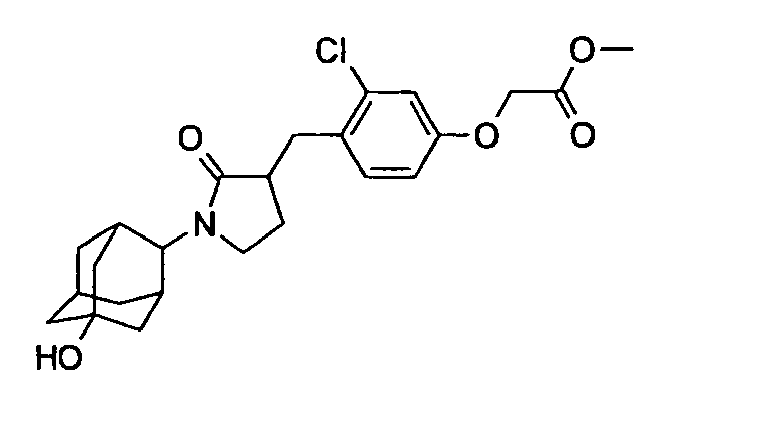
- In the same manner as in Example 318A, the title compound was obtained from 3-(2-chloro-4-hydroxybenzyl)-1-[5-hydroxy-2-adamantyl]pyrrolidin-2-one obtained in Example 431A and methyl bromoacetate.
1H NMR (300 MHz, CDCl3) δ ppm 1.41 (brs, 1 H), 1.46-1.57 (m, 2 H), 1.64-2.23 (m, 11 H), 2.38-2.52 (m, 2 H), 2.66-2.82 (m, 2 H), 3.19-3.59 (m, 3 H), 3.81 (s, 3 H), 3.87-3.94 (m, 1 H), 4.60 (s, 2 H), 6.75 (dd, J=8.5, 2.6 Hz, 1 H), 6.93 (d, J=2.6 Hz, 1 H), 7.20 (d, J=8.5 Hz, 1 H). -

- In the same manner as in Example 318A, the title compound was obtained from 3-(2-chloro-4-hydroxybenzyl)-1-[5-hydroxy-2-adamantyl]pyrrolidin-2-one obtained in Example 431A and methyl 4-(bromomethyl)benzoate.
1H NMR (300 MHz, CDCl3) δ ppm 1.39 (brs, 1 H), 1.45-1.56 (m, 2 H), 1.63-2.21 (m, 11 H), 2.38-2.52 (m, 2 H), 2.68-2.81 (m, 2 H), 3.22-3.56 (m, 3 H), 3.86-3.97 (m, 4 H), 5.09 (s, 2 H), 6.80 (dd, J=8.5, 2.5 Hz, 1 H), 6.99 (d, J=2.5 Hz, 1 H), 7.19 (d, J=8.5 Hz, 1 H), 7.48 (d, J=8.5 Hz, 2 H), 8.01-8.11 (m, 2 H). -

- In the same manner as in Example 318A, the title compound was obtained from 3-(2-chloro-4-hydroxybenzyl)-1-[5-hydroxy-2-adamantyl]pyrrolidin-2-one obtained in Example 431A and (bromomethyl)cyclopropane.
1H NMR (300 MHz, CDCl3) δ ppm 0.26-0.42 (m, 2 H), 0.56-0.72 (m, 2 H), 1.14-1.36 (m, 1 H), 1.42-2.11 (m, 13 H), 2.13-2.22 (m, 1 H), 2.38-2.51 (m, 2 H), 2.66-2.82 (m, 2 H), 3.21-3.57 (m, 3 H), 3.76 (d, J=7.0 Hz, 2 H), 3.87-3.96 (m, 1 H), 6.75 (dd, J=8.5, 2.6 Hz, 1 H), 6.90 (d, J=2.6 Hz, 1 H), 7.16 (d, J=8.5 Hz, 1 H). -
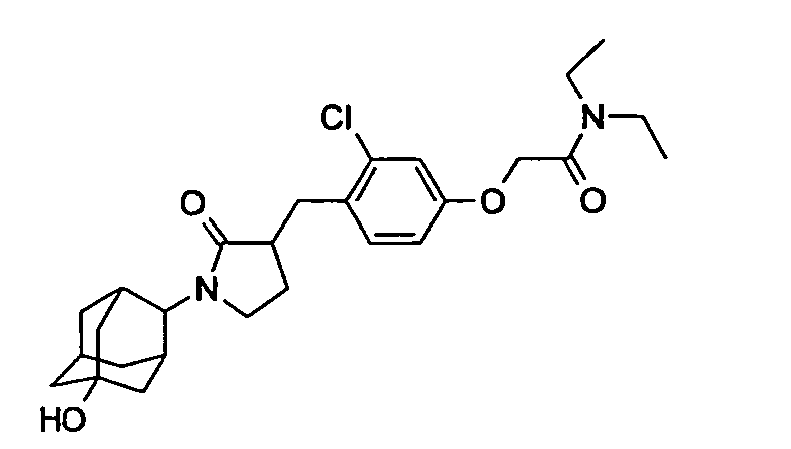
- In the same manner as in Example 318A, the title compound was obtained from 3-(2-chloro-4-hydroxybenzyl)-1-[5-hydroxy-2-adamantyl]pyrrolidin-2-one obtained in Example 431A and 2-chloro-N,N-diethylacetamide.
1H NMR (300 MHz, CDCl3) δ ppm 1.15 (t, J=7.1 Hz, 3 H), 1.23 (t, J=7.2 Hz, 3 H), 1.45-1.58 (m, 2 H), 1.62-2.11 (m, 11 H), 2.12-2.22 (m, 1 H), 2.39-2.52 (m, 2 H), 2.66-2.82 (m, 2 H), 3.21-3.58 (m, 7 H), 3.87-3.95 (m, 1 H), 4.64 (s, 2 H), 6.80 (dd, J=8.5, 2.6 Hz, 1 H), 6.95 (d, J=2.6 Hz, 1 H), 7.18 (d, J=8.5 Hz, 1 H). -

- In the same manner as in Example 318A, the title compound was obtained from 3-(2-chloro-4-hydroxybenzyl)-1-[5-hydroxy-2-adamantyl]pyrrolidin-2-one obtained in Example 431A and 2-iodopropane.
1H NMR (300 MHz, CDCl3) δ ppm 1.32 (d, J=6.0 Hz, 6 H), 1.35-1.42 (m, 1 H), 1.45-1.56 (m, 2 H), 1.65-2.22 (m, 11 H), 2.39-2.52 (m, 2 H), 2.66-2.79 (m, 2 H), 3.21-3.57 (m, 3 H), 3.87-3.94 (m, 1 H), 4.42-4.56 (m, 1 H), 6.72 (dd, J=8.5, 2.5 Hz, 1 H), 6.89 (d, J=2.5 Hz, 1 H), 7.15 (d, J=8.5 Hz, 1 H). -

- In the same manner as in Reference Example 19A, the title compound was obtained from methyl 4-[(3-chloro-4-{[1-(5-hydroxy-2-adamantyl)-2-oxopyrrolidin-3-yl]methyl}phenoxy)methyl]benzoate obtained in Example 576A.
1H NMR (300 MHz, CDCl3) δ 1.14-1.58 (m, 2 H), 1.68-1.96 (m, 6 H), 1.97-2.23 (m, 2 H), 2.43 (brs, 1 H), 2.56-2.89 (m, 7 H), 3.27 (dd, J=13.2, 3.8 Hz, 1 H), 3.41-3.58 (m, 2H), 3.87-3.95 (m, 1 H), 4.72 (s, 2 H), 5.03 (s, 2 H), 6.80 (dd, J=8.5, 2.5 Hz, 1 H), 6.99 (d, J=2.5 Hz, 1 H), 7.16 (d, J=8.5 Hz, 1 H), 7.36-7.46 (m, 4 H). -

- In the same manner as in Reference Example 19A, the title compound was obtained from methyl (3-chloro-4-{[1-(5-hydroxy-2-adamantyl)-2-oxopyrrolidin-3-yl]methyl}phenoxy)acetate obtained in Example 575A.
1H NMR (300 MHz, CDCl3) δ ppm 1.35-2.24 (m, 15 H), 2.37-2.52 (m, 2 H), 2.68-2.83 (m, 2 H), 3.21-3.59 (m, 3 H), 3.86-4.11 (m, 5 H), 6.77 (dd, J=8.5, 2.5 Hz, 1H), 6.94 (d, J=2.5 Hz, 1 H), 7.19 (d, J=8.5 Hz, 1 H). -

- 3-[2-Chloro-4-(2-hydroxyethoxy)benzyl]-1-(5-hydroxy-2-adamantyl)pyrrolidin-2-one (a mixture of two steric isomers) obtained in Example 581A was subjected to optical resolution with normal phase chiral high performance liquid chromatography (manufactured by Daicel Chemical Industries, Ltd., chiralpak AD (trade name), 50 mmID X 500 mmL, hexane-ethanol 1:1) to give the title compound (Example 582A) from a fraction with a retention time of 14 min and the title compound (Example 583A) from a fraction with a retention time of 20 min.
- 1H NMR (300 MHz, CDCl3) δ ppm 1.42 (s, 1 H), 1.46-1.57 (m, 2 H), 1.58-1.86 (m, 7 H), 1.86-2.10 (m, 4 H), 2.13-2.22 (m, 1 H), 2.39-2.51 (m, 2 H), 2.68-2.81 (m, 2 H), 3.22-3.35 (m, 1 H), 3.38-3.57 (m, 2 H), 3.87-4.00 (m, 3 H), 4.01-4.09 (m, 2 H), 6.77 (dd, J=8.5, 2.6 Hz, 1 H), 6.94 (d, J=2.6 Hz, 1 H), 7.19 (d, J=8.5 Hz, 1 H).
- 1H NMR (300 MHz, CDCl3) δ ppm 1.45 (s, 1 H), 1.47-1.56 (m, 2 H), 1.61-1.85 (m, 7 H), 1.86-2.10 (m, 4 H), 2.13-2.21 (m, 1 H), 2.39-2.52 (m, 2 H), 2.67-2.81 (m, 2 H), 3.22-3.35 (m, 1 H), 3.38-3.57 (m, 2 H), 3.87-4.00 (m, 3 H), 4.01-4.09 (m, 2 H), 6.77 (dd, J=8.5, 2.6 Hz, 1 H), 6.94 (d, J=2.6 Hz, 1 H), 7.18 (d, J=8.5 Hz, 1 H).
-

- In the same manner as in Example 155A, the title compound was obtained from methyl 4-[(3-chloro-4-{[1-(5-hydroxy-2-adamantyl)-2-oxopyrrolidin-3-yl]methyl}phenoxy)methyl]benzoate obtained in Example 576A.
1H NMR (300 MHz, DMSO-d6) δ 1.31-1.46 (m, 2 H), 1.50-1.81 (m, 9 H), 1.82-1.97 (m, 1 H), 2.03 (brs, 1 H), 2.20-2.39 (m, 2 H), 2.45-2.70 (m, 2 H), 3.12 (dd, J=12.9, 3.5 Hz, 1 H), 3.24-3.65 (m, 3H), 4.43 (brs, 1 H), 5.20 (s, 2 H), 6.94 (dd, J=8.5, 2.5 Hz, 1 H), 7.12 (d, J=2.6 Hz, 1 H), 7.27 (d, J=8.5 Hz, 1 H), 7.55 (d, J=8.3 Hz, 2 H), 7.96 (d, J=8.3 Hz, 2 H), 12.98 (brs, 1 H). Example 585A (3-chloro-4-{[1-(5-hydroxy-2-adamantyl)-2-oxopyrrolidin-3-yl]methyl}phenoxy)acetic acid
- In the same manner as in Example 155A, the title compound was obtained from methyl (3-chloro-4-{[1-(5-hydroxy-2-adamantyl)-2-oxopyrrolidin-3-yl]methyl}phenoxy)acetate obtained in Example 575A.
1H NMR (300 MHz, DMSO-d6) δ ppm 1.33-1.46 (m, 2 H), 1.53-1.82 (m, 9 H), 1.83-1.97 (m, 1 H), 2.04 (brs, 1 H), 2.23-2.38 (m, 2 H), 2.55-2.70 (m, 1 H), 3.12 (dd, J=13.1, 3.7 Hz, 1 H), 3.23-3.57 (m, 3 H), 3.70 (brs, 1 H), 4.43 (brs, 1 H), 4.69 (s, 2 H), 6.85 (dd, J=8.5, 2.6 Hz, 1 H), 6.99 (d, J=2.6 Hz, 1 H), 7.26 (d, J=8.5 Hz, 1 H), 13.05 (brs, 1 H). -

- In the same manner as in Example 318A, the title compound was obtained from 3-(2-chloro-4-hydroxybenzyl)-1-(4-hydroxy-4-methylcyclohexyl)pyrrolidin-2-one obtained in Example 542A and 4-(chloromethyl)-5-methyl-2-phenyl-1,3-oxazole.
1H NMR (300 MHz, CDCl3) δ ppm 1.27 (s, 3 H), 1.38-1.83 (m, 10 H), 1.93-2.09 (m, 1 H), 2.44 (s, 3 H), 2.68-2.86 (m, 2 H), 3.12-3.38 (m, 3 H), 3.89-4.06 (m, 4 H), 4.95 (s, 2 H), 6.86 (dd, J=8.6, 2.5 Hz, 1 H), 7.05 (d, J=2.5 Hz, 1 H), 7.18 (d, J=8.6 Hz, 1 H), 7.39-7.49 (m, 3 H), 7.96-8.06 (m, 1 H). -

- In the same manner as in Example 318A, the title compound was obtained from 3-(2-chloro-4-hydroxybenzyl)-1-(4-hydroxy-4-methylcyclohexyl)pyrrolidin-2-one obtained in Example 542A and 2-(chloromethyl)-5-(tri.fluoromethyl)-1,3-benzothiazole.
1H NMR (300 MHz, CDCl3) δ ppm 1.27 (s, 3 H), 1.36-1.81 (m, 10 H), 1.95-2.10 (m, 1 H), 2.68-2.85 (m, 2 H), 3.12-3.36 (m, 3 H), 3.90-4.05 (m, 1 H), 5.47 (s, 2 H), 6.88 (dd, J=8.5, 2.6 Hz, 1 H), 7.07 (d, J=2.6 Hz, 1 H), 7.22 (d, J=8.5 Hz, 1 H), 7.65 (dd, J=8.5, 1.3 Hz, 1 H), 8.02 (d, J=8.5 Hz, 1 H), 8.30 (brs, 1 H). -

- In the same manner as in Example 318A, the title compound was obtained from 3-(2-chloro-4-hydroxybenzyl)-1-[5-hydroxy-2-adamantyl]pyrrolidin-2-one obtained in Example 431A and 4-(chloromethyl)-5-methyl-2-phenyl-1,3-oxazole.
1H NMR (300 MHz, CDCl3) δ ppm 1.38-1.57 (m, 3 H), 1.67-2.10 (m, 10 H), 2.12-2.22 (m, 1 H), 2.38-2.53 (m, 5 H), 2.67-2.83 (m, 2 H), 3.23-3.56 (m, 3 H), 3.88-3.94 (m, 1 H), 4.95 (s, 2 H), 6.86 (dd, J=8.5, 2.5 Hz, 1 H), 7.05 (d, J=2.5 Hz, 1 H), 7.19 (d, J=8.5 Hz, 1 H), 7.39-7.48 (m, 3 H), 7.96-8.06 (m, 1 H). -

- In the same manner as in Example 318A, the title compound was obtained from 3-(2-chloro-4-hydroxybenzyl)-1-[5-hydroxy-2-adamantyl]pyrrolidin-2-one obtained in Example 431A and methyl 3-(bromomethyl)benzoate.
1H NMR (300 MHz, CDCl3) δ ppm 1.44-1.59 (m, 3 H), 1.62-1.85 (m, 7 H), 1.86-1.95 (m, 2 H), 1.98-2.10 (m, 1 H), 2.13-2.21 (m, 1 H), 2.38-2.51 (m, 2 H), 2.67-2.80 (m, 2 H), 3.21-3.59 (m, 3 H), 3.87-3.97 (m, 4 H), 5.06 (s, 2 H), 6.81 (dd, J=8.5, 2.6 Hz, 1 H), 7.00 (d, J=2.6 Hz, 1 H), 7.19 (d, J=8.5 Hz, 1 H), 7.41-7.52 (m, 1 H), 7.58-7.66 (m, 1 H), 7.97-8.13 (m, 2 H). -

- In the same manner as in Example 338A, the title compound was obtained from 3-(2-chloro-4-hydroxybenzyl)-1-[5-hydroxy-2-adamantyl]pyrrolidin-2-one obtained in Example 431A and 2-(2-hydroxyethyl)-1H-isoindole-1,3(2H)-dione.
1H NMR (300 MHz, CDCl3) δ ppm 1.44-1.57 (m, 2 H), 1.65-1.83 (m, 5 H), 1.85-2.07 (m, 3 H), 2.11-2.20 (m, 1 H), 2.36-2.49 (m, 2 H), 2.65-2.85 (m, 2 H), 2.87-3.08 (m, 3 H), 3.17-3.31 (m, 1 H), 3.38-3.55 (m, 2 H), 3.87-3.94 (m, 1 H), 4.05-4.13 (m, 2 H), 4.15-4.24 (m, 2 H), 6.72 (dd, J=8.6, 2.5 Hz, 1 H), 6.89 (d, J=2.5 Hz, 1 H), 7.12 (d, J=8.6 Hz, 1 H), 7.69-7.78 (m, 2 H), 7.82-7.91 (m, 2 H). -

- In the same manner as in Example 155A, the title compound was obtained from methyl 3-[(3-chloro-4-{[1-(5-hydroxy-2-adamantyl)-2-oxopyrrolidin-3-yl]methyl}phenoxy)methyl]benzoate obtained in Example 589A.
1H NMR (300 MHz, DMSO-d6) δ ppm 1.32-1.45 (m, 2 H), 1.52-1.80 (m, 9 H), 1.83-1.97 (m, 1 H), 2.00-2.07 (m, 1 H), 2.23-2.38 (m, 2 H), 2.52-2.68 (m, 2 H), 3.12 (dd, J=13.1, 3.5 Hz, 1 H), 3.66-3.74 (m, 3 H), 3.70 (brs, 1 H), 4.43 (brs; 1 H), 5.19 (s, 2 H), 6.95 (dd, J=8.5, 2.5 Hz, 1 H), 7.12 (d, J=2.5 Hz, 1 H), 7.27 (d, J=8.5 Hz, 1 H), 7.66-7.72 (m, 1-H), 7.88-7.93 (m, 1 H), 7.98-8.05 (m, 1 H), 13.06 (brs, 1 H). -

- In the same manner as in Reference Example 19A, the title compound was obtained from methyl 3-[(3-chloro-4-{[1-(5-hydroxy-2-adamantyl)-2-oxopyrrolidin-3-yl]methyl}phenoxy)methyl]benzoate obtained in Example 589A.
1H NMR (300 MHz, CDCl3) δ ppm 1.35-1.43 (m, 1 H), 1.46-1.56 (m, 2 H), 1.66-2.10 (m, 11 H), 2.13-2.21 (m, 1 H), 2.38-2.50 (m, 2 H), 2.67-2.81 (m, 2 H), 3.22-3.34 (m, 1 H), 3.38-3.57 (m, 2 H), 3.88-3.93 (m, 1 H), 4.69-4.77 (m, 2 H), 5.03 (s, 2 H), 6.81 (dd, J=8.5, 2.5 Hz, 1 H), 7.00 (d, J=2.5 Hz, 1 H), 7.18 (d, J=8.5 Hz, 1 H), 7.31-7.46 (m, 4 H). -

- In the same manner as in Example 570A, the title compound was obtained from methyl (3-chloro-4-{[1-(5-hydroxy-2-adamantyl)-2-oxopyrrolidin-3-yl]methyl}phenoxy)acetate obtained in Example 575A and 1-[4-(trifluoromethyl)phenyl]methanamine.
1H NMR (300 MHz, CDCl3) δ ppm 1.46-1.85 (m, 11 H), 1.86-2.11 (m, 2 H), 2.13-2.22 (m, 1 H), 2.38-2.51 (m, 2 H), 2.67-2.82 (m, 2 H), 3.21-3.59 (m, 3 H), 3.85-3.94 (m, 1 H), 4.54 (s, 2 H), 4.60 (d, J=6.2 Hz, 2 H), 6.76 (dd, J=8.5, 2.7 Hz, 1 H), 6.87-6.99 (m, 2 H), 7.23 (d, J=8.5 Hz, 1 H), 7.40 (d, J=8.1 Hz, 1 H), 7.60 (d, J=8.1 Hz, 2 H). -

- In the same manner as in Example 570A, the title compound was obtained from methyl (3-chloro-4-{[1-(5-hydroxy-2-adamantyl)-2-oxopyrrolidin-3-yl]methyl}phenoxy)acetate obtained in Example 575A and 1-cyclopropylmethanamine.
1H NMR (300 MHz, CDCl3) δ ppm 0.18-0.28 (m, 2 H), 0.48-0.59 (m, 2 H), 0.90-1.07 (m, 1 H), 1.40-1.97 (m, 12 H), 1.98-2.11 (m, 1 H), 2.13-2.22 (m, 1 H), 2.39-2.53 (m, 2 H), 2.68-2.83 (m, 2 H), 3.16-3.37 (m, 3 H), 3.38-3.60 (m, 2 H), 3.87-3.96 (m, 1 H), 4.46 (s, 2 H), 6.56-6.67 (m, 1 H), 6.79 (dd, J=8.5, 2.6 Hz, 1 H), 6.98 (d, J=2.6 Hz, 1 H), 7.23 (d, J=8.5 Hz, 1 H). -

- In the same manner as in Example 570A, the title compound was obtained from methyl (3-chloro-4-{[1-(4-hydroxy-4-methylcyclohexyl)-2-oxopyrrolidin-3-yl]methyl}phenoxy)acetate obtained in Example 551A and 4-methoxybenzylamine.
1H NMR (300 MHz, CDCl3) δ ppm 1.27 (s, 3 H), 1.34-1.82 (m, 11 H), 1.94-2.08 (m, 1 H), 2.68-2.81 (m, 2 H), 3.14-3.35 (m, 3 H), 3.80 (s, 3 H), 3.91-4.04 (m, 1 H), 4.42-4.54 (m, 3 H), 6.71-6.81 (m, 2 H), 6.83-6.96 (m, 3 H), 7.16-7.25 (m, 3 H). -
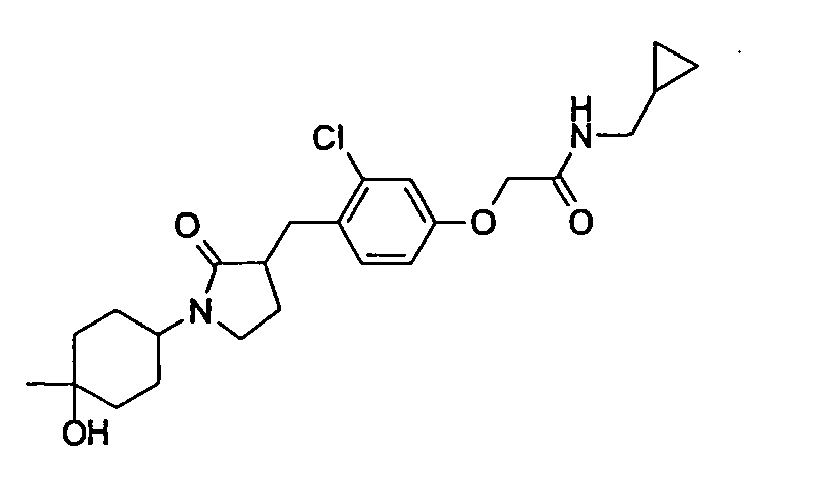
- In the same manner as in Example 570A, the title compound was obtained from methyl (3-chloro-4-{[1-(4-hydroxy-4-methylcyclohexyl)-2-oxopyrrolidin-3-yl]methyl}phenoxy)acetate obtained in Example 551A and 1-cyclopropylmethanamine.
1H NMR (300 MHz, CDCl3) δ ppm 0.18-0.28 (m, 2 H), 0.48-0.59 (m, 2 H), 0.91-1.07 (m, 1 H), 1.27 (s, 3 H), 1.42-1.82 (m, 10 H), 1.95-2.10 (m, 1 H), 2.70-2.84 (m, 2 H), 3.14-3.36 (m, 5 H), 3.91-4.05 (m, 1 H), 4.46 (s, 2 H), 6.65-6.66 (m, 1 H), 6.79 (dd, J=8.5, 2.6 Hz, 1 H), 6.97 (d, J=2.6 Hz, 1 H), 7.23 (d, J=8.5 Hz, 1 H). -

- In the same manner as in Example 318A, the title compound was obtained from 3-(2-chloro-4-hydroxybenzyl)-1-(4-hydroxy-4-methylcyclohexyl)pyrrolidin-2-one obtained in Example 543A and methyl bromoacetate.
1H NMR (300 MHz, CDCl3) δ ppm 1.27 (s, 3 H), 1.41-1.81 (m, 10 H), 1.94-2.08 (m, 1 H), 2.67-2.83 (m, 2 H), 3.14-3.36 (m, 3 H), 3.81 (s, 3 H), 3.91-4.05 (m, 1 H), 4.61 (s, 2 H), 6.75 (dd, J=8.5, 2.6 Hz, 1 H), 6.92 (d, J=2.6 Hz, 1 H), 7.19 (d, J=8.5 Hz, 1 H). Example 598A methyl (3-chloro-4-{[1-(4-hydroxy-4-methylcyclohexyl)-2-oxopyrrolidin-3-yl]methyl}phenoxy)acetate (an optically active form 2)
- In the same manner as in Example 318A, the title compound was obtained from 3-(2-chloro-4-hydroxybenzyl)-1-(4-hydroxy-4-methylcyclohexyl)pyrrolidin-2-one obtained in Example 544A and methyl bromoacetate.
1H NMR (300 MHz, CDCl3) δ ppm 1.27 (s, 3 H), 1.41-1.82 (m, 10 H), 1.94-2.09 (m, 1 H), 2.67-2.81 (m, 2 H), 3.14-3.36 (m, 3 H), 3.81 (s, 3 H), 3.90-4.05 (m, 1 H), 4.60 (s, 2 H), 6.75 (dd, J=8.5, 2.6 Hz, 1 H), 6.92 (d, J=2.6 Hz, 1 H), 7.19 (d, J=8.5 Hz, 1 H). -

- In the same manner as in Example 318A, the title compound was obtained from 3-(2-chloro-4-hydroxybenzyl)-1-(5-hydroxy-2-adamantyl)pyrrolidin-2-one obtained in Example 431A and 2-(chloromethyl)-5-(trifluoromethyl)-1,3-benzothiazole.
1H NMR (300 MHz, CDCl3) δ ppm 1.37-1.84 (m, 10 H), 1.85-2.11 (m, 4 H), 2.37-2.51 (m, 2 H), 2.68-2.82 (m, 2 H), 3.22-3.36 (m, 1 H), 3.37-3.58 (m, 2 H), 3.87-3.94 (m, 1 H), 5.47 (s, 2 H), 6.88 (dd, J=8.5, 2.6 Hz, 1 H), 7.07 (d, J=2.6 Hz, 1 H), 7.23 (d, J=8.5 Hz, 1 H), 7.62-7.69 (m, 1 H), 8.02 (d, J=8.5 Hz, 1 H), 8.30 (s, 1 H). -

- In the same manner as in Example 570A, the title compound was obtained from methyl (3-chloro-4-1[1-(5-hydroxy-2-adamantyl)-2-oxopyrrolidin-3-yl]methyl}phenoxy)acetate obtained in Example 575A and 4-methoxybenzylamine.
1H NMR (300 MHz, CDCl3) δ ppm 1.43-2.09 (m, 13 H), 2.13-2.22 (m, 1 H), 2.38-2.51 (m, 2 H), 2.67-2.81 (m, 2 H), 3.20-3.35 (m, 1 H), 3.37-3.59 (m, 2 H), 3.80 (s, 3 H), 3.87-3.94 (m, 1 H), 4.42-4.54 (m, 4 H), 6.71-6.81 (m, 2 H), 6.84-6.95 (m, 3 H), 7.16-7.26 (m, 3 H). -

- In the same manner as in Example 570A, the title compound was obtained from methyl (3-chloro-4-{[1-(5-hydroxy-2-adamantyl)-2-oxopyrrolidin-3-yl]methyl}phenoxy)acetate obtained in Example 575A and 2,4-difluorobenzylamine.
1H NMR (300 MHz, CDCl3) δ ppm 1.34-1.41 (m, 1 H), 1.45-2.10 (m, 12 H), 2.13-2.22 (m, 1 H), 2.40-2.51 (m, 2 H), 2.68-2.81 (m, 2 H), 3.22-3.33 (m, 1 H), 3.39-3.58 (m, 2 H), 3.88-3.94 (m, 1 H), 4.48 (s, 2 H), 4.54 (d, J=6.2 Hz, 2 H), 6.71-6.97 (m, 5 H), 7.17-7.40 (m, 2 H). -

- In the same manner as in Example 570A, the title compound was obtained from methyl (3-chloro-4-{[1-(4-hydroxy-4-methylcyclohexyl)-2-oxopyrrolidin-3-yl]methyl}phenoxy)acetate obtained in Example 597A and 1-[4-(trifluoromethyl)phenyl]methanamine.
1H NMR (300 MHz, CDCl3) δ ppm 1.27 (s, 3 H), 1.41-1.83 (m, 10 H), 1.94-2.09 (m, 1 H), 2.67-2.85 (m, 2 H), 3.13-3.35 (m, 3 H), 3.91-4.04 (m, 1 H), 4.54 (s, 2 H), 4.60 (d, J=6.2 Hz, 2 H), 6.76 (dd, J=8.5, 2.7 Hz, 1 H), 6.86-6.98 (m, 2 H), 7.22 (d, J=8.5 Hz, 1 H), 7.40 (d, J=8.1 Hz, 2 H), 7.60 (d, J=8.1 Hz, 2 H). -

- In the same manner as in Example 570A, the title compound was obtained from methyl (3-chloro-4-{[1-(4-hydroxy-4-methylcyclohexyl)-2-oxopyrrolidin-3-yl]methyl}phenoxy)acetate obtained in Example 598A and 1-[4-(trifluoromethyl)phenyl]methanamine.
1H NMR (300 MHz, CDCl3) δ ppm 1.27 (s, 3 H), 1.36-1.82 (m, 10 H), 1.94-2.09 (m, 1 H), 2.68-2.82 (m, 2 H), 3.13-3.35 (m, 3 H), 3.91-4.04 (m, 1H), 4.54 (s, 2 H), 4.60 (d, J=6.0 Hz, 2 H), 6.76 (dd, J=8.5, 2.7 Hz, 1 H), 6.87-6.98 (m, 2 H), 7.22 (d, J=8.5 Hz, 1 H), 7.40 (d, J=8.1 Hz, 2 H), 7.60 (d, J=8.1 Hz, 2 H). -

- In the same manner as in Example 318A, the title compound was obtained from 3-(2-chloro-4-hydroxybenzyl)-1-(4-hydroxy-4-methylcyclohexyl)pyrrolidin-2-one obtained in Example 542A and 4-(chloromethyl)-1,3-thiazole.
1H NMR (300 MHz, CDCl3) δ ppm 1.27 (s, 3 H), 1.37-1.86 (m, 10 H), 1.92-2.11 (m, 1 H), 2.67-2.86 (m, 2 H), 3.11-3.39 (m, 3 H), 3.90-4.06 (m, 1 H), 5.23 (s, 2 H), 6.84 (dd, J=8.5, 2.5 Hz, 1 H), 7.03 (d, J=2.5 Hz, 1 H), 7.19 (d, J=8.5 Hz, 1 H), 7.34-7.46 (m, 1 H), 8.84 (d, J=1.9 Hz, 1 H). -

- In the same manner as in Example 318A, the title compound was obtained from 3-(2-chloro-4-hydroxybenzyl)-1-[5-hydroxy-2-adamantyl]pyrrolidin-2-one obtained in Example 431A and 4-(chloromethyl)-1,3-thiazole.
1H NMR (300 MHz, CDCl3) δ ppm 1.46-1.60 (m, 3 H), 1.62-2.26 (m, 11 H), 2.37-2.55 (m, 2 H), 2.65-2.85 (m, 2 H), 3.22-3.59 (m, 3 H), 3.86-3.99 (m, 1 H), 5.23 (s, 2 H), 6.84 (dd, J=8.5, 2.5 Hz, 1 H), 7.03 (d, J=2.5 Hz, 1 H), 7.19 (d, J=8.5 Hz, 1 H), 7.33-7.49 (m, 1 H), 8.84 (d, J=2.1 Hz, 1 H). -

- In the same manner as in Example 318A, the title compound was obtained from 3-(2-chloro-4-hydroxybenzyl)-1-(4-hydroxy-4-methylcyclohexyl)pyrrolidin-2-one obtained in Example 542A and 4-(chloromethyl)-2-methyl-1,3-thiazole.
1H NMR (300 MHz, CDCl3) δ ppm 1.27 (s, 3 H), 1.39-1.82 (m, 10 H), 1.94-2.09 (m, 1 H), 2.68-2.83 (m, 5 H), 3.13-3.37 (m, 3 H), 3.90-4.06 (m, 1 H), 5.10 (s, 2 H), 6.83 (dd, J=8.3, 2.7 Hz, 1 H), 7.01 (d, J=2.7 Hz, 1 H), 7.12-7.22 (m, 2 H). -

- In the same manner as in Example 318A, the title compound was obtained from 3-(2-chloro-4-hydroxybenzyl)-1-[5-hydroxy-2-adamantyl]pyrrolidin-2-one obtained in Example 431A and 4-(chloromethyl)-2-methyl-1,3-thiazole.
1H NMR (300 MHz, CDCl3) δ ppm 1.46-1.58 (m, 3 H), 1.65-1.86 (m, 7 H), 1.87-2.11 (m, 1 H), 2.12-2.22 (m, 1 H), 2.37-2.53 (m, 2 H), 2.67-2.83 (m, 5 H), 3.21-3.58 (m, 3 H), 3.87-3.96 (m, 1 H), 5.11 (s, 2 H), 6.83 (dd, J=8.7, 2.7 Hz, 1 H), 7.01 (d, J=2.7 Hz, 1 H), 7.12-7.24 (m, 2 H). -

- In the same manner as in Example 318A, the title compound was obtained from 3-(2-chloro-4-hydroxybenzyl)-1-(4-hydroxy-4-methylcyclohexyl)pyrrolidin-2-one obtained in Example 542A and ethyl 4-(chloromethyl)-1,3-thiazole-2-carboxylate.
1H NMR (300 MHz, CDCl3) δ ppm 1.27 (s, 3 H), 1.35-1.84 (m, 13 H), 1.95-2.10 (m, 1 H), 2.67-2.85 (m, 2 H), 3.13-3.37 (m, 3 H), 3.91-4.06 (m, 1 H), 4.51 (q, J=7.2 Hz, 2 H), 5.26 (s, 2 H), 6.81 (dd, J=8.3, 2.7 Hz, 1 H), 6.99 (d, J=2.7 Hz, 1 H), 7.19 (d, J=8.3 Hz, 1H), 7.62 (s, 1H). -

- In the same manner as in Example 318A, the title compound was obtained from 3-(2-chloro-4-hydroxybenzyl)-1-[5-hydroxy-2-adamantyl]pyrrolidin-2-one obtained in Example 431A and ethyl 4-(chloromethyl)-1,3-thiazole-2-carboxylate.
1H NMR (300 MHz, CDCl3) δ ppm 1.39-2.12 (m, 16 H), 2.12-2.24 (m, 1 H), 2.36-2.54 (m, 2 H), 2.67-2.84 (m, 2 H), 3.20-3.59 (m, 3 H), 3.86-3.96 (m, 1 H), 4.51 (q, J=7.2 Hz, 2 H), 5.26 (s, 2 H), 6.81 (dd, J=8.7, 2.7 Hz, 1 H), 7.00 (d, J=2.7 Hz, 1 H), 7.20 (d, J=8.7 Hz, 1 H), 7.63 (s, 1 H). -

- In the same manner as in Example 570A, the title compound was obtained from methyl (3-chloro-4-{[1-(4-hydroxy-4-methylcyclohexyl)-2-oxopyrrolidin-3-yl]methyl}phenoxy)acetate obtained in Example 551A and 4-fluoroaniline.
1H NMR (300 MHz, CDCl3) δ ppm 1.27 (s, 3 H), 1.33-1.82 (m, 10 H), 1.97-2.11 (m, 1 H), 2.71-2.85 (m, 2 H), 3.14-3.38 (m, 3 H), 3.91-4.06 (m, 1 H), 4.58 (s, 2 H), 6.84 (dd, J=8.3, 2.7 Hz, 1 H), 6.99-7.12 (m, 3 H), 7,22-7.30 (m, 1 H), 7.50-7.62 (m, 2 H), 8.19 (brs, 1 H). -

- In the same manner as in Reference Example 19A, the title compound was obtained from ethyl 4-[(3-chloro-4-{[1-(4-hydroxy-4-methylcyclohexyl)-2-oxopyrrolidin-3-yl]methyl}phenoxy)methyl]-1,3-thiazole-2-carboxylate obtained in Example 608A.
1H NMR (300 MHz, CDCl3) δ ppm 1.27 (s, 3 H), 1.41-1.62 (m, 10 H), 1.93-2.08 (m, 1 H), 2.67-2.84 (m, 2 H), 3.01 (t, J=6.1 Hz, 2 H), 3.11-3.34 (m, 3 H), 3.89-4.05 (m, 1 H), 4.97 (d, J=6.1 Hz, 2 H), 5.12 (s, 2 H), 6.82 (dd, J=8.7, 2.7 Hz, 1 H), 7.01 (d, J=2.7 Hz, 1H), 7.18 (d, J=8.7 Hz, 1H), 7.30 (s, 1H). -

- In the same manner as in Reference Example 19A, the title compound was obtained from ethyl 4-[(3-chloro-4-1[1-(5-hydroxy-2-adamantyl)-2-oxopyrrolidin-3-yl]methyl}phenoxy)methyl]-1,3-thiazole-2-carboxylate obtained in Example 609A.
1H NMR (300 MHz, CDCl3) δ ppm 1.39-2.11 (m, 13 H), 2.13-2.22 (m, 1 H), 2.39-2.49 (m, 2 H), 2.68-2.95 (m, 3 H), 3.21-3.55 (m, 3 H), 3.86-3.94 (m, 1 H), 4.97 (s, 2 H), 5.13 (s, 2 H), 6.83 (dd, J=8.5, 2.7 Hz, 1 H), 7.01 (d, J=2.7 Hz, 1 H), 7.18 (d, J=8.5 Hz, 1 H), 7.30 (s, 1 H). -

- In the same manner as in Example 570A, the title compound was obtained from methyl (3-chloro-4-{[1-(4-hydroxy-4-methylcyclohexyl)-2-oxopyrrolidin-3-yl]methyl}phenoxy)acetate obtained in Example 551A and benzylamine.
1H NMR (300 MHz, CDCl3) δ ppm 1.27 (s, 3 H), 1.38-1.82 (m, 10 H), 1.95-2.08 (m, 1 H), 2.69-2.83 (m, 2 H), 3.13-3.37 (m, 3 H), 3.90-4.05 (m, 1 H), 4.52 (s, 2 H), 4.55 (d, J=5.8 Hz, 2 H), 6.75 (dd, J=8.5, 2.6 Hz, 1 H), 6.79-6.88 (m, 1 H), 6.94 (d, J=2.6 Hz, 1H), 7.21 (d, J=8.5 Hz, 1H), 7.25-7.40 (m, 5 H). -

- In the same manner as in Example 570A, the title compound was obtained from methyl (3-chloro-4-{[1-(5-hydroxy-2-adamantyl)-2-oxopyrrolidin-3-yl]methyl}phenoxy)acetate obtained in Example 575A and benzylamine.
1H NMR (300 MHz, CDCl3) δ ppm 1.35-1.57 (m, 3 H), 1.62-2.10 (m, 10 H), 2.13-2.22 (m, 1 H), 2.38-2.51 (m, 2 H), 2.67-2.82 (m, 2 H), 3.21-3.57 (m, 3 H), 3.88-3.93 (m, 1 H), 4.52 (s, 2 H), 4.55 (d, J=6.0 Hz, 2 H), 6.75 (dd, J=8.5, 2.6 Hz, 1 H), 6.78-6.87 (m, 1 H), 6.94 (d, J=2.6 Hz, 1 H), 7.21 (d, J=8.5 Hz, 1 H), 7.24-7.39 (m, 5 H). -

- In the same manner as in Example 525A, the title compound was obtained from (3-chloro-4-{[1-(5-hydroxy-2-adamantyl)-2-oxopyrrolidin-3-yl]methyl}phenoxy)acetic acid obtained in Example 585A and 4-fluorobenzamidoxime.
1H NMR (300 MHz, CDCl3) δ ppm 1.39 (s, 1 H), 1.45-1.96 (m, 11 H), 1.97-2.11 (m, 1 H), 2.13-2.21 (m, 1 H), 2.39-2.51 (m, 2 H), 2.69-2.83 (m, 2 H), 3.23-3.36 (m, 1 H), 3.38-3.57 (m, 2 H), 3.87-3.95 (m, 1 H), 5.31 (s, 2 H), 6.87 (dd, J=8.5, 2.7 Hz, 1 H), 7.07 (d, J=2.7 Hz, 1 H), 7.14 -7.28 (m, 3 H), 8.04-8.16 (m, 2 H). -

- In the same manner as in Example 70A, the title compound was obtained from (3-chloro-4-{[1-(5-hydroxy-2-adamantyl)-2-oxopyrrolidin-3-yl]methyl}phenoxy)acetic acid obtained in Example 585A and ammonium 1H-1,2,3-benzotriazol-1-ol.
1H NMR (300 MHz, CDCl3) δ ppm 1.33-1.46 (m, 2 H), 1.51-1.96 (m, 10 H), 2.00-2.08 (m, 1 H), 2.23-2.38 (m, 1 H), 2.53-2.70 (m, 2 H), 3.12 (dd, J=13.2, 3.6 Hz, 1 H), 3.28-3.57 (m, 3 H), 3.66-3.74 (m, 1 H), 4.40-4.47 (m, 3 H), 6.88 (dd, J=8.5, 2.6 Hz, 1 H), 7.03 (d, J=2.6 Hz, 1 H), 7.28 (d, J=8.5 Hz, 1 H), 7.41 (brs, 1 H), 7.56 (brs, 1 H). -

- In the same manner as in Example 155A, the title compound was obtained from methyl (3-chloro-4-{[1-(4-hydroxy-4-methylcyclohexyl)-2-oxopyrrolidin-3-yl]methyl}phenoxy)acetate obtained in Example 551A.
1H NMR (300 MHz, DMSO-d6) δ ppm 1.13 (s, 3 H), 1.37-1.65 (m, 9 H), 1.81-1.95 (m, 1 H), 2.44-2.72 (m, 2 H), 3.05-3.43 (m, 3 H), 3.64-3.78 (m, 1 H), 4.37 (brs, 1 H), 4.69 (s, 2 H), 6.85 (dd, J=8.5, 2.6 Hz, 1 H), 6.99 (d, J=2.6 Hz, 1 H), 7.26 (d, J=8.5 Hz, 1 H), 13.07 (brs, 1 H). -

- In the same manner as in Example 70A, the title compound was obtained from (3-chloro-4-{[1-(4-hydroxy-4-methylcyclohexyl)-2-oxopyrrolidin-3-yl]methyl}phenoxy)acetic acid obtained in Example 617A and ammonium 1H-1,2,3-benzotriazol-1-ol.
1H NMR (300 MHz, CDCl3) δ ppm 1.27 (s, 3 H), 1.41-1.82 (m, 10 H), 1.96-2.10 (m, 1 H), 2.69-2.84 (m, 2 H), 3.13-3.35 (m, 3 H), 3.90-4.05 (m, 1 H), 4.47 (s, 2 H), 5.71 (brs, 1 H), 6.49 (brs, 1 H), 6.78 (dd, J=8.5, 2.7 Hz, 1 H), 6.95 (d, J=2.7 Hz, 1 H), 7.23 (d, J=8.5 Hz, 1 H). -

- In the same manner as in Example 525A, the title compound was obtained from (3-chloro-4-{[1-(4-hydroxy-4-methylcyclohexyl)-2-oxopyrrolidin-3-yl]methyl}phenoxy)acetic acid obtained in Example 617A and 4-fluorobenzamidoxime.
1H NMR (300 MHz, CDCl3) δ ppm 1.27 (s, 3 H), 1.41-1.82 (m, 10 H), 1.95-2.10 (m, 1 H), 2.69-2.85 (m, 2 H), 3.13-3.37 (m, 3 H), 3.91-4.04 (m, 1 H), 5.31 (s, 2 H), 6.87 (dd, J=8.5, 2.6 Hz, 1 H), 7.06 (d, J=2.6 Hz, 1 H), 7.14-7.25 (m, 3 H), 8.04-8.16 (m, 2 H). -

- In the same manner as in Example 70A, the title compound was obtained from (3-chloro-4-{[1-(4-hydroxy-4-methylcyclohexyl)-2-oxopyrrolidin-3-yl]methyl}phenoxy)acetic acid obtained in Example 617A and cyclopropylamine.
1H NMR (300 MHz, CDCl3) δ ppm 0.53-0.63 (m, 2 H), 0.79-0.90 (m, 2 H), 1.27 (s, 3 H), 1.41 (s, 1 H), 1.45-1.83 (m, 9 H), 1.95-2.10 (m, 1 H), 2.68-2.84 (m, 3 H), 3.13-3.36 (m, 3 H), 3.90-4.05 (m, 1 H), 4.43 (s, 2 H), 6.57 (brs, 1 H), 6.74 (dd, J=8.5, 2.7 Hz, 1 H), 6.93 (d, J=2.7 Hz, 1 H), 7.22 (d, J=8.5 Hz, 1 H). -

- In the same manner as in Example 70A, the title compound was obtained from (3-chloro-4-{[1-(5-hydroxy-2-adamantyl)-2-oxopyrrolidin-3-yl]methyl}phenoxy)acetic acid obtained in Example 585A and cyclopropylamine.
1H NMR (300 MHz, CDCl3) δ ppm 0.53-0.62 (m, 2 H), 0.78-0.89 (m, 2 H), 1.45-1.58 (m, 2 H), 1.63-1.96 (m, 10 H), 1.98-2.12 (m, 1 H), 2.13-2.22 (m, 1 H), 2.38-2.51 (m, 2 H), 2.68-2.83 (m, 3 H), 3.21-3.36 (m, 1 H), 3.38-3.59 (m, 2 H), 3.88-3.94 (m, 1 H), 4.43 (s, 2 H), 6.58 (brs, 1 H), 6.74 (dd, J=8.5, 2.6 Hz, 1 H), 6.93 (d, J=2.6 Hz, 1H), 7.22 (d, J=8. 5 Hz, 1H). -

- In the same manner as in Example 570A, the title compound was obtained from methyl (3-chloro-4-{[1-(5-hydroxy-2-adamantyl)-2-oxopyrrolidin-3-yl]methyl}phenoxy)acetate obtained in Example 575A and 1-(pyridin-3-yl)methanamine.
1H NMR (300 MHz, CDCl3) δ ppm 1.35-2.22 (m, 14 H), 2.38-2.51 (m, 2 H), 2.67-2.82 (m, 2 H), 3.21-3.35 (m, 1 H), 3.38-3.59 (m, 2 H), 3.88-3.93 (m, 1 H), 4.52 (s, 2 H), 4.57 (d, J=6.2 Hz, 2 H), 6.75 (dd, J=8.6, 2.7 Hz, 1 H), 6.84-6.97 (m, 2 H), 7.18-7.33 (m, 3 H), 7.59-7.70 (m, 1 H), 8.49-8.62 (m, 2 H). -

- In the same manner as in Example 70A, the title compound was obtained from (3-chloro-4-{[1-(4-hydroxy-4-methylcyclohexyl)-2-oxopyrrolidin-3-yl]methyl}phenoxy)acetic acid obtained in Example 617A and 1-(2-furyl)methanamine.
1H NMR (300 MHz, CDCl3) δ ppm 1.27 (s, 3 H), 1.44-1.82 (m, 10 H), 1.95-2.09 (m, 1 H), 2.68-2.84 (m, 2 H), 3.12-3.35 (m, 3 H), 3.91-4.04 (m, 1 H), 4.48 (s, 2 H), 4.54 (d, J=5.7 Hz, 2 H), 6.23-6.29 (m, 1 H), 6.34 (dd, J=3.1, 1.8 Hz, 1 H), 6.76 (dd, J=8.5, 2.6 Hz, 1 H), 6.80-6.89 (m, 1 H), 6.94 (d, J=2.6 Hz, 1 H), 7.21 (d, J=8.5 Hz, 1 H), 7.37 (dd, J=1.8, 0.9 Hz, 1 H). -

- In the same manner as in Example 70A, the title compound was obtained from (3-chloro-4-{[1-(5-hydroxy-2-adamantyl)-2-oxopyrrolidin-3-yl]methyl}phenoxy)acetic acid obtained in Example 585A and 1-(2-furyl)methanamine.
1H NMR (300 MHz, CDCl3) δ ppm 1.45-1.57 (m, 2 H), 1. 62-1. 84 (m, 7 H), 1.85-2.11 (m, 4 H), 2.13-2.22 (m, 1 H), 2.37-2.51 (m, 2 H), 2.68-2.82 (m, 2 H), 3.21-3.35 (m, 1 H), 3.38-3.58 (m, 2 H), 3.88-3.93 (m, 1 H), 4.48 (s, 2 H), 4.54 (d, J=5.8 Hz, 2 H), 6.26 (dd, J=3.2, 0.8 Hz, 1H), 6.33 (dd, J=3.2, 1.9 Hz, 1H), 6.75 (dd, J=8.5, 2.7 Hz, 1H), 6.80-6.88 (m, 1H), 6.94 (d, J=2.7 Hz, 1 H), 7.21 (d, J=8.5 Hz, 1 H), 7.37 (dd, J=1.9, 0.8 Hz, 1 H). -

- In the same manner as in Example 70A, the title compound was obtained from (3-chloro-4-{[1-(4-hydroxy-4-methylcyclohexyl)-2-oxopyrrolidin-3-yl]methyl}phenoxy)acetic acid obtained in Example 617A and 1-(pyridin-3-yl)methanamine.
1H NMR (300 MHz, CDCl3) δ ppm 1.27 (s, 3 H), 1.42-1.81 (m, 10 H), 1.95-2.10 (m, 1 H), 2.68-2.83 (m, 2 H), 3.13-3.35 (m, 3 H), 3.91-4.04 (m, 1 H), 4.52 (s, 2 H), 4.57 (d, J=6.0 Hz, 2 H), 6.75 (dd, J=8.5, 2.6 Hz, 1 H), 6.88-6.98 (m, 2 H), 7.21 (d, J=8.5 Hz, 1 H), 7.25-7.31 (m, 1 H), 7.60-7.68 (m, 1 H), 8.50-8.60 (m, 2 H). -

- In the same manner as in Example 263A, the title compound was obtained from methyl (3-chloro-4-{[1-(5-hydroxy-2-adamantyl)-2-oxopyrrolidin-3-yl]methyl}phenoxy)acetate obtained in Example 575A.
1H NMR (300 MHz, CDCl3) δ ppm 1.31-1.38 (m, 9 H), 1.39-2.22 (m, 12 H), 2.39-2.51 (m, 2 H), 2.67-2.82 (m, 2 H), 3.21-3.58 (m, 3 H), 3.76 (s, 2 H), 3.88-3.95 (m, 1 H), 6.77 (dd, J=8.5, 2.6 Hz, 1 H), 6.94 (d, J=2.6 Hz, 1 H), 7.18 (d, J=8.5 Hz, 1 H). -

- In the same manner as in Example 70A, the title compound was obtained from (3-chloro-4-{[1-(4-hydroxy-4-methylcyclohexyl)-2-oxopyrrolidin-3-yl]methyl}phenoxy)acetic acid obtained in Example 617A and 1-(pyridin-2-yl)methanamine.
1H NMR (300 MHz, CDCl3) δ ppm 1.27 (s, 3 H), 1.43-1.81 (m, 10 H), 1.94-2.10 (m, 1 H), 2.68-2.84 (m, 2 H), 3.12-3.36 (m, 3 H), 3.90-4.05 (m, 1 H), 4.53 (s, 2 H), 4.65 (d, J=5.3 Hz, 2 H), 6.81 (dd, J=8.6, 2.6 Hz, 1 H), 6.99 (d, J=2.6 Hz, 1 H), 7.17-7.32 (m, 3 H), 7.63-7.76 (m, 2 H), 8.53-8.60 (m, 1 H). -

- In the same manner as in Example 570A, the title compound was obtained from methyl (3-chloro-4-{[1-(5-hydroxy-2-adamantyl)-2-oxopyrrolidin-3-yl]methyl}phenoxy)acetate obtained in Example 575A and 1-(pyridin-2-yl)methanamine.
1H NMR (300 MHz, CDCl3) δ ppm 1.45-1.57 (m, 3 H), 1.62-2.22 (m, 11 H), 2.39-2.50 (m, 2 H), 2.67-2.82 (m, 2 H), 3.22 -3.58 (m, 3 H), 3.88-3.94 (m, 1 H), 4.53 (s, 2 H), 4.65 (d, J=5.3 Hz, 2 H), 6.81 (dd, J=8.5, 2.6 Hz, 1 H), 7.00 (d, J=2.6 Hz, 1 H), 7.17-7.32 (m, 3 H), 7.62-7.75 (m, 2 H), 8.54-8.60 (m, 1 H). -

- In the same manner as in Example 263A, the title compound was obtained from methyl (3-chloro-4-{[(1-(4-hydroxy-4-methylcyclohexyl)-2-oxopyrrolidin-3-yl]methyl}phenoxy)acetate obtained in Example 551A.
1H NMR (300 MHz, CDCl3) δ ppm 1.27 (s, 3 H), 1.36 (s, 6 H), 1.41-1.81 (m, 10 H), 1.94-2.09 (m, 1 H), 2.20 (s, 1 H), 2.67-2.84 (m, 2 H), 3.13-3.36 (m, 3 H), 3.76 (s, 2 H), 3.92-4.05 (m, 1 H), 6.77 (dd, J=8.5, 2.6 Hz, 1 H), 6.94 (d, J=2.6 Hz, 1 H), 7.18 (d, J=8.5 Hz, 1 H). -

- In the same manner as in Reference Example 1A, the title compound was obtained from 2-(3-chloro-4-{[1-(5-hydroxy-2-adamantyl)-2-oxopyrrolidin-3-yl]methyl}phenoxy)-N-[(pyridin-2-yl)methyl]acetamide obtained in Example 628A and methyl iodide.
1H NMR (300 MHz, CDCl3) δ ppm 1.41 (s, 1 H), 1.45-2.10 (m, 13 H), 2.12-2.24 (m, 1 H), 2.37-2.53 (m, 2 H), 2.64-2.81 (m, 2 H), 3.00 (s, 3 H×0.5), 3.13 (s, 3 Hx0.5), 3.21-3.58 (m, 3 H), 3.85-3.96 (m, 1 H), 4.64 (s, 2 H×0.5), 4.74 (d, J=7.5 Hz, 2 H), 4.86 (s, 2 H×0.5), 6.72-6.88 (m, 1 H), 6.96 (dd, J=6.2, 2.6 Hz, 1 H), 7.09-7.31 (m, 3 H), 7.57-7.76 (m, 1 H), 8.48-8.70 (m, 1 H). -

- In the same manner as in Reference Example 1A, the title compound was obtained from N-benzyl-2-(3-chloro-4-{[1-(5-hydroxy-2-adamantyl)-2-oxopyrrolidin-3-yl]methyl}phenoxy)acetamide obtained in Example 614A and methyl iodide.
1H NMR (300 MHz, CDCl3) δ ppm 1.34-2.22 (m, 14 H), 2.39-2.51 (m, 2 H), 2.65-2.80 (m, 2 H), 2.97 (s, 3 H), 3.21-3.57 (m, 3 H), 3.87-3.94 (m, 1 H), 4.61 (s, 2 H), 4.68-4.75 (m, 2 H), 6.67-7.01 (m, 2 H), 7.10-7.43 (m, 6 H). -
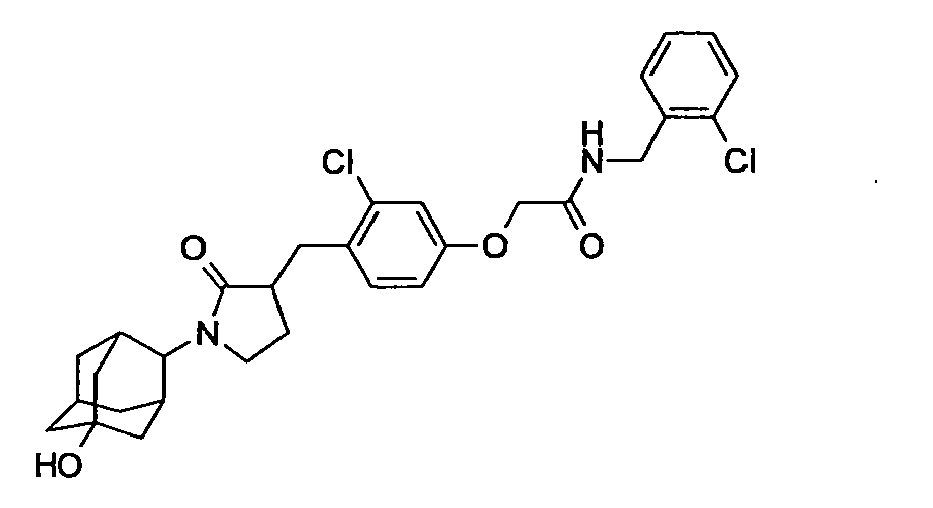
- In the same manner as in Example 70A, the title compound was obtained from (3-chloro-4-{[1-(5-hydroxy-2-adamantyl)-2-oxopyrrolidin-3-yl]methyl}phenoxy)acetic acid obtained in Example 585A and 1-(2-chlorophenyl)methanamine.
1H NMR (300 MHz, CDCl3) δ ppm 1.44-1.58 (m, 3 H), 1.61-1.96 (m, 9 H), 1.97-2.10 (m, 1 H), 2.13-2.21 (m, 1 H), 2.38-2.51 (m, 2 H), 2.68-2.82 (m, 2 H), 3.22-3.34 (m, 1 H), 3.37-3.58 (m, 2 H), 3.87-3.94 (m, 1 H), 4.49 (s, 2 H), 4.63 (d, J=6.2 Hz, 2 H), 6.75 (dd, J=8 . 5, 2.6 Hz, 1 H), 6.94 (d, J=2.6 Hz, 1 H), 6.96-7.04 (m, 1 H), 7.17-7.29 (m, 3 H), 7.33-7.42 (m, 2 H). -

- In the same manner as in Example 70A, the title compound was obtained from 3-chloro-4-{[1-(5-hydroxy-2-adamantyl)-2-oxopyrrolidin-3-yl]methyl}phenoxy)acetic acid obtained in Example 585A and 1-(3-chlorophenyl)methanamine.
1H NMR (300 MHz, CDCl3) δ ppm 1.45-1.58 (m, 2 H), 1.62-1.85 (m, 8 H), 1.86-1.96 (m, 2 H), 1.97-2.10 (m, 1 H), 2.13-2.22 (m, 1 H), 2.38-2.51 (m, 2 H), 2.68-2.82 (m, 2 H), 3.21-3.35 (m, 1 H), 3.38-3.59 (m, 2 H), 3.87-3.95 (m, 1 H), 4.46-4.57 (m, 4 H), 6.76 (dd, J=8.5, 2.6 Hz, 1 H), 6.83-6.93 (m, 1 H), 6.95 (d, J=2.6 Hz, 1 H), 7.12-7.30 (m, 5 H). -

- In the same manner as in Example 70A, the title compound was obtained from (3-chloro-4-{[1-(5-hydroxy-2-adamantyl)-2-oxopyrrolidin-3-yl]methyl}phenoxy)acetic acid obtained in Example 585A and 1-(4-chlorophenyl)methanamine.
1H NMR (300 MHz, CDCl3) δ ppm 1.42-1.58 (m, 3 H), 1.60-2.10 (m, 10 H), 2.13-2.21 (m, 1 H), 2.38-2.51 (m, 2 H), 2.67-2.81 (m, 2 H), 3.21-3.35 (m, 1 H), 3.37-3.58 (m, 2 H), 3.86-3.95 (m, 1 H), 4.46-4.55 (m, 4 H), 6.75 (dd, J=8.5, 2.6 Hz, 1 H), 6.80-6.88 (m, 1 H), 6. 94 (d, J=2.6 Hz, 1 H), 7.18-7.24 (m, 3 H), 7.28-7.33 (m, 2 H). -

- In the same manner as in Example 70A, the title compound was obtained from (3-chloro-4-{[1-(5-hydroxy-2-adamantyl)-2-oxopyrrolidin-3-yl]methyl}phenoxy)acetic acid obtained in Example 585A and 1-(2,4-dichlorophenyl)methanamine.
1H NMR (300 MHz, CDCl3) δ ppm 1.46-1.58 (m, 3 H), 1.62-2.11 (m, 10 H), 2.13-2.22 (m, 1 H), 2.39-2.51 (m, 2 H), 2.67-2.81 (m, 2 H), 3.20-3.35 (m, 1 H), 3.38-3.59 (m, 2 H), 3.87-3.94 (m, 1 H), 4.49 (s, 2 H), 4.58 (d, J=6.2 Hz, 2 H), 6.75 (dd, J=8.6, 2.6 Hz, 1 H), 6.93 (d, J=2.6 Hz, 1 H), 6.94-7.03 (m, 1 H), 7.17-7.35 (m, 3 H), 7.38 (d, J=2.1 Hz, 2 H). -

- In the same manner as in Example 70A, the title compound was obtained from (3-chloro-4-{[1-(5-hydroxy-2-adamantyl)-2-oxopyrrolidin-3-yl]methyl}phenoxy)acetic acid obtained in Example 585A and 1-[4-chloro-3-(trifluoromethyl)phenyl]methanamine.
1H NMR (300 MHz, CDCl3) δ ppm 1.44-1.58 (m, 2 H), 1.61-1.96 (m, 10 H), 1.97-2.11 (m, 1 H), 2.13-2.22 (m, 1 H), 2.38-2.51 (m, 2 H), 2.67-2.82 (m, 2 H), 3.21-3.33 (m, 1 H), 3.39-3.59 (m, 2 H), 3.87-3.93 (m, 1 H), 4.53 (s, 2 H), 4.56 (d, J=6.2 Hz, 2 H), 6.76 (dd, J=8.5, 2.6 Hz, 1 H), 6.90-7.00 (m, 2 H), 7.22 (d, J=8.5 Hz, 1 H), 7.37-7.51 (m, 2 H), 7.56-7.62 (m, 1 H). -

- In the same manner as in Example 318A, the title compound was obtained from 3-(2-chloro-4-hydroxybenzyl)-1-(5-hydroxy-2-adamantyl)pyrrolidin-2-one obtained in Example 431A and methyl 2-(chloromethyl)benzoate.
1H NMR (300 MHz, CDCl3) δ ppm 1.39 -2.10 (m, 13 H), 2.13-2.21 (m, 1 H), 2.39-2.51 (m, 1 H), 2.67-2.82 (m, 2 H), 3.24-3.56 (m, 3 H), 3.87-3.96 (m, 4 H), 5.47 (s, 2 H), 6.83 (dd, J=8.5, 2.6 Hz, 1 H), 7.02 (d, J=2.6 Hz, 1 H), 7.18 (d, J=8.5 Hz, 1 H), 7.35-7.43 (m, 1 H), 7.52-7.60 (m, 1 H), 7.68-7.75 (m, 1 H), 8.04 (dd, J=7.9, 1.2 Hz, 1 H). -

- In the same manner as in Example 318A, the title compound was obtained from 3-(2-chloro-4-hydroxybenzyl)-1-[3-(hydroxymethyl)-1-adamantyl]pyrrolidin-2-one obtained in Example 486A and methyl bromoacetate.
1H NMR (300 MHz, CDCl3) δ ppm 1.32 (t, J=6.1 Hz, 1 H), 1.40-1.75 (m, 6 H), 1.85-2.24 (m, 10 H), 2.59-2.75 (m, 2 H), 3.18-3.41 (m, 5 H), 3.81 (s, 3 H), 4.60 (s, 2 H), 6.75 (dd, J=8.6, 2.7 Hz, 1 H), 6.92 (d, J=2.7 Hz, 1 H), 7.18 (d, J=8.7 Hz, 1 H). -

- In the same manner as in Example 155A, the title compound was obtained from methyl [3-chloro-4-({1-[3-(hydroxymethyl)-1-adamantyl]-2-oxopyrrolidin-3-yl}methyl)phenoxy]acetate obtained in Example 638A.
1H NMR (300 MHz, DMSO-d6) δ ppm 1.27-1.66 (m, 7 H), 1.70-1.88 (m, 3 H), 1.89-2.16 (m, 6 H), 2.41-2.61 (m, 1 H), 2.96-3.13 (m, 3 H), 3.17-3.43 (m, 3 H), 4.68 (s, 2 H), 6.84 (dd, J=8. 7, 2.6 Hz, 1 H), 6.98 (d, J=2.6 Hz, 1 H), 7.25 (d, J=8.7 Hz, 1 H). -

- In the same manner as in Example 70A, the title compound was obtained from [3-chloro-4-({1-[3-(hydroxymethyl)-1-adamantyl]-2-oxopyrrolidin-3-yl}methyl)phenoxy]acetic acid obtained in Example 639A and 1-[4-(trifluoromethyl)phenyl]methanamine.
1H NMR (300 MHz, CDCl3) δ ppm 1.40-1.74 (m, 8 H), 1.85-2.24 (m, 9 H), 2.61-2.75 (m, 2 H), 3.19-3.42 (m, 5 H), 4.53 (s, 2 H), 4.60 (d, J=6.2 Hz, 2 H), 6.76 (dd, J=8.6, 2.7 Hz, 1 H), 6.87-6.97 (m, 2 H), 7.21 (d, J=8.6 Hz, 1 H), 7.40 (d, J=8.1 Hz, 2 H), 7.60 (d, J=8.1 Hz, 2 H). -

- In the same manner as in Reference Example 19A, the title compound was obtained from methyl [3-chloro-4-({1-[3-(hydroxymethyl)-1-adamantyl]-2-oxopyrrolidin-3-yl}methyl)phenoxy]acetate obtained in Example 638A.
1H NMR (300 MHz, CDCl3) δ ppm 1.31-1.75 (m, 8 H), 1.84-2.24 (m, 10 H), 2.61-2.75 (m, 2 H), 3.20-3.40 (m, 5 H), 3.91-3.99 (m, 2 H), 4.01-4.08 (m, 2 H), 6.77 (dd, J=8.5, 2.5 Hz, 1 H), 6.93 (d, J=2.5 Hz, 1 H), 7.17 (d, J=8.5 Hz, 1 H). -

-
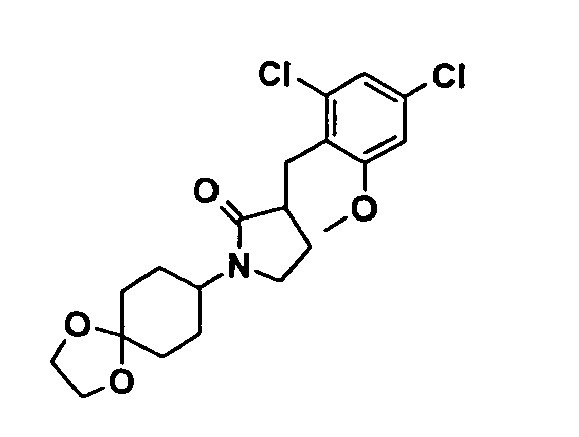
- The reaction product which was obtained in the same manner as in Reference Example 1A from 1-(1,4-dioxaspiro[4.5]dec-8-yl)pyrrolidin-2-one and a mixture of 1,3-dichloro-2-(chloromethyl)-5-methoxybenzene obtained in Reference Example 41A and 1,5-dichloro-2-(chloromethyl)-3-methoxybenzene obtained in Reference Example 42A, was subjected to silica gel column chromatography (hexane-ethyl acetate 4:1-9:1) to give the title compound (Example 642A) eluted earlier, and then to give the title compound (Example 643A) eluted later.
- 1H NMR (300 MHz, CDCl3) δ ppm 1.64-2.04 (m, 10 H), 2.78-3.01 (m, 2 H), 3.10-3.25 (m, 1 H), 3.28-3.46 (m, 2 H), 3.77 (s, 3 H), 3.95 (s, 4 H), 4.06 (d, J=8.1 Hz, 1 H), 6.87 (s, 2 H).
- 1H NMR (300 MHz, CDCl3)δ ppm 1.65-1.98 (m, 10 H), 2.66-2.90 (m, 2 H), 3.05-3.45 (m, 3 H), 3.82 (s, 3 H), 3.95 (s, 4 H), 3.99-4.12 (m, 1H), 6.75 (d, J=2.0 Hz, 1H), 7.00 (d, J=2.0 Hz, 1H).
-

- In the same manner as in Example 28A, the title compound was obtained from 3-(2,6-dichloro-4-methoxybenzyl)-1-(1,4-dioxaspiro[4.5]dec-8-yl)pyrrolidin-2-one obtained in Example 642A.
1H NMR (300 MHz, CDCl3) δ ppm 1.74-2.19 (m, 6 H), 2.32-2.69 (m, 4 H), 2.82-3.05 (m, 2 H), 3.11-3.26 (m, 1 H), 3.28-3.47 (m, 2 H), 3.78 (s, 3 H), 4.37-4.58 (m, 1H), 6.88 (s, 2 H). -

- In the same manner as in Example 541A, the title compound was obtained from 3-(2,6-dichloro-4-methoxybenzyl)-1-(4-oxocyclohexyl)pyrrolidin-2-one obtained in Example 644A and methyllithium.
1H NMR (300 MHz, CDCl3) δ ppm 1.28 (s, 3 H), 1.37 (s, 1 H), 1.46-2.05 (m, 10 H), 2.73-3.03 (m, 2 H), 3.10-3.26 (m, 1 H), 3.27-3.46 (m, 2 H), 3.78 (s, 3 H), 3.87-4.09 (m, 1 H), 6.87 (s, 2 H). -

- To a solution of 3-(2-chloro-4-hydroxybenzyl)-1-(4-hydroxy-4-methylcyclohexyl)pyrrolidin-2-one obtained in Example 542A (0.50 g) in pyridine (10 mL) was added anhydrous trifluoromethanesulfonic acid (0.63 g), and the mixture was stirred at 0°C for 30 min, and then at room temperature for 30 min. The reaction mixture was concentrated under reduced pressure, and the residue was partitioned between ethyl acetate and 2N hydrochloric acid. The ethyl acetate layer was washed successively with saturated sodium hydrogencarbonate solution and saturated brine, and dried over anhydrous magnesium sulfate. The solvent was evaporated under reduced pressure, and the residue was subjected to silica gel column chromatography (hexane-ethyl acetate 1:1-1:4, ethyl acetate-methanol 20:1) to give the title compound (0.60 g, 86%) as a pale-yellow solid.
1H NMR (300 MHz, CDCl3) δ ppm 1.27 (s, 3 H), 1.40 (s, 1 H), 1.46-1.89 (m, 9 H), 1.95-2.16 (m, 1 H), 2.69-2.94 (m, 2 H), 3.14-3.28 (m, 2 H), 3.29-3.46 (m, 1 H), 3.84-4.07 (m, 1 H), 7.13 (dd, J=8.6, 2.6 Hz, 1 H), 7.32 (d, J=2.6 Hz, 1 H), 7.40 (d, J=8.6 Hz, 1 H). -

- The reaction product (a mixture of four steric isomers) which was obtained in the same manner as in Example 30A from 3-(4-bromo-2-chlorobenzyl)-1-(4-oxocyclohexyl)pyrrolidin-2-one obtained in Example 254A and methylmagnesium bromide, was subjected to silica gel column chromatography (hexane-ethyl acetate 1:1, ethyl acetate, ethyl acetate-methanol 20:1) to give the title compound (Example 647A: less polar product) as a mixture of two steric isomers eluted earlier, and the to give the title compound (Example 648A: more polar product) as a mixture of two steric isomers eluted later.
- 1H NMR (300 MHz, CDCl3) δ ppm 1.00 (s, 1 H), 1.25 (s, 3 H), 1.37-1.92 (m, 10 H), 1.94-2.12 (m, 1 H), 2.65-2.86 (m, 2 H), 3.10-3.38 (m, 3 H), 3.81-4.02 (m, 1 H), 7.16 (d, J=8.3 Hz, 1 H), 7.31 (dd, J=8.3, 1.9 Hz, 1 H), 7.52 (d, J=1.9 Hz, 1 H).
- 1H NMR (300 MHz, CDCl3) δ ppm 1.27 (s, 3 H), 1.35 (s, 1 H), 1.43-1.86 (m, 9 H), 1.90-2.14 (m, 1 H), 2.65-2.86 (m, 2 H), 3.09-3.40 (m, 3 H), 3.83-4.06 (m, 1 H), 7.16 (d, J=8.3 Hz, 1 H), 7.32 (dd, J=8. 1, 2.1 Hz, 1 H), 7.52 (d, J=2.3 Hz, 1 H).
-

- In the same manner as in Example 218A, the title compound was obtained from 3-(4-bromo-2-chlorobenzyl)-1-(4-hydroxy-4-methylcyclohexyl)pyrrolidin-2-one (more polar product) obtained in Example 648A and o-acetamidophenylboronic acid.
1H NMR (300 MHz, CDCl3) δ ppm 1.28 (s, 3 H), 1.39 (s, 1 H), 1.52-1.87 (m, 9 H), 2.06 (s, 3 H), 2.05-2.20 (m, 1 H), 2.77-2.96 (m, 2 H), 3.16-3.34 (m, 2 H), 3.40 (t, J=8.9 Hz, 1 H), 3.91-4.11 (m, 1 H), 7.06 (s, 1 H), 7.13-7.25 (m, 3 H), 7.34-7.42 (m, 3 H), 8.20 (d, J=8.1 Hz, 1 H). -

- In the same manner as in Example 218A, the title compound was obtained from 3-(4-bromo-2-chlorobenzyl)-1-(4-hydroxy-4-methylcyclohexyl)pyrrolidin-2-one (more polar product) obtained in Example 648A and m-acetamidophenylboronic acid.
1H NMR (300 MHz, CDCl3) δ ppm 1.28 (s, 3 H), 1.35 (s, 1 H), 1.57-1.85 (m, 9 H), 1.97-2.15 (m, 1 H), 2.21 (s, 3 H), 2.75-2.91 (m, 2 H), 3.15-3.28 (m, 2 H), 3.31-3.48 (m, 2 H), 3.99 (dd, J=10.9, 4.5 Hz, 1 H), 7.27-7.50 (m, 5 H), 7.58 (d, J=1.9 Hz, 1 H), 7.76 (s, 1H) . -

- In the same manner as in Example 218A, the title compound was obtained from 3-(4-bromo-2-chlorobenzyl)-1-(4-hydroxy-4-methylcyclohexyl)pyrrolidin-2-one (more polar product) obtained in Example 648A and p-acetamidophenylboronic acid.
1H NMR (300 MHz, CDCl3) δ ppm 1.28 (s, 3 H), 1.36 (s, 1 H), 1.47-1.85 (m, 9 H), 1.95-2.13 (m, 1 H), 2.21 (s, 3 H), 2.73-2.91 (m, 2 H), 3.14-3.30 (m, 2 H), 3.31-3.46 (m, 1 H), 3.89-4.07 (m, 1 H), 7.20-7.26 (m, 1 H), 7.28-7.43 (m, 2 H), 7.45-7.64 (m, 5 H). -

- In the same manner as in Example 218A, the title compound was obtained from 3-chloro-4-{[1-(4-hydroxy-4-methylcyclohexyl)-2-oxopyrrolidin-3-yl]methyl}phenyl trifluoromethanesulfonate obtained in Example 646A and 3-formylbenzeneboronic acid.
1H NMR (300 MHz, CDCl3) δ ppm 1.28 (s, 3 H), 1.36 (s, 1 H), 1.43-1.87 (m, 9 H), 1.99-2.18 (m, 1 H), 2.77-2.94 (m, 2 H), 3.15-3.31 (m, 2 H), 3.34-3.51 (m, 1 H), 3.89-4.09 (m, 1 H), 7.34-7.42 (m, 1 H), 7.42-7.49 (m, 1 H), 7.57-7.68 (m, 2 H), 7.85 (dd, J=14.2, 7.8 Hz, 2 H), 8.07 (s, 1H), 10.09 (s, 1H). -

- In the same manner as in Example 218A, the title compound was obtained from 3-chloro-4-{[1-(4-hydroxy-4-methylcyclohexyl)-2-oxopyrrolidin-3-yl]methyl}phenyl trifluoromethanesulfonate obtained in Example 646A and 4-formylbenzeneboronic acid.
1H NMR (300 MHz, CDCl3) δ ppm 1.28 (s, 3 H), 1.35 (s, 1 H), 1.43-1.84 (m, 9 H), 1.95-2.17 (m, 1 H), 2.72-2.96 (m, 2 H), 3.11-3.31 (m, 2 H), 3.34-3.48 (m, 1 H), 3.83-4.11 (m, 1 H), 7.32-7.43 (m, 1 H), 7.44-7.50 (m, 1 H), 7.64 (d, J=1.9 Hz, 1 H), 7.72 (d, J=8.2 Hz, 2 H), 7.96 (d, J=8.2 Hz, 2 H), 10.06 (s, 1 H). -

- In the same manner as in Example 29A, the title compound was obtained from 3'-chloro-4'-{[1-(4-hydroxy-4-methylcyclohexyl)-2-oxopyrrolidin-3-yl]methyl}biphenyl-3-carbaldehyde obtained in Example 652A.
1H NMR (300 MHz, CDCl3) δ ppm 1.28 (s, 3 H), 1.35 (s, 1 H), 1.50-1.86 (m, 9 H), 1.99-2.14 (m, 1 H), 2.75-2.92 (m, 2 H), 3.17-3.30 (m, 2 H), 3.39 (t, J=9.0 Hz, 1 H), 3.90-4.11 (m, 1 H), 4.77 (d, J=5.8 Hz, 2 H), 7.30-7.54 (m, 5 H), 7.54-7.63 (m, 2 H). -

- In the same manner as in Example 29A, the title compound was obtained from 3'-chloro-4'-{[1-(4-hydroxy-4-methylcyclohexyl)-2-oxopyrrolidin-3-yl]methyl}biphenyl-4-carbaldehyde obtained in Example 653A.
1H NMR (300 MHz, CDCl3) δ ppm 1.28 (s, 3 H), 1.38 (s, 1 H), 1.46-1.86 (m, 9 H), 1.96-2.14 (m, 1 H), 2.75-2.92 (m, 2 H), 3.16-3.30 (m, 2 H), 3.34-3.47 (m, 1 H), 3.90-4.08 (m, 1 H), 4.75 (d, J=5.7 Hz, 2 H), 7.30-7.37 (m, 1 H), 7.37-7.47 (m, 3 H), 7.51-7.62 (m, 3 H). -

- In the same manner as in Example 218A, the title compound was obtained from 3-chloro-4-{[1-(4-hydroxy-4-methylcyclohexyl)-2-oxopyrrolidin-3-yl]methyl}phenyl trifluoromethanesulfonate obtained in Example 646A and 3-acetylphenylboronic acid.
1H NMR (300 MHz, CDCl3) δ ppm 1.28 (s, 3 H), 1.37 (s, 1 H), 1.46-1.87 (m, 9 H), 1.95-2.18 (m, 1 H), 2.66 (s, 3 H), 2.78-2.95 (m, 2 H), 3.15-3.32 (m, 2 H), 3.32-3.53 (m, 1 H), 3.88-4.10 (m, 1 H), 7.33-7.40 (m, 1 H), 7.41-7.48 (m, 1 H), 7.54 (t, J=7.8 Hz, 1 H), 7.62 (d, J=1.9 Hz, 1 H), 7.75 (d, J=8.3 Hz, 1 H), 7.94 (d, - J=8.0 Hz, 1H), 8.14 (s, 1H).
-

- In the same manner as in Example 218A, the title compound was obtained from 3-chloro-4-{[1-(4-hydroxy-4-methylcyclohexyl)-2-oxopyrrolidin-3-yl]methyl}phenyl trifluoromethanesulfonate obtained in Example 646A and 4-acetylphenylboronic acid.
1H NMR (300 MHz, CDCl3) δ ppm 1.28 (s, 3 H), 1.37 (s, 1 H), 1.47-1.88 (m, 9 H), 1.98-2.16 (m, 1 H), 2.64 (s, 3 H), 2.76-2.94 (m, 2 H), 3.15-3.32 (m, 2 H), 3.33-3.49 (m, 1 H), 3.90-4.11 (m, 1 H), 7.34-7.41 (m, 1 H), 7.41-7.51 (m, 1 H), 7.63 (d, J=3.0 Hz, 2 H), 7.67 (s, 1 H), 8.03 (d, J=8.7 Hz, 2 H). -

- In the same manner as in Example 218A, the title compound was obtained from 3-chloro-4-{[1-(4-hydroxy-4-methylcyclohexyl)-2-oxopyrrolidin-3-yl]methyl}phenyl trifluoromethanesulfonate obtained in Example 646A and (3-aminocarbonylphenyl)boronic acid.
1H NMR (300 MHz, DMSO-d6) δ ppm 1.13 (s, 3 H), 1.38-1.75 (m, 8 H), 1.85-2.02 (m, 1 H), 2.58-2.79 (m, 2 H), 3.12-3.35 (m, 4 H), 3.65-3.82 (m, 1 H), 4.36 (s, 1 H), 7.38-7.73 (m, 4 H), 7.80-7.91 (m, 3 H), 8.07-8.21 (m, 2 H). -

- In the same manner as in Example 218A, the title compound was obtained from 3-chloro-4-{[1-(4-hydroxy-4-methylcyclohexyl)-2-oxopyrrolidin-3-yl]methyl}phenyl trifluoromethanesulfonate obtained in Example 646A and (4-aminocarbonylphenyl)boronic acid.
1H NMR (300 MHz, CDCl3) δ ppm 1.28 (s, 3 H), 1.46-1.88 (m, 12 H), 2.05 (s, 1 H), 2.86 (d, J=3.0 Hz, 2 H), 3.24 (d, J=8.0 Hz, 2 H), 3.32-3.52 (m, 1 H), 3.84-4.19 (m, 1 H), 7.33-7.53 (m, 2 H), 7.55-7.74 (m, 3 H), 7. 89 (d, J=8. 3 Hz, 2 H). -

- In the same manner as in Example 218A, the title compound was obtained from 3-chloro-4-{[1-(4-hydroxy-4-methylcyclohexyl)-2-oxopyrrolidin-3-yl]methyl}phenyl trifluoromethanesulfonate obtained in Example 646A and 3-chlorophenylboronic acid.
1H NMR (300 MHz, CDCl3) δ ppm 1.28 (s, 3 H), 1.36 (s, 1 H), 1.46-1.85 (m, 9 H), 1.95-2.17 (m, 1 H), 2.76-2.94 (m, 2 H), 3.14-3.29 (m, 2 H), 3.34-3.48 (m, 1 H), 3.89-4.08 (m, 1 H), 7.28-7.48 (m, 5 H), 7.50-7.60 (m, 2 H). -

- In the same manner as in Example 218A, the title compound was obtained from 3-chloro-4-{[1-(4-hydroxy-4-methylcyclohexyl)-2-oxopyrrolidin-3-yl]methyl}phenyl trifluoromethanesulfonate obtained in Example 646A and 4-chlorophenylboronic acid.
1H NMR (300 MHz, CDCl3) δ ppm 1.28 (s, 3 H), 1.36 (s, 1 H), 1.46-1.84 (m, 9 H), 1.96-2.16 (m, 1 H), 2.71-2.91 (m, 2 H), 3.11-3.30 (m, 2 H), 3.40 (q, J=9.2 Hz, 1 H), 3.88-4.11 (m, 1 H), 7.30-7.60 (m, 7 H). -

- In the same manner as in Example 218A, the title compound was obtained from 3-chloro-4-{[1-(4-hydroxy-4-methylcyclohexyl)-2-oxopyrrolidin-3-yl]methyl}phenyl trifluoromethanesulfonate obtained in Example 646A and 3-cyanophenylboronic acid.
1H NMR (300 MHz, CDCl3) δ ppm 1.28 (s, 3 H), 1.36 (s, 1 H), 1.48-1.85 (m, 9 H), 2.00-2.16 (m, 1 H), 2.76-2.95 (m, 2 H), 3.14-3.33 (m, 2 H), 3.34-3.50 (m, 1 H), 3.88-4.08 (m, 1 H), 7.39 (s, 2 H), 7.49-7.59 (m, 2 H), 7.61-7.69 (m, 1 H), 7.78 (d, J=8.0 Hz, 1 H), 7.83 (s, 1 H). -

- In the same manner as in Example 218A, the title compound was obtained from 3-chloro-4-{[1-(4-hydroxy-4-methylcyclohexyl)-2-oxopyrrolidin-3-yl]methyl}phenyl trifluoromethanesulfonate obtained in Example 646A and 5-formyl-2-furanboronic acid.
1H NMR (300 MHz, CDCl3) δ ppm 1.28 (s, 3 H), 1.33 (s, 1H), 1.56-1.84 (m, 9 H), 2.00-2.13 (m, 1 H), 2.75-2.92 (m, 2 H), 3.22 (t, J=7.3 Hz, 2 H), 3.40 (d, J=8.9 Hz, 1 H), 3.86-4.11 (m, 1 H), 6.83 (d, J=3.8 Hz, 1 H), 7.32 (d, J=3.8 Hz, 1 H), 7.37 (d, J=8.1 Hz, 1 H), 7.63 (dd, J=8.0, 1.6 Hz, 1 H), 7.83 (d, J=1.9 Hz, 1 H), 9.66 (s, 1 H). - Example 664A 3-{2-chloro-4-[5-(hydroxymethyl)-2-furyl]benzyl}-1-(4-hydroxy-4-methylcyclohexyl)pyrrolidin-2-one

- In the same manner as in Example 29A, the title compound was obtained from 5-(3-chloro-4-{[1-(4-hydroxy-4-methylcyclohexyl)-2-oxopyrrolidin-3-yl]methyl}phenyl)-2-furaldehyde obtained in Example 663A.
1H NMR (300 MHz, CDCl3) δ ppm 1.27 (s, 3 H), 1.34 (s, 1 H), 1.47-1.83 (m, 12 H), 2.74-2.88 (m, 2 H), 3.12-3.28 (m, 2 H), 3.22-3. 30 (m, 1 H), 4.67 (d, J=6. 1 Hz, 2 H), 6.38 (d, J=3. 4 Hz, 1 H), 6.59 (d, J=3.4 Hz, 1 H), 7.29 (s, 1 H), 7.47 (dd, J=8.1, 1.8 Hz, 1 H), 7.67 (d, J=1.8 Hz, 1 H). -

- In the same manner as in Example 541A, the title compound was obtained from N-(3-chloro-4-{[2-oxo-1-(4-oxocyclohexyl)pyrrolidin-3-yl]methyl}phenyl)-2,2,2-trifluoroacetamide obtained in Example 476A and methyllithium. 1H NMR (300 MHz, CDCl3) δ ppm 1.27 (s, 3 H), 1.40 (s, 1 H), 1.46-1.86 (m, 9 H), 1.96-2.17 (m, 1 H), 2.69-2.93 (m, 2 H), 3.13-3.41 (m, 3 H), 3.87-4.09 (m, 1 H), 7.27-7.33 (m, 1 H), 7.33-7.42 (m, 1H), 7.71 (d, J=2.1 Hz, 1H), 8.16 (s, 1H).
-
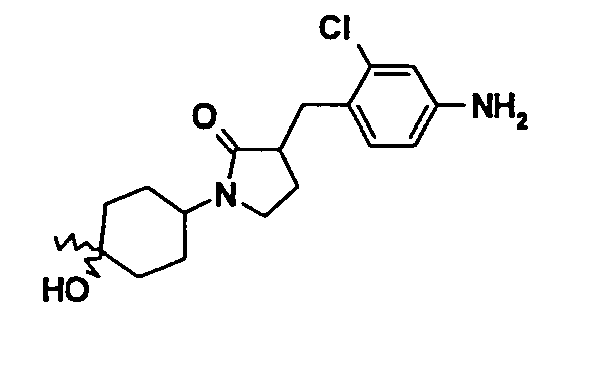
- In the same manner as in Example 155A, the title compound was obtained from N-(3-chloro-4-{[1-(4-hydroxy-4-methylcyclohexyl)-2-oxopyrrolidin-3-yl]methyl}phenyl)-2,2,2-trifluoroacetamide obtained in Example 665A.
1H NMR (300 MHz, CDCl3) δ ppm 1.27 (s, 3 H), 1.35 (s, 1 H), 1.44-1.84 (m, 9 H), 1.89-2.06 (m, 1 H), 2.61-2.82 (m, 2 H), 3.09-3.31 (m, 3 H), 3.64 (s, 2 H), 3.89-4.06 (m, 1 H), 6.51 (dd, J=8.1, 2.5 Hz, 1 H), 6.70 (d, J=2.3 Hz, 1 H), 7.03 (d, J=8.0 Hz, 1 H). -
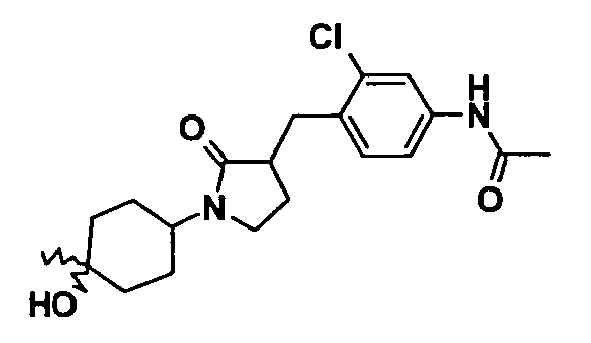
- In the same manner as in Example 22A, the title compound was obtained from 3-(4-amino-2-chlorobenzyl)-1-(4-hydroxy-4-methylcyclohexyl)pyrrolidin-2-one obtained in Example 666A and acetyl chloride.
1H NMR (300 MHz, CDCl3) δ ppm 1.27 (s, 3 H), 1.37 (s, 1 H), 1.45-1.85 (m, 9 H), 1.91-2.11 (m, 1 H), 2.17 (s, 3 H), 2.65-2.85 (m, 2 H), 3.12-3.26 (m, 2 H), 3.32 (d, J=9.1 Hz, 1 H), 3.86-4.04 (m, 1 H), 7.14-7.26 (m, 3 H), 7.65 (d, J=1.5 Hz, 1 H). -

- In the same manner as in Example 22A, the title compound was obtained from 3-(4-amino-2-chlorobenzyl)-1-(4-hydroxy-4-methylcyclohexyl)pyrrolidin-2-one obtained in Example 666A and cyclopropanecarbonyl chloride.
1H NMR (300 MHz, CDCl3) δ ppm 0.81-0.92 (m, 2 H), 1.04-1.13 (m, 2 H), 1.27 (s, 3 H), 1.36 (s, 1 H), 1.42-1.83 (m, 10 H), 1.92-2.12 (m, 1 H), 2.70-2.85 (m, 2 H), 3.14-3.25 (m, 2 H), 3.30 (t, J=9.1 Hz, 1 H), 3.89-4.05 (m, 1 H), 7.15-7.26 (m, 2 H), 7.37 (s, 1 H), 7.68 (s, 1 H). -

- In the same manner as in Example 22A, the title compound was obtained from 3-(4-amino-2-chlorobenzyl)-1-(4-hydroxy-4-methylcyclohexyl)pyrrolidin-2-one obtained in Example 666A and benzoyl chloride.
1H NMR (300 MHz, CDCl3) δ ppm 1.27 (s, 3 H), 1.39 (s, 1 H), 1.47-1.82 (m, 9 H), 1.95-2.13 (m, 1 H), 2.73-2.88 (m, 2 H), 3.15-3.25 (m, 2 H), 3.27-3.41 (m, 1 H), 3.85-4.06 (m, 1 H), 7.22-7.31 (m, 1 H), 7.41 (dd, J=8.3, 2.3 Hz, 1 H), 7.45-7.68 (m, 3 H), 7.82 (d, J=2.3 Hz, 1 H), 7.83-7.91 (m, 3 H). -

- In the same manner as in Example 22A, the title compound was obtained from 3-(4-amino-2-chlorobenzyl)-1-(4-hydroxy-4-methylcyclohexyl)pyrrolidin-2-one obtained in Example 666A and phenylacetyl chloride.
1H NMR (300 MHz, CDCl3) δ ppm 1.27 (s, 3 H), 1.34 (s, 1 H), 1.46-1.80 (m, 9 H), 1.89-2.06 (m, 1 H), 2.66-2.85 (m, 2 H), 3.11-3.25 (m, 2 H), 3.29 (d, J=9.1 Hz, 1 H), 3.73 (s, 2 H), 3.88-4.03 (m, 1 H), 7.02 (s, 1 H), 7.17 (s, 2 H), 7.29-7.47 (m, 5 H), 7.54 (s, 1 H). -
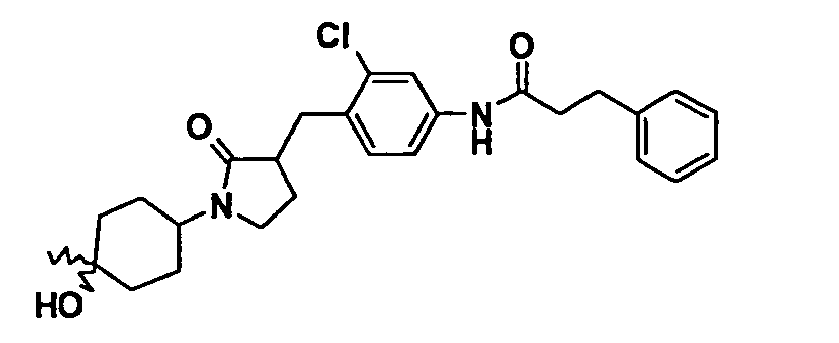
- In the same manner as in Example 22A, the title compound was obtained from 3-(4-amino-2-chlorobenzyl)-1-(4-hydroxy-4-methylcyclohexyl)pyrrolidin-2-one obtained in Example 666A and 3-phenylpropionyl chloride.
1H NMR (300 MHz, CDCl3) δ ppm 1.27 (s, 3 H), 1.39 (s, 1 H), 1.46-1.84 (m, 9 H), 1.90-2.09 (m, 1 H), 2.59-2.71 (m, 2 H), 2.71-2.83 (m, 2 H), 3.05 (t, J=7.6 Hz, 2 H), 3.13-3.24 (m, 2 H), 3.24-3.38 (m, 1H), 3.87-4.05 (m, 1H), 7.09 (s, 1H), 7.14-7.38 (m, 7 H), 7.60 (s, 1 H). -

- In the same manner as in Reference Example 1A, the title compound was obtained from N-(3-chloro-4-{[1-(4-hydroxy-4-methylcyclohexyl)-2-oxopyrrolidin-3-yl]methyl}phenyl)benzamide obtained in Example 669A and methyl iodide.
1H NMR (300 MHz, CDCl3) δ ppm 1.27 (s, 3 H), 1.43-1.80 (m, 9 H), 1.88-2.02 (m, 1 H), 2.64-2.82 (m, 2 H), 3.11-3.22 (m, 2 H), 3.25-3.32 (m, 1 H), 3.46 (s, 3 H), 3.86-4.04 (m, 1 H), 6.82 (dd, J=8.3, 2.3 Hz, 1 H), 7.07-7.14 (m, 2 H), 7.15-7.24 (m, 2 H), 7.24-7.36 (m, 3 H). -

- In the same manner as in Reference Example 1A, the title compound was obtained from N-(3-chloro-4-{[1-(4-hydroxy-4-methylcyclohexyl)-2-oxopyrrolidin-3-yl]methyl}phenyl)-3-phenylpropanamide obtained in Example 671A and methyl iodide.
1H NMR (300 MHz, CDCl3) δ ppm 1.27 (s, 3 H), 1.42-1.85 (m, 9 H), 1.98-2.17 (m, 1 H), 2.38 (d, J=6.8 Hz, 2 H), 2.70-2.85 (m, 2 H), 2.87-3.00 (m, 2 H), 3.14-3.29 (m, 5 H), 3.35 (q, J=9.2 Hz, 1 H), 3.89-4.07 (m, 1 H), 6.84 (d, J=7.2 Hz, 1 H), 6.98 (s, 1 H), 7.08 (d, J=6.8 Hz, 2 H), 7.13-7.34 (m, 4 H). -

- In the same manner as in Example 221A, 3-[2-chloro-4-(4-methylpiperazin-1-yl)benzyl]-1-(1,4-dioxaspiro[4.5]dec-8-yl)pyrrolidin-2-one was synthesized from 3-(4-bromo-2-chlorobenzyl)-1-(1,4-dioxaspiro[4.5]dec-8-yl)pyrrolidin-2-one obtained in Example 203A and N-methylpiperazine. Then, the compound was treated in the same manner as in Example 28A, the title compound was obtained.
1H NMR (300 MHz, CDCl3) δ ppm 1.63-2.16 (m, 6 H), 2.35 (s, 3 H), 2.38-2.62 (m, 8 H), 2.64-2.89 (m, 2 H), 3.09-3.23 (m, 6 H), 3.29 (dd, J=13.3, 3.8 Hz, 1 H), 4.41-4.58 (m, 1 H), 6.75 (dd, J=8.5, 2.7 Hz, 1H), 6.89 (d, J=2.7 Hz, 1H), 7.13 (d, J=8.5 Hz, 1H). -

- In the same manner as in Example 541A, the title compound was obtained from 3-[2-chloro-4-(4-methylpiperazin-1-yl)benzyl]-1-(4-oxocyclohexyl)pyrrolidin-2-one obtained in Example 674A and methyllithium.
1H NMR (300 MHz, CDCl3) δ ppm 1.27 (s, 3 H), 1.36 (s, 1 H), 1.45-1.83 (m, 9 H), 1.90-2.10 (m, 1 H), 2.35 (s, 3 H), 2.51-2.60 (m, 4 H), 2.65-2.85 (m, 2 H), 3.10-3.23 (m, 6 H), 3.22-3.31 (m, 1 H), 3.84-4.08 (m, 1 H), 6.75 (dd, J=8.7, 2.7 Hz, 1 H), 6.89 (d, J=2.7 Hz, 1 H), 7.13 (d, J=8.7 Hz, 1 H). -

- To a solution of 3-(4-bromo-2-chlorobenzyl)-1-(1,4-dioxaspiro[4.5]dec-8-yl)pyrrolidin-2-one obtained in Example 203A (3.10 g) in tetrahydrofuran (50 mL) was added dropwise n-butyllithium (1.6 M hexane solution) at -78°C. The solution was stirred at -78°C for 30 min, an excess amount of dry ice was added, and the mixture was stirred at -78°C for 1 hr. The reaction solution was allowed to warm to room temperature, 2N hydrochloric acid (5 mL) was added, and the mixture was partitioned between ethyl acetate and water. The ethyl acetate layer was washed with saturated brine, and dried over anhydrous magnesium sulfate. The solvent was evaporated under reduced pressure, and the obtained colorless amorphous was treated in the same manner as in Example 28A to give a pale-brown amorphous (1.41 g). In the same manner as in Example 70A, the title compound (0.13 g, 12%) was obtained from the obtained amorphous (0.92 g) and benzylamine.
1H NMR (300 MHz, CDCl3) δ ppm 1.62-2.18 (m, 6 H), 2.33-2.62 (m, 4 H), 2.75-2.95 (m, 2 H), 3.13-3.28 (m, 2 H), 3.33-3.51 (m, 1 H), 4.34-4.54 (m, 1 H), 4.63 (d, J=5.5 Hz, 2 H), 6.47 (t, J=5.5 Hz, 1 H), 7.30-7.43 (m, 6 H), 7.60 (dd, J=8.0, 1.7 Hz, 1 H), 7.81 (d, J=1.7 Hz, 1 H). -

- In the same manner as in Example 676A, the title compound was obtained from 3-(4-bromo-2-chlorobenzyl)-1-(1,4-dioxaspiro[4.5]dec-8-yl)pyrrolidin-2-one obtained in Example 203A and phenethylamine.
1H NMR (300 MHz, CDCl3) δ ppm 1.65-2.14 (m, 6 H), 2.35-2.64 (m, 4 H), 2.75-2.88 (m, 2 H), 2.89-2.98 (m, 2 H), 3.15-3.28 (m, 2 H), 3.33-3.48 (m, 1 H), 3.71 (q like, 2 H), 4.37-4.57 (m, 1 H), 6.07 (t, J=5.7 Hz, 1 H), 7.16-7.30 (m, 3 H), 7.34 (t like, 3 H), 7.47 (dd, J=8.0, 1.7 Hz, 1 H), 7.71 (d, J=1.7 Hz, 1 H). -

- In the same manner as in Example 541A, the title compound was obtained from N-benzyl-3-chloro-4-{[2-oxo-1-(4-oxocyclohexyl)pyrrolidin-3-yl]methyl}benzamide obtained in Example 676A and methyllithium.
1H NMR (300 MHz, CDCl3) δ ppm 1.27 (s, 3 H), 1.38-1.84 (m, 9 H), 1.90-2.12 (m, 2 H), 2.75-2.90 (m, 2 H), 3.16-3.26 (m, 2 H), 3.31-3.47 (m, 1 H), 3.86-4.05 (m, 1 H), 4.63 (d, J=5.7 Hz, 2 H), 6.44 (t, J=5.5 Hz, 1 H), 7.29-7.42 (m, 6 H), 7.59 (dd, J=8.0, 1.5 Hz, 1 H), 7.81 (d, J=1.5 Hz, 1 H). -

- In the same manner as in Example 541A, the title compound was obtained from 3-chloro-4-{[2-oxo-1-(4-oxocyclohexyl)pyrrolidin-3-yl]methyl}-N-(2-phenylethyl)benzamide obtained in Example 677A and methyllithium.
1H NMR (300 MHz, CDCl3) δ ppm 1.27 (s, 3 H), 1.39-1.84 (m, 9 H), 1.90-2.13 (m, 2 H), 2.72-2.86 (m, 2 H), 2.93 (t, J=7.0 Hz, 2 H), 3.14-3.26 (m, 2 H), 3.29-3.43 (m, 1 H), 3.71 (q like, 2 H), 3.86-4.04 (m, 1 H), 6.12 (t, J=5.7 Hz, 1 H), 7.17-7.29 (m, 3 H), 7.29-7.40 (m, 3 H), 7.46 (dd, J=8.0, 1.9 Hz, 1 H), 7.71 (d, J=1.9 Hz, 1 H). -

- In the same manner as in Example 318A, the title compound was obtained from 3-(2-chloro-4-hydroxybenzyl)-1-(4-hydroxy-4-methylcyclohexyl)pyrrolidin-2-one obtained in Example 542A and N-Boc-2-bromoethylamine.
1H NMR (300 MHz, CDCl3) δ ppm 1.27 (s, 3 H), 1.37 (s, 1 H), 1.45 (s, 9 H), 1.47-1.83 (m, 8 H), 1.89-2.09 (m, 2 H), 2.63-2.85 (m, 2 H), 3.14-3.24 (m, 2 H), 3.23-3.35 (m, 1 H), 3.51 (q, J=5.2 Hz, 2 H), 3.98 (t, J=5.2 Hz, 3 H), 4.86-5.03 (m, 1 H), 6.73 (dd, J=8.5, 2.7 Hz, 1 H), 6.90 (d, J=2.7 Hz, 1 H), 7.17 (d, J=8.5 Hz, 1 H). -

- In the same manner as in Example 20A, the title compound was obtained from tert-butyl [2-(3-chloro-4-{[1-(4-hydroxy-4-methylcyclohexyl)-2-oxopyrrolidin-3-yl]methyl}phenoxy)ethyl]carbamate obtained in Example 680A.
1H NMR (300 MHz, DMSO-d6) δ ppm 1.13 (s, 3 H), 1.38-1.68 (m, 9 H), 1.76-1.99 (m, 1 H), 2.54-2.69 (m, 2 H), 3.05-3.29 (m, 5 H), 3.62-3.79 (m, 1 H), 4.19 (t, J=5.1 Hz, 2 H), 6.92 (dd, J=8.5, 2.6 Hz, 1 H), 7.06 (d, J=2.6 Hz, 1 H), 7.30 (d, J=8.5 Hz, 1 H), 8.23 (s, 2 H). -

- In the same manner as in Example 22A, the title compound was obtained from 3-[4-(2-aminoethoxy)-2-chlorobenzyl]-1-(4-hydroxy-4-methylcyclohexyl)pyrrolidin-2-one hydrochloride obtained in Example 681A and benzoyl chloride.
1H NMR (300 MHz, CDCl3) δ ppm 1.27 (s, 3 H), 1.34 (s, 1 H), 1.48-1.84 (m, 9 H), 2.00 (m, 1 H), 2.67-2.83 (m, 2 H), 3.11-3.24 (m, 2 H), 3.30 (t like, 1 H), 3.87 (q, J=5.7 Hz, 2 H), 3.93-4.05 (m, 1 H), 4.08-4.18 (m, 2 H), 6.50-6.60 (m, 1 H), 6.76 (dd, J=8.5, 2.5 Hz, 1H), 6.94 (d, J=2.5 Hz, 1H), 7.18 (d, J=8.5 Hz, 1H), 7.39-7.54 (m, 3 H), 7.74-7.81 (m, 2 H). -

- In the same manner as in Reference Example 1A, the title compound was obtained from N-[2-(3-chloro-4-{[1-(4-hydroxy-4-methylcyclohexyl)-2-oxopyrrolidin-3-yl]methyl}phenoxy)ethyl]benzamide obtained in Example 682A and methyl iodide.
1H NMR (300 MHz, CDCl3) δ ppm 1.27 (s, 3 H), 1.41-1.90 (m, 9 H), 1.90-2.16 (m, 2 H), 2.60-2.89 (m, 2 H), 3.04-3.39 (m, 6 H), 3.68 (s, 1 H), 3.82-4.06 (m, 3 H), 4.26 (s, 1 H), 6.57-7.06 (m, 2 H), 7.18 (d, J=8.7 Hz, 1 H), 7.40 (s, 5 H). -

- In the same manner as in Example 22A, the title compound was obtained from 3-[4-(2-aminoethoxy)-2-chlorobenzyl]-1-(4-hydroxy-4-methylcyclohexyl)pyrrolidin-2-one hydrochloride obtained in Example 681A and p-trifluoromethylbenzoyl chloride. 1H NMR (300 MHz, CDCl3) δ ppm 1.27 (s, 3 H), 1.43 (s, 1 H), 1.45-1.81 (m, 9 H), 1.92-2.04 (m, 1 H), 2.66-2.82 (m, 2 H), 3.12-3.37 (m, 3 H), 3.80-4.03 (m, 3 H), 4.06-4.18 (m, 2 H), 6.66 (t, J=5.1 Hz, 1 H), 6.76 (dd, J=8.5, 2.5 Hz, 1 H), 6.93 (d, J=2.5 Hz, 1 H), 7.18 (d, J=8.5 Hz, 1 H), 7.71 (d, J=8.3 Hz, 2 H), 7.90 (d, J=8.3 Hz, 2 H).
-

- In the same manner as in Example 22A, the title compound was obtained from 3-[4-(2-aminoethoxy)-2-chlorobenzyl)-1-(4-hydroxy-4-methylcyclohexyl)pyrrolidin-2-one hydrochloride obtained in Example 681A and benzenesulfonyl chloride.
1H NMR (300 MHz, CDCl3) δ ppm 1.27 (s, 3 H), 1.34 (s, 1 H), 1.43-1.85 (m, 9 H), 1.92-2.13 (m, 1 H), 2.68-2.84 (m, 2 H), 3.12-3.31 (m, 3 H), 3.33-3.43 (m, 2 H), 3.90-4.03 (m, 3 H), 4.80-4.98 (m, 1H), 6.65 (dd, J=8.5, 2.7 Hz, 1H), 6.80 (d, J=2.7 Hz, 1H), 7.16 (d, J=8.5 Hz, 1 H), 7.47-7.65 (m, 3 H), 7.89 (d, J=6.8 Hz, 2 H). -

- 3-(4-Bromo-2-chlorobenzyl)-1-(4-hydroxy-4-methylcyclohexyl)pyrrolidin-2-one (a mixture of two steric isomers) obtained in Example 647A was subjected to optical resolution with normal phase chiral high performance liquid chromatography (manufactured by Daicel Chemical Industries, Ltd., Chiralcel OJ (trade name), 50 mmID X 500 mmL, hexane-ethanol 75:25) to give the title compound (Example 686A) from a fraction with a retention time of 9 min and the title compound (Example 687A) f from a fraction with a retention time of 14 min.
- 1H NMR (300 MHz, CDCl3) δ ppm 1.00 (s, 1 H), 1.25 (s, 3 H), 1.37-1.92 (m, 10 H), 1.94-2.12 (m, 1 H), 2.65-2.86 (m, 2 H), 3.10-3.38 (m, 3 H), 3.81-4.02 (m, 1 H), 7.16 (d, J=8.3 Hz, 1 H), 7.31 (dd, J=8.3, 1.9 Hz, 1 H), 7.52 (d, J=1.9 Hz, 1 H).
- 1H NMR (300 MHz, CDCl3) δ ppm 1.00 (s, 1 H), 1.25 (s, 3 H), 1.37-1.92 (m, 10 H), 1.94-2.12 (m, 1 H), 2.65-2.86 (m, 2 H), 3.10-3.38 (m, 3 H), 3.81-4.02 (m, 1 H), 7.16 (d, J=8.3 Hz, 1 H), 7.31 (dd, J=8.3, 1.9 Hz, 1 H), 7.52 (d, J=1.9 Hz, 1 H).
-

- 3-(4-Bromo-2-chlorobenzyl)-1-(4-hydroxy-4-methylcyclohexyl)pyrrolidin-2-one (a mixture of two steric isomers) obtained in Example 648A was subjected to optical resolution with normal phase chiral high performance liquid chromatography (manufactured by Daicel Chemical Industries, Ltd., Chiralcel OJ (trade name), 50 mmID X 500 mmL, hexane-ethanol 75:25) to give the title compound (Example 688A) from a fraction with a retention time of 10 min and the title compound (Example 689A) from a fraction with a retention time of 15 min. Example 688A (retention time 10 min)
1H NMR (300 MHz, CDCl3)δ ppm 1.27 (s, 3 H), 1.35 (s, 1 H), 1.43-1.86 (m, 9 H), 1.90-2.14 (m, 1 H), 2.65-2.86 (m, 2 H), 3.09-3.40 (m, 3 H), 3.83-4.06 (m, 1 H), 7.16 (d, J=8.1 Hz, 1 H), 7.32 (dd, J=8.1, 2.1 Hz, 1 H), 7.52 (d, J=2.1 Hz, 1 H). - 1H NMR (300 MHz, CDCl3) δ ppm 1.27 (s, 3 H), 1.35 (s, 1 H), 1.43-1.86 (m, 9 H), 1.90-2.14 (m, 1 H), 2.65-2.86 (m, 2 H), 3.09-3.40 (m, 3 H), 3.83-4.06 (m, 1 H), 7.16 (d, J=8.1 Hz, 1 H), 7.32 (dd, J=8.1, 2.1 Hz, 1 H), 7.52 (d, J=2.1 Hz, 1 H).
-

- In the same manner as in Example 70A, the title compound was obtained from 3-{3-chloro-4-[(1-cyclohexyl-2-oxopyrrolidin-3-yl)methyl]phehyl}propanoic acid obtained in Example 528A, aniline and 4-(N, N-dimethylamino)pyridine.
1H NMR (300 MHz, DMSO-d6) δ ppm 0.94-1.17 (m, 1 H) 1.18-1.46 (m, 4 H) 1.46-1.66 (m, 4 H) 1.66-1.79 (m, 2 H) 1.80-1.97 (m, 1 H) 2.55-2.74 (m, 4 H) 2.88 (t, J=7.5 Hz, 2 H) 3.04-3.25 (m, 3 H) 3.62-3.82 (m, 1 H) 7.02 (t, J=7.4 Hz, 1 H) 7.15 (dd, J=7.8, 1.6 Hz, 1 H) 7.19-7.39 (m, 4 H) 7.47-7.65 (m, 2 H) 9.89 (s, 1 H). -

- In the same manner as in Example 70A, the title compound was obtained from 3-{3-chloro-4-[(1-cyclohexyl-2-oxopyrrolidin-3-yl)methyl]phenyl}propanoic acid obtained in Example 528A and tert-butyl piperazine-1-carboxylate.
1H NMR (300 MHz, CDCl3) δ ppm 0.93-1.18 (m, 1 H), 1.18-1.43 (m, 4 H), 1.46 (s, 9 H), 1.60-1.87 (m, 6 H), 1.89-2.09 (m, 1 H), 2.60 (t, J=7.8 Hz, 2 H), 2.67-2.85 (m, 2 H), 2.93 (t, J=7.8 Hz, 2 H), 3.07-3.46 (m, 9 H), 3.52-3.68 (m, 2 H), 3.84-4.07 (m, 1 H), 7.03 (dd, J=8.0, 1.7 Hz, 1 H), 7.14-7.23 (m, 2 H). -

- In the same manner as in Example 20A, the title compound was obtained from tert-butyl 4-(3-{3-chloro-4-[(1-cyclohexyl-2-oxopyrrolidin-3-yl)methyl]phenyl}propanoyl)piperazine-1-carboxylate obtained in Example 691A.
1H NMR (300 MHz, DMSO-d6) δ ppm 0.96-1.17 (m, 1 H), 1.18-1.66 (m, 8 H), 1.74 (d, J=10.6 Hz, 2 H), 1.81-1.96 (m, 1 H), 2.55-2.86 (m, 5 H), 2.94-3.28 (m, 7 H), 3.56-3.82 (m, 5 H), 7.14 (d, J=8.0 Hz, 2 H), 7.23-7.29 (m, 1H), 7.32 (s, 1H), 9.02 (br s, 2 H). Example 693A ethyl4-({3-chloro-4-[(1-cyclohexyl-2-oxopyrrolidin-3-yl)methyl]phenyl}amino)-4-oxobutanoate
- In the same manner as in Example 70A, the title compound was obtained from 3-(4-amino-2-chlorobenzyl)-1-cyclohexylpyrrolidin-2-one obtained in Example 215A and monoethyl succinate.
1H NMR (300 MHz, CDCl3) δ ppm 0.94-1.18 (m, 1 H), 1.19-1.48 (m, 7 H), 1.59-1.87 (m, 6 H), 1.89-2.07 (m, 1 H), 2.58-2.69 (m, 2 H), 2.69-2.84 (m, 4 H), 3.09-3.40 (m, 3 H), 3.83-4.04 (m, 1 H), 4.17 (q, J=7.2 Hz, 2 H), 7.16-7.25 (m, 2 H), 7.55-7.73 (m, 2 H). -

- In the same manner as in Example 155A, the title compound was obtained from ethyl 4-({3-chloro-4-[(1-cyclohexyl-2-oxopyrrolidin-3-yl)methyl]phenyl}amino)-4-oxobutanoate obtained in Example 693A and aqueous lithium hydroxide solution.
1H NMR (300 MHz, DMSO-d6) δ ppm 0.93-1.18 (m, 1 H), 1.18-1.66 (m, 8 H), 1.66-1.80 (m, 2 H), 1.81-1.97 (m, 1 H), 2.36-2.78 (m, 6 H), 3.06-3.26 (m, 3 H), 3.61-3.86 (m, 1 H), 7.26 (d, J=8.4 Hz, 1 H), 7.34 (m, 1 H), 7.80 (d, J=2.1 Hz, 1 H), 10.14-10.37 (m, 1 H), 12.16 (br s, 1 H). -

- In the same manner as in Example 70A, the title compound was obtained from 3-(4-amino-2-chlorobenzyl)-1-cyclohexylpyrrolidin-2-one obtained in Example 215A and 4-(tert-butoxycarbonylamino)butanoic acid.
1H NMR (300 MHz, CDCl3) δ ppm 0.91-1.19 (m, 1 H), 1.19-1.52 (m, 12 H), 1.59-2.10 (m, 9 H), 2.27-2.45 (m, 2 H), 2.64-2.88 (m, 2 H), 3.08-3.41 (m, 5 H), 3.81-4.07 (m, 1 H), 4.66-4.88 (m, 1 H), 7.14-7.32 (m, 2 H), 7.32-7.47 (m, 1 H), 7.78 (s, 1 H), 9.00 (s, 1 H). -

- In the same manner as in Example 20A, the title compound was obtained from tert-butyl [4-({3-chloro-4-[(1-cyclohexyl-2-oxopyrrolidin-3-yl)methyl]phenyl}amino)-4-oxobutyl]carbamate obtained in Example 695A.
1H NMR (300 MHz, DMSO-d6) δ ppm 0.92-1.67 (m, 9 H), 1.66-1.97 (m, 5 H), 2.23-2.70 (m, 3 H), 2.82 (s, 2 H), 3.04-3.28 (m, 3 H), 3.35-3.64 (m, 2 H), 3.62-3.82 (m, 1 H), 7.20-7.32 (m, 1 H), 7.32-7.43 (m, 1 H), 7.58-7.98 (m, 3 H), 10.05-10.25 (m, 1 H). -

- To 3-(4-amino-2-chlorobenzyl)-1-cyclohexylpyrrolidin-2-one obtained in Example 215A (0.50 g) was added 2-bromoethyl acetate (0.21 g), and the mixture was stirred at 120°C for 30 min. The reaction mixture was allowed to cool to room temperature, saturated aqueous sodium hydrogencarbonate was added, and the mixture was extracted with ethyl acetate. The extract was dried over anhydrous magnesium sulfate, and the solvent was evaporated under reduced pressure. The obtained residue was subjected to silica gel column chromatography (hexane-ethyl acetate 1:1-ethyl acetate) to give a mixture containing 2-({3-chloro-4-[(1-cyclohexyl-2-oxopyrrolidin-3-yl)methyl]phenyl}amino)ethyl acetate as a main component. To a solution of this mixture in tetrahydrofuran (3 mL) was added 2N aqueous sodium hydroxide solution (6 mL), and the mixture was stirred at room temperature for 4 hr. The reaction mixture was extracted with ethyl acetate, and the organic layer was dried over anhydrous magnesium sulfate, filtrated, and concentrated under reduced pressure. The residue was subjected to silica gel column chromatography with hexane-ethyl acetate (hexane-ethyl acetate 1:1-ethyl acetate) to give 3-(2-chloro-4-[(2-hydroxyethyl)amino]benzyl}-1-cyclohexylpyrrolidin-2-one (0.11 g, 25%) as a colorless oil. The obtained oil was dissolved in ethyl acetate (2 mL), 4N hydrogen chloride-ethyl acetate (0.5 mL) was added thereto, and the mixture was stirred. The precipitated crystals were collected by filtration to give the title compound (0.096 g, 15%) as a white powder.
1H NMR (300 MHz, DMSO-d6) δ ppm 0.90-1.18 (m, 1 H), 1.47-1.67 (m, 8 H), 1.67-1.80 (m, 2 H), 1.81-1.97 (m, 1 H), 2.33-2.69 (m, 4 H), 2.98-3.30 (m, 5 H), 3.63-3.84 (m, 1 H), 5.88-7.54 (m, 6 H). -

- A mixture of 3-(4-bromo-2-chlorobenzyl)-1-(1,4-dioxaspiro[4.5]dec-8-yl)pyrrolidin-2-one obtained in Example 203A (0.80 g), phenol (0.19 g), copper iodide (I) (0.036 g), 8-quinolinol (0.028 g), potassium carbonate (0.13 g) and 1,3-dimethyl-2-imidazolidinone (5 mL) was stirred at 170°C for 20 hr, and the mixture was filtrated. Water was added, and the mixture was extracted with ethyl acetate. The organic layer was washed with saturated brine, dried over anhydrous magnesium sulfate, filtrated, and concentrated under reduced pressure. The obtained residue was subjected to silica gel column chromatography (hexane-ethyl acetate 1:1-ethyl acetate) to give a mixture containing 3-(2-chloro-4-phenoxybenzyl)-1-(1,4-dioxaspiro[4.5]dec-8-yl)pyrrolidin-2-one as a main component. In the same manner as in Example 28A, the title compound (0.30 g, 68%) was obtained as a white powder from this mixture.
1H NMR (300 MHz, CDCl3) δ ppm 1.62-2.20 (m, 6 H), 2.37-2.62 (m, 4 H), 2.70-2.91 (m, 2 H), 3.13-3.27 (m, 2 H), 3.28-3.44 (m, 1 H), 4.33-4.61 (m, 1 H), 6.85 (dd, J=8.5, 2.4 Hz, 1 H), 6.96-7.04 (m, 3 H), 7.10-7.18 (m, 1 H), 7.22 (d, J=8.5 Hz, 1 H), 7.30-7.41 (m, 2 H). -

- In the same manner as in Example 263A, the title compound was obtained from 3-(2-chloro-4-phenoxybenzyl)-1-(4-oxocyclohexyl)pyrrolidin-2-one obtained in Example 698A.
- Example 699A (less polar product)
1H NMR (300 MHz, CDCl3) δ ppm 0.99 (s, 1 H), 1.25 (s, 3 H), 1.38-1.63 (m, 4 H), 1.63-1.91 (m, 5 H), 1.92-2.14 (m, 1 H), 2.67-2.89 (m, 2 H), 3.13-3.44 (m, 3 H), 3.85-4.06 (m, 1 H), 6.84 (dd, J=8.4, 2.5 Hz, 1 H), 6.97-7.05 (m, 3 H), 7.14 (t, J=7.4 Hz, 1 H), 7.22 (d, J=8.5 Hz, 1 H), 7.31-7.40 (m, 2 H). - 1H NMR (300 MHz, CDCl3) δ ppm 1.28 (s, 3 H), 1.33 (s, 1 H), 1.38-1.84 (m, 12 H), 1.95-2.13 (m, 1 H), 2.67-2.87 (m, 2 H), 3.13-3.26 (m, 2 H), 3.26-3.43 (m, 1 H), 3.90-4.07 (m, 1 H), 6.84 (dd, J=8.5, 2.5 Hz, 1 H), 6.97-7.04 (m, 3 H), 7.14 (t, J=7.4 Hz, 1 H), 7.22 (d, J=8.3 Hz, 1 H), 7.30-7.39 (m, 2 H).
-

- In the same manner as in Example 70A, the title compound was obtained from 3-(4-amino-2-chlorobenzyl)-1-(4-oxocyclohexyl)pyrrolidin-2-one obtained in Example 473A and 1-hydroxy-1-cyclopropanecarboxylic acid.
1H NMR (300 MHz, CDCl3)δ ppm 1.04-1.22 (m, 2 H), 1.43-1.54 (m, 2 H), 1.59-2.15 (m, 6 H), 2.33-2.62 (m, 4 H), 2.66-2.92 (m, 3 H), 3.19 (dd, J=8.0, 6.1 Hz, 2 H), 3.27-3.44 (m, 1 H), 4.36-4.57 (m, 1 H), 7.18-7.24 (m, 1 H), 7.29-7.35 (m, 1 H), 7.72 (d, J=2.3 Hz, 1H), 8.68 (s, 1H). -

- In the same manner as in Example 263A, the title compound was obtained from N-(3-chloro-4-{[2-oxo-1-(4-oxocyclohexyl)pyrrolidin-3-yl]methyl}phenyl)-1-hydroxy cyclopropanecarboxamide obtained in Example 701A.
- 1H NMR (300 MHz, CDCl3) δ ppm 1.11-1.20 (m, 2 H), 1.27 (s, 3 H), 1.33 (s, 1 H), 1.40-1.86 (m, 11 H), 1.89-2.15 (m, 1 H), 2.62-2.89 (m, 2 H), 2.95 (s, 1 H), 3.11-3.25 (m, 2 H), 3.26-3.41 (m, 1 H), 3.88-4.08 (m, 1 H), 7.12-7.40 (m, 2 H), 7.74 (d, J=2.1 Hz, 1 H), 8.66 (s, 1 H).
- 1H NMR (300 MHz, CDCl3) δ ppm 1.10-1.19 (m, 2 H), 1.27 (s, 3 H), 1.35 (s, 1 H), 1.39-1.86 (m, 11 H), 1.91-2.14 (m, 1 H), 2.62-2.90 (m, 2 H), 2.95 (s, 1 H), 3.03-3.25 (m, 2 H), 3.25-3.41 (m, 1 H), 3.86-4.06 (m, 1 H), 7.12-7.35 (m, 2 H), 7.73 (d, J=1.9 Hz, 1 H), 8.68 (s, 1 H).
-

- In the same manner as in Example 210A, the title compound was obtained from 3-(4-amino-2-chlorobenzyl)-1-(4-hydroxy-4-methylcyclohexyl)pyrrolidin-2-one obtained in Example 666A and ethyl 4-isocyanatobenzoate.
1H NMR (300 MHz, CDCl3) δ ppm 1.13 (s, 3 H), 1.31 (t, J=7.2 Hz, 3 H), 1.38-1.71 (m, 9 H), 1.79-1.97 (m, 1 H), 2.55-2.73 (m, 2 H), 3.06-3.30 (m, 3 H), 3.61-3.80 (m, 1 H), 4.28 (q, J=7.2 Hz, 2 H), 4.36 (s, 1 H), 7.16-7.32 (m, 2 H), 7.52-7.63 (m, 2 H), 7.71 (d, J=1.9 Hz, 1 H), 7.80-7.94 (m, 2 H), 8.94 (s, 1 H), 9.17 (s, 1 H). -

- In the same manner as in Example 155A, the title compound was obtained from ethyl 4-(([(3-chloro-4-([1-(4-hydroxy-4-methylcyclohexyl)-2-oxopyrrolidin-3-yl]methyl}phenyl)amino]carbonyl}amino)benzoate obtained in Example 704A.
LC/MS(ESI+); m/z 500 (M+) -

- In the same manner as in Example 218A, the title compound was obtained from 3-chloro-4-{(1-(4-hydroxy-4-methylcyclohexyl)-2-oxopyrrolidin-3-yl]methyl}phenyl trifluoromethanesulfonic acid obtained in Example 646A and 4-(methanesulfonylamino)phenylboronic acid.
1H NMR (300 MHz, CDCl3) δ ppm 1.28 (s, 3 H), 1.35 (s, 1 H), 1.47-1.88 (m, 9 H), 1.96-2.18 (m, 1 H), 2.73-2.92 (m, 2 H), 3.05 (s, 3 H), 3.16-3.30 (m, 2 H), 3.39 (d, J=8.9 Hz, 1 H), 3.87-4.12 (m, 1 H), 6.54 (s, 1 H), 7.27-7.40 (m, 4 H), 7.47-7.62 (m, 3 H). Example 707A methyl (2E)-3-(3-chloro-4-{[1-(4-hydroxy-4-methylcyclohexyl)-2-oxopyrrolidin-3-yl]methyl}phenyl)acrylate
- In the same manner as in Example 253A, the title compound was obtained from 3-chloro-4-{[1-(4-hydroxy-4-methylcyclohexyl)-2-oxopyrrolidin-3-yl]methyl}phenyl trifluoromethanesulfonic acid obtained in Example 646A and methyl acrylate.
1H NMR (300 MHz, CDCl3) δ ppm 1.27 (s, 3 H), 1.35 (s, 1 H), 1.47-1.85 (m, 9 H), 1.98-2.13 (m, 1 H), 2.72-2.91 (m, 2 H), 3.13-3.28 (m, 2 H), 3.36 (t, J=9.7 Hz, 1 H), 3.81 (s, 3 H), 3.91-4.06 (m, 1H), 6.41 (d, J=16.0 Hz, 1H), 7.30-7.37 (m, 2 H), 7.51 (d, J=1.3 Hz, 1 H), 7.60 (d, J=16.0 Hz, 1 H). -

- In the same manner as in Example 527A, the title compound was obtained from methyl (2E)-3-(3-chloro-4-{[1-(4-hydroxy-4-methylcyclohexyl)-2-oxopyrrolidin-3-yl]methyl}phenyl)acrylate obtained in Example 707A.
1H NMR (300 MHz, CDCl3) δ ppm 1.27 (s, 3 H), 1.38-1.85 (m, 10 H), 1.93-2.18 (m, 1 H), 2.61 (t, J=7.7 Hz, 2 H), 2.67-2.84 (m, 2 H), 2.90 (t, J=7.7 Hz, 2 H), 3.11-3.27 (m, 2 H), 3.28-3.38 (m, 1 H), 3.68 (s, 3 H), 3.89-4.05 (m, 1 H), 7.02 (dd, J=7.7, 1.7 Hz, 1 H), 7.15-7.23 (m, 2 H). -

- In the same manner as in Example 155A, the title compound was obtained from methyl 2-[(3-chloro-4-{[1-(5-hydroxy-2-adamantyl)-2-oxopyrrolidin-3-yl]methyl}phenoxy)methyl]benzoate obtained in Example 637A.
1H NMR (300 MHz, DMSO-d6) δ ppm 1.34-1.45 (m, 2 H), 1.52-1.81 (m, 9 H), 1.84-2.07 (m, 2 H), 2.24-2.38 (m, 2 H), 2.46-2.70 (m, 2 H), 3.13 (dd, J=13.1, 3.5 Hz, 1 H), 3.22-3.56 (m, 3 H), 4.43 (brs, 1 H), 5.43 (s, 2 H), 6.90 (dd, J=8.5, 2.6 Hz, 1 H), 7.06 (d, J=2.6 Hz, 1 H), 7.27 (d, J=8.5 Hz, 1 H), 7.40-7.51 (m, 1 H), 7.54-7.66 (m, 2 H), 7.89-7.96 (m, 1 H), 13.09 (brs, 1 H). -

- A solution of (3-chloro-4-{[1-(5-hydroxy-2-adamantyl)-2-oxopyrrolidin-3-yl]methyl}phenoxy)acetic acid obtained in Example 585A (217 mg), 4-(trifluoromethyl)benzenesulfonamide (118 mg), 4-dimethylaminopyridine (92 mg) and N-[3-(dimethylamino)propyl]-N'-ethylcarbodiimide hydrochloride (144 mg) in acetonitrile (3 mL) was stirred at room temperature for 15 hr. Water was added to the reaction mixture, and the mixture was extracted with ethyl acetate. The organic layer was washed with saturated brine, and dried over anhydrous magnesium sulfate. The solvent was evaporated under reduced pressure, and the residue was subjected to silica gel column chromatography (ethyl acetate-methanol 100:0-95:5) to give an oil. Recrystallization from ethyl acetate-diethyl ether gave the title compound (110 mg, 34%) as colorless crystals.
1H NMR (300 MHz, DMSO-d6) δ ppm 1.34-1.46 (m, 2 H), 1.49-1.95 (m, 10 H), 2.00-2.07 (m, 1 H), 2.24-2.39 (m, 2 H), 2.41-2.65 (m, 2 H), 3.09 (dd, J=13.3, 3.7 Hz, 1 H), 3.24-3.56 (m, 2 H), 3.67-3.73 (m, 1 H), 4.28-4.48 (m, 3 H), 6.68 (dd, J=8.5, 2.6 Hz, 1 H), 6.76 (d, J=2.6 Hz, 1 H), 7.17 (d, J=8.5 Hz, 1 H), 7.80 (d, J=8.1 Hz, 2 H), 7.96 (d, J=8.1 Hz, 2 H). -

- In the same manner as in Example 70A, the title compound was obtained from (3-chloro-4-{[1-(4-hydroxy-4-methylcyclohexyl)-2-oxopyrrolidin-3-yl]methyl}phenoxy)acetic acid obtained in Example 617A and 1-(2,4-dichlorophenyl)methanamine.
1H NMR (300 MHz, CDCl3) δ ppm 1.27 (s, 3 H), 1.42-1.82 (m, 10 H), 1.95-2.08 (m, 1 H), 2.68-2.82 (m, 2 H), 3.13-3.34 (m, 3 H), 3.90-4.04 (m, 1 H), 4.49 (s, 2 H), 4.58 (d, J=6.4 Hz, 2 H), 6.75 (dd, J=8.5, 2.6 Hz, 1 H), 6.92 (d, J=2.6 Hz, 1 H), 6.94-7.02 (m, 1 H), 7.18-7.25 (m, 2 H), 7.29-7.34 (m, 1 H), 7.38 (d, J=2.1 Hz, 1 H) . -

- In the same manner as in Example 70A, the title compound was obtained from (3-chloro-4-{[1-(4-hydroxy-4-methylcyclohexyl)-2-oxopyrrolidin-3-yl]methyl}phenoxy)acetic acid obtained in Example 617A and 4-(trifluoromethyl)aniline.
1H NMR (300 MHz, CDCl3) δ ppm 1.27 (s, 3 H), 1.41-2.14 (m, 11 H), 2.70-2.84 (m, 2 H), 3.15-3.36 (m, 3 H), 3.90-4.04 (m, 1 H), 4.60 (s, 2 H), 6.84 (dd, J=8.5, 2.6 Hz, 1 H), 7.03 (d, J=2.6 Hz, 1 H), 7.22-7.30 (m, 1 H), 7.57-7.66 (m, 2 H), 7.70-7.79 (m, 2 H), 8.37 (brs, 1 H). -

- In the same manner as in Example 710A, the title compound was obtained from (3-chloro-4-{[1-(4-hydroxy-4-methylcyclohexyl)-2-oxopyrrolidin-3-yl]methyl}phenoxy)acetic acid obtained in Example 617A and 4-(trifluoromethyl)benzenesulfonamide.
1H NMR (300 MHz, DMSO-d6) δ ppm 1.13 (s, 3 H), 1.37-1.64 (m, 10 H), 1.78-1.92 (m, 1 H), 2.38-2.66 (m, 2 H), 3.02-3.39 (m, 3 H), 3.64-3.77 (m, 1 H), 4.26 (s, 2 H), 4.35 (brs, 1 H), 6.67 (dd, J=8.5, 2.5 Hz, 1 H), 6.73 (d, J=2.5 Hz, 1 H), 7.16 (d, J=8.5 Hz, 1 H), 7.74 (d, J=8.1 Hz, 2 H), 7.91 (d, J=8.1 Hz, 2 H). -
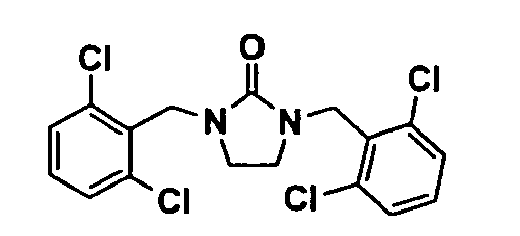
- In the same manner as in Reference Example 1B, the title compound was obtained from ethyleneurea and α,2,6-trichlorotoluene.
1H NMR (300 MHz, CDCl3) δ ppm 3.10 (s, 4 H), 4.76 (s, 4 H), 7.08-7.24 (m, 2 H), 7.28-7.45 (m, 4 H). -

- In the same manner as in Reference Example 1B, the title compound was obtained from 1-(2,6-dichlorobenzyl) imidazolidin-2-one and benzyl bromide.
1H NMR (300 MHz, CDCl3) δ ppm 3.01-3.22 (m, 4 H), 4.41 (s, 2 H), 4.77 (s, 2 H), 7.12-7.42 (m, 8 H). -

- In the same manner as in Reference Example 1B, the title compound was obtained from 1-(2,6-dichlorobenzyl)imidazolidin-2-one and α-bromo-o-xylene.
1H NMR (300 MHz, CDCl3) δ ppm 2.34 (s, 3H), 2.98-3.28 (m, 4 H), 4.42 (s, 2 H), 4.77 (s, 2 H), 7.07-7.24 (m, 5 H), 7.29-7.38 (m, 2 H). -

- In the same manner as in Reference Example 1B, the title compound was obtained from 1-(2,6-dichlorobenzyl)imidazolidin-2-one and 2,6-dimethylbenzyl chloride.
1H NMR (300 MHz, CDCl3) δ ppm 2.36 (s, 6 H), 2.85-3.18 (m, 4 H), 4.50 (s, 2 H), 4.75 (s, 2 H), 6.97-7.05 (m, 2 H), 7.05-7.13 (m, 1 H), 7.13-7.22 (m, 1 H), 7.28-7.39 (m, 2 H). -

- In the same manner as in Reference Example 1B, the title compound was obtained from 1-(2,6-dichlorobenzyl)imidazolidin-2-one and (1-bromoethyl)benzene.
1H NMR (300 MHz, CDCl3) δ ppm 1.53 (d, J=7.2 Hz, 3 H), 2.79-2.92 (m, 1 H), 3.00-3.27 (m, 3 H), 4.75 (s, 2 H), 5.33 (q, J=7.2 Hz, 1 H), 7.05-7.46 (m, 8 H). -

- In the same manner as in Reference Example 1B, the title compound was obtained from 1-phenylimidazolidin-2-one and α-bromo-o-xylene.
1H NMR (300 MHz, CDCl3) δ ppm 2.36 (s, 3 H), 3.24-3.38 (m, 2 H), 3.72-3.86 (m, 2 H), 4.50 (s, 2 H), 6.96-7.10 (m, 1 H), 7.12-7.28 (m, 4 H), 7.29-7.43 (m, 2 H), 7.52-7.65 (m, 2 H). -

- In the same manner as in Reference Example 1B, the title compound was obtained from 1-phenylimidazolidin-2-one and (1-bromoethyl)benzene.
1H NMR (300 MHz, CDCl3) δ ppm 1.59 (d, J=7.2 Hz, 3 H), 3.02-3.17 (m, 1 H), 3.37-3.52 (m, 1 H), 3.64-3.86 (m, 2 H), 5.41 (q, J=7.2 Hz, 1 H), 6.96-7.10 (m, 1 H), 7.23-7.44 (m, 7 H), 7.50-7.64 (m, 2 H). -
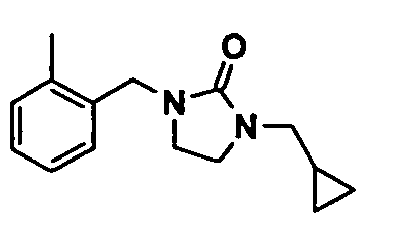
- In the same manner as in Reference Example 1B, the title compound was obtained from 1-(2-methylbenzyl)imidazolidin-2-one obtained in Reference Example 1B and cyclopropylmethyl bromide.
1H NMR (300 MHz, CDCl3) δ ppm 0.16-0.24 (m, 2 H), 0.46-0.57 (m, 2 H), 2.34 (s, 3 H), 3.10 (d, J=7.2 Hz, 2 H), 3.12-3.23 (m, 2 H), 3.34-3.45 (m, 2 H), 4.38 (s, 2 H), 7.11-7.24 (m, 4 H). -

- In the same manner as in Reference Example 1B, the title compound was obtained from ethyleneurea and α-bromo-o-xylene.
1H NMR (300 MHz, CDCl3) δ ppm 2.35 (s, 6 H), 3.12 (s, 4 H), 4.43 (s, 4 H), 7.09-7.24 (m, 8 H). -
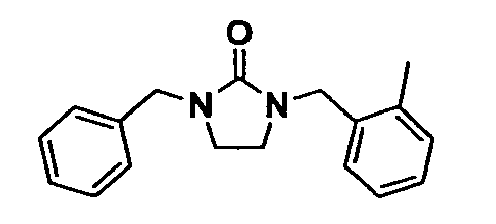
- In the same manner as in Reference Example 1B, the title compound was obtained from 1-(2-methylbenzyl)imidazolidin-2-one obtained in Reference Example 1B and benzyl bromide.
1H NMR (300 MHz, CDCl3) δ ppm 2.35 (s, 3 H), 3.06-3.25 (m, 4 H), 4.41 (s, 2 H), 4.43 (s, 2 H), 7.06-7.45 (m, 9 H). -

- In the same manner as in Reference Example 1B, the title compound was obtained from 1-(2-methylbenzyl)imidazolidin-2-one obtained in Reference Example 1B and 2-chlorobenzyl bromide.
1H NMR (300 MHz, CDCl3) δ ppm 2.35 (s, 3 H), 3.06-3.36 (m, 4 H), 4.43 (s, 2 H), 4.57 (s, 2 H), 7.06-7.31 (m, 6 H), 7.32-7.44 (m, 2 H). -

- In the same manner as in Reference Example 1B, the title compound was obtained from 1-(2-methylbenzyl)imidazolidin-2-one obtained in Reference Example 1B and 4-nitrobenzyl bromide.
1H NMR (300 MHz, CDCl3) δ ppm 2.36 (s, 3 H), 3.19 (s, 4 H), 4.45 (s, 2 H), 4.51 (s, 2 H), 7.19 (s, 4 H), 7.46 (d, J=8.9 Hz, 2 H), 8.16-8.23 (m, 2 H). -

- In the same manner as in Reference Example 1B, the title compound was obtained from 1-(2,6-dichlorobenzyl)imidazolidin-2-one and 4-nitrobenzyl bromide.
1H NMR (300 MHz, CDCl3) δ ppm 3.13-3.23 (m, 4 H), 4.50 (s, 2 H), 4.78 (s, 2 H), 7.17-7.22 (m, 1 H), 7.33 (d, J=8.1 Hz, 2 H), 7.44 (d, J=8.1Hz, 2 H), 8.17-8.20 (m, 2 H). -

- A mixture of 1-(2-methylbenzyl)-3-(4-nitrobenzyl)imidazolidin-2-one obtained in Example 12B (0.60 g), zinc powder (1.0 g) and acetic acid-tetrahydrofuran (1:1, 20 mL) was stirred at room temperature for 2 hr. The reaction solution was filtrated, and the filtrate was concentrated under reduced pressure. The residue was partitioned between ethyl acetate and 10% aqueous sodium bicarbonate, and the ethyl acetate layer was washed with saturated brine, and dried over anhydrous magnesium sulfate. The solvent was evaporated under reduced pressure, and the residue was subjected to silica gel column chromatography (hexane-ethyl acetate 4:1-3:7) to give the title compound (0.78 g, 69%) as a pale-yellow solid.
1H NMR (300 MHz, CDCl3) δ ppm 2.34 (s, 3 H), 3.11 (s, 4 H), 3.64 (brs, 2H), 4.29 (s, 2 H), 4.41 (s, 2 H), 6.64 (d, J=12.6 Hz, 2 H), 7.33 (d, J=12.6 Hz, 2 H), 7.17 (s, 4 H). -

- In the same manner as in Example 14B, the title compound was obtained from 1-(2,6-dichlorobenzyl)-3-(4-nitrobenzyl)imidazolidin-2-one obtained in Example 13B.
1H NMR (300 MHz, CDCl3) δ ppm 3.07-3.12 (m, 4 H), 4.28 (s, 2 H), 4.74 (s, 2 H), 6.63 (d, J=8.7 Hz, 2 H), 7.04-7.07 (m, 2 H), 7.14-7.17 (m, 1 H), 7.31 (d, J=8.7 Hz, 2 H). -

- A mixture of 1-(4-aminobenzyl)-3-(2-methylbenzyl)imidazolidin-2-one obtained in Example 14B (0.15 g), acetyl chloride (44 mg), triethylamine (76 µL) and tetrahydrofuran (6 mL) was stirred at room temperature for 1 hr. 10% Aqueous sodium bicarbonate was added to the reaction solution, and the mixture was extracted with ethyl acetate. The ethyl acetate layer was washed with saturated brine, and dried over anhydrous magnesium sulfate. The solvent was evaporated under reduced pressure, and the residue was subjected to NH-silica gel column chromatography (hexane-ethyl acetate 1:1) to give the title compound (0.15 g, 82%) as a pale-yellow solid.
1H NMR (300 MHz, CDCl3) δ ppm 2.17 (s, 3 H), 2.34 (s, 3 H), 3.03-3.22 (m, 4 H), 4.37 (s, 2 H), 4.42 (s, 2 H), 7.08-7.25 (m, 6 H), 7.37 (s, 1 H), 7.46 (d, J=8.3 Hz, 2 H). -

- In the same manner as in Example 16B, the title compound was obtained from 1-(4-aminobenzyl)-3-(2-methylbenzyl)imidazolidin-2-one obtained in Example 14B and benzoyl chloride.
1H NMR (300 MHz, CDCl3) δ ppm 2.34 (s, 3 H), 3.07-3.22 (m, 4 H), 4.40 (s, 2 H), 4.42 (s, 2 H), 7.12-7.23 (m, 4 H), 7.29 (d, J=8.5 Hz, 2 H), 7.43-7.57 (m, 3 H), 7.62 (d, J=8.5 Hz, 2 H), 7.82-7.96 (m, 3 H) . -

- In the same manner as in Example 16B, the title compound was obtained from 1-(4-aminobenzyl)-3-(2,6-dichlorobenzyl)imidazolidin-2-one obtained in Example 15B and benzoyl chloride.
1H NMR (300 MHz, CDCl3) δ ppm 2.93-3.31 (m, 4 H), 4.39 (s, 2 H), 4.76 (s, 2 H), 7.14-7.23 (m, 1 H), 7.28-7.38 (m, 3 H), 7.44-7.67 (m, 5 H), 7.84-7.91 (m, 2 H), 7.96 (s, 1 H). -

- In the same manner as in Example 16B, the title compound was obtained from 1-(4-aminobenzyl)-3-(2-methylbenzyl)imidazolidin-2-one obtained in Example 14B and phenylacetyl chloride.
1H NMR (300 MHz, CDCl3) δ ppm 2.33 (s, 3 H), 3.10 (s, 4 H), 3.74 (s, 2 H), 4.35 (s, 2 H), 4.40 (s, 2 H), 7.11 (s, 1 H), 7.13-7.24 (m, 6 H), 7.30-7.50 (m, 7 H). -

- In the same manner as in Example 16B, the title compound was obtained from 1-(4-aminobenzyl)-3-(2,6-dichlorobenzyl)imidazolidin-2-one obtained in Example 15B and acetyl chloride.
1H NMR (300 MHz, CDCl3) δ ppm 2.18 (s, 3 H), 3.01-3.25 (m, 4 H), 4.36 (s, 2 H), 4.76 (s, 2 H), 7.11-7.25 (m, 3 H), 7.29-7.37 (m, 2 H), 7.39-7.54 (m, 3 H). -

- In the same manner as in Reference Example 1B, the title compound was obtained from 1-(2-methylbenzyl)imidazolidin-2-one obtained in Reference Example 1B and 1-chloropinacolone.
1H NMR (300 MHz, CDCl3) δ ppm 1.20 (s, 9 H), 2.34 (s, 3 H), 3.17-3.25 (m, 2 H), 3.32-3.40 (m, 2 H), 4.20 (s, 2 H), 4.40 (s, 2 H), 7.14-7.24 (m, 4 H). -
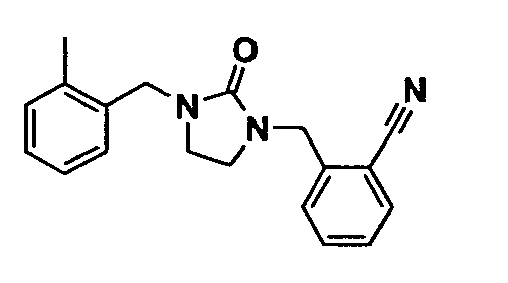
- In the same manner as in Reference Example 1B, the title compound was obtained from 1-(2-methylbenzyl)imidazolidin-2-one obtained in Reference Example 1B and 2-(bromomethyl)benzonitrile.
1H NMR (300 MHz, CDCl3) δ ppm 2.34 (s, 3 H), 3.11-3.23 (m, 2 H), 3.25-3.37 (m, 2 H), 4.43 (s, 2 H), 4.64 (s, 2 H), 7.09-7.24 (m, 4 H), 7.31-7.45 (m, 1 H), 7.51-7.73 (m, 3 H). -

- In the same manner as in Reference Example 1B, the title compound was obtained from 1-(2-methylbenzyl)imidazolidin-2-one obtained in Reference Example 1B and 3-(bromomethyl)benzonitrile.
1H NMR (300 MHz, CDCl3) δ ppm 2.36 (s, 3 H), 3.18 (s, 4 H), 4.44 (s, 4 H), 7.11-7.25 (m, 4 H), 7.45 (t, J=7.9 Hz, 1 H), 7.51-7.66 (m, 3 H). -

- In the same manner as in Reference Example 1B, the title compound was obtained from 1-(2-methylbenzyl)imidazolidin-2-one obtained in Reference Example 1B and 4-(bromomethyl)benzonitrile.
1H NMR (300 MHz, CDCl3) δ ppm 2.35 (s, 3 H), 3.18 (s, 4 H), 4.44 (s, 2 H), 4.46 (s, 2 H), 7.10-7.24 (m, 4 H), 7.40 (d, J=8.5 Hz, 2 H), 7.58-7.68 (m, 2 H). -

- In the same manner as in Reference Example 1B, the title compound was obtained from 1-(2-methylbenzyl)imidazolidin-2-one obtained in Reference Example 1B and 2-(chloromethyl)pyridine.
1H NMR (300 MHz, CDCl3) δ ppm 2.36 (s, 3 H), 3.11-3.23 (m, 2 H), 3.24-3.42 (m, 2 H), 4.43 (s, 2 H), 4.55 (s, 2 H), 7.10-7.25 (m, 5 H), 7.35 (d, J=7.9 Hz, 1 H), 7.60-7.76 (m, 1 H), 8.50-8.57 (m, 1 H). -

- In the same manner as in Reference Example 1B, the title compound was obtained from 1-(2-methylbenzyl)imidazolidin-2-one obtained in Reference Example 1B and 3-(chloromethyl)pyridine.
1H NMR (300 MHz, CDCl3) δ ppm 2.35 (s, 3 H), 3.05-3.22 (m, 4 H), 4.43 (s, 4 H), 7.12-7.24 (m, 4 H), 7.25-7.36 (m, 1 H), 7.56-7.79 (m, 1 H), 8.44-8.60 (m, 2 H). -

- In the same manner as in Reference Example 1B, the title compound was obtained from 1-(2-methylbenzyl)imidazolidin-2-one obtained in Reference Example 1B and 4-(chloromethyl)pyridine.
1H NMR (300 MHz, CDCl3) δ ppm 2.36 (s, 3 H), 3.19 (s, 4 H), 4.42 (s, 2 H), 4.45 (s, 2 H), 7.09-7.25 (m, 6 H), 8.47-8.63 (m, 2 H). -

- In the same manner as in Reference Example 1B, the title compound was obtained from 1-(2-methylbenzyl)imidazolidin-2-one obtained in Reference Example 1B and methyl 4-bromomethylbenzoate.
1H NMR (300 MHz, CDCl3) δ ppm 2.35 (s, 3 H), 3.16 (s, 4 H), 3.91 (s, 3 H), 4.44 (s, 2 H), 4.47 (s, 2 H), 7.08-7.25 (m, 4 H), 7.36 (d, J=8.5 Hz, 2 H), 8.01 (d, J=8.5 Hz, 2 H). -

- A mixture of methyl 4-{[3-(2-methylbenzyl)-2-oxoimidazolidin-1-yl]methyl}benzoate obtained in Example 28B (1.36 g), 2N sodium hydroxide (4.8 mL) and methanol (20 mL) was stirred at 45°C for 1 hr. The reaction solution was concentrated under reduced pressure, and the residue was diluted with water, and adjusted with 6N hydrochloric acid to pH 2. The solution was extracted with ethyl acetate, and the ethyl acetate layer was washed with saturated brine, and dried over anhydrous magnesium sulfate. The solvent was evaporated under reduced pressure to give the title compound (1.20 g, 92%) as a colorless powder.
1H NMR (300 MHz, CDCl3) δ ppm 2.36 (s, 3 H), 3.18 (s, 4 H), 4.45 (s, 2 H), 4.49 (s, 2 H), 7.09-7.24 (m, 4 H), 7.40 (d, J=8.3 Hz, 2 H), 8.07 (d, J=8.3 Hz, 2 H). -

- To a mixture of methyl 4-{[3-(2-methylbenzyl)-2-oxoimidazolidin-1-yl]methyl}benzoate methyl obtained in Example 28B (0.20 g) and tetrahydrofuran (15 mL) was added lithium aluminum hydride (0.03 g) at 0°C, and the mixture was stirred for 1 hr. Sodium sulfate decahydrate was added to the reaction mixture, and the mixture was filtrated through celite. The filtrate was concentrated, and the residue was subjected to silica gel column chromatography (ethyl acetate) to give the title compound (0.19 g, 100%) as a colorless oil.
1H NMR (300 MHz, CDCl3) δ ppm 1.79 (t, J=5.8 Hz, 1 H), 2.35 (s, 3 H), 3.06-3.20 (m, 4 H), 4.40 (s, 2 H), 4.42 (s, 2 H), 4.69 (d, J=5.8 Hz, 2 H), 7.08-7.25 (m, 4 H), 7.27-7.45 (m, 4 H). -
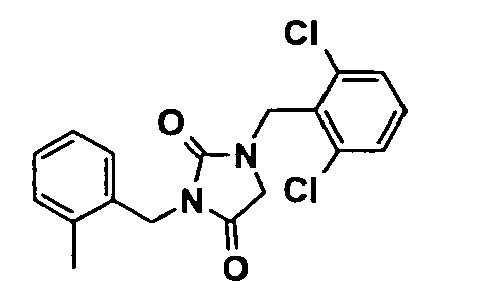
- In the same manner as in Reference Example 1B, the title compound was obtained from 3-(2-methylbenzyl)imidazolidine-2,4-dione obtained in Reference Example 2B and α,2,6-trichlorotoluene.
1H NMR (300 MHz, CDCl3) δ ppm 2.45 (s, 3 H), 3.70 (s, 2 H), 4.71 (s, 2 H), 4.95 (s, 2 H), 7.06-7.20 (m, 3 H), 7.22-7.32 (m, 2 H), 7.33-7.43 (m, 2H). -

- To a mixture of 1-(2,6-dichlorobenzyl)-3-(2-methylbenzyl)imidazolidine-2,4-dione obtained in Example 31B (0.20 g) and tetrahydrofuran (10 mL) was added methylmagnesium bromide (3 M tetrahydrofuran solution, 1.65 mL), and the mixture was stirred at room temperature for 1 hr. 10% Aqueous ammonium chloride was added to the reaction solution, and the mixture was extracted with ethyl acetate. The ethyl acetate layer was washed with saturated brine, and dried over anhydrous magnesium sulfate. The solvent was evaporated under reduced pressure to give the title compound (0.18 g, 86%) as a colorless solid.
1H NMR (300 MHz, CDCl3) δ ppm 1.30 (s, 3 H), 2.37 (s, 3 H), 3.13 (d, J=9.9 Hz, 1 H), 3.21 (d, J=9.9 Hz, 1 H), 4.45 (d, J=16.2 Hz, 1 H), 4.57 (d, J=16.2 Hz, 1 H), 4.73 (d, J=14.1 Hz, 1 H), 4.98 (d, J=14.1 Hz, 1 H), 7.06-7.42 (m, 7 H). -

- In the same manner as in Reference Example 1B, the title compound was obtained from 1-(2-methylbenzyl)imidazolidin-2-one obtained in Reference Example 1B and tert-butyl [2-(bromomethyl)phenyl](methyl)carbamate.
1H NMR (300 MHz, CDCl3) δ ppm 1.34 and 1.51 (s, 9 H), 2.36 (s, 3 H), 3.16 (brs, 7 H), 4.26-4.51 (m, 4 H), 7.04-7.30 (m, 7 H), 7.31-7.41 (m, 1 H). -

- In the same manner as in Reference Example 1B, the title compound was obtained from 1-(2-methylbenzyl)imidazolidin-2-one obtained in Reference Example 1B and tert-butyl [3-(bromomethyl)phenyl](methyl)carbamate.
1H NMR (300 MHz, CDCl3) δ ppm 1.44 (s, 9 H), 2.35 (s, 3 H), 3.10-3.22 (m, 4 H), 3.25 (s, 3 H), 4.38-4.46 (m, 4 H), 7.08 (d, J=7.5 Hz, 2 H), 7.12-7.24 (m, 5 H), 7.26-7.35 (m, 1 H). -

- In the same manner as in Reference Example 1B, the title compound was obtained from 1-(2-methylbenzyl)imidazolidin-2-one obtained in Reference Example 1B and tert-butyl [4-(bromomethyl)phenyl](methyl)carbamate obtained in Reference Example 12A.
1H NMR (300 MHz, CDCl3) δ ppm 1.45 (s, 9 H), 2.35 (s, 3 H), 3.05-3.19 (m, 4 H), 3.25 (s, 3 H), 4.39 (s, 2 H), 4.42 (s, 2 H), 7.04-7.34 (m, 8 H). -

- In the same manner as in Reference Example 1B, the title compound was obtained from 3-(2,6-dichlorobenzyl)imidazolidin-2-one and cyclopropylmethyl bromide.
1H NMR (300 MHz, CDCl3) δ ppm 0.15-0.24 (m, 2 H), 0.45-0.55 (m, 2 H), 0.81-0.98 (m, 1 H), 3.09 (d, J=7.0 Hz, 2 H), 3.13-3.24 (m, 2 H), 3.30-3.42 (m, 2 H), 4.72 (s, 2 H), 7.12-7.23 (m, 1 H), 7.28-7.42 (m, 2 H). -

- In the same manner as in Example 1B, the title compound was obtained from 1-(2,6-dichlorobenzyl)imidazolidin-2-one and methyl 2-bromomethylbenzoate.
1H NMR (300 MHz, CDCl3) δ ppm 3.08-3.30 (m, 4 H), 3.90 (s, 3 H), 4.78 (s, 2 H), 4.80 (s, 2 H), 7.12-7.24 (m, 1 H), 7.28-7.38 (m, 3 H), 7.43-7.54 (m, 2 H), 7.82-8.00 (m, 1 H). -

- In the same manner as in Example 30B, the title compound was obtained from methyl 2-{[3-(2,6-dichlorobenzyl)-2-oxoimidazolidin-1-yl]methyl}benzoate obtained in Example 37B.
1H NMR (300 MHz, CDCl3) δ ppm 3.11-3.27 (m, 4 H), 3.72 (t, J=6.6 Hz, 1 H), 4.54 (s, 2 H), 4.75 (t like, 4 H), 7.13-7.43 (m, 7 H). Example 39B methyl [3-(2,6-dichlorobenzyl)-2-oxoimidazolidin-1-yl]acetate
- In the same manner as in Example 1B, the title compound was obtained from 1-(2,6-dichlorobenzyl)imidazolidin-2-one and methyl bromoacetate.
1H NMR (300 MHz, CDCl3) δ ppm 3.17-3.28 (m, 2 H), 3.32-3.45 (m, 2 H), 3.73 (s, 3 H), 4.02 (s, 2 H), 4.75 (s, 2 H), 7.11-7.24 (m, 1 H), 7.30-7.41 (m, 2 H). -

- In the same manner as in Example 29B, the title compound was obtained from methyl [3-(2,6-dichlorobenzyl)-2-oxoimidazolidin-1-yl]acetate obtained in Example 39B.
1H NMR (300 MHz, CDCl3) δ ppm 3.23-3.32 (m, 2 H), 3.38-3.50 (m, 2 H), 4.02 (s, 2 H), 4.76 (s, 2 H), 7.16-7.24 (m, 1 H), 7.31-7.38 (m, 2 H). -
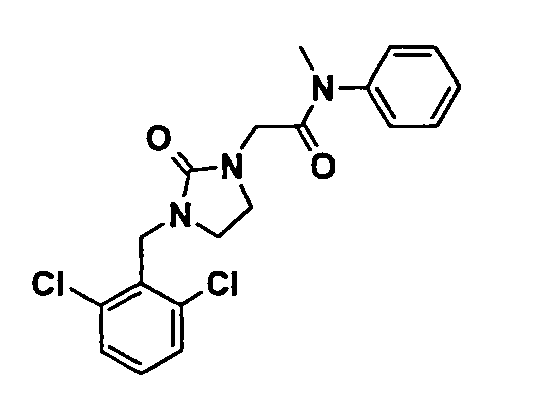
- A mixture of [3-(2,6-dichlorobenzyl)-2-oxoimidazolidin-1-yl]acetic acid obtained in Example 40B (0.18 g), N-methylaniline (0.07 g), 1-ethyl-3-(3'-dimethylaminopropyl)carbodiimide (0.12 g), N-hydroxybenzotriazole (0.10 g) and acetonitrile (10 mL) was stirred at room temperature for 16 hr. Water was added to the reaction solution, and the mixture was extracted with ethyl acetate. The ethyl acetate layer was washed successively with 1N hydrochloric acid, 10% aqueous sodium bicarbonate and saturated brine, and dried over anhydrous magnesium sulfate, and the solvent was evaporated under reduced pressure. The residue was subjected to silica gel column chromatography (hexane-ethyl acetate 4:1-ethyl acetate) to give the title compound (0.12 g, 52%) as a colorless solid.
1H NMR (300 MHz, CDCl3) δ ppm 3.14-3.25 (m, 2 H), 3.26 (s, 3 H), 3.40 (t, J=7.8 Hz, 2 H), 3.74 (s, 2 H), 4.70 (s, 2 H), 7.10-7.22 (m, 1 H), 7.21-7.52 (m, 7 H). -

- In the same manner as in Reference Example 1B, the title compound was obtained from 1,3-dihydro-2H-benzoimidazol-2-one and α-bromo-o-xylene.
1H NMR (300 MHz, CDCl3) δ ppm 2.41 (s, 6 H), 5.14 (s, 4 H), 6.71-6.86 (m, 2 H), 6.90-7.01 (m, 2 H), 7.02-7.23 (m, 8 H). -

- In the same manner as in Reference Example 1B, the title compound was obtained from 1-(2-methylbenzyl)-1,3-dihydro-2H-benzoimidazol-2-one and α,2,6-trichlorotoluene.
1H NMR (300 MHz, CDCl3) δ ppm 2.39 (s, 3 H), 5.11 (s, 2 H), 5.45 (s, 2 H), 6.69-6.82 (m, 2 H), 6.85-6.95 (m, 2 H), 6.97-7.05 (m, 1 H), 7.05-7.15 (m, 1 H), 7.15-7.21 (m, 2 H), 7.21-7.28 (m, 1 H), 7.35 (s, 1 H), 7.38 (s, 1 H). -

- In the same manner as in Reference Example 1B, the title compound was obtained from 1-(2,6-dichlorobenzyl)imidazolidin-2-one and iodocyclohexane.
1H NMR (300 MHz, CDCl3) δ ppm 1.04-1.08 (m, 1 H), 1.28-1.39 (m, 4 H), 1.63-1.98 (m, 5 H), 3.12-3.26 (m, 4 H), 3.73 (m, 1 H), 4.70 (s, 2 H), 7.15-7.20 (t, J=6.9 Hz, 1 H), 7.31-7.33 (m, 2 H). Example 45B 1-[2-chloro-4-(trifluoromethyl)benzyl]-3-cyclohexylimidazolidin-2-one
- In the same manner as in Reference Example 1B, the title compound was obtained from 1-cyclohexylimidazolidin-2-one and 2-chloro-4-(trifluoromethyl)benzyl chloride.
1H NMR (300 MHz, CDCl3) δ ppm 1.05-1.10 (m, 1 H), 1.32-1.47 (m, 4 H), 1.65-1.79 (m, 5 H), 3.23-3.36 (m, 4 H), 3.71-3.79 (m, 1 H), 4.53 (s, 2 H), 7.50 (m, 2 H), 7.63 (m, 1 H). -

- In the same manner as in Reference Example 1B, the title compound was obtained from 1-cyclohexylimidazolidin-2-one and 2-chloro-4-methoxybenzyl bromide.
1H NMR (300 MHz, CDCl3) δ ppm 1.04-1.07 (m, 1 H), 1.25-1.40 (m, 4 H), 1.63-1.79 (m, 5 H), 3.16-3.28 (m, 3 H), 3.70-3.78 (m, 2 H), 3.78 (s, 3 H), 4.44 (s, 2 H), 6.76-6.82 (m, 1 H), 6.89-6.92 (m, 1 H), 7.27-7.30 (m, 1 H). -

- In the same manner as in Reference Example 1B, the title compound was obtained from 1-(2,3-dihydro-1H-inden-1-yl)imidazolidin-2-one obtained in Reference Example 4B and α,2,6-trichlorotoluene.
1H NMR (300 MHz, CDCl3) δ ppm 1.89-2.01 (m, 1 H), 2.33-2.44 (m, 1 H), 2.82-3.00 (m, 3 H), 3.05-3.18 (m, 3 H), 4.78 (s, 2 H), 5.65 (t, J=7.8 Hz, 1 H), 7.15-7.26 (m, 5 H), 7.32-7.34 (m, 2 H). Example 48B 1-[2-chloro-4-(trifluoromethyl)benzyl]-3-(2,3-dihydro-1H-inden-1-yl)imidazolidin-2-one
- In the same manner as in Reference Example 1B, the title compound was obtained from 1-(2,3-dihydro-1H-inden-1-yl)imidazolidin-2-one obtained in Reference Example 4B and 2-chloro-4-(trifluoromethyl)benzyl chloride.
1H NMR (300 MHz, CDCl3) δ ppm 1.93-2.01 (m, 1H), 2.31-2.50 (m, 1 H), 2.93-3.07 (m, 3 H), 3.15-3.33 (m, 3 H), 4.61 (s, 2 H), 5.61-5.69 (t, J=7.6 Hz, 1 H), 7.20-7.27 (m, 5 H), 7.53 (m, 1 H), 7.65 (m, 1 H). -

- In the same manner as in Reference Example 1B, the title compound was obtained from 1-[(1R,2R,4R)-bicyclo[2.2.1]hept-2-yl]imidazolidin-2-one obtained in Reference Example 5B and α,2,4-trichlorotoluene.
1H NMR (300 MHz, CDCl3) δ ppm 1.16-1.21 (m, 2 H), 1.29-1.53 (m, 4 H), 1.65-1.73 (m, 1 H), 2.23 (m, 1 H), 2.28-2.30 (m, 2 H), 3.17-3.38 (m, 4 H), 3.84-3.88 (m, 1 H), 4.38-4.51 (m, 2 H), 7.20-7.23 (m, 1 H), 7.29-7.37 (m, 2 H). -

- In the same manner as in Reference Example 1B, the title compound was obtained from 1-(piperidin-1-yl)imidazolidin-2-one and α,2,6-trichlorotoluene.
1H NMR (300 MHz, CDCl3) δ ppm 1.37-1.43 (m, 2 H), 1.64-1.71 (m, 4 H), 2.93-2.97 (m, 4 H), 3.07-3.12 (m, 2 H), 3.29-3.34 (m, 2 H), 4.68 (s, 2 H), 7.17-7.22 (m, 1 H), 7.31-7.34 (m, 2 H). -

- In the same manner as in Reference Example 1B, the title compound was obtained from 1-(piperidin-1-yl)imidazolidin-2-one and 2-chloro-4-(trifluoromethyl)benzyl chloride.
1H NMR (300 MHz, CDCl3) δ ppm 1.39-1.44 (m, 2 H), 1.67-1.74 (m, 4 H), 2.91-2.96 (m, 4 H), 3.21-3.27 (m, 2 H), 3.40-3.47 (m, 2 H), 4.52 (d, J=4.5 Hz, 2 H), 7.46-7.54 (m, 1 H), 7.61-7.63 (m, 2 H). Example 52B 1-(2,6-dichlorobenzyl)-3-(morpholin-4-yl)imidazolidin-2-one
- In the same manner as in Reference Example 1B, the title compound was obtained from 1-(morpholin-4-yl)imidazolidin-2-oneobtained in Reference Example 3B and α,2,6-trichlorotoluene.
1H NMR (300 MHz, CDCl3)δ ppm 2.99-3.02 (t, J=4.8 Hz, 2 H), 3.12-3.14 (m, 2 H), 3.31-3.36 (m, 2 H), 3.77-3.81 (t, J=4.8 Hz, 2 H), 4.70 (s, 2 H), 7.18-7.23 (m, 1 H), 7.32-7.34 (m, 2 H). -

- In the same manner as in Reference Example 1B, the title compound was obtained from 1-(morpholin-4-yl)imidazolidin-2-oneobtained in Reference Example 3B and 2-chloro-4-(trifluoromethyl)benzyl chloride.
1H NMR (300 MHz, CDCl3) δ ppm 3.00-3.03 (m, 4 H), 3.24-3.29 (m, 2 H), 3.41-3.46 (m, 2 H), 3.80-3.83 (m, 4 H), 4.54 (m, 2 H), 7.50 (m, 2 H), 7.64 (s, 1 H). -

- In the same manner as in Reference Example 1B, the title compound was obtained from 1-(2,3-dihydro-1H-indol-1-yl)imidazolidin-2-one obtained in Reference Example 6B and α,2,6-trichlorotoluene.
1H NMR (300 MHz, CDCl3)δ ppm 2.97-3.02 (t, J=8 .1 Hz, 2 H), 3.15-3.21 (m, 2 H), 3.30-3.35 (m, 2 H), 3.55 (m, 2 H), 4.74 (s, 2 H), 6.58-6.61 (m, 1 H), 6.74-6.79 (m, 1 H), 7.03-7.07 (m, 2 H), 7.16-7.22 (m, 1 H), 7.31-7.34 (m, 2 H). -

- In the same manner as in Reference Example 1B, the title compound was obtained from 1-(2,3-dihydro-1H-indol-1-yl)imidazolidin-2-one obtained in Reference Example 6B and 2-chloro-4-(trifluoromethyl)benzyl chloride.
1H NMR (300 MHz, CDCl3)δ ppm 1.79-1.90 (m, 1 H), 2.12-2.21 (m, 1 H), 2.88-3.09 (m, 4 H), 3.27-3.60 (m, 5 H), 6.38-6.41 (d, J=7.5 Hz, 1 H), 6.82-6.87 (m, 1 H), 7.05-7.14 (m, 2 H), 7.48 (s, 2 H), 7.65 (s, 1 H). -

- To a solution of 1,4-dioxaspiro[4.5]decan-8-amine (7.22 g) and triethylamine (5.16 mL) in tetrahydrofuran (150 mL) was added dropwise 1-chloro-2-isocyanatoethane (4.00 g) at room temperature, and the mixture was stirred at room temperature for 30 min. Then, potassium tert-butoxide (8.75 g) was added to the reaction mixture, and the mixture was stirred at room temperature for 30 min. Water was added to the reaction mixture, and the mixture was extracted with ethyl acetate. The ethyl acetate layer was washed successively with water and saturated brine, and dried over anhydrous magnesium sulfate, and the solvent was evaporated under reduced pressure. To a mixture of the residue, α,2,4-trichlorotoluene (2.93 g) and N,N-dimethylformamide (50 mL) was added 60% sodium hydride (0.72 g), and the mixture was stirred at room temperature for 1 hr. Water was added to the reaction solution, and the mixture was extracted with ethyl acetate. The ethyl acetate layer was washed successively with water and saturated brine, and dried over anhydrous magnesium sulfate, and the solvent was evaporated under reduced pressure. The residue was subjected to silica gel column chromatography to give the title compound (1.1 g, 20%) as a colorless solid from a fraction eluted with ethyl acetate. 1H NMR (300 MHz, CDCl3) δ ppm 1.66-1.82 (m, 8 H), 3.20-3.35 (m, 4 H), 3. 84 (m, 1 H), 3. 94 (s, 2 H), 3. 94 (s, 2 H), 4. 46 (s, 2 H), 7.19-7.24 (dd, J=8.0, 1.8 Hz, 1 H), 7.29 (m, 1 H), 7.36 (m, 1 H).
-

- A mixture of 1-(2,4-dichlorobenzyl)-3-(1,4-dioxaspiro[4.5]dec-8-yl)imidazolidin-2-one (1.0 g), 2N hydrochloric acid (2.6 mL) and tetrahydrofuran (70 mL) was stirred at 60°C for 3 hr. Saturated aqueous sodium hydrogencarbonate was added to the reaction solution, and the mixture was extracted with ethyl acetate. The ethyl acetate layer was washed with saturated brine, and dried over anhydrous magnesium sulfate. The solvent was evaporated under reduced pressure, and the residue was triturated with hexane-ethyl acetate to give the title compound (0.46 g, 52%) as a colorless powder.
1H NMR (300 MHz, CDCl3) δ ppm 1.81-1.94 (m, 2 H), 2.07-2.10 (m, 2 H), 2.42-2.59 (m, 4 H), 3.28-3.29 (m, 4 H), 4.24-4.32 (m, 1 H), 4.49 (s, 2 H), 7.21-7.25 (dd, J=8.4, 1.8 Hz, 1 H), 7.30-7.33 (d, J=8.4 Hz, 1 H), 7.38-7.39 (d, J=1.8 Hz, 1 H). -

- A solution of 1-(2,4-dichlorobenzyl)-3-(4-oxocyclohexyl)imidazolidin-2-one obtained in Example 57B (0.41 g) in tetrahydrofuran (10 mL) was cooled to 0°C, and methyllithium (1.0 M diethyl ether solution, 2.3 mL) was added dropwise thereto. The reaction mixture was stirred at room temperature for 2 hr, water was added, and the mixture was extracted with ethyl acetate. The organic layer was washed with saturated brine, and dried over magnesium sulfate, and the solvent was evaporated under reduced pressure. The obtained residue was subjected to silica gel column chromatography (hexane-ethyl acetate 9:1-1:2) to give the title compound (0.026 g, 6%) as a colorless solid.
1H NMR (300 MHz, CDCl3) δ ppm 1.27 (s, 3 H), 1.47-1.79 (m, 8 H), 2.44 (br, 1 H), 3.21-3.33 (m, 4 H), 3.74-3.81 (m, 1 H), 4.46 (s, 2 H), 7.20-7.24 (dd, J=8.1, 2.4 Hz, 1 H), 7.27-7.32 (m, 1 H), 7.37-7.38 (d, J=2.4 Hz, 1 H). -

- In the same manner as in Reference Example 1B, the title compound was obtained from 1-[1-(1-adamantyl)ethyl]imidazolidin-2-one and α,2,4-trichlorotoluene.
1H NMR (300 MHz, CDCl3) δ ppm 1.06-1.09 (d, J=7.2 Hz, 3 H), 1.57-1. 72 (m, 13 H), 1.98 (m, 3 H), 3.19-3.24 (m, 2 H), 3.37-3.43 (m, 2 H), 3.62-3.69 (q, J=7.5 Hz, 1 H), 4.39-4.55 (q, J=15.6 Hz, 2 H), 7.20-7.23 (m, 1 H), 7.31-7.37 (m, 2 H). -

- In the same manner as in Example 56B, the title compound was obtained from 1,4-dioxaspiro[4.5]decan-8-amine, 1-chloro-2-isocyanatoethane, and α,2,6-trichlorotoluene.
1H NMR (300 MHz, CDCl3) δ ppm 1.68-1.80 (m, 8 H), 3.12-3.18 (m, 2 H), 3.20-3.26 (m, 2 H), 3.88-3.91 (m, 1 H), 3.94 (s, 4 H), 4.70 (s, 2 H), 7.15-7.20 (m, 1 H), 7.29-7.33 (m, 2 H). -

- In the same manner as in Example 57B, the title compound was obtained from 1-(2,6-dichlorobenzyl)-3-(1,4-dioxaspiro[4.5]dec-8-yl)imidazolidin-2-one obtained in Example 60B.
1H NMR (300 MHz, CDCl3) δ ppm 1.80-1.95 (m, 4 H), 2.40-2.62 (m, 4 H), 3.15-3.20 (m, 4 H), 4.23-4.34 (m, 1 H), 4.73 (s, 2 H), 7.15-7.35 (m, 3 H). -

- In the same manner as in Example 58B, the title compound was obtained from 1-(2,6-dichlorobenzyl)-3-(4-oxocyclohexyl)imidazolidin-2-one obtained in Example 61B.
1H NMR (300 MHz, CDCl3) δ ppm 1.26 (s, 3 H), 1.43-1.78 (m, 8 H), 2.20 (br, 1 H), 3.10-3.29 (m, 4 H), 3.72-3.84 (m, 1 H), 4.70 (s, 2 H), 7.14-7.22 (m, 1 H), 7.31-7.35 (m, 2 H). -

- A mixture of 3-(2,6-dichlorobenzyl)piperidin-2-one obtained in Reference Example 2C (258 mg), 60% sodium hydride (80 mg) and N,N-dimethylformamide (5 mL) was stirred at room temperature for 30 min, benzyl bromide (257 mg) was added, and the mixture was further stirred at room temperature for 16 hr. The reaction mixture was poured into water, and the mixture was extracted with ethyl acetate. The ethyl acetate layer was washed with saturated brine, and dried over anhydrous magnesium sulfate. The solvent was evaporated under reduced pressure, and the residue was subjected to silica gel column chromatography (hexane-ethyl acetate 9:1) to give the title compound (270 mg, 78%) as a colorless powder.
1H NMR (300 MHz, CDCl3) δ ppm 1.60-1.70 (m, 3 H),1.85-1.92 (m, 1 H), 2.85-2.95 (m, 1 H), 3.12 (dd, J=13.4, 11.2 Hz, 1 H), 3.20-3.28 (m, 2 H), 3.79 (dd, J=13.4, 4.4 Hz, 1 H), 4.51 (d, J=14.8 Hz, 1 H), 4.74 (d, J=14.8 Hz, 1 H), 7.05-7.12 (m, 1 H), 7.25-7.36 (m, 7 H). -

- In the same manner as in Example 1C, the title compound was obtained from 3-(2,6-dichlorobenzyl)piperidin-2-one obtained in Reference Example 2C and 2-chlorobenzyl bromide.
1H NMR (300 MHz, CDCl3) δ ppm 1.59-1.80 (m, 3 H), 1.84-2.00 (m, 1 H), 2.84-3.02 (m, 1 H), 3.13 (dd, J=13.6, 11.3 Hz, 1 H), 3.20-3. 39 (m, 2 H), 3. 78 (dd, J=13.6, 4 . 5 Hz, 1 H), 4 . 61-4 . 77 (m, 1 H), 4.77-4.94 (m, 1 H), 7.05-7.15 (m, 1 H), 7.16-7.42 (m, 6 H). Example 3C 3-(2,6-dichlorobenzyl)-1-(4-methylbenzyl)piperidin-2-one
- In the same manner as in Example 1C, the title compound was obtained from 3-(2,6-dichlorobenzyl)piperidin-2-one obtained in Reference Example 2C and a-bromo-p-xylene.
1H NMR (300 MHz, CDCl3) δ ppm 1.52-1.74 (m, 3 H), 1.77-1.94 (m, 1 H), 2.34 (s, 3 H), 2.77-2.99 (m, 1 H), 3.03-3.18 (m, 1 H), 3.17-3.37 (m, 2 H), 3.78 (dd, J=13.6, 4.3 Hz, 1 H), 4.46 (d, J=14.5 Hz, 1 H), 4.70 (d, J=14.5 Hz, 1 H), 7.03-7.23 (m, 5 H), 7.24-7.38 (m, 2 H). -

- In the same manner as in Example 1C, the title compound was obtained from 3-(2,6-dichlorobenzyl)piperidin-2-one obtained in Reference Example 2C and α-bromo-m-xylene.
1H NMR (300 MHz, CDCl3) δ ppm 1.49-1.76 (m, 3 H), 1.79-1.98 (m, 1 H), 2.35 (s, 3 H), 2.78-3.01 (m, 1 H), 3.12 (dd, J=13.6, 11.3 Hz, 1 H), 3.18-3.32 (m, 2 H), 3.79 (dd, J=13.6, 4.5 Hz, 1 H), 4.46 (d, J=14.5 Hz, 1 H), 4.72 (d, J=14.5 Hz, 1 H), 7.01-7.16 (m, 4 H), 7.16-7.38 (m, 3 H). -

- In the same manner as in Example 1C, the title compound was obtained from 3-(2,6-dichlorobenzyl)piperidin-2-one obtained in Reference Example 2C and.α-bromo-o-xylene.
1H NMR (300 MHz, CDCl3) δ ppm 0.74-0.98 (m, 1 H), 1.60-1.76 (m, 3 H), 1.79-1.97 (m, 1 H), 2.31 (s, 3 H), 2.83-3.00 (m, 1 H), 3.11-3.23 (m, 2 H), 3.79 (dd, J=13.6, 4.3 Hz, 1 H), 4.59 (d, J=15.0 Hz, 1 H), 4.59 (d, J=15.0 Hz, 1 H), 7.02-7.23 (m, 5 H), 7.27-7.38 (m, 2 H). -

- To a solution of 1-(1-adamantyl)piperidin-2-one (0.55 g) in tetrahydrofuran (10 mL) was added lithium diisopropylamide (1.8 M tetrahydrofuran solution, 1.31 mL) at -78°C under nitrogen atmosphere, and the mixture was stirred for 10 min. A solution of α,2,6-trichlorotoluene (0.46 g) in tetrahydrofuran (2 mL) was added to the obtained solution at the same temperature, the mixture was further stirred at -78°C for 10 min, and the temperature was gradually raised to room temperature. Water was added to the reaction mixture, and the mixture was extracted with ethyl acetate. The ethyl acetate layer was washed with saturated brine, and dried over anhydrous magnesium sulfate. The solvent was evaporated under reduced pressure, and the residue was subjected to silica gel column chromatography (hexane-ethyl acetate 19:1-4:1) to give the title compound (0.14 g, 15%) as a colorless solid.
1H NMR (300 MHz, CDCl3) δ ppm 1.48-1.63 (m, 2 H), 1.67-1.85 (m, 8 H), 2.10 (br, 3 H), 2.24 (br, 6 H), 2.27-2.78 (m, 1 H), 3.06 (t, J=13.5 Hz, 1 H), 3.10-3.39 (m, 2 H), 3.58-3.64 (dd, J=13.5, 3.9 Hz, 1 H), 7.04-7.09 (m, 1 H), 7.25-7.28 (m, 2 H). -

- In the same manner as in Example 6C, the title compound was obtained from 1-(1-adamantyl)azepan-2-one and α, 2, 6-trichlorotoluene.
1H NMR (300 MHz, CDCl3) δ ppm 1.32-1.42 (m, 2 H), 1.49-1.54 (m, 2 H), 1.65-1.76 (m, 8 H), 2.12 (br, 3 H), 2.24 (br, 6 H), 3.11-3.33 (m, 4 H), 3.62 -3.69 (m, 1 H), 7.08 (t, J=7.8 Hz, 1 H), 7.27-7.33 (m, 2 H). -

- In the same manner as in Reference Example 1D, the title compound was obtained from tetrahydro-2-pyrimidinone and α-bromo-o-xylene.
1H NMR (300 MHz, CDCl3) δ ppm 1.81-1.98 (m, 2 H), 2.33 (s, 6 H), 3.04-3.25 (m, 4 H), 4.66 (s, 4 H), 7.08-7.24 (m, 8 H). -

- In the same manner as in Reference Example 1D, the title compound was obtained from 1-(2-methylbenzyl)tetrahydropyrimidin-2(1H)-one obtained in Reference Example 1D and α,2,6-trichlorotoluene.
1H NMR (300 MHz, CDCl3) δ ppm 1.77-1.92 (m, 2 H), 2.32 (s, 3 H), 2.99-3.15 (m, 4 H), 4.65 (s, 2 H), 5.03 (s, 2 H), 7.12-7.22 (m, 5 H), 7.30-7.36 (m, 2 H). - The enzyme reaction was performed in a polypropylene 96-well plate (Corning). The microsome fraction obtained in Reference Example 2a was diluted with a buffer (30 mM Tris-HCl, 1 mM EDTA, 0.1% BSA, pH 7.2) to a concentration of 100 µg/ml. A solution (2.5 µl) of the test compound in dimethyl sulfoxide was added to the obtained diluted solution (22.5 µl) and the mixture was incubated at room temperature for 5 min. A substrate solution (500 nM cortisone, 400 µM NADPH) (25 µl) was added to the obtained suspension, allowed to react at room temperature for 60 min and the reaction was quenched by the addition of 2 mM 18-β-glycyrrhetinic acid (Sigma Ltd.) solution (5 µl). The produced cortisole was quantified by the following competitive ELISA.
- Anti-mouse IgG antibody (Chemicon) was suspended in 100 mM sodium phosphate buffer (pH 9.0) to a concentration of 5 µg/ml.
- The obtained suspension (100 µl) was added to a 96-well black plate (Maxisorp, Nunc), and incubated overnight at 4°C to immobilize a first antibody. The plate was washed with PBS containing 0.05% Tween20 (Bio-Rad), 30% block ace (Yukijirushi) (300 µl) diluted with PBS was added. After blocking at room temperature for 1 hr or more, the plate was washed with PBS containing 0.05% Tween20. Anti-cortisole antibody (assay design) (100 µl) diluted 4-fold with a buffer (30 mM Tris-HCl, 1 mM EDTA, pH 7.2) was added to the plate, and the plate was incubated at room temperature for 90 min. The plate was washed 4 times with PBS containing 0.05% Tween20, the enzyme reaction mixture (25 µl) and alkaline phosphatase conjugated cortisole (assay design) (25 µl) were added, and the plate was incubated at room temperature for 120 min. The plate was washed 4 times with PBS containing 0.05% Tween20, a luminescence substrate for alkaline phosphatase, Immun star (Enhancer plus, Bio-Rad) (50 µl) was added. The plate was incubated at room temperature for 10 min and the level of luminescence was measured by Arvo malti label counter (Wallac). The concentration (IC50 value) of the test compound necessary for inhibiting the 11βHSD1 activity by 50% was calculated by PRISM2.01 (Graphpad Software). The results are shown in Table 1.
[Table 1] test compound IC50 value (Example No.) (nM) 9A 7.9 38A 26 66A 56 94A 85 412A 430 413A 29 468A 19 470A 37 510A 9.9 602A 26 603A 98 619A 46 654A 150 32B 53 5C 110 2D 130 Formulation Example 1 (production of capsules) 1) compound of Example 1A 30 mg 2) fine cellulose powder 10 mg 3) lactose 19 mg 4) magnesium stearate 1 mg total 60 mg Formulation Example 2 (production of tablets) 1) compound of Example 1A 30 g 2) lactose 50 g 3) corn starch 15 g 4) carboxymethylcellulose calcium 44 g 5) magnesium stearate 1 g total of 1000 tablets 140 g 1), 2), 3) and 4) are mixed and filled in gelatin capsules. - The entire amounts of 1), 2) and 3), and 30 g of 4) are kneaded with water, dried in vacuo and granulated.
- The granules are mixed with 14 g of 4) and 1 g of 5) and the mixture is compressed with a tableting machine, whereby 1000 tablets containing 30 mg of compound of Example 1A per tablet are obtained.
- The 11β-hydroxysteroid dehydrogenase 1 inhibitor of the present invention has a superior activity, and is useful as a pharmaceutical agent such as agents for the prophylaxis or treatment of diabetes, insulin resistance, obesity, abnormal lipid metabolism, hypertension and the like, and the like.
- This application is based on patent application Nos.
2005-102913 2005-306397 
Claims (16)
- A 11β-hydroxysteroid dehydrogenase 1 inhibitor comprising a compound represented by the formula (1):

R1 is an optionally substituted cyclic group;
R2 is a hydrogen atom or an optionally substituted cyclic group;
X is N or CR3 (R3 is a hydrogen atom or a substituent);
L1 and L2 are the same or different and each is a bond, an optionally substituted divalent aliphatic hydrocarbon group, or a group represented by the formula : - (akn1)mY-(akn2)n- (akn1 and akn2 are the same or different and each is an optionally substituted C1-6 alkylene group; m and n are the same or different and each is 0 or 1; and Y is -O-, -S-, -SO-, -SO2-, -NR4-, -SO2NR4- or -NR4SO2- (R4 is a hydrogen atom or an optionally substituted C1-6 alkyl group); and
ring A is an optionally substituted 4- to 7-membered nitrogen-containing non-aromatic heterocycle wherein the non-aromatic heterocycle is optionally condensed with an optionally substituted ring,
or a salt thereof, or a prodrug thereof. - The agent of claim 1, wherein the cyclic group for R1 is a C3-6 cycloalkyl group.
- Use of a compound represented by the formula (1):

or a salt thereof, or a prodrug thereof, for the production of a 11β-hydroxysteroid dehydrogenase 1 inhibitor. - A method of inhibiting 11β-hydroxysteroid dehydrogenase 1 in a mammal, which comprises administering a compound represented by the formula (1):

or a salt thereof, or a prodrug thereof, to the mammal. - A compound represented by the formula (2a):

R1a' is an optionally substituted non-aromatic cyclic group provided that the non-aromatic cyclic group should be selected from a C3-6 cycloalkyl group optionally condensed with a benzene ring, a 6-membered non-aromatic heterocyclic group, a 5- or 6-membered non-aromatic heterocyclic group condensed with a benzene ring, and a C7-10 cross-linked hydrocarbon group; and the non-aromatic cyclic group should not have, as a substituent, a group represented by R'-E- (E is -S(O)t-CHRe-, -CHReNRe-, -C(O)-NRe-, -NRe-C(O)NRe-, -SO2-NRe- or -NRe-SO2NRe-(t is an integer of 0 to 2; and Re is a hydrogen atom or a C1-3 alkyl group); and R' is an optionally substituted C6-10 aryl group or an optionally substituted 5- to 10-membered aromatic heterocyclic group);
R2a' is an optionally substituted cyclic group (provided that the cyclic group should not be a non-aromatic heterocyclic group); L2a' is a C1-6 alkylene group;
R3a is a hydrogen atom, an optionally substituted hydroxy group, an optionally substituted mercapto group, an optionally substituted amino group or an acyl group;
R4a and R5a are the same or different and each is a hydrogen atom or a substituent,
or a salt thereof. - The compound of claim 5, wherein the non-aromatic cyclic group for R1a' is a C3-6 cycloalkyl group.
- The compound of claim 5, wherein R1a' is a C3-6 cycloalkyl group optionally condensed with a benzene ring, a 6-membered non-aromatic heterocyclic group, a 5- or 6-membered non-aromatic heterocyclic group condensed with a benzene ring, or a C7-10 cross-linked hydrocarbon group, each of which is optionally substituted by 1 to 5 substituents selected from(1) a halogen atom;(2) a hydroxy group;(3) a cyano group;(4) a nitro group;(5) a carboxyl group;(6) a carbamoyl group;(7) an oxo group;(8) a C1-3 alkylenedioxy group;(9) a C1-6 alkyl group optionally substituted by 1 to 3 substituents selected from the following (i) to (vii)(i) a halogen atom,(ii) a carboxyl group,(iii) a hydroxy group,(iv) a C1-6 alkoxy-carbonyl group,(v) a carbamoyl group optionally mono- or di-substituted by substituent (s) selected from a C6-14 aryl group and a C7-13 aralkyl group,(vi) an aromatic heterocyclic group optionally substituted by C6-14 aryl group (s) optionally substituted by 1 to 3 halogen atoms, and(vii) a non-aromatic heterocyclyl-carbonyl group;(10) a C2-6 alkenyl group optionally substituted by 1 to 3 substituents selected from a carboxyl group and a C1-6 alkoxy-carbonyl group;(11) a C2-6 alkynyl group;(12) a C6-14 aryl group optionally substituted by 1 to 3 halogen atoms;(13) a C7-13 aralkyl group;(14) a C1-6 alkoxy group optionally substituted by 1 to 3 halogen atoms;(15) an amino group optionally mono- or di-substituted by C1-6 alkyl group(s) ;(16) a C1-6 alkyl-carbonyl group;(17) a C1-6 alkoxy-carbonyl group;(18) a C7-13 aralkyloxy-carbonyl group;(19) a C1-6 alkylsulfinyl group;(20) a C1-6 alkylsulfonyl group;(21) a non-aromatic heterocyclic group; and(22) a formyl group.
- The compound of claim 5, wherein the cyclic group for R2a' is a C6-14 aryl group.
- The compound of claim 5, wherein the non-aromatic cyclic group for R1a' is a C7-10 cross-linked hydrocarbon group, and R2a' is a phenyl group having a substituent at the para-position.
- The compound of claim 9, wherein the substituent which the phenyl group has at the para-position,(1) a nitro group;(2) a carboxyl group;(3) a C1-3 alkylenedioxy group;(4) a C1-6 alkyl group substituted by 1 to 3 substituents selected from the following (i) to (viii)(i) a carboxyl group,(ii) a hydroxy group,(iii) a C1-6 alkoxy-carbonyl group,(iv) a carbamoyl group optionally mono- or di-substituted by substituent (s) selected from a C6-14 aryl group and a C7-13 aralkyl group,(v) an amino group optionally mono- or di-substituted by C1-6 alkyl-carbonyl group(s),(vi) an aromatic heterocyclic group optionally substituted by C6-14 aryl group(s) optionally substituted by 1 to 3 halogen atoms,(vii) a non-aromatic heterocyclic group, and(viii) a non-aromatic heterocyclyl-carbonyl group optionally substituted by 1 to 3 C1-6 alkoxy-carbonyl groups;(5) a C2-6 alkenyl group optionally substituted by 1 to 3 substituents selected from a carboxyl group and a C1-6 alkoxy-carbonyl group;(6) a C2-6 alkynyl group optionally substituted by 1 to 3 hydroxy groups;(7) a C6-14 aryl group optionally substituted by 1 to 3 substituents selected from the following (i) to (ix)(i) a C1-6 alkyl group optionally substituted by 1 to 3 substituents selected from a hydroxy group and a halogen atom,(ii) a formyl group,(iii) a cyano group,(iv) a carboxyl group,(v) a carbamoyl group,(vi) a halogen atom,(vii) a C1-6 alkyl-carbonyl group,(viii) a C1-6 alkylsulfonyl group, and(ix) an amino group optionally mono- or di-substituted by substituent(s) selected from a C1-6 alkyl-carbonyl group and a C1-6 alkylsulfonyl group;(8) a C7-13 aralkyl group;(9) an aromatic heterocyclic group optionally substituted by 1 to 3 substituents selected from the following (i) to (v)(i) a C1-6 alkyl group optionally substituted by 1 to 3 hydroxy groups,(ii) a carboxyl group,(iii) a C3-10 cycloalkyl group,(iv) a halogen atom, and(v) a formyl group;(10) a non-aromatic heterocyclic group optionally substituted by 1 to 3 substituents selected from the following (i) to (iii)(i) a C1-6 alkyl group optionally substituted by 1 to 3 substituents selected from(a) a hydroxy group,(b) a C6-14 aryl group optionally substituted by 1 to 3 substituents selected from a C1-6 alkyl group optionally substituted by 1 to 3 halogen atoms and a halogen atom, and(c) an aromatic heterocyclic group,(ii) an oxo group, and(iii) a C1-6 alkyl-carbonyl group;(11) a C1-6 alkoxy group substituted by 1 to 3 substituents selected from the following (i) to (xii)(i) a cyano group,(ii) a carboxyl group,(iii) an amino group optionally mono- or di-substituted by substituent(s) selected from(a) a C1-6 alkyl group,(b) a C1-6 alkoxy-carbonyl group,(c) a C6-14 aryl-carbonyl group optionally substituted by C1-6 alkyl group(s) optionally substituted by 1 to 3 halogen atoms, and(d) a C6-14 arylsulfonyl group,(iv) a C6-14 aryloxy group,(v) a C7-13 aralkyloxy group optionally substituted by 1 to 3 halogen atoms,(vi) a C1-6 alkyl-carbonyl group,(vii) a C1-6 alkoxy-carbonyl group,(viii) a carbamoyl group optionally mono- or di-substituted by substituent(s) selected from(a) a C1-6 alkyl group optionally substituted by 1 to 3 substituents selected from(a-1) a C6-14 aryl group optionally substituted by 1 to 3 substituents selected from a C1-6 alkyl group optionally substituted by 1 to 3 halogen atoms, a halogen atom and a C1-6 alkoxy group,(a-2) an aromatic heterocyclic group, and(a-3) a C3-10 cycloalkyl group,(b) a C3-10 cycloalkyl group,(c) a C6-14 aryl group optionally substituted by 1 to 3 substituents selected from(c-1) a halogen atom, and(c-2) a C1-6 alkyl group optionally substituted by 1 to 3 halogen atoms, and(d) a C6-14 arylsulfonyl group optionally substituted by C1-6 alkyl group(s) optionally substituted by 1 to 3 halogen atoms,(ix) an aromatic heterocyclic group optionally substituted by 1 to 3 substituents selected from(a) a C1-6 alkyl group optionally substituted by 1 to 3 substituents selected from a hydroxy group and a halogen atom,(b) a C6-14 aryl group optionally substituted by 1 to 3 halogen atoms,(c) a carboxyl group, and(d) a C1-6 alkoxy-carbonyl group,(x) an aromatic heterocyclyl-oxy group optionally substituted by C1-6 alkyl group(s) optionally substituted by 1 to 3 halogen atoms,(xi) a non-aromatic heterocyclic group optionally substituted by 1 to 3 substituents selected from(a) a C3-10 cycloalkyl group, and(b) an oxo group, and(xii) a C1-6 alkoxy group;(12) a C2-6 alkynyloxy group;(13) a C3-10 cycloalkyl-C1-6 alkyloxy group;(14) a C1-6 alkylthio group;(15) an amino group optionally mono- or di-substituted by substituent(s) selected from the following (i) to (xvii)(i) a C1-6 alkyl group optionally substituted by 1 to 3 substituents selected from a hydroxy group and a C1-6 alkoxy-carbonyl group,(ii) a C6-14 aryl group,(iii) a C7-13 aralkyl group,(iv) a C1-6 alkyl-carbonyl group optionally substituted by 1 to 3 substituents selected from(a) a hydroxy group,(b) a carboxyl group,(c) a C6-14 aryl group,(d) a C1-6 alkoxy-carbonyl group,(e) a C1-6 alkyl-carbonyloxy group,(f) a C6-14 arylsulfonyl group,(g) an amino group optionally mono- or di-substituted by substituent(s) selected from a C1-6 alkoxy-carbonyl group, a C6-14 aryl-carbonyl group and a C6-14 arylsulfonyl group,(h) a halogen atom, and(i) an aromatic heterocyclic group,(v) a C1-6 alkoxy-carbonyl group,(vi) a C6-14 aryl-carbonyl group optionally substituted by 1 to 3 substituents selected from(a) a C1-6 alkyl group optionally substituted by 1 to 3 halogen atoms, and(b) a sulfamoyl group,(vii) a C7-13 aralkyl-carbonyl group,(viii) a C3-10 cycloalkyl-carbonyl group optionally substituted by 1 to 3 substituents selected from(a) a hydroxy group,(b) a carboxyl group,(c) a C1-6 alkoxy-carbonyl group,(d) an amino group optionally mono- or di-substituted by substituent(s) selected from a C1-6 alkoxy-carbonyl group, a C6-14 aryl-carbonyl group and a C6-14 arylsulfonyl group,(e) an oxo group, and(f) a C1-6 alkyl group optionally substituted by 1 to 3 hydroxy groups,(ix) an aromatic heterocyclyl-carbonyl group optionally substituted by C1-6 alkyl group(s) optionally substituted by 1 to 3 hydroxy groups,(x) a C1-6 alkylsulfonyl group optionally substituted by 1 to 3 substituents selected from a non-aromatic heterocyclic group optionally substituted by oxo group(s) and a halogen atom,(xi) a C6-14 arylsulfonyl group optionally substituted by 1 to 3 substituents selected from a C1-6 alkyl group optionally substituted by 1 to 3 halogen atoms and a halogen atom,(xii) a C7-13 aralkylsulfonyl group,(xiii) a C3-10 cycloalkylsulfonyl group,(xiv) an aromatic heterocyclyl-sulfonyl group optionally substituted by 1 to 3 C1-6 alkyl group(s),(xv) -CONR6R7
wherein
R6 and R7 are the same or different and each is selected
from the following (a) to (f),(a) a hydrogen atom,(b) a C1-6 alkyl group optionally substituted by 1 to 3 substituents selected from the following (b-1) to (b-4)(b-1) a hydroxy group,(b-2) a carboxyl group,(b-3) a C1-6 alkoxy-carbonyl group, and(b-4) a carbamoyl group optionally mono- or di-substituted by C1-6 alkyl group(s),(c) a C6-14 aryl group optionally substituted by 1 to 3 substituents selected from the following (c-1) to (c-5)(c-1) a C1-6 alkyl group optionally substituted by 1 to 3 substituents selected from a hydroxy group and a halogen atom,(c-2) a carboxyl group,(c-3) a C1-6 alkoxy-carbonyl group,(c-4) a carbamoyl group, and(c-5) a C1-6 alkoxy group optionally substituted by 1 to 3 halogen atoms,(d) a C7-13 aralkyl group,(e) a C1-6 alkoxy group, and(f) a C7-13 aralkyloxy group, or
R6 and R7 form, together with the adjacent nitrogen atom, an optionally substituted nitrogen-containing heterocycle,(xvi) a sulfamoyl group optionally mono- or di-substituted by C1-6 alkyl group(s) optionally substituted by 1 to 3 C3-10 cycloalkyl groups, and(xvii) a non-aromatic heterocyclyl-carbonyl group optionally substituted by 1 to 3 substituents selected from(a) a carboxyl group,(b) a C1-6 alkoxy-carbonyl group, and(c) a C7-13 aralkyl group optionally substituted by C1-6 alkyl group(s) optionally substituted by 1 to 3 halogen atoms;(16) a C1-6 alkyl-carbonyl group;(17) a C1-6 alkoxy-carbonyl group;(18) a C7-13 aralkyloxy-carbonyl group;(19) a C1-6 alkylsulfinyl group;(20) a C1-6 alkylsulfonyl group;(21) a carbamoyl group optionally mono- or di-substituted by substituent(s) selected from a C1-6 alkyl group, a C6-14 aryl group, a C7-13 aralkyl group and an aromatic heterocyclyl-C1-6 alkyl group;(22) a C6-14 aryloxy group;(23) a C7-13 aralkyloxy group substituted by 1 to 3 substituents selected from a C1-6 alkyl group substituted by 1 to 3 hydroxy groups, a carboxyl group and a C1-6 alkoxy-carbonyl group;(24) an aromatic heterocyclyl-oxy group optionally substituted by 1 to 3 substituents selected from a C1-6 alkyl group optionally substituted by 1 to 3 halogen atoms and a halogen atom;(25) a tri-C1-6 alkyl-silyloxy group;(26) a formyl group; and(27) a C1-6 alkylsulfonyloxy group optionally substituted by 1 to 3 halogen atoms. - The compound of claim 5, wherein R3a is a hydrogen atom.
- The compound of claim 5, wherein R4a is a hydrogen atom.
- The compound of claim 5, wherein R5a is a hydrogen atom.
- The compound of claim 5, which is
3-(2,4-dichlorobenzyl)-1-(4-hydroxy-4-methylcyclohexyl)pyrrolidin-2-one;
N-(3-chloro-4-{[1-(5-hydroxy-2-adamantyl)-2-oxopyrrolidin-3-yl]methyl}phenyl)-N'-[4-(hydroxymethyl)phenyl]urea;
N-(3'-chloro-4'-{[1-(5-hydroxy-2-adamantyl)-2-oxopyrrolidin-3-yl]methyl}biphenyl-3-yl)methanesulfonamide;
1-(3-chloro-4-{[1-(5-hydroxy-2-adamantyl)-2-oxopyrrolidin-3-yl]methyl}phenyl)-3-[4-(trifluoromethyl)benzyl]imidazolidin-2-one;
2-(3-chloro-4-{[1-(4-hydroxy-4-methylcyclohexyl)-2-oxopyrrolidin-3-yl]methyl}phenoxy)-N-[4-(trifluoromethyl)benzyl]acetamide;
3-(2-chloro-4-{[3-(4-fluorophenyl)-1,2,4-oxadiazol-5-yl]methoxy}benzyl)-1-(4-hydroxy-4-methylcyclohexyl)pyrrolidin-2-one;
3-{[3-chloro-3'-(hydroxymethyl)biphenyl-4-yl]methyl}-1-(4-hydroxy-4-methylcyclohexyl)pyrrolidin-2-one;
or a salt thereof. - A pharmaceutical agent comprising the compound of claim 5.
- the pharmaceutical agent of claim 15, which is an agent for the prophylaxis or treatment of diabetes, obesity or arteriosclerosis.
Applications Claiming Priority (3)
| Application Number | Priority Date | Filing Date | Title |
|---|---|---|---|
| JP2005102913 | 2005-03-31 | ||
| JP2005306397 | 2005-10-20 | ||
| PCT/JP2006/307402 WO2006104280A1 (en) | 2005-03-31 | 2006-03-31 | Prophylactic/therapeutic agent for diabetes |
Publications (2)
| Publication Number | Publication Date |
|---|---|
| EP1864971A1 true EP1864971A1 (en) | 2007-12-12 |
| EP1864971A4 EP1864971A4 (en) | 2010-02-10 |
Family
ID=37053521
Family Applications (1)
| Application Number | Title | Priority Date | Filing Date |
|---|---|---|---|
| EP06731350A Withdrawn EP1864971A4 (en) | 2005-03-31 | 2006-03-31 | PROPHYLACTIC / THERAPEUTIC AGENT FOR DIABETES |
Country Status (4)
| Country | Link |
|---|---|
| US (1) | US20090264650A1 (en) |
| EP (1) | EP1864971A4 (en) |
| JP (1) | JPWO2006104280A1 (en) |
| WO (1) | WO2006104280A1 (en) |
Cited By (49)
| Publication number | Priority date | Publication date | Assignee | Title |
|---|---|---|---|---|
| WO2008106128A3 (en) * | 2007-02-26 | 2009-02-19 | Vitae Pharmaceuticals Inc | CYCLIC UREA AND CARBAMATE INHIBITORS OF 11β -HYDROXYSTEROID DEHYDROGENASE 1 |
| WO2009061498A1 (en) * | 2007-11-07 | 2009-05-14 | Vitae Pharmaceuticals, Inc. | CYCLIC UREA INHIBITORS OF 11β -HYDROXYSTEROID DEHYDROGENASE 1 |
| WO2008046758A3 (en) * | 2006-10-19 | 2009-06-11 | Hoffmann La Roche | Imidazolone and imidazolidinone derivatives as 11b-hsd1 inhibitors for diabetes |
| WO2009075835A1 (en) * | 2007-12-11 | 2009-06-18 | Vitae Pharmaceutical, Inc | CYCLIC UREA INHIBITORS OF 11β-HYDROXYSTEROID DEHYDROGENASE 1 |
| WO2009102428A3 (en) * | 2008-02-11 | 2009-10-22 | Vitae Pharmaceuticals, Inc. | 1,3-OXAZEPAN-2-ONE AND 1,3-DIAZEPAN-2-ONE INHIBITORS OF 11β -HYDROXYSTEROID DEHYDROGENASE 1 |
| WO2010010150A1 (en) * | 2008-07-25 | 2010-01-28 | Boehringer Ingelheim International Gmbh | Synthesis of inhibitors of 11beta-hydroxysteroid dehydrogenase type 1 |
| WO2010065717A1 (en) * | 2008-12-05 | 2010-06-10 | Mochida Pharmaceutical Co., Ltd. | Morpholinone compounds as factor ixa inhibitors |
| US7816349B2 (en) | 2006-04-24 | 2010-10-19 | Eli Lilly And Company | Substituted pyrrolidinones as inhibitors of 11-beta-hydroxysteroid dehydrogenase 1 |
| US7820659B2 (en) | 2006-04-21 | 2010-10-26 | Eli Lilly And Company | Cyclohexylimidiazole lactam derivatives as inhibitors of 11-β-hydroxysteroid dehydrogenase 1 |
| US7829582B2 (en) | 2006-04-28 | 2010-11-09 | Eli Lilly And Company | Piperidinyl substituted pyrrolidinones as inhibitors of 11-beta-hydroxysteroid dehydrogenase 1 |
| WO2011002910A1 (en) * | 2009-07-01 | 2011-01-06 | Vitae Pharmaceuticals, Inc. | Cyclic inhibitors of 11beta-hydroxysteroid dehydrogenase 1 |
| US7968585B2 (en) | 2006-04-25 | 2011-06-28 | Eli Lilly And Company | Inhibitors of 11-beta-hydroxysteroid dehydrogenase 1 |
| US7981918B2 (en) | 2006-04-21 | 2011-07-19 | Eli Lilly And Company | Cyclohexylpyrazole-lactam derivatives as inhibitors of 11-beta-hydroxysteroid dehydrogenase 1 |
| US7994176B2 (en) | 2006-04-25 | 2011-08-09 | Eli Lilly And Company | Inhibitors of 11-beta-hydroxysteroid dehydrogenase 1 |
| US7998999B2 (en) | 2006-04-24 | 2011-08-16 | Eli Lilly And Company | Cyclohexyl substituted pyrrolidinones as inhibitors of 11-beta-hydroxysteroid dehydrogenase 1 |
| US7998992B2 (en) | 2007-03-30 | 2011-08-16 | Institute Of Medicinal Molecular Design, Inc. | Oxazolidinone derivative having inhibitory activity on 11β-hydroxysteroid dehydrogenase type 1 |
| US8088776B2 (en) | 2006-04-21 | 2012-01-03 | Eli Lilly And Company | Biphenyl amide lactam derivatives as inhibitors of 11-beta-hydroxysteroid dehydrogenase 1 |
| US8148534B2 (en) | 2006-04-25 | 2012-04-03 | Eli Lilly And Company | Inhibitors of 11-beta-hydroxysteroid dehydrogenase 1 |
| US8153807B2 (en) | 2006-04-24 | 2012-04-10 | Eli Lilly And Company | Inhibitors of 11-beta-hydroxysteroid dehydrogenase 1 |
| WO2012048775A1 (en) * | 2010-10-13 | 2012-04-19 | Merck Patent Gmbh | Pyrrolidinones as metap2 inhibitors |
| US8207182B2 (en) | 2005-04-19 | 2012-06-26 | Gruenenthal Gmbh | Substituted cyclic urea derivatives and the use thereof as vanilloid receptor 1 modulators |
| US8329897B2 (en) | 2007-07-26 | 2012-12-11 | Vitae Pharmaceuticals, Inc. | Synthesis of inhibitors of 11β-hydroxysteroid dehydrogenase type 1 |
| RU2470917C2 (en) * | 2008-02-06 | 2012-12-27 | Дайити Санкио Компани, Лимитед | Novel phenyl pyrrole derivative |
| US8497281B2 (en) | 2009-11-06 | 2013-07-30 | Vitae Pharmaceuticals, Inc. | Aryl- and heteroarylcarbonyl derivatives of hexahydroindenopyridine and octahydrobenzoquinoline |
| US8552212B2 (en) | 2009-11-05 | 2013-10-08 | Boehringer Ingelheim International Gmbh | Chiral phosphorus ligands |
| US8569292B2 (en) | 2008-05-01 | 2013-10-29 | Vitae Pharmaceuticals, Inc. | Cyclic inhibitors of 11β-hydroxysteroid dehydrogenase 1 |
| US8598160B2 (en) | 2008-02-15 | 2013-12-03 | Vitae Pharmaceuticals, Inc. | Cycloalkyl lactame derivatives as inhibitors of 11-beta-hydroxysteroid dehydrogenase 1 |
| US8637505B2 (en) | 2009-02-04 | 2014-01-28 | Boehringer Ingelheim International Gmbh | Cyclic inhibitors of 11beta-hydroxysteroid dehydrogenase 1 |
| US8648192B2 (en) | 2010-05-26 | 2014-02-11 | Boehringer Ingelheim International Gmbh | 2-oxo-1,2-dihydropyridin-4-ylboronic acid derivatives |
| US8673899B2 (en) | 2008-05-01 | 2014-03-18 | Vitae Pharmaceuticals, Inc. | Cyclic inhibitors of 11beta-hydroxysteroid dehydrogenase 1 |
| US8680093B2 (en) | 2009-04-30 | 2014-03-25 | Vitae Pharmaceuticals, Inc. | Cyclic inhibitors of 11beta-hydroxysteroid dehydrogenase 1 |
| US8686149B2 (en) | 2010-11-05 | 2014-04-01 | Boehringer-Ingelheim International Gmbh | Aryl- and heteroarylcarbonyl derivatives of hexahydroindenopyridine and octahydrobenzoquinoline |
| US8703765B2 (en) | 2009-06-02 | 2014-04-22 | Boehringer Ingelheim International Gmbh | Cyclic inhibitors of 11β-hydroxysteroid dehydrogenase 1 |
| EP2543660A4 (en) * | 2010-03-04 | 2014-04-30 | Ajinomoto Kk | PROPHYLACTIC OR THERAPEUTIC AGENT FOR DIABETES OR OBESITY |
| US8735585B2 (en) | 2011-08-17 | 2014-05-27 | Boehringer Ingelheim International Gmbh | Indenopyridine derivatives |
| US8754076B2 (en) | 2008-07-25 | 2014-06-17 | Vitae Pharmaceuticals, Inc./Boehringer-Ingelheim | Cyclic inhibitors of 11beta-hydroxysteroid dehydrogenase 1 |
| US8765780B2 (en) | 2008-05-13 | 2014-07-01 | Boehringer Ingelheim International Gmbh | Alicyclic carboxylic acid derivatives of benzomorphans and related scaffolds, medicaments containing such compounds and their use |
| US8765744B2 (en) | 2010-06-25 | 2014-07-01 | Boehringer Ingelheim International Gmbh | Azaspirohexanones |
| CN103917524A (en) * | 2011-10-18 | 2014-07-09 | 安斯泰来制药有限公司 | bicyclic heterocycle |
| US8829027B2 (en) | 2008-10-23 | 2014-09-09 | Boehringer Ingelheim International Gmbh | Urea derivatives of substituted nortropanes, medicaments containing such compounds and their use |
| US8846613B2 (en) | 2010-11-02 | 2014-09-30 | Boehringer Ingelheim International Gmbh | Pharmaceutical combinations for the treatment of metabolic disorders |
| US8846668B2 (en) | 2008-07-25 | 2014-09-30 | Vitae Pharmaceuticals, Inc. | Inhibitors of 11beta-hydroxysteroid dehydrogenase 1 |
| US8859580B2 (en) | 2007-11-16 | 2014-10-14 | Boehringer Ingelheim International Gmbh | Aryl- and heteroarylcarbonyl derivatives of benzomorphanes and related scaffolds, medicaments containing such compounds and their use |
| US8927539B2 (en) | 2009-06-11 | 2015-01-06 | Vitae Pharmaceuticals, Inc. | Cyclic inhibitors of 11β-hydroxysteroid dehydrogenase 1 based on the 1,3-oxazinan-2-one structure |
| US8933072B2 (en) | 2010-06-16 | 2015-01-13 | Vitae Pharmaceuticals, Inc. | Substituted 5-,6- and 7-membered heterocycles, medicaments containing such compounds, and their use |
| EP2373617B1 (en) * | 2008-12-04 | 2015-02-25 | Basf Se | Mixtures of itaconic acid or itaconic acid derivatives and primary amines for producing 1,3- and 1,4-alkyl methyl pyrrolidones |
| US8987242B2 (en) | 2008-12-05 | 2015-03-24 | Merck Sharp & Dohme Corp. | Morpholinone compounds as factor IXA inhibitors |
| US9763957B2 (en) | 2013-07-18 | 2017-09-19 | Novartis Ag | Autotaxin inhibitors |
| WO2024211696A1 (en) * | 2023-04-07 | 2024-10-10 | Biogen Ma Inc. | 1h-pyrrolo[2,3-b]pyridin-4-yl]-2-oxopyrrolidine-3-carbonitrile derivatives as tyrosine kinase 2 (tyk2) inhibitors for the treatment of inflammatory diseases |
Families Citing this family (30)
| Publication number | Priority date | Publication date | Assignee | Title |
|---|---|---|---|---|
| US7880001B2 (en) | 2004-04-29 | 2011-02-01 | Abbott Laboratories | Inhibitors of the 11-beta-hydroxysteroid dehydrogenase Type 1 enzyme |
| US8415354B2 (en) | 2004-04-29 | 2013-04-09 | Abbott Laboratories | Methods of use of inhibitors of the 11-beta-hydroxysteroid dehydrogenase type 1 enzyme |
| US20100222316A1 (en) | 2004-04-29 | 2010-09-02 | Abbott Laboratories | Inhibitors of the 11-beta-hydroxysteroid dehydrogenase type 1 enzyme |
| KR101496190B1 (en) | 2005-01-05 | 2015-02-26 | 애브비 인코포레이티드 | Adamantyl derivatives as inhibitors of 11-beta-hydroxysteroid dehydrogenase type 1 enzyme |
| US20090192198A1 (en) | 2005-01-05 | 2009-07-30 | Abbott Laboratories | Inhibitors of the 11-beta-hydroxysteroid dehydrogenase type 1 enzyme |
| US8198331B2 (en) | 2005-01-05 | 2012-06-12 | Abbott Laboratories | Inhibitors of the 11-beta-hydroxysteroid dehydrogenase type 1 enzyme |
| US7435833B2 (en) * | 2006-04-07 | 2008-10-14 | Abbott Laboratories | Inhibitors of the 11-beta-hydroxysteroid dehydrogenase Type 1 enzyme |
| PE20080251A1 (en) | 2006-05-04 | 2008-04-25 | Boehringer Ingelheim Int | USES OF DPP IV INHIBITORS |
| WO2008044656A1 (en) * | 2006-10-06 | 2008-04-17 | Taisho Pharmaceutical Co., Ltd. | Imidazolidinone derivative |
| JP5223864B2 (en) | 2007-06-27 | 2013-06-26 | 大正製薬株式会社 | Compound having 11β-HSD1 inhibitory activity |
| RU2440989C2 (en) | 2007-07-17 | 2012-01-27 | Ф.Хоффманн-Ля Рош Аг | 11β-HYDROXYSTEROID DIHYDROGENASE INHIBITORS |
| JP5736098B2 (en) | 2007-08-21 | 2015-06-17 | アッヴィ・インコーポレイテッド | Pharmaceutical composition for treating central nervous system disorders |
| US8138168B1 (en) | 2007-09-26 | 2012-03-20 | Takeda Pharmaceutical Company Limited | Renin inhibitors |
| TW200934490A (en) * | 2008-01-07 | 2009-08-16 | Vitae Pharmaceuticals Inc | Lactam inhibitors of 11 &abgr;-hydroxysteroid dehydrogenase 1 |
| EP2252601B1 (en) | 2008-01-24 | 2012-12-19 | Vitae Pharmaceuticals, Inc. | Cyclic carbazate and semicarbazide inhibitors of 11beta-hydroxysteroid dehydrogenase 1 |
| EP2274287B1 (en) * | 2008-03-18 | 2016-03-09 | Vitae Pharmaceuticals, Inc. | Inhibitors of 11beta-hydroxysteroid dehydrogenase type 1 |
| JP5538365B2 (en) * | 2008-05-01 | 2014-07-02 | ヴァイティー ファーマシューティカルズ,インコーポレイテッド | Cyclic inhibitor of 11β-hydroxysteroid dehydrogenase 1 |
| EP2291373B1 (en) * | 2008-05-01 | 2013-09-11 | Vitae Pharmaceuticals, Inc. | Cyclic inhibitors of 11beta-hydroxysteroid dehydrogenase 1 |
| US20100331320A1 (en) * | 2009-04-30 | 2010-12-30 | Vitae Pharmaceuticals, Inc. | Cyclic inhibitors of 11beta-hydroxysteroid dehydrogenase 1 |
| SG176628A1 (en) | 2009-06-05 | 2012-01-30 | Link Medicine Corp | Aminopyrrolidinone derivatives and uses thereof |
| MA33451B1 (en) * | 2009-06-26 | 2012-07-03 | Novartis Ag | 1,3-DISUBSTITUTED IMIDAZOLIDIN-2-ONE DERIVATIVES AS CYP INHIBITORS 17 |
| SG185615A1 (en) * | 2010-05-17 | 2012-12-28 | Array Biopharma Inc | Piperidinyl-substituted lactams as gpr119 modulators |
| WO2012094437A2 (en) * | 2011-01-07 | 2012-07-12 | Targacept, Inc. | Nicotinic receptor non-competitive antagonists |
| EA023064B1 (en) | 2011-04-28 | 2016-04-29 | Новартис Аг | 17α-HYDROXYLASE/C17,20-LYASE INHIBITORS |
| CN103520724B (en) * | 2013-10-23 | 2016-05-25 | 江苏美迪森生物医药有限公司 | The new purposes of the inhibitor of HSD17B13 albumen or its encoding gene |
| MX2017005462A (en) * | 2014-11-05 | 2017-07-28 | Flexus Biosciences Inc | Immunoregulatory agents. |
| CN110357813A (en) * | 2018-04-09 | 2019-10-22 | 信达生物制药(苏州)有限公司 | A novel indoleamine 2,3-dioxygenase inhibitor and its preparation method and use |
| EP3886854A4 (en) | 2018-11-30 | 2022-07-06 | Nuvation Bio Inc. | PYRROLE AND PYRAZOLE COMPOUNDS AND METHODS OF USE THEREOF |
| KR102783746B1 (en) * | 2019-04-17 | 2025-03-18 | 폰티피씨아 유니베르시다드 까똘리까 데 칠레 | Derivatives of adamantyl oxadiazole suitable for use as effective and selective inhibitors of the reductase activity of the enzyme 11-beta dehydrogenase type 1 (11β-HSD1), pharmaceutically acceptable solvates, hydrates and salts thereof, pharmaceutical compositions comprising the same, and methods for their synthesis |
| EP3996746A4 (en) | 2019-07-11 | 2023-08-23 | Praxis Precision Medicines, Inc. | FORMULATIONS OF T-TYPE CALCIUM CHANNEL MODULATORS AND METHODS OF USE THEREOF |
Family Cites Families (25)
| Publication number | Priority date | Publication date | Assignee | Title |
|---|---|---|---|---|
| US5811462A (en) * | 1996-05-02 | 1998-09-22 | Merck & Co., Inc. | HIV Protease inhibitors useful for the treatment of AIDS |
| FR2775477B1 (en) * | 1998-02-27 | 2000-05-19 | Union Pharma Scient Appl | NOVEL HETEROCYCLIC DIARYLMETHYLENE DERIVATIVES, PROCESSES FOR THEIR PREPARATION AND THERAPEUTIC USES |
| DE60013751T2 (en) * | 1999-12-29 | 2005-09-29 | Pfizer Products Inc., Groton | Optically active 3 - ((2-piperazinyl-phenyl) methyl) -1- (4- (trifluoromethyl) -phenyl) -2-pyrrolidinone as a selective 5-HT1D receptor antagonist |
| US6710058B2 (en) * | 2000-11-06 | 2004-03-23 | Bristol-Myers Squibb Pharma Company | Monocyclic or bicyclic carbocycles and heterocycles as factor Xa inhibitors |
| US20030022891A1 (en) * | 2000-12-01 | 2003-01-30 | Anandan Palani | MCH antagonists and their use in the treatment of obesity |
| WO2002080853A2 (en) * | 2001-04-09 | 2002-10-17 | Bristol-Myers Squibb Company | Fused heterocyclic inhibitors of factor xa |
| RU2004118719A (en) * | 2001-11-22 | 2005-03-27 | Оно Фармасьютикал Ко., Лтд. (Jp) | PIPERIDIN-2-ONE DERIVATIVES AND PHARMACEUTICAL COMPOSITIONS CONTAINING SUCH COMPOUNDS AS AN ACTIVE INGREDIENT |
| ES2312637T3 (en) * | 2001-12-04 | 2009-03-01 | Schering Corporation | DERIVATIVES OF N-ARIL-N`-ARILCICLOALQUIL-UREA AS MCH ANTAGONISTS FOR THE TREATMENT OF OBESITY. |
| WO2003057673A1 (en) * | 2001-12-28 | 2003-07-17 | Bayer Pharmaceuticals Corporation | 1h-pyrazolyl derivative compounds, for use in diseases associated with the 5-ht2c receptor |
| EP1465872A1 (en) * | 2001-12-28 | 2004-10-13 | Bayer Pharmaceuticals Corporation | 4-sulfide/sulfoxide/sulfonyl-1h-pyrazolyl derivative compounds, for use in diseases associated with the 5-ht2c receptor |
| WO2003059905A1 (en) * | 2001-12-31 | 2003-07-24 | Actelion Pharmaceuticals Ltd | Pyrrolidone carboxamides |
| AU2003207717B9 (en) * | 2002-02-01 | 2009-05-07 | Merck & Co., Inc. | 11-beta-hydroxysteroid dehydrogenase 1 inhibitors useful for the treatment of diabetes, obesity and dyslipidemia |
| AU2003247772A1 (en) * | 2002-06-27 | 2004-01-19 | Schering Aktiengesellschaft | Substituted quinoline ccr5 receptor antagonists |
| GB0218630D0 (en) * | 2002-08-10 | 2002-09-18 | Tanabe Seiyaku Co | Novel compounds |
| WO2004024720A1 (en) * | 2002-09-11 | 2004-03-25 | Merck & Co., Inc. | Piperazine urea derivatives as melanocortin-4 receptor agonists |
| HK1079786B (en) * | 2002-10-09 | 2010-03-12 | 东丽株式会社 | Remedies or preventives for urinary frequency or urinary incontinence and morphinan derivatives having nitrogen-containing heterocyclic group |
| EP1556355A1 (en) * | 2002-10-21 | 2005-07-27 | Chiron Corporation | Inhibitors of glycogen synthase kinase 3 |
| RU2342388C2 (en) * | 2002-11-22 | 2008-12-27 | Джапан Тобакко Инк. | Condensing dicyclic nitrogen containing heterocycles, which have dgat inhibiting action |
| TW200508224A (en) * | 2003-02-12 | 2005-03-01 | Bristol Myers Squibb Co | Cyclic derivatives as modulators of chemokine receptor activity |
| CA2536253A1 (en) * | 2003-08-20 | 2005-03-03 | Vertex Pharmaceuticals Incorporated | Aminofurazan compounds useful as protein kinase inhibitors |
| WO2005103050A2 (en) * | 2004-04-02 | 2005-11-03 | Vertex Pharmaceuticals Incorporated | Azaindoles useful as inhibitors of rock and other protein kinases |
| NZ551076A (en) * | 2004-05-07 | 2009-05-31 | Janssen Pharmaceutica Nv | Adamantyl pyrrolidin-2-one derivatives as 11-beta hydroxysteroid dehydrogenase inhibitors |
| ES2318577T3 (en) * | 2004-10-29 | 2009-05-01 | Eli Lilly And Company | DERIVATIVES OF CYCLALKYL LACTAMA AS INHIBITORS OF 11-BETA-HYDROXIESTEROID DEHYDROGENASE 1 '. |
| ATE399546T1 (en) * | 2004-12-20 | 2008-07-15 | Lilly Co Eli | CYCLOALKYL-LACTAM DERIVATIVES AS INHIBITORS OF 11-BETA-HYDROXYSTEROIDDEHYDROGENASE 1 |
| US7834194B2 (en) * | 2004-12-21 | 2010-11-16 | Eli Lilly And Company | Cycloalkyl lactam derivatives as inhibitors of 11-beta-hydroxysteroid dehydrogenase 1 |
-
2006
- 2006-03-31 US US11/887,358 patent/US20090264650A1/en not_active Abandoned
- 2006-03-31 JP JP2007510592A patent/JPWO2006104280A1/en not_active Withdrawn
- 2006-03-31 WO PCT/JP2006/307402 patent/WO2006104280A1/en not_active Ceased
- 2006-03-31 EP EP06731350A patent/EP1864971A4/en not_active Withdrawn
Cited By (75)
| Publication number | Priority date | Publication date | Assignee | Title |
|---|---|---|---|---|
| US8207182B2 (en) | 2005-04-19 | 2012-06-26 | Gruenenthal Gmbh | Substituted cyclic urea derivatives and the use thereof as vanilloid receptor 1 modulators |
| US8088776B2 (en) | 2006-04-21 | 2012-01-03 | Eli Lilly And Company | Biphenyl amide lactam derivatives as inhibitors of 11-beta-hydroxysteroid dehydrogenase 1 |
| US7981918B2 (en) | 2006-04-21 | 2011-07-19 | Eli Lilly And Company | Cyclohexylpyrazole-lactam derivatives as inhibitors of 11-beta-hydroxysteroid dehydrogenase 1 |
| US7820659B2 (en) | 2006-04-21 | 2010-10-26 | Eli Lilly And Company | Cyclohexylimidiazole lactam derivatives as inhibitors of 11-β-hydroxysteroid dehydrogenase 1 |
| US8153807B2 (en) | 2006-04-24 | 2012-04-10 | Eli Lilly And Company | Inhibitors of 11-beta-hydroxysteroid dehydrogenase 1 |
| US7816349B2 (en) | 2006-04-24 | 2010-10-19 | Eli Lilly And Company | Substituted pyrrolidinones as inhibitors of 11-beta-hydroxysteroid dehydrogenase 1 |
| US7998999B2 (en) | 2006-04-24 | 2011-08-16 | Eli Lilly And Company | Cyclohexyl substituted pyrrolidinones as inhibitors of 11-beta-hydroxysteroid dehydrogenase 1 |
| US8148534B2 (en) | 2006-04-25 | 2012-04-03 | Eli Lilly And Company | Inhibitors of 11-beta-hydroxysteroid dehydrogenase 1 |
| US7968585B2 (en) | 2006-04-25 | 2011-06-28 | Eli Lilly And Company | Inhibitors of 11-beta-hydroxysteroid dehydrogenase 1 |
| US7994176B2 (en) | 2006-04-25 | 2011-08-09 | Eli Lilly And Company | Inhibitors of 11-beta-hydroxysteroid dehydrogenase 1 |
| US7829582B2 (en) | 2006-04-28 | 2010-11-09 | Eli Lilly And Company | Piperidinyl substituted pyrrolidinones as inhibitors of 11-beta-hydroxysteroid dehydrogenase 1 |
| US8129423B2 (en) | 2006-10-19 | 2012-03-06 | Hoffman-La Roche Inc. | Imidazolone and imidazoloidinone derivatives as 11b-HSD1 inhibitors |
| EP2308851A1 (en) * | 2006-10-19 | 2011-04-13 | F. Hoffmann-La Roche AG | Imidazolone and imidazolidinone derivatives as 11B-HSD1 inhibitors for the treatment of diabetes |
| WO2008046758A3 (en) * | 2006-10-19 | 2009-06-11 | Hoffmann La Roche | Imidazolone and imidazolidinone derivatives as 11b-hsd1 inhibitors for diabetes |
| US8835426B2 (en) | 2007-02-26 | 2014-09-16 | Vitae Pharmaceuticals, Inc. | Cyclic urea and carbamate inhibitors of 11β-hydroxysteroid dehydrogenase 1 |
| WO2008106128A3 (en) * | 2007-02-26 | 2009-02-19 | Vitae Pharmaceuticals Inc | CYCLIC UREA AND CARBAMATE INHIBITORS OF 11β -HYDROXYSTEROID DEHYDROGENASE 1 |
| US7998992B2 (en) | 2007-03-30 | 2011-08-16 | Institute Of Medicinal Molecular Design, Inc. | Oxazolidinone derivative having inhibitory activity on 11β-hydroxysteroid dehydrogenase type 1 |
| US8329897B2 (en) | 2007-07-26 | 2012-12-11 | Vitae Pharmaceuticals, Inc. | Synthesis of inhibitors of 11β-hydroxysteroid dehydrogenase type 1 |
| WO2009061498A1 (en) * | 2007-11-07 | 2009-05-14 | Vitae Pharmaceuticals, Inc. | CYCLIC UREA INHIBITORS OF 11β -HYDROXYSTEROID DEHYDROGENASE 1 |
| US8859580B2 (en) | 2007-11-16 | 2014-10-14 | Boehringer Ingelheim International Gmbh | Aryl- and heteroarylcarbonyl derivatives of benzomorphanes and related scaffolds, medicaments containing such compounds and their use |
| US8440658B2 (en) | 2007-12-11 | 2013-05-14 | Vitae Pharmaceuticals, Inc. | Cyclic urea inhibitors of 11β-hydroxysteroid dehydrogenase 1 |
| WO2009075835A1 (en) * | 2007-12-11 | 2009-06-18 | Vitae Pharmaceutical, Inc | CYCLIC UREA INHIBITORS OF 11β-HYDROXYSTEROID DEHYDROGENASE 1 |
| US8748444B2 (en) | 2007-12-11 | 2014-06-10 | Vitae Pharmaceuticals, Inc. | Cyclic urea inhibitors of 11β-hydroxysteroid dehydrogenase 1 |
| RU2470917C2 (en) * | 2008-02-06 | 2012-12-27 | Дайити Санкио Компани, Лимитед | Novel phenyl pyrrole derivative |
| WO2009102428A3 (en) * | 2008-02-11 | 2009-10-22 | Vitae Pharmaceuticals, Inc. | 1,3-OXAZEPAN-2-ONE AND 1,3-DIAZEPAN-2-ONE INHIBITORS OF 11β -HYDROXYSTEROID DEHYDROGENASE 1 |
| US8598160B2 (en) | 2008-02-15 | 2013-12-03 | Vitae Pharmaceuticals, Inc. | Cycloalkyl lactame derivatives as inhibitors of 11-beta-hydroxysteroid dehydrogenase 1 |
| US8673899B2 (en) | 2008-05-01 | 2014-03-18 | Vitae Pharmaceuticals, Inc. | Cyclic inhibitors of 11beta-hydroxysteroid dehydrogenase 1 |
| US8569292B2 (en) | 2008-05-01 | 2013-10-29 | Vitae Pharmaceuticals, Inc. | Cyclic inhibitors of 11β-hydroxysteroid dehydrogenase 1 |
| US9073870B2 (en) | 2008-05-13 | 2015-07-07 | Boehringer Ingelheim International Gmbh | Alicyclic carboxylic acid derivatives of benzomorphans and related scaffolds, medicaments containing such compounds and their use |
| US8765780B2 (en) | 2008-05-13 | 2014-07-01 | Boehringer Ingelheim International Gmbh | Alicyclic carboxylic acid derivatives of benzomorphans and related scaffolds, medicaments containing such compounds and their use |
| WO2010010150A1 (en) * | 2008-07-25 | 2010-01-28 | Boehringer Ingelheim International Gmbh | Synthesis of inhibitors of 11beta-hydroxysteroid dehydrogenase type 1 |
| US8487094B2 (en) | 2008-07-25 | 2013-07-16 | Boehringer Ingelheim International Gmbh | Synthesis of inhibitors of 11β-hydroxysteroid dehydrogenase type 1 |
| US8846668B2 (en) | 2008-07-25 | 2014-09-30 | Vitae Pharmaceuticals, Inc. | Inhibitors of 11beta-hydroxysteroid dehydrogenase 1 |
| JP2011528697A (en) * | 2008-07-25 | 2011-11-24 | ベーリンガー インゲルハイム インターナショナル ゲゼルシャフト ミット ベシュレンクテル ハフツング | Synthesis of inhibitors of 11β-hydroxysteroid dehydrogenase type 1 |
| US8754076B2 (en) | 2008-07-25 | 2014-06-17 | Vitae Pharmaceuticals, Inc./Boehringer-Ingelheim | Cyclic inhibitors of 11beta-hydroxysteroid dehydrogenase 1 |
| CN102105454A (en) * | 2008-07-25 | 2011-06-22 | 贝林格尔.英格海姆国际有限公司 | Synthesis of inhibitors of 11beta-hydroxysteroid dehydrogenase type 1 |
| US8829027B2 (en) | 2008-10-23 | 2014-09-09 | Boehringer Ingelheim International Gmbh | Urea derivatives of substituted nortropanes, medicaments containing such compounds and their use |
| EP2373617B1 (en) * | 2008-12-04 | 2015-02-25 | Basf Se | Mixtures of itaconic acid or itaconic acid derivatives and primary amines for producing 1,3- and 1,4-alkyl methyl pyrrolidones |
| US8642582B2 (en) | 2008-12-05 | 2014-02-04 | Merck Sharp & Dohme Corp. | Morpholinone compounds as factor IXa inhibitors |
| WO2010065717A1 (en) * | 2008-12-05 | 2010-06-10 | Mochida Pharmaceutical Co., Ltd. | Morpholinone compounds as factor ixa inhibitors |
| US8987242B2 (en) | 2008-12-05 | 2015-03-24 | Merck Sharp & Dohme Corp. | Morpholinone compounds as factor IXA inhibitors |
| US8637505B2 (en) | 2009-02-04 | 2014-01-28 | Boehringer Ingelheim International Gmbh | Cyclic inhibitors of 11beta-hydroxysteroid dehydrogenase 1 |
| US8680093B2 (en) | 2009-04-30 | 2014-03-25 | Vitae Pharmaceuticals, Inc. | Cyclic inhibitors of 11beta-hydroxysteroid dehydrogenase 1 |
| US8703765B2 (en) | 2009-06-02 | 2014-04-22 | Boehringer Ingelheim International Gmbh | Cyclic inhibitors of 11β-hydroxysteroid dehydrogenase 1 |
| US8927539B2 (en) | 2009-06-11 | 2015-01-06 | Vitae Pharmaceuticals, Inc. | Cyclic inhibitors of 11β-hydroxysteroid dehydrogenase 1 based on the 1,3-oxazinan-2-one structure |
| US8883778B2 (en) | 2009-07-01 | 2014-11-11 | Vitae Pharmaceuticals, Inc. | Cyclic inhibitors of 11 beta-hydroxysteroid dehydrogenase 1 |
| WO2011002910A1 (en) * | 2009-07-01 | 2011-01-06 | Vitae Pharmaceuticals, Inc. | Cyclic inhibitors of 11beta-hydroxysteroid dehydrogenase 1 |
| US8552212B2 (en) | 2009-11-05 | 2013-10-08 | Boehringer Ingelheim International Gmbh | Chiral phosphorus ligands |
| US8497281B2 (en) | 2009-11-06 | 2013-07-30 | Vitae Pharmaceuticals, Inc. | Aryl- and heteroarylcarbonyl derivatives of hexahydroindenopyridine and octahydrobenzoquinoline |
| US9663470B2 (en) | 2009-11-06 | 2017-05-30 | Vitae Pharmaceuticals, Inc. | Aryl- and heteroarylcarbonyl derivatives of hexahydroindenopyridine and octahydrobenzoquinoline |
| US9328072B2 (en) | 2009-11-06 | 2016-05-03 | Vitae Pharmaceuticals, Inc. | Aryl-and heteroarylcarbonyl derivatives of hexahydroindenopyridine and octahydrobenzoquinoline |
| EP2543660A4 (en) * | 2010-03-04 | 2014-04-30 | Ajinomoto Kk | PROPHYLACTIC OR THERAPEUTIC AGENT FOR DIABETES OR OBESITY |
| US9150505B2 (en) | 2010-03-04 | 2015-10-06 | Ajinomoto Co., Inc. | Prophylactic or therapeutic agent for diabetes or obesity |
| JP5761173B2 (en) * | 2010-03-04 | 2015-08-12 | 味の素株式会社 | Preventive or therapeutic agent for diabetes or obesity |
| US8648192B2 (en) | 2010-05-26 | 2014-02-11 | Boehringer Ingelheim International Gmbh | 2-oxo-1,2-dihydropyridin-4-ylboronic acid derivatives |
| US9090605B2 (en) | 2010-06-16 | 2015-07-28 | Vitae Pharmaceuticals, Inc. | Substituted 5-,6- and 7-membered heterocycles, medicaments containing such compounds, and their use |
| US8933072B2 (en) | 2010-06-16 | 2015-01-13 | Vitae Pharmaceuticals, Inc. | Substituted 5-,6- and 7-membered heterocycles, medicaments containing such compounds, and their use |
| US8765744B2 (en) | 2010-06-25 | 2014-07-01 | Boehringer Ingelheim International Gmbh | Azaspirohexanones |
| US8895535B2 (en) | 2010-10-13 | 2014-11-25 | Merck Patent Gmbh | Pyrrolidinones as MetAP-2 inhibitors |
| CN103153951B (en) * | 2010-10-13 | 2016-05-25 | 默克专利股份公司 | Pyrrolidones as MetAP-2 inhibitors |
| AU2011316199B2 (en) * | 2010-10-13 | 2015-07-23 | Merck Patent Gmbh | Pyrrolidinones as MetAP2 inhibitors |
| WO2012048775A1 (en) * | 2010-10-13 | 2012-04-19 | Merck Patent Gmbh | Pyrrolidinones as metap2 inhibitors |
| EA022299B1 (en) * | 2010-10-13 | 2015-12-30 | Мерк Патент Гмбх | PYRROLIDINONES AS MetAP-2 INHIBITORS |
| CN103153951A (en) * | 2010-10-13 | 2013-06-12 | 默克专利股份公司 | Pyrrolidinones as MetAP-2 inhibitors |
| US8846613B2 (en) | 2010-11-02 | 2014-09-30 | Boehringer Ingelheim International Gmbh | Pharmaceutical combinations for the treatment of metabolic disorders |
| US8686149B2 (en) | 2010-11-05 | 2014-04-01 | Boehringer-Ingelheim International Gmbh | Aryl- and heteroarylcarbonyl derivatives of hexahydroindenopyridine and octahydrobenzoquinoline |
| US9120769B2 (en) | 2010-11-05 | 2015-09-01 | Boehringer-Ingelheim International Gmbh | Aryl-and heteroarylcarbonyl derivatives of hexahydroindenopyridine and octahydrobenzoquinoline |
| US8975405B2 (en) | 2011-08-17 | 2015-03-10 | Boehringer Ingelheim International Gmbh | Indenopyridine derivatives |
| US8735585B2 (en) | 2011-08-17 | 2014-05-27 | Boehringer Ingelheim International Gmbh | Indenopyridine derivatives |
| CN103917524A (en) * | 2011-10-18 | 2014-07-09 | 安斯泰来制药有限公司 | bicyclic heterocycle |
| CN103917524B (en) * | 2011-10-18 | 2016-05-04 | 安斯泰来制药有限公司 | Bicyclic heterocycles |
| US9266840B2 (en) | 2011-10-18 | 2016-02-23 | Astellas Pharma Inc. | Bicyclic heterocyclic compound |
| US9763957B2 (en) | 2013-07-18 | 2017-09-19 | Novartis Ag | Autotaxin inhibitors |
| US10183025B2 (en) | 2013-07-18 | 2019-01-22 | Novartis Ag | Autotaxin inhibitors |
| WO2024211696A1 (en) * | 2023-04-07 | 2024-10-10 | Biogen Ma Inc. | 1h-pyrrolo[2,3-b]pyridin-4-yl]-2-oxopyrrolidine-3-carbonitrile derivatives as tyrosine kinase 2 (tyk2) inhibitors for the treatment of inflammatory diseases |
Also Published As
| Publication number | Publication date |
|---|---|
| US20090264650A1 (en) | 2009-10-22 |
| EP1864971A4 (en) | 2010-02-10 |
| WO2006104280A1 (en) | 2006-10-05 |
| JPWO2006104280A1 (en) | 2008-09-11 |
Similar Documents
| Publication | Publication Date | Title |
|---|---|---|
| US20090264650A1 (en) | Prophylactic/Therapeutic Agent for Diabetes | |
| EP2202223B1 (en) | Heterocyclic compound as blood rbp4 lowering agent | |
| EP2210876B1 (en) | Heterocyclic compound as glucagon antagonist | |
| US8318746B2 (en) | Nitrogen-containing five-membered heterocyclic compound | |
| EP2419413B1 (en) | Derivatives of n-acyl-n'-phenylpiperazine useful (inter alia) for the prophylaxis or treatment of diabetes | |
| EP2090570B1 (en) | Imidazole derivative | |
| US20080194617A1 (en) | Fused ring compound | |
| EP2128138A1 (en) | Pyrazole compound | |
| EP1845081A1 (en) | Amide compound | |
| US20090270631A1 (en) | Therapeutic agent for diabetes | |
| EP2251326A1 (en) | Heterocyclic compound | |
| EP1911738A1 (en) | Phenoxyalkanoic acid compound | |
| EP1911753A1 (en) | Spiro-cyclic compound | |
| KR20110040989A (en) | Substituted pyrrolidine-2-carboxamides | |
| WO2008011130A2 (en) | Amide compounds | |
| EP2256115A1 (en) | Heteromonocyclic compound and use thereof | |
| EP2009011A1 (en) | Nitrogen-containing heterocyclic compound | |
| EP2295406A1 (en) | Heterocyclic compound | |
| EP1876179A1 (en) | Thienopyrimidone compound | |
| WO2008093960A1 (en) | Novel dipeptidyl peptidase-iv inhibitors | |
| EP2450352A1 (en) | Prophylactic or therapeutic agent for cancer | |
| DE69915467T2 (en) | Hydroxamic acid derivatives and their medical application | |
| TW201311679A (en) | Nitrogen-containing heterocyclic compound | |
| HK1150604A (en) | Heterocyclic compound | |
| HK1155158A (en) | Heterocyclic compound |
Legal Events
| Date | Code | Title | Description |
|---|---|---|---|
| PUAI | Public reference made under article 153(3) epc to a published international application that has entered the european phase |
Free format text: ORIGINAL CODE: 0009012 |
|
| 17P | Request for examination filed |
Effective date: 20070928 |
|
| AK | Designated contracting states |
Kind code of ref document: A1 Designated state(s): AT BE BG CH CY CZ DE DK EE ES FI FR GB GR HU IE IS IT LI LT LU LV MC NL PL PT RO SE SI SK TR |
|
| DAX | Request for extension of the european patent (deleted) | ||
| STAA | Information on the status of an ep patent application or granted ep patent |
Free format text: STATUS: THE APPLICATION HAS BEEN WITHDRAWN |
|
| A4 | Supplementary search report drawn up and despatched |
Effective date: 20100113 |
|
| RIC1 | Information provided on ipc code assigned before grant |
Ipc: A61K 31/422 20060101ALI20100107BHEP Ipc: A61K 31/4184 20060101ALI20100107BHEP Ipc: A61K 31/4174 20060101ALI20100107BHEP Ipc: A61K 31/4015 20060101ALI20100107BHEP Ipc: A61K 31/4025 20060101ALI20100107BHEP Ipc: A61K 31/451 20060101ALI20100107BHEP Ipc: A61P 9/10 20060101ALI20100107BHEP Ipc: A61K 31/4439 20060101ALI20100107BHEP Ipc: A61K 31/45 20060101ALI20100107BHEP Ipc: A61P 3/10 20060101ALI20100107BHEP Ipc: A61P 3/04 20060101ALI20100107BHEP Ipc: A61K 31/454 20060101ALI20100107BHEP Ipc: C07D 207/26 20060101AFI20071106BHEP Ipc: A61K 31/4178 20060101ALI20100107BHEP |
|
| 18W | Application withdrawn |
Effective date: 20100107 |