EP1864715A1 - Multi-well plate - Google Patents
Multi-well plate Download PDFInfo
- Publication number
- EP1864715A1 EP1864715A1 EP07107641A EP07107641A EP1864715A1 EP 1864715 A1 EP1864715 A1 EP 1864715A1 EP 07107641 A EP07107641 A EP 07107641A EP 07107641 A EP07107641 A EP 07107641A EP 1864715 A1 EP1864715 A1 EP 1864715A1
- Authority
- EP
- European Patent Office
- Prior art keywords
- wells
- well plate
- mixing
- well
- cross
- Prior art date
- Legal status (The legal status is an assumption and is not a legal conclusion. Google has not performed a legal analysis and makes no representation as to the accuracy of the status listed.)
- Withdrawn
Links
Images

Classifications
-
- B—PERFORMING OPERATIONS; TRANSPORTING
- B01—PHYSICAL OR CHEMICAL PROCESSES OR APPARATUS IN GENERAL
- B01L—CHEMICAL OR PHYSICAL LABORATORY APPARATUS FOR GENERAL USE
- B01L3/00—Containers or dishes for laboratory use, e.g. laboratory glassware; Droppers
- B01L3/50—Containers for the purpose of retaining a material to be analysed, e.g. test tubes
- B01L3/508—Rigid containers without fluid transport within
- B01L3/5085—Rigid containers without fluid transport within for multiple samples, e.g. microtitration plates
- B01L3/50855—Rigid containers without fluid transport within for multiple samples, e.g. microtitration plates using modular assemblies of strips or of individual wells
-
- B—PERFORMING OPERATIONS; TRANSPORTING
- B01—PHYSICAL OR CHEMICAL PROCESSES OR APPARATUS IN GENERAL
- B01L—CHEMICAL OR PHYSICAL LABORATORY APPARATUS FOR GENERAL USE
- B01L3/00—Containers or dishes for laboratory use, e.g. laboratory glassware; Droppers
- B01L3/50—Containers for the purpose of retaining a material to be analysed, e.g. test tubes
- B01L3/508—Rigid containers without fluid transport within
- B01L3/5085—Rigid containers without fluid transport within for multiple samples, e.g. microtitration plates
-
- B—PERFORMING OPERATIONS; TRANSPORTING
- B01—PHYSICAL OR CHEMICAL PROCESSES OR APPARATUS IN GENERAL
- B01L—CHEMICAL OR PHYSICAL LABORATORY APPARATUS FOR GENERAL USE
- B01L2300/00—Additional constructional details
- B01L2300/08—Geometry, shape and general structure
- B01L2300/0809—Geometry, shape and general structure rectangular shaped
- B01L2300/0829—Multi-well plates; Microtitration plates
Definitions
- the present invention relates to a multi-well plate for mixing a fluid, for example a suspension and in particular a cell suspension, in general and more particularly to a system for mixing a fluid.
- microplate standards developed by the Society for Biomolecular Screening (SBS) and approved by the American National Standards Institute (ANSI) define microplates of 127.76 mm length, 85.48 mm width and 14.35 mm height comprising 96, 384 or 1536 wells [see Society for Biomolecular Screeneing.
- ANSI/SBS 1-2004 Microplates - Footprint Dimensions
- ANSI/SBS 2-2004 Microplates - Height Dimensions
- ANSI/SBS 3-2004 Microplates - Bottom Outside Flange Dimensions
- ANSI/SBS 4-2004 Microplates - Well Positions. http://www.sbsonline.org: Society for Biomolecular Screeneing, 2004.].
- the wells of said standardized microplates usually have a circular or square shaped cross-section and a flat, rounded or pyramidal, symmetrical bottom.
- wells can be filled with fluids, such as chemical or microbiological assays comprising several components.
- fluids such as chemical or microbiological assays comprising several components.
- fluids such as chemical or microbiological assays comprising several components.
- fluids such as chemical or microbiological assays comprising several components.
- fluids are mixed in the wells.
- shakers as for example VARIOMAG® TELESHAKE, are usually preferred especially in biological assays because stirrers may adversely affect the fluid or the analytical readout.
- the invention deals with a multi-well plate for mixing a fluid, comprising a plurality of wells.
- Each of the wells has an opening arranged at a top side of the multi-well plate and at least one of the wells has a cross-section parallel to the top side having an elongated shape.
- the multi-well plate further comprises 384 wells arranged in 16 rows and 24 columns or 96 wells arranged in 8 rows and 12 columns.
- Elongated shape in the sense of the invention comprises all geometrical forms being suitable for the use as described below.
- An advantage of such a well is that mixing of a fluid inside the well by means of a shaker can be improved.
- Suitable shakers for mixing fluids are widespread available in various embodiments, as for example VARIOMAG® TELESHAKE, particularly for the use of standardized microplates, comprising 96 or 384 wells.
- VARIOMAG® TELESHAKE particularly for the use of standardized microplates, comprising 96 or 384 wells.
- an elongated cross-section allows to provide a more turbulent mixing movement using one of said shakers.
- a mid-sized well is used, e.g. a well of a standardized microplate comprising 384 wells, a faster and therefore more efficient mixing is possible.
- Another advantage of said elongated cross-section is that a compact arrangement is possible. Particularly, if standardized microplates comprising 96 or 384 wells are used, such compact arrangement can be essential.
- the multi-well plate according to the invention provides an essentially improved mixing efficiency. Also, for an arrangement of 96 wells the multi-well plate according to the invention provides an essentially improved mixing efficiency within a standardized microplate having a length of 127.76 mm, a width of 85.48 mm and a height of 14.35 mm.
- the cross-section of said at least one of the wells of the multi-well plate has an oval shape or the shape of a rounded rectangle. Said shapes provide above described advantages for the well while they are comparably easy to fabricate.
- the bottom of said at least one of the wells can be slanted.
- a slanted bottom allows a further improvement of mixing a fluid inside the well by means of a shaker. Since the slanted bottom causes the deepest point of the well to be arranged at one longitudinal end region of the elongate cross-section a fluid inside the well is comparably easy accessible to extraction means.
- the bottom of said at least one of the wells is rounded.
- a rounded bottom allows to lower the dead volume of a fluid in the well and it allows to further improve the complete extraction of the fluid out of the well. Additionally, it allows to still further improve the mixing of a fluid inside the well by means of a shaker
- the multi-well plate according to the invention is made by injection molding of an appropriate material such as polystyrene, polypropylene, acrylonitrile butadiene styrene copolymer (ABS) or cyclo olefin copolymer (COC).
- an appropriate material such as polystyrene, polypropylene, acrylonitrile butadiene styrene copolymer (ABS) or cyclo olefin copolymer (COC).
- a second aspect of the invention deals with a system for mixing a fluid, comprising the multi-well plate described above and a mixing device arranged for shaking the multi-well plate.
- the mixing device can be a standard shaker, as for example VARIOMAG® TELESHAKE, commonly used for mixing fluids in standardized microplates.
- Fig. 1 shows a perspective view onto a multi-well plate according to the invention
- Fig. 2 shows a top view onto the multi-well plate of Fig. 1;
- Fig. 3 shows a cross-sectional view along the line B-B of the multi-well filtration device of Fig. 2;
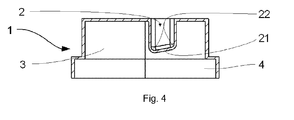
- Fig. 4 shows a cross-sectional view along the line A-A of the multi-well filtration device of Fig. 2.
- Fig. 1 and Fig. 2 show views of a multi-well plate 1 according to the invention.
- the multi-well plate 1 comprises a well layer 3 arranged onto a socket 4. It further comprises 16 rows and 24 columns of wells 2 each of them having an elongated cross section.
- the longitudinal directions of the elongated cross sections run in angle of 45 degrees to the longitudinal direction of the multi-well plate 1.
- the 384 wells 2, the well layer 3 and the socket 4 are arranged in a manner, such that the multi-well plate 1 is compliant to the ANSI approved microplate standards (see above).
- the angle of 45 degrees allows an optimal utilization of space.
- Fig. 3 shows a cross-sectional view in longitudinal direction of the plurality of wells 2 along the line B-B of Fig. 2.
- the wells 2 are fully arranged inside the well layer 3 of the multi-well plate 1.
- the bottom of each of the wells 2 has a slanted part 21 ending in rounded parts 22.
- each of the wells has rounded parts 22 being arranged adjacent to the slanted part 21 of the bottom in all directions.
- extracting means such as for example the tip of an extracting needle, can be arranged at the deepest point of the well 2.
- the dead volume in the well 2 can be efficiently minimized.
- Table 4 384 elongated cross-section wells microplate - rounded and slanted bottom Dilution ( ⁇ l) Solvent Solute Time (min) 0.25 0.5 1 2 3 4 5 10 15 20 10 C C C C C C C C C C C 40 10 C C C C C C C C C 60 10 C C C C C C C C C C 80 10 C C C C C C C C C C
- Table 1 and table 2 show the improving mixing effect of rounded bottoms compared to flat bottoms using regular standardized microplates with wells having circular cross-sections.
- Table 3 if compared to table 1 and table 2 shows the tremendous reduction of time needed for efficiently mixing a liquid being arranged in a multi-well plate according to the invention with elongated cross-section wells having flat bottoms. Even compared to the regular standardized microplate having circular cross-section wells with rounded bottoms, said multi-well plate shows a significant improvement of mixing efficiency.
- table 4 shows again a further improvement if the elongated cross-section wells are additionally arranged with rounded and slanted bottoms.
Landscapes
- Health & Medical Sciences (AREA)
- Chemical & Material Sciences (AREA)
- Analytical Chemistry (AREA)
- General Health & Medical Sciences (AREA)
- Hematology (AREA)
- Clinical Laboratory Science (AREA)
- Chemical Kinetics & Catalysis (AREA)
Abstract
Description
- The present invention relates to a multi-well plate for mixing a fluid, for example a suspension and in particular a cell suspension, in general and more particularly to a system for mixing a fluid.
- Particularly in chemical, microbiological and pharmaceutical industry, as well as in chemical, microbiological and pharmaceutical research, standardized microplates are commonly used. In particular, microplate standards developed by the Society for Biomolecular Screening (SBS) and approved by the American National Standards Institute (ANSI) define microplates of 127.76 mm length, 85.48 mm width and 14.35 mm height comprising 96, 384 or 1536 wells [see Society for Biomolecular Screeneing. ANSI/SBS 1-2004: Microplates - Footprint Dimensions, ANSI/SBS 2-2004: Microplates - Height Dimensions, ANSI/SBS 3-2004: Microplates - Bottom Outside Flange Dimensions and ANSI/SBS 4-2004: Microplates - Well Positions. http://www.sbsonline.org: Society for Biomolecular Screeneing, 2004.]. The wells of said standardized microplates usually have a circular or square shaped cross-section and a flat, rounded or pyramidal, symmetrical bottom.
- In use the, wells can be filled with fluids, such as chemical or microbiological assays comprising several components. In order to establish homogenous conditions, frequently said fluids are mixed in the wells. For mixing, stirrers and shakers are widespread, wherein shakers, as for example VARIOMAG® TELESHAKE, are usually preferred especially in biological assays because stirrers may adversely affect the fluid or the analytical readout.
- With regard to standardized microplates having 96 wells, common shakers are usually sufficient for fast and efficient mixing of fluids. Furthermore, using standardized microplates with 1536 wells, diffusion processes normally allow adequate mixing of fluids. In contrast to this, the mixing effect of shakers as well as of diffusion processes is frequently dissatisfying in standardized microplates having 384 wells.
- To improve mixing by shakers in standardized microplates, it is known to insert blades into the wells while shaking. However, such blades are usually not preferred since they may adversely affect the fluid or the analytical readout and since they complicate the procedure as the blades have to be cleaned before each use. Otherwise, if blades are used for several fluids, or the blades are used in several microplates there is a risk of cross-contamination.
- Therefore there is a need for a multi-well plate allowing efficient mixing of a fluid arranged in a well which overcomes the above described disadvantages.
- According to the invention this need is settled by a multi-well plate for mixing a fluid as it is defined by the features of
independent claim 1, and by a system for mixing a fluid as it is defined by independent claim 5. Preferred embodiments are subject of the dependent claims. - In particular, the invention deals with a multi-well plate for mixing a fluid, comprising a plurality of wells. Each of the wells has an opening arranged at a top side of the multi-well plate and at least one of the wells has a cross-section parallel to the top side having an elongated shape. The multi-well plate further comprises 384 wells arranged in 16 rows and 24 columns or 96 wells arranged in 8 rows and 12 columns. Elongated shape in the sense of the invention comprises all geometrical forms being suitable for the use as described below.
- An advantage of such a well is that mixing of a fluid inside the well by means of a shaker can be improved. Suitable shakers for mixing fluids are widespread available in various embodiments, as for example VARIOMAG® TELESHAKE, particularly for the use of standardized microplates, comprising 96 or 384 wells. Compared to a round or squared cross-section of a well, an elongated cross-section allows to provide a more turbulent mixing movement using one of said shakers. Thus, particularly if a mid-sized well is used, e.g. a well of a standardized microplate comprising 384 wells, a faster and therefore more efficient mixing is possible.
- Another advantage of said elongated cross-section is that a compact arrangement is possible. Particularly, if standardized microplates comprising 96 or 384 wells are used, such compact arrangement can be essential.
- Particularly, for an arrangement of 384 wells within a standardized microplate having a length of 127.76 mm, a width of 85.48 mm and a height of 14.35 mm, the multi-well plate according to the invention provides an essentially improved mixing efficiency. Also, for an arrangement of 96 wells the multi-well plate according to the invention provides an essentially improved mixing efficiency within a standardized microplate having a length of 127.76 mm, a width of 85.48 mm and a height of 14.35 mm.
- Preferably, the cross-section of said at least one of the wells of the multi-well plate has an oval shape or the shape of a rounded rectangle. Said shapes provide above described advantages for the well while they are comparably easy to fabricate.
- The bottom of said at least one of the wells can be slanted. Such a slanted bottom allows a further improvement of mixing a fluid inside the well by means of a shaker. Since the slanted bottom causes the deepest point of the well to be arranged at one longitudinal end region of the elongate cross-section a fluid inside the well is comparably easy accessible to extraction means.
- Preferably, the bottom of said at least one of the wells is rounded. A rounded bottom allows to lower the dead volume of a fluid in the well and it allows to further improve the complete extraction of the fluid out of the well. Additionally, it allows to still further improve the mixing of a fluid inside the well by means of a shaker
- Preferably, the multi-well plate according to the invention is made by injection molding of an appropriate material such as polystyrene, polypropylene, acrylonitrile butadiene styrene copolymer (ABS) or cyclo olefin copolymer (COC).
- A second aspect of the invention deals with a system for mixing a fluid, comprising the multi-well plate described above and a mixing device arranged for shaking the multi-well plate. In particular, the mixing device can be a standard shaker, as for example VARIOMAG® TELESHAKE, commonly used for mixing fluids in standardized microplates.
- The multi-well plate according to the invention is described in more detail hereinbelow by way of an exemplary embodiment and with reference to the attached drawings, in which:
- Fig. 1 shows a perspective view onto a multi-well plate according to the invention;
- Fig. 2 shows a top view onto the multi-well plate of Fig. 1;
- Fig. 3 shows a cross-sectional view along the line B-B of the multi-well filtration device of Fig. 2; and
- Fig. 4 shows a cross-sectional view along the line A-A of the multi-well filtration device of Fig. 2.
- Fig. 1 and Fig. 2 show views of a
multi-well plate 1 according to the invention. Themulti-well plate 1 comprises awell layer 3 arranged onto asocket 4. It further comprises 16 rows and 24 columns ofwells 2 each of them having an elongated cross section. The longitudinal directions of the elongated cross sections run in angle of 45 degrees to the longitudinal direction of themulti-well plate 1. The 384wells 2, thewell layer 3 and thesocket 4 are arranged in a manner, such that themulti-well plate 1 is compliant to the ANSI approved microplate standards (see above). The angle of 45 degrees allows an optimal utilization of space. - For the further description of the exemplary embodiment using the figures, the following applies: If a figure contains reference signs which are not explained in the direct corresponding part of the description, they are explained in a preceding part of the description.
- Fig. 3 shows a cross-sectional view in longitudinal direction of the plurality of
wells 2 along the line B-B of Fig. 2. Thewells 2 are fully arranged inside thewell layer 3 of themulti-well plate 1. The bottom of each of thewells 2 has aslanted part 21 ending inrounded parts 22. - As best seen in Fig. 4 showing a diagonal cross-sectional view in longitudinal direction of one
single well 2 along the line C-C of Fig. 2, the bottom of each of the wells hasrounded parts 22 being arranged adjacent to theslanted part 21 of the bottom in all directions. - In use, for extracting a fluid out of one of the
wells 2, extracting means, such as for example the tip of an extracting needle, can be arranged at the deepest point of thewell 2. Thus, the dead volume in thewell 2 can be efficiently minimized. - The improved mixing efficiency of the multi-well plate according to the invention is described hereinbelow with the help of mixing experiments in a challenging test system. The following tables show the results of said mixing experiments, wherein mixing times have been measured on one hand using multi-well plates according to the invention and on the other hand using regular 384 well standardized microplates with wells having circular cross-sections. First, at the bottom of the wells a fixed amount of a coloured solute, i.e. Bromophenol in 10% glycerol / 90% water, has been arranged followed by a varying amount of solvent (water). Second, the multi-well plates or the microplates, respectively, have been shaken for a certain time period using a standard shaker, i.e. VARIOMAG® TELESHAKE, at a speed of 1700 revolutions per minute (rpm) and the mixing has been evaluated using a scoring of: N - not mixed; P - partly mixed; C - completely mixed.
-
Table 1: Regular standardized 384 wells microplate - flat bottom Dilution (µl) Solvent Solute Time (min) 0.25 0.5 1 2 3 4 5 10 15 20 10 N N P C C C C C C 40 10 N N N N N N P P P 60 10 N N N N N N N N N 80 10 N N N N N N N N N -
Table 2: Regular standardized 384 wells microplate - rounded bottom Dilution (µl) Solvent Solute Time (min) 0.25 0.5 1 2 3 4 5 10 15 20 10 P C C C C C C C C 40 10 N P C C C C C C C 60 10 N N P P P P C C C 80 10 N N N N N N N P P -
Table 3: 384 elongated cross-section wells microplate - flat bottom Dilution (µl) Solvent Solute Time (min) 0.25 0.5 1 2 3 4 5 10 15 20 10 C C C C C C C C C 40 10 C C C C C C C C C 60 10 C C C C C C C C C 80 10 P C C C C C C C C -
Table 4: 384 elongated cross-section wells microplate - rounded and slanted bottom Dilution (µl) Solvent Solute Time (min) 0.25 0.5 1 2 3 4 5 10 15 20 10 C C C C C C C C C 40 10 C C C C C C C C C 60 10 C C C C C C C C C 80 10 C C C C C C C C C - Table 1 and table 2 show the improving mixing effect of rounded bottoms compared to flat bottoms using regular standardized microplates with wells having circular cross-sections. Table 3 if compared to table 1 and table 2 shows the tremendous reduction of time needed for efficiently mixing a liquid being arranged in a multi-well plate according to the invention with elongated cross-section wells having flat bottoms. Even compared to the regular standardized microplate having circular cross-section wells with rounded bottoms, said multi-well plate shows a significant improvement of mixing efficiency. Further, table 4 shows again a further improvement if the elongated cross-section wells are additionally arranged with rounded and slanted bottoms.
Claims (5)
- Multi-well plate (1) for mixing a fluid, comprising a plurality of wells (2) each having an opening arranged at a top side of the multi-well plate (1), wherein at least one of the wells (2) has a cross-section parallel to the top side having an elongated shape characterized in that the multi-well plate (1) comprises 384 wells (2) arranged in 16 rows and 24 columns or 96 wells (2) arranged in 8 rows and 12 columns.
- Multi-well plate (1) of claim 1, wherein the cross-section has an oval shape or the shape of a rounded rectangle.
- Multi-well plate (1) of claim 1 or 2, wherein the bottom of the at least one of the wells (2) is slanted.
- Multi-well plate (1) of one of claims 1 to 3, wherein the bottom of the at least one of the wells (2) is rounded.
- System for mixing a fluid, comprising the multi-well plate (1) of one of claims 1 to 4 and a mixing device arranged for shaking the multi-well plate (1).
Priority Applications (1)
| Application Number | Priority Date | Filing Date | Title |
|---|---|---|---|
| EP07107641A EP1864715A1 (en) | 2006-05-12 | 2007-05-07 | Multi-well plate |
Applications Claiming Priority (2)
| Application Number | Priority Date | Filing Date | Title |
|---|---|---|---|
| EP06405199A EP1854541A1 (en) | 2006-05-12 | 2006-05-12 | Multi-well plate |
| EP07107641A EP1864715A1 (en) | 2006-05-12 | 2007-05-07 | Multi-well plate |
Publications (1)
| Publication Number | Publication Date |
|---|---|
| EP1864715A1 true EP1864715A1 (en) | 2007-12-12 |
Family
ID=38663244
Family Applications (1)
| Application Number | Title | Priority Date | Filing Date |
|---|---|---|---|
| EP07107641A Withdrawn EP1864715A1 (en) | 2006-05-12 | 2007-05-07 | Multi-well plate |
Country Status (1)
| Country | Link |
|---|---|
| EP (1) | EP1864715A1 (en) |
Cited By (1)
| Publication number | Priority date | Publication date | Assignee | Title |
|---|---|---|---|---|
| US9803192B2 (en) | 2013-10-04 | 2017-10-31 | Cornell University | Programmable and reconfigurable microcolumn affinity chromatography device, system, and methods of use thereof |
Citations (5)
| Publication number | Priority date | Publication date | Assignee | Title |
|---|---|---|---|---|
| WO1998035013A1 (en) * | 1997-02-11 | 1998-08-13 | Corning Incorporated | Multi-well plate |
| DE19852835A1 (en) * | 1998-11-17 | 2000-05-18 | Stratec Biomedical Systems Ag | Sample holder |
| US20040043494A1 (en) * | 2002-08-30 | 2004-03-04 | Amorese Douglas A. | Apparatus for studying arrays |
| EP1621890A1 (en) * | 2004-07-26 | 2006-02-01 | bioMerieux B.V. | Device and method for separating, mixing and concentrating magnetic particles with a fluid and use thereof in purification methods |
| EP1733793A2 (en) * | 2005-06-16 | 2006-12-20 | Millipore Corporation | Multi-well filter plate with shifted wells and U-bottom receiver plate |
-
2007
- 2007-05-07 EP EP07107641A patent/EP1864715A1/en not_active Withdrawn
Patent Citations (5)
| Publication number | Priority date | Publication date | Assignee | Title |
|---|---|---|---|---|
| WO1998035013A1 (en) * | 1997-02-11 | 1998-08-13 | Corning Incorporated | Multi-well plate |
| DE19852835A1 (en) * | 1998-11-17 | 2000-05-18 | Stratec Biomedical Systems Ag | Sample holder |
| US20040043494A1 (en) * | 2002-08-30 | 2004-03-04 | Amorese Douglas A. | Apparatus for studying arrays |
| EP1621890A1 (en) * | 2004-07-26 | 2006-02-01 | bioMerieux B.V. | Device and method for separating, mixing and concentrating magnetic particles with a fluid and use thereof in purification methods |
| EP1733793A2 (en) * | 2005-06-16 | 2006-12-20 | Millipore Corporation | Multi-well filter plate with shifted wells and U-bottom receiver plate |
Cited By (1)
| Publication number | Priority date | Publication date | Assignee | Title |
|---|---|---|---|---|
| US9803192B2 (en) | 2013-10-04 | 2017-10-31 | Cornell University | Programmable and reconfigurable microcolumn affinity chromatography device, system, and methods of use thereof |
Similar Documents
| Publication | Publication Date | Title |
|---|---|---|
| US20070264164A1 (en) | Multi-well plate | |
| EP1391242A3 (en) | Microcolumn based high throughput microfluidic device | |
| US20110152128A1 (en) | Enhanced microplate configurations | |
| DE60013983T2 (en) | Multi-channel pipette system and pipette tips for it | |
| US20070054293A1 (en) | Microfluidic chaotic mixing systems and methods | |
| DE102014004851B4 (en) | Vertical functional reaction vessel | |
| EP1160573A2 (en) | Microtitre plate and coupled multiple pipettor | |
| EP2299256A3 (en) | Microfabricated crossflow devices and methods | |
| US11890619B2 (en) | Sample and reagent containers with anti-vacuum feature | |
| US9733169B2 (en) | Dispersive pipette extraction tip and methods for use | |
| CN111748444A (en) | Microfluidic device | |
| KR101591308B1 (en) | Sampling device with severing means and method of sampling or dispensing using the same | |
| DE202020100836U1 (en) | Magazine for pipetting device | |
| DE3618884A1 (en) | TEST DISK ARRANGEMENT FORMING DISCRETE AREAS ON A MICROPOROUS MEMBRANE WITH A LOW EDGE | |
| US9802200B2 (en) | Tube rack tool | |
| US20140363885A1 (en) | Tear-away multi well plate | |
| EP1864715A1 (en) | Multi-well plate | |
| CA2977505C (en) | Tube rack tool | |
| EP1724019B1 (en) | Receiver plate with multiple cross-sections | |
| CN209752872U (en) | DNA synthesizer without dead space volume | |
| US8168133B2 (en) | Device for performing a high throughput assay | |
| Lye et al. | A capacity for mixing in capillary wells for microplates | |
| CN207913815U (en) | Pipettor gun head | |
| JP3389352B2 (en) | Liquid dispensing device | |
| EP1733793A2 (en) | Multi-well filter plate with shifted wells and U-bottom receiver plate |
Legal Events
| Date | Code | Title | Description |
|---|---|---|---|
| PUAI | Public reference made under article 153(3) epc to a published international application that has entered the european phase |
Free format text: ORIGINAL CODE: 0009012 |
|
| AK | Designated contracting states |
Kind code of ref document: A1 Designated state(s): AT BE BG CH CY CZ DE DK EE ES FI FR GB GR HU IE IS IT LI LT LU LV MC MT NL PL PT RO SE SI SK TR |
|
| AX | Request for extension of the european patent |
Extension state: AL BA HR MK YU |
|
| 17P | Request for examination filed |
Effective date: 20080521 |
|
| 17Q | First examination report despatched |
Effective date: 20080630 |
|
| AKX | Designation fees paid |
Designated state(s): AT BE BG CH CY CZ DE DK EE ES FI FR GB GR HU IE IS IT LI LT LU LV MC MT NL PL PT RO SE SI SK TR |
|
| STAA | Information on the status of an ep patent application or granted ep patent |
Free format text: STATUS: THE APPLICATION IS DEEMED TO BE WITHDRAWN |
|
| 18D | Application deemed to be withdrawn |
Effective date: 20100601 |