EP1860102B1 - Process for Producing Lercanidipine - Google Patents
Process for Producing Lercanidipine Download PDFInfo
- Publication number
- EP1860102B1 EP1860102B1 EP06114517A EP06114517A EP1860102B1 EP 1860102 B1 EP1860102 B1 EP 1860102B1 EP 06114517 A EP06114517 A EP 06114517A EP 06114517 A EP06114517 A EP 06114517A EP 1860102 B1 EP1860102 B1 EP 1860102B1
- Authority
- EP
- European Patent Office
- Prior art keywords
- salt
- acid
- dimethyl
- nitrophenyl
- dihydro
- Prior art date
- Legal status (The legal status is an assumption and is not a legal conclusion. Google has not performed a legal analysis and makes no representation as to the accuracy of the status listed.)
- Not-in-force
Links
- ZDXUKAKRHYTAKV-UHFFFAOYSA-N lercanidipine Chemical compound COC(=O)C1=C(C)NC(C)=C(C(=O)OC(C)(C)CN(C)CCC(C=2C=CC=CC=2)C=2C=CC=CC=2)C1C1=CC=CC([N+]([O-])=O)=C1 ZDXUKAKRHYTAKV-UHFFFAOYSA-N 0.000 title claims abstract description 39
- 238000000034 method Methods 0.000 title claims description 45
- 229960004294 lercanidipine Drugs 0.000 title abstract description 35
- 150000003839 salts Chemical class 0.000 claims abstract description 40
- 150000001875 compounds Chemical class 0.000 claims abstract description 37
- 238000004519 manufacturing process Methods 0.000 claims abstract description 9
- ZMXDDKWLCZADIW-UHFFFAOYSA-N N,N-Dimethylformamide Chemical compound CN(C)C=O ZMXDDKWLCZADIW-UHFFFAOYSA-N 0.000 claims description 36
- WEVYAHXRMPXWCK-UHFFFAOYSA-N Acetonitrile Chemical compound CC#N WEVYAHXRMPXWCK-UHFFFAOYSA-N 0.000 claims description 27
- YXFVVABEGXRONW-UHFFFAOYSA-N Toluene Chemical compound CC1=CC=CC=C1 YXFVVABEGXRONW-UHFFFAOYSA-N 0.000 claims description 26
- 239000002253 acid Substances 0.000 claims description 24
- 238000006243 chemical reaction Methods 0.000 claims description 22
- VEXZGXHMUGYJMC-UHFFFAOYSA-N Hydrochloric acid Chemical compound Cl VEXZGXHMUGYJMC-UHFFFAOYSA-N 0.000 claims description 17
- 239000012458 free base Substances 0.000 claims description 16
- WYURNTSHIVDZCO-UHFFFAOYSA-N Tetrahydrofuran Chemical compound C1CCOC1 WYURNTSHIVDZCO-UHFFFAOYSA-N 0.000 claims description 14
- 150000003891 oxalate salts Chemical class 0.000 claims description 13
- JOXIMZWYDAKGHI-UHFFFAOYSA-N toluene-4-sulfonic acid Chemical compound CC1=CC=C(S(O)(=O)=O)C=C1 JOXIMZWYDAKGHI-UHFFFAOYSA-N 0.000 claims description 13
- MUBZPKHOEPUJKR-UHFFFAOYSA-N Oxalic acid Chemical compound OC(=O)C(O)=O MUBZPKHOEPUJKR-UHFFFAOYSA-N 0.000 claims description 12
- 239000002904 solvent Substances 0.000 claims description 11
- FYSNRJHAOHDILO-UHFFFAOYSA-N thionyl chloride Chemical group ClS(Cl)=O FYSNRJHAOHDILO-UHFFFAOYSA-N 0.000 claims description 10
- FXHOOIRPVKKKFG-UHFFFAOYSA-N N,N-Dimethylacetamide Chemical compound CN(C)C(C)=O FXHOOIRPVKKKFG-UHFFFAOYSA-N 0.000 claims description 9
- JPXPPUOCSLMCHK-UHFFFAOYSA-N 5-methoxycarbonyl-2,6-dimethyl-4-(3-nitrophenyl)-1,4-dihydropyridine-3-carboxylic acid Chemical compound COC(=O)C1=C(C)NC(C)=C(C(O)=O)C1C1=CC=CC([N+]([O-])=O)=C1 JPXPPUOCSLMCHK-UHFFFAOYSA-N 0.000 claims description 7
- ONRXEXXVIBZJBX-UHFFFAOYSA-N 5-o-[3,3-dimethyl-2-(methylamino)butyl] 3-o-methyl 2,6-dimethyl-4-(3-nitrophenyl)-1,4-dihydropyridine-3,5-dicarboxylate Chemical compound CNC(C(C)(C)C)COC(=O)C1=C(C)NC(C)=C(C(=O)OC)C1C1=CC=CC([N+]([O-])=O)=C1 ONRXEXXVIBZJBX-UHFFFAOYSA-N 0.000 claims description 5
- 238000002425 crystallisation Methods 0.000 claims description 5
- 230000008025 crystallization Effects 0.000 claims description 5
- -1 1,4-dihydro-2,6-dimethyl-4-(3-nitrophenyl)-3,5-pyridinedicarboxylic acid halide monomethyl ester Chemical class 0.000 claims description 4
- AVFZOVWCLRSYKC-UHFFFAOYSA-N 1-methylpyrrolidine Chemical compound CN1CCCC1 AVFZOVWCLRSYKC-UHFFFAOYSA-N 0.000 claims description 4
- KYCZVVFGMGLNPL-UHFFFAOYSA-N 2-methyl-1-(methylamino)propan-2-ol Chemical compound CNCC(C)(C)O KYCZVVFGMGLNPL-UHFFFAOYSA-N 0.000 claims description 4
- KRKNYBCHXYNGOX-UHFFFAOYSA-K Citrate Chemical compound [O-]C(=O)CC(O)(CC([O-])=O)C([O-])=O KRKNYBCHXYNGOX-UHFFFAOYSA-K 0.000 claims description 4
- FEWJPZIEWOKRBE-JCYAYHJZSA-N Dextrotartaric acid Chemical compound OC(=O)[C@H](O)[C@@H](O)C(O)=O FEWJPZIEWOKRBE-JCYAYHJZSA-N 0.000 claims description 4
- AHVYPIQETPWLSZ-UHFFFAOYSA-N N-methyl-pyrrolidine Natural products CN1CC=CC1 AHVYPIQETPWLSZ-UHFFFAOYSA-N 0.000 claims description 4
- QMEZUZOCLYUADC-UHFFFAOYSA-N hydrate;dihydrochloride Chemical compound O.Cl.Cl QMEZUZOCLYUADC-UHFFFAOYSA-N 0.000 claims description 4
- XHXFXVLFKHQFAL-UHFFFAOYSA-N phosphoryl trichloride Chemical compound ClP(Cl)(Cl)=O XHXFXVLFKHQFAL-UHFFFAOYSA-N 0.000 claims description 4
- ITMCEJHCFYSIIV-UHFFFAOYSA-M triflate Chemical compound [O-]S(=O)(=O)C(F)(F)F ITMCEJHCFYSIIV-UHFFFAOYSA-M 0.000 claims description 4
- 239000003795 chemical substances by application Substances 0.000 claims description 3
- 150000004820 halides Chemical class 0.000 claims description 3
- 229940095064 tartrate Drugs 0.000 claims description 3
- PXACTUVBBMDKRW-UHFFFAOYSA-M 4-bromobenzenesulfonate Chemical compound [O-]S(=O)(=O)C1=CC=C(Br)C=C1 PXACTUVBBMDKRW-UHFFFAOYSA-M 0.000 claims description 2
- CTQNGGLPUBDAKN-UHFFFAOYSA-N O-Xylene Chemical compound CC1=CC=CC=C1C CTQNGGLPUBDAKN-UHFFFAOYSA-N 0.000 claims description 2
- 150000001408 amides Chemical class 0.000 claims description 2
- GNOIPBMMFNIUFM-UHFFFAOYSA-N hexamethylphosphoric triamide Chemical compound CN(C)P(=O)(N(C)C)N(C)C GNOIPBMMFNIUFM-UHFFFAOYSA-N 0.000 claims description 2
- UHZYTMXLRWXGPK-UHFFFAOYSA-N phosphorus pentachloride Chemical compound ClP(Cl)(Cl)(Cl)Cl UHZYTMXLRWXGPK-UHFFFAOYSA-N 0.000 claims description 2
- FAIAAWCVCHQXDN-UHFFFAOYSA-N phosphorus trichloride Chemical compound ClP(Cl)Cl FAIAAWCVCHQXDN-UHFFFAOYSA-N 0.000 claims description 2
- YBBRCQOCSYXUOC-UHFFFAOYSA-N sulfuryl dichloride Chemical compound ClS(Cl)(=O)=O YBBRCQOCSYXUOC-UHFFFAOYSA-N 0.000 claims description 2
- 239000008096 xylene Substances 0.000 claims description 2
- 230000002140 halogenating effect Effects 0.000 claims 2
- XTHFKEDIFFGKHM-UHFFFAOYSA-N Dimethoxyethane Chemical compound COCCOC XTHFKEDIFFGKHM-UHFFFAOYSA-N 0.000 claims 1
- QAOWNCQODCNURD-UHFFFAOYSA-L Sulfate Chemical compound [O-]S([O-])(=O)=O QAOWNCQODCNURD-UHFFFAOYSA-L 0.000 claims 1
- 150000003892 tartrate salts Chemical class 0.000 claims 1
- XLOSOKBPFIZWCG-UHFFFAOYSA-N 5-[1-[3,3-diphenylpropyl(methyl)amino]-2-methylpropan-2-yl]oxycarbonyl-2,6-dimethyl-4-(3-nitrophenyl)-1,4-dihydropyridine-3-carboxylic acid Chemical compound CC=1NC(C)=C(C(O)=O)C(C=2C=C(C=CC=2)[N+]([O-])=O)C=1C(=O)OC(C)(C)CN(C)CCC(C=1C=CC=CC=1)C1=CC=CC=C1 XLOSOKBPFIZWCG-UHFFFAOYSA-N 0.000 abstract 1
- 239000000243 solution Substances 0.000 description 23
- YMWUJEATGCHHMB-UHFFFAOYSA-N Dichloromethane Chemical compound ClCCl YMWUJEATGCHHMB-UHFFFAOYSA-N 0.000 description 18
- HEMHJVSKTPXQMS-UHFFFAOYSA-M Sodium hydroxide Chemical compound [OH-].[Na+] HEMHJVSKTPXQMS-UHFFFAOYSA-M 0.000 description 15
- LFQSCWFLJHTTHZ-UHFFFAOYSA-N Ethanol Chemical compound CCO LFQSCWFLJHTTHZ-UHFFFAOYSA-N 0.000 description 12
- 238000002844 melting Methods 0.000 description 11
- 230000008018 melting Effects 0.000 description 11
- 239000000047 product Substances 0.000 description 11
- 239000012074 organic phase Substances 0.000 description 10
- XEKOWRVHYACXOJ-UHFFFAOYSA-N Ethyl acetate Chemical compound CCOC(C)=O XEKOWRVHYACXOJ-UHFFFAOYSA-N 0.000 description 9
- 230000015572 biosynthetic process Effects 0.000 description 9
- 239000000203 mixture Substances 0.000 description 9
- BWHMMNNQKKPAPP-UHFFFAOYSA-L potassium carbonate Chemical compound [K+].[K+].[O-]C([O-])=O BWHMMNNQKKPAPP-UHFFFAOYSA-L 0.000 description 8
- BZLVMXJERCGZMT-UHFFFAOYSA-N Methyl tert-butyl ether Chemical compound COC(C)(C)C BZLVMXJERCGZMT-UHFFFAOYSA-N 0.000 description 6
- FAPWRFPIFSIZLT-UHFFFAOYSA-M Sodium chloride Chemical compound [Na+].[Cl-] FAPWRFPIFSIZLT-UHFFFAOYSA-M 0.000 description 6
- 239000000725 suspension Substances 0.000 description 6
- XLYOFNOQVPJJNP-UHFFFAOYSA-N water Substances O XLYOFNOQVPJJNP-UHFFFAOYSA-N 0.000 description 6
- WMFYOYKPJLRMJI-UHFFFAOYSA-N Lercanidipine hydrochloride Chemical compound Cl.COC(=O)C1=C(C)NC(C)=C(C(=O)OC(C)(C)CN(C)CCC(C=2C=CC=CC=2)C=2C=CC=CC=2)C1C1=CC=CC([N+]([O-])=O)=C1 WMFYOYKPJLRMJI-UHFFFAOYSA-N 0.000 description 5
- 238000004128 high performance liquid chromatography Methods 0.000 description 5
- 229960002162 lercanidipine hydrochloride Drugs 0.000 description 5
- OKKJLVBELUTLKV-UHFFFAOYSA-N methanol Natural products OC OKKJLVBELUTLKV-UHFFFAOYSA-N 0.000 description 5
- 238000002360 preparation method Methods 0.000 description 5
- YLQBMQCUIZJEEH-UHFFFAOYSA-N tetrahydrofuran Natural products C=1C=COC=1 YLQBMQCUIZJEEH-UHFFFAOYSA-N 0.000 description 5
- IDCXQMVSIIJUEH-UHFFFAOYSA-N 3,3-diphenylpropan-1-ol Chemical compound C=1C=CC=CC=1C(CCO)C1=CC=CC=C1 IDCXQMVSIIJUEH-UHFFFAOYSA-N 0.000 description 4
- LCGLNKUTAGEVQW-UHFFFAOYSA-N Dimethyl ether Chemical compound COC LCGLNKUTAGEVQW-UHFFFAOYSA-N 0.000 description 4
- KFZMGEQAYNKOFK-UHFFFAOYSA-N Isopropanol Chemical compound CC(C)O KFZMGEQAYNKOFK-UHFFFAOYSA-N 0.000 description 4
- UIIMBOGNXHQVGW-UHFFFAOYSA-M Sodium bicarbonate Chemical compound [Na+].OC([O-])=O UIIMBOGNXHQVGW-UHFFFAOYSA-M 0.000 description 4
- 239000008346 aqueous phase Substances 0.000 description 4
- 229960000355 copper sulfate Drugs 0.000 description 4
- 229910000365 copper sulfate Inorganic materials 0.000 description 4
- ARUVKPQLZAKDPS-UHFFFAOYSA-L copper(II) sulfate Chemical compound [Cu+2].[O-][S+2]([O-])([O-])[O-] ARUVKPQLZAKDPS-UHFFFAOYSA-L 0.000 description 4
- 239000003960 organic solvent Substances 0.000 description 4
- 239000000546 pharmaceutical excipient Substances 0.000 description 4
- 229910000027 potassium carbonate Inorganic materials 0.000 description 4
- 238000000746 purification Methods 0.000 description 4
- 238000011084 recovery Methods 0.000 description 4
- NGNBDVOYPDDBFK-UHFFFAOYSA-N 2-[2,4-di(pentan-2-yl)phenoxy]acetyl chloride Chemical compound CCCC(C)C1=CC=C(OCC(Cl)=O)C(C(C)CCC)=C1 NGNBDVOYPDDBFK-UHFFFAOYSA-N 0.000 description 3
- QTBSBXVTEAMEQO-UHFFFAOYSA-N Acetic acid Chemical compound CC(O)=O QTBSBXVTEAMEQO-UHFFFAOYSA-N 0.000 description 3
- OFOBLEOULBTSOW-UHFFFAOYSA-N Malonic acid Chemical compound OC(=O)CC(O)=O OFOBLEOULBTSOW-UHFFFAOYSA-N 0.000 description 3
- ZMANZCXQSJIPKH-UHFFFAOYSA-N Triethylamine Chemical compound CCN(CC)CC ZMANZCXQSJIPKH-UHFFFAOYSA-N 0.000 description 3
- DFWHZQIOYYSTIL-UHFFFAOYSA-N [2-methyl-1-(methylamino)propan-2-yl] 4-methylbenzenesulfonate Chemical compound CNCC(C)(C)OS(=O)(=O)C1=CC=C(C)C=C1 DFWHZQIOYYSTIL-UHFFFAOYSA-N 0.000 description 3
- 239000004480 active ingredient Substances 0.000 description 3
- 239000007864 aqueous solution Substances 0.000 description 3
- 150000004649 carbonic acid derivatives Chemical class 0.000 description 3
- KRKNYBCHXYNGOX-UHFFFAOYSA-N citric acid Chemical compound OC(=O)CC(O)(C(O)=O)CC(O)=O KRKNYBCHXYNGOX-UHFFFAOYSA-N 0.000 description 3
- 229940113088 dimethylacetamide Drugs 0.000 description 3
- 239000002552 dosage form Substances 0.000 description 3
- 230000026030 halogenation Effects 0.000 description 3
- 238000005658 halogenation reaction Methods 0.000 description 3
- GEVPUGOOGXGPIO-UHFFFAOYSA-N oxalic acid;dihydrate Chemical compound O.O.OC(=O)C(O)=O GEVPUGOOGXGPIO-UHFFFAOYSA-N 0.000 description 3
- 239000002244 precipitate Substances 0.000 description 3
- 239000011780 sodium chloride Substances 0.000 description 3
- 239000012453 solvate Substances 0.000 description 3
- 238000003786 synthesis reaction Methods 0.000 description 3
- VZCYOOQTPOCHFL-UHFFFAOYSA-N trans-butenedioic acid Natural products OC(=O)C=CC(O)=O VZCYOOQTPOCHFL-UHFFFAOYSA-N 0.000 description 3
- WBYWAXJHAXSJNI-VOTSOKGWSA-M .beta-Phenylacrylic acid Natural products [O-]C(=O)\C=C\C1=CC=CC=C1 WBYWAXJHAXSJNI-VOTSOKGWSA-M 0.000 description 2
- WXTMDXOMEHJXQO-UHFFFAOYSA-N 2,5-dihydroxybenzoic acid Chemical compound OC(=O)C1=CC(O)=CC=C1O WXTMDXOMEHJXQO-UHFFFAOYSA-N 0.000 description 2
- NENUCJVGUPDXPC-UHFFFAOYSA-N 3,3-diphenylpropyl 4-methylbenzenesulfonate Chemical compound C1=CC(C)=CC=C1S(=O)(=O)OCCC(C=1C=CC=CC=1)C1=CC=CC=C1 NENUCJVGUPDXPC-UHFFFAOYSA-N 0.000 description 2
- YYROPELSRYBVMQ-UHFFFAOYSA-N 4-toluenesulfonyl chloride Chemical compound CC1=CC=C(S(Cl)(=O)=O)C=C1 YYROPELSRYBVMQ-UHFFFAOYSA-N 0.000 description 2
- VHUUQVKOLVNVRT-UHFFFAOYSA-N Ammonium hydroxide Chemical compound [NH4+].[OH-] VHUUQVKOLVNVRT-UHFFFAOYSA-N 0.000 description 2
- VTYYLEPIZMXCLO-UHFFFAOYSA-L Calcium carbonate Chemical compound [Ca+2].[O-]C([O-])=O VTYYLEPIZMXCLO-UHFFFAOYSA-L 0.000 description 2
- 229940127291 Calcium channel antagonist Drugs 0.000 description 2
- RGHNJXZEOKUKBD-SQOUGZDYSA-N D-gluconic acid Chemical compound OC[C@@H](O)[C@@H](O)[C@H](O)[C@@H](O)C(O)=O RGHNJXZEOKUKBD-SQOUGZDYSA-N 0.000 description 2
- QOSSAOTZNIDXMA-UHFFFAOYSA-N Dicylcohexylcarbodiimide Chemical compound C1CCCCC1N=C=NC1CCCCC1 QOSSAOTZNIDXMA-UHFFFAOYSA-N 0.000 description 2
- RTZKZFJDLAIYFH-UHFFFAOYSA-N Diethyl ether Chemical compound CCOCC RTZKZFJDLAIYFH-UHFFFAOYSA-N 0.000 description 2
- VZCYOOQTPOCHFL-OWOJBTEDSA-N Fumaric acid Chemical compound OC(=O)\C=C\C(O)=O VZCYOOQTPOCHFL-OWOJBTEDSA-N 0.000 description 2
- HSHXDCVZWHOWCS-UHFFFAOYSA-N N'-hexadecylthiophene-2-carbohydrazide Chemical compound CCCCCCCCCCCCCCCCNNC(=O)c1cccs1 HSHXDCVZWHOWCS-UHFFFAOYSA-N 0.000 description 2
- NBIIXXVUZAFLBC-UHFFFAOYSA-N Phosphoric acid Chemical compound OP(O)(O)=O NBIIXXVUZAFLBC-UHFFFAOYSA-N 0.000 description 2
- FEWJPZIEWOKRBE-UHFFFAOYSA-N Tartaric Acid Chemical compound [H+].[H+].[O-]C(=O)C(O)C(O)C([O-])=O FEWJPZIEWOKRBE-UHFFFAOYSA-N 0.000 description 2
- KKEYFWRCBNTPAC-UHFFFAOYSA-N Terephthalic acid Chemical compound OC(=O)C1=CC=C(C(O)=O)C=C1 KKEYFWRCBNTPAC-UHFFFAOYSA-N 0.000 description 2
- GWEVSGVZZGPLCZ-UHFFFAOYSA-N Titan oxide Chemical compound O=[Ti]=O GWEVSGVZZGPLCZ-UHFFFAOYSA-N 0.000 description 2
- 150000007513 acids Chemical class 0.000 description 2
- 239000006227 byproduct Substances 0.000 description 2
- 238000005660 chlorination reaction Methods 0.000 description 2
- 238000001035 drying Methods 0.000 description 2
- 230000032050 esterification Effects 0.000 description 2
- 238000005886 esterification reaction Methods 0.000 description 2
- 238000000605 extraction Methods 0.000 description 2
- 238000003818 flash chromatography Methods 0.000 description 2
- 239000001866 hydroxypropyl methyl cellulose Substances 0.000 description 2
- 229920003088 hydroxypropyl methyl cellulose Polymers 0.000 description 2
- 235000010979 hydroxypropyl methyl cellulose Nutrition 0.000 description 2
- 238000011065 in-situ storage Methods 0.000 description 2
- 239000000543 intermediate Substances 0.000 description 2
- JVTAAEKCZFNVCJ-UHFFFAOYSA-N lactic acid Chemical compound CC(O)C(O)=O JVTAAEKCZFNVCJ-UHFFFAOYSA-N 0.000 description 2
- HQKMJHAJHXVSDF-UHFFFAOYSA-L magnesium stearate Chemical compound [Mg+2].CCCCCCCCCCCCCCCCCC([O-])=O.CCCCCCCCCCCCCCCCCC([O-])=O HQKMJHAJHXVSDF-UHFFFAOYSA-L 0.000 description 2
- VZCYOOQTPOCHFL-UPHRSURJSA-N maleic acid Chemical compound OC(=O)\C=C/C(O)=O VZCYOOQTPOCHFL-UPHRSURJSA-N 0.000 description 2
- GBMDVOWEEQVZKZ-UHFFFAOYSA-N methanol;hydrate Chemical compound O.OC GBMDVOWEEQVZKZ-UHFFFAOYSA-N 0.000 description 2
- XTEGVFVZDVNBPF-UHFFFAOYSA-N naphthalene-1,5-disulfonic acid Chemical compound C1=CC=C2C(S(=O)(=O)O)=CC=CC2=C1S(O)(=O)=O XTEGVFVZDVNBPF-UHFFFAOYSA-N 0.000 description 2
- 239000008194 pharmaceutical composition Substances 0.000 description 2
- 239000003444 phase transfer catalyst Substances 0.000 description 2
- YGSDEFSMJLZEOE-UHFFFAOYSA-N salicylic acid Chemical compound OC(=O)C1=CC=CC=C1O YGSDEFSMJLZEOE-UHFFFAOYSA-N 0.000 description 2
- 229910000030 sodium bicarbonate Inorganic materials 0.000 description 2
- 235000017557 sodium bicarbonate Nutrition 0.000 description 2
- 239000007787 solid Substances 0.000 description 2
- 239000007858 starting material Substances 0.000 description 2
- 239000000126 substance Substances 0.000 description 2
- DPKBAXPHAYBPRL-UHFFFAOYSA-M tetrabutylazanium;iodide Chemical group [I-].CCCC[N+](CCCC)(CCCC)CCCC DPKBAXPHAYBPRL-UHFFFAOYSA-M 0.000 description 2
- BJEPYKJPYRNKOW-REOHCLBHSA-N (S)-malic acid Chemical compound OC(=O)[C@@H](O)CC(O)=O BJEPYKJPYRNKOW-REOHCLBHSA-N 0.000 description 1
- CVHZOJJKTDOEJC-UHFFFAOYSA-M 1,1-dioxo-1,2-benzothiazol-3-olate Chemical compound C1=CC=C2C([O-])=NS(=O)(=O)C2=C1 CVHZOJJKTDOEJC-UHFFFAOYSA-M 0.000 description 1
- TZEZRHURFFKWTR-UHFFFAOYSA-N 1,1-diphenylpropyl 4-methylbenzenesulfonate Chemical compound C=1C=CC=CC=1C(C=1C=CC=CC=1)(CC)OS(=O)(=O)C1=CC=C(C)C=C1 TZEZRHURFFKWTR-UHFFFAOYSA-N 0.000 description 1
- YNGDWRXWKFWCJY-UHFFFAOYSA-N 1,4-Dihydropyridine Chemical compound C1C=CNC=C1 YNGDWRXWKFWCJY-UHFFFAOYSA-N 0.000 description 1
- JNOZGFXJZQXOSU-UHFFFAOYSA-N 1-chloro-2-methylpropan-2-ol Chemical compound CC(C)(O)CCl JNOZGFXJZQXOSU-UHFFFAOYSA-N 0.000 description 1
- LBLYYCQCTBFVLH-UHFFFAOYSA-N 2-Methylbenzenesulfonic acid Chemical compound CC1=CC=CC=C1S(O)(=O)=O LBLYYCQCTBFVLH-UHFFFAOYSA-N 0.000 description 1
- KPGXRSRHYNQIFN-UHFFFAOYSA-N 2-oxoglutaric acid Chemical compound OC(=O)CCC(=O)C(O)=O KPGXRSRHYNQIFN-UHFFFAOYSA-N 0.000 description 1
- BMYNFMYTOJXKLE-UHFFFAOYSA-N 3-azaniumyl-2-hydroxypropanoate Chemical compound NCC(O)C(O)=O BMYNFMYTOJXKLE-UHFFFAOYSA-N 0.000 description 1
- GYVFENCYIPZSDN-UHFFFAOYSA-N 3-o-methyl 5-o-[2-methyl-1-(methylamino)propan-2-yl] 2,6-dimethyl-4-(3-nitrophenyl)-1,4-dihydropyridine-3,5-dicarboxylate Chemical compound CNCC(C)(C)OC(=O)C1=C(C)NC(C)=C(C(=O)OC)C1C1=CC=CC([N+]([O-])=O)=C1 GYVFENCYIPZSDN-UHFFFAOYSA-N 0.000 description 1
- QKYWSRHKEDKHPE-UHFFFAOYSA-N 3-o-methyl 5-o-[2-methyl-1-(methylamino)propan-2-yl] 2,6-dimethyl-4-(3-nitrophenyl)-1,4-dihydropyridine-3,5-dicarboxylate;oxalic acid Chemical compound OC(=O)C(O)=O.CNCC(C)(C)OC(=O)C1=C(C)NC(C)=C(C(=O)OC)C1C1=CC=CC([N+]([O-])=O)=C1 QKYWSRHKEDKHPE-UHFFFAOYSA-N 0.000 description 1
- QCQCHGYLTSGIGX-GHXANHINSA-N 4-[[(3ar,5ar,5br,7ar,9s,11ar,11br,13as)-5a,5b,8,8,11a-pentamethyl-3a-[(5-methylpyridine-3-carbonyl)amino]-2-oxo-1-propan-2-yl-4,5,6,7,7a,9,10,11,11b,12,13,13a-dodecahydro-3h-cyclopenta[a]chrysen-9-yl]oxy]-2,2-dimethyl-4-oxobutanoic acid Chemical compound N([C@@]12CC[C@@]3(C)[C@]4(C)CC[C@H]5C(C)(C)[C@@H](OC(=O)CC(C)(C)C(O)=O)CC[C@]5(C)[C@H]4CC[C@@H]3C1=C(C(C2)=O)C(C)C)C(=O)C1=CN=CC(C)=C1 QCQCHGYLTSGIGX-GHXANHINSA-N 0.000 description 1
- DZMCJRLYCZQLJF-UHFFFAOYSA-N 5-o-[1-[3,3-diphenylpropyl(methyl)amino]-2-methylpropan-2-yl] 3-o-methyl 2,6-dimethyl-4-(3-nitrophenyl)-1,4-dihydropyridine-3,5-dicarboxylate;oxalic acid Chemical compound OC(=O)C(O)=O.COC(=O)C1=C(C)NC(C)=C(C(=O)OC(C)(C)CN(C)CCC(C=2C=CC=CC=2)C=2C=CC=CC=2)C1C1=CC=CC([N+]([O-])=O)=C1 DZMCJRLYCZQLJF-UHFFFAOYSA-N 0.000 description 1
- GUBGYTABKSRVRQ-XLOQQCSPSA-N Alpha-Lactose Chemical compound O[C@@H]1[C@@H](O)[C@@H](O)[C@@H](CO)O[C@H]1O[C@@H]1[C@@H](CO)O[C@H](O)[C@H](O)[C@H]1O GUBGYTABKSRVRQ-XLOQQCSPSA-N 0.000 description 1
- BHPQYMZQTOCNFJ-UHFFFAOYSA-N Calcium cation Chemical compound [Ca+2] BHPQYMZQTOCNFJ-UHFFFAOYSA-N 0.000 description 1
- BVKZGUZCCUSVTD-UHFFFAOYSA-L Carbonate Chemical compound [O-]C([O-])=O BVKZGUZCCUSVTD-UHFFFAOYSA-L 0.000 description 1
- WBYWAXJHAXSJNI-SREVYHEPSA-N Cinnamic acid Chemical compound OC(=O)\C=C/C1=CC=CC=C1 WBYWAXJHAXSJNI-SREVYHEPSA-N 0.000 description 1
- RGHNJXZEOKUKBD-UHFFFAOYSA-N D-gluconic acid Natural products OCC(O)C(O)C(O)C(O)C(O)=O RGHNJXZEOKUKBD-UHFFFAOYSA-N 0.000 description 1
- 239000001856 Ethyl cellulose Substances 0.000 description 1
- ZZSNKZQZMQGXPY-UHFFFAOYSA-N Ethyl cellulose Chemical compound CCOCC1OC(OC)C(OCC)C(OCC)C1OC1C(O)C(O)C(OC)C(CO)O1 ZZSNKZQZMQGXPY-UHFFFAOYSA-N 0.000 description 1
- DSLZVSRJTYRBFB-UHFFFAOYSA-N Galactaric acid Natural products OC(=O)C(O)C(O)C(O)C(O)C(O)=O DSLZVSRJTYRBFB-UHFFFAOYSA-N 0.000 description 1
- 206010020772 Hypertension Diseases 0.000 description 1
- DGAQECJNVWCQMB-PUAWFVPOSA-M Ilexoside XXIX Chemical compound C[C@@H]1CC[C@@]2(CC[C@@]3(C(=CC[C@H]4[C@]3(CC[C@@H]5[C@@]4(CC[C@@H](C5(C)C)OS(=O)(=O)[O-])C)C)[C@@H]2[C@]1(C)O)C)C(=O)O[C@H]6[C@@H]([C@H]([C@@H]([C@H](O6)CO)O)O)O.[Na+] DGAQECJNVWCQMB-PUAWFVPOSA-M 0.000 description 1
- 102000004016 L-Type Calcium Channels Human genes 0.000 description 1
- 108090000420 L-Type Calcium Channels Proteins 0.000 description 1
- JVTAAEKCZFNVCJ-REOHCLBHSA-N L-lactic acid Chemical compound C[C@H](O)C(O)=O JVTAAEKCZFNVCJ-REOHCLBHSA-N 0.000 description 1
- GUBGYTABKSRVRQ-QKKXKWKRSA-N Lactose Natural products OC[C@H]1O[C@@H](O[C@H]2[C@H](O)[C@@H](O)C(O)O[C@@H]2CO)[C@H](O)[C@@H](O)[C@H]1O GUBGYTABKSRVRQ-QKKXKWKRSA-N 0.000 description 1
- FYYHWMGAXLPEAU-UHFFFAOYSA-N Magnesium Chemical compound [Mg] FYYHWMGAXLPEAU-UHFFFAOYSA-N 0.000 description 1
- AFVFQIVMOAPDHO-UHFFFAOYSA-N Methanesulfonic acid Chemical compound CS(O)(=O)=O AFVFQIVMOAPDHO-UHFFFAOYSA-N 0.000 description 1
- 229920000168 Microcrystalline cellulose Polymers 0.000 description 1
- WHNWPMSKXPGLAX-UHFFFAOYSA-N N-Vinyl-2-pyrrolidone Chemical compound C=CN1CCCC1=O WHNWPMSKXPGLAX-UHFFFAOYSA-N 0.000 description 1
- 239000002202 Polyethylene glycol Substances 0.000 description 1
- PMZURENOXWZQFD-UHFFFAOYSA-L Sodium Sulfate Chemical compound [Na+].[Na+].[O-]S([O-])(=O)=O PMZURENOXWZQFD-UHFFFAOYSA-L 0.000 description 1
- QAOWNCQODCNURD-UHFFFAOYSA-N Sulfuric acid Chemical compound OS(O)(=O)=O QAOWNCQODCNURD-UHFFFAOYSA-N 0.000 description 1
- 239000000654 additive Substances 0.000 description 1
- 238000013019 agitation Methods 0.000 description 1
- 239000003513 alkali Substances 0.000 description 1
- 229910000288 alkali metal carbonate Inorganic materials 0.000 description 1
- 150000008041 alkali metal carbonates Chemical class 0.000 description 1
- 230000029936 alkylation Effects 0.000 description 1
- 238000005804 alkylation reaction Methods 0.000 description 1
- 229910000147 aluminium phosphate Inorganic materials 0.000 description 1
- 125000003277 amino group Chemical group 0.000 description 1
- 239000000908 ammonium hydroxide Substances 0.000 description 1
- 150000008064 anhydrides Chemical class 0.000 description 1
- 229940127088 antihypertensive drug Drugs 0.000 description 1
- 239000000010 aprotic solvent Substances 0.000 description 1
- 125000003118 aryl group Chemical group 0.000 description 1
- 239000002585 base Substances 0.000 description 1
- SRSXLGNVWSONIS-UHFFFAOYSA-M benzenesulfonate Chemical compound [O-]S(=O)(=O)C1=CC=CC=C1 SRSXLGNVWSONIS-UHFFFAOYSA-M 0.000 description 1
- SRSXLGNVWSONIS-UHFFFAOYSA-N benzenesulfonic acid Chemical compound OS(=O)(=O)C1=CC=CC=C1 SRSXLGNVWSONIS-UHFFFAOYSA-N 0.000 description 1
- 239000011230 binding agent Substances 0.000 description 1
- 230000000903 blocking effect Effects 0.000 description 1
- QARVLSVVCXYDNA-UHFFFAOYSA-N bromobenzene Chemical compound BrC1=CC=CC=C1 QARVLSVVCXYDNA-UHFFFAOYSA-N 0.000 description 1
- 244000309464 bull Species 0.000 description 1
- 229910000019 calcium carbonate Inorganic materials 0.000 description 1
- 239000000480 calcium channel blocker Substances 0.000 description 1
- 229910001424 calcium ion Inorganic materials 0.000 description 1
- 239000003054 catalyst Substances 0.000 description 1
- 210000000170 cell membrane Anatomy 0.000 description 1
- 239000012320 chlorinating reagent Substances 0.000 description 1
- 229940114081 cinnamate Drugs 0.000 description 1
- 229930016911 cinnamic acid Natural products 0.000 description 1
- 235000013985 cinnamic acid Nutrition 0.000 description 1
- 239000003086 colorant Substances 0.000 description 1
- JJLJMEJHUUYSSY-UHFFFAOYSA-L copper(II) hydroxide Inorganic materials [OH-].[OH-].[Cu+2] JJLJMEJHUUYSSY-UHFFFAOYSA-L 0.000 description 1
- AEJIMXVJZFYIHN-UHFFFAOYSA-N copper;dihydrate Chemical compound O.O.[Cu] AEJIMXVJZFYIHN-UHFFFAOYSA-N 0.000 description 1
- RAABOESOVLLHRU-UHFFFAOYSA-N diazene Chemical compound N=N RAABOESOVLLHRU-UHFFFAOYSA-N 0.000 description 1
- 229910000071 diazene Inorganic materials 0.000 description 1
- 150000001991 dicarboxylic acids Chemical class 0.000 description 1
- 229940127292 dihydropyridine calcium channel blocker Drugs 0.000 description 1
- 239000007884 disintegrant Substances 0.000 description 1
- BNIILDVGGAEEIG-UHFFFAOYSA-L disodium hydrogen phosphate Chemical compound [Na+].[Na+].OP([O-])([O-])=O BNIILDVGGAEEIG-UHFFFAOYSA-L 0.000 description 1
- 229910000397 disodium phosphate Inorganic materials 0.000 description 1
- 239000002270 dispersing agent Substances 0.000 description 1
- 239000003814 drug Substances 0.000 description 1
- 230000002526 effect on cardiovascular system Effects 0.000 description 1
- 239000003480 eluent Substances 0.000 description 1
- 229920001249 ethyl cellulose Polymers 0.000 description 1
- 235000019325 ethyl cellulose Nutrition 0.000 description 1
- 239000007941 film coated tablet Substances 0.000 description 1
- 238000001914 filtration Methods 0.000 description 1
- 239000012467 final product Substances 0.000 description 1
- 239000001530 fumaric acid Substances 0.000 description 1
- DSLZVSRJTYRBFB-DUHBMQHGSA-N galactaric acid Chemical compound OC(=O)[C@H](O)[C@@H](O)[C@@H](O)[C@H](O)C(O)=O DSLZVSRJTYRBFB-DUHBMQHGSA-N 0.000 description 1
- 229960005219 gentisic acid Drugs 0.000 description 1
- 239000000174 gluconic acid Substances 0.000 description 1
- 235000012208 gluconic acid Nutrition 0.000 description 1
- 230000004941 influx Effects 0.000 description 1
- UQSXHKLRYXJYBZ-UHFFFAOYSA-N iron oxide Inorganic materials [Fe]=O UQSXHKLRYXJYBZ-UHFFFAOYSA-N 0.000 description 1
- 238000002955 isolation Methods 0.000 description 1
- 229940116871 l-lactate Drugs 0.000 description 1
- 229960000448 lactic acid Drugs 0.000 description 1
- 239000008101 lactose Substances 0.000 description 1
- 239000000314 lubricant Substances 0.000 description 1
- 239000001095 magnesium carbonate Substances 0.000 description 1
- 229910000021 magnesium carbonate Inorganic materials 0.000 description 1
- 229940063002 magnesium palmitate Drugs 0.000 description 1
- 235000019359 magnesium stearate Nutrition 0.000 description 1
- ABSWXCXMXIZDSN-UHFFFAOYSA-L magnesium;hexadecanoate Chemical compound [Mg+2].CCCCCCCCCCCCCCCC([O-])=O.CCCCCCCCCCCCCCCC([O-])=O ABSWXCXMXIZDSN-UHFFFAOYSA-L 0.000 description 1
- 239000011976 maleic acid Substances 0.000 description 1
- IWYDHOAUDWTVEP-UHFFFAOYSA-N mandelic acid Chemical compound OC(=O)C(O)C1=CC=CC=C1 IWYDHOAUDWTVEP-UHFFFAOYSA-N 0.000 description 1
- AXLHVTKGDPVANO-UHFFFAOYSA-N methyl 2-amino-3-[(2-methylpropan-2-yl)oxycarbonylamino]propanoate Chemical compound COC(=O)C(N)CNC(=O)OC(C)(C)C AXLHVTKGDPVANO-UHFFFAOYSA-N 0.000 description 1
- WBYWAXJHAXSJNI-UHFFFAOYSA-N methyl p-hydroxycinnamate Natural products OC(=O)C=CC1=CC=CC=C1 WBYWAXJHAXSJNI-UHFFFAOYSA-N 0.000 description 1
- 229940016286 microcrystalline cellulose Drugs 0.000 description 1
- 235000019813 microcrystalline cellulose Nutrition 0.000 description 1
- 239000008108 microcrystalline cellulose Substances 0.000 description 1
- 150000007522 mineralic acids Chemical class 0.000 description 1
- 150000002763 monocarboxylic acids Chemical class 0.000 description 1
- 235000006408 oxalic acid Nutrition 0.000 description 1
- KJIFKLIQANRMOU-UHFFFAOYSA-N oxidanium;4-methylbenzenesulfonate Chemical compound O.CC1=CC=C(S(O)(=O)=O)C=C1 KJIFKLIQANRMOU-UHFFFAOYSA-N 0.000 description 1
- NDLPOXTZKUMGOV-UHFFFAOYSA-N oxo(oxoferriooxy)iron hydrate Chemical compound O.O=[Fe]O[Fe]=O NDLPOXTZKUMGOV-UHFFFAOYSA-N 0.000 description 1
- FJKROLUGYXJWQN-UHFFFAOYSA-N papa-hydroxy-benzoic acid Natural products OC(=O)C1=CC=C(O)C=C1 FJKROLUGYXJWQN-UHFFFAOYSA-N 0.000 description 1
- 239000004014 plasticizer Substances 0.000 description 1
- 229920001223 polyethylene glycol Polymers 0.000 description 1
- 229920000193 polymethacrylate Polymers 0.000 description 1
- 229920000036 polyvinylpyrrolidone Polymers 0.000 description 1
- 235000013855 polyvinylpyrrolidone Nutrition 0.000 description 1
- 229940069328 povidone Drugs 0.000 description 1
- 239000003586 protic polar solvent Substances 0.000 description 1
- 150000003242 quaternary ammonium salts Chemical class 0.000 description 1
- 239000011541 reaction mixture Substances 0.000 description 1
- 238000001953 recrystallisation Methods 0.000 description 1
- CVHZOJJKTDOEJC-UHFFFAOYSA-N saccharin Chemical compound C1=CC=C2C(=O)NS(=O)(=O)C2=C1 CVHZOJJKTDOEJC-UHFFFAOYSA-N 0.000 description 1
- 229940081974 saccharin Drugs 0.000 description 1
- 235000019204 saccharin Nutrition 0.000 description 1
- 239000000901 saccharin and its Na,K and Ca salt Substances 0.000 description 1
- 229960001860 salicylate Drugs 0.000 description 1
- YGSDEFSMJLZEOE-UHFFFAOYSA-M salicylate Chemical compound OC1=CC=CC=C1C([O-])=O YGSDEFSMJLZEOE-UHFFFAOYSA-M 0.000 description 1
- 229960004889 salicylic acid Drugs 0.000 description 1
- 229920006395 saturated elastomer Polymers 0.000 description 1
- CDBYLPFSWZWCQE-UHFFFAOYSA-L sodium carbonate Substances [Na+].[Na+].[O-]C([O-])=O CDBYLPFSWZWCQE-UHFFFAOYSA-L 0.000 description 1
- 229910000029 sodium carbonate Inorganic materials 0.000 description 1
- 229940079832 sodium starch glycolate Drugs 0.000 description 1
- 239000008109 sodium starch glycolate Substances 0.000 description 1
- 229920003109 sodium starch glycolate Polymers 0.000 description 1
- 229910052938 sodium sulfate Inorganic materials 0.000 description 1
- 235000011152 sodium sulphate Nutrition 0.000 description 1
- 238000007614 solvation Methods 0.000 description 1
- 150000003467 sulfuric acid derivatives Chemical class 0.000 description 1
- 239000001117 sulphuric acid Substances 0.000 description 1
- 235000011149 sulphuric acid Nutrition 0.000 description 1
- 239000000375 suspending agent Substances 0.000 description 1
- 230000009885 systemic effect Effects 0.000 description 1
- 239000003826 tablet Substances 0.000 description 1
- 239000000454 talc Substances 0.000 description 1
- 235000012222 talc Nutrition 0.000 description 1
- 229910052623 talc Inorganic materials 0.000 description 1
- 239000004408 titanium dioxide Substances 0.000 description 1
- 125000003944 tolyl group Chemical group 0.000 description 1
- 150000003628 tricarboxylic acids Chemical class 0.000 description 1
- 230000024883 vasodilation Effects 0.000 description 1
- 238000005406 washing Methods 0.000 description 1
Images
Classifications
-
- C—CHEMISTRY; METALLURGY
- C07—ORGANIC CHEMISTRY
- C07D—HETEROCYCLIC COMPOUNDS
- C07D211/00—Heterocyclic compounds containing hydrogenated pyridine rings, not condensed with other rings
- C07D211/04—Heterocyclic compounds containing hydrogenated pyridine rings, not condensed with other rings with only hydrogen or carbon atoms directly attached to the ring nitrogen atom
- C07D211/80—Heterocyclic compounds containing hydrogenated pyridine rings, not condensed with other rings with only hydrogen or carbon atoms directly attached to the ring nitrogen atom having two double bonds between ring members or between ring members and non-ring members
- C07D211/84—Heterocyclic compounds containing hydrogenated pyridine rings, not condensed with other rings with only hydrogen or carbon atoms directly attached to the ring nitrogen atom having two double bonds between ring members or between ring members and non-ring members with hetero atoms or with carbon atoms having three bonds to hetero atoms, with at the most one bond to halogen directly attached to ring carbon atoms
- C07D211/90—Carbon atoms having three bonds to hetero atoms with at the most one bond to halogen
Definitions
- the present invention relates to a process for preparing lercanidipine and its intermediates in high purity.
- Lercanidipine (1,4-dihydro-2,6-dimethyl-4-(3-nitrophenyl)-3,5-pyridinedicarboxylic acid 2-[(3,3-diphenylpropyl)methylamino]-1,1-dimethylethyl methyl ester) is a highly lipophilic dihydropyridine calcium antagonist which is suitable for treating hypertension.
- Lercanidipine has the following Formula I:
- Lercanidipine causes systemic vasodilation by blocking the influx of calcium ions through L-type calcium channels in cell membranes. Due to its high lipophilicity it has a slower onset and longer duration of action than other calcium antagonists of the dihydropyridine type.
- Lercanidipine is commercially available from Recordati S.p.A. (Milan, Italy).
- Lercanidipine was isolated in the form of an oily residue which was purified by flash chromatography. Flash chromatography is difficult to apply on an industrial scale. Furthermore, the process reported in EP 0 153 016 A2 results in the formation of side products which causes a low yield of the desired product.
- the process is said to yield lercanidipine hydrochloride in an anhydrous non-hygroscopic crystalline form.
- the product was purified by crystallization to give lercanidipine hydrochloride having a melting point of 186-188 °C, later named Form (C).
- This process is said to give improved yields and to result in the formation of fewer side products.
- the purity of the product is still not satisfactory and is not reproducible.
- WO03/014084 discloses the preparation of various polymorphic forms of lercanidipine hydrochloride, Form (A) having a melting point of 150-152 °C, Form (B) having a melting point of 131-135 °C, Form (I) having a melting point of 197-201 °C and Form (II) having a melting point of 207-211 °C, which are said to be reproducibly obtainable on commercial scale.
- Forms (A) and (B) were produced from Form (C) by a protocol involving seven process steps.
- Forms (A) and (B) can be converted to Forms (I) and (II).
- WO03/014085 describes the formation of solvates of lercanidipine hydrochloride with various organic solvents, and crystalline forms (III) and (IV) which are obtainable from the solvates by removing the solvation solvent.
- the solvates and crystalline forms of lercanidipine hydrochloride were prepared by using Forms (I), (A) or (B) as starting material.
- WO2006/021397 discloses the preparation of amorphous and crystalline acid addition salts of lercanidipine. These salts are prepared by adding a solution of an acid to a solution of lercanidipine free base followed by the removal of the solvent. Crystalline salts are obtained by recrystallization of the isolated salts from an aprotic and/or protic solvent.
- WO2006/046830 discloses a method for preparing amorphous lercanidipine comprising the steps of (1) dissolving lercanidipine in an organic solvent; (2) forming a precipitate by the addition of a second solvent or concentrating the solution under reduced pressure to obtain a solid substance; (3) filtering, washing and drying the precipitate or drying the solid substance.
- lercanidipine of formula I i.e. 1,4-dihydro-2,6-dimethyl-4-(3-nitrophenyl)-3,5-pyridinedicarboxylic acid 2-[(3,3-diphenylpropyl)methylamino]-1,1-dimethylethyl methyl ester, which comprises reacting 1,4-dihydro-2,6-dimethyl-4-(3-nitrophenyl)-3,5-pyridinedicarboxylic acid 1,1-dimethylethyl-2-methylaminoethyl methyl ester IX or a salt thereof with a compound of the general formula XI L-O-CH 2 -CH 2 -CHPh 2 XI wherein L-O is a leaving group.
- Compound IX can be used in the form of the free base but is preferably used in the form of an acid addition salt.
- Preferred acid addition salts are the hydrochloride, tosylate, tartrate, citrate, more preferably the oxalate salt. These salts can be prepared by reaction of the free base of compound IX with the corresponding acid.
- the leaving group L-O of compound XI is preferably a triflate (trifluormethane sulfonic), brosylate (4-bromobenzene sulfonic), or napsylate (naphthalensulfonic) group, more preferably a tosylate (4-methyl benzenesulfonic) group.
- the preparation of compounds according to general formula XI can be achieved by known procedures starting at 3,3-diphenyl propanol.
- the synthesis of the preferred tosylated compound 3-tosyloxy-3,3-diphenylpropane XIa can be achieved e.g. by tosylating 3,3-diphenyl propanol according to Pitha et al., Collect. Czech. Chem. Commun. 25, 1960, 736-742 .
- 3,3-Diphenyl propanol is accessible e.g. by the method described in DE 766 207 .
- reaction of compound IX with compound XI is preferably performed in a solvent selected from the group consisting of toluene, xylene, dimethylformamide (DMF), dimethylacetamide (DMA), hexamethylphosphoric amide (HMPT), N-methyl pyrrolidine and acetonitrile.
- a solvent selected from the group consisting of toluene, xylene, dimethylformamide (DMF), dimethylacetamide (DMA), hexamethylphosphoric amide (HMPT), N-methyl pyrrolidine and acetonitrile.
- DMF dimethylformamide
- DMA dimethylacetamide
- HMPT hexamethylphosphoric amide
- N-methyl pyrrolidine acetonitrile.
- the most preferred solvent is toluene.
- the reaction temperature is preferably within a range of from 10 to 140 °C, more preferably 78 to 82 °C.
- a base which is preferably selected from the group consisting of alkali carbonates and alkaline-earth carbonates.
- alkali metal carbonates are sodium and potassium carbonate
- preferred alkaline-earth carbonates are magnesium and calcium carbonate.
- the most preferred carbonate is potassium carbonate.
- phase transfer catalyst is selected from the group consisting of tetraalkyl quaternary ammonium salts, more preferably tetra(C 2-6 )-alkyl quaternary ammonium salts.
- the most preferred phase transfer catalyst is tetrabutylammonium iodide.
- Compound IX used in the above process is preferably prepared by esterification of 1,4-dihydro-2,6-dimethyl-4-(3-nitrophenyl)-3,5-pyridinedicarboxylic acid monomethyl ester VIII with 1,1-dimethyl-2-methylaminoethanol X, or a salt thereof, which can be prepared e.g. by the method described in US 2,252,713 .
- Compound VIII is accessible according to known procedures, e.g. by the method disclosed in DE 28 47 237 .
- Compound VIII is preferably first halogenated with a halogenation agent to give the acid halide derivative of VIII.
- the halogenation is a chlorination which results in the formation of 1,4-dihydro-2,6-dimethyl-4-(3-nitrophenyl)-3,5-pyridinedicarboxylic acid chloride monomethyl ester.
- Chlorination can be achieved by using known chlorinating agents such as phosphorus pentachloride, phosphorus trichloride, phosphorus oxychloride, sulfuryl chloride and in particular thionyl chloride.
- Halogenated compound VIII is then reacted with compound X. The reaction can be performed in situ without prior isolation of halogenated compound VIII.
- compound VIII can be activated by the addition of a suitable diimide such as N,N'-dicyclohexylcarbodiimide or by forming a mixed anhydride.
- a suitable diimide such as N,N'-dicyclohexylcarbodiimide or by forming a mixed anhydride.
- compound X in the form of its triflate, hydrochloride or sulfate salt, and particularly preferred in the form of its tosylate salt (1,1-dimethyl-2-methylaminoethanol tosylate). It was surprisingly found that e.g. the tosylate salt of compound X can be O-acylated without protection of its amino group.
- the tosylate salt of X can be prepared from 2-chloro-1,1-dimethylethanol which can be synthesized according to the method described in US 2,252,713 .
- the tosylate salt can be purified and isolated in good yield.
- the tosylate salt of X is then reacted with compound VIII or preferably halogenated compound VIII to give intermediate IX in pure form and with high yield.
- the reaction of compound VIII with compound X is preferably performed in a solvent selected from the group consisting of dimethylformamide (DMF), dimethyl acetamide (DMA) and tetrahydrofuran (THF).
- the reaction temperature is preferably within a range of from -20 to 30 °C.
- the halogenation of compound VIII is preferably performed in a solvent selected from the group consisting of dimethylformamide (DMF), dimethyl acetamide (DMA), tetrahydrofuran (THF), N-methyl pyrrolidine and dimethylether (DME).
- the reaction temperature is preferably within a range of from -20 to 30 °C.
- the stereo isomeric form of the product depends on the stereo isomeric form of the starting material. If the racemate of compound VIII or IX is used, lercanidipine is also obtained in the form of the racemate. If the (R)-enantiomer or the (S)-enantiomer of compounds VIII or IX is used in the process of the present invention, the (R)-enantiomer or the (S)-enantiomer of lercanidipine can be obtained.
- the homochiral acids of compound VIII can be prepared by resolution of racemic acid VIII according to the method reported by Ashimori at al., Chem. Pharm. Bull. 39, 108 (1991 ). It is preferred to produce the (R,S) racemate of I, more preferably the (S)-enantiomer.
- the process of the present invention results in the formation of lercanidipine I in the form of the free base.
- the free base can be converted to an acid addition salt by adding an appropriate acid.
- lercanidipine free base is dissolved in an organic solvent, preferably an ether, more preferably methyl tertiary-butyl ether (MTBE), and an acid or a solution of an acid in a solvent, preferably an organic solvent is added.
- an organic solvent preferably an ether, more preferably methyl tertiary-butyl ether (MTBE)
- Suitable salts of lercanidipine include salts of inorganic acids such as hydrochloric acid, hydrobromic acid, phosphoric acid and sulphuric acid; sulphonic acids such as methanesulphonic acid, benzenesulphonic acid, toluenesulphonic acid, and naphthalene-1,5-disulphonic acid; monocarboxylic acids, such as acetic acid, (+)-L-lactic acid, DL-lactic acid, DL-mandelic acid, gluconic acid, cinnamic acid, salicylic acid, and gentisic acid; dicarboxylic acids, such as oxalic acid, 2-oxo-glutaric acid, malonic acid, (-)-L-malic acid, mucic acid, (+)-L-tartaric acid, fumaric acid, maleic acid, and terephthalic acid; tricarboxylic acids, such as citric acid; and aromatic sulphonimides such as sacchar
- Preferred salts of lercanidipine are the L-lactate, cinnamate, salicylate, maleate, saccharinate, besylate, napadisylate salts, in particular the oxalate salt and the hydrochloride salt.
- Lercanidipine free base and the acid addition salts of lercanidipine can be produced in crystalline form and in amorphous form.
- Amorphous forms can be prepared by the methods disclosed in WO2006/021397 and WO2006/046830 .
- Lercanidipine produced by the process of the present invention is preferably isolated by crystallization. Crystallization is preferably carried out by use of water containing hydrochloric acid and sodium chloride as disclosed in EP 0 153 016 A2 , or in a mixture of MTBE and isopropanol.
- the most preferred salt of lercanidipine is the hydrochloride hemihydrate salt.
- This salt is preferably obtained by crystallization from water containing hydrochloric acid and sodium chloride to give a product having a melting point of 119-123 °C as disclosed in EP 0 153 016 A2 .
- Lercanidipine produced according to the method of the present invention can be further purified by converting lercanidipine free base to a first acid addition salt, converting the first addition salt back to the free base, followed by converting the free base to a second acid addition salt.
- the first acid addition salt is preferably the oxalate
- the second addition salt is preferably the hydrochloride. Lercanidipine subjected to this purification sequence has a very high purity and is suitable for the production of pharmaceutical composition without further purification.
- compositions comprising lercanidipine as an active ingredient
- the lercanidipine prepared by the process of the present invention is mixed with at least one pharmaceutically acceptable excipient, and the mixture of the active ingredient and the one or more excipients is then converted to a pharmaceutical dosage form.
- suitable excipients and dosage forms are disclosed e.g. in WO03/014084 .
- Preferred dosage forms are tablets, in particular film coated tablets.
- Preferred excipients are pharmaceutically acceptable binders, such as lactose, hydroxypropylmethylcellulose and povidone; disintegrants, such as sodium starch glycolate; lubricants, such as magnesium stearate, magnesium palmitate and magnesium oleate; dispersing and suspending agents such as microcrystalline cellulose; plasticizers, such as polyethylene glycol; colorants, such as ferric oxide(s) and titanium dioxide; and other additives such as talcum.
- Suitable film forming agents are hydroxypropylmethylcellulose, ethylcellulose and polymethacrylates.
- Figure 1 is a reaction scheme showing a preferred embodiment of the process of the present invention.
- 1,4-Dihydro-2,6-dimethyl-4-(3-nitrophenyl)-3,5-pyridinedicarboxylic acid monomethyl ester VIII is transformed by reaction with thionyl chloride to give 1,4-dihydro-2,6-dimethyl-4-(3-nitrophenyl)-3,5-pyridinedicarboxylic monomethyl ester acid chloride.
- the acid chloride is then reacted in situ with the tosylate salt of 1,1-dimethyl-2-methylaminoethanol X to give 1,4-dihydro-2,6-dimethyl-4-(3-nitrophenyl)-3,5-pyridinedicarboxylic acid 1,1-dimethyl-2-methylaminoethyl methyl ester IX.
- Alkylation of compound IX with 3-tosyloxy-1,1-diphenylpropane XIa results in the formation of lercanidipine I free base.
- the free base is purified by forming the oxalate salt which is then converted to the hydrochloride hemihydrate via the free base.
- the final product is isolated in high yield and with high purity.
- the combined organic phases were washed with 500 ml 0.1 N sodium hydroxide solution, 2 x 400 ml 10 % copper sulfate solution and 4 x 500 ml methanol-water mixture (1 : 2).
- the toluenic solution was extracted with 2 x 400 ml diluted hydrochloric acid - methanol mixture (2 : 1).
- the combined aqueous phase was treated with 10 % sodium hydroxide solution up to pH 11 and extracted with 2 x 500 ml toluene.
- the organic phase was evaporated and the residue was dissolved in 1000 ml MTBE. 300 mmol oxalic acid dihydrate in 210 ml isopropanol were added to the solution.
- Example 4 10 mmol I oxalate (Example 4) was dissolved in 100 ml dichloromethane and 20 mmol potassium carbonate in 20 ml water was added. The organic phase was separated. The aqueous phase was extracted with 2 x 10 ml dichloromethane. The combined organic phases were treated with 20 ml 1N hydrochloric acid. The organic phase was separated and was evaporated. The residue was treated with 2,000 ml of water containing 2 ml of 1N hydrochloride acid and 5 ml of water saturated with sodium chloride to form I hydrochloric hemihydrate, which was filtered.
Landscapes
- Chemical & Material Sciences (AREA)
- Organic Chemistry (AREA)
- Pharmaceuticals Containing Other Organic And Inorganic Compounds (AREA)
- Hydrogenated Pyridines (AREA)
- Pyridine Compounds (AREA)
Abstract
Description
- The present invention relates to a process for preparing lercanidipine and its intermediates in high purity.
- Lercanidipine (1,4-dihydro-2,6-dimethyl-4-(3-nitrophenyl)-3,5-pyridinedicarboxylic acid 2-[(3,3-diphenylpropyl)methylamino]-1,1-dimethylethyl methyl ester) is a highly lipophilic dihydropyridine calcium antagonist which is suitable for treating hypertension. Lercanidipine has the following Formula I:

- This compound is used in antihypertensive medication in numerous countries since 1997. Like other dihydropyridine-type calcium channel blockers, Lercanidipine causes systemic vasodilation by blocking the influx of calcium ions through L-type calcium channels in cell membranes. Due to its high lipophilicity it has a slower onset and longer duration of action than other calcium antagonists of the dihydropyridine type.
- Lercanidipine is commercially available from Recordati S.p.A. (Milan, Italy).
- Although Corsini et al., Journal of Cardiovascular Pharmacology, 28(5), 687-694, 1996, showed that the (S)-enantiomer of lercanidipine is more active than the (R)-enantiomer the (R,S) racemate is used in the medicament Zanidip®.
- The syntheses of lercanidipine was firstly described in
EP 0 153 016 A2 . Two alternative routes are disclosed which involve the following reaction schemes: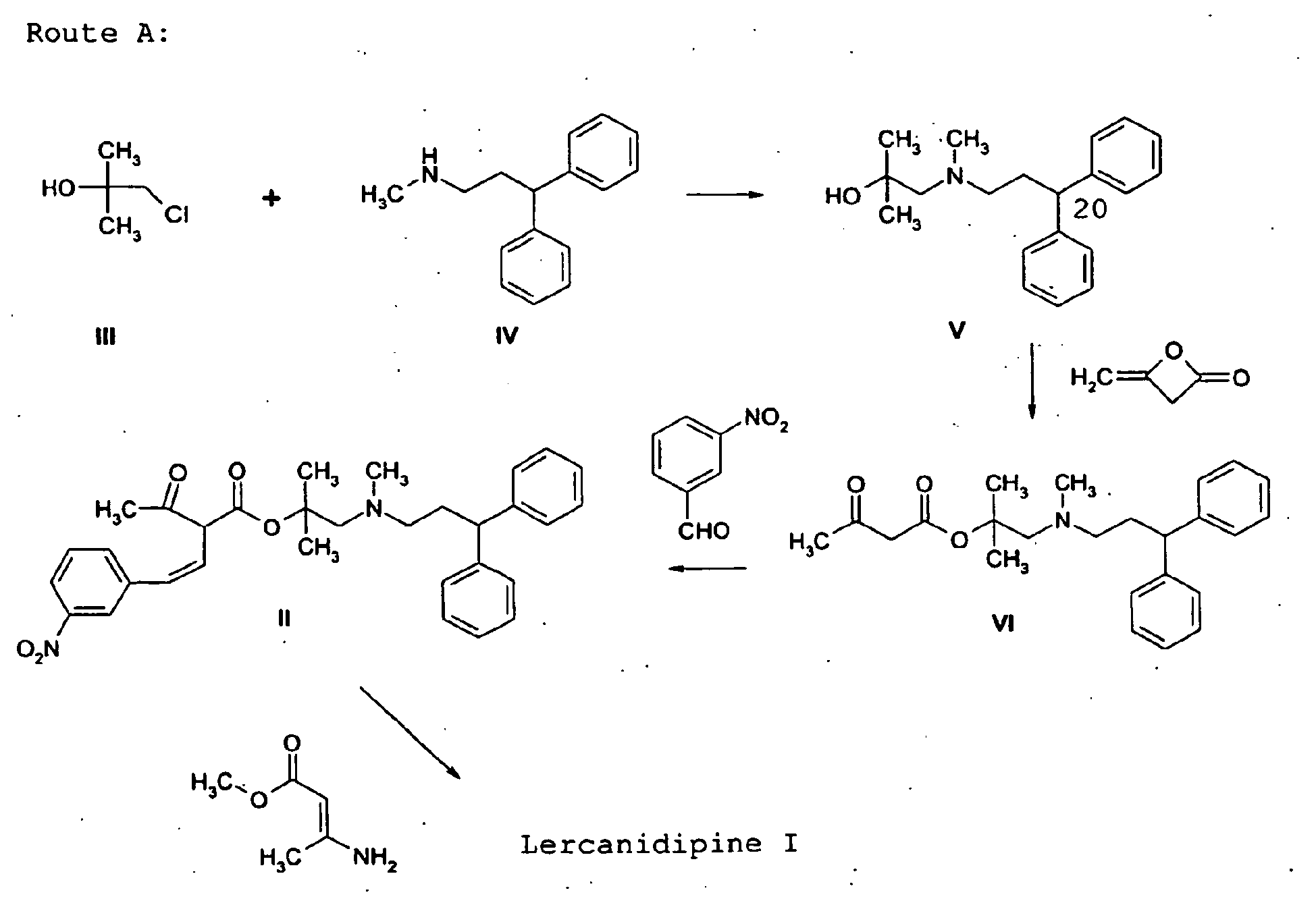

- Lercanidipine was isolated in the form of an oily residue which was purified by flash chromatography. Flash chromatography is difficult to apply on an industrial scale. Furthermore, the process reported in
EP 0 153 016 A2 results in the formation of side products which causes a low yield of the desired product. -
US 5,912,351 describes an alternative process which involves reaction of 1,4-dihydro-2,6-dimethyl-5-methoxycarbonyl-4-(3-nitrophenyl) pyridine-3-carboxylic acid with thionyl chloride in dichloromethane and dimethylformamide and subsequent esterification of the obtained acid chloride with 2,N-dimethyl-N-(3,3-diphenylpropyl)-1-amino-2-propyl alcohol:
- The process is said to yield lercanidipine hydrochloride in an anhydrous non-hygroscopic crystalline form. The product was purified by crystallization to give lercanidipine hydrochloride having a melting point of 186-188 °C, later named Form (C). This process is said to give improved yields and to result in the formation of fewer side products. However, the purity of the product is still not satisfactory and is not reproducible.
-
WO03/014084 -
WO03/014085 -
WO2006/021397 discloses the preparation of amorphous and crystalline acid addition salts of lercanidipine. These salts are prepared by adding a solution of an acid to a solution of lercanidipine free base followed by the removal of the solvent. Crystalline salts are obtained by recrystallization of the isolated salts from an aprotic and/or protic solvent. -
WO2006/046830 discloses a method for preparing amorphous lercanidipine comprising the steps of (1) dissolving lercanidipine in an organic solvent; (2) forming a precipitate by the addition of a second solvent or concentrating the solution under reduced pressure to obtain a solid substance; (3) filtering, washing and drying the precipitate or drying the solid substance. - Although the known processes often require numerous purification steps, none of the known methods is completely satisfactory as far as purity is concerned. It is therefore an object of the present invention to provide a new process for the manufacture of lercanidipine which allows the production of the active ingredient on an industrial scale in high purity and with a minimum number of purification steps.
- According to the present invention this problem is surprisingly solved by a process for preparing lercanidipine of formula I, i.e. 1,4-dihydro-2,6-dimethyl-4-(3-nitrophenyl)-3,5-pyridinedicarboxylic acid 2-[(3,3-diphenylpropyl)methylamino]-1,1-dimethylethyl methyl ester, which comprises reacting 1,4-dihydro-2,6-dimethyl-4-(3-nitrophenyl)-3,5-
pyridinedicarboxylic acid 1,1-dimethylethyl-2-methylaminoethyl methyl ester IX or a salt thereof with a compound of the general formula XI
L-O-CH2-CH2-CHPh2 XI
wherein L-O is a leaving group. - Compound IX can be used in the form of the free base but is preferably used in the form of an acid addition salt. Preferred acid addition salts are the hydrochloride, tosylate, tartrate, citrate, more preferably the oxalate salt. These salts can be prepared by reaction of the free base of compound IX with the corresponding acid.
- The leaving group L-O of compound XI is preferably a triflate (trifluormethane sulfonic), brosylate (4-bromobenzene sulfonic), or napsylate (naphthalensulfonic) group, more preferably a tosylate (4-methyl benzenesulfonic) group. The preparation of compounds according to general formula XI can be achieved by known procedures starting at 3,3-diphenyl propanol. The synthesis of the preferred tosylated compound 3-tosyloxy-3,3-diphenylpropane XIa can be achieved e.g. by tosylating 3,3-diphenyl propanol according to Pitha et al., Collect. Czech. Chem. Commun. 25, 1960, 736-742. 3,3-Diphenyl propanol is accessible e.g. by the method described in
DE 766 207 . - The reaction of compound IX with compound XI is preferably performed in a solvent selected from the group consisting of toluene, xylene, dimethylformamide (DMF), dimethylacetamide (DMA), hexamethylphosphoric amide (HMPT), N-methyl pyrrolidine and acetonitrile. The most preferred solvent is toluene.
- The reaction temperature is preferably within a range of from 10 to 140 °C, more preferably 78 to 82 °C.
- It is preferred to perform the reaction in the presence of a base which is preferably selected from the group consisting of alkali carbonates and alkaline-earth carbonates. Preferred alkali metal carbonates are sodium and potassium carbonate, preferred alkaline-earth carbonates are magnesium and calcium carbonate. The most preferred carbonate is potassium carbonate.
- It is also preferred to perform the reaction in the presence of a phase transfer catalyst. Preferably the catalyst is selected from the group consisting of tetraalkyl quaternary ammonium salts, more preferably tetra(C2-6)-alkyl quaternary ammonium salts. The most preferred phase transfer catalyst is tetrabutylammonium iodide.
- Compound IX used in the above process is preferably prepared by esterification of 1,4-dihydro-2,6-dimethyl-4-(3-nitrophenyl)-3,5-pyridinedicarboxylic acid monomethyl ester VIII with 1,1-dimethyl-2-methylaminoethanol X, or a salt thereof, which can be prepared e.g. by the method described in
US 2,252,713 . Compound VIII is accessible according to known procedures, e.g. by the method disclosed inDE 28 47 237 . - Compound VIII is preferably first halogenated with a halogenation agent to give the acid halide derivative of VIII. Preferably, the halogenation is a chlorination which results in the formation of 1,4-dihydro-2,6-dimethyl-4-(3-nitrophenyl)-3,5-pyridinedicarboxylic acid chloride monomethyl ester. Chlorination can be achieved by using known chlorinating agents such as phosphorus pentachloride, phosphorus trichloride, phosphorus oxychloride, sulfuryl chloride and in particular thionyl chloride. Halogenated compound VIII is then reacted with compound X. The reaction can be performed in situ without prior isolation of halogenated compound VIII.
- Alternatively, compound VIII can be activated by the addition of a suitable diimide such as N,N'-dicyclohexylcarbodiimide or by forming a mixed anhydride.
- It is preferred to use compound X in the form of its triflate, hydrochloride or sulfate salt, and particularly preferred in the form of its tosylate salt (1,1-dimethyl-2-methylaminoethanol tosylate). It was surprisingly found that e.g. the tosylate salt of compound X can be O-acylated without protection of its amino group. The tosylate salt of X can be prepared from 2-chloro-1,1-dimethylethanol which can be synthesized according to the method described in
US 2,252,713 . The tosylate salt can be purified and isolated in good yield. The tosylate salt of X is then reacted with compound VIII or preferably halogenated compound VIII to give intermediate IX in pure form and with high yield. - The reaction of compound VIII with compound X is preferably performed in a solvent selected from the group consisting of dimethylformamide (DMF), dimethyl acetamide (DMA) and tetrahydrofuran (THF). The reaction temperature is preferably within a range of from -20 to 30 °C.
- The halogenation of compound VIII is preferably performed in a solvent selected from the group consisting of dimethylformamide (DMF), dimethyl acetamide (DMA), tetrahydrofuran (THF), N-methyl pyrrolidine and dimethylether (DME). The reaction temperature is preferably within a range of from -20 to 30 °C.
- The process of the present invention for the synthesis of lercanidipine by reaction of compound IX with compound XI results in the formation of the desired product in good yield and in an unexpectedly high purity.
- The stereo isomeric form of the product of course depends on the stereo isomeric form of the starting material. If the racemate of compound VIII or IX is used, lercanidipine is also obtained in the form of the racemate. If the (R)-enantiomer or the (S)-enantiomer of compounds VIII or IX is used in the process of the present invention, the (R)-enantiomer or the (S)-enantiomer of lercanidipine can be obtained. The homochiral acids of compound VIII can be prepared by resolution of racemic acid VIII according to the method reported by Ashimori at al., Chem. Pharm. Bull. 39, 108 (1991). It is preferred to produce the (R,S) racemate of I, more preferably the (S)-enantiomer.
- The process of the present invention results in the formation of lercanidipine I in the form of the free base. The free base can be converted to an acid addition salt by adding an appropriate acid. Preferably, lercanidipine free base is dissolved in an organic solvent, preferably an ether, more preferably methyl tertiary-butyl ether (MTBE), and an acid or a solution of an acid in a solvent, preferably an organic solvent is added.
- Suitable salts of lercanidipine include salts of inorganic acids such as hydrochloric acid, hydrobromic acid, phosphoric acid and sulphuric acid; sulphonic acids such as methanesulphonic acid, benzenesulphonic acid, toluenesulphonic acid, and naphthalene-1,5-disulphonic acid; monocarboxylic acids, such as acetic acid, (+)-L-lactic acid, DL-lactic acid, DL-mandelic acid, gluconic acid, cinnamic acid, salicylic acid, and gentisic acid; dicarboxylic acids, such as oxalic acid, 2-oxo-glutaric acid, malonic acid, (-)-L-malic acid, mucic acid, (+)-L-tartaric acid, fumaric acid, maleic acid, and terephthalic acid; tricarboxylic acids, such as citric acid; and aromatic sulphonimides such as saccharin. The preparation of these addition salts of lercanidipine is disclosed in
WO2006/021397 . - Preferred salts of lercanidipine are the L-lactate, cinnamate, salicylate, maleate, saccharinate, besylate, napadisylate salts, in particular the oxalate salt and the hydrochloride salt.
- Lercanidipine free base and the acid addition salts of lercanidipine can be produced in crystalline form and in amorphous form. Amorphous forms can be prepared by the methods disclosed in
WO2006/021397 andWO2006/046830 . - Lercanidipine produced by the process of the present invention is preferably isolated by crystallization. Crystallization is preferably carried out by use of water containing hydrochloric acid and sodium chloride as disclosed in
EP 0 153 016 A2 , or in a mixture of MTBE and isopropanol. - The most preferred salt of lercanidipine is the hydrochloride hemihydrate salt. This salt is preferably obtained by crystallization from water containing hydrochloric acid and sodium chloride to give a product having a melting point of 119-123 °C as disclosed in
EP 0 153 016 A2 . - Lercanidipine produced according to the method of the present invention can be further purified by converting lercanidipine free base to a first acid addition salt, converting the first addition salt back to the free base, followed by converting the free base to a second acid addition salt. The first acid addition salt is preferably the oxalate, the second addition salt is preferably the hydrochloride. Lercanidipine subjected to this purification sequence has a very high purity and is suitable for the production of pharmaceutical composition without further purification.
- For the preparation of pharmaceutical compositions comprising lercanidipine as an active ingredient the lercanidipine prepared by the process of the present invention is mixed with at least one pharmaceutically acceptable excipient, and the mixture of the active ingredient and the one or more excipients is then converted to a pharmaceutical dosage form. Suitable excipients and dosage forms are disclosed e.g. in
WO03/014084 - Preferred excipients are pharmaceutically acceptable binders, such as lactose, hydroxypropylmethylcellulose and povidone; disintegrants, such as sodium starch glycolate; lubricants, such as magnesium stearate, magnesium palmitate and magnesium oleate; dispersing and suspending agents such as microcrystalline cellulose; plasticizers, such as polyethylene glycol; colorants, such as ferric oxide(s) and titanium dioxide; and other additives such as talcum. Suitable film forming agents are hydroxypropylmethylcellulose, ethylcellulose and polymethacrylates.
- In the following the invention will be described by reference to figures and examples.
-
Figure 1 is a reaction scheme showing a preferred embodiment of the process of the present invention. 1,4-Dihydro-2,6-dimethyl-4-(3-nitrophenyl)-3,5-pyridinedicarboxylic acid monomethyl ester VIII is transformed by reaction with thionyl chloride to give 1,4-dihydro-2,6-dimethyl-4-(3-nitrophenyl)-3,5-pyridinedicarboxylic monomethyl ester acid chloride. The acid chloride is then reacted in situ with the tosylate salt of 1,1-dimethyl-2-methylaminoethanol X to give 1,4-dihydro-2,6-dimethyl-4-(3-nitrophenyl)-3,5-pyridinedicarboxylic acid 1,1-dimethyl-2-methylaminoethyl methyl ester IX. Alkylation of compound IX with 3-tosyloxy-1,1-diphenylpropane XIa results in the formation of lercanidipine I free base. The free base is purified by forming the oxalate salt which is then converted to the hydrochloride hemihydrate via the free base. The final product is isolated in high yield and with high purity. - 485 mmol distilled 1,1-dimethyl-2-methylaminoethanol (
US 2,252,713 ;1938 ) was dissolved in 50 ml ethyl acetate, then 461. mmol p-toluenesulphonic acid hydrate in 270 ml ethyl acetate was added between 50-60 °C. The solution was cooled to 5-10 °C. The crystalline suspension was filtered. The product was washed with 100 ml cooled ethyl acetate.Yield: 117.6 g (72.4. %) Purity: min. 99.5 % Melting point: 130-132 °C - 361 mmol (R,S) 1,4-dihydro-2,6-dimethyl-4-(3-nitrophenyl)-3,5-pyridinedicarboxylic acid monomethyl ester (Formula VIII) (
DE 2,847,237 ;1938 ) was dissolved in a mixture of 600 ml abs. THF and 180 ml abs. DMF. The solution was cooled to -10 to 0 °C and 379 mmol of thionyl chloride was added slowly maintaining the temperature below 0 °C. Following a 1 hour agitation 357.5 mmol 1,1-dimethyl-2-methylaminoethanol tosylate salt (Formula X; Example 1) was added. The reaction mixture was stirred for 2-3 hours, then 700 ml water and 700 ml dichloromethane were added. The mixture was cooled below 0 °C and a 40 % aqueous solution of sodium hydroxide was added till pH 10-11. The organic phase was separated. The aqueous phase was extracted with 2 x 300 ml dichloromethane. The combined organic phases were washed with 3 x 300 ml 5 % aqueous solution of sodium hydrogen carbonate. The solution was dried with sodium sulfate and evaporated. The residue was dissolved in 150 ml acetonitrile. 360 mmol oxalic acid dihydrate in 150 ml acetonitrile was added to form the oxalate salt. The crystalline suspension was cooled to 12-15 °C. IX oxalate was filtered, washed with 100 ml cooled acetonitrile and dried.Yield: 154.2 (85 %) - The product was recrystallized from 450 ml acetonitrile.
Yield: 130 g (71.6 %) Purity: 99.8 % (HPLC) Melting point : 161-162 °C - 1
mol 3,3-diphenylpropanol (DE 766,207 ;1940 ) and 1.34 mol triethylamine were dissolved in 420 ml toluene then 1.1 mol p-toluenesulfonylchloride in 360 ml toluene was added maintaining the temperature between 20-26 °C. The mixture was agitated 5 hours and 400 ml 1N hydrochloric acid was added. The organic phase was separated and washed with 400 ml 5 % sodium hydrogen carbonate solution. The toluenic solution was evaporated. The residue was solved in 1,480 ml ethanol. The solution was cooled to -5 to -10 °C. The crystalline suspension was filtered and washed with 500 ml cooled ethanol.Yield: 307.4 g (83.9 %) Purity: 99.9 % (HPLC) Melting point: 49-51 °C - 500 mmol IX oxalate salt (Example 2) and 500 mmol XI (Example 3) were suspended in 760 ml toluene then 5 mol dried potassium carbonate and 15 g tetrabutylammoniumiodide were added. The mixture was stirred at 78-82 °C for 24 hours in a N2 stream in the dark while conversion was 55-65 %. The mixture was cooled, then 2,500 ml 0.1 N sodium hydroxide solution and 500 ml toluene were added. The organic phase was separated. The aqueous phase was extracted with 500 ml toluene. The combined organic phases were washed with 500 ml 0.1 N sodium hydroxide solution, 2 x 400 ml 10 % copper sulfate solution and 4 x 500 ml methanol-water mixture (1 : 2). The toluenic solution was extracted with 2 x 400 ml diluted hydrochloric acid - methanol mixture (2 : 1). The combined aqueous phase was treated with 10 % sodium hydroxide solution up to pH 11 and extracted with 2 x 500 ml toluene. The organic phase was evaporated and the residue was dissolved in 1000 ml MTBE. 300 mmol oxalic acid dihydrate in 210 ml isopropanol were added to the solution. 2,100 ml MTBE was cooled to -15 to -20 °C and the solution of the oxalate salt was added maintaining the temperature between -10 to -15 °C. The crystalline suspension was agitated 1 hour at -10 to -15 °C and filtered. The product was washed with 4 x 500 ml cooled MTBE and was dried.
Yield: 181.5 g (51.7 % without recovery of IX or 76.1 % with recovery of IX, resp.) Purity: 99.5 % (HPLC) Melting point: 120 - 125 °C - In the above reaction unreacted IX was removed by extraction with the aqueous solution of copper sulfate. IX was recovered by addition of ammonium hydroxide following extraction. The 800 ml 10 % copper sulfate solution containing unreacted IX was treated with NH4OH solution until the Cu(OH)2 precipitate was dissolved. The solution was extracted with 4 times 500 ml dichloromethane. The combined organic phases were evaporated. The residue was dissolved in 100 ml acetonitrile. 200 mmol oxalic acid dihydrate in 100 ml acetonitrile was added to form the oxalate salt. The crystalline suspension was cooled to 12 to 15 °C. IX oxalate salt was filtered and washed with 60 ml cooled acetonitrile and was dried.
Yield: 81 g (160 mmol) - The toluenic solution, which was washed with sodium hydroxide, copper-sulfate and methanol-water solutions, was evaporated. The residue was dissolved in 300 ml ethanol. The solution was cooled to -5 to 10 °C. The crystalline suspension was filtered and washed with 100 ml cooled ethanol.
Yield: 54.4 g (148 mmol) - 10 mmol I oxalate (Example 4) was dissolved in 100 ml dichloromethane and 20 mmol potassium carbonate in 20 ml water was added. The organic phase was separated. The aqueous phase was extracted with 2 x 10 ml dichloromethane. The combined organic phases were treated with 20 ml 1N hydrochloric acid. The organic phase was separated and was evaporated. The residue was treated with 2,000 ml of water containing 2 ml of 1N hydrochloride acid and 5 ml of water saturated with sodium chloride to form I hydrochloric hemihydrate, which was filtered.
Yield: 6.2 g (95 %) Purity: 99.8 % (HPLC) Melting point: 118-122 °C HPLC method: Column RP 18, 125 x 3 mm ID, 5 µm, det: 233 nm Eluent: 0.01 mol Na2HPO4/MeOH/ can : 25/65/10 tr ~ 15 min. - IR, X-ray and DSC proved that the product was identical to the product which was prepared by the process described in Example 16 of
EP 0 153 016 A2 .
Claims (24)
- A process for preparing 1,4-dihydro-2,6-dimethyl-4-(3-nitrophenyl)-3,5-pyridinedicarboxylic acid 2-[(3,3-diphenylpropyl)methylamino]-1,1-dimethylethyl methyl ester of formula I, or a salt thereof,


L-O-CH2-CH2-CHPh2 XI
wherein L-O is a leaving group. - The process of claim 1, wherein the salt of compound IX is the oxalate, tosylate, citrate, tartrate salt.
- The process of claim 1 or 2, wherein the leaving group L-O is a tosylate, triflate, brosylate or napsylate group.
- The process of any one of the preceding claims, wherein the reaction is conducted in a solvent selected from the groups consisting of toluene, xylene, dimethylformamide (DMF), dimethylacetamide (DMA), hexamethylphosphoric amide (HMPT), N-methyl pyrrolidine and acetonitrile.
- The process of any one of the preceding claims, wherein the reaction is performed at a temperature of 10 to 140 °C.
- A process for preparing 1,4-dihydro-2,6-dimethyl-4-(3-nitrophenyl)-3,5-pyridinedicarboxylic acid 1,1-dimethylethyl-2-methylaminoethyl methyl ester of formula IX, or a salt thereof,


- The process of claim 6, comprising halogenating compound VIII to give 1,4-dihydro-2,6-dimethyl-4-(3-nitrophenyl)-3,5-pyridinedicarboxylic acid halide monomethyl ester and reacting the acid halide of VIII with compound X or a salt thereof.
- The process of claim 7, wherein the halogenating agent is thionyl chloride, phosphorus pentachloride, phosphorus trichloride, phosphorus oxychloride or sulfuryl chloride.
- The process of any one of claims 6 to 8, wherein compound X is used in the form of its triflate, hydrochloride, sulfate or tosylate salt.
- The process of claim 6, wherein the reaction is performed in a solvent selected from the group consisting of THF, DMF and DMA.
- The process of claim 6 or 10, wherein the reaction is performed at a temperature of -20 to 30 °C.
- The process of claim 7 or 8, wherein the reaction is performed in a solvent selected from the groups consisting of DMF, THF, DME, N-methylpyrrolidine.
- The process of claim 7, 8 or 12, wherein the reaction is performed at a temperature of -20 to 30 °C.
- The process of any one of the preceding claims, further comprising converting the free base of compound I to a first acid addition salt, converting the first addition salt back to the free base, followed by converting the free base to a second acid addition salt.
- The process of claim 14, wherein the first acid addition salt is the oxalate.
- The process of claim 14 or 15, wherein the second addition salt is the hydrochloride hemihydrate.
- The process of any one of the preceding claims, further comprising isolating the resultant product.
- The process of claim 17, wherein the product is isolated by crystallization.
- The process of claim 17, wherein the product is isolated in amorphous form.
- An acid addition salt of 1,4-Dihydro-2,6-dimethyl-4-(3-nitrophenyl)-3,5-pyridinedicarboxylic acid 1,1-dimethylethyl-2-methylaminoethyl methyl ester of formula IX:

- The compound of claim 20, which is the tosylate, tartrate, citrate, or oxalate salt.
- The use of 1,4-Dihydro-2,6-dimethyl-4-(3-nitrophenyl)-3,5-pyridinedicarboxylic acid 1,1-dimethylethyl-2-methylaminoethyl methyl ester of formula IX, or a salt thereof:

- The use of claim 22, wherein the salt is acid addition salt.
- The use of claim 23, wherein the salt is the tosylate, tartrate, citrate, or oxalate salt.
Priority Applications (3)
| Application Number | Priority Date | Filing Date | Title |
|---|---|---|---|
| AT06114517T ATE415389T1 (en) | 2006-05-24 | 2006-05-24 | METHOD FOR PRODUCING LERCANIPIDINE |
| DE602006003877T DE602006003877D1 (en) | 2006-05-24 | 2006-05-24 | Process for the preparation of lercanipidin |
| EP06114517A EP1860102B1 (en) | 2006-05-24 | 2006-05-24 | Process for Producing Lercanidipine |
Applications Claiming Priority (1)
| Application Number | Priority Date | Filing Date | Title |
|---|---|---|---|
| EP06114517A EP1860102B1 (en) | 2006-05-24 | 2006-05-24 | Process for Producing Lercanidipine |
Publications (2)
| Publication Number | Publication Date |
|---|---|
| EP1860102A1 EP1860102A1 (en) | 2007-11-28 |
| EP1860102B1 true EP1860102B1 (en) | 2008-11-26 |
Family
ID=37075184
Family Applications (1)
| Application Number | Title | Priority Date | Filing Date |
|---|---|---|---|
| EP06114517A Not-in-force EP1860102B1 (en) | 2006-05-24 | 2006-05-24 | Process for Producing Lercanidipine |
Country Status (3)
| Country | Link |
|---|---|
| EP (1) | EP1860102B1 (en) |
| AT (1) | ATE415389T1 (en) |
| DE (1) | DE602006003877D1 (en) |
Families Citing this family (2)
| Publication number | Priority date | Publication date | Assignee | Title |
|---|---|---|---|---|
| PT2046745E (en) * | 2006-08-04 | 2014-01-15 | Recordati Ireland Ltd | Process for preparing amorphous lercanidipine hydrochloride |
| CN110183399A (en) * | 2019-06-05 | 2019-08-30 | 辽宁科隆精细化工股份有限公司 | A kind of method of synthesis 4- (2- (N, N- dimethylamino) ethyl) morpholine |
Family Cites Families (2)
| Publication number | Priority date | Publication date | Assignee | Title |
|---|---|---|---|---|
| GB8403866D0 (en) * | 1984-02-14 | 1984-03-21 | Recordati Chem Pharm | Diphenylalkylaminoalkyl esters |
| IT1274480B (en) * | 1995-05-12 | 1997-07-17 | Recordati Chem Pharm | IMPROVED PROCEDURE FOR THE PREPARATION OF LERCANIDIPINE HYDROCHLORIDE |
-
2006
- 2006-05-24 EP EP06114517A patent/EP1860102B1/en not_active Not-in-force
- 2006-05-24 DE DE602006003877T patent/DE602006003877D1/en not_active Expired - Fee Related
- 2006-05-24 AT AT06114517T patent/ATE415389T1/en not_active IP Right Cessation
Also Published As
| Publication number | Publication date |
|---|---|
| ATE415389T1 (en) | 2008-12-15 |
| EP1860102A1 (en) | 2007-11-28 |
| DE602006003877D1 (en) | 2009-01-08 |
Similar Documents
| Publication | Publication Date | Title |
|---|---|---|
| US8445688B2 (en) | Process for producing enantiomer of amlodipine in high optical purity | |
| MX2007002141A (en) | Lercanidipine salts. | |
| US6596874B1 (en) | Process for preparing amlodipine benzenesulphonate | |
| US10870654B2 (en) | Pharmaceutically acceptable salts and polymorphic forms of hydrocodone benzoic acid enol ester and processes for making same | |
| US6608206B1 (en) | Process for making S(-) Amlodipine salts | |
| EP1860102A1 (en) | Process for Producing Lercanidipine | |
| ASHIMORI et al. | Synthesis and Pharmacological Effects of Optically Active 2-[4-(4-Benzhydryl-1-piperazinyl) phenyl]-ethyl Methyl 1, 4-Dihydro-2, 6-dimethyl-4-(3-nitrophenyl-3, 5-pyridinedicarboxylate Hydrochloride | |
| CN101316820B (en) | Process for preparation of chiral amlodipine gentisate | |
| WO2021250067A2 (en) | A process for the purification of (r)-2-amino-3-phenylpropyl carbamate | |
| JP5124281B2 (en) | Optical separation of amlodipine | |
| KR20070054208A (en) | Novel Polymorphs of Azabicyclohexane | |
| KR100515294B1 (en) | S-(-)-amlodipine nicotinate crystalline dihydrate | |
| WO2005023769A1 (en) | Process for the preparation of amlodipine salts | |
| EP1407773A1 (en) | A process for the preparation of s (-) amlodipine salts | |
| EP1348697A1 (en) | Process for the preparation of S(-)-amlodipine-L(+)-hemitartrate | |
| KR101098031B1 (en) | Novel crystalline form of amlodipine nicotinate and its preparation method | |
| JP2021536429A (en) | Amorphous and crystalline forms of valbenazine salts | |
| JP2010518155A (en) | Method for producing S-(-)-amlodipine or a salt thereof and intermediate used therefor | |
| KR20060104761A (en) | Method for preparing lercanidipine hydrochloride | |
| KR20050122481A (en) | Novel intermediate compound for amlodipine besylate and preparation process of amlodipine besylate using thereof |
Legal Events
| Date | Code | Title | Description |
|---|---|---|---|
| PUAI | Public reference made under article 153(3) epc to a published international application that has entered the european phase |
Free format text: ORIGINAL CODE: 0009012 |
|
| GRAP | Despatch of communication of intention to grant a patent |
Free format text: ORIGINAL CODE: EPIDOSNIGR1 |
|
| 17P | Request for examination filed |
Effective date: 20070110 |
|
| AK | Designated contracting states |
Kind code of ref document: A1 Designated state(s): AT BE BG CH CY CZ DE DK EE ES FI FR GB GR HU IE IS IT LI LT LU LV MC NL PL PT RO SE SI SK TR |
|
| AX | Request for extension of the european patent |
Extension state: AL BA HR MK YU |
|
| GRAS | Grant fee paid |
Free format text: ORIGINAL CODE: EPIDOSNIGR3 |
|
| AKX | Designation fees paid |
Designated state(s): AT BE BG CH CY CZ DE DK EE ES FI FR GB GR HU IE IS IT LI LT LU LV MC NL PL PT RO SE SI SK TR |
|
| GRAA | (expected) grant |
Free format text: ORIGINAL CODE: 0009210 |
|
| AK | Designated contracting states |
Kind code of ref document: B1 Designated state(s): AT BE BG CH CY CZ DE DK EE ES FI FR GB GR HU IE IS IT LI LT LU LV MC NL PL PT RO SE SI SK TR |
|
| REG | Reference to a national code |
Ref country code: GB Ref legal event code: FG4D |
|
| REG | Reference to a national code |
Ref country code: CH Ref legal event code: EP |
|
| REG | Reference to a national code |
Ref country code: IE Ref legal event code: FG4D |
|
| REF | Corresponds to: |
Ref document number: 602006003877 Country of ref document: DE Date of ref document: 20090108 Kind code of ref document: P |
|
| PG25 | Lapsed in a contracting state [announced via postgrant information from national office to epo] |
Ref country code: AT Free format text: LAPSE BECAUSE OF FAILURE TO SUBMIT A TRANSLATION OF THE DESCRIPTION OR TO PAY THE FEE WITHIN THE PRESCRIBED TIME-LIMIT Effective date: 20081126 Ref country code: LT Free format text: LAPSE BECAUSE OF FAILURE TO SUBMIT A TRANSLATION OF THE DESCRIPTION OR TO PAY THE FEE WITHIN THE PRESCRIBED TIME-LIMIT Effective date: 20081126 Ref country code: ES Free format text: LAPSE BECAUSE OF FAILURE TO SUBMIT A TRANSLATION OF THE DESCRIPTION OR TO PAY THE FEE WITHIN THE PRESCRIBED TIME-LIMIT Effective date: 20090308 |
|
| NLV1 | Nl: lapsed or annulled due to failure to fulfill the requirements of art. 29p and 29m of the patents act | ||
| PG25 | Lapsed in a contracting state [announced via postgrant information from national office to epo] |
Ref country code: IS Free format text: LAPSE BECAUSE OF FAILURE TO SUBMIT A TRANSLATION OF THE DESCRIPTION OR TO PAY THE FEE WITHIN THE PRESCRIBED TIME-LIMIT Effective date: 20090326 Ref country code: SI Free format text: LAPSE BECAUSE OF FAILURE TO SUBMIT A TRANSLATION OF THE DESCRIPTION OR TO PAY THE FEE WITHIN THE PRESCRIBED TIME-LIMIT Effective date: 20081126 Ref country code: PL Free format text: LAPSE BECAUSE OF FAILURE TO SUBMIT A TRANSLATION OF THE DESCRIPTION OR TO PAY THE FEE WITHIN THE PRESCRIBED TIME-LIMIT Effective date: 20081126 Ref country code: LV Free format text: LAPSE BECAUSE OF FAILURE TO SUBMIT A TRANSLATION OF THE DESCRIPTION OR TO PAY THE FEE WITHIN THE PRESCRIBED TIME-LIMIT Effective date: 20081126 Ref country code: NL Free format text: LAPSE BECAUSE OF FAILURE TO SUBMIT A TRANSLATION OF THE DESCRIPTION OR TO PAY THE FEE WITHIN THE PRESCRIBED TIME-LIMIT Effective date: 20081126 Ref country code: FI Free format text: LAPSE BECAUSE OF FAILURE TO SUBMIT A TRANSLATION OF THE DESCRIPTION OR TO PAY THE FEE WITHIN THE PRESCRIBED TIME-LIMIT Effective date: 20081126 |
|
| PG25 | Lapsed in a contracting state [announced via postgrant information from national office to epo] |
Ref country code: RO Free format text: LAPSE BECAUSE OF FAILURE TO SUBMIT A TRANSLATION OF THE DESCRIPTION OR TO PAY THE FEE WITHIN THE PRESCRIBED TIME-LIMIT Effective date: 20081126 Ref country code: EE Free format text: LAPSE BECAUSE OF FAILURE TO SUBMIT A TRANSLATION OF THE DESCRIPTION OR TO PAY THE FEE WITHIN THE PRESCRIBED TIME-LIMIT Effective date: 20081126 Ref country code: BE Free format text: LAPSE BECAUSE OF FAILURE TO SUBMIT A TRANSLATION OF THE DESCRIPTION OR TO PAY THE FEE WITHIN THE PRESCRIBED TIME-LIMIT Effective date: 20081126 Ref country code: BG Free format text: LAPSE BECAUSE OF FAILURE TO SUBMIT A TRANSLATION OF THE DESCRIPTION OR TO PAY THE FEE WITHIN THE PRESCRIBED TIME-LIMIT Effective date: 20090226 Ref country code: DK Free format text: LAPSE BECAUSE OF FAILURE TO SUBMIT A TRANSLATION OF THE DESCRIPTION OR TO PAY THE FEE WITHIN THE PRESCRIBED TIME-LIMIT Effective date: 20081126 |
|
| PG25 | Lapsed in a contracting state [announced via postgrant information from national office to epo] |
Ref country code: SE Free format text: LAPSE BECAUSE OF FAILURE TO SUBMIT A TRANSLATION OF THE DESCRIPTION OR TO PAY THE FEE WITHIN THE PRESCRIBED TIME-LIMIT Effective date: 20090226 Ref country code: PT Free format text: LAPSE BECAUSE OF FAILURE TO SUBMIT A TRANSLATION OF THE DESCRIPTION OR TO PAY THE FEE WITHIN THE PRESCRIBED TIME-LIMIT Effective date: 20090427 Ref country code: CZ Free format text: LAPSE BECAUSE OF FAILURE TO SUBMIT A TRANSLATION OF THE DESCRIPTION OR TO PAY THE FEE WITHIN THE PRESCRIBED TIME-LIMIT Effective date: 20081126 |
|
| PGFP | Annual fee paid to national office [announced via postgrant information from national office to epo] |
Ref country code: DE Payment date: 20090527 Year of fee payment: 4 Ref country code: FR Payment date: 20090515 Year of fee payment: 4 |
|
| PG25 | Lapsed in a contracting state [announced via postgrant information from national office to epo] |
Ref country code: SK Free format text: LAPSE BECAUSE OF FAILURE TO SUBMIT A TRANSLATION OF THE DESCRIPTION OR TO PAY THE FEE WITHIN THE PRESCRIBED TIME-LIMIT Effective date: 20081126 |
|
| PLBE | No opposition filed within time limit |
Free format text: ORIGINAL CODE: 0009261 |
|
| STAA | Information on the status of an ep patent application or granted ep patent |
Free format text: STATUS: NO OPPOSITION FILED WITHIN TIME LIMIT |
|
| PGFP | Annual fee paid to national office [announced via postgrant information from national office to epo] |
Ref country code: IT Payment date: 20090531 Year of fee payment: 4 |
|
| 26N | No opposition filed |
Effective date: 20090827 |
|
| PG25 | Lapsed in a contracting state [announced via postgrant information from national office to epo] |
Ref country code: MC Free format text: LAPSE BECAUSE OF NON-PAYMENT OF DUE FEES Effective date: 20090531 |
|
| REG | Reference to a national code |
Ref country code: IE Ref legal event code: MM4A |
|
| PG25 | Lapsed in a contracting state [announced via postgrant information from national office to epo] |
Ref country code: IE Free format text: LAPSE BECAUSE OF NON-PAYMENT OF DUE FEES Effective date: 20090524 |
|
| PG25 | Lapsed in a contracting state [announced via postgrant information from national office to epo] |
Ref country code: GR Free format text: LAPSE BECAUSE OF FAILURE TO SUBMIT A TRANSLATION OF THE DESCRIPTION OR TO PAY THE FEE WITHIN THE PRESCRIBED TIME-LIMIT Effective date: 20090227 |
|
| REG | Reference to a national code |
Ref country code: CH Ref legal event code: PL |
|
| GBPC | Gb: european patent ceased through non-payment of renewal fee |
Effective date: 20100524 |
|
| REG | Reference to a national code |
Ref country code: FR Ref legal event code: ST Effective date: 20110131 |
|
| PG25 | Lapsed in a contracting state [announced via postgrant information from national office to epo] |
Ref country code: CH Free format text: LAPSE BECAUSE OF NON-PAYMENT OF DUE FEES Effective date: 20100531 Ref country code: LI Free format text: LAPSE BECAUSE OF NON-PAYMENT OF DUE FEES Effective date: 20100531 |
|
| PG25 | Lapsed in a contracting state [announced via postgrant information from national office to epo] |
Ref country code: IT Free format text: LAPSE BECAUSE OF NON-PAYMENT OF DUE FEES Effective date: 20100524 |
|
| PG25 | Lapsed in a contracting state [announced via postgrant information from national office to epo] |
Ref country code: LU Free format text: LAPSE BECAUSE OF NON-PAYMENT OF DUE FEES Effective date: 20090524 Ref country code: DE Free format text: LAPSE BECAUSE OF NON-PAYMENT OF DUE FEES Effective date: 20101201 |
|
| PG25 | Lapsed in a contracting state [announced via postgrant information from national office to epo] |
Ref country code: FR Free format text: LAPSE BECAUSE OF NON-PAYMENT OF DUE FEES Effective date: 20100531 |
|
| PG25 | Lapsed in a contracting state [announced via postgrant information from national office to epo] |
Ref country code: HU Free format text: LAPSE BECAUSE OF FAILURE TO SUBMIT A TRANSLATION OF THE DESCRIPTION OR TO PAY THE FEE WITHIN THE PRESCRIBED TIME-LIMIT Effective date: 20090527 |
|
| PG25 | Lapsed in a contracting state [announced via postgrant information from national office to epo] |
Ref country code: GB Free format text: LAPSE BECAUSE OF NON-PAYMENT OF DUE FEES Effective date: 20100524 |
|
| PG25 | Lapsed in a contracting state [announced via postgrant information from national office to epo] |
Ref country code: TR Free format text: LAPSE BECAUSE OF FAILURE TO SUBMIT A TRANSLATION OF THE DESCRIPTION OR TO PAY THE FEE WITHIN THE PRESCRIBED TIME-LIMIT Effective date: 20081126 |
|
| PG25 | Lapsed in a contracting state [announced via postgrant information from national office to epo] |
Ref country code: CY Free format text: LAPSE BECAUSE OF FAILURE TO SUBMIT A TRANSLATION OF THE DESCRIPTION OR TO PAY THE FEE WITHIN THE PRESCRIBED TIME-LIMIT Effective date: 20081126 |