EP1860099A2 - Industrial process for the production of diphenyl sulfone compounds - Google Patents
Industrial process for the production of diphenyl sulfone compounds Download PDFInfo
- Publication number
- EP1860099A2 EP1860099A2 EP07018222A EP07018222A EP1860099A2 EP 1860099 A2 EP1860099 A2 EP 1860099A2 EP 07018222 A EP07018222 A EP 07018222A EP 07018222 A EP07018222 A EP 07018222A EP 1860099 A2 EP1860099 A2 EP 1860099A2
- Authority
- EP
- European Patent Office
- Prior art keywords
- reaction
- iodine
- production
- formula
- alkyl
- Prior art date
- Legal status (The legal status is an assumption and is not a legal conclusion. Google has not performed a legal analysis and makes no representation as to the accuracy of the status listed.)
- Granted
Links
- 238000004519 manufacturing process Methods 0.000 title claims abstract description 54
- KZTYYGOKRVBIMI-UHFFFAOYSA-N diphenyl sulfone Chemical class C=1C=CC=CC=1S(=O)(=O)C1=CC=CC=C1 KZTYYGOKRVBIMI-UHFFFAOYSA-N 0.000 title claims description 23
- 239000011630 iodine Substances 0.000 claims abstract description 55
- 229910052740 iodine Inorganic materials 0.000 claims abstract description 55
- ZCYVEMRRCGMTRW-UHFFFAOYSA-N 7553-56-2 Chemical compound [I] ZCYVEMRRCGMTRW-UHFFFAOYSA-N 0.000 claims abstract description 54
- 150000001875 compounds Chemical class 0.000 claims abstract description 35
- LFQSCWFLJHTTHZ-UHFFFAOYSA-N Ethanol Chemical compound CCO LFQSCWFLJHTTHZ-UHFFFAOYSA-N 0.000 claims abstract description 20
- 238000000034 method Methods 0.000 claims abstract description 20
- 238000011084 recovery Methods 0.000 claims abstract description 17
- 239000002351 wastewater Substances 0.000 claims abstract description 11
- 238000006243 chemical reaction Methods 0.000 claims description 84
- XLYOFNOQVPJJNP-UHFFFAOYSA-N water Substances O XLYOFNOQVPJJNP-UHFFFAOYSA-N 0.000 claims description 38
- VPWNQTHUCYMVMZ-UHFFFAOYSA-N 4,4'-sulfonyldiphenol Chemical compound C1=CC(O)=CC=C1S(=O)(=O)C1=CC=C(O)C=C1 VPWNQTHUCYMVMZ-UHFFFAOYSA-N 0.000 claims description 20
- 150000004694 iodide salts Chemical class 0.000 claims description 6
- 230000035484 reaction time Effects 0.000 claims description 5
- 125000001449 isopropyl group Chemical group [H]C([H])([H])C([H])(*)C([H])([H])[H] 0.000 claims description 4
- 239000002904 solvent Substances 0.000 claims description 4
- 150000001351 alkyl iodides Chemical class 0.000 abstract description 31
- 150000001347 alkyl bromides Chemical class 0.000 abstract description 16
- 239000000975 dye Substances 0.000 abstract description 3
- 238000004904 shortening Methods 0.000 abstract description 2
- 150000002496 iodine Chemical class 0.000 abstract 1
- 239000002994 raw material Substances 0.000 abstract 1
- 239000002585 base Substances 0.000 description 18
- OAICVXFJPJFONN-UHFFFAOYSA-N Phosphorus Chemical compound [P] OAICVXFJPJFONN-UHFFFAOYSA-N 0.000 description 17
- HEMHJVSKTPXQMS-UHFFFAOYSA-M Sodium hydroxide Chemical compound [OH-].[Na+] HEMHJVSKTPXQMS-UHFFFAOYSA-M 0.000 description 15
- YXFVVABEGXRONW-UHFFFAOYSA-N Toluene Chemical compound CC1=CC=CC=C1 YXFVVABEGXRONW-UHFFFAOYSA-N 0.000 description 12
- 239000010410 layer Substances 0.000 description 12
- FMKOJHQHASLBPH-UHFFFAOYSA-N isopropyl iodide Chemical compound CC(C)I FMKOJHQHASLBPH-UHFFFAOYSA-N 0.000 description 11
- QAOWNCQODCNURD-UHFFFAOYSA-N Sulfuric acid Chemical compound OS(O)(=O)=O QAOWNCQODCNURD-UHFFFAOYSA-N 0.000 description 10
- 150000003457 sulfones Chemical class 0.000 description 10
- 239000000047 product Substances 0.000 description 9
- 238000004128 high performance liquid chromatography Methods 0.000 description 7
- 150000003839 salts Chemical class 0.000 description 7
- OKKJLVBELUTLKV-UHFFFAOYSA-N Methanol Chemical compound OC OKKJLVBELUTLKV-UHFFFAOYSA-N 0.000 description 6
- -1 alkyl halide Chemical class 0.000 description 6
- 125000004429 atom Chemical group 0.000 description 6
- 239000007858 starting material Substances 0.000 description 6
- VEXZGXHMUGYJMC-UHFFFAOYSA-N Hydrochloric acid Chemical compound Cl VEXZGXHMUGYJMC-UHFFFAOYSA-N 0.000 description 5
- 239000002253 acid Substances 0.000 description 5
- 239000006227 byproduct Substances 0.000 description 5
- PNDPGZBMCMUPRI-UHFFFAOYSA-N iodine Chemical compound II PNDPGZBMCMUPRI-UHFFFAOYSA-N 0.000 description 5
- 239000007800 oxidant agent Substances 0.000 description 5
- NAMYKGVDVNBCFQ-UHFFFAOYSA-N 2-bromopropane Chemical compound CC(C)Br NAMYKGVDVNBCFQ-UHFFFAOYSA-N 0.000 description 4
- 239000013078 crystal Substances 0.000 description 4
- 239000000706 filtrate Substances 0.000 description 4
- 238000002844 melting Methods 0.000 description 4
- 230000008018 melting Effects 0.000 description 4
- 238000001256 steam distillation Methods 0.000 description 4
- ZMXDDKWLCZADIW-UHFFFAOYSA-N N,N-Dimethylformamide Chemical compound CN(C)C=O ZMXDDKWLCZADIW-UHFFFAOYSA-N 0.000 description 3
- KWYUFKZDYYNOTN-UHFFFAOYSA-M Potassium hydroxide Chemical compound [OH-].[K+] KWYUFKZDYYNOTN-UHFFFAOYSA-M 0.000 description 3
- 239000003513 alkali Substances 0.000 description 3
- 150000001350 alkyl halides Chemical class 0.000 description 3
- 230000029936 alkylation Effects 0.000 description 3
- 238000005804 alkylation reaction Methods 0.000 description 3
- 238000009835 boiling Methods 0.000 description 3
- 239000007810 chemical reaction solvent Substances 0.000 description 3
- 230000002349 favourable effect Effects 0.000 description 3
- 229910052698 phosphorus Inorganic materials 0.000 description 3
- 239000011574 phosphorus Substances 0.000 description 3
- 238000004448 titration Methods 0.000 description 3
- OKTJSMMVPCPJKN-UHFFFAOYSA-N Carbon Chemical compound [C] OKTJSMMVPCPJKN-UHFFFAOYSA-N 0.000 description 2
- ZAMOUSCENKQFHK-UHFFFAOYSA-N Chlorine atom Chemical compound [Cl] ZAMOUSCENKQFHK-UHFFFAOYSA-N 0.000 description 2
- MHAJPDPJQMAIIY-UHFFFAOYSA-N Hydrogen peroxide Chemical compound OO MHAJPDPJQMAIIY-UHFFFAOYSA-N 0.000 description 2
- KFZMGEQAYNKOFK-UHFFFAOYSA-N Isopropanol Chemical compound CC(C)O KFZMGEQAYNKOFK-UHFFFAOYSA-N 0.000 description 2
- CDBYLPFSWZWCQE-UHFFFAOYSA-L Sodium Carbonate Chemical compound [Na+].[Na+].[O-]C([O-])=O CDBYLPFSWZWCQE-UHFFFAOYSA-L 0.000 description 2
- 150000007513 acids Chemical class 0.000 description 2
- 150000008044 alkali metal hydroxides Chemical class 0.000 description 2
- 150000001348 alkyl chlorides Chemical class 0.000 description 2
- 239000002168 alkylating agent Substances 0.000 description 2
- 229940100198 alkylating agent Drugs 0.000 description 2
- 239000000460 chlorine Substances 0.000 description 2
- 229910052801 chlorine Inorganic materials 0.000 description 2
- 208000012839 conversion disease Diseases 0.000 description 2
- 238000007599 discharging Methods 0.000 description 2
- 238000004821 distillation Methods 0.000 description 2
- 150000002366 halogen compounds Chemical class 0.000 description 2
- XMBWDFGMSWQBCA-UHFFFAOYSA-N hydrogen iodide Chemical compound I XMBWDFGMSWQBCA-UHFFFAOYSA-N 0.000 description 2
- 239000000463 material Substances 0.000 description 2
- 229910052751 metal Inorganic materials 0.000 description 2
- 239000002184 metal Substances 0.000 description 2
- 230000003647 oxidation Effects 0.000 description 2
- 238000007254 oxidation reaction Methods 0.000 description 2
- BWHMMNNQKKPAPP-UHFFFAOYSA-L potassium carbonate Chemical compound [K+].[K+].[O-]C([O-])=O BWHMMNNQKKPAPP-UHFFFAOYSA-L 0.000 description 2
- 238000003756 stirring Methods 0.000 description 2
- 238000011282 treatment Methods 0.000 description 2
- BTUGGGLMQBJCBN-UHFFFAOYSA-N 1-iodo-2-methylpropane Chemical compound CC(C)CI BTUGGGLMQBJCBN-UHFFFAOYSA-N 0.000 description 1
- LMHCYRULPLGEEZ-UHFFFAOYSA-N 1-iodoheptane Chemical compound CCCCCCCI LMHCYRULPLGEEZ-UHFFFAOYSA-N 0.000 description 1
- ANOOTOPTCJRUPK-UHFFFAOYSA-N 1-iodohexane Chemical compound CCCCCCI ANOOTOPTCJRUPK-UHFFFAOYSA-N 0.000 description 1
- UWLHSHAHTBJTBA-UHFFFAOYSA-N 1-iodooctane Chemical compound CCCCCCCCI UWLHSHAHTBJTBA-UHFFFAOYSA-N 0.000 description 1
- BLXSFCHWMBESKV-UHFFFAOYSA-N 1-iodopentane Chemical compound CCCCCI BLXSFCHWMBESKV-UHFFFAOYSA-N 0.000 description 1
- IQRUSQUYPCHEKN-UHFFFAOYSA-N 2-iodobutane Chemical compound CCC(C)I IQRUSQUYPCHEKN-UHFFFAOYSA-N 0.000 description 1
- IJGRMHOSHXDMSA-UHFFFAOYSA-N Atomic nitrogen Chemical compound N#N IJGRMHOSHXDMSA-UHFFFAOYSA-N 0.000 description 1
- KZBUYRJDOAKODT-UHFFFAOYSA-N Chlorine Chemical compound ClCl KZBUYRJDOAKODT-UHFFFAOYSA-N 0.000 description 1
- RYGMFSIKBFXOCR-UHFFFAOYSA-N Copper Chemical compound [Cu] RYGMFSIKBFXOCR-UHFFFAOYSA-N 0.000 description 1
- KJTLSVCANCCWHF-UHFFFAOYSA-N Ruthenium Chemical compound [Ru] KJTLSVCANCCWHF-UHFFFAOYSA-N 0.000 description 1
- YQNSMGUFZYPDOO-UHFFFAOYSA-N [P].[I] Chemical class [P].[I] YQNSMGUFZYPDOO-UHFFFAOYSA-N 0.000 description 1
- 230000002378 acidificating effect Effects 0.000 description 1
- 229910000288 alkali metal carbonate Inorganic materials 0.000 description 1
- 150000008041 alkali metal carbonates Chemical class 0.000 description 1
- 229910001860 alkaline earth metal hydroxide Inorganic materials 0.000 description 1
- 125000003342 alkenyl group Chemical group 0.000 description 1
- 125000000217 alkyl group Chemical group 0.000 description 1
- 150000008051 alkyl sulfates Chemical class 0.000 description 1
- 125000000304 alkynyl group Chemical group 0.000 description 1
- HFEHLDPGIKPNKL-UHFFFAOYSA-N allyl iodide Chemical compound ICC=C HFEHLDPGIKPNKL-UHFFFAOYSA-N 0.000 description 1
- 239000003125 aqueous solvent Substances 0.000 description 1
- QVGXLLKOCUKJST-UHFFFAOYSA-N atomic oxygen Chemical compound [O] QVGXLLKOCUKJST-UHFFFAOYSA-N 0.000 description 1
- AXCZMVOFGPJBDE-UHFFFAOYSA-L calcium dihydroxide Chemical compound [OH-].[OH-].[Ca+2] AXCZMVOFGPJBDE-UHFFFAOYSA-L 0.000 description 1
- 239000000920 calcium hydroxide Substances 0.000 description 1
- 229910001861 calcium hydroxide Inorganic materials 0.000 description 1
- 239000003054 catalyst Substances 0.000 description 1
- 239000007795 chemical reaction product Substances 0.000 description 1
- 239000003153 chemical reaction reagent Substances 0.000 description 1
- 239000003795 chemical substances by application Substances 0.000 description 1
- 239000000112 cooling gas Substances 0.000 description 1
- 229910052802 copper Inorganic materials 0.000 description 1
- 239000010949 copper Substances 0.000 description 1
- 125000000113 cyclohexyl group Chemical group [H]C1([H])C([H])([H])C([H])([H])C([H])(*)C([H])([H])C1([H])[H] 0.000 description 1
- 238000001514 detection method Methods 0.000 description 1
- 230000002542 deteriorative effect Effects 0.000 description 1
- 229910001873 dinitrogen Inorganic materials 0.000 description 1
- 230000000694 effects Effects 0.000 description 1
- 238000005868 electrolysis reaction Methods 0.000 description 1
- 238000001914 filtration Methods 0.000 description 1
- 239000008187 granular material Substances 0.000 description 1
- 238000010438 heat treatment Methods 0.000 description 1
- 239000001257 hydrogen Substances 0.000 description 1
- 229910052739 hydrogen Inorganic materials 0.000 description 1
- 125000004435 hydrogen atom Chemical class [H]* 0.000 description 1
- 230000007062 hydrolysis Effects 0.000 description 1
- 238000006460 hydrolysis reaction Methods 0.000 description 1
- QWPPOHNGKGFGJK-UHFFFAOYSA-N hypochlorous acid Chemical compound ClO QWPPOHNGKGFGJK-UHFFFAOYSA-N 0.000 description 1
- 239000012535 impurity Substances 0.000 description 1
- 238000009776 industrial production Methods 0.000 description 1
- 229910001505 inorganic iodide Inorganic materials 0.000 description 1
- 229910052500 inorganic mineral Inorganic materials 0.000 description 1
- HVTICUPFWKNHNG-UHFFFAOYSA-N iodoethane Chemical compound CCI HVTICUPFWKNHNG-UHFFFAOYSA-N 0.000 description 1
- INQOMBQAUSQDDS-UHFFFAOYSA-N iodomethane Chemical compound IC INQOMBQAUSQDDS-UHFFFAOYSA-N 0.000 description 1
- 239000003456 ion exchange resin Substances 0.000 description 1
- 229920003303 ion-exchange polymer Polymers 0.000 description 1
- 229910052741 iridium Inorganic materials 0.000 description 1
- GKOZUEZYRPOHIO-UHFFFAOYSA-N iridium atom Chemical compound [Ir] GKOZUEZYRPOHIO-UHFFFAOYSA-N 0.000 description 1
- 239000007788 liquid Substances 0.000 description 1
- VTHJTEIRLNZDEV-UHFFFAOYSA-L magnesium dihydroxide Chemical compound [OH-].[OH-].[Mg+2] VTHJTEIRLNZDEV-UHFFFAOYSA-L 0.000 description 1
- 239000000347 magnesium hydroxide Substances 0.000 description 1
- 229910001862 magnesium hydroxide Inorganic materials 0.000 description 1
- 239000000155 melt Substances 0.000 description 1
- 239000011707 mineral Substances 0.000 description 1
- 125000004108 n-butyl group Chemical group [H]C([H])([H])C([H])([H])C([H])([H])C([H])([H])* 0.000 description 1
- PVWOIHVRPOBWPI-UHFFFAOYSA-N n-propyl iodide Chemical compound CCCI PVWOIHVRPOBWPI-UHFFFAOYSA-N 0.000 description 1
- 150000002894 organic compounds Chemical class 0.000 description 1
- 239000012044 organic layer Substances 0.000 description 1
- 239000003960 organic solvent Substances 0.000 description 1
- 239000001301 oxygen Substances 0.000 description 1
- 229910052760 oxygen Inorganic materials 0.000 description 1
- 238000010979 pH adjustment Methods 0.000 description 1
- 230000000737 periodic effect Effects 0.000 description 1
- 239000002798 polar solvent Substances 0.000 description 1
- 229910000027 potassium carbonate Inorganic materials 0.000 description 1
- 239000000843 powder Substances 0.000 description 1
- 238000002360 preparation method Methods 0.000 description 1
- 230000009257 reactivity Effects 0.000 description 1
- 238000010992 reflux Methods 0.000 description 1
- 229910052703 rhodium Inorganic materials 0.000 description 1
- 239000010948 rhodium Substances 0.000 description 1
- MHOVAHRLVXNVSD-UHFFFAOYSA-N rhodium atom Chemical compound [Rh] MHOVAHRLVXNVSD-UHFFFAOYSA-N 0.000 description 1
- 229910052707 ruthenium Inorganic materials 0.000 description 1
- 229910000029 sodium carbonate Inorganic materials 0.000 description 1
- 159000000000 sodium salts Chemical class 0.000 description 1
- 125000005346 substituted cycloalkyl group Chemical group 0.000 description 1
- 239000000758 substrate Substances 0.000 description 1
- 229930195735 unsaturated hydrocarbon Natural products 0.000 description 1
Classifications
-
- C—CHEMISTRY; METALLURGY
- C07—ORGANIC CHEMISTRY
- C07C—ACYCLIC OR CARBOCYCLIC COMPOUNDS
- C07C315/00—Preparation of sulfones; Preparation of sulfoxides
- C07C315/04—Preparation of sulfones; Preparation of sulfoxides by reactions not involving the formation of sulfone or sulfoxide groups
Definitions
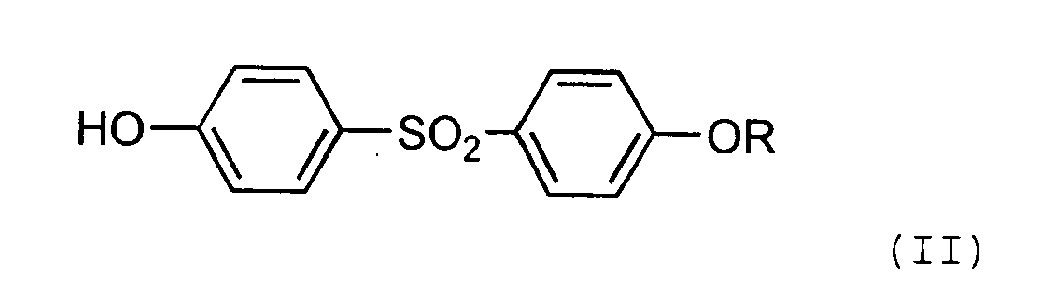
- the present invention relates to industrial processes for the production of diphenyl sulfone compounds represented by Formula (II) and useful as developers for leuco dyes to be used in thermal recording papers, and in more detail, to processes for the efficient production of the said diphenyl sulfone compounds by the recovery and reuse of harmful halogen compounds without discharging them into the environment.
- WO 91/11433 has reported that a reaction of a mole of 4,4'-dihydroxydiphenyl sulfone with an alkyl halide in the presence of 1.5 to 3 moles of alkali in 0.3 to 1.5 parts by weight of an aqueous solvent to a part by weight of 4,4'-dihydroxydiphenyl sulfone results in satisfactory selectivity and yield.
- alkyl chlorides when used, it takes a long time to complete the reaction because of their low reactivity. Besides, alkyl iodides are expensive. Therefore, alkyl halides able to use in industry are practically limited to alkyl bromides.
- the said WO patent reports only examples of using alkyl bromides.
- the inventors of the present invention studied various alkylations, such as those with alkyl sulfates, by addition of unsaturated hydrocarbons, and of using alkyl chlorides or alkyl iodides. As a result, it was found that use of alkyl iodides and the like could greatly shorten production times, and that almost all of alkyl iodides and the like used in the reactions could be recovered as inorganic iodide salts.
- An iodine recovery step in which iodine is recovered from manufacturing waste water containing the salts and reacted with an alcohol to self-produce an alkyl iodide or the like, is incorporated in the production process. Then, iodine is completely recovered for reuse. The process is more improved in productivity and economic efficiency than those of the prior art. Thus, the present invention has been completed.
- the present invention relates to (1) an industrial process for the production of diphenyl sulfone compounds of Formula (II) (wherein, R is straight or branched chain alkyl, straight or branched chain alkenyl, straight or branched chain alkynyl, or optionally substituted cycloalkyl), characterized in that 4,4'-dihydroxydiphenyl sulfone is reacted with a compound represented by Formula (I) RI (wherein, R is as defined above) in the presence of a base at reaction temperature of 70 to 110°C, preferably 70 to 90°C.
- Formula (I) RI wherein, R is as defined above
- It relates to (2) an industrial process for the production of diphenyl sulfone compounds according to (1), in which 0.8 to 2 moles of a compound of Formula (I) and 2 to 4 moles of a base are used to a mole of 4,4'-dihydroxydiphenyl sulfone, and the concentration of the base is made 20 to 50% by weight with water used as a solvent.
- It relates to (3) an industrial process for the production of diphenyl sulfone compounds according to (1) or (2), in which a reaction time is 4 to 15 hours.
- It relates to (4) an industrial process for the production of diphenyl sulfone compounds according to one of (1) to (3), in which a compound of Formula (I) is where R is isopropyl.
- It relates to (5) an industrial process for the production of diphenyl sulfone compounds represented by Formula (II) (wherein, R is as defined above), characterized by containing an iodine recovery step that 4,4'-dihydroxydiphenyl sulfone is reacted with a compound of Formula (I) RI (wherein, R is as defined above) in the presence of a base, iodine is recovered from iodides contained in waste water, and the recovered iodine is reacted with an alcohol corresponding to a compound of Formula (I) to be used for the reaction, to give a compound of Formula (I).
- Formula (II) wherein, R is as defined above
- It relates to (6) a process for the production of diphenyl sulfone compounds according to (5), in which a step is further incorporated that iodine is recovered from waste water discharged when a compound of Formula (I) is produced by a reaction of the previously recovered iodine with an alcohol corresponding to the compound of Formula (I) to be used for the reaction, and reused for the production of compounds of Formula (I).
- It relates to (7) an industrial process for the production of diphenyl sulfone compounds according to (5) or (6), in which 4,4'-dihydroxydiphenyl sulfone is reacted with a compound of Formula (I) in the presence of a base at 70 to 110°C, preferably 70 to 90°C.
- It relates to (8) an industrial process for the production of diphenyl sulfone compounds according to one of (5) to (7), in which 0.8 to 2 moles of a compound of Formula (I) and 2 to 4 moles of a base are used to a mole of 4,4'-dihydroxydiphenyl sulfone, and the concentration of the base is made 20 to 50% by weight with water used as a solvent.
- Examples of compounds of Formula (I) used in the methods of the present invention include alkyl iodides such as methyl iodide, ethyl iodide, n-propyl iodide, isopropyl iodide, n-butyl, iodide, isobutyl iodide, sec-butyl iodide, pentyl iodide, hexyl iodide, heptyl iodide and octyl iodide; alkenyl iodides such as allyl iodide; and cycloalkyl iodides such as cyclohexyl iodie.
- alkyl iodides such as methyl iodide, ethyl iodide, n-propyl iodide, isopropyl iodide, n-butyl
- compounds of Formula (I) are preferably used 0.8 to 2 equivalents, more preferably 1.0 to 1.6 equivalents, to 4,4'-dihydroxydiphenyl sulfone.
- alkyl iodides and the like are more reactive than alkyl bromides and the like, so that selectivity is not good. For example, production rates of monoalkyl and dialkyl products of 4,4'-diphenyl sulfone are reduced.
- the inventors of the present invention found out that, if water is used as a reaction solvent, selectivity is not deteriorated, because solubility of alkyl iodides and the like to water is lower than that of alkyl bromides and the like (for example, solubility of isopropyl bromide: 0.381g/ 100g of water; and isopropyl iodide: 0.139g/100g of water).
- the present invention is characterized by a reaction using an alky iodide or the like in the presence of a base in a reaction temperature range between 70 and 110°C, preferably 70 and 90°C.
- Alkyl iodides and the like are more reactive and have higher boiling points than alkyl bromides and the like, so that reaction temperatures can be raised at ordinary pressure without using special apparatuses. Therefore, reaction efficiency is improved and reactions are completed in shorter times than when alkyl bromides and the like are used. For example, the reaction is completed in about 8 hours when it is carried out using 1.07 equivalents of isopropyl iodide to 4,4'-dihydroxydiphenyl sulfone at 70°C. However, the same reaction but using isopropyl bromide does not finish completely in even twice a longer time of 16 hours. An alkylation using isopropyl iodide at a reaction temperature of 90°C finishes in about 4 hours.
- reaction efficiency is improved in terms of the shortening of reaction times and the like. This is however not preferable for industrial use.
- bases used as acid removting agents include alkali metal hydroxides such as sodium hydroxide and potassium hydroxide; alkaline earth metal hydroxides such as magnesium hydroxide and calcium hydroxide; or alkali metal carbonates such as sodium carbonate and potassium carbonate. Alkali metal hydroxides are particularly preferred.
- An amount of a base used gives great influence on reaction selectivity, together with an amount of water used as a reaction solvent: It is favorable to use 2 to 4 moles, preferably 2.2 to 3.2 moles, of a base to a mole of 4,4'-dihydroxydiphenyl sulfone, and an amount of water to make a base concentration 20 to 50% by weight, preferably 30 to 35% by weight in order to improve reaction selectivity.
- Di-alkali salts of 4,4'-dihydroxydiphenyl sulfones are highly soluble in water, but mono-alkali salts of 4,4'-dihydroxydiphenyl sulfones are less soluble in water.
- iodine of alkyl iodides and the like used is almost all recovered as salts after the reaction. It becomes possible to recover iodine from waste water containing the salts.
- the iodine recovery step consists of recovery of iodine from iodides contained in waste water discharged when a diphenyl sulfone compound of Formula (II) is produced, and production of an alkyl iodide or the like by a reaction of the recovered iodine with an alcohol corresponding to an alkyl iodide or the like to use for the reaction. Furthermore, it is favorable to contain a step of further recovering iodine from waste water when the alkyl iodide or the like is produced and reusing it for the production of an alkyl iodide.
- steps of recovering iodine are described in the following: First, 4,4'-dihydroxydiphenyl sulfone is alkylated with an alkyl iodide in the presence of a base; a small amount of di-alkyl byproducts produced is separated by filtration after the completion of the reaction; the filtrate is adjusted pH with an acid; an organic solvent that dissolves the target compound, such as toluene, is added; and the resulting solution is separated to an organic layer containing the target compound and an aqueous layer containing a sodium salt of unreacted 4,4'-dihydroxydiphenyl sulfone and iodides of the base.
- the pH of the aqueous layer is adjusted to recover unreacted 4,4'-dihydroxydiphenyl sulfone.
- a range of pH adjustment if on the acidic side. It is however preferable to be in the range between pH 0.5 and 4.0, particularly pH 2.0 and 3.0, in consideration of the following iodine recovery step.
- acids used Preferred include mineral acids such as hydrochloric acid and sulfuric acid.
- oxidizing agents used include chlorine, hypochlorous acid or its salt, hydrogen peroxide, or oxygen. Chlorine is particularly preferred when taking into consideration treatments of waste water and cost.
- a desirable amount of an oxidizing agent used is 1 to 1.5 times, preferably 1.0 to 1.3 times, that of iodine in molar ratio. It is desirable, prior to addition of the oxidizing agent, to add an acid, such as hydrochloric acid or sulfuric acid, to adjust the solution to pH 0.5 to 3.0, preferably 1.0 to 2.0.
- Methods known in the art to collect iodine from the water containing the liberated iodine include those using blow-out, ion exchange resins, copper, activated carbon or pressure melting. Any of them can be applied.
- the pressure melting method is preferred by taking into consideration the fact that in the reactions, most organic compounds and impurities are removed at the intermediate step and that iodine of high quality is obtained using relatively simple equipment.
- the liberated iodine is separated from water by a cyclone-type centrifugal separator, then heated to 130 to 150°C under pressure for melting, and cooled to solidify for making flakes, sublimed crystals or blocks, or powder or granules.
- a cyclone-type centrifugal separator heated to 130 to 150°C under pressure for melting, and cooled to solidify for making flakes, sublimed crystals or blocks, or powder or granules.
- Known methods of preparing alkyl iodides and the like with iodine include a method of using hydrogen, iodine and methanol as starting materials in the presence of a rhodium, iridium or ruthenium catalyst; a reaction of a metal of Ia, IIa, IIIa, Ib, IIb or IVb Group in Periodic Table, iodine and an alcohol or the like at 15 to 150°C and 1 to 50 atm; and a method of using an alcohol, iodine and red phosphorus. It is preferable to use the method of using red phosphorus when taking into consideration reaction equipment and cost.
- an alkyl iodide can be synthesized by that red phosphorus is suspended in an alcohol, iodine is dropped while heating, and the product is distilled from the reaction solution.
- an alkyl iodide may be prepared in a way that red phosphorus suspended in an alcohol is dropped into an alcohol solution of iodine.
- Either anhydrous red phosphorus or red phosphorus containing water can be used. The latter is preferred because of safety.
- Red phosphorus containing 10 to 40 mol%, preferably 10 to 30 mol%, of water to phosphorus is used.
- a reaction solvent is usually an alcohol that becomes a reaction substrate. It is possible to mix with water. It is preferable to carry out the reaction in the coexistence of water, particularly for the purpose of preventing the reaction from becoming out of control.
- An amount of water used is in the range of 5 to 20 ml/atom mol, preferably 10 to 15 ml/atom mol, based on an amount of iodine used. If it is less than 5 ml/atom mol, there is no effect. If more than 20 ml/atom mol is used, the reaction is checked. There are no particular restrictions on amounts of water used to suspend red phosphorus, if red phosphorus is sufficiently suspended in water within the range of giving no impediment of dropping. Water of roughly equal weight to that of red phosphorus is usually sufficient.
- iodine (I 2 ) phosphorus and an alcohol react at a molar ratio of 3:2:6. It is however preferable to use 1 to 1.5 moles of alcohol and 0.2 to 0.3 moles of red phosphorus, to 1 atom mol of iodine, when taking into consideration reaction efficiency and iodine that is present in waste water and is used again in the recovery step.
- the reaction is carried out by a method of adding iodine to an alcohol and red phosphorus, or adding phosphorus to an alcohol and iodine, at temperature of about the boiling point of the alcohol.
- the reaction exothermally proceeds simultaneously with the addition. Therefore, it becomes difficult to control the reaction if an addition rate is too fast. It is necessary to keep an appropriate reaction rate.
- the target alkyl iodide or the like can be isolated from the reaction solution by distillation after the completion of the reaction. It can also be isolated by steam distillation. Particularly when iodine is further recovered from the residue in the vessel after the distillation, it is advantageous if contained phosphorus-iodine compounds and the like are sufficiently hydrolyzed. Steam distillation is preferred when the recovery step is taken into account.
- the reaction solution was diluted with 100g of warm water of 50°C, and then cooled to ordinary temperature. 600 ml of methanol was added to completely dissolve the reaction products.
- the diluted reaction solution was quantitatively analyzed by HPLC. The results showed that a production rate of the target compound, 4-isopropoxy-4'-hydroxydiphenyl sulfone, was 75.1 % (based on the amount of BPS), and that of 4,4'-diisopropoxydiphenyl sulfone, a byproduct, was 2.2% (based on the amount of BPS). A remaining rate of BPS, a starting material, was 22.7%.
- Example 2 The same amounts of NaOH, water and BPS as those in Example 1 were placed in a flask, but 61.2g (0.36 mol) of isopropyl iodide was added. The reaction was carried out at 70°C for 20 hours. A part of the reaction solution was taken out 8 hours and 14 hours after the reaction started, and quantitatively analyzed by HPLC. The results showed that 4-isopropoxy-4'-hydroxydiphenyl sulfone was produced in yields of 73% and 85%, respectively.
- Example 2 The same amounts of NaOH, water, BPS and isopropyl iodide as those in Example 1 were placed in a flask, but the reaction was carried out at 90°C for 4hours. A part of the reaction solution was taken out 3 hours after the reaction started and quantitatively analyzed by HPLC. 4-Isopropoxy-4'-hydroxydiphenyl sulfone was produced in yield of 80%.
- reaction solution was diluted with 110g of warm water of 70°C, and 350 ml of toluene was added. The resulting solution was adjusted to pH 8.0 to 9.0 with dilute sulfuric acid. The aqueous layer was separated and named as Aqueous Layer 1. Further, 100g of warm water of 70°C was added to the remaining reaction solution and adjusted to pH 8.0 to 9.0 with dilute sulfuric acid. The aqueous layer was separated and named as Aqueous Layer 2. The toluene layer was washed with 100g of warm water of 70°C, separated, and cooled to deposit crystals.
- the crystals were filtrated, washed with toluene, and dried to give 49g of the target compound, 4-isopropoxy-4'-hydroxydiphenyl sulfone. Its purity was 99.2% (relative area ratio in HPLC), and yield was 70% (based on the amount of BPS).
- the filtrate contained 99% of iodine used for the reaction.
- the filtrate was adjusted to pH 1 with dilute hydrochloric acid. 22g (0.31 mol) of chlorine gas was blown in to liberate iodine.
- the reaction solution was separated to iodine and an aqueous layer by a cyclone-type centrifugal separator. Titration showed that the separated aqueous layer contained iodine at a ratio of 1000 ppm to 1300 ppm. Nitrogen gas was further blown in, and cooled to recover more iodine, until an amount of iodine in the aqueous layer is below the limit of detection.
- the separated iodine was heated to melt in a melting vessel at 130°C under pressure, and cooled to give 31 g of highly pure iodine. The recovery rate was 97%.
- reaction times are greatly reduced if alkyl iodides and the like, instead of alkyl bromides and the like, are used as alkylating agents or the like. Besides, material conversion rates can be improved without deteriorating reaction selectivity.
- Iodine of alkyl iodides and the like used can be recovered as salts. Products equal in terms of cost to those produced using alkyl bromides and the like can be provided if an iodine recovery step is incorporated into the reaction process. Therefore, it becomes possible to use alkyl iodides and the like, which are stably supplied, for industrial productions. Iodine used can be recovered nearly completely. Thus, processes for efficient productions have been found without discharging harmful iodides into the environment.
Landscapes
- Chemical & Material Sciences (AREA)
- Organic Chemistry (AREA)
- Chemical Kinetics & Catalysis (AREA)
- Organic Low-Molecular-Weight Compounds And Preparation Thereof (AREA)
- Heat Sensitive Colour Forming Recording (AREA)
Abstract
Description
- The present invention relates to industrial processes for the production of diphenyl sulfone compounds represented by Formula (II) and useful as developers for leuco dyes to be used in thermal recording papers, and in more detail, to processes for the efficient production of the said diphenyl sulfone compounds by the recovery and reuse of harmful halogen compounds without discharging them into the environment.
- Processes for the preparation of diphenyl sulfone compounds of Formula (II) are disclosed in
Japanese Patents Laid-open Nos. Sho 58-20493 Sho 58-82788 Sho 60-13852 Sho 60-56949 -
WO 91/11433 - If an alkylation is carried out using an alkyl bromide under the above reaction conditions, crystals are deposited as the reaction proceeds. The inside of the system becomes viscous and heterogeneous, resulting in insufficient stirring. Therefore, there is a problem of incompletion of the reaction.
- Of compounds of Formula (II) useful as developers for leuco dyes to be used in thermal recording papers, compounds where R is isopropyl are produced using isopropyl bromide, which is hardly produced domestically. Therefore it is difficult to procure the starting material stably.
- It is an object of the present invention to provide industrial processes for the production of diphenyl sulfone compounds of Formula (II) by using alkylating agents that are supplied stably, instead of alkyl bromide, with productivity, economical efficiency and safety.
- The inventors of the present invention studied various alkylations, such as those with alkyl sulfates, by addition of unsaturated hydrocarbons, and of using alkyl chlorides or alkyl iodides. As a result, it was found that use of alkyl iodides and the like could greatly shorten production times, and that almost all of alkyl iodides and the like used in the reactions could be recovered as inorganic iodide salts. An iodine recovery step in which iodine is recovered from manufacturing waste water containing the salts and reacted with an alcohol to self-produce an alkyl iodide or the like, is incorporated in the production process. Then, iodine is completely recovered for reuse. The process is more improved in productivity and economic efficiency than those of the prior art. Thus, the present invention has been completed.
- The present invention relates to (1) an industrial process for the production of diphenyl sulfone compounds of Formula (II)

RI
(wherein, R is as defined above) in the presence of a base at reaction temperature of 70 to 110°C, preferably 70 to 90°C. - It relates to (2) an industrial process for the production of diphenyl sulfone compounds according to (1), in which 0.8 to 2 moles of a compound of Formula (I) and 2 to 4 moles of a base are used to a mole of 4,4'-dihydroxydiphenyl sulfone, and the concentration of the base is made 20 to 50% by weight with water used as a solvent.
- It relates to (3) an industrial process for the production of diphenyl sulfone compounds according to (1) or (2), in which a reaction time is 4 to 15 hours.
- It relates to (4) an industrial process for the production of diphenyl sulfone compounds according to one of (1) to (3), in which a compound of Formula (I) is where R is isopropyl.
- It relates to (5) an industrial process for the production of diphenyl sulfone compounds represented by Formula (II)

RI
(wherein, R is as defined above) in the presence of a base, iodine is recovered from iodides contained in waste water, and the recovered iodine is reacted with an alcohol corresponding to a compound of Formula (I) to be used for the reaction, to give a compound of Formula (I). - It relates to (6) a process for the production of diphenyl sulfone compounds according to (5), in which a step is further incorporated that iodine is recovered from waste water discharged when a compound of Formula (I) is produced by a reaction of the previously recovered iodine with an alcohol corresponding to the compound of Formula (I) to be used for the reaction, and reused for the production of compounds of Formula (I).
- It relates to (7) an industrial process for the production of diphenyl sulfone compounds according to (5) or (6), in which 4,4'-dihydroxydiphenyl sulfone is reacted with a compound of Formula (I) in the presence of a base at 70 to 110°C, preferably 70 to 90°C.
- It relates to (8) an industrial process for the production of diphenyl sulfone compounds according to one of (5) to (7), in which 0.8 to 2 moles of a compound of Formula (I) and 2 to 4 moles of a base are used to a mole of 4,4'-dihydroxydiphenyl sulfone, and the concentration of the base is made 20 to 50% by weight with water used as a solvent.
- It relates to (9) an industrial process for the production of diphenyl sulfone compounds according to one of (5) to (8), in which a reaction time is 4 to 15 hours.
- It relates to (10) an industrial process for the production of diphenyl sulfone compounds according to one of (5) to (9), in which a compound of Formula (I) is where R is isopropyl.
- Examples of compounds of Formula (I) used in the methods of the present invention include alkyl iodides such as methyl iodide, ethyl iodide, n-propyl iodide, isopropyl iodide, n-butyl, iodide, isobutyl iodide, sec-butyl iodide, pentyl iodide, hexyl iodide, heptyl iodide and octyl iodide; alkenyl iodides such as allyl iodide; and cycloalkyl iodides such as cyclohexyl iodie.
- In the present invention, compounds of Formula (I) (hereinafter abbreviated as alkyl iodides and the like) are preferably used 0.8 to 2 equivalents, more preferably 1.0 to 1.6 equivalents, to 4,4'-dihydroxydiphenyl sulfone.
- Generally, alkyl iodides and the like are more reactive than alkyl bromides and the like, so that selectivity is not good. For example, production rates of monoalkyl and dialkyl products of 4,4'-diphenyl sulfone are reduced. The inventors of the present invention, however, found out that, if water is used as a reaction solvent, selectivity is not deteriorated, because solubility of alkyl iodides and the like to water is lower than that of alkyl bromides and the like (for example, solubility of isopropyl bromide: 0.381g/ 100g of water; and isopropyl iodide: 0.139g/100g of water).
- As describe above, solubility of alkyl bromides and the like to water is larger than that of alkyl iodides and the like. Thus, there is a problem that alkyl bromides and the like are susceptible to hydrolysis by bases that are not forming salts with 4,4'-dihydroxydiphenyl sulfone. Therefore, it is necessary to use considerably excessive amounts of alkyl bromides and the like and bases in order to increase reaction conversion rates. In the case of alkyl iodides and the like, which are less soluble in water and more reactive, reaction conversion rates can be improved to 95% from 70% of the prior art, by using only 1.5 equivalents.
- The present invention is characterized by a reaction using an alky iodide or the like in the presence of a base in a reaction temperature range between 70 and 110°C, preferably 70 and 90°C.
- Alkyl iodides and the like are more reactive and have higher boiling points than alkyl bromides and the like, so that reaction temperatures can be raised at ordinary pressure without using special apparatuses. Therefore, reaction efficiency is improved and reactions are completed in shorter times than when alkyl bromides and the like are used. For example, the reaction is completed in about 8 hours when it is carried out using 1.07 equivalents of isopropyl iodide to 4,4'-dihydroxydiphenyl sulfone at 70°C. However, the same reaction but using isopropyl bromide does not finish completely in even twice a longer time of 16 hours. An alkylation using isopropyl iodide at a reaction temperature of 90°C finishes in about 4 hours. Compared to it, it is impossible to carry out a reaction with isopropyl bromide at a reaction temperature of 90°C except using a special apparatus. Reactions using isopropyl iodide can be carried out at temperatures above the boiling points of alkyl iodides and the like, if special apparatuses are used for reactions under pressure and other cases. Reaction efficiency is improved in terms of the shortening of reaction times and the like. This is however not preferable for industrial use.
- Examples of bases used as acid removting agents include alkali metal hydroxides such as sodium hydroxide and potassium hydroxide; alkaline earth metal hydroxides such as magnesium hydroxide and calcium hydroxide; or alkali metal carbonates such as sodium carbonate and potassium carbonate. Alkali metal hydroxides are particularly preferred.
- An amount of a base used gives great influence on reaction selectivity, together with an amount of water used as a reaction solvent: It is favorable to use 2 to 4 moles, preferably 2.2 to 3.2 moles, of a base to a mole of 4,4'-dihydroxydiphenyl sulfone, and an amount of water to make a base concentration 20 to 50% by weight, preferably 30 to 35% by weight in order to improve reaction selectivity. Di-alkali salts of 4,4'-dihydroxydiphenyl sulfones are highly soluble in water, but mono-alkali salts of 4,4'-dihydroxydiphenyl sulfones are less soluble in water. Therefore, as reactions proceed, mono-substituted metal salts of products are deposited so that the mono-substituted products are obtained selectively. Because of this, it is favorable to use 2 equivalents or more of a base to 4,4'-dihydroxydiphenyl sulfone at the beginning of the reaction, and, when hot, an amount of water to make a base concentration 20% by weight or more and to dissolve di-alkali salts only. If the alkali concentration is less than 20% by weight, selectivity is lowered because the mono-alkali salts of products are dissolved. On the other hand, the viscosity of the reaction solution rises in the case of 50% by weight or more, with a problem of facilities.
- According to the methods of the present invention, iodine of alkyl iodides and the like used is almost all recovered as salts after the reaction. It becomes possible to recover iodine from waste water containing the salts.
- The iodine recovery step consists of recovery of iodine from iodides contained in waste water discharged when a diphenyl sulfone compound of Formula (II) is produced, and production of an alkyl iodide or the like by a reaction of the recovered iodine with an alcohol corresponding to an alkyl iodide or the like to use for the reaction. Furthermore, it is favorable to contain a step of further recovering iodine from waste water when the alkyl iodide or the like is produced and reusing it for the production of an alkyl iodide.
- Examples of steps of recovering iodine are described in the following: First, 4,4'-dihydroxydiphenyl sulfone is alkylated with an alkyl iodide in the presence of a base; a small amount of di-alkyl byproducts produced is separated by filtration after the completion of the reaction; the filtrate is adjusted pH with an acid; an organic solvent that dissolves the target compound, such as toluene, is added; and the resulting solution is separated to an organic layer containing the target compound and an aqueous layer containing a sodium salt of unreacted 4,4'-dihydroxydiphenyl sulfone and iodides of the base.
- Then, the pH of the aqueous layer is adjusted to recover unreacted 4,4'-dihydroxydiphenyl sulfone. There are no particular restrictions on a range of pH adjustment, if on the acidic side. It is however preferable to be in the range between pH 0.5 and 4.0, particularly pH 2.0 and 3.0, in consideration of the following iodine recovery step. There are no particular restrictions on acids used. Preferred include mineral acids such as hydrochloric acid and sulfuric acid. After most organic components are removed as described above, iodine is liberated from the aqueous layer. Examples of methods of liberation include oxidation with oxidizing agents and direct electrolysis. The oxidation with oxidizing agents is preferred from the viewpoint of equipment and cost.
- Examples of oxidizing agents used include chlorine, hypochlorous acid or its salt, hydrogen peroxide, or oxygen. Chlorine is particularly preferred when taking into consideration treatments of waste water and cost. A desirable amount of an oxidizing agent used is 1 to 1.5 times, preferably 1.0 to 1.3 times, that of iodine in molar ratio. It is desirable, prior to addition of the oxidizing agent, to add an acid, such as hydrochloric acid or sulfuric acid, to adjust the solution to pH 0.5 to 3.0, preferably 1.0 to 2.0.
- Methods known in the art to collect iodine from the water containing the liberated iodine include those using blow-out, ion exchange resins, copper, activated carbon or pressure melting. Any of them can be applied. The pressure melting method is preferred by taking into consideration the fact that in the reactions, most organic compounds and impurities are removed at the intermediate step and that iodine of high quality is obtained using relatively simple equipment.
- In more detail, for example, the liberated iodine is separated from water by a cyclone-type centrifugal separator, then heated to 130 to 150°C under pressure for melting, and cooled to solidify for making flakes, sublimed crystals or blocks, or powder or granules. To obtain spherical iodine, which is less sublime and easily handled, it is preferable to flow out the melt from a fine jetting nozzle in diameter at a constant speed, and to cool it to solidify by cooling gas in the midway of falling.
- Known methods of preparing alkyl iodides and the like with iodine include a method of using hydrogen, iodine and methanol as starting materials in the presence of a rhodium, iridium or ruthenium catalyst; a reaction of a metal of Ia, IIa, IIIa, Ib, IIb or IVb Group in Periodic Table, iodine and an alcohol or the like at 15 to 150°C and 1 to 50 atm; and a method of using an alcohol, iodine and red phosphorus. It is preferable to use the method of using red phosphorus when taking into consideration reaction equipment and cost.
- In more detail, for example, an alkyl iodide can be synthesized by that red phosphorus is suspended in an alcohol, iodine is dropped while heating, and the product is distilled from the reaction solution. In an industrial scale, an alkyl iodide may be prepared in a way that red phosphorus suspended in an alcohol is dropped into an alcohol solution of iodine. Either anhydrous red phosphorus or red phosphorus containing water can be used. The latter is preferred because of safety. Red phosphorus containing 10 to 40 mol%, preferably 10 to 30 mol%, of water to phosphorus is used.
- A reaction solvent is usually an alcohol that becomes a reaction substrate. It is possible to mix with water. It is preferable to carry out the reaction in the coexistence of water, particularly for the purpose of preventing the reaction from becoming out of control. An amount of water used is in the range of 5 to 20 ml/atom mol, preferably 10 to 15 ml/atom mol, based on an amount of iodine used. If it is less than 5 ml/atom mol, there is no effect. If more than 20 ml/atom mol is used, the reaction is checked. There are no particular restrictions on amounts of water used to suspend red phosphorus, if red phosphorus is sufficiently suspended in water within the range of giving no impediment of dropping. Water of roughly equal weight to that of red phosphorus is usually sufficient.
- In this reaction, iodine (I2), phosphorus and an alcohol react at a molar ratio of 3:2:6. It is however preferable to use 1 to 1.5 moles of alcohol and 0.2 to 0.3 moles of red phosphorus, to 1 atom mol of iodine, when taking into consideration reaction efficiency and iodine that is present in waste water and is used again in the recovery step.
- The reaction is carried out by a method of adding iodine to an alcohol and red phosphorus, or adding phosphorus to an alcohol and iodine, at temperature of about the boiling point of the alcohol. The reaction exothermally proceeds simultaneously with the addition. Therefore, it becomes difficult to control the reaction if an addition rate is too fast. It is necessary to keep an appropriate reaction rate.
- The target alkyl iodide or the like can be isolated from the reaction solution by distillation after the completion of the reaction. It can also be isolated by steam distillation. Particularly when iodine is further recovered from the residue in the vessel after the distillation, it is advantageous if contained phosphorus-iodine compounds and the like are sufficiently hydrolyzed. Steam distillation is preferred when the recovery step is taken into account.
- 4,4'-Dihydroxydiphenyl sulfone to be recovered in a post-treatment step, the alcohol produced from the reaction and recovered, and the re-produced alkyl iodide or the like are used again as part or the whole of starting materials for the reaction. They can be reused with no problems of reaction yields and the quality of products. Products with nearly equal quality can be prepared when compounds of Formula (II) are synthesized with alkyl bromides, or with alkyl iodides and the like and a recovery step included. The latter is more advantageous in terms of cost and productivity. It has become possible to use alkyl iodides and the like as alternative materials to alkyl bromides and the like.
- The present invention is described in more detail in reference to Examples, but is not limited to the examples.
- 26.0g (0.624 mol) of NaOH of 96% purity and 49.4g of water were placed in a 1000-ml four-neck flask, and dissolved at an ordinary temperature. Into the resulting solution was added 60g (0.24 mol) of 4,4'-dihydroxydiphenyl sulfone (hereinafter abbreviated as BPS) and dissolved with stirring at 100°C for 30 minutes. The internal temperature was cooled to 70°C. 43.7g (0.258 mol) of isopropyl iodide was dropped over an hour and the reaction was carried out for 10 hours at the internal temperature of 70°C. A part of the reaction solution was taken out 8 hours after the reaction started, and quantitatively analyzed by HPLC to find that 4-isopropoxy-4'-hydroxydiphenyl sulfone was produced in yield of 72%.
- After the reaction was completed, the reaction solution was diluted with 100g of warm water of 50°C, and then cooled to ordinary temperature. 600 ml of methanol was added to completely dissolve the reaction products. The diluted reaction solution was quantitatively analyzed by HPLC. The results showed that a production rate of the target compound, 4-isopropoxy-4'-hydroxydiphenyl sulfone, was 75.1 % (based on the amount of BPS), and that of 4,4'-diisopropoxydiphenyl sulfone, a byproduct, was 2.2% (based on the amount of BPS). A remaining rate of BPS, a starting material, was 22.7%.
- The same amounts of NaOH, water and BPS as those in Example 1 were placed in a flask, but 61.2g (0.36 mol) of isopropyl iodide was added. The reaction was carried out at 70°C for 20 hours. A part of the reaction solution was taken out 8 hours and 14 hours after the reaction started, and quantitatively analyzed by HPLC. The results showed that 4-isopropoxy-4'-hydroxydiphenyl sulfone was produced in yields of 73% and 85%, respectively.
- After the reaction was completed, the reaction solution was treated in the same way as that in Example 1. The diluted reaction solution was quantitatively analyzed by HPLC. The results showed that a production rate of the target compound, 4-isopropoxy-4'-hydroxydiphenyl sulfone, was 89.8% (based on the amount of BPS), and that of di-substituted byproduct was 4.8% (based on the amount of BPS). A remaining rate of BPS, a starting material, was 5.4%.
- The same amounts of NaOH, water, BPS and isopropyl iodide as those in Example 1 were placed in a flask, but the reaction was carried out at 90°C for 4hours. A part of the reaction solution was taken out 3 hours after the reaction started and quantitatively analyzed by HPLC. 4-Isopropoxy-4'-hydroxydiphenyl sulfone was produced in yield of 80%.
- After the reaction was completed, the reaction solution was treated in the same way as that in Example 1. The diluted reaction solution was quantitatively analyzed by HPLC. The results showed that a production rate of the target compound, 4-isopropoxy-4'-hydroxydiphenyl sulfone, was 82.0% (based on the amount of BPS), and that of di-substituted byproduct was 5.0% (based on the amount of BPS). A remaining rate of BPS, a starting material, was 13.0%.
- 26.0g (0.624 mol) of NaOH of 96% purity and 49.4g of water were placed in a 1000-ml 4-neck flask from whose bottom liquid can be taken out, and dissolved at an ordinary temperature. To the resulting solution was added 60g (0.24 mol) of BPS, and stirred to dissolve at 100°C for 30 minutes. The internal temperature was cooled to 70°C. 43.7g (0.258 mol) of isopropyl iodide was dropped over an hour, and reacted at the internal temperature of 70°C for 10 hours.
- After the reaction was completed, the reaction solution was diluted with 110g of warm water of 70°C, and 350 ml of toluene was added. The resulting solution was adjusted to pH 8.0 to 9.0 with dilute sulfuric acid. The aqueous layer was separated and named as Aqueous Layer 1. Further, 100g of warm water of 70°C was added to the remaining reaction solution and adjusted to pH 8.0 to 9.0 with dilute sulfuric acid. The aqueous layer was separated and named as Aqueous Layer 2. The toluene layer was washed with 100g of warm water of 70°C, separated, and cooled to deposit crystals.
- The crystals were filtrated, washed with toluene, and dried to give 49g of the target compound, 4-isopropoxy-4'-hydroxydiphenyl sulfone. Its purity was 99.2% (relative area ratio in HPLC), and yield was 70% (based on the amount of BPS).
- About 300g of combined Aqueous Layers 1 and 2 was adjusted to pH 3 with dilute sulfuric acid. The deposited unreacted BPS was filtrated and washed with water for recovery. 15.3g was recovered. A recovery rate was 25.5% (based on the amount of BPS).
- An amount of iodine in the filtrate was measured by titration. The filtrate contained 99% of iodine used for the reaction.
- The filtrate was adjusted to pH 1 with dilute hydrochloric acid. 22g (0.31 mol) of chlorine gas was blown in to liberate iodine. The reaction solution was separated to iodine and an aqueous layer by a cyclone-type centrifugal separator. Titration showed that the separated aqueous layer contained iodine at a ratio of 1000 ppm to 1300 ppm. Nitrogen gas was further blown in, and cooled to recover more iodine, until an amount of iodine in the aqueous layer is below the limit of detection. The separated iodine was heated to melt in a melting vessel at 130°C under pressure, and cooled to give 31 g of highly pure iodine. The recovery rate was 97%.
- 1209g (20.0 mmol) of isopropanol and 58 ml of water were added to 2438g (19.2 atom mol) of iodine, and heated to the internal temperature of 90°C. To the resulting solution was dropped, over about 2 hours, 160.9g of red phosphorus containing water (141g of red phosphorus and 19.8g of water, 4.6 mol) and suspended in 153.6 ml of water while keeping the internal temperature at 90°C, and then heated at reflux for 2 hours. Steam distillation was carried out for 3 hours by passing steam through the system. The obtained fraction was washed with 600 ml of water to give 2886g of isopropyl iodide of 98% purity (yield: 87%). Titration showed that the residue in the vessel after the steam distillation contained 11% of iodine used. The recovery rate of iodine together with isopropyl iodide was 98%.
- When compounds of Formula (II) are synthesized, reaction times are greatly reduced if alkyl iodides and the like, instead of alkyl bromides and the like, are used as alkylating agents or the like. Besides, material conversion rates can be improved without deteriorating reaction selectivity. Iodine of alkyl iodides and the like used can be recovered as salts. Products equal in terms of cost to those produced using alkyl bromides and the like can be provided if an iodine recovery step is incorporated into the reaction process. Therefore, it becomes possible to use alkyl iodides and the like, which are stably supplied, for industrial productions. Iodine used can be recovered nearly completely. Thus, processes for efficient productions have been found without discharging harmful iodides into the environment.
Claims (7)
- An industrial process for the production of diphenyl sulfone compounds represented by Formula (II)

RI
(wherein, R is as defined above) in the presence of a base, iodine is recovered from iodides contained in waste water, and the recovered iodine is reacted with an alcohol corresponding to a compound of Formula (I) that is used for the reaction, to give a compound of Formula (I). - A process for the production of diphenyl sulfone compounds according to Claim 1, in which a step is incorporated that iodine is further recovered from waste water discharged when a compound of Formula (I) is produced from a reaction of the recovered iodine with an alcohol corresponding to the compound of Formula (I) to be used for the reaction, and reused for the production of compounds of Formula (I).
- An industrial process for the production of diphenyl sulfone compounds according to Claim 1 or 2, in which 4,4'-dihydroxydiphenyl sulfone is reacted with a compound of Formula (I) in the presence of a base at 70 to 110°C.
- An industrial process for the production of diphenyl sulfone compounds according to Claim 3, in which the reaction is carried out at a reaction temperature of 70 to 90°C.
- An industrial process for the production of diphenyl sulfone compounds according to one of Claims 1 to 4, in which 0.8 to 2 moles of a compound of Formula (I) and 2 to 4 moles of a base are used to a mole of 4,4'-dihydroxydiphenyl sulfone, and the concentration of the base is made 20 to 50% by weight with water used as a solvent.
- An industrial process for the production of diphenyl sulfone compounds according to one of Claims 1 to 5, in which a reaction time is 4 to 15 hours.
- An industrial process for the production of diphenyl sulfone compounds according to one of Claims 1 to 6, in which a compound of Formula (I) is where R is isopropyl.
Applications Claiming Priority (2)
| Application Number | Priority Date | Filing Date | Title |
|---|---|---|---|
| JP11078625A JP2000273081A (en) | 1999-03-23 | 1999-03-23 | Industrial production of diphenyl sulfone compound |
| EP00909706A EP1164129B1 (en) | 1999-03-23 | 2000-03-17 | Industrial process for the production of diphenyl sulfone compounds |
Related Parent Applications (2)
| Application Number | Title | Priority Date | Filing Date |
|---|---|---|---|
| EP00909706.4 Division | 2000-03-17 | ||
| EP00909706A Division EP1164129B1 (en) | 1999-03-23 | 2000-03-17 | Industrial process for the production of diphenyl sulfone compounds |
Publications (3)
| Publication Number | Publication Date |
|---|---|
| EP1860099A2 true EP1860099A2 (en) | 2007-11-28 |
| EP1860099A3 EP1860099A3 (en) | 2008-02-27 |
| EP1860099B1 EP1860099B1 (en) | 2010-11-03 |
Family
ID=13667076
Family Applications (2)
| Application Number | Title | Priority Date | Filing Date |
|---|---|---|---|
| EP00909706A Expired - Lifetime EP1164129B1 (en) | 1999-03-23 | 2000-03-17 | Industrial process for the production of diphenyl sulfone compounds |
| EP07018222A Expired - Lifetime EP1860099B1 (en) | 1999-03-23 | 2000-03-17 | Industrial process for the production of diphenyl sulfone compounds |
Family Applications Before (1)
| Application Number | Title | Priority Date | Filing Date |
|---|---|---|---|
| EP00909706A Expired - Lifetime EP1164129B1 (en) | 1999-03-23 | 2000-03-17 | Industrial process for the production of diphenyl sulfone compounds |
Country Status (9)
| Country | Link |
|---|---|
| US (1) | US6590126B1 (en) |
| EP (2) | EP1164129B1 (en) |
| JP (2) | JP2000273081A (en) |
| KR (2) | KR100499981B1 (en) |
| CN (1) | CN1183106C (en) |
| AT (2) | ATE431336T1 (en) |
| DE (2) | DE60042199D1 (en) |
| ES (2) | ES2325905T3 (en) |
| WO (1) | WO2000056705A1 (en) |
Families Citing this family (8)
| Publication number | Priority date | Publication date | Assignee | Title |
|---|---|---|---|---|
| US7241924B2 (en) * | 1999-03-23 | 2007-07-10 | Nippon Soda Co., Ltd. | Industrial process for the production of diphenyl sulfone compounds |
| KR20050052551A (en) * | 2001-01-22 | 2005-06-02 | 닛뽕소다 가부시키가이샤 | Process for producing diphenyl sulfone compound |
| JP4955868B2 (en) * | 2001-07-13 | 2012-06-20 | 日本曹達株式会社 | Reaction management system for hydrous powder and method for producing diphenylsulfone compound |
| KR100529158B1 (en) * | 2002-11-14 | 2005-11-17 | 주식회사 코오롱 | Process for producing 4-isopropoxy-4'-hydroxydiphenyl sulfone |
| JP4473634B2 (en) * | 2004-04-21 | 2010-06-02 | 日華化学株式会社 | Developer for thermal recording and method for producing thermal recording material |
| WO2014170709A1 (en) * | 2013-04-16 | 2014-10-23 | Bandodkar Hemant Ratanakar | Process for the production of diphenyl sulfone compounds |
| CN107915665B (en) * | 2017-11-15 | 2019-08-23 | 山东瑞康精化有限公司 | A kind of preparation method of thermo-sensitive material D-8 |
| CN111018755B (en) * | 2019-12-30 | 2021-08-13 | 江苏傲伦达科技实业股份有限公司 | A kind of method that utilizes 4,4 '-diisopropoxy diphenyl sulfone to prepare 4-hydroxy-4 '-isopropoxy diphenyl sulfone |
Citations (5)
| Publication number | Priority date | Publication date | Assignee | Title |
|---|---|---|---|---|
| JPS5820493A (en) | 1981-07-29 | 1983-02-05 | Yoshitomi Pharmaceut Ind Ltd | Heat-sensitive recording paper |
| JPS5882788A (en) | 1981-11-11 | 1983-05-18 | Fuji Photo Film Co Ltd | Heat-sensitive recording material |
| JPS6013852A (en) | 1983-07-04 | 1985-01-24 | Shin Nisso Kako Co Ltd | Diphenylsulfone derivative and color-developing recording material containing the same |
| JPS6056949A (en) | 1983-09-08 | 1985-04-02 | Shin Nisso Kako Co Ltd | Production of 4-substituted hydroxy-4'-hydroxydiphenyl sulfone |
| WO1991011433A1 (en) | 1990-01-29 | 1991-08-08 | Yoshitomi Pharmaceutical Industries, Ltd. | Process for producing diphenyl sulfone compound |
Family Cites Families (5)
| Publication number | Priority date | Publication date | Assignee | Title |
|---|---|---|---|---|
| US3784518A (en) * | 1972-09-29 | 1974-01-08 | Monsanto Co | Method for producing alkyl iodides |
| JPS58164131A (en) | 1982-03-24 | 1983-09-29 | Toshiba Chem Corp | Solid-molding method of anode cap |
| US5284978A (en) | 1990-01-29 | 1994-02-08 | Yoshitomi Pharmaceutical Industries, Ltd. | Method for producing diphenyl sulfone compounds |
| JPH04715A (en) | 1990-04-17 | 1992-01-06 | Fujitsu Ltd | Manufacture of semiconductor device |
| JP2641002B2 (en) * | 1992-01-07 | 1997-08-13 | 富士写真フイルム株式会社 | Diphenyl sulfone compound |
-
1999
- 1999-03-23 JP JP11078625A patent/JP2000273081A/en active Pending
-
2000
- 2000-03-16 JP JP2000074612A patent/JP3811735B2/en not_active Expired - Lifetime
- 2000-03-17 ES ES00909706T patent/ES2325905T3/en not_active Expired - Lifetime
- 2000-03-17 ES ES07018222T patent/ES2352975T3/en not_active Expired - Lifetime
- 2000-03-17 KR KR10-2001-7011621A patent/KR100499981B1/en not_active Expired - Fee Related
- 2000-03-17 AT AT00909706T patent/ATE431336T1/en not_active IP Right Cessation
- 2000-03-17 US US09/937,248 patent/US6590126B1/en not_active Expired - Fee Related
- 2000-03-17 DE DE60042199T patent/DE60042199D1/en not_active Expired - Lifetime
- 2000-03-17 KR KR1020057002118A patent/KR20050047093A/en not_active Ceased
- 2000-03-17 DE DE60045198T patent/DE60045198D1/en not_active Expired - Lifetime
- 2000-03-17 WO PCT/JP2000/001639 patent/WO2000056705A1/en not_active Ceased
- 2000-03-17 EP EP00909706A patent/EP1164129B1/en not_active Expired - Lifetime
- 2000-03-17 CN CNB008054029A patent/CN1183106C/en not_active Expired - Lifetime
- 2000-03-17 EP EP07018222A patent/EP1860099B1/en not_active Expired - Lifetime
- 2000-03-17 AT AT07018222T patent/ATE486846T1/en not_active IP Right Cessation
Patent Citations (6)
| Publication number | Priority date | Publication date | Assignee | Title |
|---|---|---|---|---|
| JPS5820493A (en) | 1981-07-29 | 1983-02-05 | Yoshitomi Pharmaceut Ind Ltd | Heat-sensitive recording paper |
| JPS5882788A (en) | 1981-11-11 | 1983-05-18 | Fuji Photo Film Co Ltd | Heat-sensitive recording material |
| JPS6013852A (en) | 1983-07-04 | 1985-01-24 | Shin Nisso Kako Co Ltd | Diphenylsulfone derivative and color-developing recording material containing the same |
| US4568766A (en) | 1983-07-04 | 1986-02-04 | Nippon Soda Company Limited | 4-Hydroxy-4'-isopropoxydiphenylsulfone and its use for color-developable recording material |
| JPS6056949A (en) | 1983-09-08 | 1985-04-02 | Shin Nisso Kako Co Ltd | Production of 4-substituted hydroxy-4'-hydroxydiphenyl sulfone |
| WO1991011433A1 (en) | 1990-01-29 | 1991-08-08 | Yoshitomi Pharmaceutical Industries, Ltd. | Process for producing diphenyl sulfone compound |
Also Published As
| Publication number | Publication date |
|---|---|
| ATE431336T1 (en) | 2009-05-15 |
| JP2000273081A (en) | 2000-10-03 |
| JP2001261633A (en) | 2001-09-26 |
| EP1164129A4 (en) | 2005-06-01 |
| ES2352975T3 (en) | 2011-02-24 |
| EP1164129B1 (en) | 2009-05-13 |
| CN1344251A (en) | 2002-04-10 |
| ES2325905T3 (en) | 2009-09-24 |
| WO2000056705A1 (en) | 2000-09-28 |
| CN1183106C (en) | 2005-01-05 |
| DE60045198D1 (en) | 2010-12-16 |
| EP1164129A1 (en) | 2001-12-19 |
| KR20050047093A (en) | 2005-05-19 |
| JP3811735B2 (en) | 2006-08-23 |
| KR100499981B1 (en) | 2005-07-07 |
| EP1860099A3 (en) | 2008-02-27 |
| ATE486846T1 (en) | 2010-11-15 |
| US6590126B1 (en) | 2003-07-08 |
| KR20020005619A (en) | 2002-01-17 |
| DE60042199D1 (en) | 2009-06-25 |
| EP1860099B1 (en) | 2010-11-03 |
Similar Documents
| Publication | Publication Date | Title |
|---|---|---|
| AU2018286964B2 (en) | Methods for the preparation of 1,3-benzodioxole heterocyclic compounds | |
| JPS6225138B2 (en) | ||
| JPH0455418B2 (en) | ||
| EP1860099B1 (en) | Industrial process for the production of diphenyl sulfone compounds | |
| EP2526080A1 (en) | New processes for producing benzophenone derivatives | |
| CN107922325B (en) | Improved method for preparing diaryl sulfones | |
| US7241924B2 (en) | Industrial process for the production of diphenyl sulfone compounds | |
| JP5285830B2 (en) | Process for producing 1,1-bis (4-hydroxyphenyl) -3,3,5-trimethylcyclohexane | |
| JP5060700B2 (en) | Process for producing 1,1-bis- (4-hydroxyphenyl) -3,3,5-trimethylcyclohexane | |
| US6127572A (en) | Process for preparing 2-carboxy-5-nitrobenzenesulfonic acid and salts thereof by oxidation | |
| US7491834B2 (en) | Chemical process | |
| JP3962531B2 (en) | Method for producing 1,3-di (2-p-hydroxyphenyl-2-propyl) benzene | |
| JP3784865B2 (en) | Method for producing 4,4'-bis (chloromethyl) biphenyl | |
| JPH05208930A (en) | Diphenol | |
| EP1686116B1 (en) | Process for production of pyridylethylthio compounds, modified ion exchangers, process for production thereof, and process for production of bisphenols | |
| JP4262977B2 (en) | Process for producing 1,1-bis- (4-hydroxyphenyl) -3,3,5-trimethylcyclohexane | |
| EP0010443B1 (en) | Process for preparing sodium-m-nitrobenzenesulfonate | |
| JPH0541616B2 (en) | ||
| JPH10114729A (en) | Production of aminophenol | |
| US20020062043A1 (en) | Process for preparing optionally substituted biphenylcarbonyl chlorides | |
| JPH1087562A (en) | Method for producing 3,5-dialkylsalicylic acid | |
| RU2209198C2 (en) | Method for preparing fluoro-containing heterocyclic compounds | |
| JP2007507501A (en) | Method for recovering dihydroxybiaryl compounds | |
| WO2009002761A1 (en) | A method for making n-2,3-dibromopropyl-4,5-dibromohexahydrophthalimide | |
| JPS6251635A (en) | Production of 4-benzyloxyphenol |
Legal Events
| Date | Code | Title | Description |
|---|---|---|---|
| PUAI | Public reference made under article 153(3) epc to a published international application that has entered the european phase |
Free format text: ORIGINAL CODE: 0009012 |
|
| 17P | Request for examination filed |
Effective date: 20070917 |
|
| AC | Divisional application: reference to earlier application |
Ref document number: 1164129 Country of ref document: EP Kind code of ref document: P |
|
| AK | Designated contracting states |
Kind code of ref document: A2 Designated state(s): AT BE CH CY DE DK ES FI FR GB GR IE IT LI LU MC NL PT SE |
|
| PUAL | Search report despatched |
Free format text: ORIGINAL CODE: 0009013 |
|
| AK | Designated contracting states |
Kind code of ref document: A3 Designated state(s): AT BE CH CY DE DK ES FI FR GB GR IE IT LI LU MC NL PT SE |
|
| 17Q | First examination report despatched |
Effective date: 20080516 |
|
| AKX | Designation fees paid |
Designated state(s): AT BE CH CY DE DK ES FI FR GB GR IE IT LI LU MC NL PT SE |
|
| GRAP | Despatch of communication of intention to grant a patent |
Free format text: ORIGINAL CODE: EPIDOSNIGR1 |
|
| GRAS | Grant fee paid |
Free format text: ORIGINAL CODE: EPIDOSNIGR3 |
|
| GRAA | (expected) grant |
Free format text: ORIGINAL CODE: 0009210 |
|
| AC | Divisional application: reference to earlier application |
Ref document number: 1164129 Country of ref document: EP Kind code of ref document: P |
|
| AK | Designated contracting states |
Kind code of ref document: B1 Designated state(s): AT BE CH CY DE DK ES FI FR GB GR IE IT LI LU MC NL PT SE |
|
| REG | Reference to a national code |
Ref country code: GB Ref legal event code: FG4D |
|
| REG | Reference to a national code |
Ref country code: CH Ref legal event code: NV Representative=s name: SCHMAUDER & PARTNER AG PATENT- UND MARKENANWAELTE Ref country code: CH Ref legal event code: EP |
|
| REG | Reference to a national code |
Ref country code: IE Ref legal event code: FG4D |
|
| REF | Corresponds to: |
Ref document number: 60045198 Country of ref document: DE Date of ref document: 20101216 Kind code of ref document: P |
|
| REG | Reference to a national code |
Ref country code: ES Ref legal event code: FG2A Effective date: 20110214 |
|
| REG | Reference to a national code |
Ref country code: NL Ref legal event code: VDEP Effective date: 20101103 |
|
| PG25 | Lapsed in a contracting state [announced via postgrant information from national office to epo] |
Ref country code: SE Free format text: LAPSE BECAUSE OF FAILURE TO SUBMIT A TRANSLATION OF THE DESCRIPTION OR TO PAY THE FEE WITHIN THE PRESCRIBED TIME-LIMIT Effective date: 20101103 Ref country code: NL Free format text: LAPSE BECAUSE OF FAILURE TO SUBMIT A TRANSLATION OF THE DESCRIPTION OR TO PAY THE FEE WITHIN THE PRESCRIBED TIME-LIMIT Effective date: 20101103 Ref country code: AT Free format text: LAPSE BECAUSE OF FAILURE TO SUBMIT A TRANSLATION OF THE DESCRIPTION OR TO PAY THE FEE WITHIN THE PRESCRIBED TIME-LIMIT Effective date: 20101103 Ref country code: PT Free format text: LAPSE BECAUSE OF FAILURE TO SUBMIT A TRANSLATION OF THE DESCRIPTION OR TO PAY THE FEE WITHIN THE PRESCRIBED TIME-LIMIT Effective date: 20110303 |
|
| PG25 | Lapsed in a contracting state [announced via postgrant information from national office to epo] |
Ref country code: GR Free format text: LAPSE BECAUSE OF FAILURE TO SUBMIT A TRANSLATION OF THE DESCRIPTION OR TO PAY THE FEE WITHIN THE PRESCRIBED TIME-LIMIT Effective date: 20110204 |
|
| PG25 | Lapsed in a contracting state [announced via postgrant information from national office to epo] |
Ref country code: BE Free format text: LAPSE BECAUSE OF FAILURE TO SUBMIT A TRANSLATION OF THE DESCRIPTION OR TO PAY THE FEE WITHIN THE PRESCRIBED TIME-LIMIT Effective date: 20101103 |
|
| PG25 | Lapsed in a contracting state [announced via postgrant information from national office to epo] |
Ref country code: DK Free format text: LAPSE BECAUSE OF FAILURE TO SUBMIT A TRANSLATION OF THE DESCRIPTION OR TO PAY THE FEE WITHIN THE PRESCRIBED TIME-LIMIT Effective date: 20101103 |
|
| PLBE | No opposition filed within time limit |
Free format text: ORIGINAL CODE: 0009261 |
|
| STAA | Information on the status of an ep patent application or granted ep patent |
Free format text: STATUS: NO OPPOSITION FILED WITHIN TIME LIMIT |
|
| 26N | No opposition filed |
Effective date: 20110804 |
|
| PG25 | Lapsed in a contracting state [announced via postgrant information from national office to epo] |
Ref country code: MC Free format text: LAPSE BECAUSE OF NON-PAYMENT OF DUE FEES Effective date: 20110331 |
|
| REG | Reference to a national code |
Ref country code: DE Ref legal event code: R097 Ref document number: 60045198 Country of ref document: DE Effective date: 20110804 |
|
| REG | Reference to a national code |
Ref country code: IE Ref legal event code: MM4A |
|
| PG25 | Lapsed in a contracting state [announced via postgrant information from national office to epo] |
Ref country code: IE Free format text: LAPSE BECAUSE OF NON-PAYMENT OF DUE FEES Effective date: 20110317 |
|
| PGFP | Annual fee paid to national office [announced via postgrant information from national office to epo] |
Ref country code: IT Payment date: 20120330 Year of fee payment: 13 |
|
| PGFP | Annual fee paid to national office [announced via postgrant information from national office to epo] |
Ref country code: CH Payment date: 20130322 Year of fee payment: 14 Ref country code: FI Payment date: 20130313 Year of fee payment: 14 Ref country code: FR Payment date: 20130408 Year of fee payment: 14 Ref country code: DE Payment date: 20130321 Year of fee payment: 14 Ref country code: ES Payment date: 20130326 Year of fee payment: 14 Ref country code: GB Payment date: 20130321 Year of fee payment: 14 |
|
| PG25 | Lapsed in a contracting state [announced via postgrant information from national office to epo] |
Ref country code: CY Free format text: LAPSE BECAUSE OF FAILURE TO SUBMIT A TRANSLATION OF THE DESCRIPTION OR TO PAY THE FEE WITHIN THE PRESCRIBED TIME-LIMIT Effective date: 20101103 Ref country code: LU Free format text: LAPSE BECAUSE OF NON-PAYMENT OF DUE FEES Effective date: 20110317 |
|
| REG | Reference to a national code |
Ref country code: DE Ref legal event code: R119 Ref document number: 60045198 Country of ref document: DE |
|
| PG25 | Lapsed in a contracting state [announced via postgrant information from national office to epo] |
Ref country code: FI Free format text: LAPSE BECAUSE OF NON-PAYMENT OF DUE FEES Effective date: 20140317 |
|
| REG | Reference to a national code |
Ref country code: CH Ref legal event code: PL |
|
| GBPC | Gb: european patent ceased through non-payment of renewal fee |
Effective date: 20140317 |
|
| REG | Reference to a national code |
Ref country code: FR Ref legal event code: ST Effective date: 20141128 |
|
| REG | Reference to a national code |
Ref country code: DE Ref legal event code: R119 Ref document number: 60045198 Country of ref document: DE Effective date: 20141001 |
|
| PG25 | Lapsed in a contracting state [announced via postgrant information from national office to epo] |
Ref country code: GB Free format text: LAPSE BECAUSE OF NON-PAYMENT OF DUE FEES Effective date: 20140317 Ref country code: FR Free format text: LAPSE BECAUSE OF NON-PAYMENT OF DUE FEES Effective date: 20140331 Ref country code: DE Free format text: LAPSE BECAUSE OF NON-PAYMENT OF DUE FEES Effective date: 20141001 Ref country code: CH Free format text: LAPSE BECAUSE OF NON-PAYMENT OF DUE FEES Effective date: 20140331 Ref country code: LI Free format text: LAPSE BECAUSE OF NON-PAYMENT OF DUE FEES Effective date: 20140331 |
|
| PG25 | Lapsed in a contracting state [announced via postgrant information from national office to epo] |
Ref country code: IT Free format text: LAPSE BECAUSE OF NON-PAYMENT OF DUE FEES Effective date: 20140317 |
|
| REG | Reference to a national code |
Ref country code: ES Ref legal event code: FD2A Effective date: 20150428 |
|
| PG25 | Lapsed in a contracting state [announced via postgrant information from national office to epo] |
Ref country code: ES Free format text: LAPSE BECAUSE OF NON-PAYMENT OF DUE FEES Effective date: 20140318 |