EP1859439B1 - Multichannel audio compression and decompression method using virtual source location information - Google Patents
Multichannel audio compression and decompression method using virtual source location information Download PDFInfo
- Publication number
- EP1859439B1 EP1859439B1 EP06716366.7A EP06716366A EP1859439B1 EP 1859439 B1 EP1859439 B1 EP 1859439B1 EP 06716366 A EP06716366 A EP 06716366A EP 1859439 B1 EP1859439 B1 EP 1859439B1
- Authority
- EP
- European Patent Office
- Prior art keywords
- channel
- vector
- angle
- location information
- audio signal
- Prior art date
- Legal status (The legal status is an assumption and is not a legal conclusion. Google has not performed a legal analysis and makes no representation as to the accuracy of the status listed.)
- Expired - Lifetime
Links
Images


Classifications
-
- G—PHYSICS
- G10—MUSICAL INSTRUMENTS; ACOUSTICS
- G10L—SPEECH ANALYSIS TECHNIQUES OR SPEECH SYNTHESIS; SPEECH RECOGNITION; SPEECH OR VOICE PROCESSING TECHNIQUES; SPEECH OR AUDIO CODING OR DECODING
- G10L19/00—Speech or audio signals analysis-synthesis techniques for redundancy reduction, e.g. in vocoders; Coding or decoding of speech or audio signals, using source filter models or psychoacoustic analysis
- G10L19/008—Multichannel audio signal coding or decoding using interchannel correlation to reduce redundancy, e.g. joint-stereo, intensity-coding or matrixing
-
- G—PHYSICS
- G10—MUSICAL INSTRUMENTS; ACOUSTICS
- G10L—SPEECH ANALYSIS TECHNIQUES OR SPEECH SYNTHESIS; SPEECH RECOGNITION; SPEECH OR VOICE PROCESSING TECHNIQUES; SPEECH OR AUDIO CODING OR DECODING
- G10L19/00—Speech or audio signals analysis-synthesis techniques for redundancy reduction, e.g. in vocoders; Coding or decoding of speech or audio signals, using source filter models or psychoacoustic analysis
- G10L19/02—Speech or audio signals analysis-synthesis techniques for redundancy reduction, e.g. in vocoders; Coding or decoding of speech or audio signals, using source filter models or psychoacoustic analysis using spectral analysis, e.g. transform vocoders or subband vocoders
- G10L19/0204—Speech or audio signals analysis-synthesis techniques for redundancy reduction, e.g. in vocoders; Coding or decoding of speech or audio signals, using source filter models or psychoacoustic analysis using spectral analysis, e.g. transform vocoders or subband vocoders using subband decomposition
Definitions
- the present invention relates to compression and decompression of a multi-channel audio signal, and more particularly, to a method for compressing and decompressing a multi-channel audio signal based on virtual source location information (VSLI) on a semicircular plane.
- VSLI virtual source location information
- an inter-channel level difference In a conventional binaural cue coding method, an inter-channel level difference (ICLD) is generally used as spatial cue information in compressing spectral information of a multi-channel audio signal.
- the ICLD is subject to a quantization process before being transmitted. Since the quantization process assigns a limited number of bits, resolution is limited. Accordingly, such information loss in the ICLD deteriorates a decompressed audio signal.
- Virtual source location information (VSCI) is known from the Ph.D. thesis of Han-gil Moon entitled A Multi-Channel Audio Compression Method with Virtual Source Location Information for MPEG-4 SAC, February 2005 .
- One aspect of the present invention provides a method for estimating virtual source location information (VSLI) which is used as spatial cue information in compressing a multi-channel audio signal, the method comprising the steps of: (i) virtually assigning channels of the multi-channel audio signal on a semicircular plane; (ii) converting the multi-channel audio signal into a signal in a frequency domain; (iii) dividing the signal in the frequency domain into a plurality of sub-bands and calculating a signal size of each channel in each sub-band; (iv) estimating a global vector represented on the semicircular plane from the calculated signal size of each channel in each sub-band and virtual location information of each virtually assigned channel signal; and (v) determining whether an angle of the global vector in each sub-band is greater than zero, and estimating local vectors in a first set when the angle of the global vector is greater than zero and in a second set when the angle of the global vector is smaller than zero.
- VSLI virtual source location information
- Yet another aspect of the present invention provides a method for decompressing a compressed multi-channel audio signal represented by virtual source location information (VSLI) and an encoded down-mixed audio signal based on spatial cue information, the method comprising the steps of: (i) predicting inverse panning angle information from the VSLI using a constant power panning rule; (ii) obtaining an estimated power component of each channel in each sub-band using the predicted inverse panning angle information; and (iii) finally decompressing a signal of each channel in each sub-band using the estimated power component of each channel and the down-mixed audio signal.
- VSLI virtual source location information
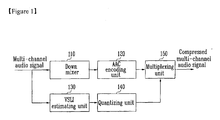
- FIG. 1 schematically illustrates the configuration of a multi-channel audio encoder according to the present invention.
- the multi-channel audio encoder includes a down mixer 110 for down-mixing an input multi-channel audio signal to generate a down-mixed audio signal, an advanced audio coding (AAC) encoding unit 120 for encoding the down-mixed audio signal, a virtual source location information (VSLI) estimating unit 130 for estimating virtual source location information from the multi-channel audio signal, a quantizing unit 140 for quantizing the VSLI, and a multiplexing unit 150 for multiplexing the down-mixed audio signal encoded by the AAC encoding unit 120 with the VSLI quantized by the quantizing unit 140 to finally generate a compressed multi-channel audio signal.
- AAC advanced audio coding
- VSLI virtual source location information
- the virtual sound location vectors include a global vector Gv b , left and right half-plane vectors LHv b and RHv b , and left and right subsequent vectors LSv b and RSv b .
- Angles between the respective vectors and the center channel are represented by Ga b , LHa b , RHa b , LSa b and RSa b , respectively.
- FIG. 2 is a flowchart illustrating a process of estimating VSLI of a multi-channel audio signal according to an exemplary embodiment of the present invention.
- step 210 respective channels of an input multi-channel audio signal are virtually assigned to a two-dimensional semicircular plane.
- FIG. 3 shows an example of five channels of C, L, R, Ls and Rs of a multi-channel audio signal assigned on the semicircular plane at 45° intervals, and a global vector which is estimated from the channels, according to an exemplary embodiment of the present invention.
- step 220 the multi-channel audio signal is converted into a signal in a frequency domain.
- ch denotes one of a center channel (C), left channel (L), right channel (R), left surround channel (Ls), and right surround channel (Rs).
- B b and B b+1 -1 denote frequency indexes corresponding to upper and lower boundaries of the sub-band B b , respectively.
- a global vector represented on the semicircular plane assigned the channels is estimated from the signal magnitude of each channel in each sub-band.
- step 250 it is determined whether the angle Ga b of the global vector in each sub-band is greater than zero.
- step 260 if the angle of the global vector is greater than zero, a first set of local vectors are estimated.
- step 270 if the angle of the global vector is smaller than zero, a second set of local vectors are estimated.
- the first set of local vectors includes LHv b , LSv b , and RSv b
- the second set of local vectors includes RHa b , RSa b , and LSa b .
- step 280 the angle of the global vector and the angles of the local vectors estimated in step 260 or 270 are transmitted as the VSLI to the decoder. That is, if the angle Ga b of the global vector is smaller than zero, ⁇ Ga b , RHa b , RSa b , LSa b ⁇ is transmitted, and otherwise, ⁇ Ga b , LHa b , LSa b , RSa b ⁇ is transmitted.
- the spatial cue information for N multi-channel audio signals can be represented by N-1 pieces of virtual source location information.
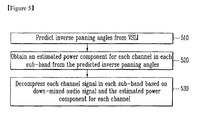
- FIG. 5 is a flowchart illustrating a process of decoding a multi-channel audio signal that has been compressed and represented based on VSLI according to an exemplary embodiment of the present invention.
- the decoder estimates vector information of original sound from virtual source location information received together with the encoded down-mixed audio signal.
- the sound vector is represented by its magnitude and angle.
- the vector angle can be obtained from the received VSLI, and the vector magnitude can be obtained from the received down-mixed audio signal.
- an inverse panning angle is predicted from the VSLI using a constant power panning (CPP) rule (S510).
- CCP constant power panning
- a method for predicting the other inverse panning angles depends on the angle Ga b of the global vector.
- an estimated power component for each channel in the sub-band is obtained from the predicted inverse panning angle.
- each channel signal in each sub-band can be finally decompressed based on the down-mixed audio signal and the estimated power component for each channel according to the following equation:
- U ch , k F ch , b ⁇ S k ⁇ , B b ⁇ k ⁇ B b + 1 - 1
- S' k denotes a frequency component coefficient of the received down-mixed signal
- U ch,k denotes the decompressed audio signal.
- the present invention described above may be provided as one or more computer programs which are implemented on one or more computer-readable mediums.
- the mediums may include a floppy disc, a hard disc, a CD-ROM, a flash memory card, a programmable read only memory (PROM), a random access memory (RAM), a read only memory (ROM), and a magnetic tape.
- the computer program may be written in any programming language, such as C, C++, and JAVA.
Landscapes
- Engineering & Computer Science (AREA)
- Physics & Mathematics (AREA)
- Mathematical Physics (AREA)
- Computational Linguistics (AREA)
- Signal Processing (AREA)
- Health & Medical Sciences (AREA)
- Audiology, Speech & Language Pathology (AREA)
- Human Computer Interaction (AREA)
- Acoustics & Sound (AREA)
- Multimedia (AREA)
- Stereophonic System (AREA)
Description
- The present invention relates to compression and decompression of a multi-channel audio signal, and more particularly, to a method for compressing and decompressing a multi-channel audio signal based on virtual source location information (VSLI) on a semicircular plane.
- In a conventional binaural cue coding method, an inter-channel level difference (ICLD) is generally used as spatial cue information in compressing spectral information of a multi-channel audio signal. However, the ICLD is subject to a quantization process before being transmitted. Since the quantization process assigns a limited number of bits, resolution is limited. Accordingly, such information loss in the ICLD deteriorates a decompressed audio signal.
- Virtual source location information (VSCI) is known from the Ph.D. dissertation of Han-gil Moon entitled A Multi-Channel Audio Compression Method with Virtual Source Location Information for MPEG-4 SAC, February 2005.
- The present invention as claimed in claims 1-13 is directed to methods for compressing and decompressing a multi-channel audio signal using virtual source location information (VSLI) represented on a limited semicircular plane rather than an ICLD, as a spatial cue parameter, thereby minimizing loss caused by quantization of spatial cue information and improving the sound quality of a decompressed audio signal.
- Also only N-1 pieces of virtual source location information are estimated and transmitted according to a location of a global vector in representing and compressing N multi-channel audio signals using a down-mixed audio signal and virtual source location information and transmitting them to a decoder, thereby reducing an amount of transmitted information.
- One aspect of the present invention provides a method for estimating virtual source location information (VSLI) which is used as spatial cue information in compressing a multi-channel audio signal, the method comprising the steps of: (i) virtually assigning channels of the multi-channel audio signal on a semicircular plane; (ii) converting the multi-channel audio signal into a signal in a frequency domain; (iii) dividing the signal in the frequency domain into a plurality of sub-bands and calculating a signal size of each channel in each sub-band; (iv) estimating a global vector represented on the semicircular plane from the calculated signal size of each channel in each sub-band and virtual location information of each virtually assigned channel signal; and (v) determining whether an angle of the global vector in each sub-band is greater than zero, and estimating local vectors in a first set when the angle of the global vector is greater than zero and in a second set when the angle of the global vector is smaller than zero.
- Another aspect of the present invention provides a method for compressing a multi-channel audio signal based on virtual source location information (VSLI), the method comprising the steps of: obtaining angle information of the global vector and the plurality of local vectors which indicate the virtual source location information estimated by performing the above-described method; quantizing the angle information of the global vector and the local vectors; down-mixing and encoding the input multi-channel audio signal; and multiplexing the encoded, down-mixed audio signal with the quantized angle information of the vectors to finally generate a compressed multi-channel audio signal.
- Yet another aspect of the present invention provides a method for decompressing a compressed multi-channel audio signal represented by virtual source location information (VSLI) and an encoded down-mixed audio signal based on spatial cue information, the method comprising the steps of: (i) predicting inverse panning angle information from the VSLI using a constant power panning rule; (ii) obtaining an estimated power component of each channel in each sub-band using the predicted inverse panning angle information; and (iii) finally decompressing a signal of each channel in each sub-band using the estimated power component of each channel and the down-mixed audio signal.
- In the method for compressing a multi-channel signal using virtual source location information on a semicircular plane according to the present invention, spatial cue information is represented using virtual sound location information (VSLI), thereby minimizing loss caused by quantization of spatial cue information and improving the sound quality of a decompressed audio signal.
-
-
FIG. 1 schematically illustrates the configuration of a multi-channel audio encoder that the present invention may be employed; -
FIG. 2 is a flowchart illustrating a process of estimating virtual sound location information (VSLI) of a multi-channel audio signal according to an exemplary embodiment of the present invention; -
FIG. 3 illustrates an example in which respective channels of a multi-channel audio signal are virtually assigned on a semicircular plane structure according to an exemplary embodiment of the present invention; -
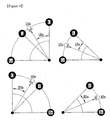
FIG. 4 illustrates an example of local vectors estimated in respective sections of a semicircular plane structure shown inFIG. 3 ; and -
FIG. 5 is a flowchart illustrating a process of decoding a multi-channel audio signal that has been compressed and represented based on VSLI according to an exemplary embodiment of the present invention. - Hereinafter, exemplary embodiments of the present invention will be described in detail. However, the present invention is not limited to the exemplary embodiments disclosed below, but can be implemented in various forms. Therefore, the present exemplary embodiments are provided for complete disclosure of the present invention and to fully convey the scope of the present invention to those of ordinary skill in the art.
-
FIG. 1 schematically illustrates the configuration of a multi-channel audio encoder according to the present invention. Referring toFIG. 1 , the multi-channel audio encoder includes adown mixer 110 for down-mixing an input multi-channel audio signal to generate a down-mixed audio signal, an advanced audio coding (AAC)encoding unit 120 for encoding the down-mixed audio signal, a virtual source location information (VSLI) estimatingunit 130 for estimating virtual source location information from the multi-channel audio signal, a quantizingunit 140 for quantizing the VSLI, and amultiplexing unit 150 for multiplexing the down-mixed audio signal encoded by theAAC encoding unit 120 with the VSLI quantized by the quantizingunit 140 to finally generate a compressed multi-channel audio signal. - In the present invention, the virtual source location information (VSLI) is represented by an azimuth angle between virtual source location vectors on a semicircular plane, which are estimated from signal magnitude of respective channels in a multi-channel audio signal, and a center channel. Since (N-1) pieces of virtual source location information are used for N multi-channel audio signals, an amount of the virtual source location information is the same as an inter-channel level difference (ICLD).
- In an exemplary embodiment of the present invention, the virtual sound location vectors include a global vector Gvb, left and right half-plane vectors LHvb and RHvb, and left and right subsequent vectors LSvb and RSvb. Angles between the respective vectors and the center channel are represented by Gab, LHab, RHab, LSab and RSab, respectively.
- In the present invention, the channels of the multi-channel audio signal are virtually assigned on the semicircular plane, and the virtual source location vectors represented on the semicircular plane are estimated from signal magnitude of the respective channels. A set of the estimated virtual source location vectors varies with the location of the global vector. Information about an angle between each estimated virtual source location vector and the center channel will be transmitted as the virtual source location information together with the down-mixed audio signal to the decoder.
-
FIG. 2 is a flowchart illustrating a process of estimating VSLI of a multi-channel audio signal according to an exemplary embodiment of the present invention. - In
step 210, respective channels of an input multi-channel audio signal are virtually assigned to a two-dimensional semicircular plane.FIG. 3 shows an example of five channels of C, L, R, Ls and Rs of a multi-channel audio signal assigned on the semicircular plane at 45° intervals, and a global vector which is estimated from the channels, according to an exemplary embodiment of the present invention. - In
step 220, the multi-channel audio signal is converted into a signal in a frequency domain. Instep 230, the signal in the frequency domain is divided into a plurality of sub-bands and the signal magnitude of each channel in each sub-band is calculated using the following Equation 1:
where Sch,n denotes a frequency coefficient of the ch-th channel. In an embodiment of the present invention, ch denotes one of a center channel (C), left channel (L), right channel (R), left surround channel (Ls), and right surround channel (Rs). Bb and Bb+1-1 denote frequency indexes corresponding to upper and lower boundaries of the sub-band Bb, respectively. - In
step 240, a global vector represented on the semicircular plane assigned the channels is estimated from the signal magnitude of each channel in each sub-band. In the sub-band b, a global vector Gvb is estimated using the following Equation 2:
where Ai denotes virtual location information of each channel signal assigned on the semicircular plane. It may be mapping information of each channel that is assigned on the semicircular plane instep 210. In the embodiment shown inFIG. 3 , the virtual location information may be defined as A1=cos0°+jsin0°, A2=cos45°-jsin45°, A3=cos45°+jsin45°, A4=cos90°-jsin90°, and A5=cos90°+jsin90° in order of the center, left, right, left surround, and right surround channel signals. - In
step 250, it is determined whether the angle Gab of the global vector in each sub-band is greater than zero. Instep 260, if the angle of the global vector is greater than zero, a first set of local vectors are estimated. Instep 270, if the angle of the global vector is smaller than zero, a second set of local vectors are estimated. In an embodiment, the first set of local vectors includes LHvb, LSvb, and RSvb, and the second set of local vectors includes RHab, RSab, and LSab. - Local vectors for sections of the semicircular plane are estimated using the following Equations 3. An embodiment thereof is shown in
FIG. 4 .
- In
step 280, the angle of the global vector and the angles of the local vectors estimated instep - In this manner, according to the present invention, it can be seen that the spatial cue information for N multi-channel audio signals can be represented by N-1 pieces of virtual source location information.
-
FIG. 5 is a flowchart illustrating a process of decoding a multi-channel audio signal that has been compressed and represented based on VSLI according to an exemplary embodiment of the present invention. The decoder estimates vector information of original sound from virtual source location information received together with the encoded down-mixed audio signal. The sound vector is represented by its magnitude and angle. The vector angle can be obtained from the received VSLI, and the vector magnitude can be obtained from the received down-mixed audio signal. - Specifically, as shown in
FIG. 5 , an inverse panning angle is predicted from the VSLI using a constant power panning (CPP) rule (S510). In this case, a method for predicting the other inverse panning angles depends on the angle Gab of the global vector. The inverse panning angle is predicted using the following Equations 4:
- In
step 520, an estimated power component for each channel in the sub-band is obtained from the predicted inverse panning angle. The estimated power component for each channel is obtained using the following Equations 5:
- In
step 530, each channel signal in each sub-band can be finally decompressed based on the down-mixed audio signal and the estimated power component for each channel according to the following equation:
where S'k denotes a frequency component coefficient of the received down-mixed signal, and Uch,k denotes the decompressed audio signal. - The present invention described above may be provided as one or more computer programs which are implemented on one or more computer-readable mediums. The mediums may include a floppy disc, a hard disc, a CD-ROM, a flash memory card, a programmable read only memory (PROM), a random access memory (RAM), a read only memory (ROM), and a magnetic tape. In general, the computer program may be written in any programming language, such as C, C++, and JAVA.
- While the invention has been shown and described with reference to certain exemplary embodiments thereof, it will be understood by those skilled in the art that various changes in form and details may be made therein without departing from the scope of the invention as defined by the appended claims.
Claims (15)
- A method for estimating virtual source location information (VSLI) that is used as spatial cue information in compressing a multi-channel audio signal, the method comprising the steps of:(i) virtually assigning each channel of the multi-channel audio signal to a semicircular plane, using virtual location information indicating a mapping of each channel on the semicircular plane;(ii) converting the multi-channel audio signal into a frequency domain signal;(iii) dividing the frequency domain signal into a plurality of sub-bands and calculating signal magnitude of each channel in each sub-band;(iv) for each sub-band, estimating a global vector represented on the semicircular plane from the calculated signal magnitude of each channel in the sub-band and from the virtual location information of each virtually assigned channel signal;(v) for each sub-band, determining whether an angle between the global vector and a center channel is greater than zero and
estimating a first set of virtual source location vectors when the angle is greater than zero and
estimating a second set of virtual source location vectors when the angle is smaller than zero; and(vi) using information on an angle between each estimated virtual source location vector and the center channel as virtual source location information. - The method of claim 1, wherein step (iii) comprises calculating the signal magnitude of each channel in each sub-band using the following equation:

where SCh,n denotes a frequency coefficient of the ch-th channel, ch denotes one of a center channel (C), left channel (L), right channel (R), left surround channel (Ls), and right surround channel (Rs), and Bb and Bb+1-1 denote frequency indexes corresponding to upper and lower boundaries of the sub-band Bb, respectively. - The method of claim 2, wherein step (iv) comprises estimating the global vector for each sub-band using the following equation:

where A1 denotes virtual location information of the center channel, A2 denotes virtual location information of the left channel, A3 denotes virtual location information of the right channel, A4 denotes virtual location information of the left surround channel, and A5 denotes virtual location information of the right surround channel. - The method of claim 3, wherein
A1=cos0°+jsin0°, A2=cos45°-jsin45°, A3=cos45°+jsin45 °, A4=cos90°-jsin90°, and A5=cos90° +jsin90°. - The method of claim 1, wherein in step (v), the first set of local vectors includes a right half-plane vector RHvb, a right subsequent vector RSvb and a left subsequent vector LSvb, and the second set of local vectors includes a left half-plane vector LHvb, a left subsequent vector LSvb and a right subsequent vector RSvb.
- The method of claim 5, wherein in step (v), the right half-plane vector RHvb is estimated using the signal magnitude of center, right, and right surround channels calculated in step (iii); the right subsequent vector RSvb is estimated using signal magnitude of right and right surround channels calculated in step (iii); the left half-plane vector LHvb is estimated using signal magnitude of the center, left and left surround channels calculated in step (iii); and the left subsequent vector LSvb is estimated using signal magnitude of left and left surround channels calculated in step (iii).
- The method of claim 6, wherein the right half-plane vector RHvb, the right subsequent vector RSvb, the left half-plane vector LHvb and the left subsequent vector LSvb are estimated using the following equations:


and
- The method of claim 5, wherein when the angle of the global vector Gab is greater than zero, angle information of the global vector and the first set of local vectors is transmitted to a decoder, and otherwise, angle information of the global vector and the second set of local vectors is transmitted to the decoder.
- A method for compressing a multi-channel audio signal based on virtual source location information (VSLI), the method comprising the steps of:obtaining angle information of a global vector and a plurality of local vectors which represent the virtual source location information estimated by performing the method of any one of claims 1 to 7;quantizing the angle information of the global vector and the local vectors;down-mixing and encoding the input multi-channel audio signal; andmultiplexing the encoded, down-mixed audio signal with the quantized angle information of the vectors to finally generate a compressed multi-channel audio signal.
- A method for decompressing a compressed multi-channel audio signal represented by virtual source location information (VSLI) and an encoded down-mixed audio signal based on spatial cue information, wherein the virtual source location information comprises angle information on an angle between a global vector, estimated from the channels of the multi-channel audio signal, and a center channel of the multi-channel audio signal, the method comprising the steps of:(i) predicting inverse panning angle information from the VSLI using a constant power panning rule, wherein the prediction scheme of the inverse panning angle information differs depending on the angle information of the global vector;(ii) obtaining an estimated power component of each channel in each sub-band using the predicted inverse panning angle information; and(iii) finally decompressing a signal of each channel in each sub-band using the estimated power component of each channel and the down-mixed audio signal, wherein step (i) includes predicting inverse panning angles θ 1, θ 2, θ 3, and θ 4 from the global vector angle Gab, the left half-plane vector angle LHab, the left subsequent vector angle LSab and right subsequent vector angle RSab in the virtual source location information when the global vector angle Gab in the virtual source location information is greater than zero, and from the global vector angle Gab, right half-plane vector angle RHab, right subsequent vector angle RSab and left subsequent vector angle LSab in the virtual source location information when the global vector angle Gab is smaller than zero.
- The method of claim 10, wherein in step (i), the inverse panning angles θ 1, θ 2, θ 3, and θ 4 are estimated using the following equations:If Gab ≥ 0,

 and, if Gab < 0,

- The method of claim 11, wherein step (ii) comprises obtaining the estimated power component of each channel in each sub-band using the following equations:If Gab ≥ 0,



and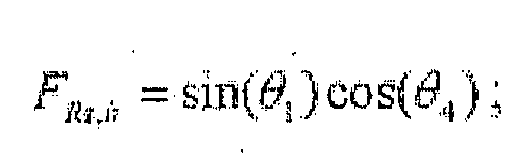
andif Gab < 0,


and
- The method of claim 12, wherein step (iii) includes decompressing a signal of each channel in each sub-band using the following equation:

where
- A computer-readable medium having a computer program recorded thereon for performing the method of any of claims 1 to 9.
- A computer-readable medium having a computer program recorded thereon for performing the method of any one of claims 10 to 13.
Applications Claiming Priority (3)
| Application Number | Priority Date | Filing Date | Title |
|---|---|---|---|
| KR20050021104 | 2005-03-14 | ||
| PCT/KR2006/000916 WO2006098583A1 (en) | 2005-03-14 | 2006-03-14 | Multichannel audio compression and decompression method using virtual source location information |
| KR1020060023545A KR100714980B1 (en) | 2005-03-14 | 2006-03-14 | Multichannel audio compression and decompression method using Virtual Source Location Information |
Publications (3)
| Publication Number | Publication Date |
|---|---|
| EP1859439A1 EP1859439A1 (en) | 2007-11-28 |
| EP1859439A4 EP1859439A4 (en) | 2010-12-22 |
| EP1859439B1 true EP1859439B1 (en) | 2013-10-30 |
Family
ID=36991912
Family Applications (1)
| Application Number | Title | Priority Date | Filing Date |
|---|---|---|---|
| EP06716366.7A Expired - Lifetime EP1859439B1 (en) | 2005-03-14 | 2006-03-14 | Multichannel audio compression and decompression method using virtual source location information |
Country Status (2)
| Country | Link |
|---|---|
| EP (1) | EP1859439B1 (en) |
| WO (1) | WO2006098583A1 (en) |
Families Citing this family (2)
| Publication number | Priority date | Publication date | Assignee | Title |
|---|---|---|---|---|
| EP2595148A3 (en) * | 2006-12-27 | 2013-11-13 | Electronics and Telecommunications Research Institute | Apparatus for coding multi-object audio signals |
| CN102084418B (en) * | 2008-07-01 | 2013-03-06 | 诺基亚公司 | Apparatus and method for adjusting spatial cue information of a multichannel audio signal |
Family Cites Families (2)
| Publication number | Priority date | Publication date | Assignee | Title |
|---|---|---|---|---|
| US20030035553A1 (en) * | 2001-08-10 | 2003-02-20 | Frank Baumgarte | Backwards-compatible perceptual coding of spatial cues |
| US7292901B2 (en) * | 2002-06-24 | 2007-11-06 | Agere Systems Inc. | Hybrid multi-channel/cue coding/decoding of audio signals |
-
2006
- 2006-03-14 EP EP06716366.7A patent/EP1859439B1/en not_active Expired - Lifetime
- 2006-03-14 WO PCT/KR2006/000916 patent/WO2006098583A1/en not_active Ceased
Also Published As
| Publication number | Publication date |
|---|---|
| EP1859439A1 (en) | 2007-11-28 |
| EP1859439A4 (en) | 2010-12-22 |
| WO2006098583A1 (en) | 2006-09-21 |
Similar Documents
| Publication | Publication Date | Title |
|---|---|---|
| US20250322834A1 (en) | Methods, apparatus and systems for encoding and decoding of multi-channel ambisonics audio data | |
| US8817991B2 (en) | Advanced encoding of multi-channel digital audio signals | |
| JP7689196B2 (en) | Combining spatial audio streams | |
| JP2022509440A (en) | Determining the coding of spatial audio parameters and the corresponding decoding | |
| US20150332679A1 (en) | Method and apparatus for compressing and decompressing a higher order ambisonics representation for a sound field | |
| US20170164131A1 (en) | Method and apparatus for decoding a compressed hoa representation, and method and apparatus for encoding a compressed hoa representation | |
| JP2014026007A (en) | Audio decryption device, audio decryption method and audio decryption computer program | |
| US20080187144A1 (en) | Multichannel Audio Compression and Decompression Method Using Virtual Source Location Information | |
| US9837085B2 (en) | Audio encoding device and audio coding method | |
| JP6051621B2 (en) | Audio encoding apparatus, audio encoding method, audio encoding computer program, and audio decoding apparatus | |
| US20130182854A1 (en) | Audio coding device and method | |
| JP6179122B2 (en) | Audio encoding apparatus, audio encoding method, and audio encoding program | |
| WO2006098583A1 (en) | Multichannel audio compression and decompression method using virtual source location information | |
| HK40019652A (en) | Method and apparatus for decoding a bitstream including encoded hoa representations, and medium | |
| HK1227165A1 (en) | Method and apparatus for improving the coding of side information required for coding a higher order ambisonics representation of a sound filed |
Legal Events
| Date | Code | Title | Description |
|---|---|---|---|
| PUAI | Public reference made under article 153(3) epc to a published international application that has entered the european phase |
Free format text: ORIGINAL CODE: 0009012 |
|
| 17P | Request for examination filed |
Effective date: 20070717 |
|
| AK | Designated contracting states |
Kind code of ref document: A1 Designated state(s): AT BE BG CH CY CZ DE DK EE ES FI FR GB GR HU IE IS IT LI LT LU LV MC NL PL PT RO SE SI SK TR |
|
| DAX | Request for extension of the european patent (deleted) | ||
| A4 | Supplementary search report drawn up and despatched |
Effective date: 20101119 |
|
| 17Q | First examination report despatched |
Effective date: 20120418 |
|
| REG | Reference to a national code |
Ref country code: DE Ref legal event code: R079 Ref document number: 602006039029 Country of ref document: DE Free format text: PREVIOUS MAIN CLASS: G10L0019000000 Ipc: G10L0019008000 |
|
| GRAP | Despatch of communication of intention to grant a patent |
Free format text: ORIGINAL CODE: EPIDOSNIGR1 |
|
| RIC1 | Information provided on ipc code assigned before grant |
Ipc: G10L 19/008 20130101AFI20130502BHEP Ipc: G10L 19/02 20130101ALN20130502BHEP |
|
| INTG | Intention to grant announced |
Effective date: 20130523 |
|
| RIC1 | Information provided on ipc code assigned before grant |
Ipc: G10L 19/02 20130101ALN20130510BHEP Ipc: G10L 19/008 20130101AFI20130510BHEP |
|
| GRAS | Grant fee paid |
Free format text: ORIGINAL CODE: EPIDOSNIGR3 |
|
| GRAA | (expected) grant |
Free format text: ORIGINAL CODE: 0009210 |
|
| 111L | Licence recorded |
Designated state(s): AT BE BG CH CY CZ DE DK EE ES FI FR GB GR HU IE IS IT LT LU LV MC NL PL PT RO SE SI SK TR Free format text: EXCLUSIVE LICENSE Name of requester: INTELLECTUAL DISCOVERY CO., LTD., KR Effective date: 20130712 |
|
| 111L | Licence recorded |
Designated state(s): AT BE BG CH CY CZ DE DK EE ES FI FR GB GR HU IE IS IT LT LU LV MC NL PL PT RO SE SI SK TR Free format text: EXCLUSIVE LICENSE Name of requester: INTELLECTUAL DISCOVERY CO., LTD., KR Effective date: 20130712 |
|
| AK | Designated contracting states |
Kind code of ref document: B1 Designated state(s): AT BE BG CH CY CZ DE DK EE ES FI FR GB GR HU IE IS IT LI LT LU LV MC NL PL PT RO SE SI SK TR |
|
| REG | Reference to a national code |
Ref country code: GB Ref legal event code: FG4D |
|
| REG | Reference to a national code |
Ref country code: CH Ref legal event code: PK Free format text: ERGAENZUNG LIZENZEINTRAG: AUSSCHLIESSLICHE LIZENZ Ref country code: CH Ref legal event code: EP |
|
| REG | Reference to a national code |
Ref country code: AT Ref legal event code: REF Ref document number: 638675 Country of ref document: AT Kind code of ref document: T Effective date: 20131115 |
|
| REG | Reference to a national code |
Ref country code: IE Ref legal event code: FG4D |
|
| REG | Reference to a national code |
Ref country code: DE Ref legal event code: R096 Ref document number: 602006039029 Country of ref document: DE Effective date: 20131224 |
|
| REG | Reference to a national code |
Ref country code: NL Ref legal event code: VDEP Effective date: 20131030 |
|
| REG | Reference to a national code |
Ref country code: AT Ref legal event code: MK05 Ref document number: 638675 Country of ref document: AT Kind code of ref document: T Effective date: 20131030 |
|
| REG | Reference to a national code |
Ref country code: LT Ref legal event code: MG4D |
|
| PG25 | Lapsed in a contracting state [announced via postgrant information from national office to epo] |
Ref country code: IS Free format text: LAPSE BECAUSE OF FAILURE TO SUBMIT A TRANSLATION OF THE DESCRIPTION OR TO PAY THE FEE WITHIN THE PRESCRIBED TIME-LIMIT Effective date: 20140228 Ref country code: FI Free format text: LAPSE BECAUSE OF FAILURE TO SUBMIT A TRANSLATION OF THE DESCRIPTION OR TO PAY THE FEE WITHIN THE PRESCRIBED TIME-LIMIT Effective date: 20131030 Ref country code: BE Free format text: LAPSE BECAUSE OF FAILURE TO SUBMIT A TRANSLATION OF THE DESCRIPTION OR TO PAY THE FEE WITHIN THE PRESCRIBED TIME-LIMIT Effective date: 20131030 Ref country code: LT Free format text: LAPSE BECAUSE OF FAILURE TO SUBMIT A TRANSLATION OF THE DESCRIPTION OR TO PAY THE FEE WITHIN THE PRESCRIBED TIME-LIMIT Effective date: 20131030 Ref country code: SE Free format text: LAPSE BECAUSE OF FAILURE TO SUBMIT A TRANSLATION OF THE DESCRIPTION OR TO PAY THE FEE WITHIN THE PRESCRIBED TIME-LIMIT Effective date: 20131030 Ref country code: NL Free format text: LAPSE BECAUSE OF FAILURE TO SUBMIT A TRANSLATION OF THE DESCRIPTION OR TO PAY THE FEE WITHIN THE PRESCRIBED TIME-LIMIT Effective date: 20131030 |
|
| PG25 | Lapsed in a contracting state [announced via postgrant information from national office to epo] |
Ref country code: LV Free format text: LAPSE BECAUSE OF FAILURE TO SUBMIT A TRANSLATION OF THE DESCRIPTION OR TO PAY THE FEE WITHIN THE PRESCRIBED TIME-LIMIT Effective date: 20131030 Ref country code: AT Free format text: LAPSE BECAUSE OF FAILURE TO SUBMIT A TRANSLATION OF THE DESCRIPTION OR TO PAY THE FEE WITHIN THE PRESCRIBED TIME-LIMIT Effective date: 20131030 Ref country code: ES Free format text: LAPSE BECAUSE OF FAILURE TO SUBMIT A TRANSLATION OF THE DESCRIPTION OR TO PAY THE FEE WITHIN THE PRESCRIBED TIME-LIMIT Effective date: 20131030 Ref country code: CY Free format text: LAPSE BECAUSE OF FAILURE TO SUBMIT A TRANSLATION OF THE DESCRIPTION OR TO PAY THE FEE WITHIN THE PRESCRIBED TIME-LIMIT Effective date: 20131030 |
|
| PG25 | Lapsed in a contracting state [announced via postgrant information from national office to epo] |
Ref country code: PT Free format text: LAPSE BECAUSE OF FAILURE TO SUBMIT A TRANSLATION OF THE DESCRIPTION OR TO PAY THE FEE WITHIN THE PRESCRIBED TIME-LIMIT Effective date: 20140228 |
|
| PG25 | Lapsed in a contracting state [announced via postgrant information from national office to epo] |
Ref country code: EE Free format text: LAPSE BECAUSE OF FAILURE TO SUBMIT A TRANSLATION OF THE DESCRIPTION OR TO PAY THE FEE WITHIN THE PRESCRIBED TIME-LIMIT Effective date: 20131030 |
|
| REG | Reference to a national code |
Ref country code: DE Ref legal event code: R097 Ref document number: 602006039029 Country of ref document: DE |
|
| PG25 | Lapsed in a contracting state [announced via postgrant information from national office to epo] |
Ref country code: IT Free format text: LAPSE BECAUSE OF FAILURE TO SUBMIT A TRANSLATION OF THE DESCRIPTION OR TO PAY THE FEE WITHIN THE PRESCRIBED TIME-LIMIT Effective date: 20131030 Ref country code: SK Free format text: LAPSE BECAUSE OF FAILURE TO SUBMIT A TRANSLATION OF THE DESCRIPTION OR TO PAY THE FEE WITHIN THE PRESCRIBED TIME-LIMIT Effective date: 20131030 Ref country code: RO Free format text: LAPSE BECAUSE OF FAILURE TO SUBMIT A TRANSLATION OF THE DESCRIPTION OR TO PAY THE FEE WITHIN THE PRESCRIBED TIME-LIMIT Effective date: 20131030 Ref country code: CZ Free format text: LAPSE BECAUSE OF FAILURE TO SUBMIT A TRANSLATION OF THE DESCRIPTION OR TO PAY THE FEE WITHIN THE PRESCRIBED TIME-LIMIT Effective date: 20131030 Ref country code: PL Free format text: LAPSE BECAUSE OF FAILURE TO SUBMIT A TRANSLATION OF THE DESCRIPTION OR TO PAY THE FEE WITHIN THE PRESCRIBED TIME-LIMIT Effective date: 20131030 |
|
| PLBE | No opposition filed within time limit |
Free format text: ORIGINAL CODE: 0009261 |
|
| STAA | Information on the status of an ep patent application or granted ep patent |
Free format text: STATUS: NO OPPOSITION FILED WITHIN TIME LIMIT |
|
| PG25 | Lapsed in a contracting state [announced via postgrant information from national office to epo] |
Ref country code: DK Free format text: LAPSE BECAUSE OF FAILURE TO SUBMIT A TRANSLATION OF THE DESCRIPTION OR TO PAY THE FEE WITHIN THE PRESCRIBED TIME-LIMIT Effective date: 20131030 |
|
| 26N | No opposition filed |
Effective date: 20140731 |
|
| PG25 | Lapsed in a contracting state [announced via postgrant information from national office to epo] |
Ref country code: LU Free format text: LAPSE BECAUSE OF FAILURE TO SUBMIT A TRANSLATION OF THE DESCRIPTION OR TO PAY THE FEE WITHIN THE PRESCRIBED TIME-LIMIT Effective date: 20140314 |
|
| REG | Reference to a national code |
Ref country code: CH Ref legal event code: PL |
|
| REG | Reference to a national code |
Ref country code: DE Ref legal event code: R097 Ref document number: 602006039029 Country of ref document: DE Effective date: 20140731 |
|
| GBPC | Gb: european patent ceased through non-payment of renewal fee |
Effective date: 20140314 |
|
| REG | Reference to a national code |
Ref country code: FR Ref legal event code: ST Effective date: 20141128 |
|
| REG | Reference to a national code |
Ref country code: IE Ref legal event code: MM4A |
|
| PG25 | Lapsed in a contracting state [announced via postgrant information from national office to epo] |
Ref country code: FR Free format text: LAPSE BECAUSE OF NON-PAYMENT OF DUE FEES Effective date: 20140331 Ref country code: CH Free format text: LAPSE BECAUSE OF NON-PAYMENT OF DUE FEES Effective date: 20140331 Ref country code: LI Free format text: LAPSE BECAUSE OF NON-PAYMENT OF DUE FEES Effective date: 20140331 Ref country code: GB Free format text: LAPSE BECAUSE OF NON-PAYMENT OF DUE FEES Effective date: 20140314 Ref country code: IE Free format text: LAPSE BECAUSE OF NON-PAYMENT OF DUE FEES Effective date: 20140314 |
|
| PG25 | Lapsed in a contracting state [announced via postgrant information from national office to epo] |
Ref country code: SI Free format text: LAPSE BECAUSE OF FAILURE TO SUBMIT A TRANSLATION OF THE DESCRIPTION OR TO PAY THE FEE WITHIN THE PRESCRIBED TIME-LIMIT Effective date: 20131030 |
|
| REG | Reference to a national code |
Ref country code: DE Ref legal event code: R088 Ref document number: 602006039029 Country of ref document: DE |
|
| PG25 | Lapsed in a contracting state [announced via postgrant information from national office to epo] |
Ref country code: MC Free format text: LAPSE BECAUSE OF FAILURE TO SUBMIT A TRANSLATION OF THE DESCRIPTION OR TO PAY THE FEE WITHIN THE PRESCRIBED TIME-LIMIT Effective date: 20131030 Ref country code: BG Free format text: LAPSE BECAUSE OF FAILURE TO SUBMIT A TRANSLATION OF THE DESCRIPTION OR TO PAY THE FEE WITHIN THE PRESCRIBED TIME-LIMIT Effective date: 20131030 |
|
| PG25 | Lapsed in a contracting state [announced via postgrant information from national office to epo] |
Ref country code: GR Free format text: LAPSE BECAUSE OF FAILURE TO SUBMIT A TRANSLATION OF THE DESCRIPTION OR TO PAY THE FEE WITHIN THE PRESCRIBED TIME-LIMIT Effective date: 20140131 |
|
| PG25 | Lapsed in a contracting state [announced via postgrant information from national office to epo] |
Ref country code: HU Free format text: LAPSE BECAUSE OF FAILURE TO SUBMIT A TRANSLATION OF THE DESCRIPTION OR TO PAY THE FEE WITHIN THE PRESCRIBED TIME-LIMIT; INVALID AB INITIO Effective date: 20060314 Ref country code: TR Free format text: LAPSE BECAUSE OF FAILURE TO SUBMIT A TRANSLATION OF THE DESCRIPTION OR TO PAY THE FEE WITHIN THE PRESCRIBED TIME-LIMIT Effective date: 20131030 |
|
| PGFP | Annual fee paid to national office [announced via postgrant information from national office to epo] |
Ref country code: DE Payment date: 20190220 Year of fee payment: 14 |
|
| REG | Reference to a national code |
Ref country code: DE Ref legal event code: R119 Ref document number: 602006039029 Country of ref document: DE |
|
| PG25 | Lapsed in a contracting state [announced via postgrant information from national office to epo] |
Ref country code: DE Free format text: LAPSE BECAUSE OF NON-PAYMENT OF DUE FEES Effective date: 20201001 |