EP1858905B1 - Organotrisiloxane, its preparation and its use in curable resin composition - Google Patents
Organotrisiloxane, its preparation and its use in curable resin composition Download PDFInfo
- Publication number
- EP1858905B1 EP1858905B1 EP06729604A EP06729604A EP1858905B1 EP 1858905 B1 EP1858905 B1 EP 1858905B1 EP 06729604 A EP06729604 A EP 06729604A EP 06729604 A EP06729604 A EP 06729604A EP 1858905 B1 EP1858905 B1 EP 1858905B1
- Authority
- EP
- European Patent Office
- Prior art keywords
- organotrisiloxane
- group
- curable resin
- resin composition
- represented
- Prior art date
- Legal status (The legal status is an assumption and is not a legal conclusion. Google has not performed a legal analysis and makes no representation as to the accuracy of the status listed.)
- Expired - Lifetime
Links
- 0 C*c1ccccc1 Chemical compound C*c1ccccc1 0.000 description 1
Images

Classifications
-
- C—CHEMISTRY; METALLURGY
- C07—ORGANIC CHEMISTRY
- C07F—ACYCLIC, CARBOCYCLIC OR HETEROCYCLIC COMPOUNDS CONTAINING ELEMENTS OTHER THAN CARBON, HYDROGEN, HALOGEN, OXYGEN, NITROGEN, SULFUR, SELENIUM OR TELLURIUM
- C07F7/00—Compounds containing elements of Groups 4 or 14 of the Periodic Table
- C07F7/02—Silicon compounds
- C07F7/08—Compounds having one or more C—Si linkages
- C07F7/0834—Compounds having one or more O-Si linkage
- C07F7/0838—Compounds with one or more Si-O-Si sequences
-
- C—CHEMISTRY; METALLURGY
- C07—ORGANIC CHEMISTRY
- C07F—ACYCLIC, CARBOCYCLIC OR HETEROCYCLIC COMPOUNDS CONTAINING ELEMENTS OTHER THAN CARBON, HYDROGEN, HALOGEN, OXYGEN, NITROGEN, SULFUR, SELENIUM OR TELLURIUM
- C07F7/00—Compounds containing elements of Groups 4 or 14 of the Periodic Table
- C07F7/02—Silicon compounds
- C07F7/08—Compounds having one or more C—Si linkages
- C07F7/18—Compounds having one or more C—Si linkages as well as one or more C—O—Si linkages
-
- C—CHEMISTRY; METALLURGY
- C07—ORGANIC CHEMISTRY
- C07F—ACYCLIC, CARBOCYCLIC OR HETEROCYCLIC COMPOUNDS CONTAINING ELEMENTS OTHER THAN CARBON, HYDROGEN, HALOGEN, OXYGEN, NITROGEN, SULFUR, SELENIUM OR TELLURIUM
- C07F7/00—Compounds containing elements of Groups 4 or 14 of the Periodic Table
- C07F7/02—Silicon compounds
- C07F7/08—Compounds having one or more C—Si linkages
-
- C—CHEMISTRY; METALLURGY
- C08—ORGANIC MACROMOLECULAR COMPOUNDS; THEIR PREPARATION OR CHEMICAL WORKING-UP; COMPOSITIONS BASED THEREON
- C08G—MACROMOLECULAR COMPOUNDS OBTAINED OTHERWISE THAN BY REACTIONS ONLY INVOLVING UNSATURATED CARBON-TO-CARBON BONDS
- C08G59/00—Polycondensates containing more than one epoxy group per molecule; Macromolecules obtained by polymerising compounds containing more than one epoxy group per molecule using curing agents or catalysts which react with the epoxy groups
-
- C—CHEMISTRY; METALLURGY
- C08—ORGANIC MACROMOLECULAR COMPOUNDS; THEIR PREPARATION OR CHEMICAL WORKING-UP; COMPOSITIONS BASED THEREON
- C08K—Use of inorganic or non-macromolecular organic substances as compounding ingredients
- C08K5/00—Use of organic ingredients
- C08K5/54—Silicon-containing compounds
Definitions
- the present invention relates to a novel organotrisiloxane that contains an organic group with a phenolic hydroxyl group, and an aryl group.
- the invention also relates to a method of manufacturing the aforementioned organotrisiloxane, a curable resin composition that contains the aforementioned organotrisiloxane, and a product obtained by curing the above composition.
- Japanese Unexamined Patent Application Publication No. (hereinafter referred to as "Kokai") S63-199220 , Kokai H9-151253 , and U.S. Patent No. 4,430,235 disclose a linear-chain organopolysiloxane that contains an organic group with a phenolic hydroxyl group.
- the linear-chain organopolysiloxane that contains an organic group with a phenolic hydroxyl group has low reactivity and poor compatibility with curable resins, such as epoxy resins.
- the disiloxane that contains an organic group with a phenolic hydroxyl group has excellent reactivity, and when it is compounded with a curable resin, such as an epoxy resin, a problem occurs in view of high rigidity of the obtained cured body and low adhesion thereof to a substrate.
- the invention also relates to a method of manufacturing the aforementioned organotrisiloxane, and to a curable resin composition that contains the aforementioned organotrisiloxane, and to a cured product obtained from the above composition.
- the organotrisiloxane of the present invention is represented by the following general formula: (wherein R 1 and R 2 may be the same or different and designate optionally substituted univalent hydrocarbon groups that do not have aliphatically unsaturated bonds, with the proviso that at least one of R 1 or R 2 is an aryl group, and R 3 designates an organic group that contains a phenolic hydroxyl group).
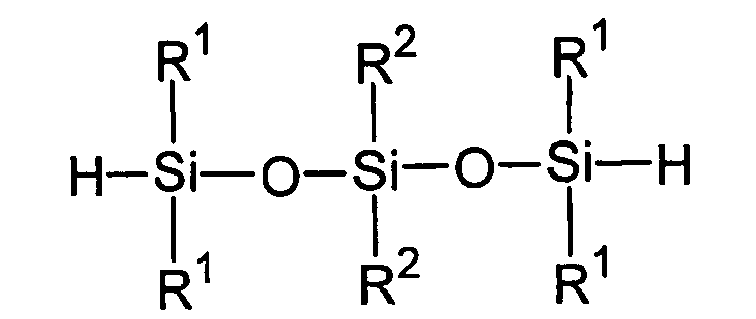
- the method of the invention for manufacturing an organotrisiloxane of the invention is characterized by carrying out a hydrosilylation reaction between a phenolic compound that contains an aliphatically unsaturated hydrocarbon group and an organotrisiloxane represented by the following general formula: (wherein R 1 and R 2 may be the same or different and designate optionally substituted univalent hydrocarbon groups that do not have aliphatically unsaturated bonds, with the proviso that at least one of R 1 or R 2 is an aryl group).
- the curable resin composition of the invention is characterized by comprising: a curable resin and the aforementioned organotrisiloxane.
- the cured product of the invention is characterized by being obtained as a result of curing the aforementioned curable resin composition.
- the organotrisiloxane of the present invention is a novel compound that possesses good reactivity and excellent compatibility and dispersibility with respect to the curable resins, such as epoxy resin.
- the method of the invention can be used for efficient production of such novel compounds, and since the composition of the invention contains the aforementioned novel compound, it demonstrates good curability and adhesion to substrates, while a cured body obtained from the composition of the invention also demonstrates good adhesion to various substrates.
- Fig. 1 is a 13 C-NMR spectral chart of organotrisiloxane prepared in Application Example 1.
- Fig. 2 is a 29 Si-NMR spectral chart of organotrisiloxane prepared in Application Example 1.
- Fig. 3 is a 13 C-NMR spectral chart of organotrisiloxane prepared in Application Example 2.
- Fig. 4 is a 29 Si-NMR spectral chart of organotrisiloxane prepared in Application Example 2.
- R 1 and R 2 may be the same or different and designate optionally substituted univalent hydrocarbon groups that do not have aliphatically unsaturated bonds.
- univalent hydrocarbon groups methyl, ethyl, propyl, butyl, pentyl, hexyl, or similar alkyl groups; phenyl, tolyl, xylyl, or similar aryl groups; benzyl, phenethyl, or similar aralkyl groups; 3-chloropropyl, 3,3,3-trifluoropropyl, or similar halogenated alkyl groups.
- R 1 or R 2 is an aryl group, and preferably, that R 1 is an alkyl group and R 2 is an aryl group. It is especially preferable that R 1 is a methyl group and R 2 is a phenyl group. It is recommended that R 3 in the above formula is an organic group having a phenolic hydroxyl group. More specifically, there are no special restrictions with regard to the aforementioned organic group, provided that this group has a hydroxyl group bonded to an aromatic ring, but it is recommended that this group is expressed by the following formula:
- R 4 is an alkylene group, more specifically, an ethylene, propylene, methylethylene, or a butylene group, preferably a propylene group.
- R 5 is an alkyl group or an alkoxy group
- R 5 as an alkyl group can be exemplified by a methyl, ethyl, propyl, butyl, pentyl, or hexyl group.
- R 5 as an alkoxy group can be exemplified by a methoxy, ethoxy, propoxy, or butoxy group.
- "n" is 0 or 1.
- organotrisiloxane can be exemplified by the following compounds:
- R 1 and R 2 may be the same or different and designate optionally substituted univalent hydrocarbon groups that do not have aliphatically unsaturated bonds. At least one of R 1 or R 2 should be an aryl group. Preferably, R 1 should be an alkyl group and R 2 a phenyl group.
- phenolic compound contains an unsaturated aliphatic hydrocarbon group. It is preferable, however, that a molecule of the phenolic compound contain an alkyl group.
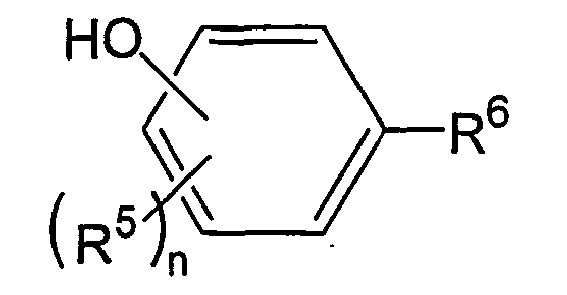
- the aforementioned phenolic compound should preferably be represented by the following general formula:
- R 5 is an alkyl or alkoxy group. These groups may be the same as exemplified above.
- R 6 designate an alkenyl group. Specific examples of the alkenyl group are vinyl groups, allyl groups, and butenyl groups, of which allyl groups are preferable.
- "n" is 0 or 1
- a preferable phenolic group is arylphenol or eugenol.
- the hydrosilylation reaction between the aforementioned organotrisiloxane and the phenolic group with an unsaturated aliphatic hydrocarbon group may be carried out with the use of a hydrosilylation catalyst.
- a hydrosilylation catalyst may be exemplified by a platinum-type catalyst, rhodium-type catalyst, or a palladium-type catalyst, of which the platinum-type catalyst is preferable.
- platinum-type catalysts platinum black, chloroplatinic acid, alcohol-modified chloroplatinic acid, platinum-olefin complex, platinum-alkenylsiloxane complex, or a platinum-carbonyl complex.
- the hydrosilylation reaction can be carried out at room temperature but for acceleration of the process the reaction can be carried out with heating.
- proportions in which the organotrisiloxane and phenolic compound can be used it may be recommend that a mole ratio of silicon-bonded hydrogen atoms contained in the organotrisiloxane to unsaturated aliphatic hydrocarbon groups contained in the phenolic compound be within the range of (1:1) to (1:10), preferably (1:1) to (1:3).
- the target organotrisiloxane will be produced with a low yield, and if, on the other hand, the mole ratio exceeds the upper recommended limit, the product will contain a large amount of an unreacted phenolic compound, and, in some cases, this may lead to decrease in purity of the obtained organotrisiloxane.
- An organic solvent suitable for the hydrosilylation reaction may be hexane, octane, or a similar aliphatic hydrocarbon; toluene, xylene, or a similar aromatic hydrocarbon; butyl acetate, ethyl acetate, or a similar ester; diethyl ether, dibutyl ether, dioxane, or a similar ether; acetone, methylethylketone, methylisobutylketone, cyclohexanone, or a similar ketone.
- the obtained organotrisiloxane is purified by removing the organic solvent and unreacted phenol compound by heating the reaction mixture under a reduced pressure.
- the curable resin composition of the invention is characterized by comprising: a curable resin and the aforementioned organotrisiloxane.
- curable resin that constitutes one of the main components of the composition of the invention.
- the resins can be cured by heating, radiation with ultraviolet rays, radiation with high-energy rays, or by holding in a humid air. Curing by heating is most preferable.
- the above-described curable resins can be combined with some arbitrary components, such as curing agents, curing accelerators, etc.
- the curing agents may be exemplified by carboxylic acids, sulfonic acids, or a similar organic acids, hydrates of the aforementioned acids, an organic hydroxyl compounds, organic silicon compounds that contain silanol groups, halogen groups, or the like, primary or secondary amino compounds, silicone resins that contain silanol groups, silicone oils that contain silanol groups, or combinations of two or more of the above compounds.
- the curing accelerators may be represented by tertiary amino compounds, organic metal salts, such as organic salts of aluminum, zirconium, etc., phosphines such as organic phosphates, heterocyclic amino compounds, complex boron compounds, organic ammonium salts, organic sulfonium salts, organic peroxides, hydrosilation catalysts, etc.
- the above-described organotrisiloxane is a component that is used for protecting the composition of the invention from the loss of flowability prior to curing, as well as for improving tightness of contact and adhesion with respect to various substrates after curing.
- the amount in which the organotrisiloxane can be added It is recommended, however, to add it in an amount of 0.01 to 100 parts by weight, preferably 0.1 to 50 parts by weight per 100 parts by weight of the curable resin that constitutes the main component. If the aforementioned organotrisiloxane is added in an amount smaller than the lower recommended limit, this will impair tightness of contact and adhesion of the obtained curable resin composition with respect to various substrates. If, on the other hand, the added amount of the organotrisiloxane exceeds the upper recommended limit, a cured body of the composition will have reduced mechanical characteristics.
- composition of the invention may be compounded with various arbitrary components such as sensitizers, metal salts of higher fatty acids, ester-type waxes, plasticizers, flexibilizer, fillers, silane coupling agents, etc.
- the flexibility imparters can be represented by silicone oils and silicone rubbers.
- the fillers may be comprised of glass fibers, aluminum fibers, ceramic fibers having alumina and silica as their components, boron fibers, zirconia fibers, silicon carbide fibers, metal fibers, polyester fibers, aramid fibers, Nylon fibers, phenol fibers, natural animal and vegetable fibers, or other fibrous fillers, as well as powders of fused silica, precipitated silica, fumed silica, baked silica, zinc oxide, baked clay, carbon black, glass beads, alumina, talc, calcium carbonate, clay, aluminum hydroxide, barium sulfate, titanium dioxide, aluminum nitride, silicon carbide, magnesium oxide, beryllium oxide, kaolin, mica, zirconia, etc.
- Silane coupling agents can be represented by vinyltrimethoxysilane, allyltrimethoxysilane, allyltriethoxysilane, 3-glycidoxypropyl-trimethoxysilane, 3-methacryloxypropyl-trimethoxysilane, 3-amonopropyl-triethoxysilane, and N-(2-aminoethyl)-3-aminopropyl-trimethoxysilane.
- composition of the invention is prepared by uniformly mixing the aforementioned curable resin, organotrisiloxane, and, if necessary, other arbitrary components.
- the components can be mixed with the use of a single or biaxial mixer, two-roll mill, Ross mixer, or a kneader-mixer.
- a cured product of the invention is obtained by curing the curable resin composition described above. Since the obtained cured product has excellent adhesive properties, it can be used as a sealer, adhesive agent, or a coating material for parts of electronic and electrical devices.
- the organotrisiloxane of the invention the method of manufacturing thereof, the curable resin composition of the invention, and the cured product will be further described in detail with reference to application and comparative examples.
- the appearance and viscosity of the curable resin composition, as well as the composite modulus of elasticity and adhesive properties of the cured product were evaluated by the methods described below.
- a curable resin composition was prepared without fine silica powder and curing accelerator (amine-type catalyst), and the appearance of the composition was visually observed after vacuum defoaming.
- Viscosity of the curable resin composition at 25°C was measured with the use of an E-type viscometer (the product of Tokimec, Inc., digital viscometer, Model DV-U-E Type II), under the following conditions: speed of rotation 2.5 rpm.
- E-type viscometer the product of Tokimec, Inc., digital viscometer, Model DV-U-E Type II
- the curable resin composition was defoamed at 70 mmHg, it was loaded into a mold having a 10 mm-wide, 50 mm-long, and 2 mm-deep cavity, and after pressure curing for 60 min. under conditions of 150°C and 2.5 MPa was completed, the obtained cured specimen was subjected to secondary heat treatment in an oven for 2 hours at 180°C.
- the composite modulus of elasticity of the obtained specimen at 25°C was measured with the use of the ARES viscoelasticity tester (the product of Rheometric Scientific Co. , Model RDA 700). Measurement was carried out under the following conditions: twist 0.5%; frequency 1 Hz.
- the curable resin composition was applied in an amount of about 1 cm 3 onto adherends ⁇ a glass plate (a float glass plate, the product of Paltec Co., Ltd.); an aluminum plate (A1050P, the product of Paltec Co., Ltd.); a nickel plate (SPCC-SB, the product of Paltec Co., Ltd.); a copper plate (C1100P, the product of Paltec Co., Ltd.); a gold-plated plate (C2801P, the product of Nippon Test Panel Co., Ltd.); a polyimide film (Upilex, the product of Ube Industries Co., Ltd., thickness 125 ⁇ m) ⁇ .
- the units were heated in an oven for 2 hours at 125°C and then in an oven for another 2 hours at 180°C.
- specimens for evaluating adhesive properties were produced.
- the cured coatings were separated from the specimens by mean of a dental spatula, and the separation conditions were designated as follows:
- a four-neck flask equipped with a stirrer was filled with 81.3 g (0.24 mol) of 1,1,5,5-tetramethyl-3,3-diphenyltrisiloxane, 100 g of toluene, and 0.025 g of a platinum-1,3-divinyl-1,1,3,3-tetramethyldisiloxane complex (concentration of metal platinum was 4 wt.%).
- the contents were heated to 80°C, and 79.1 g (0.59 mol) of 2-allylphenol were added dropwise. A reaction was carried out for 2 hours at 120°C.
- a four-neck flask equipped with a stirrer was filled with 287.4 g (0.86 mol) of 1,1,5,5-tetramethyl-3,3-diphenyltrisiloxane, 160 g of toluene, and 0.06 g of a platinum-1,3-divinyl-1,1,3,3-tetramethyldisiloxane complex (concentration of metal platinum was 4 wt.%).
- the contents were heated to 80°C, and 312.6 g (1.90 mol) of eugenol were added dropwise. A reaction was carried out for 2 hours at 120°C.
- a capsule type amine catalyst HX-3088, the product of Asahi Chemical Industry Co., Ltd.
- the organotrisiloxane of the present invention demonstrated good dispersibility in curable resins, imparted low viscosity to curable resin compositions, and made it possible to produce a cured product with good composite modulus of elasticity and high adhesive strength to various substrates.
- the organotrisiloxane of the present invention possesses good reactivity and excellent dispersibility and compatibility with respect to epoxy resins or similar curable resins, it can be used as an agent for improving properties of curable epoxy or similar curable resins.
- the composition of the invention demonstrates good curability and tight adherence to substrates. Therefore, the composition is suitable for use as a sealing, adhesive, or coating agent for parts of electronic and electrical devices.
Landscapes
- Chemical & Material Sciences (AREA)
- Organic Chemistry (AREA)
- Health & Medical Sciences (AREA)
- Chemical Kinetics & Catalysis (AREA)
- Medicinal Chemistry (AREA)
- Polymers & Plastics (AREA)
- Compositions Of Macromolecular Compounds (AREA)
- Epoxy Resins (AREA)
- Silicon Polymers (AREA)
Abstract
Description
- The present invention relates to a novel organotrisiloxane that contains an organic group with a phenolic hydroxyl group, and an aryl group. The invention also relates to a method of manufacturing the aforementioned organotrisiloxane, a curable resin composition that contains the aforementioned organotrisiloxane, and a product obtained by curing the above composition.
- Japanese Unexamined Patent Application Publication No. (hereinafter referred to as "Kokai")
S63-199220 Kokai H9-151253 U.S. Patent No. 4,430,235 disclose a linear-chain organopolysiloxane that contains an organic group with a phenolic hydroxyl group.Kokai H2-117682 Kokai H3-20324 - However, the linear-chain organopolysiloxane that contains an organic group with a phenolic hydroxyl group has low reactivity and poor compatibility with curable resins, such as epoxy resins. On the other hand, the disiloxane that contains an organic group with a phenolic hydroxyl group has excellent reactivity, and when it is compounded with a curable resin, such as an epoxy resin, a problem occurs in view of high rigidity of the obtained cured body and low adhesion thereof to a substrate.
- It is an object of the present invention to provide a novel organotrisiloxane that contains an organic group with phenolic hydroxyl group, and an aryl group, and that possesses good reactivity and excellent dispersibility and miscibility relative to curable resins, such as epoxy resins. The invention also relates to a method of manufacturing the aforementioned organotrisiloxane, and to a curable resin composition that contains the aforementioned organotrisiloxane, and to a cured product obtained from the above composition.
- The organotrisiloxane of the present invention is represented by the following general formula:

- The method of the invention for manufacturing an organotrisiloxane of the invention is characterized by carrying out a hydrosilylation reaction between a phenolic compound that contains an aliphatically unsaturated hydrocarbon group and an organotrisiloxane represented by the following general formula:
- The curable resin composition of the invention is characterized by comprising: a curable resin and the aforementioned organotrisiloxane.
- The cured product of the invention is characterized by being obtained as a result of curing the aforementioned curable resin composition.
- The organotrisiloxane of the present invention is a novel compound that possesses good reactivity and excellent compatibility and dispersibility with respect to the curable resins, such as epoxy resin. The method of the invention can be used for efficient production of such novel compounds, and since the composition of the invention contains the aforementioned novel compound, it demonstrates good curability and adhesion to substrates, while a cured body obtained from the composition of the invention also demonstrates good adhesion to various substrates.
-
Fig. 1 is a 13C-NMR spectral chart of organotrisiloxane prepared in Application Example 1. -
Fig. 2 is a 29Si-NMR spectral chart of organotrisiloxane prepared in Application Example 1. -
Fig. 3 is a 13C-NMR spectral chart of organotrisiloxane prepared in Application Example 2. -
Fig. 4 is a 29Si-NMR spectral chart of organotrisiloxane prepared in Application Example 2. - The organotrisiloxane of the present invention is characterized by the following general formula:

- In this formula, R1 and R2 may be the same or different and designate optionally substituted univalent hydrocarbon groups that do not have aliphatically unsaturated bonds. The following are specific examples of such univalent hydrocarbon groups: methyl, ethyl, propyl, butyl, pentyl, hexyl, or similar alkyl groups; phenyl, tolyl, xylyl, or similar aryl groups; benzyl, phenethyl, or similar aralkyl groups; 3-chloropropyl, 3,3,3-trifluoropropyl, or similar halogenated alkyl groups. It is required, however, that in the above formula at least one of R1 or R2 is an aryl group, and preferably, that R1 is an alkyl group and R2 is an aryl group. It is especially preferable that R1 is a methyl group and R2 is a phenyl group. It is recommended that R3 in the above formula is an organic group having a phenolic hydroxyl group. More specifically, there are no special restrictions with regard to the aforementioned organic group, provided that this group has a hydroxyl group bonded to an aromatic ring, but it is recommended that this group is expressed by the following formula:

- In the above formula, R4 is an alkylene group, more specifically, an ethylene, propylene, methylethylene, or a butylene group, preferably a propylene group.
- Furthermore, in the above formula, R5 is an alkyl group or an alkoxy group; R5 as an alkyl group can be exemplified by a methyl, ethyl, propyl, butyl, pentyl, or hexyl group. R5 as an alkoxy group can be exemplified by a methoxy, ethoxy, propoxy, or butoxy group. In the above formula, "n" is 0 or 1.
- The aforementioned organotrisiloxane can be exemplified by the following compounds:


- The manufacturing method of the present invention is characterized by carrying out a hydrosilylation reaction between a phenolic compound that contains an aliphatically unsaturated hydrocarbon group and an organotrisiloxane represented by the following general formula:

- In the above formula, R1 and R2 may be the same or different and designate optionally substituted univalent hydrocarbon groups that do not have aliphatically unsaturated bonds. At least one of R1 or R2 should be an aryl group. Preferably, R1 should be an alkyl group and R2 a phenyl group.
- There are no special restrictions with regard to the structure of the aforementioned phenolic compound, provided that its molecule contains an unsaturated aliphatic hydrocarbon group. It is preferable, however, that a molecule of the phenolic compound contain an alkyl group. The aforementioned phenolic compound should preferably be represented by the following general formula:
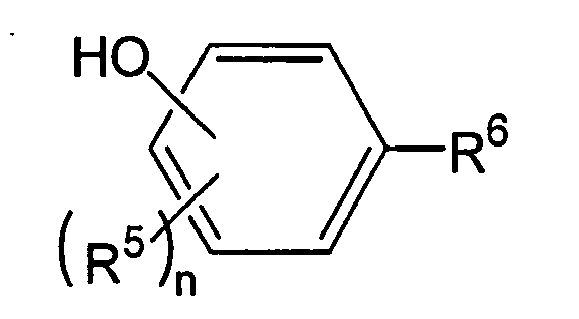
- In the above formula, R5 is an alkyl or alkoxy group. These groups may be the same as exemplified above. R6 designate an alkenyl group. Specific examples of the alkenyl group are vinyl groups, allyl groups, and butenyl groups, of which allyl groups are preferable. In the above formula, "n" is 0 or 1, and a preferable phenolic group is arylphenol or eugenol.
- The hydrosilylation reaction between the aforementioned organotrisiloxane and the phenolic group with an unsaturated aliphatic hydrocarbon group may be carried out with the use of a hydrosilylation catalyst. Such a catalyst may be exemplified by a platinum-type catalyst, rhodium-type catalyst, or a palladium-type catalyst, of which the platinum-type catalyst is preferable. The following are specific example of such platinum-type catalysts: platinum black, chloroplatinic acid, alcohol-modified chloroplatinic acid, platinum-olefin complex, platinum-alkenylsiloxane complex, or a platinum-carbonyl complex. The hydrosilylation reaction can be carried out at room temperature but for acceleration of the process the reaction can be carried out with heating. There are no special restrictions with regard to proportions in which the organotrisiloxane and phenolic compound can be used, but it may be recommend that a mole ratio of silicon-bonded hydrogen atoms contained in the organotrisiloxane to unsaturated aliphatic hydrocarbon groups contained in the phenolic compound be within the range of (1:1) to (1:10), preferably (1:1) to (1:3). If the aforementioned ratio is below the lower recommended limit, the target organotrisiloxane will be produced with a low yield, and if, on the other hand, the mole ratio exceeds the upper recommended limit, the product will contain a large amount of an unreacted phenolic compound, and, in some cases, this may lead to decrease in purity of the obtained organotrisiloxane.
- In the hydrosilylation reaction, attention has to be paid to the use of an organic solvent. An organic solvent suitable for the hydrosilylation reaction may be hexane, octane, or a similar aliphatic hydrocarbon; toluene, xylene, or a similar aromatic hydrocarbon; butyl acetate, ethyl acetate, or a similar ester; diethyl ether, dibutyl ether, dioxane, or a similar ether; acetone, methylethylketone, methylisobutylketone, cyclohexanone, or a similar ketone. Upon completion of the hydrosilylation reaction, the obtained organotrisiloxane is purified by removing the organic solvent and unreacted phenol compound by heating the reaction mixture under a reduced pressure.
- The curable resin composition of the invention is characterized by comprising: a curable resin and the aforementioned organotrisiloxane.
- There are no special restrictions with regard to a curable resin that constitutes one of the main components of the composition of the invention. The following are specific examples of such resins: an epoxy resin, phenolic resin, formaldehyde resin, xylene resin, xylene-formaldehyde resin, ketone-formaldehyde resin, furane resin, urea resin, imide resin, melamine resin, alkyd resin, unsaturated polyester resin, aniline resin, sulfonamide resin, or their copolymerizable organic resin; silicone-modified organic resins with organosilyl groups or organosiloxy groups partially bonded to the aforementioned curable organic resins; or a mixture of two or more of the aforementioned organic resins. Most preferable are epoxy resin, imide resin, or phenolic resin. There are no special restrictions with regard to the mechanism of curing of the aforementioned curable resin. For example, the resins can be cured by heating, radiation with ultraviolet rays, radiation with high-energy rays, or by holding in a humid air. Curing by heating is most preferable.
- The above-described curable resins can be combined with some arbitrary components, such as curing agents, curing accelerators, etc. The curing agents may be exemplified by carboxylic acids, sulfonic acids, or a similar organic acids, hydrates of the aforementioned acids, an organic hydroxyl compounds, organic silicon compounds that contain silanol groups, halogen groups, or the like, primary or secondary amino compounds, silicone resins that contain silanol groups, silicone oils that contain silanol groups, or combinations of two or more of the above compounds. The curing accelerators may be represented by tertiary amino compounds, organic metal salts, such as organic salts of aluminum, zirconium, etc., phosphines such as organic phosphates, heterocyclic amino compounds, complex boron compounds, organic ammonium salts, organic sulfonium salts, organic peroxides, hydrosilation catalysts, etc.
- As has been mentioned above, the above-described organotrisiloxane is a component that is used for protecting the composition of the invention from the loss of flowability prior to curing, as well as for improving tightness of contact and adhesion with respect to various substrates after curing. There are no special restrictions in regard to the amount in which the organotrisiloxane can be added. It is recommended, however, to add it in an amount of 0.01 to 100 parts by weight, preferably 0.1 to 50 parts by weight per 100 parts by weight of the curable resin that constitutes the main component. If the aforementioned organotrisiloxane is added in an amount smaller than the lower recommended limit, this will impair tightness of contact and adhesion of the obtained curable resin composition with respect to various substrates. If, on the other hand, the added amount of the organotrisiloxane exceeds the upper recommended limit, a cured body of the composition will have reduced mechanical characteristics.
- The composition of the invention may be compounded with various arbitrary components such as sensitizers, metal salts of higher fatty acids, ester-type waxes, plasticizers, flexibilizer, fillers, silane coupling agents, etc. The flexibility imparters can be represented by silicone oils and silicone rubbers. The fillers may be comprised of glass fibers, aluminum fibers, ceramic fibers having alumina and silica as their components, boron fibers, zirconia fibers, silicon carbide fibers, metal fibers, polyester fibers, aramid fibers, Nylon fibers, phenol fibers, natural animal and vegetable fibers, or other fibrous fillers, as well as powders of fused silica, precipitated silica, fumed silica, baked silica, zinc oxide, baked clay, carbon black, glass beads, alumina, talc, calcium carbonate, clay, aluminum hydroxide, barium sulfate, titanium dioxide, aluminum nitride, silicon carbide, magnesium oxide, beryllium oxide, kaolin, mica, zirconia, etc. The above fillers can be used in combinations of two or more. Silane coupling agents can be represented by vinyltrimethoxysilane, allyltrimethoxysilane, allyltriethoxysilane, 3-glycidoxypropyl-trimethoxysilane, 3-methacryloxypropyl-trimethoxysilane, 3-amonopropyl-triethoxysilane, and N-(2-aminoethyl)-3-aminopropyl-trimethoxysilane.
- The composition of the invention is prepared by uniformly mixing the aforementioned curable resin, organotrisiloxane, and, if necessary, other arbitrary components. There are no limitations with regard to methods of mixing. For example, the components can be mixed with the use of a single or biaxial mixer, two-roll mill, Ross mixer, or a kneader-mixer.
- A cured product of the invention is obtained by curing the curable resin composition described above. Since the obtained cured product has excellent adhesive properties, it can be used as a sealer, adhesive agent, or a coating material for parts of electronic and electrical devices.
- The organotrisiloxane of the invention, the method of manufacturing thereof, the curable resin composition of the invention, and the cured product will be further described in detail with reference to application and comparative examples. The appearance and viscosity of the curable resin composition, as well as the composite modulus of elasticity and adhesive properties of the cured product were evaluated by the methods described below.
- A curable resin composition was prepared without fine silica powder and curing accelerator (amine-type catalyst), and the appearance of the composition was visually observed after vacuum defoaming.
- Viscosity of the curable resin composition at 25°C was measured with the use of an E-type viscometer (the product of Tokimec, Inc., digital viscometer, Model DV-U-E Type II), under the following conditions: speed of rotation 2.5 rpm.
- After the curable resin composition was defoamed at 70 mmHg, it was loaded into a mold having a 10 mm-wide, 50 mm-long, and 2 mm-deep cavity, and after pressure curing for 60 min. under conditions of 150°C and 2.5 MPa was completed, the obtained cured specimen was subjected to secondary heat treatment in an oven for 2 hours at 180°C. The composite modulus of elasticity of the obtained specimen at 25°C was measured with the use of the ARES viscoelasticity tester (the product of Rheometric Scientific Co. , Model RDA 700). Measurement was carried out under the following conditions: twist 0.5%; frequency 1 Hz.
- The curable resin composition was applied in an amount of about 1 cm3 onto adherends {a glass plate (a float glass plate, the product of Paltec Co., Ltd.); an aluminum plate (A1050P, the product of Paltec Co., Ltd.); a nickel plate (SPCC-SB, the product of Paltec Co., Ltd.); a copper plate (C1100P, the product of Paltec Co., Ltd.); a gold-plated plate (C2801P, the product of Nippon Test Panel Co., Ltd.); a polyimide film (Upilex, the product of Ube Industries Co., Ltd.,
thickness 125 µm)}. The units were heated in an oven for 2 hours at 125°C and then in an oven for another 2 hours at 180°C. As a result, specimens for evaluating adhesive properties were produced. The cured coatings were separated from the specimens by mean of a dental spatula, and the separation conditions were designated as follows: - CF: separation with fracture of the coating material,
- TCF: separation with a thin residual layer left on the interface,
- AF: complete separation through interface.
- A four-neck flask equipped with a stirrer was filled with 81.3 g (0.24 mol) of 1,1,5,5-tetramethyl-3,3-diphenyltrisiloxane, 100 g of toluene, and 0.025 g of a platinum-1,3-divinyl-1,1,3,3-tetramethyldisiloxane complex (concentration of metal platinum was 4 wt.%). The contents were heated to 80°C, and 79.1 g (0.59 mol) of 2-allylphenol were added dropwise. A reaction was carried out for 2 hours at 120°C. After the reaction mixture was stripped under a reduced pressure, 142.6 g of a brown liquid having a viscosity of 3,500 mPa·s were produced with yield of 96.8%. 13C-Nuclear Magnetic Resonance Analysis (hereinafter referred to as NMR analysis) and 29Si-NMR analysis showed that the product was an organotrisiloxane represented by the following formula:

- A four-neck flask equipped with a stirrer was filled with 287.4 g (0.86 mol) of 1,1,5,5-tetramethyl-3,3-diphenyltrisiloxane, 160 g of toluene, and 0.06 g of a platinum-1,3-divinyl-1,1,3,3-tetramethyldisiloxane complex (concentration of metal platinum was 4 wt.%). The contents were heated to 80°C, and 312.6 g (1.90 mol) of eugenol were added dropwise. A reaction was carried out for 2 hours at 120°C. After the reaction mixture was stripped under a reduced pressure, 564 g of a brown transparent liquid having a viscosity of 2,700 mPa·s were produced with yield of 98.7%. 13C-NMR and 29Si-NMR analyses showed that the product was an organotrisiloxane represented by the following formula:

- A curable epoxy resin composition was prepared by uniformly mixing 16.0 parts by weight of a liquid bisphenol A type epoxy resin (Epikote 828, the product of Japan Epoxy Resin Co., Ltd.; epoxy equivalent =190), 22.0 parts by weight of the trisiloxane obtained in Application Example 1, 1.0 part by weight of a capsule type amine catalyst (HX-3088, the product of Asahi Chemical Industry Co., Ltd., amine catalyst content = 40 wt.%), 60.0 parts by weight of a fine spherical amorphous silica powder (Admafine, the product of Admatechs Co., Inc. ; average particle diameter = 1.5 µm), and 1 part by weight of 3-glycidoxypropyl-trimethoxysilane. Results of evaluation of the appearance and viscosity of the obtained curable epoxy resin composition as well as the composite modulus of elasticity and adhesive properties measured in a cured body are given in Table 1.
- A curable epoxy resin composition was prepared by uniformly mixing 16.0 parts by weight of a liquid bisphenol A type epoxy resin (Epikote 828, the product of Japan Epoxy Resin Co., Ltd.; epoxy equivalent =190), 22.0 parts by weight of the trisiloxane obtained in Application Example 2, 1.0 part by weight of a capsule type amine catalyst (HX-3088, the product of Asahi Chemical Industry Co., Ltd. , amine catalyst content = 40 wt.%), 60.0 parts by weight of a fine spherical amorphous silica powder (Admafine, the product of Admatechs Co., Inc., average particle diameter =1.5 µm), and 1 part by weight of 3-glycidoxypropyl-trimethoxysilane. Results of evaluation of the appearance and viscosity of the obtained curable epoxy resin composition as well as the composite modulus of elasticity and adhesive properties measured in a cured body are given in Table 1.
- A curable epoxy resin composition was prepared by uniformly mixing 9.0 parts by weight of a liquid bisphenol A type epoxy resin (Epikote 828, the product of Japan Epoxy Resin Co., Ltd.; epoxy equivalent =190), 29.0 parts by weight of a polydimethylsiloxane represented by the following average structural formula:

- A curable epoxy resin composition was prepared by uniformly mixing 19.0 parts by weight of a liquid bisphenol A type epoxy resin (Epikote 828, the product of Japan Epoxy Resin Co., Ltd.; epoxy equivalent =190), 19.0 parts by weight of a disiloxane represented by the following average structural formula:

- A curable epoxy resin composition was prepared by uniformly mixing 22.0 parts by weight of a liquid bisphenol A type epoxy resin (Epikote 828, the product of Japan Epoxy Resin Co., Ltd.; epoxy equivalent = 190), 16.0 parts by weight of a liquid phenol-novolac resin (MEH8000, the product of Meiwa Plastic Ind., Ltd.; hydroxyl group equivalent = 141), 1.0 part by weight of a capsule type amine catalyst (HX-3088, the product of Asahi Chemical Industry Co., Ltd., amine catalyst content = 40 wt.%), 60.0 parts by weight of a fine spherical amorphous silica powder (Admafine, the product of Adomatechs Co., Inc.; average particle diameter = 1.5 µm), and 1 part by weight of 3-glycidoxypropyl-trimehoxysilane. Results of evaluation of the appearance and viscosity of the obtained curable epoxy resin composition as well as the composite modulus of elasticity and adhesive properties measured in a cured body are given in Table 1.
-
[Table 1] Examples Application Examples (Present Invention) Comparative Examples Characteristics 3 4 1 2 3 Appearance Compatible Compatible White · turbidity (Separation) Compatible Compatible Viscosity (Pa·s) 148 104 171 65 200 Composite Modulus of Elasticity (MPa) 2160 1950 80* 1580 2900 Adhesive Properties Glass plate CF CF CF CF CF Nickel CF CF CF CF CF Copper CF CF CF CF CF Aluminum CF CF CF CF CF Gold CF CF CF CF CF Polyimide resin CF CF CF CF CF *Oil bleed is noted on the surfaces cured products; non-uniform properties. - The organotrisiloxane of the present invention demonstrated good dispersibility in curable resins, imparted low viscosity to curable resin compositions, and made it possible to produce a cured product with good composite modulus of elasticity and high adhesive strength to various substrates.
- Since the organotrisiloxane of the present invention possesses good reactivity and excellent dispersibility and compatibility with respect to epoxy resins or similar curable resins, it can be used as an agent for improving properties of curable epoxy or similar curable resins. The composition of the invention demonstrates good curability and tight adherence to substrates. Therefore, the composition is suitable for use as a sealing, adhesive, or coating agent for parts of electronic and electrical devices.
Claims (10)
- An organotrisiloxane represented by the following general formula:

- The organotrisiloxane of Claim 1, wherein R1 in the above formula is a methyl group.
- The organotrisiloxane of Claim 1, wherein R2 in the above formula is a phenyl group.
- The organotrisiloxane of Claim 1, wherein R3 in the above formula is a phenolic hydroxyl group containing organic group represented by the following general formula:

- A method of manufacturing the organotrisiloxane of Claim 1, characterized by carrying out a hydrosilylation reaction between a phenolic compound that contains an aliphatically unsaturated hydrocarbon group and an organotrisiloxane represented by the following general formula:

- The method of manufacturing the organotrisiloxane of Claim 5, wherein said phenolic compound is represented by the following general formula:
- A curable resin composition comprising: a curable resin and the organotrisiloxane as claimed in any of Claims 1 to 4.
- The curable resin composition of Claim 7, wherein the curable resin is an epoxy resin, imide resin, or a phenol resin.
- The curable resin composition of Claim 7, wherein the content of said organotrisiloxane is within the range of 0.01 to 100 parts by weight per 100 parts by weight of said curable resin.
- A cured product obtained by curing the curable resin composition of Claim 7.
Applications Claiming Priority (2)
| Application Number | Priority Date | Filing Date | Title |
|---|---|---|---|
| JP2005072394A JP4875312B2 (en) | 2005-03-15 | 2005-03-15 | Organotrisiloxane, method for producing the same, curable resin composition containing the same, and cured product thereof |
| PCT/JP2006/305637 WO2006098491A1 (en) | 2005-03-15 | 2006-03-15 | Organotrisiloxane, preparation and use in curable resin composition |
Publications (2)
| Publication Number | Publication Date |
|---|---|
| EP1858905A1 EP1858905A1 (en) | 2007-11-28 |
| EP1858905B1 true EP1858905B1 (en) | 2011-05-18 |
Family
ID=36579087
Family Applications (1)
| Application Number | Title | Priority Date | Filing Date |
|---|---|---|---|
| EP06729604A Expired - Lifetime EP1858905B1 (en) | 2005-03-15 | 2006-03-15 | Organotrisiloxane, its preparation and its use in curable resin composition |
Country Status (7)
| Country | Link |
|---|---|
| US (1) | US20090234078A1 (en) |
| EP (1) | EP1858905B1 (en) |
| JP (1) | JP4875312B2 (en) |
| KR (1) | KR101261252B1 (en) |
| CN (1) | CN101142222B (en) |
| TW (1) | TW200635937A (en) |
| WO (1) | WO2006098491A1 (en) |
Families Citing this family (4)
| Publication number | Priority date | Publication date | Assignee | Title |
|---|---|---|---|---|
| WO2009035906A2 (en) * | 2007-09-11 | 2009-03-19 | Dow Corning Corporation | Composite, thermal interface material containing the composite, and methods for their preparation and use |
| CN101803010B (en) * | 2007-09-11 | 2014-01-29 | 陶氏康宁公司 | Thermal interface material, electronic device containing the thermal interface material, and methods for their preparation and use |
| US8497338B2 (en) * | 2011-10-31 | 2013-07-30 | Momentive Performance Materials Inc. | Process of manufacturing organosilicon products with improved quality using heterogeneous precious metal catalysts |
| TWI881059B (en) * | 2020-03-17 | 2025-04-21 | 日商信越化學工業股份有限公司 | Silicone coating compositions and articles |
Family Cites Families (17)
| Publication number | Priority date | Publication date | Assignee | Title |
|---|---|---|---|---|
| US4430235A (en) * | 1981-07-17 | 1984-02-07 | Union Carbide Corporation | Polymeric antioxidants |
| JPH02117682A (en) * | 1988-10-27 | 1990-05-02 | Sumitomo Bakelite Co Ltd | Method for producing 1,3-bis(hydroxyphenyl)disiloxane derivative |
| JPH0320324A (en) * | 1989-02-03 | 1991-01-29 | Sumitomo Durez Co Ltd | Silicone-modified epoxy resin |
| US5206312A (en) * | 1989-11-20 | 1993-04-27 | The Dow Chemical Company | Aromatic hydroxyl-containing compounds containing organosiloxane moieties, epoxy compounds and cured products thereof |
| JP3059776B2 (en) * | 1991-05-27 | 2000-07-04 | 東レ・ダウコーニング・シリコーン株式会社 | Method for producing silicone rubber powder |
| US5645941A (en) * | 1992-11-19 | 1997-07-08 | Shin-Etsu Chemical Co., Ltd. | Silicone resin/silicone rubber composite material |
| JP3318408B2 (en) * | 1993-10-06 | 2002-08-26 | 東レ・ダウコーニング・シリコーン株式会社 | Powdered silicone cured product and method for producing the same |
| TW343218B (en) * | 1994-03-25 | 1998-10-21 | Shinetsu Chem Ind Co | Integral composite consisted of polysiloxane rubber and epoxy resin and process for producing the same |
| TW296400B (en) * | 1994-11-17 | 1997-01-21 | Shinetsu Chem Ind Co | |
| JPH09151253A (en) * | 1995-11-29 | 1997-06-10 | Toray Dow Corning Silicone Co Ltd | Heat-resistant agent for organopolysiloxane and heat-resistant organopolysiloxane composition |
| US5604039A (en) * | 1996-01-22 | 1997-02-18 | Eastman Kodak Company | Thermally stable release agents |
| US5859127A (en) * | 1996-11-29 | 1999-01-12 | Shin-Etsu Polymer Co., Ltd. | Thermosetting resin composition and two-parts composite body thereof with silcone rubber |
| US6861482B2 (en) * | 1999-05-18 | 2005-03-01 | General Electric Company | Weatherable, thermostable polymers having improved flow composition |
| US7169859B2 (en) * | 1999-05-18 | 2007-01-30 | General Electric Company | Weatherable, thermostable polymers having improved flow composition |
| JP2002020719A (en) * | 2000-07-11 | 2002-01-23 | Shin Etsu Chem Co Ltd | Silicone rubber adhesive composition and integrally molded article of the adhesive composition and thermoplastic resin |
| US6709756B2 (en) * | 2001-05-21 | 2004-03-23 | Shin-Etsu Chemical Co., Ltd. | Optical device-related adhesive and optical device |
| US6630525B2 (en) * | 2001-10-09 | 2003-10-07 | General Electric Company | Polycarbonate-siloxane copolymers |
-
2005
- 2005-03-15 JP JP2005072394A patent/JP4875312B2/en not_active Expired - Fee Related
-
2006
- 2006-03-01 TW TW095106725A patent/TW200635937A/en unknown
- 2006-03-15 WO PCT/JP2006/305637 patent/WO2006098491A1/en not_active Ceased
- 2006-03-15 US US11/908,587 patent/US20090234078A1/en not_active Abandoned
- 2006-03-15 EP EP06729604A patent/EP1858905B1/en not_active Expired - Lifetime
- 2006-03-15 KR KR1020077021083A patent/KR101261252B1/en not_active Expired - Fee Related
- 2006-03-15 CN CN2006800082679A patent/CN101142222B/en not_active Expired - Fee Related
Also Published As
| Publication number | Publication date |
|---|---|
| EP1858905A1 (en) | 2007-11-28 |
| TW200635937A (en) | 2006-10-16 |
| KR20070112388A (en) | 2007-11-23 |
| JP4875312B2 (en) | 2012-02-15 |
| WO2006098491A1 (en) | 2006-09-21 |
| US20090234078A1 (en) | 2009-09-17 |
| JP2006256970A (en) | 2006-09-28 |
| KR101261252B1 (en) | 2013-05-07 |
| CN101142222A (en) | 2008-03-12 |
| CN101142222B (en) | 2011-03-30 |
Similar Documents
| Publication | Publication Date | Title |
|---|---|---|
| EP2201068B1 (en) | Curable silicone composition and cured product thereof | |
| EP1874869B1 (en) | Curable silicone composition and cured product therefrom | |
| JP4799848B2 (en) | Curable silicone composition and cured product thereof | |
| CN106103594B (en) | Silicone Gel Composition | |
| CN101616994A (en) | curable silicone composition | |
| EP1874870B1 (en) | Curable silicone composition and electronic components | |
| US8263723B2 (en) | Organopolysiloxane, method of manufacturing thereof, curable silicone composition, and cured product thereof | |
| EP2079802B1 (en) | Curable silicone composition and cured body thereof | |
| CN109796595B (en) | High-refractive-index phenolic hydroxyl-containing organic silicon tackifier and preparation method thereof | |
| US20090234078A1 (en) | Organotrisiloxane, Preparation And Use In Curable Resin Composition | |
| WO2005063843A1 (en) | Curing silicone composition and cured product thereof | |
| EP2066734B1 (en) | Diorganopolysiloxane and method of manufacturing thereof | |
| WO2025018067A1 (en) | Organically modified silicone resin composition for die bonding, cured product thereof, and optical semiconductor element |
Legal Events
| Date | Code | Title | Description |
|---|---|---|---|
| PUAI | Public reference made under article 153(3) epc to a published international application that has entered the european phase |
Free format text: ORIGINAL CODE: 0009012 |
|
| 17P | Request for examination filed |
Effective date: 20070912 |
|
| AK | Designated contracting states |
Kind code of ref document: A1 Designated state(s): AT BE BG CH CY CZ DE DK EE ES FI FR GB GR HU IE IS IT LI LT LU LV MC NL PL PT RO SE SI SK TR |
|
| DAX | Request for extension of the european patent (deleted) | ||
| 17Q | First examination report despatched |
Effective date: 20071219 |
|
| GRAP | Despatch of communication of intention to grant a patent |
Free format text: ORIGINAL CODE: EPIDOSNIGR1 |
|
| GRAS | Grant fee paid |
Free format text: ORIGINAL CODE: EPIDOSNIGR3 |
|
| GRAA | (expected) grant |
Free format text: ORIGINAL CODE: 0009210 |
|
| AK | Designated contracting states |
Kind code of ref document: B1 Designated state(s): AT BE BG CH CY CZ DE DK EE ES FI FR GB GR HU IE IS IT LI LT LU LV MC NL PL PT RO SE SI SK TR |
|
| REG | Reference to a national code |
Ref country code: GB Ref legal event code: FG4D |
|
| REG | Reference to a national code |
Ref country code: CH Ref legal event code: EP |
|
| REG | Reference to a national code |
Ref country code: IE Ref legal event code: FG4D |
|
| REG | Reference to a national code |
Ref country code: DE Ref legal event code: R096 Ref document number: 602006022033 Country of ref document: DE Effective date: 20110630 |
|
| REG | Reference to a national code |
Ref country code: NL Ref legal event code: VDEP Effective date: 20110518 |
|
| PG25 | Lapsed in a contracting state [announced via postgrant information from national office to epo] |
Ref country code: LT Free format text: LAPSE BECAUSE OF FAILURE TO SUBMIT A TRANSLATION OF THE DESCRIPTION OR TO PAY THE FEE WITHIN THE PRESCRIBED TIME-LIMIT Effective date: 20110518 Ref country code: SE Free format text: LAPSE BECAUSE OF FAILURE TO SUBMIT A TRANSLATION OF THE DESCRIPTION OR TO PAY THE FEE WITHIN THE PRESCRIBED TIME-LIMIT Effective date: 20110518 Ref country code: PT Free format text: LAPSE BECAUSE OF FAILURE TO SUBMIT A TRANSLATION OF THE DESCRIPTION OR TO PAY THE FEE WITHIN THE PRESCRIBED TIME-LIMIT Effective date: 20110919 |
|
| PG25 | Lapsed in a contracting state [announced via postgrant information from national office to epo] |
Ref country code: AT Free format text: LAPSE BECAUSE OF FAILURE TO SUBMIT A TRANSLATION OF THE DESCRIPTION OR TO PAY THE FEE WITHIN THE PRESCRIBED TIME-LIMIT Effective date: 20110518 Ref country code: SI Free format text: LAPSE BECAUSE OF FAILURE TO SUBMIT A TRANSLATION OF THE DESCRIPTION OR TO PAY THE FEE WITHIN THE PRESCRIBED TIME-LIMIT Effective date: 20110518 Ref country code: CY Free format text: LAPSE BECAUSE OF FAILURE TO SUBMIT A TRANSLATION OF THE DESCRIPTION OR TO PAY THE FEE WITHIN THE PRESCRIBED TIME-LIMIT Effective date: 20110518 Ref country code: IS Free format text: LAPSE BECAUSE OF FAILURE TO SUBMIT A TRANSLATION OF THE DESCRIPTION OR TO PAY THE FEE WITHIN THE PRESCRIBED TIME-LIMIT Effective date: 20110918 Ref country code: GR Free format text: LAPSE BECAUSE OF FAILURE TO SUBMIT A TRANSLATION OF THE DESCRIPTION OR TO PAY THE FEE WITHIN THE PRESCRIBED TIME-LIMIT Effective date: 20110819 Ref country code: BE Free format text: LAPSE BECAUSE OF FAILURE TO SUBMIT A TRANSLATION OF THE DESCRIPTION OR TO PAY THE FEE WITHIN THE PRESCRIBED TIME-LIMIT Effective date: 20110518 Ref country code: LV Free format text: LAPSE BECAUSE OF FAILURE TO SUBMIT A TRANSLATION OF THE DESCRIPTION OR TO PAY THE FEE WITHIN THE PRESCRIBED TIME-LIMIT Effective date: 20110518 Ref country code: FI Free format text: LAPSE BECAUSE OF FAILURE TO SUBMIT A TRANSLATION OF THE DESCRIPTION OR TO PAY THE FEE WITHIN THE PRESCRIBED TIME-LIMIT Effective date: 20110518 Ref country code: ES Free format text: LAPSE BECAUSE OF FAILURE TO SUBMIT A TRANSLATION OF THE DESCRIPTION OR TO PAY THE FEE WITHIN THE PRESCRIBED TIME-LIMIT Effective date: 20110829 |
|
| PG25 | Lapsed in a contracting state [announced via postgrant information from national office to epo] |
Ref country code: NL Free format text: LAPSE BECAUSE OF FAILURE TO SUBMIT A TRANSLATION OF THE DESCRIPTION OR TO PAY THE FEE WITHIN THE PRESCRIBED TIME-LIMIT Effective date: 20110518 |
|
| PG25 | Lapsed in a contracting state [announced via postgrant information from national office to epo] |
Ref country code: EE Free format text: LAPSE BECAUSE OF FAILURE TO SUBMIT A TRANSLATION OF THE DESCRIPTION OR TO PAY THE FEE WITHIN THE PRESCRIBED TIME-LIMIT Effective date: 20110518 Ref country code: CZ Free format text: LAPSE BECAUSE OF FAILURE TO SUBMIT A TRANSLATION OF THE DESCRIPTION OR TO PAY THE FEE WITHIN THE PRESCRIBED TIME-LIMIT Effective date: 20110518 |
|
| PG25 | Lapsed in a contracting state [announced via postgrant information from national office to epo] |
Ref country code: RO Free format text: LAPSE BECAUSE OF FAILURE TO SUBMIT A TRANSLATION OF THE DESCRIPTION OR TO PAY THE FEE WITHIN THE PRESCRIBED TIME-LIMIT Effective date: 20110518 Ref country code: PL Free format text: LAPSE BECAUSE OF FAILURE TO SUBMIT A TRANSLATION OF THE DESCRIPTION OR TO PAY THE FEE WITHIN THE PRESCRIBED TIME-LIMIT Effective date: 20110518 Ref country code: SK Free format text: LAPSE BECAUSE OF FAILURE TO SUBMIT A TRANSLATION OF THE DESCRIPTION OR TO PAY THE FEE WITHIN THE PRESCRIBED TIME-LIMIT Effective date: 20110518 Ref country code: DK Free format text: LAPSE BECAUSE OF FAILURE TO SUBMIT A TRANSLATION OF THE DESCRIPTION OR TO PAY THE FEE WITHIN THE PRESCRIBED TIME-LIMIT Effective date: 20110518 |
|
| PLBE | No opposition filed within time limit |
Free format text: ORIGINAL CODE: 0009261 |
|
| STAA | Information on the status of an ep patent application or granted ep patent |
Free format text: STATUS: NO OPPOSITION FILED WITHIN TIME LIMIT |
|
| 26N | No opposition filed |
Effective date: 20120221 |
|
| PGFP | Annual fee paid to national office [announced via postgrant information from national office to epo] |
Ref country code: FR Payment date: 20120319 Year of fee payment: 7 |
|
| PG25 | Lapsed in a contracting state [announced via postgrant information from national office to epo] |
Ref country code: IT Free format text: LAPSE BECAUSE OF FAILURE TO SUBMIT A TRANSLATION OF THE DESCRIPTION OR TO PAY THE FEE WITHIN THE PRESCRIBED TIME-LIMIT Effective date: 20110518 |
|
| REG | Reference to a national code |
Ref country code: DE Ref legal event code: R097 Ref document number: 602006022033 Country of ref document: DE Effective date: 20120221 |
|
| PGFP | Annual fee paid to national office [announced via postgrant information from national office to epo] |
Ref country code: GB Payment date: 20120314 Year of fee payment: 7 |
|
| PG25 | Lapsed in a contracting state [announced via postgrant information from national office to epo] |
Ref country code: MC Free format text: LAPSE BECAUSE OF NON-PAYMENT OF DUE FEES Effective date: 20120331 |
|
| REG | Reference to a national code |
Ref country code: CH Ref legal event code: PL |
|
| REG | Reference to a national code |
Ref country code: IE Ref legal event code: MM4A |
|
| PG25 | Lapsed in a contracting state [announced via postgrant information from national office to epo] |
Ref country code: CH Free format text: LAPSE BECAUSE OF NON-PAYMENT OF DUE FEES Effective date: 20120331 Ref country code: IE Free format text: LAPSE BECAUSE OF NON-PAYMENT OF DUE FEES Effective date: 20120315 Ref country code: LI Free format text: LAPSE BECAUSE OF NON-PAYMENT OF DUE FEES Effective date: 20120331 |
|
| PG25 | Lapsed in a contracting state [announced via postgrant information from national office to epo] |
Ref country code: BG Free format text: LAPSE BECAUSE OF FAILURE TO SUBMIT A TRANSLATION OF THE DESCRIPTION OR TO PAY THE FEE WITHIN THE PRESCRIBED TIME-LIMIT Effective date: 20110818 |
|
| GBPC | Gb: european patent ceased through non-payment of renewal fee |
Effective date: 20130315 |
|
| REG | Reference to a national code |
Ref country code: FR Ref legal event code: ST Effective date: 20131129 |
|
| PG25 | Lapsed in a contracting state [announced via postgrant information from national office to epo] |
Ref country code: FR Free format text: LAPSE BECAUSE OF NON-PAYMENT OF DUE FEES Effective date: 20130402 Ref country code: GB Free format text: LAPSE BECAUSE OF NON-PAYMENT OF DUE FEES Effective date: 20130315 |
|
| REG | Reference to a national code |
Ref country code: DE Ref legal event code: R082 Ref document number: 602006022033 Country of ref document: DE Representative=s name: FLEISCHER, ENGELS & PARTNER MBB, PATENTANWAELT, DE |
|
| PG25 | Lapsed in a contracting state [announced via postgrant information from national office to epo] |
Ref country code: TR Free format text: LAPSE BECAUSE OF FAILURE TO SUBMIT A TRANSLATION OF THE DESCRIPTION OR TO PAY THE FEE WITHIN THE PRESCRIBED TIME-LIMIT Effective date: 20110518 |
|
| PG25 | Lapsed in a contracting state [announced via postgrant information from national office to epo] |
Ref country code: LU Free format text: LAPSE BECAUSE OF NON-PAYMENT OF DUE FEES Effective date: 20120315 |
|
| PG25 | Lapsed in a contracting state [announced via postgrant information from national office to epo] |
Ref country code: HU Free format text: LAPSE BECAUSE OF FAILURE TO SUBMIT A TRANSLATION OF THE DESCRIPTION OR TO PAY THE FEE WITHIN THE PRESCRIBED TIME-LIMIT Effective date: 20060315 |
|
| PGFP | Annual fee paid to national office [announced via postgrant information from national office to epo] |
Ref country code: DE Payment date: 20150310 Year of fee payment: 10 |
|
| REG | Reference to a national code |
Ref country code: DE Ref legal event code: R119 Ref document number: 602006022033 Country of ref document: DE |
|
| PG25 | Lapsed in a contracting state [announced via postgrant information from national office to epo] |
Ref country code: DE Free format text: LAPSE BECAUSE OF NON-PAYMENT OF DUE FEES Effective date: 20161001 |