EP1857485A1 - Ring-opening polymerization method and activated carbon catalyst for ring-opening polymerization - Google Patents
Ring-opening polymerization method and activated carbon catalyst for ring-opening polymerization Download PDFInfo
- Publication number
- EP1857485A1 EP1857485A1 EP06712996A EP06712996A EP1857485A1 EP 1857485 A1 EP1857485 A1 EP 1857485A1 EP 06712996 A EP06712996 A EP 06712996A EP 06712996 A EP06712996 A EP 06712996A EP 1857485 A1 EP1857485 A1 EP 1857485A1
- Authority
- EP
- European Patent Office
- Prior art keywords
- ring
- opening polymerization
- activated carbon
- compound
- group
- Prior art date
- Legal status (The legal status is an assumption and is not a legal conclusion. Google has not performed a legal analysis and makes no representation as to the accuracy of the status listed.)
- Granted
Links
Classifications
-
- C—CHEMISTRY; METALLURGY
- C08—ORGANIC MACROMOLECULAR COMPOUNDS; THEIR PREPARATION OR CHEMICAL WORKING-UP; COMPOSITIONS BASED THEREON
- C08G—MACROMOLECULAR COMPOUNDS OBTAINED OTHERWISE THAN BY REACTIONS ONLY INVOLVING UNSATURATED CARBON-TO-CARBON BONDS
- C08G59/00—Polycondensates containing more than one epoxy group per molecule; Macromolecules obtained by polymerising compounds containing more than one epoxy group per molecule using curing agents or catalysts which react with the epoxy groups
- C08G59/18—Macromolecules obtained by polymerising compounds containing more than one epoxy group per molecule using curing agents or catalysts which react with the epoxy groups ; e.g. general methods of curing
- C08G59/68—Macromolecules obtained by polymerising compounds containing more than one epoxy group per molecule using curing agents or catalysts which react with the epoxy groups ; e.g. general methods of curing characterised by the catalysts used
-
- B—PERFORMING OPERATIONS; TRANSPORTING
- B01—PHYSICAL OR CHEMICAL PROCESSES OR APPARATUS IN GENERAL
- B01J—CHEMICAL OR PHYSICAL PROCESSES, e.g. CATALYSIS OR COLLOID CHEMISTRY; THEIR RELEVANT APPARATUS
- B01J21/00—Catalysts comprising the elements, oxides, or hydroxides of magnesium, boron, aluminium, carbon, silicon, titanium, zirconium, or hafnium
- B01J21/18—Carbon
-
- C—CHEMISTRY; METALLURGY
- C08—ORGANIC MACROMOLECULAR COMPOUNDS; THEIR PREPARATION OR CHEMICAL WORKING-UP; COMPOSITIONS BASED THEREON
- C08G—MACROMOLECULAR COMPOUNDS OBTAINED OTHERWISE THAN BY REACTIONS ONLY INVOLVING UNSATURATED CARBON-TO-CARBON BONDS
- C08G59/00—Polycondensates containing more than one epoxy group per molecule; Macromolecules obtained by polymerising compounds containing more than one epoxy group per molecule using curing agents or catalysts which react with the epoxy groups
-
- C—CHEMISTRY; METALLURGY
- C08—ORGANIC MACROMOLECULAR COMPOUNDS; THEIR PREPARATION OR CHEMICAL WORKING-UP; COMPOSITIONS BASED THEREON
- C08G—MACROMOLECULAR COMPOUNDS OBTAINED OTHERWISE THAN BY REACTIONS ONLY INVOLVING UNSATURATED CARBON-TO-CARBON BONDS
- C08G59/00—Polycondensates containing more than one epoxy group per molecule; Macromolecules obtained by polymerising compounds containing more than one epoxy group per molecule using curing agents or catalysts which react with the epoxy groups
- C08G59/14—Polycondensates modified by chemical after-treatment
- C08G59/1433—Polycondensates modified by chemical after-treatment with organic low-molecular-weight compounds
- C08G59/1438—Polycondensates modified by chemical after-treatment with organic low-molecular-weight compounds containing oxygen
- C08G59/1455—Monocarboxylic acids, anhydrides, halides, or low-molecular-weight esters thereof
-
- C—CHEMISTRY; METALLURGY
- C08—ORGANIC MACROMOLECULAR COMPOUNDS; THEIR PREPARATION OR CHEMICAL WORKING-UP; COMPOSITIONS BASED THEREON
- C08G—MACROMOLECULAR COMPOUNDS OBTAINED OTHERWISE THAN BY REACTIONS ONLY INVOLVING UNSATURATED CARBON-TO-CARBON BONDS
- C08G59/00—Polycondensates containing more than one epoxy group per molecule; Macromolecules obtained by polymerising compounds containing more than one epoxy group per molecule using curing agents or catalysts which react with the epoxy groups
- C08G59/18—Macromolecules obtained by polymerising compounds containing more than one epoxy group per molecule using curing agents or catalysts which react with the epoxy groups ; e.g. general methods of curing
-
- C—CHEMISTRY; METALLURGY
- C08—ORGANIC MACROMOLECULAR COMPOUNDS; THEIR PREPARATION OR CHEMICAL WORKING-UP; COMPOSITIONS BASED THEREON
- C08G—MACROMOLECULAR COMPOUNDS OBTAINED OTHERWISE THAN BY REACTIONS ONLY INVOLVING UNSATURATED CARBON-TO-CARBON BONDS
- C08G65/00—Macromolecular compounds obtained by reactions forming an ether link in the main chain of the macromolecule
- C08G65/02—Macromolecular compounds obtained by reactions forming an ether link in the main chain of the macromolecule from cyclic ethers by opening of the heterocyclic ring
- C08G65/04—Macromolecular compounds obtained by reactions forming an ether link in the main chain of the macromolecule from cyclic ethers by opening of the heterocyclic ring from cyclic ethers only
- C08G65/06—Cyclic ethers having no atoms other than carbon and hydrogen outside the ring
- C08G65/08—Saturated oxiranes
- C08G65/10—Saturated oxiranes characterised by the catalysts used
Definitions
- the present invention relates to a process for ring-opening polymerization using an activated carbon as a catalyst, and a catalyst for ring-opening polymerization.
- Ring-opening polymerization is a polymerization process in which polymerization proceeds as a result of ring opening of a cyclic compound as a monomer to synthetically yield a polymer.
- Industrially important synthetic polymers such as nylons (polyamides), polyesters, polyethers, polyethyleneimines, and polysiloxanes are now produced through ring-opening polymerization.
- a catalyst In general, a catalyst must be added to a reaction system so as to develop ring-opening polymerization.
- the catalyst herein acts upon the cyclic compound and accelerates its ring-opening reaction.
- catalysts for cation-reactive monomers such as cyclic ethers, cyclic formals, and cyclic imines include Lewis acids such as BF 3 ⁇ O(C 2 H 5 ) 2 , SnCl 4 , and AlCl 3 ; alkyl halides such as alkyl chlorides and alkyl bromides; super strong acids such as CF 3 SO 3 H; esters of super strong acids, such as CF 3 SO 3 R, wherein R represents an alkyl group; and cation salts such as R 3 C + PF 6 - and R 3 O + BF 4 - , wherein R represents an alkyl group.
- Catalysts for anion-reactive monomers such as cyclic siloxanes, lactams, and acid anhydrides include Li, Na, K, RCOONa, RONa, and R 2 NLi, wherein R represents an alkyl group.
- a catalyst for a fluorooxetane there is disclosed an alkali metal fluoride supported on a support such as an activated carbon. In this catalyst, however, the active site is the alkali metal fluoride, and the activated carbon only plays a role as a support (Patent Document 1).
- Catalysts for coordinate anion-reactive monomers such as cyclic ethers and lactones include, for example, (C 2 H 5 ) 2 Zn-H 2 O, (C 2 H 5 ) 2 Zn-ROH, and AlR 3 -acetylacetone-H 2 O, wherein R represents an alkyl group; and those for metathesis reactive monomers such as cyclic olefins include MoCl 5 and WC1 6 .
- activated carbons have been known to be used as adsorbents and supports for solid catalysts but have not yet been known to be usable, if used alone, as catalysts for ring-opening polymerization.
- Patent Document 1 Japanese Examined Patent Application Publication No. 1-49340 (Claim 5)
- an object of the present invention is to provide a process for ring-opening polymerization using a catalyst that has an excellent catalytic activity, does not cause side reactions, is separated from a produced polymer through filtration, thereby does not remain in the polymer, and does not cause deterioration in safety and performance of the polymer.
- Another object of the present invention is to provide a catalyst for use in the polymerization process.
- a process for ring-opening polymerization that proceeds through ring opening of at least one cyclic compound (A) as a monomer.
- This process includes the step of using an activated carbon as a catalyst.
- the activated carbon includes a powdered activated carbon.
- a process for ring-opening polymerization according to the first embodiment in which the ring-opening polymerization is ring-opening homopolymerization of one cyclic compound (A) or ring-opening copolymerization of two or more different cyclic compounds (A).
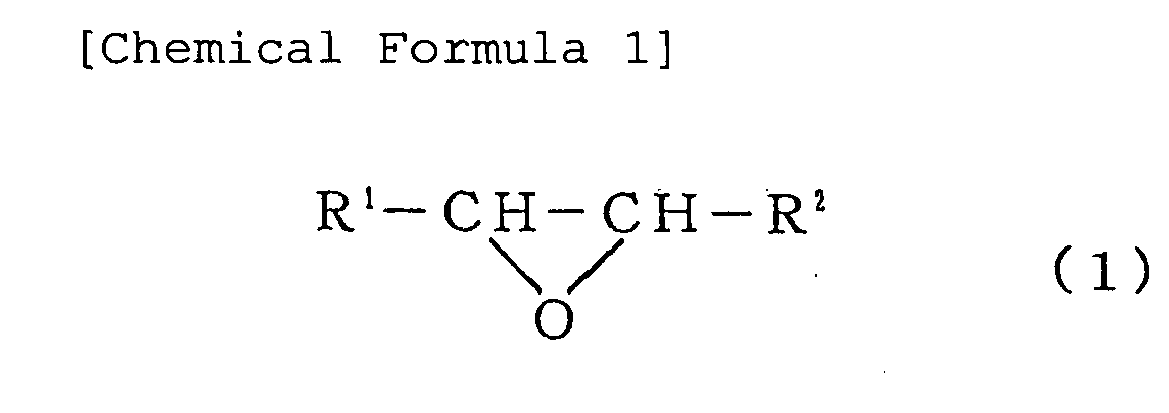
- a process for ring-opening polymerization according to any one of the first, second, and third embodiments, in which the cyclic compound (A) includes an oxirane compound (a) represented by following General Formula (1): wherein R 1 and R 2 may be the same as or different from each other and each represent one selected from the group consisting of hydrogen (H); a branched- or straight-chain alkyl group having one to thirty carbon atoms or an aryl group; and a functional group represented by -CH 2 -M, wherein M represents OH, F, Cl, Br, or -OR 3 , wherein R 3 represents an alkyl group having one to twenty carbon atoms, allyl group, or an aryl group.
- R 1 and R 2 may be the same as or different from each other and each represent one selected from the group consisting of hydrogen (H); a branched- or straight-chain alkyl group having one to thirty carbon atoms or an aryl group; and a functional group represented by -CH 2
- a process for ring-opening polymerization in which the oxirane compound (a) is at least one selected from the group consisting of ethylene oxide, propylene oxide, butylene oxide, an ⁇ -olefin epoxide having six to thirty carbon atoms, styrene oxide, glycidol, and epichlorohydrin.
- a process for ring-opening polymerization according to the fifth embodiment in which the oxirane compound (a) is glycidol.
- a seventh embodiment of the present invention there is provided a process for ring-opening polymerization according to the sixth embodiment, in which a reaction of glycidol is carried out using an active hydrogen-containing compound (b) as an initiator.
- an eighth embodiment of the present invention there is provided a process for ring-opening polymerization according to the seventh embodiment, in which water or a polyhydroxy compound is used as the active hydrogen-containing compound (b) to yield a polyglycidol.
- a ninth embodiment of the present invention there is provided a process for ring-opening polymerization according to the seventh embodiment, in which an aliphatic alcohol is used as the active hydrogen-containing compound (b) to yield a polyglycidol aliphatic alkyl ether.
- a process for ring-opening polymerization according to the seventh embodiment in which an aliphatic carboxylic acid is used as the active hydrogen-containing compound (b) to yield a polyglycidol aliphatic carboxylic acid ester.
- a catalyst for ring-opening polymerization which includes any one of:
- a catalyst for ring-opening polymerization according to the eleventh embodiment for use in ring-opening polymerization of oxirane compounds.
- a process for ring-opening polymerization which uses an activated carbon as a catalyst.
- the activated carbon as the catalyst has an excellent catalytic activity, does not cause side reactions, is separated from a produced polymer through filtration, thereby does not remain in the polymer, and does not cause deterioration in safety and performance of the polymer.
- an activated carbon for use in the polymerization process.
- Cyclic compounds (A) used as monomers are not specifically limited, as long as they can undergo ring-opening polymerization in the presence of an activated carbon catalyst.
- Examples of cyclic compounds (A) usable in the present invention include oxiranes (a) represented by following General Formula (1): wherein R 1 and R 2 may be the same as or different from each other and each represent one selected from the group consisting of hydrogen (H); a branched- or straight-chain alkyl group having one to thirty carbon atoms or an aryl group; and a functional group represented by -CH 2 -M, wherein M represents OH, F, Cl, Br, or -OR 3 , wherein R 3 represents an alkyl group having one to twenty carbon atoms, allyl group, or an aryl group.
- R 1 and R 2 may be the same as or different from each other and each represent one selected from the group consisting of hydrogen (H); a branched- or straight-chain alkyl group having one to thirty carbon atoms
- Preferred examples of oxirane compounds (a) include compounds of General Formula (1), in which R 1 and R 2 are hydrogens; and compounds of General Formula (1), in which R 1 is hydrogen and R 2 is one of a branched- or straight-chain alkyl group having one to thirty carbon atoms, an aryl group, and a group represented by -CH 2 -M, wherein M represents OH, F, Cl, Br, -OR 3 , wherein R 3 represents an alkyl group having one to twenty carbon atoms, allyl group, or an aryl group.
- Specific examples thereof include ethylene oxide, propylene oxide, butylene oxide, an ⁇ -olefin epoxide having six to thirty carbon atoms, styrene oxide, glycidol, and epichlorohydrin.
- ring-opening homopolymerization refers to ring-opening polymerization of one cyclic compound (A)
- ring-opening copolymerization refers to ring-opening polymerization of two or more different cyclic compounds (A).
- Activated carbons for use as catalysts in the present invention can be articles known as porous carbonaceous absorbents. These activated carbons can be prepared by carbonizing carbonaceous materials through heat treatment, and activating the carbonized materials.
- Examples of such carbonaceous materials include vegetable-derived (plant-derived) natural carbonaceous materials such as coal, cokes, pitch, bone charcoal, vegetable charcoal, coconut shells/wood, sawdust, and lignin; animal-derived natural carbonaceous materials such as beef bones; organic polymers including synthetic resins such as phenolic resins and polyacrylonitriles; and soot.
- Activated carbons for use in the present invention can be either activated carbons themselves or articles partially containing activated carbons.
- Such activated carbons can be, for example, an activated carbon supported on a support such as a plastic, a mineral, a ceramic, or a fiber; a granulated article (granules) prepared by granulating a powdered activated carbon with a binder; and a granulated article of a powdered activated carbon with a powder typically of a mineral or a ceramic.
- Some materials such as bone charcoal, vegetable charcoal, graphite, and carbon black may structurally partially contain activated carbons. In this case, these materials can also be used as the articles partially containing activated carbons in the present invention.
- the specific surface area of an activated carbon for use in the present invention is not specifically limited, as long as being 500 m 2 /g or more, and is preferably 750 m 2 /g or more, and more preferably 900 m 2 /g or more, with its upper limit generally being about 3000 m 2 /g.
- An activated carbon for use in the present invention can have any shape such as granular, powdery, fibrous, sheet-like, or honeycomb-like shape.
- granular activated carbons include products supplied from Calgon Mitsubishi Chemical Corporation (former Toyo Calgon Co., Ltd.) under the trade names of F400, F300, PCB, BPL, CAL, CPG, and APC; products supplied from Japan EnviroChemicals, Ltd. under the trade names of Granular Shirasagi WH and Granular Shirasagi C; a product supplied from Kuraray Chemical Co., Ltd. under the trade name of Kuraraycoal KW; and a product supplied from Kureha Corporation under the trade name of BAC.
- powdered activated carbons include products supplied from Japan EnviroChemicals, Ltd. under the trade names of Shirasagi A and Shirasagi C.
- fibrous activated carbon include a product supplied from Toho Rayon Co., Ltd. under the trade name of FX-300; a product supplied from Osaka Gas Co., Ltd. under the trade name of M-30; and a product supplied from Toyobo Co., Ltd. under the trade name of KF-1500.
- sheet-like activated carbons include a product supplied from Kanebo, Ltd. under the trade name of Microlite AC.
- the amount of an activated carbon is not specifically limited but is preferably 0.01 to 10 parts by weight, and more preferably 0.1 to 1 parts by weight, to 100 parts by weight the cyclic compounds (A).
- a cyclic compound (A) for use in the present invention is one having active hydrogen, such as glycidol, ring-opening homopolymerization of glycidol or ring-opening copolymerization of glycidol with another cyclic compound (A) having no active hydrogen can be carried out using hydroxyl group of glycidol as an initiator.
- Ring-opening homopolymerization of a cyclic compound (A) and ring-opening copolymerization of a cyclic compound (A) with another cyclic compound (A) can also be carried out using an active hydrogen-containing compound (b) as an initiator.
- active hydrogen-containing compound (b) refers to, for example, a compound having one or more of hydroxyl group, carboxyl group, amino group and/or thiol group.
- active hydrogen-containing compounds (b) examples include water; diols such as ethylene glycol, propylene glycol, butanediol, neopentyl glycol, and hexanediol; ether diols as condensates of these; and trifunctional or higher polyhydroxy compounds such as glycerol, trimethylolethane, trimethylolpropane, pentaerythritol, and dipentaerythritol.
- products from glycidol as the cyclic compound (A) and at least one of these compounds as the active hydrogen-containing compound (b) are herein referred to as polyglycidols.
- the active hydrogen-containing compounds (b) further include monohydroxy compounds. Among them, aliphatic, alicyclic, or aromatic alcohols having one to thirty carbon atoms are preferred, of which aliphatic alcohols are more preferred. More specific examples thereof include lower alcohols having one or more carbon atoms, and higher alcohols having ten or more carbon atoms. Products from glycidol as a cyclic compound (A) and any of these compounds as an active hydrogen-containing compound (b) are corresponding alcohol esters of polyglycidols. The use of an aliphatic alcohol, for example, as an active hydrogen-containing compound (b) yields a polyglycidol aliphatic alkyl ether.
- the active hydrogen-containing compounds (b) also include monocarboxy or polycarboxy compounds.
- carboxy compounds include lower aliphatic carboxylic acids such as those ranging from formic acid, acetic acid to decanoic acid, polymerizable unsaturated carboxylic acids such as (meth)acrylic acids, and higher aliphatic carboxylic acids such as those ranging from lauric acid (dodecanoic acid) to stearic acid (octadecanoic acid); aliphatic saturated or polymerizable unsaturated dicarboxylic acids such as maleic acid, succinic acid, and adipic acid; alicyclic dicarboxylic acids such as cyclohexanedicarboxylic acid; aromatic dicarboxylic acids such as phthalic acid and analogues thereof; tricarboxylic acids such as propanetricarboxylic acid, trimellitic acid, and aminotriacetic acid; tetracarboxylic acids such as butanetetrac
- Products from glycidol and any of these compounds, if used as a cyclic compound (A) and an active hydrogen-containing compound (b), respectively, are corresponding carboxylic acid esters of polyglycidols.
- the use of an aliphatic carboxylic acid, for example, as an active hydrogen-containing compound (b) yields a polyglycidol aliphatic carboxylic acid ester.
- reaction temperature and reaction time of ring-opening polymerization are not specifically limited.
- the ring-opening polymerization is carried out at temperatures of, for example, 100°C to 200°C preferably for one hour or longer and more preferably for five hours or longer.
- a reaction system in ring-opening polymerization contains a cyclic compound as a monomer and an activated carbon as essential components. It may further contain, where necessary, one or more solvents as reaction diluents.
- solvents include low molecular weight hydrocarbons such as aliphatic hydrocarbons having about four to about twelve carbon atoms; alicyclic hydrocarbons such as cyclohexane; aromatic hydrocarbons such as toluene; chain ethers such as those ranging from dimethyl ether to ethylene glycol dimethyl ether; halogenated hydrocarbons such as chloroform; ketones such as acetone, methyl ethyl ketone, and cyclohexanone; amides such as N,N-dimethylformamidei; and cyclic ethers such as tetrahydrofuran and dioxane.
- a reaction may be carried out according to a batch mode, a semibatch mode, or a continuous mode.
- Reactors for use herein include stirred tank reactors; flow reactors such as packed columns; and fluidized bed reactors.
- the reaction is preferably carried out according to a procedure, in which an activated carbon as a catalyst is packed in a packed-column reactor to form a catalytic layer, and a cyclic compound (A) alone or a mixture of a cyclic compound (A) and an active hydrogen-containing compound (b) is allowed to pass through the catalytic layer.
- This procedure not only saves the time and efforts for filtering the catalyst but also enables easy reactivation and drying of a deactivated catalyst by allowing steam to pass through the catalytic layer.
- the activated carbon was removed from the reaction system through filtration, to yield about 950 g of a reaction product.
- the resulting polyglycidol had a color (American Public Health Association (APHA) color index) of 20, an acid value (KOH-mg/g) of 0.20, a moisture content (%) of 0.22, a hydroxyl value (KOH-mg/g) of 1146, and a viscosity (mPa.s, at 40°C) of 8600.
- APHA American Public Health Association
- the activated carbon was removed from the reaction system through filtration, to yield about 2000 g of a reaction product.
- the resulting polyglycidol had an APHA color index of 15, an acid value (KOH-mg/g) of 0.06, a moisture content (%) of 0.21, a hydroxyl value (KOH-mg/g) of 948, and a viscosity (mPa.s, at 60°C) of 7100.
- the resulting polyglycidol lauryl ether had an APHA color index of 20, an acid value (KOH-mg/g) of 0.45, a moisture content (%) of 0.013, a hydroxyl value (KOH-mg/g) of 583.0, and a viscosity (mPa.S, at 40°C) of 15200.
- the activated carbon was removed from the reaction system through filtration, to yield about 300 g of a polyglycidol monolauric ester.
- the resulting polyglycidol monolauric ester had an appearance in terms of APHA color index of 20, an acid value (KOH-mg/g) of 2.44, a moisture content (%) of 0.049, a hydroxyl value (KOH-mg/g) of 598.1, a saponification value (KOH-mg/g) of 88.8, and a viscosity (mPa.S, at 40°C) of 14470.
- the activated carbon was removed from the reaction system through filtration, to yield about 450 g of a polyglycidol monolauric ester.
- the resulting polyglycidol monolauric ester had an appearance in terms of APHA color index of 15, an acid value (KOH-mg/g) of 0.32, a moisture content (%) of 0.088, a hydroxyl value (KOH-mg/g) of 639, a saponification value (KOH-mg/g) of 61.1, and a viscosity (mPa.S, at 40°C) of 44000.
- an activated carbon used as a catalyst is excellent in catalytic activity and reduces side reactions.
- the catalyst can be easily separated and removed from a target product through filtration, and does not cause deterioration in safety and performance of the target product, in contrast to known catalysts.
- a process according to the present invention is very excellent as a process for industrially producing ring-opened polymers of cyclic compounds.
Landscapes
- Chemical & Material Sciences (AREA)
- Chemical Kinetics & Catalysis (AREA)
- Organic Chemistry (AREA)
- Health & Medical Sciences (AREA)
- Medicinal Chemistry (AREA)
- Polymers & Plastics (AREA)
- Engineering & Computer Science (AREA)
- Materials Engineering (AREA)
- Emergency Medicine (AREA)
- General Chemical & Material Sciences (AREA)
- Polyethers (AREA)
- Organic Low-Molecular-Weight Compounds And Preparation Thereof (AREA)
Abstract
Description
- The present invention relates to a process for ring-opening polymerization using an activated carbon as a catalyst, and a catalyst for ring-opening polymerization.
- Ring-opening polymerization is a polymerization process in which polymerization proceeds as a result of ring opening of a cyclic compound as a monomer to synthetically yield a polymer. Industrially important synthetic polymers such as nylons (polyamides), polyesters, polyethers, polyethyleneimines, and polysiloxanes are now produced through ring-opening polymerization.
- In general, a catalyst must be added to a reaction system so as to develop ring-opening polymerization. The catalyst herein acts upon the cyclic compound and accelerates its ring-opening reaction. For example, catalysts for cation-reactive monomers such as cyclic ethers, cyclic formals, and cyclic imines include Lewis acids such as BF3·O(C2H5)2, SnCl4, and AlCl3; alkyl halides such as alkyl chlorides and alkyl bromides; super strong acids such as CF3SO3H; esters of super strong acids, such as CF3SO3R, wherein R represents an alkyl group; and cation salts such as R3C+PF6 - and R3O+BF4 -, wherein R represents an alkyl group. Catalysts for anion-reactive monomers such as cyclic siloxanes, lactams, and acid anhydrides include Li, Na, K, RCOONa, RONa, and R2NLi, wherein R represents an alkyl group. As a catalyst for a fluorooxetane, there is disclosed an alkali metal fluoride supported on a support such as an activated carbon. In this catalyst, however, the active site is the alkali metal fluoride, and the activated carbon only plays a role as a support (Patent Document 1). Catalysts for coordinate anion-reactive monomers such as cyclic ethers and lactones include, for example, (C2H5)2Zn-H2O, (C2H5)2Zn-ROH, and AlR3-acetylacetone-H2O, wherein R represents an alkyl group; and those for metathesis reactive monomers such as cyclic olefins include MoCl5 and WC16.
- However, when these known catalysts are used, 1) side reactions other than polymerization may occur, and/or 2) residual catalysts, if remained in the resulting polymers, may exhibit some toxicity or may cause deterioration in performance of the polymers.
- In contrast, activated carbons have been known to be used as adsorbents and supports for solid catalysts but have not yet been known to be usable, if used alone, as catalysts for ring-opening polymerization.
- Patent Document 1:
Japanese Examined Patent Application Publication No. 1-49340 - Accordingly, an object of the present invention is to provide a process for ring-opening polymerization using a catalyst that has an excellent catalytic activity, does not cause side reactions, is separated from a produced polymer through filtration, thereby does not remain in the polymer, and does not cause deterioration in safety and performance of the polymer. Another object of the present invention is to provide a catalyst for use in the polymerization process. Means for Solving the Problems
- After intensive investigation, the present inventors found that the above objects are achieved by using an activated carbon as a catalyst in ring-opening polymerization. The present invention has been made based on these findings.
- Specifically, according to a first embodiment of the present invention, there is provided a process for ring-opening polymerization that proceeds through ring opening of at least one cyclic compound (A) as a monomer. This process includes the step of using an activated carbon as a catalyst.
- According to a second embodiment of the present invention, there is provided a process for ring-opening polymerization according to the first embodiment, in which the activated carbon includes a powdered activated carbon.
- There is also provided, according to a third embodiment of the present invention, a process for ring-opening polymerization according to the first embodiment, in which the ring-opening polymerization is ring-opening homopolymerization of one cyclic compound (A) or ring-opening copolymerization of two or more different cyclic compounds (A).
- There is further provided, according to a fourth embodiment of the present invention, a process for ring-opening polymerization according to any one of the first, second, and third embodiments, in which the cyclic compound (A) includes an oxirane compound (a) represented by following General Formula (1):

- According to a fifth embodiment of the present invention, there is provided a process for ring-opening polymerization according to the fourth embodiment, in which the oxirane compound (a) is at least one selected from the group consisting of ethylene oxide, propylene oxide, butylene oxide, an α-olefin epoxide having six to thirty carbon atoms, styrene oxide, glycidol, and epichlorohydrin.
- According to a sixth embodiment of the present invention, there is provided a process for ring-opening polymerization according to the fifth embodiment, in which the oxirane compound (a) is glycidol.
- According to a seventh embodiment of the present invention, there is provided a process for ring-opening polymerization according to the sixth embodiment, in which a reaction of glycidol is carried out using an active hydrogen-containing compound (b) as an initiator.
- According to an eighth embodiment of the present invention, there is provided a process for ring-opening polymerization according to the seventh embodiment, in which water or a polyhydroxy compound is used as the active hydrogen-containing compound (b) to yield a polyglycidol.
- According to a ninth embodiment of the present invention, there is provided a process for ring-opening polymerization according to the seventh embodiment, in which an aliphatic alcohol is used as the active hydrogen-containing compound (b) to yield a polyglycidol aliphatic alkyl ether.
- According to a tenth embodiment of the present invention, there is provided a process for ring-opening polymerization according to the seventh embodiment, in which an aliphatic carboxylic acid is used as the active hydrogen-containing compound (b) to yield a polyglycidol aliphatic carboxylic acid ester.
- There is also provided, according to an eleventh embodiment of the present invention, a catalyst for ring-opening polymerization, which includes any one of:
- (1) an activated carbon alone;
- (2) a support and a powdered activated carbon supported on the support;
- (3) a granulated article of a powdered activated carbon; and
- (4) a granulated article of a powdered activated carbon with another powdered material.
- In addition, there is provided; according to a twelfth embodiment of the present invention, a catalyst for ring-opening polymerization according to the eleventh embodiment, for use in ring-opening polymerization of oxirane compounds. Advantages
- According to the present invention, there is provided a process for ring-opening polymerization which uses an activated carbon as a catalyst. In this process, the activated carbon as the catalyst has an excellent catalytic activity, does not cause side reactions, is separated from a produced polymer through filtration, thereby does not remain in the polymer, and does not cause deterioration in safety and performance of the polymer. According to the present invention, there is also provided an activated carbon for use in the polymerization process.
- Cyclic compounds (A) used as monomers are not specifically limited, as long as they can undergo ring-opening polymerization in the presence of an activated carbon catalyst. Examples of cyclic compounds (A) usable in the present invention include oxiranes (a) represented by following General Formula (1):

- Preferred examples of oxirane compounds (a) include compounds of General Formula (1), in which R1 and R2 are hydrogens; and compounds of General Formula (1), in which R1 is hydrogen and R2 is one of a branched- or straight-chain alkyl group having one to thirty carbon atoms, an aryl group, and a group represented by -CH2-M, wherein M represents OH, F, Cl, Br, -OR3, wherein R3 represents an alkyl group having one to twenty carbon atoms, allyl group, or an aryl group. Specific examples thereof include ethylene oxide, propylene oxide, butylene oxide, an α-olefin epoxide having six to thirty carbon atoms, styrene oxide, glycidol, and epichlorohydrin.
- In the present invention, the term "ring-opening homopolymerization" refers to ring-opening polymerization of one cyclic compound (A), and the term "ring-opening copolymerization" refers to ring-opening polymerization of two or more different cyclic compounds (A).
- Activated carbons for use as catalysts in the present invention can be articles known as porous carbonaceous absorbents. These activated carbons can be prepared by carbonizing carbonaceous materials through heat treatment, and activating the carbonized materials. Examples of such carbonaceous materials include vegetable-derived (plant-derived) natural carbonaceous materials such as coal, cokes, pitch, bone charcoal, vegetable charcoal, coconut shells/wood, sawdust, and lignin; animal-derived natural carbonaceous materials such as beef bones; organic polymers including synthetic resins such as phenolic resins and polyacrylonitriles; and soot.
- Activated carbons for use in the present invention can be either activated carbons themselves or articles partially containing activated carbons. Such activated carbons can be, for example, an activated carbon supported on a support such as a plastic, a mineral, a ceramic, or a fiber; a granulated article (granules) prepared by granulating a powdered activated carbon with a binder; and a granulated article of a powdered activated carbon with a powder typically of a mineral or a ceramic. Some materials such as bone charcoal, vegetable charcoal, graphite, and carbon black may structurally partially contain activated carbons. In this case, these materials can also be used as the articles partially containing activated carbons in the present invention.
- The specific surface area of an activated carbon for use in the present invention is not specifically limited, as long as being 500 m2/g or more, and is preferably 750 m2/g or more, and more preferably 900 m2/g or more, with its upper limit generally being about 3000 m2/g.
- An activated carbon for use in the present invention can have any shape such as granular, powdery, fibrous, sheet-like, or honeycomb-like shape. Examples of granular activated carbons include products supplied from Calgon Mitsubishi Chemical Corporation (former Toyo Calgon Co., Ltd.) under the trade names of F400, F300, PCB, BPL, CAL, CPG, and APC; products supplied from Japan EnviroChemicals, Ltd. under the trade names of Granular Shirasagi WH and Granular Shirasagi C; a product supplied from Kuraray Chemical Co., Ltd. under the trade name of Kuraraycoal KW; and a product supplied from Kureha Corporation under the trade name of BAC. Examples of powdered activated carbons include products supplied from Japan EnviroChemicals, Ltd. under the trade names of Shirasagi A and Shirasagi C. Examples of fibrous activated carbon include a product supplied from Toho Rayon Co., Ltd. under the trade name of FX-300; a product supplied from Osaka Gas Co., Ltd. under the trade name of M-30; and a product supplied from Toyobo Co., Ltd. under the trade name of KF-1500. Examples of sheet-like activated carbons include a product supplied from Kanebo, Ltd. under the trade name of Microlite AC.
- The amount of an activated carbon is not specifically limited but is preferably 0.01 to 10 parts by weight, and more preferably 0.1 to 1 parts by weight, to 100 parts by weight the cyclic compounds (A).
- When a cyclic compound (A) for use in the present invention is one having active hydrogen, such as glycidol, ring-opening homopolymerization of glycidol or ring-opening copolymerization of glycidol with another cyclic compound (A) having no active hydrogen can be carried out using hydroxyl group of glycidol as an initiator.
- Ring-opening homopolymerization of a cyclic compound (A) and ring-opening copolymerization of a cyclic compound (A) with another cyclic compound (A) can also be carried out using an active hydrogen-containing compound (b) as an initiator. The "active hydrogen-containing compound (b)" refers to, for example, a compound having one or more of hydroxyl group, carboxyl group, amino group and/or thiol group.
- Examples of such active hydrogen-containing compounds (b) include water; diols such as ethylene glycol, propylene glycol, butanediol, neopentyl glycol, and hexanediol; ether diols as condensates of these; and trifunctional or higher polyhydroxy compounds such as glycerol, trimethylolethane, trimethylolpropane, pentaerythritol, and dipentaerythritol. Products from glycidol as the cyclic compound (A) and at least one of these compounds as the active hydrogen-containing compound (b) are herein referred to as polyglycidols.
- The active hydrogen-containing compounds (b) further include monohydroxy compounds. Among them, aliphatic, alicyclic, or aromatic alcohols having one to thirty carbon atoms are preferred, of which aliphatic alcohols are more preferred. More specific examples thereof include lower alcohols having one or more carbon atoms, and higher alcohols having ten or more carbon atoms. Products from glycidol as a cyclic compound (A) and any of these compounds as an active hydrogen-containing compound (b) are corresponding alcohol esters of polyglycidols. The use of an aliphatic alcohol, for example, as an active hydrogen-containing compound (b) yields a polyglycidol aliphatic alkyl ether.
- The active hydrogen-containing compounds (b) also include monocarboxy or polycarboxy compounds. Specific examples of such carboxy compounds include lower aliphatic carboxylic acids such as those ranging from formic acid, acetic acid to decanoic acid, polymerizable unsaturated carboxylic acids such as (meth)acrylic acids, and higher aliphatic carboxylic acids such as those ranging from lauric acid (dodecanoic acid) to stearic acid (octadecanoic acid); aliphatic saturated or polymerizable unsaturated dicarboxylic acids such as maleic acid, succinic acid, and adipic acid; alicyclic dicarboxylic acids such as cyclohexanedicarboxylic acid; aromatic dicarboxylic acids such as phthalic acid and analogues thereof; tricarboxylic acids such as propanetricarboxylic acid, trimellitic acid, and aminotriacetic acid; tetracarboxylic acids such as butanetetracarboxylic acid, pyromellitic acid, and ethylenediaminetetraacetic acid, and other polycarboxylic acids. Products from glycidol and any of these compounds, if used as a cyclic compound (A) and an active hydrogen-containing compound (b), respectively, are corresponding carboxylic acid esters of polyglycidols. The use of an aliphatic carboxylic acid, for example, as an active hydrogen-containing compound (b) yields a polyglycidol aliphatic carboxylic acid ester.
- The reaction temperature and reaction time of ring-opening polymerization are not specifically limited. The ring-opening polymerization is carried out at temperatures of, for example, 100°C to 200°C preferably for one hour or longer and more preferably for five hours or longer.
- A reaction system in ring-opening polymerization contains a cyclic compound as a monomer and an activated carbon as essential components. It may further contain, where necessary, one or more solvents as reaction diluents. Examples of such solvents (reaction diluents) include low molecular weight hydrocarbons such as aliphatic hydrocarbons having about four to about twelve carbon atoms; alicyclic hydrocarbons such as cyclohexane; aromatic hydrocarbons such as toluene; chain ethers such as those ranging from dimethyl ether to ethylene glycol dimethyl ether; halogenated hydrocarbons such as chloroform; ketones such as acetone, methyl ethyl ketone, and cyclohexanone; amides such as N,N-dimethylformamidei; and cyclic ethers such as tetrahydrofuran and dioxane.
- A reaction may be carried out according to a batch mode, a semibatch mode, or a continuous mode. Reactors for use herein include stirred tank reactors; flow reactors such as packed columns; and fluidized bed reactors. The reaction is preferably carried out according to a procedure, in which an activated carbon as a catalyst is packed in a packed-column reactor to form a catalytic layer, and a cyclic compound (A) alone or a mixture of a cyclic compound (A) and an active hydrogen-containing compound (b) is allowed to pass through the catalytic layer. This procedure not only saves the time and efforts for filtering the catalyst but also enables easy reactivation and drying of a deactivated catalyst by allowing steam to pass through the catalytic layer.
- The present invention will be further illustrated with reference to several examples and comparative examples below, which, however, are never intended to limit the scope of the present invention. All percentages are by weight, unless otherwise specified.
- In a 1-liter four-neck flask equipped with a nitrogen inlet tube, a stirrer, a condenser, a temperature controller, and a dropping cylinder were placed 4.0 mol (368.4 g) of glycerol and 4.805 g of an activated carbon (supplied from Japan EnviroChemicals, Ltd. as Shirasagi A), followed by heating to 120°C. Next, while keeping the reaction temperature to 120°C, 8.0 mol (592.6 g) of glycidol was added dropwise over six hours, and the reaction was continued until the oxirane concentration in the reaction system became less than 0.1%. After cooling, the activated carbon was removed from the reaction system through filtration, to yield about 950 g of a reaction product.
The resulting polyglycidol had a color (American Public Health Association (APHA) color index) of 20, an acid value (KOH-mg/g) of 0.20, a moisture content (%) of 0.22, a hydroxyl value (KOH-mg/g) of 1146, and a viscosity (mPa.s, at 40°C) of 8600. - In a 2-liter four-neck flask equipped with a nitrogen inlet tube, a stirrer, a condenser, a temperature controller, and a dropping cylinder were placed 4.4 mol (405.2 g) of glycerol and 10.175 g of an activated carbon (supplied from Japan EnviroChemicals, Ltd. as Shirasagi A), followed by heating to 120°C. Next, while keeping the reaction temperature to 120°C, 22.0 mol (1629.8 g) of glycidol was added dropwise over six hours, and the reaction was continued until the oxirane concentration in the reaction system became less than 0.1%. After cooling, the activated carbon was removed from the reaction system through filtration, to yield about 2000 g of a reaction product.
The resulting polyglycidol had an APHA color index of 15, an acid value (KOH-mg/g) of 0.06, a moisture content (%) of 0.21, a hydroxyl value (KOH-mg/g) of 948, and a viscosity (mPa.s, at 60°C) of 7100. - In a 2-liter four-neck flask equipped with a nitrogen inlet tube, a stirrer, a condenser, a temperature controller, and a dropping cylinder were placed 1.0 mol (184.3 g) of lauryl alcohol and 4.065 g of an activated carbon (supplied from Japan EnviroChemicals, Ltd. as Shirasagi A), followed by heating to 120°C. Next, while keeping the reaction temperature to 120°C, 3.0 mol (222.2 g) of glycidol was added dropwise over six hours, and the reaction was continued until the oxirane concentration in the reaction system became less than 0.1%. After cooling, the activated carbon was removed from the reaction system through filtration, to yield about 380 g of a reaction product.
The resulting polyglycidol lauryl ether had an APHA color index of 20, an acid value (KOH-mg/g) of 0.45, a moisture content (%) of 0.013, a hydroxyl value (KOH-mg/g) of 583.0, and a viscosity (mPa.S, at 40°C) of 15200. - In a 1-liter four-neck flask equipped with a nitrogen inlet tube, a stirrer, a condenser, a temperature controller, and a dropping cylinder were placed 0.5 mol (100.16 g) of lauric acid and 3.224 g of an activated carbon (supplied from Japan EnviroChemicals, Ltd. as Shirasagi A), followed by heating to 140°C. Next, while keeping the reaction temperature to 140°C, 3.0 mol (222.24 g) of glycidol was added dropwise over five hours, and the reaction was continued until the oxirane concentration in the system became less than 0.1%. After cooling, the activated carbon was removed from the reaction system through filtration, to yield about 300 g of a polyglycidol monolauric ester.
The resulting polyglycidol monolauric ester had an appearance in terms of APHA color index of 20, an acid value (KOH-mg/g) of 2.44, a moisture content (%) of 0.049, a hydroxyl value (KOH-mg/g) of 598.1, a saponification value (KOH-mg/g) of 88.8, and a viscosity (mPa.S, at 40°C) of 14470. - In a 1-liter four-neck flask equipped with a nitrogen inlet tube, a stirrer, a condenser, a temperature controller, and a dropping cylinder were placed 0.5 mol (100.16 g) of lauric acid and 4.706 g of an activated carbon (supplied from Japan EnviroChemicals, Ltd. as Shirasagi A), followed by heating to 140°C. Next, while keeping the reaction temperature to 140°C, 5.0 mol (370.40 g) of glycidol was added dropwise over five hours, and the reaction was continued until the oxirane concentration in the system became less than 0.1%. After cooling, the activated carbon was removed from the reaction system through filtration, to yield about 450 g of a polyglycidol monolauric ester.
The resulting polyglycidol monolauric ester had an appearance in terms of APHA color index of 15, an acid value (KOH-mg/g) of 0.32, a moisture content (%) of 0.088, a hydroxyl value (KOH-mg/g) of 639, a saponification value (KOH-mg/g) of 61.1, and a viscosity (mPa.S, at 40°C) of 44000. - According to the present invention, an activated carbon used as a catalyst is excellent in catalytic activity and reduces side reactions. The catalyst can be easily separated and removed from a target product through filtration, and does not cause deterioration in safety and performance of the target product, in contrast to known catalysts. A process according to the present invention is very excellent as a process for industrially producing ring-opened polymers of cyclic compounds.
Claims (12)
- A process for ring-opening polymerization that proceeds through ring opening of at least one cyclic compound (A) as a monomer, the process comprising the step of using an activated carbon as a catalyst.
- The process for ring-opening polymerization according to claim 1, wherein the activated carbon comprises a powdered activated carbon.
- The process for ring-opening polymerization according to one of claims 1 and 2, wherein the ring-opening polymerization is ring-opening homopolymerization of one cyclic compound (A) or ring-opening copolymerization of two or more different cyclic compounds (A).
- The process for ring-opening polymerization according to any one of claims 1 to 3, wherein the cyclic compound (A) is an oxirane compound (a) represented by following General Formula (1):

- The process for ring-opening polymerization according to claim 4, wherein the oxirane compound (a) is at least one selected from the group consisting of ethylene oxide, propylene oxide, butylene oxide, an α-olefin epoxide having six to thirty carbon atoms, styrene oxide, glycidol, and epichlorohydrin.
- The process for ring-opening polymerization according to claim 5, wherein the oxirane compound (a) is glycidol.
- The process for ring-opening polymerization according to claim 6, further comprising carrying out a reaction of glycidol using an active hydrogen-containing compound (b) as an initiator.
- The process for ring-opening polymerization according to claim 7, further comprising using water or a polyhydroxy compound as the active hydrogen-containing compound (b) to yield a polyglycidol.
- The process for ring-opening polymerization according to claim 7, further comprising using an aliphatic alcohol as the active hydrogen-containing compound (b) to yield a polyglycidol aliphatic alkyl ether.
- The process for ring-opening polymerization according to claim 7, further comprising using an aliphatic carboxylic acid as the active hydrogen-containing compound (b) to yield a polyglycidol aliphatic carboxylic acid ester.
- A catalyst for ring-opening polymerization, comprising any one of:(1) an activated carbon alone;(2) a support and a powdered activated carbon supported on the support;(3) a granulated article of a powdered activated carbon; and(4) a granulated article of a powdered activated carbon with another powdered material.
- The catalyst for ring-opening polymerization according to claim 11, for use in ring-opening polymerization of oxirane compounds.
Applications Claiming Priority (2)
| Application Number | Priority Date | Filing Date | Title |
|---|---|---|---|
| JP2005034764 | 2005-02-10 | ||
| PCT/JP2006/301853 WO2006085485A1 (en) | 2005-02-10 | 2006-02-03 | Ring-opening polymerization method and activated carbon catalyst for ring-opening polymerization |
Publications (3)
| Publication Number | Publication Date |
|---|---|
| EP1857485A1 true EP1857485A1 (en) | 2007-11-21 |
| EP1857485A4 EP1857485A4 (en) | 2008-12-31 |
| EP1857485B1 EP1857485B1 (en) | 2011-04-13 |
Family
ID=36793059
Family Applications (1)
| Application Number | Title | Priority Date | Filing Date |
|---|---|---|---|
| EP06712996A Expired - Lifetime EP1857485B1 (en) | 2005-02-10 | 2006-02-03 | Ring-opening polymerization method using activated carbon as catalyst |
Country Status (8)
| Country | Link |
|---|---|
| US (1) | US7851583B2 (en) |
| EP (1) | EP1857485B1 (en) |
| JP (1) | JP5094383B2 (en) |
| KR (1) | KR101257525B1 (en) |
| CN (1) | CN101111533B (en) |
| DE (1) | DE602006021286D1 (en) |
| TW (1) | TWI389933B (en) |
| WO (1) | WO2006085485A1 (en) |
Families Citing this family (3)
| Publication number | Priority date | Publication date | Assignee | Title |
|---|---|---|---|---|
| JP2009249500A (en) * | 2008-04-07 | 2009-10-29 | Hakuto Co Ltd | Polymerizable highly-branched polymer and its manufacturing method |
| JP5683115B2 (en) | 2009-01-29 | 2015-03-11 | 花王株式会社 | Method for producing polyglyceryl ether derivative |
| RU2009130572A (en) * | 2009-08-10 | 2011-02-20 | Мицубиси Кемикал Корпорейшн (Jp) | METHOD FOR PRODUCING POLYOXYALKYLENE GLYCOL |
Family Cites Families (12)
| Publication number | Priority date | Publication date | Assignee | Title |
|---|---|---|---|---|
| US3370056A (en) * | 1963-04-04 | 1968-02-20 | Takeda Chemical Industries Ltd | Production of polyoxyalkylene ethers |
| GB1038365A (en) * | 1963-05-16 | 1966-08-10 | Du Pont | Novel perfluoroolefin epoxide polyethers |
| US3250807A (en) * | 1963-08-23 | 1966-05-10 | Du Pont | Dicarboxylic acids of fluorocarbon ethers and fluorides, esters, amides and salts thereof |
| NL8104025A (en) * | 1981-08-29 | 1983-03-16 | Stamicarbon | PROCESS FOR THE PREPARATION OF ETHERCARBOXYLATES. |
| JPS60136536A (en) * | 1983-12-26 | 1985-07-20 | Daikin Ind Ltd | Production of 2,2,3-trifluoropropinonyl fluoride |
| US4769184A (en) * | 1987-09-08 | 1988-09-06 | Nippon Mektron Limited | Process for producing carbonyl fluoride compound |
| US5010187A (en) * | 1988-11-18 | 1991-04-23 | Dow Chemical Company | Production of polyether polyols with reduced unsaturation |
| US5952457A (en) * | 1995-09-12 | 1999-09-14 | Mitsui Chemicals, Inc. | Polymerization catalyst for alkylene oxide compound and production process of poly(alkylene oxide) |
| US5798412A (en) * | 1997-07-16 | 1998-08-25 | Huntsman Petrochemical Corporation | Alkylene glycol production using carbon catalysts |
| IT1301999B1 (en) * | 1998-08-05 | 2000-07-20 | Enichem Spa | CATALYST, PROCESS FOR THE PRODUCTION OF OXYGEN WATER AND ITS USE IN OXIDATION PROCESSES. |
| JP2002030144A (en) * | 2000-07-14 | 2002-01-31 | Nof Corp | Method for producing polyether compound |
| JP5036989B2 (en) * | 2005-09-01 | 2012-09-26 | 株式会社ダイセル | Polyglycerin and method for producing the same |
-
2006
- 2006-02-03 EP EP06712996A patent/EP1857485B1/en not_active Expired - Lifetime
- 2006-02-03 DE DE602006021286T patent/DE602006021286D1/en not_active Expired - Lifetime
- 2006-02-03 KR KR1020077020498A patent/KR101257525B1/en not_active Expired - Fee Related
- 2006-02-03 US US11/795,803 patent/US7851583B2/en not_active Expired - Fee Related
- 2006-02-03 CN CN2006800033668A patent/CN101111533B/en not_active Expired - Fee Related
- 2006-02-03 JP JP2007502584A patent/JP5094383B2/en not_active Expired - Lifetime
- 2006-02-03 WO PCT/JP2006/301853 patent/WO2006085485A1/en not_active Ceased
- 2006-02-09 TW TW095104301A patent/TWI389933B/en not_active IP Right Cessation
Also Published As
| Publication number | Publication date |
|---|---|
| EP1857485A4 (en) | 2008-12-31 |
| JPWO2006085485A1 (en) | 2008-06-26 |
| TW200635981A (en) | 2006-10-16 |
| DE602006021286D1 (en) | 2011-05-26 |
| EP1857485B1 (en) | 2011-04-13 |
| US20080161533A1 (en) | 2008-07-03 |
| KR20070108395A (en) | 2007-11-09 |
| TWI389933B (en) | 2013-03-21 |
| JP5094383B2 (en) | 2012-12-12 |
| KR101257525B1 (en) | 2013-04-23 |
| CN101111533B (en) | 2011-02-09 |
| WO2006085485A1 (en) | 2006-08-17 |
| US7851583B2 (en) | 2010-12-14 |
| CN101111533A (en) | 2008-01-23 |
Similar Documents
| Publication | Publication Date | Title |
|---|---|---|
| US7622547B2 (en) | Process and activated carbon catalyst for ring-opening polymerization of lactone compounds | |
| US3288842A (en) | Alkoxyalkyl esters of carboxylic acids | |
| EP1485422B1 (en) | Catalytic systems | |
| CN1149247C (en) | Prepn. process of polymer | |
| Huang et al. | Ring‐opening polymerization of (Macro) lactones by highly active mononuclear salen–aluminum complexes bearing cyclic β‐ketoiminato ligand | |
| EP1857485B1 (en) | Ring-opening polymerization method using activated carbon as catalyst | |
| CN110240696B (en) | A catalyst system for preparing aliphatic polyester and a method for catalyzing and synthesizing aliphatic polyester with the same | |
| CN1440437A (en) | Improved method for single-step production of polytetrahydrofuran and tetrahydrofuran compolymers | |
| KR20130112462A (en) | A method for lactide synthesis from lactic acid salt | |
| CN1358207A (en) | Method for the continuous production of polybutyleneterephthalate from terephthalic acid and butanediol | |
| Flourat et al. | Biobased Polyethers via Acyclic Diene Metathesis Polymerization of α, ω-Diene Furanics | |
| EP0954542A1 (en) | Process for production of polytetramethylene-ether-glycol-diester using halloysite catalyst | |
| CN1046536A (en) | Preparation of Copolymers of Carbon Monoxide | |
| JP7588730B2 (en) | Method for producing glycolic acid and methyl glycolate by hydrolysis of methyl methoxyacetate and methoxyacetic acid | |
| CN1500554A (en) | Double metal cyanide catalysts | |
| JP2525043B2 (en) | Method for producing block copolymer | |
| WO1995002625A2 (en) | Polymerization/depolymerization catalyst for polyethers | |
| TW473495B (en) | Catalyst for preparing polytetrahydrofuran | |
| TWI712584B (en) | New adipate-type compounds and a process of preparing it | |
| JP2960477B2 (en) | Method for producing terminal-stabilized epihalohydrin polymer | |
| JPH03502926A (en) | Polyfunctional vinyl ether-terminated ester oligomer | |
| KR20200027923A (en) | Method for manufacturing polyester using additives | |
| EP0053024A1 (en) | Process for producing oligoesters | |
| CN121824922A (en) | A porphyrin-quaternary phosphine salt bifunctional synergistic hypercrosslinked polymer catalyst and a method for catalytic synthesis of carbon dioxide-based polyols. | |
| CN1875046A (en) | Acyloxy acetic acid polymer and method for producing same |
Legal Events
| Date | Code | Title | Description |
|---|---|---|---|
| PUAI | Public reference made under article 153(3) epc to a published international application that has entered the european phase |
Free format text: ORIGINAL CODE: 0009012 |
|
| 17P | Request for examination filed |
Effective date: 20070717 |
|
| AK | Designated contracting states |
Kind code of ref document: A1 Designated state(s): DE FR GB IT NL |
|
| RAP1 | Party data changed (applicant data changed or rights of an application transferred) |
Owner name: DAICEL CHEMICAL INDUSTRIES, LTD. Owner name: HOKOKU CORPORATION |
|
| DAX | Request for extension of the european patent (deleted) | ||
| RBV | Designated contracting states (corrected) |
Designated state(s): DE FR GB IT NL |
|
| A4 | Supplementary search report drawn up and despatched |
Effective date: 20081127 |
|
| 17Q | First examination report despatched |
Effective date: 20090213 |
|
| GRAP | Despatch of communication of intention to grant a patent |
Free format text: ORIGINAL CODE: EPIDOSNIGR1 |
|
| RTI1 | Title (correction) |
Free format text: RING-OPENING POLYMERIZATION METHOD USING ACTIVATED CARBON AS CATALYST |
|
| GRAS | Grant fee paid |
Free format text: ORIGINAL CODE: EPIDOSNIGR3 |
|
| GRAA | (expected) grant |
Free format text: ORIGINAL CODE: 0009210 |
|
| AK | Designated contracting states |
Kind code of ref document: B1 Designated state(s): DE FR GB IT NL |
|
| REG | Reference to a national code |
Ref country code: GB Ref legal event code: FG4D |
|
| REF | Corresponds to: |
Ref document number: 602006021286 Country of ref document: DE Date of ref document: 20110526 Kind code of ref document: P |
|
| REG | Reference to a national code |
Ref country code: DE Ref legal event code: R096 Ref document number: 602006021286 Country of ref document: DE Effective date: 20110526 |
|
| REG | Reference to a national code |
Ref country code: NL Ref legal event code: T3 |
|
| PLBE | No opposition filed within time limit |
Free format text: ORIGINAL CODE: 0009261 |
|
| STAA | Information on the status of an ep patent application or granted ep patent |
Free format text: STATUS: NO OPPOSITION FILED WITHIN TIME LIMIT |
|
| 26N | No opposition filed |
Effective date: 20120116 |
|
| REG | Reference to a national code |
Ref country code: DE Ref legal event code: R097 Ref document number: 602006021286 Country of ref document: DE Effective date: 20120116 |
|
| PGFP | Annual fee paid to national office [announced via postgrant information from national office to epo] |
Ref country code: GB Payment date: 20130221 Year of fee payment: 8 |
|
| PGFP | Annual fee paid to national office [announced via postgrant information from national office to epo] |
Ref country code: NL Payment date: 20130221 Year of fee payment: 8 |
|
| PGFP | Annual fee paid to national office [announced via postgrant information from national office to epo] |
Ref country code: DE Payment date: 20140225 Year of fee payment: 9 |
|
| PGFP | Annual fee paid to national office [announced via postgrant information from national office to epo] |
Ref country code: IT Payment date: 20140219 Year of fee payment: 9 Ref country code: FR Payment date: 20140224 Year of fee payment: 9 |
|
| REG | Reference to a national code |
Ref country code: NL Ref legal event code: V1 Effective date: 20140901 |
|
| GBPC | Gb: european patent ceased through non-payment of renewal fee |
Effective date: 20140203 |
|
| PG25 | Lapsed in a contracting state [announced via postgrant information from national office to epo] |
Ref country code: NL Free format text: LAPSE BECAUSE OF NON-PAYMENT OF DUE FEES Effective date: 20140901 |
|
| PG25 | Lapsed in a contracting state [announced via postgrant information from national office to epo] |
Ref country code: GB Free format text: LAPSE BECAUSE OF NON-PAYMENT OF DUE FEES Effective date: 20140203 |
|
| REG | Reference to a national code |
Ref country code: DE Ref legal event code: R119 Ref document number: 602006021286 Country of ref document: DE |
|
| REG | Reference to a national code |
Ref country code: FR Ref legal event code: ST Effective date: 20151030 |
|
| PG25 | Lapsed in a contracting state [announced via postgrant information from national office to epo] |
Ref country code: IT Free format text: LAPSE BECAUSE OF NON-PAYMENT OF DUE FEES Effective date: 20150203 |
|
| PG25 | Lapsed in a contracting state [announced via postgrant information from national office to epo] |
Ref country code: DE Free format text: LAPSE BECAUSE OF NON-PAYMENT OF DUE FEES Effective date: 20150901 |
|
| PG25 | Lapsed in a contracting state [announced via postgrant information from national office to epo] |
Ref country code: FR Free format text: LAPSE BECAUSE OF NON-PAYMENT OF DUE FEES Effective date: 20150302 |