EP1854883A1 - Assist probes and method of using the same - Google Patents
Assist probes and method of using the same Download PDFInfo
- Publication number
- EP1854883A1 EP1854883A1 EP06714766A EP06714766A EP1854883A1 EP 1854883 A1 EP1854883 A1 EP 1854883A1 EP 06714766 A EP06714766 A EP 06714766A EP 06714766 A EP06714766 A EP 06714766A EP 1854883 A1 EP1854883 A1 EP 1854883A1
- Authority
- EP
- European Patent Office
- Prior art keywords
- region
- nucleic acid
- probe
- target
- assist
- Prior art date
- Legal status (The legal status is an assumption and is not a legal conclusion. Google has not performed a legal analysis and makes no representation as to the accuracy of the status listed.)
- Granted
Links
Images


Classifications
-
- C—CHEMISTRY; METALLURGY
- C12—BIOCHEMISTRY; BEER; SPIRITS; WINE; VINEGAR; MICROBIOLOGY; ENZYMOLOGY; MUTATION OR GENETIC ENGINEERING
- C12N—MICROORGANISMS OR ENZYMES; COMPOSITIONS THEREOF; PROPAGATING, PRESERVING, OR MAINTAINING MICROORGANISMS; MUTATION OR GENETIC ENGINEERING; CULTURE MEDIA
- C12N15/00—Mutation or genetic engineering; DNA or RNA concerning genetic engineering, vectors, e.g. plasmids, or their isolation, preparation or purification; Use of hosts therefor
- C12N15/09—Recombinant DNA-technology
- C12N15/10—Processes for the isolation, preparation or purification of DNA or RNA
-
- C—CHEMISTRY; METALLURGY
- C12—BIOCHEMISTRY; BEER; SPIRITS; WINE; VINEGAR; MICROBIOLOGY; ENZYMOLOGY; MUTATION OR GENETIC ENGINEERING
- C12N—MICROORGANISMS OR ENZYMES; COMPOSITIONS THEREOF; PROPAGATING, PRESERVING, OR MAINTAINING MICROORGANISMS; MUTATION OR GENETIC ENGINEERING; CULTURE MEDIA
- C12N15/00—Mutation or genetic engineering; DNA or RNA concerning genetic engineering, vectors, e.g. plasmids, or their isolation, preparation or purification; Use of hosts therefor
- C12N15/09—Recombinant DNA-technology
- C12N15/10—Processes for the isolation, preparation or purification of DNA or RNA
- C12N15/1034—Isolating an individual clone by screening libraries
- C12N15/1068—Template (nucleic acid) mediated chemical library synthesis, e.g. chemical and enzymatical DNA-templated organic molecule synthesis, libraries prepared by non ribosomal polypeptide synthesis [NRPS], DNA/RNA-polymerase mediated polypeptide synthesis
-
- C—CHEMISTRY; METALLURGY
- C12—BIOCHEMISTRY; BEER; SPIRITS; WINE; VINEGAR; MICROBIOLOGY; ENZYMOLOGY; MUTATION OR GENETIC ENGINEERING
- C12Q—MEASURING OR TESTING PROCESSES INVOLVING ENZYMES, NUCLEIC ACIDS OR MICROORGANISMS; COMPOSITIONS OR TEST PAPERS THEREFOR; PROCESSES OF PREPARING SUCH COMPOSITIONS; CONDITION-RESPONSIVE CONTROL IN MICROBIOLOGICAL OR ENZYMOLOGICAL PROCESSES
- C12Q1/00—Measuring or testing processes involving enzymes, nucleic acids or microorganisms; Compositions therefor; Processes of preparing such compositions
- C12Q1/68—Measuring or testing processes involving enzymes, nucleic acids or microorganisms; Compositions therefor; Processes of preparing such compositions involving nucleic acids
- C12Q1/6813—Hybridisation assays
- C12Q1/6816—Hybridisation assays characterised by the detection means
- C12Q1/682—Signal amplification
-
- C—CHEMISTRY; METALLURGY
- C12—BIOCHEMISTRY; BEER; SPIRITS; WINE; VINEGAR; MICROBIOLOGY; ENZYMOLOGY; MUTATION OR GENETIC ENGINEERING
- C12Q—MEASURING OR TESTING PROCESSES INVOLVING ENZYMES, NUCLEIC ACIDS OR MICROORGANISMS; COMPOSITIONS OR TEST PAPERS THEREFOR; PROCESSES OF PREPARING SUCH COMPOSITIONS; CONDITION-RESPONSIVE CONTROL IN MICROBIOLOGICAL OR ENZYMOLOGICAL PROCESSES
- C12Q1/00—Measuring or testing processes involving enzymes, nucleic acids or microorganisms; Compositions therefor; Processes of preparing such compositions
- C12Q1/68—Measuring or testing processes involving enzymes, nucleic acids or microorganisms; Compositions therefor; Processes of preparing such compositions involving nucleic acids
- C12Q1/6876—Nucleic acid products used in the analysis of nucleic acids, e.g. primers or probes
-
- C—CHEMISTRY; METALLURGY
- C12—BIOCHEMISTRY; BEER; SPIRITS; WINE; VINEGAR; MICROBIOLOGY; ENZYMOLOGY; MUTATION OR GENETIC ENGINEERING
- C12Q—MEASURING OR TESTING PROCESSES INVOLVING ENZYMES, NUCLEIC ACIDS OR MICROORGANISMS; COMPOSITIONS OR TEST PAPERS THEREFOR; PROCESSES OF PREPARING SUCH COMPOSITIONS; CONDITION-RESPONSIVE CONTROL IN MICROBIOLOGICAL OR ENZYMOLOGICAL PROCESSES
- C12Q2521/00—Reaction characterised by the enzymatic activity
- C12Q2521/10—Nucleotidyl transfering
- C12Q2521/107—RNA dependent DNA polymerase,(i.e. reverse transcriptase)
-
- C—CHEMISTRY; METALLURGY
- C12—BIOCHEMISTRY; BEER; SPIRITS; WINE; VINEGAR; MICROBIOLOGY; ENZYMOLOGY; MUTATION OR GENETIC ENGINEERING
- C12Q—MEASURING OR TESTING PROCESSES INVOLVING ENZYMES, NUCLEIC ACIDS OR MICROORGANISMS; COMPOSITIONS OR TEST PAPERS THEREFOR; PROCESSES OF PREPARING SUCH COMPOSITIONS; CONDITION-RESPONSIVE CONTROL IN MICROBIOLOGICAL OR ENZYMOLOGICAL PROCESSES
- C12Q2525/00—Reactions involving modified oligonucleotides, nucleic acids, or nucleotides
- C12Q2525/10—Modifications characterised by
- C12Q2525/161—Modifications characterised by incorporating target specific and non-target specific sites
-
- C—CHEMISTRY; METALLURGY
- C12—BIOCHEMISTRY; BEER; SPIRITS; WINE; VINEGAR; MICROBIOLOGY; ENZYMOLOGY; MUTATION OR GENETIC ENGINEERING
- C12Q—MEASURING OR TESTING PROCESSES INVOLVING ENZYMES, NUCLEIC ACIDS OR MICROORGANISMS; COMPOSITIONS OR TEST PAPERS THEREFOR; PROCESSES OF PREPARING SUCH COMPOSITIONS; CONDITION-RESPONSIVE CONTROL IN MICROBIOLOGICAL OR ENZYMOLOGICAL PROCESSES
- C12Q2525/00—Reactions involving modified oligonucleotides, nucleic acids, or nucleotides
- C12Q2525/10—Modifications characterised by
- C12Q2525/173—Modifications characterised by incorporating a polynucleotide run, e.g. polyAs, polyTs
-
- C—CHEMISTRY; METALLURGY
- C12—BIOCHEMISTRY; BEER; SPIRITS; WINE; VINEGAR; MICROBIOLOGY; ENZYMOLOGY; MUTATION OR GENETIC ENGINEERING
- C12Q—MEASURING OR TESTING PROCESSES INVOLVING ENZYMES, NUCLEIC ACIDS OR MICROORGANISMS; COMPOSITIONS OR TEST PAPERS THEREFOR; PROCESSES OF PREPARING SUCH COMPOSITIONS; CONDITION-RESPONSIVE CONTROL IN MICROBIOLOGICAL OR ENZYMOLOGICAL PROCESSES
- C12Q2533/00—Reactions characterised by the enzymatic reaction principle used
- C12Q2533/10—Reactions characterised by the enzymatic reaction principle used the purpose being to increase the length of an oligonucleotide strand
- C12Q2533/107—Probe or oligonucleotide ligation
-
- C—CHEMISTRY; METALLURGY
- C12—BIOCHEMISTRY; BEER; SPIRITS; WINE; VINEGAR; MICROBIOLOGY; ENZYMOLOGY; MUTATION OR GENETIC ENGINEERING
- C12Q—MEASURING OR TESTING PROCESSES INVOLVING ENZYMES, NUCLEIC ACIDS OR MICROORGANISMS; COMPOSITIONS OR TEST PAPERS THEREFOR; PROCESSES OF PREPARING SUCH COMPOSITIONS; CONDITION-RESPONSIVE CONTROL IN MICROBIOLOGICAL OR ENZYMOLOGICAL PROCESSES
- C12Q2537/00—Reactions characterised by the reaction format or use of a specific feature
- C12Q2537/10—Reactions characterised by the reaction format or use of a specific feature the purpose or use of
- C12Q2537/125—Sandwich assay format
-
- C—CHEMISTRY; METALLURGY
- C12—BIOCHEMISTRY; BEER; SPIRITS; WINE; VINEGAR; MICROBIOLOGY; ENZYMOLOGY; MUTATION OR GENETIC ENGINEERING
- C12Q—MEASURING OR TESTING PROCESSES INVOLVING ENZYMES, NUCLEIC ACIDS OR MICROORGANISMS; COMPOSITIONS OR TEST PAPERS THEREFOR; PROCESSES OF PREPARING SUCH COMPOSITIONS; CONDITION-RESPONSIVE CONTROL IN MICROBIOLOGICAL OR ENZYMOLOGICAL PROCESSES
- C12Q2537/00—Reactions characterised by the reaction format or use of a specific feature
- C12Q2537/10—Reactions characterised by the reaction format or use of a specific feature the purpose or use of
- C12Q2537/143—Multiplexing, i.e. use of multiple primers or probes in a single reaction, usually for simultaneously analyse of multiple analysis
-
- C—CHEMISTRY; METALLURGY
- C12—BIOCHEMISTRY; BEER; SPIRITS; WINE; VINEGAR; MICROBIOLOGY; ENZYMOLOGY; MUTATION OR GENETIC ENGINEERING
- C12Q—MEASURING OR TESTING PROCESSES INVOLVING ENZYMES, NUCLEIC ACIDS OR MICROORGANISMS; COMPOSITIONS OR TEST PAPERS THEREFOR; PROCESSES OF PREPARING SUCH COMPOSITIONS; CONDITION-RESPONSIVE CONTROL IN MICROBIOLOGICAL OR ENZYMOLOGICAL PROCESSES
- C12Q2537/00—Reactions characterised by the reaction format or use of a specific feature
- C12Q2537/10—Reactions characterised by the reaction format or use of a specific feature the purpose or use of
- C12Q2537/162—Helper probe
Definitions
- the present invention relates to an assist probe to be used in a signal amplification method using a pair of oligonucleotides that form a self-assembly substance and a method of using the same. More specifically, the present invention relates to an assist probe capable of increasing sensitivity and of simultaneously detecting a plurality of genes in a case where the signal amplification method is used on a DNA tip including a support in a form of a microplate, glass slide, fine particle, electroconductive substrate (hereinafter, collectively referred to as a DNA tip), a method of detecting a target gene by using the assist probe, and a method of forming a signal probe polymer by using the assist probe.
- a DNA tip electroconductive substrate
- HCPs oligonucleotides
- PALSAR method a signal amplification method using a pair of oligonucleotides represented by the following chemical formulae (1) and (2) to form a self-assembly substance (polymer) of the HCPs
- PALSAR method a method of detecting genes using the method
- the region X and X', the region Y and Y', and the region Z and Z' are complementary nucleic acid regions capable of hybridizing with each other, and a self assembly substance represented by the following chemical formula (3) is formed by binding plural pairs of HCPs.
- the signal probe polymer refers to the self-assembly substance formed from HCPs.
- the assist probe refers to a probe, which has both a sequence complementary to that of a target gene to be detected and a sequence complementary to that of an HCP, and plays a role in linking the target gene to a signal probe polymer.
- Patent Document 3 discloses a method of detecting a target gene on a DNA tip by using the PALSAR method.
- Patent Documents 1 to 3 disclose methods of sensitively detecting a target gene by forming a complex of a target gene and a self-assembly substance to detect the self-assembly substance.
- a method of forming a signal probe polymer on a target gene includes a method of designing an HCP so as to have a sequence complementary to that of a target gene, and a method of using an assist probe.
- the method of forming an assist probe has an advantage of being capable of detecting a plurality of genes with a pair of HCPs by preparing a plurality of assist probes modified so as to have different sequences complementary to that of a target gene.
- an assist probe having a sequence complementary to that of one region in an HCP is illustrated, but an assist probe capable of sensitively detecting a target gene have not been clarified.
- Patent Document 1 JP 3267576 B
- Patent Document 2 JP 3310662 B
- Patent Document 3 WO 2003-029441
- Patent Document 4 WO 2004-074480
- Patent Document 5 WO 2004-072302
- the inventors of the present invention have made extensive studies to increase detection sensitivity in the PALSAR method and to simultaneously detect many kinds of genes. As a result, they have found out a method of designing an assist probe suitable for the PALSAR method. It is an object of the present invention to provide a method of detecting a target gene, capable of increasing sensitivity in the PALSAR method and of simultaneously detecting many genes, an assist probe to be used in the method, and a method of forming a signal probe polymer using the assist probe.
- the inventors of the present invention have made extensive studies on a design of an assist probe. As a result, they have found out a method of designing an assist probe most suitable for the PALSAR method, thus completing the present invention. That is, the present invention provides a method of detecting a target gene, including forming a signal probe polymer by using:
- an assist prove having a spacer region incapable of hybridizing with the target gene and the first and second probes between the target region and the nucleic acid region X or Z.
- an assist probe including a XYX region having the nucleic acid regions X, Y, and X, a YX region having the nucleic acid regions Y and X, and the target region in the stated order from the 5' end. It is preferable that the assist probe further includes a spacer region incapable of hybridizing with the target gene and the first and second probes between the XYX region and the YX region or between the ZY region and the ZYZ region.
- the assist probe there may be used an assist probe that includes the target region, a ZY region having the nucleic acid regions Z and Y, and a ZYZ region having the nucleic acid regions Z, Y, and Z in the stated order from the 5' end.
- the assist probe further includes a spacer region incapable of hybridizing with a target gene and the first and second probes between the ZY region and the ZYZ region.
- the method of detecting a target gene of the present invention may include a reaction step of performing a ligation reaction for the assist probes by using the target gene as a template, which enables detection of the target gene by the hybridization reaction.
- the method of detecting a target gene of the present invention may include a reaction step of reverse transcription by using the assist probes each having poly(dT) or a primer sequence in a target region on the 3' end side as primers and using a target RNA as a template, which enables detection of a target gene by the reverse transcription reaction.
- a plurality of assist probes which are different from each other only in the target regions, are used, thereby being capable of simultaneously detecting a plurality of target genes.
- a method of forming a signal probe polymer according to the present invention includes: using a pair of first and second probes including:
- a first aspect of the assist probe of the present invention provides an assist probe to be used in the above-mentioned method according to the present invention, characterized in that the assist probe includes a XYX region having the nucleic acid regions X, Y, and X and the target region in the stated order from the 5' end.
- the assist probe described above there may be used an assist probe that includes the target region with poly(dT) or a primer sequence.
- an assist probe that further includes a YX region having the nucleic acid regions Y and X, and/or a spacer region incapable of hybridizing with a target gene and the first and second probes between the XYX region and the target region.
- a second aspect of the assist probe of the present invention provides an assist probe to be used in the above-mentioned method according to the present invention, characterized in the assist probe has a structure including the target region and a ZYZ region having the nucleic acid regions Z, Y, and Z in the stated order from the 5' end.
- the assist probe described above there may be used an assist probe having a phosphate group at the 5' end on the target region side.
- an assist probe that further includes a YZ region having the nucleic acid regions Y and Z, and/or a spacer region incapable of hybridizing with a target gene and the first and second probes between the ZYZ region and the target region.
- a signal probe polymer of the present invention is characterized by being formed by the above-mentioned method according to the present invention.
- the present invention it is possible to significantly increase sensitivity in detection of a target gene using the PALSAR method. Meanwhile, by changing the target regions of the assist probes of the present invention, it is possible to simultaneously detect various kinds of genes.
- Fig. 1 is a schematic diagram illustrating a first example of an assist probe of the present invention
- Figs. 2 and 3 are schematic diagram illustrating examples of a method of forming a signal probe polymer using the assist probe of Fig. 1.
- Fig. 4 is a schematic diagram illustrating an example of a conventional assist probe
- Fig. 5 is a schematic diagram illustrating a state where a target gene and one of HCPs bind to the assist probe of Fig. 4.
- Fig. 6 is a schematic diagram illustrating another example of an assist probe.
- the assist probe to be used in the PALSAR method includes one of HCPs (HCP-1) with no modification and a probe obtained by adding a sequence complementary to a target (target region) to one of HCPs (HCP-1) as shown in Fig. 4.
- the assist probe 11a of Fig. 4 has an HCP region including the same nucleic acid regions X, Y, and Z as in HCP-1 and a target region T complementary to a target gene, and as shown in Fig. 5, the HCP region binds to HCP-2s (symbol 14) at the respective regions.
- a region including a plurality of nucleic acid regions selected from the group consisting of the nucleic acid regions X, Y, and Z is referred to an HCP region.
- An assist probe of the present invention is designed so as to bind to at least one HCP-2 at the two regions and to bind to another HCP-2 at the other regions.
- Fig. 1 illustrates an example of an assist probe of the present invention.
- 10a illustrates a first example of an assist probe of the present invention, and the probe includes the target region T and HCP region including three regions, which is not XYZ but XYX from the 5' end (that is, 5'-XYX-T-3'). Therefore, when the HCP-2 (symbol 14) and assist probe 10a are allowed to react, as shown in Fig.
- the assist probe binds to one HCP-2 at two sequential regions of the three regions and to another HCP-2 at the other region to form a polymer. Accordingly, as shown in Fig. 3, when plural pairs of HCPs (symbols 14 and 16), the assist probe 10a, and the target gene 12 are allowed to react, a signal probe polymer 18 including a complex of a polymer formed from a pair of HCPs, an assist probe and a target gene is formed.
- an assist probe should be designed so that the end on the HCP region side of the assist probe is different from the end of the HCP-2 in binding to the HCP-2.
- 11b is another example of an assist probe.
- Fig. 7 is a schematic diagram illustrating a second example of an assist probe of the present invention.
- Fig. 1 illustrates an assist probe including a target region on the 3' side, but the positions of the target region and the HCP region are not particularly limited, and the present invention includes an assist probe including a target region on the 5' side.
- Examples of the assist probe including a target region on the 5' side include, as shown in Fig. 7, an assist probe 10b (5'-T-ZYZ-3') including a target region T on the 5' side and an HCP region that include three regions ZYZ on the 3' side.
- Fig. 8 is a schematic view a third example of an assist probe of the present invention
- Fig. 9 is a schematic diagram illustrating a state where one of HCPs (HCP-2) and a target gene bind to the assist probe of Fig. 8.
- Fig. 10 is a schematic diagram illustrating a fourth example of an assist probe of the present invention.
- an assist probe of the present invention there may be used a probe designed so that two or more of HCP-2s bind to one assist probe at sequential two regions.
- assist probe examples include, as shown in Fig. 8, an assist probe 10c (5'-XYX-YX-T-3')further including a second HCP region capable of binding to HCP-2 at sequential two regions and having two regions XY between the first HCP region (XYX) at the 5' end and the target region T at the 3' end.
- an assist probe 10c 5'-XYX-YX-T-3'further including a second HCP region capable of binding to HCP-2 at sequential two regions and having two regions XY between the first HCP region (XYX) at the 5' end and the target region T at the 3' end.
- XYX first HCP region
- an assist probe 10d (5'-T-ZY ZYZ-3') further including a second HCP region capable of binding to HCP-2 at sequential two regions and having two regions ZY between the target region T at the 5' end and the first HCP region (ZYZ) at the 3' end.
- Figs. 8 and 10 show examples of assist probes further including a second HCP region, but an assist probe having a plurality of the second HCP regions may be used.
- Fig. 11 is a schematic diagram illustrating a fifth example of an assist probe of the present invention
- Fig. 12 is a schematic diagram illustrating a state where one of HCPs (HCP-2) and a target gene bind to the assist probe of Fig. 11.
- Fig. 13 is a schematic diagram illustrating a sixth example of an assist probe of the present invention.
- an assist probe further including a spacer region S having a sequence (spacer sequence) unrelated to a target sequence or HCPs between a target region and an HCP region or between a first HCP region and a second HCP region
- sensitivity in signal detection may increase in some cases.
- a number of bases in the spacer region is preferably 0 to 5 bases, but is not particularly limited thereto.
- Examples of the assist probe having a spacer region include an assist probe further including a spacer region between the target region and the HCP region [5'-XYX-S-T-3' (see the assist probe 10e of Fig. 11) or 5'-T-S-ZYZ-3'], an assist probe further including a spacer region between the first HCP region and the second HCP region [5'-XYX-S-YX-T-3' (see the assist probe 10f of Fig.
- an assist probe further including a spacer region between the target region and the second HCP region [5'-XYX-YX-S-T-3' or 5'-T-S-ZY-ZYZ-3'], and an assist probe further including spacer regions between the target region and the second HCP region and between the second HCP and the first HCP region [5'-XYX-S-YX-S-T-3' or 5'-T-S-ZY S-ZYZ-3'].
- Fig. 14 is a schematic diagram illustrating an example of an assist probe to be used in a method of detecting a target gene using a ligation reaction
- 10g represents a seventh example of an assist probe of the present invention.
- an assist probe having phosphorylated 5' end at the target region is preferably used as an assist probe in a method of detecting a target gene using a ligation reaction (for example, see Patent Document 4, etc.).
- Figs. 15 to 18 are schematic diagram illustrating examples of the order of steps in a method of detecting a target gene using the assist probe of Fig. 14 and a ligation reaction.
- (a) represents a target gene (symbol 12a)
- (b) represents a support 22 bound to a capture probe having a region T 2 complementary to the target gene on the 3' end side.
- Fig. 16 is a schematic diagram illustrating a state where an assist probe 10g, a capture probe 20, and a target gene 12a bind to each other.
- Fig. 17 illustrates a state where a capture probe 20 that is dissociated from the target gene 12a and is linked to an assist probe 10g binds to a support 24.
- the assist probe 10g and capture probe 20 are designed so as to anneal to the target gene 12a in a state where the end of the capture probe 20 and the end of the assist probe 10g are adjacent to each other.
- the assist probe 10g and capture probe 20 are allowed to hybridize with the target gene 12a (step 100). Thereafter, a ligation reaction is carried out using a ligase (step 102). Only in the case where the sequence of the part 24 adjacent to the assist probe 10g and capture probe 20 is complementary to the sequence of the target gene 12a, the assist probe 10g and capture probe 20 are linked by a ligation reaction.
- the target gene 12a is removed (step 104).
- the sequence of the part 24 adjacent to the assist probe 10g and capture probe 20 is complementary to the sequence of the target gene 12a, as shown in Fig. 17, the capture probe 20 linked to the assist probe 10g binds to the support 24.
- plural pairs of HCPs 14 and 16
- a hybridization reaction step 106
- the assist probe 10g and capture probe 20 are not linked after the step 102.
- the target gene is removed, only the capture probe 20 binds to the support 24. Therefore, after the step, polymers formed by adding plural pairs of HCPs are not captured on the support and removed by washing or the like.
- detection of a signal probe polymer captured on a support can detect a target gene.
- an assist probe designed so that the part 24 adjacent to the assist probe 10g and capture probe 20 will be positioned on a mutation site of the target gene can detect a mutant gene.
- Fig. 19 is a schematic diagram illustrating an example of an assist probe to be used in a method of detecting a target gene using a reverse transcription reaction
- 10h represents an eighth example of an assist probe of the present invention.
- an assist probe having a sequence that may be used as a primer for a reverse transcription reaction such as poly(dT) sequence at the target region on the 3' end side is preferably used as an assist probe in a method of detecting a target gene using a reverse transcription reaction (for example, see Patent Document 5, etc.).
- Figs. 20 to 23 are schematic diagrams illustrating examples of the orders of steps in a method of detecting a target gene using an assist probe and a reverse transcription reaction.
- Figs. 20 to 23 show examples of the case where the target gene is mRNA, and an assist probe 10h having poly(dT) on a target region at the 3' end and including HCP region having three regions XYX on the 5' side is used as an assist probe.
- the assist probe 10h including poly(dT) at the 3' end is allowed to bind to the polyA tail part of a target gene, i.e., mRNA (symbol 12b) (step 200, Fig. 20), and the assist probe 10h is used as a primer to carry out a reverse transcription reaction for the mRNA, to thereby form a probe 26 including the assist probe and the cDNA region of the mRNA (step 202, Fig. 21).
- mRNA i.e., mRNA
- the mRNA is dissociated from the probe 26, to thereby yield a single-stranded oligonucleotide having the cDNA region and HCP region XYX (step 204).
- the probe 26 is allowed to hybridize with a capture probe 28 having a region complementary to the cDNA region of the mRNA to capture the probe 26 (step 206, Fig. 23).
- the capture probe is preferably allowed to bind to the support 22 in advance.
- a hybridization reaction is carried out by adding plural pairs of HCPs (step 208), to thereby form a signal probe polymer captured by the capture probe 28. If the signal probe polymer is detected, a target gene can be detected.
- HCP-1A and HCP-2A were used as a pair of HCPs to be used in the PALSAR method.
- Base sequence of HCP-1A (SEQ ID NO: 1) 5'-Cy3-X region (CGTATCAATGATAGCCGATC) ⁇ Y region (CGCCTAAGTTCGATATAGTC) ⁇ Z region (CGCGTATACTAAGCGTAATG)-3'
- Base sequence of HCP-2A (SEQ ID NO: 2) 5'-Cy3-X' region (GATCGGCTATCATTGATACG) ⁇ Y' region (GACTATATCGAACTTAGGCG) ⁇ Z' region (CATTACGCTTAGTATACGCG)-3'
- a synthetic DNA having a base sequence derived from Apolipoprotein E (ApoE) was used as a target DNA.
- Base sequence of target DNA-1 SEQ ID NO: 3
- assist probe-1 was used as an assist probe, which includes two of three regions of the HCP-1A in XYX order and has a region of a sequence complementary to that of the target DNA-1 at the 3' end (T region).
- Base sequence of assist probe-1 SEQ ID NO: 4
- 5'-X region CGTATCAATGATAGCCGATC
- Y region CGCCTAAGTTCGATATAGTC
- ⁇ X region CGTATCAATGATAGCCGATC
- capture probe-1 was used as a capture probe, which has a base sequence complementary to that of the target DNA-1.
- Base sequence of capture probe-1 SEQ ID NO: 5
- a first hybridization solution having the following composition (total volume: 50 ⁇ L) was prepared and allowed to react at 95°C for two minutes and then at 68°C for 120 minutes, followed by incubation at 15°C.
- Fine particles (polystyrene particles with the surfaces immobilized with the capture probe-1): 500 particles
- HCP solution 50 ⁇ L was added to the resultant solution to achieve the following composition (final volume: 100 ⁇ L), and the mixture was allowed to react at 68°C for 60 minutes, followed by incubation at 15°C. Note that the HCP solution was subjected to a thermal treatment at 95°C for two minutes before addition.
- Example 1 The experiment of Example 1 was repeated except that the following assist probe-2, which was obtained by inserting a spacer region S including five poly(dT)s and a YX region between the XYX region and the T region of the assist probe-1, was used as an assist probe.
- the results are shown in Table 1.
- Base sequence of assist probe-2 (SEQ ID NO: 6) 5'-X region (CGTATCAATGATAGCCGATC) ⁇ Y region (CGCCTAAGTTCGATATAGTC) ⁇ X region (CGTATCAATGATAGCCGATC) ⁇ S region (TTTTT) ⁇ Y region (CGCCTAAGTTCGATATAGTC) ⁇ X region (CGTATCAATGATAGCCGATC) ⁇ T region (GTACTGCACCAGGCGGCCGC)-3'
- Example 1 The experiment of Example 1 was repeated except that the following assist probe-3 (a conventional assist probe) was used as an assist probe.
- the results are shown in Table 1.
- Base sequence of assist probe-3 SEQ ID NO: 7 5'-X region (CGTATCAATGATAGCCGATC) ⁇ Y region (CGCCTAAGTTCGATATAGTC) ⁇ Z region (CGCGTATACTAAGCGTAATG) ⁇ T region (GTACTGCACCAGGCGGCCGC)-3'
Landscapes
- Chemical & Material Sciences (AREA)
- Life Sciences & Earth Sciences (AREA)
- Health & Medical Sciences (AREA)
- Engineering & Computer Science (AREA)
- Organic Chemistry (AREA)
- Genetics & Genomics (AREA)
- Zoology (AREA)
- Wood Science & Technology (AREA)
- Bioinformatics & Cheminformatics (AREA)
- Biotechnology (AREA)
- General Engineering & Computer Science (AREA)
- Biomedical Technology (AREA)
- General Health & Medical Sciences (AREA)
- Microbiology (AREA)
- Molecular Biology (AREA)
- Biophysics (AREA)
- Biochemistry (AREA)
- Physics & Mathematics (AREA)
- Proteomics, Peptides & Aminoacids (AREA)
- Plant Pathology (AREA)
- Crystallography & Structural Chemistry (AREA)
- Analytical Chemistry (AREA)
- Immunology (AREA)
- Bioinformatics & Computational Biology (AREA)
- Measuring Or Testing Involving Enzymes Or Micro-Organisms (AREA)
Abstract
Description
- The present invention relates to an assist probe to be used in a signal amplification method using a pair of oligonucleotides that form a self-assembly substance and a method of using the same. More specifically, the present invention relates to an assist probe capable of increasing sensitivity and of simultaneously detecting a plurality of genes in a case where the signal amplification method is used on a DNA tip including a support in a form of a microplate, glass slide, fine particle, electroconductive substrate (hereinafter, collectively referred to as a DNA tip), a method of detecting a target gene by using the assist probe, and a method of forming a signal probe polymer by using the assist probe.
- As signal amplification methods without using any enzyme, there have been reported a signal amplification method using a pair of oligonucleotides (hereinafter, referred to as HCPs) represented by the following chemical formulae (1) and (2) to form a self-assembly substance (polymer) of the HCPs (hereinafter, referred to as a PALSAR method) and a method of detecting genes using the method (
Patent Documents 
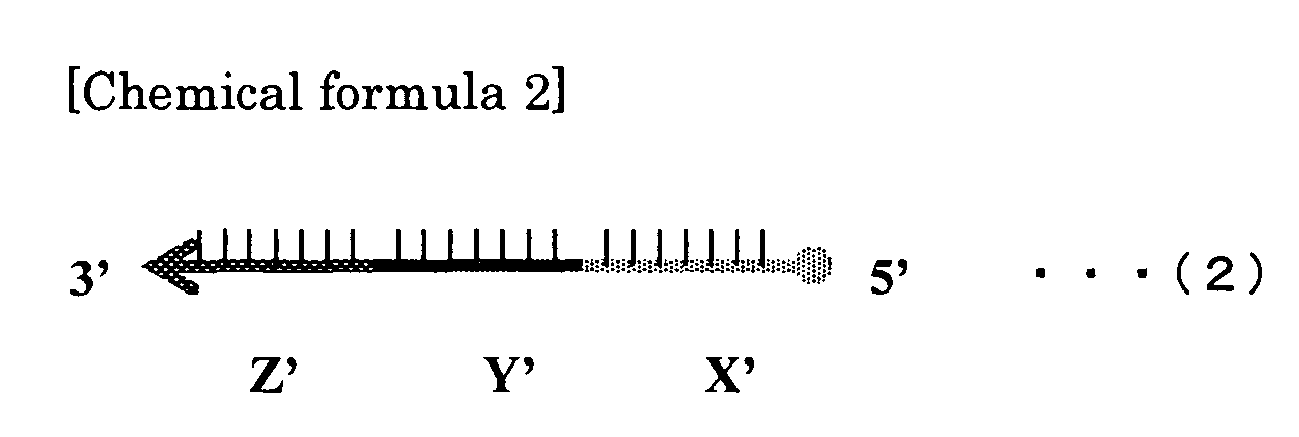
- In the formulae (1) and (2), the region X and X', the region Y and Y', and the region Z and Z' are complementary nucleic acid regions capable of hybridizing with each other, and a self assembly substance represented by the following chemical formula (3) is formed by binding plural pairs of HCPs. In the present specification, the signal probe polymer refers to the self-assembly substance formed from HCPs. Meanwhile, the assist probe refers to a probe, which has both a sequence complementary to that of a target gene to be detected and a sequence complementary to that of an HCP, and plays a role in linking the target gene to a signal probe polymer.

- Meanwhile,
Patent Document 3 discloses a method of detecting a target gene on a DNA tip by using the PALSAR method.Patent Documents 1 to 3 disclose methods of sensitively detecting a target gene by forming a complex of a target gene and a self-assembly substance to detect the self-assembly substance. A method of forming a signal probe polymer on a target gene includes a method of designing an HCP so as to have a sequence complementary to that of a target gene, and a method of using an assist probe. Of those, the method of forming an assist probe has an advantage of being capable of detecting a plurality of genes with a pair of HCPs by preparing a plurality of assist probes modified so as to have different sequences complementary to that of a target gene.
In each ofPatent Documents 1 to 3, an assist probe having a sequence complementary to that of one region in an HCP is illustrated, but an assist probe capable of sensitively detecting a target gene have not been clarified.
[Patent Document 1]JP 3267576 B
[Patent Document 2]JP 3310662 B
[Patent Document 3]WO 2003-029441
[Patent Document 4]WO 2004-074480
[Patent Document 5]WO 2004-072302 - In view of the present state of the related art, the inventors of the present invention have made extensive studies to increase detection sensitivity in the PALSAR method and to simultaneously detect many kinds of genes. As a result, they have found out a method of designing an assist probe suitable for the PALSAR method. It is an object of the present invention to provide a method of detecting a target gene, capable of increasing sensitivity in the PALSAR method and of simultaneously detecting many genes, an assist probe to be used in the method, and a method of forming a signal probe polymer using the assist probe.
- In order to solve the above-mentioned problems, the inventors of the present invention have made extensive studies on a design of an assist probe. As a result, they have found out a method of designing an assist probe most suitable for the PALSAR method, thus completing the present invention. That is, the present invention provides a method of detecting a target gene, including forming a signal probe polymer by using:
- a pair of first and second probes (also referred to as HCPs) including:
- a first probe (also referred to as HCP-1) having three nucleic acid regions, which includes a nucleic acid region X, a nucleic acid region Y, and a nucleic acid region Z in the stated order from the 5' end and has a structure represented by the following chemical formula (1);


- an assist probe having a plurality of the same nucleic acid regions as in the first probe and a target region capable of hybridizing with a target gene,
- a first probe (also referred to as HCP-1) having three nucleic acid regions, which includes a nucleic acid region X, a nucleic acid region Y, and a nucleic acid region Z in the stated order from the 5' end and has a structure represented by the following chemical formula (1);
- As the assist probe, there may used an assist prove having a spacer region incapable of hybridizing with the target gene and the first and second probes between the target region and the nucleic acid region X or Z.
- Further, as the assist probe, there may used an assist probe including a XYX region having the nucleic acid regions X, Y, and X, a YX region having the nucleic acid regions Y and X, and the target region in the stated order from the 5' end.
It is preferable that the assist probe further includes a spacer region incapable of hybridizing with the target gene and the first and second probes between the XYX region and the YX region or between the ZY region and the ZYZ region. - Meanwhile, as the assist probe, there may be used an assist probe that includes the target region, a ZY region having the nucleic acid regions Z and Y, and a ZYZ region having the nucleic acid regions Z, Y, and Z in the stated order from the 5' end.
Preferably, the assist probe further includes a spacer region incapable of hybridizing with a target gene and the first and second probes between the ZY region and the ZYZ region. - The method of detecting a target gene of the present invention may include a reaction step of performing a ligation reaction for the assist probes by using the target gene as a template, which enables detection of the target gene by the hybridization reaction.
Meanwhile, the method of detecting a target gene of the present invention may include a reaction step of reverse transcription by using the assist probes each having poly(dT) or a primer sequence in a target region on the 3' end side as primers and using a target RNA as a template, which enables detection of a target gene by the reverse transcription reaction.
In the method of detecting a target gene of the present invention, a plurality of assist probes, which are different from each other only in the target regions, are used, thereby being capable of simultaneously detecting a plurality of target genes. - A method of forming a signal probe polymer according to the present invention includes: using a pair of first and second probes including:
- a first probe having three nucleic acid regions, which includes a nucleic acid region X, a nucleic acid region Y, and a nucleic acid region Z in the stated order from the 5' end, and has a structure represented by the following chemical formula (1);

- a second probe having three nucleic acid regions, which includes a nucleic acid region X', a nucleic acid region Y', and a nucleic acid region Z' in the stated order from the 5' end and has a structure represented by the following chemical formula (2)

- an assist probe having a plurality of the same nucleic acid regions as in the first probe and a target region capable of hybridizing with a target gene; and
- allowing plural pairs of the first and second probes, the assist probes, and the target gene to react with each other,
- A first aspect of the assist probe of the present invention provides an assist probe to be used in the above-mentioned method according to the present invention, characterized in that the assist probe includes a XYX region having the nucleic acid regions X, Y, and X and the target region in the stated order from the 5' end.
As the assist probe described above, there may be used an assist probe that includes the target region with poly(dT) or a primer sequence. - As the assist probe described above, there may be also used an assist probe that further includes a YX region having the nucleic acid regions Y and X, and/or a spacer region incapable of hybridizing with a target gene and the first and second probes between the XYX region and the target region.
- A second aspect of the assist probe of the present invention provides an assist probe to be used in the above-mentioned method according to the present invention, characterized in the assist probe has a structure including the target region and a ZYZ region having the nucleic acid regions Z, Y, and Z in the stated order from the 5' end.
As the assist probe described above, there may be used an assist probe having a phosphate group at the 5' end on the target region side. - As the assist probe described above, there may be also used an assist probe that further includes a YZ region having the nucleic acid regions Y and Z, and/or a spacer region incapable of hybridizing with a target gene and the first and second probes between the ZYZ region and the target region.
- A signal probe polymer of the present invention is characterized by being formed by the above-mentioned method according to the present invention.
- According to the present invention, it is possible to significantly increase sensitivity in detection of a target gene using the PALSAR method. Meanwhile, by changing the target regions of the assist probes of the present invention, it is possible to simultaneously detect various kinds of genes.
-
- Fig. 1 is a schematic diagram illustrating a first example of an assist probe of the present invention.
- Fig. 2 is a schematic diagram illustrating a state where HCP-2 and a target gene bind to the assist probe of Fig. 1.
- Fig.3 is a schematic diagram illustrating an example of a method of forming a signal probe polymer by using the assist probe of Fig. 1.
- Fig. 4 is a schematic diagram illustrating an example of the assist probe.
- Fig. 5 is a schematic diagram illustrating a state where HCP-2 and a target gene bound to the assist probe of Fig. 4.
- Fig. 6 is a schematic diagram illustrating another example of the assist probe.
- Fig. 7 is a schematic diagram illustrating a second example of the assist probe of the present invention.
- Fig. 8 is a schematic diagram illustrating a third example of the assist probe of the present invention.
- Fig. 9 is a schematic diagram illustrating a state where HCP-2 and a target gene bound to the assist probe of Fig. 8.
- Fig. 10 is a schematic diagram illustrating a fourth example of the assist probe of the present invention.
- Fig. 11 is a schematic diagram illustrating a fifth example of the assist probe of the present invention.
- Fig. 12 is a schematic diagram illustrating a state where HCP-2 and a target gene bound to the assist probe of Fig. 11.
- Fig. 13 is a schematic diagram illustrating a sixth example of the assist probe of the present invention.
- Fig. 14 is a schematic diagram illustrating a seventh example of the assist probe of the present invention.
- Fig. 15 is a schematic diagram illustrating an example of an order of steps in a method of detecting a target gene by using the assist probe of Fig. 14 and a ligation reaction, where (a) and (b) each represent a target gene and a capture probe bound to a support.
- Fig. 16 is a schematic diagram illustrating a step 100 in an example of the order of steps in the method of detecting a target gene by using the assist probe of Fig. 14 and a ligation reaction.
- Fig. 17 is a schematic diagram illustrating a step 104 in an example of the order of steps in the method of detecting target a target gene by using the assist probe of Fig. 14 and the ligation reaction.
- Fig. 18 is a schematic diagram illustrating a step 106 in an example of the order of steps in the method of detecting a target gene by using the assist probe of Fig. 14 and the ligation reaction.
- Fig. 19 is a schematic diagram illustrating an eighth example of the assist probe of the present invention.
- Fig. 20 is a schematic diagram illustrating a step 200 in an example of the order of steps in the method of detecting a target gene by using the assist probe of Fig. 19 and the reverse transcription reaction.
- Fig. 21 is a schematic diagram illustrating a step 202 in an example of the order of steps in the method of detecting a target gene by using the assist probe of Fig. 19 and a reverse transcription reaction.
- Fig. 22 is a schematic diagram illustrating a step 204 in an example of the order of steps in the method of detecting a target gene by using the assist probe of Fig. 19 and the reverse transcription reaction.
- Fig. 23 is a schematic diagram illustrating a step 206 in an example of the order of steps in the method of detecting a target gene by using the assist probe of Fig. 19 and the reverse transcription reaction.
- 10a to 10h: assist probe of the present invention, 11a, 11b: assist probe, 12, 12a, 12b: target gene, 14: HCP-2, 16: HCP-1, 18: signal probe polymer, 20: capture probe, 22: support, 24: adjacent part between
assistant probe 10g and captureprobe 20, 26: probe - Hereinafter, embodiments of the present invention will be described with reference to the accompanying drawings, which are for illustrative purposes only, and it will be appreciated that various modifications can be made without departing from the technical idea of the invention.
- Fig. 1 is a schematic diagram illustrating a first example of an assist probe of the present invention, and Figs. 2 and 3 are schematic diagram illustrating examples of a method of forming a signal probe polymer using the assist probe of Fig. 1. Fig. 4 is a schematic diagram illustrating an example of a conventional assist probe, and Fig. 5 is a schematic diagram illustrating a state where a target gene and one of HCPs bind to the assist probe of Fig. 4. Fig. 6 is a schematic diagram illustrating another example of an assist probe.
- The assist probe to be used in the PALSAR method includes one of HCPs (HCP-1) with no modification and a probe obtained by adding a sequence complementary to a target (target region) to one of HCPs (HCP-1) as shown in Fig. 4. The
assist probe 11a of Fig. 4 has an HCP region including the same nucleic acid regions X, Y, and Z as in HCP-1 and a target region T complementary to a target gene, and as shown in Fig. 5, the HCP region binds to HCP-2s (symbol 14) at the respective regions. Note that, in the present invention, a region including a plurality of nucleic acid regions selected from the group consisting of the nucleic acid regions X, Y, and Z is referred to an HCP region. - An assist probe of the present invention is designed so as to bind to at least one HCP-2 at the two regions and to bind to another HCP-2 at the other regions.
Fig. 1 illustrates an example of an assist probe of the present invention. In Fig. 1, 10a illustrates a first example of an assist probe of the present invention, and the probe includes the target region T and HCP region including three regions, which is not XYZ but XYX from the 5' end (that is, 5'-XYX-T-3'). Therefore, when the HCP-2 (symbol 14) and assistprobe 10a are allowed to react, as shown in Fig. 2, the assist probe binds to one HCP-2 at two sequential regions of the three regions and to another HCP-2 at the other region to form a polymer. Accordingly, as shown in Fig. 3, when plural pairs of HCPs (symbols 14 and 16), theassist probe 10a, and thetarget gene 12 are allowed to react, asignal probe polymer 18 including a complex of a polymer formed from a pair of HCPs, an assist probe and a target gene is formed. - However, as shown in Fig. 6, if an assist probe is designed so that the end on the HCP region side thereof corresponds to the end of HCP-2 in binding in the present invention, signals may decrease. Therefore, an assist probe should be designed so that the end on the HCP region side of the assist probe is different from the end of the HCP-2 in binding to the HCP-2. In Fig. 6, 11b is another example of an assist probe.
- Fig. 7 is a schematic diagram illustrating a second example of an assist probe of the present invention.
Fig. 1 illustrates an assist probe including a target region on the 3' side, but the positions of the target region and the HCP region are not particularly limited, and the present invention includes an assist probe including a target region on the 5' side. Examples of the assist probe including a target region on the 5' side include, as shown in Fig. 7, anassist probe 10b (5'-T-ZYZ-3') including a target region T on the 5' side and an HCP region that include three regions ZYZ on the 3' side. - Fig. 8 is a schematic view a third example of an assist probe of the present invention, and Fig. 9 is a schematic diagram illustrating a state where one of HCPs (HCP-2) and a target gene bind to the assist probe of Fig. 8. Fig. 10 is a schematic diagram illustrating a fourth example of an assist probe of the present invention.
As an assist probe of the present invention, there may be used a probe designed so that two or more of HCP-2s bind to one assist probe at sequential two regions. - Examples of the assist probe include, as shown in Fig. 8, an
assist probe 10c (5'-XYX-YX-T-3')further including a second HCP region capable of binding to HCP-2 at sequential two regions and having two regions XY between the first HCP region (XYX) at the 5' end and the target region T at the 3' end. As shown in Fig. 9, when theassist probe 10c is allowed to react with HCP-2, one assistprobe 10c binds to two HCP-2s at sequential two regions. - Meanwhile, as shown in Fig. 10, there may be used an
assist probe 10d (5'-T-ZY ZYZ-3') further including a second HCP region capable of binding to HCP-2 at sequential two regions and having two regions ZY between the target region T at the 5' end and the first HCP region (ZYZ) at the 3' end.
Note that Figs. 8 and 10 show examples of assist probes further including a second HCP region, but an assist probe having a plurality of the second HCP regions may be used. - Fig. 11 is a schematic diagram illustrating a fifth example of an assist probe of the present invention, and Fig. 12 is a schematic diagram illustrating a state where one of HCPs (HCP-2) and a target gene bind to the assist probe of Fig. 11. Fig. 13 is a schematic diagram illustrating a sixth example of an assist probe of the present invention.
When an assist probe further including a spacer region S having a sequence (spacer sequence) unrelated to a target sequence or HCPs between a target region and an HCP region or between a first HCP region and a second HCP region is used as an assist probe of the present invention, sensitivity in signal detection may increase in some cases.
In an assist probe of the present invention, a number of bases in the spacer region is preferably 0 to 5 bases, but is not particularly limited thereto. - Examples of the assist probe having a spacer region include an assist probe further including a spacer region between the target region and the HCP region [5'-XYX-S-T-3' (see the
assist probe 10e of Fig. 11) or 5'-T-S-ZYZ-3'], an assist probe further including a spacer region between the first HCP region and the second HCP region [5'-XYX-S-YX-T-3' (see the assist probe 10f of Fig. 13) or 5'-T-ZY S-ZYZ-3'], an assist probe further including a spacer region between the target region and the second HCP region [5'-XYX-YX-S-T-3' or 5'-T-S-ZY-ZYZ-3'], and an assist probe further including spacer regions between the target region and the second HCP region and between the second HCP and the first HCP region [5'-XYX-S-YX-S-T-3' or 5'-T-S-ZY S-ZYZ-3']. - Fig. 14 is a schematic diagram illustrating an example of an assist probe to be used in a method of detecting a target gene using a ligation reaction, and 10g represents a seventh example of an assist probe of the present invention. As shown in Fig. 14, an assist probe having phosphorylated 5' end at the target region is preferably used as an assist probe in a method of detecting a target gene using a ligation reaction (for example, see Patent Document 4, etc.).
- One example of the method of detecting a target gene using a ligation reaction will be described below. Figs. 15 to 18 are schematic diagram illustrating examples of the order of steps in a method of detecting a target gene using the assist probe of Fig. 14 and a ligation reaction.
In Fig. 15, (a) represents a target gene (symbol 12a), and (b) represents asupport 22 bound to a capture probe having a region T2 complementary to the target gene on the 3' end side. Fig. 16 is a schematic diagram illustrating a state where anassist probe 10g, acapture probe 20, and atarget gene 12a bind to each other. Fig. 17 illustrates a state where acapture probe 20 that is dissociated from thetarget gene 12a and is linked to anassist probe 10g binds to asupport 24. - As shown in Figs. 14 to 16, the
assist probe 10g and captureprobe 20 are designed so as to anneal to thetarget gene 12a in a state where the end of thecapture probe 20 and the end of theassist probe 10g are adjacent to each other. - As shown in Fig. 16, the
assist probe 10g and captureprobe 20 are allowed to hybridize with thetarget gene 12a (step 100). Thereafter, a ligation reaction is carried out using a ligase (step 102). Only in the case where the sequence of thepart 24 adjacent to theassist probe 10g and captureprobe 20 is complementary to the sequence of thetarget gene 12a, theassist probe 10g and captureprobe 20 are linked by a ligation reaction. - After the ligation reaction, the
target gene 12a is removed (step 104). In the case where the sequence of thepart 24 adjacent to theassist probe 10g and captureprobe 20 is complementary to the sequence of thetarget gene 12a, as shown in Fig. 17, thecapture probe 20 linked to theassist probe 10g binds to thesupport 24.
Thereafter, when plural pairs of HCPs (14 and 16) are added to carry out a hybridization reaction (step 106), as shown in Fig. 18, asignal probe polymer 18 including a complex of a polymer formed from a pair of HCPs, an assist probe and a target gene is formed on the support. - On the other hand, in the case where the sequence of the
part 24 adjacent to theassist probe 10g and captureprobe 20 is not complementary to the sequence of a target gene, theassist probe 10g and captureprobe 20 are not linked after the step 102. When the target gene is removed, only thecapture probe 20 binds to thesupport 24. Therefore, after the step, polymers formed by adding plural pairs of HCPs are not captured on the support and removed by washing or the like. - Accordingly, detection of a signal probe polymer captured on a support can detect a target gene. In particular, an assist probe designed so that the
part 24 adjacent to theassist probe 10g and captureprobe 20 will be positioned on a mutation site of the target gene can detect a mutant gene. - Fig. 19 is a schematic diagram illustrating an example of an assist probe to be used in a method of detecting a target gene using a reverse transcription reaction, and 10h represents an eighth example of an assist probe of the present invention. As shown in Fig. 15, an assist probe having a sequence that may be used as a primer for a reverse transcription reaction such as poly(dT) sequence at the target region on the 3' end side is preferably used as an assist probe in a method of detecting a target gene using a reverse transcription reaction (for example, see
Patent Document 5, etc.). - One example of the method of detecting a target gene using a reverse transcription reaction will be described below. Figs. 20 to 23 are schematic diagrams illustrating examples of the orders of steps in a method of detecting a target gene using an assist probe and a reverse transcription reaction. Figs. 20 to 23 show examples of the case where the target gene is mRNA, and an
assist probe 10h having poly(dT) on a target region at the 3' end and including HCP region having three regions XYX on the 5' side is used as an assist probe. - The
assist probe 10h including poly(dT) at the 3' end is allowed to bind to the polyA tail part of a target gene, i.e., mRNA (symbol 12b) (step 200, Fig. 20), and theassist probe 10h is used as a primer to carry out a reverse transcription reaction for the mRNA, to thereby form aprobe 26 including the assist probe and the cDNA region of the mRNA (step 202, Fig. 21). - Next, as shown in Fig. 22, the mRNA is dissociated from the
probe 26, to thereby yield a single-stranded oligonucleotide having the cDNA region and HCP region XYX (step 204).
After the dissociation, theprobe 26 is allowed to hybridize with acapture probe 28 having a region complementary to the cDNA region of the mRNA to capture the probe 26 (step 206, Fig. 23). Note that the capture probe is preferably allowed to bind to thesupport 22 in advance. - Thereafter, a hybridization reaction is carried out by adding plural pairs of HCPs (step 208), to thereby form a signal probe polymer captured by the
capture probe 28. If the signal probe polymer is detected, a target gene can be detected. - Hereinafter, the present invention will be described more specifically by way of Examples, but it will be appreciated that these Examples are for illustrative purposes only and should not be construed as limiting the scope of the invention.
- Oligonucleotide probes having the following base sequences with the 5'ends labeled with Cy3 (HCP-1A and HCP-2A) were used as a pair of HCPs to be used in the PALSAR method.
Base sequence of HCP-1A (SEQ ID NO: 1)
5'-Cy3-X region (CGTATCAATGATAGCCGATC) · Y region (CGCCTAAGTTCGATATAGTC) · Z region (CGCGTATACTAAGCGTAATG)-3'
Base sequence of HCP-2A (SEQ ID NO: 2)
5'-Cy3-X' region (GATCGGCTATCATTGATACG) · Y' region (GACTATATCGAACTTAGGCG) · Z' region (CATTACGCTTAGTATACGCG)-3' - A synthetic DNA having a base sequence derived from Apolipoprotein E (ApoE) (target DNA-1) was used as a target DNA.
Base sequence of target DNA-1 (SEQ ID NO: 3)
- The following assist probe-1 was used as an assist probe, which includes two of three regions of the HCP-1A in XYX order and has a region of a sequence complementary to that of the target DNA-1 at the 3' end (T region).
Base sequence of assist probe-1 (SEQ ID NO: 4)
5'-X region (CGTATCAATGATAGCCGATC) Y region (CGCCTAAGTTCGATATAGTC) · X region (CGTATCAATGATAGCCGATC) T region (GTACTGCACCAGGCGGCCGC)-3' - The following capture probe-1 was used as a capture probe, which has a base sequence complementary to that of the target DNA-1.
Base sequence of capture probe-1 (SEQ ID NO: 5)
- A first hybridization solution having the following composition (total volume: 50 µL) was prepared and allowed to react at 95°C for two minutes and then at 68°C for 120 minutes, followed by incubation at 15°C.
- Fine particles (polystyrene particles with the surfaces immobilized with the capture probe-1): 500 particles
- assist probe-1: 1 pmol
- target DNA-1: 0, 100, or 500 amol
- 3M TMAC
- 0.1% N-Lauroylsarcosine
- 50 mM Tris-HCl (pH 8.0)
- 4 mM EDTA (pH 8.0)
- After the first hybridization, 50 µL of an HCP solution was added to the resultant solution to achieve the following composition (final volume: 100 µL), and the mixture was allowed to react at 68°C for 60 minutes, followed by incubation at 15°C. Note that the HCP solution was subjected to a thermal treatment at 95°C for two minutes before addition.
- (Composition of second hybridization solution)
- HCP-1A: 50 pmol
- HCP-2A: 50 pmol
- 3M TMAC
- 0.1% N-Lauroylsarcosine
- 50 mM Tris-HCl (pH 8.0)
- 4 mM EDTA (pH 8.0)
- After the second hybridization, measurement was carried out using a flow cytometer. Fluorescence intensities of about 100 fine particles were measured for each item using Luminex 100 (manufactured by Luminex Corporation) as a flow cytometer, followed by calculation of medians. The results are shown in Table 1. Note that the numerical values were calculated by subtracting blank values from actual measured values.
-
[Table 1] Concentration of target DNA (amol) Example 1 Example 2 Comparative Example 1 0 0 0 0 100 1268 4301 273 500 19099 20112 15988 - The experiment of Example 1 was repeated except that the following assist probe-2, which was obtained by inserting a spacer region S including five poly(dT)s and a YX region between the XYX region and the T region of the assist probe-1, was used as an assist probe. The results are shown in Table 1.
Base sequence of assist probe-2 (SEQ ID NO: 6)
5'-X region (CGTATCAATGATAGCCGATC) · Y region (CGCCTAAGTTCGATATAGTC) · X region (CGTATCAATGATAGCCGATC) · S region (TTTTT) · Y region (CGCCTAAGTTCGATATAGTC) · X region (CGTATCAATGATAGCCGATC) · T region (GTACTGCACCAGGCGGCCGC)-3' - The experiment of Example 1 was repeated except that the following assist probe-3 (a conventional assist probe) was used as an assist probe. The results are shown in Table 1.
Base sequence of assist probe-3 (SEQ ID NO: 7)
5'-X region (CGTATCAATGATAGCCGATC) · Y region (CGCCTAAGTTCGATATAGTC) · Z region (CGCGTATACTAAGCGTAATG) · T region (GTACTGCACCAGGCGGCCGC)-3' - As shown in Table 1, in the cases of Examples 1 and 2 where the assist probes of the present invention were used, the signals were found to be significantly larger than those in the case of Comparative Example 1 where the conventional assist probe was used.
Claims (15)
- A method of detecting a target gene, comprising forming a signal probe polymer by using:a pair of first and second probes including:the first probe having three nucleic acid regions, which includes a nucleic acid region X, a nucleic acid region Y, and a nucleic acid region Z in the stated order from the 5' end and has a structure represented by the following chemical formula (1);
 the second probe having three nucleic acid regions, which includes a nucleic acid region X', a nucleic acid region Y', and a nucleic acid region Z' in the stated order from the 5' end and has a structure represented by the following chemical formula (2)
 an assist probe having a plurality of the same nucleic acid regions as in the first probe and a target region capable of hybridizing with a target gene,wherein the assist probe has a structure including the nucleic acid regions X, Y, and X, and the target region in the stated order from the 5' end, or a structure including the target region, and the nucleic acid regions Z, Y, and Z in the stated order from the 5' end.
 - The method of detecting a target gene according to Claim 1,
wherein the assist probe further has a spacer region incapable of hybridizing with the target gene and the first and second probes between the target region and the nucleic acid region X or Z. - The method of detecting a target gene according to Claim 1 or 2,
wherein the assist probe includes an XYX region having the nucleic acid regions X, Y, and X, a YX region having the nucleic acid regions Y and X, and the target region in the stated order from the 5' end, or includes the target region, a ZY region having the nucleic acid regions Z and Y, and a ZYZ region having the nucleic acid regions Z, Y, and Z in the stated order from the 5' end. - The method of detecting a target gene according to Claim 3,
wherein the assist probe further includes a spacer region incapable of hybridizing with the target gene and the first and second probes between the XYX region and the YX region or between the ZY region and the ZYZ region. - The method of detecting a target gene according to any one of Claims 1 to 4, comprising a reaction step of ligating the assist probe by using the target gene as a template.
- The method of detecting a target gene according to any one of Claims 1 to 4, further comprising a reaction step of performing reverse transcription by using the assist probe having poly(dT) or a primer sequence on the target region of the 3' end as a primer and by using a target RNA as a template.
- The method of detecting a target gene according to any one of Claims 1 to 6, wherein a plurality of target genes are simultaneously detected by using a plurality of assist probes, which are different from each other only in the target regions.
- A method of forming a signal probe polymer, comprising:using a pair of first and second probes including:the first probe having three nucleic acid regions, includes a nucleic acid region X, a nucleic acid region Y, and a nucleic acid region Z in the stated order from the 5' end, and has a structure represented by the following chemical formula (1);
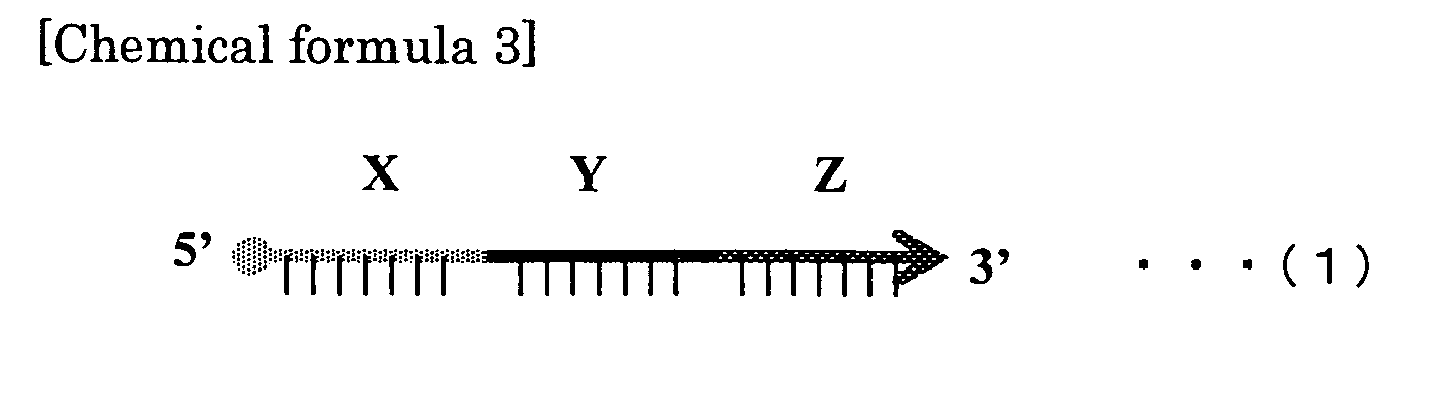 the second probe having three nucleic acid regions, which includes a nucleic acid region X', a nucleic acid region Y', and a nucleic acid region Z' in the stated order from the 5' end and has a structure represented by the following chemical formula (2)
 an assist probe having a plurality of the same nucleic acid regions as in the first probe and a target region capable of hybridizing with a target gene; andallowing plural pairs of the first and second probes, the assist probe, and the target gene to react with each other,wherein the assist probe has a structure including the nucleic acid regions X, Y, and X, and the target region in the stated order from the 5' end, or a structure including the target region, and the nucleic acid regions Z, Y, and Z in the stated order from the 5' end.
 - An assist probe to be used in the method according to any one of Claims 1 to 8, comprising a structure which includes an XYX region having the nucleic acid regions X, Y, and X, and the target region in the stated order from the 5' end.
- The assist probe according to Claim 9, further comprising a YX region having the nucleic acid regions Y and X and/or a spacer region incapable of hybridizing with a target gene and the first and second probes between the XYX region and the target region.
- An assist probe to be used in the method according to any one of Claims 1 to 8, comprising a structure which includes the target region and a ZYZ region having the nucleic acid regions Z, Y, and Z in the stated order from the 5' end.
- The assist probe according to Claim 11, further comprising a YZ region having the nucleic acid regions Y and Z, and/or a spacer region incapable of hybridizing with a target gene and the first and second probes between the ZYZ region and the target region.
- The assist probe according to Claim 9 or 10, wherein the target region has poly(dT) or a primer sequence.
- The assist probe according to Claim 11 or 12, comprising a phosphate group at the 5' end on the target region side.
- The signal probe polymer formed by the method according to any one of Claims 1 to 8.
Applications Claiming Priority (2)
| Application Number | Priority Date | Filing Date | Title |
|---|---|---|---|
| JP2005054521 | 2005-02-28 | ||
| PCT/JP2006/303629 WO2006093097A1 (en) | 2005-02-28 | 2006-02-27 | Assist probes and method of using the same |
Publications (3)
| Publication Number | Publication Date |
|---|---|
| EP1854883A1 true EP1854883A1 (en) | 2007-11-14 |
| EP1854883A4 EP1854883A4 (en) | 2010-02-03 |
| EP1854883B1 EP1854883B1 (en) | 2011-09-28 |
Family
ID=36941126
Family Applications (1)
| Application Number | Title | Priority Date | Filing Date |
|---|---|---|---|
| EP06714766A Expired - Lifetime EP1854883B1 (en) | 2005-02-28 | 2006-02-27 | Assist probes and method of using the same |
Country Status (7)
| Country | Link |
|---|---|
| EP (1) | EP1854883B1 (en) |
| JP (1) | JP4616881B2 (en) |
| KR (1) | KR101230970B1 (en) |
| CN (1) | CN101128582B (en) |
| AU (1) | AU2006219362B2 (en) |
| CA (1) | CA2599537C (en) |
| WO (1) | WO2006093097A1 (en) |
Cited By (2)
| Publication number | Priority date | Publication date | Assignee | Title |
|---|---|---|---|---|
| US8450058B2 (en) | 2007-08-14 | 2013-05-28 | Eisai R&D Management Co., Ltd. | Method of detecting target substance |
| EP2554681A4 (en) * | 2010-03-31 | 2014-05-14 | Univ Tokyo | CONSTITUTION OF TOOL FOR ANALYZING BIOMOLECULAR INTERACTION AND ANALYSIS METHOD EMPLOYING IT |
Families Citing this family (5)
| Publication number | Priority date | Publication date | Assignee | Title |
|---|---|---|---|---|
| JP5289315B2 (en) * | 2007-08-14 | 2013-09-11 | エーザイ・アール・アンド・ディー・マネジメント株式会社 | Target substance detection method |
| SG185315A1 (en) * | 2007-10-24 | 2012-11-29 | Eisai R&D Man Co Ltd | Nucleic acid probe, and method of forming probe -polymer |
| JPWO2013085026A1 (en) | 2011-12-09 | 2015-04-27 | エーザイ・アール・アンド・ディー・マネジメント株式会社 | Base mutation detection method and detection kit |
| JPWO2013172305A1 (en) * | 2012-05-15 | 2016-01-12 | エーザイ・アール・アンド・ディー・マネジメント株式会社 | RNA detection method and detection kit |
| JP7161173B2 (en) * | 2018-06-29 | 2022-10-26 | 積水メディカル株式会社 | Method for quantifying siRNA |
Family Cites Families (6)
| Publication number | Priority date | Publication date | Assignee | Title |
|---|---|---|---|---|
| US6589726B1 (en) * | 1991-09-04 | 2003-07-08 | Metrigen, Inc. | Method and apparatus for in situ synthesis on a solid support |
| EP0729975B9 (en) * | 1994-09-21 | 2007-05-30 | Cancer Institute | Ecdn protein and dna coding for the same |
| JP3267576B2 (en) * | 1998-11-09 | 2002-03-18 | 三光純薬株式会社 | Method for forming probe polymer |
| ES2317893T3 (en) * | 2000-03-31 | 2009-05-01 | Sanko Junyaku Co., Ltd. | PROBES TO BUILD PROBE POLYMERS, PROCEDURE TO BUILD A PROBE POLYMER AND USE THE SAME. |
| CA2515734C (en) * | 2003-02-14 | 2013-04-09 | Eisai Co., Ltd. | Signal amplification method for detecting expressed gene |
| WO2004074480A1 (en) * | 2003-02-21 | 2004-09-02 | Eisai Co., Ltd. | Signal amplification method for detecting mutant gene |
-
2006
- 2006-02-27 EP EP06714766A patent/EP1854883B1/en not_active Expired - Lifetime
- 2006-02-27 CA CA2599537A patent/CA2599537C/en not_active Expired - Lifetime
- 2006-02-27 AU AU2006219362A patent/AU2006219362B2/en not_active Ceased
- 2006-02-27 JP JP2007505925A patent/JP4616881B2/en not_active Expired - Lifetime
- 2006-02-27 KR KR1020077017804A patent/KR101230970B1/en not_active Expired - Lifetime
- 2006-02-27 CN CN2006800062073A patent/CN101128582B/en not_active Expired - Lifetime
- 2006-02-27 WO PCT/JP2006/303629 patent/WO2006093097A1/en not_active Ceased
Cited By (3)
| Publication number | Priority date | Publication date | Assignee | Title |
|---|---|---|---|---|
| US8450058B2 (en) | 2007-08-14 | 2013-05-28 | Eisai R&D Management Co., Ltd. | Method of detecting target substance |
| EP2554681A4 (en) * | 2010-03-31 | 2014-05-14 | Univ Tokyo | CONSTITUTION OF TOOL FOR ANALYZING BIOMOLECULAR INTERACTION AND ANALYSIS METHOD EMPLOYING IT |
| US9481882B2 (en) | 2010-03-31 | 2016-11-01 | Tokyo University Of Science Foundation | Constitution of tool for analyzing biomolecular interaction and analysis method using same |
Also Published As
| Publication number | Publication date |
|---|---|
| KR101230970B1 (en) | 2013-02-07 |
| CA2599537A1 (en) | 2006-09-08 |
| AU2006219362B2 (en) | 2011-08-25 |
| JPWO2006093097A1 (en) | 2008-08-07 |
| AU2006219362A1 (en) | 2006-09-08 |
| JP4616881B2 (en) | 2011-01-19 |
| CN101128582B (en) | 2012-02-01 |
| WO2006093097A1 (en) | 2006-09-08 |
| KR20070106705A (en) | 2007-11-05 |
| CA2599537C (en) | 2011-10-11 |
| EP1854883A4 (en) | 2010-02-03 |
| EP1854883B1 (en) | 2011-09-28 |
| CN101128582A (en) | 2008-02-20 |
Similar Documents
| Publication | Publication Date | Title |
|---|---|---|
| EP1778867B1 (en) | Methods and compositions to detect nucleic acids in a biological sample | |
| US11072819B2 (en) | Methods of constructing small RNA libraries and their use for expression profiling of target RNAs | |
| JP6925424B2 (en) | A method of increasing the throughput of a single molecule sequence by ligating short DNA fragments | |
| CN105985945B (en) | mRNA fragmentation method and method for constructing sequencing library based thereon | |
| EP2619329B1 (en) | Direct capture, amplification and sequencing of target dna using immobilized primers | |
| US20100092972A1 (en) | Assay for gene expression | |
| EP3612641A1 (en) | Compositions and methods for library construction and sequence analysis | |
| CN106460065A (en) | Systems and methods for clonal replication and amplification of nucleic acid molecules for genomic and therapeutic applications | |
| KR20210043634A (en) | Compositions and methods for improving library enrichment | |
| KR20220012980A (en) | Method for Quantitatively Analyzing Protein Population Using Next Generation Sequencing and Use Thereof | |
| WO2008109945A1 (en) | Analysis of ribonucleic acid | |
| KR20070106705A (en) | Assist Probe and How to Use It | |
| Göransson et al. | A single molecule array for digital targeted molecular analyses | |
| EP4060047A1 (en) | Method for detecting or quantifying oligonucleotide | |
| US20200048685A1 (en) | Rna microarray for detecting interaction between protein and rna containing a higher-order structure | |
| JP4351210B2 (en) | Signal amplification method for detection of expressed genes | |
| US7862998B2 (en) | Assist probe and method of using the same | |
| WO2022007863A1 (en) | Method for rapidly enriching target gene region | |
| CN112639127A (en) | Method for detecting and quantifying genetic alterations | |
| WO2013085026A1 (en) | Method for detecting nucleotide mutation, and detection kit | |
| WO2019200580A1 (en) | Parallel liquid-phase hybrid capture method for simultaneously capturing positive-sense and antisense strands of genomic target region | |
| EP4012029B1 (en) | Method for capturing nucleic acid molecule, preparation method for nucleic acid library, and a sequencing method | |
| EP4731782A1 (en) | Interlocking nucleic acids for target hybridization | |
| CN120775969A (en) | Probe combination for unbiased enrichment of nucleic acid and design method and application thereof | |
| JP2025133705A (en) | A sensitive method for accurate parallel quantification of nucleic acids. |
Legal Events
| Date | Code | Title | Description |
|---|---|---|---|
| PUAI | Public reference made under article 153(3) epc to a published international application that has entered the european phase |
Free format text: ORIGINAL CODE: 0009012 |
|
| 17P | Request for examination filed |
Effective date: 20070824 |
|
| AK | Designated contracting states |
Kind code of ref document: A1 Designated state(s): AT BE BG CH CY CZ DE DK EE ES FI FR GB GR HU IE IS IT LI LT LU LV MC NL PL PT RO SE SI SK TR |
|
| DAX | Request for extension of the european patent (deleted) | ||
| A4 | Supplementary search report drawn up and despatched |
Effective date: 20100105 |
|
| 17Q | First examination report despatched |
Effective date: 20100505 |
|
| RIC1 | Information provided on ipc code assigned before grant |
Ipc: G01N 33/566 20060101ALI20110119BHEP Ipc: C12N 15/09 20060101AFI20110119BHEP Ipc: C12Q 1/68 20060101ALI20110119BHEP |
|
| GRAP | Despatch of communication of intention to grant a patent |
Free format text: ORIGINAL CODE: EPIDOSNIGR1 |
|
| GRAS | Grant fee paid |
Free format text: ORIGINAL CODE: EPIDOSNIGR3 |
|
| GRAA | (expected) grant |
Free format text: ORIGINAL CODE: 0009210 |
|
| AK | Designated contracting states |
Kind code of ref document: B1 Designated state(s): AT BE BG CH CY CZ DE DK EE ES FI FR GB GR HU IE IS IT LI LT LU LV MC NL PL PT RO SE SI SK TR |
|
| REG | Reference to a national code |
Ref country code: GB Ref legal event code: FG4D |
|
| REG | Reference to a national code |
Ref country code: CH Ref legal event code: EP |
|
| REG | Reference to a national code |
Ref country code: DE Ref legal event code: R081 Ref document number: 602006024686 Country of ref document: DE Owner name: EIDIA CO., LTD., JP Free format text: FORMER OWNER: EISAI R&D MANAGEMENT CO., LTD., TOKYO, JP Ref country code: DE Ref legal event code: R081 Ref document number: 602006024686 Country of ref document: DE Owner name: SEKISUI MEDICAL CO., LTD., JP Free format text: FORMER OWNER: EISAI R&D MANAGEMENT CO., LTD., TOKYO, JP |
|
| REG | Reference to a national code |
Ref country code: IE Ref legal event code: FG4D |
|
| REG | Reference to a national code |
Ref country code: DE Ref legal event code: R096 Ref document number: 602006024686 Country of ref document: DE Effective date: 20111124 |
|
| REG | Reference to a national code |
Ref country code: NL Ref legal event code: T3 |
|
| PG25 | Lapsed in a contracting state [announced via postgrant information from national office to epo] |
Ref country code: SE Free format text: LAPSE BECAUSE OF FAILURE TO SUBMIT A TRANSLATION OF THE DESCRIPTION OR TO PAY THE FEE WITHIN THE PRESCRIBED TIME-LIMIT Effective date: 20110928 Ref country code: FI Free format text: LAPSE BECAUSE OF FAILURE TO SUBMIT A TRANSLATION OF THE DESCRIPTION OR TO PAY THE FEE WITHIN THE PRESCRIBED TIME-LIMIT Effective date: 20110928 Ref country code: LT Free format text: LAPSE BECAUSE OF FAILURE TO SUBMIT A TRANSLATION OF THE DESCRIPTION OR TO PAY THE FEE WITHIN THE PRESCRIBED TIME-LIMIT Effective date: 20110928 |
|
| LTIE | Lt: invalidation of european patent or patent extension |
Effective date: 20110928 |
|
| PG25 | Lapsed in a contracting state [announced via postgrant information from national office to epo] |
Ref country code: SI Free format text: LAPSE BECAUSE OF FAILURE TO SUBMIT A TRANSLATION OF THE DESCRIPTION OR TO PAY THE FEE WITHIN THE PRESCRIBED TIME-LIMIT Effective date: 20110928 Ref country code: AT Free format text: LAPSE BECAUSE OF FAILURE TO SUBMIT A TRANSLATION OF THE DESCRIPTION OR TO PAY THE FEE WITHIN THE PRESCRIBED TIME-LIMIT Effective date: 20110928 Ref country code: LV Free format text: LAPSE BECAUSE OF FAILURE TO SUBMIT A TRANSLATION OF THE DESCRIPTION OR TO PAY THE FEE WITHIN THE PRESCRIBED TIME-LIMIT Effective date: 20110928 Ref country code: GR Free format text: LAPSE BECAUSE OF FAILURE TO SUBMIT A TRANSLATION OF THE DESCRIPTION OR TO PAY THE FEE WITHIN THE PRESCRIBED TIME-LIMIT Effective date: 20111229 Ref country code: CY Free format text: LAPSE BECAUSE OF FAILURE TO SUBMIT A TRANSLATION OF THE DESCRIPTION OR TO PAY THE FEE WITHIN THE PRESCRIBED TIME-LIMIT Effective date: 20110928 |
|
| REG | Reference to a national code |
Ref country code: AT Ref legal event code: MK05 Ref document number: 526402 Country of ref document: AT Kind code of ref document: T Effective date: 20110928 |
|
| PG25 | Lapsed in a contracting state [announced via postgrant information from national office to epo] |
Ref country code: BE Free format text: LAPSE BECAUSE OF FAILURE TO SUBMIT A TRANSLATION OF THE DESCRIPTION OR TO PAY THE FEE WITHIN THE PRESCRIBED TIME-LIMIT Effective date: 20110928 |
|
| PG25 | Lapsed in a contracting state [announced via postgrant information from national office to epo] |
Ref country code: IS Free format text: LAPSE BECAUSE OF FAILURE TO SUBMIT A TRANSLATION OF THE DESCRIPTION OR TO PAY THE FEE WITHIN THE PRESCRIBED TIME-LIMIT Effective date: 20120128 Ref country code: CZ Free format text: LAPSE BECAUSE OF FAILURE TO SUBMIT A TRANSLATION OF THE DESCRIPTION OR TO PAY THE FEE WITHIN THE PRESCRIBED TIME-LIMIT Effective date: 20110928 Ref country code: SK Free format text: LAPSE BECAUSE OF FAILURE TO SUBMIT A TRANSLATION OF THE DESCRIPTION OR TO PAY THE FEE WITHIN THE PRESCRIBED TIME-LIMIT Effective date: 20110928 |
|
| PG25 | Lapsed in a contracting state [announced via postgrant information from national office to epo] |
Ref country code: RO Free format text: LAPSE BECAUSE OF FAILURE TO SUBMIT A TRANSLATION OF THE DESCRIPTION OR TO PAY THE FEE WITHIN THE PRESCRIBED TIME-LIMIT Effective date: 20110928 Ref country code: EE Free format text: LAPSE BECAUSE OF FAILURE TO SUBMIT A TRANSLATION OF THE DESCRIPTION OR TO PAY THE FEE WITHIN THE PRESCRIBED TIME-LIMIT Effective date: 20110928 Ref country code: PT Free format text: LAPSE BECAUSE OF FAILURE TO SUBMIT A TRANSLATION OF THE DESCRIPTION OR TO PAY THE FEE WITHIN THE PRESCRIBED TIME-LIMIT Effective date: 20120130 Ref country code: IT Free format text: LAPSE BECAUSE OF FAILURE TO SUBMIT A TRANSLATION OF THE DESCRIPTION OR TO PAY THE FEE WITHIN THE PRESCRIBED TIME-LIMIT Effective date: 20110928 |
|
| PG25 | Lapsed in a contracting state [announced via postgrant information from national office to epo] |
Ref country code: DK Free format text: LAPSE BECAUSE OF FAILURE TO SUBMIT A TRANSLATION OF THE DESCRIPTION OR TO PAY THE FEE WITHIN THE PRESCRIBED TIME-LIMIT Effective date: 20110928 |
|
| PLBE | No opposition filed within time limit |
Free format text: ORIGINAL CODE: 0009261 |
|
| STAA | Information on the status of an ep patent application or granted ep patent |
Free format text: STATUS: NO OPPOSITION FILED WITHIN TIME LIMIT |
|
| PG25 | Lapsed in a contracting state [announced via postgrant information from national office to epo] |
Ref country code: PL Free format text: LAPSE BECAUSE OF FAILURE TO SUBMIT A TRANSLATION OF THE DESCRIPTION OR TO PAY THE FEE WITHIN THE PRESCRIBED TIME-LIMIT Effective date: 20110928 |
|
| 26N | No opposition filed |
Effective date: 20120629 |
|
| PG25 | Lapsed in a contracting state [announced via postgrant information from national office to epo] |
Ref country code: MC Free format text: LAPSE BECAUSE OF NON-PAYMENT OF DUE FEES Effective date: 20120229 |
|
| REG | Reference to a national code |
Ref country code: CH Ref legal event code: PL |
|
| REG | Reference to a national code |
Ref country code: DE Ref legal event code: R097 Ref document number: 602006024686 Country of ref document: DE Effective date: 20120629 |
|
| PG25 | Lapsed in a contracting state [announced via postgrant information from national office to epo] |
Ref country code: CH Free format text: LAPSE BECAUSE OF NON-PAYMENT OF DUE FEES Effective date: 20120229 Ref country code: LI Free format text: LAPSE BECAUSE OF NON-PAYMENT OF DUE FEES Effective date: 20120229 |
|
| REG | Reference to a national code |
Ref country code: IE Ref legal event code: MM4A |
|
| PG25 | Lapsed in a contracting state [announced via postgrant information from national office to epo] |
Ref country code: IE Free format text: LAPSE BECAUSE OF NON-PAYMENT OF DUE FEES Effective date: 20120227 |
|
| PG25 | Lapsed in a contracting state [announced via postgrant information from national office to epo] |
Ref country code: ES Free format text: LAPSE BECAUSE OF FAILURE TO SUBMIT A TRANSLATION OF THE DESCRIPTION OR TO PAY THE FEE WITHIN THE PRESCRIBED TIME-LIMIT Effective date: 20120108 |
|
| PG25 | Lapsed in a contracting state [announced via postgrant information from national office to epo] |
Ref country code: BG Free format text: LAPSE BECAUSE OF FAILURE TO SUBMIT A TRANSLATION OF THE DESCRIPTION OR TO PAY THE FEE WITHIN THE PRESCRIBED TIME-LIMIT Effective date: 20111228 |
|
| PG25 | Lapsed in a contracting state [announced via postgrant information from national office to epo] |
Ref country code: TR Free format text: LAPSE BECAUSE OF FAILURE TO SUBMIT A TRANSLATION OF THE DESCRIPTION OR TO PAY THE FEE WITHIN THE PRESCRIBED TIME-LIMIT Effective date: 20110928 |
|
| PG25 | Lapsed in a contracting state [announced via postgrant information from national office to epo] |
Ref country code: LU Free format text: LAPSE BECAUSE OF NON-PAYMENT OF DUE FEES Effective date: 20120227 |
|
| PG25 | Lapsed in a contracting state [announced via postgrant information from national office to epo] |
Ref country code: HU Free format text: LAPSE BECAUSE OF FAILURE TO SUBMIT A TRANSLATION OF THE DESCRIPTION OR TO PAY THE FEE WITHIN THE PRESCRIBED TIME-LIMIT Effective date: 20060227 |
|
| REG | Reference to a national code |
Ref country code: FR Ref legal event code: PLFP Year of fee payment: 11 |
|
| REG | Reference to a national code |
Ref country code: DE Ref legal event code: R082 Ref document number: 602006024686 Country of ref document: DE Representative=s name: GRUENECKER PATENT- UND RECHTSANWAELTE PARTG MB, DE Ref country code: DE Ref legal event code: R081 Ref document number: 602006024686 Country of ref document: DE Owner name: EIDIA CO., LTD., JP Free format text: FORMER OWNER: EISAI R&D MANAGEMENT CO., LTD., TOKYO, JP Ref country code: DE Ref legal event code: R081 Ref document number: 602006024686 Country of ref document: DE Owner name: SEKISUI MEDICAL CO., LTD., JP Free format text: FORMER OWNER: EISAI R&D MANAGEMENT CO., LTD., TOKYO, JP |
|
| REG | Reference to a national code |
Ref country code: GB Ref legal event code: 732E Free format text: REGISTERED BETWEEN 20160512 AND 20160518 |
|
| REG | Reference to a national code |
Ref country code: FR Ref legal event code: TP Owner name: EIDIA CO., LTD., JP Effective date: 20160720 |
|
| REG | Reference to a national code |
Ref country code: NL Ref legal event code: PD Owner name: EIDIA CO., LTD.; JP Free format text: DETAILS ASSIGNMENT: VERANDERING VAN EIGENAAR(S), OVERDRACHT; FORMER OWNER NAME: EISAI R&D MANAGEMENT CO., LTD. Effective date: 20160509 |
|
| REG | Reference to a national code |
Ref country code: FR Ref legal event code: PLFP Year of fee payment: 12 |
|
| REG | Reference to a national code |
Ref country code: DE Ref legal event code: R082 Ref document number: 602006024686 Country of ref document: DE Representative=s name: GRUENECKER PATENT- UND RECHTSANWAELTE PARTG MB, DE Ref country code: DE Ref legal event code: R081 Ref document number: 602006024686 Country of ref document: DE Owner name: SEKISUI MEDICAL CO., LTD., JP Free format text: FORMER OWNER: EIDIA CO., LTD., TOKIO/TOKYO, JP |
|
| REG | Reference to a national code |
Ref country code: GB Ref legal event code: 732E Free format text: REGISTERED BETWEEN 20170921 AND 20170927 |
|
| REG | Reference to a national code |
Ref country code: NL Ref legal event code: PD Owner name: SEKISUI MEDICAL CO., LTD.; JP Free format text: DETAILS ASSIGNMENT: CHANGE OF OWNER(S), MERGE; FORMER OWNER NAME: EISAI R&D MANAGEMENT CO., LTD. Effective date: 20171023 |
|
| REG | Reference to a national code |
Ref country code: FR Ref legal event code: PLFP Year of fee payment: 13 |
|
| REG | Reference to a national code |
Ref country code: FR Ref legal event code: TP Owner name: SEKISUI MEDICAL CO., LTD., JP Effective date: 20180226 |
|
| P01 | Opt-out of the competence of the unified patent court (upc) registered |
Effective date: 20230522 |
|
| PGFP | Annual fee paid to national office [announced via postgrant information from national office to epo] |
Ref country code: NL Payment date: 20250218 Year of fee payment: 20 |
|
| PGFP | Annual fee paid to national office [announced via postgrant information from national office to epo] |
Ref country code: DE Payment date: 20250218 Year of fee payment: 20 |
|
| PGFP | Annual fee paid to national office [announced via postgrant information from national office to epo] |
Ref country code: FR Payment date: 20250221 Year of fee payment: 20 |
|
| PGFP | Annual fee paid to national office [announced via postgrant information from national office to epo] |
Ref country code: GB Payment date: 20250219 Year of fee payment: 20 |
|
| REG | Reference to a national code |
Ref country code: DE Ref legal event code: R071 Ref document number: 602006024686 Country of ref document: DE |
|
| REG | Reference to a national code |
Ref country code: NL Ref legal event code: MK Effective date: 20260226 |
|
| REG | Reference to a national code |
Ref country code: GB Ref legal event code: PE20 Expiry date: 20260226 |