EP1854796A1 - Optically active ammonium salt compound, production intermediate thereof and method for producing same - Google Patents
Optically active ammonium salt compound, production intermediate thereof and method for producing same Download PDFInfo
- Publication number
- EP1854796A1 EP1854796A1 EP06715174A EP06715174A EP1854796A1 EP 1854796 A1 EP1854796 A1 EP 1854796A1 EP 06715174 A EP06715174 A EP 06715174A EP 06715174 A EP06715174 A EP 06715174A EP 1854796 A1 EP1854796 A1 EP 1854796A1
- Authority
- EP
- European Patent Office
- Prior art keywords
- optionally substituted
- cyclic
- branched
- linear
- halogen
- Prior art date
- Legal status (The legal status is an assumption and is not a legal conclusion. Google has not performed a legal analysis and makes no representation as to the accuracy of the status listed.)
- Granted
Links
- 0 Cc1c(*)c(*)c(C[N+](Cc2c(*)cc(*)c(*)c2-c2c(*)c(*)cc(*)c2*)Cc2c(*)c(*)c(*)c(*)c2-2)c-2c1* Chemical compound Cc1c(*)c(*)c(C[N+](Cc2c(*)cc(*)c(*)c2-c2c(*)c(*)cc(*)c2*)Cc2c(*)c(*)c(*)c(*)c2-2)c-2c1* 0.000 description 7
Classifications
-
- B—PERFORMING OPERATIONS; TRANSPORTING
- B01—PHYSICAL OR CHEMICAL PROCESSES OR APPARATUS IN GENERAL
- B01J—CHEMICAL OR PHYSICAL PROCESSES, e.g. CATALYSIS OR COLLOID CHEMISTRY; THEIR RELEVANT APPARATUS
- B01J31/00—Catalysts comprising hydrides, coordination complexes or organic compounds
- B01J31/02—Catalysts comprising hydrides, coordination complexes or organic compounds containing organic compounds or metal hydrides
- B01J31/0234—Nitrogen-, phosphorus-, arsenic- or antimony-containing compounds
- B01J31/0271—Nitrogen-, phosphorus-, arsenic- or antimony-containing compounds also containing elements or functional groups covered by B01J31/0201 - B01J31/0231
-
- C—CHEMISTRY; METALLURGY
- C07—ORGANIC CHEMISTRY
- C07B—GENERAL METHODS OF ORGANIC CHEMISTRY; APPARATUS THEREFOR
- C07B53/00—Asymmetric syntheses
-
- C—CHEMISTRY; METALLURGY
- C07—ORGANIC CHEMISTRY
- C07C—ACYCLIC OR CARBOCYCLIC COMPOUNDS
- C07C22/00—Cyclic compounds containing halogen atoms bound to an acyclic carbon atom
- C07C22/02—Cyclic compounds containing halogen atoms bound to an acyclic carbon atom having unsaturation in the rings
- C07C22/04—Cyclic compounds containing halogen atoms bound to an acyclic carbon atom having unsaturation in the rings containing six-membered aromatic rings
-
- C—CHEMISTRY; METALLURGY
- C07—ORGANIC CHEMISTRY
- C07C—ACYCLIC OR CARBOCYCLIC COMPOUNDS
- C07C25/00—Compounds containing at least one halogen atom bound to a six-membered aromatic ring
- C07C25/18—Polycyclic aromatic halogenated hydrocarbons
-
- C—CHEMISTRY; METALLURGY
- C07—ORGANIC CHEMISTRY
- C07C—ACYCLIC OR CARBOCYCLIC COMPOUNDS
- C07C33/00—Unsaturated compounds having hydroxy or O-metal groups bound to acyclic carbon atoms
- C07C33/40—Halogenated unsaturated alcohols
- C07C33/46—Halogenated unsaturated alcohols containing only six-membered aromatic rings as cyclic parts
-
- C—CHEMISTRY; METALLURGY
- C07—ORGANIC CHEMISTRY
- C07C—ACYCLIC OR CARBOCYCLIC COMPOUNDS
- C07C43/00—Ethers; Compounds having groups, groups or groups
- C07C43/02—Ethers
- C07C43/20—Ethers having an ether-oxygen atom bound to a carbon atom of a six-membered aromatic ring
- C07C43/225—Ethers having an ether-oxygen atom bound to a carbon atom of a six-membered aromatic ring containing halogen
-
- C—CHEMISTRY; METALLURGY
- C07—ORGANIC CHEMISTRY
- C07D—HETEROCYCLIC COMPOUNDS
- C07D223/00—Heterocyclic compounds containing seven-membered rings having one nitrogen atom as the only ring hetero atom
- C07D223/14—Heterocyclic compounds containing seven-membered rings having one nitrogen atom as the only ring hetero atom condensed with carbocyclic rings or ring systems
- C07D223/18—Dibenzazepines; Hydrogenated dibenzazepines
-
- C—CHEMISTRY; METALLURGY
- C07—ORGANIC CHEMISTRY
- C07D—HETEROCYCLIC COMPOUNDS
- C07D487/00—Heterocyclic compounds containing nitrogen atoms as the only ring hetero atoms in the condensed system, not provided for by groups C07D451/00 - C07D477/00
- C07D487/02—Heterocyclic compounds containing nitrogen atoms as the only ring hetero atoms in the condensed system, not provided for by groups C07D451/00 - C07D477/00 in which the condensed system contains two hetero rings
- C07D487/10—Spiro-condensed systems
-
- C—CHEMISTRY; METALLURGY
- C07—ORGANIC CHEMISTRY
- C07B—GENERAL METHODS OF ORGANIC CHEMISTRY; APPARATUS THEREFOR
- C07B2200/00—Indexing scheme relating to specific properties of organic compounds
- C07B2200/07—Optical isomers
Definitions
- the present invention relates to a compound of an optically active quaternary ammonium salt which is useful as a chiral phase transfer catalyst and more specifically, relates to a novel optically active quaternary ammonium salt, and an intermediate and production method for producing said compound.
- Priority is claimed on Japanese Patent Applications No. 2005-059694, filed March 3, 2005 , and No. 2005-192757, filed June 30, 2005 , the contents of which are incorporated herein by reference.
- the compound is optically active only on one side, the reaction time is long, and thus the compound is not necessarily satisfactory for industrial use.
- the present invention is made to solve the aforementioned problems of the prior art regarding the compounds of optically active quaternary ammonium salts which are useful as chiral phase transfer catalysts.
- the object of the present invention is to provide a compound having excellent effects in synthesizing optically active amino acids regardless of being natural or not, and a production method capable of producing said compound to industrial advantage.
- optically active spiro quaternary ammonium salts which are constituted from two kinds of biphenyl derivatives having different substituents or from a biphenyl derivative and binaphthyl derivative, and which can be used as a catalyst having excellent effects in synthesizing optically active amino acids and which are industrially useful, as well as a method for readily producing said quaternary ammonium salts.
- the discovered method for readily producing the spiro quaternary ammonium salts is based on kinetic resolution.
- a compound of an optically active quaternary ammonium salt having two axial asymmetries can readily be obtained by reacting with an optically active azepine derivative. During this process, it is also possible to recover the biphenyl derivative which is not involved in the reaction as an optically active substance.
- a compound of an optically active quaternary ammonium salt having two axial asymmetries can readily be obtained by reacting with an azepine derivative which has no optical activity, and it is also possible to recover the azepine derivative, which is not involved in the reaction, as an optically active substance.
- azepines which are important production intermediates for producing the spiro quaternary ammonium salts. According to the present production method, by reacting a 2,2'-bis(substituted methyl)biaryl compound, which has a substituent at the 3,3'-positions, with ammonia, corresponding azepines can readily be obtained.
- a first aspect of the present invention relates to an optically active quaternary ammonium salt compound represented by the formula (1)
- R 1 represents a halogen, a C 1-8 alkyl which is optionally substituted and which is linear, branched, or cyclic, a C 2-8 alkenyl which is optionally substituted, a C 2-8 alkynyl which is optionally substituted, a C 6-14 aryl which is optionally substituted, a C 3-8 heteroaryl which is optionally substituted, a C 1-8 alkoxy which is optionally substituted and which is linear, branched, or cyclic, or a C 7-16 aralkyl which is optionally substituted;
- R 2 and R 21 each independently represents hydrogen, halogen, nitro, a C 1-8 alkyl which is optionally substituted and which is linear, branched, or cyclic, a C 2-8 alkenyl which is optionally substituted, a C 2-8 alkynyl which is optionally substituted, a C 6-14 aryl which is optionally substituted, a C 1-8 alkoxy which is optionally substitute
- a second aspect of the present invention relates to:
- R 1 , R 21 , and R 3 are the same as above and Y 2 represents a leaving group which has axial chirality;
- R 1 , R 2 , R 21 , and R 3 are the same as above.
- a third aspect of the present invention is a production method of an azepine derivative characterized in that a biphenyl derivative represented by the formula (4)
- Ra represents a C 6-14 aryl which is optionally substituted, a C 3-8 heteroaryl which is optionally substituted, or a C 7-16 aralkyl which is optionally substituted
- Rb represents halogen, nitro, a C 1-8 alkyl which is optionally substituted and which is linear, branched, or cyclic, a C 2-8 alkenyl which is optionally substituted, a C 2-8 alkynyl which is optionally substituted, a C 6-14 aryl which is optionally substituted, a C 1-8 alkoxy which is optionally substituted and which is linear, branched, or cyclic, or a C 7-16 aralkyl which is optionally substituted
- Rb may bond with each other to form a C 1-6 alkylene which is optionally substituted, a C 1-6 alkylenemonooxy which is optionally substituted, a C 1-6 alkylenedioxy which is optionally substituted, or an aromatic ring which is
- a fourth aspect of the present invention is a production method of an optically active quaternary ammonium salt compound characterized in that,
- Rc represents halogen, a C 1-8 alkyl which is optionally substituted and which is linear, branched, or cyclic, a C 2-8 alkenyl which is optionally substituted, a C 2-8 alkynyl which is optionally substituted, a C 6-14 aryl which is optionally substituted, a C 3-8 heteroaryl which is optionally substituted, a C 1-8 alkoxy which is optionally substituted and which is linear, branched, or cyclic, or a C 7-16 aralkyl which is optionally substituted;
- Rd and Re each independently represents halogen, nitro, a C 1-8 alkyl which is optionally substituted and which is linear, branched, or cyclic, a C 2-8 alkenyl which is optionally substituted, a C 2-8 alkynyl which is optionally substituted, a C 6-14 aryl which is optionally substituted, a C 1-8 alkoxy which is optionally substituted and which
- Rf represents halogen, a C 1-8 alkyl which is optionally substituted and which is linear, branched, or cyclic, a C 1-8 alkoxy which is optionally substituted and which is linear, branched, or cyclic, a C 2-8 alkenyl which is optionally substituted, a C 2-8 alkynyl which is optionally substituted, a C 6-14 aryl which is optionally substituted, a C 3-8 heteroaryl which is optionally substituted, or a C 7-16 aralkyl which is optionally substituted, and k is 0 or represents an integer of 1 to 4 and Rf may be different substituents to each other when k is 2 or more and Rf may bond with each other to form an aromatic ring which is optionally substituted); are reacted to produce the optically active quaternary ammonium salt compound represented by the formula (8)
- a fifth aspect of the present invention is a production method of an optically active quaternary ammonium salt compound characterized in that an optically active azepine derivative represented by the formula (9)
- optically active quaternary ammonium salt compound of the present invention can be produced in an industrially advantageous method and has an excellent catalytic effect on the synthesis of optically active amino acids.
- the compounds of optically active quaternary ammonium salts can be industrially advantageously produced due to kinetic resolution.
- halogens in the present specification include each atom of fluorine, chlorine, bromine, and iodine.
- Examples of the C 1-8 alkyl, which is linear, branched, or cyclic, of the C 1-8 alkyl which is linear, branched, or cyclic, and which is optionally substituted include methyl, ethyl, propyl, isopropyl, butyl, isobutyl, sec-butyl, tert-butyl, pentyl, isopentyl, neopentyl, hexyl, isohexyl, heptyl, isoheptyl, octyl, isooctyl, cyclopropyl, cyclobutyl, 2-methylcyclopropyl, cyclopropylmethyl, cyclopentyl, and cyclohexyl.
- Examples of the C 2-8 alkenyl of the C 2-8 alkenyl, which is optionally substituted, include vinyl, 1-propenyl, 2-propenyl, isopropenyl, 1-butenyl, 2-butenyl, 3-butenyl, 1-pentenyl, 2-pentenyl, 3-pentenyl, 4-pentenyl, 1-methyl-2-butenyl, 1-methyl-3-butenyl, 1,1-dimethyl-2-propenyl, 3-methyl-2-butenyl, 1-hexenyl, 2-hexenyl, 3-hexenyl, 4-hexenyl, 5-hexenyl, 2-methyl-1-pentenyl, 3-methyl-1-pentenyl, 4-methyl-1-pentenyl, 2-methyl-2-pentenyl, 3-methyl-2-pentenyl, 2-ethyl-1-butenyl, 3,3-dimethyl-1-butenyl, 1-heptenyl, 2-heptenyl, 3-hepten
- Examples of the C 2-8 alkynyl of the C 2-8 alkynyl, which is optionally substituted, include ethynyl, 1-propynyl, 2-propynyl, 1-butynyl, 2-butynyl, 3-butynyl, 1-pentynyl, 2-pentynyl, 3-pentynyl, 4-pentynyl, 4-methyl-1-pentenyl, 1-hexynyl, and 1-octynyl.
- Examples of the C 6-14 aryl of the C 6-14 aryl, which is optionally substituted, include phenyl, 1-naphthyl, 2-naphthyl, 1-anthryl, 2-anthryl, 9-anthryl, 1-phenanthryl, 2-phenanthryl, 3-phenanthryl, 4-phenanthryl, 9-phenanthryl, and 10-phenanthryl.
- the C 3-8 heteroaryl of the C 3-8 heteroaryl which is optionally substituted, is monocyclic, polycyclic, or a condensed ring which contains 1 to 4 atoms of N, O, and S and these atoms may be the same or different.
- C 3-8 heteroaryl examples include 2-pyridyl, 3-pyridyl, 4-pyridyl, 2-quinonyl, 3-quinonyl, 4-quinonyl, 5-quinonyl, 6-quinonyl, 7-quinonyl, 8-quinonyl, 2-indolyl, 3-indolyl, 4-indolyl, 5-indolyl, 6-indolyl, 7-indolyl, 2-furyl, 3-furyl, 2-thienyl, 3-thienyl, 2-pyrrolidyl, 3-pyrrolidyl, 2-imidazolyl, 4-imidazolyl, 5-imidazolyl, 2-oxazolyl, 4-oxazolyl, 5-oxazolyl, 2-thiazolyl, 4-thiazolyl, and 5-thiazolyl.
- the alkyl moiety of the C 1-8 alkoxy, which is linear, branched, or cyclic, of the C 1-8 alkoxy which is linear, branched, or cyclic, and which is optionally substituted, is the same as the aforementioned alkyl.
- C 1-8 alkoxy examples include methoxy, ethoxy, propoxy, isopropoxy, butoxy, isobutoxy, sec-butoxy, tert-butoxy, pentyloxy, isopentyloxy, hexyloxy, heptyloxy, octyloxy, cyclopropoxy, cyclobutoxy, 2-methylcyclopropoxy, cyclopropylmethoxy, cyclopentyloxy, and cyclohexyloxy.
- Examples of the C 7-16 aralkyl of the C 7-16 aralkyl, which is optionally substituted, include benzyl, 1-phenylethyl, 2-phenylethyl, 1-methyl-1-phenylethyl, 1-naphthylmethyl, and 2-naphthylmethyl.
- Examples of X- include anions such as anions of halogens like fluorine, chlorine, bromine, and iodine; OH - ; BF 4 - ; PF 6 - ; SCN - ; HSO 4 - ; anions of C 1-6 dialkyl sulfate which is optionally substituted and which is linear, branched, or cyclic; anions of C 1-6 alkyl sulfonate which is optionally substituted and which is linear, branched, or cyclic; anions of C 6-14 aryl sulfonate which is optionally substituted; and anions of C 7-16 aralkyl sulfonate which is optionally substituted.
- anions such as anions of halogens like fluorine, chlorine, bromine, and iodine
- OH - BF 4 - ; PF 6 - ; SCN - ; HSO 4 -
- the alkyl moieties of C 1-6 dialkyl sulfate which is optionally substituted and which is linear, branched, or cyclic and of C 1-6 alkyl sulfonate which is optionally substituted and which is linear, branched, or cyclic are the same as the aforementioned alkyl.
- Specific examples of the C 1-6 dialkyl sulfate and C 1-6 alkyl sulfonate include dimethyl sulfate, methyl sulfonate, ethyl sulfonate, propyl sulfonate, and butyl sulfonate.
- the aryl moiety of C 6-14 aryl sulfonate group which is optionally substituted is the same as the aforementioned aryl.
- Specific examples of the C 6-14 aryl sulfonate include phenylsulfonate, p-toluenesulfonate, and naphthylsulfonate.
- the aralkyl moiety of C 7-16 aralkyl sulfonate group which is optionally substituted is the same as the aforementioned aralkyl.
- Specific examples of the C 7-16 aralkyl sulfonate include benzylsulfonate and phenethylsulfonate.
- Examples of the aromatic ring which is formed by the bonding of R 5 and R 6 and which is optionally substituted include a benzene ring and naphthalene ring.
- the C 1-6 alkylene of the C 1-6 alkylene which is optionally substituted, is represented by the formula -(CH 2 ) n - (in the formula, n represents an integer of 1 to 6).
- Specific examples of the compounds, in which R 1 and R 21 or R 2 and R 21 are bonded, include the compounds having the following structures.
- the C 1-6 alkylenemonooxy of the C 1-6 alkylenemonooxy which is optionally substituted, is represented by the formula -O(CH 2 ) n - or -(CH 2 ) n O- (in the formula, n represents an integer of 1 to 6).
- Specific examples of the compounds, in which R 1 and R 21 or R 2 and R 21 are bonded, include the compounds having the following structures.
- the C 1-6 alkylenedioxy of the C 1-6 alkylenedioxy, which is optionally substituted, is represented by the formula -O(CH 2 ) n O- (in the formula, n represents an integer of 1 to 6).
- n represents an integer of 1 to 6
- Specific examples of the compounds, in which R 1 and R 21 or R 2 and R 21 are bonded, include the compounds having the following structures.
- the leaving group represents halogen, a C 1-8 alkylsulfonyloxy which is optionally substituted, C 6-14 arylsulfonyloxy which is optionally substituted, C 7-16 aralkylsulfonyloxy which is optionally substituted, or the like.
- alkyl moiety, aryl moiety, and aralkyl moiety in the C 1-8 alkylsulfonyloxy which is optionally substituted and which is linear, branched, or cyclic, C 6-14 arylsulfonyloxy which is optionally substituted, and C 7-16 aralkylsulfonyloxy which is optionally substituted, are the same alkyl, aryl, and aralkyl as defined above, respectively.
- racemic bisbenzyl compound having an axial chirality and represented by the aforementioned formula (2) which is useful as a production intermediate of the compound represented by the aforementioned formula (1), include the compound represented by the following formula (2a), and examples of the optically active bisbenzyl compound include the compound represented by the following formula (2b).
- R 1 is the same as above;
- R 2a and R 21a each independently representss halogen, a C 1-8 alkyl which is optionally substituted and which is linear, branched, or cyclic, a C 2-8 alkenyl which is optionally substituted, a C 2-8 alkynyl which is optionally substituted, a C 6-14 aryl which is optionally substituted, a C 3-8 heteroaryl which is optionally substituted, a C 1-8 alkoxy which is optionally substituted and which is linear, branched, or cyclic, or a C 7-16 aralkyl which is optionally substituted;
- R 31 represents a C 6-14 aryl which is optionally substituted, a C 3-8 heteroaryl which is optionally substituted, or a C 7-16 aralkyl which is optionally substituted;
- Y 1 represents a leaving group and preferably represents halogen, a C 1-8 alkylsulfonyloxy which is optionally substituted
- R 1 , R 2a , R 21a , R 31 , Y 1 , and the symbol * are the same as above.
- Examples of the racemic azepine derivative represented by the aforementioned formula (3), which is useful as a production intermediate of the compound represented by the aforementioned formula (1), include the compound represented by the following formula (3a), and examples of the optically active azepine derivative include the compound represented by the following formula (3b).
- R 1 , R 2 , R 21 , and R 3 are the same as above.
- R 1 , R 2 , R 21 , R 3 , and the symbol * are the same as above.
- optically active quaternary ammonium salt compound represented by the aforementioned formula (1) and the following formula (1') are constituted by an optically active and axially asymmetric biphenyl and optically active and axially asymmetric binaphthyl, or by 2 kinds of optically active and axially asymmetric biphenyl groups, 4 kinds of isomers of said compound exist; i.e., S,S-form, R,R-form, S,R-form, and R,S-form following the conventional symbols showing an axially asymmetric optical activity, and all these isomers are included in the present invention.
- the quaternary ammonium salt compound (1') of the present invention can be produced, for example, by any one the following methods.
- 1 to 10 times of the racemic substance in the present invention can be used relative to the optically active substance in terms of moles, and particularly, the use of 1.5 to 3 times in terms of moles is preferable industrially.
- the present reaction can be carried out under the presence of a solvent or without a solvent.
- Usable solvents are not particularly limited as long as they are solvents inert to the reaction and examples thereof include hydrocarbon solvents such as pentane, hexane, heptane, benzene, toluene, and xylene; halogen solvents such as dichloromethane, 1,2-dichloroethane, chloroform, and carbon tetrachloride; alcohols such as methanol and ethanol; nitrile solvents such as acetonitrile and propionenitrile; ether solvents such as diethylether, dioxane, and tetrahydrofuran; non-protonic polar solvents such as N,N-dimethylformamide and dimethylsulfoxide; water; and mixed solvent systems in which two or more of these solvents are mixed.
- the bases include inorganic bases such as sodium hydroxide, potassium hydroxide, sodium carbonate, potassium carbonate, sodium bicarbonate, and potassium bicarbonate; and organic bases such as pyridine, triethylamine, N,N-dimethylaniline, 4-dimethylaminopyridine, N-methylpyrrolidine, N-methylmorpholine, and 1,8-diazabicyclo(5.4.0)undeca-7-ene.
- the amount of base used is normally 1 to 10 times and preferably 1 to 3 times of that of an optically active binaphthyl derivative or optically active biphenyl derivative in terms of moles.
- the temperature range of the present reaction is -78°C to 200°C and preferably -20°C to 100°C.
- the range of reaction time is 30 minutes to 100 hours, although this depends on the amount of reaction agents, temperature, or the like.
- Bisbenzyl compounds (2a') and (2b') and biphenyl derivatives (4a) and (4b), which are production intermediates, can be produced from the corresponding materials by following the method described in Japanese Laid-Open Patent Application No. 2003-327566 , Japanese Laid-Open Patent Application No. 2004-359578 , or the like.
- azepine derivatives (3a), (3b), (5a), and (5b), which are production intermediates, can be produced by following the description below.
- halogenating reagents examples include N-bromosuccinimide (NBS), N-chlorosuccinimide (NCS), N-iodosuccinimide (NIS), bromine, chlorine, and iodine.
- Usable solvents are not particularly limited as long as they are solvents inert to the reaction and examples thereof include hydrocarbon solvents such as pentane, hexane, heptane, benzene, toluene, and xylene; halogen solvents such as dichloromethane, 1,2-dichloroethane, chloroform, and carbon tetrachloride; alcohols such as methanol and ethanol; and mixed solvent systems in which two or more of these solvents are mixed.
- the reaction can be carried out at an appropriate temperature from room temperature to the boiling point of the solvent.
- a 3,3'-disubstituted-2,2'-dihalogenated substance (15) is prepared by converting the amino group in 3,3-disubstituted-2,2'-dianilines (14) to halogen using a nitrite, and by treating this substance (15) with a carbon monoxide-Pd catalyst, a 3,3'-disubstituted-2,2'-diester substance (16) is obtained.
- the conversion of amino to halogen due to a nitrite can be carried out based on the method described in Japanese Laid-Open Patent Application No. 2004-359578 , and the conversion of the 3,3'-disubstituted-2,2'-dihalogenated substance (15) to the 3,3'-disubstituted-2,2'-diester substance (16) can be carried out based on the method described in Synlett (1998) 2, 183 .
- 3,3'-disubstituted-2,2'-diester substance (16) can also be obtained via 3,3'-dihalogenobiphenyl-2,2'-diester substance (15').
- 3,3'-disubstituted-2,2'-bishydroxymethyl substance (17) can be obtained by reducing 3,3'-disubstituted-2,2'-diester substance (16) due to the method described in Jikken Kagaku Koza (Courses in Experimental Chemistry, 4th Ed., edited by The Chemical Society of Japan and published by Maruzen Co., Ltd., vol. 20, pp.10-141 ).
- Y 2 represents a leaving group and R 1 , R 2 , R 21 , and R 3 are the same as above.
- Examples of the abovementioned leaving group Y 2 include halogen, p-toluenesulfonyloxy, and methanesulfonyloxy.
- 3,3'-disubstituted-2,2'-dihalogen substance (15) can be converted to 3,3'-disubstituted-2,2'-dimethyl substance (17') according to the method described in a document ( J. Mol. Catal., 1990, 60, 343 ), and the bisbenzyl compound (2a') can also be obtained by subjecting the substance (17') to a general halogenation condition.
- 6,6'-dialkoxy-3,3'-disubstituted-2,2'-dimethyl substance (17") is obtained, for example, by carrying out halogenation/Suzuki coupling reaction according to the aforementioned method using 6,6'-dialkoxy-2,2'-dimethylbiphenyl derivative (14"), which can be synthesized based on a document ( J. Chem. Soc., 1950, 711 ) or the like.
- the substance (17" can be derived to a corresponding bisbenzyl compound (2a").
- R alc represents alkoxy and R 2 , R 3 , R 21 , and Y 2 are the same as above.
- the present reaction can be carried out by reacting the respective solvent solutions of biphenyls and ammonia, or by reacting one with the other's solvent solution directly.
- the solvent used is not particularly limited as long as it does not react with biphenyls and ammonia, examples thereof include hydrocarbon solvents such as pentane, hexane, heptane, benzene, toluene, and xylene; halogen solvents such as dichloromethane, 1,2-dichloroethane, chloroform, and carbon tetrachloride; alcohols such as methanol and ethanol; nitrile solvents such as acetonitrile and propionenitrile; ether solvents such as diethylether, dioxane, and tetrahydrofuran; non-protonic polar solvents such as N,N-dimethylformamide and dimethylsulfoxide; water; and mixed solvent systems in which two or more of these solvents are mixed.
- the solvent for dissolving ammonia is not particularly limited as long as it does not react with ammonia.
- examples thereof include hydrocarbon solvents such as pentane, hexane, heptane, benzene, toluene, and xylene; halogen solvents such as dichloromethane, 1,2-dichloroethane, chloroform, and carbon tetrachloride; alcohols such as methanol and ethanol; nitrile solvents such as acetonitrile and propionenitrile; ether solvents such as diethylether, dioxane, and tetrahydrofuran; non-protonic polar solvents such as N,N-dimethylformwnide and dimethylsulfoxide; water; and mixed solvent systems in which two or more of these solvents are mixed.
- the reaction can be carried out, for example, by adding ammonia, in either gaseous form or liquid form, to the solution of biphenyls directly, or by adding the aforementioned solvent solution of ammonia dropwise to the solution of biphenyls.
- the mixing ratio of a solvent and biphenyls is not particularly limited, it can appropriately be set from 1: 1 to 100: 1 (volume: weight).
- ammonia can also be used in an arbitrary concentration.
- the mole ratio of biphenyls and ammonia is from 1: 0.2 to 1: 10 and preferably from 1: 1 to 1: 5.
- Reaction temperature is -70°C to the boiling point of solvents and preferably -20°C to 40°C.
- azepine derivatives can be separated/purified by applying known conventional methods such as extraction, washing, distillation, column chromatography, drying, and recrystallization.
- optically active quaternary ammonium salt compound (1) can be carried out by following the condition of a general N-benzylation reaction as shown below.
- an optically active quaternary ammonium salt compound (1) can also be carried out by the kinetic resolution method. In other words, it can be performed by reacting a racemic substance with an optically active substance as shown below.
- reaction between 2 kinds of the aforementioned substances can readily be carried out in an appropriate solvent under the presence of a base.
- Solvents can be used regardless of their type as long as they are not involved in the reaction. Examples thereof include hydrocarbon solvents such as pentane, hexane, heptane, benzene, toluene, and xylene; halogen solvents such as dichloromethane, 1,2-dichloroethane, chloroform, and carbon tetrachloride; alcohols such as methanol and ethanol; nitrile solvents such as acetonitrile and propionenitrile; ether solvents such as diethylether, dioxane, and tetrahydrofuran; non-protonic polar solvents such as N,N-dimethylformamide and dimethylsulfoxide; and mixed solvent systems in which two or more of these solvents are mixed. However, since the present reaction can be carried out under the phase-transfer reaction conditions, solvent systems, in which a water-insoluble solvent among the aforementioned solvents and water are combined, can also be used.
- inorganic bases can be used as the base, which may be used, more preferable examples thereof include sodium hydroxide, potassium hydroxide, sodium carbonate, and potassium carbonate.
- Reaction can be performed in a solvent or in a solvent system while stirring under the presence of a base, and in a temperature range from the solidifying point to the boiling point of the solvent or the solvent system.
- Reaction temperature is preferably -20°C to 80°C.
- reaction time can be adjusted appropriately depending on the reaction temperature, reactions can be completed in 30 minutes to 12 hours.
- the volume of the abovementioned reaction solvent is 1 to 100 times larger and more preferably 5 to 50 times larger in terms of volume (ml)/ weight (g) ratio with respect to the total weight of the 2 substances.
- the charged mole ratio of the aforementioned 2 substances is preferably 1: 1 when the condition is for a general N-benzylation reaction, more favorable results can be obtained by increasing the amount of one substance, which is more readily available than the other.
- the ratio of an optically active substance and racemic substance is preferably 1: 2 to 1: 5 and more preferably 1: 2 to 1: 3.
- the amount of base used is preferably 1 to 6 equivalent and more preferably 1 to 3 equivalent of the leaving group Y 2 , which is present in the reaction system, when the condition is for a general N-benzylation reaction.
- the amount of base used is preferably 1 to 6 equivalent and more preferably 1 to 3 equivalent of the leaving group Y 2 , which is present in the reaction system, if an azepine derivative is an optically active substance, and the amount of base used is preferably 0 to 4 equivalent and more preferably 0 to 1 equivalent of the leaving group Y 2 , which is present in the reaction system, if the azepine derivative is a racemic substance.
- the compound (1) which is produced as such can provide a reaction product having a high optical purity when used as a phase transfer catalyst in the asymmetric alkylation of an ⁇ -amino acid derivative.
Landscapes
- Chemical & Material Sciences (AREA)
- Organic Chemistry (AREA)
- Engineering & Computer Science (AREA)
- Materials Engineering (AREA)
- Chemical Kinetics & Catalysis (AREA)
- Organic Low-Molecular-Weight Compounds And Preparation Thereof (AREA)
- Nitrogen Condensed Heterocyclic Rings (AREA)
- Catalysts (AREA)
Abstract

R2 and R21 each independently represents hydrogen, halogen, nitro, a C1-8 alkyl which is optionally substituted and which is linear, branched, or cyclic, a C2-8 alkenyl which is optionally substituted, a C2-8 alkynyl which is optionally substituted, a C6-14 aryl which is optionally substituted, a C1-8 alkoxy which is optionally substituted and which is linear, branched, or cyclic, or a C7-16 aralkyl which is optionally substituted;
one of combinations of R1 and R21, and R2 and R21, may bond to form a C1-6 alkylene which is optionally substituted, a C1-6 alkylenemonooxy which is optionally substituted, or a C1-6 alkylenedioxy which is optionally substituted;
R3 and R4 each independently represents hydrogen, a C6-14 aryl which is optionally substituted, a C3-8 heteroaryl which is optionally substituted, or a C7-16 aralkyl which is optionally substituted, with a proviso that R3 and R4 are not hydrogen at the same time;
R5 represents hydrogen, halogen, a C1-8 alkyl which is optionally substituted and which is linear, branched, or cyclic, a C1-8 alkoxy which is optionally substituted and which is linear, branched, or cyclic, a C2-8 alkenyl which is optionally substituted, or a C2-8 alkynyl which is optionally substituted;
R6 represents halogen, a C1-8 alkyl which is optionally substituted and which is linear, branched, or cyclic, a C1-8 alkoxy which is optionally substituted and which is linear, branched, or cyclic, a C2-8 alkenyl which is optionally substituted, or a C2-8 alkynyl which is optionally substituted, and R5 and R6 may bond to form an aromatic ring which is optionally substituted;
ring A and ring B do not have a same substituent at the same time;
symbols * and ** represent an optical activity having an axial chirality; and
X- represents an anion.
Description
- The present invention relates to a compound of an optically active quaternary ammonium salt which is useful as a chiral phase transfer catalyst and more specifically, relates to a novel optically active quaternary ammonium salt, and an intermediate and production method for producing said compound.
Priority is claimed onJapanese Patent Applications No. 2005-059694, filed March 3, 2005 No. 2005-192757, filed June 30, 2005 - Many compounds regarding optically active spiro quaternary ammonium salts have been known to date. Examples thereof include the compound described in Patent document 1 and represented by the following formula
-

- and the compound described in Patent document 3, and the documents disclose that these compounds perform extremely effectively as a phase transfer catalyst for synthesizing optically active α-amino acids regardless of being natural or not. However, the optically active spiro quaternary ammonium salts described in these documents are expensive since they are constituted from two kinds of binaphthyl derivatives having different substituents, and thus they are not necessarily satisfactory for industrial use.
- Moreover, the compound represented by the following formula is described in Patent document 2.
-

- Furthermore, the compound represented by the following formula is described in Patent document 4. However, since the spiro quaternary ammonium salts described in these documents are constituted of two kinds of optically active biphenyl derivatives which have the same substituents, there are limits in catalyst design, and thus the salts are not necessarily satisfactory for industrial use.
-

- For this reason, the development of an optically active spiro quaternary ammonium salt which is effective as a phase transfer catalyst for synthesizing optically active α-amino acids and which is readily produced and is also practical, has been desired.
-
- [Patent document 1]
Japanese Laid-Open Patent Application No. 2001-48866 - [Patent document 2]
Japanese Laid-Open Patent Application No. 2002-326992 - [Patent document 3]
Japanese Laid-Open Patent Application No. 2003-81976 - [Patent document 4]
Japanese Laid-Open Patent Application No. 2004-359578 - The present invention is made to solve the aforementioned problems of the prior art regarding the compounds of optically active quaternary ammonium salts which are useful as chiral phase transfer catalysts. The object of the present invention is to provide a compound having excellent effects in synthesizing optically active amino acids regardless of being natural or not, and a production method capable of producing said compound to industrial advantage.
- The present inventors studied intensively in order to solve the above problems and discovered the following to complete the present invention. That is, optically active spiro quaternary ammonium salts, which are constituted from two kinds of biphenyl derivatives having different substituents or from a biphenyl derivative and binaphthyl derivative, and which can be used as a catalyst having excellent effects in synthesizing optically active amino acids and which are industrially useful, as well as a method for readily producing said quaternary ammonium salts.
- In the present invention, the discovered method for readily producing the spiro quaternary ammonium salts is based on kinetic resolution. According to said production method, for example, even when a biphenyl derivative, which is a material compound, has no optical activity, a compound of an optically active quaternary ammonium salt having two axial asymmetries can readily be obtained by reacting with an optically active azepine derivative. During this process, it is also possible to recover the biphenyl derivative which is not involved in the reaction as an optically active substance. In addition, when a biphenyl derivative, which is a material compound, has an optical activity, likewise, a compound of an optically active quaternary ammonium salt having two axial asymmetries can readily be obtained by reacting with an azepine derivative which has no optical activity, and it is also possible to recover the azepine derivative, which is not involved in the reaction, as an optically active substance.
- Furthermore, another basis constituting the method for readily producing the spiro quaternary ammonium salts which have been discovered in the present invention is the simple production method of azepines which are important production intermediates for producing the spiro quaternary ammonium salts. According to the present production method, by reacting a 2,2'-bis(substituted methyl)biaryl compound, which has a substituent at the 3,3'-positions, with ammonia, corresponding azepines can readily be obtained.
- That is, a first aspect of the present invention relates to an optically active quaternary ammonium salt compound represented by the formula (1)
-

- (in the formula, R1 represents a halogen, a C1-8 alkyl which is optionally substituted and which is linear, branched, or cyclic, a C2-8 alkenyl which is optionally substituted, a C2-8 alkynyl which is optionally substituted, a C6-14 aryl which is optionally substituted, a C3-8 heteroaryl which is optionally substituted, a C1-8 alkoxy which is optionally substituted and which is linear, branched, or cyclic, or a C7-16 aralkyl which is optionally substituted;
R2 and R21 each independently represents hydrogen, halogen, nitro, a C1-8 alkyl which is optionally substituted and which is linear, branched, or cyclic, a C2-8 alkenyl which is optionally substituted, a C2-8 alkynyl which is optionally substituted, a C6-14 aryl which is optionally substituted, a C1-8 alkoxy which is optionally substituted and which is linear, branched, or cyclic, or a C7-16 aralkyl which is optionally substituted and one of combinations of R1 and R21, and R2 and R21, may bind to form a C1-6 alkylene which is optionally substituted, a C1-6 alkylenemonooxy which is optionally substituted, or a C1-6 alkylenedioxy which is optionally substituted;
R3 and R4 each independently represents hydrogen, a C6-14 aryl which is optionally substituted, a C3-8 heteroaryl which is optionally substituted, or a C7-16 aralkyl which is optionally substituted, with a proviso that R3 and R4 are not hydrogen at the same time;
R5 represents hydrogen, halogen, a C1-8 alkyl which is optionally substituted and which is linear, branched, or cyclic, a C1-8 alkoxy which is optionally substituted and which is linear, branched, or cyclic, a C2-8 alkenyl which is optionally substituted, or a C2-8 alkynyl which is optionally substituted;
R6 represents halogen, a C1-8 alkyl which is optionally substituted and which is linear, branched, or cyclic, a C1-8 alkoxy which is optionally substituted and which is linear, branched, or cyclic, a C2-8 alkenyl which is optionally substituted, or a C2-8 alkynyl which is optionally substituted, and R5 and R6 may bond to form an aromatic ring which is optionally substituted;
ring A and ring B do not have a same substituent at the same time;
symbols * and ** represent an optical activity having an axial chirality; and X- represents an anion). - As the quaternary ammonium salt compound represented by the formula (1) the following compounds are preferable:
- a compound in which R2 is hydrogen and R21 is halogen, nitro, a C1-8 alkyl which is optionally substituted and which is linear, branched, or cyclic, a C2-8 alkenyl which is optionally substituted, a C2-8 alkynyl which is optionally substituted, a C6-14 aryl which is optionally substituted, a C1-8 alkoxy which is optionally substituted and which is linear, branched, or cyclic, or a C7-16 aralkyl which is optionally substituted;
- a compound in which R1, R2, and R21 each independently represents a C1-8 alkoxy which is optionally substituted and which is linear, branched, or cyclic;
- a compound in which R1 is a C1-8 alkoxy which is optionally substituted and which is linear, branched, or cyclic, and R2 and R21 bond to form a C1-6 alkylenedioxy which is optionally substituted;
- a compound in which R1 and R21 each independently represents a C1-8 alkoxy which is optionally substituted and which is linear, branched, or cyclic, and R2 is hydrogen;
- a compound in which R1 and R21 bond to form a C1-6 alkylenedioxy which is optionally substituted, and R2 is hydrogen, fluorine, chlorine, a C1-8 alkyl which is optionally substituted and which is linear, branched, or cyclic, a C1-8 alkoxy which is optionally substituted and which is linear, branched, or cyclic, or a C7-16 aralkyl which is optionally substituted;
- a compound in which R1 is fluorine, chlorine, a C1-8 alkyl which is optionally substituted and which is linear, branched, or cyclic, or a C1-8 alkoxy which is optionally substituted and which is linear, branched, or cyclic, and R2 and R21 bond to form a C1-6 alkylenedioxy which is optionally substituted;
- a compound in which R3 represents a C6-14 aryl (which is optionally substituted by halogen, a C1-8 alkyl which is optionally substituted by halogen and which is linear, branched, or cyclic, or a C6-14 aryl), a C3-8 heteroaryl (which is optionally substituted by halogen, a C1-8 alkyl which is optionally substituted by halogen and which is linear, branched, or cyclic, or a C6-14 aryl), or a C7-16 aralkyl (which is optionally substituted by halogen, a C1-8 alkyl which is optionally substituted by halogen and which is linear, branched, or cyclic, or a C6-14 aryl); and R4 is hydrogen;
- a compound in which R3 represents hydrogen and R4 is a C6-14 aryl (which is optionally substituted by halogen, a C1-8 alkyl which is optionally substituted by halogen and which is linear, branched, or cyclic, or a C6-14 aryl), a C3-8 heteroaryl (which is optionally substituted by halogen, a C1-8 alkyl which is optionally substituted by halogen and which is linear, branched, or cyclic, or a C6-14 aryl), or a C7-16 aralkyl (which is optionally substituted by halogen, a C1-8 alkyl which is optionally substituted by halogen and which is linear, branched, or cyclic, or a C6-14 aryl); and
- a compound in which X- is an anion of halogen, OH-, BF4 -, PF6 -, HSO4 -, an anion of C1-6 dialkylsulfate which is optionally substituted and which is linear, branched, or cyclic, an anion of C1-6 alkylsulfonate which is optionally substituted and which is linear, branched, or cyclic, an anion of C6-14 arylsulfonate which is optionally substituted, or an anion of C7-16 aralkylsulfonate which is optionally substituted.
- In addition, a second aspect of the present invention relates to:
- (i) an optically active bisbenzyl compound or a racemic bisbenzyl compound represented by the formula (2)
-

- (in the formula, R1, R21, and R3 are the same as above and Y2 represents a leaving group) which has axial chirality; and
- (ii) a racemic azepine derivative or an optically active azepine derivative represented by the formula (3)
-

- (in the formula, R1, R2, R21, and R3 are the same as above).
- A third aspect of the present invention is a production method of an azepine derivative characterized in that a biphenyl derivative represented by the formula (4)
-

- (in the formula, Ra represents a C6-14 aryl which is optionally substituted, a C3-8 heteroaryl which is optionally substituted, or a C7-16 aralkyl which is optionally substituted; Rb represents halogen, nitro, a C1-8 alkyl which is optionally substituted and which is linear, branched, or cyclic, a C2-8 alkenyl which is optionally substituted, a C2-8 alkynyl which is optionally substituted, a C6-14 aryl which is optionally substituted, a C1-8 alkoxy which is optionally substituted and which is linear, branched, or cyclic, or a C7-16 aralkyl which is optionally substituted, and Rb may bond with each other to form a C1-6 alkylene which is optionally substituted, a C1-6 alkylenemonooxy which is optionally substituted, a C1-6 alkylenedioxy which is optionally substituted, or an aromatic ring which is optionally substituted; and m is 0 or represents an integer of 1 to 3 and Rb may be different substituents to each other when m is 2 or more); and ammonia are reacted to produce the azepine derivative represented by the following formula (5)
-

- (in the formula, Ra, Rb, and m are the same as above). This azepine derivative is useful as a production intermediate of the compound represented by the formula (1).
- A fourth aspect of the present invention is a production method of an optically active quaternary ammonium salt compound characterized in that,
- (i) an optically active bisbenzyl derivative represented by the formula (6)
-

- (in the formula, Rc represents halogen, a C1-8 alkyl which is optionally substituted and which is linear, branched, or cyclic, a C2-8 alkenyl which is optionally substituted, a C2-8 alkynyl which is optionally substituted, a C6-14 aryl which is optionally substituted, a C3-8 heteroaryl which is optionally substituted, a C1-8 alkoxy which is optionally substituted and which is linear, branched, or cyclic, or a C7-16 aralkyl which is optionally substituted; Rd and Re each independently represents halogen, nitro, a C1-8 alkyl which is optionally substituted and which is linear, branched, or cyclic, a C2-8 alkenyl which is optionally substituted, a C2-8 alkynyl which is optionally substituted, a C6-14 aryl which is optionally substituted, a C1-8 alkoxy which is optionally substituted and which is linear, branched, or cyclic, a C3-8 heteroaryl which is optionally substituted, or a C7-16 aralkyl which is optionally substituted, and Rd may bond with each other to form a C1-6 alkylene which is optionally substituted, a C1-6 alkylenemonooxy which is optionally substituted, or a C1-6 alkylenedioxy which is optionally substituted, and n is 0 or represents an integer of 1 to 2 and Rd may be different substituents to each other when n is 2; and Y2 is the same as above);
and racemic azepine derivative represented by the formula (7) -
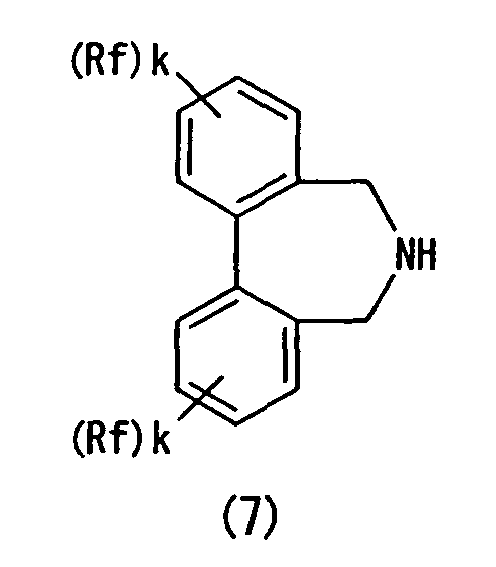
- (in the formula, Rf represents halogen, a C1-8 alkyl which is optionally substituted and which is linear, branched, or cyclic, a C1-8 alkoxy which is optionally substituted and which is linear, branched, or cyclic, a C2-8 alkenyl which is optionally substituted, a C2-8 alkynyl which is optionally substituted, a C6-14 aryl which is optionally substituted, a C3-8 heteroaryl which is optionally substituted, or a C7-16 aralkyl which is optionally substituted, and k is 0 or represents an integer of 1 to 4 and Rf may be different substituents to each other when k is 2 or more and Rf may bond with each other to form an aromatic ring which is optionally substituted); are reacted to produce the optically active quaternary ammonium salt compound represented by the formula (8)
-

- (in the formula, Rc, Rd, Re, Rf, n, k, and symbols * and ** are the same as above); and
- (ii) the production method of an optically active quaternary ammonium salt compound represented by the formula (8) characterized in that the racemic bisbenzyl derivative represented by the formula (6) and optically active azepine derivative represented by the formula (7) are reacted.
- A fifth aspect of the present invention is a production method of an optically active quaternary ammonium salt compound characterized in that an optically active azepine derivative represented by the formula (9)
-

- (in the formula, Rc, Rd, and n are the same as above); and racemic bisbenzyl derivative represented by the following formula (10)
-

- (Rf, k, and Y2 are the same as above); are reacted to produce the optically active quaternary ammonium salt compound represented by the following formula (8)
-

- (in the formula, Rc, Rd, Re, Rf, n, k, and symbols * and ** are the same as above); and
- (ii) a production method of the optically active quaternary ammonium salt compound represented by the formula (8) characterized in that the racemic bisbenzyl derivative represented by the formula (9) and optically active azepine derivative represented by the formula (10) are reacted.
- The optically active quaternary ammonium salt compound of the present invention can be produced in an industrially advantageous method and has an excellent catalytic effect on the synthesis of optically active amino acids.
In addition, according to the production method of the present invention, the compounds of optically active quaternary ammonium salts can be industrially advantageously produced due to kinetic resolution. - The present invention will be described in detail below.
Examples of halogens in the present specification include each atom of fluorine, chlorine, bromine, and iodine. - Examples of the C1-8 alkyl, which is linear, branched, or cyclic, of the C1-8 alkyl which is linear, branched, or cyclic, and which is optionally substituted, include methyl, ethyl, propyl, isopropyl, butyl, isobutyl, sec-butyl, tert-butyl, pentyl, isopentyl, neopentyl, hexyl, isohexyl, heptyl, isoheptyl, octyl, isooctyl, cyclopropyl, cyclobutyl, 2-methylcyclopropyl, cyclopropylmethyl, cyclopentyl, and cyclohexyl.
- Examples of the C2-8 alkenyl of the C2-8 alkenyl, which is optionally substituted, include vinyl, 1-propenyl, 2-propenyl, isopropenyl, 1-butenyl, 2-butenyl, 3-butenyl, 1-pentenyl, 2-pentenyl, 3-pentenyl, 4-pentenyl, 1-methyl-2-butenyl, 1-methyl-3-butenyl, 1,1-dimethyl-2-propenyl, 3-methyl-2-butenyl, 1-hexenyl, 2-hexenyl, 3-hexenyl, 4-hexenyl, 5-hexenyl, 2-methyl-1-pentenyl, 3-methyl-1-pentenyl, 4-methyl-1-pentenyl, 2-methyl-2-pentenyl, 3-methyl-2-pentenyl, 2-ethyl-1-butenyl, 3,3-dimethyl-1-butenyl, 1-heptenyl, 2-heptenyl, 3-heptenyl, 1-octenyl, 2-octenyl, 3-octenyl, and 4-octenyl.
- Examples of the C2-8 alkynyl of the C2-8 alkynyl, which is optionally substituted, include ethynyl, 1-propynyl, 2-propynyl, 1-butynyl, 2-butynyl, 3-butynyl, 1-pentynyl, 2-pentynyl, 3-pentynyl, 4-pentynyl, 4-methyl-1-pentenyl, 1-hexynyl, and 1-octynyl.
- Examples of the C6-14 aryl of the C6-14 aryl, which is optionally substituted, include phenyl, 1-naphthyl, 2-naphthyl, 1-anthryl, 2-anthryl, 9-anthryl, 1-phenanthryl, 2-phenanthryl, 3-phenanthryl, 4-phenanthryl, 9-phenanthryl, and 10-phenanthryl.
- The C3-8 heteroaryl of the C3-8 heteroaryl, which is optionally substituted, is monocyclic, polycyclic, or a condensed ring which contains 1 to 4 atoms of N, O, and S and these atoms may be the same or different. Specific examples of the C3-8 heteroaryl include 2-pyridyl, 3-pyridyl, 4-pyridyl, 2-quinonyl, 3-quinonyl, 4-quinonyl, 5-quinonyl, 6-quinonyl, 7-quinonyl, 8-quinonyl, 2-indolyl, 3-indolyl, 4-indolyl, 5-indolyl, 6-indolyl, 7-indolyl, 2-furyl, 3-furyl, 2-thienyl, 3-thienyl, 2-pyrrolidyl, 3-pyrrolidyl, 2-imidazolyl, 4-imidazolyl, 5-imidazolyl, 2-oxazolyl, 4-oxazolyl, 5-oxazolyl, 2-thiazolyl, 4-thiazolyl, and 5-thiazolyl.
- The alkyl moiety of the C1-8 alkoxy, which is linear, branched, or cyclic, of the C1-8 alkoxy which is linear, branched, or cyclic, and which is optionally substituted, is the same as the aforementioned alkyl. Specific examples of the C1-8 alkoxy include methoxy, ethoxy, propoxy, isopropoxy, butoxy, isobutoxy, sec-butoxy, tert-butoxy, pentyloxy, isopentyloxy, hexyloxy, heptyloxy, octyloxy, cyclopropoxy, cyclobutoxy, 2-methylcyclopropoxy, cyclopropylmethoxy, cyclopentyloxy, and cyclohexyloxy.
- Examples of the C7-16 aralkyl of the C7-16 aralkyl, which is optionally substituted, include benzyl, 1-phenylethyl, 2-phenylethyl, 1-methyl-1-phenylethyl, 1-naphthylmethyl, and 2-naphthylmethyl.
- Examples of X- include anions such as anions of halogens like fluorine, chlorine, bromine, and iodine; OH-; BF4 -; PF6 -; SCN-; HSO4 -; anions of C1-6 dialkyl sulfate which is optionally substituted and which is linear, branched, or cyclic; anions of C1-6 alkyl sulfonate which is optionally substituted and which is linear, branched, or cyclic; anions of C6-14 aryl sulfonate which is optionally substituted; and anions of C7-16 aralkyl sulfonate which is optionally substituted.
- The alkyl moieties of C1-6 dialkyl sulfate which is optionally substituted and which is linear, branched, or cyclic and of C1-6 alkyl sulfonate which is optionally substituted and which is linear, branched, or cyclic are the same as the aforementioned alkyl. Specific examples of the C1-6 dialkyl sulfate and C1-6 alkyl sulfonate include dimethyl sulfate, methyl sulfonate, ethyl sulfonate, propyl sulfonate, and butyl sulfonate.
- The aryl moiety of C6-14 aryl sulfonate group which is optionally substituted is the same as the aforementioned aryl. Specific examples of the C6-14 aryl sulfonate include phenylsulfonate, p-toluenesulfonate, and naphthylsulfonate.
- The aralkyl moiety of C7-16 aralkyl sulfonate group which is optionally substituted is the same as the aforementioned aralkyl. Specific examples of the C7-16 aralkyl sulfonate include benzylsulfonate and phenethylsulfonate.
- Examples of the aromatic ring which is formed by the bonding of R5 and R6 and which is optionally substituted include a benzene ring and naphthalene ring.
- The C1-6 alkylene of the C1-6 alkylene, which is optionally substituted, is represented by the formula -(CH2)n- (in the formula, n represents an integer of 1 to 6). Specific examples of the compounds, in which R1 and R21 or R2 and R21 are bonded, include the compounds having the following structures.
-


- The C1-6 alkylenemonooxy of the C1-6 alkylenemonooxy, which is optionally substituted, is represented by the formula -O(CH2)n- or -(CH2)nO- (in the formula, n represents an integer of 1 to 6). Specific examples of the compounds, in which R1 and R21 or R2 and R21 are bonded, include the compounds having the following structures.
-

- The C1-6 alkylenedioxy of the C1-6 alkylenedioxy, which is optionally substituted, is represented by the formula -O(CH2)nO- (in the formula, n represents an integer of 1 to 6). Specific examples of the compounds, in which R1 and R21 or R2 and R21 are bonded, include the compounds having the following structures.
-

- Additionally, the leaving group represents halogen, a C1-8 alkylsulfonyloxy which is optionally substituted, C6-14 arylsulfonyloxy which is optionally substituted, C7-16 aralkylsulfonyloxy which is optionally substituted, or the like.
The alkyl moiety, aryl moiety, and aralkyl moiety in the C1-8 alkylsulfonyloxy which is optionally substituted and which is linear, branched, or cyclic, C6-14 arylsulfonyloxy which is optionally substituted, and C7-16 aralkylsulfonyloxy which is optionally substituted, are the same alkyl, aryl, and aralkyl as defined above, respectively. - The group which is optionally substituted (i.e., C1-8 alkyl, C2-8 alkenyl, C2-8 alkynyl, C6-14 aryl, C3-8 heteroaryl, C1-8 alkoxy, C7-16 aralkyl, aromatic rings formed by the bonding of R5 and R6, C1-6 alkylene, C1-6 alkylenemonooxy, C1-6 alkylenedioxy, C1-6 dialkyl sulfate group, C1-6 alkylsulfonate group, C6-14 arylsulfonate group, C7-16 aralkylsulfonate group, C1-8 alkylsulfonyloxy group, C6-14 arylsulfonyloxy group, and C7-16 aralkylsulfonyloxy group) and substituent G are the substituent which may be substituted at 1 to 6 positions by the same or different substituents, and examples thereof include:
- halogens such as fluorine, chlorine, bromine, and iodine; C1-8 alkyl which is linear, branched, or cyclic, such as methyl, ethyl, propyl, isopropyl, butyl, isobutyl, sec-butyl, tert-butyl, pentyl, isopentyl, neopentyl, hexyl, isohexyl, heptyl, isoheptyl, octyl, isooctyl, cyclopropyl, cyclobutyl, 2-methylcyclopropyl, cyclopropylmethyl, and cyclopentyl;
- C1-5 perfluoroalkyl which is linear, branched, or cyclic, such as trifluoromethyl, tetrafluoroethyl, and heptafluoroisopropyl;
- C6-14 aryl such as phenyl, 1-naphthyl, 2-naphthyl, 1-anthryl, 2-anthryl, 9-anthryl, 1-phenanthryl, and 2-phenanthryl;
- C1-8 alkoxy which is linear, branched, or cyclic, such as methoxy, ethoxy, propoxy, isopropoxy, butoxy, isobutoxy, sec-butoxy, tert-butoxy, pentyloxy, isopentyloxy, hexyloxy, heptyloxy, octyloxy, cyclopropoxy, cyclobutoxy, 2-methylcyclopropoxy, cyclopropylmethoxy, and cyclopentyloxy;
- C7-16 aralkyl such as benzyl, 2-phenylethyl, 1-naphthylmethyl, and 2-naphthylmethyl; and
- C3-8 heteroaryl, which is monocyclic, polycyclic, or a condensed ring which contains 1 to 4 atoms of N, O, and S and these atoms may be the same or different, such as 2-pyridyl, 3-pyridyl, 4-pyridyl, 2-quinonyl, 3-quinonyl, 4-quinonyl, 5-quinonyl, 6-quinonyl, 7-quinonyl, 8-quinonyl, 2-indolyl, 3-indolyl, 4-indolyl, 5-indolyl, 6-indolyl, 7-indolyl, 2-furyl, 3-furyl, 2-thienyl, 3-thienyl, 2-pyrrolidyl, 3-pyrrolidyl, 2-imidazolyl, 4-imidazolyl, 5-imidazolyl, 2-oxazolyl, 4-oxazolyl, 5-oxazolyl, 2-thiazolyl, 4-thiazolyl, and 5-thiazolyl.
- Examples of the racemic bisbenzyl compound having an axial chirality and represented by the aforementioned formula (2), which is useful as a production intermediate of the compound represented by the aforementioned formula (1), include the compound represented by the following formula (2a), and examples of the optically active bisbenzyl compound include the compound represented by the following formula (2b).
-

- In the formula,
R1 is the same as above;
R2a and R21a each independently representss halogen, a C1-8 alkyl which is optionally substituted and which is linear, branched, or cyclic, a C2-8 alkenyl which is optionally substituted, a C2-8 alkynyl which is optionally substituted, a C6-14 aryl which is optionally substituted, a C3-8 heteroaryl which is optionally substituted, a C1-8 alkoxy which is optionally substituted and which is linear, branched, or cyclic, or a C7-16 aralkyl which is optionally substituted;
R31 represents a C6-14 aryl which is optionally substituted, a C3-8 heteroaryl which is optionally substituted, or a C7-16 aralkyl which is optionally substituted; and
Y1 represents a leaving group and preferably represents halogen, a C1-8 alkylsulfonyloxy which is optionally substituted, a C6-14 arylsulfonyloxy which is optionally substituted, or a C7-16 aralkylsulfonyloxy which is optionally substituted. -

- In the formula, R1, R2a, R21a, R31, Y1, and the symbol * are the same as above.
- Examples of the racemic azepine derivative represented by the aforementioned formula (3), which is useful as a production intermediate of the compound represented by the aforementioned formula (1), include the compound represented by the following formula (3a), and examples of the optically active azepine derivative include the compound represented by the following formula (3b).
-

- In the formula, R1, R2, R21, and R3 are the same as above.
-

- In the formula, R1, R2, R21, R3, and the symbol * are the same as above.
- Since the optically active quaternary ammonium salt compound represented by the aforementioned formula (1) and the following formula (1') (one of the axially asymmetric compounds, which are enantiomorphic, is in excess compared to the other) are constituted by an optically active and axially asymmetric biphenyl and optically active and axially asymmetric binaphthyl, or by 2 kinds of optically active and axially asymmetric biphenyl groups, 4 kinds of isomers of said compound exist; i.e., S,S-form, R,R-form, S,R-form, and R,S-form following the conventional symbols showing an axially asymmetric optical activity, and all these isomers are included in the present invention.
- The quaternary ammonium salt compound (1') of the present invention can be produced, for example, by any one the following methods.
- (i) Reacting a racemic bisbenzyl compound (2a') and optically active azepine derivative (5b)
-

-
- (ii) Reacting an optically active bisbenzyl compound (2b') and racemic azepine derivative (5a)
(2b'); optically active substance + (5a); racemic substance → (1') + (5b); optically active substance - (iii) Reacting a racemic azepine derivative (3a) and optically active biphenyl derivative (4b)
-

-
- (iv) Reacting an optically active azepine derivative (3b) and racemic biphenyl derivative (4a)
(3b); optically active substance + (4a); racemic substance → (1') + (4b); optically active substance - In all the production methods (i) to (iv) of the present invention, when optically active materials are reacted with each other, two asymmetric axes of the obtained quaternary ammonium salt compound are both optically active. However, even when one material, which is optically active, is reacted with another material, which is racemic, the former preferentially reacts with one enantiomer of the latter due to kinetic resolution and two asymmetric axes of the obtained quaternary ammonium salt compound are produced so that they are both optically active. For this reason, the enantiomer of the latter material which is not involved in the production is recovered as an optically active substance. Accordingly, in the production method of the present invention, even when one material is not optically active, the quaternary ammonium salt compound having two asymmetric axes which are both optically active can readily be obtained, and thus it is an advantageous method industrially.
- 1 to 10 times of the racemic substance in the present invention can be used relative to the optically active substance in terms of moles, and particularly, the use of 1.5 to 3 times in terms of moles is preferable industrially.
- The present reaction can be carried out under the presence of a solvent or without a solvent. Usable solvents are not particularly limited as long as they are solvents inert to the reaction and examples thereof include hydrocarbon solvents such as pentane, hexane, heptane, benzene, toluene, and xylene; halogen solvents such as dichloromethane, 1,2-dichloroethane, chloroform, and carbon tetrachloride; alcohols such as methanol and ethanol; nitrile solvents such as acetonitrile and propionenitrile; ether solvents such as diethylether, dioxane, and tetrahydrofuran; non-protonic polar solvents such as N,N-dimethylformamide and dimethylsulfoxide; water; and mixed solvent systems in which two or more of these solvents are mixed.
- Examples of the bases include inorganic bases such as sodium hydroxide, potassium hydroxide, sodium carbonate, potassium carbonate, sodium bicarbonate, and potassium bicarbonate; and organic bases such as pyridine, triethylamine, N,N-dimethylaniline, 4-dimethylaminopyridine, N-methylpyrrolidine, N-methylmorpholine, and 1,8-diazabicyclo(5.4.0)undeca-7-ene. The amount of base used is normally 1 to 10 times and preferably 1 to 3 times of that of an optically active binaphthyl derivative or optically active biphenyl derivative in terms of moles.
- The temperature range of the present reaction is -78°C to 200°C and preferably -20°C to 100°C. The range of reaction time is 30 minutes to 100 hours, although this depends on the amount of reaction agents, temperature, or the like.
- Bisbenzyl compounds (2a') and (2b') and biphenyl derivatives (4a) and (4b), which are production intermediates, can be produced from the corresponding materials by following the method described in
Japanese Laid-Open Patent Application No. 2003-327566 Japanese Laid-Open Patent Application No. 2004-359578 - On the other hand, azepine derivatives (3a), (3b), (5a), and (5b), which are production intermediates, can be produced by following the description below.
- That is, 3,3'-dihalogeno-2,2'-dianilines (13), which are obtained by halogenating the bisanilines (12) produced from a known substance based on
Japanese Laid-Open Patent Application No. 2004-359578 Japanese Laid-Open Patent Application No. 2001-48866 -

- Examples of the halogenating reagents include N-bromosuccinimide (NBS), N-chlorosuccinimide (NCS), N-iodosuccinimide (NIS), bromine, chlorine, and iodine. Usable solvents are not particularly limited as long as they are solvents inert to the reaction and examples thereof include hydrocarbon solvents such as pentane, hexane, heptane, benzene, toluene, and xylene; halogen solvents such as dichloromethane, 1,2-dichloroethane, chloroform, and carbon tetrachloride; alcohols such as methanol and ethanol; and mixed solvent systems in which two or more of these solvents are mixed. The reaction can be carried out at an appropriate temperature from room temperature to the boiling point of the solvent.
- Subsequently, a 3,3'-disubstituted-2,2'-dihalogenated substance (15) is prepared by converting the amino group in 3,3-disubstituted-2,2'-dianilines (14) to halogen using a nitrite, and by treating this substance (15) with a carbon monoxide-Pd catalyst, a 3,3'-disubstituted-2,2'-diester substance (16) is obtained.
- The conversion of amino to halogen due to a nitrite can be carried out based on the method described in
Japanese Laid-Open Patent Application No. 2004-359578 -

- Moreover, by carrying out halogenation/Suzuki coupling reaction due to the method according to the above using a known compound or a biphenyl-2,2'-diester substance (14'), which can be derived by known methods, 3,3'-disubstituted-2,2'-diester substance (16) can also be obtained via 3,3'-dihalogenobiphenyl-2,2'-diester substance (15').
-

- 3,3'-disubstituted-2,2'-bishydroxymethyl substance (17) can be obtained by reducing 3,3'-disubstituted-2,2'-diester substance (16) due to the method described in Jikken Kagaku Koza (Courses in Experimental Chemistry, 4th Ed., edited by The Chemical Society of Japan and published by Maruzen Co., Ltd., vol. 20, pp.10-141).
-

- Subsequently, the hydroxyl in 3,3'-disubstituted-2,2'-bishydroxymethyl substance (17) is converted to a leaving group such as halogen based on the method described in Jikken Kagaku Koza (Courses in Experimental Chemistry, 4th Ed., edited by The Chemical Society of Japan and published by Maruzen Co., Ltd., vol. 19, pp.438-445) to obtain a bisbenzyl compound (2a').
-

- (In the formula, Y2 represents a leaving group and R1, R2, R21, and R3 are the same as above.)
Examples of the abovementioned leaving group Y2 include halogen, p-toluenesulfonyloxy, and methanesulfonyloxy. - On the other hand, 3,3'-disubstituted-2,2'-dihalogen substance (15) can be converted to 3,3'-disubstituted-2,2'-dimethyl substance (17') according to the method described in a document (J. Mol. Catal., 1990, 60, 343), and the bisbenzyl compound (2a') can also be obtained by subjecting the substance (17') to a general halogenation condition.
-

- Furthermore, 6,6'-dialkoxy-3,3'-disubstituted-2,2'-dimethyl substance (17") is obtained, for example, by carrying out halogenation/Suzuki coupling reaction according to the aforementioned method using 6,6'-dialkoxy-2,2'-dimethylbiphenyl derivative (14"), which can be synthesized based on a document (J. Chem. Soc., 1950, 711) or the like. By the same treatment carried out on the substance (17') to prepare the substance (2a'), the substance (17") can be derived to a corresponding bisbenzyl compound (2a").
-

- (In the formula, Ralc represents alkoxy and R2, R3, R21, and Y2 are the same as above.)
- In addition, it is possible to obtain biphenyl derivatives (4a) from diols (18) according to a document (J. Am. Chem. Soc., 121, 6519 (1999)).
-

- (In the formula, R4, R5, R6, and Y2 are the same as above.)
- The synthesis method of the aforementioned bisbenzyl compound (2a') and biphenyl derivatives (4a) can be applied to the corresponding optically-active compounds (2b') and (4b).
- By reacting these biphenyls with ammonia, an azepine derivative (3a), (3b), (5a), or (5b) can be produced.
-

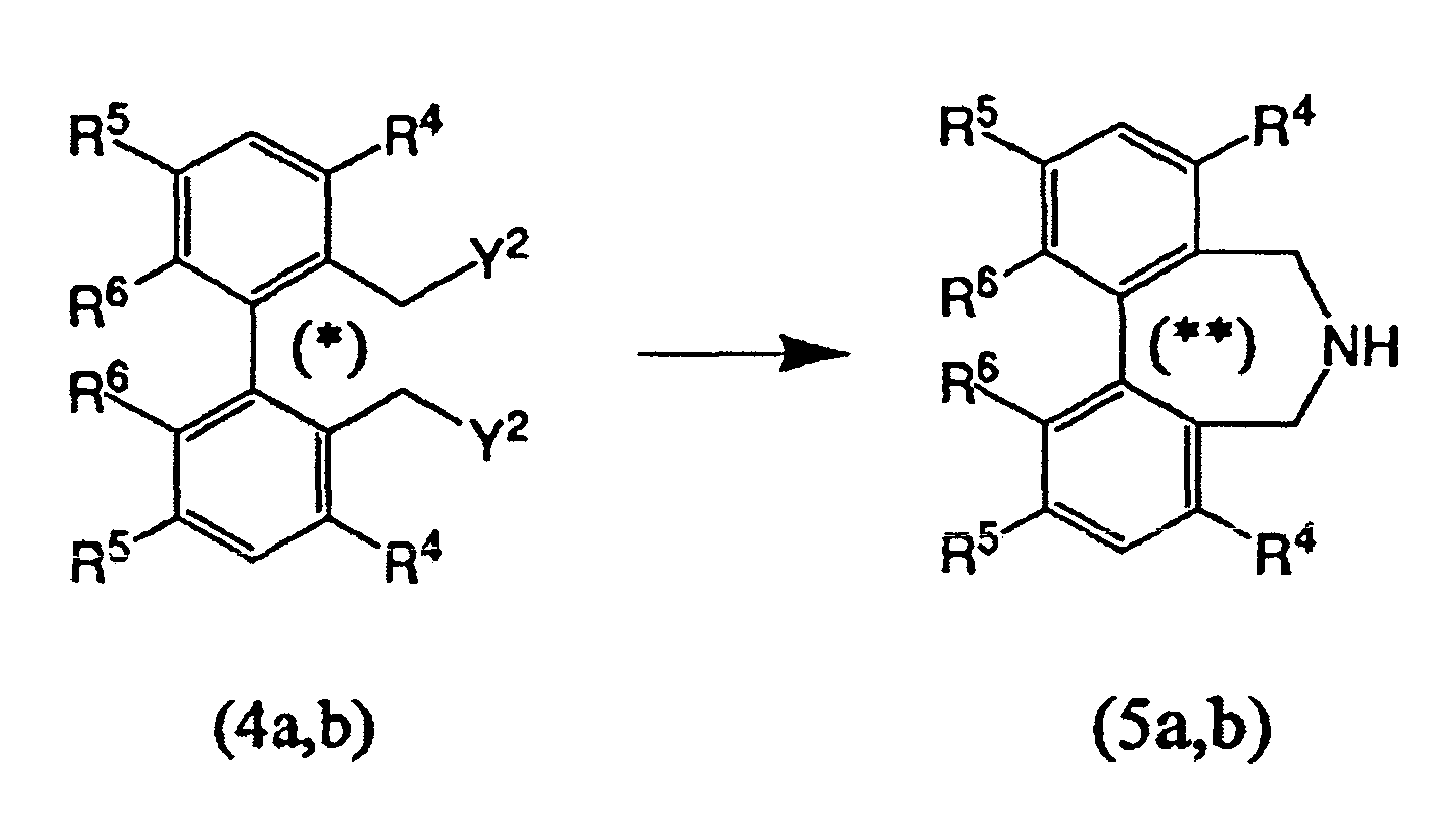
- (In the formula, R1, R2, R21, R3, R4, R5, R6, X, and X3 are the same as above and the symbols (*) and (**) represents optical activity when the compound is labeled with the alphabet "b".)
- The present reaction can be carried out by reacting the respective solvent solutions of biphenyls and ammonia, or by reacting one with the other's solvent solution directly.
Although the solvent used is not particularly limited as long as it does not react with biphenyls and ammonia, examples thereof include hydrocarbon solvents such as pentane, hexane, heptane, benzene, toluene, and xylene; halogen solvents such as dichloromethane, 1,2-dichloroethane, chloroform, and carbon tetrachloride; alcohols such as methanol and ethanol; nitrile solvents such as acetonitrile and propionenitrile; ether solvents such as diethylether, dioxane, and tetrahydrofuran; non-protonic polar solvents such as N,N-dimethylformamide and dimethylsulfoxide; water; and mixed solvent systems in which two or more of these solvents are mixed. In addition, the solvent for dissolving ammonia is not particularly limited as long as it does not react with ammonia. Examples thereof include hydrocarbon solvents such as pentane, hexane, heptane, benzene, toluene, and xylene; halogen solvents such as dichloromethane, 1,2-dichloroethane, chloroform, and carbon tetrachloride; alcohols such as methanol and ethanol; nitrile solvents such as acetonitrile and propionenitrile; ether solvents such as diethylether, dioxane, and tetrahydrofuran; non-protonic polar solvents such as N,N-dimethylformwnide and dimethylsulfoxide; water; and mixed solvent systems in which two or more of these solvents are mixed. - Although the method is not particularly limited, the reaction can be carried out, for example, by adding ammonia, in either gaseous form or liquid form, to the solution of biphenyls directly, or by adding the aforementioned solvent solution of ammonia dropwise to the solution of biphenyls.
Although the mixing ratio of a solvent and biphenyls is not particularly limited, it can appropriately be set from 1: 1 to 100: 1 (volume: weight). Likewise, ammonia can also be used in an arbitrary concentration.
The mole ratio of biphenyls and ammonia is from 1: 0.2 to 1: 10 and preferably from 1: 1 to 1: 5.
Reaction temperature is -70°C to the boiling point of solvents and preferably -20°C to 40°C. - After completing the reaction and the distillation process to remove unreacted ammonia, azepine derivatives can be separated/purified by applying known conventional methods such as extraction, washing, distillation, column chromatography, drying, and recrystallization.
- The production of an optically active quaternary ammonium salt compound (1) can be carried out by following the condition of a general N-benzylation reaction as shown below.
- (a) Reacting an optically active bisbenzyl compound (2b') with an optically active azepine derivative (5b); or
- (b) Reacting an optically active biphenyl compound (4b) with an optically active azepine derivative (3b)
- Additionally, the production of an optically active quaternary ammonium salt compound (1) can also be carried out by the kinetic resolution method. In other words, it can be performed by reacting a racemic substance with an optically active substance as shown below.
- (i) Reacting a racemic bisbenzyl compound (2a') with an optically active azepine derivative (5b);
- (ii) Reacting an optically active bisbenzyl compound (2b') with a racemic azepine derivative (5a);
- (iii) Reacting a racemic azepine derivative (3a) with an optically active biphenyl derivative (4b); or
- (iv) Reacting an optically active azepine derivative (3b) with a racemic biphenyl derivative (4a)
- The reaction between 2 kinds of the aforementioned substances can readily be carried out in an appropriate solvent under the presence of a base.
- Solvents can be used regardless of their type as long as they are not involved in the reaction. Examples thereof include hydrocarbon solvents such as pentane, hexane, heptane, benzene, toluene, and xylene; halogen solvents such as dichloromethane, 1,2-dichloroethane, chloroform, and carbon tetrachloride; alcohols such as methanol and ethanol; nitrile solvents such as acetonitrile and propionenitrile; ether solvents such as diethylether, dioxane, and tetrahydrofuran; non-protonic polar solvents such as N,N-dimethylformamide and dimethylsulfoxide; and mixed solvent systems in which two or more of these solvents are mixed. However, since the present reaction can be carried out under the phase-transfer reaction conditions, solvent systems, in which a water-insoluble solvent among the aforementioned solvents and water are combined, can also be used.
- Although general inorganic bases can be used as the base, which may be used, more preferable examples thereof include sodium hydroxide, potassium hydroxide, sodium carbonate, and potassium carbonate.
- Reaction can be performed in a solvent or in a solvent system while stirring under the presence of a base, and in a temperature range from the solidifying point to the boiling point of the solvent or the solvent system. Reaction temperature is preferably -20°C to 80°C. Although reaction time can be adjusted appropriately depending on the reaction temperature, reactions can be completed in 30 minutes to 12 hours.
- The volume of the abovementioned reaction solvent is 1 to 100 times larger and more preferably 5 to 50 times larger in terms of volume (ml)/ weight (g) ratio with respect to the total weight of the 2 substances.
- Although the charged mole ratio of the aforementioned 2 substances is preferably 1: 1 when the condition is for a general N-benzylation reaction, more favorable results can be obtained by increasing the amount of one substance, which is more readily available than the other. When using the kinetic resolution method, the ratio of an optically active substance and racemic substance is preferably 1: 2 to 1: 5 and more preferably 1: 2 to 1: 3.
- The amount of base used is preferably 1 to 6 equivalent and more preferably 1 to 3 equivalent of the leaving group Y2, which is present in the reaction system, when the condition is for a general N-benzylation reaction. When using the kinetic resolution method, the amount of base used is preferably 1 to 6 equivalent and more preferably 1 to 3 equivalent of the leaving group Y2, which is present in the reaction system, if an azepine derivative is an optically active substance, and the amount of base used is preferably 0 to 4 equivalent and more preferably 0 to 1 equivalent of the leaving group Y2, which is present in the reaction system, if the azepine derivative is a racemic substance.
- The compound (1) which is produced as such can provide a reaction product having a high optical purity when used as a phase transfer catalyst in the asymmetric alkylation of an α-amino acid derivative.
- Although the present invention will be described in more detail below using Examples and Reference Examples, the technical scope of the present invention is not limited to these Examples.
- Production of 2',2"-bis(bromomethyl)-3,4,5,3"',4"',5"'-hexafluoro-4',5',4",5"-tetramethyl-(1,1';3',3' ';1",1"') quaterphenyl (22)
-

- After dissolving 156 mg (0.27 mmol) of a compound (20) in 5 ml of THF and cooling the resultant down to 0°C, 31 mg (0.81 mmol) of LiAlH4 was added thereto. After increasing the temperature of the mixture slowly to room temperature, the mixture was further stirred for 5 hours. Thereafter, the reaction was stopped by pouring the reaction solution into ice-cold water, and an alcoholic substance (21) was obtained by carrying out further procedures of extraction/drying/concentration. Without subjecting to further purification procedures, the alcoholic substance (21) was dissolved in 5 ml of CH2Cl2, and 0.26 ml (0.6 mmol) of PBr3 was added dropwise to the resulting solution at 0°C. After stirring for 2 hours at room temperature, the reaction solution was poured into ice-cold water to stop the reaction. The reaction solution was then further extracted using methylene chloride and the resultant was dried/concentrated and thereafter purified by column chromatography (ethyl acetate: hexane = 1: 10) to obtain 137 mg (0.21 mmol) of a compound (22) (yield was 77%).
1H NMR (300MHz, CDCl3), δ7.15 (2H, d, J=6.6Hz, ArH), 7.12 (2H, d, J=6.6Hz, ArH), 7.09 (2H, s, ArH), 4.03 (4H, d, J=2.4Hz, ArCH2), 2.37 (6H, s, ArCH3), 1.97 (6H, s, ArCH3) - Production of 1,2,10,11-tetramethyl-4,8-bis(3,4,5-trifluorophenyl)-6,7-dihydro-5H-dibenzo(c,e)azepine
-

- 65 mg (0.1 mmol) of the compound (22) and 0.2 ml of 25% ammonia water were stirred in an acetonitrile solvent at room temperature for 24 hours. After the completion of the reaction, the resultant was extracted/dried/concentrated, and thereafter purified by column chromatography (methanol: methylene chloride = 1: 10) to obtain 51 mg (0.1 mmol) of a compound (23) (yield was 100%).
1H NMR (300MHz, CD3OD), δ7.31 (2H, s, ArH), 7.24 (2H, d, J=6.6Hz, ArH), 7.21 (2H, d, J=6.6Hz, ArH), 4.14 (2H, d, J=13.8Hz, ArCH2), 3.46 (2H, d, J=13.8Hz, ArCH2), 2.43 (6H, s, ArCH3), 2.09 (6H, s, ArCH3) - Production of optically active quaternary ammonium salt compound (26) (homo)
-

- Under the presence of 140 mg of potassium carbonate, 56 mg of a chiral secondary amine (24) and 80 mg of racemic dibromomethylbiphenyl (25), which was 2.1 equivalent of said amine, were stirred in an acetonitrile solvent at room temperature for 12 hours. After the completion of the reaction, the resultant was purified by extraction/column chromatography (methylene chloride: methanol = 10: 1) to obtain 74 mg of an optically pure compound (S, S)-(26) (yield was 85%). [α]D 22=+25.6° (c1.0, CHCl3)
1H NMR (300MHz, CDCl3), δ8.21 (2H, s, ArH), 8.08 (2H, d, J=8.4Hz, ArH), 7.205-7.60 (8H, m, ArH), 7.09 (2H, d, J=8.7Hz, ArH), 6.71 (2H, d, J=7.8Hz, ArH), 6.02 (2H, d, J=7.8Hz, ArH), 4.71 (2H, d, J=13.8Hz, ArCH2), 4.50 (2H, d, J=14.1Hz, ArCH2), 4.04 (2H, d, J=13.5Hz, ArCH2), 3.49 (2H, d, J=13.2Hz, ArCH2), 2.30 (6H, s, ArCH3), 1.88 (6H, s, ArCH3) - Production of optically active quaternary ammonium salt compound (29) (homo)
-

- Under the presence of 140 mg of potassium carbonate, 56 mg of a chiral secondary amine (27) and 80 mg of racemic dibromomethylbiphenyl (28), which was 2.1 equivalent of said amine, were stirred in an acetonitrile solvent at room temperature for 12 hours as in Example 1. After the completion of the reaction, the resultant was purified by extraction/column chromatography (methylene chloride: methanol = 10: 1) to obtain 82 mg of an optically pure compound (R, R)-(29) (yield was 94%).
[α]D 23=-120.2° (c1.0, CHCl3)
1H NMR (300MHz, CDCl3), δ7.92 (2H, d, J=8.4Hz, ArH), 7.20-7.57 (12H, m, ArH), 7.11 (2H, d, J=8.4Hz, ArH), 6.32 (2H, d, J=8.7Hz, ArH), 4.55 (2H, d, J=13.8Hz, ArCH2), 4.47 (4H, d, J=14.1Hz, ArCH2), 4.18 (2H, d, J=14.1Hz, ArCH2), 3.61 (2H, d, J=12.9Hz, ArCH2), 2.45 (6H, s, ArCH3), 2.05 (6H, s, ArCH3) - Production of optically active quaternary ammonium salt compound (45)
-

- 1.97 g (4.37 mmol) of a compound (40) and 2.33 g (13.1 mmol) of N-bromosuccinimide were reacted in 20 ml of a chloroform solvent at room temperature for 12 hours. After the completion of the reaction, the resultant was extracted with ethyl acetate, dried/concentrated, and thereafter purified by column chromatography (ethyl acetate: hexane = 1: 3) to obtain a compound (41) (yield was 94%).
1H NMR (300MHz, CDCl3), δ3.96 (6H, s, ArCO2CH3), 3.94 (6H, s, ArOCH3), 3.79 (6H, s, ArOCH3), 3.94 (6H, s, ArOCH3) - The compounds (41) to (45) were synthesized according to the methods of Reference Example 7, and Examples 1 and 4.
-

- Compound (42) (yield was 80%)
1H NMR (300MHz, CDCl3), δ6.90-6.95 (4H, m, ArH), 3.98 (6H, s, ArCO2CH3), 3.85 (6H, s, ArOCH3), 3.70 (6H, s, ArOCH3), 3.27 (6H, s, ArOCH3) - Compound (44) (yield was 81% from the compound (42))
1H NMR (300MHz, CDCl3), δ6.95-7.15 (4H, m, ArH), 3.90-4.00 (4H, m, ArCH2O-), 3.95 (6H, s, ArOCH3), 3.87 (6H, s, ArOCH3), 3.73 (6H, s, ArOCH3)
Compound (45) (yield was 83%)
[α]D 22=-89.55° (c0.22, CHCl3)
1H NMR (300MHz, CDCl3), δ6.75-8.00 (12H, m, ArH), 6.47 (4H, d, J=8.4Hz, ArH), 4.65 (2H, d, J=14.1Hz, ArCH2), 4.44 (2H, d, J=12.6Hz, ArCH2), 4.40 (2H, d, J=13.5Hz, ArCH2), 4.11 (6H, s, ArOCH3), 3.91 (6H, s, ArOCH3), 3.75 (6H, s, ArOCH3), 3.61 (2H, d, J=13.8Hz, ArCH2) -

- 30 mg (0.043 mmol) of a compound (60) was dissolved in 2 ml of acetonitrile, and 0.1 to 0.2 ml of 25% ammonia water solution was added dropwise thereto. The reaction mixture was stirred at room temperature for 48 hours, concentrated to remove the solvent, and extracted with ethyl acetate. The resultant was subjected to drying/concentration and thereafter purified by column chromatography (methylene chloride: methanol = 15: 1) to obtain 20 mg (0.036 mmol) of a targeted substance (61) (yield was 84%).
- The compounds of the present invention including those obtained in the abovementioned Examples are described in Tables 1 to 4.
-
Table 1 Optically active quaternary ammonium salt (1) 
Compound No. R1 R2 R21 R3 R4 x Physical property value (1HNMR, 300MHz, CDCl3) Physical property (angle of rotation) Note 26 Me H Me H 3,4,5-F3-C6H2 Br δ8.21 (2H, s, ArH), 8.08 (2H, d, J=8.4Hz, ArH), 7.205-7.60 (8H, m, ArH). 7.09 (2H, d, J=8.7Hz, ArH), 6.71 (2H, d, J=7.8Hz, ArH), 6.02 (2H, d, J=7.8Hz, ArH), 4.71 (2H, d, J=13.8Hz, ArCH2), 4.50 (2H, d, J=14.1Hz, ArCH2), 4.04 (2H, d, J=13.5Hz, ArCH2), 3.49 (2H, d, J=13.2Hz, ArCH2), 2.30 (6H, s, ArCH3), 1.88 (6H, s, ArCH3) [α]D 22=+25.6° (c1.0, CHCl3) S,S-form 29 Me H Me 3,4,5-F3-C6H2 H Br δ7.92 (2H, d, J=8.4Hz, ArH), 7.20-7.57 (12H, m, ArH), 7.11 (2H, d, J=8.4Hz, ArH), 6.32 (2H, d, Jm8.7Hz, ArH), 4.55 (2H, d, J=13.8Hz, ArCH2), 4.47 (4H, d, J=14.1Hz, ArCH2), 4.18 (2H, d, J=14.1Hz, ArCH2), 3.61 (2H, d, J=12.9Hz, ArCH2), 2.45 (6H, s, ArCH3), 2.05 (6H, s, ArCH3) [α]D 23=-120.2° (c1.0, CHCl3) R,R-form 30 Me H Me H 3,5-(CF3)2-C6H2 Br δ8.27 (2H, s, ArH), 7.35-8.16 (12H, m, ArH), 7.16 (2H, d, J=8.7Hz, ArH), 6.43 (2H, d, 3=7.8Hz, ArH), 5.73 (2H, d, J=7.8Hz, ArH), 4.71 (2H, d, J=14.1Hz, ArCH2), 4.53 (2H, d, J=13.8Hz, ArCH2), 4.10 (2H, d, J=13.5Ha, ArCH2), 3.42 (2H, d, J=12.9Hz, ArCH2), 2.20 (6H, s, ArCH3), 1.82 (6H, s, ArCH3) [α]D 22=+25.6° (c1.0, CHCl3) S,S-form 31 Me H Me H 3,4,5-F3-C6H2 Br δ8.22 (2H, s, ArH), 8.08 (2H, d, J=8.4Hz, ArH), 7.64 (2H, d, J=7.2Hz. ArH), 6.91-7,60 (12H, m, ArH), 5.90 (2H, d, J=7.5Hz, ArH), 4.85 (2H, d, J=14.1Hz, ArCH2), 4.57 (2H, d, J=13.5Hz, ArCH2), 4.11 (2H, d, J=13.5Hz, ArCH2), 3.76 (6H, s, OCH3), 3.61 (2H, d, J=12.9Hz, ArCH2) [α]D 23=+18.0° (c0.15, CHCl3) S,R-form 45 OMe OMe OMe 3,4,5-F3-C6H2 H Br δ6.75-8.00 (12H, m, ArH), 6.47 (4H, d, J=8.4Hz, ArH), 4.65 (2H, d, J=14.1Hz, ArCH2), 4.44 (2H, d, J=12.6Hz, ArCH2), 4.40 (2H, d, J=13.5Hz, ArCH2), 4.11 (6H, s, ArOCH3), 3.91 (6H, s, ArOCH3), 3.75 (6H, s, ArOCH3), 3.61 (2H, d, J=13.8Hz, ArCH2) [α]D 22=-89.55° (c0.22, CHCl3) R,S-form 46 OMe OMe OMe H 3,5-(CF3)2-C6H2 Br δ8.76 (2H, s, ArH), 8.17 (2H, s, ArH), 7.01-7.92 (12H, m, ArH), 6.11 (2H, d, J=8.4Hz, ArH), 2.25-4.80 (8H, m, ArCH2), 4.14 (4H, s, ArOCH3, homo), 4.09 (2H, s, ArOCH3, hetero), 4.07 (2H, s, ArOCH3, hetero), 3.98 (4H, s, ArOCH3, homo), 3.81 (2H, s, ArOCH3, hetero), 3.76 (4H, s, ArOCH3, homo) [α]D 22=-63.125° (c0.48, CHCl3) Mixture of R,S-form and R,R-form (ratio is 2: 1) 47 OMe H C6H5 C6H5 H Br 87.08-7.85 (32H, m, ArH), 6.15 (2H, d, J=8.4Hz, ArH), 4.86 (2H, d, J=13.8Hz, ArCH2), 4.69 (2H, d, J=13.SHz, ArCH2), 4.38 (2H, d, J=13.2Hz, ArCH2), 3.69 (2H, d, J=13.2Hz, ArCH2), 3.43 (6H, s, ArOCH3) 48 OMe H 4-CF3-C6H4 4-CF3-C6H4 H Br δ7.07-7.95 (28H, m, ArH), 6.11 (2H, d, J=8.4Hz, ArH), 4.90 (2H, d, J=12.OHz, ArCH2), 4.74 (2H, d, J=13.8Hz, ArCH2), 4.46 (2H, d, J=14.7Hz, ArCH2), 3.69 (2H, d, J=13.8Hz, ArCH2), 3.44 (6H, s, ArOCH3) 49 OMe H 4-F-C6H4 4-F-C6H4 H Br 7.60-7.65 (4H, m, ArH), 7.40-7.55 (4H, m, ArH), 7.28 (2H, s, ArH), 7.05-7.20 (8H, m, ArH), 4.27 (4H, s, ArCH2), 3.35 (6H, s, ArOCH3) 50 OMe H 3-CF3-C6H4 3-CF3-C6H4 H Br 87.02-7.98 (28H, m, ArH), 6.14 (2H, br, ArH), 4.71 (2H, d, J=13.2Hz, ArCH2), 3.40-3.77 (6H, m, ArCH2), 3.55 (6H, s, ArOCH3) 51 OMe H 3,5-CF3-C6H3 3,5-CF3-C6H3 H Br δ7.05-8.22 (24H, m, ArH), 6.00 (2H, d, J=8.4Hz, ArH), 5.11 (2H, br, ArCH2), 4.51-4.60 (4H, m, ArCH2), 3.73 (2H, d, J=13.2Hz, ArCH2), 3.52 (6H, s, ArOCH3) 52 OMe OMe H 3,5-CF3-C6H3 H Br δ8.75 (2H, s, ArH), 8.10 (2H, s, ArH), 6.85-7.93 (14H, m, ArH), 6.22 (2H, d, J=8.4Hz, ArH), 4.55 (2H, d, J=13.5Hz, ArCH2), 4.43 (2H, d, J=13.5Hz, ArCH2), 4.31 (2H, d, J=13.5Hz, ArCH2), 3.99 (12H, s, ArOCH3), 3.58 (2H, d, J=13.5Hz, ArCH2) 53 OMe H OMe 3,5-CF3-C6H3 H Br δ8.22 (2H, s, ArH), 6.98-7.95 (16H, m, ArH), 5.95 (2H, d, J=8.4Hz, ArH), 4.66 (2H, d, J=12.9Hz, ArCH2), 4.32-4.42 (4H, m, ArCH2), 4.11 (6H, s, ArOCH3), 3.94 (6H, s, ArOCH3), 3.57 (2H, d, J=13.5Hz, ArCH2) 54 OMe H H 3,5-CF3-C6H3 H Br δ8.18 (2H, s, ArH), 7.03-7.95 (18H, m, ArH), 6.04 (2H, d, J=8.4Hz, ArH), 4.66 (2H, d, J=14.1Hz, ArCH2), 4.50 (2H, d, J=13.5Hz, ArCH2), 4.45 (2H, d, J=13.8Hz, ArCH2), 3.94 (6H, s, ArOCH3), 3.63 (2H, d, J=13.2Hz, ArCH2) 55 OMe H H 3,4,5-F3-4C6H2 H Br δ7.92 (2H, d, J=8.4Hz, ArH), 7.09-7.65 (16H, m, ArH), 6.35 (2H, d, J=8.4Hz, ArH), 4.62 (2H, d, J=13.8Hz, ArCH2), 4.45-4.52 (4H, m, ArCH2), 3.89 (6H, s, ArOCH3), 3.68 (2H, d, J=13.5Hz, ArCH2) 56 OMe OMe OMe 3,5-CF3-C6H3 H δ6.75-8.00 (12H, m, AtH), 6.47 (4H, d, J=8.4Hz, ArH), 4.65 (2H, d, J=14.1Hz, ArCH2), 4.44 (2H, d, J=12.6Hz, ArCH2), 4.40 (2H, d, J=13.SHz, ArCH2), 4.11 (6H, s, ArOCH3), 3.91 (6H, s, ArOCH3), 3.75 (6H, s, ArOCH3), 3.61 (2H, d, J=13.8Hz, ArCH2) [α]D 22=89.55° (c0.22, CHCl3) 57 Me Me H 3,4,5-F3-C6H2 H δ7.92 (2H, d, J=8.4Hz, ArH), 7.20-7.57 (12H, m. ArH), 7.11 (2H, d, J=8.4Hz, ArH), 6.32 (2H, d, J=8.7Hz, ArH), 4.55 (2H, d, J=13.8Hz, ArCH2), 4.47 (4H, d, J=14.1Hz, ArCH2), 4.18 (2H, d, J=14.1Hz, ArCH2), 3.61 (2H, d, J=12.9Hz, ArCH2), 2.45 (6H, s, ArCH3), 2.05 (6H, s. ArCH3) -
Table 2 Optically active quaternary ammonium salt (1) 
Compound No. R1 R 2 R21 R 3 R4 R5 R6 x Physical property value (1HNMR, 300MHz, CDCl3) Physical property (angle of rotation) Note 32 Me H Me 3,4,5-F3-C6H2 H H OMe Br δ7.41 (4H, s, ArH), 7.00 (2H, d, J=8.7Hz, ArH), 6.85-6.91 (4H, m, ArH), 5.70 (2H, d, J=6.9Hz, ArH), 4.56 (2H, d, J=14.1Hz, ArCH2), 4.40 (2H, d, J=13.2Hz, ArCH2), 3.86 (2H, d, J=13.5Hz, ArCH2). 3.75 (6H, s, OCH3), 3.45 (2H, d, J=12.9Hz, ArCH2), 2.48 (6H, s, ArCH3), 2.04 (6H, s, ArCH3) -
Table 3 
Compound No. R1 R2 R21 R3 Y2 Physical property value (1HNMR, 300MHz, CDCl3) 22 Me H Me 3,4,5-F3-C6H2 Br δ7.15 (2H, d, J=6.6Hz, ArH), 7.12 (2H, d, J=6.6Hz, ArH), 7.09 (2H, s, ArH), 4.03 (4H, d, J=2.4Hz, ArCH2), 2.37 (6H, s, ArCH3), 1.97 (6H, s, ArCH3) 44 OMe OMe OMe 3,4,5-F3-C6H2 Br δ6.95-7.15 (4H, m, ArH), 3.90-4.00 (4H, m, ArCH2O-), 3.95 (6H, s, ArOCH3), 3.87 (6H, s, ArOCH3), 3.73 (6H, s, ArOCH3) 47B OMe H C6H5 C6H5 Br 87.30-7.68 (22H, m, ArH), 4.34 (4H, d, J=2.1Hz, ArCH2), 3.37 (6H, s, ArOCH3) 48B OMe H 4-CF3-C6H4 4-CF3-C6H4 Br δ7.60-7.78 (16H, m, ArH), 7.34 (2H, s, ArH), 4.27 (4H, s, ArCH2), 3.38 (6H, s, ArOCH3) 49B OMe H 4-F-C6H4 4-F-C6H4 Br δ7.60-7.78 (16H, m, ArH), 7.34 (2H, s, ArH), 4.27 (4H, s, ArCH2), 3.38 (6H, s, ArOCH3) 50B OMe H 3-CF3-C6H4 3-CF3-C6H4 Br 87.55-7.93 (16H, m, ArH), 7.35 (2H, s, ArH), 4.25 (4H, s, ArCH2), 3.37 (6H, s, ArOCH3) 51B OMe H 3,5-CF3-C6H3 3-CF3-C6H4 Br δ7.90-8.15 (12H, m, ArH), 7.39 (2H, s, ArH), 4.17 (4H, s, ArCH2), 3.41 (6H, s, ArOCH3) 52B OMe OMe H 3,5-CF3-C6H3 Br 87.81-7.92 (6H, m, ArH), 6.65 (2H, s, ArH), 3.81-3.92 (4H, m, ArCH2), 3.83 (6H, s, ArOCH3), 3.79 (6H, s, ArOCH3) 53B OMe H OMe 3,5-CF3-C6H3 Br 88.02 (4H, s, ArH), 7.94 (2H, s, ArH), 6.87 (2H, s, ArH), 4.04 (4H, s, ArCH2), 3.95 (6H, s, ArOCH3), 3.86 (6H, s, ArOCH3) 54B OMe H H 3,5-CF3-C6H3 Br δ8.01 (4H, s, ArH), 7.91 (2H, s, ArH), 7.32 (2H, d, J=8.4Hz, ArH), 7.08 (2H, d, J=8.4Hz, ArH), 4.02 (4H, d, J=3.0Hz, ArCH2), 3.80 (6H, s, ArOCH3) 55B OMe H H 3,4,5-F3-C6H2 Br δ7.26 (2H, d, J=8.4Hz, ArH), 7.03 (2H, d, J=8.4Hz, ArH), 7.10-7.17 (4H, m, ArH), 4.06 (4H, s, ArCH2), 3.77 (6H, s, ArOCH3) 56B OMe OMe OMe 3,5-CF3-C6H3 Br δ6.95-7.15 (4H, m, ArH), 3.90-4.00 (4H, m, ArCH2O-), 3.95 (6H, s, ArOMe), 3.87 (6H, s, ArOMe), 3.73 (6H, s, ArOMe) 57B Me Me H 3,4,5-F3-C6H2 Br δ7.15 (2H, d, J=6.6Hz, ArH), 7.12 (2H, d, J=6.6Hz, ArH), 7.09 (2H, s, ArH), 4.03 (4H, d, J=2.4Hz, ArCH2), 2.37 (6H, s, ArCH3), 1.97 (6H, s, ArCH3) -
Table 4 
Compound No. R1 R2 R21 R3 Physical property value (1HNMR, 300MHz, CDCl3) 23 Me H Me 3,4,5-F3-C6H2 87.31 (2H, s, ArH), 7.24 (2H, d, J=6.6Hz, ArH), 7.21 (2H, d, J=6.6Hz, ArH), 4.14 (2H, d, J=13.8Hz, ArCH2), 3.46 (2H, d, J=13.8Hz, ArCH2), 2.43 (6H, s, ArCH3), 2.09 (6H, s, ArCH3) 47A OMe H C6H5 C6H5 δ7.33-7.69 (22H, m, ArH), 3.95 (4H, d, J=12.6Hz, ArCH2), 3.41 (4H, d, J=12.6Hz, ArCH2), 3.29 (6H, s, ArOCH3) 48A OMe H H 3,5-CF3-C6H3 δ7.96 (4H, s, ArH), 7.85 (2H, s, ArH), 7.38 (2H, d, J=8.4Hz, ArH), 7.08 (2H, d, J=8.4Hz, ArH), 3.91 (6H, s, ArOCH3), 3.72 (2H, d, J=12.6Hz, ArCH2), 3.34 (2H, d, J=12.9Hz, ArCH2) 56A OMe OMe OMe 3,5-CF3-C6H3 δ8.32 (2H, s, ArH), 7.76 (2H, s, ArH), 7.63 (2H, s, ArH), 3.98 (6H, s, ArOCH3), 3.87 (6H, s, ArOCH3), 3.67 (6H, s, ArOCH3), 3.45-3.76 (4H, m, ArCH2); m.p.=258-260° (decomp.) 57A Me H Me 3,4,5-CF3-C6H2 δ7.00-7.22 (6H, m, ArH), 3.72 (2H, d, J=12.6Hz, ArCH2), 3.10 (2H, d, J=12.6Hz, ArCH2), 2.37 (6H, s, ArCH3), 2.06 (6H, s, ArCH3) - 74 mg of tert-butyl(benzhydrylideneamino)acetate, 2.0 mg of an optically active quaternary ammonium salt compound (R, R)-(29), and 36 µl of benzylbromide were added to 2 ml of a toluene solvent at 0°C. 0.5 ml of 50% KOH aqueous solution was added dropwise to the resulting solution while stirring. The reaction solution was stirred for 8 hours at 0°C and thereafter extracted by adding water and ether. The reaction product was purified by column chromatography (hexane: ether = 15: 1) to obtain targeted tert-butyl-2-(benzhydrylideneamino)-3-phenylpropionate (yield was 95%).
Furthermore, optical purity was determined by HPLC analysis (hexane: isopropyl alcohol = 100: 1) using CHIRALCEL® OD manufactured by Daicel Chemical Industries, Ltd (asymmetric yield was 97% ee). - When the same reaction as in the above Reference Example 1 was carried out using the catalyst represented by the formula (45), a corresponding alkylated substance was obtained with a yield of 96% and asymmetric yield of 94% ee.
- When the same reaction as in the above Reference Example 1 was carried out using the catalyst represented by the formula (46), a corresponding alkylated substance was obtained with a yield of 100% and asymmetric yield of 98% ee.
-

- In 20 ml of a DMF solvent, 5.5 g (20 mmol) of 2-iodo-3,4-dimethyl-1-nitrobenzene and 10 g (155 mmol) of copper powder were heated at 150°C for 48 hours. After the completion of the reaction, copper powder was removed by filtration and thereafter, the resultant was extracted using ethyl acetate, dried/concentrated, and then purified by column chromatography (ethyl acetate: hexane = 1: 10) to obtain 2.9 g (0.96 mmol) of 2,3,2',3'-tetramethyl-6,6'-dinitrobiphenyl (34) (yield was 96%).
1H NMR (300MHz, CDCl3), δ7.91 (2H, d, J=8.4Hz, ArCH), 7.34 (2H, d, J=8.4Hz, ArCH), 2.40 (6H, s, ArCH3), 1.84 (6H, s, ArCH3) -

- 3.0 g (10 mmol) of the compound (34) and 500 mg (5 mol%) of 10% Pd/C were added to 50 ml of a methanol solvent and were stirred for 12 hours under hydrogen atmosphere. After the completion of the reaction, solid matter was removed by filtration and thereafter, the resultant was purified by column chromatography (ethyl acetate: hexane = 1: 5) to obtain 2.4 g (10 mmol) of 5,6,5',6'-tetramethylbiphenyl-2,2'-diamine (35) (yield was 100%).
1H NMR (300MHz, CDCl3), 86.97 (2H, d, J=8.1Hz, ArH), 6.58 (2H, d, J=8.4Hz, ArH), 3.25 (4H, br, NH2), 2.21 (6H, s, ArCH3), 1.86 (6H, s, ArCH3) -

- After dissolving 2.75 g (11.5 mmol) of the compound (35) in 20 ml of isopropyl alcohol, 4.45 g (25 mmol) of NBS was added thereto at 60°C. The reaction mixture was stirred for 1 hour under reflux and thereafter, poured into ice-cold water to stop the reaction. The obtained suspension was extracted with ethyl acetate and the resultant was dried/concentrated and thereafter purified by column chromatography (ethyl acetate: hexane = 1: 10) to obtain 2.98 g (7.48 mmol) of 3,3'-dibromo-5,6,5',6'-tetramethylbiphenyl-2,2'-diamine (36) (yield was 65%).
1H NMR (300MHz, CDCl3), δ7.27 (2H, s, ArH), 3.71 (4H, br, NH2), 2.21 (6H, s, ArCH3), 1.80 (6H, s, ArCH3) -

- 1.5 g (3.77 mmol) of the compound (36), 1.5 g (9.0 mmol) of 3,4,5-trifluorophenylborate, 42 mg (5 mol%) of Pd(OAc)2, 99 mg (10 mol%) of PPh3, and 3.78 g (12.0 mmol) of Ba(OH)2·8H2O were added to 10 ml of a DME-H2O (9: 1 (v/v)) solvent and were stirred for 12 hours at 100°C under argon atmosphere. After the completion of the reaction, the obtained reaction mixture was poured into a saturated NH4Cl solution and thereafter, the catalyst was removed by celite filtration. Furthermore, the resulting solution was extracted with ethyl acetate, dried/concentrated, and then purified by column chromatography (ethyl acetate: hexane = 1: 10) to obtain 1.63 g (3.21 mmol) of the compound (37) (yield was 85%).
1H NMR (300MHz, CDCl3), δ7.15 (2H, d, J=6.6Hz, ArH), 7.12 (2H, d, J=6.6Hz, ArH), 6.92 (2H, s, ArH), 3.46 (4H, br, NH2), 2.26 (6H, s, ArCH3), 1.92 (6H, s, ArCH3) -

- 760 mg (1.52 mmol) of the compound (37) was dissolved in 20 ml of 6M HCl and the resulting solution was cooled down to 0°C. 315 mg (4.56 mmol) of NaNO2 aqueous solution was slowly added dropwise to this solution in 5 minutes. Furthermore, 1.51 g (9.12 mmol) of KI aqueous solution was added dropwise thereto at the same temperature and the reaction temperature was increased to 80°C after the addition. After stirring the reaction mixture for another 2 hours at the same temperature, it was cooled using ice-cold water and the reaction was stopped by adding sodium sulfite thereto. The obtained mixture was extracted with diethylether and the resultant was dried/concentrated and thereafter purified by column chromatography (ethyl acetate: hexane = 1: 10) to obtain 1.03 g (1.43 mmol) of the compound (38) (yield was 94%).
1H NMR (300MHz, CDCl3), 87.09 (2H, s, ArH), 6.99 (2H, d, J=7.2Hz, ArH), 6.97 (2H, d, J=6.6Hz, ArH), 2.33 (6H, s, ArCH3), 1.99 (6H, s, ArCH3) -

- 361 mg (0.5 mmol) of the compound (38), 5.6 mg (5 mol%) of Pd(OAc)2, 10.3 mg (5 mol%) of 1,3-bis(diphenylphosphino)propane, 0.52 ml (3 mmol) of N-ethyldiisopropylamine, and 3ml of MeOH were added to 3 ml of a toluene solvent and were stirred for 48 hours at 80°C under 10 atm of carbon monoxide. After the completion of the reaction, the catalyst was removed by filtration and thereafter, the resultant was purified by column chromatography (ethyl acetate: hexane = 1: 20) to obtain 198 mg (0.34 mmol) of the compound (20) (yield was 68%).
1H NMR (300MHz, CDCl3), δ7.14 (2H, s, ArH), 6.99 (2H, d, J=6.6Hz, ArH), 6.94 (2H, d, J=6.3Hz, ArH), 3.27 (6H, s, ArH), 2.40 (6H, s, ArCH3), 1.97 (6H, s, ArCH3)
Claims (15)
- An optically active quaternary ammonium salt compound represented by formula (1),

R2 and R21 each independently represents hydrogen, halogen, nitro, a C1-8 alkyl which is optionally substituted and which is linear, branched, or cyclic, a C2-8 alkenyl which is optionally substituted, a C2-8 alkynyl which is optionally substituted, a C6-14 aryl which is optionally substituted, a C1-8 alkoxy which is optionally substituted and which is linear, branched, or cyclic, or a C7-16 aralkyl which is optionally substituted;
one of combinations of R1 and R21, and R2 and R21, may bond to form a C1-6 alkylene which is optionally substituted, a C1-6 alkylenemonooxy which is optionally substituted, or a C1-6 alkylenedioxy which is optionally substituted;
R3 and R4 each independently represents hydrogen, a C6-14 aryl which is optionally substituted, a C3-8 heteroaryl which is optionally substituted, or a C7-16 aralkyl which is optionally substituted, with a proviso that R3 and R4 are not hydrogen at the same time;
R5 represents hydrogen, halogen, a C1-8 alkyl which is optionally substituted and which is linear, branched, or cyclic, a C1-8 alkoxy which is optionally substituted and which is linear, branched, or cyclic, a C2-8 alkenyl which is optionally substituted, or a C2-8 alkynyl which is optionally substituted;
R6 represents halogen, a C1-8 alkyl which is optionally substituted and which is linear, branched, or cyclic, a C1-8 alkoxy which is optionally substituted and which is linear, branched, or cyclic, a C2-8 alkenyl which is optionally substituted, or a C2-8 alkynyl which is optionally substituted, and R5 and R6 may bond to form an aromatic ring which is optionally substituted;
ring A and ring B do not have a same substituent at the same time;
symbols * and ** represent an optical activity having an axial chirality; and
X- represents an anion. - The compound according to Claim 1,
wherein R2 is hydrogen and R21 is halogen, nitro, a C1-8 alkyl which is optionally substituted and which is linear, branched, or cyclic, a C2-8 alkenyl which is optionally substituted, a C2-8 alkynyl which is optionally substituted, a C6-14 aryl which is optionally substituted, a C1-8 alkoxy which is optionally substituted and which is linear, branched, or cyclic, or a C7-16 aralkyl which is optionally substituted. - The compound according to Claim 1,
wherein R1, R2, and R21 each independently represents a C1-8 alkoxy which is optionally substituted and which is linear, branched, or cyclic. - The compound according to Claim 1,
wherein R1 is a C1-8 alkoxy which is optionally substituted and which is linear, branched, or cyclic, and R2 and R21 bond to form a C1-6 alkylenedioxy which is optionally substituted. - The compound according to Claim 1,
wherein R1 and R21 each independently represents a C1-8 alkoxy which is optionally substituted and which is linear, branched, or cyclic, and R2 is hydrogen. - The compound according to any one of Claims 1 to 4,
wherein R3 represents a C6-14 aryl (which is optionally substituted by halogen, a C1-8 alkyl which is optionally substituted by halogen and which is linear, branched, or cyclic, or a C6-14 aryl), a C3-8 heteroaryl (which is optionally substituted by halogen, a C1-8 alkyl which is optionally substituted by halogen and which is linear, branched, or cyclic, or a C6-14 aryl), or a C7-16 aralkyl (which is optionally substituted by halogen, a C1-8 alkyl which is optionally substituted by halogen and which is linear, branched, or cyclic, or a C6-14 aryl); and
R4 is hydrogen. - The compound according to any one of Claims 1 to 4,
wherein R3 represents hydrogen; and
R4 is a C6-14 aryl (which is optionally substituted by halogen, a C1-8 alkyl which is optionally substituted by halogen and which is linear, branched, or cyclic, or a C6-14 aryl), a C3-8 heteroaryl (which is optionally substituted by halogen, a C1-8 alkyl which is optionally substituted by halogen and which is linear, branched, or cyclic, or a C6-14 aryl), or a C7-16 aralkyl (which is optionally substituted by halogen, a C1-8 alkyl which is optionally substituted by halogen and which is linear, branched, or cyclic, or a C6-14 aryl). - The compound according to any one of Claims 1 to 7,
wherein X- is an anion of halogen, OH-, BF4 -, PF6 -, HSO4 -, an anion of C1-6 dialkylsulfate which is optionally substituted and which is linear, branched, or cyclic, an anion of C1-6 alkylsulfonate which is optionally substituted and which is linear, branched, or cyclic, an anion of C6-14 arylsulfonate which is optionally substituted, or an anion of C7-16 aralkylsulfonate which is optionally substituted. - An optically active bisbenzyl compound or a racemic bisbenzyl compound represented by formula (2) and which has an axial chirality,

R21 each independently represents hydrogen, halogen, nitro, a C1-8 alkyl which is optionally substituted and which is linear, branched, or cyclic, a C2-8 alkenyl which is optionally substituted, a C2-8 alkynyl which is optionally substituted, a C6-14 aryl which is optionally substituted, a C1-8 alkoxy which is optionally substituted and which is linear, branched, or cyclic, or a C7-16 aralkyl which is optionally substituted;
R1 and R21 may bond to form a C1-6 alkylene which is optionally substituted, a C1-6 alkylenemonooxy which is optionally substituted, or a C1-6 alkylenedioxy which is optionally substituted;
R3 represents hydrogen, a C6-14 aryl which is optionally substituted, a C3-8 heteroaryl which is optionally substituted, or a C7-16 aralkyl which is optionally substituted; and
Y2 represents a leaving group. - An optically active azepine derivative or a racemic azepine derivative represented by formula (3),

R2 and R21 each independently represents hydrogen, halogen, nitro, a C1-8 alkyl which is optionally substituted and which is linear, branched, or cyclic, a C2-8 alkenyl which is optionally substituted, a C2-8 alkynyl which is optionally substituted, a C6-14 aryl which is optionally substituted, a C1-8 alkoxy which is optionally substituted and which is linear, branched, or cyclic, or a C7-16 aralkyl which is optionally substituted;
one of combinations of R1 and R21, and R2 and R21, may bond to form a C1-6 alkylene which is optionally substituted, a C1-6 alkylenemonooxy which is optionally substituted, or a C1-6 alkylenedioxy which is optionally substituted; and
R3 represents hydrogen, a C6-14 aryl which is optionally substituted, a C3-8 heteroaryl which is optionally substituted, or a C7-16 aralkyl which is optionally substituted. - A production method of an azepine derivative represented by formula (5)
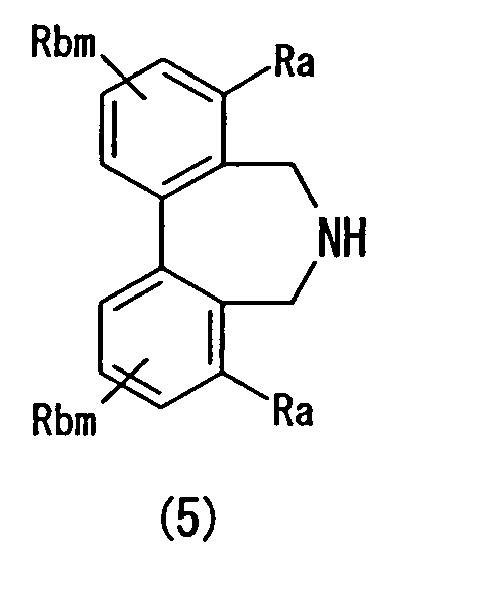 reacting a biphenyl derivative represented by formula (4)
 wherein Ra represents a C6-14 aryl which is optionally substituted, a C3-8 heteroaryl which is optionally substituted, or a C7-16 aralkyl which is optionally substituted;Rb represents halogen, nitro, a C1-8 alkyl which is optionally substituted and which is linear, branched, or cyclic, a C2-8 alkenyl which is optionally substituted, a C2-8 alkynyl which is optionally substituted, a C6-14 aryl which is optionally substituted, a C1-8 alkoxy which is optionally substituted and which is linear, branched, or cyclic, or a C7-16 aralkyl which is optionally substituted, and Rb may bond with each other to form a C1-6 alkylene which is optionally substituted, a C1-6 alkylenemonooxy which is optionally substituted, a C1-6 alkylenedioxy which is optionally substituted, or an aromatic ring which is optionally substituted; andm is 0 or represents an integer of 1 to 3 and Rb may be different substituents to each other when m is 2 or more.
 - A production method of an optically active quaternary ammonium salt compound represented by formula (8)
 reacting an optically active bisbenzyl derivative represented by formula (6)
 wherein Rc represents halogen, a C1-8 alkyl which is optionally substituted and which is linear, branched, or cyclic, a C2-8 alkenyl which is optionally substituted, a C2-8 alkynyl which is optionally substituted, a C6-14 aryl which is optionally substituted, a C3-8 heteroaryl which is optionally substituted, a C1-8 alkoxy which is optionally substituted and which is linear, branched, or cyclic, or a C7-16 aralkyl which is optionally substituted;Rd and Re each independently represents halogen, nitro, a C1-8 alkyl which is optionally substituted and which is linear, branched, or cyclic, a C2-8 alkenyl which is optionally substituted, a C2-8 alkynyl which is optionally substituted, a C6-14 aryl which is optionally substituted, a C1-8 alkoxy which is optionally substituted and which is linear, branched, or cyclic, a C3-8 heteroaryl which is optionally substituted, or a C7-16 aralkyl which is optionally substituted, and Rd may bond with each other to form a C1-6 alkylene which is optionally substituted, a C1-6 alkylenemonooxy which is optionally substituted, or a C1-6 alkylenedioxy which is optionally substituted, and n is 0 or represents an integer of 1 to 2 and Rd may be different substituents to each other when n is 2;Y2 represents a leaving group;Rf represents halogen, a C1-8 alkyl which is optionally substituted and which is linear, branched, or cyclic, a C1-8 alkoxy which is optionally substituted and which is linear, branched, or cyclic, a C2-8 alkenyl which is optionally substituted, a C2-8 alkynyl which is optionally substituted, a C6-14 aryl which is optionally substituted, a C3-8 heteroaryl which is optionally substituted, or a C7-16 aralkyl which is optionally substituted, and k is 0 or represents an integer of 1 to 4 and Rf may be different substituents to each other when k is 2 or more and Rf may bond with each other to form an aromatic ring which is optionally substituted; andsymbols * and ** represent an optical activity having an axial chirality.
 - A production method of an optically active quaternary ammonium salt compound represented by formula (8)
 reacting a racemic bisbenzyl derivative represented by formula (6)
 wherein Rc represents halogen, a C1-8 alkyl which is optionally substituted and which is linear, branched, or cyclic, a C2-8 alkenyl which is optionally substituted, a C2-8 alkynyl which is optionally substituted, a C6-14 aryl which is optionally substituted, a C3-8 heteroaryl which is optionally substituted, a C1-8 alkoxy which is optionally substituted and which is linear, branched, or cyclic, or a C7-16 aralkyl which is optionally substituted;Rd and Re each independently represents halogen, nitro, a C1-8 alkyl which is optionally substituted and which is linear, branched, or cyclic, a C2-8 alkenyl which is optionally substituted, a C2-8 alkynyl which is optionally substituted, a C6-14 aryl which is optionally substituted, a C1-8 alkoxy which is optionally substituted and which is linear, branched, or cyclic, a C3-8 heteroaryl which is optionally substituted, or a C7-16 aralkyl which is optionally substituted, and Rd may bond with each other to form a C1-6 alkylene which is optionally substituted, a C1-6 alkylenemonooxy which is optionally substituted, or a C1-6 alkylenedioxy which is optionally substituted, and n is 0 or represents an integer of 1 to 2 and Rd may be different substituents to each other when n is 2, and Y2 represents a leaving group;Rf represents halogen, a C1-8 alkyl which is optionally substituted and which is linear, branched, or cyclic, a C1-8 alkoxy which is optionally substituted and which is linear, branched, or cyclic, a C2-8 alkenyl which is optionally substituted, a C2-8 alkynyl which is optionally substituted, a C6-14 aryl which is optionally substituted, a C3-8 heteroaryl which is optionally substituted, or a C7-16 aralkyl which is optionally substituted, and k is 0 or represents an integer of 1 to 4 and Rf may be different substituents to each other when k is 2 or more and Rf may bond with each other to form an aromatic ring which is optionally substituted; and symbols * and ** represent an optical activity having an axial chirality..
 - A production method of an optically active quaternary ammonium salt compound represented by formula (8)
 reacting an optically active azepine derivative represented by formula (9)
 wherein Rc represents halogen, a C1-8 alkyl which is optionally substituted and which is linear, branched, or cyclic, a C2-8 alkenyl which is optionally substituted, a C2-8 alkynyl which is optionally substituted, a C6-14 aryl which is optionally substituted, a C3-8 heteroaryl which is optionally substituted, a C1-8 alkoxy which is optionally substituted and which is linear, branched, or cyclic, or a C7-16 aralkyl which is optionally substituted;Rd and Re each independently represents halogen, nitro, a C1-8 alkyl which is optionally substituted and which is linear, branched, or cyclic, a C2-8 alkenyl which is optionally substituted, a C2-8 alkynyl which is optionally substituted, a C6-14 aryl which is optionally substituted, a C1-8 alkoxy which is optionally substituted and which is linear, branched, or cyclic, a C3-8 heteroaryl which is optionally substituted, or a C7-16 aralkyl which is optionally substituted, and Rd may bond with each other to form a C1-6 alkylene which is optionally substituted, a C1-6 alkylenemonooxy which is optionally substituted, or a C1-6 alkylenedioxy which is optionally substituted;n is 0 or represents an integer of 1 to 2 and Rd may be different substituents to each other when n is 2;Rf represents halogen, a C1-8 alkyl which is optionally substituted and which is linear, branched, or cyclic, a C1-8 alkoxy which is optionally substituted and which is linear, branched, or cyclic, a C2-8 alkenyl which is optionally substituted, a C2-8 alkynyl which is optionally substituted, a C6-14 aryl which is optionally substituted, a C3-8 heteroaryl which is optionally substituted, or a C7-16 aralkyl which is optionally substituted;k is 0 or represents an integer of 1 to 4 and Rf may be different substituents to each other when k is 2 or more;Y2 represents a leaving group; andsymbols * and ** represent an optical activity having an axial chirality.
 - A production method of an optically active quaternary ammonium salt compound represented by formula (8)
 reacting a racemic azepine derivative represented by formula (9)
 wherein Rc represents halogen, a C1-8 alkyl which is optionally substituted and which is linear, branched, or cyclic, a C2-8 alkenyl which is optionally substituted, a C2-8 alkynyl which is optionally substituted, a C6-14 aryl which is optionally substituted, a C3-8 heteroaryl which is optionally substituted, a C1-8 alkoxy which is optionally substituted and which is linear, branched, or cyclic, or a C7-16 aralkyl which is optionally substituted;Rd and Re each independently represents halogen, nitro, a C1-8 alkyl which is optionally substituted and which is linear, branched, or cyclic, a C2-8 alkenyl which is optionally substituted, a C2-8 alkynyl which is optionally substituted, a C6-14 aryl which is optionally substituted, a C1-8 alkoxy which is optionally substituted and which is linear, branched, or cyclic, a C3-8 heteroaryl which is optionally substituted, or a C7-16 aralkyl which is optionally substituted, and Rd may bond with each other to form a C1-6 alkylene which is optionally substituted, a C1-6 alkylenemonooxy which is optionally substituted, or a C1-6 alkylenedioxy which is optionally substituted;n is 0 or represents an integer of 1 to 2 and Rd may be different substituents to each other when n is 2;Rf represents halogen, a C1-8 alkyl which is optionally substituted and which is linear, branched, or cyclic, a C1-8 alkoxy which is optionally substituted and which is linear, branched, or cyclic, a C2-8 alkenyl which is optionally substituted, a C2-8 alkynyl which is optionally substituted, a C6-14 aryl which is optionally substituted, a C3-8 heteroaryl which is optionally substituted, or a C7-16 aralkyl which is optionally substituted;k is 0 or represents an integer of 1 to 4 and Rf may be different substituents to each other when k is 2 or more;Y2 represents a leaving group; andsymbols * and ** represent an optical activity having an axial chirality.
Applications Claiming Priority (3)
| Application Number | Priority Date | Filing Date | Title |
|---|---|---|---|
| JP2005059694 | 2005-03-03 | ||
| JP2005192757 | 2005-06-30 | ||
| PCT/JP2006/304091 WO2006093269A1 (en) | 2005-03-03 | 2006-03-03 | Optically active ammonium salt compound, production intermediate thereof and method for producing same |
Publications (3)
| Publication Number | Publication Date |
|---|---|
| EP1854796A1 true EP1854796A1 (en) | 2007-11-14 |
| EP1854796A4 EP1854796A4 (en) | 2010-08-18 |
| EP1854796B1 EP1854796B1 (en) | 2016-05-04 |
Family
ID=36941299
Family Applications (1)
| Application Number | Title | Priority Date | Filing Date |
|---|---|---|---|
| EP06715174.6A Expired - Lifetime EP1854796B1 (en) | 2005-03-03 | 2006-03-03 | Optically active ammonium salt compound, production intermediate thereof and method for producing same |
Country Status (6)
| Country | Link |
|---|---|
| US (2) | US8367820B2 (en) |
| EP (1) | EP1854796B1 (en) |
| JP (2) | JP5296375B2 (en) |
| CN (1) | CN101146812B (en) |
| IN (1) | IN2015KN00276A (en) |
| WO (1) | WO2006093269A1 (en) |
Cited By (4)
| Publication number | Priority date | Publication date | Assignee | Title |
|---|---|---|---|---|
| WO2006104226A1 (en) | 2005-03-29 | 2006-10-05 | Nagase & Co., Ltd. | OPTICALLY ACTIVE QUATERNARY AMMONIUM SALT HAVING AXIAL ASYMMETRY AND PROCESS FOR PRODUCING α-AMINO ACID AND DERIVATIVE THEREOF WITH THE SAME |
| US7928224B2 (en) | 2004-01-30 | 2011-04-19 | Nagase & Co., Ltd | Optically active quaternary ammonium salt having axial asymmetry and process for producing α-amino acid and derivative thereof with the same |
| US8110680B2 (en) | 2006-09-28 | 2012-02-07 | Nagase & Co., Ltd. | Optically active quaternary ammonium salt having axial asymmetry, and method for producing alpha-amino acid and derivative thereof by using the same |
| US8722919B2 (en) | 2005-07-29 | 2014-05-13 | Nagase & Co., Ltd. | Process for production of mono-substituted alkylated compound using aldimine or derivative thereof |
Families Citing this family (5)
| Publication number | Priority date | Publication date | Assignee | Title |
|---|---|---|---|---|
| JP2009235393A (en) * | 2008-03-04 | 2009-10-15 | Nippon Soda Co Ltd | Polymer with optical-active quaternary ammonium salt carried thereon, production method therefor, and production method for optical-active amino acid |
| JP5673169B2 (en) * | 2011-02-08 | 2015-02-18 | 住友化学株式会社 | Quaternary ammonium salt and method for producing cyclopropane compound using the same |
| JP5829529B2 (en) * | 2011-08-29 | 2015-12-09 | 日本曹達株式会社 | Optically active quaternary ammonium salt and method for producing optically active compound |
| US8899533B2 (en) | 2013-01-16 | 2014-12-02 | Honda Motor Co., Ltd. | Vehicle hydraulic brake hose assembly |
| WO2017111176A1 (en) * | 2015-12-25 | 2017-06-29 | 東洋合成工業株式会社 | Compound and method for producing organic material |
Family Cites Families (28)
| Publication number | Priority date | Publication date | Assignee | Title |
|---|---|---|---|---|
| JPH0627128B2 (en) * | 1985-05-07 | 1994-04-13 | ダイセル化学工業株式会社 | Optically active polymerization catalyst with axial chirality |
| JPH0681768B2 (en) * | 1985-08-05 | 1994-10-19 | ダイセル化学工業株式会社 | Method for producing optically active organic polymer |
| AU3441193A (en) * | 1992-04-14 | 1993-11-18 | Sphinx Pharmaceuticals Corporation | Polyhydroxylated dibenz (C,E) azepines as protein kinase C inhibitors |
| US5332846A (en) * | 1993-06-01 | 1994-07-26 | Eastman Kodak Company | Hydroformylation process using novel phosphine-rhodium catalyst system |
| ES2133606T3 (en) * | 1994-03-23 | 1999-09-16 | Hoechst Ag | PROCEDURE FOR THE PREPARATION OF A 2,2'-BIS (HALOGENOMETIL) -1,1'-BINAFTILO. |
| GB9516309D0 (en) | 1995-08-09 | 1995-10-11 | Univ Sheffield | Novel compounds and process |
| DE69908889T2 (en) * | 1998-11-19 | 2004-05-06 | Solvias Ag | Chiral diphenyldiphosphines and d-8 metal complexes thereof |
| US6340753B1 (en) | 2000-04-21 | 2002-01-22 | Nagase & Co., Ltd. | Optically active quarternary ammonium salt with axial chirality, method for producing thereof, and application thereof for asymmetric synthesis of α-amino acid |
| JP4502293B2 (en) * | 1999-06-04 | 2010-07-14 | 長瀬産業株式会社 | Optically active quaternary ammonium salt having axial asymmetry, its production method and application to asymmetric synthesis of α-amino acid derivatives |
| JP2002173492A (en) * | 2000-12-07 | 2002-06-21 | Nagase & Co Ltd | OPTICALLY ACTIVE QUATERNARY AMMONIUM SALT HAVING AXIAL ASYMMETRY AND STEREOSELECTIVE SYNTHESIS OF beta- HYDROXYKETONE USING THE SAME |
| JP2002326992A (en) | 2001-05-02 | 2002-11-15 | Nagase & Co Ltd | N-spiro asymmetric phase transfer catalysts containing binaphthyl and biphenyl groups |
| JP4782329B2 (en) | 2001-07-02 | 2011-09-28 | 長瀬産業株式会社 | Chiral phase transfer catalyst and method for producing asymmetric peptide using the same |
| JP4217085B2 (en) * | 2002-03-08 | 2009-01-28 | 長瀬産業株式会社 | Process for producing β-hydroxyamino acid derivative using optically active quaternary ammonium salt having axial asymmetry as phase transfer catalyst |
| JP2004076459A (en) * | 2002-08-20 | 2004-03-11 | Seven Kogyo Kk | Baseboard structure for stair |
| JPWO2004031163A1 (en) * | 2002-10-01 | 2006-02-02 | 株式会社カネカ | Process for producing optically active α-substituted cysteine or a salt thereof, synthetic intermediate thereof and process for producing the same |
| JP4406530B2 (en) * | 2002-10-11 | 2010-01-27 | 長瀬産業株式会社 | 3,3'-Substituted-2,2'-bisalkoxycarbonyl-1,1'-binaphthyl and method for producing N-spiro quaternary ammonium salt using the same |
| JP4360096B2 (en) * | 2003-02-07 | 2009-11-11 | 東ソー株式会社 | Optically active quaternary ammonium salt, method for producing the same, and method for producing optically active α-amino acid derivative using the same as phase transfer catalyst |
| AU2003252268A1 (en) * | 2003-02-27 | 2004-09-17 | Nagase And Co., Ltd. | Quaternary ammonium bifluoride compound and process for producing nitroalcohol with the same |
| JP2004352708A (en) * | 2003-05-02 | 2004-12-16 | Nagase & Co Ltd | METHOD FOR PRODUCING gamma-NITROCARBONYL COMPOUND |
| JP4322051B2 (en) | 2003-06-03 | 2009-08-26 | 日本曹達株式会社 | Optically active quaternary ammonium salt compound and synthetic intermediate thereof |
| JP2005015402A (en) * | 2003-06-26 | 2005-01-20 | Nagase & Co Ltd | METHOD FOR PRODUCING OPTICALLY ACTIVE 3,5-DIHYDRO-4H-DINAPHTHO[2,1-c:1',2'-e]AZEPINE AND OXALATE THEREOF |
| US7566779B2 (en) * | 2003-07-23 | 2009-07-28 | Tosoh Corporation | Optically active quaternary ammonium salt, process for producing the same, and process for producing optically active α-amino acid derivative with the same |
| JP4474861B2 (en) | 2003-07-23 | 2010-06-09 | 東ソー株式会社 | Optically active quaternary ammonium salt, process for producing the same, and process for producing optically active α-amino acid derivative using the same |
| CA2549431C (en) * | 2004-01-30 | 2010-09-14 | Nagase & Co., Ltd. | Optically active quaternary ammonium salt having axial asymmetry and process for producing .alpha.-amino acid and derivative thereof with the same |
| JP2005225809A (en) * | 2004-02-13 | 2005-08-25 | Nippon Soda Co Ltd | Optically-active quaternary ammonium salt compound and asymmetric epoxidation reaction using the compound as catalyst |
| JP2005225810A (en) * | 2004-02-13 | 2005-08-25 | Nippon Soda Co Ltd | Optically-active ammonium salt compound and intermediate for production thereof |
| WO2005077908A1 (en) * | 2004-02-18 | 2005-08-25 | Takasago International Corporation | Guanidine compound and asymmetric reaction using the same |
| JP2005263664A (en) * | 2004-03-17 | 2005-09-29 | Nagase & Co Ltd | Method for producing optically active 3-nitroalkylmalonic acid ester derivative |
-
2006
- 2006-03-03 EP EP06715174.6A patent/EP1854796B1/en not_active Expired - Lifetime
- 2006-03-03 US US11/817,585 patent/US8367820B2/en not_active Expired - Fee Related
- 2006-03-03 CN CN200680006577.7A patent/CN101146812B/en not_active Expired - Fee Related
- 2006-03-03 WO PCT/JP2006/304091 patent/WO2006093269A1/en not_active Ceased
- 2006-03-03 JP JP2007506022A patent/JP5296375B2/en not_active Expired - Fee Related
- 2006-03-03 IN IN276KON2015 patent/IN2015KN00276A/en unknown
-
2012
- 2012-02-22 JP JP2012036862A patent/JP5379873B2/en not_active Expired - Fee Related
- 2012-12-05 US US13/705,506 patent/US8962898B2/en not_active Expired - Fee Related
Non-Patent Citations (2)
| Title |
|---|
| No further relevant documents disclosed * |
| See also references of WO2006093269A1 * |
Cited By (11)
| Publication number | Priority date | Publication date | Assignee | Title |
|---|---|---|---|---|
| US7928224B2 (en) | 2004-01-30 | 2011-04-19 | Nagase & Co., Ltd | Optically active quaternary ammonium salt having axial asymmetry and process for producing α-amino acid and derivative thereof with the same |
| US8697910B2 (en) | 2004-01-30 | 2014-04-15 | Nagase & Co., Ltd | Optically active quaternary ammonium salt having axial asymmetry and process for producing α-amino acid and derivative thereof with the same |
| US8716524B2 (en) | 2004-01-30 | 2014-05-06 | Nagase & Co., Ltd | Optically active quaternary ammonium salt having axial asymmetry and process for producing a-amino acid and derivative thereof with the same |
| WO2006104226A1 (en) | 2005-03-29 | 2006-10-05 | Nagase & Co., Ltd. | OPTICALLY ACTIVE QUATERNARY AMMONIUM SALT HAVING AXIAL ASYMMETRY AND PROCESS FOR PRODUCING α-AMINO ACID AND DERIVATIVE THEREOF WITH THE SAME |
| EP1870403A4 (en) * | 2005-03-29 | 2010-07-07 | Nagase & Co Ltd | Optically active quaternary ammonium salt having axial asymmetry and process for producing alpha-amino acid and derivative thereof with the same |
| EP2484667A1 (en) * | 2005-03-29 | 2012-08-08 | Nagase & Company, Ltd. | Optically active quaternary ammonium salt having axial asymmetry and process for producing alpha-amino acid and derivative thereof with the same |
| US8614316B2 (en) | 2005-03-29 | 2013-12-24 | Nagase & Co., Ltd. | Optically active quaternary ammonium salt having axial asymmetry and process for producing α-amino acid and derivative thereof with the same |
| US8722919B2 (en) | 2005-07-29 | 2014-05-13 | Nagase & Co., Ltd. | Process for production of mono-substituted alkylated compound using aldimine or derivative thereof |
| US8110680B2 (en) | 2006-09-28 | 2012-02-07 | Nagase & Co., Ltd. | Optically active quaternary ammonium salt having axial asymmetry, and method for producing alpha-amino acid and derivative thereof by using the same |
| US8252952B2 (en) | 2006-09-28 | 2012-08-28 | Nagase & Co., Ltd. | Optically active quaternary ammonium salt having axial asymmetry, and method for producing alpha-amino acid and derivative thereof by using the same |
| US8263798B2 (en) | 2006-09-28 | 2012-09-11 | Nagase & Co., Ltd. | Optically active quaternary ammonium salt having axial asymmetry, and method for producing alpha-amino acid and derivative thereof by using the same |
Also Published As
| Publication number | Publication date |
|---|---|
| JP5379873B2 (en) | 2013-12-25 |
| US8962898B2 (en) | 2015-02-24 |
| EP1854796B1 (en) | 2016-05-04 |
| US20130131337A1 (en) | 2013-05-23 |
| CN101146812B (en) | 2013-10-16 |
| IN2015KN00276A (en) | 2015-06-12 |
| US8367820B2 (en) | 2013-02-05 |
| CN101146812A (en) | 2008-03-19 |
| JP2012153691A (en) | 2012-08-16 |
| JP5296375B2 (en) | 2013-09-25 |
| EP1854796A4 (en) | 2010-08-18 |
| JPWO2006093269A1 (en) | 2008-08-07 |
| WO2006093269A1 (en) | 2006-09-08 |
| US20100041881A1 (en) | 2010-02-18 |
Similar Documents
| Publication | Publication Date | Title |
|---|---|---|
| US8962898B2 (en) | Optically active ammonium salt compound, production intermediate thereof, and production method thereof | |
| US9771317B2 (en) | Process for preparing lacosamide and related compounds | |
| KR101342326B1 (en) | Optically active dibenzazepine derivatives | |
| CN101519384A (en) | Chiral oxazoline and synthesis method thereof | |
| CN109608471B (en) | Synthetic method of chiral spiro-epoxy indole compounds | |
| JP5441060B2 (en) | Kit for producing a molecular probe for PET screening for drug discovery | |
| CN101279954A (en) | A kind of chiral oxazoline and its synthetic method | |
| CN114057712A (en) | Method for synthesizing chiral phenyl oxazolidine-2-ketone | |
| EP1870403A1 (en) | Optically active quaternary ammonium salt having axial asymmetry and process for producing -amino acid and derivative thereof with the same | |
| JP2009046452A (en) | Phosphoramidite ligand and method for producing allylamine using the same | |
| JP6695908B2 (en) | Method for producing benzamide compound | |
| JP4649645B2 (en) | Process for producing optically active alcohol compounds | |
| JP5046213B2 (en) | Process for producing optically active alcohol compounds | |
| CN118221492A (en) | A method for preparing (E)-N N-disubstituted-N'-sulfonyl amidine | |
| JP5899110B2 (en) | Method for producing diaryl derivative, novel binaphthyl derivative, method for producing arene derivative, and novel arene derivative | |
| CN110240572B (en) | Synthesis method of trans-1, 1-cyclopropane dicarboxylic acid ester | |
| CN101497631A (en) | Oxazoline phosphine ligand and preparation thereof | |
| Zhu et al. | Synthesis of o-benzyl benzamides via NaH-mediated aryne insertion into N-sulfonylacetimidates | |
| KR101220154B1 (en) | Novel heterocyclic compound derivatives catalyzed by iron and its preparation method | |
| JP5208928B2 (en) | C2-ruthenocene bisphosphine ligand having only symmetric planar chirality and its synthesis method | |
| CN118063328A (en) | A high-efficiency and low-cost preparation method of 2,3-dibromo-1-propylamine salt | |
| CN119191925A (en) | A method for synthesizing chiral dihydronaphthalene compounds | |
| JP2005225810A (en) | Optically-active ammonium salt compound and intermediate for production thereof | |
| CN113185482A (en) | Aldehyde cyclohexadienone and polyoxoalene compound and preparation method thereof | |
| JP2009522211A (en) | 1,1'-Biphenyls Axial Chirality Ligand Linked at 5,5 'Position and Method for Producing the Same |
Legal Events
| Date | Code | Title | Description |
|---|---|---|---|
| PUAI | Public reference made under article 153(3) epc to a published international application that has entered the european phase |
Free format text: ORIGINAL CODE: 0009012 |
|
| 17P | Request for examination filed |
Effective date: 20070907 |
|
| AK | Designated contracting states |
Kind code of ref document: A1 Designated state(s): AT BE BG CH CY CZ DE DK EE ES FI FR GB GR HU IE IS IT LI LT LU LV MC NL PL PT RO SE SI SK TR |
|
| AX | Request for extension of the european patent |
Extension state: AL BA HR MK YU |
|
| RAP1 | Party data changed (applicant data changed or rights of an application transferred) |
Owner name: NIPPON SODA CO., LTD. |
|
| A4 | Supplementary search report drawn up and despatched |
Effective date: 20100721 |
|
| 17Q | First examination report despatched |
Effective date: 20130911 |
|
| GRAP | Despatch of communication of intention to grant a patent |
Free format text: ORIGINAL CODE: EPIDOSNIGR1 |
|
| INTG | Intention to grant announced |
Effective date: 20151006 |
|
| GRAS | Grant fee paid |
Free format text: ORIGINAL CODE: EPIDOSNIGR3 |
|
| GRAJ | Information related to disapproval of communication of intention to grant by the applicant or resumption of examination proceedings by the epo deleted |
Free format text: ORIGINAL CODE: EPIDOSDIGR1 |
|
| GRAR | Information related to intention to grant a patent recorded |
Free format text: ORIGINAL CODE: EPIDOSNIGR71 |
|
| INTG | Intention to grant announced |
Effective date: 20160225 |
|
| GRAA | (expected) grant |
Free format text: ORIGINAL CODE: 0009210 |
|
| AK | Designated contracting states |
Kind code of ref document: B1 Designated state(s): AT BE BG CH CY CZ DE DK EE ES FI FR GB GR HU IE IS IT LI LT LU LV MC NL PL PT RO SE SI SK TR |
|
| AX | Request for extension of the european patent |
Extension state: AL BA HR MK YU |
|
| REG | Reference to a national code |
Ref country code: GB Ref legal event code: FG4D |
|
| REG | Reference to a national code |
Ref country code: CH Ref legal event code: EP Ref country code: CH Ref legal event code: NV Representative=s name: SCHMAUDER AND PARTNER AG PATENT- UND MARKENANW, CH |
|
| REG | Reference to a national code |
Ref country code: AT Ref legal event code: REF Ref document number: 796816 Country of ref document: AT Kind code of ref document: T Effective date: 20160515 |
|
| REG | Reference to a national code |
Ref country code: IE Ref legal event code: FG4D |
|
| REG | Reference to a national code |
Ref country code: DE Ref legal event code: R096 Ref document number: 602006048959 Country of ref document: DE |
|
| REG | Reference to a national code |
Ref country code: NL Ref legal event code: MP Effective date: 20160504 |
|
| REG | Reference to a national code |
Ref country code: LT Ref legal event code: MG4D |
|
| PG25 | Lapsed in a contracting state [announced via postgrant information from national office to epo] |
Ref country code: NL Free format text: LAPSE BECAUSE OF FAILURE TO SUBMIT A TRANSLATION OF THE DESCRIPTION OR TO PAY THE FEE WITHIN THE PRESCRIBED TIME-LIMIT Effective date: 20160504 Ref country code: LT Free format text: LAPSE BECAUSE OF FAILURE TO SUBMIT A TRANSLATION OF THE DESCRIPTION OR TO PAY THE FEE WITHIN THE PRESCRIBED TIME-LIMIT Effective date: 20160504 Ref country code: FI Free format text: LAPSE BECAUSE OF FAILURE TO SUBMIT A TRANSLATION OF THE DESCRIPTION OR TO PAY THE FEE WITHIN THE PRESCRIBED TIME-LIMIT Effective date: 20160504 |
|
| REG | Reference to a national code |
Ref country code: AT Ref legal event code: MK05 Ref document number: 796816 Country of ref document: AT Kind code of ref document: T Effective date: 20160504 |
|
| PG25 | Lapsed in a contracting state [announced via postgrant information from national office to epo] |
Ref country code: SE Free format text: LAPSE BECAUSE OF FAILURE TO SUBMIT A TRANSLATION OF THE DESCRIPTION OR TO PAY THE FEE WITHIN THE PRESCRIBED TIME-LIMIT Effective date: 20160504 Ref country code: ES Free format text: LAPSE BECAUSE OF FAILURE TO SUBMIT A TRANSLATION OF THE DESCRIPTION OR TO PAY THE FEE WITHIN THE PRESCRIBED TIME-LIMIT Effective date: 20160504 Ref country code: LV Free format text: LAPSE BECAUSE OF FAILURE TO SUBMIT A TRANSLATION OF THE DESCRIPTION OR TO PAY THE FEE WITHIN THE PRESCRIBED TIME-LIMIT Effective date: 20160504 Ref country code: PT Free format text: LAPSE BECAUSE OF FAILURE TO SUBMIT A TRANSLATION OF THE DESCRIPTION OR TO PAY THE FEE WITHIN THE PRESCRIBED TIME-LIMIT Effective date: 20160905 Ref country code: GR Free format text: LAPSE BECAUSE OF FAILURE TO SUBMIT A TRANSLATION OF THE DESCRIPTION OR TO PAY THE FEE WITHIN THE PRESCRIBED TIME-LIMIT Effective date: 20160805 |
|
| PG25 | Lapsed in a contracting state [announced via postgrant information from national office to epo] |
Ref country code: IT Free format text: LAPSE BECAUSE OF FAILURE TO SUBMIT A TRANSLATION OF THE DESCRIPTION OR TO PAY THE FEE WITHIN THE PRESCRIBED TIME-LIMIT Effective date: 20160504 |
|
| PG25 | Lapsed in a contracting state [announced via postgrant information from national office to epo] |
Ref country code: RO Free format text: LAPSE BECAUSE OF FAILURE TO SUBMIT A TRANSLATION OF THE DESCRIPTION OR TO PAY THE FEE WITHIN THE PRESCRIBED TIME-LIMIT Effective date: 20160504 Ref country code: EE Free format text: LAPSE BECAUSE OF FAILURE TO SUBMIT A TRANSLATION OF THE DESCRIPTION OR TO PAY THE FEE WITHIN THE PRESCRIBED TIME-LIMIT Effective date: 20160504 Ref country code: SK Free format text: LAPSE BECAUSE OF FAILURE TO SUBMIT A TRANSLATION OF THE DESCRIPTION OR TO PAY THE FEE WITHIN THE PRESCRIBED TIME-LIMIT Effective date: 20160504 Ref country code: CZ Free format text: LAPSE BECAUSE OF FAILURE TO SUBMIT A TRANSLATION OF THE DESCRIPTION OR TO PAY THE FEE WITHIN THE PRESCRIBED TIME-LIMIT Effective date: 20160504 Ref country code: DK Free format text: LAPSE BECAUSE OF FAILURE TO SUBMIT A TRANSLATION OF THE DESCRIPTION OR TO PAY THE FEE WITHIN THE PRESCRIBED TIME-LIMIT Effective date: 20160504 |
|
| REG | Reference to a national code |
Ref country code: DE Ref legal event code: R097 Ref document number: 602006048959 Country of ref document: DE |
|
| PG25 | Lapsed in a contracting state [announced via postgrant information from national office to epo] |
Ref country code: AT Free format text: LAPSE BECAUSE OF FAILURE TO SUBMIT A TRANSLATION OF THE DESCRIPTION OR TO PAY THE FEE WITHIN THE PRESCRIBED TIME-LIMIT Effective date: 20160504 Ref country code: PL Free format text: LAPSE BECAUSE OF FAILURE TO SUBMIT A TRANSLATION OF THE DESCRIPTION OR TO PAY THE FEE WITHIN THE PRESCRIBED TIME-LIMIT Effective date: 20160504 Ref country code: BE Free format text: LAPSE BECAUSE OF FAILURE TO SUBMIT A TRANSLATION OF THE DESCRIPTION OR TO PAY THE FEE WITHIN THE PRESCRIBED TIME-LIMIT Effective date: 20160504 |
|
| PLBE | No opposition filed within time limit |
Free format text: ORIGINAL CODE: 0009261 |
|
| STAA | Information on the status of an ep patent application or granted ep patent |
Free format text: STATUS: NO OPPOSITION FILED WITHIN TIME LIMIT |
|
| REG | Reference to a national code |
Ref country code: FR Ref legal event code: PLFP Year of fee payment: 12 |
|
| 26N | No opposition filed |
Effective date: 20170207 |
|
| PG25 | Lapsed in a contracting state [announced via postgrant information from national office to epo] |
Ref country code: SI Free format text: LAPSE BECAUSE OF FAILURE TO SUBMIT A TRANSLATION OF THE DESCRIPTION OR TO PAY THE FEE WITHIN THE PRESCRIBED TIME-LIMIT Effective date: 20160504 |
|
| PG25 | Lapsed in a contracting state [announced via postgrant information from national office to epo] |
Ref country code: MC Free format text: LAPSE BECAUSE OF FAILURE TO SUBMIT A TRANSLATION OF THE DESCRIPTION OR TO PAY THE FEE WITHIN THE PRESCRIBED TIME-LIMIT Effective date: 20160504 |
|
| REG | Reference to a national code |
Ref country code: IE Ref legal event code: MM4A |
|
| PG25 | Lapsed in a contracting state [announced via postgrant information from national office to epo] |
Ref country code: LU Free format text: LAPSE BECAUSE OF NON-PAYMENT OF DUE FEES Effective date: 20170303 |
|
| PG25 | Lapsed in a contracting state [announced via postgrant information from national office to epo] |
Ref country code: IE Free format text: LAPSE BECAUSE OF NON-PAYMENT OF DUE FEES Effective date: 20170303 |
|
| REG | Reference to a national code |
Ref country code: FR Ref legal event code: PLFP Year of fee payment: 13 |
|
| PGFP | Annual fee paid to national office [announced via postgrant information from national office to epo] |
Ref country code: DE Payment date: 20180322 Year of fee payment: 13 Ref country code: GB Payment date: 20180321 Year of fee payment: 13 Ref country code: CH Payment date: 20180321 Year of fee payment: 13 |
|
| PGFP | Annual fee paid to national office [announced via postgrant information from national office to epo] |
Ref country code: FR Payment date: 20180323 Year of fee payment: 13 |
|
| PG25 | Lapsed in a contracting state [announced via postgrant information from national office to epo] |
Ref country code: HU Free format text: LAPSE BECAUSE OF FAILURE TO SUBMIT A TRANSLATION OF THE DESCRIPTION OR TO PAY THE FEE WITHIN THE PRESCRIBED TIME-LIMIT; INVALID AB INITIO Effective date: 20060303 |
|
| PG25 | Lapsed in a contracting state [announced via postgrant information from national office to epo] |
Ref country code: BG Free format text: LAPSE BECAUSE OF FAILURE TO SUBMIT A TRANSLATION OF THE DESCRIPTION OR TO PAY THE FEE WITHIN THE PRESCRIBED TIME-LIMIT Effective date: 20160504 |
|
| REG | Reference to a national code |
Ref country code: DE Ref legal event code: R119 Ref document number: 602006048959 Country of ref document: DE |
|
| PG25 | Lapsed in a contracting state [announced via postgrant information from national office to epo] |
Ref country code: CY Free format text: LAPSE BECAUSE OF NON-PAYMENT OF DUE FEES Effective date: 20160504 |
|
| REG | Reference to a national code |
Ref country code: CH Ref legal event code: PL |
|
| GBPC | Gb: european patent ceased through non-payment of renewal fee |
Effective date: 20190303 |
|
| PG25 | Lapsed in a contracting state [announced via postgrant information from national office to epo] |
Ref country code: GB Free format text: LAPSE BECAUSE OF NON-PAYMENT OF DUE FEES Effective date: 20190303 Ref country code: CH Free format text: LAPSE BECAUSE OF NON-PAYMENT OF DUE FEES Effective date: 20190331 Ref country code: DE Free format text: LAPSE BECAUSE OF NON-PAYMENT OF DUE FEES Effective date: 20191001 Ref country code: LI Free format text: LAPSE BECAUSE OF NON-PAYMENT OF DUE FEES Effective date: 20190331 |
|
| PG25 | Lapsed in a contracting state [announced via postgrant information from national office to epo] |
Ref country code: FR Free format text: LAPSE BECAUSE OF NON-PAYMENT OF DUE FEES Effective date: 20190331 |
|
| PG25 | Lapsed in a contracting state [announced via postgrant information from national office to epo] |
Ref country code: TR Free format text: LAPSE BECAUSE OF FAILURE TO SUBMIT A TRANSLATION OF THE DESCRIPTION OR TO PAY THE FEE WITHIN THE PRESCRIBED TIME-LIMIT Effective date: 20160504 |
|
| PG25 | Lapsed in a contracting state [announced via postgrant information from national office to epo] |
Ref country code: IS Free format text: LAPSE BECAUSE OF FAILURE TO SUBMIT A TRANSLATION OF THE DESCRIPTION OR TO PAY THE FEE WITHIN THE PRESCRIBED TIME-LIMIT Effective date: 20160904 |