EP1854346A1 - Biodegradable textile - Google Patents
Biodegradable textile Download PDFInfo
- Publication number
- EP1854346A1 EP1854346A1 EP05817184A EP05817184A EP1854346A1 EP 1854346 A1 EP1854346 A1 EP 1854346A1 EP 05817184 A EP05817184 A EP 05817184A EP 05817184 A EP05817184 A EP 05817184A EP 1854346 A1 EP1854346 A1 EP 1854346A1
- Authority
- EP
- European Patent Office
- Prior art keywords
- fabric
- fabric according
- previous
- covering
- treatment
- Prior art date
- Legal status (The legal status is an assumption and is not a legal conclusion. Google has not performed a legal analysis and makes no representation as to the accuracy of the status listed.)
- Withdrawn
Links
- 239000004753 textile Substances 0.000 title abstract description 6
- 239000004744 fabric Substances 0.000 claims abstract description 55
- 238000011282 treatment Methods 0.000 claims abstract description 12
- 230000005855 radiation Effects 0.000 claims abstract description 10
- 239000001913 cellulose Substances 0.000 claims abstract description 7
- 229920002678 cellulose Polymers 0.000 claims abstract description 7
- 238000001914 filtration Methods 0.000 claims abstract description 7
- JJWKPURADFRFRB-UHFFFAOYSA-N carbonyl sulfide Chemical compound O=C=S JJWKPURADFRFRB-UHFFFAOYSA-N 0.000 claims abstract description 6
- 239000003063 flame retardant Substances 0.000 claims abstract description 6
- 241000218631 Coniferophyta Species 0.000 claims abstract description 3
- 230000000844 anti-bacterial effect Effects 0.000 claims abstract description 3
- 239000005871 repellent Substances 0.000 claims abstract description 3
- 239000000123 paper Substances 0.000 claims description 9
- 238000000034 method Methods 0.000 claims description 6
- 238000004040 coloring Methods 0.000 claims description 3
- 230000001603 reducing effect Effects 0.000 claims description 3
- 239000003899 bactericide agent Substances 0.000 claims description 2
- 238000000151 deposition Methods 0.000 claims description 2
- 239000002655 kraft paper Substances 0.000 claims description 2
- 239000000049 pigment Substances 0.000 claims description 2
- 230000002940 repellent Effects 0.000 claims description 2
- 150000003839 salts Chemical class 0.000 claims description 2
- XLYOFNOQVPJJNP-UHFFFAOYSA-N water Substances O XLYOFNOQVPJJNP-UHFFFAOYSA-N 0.000 claims description 2
- 239000000417 fungicide Substances 0.000 claims 1
- 239000002023 wood Substances 0.000 claims 1
- 230000000855 fungicidal effect Effects 0.000 abstract description 2
- 239000000126 substance Substances 0.000 abstract 1
- 239000000463 material Substances 0.000 description 6
- 239000004033 plastic Substances 0.000 description 6
- 230000008030 elimination Effects 0.000 description 5
- 238000003379 elimination reaction Methods 0.000 description 5
- 230000005068 transpiration Effects 0.000 description 5
- 241000238876 Acari Species 0.000 description 3
- 241000196324 Embryophyta Species 0.000 description 3
- HEMHJVSKTPXQMS-UHFFFAOYSA-M Sodium hydroxide Chemical compound [OH-].[Na+] HEMHJVSKTPXQMS-UHFFFAOYSA-M 0.000 description 3
- 238000010276 construction Methods 0.000 description 3
- 239000000047 product Substances 0.000 description 3
- 239000002361 compost Substances 0.000 description 2
- 239000000835 fiber Substances 0.000 description 2
- 230000035755 proliferation Effects 0.000 description 2
- 239000001993 wax Substances 0.000 description 2
- 241000239223 Arachnida Species 0.000 description 1
- 229920003043 Cellulose fiber Polymers 0.000 description 1
- LSNNMFCWUKXFEE-UHFFFAOYSA-N Sulfurous acid Chemical class OS(O)=O LSNNMFCWUKXFEE-UHFFFAOYSA-N 0.000 description 1
- 238000005299 abrasion Methods 0.000 description 1
- 238000010521 absorption reaction Methods 0.000 description 1
- 238000009825 accumulation Methods 0.000 description 1
- 239000000654 additive Substances 0.000 description 1
- 239000000853 adhesive Substances 0.000 description 1
- 230000001070 adhesive effect Effects 0.000 description 1
- 230000003796 beauty Effects 0.000 description 1
- 239000006227 byproduct Substances 0.000 description 1
- 238000006243 chemical reaction Methods 0.000 description 1
- 239000003638 chemical reducing agent Substances 0.000 description 1
- 239000002894 chemical waste Substances 0.000 description 1
- 230000000295 complement effect Effects 0.000 description 1
- 230000006866 deterioration Effects 0.000 description 1
- 238000011161 development Methods 0.000 description 1
- 230000000694 effects Effects 0.000 description 1
- 238000005265 energy consumption Methods 0.000 description 1
- 238000010438 heat treatment Methods 0.000 description 1
- 239000003864 humus Substances 0.000 description 1
- 238000010348 incorporation Methods 0.000 description 1
- 238000009434 installation Methods 0.000 description 1
- 238000009940 knitting Methods 0.000 description 1
- 229920005610 lignin Polymers 0.000 description 1
- 238000012423 maintenance Methods 0.000 description 1
- 239000002184 metal Substances 0.000 description 1
- 238000012986 modification Methods 0.000 description 1
- 230000004048 modification Effects 0.000 description 1
- 239000002245 particle Substances 0.000 description 1
- 239000002985 plastic film Substances 0.000 description 1
- 229920005989 resin Polymers 0.000 description 1
- 239000011347 resin Substances 0.000 description 1
- 238000009958 sewing Methods 0.000 description 1
- 235000011121 sodium hydroxide Nutrition 0.000 description 1
- 238000010186 staining Methods 0.000 description 1
- 238000004381 surface treatment Methods 0.000 description 1
- 238000012546 transfer Methods 0.000 description 1
- 238000009423 ventilation Methods 0.000 description 1
- 238000009941 weaving Methods 0.000 description 1
Images
Classifications
-
- D—TEXTILES; PAPER
- D03—WEAVING
- D03D—WOVEN FABRICS; METHODS OF WEAVING; LOOMS
- D03D15/00—Woven fabrics characterised by the material, structure or properties of the fibres, filaments, yarns, threads or other warp or weft elements used
- D03D15/50—Woven fabrics characterised by the material, structure or properties of the fibres, filaments, yarns, threads or other warp or weft elements used characterised by the properties of the yarns or threads
-
- D—TEXTILES; PAPER
- D02—YARNS; MECHANICAL FINISHING OF YARNS OR ROPES; WARPING OR BEAMING
- D02G—CRIMPING OR CURLING FIBRES, FILAMENTS, THREADS, OR YARNS; YARNS OR THREADS
- D02G3/00—Yarns or threads, e.g. fancy yarns; Processes or apparatus for the production thereof, not otherwise provided for
- D02G3/02—Yarns or threads characterised by the material or by the materials from which they are made
- D02G3/08—Paper yarns or threads
-
- A—HUMAN NECESSITIES
- A01—AGRICULTURE; FORESTRY; ANIMAL HUSBANDRY; HUNTING; TRAPPING; FISHING
- A01G—HORTICULTURE; CULTIVATION OF VEGETABLES, FLOWERS, RICE, FRUIT, VINES, HOPS OR SEAWEED; FORESTRY; WATERING
- A01G9/00—Cultivation in receptacles, forcing-frames or greenhouses; Edging for beds, lawn or the like
- A01G9/14—Greenhouses
- A01G9/1438—Covering materials therefor; Materials for protective coverings used for soil and plants, e.g. films, canopies, tunnels or cloches
-
- B—PERFORMING OPERATIONS; TRANSPORTING
- B32—LAYERED PRODUCTS
- B32B—LAYERED PRODUCTS, i.e. PRODUCTS BUILT-UP OF STRATA OF FLAT OR NON-FLAT, e.g. CELLULAR OR HONEYCOMB, FORM
- B32B23/00—Layered products comprising a layer of cellulosic plastic substances, i.e. substances obtained by chemical modification of cellulose, e.g. cellulose ethers, cellulose esters, viscose
- B32B23/02—Layered products comprising a layer of cellulosic plastic substances, i.e. substances obtained by chemical modification of cellulose, e.g. cellulose ethers, cellulose esters, viscose in the form of fibres or filaments
-
- D—TEXTILES; PAPER
- D03—WEAVING
- D03D—WOVEN FABRICS; METHODS OF WEAVING; LOOMS
- D03D15/00—Woven fabrics characterised by the material, structure or properties of the fibres, filaments, yarns, threads or other warp or weft elements used
- D03D15/40—Woven fabrics characterised by the material, structure or properties of the fibres, filaments, yarns, threads or other warp or weft elements used characterised by the structure of the yarns or threads
- D03D15/44—Woven fabrics characterised by the material, structure or properties of the fibres, filaments, yarns, threads or other warp or weft elements used characterised by the structure of the yarns or threads with specific cross-section or surface shape
- D03D15/46—Flat yarns, e.g. tapes or films
-
- D—TEXTILES; PAPER
- D03—WEAVING
- D03D—WOVEN FABRICS; METHODS OF WEAVING; LOOMS
- D03D15/00—Woven fabrics characterised by the material, structure or properties of the fibres, filaments, yarns, threads or other warp or weft elements used
- D03D15/60—Woven fabrics characterised by the material, structure or properties of the fibres, filaments, yarns, threads or other warp or weft elements used characterised by the warp or weft elements other than yarns or threads
- D03D15/65—Paper
-
- D—TEXTILES; PAPER
- D03—WEAVING
- D03D—WOVEN FABRICS; METHODS OF WEAVING; LOOMS
- D03D9/00—Open-work fabrics
-
- B—PERFORMING OPERATIONS; TRANSPORTING
- B60—VEHICLES IN GENERAL
- B60R—VEHICLES, VEHICLE FITTINGS, OR VEHICLE PARTS, NOT OTHERWISE PROVIDED FOR
- B60R13/00—Elements for body-finishing, identifying, or decorating; Arrangements or adaptations for advertising purposes
- B60R13/02—Internal Trim mouldings ; Internal Ledges; Wall liners for passenger compartments; Roof liners
-
- B—PERFORMING OPERATIONS; TRANSPORTING
- B60—VEHICLES IN GENERAL
- B60R—VEHICLES, VEHICLE FITTINGS, OR VEHICLE PARTS, NOT OTHERWISE PROVIDED FOR
- B60R13/00—Elements for body-finishing, identifying, or decorating; Arrangements or adaptations for advertising purposes
- B60R13/08—Insulating elements, e.g. for sound insulation
- B60R13/0815—Acoustic or thermal insulation of passenger compartments
- B60R13/083—Acoustic or thermal insulation of passenger compartments for fire walls or floors
-
- B—PERFORMING OPERATIONS; TRANSPORTING
- B60—VEHICLES IN GENERAL
- B60R—VEHICLES, VEHICLE FITTINGS, OR VEHICLE PARTS, NOT OTHERWISE PROVIDED FOR
- B60R13/00—Elements for body-finishing, identifying, or decorating; Arrangements or adaptations for advertising purposes
- B60R13/08—Insulating elements, e.g. for sound insulation
- B60R13/0876—Insulating elements, e.g. for sound insulation for mounting around heat sources, e.g. exhaust pipes
-
- D—TEXTILES; PAPER
- D10—INDEXING SCHEME ASSOCIATED WITH SUBLASSES OF SECTION D, RELATING TO TEXTILES
- D10B—INDEXING SCHEME ASSOCIATED WITH SUBLASSES OF SECTION D, RELATING TO TEXTILES
- D10B2201/00—Cellulose-based fibres, e.g. vegetable fibres
-
- D—TEXTILES; PAPER
- D10—INDEXING SCHEME ASSOCIATED WITH SUBLASSES OF SECTION D, RELATING TO TEXTILES
- D10B—INDEXING SCHEME ASSOCIATED WITH SUBLASSES OF SECTION D, RELATING TO TEXTILES
- D10B2401/00—Physical properties
- D10B2401/12—Physical properties biodegradable
-
- D—TEXTILES; PAPER
- D10—INDEXING SCHEME ASSOCIATED WITH SUBLASSES OF SECTION D, RELATING TO TEXTILES
- D10B—INDEXING SCHEME ASSOCIATED WITH SUBLASSES OF SECTION D, RELATING TO TEXTILES
- D10B2401/00—Physical properties
- D10B2401/13—Physical properties anti-allergenic or anti-bacterial
-
- D—TEXTILES; PAPER
- D10—INDEXING SCHEME ASSOCIATED WITH SUBLASSES OF SECTION D, RELATING TO TEXTILES
- D10B—INDEXING SCHEME ASSOCIATED WITH SUBLASSES OF SECTION D, RELATING TO TEXTILES
- D10B2503/00—Domestic or personal
- D10B2503/04—Floor or wall coverings; Carpets
-
- D—TEXTILES; PAPER
- D10—INDEXING SCHEME ASSOCIATED WITH SUBLASSES OF SECTION D, RELATING TO TEXTILES
- D10B—INDEXING SCHEME ASSOCIATED WITH SUBLASSES OF SECTION D, RELATING TO TEXTILES
- D10B2505/00—Industrial
-
- D—TEXTILES; PAPER
- D10—INDEXING SCHEME ASSOCIATED WITH SUBLASSES OF SECTION D, RELATING TO TEXTILES
- D10B—INDEXING SCHEME ASSOCIATED WITH SUBLASSES OF SECTION D, RELATING TO TEXTILES
- D10B2505/00—Industrial
- D10B2505/18—Outdoor fabrics, e.g. tents, tarpaulins
-
- Y—GENERAL TAGGING OF NEW TECHNOLOGICAL DEVELOPMENTS; GENERAL TAGGING OF CROSS-SECTIONAL TECHNOLOGIES SPANNING OVER SEVERAL SECTIONS OF THE IPC; TECHNICAL SUBJECTS COVERED BY FORMER USPC CROSS-REFERENCE ART COLLECTIONS [XRACs] AND DIGESTS
- Y02—TECHNOLOGIES OR APPLICATIONS FOR MITIGATION OR ADAPTATION AGAINST CLIMATE CHANGE
- Y02A—TECHNOLOGIES FOR ADAPTATION TO CLIMATE CHANGE
- Y02A40/00—Adaptation technologies in agriculture, forestry, livestock or agroalimentary production
- Y02A40/10—Adaptation technologies in agriculture, forestry, livestock or agroalimentary production in agriculture
- Y02A40/25—Greenhouse technology, e.g. cooling systems therefor
Definitions
- This present invention refers to a biodegradable fabric and its use a covering for the internal surfaces of vehicles and for the covering of greenhouses, big tents for public events and similar items.
- Greenhouses, big tents for public events and other similar constructions in general have a metal structure for the support of a sheet covering made from, in the case of greenhouses, a sheet of plastic, generally transparent, and in the case of big tents for public events or similar items, from a plastic awning or a plastic canvas.
- the plastic sheets or layers used in these types of continuous sheet coverings suffer from a significant problem when they deteriorate and it is necessary to proceed with their replacement and elimination, as it either falls to specialised companies capable of converting the plastic into chemical waste, which carries with it additional costs, or alternatively they are dumped in uncontrolled tips, which means a problem as the plastic is a non-biodegradable material.
- the differing internal surfaces of vehicles, both terrestrial and equally aeronautical are covered with different materials, the normal being the use of carpet for the covering of the floors and walls and the use of other textile fibre fabrics for the covering of other surfaces such as the seats.
- the textile fibre fabrics especially those used for the covering of seats, have a reduced transpiration, which brings about greater perspiration for the user and the build up of dampness in the covering and in the atmosphere; in addition the build up of dirt between the fibres that make up same create an ideal habitat for the accumulation and proliferation of mites.
- a first aspect of the present invention makes reference to a flexible biodegradable fabric that comprises of at least a layer of long elements which are interlaced or crossed with one another, and characterised because the long elements have been obtained from paper fibres or a non-woven cellulose fabric.
- This fabric thanks to the materials used, has a low cost and has a low weight; it allows transpiration and has good cosmic radiation and infra-red filtering properties, which makes it an optimal covering for the internal surfaces of aircraft cabins. Likewise it absorbs and reduces the transfer of external noises.
- the fabric can be completely recycled; therefore, the fabric can be eliminated easily once it has deteriorated, or equally after its use; this can be especially useful in the case of greenhouses, terraces for summer use, marquees used for fairs or any other similar construction.
- Another property of the fabric is that because of being made up of paper elements it has a low susceptibility to staining and the stains which occur are dispersed quickly.
- the invention refers to the use of a fabric as that described as a covering for the internal surfaces of vehicles or aircraft.
- the invention makes reference to the use of a fabric such as that described, for the covering of greenhouses, big tents for public events or similar structures.
- the invention likewise refers to a covering that has a low cost, is recyclable and biodegradable, with radiation reducing properties for the inner surfaces of vehicles, said surfaces being able to be walls, floors, ceilings, seats or others that are similar, both on terrestrial vehicles and equally aircraft. It is characterised because it has a sheet body made up of at least, a layer with fire retardant threads and/or strips of paper.
- the invention likewise refers to a sheet element for the covering of greenhouses, big tents for public events and similar items, is characterised because it is made up from a flexible mesh made from a plurality of long paper or cellulose elements, that are completely biodegradable and appropriately interlaced or crossed, forming a plurality of openings between them.
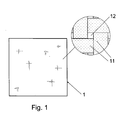
- Figure 1 shows a view of the fabric according to an embodiment of the invention, with an expanded section of same.
- the fabric can be made from any long element, for example, from yarns, staples or narrow fabric; an example has been shown in Figure 1, that is particularly suitable for the covering of greenhouses or big tents for public events, made with strips 11.
- the long elements are in turn obtained from long cellulose fibres.
- the cellulose pulp is obtained from conifer trees, with a kraft process in which the woodchips are subjected to heating in a bath of sulphites and caustic soda, for the purpose of extracting the lignin.
- the fabric can be woven, which will have the appropriate dimensions and thicknesses for each case in which the application is required.
- some yarns that are suitable for a fabric according to the invention can be around 10.3 Nm (metres per gram).
- the fabric can be made by any known fabric technique (weaving, knitting/knitwear, "rachel" methods,).
- This fabric can be applied to surfaces to be covered by conventional adhesive or sewing techniques or any others.
- the intermediary openings 12 can have, for example, a width of between 0.3 and 0.4 mm, whilst the strips 11 have double width, preferably between 0.6 and 0.8 mm.
- the fabric When the fabric is used to cover a glasshouse, tent or similar structure, and in spite of the fact that the fabric itself is suitable to make up a covering element in itself, it is also possible to place the fabric below a sheet of plastic, especially when it is used in areas with a high level of rainfall, in this case the fabric acting as a solar filter and reducer of sunshine on the plants, thanks to its solar radiation and ultra-violet ray filtering capacity.
- the fabric or the long elements with which the fabric is made can be subjected to a treatment with natural waxes in order to make handling easier, a treatment with surface treatment products, also by preference biodegradable, for resistance to dampness, or a fungicidal and bactericide treatment.
- the fabric can be treated with a fire retardant product, preventing the elements making up the fabric from becoming combustible in the event of a fire, and/or with water repellent products.
- a fabric can be obtained that can transpire with fire-retardant, anti-static and isothermal properties, etc. and that makes the development of mites and other miniscule sized arachnids difficult, in such a way that it is particularly suitable for the finishing of vehicle interiors.
- the isothermal nature brings comfort at the same time as reducing the energy consumption of the vehicle.
- the yarns, strips, or the already made up fabric can also be covered with waxes or resins to prevent accelerated deterioration, and it can be treated with pigments or colourings to give it a beauty integrated into its surroundings and suitable for different applications.
Landscapes
- Engineering & Computer Science (AREA)
- Textile Engineering (AREA)
- Life Sciences & Earth Sciences (AREA)
- Chemical & Material Sciences (AREA)
- Materials Engineering (AREA)
- Soil Sciences (AREA)
- Environmental Sciences (AREA)
- Mechanical Engineering (AREA)
- Woven Fabrics (AREA)
- Tents Or Canopies (AREA)
- Chemical Or Physical Treatment Of Fibers (AREA)
- Protection Of Plants (AREA)
- Treatments For Attaching Organic Compounds To Fibrous Goods (AREA)
Abstract
Description
- This present invention refers to a biodegradable fabric and its use a covering for the internal surfaces of vehicles and for the covering of greenhouses, big tents for public events and similar items.
- Greenhouses, big tents for public events and other similar constructions in general have a metal structure for the support of a sheet covering made from, in the case of greenhouses, a sheet of plastic, generally transparent, and in the case of big tents for public events or similar items, from a plastic awning or a plastic canvas.
- The use of these continuous covers prevents adequate ventilation, which is a disadvantage for plants in the case of greenhouses and for the workers who have to work inside of these constructions.
- On the other hand, the plastic sheets or layers used in these types of continuous sheet coverings suffer from a significant problem when they deteriorate and it is necessary to proceed with their replacement and elimination, as it either falls to specialised companies capable of converting the plastic into chemical waste, which carries with it additional costs, or alternatively they are dumped in uncontrolled tips, which means a problem as the plastic is a non-biodegradable material.
- The limited transpiration provided by the fabrics normally used in these coverings, and the difficulty of their elimination once they have deteriorated are problems that also occur in other fields related to coverings or linings by means of sheet element, such as in linings for the internal surfaces of vehicles.
- The differing internal surfaces of vehicles, both terrestrial and equally aeronautical are covered with different materials, the normal being the use of carpet for the covering of the floors and walls and the use of other textile fibre fabrics for the covering of other surfaces such as the seats.
- The textile fibre fabrics, especially those used for the covering of seats, have a reduced transpiration, which brings about greater perspiration for the user and the build up of dampness in the covering and in the atmosphere; in addition the build up of dirt between the fibres that make up same create an ideal habitat for the accumulation and proliferation of mites.
- This build up of dirt and the proliferation of mites means, especially in the case of aircraft, that said surface coverings must be changed with a higher frequency: this brings about the elimination and treatment problems mentioned above in regard to the covers of greenhouses, in addition to a high cost of maintenance, both in the time used in said operation, during which the vehicle is not operational, and equally because of the costs of the material and the installation.
- These coverings in addition present other disadvantages, amongst which the combustible nature of said materials and an almost nil filtering of cosmic radiation must be highlighted, which is an especially important problem in the cabins of aircraft.
- It would be desirable to have a suitable fabric for these types of applications that are low in cost and at the same time which reduced the problems of transpiration and the elimination of the materials once their useful working life has come to an end.
- In accordance with this objective, a first aspect of the present invention makes reference to a flexible biodegradable fabric that comprises of at least a layer of long elements which are interlaced or crossed with one another, and characterised because the long elements have been obtained from paper fibres or a non-woven cellulose fabric.
- This fabric, thanks to the materials used, has a low cost and has a low weight; it allows transpiration and has good cosmic radiation and infra-red filtering properties, which makes it an optimal covering for the internal surfaces of aircraft cabins. Likewise it absorbs and reduces the transfer of external noises.
- In addition, thanks to its biodegradable characteristics the problems associated with the elimination once it has come to the end of its working life are drastically reduced.
- In effect, the fabric can be completely recycled; therefore, the fabric can be eliminated easily once it has deteriorated, or equally after its use; this can be especially useful in the case of greenhouses, terraces for summer use, marquees used for fairs or any other similar construction.
- And as a result of the high degradability of its components, it can even be recycled for compost. For example, in the case of greenhouses, when the fabric has deteriorated from use it can be directly mixed with the earth to break it down into humus, or with weeds and stubble for conversion into by-products for compost.
- Another property of the fabric is that because of being made up of paper elements it has a low susceptibility to staining and the stains which occur are dispersed quickly.
- In another aspect, the invention refers to the use of a fabric as that described as a covering for the internal surfaces of vehicles or aircraft.
- In a subsequent aspect, the invention makes reference to the use of a fabric such as that described, for the covering of greenhouses, big tents for public events or similar structures.
- The invention likewise refers to a covering that has a low cost, is recyclable and biodegradable, with radiation reducing properties for the inner surfaces of vehicles, said surfaces being able to be walls, floors, ceilings, seats or others that are similar, both on terrestrial vehicles and equally aircraft. It is characterised because it has a sheet body made up of at least, a layer with fire retardant threads and/or strips of paper.
- The invention likewise refers to a sheet element for the covering of greenhouses, big tents for public events and similar items, is characterised because it is made up from a flexible mesh made from a plurality of long paper or cellulose elements, that are completely biodegradable and appropriately interlaced or crossed, forming a plurality of openings between them.
- In order to complement the description that is being made and for the purpose of giving a greater understanding of the nature of the invention, a set of descriptive drawings is attached to this present descriptive memorandum that is by way of illustration and without being by way of limitation and which represents a practical case for an embodiment of the invention.
- In said drawings, Figure 1 shows a view of the fabric according to an embodiment of the invention, with an expanded section of same.
-
- Figure 1 shows a
fabric 1 according to an example of an embodiment of the invention, which, as can be seen in the expanded section, is made up oflong elements 11, interlaced or crossed, that between them define a plurality ofopenings 12. - The fabric can be made from any long element, for example, from yarns, staples or narrow fabric; an example has been shown in Figure 1, that is particularly suitable for the covering of greenhouses or big tents for public events, made with
strips 11. - The long elements are in turn obtained from long cellulose fibres. The cellulose pulp is obtained from conifer trees, with a kraft process in which the woodchips are subjected to heating in a bath of sulphites and caustic soda, for the purpose of extracting the lignin.
- This process allows very resistant threads to be obtained, both dry and damp; this high resistance when damp allows the incorporation of additives such as, colourings.
- With yarns, staples, strips or a combination of same the fabric can be woven, which will have the appropriate dimensions and thicknesses for each case in which the application is required. For example, some yarns that are suitable for a fabric according to the invention can be around 10.3 Nm (metres per gram). The fabric can be made by any known fabric technique (weaving, knitting/knitwear, "rachel" methods,...).
- Below by way of example are some of the characteristics of the fabric that would be particularly suitable for the internal covering of floors, walls, ceilings, seats and other surfaces in aircraft and vehicles in general:
- Fabric: Bativa twill 3e1 b2.2
- Warp density: 12.2 threads / cm
- Weft density: 10.2 rows / cm
- Thread thickness: 0.84 mm
- Weight: 210 gr/m2
- A fabric of this type has a resistance to traction of 37.0 daN (warp) and 34.1 daN (weft), excellent resistance properties to abrasion, likewise cosmic radiation filtering: for example, alpha and beta particle absorption of around 25% (DW) and gamma radiation of around 23% (DW).
- This fabric can be applied to surfaces to be covered by conventional adhesive or sewing techniques or any others.
- In the case of a fabric to cover greenhouses, such as that shown in Figure 1, the
intermediary openings 12 can have, for example, a width of between 0.3 and 0.4 mm, whilst thestrips 11 have double width, preferably between 0.6 and 0.8 mm. - These embodiments, and any other in which the openings have less width than the elongated elements, are designed to allow correct transpiration through the fabric and at the same time achieve a projection of shadows of some elements onto others and to filter the solar rays, however allowing the passage of light through the covering.
- When the fabric is used to cover a glasshouse, tent or similar structure, and in spite of the fact that the fabric itself is suitable to make up a covering element in itself, it is also possible to place the fabric below a sheet of plastic, especially when it is used in areas with a high level of rainfall, in this case the fabric acting as a solar filter and reducer of sunshine on the plants, thanks to its solar radiation and ultra-violet ray filtering capacity.
- It has been designed so that the fabric or the long elements with which the fabric is made can be subjected to a treatment with natural waxes in order to make handling easier, a treatment with surface treatment products, also by preference biodegradable, for resistance to dampness, or a fungicidal and bactericide treatment.
- It has also been designed so that the fabric can be treated with a fire retardant product, preventing the elements making up the fabric from becoming combustible in the event of a fire, and/or with water repellent products.
- Thus a fabric can be obtained that can transpire with fire-retardant, anti-static and isothermal properties, etc. and that makes the development of mites and other miniscule sized arachnids difficult, in such a way that it is particularly suitable for the finishing of vehicle interiors. The isothermal nature brings comfort at the same time as reducing the energy consumption of the vehicle.
- The yarns, strips, or the already made up fabric can also be covered with waxes or resins to prevent accelerated deterioration, and it can be treated with pigments or colourings to give it a beauty integrated into its surroundings and suitable for different applications.
- In the case of fabrics used as coverings on the inside of aircraft and other vehicles it can be particularly important to subject the fabric or its components to a treatment to increase the cosmic radiation filtering properties; it has been found that this resistance can be improved for example by means of the depositing of soluble salts onto the paper.
- Experts in the subject will be able to introduce variations and modifications to the fabric described according to the specific requirements for each case, and replace any element for another that is technically equivalent, without this meaning the abandoning of the scope of the protection defined by the attached claims.
Claims (12)
- A flexible biodegradable fabric that comprises of at least a layer of long elements (11) which are interlaced or crossed with one another, and characterised because the long elements (11) have been obtained from paper fibres or a non-woven cellulose fabric.
- A fabric according to Claim 1, characterised in that said long elements (11) are yarns, staples or strips.
- A fabric according to any of the previous claims, characterised in that the paper fibres or cellulose fabric has been obtained from wood from conifers by means of the kraft process.
- A fabric according to any of the previous claims, characterised in that it is subjected to a treatment to increase the cosmic radiation filtering properties, preferably by means of the depositing of soluble salts.
- A fabric according to any of the previous claims, characterised in that it is subjected to a treatment with fire retardant products.
- A fabric according to any of the previous claims, characterised in that it is subjected to a water repellent treatment.
- A fabric according to any of the previous claims, characterised in that it is subjected to a treatment with fungicides and bactericides.
- A fabric according to any of the previous claims, characterised in that it is subjected to a treatment with pigments or colourings.
- The use of a fabric according to any of the Claims 1 to 8 as a covering for the internal surfaces of vehicles or aircraft.
- The use of a fabric according to any of the Claims 1 to 8 as a covering for greenhouses, big tents for public events or similar structures.
- A covering that has a low weight, is recyclable and biodegradable with radiation reducing properties for the inner surfaces of vehicles, being able to be used on walls, floors, ceilings, seats or other similar surfaces, both in terrestrial vehicles and equally for aircraft, characterised in that it has a laminar body comprising of at least a layer of fire retardant thread and/or paper strip (11).
- A laminar element for the covering of greenhouses, big tents for public events and similar structures, characterised in that it includes a flexible mesh comprising of a plurality of long elements (11) of paper or cellulose, which are completely biodegradable and suitably interlaced or crossed, thus defining a plurality of intermediary openings between one and another (12).
Applications Claiming Priority (3)
| Application Number | Priority Date | Filing Date | Title |
|---|---|---|---|
| ES200402807A ES2254022B1 (en) | 2004-11-16 | 2004-11-16 | RECYCLABLE AND BIODEGRADABLE COATING FOR INTERIOR VEHICLE SURFACES. |
| ES200501018A ES2261085B1 (en) | 2005-04-27 | 2005-04-27 | LAMINARY ELEMENT FOR THE COVER OF GREENHOUSES, FLOORS AND SIMILAR. |
| PCT/ES2005/000624 WO2006053926A1 (en) | 2004-11-16 | 2005-11-16 | Biodegradable textile |
Publications (1)
| Publication Number | Publication Date |
|---|---|
| EP1854346A1 true EP1854346A1 (en) | 2007-11-14 |
Family
ID=36406853
Family Applications (1)
| Application Number | Title | Priority Date | Filing Date |
|---|---|---|---|
| EP05817184A Withdrawn EP1854346A1 (en) | 2004-11-16 | 2005-11-16 | Biodegradable textile |
Country Status (2)
| Country | Link |
|---|---|
| EP (1) | EP1854346A1 (en) |
| WO (1) | WO2006053926A1 (en) |
Cited By (1)
| Publication number | Priority date | Publication date | Assignee | Title |
|---|---|---|---|---|
| NL2003926C2 (en) * | 2009-12-09 | 2011-06-14 | Beheer 141 B V | CASH FOR GROWING A CROP. |
Families Citing this family (4)
| Publication number | Priority date | Publication date | Assignee | Title |
|---|---|---|---|---|
| CN1912215A (en) * | 2006-08-23 | 2007-02-14 | 林净植 | Weaving method of using nonwoven fibric as yarn |
| ES2435391B1 (en) * | 2012-06-19 | 2014-09-29 | Seat, S.A. | Use of a lignocellulosic biopolymer sheet for the filtration of alpha, beta and gamma radiation radioactive particles, and filtration procedure |
| CN103806183A (en) * | 2014-01-29 | 2014-05-21 | 安徽工程大学 | Method for weaving fabric by using knitted leftover material |
| ES1226782Y (en) * | 2019-01-31 | 2019-06-11 | Smurfit Kappa Navarra S A | Fruit protector |
Family Cites Families (6)
| Publication number | Priority date | Publication date | Assignee | Title |
|---|---|---|---|---|
| CH601968A5 (en) * | 1976-03-05 | 1978-07-14 | Breveteam Sa | |
| ES2012268A6 (en) * | 1988-05-03 | 1990-03-01 | Artisan S L | A fabric of wicker and paper |
| ES2034902A6 (en) * | 1989-06-20 | 1993-04-01 | Mimcord S A | Substitute for paper cord and the like, and process for obtaining it. |
| SE9601156L (en) * | 1996-03-26 | 1997-09-27 | Volvo Ab | Multilayer Block |
| ES2138903B1 (en) * | 1997-05-28 | 2000-09-16 | Mimcord S A | PAPER STRIP FABRIC. |
| EP1403406B1 (en) | 2002-09-26 | 2006-06-21 | Tomoegawa Paper Co., Ltd. | Paper string reticulated structure |
-
2005
- 2005-11-16 WO PCT/ES2005/000624 patent/WO2006053926A1/en not_active Ceased
- 2005-11-16 EP EP05817184A patent/EP1854346A1/en not_active Withdrawn
Non-Patent Citations (1)
| Title |
|---|
| See references of WO2006053926A1 * |
Cited By (1)
| Publication number | Priority date | Publication date | Assignee | Title |
|---|---|---|---|---|
| NL2003926C2 (en) * | 2009-12-09 | 2011-06-14 | Beheer 141 B V | CASH FOR GROWING A CROP. |
Also Published As
| Publication number | Publication date |
|---|---|
| WO2006053926A1 (en) | 2006-05-26 |
Similar Documents
| Publication | Publication Date | Title |
|---|---|---|
| EP1934040B1 (en) | Fire-resistant carpet for aircraft interiors | |
| CA1052082A (en) | Carpeting materials for entrance mats | |
| Byrne | Technical textiles market–an overview | |
| JP2013212238A (en) | Odor-reducing mesh sheet | |
| HUE025834T2 (en) | Industrial fabric | |
| EP0805883B1 (en) | Reinforced fabric | |
| Maity et al. | Introduction to functional and technical textiles | |
| EP1127969B1 (en) | Textile substrate | |
| JP2010516275A (en) | Greenhouse screen | |
| AT404365B (en) | RECYCLABLE FABRIC MADE OF POLYOLE YARN | |
| EP1403406B1 (en) | Paper string reticulated structure | |
| JP2017012067A (en) | Weed-preventing sheet | |
| WO2006053926A1 (en) | Biodegradable textile | |
| US20030186606A1 (en) | Casement fabrics | |
| CN101060774A (en) | Biological degradable textile | |
| JP3603477B2 (en) | Mesh sheet for construction work and method of manufacturing the same | |
| DE9315978U1 (en) | Light-absorbing decorative textile material | |
| JP3217928B2 (en) | Breathable base cloth | |
| EP1146155A1 (en) | Awning cloth and method for production of the same | |
| CN217258829U (en) | Antibacterial and mildewproof non-woven fabric for wall cloth | |
| EP1670636A2 (en) | Fabric with odor receiving layer | |
| ES8106341A1 (en) | Window blind or curtain slats - of mono-filaments in plan heave gauze | |
| US20250034767A1 (en) | Fiber with Multi-filament Structure and Textile Fabric, Curtain, and Screen Incorporating Such Fiber | |
| DE69806340T2 (en) | COVER WITH TEXTILE ASPECT FOR CLOTHING SHAPED PANELS | |
| CN211917957U (en) | Honeycomb-structure ultraviolet-resistant polyester modified short fiber |
Legal Events
| Date | Code | Title | Description |
|---|---|---|---|
| PUAI | Public reference made under article 153(3) epc to a published international application that has entered the european phase |
Free format text: ORIGINAL CODE: 0009012 |
|
| 17P | Request for examination filed |
Effective date: 20070515 |
|
| AK | Designated contracting states |
Kind code of ref document: A1 Designated state(s): AT BE BG CH CY CZ DE DK EE ES FI FR GB GR HU IE IS IT LI LT LU LV MC NL PL PT RO SE SI SK TR |
|
| DAX | Request for extension of the european patent (deleted) | ||
| RIC1 | Information provided on ipc code assigned before grant |
Ipc: B60R 21/04 20060101ALI20090720BHEP Ipc: A01G 9/14 20060101AFI20061009BHEP Ipc: A01G 13/02 20060101ALI20090720BHEP Ipc: B32B 29/00 20060101ALI20090720BHEP Ipc: D03D 15/00 20060101ALI20090720BHEP Ipc: D02G 3/08 20060101ALI20090720BHEP |
|
| 17Q | First examination report despatched |
Effective date: 20090923 |
|
| STAA | Information on the status of an ep patent application or granted ep patent |
Free format text: STATUS: THE APPLICATION IS DEEMED TO BE WITHDRAWN |
|
| 18D | Application deemed to be withdrawn |
Effective date: 20140103 |