EP1853548B1 - Process for the preparation of benzoic acid derivatives via a new intermediate of synthesis - Google Patents
Process for the preparation of benzoic acid derivatives via a new intermediate of synthesis Download PDFInfo
- Publication number
- EP1853548B1 EP1853548B1 EP05804725A EP05804725A EP1853548B1 EP 1853548 B1 EP1853548 B1 EP 1853548B1 EP 05804725 A EP05804725 A EP 05804725A EP 05804725 A EP05804725 A EP 05804725A EP 1853548 B1 EP1853548 B1 EP 1853548B1
- Authority
- EP
- European Patent Office
- Prior art keywords
- formula
- acid
- chloro
- process according
- fluoro
- Prior art date
- Legal status (The legal status is an assumption and is not a legal conclusion. Google has not performed a legal analysis and makes no representation as to the accuracy of the status listed.)
- Expired - Lifetime
Links
Classifications
-
- C—CHEMISTRY; METALLURGY
- C07—ORGANIC CHEMISTRY
- C07C—ACYCLIC OR CARBOCYCLIC COMPOUNDS
- C07C201/00—Preparation of esters of nitric or nitrous acid or of compounds containing nitro or nitroso groups bound to a carbon skeleton
- C07C201/06—Preparation of nitro compounds
- C07C201/12—Preparation of nitro compounds by reactions not involving the formation of nitro groups
Definitions
- the subject-matter of the present invention is the preparation of 2-chloro-4-fluoro-5-nitrobenzoic acid and derivatives thereof, including the acyl chloride thereof and a novel synthetic intermediate.
- the subject-matter of the invention is a process for the preparation of the above-mentioned derivatives by nitration of 2-chloro-4-fluorobenzotrichloride and the transformation of the novel synthetic intermediate thus obtained into the acid and derivatives thereof, including the corresponding acyl chloride, or by a process comprising the nitration and simultaneous hydrolysis of said 2-chloro-4-fluorobenzotrichloride.
- the reaction described has considerable drawbacks, including the fact that the starting product, 2-chloro-4-fluorobenzoic acid is a solid, and hence not so easily handled compared to a liquid compound at room temperature. Furthermore, its nitration requires significant volumes of sulfuric acid and, by no means least, nitration of 2-chloro-4-fluorobenzoic acid leads to the production of considerable amounts of impurities, such as unwanted by-products.
- WO87/07602 discloses, in a generic way, a nitration reaction on benzoic acid derivatives and on benzyl chloride derivatives.
- the nitration of the benzoic acid derivative is disclosed, by using a 1/1 (v/v) mixture of nitric acid and sulfuric acid.
- v/v 1/1 (v/v) mixture of nitric acid and sulfuric acid.
- WO93/09077 discloses i.a. the conversion of fluorinated benzotrichlorides into fluorinated benzoic acids.
- the aim of the present invention is to provide an alternative synthetic process for 2-chloro-4-fluoro-5-nitrobenzoic acid and derivatives thereof including the acyl chloride, by a novel and original preparation process, with respect to the nitration process described in the aforementioned references, furthermore obviating the drawbacks of said nitration.
- the object of the present invention relates to a process for the preparation of 2-chloro-4-fluoro-5-nitrobenzoic acid and derivatives thereof, of formula (I): wherein
- halogen is meant a substituent selected from chlorine, bromine, fluorine and iodine, with chlorine being a particularly preferred substituent.
- linear or branched alkyl, alkenyl and alkynyl groups include lower alkyls such as methyl, ethyl, propyl, isopropyl, n-butyl, sec-butyl, t-butyl, iso-pentyl, etc., optionally, whenever possible, mono- or poly-unsaturated.
- optionally substituted aryl and arylalkyl groups include phenyl, naphthyl, diphenyl, benzyl, etc., optionally mono or poly-substituted with linear or branched alkyl, alkenyl or alkynyl groups, with halogens or with functional groups such as carboxyls (optionally esterified), primary, secondary or tertiary amines etc..
- the starting product, 2-chloro-4-fluorobenzotrichloride of formula (II), is a liquid, easily measurable product, the preparation of which is described in the literature for example in US 4,711,905 (column 17) in which it is synthesised via the photochlorination of the corresponding toluenic derivative.
- sulfonitric mixture a mixture composed of concentrated nitric acid and either concentrated sulfuric acid or oleum, wherein the nitric acid content in said sulfonitric mixture is 30% by weight with respect to the total mixture weight.
- the nitric acid content in the sulfonitric mixture is less than 30% by weight, for example comprised of between 15 and 30%. Indeed, it has been observed that said sulfonitric mixture is particularly advantageous when used on an industrial scale.
- the nitration step (a) is performed with a nitric acid/compound of formula (I) ratio greater than 1/1, even better if greater than 2/1 (mol/mol), for example with a ratio of 2.2/1 or even 3/1 or higher.
- the temperature of the nitration reaction (a) is at least slightly lower than room temperature, advantageously comprised of between 0 and 20°C, for example comprised of between 10 and 20°C or between 0°C and 10°C. Temperatures less than 0°C may likewise be used but involve longer reaction times, while temperatures above room temperature do not always give the selective nitration of the desired position in the benzene ring.
- a temperature comprised of between 0-10°C, for example around 0-5°C is particularly advantageous, above all when operating in the presence of a sulfonitric mixture with a nitric acid content of less than 30% by weight, allowing greater handleability of the reaction mixture with reduced production of by products.
- Hydrolysis (b) of the compound of formula (III) to give the acid form is generally performed in an acid medium, for example in the presence of hydrochloric, hydrobromic, acetic and/or sulfuric acid, at a temperature comprised of between room temperature and the reaction mixture reflux temperature, for example at a temperature greater than 50°C, advantageously comprised of between 80 and 120°C.
- a suitable catalyst such as for example FeCl 3 .
- the starting product of formula (II) may be added slowly (over several hours, for example around 2-3 hours) into the pre-chilled sulfonitric mixture and kept at a temperature comprised of between 0 and 10°C, the reaction mixture may then be left at said temperature for several hours until the nitration reaction is complete.
- the reaction mixture may be treated according to known techniques for the isolation of the intermediate product of formula (III).
- the desired product may be precipitated by treatment with ice water, and then isolated by filtration or be extracted from the suspension formed by using an appropriate solvent immiscible in water, for example a chlorinated solvent.
- an appropriate solvent immiscible in water for example a chlorinated solvent.
- the compound of formula (III) may be obtained with good yield and high purity. Said compound may be used directly for subsequent transformations without any further purification.
- 2-Chloro-4-fluoro-5-nitrobenzotrichloride of formula (III) is a novel compound and represents a further aspect of the present invention.
- the acid obtained from step (b) may be transformed into a derivative thereof (R is as defined above but # -COOH) according to techniques well known to those skilled in the art and/or described in the literature.
- the present invention also relates to a process for the preparation of the compound of formula (I) wherein R is -COCl comprising reacting the 2-chloro-4-fluoro-5-nitrobenzotrichloride of formula (III) and 2-chloro-4-fluoro-5-nitrobenzoic acid (formula (I) wherein R is -COOH) in a molar ratio of 1/1, preferably in the presence of a Lewis acid, such as for example FeCl 3 or ZnCl 2 , at a temperature comprised of between room temperature and 150-160°C, for example around 50°C or more advantageously around 80°C.
- a Lewis acid such as for example FeCl 3 or ZnCl 2
- novel compound of formula (III) is a particularly versatile chemical intermediate and may be used, for example, as a starting product for the preparation of 2-chloro-4-fluoro-5-nitrobenzotrifluoride, for example by halogen exchange reaction with hydrofluoric acid (HF).
- HF hydrofluoric acid
- the reaction is monitored by GC, following the disappearance of the reagent, and the acids are then diluted with 150.4 g of deionised water.
- the process is performed using external cooling in order to maintain the temperature below 10°C. 20 minutes after the addition of the water to dilute the acids, still with cooling, the reaction mixture is filtered under reduced pressure to give 651.6 g of filtered acids and 328.5 g of a damp, pale yellow, coarse grained solid which is washed by stirring with deionised water for one hour.
- the desired product is filtered to give 304.1 g of a pale yellow coloured product upon drying.
- Nitration molar yield 96.2%. Melting point (°C): 59-62
- the temperature is kept between 80-100°C for the entire duration of the reaction, and for 3 ⁇ 4 of the duration, the reaction has the appearance of a solution, then the acid product begins to form a suspension despite the high temperature.
- Addition of the organic component is completed in 3 hours 45 minutes, divided into 15 minute periods with the addition of 20-30 g each.
- the reaction mixture is kept stirring at 100°C for a further 3 hours, until the reaction is complete.
- the gas absorbed in the traps (97.5 g) is an indication of the state of completion of the reaction.
- the reaction mixture is then cooled to 20°C, and then the product filtered to give 233 g of a creamy white, damp solid. It is then further purified by washing with water, filtration and drying to obtain 171.0 g of product. Hydrolysis molar yield: 82%. Melting point (°C): 148-152.
Landscapes
- Chemical & Material Sciences (AREA)
- Organic Chemistry (AREA)
- Chemical Kinetics & Catalysis (AREA)
- Organic Low-Molecular-Weight Compounds And Preparation Thereof (AREA)
- Transition And Organic Metals Composition Catalysts For Addition Polymerization (AREA)
Abstract
Description
- The subject-matter of the present invention is the preparation of 2-chloro-4-fluoro-5-nitrobenzoic acid and derivatives thereof, including the acyl chloride thereof and a novel synthetic intermediate. In particular, the subject-matter of the invention is a process for the preparation of the above-mentioned derivatives by nitration of 2-chloro-4-fluorobenzotrichloride and the transformation of the novel synthetic intermediate thus obtained into the acid and derivatives thereof, including the corresponding acyl chloride, or by a process comprising the nitration and simultaneous hydrolysis of said 2-chloro-4-fluorobenzotrichloride.
- 2-chloro-4-fluoro-5-nitrobenzoic acid is a known product.
- Its preparation is described in the literature , solely by nitration of 2-chloro-4-fluorobenzoic acid, just as reported, for example, in
WO87/07602 EP0863142 andWO01/83459 - The reaction described has considerable drawbacks, including the fact that the starting product, 2-chloro-4-fluorobenzoic acid is a solid, and hence not so easily handled compared to a liquid compound at room temperature. Furthermore, its nitration requires significant volumes of sulfuric acid and, by no means least, nitration of 2-chloro-4-fluorobenzoic acid leads to the production of considerable amounts of impurities, such as unwanted by-products.
-
WO87/07602 -
WO93/09077 - The aim of the present invention is to provide an alternative synthetic process for 2-chloro-4-fluoro-5-nitrobenzoic acid and derivatives thereof including the acyl chloride, by a novel and original preparation process, with respect to the nitration process described in the aforementioned references, furthermore obviating the drawbacks of said nitration.
- Indeed, it has now been found that it is possible to prepare 2-chloro-4-fluoro-5-nitrobenzoic acid by nitration, not of the corresponding non-nitrated acid, but of 2-chloro-4-fluorobenzotrichloride, the reaction proceeding via 2-chloro-4-fluoro-5-nitrobenzotrichloride, a novel and versatile reaction intermediate which is easily converted into the desired acid or the acyl chloride thereof or into other possible compounds.
- Hence, according to one aspect thereof, the object of the present invention relates to a process for the preparation of 2-chloro-4-fluoro-5-nitrobenzoic acid and derivatives thereof, of formula (I):

- R is a -COOH, -COOR', -CO-Hal, -CONR"R"', -COSR"' or -CN group,
- Hal represents a halogen atom,
- R' represents a linear or branched alkyl, alkenyl or alkynyl group; an optionally substituted aryl group;
- R" and R"' represent, independently, a hydrogen atom; a linear or branched alkyl, alkenyl or alkynyl group; an optionally substituted aryl or arylalkyl group;
- a) reacting 2-chloro-4-fluorobenzotrichloride of formula (II):
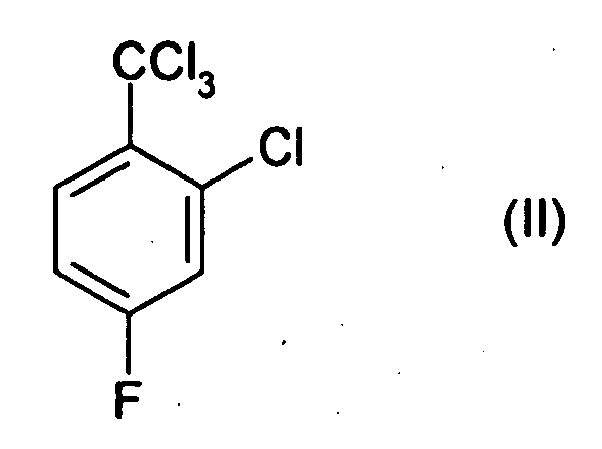

- b) hydrolysing the intermediate to give the acid of formula (I) wherein R is - COOH; and optionally
- c) converting the acid thus obtained into a derivative thereof.
- According to the present invention, by halogen is meant a substituent selected from chlorine, bromine, fluorine and iodine, with chlorine being a particularly preferred substituent.
- In particular, the preparation of the compound of formula (I) wherein R is -COCl (R = -CO-Hal with Hal = Chlorine) may proceed according to any of the following steps, including:
- c') treating the acid of formula (I) wherein R is -COOH with classic chlorinating agents; or alternatively
- c") reacting 2-chloro-4-fluoro-5-nitrobenzotrichloride of formula (III) with 2-chloro-4-fluoro-5-nitrobenzoic acid (formula (I) wherein R is OH) in 1/1 molar ratios,
- Examples of linear or branched alkyl, alkenyl and alkynyl groups include lower alkyls such as methyl, ethyl, propyl, isopropyl, n-butyl, sec-butyl, t-butyl, iso-pentyl, etc., optionally, whenever possible, mono- or poly-unsaturated.
- Examples of optionally substituted aryl and arylalkyl groups include phenyl, naphthyl, diphenyl, benzyl, etc., optionally mono or poly-substituted with linear or branched alkyl, alkenyl or alkynyl groups, with halogens or with functional groups such as carboxyls (optionally esterified), primary, secondary or tertiary amines etc..
- The starting product, 2-chloro-4-fluorobenzotrichloride of formula (II), is a liquid, easily measurable product, the preparation of which is described in the literature for example in
US 4,711,905 (column 17) in which it is synthesised via the photochlorination of the corresponding toluenic derivative. - According to the present invention, by "sulfonitric mixture" is meant a mixture composed of concentrated nitric acid and either concentrated sulfuric acid or oleum, wherein the nitric acid content in said sulfonitric mixture is 30% by weight with respect to the total mixture weight.
- According to one advantageous aspect of the invention, the nitric acid content in the sulfonitric mixture is less than 30% by weight, for example comprised of between 15 and 30%. Indeed, it has been observed that said sulfonitric mixture is particularly advantageous when used on an industrial scale.
- According to one advantageous aspect, the nitration step (a) is performed with a nitric acid/compound of formula (I) ratio greater than 1/1, even better if greater than 2/1 (mol/mol), for example with a ratio of 2.2/1 or even 3/1 or higher.
- The temperature of the nitration reaction (a) is at least slightly lower than room temperature, advantageously comprised of between 0 and 20°C, for example comprised of between 10 and 20°C or between 0°C and 10°C. Temperatures less than 0°C may likewise be used but involve longer reaction times, while temperatures above room temperature do not always give the selective nitration of the desired position in the benzene ring.
- In particular, it has been observed that using a temperature comprised of between 0-10°C, for example around 0-5°C, is particularly advantageous, above all when operating in the presence of a sulfonitric mixture with a nitric acid content of less than 30% by weight, allowing greater handleability of the reaction mixture with reduced production of by products.
- Hydrolysis (b) of the compound of formula (III) to give the acid form, is generally performed in an acid medium, for example in the presence of hydrochloric, hydrobromic, acetic and/or sulfuric acid, at a temperature comprised of between room temperature and the reaction mixture reflux temperature, for example at a temperature greater than 50°C, advantageously comprised of between 80 and 120°C. With certain types of hydrolysis, it may be possible to add a suitable catalyst, such as for example FeCl3. The technical details of the hydrolysis step (b) are provided in the experimental section of this description.
- If desired, or indeed necessary, the acid of formula (I) (wherein R = -COOH) may be purified according to known techniques, for example by washing with water, advantageously in a water/alcohol mixture.
- For the good outcome of the process of the invention according to the aforementioned steps (a), (b), (c') or (c"), it is essential that the sulfonitric mixture be used in pre-mixed form, instead of the starting product being dissolved firstly in sulfuric acid with nitric acid then being added later.
- Indeed, it has been observed that when the starting product of formula (II) comes into contact firstly with sulfuric acid or oleum and then with nitric acid, then besides the desired nitration, the hydrolysis of the trichloride group to the acid form is also obtained without the formation of the 2-chloro-4-fluoro-5-nitrobenzotrichloride intermediate of formula (III), which as already mentioned, is a novel, potentially versatile compound with wide range of potential uses in the synthesis of organic compounds, that may be useful for example in the preparation of derivatives of said acid and particularly the compound of formula (I) wherein R is as defined previously but other than -COOH.
- The process for the preparation of the compound of formula (I) wherein R is -COOH by the nitration and simultaneous hydrolysis of 2-chloro-4-fluorobenzotrichloride of formula (II) comprising of the addition of said compound of formula (II) in sulfuric acid or oleum, with the subsequent addition of an appropriate quantity of nitric acid to the mixture, represents however a further aspect of the present invention. The details of this synthetic process are provided in the experimental section of the present description.
- In general, for carrying out the process of stage (a) of the invention, the starting product of formula (II) may be added slowly (over several hours, for example around 2-3 hours) into the pre-chilled sulfonitric mixture and kept at a temperature comprised of between 0 and 10°C, the reaction mixture may then be left at said temperature for several hours until the nitration reaction is complete. Those skilled in the art are naturally able to check the progress of the reaction by means of conventional chromatographic techniques.
- Once the reaction is complete (i.e. when the starting product can no longer be detected) the reaction mixture may be treated according to known techniques for the isolation of the intermediate product of formula (III). For example, the desired product may be precipitated by treatment with ice water, and then isolated by filtration or be extracted from the suspension formed by using an appropriate solvent immiscible in water, for example a chlorinated solvent. Afterwards, using conventional isolation techniques, the compound of formula (III) may be obtained with good yield and high purity. Said compound may be used directly for subsequent transformations without any further purification.
- 2-Chloro-4-fluoro-5-nitrobenzotrichloride of formula (III) is a novel compound and represents a further aspect of the present invention.
- The acid obtained from step (b) may be transformed into a derivative thereof (R is as defined above but # -COOH) according to techniques well known to those skilled in the art and/or described in the literature.
- The transformation of the acid of formula (I) wherein R is -COOH into the acyl chloride thereof of formula (I) wherein R is -COCl (R = -CO-Hal with Hal = Chloride) may be particularly useful. Said reaction may be carried out either by chlorination of the corresponding acid according to conventional techniques, for example through the action of chlorinating agents such as thionyl chloride, under reaction conditions well known to those skilled in the art or, according to a further aspect of the present invention, by reacting 2-chloro-4-fluoro-5-nitrobenzotrichloride of formula (III) with 2-chloro-4-fluoro-5-nitrobenzoic acid.
- Thus, according to a further aspect thereof, the present invention also relates to a process for the preparation of the compound of formula (I) wherein R is -COCl comprising reacting the 2-chloro-4-fluoro-5-nitrobenzotrichloride of formula (III) and 2-chloro-4-fluoro-5-nitrobenzoic acid (formula (I) wherein R is -COOH) in a molar ratio of 1/1, preferably in the presence of a Lewis acid, such as for example FeCl3 or ZnCl2, at a temperature comprised of between room temperature and 150-160°C, for example around 50°C or more advantageously around 80°C. The reaction is exothermic and produces hydrochloric acid. The technical details of said preparation are reported in the following experimental section.
- Alternatively, it is possible to react the 2-chloro-4-fluoro-5-nitrobenzotricloride of formula (III) with water in the presence of a catalyst such as FeCl3 or FeSO4, or even in a weakly acidic medium, for example in the presence of dilute sulfuric acid, to obtain the of 2-chloro-4-fluoro-5-nitrobenzoic acid chloride; in this case, it is advantageous to operate at temperatures ranging between 120 and 160°C and the measured quantity of water must be added slowly and constantly in order to avoid inactivation of the catalyst and hydrolysis of the compound into its acid form.
- As already mentioned, the novel compound of formula (III) is a particularly versatile chemical intermediate and may be used, for example, as a starting product for the preparation of 2-chloro-4-fluoro-5-nitrobenzotrifluoride, for example by halogen exchange reaction with hydrofluoric acid (HF).
- The various aspects of the invention will now be non-limitingly illustrated by means of the following examples.
- Into a 500 ml 4-necked round-bottomed flask, equipped with mechanical means of stirring, means of cooling, thermometer and dropping funnel, 150.2 g of 30% oleum, and 60.2 g of concentrated nitric acid (99%) are added while maintaining the temperature below 10°C. To the sulfonitric mixture thus obtained 115.6 g of 2-chloro-4-fluorobenzotrichloride are added over 2.5 hours while maintaining the temperature between 0 and 10°C. The reaction is left at said temperature for a further 2 hours to achieve completion, then poured into an ice/water mixture and the precipitation of a white solid is immediately observed. 300 g of dichloromethane is added to the mixture and the phases separated, the organic phase is washed with a solution of NaHCO3, then dried over magnesium sulfate, filtered and evaporated to dryness. 132 g of the title product (titre by GC = 93.7%, yield 93%) are obtained as a white solid.
M.P. = 65-68°C
GC-MS identifies ion 256-262 [M-Cl]+
1H NMR (spectra have been performed in CD3COCD3)
doublet signal at 7.91 ppm 3JHF 9.91 Hz
doublet signal at 8.93 ppm 4JHF 7.63 Hz
(reference 2.03 ppm on the central line of the residual acetone signal)
19F NMR
Singlet signal at -113.68 ppm
(trifluoroacetic acid reference, the signal of which is given at -77.00 ppm)
13C NMR (coupled spectrum)C(1) 136.91 ppm ddd (4JCF 4.7 Hz, 2JCH 10.9 Hz, 3JCH 6.0 Hz) C(2) 141.01 ppm ddd (3JCF 11.0 Hz, 2JCH 11.1 Hz, 3JCH 5.0 Hz) C(3) 125.16 ppm dd (1JCH 175.5 Hz, Hz, 3JCF 25.1 Hz) C(4) 157.26 ppm ddd (1JCF 271.9 Hz, 2JCH 9.36 Hz, 3JCH 5.9 Hz) C(5) 136.07 ppm m C(6) 127.09 ppm dd (1JCH 171.4 Hz, 3JCF 1.6 Hz) C(CCl3) 94.26 ppm dd (3JCH 6.4 Hz, 5JCF 1.5 Hz) - Into a 500 ml 4-necked, cryostatically cooled round-bottomed flask equipped with mechanical means of stirring, a thermometer, dropping funnel and a acidic gas traps, 602.8 g of sulfonitric mixture containing 22% nitric acid are loaded, and the temperature cryostatically cooled to 0°C. 251.8 g of 2-chloro-4-fluorobenzotrichloride are added by means of the dropping funnel while maintaining the temperature between 0 and 2°C. The addition is completed over 4.5 hours, and the well-stirred, homogeneously appearing mixture has a pale yellow colour. The reaction mixture is left, still at 0-4°C, for a further 2 hours for the reaction to go to completion. The reaction is monitored by GC, following the disappearance of the reagent, and the acids are then diluted with 150.4 g of deionised water. The process is performed using external cooling in order to maintain the temperature below 10°C. 20 minutes after the addition of the water to dilute the acids, still with cooling, the reaction mixture is filtered under reduced pressure to give 651.6 g of filtered acids and 328.5 g of a damp, pale yellow, coarse grained solid which is washed by stirring with deionised water for one hour. The desired product is filtered to give 304.1 g of a pale yellow coloured product upon drying.
Nitration molar yield: 96.2%.
Melting point (°C): 59-62 - Into a 250 ml reaction vessel 41.6 g of 96% H2SO4 are loaded and 8.4 g of water added dropwise (to adjust the acid concentration to 80%). The temperature of the acid is adjusted to 70°C and the portionwise addition of 10 g of purified 2-chloro-4-fluoro-5-nitrobenzotrichloride (titre by GC = 99.5%) commenced. The temperature is then set to 100-110°C, observing the progressive formation of a white solid product dispersed in the mixture. The temperature is kept for 3 hours, then the reaction mixture cooled to 50°C and diluted with 100 g of water, and the product then extracted with 40 g of ethyl acetate at room temperature. The phases are separated and the organic solution washed with 46 g of water. Finally, the solvent is evaporated to give 7 g of the title product, as a white solid.
Titre by HPLC = 94.5%, molar yield 88%.
Melting point (°C): 148-151. - Into a 250 ml reaction vessel inside a 1 I glass equipped with mechanical means of stirring, thermometer, bubble condenser, thermostatically controlled oil heater, acid vapour water traps, 750 g of 96% sulfuric acid are loaded and 75 g of deionised water added dropwise to dilute the acid to 85%. The operation is completed over 1.5 hours, reaching a maximum temperature of 45°C. The acid is then heated to 80-90°C, and the portionwise addition of 302.6 g of crude 2-chloro-4-fluoro-5-nitrobenzotrichloride commenced. The production of HCl may be observed immediately, both in the reaction mixture (seen by foaming), and in the water absorption traps. The reaction is moderately exothermic, however, the portionwise addition continues in safety, avoiding the accumulation of gas with vigorous stirring.
- The temperature is kept between 80-100°C for the entire duration of the reaction, and for ¾ of the duration, the reaction has the appearance of a solution, then the acid product begins to form a suspension despite the high temperature. Addition of the organic component is completed in 3 hours 45 minutes, divided into 15 minute periods with the addition of 20-30 g each. The reaction mixture is kept stirring at 100°C for a further 3 hours, until the reaction is complete. The gas absorbed in the traps (97.5 g) is an indication of the state of completion of the reaction. The reaction mixture is then cooled to 20°C, and then the product filtered to give 233 g of a creamy white, damp solid. It is then further purified by washing with water, filtration and drying to obtain 171.0 g of product.
Hydrolysis molar yield: 82%.
Melting point (°C): 148-152. - Into a 250 ml reaction vessel 50 g of 96% sulfuric acid are loaded then diluted to 80% by the addition of 10 g of water. The mixture is then heated to 70°C and then the portionwise addition of 12 g of crude nitration product 2-chloro-4-fluoro-5-nitrobenzotrichloride (titre by GC = 98%) commenced. The reaction mixture is heated to 100-110°C and kept at said temperature for 3 hours to promote the formation of the hydrolysis product. While cooling, it is diluted with the addition of 50 g of water and 50 g of ice, and the product extracted with 60 g of ethyl acetate. Following separation of the phases, the organic phase is washed with 60 g of water, and the ethyl acetate concentrated under reduced pressure. 10 g of heptane are then added and 8 g of title product isolated as a white solid.
Titre by HPLC = 96.5%, molar yield 91%.
Melting point (°C): 150-153. - Into a 100 ml reaction vessel 30 g of 2-chloro-4-fluoro-5-nitrobenzotrichloride and 0.85 g of FeCl3 are loaded. The mixture is heated to 50°C and 22.4 g of 2-chloro-4-fluoro-5-nitrobenzoic acid added. The temperature increases to 85°C with strong release of gaseous hydrochloric acid. The mixture becomes completely fluid and the reaction is left for 1.5 hours to proceed to completion. The disappearance of the starting product and the corresponding appearance of the title compound are monitored by gas chromatography (GC).
Final GC analysis: 94.7% 2-chloro-4-fluoro-5-nitrobenzoic acid chloride (via the methyl ester).
Melting point (°C): 53-57.
Claims (10)
- A process for the preparation of 2-chloro-4-fluoro-5-nitrobenzoic acid and/or the chloride derivative thereof of formula (I):
 - R is a -COOH, -COOR', -CO-Hal, -CONR"R"', -COSR'" or -CN group,- Hal represents a halogen atom,- R' represents a linear or branched alkyl, alkenyl or alkynyl group; an optionally substituted aryl group;- R" and R"' represent, independently, a hydrogen atom; a linear or branched alkyl, alkenyl or alkynyl group; an optionally substituted aryl or arylalkyl group,characterised in that:a) reacting 2-chloro-4-fluorobenzotrichloride of formula (II):
 b) hydrolysing the intermediate to give the acid of formula (I) wherein R is - COOH; and optionallyc) the acid thus obtained is transformed into a derivative thereof.
 - The process according to claim 1 characterised in that said nitration mixture is a mixture composed of concentrated nitric acid and concentrated sulfuric acid or oleum and wherein the nitric acid content in said nitration mixture is 30% by weight with respect to the total mixture weight.
- The process according to claims 1 or 2 characterised in that the nitric acid content in the nitration mixture is less than 30% by weight.
- The process according to claims 1 to 3 characterised in that the nitration step (a) is carried out with a nitric acid/compound of formula (I) ratio of no less than 2/1 (mol/mol).
- The process according to claims 1 to 4 characterised in that the temperature of the nitration reaction (a) is between 0 and 20°C.
- The process according to claims 5 characterised in that the temperature of the nitration reaction (a) is between 0 and 10°C.
- The process according to claims 1 to 6 characterised in that the hydrolysis (b) is performed in an acidic medium.
- The process according to claims 1 to 7 for the preparation of the product of formula (I) wherein R is -COCl, characterised in that any of the following steps are performed:c') treating the acid of formula (I) wherein R is -COOH with classic chlorinating agents; or alternativelyc") reacting 2-chloro-4-fluoro-5-nitrobenzotrichloride of formula (III) with 2-chloro-4-fluoro-5-nitrobenzoic acid (formula (I) wherein R is -COOH) in 1/1 molar ratios.
- The process according to claim 8 characterised in that thionyl chloride is used in step (c').
- The process according to claim 8 characterised in that step (c") is performed in the presence of a Lewis acid.
Applications Claiming Priority (2)
| Application Number | Priority Date | Filing Date | Title |
|---|---|---|---|
| IT000275A ITMI20050275A1 (en) | 2005-02-22 | 2005-02-22 | PROCEDURE FOR THE PREPARATION OF BENZOIC ACID DERIVATIVES THROUGH A NEW INTERMEDIATE SYNTHESIS |
| PCT/IB2005/003622 WO2006090210A1 (en) | 2005-02-22 | 2005-12-01 | Process for the preparation of benzoic acid derivatives via a new intermediate of synthesis |
Publications (2)
| Publication Number | Publication Date |
|---|---|
| EP1853548A1 EP1853548A1 (en) | 2007-11-14 |
| EP1853548B1 true EP1853548B1 (en) | 2009-05-13 |
Family
ID=35730491
Family Applications (1)
| Application Number | Title | Priority Date | Filing Date |
|---|---|---|---|
| EP05804725A Expired - Lifetime EP1853548B1 (en) | 2005-02-22 | 2005-12-01 | Process for the preparation of benzoic acid derivatives via a new intermediate of synthesis |
Country Status (7)
| Country | Link |
|---|---|
| EP (1) | EP1853548B1 (en) |
| CN (3) | CN101142168B (en) |
| AT (1) | ATE431329T1 (en) |
| DE (1) | DE602005014511D1 (en) |
| IT (1) | ITMI20050275A1 (en) |
| MX (1) | MX2007009874A (en) |
| WO (1) | WO2006090210A1 (en) |
Families Citing this family (10)
| Publication number | Priority date | Publication date | Assignee | Title |
|---|---|---|---|---|
| BRPI0619760A2 (en) | 2005-12-01 | 2012-02-22 | Basf Se | process for preparing compounds |
| BRPI0818408B1 (en) | 2007-10-12 | 2024-01-09 | Basf Se | PROCESSES FOR PREPARING SULFURIC DIAMIDS AND ACTIVE HERBICIDAL INGREDIENTS |
| CN102320919B (en) * | 2011-10-31 | 2014-07-23 | 江苏威耳化工有限公司 | Preparation method for 2,6-dichloro-trifluorotoluene |
| CN106397209A (en) * | 2016-08-30 | 2017-02-15 | 枣阳凤泽精细化工有限公司 | Preparation method of 2-chloride-5-nitrobenzoic acid |
| CN108218709A (en) * | 2016-12-14 | 2018-06-29 | 江苏联化科技有限公司 | The separation method of the fluoro- benzoic acid nitration products of the chloro- 4- of 2- |
| WO2018141642A1 (en) | 2017-02-06 | 2018-08-09 | BASF Agro B.V. | Process for the preparation of 2-chloro-4-fluoro-5-nitrobenzotrichloride |
| CN109232258A (en) * | 2018-11-20 | 2019-01-18 | 宿州学院 | A kind of fluoro- 5- nitrotrichloromethane benzene synthesis post-processing approach of the chloro- 4- of 2- |
| WO2025103929A1 (en) | 2023-11-15 | 2025-05-22 | Bayer Aktiengesellschaft | Substituted n-benzoic acid uracils and salts thereof, and use thereof as herbicidal active substances |
| CN117964490B (en) * | 2024-01-24 | 2024-12-20 | 景德镇富祥生命科技有限公司 | A method for preparing trifluoromethyl aromatic compounds |
| WO2026139954A1 (en) | 2024-12-24 | 2026-07-02 | Adama Agan Ltd. | Process for the preparation of nitrobenzene derivatives |
Family Cites Families (9)
| Publication number | Priority date | Publication date | Assignee | Title |
|---|---|---|---|---|
| DE82927C (en) * | ||||
| US4045502A (en) * | 1976-09-29 | 1977-08-30 | Olin Corporation | Process for producing high purity para-chlorobenzotrifluoride |
| DE3142856A1 (en) * | 1981-10-29 | 1983-05-11 | Bayer Ag, 5090 Leverkusen | METHOD FOR PRODUCING 2,4-DICHLOR-5-FLUOR-BENZOYL CHLORIDE |
| IL82657A0 (en) * | 1986-06-03 | 1987-11-30 | Rhone Poulenc Agrochimie | N-(5-substituted methylene)phenyl herbicides |
| ES2074047T3 (en) * | 1987-08-14 | 1995-09-01 | Asahi Glass Co Ltd | FLUORATED BENZOYL COMPOUNDS. |
| ATE157642T1 (en) * | 1991-10-31 | 1997-09-15 | Abbott Lab | METHOD FOR PRODUCING FLUORINATED BENZOIC ACIDS |
| DE4227371A1 (en) * | 1992-08-19 | 1994-02-24 | Bayer Ag | Process for the preparation of 2,3,4-trichloro-5-fluoro-benzoyl chloride |
| NZ517562A (en) * | 2000-05-04 | 2004-09-24 | Basf Ag | Uracil substituted phenyl sulfamoyl carboxamides |
| CN1508115A (en) * | 2002-12-13 | 2004-06-30 | 上海群力化工有限公司 | High-purity benzoyl chloride synthesizing process |
-
2005
- 2005-02-22 IT IT000275A patent/ITMI20050275A1/en unknown
- 2005-12-01 EP EP05804725A patent/EP1853548B1/en not_active Expired - Lifetime
- 2005-12-01 WO PCT/IB2005/003622 patent/WO2006090210A1/en not_active Ceased
- 2005-12-01 MX MX2007009874A patent/MX2007009874A/en active IP Right Grant
- 2005-12-01 DE DE602005014511T patent/DE602005014511D1/en not_active Expired - Lifetime
- 2005-12-01 CN CN2005800485745A patent/CN101142168B/en not_active Expired - Lifetime
- 2005-12-01 CN CN2010102805492A patent/CN101948390B/en not_active Expired - Lifetime
- 2005-12-01 CN CN2010101131083A patent/CN101891624B/en not_active Expired - Lifetime
- 2005-12-01 AT AT05804725T patent/ATE431329T1/en not_active IP Right Cessation
Also Published As
| Publication number | Publication date |
|---|---|
| CN101142168A (en) | 2008-03-12 |
| CN101142168B (en) | 2012-03-28 |
| ATE431329T1 (en) | 2009-05-15 |
| CN101891624A (en) | 2010-11-24 |
| MX2007009874A (en) | 2007-09-25 |
| ITMI20050275A1 (en) | 2006-08-23 |
| CN101948390B (en) | 2011-12-28 |
| EP1853548A1 (en) | 2007-11-14 |
| WO2006090210A1 (en) | 2006-08-31 |
| CN101891624B (en) | 2013-05-01 |
| CN101948390A (en) | 2011-01-19 |
| DE602005014511D1 (en) | 2009-06-25 |
Similar Documents
| Publication | Publication Date | Title |
|---|---|---|
| CZ301809B6 (en) | Process for preparing 2-halobenzoic acids and derivatives thereof | |
| EP1853548A1 (en) | Process for the preparation of benzoic acid derivatives via a new intermediate of synthesis | |
| Salehi et al. | Catalytic Friedel–Crafts acylation of alkoxybenzenes mediated by aluminum hydrogensulfate in solution and solvent-free conditions | |
| EP0303291A2 (en) | Fluorinated benzoyl compounds | |
| CN116640064B (en) | A kind of synthetic method of 4'-chloro-2-aminobiphenyl | |
| JP2003335735A (en) | Method for producing perfluoroisopropylaniline | |
| KR20220051422A (en) | Process for the preparation of 1-(3,5-dichlorophenyl)-2,2,2-trifluoroethanone and derivatives thereof | |
| JP5536668B2 (en) | Preparation of diacerein | |
| US4996377A (en) | Preparation of aliphatically substituted fluorobenzenes | |
| AU2003268683B2 (en) | Process for production of an acetylenic compound | |
| JP4641839B2 (en) | Process for producing 4-methyl-3-trifluoromethylbenzoic acid | |
| CN100537499C (en) | Process for producing halogenated adamantane compound | |
| EP1961730A1 (en) | Method for producing polymerizable hydroxydiamantyl ester compound | |
| JPH06737B2 (en) | Method for producing alkyl- [3chlorophenyl] -sulfone | |
| JP2008031085A (en) | Method for producing 2-naphthol derivative | |
| JP3646223B2 (en) | Method for producing aromatic compound by electrophilic reaction and aromatic compound | |
| JP3887757B2 (en) | Method for producing cyanobenzenesulfonyl chloride | |
| JP5105825B2 (en) | Method for producing 4-hydroxy-2-adamantanone compound | |
| JPH0586000A (en) | Method for producing 2-amino-4-fluorobenzoic acid | |
| JP2008050287A (en) | Method for producing 2-naphthol derivative | |
| JP4967530B2 (en) | Method for producing tetrahydronaphthalene derivative | |
| CN111440042A (en) | Preparation method of 1-phenyladamantane and obtained 1-phenyladamantane | |
| CN115279725A (en) | Efficient and selective route for the synthesis of alkyl 2-benzoyl benzoates | |
| JPH0759557B2 (en) | Method for producing 1,3-dialkylpyrazole-4-aldehyde derivative | |
| EP0887333A1 (en) | Process for the production of halogeno-o-hydroxydiphenyl compounds |
Legal Events
| Date | Code | Title | Description |
|---|---|---|---|
| PUAI | Public reference made under article 153(3) epc to a published international application that has entered the european phase |
Free format text: ORIGINAL CODE: 0009012 |
|
| 17P | Request for examination filed |
Effective date: 20070918 |
|
| AK | Designated contracting states |
Kind code of ref document: A1 Designated state(s): AT BE BG CH CY CZ DE DK EE ES FI FR GB GR HU IE IS IT LI LT LU LV MC NL PL PT RO SE SI SK TR |
|
| 17Q | First examination report despatched |
Effective date: 20080226 |
|
| DAX | Request for extension of the european patent (deleted) | ||
| GRAP | Despatch of communication of intention to grant a patent |
Free format text: ORIGINAL CODE: EPIDOSNIGR1 |
|
| GRAS | Grant fee paid |
Free format text: ORIGINAL CODE: EPIDOSNIGR3 |
|
| GRAA | (expected) grant |
Free format text: ORIGINAL CODE: 0009210 |
|
| AK | Designated contracting states |
Kind code of ref document: B1 Designated state(s): AT BE BG CH CY CZ DE DK EE ES FI FR GB GR HU IE IS IT LI LT LU LV MC NL PL PT RO SE SI SK TR |
|
| REG | Reference to a national code |
Ref country code: GB Ref legal event code: FG4D |
|
| REG | Reference to a national code |
Ref country code: CH Ref legal event code: EP |
|
| REG | Reference to a national code |
Ref country code: IE Ref legal event code: FG4D |
|
| REF | Corresponds to: |
Ref document number: 602005014511 Country of ref document: DE Date of ref document: 20090625 Kind code of ref document: P |
|
| PG25 | Lapsed in a contracting state [announced via postgrant information from national office to epo] |
Ref country code: AT Free format text: LAPSE BECAUSE OF FAILURE TO SUBMIT A TRANSLATION OF THE DESCRIPTION OR TO PAY THE FEE WITHIN THE PRESCRIBED TIME-LIMIT Effective date: 20090513 Ref country code: PT Free format text: LAPSE BECAUSE OF FAILURE TO SUBMIT A TRANSLATION OF THE DESCRIPTION OR TO PAY THE FEE WITHIN THE PRESCRIBED TIME-LIMIT Effective date: 20090913 Ref country code: ES Free format text: LAPSE BECAUSE OF FAILURE TO SUBMIT A TRANSLATION OF THE DESCRIPTION OR TO PAY THE FEE WITHIN THE PRESCRIBED TIME-LIMIT Effective date: 20090824 Ref country code: FI Free format text: LAPSE BECAUSE OF FAILURE TO SUBMIT A TRANSLATION OF THE DESCRIPTION OR TO PAY THE FEE WITHIN THE PRESCRIBED TIME-LIMIT Effective date: 20090513 Ref country code: LT Free format text: LAPSE BECAUSE OF FAILURE TO SUBMIT A TRANSLATION OF THE DESCRIPTION OR TO PAY THE FEE WITHIN THE PRESCRIBED TIME-LIMIT Effective date: 20090513 |
|
| NLV1 | Nl: lapsed or annulled due to failure to fulfill the requirements of art. 29p and 29m of the patents act | ||
| PG25 | Lapsed in a contracting state [announced via postgrant information from national office to epo] |
Ref country code: PL Free format text: LAPSE BECAUSE OF FAILURE TO SUBMIT A TRANSLATION OF THE DESCRIPTION OR TO PAY THE FEE WITHIN THE PRESCRIBED TIME-LIMIT Effective date: 20090513 Ref country code: SI Free format text: LAPSE BECAUSE OF FAILURE TO SUBMIT A TRANSLATION OF THE DESCRIPTION OR TO PAY THE FEE WITHIN THE PRESCRIBED TIME-LIMIT Effective date: 20090513 Ref country code: SE Free format text: LAPSE BECAUSE OF FAILURE TO SUBMIT A TRANSLATION OF THE DESCRIPTION OR TO PAY THE FEE WITHIN THE PRESCRIBED TIME-LIMIT Effective date: 20090813 Ref country code: IS Free format text: LAPSE BECAUSE OF FAILURE TO SUBMIT A TRANSLATION OF THE DESCRIPTION OR TO PAY THE FEE WITHIN THE PRESCRIBED TIME-LIMIT Effective date: 20090913 Ref country code: LV Free format text: LAPSE BECAUSE OF FAILURE TO SUBMIT A TRANSLATION OF THE DESCRIPTION OR TO PAY THE FEE WITHIN THE PRESCRIBED TIME-LIMIT Effective date: 20090513 Ref country code: NL Free format text: LAPSE BECAUSE OF FAILURE TO SUBMIT A TRANSLATION OF THE DESCRIPTION OR TO PAY THE FEE WITHIN THE PRESCRIBED TIME-LIMIT Effective date: 20090513 |
|
| PG25 | Lapsed in a contracting state [announced via postgrant information from national office to epo] |
Ref country code: DK Free format text: LAPSE BECAUSE OF FAILURE TO SUBMIT A TRANSLATION OF THE DESCRIPTION OR TO PAY THE FEE WITHIN THE PRESCRIBED TIME-LIMIT Effective date: 20090513 Ref country code: CZ Free format text: LAPSE BECAUSE OF FAILURE TO SUBMIT A TRANSLATION OF THE DESCRIPTION OR TO PAY THE FEE WITHIN THE PRESCRIBED TIME-LIMIT Effective date: 20090513 Ref country code: EE Free format text: LAPSE BECAUSE OF FAILURE TO SUBMIT A TRANSLATION OF THE DESCRIPTION OR TO PAY THE FEE WITHIN THE PRESCRIBED TIME-LIMIT Effective date: 20090513 |
|
| PG25 | Lapsed in a contracting state [announced via postgrant information from national office to epo] |
Ref country code: SK Free format text: LAPSE BECAUSE OF FAILURE TO SUBMIT A TRANSLATION OF THE DESCRIPTION OR TO PAY THE FEE WITHIN THE PRESCRIBED TIME-LIMIT Effective date: 20090513 Ref country code: BE Free format text: LAPSE BECAUSE OF FAILURE TO SUBMIT A TRANSLATION OF THE DESCRIPTION OR TO PAY THE FEE WITHIN THE PRESCRIBED TIME-LIMIT Effective date: 20090513 |
|
| PLBE | No opposition filed within time limit |
Free format text: ORIGINAL CODE: 0009261 |
|
| STAA | Information on the status of an ep patent application or granted ep patent |
Free format text: STATUS: NO OPPOSITION FILED WITHIN TIME LIMIT |
|
| PG25 | Lapsed in a contracting state [announced via postgrant information from national office to epo] |
Ref country code: BG Free format text: LAPSE BECAUSE OF FAILURE TO SUBMIT A TRANSLATION OF THE DESCRIPTION OR TO PAY THE FEE WITHIN THE PRESCRIBED TIME-LIMIT Effective date: 20090813 |
|
| 26N | No opposition filed |
Effective date: 20100216 |
|
| PG25 | Lapsed in a contracting state [announced via postgrant information from national office to epo] |
Ref country code: MC Free format text: LAPSE BECAUSE OF NON-PAYMENT OF DUE FEES Effective date: 20100701 |
|
| REG | Reference to a national code |
Ref country code: CH Ref legal event code: PL |
|
| GBPC | Gb: european patent ceased through non-payment of renewal fee |
Effective date: 20091201 |
|
| REG | Reference to a national code |
Ref country code: IE Ref legal event code: MM4A |
|
| PG25 | Lapsed in a contracting state [announced via postgrant information from national office to epo] |
Ref country code: IE Free format text: LAPSE BECAUSE OF NON-PAYMENT OF DUE FEES Effective date: 20091201 Ref country code: LI Free format text: LAPSE BECAUSE OF NON-PAYMENT OF DUE FEES Effective date: 20091231 Ref country code: CH Free format text: LAPSE BECAUSE OF NON-PAYMENT OF DUE FEES Effective date: 20091231 Ref country code: GR Free format text: LAPSE BECAUSE OF FAILURE TO SUBMIT A TRANSLATION OF THE DESCRIPTION OR TO PAY THE FEE WITHIN THE PRESCRIBED TIME-LIMIT Effective date: 20090814 |
|
| PG25 | Lapsed in a contracting state [announced via postgrant information from national office to epo] |
Ref country code: GB Free format text: LAPSE BECAUSE OF NON-PAYMENT OF DUE FEES Effective date: 20091201 |
|
| PG25 | Lapsed in a contracting state [announced via postgrant information from national office to epo] |
Ref country code: RO Free format text: LAPSE BECAUSE OF FAILURE TO SUBMIT A TRANSLATION OF THE DESCRIPTION OR TO PAY THE FEE WITHIN THE PRESCRIBED TIME-LIMIT Effective date: 20090513 |
|
| PG25 | Lapsed in a contracting state [announced via postgrant information from national office to epo] |
Ref country code: LU Free format text: LAPSE BECAUSE OF NON-PAYMENT OF DUE FEES Effective date: 20091201 |
|
| PG25 | Lapsed in a contracting state [announced via postgrant information from national office to epo] |
Ref country code: HU Free format text: LAPSE BECAUSE OF FAILURE TO SUBMIT A TRANSLATION OF THE DESCRIPTION OR TO PAY THE FEE WITHIN THE PRESCRIBED TIME-LIMIT Effective date: 20091114 |
|
| PG25 | Lapsed in a contracting state [announced via postgrant information from national office to epo] |
Ref country code: TR Free format text: LAPSE BECAUSE OF FAILURE TO SUBMIT A TRANSLATION OF THE DESCRIPTION OR TO PAY THE FEE WITHIN THE PRESCRIBED TIME-LIMIT Effective date: 20090513 |
|
| PG25 | Lapsed in a contracting state [announced via postgrant information from national office to epo] |
Ref country code: CY Free format text: LAPSE BECAUSE OF FAILURE TO SUBMIT A TRANSLATION OF THE DESCRIPTION OR TO PAY THE FEE WITHIN THE PRESCRIBED TIME-LIMIT Effective date: 20090513 |
|
| REG | Reference to a national code |
Ref country code: DE Ref legal event code: R082 Ref document number: 602005014511 Country of ref document: DE Representative=s name: GODEMEYER BLUM LENZE PARTNERSCHAFT, PATENTANWA, DE Ref country code: DE Ref legal event code: R082 Ref document number: 602005014511 Country of ref document: DE Representative=s name: GODEMEYER BLUM LENZE PATENTANWAELTE, PARTNERSC, DE |
|
| REG | Reference to a national code |
Ref country code: FR Ref legal event code: PLFP Year of fee payment: 11 |
|
| REG | Reference to a national code |
Ref country code: FR Ref legal event code: PLFP Year of fee payment: 12 |
|
| REG | Reference to a national code |
Ref country code: FR Ref legal event code: PLFP Year of fee payment: 13 |
|
| REG | Reference to a national code |
Ref country code: DE Ref legal event code: R082 Ref document number: 602005014511 Country of ref document: DE Representative=s name: GODEMEYER BLUM LENZE PATENTANWAELTE, PARTNERSC, DE Ref country code: DE Ref legal event code: R081 Ref document number: 602005014511 Country of ref document: DE Owner name: VIVA LIFE SCIENCES PRIVATE LIMITED, IN Free format text: FORMER OWNER: MITENI S.P.A., MAILAND/MILANO, IT |
|
| PGFP | Annual fee paid to national office [announced via postgrant information from national office to epo] |
Ref country code: DE Payment date: 20211202 Year of fee payment: 17 Ref country code: FR Payment date: 20211117 Year of fee payment: 17 |
|
| PGFP | Annual fee paid to national office [announced via postgrant information from national office to epo] |
Ref country code: IT Payment date: 20211215 Year of fee payment: 17 |
|
| REG | Reference to a national code |
Ref country code: DE Ref legal event code: R119 Ref document number: 602005014511 Country of ref document: DE |
|
| PG25 | Lapsed in a contracting state [announced via postgrant information from national office to epo] |
Ref country code: DE Free format text: LAPSE BECAUSE OF NON-PAYMENT OF DUE FEES Effective date: 20230701 |
|
| PG25 | Lapsed in a contracting state [announced via postgrant information from national office to epo] |
Ref country code: FR Free format text: LAPSE BECAUSE OF NON-PAYMENT OF DUE FEES Effective date: 20221231 |
|
| PG25 | Lapsed in a contracting state [announced via postgrant information from national office to epo] |
Ref country code: IT Free format text: LAPSE BECAUSE OF NON-PAYMENT OF DUE FEES Effective date: 20221201 |