EP1852463A1 - Rubber composition for coating cord - Google Patents
Rubber composition for coating cord Download PDFInfo
- Publication number
- EP1852463A1 EP1852463A1 EP07005820A EP07005820A EP1852463A1 EP 1852463 A1 EP1852463 A1 EP 1852463A1 EP 07005820 A EP07005820 A EP 07005820A EP 07005820 A EP07005820 A EP 07005820A EP 1852463 A1 EP1852463 A1 EP 1852463A1
- Authority
- EP
- European Patent Office
- Prior art keywords
- weight
- resorcin
- rubber
- cord
- modified
- Prior art date
- Legal status (The legal status is an assumption and is not a legal conclusion. Google has not performed a legal analysis and makes no representation as to the accuracy of the status listed.)
- Granted
Links
- 229920001971 elastomer Polymers 0.000 title claims abstract description 81
- 239000005060 rubber Substances 0.000 title claims abstract description 81
- 239000000203 mixture Substances 0.000 title claims abstract description 46
- 239000011248 coating agent Substances 0.000 title claims abstract description 17
- 238000000576 coating method Methods 0.000 title claims abstract description 17
- GHMLBKRAJCXXBS-UHFFFAOYSA-N resorcinol Chemical compound OC1=CC=CC(O)=C1 GHMLBKRAJCXXBS-UHFFFAOYSA-N 0.000 claims abstract description 57
- 239000011347 resin Substances 0.000 claims abstract description 42
- 229920005989 resin Polymers 0.000 claims abstract description 42
- 229960001755 resorcinol Drugs 0.000 claims abstract description 40
- 239000005011 phenolic resin Substances 0.000 claims abstract description 33
- 150000001875 compounds Chemical class 0.000 claims abstract description 20
- QTWJRLJHJPIABL-UHFFFAOYSA-N 2-methylphenol;3-methylphenol;4-methylphenol Chemical compound CC1=CC=C(O)C=C1.CC1=CC=CC(O)=C1.CC1=CC=CC=C1O QTWJRLJHJPIABL-UHFFFAOYSA-N 0.000 claims abstract description 16
- 229930003836 cresol Natural products 0.000 claims abstract description 16
- 150000002989 phenols Chemical class 0.000 claims abstract description 15
- 150000001896 cresols Chemical class 0.000 claims abstract description 14
- 229910017052 cobalt Inorganic materials 0.000 claims description 14
- 239000010941 cobalt Substances 0.000 claims description 14
- GUTLYIVDDKVIGB-UHFFFAOYSA-N cobalt atom Chemical compound [Co] GUTLYIVDDKVIGB-UHFFFAOYSA-N 0.000 claims description 14
- 150000007524 organic acids Chemical class 0.000 claims description 11
- 229910000831 Steel Inorganic materials 0.000 claims description 7
- 239000010959 steel Substances 0.000 claims description 7
- 238000005096 rolling process Methods 0.000 abstract description 6
- VKYKSIONXSXAKP-UHFFFAOYSA-N hexamethylenetetramine Chemical compound C1N(C2)CN3CN1CN2C3 VKYKSIONXSXAKP-UHFFFAOYSA-N 0.000 description 19
- 239000000126 substance Substances 0.000 description 15
- 239000005062 Polybutadiene Substances 0.000 description 14
- 229920002857 polybutadiene Polymers 0.000 description 14
- 244000043261 Hevea brasiliensis Species 0.000 description 12
- NINIDFKCEFEMDL-UHFFFAOYSA-N Sulfur Chemical compound [S] NINIDFKCEFEMDL-UHFFFAOYSA-N 0.000 description 12
- 229920003052 natural elastomer Polymers 0.000 description 12
- 229920001194 natural rubber Polymers 0.000 description 12
- 229920003048 styrene butadiene rubber Polymers 0.000 description 11
- 239000011593 sulfur Substances 0.000 description 11
- 229910052717 sulfur Inorganic materials 0.000 description 11
- 239000002174 Styrene-butadiene Substances 0.000 description 9
- 239000004312 hexamethylene tetramine Substances 0.000 description 9
- 235000010299 hexamethylene tetramine Nutrition 0.000 description 9
- 238000012360 testing method Methods 0.000 description 9
- UEZWYKZHXASYJN-UHFFFAOYSA-N cyclohexylthiophthalimide Chemical compound O=C1C2=CC=CC=C2C(=O)N1SC1CCCCC1 UEZWYKZHXASYJN-UHFFFAOYSA-N 0.000 description 8
- 238000004073 vulcanization Methods 0.000 description 8
- 229920003049 isoprene rubber Polymers 0.000 description 7
- JQALNNOQTGZTJZ-UHFFFAOYSA-N [[4,6-bis[bis(methoxymethyl)amino]-1,3,5-triazin-2-yl]-(methoxymethyl)amino]methanol Chemical compound COCN(CO)C1=NC(N(COC)COC)=NC(N(COC)COC)=N1 JQALNNOQTGZTJZ-UHFFFAOYSA-N 0.000 description 6
- 238000004132 cross linking Methods 0.000 description 6
- 239000000835 fiber Substances 0.000 description 6
- WSFSSNUMVMOOMR-UHFFFAOYSA-N Formaldehyde Chemical compound O=C WSFSSNUMVMOOMR-UHFFFAOYSA-N 0.000 description 5
- XLOMVQKBTHCTTD-UHFFFAOYSA-N Zinc monoxide Chemical compound [Zn]=O XLOMVQKBTHCTTD-UHFFFAOYSA-N 0.000 description 5
- BJSBGAIKEORPFG-UHFFFAOYSA-N [[6-amino-1,2,3,4-tetramethoxy-4-(methoxyamino)-1,3,5-triazin-2-yl]-methoxyamino]methanol Chemical compound CONC1(N(C(N(C(=N1)N)OC)(N(CO)OC)OC)OC)OC BJSBGAIKEORPFG-UHFFFAOYSA-N 0.000 description 5
- 125000000217 alkyl group Chemical group 0.000 description 5
- 239000003431 cross linking reagent Substances 0.000 description 5
- 125000002496 methyl group Chemical group [H]C([H])([H])* 0.000 description 5
- 235000021355 Stearic acid Nutrition 0.000 description 4
- QIQXTHQIDYTFRH-UHFFFAOYSA-N octadecanoic acid Chemical compound CCCCCCCCCCCCCCCCCC(O)=O QIQXTHQIDYTFRH-UHFFFAOYSA-N 0.000 description 4
- OQCDKBAXFALNLD-UHFFFAOYSA-N octadecanoic acid Natural products CCCCCCCC(C)CCCCCCCCC(O)=O OQCDKBAXFALNLD-UHFFFAOYSA-N 0.000 description 4
- 125000002347 octyl group Chemical group [H]C([*])([H])C([H])([H])C([H])([H])C([H])([H])C([H])([H])C([H])([H])C([H])([H])C([H])([H])[H] 0.000 description 4
- 239000008117 stearic acid Substances 0.000 description 4
- 229920000459 Nitrile rubber Polymers 0.000 description 3
- 239000003963 antioxidant agent Substances 0.000 description 3
- 230000003078 antioxidant effect Effects 0.000 description 3
- 229920005549 butyl rubber Polymers 0.000 description 3
- 239000006229 carbon black Substances 0.000 description 3
- AMFIJXSMYBKJQV-UHFFFAOYSA-L cobalt(2+);octadecanoate Chemical compound [Co+2].CCCCCCCCCCCCCCCCCC([O-])=O.CCCCCCCCCCCCCCCCCC([O-])=O AMFIJXSMYBKJQV-UHFFFAOYSA-L 0.000 description 3
- 230000000052 comparative effect Effects 0.000 description 3
- 238000013329 compounding Methods 0.000 description 3
- 230000006866 deterioration Effects 0.000 description 3
- 230000002349 favourable effect Effects 0.000 description 3
- 238000004898 kneading Methods 0.000 description 3
- 239000011787 zinc oxide Substances 0.000 description 3
- SZNYYWIUQFZLLT-UHFFFAOYSA-N 2-methyl-1-(2-methylpropoxy)propane Chemical compound CC(C)COCC(C)C SZNYYWIUQFZLLT-UHFFFAOYSA-N 0.000 description 2
- QGZKDVFQNNGYKY-UHFFFAOYSA-N Ammonia Chemical compound N QGZKDVFQNNGYKY-UHFFFAOYSA-N 0.000 description 2
- PAYRUJLWNCNPSJ-UHFFFAOYSA-N Aniline Chemical compound NC1=CC=CC=C1 PAYRUJLWNCNPSJ-UHFFFAOYSA-N 0.000 description 2
- 229920001342 Bakelite® Polymers 0.000 description 2
- 229920002943 EPDM rubber Polymers 0.000 description 2
- 239000004677 Nylon Substances 0.000 description 2
- 239000004760 aramid Substances 0.000 description 2
- 239000010692 aromatic oil Substances 0.000 description 2
- 229920003235 aromatic polyamide Polymers 0.000 description 2
- 238000005452 bending Methods 0.000 description 2
- 125000004432 carbon atom Chemical group C* 0.000 description 2
- 238000011156 evaluation Methods 0.000 description 2
- HYBBIBNJHNGZAN-UHFFFAOYSA-N furfural Chemical compound O=CC1=CC=CO1 HYBBIBNJHNGZAN-UHFFFAOYSA-N 0.000 description 2
- 239000007769 metal material Substances 0.000 description 2
- 238000000034 method Methods 0.000 description 2
- 125000000325 methylidene group Chemical group [H]C([H])=* 0.000 description 2
- 238000002156 mixing Methods 0.000 description 2
- 229920001778 nylon Polymers 0.000 description 2
- 239000003921 oil Substances 0.000 description 2
- 235000019198 oils Nutrition 0.000 description 2
- 238000012545 processing Methods 0.000 description 2
- 238000009864 tensile test Methods 0.000 description 2
- ZZMVLMVFYMGSMY-UHFFFAOYSA-N 4-n-(4-methylpentan-2-yl)-1-n-phenylbenzene-1,4-diamine Chemical compound C1=CC(NC(C)CC(C)C)=CC=C1NC1=CC=CC=C1 ZZMVLMVFYMGSMY-UHFFFAOYSA-N 0.000 description 1
- HDLPONLLJOSAIM-UHFFFAOYSA-N 5-[2-(dimethylamino)ethoxy]-2-[1-[(4-ethoxy-2,6-difluorophenyl)methyl]-5,6-dihydro-4h-cyclopenta[c]pyrazol-3-yl]-n-pyridin-4-ylpyrimidin-4-amine Chemical class FC1=CC(OCC)=CC(F)=C1CN1C(CCC2)=C2C(C=2N=C(NC=3C=CN=CC=3)C(OCCN(C)C)=CN=2)=N1 HDLPONLLJOSAIM-UHFFFAOYSA-N 0.000 description 1
- RSWGJHLUYNHPMX-UHFFFAOYSA-N Abietic-Saeure Natural products C12CCC(C(C)C)=CC2=CCC2C1(C)CCCC2(C)C(O)=O RSWGJHLUYNHPMX-UHFFFAOYSA-N 0.000 description 1
- 244000226021 Anacardium occidentale Species 0.000 description 1
- YJEUJARPQSLENW-UHFFFAOYSA-M B([O-])([O-])[O-].C(CCCCCC(C)(C)C)(=O)[O-].[Co+4] Chemical compound B([O-])([O-])[O-].C(CCCCCC(C)(C)C)(=O)[O-].[Co+4] YJEUJARPQSLENW-UHFFFAOYSA-M 0.000 description 1
- 235000019492 Cashew oil Nutrition 0.000 description 1
- 229920000271 Kevlar® Polymers 0.000 description 1
- 229920000877 Melamine resin Polymers 0.000 description 1
- AFCARXCZXQIEQB-UHFFFAOYSA-N N-[3-oxo-3-(2,4,6,7-tetrahydrotriazolo[4,5-c]pyridin-5-yl)propyl]-2-[[3-(trifluoromethoxy)phenyl]methylamino]pyrimidine-5-carboxamide Chemical compound O=C(CCNC(=O)C=1C=NC(=NC=1)NCC1=CC(=CC=C1)OC(F)(F)F)N1CC2=C(CC1)NN=N2 AFCARXCZXQIEQB-UHFFFAOYSA-N 0.000 description 1
- ISWSIDIOOBJBQZ-UHFFFAOYSA-N Phenol Chemical compound OC1=CC=CC=C1 ISWSIDIOOBJBQZ-UHFFFAOYSA-N 0.000 description 1
- 229920000297 Rayon Polymers 0.000 description 1
- KHPCPRHQVVSZAH-HUOMCSJISA-N Rosin Natural products O(C/C=C/c1ccccc1)[C@H]1[C@H](O)[C@@H](O)[C@@H](O)[C@@H](CO)O1 KHPCPRHQVVSZAH-HUOMCSJISA-N 0.000 description 1
- HSSJULAPNNGXFW-UHFFFAOYSA-N [Co].[Zn] Chemical compound [Co].[Zn] HSSJULAPNNGXFW-UHFFFAOYSA-N 0.000 description 1
- IKHGUXGNUITLKF-XPULMUKRSA-N acetaldehyde Chemical compound [14CH]([14CH3])=O IKHGUXGNUITLKF-XPULMUKRSA-N 0.000 description 1
- 239000002253 acid Substances 0.000 description 1
- 239000000654 additive Substances 0.000 description 1
- 150000001299 aldehydes Chemical class 0.000 description 1
- 239000003513 alkali Substances 0.000 description 1
- 150000004996 alkyl benzenes Chemical class 0.000 description 1
- 230000002152 alkylating effect Effects 0.000 description 1
- 229910021529 ammonia Inorganic materials 0.000 description 1
- 239000010775 animal oil Substances 0.000 description 1
- 125000003118 aryl group Chemical group 0.000 description 1
- 239000011324 bead Substances 0.000 description 1
- KVBYPTUGEKVEIJ-UHFFFAOYSA-N benzene-1,3-diol;formaldehyde Chemical compound O=C.OC1=CC=CC(O)=C1 KVBYPTUGEKVEIJ-UHFFFAOYSA-N 0.000 description 1
- 235000020226 cashew nut Nutrition 0.000 description 1
- 229940059459 cashew oil Drugs 0.000 description 1
- 239000010467 cashew oil Substances 0.000 description 1
- 239000003054 catalyst Substances 0.000 description 1
- 230000008859 change Effects 0.000 description 1
- 238000006243 chemical reaction Methods 0.000 description 1
- KDMCQAXHWIEEDE-UHFFFAOYSA-L cobalt(2+);7,7-dimethyloctanoate Chemical compound [Co+2].CC(C)(C)CCCCCC([O-])=O.CC(C)(C)CCCCCC([O-])=O KDMCQAXHWIEEDE-UHFFFAOYSA-L 0.000 description 1
- 239000002131 composite material Substances 0.000 description 1
- 229920001577 copolymer Polymers 0.000 description 1
- 230000003247 decreasing effect Effects 0.000 description 1
- 230000000694 effects Effects 0.000 description 1
- CCGKOQOJPYTBIH-UHFFFAOYSA-N ethenone Chemical compound C=C=O CCGKOQOJPYTBIH-UHFFFAOYSA-N 0.000 description 1
- 125000001495 ethyl group Chemical group [H]C([H])([H])C([H])([H])* 0.000 description 1
- 238000009472 formulation Methods 0.000 description 1
- 229920005555 halobutyl Polymers 0.000 description 1
- 125000002887 hydroxy group Chemical group [H]O* 0.000 description 1
- 230000006872 improvement Effects 0.000 description 1
- 230000000977 initiatory effect Effects 0.000 description 1
- 239000004761 kevlar Substances 0.000 description 1
- 235000021388 linseed oil Nutrition 0.000 description 1
- 239000000944 linseed oil Substances 0.000 description 1
- 239000007788 liquid Substances 0.000 description 1
- 239000000463 material Substances 0.000 description 1
- JDSHMPZPIAZGSV-UHFFFAOYSA-N melamine Chemical compound NC1=NC(N)=NC(N)=N1 JDSHMPZPIAZGSV-UHFFFAOYSA-N 0.000 description 1
- WSFSSNUMVMOOMR-NJFSPNSNSA-N methanone Chemical compound O=[14CH2] WSFSSNUMVMOOMR-NJFSPNSNSA-N 0.000 description 1
- 230000004048 modification Effects 0.000 description 1
- 238000012986 modification Methods 0.000 description 1
- 238000000465 moulding Methods 0.000 description 1
- GEMHFKXPOCTAIP-UHFFFAOYSA-N n,n-dimethyl-n'-phenylcarbamimidoyl chloride Chemical compound CN(C)C(Cl)=NC1=CC=CC=C1 GEMHFKXPOCTAIP-UHFFFAOYSA-N 0.000 description 1
- IUJLOAKJZQBENM-UHFFFAOYSA-N n-(1,3-benzothiazol-2-ylsulfanyl)-2-methylpropan-2-amine Chemical compound C1=CC=C2SC(SNC(C)(C)C)=NC2=C1 IUJLOAKJZQBENM-UHFFFAOYSA-N 0.000 description 1
- 230000003647 oxidation Effects 0.000 description 1
- 238000007254 oxidation reaction Methods 0.000 description 1
- 230000000704 physical effect Effects 0.000 description 1
- 238000007747 plating Methods 0.000 description 1
- 229920000728 polyester Polymers 0.000 description 1
- -1 polyethylene terephthalate Polymers 0.000 description 1
- 229920000139 polyethylene terephthalate Polymers 0.000 description 1
- 239000005020 polyethylene terephthalate Substances 0.000 description 1
- 238000002360 preparation method Methods 0.000 description 1
- 230000008569 process Effects 0.000 description 1
- 239000002964 rayon Substances 0.000 description 1
- 239000000376 reactant Substances 0.000 description 1
- 230000009257 reactivity Effects 0.000 description 1
- 239000012744 reinforcing agent Substances 0.000 description 1
- 239000007787 solid Substances 0.000 description 1
- 125000003011 styrenyl group Chemical group [H]\C(*)=C(/[H])C1=C([H])C([H])=C([H])C([H])=C1[H] 0.000 description 1
- 238000010059 sulfur vulcanization Methods 0.000 description 1
- 230000008961 swelling Effects 0.000 description 1
- 239000003784 tall oil Substances 0.000 description 1
- 238000010998 test method Methods 0.000 description 1
- KHPCPRHQVVSZAH-UHFFFAOYSA-N trans-cinnamyl beta-D-glucopyranoside Natural products OC1C(O)C(O)C(CO)OC1OCC=CC1=CC=CC=C1 KHPCPRHQVVSZAH-UHFFFAOYSA-N 0.000 description 1
- 235000021122 unsaturated fatty acids Nutrition 0.000 description 1
- 150000004670 unsaturated fatty acids Chemical class 0.000 description 1
- 235000015112 vegetable and seed oil Nutrition 0.000 description 1
- 239000008158 vegetable oil Substances 0.000 description 1
- 239000003981 vehicle Substances 0.000 description 1
- 229920002554 vinyl polymer Polymers 0.000 description 1
- 239000004636 vulcanized rubber Substances 0.000 description 1
- 238000004804 winding Methods 0.000 description 1
- 229910052725 zinc Inorganic materials 0.000 description 1
Classifications
-
- C—CHEMISTRY; METALLURGY
- C08—ORGANIC MACROMOLECULAR COMPOUNDS; THEIR PREPARATION OR CHEMICAL WORKING-UP; COMPOSITIONS BASED THEREON
- C08K—Use of inorganic or non-macromolecular organic substances as compounding ingredients
- C08K5/00—Use of organic ingredients
- C08K5/04—Oxygen-containing compounds
- C08K5/09—Carboxylic acids; Metal salts thereof; Anhydrides thereof
- C08K5/098—Metal salts of carboxylic acids
-
- C—CHEMISTRY; METALLURGY
- C08—ORGANIC MACROMOLECULAR COMPOUNDS; THEIR PREPARATION OR CHEMICAL WORKING-UP; COMPOSITIONS BASED THEREON
- C08L—COMPOSITIONS OF MACROMOLECULAR COMPOUNDS
- C08L21/00—Compositions of unspecified rubbers
-
- C—CHEMISTRY; METALLURGY
- C08—ORGANIC MACROMOLECULAR COMPOUNDS; THEIR PREPARATION OR CHEMICAL WORKING-UP; COMPOSITIONS BASED THEREON
- C08L—COMPOSITIONS OF MACROMOLECULAR COMPOUNDS
- C08L61/00—Compositions of condensation polymers of aldehydes or ketones; Compositions of derivatives of such polymers
- C08L61/04—Condensation polymers of aldehydes or ketones with phenols only
- C08L61/06—Condensation polymers of aldehydes or ketones with phenols only of aldehydes with phenols
Definitions
- the present invention relates to a rubber composition for coating a cord.
- a resorcin and/or a modified resorcin resin and at least one crosslinking agent selected from hexamethylenetetramine (HMT), hexamethoxymethylolmelamine (HMMM) and hexamethylolmelamine pentamethyl ether (HMMPME) have been used.
- HMT hexamethylenetetramine
- HMMM hexamethoxymethylolmelamine
- HMMPME hexamethylolmelamine pentamethyl ether
- a resorcin and/or a modified resorcin resin improves rigidity (E*) of a rubber composition and functions to cure a rubber layer around a cord periphery.
- Resorcins also play a role for increasing adhesion force between a rubber and a cord by forming a composite bond layer with a dip layer (resorcin-formalin resin) of a cord.
- resorcins are used for improving rigidity (E*) of a rubber composition and for increasing adhesion force between a rubber and a cord.
- E* rigidity
- resorcins and crosslinking agents are simultaneously mixed together with sulfur and a vulcanization accelerator in a final step, and since a crosslinking agent and a part of resorcins initiate crosslinking, there is a problem that a rubber viscosity is increased and thus processability is deteriorated.
- JP-A-2005-239874 discloses a rubber composition for coating a steel cord of a belt layer, in which peeling between a rubber composition and a steel cord during running of a tire is suppressed by containing specified amounts of a rubber component, sulfur, resorcin or modified resorcin condensate, partial condensate of HMMPME or partial condensate of HMMM, and an organic acid cobalt.
- a rubber component sulfur, resorcin or modified resorcin condensate, partial condensate of HMMPME or partial condensate of HMMM, and an organic acid cobalt.
- An object of the present invention is to provide a rubber composition for coating a cord which is excellent in processability, rigidity, rolling resistance characteristics, rubber strength, and durability.
- the present invention relates to a rubber composition for coating a cord comprising 0.5 to 10 parts by weight of a phenol resin and/or a modified phenol resin, and 0.5 to 5 parts by weight of at least one compound selected from the group consisting of a resorcin, a resorcin condensate, a modified resorcin condensate, a cresol resin, and a modified cresol resin on the basis of 100 parts by weight of a rubber component.
- the rubber composition for coating a cord comprises 0.05 to 0.8 part by weight of an organic acid cobalt converted to cobalt element, and the cord is a steel cord.
- the rubber composition for coating a cord of the present invention comprises a rubber component, a phenol resin and/or a modified phenol resin, and at least one compound selected from the group consisting of a resorcin, a resorcin condensate, a modified resorcin condensate, a cresol resin, and a modified cresol resin.
- Examples of the rubber component are natural rubber (NR), butadiene rubber (BR), styrene-butadiene rubber (SBR), epoxidized natural rubber (ENR), isoprene rubber (IR), butyl rubber (IIR), acrylonitrile-butadiene rubber (NBR), ethylene-propylene-diene rubber (EPDM), halogenated butyl rubber (X-IIR), and a halogenated product of a copolymer of isomonoolefin and paraalkylstyrene.
- NR, IR, BR and SBR are preferable.
- NR NR of a grade such as RSS#3 and TSR20 conventionally used in the rubber industries can be used.
- IR IR conventionally used in the rubber industries can be used.
- a content of NR in the rubber component is preferably not less than 50 % by weight, more preferably not less than 60 % by weight from the point that a strength at break is increased.
- the content of NR and/or IR is preferably not more than 90 % by weight, more preferably not more than 80 % by weight from the point that vulcanization reversion is hardly generated.
- BR generally used in the rubber industries such as BR having a high cis content (high cis BR) can be used.
- a content of BR in the rubber component is preferably not less than 7 % by weight, more preferably not less than 10 % by weight from the point that crack growth resistance is not deteriorated.
- the content of BR is preferably not more than 30 % by weight, more preferably not more than 25 % by weight from the point that winding of a kneaded rubber on a roll is not increased.
- SBR emulsion-polymerized SBR
- S-SBR solution-polymerized SBR
- a content of SBR in the rubber component is preferably not less than 10 % by weight, more preferably not less than 20 % by weight from the point that reversion is not generated.
- the content of SBR is preferably not more than 40 % by weight, more preferably not more than 30 % by weight from the point that strength at break is not lowered.
- Phenol resin is not particularly limited, and examples thereof are phenol resins obtained by reacting phenol with aldehyde such as formaldehyde, acetaldehyde, or furfural by using an acid or an alkali catalyst.
- aldehyde such as formaldehyde, acetaldehyde, or furfural
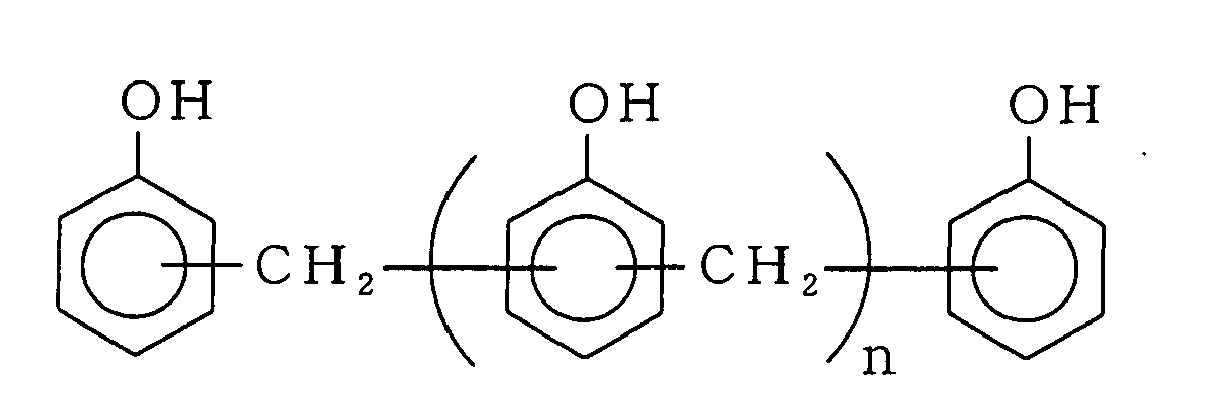
- phenol resin examples include compounds represented by the following chemical formula 1: wherein n is an integer, preferably an integer of 1 to 10 from the point that dispersibility in the rubber is satisfactory.
- modified phenol resin is a phenol resin modified with at least one selected from the group consisting of cashew oil, tall oil, linseed oil, various vegetable oils and animal oils, unsaturated fatty acid, rosin, alkylbenzene resin, aniline and melamine.
- modification in the modified phenol resin means replacement of an end portion of a phenol resin with a branched alkyl group or an aryl group.
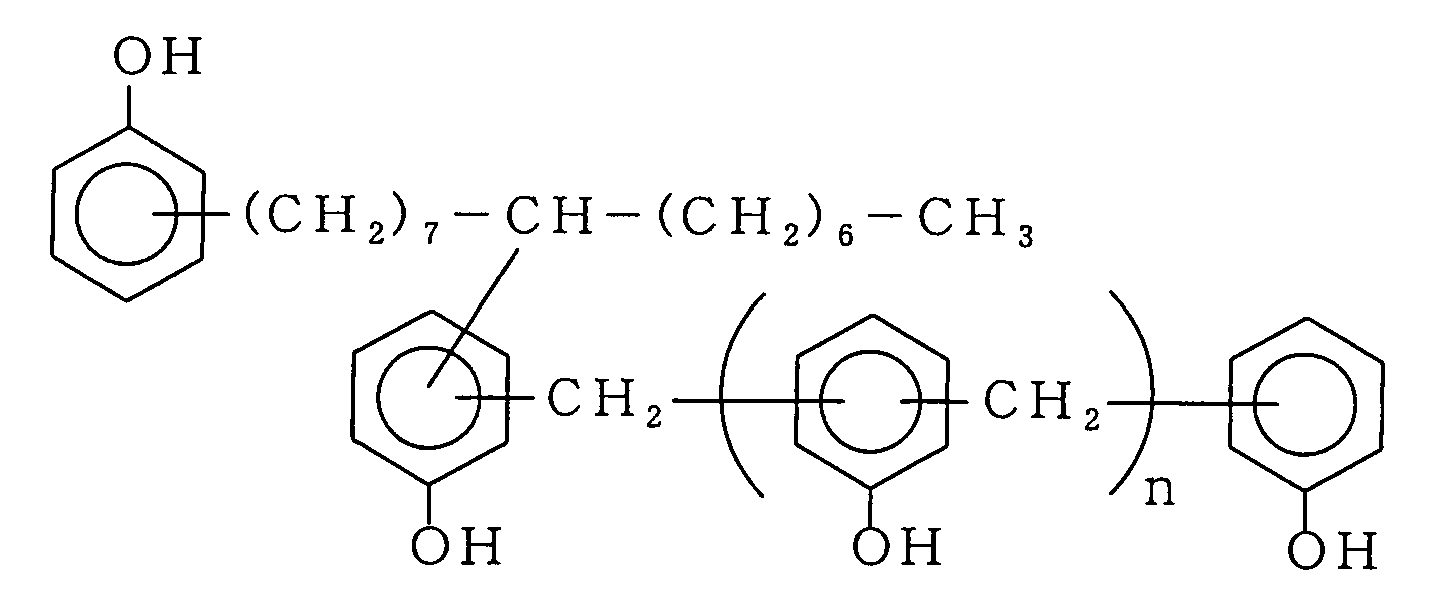
- cashew oil-modified phenol resin represented by the following chemical formula 2 is preferable as a phenol resin and a modified phenol resin for the reason that a complex modulus (E*) can be improved.
- An amount of phenol resin and/or modified phenol resin is not less than 0.5 part by weight, preferably not less than 1.0 part by weight on the basis of 100 parts by weight of the rubber component from the point that E* is not lowered.
- the amount of phenol resin and/or modified phenol resin is not more than 10 parts by weight, preferably not more than 7 parts by weight from the point that E* does not excessively increase, and thus strength at break is not lowered.
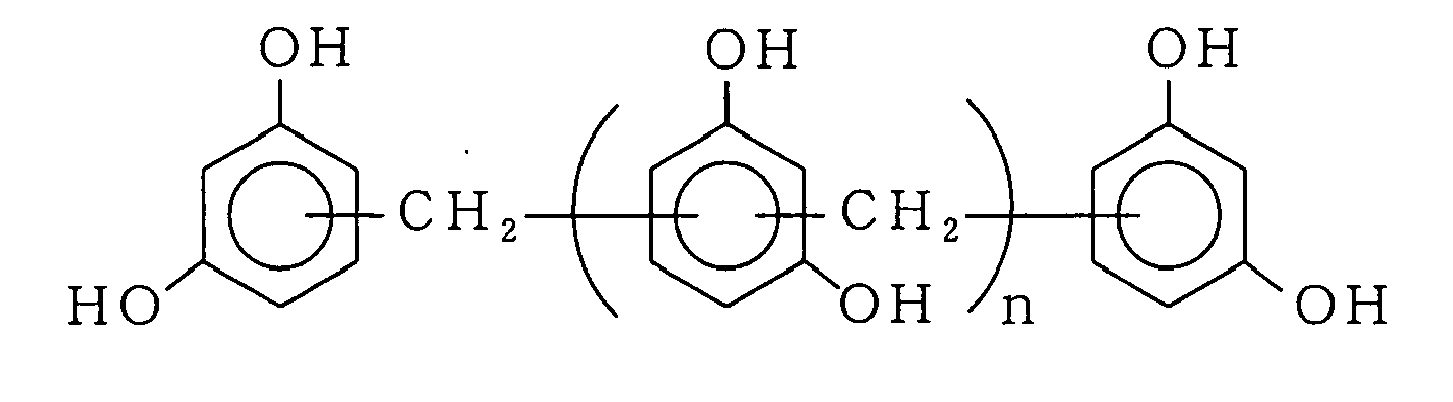
- the resorcin condensate means a compound represented by the following chemical formula 3.
- modified resorcin condensate is a condensate having a resorcin at its end as shown in the following chemical formula 4 and recurring units have a resorcin or alkylphenol.
- n is an integer, preferably 2 to 5 from the point that dispersibility in the rubber is satisfactory.
- R is an alkyl group, and the number of carbon atoms thereof is preferably not more than 9, more preferably not more than 8.
- alkyl group R of the chemical formula 4 are a methyl group, an ethyl group and an octyl group.
- the aforementioned modified resorcin condensate may be a mixture of recurring units having a resorcin or alkylphenol.
- modified resorcin condensate examples include, for instance, Sumikanol 620 available from Sumitomo Chemical Co., Ltd., PENACOLITE resin (1319S available from INDSPEC Chemical Corporation) as a resorcin ⁇ formalin reactant, and RSM (a mixture containing about 60 % by weight of resorcin and about 40 % by weight of stearic acid).
- Sumikanol 620 is preferable.
- the cresol resin means a compound represented by the following chemical formula 5.
- n is preferably not less than 1, more preferably not less than 2, and preferably not more than 5.
- a methacresol resin is most preferable from the viewpoint that since its softening point is around 100°C (92 to 107°C), a methacresol resin is solid at normal temperature, but is liquid during rubber kneading, thus, being easily dispersed, and further, a temperature of initiating a reaction with a partial condensate of hexamethylolmelamine pentamethyl ether (HMMPME) used in the present invention is as appropriate as around 130°C, which is not more than a processing temperature of a crude rubber (100 to 140°C).
- HMMPME hexamethylolmelamine pentamethyl ether
- modified cresol resin examples include a cresol resin in which a methyl group at an end thereof is modified with a hydroxyl group and a cresol resin in which a part of its recurring units is alkylated.
- the number of carbon atoms of alkyl group of the obtained modified cresol resin is preferably 2 to 5.
- the alkyl group are a methyl group, an octyl group and the like.
- An amount of at least one compound selected from the group consisting of a resorcin, a resorcin condensate, a modified resorcin condensate, a cresol resin and a modified cresol resin is not less than 0.5 part by weight, preferably not less than 1 part by weight on the basis of 100 parts by weight of the rubber component.
- the amount of at least one compound selected from the group consisting of a resorcin, a resorcin condensate, a modified resorcin condensate, a cresol resin and a modified cresol resin is less than 0.5 part by weight, a crosslinking density of the resin is not sufficient as compared with a crosslinking density of sulfur, and hardness becomes low.
- the amount of at least one compound selected from the group consisting of a resorcin, a resorcin condensate, a modified resorcin condensate, a cresol resin and a modified cresol resin is not more than 5 parts by weight, preferably not more than 4 parts by weight.
- hardness and processability can be improved by containing specified amounts of the above described rubber component, phenol resin and/or modified phenol resin, and at least one compound selected from the group consisting of a resorcin, a resorcin condensate, a modified resorcin condensate, a cresol resin and a modified cresol resin.
- the rubber composition of the present invention is used for a rubber composition for coating a steel cord, it is preferable that the rubber composition contains an organic acid cobalt.
- organic acid cobalt functions to crosslink the cord and the rubber, adhesion between the cord and the rubber can be improved by compounding the organic acid cobalt.
- organic acid cobalt examples include, for instance, cobalt stearate, cobalt naphthenate, cobalt neodecanoate, cobalt borate neodecanoate and the like. From the point that a viscosity is decreased and processability is excellent, cobalt stearate is preferable.
- An amount of organic acid cobalt converted to cobalt element is preferably not less than 0.05 part by weight, more preferably not less than 0.09 part by weight on the basis of 100 parts by weight of the rubber component.
- the amount of organic acid cobalt is preferably not more than 0.8 part by weight, more preferably not more than 0.3 part by weight, from the point that deterioration of a rubber caused by thermal oxidation is not accelerated, and thus strength at break is not lowered.
- the rubber composition for coating a cord of the present invention can contain at least one compound (hereinafter referred to as compound I) selected from the group consisting of hexamethylenetetramine (HMT), hexamethoxymethylolmelamine (HMMM) and HMMPME.
- HMT hexamethylenetetramine
- HMMM hexamethoxymethylolmelamine
- HMMPME hexamethoxymethylolmelamine
- An amount of the compound I is preferably not less than 0.3 part by weight, more preferably not less than 0.5 part by weight on the basis of 100 parts by weight of the rubber component.
- the amount of the compound I is preferably not more than 2.0 parts by weight, more preferably not more than 1.5 parts by weight since ammonia generated along with methylene breaks a dip layer and a plating layer of the cord.
- a reinforcing agent such as carbon black, oil, antioxidant, zinc oxide, stearic acid, sulfur, various vulcanization accelerators, polyvinyl isobutyl ether (PVI) and N-cyclohexylthiophthalimide (CTP) in addition to the above-described rubber component, at least one compound selected from the group consisting of a resorcin, a resorcin condensate, a modified resorcin condensate, a cresol resin and a modified cresol resin, the phenol resin or modified phenol resin, the compound I , and the organic acid cobalt.
- a reinforcing agent such as carbon black, oil, antioxidant, zinc oxide, stearic acid, sulfur, various vulcanization accelerators, polyvinyl isobutyl ether (PVI) and N-cyclohexylthiophthalimide (CTP) in addition to the above-described rubber component, at least one compound selected from the group consisting of
- the rubber composition of the present invention is used for a carcass and/or a belt among tire parts, and particularly preferably used for a carcass. After coating a cord with the rubber composition and molding a carcass and/or a belt, the carcass and/or belt is laminated with other tire parts to mold an unvulcanized tire, and the unvulcanized tire is vulcanized, thereby a pneumatic tire can be prepared.
- the rubber composition of the present invention for a carcass cord and/or a belt, not for other members, there are advantages that favorable adhesion between the cord and the rubber composition can be obtained, and the rubber composition can be prevented from being broken due to thermal deterioration.
- the cord of the present invention means a cord covered with a carcass and/or a belt, using the rubber composition as a carcass and/or a belt.
- the cord includes a fiber cord and a steel cord.
- the fiber cord is obtained from non-metallic materials such as aramid, polyester, nylon, rayon, and polyethylene terephthalate, and the steel cord is obtained from metallic materials.
- the cord of the preset invention is preferably a carcass fiber cord using aramid such as Kevlar among the mentioned materials for the reasons that bending rigidity of a case is complemented, and comprehensive E* (bending rigidity) can be obtained
- the carcass and/or the belt cord of the present invention is subjected to dip treatment in order to improve adhesion with the rubber composition.
- the dip treatment is to form a resin film of resorcin condensate on the cord surface by immersing the cord into a solution mixture of the resorcin condensate and formaldehyde.
- excellent adhesion can be obtained by carrying out the dip treatment.
- the tire of the present invention is used as a tire for an autotruck for the reason that the rubber composition of the present invention is suitable for topping of a high-power cord (a low-power cord such as nylon is used in a general tire for an automobile).
- the tire can be also used as a run-flat tire for an automobile and a tire for a motorcycle.
- NOCRAC 6C N-(1,3-dimethylbutyl)-N'-phenyl-p-phenylenediamine
- Organic acid cobalt Cobalt stearate (containing 10 % of cobalt element) available from DAINIPPON INK AND CHEMICALS, INCORPORATED.
- Zinc oxide Ginrei R available from Toho Zinc Co., Ltd.
- Stearic acid available from NOF Corporation
- Sulfur Crystex HSOT20 (insoluble sulfur containing 80 % by weight of sulfur and 20 % by weight of an oil content) available from Flexsys Co.
- Vulcanization accelerator Nocceler NS (N-tert-butyl-2-benzothiazolylsulfeneamide) available from Ouchi Shinko Chemical Industrial Co., Ltd.
- Modified resorcin condensate Sumikanol 620 (resorcin ⁇ alkylphenol condensate which is a mixture of two kinds of the following condensates where R is a methyl group and an octyl group) available from Sumitomo Chemical Co., Ltd. (in the formula, R is a methyl group or an octyl group, and these may be present as a mixture in the condensate)
- Modified phenol resin SUMILITERESIN PR12686R available from Sumitomo Bakelite Co., Ltd.
- Resorcin condensate Methacresol condensate: Crosslinking agent: Nocceler H (hexamethylenetetramine) available from Sumitomo Bakelite Co., Ltd. N-cyclohexylthio-phthalimide (CTP): Retarder CTP available from Toray Industries, Inc.
- Crosslinking agent Nocceler H (hexamethylenetetramine) available from Sumitomo Bakelite Co., Ltd.
- N-cyclohexylthio-phthalimide (CTP) Retarder CTP available from Toray Industries, Inc.
- a test piece having a specified size was prepared from the above-described unvulcanized rubber composition, and according to JIS K 6300 "Test Method of Unvulcanized Rubbers", by using a Mooney viscosity tester manufactured by Shimadzu Corporation, a small rotor was rotated under the temperature condition of 130°C heated by preheating for 1 minute to measure a Mooney viscosity of the unvulcanized rubber composition after a lapse of 4 minutes. The smaller the Mooney viscosity is, the more excellent processability is.
- a fiber cord on which a resin film of resorcin condensate is formed (dip treatment) was coated with the unvulcanized rubber composition to mold an unvulcanized carcass. Then, the prepared unvulcanized carcass was laminated with other tire parts to mold an unvulcanized tire. The unvulcanized tire was vulcanized to prepare a track tire for a commercial vehicle (tire size: 225/70R16 117/115), and the following test was carried out.
- a rubber composition for coating a cord which is excellent in processability, rigidity, rolling resistance property, rubber strength and durability by containing specified amounts of a rubber component, a phenol resin and/or a modified phenol resin, and at least one compound selected from the group consisting of a resorcin, a resorcin condensate, a modified resorcin condensate, a cresol resin and a modified cresol resin.
Landscapes
- Chemical & Material Sciences (AREA)
- Health & Medical Sciences (AREA)
- Chemical Kinetics & Catalysis (AREA)
- Medicinal Chemistry (AREA)
- Polymers & Plastics (AREA)
- Organic Chemistry (AREA)
- Compositions Of Macromolecular Compounds (AREA)
Abstract
Description
- The present invention relates to a rubber composition for coating a cord.
- Conventionally, in a rubber composition for coating a fiber cord required to have high rigidity characteristics, a resorcin and/or a modified resorcin resin, and at least one crosslinking agent selected from hexamethylenetetramine (HMT), hexamethoxymethylolmelamine (HMMM) and hexamethylolmelamine pentamethyl ether (HMMPME) have been used. A resorcin and/or a modified resorcin resin (hereinafter referred to as resorcins) improves rigidity (E*) of a rubber composition and functions to cure a rubber layer around a cord periphery. Resorcins also play a role for increasing adhesion force between a rubber and a cord by forming a composite bond layer with a dip layer (resorcin-formalin resin) of a cord.
- As described above, resorcins are used for improving rigidity (E*) of a rubber composition and for increasing adhesion force between a rubber and a cord. However, usually resorcins and crosslinking agents are simultaneously mixed together with sulfur and a vulcanization accelerator in a final step, and since a crosslinking agent and a part of resorcins initiate crosslinking, there is a problem that a rubber viscosity is increased and thus processability is deteriorated.
- On the other hand, in order to enhance E* of a rubber composition, a method of compounding a phenol resin has been known. Since a phenol resin has poor reactivity, unless a temperature thereof is adjusted to be high, it does not react with a crosslinking agent and is not crosslinked, and therefore, there is no problem such as an increase in viscosity in a kneading step. However, there has been a problem that rolling resistance (tan δ) of a rubber composition is increased.
-
JP-A-2005-239874 - An object of the present invention is to provide a rubber composition for coating a cord which is excellent in processability, rigidity, rolling resistance characteristics, rubber strength, and durability.
- The present invention relates to a rubber composition for coating a cord comprising 0.5 to 10 parts by weight of a phenol resin and/or a modified phenol resin, and 0.5 to 5 parts by weight of at least one compound selected from the group consisting of a resorcin, a resorcin condensate, a modified resorcin condensate, a cresol resin, and a modified cresol resin on the basis of 100 parts by weight of a rubber component.
- It is preferable that the rubber composition for coating a cord comprises 0.05 to 0.8 part by weight of an organic acid cobalt converted to cobalt element, and the cord is a steel cord.
- The rubber composition for coating a cord of the present invention comprises a rubber component, a phenol resin and/or a modified phenol resin, and at least one compound selected from the group consisting of a resorcin, a resorcin condensate, a modified resorcin condensate, a cresol resin, and a modified cresol resin.
- Examples of the rubber component are natural rubber (NR), butadiene rubber (BR), styrene-butadiene rubber (SBR), epoxidized natural rubber (ENR), isoprene rubber (IR), butyl rubber (IIR), acrylonitrile-butadiene rubber (NBR), ethylene-propylene-diene rubber (EPDM), halogenated butyl rubber (X-IIR), and a halogenated product of a copolymer of isomonoolefin and paraalkylstyrene. For the reasons that adhesion to the cord is excellent, and generally, appropriate hardness can be obtained in a sulfur vulcanization system, NR, IR, BR and SBR are preferable.
- As for NR, NR of a grade such as RSS#3 and TSR20 conventionally used in the rubber industries can be used. As for IR, IR conventionally used in the rubber industries can be used.
- When NR and/or IR is contained, a content of NR in the rubber component is preferably not less than 50 % by weight, more preferably not less than 60 % by weight from the point that a strength at break is increased. The content of NR and/or IR is preferably not more than 90 % by weight, more preferably not more than 80 % by weight from the point that vulcanization reversion is hardly generated.
- As for BR, BR generally used in the rubber industries such as BR having a high cis content (high cis BR) can be used.
- When BR is contained in the rubber component, a content of BR in the rubber component is preferably not less than 7 % by weight, more preferably not less than 10 % by weight from the point that crack growth resistance is not deteriorated. The content of BR is preferably not more than 30 % by weight, more preferably not more than 25 % by weight from the point that winding of a kneaded rubber on a roll is not increased.
- Examples of SBR are emulsion-polymerized SBR (E-SBR) and solution-polymerized SBR (S-SBR), and SBR is not particularly limited.
- When SBR is contained in the rubber component, a content of SBR in the rubber component is preferably not less than 10 % by weight, more preferably not less than 20 % by weight from the point that reversion is not generated. The content of SBR is preferably not more than 40 % by weight, more preferably not more than 30 % by weight from the point that strength at break is not lowered.
- Phenol resin is not particularly limited, and examples thereof are phenol resins obtained by reacting phenol with aldehyde such as formaldehyde, acetaldehyde, or furfural by using an acid or an alkali catalyst.
- Examples of the phenol resin are, for instance, compounds represented by the following chemical formula 1:
- An example of the modified phenol resin is a phenol resin modified with at least one selected from the group consisting of cashew oil, tall oil, linseed oil, various vegetable oils and animal oils, unsaturated fatty acid, rosin, alkylbenzene resin, aniline and melamine.
- Herein the modification in the modified phenol resin means replacement of an end portion of a phenol resin with a branched alkyl group or an aryl group.
- Among these, cashew oil-modified phenol resin represented by the following chemical formula 2 is preferable as a phenol resin and a modified phenol resin for the reason that a complex modulus (E*) can be improved.
- An amount of phenol resin and/or modified phenol resin is not less than 0.5 part by weight, preferably not less than 1.0 part by weight on the basis of 100 parts by weight of the rubber component from the point that E* is not lowered. The amount of phenol resin and/or modified phenol resin is not more than 10 parts by weight, preferably not more than 7 parts by weight from the point that E* does not excessively increase, and thus strength at break is not lowered.
- The resorcin condensate means a compound represented by the following chemical formula 3.
- An example of the modified resorcin condensate is a condensate having a resorcin at its end as shown in the following chemical formula 4 and recurring units have a resorcin or alkylphenol.

- In the chemical formulae 3 and 4, n is an integer, preferably 2 to 5 from the point that dispersibility in the rubber is satisfactory.
- In the chemical formula 4, R is an alkyl group, and the number of carbon atoms thereof is preferably not more than 9, more preferably not more than 8. Examples of the alkyl group R of the chemical formula 4 are a methyl group, an ethyl group and an octyl group. In addition, the aforementioned modified resorcin condensate may be a mixture of recurring units having a resorcin or alkylphenol.
- Examples of the modified resorcin condensate are, for instance, Sumikanol 620 available from Sumitomo Chemical Co., Ltd., PENACOLITE resin (1319S available from INDSPEC Chemical Corporation) as a resorcin·formalin reactant, and RSM (a mixture containing about 60 % by weight of resorcin and about 40 % by weight of stearic acid). Among these, for the reason that stability for a change with a lapse of time is excellent, Sumikanol 620 is preferable.
- The cresol resin means a compound represented by the following chemical formula 5.

- As for the cresol resin, a methacresol resin is most preferable from the viewpoint that since its softening point is around 100°C (92 to 107°C), a methacresol resin is solid at normal temperature, but is liquid during rubber kneading, thus, being easily dispersed, and further, a temperature of initiating a reaction with a partial condensate of hexamethylolmelamine pentamethyl ether (HMMPME) used in the present invention is as appropriate as around 130°C, which is not more than a processing temperature of a crude rubber (100 to 140°C).
- Examples of the modified cresol resin are a cresol resin in which a methyl group at an end thereof is modified with a hydroxyl group and a cresol resin in which a part of its recurring units is alkylated.
- In the modified cresol resin, in the case of alkylating a part of recurring units of a cresol resin, the number of carbon atoms of alkyl group of the obtained modified cresol resin is preferably 2 to 5. Examples of the alkyl group are a methyl group, an octyl group and the like.
- An amount of at least one compound selected from the group consisting of a resorcin, a resorcin condensate, a modified resorcin condensate, a cresol resin and a modified cresol resin is not less than 0.5 part by weight, preferably not less than 1 part by weight on the basis of 100 parts by weight of the rubber component. When the amount of at least one compound selected from the group consisting of a resorcin, a resorcin condensate, a modified resorcin condensate, a cresol resin and a modified cresol resin is less than 0.5 part by weight, a crosslinking density of the resin is not sufficient as compared with a crosslinking density of sulfur, and hardness becomes low. The amount of at least one compound selected from the group consisting of a resorcin, a resorcin condensate, a modified resorcin condensate, a cresol resin and a modified cresol resin is not more than 5 parts by weight, preferably not more than 4 parts by weight. When the amount of at least one compound selected from the group consisting of a resorcin, a resorcin condensate, a modified resorcin condensate, a cresol resin and a modified cresol resin is more than 5 parts by weight, since a crosslinking density of the resin is too large as compared with a crosslinking density of sulfur, low heat build-up is deteriorated. A rubber composition prepared by blending the resorcin to the rubber component exhibit nearly the same effect as in a rubber composition prepared by blending a resorcin condensate to a rubber component.
- In the present invention, hardness and processability can be improved by containing specified amounts of the above described rubber component, phenol resin and/or modified phenol resin, and at least one compound selected from the group consisting of a resorcin, a resorcin condensate, a modified resorcin condensate, a cresol resin and a modified cresol resin.
- When the rubber composition of the present invention is used for a rubber composition for coating a steel cord, it is preferable that the rubber composition contains an organic acid cobalt.
- Since the organic acid cobalt functions to crosslink the cord and the rubber, adhesion between the cord and the rubber can be improved by compounding the organic acid cobalt.
- Examples of the organic acid cobalt are, for instance, cobalt stearate, cobalt naphthenate, cobalt neodecanoate, cobalt borate neodecanoate and the like. From the point that a viscosity is decreased and processability is excellent, cobalt stearate is preferable.
- An amount of organic acid cobalt converted to cobalt element is preferably not less than 0.05 part by weight, more preferably not less than 0.09 part by weight on the basis of 100 parts by weight of the rubber component. The amount of organic acid cobalt is preferably not more than 0.8 part by weight, more preferably not more than 0.3 part by weight, from the point that deterioration of a rubber caused by thermal oxidation is not accelerated, and thus strength at break is not lowered.
- The rubber composition for coating a cord of the present invention can contain at least one compound (hereinafter referred to as compound I) selected from the group consisting of hexamethylenetetramine (HMT), hexamethoxymethylolmelamine (HMMM) and HMMPME. Among these, HMT is preferable for the reason that methylene (formaldehyde) is generated during tire vulcanization of the rubber (but not during the processing).
- An amount of the compound I is preferably not less than 0.3 part by weight, more preferably not less than 0.5 part by weight on the basis of 100 parts by weight of the rubber component. When the amount of the compound I is less than 0.3 part by weight, generation of methylene is insufficient, and there is a tendency that a crosslinking density of the phenol resin or the resorcin resin is not sufficient. The amount of the compound I is preferably not more than 2.0 parts by weight, more preferably not more than 1.5 parts by weight since ammonia generated along with methylene breaks a dip layer and a plating layer of the cord.
- To the rubber composition for coating a cord of the present invention can be optionally compounded, according to the necessity, additives conventionally used in the rubber industries, for example, a reinforcing agent such as carbon black, oil, antioxidant, zinc oxide, stearic acid, sulfur, various vulcanization accelerators, polyvinyl isobutyl ether (PVI) and N-cyclohexylthiophthalimide (CTP) in addition to the above-described rubber component, at least one compound selected from the group consisting of a resorcin, a resorcin condensate, a modified resorcin condensate, a cresol resin and a modified cresol resin, the phenol resin or modified phenol resin, the compound I , and the organic acid cobalt.
- The rubber composition of the present invention is used for a carcass and/or a belt among tire parts, and particularly preferably used for a carcass. After coating a cord with the rubber composition and molding a carcass and/or a belt, the carcass and/or belt is laminated with other tire parts to mold an unvulcanized tire, and the unvulcanized tire is vulcanized, thereby a pneumatic tire can be prepared. By using the rubber composition of the present invention for a carcass cord and/or a belt, not for other members, there are advantages that favorable adhesion between the cord and the rubber composition can be obtained, and the rubber composition can be prevented from being broken due to thermal deterioration.
- The cord of the present invention means a cord covered with a carcass and/or a belt, using the rubber composition as a carcass and/or a belt. Herein, the cord includes a fiber cord and a steel cord. The fiber cord is obtained from non-metallic materials such as aramid, polyester, nylon, rayon, and polyethylene terephthalate, and the steel cord is obtained from metallic materials. Particularly, the cord of the preset invention is preferably a carcass fiber cord using aramid such as Kevlar among the mentioned materials for the reasons that bending rigidity of a case is complemented, and comprehensive E* (bending rigidity) can be obtained
- It is preferable that the carcass and/or the belt cord of the present invention is subjected to dip treatment in order to improve adhesion with the rubber composition. Herein, the dip treatment is to form a resin film of resorcin condensate on the cord surface by immersing the cord into a solution mixture of the resorcin condensate and formaldehyde. Particularly, in the case of a fiber cord, excellent adhesion can be obtained by carrying out the dip treatment.
- It is preferable that the tire of the present invention is used as a tire for an autotruck for the reason that the rubber composition of the present invention is suitable for topping of a high-power cord (a low-power cord such as nylon is used in a general tire for an automobile). The tire can be also used as a run-flat tire for an automobile and a tire for a motorcycle.
- The present invention is specifically explained by means of Examples, but the present invention is not limited only thereto.
- Then, various chemicals used in Examples and Comparative Examples are collectively explained in the following.
Natural rubber (NR): RSS#3
Butadiene rubber (BR) : . BR 150B available from Ube Industries, Ltd.
Styrene butadiene rubber (SBR): SBR1502 (styrene unit content: 23.5 % by weight) available from JSR Corporation
Carbon black: DIABLACK LH (N326) available from Mitsubishi Chemical Corporation
Aromatic oil: Process X-260 available from Japan Energy Corporation
Antioxidant: NOCRAC 6C (N-(1,3-dimethylbutyl)-N'-phenyl-p-phenylenediamine) available from Ouchi Shinko Chemical Industrial Co., Ltd.
Organic acid cobalt: Cobalt stearate (containing 10 % of cobalt element) available from DAINIPPON INK AND CHEMICALS, INCORPORATED.
Zinc oxide: Ginrei R available from Toho Zinc Co., Ltd.
Stearic acid: available from NOF Corporation
Sulfur: Crystex HSOT20 (insoluble sulfur containing 80 % by weight of sulfur and 20 % by weight of an oil content) available from Flexsys Co. Vulcanization accelerator: Nocceler NS (N-tert-butyl-2-benzothiazolylsulfeneamide) available from Ouchi Shinko Chemical Industrial Co., Ltd.
Modified resorcin condensate: Sumikanol 620 (resorcin·alkylphenol condensate which is a mixture of two kinds of the following condensates where R is a methyl group and an octyl group) available from Sumitomo Chemical Co., Ltd.
Modified phenol resin: SUMILITERESIN PR12686R available from Sumitomo Bakelite Co., Ltd.


N-cyclohexylthio-phthalimide (CTP): Retarder CTP available from Toray Industries, Inc. - According to the compounding formulation shown in Table 1, various chemicals except sulfur, a vulcanization accelerator, HMT and CTP were kneaded in a banbury mixer. Sulfur, vulcanization accelerator, HMT and CTP were added to the obtained kneaded product, and the mixture was kneaded in an open roll to obtain an unvulcanized rubber composition. The unvulcanized rubber composition was vulcanized at 170°C for 12 minutes and thereby a test piece was prepared. The following tests were carried out using the obtained test piece.
- A test piece having a specified size was prepared from the above-described unvulcanized rubber composition, and according to JIS K 6300 "Test Method of Unvulcanized Rubbers", by using a Mooney viscosity tester manufactured by Shimadzu Corporation, a small rotor was rotated under the temperature condition of 130°C heated by preheating for 1 minute to measure a Mooney viscosity of the unvulcanized rubber composition after a lapse of 4 minutes. The smaller the Mooney viscosity is, the more excellent processability is.
- By using a viscoelasticity spectrometer manufactured by Iwamoto Seisakusyo K.K., under the conditions of an initial strain of 10 %, a dynamic strain of 2 %, and a vibration frequency of 10 Hz, physical properties of a vulcanized rubber sheet at 70°C (complex modulus E* and loss tangent tan δ) were measured. The larger the complex modulus E* is, the higher rigidity is. The smaller tan δ is, the smaller rolling resistance is, which is favorable.
- According to JIS K 6251 "Rubber, vulcanized or thermoplastic--Determination of tensile stress-strain properties", by using a No.3 dumbbell, a tensile test was carried out, and an elongation at break (%) of each test piece was measured.
- A fiber cord on which a resin film of resorcin condensate is formed (dip treatment) was coated with the unvulcanized rubber composition to mold an unvulcanized carcass. Then, the prepared unvulcanized carcass was laminated with other tire parts to mold an unvulcanized tire. The unvulcanized tire was vulcanized to prepare a track tire for a commercial vehicle (tire size: 225/70R16 117/115), and the following test was carried out.
- When a tire was run on a drum at a speed of 20 km/h under the condition of a load of 230 % of a maximum load (maximum internal pressure condition) prescribed by JIS standards, a running distance until swelling at a bead part or a tread part is generated was measured. According to the following calculation formula, each of the measured values of running distances was expressed as an index, assuming a value measured in Example 1 is 100. The larger the value is, the more excellent durability is, which is favorable.

- Evaluation results of the above tests are shown in Table 1.
TABLE 1 Example Comparative Example 1 2 3 4 5 6 7 1 2 3 4 5 6 Amounts (parts by weight) NR 60 60 60 60 60 60 60 60 60 60 60 60 60 BR 20 20 20 20 20 20 20 20 20 20 20 20 20 SBR 20 20 20 20 20 20 20 20 20 20 20 20 20 Carbon black 48 48 48 48 48 48 48 48 48 48 48 48 48 Aromatic oil 5 5 5 5 5 5 5 5 5 5 5 5 5 Antioxidant 2 2 2 2 2 2 2 2 2 2 2 2 2 Organic acid cobalt - - - - - - - - - - - - - Zinc oxide 5 5 5 5 5 5 5 5 5 5 5 5 5 Stearic acid 2.5 2.5 2.5 2.5 2.5 2.5 2.5 2.5 2.5 2.5 2.5 2.5 2.5 Sulfur 3.75 3.75 3.75 3.75 3.75 3.75 3.75 3.75 3.75 3.75 3.75 3.75 3.75 Vulcanization accelerator 1.0 1.0 1.0 1.0 1.0 1.0 1.0 1.0 1.0 1.0 1.0 1.0 1.0 Resorcin-modified compound 2 3 1 4 2 - - 4 0 8 0 - - Resorcin - - - - - 2 - - - - - 4 - Methacresol condensate - - - - - - 2 - - - - - 4 Modified phenol resin 2 1 3 4 2 2 2 0 4 0 8 0 0 HMT 1.2 1.2 1.2 1.2 1.2 1.2 1.2 1.2 1.2 2.4 2.4 1.2 1.2 CTP 0.2 0.2 0.2 0.2 0.2 0.2 0.2 0.2 0.2 0.2 0.2 0.2 0.2 Evaluation results Mooney viscosity 52 54 50 56 52 51 49 62 49 85 50 51 48 E* 10.0 9.3 12.2 14.5 11.0 11.2 11.4 7.0 11.5 12.5 18.0 8.2 8.1 Tan δ 0.10 0.095 0.11 0.13 0.102 0.095 0.122 0.10 0.15 0.11 0.17 0.095 0.142 Elongation at break (%) 300 350 250 240 295 260 330 380 250 340 150 180 370 Index of heavy load durability 100 90 110 85 105 85 90 55 60 90 50 50 60 - According to the present invention, there can be provided a rubber composition for coating a cord which is excellent in processability, rigidity, rolling resistance property, rubber strength and durability by containing specified amounts of a rubber component, a phenol resin and/or a modified phenol resin, and at least one compound selected from the group consisting of a resorcin, a resorcin condensate, a modified resorcin condensate, a cresol resin and a modified cresol resin.
Claims (2)
- A rubber composition for coating a cord, comprising 0.5 to 10 parts by weight of a phenol resin and/or a modified phenol resin, and 0.5 to 5 parts by weight of at least one compound selected from the group consisting of a resorcin, a resorcin condensate, a modified resorcin condensate, a cresol resin and a modified cresol resin on the basis of 100 parts by weight of a rubber component.
- The rubber composition for coating a cord of Claim 1, comprising 0.05 to 0.8 part by weight of an organic acid cobalt converted to cobalt element, wherein said cord is a steel cord.
Applications Claiming Priority (1)
| Application Number | Priority Date | Filing Date | Title |
|---|---|---|---|
| JP2006098037 | 2006-03-31 |
Publications (2)
| Publication Number | Publication Date |
|---|---|
| EP1852463A1 true EP1852463A1 (en) | 2007-11-07 |
| EP1852463B1 EP1852463B1 (en) | 2009-01-14 |
Family
ID=38461051
Family Applications (1)
| Application Number | Title | Priority Date | Filing Date |
|---|---|---|---|
| EP07005820A Ceased EP1852463B1 (en) | 2006-03-31 | 2007-03-21 | Rubber composition for coating cord |
Country Status (4)
| Country | Link |
|---|---|
| US (1) | US20070232737A1 (en) |
| EP (1) | EP1852463B1 (en) |
| CN (1) | CN101045840B (en) |
| DE (1) | DE602007000480D1 (en) |
Cited By (2)
| Publication number | Priority date | Publication date | Assignee | Title |
|---|---|---|---|---|
| EP2072280A1 (en) * | 2007-12-18 | 2009-06-24 | Sumtiomo Rubber Industries Ltd | Rubber composition for topping a case and/or breaker used for run-flat tire and run-flat tire using the same |
| EP2599645A1 (en) * | 2011-12-01 | 2013-06-05 | Sumitomo Rubber Industries Limited | Pneumatic tire |
Families Citing this family (15)
| Publication number | Priority date | Publication date | Assignee | Title |
|---|---|---|---|---|
| JP5095681B2 (en) * | 2008-08-01 | 2012-12-12 | 住友ゴム工業株式会社 | tire |
| KR101472597B1 (en) * | 2008-08-07 | 2014-12-15 | 스미도모 고무 고교 가부시기가이샤 | tire |
| JP5302987B2 (en) * | 2011-01-31 | 2013-10-02 | 住友ゴム工業株式会社 | Pneumatic tire manufacturing method |
| CN105622874B (en) * | 2014-12-26 | 2018-08-28 | 彤程化学(中国)有限公司 | With rosin or the phenol-formaldehyde resin and its preparation method and application of maleic rosin and modified by cardanol |
| JP6648820B2 (en) * | 2016-04-08 | 2020-02-14 | 横浜ゴム株式会社 | Pneumatic tire |
| JP6785196B2 (en) | 2017-06-16 | 2020-11-18 | 株式会社ブリヂストン | Resin metal composite members for tires and tires |
| JP7275136B2 (en) * | 2017-12-21 | 2023-05-17 | コンパニー ゼネラール デ エタブリッスマン ミシュラン | Diacid crosslinked rubber composition containing phenol compound |
| US20200338928A1 (en) * | 2018-02-14 | 2020-10-29 | Sumitomo Electric Industries, Ltd. | Tire |
| CN111868318B (en) * | 2018-03-19 | 2022-08-05 | 日本板硝子株式会社 | Rubber reinforcing cord, method for producing same, and rubber product |
| US20200070579A1 (en) * | 2018-09-04 | 2020-03-05 | The Goodyear Tire & Rubber Company | Pneumatic tire |
| JP7293720B2 (en) * | 2019-02-27 | 2023-06-20 | 横浜ゴム株式会社 | Steel cord adhesive rubber composition and conveyor belt |
| CN110028707A (en) * | 2019-05-08 | 2019-07-19 | 江苏通用科技股份有限公司 | A kind of belt rubber cement and its preparation process |
| JP7360029B2 (en) * | 2019-10-03 | 2023-10-12 | 横浜ゴム株式会社 | Rubber composition for adhering steel cords and conveyor belts |
| JP6819028B1 (en) * | 2020-08-20 | 2021-01-27 | 住友ゴム工業株式会社 | Pneumatic tires |
| CN113480860B (en) * | 2021-07-22 | 2022-11-18 | 泰特耐特新材料科技有限公司 | Titanate platelet reinforced fiber material for tire and preparation method thereof |
Citations (12)
| Publication number | Priority date | Publication date | Assignee | Title |
|---|---|---|---|---|
| JPS4937986A (en) * | 1972-08-14 | 1974-04-09 | ||
| US3963652A (en) * | 1973-03-27 | 1976-06-15 | Sumitomo Chemical Company, Limited | Adhesion of rubber to reinforcing materials |
| JPH0245584A (en) * | 1988-08-05 | 1990-02-15 | Honda Motor Co Ltd | Adhesive composition of glass pulling unit for belt |
| US5252405A (en) * | 1991-03-25 | 1993-10-12 | The Yokohama Rubber Co., Ltd. | Rubber composition for coating steel cords and rubber product using the same |
| JPH0912997A (en) * | 1995-07-03 | 1997-01-14 | Bridgestone Corp | Adhesive composition |
| JP2000034455A (en) * | 1998-07-17 | 2000-02-02 | Bridgestone Corp | Adhesive composition, rubber reinforcing organic fiber and pneumatic tire |
| JP2003002006A (en) * | 2001-06-27 | 2003-01-08 | Toyo Tire & Rubber Co Ltd | Pneumatic tire |
| EP1371618A1 (en) * | 2002-06-14 | 2003-12-17 | Asahi Fiber Glass Company, Limited | Fiber for reinforcing rubber products and process for its production |
| WO2004055106A2 (en) | 2002-12-13 | 2004-07-01 | Indspec Chemical Corporation | Phenolic modified resorcinolic resins for rubber compounding |
| JP2004300608A (en) * | 2003-03-31 | 2004-10-28 | Bridgestone Corp | Steel cord, bead wire and tire |
| EP1568735A1 (en) * | 2004-02-26 | 2005-08-31 | Sumitomo Rubber Industries Ltd. | Rubber composition for belt layer steel cord and steel cord coated by the same |
| WO2005098123A1 (en) | 2004-03-30 | 2005-10-20 | Nippon Sheet Glass Company, Limited | Composition for cord coating, cord for rubber reinforcement made with the same, and rubber product made with the same |
Family Cites Families (4)
| Publication number | Priority date | Publication date | Assignee | Title |
|---|---|---|---|---|
| US4076668A (en) * | 1976-02-27 | 1978-02-28 | The Yokohama Rubber Co., Ltd. | Rubber composition |
| CA1196139A (en) * | 1982-02-26 | 1985-10-29 | Hiroshi Furukawa | Elastomer composition |
| CA2113743C (en) * | 1993-02-03 | 2005-06-28 | Naoki Inui | Reinforced rubber article, production thereof and rubber composition suitable therefor |
| JP4363697B2 (en) * | 1998-06-25 | 2009-11-11 | 株式会社ブリヂストン | Rubber composition for tire tread and pneumatic tire using the rubber composition |
-
2007
- 2007-03-21 EP EP07005820A patent/EP1852463B1/en not_active Ceased
- 2007-03-21 DE DE602007000480T patent/DE602007000480D1/en active Active
- 2007-03-29 US US11/730,124 patent/US20070232737A1/en not_active Abandoned
- 2007-03-30 CN CN2007100936435A patent/CN101045840B/en not_active Expired - Fee Related
Patent Citations (14)
| Publication number | Priority date | Publication date | Assignee | Title |
|---|---|---|---|---|
| JPS4937986A (en) * | 1972-08-14 | 1974-04-09 | ||
| US3963652A (en) * | 1973-03-27 | 1976-06-15 | Sumitomo Chemical Company, Limited | Adhesion of rubber to reinforcing materials |
| JPH0245584A (en) * | 1988-08-05 | 1990-02-15 | Honda Motor Co Ltd | Adhesive composition of glass pulling unit for belt |
| US5252405A (en) * | 1991-03-25 | 1993-10-12 | The Yokohama Rubber Co., Ltd. | Rubber composition for coating steel cords and rubber product using the same |
| JPH0912997A (en) * | 1995-07-03 | 1997-01-14 | Bridgestone Corp | Adhesive composition |
| JP2000034455A (en) * | 1998-07-17 | 2000-02-02 | Bridgestone Corp | Adhesive composition, rubber reinforcing organic fiber and pneumatic tire |
| JP2003002006A (en) * | 2001-06-27 | 2003-01-08 | Toyo Tire & Rubber Co Ltd | Pneumatic tire |
| EP1371618A1 (en) * | 2002-06-14 | 2003-12-17 | Asahi Fiber Glass Company, Limited | Fiber for reinforcing rubber products and process for its production |
| WO2004055106A2 (en) | 2002-12-13 | 2004-07-01 | Indspec Chemical Corporation | Phenolic modified resorcinolic resins for rubber compounding |
| JP2004300608A (en) * | 2003-03-31 | 2004-10-28 | Bridgestone Corp | Steel cord, bead wire and tire |
| EP1568735A1 (en) * | 2004-02-26 | 2005-08-31 | Sumitomo Rubber Industries Ltd. | Rubber composition for belt layer steel cord and steel cord coated by the same |
| JP2005239874A (en) | 2004-02-26 | 2005-09-08 | Sumitomo Rubber Ind Ltd | Rubber composition for belt layer steel cord and steel cord coated thereby |
| WO2005098123A1 (en) | 2004-03-30 | 2005-10-20 | Nippon Sheet Glass Company, Limited | Composition for cord coating, cord for rubber reinforcement made with the same, and rubber product made with the same |
| EP1731657A1 (en) * | 2004-03-30 | 2006-12-13 | Nippon Sheet Glass Company, Limited | Composition for cord coating, cord for rubber reinforcement made with the same, and rubber product made with the same |
Cited By (2)
| Publication number | Priority date | Publication date | Assignee | Title |
|---|---|---|---|---|
| EP2072280A1 (en) * | 2007-12-18 | 2009-06-24 | Sumtiomo Rubber Industries Ltd | Rubber composition for topping a case and/or breaker used for run-flat tire and run-flat tire using the same |
| EP2599645A1 (en) * | 2011-12-01 | 2013-06-05 | Sumitomo Rubber Industries Limited | Pneumatic tire |
Also Published As
| Publication number | Publication date |
|---|---|
| EP1852463B1 (en) | 2009-01-14 |
| DE602007000480D1 (en) | 2009-03-05 |
| CN101045840B (en) | 2012-08-29 |
| US20070232737A1 (en) | 2007-10-04 |
| CN101045840A (en) | 2007-10-03 |
Similar Documents
| Publication | Publication Date | Title |
|---|---|---|
| EP1852463B1 (en) | Rubber composition for coating cord | |
| EP1568735B1 (en) | Rubber composition for belt layer steel cord and steel cord coated by the same | |
| EP1726615B1 (en) | Rubber composition for coating a carcass cord and a carcass cord coated thereby | |
| JP5456116B2 (en) | tire | |
| EP2009049B1 (en) | Rubber composition for bead apex and tire with bead apex utilizing the same | |
| EP2617763B1 (en) | Rubber composition for band topping, rubber composition for breaker edge strip, and pneumatic tire | |
| EP2072280B1 (en) | Rubber composition for topping a case and/or breaker used for run-flat tire and run-flat tire using the same | |
| US9862794B2 (en) | Co-condensate and method for producing the same, and rubber composition containing the same | |
| US20140034206A1 (en) | Rubber composition for a sidewall reinforcing layer of a run-flat tire and the run-flat tire | |
| JP2009035683A (en) | Rubber composition for tire | |
| JP5236193B2 (en) | Rubber composition for cord coating | |
| EP1731332B1 (en) | Pneumatic tire having a base tread rubber composition containing a thermosetting resin | |
| US7259199B2 (en) | Tire with rubber containing in-situ resin | |
| JP6682949B2 (en) | Tires for passenger cars | |
| US20060089439A1 (en) | Rubber composition for steel cord and steel cord coated thereby | |
| JP5185528B2 (en) | Rubber composition for coating steel cord, and tire having belt or breaker obtained by coating steel cord with the same | |
| JP7517870B2 (en) | Rubber-steel cord composite and pneumatic tire using same | |
| US20110132512A1 (en) | Rubber composition for coating steel cord | |
| JP5356047B2 (en) | Rubber composition for covering steel cord and pneumatic tire | |
| WO2014167937A1 (en) | Pneumatic tire | |
| JP7385442B2 (en) | Rubber composition for covering steel cords and pneumatic tires | |
| US20210388143A1 (en) | Rubber-steel cord composite and pneumatic tire using the same | |
| JP7354509B2 (en) | Rubber composition for covering steel cords and pneumatic tires | |
| JP4647947B2 (en) | Rubber composition for covering carcass fiber cord and carcass fiber cord coated thereby | |
| JP2022094169A (en) | Rubber composition for coating steel cords and pneumatic tire |
Legal Events
| Date | Code | Title | Description |
|---|---|---|---|
| PUAI | Public reference made under article 153(3) epc to a published international application that has entered the european phase |
Free format text: ORIGINAL CODE: 0009012 |
|
| AK | Designated contracting states |
Kind code of ref document: A1 Designated state(s): AT BE BG CH CY CZ DE DK EE ES FI FR GB GR HU IE IS IT LI LT LU LV MC MT NL PL PT RO SE SI SK TR |
|
| AX | Request for extension of the european patent |
Extension state: AL BA HR MK YU |
|
| 17P | Request for examination filed |
Effective date: 20080430 |
|
| AKX | Designation fees paid |
Designated state(s): DE FR |
|
| GRAP | Despatch of communication of intention to grant a patent |
Free format text: ORIGINAL CODE: EPIDOSNIGR1 |
|
| GRAS | Grant fee paid |
Free format text: ORIGINAL CODE: EPIDOSNIGR3 |
|
| GRAA | (expected) grant |
Free format text: ORIGINAL CODE: 0009210 |
|
| AK | Designated contracting states |
Kind code of ref document: B1 Designated state(s): DE FR |
|
| REF | Corresponds to: |
Ref document number: 602007000480 Country of ref document: DE Date of ref document: 20090305 Kind code of ref document: P |
|
| PLBE | No opposition filed within time limit |
Free format text: ORIGINAL CODE: 0009261 |
|
| STAA | Information on the status of an ep patent application or granted ep patent |
Free format text: STATUS: NO OPPOSITION FILED WITHIN TIME LIMIT |
|
| 26N | No opposition filed |
Effective date: 20091015 |
|
| REG | Reference to a national code |
Ref country code: FR Ref legal event code: PLFP Year of fee payment: 10 |
|
| REG | Reference to a national code |
Ref country code: FR Ref legal event code: PLFP Year of fee payment: 11 |
|
| REG | Reference to a national code |
Ref country code: FR Ref legal event code: PLFP Year of fee payment: 12 |
|
| PGFP | Annual fee paid to national office [announced via postgrant information from national office to epo] |
Ref country code: DE Payment date: 20190305 Year of fee payment: 13 |
|
| PGFP | Annual fee paid to national office [announced via postgrant information from national office to epo] |
Ref country code: FR Payment date: 20190213 Year of fee payment: 13 Ref country code: DE Payment date: 20190305 Year of fee payment: 13 |
|
| REG | Reference to a national code |
Ref country code: DE Ref legal event code: R119 Ref document number: 602007000480 Country of ref document: DE |
|
| PG25 | Lapsed in a contracting state [announced via postgrant information from national office to epo] |
Ref country code: FR Free format text: LAPSE BECAUSE OF NON-PAYMENT OF DUE FEES Effective date: 20200331 Ref country code: DE Free format text: LAPSE BECAUSE OF NON-PAYMENT OF DUE FEES Effective date: 20201001 |