EP1852434A1 - Bicyclic carbamoylpyridone derivative having hiv integrase inhibiting activity - Google Patents
Bicyclic carbamoylpyridone derivative having hiv integrase inhibiting activity Download PDFInfo
- Publication number
- EP1852434A1 EP1852434A1 EP06714066A EP06714066A EP1852434A1 EP 1852434 A1 EP1852434 A1 EP 1852434A1 EP 06714066 A EP06714066 A EP 06714066A EP 06714066 A EP06714066 A EP 06714066A EP 1852434 A1 EP1852434 A1 EP 1852434A1
- Authority
- EP
- European Patent Office
- Prior art keywords
- optionally substituted
- lower alkyl
- phosphoric acid
- acid residue
- substituted
- Prior art date
- Legal status (The legal status is an assumption and is not a legal conclusion. Google has not performed a legal analysis and makes no representation as to the accuracy of the status listed.)
- Granted
Links
- -1 Bicyclic carbamoylpyridone derivative Chemical class 0.000 title claims description 222
- 230000002401 inhibitory effect Effects 0.000 title abstract description 14
- 108010002459 HIV Integrase Proteins 0.000 title abstract description 5
- 125000000217 alkyl group Chemical group 0.000 claims abstract description 530
- 150000001875 compounds Chemical class 0.000 claims abstract description 207
- 229910052739 hydrogen Inorganic materials 0.000 claims abstract description 202
- 239000001257 hydrogen Substances 0.000 claims abstract description 202
- 125000002887 hydroxy group Chemical group [H]O* 0.000 claims abstract description 146
- 125000001424 substituent group Chemical group 0.000 claims abstract description 91
- 125000003107 substituted aryl group Chemical group 0.000 claims abstract description 89
- 229910052736 halogen Inorganic materials 0.000 claims abstract description 76
- 150000002367 halogens Chemical group 0.000 claims abstract description 76
- 125000005842 heteroatom Chemical group 0.000 claims abstract description 68
- 125000002947 alkylene group Chemical group 0.000 claims abstract description 67
- 125000004435 hydrogen atom Chemical group [H]* 0.000 claims abstract description 67
- 229910052760 oxygen Inorganic materials 0.000 claims abstract description 55
- 229910052717 sulfur Inorganic materials 0.000 claims abstract description 53
- 125000004450 alkenylene group Chemical group 0.000 claims abstract description 42
- 239000002259 anti human immunodeficiency virus agent Substances 0.000 claims abstract description 11
- 229940124411 anti-hiv antiviral agent Drugs 0.000 claims abstract description 11
- NBIIXXVUZAFLBC-UHFFFAOYSA-N Phosphoric acid Chemical group OP(O)(O)=O NBIIXXVUZAFLBC-UHFFFAOYSA-N 0.000 claims description 300
- 125000003545 alkoxy group Chemical group 0.000 claims description 116
- 125000000623 heterocyclic group Chemical group 0.000 claims description 108
- 125000002924 primary amino group Chemical group [H]N([H])* 0.000 claims description 95
- 125000005346 substituted cycloalkyl group Chemical group 0.000 claims description 84
- 150000002431 hydrogen Chemical group 0.000 claims description 81
- 125000004448 alkyl carbonyl group Chemical group 0.000 claims description 78
- 125000003118 aryl group Chemical group 0.000 claims description 68
- 150000003839 salts Chemical class 0.000 claims description 64
- 239000012453 solvate Substances 0.000 claims description 61
- 125000003342 alkenyl group Chemical group 0.000 claims description 56
- 125000003710 aryl alkyl group Chemical group 0.000 claims description 55
- UFHFLCQGNIYNRP-UHFFFAOYSA-N Hydrogen Chemical compound [H][H] UFHFLCQGNIYNRP-UHFFFAOYSA-N 0.000 claims description 54
- 125000003277 amino group Chemical group 0.000 claims description 48
- 125000001997 phenyl group Chemical group [H]C1=C([H])C([H])=C(*)C([H])=C1[H] 0.000 claims description 47
- 125000003302 alkenyloxy group Chemical group 0.000 claims description 38
- 125000004104 aryloxy group Chemical group 0.000 claims description 38
- 125000004390 alkyl sulfonyl group Chemical group 0.000 claims description 37
- 229910002091 carbon monoxide Inorganic materials 0.000 claims description 30
- 125000003917 carbamoyl group Chemical group [H]N([H])C(*)=O 0.000 claims description 29
- 125000000876 trifluoromethoxy group Chemical group FC(F)(F)O* 0.000 claims description 28
- 125000002023 trifluoromethyl group Chemical group FC(F)(F)* 0.000 claims description 23
- 125000004458 methylaminocarbonyl group Chemical group [H]N(C(*)=O)C([H])([H])[H] 0.000 claims description 19
- 125000000956 methoxy group Chemical group [H]C([H])([H])O* 0.000 claims description 18
- 125000004453 alkoxycarbonyl group Chemical group 0.000 claims description 15
- 125000004656 alkyl sulfonylamino group Chemical group 0.000 claims description 14
- 125000005129 aryl carbonyl group Chemical group 0.000 claims description 11
- 125000002915 carbonyl group Chemical group [*:2]C([*:1])=O 0.000 claims description 11
- 125000006254 cycloalkyl carbonyl group Chemical group 0.000 claims description 11
- 125000005161 aryl oxy carbonyl group Chemical group 0.000 claims description 10
- 125000004429 atom Chemical group 0.000 claims description 5
- 239000008194 pharmaceutical composition Substances 0.000 claims description 5
- 239000003795 chemical substances by application Substances 0.000 abstract description 15
- 230000000840 anti-viral effect Effects 0.000 abstract description 2
- 125000000547 substituted alkyl group Chemical group 0.000 abstract 1
- IAZDPXIOMUYVGZ-WFGJKAKNSA-N Dimethyl sulfoxide Chemical compound [2H]C([2H])([2H])S(=O)C([2H])([2H])[2H] IAZDPXIOMUYVGZ-WFGJKAKNSA-N 0.000 description 278
- 238000005481 NMR spectroscopy Methods 0.000 description 200
- HEDRZPFGACZZDS-MICDWDOJSA-N Trichloro(2H)methane Chemical compound [2H]C(Cl)(Cl)Cl HEDRZPFGACZZDS-MICDWDOJSA-N 0.000 description 168
- IIFVWLUQBAIPMJ-UHFFFAOYSA-N (4-fluorophenyl)methanamine Chemical compound NCC1=CC=C(F)C=C1 IIFVWLUQBAIPMJ-UHFFFAOYSA-N 0.000 description 131
- 239000000243 solution Substances 0.000 description 103
- 238000006243 chemical reaction Methods 0.000 description 102
- 125000006222 dimethylaminomethyl group Chemical group [H]C([H])([H])N(C([H])([H])[H])C([H])([H])* 0.000 description 90
- 238000002844 melting Methods 0.000 description 85
- 230000008018 melting Effects 0.000 description 85
- ZMXDDKWLCZADIW-UHFFFAOYSA-N N,N-Dimethylformamide Chemical compound CN(C)C=O ZMXDDKWLCZADIW-UHFFFAOYSA-N 0.000 description 54
- 239000013078 crystal Substances 0.000 description 52
- RTZKZFJDLAIYFH-UHFFFAOYSA-N Diethyl ether Chemical compound CCOCC RTZKZFJDLAIYFH-UHFFFAOYSA-N 0.000 description 49
- OKKJLVBELUTLKV-UHFFFAOYSA-N Methanol Chemical compound OC OKKJLVBELUTLKV-UHFFFAOYSA-N 0.000 description 48
- XEKOWRVHYACXOJ-UHFFFAOYSA-N Ethyl acetate Chemical compound CCOC(C)=O XEKOWRVHYACXOJ-UHFFFAOYSA-N 0.000 description 42
- 230000002829 reductive effect Effects 0.000 description 39
- YMWUJEATGCHHMB-UHFFFAOYSA-N Dichloromethane Chemical compound ClCCl YMWUJEATGCHHMB-UHFFFAOYSA-N 0.000 description 36
- HEDRZPFGACZZDS-UHFFFAOYSA-N Chloroform Chemical compound ClC(Cl)Cl HEDRZPFGACZZDS-UHFFFAOYSA-N 0.000 description 34
- 238000000034 method Methods 0.000 description 33
- 239000002904 solvent Substances 0.000 description 33
- WYURNTSHIVDZCO-UHFFFAOYSA-N Tetrahydrofuran Chemical compound C1CCOC1 WYURNTSHIVDZCO-UHFFFAOYSA-N 0.000 description 32
- 239000000203 mixture Substances 0.000 description 27
- XLYOFNOQVPJJNP-UHFFFAOYSA-N water Substances O XLYOFNOQVPJJNP-UHFFFAOYSA-N 0.000 description 27
- 238000005160 1H NMR spectroscopy Methods 0.000 description 23
- 230000035484 reaction time Effects 0.000 description 22
- WEVYAHXRMPXWCK-UHFFFAOYSA-N Acetonitrile Chemical compound CC#N WEVYAHXRMPXWCK-UHFFFAOYSA-N 0.000 description 21
- ZMANZCXQSJIPKH-UHFFFAOYSA-N Triethylamine Chemical compound CCN(CC)CC ZMANZCXQSJIPKH-UHFFFAOYSA-N 0.000 description 21
- 238000001816 cooling Methods 0.000 description 21
- 239000007810 chemical reaction solvent Substances 0.000 description 20
- VEXZGXHMUGYJMC-UHFFFAOYSA-N Hydrochloric acid Chemical compound Cl VEXZGXHMUGYJMC-UHFFFAOYSA-N 0.000 description 17
- 125000002496 methyl group Chemical group [H]C([H])([H])* 0.000 description 17
- YLQBMQCUIZJEEH-UHFFFAOYSA-N tetrahydrofuran Natural products C=1C=COC=1 YLQBMQCUIZJEEH-UHFFFAOYSA-N 0.000 description 16
- HEMHJVSKTPXQMS-UHFFFAOYSA-M Sodium hydroxide Chemical compound [OH-].[Na+] HEMHJVSKTPXQMS-UHFFFAOYSA-M 0.000 description 15
- PMZURENOXWZQFD-UHFFFAOYSA-L Sodium Sulfate Chemical compound [Na+].[Na+].[O-]S([O-])(=O)=O PMZURENOXWZQFD-UHFFFAOYSA-L 0.000 description 14
- QTBSBXVTEAMEQO-UHFFFAOYSA-N Acetic acid Chemical compound CC(O)=O QTBSBXVTEAMEQO-UHFFFAOYSA-N 0.000 description 13
- 125000001570 methylene group Chemical group [H]C([H])([*:1])[*:2] 0.000 description 13
- 125000004043 oxo group Chemical group O=* 0.000 description 13
- WFDIJRYMOXRFFG-UHFFFAOYSA-N Acetic anhydride Chemical compound CC(=O)OC(C)=O WFDIJRYMOXRFFG-UHFFFAOYSA-N 0.000 description 12
- IAZDPXIOMUYVGZ-UHFFFAOYSA-N Dimethylsulphoxide Chemical compound CS(C)=O IAZDPXIOMUYVGZ-UHFFFAOYSA-N 0.000 description 12
- PEDCQBHIVMGVHV-UHFFFAOYSA-N Glycerine Chemical compound OCC(O)CO PEDCQBHIVMGVHV-UHFFFAOYSA-N 0.000 description 12
- 102100034343 Integrase Human genes 0.000 description 12
- UIIMBOGNXHQVGW-UHFFFAOYSA-M Sodium bicarbonate Chemical class [Na+].OC([O-])=O UIIMBOGNXHQVGW-UHFFFAOYSA-M 0.000 description 12
- VLKZOEOYAKHREP-UHFFFAOYSA-N n-Hexane Chemical compound CCCCCC VLKZOEOYAKHREP-UHFFFAOYSA-N 0.000 description 12
- 230000002194 synthesizing effect Effects 0.000 description 12
- FAPWRFPIFSIZLT-UHFFFAOYSA-M Sodium chloride Chemical class [Na+].[Cl-] FAPWRFPIFSIZLT-UHFFFAOYSA-M 0.000 description 11
- 125000000753 cycloalkyl group Chemical group 0.000 description 11
- 125000001495 ethyl group Chemical group [H]C([H])([H])C([H])([H])* 0.000 description 11
- 108010061833 Integrases Proteins 0.000 description 10
- 239000002253 acid Substances 0.000 description 10
- 125000001797 benzyl group Chemical group [H]C1=C([H])C([H])=C(C([H])=C1[H])C([H])([H])* 0.000 description 10
- 238000001914 filtration Methods 0.000 description 10
- NLXLAEXVIDQMFP-UHFFFAOYSA-N Ammonia chloride Chemical compound [NH4+].[Cl-] NLXLAEXVIDQMFP-UHFFFAOYSA-N 0.000 description 9
- YXFVVABEGXRONW-UHFFFAOYSA-N Toluene Chemical compound CC1=CC=CC=C1 YXFVVABEGXRONW-UHFFFAOYSA-N 0.000 description 9
- 238000003756 stirring Methods 0.000 description 9
- DTNYGEBHHWVMBK-UHFFFAOYSA-N (2-chloro-3-fluorophenyl)methanamine Chemical compound NCC1=CC=CC(F)=C1Cl DTNYGEBHHWVMBK-UHFFFAOYSA-N 0.000 description 8
- KYQCOXFCLRTKLS-UHFFFAOYSA-N Pyrazine Chemical compound C1=CN=CC=N1 KYQCOXFCLRTKLS-UHFFFAOYSA-N 0.000 description 8
- 125000003282 alkyl amino group Chemical group 0.000 description 8
- 125000001449 isopropyl group Chemical group [H]C([H])([H])C([H])(*)C([H])([H])[H] 0.000 description 8
- 238000004458 analytical method Methods 0.000 description 7
- 125000006615 aromatic heterocyclic group Chemical group 0.000 description 7
- 150000001732 carboxylic acid derivatives Chemical class 0.000 description 7
- 238000000605 extraction Methods 0.000 description 7
- 239000008363 phosphate buffer Substances 0.000 description 7
- 238000010898 silica gel chromatography Methods 0.000 description 7
- 208000030507 AIDS Diseases 0.000 description 6
- CSCPPACGZOOCGX-UHFFFAOYSA-N Acetone Chemical compound CC(C)=O CSCPPACGZOOCGX-UHFFFAOYSA-N 0.000 description 6
- LFQSCWFLJHTTHZ-UHFFFAOYSA-N Ethanol Chemical compound CCO LFQSCWFLJHTTHZ-UHFFFAOYSA-N 0.000 description 6
- 241000725303 Human immunodeficiency virus Species 0.000 description 6
- WMFOQBRAJBCJND-UHFFFAOYSA-M Lithium hydroxide Chemical compound [Li+].[OH-] WMFOQBRAJBCJND-UHFFFAOYSA-M 0.000 description 6
- KWYUFKZDYYNOTN-UHFFFAOYSA-M Potassium hydroxide Chemical compound [OH-].[K+] KWYUFKZDYYNOTN-UHFFFAOYSA-M 0.000 description 6
- 241000700605 Viruses Species 0.000 description 6
- 125000005115 alkyl carbamoyl group Chemical group 0.000 description 6
- KRKNYBCHXYNGOX-UHFFFAOYSA-N citric acid Chemical compound OC(=O)CC(O)(C(O)=O)CC(O)=O KRKNYBCHXYNGOX-UHFFFAOYSA-N 0.000 description 6
- 229940125773 compound 10 Drugs 0.000 description 6
- 239000003814 drug Substances 0.000 description 6
- ZLVXBBHTMQJRSX-VMGNSXQWSA-N jdtic Chemical compound C1([C@]2(C)CCN(C[C@@H]2C)C[C@H](C(C)C)NC(=O)[C@@H]2NCC3=CC(O)=CC=C3C2)=CC=CC(O)=C1 ZLVXBBHTMQJRSX-VMGNSXQWSA-N 0.000 description 6
- 239000013642 negative control Substances 0.000 description 6
- 125000004433 nitrogen atom Chemical group N* 0.000 description 6
- 239000012044 organic layer Substances 0.000 description 6
- 125000004307 pyrazin-2-yl group Chemical group [H]C1=C([H])N=C(*)C([H])=N1 0.000 description 6
- AOJFQRQNPXYVLM-UHFFFAOYSA-N pyridin-1-ium;chloride Chemical compound [Cl-].C1=CC=[NH+]C=C1 AOJFQRQNPXYVLM-UHFFFAOYSA-N 0.000 description 6
- DGVVWUTYPXICAM-UHFFFAOYSA-N β‐Mercaptoethanol Chemical compound OCCS DGVVWUTYPXICAM-UHFFFAOYSA-N 0.000 description 6
- RYHBNJHYFVUHQT-UHFFFAOYSA-N 1,4-Dioxane Chemical compound C1COCCO1 RYHBNJHYFVUHQT-UHFFFAOYSA-N 0.000 description 5
- 125000004200 2-methoxyethyl group Chemical group [H]C([H])([H])OC([H])([H])C([H])([H])* 0.000 description 5
- VYPSYNLAJGMNEJ-UHFFFAOYSA-N Silicium dioxide Chemical compound O=[Si]=O VYPSYNLAJGMNEJ-UHFFFAOYSA-N 0.000 description 5
- 230000036436 anti-hiv Effects 0.000 description 5
- 201000010099 disease Diseases 0.000 description 5
- 208000037265 diseases, disorders, signs and symptoms Diseases 0.000 description 5
- 229940079593 drug Drugs 0.000 description 5
- 239000000706 filtrate Substances 0.000 description 5
- 230000010534 mechanism of action Effects 0.000 description 5
- 239000007800 oxidant agent Substances 0.000 description 5
- 239000013641 positive control Substances 0.000 description 5
- 239000007787 solid Substances 0.000 description 5
- 238000005406 washing Methods 0.000 description 5
- ASOKPJOREAFHNY-UHFFFAOYSA-N 1-Hydroxybenzotriazole Chemical compound C1=CC=C2N(O)N=NC2=C1 ASOKPJOREAFHNY-UHFFFAOYSA-N 0.000 description 4
- FPQQSJJWHUJYPU-UHFFFAOYSA-N 3-(dimethylamino)propyliminomethylidene-ethylazanium;chloride Chemical compound Cl.CCN=C=NCCCN(C)C FPQQSJJWHUJYPU-UHFFFAOYSA-N 0.000 description 4
- GXWNSJYVSIJRLS-UHFFFAOYSA-N 6-bromo-8-methylimidazo[1,2-a]pyrazine Chemical compound CC1=NC(Br)=CN2C=CN=C12 GXWNSJYVSIJRLS-UHFFFAOYSA-N 0.000 description 4
- 239000007993 MOPS buffer Substances 0.000 description 4
- TWRXJAOTZQYOKJ-UHFFFAOYSA-L Magnesium chloride Chemical compound [Mg+2].[Cl-].[Cl-] TWRXJAOTZQYOKJ-UHFFFAOYSA-L 0.000 description 4
- DTQVDTLACAAQTR-UHFFFAOYSA-N Trifluoroacetic acid Chemical compound OC(=O)C(F)(F)F DTQVDTLACAAQTR-UHFFFAOYSA-N 0.000 description 4
- 238000002835 absorbance Methods 0.000 description 4
- 150000001412 amines Chemical class 0.000 description 4
- 239000012043 crude product Substances 0.000 description 4
- 125000005843 halogen group Chemical group 0.000 description 4
- 125000001072 heteroaryl group Chemical group 0.000 description 4
- 229910052740 iodine Inorganic materials 0.000 description 4
- 125000004123 n-propyl group Chemical group [H]C([H])([H])C([H])([H])C([H])([H])* 0.000 description 4
- 230000001590 oxidative effect Effects 0.000 description 4
- TYJJADVDDVDEDZ-UHFFFAOYSA-M potassium hydrogencarbonate Chemical compound [K+].OC([O-])=O TYJJADVDDVDEDZ-UHFFFAOYSA-M 0.000 description 4
- 238000002360 preparation method Methods 0.000 description 4
- 125000006239 protecting group Chemical group 0.000 description 4
- 239000000725 suspension Substances 0.000 description 4
- 125000000999 tert-butyl group Chemical group [H]C([H])([H])C(*)(C([H])([H])[H])C([H])([H])[H] 0.000 description 4
- 241001430294 unidentified retrovirus Species 0.000 description 4
- PXJACNDVRNAFHD-UHFFFAOYSA-N (2-methoxyphenyl)methanamine Chemical compound COC1=CC=CC=C1CN PXJACNDVRNAFHD-UHFFFAOYSA-N 0.000 description 3
- KQZLRWGGWXJPOS-NLFPWZOASA-N 1-[(1R)-1-(2,4-dichlorophenyl)ethyl]-6-[(4S,5R)-4-[(2S)-2-(hydroxymethyl)pyrrolidin-1-yl]-5-methylcyclohexen-1-yl]pyrazolo[3,4-b]pyrazine-3-carbonitrile Chemical compound ClC1=C(C=CC(=C1)Cl)[C@@H](C)N1N=C(C=2C1=NC(=CN=2)C1=CC[C@@H]([C@@H](C1)C)N1[C@@H](CCC1)CO)C#N KQZLRWGGWXJPOS-NLFPWZOASA-N 0.000 description 3
- UNILWMWFPHPYOR-KXEYIPSPSA-M 1-[6-[2-[3-[3-[3-[2-[2-[3-[[2-[2-[[(2r)-1-[[2-[[(2r)-1-[3-[2-[2-[3-[[2-(2-amino-2-oxoethoxy)acetyl]amino]propoxy]ethoxy]ethoxy]propylamino]-3-hydroxy-1-oxopropan-2-yl]amino]-2-oxoethyl]amino]-3-[(2r)-2,3-di(hexadecanoyloxy)propyl]sulfanyl-1-oxopropan-2-yl Chemical compound O=C1C(SCCC(=O)NCCCOCCOCCOCCCNC(=O)COCC(=O)N[C@@H](CSC[C@@H](COC(=O)CCCCCCCCCCCCCCC)OC(=O)CCCCCCCCCCCCCCC)C(=O)NCC(=O)N[C@H](CO)C(=O)NCCCOCCOCCOCCCNC(=O)COCC(N)=O)CC(=O)N1CCNC(=O)CCCCCN\1C2=CC=C(S([O-])(=O)=O)C=C2CC/1=C/C=C/C=C/C1=[N+](CC)C2=CC=C(S([O-])(=O)=O)C=C2C1 UNILWMWFPHPYOR-KXEYIPSPSA-M 0.000 description 3
- 125000003006 2-dimethylaminoethyl group Chemical group [H]C([H])([H])N(C([H])([H])[H])C([H])([H])C([H])([H])* 0.000 description 3
- NHQDETIJWKXCTC-UHFFFAOYSA-N 3-chloroperbenzoic acid Chemical compound OOC(=O)C1=CC=CC(Cl)=C1 NHQDETIJWKXCTC-UHFFFAOYSA-N 0.000 description 3
- WVDDGKGOMKODPV-UHFFFAOYSA-N Benzyl alcohol Chemical compound OCC1=CC=CC=C1 WVDDGKGOMKODPV-UHFFFAOYSA-N 0.000 description 3
- KFZMGEQAYNKOFK-UHFFFAOYSA-N Isopropanol Chemical compound CC(C)O KFZMGEQAYNKOFK-UHFFFAOYSA-N 0.000 description 3
- SJRJJKPEHAURKC-UHFFFAOYSA-N N-Methylmorpholine Chemical compound CN1CCOCC1 SJRJJKPEHAURKC-UHFFFAOYSA-N 0.000 description 3
- JUJWROOIHBZHMG-UHFFFAOYSA-N Pyridine Chemical group C1=CC=NC=C1 JUJWROOIHBZHMG-UHFFFAOYSA-N 0.000 description 3
- DWAQJAXMDSEUJJ-UHFFFAOYSA-M Sodium bisulfite Chemical compound [Na+].OS([O-])=O DWAQJAXMDSEUJJ-UHFFFAOYSA-M 0.000 description 3
- PSLUFJFHTBIXMW-WYEYVKMPSA-N [(3r,4ar,5s,6s,6as,10s,10ar,10bs)-3-ethenyl-10,10b-dihydroxy-3,4a,7,7,10a-pentamethyl-1-oxo-6-(2-pyridin-2-ylethylcarbamoyloxy)-5,6,6a,8,9,10-hexahydro-2h-benzo[f]chromen-5-yl] acetate Chemical compound O([C@@H]1[C@@H]([C@]2(O[C@](C)(CC(=O)[C@]2(O)[C@@]2(C)[C@@H](O)CCC(C)(C)[C@@H]21)C=C)C)OC(=O)C)C(=O)NCCC1=CC=CC=N1 PSLUFJFHTBIXMW-WYEYVKMPSA-N 0.000 description 3
- 125000002777 acetyl group Chemical group [H]C([H])([H])C(*)=O 0.000 description 3
- 239000004480 active ingredient Substances 0.000 description 3
- 125000002252 acyl group Chemical group 0.000 description 3
- 125000004414 alkyl thio group Chemical group 0.000 description 3
- 125000004397 aminosulfonyl group Chemical group NS(=O)(=O)* 0.000 description 3
- 239000002585 base Substances 0.000 description 3
- 239000012888 bovine serum Substances 0.000 description 3
- 229910052794 bromium Inorganic materials 0.000 description 3
- 239000000872 buffer Substances 0.000 description 3
- 125000004432 carbon atom Chemical group C* 0.000 description 3
- 125000003178 carboxy group Chemical group [H]OC(*)=O 0.000 description 3
- 229940125877 compound 31 Drugs 0.000 description 3
- 125000001559 cyclopropyl group Chemical group [H]C1([H])C([H])([H])C1([H])* 0.000 description 3
- ZBCBWPMODOFKDW-UHFFFAOYSA-N diethanolamine Chemical class OCCNCCO ZBCBWPMODOFKDW-UHFFFAOYSA-N 0.000 description 3
- 239000012153 distilled water Substances 0.000 description 3
- 230000000694 effects Effects 0.000 description 3
- 150000002148 esters Chemical class 0.000 description 3
- 238000009472 formulation Methods 0.000 description 3
- 125000002485 formyl group Chemical group [H]C(*)=O 0.000 description 3
- 230000007062 hydrolysis Effects 0.000 description 3
- 238000006460 hydrolysis reaction Methods 0.000 description 3
- 208000015181 infectious disease Diseases 0.000 description 3
- 239000004615 ingredient Substances 0.000 description 3
- 230000005764 inhibitory process Effects 0.000 description 3
- LULAYUGMBFYYEX-UHFFFAOYSA-N metachloroperbenzoic acid Natural products OC(=O)C1=CC=CC(Cl)=C1 LULAYUGMBFYYEX-UHFFFAOYSA-N 0.000 description 3
- 125000004170 methylsulfonyl group Chemical group [H]C([H])([H])S(*)(=O)=O 0.000 description 3
- 229910000489 osmium tetroxide Inorganic materials 0.000 description 3
- 229910052698 phosphorus Inorganic materials 0.000 description 3
- 229910000030 sodium bicarbonate Inorganic materials 0.000 description 3
- 229940079827 sodium hydrogen sulfite Drugs 0.000 description 3
- 235000010267 sodium hydrogen sulphite Nutrition 0.000 description 3
- FVAUCKIRQBBSSJ-UHFFFAOYSA-M sodium iodide Chemical compound [Na+].[I-] FVAUCKIRQBBSSJ-UHFFFAOYSA-M 0.000 description 3
- SUBJHSREKVAVAR-UHFFFAOYSA-N sodium;methanol;methanolate Chemical compound [Na+].OC.[O-]C SUBJHSREKVAVAR-UHFFFAOYSA-N 0.000 description 3
- 239000000758 substrate Substances 0.000 description 3
- 238000002560 therapeutic procedure Methods 0.000 description 3
- ASGMFNBUXDJWJJ-JLCFBVMHSA-N (1R,3R)-3-[[3-bromo-1-[4-(5-methyl-1,3,4-thiadiazol-2-yl)phenyl]pyrazolo[3,4-d]pyrimidin-6-yl]amino]-N,1-dimethylcyclopentane-1-carboxamide Chemical compound BrC1=NN(C2=NC(=NC=C21)N[C@H]1C[C@@](CC1)(C(=O)NC)C)C1=CC=C(C=C1)C=1SC(=NN=1)C ASGMFNBUXDJWJJ-JLCFBVMHSA-N 0.000 description 2
- ABJSOROVZZKJGI-OCYUSGCXSA-N (1r,2r,4r)-2-(4-bromophenyl)-n-[(4-chlorophenyl)-(2-fluoropyridin-4-yl)methyl]-4-morpholin-4-ylcyclohexane-1-carboxamide Chemical compound C1=NC(F)=CC(C(NC(=O)[C@H]2[C@@H](C[C@@H](CC2)N2CCOCC2)C=2C=CC(Br)=CC=2)C=2C=CC(Cl)=CC=2)=C1 ABJSOROVZZKJGI-OCYUSGCXSA-N 0.000 description 2
- GLGNXYJARSMNGJ-VKTIVEEGSA-N (1s,2s,3r,4r)-3-[[5-chloro-2-[(1-ethyl-6-methoxy-2-oxo-4,5-dihydro-3h-1-benzazepin-7-yl)amino]pyrimidin-4-yl]amino]bicyclo[2.2.1]hept-5-ene-2-carboxamide Chemical compound CCN1C(=O)CCCC2=C(OC)C(NC=3N=C(C(=CN=3)Cl)N[C@H]3[C@H]([C@@]4([H])C[C@@]3(C=C4)[H])C(N)=O)=CC=C21 GLGNXYJARSMNGJ-VKTIVEEGSA-N 0.000 description 2
- LAUPTNYHVCVPFH-UHFFFAOYSA-N (2-ethoxyphenyl)methanamine Chemical compound CCOC1=CC=CC=C1CN LAUPTNYHVCVPFH-UHFFFAOYSA-N 0.000 description 2
- VIJSPAIQWVPKQZ-BLECARSGSA-N (2s)-2-[[(2s)-2-[[(2s)-2-[[(2s)-2-[[(2s)-2-[[(2s)-2-acetamido-5-(diaminomethylideneamino)pentanoyl]amino]-4-methylpentanoyl]amino]-4,4-dimethylpentanoyl]amino]-4-methylpentanoyl]amino]propanoyl]amino]-5-(diaminomethylideneamino)pentanoic acid Chemical compound NC(=N)NCCC[C@@H](C(O)=O)NC(=O)[C@H](C)NC(=O)[C@H](CC(C)C)NC(=O)[C@H](CC(C)(C)C)NC(=O)[C@H](CC(C)C)NC(=O)[C@H](CCCNC(N)=N)NC(C)=O VIJSPAIQWVPKQZ-BLECARSGSA-N 0.000 description 2
- UDQTXCHQKHIQMH-KYGLGHNPSA-N (3ar,5s,6s,7r,7ar)-5-(difluoromethyl)-2-(ethylamino)-5,6,7,7a-tetrahydro-3ah-pyrano[3,2-d][1,3]thiazole-6,7-diol Chemical compound S1C(NCC)=N[C@H]2[C@@H]1O[C@H](C(F)F)[C@@H](O)[C@@H]2O UDQTXCHQKHIQMH-KYGLGHNPSA-N 0.000 description 2
- MPDDTAJMJCESGV-CTUHWIOQSA-M (3r,5r)-7-[2-(4-fluorophenyl)-5-[methyl-[(1r)-1-phenylethyl]carbamoyl]-4-propan-2-ylpyrazol-3-yl]-3,5-dihydroxyheptanoate Chemical compound C1([C@@H](C)N(C)C(=O)C2=NN(C(CC[C@@H](O)C[C@@H](O)CC([O-])=O)=C2C(C)C)C=2C=CC(F)=CC=2)=CC=CC=C1 MPDDTAJMJCESGV-CTUHWIOQSA-M 0.000 description 2
- CBODMDXBVNUXJY-UHFFFAOYSA-N (4-fluoro-3-methoxyphenyl)methanamine Chemical compound COC1=CC(CN)=CC=C1F CBODMDXBVNUXJY-UHFFFAOYSA-N 0.000 description 2
- YQOLEILXOBUDMU-KRWDZBQOSA-N (4R)-5-[(6-bromo-3-methyl-2-pyrrolidin-1-ylquinoline-4-carbonyl)amino]-4-(2-chlorophenyl)pentanoic acid Chemical compound CC1=C(C2=C(C=CC(=C2)Br)N=C1N3CCCC3)C(=O)NC[C@H](CCC(=O)O)C4=CC=CC=C4Cl YQOLEILXOBUDMU-KRWDZBQOSA-N 0.000 description 2
- 0 *C(C(*)*(C=C1C(*Cc(cc2)ccc2N)=O)C2=C(*)C1=O)*(*)C2=O Chemical compound *C(C(*)*(C=C1C(*Cc(cc2)ccc2N)=O)C2=C(*)C1=O)*(*)C2=O 0.000 description 2
- LVEYOSJUKRVCCF-UHFFFAOYSA-N 1,3-bis(diphenylphosphino)propane Chemical compound C=1C=CC=CC=1P(C=1C=CC=CC=1)CCCP(C=1C=CC=CC=1)C1=CC=CC=C1 LVEYOSJUKRVCCF-UHFFFAOYSA-N 0.000 description 2
- IDPURXSQCKYKIJ-UHFFFAOYSA-N 1-(4-methoxyphenyl)methanamine Chemical compound COC1=CC=C(CN)C=C1 IDPURXSQCKYKIJ-UHFFFAOYSA-N 0.000 description 2
- LMDZBCPBFSXMTL-UHFFFAOYSA-N 1-Ethyl-3-(3-dimethylaminopropyl)carbodiimide Substances CCN=C=NCCCN(C)C LMDZBCPBFSXMTL-UHFFFAOYSA-N 0.000 description 2
- ONBQEOIKXPHGMB-VBSBHUPXSA-N 1-[2-[(2s,3r,4s,5r)-3,4-dihydroxy-5-(hydroxymethyl)oxolan-2-yl]oxy-4,6-dihydroxyphenyl]-3-(4-hydroxyphenyl)propan-1-one Chemical compound O[C@@H]1[C@H](O)[C@@H](CO)O[C@H]1OC1=CC(O)=CC(O)=C1C(=O)CCC1=CC=C(O)C=C1 ONBQEOIKXPHGMB-VBSBHUPXSA-N 0.000 description 2
- 125000001462 1-pyrrolyl group Chemical group [*]N1C([H])=C([H])C([H])=C1[H] 0.000 description 2
- 125000004793 2,2,2-trifluoroethoxy group Chemical group FC(CO*)(F)F 0.000 description 2
- 125000004206 2,2,2-trifluoroethyl group Chemical group [H]C([H])(*)C(F)(F)F 0.000 description 2
- YQTCQNIPQMJNTI-UHFFFAOYSA-N 2,2-dimethylpropan-1-one Chemical group CC(C)(C)[C]=O YQTCQNIPQMJNTI-UHFFFAOYSA-N 0.000 description 2
- FQMZXMVHHKXGTM-UHFFFAOYSA-N 2-(1-adamantyl)-n-[2-[2-(2-hydroxyethylamino)ethylamino]quinolin-5-yl]acetamide Chemical compound C1C(C2)CC(C3)CC2CC13CC(=O)NC1=CC=CC2=NC(NCCNCCO)=CC=C21 FQMZXMVHHKXGTM-UHFFFAOYSA-N 0.000 description 2
- HZAXFHJVJLSVMW-UHFFFAOYSA-N 2-Aminoethan-1-ol Chemical compound NCCO HZAXFHJVJLSVMW-UHFFFAOYSA-N 0.000 description 2
- PYRKKGOKRMZEIT-UHFFFAOYSA-N 2-[6-(2-cyclopropylethoxy)-9-(2-hydroxy-2-methylpropyl)-1h-phenanthro[9,10-d]imidazol-2-yl]-5-fluorobenzene-1,3-dicarbonitrile Chemical compound C1=C2C3=CC(CC(C)(O)C)=CC=C3C=3NC(C=4C(=CC(F)=CC=4C#N)C#N)=NC=3C2=CC=C1OCCC1CC1 PYRKKGOKRMZEIT-UHFFFAOYSA-N 0.000 description 2
- FMKGJQHNYMWDFJ-CVEARBPZSA-N 2-[[4-(2,2-difluoropropoxy)pyrimidin-5-yl]methylamino]-4-[[(1R,4S)-4-hydroxy-3,3-dimethylcyclohexyl]amino]pyrimidine-5-carbonitrile Chemical compound FC(COC1=NC=NC=C1CNC1=NC=C(C(=N1)N[C@H]1CC([C@H](CC1)O)(C)C)C#N)(C)F FMKGJQHNYMWDFJ-CVEARBPZSA-N 0.000 description 2
- NPRYCHLHHVWLQZ-TURQNECASA-N 2-amino-9-[(2R,3S,4S,5R)-4-fluoro-3-hydroxy-5-(hydroxymethyl)oxolan-2-yl]-7-prop-2-ynylpurin-8-one Chemical compound NC1=NC=C2N(C(N(C2=N1)[C@@H]1O[C@@H]([C@H]([C@H]1O)F)CO)=O)CC#C NPRYCHLHHVWLQZ-TURQNECASA-N 0.000 description 2
- 125000000954 2-hydroxyethyl group Chemical group [H]C([*])([H])C([H])([H])O[H] 0.000 description 2
- ASUDFOJKTJLAIK-UHFFFAOYSA-N 2-methoxyethanamine Chemical compound COCCN ASUDFOJKTJLAIK-UHFFFAOYSA-N 0.000 description 2
- 125000001622 2-naphthyl group Chemical group [H]C1=C([H])C([H])=C2C([H])=C(*)C([H])=C([H])C2=C1[H] 0.000 description 2
- 125000000389 2-pyrrolyl group Chemical group [H]N1C([*])=C([H])C([H])=C1[H] 0.000 description 2
- XPCTZQVDEJYUGT-UHFFFAOYSA-N 3-hydroxy-2-methyl-4-pyrone Chemical compound CC=1OC=CC(=O)C=1O XPCTZQVDEJYUGT-UHFFFAOYSA-N 0.000 description 2
- 125000001397 3-pyrrolyl group Chemical group [H]N1C([H])=C([*])C([H])=C1[H] 0.000 description 2
- WYFCZWSWFGJODV-MIANJLSGSA-N 4-[[(1s)-2-[(e)-3-[3-chloro-2-fluoro-6-(tetrazol-1-yl)phenyl]prop-2-enoyl]-5-(4-methyl-2-oxopiperazin-1-yl)-3,4-dihydro-1h-isoquinoline-1-carbonyl]amino]benzoic acid Chemical compound O=C1CN(C)CCN1C1=CC=CC2=C1CCN(C(=O)\C=C\C=1C(=CC=C(Cl)C=1F)N1N=NN=C1)[C@@H]2C(=O)NC1=CC=C(C(O)=O)C=C1 WYFCZWSWFGJODV-MIANJLSGSA-N 0.000 description 2
- ZCYVEMRRCGMTRW-UHFFFAOYSA-N 7553-56-2 Chemical compound [I] ZCYVEMRRCGMTRW-UHFFFAOYSA-N 0.000 description 2
- 102000002260 Alkaline Phosphatase Human genes 0.000 description 2
- 108020004774 Alkaline Phosphatase Proteins 0.000 description 2
- 229940127007 Compound 39 Drugs 0.000 description 2
- ZAFNJMIOTHYJRJ-UHFFFAOYSA-N Diisopropyl ether Chemical compound CC(C)OC(C)C ZAFNJMIOTHYJRJ-UHFFFAOYSA-N 0.000 description 2
- 241000713800 Feline immunodeficiency virus Species 0.000 description 2
- 241000714260 Human T-lymphotropic virus 1 Species 0.000 description 2
- MHAJPDPJQMAIIY-UHFFFAOYSA-N Hydrogen peroxide Chemical compound OO MHAJPDPJQMAIIY-UHFFFAOYSA-N 0.000 description 2
- 239000002841 Lewis acid Substances 0.000 description 2
- CSNNHWWHGAXBCP-UHFFFAOYSA-L Magnesium sulfate Chemical compound [Mg+2].[O-][S+2]([O-])([O-])[O-] CSNNHWWHGAXBCP-UHFFFAOYSA-L 0.000 description 2
- 239000012359 Methanesulfonyl chloride Substances 0.000 description 2
- ATHHXGZTWNVVOU-UHFFFAOYSA-N N-methylformamide Chemical compound CNC=O ATHHXGZTWNVVOU-UHFFFAOYSA-N 0.000 description 2
- OPFJDXRVMFKJJO-ZHHKINOHSA-N N-{[3-(2-benzamido-4-methyl-1,3-thiazol-5-yl)-pyrazol-5-yl]carbonyl}-G-dR-G-dD-dD-dD-NH2 Chemical compound S1C(C=2NN=C(C=2)C(=O)NCC(=O)N[C@H](CCCN=C(N)N)C(=O)NCC(=O)N[C@H](CC(O)=O)C(=O)N[C@H](CC(O)=O)C(=O)N[C@H](CC(O)=O)C(N)=O)=C(C)N=C1NC(=O)C1=CC=CC=C1 OPFJDXRVMFKJJO-ZHHKINOHSA-N 0.000 description 2
- 108091005804 Peptidases Proteins 0.000 description 2
- 239000004365 Protease Substances 0.000 description 2
- 108010092799 RNA-directed DNA polymerase Proteins 0.000 description 2
- 102100037486 Reverse transcriptase/ribonuclease H Human genes 0.000 description 2
- WQDUMFSSJAZKTM-UHFFFAOYSA-N Sodium methoxide Chemical compound [Na+].[O-]C WQDUMFSSJAZKTM-UHFFFAOYSA-N 0.000 description 2
- XSQUKJJJFZCRTK-UHFFFAOYSA-N Urea Chemical compound NC(N)=O XSQUKJJJFZCRTK-UHFFFAOYSA-N 0.000 description 2
- LNUFLCYMSVYYNW-ZPJMAFJPSA-N [(2r,3r,4s,5r,6r)-2-[(2r,3r,4s,5r,6r)-6-[(2r,3r,4s,5r,6r)-6-[(2r,3r,4s,5r,6r)-6-[[(3s,5s,8r,9s,10s,13r,14s,17r)-10,13-dimethyl-17-[(2r)-6-methylheptan-2-yl]-2,3,4,5,6,7,8,9,11,12,14,15,16,17-tetradecahydro-1h-cyclopenta[a]phenanthren-3-yl]oxy]-4,5-disulfo Chemical compound O([C@@H]1[C@@H](COS(O)(=O)=O)O[C@@H]([C@@H]([C@H]1OS(O)(=O)=O)OS(O)(=O)=O)O[C@@H]1[C@@H](COS(O)(=O)=O)O[C@@H]([C@@H]([C@H]1OS(O)(=O)=O)OS(O)(=O)=O)O[C@@H]1[C@@H](COS(O)(=O)=O)O[C@H]([C@@H]([C@H]1OS(O)(=O)=O)OS(O)(=O)=O)O[C@@H]1C[C@@H]2CC[C@H]3[C@@H]4CC[C@@H]([C@]4(CC[C@@H]3[C@@]2(C)CC1)C)[C@H](C)CCCC(C)C)[C@H]1O[C@H](COS(O)(=O)=O)[C@@H](OS(O)(=O)=O)[C@H](OS(O)(=O)=O)[C@H]1OS(O)(=O)=O LNUFLCYMSVYYNW-ZPJMAFJPSA-N 0.000 description 2
- GGXXUJUQXAOYPK-UHFFFAOYSA-N [2-(difluoromethoxy)phenyl]methanamine Chemical compound NCC1=CC=CC=C1OC(F)F GGXXUJUQXAOYPK-UHFFFAOYSA-N 0.000 description 2
- ZSKQIFWUTUZAGF-UHFFFAOYSA-N [2-(trifluoromethyl)phenyl]methanamine Chemical compound NCC1=CC=CC=C1C(F)(F)F ZSKQIFWUTUZAGF-UHFFFAOYSA-N 0.000 description 2
- TUPUHSXMDIWJQT-UHFFFAOYSA-N [3-(trifluoromethoxy)phenyl]methanamine Chemical compound NCC1=CC=CC(OC(F)(F)F)=C1 TUPUHSXMDIWJQT-UHFFFAOYSA-N 0.000 description 2
- YKNZTUQUXUXTLE-UHFFFAOYSA-N [3-(trifluoromethyl)phenyl]methanamine Chemical compound NCC1=CC=CC(C(F)(F)F)=C1 YKNZTUQUXUXTLE-UHFFFAOYSA-N 0.000 description 2
- DBGROTRFYBSUTR-UHFFFAOYSA-N [4-(trifluoromethoxy)phenyl]methanamine Chemical compound NCC1=CC=C(OC(F)(F)F)C=C1 DBGROTRFYBSUTR-UHFFFAOYSA-N 0.000 description 2
- PRDBLLIPPDOICK-UHFFFAOYSA-N [4-(trifluoromethyl)phenyl]methanamine Chemical compound NCC1=CC=C(C(F)(F)F)C=C1 PRDBLLIPPDOICK-UHFFFAOYSA-N 0.000 description 2
- BLQGRYYLPWCHMA-UHFFFAOYSA-N [4-fluoro-2-(trifluoromethyl)phenyl]methanamine Chemical compound NCC1=CC=C(F)C=C1C(F)(F)F BLQGRYYLPWCHMA-UHFFFAOYSA-N 0.000 description 2
- HZDVQEUISWBXPV-UHFFFAOYSA-N [4-fluoro-3-(trifluoromethyl)phenyl]methanamine Chemical compound NCC1=CC=C(F)C(C(F)(F)F)=C1 HZDVQEUISWBXPV-UHFFFAOYSA-N 0.000 description 2
- SMNRFWMNPDABKZ-WVALLCKVSA-N [[(2R,3S,4R,5S)-5-(2,6-dioxo-3H-pyridin-3-yl)-3,4-dihydroxyoxolan-2-yl]methoxy-hydroxyphosphoryl] [[[(2R,3S,4S,5R,6R)-4-fluoro-3,5-dihydroxy-6-(hydroxymethyl)oxan-2-yl]oxy-hydroxyphosphoryl]oxy-hydroxyphosphoryl] hydrogen phosphate Chemical compound OC[C@H]1O[C@H](OP(O)(=O)OP(O)(=O)OP(O)(=O)OP(O)(=O)OC[C@H]2O[C@H]([C@H](O)[C@@H]2O)C2C=CC(=O)NC2=O)[C@H](O)[C@@H](F)[C@@H]1O SMNRFWMNPDABKZ-WVALLCKVSA-N 0.000 description 2
- 238000006137 acetoxylation reaction Methods 0.000 description 2
- 239000003513 alkali Substances 0.000 description 2
- 229910052783 alkali metal Inorganic materials 0.000 description 2
- 125000003806 alkyl carbonyl amino group Chemical group 0.000 description 2
- 229910000147 aluminium phosphate Inorganic materials 0.000 description 2
- VSCWAEJMTAWNJL-UHFFFAOYSA-K aluminium trichloride Chemical compound Cl[Al](Cl)Cl VSCWAEJMTAWNJL-UHFFFAOYSA-K 0.000 description 2
- 230000002862 amidating effect Effects 0.000 description 2
- 150000001408 amides Chemical class 0.000 description 2
- 235000019270 ammonium chloride Nutrition 0.000 description 2
- 229940053202 antiepileptics carboxamide derivative Drugs 0.000 description 2
- 239000003443 antiviral agent Substances 0.000 description 2
- 239000007864 aqueous solution Substances 0.000 description 2
- 125000004391 aryl sulfonyl group Chemical group 0.000 description 2
- 125000003236 benzoyl group Chemical group [H]C1=C([H])C([H])=C(C([H])=C1[H])C(*)=O 0.000 description 2
- ILAHWRKJUDSMFH-UHFFFAOYSA-N boron tribromide Chemical compound BrB(Br)Br ILAHWRKJUDSMFH-UHFFFAOYSA-N 0.000 description 2
- YSHOWEKUVWPFNR-UHFFFAOYSA-N burgess reagent Chemical compound CC[N+](CC)(CC)S(=O)(=O)N=C([O-])OC YSHOWEKUVWPFNR-UHFFFAOYSA-N 0.000 description 2
- FJDQFPXHSGXQBY-UHFFFAOYSA-L caesium carbonate Chemical compound [Cs+].[Cs+].[O-]C([O-])=O FJDQFPXHSGXQBY-UHFFFAOYSA-L 0.000 description 2
- 229910000024 caesium carbonate Inorganic materials 0.000 description 2
- 239000002775 capsule Substances 0.000 description 2
- 210000004027 cell Anatomy 0.000 description 2
- 230000010261 cell growth Effects 0.000 description 2
- 229910052801 chlorine Inorganic materials 0.000 description 2
- IJOOHPMOJXWVHK-UHFFFAOYSA-N chlorotrimethylsilane Chemical compound C[Si](C)(C)Cl IJOOHPMOJXWVHK-UHFFFAOYSA-N 0.000 description 2
- 229940125758 compound 15 Drugs 0.000 description 2
- 229940126142 compound 16 Drugs 0.000 description 2
- 229940126086 compound 21 Drugs 0.000 description 2
- 229940126540 compound 41 Drugs 0.000 description 2
- 229940125936 compound 42 Drugs 0.000 description 2
- 229940125844 compound 46 Drugs 0.000 description 2
- 229940127113 compound 57 Drugs 0.000 description 2
- 125000004093 cyano group Chemical group *C#N 0.000 description 2
- 125000000113 cyclohexyl group Chemical group [H]C1([H])C([H])([H])C([H])([H])C([H])(*)C([H])([H])C1([H])[H] 0.000 description 2
- 125000004210 cyclohexylmethyl group Chemical group [H]C([H])(*)C1([H])C([H])([H])C([H])([H])C([H])([H])C([H])([H])C1([H])[H] 0.000 description 2
- 238000006297 dehydration reaction Methods 0.000 description 2
- 125000004177 diethyl group Chemical group [H]C([H])([H])C([H])([H])* 0.000 description 2
- 238000007865 diluting Methods 0.000 description 2
- 239000003085 diluting agent Substances 0.000 description 2
- 229940042399 direct acting antivirals protease inhibitors Drugs 0.000 description 2
- 125000003754 ethoxycarbonyl group Chemical group C(=O)(OCC)* 0.000 description 2
- DQYBDCGIPTYXML-UHFFFAOYSA-N ethoxyethane;hydrate Chemical compound O.CCOCC DQYBDCGIPTYXML-UHFFFAOYSA-N 0.000 description 2
- 125000002541 furyl group Chemical group 0.000 description 2
- 239000005457 ice water Substances 0.000 description 2
- 229910017053 inorganic salt Inorganic materials 0.000 description 2
- 239000002850 integrase inhibitor Substances 0.000 description 2
- 229940124524 integrase inhibitor Drugs 0.000 description 2
- 239000011630 iodine Substances 0.000 description 2
- 125000000959 isobutyl group Chemical group [H]C([H])([H])C([H])(C([H])([H])[H])C([H])([H])* 0.000 description 2
- 125000004491 isohexyl group Chemical group C(CCC(C)C)* 0.000 description 2
- 125000001972 isopentyl group Chemical group [H]C([H])([H])C([H])(C([H])([H])[H])C([H])([H])C([H])([H])* 0.000 description 2
- 150000007517 lewis acids Chemical class 0.000 description 2
- RENRQMCACQEWFC-UGKGYDQZSA-N lnp023 Chemical compound C1([C@H]2N(CC=3C=4C=CNC=4C(C)=CC=3OC)CC[C@@H](C2)OCC)=CC=C(C(O)=O)C=C1 RENRQMCACQEWFC-UGKGYDQZSA-N 0.000 description 2
- 229910001629 magnesium chloride Inorganic materials 0.000 description 2
- HQKMJHAJHXVSDF-UHFFFAOYSA-L magnesium stearate Chemical compound [Mg+2].CCCCCCCCCCCCCCCCCC([O-])=O.CCCCCCCCCCCCCCCCCC([O-])=O HQKMJHAJHXVSDF-UHFFFAOYSA-L 0.000 description 2
- NUJOXMJBOLGQSY-UHFFFAOYSA-N manganese dioxide Chemical compound O=[Mn]=O NUJOXMJBOLGQSY-UHFFFAOYSA-N 0.000 description 2
- UKVIEHSSVKSQBA-UHFFFAOYSA-N methane;palladium Chemical compound C.[Pd] UKVIEHSSVKSQBA-UHFFFAOYSA-N 0.000 description 2
- QARBMVPHQWIHKH-UHFFFAOYSA-N methanesulfonyl chloride Chemical compound CS(Cl)(=O)=O QARBMVPHQWIHKH-UHFFFAOYSA-N 0.000 description 2
- 125000001160 methoxycarbonyl group Chemical group [H]C([H])([H])OC(*)=O 0.000 description 2
- 125000004184 methoxymethyl group Chemical group [H]C([H])([H])OC([H])([H])* 0.000 description 2
- 238000002156 mixing Methods 0.000 description 2
- 125000002950 monocyclic group Chemical group 0.000 description 2
- 125000004573 morpholin-4-yl group Chemical group N1(CCOCC1)* 0.000 description 2
- RHQQCIJQRPEPBD-UHFFFAOYSA-N n-[(4-fluorophenyl)methyl]-6-(hydroxymethyl)-4-oxo-5-phenylmethoxy-1h-pyridine-3-carboxamide Chemical compound OC1=C(OCC=2C=CC=CC=2)C(CO)=NC=C1C(=O)NCC1=CC=C(F)C=C1 RHQQCIJQRPEPBD-UHFFFAOYSA-N 0.000 description 2
- 125000004108 n-butyl group Chemical group [H]C([H])([H])C([H])([H])C([H])([H])C([H])([H])* 0.000 description 2
- 125000001280 n-hexyl group Chemical group C(CCCCC)* 0.000 description 2
- 125000000740 n-pentyl group Chemical group [H]C([H])([H])C([H])([H])C([H])([H])C([H])([H])C([H])([H])* 0.000 description 2
- IOMMMLWIABWRKL-WUTDNEBXSA-N nazartinib Chemical compound C1N(C(=O)/C=C/CN(C)C)CCCC[C@H]1N1C2=C(Cl)C=CC=C2N=C1NC(=O)C1=CC=NC(C)=C1 IOMMMLWIABWRKL-WUTDNEBXSA-N 0.000 description 2
- 125000001971 neopentyl group Chemical group [H]C([*])([H])C(C([H])([H])[H])(C([H])([H])[H])C([H])([H])[H] 0.000 description 2
- 239000003921 oil Substances 0.000 description 2
- CTSLXHKWHWQRSH-UHFFFAOYSA-N oxalyl chloride Chemical compound ClC(=O)C(Cl)=O CTSLXHKWHWQRSH-UHFFFAOYSA-N 0.000 description 2
- 238000007911 parenteral administration Methods 0.000 description 2
- 239000000137 peptide hydrolase inhibitor Substances 0.000 description 2
- 230000000144 pharmacologic effect Effects 0.000 description 2
- 125000003170 phenylsulfonyl group Chemical group C1(=CC=CC=C1)S(=O)(=O)* 0.000 description 2
- 150000003016 phosphoric acids Chemical group 0.000 description 2
- 125000004437 phosphorous atom Chemical group 0.000 description 2
- BWHMMNNQKKPAPP-UHFFFAOYSA-L potassium carbonate Chemical compound [K+].[K+].[O-]C([O-])=O BWHMMNNQKKPAPP-UHFFFAOYSA-L 0.000 description 2
- 230000003389 potentiating effect Effects 0.000 description 2
- 239000000843 powder Substances 0.000 description 2
- 125000004076 pyridyl group Chemical group 0.000 description 2
- 238000010992 reflux Methods 0.000 description 2
- 239000003419 rna directed dna polymerase inhibitor Substances 0.000 description 2
- 229920006395 saturated elastomer Polymers 0.000 description 2
- 125000002914 sec-butyl group Chemical group [H]C([H])([H])C([H])([H])C([H])(*)C([H])([H])[H] 0.000 description 2
- 239000011734 sodium Substances 0.000 description 2
- 235000017557 sodium bicarbonate Nutrition 0.000 description 2
- 239000011780 sodium chloride Substances 0.000 description 2
- UKLNMMHNWFDKNT-UHFFFAOYSA-M sodium chlorite Chemical compound [Na+].[O-]Cl=O UKLNMMHNWFDKNT-UHFFFAOYSA-M 0.000 description 2
- JQWHASGSAFIOCM-UHFFFAOYSA-M sodium periodate Chemical compound [Na+].[O-]I(=O)(=O)=O JQWHASGSAFIOCM-UHFFFAOYSA-M 0.000 description 2
- 125000006850 spacer group Chemical group 0.000 description 2
- 125000001973 tert-pentyl group Chemical group [H]C([H])([H])C([H])([H])C(*)(C([H])([H])[H])C([H])([H])[H] 0.000 description 2
- 230000001225 therapeutic effect Effects 0.000 description 2
- 125000001544 thienyl group Chemical group 0.000 description 2
- JOXIMZWYDAKGHI-UHFFFAOYSA-N toluene-4-sulfonic acid Chemical class CC1=CC=C(S(O)(=O)=O)C=C1 JOXIMZWYDAKGHI-UHFFFAOYSA-N 0.000 description 2
- 125000005147 toluenesulfonyl group Chemical group C=1(C(=CC=CC1)S(=O)(=O)*)C 0.000 description 2
- GETQZCLCWQTVFV-UHFFFAOYSA-N trimethylamine Chemical compound CN(C)C GETQZCLCWQTVFV-UHFFFAOYSA-N 0.000 description 2
- CSRZQMIRAZTJOY-UHFFFAOYSA-N trimethylsilyl iodide Chemical compound C[Si](C)(C)I CSRZQMIRAZTJOY-UHFFFAOYSA-N 0.000 description 2
- 125000002221 trityl group Chemical group [H]C1=C([H])C([H])=C([H])C([H])=C1C([*])(C1=C(C(=C(C(=C1[H])[H])[H])[H])[H])C1=C([H])C([H])=C([H])C([H])=C1[H] 0.000 description 2
- 125000000391 vinyl group Chemical group [H]C([*])=C([H])[H] 0.000 description 2
- 229920002554 vinyl polymer Polymers 0.000 description 2
- OHEKQGOBJIKKIF-AWEZNQCLSA-N (12as)-n-[(4-fluorophenyl)methyl]-7-hydroxy-6,8-dioxo-3,4,12,12a-tetrahydro-2h-pyrido[5,6]pyrazino[2,6-b][1,3]oxazine-9-carboxamide Chemical class C([C@@H]1OCCCN1C(=O)C1=C(C2=O)O)N1C=C2C(=O)NCC1=CC=C(F)C=C1 OHEKQGOBJIKKIF-AWEZNQCLSA-N 0.000 description 1
- UAOUIVVJBYDFKD-XKCDOFEDSA-N (1R,9R,10S,11R,12R,15S,18S,21R)-10,11,21-trihydroxy-8,8-dimethyl-14-methylidene-4-(prop-2-enylamino)-20-oxa-5-thia-3-azahexacyclo[9.7.2.112,15.01,9.02,6.012,18]henicosa-2(6),3-dien-13-one Chemical compound C([C@@H]1[C@@H](O)[C@@]23C(C1=C)=O)C[C@H]2[C@]12C(N=C(NCC=C)S4)=C4CC(C)(C)[C@H]1[C@H](O)[C@]3(O)OC2 UAOUIVVJBYDFKD-XKCDOFEDSA-N 0.000 description 1
- SZUVGFMDDVSKSI-WIFOCOSTSA-N (1s,2s,3s,5r)-1-(carboxymethyl)-3,5-bis[(4-phenoxyphenyl)methyl-propylcarbamoyl]cyclopentane-1,2-dicarboxylic acid Chemical compound O=C([C@@H]1[C@@H]([C@](CC(O)=O)([C@H](C(=O)N(CCC)CC=2C=CC(OC=3C=CC=CC=3)=CC=2)C1)C(O)=O)C(O)=O)N(CCC)CC(C=C1)=CC=C1OC1=CC=CC=C1 SZUVGFMDDVSKSI-WIFOCOSTSA-N 0.000 description 1
- QDZZDVQGBKTLHV-UHFFFAOYSA-N (2,4-difluorophenyl)methanamine Chemical compound NCC1=CC=C(F)C=C1F QDZZDVQGBKTLHV-UHFFFAOYSA-N 0.000 description 1
- QOWBXWFYRXSBAS-UHFFFAOYSA-N (2,4-dimethoxyphenyl)methanamine Chemical compound COC1=CC=C(CN)C(OC)=C1 QOWBXWFYRXSBAS-UHFFFAOYSA-N 0.000 description 1
- XEKGMBAKVJAVAZ-UHFFFAOYSA-N (2,6-dimethoxyphenyl)methanamine Chemical compound COC1=CC=CC(OC)=C1CN XEKGMBAKVJAVAZ-UHFFFAOYSA-N 0.000 description 1
- GHYOCDFICYLMRF-UTIIJYGPSA-N (2S,3R)-N-[(2S)-3-(cyclopenten-1-yl)-1-[(2R)-2-methyloxiran-2-yl]-1-oxopropan-2-yl]-3-hydroxy-3-(4-methoxyphenyl)-2-[[(2S)-2-[(2-morpholin-4-ylacetyl)amino]propanoyl]amino]propanamide Chemical compound C1(=CCCC1)C[C@@H](C(=O)[C@@]1(OC1)C)NC([C@H]([C@@H](C1=CC=C(C=C1)OC)O)NC([C@H](C)NC(CN1CCOCC1)=O)=O)=O GHYOCDFICYLMRF-UTIIJYGPSA-N 0.000 description 1
- WWTBZEKOSBFBEM-SPWPXUSOSA-N (2s)-2-[[2-benzyl-3-[hydroxy-[(1r)-2-phenyl-1-(phenylmethoxycarbonylamino)ethyl]phosphoryl]propanoyl]amino]-3-(1h-indol-3-yl)propanoic acid Chemical compound N([C@@H](CC=1C2=CC=CC=C2NC=1)C(=O)O)C(=O)C(CP(O)(=O)[C@H](CC=1C=CC=CC=1)NC(=O)OCC=1C=CC=CC=1)CC1=CC=CC=C1 WWTBZEKOSBFBEM-SPWPXUSOSA-N 0.000 description 1
- STBLNCCBQMHSRC-BATDWUPUSA-N (2s)-n-[(3s,4s)-5-acetyl-7-cyano-4-methyl-1-[(2-methylnaphthalen-1-yl)methyl]-2-oxo-3,4-dihydro-1,5-benzodiazepin-3-yl]-2-(methylamino)propanamide Chemical compound O=C1[C@@H](NC(=O)[C@H](C)NC)[C@H](C)N(C(C)=O)C2=CC(C#N)=CC=C2N1CC1=C(C)C=CC2=CC=CC=C12 STBLNCCBQMHSRC-BATDWUPUSA-N 0.000 description 1
- LYKWZKBLNOCJMA-UHFFFAOYSA-N (3-chloro-2-fluorophenyl)methanamine Chemical compound NCC1=CC=CC(Cl)=C1F LYKWZKBLNOCJMA-UHFFFAOYSA-N 0.000 description 1
- GRRIMVWABNHKBX-UHFFFAOYSA-N (3-methoxyphenyl)methanamine Chemical compound COC1=CC=CC(CN)=C1 GRRIMVWABNHKBX-UHFFFAOYSA-N 0.000 description 1
- HUWSZNZAROKDRZ-RRLWZMAJSA-N (3r,4r)-3-azaniumyl-5-[[(2s,3r)-1-[(2s)-2,3-dicarboxypyrrolidin-1-yl]-3-methyl-1-oxopentan-2-yl]amino]-5-oxo-4-sulfanylpentane-1-sulfonate Chemical compound OS(=O)(=O)CC[C@@H](N)[C@@H](S)C(=O)N[C@@H]([C@H](C)CC)C(=O)N1CCC(C(O)=O)[C@H]1C(O)=O HUWSZNZAROKDRZ-RRLWZMAJSA-N 0.000 description 1
- OUYQGZMPYJPPER-UHFFFAOYSA-N (4-fluoro-2-methoxyphenyl)methanamine Chemical compound COC1=CC(F)=CC=C1CN OUYQGZMPYJPPER-UHFFFAOYSA-N 0.000 description 1
- HMTSWYPNXFHGEP-UHFFFAOYSA-N (4-methylphenyl)methanamine Chemical compound CC1=CC=C(CN)C=C1 HMTSWYPNXFHGEP-UHFFFAOYSA-N 0.000 description 1
- MPWSRGAWRAYBJK-UHFFFAOYSA-N (4-tert-butylphenyl)methanamine Chemical compound CC(C)(C)C1=CC=C(CN)C=C1 MPWSRGAWRAYBJK-UHFFFAOYSA-N 0.000 description 1
- 125000000008 (C1-C10) alkyl group Chemical group 0.000 description 1
- 125000003626 1,2,4-triazol-1-yl group Chemical group [*]N1N=C([H])N=C1[H] 0.000 description 1
- 125000001305 1,2,4-triazol-3-yl group Chemical group [H]N1N=C([*])N=C1[H] 0.000 description 1
- 125000001401 1,2,4-triazol-4-yl group Chemical group N=1N=C([H])N([*])C=1[H] 0.000 description 1
- 125000004509 1,3,4-oxadiazol-2-yl group Chemical group O1C(=NN=C1)* 0.000 description 1
- WZZBNLYBHUDSHF-DHLKQENFSA-N 1-[(3s,4s)-4-[8-(2-chloro-4-pyrimidin-2-yloxyphenyl)-7-fluoro-2-methylimidazo[4,5-c]quinolin-1-yl]-3-fluoropiperidin-1-yl]-2-hydroxyethanone Chemical compound CC1=NC2=CN=C3C=C(F)C(C=4C(=CC(OC=5N=CC=CN=5)=CC=4)Cl)=CC3=C2N1[C@H]1CCN(C(=O)CO)C[C@@H]1F WZZBNLYBHUDSHF-DHLKQENFSA-N 0.000 description 1
- MNCMBBIFTVWHIP-UHFFFAOYSA-N 1-anthracen-9-yl-2,2,2-trifluoroethanone Chemical group C1=CC=C2C(C(=O)C(F)(F)F)=C(C=CC=C3)C3=CC2=C1 MNCMBBIFTVWHIP-UHFFFAOYSA-N 0.000 description 1
- 125000004973 1-butenyl group Chemical group C(=CCC)* 0.000 description 1
- 125000001637 1-naphthyl group Chemical group [H]C1=C([H])C([H])=C2C(*)=C([H])C([H])=C([H])C2=C1[H] 0.000 description 1
- 125000006017 1-propenyl group Chemical group 0.000 description 1
- 125000004214 1-pyrrolidinyl group Chemical group [H]C1([H])N(*)C([H])([H])C([H])([H])C1([H])[H] 0.000 description 1
- OGFKTAMJLKHRAZ-UHFFFAOYSA-N 2,2-dimethoxyacetaldehyde Chemical compound COC(OC)C=O OGFKTAMJLKHRAZ-UHFFFAOYSA-N 0.000 description 1
- NGNBDVOYPDDBFK-UHFFFAOYSA-N 2-[2,4-di(pentan-2-yl)phenoxy]acetyl chloride Chemical compound CCCC(C)C1=CC=C(OCC(Cl)=O)C(C(C)CCC)=C1 NGNBDVOYPDDBFK-UHFFFAOYSA-N 0.000 description 1
- QKNYBSVHEMOAJP-UHFFFAOYSA-N 2-amino-2-(hydroxymethyl)propane-1,3-diol;hydron;chloride Chemical compound Cl.OCC(N)(CO)CO QKNYBSVHEMOAJP-UHFFFAOYSA-N 0.000 description 1
- YSUIQYOGTINQIN-UZFYAQMZSA-N 2-amino-9-[(1S,6R,8R,9S,10R,15R,17R,18R)-8-(6-aminopurin-9-yl)-9,18-difluoro-3,12-dihydroxy-3,12-bis(sulfanylidene)-2,4,7,11,13,16-hexaoxa-3lambda5,12lambda5-diphosphatricyclo[13.2.1.06,10]octadecan-17-yl]-1H-purin-6-one Chemical compound NC1=NC2=C(N=CN2[C@@H]2O[C@@H]3COP(S)(=O)O[C@@H]4[C@@H](COP(S)(=O)O[C@@H]2[C@@H]3F)O[C@H]([C@H]4F)N2C=NC3=C2N=CN=C3N)C(=O)N1 YSUIQYOGTINQIN-UZFYAQMZSA-N 0.000 description 1
- TVTJUIAKQFIXCE-HUKYDQBMSA-N 2-amino-9-[(2R,3S,4S,5R)-4-fluoro-3-hydroxy-5-(hydroxymethyl)oxolan-2-yl]-7-prop-2-ynyl-1H-purine-6,8-dione Chemical compound NC=1NC(C=2N(C(N(C=2N=1)[C@@H]1O[C@@H]([C@H]([C@H]1O)F)CO)=O)CC#C)=O TVTJUIAKQFIXCE-HUKYDQBMSA-N 0.000 description 1
- 125000004974 2-butenyl group Chemical group C(C=CC)* 0.000 description 1
- 125000002941 2-furyl group Chemical group O1C([*])=C([H])C([H])=C1[H] 0.000 description 1
- WBKGCSWOAILTET-UHFFFAOYSA-N 2-methyl-3-phenylmethoxy-1h-pyridin-4-one Chemical compound N1C=CC(=O)C(OCC=2C=CC=CC=2)=C1C WBKGCSWOAILTET-UHFFFAOYSA-N 0.000 description 1
- LQDVCPYRCOKNMV-UHFFFAOYSA-N 2-methyl-3-phenylmethoxypyran-4-one Chemical compound O1C=CC(=O)C(OCC=2C=CC=CC=2)=C1C LQDVCPYRCOKNMV-UHFFFAOYSA-N 0.000 description 1
- BSKHPKMHTQYZBB-UHFFFAOYSA-N 2-methylpyridine Chemical class CC1=CC=CC=N1 BSKHPKMHTQYZBB-UHFFFAOYSA-N 0.000 description 1
- 125000005979 2-naphthyloxy group Chemical group 0.000 description 1
- 125000000094 2-phenylethyl group Chemical group [H]C1=C([H])C([H])=C(C([H])=C1[H])C([H])([H])C([H])([H])* 0.000 description 1
- 125000003903 2-propenyl group Chemical group [H]C([*])([H])C([H])=C([H])[H] 0.000 description 1
- 125000004105 2-pyridyl group Chemical group N1=C([*])C([H])=C([H])C([H])=C1[H] 0.000 description 1
- 125000004485 2-pyrrolidinyl group Chemical group [H]N1C([H])([H])C([H])([H])C([H])([H])C1([H])* 0.000 description 1
- 125000000175 2-thienyl group Chemical group S1C([*])=C([H])C([H])=C1[H] 0.000 description 1
- QBWKPGNFQQJGFY-QLFBSQMISA-N 3-[(1r)-1-[(2r,6s)-2,6-dimethylmorpholin-4-yl]ethyl]-n-[6-methyl-3-(1h-pyrazol-4-yl)imidazo[1,2-a]pyrazin-8-yl]-1,2-thiazol-5-amine Chemical compound N1([C@H](C)C2=NSC(NC=3C4=NC=C(N4C=C(C)N=3)C3=CNN=C3)=C2)C[C@H](C)O[C@H](C)C1 QBWKPGNFQQJGFY-QLFBSQMISA-N 0.000 description 1
- 125000004975 3-butenyl group Chemical group C(CC=C)* 0.000 description 1
- 125000003682 3-furyl group Chemical group O1C([H])=C([*])C([H])=C1[H] 0.000 description 1
- 125000003349 3-pyridyl group Chemical group N1=C([H])C([*])=C([H])C([H])=C1[H] 0.000 description 1
- 125000004575 3-pyrrolidinyl group Chemical group [H]N1C([H])([H])C([H])([H])C([H])(*)C1([H])[H] 0.000 description 1
- 125000001541 3-thienyl group Chemical group S1C([H])=C([*])C([H])=C1[H] 0.000 description 1
- XZKIHKMTEMTJQX-UHFFFAOYSA-N 4-Nitrophenyl Phosphate Chemical compound OP(O)(=O)OC1=CC=C([N+]([O-])=O)C=C1 XZKIHKMTEMTJQX-UHFFFAOYSA-N 0.000 description 1
- 125000004176 4-fluorobenzyl group Chemical group [H]C1=C([H])C(=C([H])C([H])=C1F)C([H])([H])* 0.000 description 1
- 125000001255 4-fluorophenyl group Chemical group [H]C1=C([H])C(*)=C([H])C([H])=C1F 0.000 description 1
- 125000000339 4-pyridyl group Chemical group N1=C([H])C([H])=C([*])C([H])=C1[H] 0.000 description 1
- KDDQRKBRJSGMQE-UHFFFAOYSA-N 4-thiazolyl Chemical group [C]1=CSC=N1 KDDQRKBRJSGMQE-UHFFFAOYSA-N 0.000 description 1
- RYVJSIHOYJALSH-UHFFFAOYSA-N 5-[(4-fluorophenyl)methylcarbamoyl]-3-methoxy-4-phenylmethoxypyridine-2-carboxylic acid Chemical compound C=1C=C(F)C=CC=1CNC(=O)C1=CN=C(C(O)=O)C(OC)=C1OCC1=CC=CC=C1 RYVJSIHOYJALSH-UHFFFAOYSA-N 0.000 description 1
- QHSWPHDRUSLIRF-UHFFFAOYSA-N 5-[(4-fluorophenyl)methylcarbamoyl]-4-oxo-3-phenylmethoxy-1h-pyridine-2-carboxylic acid Chemical compound OC1=C(OCC=2C=CC=CC=2)C(C(=O)O)=NC=C1C(=O)NCC1=CC=C(F)C=C1 QHSWPHDRUSLIRF-UHFFFAOYSA-N 0.000 description 1
- RTPDVDCGESIMNA-UHFFFAOYSA-N 5-bromo-2-methyl-3-phenylmethoxy-1h-pyridin-4-one Chemical compound CC1=NC=C(Br)C(O)=C1OCC1=CC=CC=C1 RTPDVDCGESIMNA-UHFFFAOYSA-N 0.000 description 1
- AFOTZKWPHPDPAH-UHFFFAOYSA-N 5-bromo-6-methyl-4-oxo-1h-pyridine-3-carboxylic acid Chemical compound CC=1NC=C(C(O)=O)C(=O)C=1Br AFOTZKWPHPDPAH-UHFFFAOYSA-N 0.000 description 1
- MFTBFQQACJNLNZ-UHFFFAOYSA-N 5-bromo-n-[(4-fluorophenyl)methyl]-6-methyl-4-oxo-1h-pyridine-3-carboxamide Chemical compound OC1=C(Br)C(C)=NC=C1C(=O)NCC1=CC=C(F)C=C1 MFTBFQQACJNLNZ-UHFFFAOYSA-N 0.000 description 1
- XFJBGINZIMNZBW-CRAIPNDOSA-N 5-chloro-2-[4-[(1r,2s)-2-[2-(5-methylsulfonylpyridin-2-yl)oxyethyl]cyclopropyl]piperidin-1-yl]pyrimidine Chemical compound N1=CC(S(=O)(=O)C)=CC=C1OCC[C@H]1[C@@H](C2CCN(CC2)C=2N=CC(Cl)=CN=2)C1 XFJBGINZIMNZBW-CRAIPNDOSA-N 0.000 description 1
- CWDWFSXUQODZGW-UHFFFAOYSA-N 5-thiazolyl Chemical group [C]1=CN=CS1 CWDWFSXUQODZGW-UHFFFAOYSA-N 0.000 description 1
- ZAJLILDODBISQE-UHFFFAOYSA-N 6-(hydroxymethyl)-4-oxo-5-phenylmethoxy-1h-pyridine-3-carboxylic acid Chemical compound OCC1=NC=C(C(O)=O)C(O)=C1OCC1=CC=CC=C1 ZAJLILDODBISQE-UHFFFAOYSA-N 0.000 description 1
- AOJLDZLRTUWFFY-UHFFFAOYSA-N 6-methyl-4-oxo-1h-pyridine-3-carboxylic acid Chemical compound CC1=CC(=O)C(C(O)=O)=CN1 AOJLDZLRTUWFFY-UHFFFAOYSA-N 0.000 description 1
- VHUUQVKOLVNVRT-UHFFFAOYSA-N Ammonium hydroxide Chemical compound [NH4+].[OH-] VHUUQVKOLVNVRT-UHFFFAOYSA-N 0.000 description 1
- WKBOTKDWSSQWDR-UHFFFAOYSA-N Bromine atom Chemical compound [Br] WKBOTKDWSSQWDR-UHFFFAOYSA-N 0.000 description 1
- SQWJXFWCAVVZGI-UHFFFAOYSA-N CCOP(NC)(OCC)=O Chemical compound CCOP(NC)(OCC)=O SQWJXFWCAVVZGI-UHFFFAOYSA-N 0.000 description 1
- QNBFOQKHOPUSKW-UHFFFAOYSA-N CS(=O)(=O)NC1=CC(F)=CC=C1CN Chemical compound CS(=O)(=O)NC1=CC(F)=CC=C1CN QNBFOQKHOPUSKW-UHFFFAOYSA-N 0.000 description 1
- OYPRJOBELJOOCE-UHFFFAOYSA-N Calcium Chemical compound [Ca] OYPRJOBELJOOCE-UHFFFAOYSA-N 0.000 description 1
- UGFAIRIUMAVXCW-UHFFFAOYSA-N Carbon monoxide Chemical group [O+]#[C-] UGFAIRIUMAVXCW-UHFFFAOYSA-N 0.000 description 1
- BVKZGUZCCUSVTD-UHFFFAOYSA-L Carbonate Chemical compound [O-]C([O-])=O BVKZGUZCCUSVTD-UHFFFAOYSA-L 0.000 description 1
- 229910021595 Copper(I) iodide Inorganic materials 0.000 description 1
- XBPCUCUWBYBCDP-UHFFFAOYSA-N Dicyclohexylamine Chemical compound C1CCCCC1NC1CCCCC1 XBPCUCUWBYBCDP-UHFFFAOYSA-N 0.000 description 1
- QOSSAOTZNIDXMA-UHFFFAOYSA-N Dicylcohexylcarbodiimide Chemical compound C1CCCCC1N=C=NC1CCCCC1 QOSSAOTZNIDXMA-UHFFFAOYSA-N 0.000 description 1
- KCXVZYZYPLLWCC-UHFFFAOYSA-N EDTA Chemical compound OC(=O)CN(CC(O)=O)CCN(CC(O)=O)CC(O)=O KCXVZYZYPLLWCC-UHFFFAOYSA-N 0.000 description 1
- VGGSQFUCUMXWEO-UHFFFAOYSA-N Ethene Chemical compound C=C VGGSQFUCUMXWEO-UHFFFAOYSA-N 0.000 description 1
- 239000005977 Ethylene Substances 0.000 description 1
- PIICEJLVQHRZGT-UHFFFAOYSA-N Ethylenediamine Chemical class NCCN PIICEJLVQHRZGT-UHFFFAOYSA-N 0.000 description 1
- 208000031886 HIV Infections Diseases 0.000 description 1
- 229940099797 HIV integrase inhibitor Drugs 0.000 description 1
- 241000713772 Human immunodeficiency virus 1 Species 0.000 description 1
- 241000713340 Human immunodeficiency virus 2 Species 0.000 description 1
- DGAQECJNVWCQMB-PUAWFVPOSA-M Ilexoside XXIX Chemical compound C[C@@H]1CC[C@@]2(CC[C@@]3(C(=CC[C@H]4[C@]3(CC[C@@H]5[C@@]4(CC[C@@H](C5(C)C)OS(=O)(=O)[O-])C)C)[C@@H]2[C@]1(C)O)C)C(=O)O[C@H]6[C@@H]([C@H]([C@@H]([C@H](O6)CO)O)O)O.[Na+] DGAQECJNVWCQMB-PUAWFVPOSA-M 0.000 description 1
- 102000001706 Immunoglobulin Fab Fragments Human genes 0.000 description 1
- 108010054477 Immunoglobulin Fab Fragments Proteins 0.000 description 1
- 239000007836 KH2PO4 Substances 0.000 description 1
- KDXKERNSBIXSRK-YFKPBYRVSA-N L-lysine Chemical class NCCCC[C@H](N)C(O)=O KDXKERNSBIXSRK-YFKPBYRVSA-N 0.000 description 1
- HYMLWHLQFGRFIY-UHFFFAOYSA-N Maltol Natural products CC1OC=CC(=O)C1=O HYMLWHLQFGRFIY-UHFFFAOYSA-N 0.000 description 1
- 229910021380 Manganese Chloride Inorganic materials 0.000 description 1
- GLFNIEUTAYBVOC-UHFFFAOYSA-L Manganese chloride Chemical compound Cl[Mn]Cl GLFNIEUTAYBVOC-UHFFFAOYSA-L 0.000 description 1
- BZLVMXJERCGZMT-UHFFFAOYSA-N Methyl tert-butyl ether Chemical compound COC(C)(C)C BZLVMXJERCGZMT-UHFFFAOYSA-N 0.000 description 1
- NQTADLQHYWFPDB-UHFFFAOYSA-N N-Hydroxysuccinimide Chemical compound ON1C(=O)CCC1=O NQTADLQHYWFPDB-UHFFFAOYSA-N 0.000 description 1
- 238000007126 N-alkylation reaction Methods 0.000 description 1
- PCLIMKBDDGJMGD-UHFFFAOYSA-N N-bromosuccinimide Chemical compound BrN1C(=O)CCC1=O PCLIMKBDDGJMGD-UHFFFAOYSA-N 0.000 description 1
- MBBZMMPHUWSWHV-BDVNFPICSA-N N-methylglucamine Chemical compound CNC[C@H](O)[C@@H](O)[C@H](O)[C@H](O)CO MBBZMMPHUWSWHV-BDVNFPICSA-N 0.000 description 1
- 206010034133 Pathogen resistance Diseases 0.000 description 1
- 241001494479 Pecora Species 0.000 description 1
- OAICVXFJPJFONN-UHFFFAOYSA-N Phosphorus Chemical group [P] OAICVXFJPJFONN-UHFFFAOYSA-N 0.000 description 1
- 229920001213 Polysorbate 20 Polymers 0.000 description 1
- ZLMJMSJWJFRBEC-UHFFFAOYSA-N Potassium Chemical compound [K] ZLMJMSJWJFRBEC-UHFFFAOYSA-N 0.000 description 1
- XBDQKXXYIPTUBI-UHFFFAOYSA-N Propionic acid Chemical class CCC(O)=O XBDQKXXYIPTUBI-UHFFFAOYSA-N 0.000 description 1
- 241000713311 Simian immunodeficiency virus Species 0.000 description 1
- 229920002472 Starch Polymers 0.000 description 1
- 235000021355 Stearic acid Nutrition 0.000 description 1
- 108010090804 Streptavidin Proteins 0.000 description 1
- QAOWNCQODCNURD-UHFFFAOYSA-L Sulfate Chemical compound [O-]S([O-])(=O)=O QAOWNCQODCNURD-UHFFFAOYSA-L 0.000 description 1
- ZMZDMBWJUHKJPS-UHFFFAOYSA-M Thiocyanate anion Chemical compound [S-]C#N ZMZDMBWJUHKJPS-UHFFFAOYSA-M 0.000 description 1
- GSEJCLTVZPLZKY-UHFFFAOYSA-N Triethanolamine Chemical compound OCCN(CCO)CCO GSEJCLTVZPLZKY-UHFFFAOYSA-N 0.000 description 1
- HCHKCACWOHOZIP-UHFFFAOYSA-N Zinc Chemical compound [Zn] HCHKCACWOHOZIP-UHFFFAOYSA-N 0.000 description 1
- LJOOWESTVASNOG-UFJKPHDISA-N [(1s,3r,4ar,7s,8s,8as)-3-hydroxy-8-[2-[(4r)-4-hydroxy-6-oxooxan-2-yl]ethyl]-7-methyl-1,2,3,4,4a,7,8,8a-octahydronaphthalen-1-yl] (2s)-2-methylbutanoate Chemical compound C([C@H]1[C@@H](C)C=C[C@H]2C[C@@H](O)C[C@@H]([C@H]12)OC(=O)[C@@H](C)CC)CC1C[C@@H](O)CC(=O)O1 LJOOWESTVASNOG-UFJKPHDISA-N 0.000 description 1
- NHRIWUULBXVLFS-UHFFFAOYSA-N [2-(methoxymethyl)phenyl]methanamine Chemical compound COCC1=CC=CC=C1CN NHRIWUULBXVLFS-UHFFFAOYSA-N 0.000 description 1
- FYXMMFFZMQMXCQ-UHFFFAOYSA-N [2-(trifluoromethoxy)phenyl]methanamine Chemical compound NCC1=CC=CC=C1OC(F)(F)F FYXMMFFZMQMXCQ-UHFFFAOYSA-N 0.000 description 1
- YODLUZCGKXCOGJ-UHFFFAOYSA-N [4-(methoxymethyl)phenyl]methanamine Chemical compound COCC1=CC=C(CN)C=C1 YODLUZCGKXCOGJ-UHFFFAOYSA-N 0.000 description 1
- KGFNZIRDFHSOSJ-UHFFFAOYSA-N [4-fluoro-2-(methoxymethyl)phenyl]methanamine Chemical compound COCC1=CC(F)=CC=C1CN KGFNZIRDFHSOSJ-UHFFFAOYSA-N 0.000 description 1
- PCQZCUNMYIQSRJ-UHFFFAOYSA-N [4-fluoro-3-(methoxymethyl)phenyl]methanamine Chemical compound COCC1=CC(CN)=CC=C1F PCQZCUNMYIQSRJ-UHFFFAOYSA-N 0.000 description 1
- DHKHKXVYLBGOIT-UHFFFAOYSA-N acetaldehyde Diethyl Acetal Natural products CCOC(C)OCC DHKHKXVYLBGOIT-UHFFFAOYSA-N 0.000 description 1
- 150000001241 acetals Chemical class 0.000 description 1
- 150000001242 acetic acid derivatives Chemical class 0.000 description 1
- 230000002378 acidificating effect Effects 0.000 description 1
- 125000000641 acridinyl group Chemical group C1(=CC=CC2=NC3=CC=CC=C3C=C12)* 0.000 description 1
- 230000009471 action Effects 0.000 description 1
- 125000004442 acylamino group Chemical group 0.000 description 1
- 230000002730 additional effect Effects 0.000 description 1
- 230000002411 adverse Effects 0.000 description 1
- 125000001931 aliphatic group Chemical group 0.000 description 1
- 150000008044 alkali metal hydroxides Chemical class 0.000 description 1
- 150000001340 alkali metals Chemical class 0.000 description 1
- 150000001447 alkali salts Chemical class 0.000 description 1
- 229910052784 alkaline earth metal Inorganic materials 0.000 description 1
- 150000004703 alkoxides Chemical class 0.000 description 1
- 125000004183 alkoxy alkyl group Chemical group 0.000 description 1
- 125000004457 alkyl amino carbonyl group Chemical group 0.000 description 1
- 125000004471 alkyl aminosulfonyl group Chemical group 0.000 description 1
- 125000005196 alkyl carbonyloxy group Chemical group 0.000 description 1
- 125000005103 alkyl silyl group Chemical group 0.000 description 1
- 125000000304 alkynyl group Chemical group 0.000 description 1
- BHELZAPQIKSEDF-UHFFFAOYSA-N allyl bromide Chemical compound BrCC=C BHELZAPQIKSEDF-UHFFFAOYSA-N 0.000 description 1
- 125000005336 allyloxy group Chemical group 0.000 description 1
- HSFWRNGVRCDJHI-UHFFFAOYSA-N alpha-acetylene Natural products C#C HSFWRNGVRCDJHI-UHFFFAOYSA-N 0.000 description 1
- 238000007112 amidation reaction Methods 0.000 description 1
- QGZKDVFQNNGYKY-UHFFFAOYSA-N ammonia Natural products N QGZKDVFQNNGYKY-UHFFFAOYSA-N 0.000 description 1
- 150000003863 ammonium salts Chemical class 0.000 description 1
- 210000004102 animal cell Anatomy 0.000 description 1
- 125000002078 anthracen-1-yl group Chemical group [H]C1=C([H])C([H])=C2C([H])=C3C([*])=C([H])C([H])=C([H])C3=C([H])C2=C1[H] 0.000 description 1
- 125000000748 anthracen-2-yl group Chemical group [H]C1=C([H])C([H])=C2C([H])=C3C([H])=C([*])C([H])=C([H])C3=C([H])C2=C1[H] 0.000 description 1
- 229940124522 antiretrovirals Drugs 0.000 description 1
- 239000003903 antiretrovirus agent Substances 0.000 description 1
- 239000000010 aprotic solvent Substances 0.000 description 1
- 239000003125 aqueous solvent Substances 0.000 description 1
- 150000001483 arginine derivatives Chemical class 0.000 description 1
- 125000001691 aryl alkyl amino group Chemical group 0.000 description 1
- 235000010323 ascorbic acid Nutrition 0.000 description 1
- 125000003289 ascorbyl group Chemical class [H]O[C@@]([H])(C([H])([H])O*)[C@@]1([H])OC(=O)C(O*)=C1O* 0.000 description 1
- CKLJMWTZIZZHCS-REOHCLBHSA-L aspartate group Chemical class N[C@@H](CC(=O)[O-])C(=O)[O-] CKLJMWTZIZZHCS-REOHCLBHSA-L 0.000 description 1
- 238000003556 assay Methods 0.000 description 1
- XRWSZZJLZRKHHD-WVWIJVSJSA-N asunaprevir Chemical compound O=C([C@@H]1C[C@H](CN1C(=O)[C@@H](NC(=O)OC(C)(C)C)C(C)(C)C)OC1=NC=C(C2=CC=C(Cl)C=C21)OC)N[C@]1(C(=O)NS(=O)(=O)C2CC2)C[C@H]1C=C XRWSZZJLZRKHHD-WVWIJVSJSA-N 0.000 description 1
- 239000012298 atmosphere Substances 0.000 description 1
- 125000000852 azido group Chemical group *N=[N+]=[N-] 0.000 description 1
- UPABQMWFWCMOFV-UHFFFAOYSA-N benethamine Chemical class C=1C=CC=CC=1CNCCC1=CC=CC=C1 UPABQMWFWCMOFV-UHFFFAOYSA-N 0.000 description 1
- SRSXLGNVWSONIS-UHFFFAOYSA-N benzenesulfonic acid Chemical class OS(=O)(=O)C1=CC=CC=C1 SRSXLGNVWSONIS-UHFFFAOYSA-N 0.000 description 1
- 125000004618 benzofuryl group Chemical group O1C(=CC2=C1C=CC=C2)* 0.000 description 1
- 125000005872 benzooxazolyl group Chemical group 0.000 description 1
- 125000004196 benzothienyl group Chemical group S1C(=CC2=C1C=CC=C2)* 0.000 description 1
- FFBHFFJDDLITSX-UHFFFAOYSA-N benzyl N-[2-hydroxy-4-(3-oxomorpholin-4-yl)phenyl]carbamate Chemical compound OC1=C(NC(=O)OCC2=CC=CC=C2)C=CC(=C1)N1CCOCC1=O FFBHFFJDDLITSX-UHFFFAOYSA-N 0.000 description 1
- 235000019445 benzyl alcohol Nutrition 0.000 description 1
- AGEZXYOZHKGVCM-UHFFFAOYSA-N benzyl bromide Chemical compound BrCC1=CC=CC=C1 AGEZXYOZHKGVCM-UHFFFAOYSA-N 0.000 description 1
- KGNDCEVUMONOKF-UGPLYTSKSA-N benzyl n-[(2r)-1-[(2s,4r)-2-[[(2s)-6-amino-1-(1,3-benzoxazol-2-yl)-1,1-dihydroxyhexan-2-yl]carbamoyl]-4-[(4-methylphenyl)methoxy]pyrrolidin-1-yl]-1-oxo-4-phenylbutan-2-yl]carbamate Chemical compound C1=CC(C)=CC=C1CO[C@H]1CN(C(=O)[C@@H](CCC=2C=CC=CC=2)NC(=O)OCC=2C=CC=CC=2)[C@H](C(=O)N[C@@H](CCCCN)C(O)(O)C=2OC3=CC=CC=C3N=2)C1 KGNDCEVUMONOKF-UGPLYTSKSA-N 0.000 description 1
- QSRFYFHZPSGRQX-UHFFFAOYSA-N benzyl(tributyl)azanium Chemical class CCCC[N+](CCCC)(CCCC)CC1=CC=CC=C1 QSRFYFHZPSGRQX-UHFFFAOYSA-N 0.000 description 1
- VBQDSLGFSUGBBE-UHFFFAOYSA-N benzyl(triethyl)azanium Chemical class CC[N+](CC)(CC)CC1=CC=CC=C1 VBQDSLGFSUGBBE-UHFFFAOYSA-N 0.000 description 1
- YOUGRGFIHBUKRS-UHFFFAOYSA-N benzyl(trimethyl)azanium Chemical class C[N+](C)(C)CC1=CC=CC=C1 YOUGRGFIHBUKRS-UHFFFAOYSA-N 0.000 description 1
- 125000000440 benzylamino group Chemical group [H]N(*)C([H])([H])C1=C([H])C([H])=C([H])C([H])=C1[H] 0.000 description 1
- 239000011230 binding agent Substances 0.000 description 1
- GDTBXPJZTBHREO-UHFFFAOYSA-N bromine Substances BrBr GDTBXPJZTBHREO-UHFFFAOYSA-N 0.000 description 1
- 239000007853 buffer solution Substances 0.000 description 1
- 125000005569 butenylene group Chemical group 0.000 description 1
- 125000004063 butyryl group Chemical group O=C([*])C([H])([H])C([H])([H])C([H])([H])[H] 0.000 description 1
- 239000011575 calcium Substances 0.000 description 1
- 229910052791 calcium Inorganic materials 0.000 description 1
- 239000004202 carbamide Substances 0.000 description 1
- 125000005242 carbamoyl alkyl group Chemical group 0.000 description 1
- 125000000609 carbazolyl group Chemical group C1(=CC=CC=2C3=CC=CC=C3NC12)* 0.000 description 1
- BVKZGUZCCUSVTD-UHFFFAOYSA-N carbonic acid Chemical class OC(O)=O BVKZGUZCCUSVTD-UHFFFAOYSA-N 0.000 description 1
- 150000004649 carbonic acid derivatives Chemical class 0.000 description 1
- 239000003054 catalyst Substances 0.000 description 1
- 230000003197 catalytic effect Effects 0.000 description 1
- 239000001913 cellulose Substances 0.000 description 1
- 229920002678 cellulose Polymers 0.000 description 1
- 229920001429 chelating resin Polymers 0.000 description 1
- 239000003153 chemical reaction reagent Substances 0.000 description 1
- 239000003638 chemical reducing agent Substances 0.000 description 1
- WORJEOGGNQDSOE-UHFFFAOYSA-N chloroform;methanol Chemical compound OC.ClC(Cl)Cl WORJEOGGNQDSOE-UHFFFAOYSA-N 0.000 description 1
- 125000000259 cinnolinyl group Chemical group N1=NC(=CC2=CC=CC=C12)* 0.000 description 1
- 150000001860 citric acid derivatives Chemical class 0.000 description 1
- 238000004040 coloring Methods 0.000 description 1
- 238000002648 combination therapy Methods 0.000 description 1
- 230000000295 complement effect Effects 0.000 description 1
- 229940125797 compound 12 Drugs 0.000 description 1
- 229940126543 compound 14 Drugs 0.000 description 1
- 229940125782 compound 2 Drugs 0.000 description 1
- 229940125810 compound 20 Drugs 0.000 description 1
- 229940126208 compound 22 Drugs 0.000 description 1
- 229940125833 compound 23 Drugs 0.000 description 1
- 229940125961 compound 24 Drugs 0.000 description 1
- 229940125846 compound 25 Drugs 0.000 description 1
- 229940125851 compound 27 Drugs 0.000 description 1
- 229940127204 compound 29 Drugs 0.000 description 1
- 229940126214 compound 3 Drugs 0.000 description 1
- 229940125878 compound 36 Drugs 0.000 description 1
- 229940125898 compound 5 Drugs 0.000 description 1
- 238000009833 condensation Methods 0.000 description 1
- 230000005494 condensation Effects 0.000 description 1
- LSXDOTMGLUJQCM-UHFFFAOYSA-M copper(i) iodide Chemical compound I[Cu] LSXDOTMGLUJQCM-UHFFFAOYSA-M 0.000 description 1
- 150000001923 cyclic compounds Chemical class 0.000 description 1
- 125000004122 cyclic group Chemical group 0.000 description 1
- 125000000392 cycloalkenyl group Chemical group 0.000 description 1
- 125000001995 cyclobutyl group Chemical group [H]C1([H])C([H])([H])C([H])(*)C1([H])[H] 0.000 description 1
- 125000004850 cyclobutylmethyl group Chemical group C1(CCC1)C* 0.000 description 1
- 125000000582 cycloheptyl group Chemical group [H]C1([H])C([H])([H])C([H])([H])C([H])([H])C([H])(*)C([H])([H])C1([H])[H] 0.000 description 1
- 125000006639 cyclohexyl carbonyl group Chemical group 0.000 description 1
- 125000000640 cyclooctyl group Chemical group [H]C1([H])C([H])([H])C([H])([H])C([H])([H])C([H])(*)C([H])([H])C([H])([H])C1([H])[H] 0.000 description 1
- 125000001511 cyclopentyl group Chemical group [H]C1([H])C([H])([H])C([H])([H])C([H])(*)C1([H])[H] 0.000 description 1
- 125000004851 cyclopentylmethyl group Chemical group C1(CCCC1)C* 0.000 description 1
- 125000000298 cyclopropenyl group Chemical group [H]C1=C([H])C1([H])* 0.000 description 1
- 125000006255 cyclopropyl carbonyl group Chemical group [H]C1([H])C([H])([H])C1([H])C(*)=O 0.000 description 1
- 125000004186 cyclopropylmethyl group Chemical group [H]C([H])(*)C1([H])C([H])([H])C1([H])[H] 0.000 description 1
- 230000018044 dehydration Effects 0.000 description 1
- 238000010511 deprotection reaction Methods 0.000 description 1
- 125000004987 dibenzofuryl group Chemical group C1(=CC=CC=2OC3=C(C21)C=CC=C3)* 0.000 description 1
- FHHZOYXKOICLGH-UHFFFAOYSA-N dichloromethane;ethanol Chemical compound CCO.ClCCl FHHZOYXKOICLGH-UHFFFAOYSA-N 0.000 description 1
- WGLUMOCWFMKWIL-UHFFFAOYSA-N dichloromethane;methanol Chemical compound OC.ClCCl WGLUMOCWFMKWIL-UHFFFAOYSA-N 0.000 description 1
- FAMRKDQNMBBFBR-BQYQJAHWSA-N diethyl azodicarboxylate Substances CCOC(=O)\N=N\C(=O)OCC FAMRKDQNMBBFBR-BQYQJAHWSA-N 0.000 description 1
- 238000010790 dilution Methods 0.000 description 1
- 239000012895 dilution Substances 0.000 description 1
- 125000006263 dimethyl aminosulfonyl group Chemical group [H]C([H])([H])N(C([H])([H])[H])S(*)(=O)=O 0.000 description 1
- 125000002147 dimethylamino group Chemical group [H]C([H])([H])N(*)C([H])([H])[H] 0.000 description 1
- 150000002012 dioxanes Chemical class 0.000 description 1
- 125000005982 diphenylmethyl group Chemical group [H]C1=C([H])C([H])=C(C([H])=C1[H])C([H])(*)C1=C([H])C([H])=C([H])C([H])=C1[H] 0.000 description 1
- DGODWNOPHMXOTR-UHFFFAOYSA-N dipotassium;dioxido(dioxo)osmium;dihydrate Chemical compound O.O.[K+].[K+].[O-][Os]([O-])(=O)=O DGODWNOPHMXOTR-UHFFFAOYSA-N 0.000 description 1
- BNIILDVGGAEEIG-UHFFFAOYSA-L disodium hydrogen phosphate Chemical compound [Na+].[Na+].OP([O-])([O-])=O BNIILDVGGAEEIG-UHFFFAOYSA-L 0.000 description 1
- 229910000397 disodium phosphate Inorganic materials 0.000 description 1
- 239000002552 dosage form Substances 0.000 description 1
- 239000003937 drug carrier Substances 0.000 description 1
- 239000003480 eluent Substances 0.000 description 1
- 239000003995 emulsifying agent Substances 0.000 description 1
- 125000005678 ethenylene group Chemical group [H]C([*:1])=C([H])[*:2] 0.000 description 1
- 125000005448 ethoxyethyl group Chemical group [H]C([H])([H])C([H])([H])OC([H])([H])C([H])([H])* 0.000 description 1
- 125000005745 ethoxymethyl group Chemical group [H]C([H])([H])C([H])([H])OC([H])([H])* 0.000 description 1
- OAYLNYINCPYISS-UHFFFAOYSA-N ethyl acetate;hexane Chemical compound CCCCCC.CCOC(C)=O OAYLNYINCPYISS-UHFFFAOYSA-N 0.000 description 1
- FAMRKDQNMBBFBR-UHFFFAOYSA-N ethyl n-ethoxycarbonyliminocarbamate Chemical compound CCOC(=O)N=NC(=O)OCC FAMRKDQNMBBFBR-UHFFFAOYSA-N 0.000 description 1
- 125000002534 ethynyl group Chemical group [H]C#C* 0.000 description 1
- VZCYOOQTPOCHFL-OWOJBTEDSA-L fumarate(2-) Chemical class [O-]C(=O)\C=C\C([O-])=O VZCYOOQTPOCHFL-OWOJBTEDSA-L 0.000 description 1
- 125000000524 functional group Chemical group 0.000 description 1
- 125000003838 furazanyl group Chemical group 0.000 description 1
- 239000007903 gelatin capsule Substances 0.000 description 1
- 238000001415 gene therapy Methods 0.000 description 1
- 230000008570 general process Effects 0.000 description 1
- 150000002306 glutamic acid derivatives Chemical class 0.000 description 1
- 239000008187 granular material Substances 0.000 description 1
- JAXFJECJQZDFJS-XHEPKHHKSA-N gtpl8555 Chemical compound OC(=O)C[C@H](N)C(=O)N[C@@H](CCC(O)=O)C(=O)N[C@@H](C(C)C)C(=O)N[C@@H](C(C)C)C(=O)N1CCC[C@@H]1C(=O)N[C@H](B1O[C@@]2(C)[C@H]3C[C@H](C3(C)C)C[C@H]2O1)CCC1=CC=C(F)C=C1 JAXFJECJQZDFJS-XHEPKHHKSA-N 0.000 description 1
- 125000005067 haloformyl group Chemical group 0.000 description 1
- 238000010438 heat treatment Methods 0.000 description 1
- 230000002363 herbicidal effect Effects 0.000 description 1
- 239000004009 herbicide Substances 0.000 description 1
- 125000004836 hexamethylene group Chemical group [H]C([H])([*:2])C([H])([H])C([H])([H])C([H])([H])C([H])([H])C([H])([H])[*:1] 0.000 description 1
- 125000003104 hexanoyl group Chemical group O=C([*])C([H])([H])C([H])([H])C([H])([H])C([H])([H])C([H])([H])[H] 0.000 description 1
- 239000003084 hiv integrase inhibitor Substances 0.000 description 1
- 150000004677 hydrates Chemical class 0.000 description 1
- ZMZDMBWJUHKJPS-UHFFFAOYSA-N hydrogen thiocyanate Natural products SC#N ZMZDMBWJUHKJPS-UHFFFAOYSA-N 0.000 description 1
- 125000002349 hydroxyamino group Chemical group [H]ON([H])[*] 0.000 description 1
- 230000000640 hydroxylating effect Effects 0.000 description 1
- 125000004029 hydroxymethyl group Chemical group [H]OC([H])([H])* 0.000 description 1
- 125000002883 imidazolyl group Chemical group 0.000 description 1
- 230000006872 improvement Effects 0.000 description 1
- 238000000338 in vitro Methods 0.000 description 1
- CBVCZFGXHXORBI-PXQQMZJSSA-N indinavir Chemical compound C([C@H](N(CC1)C[C@@H](O)C[C@@H](CC=2C=CC=CC=2)C(=O)N[C@H]2C3=CC=CC=C3C[C@H]2O)C(=O)NC(C)(C)C)N1CC1=CC=CN=C1 CBVCZFGXHXORBI-PXQQMZJSSA-N 0.000 description 1
- 229960001936 indinavir Drugs 0.000 description 1
- 125000001041 indolyl group Chemical group 0.000 description 1
- 229910052500 inorganic mineral Inorganic materials 0.000 description 1
- 238000003402 intramolecular cyclocondensation reaction Methods 0.000 description 1
- SUMDYPCJJOFFON-UHFFFAOYSA-N isethionic acid Chemical class OCCS(O)(=O)=O SUMDYPCJJOFFON-UHFFFAOYSA-N 0.000 description 1
- VINBVOMNIBDIPH-UHFFFAOYSA-N isocyanoimino(oxo)methane Chemical compound O=C=N[N+]#[C-] VINBVOMNIBDIPH-UHFFFAOYSA-N 0.000 description 1
- 125000000904 isoindolyl group Chemical group C=1(NC=C2C=CC=CC12)* 0.000 description 1
- 125000006229 isopropoxyethyl group Chemical group [H]C([H])([H])C([H])(OC([H])([H])C([H])([H])*)C([H])([H])[H] 0.000 description 1
- 150000002537 isoquinolines Chemical class 0.000 description 1
- 125000005956 isoquinolyl group Chemical group 0.000 description 1
- 125000001786 isothiazolyl group Chemical group 0.000 description 1
- 150000002540 isothiocyanates Chemical class 0.000 description 1
- 125000000842 isoxazolyl group Chemical group 0.000 description 1
- 208000017169 kidney disease Diseases 0.000 description 1
- 150000003893 lactate salts Chemical class 0.000 description 1
- 239000007788 liquid Substances 0.000 description 1
- 239000000314 lubricant Substances 0.000 description 1
- 159000000003 magnesium salts Chemical class 0.000 description 1
- 235000019359 magnesium stearate Nutrition 0.000 description 1
- 229910052943 magnesium sulfate Inorganic materials 0.000 description 1
- 235000019341 magnesium sulphate Nutrition 0.000 description 1
- 150000002688 maleic acid derivatives Chemical class 0.000 description 1
- 150000004701 malic acid derivatives Chemical class 0.000 description 1
- 229940043353 maltol Drugs 0.000 description 1
- 239000011565 manganese chloride Substances 0.000 description 1
- 239000000463 material Substances 0.000 description 1
- 238000005259 measurement Methods 0.000 description 1
- 230000007246 mechanism Effects 0.000 description 1
- 230000001404 mediated effect Effects 0.000 description 1
- 239000011873 medical mixture Substances 0.000 description 1
- 229960003194 meglumine Drugs 0.000 description 1
- 229910052751 metal Inorganic materials 0.000 description 1
- 239000002184 metal Substances 0.000 description 1
- AFVFQIVMOAPDHO-UHFFFAOYSA-M methanesulfonate group Chemical class CS(=O)(=O)[O-] AFVFQIVMOAPDHO-UHFFFAOYSA-M 0.000 description 1
- RIFHJAODNHLCBH-UHFFFAOYSA-N methanethione Chemical group S=[CH] RIFHJAODNHLCBH-UHFFFAOYSA-N 0.000 description 1
- XKDZDCXMCKXFLH-UHFFFAOYSA-N methyl 4-acetyloxy-6-(acetyloxymethyl)-5-phenylmethoxypyridine-3-carboxylate Chemical compound COC(=O)C1=CN=C(COC(C)=O)C(OCC=2C=CC=CC=2)=C1OC(C)=O XKDZDCXMCKXFLH-UHFFFAOYSA-N 0.000 description 1
- GQNCXSVKEHTHBE-UHFFFAOYSA-N methyl 4-acetyloxy-6-methyl-5-phenylmethoxypyridine-3-carboxylate Chemical compound COC(=O)C1=CN=C(C)C(OCC=2C=CC=CC=2)=C1OC(C)=O GQNCXSVKEHTHBE-UHFFFAOYSA-N 0.000 description 1
- MAZPRPKBRZXBPV-UHFFFAOYSA-N methyl 5-[(4-fluorophenyl)methylcarbamoyl]-3-methoxy-4-oxo-1h-pyridine-2-carboxylate Chemical compound O=C1C(OC)=C(C(=O)OC)NC=C1C(=O)NCC1=CC=C(F)C=C1 MAZPRPKBRZXBPV-UHFFFAOYSA-N 0.000 description 1
- BVMWDQPVWRBYOC-UHFFFAOYSA-N methyl 5-[(4-fluorophenyl)methylcarbamoyl]-3-methoxy-4-phenylmethoxypyridine-2-carboxylate Chemical compound C=1C=CC=CC=1COC1=C(OC)C(C(=O)OC)=NC=C1C(=O)NCC1=CC=C(F)C=C1 BVMWDQPVWRBYOC-UHFFFAOYSA-N 0.000 description 1
- NBANPWNFLURNRW-UHFFFAOYSA-N methyl 5-[(4-fluorophenyl)methylcarbamoyl]-4-oxo-1-(2-oxoethyl)-3-phenylmethoxypyridine-2-carboxylate Chemical compound O=C1C(C(=O)NCC=2C=CC(F)=CC=2)=CN(CC=O)C(C(=O)OC)=C1OCC1=CC=CC=C1 NBANPWNFLURNRW-UHFFFAOYSA-N 0.000 description 1
- MTXHIAZCPOIXIR-UHFFFAOYSA-N methyl 5-[(4-fluorophenyl)methylcarbamoyl]-4-oxo-3-phenylmethoxy-1-prop-2-enylpyridine-2-carboxylate Chemical compound O=C1C(C(=O)NCC=2C=CC(F)=CC=2)=CN(CC=C)C(C(=O)OC)=C1OCC1=CC=CC=C1 MTXHIAZCPOIXIR-UHFFFAOYSA-N 0.000 description 1
- SOGHNFFTQWXXDC-UHFFFAOYSA-N methyl 5-[(4-fluorophenyl)methylcarbamoyl]-4-oxo-3-phenylmethoxy-1h-pyridine-2-carboxylate Chemical compound OC1=C(OCC=2C=CC=CC=2)C(C(=O)OC)=NC=C1C(=O)NCC1=CC=C(F)C=C1 SOGHNFFTQWXXDC-UHFFFAOYSA-N 0.000 description 1
- PGFZURCHGNIEMW-UHFFFAOYSA-N methyl 6-(hydroxymethyl)-4-oxo-5-phenylmethoxy-1h-pyridine-3-carboxylate Chemical compound COC(=O)C1=CN=C(CO)C(OCC=2C=CC=CC=2)=C1O PGFZURCHGNIEMW-UHFFFAOYSA-N 0.000 description 1
- FUDXNCAELILTID-UHFFFAOYSA-N methyl 6-methyl-4-oxo-5-phenylmethoxy-1h-pyridine-3-carboxylate Chemical compound COC(=O)C1=CN=C(C)C(OCC=2C=CC=CC=2)=C1O FUDXNCAELILTID-UHFFFAOYSA-N 0.000 description 1
- 125000006261 methyl amino sulfonyl group Chemical group [H]N(C([H])([H])[H])S(*)(=O)=O 0.000 description 1
- 125000000325 methylidene group Chemical group [H]C([H])=* 0.000 description 1
- 125000002816 methylsulfanyl group Chemical group [H]C([H])([H])S[*] 0.000 description 1
- ZUZLIXGTXQBUDC-UHFFFAOYSA-N methyltrioctylammonium Chemical class CCCCCCCC[N+](C)(CCCCCCCC)CCCCCCCC ZUZLIXGTXQBUDC-UHFFFAOYSA-N 0.000 description 1
- 235000010755 mineral Nutrition 0.000 description 1
- 239000011707 mineral Substances 0.000 description 1
- 229910000402 monopotassium phosphate Inorganic materials 0.000 description 1
- 125000004312 morpholin-2-yl group Chemical group [H]N1C([H])([H])C([H])([H])OC([H])(*)C1([H])[H] 0.000 description 1
- 125000004572 morpholin-3-yl group Chemical group N1C(COCC1)* 0.000 description 1
- 125000006203 morpholinoethyl group Chemical group [H]C([H])(*)C([H])([H])N1C([H])([H])C([H])([H])OC([H])([H])C1([H])[H] 0.000 description 1
- ACTNHJDHMQSOGL-UHFFFAOYSA-N n',n'-dibenzylethane-1,2-diamine Chemical compound C=1C=CC=CC=1CN(CCN)CC1=CC=CC=C1 ACTNHJDHMQSOGL-UHFFFAOYSA-N 0.000 description 1
- LNOPIUAQISRISI-UHFFFAOYSA-N n'-hydroxy-2-propan-2-ylsulfonylethanimidamide Chemical compound CC(C)S(=O)(=O)CC(N)=NO LNOPIUAQISRISI-UHFFFAOYSA-N 0.000 description 1
- DPQOCVIKWJNPIK-UHFFFAOYSA-N n-[(4-fluorophenyl)methyl]-5-methoxy-6-methyl-4-oxo-1h-pyridine-3-carboxamide Chemical compound COC1=C(C)N=CC(C(=O)NCC=2C=CC(F)=CC=2)=C1O DPQOCVIKWJNPIK-UHFFFAOYSA-N 0.000 description 1
- RRYZOCWBCPDPLH-UHFFFAOYSA-N n-[(4-fluorophenyl)methyl]-5-methoxy-6-methyl-4-phenylmethoxypyridine-3-carboxamide Chemical compound C=1C=CC=CC=1COC=1C(OC)=C(C)N=CC=1C(=O)NCC1=CC=C(F)C=C1 RRYZOCWBCPDPLH-UHFFFAOYSA-N 0.000 description 1
- FQCHWDZISHVEQJ-UHFFFAOYSA-N n-[(4-fluorophenyl)methyl]-6-(hydroxymethyl)-5-methoxy-4-phenylmethoxypyridine-3-carboxamide Chemical compound C=1C=CC=CC=1COC=1C(OC)=C(CO)N=CC=1C(=O)NCC1=CC=C(F)C=C1 FQCHWDZISHVEQJ-UHFFFAOYSA-N 0.000 description 1
- MVSAURQPCXFLSO-UHFFFAOYSA-N n-[(4-fluorophenyl)methyl]-6-formyl-4-oxo-5-phenylmethoxy-1h-pyridine-3-carboxamide Chemical compound O=CC1=NC=C(C(=O)NCC=2C=CC(F)=CC=2)C(O)=C1OCC1=CC=CC=C1 MVSAURQPCXFLSO-UHFFFAOYSA-N 0.000 description 1
- WTTWEFAHBVYAPY-UHFFFAOYSA-N n-[(4-fluorophenyl)methyl]-6-formyl-5-methoxy-4-phenylmethoxypyridine-3-carboxamide Chemical compound C=1C=CC=CC=1COC=1C(OC)=C(C=O)N=CC=1C(=O)NCC1=CC=C(F)C=C1 WTTWEFAHBVYAPY-UHFFFAOYSA-N 0.000 description 1
- 125000003136 n-heptyl group Chemical group [H]C([H])([H])C([H])([H])C([H])([H])C([H])([H])C([H])([H])C([H])([H])C([H])([H])* 0.000 description 1
- 125000001624 naphthyl group Chemical group 0.000 description 1
- 125000005186 naphthyloxy group Chemical group C1(=CC=CC2=CC=CC=C12)O* 0.000 description 1
- 239000007923 nasal drop Substances 0.000 description 1
- 230000007935 neutral effect Effects 0.000 description 1
- 150000002823 nitrates Chemical class 0.000 description 1
- 125000000449 nitro group Chemical group [O-][N+](*)=O 0.000 description 1
- 229910052757 nitrogen Inorganic materials 0.000 description 1
- 125000000018 nitroso group Chemical group N(=O)* 0.000 description 1
- QIQXTHQIDYTFRH-UHFFFAOYSA-N octadecanoic acid Chemical compound CCCCCCCCCCCCCCCCCC(O)=O QIQXTHQIDYTFRH-UHFFFAOYSA-N 0.000 description 1
- OQCDKBAXFALNLD-UHFFFAOYSA-N octadecanoic acid Natural products CCCCCCCC(C)CCCCCCCCC(O)=O OQCDKBAXFALNLD-UHFFFAOYSA-N 0.000 description 1
- 125000002801 octanoyl group Chemical group C(CCCCCCC)(=O)* 0.000 description 1
- 125000001715 oxadiazolyl group Chemical group 0.000 description 1
- UWBHMRBRLOJJAA-UHFFFAOYSA-N oxaluric acid Chemical compound NC(=O)NC(=O)C(O)=O UWBHMRBRLOJJAA-UHFFFAOYSA-N 0.000 description 1
- 125000002971 oxazolyl group Chemical group 0.000 description 1
- 238000007254 oxidation reaction Methods 0.000 description 1
- 125000004430 oxygen atom Chemical group O* 0.000 description 1
- KDLHZDBZIXYQEI-UHFFFAOYSA-N palladium Substances [Pd] KDLHZDBZIXYQEI-UHFFFAOYSA-N 0.000 description 1
- YJVFFLUZDVXJQI-UHFFFAOYSA-L palladium(ii) acetate Chemical compound [Pd+2].CC([O-])=O.CC([O-])=O YJVFFLUZDVXJQI-UHFFFAOYSA-L 0.000 description 1
- VLTRZXGMWDSKGL-UHFFFAOYSA-M perchlorate Inorganic materials [O-]Cl(=O)(=O)=O VLTRZXGMWDSKGL-UHFFFAOYSA-M 0.000 description 1
- VLTRZXGMWDSKGL-UHFFFAOYSA-N perchloric acid Chemical compound OCl(=O)(=O)=O VLTRZXGMWDSKGL-UHFFFAOYSA-N 0.000 description 1
- 239000000546 pharmaceutical excipient Substances 0.000 description 1
- 125000004934 phenanthridinyl group Chemical group C1(=CC=CC2=NC=C3C=CC=CC3=C12)* 0.000 description 1
- 150000003003 phosphines Chemical class 0.000 description 1
- 150000003013 phosphoric acid derivatives Chemical class 0.000 description 1
- 239000011574 phosphorus Substances 0.000 description 1
- 125000004592 phthalazinyl group Chemical group C1(=NN=CC2=CC=CC=C12)* 0.000 description 1
- 125000004193 piperazinyl group Chemical group 0.000 description 1
- 125000005936 piperidyl group Chemical group 0.000 description 1
- 239000002373 plant growth inhibitor Substances 0.000 description 1
- 125000005575 polycyclic aromatic hydrocarbon group Chemical group 0.000 description 1
- 239000000256 polyoxyethylene sorbitan monolaurate Substances 0.000 description 1
- 235000010486 polyoxyethylene sorbitan monolaurate Nutrition 0.000 description 1
- 229910052700 potassium Inorganic materials 0.000 description 1
- 239000011591 potassium Substances 0.000 description 1
- 229910000027 potassium carbonate Inorganic materials 0.000 description 1
- GNSKLFRGEWLPPA-UHFFFAOYSA-M potassium dihydrogen phosphate Chemical compound [K+].OP(O)([O-])=O GNSKLFRGEWLPPA-UHFFFAOYSA-M 0.000 description 1
- 159000000001 potassium salts Chemical class 0.000 description 1
- 239000002244 precipitate Substances 0.000 description 1
- 125000001844 prenyl group Chemical group [H]C([*])([H])C([H])=C(C([H])([H])[H])C([H])([H])[H] 0.000 description 1
- 239000003755 preservative agent Substances 0.000 description 1
- 230000002265 prevention Effects 0.000 description 1
- 230000003449 preventive effect Effects 0.000 description 1
- MFDFERRIHVXMIY-UHFFFAOYSA-N procaine Chemical compound CCN(CC)CCOC(=O)C1=CC=C(N)C=C1 MFDFERRIHVXMIY-UHFFFAOYSA-N 0.000 description 1
- 229960004919 procaine Drugs 0.000 description 1
- 230000008569 process Effects 0.000 description 1
- AAZYNPCMLRQUHI-UHFFFAOYSA-N propan-2-one;2-propan-2-yloxypropane Chemical compound CC(C)=O.CC(C)OC(C)C AAZYNPCMLRQUHI-UHFFFAOYSA-N 0.000 description 1
- XYKIUTSFQGXHOW-UHFFFAOYSA-N propan-2-one;toluene Chemical compound CC(C)=O.CC1=CC=CC=C1 XYKIUTSFQGXHOW-UHFFFAOYSA-N 0.000 description 1
- VVWRJUBEIPHGQF-UHFFFAOYSA-N propan-2-yl n-propan-2-yloxycarbonyliminocarbamate Chemical compound CC(C)OC(=O)N=NC(=O)OC(C)C VVWRJUBEIPHGQF-UHFFFAOYSA-N 0.000 description 1
- DIRYBTPIWDRSDJ-UHFFFAOYSA-N propan-2-yl n-propan-2-yloxycarbonyliminocarbamate;toluene Chemical compound CC1=CC=CC=C1.CC(C)OC(=O)N=NC(=O)OC(C)C DIRYBTPIWDRSDJ-UHFFFAOYSA-N 0.000 description 1
- 125000001501 propionyl group Chemical group O=C([*])C([H])([H])C([H])([H])[H] 0.000 description 1
- QQONPFPTGQHPMA-UHFFFAOYSA-N propylene Natural products CC=C QQONPFPTGQHPMA-UHFFFAOYSA-N 0.000 description 1
- 125000004805 propylene group Chemical group [H]C([H])([H])C([H])([*:1])C([H])([H])[*:2] 0.000 description 1
- 125000001042 pteridinyl group Chemical group N1=C(N=CC2=NC=CN=C12)* 0.000 description 1
- 125000000561 purinyl group Chemical group N1=C(N=C2N=CNC2=C1)* 0.000 description 1
- 125000003373 pyrazinyl group Chemical group 0.000 description 1
- 125000003226 pyrazolyl group Chemical group 0.000 description 1
- 125000002206 pyridazin-3-yl group Chemical group [H]C1=C([H])C([H])=C(*)N=N1 0.000 description 1
- 125000004940 pyridazin-4-yl group Chemical group N1=NC=C(C=C1)* 0.000 description 1
- 125000002098 pyridazinyl group Chemical group 0.000 description 1
- UMJSCPRVCHMLSP-UHFFFAOYSA-N pyridine Natural products COC1=CC=CN=C1 UMJSCPRVCHMLSP-UHFFFAOYSA-N 0.000 description 1
- 150000003222 pyridines Chemical class 0.000 description 1
- 125000000246 pyrimidin-2-yl group Chemical group [H]C1=NC(*)=NC([H])=C1[H] 0.000 description 1
- 125000004527 pyrimidin-4-yl group Chemical group N1=CN=C(C=C1)* 0.000 description 1
- 125000004528 pyrimidin-5-yl group Chemical group N1=CN=CC(=C1)* 0.000 description 1
- 125000000714 pyrimidinyl group Chemical group 0.000 description 1
- 125000000719 pyrrolidinyl group Chemical group 0.000 description 1
- 125000000168 pyrrolyl group Chemical group 0.000 description 1
- 150000003242 quaternary ammonium salts Chemical class 0.000 description 1
- 125000002294 quinazolinyl group Chemical group N1=C(N=CC2=CC=CC=C12)* 0.000 description 1
- 150000003248 quinolines Chemical class 0.000 description 1
- 125000005493 quinolyl group Chemical group 0.000 description 1
- 125000001567 quinoxalinyl group Chemical group N1=C(C=NC2=CC=CC=C12)* 0.000 description 1
- 229910052705 radium Inorganic materials 0.000 description 1
- 239000002994 raw material Substances 0.000 description 1
- 238000001953 recrystallisation Methods 0.000 description 1
- 229910052701 rubidium Inorganic materials 0.000 description 1
- 229930195734 saturated hydrocarbon Natural products 0.000 description 1
- DCKVNWZUADLDEH-UHFFFAOYSA-N sec-butyl acetate Chemical group CCC(C)OC(C)=O DCKVNWZUADLDEH-UHFFFAOYSA-N 0.000 description 1
- 239000000377 silicon dioxide Substances 0.000 description 1
- 235000012239 silicon dioxide Nutrition 0.000 description 1
- 235000020183 skimmed milk Nutrition 0.000 description 1
- 229910052708 sodium Inorganic materials 0.000 description 1
- 229960002218 sodium chlorite Drugs 0.000 description 1
- 235000009518 sodium iodide Nutrition 0.000 description 1
- 230000007480 spreading Effects 0.000 description 1
- 238000003892 spreading Methods 0.000 description 1
- 239000003381 stabilizer Substances 0.000 description 1
- 239000008107 starch Substances 0.000 description 1
- 235000019698 starch Nutrition 0.000 description 1
- 239000008117 stearic acid Substances 0.000 description 1
- 239000000126 substance Substances 0.000 description 1
- 150000003871 sulfonates Chemical class 0.000 description 1
- 125000004434 sulfur atom Chemical group 0.000 description 1
- UDYFLDICVHJSOY-UHFFFAOYSA-N sulfur trioxide-pyridine complex Substances O=S(=O)=O.C1=CC=NC=C1 UDYFLDICVHJSOY-UHFFFAOYSA-N 0.000 description 1
- 150000003467 sulfuric acid derivatives Chemical class 0.000 description 1
- 239000000375 suspending agent Substances 0.000 description 1
- 239000006188 syrup Substances 0.000 description 1
- 235000020357 syrup Nutrition 0.000 description 1
- 239000003826 tablet Substances 0.000 description 1
- 125000004213 tert-butoxy group Chemical group [H]C([H])([H])C(O*)(C([H])([H])[H])C([H])([H])[H] 0.000 description 1
- 125000005931 tert-butyloxycarbonyl group Chemical group [H]C([H])([H])C(OC(*)=O)(C([H])([H])[H])C([H])([H])[H] 0.000 description 1
- DZLFLBLQUQXARW-UHFFFAOYSA-N tetrabutylammonium Chemical class CCCC[N+](CCCC)(CCCC)CCCC DZLFLBLQUQXARW-UHFFFAOYSA-N 0.000 description 1
- CBXCPBUEXACCNR-UHFFFAOYSA-N tetraethylammonium Chemical class CC[N+](CC)(CC)CC CBXCPBUEXACCNR-UHFFFAOYSA-N 0.000 description 1
- 125000003718 tetrahydrofuranyl group Chemical group 0.000 description 1
- 125000001412 tetrahydropyranyl group Chemical group 0.000 description 1
- QEMXHQIAXOOASZ-UHFFFAOYSA-N tetramethylammonium Chemical class C[N+](C)(C)C QEMXHQIAXOOASZ-UHFFFAOYSA-N 0.000 description 1
- 125000000383 tetramethylene group Chemical group [H]C([H])([*:1])C([H])([H])C([H])([H])C([H])([H])[*:2] 0.000 description 1
- 125000003831 tetrazolyl group Chemical group 0.000 description 1
- 229940124597 therapeutic agent Drugs 0.000 description 1
- 125000001113 thiadiazolyl group Chemical group 0.000 description 1
- 125000000335 thiazolyl group Chemical group 0.000 description 1
- 125000005300 thiocarboxy group Chemical group C(=S)(O)* 0.000 description 1
- 125000003396 thiol group Chemical class [H]S* 0.000 description 1
- 125000005425 toluyl group Chemical group 0.000 description 1
- 125000001425 triazolyl group Chemical group 0.000 description 1
- TUQOTMZNTHZOKS-UHFFFAOYSA-N tributylphosphine Chemical compound CCCCP(CCCC)CCCC TUQOTMZNTHZOKS-UHFFFAOYSA-N 0.000 description 1
- 125000003774 valeryl group Chemical group O=C([*])C([H])([H])C([H])([H])C([H])([H])C([H])([H])[H] 0.000 description 1
- 230000009385 viral infection Effects 0.000 description 1
- 239000011534 wash buffer Substances 0.000 description 1
- 238000005303 weighing Methods 0.000 description 1
- 229910052725 zinc Inorganic materials 0.000 description 1
- 239000011701 zinc Substances 0.000 description 1
Classifications
-
- C—CHEMISTRY; METALLURGY
- C07—ORGANIC CHEMISTRY
- C07D—HETEROCYCLIC COMPOUNDS
- C07D471/00—Heterocyclic compounds containing nitrogen atoms as the only ring hetero atoms in the condensed system, at least one ring being a six-membered ring with one nitrogen atom, not provided for by groups C07D451/00 - C07D463/00
- C07D471/02—Heterocyclic compounds containing nitrogen atoms as the only ring hetero atoms in the condensed system, at least one ring being a six-membered ring with one nitrogen atom, not provided for by groups C07D451/00 - C07D463/00 in which the condensed system contains two hetero rings
- C07D471/04—Ortho-condensed systems
-
- A—HUMAN NECESSITIES
- A61—MEDICAL OR VETERINARY SCIENCE; HYGIENE
- A61P—SPECIFIC THERAPEUTIC ACTIVITY OF CHEMICAL COMPOUNDS OR MEDICINAL PREPARATIONS
- A61P31/00—Antiinfectives, i.e. antibiotics, antiseptics, chemotherapeutics
- A61P31/12—Antivirals
-
- A—HUMAN NECESSITIES
- A61—MEDICAL OR VETERINARY SCIENCE; HYGIENE
- A61P—SPECIFIC THERAPEUTIC ACTIVITY OF CHEMICAL COMPOUNDS OR MEDICINAL PREPARATIONS
- A61P31/00—Antiinfectives, i.e. antibiotics, antiseptics, chemotherapeutics
- A61P31/12—Antivirals
- A61P31/14—Antivirals for RNA viruses
- A61P31/18—Antivirals for RNA viruses for HIV
-
- A—HUMAN NECESSITIES
- A61—MEDICAL OR VETERINARY SCIENCE; HYGIENE
- A61P—SPECIFIC THERAPEUTIC ACTIVITY OF CHEMICAL COMPOUNDS OR MEDICINAL PREPARATIONS
- A61P37/00—Drugs for immunological or allergic disorders
- A61P37/02—Immunomodulators
- A61P37/04—Immunostimulants
-
- A—HUMAN NECESSITIES
- A61—MEDICAL OR VETERINARY SCIENCE; HYGIENE
- A61P—SPECIFIC THERAPEUTIC ACTIVITY OF CHEMICAL COMPOUNDS OR MEDICINAL PREPARATIONS
- A61P43/00—Drugs for specific purposes, not provided for in groups A61P1/00-A61P41/00
-
- C—CHEMISTRY; METALLURGY
- C07—ORGANIC CHEMISTRY
- C07F—ACYCLIC, CARBOCYCLIC OR HETEROCYCLIC COMPOUNDS CONTAINING ELEMENTS OTHER THAN CARBON, HYDROGEN, HALOGEN, OXYGEN, NITROGEN, SULFUR, SELENIUM OR TELLURIUM
- C07F9/00—Compounds containing elements of Groups 5 or 15 of the Periodic Table
- C07F9/02—Phosphorus compounds
- C07F9/547—Heterocyclic compounds, e.g. containing phosphorus as a ring hetero atom
- C07F9/6561—Heterocyclic compounds, e.g. containing phosphorus as a ring hetero atom containing systems of two or more relevant hetero rings condensed among themselves or condensed with a common carbocyclic ring or ring system, with or without other non-condensed hetero rings
Definitions
- the present invention relates to novel compounds possessing an antiviral activity, more particularly, bicyclic carbamoylpyridone derivatives having a HIV integrase inhibitory activity and a pharmaceutical composition, particularly an anti-HIV agent.
- HIV human immunodeficiency virus
- AIDS acquired immunodeficiency syndrome
- the therapeutic agent for AIDS is mainly selected from a group of reverse transcriptase inhibitors (e.g., AZT, 3TC) and protease inhibitors (e.g., Indinavir), but they are proved to be accompanied by side effects such as nephropathy and the emergence of resistant viruses.
- AZT reverse transcriptase inhibitors
- Indinavir protease inhibitors
- a combination therapy is reported to be efficient in treatment for AIDS because of the frequent emergence of the resistant mutant.
- a compound of the present compound and a pharmaceutical composition containing the same are useful as an antiviral agent (e.g. antiretroviral agent, anti-HIV agent, anti-HTLV-1 (Human T cell leukemia virus type 1) agent, anti-FIV (Feline immunodeficiency virus) agent, anti-SIV (Simian immunodeficiency virus) agent), especially an anti-HIV agent, an anti-AIDS agent, or a therapeutic for associated diseases, to accomplish the present invention shown below.
- an antiviral agent e.g. antiretroviral agent, anti-HIV agent, anti-HTLV-1 (Human T cell leukemia virus type 1) agent, anti-FIV (Feline immunodeficiency virus) agent, anti-SIV (Simian immunodeficiency virus) agent
- the present invention compounds possess an integrase inhibitory activity and/or a cell-growth inhibitory activity against virus, especially HIV. Accordingly, they are useful for the prevention or treatment of various diseases mediated by integrase or virus infection diseases (e.g., AIDS).
- integrase or virus infection diseases e.g., AIDS
- Lower alkylene means a straight or branched C1 to C6 lower alkylene such as methylene, ethylene, trimethylene, propylene, tetramethylene, ethylethylene, pentamethylene, or hexamethylene, preferably C1 to C4 lower straight alkylene such as methylene, ethylene, trimethylene, and tetramethylene, more preferably methylene or ethylene.
- “Lower alkenylene” means a straight or branched C2 to C6 lower alkenylene, which consists of the above “Lower alkylene” having one or more double bonds, such as vinylene, propylene, or butenylene, preferably a straight C2 to C3 lower alkenylene such as vinylene or propylene.
- Alkyl means a straight or branched C1 to C10 alkyl such as methyl, ethyl, n-propyl, isopropyl, n-butyl, isobutyl, sec-butyl, tert-butyl, n-pentyl, isopentyl, neopentyl, tert-pentyl, n-hexyl, isohexyl, n-heptyl, n-octyl, n-nonyl, and n-decyl.
- C1 to C6 lower alkyl Preferred is C1 to C6 lower alkyl, more preferred is C1 to C4 lower alkyl such as methyl, ethyl, n-propyl, isopropyl, n-butyl, isobutyl, sec-butyl, tert-butyl, n-pentyl, isopentyl, neopentyl, tert-pentyl, n-hexyl, and isohexyl.
- Alkenyl means a straight or branched C2 to C8 alkenyl, which consists of the above “alkyl” having one or more double bonds, such as vinyl, 1-propenyl, 2-propenyl, 1-butenyl, 2-butenyl, 3-butenyl, 1,3-butadienyl, and 3-methyl-2-butenyl, preferably C2 to C6 lower alkenyl, and more preferably C2 to C4 lower alkenyl.
- “Lower alkenyloxy” means oxy attached to the above “lower alkenyl”, such as vinyloxy, 1-propenyloxy, 2-propenyloxy, 1-butenyloxy, 2-butenyloxy, 3-butenyloxy, 1,3-butadienyloxy, and 3-methyl-2-butenyloxy.
- “Cycloalkyl” means C3 to C10 cyclic saturated hydrocarbon, such as cyclopropyl, cyclobutyl, cyclopentyl, cyclohexyl, cycloheptyl, and cyclooctyl, preferably C3 to C6 cycloalkyl.
- Cycloalkyl lower alkyl means lower alkyl substituted with the above cycloalkyl, such as cyclopropylmethyl, cyclopropylethyl, cyclobutylmethyl, cyclopentylmethyl, cyclohexylmethyl, and cyclohexylethyl, and preferably C3 to C6 cycloalkyl lower alkyl.
- Aryl means monocyclic aromatic hydrocarbon (phenyl) and polycyclic aromatic hydrocarbon (e.g., 1-naphthyl, 2-naphthyl, 1-anthryl, 2-anthryl, 9-anthryl, 1-phenanthryl, 2-phenanthryl, 3-phenanthryl, 4-phenanthryl, 9-phenanthryl etc.), preferably phenyl or naphthyl (e.g., 1-napthyl, 2-naphthyl).
- Alkyl or aryl lower alkyl means the above “lower alkyl” substituted with 1 to 3 of the above “aryl”, such as benzyl, diphenylmethyl, triphenylmethyl, phenethyl, 1- napthylmethyl, 2- napthylmethyl, preferably benzyl.
- Aryloxy means oxy attached to the above “aryl", such as 1-naphthyloxy, 2-naphthyloxy, 1-anthryloxy, 2-anthryloxy, 9-anthryloxy, 1-phenanthryloxy, 2-phenanthryloxy, 3-phenanthryloxy, 4-phenanthryloxy, and 9-phenanthryloxy, preferably phenyloxy or naphthyloxy (e.g., 1-napthyloxy, 2-naphthyloxy).
- Heterocyclic group means “heterocycle” or "heteroaryl”.
- Heterocycle means a non-aromatic heterocyclic group which has at least one of N, O, P and/or S in the ring and may be bonded at any substitutable position, preferably 5- to 7-membered ring, such as 1-pyrrolyl, 2-pyrrolyl, 3-pyrrolyl, 1-pyrrolidinyl, 2-pyrrolidinyl, 3-pyrrolidinyl, 1-imidazolyl, 2-imidazolyl, 4-imidazolyl, 1-imidazolidinyl, 2-imidazolidinyl, 4-imidazolidinyl, 1-pyrazolinyl, 3-pyrazolinyl, 4-pyrazolinyl, 1-pyrazolidinyl, 3-pyrazolidinyl, 4-pyrazolidinyl, piperidino, 2-piperidyl, 3-piperidyl, 4-piperidyl, 1-piperadinyl, 2-piperadinyl, 2-morpholinyl, 3-morpholinyl, morpholino, and
- non-aromatic heterocyclic group may be saturated or unsaturated as far as it is non-aromatic.
- Heteroaryl means monocyclic aromatic heterocyclic group or condensed aromatic heterocyclic group.
- Monocyclic aromatic heterocyclic group means a group induced from a 5- to 8- membered aromatic ring optionally containing 1 to 4 of O, S, P and/or N in the ring wherein the group may be bonded at any substitutable position.
- Condensed aromatic heterocyclic group means a group wherein a 5- to 8- membered aromatic ring optionally containing 1 to 4 of O, S, P and/ or N in the ring is condensed with 1 to 4 of 5- to 8-membered aromatic carbocycle (s) or the other 5- to 8-membered aromatic heteroring (s), and may be bonded at any substitutable position.
- heteroaryl examples include furyl (e.g., 2-furyl, 3-furyl), thienyl (e.g., 2-thienyl, 3-thienyl), pyrrolyl (e.g., 1-pyrrolyl, 2-pyrrolyl, 3-pyrrolyl), imidazolyl (e.g., 1-imidazolyl, 2-imidazolyl, 4-imidazolyl), pyrazolyl (e.g., 1-pyrazolyl, 3-pyrazolyl, 4-pyrazolyl), triazolyl (e.g., 1,2,4-triazol-1-yl, 1,2,4-triazol-3-yl, 1,2,4-triazol-4-yl), tetrazolyl (e.g., 1-tetrazolyl, 2-tetrazolyl, 5-tetrazolyl), oxazolyl (e.g., 2-oxazolyl, 4-oxazolyl, 5-oxazolyl), e
- Heterocycle lower alkyl means lower alkyl substituted with the above “heterocyclic group”.
- Heterocycle oxy means an oxy attached to the above “heterocyclic group”.
- Heterocycle means a heterocycle which can form the heterocyclic group.
- Lower alkoxy means oxy attached to the above “lower alkyl”, such as methoxy, ethoxy, n-propoxy, isopropoxy, n-butoxy, isobutoxy, and tert-butoxy.
- Substituent group B examples include hydroxy, carboxy, halogen (F,Cl,Br,I), halo lower alkyl (e.g., CF 3 ,CH 2 CF 3 , CH 2 CCl 3 ), halo lower alkoxy (e.g., OCF 3 , OCH 2 CF 3 , OCH 2 CCl 3 ), lower alkyl (e.g., methyl, ehtyl, isopropyl, tert-butyl), lower alkenyl (e.g., vinyl), lower alkynyl (e.g., ethynyl), cycloalkyl (e.g., cyclopropyl), cycloalkenyl (e.g., cyclopropenyl), lower alkoxy (e.g., methoxy, ethoxy, propoxy, butoxy), lower alkenyloxy (e.g., vinyloxy, allyloxy), lower alkoxycarbon
- substituents of "optionally substituted amino" or “optionally substituted carbamoyl” include mono- or di- lower alkyl, lower alkylcarbonyl or lower alkylsulfonyl, optionally substituted lower alkyl (e.g., methyl, ethyl, isopropyl, benzyl, carbamoylalkyl (e.g., carbamoylmethyl), mono- or di- lower alkylcarbamoyl lower alkyl (e.g., dimethylcarbamoylethyl), hydroxy lower alkyl, heterocycle lower alkyl (e.g., morpholinoethyl, tetrahydropyranylethyl), alkoxycarbonyl lower alkyl (e.g., ethoxycarbonylmethyl, ethoxycarbonylethyl), mono- or di-lower alkylamino lower alkyl (e.g., dimethylaminoethyl),
- two substituents on the amino together with the neighboring N atom may form an N-containing heterocycle which optionally contains S and/or O in the ring (preferably 5- to 7- membered ring or saturated ring) and the ring is optionally substituted with oxo or hydroxy.
- the optional S atom in the ring may be substituted with oxo.
- a 5- or 6-membered ring such as piperazinyl, piperidino, morpholino, pyrrolidino, thiadinan-2-yl, 2-oxopiperidino, 2-oxopyrrolidino, 1,1-dioxido-1,2-thiadinan-2-yl, and 4-hydroxymorpholino.
- Phosphoric acid residue means a group shown of the formula: -PO(OH) 2 .
- Optionally substituted phosphoric acid residue means a phosphoric acid residue wherein the OH part and/or hydrogen of the OH is optionally substituted with a phosphoric acid residue, preferably shown by the formula: (wherein, R A and R B each are independently OR C or NR D R E (wherein R C , R D and R E each are independently hydrogen, optionally substituted lower alkyl, optionally substituted cycloalkyl, optionally substituted aryl, optionally substituted heterocyclic group, or R D and R E taken together with the neighboring N atom may form an optionally substituted heterocycle (preferably 5- to 6- membered ring)), or R A and R B taken together with the neighboring P atom may form an optionally substituted heterocycle (preferably 5- to 6- membered ring)).
- R A and R B are both OR C , or one of them is OR C and the other is NR D R E .
- R C , R D and R E each are preferably, independently, lower alkyl (e.g., methyl, ethyl).
- the optionally substituted heterocycle formed by R A and R B taken together with the neighboring P atom may be the following structure: (wherein, the broken line means a part of the ring) Hydroxy substituted with optionally substituted phosphoric acid residue is preferably hydroxy substituted with a phosphoric acid residue substituted with di lower alkyls, and more preferably a group of the formula: Amino substituted with optionally substituted phosphoric acid residue is preferably amino substituted with a phosphoric acid residue substituted with di lower alkyls, and more preferably a group of the formula:
- Z 1 is NR 4 (R 4 is hydrogen, optionally substituted lower alkyl, optionally substituted cycloalkyl, optionally substituted cycloalkyl lower alkyl, optionally substituted lower alkenyl, optionally substituted lower alkoxy, optionally substituted aryl, optionally substituted aryl lower alkyl, optionally substituted aryloxy, optionally substituted heterocyclic group, optionally substituted heterocycle lower alkyl, optionally substituted heterocycleoxy, hydroxy, optionally substituted amino, optionally substituted phosphoric acid residue, aryl substituted with optionally substituted phosphoric acid residue, aralkyl substituted with optionally substituted phosphoric acid residue, hydroxy substituted with optionally substituted phosphoric acid residue, amino substituted with optionally substituted phosphoric acid residue or lower alkyl substituted with optionally substituted phosphoric acid residue (the lower alkyl may be intervened by a heteroatom group selected from group consisting CO, O, S, SO, SO 2
- a substituent related to "optionally” in R 4 is preferably selected from hydroxy, lower alkyl, lower alkoxy, optionally substituted amino (example of substituent: mono- or di-lower alkyl, lower alkylcarbonyl, lower alkylsulfonyl, optionally substituted phenyl), halogen, halogenated alkyl, halogenated lower alkoxy, heterocyclic group, alkylsilyl, cyano, phenyl and the like.
- X is a single bond, a heteroatom group (hereinafter, referred to as M in some cases) selected from O, S, SO, SO 2 and NH, or lower alkylene or lower alkenylene, each may be intervened by the heteroatom.
- M a heteroatom group
- “intervene” means the case where the heteroatom 1) is present between carbon atoms constituting lower alkylene or lower alkenylene, 2) is bound to a N atom of carbamoyl group adjacent to X, and/or 3) is bound to R 2 adjacent to X.
- the heteroatom group (M) may be same or different one or more groups.
- the case where lower alkylene is intervened by the heteroatom includes -M-CH 2 -, -CH 2 -M-CH 2 -, -CH 2 -M-, and -CH 2 -M-M-CH 2 -.
- X is preferably a spacer in which 1 to 3 atoms are connected.
- X is more preferably lower alkylene, or lower alkenylene which may be intervened by a heteroatom, or O, further preferably C1 to C3 lower alkylene ot C2 to C3 lower alkenylene, or O, particularly preferably methylene or O.
- Compound (I) includes the following compounds.
- L 1 is a leaving group (e.g.; halogen); P 1 and P 2 are a hydroxy protecting group; P 3 is a carboxy protecting group (e.g.: lower alkyl); R a and R b are hydrogen or a substituent on an amino group
- a hydroxy protecting group P 1 , P 2
- examples of a hydroxy protecting group (P 1 , P 2 ) include acyl (e.g.: acetyl, pivaloyl, benzoyl), aralkyl (e.g.: benzyl), lower alkyl (e.g.: methyl), alkoxyalkyl (e.g.: methoxymethyl, methoxyethyl), lower alkylsulfonyl (e.g.: methanesulfonyl), arylsulfonyl (e.g.: benzenesulfonyl, toluenesulfonyl), alkoxycarbonyl (e
- the present step is a reaction for condensing a compound (II) and a compound (III) to synthesize a compound (IV).
- the reaction may be performed according to the condition for a reaction of amidating carboxylic acid which is generally performed.
- a compound (II) may be reacted as it is, or may be reacted after converted into corresponding acid chloride or active ester.
- the reaction is performed in a suitable solvent in the presence of a condensing agent.
- a condensing agent dicyclohexylcarbodiimide, 1-ethyl-3-(3-dimethylaminopropyl)carbodiimide hydrochloride and the like may be used.
- a reaction temperature is 0 to 150°C, preferably room temperature to 70°C.
- an aprotic solvent can be broadly used, and tetrahydrofuran (THF), 1,4-dioxane, dimethylformamide (DMF), methylene chloride, chloroform and the like are preferable.
- a reaction time is a few minutes to a few tens hours, preferably 9 to 17 hours.
- the present step is a reaction for introducing a protected hydroxy group (OP 1 ) into a compound (IV) to produce a compound (V).
- the reaction may be performed according to the condition for an alkoxylating reaction which is generally performed.
- a compound (V) in which P 1 is methyl can be synthesized by reacting a compound (IV) with metal alkoxide (e.g.: sodium methoxide).
- a reaction temperature is 0 to 200°C, preferably 80 to 120°C.
- As a reaction solvent alcohol, dimethylformamide (DMF), and dimethyl sulfoxide (DMSO) are exemplified.
- a reaction time is a few minutes to a few tens hours, preferably 5 to 10 hours.
- the present step is a reaction for protecting a hydroxy group of a compound (V) to produce a compound (VI).
- the reaction may be performed according to the condition for a reaction of protecting a hydroxy group which is generally performed. For example, by using diisopropyl azodicarboxylate or diethyl azodicarboxylate together with an alcohol and various phosphines, a compound (VI) in which P 2 is alkyl can be synthesized.
- a reaction temperature is 0 to 100°C, preferably 0°C to room temperature.
- As a reaction solvent THF, toluene, dichloromethane and the like are exemplified.
- a reaction time is a few minutes to a few tens hours, preferably 1 to 3 hours.
- the present step is a reaction of oxidizing a nitrogen atom of a compound (VI) to produce a compound (VII).
- the reaction may be performed according to the condition for an oxidation reaction using an oxidizing agent which is generally performed.
- a reaction temperature is 0 to 100°C, preferably under ice-cooling to room temperature.
- chloroform, methylene chloride, acetic acid and the like are exemplified.
- Examples of an oxidizing agent include metachloroperbenzoic acid, hydrogen peroxide and the like.
- a reaction time is a few minutes to a few tens hours, preferably 1 to 5 hours.
- the present step is a reaction for hydroxylating a methyl group of a compound (VII).
- reaction temperature 0 to 150°C, preferably 120 to 140°C
- this may be hydrolyzed (e.g.: treatment with a base (e.g.: alkali metal hydroxide)).
- a reaction time is a few minutes to a few tens hours, preferably 0.5 to 2 hours for acetoxylation, and 0.5 to 1 hour for hydrolysis.
- the present step is a reaction for oxidizing a hydroxy group of a compound (VIII) to synthesize a compound (IX).
- a reaction temperature is 0 to 150°C, preferably room temperature to 70°C.
- chloroform and the like are exemplified.
- an oxidizing agent dimethyl sulfoxide and the like are exemplified.
- a reaction time is a few minutes to a few tens hours, preferably 0.1 to 1 hour.
- the present step is a reaction for oxidizing a formyl group of a compound (IX) to synthesize a compound (X).
- a reaction temperature is 0 to 150°C, preferably under ice-cooling to room temperature.
- a reaction solvent an alcohol and the like are exemplified.
- an oxidizing agent potassium hydroxide and iodine are exemplified.
- a reaction time is a few minutes to a few tens hours, preferably 0.5 to 3 hours.
- the present step is a reaction for deprotecting an OP 2 part of a compound (X) to synthesize a compound (XI).
- the reaction may be performed according to the condition for a reaction of deprotecting a hydroxy protecting group which is generally performed.
- a reaction temperature is 0 to 150°C, preferably under ice-cooling to room temperature.
- As a reaction solvent acetonitrile, methylene chloride, THF and the like are exemplified.
- a reaction time is a few minutes to a few tens hours, preferably 1 to 3 hours.
- the present step is a reaction for deprotecting an OP 1 part of a compound (XI) to synthesize a compound (I-A).
- the reaction may be treated preferably with a Lewis acid (e.g.: aluminum chloride).
- a reaction temperature is 0 to 150°C, preferably 10 to 50°C.
- a reaction solvent methylene chloride, THF and the like are exemplified.
- a reaction time is a few minutes to a few tens hours, preferably 1 to 3 hours.
- the present step is a reaction for deprotecting an ester part (COOP 3 ) of a compound (X) to synthesize carboxylic acid (XII).
- hydrolysis with an alkali e.g.: NaOH
- a reaction temperature is 0 to 150°C, preferably 10 to 50°C.
- As a reaction solvent methanol, water and the like are exemplified.
- a reaction time is a few minutes to a few tens hours, preferably a few minutes to 2 hours.
- Carboxylic acid (XII) can be converted into various derivatives (e.g.; amide).
- the present step is a reaction for reacting a compound (XII) with various amines to synthesize a compound (XIII).
- the reaction may be performed according to the condition for a reaction of amidating carboxylic acid which is generally performed and, for example, the reaction may be performed as in the first step.
- a reaction temperature is 0 to 150°C, preferably room temperature to 70°C.
- a reaction solvent a non-protonic solvent can be broadly used, and tetrahydrofuran (THF), 1,4-dioxane, dimethylformamide (DMF), methylene chloride, chloroform and the like are preferable.
- a reaction time is a few minutes to a few tens hours, preferably a few minutes to 3 hours.
- An amide part of the resulting compound (XIII) may be further chemically modified (e.g.: N-alkylation).
- the present step is a reaction for deprotecting OP 1 and OP 2 parts of a compound (XIII) to synthesize a compound (I-B).
- the reaction may be performed according to the condition for a reaction of deprotecting a hydroxy protecting group which is generally performed.
- a reaction temperature is 0 to 200°C, preferably 150 to 180 degree.
- a reaction time is a few minutes to a few tens hours, preferably 1 to 5 minutes.
- the present step is a reaction for deprotecting an ester part (COOP 3 ) of a compound (XI) to synthesize carboxylic acid (XIV).
- hydrolysis with an alkali e.g.: lithium hydroxide
- a reaction temperature is 0 to 150°C, preferably 10 to 50°C.
- As a reaction solvent methanol, water and the like are exemplified.
- a reaction time is a few minutes to a few tens hours, preferably a few minutes to 3 hours.
- the present step is a reaction for deprotecting an OP 1 part of a compound (XIV) to synthesize a compound (I-C).
- the reaction may be treated preferably with a Lewis acid (e.g.: boron tribromide).
- a reaction temperature is 0 to 150°C, preferably under ice-cooling to room temperature.
- a reaction solvent dichloromethane and the like are exemplified.
- a reaction time is a few minutes to a few tens hours, preferably a few minutes to 5 hours.
- the monocyclic carbamoylpyridone derivative obtained above is derived into a bicyclic compound by the following method.
- R 1 , X, R 2 , P 1 , P 3 and R 4 are as define above, and L 2 is a leaving group such as halogen etc.
- the present step is a reaction for reacting the compound (XI) or a compound (XI') which is a tautomer thereof with an allyl compound to synthesize a compound (XV).
- a compound (XI') can be synthesized, for example, according to the method of Example A-1.
- the reaction is performed preferably in the presence of a base (e.g.: cesium carbonate).
- a reaction temperature is 0 to 100°C, preferably 10 to 40°C.
- As a reaction solvent dimethylformamide and the like are exemplified.
- a reaction time is a few minutes to a few tens hours, preferably 1 to 10 hours.
- the present step is a reaction for oxidizing a compound (XV) to synthesize a compound (XVI).
- a compound (XV) As an oxidizing agent, osmium tetraoxide and alkali metal osmium tetraoxide (e.g.: K 2 O s O 4 ) are exemplified.
- a reaction temperature is 0 to 100°C, preferably 10 to 40°C.
- As a reaction solvent 1,4-dioxane, tetrahydrofuran and the like are exemplified.
- a reaction time is a few minutes to a few tens hours, preferably 1 to 5 hours.
- the present step is a reaction for reacting a compound (XVI) with amine (XVII) to perform dehydration condensation to synthesize a compound (XVIII).
- a reaction temperature is 0 to 200°C, preferably 140 to 180°C.
- As a reaction solvent methylene chloride, acetonitrile and the like are exemplified.
- a reaction time is a few minutes to a few tens hours, preferably 0.5 to 1.5 hours.
- the present step is a reaction for deprotecting a compound (XVIII) preferably with an acid to synthesize a compound (XIX), and may be performed according to the condition for a conventional reaction of deprotecting a protected hydroxy group.
- a reaction temperature is 0 to 200°C.
- an acid pyridine hydrochloride, trifluoroacetic acid and the like are exemplified.
- As a reaction solvent the above acid and trimethylsilyl iodide are exemplified.
- a reaction time is a few minutes to a few tens hours, preferably 15 minutes to 1 hour.
- the present step is a reaction for reducing a compound (XVIII) to synthesize a compound (XX).
- a reducing agent H 2 /Pd•C and the like are exemplified.
- a reaction temperature is 0 to 100°C, preferably 10 to 30°C.
- dimethylformamide, methanol, tetrahydrofuran and the like are exemplified.
- a reaction time is a few minutes to a few tens hours, preferably 5 to 20 hours.
- the intermediate (XVIII) may be also synthesized by a method shown below.
- the present step is a reaction for reacting a compound (XIV) with a compound (XXI) to synthesize a compound (XXII).
- the present reaction may be performed according to the condition for a conventional amidation reaction.
- a reaction temperature is 0 to 100°C, preferably 0 to 50°C.
- As a reaction solvent dimethylformamide, methylene chloride, tetrahydrofuran and the like are exemplified.
- a reaction time is a few minutes to a few tens hours, preferably 1 to 10 hours.
- the present step is a reaction for reacting a compound (XXII) with an acid to perform deprotection and intramolecular ring closure, to synthesize a compound (XXIII).
- the present reaction may be performed according to the condition for a conventional reaction of deprotecting acetal.
- a reaction temperature is 0 to 100°C, preferably room temperature to 80°C.
- As a reaction solvent dioxane, tetrahydrofuran and the like are exemplified.
- a reaction time is a few minutes to a few tens hours, preferably 0.5 to 1 hour.
- As an acid hydrochloric acid, and paratoluenesulfonic acid are exemplified.
- the present step is a reaction for dehydrating a compound (XXIII) to synthesize a compound (XXIV).
- the present reaction may be performed according to the condition for a conventional dehydration reaction.
- a reaction temperature is 0 to 100°C, preferably room temperature to 80°C.
- As a reaction solvent acetonitrile, methylene chloride and the like are exemplified.
- a reaction time is a few minutes to a few tens hours, preferably 1 to 5 hours.
- the present compound obtained above may be further chemically modified to synthesize another compound.
- a reactive functional group e.g.: OH, COOH, NH 2
- the group may be protected before the reaction and may be deprotected after the reaction, if desired.
- the present compound is useful, for example, as a drug such as an anti-viral drug.
- the present compound has the remarkable inhibitory action on integrase of a virus.
- the present compound can be expected to have the preventive or therapeutic effect for various diseases derived from a virus which produces at least integrase, and is grown at infection in an animal cell, and is useful as an integrase inhibiting agent for retrovirus (e.g. HIV-1, HIV-2, HTLV-1, SIV, FIV etc.), and is useful as an anti-HIV drug etc.
- the present compound may be used in joint use therapy by combining an anti-HIV drug having the different action mechanism such as a reverse transcriptase inhibiter and/or a protease inhibiting agent.
- an integrase inhibiter is not marketed, and it is useful to use in joint use therapy by combining the present compound with a reverse transcriptase inhibiter and/or a protease inhibiter.
- the above use includes not only use as a medical mixture for anti-HIV, but also use as a joint use agent for increasing the anti-HIV activity of other anti-HIV drug such as cocktail therapy.
- the present compound can be used in order to prevent infection with a retrovirus vector from spreading into a tissue other than an objective tissue, upon use of a retrovirus vector based on HIV or MLV in the field of gene therapy.
- the present compound can be administered orally or parenterally.
- the present compound can be also used as a conventional preparation, for example, as any dosage form of a solid agent such as tablets, powders, granules, capsules and the like; an aqueous agent; an oily suspension; or a liquid agent such as syrup and elixir.
- the present compound can be used as an aqueous or oily suspension injectable, or a nasal drop.
- a preparation of the present invention is prepared by combining (e.g. mixing) a therapeutically effective amount of the present compound with a pharmaceutically acceptable carrier or diluent.
- a dose of the present invention is different depending on an administration method, an age, a weight and condition of a patient, and a kind of a disease and, usually, in the case of oral administration, about 0.05 mg to 3000 mg, preferably about 0.1 mg to 1000 mg may be administered per adult a day, if necessary, by dividing the dose. In addition, in the case of parenteral administration, about 0.01 mg to 1000 mg, preferably about 0.05 mg to 500 mg is administered per adult a day. Examples are shown below.
- R4 H No R R14-A R14-B No R R14-A R14-B 1 - H H OH 27 - H H H 2 - CF 3 H OH 28 - CF 3 H H 3 - OMe H OH 29 - OMe H H H 4 - CH 2 OMe H OH 30 - CH 2 OMe H H 5 - CH 2 NMe 2 H OH 31 -CH 2 NMe 2 H H 6 - CONHMe H OH 32 - CONHMe H H H 7 - CONMe 2 H OH 33 - CONMe 2 H H 8 - PO(OEt) 2 H OH 34 - PO(OEt) 2 H H 9 - CH 2 PO(OEt) 2 H OH 35 - CH 2 PO(OEt) 2 H 10 - NHSO 2 Me H OH 36 - NHSO 2 Me H H H 11 - NMeSO 2 Me H OH 37 - NMeSO 2 Me H H H H 10 - NHSO 2 Me H
- the HIV integrase inhibitory activity was investigated based on the following assay method.
- Streptavidin (manufactured by Vector Laboratories) was dissolved in a 0.1M carbonate buffer solution (composition: 90 mM Na 2 CO 3 ,10 mM NaHCO 3 ) to a concentration of 40 ⁇ g/ml. Each 50 ml of this solution was added to a well of an immunoplate (manufactured by NUNC), and this is allowed to stand at 4°C overnight to adsorb.
- a 0.1M carbonate buffer solution composition: 90 mM Na 2 CO 3 ,10 mM NaHCO 3
- each well was washed with a phosphate buffer (composition: 13.7 mM NaCl, 0.27 mM KCl, 0.43 mM Na 2 HPO 4 , 0.14 mM KH 2 PO 4 ) two times, and 300 ml of a phosphate buffer containing 1 % skim milk was added to block it for 30 minutes. Further, each well was washed with a phosphate buffer two times, 50 ml of a substrate DNA solution (2 pmol/ml) was added to adsorb at room temperature for 30 minutes while shaking, and this was washed with a phosphate buffer two times and, then, distilled water once.
- a phosphate buffer composition: 13.7 mM NaCl, 0.27 mM KCl, 0.43 mM Na 2 HPO 4 , 0.14 mM KH 2 PO 4
- each well prepared as described above were added 12 ml of a buffer (composition: 150 mM MOPS (pH7.2), 75 mM MnCl 2 , 50 mM 2-mercaptoethanol, 25% glycerol, 500 ⁇ g/ml bovine serum albumin-fraction V), and 51 ml of a reaction solution prepared from 39 ml of distilled water. Then, 9 ml of an integrase solution (30 pmol) was added, and the mixture was mixed well.
- a buffer composition: 150 mM MOPS (pH7.2), 75 mM MnCl 2 , 50 mM 2-mercaptoethanol, 25% glycerol, 500 ⁇ g/ml bovine serum albumin-fraction V
- NC negative control
- a diluting solution composition: 20 mM MOPS (pH7.2), 400 mM potassium glutamete, 1 mM EDTA, 0.1% NP-40, 20% glycerol, 1 mM DTT, 4 M urea
- the reaction solution was discarded, followed by washing with 250 ml of a washing buffer (composition: 150 mM MOPS (pH7.2), 50 mM 2-mercaptoethanol, 25% glycerol, 500 ⁇ g/ml bovine serum albumin-fraction V) three times.
- a buffer composition: 150 mM MOPS (pH7.2), 75 mM MgCl 2 , 50 mM 2-mercaptoethanol, 25% glycerol, 500 ⁇ g/ml bovine serum albumin-fraction V
- a reaction solution prepared from 41 ml of distilled water.
- 6 ml of a solution of a test compound in DMSO was added to each well, and 6 ml of DMSO was added to a well as a positive control (PC), followed by mixing well using a plate mixer.
- PC positive control
- an anti-digoxigenin antibody labeled with alkaline phosphatase (sheep Fab fragment: manufactured by Boehringer) was diluted 2000-fold with an antibody diluting solution, 100 ml of the diluent was added to bind at 30°C for 1 hour, and this was washed successively with a phosphate buffer containing 0.05 % Tween20 two times, and a phosphate buffer once.
- an alkaline phosphatase coloring buffer composition: 10 mM paranitrophenyl phosphate (manufactured by Vector Laboratories), 5 mM MgCl 2 , 100 mM NaCl, 100 mM Tris-HCl (pH 9.5)
- an absorbance (OD405 nm) of each well was measured, and an inhibition rate (IC 50 ) was obtained according to the following calculation equation.
- Inhibition rate % 100 ⁇ 1 - C abs . ⁇ NC abs . / PC abs . ⁇ NC abs .
- active ingredient means the present compound, a tautomer thereof, a pharmaceutically acceptable salt thereof, or a solvate thereof.
- a hard gelatin capsule is prepared using the following ingredients: dose (mg/capsule) Active ingredient 250 Starch (dried) 200 Magnesium stearate 10 Total 460 mg
- a tablet is prepared using the following ingredients: dose (mg/tablet) Active ingredient 250 Cellulose (microcrystalline) 400 Silicon dioxide (fumed) 10 Stearic acid 5 Total 665 mg Ingredients are mixed, and compressed to obtain tablets, each weighing 665 mg.
Landscapes
- Health & Medical Sciences (AREA)
- Chemical & Material Sciences (AREA)
- Organic Chemistry (AREA)
- Life Sciences & Earth Sciences (AREA)
- General Health & Medical Sciences (AREA)
- Animal Behavior & Ethology (AREA)
- Public Health (AREA)
- General Chemical & Material Sciences (AREA)
- Medicinal Chemistry (AREA)
- Nuclear Medicine, Radiotherapy & Molecular Imaging (AREA)
- Chemical Kinetics & Catalysis (AREA)
- Pharmacology & Pharmacy (AREA)
- Veterinary Medicine (AREA)
- Molecular Biology (AREA)
- Virology (AREA)
- Immunology (AREA)
- Communicable Diseases (AREA)
- Oncology (AREA)
- Engineering & Computer Science (AREA)
- Bioinformatics & Cheminformatics (AREA)
- Biochemistry (AREA)
- AIDS & HIV (AREA)
- Tropical Medicine & Parasitology (AREA)
- Pharmaceuticals Containing Other Organic And Inorganic Compounds (AREA)
- Nitrogen Condensed Heterocyclic Rings (AREA)
Abstract

Z1 is NR4 (R4 is hydrogen, optionally substituted lower alkyl etc.), O or CH2;
Z2 is optionally substituted lower alkylene or optionally substituted lower alkenylene, each may be intervened by a heteroatom group selected from group consisting O, S, SO, SO2, NR5 (R5 is selected independently from the same substituent group of R4) -N= and =N-;
R1 is hydrogen or lower alkyl;
X is a single bond, a heteroatom group selected from O, S, SO, SO2 and NH, or lower alkylene or lower alkenylene each may be intervened by the heteroatom group;
R2 is optionally substituted aryl;
R3 is hydrogen, halogen, hydroxy, optionally substituted alkyl group etc.)
Description
- The present invention relates to novel compounds possessing an antiviral activity, more particularly, bicyclic carbamoylpyridone derivatives having a HIV integrase inhibitory activity and a pharmaceutical composition, particularly an anti-HIV agent.
- Among viruses, human immunodeficiency virus (hereafter, referred to as HIV), a kind of retrovirus, is known to cause acquired immunodeficiency syndrome (hereafter, referred to as AIDS). The therapeutic agent for AIDS is mainly selected from a group of reverse transcriptase inhibitors (e.g., AZT, 3TC) and protease inhibitors (e.g., Indinavir), but they are proved to be accompanied by side effects such as nephropathy and the emergence of resistant viruses. Thus, the development of anti-HIV agents having the other mechanism of action has been desired.
On the other hand, a combination therapy is reported to be efficient in treatment for AIDS because of the frequent emergence of the resistant mutant. Two kinds of reverse transcriptase inhibitors and protease inhibitors are clinically used as an anti-HIV agent, however agents having the same mechanism of action often exhibit cross-resistance or only an additional activity. Therefore, anti-HIV agents having the other mechanism of action are desired.
Under the circumstances above, an integrase inhibitor has been focused on as an anti-HIV agent having a novel mechanism of action (Ref: Patent Documents 1 and 2). As an anti-HIV agent having such a mechanism of action, known are carbamoyl-substituted hydroxypyrimidinone derivative (Ref: Patent Documents 3 and 4) and carbamoyl-substituted hydroxypyrrolidione derivative (Ref: Patent Document 5). Further, a patent application concerning carbamoyl-substituted hydroxypyridone derivative has been filed (Ref: Patent Document 6, Example 8).
Other known carbamoylpyridone derivatives include 5-alkoxypyridine-3-carboxamide derivatives and γ-pyrone-3-carboxamide derivatives, which are a plant growth inhibitor or herbicide (Ref: Patent Documents 7-9).
Other HIV integrase inhibitors include N-containing condensed cyclic compounds (Ref: Patent Document 10). - [Patent Document 1]
WO03/0166275 - [Patent Document 2]
WO2004/024693 - [Patent Document 3]
WO03/035076 - [Patent Document 4]
WO03/035076 - [Patent Document 5]
WO2004/004657 - [Patent Document 6]
JP Patent Application 2003-32772 - [Patent Document 7]
JP Patent Publication 1990-108668 - [Patent Document 8]
JP Patent Publication 1990-108683 - [Patent Document 9]
JP Patent Publication 1990-96506 - [Patent Document 10]
W02005/016927 - Under such the circumstances, the development of a novel integrase inhibitor has been desired.
- The present inventors intensively studied to find that a novel bicyclic carbamoylpyridone derivative possesses a potent HIV integrase inhibitory activity. Moreover, the present inventors have discovered that a compound of the present compound and a pharmaceutical composition containing the same are useful as an antiviral agent (e.g. antiretroviral agent, anti-HIV agent, anti-HTLV-1 (Human T cell leukemia virus type 1) agent, anti-FIV (Feline immunodeficiency virus) agent, anti-SIV (Simian immunodeficiency virus) agent), especially an anti-HIV agent, an anti-AIDS agent, or a therapeutic for associated diseases, to accomplish the present invention shown below.
- (1) A compound of the formula:

- Z1 is NR4 (R4 is hydrogen, optionally substituted lower alkyl, optionally substituted cycloalkyl, optionally substituted cycloalkyl lower alkyl, optionally substituted lower alkenyl; optionally substituted lower alkoxy, optionally substituted aryl, optionally substituted aryl lower alkyl, optionally substituted aryloxy, optionally substituted heterocyclic group, optionally substituted heterocycle lower alkyl, optionally substituted heterocycleoxy, hydroxy, optionally substituted amino, optionally substituted phosphoric acid residue, aryl substituted with optionally substituted phosphoric acid residue, aralkyl substituted with optionally substituted phosphoric acid residue, hydroxy substituted with optionally substituted phosphoric acid residue, amino substituted with optionally substituted phosphoric acid residue or lower alkyl substituted with optionally substituted phosphoric acid residue (the lower alkyl may be intervened by a heteroatom group selected from group consisting CO, O, S, SO, SO2, NRa (Ra is hydrogen or lower alkyl), -N= and =N-)), O or CH2;
- Z2 is optionally substituted lower alkylene or optionally substituted lower alkenylene, each may be intervened by a heteroatom group selected from group consisting O, S, SO, SO2, NR5 (R5 is hydrogen, optionally substituted lower alkyl, optionally substituted cycloalkyl, optionally substituted cycloalkyl lower alkyl, optionally substituted lower alkenyl, optionally substituted lower alkoxy, optionally substituted aryl, optionally substituted aryl lower alkyl, optionally substituted aryloxy, optionally substituted heterocyclic group, optionally substituted heterocycle lower alkyl, optionally substituted heterocycleoxy, hydroxy, optionally substituted amino, optionally substituted phosphoric acid residue, aryl substituted with optionally substituted phosphoric acid residue, aralkyl substituted with optionally substituted phosphoric acid residue, hydroxy substituted with optionally substituted phosphoric acid residue, amino substituted with optionally substituted phosphoric acid residue or lower alkyl substituted with optionally substituted phosphoric acid residue (the lower alkyl may be intervened by a heteroatom group selected from group consisting CO, O, S, SO, SO2, NR5 (R5 is selected independently from the same substituent group as R4), -N= and =N-)), -N= or =N-;
- R1 is hydrogen or lower alkyl;
- X is a single bond, a heteroatom group selected from O, S, SO, SO2 and NH, or lower alkylene or lower alkenylene each may be intervened by the heteroatom;
- R2 is optionally substituted aryl;
- R3 is hydrogen, halogen, hydroxy, optionally substituted lower alkyl, optionally substituted cycloalkyl, optionally substituted lower alkenyl, optionally substituted lower alkoxy, optionally substituted lower alkenyloxy, optionally substituted aryl, optionally substituted aryloxy, optionally substituted heterocyclic group, optionally substituted heterocycleoxy or optionally substituted amino), its pharmaceutically acceptable salt, or solvate thereof.
In the above (1), the case where Z1 is not " optionally substituted phosphoric acid residue, aryl substituted with optionally substituted phosphoric acid residue, aralkyl substituted with optionally substituted phosphoric acid residue, hydroxy substituted with optionally substituted phosphoric acid residue, amino substituted with optionally substituted phosphoric acid residue or lower alkyl substituted with optionally substituted phosphoric acid residue (the lower alkyl may be intervened by a heteroatom group selected from group consisting CO, O, S, SO, SO2, NRa (Ra is hydrogen or lower alkyl), -N= and =N-)" is also one embodiment of the present invention.
- (2) A compound according to the above (1), pharmaceutically acceptable salt, or solvate thereof, wherein Z1 is NR4 (R4 is as defined above (1)).
- (3) A compound according to the above (1), pharmaceutically acceptable salt, or solvate thereof, wherein Z1 is NR4 (R4 is hydrogen, optionally substituted lower alkyl, optionally substituted cycloalkyl, optionally substituted cycloalkyl lower alkyl, optionally substituted aryl lower alkyl, or optionally substituted heterocycle lower alkyl).
- (4) A compound according to the above (1), pharmaceutically acceptable salt, or solvate thereof, wherein Z2 is optionally substituted lower alkylene or optionally substituted lower alkenylene.
- (5) A compound according to the above (1), pharmaceutically acceptable salt, or solvate thereof, wherein Z2 is any one of the following groups:

- (6) A compound according to the above (5), pharmaceutically acceptable salt, or solvate thereof, wherein R6, R7, R8, R9, R10, R11, R12 and R13 are each independently hydrogen, lower alkyl, lower alkenyl, lower alkoxy, lower alkenyloxy, hydroxy, or optionally substituted amino.
- (7) A compound according to the above (5), pharmaceutically acceptable salt, or solvate thereof, wherein R6, R7, R8, R9, R10, R11, R12 and R13 are hydrogen.
- (8) A compound according to the above (1), pharmaceutically acceptable salt, or solvate thereof, wherein R1 is hydrogen.
- (9) A compound according to the above (1), pharmaceutically acceptable salt, or solvate thereof, wherein X is lower alkylene; R2 is phenyl optionally substituted with at least halogen.
- (10) A compound according to the above (1), pharmaceutically acceptable salt, or solvate thereof, wherein R3 is hydrogen, halogen, hydroxy, lower alkyl, lower alkenyl, lower alkoxy, lower alkenyloxy, or optionally substituted amino.
- (11) A compound according to the above (1), pharmaceutically acceptable salt, or solvate thereof, wherein R3 is hydrogen.
- (12) A compound according to the above (1), pharmaceutically acceptable salt, or solvate thereof, wherein R1 is hydrogen or lower alkyl; X is lower alkylene; R2 is phenyl optionally substituted with at least halogen; R3 is hydrogen, halogen, hydroxy, lower alkyl, lower alkenyl, lower alkoxy, lower alkenyloxy, or optionally substituted amino.
- (13) A compound according to the above (1), pharmaceutically acceptable salt, or solvate thereof, wherein Z1 is NR4 (R4 is as defined in above (1)); Z2 is optionally substituted lower alkylene or optionally substituted lower alkenylene; R1 is hydrogen or lower alkyl; X is lower alkylene; R2 is phenyl optionally substituted with at least halogen.
- (14) A compound according to the above (1), pharmaceutically acceptable salt, or solvate thereof, wherein Z1 is NR4 (R4 is as defined in above (1)); Z2 is optionally substituted lower alkylene or optionally substituted lower alkenylene; R1 is hydrogen or lower alkyl; X is lower alkylene; R2 is phenyl optionally substituted with at least halogen; R3 is hydrogen, halogen, hydroxy, lower alkyl, lower alkenyl, lower alkoxy, lower alkenyloxy, or optionally substituted amino.
- (15) A compound according to the above (1), pharmaceutically acceptable salt, or solvate thereof, wherein Z1 is NR4 (R4 is hydrogen, optionally substituted lower alkyl, optionally substituted cycloalkyl, optionally substituted cycloalkyl lower alkyl, optionally substituted aryl lower alkyl, or optionally substituted heterocycle lower alkyl); Z2 is optionally substituted lower alkylene or optionally substituted lower alkenylene; R1 is hydrogen or lower alkyl; X is lower alkylene; R2 is phenyl optionally substituted with at least halogen; R3 is hydrogen, halogen, hydroxy, lower alkyl, lower alkenyl, lower alkoxy, lower alkenyloxy, or optionally substituted amino.
- (16) A compound according to the above (1), pharmaceutically acceptable salt, or solvate thereof, wherein Z1 is NR4 (R4 is as defined in above (1)); Z2 is optionally substituted lower alkylene or optionally substituted lower alkenylene; R1 is hydrogen or lower alkyl; X is lower alkylene; R2 is phenyl optionally substituted with at least halogen; R3 is hydrogen.
- (17) A compound according to the above (1), pharmaceutically acceptable salt, or solvate thereof, wherein Z1 is NR4 (R4 is hydrogen, optionally substituted lower alkyl, optionally substituted cycloalkyl, optionally substituted cycloalkyl lower alkyl, optionally substituted aryl lower alkyl, or optionally substituted heterocycle lower alkyl); Z2 is optionally substituted lower alkylene or optionally substituted lower alkenylene; R1 is hydrogen or lower alkyl; X is lower alkylene; R2 is phenyl optionally substituted with at least halogen; R3 is hydrogen.
- (18) A compound according to the above (1), pharmaceutically acceptable salt, or solvate thereof, wherein at least any one of the following 1) to 3) is satisfied:
- 1) the case where Z1 is NR4, and R4 is hydrogen, optionally substituted amino lower alkyl (substituent: mono- or di-lower alkyl, lower alkylcarbonyl or lower alkylsulfonyl), optionally substituted phosphoric acid residue, aryl substituted with optionally substituted phosphoric acid residue, aralkyl substituted with optionally substituted phosphoric acid residue, hydroxy substituted with optionally substituted phosphoric acid residue, amino substituted with optionally substituted phosphoric acid residue or lower alkyl substituted with optionally substituted phosphoric acid residue (the lower alkyl may be intervened by a heteroatom group selected from group consisting CO, O, S, SO, SO2, NRa (Ra is hydrogen or lower alkyl), -N= and =N-);
- 2) the case where Z2 is substituted lower alkylene or substituted lower alkenylene, and the substituents are each independently hydroxy, optionally substituted amino lower alkyl (substituent: mono- or di-lower alkyl, lower alkylcarbonyl or lower alkylsulfonyl), optionally substituted phosphoric acid residue, aryl substituted with optionally substituted phosphoric acid residue, aralkyl substituted with optionally substituted phosphoric acid residue, hydroxy substituted with optionally substituted phosphoric acid residue, amino substituted with optionally substituted phosphoric acid residue or lower alkyl substituted with optionally substituted phosphoric acid residue (the lower alkyl may be intervened by a heteroatom group selected from group consisting CO, O, S, SO, SO2, NRa (Ra is hydrogen or lower alkyl), -N= and =N-);
- 3) the case where R2 is substituted aryl, and the substituent comprises a group selected at least from Substituent group S1 (: optionally substituted phosphoric acid residue, aryl substituted with optionally substituted phosphoric acid residue, aralkyl substituted with optionally substituted phosphoric acid residue, hydroxy substituted with optionally substituted phosphoric acid residue, amino substituted with optionally substituted phosphoric acid residue, or lower alkyl substituted with optionally substituted phosphoric acid residue (the lower alkyl may be intervened by a heteroatom group selected from group consisting CO, O, S, SO, SO2, NRa (Ra is hydrogen or lower alkyl), -N= and =N-), lower alkoxy lower alkyl, optionally substituted amino lower alkyl (substituent: mono- or di-lower alkyl, lower alkylcarbonyl or lower alkylsulfonyl), halogenated lower alkyl, lower alkoxy, optionally substituted carbamoyl (substituent: mono- or di-lower alkyl, lower alkylcarbonyl, or lower alkylsulfonyl), optionally substituted lower alkylsulfonylamino, halogenated lower alkoxy, hydroxy lower alkyl).
By satisfying this condition, further improvement in a pharmacological activity and kinetic in a body and the like is expected.
- (19) A compound according to the above (1), pharmaceutically acceptable salt, or solvate thereof, wherein Z1 is NR4, R4 is hydrogen, optionally substituted amino lower alkyl (substituent: mono- or di-lower alkyl, lower alkylcarbonyl or lower alkylsulfonyl), optionally substituted phosphoric acid residue, aryl substituted with optionally substituted phosphoric acid residue, aralkyl substituted with optionally substituted phosphoric acid residue, hydroxy substituted with optionally substituted phosphoric acid residue, amino substituted with optionally substituted phosphoric acid residue, or lower alkyl substituted with optionally substituted phosphoric acid residue (the lower alkyl may be intervened by a heteroatom group selected from group consisting CO, O, S, SO, SO2, NRa (Ra is hydrogen or lower alkyl), -N= and =N-).
- (20) A compound according to the above (1), pharmaceutically acceptable salt, or solvate thereof, wherein Z2 is substituted lower alkylene or substituted lower alkenylene, and the substituents are each independently hydroxy, optionally substituted amino lower alkyl (substituent: mono- or di-lower alkyl, lower alkylcarbonyl or lower alkylsulfonyl), optionally substituted phosphoric acid residue, aryl substituted with optionally substituted phosphoric acid residue, aralkyl substituted with optionally substituted phosphoric acid residue, hydroxy substituted with optionally substituted phosphoric acid residue, amino substituted with optionally substituted phosphoric acid residue or lower alkyl substituted with optionally substituted phosphoric acid residue (the lower alkyl may be intervened by a heteroatom group selected from group consisting CO, O, S, SO, SO2 NRa (Ra is hydrogen or lower alkyl), -N= and =N-).
- (21) A compound according to the above (1), pharmaceutically acceptable salt, or solvate thereof, wherein R2 is substituted aryl, and the substituent comprises a group selected at least from Substituent group S1 (: optionally substituted phosphoric acid residue, aryl substituted with optionally substituted phosphoric acid residue, aralkyl substituted with optionally substituted phosphoric acid residue, hydroxy substituted with optionally substituted phosphoric acid residue, amino substituted with optionally substituted phosphoric acid residue, or lower alkyl substituted with optionally substituted phosphoric acid residue (the lower alkyl may be intervened by a heteroatom group selected from group consisting CO, O, S, SO, SO2, NRa (Ra is hydrogen or lower alkyl), -N= and =N-), lower alkoxy lower alkyl, optionally substituted amino lower alkyl (substituent: mono- or di-lower alkyl, lower alkylcarbonyl or lower alkylsulfonyl), halogenated lower alkyl, lower alkoxy, optionally substituted carbamoyl (substituent: mono- or di-lower alkyl, lower alkylcarbonyl, or lower alkylsulfonyl), optionally substituted lower alkylsulfonylamino, halogenated lower alkoxy, hydroxy lower alkyl).
- (22) A compound according to the above (1) of the formula:


- R1 is hydrogen or lower alkyl:
- R3 is hydrogen, halogen, hydroxy, optionally substituted lower alkyl, optionally substituted cycloalkyl, optionally substituted lower alkenyl, optionally substituted lower alkoxy, optionally substituted lower alkenyloxy, optionally substituted aryl, optionally substituted aryloxy, optionally substituted heterocyclic group, optionally substituted heterocycleoxy or optionally substituted amino;
- R's are each independently a group selected from the group consisting of halogen and Substituent group S1;
(Substituent group S1: optionally substituted phosphoric acid residue, aryl substituted with optionally substituted phosphoric acid residue, aralkyl substituted with optionally substituted phosphoric acid residue, hydroxy substituted with optionally substituted phosphoric acid residue, amino substituted with optionally substituted phosphoric acid residue, or lower alkyl substituted with optionally substituted phosphoric acid residue (the lower alkyl may be intervened by a heteroatom group selected from group consisting CO, O, S, SO, SO2, NRa (Ra is hydrogen or lower alkyl), -N= and =N-), lower alkoxy lower alkyl, optionally substituted amino lower alkyl (substituent: mono- or di-lower alkyl, lower alkylcarbonyl or lower alkylsulfonyl), halogenated lower alkyl, lower alkoxy, optionally substituted carbamoyl (substituent: mono- or di-lower alkyl, lower alkylcarbonyl, or lower alkylsulfonyl), optionally substituted lower alkylsulfonylamino, halogenated lower alkoxy, hydroxy lower alkyl) - m is an integer of 0 to 3;
- R4 is hydrogen, optionally substituted lower alkyl, optionally substituted cycloalkyl, optionally substituted cycloalkyl lower alkyl, optionally substituted lower alkenyl, optionally substituted lower alkoxy, optionally substituted aryl, optionally substituted aryl lower alkyl, optionally substituted aryloxy, optionally substituted heterocyclic group, optionally substituted heterocycle lower alkyl, optionally substituted heterocycleoxy, hydroxy, optionally substituted amino, optionally substituted phosphoric acid residue, aryl substituted with optionally substituted phosphoric acid residue, aralkyl substituted with optionally substituted phosphoric acid residue, hydroxy substituted with optionally substituted phosphoric acid residue, amino substituted with optionally substituted phosphoric acid residue or lower alkyl substituted with optionally substituted phosphoric acid residue (the lower alkyl may be intervened by a heteroatom group selected from group consisting O, S, SO, SO2, NRa (Ra is hydrogen or lower alkyl), -N= and =N-);
- R14 is hydrogen, optionally substituted lower alkyl, optionally substituted cycloalkyl, optionally substituted cycloalkyl lower alkyl, optionally substituted lower alkenyl, optionally substituted lower alkoxy, optionally substituted lower alkenyloxy, optionally substituted aryl, optionally substituted aryl lower alkyl, optionally substituted aryloxy, optionally substituted heterocycle, optionally substituted heterocycle lower alkyl, optionally substituted heterocycleoxy, hydroxy, optionally substituted amino, optionally substituted lower alkylcarbonyl, optionally substituted cycloalkylcarbonyl, optionally substituted cycloalkyl lower alkylcarbonyl, optionally substituted lower alkoxycarbonyl, optionally substituted arylcarbonyl, optionally substituted aryl lower alkylcarbonyl, optionally substituted aryloxycarbonyl, optionally substituted heterocycle carbonyl, optionally substituted heterocyclic lower alkylcarbonyl, optionally substituted heterocycleoxy carbonyl, optionally substituted aminocarbonyl, optionally substituted phosphoric acid residue, aryl substituted with optionally substituted phosphoric acid residue, aralkyl substituted with optionally substituted phosphoric acid residue, hydroxy substituted with optionally substituted phosphoric acid residue, amino substituted with optionally substituted phosphoric acid residue or lower alkyl substituted with optionally substituted phosphoric acid residue (the lower alkyl may be intervened by a heteroatom group selected from group consisting CO, Q, S, SO, SO2, NRa (Ra is hydrogen or lower alkyl), -N= and =N-); provided that at least one of the following is satisfied:
- 1) the case where R4 is hydrogen, optionally substituted amino lower alkyl (substituent: mono- or di-lower alkyl, lower alkylcarbonyl or lower alkylsulfonyl), optionally substituted phosphoric acid residue, aryl substituted with optionally substituted phosphoric acid residue, aralkyl substituted with optionally substituted phosphoric acid residue, hydroxy substituted with optionally substituted phosphoric acid residue, amino substituted with optionally substituted phosphoric acid residue or lower alkyl substituted with optionally substituted phosphoric acid residue (the lower alkyl may be intervened by a heteroatom group selected from group consisting CO, O, S, SO, SO2 NRa (Ra is hydrogen or lower alkyl), -N= and =N-);
- 2) the case where R14 is hydroxy, optionally substituted amino lower alkyl (substituent: mono- or di-lower alkyl, lower alkylcarbonyl or lower alkylsulfonyl), optionally substituted phosphoric acid residue, aryl substituted with optionally substituted phosphoric acid residue, aralkyl substituted with optionally substituted phosphoric acid residue, hydroxy substituted with optionally substituted phosphoric acid residue, amino substituted with optionally substituted phosphoric acid residue or lower alkyl substituted with optionally substituted phosphoric acid residue (the lower alkyl may be intervened by a heteroatom group selected from group consisting CO, O, S, SO, SO2, NRa (Ra is hydrogen or lower alkyl), -N= and =N-);
- 3) the case where m is 1 to 3, and at least one R is a group selected from Substituent group S1), pharmaceutically acceptable salt, or solvate thereof.
- (23) A compound according to the above (22), wherein R1 is hydrogen; R3 is hydrogen; m is 1 or 2.
- (24) A compound according to the above (22), pharmaceutically acceptable salt, or solvate thereof, wherein phosphoric acid residues are each independently represented by the formula:

- (25) A compound according to the above (22), pharmaceutically acceptable salt, or solvate thereof, wherein m is 1 or 2; R's are each independently halogen, halogenated lower alkyl, lower alkoxy, halogenated lower alkoxy, lower alkoxy lower alkyl, hydroxy lower alkyl, amino lower alkyl optionally substituted with mono- or di-lower alkyl, optionally substituted carbamoyl (substituent: mono- or di-lower alkyl, lower alkylcarbonyl, or lower alkylsulfonyl), phosphoric acid residue, aryl substituted with optionally substituted phosphoric acid residue, aralkyl substituted with optionally substituted phosphoric acid residue, hydroxy substituted with optionally substituted phosphoric acid residue, amino substituted with optionally substituted phosphoric acid residue, lower alkyl substituted with optionally substituted phosphoric acid residue, or lower alkylsulfonylamino optionally substituted with lower alkyl; R1 is hydrogen; R3 is hydrogen; R14 is hydrogen, hydroxy, or amino lower alkyl optionally substituted with mono- or di-lower alkyl; R4 is hydrogen, lower alkyl, lower alkoxy lower alkyl, amino lower alkyl optionally substituted with mono- or di-lower alkyl, optionally substituted phosphoric acid residue, aryl substituted with optionally substituted phosphoric acid residue, aralkyl substituted with optionally substituted phosphoric acid residue, hydroxy substituted with optionally substituted phosphoric acid residue, amino substituted with optionally substituted phosphoric acid residue, or lower alkyl substituted with optionally substituted phosphoric acid residue.
- (26) A compound according to the above (22), pharmaceutically acceptable salt, or solvate thereof, wherein R is -F, -CF3, -OMe, -OCF3, -CH2OMe, -CH2OH, -CH2N (Me)2, -CONHMe, -CON (Me)2, -CH2PO (OEt)2, -PO (OEt)2, -NHSO2Me, or -NMeSO2Me; R1 is hydrogen; R3 is hydrogen; m is 1 or 2; R14 is hydrogen, -CH2N (Me)2 or hydroxy; R4 is hydrogen, Me, - (CH2)2OMe, - (CH2)2N (Me)2, - (CH2)2PO (OEt)2.
- (27) A compound according to the above (1) of the formula:

- R1 is hydrogen or lower alkyl;
- X is a single bond, a heteroatom group selected from O, S, SO, SO2 and NH, or lower alkylene or lower alkenylene each may be intervened by the heteroatom group;
- R2 is optionally substituted aryl;
- R3 is hydrogen, halogen, hydroxy, optionally substituted lower alkyl, optionally substituted cycloalkyl, optionally substituted lower alkenyl, optionally substituted lower alkoxy, optionally substituted lower alkenyloxy, optionally substituted aryl, optionally substituted aryloxy, optionally substituted heterocyclic group, optionally substituted heterocycleoxy or optionally substituted amino;
- R4 is hydrogen, optionally substituted lower alkyl, optionally substituted cycloalkyl, optionally substituted cycloalkyl lower alkyl, optionally substituted lower alkenyl, optionally substituted lower alkoxy, optionally substituted aryl, optionally substituted aryl lower alkyl, optionally substituted aryloxy, optionally substituted heterocyclic group, optionally substituted heterocycle lower alkyl, optionally substituted heterocycleoxy, hydroxy, optionally substituted amino, optionally substituted phosphoric acid residue, aryl substituted with optionally substituted phosphoric acid residue, aralkyl substituted with optionally substituted phosphoric acid residue, hydroxy substituted with optionally substituted phosphoric acid residue, amino substituted with optionally substituted phosphoric acid residue or lower alkyl substituted with optionally substituted phosphoric acid residue (the lower alkyl may be intervened by a heteroatom group selected from group consisting O, S, SO, SO2, NRa (Ra is hydrogen or lower alkyl), -N= and =N-)), pharmaceutically acceptable salt, or solvate thereof.
- (28) A compound according to the above (1) of the formula:

- R1 is hydrogen or lower alkyl;
- X is a single bond, a heteroatom group selected from O, S, SO, SO2 and NH, or lower alkylene or lower alkenylene each may be intervened by the heteroatom group;
- R2 is optionally substituted aryl;
- R3 is hydrogen, halogen, hydroxy, optionally substituted lower alkyl, optionally substituted cycloalkyl, optionally substituted lower alkenyl, optionally substituted lower alkoxy, optionally substituted lower alkenyloxy, optionally substituted aryl, optionally substituted aryloxy, optionally substituted heterocyclic group, optionally substituted heterocycleoxy or optionally substituted amino;
- Z3 and Z4 are both oxo, or one of Z3 and Z4 is oxo, and the other is hydrogen or a substituent represented by R14;
- R14 is selected from the group consisting of hydrogen, optionally substituted lower alkyl, optionally substituted cycloalkyl, optionally substituted cycloalkyl lower alkyl, optionally substituted lower alkenyl, optionally substituted lower alkoxy, optionally substituted lower alkenyloxy, optionally substituted aryl, optionally substituted aryl lower alkyl, optionally substituted aryloxy, optionally substituted heterocyclic group, optionally substituted heterocycle lower alkyl, optionally substituted heterocycleoxy, hydroxy, optionally substituted amino, optionally substituted lower alkylcarbonyl, optionally substituted cycloalkylcarbonyl, optionally substituted cycloalkyl lower alkylcarbonyl, optionally substituted lower alkoxycarbonyl, optionally substituted arylcarbonyl, optionally substituted aryl lower alkylcarbonyl, optionally substituted aryloxycarbonyl, optionally substituted heterocyclecarbonyl, optionally substituted heterocycle lower alkylcarbonyl, optionally substituted heterocycleoxy carbonyl, and optionally substituted aminocarbonyl;
- R4 is hydrogen, optionally substituted lower alkyl, optionally substituted cycloalkyl, optionally substituted cycloalkyl lower alkyl, optionally substituted lower alkenyl, optionally substituted lower alkoxy, optionally substituted aryl, optionally substituted aryl lower alkyl, optionally substituted aryloxy, optionally substituted heterocycle, optionally substituted heterocycle lower alkyl, optionally substituted heterocycleoxy, hydroxy, optionally substituted amino, optionally substituted phosphoric acid residue, aryl substituted with optionally substituted phosphoric acid residue, aralkyl substituted with optionally substituted phosphoric acid residue, hydroxy substituted with optionally substituted phosphoric acid residue, amino substituted with optionally substituted phosphoric acid residue or lower alkyl substituted with optionally substituted phosphoric acid residue (the lower alkyl may be intervened by a heteroatom group selected from group consisting O, S, SO, SO2, NRa (Ra is hydrogen or lower alkyl), -N= and =N-)), pharmaceutically acceptable salt, or solvate thereof.
- (29) A compound according to the above (27) or (28), pharmaceutically acceptable salt, or solvate thereof, wherein R1 is hydrogen; X is lower alkylene; R2 is phenyl, or phenyl substituted with at least halogen; and R3 is hydrogen, halogen, hydroxy, lower alkyl, lower alkenyl, lower alkoxy, lower alkenyloxy or optionally substituted amino.
The present invention further provides a pharmaceutical composition containing any of the compounds shown above, a pharmaceutically acceptable salt or a solvate thereof, especially an anti-HIV agent. - The present invention compounds possess an integrase inhibitory activity and/or a cell-growth inhibitory activity against virus, especially HIV. Accordingly, they are useful for the prevention or treatment of various diseases mediated by integrase or virus infection diseases (e.g., AIDS).
- The terms used herein are explained below. Each term, alone or in combination with another term, means as follows.
"Lower alkylene" means a straight or branched C1 to C6 lower alkylene such as methylene, ethylene, trimethylene, propylene, tetramethylene, ethylethylene, pentamethylene, or hexamethylene, preferably C1 to C4 lower straight alkylene such as methylene, ethylene, trimethylene, and tetramethylene, more preferably methylene or ethylene.
"Lower alkenylene" means a straight or branched C2 to C6 lower alkenylene, which consists of the above "Lower alkylene" having one or more double bonds, such as vinylene, propylene, or butenylene, preferably a straight C2 to C3 lower alkenylene such as vinylene or propylene.
"Alkyl" means a straight or branched C1 to C10 alkyl such as methyl, ethyl, n-propyl, isopropyl, n-butyl, isobutyl, sec-butyl, tert-butyl, n-pentyl, isopentyl, neopentyl, tert-pentyl, n-hexyl, isohexyl, n-heptyl, n-octyl, n-nonyl, and n-decyl. Preferred is C1 to C6 lower alkyl, more preferred is C1 to C4 lower alkyl such as methyl, ethyl, n-propyl, isopropyl, n-butyl, isobutyl, sec-butyl, tert-butyl, n-pentyl, isopentyl, neopentyl, tert-pentyl, n-hexyl, and isohexyl.
When lower alkyl is intervened with "-N=" or "=N-", the lower alkyl may have a double bond to form -CH2-N=CH2, -CH=N-CH3, etc.
"Alkenyl" means a straight or branched C2 to C8 alkenyl, which consists of the above "alkyl" having one or more double bonds, such as vinyl, 1-propenyl, 2-propenyl, 1-butenyl, 2-butenyl, 3-butenyl, 1,3-butadienyl, and 3-methyl-2-butenyl, preferably C2 to C6 lower alkenyl, and more preferably C2 to C4 lower alkenyl.
"Lower alkenyloxy" means oxy attached to the above "lower alkenyl", such as vinyloxy, 1-propenyloxy, 2-propenyloxy, 1-butenyloxy, 2-butenyloxy, 3-butenyloxy, 1,3-butadienyloxy, and 3-methyl-2-butenyloxy.
"Cycloalkyl" means C3 to C10 cyclic saturated hydrocarbon, such as cyclopropyl, cyclobutyl, cyclopentyl, cyclohexyl, cycloheptyl, and cyclooctyl, preferably C3 to C6 cycloalkyl.
"Cycloalkyl lower alkyl" means lower alkyl substituted with the above cycloalkyl, such as cyclopropylmethyl, cyclopropylethyl, cyclobutylmethyl, cyclopentylmethyl, cyclohexylmethyl, and cyclohexylethyl, and preferably C3 to C6 cycloalkyl lower alkyl.
"Aryl" means monocyclic aromatic hydrocarbon (phenyl) and polycyclic aromatic hydrocarbon (e.g., 1-naphthyl, 2-naphthyl, 1-anthryl, 2-anthryl, 9-anthryl, 1-phenanthryl, 2-phenanthryl, 3-phenanthryl, 4-phenanthryl, 9-phenanthryl etc.), preferably phenyl or naphthyl (e.g., 1-napthyl, 2-naphthyl).
"Aralkyl" or "aryl lower alkyl" means the above "lower alkyl" substituted with 1 to 3 of the above "aryl", such as benzyl, diphenylmethyl, triphenylmethyl, phenethyl, 1- napthylmethyl, 2- napthylmethyl, preferably benzyl.
"Aryloxy" means oxy attached to the above "aryl", such as 1-naphthyloxy, 2-naphthyloxy, 1-anthryloxy, 2-anthryloxy, 9-anthryloxy, 1-phenanthryloxy, 2-phenanthryloxy, 3-phenanthryloxy, 4-phenanthryloxy, and 9-phenanthryloxy, preferably phenyloxy or naphthyloxy (e.g., 1-napthyloxy, 2-naphthyloxy).
"Heterocyclic group" means "heterocycle" or "heteroaryl".
"Heterocycle" means a non-aromatic heterocyclic group which has at least one of N, O, P and/or S in the ring and may be bonded at any substitutable position, preferably 5- to 7-membered ring, such as 1-pyrrolyl, 2-pyrrolyl, 3-pyrrolyl, 1-pyrrolidinyl, 2-pyrrolidinyl, 3-pyrrolidinyl, 1-imidazolyl, 2-imidazolyl, 4-imidazolyl, 1-imidazolidinyl, 2-imidazolidinyl, 4-imidazolidinyl, 1-pyrazolinyl, 3-pyrazolinyl, 4-pyrazolinyl, 1-pyrazolidinyl, 3-pyrazolidinyl, 4-pyrazolidinyl, piperidino, 2-piperidyl, 3-piperidyl, 4-piperidyl, 1-piperadinyl, 2-piperadinyl, 2-morpholinyl, 3-morpholinyl, morpholino, and tetrahydropyranyl. The "non-aromatic heterocyclic group" may be saturated or unsaturated as far as it is non-aromatic.
"Heteroaryl" means monocyclic aromatic heterocyclic group or condensed aromatic heterocyclic group.
Monocyclic aromatic heterocyclic group means a group induced from a 5- to 8- membered aromatic ring optionally containing 1 to 4 of O, S, P and/or N in the ring wherein the group may be bonded at any substitutable position.
Condensed aromatic heterocyclic group means a group wherein a 5- to 8- membered aromatic ring optionally containing 1 to 4 of O, S, P and/ or N in the ring is condensed with 1 to 4 of 5- to 8-membered aromatic carbocycle (s) or the other 5- to 8-membered aromatic heteroring (s), and may be bonded at any substitutable position.
Examples of "heteroaryl" include furyl (e.g., 2-furyl, 3-furyl), thienyl (e.g., 2-thienyl, 3-thienyl), pyrrolyl (e.g., 1-pyrrolyl, 2-pyrrolyl, 3-pyrrolyl), imidazolyl (e.g., 1-imidazolyl, 2-imidazolyl, 4-imidazolyl), pyrazolyl (e.g., 1-pyrazolyl, 3-pyrazolyl, 4-pyrazolyl), triazolyl (e.g., 1,2,4-triazol-1-yl, 1,2,4-triazol-3-yl, 1,2,4-triazol-4-yl), tetrazolyl (e.g., 1-tetrazolyl, 2-tetrazolyl, 5-tetrazolyl), oxazolyl (e.g., 2-oxazolyl, 4-oxazolyl, 5-oxazolyl), isoxazolyl (e.g., 3-isoxazolyl, 4-isoxazolyl, 5-isoxazolyl), thiazolyl (e.g., 2-thiazolyl, 4-thiazolyl, 5-thiazolyl), thiadiazolyl, isothiazolyl (e.g., 3-isothiazolyl, 4-isothiazolyl, 5-isothiazolyl), pyridyl (e.g., 2-pyridyl, 3-pyridyl, 4-pyridyl), pyridazinyl (e.g., 3-pyridazinyl, 4-pyridazinyl), pyrimidinyl (e.g., 2-pyrimidinyl, 4-pyrimidinyl, 5-pyrimidinyl), furazanyl (e.g., 3-furazanyl), pyrazinyl (e.g., 2-pyrazinyl), oxadiazolyl (e.g., 1,3,4-oxadiazol-2-yl), benzofuryl (e.g., 2-benzo[b]furyl, 3-benzo[b]furyl, 4-benzo[b]furyl, 5-benzo[b]furyl, 6-benzo[b]furyl, 7-benzo[b]furyl), benzothienyl (e.g., 2-benzo[b]thienyl, 3-benzo[b]thienyl, 4-benzo[b]thienyl, 5-benzo[b]thienyl, 6-benzo[b]thienyl, 7-benzo[b]thienyl), benzoimidazolyl (e.g., 1-benzoimidazolyl, 2-benzoimidazolyl, 4-benzoimidazolyl, 5-benzoimidazolyl), dibenzofuryl, benzooxazolyl, quinoxalinyl (e.g., 2-quinoxalinyl, 5-quinoxalinyl, 6-quinoxalinyl), cinnolinyl (e.g., 3-cinnolinyl, 4-cinnolinyl, 5-cinnolinyl, 6-cinnolinyl, 7-cinnolinyl, 8-cinnolinyl), quinazolinyl (e.g., 2-quinazolinyl, 4-quinazolinyl, 5-quinazolinyl, 6-quinazolinyl, 7-quinazolinyl, 8-quinazolinyl), quinolyl (e.g., 2-quinolyl, 3-quinolyl, 4-quinolyl, 5-quinolyl, 6-quinolyl, 7-quinolyl, 8-quinolyl), phthalazinyl (e.g., 1-phthalazinyl, 5-phthalazinyl, 6-phthalazinyl), isoquinolyl (e.g., 1-isoquinolyl, 3-isoquinolyl, 4-isoquinolyl, 5-isoquinolyl, 6-isoquinolyl, 7-isoquinolyl, 8-isoquinolyl), purinyl, pteridinyl (e.g., 2-pteridinyl, 4-pteridinyl, 6-pteridinyl, 7-pteridinyl), carbazolyl, phenanthridinyl, acridinyl (e.g., 1-acridinyl, 2-acridinyl, 3-acridinyl, 4-acridinyl, 9- acridinyl), indolyl (e.g., 1-indolyl, 2-indolyl, 3-indolyl, 4-indolyl, 5-indolyl, 6-indolyl, 7-indolyl), isoindolyl, phenandinyl (e.g., 1-phenandinyl, 2-phenandinyl) or phenothiadinyl (e.g., 1-phenothiadinyl, 2-phenothiadinyl, 3-phenothiadinyl, 4-phenothiadinyl).
"Heterocycle lower alkyl" means lower alkyl substituted with the above "heterocyclic group".
"Heterocycle oxy" means an oxy attached to the above "heterocyclic group".
"Heterocycle" means a heterocycle which can form the heterocyclic group.
"Lower alkoxy" means oxy attached to the above "lower alkyl", such as methoxy, ethoxy, n-propoxy, isopropoxy, n-butoxy, isobutoxy, and tert-butoxy.
"Lower alkylcarbonyl", "cycloalkylcarbonyl", "cycloalkyl lower alkylcarbonyl", "lower alkoxycarbonyl", "arylcarbonyl", "aryl lower alkylcarbonyl", "aryloxycarbonyl", "heterocyclecarbonyl", "heterocycle lower alkylcarbonyl", and "heterocycleoxy carbonyl", each means a carbonyl attached to the above "lower alkyl", "cycloalkyl", "cycloalkyl lower alkyl", "lower alkoxy", "aryl", "aryl lower alkyl", "aryloxy", "heterocyclic group", and "heterocycle lower alkyl", respectively. - When a substituent (s) is/are present on "optionally substituted lower alkyl", "optionally substituted cycloalkyl", "optionally substituted cycloalkyl lower alkyl", "optionally substituted lower alkenyl", "optionally substituted lower alkoxy", "optionally substituted aryl", "optionally substituted aryl lower alkyl", "optionally substituted aryloxy", "optionally substituted aryloxy lower alkyl", "optionally substituted heterocyle", "optionally substituted heterocyclic group", "optionally substituted heterocycle lower alkyl", "optionally substituted heterocycleoxy", "optionally substituted lower alkenyloxy", "optionally substituted lower alkylcarbonyl", "optionally substituted cycloalkylcarbonyl", "optionally substituted cycloalkyl lower alkylcarbonyl", "optionally substituted lower alkoxycarbonyl", "optionally substituted arylcarbonyl", "optionally substituted aryl lower alkylcarbonyl", "optionally substituted aryloxycarbonyl", "optionally substituted heterocyclecarbonyl", "optionally substituted heterocycle lower alkylcarbonyl", "optionally substituted heterocycleoxy carbonyl", "optionally substituted lower alkylene", "optionally substituted lower alkenylene", "optionally substituted phosphoric acid residue", "optionally substituted carbocycle" or "optionally substituted heterocycle", each may be substituted with the same or different, 1 to 4 group (s) selected from Substituent group B at any position.
Examples of Substituent group B include hydroxy, carboxy, halogen (F,Cl,Br,I), halo lower alkyl (e.g., CF3,CH2CF3, CH2CCl3), halo lower alkoxy (e.g., OCF3, OCH2CF3, OCH2CCl3), lower alkyl (e.g., methyl, ehtyl, isopropyl, tert-butyl), lower alkenyl (e.g., vinyl), lower alkynyl (e.g., ethynyl), cycloalkyl (e.g., cyclopropyl), cycloalkenyl (e.g., cyclopropenyl), lower alkoxy (e.g., methoxy, ethoxy, propoxy, butoxy), lower alkenyloxy (e.g., vinyloxy, allyloxy), lower alkoxycarbonyl (e.g., methoxycarbonyl, ethoxycarbonyl, tert-butoxycarbonyl), nitro, nitroso, optionally substituted amino (e.g., alkylamino (e.g., methylamino, ethylamino, dimethylamino), acylamino (e.g., acetylamino, benzoylamino), aralkylamino (e.g., benzylamino, trithylamino), hydroxyamino), azido, aryl (e.g., phenyl), aralkyl (e.g., benzyl), cyano, isocyano, isocyanate, thiocyanate, isothiocyanate, mercapto, alkylthio (e.g., methylthio), alkylsulfonyl (e.g., methanesulfonyl, ethanesulfonyl), optionally substituted alkylsulfonylamino (e.g., methanesulfonylamino, ethanesulfonylamino, N-methylsulfonyl-N'-methylamino), optionally substituted carbamoyl (e.g., alkylcarbamoyl (e.g., methylcarbamoyl, ethylcarbamoyl, dimethylcarbamoyl)), sulfamoyl, acyl (e.g., formyl, acetyl), formyloxy, haloformyl, oxal, thioformyl, thiocarboxy, dithiocarboxy, thiocarbamoyl, sulfino, sulfo, sulfoamino, hydrazino, azido, ureido, amidino, guanidino, phthalimido, oxo, phosphoric acid residue, lower alkyl which is substituted with a phosphoric acid residue and may be intervened with a heteroatom group (s), aryl substituted with a phosphoric acid residue, aralkyl substituted with a phosphoric acid residue, and hydroxy lower alkyl, more preferably hydroxy, carboxy, halogen (F,Cl,Br,I), halo lower alkyl (e.g., CF3, CH2CF3, CH2CCl3), halo lower alkoxy (e.g., OCF3, OCH2CF3, OCH2CCl3), lower alkyl (e.g., methyl, ethyl, isopropyl, tert-butyl), lower alkoxy (e.g., methoxy, ethoxy, propoxy, butoxy), optionally substituted amino (e.g., alkylamino (e.g., methylamino, ethylamino, dimethylamino), oxo, or phosphoric acid residue.
Examples of a substituent of "optionally substituted amino" or "optionally substituted carbamoyl" include mono- or di- lower alkyl, lower alkylcarbonyl or lower alkylsulfonyl, optionally substituted lower alkyl (e.g., methyl, ethyl, isopropyl, benzyl, carbamoylalkyl (e.g., carbamoylmethyl), mono- or di- lower alkylcarbamoyl lower alkyl (e.g., dimethylcarbamoylethyl), hydroxy lower alkyl, heterocycle lower alkyl (e.g., morpholinoethyl, tetrahydropyranylethyl), alkoxycarbonyl lower alkyl (e.g., ethoxycarbonylmethyl, ethoxycarbonylethyl), mono- or di-lower alkylamino lower alkyl (e.g., dimethylaminoethyl)), lower alkoxy lower alkyl (e.g., methoxyethyl, ethoxymethyl, ethoxyethyl, isopropoxyethyl), acyl (e.g., formyl, optionally substituted lower alkylcarbonyl (e.g., acetyl, propionyl, butyryl, isobutyryl, valeryl, isovaleryl, pivaloyl, hexanoyl, octanoyl, methoxyethylcarbonyl, 2,2,2-trifluoroethylcarbonyl, ethoxycarbonylmethylcarbonyl), lower alkoxy lower alkylcarbonyl (e.g., methoxyethylcarbonyl), lower alkylcarbamoyl lower alkylcarbonyl (e.g., methylcarbamoylehtylcarbonyl), alkoxycarbonylacetyl), optionally substituted arylcarbonyl (e.g., benzoyl, toluoyl), optionally substituted aralkyl (e.g., benzyl, 4-fluorobenzyl), hydroxy, optionally substituted lower alkylsulfonyl (e.g., methanesulfonyl, ethanesulfonyl, isopropylsulfonyl, 2,2,2-trifluoroethanesulfonyl, benzylsulfonyl, methoxyethylsulfonyl), arylsulfonyl optionally substituted with lower alkyl or halogen (e.g., benzenesulfonyl, toluenesulfonyl, 4-fluorobenzenesulfonyl), cycloalkyl (e.g., cyclopropyl), aryl optionally substituted with lower alkyl (e.g., phenyl, trityl), lower alkylaminosulfonyl (e.g., methylaminosulfonyl, dimethylaminosulfonyl), lower alkylaminocarbonyl (e.g., dimethylaminocarbonyl), lower alkoxycarbonyl (e.g., ethoxycarbonyl), cycloalkylcarbonyl (e.g., cyclopropylcarbonyl, cyclohexylcarbonyl), optionally substituted sulfamoyl (e.g., sulfamoyl, methylsulfamoyl, dimethylsulfamoyl), lower alkylcarbonylamino (e.g., methylcarbonylamino), heterocycle (e.g., morpholino, tetrahydropyranyl), optionally substituted amino (e.g., mono- or di-alkylamino (e.g., dimethylamino), formylamino), and the like.
As to amino of "optionally substituted amino", "optionally substituted carbamoyl", or "optionally substituted carbamoylcarbonyl", two substituents on the amino together with the neighboring N atom may form an N-containing heterocycle which optionally contains S and/or O in the ring (preferably 5- to 7- membered ring or saturated ring) and the ring is optionally substituted with oxo or hydroxy. The optional S atom in the ring may be substituted with oxo. A 5- or 6-membered ring such as piperazinyl, piperidino, morpholino, pyrrolidino, thiadinan-2-yl, 2-oxopiperidino, 2-oxopyrrolidino, 1,1-dioxido-1,2-thiadinan-2-yl, and 4-hydroxymorpholino.
Phosphoric acid residue means a group shown of the formula: -PO(OH)2. Optionally substituted phosphoric acid residue means a phosphoric acid residue wherein the OH part and/or hydrogen of the OH is optionally substituted with a phosphoric acid residue, preferably shown by the formula:
More preferably, RA and RB are both ORC, or one of them is ORC and the other is NRDRE.
RC, RD and RE each are preferably, independently, lower alkyl (e.g., methyl, ethyl).
The optionally substituted heterocycle formed by RA and RB taken together with the neighboring P atom may be the following structure:
Hydroxy substituted with optionally substituted phosphoric acid residue is preferably hydroxy substituted with a phosphoric acid residue substituted with di lower alkyls, and more preferably a group of the formula:

- Z1 is NR4 (R4 is hydrogen, optionally substituted lower alkyl, optionally substituted cycloalkyl, optionally substituted cycloalkyl lower alkyl, optionally substituted lower alkenyl, optionally substituted lower alkoxy, optionally substituted aryl, optionally substituted aryl lower alkyl, optionally substituted aryloxy, optionally substituted heterocyclic group, optionally substituted heterocycle lower alkyl, optionally substituted heterocycleoxy, hydroxy, optionally substituted amino, optionally substituted phosphoric acid residue, aryl substituted with optionally substituted phosphoric acid residue, aralkyl substituted with optionally substituted phosphoric acid residue, hydroxy substituted with optionally substituted phosphoric acid residue, amino substituted with optionally substituted phosphoric acid residue or lower alkyl substituted with optionally substituted phosphoric acid residue (the lower alkyl may be intervened by a heteroatom group selected from group consisting CO, O, S, SO, SO2, NR5 (R5 is selected independently from the same substituent group of R4), -N= and =N-)), O or CH2.
A substituent related to "optionally" in R4 is preferably selected from hydroxy, lower alkyl, lower alkoxy, optionally substituted amino (example of substituent: mono- or di-lower alkyl, lower alkylcarbonyl, lower alkylsulfonyl, optionally substituted phenyl), halogen, halogenated alkyl, halogenated lower alkoxy, heterocyclic group, alkylsilyl, cyano, phenyl and the like. - Z1 is preferably NR4.
- R4 is preferably hydrogen, lower alkyl (e.g.: methyl, ethyl, n-propyl, isopropyl, 2-ethylpropyl), optionally substituted lower alkoxy, optionally substituted lower alkoxy lower alkyl (e.g.: 2-isopropoxyethyl, 2-methoxyethyl, 2-ethoxyethyl, 3-methoxy-n-propyl, 2-n-propoxyethyl; example of substituent: phenyl), hydroxy lower alkyl (e.g.: 2-hydroxyethyl), mono- or di-lower alkylamino lower alkyl (2-methylaminoethyl, 2-dimethylaminoethyl, N-acetylaminoethyl), substituted amino lower alkyl (example of substituent: lower alkyl, optionally substituted phenyl (example of substituent: lower alkyl), optionally substituted heterocycle), optionally substituted cycloalkyl (e.g. cyclohexyl), optionally substituted cycloalkyl lower alkyl (e.g. cyclohexylmethyl, 2-cyclohexylethyl), optionally substituted aryl (e.g. phenyl, example of substituent: halogen, lower alkoxy, halogenated lower alkyl), optionally substituted aryl lower alkyl (e.g. benzyl, 4-halogenobenzyl, 4-dimethylaminobenzyl), optionally substituted aryloxy lower alkyl, optionally substituted heterocycle lower alkyl (e.g. morpholino lower alkyl, pyridyl lower alkyl, furyl lower alkyl, thienyl lower alkyl), optionally substituted phosphoric acid residue, or lower alkyl substituted with optionally substituted phosphoric acid residue (the lower alkyl may be intervened by a heteroatom group selected from group consisting O, S, SO, SO2, NR5 (R5 is selected independently from the same substituent group of R4), -N= and =N-). The heterocyclic group in the optionally substituted heterocycle lower alkyl is preferably a 5- to 7-membered aliphatic heterocyclic group (e.g. piperidyl, morpholino, piperazinyl, pyrrolidinyl, tetrahydrofuryl).
- R4 is more preferably hydrogen, lower alkyl (e.g. methyl, ethyl), lower alkoxy lower alkyl (e.g. 2-methoxyethyl, - (CH2)nO-i-Pr (n=integer of 1 to 4)), hydroxy lower alkyl (e.g. - (CH2)2OH), optionally substituted amino lower alkyl (example of substituent: mono- or di-lower alkyl, lower alkylcarbonyl or lower alkylsulfonyl; e.g. 2-dimethylaminoethyl), carbamoyl lower alkyl optionally substituted with mono- or di-lower alkyl (e.g. CH2CONMe2), optionally substituted phosphoric acid residue (example of substituent: lower alkyl; e.g. -PO (OEt)2), lower alkyl substituted with optionally substituted phosphoric acid residue (example of substituent: lower alkyl; e.g. - (CH2)2-PO (OEt)2), aryl substituted with optionally substituted phosphoric acid residue (example of aryl: phenyl), aralkyl substituted with optionally substituted phosphoric acid residue (example of aralkyl: benzyl), lower alkyl substituted with optionally substituted phosphoric acid residue, or optionally substituted aryl lower alkyl.
One of preferable embodiments of R4 is lower alkyl (e.g. methyl), lower alkoxy lower alkyl (e.g. 2-methoxyethyl), or halogenated aralkyl (e.g. 4-halogenobenzyl). - Z2 is optionally substituted lower alkylene or optionally substituted lower alkenylene, each may be intervened by a heteroatom group selected from group consisting O, S, SO, SO2, NR5 (R5 is hydrogen, optionally substituted lower alkyl, optionally substituted cycloalkyl, optionally substituted cycloalkyl lower alkyl, optionally substituted lower alkenyl, optionally substituted lower alkoxy, optionally substituted aryl, optionally substituted aryl lower alkyl, optionally substituted aryloxy, optionally substituted heterocyclic group, optionally substituted heterocycle lower alkyl, optionally substituted heterocycleoxy, hydroxy, optionally substituted amino), -N= and =N-. Herein, "intervene" means the case where the heteroatom 1) is present between carbon atoms constituting lower alkylene or lower alkenylene, 2) is bound to a N, O or C atom of Z1 adjacent to Z2, and/or 3) is bound to an N atom in a pyridine ring, and 1) is preferable. The heteroatom group (M) may be same or different one or more groups. For example, the case where lower alkylene is intervened by the heteroatom includes -M-CH2-, -CH2-M-CH2-, -CH2-M-, and -CH2-M-M-CH2-, preferably -CH2-M-CH2-.
- Z2 is preferably a spacer in which 1 to 3 atoms are connected. Z2 is more preferably optionally substituted lower alkylene or optionally substituted lower alkenylene. Z2 is further preferably any of the following groups, particularly preferably a group of (b).

In addition, R6, R7, R8, R9, R10, R11, R12 and R13 may be a group exemplified as R14 described later.
A substituent of "optionally substituted" in R6, R7, R8, R9, R10, R11, R12 and R13 is preferably selected from hydroxy, lower alkyl, lower alkoxy, amino, mono- or di-lower alkylamino, N-lower alkylcarbonylamino, N-methanesulfonylamino, halogen, halogenated lower alkyl, halogenated lower alkoxy, heterocyclic group and the like. - R6, R7, R8, R9, R10, R11, R12 and R13 are preferably each independently hydrogen, optionally substituted lower alkyl (e.g. methyl, ethyl, n-propyl, isopropyl, 2-methoxyethyl, 2-hydroxyethyl, 2-isopropoxyethyl, 2-ethoxyethyl, 3-methyl-n-propyl, hydroxymethyl, methoxymethyl, isopropoxymethyl, N,N-dimethylaminomethyl, N-acetylaminomethyl, N-methyl-N-acetylaminomethyl, N-methanesulfonylaminomethyl), lower alkenyl, lower alkoxy (e.g. methoxy), lower alkenyloxy, hydroxy, or optionally substituted amino (e.g. amino, dimethylamino), aryl lower alkyl (e.g. benzyl), aryloxy lower alkyl (e.g. benzyloxymethyl).
In another preferable embodiment, at least one of (R8, R9), (R10, R11) and (R12, R13) is hydrogen.
In another preferable embodiment, R6, R7, R8, R9, R10, R11, R12 and R13 are all hydrogen.
In another preferable embodiment, (R8, R9), (R10, R11) or (R12, R13) taken together form "=O". Particularly preferably, (R8 and R9) and/or (R10 and R11) taken together form "=O" and, in this case, Compound (I-5) is exemplified.
In another preferable embodiment, one of R6 and R7 is hydroxy, or amino lower alkyl optionally substituted with mono- or di-lower alkyl (e.g. -CH2N (Me)2), and the other is hydrogen.
In another preferable embodiment, at least one of R8, R9, R10 and R11 is hydroxy, or amino lower alkyl optionally substituted with mono- or di-lower alkyl (e.g. -CH2N (Me)2), and the remaining is hydrogen. In one of more preferably embodiments, any one of R8, R9, R10 and R11 is hydroxy, the remaining is hydrogen, and Compound (I-4) is exemplified.
In another preferable embodiment, one of R12 and R13 is hydroxy, and the other is hydrogen.
In another preferable embodiment, one of R8 and R9 is hydroxy, and the other is hydrogen, lower alkyl (e.g. methyl, isopropyl), or lower alkoxy lower alkyl (e.g. 2-methoxyethyl). - R1 is hydrogen or lower alkyl, preferable hydrogen.
- X is a single bond, a heteroatom group (hereinafter, referred to as M in some cases) selected from O, S, SO, SO2 and NH, or lower alkylene or lower alkenylene, each may be intervened by the heteroatom. Herein, "intervene" means the case where the heteroatom 1) is present between carbon atoms constituting lower alkylene or lower alkenylene, 2) is bound to a N atom of carbamoyl group adjacent to X, and/or 3) is bound to R2 adjacent to X. The heteroatom group (M) may be same or different one or more groups. For example, the case where lower alkylene is intervened by the heteroatom includes -M-CH2-, -CH2-M-CH2-, -CH2-M-, and -CH2-M-M-CH2-. X is preferably a spacer in which 1 to 3 atoms are connected. X is more preferably lower alkylene, or lower alkenylene which may be intervened by a heteroatom, or O, further preferably C1 to C3 lower alkylene ot C2 to C3 lower alkenylene, or O, particularly preferably methylene or O.
- R2 is optionally substituted aryl, preferably phenyl. Examples of a substituent on aryl preferably include same or different 1 to 3, preferably 1 to 2 substituents selected from the group consisting of halogen, hydroxy, amino, lower alkylamino, cyano, carboxy, formyl, oxo, lower alkyl, lower alkoxy, lower alkylthio, carbamoyl, and lower alkylcarbamoyl, and Substituent group S1 (: optionally substituted phosphoric acid residue, aryl substituted with optionally substituted phosphoric acid residue, aralkyl substituted with optionally substituted phosphoric acid residue, hydroxy substituted with optionally substituted phosphoric acid residue, amino substituted with optionally substituted phosphoric acid residue, or lower alkyl substituted with optionally substituted phosphoric acid residue (the lower alkyl may be intervened by a heteroatom group selected from group consisting O, S, SO, SO2, NR5 (R5 is selected independently from the same substituent group of R4), -N= and =N-), lower alkoxy lower alkyl, amino lower alkyl optionally substituted with mono- or di-lower alkyl, halogenated lower alkyl, lower alkoxy, carbamoyl optionally substituted with mono- or di-lower alkyl, optionally substituted lower alkylsulfonylamino, halogenated lower alkoxy, hydroxy lower alkyl). The substituent is a group more preferably selected from halogen, hydroxy, amino, cyano, lower alkyl, and lower alkoxy, and Substituent group S1, particularly preferably selected from halogen (e.g. F) and/or Substituent group S1. When one substituent is present on aryl, its position is preferably a 4-position. R2 is more preferably phenyl, or phenyl substituted with at least halogen, particularly preferably 4-halogenophenyl (e.g. 4-F-phenyl).
- R2 is more preferably phenyl optionally substituted with 1 to 3 substituents described later.
In all compounds of the present invention, a -X-R2 part is preferably represented by the following formula.
- R's are each independently a group selected from the group consisting of halogen and Substituent group S1.
Substituent group S1: optionally substituted phosphoric acid residue, aryl substituted with optionally substituted phosphoric acid residue, aralkyl substituted with optionally substituted phosphoric acid residue, hydroxy substituted with optionally substituted phosphoric acid residue, amino substituted with optionally substituted phosphoric acid residue, or lower alkyl substituted with optionally substituted phosphoric acid residue (the lower alkyl may be intervened by a heteroatom group selected from group consisting CO, O, S, SO, SO2, NRa (Ra is hydrogen or lower alkyl), -N= and =N-), lower alkoxy lower alkyl, optionally substituted amino lower alkyl (substituent: mono- or di-lower alkyl, lower alkylcarbonyl, or lower alkylsulfonyl), halogenated lower alkyl, lower alkoxy, optionally substituted carbamoyl (substituent: mono- or di-lower alkyl, lower alkylcarbonyl, or lower alkylsulfonyl), optionally substituted lower alkylsulfonylamino, halogenated lower alkoxy, and hydroxy lower alkyl.
And, m is an integer of 0 to 3, preferably o, or 1 to 2. When m is 1, R is preferably halogen and, when m is 2, R is preferably halogen, or other group.
R is preferably present at a 4-position and, optionally, other position on a benzene ring.
When m=2, R is more preferably same or different groups selected from the group consisting of halogen, lower alkyl, lower alkoxy, lower alkoxy lower alkyl, halogenated alkyl, halogenated lower alkoxy, lower alkylsulfonylamino, carbamoyl, and lower alkylcarbamoyl. - R3 may be a variety of substituents as far as they do not adversely affect on the pharmacological activity of Compound (I), and examples include hydrogen, halogen, hydroxy, optionally substituted lower alkyl, optionally substituted cycloalkyl, optionally substituted lower alkenyl, optionally substituted lower alkoxy, optionally substituted lower alkenyloxy, optionally substituted aryl, optionally substituted aryloxy, optionally substituted heterocyclic group, optionally substituted heterocycleoxy or optionally substituted amino. Examples of a substituent of "optionally substituted" include halogen, hydroxy, amino, lower alkylamino, cyano, carboxy, formyl, oxo, lower alkyl, lower alkoxy, lower alkylthio, carbamoyl, lower alkylcarbamoyl, aryl, heterocyclic group, lower alkylcarbonyl, lower alkylcarbonyloxy, lower alkoxycarbonyl, halogenated lower alkyl, and halogenated lower alkoxy, more preferably halogen, hydroxy, amino, lower alkylamino, lower alkyl, and lower alkoxy. R3 is more preferably hydrogen, halogen, hydroxy, lower alkyl, lower alkenyl, lower alkoxy, lower alkenyloxy or optionally substituted amino, further preferably hydrogen or lower alkyl (e.g. methyl), particularly preferably hydrogen.
- Preferable aspects of the present compound are exemplified below.
- (1) The case where R1 is hydrogen or lower alkyl; X is lower alkylene; R2 is phenyl, or phenyl substituted with at least halogen; R3 is hydrogen, halogen, hydroxy, lower alkyl, lower alkenyl, lower alkoxy, lower alkenyloxy or optionally substituted amino, preferably hydrogen.
- (2) The case where Z1 is NR4 (R4 is hydrogen, optionally substituted lower alkyl, optionally substituted cycloalkyl, optionally substituted cycloalkyl lower alkyl, optionally substituted lower alkenyl, optionally substituted lower alkoxy, optionally substituted aryl, optionally substituted aryl lower alkyl, optionally substituted aryloxy, optionally substituted heterocycle, optionally substituted heterocycle lower alkyl, optionally substituted heterocycleoxy, hydroxy, or optionally substituted amino); Z2 is optionally substituted lower alkylene or optionally substituted lower alkenylene; R1 is hydrogen or lower alkyl; X is lower alkylene; R2 is phenyl, or phenyl substituted with at least halogen.
- (3) The case where Z1 is NR4 (R4 is as defined in (2)); Z2 is optionally substituted lower alkylene or optionally substituted lower alkenylene; R1 is hydrogen or lower alkyl; X is lower alkylene; R2 is phenyl, or phenyl substituted with at least halogen; R3 is hydrogen, halogen, hydroxy, lower alkyl, lower alkenyl, lower alkoxy, lower alkenyloxy or optionally substituted amino, preferably hydrogen.
- (4) The case where Z1 is NR4 (R4 is hydrogen, optionally substituted lower alkyl, optionally substituted cycloalkyl, optionally substituted cycloalkyl lower alkyl, optionally substituted aryl lower alkyl, or optionally substituted heterocycle lower alkyl); Z2 is optionally substituted lower alkylene or optionally substituted lower alkenylene; R1 is hydrogen or lower alkyl; X is lower alkylene; R2 is phenyl, or phenyl substituted with at least halogen; R3 is hydrogen, halogen, hydroxy, lower alkyl, lower alkenyl, lower alkoxy, lower alkenyloxy or optionally substituted amino, preferably hydrogen.
- (5) The case where Z1 is NR4 (R4 is as defined in (2)); Z2 is optionally substituted lower alkylene or optionally substituted lower alkenylene; R1 is hydrogen or lower alkyl; X is lower alkylene; R2 is phenyl, or phenyl substituted with at least halogen; R3 is hydrogen.
- (6) The case where Z1 is NR4 (R4 is hydrogen, optionally substituted lower alkyl, optionally substituted cycloalkyl, optionally substituted cycloalkyl lower alkyl, optionally substituted aryl lower alkyl, or optionally substituted heterocycle lower alkyl); Z2 is optionally substituted lower alkylene or optionally substituted lower alkenylene; R1 is hydrogen or lower alkyl; X is lower alkylene; R2 is phenyl, or phenyl substituted with at least halogen; R3 is hydrogen.
- (7) The case where a Z2 part is substituted with hydroxy or oxo (e.g. Compounds (1-4) and (1-5)).
- Another preferable embodiment of Compound (I) includes the following compounds.


- R1 is hydrogen or lower alkyl, preferably hydrogen.
- R3 is hydrogen, halogen, hydroxy, optionally substituted lower alkyl, optionally substituted cycloalkyl, optionally substituted lower alkenyl, optionally substituted lower alkoxy, optionally substituted lower alkenyloxy, optionally substituted aryl, optionally substituted aryloxy, optionally substituted heterocyclic group, optionally substituted heterocycleoxy or optionally substituted amino, preferably halogen, hydroxy, lower alkyl, or lower alkenyl, more preferably hydrogen.
- R's are a group independently selected from the group consisting of halogen and Substituent group S1.
Substituent group S1: optionally substituted phosphoric acid residue, aryl substituted with optionally substituted phosphoric acid residue, aralkyl substituted with optionally substituted phosphoric acid residue, hydroxy substituted with optionally substituted phosphoric acid residue, amino substituted with optionally substituted phosphoric acid residue, lower alkyl substituted with optionally substituted phosphoric acid residue (the lower alkyl may be intervened by a heteroatom group selected from group consisting CO, O, S, SO, SO2 NRa (Ra is hydrogen or lower alkyl), -N= and =N-), lower alkoxy lower alkyl, optionally substituted amino lower alkyl (substituent: mono- or di-lower alkyl, lower alkylcarbonyl, or lower alkylsulfonyl), halogenated lower alkyl, lower alkoxy, optionally substituted carbamoyl (substituent: mono- or di-lower alkyl, lower alkylcarbonyl, or lower alkylsulfonyl), optionally substituted lower alkylsulfonylamino, halogenated lower alkoxy, and hydroxy lower alkyl.
Herein, m is an integer of 0 to 3, preferably 0, or 1 to 2. Preferably, m is 1 to 3, and at least one R is a group selected from Substituent group S1.
When m is 1, R is preferably halogen and, when m is 2, R is preferably a group selected from halogen and Substituent group S1. - R is preferably present at a 4-position and, optionally, other position on a benzene ring.
"Optionally substituted phosphoric acid residue" is preferably represented by the formula: (P-1). - R4 is as defined above, and is preferably hydrogen, optionally substituted amino lower alkyl (substituent: mono- or di-lower alkyl, lower alkylcarbonyl or lower alkylsulfonyl), optionally substituted phosphoric acid residue, aryl substituted with optionally substituted phosphoric acid residue, aralkyl substituted with optionally substituted phosphoric acid residue, hydroxy substituted with optionally substituted phosphoric acid residue, amino substituted with optionally substituted phosphoric acid residue or lower alkyl substituted with optionally substituted phosphoric acid residue (the lower alkyl may be intervened by a heteroatom group selected from group consisting CO, O, S, SO, SO2, NRa (Ra is hydrogen or lower alkyl), -N= and =N-).
- R14 is hydrogen, optionally substituted lower alkyl, optionally substituted cycloalkyl, optionally substituted cycloalkyl lower alkyl, optionally substituted lower alkenyl, optionally substituted lower alkoxy, optionally substituted lower alkenyloxy, optionally substituted aryl, optionally substituted aryl lower alkyl, optionally substituted aryloxy, optionally substituted heterocycle, optionally substituted heterocycle lower alkyl, optionally substituted heterocycleoxy, hydroxy, optionally substituted amino, optionally substituted lower alkylcarbonyl, optionally substituted cycloalkylcarbonyl, optionally substituted cycloalkyl lower alkylcarbonyl, optionally substituted lower alkoxycarbonyl, optionally substituted arylcarbonyl, optionally substituted aryl lower alkylcarbonyl, optionally substituted aryloxycarbonyl, optionally substituted heterocycle carbonyl, optionally substituted heterocyclic lower alkylcarbonyl, optionally substituted heterocycleoxy carbonyl, optionally substituted aminocarbonyl, optionally substituted phosphoric acid residue, aryl substituted with optionally substituted phosphoric acid residue, aralkyl substituted with optionally substituted phosphoric acid residue, hydroxy substituted with optionally substituted phosphoric acid residue, amino substituted with optionally substituted phosphoric acid residue or lower alkyl substituted with optionally substituted phosphoric acid residue (the lower alkyl may be intervened by a heteroatom group selected from group consisting CO, O, S, SO, SO2 NRa (Ra is hydrogen or lower alkyl), -N= and =N-); preferably hydrogen, hydroxy, optionally substituted phosphoric acid residue, aryl substituted with optionally substituted phosphoric acid residue, aralkyl substituted with optionally substituted phosphoric acid residue, hydroxy substituted with optionally substituted phosphoric acid residue, amino substituted with optionally substituted phosphoric acid residue, lower alkyl substituted with optionally substituted phosphoric acid residue, or optionally substituted amino lower alkyl (substituent: mono- or di-lower alkyl, lower alkylcarbonyl or lower alkylsulfonyl), more preferably hydrogen or OH. Preferably, it is hydroxy, optionally substituted amino lower alkyl (substituent: mono- or di-lower alkyl, lower alkylcarbonyl or lower alkylsulfonyl), optionally substituted phosphoric acid residue, aryl substituted with optionally substituted phosphoric acid residue, aralkyl substituted with optionally substituted phosphoric acid residue, hydroxy substituted with optionally substituted phosphoric acid residue, amino substituted with optionally substituted phosphoric acid residue or lower alkyl substituted with optionally substituted phosphoric acid residue (the lower alkyl may be intervened by a heteroatom group selected from group consisting CO, O, S, SO, SO2, NRa (Ra is hydrogen or lower alkyl), -N= and =N-).
- (1) Herein, m is 1 or 2; R's are each independently halogen, halogenated lower alkyl, lower alkoxy, halogenated lower alkoxy, lower alkoxy lower alkyl, hydroxy lower alkyl, optionally substituted amino lower alkyl or optionally substituted carbamoyl (substituent: mono- or di-lower alkyl, lower alkylcarbonyl or lower alkylsulfonyl), phosphoric acid residue, aryl substituted with optionally substituted phosphoric acid residue, aralkyl substituted with optionally substituted phosphoric acid residue, hydroxy substituted with optionally substituted phosphoric acid residue, amino substituted with optionally substituted phosphoric acid residue or lower alkyl substituted with optionally substituted phosphoric acid residue, or lower alkylsulfonylamino in which NH part is optionally substituted with lower alkyl, preferably at least one halogen; R1 is hydrogen; R3 is hydrogen; R14 is hydrogen, hydroxy, or amino lower alkyl optionally substituted with mono- or di-lower alkyl; R4 is hydrogen, lower alkyl, lower alkoxy lower alkyl, amino lower alkyl optionally substituted with mono- or di-lower alkyl, optionally substituted phosphoric acid residue, aryl substituted with optionally substituted phosphoric acid residue, aralkyl substituted with optionally substituted phosphoric acid residue, hydroxy substituted with optionally substituted phosphoric acid residue, amino substituted with optionally substituted phosphoric acid residue or lower alkyl substituted with optionally substituted phosphoric acid residue; phosphoric acid residue is preferably represented by the (P-1);
provided that the case where R is halogen; R14 is hydrogen; and R4 is lower alkyl or lower alkoxy lower alkyl is excluded. - (2) Herein, m is 1 or 2, R's are each independently -F, -CF3, -OMe, -OCF3, -CH2OMe, -CH2OH, -CH2N (Me)2, -CONHMe, -CON (Me)2, -CH2PO (OEt)2, -PO (OEt)2, -NHSO2Me, or -NMeSO2Me, or one of R's is -F, and a remaining is other group; R1 is hydrogen; R3 is hydrogen; R14 is hydrogen, amino lower alkyl optionally substituted with mono- or di-lower alkyl (e.g. -CH2N (Me)2) or hydroxy; R4 is hydrogen, lower alkyl (e.g. Me), lower alkoxy lower alkyl (e.g. - (CH2)2OMe), amino lower alkyl optionally substituted with mono- or di-lower alkyl (e.g. -CH2N (Me)2), phosphoric acid residue optionally substituted with lower alkyl (e.g. - (CH2)2PO (OEt)2);
provided that the case where R is -F; R14 is hydrogen; and R4 is Me or - (CH2)2OMe is excluded.
A broken line indicates the presence or absence of a bond. - (1) The main structure, condensed heterocycle, is substituted with oxo (=O), hydroxy (OH) and oxo (=O).
- (2) A substituted carbamoyl group (-CONR1XR2) is attached to the position neighboring to the oxo group on the heterocycle.
The above structure contributes to a remarkably potent integrase inhibitory activity and/or cell-growth inhibitory activity against virus including HIV. In contrast, the structures of the other parts (Z1, Z2, and R3) have a relatively large freedom degree, may have a variety of substituents, and may form a condensed ring, and the condensed ring may be further substituted. - A general process for producing the present compound will be exemplified below.
-


Examples of a hydroxy protecting group (P1, P2) include acyl (e.g.: acetyl, pivaloyl, benzoyl), aralkyl (e.g.: benzyl), lower alkyl (e.g.: methyl), alkoxyalkyl (e.g.: methoxymethyl, methoxyethyl), lower alkylsulfonyl (e.g.: methanesulfonyl), arylsulfonyl (e.g.: benzenesulfonyl, toluenesulfonyl), alkoxycarbonyl (e.g.: methoxycarbonyl) and the like.
As a carboxy protecting group (P3), lower alkyl (e.g.; methyl, ethyl), and aralkyl (e.g.: benzyl) are exemplified. - The present step is a reaction for condensing a compound (II) and a compound (III) to synthesize a compound (IV). The reaction may be performed according to the condition for a reaction of amidating carboxylic acid which is generally performed. A compound (II) may be reacted as it is, or may be reacted after converted into corresponding acid chloride or active ester. Preferably, the reaction is performed in a suitable solvent in the presence of a condensing agent.
As a condensing agent, dicyclohexylcarbodiimide, 1-ethyl-3-(3-dimethylaminopropyl)carbodiimide hydrochloride and the like may be used. If necessary, a reagent such as 1-hydroxybenzotriazole and N-hydroxysuccinimide, or a base such as triethylamine, N-methylmorpholine, and pyridine may be added.
A reaction temperature is 0 to 150°C, preferably room temperature to 70°C.
As a reaction solvent, an aprotic solvent can be broadly used, and tetrahydrofuran (THF), 1,4-dioxane, dimethylformamide (DMF), methylene chloride, chloroform and the like are preferable.
A reaction time is a few minutes to a few tens hours, preferably 9 to 17 hours. - The present step is a reaction for introducing a protected hydroxy group (OP1) into a compound (IV) to produce a compound (V). The reaction may be performed according to the condition for an alkoxylating reaction which is generally performed.
For example, a compound (V) in which P1 is methyl can be synthesized by reacting a compound (IV) with metal alkoxide (e.g.: sodium methoxide).
A reaction temperature is 0 to 200°C, preferably 80 to 120°C.
As a reaction solvent, alcohol, dimethylformamide (DMF), and dimethyl sulfoxide (DMSO) are exemplified.
A reaction time is a few minutes to a few tens hours, preferably 5 to 10 hours. - The present step is a reaction for protecting a hydroxy group of a compound (V) to produce a compound (VI). The reaction may be performed according to the condition for a reaction of protecting a hydroxy group which is generally performed. For example, by using diisopropyl azodicarboxylate or diethyl azodicarboxylate together with an alcohol and various phosphines, a compound (VI) in which P2 is alkyl can be synthesized.
A reaction temperature is 0 to 100°C, preferably 0°C to room temperature.
As a reaction solvent, THF, toluene, dichloromethane and the like are exemplified.
A reaction time is a few minutes to a few tens hours, preferably 1 to 3 hours. - The present step is a reaction of oxidizing a nitrogen atom of a compound (VI) to produce a compound (VII). The reaction may be performed according to the condition for an oxidation reaction using an oxidizing agent which is generally performed.
A reaction temperature is 0 to 100°C, preferably under ice-cooling to room temperature.
As a reaction solvent, chloroform, methylene chloride, acetic acid and the like are exemplified.
Examples of an oxidizing agent include metachloroperbenzoic acid, hydrogen peroxide and the like.
A reaction time is a few minutes to a few tens hours, preferably 1 to 5 hours. - The present step is a reaction for hydroxylating a methyl group of a compound (VII). Preferably, after acetoxylation by a reaction with acetic anhydride (reaction temperature: 0 to 150°C, preferably 120 to 140°C), this may be hydrolyzed (e.g.: treatment with a base (e.g.: alkali metal hydroxide)).
A reaction time is a few minutes to a few tens hours, preferably 0.5 to 2 hours for acetoxylation, and 0.5 to 1 hour for hydrolysis. - The present step is a reaction for oxidizing a hydroxy group of a compound (VIII) to synthesize a compound (IX).
A reaction temperature is 0 to 150°C, preferably room temperature to 70°C.
As a reaction solvent, chloroform and the like are exemplified.
As an oxidizing agent, dimethyl sulfoxide and the like are exemplified.
A reaction time is a few minutes to a few tens hours, preferably 0.1 to 1 hour. - The present step is a reaction for oxidizing a formyl group of a compound (IX) to synthesize a compound (X).
A reaction temperature is 0 to 150°C, preferably under ice-cooling to room temperature.
As a reaction solvent, an alcohol and the like are exemplified.
As an oxidizing agent, potassium hydroxide and iodine are exemplified.
A reaction time is a few minutes to a few tens hours, preferably 0.5 to 3 hours. - The present step is a reaction for deprotecting an OP2 part of a compound (X) to synthesize a compound (XI). The reaction may be performed according to the condition for a reaction of deprotecting a hydroxy protecting group which is generally performed.
A reaction temperature is 0 to 150°C, preferably under ice-cooling to room temperature.
As a reaction solvent, acetonitrile, methylene chloride, THF and the like are exemplified.
A reaction time is a few minutes to a few tens hours, preferably 1 to 3 hours. - The present step is a reaction for deprotecting an OP1 part of a compound (XI) to synthesize a compound (I-A). The reaction may be treated preferably with a Lewis acid (e.g.: aluminum chloride).
A reaction temperature is 0 to 150°C, preferably 10 to 50°C.
As a reaction solvent, methylene chloride, THF and the like are exemplified.
A reaction time is a few minutes to a few tens hours, preferably 1 to 3 hours. - The present step is a reaction for deprotecting an ester part (COOP3) of a compound (X) to synthesize carboxylic acid (XII). Preferably, hydrolysis with an alkali (e.g.: NaOH) may be performed.
A reaction temperature is 0 to 150°C, preferably 10 to 50°C.
As a reaction solvent, methanol, water and the like are exemplified.
A reaction time is a few minutes to a few tens hours, preferably a few minutes to 2 hours.
Carboxylic acid (XII) can be converted into various derivatives (e.g.; amide). - The present step is a reaction for reacting a compound (XII) with various amines to synthesize a compound (XIII). The reaction may be performed according to the condition for a reaction of amidating carboxylic acid which is generally performed and, for example, the reaction may be performed as in the first step.
A reaction temperature is 0 to 150°C, preferably room temperature to 70°C.
As a reaction solvent, a non-protonic solvent can be broadly used, and tetrahydrofuran (THF), 1,4-dioxane, dimethylformamide (DMF), methylene chloride, chloroform and the like are preferable.
A reaction time is a few minutes to a few tens hours, preferably a few minutes to 3 hours.
An amide part of the resulting compound (XIII) may be further chemically modified (e.g.: N-alkylation). - The present step is a reaction for deprotecting OP1 and OP2 parts of a compound (XIII) to synthesize a compound (I-B). The reaction may be performed according to the condition for a reaction of deprotecting a hydroxy protecting group which is generally performed.
For example, when pyridine hydrochloride is used, a reaction temperature is 0 to 200°C, preferably 150 to 180 degree.
A reaction time is a few minutes to a few tens hours, preferably 1 to 5 minutes. - The present step is a reaction for deprotecting an ester part (COOP3) of a compound (XI) to synthesize carboxylic acid (XIV). Preferably, hydrolysis with an alkali (e.g.: lithium hydroxide) may be performed.
A reaction temperature is 0 to 150°C, preferably 10 to 50°C.
As a reaction solvent, methanol, water and the like are exemplified.
A reaction time is a few minutes to a few tens hours, preferably a few minutes to 3 hours. - The present step is a reaction for deprotecting an OP1 part of a compound (XIV) to synthesize a compound (I-C). The reaction may be treated preferably with a Lewis acid (e.g.: boron tribromide).
A reaction temperature is 0 to 150°C, preferably under ice-cooling to room temperature.
As a reaction solvent, dichloromethane and the like are exemplified.
A reaction time is a few minutes to a few tens hours, preferably a few minutes to 5 hours. - The monocyclic carbamoylpyridone derivative obtained above is derived into a bicyclic compound by the following method.
-


- The present step is a reaction for reacting the compound (XI) or a compound (XI') which is a tautomer thereof with an allyl compound to synthesize a compound (XV). A compound (XI') can be synthesized, for example, according to the method of Example A-1.
The reaction is performed preferably in the presence of a base (e.g.: cesium carbonate).
A reaction temperature is 0 to 100°C, preferably 10 to 40°C.
As a reaction solvent, dimethylformamide and the like are exemplified.
A reaction time is a few minutes to a few tens hours, preferably 1 to 10 hours. - The present step is a reaction for oxidizing a compound (XV) to synthesize a compound (XVI). As an oxidizing agent, osmium tetraoxide and alkali metal osmium tetraoxide (e.g.: K2OsO4) are exemplified.
A reaction temperature is 0 to 100°C, preferably 10 to 40°C.
As a reaction solvent, 1,4-dioxane, tetrahydrofuran and the like are exemplified.
A reaction time is a few minutes to a few tens hours, preferably 1 to 5 hours. - The present step is a reaction for reacting a compound (XVI) with amine (XVII) to perform dehydration condensation to synthesize a compound (XVIII).
A reaction temperature is 0 to 200°C, preferably 140 to 180°C.
As a reaction solvent, methylene chloride, acetonitrile and the like are exemplified.
A reaction time is a few minutes to a few tens hours, preferably 0.5 to 1.5 hours. - The present step is a reaction for deprotecting a compound (XVIII) preferably with an acid to synthesize a compound (XIX), and may be performed according to the condition for a conventional reaction of deprotecting a protected hydroxy group.
A reaction temperature is 0 to 200°C.
As an acid, pyridine hydrochloride, trifluoroacetic acid and the like are exemplified.
As a reaction solvent, the above acid and trimethylsilyl iodide are exemplified.
A reaction time is a few minutes to a few tens hours, preferably 15 minutes to 1 hour. - The present step is a reaction for reducing a compound (XVIII) to synthesize a compound (XX).
As a reducing agent, H2/Pd•C and the like are exemplified.
A reaction temperature is 0 to 100°C, preferably 10 to 30°C.
As a reaction solvent, dimethylformamide, methanol, tetrahydrofuran and the like are exemplified.
A reaction time is a few minutes to a few tens hours, preferably 5 to 20 hours. - The intermediate (XVIII) may be also synthesized by a method shown below.


- The present step is a reaction for reacting a compound (XIV) with a compound (XXI) to synthesize a compound (XXII). The present reaction may be performed according to the condition for a conventional amidation reaction.
A reaction temperature is 0 to 100°C, preferably 0 to 50°C.
As a reaction solvent, dimethylformamide, methylene chloride, tetrahydrofuran and the like are exemplified.
A reaction time is a few minutes to a few tens hours, preferably 1 to 10 hours. - The present step is a reaction for reacting a compound (XXII) with an acid to perform deprotection and intramolecular ring closure, to synthesize a compound (XXIII). The present reaction may be performed according to the condition for a conventional reaction of deprotecting acetal.
A reaction temperature is 0 to 100°C, preferably room temperature to 80°C.
As a reaction solvent, dioxane, tetrahydrofuran and the like are exemplified.
A reaction time is a few minutes to a few tens hours, preferably 0.5 to 1 hour.
As an acid, hydrochloric acid, and paratoluenesulfonic acid are exemplified. - The present step is a reaction for dehydrating a compound (XXIII) to synthesize a compound (XXIV). The present reaction may be performed according to the condition for a conventional dehydration reaction.
A reaction temperature is 0 to 100°C, preferably room temperature to 80°C.
As a reaction solvent, acetonitrile, methylene chloride and the like are exemplified.
A reaction time is a few minutes to a few tens hours, preferably 1 to 5 hours. - In addition, the present compound obtained above may be further chemically modified to synthesize another compound. In addition, when there is a reactive functional group (e.g.: OH, COOH, NH2) on a side chain part etc. in the above reaction, the group may be protected before the reaction and may be deprotected after the reaction, if desired.
The present compound is useful, for example, as a drug such as an anti-viral drug. The present compound has the remarkable inhibitory action on integrase of a virus. Therefore, the present compound can be expected to have the preventive or therapeutic effect for various diseases derived from a virus which produces at least integrase, and is grown at infection in an animal cell, and is useful as an integrase inhibiting agent for retrovirus (e.g. HIV-1, HIV-2, HTLV-1, SIV, FIV etc.), and is useful as an anti-HIV drug etc.
In addition, the present compound may be used in joint use therapy by combining an anti-HIV drug having the different action mechanism such as a reverse transcriptase inhibiter and/or a protease inhibiting agent. Particularly, currently, an integrase inhibiter is not marketed, and it is useful to use in joint use therapy by combining the present compound with a reverse transcriptase inhibiter and/or a protease inhibiter.
Further, the above use includes not only use as a medical mixture for anti-HIV, but also use as a joint use agent for increasing the anti-HIV activity of other anti-HIV drug such as cocktail therapy.
In addition, the present compound can be used in order to prevent infection with a retrovirus vector from spreading into a tissue other than an objective tissue, upon use of a retrovirus vector based on HIV or MLV in the field of gene therapy. Particularly, when a cell is infected with a vector in vitro, and the cell is returned into a body, if the present compound is administered in advance, extra infection can be prevented in a body.
The present compound can be administered orally or parenterally. In the case of oral administration, the present compound can be also used as a conventional preparation, for example, as any dosage form of a solid agent such as tablets, powders, granules, capsules and the like; an aqueous agent; an oily suspension; or a liquid agent such as syrup and elixir. In the case of parenteral administration, the present compound can be used as an aqueous or oily suspension injectable, or a nasal drop. Upon preparation of it, conventional excipients, binders, lubricants, aqueous solvents, oily solvents, emulsifiers, suspending agents, preservatives, stabilizers and the like may be arbitrarily used. As an anti-HIV-drug, particularly, an oral agent is preferable. A preparation of the present invention is prepared by combining (e.g. mixing) a therapeutically effective amount of the present compound with a pharmaceutically acceptable carrier or diluent.
A dose of the present invention is different depending on an administration method, an age, a weight and condition of a patient, and a kind of a disease and, usually, in the case of oral administration, about 0.05 mg to 3000 mg, preferably about 0.1 mg to 1000 mg may be administered per adult a day, if necessary, by dividing the dose. In addition, in the case of parenteral administration, about 0.01 mg to 1000 mg, preferably about 0.05 mg to 500 mg is administered per adult a day.
Examples are shown below. -
- Example A-1)
9-Hydroxy-2-(2-methoxy-ethyl)-1,8-dioxo-1,8-dihydro-2H-pyrid[1,2-a]pyrazi ne-7-carboxylic acid 4-fluoro-banzylamide - Example B-1)
9-Hydroxy-2-(2-methoxy-ethyl)-1,8-dioxo-1,3,4,8-tetrahydro-2H-pyrid[1,2-a] pyrazine-7-carboxylic acid 4-fluoro-benzylamide

- 1) Maltol 1 (189 g, 1.5mol) was dissolved in dimethylformamide (1890 ml), and benzyl bromide (184 ml, 1.5mol) was added. After the solution was stirred at 80°C for 15 minutes, potassium carbonate (228 g, 1.65mol) was added, and the mixture was stirred for 1 hour. After the reaction solution was cooled to room temperature, an inorganic salt was filtered, and the filtrate was distilled off under reduced pressure. To the again precipitated inorganic salt was added tetrahydrofuran (1000 ml), this was filtered, and the filtrate was distilled off under reduced pressure to obtain the crude product (329 g, >100%) of 3-benzyloxy-2-methyl-pyran-4-one 2 as a brown oil.
NMR (CDCl3) δ: 2.09 (3H, s), 5.15 (2H, s), 6.36 (1H, d, J= 5.6 Hz), 7.29-7.41 (5H, m), 7.60 (1H, d, J= 5.6 Hz). - 2) The compound 2 (162.2 g, 750 mmol) was dissolved in ethanol (487 ml), and aqueous ammonia (28%, 974 ml) and a 6N aqueous sodium hydroxide solution (150 ml, 900 mmol) were added. After the reaction solution was stirred at 90 °C for 1 hour, this was cooled to under ice-cooling, and ammonium chloride (58 g, 1080 mmol) was added. To the reaction solution was added chloroform, this was extracted, and the organic layer was washed with an aqueous saturated sodium bicarbonate solution, and dried with anhydrous sodium sulfate. The solvent was distilled off under reduced pressure, isopropyl alcohol and diethyl ether were added to the residue, and precipitated crystals were filtered to obtain 3-benzyloxy-2-methyl-1H-pyridine-4-one 3 (69.1 g, 43%) as a pale yellow crystal.
NMR (DMSO-d6) δ: 2.05 (3H, s), 5.04 (2H, s), 6.14 (1H, d, J= 7.0 Hz), 7.31-7.42 (5H, m), 7.46 (1H, d, J= 7.2 Hz), 11.29 (1H, brs). - 3) The above compound 3 (129 g, 599 mmol) was suspended in acetonitrile (1300 ml), and N-bromosuccinic acid imide (117 g, 659 mmol) was added, followed by stirring at room temperature for 90 minutes. Precipitated crystals were filtered, and washed with acetonitrile and diethyl ether to obtain 3-benzyloxy-5-bromo-2-methyl-pyridine-4-ol 4 (154 g, 88%) as a colorless crystal.
NMR (DMSO-d6) δ: 2.06 (3H, s), 5.04 (2H, s), 7.32-7.42 (5H, m), 8.03 (1H, d, J= 5.5 Hz), 11.82 (1H, brs). - 4) To a solution of the compound 4 (88 g, 300 mmol), palladium acetate (13.4 g, 60 mmol) and 1,3-bis (diphenylphosphino)propane (30.8 g, 516 mmol) in dimethylformamide (660 ml) were added methanol (264 ml) and triethylamine (210 ml, 1.5mol) at room temperature. The interior of a reaction vessel was replaced with carbon monoxide, and the material was stirred at room temperature for 30 minutes, and stirred at 80 degree for 18 hours. A vessel to which ethyl acetate (1500 ml), an aqueous saturated ammonium chloride solution (1500 ml) and water (1500 ml) had been added was stirred under ice-cooling, and the reaction solution was added thereto. Precipitates were filtered, and washed with water (300 ml), ethyl acetate (300 ml) and diethyl ether (300 ml) to obtain 5-benzyloxy-4-hydroxy-6-methyl-nicotinic acid methyl ester 5 (44.9 g, 55%) as a colorless crystal.
NMR (DMSO-d6) δ: 2.06 (3H, s), 3.72 (3H, s), 5.02 (2H, s), 7.33-7.42 (5H, m), 8.07 (1H, s). - 5) After a solution of the compound 5 (19.1 g, 70 mmol) in acetic anhydride (134 ml) was stirred at 130 °C for 40 minutes, the solvent was distilled off under reduced pressure to obtain 4-acetoxy-5-benzyloxy-6-methyl-nicotinic acid methyl ester 6 (19.9 g, 90%) as a flesh colored crystal.
NMR (CDCl3) δ: 2.29 (3H, s), 2.52 (3H, s), 3.89 (3H, s), 4.98 (2H, s), 7.36-7.41 (5H, m), 8.85 (1H, s). - 6) To a solution of the compound 6 (46.2 g, 147 mmol) in chloroform (370 ml) was added metachloroperbenzoic acid (65%) (42.8 g, 161 mmol) in portions under ice-cooling, and this was stirred at room temperature for 90 minutes. To the reaction solution was added a 10% aqueous potassium carbonate solution, and this was stirred for 10 minutes, followed by extraction with chloroform. The organic layer was washed with successively with a 10% aqueous potassium carbonate solution, an aqueous saturated ammonium chloride solution; and an aqueous saturated sodium chloride solution, and dried with anhydrous sodium sulfate. The solvent was distilled off under reduced pressure, and the residue was washed with diisopropyl ether to obtain 4-acetoxy-5-benzyloxy-6-methyl-1-oxy-nicotinic acid methyl ester 7 (42.6 g, 87%) as a colorless crystal.
NMR (CDCl3) δ: 2.30 (3H, s), 2.41 (3H, s), 3.90 (3H, s), 5.02 (2H, s), 7.37-7.39 (5H, m), 8.70 (1H, s). - 7) To acetic anhydride (500 ml) which had been heated to stir at 130 °C was added the compound 7 (42.6 g, 129 mmol) over 2 minutes, and this was stirred for 20 minutes. The solvent was distilled off under reduced pressure to obtain 4-acetoxy-6-acetoxymethyl-5-benzyloxy-nicotinic acid methyl ester 8 (49.6 g, >100%) as a black oil.
NMR (CDCl3) δ: 2.10 (3H, s), 2.28 (3H, s), 3.91 (3H, s), 5.07 (2H, s), 5.20 (2H, s), 7.35-7.41 (5H, m), 8.94 (1H, s). - 8) To a solution of the compound 8 (46.8 g, 125 mmol) in methanol (140 ml) was added a 2N aqueous sodium hydroxide solution (376 ml) under ice-cooling, and this was stirred at 50 °C for 40 minutes. To the reaction solution were added diethyl ether and 2N hydrochloric acid under ice-cooling, and precipitated crystals were filtered. Resulting crystals were washed with water and diethyl ether to obtain 5-benzyloxy-4-hydroxy-6-hydroxymethyl-nicotinic acid 9 (23.3 g, 68%) as a colorless crystal.
NMR (DMSO-d6) δ: 4.49 (2H, s), 5.19 (2H, s), 5.85 (1H, brs), 7.14-7.20 (2H, m), 7.33-7.43 (7H, m), 8.30 (1H, s), 10.73 (1H, t, J= 5.8 Hz), 11.96 (1H, brs). - 9) To a solution of the compound 9 (131 g, 475 mmol), 1-(3-dimethylaminopropyl)-3-ethylcarbodiimide hydrochloride (219 g, 1140 mmol) and 1-hydroxybenzotriazole (128 g, 950 mmol) in dimethylformamide (1300 ml) was added 4-fluorobenzylamine (109 ml, 950 mmol), and this was stirred at 80°C for 1.5 hours. After the reaction solution was cooled to room temperature, hydrochloric acid was added, followed by extraction with ethyl acetate. The extract was washed with a 5% aqueous potassium carbonate solution, an aqueous saturated ammonium chloride solution, and an aqueous saturated sodium chloride solution, and dried with anhydrous sodium sulfate. The solvent was distilled off under reduced pressure to obtain a mixture (175 g) of 10 and 11. The resulting mixture was dissolved in acetic acid (1050 ml) and water (1050 ml), and zinc (31.1 g, 475 mmol) was added, followed by heating to reflux for 1 hour. After the reaction solution was cooled to room temperature, a 10% aqueous potassium carbonate solution was added, followed by extraction with ethyl acetate. The extract was washed with an aqueous saturated ammonium chloride solution, and an aqueous saturated sodium chloride solution, and dried with anhydrous sodium sulfate. After the solvent was distilled off under reduced pressure, this was washed with diethyl ether to obtain 5-benzyloxy-N-(4-fluoro-benzyl)-4-hydroxy-6-hydroxymethyl-nicotinic acid amide 10 (107 g, 59%) as a colorless crystal.
NMR (DMSO-d6) δ: 4.45 (2H, d, J= 4.3 Hz), 4.52 (2H, d, J= 5.8 Hz), 5.09 (2H, s), 6.01 (1H, brs), 7.36-7.43 (5H, m), 8.31 (1H, s), 12.63 (1H, brs). - 10) After manganese dioxide (49 g) was added to a suspension of the compound 10 (9.8 g, 25.6 mmol) in chloroform (490 ml), the mixture was stirred at room temperature for 1 hour. After the reaction solution was stirred at 60 °C for 20 minutes, Celite filtration was performed, and this was washed with chloroform heated at 50 °C. The filtrate was distilled off under reduced pressure to obtain 5-benzyloxy-N-(4-fluoro-benzyl)-6-formyl-4-hydroxy-nicotinic acid amide 12 (8.2 g, 84%) as a pale yellow crystal.
NMR (DMSO-d6) δ: 4.53 (2H, d, J= 5.8 Hz), 5.38 (2H, s), 7.15-7.21 (2H, m), 7.35-7.46 (7H, m), 8.33 (1H, s), 9.90 (1H, s), 10.35 (1H, t, J= 5.8 Hz), 12.49 (1H, brs). - 11) To an aqueous solution (105 ml) of sodium chlorite (7.13 g, 78.8 mmol), and sulfamic acid (7.65 g, 78.8 mmol) was added a solution of the compound 12 (15.0 g, 39.4 mmol) in tetrahydrofuran (630 ml) under ice-cooling, and the mixture was stirred at room temperature for 1 hour. After water (2500 ml) was added to the reaction solution, precipitated crystals were filtered. Washing with diethyl ether afforded 3-benzyloxy-5-(4-fluoro-benzylcarbamoyl)-4-hydroxy-pyridine-2-carboxylic acid 13 (14.0 g, 90%) as a colorless crystal.
NMR (DMSO-d6) δ: 4.52 (2H, d, J= 5.8 Hz), 5.13 (2H, s), 7.14-7.19 (2H, m), 7.31-7.40 (5H, m), 7.47-7.49 (2H, m), 8.31 (1H, d, J= 4.5 Hz), 10.44 (1H, t, J= 5.9 Hz), 12.47 (1H, brs). - 12) A solution of the compound 13 (198 mg, 0.500 mmol), 1-(3-dimethylaminopropyl)-3-ethylcarbodiimide hydrochloride (115 mg, 0.600 mmol) and 1-hydroxybenzotriazole (81 mg, 0.600 mmol) in dimethylformamide (3 ml) was stirred at room temperature for 1.5 hours. Then, methanol (3 ml) and triethylamine (153ul, 1.10 mmol) were added, and the mixture was heated to reflux for 1.5 hours. The reaction solution was diluted with ethyl acetate, washed with an aqueous saturated sodium bicarbonate solution, a 10% aqueous citric acid solution, and an aqueous saturated sodium chloride solution, and dried with anhydrous sodium sulfate. The solvent was distilled off under reduced pressure, and the residue was washed with diethyl ether to obtain 3-benzyloxy-5-(4-fluoro-benzylcarbamoyl)-4-hydroxy-pyridine-2-carboxylic acid methyl ester 14 (141 mg, 69%) as a colorless crystal.
NMR (DMSO-d6) δ: 3.85 (3H, s), 4.52 (2H, d, J= 6.0 Hz), 5.15 (2H, s), 7.13-7.21 (2H, m), 7.31-7.47 (7H, m), 8.33 (1H, s), 10.41 (1H, t, J= 6.0 Hz), 12.59 (1H, brs). - 13) After 3-bromopropene (2.15 ml, 24.8 mmol) was added to a solution of the compound 14 (6.79 g, 16.5 mmol), and cesium carbonate (8.09 g, 24.8 mmol) in dimethylformamide (54 ml), the mixture was stirred at room temperature for 4.5 hours. To the reaction solution was added an aqueous ammonium chloride solution, and this was extracted with ethyl acetate, washed with water and an aqueous saturated sodium chloride solution, and dried with anhydrous sodium sulfate. The solvent was distilled off under reduced pressure, and the residue was washed with diethyl ether to obtain 1-allyl-3-benzyloxy-5-(4-fluoro-benzylcarbamoyl)-4-oxo-1,4-dihydro-pyridine -2-carboxylic acid methyl ester 15 (6.15 g, 83%) as a colorless crystal.
NMR (CDCl3) δ: 3.76 (3H, s), 4.54 (2H, d, J= 6.0 Hz), 4.60 (2H, d, J= 6.0 Hz), 5.20-5.37 (2H, m), 5.25 (2H, s), 5.80-5.93 (1H, m), 6.98-7.04 (2H, m), 7.31-7.35 (7H, m), 8.45 (1H, s), 10.41 (1H, m). - 14) To a solution of the compound 15 (7.6 g, 16.9 mmol) in 1,4-dioxane (228 ml) was added an aqueous solution (38 ml) of potassium osmate dihydrate (372 mg, 1.01 mmol), and sodium metaperiodate (14.5 g, 67.6 mmol) was further added, followed by stirring at room temperature for 2 hours. The reaction solution was added to a vessel to which ethyl acetate (300 ml) and water (300 ml) had been added, while stirring. The organic layer was washed with water, a 5% aqueous sodium hydrogen sulfite solution and an aqueous saturated sodium chloride solution, and dried with anhydrous sodium sulfate. The solvent was distilled off under reduced pressure, and the residue was washed with diethyl ether to obtain 3-benzyloxy-5-(4-fluoro-benzylcarbamoyl)-4-oxo-1-(2-oxo-ethyl)-1,4-dihydropyridine-2-carboxylic acid methyl ester 16 (5.39 g, 71%) as a colorless crystal.
NMR (CDCl3) δ: 3.74 (3H, s), 4.60 (2H, d, J= 5.9 Hz), 4.87 (2H, s), 5.27 (2H, s), 6.98-7.04 (2H, m), 7.30-7.40 (7H, m), 8.39 (1H, s), 9.58 (1H, s), 10.38 (1H, s). - 15) To a solution of the compound 16 (400 mg, 0.884 mmol) in methylene chloride (12 ml) were added 2-methoxyethylamine (77ul, 0.884 mmol) and acetic acid (18ul), and the mixture was stirred at room temperature for 5 minutes. Thereafter, the reaction was performed at 140 °C for 30 minutes in a microwave reaction apparatus. The solvent was distilled off under reduced pressure, the residue was subjected to silica gel column chromatography, and fractions eluting with toluene-acetone were concentrated under reduced pressure to obtain 9-benzyloxy-2-(2-methy-ethyl)-1,8-dioxo-1,8-dihydro-2H-pyrid[1,2-a]pyrazin e-7-carboxylic acid 4-fluoro-benzylamide 17-1 (226 mg, 54%) as a yellow solid.
NMR (CDCl3) δ: 3.35 (3H, s), 3.65 (2H, t, J= 5.1 Hz), 3.97 (2H, t, J= 4.5 Hz), 4.63 (2H, d, J= 5.7 Hz), 5.28 (2H, s), 6.56 (2H, m), 7.01 (2H, t, J= 8.7 Hz), 7.38-7.30 (5H, m), 7.65 (2H, d, J= 6.6 Hz), 10.63 (1H, s).
According to the similar method, the following compounds were synthesized.- Compound 17-2)
9-Benzyloxy-2-(2-dimethylamino-ethyl)-1,8-dioxo-1,8-dihydro-2H-pyrid[1,2-a]pyrazine-7-carboxylic acid 7-fluoro-benzylamide
NMR (CDCl3) δ: 2.68 (6H, s), 3.33 (2H, t, J= 6.6 Hz), 4.28 (2H, t, J= 6.6 Hz), 4.62 (2H, d, J= 6.0 Hz), 5.25 (2H, s), 6.85-6.92 (2H, m), 7.03 (2H, t, J= 8.7 Hz), 7.31-7.40 (5H, m), 7.62 (2H, d, J= 6.3 Hz), 8.65 (1H, s), 10.63 (1H, t, J= 6.0 Hz). - Compound 17-3)
9-Benzyloxy-2-(2-morpholin-4-yl-ethyl)-1,8-dioxo-1,8-dihydro-2H-pyrid[1,2-a ]pyrazine-7-carboxylic acid 4-fluoro-benzylamide
NMR (CDCl3) δ: 2.59 (4H, s), 2.74 (2H, s), 3.73 (4H; s), 3.95 (2H, s), 4.62 (2H, d, J= 6.0 Hz), 5.28 (1H, s), 6.53 (1H, d, J= 6.0 Hz), 6.63 (1H, d, J= 6.0 Hz), 7.01 (2H, t, J= 8.7 Hz), 7.26-7.38 (5H, m), 7.64 (2H, d, J= 6.9 Hz), 8.61 (1H, s), 10.61 (1H, t, J= 5.4 Hz). - Compound 17-4)
9-Benzyloxy-1,8-dioxo-2-(2-piperidin-1-yl-ethyl)-1,8-dihydro-2H-pyrid[1,2-a]pyrazine-7-carboxylic acid 4-fluoro-benzylamide
NMR (CDCl3) δ: 1.55-1.76 (6H, m), 2.71-2.87 (6H, m), 4.13 (2H, brs), 4.62 (2H, d, J= 6 Hz), 5.28 (2H, s), 6.62 (1H, d, J= 6.2 Hz), 6.77 (1H, m), 6.97-7.04 (2H, m), 7.30-7.39 (5H, m), 7.62-7.63 (2H, m), 8.59 (1H, s), 10.56-10.61 (1H, m). - Compound 17-5)
9-Benzyloxy-2-(2-methyl-butyl)-1,8-dioxo-1,8-dihydro-2H-pyrid[1,2-a]pyrazi ne-7-carboxylic acid 4-fluoro-benzylamide
NMR (CDCl3) δ: 0.92-0.99 (6H, m), 1.17-1.26 (1H, m), 1.44-1.50 (1H, m), 1.88-1.92 (1H, m), 3.52-3.59 (1H, m), 3.68-3.75 (1H, m), 4.62 (2H, d, J= 6 Hz), 5.29 (2H, s), 6.36 (1H, d, J= 6 Hz), 6.59 (1H, d, J= 6 Hz), 6.98-7.04 (2H, m), 7.29-7.37 (5H, m), 7.62-7.65 (2H, m), 8.57 (1H, s), 10.62 (1H, m). - Compound 17-6)
9-Benzyloxy-2-(2-isopropoxy-ethyl)-1,8-dioxo-1,8-dihydro-2H-pyrid[1,2-a]pyr azine-7-carboxylic acid 4-fluoro-benzylamide
NMR (CDCl3) δ: 1.12 (6H, d, J= 6 Hz), 3.51-3.59 (1H, m), 3.68 (2H, t, J= 4.8 Hz), 3.96 (2H, t, J= 4.8 Hz), 4.62 (2H, d, J= 6 Hz), 5.28 (2H, s), 6.58-6.64 (2H, m), 6.98-7.04 (2H, m), 7.30-7.39 (5H, m), 7.64-7.66 (2H, m), 8.59 (1H, brs), 10.63 (1H, brs). - Compound 17-7)
9-Benzyloxy-2-isopropyl-1,8-dioxo-1,8-dihydro-2H-pyrid[1,2-a]pyrazine-7-ca rboxylic acid 4-fluoro-benzylamide
NMR (CDCl3) δ: 1.31 (6H, d, J= 6.9 Hz), 4.62 (2H, d, J= 6.0 Hz), 5.08-5.17 (1H, m), 5.27 (2H, s), 6.39 (1H, d, J= 6.3 Hz), 6.73 (1H, d, J= 6.3 Hz), 6.98-7.04 (2H, m), 7.16-7.39 (5H, m), 7.66-7.68 (2H, m), 8.66 (1H, s), 10.67 (1H, t, J= 5.5 Hz). - Compound 17-8)
9-Benzyloxy-2-cyclohexyl-1,8-dioxo-1,8-dihydro-2H-pyrid[1,2-a]pyrazine-7-c arboxylic acid 4-fluoro-benzylamide
NMR (CDCl3) δ: 1.15-1.92 (10H, m), 4.62 (2H, d, J= 6.1 Hz), 4.70-4.78 (1H, m), 5.27 (2H, s), 6.43 (1H, d, J= 6.4 Hz), 6.69 (1H, d, J= 6.3 Hz), 7.01-7.16 (2H, m), 7.18-7.37 (5H, m), 7.66-7.68 (2H, m), 8.63 (1H, s), 10.67 (1H, t, J= 5.5 Hz). - Compound 17-9)
9-Benzyloxy-2-(4-fluoro-benzyl)-1,8-dioxo- 1,8-dihydro-2H-pyrid[1,2-a]pyrazi ne-7-carboxylic acid 4-fluoro-benzylamide
NMR (CDCl3) δ: 4.61 (2H, d, J= 6.0 Hz), 4.92 (2H, s), 5.31 (2H, s), 6.28 (1H, d, J= 6.1 Hz), 6.62 (1H, d, J= 6.3 Hz), 6.97-7.09 (4H, m), 7.25-7.38 (7H, m), 7.62-7.66 (2H, m), 8.60 (1H, s), 10.59 (1H, t, J= 6.0 Hz). - Compound 17-10)
9-Benzyloxy-1,8-dioxo-2-[2-(propyl-m-toluyl-amino)-ethyl]-1,8-dihydro-2H-p yrid[1,2-a]pyrazine-7-carboxylic acid 4-fluoro-benzylamide
NMR (CDCl3) δ: 1.09 (3H, t, J= 6.6 Hz), 2.29 (3H, s), 3.28-3.32 (2H, m), 3.61-3.65 (2H, m), 3.94-3.98 (2H, m), 4.62 (2H, d, J= 5.7 Hz), 5.31 (2H, s), 6.21 (1H, d, J= 6.0 Hz), 6.49 (1H, d, J= 6.0 Hz), 6.54 (3H, brs), 6.89-7.04 (2H, m), 7.08-7.39 (6H, m), 7.66 (2H, d, J= 6.3 Hz), 8.54 (1H, s), 10.57-10.62 (1H, m). - Compound 17-11)
9-Benzyloxy-1,8-dioxo-2-[3-(2-oxo-pyrrolodin-1-yl)-propyl]-1,8-dihydro-2H-p yrid[1,2-a]pyrazine-7-carboxylic acid 4-fluoro-benzylamide
NMR (CDCl3) δ: 1.96 (2H, t, J= 6.6 Hz), 2.07 (2H, t, J= 7.5 Hz), 2.42 (2H, t, J= 7.8 Hz), 3.36 (2H, t, J= 6.6 Hz), 3.43 (2H, t, J= 6.9 Hz), 3.76 (2H, t, J= 6.6 Hz), 4.62 (2H, d, J= 6.0 Hz), 5.28 (2H, s), 6.62 (1H, d, J= 6.3 Hz), 6.78 (1H, d, J= 6.3 Hz), 6.98-7.04 (2H, m), 7.30-7.38 (5H, m), 7.63-7.65 (2H, m), 8.59 (1H, s), 10.59-10.63 (1H, m). - Compound 17-12)
9-Benzyloxy-1,8-dioxo-2-(2-tetrahydrofuran-2-ylmethyl)-1,8-dihydro-2H-pyr id[1,2-a]pyrazine-7-carboxylic acid 4-fluoro-benzylamide
NMR (CDCl3) δ: 1.48-1.62 (1H, m), 1.87-1.98 (2H, m), 2.05-2.17 (1H, m), 3.47 (1H, dd, J= 14.1, 8.1 Hz), 3.73-3.82 (1H, m), 3.84-3.92 (1H, m), 4.12-4.21 (1H, m), 4.21 (1H, dd, J= 13.8, 2.4 Hz), 4.62 (2H, d, J= 6.0 Hz), 5.28 (2H, s), 6.58 (1H, d, J= 6.2 Hz), 6.67 (1H, d, J= 6.2 Hz), 6.97-7.05 (2H, m), 7.28-7.39 (5H, m), 7.62-7.66 (2H, m), 8.58 (1H, m), 10.60-10.68 (1H, m). - Compound 17-13)
9-Benzyloxy-1,8-dioxo-2-pyridin-4-ylmethyl-1,8-dihydro-2H-pyrid[1,2-a]pyra zine-7-carboxylic acid 4-fluoro-benzylamide
NMR (CDCl3) δ: 4.63 (2H, d, J= 6.0 Hz), 5.00 (2H, s), 5.31 (2H, s), 6.37 (1H, d, J= 6.1 Hz), 6.68 (1H, d, J= 6.1 Hz), 6.97-7.06 (2H, m), 7.28-7.38 (7H, m), 7.56-7.61 (2H, m), 8.61 (1H, s), 8.62-8.66 (2H, m), 10.50 (1H, t, J= 6.0 Hz). - Compound 17-14)
4-[9-Benzyloxy-7-(4-fluoro-benzylcarbamoyl)-1,8-dioxo-1,8-dihydro-2H-pyrid [1,2-a]pyrazin-2-yl]-piperidine-1-carboxylic acid ethyl ester
NMR (CDCl3) δ: 1.26 (3H, t, J= 7.0 Hz), 1.62-1.69 (2H, m), 1.84-1.87 (2H, m), 2.88-2.96 (2H, m), 4.16 (2H, q, J= 7.0 Hz), 4.35 (2H, brs), 4.62 (2H, d, J= 5.9 Hz), 5.27 (2H, s), 6.37 (1H, d, J= 6.3 Hz), 6.69 (1H, d, J= 5.6 Hz), 6.98-7.04 (2H, m), 7.16-7.40 (5H, m), 7.64-7.67 (2H, m), 8.62 (1H, brs), 10.59 (1H, brs). - Compound 17-15)
9-Benzyloxy-2-methyl-1,8-dioxo-1,8-dihydro-2H-pyrid[1,2-a]pyrazine-7-carb oxylic acid 4-fluoro-benzylamide.
NMR (CDCl3) δ: 3.40 (3H, s), 4.62 (2H, d, J= 6.0 Hz), 5.27 (2H, s), 6.37 (1H, d, J= 6.0 Hz), 6.64 (1H, d, J= 6.0 Hz), 6.97-7.05 (2H, m), 7.28-7.40 (5H, m), 7.63-7.68 (2H, m), 8.60 (1H, brs), 10.61 (1H, brs). - Compound 17-16)
2-(2-Acetylamino-ethyl)-9-benzyloxy-1,8-dioxo-1,8-dihydro-2H-pyrid[1,2-a]p yrazine-7-carboxylic acid 4-fluoro-benzylamide
NMR (DMSO-d6) δ: 1.76 (3H, s), 3.33 (2H, s), 3.79 (2H, s), 4.55 (2H, d, J= 5.1 Hz), 5.05 (2H, s), 6.89 (1H, d, J= 6.0 Hz), 7.17 (2H, t, J= 8.4 Hz), 7.30-7.50 (5H, m), 7.61 (2H, d, J= 5.1 Hz), 7.96 (1H, s), 8.93 (1H, s), 10.61 (1H, s). - Compound 17-17)
9-Benzyloxy-2-(3-isopropoxy-propyl)-1,8-dioxo-1,8-dihydro-2H-pyrid[1,2-a]p yrazine-7-carboxylic acid 4-fluoro-benzylamide
NMR (CDCl3) δ: 1.15 (6H, d, J= 6.1 Hz), 1.93-2.02 (2H, m), 3.45 (2H, t, J= 5.7 Hz), 3.55 (1H, sep, J= 6.1 Hz), 3.90 (2H, d, J= 6.8 Hz), 4.62 (2H, d, J= 6.0 Hz), 5.28 (2H, s), 6.49 (1H, d, J= 6.3 Hz), 6.59 (1H, d, J= 6.3 Hz), 6.97-7.05 (2H, m), 7.27-7.38 (5H, m), 7.62-7.65 (2H, m), 8.58 (1H, s), 10.58-10.65 (1H, m). - Compound 17-18)
9-Benzyloxy-2-(4-dimethylamino-benzyl)-1,8-dioxo-1,8-dihydro-2H-pyrid[1,2 -a]pyrazine-7-carboxylic acid 4-fluoro-benzylamide
NMR (CDCl3) δ: 2.98 (6H, s), 4.62 (2H, d, J= 6.0 Hz), 4.88 (2H, s), 5.31 (2H, s), 6.35 (1H, d, J= 6.2 Hz), 6.54 (1H, d, J= 6.2 Hz), 6.77 (2H, brs), 6.87-7.05 (2H, m), 7.19-7.25 (2H, m), 7.29-7.41 (2H, m), 7.65-7.70 (2H, m), 8.54 (1H, s), 10.62 (1H, t, J= 5.6 Hz). - Compound 17-19)
9-Benzyloxy-1,8-dioxo-2-(4-sulfamoyl-1-benzyl)-1,8-dihydro-2H-pyrid[1,2-a] pyrazine-7-carboxylic acid 4-fluoro-benzylamide
NMR (CDCl3) δ: 4.62 (2H, s), 5.04 (2H, s), 5.28 (2H, s), 6.51 (1H, d, J= 6.3 Hz), 6.87 (1H, d, J= 6.3 Hz), 7.00-7.06 (2H, m), 7.20-7.40 (5H, m), 7.44-7.47 (2H, m), 7.59-7.62 (2H, m), 7.90-7.93 (2H, m), 8.63 (1H, s). - Compound 17-20)
9-Benzyloxy-2-[3-(4-methyl-piperazin-1-yl)-propyl]-1,8-dioxo-1,8-dihydro-2H -pyrid[1,2-a]pyrazine-7-carboxylic acid 4-fluoro-benzylamide
NMR (CDCl3) δ: 1.87-1.97 (2H, m), 2.34 (3H, s), 2.42 (2H, d, J= 6.8 Hz), 2.54 (8H, brs), 3.85 (2H, d, J= 6.9 Hz), 4.62 (2H, d, J= 5.9 Hz), 5.28 (2H, s), 6.52 (1H, d, J= 6.3 Hz), 6.60 (1H, d, J= 6.3 Hz), 6.95-7.05 (2H, m), 7.28-7.38 (5H, m), 7.61-7.66 (2H, m), 8.59 (1H, s), 10.61 (1H, t, J= 5.9 Hz). - Compound 17-21)
9-Benzyloxy-2-(3-methoxy-propyl)-1,8-dioxo-1,8-dihydro-2H-pyrid[1,2-a]pyr azine-7-carboxylic acid 4-fluoro-benzylamide
NMR (CDCl3) δ: 1.99 (2H, quin, J= 5.7 Hz), 3.34 (3H, s), 3.60 (2H, t, J= 6.3 Hz), 3.95 (2H, t, J= 6.3 Hz), 4.62 (2H, d, J= 5.7 Hz), 5.28 (2H, s), 6.45 (1H, d, J= 6.3 Hz), 6.61 (1H, d, J= 6.3 Hz), 7.01 (2H, t, J= 6.6 Hz), 7.28-7.38 (5H, m), 7.64 (2H, d, J= 6.6 Hz), 8.59 (1H, s), 10.62 (1H, s). - Compound 17-22)
9-Benzyloxy-1,8-dioxo-2-(2-propoxy-ethyl)-1,8-dihydro-2H-pyrid[1,2-a]pyraz ine-7-carboxylic acid 4-fluoro-benzylamide
NMR (CDCl3) δ: 0.89 (3H, t, J= 7.5 Hz), 1.55 (2H, m), 3.38 (2H, t, J= 6.6 Hz), 3.68 (2H, t, J= 4.8 Hz), 3.98 (2H, t, J= 4.5 Hz), 4.62 (2H, d, J= 5.7 Hz), 5.28 (2H, s), 6.57 (1H, d, J= 5.7 Hz), 6.60 (1H, d, J= 5.7 Hz), 7.01 (2H, t, J= 8.7 Hz), 7.30-7.38 (5H, m), 7.65 (2H, d, J= 6.9 Hz), 8.59 (1H, s), 10.63 (1H, s). - Compound 17-23)
9-Benzyloxy-1,8-dioxo-2-(2-phenoxy-ethyl)-1,8-dihydro-2H-pyrid[1,2-a]pyraz ine-7-carboxylic acid 4-fluoro-benzylamide
NMR (CDCl3) δ: 4.17-4.20 (2H, m), 4.25-4.28 (2H, m), 4.62 (2H, d, J= 5.6 Hz), 5.28 (2H, s), 6.60-6.66 (1H, m), 6.86 (2H, d, J= 8.0 Hz), 6.95-7.04 (2H, m), 7.28-7.37 (8H, m), 7.64 (2H, d, J= 7.0 Hz), 8.59 (1H, s), 10.60 (1H, brs). - Compound 17-24)
9-Benzyloxy-1,8-dioxo-2-(piperizin-3-yl-ethyl)-1,8-dihydro-2H-pyrid [1,2-a]py razine-7-carboxylic acid 4-fluoro-benzylamide
NMR (CDCl3) δ: 3.04 (2H, t, J= 7.2 Hz), 4.00 (2H, t, J= 7.2 Hz), 4.62 (2H, d, J= 6.0 Hz), 5.29 (2H, s), 6.10 (1H, d, J= 6.3 Hz), 6.52 (1H, d, J= 6.3 Hz), 7.01 (2H, m), 7.24 (1H, m), 7.30-7.39 (5H, m), 7.53 (1H, m), 7.62-7.66 (2H, m), 8.46 (1H, m), 8.52 (1H, dd, J= 1.5 Hz, 4.5 Hz), 8.56 (1H, s), 10.57 (1H, brt, J= 6.0 Hz). - Compound 17-25)
9-Benzyloxy-2-dimethylcarbamoylmethyl- 1,8-dioxo- 1,8-dihydro-2H-pyrid[1, 2-a]pyrazine-7-carboxylic acid 4-fluoro-benzylamide
NMR (CDCl3) δ: 3.01 (3H, s), 3.13 (3H, s), 4.59 (2H, s), 4.63 (2H, d, J= 6.0 Hz), 5.26 (2H, s), 6.42 (1H, d, J= 6.0 Hz), 6.64 (1H, d, J= 6.0 Hz), 7.01 (2H, m), 7.29-7.36 (5H, m), 7.64 (2H, m), 8.60 (1H, s), 10.59 (1H, brt, J= 6.0 Hz). - Compound 17-26)
9-Benzyloxy-2-(2-ethoxy-ethyl)-1,8-dioxo-1,8-dihydro-2H-pyrid[1,2-a]pyrazi ne-7-carboxylic acid 4-fluoro-benzylamide
NMR (CDCl3) δ: 1.18 (3H, t, J= 7.0 Hz), 3.49 (2H, q, J= 7.0 Hz), 3.66-3.71 (2H, m), 3.96-4.00 (2H, m), 4.63 (2H, d, J= 6.0 Hz), 5.28 (2H, s), 6.57 (1H, d, J= 5.9 Hz), 6.61 (1H, d, J= 5.9 Hz), 6.98-7.06 (2H, m), 7.29-7.40 (5H, m), 7.63-7.67 (2H, m), 8.59 (1H, s), 10.60-10.68 (1H, m). - Compound 17-27)
9-Benzyloxy-2-furan-2-ylmethyl-1,8-dioxo-1,8-dihydro-2H-pyrid[1,2-a]pyrazi ne-7-carboxylic acid 4-fluoro-benzylamide
NMR (DMSO-d6) δ: 4.55 (2H, d, J= 5.7 Hz), 4.99 (2H, s), 5.07 (2H, s), 6.44 (1H, dd, J= 1.8 Hz, 3.0 Hz), 6.51 (1H, dd, J= 0.9 Hz, 3.0 Hz), 6.99 (1H, d, J= 6.3 Hz), 7.17 (2H, m), 7.31-7.41 (4H, m), 7.46 (1H, d, J= 6.6 Hz), 7.58-7.62 (2H, m), 7.65 (1H, dd, J= 0.9 Hz, 1.8 Hz), 8.89 (1H, s), 10.57 (1H, brt, J= 5.7 Hz). - Compound 17-28)
9-Benzyloxy-2-[2-(4-chloro-phenyl)-ethyl]-1,8-dioxo-1,8-dihydro-2H-pyrid[1, 2-a]pyrazine-7-carboxylic acid 4-fluoro-benzylamide
NMR (CDCl3) δ: 3.00 (2H, t, J= 7.2 Hz), 3.98 (2H, t, J= 7.2 Hz), 4.62 (2H, d, J= 5.4 Hz), 5.30 (2H, s), 6.06 (1H, d, J= 6.3 Hz), 6.46 (1H, d, J= 6.3 Hz), 7.01 (2H, m), 7.11 (2H, m), 7.17-7.40 (9H, m), 7.64 (2H, m), 8.53 (1H, s), 10.58 (1H, brt, J= 5.4 Hz). - Compound 17-29)
9-Benzyloxy-2-(1-benzyl-pyrrolidin-3-yl)-1,8-dioxo-1,8-dihydro-2H-pyrid[1,2-a]pyrazine-7-carboxylic acid 4-fluoro-benzylamide
NMR (CDCl3) δ: 1.75 (1H, m), 2.21 (1H, m), 2.44-2.55 (2H, m), 2.87 (1H, brd, J= 10.8 Hz), 3.15 (1H, brt, J= 8.7 Hz), 3.56 (1H, d, J= 9.9 Hz), 3.69 (1H, d, J= 9.9 Hz), 4.62 (2H, d, J= 5.7 Hz), 5.25 (2H, s), 6.66 (1H, d, J= 6.3 Hz), 6.98 (1H, d, J= 6.3 Hz), 7.00 (2H, m), 7.15-7.38 (10H, m), 7.62-7.66 (2H, m), 8.58 (1H, s), 10.63 (1H, brt, J= 5.7 Hz). - Compound 17-30)
9-Benzyloxy-1,8-dioxo-2-thiophen-2-ylmethyl-1,8-dihydro-2H-pyrid[1,2-a]py razine-7-carboxylic acid 4-fluoro-benzylamide
NMR (CDCl3) δ: 4.63 (2H, d, J= 5.2 Hz), 5.13 (2H, s), 5.32 (2H, s), 6.43-6.44 (1H, m), 6.58-6.60 (1H, m), 6.98-7.04 (3H, m), 7.13-7.14 (1H, m), 7.28-7.39 (6H, m), 7.65-7.67 (2H, m), 8.56 (1H, s), 10.58 (1H, brs). - Compound 17-31)
9-Benzyloxy-2-(3-dimethylamino-2,2-dimethyl-propyl)-1,8-dioxo-1,8-dihydro -2H-pyrid[1,2-a]pyrazine-7-carboxylic acid 4-fluoro-benzylamide
NMR (CDCl3) δ: 0.99 (6H, brs), 1.62 (1H, brs), 2.22 (1H, brs), 2.33 (6H, brs), 3.83 (2H, brs), 4.62 (2H, d, J= 6.0 Hz), 5.29 (2H, s), 6.56 (1H, d, J= 6.3 Hz), 6.64 (1H, brs), 7.01 (2H, t, J= 8.1 Hz), 7.27-7.36 (5H, m), 7.62 (2H, d, J= 8.1 Hz), 8.57 (1H, s), 10.62 (1H, t, J= 5.7 Hz). - Compound 17-32)
9-Benzyloxy-2-(3-morpholin-4-yl-propyl)-1,8-dioxo-1,8-dihydro-2H-pyrid[1,2-a]pyrazine-7-carboxylic acid 4-fluoro-benzylamide
NMR (CDCl3) δ: 1.92 (2H, tt, J= 6.6 Hz, 6.9 Hz), 2.39 (2H, t, J= 6.6 Hz), 2.43 (4H, brt, J= 4.8 Hz), 3.70 (4H, brt, J= 4.8 Hz), 3.86 (2H, t, J= 6.9 Hz), 4.62 (2H, d, J= 6.0 Hz), 5.28 (2H, s), 6.50 (1H, d, J= 6.3 Hz), 6.61 (1H, d, J= 6.3 Hz), 7.01 (2H, m), 7.29-7.38 (5H, m), 7.62-7.65 (2H, m), 8.60 (1H, s), 10.62 (1H, brt, J= 6.0 Hz).
- Compound 17-2)
- 16) To the compound 17-1 (140 mg, 0.293 mmol) was added trifluoroacetic acid (1.4 ml) under ice-cooling, and the mixture was stirred at 0 °C for 5 minutes and, then, at room temperature for 1.5 hours. The solvent was distilled off under reduced pressure, and this was diluted with chloroform, and added to ice water. This was washed with an aqueous saturated sodium bicarbonate solution, a 10% aqueous citric acid solution and water, and dried with anhydrous sodium sulfate. The solvent was distilled off under reduced pressure, and the residue was recrystallized with methylene chloride-ethanol to obtain Example A-1 (89 mg, 79%) as a yellow crystal. melting point: 223-224 °C
NMR (DMSO-d6) δ: 3.25 (3H, s), 3.58 (2H, t, J= 5.4 Hz), 3.92 (2H, t, J= 5.1 Hz), 4.53 (2H, d, J= 5.7 Hz), 6.87 (1H, d, 6.3 Hz), 7.14 (2H, t, J= 9.0 Hz), 7.33-7.38 (2H, m), 7.47 (1H, d, J= 6.0 Hz), 8.77 (1H, s), 10.56 (1H, t, J= 6.0 Hz), 12.00 (1H, brs). - 17) The compound 17-1 (157 mg, 0.329 mmol) was dissolved in dimethylformamide (18 ml) and methanol (1 ml), 10% palladium-carbon powder (31 mg) was added, and the mixture was stirred at room temperature for 20 hours under the hydrogen atmosphere. The reaction solution was filtered with Celite, and the filtrate was concentrated under reduced pressure. The residue was dissolved in chloroform, this was filtered with Celite again, and the filtrate was concentrated under reduced pressure. The residue was recrystallized with methylene chloride-methanol to obtain Example B-1 (66 mg, 52%) as a brown crystal.
melting point: 197-199 °C
NMR (DMSO-d6) δ: 3.27 (3H, s), 3.55 (2H, t, J= 5.1 Hz), 3.68 (2H, t, J= 5.1 Hz), 3.79 (2H, s), 4.36 (2H, s), 4.51 (2H, d, J= 5.7 Hz), 7.15 (2H, t, J= 8.7 Hz), 7.32-7.37 (2H, m), 8.38 (1H, s), 10.46 (1H, t, J= 5.4 Hz), 12.41 (1H, s).
According to the same manner as that of Example A-1, the following Example compounds A-2 to A-29, and A-31 to A-32 were synthesized.- Example A-2)
2-(2-Dimethylamino-ethyl)-9-hydroxy-1,8-dioxo-1,8-dihydro-2H-pyrid[1,2-a] pyrazine-7-carboxylic acid 4-fluoro-benzylamide
melting point: 224-225°C
NMR (DMSO-d6) δ: 2.24 (6H, s), 2.59 (2H, t, J= 6.0 Hz), 3.87 (2H, t, J= 6.0 Hz), 4.55 (2H, d, J= 6.0 Hz), 6.94 (1H, d, J= 6.3 Hz), 7.17 (2H, t, J= 6.9 Hz), 7.35-7.40 (2H, m), 7.50 (1 d, J= 6.3 Hz), 8.80 (1H, s), 10.59 (1H, t, J= 6.0 Hz), 12.05 (1H, s). - Example A-3)
9-Hydroxy-2-(2-morpholin-4-yl-ethyl)-1,8-dioxo-1,8-dihydro-2H-pyrid[1,2-a] pyrazine-7-carboxylic acid 4-fluoro-benzylamide melting point: 212-215°C
NMR (DMSO-d6) δ: 2.51 (4H, s), 2.38 (3H, s), 3.55 (4H, s), 3.90 (2H, s), 4.55 (2H, d, J= 6.0 Hz), 6.95 (1H, d, J= 6.3 Hz), 7.17 (2H, t, J= 8.7 Hz), 7.35-7.40 (2H, m), 7.50 (1H, d, J= 6.3 Hz), 10.58 (1H, t, J= 6.3 Hz), 12.10 (1H, s). - Example A-4)
9- Hydroxy-1,8-dioxo-2-(2-piperidin-1-yl-ethyl)-1,8-dihydro-2H -pyrid[1,2-a]p yrazine-7-carboxylic acid 4-fluoro-benzylamide
melting point: 217-218°C
Elementary analysis for C23H25FN4O4
Cal'd (%): C, 62.72; H, 5.72; F, 4.31; N, 12.72
Found (%): C, 58.98;H, 5.46; F, 6.16; N, 11.66
NMR (DMSO-d6) δ: 1.41-1.51 (6H, m), 2.49-2.73 (6H, m), 3.91 (2H, m), 4.54 (2H, d, J= 6 Hz), 6.93 (1H, d, J= 6 Hz), 7.13-7.19 (2H, m), 7.35-7.39 (2H, m), 7.50 (1H, d, J= 6 Hz), 8.80 (1H, s), 10.57 (1H, t, J= 5.7 Hz), 12.14 (1H, brs). - Example A-5)
9-Hydroxy-2-(2-methyl-butyl)-1,8-dioxo-1,8-dihydro-2H-pyrid[1,2-a]pyrazine -7-carboxylic acid 4-fluoro-benzylamide
melting point: 242-243°C
Elementary analysis for C21H22FN3O4
Cal'd (%): C, 63.15; H, 5.55; F, 4.76; N, 10.52
Found (%): C, 63.14;H, 5.57; F, 4.63; N, 10.54
NMR (DMSO-d6) δ: 0.86-0.94 (6H, m), 1.08-1.20 (1H, m), 1.33-1.55 (1H, m), 1.81-1.90 (1H, m), 3.51-3.58 (1H, m), 3.65-3.71 (1H, m), 4.54 (2H, d, J= 6 Hz), 6.92 (1H, d, J= 6.3 Hz), 7.13-7.20 (2H, m), 7.34-7.39 (2H, m), 7.50 (1H, d, J= 6.3 Hz), 8.79 (1H, s), 10.60 (1H, t, J= 5.7 Hz), 12.13 (1H, brs). - Example A-6)
9-Hydroxy-2-(2-isopropoxy-ethyl)-1,8-dioxo-1,8-dihydro-2H-pyrid[1,2-a]pyra zine-7-carboxylic acid 4-fluoro-benzylamide
melting point: 209-210°C
Elementary analysis for C21H22FN3O5
Cal'd (%): C, 60.72; H, 5.34; F, 4.57; N, 10.12
Found (%): C, 60.78;H, 5.29; F, 4.34; N, 10.11
NMR (DMSO-d6) δ: 1.06 (6H, d, J= 6.3 Hz), 3.54-3.64 (3H, m), 3.90 (2H, t, J= 5.4 Hz), 6.89 (1H, d, J= 6.3 Hz), 7.13-7.19 (2H, m), 7.35-7.39 (2H, m), 7.47 (1H, d, J= 6.3 Hz), 8.77 (1H, s), 10.58 (1H, t, J= 5.7 Hz), 12.04 (1H, brs). - Example A-7)
9-Hydroxy-2-isopropyl-1,8-dioxo-1,8-dihydro-2H-pyrid[1,2-a]pyrazine-7-carb oxylic acid 4-fluoro-benzylamide
melting point: 282-283°C
NMR (DMSO-d6) δ: 1.29 (6H, d, J= 6.9 Hz), 4.54 (2H, d, J= 5.9 Hz), 4.83-4.92 (1H, m), 7.04 (1H, d, J= 6.4 Hz), 7.13-7.19 (2H, m), 7.35-7.40 (2H, m), 7.56 (1H, d, J= 6.4 Hz), 8.80 (1H, s), 10.61 (1H, t, J= 5.8 Hz), 12.26 (1H, brs). - Example A-8)
2-Cyclohexyl-9-hydroxy-1,8-dioxo-1,8-dihydro-2H-pyrid[1,2-a]pyrazine-7-car boxylic acid 4-fluoro-benzylamide melting point: >300°C
NMR (DMSO-d6) δ: 1.15-1.84 (10H, m), 4.43-4.49 (1H, m), 4.53 (2H, d, J= 5.8 Hz), 7.05 (1H, d, J= 6.4 Hz), 7.13-7.19 (2H, m), 7.34-7.39 (2H, m), 7.53 (1H, d, J= 6.4 Hz), 8.79 (1H, s), 10.61 (1H, t, J= 5.8 Hz), 12.23 (1H, brs). - Example A-9)
9-Hydroxy-1, 8-dioxo-2- [2-(propyl-m-toluyl-amino)-ethyl] - 1,8-dlhydro-2H-pyr id[1,2-a]pyrazine-7-carboxylic acid 4-fluoro-benzylamide
melting point: 190-192°C
NMR (CDCl3) δ: 1.10-1.16 (3H, m), 2.29 (3H, s), 3.29-3.38 (2H, m), 3.63-3.69 (2H, m), 3.94-3.99 (2H, m), 4.62 (2H, d, J= 6.0 Hz), 6.13-6.19 (1H, m), 6.52-6.61 (4H, m), 6.96-7.40 (2H, m), 6.96-7.04 (2H, m), 7.04-7.17 (1H, m), 7.29-7.36 (2H, m), 8.47 (1H, s), 10.56 (1H, brs), 11.89 (1H, brs). - Example A-10)
9-Hydroxy-1,8-dioxo-2-[3-(2-oxo-pyrrolidin-1-yl)-propyl]-1,8-dihydro-2H-pyri d[1,2-a]pyrazine-7-carboxylic acid 4-fluoro-benzylamide
melting point: 262-264°C
NMR (CDCl3) δ: 1.93-2.04 (2H, m), 2.04-2.15 (2H, m), 2.39-2.46 (2H, m), 3.35-3.46 (4H, m), 3.75-3.81 (2H, m), 4.62 (2H, d, J= 5.7 Hz), 6.69 (1H, d, J= 6.3 Hz), 6.78 (1H, d, J= 6.3 Hz), 6.95-7.04 (2H, m), 7.29-7.37 (2H, m), 8.53 (1H, s), 10.58 (1H, brs), 11.89 (1H, brs). - Example A-11)
9-Hydroxy-1,8-dioxo-2-(2-tetrahydrofuran-2-ylmethyl)-1,8-dihydro-2H-pyrid [1,2-a]pyrazine-7-carboxylic acid 4-fluoro-benzylamide
melting point: 248-249°C
NMR (CDCl3) δ: 1.52-1.66 (1H, m), 1.90-2.00 (2H, m), 2.06-2.18 (1H, m), 3.52-3.61 (1H, m), 3.71-3.83 (1H, m), 3.85-3.94 (1H, m), 4.12-4.24 (1H, m), 4.63 (2H, d, J= 6.0 Hz), 6.59 (1H, d, J= 6.5 Hz), 6.66 (1H, d, J= 6.5 Hz), 6.96-7.04 (2H, m), 7.29-7.37 (2H, m), 8.52 (1H, s), 10.61 (1H, brs), 11.97 (1H, brs). - Example A-12)
9-Hydroxy-1,8-dioxo-2-pyridin-4-ylmethyl-1,8-dihydro-2H-pyrid[1,2-a]pyrazi ne-7-carboxylic acid 4-fluoro-benzylamide
melting point: 265-268°C
NMR (DMSO-d6) δ: 4.55 (2H, d, J= 5.4 Hz), 5.02 (2H, s), 7.02 (1H, d, J= 6.5 Hz), 7.13-7.22 (2H, m), 7.34-7.42 (4H, m), 7.56 (1H, d, J= 6.51 Hz), 8.54-8.57 (2H, m), 8.83 (1H, s), 10.54-10.56 (1H, m), 11.78 (1H, s). - Example A-13)
4-[7-(4-Fluoro-benzylcarbamoyl)-9-hydroxy-1,8-dioxo-1,8-dihydro-pyrid[1,2-a]pyrazin-2-yl]-piperidine-1-carboxylic acid ethyl ester
melting point: 288-289°C
NMR (CDCl3) δ: 1.29 (3H, t, J= 7.0 Hz), 1.64-1.75 (2H, m), 1.86-1.92 (2H, m), 2.89-2.97 (2H, m), 4.16 (2H, q, J= 7.0 Hz), 4.30-4.50 (2H, m), 4.62 (2H, d, J= 5.8 Hz), 4.80-4.88 (1H, m), 6.33 (1H, d, J= 6.6 Hz), 6.76 (1H, d, J= 6.6 Hz), 6.97-7.03 (2H, m), 7.31-7.35 (2H, m), 8.56 (1H, s), 10.57 (1H, brs), 11.98 (1H, brs). - Example A-14)
9-Hydroxy-2-methyl-1,8-dioxo-1,8-dihydro-2H-pyrid[1,2-a]pyrazine-7-carbox ylic acid 4-fluoro-benzylamide
melting point: 276-279°C
NMR (CDCl3) δ: 3.43 (3H, s), 4.63 (2H, d, J= 5.7 Hz), 6.33 (1H, d, J= 6.2 Hz), 6.71 (1H, d, J= 6.2 Hz), 6.86-7.05 (2H, m), 7.30-7.37 (2H, m), 8.53 (1H, s), 10.59 (1H, brs), 11.95 (1H, brs). - Example A-15)
2-(2-Acetylamino-ethyl)-9-hydroxy-1,8-dioxo-1,8-dihydro-2H-pyrid[1,2-a]pyr azine-7-carboxylic acid 4-fluoro-benzylamide
melting point: >300°C
NMR (DMSO-d6) δ: 1.76 (3H, s), 3.37 (2H, t, J= 5.7 Hz), 3.79 (2H, t, J= 5.7 Hz), 4.54 (2H, d, J= 5.7 Hz), 6.85 (1H, d, J= 6.3 Hz), 7.16 (2H, m), 7.37 (2H, m), 7.48 (1H, d, J= 6.3 Hz), 7.95 (1H, brt, J= 5.7 Hz), 8.82 (1H, s), 10.58 (1H, brt, J= 5.7 Hz), 12.07 (1H, s). - Example A-16)
9-Hydroxy-2-(3-isopropoxy-propyl)-1,8-dioxo-1,8-dihydro-2H-pyrid[1,2-a]pyr azine-7-carboxylic acid 4-fluoro-benzylamide
melting point: 180-181°C
NMR (CDCl3) δ: 1.14 (6H, d, J= 6.1 Hz), 1.94-2.04 (2H, m), 3.48 (2H, t, J= 5.7 Hz), 3.55 (1H, sep, J= 6.1 Hz), 3.92 (2H, t, J= 6.6 Hz), 4.63 (2H, d, J= 6.0 Hz), 6.42 (1H, d, J= 6.2 Hz), 6.67 (1H, d, J= 6.2 Hz), 6.96-7.04 (2H, m), 7.30-7.37 (2H, m), 8.52 (1H, s), 10.61 (1H, brs), 12.05 (1H, brs). - Example A-17)
2-(4-Dimethylamino-benzyl)-9-hydroxy-1,8-dioxo-1,8-dihydro-2H-pyrid[1,2-a ]pyrazine-7-carboxylic acid 4-fluoro-benzylamide
melting point: 245-247°C
NMR (CDCl3) δ: 2.98 (6H, s), 4.62 (2H, d, J= 5.7 Hz), 4.87 (2H, s), 6.32 (1H, d, J= 6.2 Hz), 6.63 (1H, d, J= 6.2 Hz), 6.79 (2H, brs), 6.96-7.23 (2H, m), 7.21-7.25 (2H, m), 7.30-7.36 (2H, m), 8.49 (1H, s), 10.61 (1H, t, J= 5.7 Hz), 12.08 (1H, brs). - Example A-18)
9-Hydroxy-2-(3-methoxy-propyl)-1,8-dioxo-1,8-dihydro-2H-pyrid[1,2-a]pyraz ine-7-carboxylic acid 4-fluoro-benzylamide
melting point: 197-199°C
NMR (CDCl3) δ: 1.96-2.04 (2H, m), 3.34 (3H, s), 3.45 (2H, t, J= 5.4 Hz), 3.90 (2H, t, J= 6.9 Hz), 4.62 (2H, d, J= 5.7 Hz), 5.11 (2H, s), 6.38 (1H, d, J= 6.0 Hz), 6.70 (1H, d, J= 6.0 Hz), 6.97-7.03 (2H, m), 7.31-7.35 (2H, m), 8.55 (1H, s), 10.61 (1H, brs), 12.03 (1H, brs). - Example A-19)
9-Hydroxy-1,8-dioxo-2-(2-propoxy-ethyl)-1,8-dihydro-2H-pyrid[1,2-a]pyrazin e-7-carboxylic acid 4-fluoro-benzylamide
melting point: 215-217°C
NMR (CDCl3) δ: 0.90 (3H, t, J= 7.5 Hz), 1.58 (2H, m), 3.41 (2H, t, J= 6.6 Hz), 3.69 (2H, t, J= 4.7 Hz), 3.97 (2H, t, J= 4.6 Hz), 4.63 (2H, d, J= 5.8 Hz), 6.53 (1H, d, J= 6.3 Hz), 6.67 (1H, d, J= 6.3 Hz), 6.97-7.03 (2H, m), 7.31-7.36 (2H, m), 8.54 (1H, s), 10.62 (1H, brs), 11.97 (1H, brs). - Example A-20)
9-Hydroxy-1,8-dioxo-2-(2-phenoxy-ethyl)-1,8-dihydro-2H-pyrid[1,2-a]pyrazi ne-7-carboxylic acid 4-fluoro-benzylamide
melting point: 237-239°C
NMR (CDCl3) δ: 4.18-4.21 (2H, m), 4.26-4.29 (2H, m), 4.62 (2H, d, J= 5.8 Hz), 6.57 (1H, d, J= 6.3 Hz), 6.71 (1H, d, J= 6.3 Hz), 6.86 (2H, d, J= 8.1 Hz), 6.97-7.02 (3H, m), 7.29-7.35 (4H, m), 8.56 (1H, s), 10.58 (1H, t, J= 5.7 Hz), 11.84 (1H, brs). - Example A-21)
9-Hydroxy-1,8-dioxo-2-(2-pyridin-3-yl-ethyl)-1,8-dihydro-2H-pyrid[1,2-a]pyr azine-7-carboxylic acid 4-fluoro-benzylamide
melting point: 256-257°C
NMR (CDCl3) δ: 3.00 (2H, t, J= 7.5 Hz), 4.02 (2H, t, J= 7.5 Hz), 4.54 (2H, d, J= 6.0 Hz), 6.89 (1H, d, J= 6.3 Hz), 7.16 (2H, m), 7.30-7.39 (3H, m), 7.48 (1H, d, J= 6.3 Hz), 7.70 (1H, m), 8.44 (1H ,dd, J= 1.8 Hz, 5.1 Hz), 8.48 (1H, m), 8.78 (1H, s), 10.56 (1H, t, J= 6.0 Hz), 11.98 (1H, s). - Example A-22)
2-Dimethylcarbamoylmethyl-9-hydroxy-1,8-dioxo-1,8-dihydro-2H-pyrid[1,2-a]pyrazine-7-carboxylic acid 4-fluoro-benzylamide
melting point: >300°C
NMR (DMSO-d6) δ: 2.87 (3H, s), 3.03 (3H, s), 4.55 (2H, d, J= 6.0 Hz), 4.71 (2H, s), 6.80 (1H, d, J= 6.3 Hz), 7.16 (2H, m), 7.38 (2H, m), 7.48 (1H, d, J= 6.3 Hz), 8.82 (1H, s), 10.54 (1H, brt, J= 6.0 Hz), 11.83 (1H, s). - Example A-23)
2-(2-Ethoxy-ethyl)-9-hydroxy-1,8-dioxo-1,8-dihydro-2H-pyrid[1,2-a]pyrazine - -7-carboxylic acid 4-fluoro-benzylamide
melting point: 212-214°C
NMR (CDCl3) δ: 1.19 (3H, t, J= 7.0 Hz), 3.51 (2H, q, J= 7.0 Hz), 3.67-3.72 (2H, m), 3.95-4.01 (2H, m), 4.63 (2H, d, J= 5.7 Hz), 6.54 (1H, d, J= 6.0 Hz), 6.65 (1H, d, J= 6.0 Hz), 6.96-7.02 (2H, m), 7.29-7.36 (2H, m), 8.52 (1H, s), 10.62 (1H, brs), 11.97 (1H, brs). - Example A-24)
2-Furan-2-ylmethyl-9-hydroxy-1,8-dioxo-1,8-dihydro-2H-pyrid[1,2-a]pyrazin e-7-carboxylic acid 4-fluoro-benzylamide
melting point: 234-237°C
NMR (DMSO-d6) δ: 4.54 (2H, d, J= 6.0 Hz), 4.98 (2H, s), 6.45 (1H, dd, J= 2.1 Hz, 3.3 Hz), 6.53 (1H, dd, J= 0.6 Hz, 3.3 Hz), 6.93 (1H, d, J= 6.3 Hz), 7.16 (2H, m), 7.36 (2H, m), 7.47 (1H, d, J= 6.3 Hz), 7.65 (1H, dd, J= 0.6 Hz, 2.1 Hz), 8.74 (1H, s), 10.56 (1H, brt, J= 6.0 Hz), 11.85 (1H, s). - Example A-25)
2-[2-(4-Chloro-phenyl)-ethyl]-9-hydroxy-1,8-dioxo-1,8-dihydro-2H-pyrid[1,2-a]pyrazine-7-carboxylic acid 4-fluoro-benzylamide
melting point: 288-291°C
NMR (DMSO-d6) δ: 2.96 (2H, t, J= 7.5 Hz), 2.98 (2H, t, J= 7.5 Hz), 4.54 (2H, d, J= 6.0 Hz), 6.87 (1H, d, J= 6.3 Hz), 7.16 (2H, m), 7.30 (2H, m), 7.34-7.39 (4H, m), 7.47 (1H, d, J= 6.3 Hz), 8.78 (1H, s), 10.57 (1H, brt, J= 6.0 Hz), 12.01 (1H, s). - Example A-26)
2-(1-Benzyl-pyrrolidin-3-yl)-9-hydroxy-1,8-dioxo-1,8-dihydro-2H-pyrid[1,2-a ]pyrazine-7-carboxylic acid 4-fluoro-benzylamide
melting point: 218-219°C
NMR (CDCl3) δ: 1.82 (1H, m), 2.24 (1H, q, J= 8.4 Hz), 2.36 (1H, m), 2.56 (1H, m), 2.83 (1H, m), 3.00 (1H, m), 3.63 (2H, s), 4.54 (2H, d, J= 6.0 Hz), 5.19 (1H, m), 7.11 (1H, d, J= 6.3 Hz), 7.16 (2H, m), 7.23-7.39 (7H, m), 7.56 (1H, d, J= 6.3 Hz), 8.78 (1H, s), 10.58 (1H, t, J= 6.0 Hz), 12.14 (1H,s). - Example A-27)
9-Hydroxy-1,8-dioxo-2-thiophen-2-ylmethyl-1,8-dihydro-2H-pyrid[1,2-a]pyra zine-7-carboxylic acid 4-fluoro-benzylamide
melting point: 233-236°C
NMR (CDCl3) δ: 4.61 (2H, d, J= 6.0 Hz), 5.11 (2H, s), 6.37 (1H, d, J= 6.3 Hz), 6.72 (1H, d, J= 6.3 Hz), 6.96-7.04 (3H, m), 7.15 (1H, d, J= 3.3 Hz), 7.32-7.36 (3H, m), 8.56 (1H, s), 10.56 (1H, brs), 11.87 (1H, brs). - Example A-28)
2-(3-Dimethylamino-2,2-dimethyl-propyl)-9-hydroxy-1,8-dioxo-1,8-dihydro-2 H-pyrid[1,2-a]pyrazine-7-carboxylic acid 4-fluoro-benzylamide
melting point: 208-210°C
NMR (DMSO-d6) δ: 0.91 (6H, s), 2.17 (2H, s), 2.25 (6H, s), 3.70 (2H, s), 4.54 (2H, d, J= 5.7 Hz), 6.84 (1H, d, J= 6.0 Hz), 7.14-7.19 (2H, m), 7.35-7.39 (2H, m), 7.46 (1H, d, J= 6.0 Hz), 8.81 (1H, s), 10.60 (1H, t, J= 6.3 Hz), 12.18 (1H, brs). - Example A-29)
9-Hydroxy-2-(3-morpholin-4-yl-propyl)-1,8-dioxo-1,8-dihydro-2H-pyrid[1,2-a ]pyrazine-7-carboxylic acid 4-fluoro-benzylamide
melting point: 197-198°C
NMR (CDCl3) δ: 1.81 (2H, tt, J= 6.3 Hz, 6.9 Hz), 2.31 (4H, brs), 2.33 (2H, t, J= 6.3 Hz), 3.49 (4H, brt, J= 4.5 Hz), 3.80 (2H, t, J= 6.9 Hz), 4.54 (2H, d, J= 6.0 Hz), 6.95 (1H, d, J= 6.3 Hz), 7.16 (2H, m), 7.34 (2H, m), 7.50 (1H, d, J= 6.3 Hz), 8.80 (1H, s), 10.59 (1H, t, J= 6.0 Hz), 12.16 (1H, s). - Example A-30)
2-(4-Fluorobenzyl)-9-hydroxy-1,8-dioxo-1,8-dihydro-2H-pyrid[1,2-a]pyrazine -7-carboxylic acid 4-fluoro-benzylamide

- 1) 4-Hydroxy-6-methylnicotinic acid 19 (95.6 g, 0.625mol) was dissolved in acetic acid (950 ml) and water (190 ml), and bromine (39 ml, 0.750mol) was added over 15 minutes. After the solution was stirred at 60°C for 5 hours, the solvent was distilled off under reduced pressure, methanol (200 ml) was added and, crystals were collected by filtration. The solution was distilled off under reduced pressure, methanol was added again to the residue, and crystalls were collected by filtration. A total of 142.2 g (98%) of 5-bromo-4-hydroxy-6-methylnicotinic acid 20 was obtained as a colorless crystal.
NMR (DMSO-d6) δ: 2.53 (3H, s), 8.56 (1H, s), 13.45 (1H, brs), 14.80 (1H, brs). - 2) The compound 20 (138 g, 0.596mol), 1-ethyl-3-(3-dimethylaminopropyl)carbodiimide hydrochloride (148 g, 0.775mol), and 1-hydroxybenzotriazole (100 g, 0.656mol) were dissolved in methylformamide (970 ml), and 4-fluorobenzylamine (79 ml, 0.715mol) was added. After the reaction solution was stirred at room temperature for 9 hours, water (2000 ml) was added, and crystals were collected by filtration, followed by washing with ether. 5-Bromo-N-(4-fluorobenzyl)-4-hydroxy-6-methylnicotinamide 21 (156 g, 77%) was obtained as a colorless crystal.
NMR (DMSO-d6) δ: 2.47 (3H, s), 4.50 (2H, d, J= 5.9 Hz), 7.12-7.20 (m, 2H), 7.32-7.39 (m, 2H), 8.38 (1H, s), 10.50 (1H, t, J= 5.9 Hz), 12.72 (1H, brs). - 3) The compound 21 (75.2 g, 222 mmol) and copper (I) iodide (21.1 g, 111 mmol) were dissolved in dimethylformamide (750 ml), a 28% sodium methoxide-methanol solution (216 ml, 888 mmol) was added, and the mixture was stirred at 105°C for 100 minutes. After cooling, ice-water (800 ml) was added, and unnecessary matter were filtered. To the solution was added 2M hydrochloric acid (443 ml), and crystals were collected by filtration. N- (4-fluorobenzyl)-4-hydroxy-5-methoxy-6-methylnicotinamide 22 (56.0 g, 87%) was obtained as a colorless crystal.
NMR (DMSO-d6) δ: 2.26 (3H, s), 3.74 (3H, s), 4.49 (2H, d, J= 6.0 Hz), 7.10-7.19 (2H, m), 7.30-7.38 (2H, m), 8.24 (1H, s), 10.68 (1H, t, J= 6.0 Hz), 12.21 (1H, brs). - 4) To a solution of the compound 22 (100 g, 344 mmol), benzyl alcohol (46 ml, 447 mmol), and tributylphosphine (128 ml, 516 mmol) in tetrahydrofuran (1000 ml) was added a 40% diisopropyl azodicarboxylate-toluene solution (280 ml, 516 mmol) under ice-cooling over 30 minutes. After stirred for 30 minutes under ice-cooling, a temperature was raised to room temperature, followed by stirring for 2 hours. The solvent was distilled off under reduced pressure, to the residue were added toluene (100 ml) and hexane (2000 ml), and precipitated crystals were filtered. The solvent was distilled off under reduced pressure, to the residue were added diethyl ether (200 ml) and hexane (2000 ml), and precipitated crystals were filtered. The solvent was distilled off under reduced pressure, and the residue was purified by silica gel column chromatography (hexane/ethyl acetate). 4-Benzyloxy-N-(4-fluorobenzyl)-5-methoxy-6-methylnicotinamide 23 (68.5 g, 52%) was obtained as a colorless crystal.
NMR (CDCl3) δ: 2.58 (3H, s), 3.86 (3H, s), 4.40 (2H, d, J= 5.7 Hz), 5.21 (2H, s), 6.91-7.00 (2H, m), 7.08-7.14 (2H, m), 7.19-7.27 (2H, m), 7.32-7.40 (3H, m), 7.87 (1H, brs), 8.97 (1H, s). - 5) To a solution of the compound 23 (67.5 g, 177 mmol) in chloroform (350 ml) was added a solution of metachloroperbenzoic acid (65%) (49.5 g, 186 mmol) in chloroform (350 ml) over 30 minutes under ice-cooling. After stirred for 45 minutes under ice-cooling, a temperature was raised to room temperature, followed by stirring for 75 minutes. To the reaction solution was added an aqueous saturated sodium bicarbonate solution, followed by extraction with chloroform. The organic layer was washed with an aqueous saturated sodium bicarbonate solution, and dried with anhydrous sodium sulfate. The solvent was distilled off under reduced pressure, to the residue was added diethyl ether (200 ml), and precipitated crystals (47.8 g) were collected by filtration. The solvent was distilled off under reduced pressure, and the residue was purified by silica gel column chromatography (toluene/acetone) to obtain 2.65 g of crystals. A total of 50.5 g (72%) of 4-benzyloxy-N- (4-fluorobenzyl)-5-methoxy-6-methyl-1-oxynicotinamide 24 was obtained as a colorless crystal.
NMR (CDCl3) δ: 2.55 (3H, s), 3.90 (3H, s), 4.40 (2H, d, J= 5.7 Hz), 5.16 (2H, s), 6.93-6.70 (2H, s), 6.90-7.19 (5H, m), 7.30-7.38 (2H, m), 7.94 (1H, brs), 8.81 (1H, s). - 6) The compound 24 (49.4 g, 125 mmol) was dissolved in acetic anhydride (350 ml), and this was stirred at 80°C for 30 minutes. The solvent was distilled off under reduced pressure, this was dissolved in methanol (500 ml), and a 28% sodium methoxide-methanol solution (7.5 ml, 31.3 mmol) was added under ice-cooling, followed by stirring at room temperature for 1 hour. To the reaction solution was added Amberlite (registered trade mark) IR-120B until the solution became neutral, and a solid matter was filtered. The solvent was distilled off under reduced pressure, and the residue was purified by silica gel column chromatography (hexane/ethyl acetate). 4-Benzyloxy-N- (4-fluorobenzyl)-6-hydroxymethyl-5-methoxynicotinamide 25 (25.4 g, 51%) was obtained as a colorless crystal.
NMR (CDCl3) δ: 3.42 (1H,brs) 3.89 (3H, s), 4.41 (2H, d, J= 5.7 Hz), 4.83 (2H, s), 5.23 (2H, s), 6.92-6.99 (2H, m), 7.09-7.14 (2H, m), 7.19-7.23 (2H, m), 7.28-7.37 (3H, m), 7.85 (1H, brs), 9.03 (1H, s). - 7) To a solution of the compound 25 (25.0 g, 63.1 mmol), dimethyl sulfoxide (44.8 ml, 631 mmol), and triethylamine (44.3 ml, 378 mmol) in chloroform (250 ml) was added a sulfur trioxide pyridine complex (50.2 g, 315 mmol) under ice-cooling, and the mixture was stirred at room temperature for 20 minutes. To the reaction solution was added water, chroloform was distilled off under reduced pressure, and the residue was extracted with ethyl acetate. The extract was washed with water, and dried with anhydrous sodium sulfate. The solvent was distilled off under reduced pressure, to the residue was added diethyl ether, and crystals (17.7 g) were collected by filtration. The solvent was distilled off under reduced pressure, and the residue was purified by silica gel column chromatography to obtain 3.16 g of crystals. A total of 20.9 g (84%) of 4-benzyloxy-N-(4-fluorobenzyl)-6-formyl-5-methoxynicotinamide 26 was obtained as a colorless crystal.
NMR (CDCl3) δ: 4.02 (3H, s), 4.41 (2H, d, J= 5.7 Hz), 5.30 (2H, s), 6.93-6.70 (2H, m), 7.09-7.15 (2H, m), 7.20-7.27 (2H, m), 7.31-7.40 (3H, m), 7.83 (1H, brs), 9.20 (1H, s), 10.26 (1H, s). - 8) To a solution of the compound 26 (300 mg, 0.761 mmol) in methanol (1 ml) was added a solution of potassium hydroxide (111 mg, 1.99 mmol) in methanol (1 ml) under ice-cooling, and a solution of iodine (251 mg, 1.00 mmol) in methanol (4 ml) was further added, followed by stirring at the same temperature for 1 hour. To the reaction solution were added a 5% aqueous sodium hydrogen sulfite solution and water, and precipitated crystals were collected by filtration. Methyl 4-benzyloxy-5-(4-fluorobenzylcarbamoyl)-3-methoxypyridine-2-carboxylate 27 (275 mg, 85%) was obtained as a colorless crystal.
NMR (CDCl3) δ: 3.99 (3H, s), 4.02 (3H, s), 7.40 (2H, d, J= 5.7 Hz), 5.26 (2H, s), 6.92-6.99 (2H, m), 7.10-7.15 (2H, m), 7.19-7.23 (2H, m), 7.25-7.39 (3H, m), 7.81 (1H, brs), 9.09 (1H, s). - 9) To a suspension of sodium iodide (5.51 g, 36.8 mmol) in acetonitrile (50 ml) was added chlorotrimethylsilane (4.66 ml, 36.8 mmol), and the mixture was stirred at room temperature for 10 minutes. After to this solution was added the compound 27 (2.60 g, 6.13 mmol) under ice-cooling, this was stirred at the same temperature for 20 minutes. To the reaction solution was added a 5% sodium hydrogen sulfite solution, followed by extraction with ethyl acetate. The extract was washed with an aqueous saturated sodium bicarbonate solution and an aqueous saturated sodium chlorite solution, and dried with anhydrous sodium sulfate. The solvent was distilled off under reduced pressure, and the resulting solid matter was recrystallized to obtain (acetone-diisopropyl ether) and methyl 5-(4-fluorobenzylcarbamoyl)-3-methoxy-4-oxo-1,4-dihydropyridine-2-carboxyla te 28 (1.73 g, 84%) as a colorless crystal.
NMR (CDCl3) δ: 4.04 (6H, s), 4.60 (2H, d, J= 6.0 Hz), 6.96-7.03 (2H, m), 7.29-7.35 (2H, m), 8.63 (1H, s), 9.68 (1H, brs), 10.34 (1H, brs). - 10) The compound 28 (900 mg, 2.12 mmol) was dissolved in methanol (8 ml), and a 2N aqueous sodium hydroxide solution (4 ml) was added. The solution was stirred at room temperature for 2 hours, 2M hydrochloric acid (3 ml) was added, and crystals were collected by filtration. 4-Benzyloxy-5-(4-fluoro-benzylcarbamoyl)-3-methoxy-pyridine-2-carboxylic acid 29 (474 mg, 54%) was obtained as a colorless crystal.
NMR (CDCl3) δ: 4.05 (3H, s), 4.40 (2H, d, J= 5.6 Hz), 5.36 (2H, s), 6.94-7.01 (2H, m), 7.08-7.12 (2H, m), 7.21-7.24 (2H, m), 7.29-7.41 (3H, m), 7.87 (1H, brs), 9.03 (1H, s). - 11) From the compound 29 (641 mg, 2 mmol), a crude compound 30 (932 mg) was obtained according to the method of the step 21. To this dioxane (6 ml) solution was added 2N hydrochloric acid (3 ml) at room temperature, thereafter, this was warmed to 70°C for 30 minutes, and cooled to room temperature, and sodium hydrogen carbonate was added. Precipitated crystals were washed with water, and dried to obtain a compound 31 (513 mg, 61%).
1H-NMR (DMSO-d6) δ: 3.58 (1H, brs), 3.82 (3H, s), 3.83 (1H, brs), 4.51 (2H, d, J= 6.0 Hz), 4.60 (1H, brs), 4.70 (1H, brs), 5.84 (1H, brs), 7.10-7.20 (4H, m), 7.30-7.42 (4H, m), 7.68 (1H, brs), 8.57 (1H, s), 10.41 (1H, brs). - 12) To a solution of the compound 31 (513 mg, 1.1 mmol) in acetonitrile (5 ml) was added a Burgess reagent (520 mg, 2.2 mmol), and this was warmed at 70°C for 1.5 hours. After cooled to room temperature, water was added to stop the reaction, and this was extracted with chloroform, washed with water, and dried with magnesium sulfate. The solvent was distilled off under reduced pressure, the residue was subjected to silica gel column chromatography, and fractions eluted with chloroform-methanol were concentrated under reduced pressure to obtain a compound 32 (95 mg, 19%). 1H-NMR (CDCl3) δ: 4.08 (3H, s), 4.60 (2H, d, J= 5.8 Hz), 4.95 (2H, s), 6.38 (1H, d, J= 6.1 Hz), 6.62 (1H, d, J= 6.1 Hz), 6.95-7.10 (4H, m), 7.27-7.40 (4H, m), 8.57 (1H, s), 10.54 (1H, brs).
- 13) To the compound 32 (95 mg, 0.2 mmol) was added pyridine hydrochloride (2 g), and this was warmed at 180°C for 5 minutes. After cooled to room temperature, water was added, and precipitated crystals were washed with water, and dried to obtain Example A-30 (86 mg, 93%).
melting point: 290-293°C
Elementary analysis for C23H17F2N3O4
Cal'd (%): C, 63.16; H, 3.92; F, 8.69; N, 9.61
Found (%): C, 62.97; H, 3.87; F, 8.36; N, 9.65
1H-NMR (DMSO-d6) δ: 4.54 (2H, d, J= 5.6 Hz), 4.95 (2H, s), 7.02 (1H, d, J= 5.6 Hz), 7.10-7.22 (4H, m), 7.30-7.57 (5H, m), 8.78 (1H, s), 10.57 (1H, t, J= 5.9 Hz), 11.9 (1H, brs).
- 1) 4-Hydroxy-6-methylnicotinic acid 19 (95.6 g, 0.625mol) was dissolved in acetic acid (950 ml) and water (190 ml), and bromine (39 ml, 0.750mol) was added over 15 minutes. After the solution was stirred at 60°C for 5 hours, the solvent was distilled off under reduced pressure, methanol (200 ml) was added and, crystals were collected by filtration. The solution was distilled off under reduced pressure, methanol was added again to the residue, and crystalls were collected by filtration. A total of 142.2 g (98%) of 5-bromo-4-hydroxy-6-methylnicotinic acid 20 was obtained as a colorless crystal.
- Example A-31
2-[3-(3-Chloro-5-trifluoromethyl-pyridin-2-ylamino)-propyl]-9-hydroxy-1,8-d ioxo-1,8-dihydro-2H-pyrid[1,2-a]pyrazine-7-carboxylic acid
4-fluoro-benzylamide
melting point: 281-283°C
NMR (DMSO-d6) δ: 1.97-2.00 (2H, m), 3.43-3.51 (2H, m), 3.83 (2H, t, J= 6.8 Hz), 4.54 (2H, d, J= 5.6 Hz), 6.97 (1H, d, J= 6.0 Hz), 7.14-7.18 (2H, m), 7.30 (1H, t, J= 5.2 Hz), 7.35-7.39 (2H, m), 7.50 (1H, d, J= 6.0 Hz), 7.93 (1H, s), 8.27 (1H, s), 8.78 (1H, s), 10.58 (1H, t, J= 5.6 Hz), 12.05 (1H, s). - Example A-32
2-(2-Benzyloxy-ethyl)-9-hydroxy-1,8-dioxo-1,8-dihydro-2H-pyrid[1,2-a]pyraz ine-7-carboxylic acid 4-fluoro-benzylamide
melting pint: 191°C
NMR (DMSO-d6) δ: 3.76 (2H, t, J= 5.0 Hz), 3.98 (2H, t, J= 5.2 Hz), 4.52 (2H, s), 4.63 (2H, d, J= 5.8 Hz), 6.49 (1H, d, J= 6.4 Hz), 6.63 (1H, d, J= 6.3 Hz), 6.98-7.03 (2H, m), 7.25-7.36 (7H, m), 8.53 (1H, s), 10.60-10.64 (1H, m), 11.92 (1H, brs). - Example A-33
9-Hydroxy-2-(2-hydroxy-ethyl)-1,8-dioxo-1,8-dihydro-2H-pyrid[1,2-a]pyrazin e-7-carboxylic acid 4-fluoro-benzylamide
melting point: 287°C
NMR (DMSO-d6) δ: 3.63-3.68 (2H, m), 3.81-3.84 (2H, m), 4.54 (2H, d, J= 5.8 Hz), 4.95 (1H, t, J= 5.5 Hz), 6.90 (1H, d, J= 5.9 Hz), 7.14-7.20 (2H, m), 7.35-7.38 (2H, m), 7.48 (1H, d, J= 5.8 Hz), 8.81 (1H, s), 10.60 (1H, t, J= 5.9 Hz), 12.12 (1H, brs).
- Example B-2)
2-(2-Dimethylamino-ethyl)-9-hydroxy-1,8-dioxo-1,3,4,8-tetrahydro-2H-pyrid [1,2-a]pyrazine-7-carboxylic acid 4-fluoro-benzylamide
melting point: 218-220°C
NMR (DMSO-d6) δ: 2.19 (6H, s), 3.60 (2H, t, J= 6.3 Hz), 3.79 (2H, s), 4.37 (2H, s), 4.52 (2H, d, J= 4.5 Hz), 7.15 (2H, t, J= 9.0 Hz), 7.32-7.37 (2H, m), 8.40 (1H, s), 10.45 (1H, t, J= 6.3 Hz), 12.40 (1H, s). - Example B-3)
9-Hydroxy-2-(2-morpholin-4-yl-ethyl)-1,8-dioxo-1,3,4,8-tetrahydro-2H-pyrid[ 1,2-a]pyrazine-7-carboxylic acid 4-fluoro-benzylamide
melting point: 205-207°C
NMR (DMSO-d6) δ: 2.43 (2H, s), 2.50 (4H, s), 3.54 (4H, s), 3.63 (2H, s), 3.81 (2H, s), 4.40 (2H, s), 4.52 (2H, d, J= 6.0 Hz), 7.16 (2H, t, J= 9.0 Hz), 7.33-7.37 (2H, m), 8.43 (1H, s), 10.45 (1H, t, J= 5.7 Hz), 12.48 (1H, s). - Example B-4)
9-Hydroxy-1,8-dioxo-2-(2-piperidin-1-yl-ethyl)-1,3,4,8-tetrahydro-2H-pyrid[ 1,2-a]pyrazine-7-carboxylic acid 4-fluoro-benzylamide
melting point: 232-235°C
Elementary analysis for C23H27FN4O4
Cal'd (%): C, 62.43; H, 6.15; F, 4.29; N, 12.66
Found (%): C, 61.78; H, 5.76; F, 4.04; N, 12.50
NMR (DMSO-d6) δ: 1.37-1.46 (6H, m), 2.38-2.50 (6H, m), 3.61 (2H, t, J= 6.6 Hz), 3.79 (2H, m), 4.37 (2H, m), 4.52 (2H, d, J= 6 Hz), 7.12-7.18 (2H, m), 7.32-7.37 (2H, m), 8.41 (1H, s), 10.44 (1H, t, J= 6 Hz), 12.50 (1H, brs). - Example B-5)
9-Hydroxy-2-(2-methyl-butyl)-1,8-dioxo-1,8-dihydro-1,3,4,8-tetrahydro-2H-p yrid[1,2-a]pyrazine-7-carboxylic acid 4-fluoro-benzylamide
melting point: 278-280°C
Elementary analysis for C21H24FN3O4
Cal'd (%): C, 62.83; H, 6.03; F, 4.73; N, 10.47
Found (%): C, 62.45; H, 6.00; F, 4.50; N, 10.43
NMR (DMSO-d6) δ: 0.86-0.93 (6H, m), 1.08-1.18 (1H, m), 1.37-1.44 (1H, m), 1.78-1.84 (1H, m), 3.30-3.38 (2H, m), 3.73-3.77 (2H, m), 4.37-4.44 (2H, m), 4.52 (2H, d, J= 6 Hz), 7.12-7.18 (2H, m), 7.32-7.37 (2H, m), 8.41 (1H, s), 10.46 (1H, t, J= 6 Hz), 12.54 (1H, brs). - Example B-6)
9-Hydroxy-2-(2-isopropoxy-ethyl)-1,8-dioxo-1,3,4,8-tetrahydro-2H-pyrid[1,2-a]pyrazine-7-carboxylic acid 4-fluoro-benzylamide
melting point: 210-212°C
Elementary analysis for C21H24FN3O5
Cal'd (%): C, 60.42; H, 5.80; F, 4.55; N, 10.07
Found (%): C, 59.77; H, 5.66; F, 4.42; N, 10.01
NMR (DMSO-d6) δ: 1.08 (6H, d, J= 6 Hz), 3.54-3.66 (5H, m), 3.79-3.83 (2H, m), 4.35-4.39 (2H, m), 4.52 (2H, d, J= 6 Hz), 7.12-7.18 (2H, m), 7.32-7.37 (2H, m), 8.40 (1H, s), 10.44 (1H, t, J= 6 Hz), 12.42 (1H, brs). - Example B-7) 9-Hydroxy-2-isopropyl-1,8-dioxo-1,3,4,8-tetrahydro-2H-pyrid[1,2-a]pyrazine -7-carboxylic acid 4-fluoro-benzylamide
melting point: 286-287°C
NMR (DMSO-d6) δ: 1.17 (6H, d, J= 6.9 Hz), 3.64-3.70 (2H, m), 4.36-4.38 (2H, m), 4.52 (2H, d, J= 6.0 Hz), 4.70-4.79 (1H, m), 7.13-7.19 (2H, m), 7.33-7.37 (2H, m), 8.43 (1H, s), 10.47 (1H, t, J= 6.0 Hz), 12.60 (1H, brs). - Example B-8)
2-Cyclohexyl-9-hydroxy-1,8-dioxo-1,3,4,8-tetrahydro-2H-pyrid[1,2-a]pyrazin e-7-carboxylic acid 4-fluoro-benzylamide
melting point: >300°C
NMR (DMSO-d6) δ: 1.03-1.81 (10H, m), 3.69-3.72 (2H, m), 4.29-4.36 (3H, m), 4.52 (2H, d, J= 6.1 Hz), 7.13-7.19 (2H, m), 7.33-7.37 (2H, m), 8.43 (1H, s), 10.47 (1H, t, J= 5.8 Hz), 12.59 (1H, brs). - Example B-9)
2-(4-Fluoro-benzyl)-9-hydroxy-1,8-dioxo-1,3,4,8-tetrahydro-2H-pyrid[1,2-a]p yrazine-7-carboxylic acid 4-fluoro-benzylamide
melting point: 271-272°C
NMR (DMSO-d6) δ: 3.71-3.75 (2H, m), 4.37-4.41 (2H, m), 4.52 (2H, d, J= 6.0 Hz), 4.71 (2H, s), 7.13-7.23 (4H, m), 7.33-7.45 (4H, m), 8.41 (1H, s), 10.44 (1H, t, J= 5.9 Hz), 12.36 (1H, brs). - Example B-10)
9-Hydroxy-1,8-dioxo-2-[2-(propyl-m-toluyl-amino)-ethyl] -1,3,4,8-tetrahydro-2H-pyrid[1,2-a]pyrazine-7-carboxylic acid 4-fluoro-benzylamide
melting point: 185-188°C
NMR (CDCl3) δ: 1.12-1.18 (3H, m), 2.26 (3H, s), 3.30-4.40 (10H, m), 4.60 (2H, d, J= 5.4 Hz), 6.57 (2H, brs), 6.97-7.02 (2H, m), 7.04-7.16 (1H, m), 7.26-7.34 (3H, m), 8.23 (1H, s), 10.43 (1H, brs), 12.29 (1H, brs). - Example B-11)
9-Hydroxy-1,8-dioxo-2-[3-(2-oxo-pyrrolidin-1-yl)-propyl]-1,3,4,8-tetrahydro-2 H-pyrid[1,2-a]pyrazine-7-carboxylic acid 4-fluoro-benzylamide
melting point: 207-209°C
NMR (CDCl3) δ: 1.92-1.96 (2H, m), 2.05-2.10 (2H, m), 2.40 (2H, t, J= 8.1 Hz), 3.35 (2H, t, J= 6.6 Hz), 3.43 (2H, t, J= 6.9 Hz), 3.55 (2H, t, J= 6.6 Hz), 3.82-3.86 (2H, m), 4.26-4.30 (2H, m), 4.60 (2H, d, J= 6.0 Hz), 6.96-7.02 (2H, m), 7.30-7.35 (2H, m), 8.32 (1H, s), 10.43-10.47 (1H, m), 12.26 (1H, brs). - Example B-12)
9-Hydroxy-1,8-dioxo-2-(2-tetrahydrofuran-2-ylmethyl)-1,3,4,8-tetrahydro-2 H-pyrid[1,2-a]pyrazine-7-carboxylic acid 4-fluoro-benzylamide
melting point: 250-251°C
NMR (CDCl3) δ: 1.50-1.59 (2H, m), 1.89-1.98 (2H, m), 2.03-2.14 (1H, m), 3.25 (1H, dd, J= 8.4 Hz, 13.8 Hz), 4.25-3.73 (7H, m), 4.59 (2H, d, J= 5.1 Hz), 7.00 (2H, d, J= 8.4 Hz), 7.32 (2H, dd, J= 5.4 Hz, 8.4 Hz), 8.31 (1H, s), 10.47 (1H, t, 5.1 Hz), 12.29 (1H, brs). - Example B-13)
4-[7-(4-Fluoro-benzylcarbamoyl)-9-hydroxy-1,8-dioxo-1,3,4,8-tetrahydro-pyri d[1,2-a]pyrazine-2-yl]-piperidine-1-carboxylic acid ethyl ester
melting point: 258-260°C
NMR (CDCl3) δ: 1.28 (3H, t, J= 7.2 Hz), 1.54-1.92 (4H, m), 4.14-4.43 (6H, m), 4.60 (2H, d, J= 5.4 Hz), 6.97-7.05 (2H, m), 7.29-7.34 (2H, m), 8.32 (1H, s), 10.43 (1H, t, J= 5.4 Hz), 12.27 (1H, brs). - Example B-14)
2-(2-Acetylamino-ethyl)-9-hydroxy-1,8-dioxo-1,3,4,8-tetrahydro-2H-pyrid[1, 2-a]pyrazine-7-carboxylic acid 4-fluoro-benzylamide
melting point: 249-251°C
NMR (CDCl3) δ: 1.93 (3H, s), 3.48-3.52 (2H, m), 3.67-3.71 (2H, m), 3.82-3.86 (2H, m), 4.28-4.32 (2H, m), 4.59 (2H, s), 6.99-7.04 (2H, m), 7.30-7.33 (2H, m), 8.30 (1H, s). - Example B-15)
9-Hydroxy-2-(3-isopropoxy-propyl)-1,8-dioxo-1,3,4,8-tetrahydro-2H-pyrid[1, 2-a]pyrazine-7-carboxylic acid 4-fluoro-benzylamide
melting point: 239-241°C
NMR (CDCl3) δ: 1.10 (6H, d, J= 6.0 Hz), 1.88-1.96 (2H, m), 3.48-3.57 (3H, m), 3.69 (2H, t, J= 6.6 Hz), 3.77-3.81 (2H, m), 4.21-4.24 (2H, m), 4.60 (2H, d, J= 5.7 Hz), 6.96-7.02 (2H, m), 7.30-7.35 (2H, m), 8.30 (1H, s), 10.45-10.49 (1H, m), 12.42 (1H, brs). - Example B-16)
2-(4-Dimethylamino-benzyl)-9-hydroxy-1,8-dioxo-1,3,4,8-tetrahydro-2H-pyri d[1,2-a]pyrazine-7-carboxylic acid 4-fluoro-benzylamide
melting point: 260-262°C
NMR (CDCl3) δ: 2.97 (6H, s), 3.59-3.63 (2H, m), 4.09-4.13 (2H, m), 4.59 (2H, d, J= 5.7 Hz), 4.67 (2H, s), 6.70-6.78 (2H, m), 6.96-7.02 (2H, m), 7.19 (2H, d, J= 8.7 Hz), 7.29-7.34 (2H, m), 8.27 (1H, s), 10.46 (1H, t, J= 5.7 Hz), 12.45 (1H, brs). - Example B-17)
9-Hydroxy-1,8-dioxo-2-(4-sulfamoyl-1-benzyl)-1,3,4,8-tetrahydro-2H-pyrid[1 ,2-a]pyrazine-7-carboxylic acid 4-fluoro-benzylamide
melting point: 266-270°C
NMR (DMSO-d6) δ: 3.75-3.81 (2H, m), 4.41-4.45 (2H, m), 4.52 (2H, d, J= 6.0 Hz), 4.80 (2H, s), 7.13-7.19 (2H, m), 7.33-7.37 (4H, m), 7.56 (2H, d, J= 8.1 Hz), 7.81 (2H, d, J= 8.1 Hz), 8.44 (1H, s), 10.44 (1H, t, J= 6.0 Hz), 12.28 (1H, brs). - Example B-18)
9-Hydroxy-2-(3-methoxy-propyl)-1,8-dioxo-1,3,4,8-tetrahydro-2H-pyrid[1,2-a ]pyrazine-7-carboxylic acid 4-fluoro-benzylamide
melting point: 238-240°C
NMR (CDCl3) δ: 1.93 (2H, quin, J= 5.7 Hz), 3.31 (3H, s), 3.47 (2H, t, J= 5.7 Hz), 3.68 (2H, t, J= 6.9 Hz), 3.75-3.79 (2H, m), 4.21-4.24 (2H, m), 4.60 (2H, d, J= 5.7 Hz), 6.97-7.02 (2H, m), 7.30-7.35 (2H, m), 8.31 (1H, s), 10.46 (1H, t, J= 7.8 Hz), 12.38 (1H, brs). - Example B-19)
9-Hydroxy-1,8-dioxo-2-(2-propoxy-ethyl)-1,3,4,8-tetrahydro-2H-pyrid[1,2-a]p yrazine-7-carboxylic acid 4-fluoro-benzylamide
melting point: 196-197°C
NMR (CDCl3) δ: 0.91 (3H, t, J= 7.5 Hz), 1.52-1.63 (2H, m), 3.41 (2H, t, J= 7.5 Hz), 3.67 (2H, t, J= 4.2 Hz), 3.76 (2H, t, J= 4.2 Hz), 3.88-3.92 (2H, m), 4.19-4.23 (2H, m), 4.60 (2H, d, J= 6.0 Hz), 6.97-7.03 (2H, m), 7.30-7.35 (2H, m), 8.32 (1H, s), 10.47 (1H, t, J= 5.7 Hz), 12.29 (1H, brs). - Example B-20)
9-Hydroxy-1,8-dioxo-2-(2-phenoxy-ethyl)-1,3,4,8-tetrahydro-2H-pyrid[1,2-a] pyrazine-7-carboxylic acid 4-fluoro-benzylamide
melting point: 200-201°C
NMR (CDCl3) δ: 3.96-4.02 (4H, m), 4.20-4.28 (4H, m), 4.60 (2H, d, J= 6.0 Hz), 6.86-6.89 (2H, m), 6.96-7.02 (3H, m), 7.28-7.34 (4H, m), 8.31 (1H, s), 10.43 (1H, brs), 12.15 (1H, brs). - Example B-21)
2-Dimethylcarbamoylmethyl-9-hydroxy-1,8-dioxo-1,3,4,8-tetrahydro-2H-pyr id[1,2-a]pyrazine-7-carboxylic acid 4-fluoro-benzylamide
melting point: 245°C
NMR (CDCl3) δ: 3.00 (3H, s), 3.08 (3H, s), 3.83-3.87 (2H, m), 4.37-4.41 (2H, m), 4.42 (2H, s), 4.60 (2H, s), 6.98-7.04 (2H, m), 7.30-7.34 (2H, m), 8.33 (1H, s). - Example B-22)
2-(2-Ethoxy-ethyl)-9-hydroxy- 1,8-dioxo-1,3,4,8-tetrahydro-2H-pyrid[1,2-a]py razine-7-carboxylic acid 4-fluoro-benzylamide
melting point: 201-202°C
NMR (CDCl3) δ: 1.19 (3H, t, J= 7.2 Hz), 3.51 (2H, q, J= 7.2 Hz), 3.67 (2H, t, J= 5.4 Hz), 3.76 (2H, t, J= 5.4 Hz), 3.88-3.92 (2H, m), 4.20-4.23 (2H, m), 4.60 (2H, d, J= 5.7 Hz), 6.96-7.02 (2H, m), 7.30-7.34 (2H, m), 8.31 (1H, s), 10.46 (1H, brs), 12.28 (1H, brs). - Example B-23)
9-Hydroxy-1,8-dioxo-2-phenethyl-1,3,4,8-tetrahydro-2H-pyrid[1,2-a]pyrazin e-7-carboxylic acid 4-fluoro-benzylamide
melting point: 241°C
NMR (CDCl3) δ: 3.00 (2H, t, J= 6.3 Hz), 3.41 (2H, brs), 3.82 (2H, t, J= 6.6 Hz), 3.97 (2H, brs), 4.59 (2H, d, J= 5.1 Hz), 6.96-7.02 (2H, m), 7.22-7.36 (7H, m), 8.24 (1H, brs), 10.45 (1H, brs), 12.31 (1H, brs). - Example B-24)
2-(3-Dimethylamino-2,2-dimethyl-propyl)-9-hydroxy-1,8-dioxo-1,3,4,8-tetrah ydro-2H-pyrid[1,2-a]pyrazine-7-carboxylic acid 4-fluoro-benzylamide melting point: 212-214°C
NMR (CDCl3) δ: 1.03 (6H, s), 2.25 (2H, brs), 2.37 (6H, s), 3.55 (2H, s), 3.86-3.90 (2H, m), 4.20-4.24 (2H, m), 4.60 (2H, d, J= 6.0 Hz), 6.96-7.02 (2H, m), 7.29-7.34 (2H, m), 8.30 (1H, s), 10.46 (1H, t, J= 4.5 Hz), 12.43 (1H, brs). - Example B-25)
9-Hydroxy-2-(3-morpholin-4-yl-propyl)-1,8-dioxo-1,3,4,8-tetrahydro-2H-pyri d[1,2-a]pyrazine-7-carboxylic acid 4-fluoro-benzylamide
melting point: 181-185°C
NMR (CDCl3) δ: 2.08 (2H, brs), 2.73 (6H, brs), 3.67 (2H, t, J= 6.6 Hz), 3.80-3.84 (6H, m), 4.22-4.26 (2H, m), 4.61 (2H, d, J= 6.0 Hz), 6.98-7.04 (2H, m), 7.33-7.38 (2H, m), 8.28 (1H,s), 10.41 (1H, t, J= 6.0 Hz), 12.19 (1H, brs). - Example B-26)
Diethyl {2-[7-(4-fluorobenzylcarbamoyl)-9-hydroxy-1,8-dioxo-1,3,4,8-tetrahydropyrid [1, 2-a]pyrazin-2-yl]ethyl}phosphonate
NMR (DMSO-d6) δ: 1.24 (6H, d, J= 7.0 Hz), 2.1-2.23 (2H, m), 3.64-3.72 (2H, m), 3.79-3.82 (2H, m), 3.99-4.06 (4H, m), 4.37-4.41 (2H, m), 7.52 (2H, d, J= 5.7 Hz), 7.12-7.18 (2H, m), 7.33-7.38 (2H, m), 8.42 (1H, s), 10.43 (1H, t, J= 5.7 Hz), 12.34 (1H, s). - Example B-27)
2-(3-Tert-butylamino-propyl)-9-hydroxy-1,8-dioxo-1,3,4,8-tetrahydro-2H-pyr id[1,2-a]pyrazine-7-carboxylic acid 4-fluoro-benzylamide
melting point: 216°C
NMR (DMSO-d6) δ: 1.40 (9H, s), 2.18 (2H, s), 2.92 (2H, s), 3.40 (2H, s), 3.90 (2H, s), 4.39 (2H, s), 4.59 (2H, s), 7.01 (2H, t, J= 11.6 Hz), 7.31 (2H, m), 8.34 (1H, s), 10.48 (1H, s). - Example B-28)
9-Hydroxy-2-(2-hydroxy-ethyl)-1,8-dioxo-1,3,4,8-tetrahydro-2H-pyrid[1,2-a] pyrazine-7-carboxylic acid 4-fluoro-benzylamide
melting point: 213°C
NMR (DMSO-d6) δ: 3.57-3.63 (4H, m), 3.80-3.84 (2H, m), 4.36-4.41 (2H, m), 4.52 (2H, d, J= 5.8 Hz), 4.89 (1H, t, J= 5.5 Hz), 7.13-7.20 (2H, m), 7.32-7.38 (2H, m), 8.42 (1H, s), 10.46 (1H, t, J= 5.8 Hz), 12.52 (1H, brs).

- Example A-2)
- 18) The compound 8 (9.5 g, 25.4 mmol) was dissolved in methanol (50 ml), and a sodium methylate methanol solution (7.35 ml, 38.1 mmol) was added. The solution was stirred at room temperature for 1 hour, an aqueous saturated ammonium chloride solution was added, and crystals were collected by filtration. Washing with water and diethyl ether afforded 5-benzyloxy-4-hydroxy-6-hydroxymethyl-nicotinic acid methyl ester 18 (4.68 g, 64%) as a colorless crystal.
NMR (DMSO-d6) δ: 3.72 (2H, s), 4.37 (2H, s), 5.06 (2H, s), 5.72 (1H, brs), 7.34-7.40 (5H, m), 11.47 (1H, brs). - 19) The compound 18 (3.76 g, 13.0 mmol) was dissolved in dimethylformamide (38 ml), and 4-fluorobenzylamine (2.44 ml, 21.3 mmol) was added, followed by stirring at 120°C for 2 hours. The reaction solution was cooled to room temperature, and the solvent was distilled off under reduced pressure, followed by dilution with ethyl acetate. Thereafter, this was washed with 2N hydrochloric acid and water, and dried with anhydrous sodium sulfate. The solvent was distilled off under reduced pressure, and the residue was washed with diethyl ether to obtain 5-benzyloxy-N-(4-fluoro-benzyl)-4-hydroxy-6-hydroxymethyl-nicotinic acid amide 10 (3.59 g, 72%) as a beige crystal.
- Example D-1)
3,9-Dihydroxy-2-(2-methoxy-ethyl)-1,8-dioxo-1,3,4,8-tetrahydro-2H-pyrid[1, 2-a]pyrazine-7-carboxylic acid 4-fluoro-benzylamide

- 1) Using a compound 13, a compound 34 was synthesized according to the method of synthesizing a compound 10.
1H-NMR (CDCl3) δ: 3.27 (3H, s), 3.76-3.40 (2H, m), 3.47-3.52 (2H, m), 4.63 (2H, d, J= 6.1 Hz), 5.48 (2H, s), 6.99-7.05 (2H, m), 7.33-7.45 (7H, m), 8.54-8.58 (1H, m), 8.62 (1H, d, J= 6.7 Hz), 10.44-10.48 (1H, m). - 2) Using a compound 34, a compound 35 was synthesized according to the method of synthesizing a compound 15.
1H-NMR (CDCl3) δ: 3.21 (3H, s), 3.32-3.35 (2H, m), 3.38-3.45 (2H, m), 4.58-4.61 (4H, m), 5.14-5.30 (4H, s), 5.82-5.93 (1H, m), 6.72 (1H, brs), 6.98-7.04 (2H, m), 7.30-7.39 (7H, m), 8.41 (1H, s), 10.43-10.47 (1H, m). - 3) Using a compound 35, a compound 36 was synthesized according to the method of synthesizing a compound 16.
1H-NMR (CDCl3) δ: 3.07-3.17 (1H, s), 3.42 (3H, s), 3.44-3.49 (1H, m), 3.61-3.69 (1H, m), 4.11-4.17 (4H, m), 4.26-4.31 (1H, m), 4.43-4.49 (1H, m), 4.59-4.62 (2H, m), 5.00-5.08 (2H, m), 5.20 (1H, d, J= 9.9 Hz), 5.34 (1H, d, J= 9.9 Hz), 6.98-7.04 (2H, m), 7.30-7.35 (5H, m), 7.60-7.63 (1H, s), 8.38 (1H, s), 10.45-10.49 (1H, m). - 4) According to the method of synthesizing Example B-1, Example D-1 was synthesized.
melting point: 163-164°C
1H-NMR (CDCl3) δ: 3.24-3.32 (1H, m), 3.46 (3H, s), 3.52-3.57 (1H, m), 3.72-3.80 (1H, m), 4.17-4.39 (3H, m), 4.62 (2H, d, J= 5.8 Hz), 5.12 (1H, t, J= 2.1 Hz), 6.97-7.03 (2H, m), 7.30-7.35 (2H, m), 8.32 (1H, s), 10.36-10.38 (1H, m), 12.02 (1H, brs).
- 1) Using a compound 13, a compound 34 was synthesized according to the method of synthesizing a compound 10.
- Example D-2)
2-Cyclohexylmethyl-3,9-dihydroxy-1,8-dioxo-1,3,4,8-tetrahydro-2H-pyrid[1,2 -a]pyrazine-7-carboxylic acid 4-fluoro-benzylamide melting point: 240-241°C
1H-NMR (DMSO-d6) δ: 0.96-1.71 (11H, m), 3.06 (1H, dd, J= 6.6 Hz, 12.9 Hz), 3.67 (1H, dd, J= 6.9 Hz, 13.5 Hz), 4.36 (1H, d, J= 13.2 Hz), 4.47 (1H, d, J= 13.2 Hz), 4.52 (2H, d, J= 5.7 Hz), 5.22 (1H, s), 6.94 (1H, s), 7.15 (2H, t, bJ= 8.71 Hz), 7.35 (2H, dd, J= 6.0 Hz, 8.7 Hz), 8.46 (1H, s), 10.45 (1H, s), 12.35 (1H, s). - Example D-3)
3,9-Dihydroxy-2-methyl-1,8-dioxo-1,3,4,8-tetrahydro-2H-pyrid[1,2-a]pyrazin e-7-carboxylic acid 4-fluoro-benzylamide
melting point: 200-201°C
1H-NMR (DMSO-d6) δ: 3.09 (3H, s), 4.37 (1H, d, J= 12.8 Hz), 4.47 (1H, d, J= 12.8 Hz), 4.52 (2H, d, J= 6.0 Hz), 5.25 (1H, s), 7.00 (1H, d, J= 6.4 Hz), 7.15 (2H, t, J= 9.6 Hz), 7.35 (2H, dd, J= 5.6 Hz, 8.4 Hz), 8.32 (1H, s), 10.46 (1H, s), 12.33 (1H, s). - Example D-4)
Diethyl
{2-[7-(4-fluorobenzylcarbamoyl)-3,9-dihydrox-1-8-dioxo-1,3,4,8-tetrahydrop yrid[1,2-a]pyrazin-2-yl]ethyl}phosphonate
1H-NMR (DMSO-d6) δ: 1.26 (6H, td, J= 7.2, 1.6 Hz), 2.09-2.33 (2H, m), 3.46-3.55 (1H, m), 3.84-3.91 (1H, m), 3.98-4.07 (4H, m), 4.32 (1H, d, J= 12.4 Hz), 4.47-4.54 (3H, m), 5.37-5.40 (1H, m), 7.04 (1H, d, J= 6.4 Hz), 7.13-7.18 (2H, m), 7.33-7.38 (2H, m), 8.50 (1H, s), 10.39 (1H, t, J= 6.0 Hz), 12.05 (1H, s). - Example D-5)
3,9-Dihydroxy-2-(2-isopropoxy-ethyl)-1,8-dioxo-1,3,4,8-tetrahydro-2H-pyrid[ 1,2-a]pyrazine-7-carboxylic acid 4-fluoro-benzylamide
NMR (DMSO-d6) δ: 1.08-1.10 (6H, m), 3.41-3.46 (1H, m), 3.55-3.62 (2H, m), 3.87-3.91 (1H, m), 4.31 (1H, d, J= 12.8 Hz), 4.49-4.53 (3H, m), 5.33 (1H, s), 6.91 (1H, d, J= 6.0 Hz), 7.13-7.18 (2H, m), 7.34-7.37 (2H, m), 8.49 (1H, s), 10.40 (1H, t, J= 6.0 Hz), 12.16 (1H, s). - Example D-6)
3, 9-Dihydroxy-2-(3-isopropoxy-propyl)-1,8-dioxo-1,3,4, 8-tetrahydro-2H-pyri d[1,2-a]pyrazine-7-carboxylic acid 4-fluoro-benzylamide
NMR (DMSO-d6) δ: 1.07-1.09 (6H, m), 1.80-1.87 (2H, m), 3.34-3.43 (3H, m), 3.48-3.55 (1H, m), 3.76-3.83 (1H, m), 4.34 (1H, d, J= 12.8 Hz), 4.46-4.53 (3H, m), 5.28 (1H, s), 6.94 (1H, s), 7.13-7.18 (2H, m), 7.34-7.37 (2H, m), 8.48 (1H, s), 10.42-10.48 (1H, m), 12.30 (1H, s). - Example D-7)
2-Dimethylcarbamoylmethyl-3,9-dihydroxy-1,8-dioxo-1,3,4,8-tetrahydro-2H-pyrid[1,2-a]pyrazine-7-carboxylic acid 4-fluoro-benzylamide
NMR (DMSO-d6) δ: 2.87 (3H, s), 3.03 (3H, s), 4.28 (1H, d, J= 16.8 Hz), 4.39 (1H, d, J= 12.0 Hz), 4.50 (1H, d, J= 12.4 Hz), 4.49-4.54 (3H, m), 4.72 (1H, d, J= 16.8 Hz), 5.19 (1H, s), 6.92 (1H, d, J= 4.8 Hz), 7.13-7.18 (2H, m), 7.32-7.38 (2H, m), 8.50 (1H, s), 10.40-10.46 (1H, m), 12.20 (1H, s). - Example D-8)
4-[7-(4-Fluoro-benzylcarbamoyl)-3,9-dihydroxy-1,8-dioxo-1,3,4,8-tetrahydro-2H-pyrid[1,2-a]pyrazine-1-carboxylic acid ethyl ester
NMR (DMSO-d6) δ: 1.19 (3H, t, J= 6.8 Hz), 1.68-1.81 (4H, m), 2.81-2.89 (2H, m), 4.02-4.11 (4H, m), 4.23-4.38 (2H, m), 4.45-4.53 (3H, m), 5.41 (1H, d, J= 7.6 Hz), 6.73 (1H, d, J= 6.8 Hz), 7.13-7.18 (2H, m), 7.34-7.37 (2H, m), 8.49 (1H, s), 10.40-10.45 (1H, m), 12.18 (1H, s). - Example D-9)
2-(3-Dimethylamino-2,2-dimethyl-propyl)-3,9-dihydroxy-1,8-dioxo-1,3,4,8-te trahydro-2H-pyrid[1,2-a]pyrazine-7-carboxylic acid 4-fluoro-benzylamide NMR (DMSO-d6) δ: 0.91 (6H, d, J= 8.0 Hz), 1.04 (2H, d, J= 6.0 Hz), 3.10 (1H, d, J= 13.2 Hz), 3.83 (1H, d, J= 13.2 Hz), 4.48-4.53 (3H, m), 5.25 (1H, s), 7.13-7.18 (2H, m), 7.34-7.38 (2H, m), 8.49 (1H, s), 10.42-10.47 (1H, m). - Example D-10)
3,9-Dihydroxy-1,8-dioxo-2-pyridin-3-ylmethyl-1,3,4,8-tetrahydro-2H-pyrid[1 ,2-a]pyrazine-7-carboxylic acid 4-fluoro-benzylamide
NMR (DMSO-d6) δ: 4.41-4.57 (5H, m), 4.50 (1H, d, J= 15.6 Hz), 5.36 (1H, d, J= 6.8 Hz), 7.08 (1H, d, J= 6.8 Hz), 7.13-7.19 (2H, m), 7.13-7.18 (2H, m), 7.34-7.40 (3H, m), 7.78-7.83 (1H, m), 8.49-8.51 (2H, m), 8.62 (1H, s), 10.38-10.42 (1H, m), 12.19 (1H, s). - Example D-11)
2- [2-(4-Fluoro-phenyl)-ethyl] -3,9-dihydroxy-1,8-dioxo-1,3,4,8-tetrahydro-2H-pyrid[1,2-a]pyrazine-7-carboxylic acid 4-fluoro-benzylamide
NMR (DMSO-d6) δ: 2.94 (2H, t, J= 7.2 Hz), 3.47-3.54 (1H, m), 3.92-3.99 (1H, m), 4.25 (1H, d, J= 12.8 Hz), 4.48 (1H, d, J= 13.2 Hz), 4.53 (2H, d, J= 6.0 Hz), 5.22 (1H, d, J= 6.4 Hz), 7.02 (1H, d, J= 6.4 Hz), 7.11-7.18 (4H, m), 7.32-7.38 (4H, m), 8.50 (1H, s), 10.41 (1H, t, J= 6.0 Hz), 12.20 (1H, s). - Example D-12)
3,9-Dihydroxy-1,8-dioxo-2-(2,2,2-trifluoro-ethyl)-1,3,4,8-tetrahydro-2H-pyri d[1,2-a]pyrazine-7-carboxylic acid 4-fluoro-benzylamide
NMR (DMSO-d6) δ: 4.13-4.23 (1H, m), 4.43 (1H, d, J= 13.2 Hz), 4.53-4.68 (4H, m), 5.38 (1H, s), 7.13-7.18 (3H, m), 7.35-7.38 (2H, m), 8.53 (1H, s), 10.35 (1H, t, J= 6.0 Hz), 11.50 (1H, s). - Example D-13)
3,9-Dihydroxy-1,8-dioxo-2-(1,1,3,3-tetramethyl-butyl)-1,3,4,8-tetrahydro-2H -pyrid[1,2-a]pyrazine-7-carboxylic acid 4-fluoro-benzylamide
NMR (DMSO-d6) δ: 0.95 (9H, s), 1.56 (6H, d, J= 21.6 Hz), 2.50 (2H, s), 4.20 (1H, d, J= 13.2 Hz), 4.47 (1H, d, J= 12.9 Hz), 4.53 (2H, d, J= 6.0 Hz), 5.63 (1H, s), 6.72 (1H, s), 7.13-7.18 (2H, m), 7.34-7.37 (2H, m), 8.46 (1H, s), 10.48 (1H, t, J= 6.0 Hz), 12.62 (1H, s). - Example D-14)
2-(2,2-Dimethyl-propyl)-3,9-dihydroxy-1,8-dioxo-1,3,4,8-tetrahydro-2H-pyri d[1,2-a]pyrazine-7-carboxylic acid 4-fluoro-benzylamide
NMR (DMSO-d6) δ: 0.95 (9H, s), 2.93 (1H, d, J= 13.6 Hz), 3.82 (1H, d, J= 12.9 Hz), 4.48-4.54 (4H, m), 5.22 (1H, s), 7.07 (1H, s), 7.13-7.18 (2H, m), 7.34-7.38 (2H, m), 8.45 (1H, s), 10.48 (1H, t, J= 6.0 Hz), 12.45 (1H, s). - Example D-15)
3,9-Dihydroxy-1,8-dioxo-2-trimethylsilanylmethyl-1,3,4,8-tetrahydro-2H-py rid[1,2-a]pyrazine-7-carboxylic acid 4-fluoro-benzylamide
NMR (DMSO-d6) δ: 0.10 (9H, s), 2.95 (1H, d, J= 14.8 Hz), 3.27 (1H, d, J= 14.8 Hz), 4.36-4.53 (4H, m), 5.14 (1H, s), 7.04 (1H, s), 7.13-7.17 (2H, m), 7.33-7.37 (2H, m), 8.48 (1H, s), 10.47 (1H, t, J= 6.0 Hz), 12.45 (1H, s). - Example D-16)
2-Fluoromethyl-3,9-dihydroxy-1,8-dioxo-1,3,4,8-tetrahydro-2H-pyrid[1,2-a]p yrazine-7-carboxylic acid 4-fluoro-benzylamide
NMR (DMSO-d6) δ: 3.56-3.70 (1H, m), 3.89-4.11 (1H, m), 4.36 (1H, d, J= 13.2 Hz), 4.46-4.75 (5H, m), 5.32 (1H, s), 6.99 (1H, s), 7.13-7.19 (2H, m), 7.32-7.37 (2H, m), 8.46 (1H, s), 10.42 (1H, t, J= 6.0 Hz), 12.04 (1H, s). - Example D-17)
2-(2-Ethoxy-ethyl)-3,9-dihydroxy-1,8-dioxo-1,3,4,8-tetrahydro-2H-pyrid[1,2-a]pyrazine-7-carboxylic acid 4-fluoro-benzylamide
NMR (DMSO-d6) δ: 1.11 (3H, t, J= 6.8 Hz), 3.47 (2H, q, J= 6.8 Hz), 3.53-3.63 (2H, m), 3.88-3.93 (1H, m), 4.32 (1H, d, J= 11.6 Hz), 4.48-4.53 (3H, m), 5.33 (1H, d, J= 6.0 Hz), 6.92 (1H, d, J= 6.0 Hz), 7.13-7.18 (2H, m), 7.34-7.37 (2H, m), 8.49 (1H, s), 10.40 (1H, t, J= 6.0 Hz), 12.16 (1H, s). - Example D-18)
3,9-Dihydroxy-2-(3-methoxy-propyl)-1,8-dioxo-1,3,4,8-tetrahydro-2H-pyrid[1 ,2-a]pyrazine-7-carboxylic acid 4-fluoro-benzylamide
NMR (DMSO-d6) δ: 1.82-1.91 (2H, m), 3.24 (3H, s), 3.35-3.40 (3H, m), 3.74-3.81 (1H, m), 4.35 (1H, d, J= 12.4 Hz), 4.48 (1H, d, J= 14.0 Hz), 4.52 (2H, d, J= 5.6 Hz), 5.27 (1H, d, J= 6.4 Hz), 6.95 (1H, d, J= 6.4 Hz), 7.13-7.18 (2H, m), 7.34-7.37 (2H, m), 8.50 (1H, s), 10.42 (1H, t, J= 6.0 Hz), 12.28 (1H, s). - Example D-19)
3,9-Dihydroxy-1,8-dioxo-2-(2-propoxy-ethyl)-1,3,4,8-tetrahydro-2H-pyrid[1,2 -a]pyrazine-7-carboxylic acid 4-fluoro-benzylamide
NMR (DMSO-d6) δ: 0.86 (3H, t, J= 6.8 Hz), 1.47-1.56 (2H, m), 3.36-3.39 (2H, m), 3.40-3.50 (1H, m), 3.53-3.63 (2H, m), 3.91-3.94 (1H, m), 4.32 (1H, d, J= 12.4 Hz), 4.49-4.53 (3H, m), 5.33 (1H, d, J= 6.0 Hz), 6.92 (1H, d, J= 6.4 Hz), 7.13-7.18 (2H, m), 7.34-7.37 (2H, m), 8.49 (1H, s), 10.40 (1H, t, J= 6.0 Hz), 12.16 (1H, s). - Example D-20)
3,9-Dihydroxy-2-methylcarbamoylmethyl-1,8-dioxo-1,3,4,8-tetrahydro-2H-p yrid[1,2-a]pyrazine-7-carboxylic acid 4-fluoro-benzylamide
NMR (DMSO-d6) δ: 2.63 (3H, d, J= 4.4 Hz), 3.98 (1H, d, J= 16.4 Hz), 4.37 (1H, d, J= 16.4 Hz), 4.42-4.53 (4H, m), 5.27 (1H, s), 7.03 (1H, s), 7.13-7.18 (2H, m), 7.34-7.38 (2H, m), 8.06 (1H, d, J= 4.0 Hz), 8.50 (1H, s), 10.40 (1H, t, J= 6.0 Hz), 11.88 (1H, s). - Example D-21)
2-(3-Chloro-2-fluoro-benzyl)-3,9-dihydroxy-1,8-dioxo-1,3,4,8-tetrahydro-2H-pyrid[1,2-a]pyrazine-7-carboxylic acid 4-fluoro-benzylamide
NMR (DMSO-d6) δ: 4.42-4.64 (5H, m), 5.02 (1H, d, J= 15.6 Hz), 5.30-5.35 (1H, m), 7.10-7.24 (4H, m), 7.34-7.55 (4H, m), 8.52 (1H, s), 10.39 (1H, t, J= 6.0 Hz), 11.91 (1H, s). - Example D-22)
2-(3-Fluoro-benzyl)-3,9-dihydroxy-1,8-dioxo-1,3,4,8-tetrahydro-2H-pyrid[1,2 -a]pyrazine-7-carboxylic acid 4-fluoro-benzylamide
NMR (DMSO-d6) δ: 4.42-4.54 (5H, m), 5.04 (1H, d, J= 15.6 Hz), 5.29 (1H, s),7.08-7.43 (9H, m), 8.51 (1H, s), 10.42 (1H, t, J= 6.0 Hz), 12.02 (1H, s). - Example D-23)
3,9-Dihydroxy-1,8-dioxo-2-(3-phenyl-propyl)-1,3,4,8-tetrahydro-2H-pyrid[1,2 -a]pyrazine-7-carboxylic acid 4-fluoro-benzylamide
NMR (DMSO-d6) δ: 1.85-2.02 (2H, m), 2.63 (2H, t, J= 7.6 Hz), 3.33-3.46 (2H, m), 4.32 (1H, d, J= 12.4 Hz), 4.47 (1H, d, J= 12.8 Hz), 4.53 (2H, d, J= 6.0 Hz), 5.30 (1H, s), 6.94 (1H, s), 7.13-7.37 (9H, m), 8.48 (1H, s), 10.44 (1H, t, J= 6.0 Hz), 12.30 (1H, s). - Example D-24)
3,9-Dihydroxy-1,8-dioxo-2-(4-phenyl-butyl)-1,3,4,8-tetrahydro-2H-pyrid[1,2-a]pyrazine-7-carboxylic acid 4-fluoro-benzylamide
NMR (DMSO-d6) δ: 1.55-1.70 (4H, m), 2.58-2.64 (2H, m), 3.71-3.76 (2H, m), 4.33 (1H, d, J= 13.6 Hz), 4.45-4.53 (3H, m), 5.28 (1H, s), 6.92 (1H, s), 7.13-7.37 (9H, m), 8.49 (1H, s), 10.41 (1H, t, J= 6.0 Hz), 12.31 (1H, s). - Example D-25)
3,9-Dihydroxy-1,8-dioxo-2-(4-trifluoromethyl-benzyl)-1,3,4,8-tetrahydro-2H-pyrid[1,2-a]pyrazine-7-carboxylic acid 4-fluoro-benzylamide
NMR (DMSO-d6) δ: 4.43-4.62 (5H, m), 5.08 (1H, d, J= 16 Hz), 5.32 (1H, s), 7.09-7.18 (3H, m), 7.34-7.38 (2H, m), 7.62 (2H, d, J= 8.0 Hz), 7.72 (2H, d, J= 8.0 Hz), 8.52 (1H, s), 10.39 (1H, t, J= 6.0 Hz), 11.90 (1H, s). - Example D-26)
3,9-Dihydroxy-1,8-dioxo-2-propyl-1,3,4,8-tetrahydro-2H-pyrid[1,2-a]pyrazin e-7-carboxylic acid 4-fluoro-benzylamide
NMR (DMSO-d6) δ: 0.90 (3H, t, J= 7.2 Hz), 1.60-1.69 (2H, m), 3.25-3.32 (1H, m), 3.64-3.71 (1H, m), 4.35 (1H, d, J= 12.4 Hz), 4.47-4.53 (3H, m), 5.30 (1H, s), 6.93 (1H, s), 7.13-7.18 (2H, m), 7.34-7.37 (2H, m), 8.50 (1H, s), 10.43 (1H, t, J= 6.0 Hz), 12.33 (1H, s). - Example D-27) 3,9-Dihydroxy-2-(3-methoxy-benzyl)-1,8-dioxo-1,3,4,8-tetrahydro-2H-pyrid[1,2-a]pyrazine-7-c arboxylic acid 4-fluoro-benzylamide
NMR (DMSO-d6) δ: 3.75 (3H, s), 4.38 (2H, d, J= 14.4 Hz), 4.49-4.54 (3H, m), 5.08 (1H, d, J= 14.4 Hz), 5.23 (1H, s), 6.86-6.88 (1H, m), 6.94-6.96 (2H, m), 7.08-7.38 (6H, m), 8.50 (1H, s), 10.42 (1H, t, J= 6.0 Hz), 12.12 (1H, s). - Example D-28)
3,9-Dihydroxy-1,8-dioxo-2-(2-phenoxy-ethyl)-1,3,4,8-tetrahydro-2H-pyrid[1, 2-a]pyrazine-7-carboxylic acid 4-fluoro-benzylamide
NMR (DMSO-d6) δ: 3.66-3.75 (1H, m), 4.11-4.35 (4H, m), 4.50-4.53 (3H, m), 5.44 (1H, s), 6.93-7.18 (6H, m), 7.28-7.37 (4H, m), 8.49 (1H, s), 10.41 (1H, t, J= 6.0 Hz), 12.08 (1H, s). - Example D-29)
2-(2-Cyano-ethyl)-3,9-dihydroxy-1,8-dioxo-1,3,4,8-tetrahydro-2H-pyrid[1,2-a ]pyrazine-7-carboxylic acid 4-fluoro-benzylamide
NMR (DMSO-d6) δ: 2.90 (2H, t, J= 6.8 Hz), 3.62-3.71 (1H, m), 3.89-3.99 (1H, m), 4.36 (1H, d, J= 13.2 Hz), 4.50-4.53 (3H, m), 5.39 (1H, s), 7.04 (1H, s), 7.13-7.18 (2H, m), 7.34-7.37 (2H, m), 8.49 (1H, s), 10.38 (1H, t, J= 6.0 Hz), 11.89 (1H, s). - Example D-30)
3,9-Dihydroxy-2-isobutyl-1,8.dioxo-1,3,4,8-tetrahydro-2H-pyrid[1,2-a]pyrazi ne-7-carboxylic acid 4-fluoro-benzylamide
NMR (DMSO-d6) δ: 0.89 (3H, d, J= 6.4 Hz), 0.93 (3H, d, J= 6.8 Hz), 2.01-2.08 (1H, m), 3.04-3.09 (1H, m), 3.62-3.67 (1H, m), 4.38 (1H, d, J= 12.4 Hz), 4.48-4.53 (3H, m), 5.26 (1H, s), 6.95-6.96 (1H, m), 7.13-7.18 (2H, m), 7.34-7.37 (2H, m), 8.51 (1H, s), 10.43 (1H, t, J= 6.0 Hz), 12.34 (1H, s). - Example D-31)
2-(2-Ethyl-butyl)-3,9-dihydroxy-1,8-dioxo-1,3,4,8-tetrahydro-2H-pyrid[1,2-a] pyrazine-7-carboxylic acid 4-fluoro-benzylamide
NMR (DMSO-d6) δ: 0.87 (6H, q, J= 8.0 Hz), 1.24-1.34 (4H, m), 1.68-1.73 (1H, m), 3.12-3.17 (1H, m), 3.72-3.77 (1H, m), 4.36 (1H, d, J= 13.2 Hz), 4.49-4.54 (3H, m), 5.25 (1H, s), 7.00 (1H, s), 7.13-7.18 (2H, m), 7.34-7.38 (2H, m), 8.50 (1H, s), 10.42 (1H, t, J= 6.0 Hz), 12.36 (1H, s). - Example D-32)
2-(3-Ethoxy-propyl)-3,9-dihydroxy-1,8-dioxo-1,3,4,8-tetrahydro-2H-pyrid[1,2 -a]pyrazine-7-carboxylic acid 4-fluoro-benzylamide
NMR (DMSO-d6) δ: 1.11 (3H, t, J= 7.2 Hz), 1.83-1.89 (2H, m), 3.35-3.43 (5H, m), 3.76-3.82 (1H, m), 4.34 (1H, d, J= 12.8 Hz), 4.46-4.53 (3H, m), 5.28 (1H, s), 6.94 (1H, s), 7.13-7.18 (2H, m), 7.34-7.37 (2H, m), 8.48 (1H, s), 10.43 (1H, t, J= 6.0 Hz), 12.30 (1H, s). - Example D-33)
[7-(4-Fluoro-benzylcarbamoyl)-3,9-dihydroxy-1,8-dioxo-1,3,4,8-tetrahydro-2 H-pyrid[1,2-a]pyrazin-2-yl]-acetic acid tertiary butyl ester
NMR (DMSO-d6) δ: 1.44 (9H, s), 4.09 (1H, d, J= 17.6 Hz), 4.32-4.40 (2H, m), 4.49-4.54 (3H, m), 5.29 (1H, s), 6.98 (1H, s), 7.13-7.18 (2H, m), 7.34-7.38 (2H, m), 8.50 (1H, s), 10.38 (1H, t, J= 6.0 Hz), 11.72 (1H, s). - Example D-34)
3,9-Dihydroxy-1,8-dioxo-2-(2-tetrahydropyran-4-yl)-1,3,4,8-tetrahydro-2H-p yrid[1,2-a]pyrazine-7-carboxylic acid 4-fluoro-benzylamide
NMR (DMSO-d6) δ: 1.57-1.64 (1H, m), 1.72-1.77 (1H, m), 1.86-1.98 (2H, m), 3.37-3.46 (2H, m), 3.94 (2H, d, J= 10.4 Hz), 4.25-4.53 (5H, m), 5.43 (1H, s), 6.70 (1H, s), 7.13-7.18 (2H, m), 7.34-7.37 (2H, m), 8.46 (1H, s), 10.46 (1H, t, J= 6.0 Hz), 12.22 (1H, s). - Example D-35)
3,9-Dihydroxy-1,8-dioxo-2-(2-tetrahydropyran-4-ylmethyl)-1,3,4,8-tetrahydr o-2H-pyrid[1,2-a]pyrazine-7-carboxylic acid 4-fluoro-benzylamide
NMR (DMSO-d6) δ: 1.15-1.31 (2H, m), 1.59 (2H, d, J= 11.6 Hz), 1.94-2.03 (1H, m), 3.12-3.17 (1H, m), 3.23-3.36 (2H, m), 3.67-3.72 (1H, m), 3.85 (2H, d, J= 10.0 Hz), 4.37-4.53 (4H, m), 5.26 (1H, s), 6.96 (1H, s), 7.13-7.18 (2H, m), 7.34-7.37 (2H, m), 8.47 (1H, s), 10.44 (1H, t, J= 6.0 Hz), 12.28 (1H, s).
- Example D-36)
2-(2-Ethoxy-ethyl)-3,9-dihydroxy-1,8-dioxo-1,3,4,8-tetrahydro-2H-pyrid [1,2-a]pyrazine-7-carboxylic acid 2-chloro-3-fluoro-benzylamide
NMR (DMSO-d6) δ: 1.11 (3H, t, J= 6.0 Hz), 3.45-3.62 (5H, m), 3.88-3.93 (1H, m), 4.30-4.33 (1H, m), 4.48-4.51 (1H, m), 4.62 (2H, d, J= 5.6 Hz), 5.33 (1H, s), 6.91-6.93 (1H, m), 7.18-7.22 (1H, m), 7.30-7.36 (1H, m), 7.47-7.51 (1H, m), 8.48 (1H, s), 10.45 (1H, t, J= 5.6 Hz), 12.17 (1H, s). - Example D-37)
3,9-Dihydroxy-2-(3-isopropoxy-propyl)-1,8-dioxo-1,3,4,8-tetrahydro-2H-pyri d[1,2-a]pyrazine-7-carboxylic acid 2-chloro-3-fluoro-benzylamide
NMR (DMSO-d6) δ: 1.08 (6H, d, J= 6.0 Hz), 1.83 (2H, t, J= 6.4 Hz), 3.40-3.42 (2H, m), 3.51-3.54 (1H, m), 3.76-3.81 (1H, m), 4.33-4.36 (1H, m), 4.46-4.49 (1H, m), 4.58-4.63 (3H, m), 5.28 (1H, s), 6.93-6.98 (1H, m), 7.18-7.22 (1H, m), 7.30-7.36 (1H, m), 7.48-7.52 (1H, m), 8.48 (1H, s), 10.47 (1H, t, J= 5.6 Hz), 12.31 (1H, s). - Example D-38)
3,9-Dihydroxy-2-isopropyl-1,8-dioxo-1,3,4,8-tetrahydro-2H-pyrid[1,2-a]pyra zine-7-carboxylic acid 2-chloro-3-fluoro-benzylamide
NMR (DMSO-d6) δ: 1.27 (6H, dd, J= 12.8, 6.8 Hz), 4.25-4.28 (1H, m), 4.46-4.63 (4H, m), 5.41 (1H, d, J= 6.8 Hz), 6.70 (1H, d, J= 6.8 Hz), 7.18-7.22 (1H, m), 7.30-7.34 (1H, m), 7.48-7.51 (1H, m), 8.47 (1H, s), 10.49 (1H, t, J= 6.0 Hz), 12.35 (1H, s). - Example D-39)
2-(4-Fluorobenzyl)-3,9-dihydroxy-1,8-dioxo-1,3,4,8-tetrahydro-2H-pyrid[1,2-a]pyrazine-7-carboxylic acid 4-fluoro-benzylamide
1H-NMR (DMSO-d6) δ: 4.35-4.49 (3H, m), 4.53 (2H, d, J= 6.0 Hz), 5.30 (1H, d, J= 15.2 Hz), 5.27 (1H, d, J= 6.4 Hz), 7.08 (1H, d, J= 6.8 Hz), 7.13-7.21 (4H, m), 7.33-7.38 (2H, m), 7.42-7.46 (2H, m), 8.51 (1H, s), 10.40 (1H, t, J= 5.8 Hz), 12.07 (1H, s). - Example D-40)
3,9-Dihydroxy-2-isopropyl-1,8-dioxo-1,3,4,8-tetrahydro-2H-pyrid[1,2-a]pyra zine-7-carboxylic acid 4-fluoro-benzylamide
1H-NMR (DMSO-d6) δ: 1.26 (3H, d, J= 6.8 Hz), 1.29 (3H, d, J= 6.8 Hz), 4.26 (1H, d, J= 13.2 Hz), 4.48 (1H, d, J= 13.2 Hz), 4.52 (2H, d, J= 6.0 Hz), 4.50-4.57 (1H, m), 5.42 (1H, d, J= 6.6 Hz), 6.68 (1H, d, J= 6.6 Hz), 7.13-7.18 (2H, m), 7.33-7.38 (2H, m), 8.49 (1H, s), 10.44 (1H, t, J= 6.0 Hz), 12.34 (1H, s). - Example D-41) 4,9-Dihydroxy-2-(2-methoxy-ethyl)-1,8-dioxo-1,3,4,8-tetrahydro-2H-pyrid[1, 2-a]pyrazine-7-carboxylic acid 4-fluoro-benzylamide


- 1) To a solution of 2-methoxyethylamine 37 (869ul, 10 mmol) in methanol (2,6 ml) were added a solution of glyoxal-1,1-dimethylacetal 38 in t-butyl methyl ether (2.57 ml, 10 mmol), and 10% palladium carbon (100 mg), and the mixture was stirred for 1 hour under the hydrogen atomosphere. A catalyst was filtered, and the solvent was distilled off under reduced pressure to obtain a compound 39 (1.26 g).
1H-NMR (CDCl3) δ: 2.76 (2H, d, J= 5:6 Hz), 2.81 (2H, t, J= 5.2 Hz), 3.36 (3H, s), 3.39 (6H, s), 3.49 (2H, d, J= 5.2 Hz), 4.48 (1H, t, J= 5.5 Hz). - 2) Using a compound 39, a compound 40 was synthesized according to the method of synthesizing a compound 10, and Example D-41 was further obtained according to the method of synthesizing a compound 31.
melting point: 242-243°C
1H-NMR (DMSO-d6) δ: 3.27 (3H, s), 3.53-3.58 (2H, m), 3.61-3.65 (1H, m), 3.70-3.80 (2H, m), 3.94-3.99 (1H, m), 4.52 (2H, d, J= 6.4 Hz), 5.90 (1H, brs), 7.13-7.19 (2H, m), 7.33-7.37 (2H, m), 7.65 (1H, d, J= 5.2 Hz), 8.51 (1H, s), 10.36 (1H, t, J= 5.9 Hz), 12.46 (1H, brs).
According to the same manner as that of Example D-41, the following Example compounds D-42, D-43, D-45, and D-47 were synthesized.
- 1) To a solution of 2-methoxyethylamine 37 (869ul, 10 mmol) in methanol (2,6 ml) were added a solution of glyoxal-1,1-dimethylacetal 38 in t-butyl methyl ether (2.57 ml, 10 mmol), and 10% palladium carbon (100 mg), and the mixture was stirred for 1 hour under the hydrogen atomosphere. A catalyst was filtered, and the solvent was distilled off under reduced pressure to obtain a compound 39 (1.26 g).
- Example D-42)
4,9-Dihydoxy-1,8-dioxo-1,3,4,8-tetrahydro-2H-pyrid[1,2-a]pyrazine-7-carbox ylic acid 4-fluoro-benzylamide
melting point: 280-282°C
1H-NMR (DMSO-d6) δ: 3.48 (1H, ddd, J= 3.1, 4.5, 13.7 Hz), 3.75 (1H, d, J= 11.9 Hz), 4.52 (2H, d, J= 6.1 Hz), 5.89 (1H, dd, J= 2.4, 5.0 Hz), 7.13-7.20 (2H, m), 7.32-7.38 (2H, m), 7.63 (1H, d, J= 5.2 Hz), 8.55 (1H, s), 9.20 (1H, d, J= 3.8 Hz), 10.38 (1H, m), 12.57 (1H, s). - Example D-43)
4,9-Dihydroxy-2-(3-isopropoxy-propyl)-1,8-dioxo-1,3,4,8-tetrahydro-2H-pyri d[1,2-a]pyrazine-7-carboxylic acid 4-fluoro-benzylamide
NMR (DMSO-d6) δ: 1.05 (6H, d, J= 6.4 Hz), 1.78 (2H, t, J= 6.4 Hz), 3.42-3.66 (6H, m), 3.94-3.97 (1H, m), 4.52 (2H, d, J= 5.2 Hz), 5.92 (1H, s), 7.13-7.18 (2H, m), 7.33-7.37 (2H, m), 7.63-7.64 (1H, m), 8.51 (1H, s), 10.37 (1H, t, J= 6.0 Hz), 12.56 (1H, s). - Example D-45)
2-Cyclohexylmethyl-4,9-dihydroxy-1,8-dioxo-1,3,4,8-tetrahydro-2H-pyrid[1,2 -a]pyrazine-7-carboxylic acid 4-fluoro-benzylamide
NMR (DMSO-d6) δ: 0.93-0.99 (2H, m), 1.12-1.22 (3H, m), 1.59-1.74 (6H, m), 3.25-3.30 (1H, m), 3.40-3.45 (1H, m), 3.64-3.68 (1H, m), 3.93-3.96 (1H, m), 4.52 (2H, d, J= 6.0 Hz), 5.92 (1H, s), 7.13-7.18 (2H, m), 7.33-7.37 (2H, m), 7.61 (1H, d, J= 4.8 Hz), 8.51 (1H, s), 10.37 (1H, t, J= 6.0 Hz), 12.59 (1H, s). - Example D-47)
2-(4-Fluoro-benzyl)-4,9-dihydroxy-1,8-dioxo-1,3,4,8-tetrahydro-2H-pyrid[1,2 -a]pyrazine-7-carboxylic acid 4-fluoro-benzylamide
NMR (DMSO-d6) δ: 3.63-3.66 (1H, m), 3.91-3.94 (1H, m), 4.53 (2H, d, J= 4.4 Hz), 4.73 (2H, dd, J= 18.4, 15.2 Hz), 5.93 (1H, s), 7.13-7.22 (4H, m), 7.34-7.37 (2H, m), 7.43-7.46 (2H, m), 7.64 (1H, s), 8.51 (1H, s), 10.35 (1H, t, J= 5.6 Hz), 12.38 (1H, s).
After amine used in the step 2) of synthesizing a compound 10 was changed to 2-chloro-3-fluoro-benzylamine, the following Example compounds D-42, D-44, and D-46 were synthesized according to the method of synthesizing Example D-39. - Example D-44)
4,9-Dihydroxy-2-(3-isopropoxy-propyl)-1,8-dioxo-1,3,4,8-tetrahydro-2H-pyri d[1,2-a]pyrazine-7-carboxylic acid 2-chloro-3-fluoro-benzylamide
NMR (DMSO-d6) δ: 1.05 (6H, d, J= 6.0 Hz), 1.78 (2H, t, J= 6.4 Hz), 3.42-3.66 (6H, m), 3.94-3.97 (1H, m), 4.62 (2H, d, J= 6.0 Hz), 5.92 (1H, s), 7.18-7.22 (1H, m), 7.29-7.33 (1H, m), 7.48-7.51 (1H, m), 7.63-7.64 (1H, m), 8.50 (1H, s), 10.40 (1H, t, J= 5.6 Hz), 12.58 (1H, s). - Example D-46)
2-Cyclohexylmethyl-4,9-dlhydroxy-1,8-dioxo-1,3,4,8-tetrahydro-2H-pyrid[1,2 -a]pyrazine-7-carboxylic acid 2-chloro-3-fluoro-benzylamide
NMR (DMSO-d6) δ: 0.94-0.98 (2H, m), 1.12-1.22 (3H, m), 1.62-1.73 (6H, m), 3.22-3.27 (1H, m), 3.40-3.45 (1H, m), 3.63-3.67 (1H, m), 3.92-3.96 (1H, m), 4.62 (2H, d, J= 5.6 Hz), 5.91 (1H, s), 7.18-7.22 (1H, m), 7.29-7.33 (1H, m), 7.48-7.51 (1H, m), 7.60 (1H, d, J= 4.8 Hz), 8.49 (1H, s), 10.42 (1H, t, J= 5.6 Hz), 12.60 (1H, s). - Example D-48)
2-(4-Fluoro-benzyl)-4,9-dihydroxy-1,8-dioxo-1,3,4,8-tetrahydro-2H-pyrid[1,2 -a]pyrazine-7-carboxylic acid 2-chloro-3-fluoro-benzylamide
NMR (DMSO-d6) δ: 3.59-3.66 (1H, m), 3.84-3.92 (1H, m), 4.62 (2H, d, J= 5.6 Hz), 4.72 (2H, d, J= 15.2 Hz), 5.92 (1H, s), 7.17-7.22 (3H, m), 7.30-7.33 (1H, m), 7.43-7.51 (3H, m), 7.65 (1H, s), 8.49 (1H, s), 10.40 (1H, t, J= 5.6 Hz), 12.38 (1H, brs). - Example D-49)
5,9-Dihydroxy-6,10-dioxo-1,2,3,4,6,9,9a,10-octahydro-2,4a,8a-triaza-anthrac ene-7-carboxylic acid 4-fluorobenzylamide
1H-NMR (DMSO-d6) δ: 2.58-2.65 (1H, m), 2.70-3.20 (4H, m), 3.19-3.23 (1H, m), 3.65-3.70 (0.5H, m), 3.80-3.90 (0.5H, m), 4.13 (0.5H, d, J= 12.4 Hz), 4.24 (0.5H, d, J= 12.4 Hz), 4.47-4.54 (2H, m), 5.50 (0.5H, brs), 5.80 (0.5H, brs), 7.15 (1H, t, J= 8.4 Hz), 7.33-7.36 (2H, m), 7.56 (0.5H, brs), 8.17 (0.5H, brs), 8.45 (0.5H, s), 8.58 (0.5H, s), 10.35-10.39 (1H, m). - Example E-1)
3,9-Dihydroxy-2-(2-methoxy-ethyl)-1,8-dioxo-1,3,4,8-tetrahydro-2H-pyrid[1, 2-a]pyrazine-7-carboxylic acid 4-fluoro-2-methoxymethyl-benzylamide

- 1) According to the method of the step 10) of Example A-1, and from a compound 18 (100 g), a compound 41 was obtained as a pale yellow crystal (77.6 g) at a yield of 78%.
1H-NMR (DMSO-d6) δ: 3.75 (3H, s), 5.36 (2H, s), 7.34-7.46 (5H, m), 8.10 (1H, s), 9.88 (1H, s), 12.05 (1H, br s). - 2) According to the method of the step 13) of Example A-1, and from a compound 41 (77 g), a compound 42 was obtained as a pale brown solid (80.3 g) at a yield of 92%.
1H-NMR (CDCl3) δ: 3.95 (3H, s), 4.86 (2H, dt, J= 5.2, 1.4 Hz), 4.96 (1H, d, J= 17.1 Hz), 5.21 (1H, d, J= 10.5 Hz), 5.55 (2H, s), 5.77-5.91 (1H, m), 7.32-7.39 (5H, m), 8.12 (1H, s), 10.00 (1H, s). - 3) According to the method of the step 11) of Example A-1, and from a compound 42 (53.2 g), a compound 43 was obtained as a colorless crystal (36.1 g) at a yield of 65%.
1H-NMR (DMSO-d6) δ: 3.75 (3H, s), 4.65 (2H, d, J= 5.6 Hz), 5.08 (2H, s), 5.17 (1H, dd, J= 17.0, 1.1 Hz), 5.29 (1H, dd, J= 10.5, 1.1 Hz), 5.96 (1H, ddt, J= 17.0, 10.5, 5.6 Hz), 7.29-7.44 (5H, m), 8.36 (1H, s), 14.78 (1H, br s). - 4) According to the method of the step 21) of Example A-9, and from a compound 43 (50 g), a compound 44 was obtained as a colorless crystal (54 g) at a yield of 92%.
1H-NMR (CDCl3) δ: 3.25 (3H, s), 3.34-3.46 (4H, m), 3.87 (3H, s), 4.58 (2H, d, J= 6.0 Hz), 5.13 (2H, s), 5.27 (1H, d, J= 16.8 Hz), 5.33 (1H, dd, J= 10.5, 0.9 Hz), 5.95 (1H, ddt, J= 16.8, 10.5, 6.0 Hz), 7.29-7.39 (5H, m), 7.40 (1H, br s), 8.04 (1H, s). - 5) According to the method of the step 14) of Example A-1, and from a compound 44 (53.5 g), a compound 45 was obtained as a colorless crystal (45.0 g) at a yield of 84%.
1H-NMR (CDCl3) δ: 3.13-3.22 (1H, m), 3.45-3.50 (1H, m), 3.59-3.69 (1H, m), 3.71 (3H, s), 3.91 (3H, s), 4.07 (1H, dd, J= 12.8, 2.1 Hz), 4.26 (1H, dd, J= 12.5, 2.1 Hz), 4.40 (1H, dt, J= 13.9, 2.7 Hz), 5.04 (1H, t, J= 2.1 Hz), 5.19 (1H, d, J= 9.9 Hz), 5.42 (1H, d, J= 9.9 Hz), 7.29-7.38 (3H, m), 7.65-7.68 (2H, m), 8.10 (1H, s). - 6) According to the method of the step 17) of Example B-1, and from a compound 45 (1.61 g), a crude product (2.50 g) of a compound 46 was obtained.
- 7) According to the method of the step 8) of Example A-1, and from a crude product (2.50 g) of a compound 46, a compound 47 was obtained as a colorless crystal (607 mg) at a yield of 54%.
1H-NMR (DMSO-d6) δ: 3.29 (3H, s), 3.45-3.63 (3H, m), 3.90-3.99 (1H, m), 4.40 (1H, dd, J= 13.9, 1.8 Hz), 4.60 (1H, dd, J= 13.8, 2.1 Hz), 5.36-5.38 (1H, m), 7.04 (1H, d, J= 6.6 Hz), 8.68 (1H, s), 12.48 (1H, brs). - 8) According to the method of the step 21) of Example A-9, and from a compound 47 (149 mg), Example E-1 was obtained as a colorless crystal (92 mg) at a yield of 41%.
melting point: 175-177°C
1H-NMR (DMSO-d6) δ: 3.29 (3H, s), 3.34 (3H, s), 3.40-3.60 (3H, m), 3.89-3.95 (1H, m), 4.29-4.35 (1H, m), 4.48-4.54 (5H, m), 5.32 (1H, d, J= 6.3 Hz), 6.94 (1H, d, J= 6.3 Hz), 7.08-7.20 (2H, m), 7.32-7.37 (1H, m), 8.49 (1H, s), 10.33 (1H, t, J= 5.9 Hz), 12.15 (1H, brs).
According to the same manner as that of Example E-1, the following Example compounds E-2 to E-22 were synthesized.
- 1) According to the method of the step 10) of Example A-1, and from a compound 18 (100 g), a compound 41 was obtained as a pale yellow crystal (77.6 g) at a yield of 78%.
- Example E-2)
3,9-Dihydroxy-2-(2-methoxy-ethyl)-1,8-dioxo-1,3,4,8-tetrahydro-2H-pyrid[1, 2-a]pyrazine-7-carboxylic acid 4-fluoro-2-trifluoromethyl-benzylamide melting point: 240-241°C
NMR (DMSO-d6) δ: 3.24 (3H, s), 3.44-3.61 (3H, m), 3.90-3.96 (1H, m), 4.31-4.34 (1H, m), 4.48-4.51 (1H, m), 4.69 (2H, d, J= 5.6 Hz), 5.32 (1H, d, J= 6.0 Hz), 6.93 (1H, d, J= 6.0 Hz), 7.52-7.65 (3H, m), 8.48 (1H, s), 10.50 (1H, t, J= 6.0 Hz), 12.17 (1H, brs). - Example E-3) 3,9-Dihydroxy-2-(2-methoxy-ethyl)-1,8-dioxo-1,3,4,8-tetrahydro-2H-pyrid[1, 2-a]pyrazine-7-carboxylic acid 4-fluoro-3-trifluoromethyl-benzylamide melting point: 223-224°C
NMR (DMSO-d6) δ: 3.24 (3H, s), 3.44-3.61 (3H, m), 3.90-3.96 (1H, m), 4.30-4.33 (1H, m), 4.48-4.51 (1H, m), 4.59 (2H, d, J= 6.0 Hz), 5.32 (1H, d, J= 6.4 Hz), 6.93 (1H, d, J= 6.0 Hz), 7.45-7.50 (1H, m), 7.68-7.74 (2H, m), 8.50 (1H, s), 10.47 (1H, t, J= 6.0 Hz), 12.19 (1H, s). - Example E-4) 3,9-Dihydroxy-2-(2-methoxy-ethyl)-1,8-dioxo-1,3,4,8-tetrahydro-2H-pyrid[1, 2-a]pyrazine-7-carboxylic acid 2-difluoromethoxy-benzylamide
melting point: 220-221°C
NMR (DMSO-d6) δ : 3.29 (3H, s), 3.40-3.62 (3H, m), 3.90-3.98 (1H, m), 4.33 (1H, d, J= 12.4 Hz), 4.50 (1H, d, J= 12.4 Hz), 4.57 (1H, d, J= 6.0 Hz), 5.33 (1H, d, J= 6.0 Hz), 6.93 (1H, d, J= 6.4 Hz), 7.07-7.47 (5H, m), 8.49 (1H, s), 10.42 (1H, t, J= 6.0 Hz), 12.18 (1H, s). - Example E-5) 3,9-Dihydroxy-2-(2-methoxy-ethyl)-1,8-dioxo-1,3,4,8-tetrahydro-2H-pyrid[1, 2-a]pyrazine-7-carboxylic acid 2-methoxy-benzylamide
NMR (DMSO-d6) δ: 3.29 (3H, s), 3.41-3.60 (3H, m), 3.84 (3H, s), 3.91-3.94 (1H, m), 4.31 (1H, d, J= 13.2 Hz), 4.47-4.51 (3H, m), 5.31 (1H, d, J= 6.0 Hz), 6.86-6.96 (2H, m), 7.02 (1H, d, J= 8.0 Hz), 7.20 (1H, d, J= 7.2 Hz), 7.25-7.28 (1H, m), 8.47 (1H, s), 10.34-10.36 (1H, m), 12.15 (1H, s). - Example E-6)
3,9-Dihydroxy-2-(2-methoxy-ethyl)-1,8-dioxo-1,3,4,8-tetrahydro-2H-pyrid[1, 2-a]pyrazine-7-carboxylic acid 4-methoxy-benzylamide
NMR (DMSO-d6) δ: 3.29 (3H, s), 3.44-3.60 (3H, m), 3.73 (3H, s), 3.90-3.94 (1H, m), 4.32 (1H, d, J= 12.4 Hz), 4.45-4.51 (3H, m), 5.32 (1H, d, J= 6.4 Hz), 6.90 (2H, d, J= 8.4 Hz), 6.93 (1H, d, J= 5.6 Hz), 7.24 (2H, d, J= 8.4 Hz), 8.49 (1H, s), 10.33-10.34 (1H, m), 12.14 (1H, s). - Example E-7)
3,9-Dihydroxy-2-(2-methoxy-ethyl)-1,8-dioxo-1,3,4,8-tetrahydro-2H-pyrid[1, 2-a]pyrazine-7-carboxylic acid 2-trifluoromethoxy-benzylamide
NMR (DMSO-d6) δ: 3.29 (3H, s), 3.50-3.60 (3H, m), 3.82-3.95 (1H, m), 4.26 (1H, d, J= 13.2 Hz), 4.41 (1H, d, J= 12.0 Hz), 4.61 (2H, d, J= 4.8 Hz), 5.27 (1H, s), 6.98-7.10 (1H, m), 7.36-7.48 (4H, m), 8.26 (1H, s), 10.58 (1H, s), 12.20 (1H, s). - Example E-8)
3,9-Dihydroxy-2-(2-methoxy-ethyl)-1,8-dioxo-1,3,4,8-tetrahydro-2H-pyrid[1, 2-a]pyrazine-7-carboxylic acid 3-trifluoromethoxy-benzylamide
NMR (DMSO-d6) δ: 3.29 (3H, s), 3.45-3.62 (3H, m), 3.90-3.96 (1H, m), 4.33 (1H, d, J= 12.4 Hz), 4.51 (1H, d, J= 13.2 Hz), 4.60 (2H, d, J= 6.0 Hz), 5.33 (1H, d, J= 6.0 Hz), 6.95 (1H, d, J= 6.0 Hz), 7.25 (1H, d, J= 8.0 Hz), 7.29 (1H, s), 7.35 (1H, d, J= 8.0 Hz), 7.48 (1H, t, J= 8.0 Hz), 8.51 (1H, s), 10.48 (1H, t, J= 6.0 Hz), 12.20 (1H, s). - Example E-9)
3,9-Dihydroxy-2-(2-methoxy-ethyl)-1,8-dioxo-1,3,4,8-tetrahydro-2H-pyrid[1, 2-a]pyrazine-7-carboxylic acid 4-trifluoromethoxy-benzylamide
NMR (DMSO-d6) δ: 3.29 (3H, s), 3.45-3.62 (3H, m), 3.91-3.96 (1H, m), 4.34 (1H, d, J= 13.2 Hz), 4.52 (1H, d, J= 13.6 Hz), 4.58 (2H, d, J= 5.6 Hz), 5.34 (1H, d, J= 5.2 Hz), 6.95 (1H, d, J= 6.0 Hz), 7.33 (2H, d, J= 8.0 Hz), 7.45 (2H, d, J= 8.0 Hz), 8.52 (1H, s), 10.47 (1H, t, J= 6.0 Hz), 12.20 (1H, s). - Example E-10)
3,9-Dihydroxy-2-(2-methoxy-ethyl)-1,8-dioxo-1,3,4,8-tetrahydro-2H-pyrid[1, 2-a]pyrazine-7-carboxylic acid 2-trifluoromethyl-benzylamide
NMR (DMSO-d6) δ: 3.29 (3H, s), 3.45-3.62 (3H, m), 3.90-3.96 (1H, m), 4.33 (1H, d, J= 12.4 Hz), 4.51 (1H, d, J= 13.2 Hz), 4.73 (2H, d, J= 5.6 Hz), 5.32 (1H, s), 6.94 (1H, s), 7.50 (1H, t, J= 7.6 Hz), 7.55 (1H, d, J= 8.0 Hz), 7.66 (1H, t, J= 8.0 Hz), 7.75 (1H, d, J= 8.0 Hz), 8.50 (1H, s), 10.51 (1H, t, J= 6.0 Hz), 12.13 (1H, s). - Example E-11)
3,9-Dihydroxy-2-(2-methoxy-ethyl)-1,8-dioxo-1,3,4,8-tetrahydro-2H-pyrid[1, 2-a]pyrazine-7-carboxylic acid 3-trifluoromethyl-benzylamide
NMR (DMSO-d6) δ: 3.29 (3H, s), 3.46-3.61 (3H, m), 3.90-3.96 (1H, m), 4.32 (1H, d, J= 13.6 Hz), 4.50 (1H, d, J= 12.8 Hz), 4.64 (2H, d, J= 6.0 Hz), 5.32 (1H, d, J= 6.0 Hz), 6.94 (1H, d, J= 5.6 Hz), 7.54-7.67 (4H, m), 8.51 (1H, s), 10.49 (1H, t, J= 6.0 Hz), 12.19 (1H, s). - Example E-12)
3,9-Dihydroxy-2-(2-methoxy-ethyl)-1,8-dioxo-1,3,4,8-tetrahydro-2H-pyrid[1, 2-a]pyrazine-7-carboxylic acid 4-trifluoromethyl-benzylamide
NMR (DMSO-d6) δ: 3.29 (3H, s), 3.44-3.62 (3H, m), 3.90-3.96 (1H, m), 4.33 (1H, d, J= 12 Hz), 4.50 (1H, d, J= 13.2 Hz), 4.64 (2H, d, J= 6.0 Hz), 5.32 (1H, d, J= 6.0 Hz), 6.95 (1H, d, J= 6.4 Hz), 7.52 (2H, d, J= 7.6 Hz), 7.70 (2H, d, J= 8.0 Hz), 8.50 (1H, s), 10.51 (1H, t, J= 6.0 Hz), 12.20 (1H, s). - Example E-13)
3,9-Dihydroxy-2-(2-methoxy-ethyl)-1,8-dioxo-1,3,4,8-tetrahydro-2H-pyrid[1, 2-a]pyrazine-7-carboxylic acid 2-ethoxy-benzylamide
NMR (DMSO-d6) δ: 3.29 (3H, s), 3.44-3.61 (3H, m), 3.90-3.96 (1H, m), 4.09 (2H, q, J= 6.8 Hz), 4.31 (1H, d, J= 12.4 Hz), 4.48-4.51 (3H, m), 5.32 (1H, s), 6.87-6.97 (2H, m), 6.99 (1H, d, J= 8.0 Hz), 7.20-7.26 (2H, m), 8.47 (1H, s), 10.38 (1H, t, J= 6.0 Hz), 12.06 (1H, brs). - Example E-14)
3,9-Dihydroxy-2-(2-methoxy-ethyl)-1,8-dioxo-1,3,4,8-tetrahydro-2H-pyrid[1, 2-a]pyrazine-7-carboxylic acid 2,4-dimethoxy-benzylamide
NMR (DMSO-d6) δ: 3.29 (3H, s), 3.44-3.61 (3H, m), 3.75 (3H, s), 3.83 (3H, s), 3.90-3.96 (1H, m), 4.31 (1H, d, J= 12.8 Hz), 4.40 (2H, d, J= 5.6 Hz), 4.49 (1H, d, J= 12.8 Hz), 5.32 (1H, d, J= 6.0 Hz), 6.47 (1H, dd, J= 2.4, 8.4 Hz), 7.52 (2H, d, J= 7.6 Hz), 6.58-6.59 (1H, m), 6.93 (1H, d, J= 6.0 Hz), 7.12 (1H, d, J= 8.0 Hz), 8.47 (1H, s), 10.27 (1H, t, J= 5.6 Hz), 12.14 (1H, s). - Example E-15)
3,9-Dihydroxy-2-(2-methoxy-ethyl)-1,8-dioxo-1,3,4,8-tetrahydro-2H-pyrid [1, 2-a]pyrazine-7-carboxylic acid 4-methoxymethyl-benzylamide
NMR (DMSO-d6) δ: 3.28 (3H, s), 3.42-3.60 (3H, m), 3.88-3.93 (1H, m), 4.23 (1H, d, J= 12.8 Hz), 4.38-4.41 (3H, m), 5.26-5.29 (3H, m), 6.92 (1H, d, J= 6.0 Hz), 7.32 (2H, d, J= 7.6 Hz), 7.45 (2H, d, J= 7.6 Hz), 8.35 (1H, s), 12.10 (1H, brs). - Example E-16)
3,9-Dihydroxy-2-(2-methoxy-ethyl)-1,8-dioxo-1,3,4,8-tetrahydro-2H-pyrid[1, 2-a]pyrazine-7-carboxylic acid 4-tertiary-butyl-benzylamide
NMR (DMSO-d6) δ: 1.27 (9H; s), 3.29 (3H, s), 3.44-3.61 (3H, m), 3.90-3.96 (1H, m), 4.33 (1H, d, J= 11.6 Hz), 4.49-4.52 (3H, m), 5.32 (1H, s), 6.94 (1H, s), 7.24 (2H, d, J= 8.4 Hz), 7.35 (2H, d, J= 8.4 Hz), 8.50 (1H, s), 10.37 (1H, t, J= 6.0 Hz), 12.16 (1H, s). - Example E-17)
3,9-Dihydroxy-2-(2-methoxy-ethyl) -1,8-dioxo-1,3,4,8-tetrahydro-2H-pyrid[1, 2-a]pyrazine-7-carboxylic acid 3-chloro-2-fluoro-benzylamide
NMR (DMSO-d6) δ: 3.29 (3H, s), 3.44-3.62 (3H, m), 3.90-3.96 (1H, m), 4.32 (1H, d, J= 11.6 Hz), 4.50 (1H, d, J= 12.4 Hz), 4.62 (2H, d, J= 5.6 Hz), 5.32 (1H, s), 6.95 (1H, s), 7.20 (1H, t, J= 8.0 Hz), 7.32 (1H, t, J= 7.2 Hz), 7.50 (1H, t, J= 8.0 Hz), 8.49 (1H, s), 10.46 (1H, t, J= 6.0 Hz), 12.06 (1H, s). - Example E-18)
3,9-Dihydroxy-2-(2-methoxy-ethyl)-1,8-dioxo-1,3,4,8-tetrahydro-2H-pyrid[1, 2-a]pyrazine-7-carboxylic acid 2,4-difluoro-benzylamide
NMR (DMSO-d6) δ: 3.29 (3H, s), 3.44-3.61 (3H, m), 3.90-3.96 (1H, m), 4.32 (1H, d, J= 12.4 Hz), 4.50 (1H, d, J= 13.6 Hz), 4.55 (2H, d, J= 5.6 Hz), 5.32 (1H, d, J= 6.4 Hz), 6.94 (1H, d, J= 6.4 Hz), 7.03-7.09 (1H, m), 7.21-7.27 (1H, m), 7.38-7.44 (1H, m), 8.49 (1H, s), 10.41 (1H, t, J= 6.0 Hz), 12.18 (1H, s). - Example E-19)
3,9-Dihydroxy-2-(2-methoxy-ethyl)-1,8-dioxo-1,3,4,8-tetrahydro-2H-pyrid[1, 2-a]pyrazine-7-carboxylic acid
4-fluoro-2-methanesulfonylamino-benzylamide NMR (DMSO-d6) δ: 3.08 (3H, s), 3.28 (3H, s), 3.43-3.61 (3H, m), 3.90-3.95 (1H, m), 4.31 (1H, d, J= 12.0 Hz), 4.50-4.57 (3H, m), 5.32 (1H, d, J= 6.0 Hz), 6.95 (1H, d, J= 6.0 Hz), 7.03-7.07 (1H, m), 7.18-7.22 (1H, m), 7.47-7.50 (1H, m), 8.52 (1H, s), 10.57 (1H, t, J= 6.0 Hz), 12.21 (1H, s). - Example E-20)
3,9-Dihydroxy-2-(2-methoxy-ethyl)-1,8-dioxo-1,3,4,8-tetrahydro-2H-pyrid[1, 2-a]pyrazine-7-carboxylic acid 4-fluoro-2-methoxy-benzylamide
NMR (DMSO-d6) δ: 3.29 (3H, s), 3.44-3.61 (3H, m), 3.86 (3H, s), 3.90-3.96 (1H, m), 4.32 (1H, d, J= 12.0 Hz), 4.44 (2H, d, J= 6.0 Hz), 4.49 (1H, d, J= 12.8 Hz), 5.32 (1H, d, J= 5.2 Hz), 6.70-6.75 (1H, m), 6.91-6.95 (2H, m), 7.22 (1H, t, J= 7.6 Hz), 8.47 (1H, s), 10.35 (1H, t, J= 6.0 Hz), 12.16 (1H, s). - Example E-21)
3,9-Dihydroxy-2-(2-methoxy-ethyl)-1,8-dioxo-1,3,4,8-tetrahydro-2H-pyrid[1, 2-a]pyrazine-7-carboxylic acid 4-fluoro-3-methoxy-benzylamide
NMR (DMSO-d6) δ: 3.29 (3H, s), 3.45-3.62 (3H, m), 3.82 (3H, s), 3.90-3.96 (1H, m), 4.33 (1H, d, J= 13.2 Hz), 4.50-4.52 (3H, m), 5.32 (1H, s), 6.85-6.89 (1H, m), 6.96 (1H, d, J= 6.0 Hz), 7.13-7.18 (2H, m), 8.51 (1H, s), 10.42 (1H, t, J= 6.8 Hz), 12.18 (1H, s). - Example E-22)
3,9-Dihydroxy-2-(2-methoxy-ethyl)-1,8-dioxo-1,3,4,8-tetrahydro-2H-pyrid[1, 2-a]pyrazine-7-carboxylic acid 4-fluoro-3-methoxymethyl-benzylamide
NMR (DMSO-d6) δ: 3.29 (3H, s), 3.30 (3H, s), 3.45-3.62 (3H, m), 3.91-3.96 (1H, m), 4.33 (1H, d, J= 13.2 Hz), 4.44 (2H, s), 4.50-4.54 (3H, m), 5.33 (1H, s), 6.95 (1H, s), 7.13-7.17 (2H, m), 7.28-7.32 (1H, m), 7.37-7.39 (1H, m), 8.51 (1H, s), 10.42 (1H, t, J= 6.0 Hz), 12.18 (1H, s). - Example G-1)
9-Hydroxy-2-(2-methoxy-ethyl)-1,8-dioxo-1,3,4,8-tetrahydro-2H-pyrid[1,2-a] pyrazine-7-carboxylic acid 4-fluoro-3-methoxy-benzylamide
- 1) To a solution of a compound 45 (25 g, 62.1 mmol) in tetrahydrofuran (375 ml) were added triethylamine (21.6 ml, 155 mmol) and methanesulfonyl chloride (5.8 ml, 74.5 mmol) under ice-cooling, and the mixture was stirred at room temperature for 1 hour. Triethylamine (4.3 ml, 31.1 mmol) and methanesulfonyl chloride (1.45 ml, 18.6 mmol) were further added, and the mixture was further stirred for 30 minutes. Water was added to the reaction solution, followed by extraction with ethyl acetate. The organic layer was dried with anhydrous sodium sulfate, and the solvent was distilled off under reduced pressure. The residue was washed with ether to obtain a crude product (31 g). Recrystallization with acetone and diisopropyl ether afforded a compound 50 (21.5 g) at a yield of 90%.
- 2) According to the method of Example A-18), and from a compound 50 (14 g), a crystal (12.2 g) of a compound 51 was obtained at a yield of 90%.
- 3) According to the method of synthesizing a compound 21, and from a compound 51 (250 mg), a compound 52 (207 mg) was obtained at a yield of 60%.
- 4) According to the method of synthesizing Example B-1, and from a compound 52 (207 mg), a compound G-1 (102 mg) was obtained at a yield of 60%.
melting point: 197°C
NMR (DMSO-d6) δ : 3.28 (3H, s), 3.54-3.57 (2H, m), 3.67-3.69 (2H, m), 3.79-3.82 (5H, m), 4.35-4.38 (2H, m), 4.50 (2H, d, J= 6.0 Hz), 6.83-6.89 (1H, m), 7.12-7.18 (2H, m), 8.40 (1H, s), 10.37-10.47 (1H, m), 12.42 (1H, s).
According to the same manner as that of Example G-1, the following Example compounds G-2 to G-15 were synthesized.
- Example G-2)
9-Hydroxy-2-(2-methoxy-ethyl)-1,8-dioxo-1,3,4,8-tetrahydro-2H-pyrid[1,2-a] pyrazine-7-carboxylic acid 4-fluoro-2-trifluoromethyl-benzylamide
melting point: 276°C
NMR (DMSO-d6) δ: 3.27 (3H, s), 3.53-3.57 (2H, m), 3.66-3.70 (2H, m), 3.77-3.81 (2H, m), 4.34-4.38 (2H, m), 4.68 (2H, d, J= 6.4 Hz), 7.54-7.56 (3H, m), 8.37 (1H, brs), 10.54-10.55 (1H, m), 12.44 (1H, s). - Example G-3)
9-Hydroxy-2-(2-methoxy-ethyl)-1,8-dioxo-1,3,4,8-tetrahydro-2H-pyrid[1,2-a] pyrazine-7-carboxylic acid 4-fluoro-3-trifluoromethyl-benzylamide
melting point: 225°C
NMR (DMSO-d6) δ: 3.27 (3H, s), 3.55 (2H, t, J= 5.6 Hz), 3.68 (2H, t, J= 5.2 Hz), 3.78-3.81 (2H, m), 4.35-4.38 (2H, m), 4.59 (2H, d, J= 6.0 Hz), 7.46-7.50 (1H, m), 7.67-7.73 (2H, m), 8.41 (1H, s), 10.52 (1H, t, J= 6.0 Hz), 12.45 (1H, s). - Example G-4)
9-Hydroxy-2-(2-methoxy-ethyl)-1,8-dioxo-1,3,4,8-tetrahydro-2H-pyrid[1,2-a] pyrazine-7-carboxylic acid 4-methyl-benzylamide
melting point: 180°C
NMR (DMSO-d6) δ: 2.28 (3H, s), 3.28 (3H, s), 3.56 (2H, t, J= 5.2 Hz), 3.68 (2H, t, J= 5.2 Hz), 3.78-3.82 (2H, m), 4.35-4.39 (2H, m), 4.49 (2H, d, J= 5.6 Hz), 7.14 (2H, d, J= 8.0 Hz), 7.19 (2H, d, J= 7.6 Hz), 8.40 (1H, s), 10.40 (1H, t, J= 5.6 Hz), 12.42 (1H, brs). - Example G-5)
9-Hydroxy-2-(2-methoxy-ethyl)-1,8-dioxo-1,3,4,8-tetrahydro-2H-pyrid[1,2-a] pyrazine-7-carboxylic acid 2-difluoromethoxy-benzylamide
melting point: 201°C
NMR (DMSO-d6) δ: 3.28 (3H, s), 3.56 (2H, t, J= 5.6 Hz), 3.68 (2H, t, J= 5.6 Hz), 3.80 (2H, J= 5.6 Hz), 4.37 (2H, t, J= 5.6 Hz), 4.56 (2H, d, J= 5.6 Hz), 7.25 (1H, t, J= 74 Hz), 7.20-7.23 (2H, m), 7.33-7.37 (2H, m), 8.40 (1H, s), 10.43 (1H, t, J= 5.6 Hz), 12.43 (1H, s). - Example G-6)
9-Hydroxy-2-(2-methoxy-ethyl)-1,8-dioxo-1,3,4,8-tetrahydro-2H-pyrid[1,2-a] pyrazine-7-carboxylic acid 2-methoxy-benzylamide
melting point: 181°C
NMR (DMSO-d6) δ: 3.27 (3H, s), 3.56 (2H, t, J= 5.2 Hz), 3.68 (2H, t, J= 5.2 Hz), 3.80 (2H, t, J= 5.6 Hz), 3.84 (3H, s), 4.37 (2H, t, J= 5.6 Hz), 4.48 (2H, d, J= 5.6 Hz), 6.90 (1H, t, J= 7.6 Hz), 7.01 (1H, d, J= 8.4 Hz), 7.20 (1H, d, J= 7.2 Hz), 7.26 (1H, t, J= 7.6 Hz), 8.38 (1H, s), 10.38 (1H, t, J= 6.0 Hz), 12.41 (1H, brs). - Example G-7)
9-Hydroxy-2-(2-methoxy-ethyl)-1,8-dioxo-1,3,4,8-tetrahydro-2H-pyrid[1,2-a] pyrazine-7-carboxylic acid 3-methoxy-benzylamide
melting point: 134°C
NMR (DMSO-d6) δ: 3.28 (3H, s), 3.56 (2H, t, J= 5.2 Hz), 3.68 (2H, t, J= 5.2 Hz), 3.73 (3H, s), 3.80 (2H, t, J= 5.2 Hz), 4.37 (2H, t, J= 5.6 Hz), 4.51 (2H, d, J= 5.6 Hz), 6.82-6.89 (3H, m), 7.25 (1H, t, J= 8.0 Hz), 8.41 (1H, s), 10.43 (1H, t, J= 5.6 Hz), 12.42 (1H, brs). - Example G-8)
9-Hydroxy-2-(2-methoxy-ethyl)-1,8-dioxo-1,3,4,8-tetrahydro-2H-pyrid[1,2-a] pyrazine-7-carboxylic acid 4-methoxy-benzylamide
melting point: 172°C
NMR (DMSO-d6) δ: 3.27 (3H, s), 3.56 (2H, t, J= 5.2 Hz), 3.68 (2H, t, J= 5.2 Hz), 3.73 (3H, s), 3.80 (2H, t, J= 5.2 Hz), 4.38 (2H, t, J= 5.6 Hz), 4.46 (2H, d, J= 5.6 Hz), 6.89 (2H, d, J= 8.4 Hz), 7.24 (2H, d, J= 8.4 Hz), 8.41 (1H, s), 10.36 (1H, t, J= 5.6 Hz), 12.41 (1H, brs). - Example G-9)
9-Hydroxy-2-(2-methoxy-ethyl)-1,8-dioxo-1,3,4,8-tetrahydro-2H-pyrid[1,2-a] pyrazine-7-carboxylic acid 2-trifluoromethyl-benzylamide
melting point: 251°C
NMR (DMSO-d6) δ: 3.28 (3H, s), 3.56 (2H, t, J= 5.2 Hz), 3.69 (2H, t, J= 5.2 Hz), 3.80 (2H, t, J= 5.2 Hz), 4.38 (2H, t, J= 5.6 Hz), 4.72 (2H, d, J= 5.6 Hz), 7.48-7.55 (2H, m), 7.66 (1H, t, J= 7.6 Hz), 7.74 (1H, d, J= 8.0 Hz), 8.40 (1H, s), 10.49-10.58 (1H, m), 12.44 (1H, s). - Example G-10)
9-Hydroxy-2-(2-methoxy-ethyl)-1,8-dioxo-1,3,4,8-tetrahydro-2H-pyrid[1,2-a] pyrazine-7-carboxylic acid 3-trifluoromethyl-benzylamide
melting point: 209°C
NMR (DMSO-d6) δ: 3.28 (3H, s), 3.56 (2H, t, J= 5.2 Hz), 3.68 (2H, t, J= 5.2 Hz), 3.80 (2H, t, J= 5.2 Hz), 4.37 (2H, t, J= 5.6 Hz), 4.63 (2H, d, J= 6.0 Hz), 7.55-7.66 (4H, m), 8.40 (1H, s), 10.49-10.58 (1H, m), 12.45 (1H, brs). - Example G-11)
9-Hydroxy-2-(2-methoxy-ethyl)-1,8-dioxo-1,3,4,8-tetrahydro-2H-pyrid[1,2-a] pyrazine-7-carboxylic acid 4-trifluoromethyl-benzylamide
melting point: 240°C
NMR (DMSO-d6) δ: 3.28 (3H, s), 3.56 (2H, t, J= 5.2 Hz), 3.69 (2H, t, J= 5.2 Hz), 3.80 (2H, t, J= 5.2 Hz), 4.37 (2H, t, J= 5.6 Hz), 4.63 (2H, d, J= 6.0 Hz), 7.52 (2H, d, J= 8.0 Hz), 7.70 (2H, d, J= 8.0 Hz), 8.41 (1H, s), 10.54 (1H, t, J= 6.0 Hz), 12.44 (1H, s). - Example G-12)
9-Hydroxy-2-(2-methoxy-ethyl)-1,8-dioxo-1,3,4,8-tetrahydro-2H-pyrid[1,2-a] pyrazine-7-carboxylic acid 3-trifluoromethoxy-benzylamide
melting point: 205°C
NMR (DMSO-d6) δ: 3.28 (3H, s), 3.56 (2H, t, J= 5.2 Hz), 3.68 (2H, t, J= 5.2 Hz), 3.80 (2H, t, J= 5.2 Hz), 4.37 (2H, t, J= 5.6 Hz), 4.59 (2H, d, J= 5.6 Hz), 7.24-7.28 (2H, m), 7.33-7.35 (1H, m), 7.43-7.49 (1H, m), 8.41 (1H, s), 10.49-10.52 (1H, m), 12.44 (1H, brs). - Example G-13)
9-Hydroxy-2-(2-methoxy-ethyl)-1,8-dioxo-1,3,4,8-tetrahydro-2H-pyrid[1,2-a] pyrazine-7-carboxylic acid 4-trifluoromethoxy-benzylamide
melting point: 243°C
NMR (DMSO-d6) δ: 3.27 (3H, s), 3.55 (2H, t, J= 5.4 Hz), 3.68 (2H, t, J= 5.3 Hz), 3.80 (2H, t, J= 5.3 Hz), 4.37 (2H, t, J= 5.6 Hz), 4.56 (2H, d, J= 6.1 Hz), 7.32 (2H, d, J= 7.9 Hz), 7.43 (2H, d, J= 8.9 Hz), 8.40 (1H, s), 10.49 (1H, t, J= 5.9 Hz), 12.43 (1H, s). - Example G-14)
9-Hydroxy-2-(2-methoxy-ethyl)-1,8-dioxo-1,3,4,8-tetrahydro-2H-pyrid[1,2-a] pyrazine-7-carboxylic acid 2,6-dimethoxy-benzylamide
melting point: 228°C
NMR (DMSO-d6) δ: 3.27 (3H, s), 3.55 (2H, t, J= 5.2 Hz), 3.67 (2H, t, J= 5.2 Hz), 3.77-3.82 (8H, m), 4.35 (2H, s), 4.50 (2H, d, J= 5.6 Hz), 6.69 (2H, d, J= 8.4 Hz), 7.24-7.29 (2H, m), 8.35 (1H, s), 10.13 (1H, s), 12.35 (1H, s). - Example G-15)
9-Hydroxy-2-(2-methoxy-ethyl)-1,8-dioxo-1,3,4,8-tetrahydro-2H-pyrid[1,2-a] pyrazine-7-carboxylic acid 2-ethoxy-benzylamide
melting point: 187°C
NMR (DMSO-d6) δ: 1.40 (3H, t, J= 5.1 Hz), 3.27 (3H, s), 3.55 (2H, t, J= 5.2 Hz), 3.68 (2H, t, J= 5.2 Hz), 3.80 (2H, t, J= 5.2 Hz), 4.09 (2H, q, J= 6.8 Hz), 4.36 (2H, t, J= 5.2 Hz), 4.48 (2H, d, J= 5.6 Hz), 6.88 (1H, d, J= 7.6 Hz), 6.99 (1H, d, J= 8.0 Hz), 7.19-7.25 (2H, m), 8.38 (1H, s), 10.41 (1H, t, J= 5.6 Hz), 12.41 (1H, s). - Example G-16)
9-Hydroxy- 2-(2-methoxy-ethyl) 1,8-dioxo- 1,3,4,8-tetrahydro-2H-pyrid[1,2 -a] pyrazine-7-carboxylic acid 2-methoxy-benzylamide
NMR (DMSO-d6) δ: 3.27 (3H, s), 3.56 (2H, t, J= 5.2 Hz), 3.68 (2H, t, J= 5.2 Hz), 3.80 (2H, t, J= 5.2 Hz), 3.85 (3H, s), 4.37 (2H, t, J= 5.2 Hz), 4.43 (2H, d, J= 5.6 Hz), 6.70-6.74 (1H, m), 6.91-6.94 (1H, m), 7.17-7.23 (1H, m), 8.38 (1H, s), 10.37 (1H, t, J= 5.6 Hz), 12.41 (1H, s). - Example G-17)
9-Hydroxy-2-(2-methoxy-ethyl)-1,8-dioxo-1,3,4,8-tetrahydro-2H-pyrid[1,2-a] pyrazine-7-carboxylic acid 2-methoxymethyl-benzylamide
NMR (DMSO-d6) δ: 3.27 (3H, s), 3.34 (3H, s), 3.56 (2H, t, J= 5.2 Hz), 3.68 (2H, t, J= 5.2 Hz), 3.80 (2H, t, J= 5.2 Hz), 3.85 (3H, s), 4.37 (2H, t, J= 5.2 Hz), 4.50-4.53 (4H, m), 7.08-7.13 (1H, m), 7.16-7.19 (1H, m), 7.32-7.36 (1H, m), 8.40 (1H, s), 10.36 (1H, t, J= 5.6 Hz), 12.42 (1H, s). - Example J-1)
2-(4-Fluorobenzyl)-9-hydroxy-1,3,8-trioxo-1,3,4,8-tetrahydro-2H-pyrid[1,2-a]p yrazine-7-carboxylic acid 4-fluorobenzylamide

- 1) According to the method of the step 21, a compound 55 (1.35 g) was obtained at a yield of 71% from a compound 13 (1.50 g, 3.78 mmol).
NMR (DMSO-d6) δ: 4.43 (2H, d, J= 6.0 Hz), 4.52 (2H, d, J= 6.0 Hz), 5.36 (2H, s), 7.10-7.41 (13H, m), 8.32 (1H, s), 8.94 (2H, t, J= 6.0 Hz), 10.47 (1H, t, J= 6.0 Hz), 12.36 (1H, s). - 2) According to the method of the step 13, a compound 56 (330 mg) was obtained at a yield of 57% from a compound 55 (503 mg, 1.00mmmol).
NMR (CDCl3) δ: 3.68 (3H, s), 4.30 (2H, d, J= 6.0 Hz), 4.57 (2H, d, J= 5.7 Hz), 4.88 (2H, s), 5.21 (2H, s), 6.93 (2H, t, J= 8.7 Hz), 7.01 (2H, t, J= 8.7 Hz), 7.11 (2H, dd, J= 5.4 Hz, 8.7 Hz, 2H), 7.25-7.35 (7H, m), 8.37 (1H, s), 10.33 (1H, s). - 3) To a solution of a compound 56 (230 mg, 0.400 mmol) in tetrahydrofuran (4.5 ml) was added a 1N aqueous lithium hydroxide solution (0.48 ml) at room temperature, and this was stirred for 3 hours as it was. 2N hydrochloric acid was added, this was extracted with ethyl acetate and the organic layer was washed with an aqueous saturated sodium chloride solution. This was dried with anhydrous sodium sulfate, and the solvent was distilled off under reduced pressure to obtain a compound 57 (216 mg) at a yield of 96%.
NMR (DMSO-d6) δ: 4.38 (2H, d, J= 5.7 Hz), 4.53 (2H, d, J= 6.0 Hz), 4.86 (2H, s), 5.10 (2H, s), 6.97 (2H, t, J= 9.0 Hz), 7.16 (2H, t, J= 9.0 Hz), 7.26-7.40 (9H, m), 8.59 (1H, s), 9.46 (1H, t, J= 6.0 Hz), 10.43 (1H, t, J= 6.0 Hz). - 4) To a solution of the compound 57 (183 mg, 0.326 mmol) in dichloromethane (6.0 ml) were added oxalyl chloride (43µl, 0.489 mmol) and dimethylformamide (catalytic amount) at room temperature, and this was stirred for 1.5 hours as it was. An aquoeus sodium bicarbonate solution was added to neutralize it, followed by extraction with chloroform. This was dried with anhydrous sdium sulfate, and the solvent was distilled off under reduced pressure. The residue was purified by silica gel column chromatography (eluent: n-hexane-ethyl acetate) to obtain a compound 58 (133 mg) at a yield of 75%.
NMR (CDCl3) δ: 4.58 (2H, d, J= 6.0 Hz), 5.03 (2H, s), 5.36 (2H, s), 6.97-7.03 (4H, m), 7.28-7.52 (9H, m), 8.34 (1H, s), 10.21 (1H, s). - 5) According to the method of synthesizimg Example B-1, Exaple J-1 compound J-1 was synthesized.
melting point: 257-259°C
NMR (DMSO-d6) δ: 4.53 (2H, d, J= 6.0H), 4.97 (2H, s), 5.27 (2H, s), 7.12-7.19 (4H, m), 7.34-7.43 (4H, m), 8.48 (1H, s), 10.25 (1H, t, J= 6.0 Hz), 10.80 (1H, s).
- 1) According to the method of the step 21, a compound 55 (1.35 g) was obtained at a yield of 71% from a compound 13 (1.50 g, 3.78 mmol).
- Example D-1)
- The present invention further inlcudes the following compounds.

R4= H
No R R14-A R14-B No R R14-A R14-B 1 - H H OH 27 - H H H 2 - CF3 H OH 28 - CF3 H H 3 - OMe H OH 29 - OMe H H 4 - CH2OMe H OH 30 - CH2OMe H H 5 - CH2NMe2 H OH 31 -CH2NMe2 H H 6 - CONHMe H OH 32 - CONHMe H H 7 - CONMe2 H OH 33 - CONMe2 H H 8 - PO(OEt)2 H OH 34 - PO(OEt)2 H H 9 - CH2PO(OEt)2 H OH 35 - CH2PO(OEt)2 H H 10 - NHSO2Me H OH 36 - NHSO2Me H H 11 - NMeSO2Me H OH 37 - NMeSO2Me H H 12 - CH2OH H OH 38 - CH2OH H H 13 - OCF3 H OH 39 - OCF3 H H 14 - H OH H 40 - H -CH2NMe2 H 15 - CF3 OH H 41 - CF3 -CH2NMe2 H 16 - OMe OH H 42 - OMe -CH2NMe2 H 17 - CH2OMe OH H 43 - CH2OMe -CH2NMe2 H 18 - CH2NMe2 OH H 44 - CH2NMe2 -CH2NMe2 H 19 - CONHMe OH H 45 - CONHMe -CH2NMe2 H 20 - CONMe2 OH H 46 - CONMe2 - CH2NMe2 H 21 -PO(OEt)2 OH H 47 - PO(OEt)2 -CH2NMe2 H 22 -CH2PO(OEt)2 OH H 48 - 2PO(OEt)2 CH-CH2NMe2 H 23 - NHSO2Me OH H 49 - NHSO2Me -CH2NMe2 H 24 - NMeSO2Me OH H 50 - NMeSO2Me -CH2NMe2 H 25 -CH2OH OH H 51 - CH2OH -CH2NMe2 H 26 -OCF3 OH H 52 - OCF3 -CH2NMe2 H 
R4= Me
No R R14-A R14-B No R R14-A R14-B 1 - H H OH 27 - H H H 2 - CF3 H OH 28 - CF3 H H 3 - OMe H OH 29 - OMe H H 4 - CH2OMe H OH 30 - CH2OMe H H 5 - CH2NMe2 H OH 31 - CH2NMe2 H H 6 - CONHMe H OH 32 - CONHMe H H 7 - CONMe2 H OH 33 - CONMe2 H H 8 - PO(OEt)2 H OH 34 - PO(OEt)2 H H 9 - CH2PO(OEt)2 H OH 35 - CH2PO(OEt)2 H H 10 - NHSO2Me H OH 36 - NHSO2Me H H 11 - NMeSO2Me H OH 37 - NMeSO2Me H H 12 - CH2OH H OH 38 - CH2OH H H 13 - OCF3 H OH 39 - OCF3 H H 14 - H OH H 40 - H - CH2NMe2 H 15 - CF3 OH H 41 - CF3 - CH2NMe2 H 16 - OMe OH H 42 - OMe - CH2NMe2 H 17 - CH2OMe OH H 43 - CH2OMe - CH2NMe2 H 18 - CH2NMe2 OH H 44 - CH2NMe2 - CH2NMe2 H 19 - CONHMe OH H 45 - CONHMe - CH2NMe2 H 20 - CONMe2 OH H 46 - CONMe2 - CH2NMe2 H 21 -PO(OEt)2 OH H 47 - PO(OEt)2 - CH2NMe2 H 22 -CH2PO(OEt)2 OH H 48 - 2PO(OEt)2 - CH2NMe2 H 23 -NHSO2Me OH H 49 - NHSO2Me - CH2NMe2 H 24 - NMeSO2Me OH H 50 - NMeSO2Me - CH2NMe2 H 25 - CH2OH OH H 51 - CH2OH - CH2NMe2 H 26 - OCF3 OH H 52 - OCF3 - CH2NMe2 H 
R4= -CH2CH2OMe
No R R14-A R14-B No R R14-A R14-B 1 - H H OH 27 - H H H 2 - CF3 H OH 28 - CF3 H H 3 - OMe H OH 29 - OMe H H 4 - CH2OMe H OH 30 -CH2OMe H H 5 - CH2NMe2 H OH 31 -CH2NMe2 H H 6 - CONHMe H OH 32 - CONHMe H H 7 - CONMe2 H OH 33 - CONMe2 H H 8 - PO(OEt)2 H OH 34 -PO(OEt)2 H H 9 - CH2PO(OEt)2 H OH 35 -CH2PO(OEt)2 H H 10 - NHSO2Me H OH 36 -NHSO2Me H H 11 - NMeSO2Me H OH 37 -NMeSO2Me H H 12 - CH2OH H OH 38 -CH2OH H H 13 - OCF3 H OH 39 -OCF3 H H 14 - H OH H 40 -H -CH2NMe2 H 15 - CF3 OH H 41 -CF3 -CH2NMe2 H 16 - OMe OH H 42 -OMe -CH2NMe2 H 17 - CH2OMe OH H 43 - CH2OMe -CH2NMe2 H 18 - CH2NMe2 OH H 44 - CH2NMe2 -CH2NMe2 H 19 - CONHMe OH H 45 - CONHMe -CH2NMe2 H 20 - CONMe2 OH H 46 - CONMe2 - CH2NMe2 H 21 - PO(OEt)2 OH H 47 - PO(OEt)2 -CH2NMe2 H 22 - CH2PO(OEt)2 OH H 48 - CH2NMe2 CH2PO(OEt)2 - H 23 - NHSO2Me OH H 49 - NHSO2Me - CH2NMe2 H 24 - NMeSO2Me OH H 50 - NMeSO2Me - CH2NMe2 H 25 - CH2OH OH H 51 - CH2OH - CH2NMe2 H 26 - OCF3 OH H 52 - OCF3 -CH2NMe2 H 
R4= - CH2CH2NMe2
No R R14-A R14-B No R R14-A R14-B 1 -H H OH 27 -H H H 2 -CF3 H OH 28 -CF3 H H 3 -OMe H OH 29 -OMe H H 4 -CH2OMe H OH 30 -CH2OMe H H 5 -CH2NMe2 H OH 31 -CH2NMe2 H H 6 -CONHMe H OH 32 -CONHMe H H 7 -CONMe2 H OH 33 -CONMe2 H H 8 -PO(OEt)2 H OH 34 -PO(OEt)2 H H 9 -CH2PO(OEt)2 H OH 35 -CH2PO(OEt)2 H H 10 -NHSO2Me H OH 36 -NHSO2Me H H 11 -NMeSO2Me H OH 37 -NMeSO2Me H H 12 -CH2OH H OH 38 -CH2OH H H 13 -OCF3 H OH 39 -OCF3 H H 14 -H OH H 40 -H -CH2NMe2 H 15 -CF3 OH H 41 -CF3 -CH2NMe2 H 16 -OMe OH H 42 -OMe -CH2NMe2 H 17 -CH2OMe OH H 43 -CH2OMe -CH2NMe2 H 18 -CH2NMe2 OH H 44 -CH2NMe2 -CH2NMe2 H 19 -CONHMe OH H 45 -CONHMe -CH2NMe2 H 20 -CONMe2 OH H 46 -CONMe2 -CH2NMe2 H 21 -PO(OEt)2 OH H 47 -PO(OEt)2 -CH2NMe2 H 22 -CH2PO(OEt)2 OH H 48 -CH2PO(OEt)2 -CH2NMe2 H 23 -NHSO2Me OH H 49 -NHSO2Me -CH2NMe2 H 24 -NMeSO2Me OH H 50 -NMeSO2Me -CH2NMe2 H 25 -CH2OH OH H 51 -CH2OH -CH2NMe2 H 26 -OCF3 OH H 52 -OCF3 -CH2NMe2 H 
R4= -CH2CH2PO(OEt)2
No R R14-A R14-B No R R14-A R14-B 1 -H H OH 27 -H H H 2 - CF3 H OH 28 -CF3 H H 3 -OMe H OH 29 -OMe H H 4 -CH2OMe H OH 30 -CH2OMe H H 5 -CH2NMe2 H OH 31 -CH2NMe2 H H 6 -CONHMe H OH 32 -CONHMe H H 7 -CONMe2 H OH 33 -CONMe2 H H 8 -PO(OEt)2 H OH 34 -PO(OEt)2 H H 9 -CH2PO(OEt)2 H OH 35 -CH2PO(OEt)2 H H 10 -NHSO2Me H OH 36 -NHSO2Me H H 11 -NMeSO2Me H OH 37 -NMeSO2Me H H 12 -CH2OH H OH 38 -CH2OH H H 13 -OCF3 H OH 39 - OCF3 H H 14 -H OH H 40 - H -CH2NMe2 H 15 -CF3 OH H 41 - CF3 -CH2NMe2 H 16 - OMe OH H 42 - OMe -CH2NMe2 H 17 -CH2OMe OH H 43 -CH2OMe - CH2NMe2 H 18 -CH2NMe2 OH H 44 - CH2NMe2 - CH2NMe2 H 19 - CONHMe OH H 45 -CONHMe - CH2NMe2 H 20 - CONMe2 OH H 46 -CONMe2 -CH2NMe2 H 21 -PO(OEt)2 OH H 47 -PO(OEt)2 -CH2NMe2 H 22 -CH2PO(OEt)2 OH H 48 - CH2PO(OEt)2 -CH2NMe2 H 23 - NHSO2Me OH H 49 - NHSO2Me -CH2NMe2 H 24 - NMeSO2Me OH H 50 - NMeSO2Me -CH2NMe2 H 25 - CH2OH OH H 51 -CH2OH -CH2NMe2 H 26 -OCF3 OH H 52 -OCF3 -CH2NMe2 H 
R4= H
No R R14-A R14-B No R R14-A R14-B 1 -H H OH 27 -H H H 2 -CF3 H OH 28 -CF3 H H 3 -OMe H OH 29 -OMe H H 4 -CH2OMe H OH 30 -CH2OMe H H 5 -CH2NMe2 H OH 31 -CH2NMe2 H H 6 -CONHMe H OH 32 -CONHMe H H 7 -CONMe2 H OH 33 -CONMe2 H H 8 -PO(OEt)2 H OH 34 -PO(OEt)2 H H 9 -CH2PO(OEt)2 H OH 35 -CH2PO(OEt)2 H H 10 - NHSO2Me H OH 36 -NHSO2Me H H 11 -NMeSO2Me H OH 37 -NMeSO2Me H H 12 - CH2OH H OH 38 -CH2OH H H 13 -OCF3 H OH 39 - OCF3 H H 14 - H OH H 40 - H - CH2NMe2 H 15 - CF3 OH H 41 - CF3 -CH2NMe2 H 16 - OMe OH H 42 - OMe -CH2NMe2 H 17 - CH2OMe OH H 43 -CH2OMe - CH2NMe2 H 18 - CH2NMe2 OH H 44 - CH2NMe2 - CH2NMe2 H 19 - CONHMe OH H 45 - CONHMe -CH2NMe2 H 20 - CONMe2 OH H 46 -CONMe2 -CH2NMe2 H 21 -PO(OEt)2 OH H 47 -PO(OEt)2 -CH2NMe2 H 22 -CH2PO(OEt)2 OH H 48 - CH2PO(OEt)2 - CH2NMe2 H 23 - NHSO2Me OH H 49 - NHSO2Me - CH2NMe2 H 24 - NMeSO2Me OH H 50 - NMeSO2Me -CH2NMe2 H 25 - CH2OH OH H 51 - CH2OH -CH2NMe2 H 26 -OCF3 OH H 52 -OCF3 -CH2NMe2 H 
R4= Me
No R R14-A R14-B No R R14·A R14-B 1 -H H OH 27 -H H H 2 -CF3 H OH 28 -CF3 H H 3 -OMe H OH 29 -OMe H H 4 -CH2OMe H OH 30 -CH2OMe H H 5 -CH2NMe2 H OH 31 -CH2NMe2 H H 6 -CONHMe H OH 32 -CONHMe H H 7 -CONMe2 H OH 33 -CONMe2 H H 8 -PO(OEt)2 H OH 34 -PO(OEt)2 H H 9 -CH2PO(OEt)2 H OH 35 -CH2PO(OEt)2 H H 10 -NHSO2Me H OH 36 -NHSO2Me H H 11 -NMeSO2Me H OH 37 -NMeSO2Me H H 12OH 2 -CH H OH 38 - CH2OH H H 13 - OCF3 H OH 39 - OCF3 H H 14 - H OH H 40 -H - CH2NMe2 H 15 - CF3 OH H 41 - CF3 - CH2NMe2 H 16 - OMe OH H 42 - OMe - CH2NMe2 H 17 -CH2OMe OH H 43 - CH2OMe -CH2NMe2 H 18 -CH2NMe2 OH H 44 - CH2NMe2 - CH2NMe2 H 19 - CONHMe OH H 45 - CONHMe - CH2NMe2 H 2 0 - CONMe2 OH H 46 - CONMe2 - CH2NMe2 H 21 -PO(OEt)2 OH H 47 -PO(OEt)2 - CH2NMe2 H 22 - CH2PO(OEt)2 OH H 48 - CH2NMe2 CH2PO(OEt)2 - H 23 -NHSO2Me OH H 49 -NHSO2Me -CH2NMe2 H 24 -NMeSO2Me OH H 50 -NMeSO2Me -CH2NMe2 H 25 - CH2OH OH H 51 - CH2OH - CH2NMe2 H 26 - OCF3 OH H 52 - OCF3 - CH2NMe2 H 
R4= -CH2CH2OMe
No R R14-A R14-B No R R14-A R14-B 1 -H H OH 27 -H H H 2 -CF3 H OH 28 -CF3 H H 3 -OMe H OH 29 -OMe H H 4 -CH2OMe H OH 30 -CH2OMe H H 5 - CH2NMe2 H OH 31 -CH2NMe2 H H 6 -CONHMe H OH 32 - CONHMe H H 7 - CONMe2 H OH 33 - CONMe2 H H 8 - PO(OEt)2 H OH 34 - PO(OEt)2 H H 9 - CH2PO(OEt)2 H OH 35 - CH2PO(OEt)2 H H 10 -NHSO2Me H OH 36 -NHSO2Me H H 11 -NMeSO2Me H OH 37 -NMeSO2Me H H 12 -CH2OH H OH 38 -CH2OH H H 13 -OCF3 H OH 39 -OCF3 H H 14 -H OH H 40 -H -CH2NMe2 H 15 -CF3 OH H 41 -CF3 -CH2NMe2 H 16 -OMe OH H 42 -OMe -CH2NMe2 H 17 -CH2OMe OH H 43 -CH2OMe -CH2NMe2 H 18 -CH2NMe2 OH H 44 -CH2NMe2 -CH2NMe2 H 19 -CONHMe OH H 45 -CONHMe -CH2NMe2 H 20 -CONMe2 OH H 46 -CONMe2 - CH2NMe2 H 21 -PO(OEt)2 OH H 47 -PO(OEt)2 -CH2NMe2 H 22 -CH2PO(OEt)2 OH H 48 -CH2PO(OEt)2 -CH2NMe2 H 23 -NHSO2Me OH H 49 -NHSO2Me -CH2NMe2 H 24 -NMeSO2Me OH H 50 -NMeSO2Me - CH2NMe2 H 25 -CH2OH OH H 51 - CH2OH - CH2NMe2 H 26 - OCF3 OH H 52 -OCF3 -CH2NMe2 H 
R4= -CH2CH2NMe2
No R R14-A R14-B No R R14-A R14-B 1 -H H OH 27 -H H H 2 -CF3 H OH 28 -CF3 H H 3 - OMe H OH 29 - OMe H H 4 - CH2OMe H OH 30 -CH2OMe H H 5 -CH2NMe2 H OH 31 - CH2NMe2 H H 6 -CONHMe H OH 32 -CONHMe H H 7 -CONMe2 H OH 33 -CONMe2 H H 8 -PO(OEt)2 H OH 34 -PO(OEt)2 H H 9 -CH2PO(OEt)2 H OH 35 - CH2PO(OEt)2 H H 10 -NHSO2Me H OH 36 -NHSO2Me H H 11 -NMeSO2Me H OH 37 -NMeSO2Me H H 12 -CH2OH H OH 38 -CH2OH H H 13 -OCF3 H OH 39 -OCF3 H H 14 -H OH H 40 -H -CH2NMe2 H 15 -CF3 OH H 41 -CF3 -CH2NMe2 H 16 -OMe OH H 42 -OMe -CH2NMe2 H 17 - CH2OMe OH H 43 - CH2OMe -CH2NMe2 H 18 - CH2NMe2 OH H 44 -CH2NMe2 -CH2NMe2 H 19 -CONHMe OH H 45 -CONHMe -CH2NMe2 H 20 -CONMe2 OH H 46 -CONMe2 -CH2NMe2 H 21 -PO(OEt)2 OH H 47 -PO(OEt)2 -CH2NMe2 H 22 -CH2PO(OEt)2 OH H 48 -CH2PO(OEt)2 -CH2NMe2 H 23 -NHSO2Me OH H 49 -NHSO2Me -CH2NMe2 H 24 -NMeSO2Me OH H 50 -NMeSO2Me -CH2NMe2 H 25 -CH2OH OH H 51 -CH2OH -CH2NMe2 H 26 -OCF3 OH H 52 -OCF3 -CH2NMe2 H 
R4= -CH2CH2PO(OEt)2
No R R14-A R14-B No R R14-A R14-B 1 -H H OH 27 -H H H 2 -CF3 H OH 28 -CF3 H H 3 - OMe H OH 29 - OMe H H 4 -CH2OMe H OH 30 -CH2OMe H H 5 - CH2NMe2 H OH 31 -CH2NMe2 H H 6 - CONHMe H OH 32 -CONHMe H H 7 -CONMe2 H OH 33 - CONMe2 H H 8 -PO(OEt)2 H OH 34 -PO(OEt)2 H H 9 -CH2PO(OEt)2 H OH 35 -CH2PO(OEt)2 H H 10 -NHSO2Me H OH 36 -NHSO2Me H H 11 -NMeSO2Me H OH 37 -NMeSO2Me H H 12 -CH2OH H OH 38 -CH2OH H H 13 -OCF3 H OH 39 -OCF3 H H 14 -H OH H 40 -H -CH2NMe2 H 15 - CF3 OH H 41 -CF3 - CH2NMe2 H 16 -OMe OH H 42 -OMe -CH2NMe2 H 17 - CH2OMe OH H 43 - CH2OMe - CH2NMe2 H 18 -CH2NMe2 OH H 44 -CH2NMe2 -CH2NMe2 H 19 -CONHMe OH H 45 -CONHMe -CH2NMe2 H 20 -CONMe2 OH H 46 -CONMe2 -CH2NMe2 H 21 -PO(OEt)2 OH H 47 -PO(OEt)2 -CH2NMe2 H 22 -CH2PO(OEt)2 OH H 48 -CH2PO(OEt)2 -CH2NMe2 H 23 -NHSO2Me OH H 49 -NHSO2Me -CH2NMe2 H 24 -NMeSO2Me OH H 50 -NMeSO2Me -CH2NMe2 H 25 -CH2OH OH H 51 -CH2OH -CH2NMe2 H 26 -OCF3 OH H 52 -OCF3 -CH2NMe2 H - The HIV integrase inhibitory activity was investigated based on the following assay method.
- By the same method as that described in Experimental Example 1 of
WO 2004/024693 , a substrate DNA solution (2 pmol/ml) and a target DNA solution (5 pmol/ml) were prepared. After each target DNA solution was once boiled, a temperature was slowly lowered to anneal complementary chains, which was used. Each sequence of a substrate DNA and a target DNA is as described in the same Experimental Example. - Streptavidin (manufactured by Vector Laboratories) was dissolved in a 0.1M carbonate buffer solution (composition: 90 mM Na2CO3,10 mM NaHCO3) to a concentration of 40 µg/ml. Each 50 ml of this solution was added to a well of an immunoplate (manufactured by NUNC), and this is allowed to stand at 4°C overnight to adsorb. Then, each well was washed with a phosphate buffer (composition: 13.7 mM NaCl, 0.27 mM KCl, 0.43 mM Na2HPO4, 0.14 mM KH2PO4) two times, and 300 ml of a phosphate buffer containing 1 % skim milk was added to block it for 30 minutes. Further, each well was washed with a phosphate buffer two times, 50 ml of a substrate DNA solution (2 pmol/ml) was added to adsorb at room temperature for 30 minutes while shaking, and this was washed with a phosphate buffer two times and, then, distilled water once.
Then, to each well prepared as described above were added 12 ml of a buffer (composition: 150 mM MOPS (pH7.2), 75 mM MnCl2, 50 mM 2-mercaptoethanol, 25% glycerol, 500 µg/ml bovine serum albumin-fraction V), and 51 ml of a reaction solution prepared from 39 ml of distilled water. Then, 9 ml of an integrase solution (30 pmol) was added, and the mixture was mixed well. To a well as a negative control (NC) was added 9 ml of a diluting solution (composition: 20 mM MOPS (pH7.2), 400 mM potassium glutamete, 1 mM EDTA, 0.1% NP-40, 20% glycerol, 1 mM DTT, 4 M urea), and this was mixed well using a plate mixer.
After the plate was incubated at 30°C for 60 minutes, the reaction solution was discarded, followed by washing with 250 ml of a washing buffer (composition: 150 mM MOPS (pH7.2), 50 mM 2-mercaptoethanol, 25% glycerol, 500 µg/ml bovine serum albumin-fraction V) three times.
Then, to each well were added 12 µl of a buffer (composition: 150 mM MOPS (pH7.2), 75 mM MgCl2, 50 mM 2-mercaptoethanol, 25% glycerol, 500 µg/ml bovine serum albumin-fraction V) 12ml, and 53 ml of a reaction solution prepared from 41 ml of distilled water. Further, 6 ml of a solution of a test compound in DMSO was added to each well, and 6 ml of DMSO was added to a well as a positive control (PC), followed by mixing well using a plate mixer. After the plate was incubated at 30°C for 30 minutes, 1 ul of a target DNA (5 pmol/ml) was added, and this was mixed well using a plate mixer. After each plate was incubated at 30°C for 10 minutes, the reaction solution was discarded, followed by washing with a phosphate buffer two times. Then, an anti-digoxigenin antibody labeled with alkaline phosphatase (sheep Fab fragment: manufactured by Boehringer) was diluted 2000-fold with an antibody diluting solution, 100 ml of the diluent was added to bind at 30°C for 1 hour, and this was washed successively with a phosphate buffer containing 0.05 % Tween20 two times, and a phosphate buffer once. Then, 150 ml of an alkaline phosphatase coloring buffer (composition: 10 mM paranitrophenyl phosphate (manufactured by Vector Laboratories), 5 mM MgCl2, 100 mM NaCl, 100 mM Tris-HCl (pH 9.5)) was added to react at 30°C for 2 hours, 50 ml of a 1N NaOH solution was added to stop the reaction, an absorbance (OD405 nm) of each well was measured, and an inhibition rate (IC50) was obtained according to the following calculation equation.
- C abs.; absorbance of well of compound
- NC abs.: absorbance of NC
- PC abs.: absorbance of PC
- A term "active ingredient" means the present compound, a tautomer thereof, a pharmaceutically acceptable salt thereof, or a solvate thereof.
- A hard gelatin capsule is prepared using the following ingredients:
dose (mg/capsule) Active ingredient 250 Starch (dried) 200 Magnesium stearate 10 Total 460 mg - A tablet is prepared using the following ingredients:
dose (mg/tablet) Active ingredient 250 Cellulose (microcrystalline) 400 Silicon dioxide (fumed) 10 Stearic acid 5 Total 665 mg Ingredients are mixed, and compressed to obtain tablets, each weighing 665 mg.


A preferable embodiment is according to a compound (I-2).

In one preferable embodiment of Z3 and Z4, any one of them indicates oxo, and the other indicates two hydrogen. A preferable embodiment of other substituents is according to a compound (I-2).
Compound (I) has at least the following characteristics as its chemical structure.
Pharmaceutically acceptable salts of a compound of the present invention include, as basic salts, for example, alkali metal salts such as sodium or potassium salts; alkaline-earth metal salts such as calcium or magnesium salts; ammonium salts; aliphatic amine salts such as trimethylamine, triethylamine, dicyclohexylamine, ethanolamine, diethanolamine, triethanolamine or procaine, meglumine, diethanolamine,or ethylenediamine salts; aralkyl amine salts such as N, N-dibenzylethylenediamine or benethamine salts; heterocyclic aromatic amine salts such as pyridine salts, picoline salts, quinoline salts or isoquinoline salts; quaternary ammonium salts such as tetramethylammonium salts, tetraethylammonium salts, benzyltrimethylammonium salts, benzyltriethylammonium salts, benzyltributylammonium salts, methyltrioctylammonium salts or tetrabutylammonium salts; and basic amino acid salts such as arginine salts or lysine salts. Acid salts include, for example, mineral acid salts such as hydrochloride, sulfates salts, nitrate salts, phosphates salts, carbonates salts, hydrogencarbonates or perchlorate; organic acid salts such as acetates, propionates, lactates, maleates, fumarates, tararates, malates, citrates salts, or ascorbates; sulfonates such as methanesulfonates, isethionates, benzenesulfonates, or p-toluenesulfonates; and acidic amino acid salts such as aspartates or glutamates.
Solvates of a compound of the present invention include alcholates and hydrates.
| Example No. | Integrase inhibitory activity (IC50, ng/ml) |
| A-30 | 1.0 |
| D-41 | 3.2 |
| E-1 | 5.0 |
Claims (31)
- A compound of the formula:
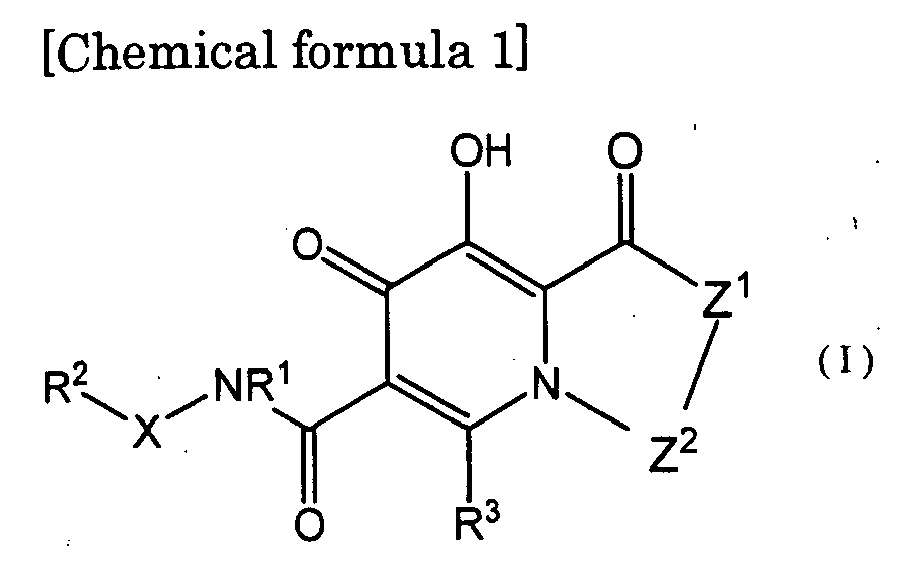 Z1 is NR4 (R4 is hydrogen, optionally substituted lower alkyl, optionally substituted cycloalkyl, optionally substituted cycloalkyl lower alkyl, optionally substituted lower alkenyl, optionally substituted lower alkoxy, optionally substituted aryl, optionally substituted aryl lower alkyl, optionally substituted aryloxy, optionally substituted heterocyclic group, optionally substituted heterocycle lower alkyl, optionally substituted heterocycleoxy, hydroxy, optionally substituted amino, optionally substituted phosphoric acid residue, aryl substituted with optionally substituted phosphoric acid residue, aralkyl substituted with optionally substituted phosphoric acid residue, hydroxy substituted with optionally substituted phosphoric acid residue, amino substituted with optionally substituted phosphoric acid residue or lower alkyl substituted with optionally substituted phosphoric acid residue (the lower alkyl may be intervened by a heteroatom group selected from group consisting CO, O, S, SO, SO2, NRa (Ra is hydrogen or lower alkyl), -N= and =N-)), O or CH2;Z2 is optionally substituted lower alkylene or optionally substituted lower alkenylene, each may be intervened by a heteroatom group selected from group consisting O, S, SO, SO2, NR5 (R5 is hydrogen, optionally substituted lower alkyl, optionally substituted cycloalkyl, optionally substituted cycloalkyl lower alkyl, optionally substituted lower alkenyl, optionally substituted lower alkoxy, optionally substituted aryl, optionally substituted aryl lower alkyl, optionally substituted aryloxy, optionally substituted heterocyclic group, optionally substituted heterocycle lower alkyl, optionally substituted heterocycleoxy, hydroxy, optionally substituted amino, optionally substituted phosphoric acid residue, aryl substituted with optionally substituted phosphoric acid residue, aralkyl substituted with optionally substituted phosphoric acid residue, hydroxy substituted with optionally substituted phosphoric acid residue, amino substituted with optionally substituted phosphoric acid residue or lower alkyl substituted with optionally substituted phosphoric acid residue (the lower alkyl may be intervened by a heteroatom group selected from group consisting CO, O, S, SO, SO2, NR5 (R5 is selected independently from the same substituent group as R4), -N= and =N-)), -N= or =N-;R1 is hydrogen or lower alkyl;X is a single bond, a heteroatom group selected from O, S, SO, SO2 and NH, or lower alkylene or lower alkenylene each may be intervened by the heteroatom;R2 is optionally substituted aryl;R3 is hydrogen, halogen, hydroxy, optionally substituted lower alkyl, optionally substituted cycloalkyl, optionally substituted lower alkenyl, optionally substituted lower alkoxy, optionally substituted lower alkenyloxy, optionally substituted aryl, optionally substituted aryloxy, optionally substituted heterocyclic group, optionally substituted heterocycleoxy or optionally substituted amino), its pharmaceutically acceptable salt, or solvate thereof.
 - A compound according to claim 1, pharmaceutically acceptable salt, or solvate thereof, wherein Z1 is NR4 (R4 is as defined in claim 1).
- A compound according to claim 1, pharmaceutically acceptable salt, or solvate thereof, wherein Z1 is NR4 (R4 is hydrogen, optionally substituted lower alkyl, optionally substituted cycloalkyl, optionally substituted cycloalkyl lower alkyl, optionally substituted aryl lower alkyl, or optionally substituted heterocycle lower alkyl).
- A compound according to claim 1, pharmaceutically acceptable salt, or solvate thereof, wherein Z2 is optionally substituted lower alkylene or optionally substituted lower alkenylene.
- A compound according to claim 1, pharmaceutically acceptable salt, or solvate thereof, wherein Z2 is any one of the following groups:

- A compound according to claim 5, pharmaceutically acceptable salt, or solvate thereof, wherein R6, R7, R8, R9, R10, R11, R12 and R13 are each independently hydrogen, lower alkyl, lower alkenyl, lower alkoxy, lower alkenyloxy, hydroxy, or optionally substituted amino.
- A compound according to claim 5, pharmaceutically acceptable salt, or solvate thereof, wherein R6, R7, R8, R9, R10, R11, R12 and R13 are hydrogen.
- A compound according to claim 1, pharmaceutically acceptable salt, or solvate thereof, wherein R1 is hydrogen.
- A compound according to claim 1, pharmaceutically acceptable salt, or solvate thereof, wherein X is lower alkylene; R2 is phenyl, or phenyl optionally substituted with at least halogen.
- A compound according to claim 1, pharmaceutically acceptable salt, or solvate thereof, wherein R3 is hydrogen, halogen, hydroxy, lower alkyl, lower alkenyl, lower alkoxy, lower alkenyloxy, or optionally substituted amino.
- A compound according to claim 1, pharmaceutically acceptable salt, or solvate thereof, wherein R3 is hydrogen.
- A compound according to claim 1, pharmaceutically acceptable salt, or solvate thereof, wherein R1 is hydrogen or lower alkyl; X is lower alkylene; R2 is phenyl, or phenyl optionally substituted with at least halogen; R3 is hydrogen, halogen, hydroxy, lower alkyl, lower alkenyl, lower alkoxy, lower alkenyloxy, or optionally substituted amino.
- A compound according to claim 1, pharmaceutically acceptable salt, or solvate thereof, wherein Z1 is NR4 (R4 is as defined in claim 1); Z2 is optionally substituted lower alkylene or optionally substituted lower alkenylene; R1 is hydrogen or lower alkyl; X is lower alkylene; R2 is phenyl optionally substituted with at least halogen.
- A compound according to claim 1, pharmaceutically acceptable salt, or solvate thereof, wherein Z1 is NR4 (R4 is as defined in claim 1); Z2 is optionally substituted lower alkylene or optionally substituted lower alkenylene; R1 is hydrogen or lower alkyl; X is lower alkylene; R2 is phenyl optionally substituted with at least halogen; R3 is hydrogen, halogen, hydroxy, lower alkyl, lower alkenyl, lower alkoxy, lower alkenyloxy, or optionally substituted amino.
- A compound according to claim 1, pharmaceutically acceptable salt, or solvate thereof, wherein Z1 is NR4 (R4 is hydrogen, optionally substituted lower alkyl, optionally substituted cycloalkyl, optionally substituted cycloalkyl lower alkyl, optionally substituted aryl lower alkyl, or optionally substituted heterocycle lower alkyl); Z2 is optionally substituted lower alkylene or optionally substituted lower alkenylene; R1 is hydrogen or lower alkyl; X is lower alkylene; R2 is phenyl optionally substituted with at least halogen; R3 is hydrogen, halogen, hydroxy, lower alkyl, lower alkenyl, lower alkoxy, lower alkenyloxy, or optionally substituted amino.
- A compound according to claim 1, pharmaceutically acceptable salt, or solvate thereof, wherein Z1 is NR4 (R4 is as defined in claim 1); Z2 is optionally substituted lower alkylene or optionally substituted lower alkenylene; R1 is hydrogen or lower alkyl; X is lower alkylene; R2 is phenyl optionally substituted with at least halogen; R3 is hydrogen.
- A compound according to claim 1, pharmaceutically acceptable salt, or solvate thereof, wherein Z1 is NR4 (R4 is hydrogen, optionally substituted lower alkyl, optionally substituted cycloalkyl, optionally substituted cycloalkyl lower alkyl, optionally substituted aryl lower alkyl, or optionally substituted heterocycle lower alkyl); Z2 is optionally substituted lower alkylene or optionally substituted lower alkenylene; R1 is hydrogen or lower alkyl; X is lower alkylene; R2 is phenyl optionally substituted with at least halogen; R3 is hydrogen.
- A compound according to claim 1, pharmaceutically acceptable salt, or solvate thereof, wherein at least one of the following 1) to 3) is satisfied:1) the case where Z1 is NR4 , and R4 is hydrogen, optionally substituted amino lower alkyl (substituent: mono- or di-lower alkyl, lower alkylcarbonyl or lower alkylsulfonyl), optionally substituted phosphoric acid residue, aryl substituted with optionally substituted phosphoric acid residue, aralkyl substituted with optionally substituted phosphoric acid residue, hydroxy substituted with optionally substituted phosphoric acid residue, amino substituted with optionally substituted phosphoric acid residue or lower alkyl substituted with optionally substituted phosphoric acid residue (the lower alkyl may be intervened by a heteroatom group selected from group consisting CO, O, S, SO, SO2, NRa (Ra is hydrogen or lower alkyl), -N= and =N-);2) the case where Z2 is substituted lower alkylene or substituted lower alkenylene, and the substituents are each independently hydroxy, amino lower alkyl optionally substituted with mono- or di-lower alkyl, optionally substituted phosphoric acid residue, aryl substituted with optionally substituted phosphoric acid residue, aralkyl substituted with optionally substituted phosphoric acid residue, hydroxy substituted with optionally substituted phosphoric acid residue, amino substituted with optionally substituted phosphoric acid residue or lower alkyl substituted with optionally substituted phosphoric acid residue (the lower alkyl may be intervened by a heteroatom group selected from group consisting CO, O, S, SO, SO2, NRa (Ra is hydrogen or lower alkyl), -N= and =N-);3) the case where R2 is substituted aryl, and the substituent comprises a group selected at least from Substituent group S1 (: optionally substituted phosphoric acid residue, aryl substituted with optionally substituted phosphoric acid residue, aralkyl substituted with optionally substituted phosphoric acid residue, hydroxy substituted with optionally substituted phosphoric acid residue, amino substituted with optionally substituted phosphoric acid residue, or lower alkyl substituted with optionally substituted phosphoric acid residue (the lower alkyl may be intervened by a heteroatom group selected from group consisting CO, O, S, SO, SO2, NRa (Ra is hydrogen or lower alkyl), -N= and =N-), lower alkoxy lower alkyl, amino lower alkyl optionally substituted with mono- or di-lower alkyl, halogenated lower alkyl, lower alkoxy, carbamoyl optionally substituted with mono- or di-lower alkyl, optionally substituted lower alkylsulfonylamino, halogenated lower alkoxy, hydroxy lower alkyl).
- A compound according to claim 1, pharmaceutically acceptable salt, or solvate thereof, wherein Z1 is NR4, R4 is hydrogen, optionally substituted amino lower alkyl (substituent: mono- or di-lower alkyl, lower alkylcarbonyl or lower alkylsulfonyl), optionally substituted phosphoric acid residue, aryl substituted with optionally substituted phosphoric acid residue, aralkyl substituted with optionally substituted phosphoric acid residue, hydroxy substituted with optionally substituted phosphoric acid residue, amino substituted with optionally substituted phosphoric acid residue, or lower alkyl substituted with optionally substituted phosphoric acid residue (the lower alkyl may be intervened by a heteroatom group selected from group consisting CO, O, S, SO, SO2 NRa (Ra is hydrogen or lower alkyl), -N= and =N-).
- A compound according to claim 1, pharmaceutically acceptable salt, or solvate thereof, wherein Z2 is substituted lower alkylene or substituted lower alkenylene, and the substituents are each independently hydroxy, optionally substituted amino lower alkyl (substituent: mono- or di-lower alkyl, lower alkylcarbonyl or lower alkylsulfonyl), optionally substituted phosphoric acid residue, aryl substituted with optionally substituted phosphoric acid residue, aralkyl substituted with optionally substituted phosphoric acid residue, hydroxy substituted with optionally substituted phosphoric acid residue, amino substituted with optionally substituted phosphoric acid residue or lower alkyl substituted with optionally substituted phosphoric acid residue (the lower alkyl may be intervened by a heteroatom group selected from group consisting CO, O, S, SO, SO2, NRa (Ra is hydrogen or lower alkyl), -N= and =N-).
- A compound according to claim 1, pharmaceutically acceptable salt, or solvate thereof, wherein R2 is substituted aryl, and the substituent comprises a group selected at least from Substituent group S1 (: optionally substituted phosphoric acid residue, aryl substituted with optionally substituted phosphoric acid residue, aralkyl substituted with optionally substituted phosphoric acid residue, hydroxy substituted with optionally substituted phosphoric acid residue, amino substituted with optionally substituted phosphoric acid residue, or lower alkyl substituted with optionally substituted phosphoric acid residue (the lower alkyl may be intervened by a heteroatom group selected from group consisting CO, O, S, SO, SO2 NRa (Ra is hydrogen or lower alkyl), -N= and =N-), lower alkoxy lower alkyl, optionally substituted amino lower alkyl (substituent: mono- or di-lower alkyl, lower alkylcarbonyl or lower alkylsulfonyl), halogenated lower alkyl, lower alkoxy, optionally substituted carbamoyl (substituent: mono- or di-lower alkyl, lower alkylcarbonyl, or lower alkylsulfonyl), optionally substituted lower alkylsulfonylamino, halogenated lower alkoxy, hydroxy lower alkyl).
- A compound according to claim 1, which is represented by the formula:
 R1 is hydrogen or lower alkyl:R3 is hydrogen, halogen, hydroxy, optionally substituted lower alkyl, optionally substituted cycloalkyl, optionally substituted lower alkenyl, optionally substituted lower alkoxy, optionally substituted lower alkenyloxy, optionally substituted aryl, optionally substituted aryloxy, optionally substituted heterocyclic group, optionally substituted heterocycleoxy or optionally substituted amino;R's are each independently a group selected from the group consisting of halogen and Substituent group S1;(Substituent group S1: optionally substituted phosphoric acid residue, aryl substituted with optionally substituted phosphoric acid residue, aralkyl substituted with optionally substituted phosphoric acid residue, hydroxy substituted with optionally substituted phosphoric acid residue, amino substituted with optionally substituted phosphoric acid residue, or lower alkyl substituted with optionally substituted phosphoric acid residue (the lower alkyl may be intervened by a heteroatom group selected from group consisting CO, O, S, SO, SO2, NRa (Ra is hydrogen or lower alkyl), -N= and =N-), lower alkoxy lower alkyl, optionally substituted amino lower alkyl (substituent: mono- or di-lower alkyl, lower alkylcarbonyl or lower alkylsulfonyl), halogenated lower alkyl, lower alkoxy, optionally substituted carbamoyl (substituent: mono- or di-lower alkyl, lower alkylcarbonyl, or lower alkylsulfonyl), optionally substituted lower alkylsulfonylamino, halogenated lower alkoxy, hydroxy lower alkyl)m is an integer of 0 to 3;R4 is hydrogen, optionally substituted lower alkyl, optionally substituted cycloalkyl, optionally substituted cycloalkyl lower alkyl, optionally substituted lower alkenyl, optionally substituted lower alkoxy, optionally substituted aryl, optionally substituted aryl lower alkyl, optionally substituted aryloxy, optionally substituted heterocycle, optionally substituted heterocycle lower alkyl, optionally substituted heterocycleoxy, hydroxy, optionally substituted amino, optionally substituted phosphoric acid residue, aryl substituted with optionally substituted phosphoric acid residue, aralkyl substituted with optionally substituted phosphoric acid residue, hydroxy substituted with optionally substituted phosphoric acid residue, amino substituted with optionally substituted phosphoric acid residue or lower alkyl substituted with optionally substituted phosphoric acid residue (the lower alkyl may be intervened by a heteroatom group selected from group consisting O, S, SO, SO2 NRa (Ra is hydrogen or lower alkyl), -N= and =N-);R14 is hydrogen, optionally substituted lower alkyl, optionally substituted cycloalkyl, optionally substituted cycloalkyl lower alkyl, optionally substituted lower alkenyl, optionally substituted lower alkoxy, optionally substituted lower alkenyloxy, optionally substituted aryl, optionally substituted aryl lower alkyl, optionally substituted aryloxy, optionally substituted heterocycle, optionally substituted heterocycle lower alkyl, optionally substituted heterocycleoxy, hydroxy, optionally substituted amino, optionally substituted lower alkylcarbonyl, optionally substituted cycloalkylcarbonyl, optionally substituted cycloalkyl lower alkylcarbonyl, optionally substituted lower alkoxycarbonyl, optionally substituted arylcarbonyl, optionally substituted aryl lower alkylcarbonyl, optionally substituted aryloxycarbonyl, optionally substituted heterocycle carbonyl, optionally substituted heterocyclic lower alkylcarbonyl, optionally substituted heterocycleoxy carbonyl, optionally substituted aminocarbonyl, optionally substituted phosphoric acid residue, aryl substituted with optionally substituted phosphoric acid residue, aralkyl substituted with optionally substituted phosphoric acid residue, hydroxy substituted with optionally substituted phosphoric acid residue, amino substituted with optionally substituted phosphoric acid residue or lower alkyl substituted with optionally substituted phosphoric acid residue (the lower alkyl may be intervened by a heteroatom group selected from group consisting O, S, SO, SO2, NRa (Ra is hydrogen or lower alkyl), -N= and =N-); provided that at least one of the following is satisfied:1) the case where R4 is hydrogen, optionally substituted amino lower alkyl (substituent: mono- or di-lower alkyl, lower alkylcarbonyl or lower alkylsulfonyl), optionally substituted phosphoric acid residue, aryl substituted with optionally substituted phosphoric acid residue, aralkyl substituted with optionally substituted phosphoric acid residue, hydroxy substituted with optionally substituted phosphoric acid residue, amino substituted with optionally substituted phosphoric acid residue or lower alkyl substituted with optionally substituted phosphoric acid residue (the lower alkyl may be intervened by a heteroatom group selected from group consisting CO, O, S, SO, SO2, NRa (Ra is hydrogen or lower alkyl), -N= and =N-);2) the case where R14 is hydroxy, optionally substituted amino lower alkyl (substituent: mono- or di-lower alkyl, lower alkylcarbonyl or lower alkylsulfonyl), optionally substituted phosphoric acid residue, aryl substituted with optionally substituted phosphoric acid residue, aralkyl substituted with optionally substituted phosphoric acid residue, hydroxy substituted with optionally substituted phosphoric acid residue, amino substituted with optionally substituted phosphoric acid residue or lower alkyl substituted with optionally substituted phosphoric acid residue (the lower alkyl may be intervened by a heteroatom group selected from group consisting CO, O, S, SO, SO2, NRa (Ra is hydrogen or lower alkyl), -N= and =N-);3) the case where m is 1 to 3, and at least one R is a group selected from Substituent group S1), pharmaceutically acceptable salt, or solvate thereof.
 - A compound according to claim 22, wherein R1 is hydrogen; R3 is hydrogen; m is 1 or 2.
- A compound according to claim 22, pharmaceutically acceptable salt, or solvate thereof, wherein phosphoric acid residues are each independently represented by the formula:

- A compound according to claim 22, pharmaceutically acceptable salt, or solvate thereof, wherein m is 1 or 2; R's are each independently halogen, halogenated lower alkyl, lower alkoxy, halogenated lower alkoxy, lower alkoxy lower alkyl, hydroxy lower alkyl, amino lower alkyl optionally substituted with mono- or di-lower alkyl, optionally substituted carbamoyl (substituent: mono- or di-lower alkyl, lower alkylcarbonyl, or lower alkylsulfonyl), phosphoric acid residue, aryl substituted with optionally substituted phosphoric acid residue, aralkyl substituted with optionally substituted phosphoric acid residue, hydroxy substituted with optionally substituted phosphoric acid residue, amino substituted with optionally substituted phosphoric acid residue, lower alkyl substituted with optionally substituted phosphoric acid residue, or lower alkylsulfonylamino optionally substituted with lower alkyl; R1 is hydrogen; R3 is hydrogen; R14 is hydrogen, hydroxy, or amino lower alkyl optionally substituted with mono- or di-lower alkyl; R4 is hydrogen, lower alkyl, lower alkoxy lower alkyl, amino lower alkyl optionally substituted with mono- or di-lower alkyl, optionally substituted phosphoric acid residue, aryl substituted with optionally substituted phosphoric acid residue, aralkyl substituted with optionally substituted phosphoric acid residue, hydroxy substituted with optionally substituted phosphoric acid residue, amino substituted with optionally substituted phosphoric acid residue, or lower alkyl substituted with optionally substituted phosphoric acid residue.
- A compound according to claim 22, pharmaceutically acceptable salt, or solvate thereof, wherein R is -F, -CF3, -OMe, -OCF3, -CH2OMe, -CH2OH, -CH2N (Me)2, -CONHMe, -CON (Me)2, -CH2PO (OEt)2, -PO (OEt)2, -NHSO2Me, or -NMeSO2Me; R1 is hydrogen; R3 is hydrogen; m is 1 or 2; R14 is hydrogen, -CH2N (Me)2 or hydroxy; R4 is hydrogen, Me, - (CH2)2OMe, - (CH2)2N (Me)2, - (CH2)2PO (OEt)2.
- A compound according to claim 1, which is represented by the formula:
 R1 is hydrogen or lower alkyl;X is a single bond, a heteroatom group selected from O, S, SO, SO2 and NH, or lower alkylene or lower alkenylene each may be intervened by the heteroatom group;R2 is optionally substituted aryl;R3 is hydrogen, halogen, hydroxy, optionally substituted lower alkyl, optionally substituted cycloalkyl, optionally substituted lower alkenyl, optionally substituted lower alkoxy, optionally substituted lower alkenyloxy, optionally substituted aryl, optionally substituted aryloxy, optionally substituted heterocyclic group, optionally substituted heterocycleoxy or optionally substituted amino;R4 is hydrogen, optionally substituted lower alkyl, optionally substituted cycloalkyl, optionally substituted cycloalkyl lower alkyl, optionally substituted lower alkenyl, optionally substituted lower alkoxy, optionally substituted aryl, optionally substituted aryl lower alkyl, optionally substituted aryloxy, optionally substituted heterocycle, optionally substituted heterocycle lower alkyl, optionally substituted heterocycleoxy, hydroxy, optionally substituted amino, optionally substituted phosphoric acid residue, aryl substituted with optionally substituted phosphoric acid residue, aralkyl substituted with optionally substituted phosphoric acid residue, hydroxy substituted with optionally substituted phosphoric acid residue, amino substituted with optionally substituted phosphoric acid residue or lower alkyl substituted with optionally substituted phosphoric acid residue (the lower alkyl may be intervened by a heteroatom group selected from group consisting O, S, SO, SO2, NRa (Ra is hydrogen or lower alkyl), -N= and =N-)), pharmaceutically acceptable salt, or solvate thereof.
 - A compound according to claim 1, which is represented by the formula:
 R1 is hydrogen or lower alkyl;X is a single bond, a heteroatom group selected from O, S, SO, SO2 and NH, or lower alkylene or lower alkenylene each may be intervened by the heteroatom group;R2 is optionally substituted aryl;R3 is hydrogen, halogen, hydroxy, optionally substituted lower alkyl, optionally substituted cycloalkyl, optionally substituted lower alkenyl, optionally substituted lower alkoxy, optionally substituted lower alkenyloxy, optionally substituted aryl, optionally substituted aryloxy, optionally substituted heterocyclic group, optionally substituted heterocycleoxy or optionally substituted amino;Z3 and Z4 are both oxo, or one of Z3 and Z4 is oxo, and the other is hydrogen or a substituent represented by R14;R14 is selected from the group consisting of hydrogen, optionally substituted lower alkyl, optionally substituted cycloalkyl, optionally substituted cycloalkyl lower alkyl, optionally substituted lower alkenyl, optionally substituted lower alkoxy, optionally substituted lower alkenyloxy, optionally substituted aryl, optionally substituted aryl lower alkyl, optionally substituted aryloxy, optionally substituted heterocyclic group, optionally substituted heterocycle lower alkyl, optionally substituted heterocycleoxy, hydroxy, optionally substituted amino, optionally substituted lower alkylcarbonyl, optionally substituted cycloalkylcarbonyl, optionally substituted cycloalkyl lower alkylcarbonyl, optionally substituted lower alkoxycarbonyl, optionally substituted arylcarbonyl, optionally substituted aryl lower alkylcarbonyl, optionally substituted aryloxycarbonyl, optionally substituted heterocycle carbonyl, optionally substituted heterocycle lower alkylcarbonyl, optionally substituted heterocycleoxy carbonyl, and optionally substituted aminocarbonyl;R4 is hydrogen, optionally substituted lower alkyl, optionally substituted cycloalkyl, optionally substituted cycloalkyl lower alkyl, optionally substituted lower alkenyl, optionally substituted lower alkoxy, optionally substituted aryl, optionally substituted aryl lower alkyl, optionally substituted aryloxy, optionally substituted heterocycle, optionally substituted heterocycle lower alkyl, optionally substituted heterocycleoxy, hydroxy, optionally substituted amino, optionally substituted phosphoric acid residue, aryl substituted with optionally substituted phosphoric acid residue, aralkyl substituted with optionally substituted phosphoric acid residue, hydroxy substituted with optionally substituted phosphoric acid residue, amino substituted with optionally substituted phosphoric acid residue or lower alkyl substituted with optionally substituted phosphoric acid residue (the lower alkyl may be intervened by a heteroatom group selected from group consisting O, S, SO, SO2, NRa (Ra is hydrogen or lower alkyl), -N= and =N-)), pharmaceutically acceptable salt, or solvate thereof.
 - A compound according to claim 27 or 28, pharmaceutically acceptable salt, or solvate thereof, wherein R1 is hydrogen; X is lower alkylene; R2 is phenyl, or phenyl substituted with at least halogen; and R3 is hydrogen, halogen, hydroxy, lower alkyl, lower alkenyl, lower alkoxy, lower alkenyloxy or optionally substituted amino.
- A pharmaceutical composition, containing a compound as defined in any one of claims 1 to 29, pharmaceutically acceptable salt, or solvate thereof.
- A pharmaceutical composition according to claim 30, which an anti-HIV agent.
Applications Claiming Priority (4)
| Application Number | Priority Date | Filing Date | Title |
|---|---|---|---|
| JP2005043310 | 2005-02-21 | ||
| JP2005131161 | 2005-04-28 | ||
| JP2005312076 | 2005-10-27 | ||
| PCT/JP2006/302925 WO2006088173A1 (en) | 2005-02-21 | 2006-02-20 | Bicyclic carbamoylpyridone derivative having hiv integrase inhibiting activity |
Publications (3)
| Publication Number | Publication Date |
|---|---|
| EP1852434A1 true EP1852434A1 (en) | 2007-11-07 |
| EP1852434A4 EP1852434A4 (en) | 2010-01-13 |
| EP1852434B1 EP1852434B1 (en) | 2011-07-13 |
Family
ID=36916569
Family Applications (1)
| Application Number | Title | Priority Date | Filing Date |
|---|---|---|---|
| EP06714066A Expired - Lifetime EP1852434B1 (en) | 2005-02-21 | 2006-02-20 | Bicyclic carbamoylpyridone derivative having hiv integrase inhibiting activity |
Country Status (5)
| Country | Link |
|---|---|
| US (1) | US7858788B2 (en) |
| EP (1) | EP1852434B1 (en) |
| JP (1) | JP5317257B2 (en) |
| AT (1) | ATE516026T1 (en) |
| WO (1) | WO2006088173A1 (en) |
Cited By (14)
| Publication number | Priority date | Publication date | Assignee | Title |
|---|---|---|---|---|
| EP1790638A4 (en) * | 2004-09-15 | 2009-10-28 | Shionogi & Co | Carbamoylpyridone derivative having hiv integrase inhibitory activity |
| EP1874117A4 (en) * | 2005-04-28 | 2009-12-30 | Smithkline Beecham Corp | POLYCYCLIC DERIVATIVE OF CARBAMOYLPYRIDONE WITH INHIBITORY ACTIVITY ON HIV INTEGRASE |
| EP1950212A4 (en) * | 2005-10-27 | 2010-08-04 | Shionogi & Co | POLYCYCLIC CARBAMOYLPYRIDONE DERIVATIVE HAVING INHIBITION ACTIVITY ON HIV INTEGRASE |
| US8148373B2 (en) | 2008-02-06 | 2012-04-03 | Astrazeneca Ab | Compounds |
| US8455483B2 (en) | 2009-07-31 | 2013-06-04 | Astrazeneca Ab | Compounds—801 |
| CN103228653A (en) * | 2010-09-24 | 2013-07-31 | 盐野义制药株式会社 | Substituted polycyclic carbamoyl pyridone derivative prodrug |
| CN104151234A (en) * | 2009-03-26 | 2014-11-19 | 盐野义制药株式会社 | Process for producing pyrone and pyridone derivatives |
| EP3049081A4 (en) * | 2013-09-27 | 2017-02-22 | Merck Sharp & Dohme Corp. | Substituted quinolizine derivatives useful as hiv integrase inhibitors |
| US10087178B2 (en) | 2012-12-27 | 2018-10-02 | Japan Tobacco Inc. | Substituted spiropyrido[1,2-a]pyrazine derivative and medicinal use thereof as HIV integrase inhibitor |
| EP3377065A4 (en) * | 2015-11-17 | 2019-06-12 | Merck Sharp & Dohme Corp. | SPIROCYCLIC PYRIDOTRIAZINE DERIVATIVES USEFUL AS INHIBITORS OF HIV INTEGRASE |
| US11453669B2 (en) | 2018-05-31 | 2022-09-27 | Shionogi & Co., Ltd. | Polycyclic pyridone derivative |
| US11649236B2 (en) | 2018-05-31 | 2023-05-16 | Shionogi & Co., Ltd. | Polycyclic carbamoylpyridone derivative |
| TWI880373B (en) * | 2018-05-31 | 2025-04-11 | 日商鹽野義製藥股份有限公司 | Polycyclic pyridotriazine derivative |
| US12577241B2 (en) | 2019-11-28 | 2026-03-17 | Shionogi & Co., Ltd. | Polycyclic pyridopyrazine derivative |
Families Citing this family (62)
| Publication number | Priority date | Publication date | Assignee | Title |
|---|---|---|---|---|
| TW200510425A (en) * | 2003-08-13 | 2005-03-16 | Japan Tobacco Inc | Nitrogen-containing fused ring compound and use thereof as HIV integrase inhibitor |
| AU2007313293A1 (en) * | 2006-10-18 | 2008-04-24 | Merck & Co., Inc. | HIV integrase inhibitors |
| WO2010011815A1 (en) * | 2008-07-25 | 2010-01-28 | Smithkline Beecham Corporation | Chemical compounds |
| CN103951643B (en) | 2008-07-25 | 2015-12-09 | 盐野义制药株式会社 | As the compound of hiv integrase inhibitor |
| SI2320908T1 (en) * | 2008-07-25 | 2014-05-30 | Viiv Healthcare Company | Dolutegravir Prodrugs |
| KR101733625B1 (en) | 2008-12-11 | 2017-05-10 | 시오노기세야쿠 가부시키가이샤 | Synthesis of carbamoylpyridone hiv integrase inhibitors and intermediates |
| KR101678563B1 (en) | 2008-12-11 | 2016-11-22 | 비이브 헬쓰케어 컴퍼니 | Processes and intermediates for carbamoylpyridone hiv integrase inhibitors |
| WO2010110231A1 (en) | 2009-03-26 | 2010-09-30 | 塩野義製薬株式会社 | Substituted 3-hydroxy-4-pyridone derivative |
| DK2444400T3 (en) | 2009-06-15 | 2018-06-18 | Shionogi & Co | SUBSTITUTED POLYCYCLIC CARBAMOYLPYRIDONE DERIVATIVE |
| MX2012009869A (en) | 2010-02-26 | 2012-09-12 | Japan Tobacco Inc | DERIVED FROM 1, 3,4, 8-TETRAHIDRO-2H-PIRIDO [1, 2-A] PIRAZINA AND ITS USE AS AN INHIBITOR OF THE INTEGRESS OF HIV. |
| TWI582097B (en) | 2010-03-23 | 2017-05-11 | Viiv醫療保健公司 | Process for preparing carbamoylpyridone derivatives and intermediates |
| JP5766690B2 (en) | 2010-04-12 | 2015-08-19 | 塩野義製薬株式会社 | Pyridone derivatives having integrase inhibitory activity |
| PT2602260T (en) | 2010-08-05 | 2016-12-27 | Shionogi & Co | Process for preparing compound having hiv integrase inhibitory activity |
| DK3738434T3 (en) | 2011-12-28 | 2023-12-04 | Global Blood Therapeutics Inc | Intermediates for obtaining substituted benzaldehyde compounds and methods for using them in increasing tissue oxygenation |
| WO2013102145A1 (en) | 2011-12-28 | 2013-07-04 | Global Blood Therapeutics, Inc. | Substituted heteroaryl aldehyde compounds and methods for their use in increasing tissue oxygenation |
| SG10201603288XA (en) | 2012-03-28 | 2016-05-30 | Fujifilm Corp | Salt Of 1-(2-Deoxy-2-Fluoro-4-Thio-beta-D-Arabinofuranosyl)Cytosine |
| KR20170001722A (en) | 2012-08-13 | 2017-01-04 | 후지필름 가부시키가이샤 | Synthesis intermediates of 1- (2-deoxy-2-fluoro-4-thio- 硫 -D-arabinofuranosyl) cytosine, synthetic intermediates of thionucleosides, |
| CA2893843C (en) | 2012-12-21 | 2018-09-04 | Gilead Sciences, Inc. | Polycyclic-carbamoylpyridone compounds and their pharmaceutical use |
| US9604999B2 (en) | 2013-03-15 | 2017-03-28 | Global Blood Therapeutics, Inc. | Compounds and uses thereof for the modulation of hemoglobin |
| US20140274961A1 (en) | 2013-03-15 | 2014-09-18 | Global Blood Therapeutics, Inc. | Compounds and uses thereof for the modulation of hemoglobin |
| US9802900B2 (en) | 2013-03-15 | 2017-10-31 | Global Blood Therapeutics, Inc. | Bicyclic heteroaryl compounds and uses thereof for the modulation of hemoglobin |
| US10266551B2 (en) | 2013-03-15 | 2019-04-23 | Global Blood Therapeutics, Inc. | Compounds and uses thereof for the modulation of hemoglobin |
| US10100043B2 (en) | 2013-03-15 | 2018-10-16 | Global Blood Therapeutics, Inc. | Substituted aldehyde compounds and methods for their use in increasing tissue oxygenation |
| US8952171B2 (en) | 2013-03-15 | 2015-02-10 | Global Blood Therapeutics, Inc. | Compounds and uses thereof for the modulation of hemoglobin |
| KR102280614B1 (en) | 2013-03-15 | 2021-07-21 | 글로벌 블러드 테라퓨틱스, 인크. | Compounds and uses thereof for the modulation of hemoglobin |
| AU2014237330A1 (en) | 2013-03-15 | 2015-09-17 | Global Blood Therapeutics, Inc. | Compounds and uses thereof for the modulation of hemoglobin |
| BR112015021982B1 (en) | 2013-03-15 | 2022-12-13 | Global Blood Therapeutics, Inc | COMPOUNDS AND THEIR USES FOR HEMOGLOBIN MODULATION |
| US9422279B2 (en) | 2013-03-15 | 2016-08-23 | Global Blood Therapeutics, Inc. | Compounds and uses thereof for the modulation of hemoglobin |
| US9458139B2 (en) | 2013-03-15 | 2016-10-04 | Global Blood Therapeutics, Inc. | Compounds and uses thereof for the modulation of hemoglobin |
| NO2865735T3 (en) | 2013-07-12 | 2018-07-21 | ||
| DK3019503T3 (en) | 2013-07-12 | 2017-11-20 | Gilead Sciences Inc | POLYCYCLIC-CARBAMOYLPYRIDON COMPOUNDS AND ITS USES FOR TREATING HIV INFECTIONS |
| EA201992707A1 (en) | 2013-11-18 | 2020-06-30 | Глобал Блад Терапьютикс, Инк. | COMPOUNDS AND THEIR APPLICATIONS FOR HEMOGLOBIN MODULATION |
| WO2015089847A1 (en) * | 2013-12-20 | 2015-06-25 | Merck Sharp & Dohme Corp. | Spirocyclic heterocycle compounds useful as hiv integrase inhibitors |
| SI3102208T2 (en) | 2014-02-07 | 2024-10-30 | Global Blood Therapeutics, Inc. | Crystalline polymorph of the free base of 2-hydroxy-6-((2-(1-isopropyl-1h-pyrazol-5-yl)pyridin-3-yl)methoxy)benzaldehyde |
| JP6175553B2 (en) | 2014-02-18 | 2017-08-09 | 富士フイルム株式会社 | Method for producing thiolane skeleton type sugar compound and thiolane skeleton type sugar compound |
| TW201613936A (en) | 2014-06-20 | 2016-04-16 | Gilead Sciences Inc | Crystalline forms of(2R,5S,13aR)-8-hydroxy-7,9-dioxo-n-(2,4,6-trifluorobenzyl)-2,3,4,5,7,9,13,13a-octahydro-2,5-methanopyrido[1',2':4,5]pyrazino[2,1-b][1,3]oxazepine-10-carboxamide |
| TWI677489B (en) | 2014-06-20 | 2019-11-21 | 美商基利科學股份有限公司 | Synthesis of polycyclic-carbamoylpyridone compounds |
| NO2717902T3 (en) | 2014-06-20 | 2018-06-23 | ||
| WO2016065248A1 (en) | 2014-10-23 | 2016-04-28 | Complete Genomics, Inc. | Signal confinement sequencing (scs) and nucleotide analogues for signal confinement sequencing |
| TWI678373B (en) * | 2014-10-31 | 2019-12-01 | 日商富士軟片股份有限公司 | Thionucleoside derivative or its salt and pharmaceutical composition |
| WO2016090545A1 (en) * | 2014-12-09 | 2016-06-16 | Merck Sharp & Dohme Corp. | Spirocyclic heterocycle compounds useful as hiv integrate inhibitors |
| TWI738321B (en) | 2014-12-23 | 2021-09-01 | 美商基利科學股份有限公司 | Polycyclic-carbamoylpyridone compounds and their pharmaceutical use |
| EP3253767A2 (en) * | 2015-02-06 | 2017-12-13 | Mylan Laboratories Ltd. | Processes for the preparation of dolute-gravir |
| MA41841A (en) | 2015-03-30 | 2018-02-06 | Global Blood Therapeutics Inc | ALDEHYDE COMPOUNDS FOR THE TREATMENT OF PULMONARY FIBROSIS, HYPOXIA, AND AUTOIMMUNE AND CONNECTIVE TISSUE DISEASES |
| TR201905009T4 (en) * | 2015-04-02 | 2019-05-21 | Gilead Sciences Inc | Polycyclic-carbamoylpyridone compounds and their pharmaceutical uses. |
| WO2017087257A1 (en) * | 2015-11-17 | 2017-05-26 | Merck Sharp & Dohme Corp. | Amido-substituted pyridotriazine derivatives useful as hiv integrase inhibitors |
| US11020382B2 (en) | 2015-12-04 | 2021-06-01 | Global Blood Therapeutics, Inc. | Dosing regimens for 2-hydroxy-6-((2-(1-isopropyl-1h-pyrazol-5-yl)pyridin-3-yl)methoxy)benzaldehyde |
| AR108435A1 (en) | 2016-05-12 | 2018-08-22 | Global Blood Therapeutics Inc | PROCESS TO SYNTHETIZE 2-HYDROXI-6 - ((2- (1-ISOPROPIL-1H-PIRAZOL-5-IL) -PIRIDIN-3-IL) METOXI) BENZALDEHYDE |
| BR112019003946A2 (en) | 2016-08-31 | 2019-05-21 | Fujifilm Corporation | antitumor agent, antitumor effect booster and antitumor kit |
| US20190216725A1 (en) * | 2016-09-21 | 2019-07-18 | Merck Shapr & Dohme Corp. | Drug delivery system for the delivery of integrase inhibitors |
| TWI778983B (en) | 2016-10-12 | 2022-10-01 | 美商全球血液治療公司 | Tablets comprising 2-hydroxy-6-((2-(1-isopropyl-1h-pyrazol-5-yl)pyridin-3-yl)methoxy)benzaldehyde |
| MX2018002611A (en) | 2018-01-29 | 2019-07-30 | Fujifilm Corp | Antitumor agent for biliary cancer and treatment method of biliary cancer. |
| EP3860975B1 (en) | 2018-10-01 | 2023-10-18 | Global Blood Therapeutics, Inc. | Modulators of hemoglobin for the treatment of sickle cell disease |
| IL286328B1 (en) | 2019-03-22 | 2026-04-01 | Gilead Sciences Inc | Bridged tricyclic carbamoylpyridone compounds and their pharmaceutical use |
| EP4066839A4 (en) | 2019-11-28 | 2023-12-27 | Shionogi & Co., Ltd | Prophylactic and therapeutic pharmaceutical agent for hiv infectious diseases characterized by comprising combination of integrase inhibitor and anti-hiv agent |
| CR20220418A (en) | 2020-02-24 | 2022-10-10 | Gilead Sciences Inc | Tetracyclic compounds for treating hiv infection |
| CA3192145A1 (en) | 2020-09-30 | 2022-04-07 | Gilead Sciences, Inc. | Bridged tricyclic carbamoylpyridone compounds and uses thereof |
| WO2022079739A1 (en) | 2020-10-14 | 2022-04-21 | Cipla Limited | Fixed dose compositions of cabotegravir and rilpivirine |
| JP7591155B2 (en) | 2021-01-19 | 2024-11-27 | ギリアード サイエンシーズ, インコーポレイテッド | Substituted pyridotriazine compounds and uses thereof |
| CN117751118A (en) * | 2021-07-30 | 2024-03-22 | 吉斯凯(苏州)制药有限公司 | Macrocyclic pyridone compounds and application thereof |
| TWI856796B (en) | 2022-04-06 | 2024-09-21 | 美商基利科學股份有限公司 | Bridged tricyclic carbamoylpyridone compounds and uses thereof |
| WO2024151855A1 (en) * | 2023-01-13 | 2024-07-18 | The United States Of America, As Represented By The Secretary, Department Of Health And Human Services | Bicyclic carbamoyl pyridone-based integrase strand transfer inhibitors |
Family Cites Families (16)
| Publication number | Priority date | Publication date | Assignee | Title |
|---|---|---|---|---|
| JPH0296506A (en) | 1988-09-30 | 1990-04-09 | Daicel Chem Ind Ltd | Herbicide composition |
| JP2551472B2 (en) | 1988-10-18 | 1996-11-06 | ダイセル化学工業株式会社 | 5-Alkoxy-γ-pyrone-3-carboxamide derivative, method for producing the same, and plant growth inhibitor |
| JP2533796B2 (en) | 1988-10-18 | 1996-09-11 | ダイセル化学工業株式会社 | 5-Alkoxypyridine-3-carboxamide derivative, method for producing the same, and plant growth inhibitor |
| ATE430745T1 (en) * | 2000-10-12 | 2009-05-15 | Merck & Co Inc | AZA- AND POLYAZA NAPHTHALENYL CARBOXAMIDES AS INHIBITORS OF HIV INTEGRASE |
| AU1532802A (en) * | 2000-10-12 | 2002-04-22 | Merck & Co Inc | Aza- and polyaza-naphthalenyl-carboxamides useful as hiv integrase inhibitors |
| JP2003032772A (en) | 2001-07-12 | 2003-01-31 | Foster Electric Co Ltd | Earphone |
| CN1227415C (en) | 2001-07-31 | 2005-11-16 | 花王株式会社 | Manufacturing method of hollow fiber molded body, hollow fiber molded body and manufacturing apparatus thereof |
| DK3042894T1 (en) * | 2001-08-10 | 2016-11-07 | Shionogi & Co | ANTIVIRAL AGENT |
| SI1441734T1 (en) | 2001-10-26 | 2007-08-31 | Angeletti P Ist Richerche Bio | Dihydroxypyrimidine carboxamide inhibitors of hiv integrase |
| AU2003248872A1 (en) * | 2002-07-09 | 2004-01-23 | Bristol-Myers Squibb Company | Hiv integrase inhibitors |
| DE60322920D1 (en) * | 2002-08-13 | 2008-09-25 | Shionogi & Co | HETEROCYCLIC COMPOUNDS WITH HIV INTEGRATE-INHIBITOR EFFECT |
| US7517532B2 (en) * | 2002-09-11 | 2009-04-14 | Merck & Co., Inc. | Dihydroxypyridopyrazine-1,6-dione compounds useful as HIV integrase inhibitors |
| BR0317749A (en) * | 2002-12-27 | 2005-11-22 | Angeletti P Ist Richerche Bio | Compound, pharmaceutical composition, and use of a compound |
| JP2004244320A (en) | 2003-02-10 | 2004-09-02 | Shionogi & Co Ltd | Nitrogen-containing heterocyclic antiviral agents |
| TW200510425A (en) * | 2003-08-13 | 2005-03-16 | Japan Tobacco Inc | Nitrogen-containing fused ring compound and use thereof as HIV integrase inhibitor |
| WO2006066414A1 (en) * | 2004-12-23 | 2006-06-29 | Virochem Pharma Inc. | Hydroxydihydropyridopy razine-1,8-diones and methods for inhibiting hiv integrase |
-
2006
- 2006-02-20 AT AT06714066T patent/ATE516026T1/en not_active IP Right Cessation
- 2006-02-20 JP JP2007503763A patent/JP5317257B2/en not_active Expired - Fee Related
- 2006-02-20 US US11/884,686 patent/US7858788B2/en not_active Expired - Fee Related
- 2006-02-20 EP EP06714066A patent/EP1852434B1/en not_active Expired - Lifetime
- 2006-02-20 WO PCT/JP2006/302925 patent/WO2006088173A1/en not_active Ceased
Cited By (31)
| Publication number | Priority date | Publication date | Assignee | Title |
|---|---|---|---|---|
| EP1790638A4 (en) * | 2004-09-15 | 2009-10-28 | Shionogi & Co | Carbamoylpyridone derivative having hiv integrase inhibitory activity |
| US8410103B2 (en) | 2005-04-28 | 2013-04-02 | Shionogi & Co., Ltd. | (3S,11aR)-N-[2,4-difluorophenyl)methyl]-6-hydroxy-3-methyl-5,7-dioxo-2,3,5,7,11,11a-hexahydro[1,3]oxazolo[3,2-a]pyrido[1,2-d]pyrazine-8-carboxamide useful as anti-HIV agent |
| US8129385B2 (en) | 2005-04-28 | 2012-03-06 | Shionogi & Co., Ltd. | Substituted 5-hydroxy-3,4,6,9,9a, 10-hexanhydro-2h-1-oxa04a,8a-diaza-anthracene-6,10-dioness |
| US9273065B2 (en) | 2005-04-28 | 2016-03-01 | Shionogi & Co., Ltd. | Substituted pyrido[1',2':4,5]pyrazino[1,2-a]pyrimidines as HIV integrase inhibitors |
| EP1874117A4 (en) * | 2005-04-28 | 2009-12-30 | Smithkline Beecham Corp | POLYCYCLIC DERIVATIVE OF CARBAMOYLPYRIDONE WITH INHIBITORY ACTIVITY ON HIV INTEGRASE |
| US11267823B2 (en) | 2005-04-28 | 2022-03-08 | Shionogi & Co., Ltd. | Substituted 1,2,3,3a,4,5,7,9,13,13a-decahydropyrido[1′,2′:4,5]pyrazino[1,2-a]pyrrolo[1,2-c]pyrimidines having HIV integrase inhibitory activity |
| US10927129B2 (en) | 2005-04-28 | 2021-02-23 | Shinogi & Co., Ltd. | N-[(2,4-difluorophenyl)methyl]-6-hydroxy-3-methyl-5,7-dioxo-2,3,5,7,11,11a-hexahydro[1,3] oxazolo[3,2-a]pyrido[1,2-d]pyrazine-8-carboxamide having HIV integrase inhibitory activity |
| US8778943B2 (en) | 2005-04-28 | 2014-07-15 | Shionogi & Co., Ltd. | Substituted 10-hydroxy-9,11-dioxo-2,3,4a,5,9,11,13,13a-octahydro-1h-pyrido[1,2-α]pyrrolo[1′,2′:3,4]imidazo[1,2-d]pyrazine-8-carboxamides |
| US9051337B2 (en) | 2005-04-28 | 2015-06-09 | Shionogi & Co., Ltd. | Substituted 10-hydroxy-9,11-dioxo-2,3,4a,5,9,11,13,13a-octahydro-1h-pyrido[1,2-a]pyrrolo[1′,2′:3,4]imidazo[1,2-d]pyrazine-8-carboxamides |
| EP1950212A4 (en) * | 2005-10-27 | 2010-08-04 | Shionogi & Co | POLYCYCLIC CARBAMOYLPYRIDONE DERIVATIVE HAVING INHIBITION ACTIVITY ON HIV INTEGRASE |
| US8188271B2 (en) | 2005-10-27 | 2012-05-29 | Shionogi & Co., Ltd. | Polycyclic carbamoylpyridone derivative having HIV integrase inhibitory activity |
| US8148373B2 (en) | 2008-02-06 | 2012-04-03 | Astrazeneca Ab | Compounds |
| CN104151234A (en) * | 2009-03-26 | 2014-11-19 | 盐野义制药株式会社 | Process for producing pyrone and pyridone derivatives |
| CN104151234B (en) * | 2009-03-26 | 2017-04-12 | 盐野义制药株式会社 | Process for producing pyrone and pyridone derivatives |
| US8455483B2 (en) | 2009-07-31 | 2013-06-04 | Astrazeneca Ab | Compounds—801 |
| US8476265B2 (en) | 2009-07-31 | 2013-07-02 | Astrazeneca Ab | Compounds-801 |
| CN103228653A (en) * | 2010-09-24 | 2013-07-31 | 盐野义制药株式会社 | Substituted polycyclic carbamoyl pyridone derivative prodrug |
| CN103228653B (en) * | 2010-09-24 | 2016-03-16 | 盐野义制药株式会社 | The prodrug of the polycyclic carbamoylpyridone derivative be substituted |
| US8987441B2 (en) | 2010-09-24 | 2015-03-24 | Shionogi & Co., Ltd. | Substituted polycyclic carbamoyl pyridone derivative prodrug |
| US9758515B2 (en) | 2010-09-24 | 2017-09-12 | Shionogi & Co., Ltd. | Substituted polycyclic carbamoyl pyridone derivative prodrug |
| RU2608519C2 (en) * | 2010-09-24 | 2017-01-19 | Шионоги энд Ко. Лтд. | Substituted polycyclic carbamoyl pyridone derivative prodrug |
| US10202379B2 (en) | 2010-09-24 | 2019-02-12 | Shionogi & Co., Ltd. | Substituted polycyclic carbamoyl pyridone derivative prodrug |
| US10087178B2 (en) | 2012-12-27 | 2018-10-02 | Japan Tobacco Inc. | Substituted spiropyrido[1,2-a]pyrazine derivative and medicinal use thereof as HIV integrase inhibitor |
| EP3049081A4 (en) * | 2013-09-27 | 2017-02-22 | Merck Sharp & Dohme Corp. | Substituted quinolizine derivatives useful as hiv integrase inhibitors |
| EP3377065A4 (en) * | 2015-11-17 | 2019-06-12 | Merck Sharp & Dohme Corp. | SPIROCYCLIC PYRIDOTRIAZINE DERIVATIVES USEFUL AS INHIBITORS OF HIV INTEGRASE |
| US11649236B2 (en) | 2018-05-31 | 2023-05-16 | Shionogi & Co., Ltd. | Polycyclic carbamoylpyridone derivative |
| US11453669B2 (en) | 2018-05-31 | 2022-09-27 | Shionogi & Co., Ltd. | Polycyclic pyridone derivative |
| US12139489B2 (en) | 2018-05-31 | 2024-11-12 | Shionogi & Co., Ltd. | Polycyclic carbamoylpyridone derivative |
| TWI880373B (en) * | 2018-05-31 | 2025-04-11 | 日商鹽野義製藥股份有限公司 | Polycyclic pyridotriazine derivative |
| TWI880167B (en) * | 2018-05-31 | 2025-04-11 | 日商鹽野義製藥股份有限公司 | Polycyclic pyridotriazine derivative |
| US12577241B2 (en) | 2019-11-28 | 2026-03-17 | Shionogi & Co., Ltd. | Polycyclic pyridopyrazine derivative |
Also Published As
| Publication number | Publication date |
|---|---|
| EP1852434A4 (en) | 2010-01-13 |
| US20080161271A1 (en) | 2008-07-03 |
| WO2006088173A1 (en) | 2006-08-24 |
| US7858788B2 (en) | 2010-12-28 |
| EP1852434B1 (en) | 2011-07-13 |
| JPWO2006088173A1 (en) | 2008-07-03 |
| JP5317257B2 (en) | 2013-10-16 |
| ATE516026T1 (en) | 2011-07-15 |
Similar Documents
| Publication | Publication Date | Title |
|---|---|---|
| EP1852434B1 (en) | Bicyclic carbamoylpyridone derivative having hiv integrase inhibiting activity | |
| EP1950212B1 (en) | Polycyclic carbamoylpyridone derivative having inhibitory activity on hiv integrase | |
| US6489338B2 (en) | Imidazopyridine and imidazopyrimidine antiviral agents | |
| EP3187225B1 (en) | Polycyclic carbamoylpyridone derivative having hiv integrase inhibitory activity | |
| EP2774928B1 (en) | Polycyclic pyridone derivative having integrase-inhibiting activity | |
| EP3196201B1 (en) | Polycyclic pyridone derivative having integrase-inhibiting activity | |
| AU2001272906A1 (en) | Imidazopyridine and imidazopyrimidine antiviral agents | |
| JP2006342115A (en) | Polycyclic compound having HIV integrase inhibitory activity | |
| EP1673087A2 (en) | Alkoxy substituted imidazoquinolines | |
| BR112012008828A2 (en) | cgrp receptor antagonists, pharmaceutical composition and use of said antagonists | |
| CA3168222A1 (en) | Pyrrolopyrimidine derivatives and pharmaceutical composition for preventing or treating protein kinase-related disease comprising the same as an active ingredient | |
| CN101346376A (en) | Polycyclic carbamoylpyridone derivatives with HIV integrase inhibitory activity | |
| US7919623B2 (en) | Naphthyridine derivatives having inhibitory activity against HIV integrase | |
| HK1117530A (en) | Polycyclic carbamoylpyridone derivative having inhibitory activity on hiv integrase | |
| CA3109195A1 (en) | Transglutaminase 2 (tg2) inhibitors |
Legal Events
| Date | Code | Title | Description |
|---|---|---|---|
| PUAI | Public reference made under article 153(3) epc to a published international application that has entered the european phase |
Free format text: ORIGINAL CODE: 0009012 |
|
| 17P | Request for examination filed |
Effective date: 20070907 |
|
| AK | Designated contracting states |
Kind code of ref document: A1 Designated state(s): AT BE BG CH CY CZ DE DK EE ES FI FR GB GR HU IE IS IT LI LT LU LV MC NL PL PT RO SE SI SK TR |
|
| DAX | Request for extension of the european patent (deleted) | ||
| A4 | Supplementary search report drawn up and despatched |
Effective date: 20091211 |
|
| RIC1 | Information provided on ipc code assigned before grant |
Ipc: C07D 497/00 20060101ALI20091207BHEP Ipc: C07D 487/00 20060101ALI20091207BHEP Ipc: C07D 241/36 20060101ALI20091207BHEP Ipc: A61K 31/50 20060101ALI20091207BHEP Ipc: A61K 31/403 20060101AFI20091207BHEP Ipc: C07D 471/00 20060101ALI20091207BHEP Ipc: C07D 239/00 20060101ALI20091207BHEP Ipc: A61K 31/495 20060101ALI20091207BHEP Ipc: A61K 31/519 20060101ALI20091207BHEP Ipc: C07D 495/00 20060101ALI20091207BHEP |
|
| GRAP | Despatch of communication of intention to grant a patent |
Free format text: ORIGINAL CODE: EPIDOSNIGR1 |
|
| GRAS | Grant fee paid |
Free format text: ORIGINAL CODE: EPIDOSNIGR3 |
|
| GRAA | (expected) grant |
Free format text: ORIGINAL CODE: 0009210 |
|
| AK | Designated contracting states |
Kind code of ref document: B1 Designated state(s): AT BE BG CH CY CZ DE DK EE ES FI FR GB GR HU IE IS IT LI LT LU LV MC NL PL PT RO SE SI SK TR |
|
| REG | Reference to a national code |
Ref country code: GB Ref legal event code: FG4D |
|
| REG | Reference to a national code |
Ref country code: CH Ref legal event code: EP |
|
| REG | Reference to a national code |
Ref country code: IE Ref legal event code: FG4D |
|
| REG | Reference to a national code |
Ref country code: DE Ref legal event code: R096 Ref document number: 602006023052 Country of ref document: DE Effective date: 20110901 |
|
| REG | Reference to a national code |
Ref country code: NL Ref legal event code: VDEP Effective date: 20110713 |
|
| REG | Reference to a national code |
Ref country code: AT Ref legal event code: MK05 Ref document number: 516026 Country of ref document: AT Kind code of ref document: T Effective date: 20110713 |
|
| PG25 | Lapsed in a contracting state [announced via postgrant information from national office to epo] |
Ref country code: PT Free format text: LAPSE BECAUSE OF FAILURE TO SUBMIT A TRANSLATION OF THE DESCRIPTION OR TO PAY THE FEE WITHIN THE PRESCRIBED TIME-LIMIT Effective date: 20111114 Ref country code: IS Free format text: LAPSE BECAUSE OF FAILURE TO SUBMIT A TRANSLATION OF THE DESCRIPTION OR TO PAY THE FEE WITHIN THE PRESCRIBED TIME-LIMIT Effective date: 20111113 Ref country code: NL Free format text: LAPSE BECAUSE OF FAILURE TO SUBMIT A TRANSLATION OF THE DESCRIPTION OR TO PAY THE FEE WITHIN THE PRESCRIBED TIME-LIMIT Effective date: 20110713 Ref country code: LT Free format text: LAPSE BECAUSE OF FAILURE TO SUBMIT A TRANSLATION OF THE DESCRIPTION OR TO PAY THE FEE WITHIN THE PRESCRIBED TIME-LIMIT Effective date: 20110713 Ref country code: BE Free format text: LAPSE BECAUSE OF FAILURE TO SUBMIT A TRANSLATION OF THE DESCRIPTION OR TO PAY THE FEE WITHIN THE PRESCRIBED TIME-LIMIT Effective date: 20110713 Ref country code: FI Free format text: LAPSE BECAUSE OF FAILURE TO SUBMIT A TRANSLATION OF THE DESCRIPTION OR TO PAY THE FEE WITHIN THE PRESCRIBED TIME-LIMIT Effective date: 20110713 Ref country code: SE Free format text: LAPSE BECAUSE OF FAILURE TO SUBMIT A TRANSLATION OF THE DESCRIPTION OR TO PAY THE FEE WITHIN THE PRESCRIBED TIME-LIMIT Effective date: 20110713 |
|
| PG25 | Lapsed in a contracting state [announced via postgrant information from national office to epo] |
Ref country code: PL Free format text: LAPSE BECAUSE OF FAILURE TO SUBMIT A TRANSLATION OF THE DESCRIPTION OR TO PAY THE FEE WITHIN THE PRESCRIBED TIME-LIMIT Effective date: 20110713 Ref country code: AT Free format text: LAPSE BECAUSE OF FAILURE TO SUBMIT A TRANSLATION OF THE DESCRIPTION OR TO PAY THE FEE WITHIN THE PRESCRIBED TIME-LIMIT Effective date: 20110713 Ref country code: CY Free format text: LAPSE BECAUSE OF FAILURE TO SUBMIT A TRANSLATION OF THE DESCRIPTION OR TO PAY THE FEE WITHIN THE PRESCRIBED TIME-LIMIT Effective date: 20110713 Ref country code: LV Free format text: LAPSE BECAUSE OF FAILURE TO SUBMIT A TRANSLATION OF THE DESCRIPTION OR TO PAY THE FEE WITHIN THE PRESCRIBED TIME-LIMIT Effective date: 20110713 Ref country code: GR Free format text: LAPSE BECAUSE OF FAILURE TO SUBMIT A TRANSLATION OF THE DESCRIPTION OR TO PAY THE FEE WITHIN THE PRESCRIBED TIME-LIMIT Effective date: 20111014 Ref country code: SI Free format text: LAPSE BECAUSE OF FAILURE TO SUBMIT A TRANSLATION OF THE DESCRIPTION OR TO PAY THE FEE WITHIN THE PRESCRIBED TIME-LIMIT Effective date: 20110713 |
|
| PG25 | Lapsed in a contracting state [announced via postgrant information from national office to epo] |
Ref country code: CZ Free format text: LAPSE BECAUSE OF FAILURE TO SUBMIT A TRANSLATION OF THE DESCRIPTION OR TO PAY THE FEE WITHIN THE PRESCRIBED TIME-LIMIT Effective date: 20110713 Ref country code: SK Free format text: LAPSE BECAUSE OF FAILURE TO SUBMIT A TRANSLATION OF THE DESCRIPTION OR TO PAY THE FEE WITHIN THE PRESCRIBED TIME-LIMIT Effective date: 20110713 |
|
| PLBE | No opposition filed within time limit |
Free format text: ORIGINAL CODE: 0009261 |
|
| STAA | Information on the status of an ep patent application or granted ep patent |
Free format text: STATUS: NO OPPOSITION FILED WITHIN TIME LIMIT |
|
| PG25 | Lapsed in a contracting state [announced via postgrant information from national office to epo] |
Ref country code: RO Free format text: LAPSE BECAUSE OF FAILURE TO SUBMIT A TRANSLATION OF THE DESCRIPTION OR TO PAY THE FEE WITHIN THE PRESCRIBED TIME-LIMIT Effective date: 20110713 Ref country code: EE Free format text: LAPSE BECAUSE OF FAILURE TO SUBMIT A TRANSLATION OF THE DESCRIPTION OR TO PAY THE FEE WITHIN THE PRESCRIBED TIME-LIMIT Effective date: 20110713 Ref country code: IT Free format text: LAPSE BECAUSE OF FAILURE TO SUBMIT A TRANSLATION OF THE DESCRIPTION OR TO PAY THE FEE WITHIN THE PRESCRIBED TIME-LIMIT Effective date: 20110713 |
|
| 26N | No opposition filed |
Effective date: 20120416 |
|
| PG25 | Lapsed in a contracting state [announced via postgrant information from national office to epo] |
Ref country code: DK Free format text: LAPSE BECAUSE OF FAILURE TO SUBMIT A TRANSLATION OF THE DESCRIPTION OR TO PAY THE FEE WITHIN THE PRESCRIBED TIME-LIMIT Effective date: 20110713 |
|
| REG | Reference to a national code |
Ref country code: DE Ref legal event code: R097 Ref document number: 602006023052 Country of ref document: DE Effective date: 20120416 |
|
| PG25 | Lapsed in a contracting state [announced via postgrant information from national office to epo] |
Ref country code: MC Free format text: LAPSE BECAUSE OF NON-PAYMENT OF DUE FEES Effective date: 20120229 |
|
| REG | Reference to a national code |
Ref country code: CH Ref legal event code: PL |
|
| PG25 | Lapsed in a contracting state [announced via postgrant information from national office to epo] |
Ref country code: CH Free format text: LAPSE BECAUSE OF NON-PAYMENT OF DUE FEES Effective date: 20120229 Ref country code: LI Free format text: LAPSE BECAUSE OF NON-PAYMENT OF DUE FEES Effective date: 20120229 |
|
| REG | Reference to a national code |
Ref country code: IE Ref legal event code: MM4A |
|
| PG25 | Lapsed in a contracting state [announced via postgrant information from national office to epo] |
Ref country code: IE Free format text: LAPSE BECAUSE OF NON-PAYMENT OF DUE FEES Effective date: 20120220 |
|
| PG25 | Lapsed in a contracting state [announced via postgrant information from national office to epo] |
Ref country code: ES Free format text: LAPSE BECAUSE OF FAILURE TO SUBMIT A TRANSLATION OF THE DESCRIPTION OR TO PAY THE FEE WITHIN THE PRESCRIBED TIME-LIMIT Effective date: 20111024 |
|
| PG25 | Lapsed in a contracting state [announced via postgrant information from national office to epo] |
Ref country code: BG Free format text: LAPSE BECAUSE OF FAILURE TO SUBMIT A TRANSLATION OF THE DESCRIPTION OR TO PAY THE FEE WITHIN THE PRESCRIBED TIME-LIMIT Effective date: 20111013 |
|
| PG25 | Lapsed in a contracting state [announced via postgrant information from national office to epo] |
Ref country code: TR Free format text: LAPSE BECAUSE OF FAILURE TO SUBMIT A TRANSLATION OF THE DESCRIPTION OR TO PAY THE FEE WITHIN THE PRESCRIBED TIME-LIMIT Effective date: 20110713 |
|
| PG25 | Lapsed in a contracting state [announced via postgrant information from national office to epo] |
Ref country code: LU Free format text: LAPSE BECAUSE OF NON-PAYMENT OF DUE FEES Effective date: 20120220 |
|
| PG25 | Lapsed in a contracting state [announced via postgrant information from national office to epo] |
Ref country code: HU Free format text: LAPSE BECAUSE OF FAILURE TO SUBMIT A TRANSLATION OF THE DESCRIPTION OR TO PAY THE FEE WITHIN THE PRESCRIBED TIME-LIMIT Effective date: 20060220 |
|
| REG | Reference to a national code |
Ref country code: FR Ref legal event code: PLFP Year of fee payment: 11 |
|
| REG | Reference to a national code |
Ref country code: FR Ref legal event code: PLFP Year of fee payment: 12 |
|
| REG | Reference to a national code |
Ref country code: FR Ref legal event code: PLFP Year of fee payment: 13 |
|
| PGFP | Annual fee paid to national office [announced via postgrant information from national office to epo] |
Ref country code: GB Payment date: 20211230 Year of fee payment: 17 |
|
| PGFP | Annual fee paid to national office [announced via postgrant information from national office to epo] |
Ref country code: DE Payment date: 20211230 Year of fee payment: 17 |
|
| PGFP | Annual fee paid to national office [announced via postgrant information from national office to epo] |
Ref country code: FR Payment date: 20220118 Year of fee payment: 17 |
|
| REG | Reference to a national code |
Ref country code: DE Ref legal event code: R119 Ref document number: 602006023052 Country of ref document: DE |
|
| GBPC | Gb: european patent ceased through non-payment of renewal fee |
Effective date: 20230220 |
|
| PG25 | Lapsed in a contracting state [announced via postgrant information from national office to epo] |
Ref country code: GB Free format text: LAPSE BECAUSE OF NON-PAYMENT OF DUE FEES Effective date: 20230220 |
|
| PG25 | Lapsed in a contracting state [announced via postgrant information from national office to epo] |
Ref country code: GB Free format text: LAPSE BECAUSE OF NON-PAYMENT OF DUE FEES Effective date: 20230220 Ref country code: FR Free format text: LAPSE BECAUSE OF NON-PAYMENT OF DUE FEES Effective date: 20230228 Ref country code: DE Free format text: LAPSE BECAUSE OF NON-PAYMENT OF DUE FEES Effective date: 20230901 |