EP1845284A1 - Friction transmission belt - Google Patents
Friction transmission belt Download PDFInfo
- Publication number
- EP1845284A1 EP1845284A1 EP06711534A EP06711534A EP1845284A1 EP 1845284 A1 EP1845284 A1 EP 1845284A1 EP 06711534 A EP06711534 A EP 06711534A EP 06711534 A EP06711534 A EP 06711534A EP 1845284 A1 EP1845284 A1 EP 1845284A1
- Authority
- EP
- European Patent Office
- Prior art keywords
- belt
- rubber layer
- weight
- silica
- mentioned
- Prior art date
- Legal status (The legal status is an assumption and is not a legal conclusion. Google has not performed a legal analysis and makes no representation as to the accuracy of the status listed.)
- Withdrawn
Links
- 230000005540 biological transmission Effects 0.000 title claims abstract description 38
- 229920001971 elastomer Polymers 0.000 claims abstract description 140
- 239000005060 rubber Substances 0.000 claims abstract description 106
- VYPSYNLAJGMNEJ-UHFFFAOYSA-N Silicium dioxide Chemical compound O=[Si]=O VYPSYNLAJGMNEJ-UHFFFAOYSA-N 0.000 claims abstract description 102
- 239000010410 layer Substances 0.000 claims abstract description 87
- 239000000377 silicon dioxide Substances 0.000 claims abstract description 51
- 239000000835 fiber Substances 0.000 claims abstract description 41
- 239000000806 elastomer Substances 0.000 claims abstract description 34
- 239000004711 α-olefin Substances 0.000 claims abstract description 34
- 239000002356 single layer Substances 0.000 claims abstract description 18
- XLYOFNOQVPJJNP-UHFFFAOYSA-N water Substances O XLYOFNOQVPJJNP-UHFFFAOYSA-N 0.000 abstract description 28
- 238000005452 bending Methods 0.000 abstract description 24
- 239000000853 adhesive Substances 0.000 description 23
- 230000001070 adhesive effect Effects 0.000 description 23
- 239000003795 chemical substances by application Substances 0.000 description 19
- 239000000203 mixture Substances 0.000 description 17
- 239000000126 substance Substances 0.000 description 16
- 238000004073 vulcanization Methods 0.000 description 13
- 150000001875 compounds Chemical class 0.000 description 12
- VGGSQFUCUMXWEO-UHFFFAOYSA-N Ethene Chemical compound C=C VGGSQFUCUMXWEO-UHFFFAOYSA-N 0.000 description 10
- 239000005977 Ethylene Substances 0.000 description 10
- 238000007654 immersion Methods 0.000 description 10
- 238000004132 cross linking Methods 0.000 description 9
- 238000000034 method Methods 0.000 description 9
- 238000005336 cracking Methods 0.000 description 8
- 230000001737 promoting effect Effects 0.000 description 8
- 239000006087 Silane Coupling Agent Substances 0.000 description 7
- 150000001993 dienes Chemical class 0.000 description 7
- 229920001084 poly(chloroprene) Polymers 0.000 description 7
- -1 polyethylene phthalate Polymers 0.000 description 7
- 229920002943 EPDM rubber Polymers 0.000 description 6
- XLOMVQKBTHCTTD-UHFFFAOYSA-N Zinc monoxide Chemical compound [Zn]=O XLOMVQKBTHCTTD-UHFFFAOYSA-N 0.000 description 6
- 239000004205 dimethyl polysiloxane Substances 0.000 description 6
- VLKZOEOYAKHREP-UHFFFAOYSA-N n-Hexane Chemical compound CCCCCC VLKZOEOYAKHREP-UHFFFAOYSA-N 0.000 description 6
- 150000001451 organic peroxides Chemical class 0.000 description 6
- 229920000435 poly(dimethylsiloxane) Polymers 0.000 description 6
- 229920000728 polyester Polymers 0.000 description 6
- 230000001629 suppression Effects 0.000 description 6
- OJOWICOBYCXEKR-KRXBUXKQSA-N (5e)-5-ethylidenebicyclo[2.2.1]hept-2-ene Chemical compound C1C2C(=C/C)/CC1C=C2 OJOWICOBYCXEKR-KRXBUXKQSA-N 0.000 description 5
- 230000032683 aging Effects 0.000 description 5
- 230000000052 comparative effect Effects 0.000 description 5
- 230000000694 effects Effects 0.000 description 5
- 229920001778 nylon Polymers 0.000 description 5
- 230000002265 prevention Effects 0.000 description 5
- 241000531908 Aramides Species 0.000 description 4
- 239000004677 Nylon Substances 0.000 description 4
- NINIDFKCEFEMDL-UHFFFAOYSA-N Sulfur Chemical compound [S] NINIDFKCEFEMDL-UHFFFAOYSA-N 0.000 description 4
- 229920003235 aromatic polyamide Polymers 0.000 description 4
- 239000006229 carbon black Substances 0.000 description 4
- 150000002978 peroxides Chemical class 0.000 description 4
- 239000007787 solid Substances 0.000 description 4
- 229910052717 sulfur Inorganic materials 0.000 description 4
- 239000011593 sulfur Substances 0.000 description 4
- XMNIXWIUMCBBBL-UHFFFAOYSA-N 2-(2-phenylpropan-2-ylperoxy)propan-2-ylbenzene Chemical compound C=1C=CC=CC=1C(C)(C)OOC(C)(C)C1=CC=CC=C1 XMNIXWIUMCBBBL-UHFFFAOYSA-N 0.000 description 3
- SJECZPVISLOESU-UHFFFAOYSA-N 3-trimethoxysilylpropan-1-amine Chemical compound CO[Si](OC)(OC)CCCN SJECZPVISLOESU-UHFFFAOYSA-N 0.000 description 3
- OKTJSMMVPCPJKN-UHFFFAOYSA-N Carbon Chemical compound [C] OKTJSMMVPCPJKN-UHFFFAOYSA-N 0.000 description 3
- 235000021355 Stearic acid Nutrition 0.000 description 3
- 239000004744 fabric Substances 0.000 description 3
- 238000004519 manufacturing process Methods 0.000 description 3
- 238000002156 mixing Methods 0.000 description 3
- QIQXTHQIDYTFRH-UHFFFAOYSA-N octadecanoic acid Chemical compound CCCCCCCCCCCCCCCCCC(O)=O QIQXTHQIDYTFRH-UHFFFAOYSA-N 0.000 description 3
- OQCDKBAXFALNLD-UHFFFAOYSA-N octadecanoic acid Natural products CCCCCCCC(C)CCCCCCCCC(O)=O OQCDKBAXFALNLD-UHFFFAOYSA-N 0.000 description 3
- 150000003839 salts Chemical class 0.000 description 3
- 239000008117 stearic acid Substances 0.000 description 3
- 230000035882 stress Effects 0.000 description 3
- 239000011787 zinc oxide Substances 0.000 description 3
- KOMNUTZXSVSERR-UHFFFAOYSA-N 1,3,5-tris(prop-2-enyl)-1,3,5-triazinane-2,4,6-trione Chemical compound C=CCN1C(=O)N(CC=C)C(=O)N(CC=C)C1=O KOMNUTZXSVSERR-UHFFFAOYSA-N 0.000 description 2
- YXIWHUQXZSMYRE-UHFFFAOYSA-N 1,3-benzothiazole-2-thiol Chemical compound C1=CC=C2SC(S)=NC2=C1 YXIWHUQXZSMYRE-UHFFFAOYSA-N 0.000 description 2
- HECLRDQVFMWTQS-RGOKHQFPSA-N 1755-01-7 Chemical compound C1[C@H]2[C@@H]3CC=C[C@@H]3[C@@H]1C=C2 HECLRDQVFMWTQS-RGOKHQFPSA-N 0.000 description 2
- ZNRLMGFXSPUZNR-UHFFFAOYSA-N 2,2,4-trimethyl-1h-quinoline Chemical compound C1=CC=C2C(C)=CC(C)(C)NC2=C1 ZNRLMGFXSPUZNR-UHFFFAOYSA-N 0.000 description 2
- BJELTSYBAHKXRW-UHFFFAOYSA-N 2,4,6-triallyloxy-1,3,5-triazine Chemical compound C=CCOC1=NC(OCC=C)=NC(OCC=C)=N1 BJELTSYBAHKXRW-UHFFFAOYSA-N 0.000 description 2
- MHKLKWCYGIBEQF-UHFFFAOYSA-N 4-(1,3-benzothiazol-2-ylsulfanyl)morpholine Chemical compound C1COCCN1SC1=NC2=CC=CC=C2S1 MHKLKWCYGIBEQF-UHFFFAOYSA-N 0.000 description 2
- VTYYLEPIZMXCLO-UHFFFAOYSA-L Calcium carbonate Chemical compound [Ca+2].[O-]C([O-])=O VTYYLEPIZMXCLO-UHFFFAOYSA-L 0.000 description 2
- 229920000742 Cotton Polymers 0.000 description 2
- ZRALSGWEFCBTJO-UHFFFAOYSA-N Guanidine Chemical compound NC(N)=N ZRALSGWEFCBTJO-UHFFFAOYSA-N 0.000 description 2
- 229920000459 Nitrile rubber Polymers 0.000 description 2
- 229920002302 Nylon 6,6 Polymers 0.000 description 2
- 239000005662 Paraffin oil Substances 0.000 description 2
- 239000004902 Softening Agent Substances 0.000 description 2
- 229910052799 carbon Inorganic materials 0.000 description 2
- 239000013043 chemical agent Substances 0.000 description 2
- 230000003247 decreasing effect Effects 0.000 description 2
- 238000011156 evaluation Methods 0.000 description 2
- 229910052751 metal Inorganic materials 0.000 description 2
- 239000002184 metal Substances 0.000 description 2
- 239000004014 plasticizer Substances 0.000 description 2
- QQONPFPTGQHPMA-UHFFFAOYSA-N propylene Natural products CC=C QQONPFPTGQHPMA-UHFFFAOYSA-N 0.000 description 2
- 125000004805 propylene group Chemical group [H]C([H])([H])C([H])([*:1])C([H])([H])[*:2] 0.000 description 2
- 238000010059 sulfur vulcanization Methods 0.000 description 2
- 230000003746 surface roughness Effects 0.000 description 2
- KUAZQDVKQLNFPE-UHFFFAOYSA-N thiram Chemical compound CN(C)C(=S)SSC(=S)N(C)C KUAZQDVKQLNFPE-UHFFFAOYSA-N 0.000 description 2
- 229960002447 thiram Drugs 0.000 description 2
- RKQOSDAEEGPRER-UHFFFAOYSA-L zinc diethyldithiocarbamate Chemical compound [Zn+2].CCN(CC)C([S-])=S.CCN(CC)C([S-])=S RKQOSDAEEGPRER-UHFFFAOYSA-L 0.000 description 2
- DUBNHZYBDBBJHD-UHFFFAOYSA-L ziram Chemical compound [Zn+2].CN(C)C([S-])=S.CN(C)C([S-])=S DUBNHZYBDBBJHD-UHFFFAOYSA-L 0.000 description 2
- WYTZZXDRDKSJID-UHFFFAOYSA-N (3-aminopropyl)triethoxysilane Chemical compound CCO[Si](OCC)(OCC)CCCN WYTZZXDRDKSJID-UHFFFAOYSA-N 0.000 description 1
- UBRWPVTUQDJKCC-UHFFFAOYSA-N 1,3-bis(2-tert-butylperoxypropan-2-yl)benzene Chemical compound CC(C)(C)OOC(C)(C)C1=CC=CC(C(C)(C)OOC(C)(C)C)=C1 UBRWPVTUQDJKCC-UHFFFAOYSA-N 0.000 description 1
- VXNZUUAINFGPBY-UHFFFAOYSA-N 1-Butene Chemical compound CCC=C VXNZUUAINFGPBY-UHFFFAOYSA-N 0.000 description 1
- IPJGAEWUPXWFPL-UHFFFAOYSA-N 1-[3-(2,5-dioxopyrrol-1-yl)phenyl]pyrrole-2,5-dione Chemical compound O=C1C=CC(=O)N1C1=CC=CC(N2C(C=CC2=O)=O)=C1 IPJGAEWUPXWFPL-UHFFFAOYSA-N 0.000 description 1
- LIKMAJRDDDTEIG-UHFFFAOYSA-N 1-hexene Chemical compound CCCCC=C LIKMAJRDDDTEIG-UHFFFAOYSA-N 0.000 description 1
- KWKAKUADMBZCLK-UHFFFAOYSA-N 1-octene Chemical compound CCCCCCC=C KWKAKUADMBZCLK-UHFFFAOYSA-N 0.000 description 1
- VILCJCGEZXAXTO-UHFFFAOYSA-N 2,2,2-tetramine Chemical compound NCCNCCNCCN VILCJCGEZXAXTO-UHFFFAOYSA-N 0.000 description 1
- KRDXTHSSNCTAGY-UHFFFAOYSA-N 2-cyclohexylpyrrolidine Chemical compound C1CCNC1C1CCCCC1 KRDXTHSSNCTAGY-UHFFFAOYSA-N 0.000 description 1
- VNWOJVJCRAHBJJ-UHFFFAOYSA-N 2-pentylcyclopentan-1-one Chemical compound CCCCCC1CCCC1=O VNWOJVJCRAHBJJ-UHFFFAOYSA-N 0.000 description 1
- GPXCORHXFPYJEH-UHFFFAOYSA-N 3-[[3-aminopropyl(dimethyl)silyl]oxy-dimethylsilyl]propan-1-amine Chemical compound NCCC[Si](C)(C)O[Si](C)(C)CCCN GPXCORHXFPYJEH-UHFFFAOYSA-N 0.000 description 1
- UFTSSHDMTRZGQX-UHFFFAOYSA-N 3-[dimethoxy(methyl)silyl]-n-[3-[dimethoxy(methyl)silyl]propyl]propan-1-amine Chemical compound CO[Si](C)(OC)CCCNCCC[Si](C)(OC)OC UFTSSHDMTRZGQX-UHFFFAOYSA-N 0.000 description 1
- QWFSPEQGWSIPLB-UHFFFAOYSA-N 3-[dimethyl(trimethylsilyloxy)silyl]propan-1-amine Chemical compound C[Si](C)(C)O[Si](C)(C)CCCN QWFSPEQGWSIPLB-UHFFFAOYSA-N 0.000 description 1
- LVNLBBGBASVLLI-UHFFFAOYSA-N 3-triethoxysilylpropylurea Chemical compound CCO[Si](OCC)(OCC)CCCNC(N)=O LVNLBBGBASVLLI-UHFFFAOYSA-N 0.000 description 1
- TZZGHGKTHXIOMN-UHFFFAOYSA-N 3-trimethoxysilyl-n-(3-trimethoxysilylpropyl)propan-1-amine Chemical compound CO[Si](OC)(OC)CCCNCCC[Si](OC)(OC)OC TZZGHGKTHXIOMN-UHFFFAOYSA-N 0.000 description 1
- UUEWCQRISZBELL-UHFFFAOYSA-N 3-trimethoxysilylpropane-1-thiol Chemical compound CO[Si](OC)(OC)CCCS UUEWCQRISZBELL-UHFFFAOYSA-N 0.000 description 1
- WMTHOCDKBFTQDR-UHFFFAOYSA-N 3-tris(trimethylsilyloxy)silylpropane-1-thiol Chemical compound C[Si](C)(C)O[Si](O[Si](C)(C)C)(O[Si](C)(C)C)CCCS WMTHOCDKBFTQDR-UHFFFAOYSA-N 0.000 description 1
- GPIARXZSVWTOMD-UHFFFAOYSA-N 4-[chloro(dimethyl)silyl]butanenitrile Chemical compound C[Si](C)(Cl)CCCC#N GPIARXZSVWTOMD-UHFFFAOYSA-N 0.000 description 1
- DBCAQXHNJOFNGC-UHFFFAOYSA-N 4-bromo-1,1,1-trifluorobutane Chemical compound FC(F)(F)CCCBr DBCAQXHNJOFNGC-UHFFFAOYSA-N 0.000 description 1
- TXLINXBIWJYFNR-UHFFFAOYSA-N 4-phenylpyridine-2-carbonitrile Chemical compound C1=NC(C#N)=CC(C=2C=CC=CC=2)=C1 TXLINXBIWJYFNR-UHFFFAOYSA-N 0.000 description 1
- 239000004342 Benzoyl peroxide Substances 0.000 description 1
- OMPJBNCRMGITSC-UHFFFAOYSA-N Benzoylperoxide Chemical compound C=1C=CC=CC=1C(=O)OOC(=O)C1=CC=CC=C1 OMPJBNCRMGITSC-UHFFFAOYSA-N 0.000 description 1
- 244000043261 Hevea brasiliensis Species 0.000 description 1
- 229910017976 MgO 4 Inorganic materials 0.000 description 1
- CHJJGSNFBQVOTG-UHFFFAOYSA-N N-methyl-guanidine Natural products CNC(N)=N CHJJGSNFBQVOTG-UHFFFAOYSA-N 0.000 description 1
- 239000006057 Non-nutritive feed additive Substances 0.000 description 1
- 229920002292 Nylon 6 Polymers 0.000 description 1
- 239000004952 Polyamide Substances 0.000 description 1
- BLRPTPMANUNPDV-UHFFFAOYSA-N Silane Chemical compound [SiH4] BLRPTPMANUNPDV-UHFFFAOYSA-N 0.000 description 1
- 239000004115 Sodium Silicate Substances 0.000 description 1
- OKKRPWIIYQTPQF-UHFFFAOYSA-N Trimethylolpropane trimethacrylate Chemical compound CC(=C)C(=O)OCC(CC)(COC(=O)C(C)=C)COC(=O)C(C)=C OKKRPWIIYQTPQF-UHFFFAOYSA-N 0.000 description 1
- 229920002978 Vinylon Polymers 0.000 description 1
- HOPJAXAPDXATTJ-UHFFFAOYSA-N [[dimethyl(sulfanylmethyl)silyl]oxy-dimethylsilyl]methanethiol Chemical compound SC[Si](C)(C)O[Si](C)(C)CS HOPJAXAPDXATTJ-UHFFFAOYSA-N 0.000 description 1
- 239000002253 acid Substances 0.000 description 1
- 230000004075 alteration Effects 0.000 description 1
- 125000004202 aminomethyl group Chemical group [H]N([H])C([H])([H])* 0.000 description 1
- 239000007864 aqueous solution Substances 0.000 description 1
- 239000004760 aramid Substances 0.000 description 1
- 235000019400 benzoyl peroxide Nutrition 0.000 description 1
- 230000015572 biosynthetic process Effects 0.000 description 1
- IAQRGUVFOMOMEM-UHFFFAOYSA-N butene Natural products CC=CC IAQRGUVFOMOMEM-UHFFFAOYSA-N 0.000 description 1
- 229910000019 calcium carbonate Inorganic materials 0.000 description 1
- 150000001732 carboxylic acid derivatives Chemical class 0.000 description 1
- 150000001735 carboxylic acids Chemical class 0.000 description 1
- 208000018747 cerebellar ataxia with neuropathy and bilateral vestibular areflexia syndrome Diseases 0.000 description 1
- 238000006243 chemical reaction Methods 0.000 description 1
- YACLQRRMGMJLJV-UHFFFAOYSA-N chloroprene Chemical compound ClC(=C)C=C YACLQRRMGMJLJV-UHFFFAOYSA-N 0.000 description 1
- 239000003086 colorant Substances 0.000 description 1
- 229920001577 copolymer Polymers 0.000 description 1
- 239000003431 cross linking reagent Substances 0.000 description 1
- LSXWFXONGKSEMY-UHFFFAOYSA-N di-tert-butyl peroxide Chemical compound CC(C)(C)OOC(C)(C)C LSXWFXONGKSEMY-UHFFFAOYSA-N 0.000 description 1
- AFZSMODLJJCVPP-UHFFFAOYSA-N dibenzothiazol-2-yl disulfide Chemical compound C1=CC=C2SC(SSC=3SC4=CC=CC=C4N=3)=NC2=C1 AFZSMODLJJCVPP-UHFFFAOYSA-N 0.000 description 1
- 229920003244 diene elastomer Polymers 0.000 description 1
- SWSQBOPZIKWTGO-UHFFFAOYSA-N dimethylaminoamidine Natural products CN(C)C(N)=N SWSQBOPZIKWTGO-UHFFFAOYSA-N 0.000 description 1
- 230000007613 environmental effect Effects 0.000 description 1
- HQQADJVZYDDRJT-UHFFFAOYSA-N ethene;prop-1-ene Chemical group C=C.CC=C HQQADJVZYDDRJT-UHFFFAOYSA-N 0.000 description 1
- STVZJERGLQHEKB-UHFFFAOYSA-N ethylene glycol dimethacrylate Substances CC(=C)C(=O)OCCOC(=O)C(C)=C STVZJERGLQHEKB-UHFFFAOYSA-N 0.000 description 1
- 239000000945 filler Substances 0.000 description 1
- 125000000524 functional group Chemical group 0.000 description 1
- 229910052736 halogen Inorganic materials 0.000 description 1
- 125000005843 halogen group Chemical group 0.000 description 1
- 229910052500 inorganic mineral Inorganic materials 0.000 description 1
- 229920000126 latex Polymers 0.000 description 1
- 239000004816 latex Substances 0.000 description 1
- 229940018564 m-phenylenediamine Drugs 0.000 description 1
- 239000011707 mineral Substances 0.000 description 1
- RMBYJMVHGICGMN-UHFFFAOYSA-N n',n'-bis(3-trimethoxysilylpropyl)ethane-1,2-diamine Chemical compound CO[Si](OC)(OC)CCCN(CCN)CCC[Si](OC)(OC)OC RMBYJMVHGICGMN-UHFFFAOYSA-N 0.000 description 1
- AEXNXFCTHRXVMT-UHFFFAOYSA-N n',n'-bis[3-[dimethoxy(methyl)silyl]propyl]ethane-1,2-diamine Chemical compound CO[Si](C)(OC)CCCN(CCN)CCC[Si](C)(OC)OC AEXNXFCTHRXVMT-UHFFFAOYSA-N 0.000 description 1
- DEQZTKGFXNUBJL-UHFFFAOYSA-N n-(1,3-benzothiazol-2-ylsulfanyl)cyclohexanamine Chemical compound C1CCCCC1NSC1=NC2=CC=CC=C2S1 DEQZTKGFXNUBJL-UHFFFAOYSA-N 0.000 description 1
- 229920003052 natural elastomer Polymers 0.000 description 1
- 229920001194 natural rubber Polymers 0.000 description 1
- 150000002923 oximes Chemical class 0.000 description 1
- 230000002093 peripheral effect Effects 0.000 description 1
- 239000003208 petroleum Substances 0.000 description 1
- 230000000704 physical effect Effects 0.000 description 1
- 229920003207 poly(ethylene-2,6-naphthalate) Polymers 0.000 description 1
- 229920000889 poly(m-phenylene isophthalamide) Polymers 0.000 description 1
- 229920003366 poly(p-phenylene terephthalamide) Polymers 0.000 description 1
- 229920002589 poly(vinylethylene) polymer Chemical class 0.000 description 1
- 229920002647 polyamide Polymers 0.000 description 1
- 239000011112 polyethylene naphthalate Substances 0.000 description 1
- 229920000139 polyethylene terephthalate Polymers 0.000 description 1
- 239000005020 polyethylene terephthalate Substances 0.000 description 1
- 229920000642 polymer Polymers 0.000 description 1
- 125000001436 propyl group Chemical group [H]C([*])([H])C([H])([H])C([H])([H])[H] 0.000 description 1
- 230000003014 reinforcing effect Effects 0.000 description 1
- 239000011347 resin Substances 0.000 description 1
- 229920005989 resin Polymers 0.000 description 1
- 238000005096 rolling process Methods 0.000 description 1
- 229910000077 silane Inorganic materials 0.000 description 1
- 125000005372 silanol group Chemical group 0.000 description 1
- RMAQACBXLXPBSY-UHFFFAOYSA-N silicic acid Chemical compound O[Si](O)(O)O RMAQACBXLXPBSY-UHFFFAOYSA-N 0.000 description 1
- 235000012239 silicon dioxide Nutrition 0.000 description 1
- NTHWMYGWWRZVTN-UHFFFAOYSA-N sodium silicate Chemical compound [Na+].[Na+].[O-][Si]([O-])=O NTHWMYGWWRZVTN-UHFFFAOYSA-N 0.000 description 1
- 229910052911 sodium silicate Inorganic materials 0.000 description 1
- 239000003381 stabilizer Substances 0.000 description 1
- 238000004381 surface treatment Methods 0.000 description 1
- 239000000454 talc Substances 0.000 description 1
- 229910052623 talc Inorganic materials 0.000 description 1
Images

Classifications
-
- F—MECHANICAL ENGINEERING; LIGHTING; HEATING; WEAPONS; BLASTING
- F16—ENGINEERING ELEMENTS AND UNITS; GENERAL MEASURES FOR PRODUCING AND MAINTAINING EFFECTIVE FUNCTIONING OF MACHINES OR INSTALLATIONS; THERMAL INSULATION IN GENERAL
- F16G—BELTS, CABLES, OR ROPES, PREDOMINANTLY USED FOR DRIVING PURPOSES; CHAINS; FITTINGS PREDOMINANTLY USED THEREFOR
- F16G1/00—Driving-belts
- F16G1/06—Driving-belts made of rubber
- F16G1/08—Driving-belts made of rubber with reinforcement bonded by the rubber
-
- F—MECHANICAL ENGINEERING; LIGHTING; HEATING; WEAPONS; BLASTING
- F16—ENGINEERING ELEMENTS AND UNITS; GENERAL MEASURES FOR PRODUCING AND MAINTAINING EFFECTIVE FUNCTIONING OF MACHINES OR INSTALLATIONS; THERMAL INSULATION IN GENERAL
- F16G—BELTS, CABLES, OR ROPES, PREDOMINANTLY USED FOR DRIVING PURPOSES; CHAINS; FITTINGS PREDOMINANTLY USED THEREFOR
- F16G5/00—V-belts, i.e. belts of tapered cross-section
- F16G5/04—V-belts, i.e. belts of tapered cross-section made of rubber
- F16G5/06—V-belts, i.e. belts of tapered cross-section made of rubber with reinforcement bonded by the rubber
-
- F—MECHANICAL ENGINEERING; LIGHTING; HEATING; WEAPONS; BLASTING
- F16—ENGINEERING ELEMENTS AND UNITS; GENERAL MEASURES FOR PRODUCING AND MAINTAINING EFFECTIVE FUNCTIONING OF MACHINES OR INSTALLATIONS; THERMAL INSULATION IN GENERAL
- F16G—BELTS, CABLES, OR ROPES, PREDOMINANTLY USED FOR DRIVING PURPOSES; CHAINS; FITTINGS PREDOMINANTLY USED THEREFOR
- F16G5/00—V-belts, i.e. belts of tapered cross-section
- F16G5/20—V-belts, i.e. belts of tapered cross-section with a contact surface of special shape, e.g. toothed
Definitions
- the present invention relates to a friction transmission belt.
- the slip sound generated conventionally at the time of belt driving is regarded as noise and thus it has been a problem to be improved for making automobile calm.
- There is one kind noise generated from the belt is slip noise caused at the time when water penetrates an engine room and the belt is immersed in water.
- As a technique to be employed conventionally for improving the slip sound at the time of immersion in water there have been adding short fibers in the belt rib part or applying a water-repelling agent to the surface of the belt rib part.
- the working steps for applying the water-repelling agent after the rib shape is formed are increased to cause a problem that the production cost of the belt is increased. Further, the water-repelling agent on the surface is difficult to exist stably due to the alteration with the lapse of time in the rib part and compressed rubber because of wear or the like. Further, as another method besides the above-mentioned methods, it has been tried for suppressing slip sound at the time of immersion in water by adding silica to the rubber which is to be brought into contact with a pulley.
- Patent Document 1 discloses a V-ribbed belt with improved noise occurrence because of slip caused at the time of water pouring by composing at least a portion of the rib part side surface using a rubber mixture containing an ethylene- ⁇ -olefin elastomer, silica, and short fibers.
- a belt having the rib part of a three-layer structure composed of a rubber layer containing no silica, a rubber layer containing silica, and a rubber layer containing no silica and in the case of partial formation of the rubber layer containing silica in the three-layer structure for the belt rib part, rubbers with different blending have to be used, which results in a problem of complication of the working steps.
- Patent Document 2 discloses a transmission belt with suppressed pressure sensitive adhesion wear without losing the reinforcing effect and decreased noise at the time of driving by using a chloroprene rubber composition containing prescribed amounts of surface treated silica, carbon black, a vulcanization promoting agent, a vulcanization agent, and short fibers for the compressed rubber layer and having specified physical properties.
- Patent Document 3 discloses a transmission belt made of rubber obtained by adding silica and co-crosslinking agent to hydrogenated nitrile rubber containing an unsaturated carboxylic acid metal salt and causing crosslinking by adding an organic peroxide.
- silica and co-crosslinking agent to hydrogenated nitrile rubber containing an unsaturated carboxylic acid metal salt and causing crosslinking by adding an organic peroxide.
- the present invention aims to provide a friction transmission belt in which slip noise caused at the time when a belt drive portion is immersed in water is suppressed and which has excellent bending fatigue strength and can be produced by simple working steps.
- the present invention provides a friction transmission belt which contains a compressed rubber layer containing an ethylene- ⁇ -olefin elastomer, short fibers, and silica and having a monolayer structure.
- the content of the above-mentioned short fibers is 5 to 25 parts by weight to 100 parts by weight of the above-mentioned ethylene- ⁇ -olefin elastomer
- the content of the above-mentioned silica is 5 parts by weight or higher and less than 60 parts by weight to 100 parts by weight of the above-mentioned ethylene- ⁇ -olefin elastomer
- the total content of the above-mentioned short fibers and silica is 30 to 65 parts by weight to 100 parts by weight of the ethylene- ⁇ -olefin elastomer.
- the above-mentioned friction transmission belt is preferably a V-ribbed belt, a low edge belt, or a flat belt.
- the present invention provides a friction transmission belt which contains a compressed rubber layer containing an ethylene- ⁇ -olefin elastomer, short fibers, and silica and having a monolayer structure. Accordingly, the friction transmission belt can suppress the slip noise generated at the time of immersion of the belt drive part in water and is excellent in the bending fatigue strength at the time of belt running. Further, the compressed rubber layer has a monolayer structure. Therefore, the belt can be produced simply as compared with a friction transmission belt comprising a compressed rubber layer of a multilayer structure such as a trilayer structure or the like.
- the friction transmission belt of the present invention has both of excellent suppression of slip sound generation and bending fatigue strength.
- the water pouring slip sound generated in the case where the friction transmission belt is immersed in water is generated due to occurrence of stick slip because of existence of water in the interface of the compressed rubber layer surface and the pulley, and addition of the silica in the present invention coarsens the surface roughness of the compressed rubber surface, so that the water film at the time of such water pouring is scarcely formed and as a result, the slip at the time of water pouring is suppressed and generation of the water pouring slip sound can be suppressed.
- the above-mentioned compressed rubber layer contains the ethylene- ⁇ -olefin elastomer, short fibers, and silica.
- the above-mentioned ethylene- ⁇ -olefin elastomer to be used may be rubbers made of copolymers of ⁇ -olefin excluding ethylene with ethylene and diene (non-conjugated diene), their partially halogen-substituted compounds; or mixtures of two or more kinds of these compounds.
- the ⁇ -olefin excluding ethylene to be used may be preferably at least one kind compound selected from propylene, butene, hexene, and octene.
- EPDM ethylene-propylene-diene type rubber
- EPR ethylene-propylene type rubber
- the ethylene content of the above-mentioned ethylene- ⁇ -olefin elastomer (the content of structural unit derived from ethylene in the ethylene- ⁇ -olefin elastomer) is preferably 55 to 70% by weight in 100% by weight of the total of ethylene- ⁇ -olefin and diene composing the above-mentioned ethylene- ⁇ -olefin-diene rubber.
- the ethylene- ⁇ -olefin elastomer having the ethylene content in the above-mentioned range in combination with silica and short fibers it is made possible to obtain high rubber hardness and sufficiently high belt hardness and at the same time water pouring slip sound can be sufficiently suppressed. Therefore, in the case of using the above-mentioned ethylene- ⁇ -olefin elastomer, the water pouring slip sound can be more preferably suppressed and at the same time, the friction transmission belt is provided with more excellent bending fatigue strength.
- the rubber may possibly become soft. If it exceeds 70% by weight, the rubber may become too hard to be used for the belt.
- the above-mentioned ethylene content is preferably 55 to 65% by weight.
- the above-mentioned compressed rubber layer may contain other polymers such as hydrogenated nitrile rubber, chloroprene rubber, natural rubber, CSM, and SBR to an extent that the effect of the present invention is not inhibited.
- Examples of the above-mentioned short fibers may be short fibers of nylon 6, nylon 66, polyesters, cotton, and aramides.
- the length, the shape and the like of the above-mentioned short fibers may be properly adjusted to improve the suppression of slip sound, and in general, the length of the above-mentioned short fibers is preferably 0.5 to 3.0 mm.
- the content of the above-mentioned short fibers is preferably 5 to 25 parts by weight to 100 parts by weight of the above-mentioned ethylene- ⁇ -olefin elastomer (on the basis of solid matter). If it is less than 5 parts by weight, the rubber may possibly become soft. If it exceeds 25 parts by weight, cracking tends to occur due to stress convergence when the bending fatigue affects the belt.
- the above-mentioned silica is not particularly limited and conventionally known ones can be used and examples thereof are dry silica, wet silica, and surface treated silica.
- the above-mentioned wet silica (hydrous silicic acid) can be generally obtained by a method of causing reaction of sodium silicate with a mineral acid and salts in an aqueous solution and as compared with dry silica, the wet silica has a large number of silanol groups in the front face and therefore has high polarity. Further, the wet silica has advantageous points that the cost is low as compared with that of the dry silica and the processability is good.
- the above-mentioned surface treated silica is provided with improved dispensability by surface treatment of dry silica or wet silica with a silane coupling agent.
- the content of the above-mentioned silica in the above-mentioned compressed rubber layer is preferably 5 parts by weight or higher and less than 60 parts by weight to 100 parts by weight of the above-mentioned ethylene- ⁇ -olefin elastomer (on the basis of solid matter) .
- Addition of silica in a content in the above-mentioned range makes it possible to satisfy both of excellent suppression of water pouring slip sound generation and bending fatigue strength. If it is less than 5 parts by weight, the rubber surface roughness becomes small and a water film may be formed to easily cause stick slip. If it is 60 parts by weight or higher, the rubber becomes too hard to cause cracks due to the bending fatigue by running and to shorten the belt life.
- the total content of the above-mentioned silica and short fibers is preferably 30 to 65 parts by weight to 100 parts by weight of the above-mentioned ethylene- ⁇ -olefin elastomer (on the basis of solid matter). If the total content of the silica and short fibers is within the above-mentioned range, it is made possible to satisfy both of excellent suppression of water pouring slip sound generation and bending fatigue strength. If it is less than 30 parts by weight, no effect for suppressing the slip sound may be caused. If it exceeds 65 parts by weight, the bending life may be shortened. Adjustment of the contents of the silica and short fibers respectively, and the total content of the silica and short fibers in the above-mentioned ranges in the compressed rubber layer makes it possible to improve the slip sound suppression and the bending fatigue strength.
- the above-mentioned silica may be dispersed in the entire body of the above-mentioned compressed rubber layer.
- the fact that the silica is dispersed in the entire body of the compressed rubber layer means that the silica exists while being evenly dispersed in the above-mentioned compressed rubber layer of the monolayer structure but does not mean that the silica unevenly exists in the center part or the surface part in the compressed rubber layer.
- the compressed rubber layer in which the silica is dispersed entirely in such a manner can be obtained by producing the compressed rubber layer of a monolayer structure by a conventionally known method using a mixture containing the ethylene- ⁇ -olefin elastomer, short fibers, silica, and if necessary other components.
- the above-mentioned compressed rubber layer is preferable to contain a silane coupling agent. If silica is added, the rigidity is increased and cracking tends to occur, however addition of the silane coupling agent can suppress occurrence of cracking.
- Examples of the above-mentioned silane coupling agent may be 3-aminopropyltriethoxysilane, 3-aminopropyltrimethoxysilane, N- ⁇ -(aminoethyl) ⁇ -aminopropyltrimethoxysilane, 3-mercaptopropyltrimethoxysilane, ⁇ -ureidopropyltriethoxysilane, 3-cyanopropyldimethylchlorosilane, 3-[N-allyl-N-(2-aminoethyl)]aminopropyltrimethoxysilane, P-[N-(2-aminoethyl)aminomethyl]phenetyltrimethoxysilane,
- the content of the above-mentioned silane coupling agent is preferably 0.3 to 20 parts by weight and more preferably 0.3 to 8 parts by weight to 100 parts by weight of the above-mentioned ethylene- ⁇ -olefin elastomer (on the basis of solid matter) . If it is out of the above-mentioned range, the effect to suppress occurrence of cracking may not be caused sufficiently.
- the rubber mixture for forming the above-mentioned compressed rubber layer can be crosslinked by sulfur or a peroxide.
- the above-mentioned peroxide for crosslinking is not particularly limited and common organic peroxides may be used and examples thereof are dicumyl peroxide, di-tert-butyl peroxide, tert-butylcumyl peroxide, benzoyl peroxide, 1,3-bis(tert-butylperoxyisopropyl)benzene, 2,5-dimethyl-2,5-di(tert-butylperoxy)hexine-3,2,5-dimethyl-2,5-(benzoylperoxy)hexane, and 2,5-dimethyl-2,5-mono(tert-butylperoxy)hexane.
- the addition amount of the above-mentioned organic peroxide may be set properly in accordance with the functional group amount and the molecular weight of the organic peroxide, or diene amount of EPDM, however, in general, they may be added alone or in form of a mixture in an amount of 0.5 to 5 g to 100 g of the ethylene- ⁇ -olefin elastomer.
- crosslinking aid may also be added. Addition of the crosslinking aid is effective to increase the crosslinking density and thereby stabilize the adhesive power and prevent a problem such as pressure sensitive adhesion wear or the like.
- the above-mentioned crosslinking aid may be those which are used commonly for peroxide crosslinking and examples thereof may include triallyl isocyanurate (TAIC), triallyl cyanurate (TAC), 1, 2-polybutadiene, metal salts of unsaturated carboxylic acids, oximes, guanidine, trimethylolpropane trimethacrylate, ethylene glycol dimethacrylate, N,N'-m-phenylenebismaleimide, and sulfur.
- TAIC triallyl isocyanurate
- TAC triallyl cyanurate
- 1, 2-polybutadiene 1, 2-polybutadiene
- metal salts of unsaturated carboxylic acids oximes
- guanidine trimethylolpropane trimethacrylate
- the addition amount of sulfur is preferably 1 to 3 parts by weight to 100 parts by weight of the ethylene- ⁇ -olefin elastomer.
- a vulcanization promoting agent may also be added. Addition of the vulcanization promoting agent can prevent the problem of pressure sensitive adhesion wear by increasing the crosslinking density.
- the above-mentioned vulcanization promoting agent may be those which are used commonly as a vulcanization promoting agent and examples thereof may be N-oxydiethylenebenzothiazole-2-sulfenamide (OBS), tetramethylthiuram disulfide (TMTD), tetraethylthiuram disulfide (TETD), zinc dimethyldithiocarbamate (ZnMDC), zinc diethyldithiocarbamate (ZnEDC), N-cyclohexylbenzothiazole-2-sulfenamide, and 2-mercaptobenzothiazole, and dibenzothiazolyldisulfide.
- OBS N-oxydiethylenebenzothiazole-2-sulfenamide
- TMTD tetramethylthiuram disulfide
- TETD tetraethylthiuram disulfide
- ZnMDC zinc dimethyldithiocarbamate
- ZnEDC
- the mixture containing ethylene- ⁇ -olefin elastomer, short fibers, and silica for forming the above-mentioned compressed rubber layer in the present invention may contain, if necessary, various kinds of chemical agents to be used commonly in rubber industries, e.g. fillers such as carbon black, calcium carbonate, and talc; plasticizers, stabilizers, processing aids, aging prevention agents, and coloring agents, in combination with these components.
- the mixture for forming the compressed rubber layer can be obtained by evenly mixing the indispensable components such as the ethylene- ⁇ -olefin elastomer with the above-mentioned chemical agents by common mixing means such as rolls and a Bumbury's mixer, if necessary.
- the compressed rubber layer has a monolayer structure.
- the monolayer structure means the compressed rubber layer is formed in form of a single rubber layer.
- the above-mentioned compressed rubber layer of the monolayer structure can be obtained by forming a compressed rubber layer using one kind mixture containing the ethylene- ⁇ -olefin elastomer, short fibers, silica, and if necessary other components.
- Examples of the friction transmission belt of the present invention may include those each of which comprises the above-mentioned compressed rubber layer, an adhesive rubber layer being in contact with the compressed rubber layer and containing core wires embedded along the longitudinal direction of the belt, and a top canvas layer being in contact with the adhesive rubber layer.
- the friction transmission belt of the present invention may include those which do not have the above-mentioned adhesive rubber layer.
- the rubber components to be used for forming the adhesive rubber layer may be those same as exemplified for the compressed rubber layer.
- the mixture for forming the adhesive rubber layer may further contain the above-mentioned other components similarly to the case of the above-mentioned compressed rubber layer.
- the mixture for forming the adhesive rubber layer can be obtained in the same manner as the method for the above-mentioned compressed rubber layer.
- Examples of the top canvas layer to be used may be cloths fabricated in plain weave fabrics, twill fabrics, satin fabrics using yarns of cotton, polyamides, polyethylene phthalate, aramide fibers.
- the above-mentioned core wires to be used may be preferably polyester core wires, nylon core wires, vinylon core wires, aramide core wires and the like, and among them, examples of the polyester core wires are preferably polyethylene terephthalate and polyethylene naphthalate and examples of the nylon core wires are preferably 6,6-nylon (polyhexamethylene adipamide) and 6 nylon.
- aramide core wires to be used are preferably copoly(p-phenylene)-3,4'-oxydiphenylene-terephthalamide, poly(p-phenylene terephthalamide), and poly(m-phenylene isophthalamide). These core wires are preferable to be embedded in the above-mentioned adhesive rubber layer after being subjected to adhesion treatment with a resorcin-formalin-latex adhesive composition (hereinafter, referred to as RFL adhesive in some cases).
- RFL adhesive resorcin-formalin-latex adhesive composition
- the friction transmission belt of the present invention is preferably a V-ribbed belt, a low edge belt or a flat belt. Examples of the V-ribbed belt, low edge belt or flat belt may be described with reference to Figs 1 to 3.
- Figure 1 is a transverse cross-sectional view (sectional plane perpendicular to the longitudinal direction of a belt) of an example of a V-ribbed belt of the present invention, and on the top face of the belt, a top canvas layer 1 of a single layer or multilayer is formed, and the adhesive rubber layer 3 is laminated adjacent to the inside the canvas layer.
- this adhesive rubber layer 3 a plurality of core wires 2 of low elongation consisting of fiber code are embedded at some spaces along the longitudinal direction of the belt.
- the compressed rubber layer 5 having a monolayer structure is laminated adjacent to the inside this adhesive rubber layer.
- This compressed rubber layer is formed on ribs 4 that are spaced to each other along the longitudinal direction of the belt.
- short fibers 6 are dispersed with the fiber being oriented to the direction of width of the belt in order to enhance side pressure resistance.
- Figure 2 is a transverse cross-sectional view of an example of a low edge belt of the present invention, and on the top face of the belt, a top canvas layer 1 of a single layer or multilayer is formed as with the above case and an upper rubber layer 7 is laminated as required, and the adhesive rubber layer 3 in which the core wires 2 are embedded is laminated adjacent to the inside the upper rubber layer as with the above case. Further, the compressed rubber layer 5 is laminated adjacent to the inside this adhesive rubber layer. In many cases, in the compressed rubber layer 5, short fibers 6 are dispersed with the fiber being oriented to the direction of width of the belt in order to enhance side pressure resistance. A top canvas layer 1 of a single layer or multilayer is generally laminated adjacent to the inside the compressed rubber layer.
- Figure 3 is a transverse cross-sectional view of an example of a flat belt of the present invention, and the top canvas layer 1, the adhesive rubber layer 3 and the compressed rubber layer 5 having a monolayer structure are laminated as with the above case.
- the friction transmission belt in accordance with the present invention can be manufactured by ordinary methods hitherto known. For example, taking a V-ribbed belt for an example, after a sheet of or a plurality of top canvases and unvulcanized sheets of a rubber compound for a adhesive rubber layer are wound around the side of a cylindrical forming drum with a smooth surface, a polyester core wire is spun in a spiral manner around these sheets, and an unvulcanized sheet of a rubber compound for a adhesive rubber layer is wound thereon and then an unvulcanized sheet of a rubber compound for a compressed rubber layer is further wound to form a laminate. This laminate is heated and pressurized in a vulcanizer to be vulcanized to obtain an annular substance.
- this annular substance is looped between a drive pulley and a driven pulley and a plurality of ribs are formed on the surface with a grinding wheel while running the belt under a prescribed tension. Thereafter, this annular substance is further looped between other drive pulley and other driven pulley and cut to the prescribed width while running the belt to obtain a V-ribbed belt as a product.
- the compressed rubber layer contains the ethylene- ⁇ -olefin elastomer, silica, and short fibers and has a monolayer structure. Therefore, the belt can maintain strength necessary for a belt, suppress occurrence of cracking at the time of running, and improve the belt slip sound at the time of immersion in water while keeping the bending life. Further, the belt can be produced easily.
- the friction transmission belt of the present invention has the above-mentioned configuration, the belt can suppress the slip sound generated at the time of immersion in water and is excellent in the bending fatigue strength. Further, the belt can be produced by simple working steps. Accordingly, the friction transmission belt of the present invention is preferably usable as a belt for motive power transmission such as a belt for driving of automobile' s auxiliaries (dynamo, air conditioner, power steering and the like).
- Ethylene-propylene-diene rubber ethylene content 56% by weight, propylene content 36.1% by weight, ethylidene norbornene (ENB) 5.5% by weight, dicyclopentadiene (DCPD) 2.4% by weight, Mooney viscosity ML 1+4 (100°C) 60
- HAF carbon manufactured by Mitsubishi Chemical Corporation
- Silica: Tokusil GU manufactured by Tokuyama Corporation
- Paraffin oil Sunflex 2280, manufactured by Japan Sun Kagaku K.K.
- Vulcanization agent oil sulfur, manufactured by Hosoi Kagaku K.K.
- Vulcanization promoting agent DM
- polyester core wires polyester cord, 1000 denier/2 x 3, upper twist 9.5T/10 cm (Z) was spun in a spiral manner around these sheets. Further, the above-mentioned unvulcanized sheet of a rubber compound for an adhesive rubber layer were wound thereon, and then the unvulcanized sheet of a rubber compound for a compressed rubber layer was wound around this to obtain a laminate.
- This laminate was heated and pressurized at an internal pressure of 6 kgf/cm 2 and an external pressure of 9 kgf/cm 2 at a temperature of 165°C for 35 minutes in a vulcanizer and vulcanized it by steam to obtain an annular substance.
- this annular substance was mounted on a first drive system comprising a drive roll and a driven roll and a plurality of ribs are formed on the surface with a grinding wheel while running the belt under a prescribed tension.
- this annular substance was further mounted on a second drive system comprising other drive roll and driven roll and cut to the prescribed width while running the belt to obtain a V-ribbed belt (the compressed rubber layer had a monolayer structure) having three ribs and a peripheral length of 1000 mm as a product.
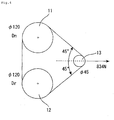
- Fig. 4 shows a layout of a belt running tester for durability evaluation of each V-ribbed belt.
- the belt running tester comprises large diameter rib pulleys (a coupled pulley 11 in the upper side and a driving pulley 12 in the lower side) arranged up and down and having a pulley diameter of 120 mm and a small diameter rib pulley 13 arranged in rightward in the middle of the up and down direction and having a diameter of 45 mm.
- the small diameter rib pulley 13 was positioned in a manner that the belt rolling angle was to be 90°.
- Each V-ribbed belt obtained in the above-mentioned manner was rolled around those three rib pulleys 11 to 13 and the small diameter rib pulley 13 was pulled sideward so as to apply 834N set weight and the belt running test was carried out by rotating the rib pulley 12 in the lower side, which was a drive pulley, at 4900 rpm rotation speed under atmospheric temperature of 23°C. The time until the belt was broken was measured and the time was defined as the belt bending life.
- the belts were produced simply.
- the belt of Comparative Example 1 was found generating moderate slip sound at the time of immersion in water and having belt bending life of 648 hours, however chloroprene was used, and it had a problem in terms of environmental issue.
- the belt of Comparative Example 2 was found generating large slip sound.
- the friction transmission belt of the present invention is preferably usable as a belt for motive power transmission such as a belt for driving of automobile's auxiliaries (dynamo, air conditioner, power steering and the like).
Landscapes
- Engineering & Computer Science (AREA)
- General Engineering & Computer Science (AREA)
- Mechanical Engineering (AREA)
- Compositions Of Macromolecular Compounds (AREA)
Abstract
The present invention provides a friction transmission belt in which slip noise caused at the time when a belt drive portion is immersed in water is suppressed and which has excellent bending fatigue strength and can be produced by simple working steps.
A friction transmission belt
which contains a compressed rubber layer containing an ethylene-α-olefin elastomer, short fibers, and silica and having a monolayer structure.
which contains a compressed rubber layer containing an ethylene-α-olefin elastomer, short fibers, and silica and having a monolayer structure.
Description
- The present invention relates to a friction transmission belt.
- In the friction transmission belt for motive power transmission to be used for auxiliary driving of automobiles, or the like, the slip sound generated conventionally at the time of belt driving is regarded as noise and thus it has been a problem to be improved for making automobile calm. There is one kind noise generated from the belt is slip noise caused at the time when water penetrates an engine room and the belt is immersed in water. As a technique to be employed conventionally for improving the slip sound at the time of immersion in water, there have been adding short fibers in the belt rib part or applying a water-repelling agent to the surface of the belt rib part.
- However, in the case of the transmission belt containing short fibers in the belt rib part, although the slip sound at the time of immersion in water can be improved by using short fibers, because the modulus of elasticity is quite different between the short fibers and rubber, the stress is converged upon the interface of the short fibers and rubber when bending fatigue affects the transmission belt and the interface becomes a cracking starting point and a crack is grown to shorten the product life.
- On the other hand, with respect to the method for applying a water-repelling agent to the belt rib part, the working steps for applying the water-repelling agent after the rib shape is formed are increased to cause a problem that the production cost of the belt is increased. Further, the water-repelling agent on the surface is difficult to exist stably due to the alteration with the lapse of time in the rib part and compressed rubber because of wear or the like.
Further, as another method besides the above-mentioned methods, it has been tried for suppressing slip sound at the time of immersion in water by adding silica to the rubber which is to be brought into contact with a pulley. - For example,
Patent Document 1 discloses a V-ribbed belt with improved noise occurrence because of slip caused at the time of water pouring by composing at least a portion of the rib part side surface using a rubber mixture containing an ethylene-α-olefin elastomer, silica, and short fibers. Here, there is disclosed only a belt having the rib part of a three-layer structure composed of a rubber layer containing no silica, a rubber layer containing silica, and a rubber layer containing no silica and in the case of partial formation of the rubber layer containing silica in the three-layer structure for the belt rib part, rubbers with different blending have to be used, which results in a problem of complication of the working steps. -
Patent Document 2 discloses a transmission belt with suppressed pressure sensitive adhesion wear without losing the reinforcing effect and decreased noise at the time of driving by using a chloroprene rubber composition containing prescribed amounts of surface treated silica, carbon black, a vulcanization promoting agent, a vulcanization agent, and short fibers for the compressed rubber layer and having specified physical properties.Patent Document 3 discloses a transmission belt made of rubber obtained by adding silica and co-crosslinking agent to hydrogenated nitrile rubber containing an unsaturated carboxylic acid metal salt and causing crosslinking by adding an organic peroxide. However, in these documents, there is no detailed description on the use of an ethylene-α-olefin elastomer for the compressed rubber layer. - Accordingly, with respect to a friction transmission belt for motive power transmission, it has been desired to develop a friction transmission belt whose production working steps are easy and which can suppress the slip noise generated at the time of immersion of the belt drive part in water and is excellent in the bending fatigue strength at the time of belt running.
-
- Patent Document 1:
Japanese Kokai Publication 2003-247604 - Patent Document 2:
Japanese Kokai Publication 2002-69240 - Patent Document 3:
Japanese Kokai Publication 2003-221470 - In view of the above state of the art, the present invention aims to provide a friction transmission belt in which slip noise caused at the time when a belt drive portion is immersed in water is suppressed and which has excellent bending fatigue strength and can be produced by simple working steps.
- The present invention provides a friction transmission belt
which contains a compressed rubber layer containing an ethylene-α-olefin elastomer, short fibers, and silica and having a monolayer structure. - The content of the above-mentioned short fibers is 5 to 25 parts by weight to 100 parts by weight of the above-mentioned ethylene-α-olefin elastomer, and the content of the above-mentioned silica is 5 parts by weight or higher and less than 60 parts by weight to 100 parts by weight of the above-mentioned ethylene-α-olefin elastomer, and the total content of the above-mentioned short fibers and silica is 30 to 65 parts by weight to 100 parts by weight of the ethylene-α-olefin elastomer.
The above-mentioned friction transmission belt is preferably a V-ribbed belt, a low edge belt, or a flat belt.
Hereinafter, the present invention will be described more in detail. - The present invention provides a friction transmission belt which contains a compressed rubber layer containing an ethylene-α-olefin elastomer, short fibers, and silica and having a monolayer structure. Accordingly, the friction transmission belt can suppress the slip noise generated at the time of immersion of the belt drive part in water and is excellent in the bending fatigue strength at the time of belt running. Further, the compressed rubber layer has a monolayer structure. Therefore, the belt can be produced simply as compared with a friction transmission belt comprising a compressed rubber layer of a multilayer structure such as a trilayer structure or the like.
- Generally, with respect to the friction transmission belt, although the slip sound at the time of immersion in water can be improved by adding short fibers in the belt rib part, cracking tends to occur when the bending fatigue affects the belt. In the present invention, the amount of the short fibers to be added to the compressed rubber layer is decreased and silica is added instead, so that portions where the stress convergence unevenly occurs when the belt receives bending power are lessened, which results in difficulty of occurrence of cracking and also the belt surface can be provided with proper roughness to suppress slip sound generation. Accordingly, the friction transmission belt of the present invention has both of excellent suppression of slip sound generation and bending fatigue strength.
- The water pouring slip sound generated in the case where the friction transmission belt is immersed in water is generated due to occurrence of stick slip because of existence of water in the interface of the compressed rubber layer surface and the pulley, and addition of the silica in the present invention coarsens the surface roughness of the compressed rubber surface, so that the water film at the time of such water pouring is scarcely formed and as a result, the slip at the time of water pouring is suppressed and generation of the water pouring slip sound can be suppressed.
- The above-mentioned compressed rubber layer contains the ethylene-α-olefin elastomer, short fibers, and silica.
The above-mentioned ethylene-α-olefin elastomer to be used may be rubbers made of copolymers of α-olefin excluding ethylene with ethylene and diene (non-conjugated diene), their partially halogen-substituted compounds; or mixtures of two or more kinds of these compounds. The α-olefin excluding ethylene to be used may be preferably at least one kind compound selected from propylene, butene, hexene, and octene. Among them, ethylene-propylene-diene type rubber (hereinafter, abbreviated as EPDM) is preferable in terms of capability of suppression of the slip sound and excellent bending fatigue strength. Further, their halogen substituted compounds and blends with other rubbers may be also usable. The diene type is preferably ethylidene norbornene (ENB) in terms of the effect of the present invention. Further, ethylene-propylene type rubber (EPR) containing no diene component may be also selected. - The ethylene content of the above-mentioned ethylene-α-olefin elastomer (the content of structural unit derived from ethylene in the ethylene-α-olefin elastomer) is preferably 55 to 70% by weight in 100% by weight of the total of ethylene-α-olefin and diene composing the above-mentioned ethylene-α-olefin-diene rubber. In the case of using the ethylene-α-olefin elastomer having the ethylene content in the above-mentioned range in combination with silica and short fibers, it is made possible to obtain high rubber hardness and sufficiently high belt hardness and at the same time water pouring slip sound can be sufficiently suppressed. Therefore, in the case of using the above-mentioned ethylene-α-olefin elastomer, the water pouring slip sound can be more preferably suppressed and at the same time, the friction transmission belt is provided with more excellent bending fatigue strength.
- If the above-mentioned ethylene content is lower than 55% by weight, the rubber may possibly become soft. If it exceeds 70% by weight, the rubber may become too hard to be used for the belt. The above-mentioned ethylene content is preferably 55 to 65% by weight.
- Examples of commercialized products of the above-mentioned ethylene-α-olefin elastomer are Nordel IP 4640 (manufactured by DuPont Dow Elastomer)
- Besides the above-mentioned ethylene-α-olefin elastomer, the above-mentioned compressed rubber layer may contain other polymers such as hydrogenated nitrile rubber, chloroprene rubber, natural rubber, CSM, and SBR to an extent that the effect of the present invention is not inhibited.
- Examples of the above-mentioned short fibers may be short fibers of
nylon 6, nylon 66, polyesters, cotton, and aramides.
The length, the shape and the like of the above-mentioned short fibers may be properly adjusted to improve the suppression of slip sound, and in general, the length of the above-mentioned short fibers is preferably 0.5 to 3.0 mm. - In the above-mentioned compressed rubber layer, the content of the above-mentioned short fibers is preferably 5 to 25 parts by weight to 100 parts by weight of the above-mentioned ethylene-α-olefin elastomer (on the basis of solid matter). If it is less than 5 parts by weight, the rubber may possibly become soft. If it exceeds 25 parts by weight, cracking tends to occur due to stress convergence when the bending fatigue affects the belt.
- The above-mentioned silica is not particularly limited and conventionally known ones can be used and examples thereof are dry silica, wet silica, and surface treated silica. The above-mentioned wet silica (hydrous silicic acid) can be generally obtained by a method of causing reaction of sodium silicate with a mineral acid and salts in an aqueous solution and as compared with dry silica, the wet silica has a large number of silanol groups in the front face and therefore has high polarity. Further, the wet silica has advantageous points that the cost is low as compared with that of the dry silica and the processability is good. The above-mentioned surface treated silica is provided with improved dispensability by surface treatment of dry silica or wet silica with a silane coupling agent.
- The content of the above-mentioned silica in the above-mentioned compressed rubber layer is preferably 5 parts by weight or higher and less than 60 parts by weight to 100 parts by weight of the above-mentioned ethylene-α-olefin elastomer (on the basis of solid matter) . Addition of silica in a content in the above-mentioned range makes it possible to satisfy both of excellent suppression of water pouring slip sound generation and bending fatigue strength. If it is less than 5 parts by weight, the rubber surface roughness becomes small and a water film may be formed to easily cause stick slip. If it is 60 parts by weight or higher, the rubber becomes too hard to cause cracks due to the bending fatigue by running and to shorten the belt life.
- In the above-mentioned compressed rubber layer, the total content of the above-mentioned silica and short fibers is preferably 30 to 65 parts by weight to 100 parts by weight of the above-mentioned ethylene-α-olefin elastomer (on the basis of solid matter). If the total content of the silica and short fibers is within the above-mentioned range, it is made possible to satisfy both of excellent suppression of water pouring slip sound generation and bending fatigue strength. If it is less than 30 parts by weight, no effect for suppressing the slip sound may be caused. If it exceeds 65 parts by weight, the bending life may be shortened. Adjustment of the contents of the silica and short fibers respectively, and the total content of the silica and short fibers in the above-mentioned ranges in the compressed rubber layer makes it possible to improve the slip sound suppression and the bending fatigue strength.
- The above-mentioned silica may be dispersed in the entire body of the above-mentioned compressed rubber layer. The fact that the silica is dispersed in the entire body of the compressed rubber layer means that the silica exists while being evenly dispersed in the above-mentioned compressed rubber layer of the monolayer structure but does not mean that the silica unevenly exists in the center part or the surface part in the compressed rubber layer. The compressed rubber layer in which the silica is dispersed entirely in such a manner can be obtained by producing the compressed rubber layer of a monolayer structure by a conventionally known method using a mixture containing the ethylene-α-olefin elastomer, short fibers, silica, and if necessary other components.
- The above-mentioned compressed rubber layer is preferable to contain a silane coupling agent. If silica is added, the rigidity is increased and cracking tends to occur, however addition of the silane coupling agent can suppress occurrence of cracking.
Examples of the above-mentioned silane coupling agent may be 3-aminopropyltriethoxysilane, 3-aminopropyltrimethoxysilane, N-β-(aminoethyl) γ-aminopropyltrimethoxysilane, 3-mercaptopropyltrimethoxysilane, γ-ureidopropyltriethoxysilane, 3-cyanopropyldimethylchlorosilane, 3-[N-allyl-N-(2-aminoethyl)]aminopropyltrimethoxysilane, P-[N-(2-aminoethyl)aminomethyl]phenetyltrimethoxysilane, N-(2-aminomethyl)-3-aminopropylmethyldimethoxysilane, 1-(3-aminopropyl)-1,1,3,3,3-pentamethyldisiloxane, 3-aminopropyltris(trimethylsiloxane)silane, α, ω-bis(3-aminopropyl)polydimethylsiloxane, α, ω-bis(3-aminopropyl)polydimethylsiloxane, 1,3-bis(3-aminopropyl)-1,1,3,3-tetramethyldisiloxane, α, ω-bis(mercaptomethyl)polydimethylsiloxane, α, ω-bis(mercaptomethyl)polydimethylsiloxane, 1,3-bis(mercaptomethyl)-1,1,3,3-tetramethyldisiloxane, α, ω-bis(3-mercaptopropyl)polydimethylsiloxane, α, ω-bis(3-mercaptopropyl)polydimethylsiloxane, 1,3-bis(3-mercaptomethyl)-1,1,3,3-tetramethyldisiloxane, N,N-bis[(methyldimethoxysilyl)propyl]amine, N,N-bis[3-(methyldimethoxysilyl)propyl]ethylenediamine, N,N-bis[3-(trimethoxysilyl)propyl]amine, N,N-bis[3-(trimethoxysilyl)propyl]ethylenediamine, 3-mercaptopropyltris(trimethylsiloxy)silane, 1-trimethoxysil-4,7,10-triazadecane, N-[(3-trimethoxysilyl)propyl]triethylenetetramine, and N-3-trimethoxysilylpropyl-m-phenylenediamine. - The content of the above-mentioned silane coupling agent is preferably 0.3 to 20 parts by weight and more preferably 0.3 to 8 parts by weight to 100 parts by weight of the above-mentioned ethylene-α-olefin elastomer (on the basis of solid matter) . If it is out of the above-mentioned range, the effect to suppress occurrence of cracking may not be caused sufficiently.
- The rubber mixture for forming the above-mentioned compressed rubber layer can be crosslinked by sulfur or a peroxide.
The above-mentioned peroxide for crosslinking is not particularly limited and common organic peroxides may be used and examples thereof are dicumyl peroxide, di-tert-butyl peroxide, tert-butylcumyl peroxide, benzoyl peroxide, 1,3-bis(tert-butylperoxyisopropyl)benzene, 2,5-dimethyl-2,5-di(tert-butylperoxy)hexine-3,2,5-dimethyl-2,5-(benzoylperoxy)hexane, and 2,5-dimethyl-2,5-mono(tert-butylperoxy)hexane.
The addition amount of the above-mentioned organic peroxide may be set properly in accordance with the functional group amount and the molecular weight of the organic peroxide, or diene amount of EPDM, however, in general, they may be added alone or in form of a mixture in an amount of 0.5 to 5 g to 100 g of the ethylene-α-olefin elastomer. - In the case of crosslinking by the peroxide, a crosslinking aid may also be added. Addition of the crosslinking aid is effective to increase the crosslinking density and thereby stabilize the adhesive power and prevent a problem such as pressure sensitive adhesion wear or the like. The above-mentioned crosslinking aid may be those which are used commonly for peroxide crosslinking and examples thereof may include triallyl isocyanurate (TAIC), triallyl cyanurate (TAC), 1, 2-polybutadiene, metal salts of unsaturated carboxylic acids, oximes, guanidine, trimethylolpropane trimethacrylate, ethylene glycol dimethacrylate, N,N'-m-phenylenebismaleimide, and sulfur.
- In the case of the sulfur vulcanization, the addition amount of sulfur is preferably 1 to 3 parts by weight to 100 parts by weight of the ethylene-α-olefin elastomer.
In the case of sulfur vulcanization, a vulcanization promoting agent may also be added. Addition of the vulcanization promoting agent can prevent the problem of pressure sensitive adhesion wear by increasing the crosslinking density. The above-mentioned vulcanization promoting agent may be those which are used commonly as a vulcanization promoting agent and examples thereof may be N-oxydiethylenebenzothiazole-2-sulfenamide (OBS), tetramethylthiuram disulfide (TMTD), tetraethylthiuram disulfide (TETD), zinc dimethyldithiocarbamate (ZnMDC), zinc diethyldithiocarbamate (ZnEDC), N-cyclohexylbenzothiazole-2-sulfenamide, and 2-mercaptobenzothiazole, and dibenzothiazolyldisulfide. - The mixture containing ethylene-α-olefin elastomer, short fibers, and silica for forming the above-mentioned compressed rubber layer in the present invention may contain, if necessary, various kinds of chemical agents to be used commonly in rubber industries, e.g. fillers such as carbon black, calcium carbonate, and talc; plasticizers, stabilizers, processing aids, aging prevention agents, and coloring agents, in combination with these components.
- The mixture for forming the compressed rubber layer can be obtained by evenly mixing the indispensable components such as the ethylene-α-olefin elastomer with the above-mentioned chemical agents by common mixing means such as rolls and a Bumbury's mixer, if necessary.
- In the friction transmission belt of the present invention, the compressed rubber layer has a monolayer structure. The monolayer structure means the compressed rubber layer is formed in form of a single rubber layer. The above-mentioned compressed rubber layer of the monolayer structure can be obtained by forming a compressed rubber layer using one kind mixture containing the ethylene-α-olefin elastomer, short fibers, silica, and if necessary other components.
- Examples of the friction transmission belt of the present invention may include those each of which comprises the above-mentioned compressed rubber layer, an adhesive rubber layer being in contact with the compressed rubber layer and containing core wires embedded along the longitudinal direction of the belt, and a top canvas layer being in contact with the adhesive rubber layer.
The friction transmission belt of the present invention may include those which do not have the above-mentioned adhesive rubber layer. - The rubber components to be used for forming the adhesive rubber layer may be those same as exemplified for the compressed rubber layer.
The mixture for forming the adhesive rubber layer may further contain the above-mentioned other components similarly to the case of the above-mentioned compressed rubber layer. The mixture for forming the adhesive rubber layer can be obtained in the same manner as the method for the above-mentioned compressed rubber layer. - Examples of the top canvas layer to be used may be cloths fabricated in plain weave fabrics, twill fabrics, satin fabrics using yarns of cotton, polyamides, polyethylene phthalate, aramide fibers.
The above-mentioned core wires to be used may be preferably polyester core wires, nylon core wires, vinylon core wires, aramide core wires and the like, and among them, examples of the polyester core wires are preferably polyethylene terephthalate and polyethylene naphthalate and examples of the nylon core wires are preferably 6,6-nylon (polyhexamethylene adipamide) and 6 nylon. Examples of the aramide core wires to be used are preferably copoly(p-phenylene)-3,4'-oxydiphenylene-terephthalamide, poly(p-phenylene terephthalamide), and poly(m-phenylene isophthalamide). These core wires are preferable to be embedded in the above-mentioned adhesive rubber layer after being subjected to adhesion treatment with a resorcin-formalin-latex adhesive composition (hereinafter, referred to as RFL adhesive in some cases). - The friction transmission belt of the present invention is preferably a V-ribbed belt, a low edge belt or a flat belt.
Examples of the V-ribbed belt, low edge belt or flat belt may be described with reference to Figs 1 to 3. - Figure 1 is a transverse cross-sectional view (sectional plane perpendicular to the longitudinal direction of a belt) of an example of a V-ribbed belt of the present invention, and on the top face of the belt, a
top canvas layer 1 of a single layer or multilayer is formed, and theadhesive rubber layer 3 is laminated adjacent to the inside the canvas layer. In thisadhesive rubber layer 3, a plurality ofcore wires 2 of low elongation consisting of fiber code are embedded at some spaces along the longitudinal direction of the belt. Further, thecompressed rubber layer 5 having a monolayer structure is laminated adjacent to the inside this adhesive rubber layer. This compressed rubber layer is formed on ribs 4 that are spaced to each other along the longitudinal direction of the belt. In thecompressed rubber layer 5,short fibers 6 are dispersed with the fiber being oriented to the direction of width of the belt in order to enhance side pressure resistance. - Figure 2 is a transverse cross-sectional view of an example of a low edge belt of the present invention, and on the top face of the belt, a
top canvas layer 1 of a single layer or multilayer is formed as with the above case and anupper rubber layer 7 is laminated as required, and theadhesive rubber layer 3 in which thecore wires 2 are embedded is laminated adjacent to the inside the upper rubber layer as with the above case. Further, thecompressed rubber layer 5 is laminated adjacent to the inside this adhesive rubber layer. In many cases, in thecompressed rubber layer 5,short fibers 6 are dispersed with the fiber being oriented to the direction of width of the belt in order to enhance side pressure resistance. Atop canvas layer 1 of a single layer or multilayer is generally laminated adjacent to the inside the compressed rubber layer.
Figure 3 is a transverse cross-sectional view of an example of a flat belt of the present invention, and thetop canvas layer 1, theadhesive rubber layer 3 and thecompressed rubber layer 5 having a monolayer structure are laminated as with the above case. - The friction transmission belt in accordance with the present invention can be manufactured by ordinary methods hitherto known. For example, taking a V-ribbed belt for an example, after a sheet of or a plurality of top canvases and unvulcanized sheets of a rubber compound for a adhesive rubber layer are wound around the side of a cylindrical forming drum with a smooth surface, a polyester core wire is spun in a spiral manner around these sheets, and an unvulcanized sheet of a rubber compound for a adhesive rubber layer is wound thereon and then an unvulcanized sheet of a rubber compound for a compressed rubber layer is further wound to form a laminate. This laminate is heated and pressurized in a vulcanizer to be vulcanized to obtain an annular substance. Next, this annular substance is looped between a drive pulley and a driven pulley and a plurality of ribs are formed on the surface with a grinding wheel while running the belt under a prescribed tension. Thereafter, this annular substance is further looped between other drive pulley and other driven pulley and cut to the prescribed width while running the belt to obtain a V-ribbed belt as a product.
- With respect to the friction transmission belt of the present invention, the compressed rubber layer contains the ethylene-α-olefin elastomer, silica, and short fibers and has a monolayer structure. Therefore, the belt can maintain strength necessary for a belt, suppress occurrence of cracking at the time of running, and improve the belt slip sound at the time of immersion in water while keeping the bending life. Further, the belt can be produced easily.
- Since the friction transmission belt of the present invention has the above-mentioned configuration, the belt can suppress the slip sound generated at the time of immersion in water and is excellent in the bending fatigue strength. Further, the belt can be produced by simple working steps. Accordingly, the friction transmission belt of the present invention is preferably usable as a belt for motive power transmission such as a belt for driving of automobile' s auxiliaries (dynamo, air conditioner, power steering and the like).
- Hereinafter, the present invention will be described in more detail with reference to Examples, however it is not intended that the present invention be limited to the illustrated Examples. In descriptions of Examples, "part" and "%" respectively means "part by weight" and "% by weight" unless otherwise specified.
- An unvulcanized sheet of a rubber compound for a compressed rubber layer was firstly produced from a mixture composition shown in Table 1. Amounts of mixture composition shown in Table 1 are indicated in "parts by weight".
Commercialized products employed were as follows. ethylene-propylene-diene rubber (EPDM): - Nordel IP 4640 (ethylene content 55%, diene type ENB, manufactured by DuPont Dow Elastomer)
- Chloroprene rubber (CR): Neoprene GRT (sulfur-modified type chloroprene rubber, manufactured by DuPont Dow Elastomer)
- Carbon black: HAF Carbon (manufactured by Mitsubishi Chemical Corporation)
- Silica: Tokusil GU (manufactured by Tokuyama Corporation) Silane coupling agent: Si-69 (manufactured by Degussa) Softening agent: Sunflex 2280 (paraffin oil, manufactured by Japan Sun Kagaku K.K.)
- Vulcanization aid: stearic acid (manufactured by Kao Corporation), zinc oxide (manufactured by Sakai Chemical Industry Co., Ltd.)
- Aging prevention agent: Nocrac 224 (manufactured by Ouchi Shinko Chemical Industrial Co., Ltd.)
- Organic peroxide: Percumyl D (dicumyl peroxide, manufactured by NOF Corporation)
- Short fiber: 66 nylon fibers, 6 de x 1 mm
- With respect to the adhesive rubber layer, the following components were mixed and kneaded by a Bumbury's mixer and rolled with calendar rolls and a unvulcanized sheet of a rubber compound for an adhesive rubber layer was produced in the same manner.
Ethylene-propylene-diene rubber (ethylene content 56% by weight, propylene content 36.1% by weight, ethylidene norbornene (ENB) 5.5% by weight, dicyclopentadiene (DCPD) 2.4% by weight, Mooney viscosity ML1+4 (100°C) 60) 100 parts by weight HAF carbon (manufactured by Mitsubishi Chemical Corporation) 50 parts by weight
Silica: Tokusil GU (manufactured by Tokuyama Corporation) 20 parts by weight
Paraffin oil (Sunflex 2280, manufactured by Japan Sun Kagaku K.K.) 20 parts by weight
Vulcanization agent (oil sulfur, manufactured by Hosoi Kagaku K.K.) 3 parts by weight, Vulcanization promoting agent (DM, manufactured by Ouchi Shinko Chemical Industrial Co., Ltd.) 1.4 parts by weight
Vulcanization promoting agent (EZ, manufactured by OuchiShinko Chemical Industrial Co., Ltd.) 0.6 parts by weight Vulcanization promoting agent (TT, manufactured by Ouchi Shinko Chemical Industrial Co., Ltd.) 0.6 parts by weight
Vulcanization aid (stearic acid, manufactured by Kao Corporation) 1 part by weight
Vulcanization aid (zinc oxide, manufactured by Sakai Chemical Industry Co., Ltd.) 5 parts by weight
Aging prevention agent (Nocrac 224 manufactured by Ouchi Shinko Chemical Industrial Co., Ltd.) 2 parts by weight
Aging prevention agent (MB, manufactured by Ouchi Shinko Chemical Industrial Co., Ltd.) 1 part by weight Tackifier (Petroleum Resin Quintone A-100, manufactured by Zeon Corporation) 5 parts by weight - After a canvas and the above-mentioned unvulcanized sheet of a rubber compound for an adhesive rubber layer were wound around the side of a cylindrical forming drum with a smooth surface, polyester core wires (polyester cord, 1000 denier/2 x 3, upper twist 9.5T/10 cm (Z) was spun in a spiral manner around these sheets. Further, the above-mentioned unvulcanized sheet of a rubber compound for an adhesive rubber layer were wound thereon, and then the unvulcanized sheet of a rubber compound for a compressed rubber layer was wound around this to obtain a laminate. This laminate was heated and pressurized at an internal pressure of 6 kgf/cm2 and an external pressure of 9 kgf/cm2 at a temperature of 165°C for 35 minutes in a vulcanizer and vulcanized it by steam to obtain an annular substance. Next, this annular substance was mounted on a first drive system comprising a drive roll and a driven roll and a plurality of ribs are formed on the surface with a grinding wheel while running the belt under a prescribed tension. Thereafter, this annular substance was further mounted on a second drive system comprising other drive roll and driven roll and cut to the prescribed width while running the belt to obtain a V-ribbed belt (the compressed rubber layer had a monolayer structure) having three ribs and a peripheral length of 1000 mm as a product.
- Each V-ribbed belt obtained in the above-mentioned manner was subjected to the evaluations of belt bending life and slip sound by the following methods. The respective results are shown in Table 1.
- Fig. 4 shows a layout of a belt running tester for durability evaluation of each V-ribbed belt. The belt running tester comprises large diameter rib pulleys (a coupled
pulley 11 in the upper side and a drivingpulley 12 in the lower side) arranged up and down and having a pulley diameter of 120 mm and a smalldiameter rib pulley 13 arranged in rightward in the middle of the up and down direction and having a diameter of 45 mm. The smalldiameter rib pulley 13 was positioned in a manner that the belt rolling angle was to be 90°.
Each V-ribbed belt obtained in the above-mentioned manner was rolled around those threerib pulleys 11 to 13 and the smalldiameter rib pulley 13 was pulled sideward so as to apply 834N set weight and the belt running test was carried out by rotating therib pulley 12 in the lower side, which was a drive pulley, at 4900 rpm rotation speed under atmospheric temperature of 23°C. The time until the belt was broken was measured and the time was defined as the belt bending life. - In Fig. 4, during the running of the belt, when water was poured to the drive pulley 12 (2000 cc/minute), generation of slip sound was evaluated.
-
Table 1 Example 1 Example 2 Example 3 Example 4 Example 5 Comparative Example 1 Comparative Example 2 EPDM 100 100 100 100 100 100 CR 100 carbon black (HAF) 30 30 30 30 30 30 30 silica 30 4 60 30 30 50 50 silane coupling agent 5 0.4 6 3 3 5 5 softening agent 14 14 14 14 14 14 plasticizer 5 zinc oxide 5 5 5 5 5 5 5 stearic acid 1 1 1 1 1 1 1 aging prevention agent 2.5 2.5 2.5 2.5 2.5 2.5 2.5 organic peroxide 2.5 2.5 2.5 2.5 2.5 2.5 MgO 4 short fibers 15 15 15 3 30 15 0 slip sound in the case of immersion in water none moderate none moderate none moderate large belt bending life (hours) 1000 or longer 1000 or longer 768 1000 or longer 600 648 1000 or longer - The friction transmission belt of the present invention is preferably usable as a belt for motive power transmission such as a belt for driving of automobile's auxiliaries (dynamo, air conditioner, power steering and the like).
-
- Fig. 1 shows a transverse cross-sectional view of one example of a V-ribbed belt.
- Fig. 2 shows a transverse cross-sectional view of one example of a low edge belt.
- Fig. 3 shows a transverse cross-sectional view of one example of a flat belt.
- Fig. 4 shows a layout of a belt running test apparatus.
-
- 1. top canvas layer
- 2. core wires
- 3. adhesive rubber layer
- 4. ribs
- 5. compressed rubber layer
- 6. short fibers
- 7. top rubber layer
- 11. driven pulley
- 12. drive pulley
- 13. rib pulley
Claims (3)
- A friction transmission belt
which contains a compressed rubber layer containing an ethylene-α-olefin elastomer, short fibers, and silica and having a monolayer structure. - The friction transmission belt according to claim 1,
wherein the content of short fibers is 5 to 25 parts by weight to 100 parts by weight of the ethylene-α-olefin elastomer, and the content of the silica is 5 parts by weight or higher and less than 60 parts by weight to 100 parts by weight of the ethylene-α-olefin elastomer, and the total content of the short fibers and silica is 30 to 65 parts by weight to 100 parts by weight of the ethylene-α-olefin elastomer. - The friction transmission belt according to claim 1 or 2, being a V-ribbed belt, a low edge belt, or a flat belt.
Applications Claiming Priority (2)
| Application Number | Priority Date | Filing Date | Title |
|---|---|---|---|
| JP2005005498A JP2006194322A (en) | 2005-01-12 | 2005-01-12 | Friction transmission belt |
| PCT/JP2006/300185 WO2006075598A1 (en) | 2005-01-12 | 2006-01-11 | Friction transmission belt |
Publications (1)
| Publication Number | Publication Date |
|---|---|
| EP1845284A1 true EP1845284A1 (en) | 2007-10-17 |
Family
ID=36677623
Family Applications (1)
| Application Number | Title | Priority Date | Filing Date |
|---|---|---|---|
| EP06711534A Withdrawn EP1845284A1 (en) | 2005-01-12 | 2006-01-11 | Friction transmission belt |
Country Status (6)
| Country | Link |
|---|---|
| US (1) | US20100167861A1 (en) |
| EP (1) | EP1845284A1 (en) |
| JP (1) | JP2006194322A (en) |
| KR (1) | KR20070099605A (en) |
| CN (1) | CN101099052A (en) |
| WO (1) | WO2006075598A1 (en) |
Cited By (1)
| Publication number | Priority date | Publication date | Assignee | Title |
|---|---|---|---|---|
| EP3144559A4 (en) * | 2014-05-16 | 2018-02-14 | Nitta Corporation | Endless flat belt and method for manufacturing same |
Families Citing this family (10)
| Publication number | Priority date | Publication date | Assignee | Title |
|---|---|---|---|---|
| DE112010000879B4 (en) * | 2009-02-24 | 2019-05-09 | Bando Chemical Industries, Ltd. | Friction drive belts |
| US9157503B2 (en) * | 2013-03-14 | 2015-10-13 | Dayco Ip Holdings, Llc | V-ribbed belt with spaced rib flank reinforcement |
| JP6055430B2 (en) * | 2013-03-29 | 2016-12-27 | 三ツ星ベルト株式会社 | Transmission belt |
| JP6275585B2 (en) * | 2013-08-30 | 2018-02-07 | 三ツ星ベルト株式会社 | Toothed belt |
| CN110799770B (en) * | 2017-07-19 | 2020-09-01 | 阪东化学株式会社 | Transmission belt and method of making the same |
| DE102017220469A1 (en) * | 2017-11-16 | 2019-05-16 | Contitech Antriebssysteme Gmbh | Method of adhering a textile material to an elastomer |
| JP6626226B2 (en) * | 2018-02-15 | 2019-12-25 | 三ツ星ベルト株式会社 | V-ribbed belt and method of using the same |
| AU2019347769B2 (en) * | 2018-09-27 | 2022-12-01 | Gates Corporation | High-efficiency belt and method of manufacturing the same |
| JP7532107B2 (en) * | 2019-06-28 | 2024-08-13 | 三ツ星ベルト株式会社 | Rubber composition, its manufacturing method, and transmission belt |
| CN116348542B (en) * | 2021-07-07 | 2023-12-15 | 阪东化学株式会社 | Crosslinked rubber composition and friction transmission belt using same |
Family Cites Families (7)
| Publication number | Priority date | Publication date | Assignee | Title |
|---|---|---|---|---|
| JP2002069240A (en) | 2000-08-28 | 2002-03-08 | Mitsuboshi Belting Ltd | Chloroprene rubber composition and transmission belt using the same |
| WO2002084144A1 (en) * | 2001-04-12 | 2002-10-24 | The Gates Corporation | Thermoplastic jacket belt |
| JP2003221470A (en) | 2001-11-21 | 2003-08-05 | Mitsuboshi Belting Ltd | Rubber composition for power transmission belt and power transmission belt |
| JP2003247604A (en) | 2002-02-27 | 2003-09-05 | Mitsuboshi Belting Ltd | V ribbed belt |
| US7037578B2 (en) * | 2002-12-11 | 2006-05-02 | The Goodyear Tire & Rubber Company | Power transmission belt |
| JP2004292735A (en) * | 2003-03-28 | 2004-10-21 | Mitsuboshi Belting Ltd | Method for producing bonded body of ethylene / α-olefin rubber composition and fiber and power transmission belt |
| US7056250B2 (en) * | 2003-04-14 | 2006-06-06 | The Goodyear Tire & Rubber Company | Power transmission belt containing short high molecular weight polyacrylonitrile fiber |
-
2005
- 2005-01-12 JP JP2005005498A patent/JP2006194322A/en active Pending
-
2006
- 2006-01-11 WO PCT/JP2006/300185 patent/WO2006075598A1/en not_active Ceased
- 2006-01-11 US US11/721,511 patent/US20100167861A1/en not_active Abandoned
- 2006-01-11 EP EP06711534A patent/EP1845284A1/en not_active Withdrawn
- 2006-01-11 KR KR1020077015986A patent/KR20070099605A/en not_active Withdrawn
- 2006-01-11 CN CNA200680001799XA patent/CN101099052A/en active Pending
Non-Patent Citations (1)
| Title |
|---|
| See references of WO2006075598A1 * |
Cited By (1)
| Publication number | Priority date | Publication date | Assignee | Title |
|---|---|---|---|---|
| EP3144559A4 (en) * | 2014-05-16 | 2018-02-14 | Nitta Corporation | Endless flat belt and method for manufacturing same |
Also Published As
| Publication number | Publication date |
|---|---|
| WO2006075598A1 (en) | 2006-07-20 |
| CN101099052A (en) | 2008-01-02 |
| JP2006194322A (en) | 2006-07-27 |
| US20100167861A1 (en) | 2010-07-01 |
| KR20070099605A (en) | 2007-10-09 |
Similar Documents
| Publication | Publication Date | Title |
|---|---|---|
| EP3587859B1 (en) | Transmission belt | |
| KR101598509B1 (en) | Friction transmission belt | |
| EP1000118B1 (en) | Power transmission belt | |
| US20100167861A1 (en) | Friction transmission belt | |
| EP1845285B1 (en) | Friction transmission belt | |
| JPWO2006112386A1 (en) | Friction transmission belt and manufacturing method thereof | |
| CN108884907A (en) | Friction belt for power transmission | |
| US20090298632A1 (en) | Friction transmission belt | |
| JP4837274B2 (en) | Transmission belt | |
| WO2006001408A1 (en) | Power transmission belt | |
| JP2008304053A (en) | Friction transmission belt | |
| JP2003130137A (en) | Transmission belt and manufacturing method thereof | |
| WO2018016557A1 (en) | Transmission v-belt | |
| JP5416566B2 (en) | Friction transmission belt | |
| JP2006322483A (en) | Transmission belt | |
| JP4820107B2 (en) | Transmission belt | |
| JP4886223B2 (en) | Transmission belt | |
| JP2006029493A (en) | V-ribbed belt | |
| JP2007262147A (en) | Rubber composition and transmission belt | |
| JP6764047B1 (en) | Wrapped V-belt | |
| JP4416060B2 (en) | Power transmission belt | |
| JP2008291992A (en) | Friction transmission belt | |
| JP5416601B2 (en) | Friction transmission belt | |
| JP2007333059A (en) | Transmission belt |
Legal Events
| Date | Code | Title | Description |
|---|---|---|---|
| PUAI | Public reference made under article 153(3) epc to a published international application that has entered the european phase |
Free format text: ORIGINAL CODE: 0009012 |
|
| 17P | Request for examination filed |
Effective date: 20070810 |
|
| AK | Designated contracting states |
Kind code of ref document: A1 Designated state(s): DE |
|
| RIN1 | Information on inventor provided before grant (corrected) |
Inventor name: SHIRIIKE, HIROYUKI Inventor name: TACHIBANA, HIROYUKI Inventor name: YOSHIDA, YASUHIKO |
|
| DAX | Request for extension of the european patent (deleted) | ||
| RBV | Designated contracting states (corrected) |
Designated state(s): DE |
|
| STAA | Information on the status of an ep patent application or granted ep patent |
Free format text: STATUS: THE APPLICATION HAS BEEN WITHDRAWN |
|
| 18W | Application withdrawn |
Effective date: 20091203 |