EP1844044B1 - Thiazole-4-carboxamide derivatives as mglur5 antagonists - Google Patents
Thiazole-4-carboxamide derivatives as mglur5 antagonists Download PDFInfo
- Publication number
- EP1844044B1 EP1844044B1 EP06701375A EP06701375A EP1844044B1 EP 1844044 B1 EP1844044 B1 EP 1844044B1 EP 06701375 A EP06701375 A EP 06701375A EP 06701375 A EP06701375 A EP 06701375A EP 1844044 B1 EP1844044 B1 EP 1844044B1
- Authority
- EP
- European Patent Office
- Prior art keywords
- methyl
- thiazole
- carboxylic acid
- amide
- pyridin
- Prior art date
- Legal status (The legal status is an assumption and is not a legal conclusion. Google has not performed a legal analysis and makes no representation as to the accuracy of the status listed.)
- Expired - Lifetime
Links
- 0 CCOC(c1c(N)[s]c(*)n1)=O Chemical compound CCOC(c1c(N)[s]c(*)n1)=O 0.000 description 7
- FINAXYSMTLVVOE-UHFFFAOYSA-N Cc([s]1)nc(C(OC)=O)c1Br Chemical compound Cc([s]1)nc(C(OC)=O)c1Br FINAXYSMTLVVOE-UHFFFAOYSA-N 0.000 description 1
Classifications
-
- C—CHEMISTRY; METALLURGY
- C07—ORGANIC CHEMISTRY
- C07D—HETEROCYCLIC COMPOUNDS
- C07D277/00—Heterocyclic compounds containing 1,3-thiazole or hydrogenated 1,3-thiazole rings
- C07D277/02—Heterocyclic compounds containing 1,3-thiazole or hydrogenated 1,3-thiazole rings not condensed with other rings
- C07D277/20—Heterocyclic compounds containing 1,3-thiazole or hydrogenated 1,3-thiazole rings not condensed with other rings having two or three double bonds between ring members or between ring members and non-ring members
- C07D277/32—Heterocyclic compounds containing 1,3-thiazole or hydrogenated 1,3-thiazole rings not condensed with other rings having two or three double bonds between ring members or between ring members and non-ring members with hetero atoms or with carbon atoms having three bonds to hetero atoms with at the most one bond to halogen, e.g. ester or nitrile radicals, directly attached to ring carbon atoms
- C07D277/56—Carbon atoms having three bonds to hetero atoms with at the most one bond to halogen
-
- C—CHEMISTRY; METALLURGY
- C07—ORGANIC CHEMISTRY
- C07D—HETEROCYCLIC COMPOUNDS
- C07D277/00—Heterocyclic compounds containing 1,3-thiazole or hydrogenated 1,3-thiazole rings
- C07D277/02—Heterocyclic compounds containing 1,3-thiazole or hydrogenated 1,3-thiazole rings not condensed with other rings
- C07D277/20—Heterocyclic compounds containing 1,3-thiazole or hydrogenated 1,3-thiazole rings not condensed with other rings having two or three double bonds between ring members or between ring members and non-ring members
- C07D277/32—Heterocyclic compounds containing 1,3-thiazole or hydrogenated 1,3-thiazole rings not condensed with other rings having two or three double bonds between ring members or between ring members and non-ring members with hetero atoms or with carbon atoms having three bonds to hetero atoms with at the most one bond to halogen, e.g. ester or nitrile radicals, directly attached to ring carbon atoms
- C07D277/38—Nitrogen atoms
- C07D277/42—Amino or imino radicals substituted by hydrocarbon or substituted hydrocarbon radicals
-
- A—HUMAN NECESSITIES
- A61—MEDICAL OR VETERINARY SCIENCE; HYGIENE
- A61K—PREPARATIONS FOR MEDICAL, DENTAL OR TOILETRY PURPOSES
- A61K31/00—Medicinal preparations containing organic active ingredients
- A61K31/33—Heterocyclic compounds
- A61K31/395—Heterocyclic compounds having nitrogen as a ring hetero atom, e.g. guanethidine or rifamycins
- A61K31/41—Heterocyclic compounds having nitrogen as a ring hetero atom, e.g. guanethidine or rifamycins having five-membered rings with two or more ring hetero atoms, at least one of which being nitrogen, e.g. tetrazole
- A61K31/415—1,2-Diazoles
-
- A—HUMAN NECESSITIES
- A61—MEDICAL OR VETERINARY SCIENCE; HYGIENE
- A61P—SPECIFIC THERAPEUTIC ACTIVITY OF CHEMICAL COMPOUNDS OR MEDICINAL PREPARATIONS
- A61P13/00—Drugs for disorders of the urinary system
- A61P13/02—Drugs for disorders of the urinary system of urine or of the urinary tract, e.g. urine acidifiers
-
- A—HUMAN NECESSITIES
- A61—MEDICAL OR VETERINARY SCIENCE; HYGIENE
- A61P—SPECIFIC THERAPEUTIC ACTIVITY OF CHEMICAL COMPOUNDS OR MEDICINAL PREPARATIONS
- A61P25/00—Drugs for disorders of the nervous system
-
- A—HUMAN NECESSITIES
- A61—MEDICAL OR VETERINARY SCIENCE; HYGIENE
- A61P—SPECIFIC THERAPEUTIC ACTIVITY OF CHEMICAL COMPOUNDS OR MEDICINAL PREPARATIONS
- A61P25/00—Drugs for disorders of the nervous system
- A61P25/04—Centrally acting analgesics, e.g. opioids
-
- A—HUMAN NECESSITIES
- A61—MEDICAL OR VETERINARY SCIENCE; HYGIENE
- A61P—SPECIFIC THERAPEUTIC ACTIVITY OF CHEMICAL COMPOUNDS OR MEDICINAL PREPARATIONS
- A61P25/00—Drugs for disorders of the nervous system
- A61P25/08—Antiepileptics; Anticonvulsants
-
- A—HUMAN NECESSITIES
- A61—MEDICAL OR VETERINARY SCIENCE; HYGIENE
- A61P—SPECIFIC THERAPEUTIC ACTIVITY OF CHEMICAL COMPOUNDS OR MEDICINAL PREPARATIONS
- A61P25/00—Drugs for disorders of the nervous system
- A61P25/14—Drugs for disorders of the nervous system for treating abnormal movements, e.g. chorea, dyskinesia
-
- A—HUMAN NECESSITIES
- A61—MEDICAL OR VETERINARY SCIENCE; HYGIENE
- A61P—SPECIFIC THERAPEUTIC ACTIVITY OF CHEMICAL COMPOUNDS OR MEDICINAL PREPARATIONS
- A61P25/00—Drugs for disorders of the nervous system
- A61P25/18—Antipsychotics, i.e. neuroleptics; Drugs for mania or schizophrenia
-
- A—HUMAN NECESSITIES
- A61—MEDICAL OR VETERINARY SCIENCE; HYGIENE
- A61P—SPECIFIC THERAPEUTIC ACTIVITY OF CHEMICAL COMPOUNDS OR MEDICINAL PREPARATIONS
- A61P25/00—Drugs for disorders of the nervous system
- A61P25/22—Anxiolytics
-
- A—HUMAN NECESSITIES
- A61—MEDICAL OR VETERINARY SCIENCE; HYGIENE
- A61P—SPECIFIC THERAPEUTIC ACTIVITY OF CHEMICAL COMPOUNDS OR MEDICINAL PREPARATIONS
- A61P25/00—Drugs for disorders of the nervous system
- A61P25/24—Antidepressants
-
- A—HUMAN NECESSITIES
- A61—MEDICAL OR VETERINARY SCIENCE; HYGIENE
- A61P—SPECIFIC THERAPEUTIC ACTIVITY OF CHEMICAL COMPOUNDS OR MEDICINAL PREPARATIONS
- A61P25/00—Drugs for disorders of the nervous system
- A61P25/28—Drugs for disorders of the nervous system for treating neurodegenerative disorders of the central nervous system, e.g. nootropic agents, cognition enhancers, drugs for treating Alzheimer's disease or other forms of dementia
-
- A—HUMAN NECESSITIES
- A61—MEDICAL OR VETERINARY SCIENCE; HYGIENE
- A61P—SPECIFIC THERAPEUTIC ACTIVITY OF CHEMICAL COMPOUNDS OR MEDICINAL PREPARATIONS
- A61P25/00—Drugs for disorders of the nervous system
- A61P25/30—Drugs for disorders of the nervous system for treating abuse or dependence
- A61P25/32—Alcohol-abuse
-
- A—HUMAN NECESSITIES
- A61—MEDICAL OR VETERINARY SCIENCE; HYGIENE
- A61P—SPECIFIC THERAPEUTIC ACTIVITY OF CHEMICAL COMPOUNDS OR MEDICINAL PREPARATIONS
- A61P25/00—Drugs for disorders of the nervous system
- A61P25/30—Drugs for disorders of the nervous system for treating abuse or dependence
- A61P25/34—Tobacco-abuse
-
- A—HUMAN NECESSITIES
- A61—MEDICAL OR VETERINARY SCIENCE; HYGIENE
- A61P—SPECIFIC THERAPEUTIC ACTIVITY OF CHEMICAL COMPOUNDS OR MEDICINAL PREPARATIONS
- A61P25/00—Drugs for disorders of the nervous system
- A61P25/30—Drugs for disorders of the nervous system for treating abuse or dependence
- A61P25/36—Opioid-abuse
-
- A—HUMAN NECESSITIES
- A61—MEDICAL OR VETERINARY SCIENCE; HYGIENE
- A61P—SPECIFIC THERAPEUTIC ACTIVITY OF CHEMICAL COMPOUNDS OR MEDICINAL PREPARATIONS
- A61P27/00—Drugs for disorders of the senses
- A61P27/02—Ophthalmic agents
-
- A—HUMAN NECESSITIES
- A61—MEDICAL OR VETERINARY SCIENCE; HYGIENE
- A61P—SPECIFIC THERAPEUTIC ACTIVITY OF CHEMICAL COMPOUNDS OR MEDICINAL PREPARATIONS
- A61P3/00—Drugs for disorders of the metabolism
-
- A—HUMAN NECESSITIES
- A61—MEDICAL OR VETERINARY SCIENCE; HYGIENE
- A61P—SPECIFIC THERAPEUTIC ACTIVITY OF CHEMICAL COMPOUNDS OR MEDICINAL PREPARATIONS
- A61P3/00—Drugs for disorders of the metabolism
- A61P3/04—Anorexiants; Antiobesity agents
-
- A—HUMAN NECESSITIES
- A61—MEDICAL OR VETERINARY SCIENCE; HYGIENE
- A61P—SPECIFIC THERAPEUTIC ACTIVITY OF CHEMICAL COMPOUNDS OR MEDICINAL PREPARATIONS
- A61P43/00—Drugs for specific purposes, not provided for in groups A61P1/00-A61P41/00
-
- C—CHEMISTRY; METALLURGY
- C07—ORGANIC CHEMISTRY
- C07D—HETEROCYCLIC COMPOUNDS
- C07D417/00—Heterocyclic compounds containing two or more hetero rings, at least one ring having nitrogen and sulfur atoms as the only ring hetero atoms, not provided for by group C07D415/00
- C07D417/02—Heterocyclic compounds containing two or more hetero rings, at least one ring having nitrogen and sulfur atoms as the only ring hetero atoms, not provided for by group C07D415/00 containing two hetero rings
- C07D417/12—Heterocyclic compounds containing two or more hetero rings, at least one ring having nitrogen and sulfur atoms as the only ring hetero atoms, not provided for by group C07D415/00 containing two hetero rings linked by a chain containing hetero atoms as chain links
-
- C—CHEMISTRY; METALLURGY
- C07—ORGANIC CHEMISTRY
- C07D—HETEROCYCLIC COMPOUNDS
- C07D417/00—Heterocyclic compounds containing two or more hetero rings, at least one ring having nitrogen and sulfur atoms as the only ring hetero atoms, not provided for by group C07D415/00
- C07D417/14—Heterocyclic compounds containing two or more hetero rings, at least one ring having nitrogen and sulfur atoms as the only ring hetero atoms, not provided for by group C07D415/00 containing three or more hetero rings
Definitions
- the present invention is concerned with novel thiazole 4-carboxyamide derivatives of the general formula (I) useful as metabotropic glutamate receptor antagonists: wherein
- WO2002068417 and WO9805651 already described a broad family of compounds useful as group I metabotropic glutamate receptor antagonists without disclosing the compounds of the instant invention.
- the transmission of stimuli takes place by the interaction of a neurotransmitter, which is sent out by a neuron, with a neuroreceptor.
- the compounds of general formula I are metabotropic glutamate receptor antagonists.
- Compounds of formula I are distinguished by having valuable therapeutic properties. They can be used in the treatment or prevention of mGluR5 receptor mediated disorders.
- Glutamate is the major excitatory neurotransmitter in the brain and plays a unique role in a variety of central nervous system (CNS) functions.
- the glutamate-dependent stimulus receptors are divided into two main groups.
- the first main group namely the ionotropic receptors, forms ligand-controlled ion channels.
- the metabotropic glutamate receptors (mGluR) belong to the second main group and, furthermore, belong to the family of G-protein coupled receptors.
- these eight receptors can be sub-divided into three sub-groups:
- Ligands of metabotropic glutamate receptors belonging to the first group can be used for the treatment or prevention of acute and/or chronic neurological disorders such as psychosis, epilepsy, schizophrenia, Alzheimer's disease, cognitive disorders and memory deficits, as well as chronic and acute pain.
- acute and/or chronic neurological disorders such as psychosis, epilepsy, schizophrenia, Alzheimer's disease, cognitive disorders and memory deficits, as well as chronic and acute pain.
- treatable indications in this connection are restricted brain function caused by bypass operations or transplants, poor blood supply to the brain, spinal cord injuries, head injuries, hypoxia caused by pregnancy, cardiac arrest and hypoglycaemia.
- Further treatable indications are ischemia, Huntington's chorea, amyotrophic lateral sclerosis (ALS), dementia caused by AIDS, eye injuries, retinopathy, idiopathic parkinsonism or parkinsonism caused by medicaments as well as conditions which lead to glutamate-deficiency functions, such as e.g. muscle spasms, convulsions, migraine, urinary incontinence, obesity, nicotine addiction, opiate addiction, anxiety, vomiting, dyskinesia and depressions.
- ALS amyotrophic lateral sclerosis
- idiopathic parkinsonism or parkinsonism caused by medicaments as well as conditions which lead to glutamate-deficiency functions, such as e.g. muscle spasms, convulsions, migraine, urinary incon
- Disorders mediated full or in part by mGluR5 are for example acute, traumatic and chronic degenerative processes of the nervous system, such as Alzheimer's disease, senile dementia, Parkinson's disease, Huntington's chorea, amyotrophic lateral sclerosis and multiple sclerosis, psychiatric diseases such as schizophrenia and anxiety, depression, pain and drug dependency ( Expert Opin. Ther. Patents (2002), 12, (12 )).
- Selective mGluR5 antagonists are especially useful for the treatment of anxiety and pain.
- the invention relates to compounds of formula I and their pharmaceutically acceptable salts, to the above-mentioned compounds as pharmaceutically active substances and their production.
- the invention also relates to a process for preparing a compound according to general formula I following the general procedures as outlined above for compounds of formula I.
- the invention relates also to medicaments containing one or more compounds of the present invention and pharmaceutically acceptable excipients for the treatment and prevention of mGluR5 receptor mediated disorders, such as acute and/or chronic neurological disorders, in particular anxiety and chronic or acute pain.
- mGluR5 receptor mediated disorders such as acute and/or chronic neurological disorders, in particular anxiety and chronic or acute pain.
- the invention also relates to the use of a compound in accordance with the present invention as well as its pharmaceutically acceptable salt for the manufacture of medicaments for the treatment and prevention of mGluR5 receptor mediated disorders as outlined above.
- Aryl means a monovalent cyclic aromatic hydrocarbon moiety consisting of a mono-, bi- or tricyclic aromatic ring. Preferred aryl groups are C 6 -C 10 aryl. The aryl group can be optionally substituted as defined herein.
- aryl moieties include, but are not limited to, optionally substituted phenyl, naphthyl, phenanthryl, fluorenyl, indenyl, pentalenyl, azulenyl, oxydiphenyl, biphenyl, methylenediphenyl, aminodiphenyl, diphenylsulfidyl, diphenylsulfonyl, diphenylisopropylidenyl, benzodioxanyl, benzofuranyl, benzodioxylyl, benzopyranyl, benzoxazinyl, benzoxazinonyl, benzopiperadinyl, benzopiperazinyl, benzopyrrolidinyl, benzomorpholinyl, methylenedioxyphenyl, ethylenedioxyphenyl, and the like, including partially hydrogenated derivatives thereof.
- C 1 -C 7 alkyl denotes a straight- or branched-carbon chain group containing from 1 to 7 carbon atoms, for example, methyl, ethyl, propyl, isopropyl, isobutyl, sec-butyl, tert-butyl, pentyl, n-hexyl as well as those specifically illustrated by the examples herein below.
- C 1 -C 7 alkoxy denotes a group wherein the alkyl group is as defined above and the alkyl group is connected via an oxygen atom.
- Halogen denotes chlorine, iodine, fluorine and bromine.
- Heteroaryl means a monocyclic, bicyclic or tricyclic radical of 5 to 12, preferably 5 to 9 ring atoms, still more preferably 5 to 6 ring atoms having at least one aromatic ring and furthermore containing one, two, or three ring heteroatoms selected from N, O, or S, the remaining ring atoms being C.
- Heteroaryl can optionally be substituted with one, two, three or four substituents, wherein each substituent is independently hydroxy, cyano, alkyl, alkoxy, thioalkyl, halo, haloalkyl, hydroxyalkyl, alkoxycarbonyl, amino, acetyl, -NHCOOC(CH 3 ) 3 or halogen substituted benzyl, or for the non aromatic part of cyclic ring also by oxo, unless otherwise specifically indicated.
- heteroaryl moieties include, but are not limited to, optionally substituted imidazolyl, optionally substituted oxazolyl, optionally substituted thiazolyl, optionally substituted pyrazinyl, optionally substituted pyrrolyl, optionally substituted pyridinyl, optionally substituted pyrimdinyl, optionally substituted indonyl, optionally substituted isoquinolinyl, optionally substituted carbazol-9-yl, optionally substituted furanyl, optionally substituted benzofuranyl, optionally substituted benzo[1,2,3]thiadiazolyl, optionally substituted benzo[b]thiophenyl, optionally substituted 9H-thioxanthenyl, optionally substituted thieno[2,3-c]pyridinyl and the like or those which are specifically exemplified herein.
- C 3 -C 6 cycloalkyl denotes a carbon ring having 3 to 6 carbon atoms as ring members and includes but is not limited to cyclopropyl, cyclobutyl, cyclopentyl, cyclohexyl, as well as those groups specifically illustrated by the examples herein below.
- 4 to 7 membered heterocycloalkyl denote a saturated cyclic ring comprising from 1 to 6 carbon atoms as ring members, the other remaining ring member atoms being selected from one or more O, N and S.
- Preferred 4 to 7 membered heterorycloalkyl groups are 5 or 6 membered heterocycloalkyl groups.
- Examples of 4 to 7 and 5 or 6 membered heterocycloalkyl groups include but are not limited to optionally substituted piperidinyl, piperazinyl, homopiperazinyl, azepinyl, pyrrolidinyl, pyrazolidinyl, imidazolinyl, imidazolidinyl, oxazolidinyl, isoxazolidinyl, morpholinyl, thiazolidinyl, isothiazolidinyl, quinuclidinyl, thiadiazolylidinyl, benzothiazolidinyl, benzoazolylidinyl, dihydrofuryl, tetrahydrofuryl, dihydropyranyl, tetrahydropyranyl, thiomorpholinyl, thiomorpholinylsulfoxide, thiomorpholinylsulfone, dihydroquinolinyl, dihydrisoquinolinyl, tetrahydroquino
- the compounds of the invention are those compounds wherein:
- the compounds of the invention are those compounds wherein:
- R 3 is heteroaryl optionally substituted by
- R 3 is aryl optionally substituted by
- R 3 is C 1 -C 7 -alkyl, for example the following compounds:
- R 3 is -(CH 2 ) m -R b wherein R b is -O-C 1 -C 7 -alkyl, C 3 -C 6 -cycloalkyl, 5 or 6 membered heterocycloalkyl, aryl optionally substituted by fluoro, or heteroaryl optionally substituted by C 1 -C 7 -alkyl for example the following compounds:
- R 3 is -(CO)-R c , wherein R c is -O-(CH 2 ) m -C 3 -C 6 -cycloalkyl, or aryl; for example the following compounds:
- R 3 is C 3 -C 6 -cycloalkyl; for example the following compounds:
- heteroaryls can be 5 or 6 membered heteroaryls.
- the compounds of the invention of formula (I) wherein R 2 and R 4 are H may be prepared according to a method comprising the steps of:
- the compounds of the invention of formula (I) wherein R 2 is C 1 -C 7 -alkyl, -(CH 2 ) m -O-C 1 -C 7 -alkyl or C 3 -C 6 -cycloalkyl and R 4 is H may be prepared according to a method comprising the steps of:
- the compounds of the invention of formula (I) wherein R 2 is methyl and R 4 is H or is as defined hereinabove may be prepared according to a method comprising the steps of:
- the compounds of the invention of formula (I) wherein R 2 is methyl and R 4 is H may be prepared according to a method comprising the steps of:
- the compounds of the invention of formula (I) wherein R 4 is H may be prepared according to a method comprising the steps of:
- the compounds of the invention of formula (I) wherein R 2 is methyl and R 4 is H may be prepared according to a method comprising the steps of:
- the compounds of the invention of formula (I), wherein R 3 is CH 2 -R b and R 4 is H may be prepared according to a method comprising the steps of:
- the esters 4 can be hydrolyzed to the corresponding acids 5 by the action of an aqueous base, and these reacted with an amine R 1 NH 2 in the presence of a condensing agent such as O-(benzotriazol-1-yl)-N,N,N',N'-tetramethyluronium tetrafluoborate (TBTU), or converted to the corresponding acyl chlorides by the action of e.g. thionyl chloride or oxalyl chloride and then reacted with the generic amine in the presence of a base.
- a condensing agent such as O-(benzotriazol-1-yl)-N,N,N',N'-tetramethyluronium tetrafluoborate (TBTU)
- the esters 4 can be heated directly with the aluminium salt of the desired amine ( Basha, A.; Lipton, M.; Weinreb, S.M. Tetrahedron Lett. 1977, 18, 4171 ), which can be formed by reaction of the amine with trimethylaluminium. The reaction can be made more efficient by irradiation at 150°C in a microwave oven.
- Acylamino-cyanoacetic acid ethyl ester 10 can be prepared by several known methods, for example by reacting aminocyanacetic acid ethyl ester 9 with an acyl chloride in the presence of a suitable base or with an acid in the presence of a coupling agent, as TBTU.
- Aminocyanacetic acid ethyl ester 9 is accessed by conversion of cyanacetic acid ethyl ester 7 to cyano-hydroxyimino-acetic acid ethyl ester 8, followed by reduction of the oxime with sodium dithionite.
- R 2 methyl
- 2-Substituted-5-aminothiazole-4-carboxylic acid ethyl ester 11 can then be converted to compounds of type 4 by coupling with an aryl or alkyl halide, for example by coupling with an aryl bromide under standard palladium catalysed N-C coupling conditions, such as using palladium dibenzylideneacetone (Pd 2 dba 3 ) and 4,5-bis(diphenylphosphino)-9,9-dimethylxanthene (Xantphos) with cesium carbonate in dioxane.
- Pd 2 dba 3 palladium dibenzylideneacetone
- Xantphos 4,5-bis(diphenylphosphino)-9,9-dimethylxanthene
- the efficiency of the reaction can be improved by irradiating in a microwave oven at 150°C.
- the esters 4 can then be transformed into the target compounds by one of the methods illustrated in scheme 2.
- compounds of general formula I, where R 2 is methyl can be prepared starting from the commercially available 2-methyl-thiazole-4-carboxylic acid ethyl ester 12 as described in scheme 4. After conversion to the corresponding 2-methyl-thiazole-4-carboxylic acid 13 by acqueous hydrolysis, this is doubly deprotonated by the action of a strong base, as for example buthyl lithium. The dianion is then reacted with molecular bromine, to generate 5-bromo-2-methyl-thiazole-4-carboxylic acid 14.
- 5-bromo-2-methyl-thiazole-4-carboxylic acid 14 can be esterified with an alcohol, for example methanol, to 5-bromo-2-methyl-thiazole-4-carboxylic acid methyl ester 17 (scheme 5), which can be employed as reactant in palladium catalysed C-N coupling reactions as described above, to yield 5-amino-2-methyl-thiazole-4-carboxylic acid methyl esters 18.
- an alcohol for example methanol
- 5-bromo-2-methyl-thiazole-4-carboxylic acid methyl ester 17 (scheme 5), which can be employed as reactant in palladium catalysed C-N coupling reactions as described above, to yield 5-amino-2-methyl-thiazole-4-carboxylic acid methyl esters 18.
- These can be processed in analogy to ethyl esters 4, as described in scheme 2.
- the synthetic protocol illustrated in schemes 2 and 3 can also be inverted, as illustrated in scheme 6.
- compounds of general formula I, where R 2 is methyl can be prepared starting from the commercially available 2-methyl-thiazole-4-carboxylic acid ethyl ester 12 as described in scheme 7. After conversion to the corresponding 2-methyl-thiazole-4-carboxylic acid 13 by aqueous hydrolysis, this is doubly deprotonated by the action of a strong base, as for example butyl lithium. The dianion is then reacted with molecular bromine, to generate 5-bromo-2-methyl-thiazole-4-carboxylic acid 14 which be esterified with an alcohol, for example methanol, to 5-bromo-2-methyl-thiazole-4-carboxylic acid methyl ester 17.
- a strong base as for example butyl lithium
- the esters 17 can be heated directly with the aluminium salt of the desired amine, ( Basha, A.; Lipton, M.; Weinreb, S.M. Tetrahedron Lett. 1977, 18, 4171 ) to yield amide 15.
- the reaction can be made more efficient by irradiation at 150°C in a microwave oven.
- Amide 15 can be employed as reactant in palladium catalyzed C-N coupling reactions as described above.
- Compounds of the general formula 23 can be prepared from the already known intermediate 11 as described in scheme 10.
- Compound 11 is reductively laminated using an aldehyde, tetraisopropyl-orthotitanate and sodium cyanoborohydride to obtain compound 22 which is converted to amide 23 as described hereinabove.
- Pharmaceutically acceptable salts of compounds of formula I can be manufactured readily according to methods known per se and taking into consideration the nature of the compound to be converted into a salt.
- Inorganic or organic acids such as, for example, hydrochloric acid, hydrobromic acid, sulphuric acid, nitric acid, phosphoric acid or citric acid, formic acid, fumaric acid, maleic acid, acetic acid, succinic acid, tartaric acid, methanesulphonic acid, p-toluenesulphonic acid and the like are suitable for the formation of pharmaceutically acceptable salts of basic compounds of formula I.
- Compounds which contain the alkali metals or alkaline earth metals, for example sodium, potassium, calcium, magnesium or the like, basic amines or basic amino acids are suitable for the formation of pharmaceutically acceptable salts of acidic compounds.
- the compounds of formula I and their pharmaceutically acceptable salts are, as already mentioned above, metabotropic glutamate receptor antagonists and can be used for the treatment or prevention of mGluR5 receptor mediated disorders, such as acute and/or chronic neurological disorders, cognitive disorders and memory deficits, as well as acute and chronic pain.
- Treatable neurological disorders are for instance epilepsy, schizophrenia, anxiety, acute, traumatic or chronic degenerative processes of the nervous system, such as Alzheimer's disease, senile dementia, Huntington's chorea, ALS, multiple sclerosis, dementia caused by AIDS, eye injuries, retinopathy, idiopathic parkinsonisin or parkinsonism caused by medicaments as well as conditions which lead to glutamate-deficient functions, such as e.g.
- treatable indications are restricted brain function caused by bypass operations or transplants, poor blood supply to the brain, spinal cord injuries, head injuries, hypoxia caused by pregnancy, cardiac arrest and hypoglycaemia.
- Treatable kinds of pain include inflammatory pain such as arthritis and rheumatoid disease, vasculitis, neuropathic pain such as trigeminal or herpetic neuralgia, diabetic neuropathy pain, causalgia, hyperalgesia, severe chronic pain, post-operative pain and pain associated with various conditions like cancer, angina, renal or billiay colic, menstruation, migraine and gout.
- membranes were filtered onto unifilter (96-well white microplate with bonded GF/C filter preincubated 1 h in 0.1% PEI in wash buffer, Packard BioScience, Meriden, CT) with a Filtermate 96 harvester (Packard BioScience) and washed 3 times with cold 50 mM Tris-HCl, pH 7.4 buffer. Nonspecific binding was measured in the presence of 10 ⁇ M MPEP. The radioactivity on the filter was counted (3 min) on a Packard Top-count microplate scintillation counter with quenching correction after addition of 45 ⁇ l of microscint 40 (Canberra Packard S.A., Zürich, Switzerland) and shaking for 20 min.
- [Ca 2+ ]i measurements were performed as described previously by Porter et al. [Br. J. Pharmacol. 128:13-20 (1999 )] on recombinant human mGlu 5a receptors in HEK-293 cells.
- the cells were dye loaded using Fluo 4-AM (obtainable by FLUKA, 0.2 ⁇ M final concentration).
- [Ca 2+ ]i measurements were performed using a fluorometric imaging plate reader (FLIPR, Molecular Devices Corporation, La Jolla, CA, USA).
- Antagonist evaluation was performed following a 5 min preincubation with the test compounds followed by the addition of a submaximal addition of agonist.
- the inhibition (antagonists) curves were fitted with a four parameter logistic equation giving IC 50 , and Hill coefficient using iterative non linear curve fitting software (Xcel fit).
- Ki values of the compounds tested are given.
- L is the concentration of radioligand used in the binding experiment and the K d value of the radioligand is empirically determined for each batch of membranes prepared.
- the compounds of the present invention are mGluR 5a receptor antagonists.
- the activities of compounds of formula I as measured in the assay described above are in the range of K i ⁇ 4 ⁇ M and preferably ⁇ 200 nM.
- Example No. Ki nM Example No. Ki nM
- Example No. Ki nM Example No. Ki nM 1 29 24 127 145 40 2 124 74 99 149 53 13 26 81 19 209 40 18 458 88 18
- the compounds of formula I and pharmaceutically acceptable salts thereof can be used as medicaments, e.g. in the form of pharmaceutical preparations.
- the pharmaceutical preparations can be administered orally, e.g. in the form of tablets, coated tablets,dragées, hard and soft gelatine capsules, solutions, emulsions or suspensions.
- the administration can also be effected rectally, e.g. in the form of suppositories, or parenterally, e.g. in the form of injection solutions.
- the compounds of formula I and pharmaceutically acceptable salts thereof can be processed with pharmaceutically inert, inorganic or organic carriers for the production of pharmaceutical preparations.
- Lactose, corn starch or derivatives thereof, talc, stearic acid or its salts and the like can be used, for example, as such carriers for tablets, coated tablets, dragées and hard gelatine capsules.
- Suitable carriers for soft gelatine capsules are, for example, vegetable oils, waxes, fats, semi-solid and liquid polyols and the like; depending on the nature of the active substance no carriers are, however, usually required in the case of soft gelatine capsules.
- Suitable carriers for the production of solutions and syrups are, for example, water, polyols, sucrose, invert sugar, glucose and the like.
- Adjuvants such as alcohols, polyols, glycerol, vegetable oils and the like, can be used for aqueous injection solutions of water-soluble salts of compounds of formula I, but as a rule are not necessary.
- Suitable carriers for suppositories are, for example, natural or hardened oils, waxes, fats, semi-liquid or liquid polyols and the like.
- the pharmaceutical preparations can contain preservatives, solubilizers, stabilizers, wetting agents, emulsifiers, sweeteners, colorants, flavorants, salts for varying the osmotic pressure, buffers, masking agents or antioxidants. They can also contain still other therapeutically valuable substances.
- medicaments containing a compound of formula I or pharmaceutically acceptable salts thereof and a therapeutically inert excipient are also an object of the present invention, as is a process for the production of such medicaments which comprises bringing one or more compounds of formula I or pharmaceutically acceptable salts thereof and, if desired, one or more other therapeutically valuable substances into a galenical dosage form together with one or more therapeutically inert carriers.
- the dosage can vary within wide limits and will, of course, be fitted to the individual requirements in each particular case.
- the effective dosage for oral or parenteral administration is between 0.01-20 mg/kg/day, with a dosage of 0.1-10 mg/kg/day being preferred for all of the indications described.
- Step A was performed using isothiocyanato-benzene and yielded 5-phenylamino-thiazole-4-carboxylic acid ethyl ester. This was hydrolyzed in step B to 5-phenylamino-thiazole-4-carboxylic acid, which was reacted with aniline in step C.
- Step A was performed using 1-chloro-3-isothiocyanato-benzene and yielded 5-(3-chloro-phenylamino)-thiazole-4-carboxylic acid ethyl ester. This was hydrolised in step B to 5-(3-chloro-phenylamino)-thiazole-4-carboxylic acid, which was reacted with 3-chloro aniline in step C.
- Step A was performed using isothiocyanato-cyclopropane and yielded 5-cyclopropylamino-thiazole-4-carboxylic acid ethyl ester. This was hydrolised in step B to 5-cyclopropylamino-thiazole-4-carboxylic acid, which was reacted with 3-chloro aniline in step C.
- Step A was performed using isothiocyanato-cyclohexane and yielded 5-cyclohexylamino-thiazole-4-carboxylic acid ethyl ester. This was hydrolised in step B to 5-cyclohexylamino-thiazole-4-carboxylic acid, which was reacted with 3-chloro aniline in step C.
- Step A was performed using isothiocyanatomethane and yielded 5-methylamino-thiazole-4-carboxylic acid ethyl ester. This was hydrolised in step B to 5-methylamino-thiazole-4-carboxylic acid, which was reacted with 3-chloro aniline in step C.
- Step A was performed using isothiocyanato-cyclopentane and yielded 5-cydopentylamino-thiazole-4-carboxylic acid ethyl ester. This was hydrolised in step B to 5-cyclopentylamino-thiazole-4-carboxylic acid, which was reacted with 3-chloro aniline in step C.
- Step A was performed using 1-isothiocyanato-2-methyl-propane and yielded 5-isobutylamino-thiazole-4-carboxylic acid ethyl ester. This was hydrolised in step B to 5-isobutylamino-thiazole-4-carboxylic acid, which was reacted with 3-chloro aniline in step C.
- Step A was performed using 2-isothiocyanato-2-methyl-propane and yielded 5-tert-butylamino-thiazole-4-carboxylic acid ethyl ester. This was hydrolised in step B to 5-tert-butylamino-thiazole-4-carboxylic acid, which was reacted with 3-chloro aniline in step C.
- Step A was performed using 1-isothiocyanato-3-methoxy-propane and yielded 5-(3-methoxy-propylamino)-thiazole-4-carboxylic acid ethyl ester. This was hydrolised in step B to 5-(3-methoxy-propylamino)-thiazole-4-carboxylic acid, which was reacted with 3-chloro aniline in step C.
- Step A was performed using isothiocyanatomethyl-benzene and yielded 5-benzylamino-thiazole-4-carboxylic acid ethyl ester. This was hydrolised in step B to 5-benzylamino-thiazole-4-carboxylic acid, which was reacted with 6-methyl-pyridin-2-ylamine in step C.
- Step A was performed using 2-isothiocyanato-propane and yielded 5-isopropylamino-thiazole-4-carboxylic acid ethyl ester. This was hydrolyzed in step B to 5-isopropylamino-thiazole-4-carboxylic acid, which was reacted with m-tolylamine in step C.
- Step A was performed using 2-isothiocyanato-2-methyl-butane and yielded 5-(1,1-dimethyl-propylamino)-thiazole-4-carboxylic acid ethyl ester. This was hydrolyzed in step B to 5-(1,1-dimethyl-propylamino)-thiazole-4-carboxylic acid, which was reacted with 3-chloro aniline in step C.
- Step A was performed using isothiocyanato-ethane and yielded 5-ethylamino-thiazole-4-carboxylic acid ethyl ester. This was hydrolyzed in step B to 5-ethylamino-thiazole-4-carboxylic acid, which was reacted with m-tolylamine in step C.
- Step A was performed using 1,3-dichloro-2-isothiocyanato-benzene and yielded 5-(2,6-dichloro-phenylamino)-thiazole-4-carboxylic acid ethyl ester. This was hydrolyzed in step B to 5-(2,6-dichloro-phenylamino)-thiazole-4-carboxylic acid, which was reacted with 3-chloro aniline in step C.
- Step A was performed using 4-isothiocyanato-3,5-dimethyl-isoxazole and yielded 5-(3,5-dimethyl-isoxazol-4-ylamino)-thiazole-4-carboxylic acid ethyl ester. This was hydrolised in step B to 5-(3,5-dimethyl-isoxazol-4-ylamino)-thiazole-4-carboxylic acid, which was reacted with 3-chloro aniline in step C.
- Step A was performed using 3-isothiocyanato-benzonitrile and yielded 5-(3-cyano-phenylamino)-thiazole-4-carboxylic acid ethyl ester. This was hydrolyzed in step B to 5-(3-cyano-phenylamino)-thiazole-4-carboxylic acid, which was reacted with 3-chloro aniline in step C.
- Step A was performed using 1-isothiocyanato-2-methyl-benzene and yielded 5- o -tolylamino-thiazole-4-carboxylic acid ethyl ester. This was hydrolyzed in step B to 5-o-tolylamino-thiazole-4-carboxylic acid, which was reacted with 3-chloro aniline in step C.
- Step A was performed using 1-bromo-2-isothiocyanato-benzene and yielded 5-(2-bromo-phenylamino)-thiazole-4-carboxylic acid ethyl ester. This was hydrolyzed in step B to 5-(2-bromo-phenylamino)-thiazole-4-carboxylic acid, which was reacted with 6-methyl-pyridin-2-ylamine in step C.
- Step A was performed using 1-(3-isothiocyanato-phenyl)-ethanone and yielded 5-(3-acetyl-phenylamino)-thiazole-4-carboxylic acid ethyl ester. This was hydrolyzed in step B to 5-(3-acetyl-phenylamino)-thiazole-4-carboxylic acid, which was reacted with 6-methyl-pyridin-2-ylamine in step C.
- Step A was performed using 1-isothiocyanato-3,5-dimethoxy-benzene and yielded 5-(3,5-dimethoxy-phenylamino)-thiazole-4-carboxylic acid ethyl ester. This was hydrolised in step B to 5-(3,5-dimethoxy-phenylamino)-thiazole-4-carboxylic acid, which was reacted with 6-methyl-pyridin-2-ylamine in step C.
- Step A was performed using 1-isothiocyanato-3-methoxy-benzene and yielded 5-(3-methoxy-phenylamino)-thiazole-4-carboxylic acid ethyl ester. This was hydrolyzed in step B to 5-(3-methoxy-phenylamino)-thiazole-4-carboxylic acid, which was reacted with 6-methyl-pyridin-2-ylamine in step C.
- Step A was performed using 1-fluoro-3-isothiocyanato-benzene and yielded 5-(3-fluoro-phenylamino)-thiazole-4-carboxylic acid ethyl ester. This was hydrolyzed in step B to 5-(3-fluoro-phenylamino)-thiazole-4-carboxylic acid, which was reacted with 6-methyl-pyridin-2-ylamine in step C.
- Step A was performed using 1-fluoro-2-isothiocyanato-benzene and yielded 5-(2-fluoro-phenylamino)-thiazole-4-carboxylic acid ethyl ester. This was hydrolyzed in step B to 5-(2-fluoro-phenylamino)-thiazole-4-carboxylic acid, which was reacted with 6-methyl-pyridin-2-ylamine in step C.
- Step A was performed using 1-fluoro-4-isothiocyanato-benzene and yielded 5-(4-fluoro-phenylamino)-thiazole-4-carboxylic acid ethyl ester. This was hydrolyzed in step B to 5-(4-fluoro-phenylamino)-thiazole-4-carboxylic acid, which was reacted with 6-methyl-pyridin-2-ylamine in step C.
- Step A was performed using 1,4-difluoro-2-isothiocyanato-benzene and yielded 5-(2,5-difluoro-phenylamino)-thiazole-4-carboxylic acid ethyl ester. This was hydrolised in step B to 5-(2,5-difluoro-phenylamino)-thiazole-4-carboxylic acid, which was reacted with 6-methyl-pyridin-2-ylamine in step C.
- Step A was performed using 1,3-difluoro-2-isothiocyanato-benzene and yielded 5-(2,6-difluoro-phenylamino)-thiazole-4-carboxylic acid ethyl ester. This was hydrolised in step B to 5-(2,6-difluoro-phenylamino)-thiazole-4-carboxylic acid, which was reacted with 6-methyl-pyridin-2-ylamine in step C.
- Step A was performed using 3-isothiocyanato-2-methoxy-pyridine and yielded 5-(2-methoxy-pyridin-3-ylamino)-thiazole-4-carboxylic acid ethyl ester. This was hydrolised in step B to 5-(2-methoxy-pyridin-3-ylamino)-thiazole-4-carboxylic acid, which was reacted with 6-methyl-pyridin-2-ylamine in step C.
- 3-Isothiocyanato-2-methoxy-pyridine was prepared as in example 96, starting from 2-methoxy-pyridin-3-ylamine.
- Step A was performed using 1,3-difluoro-5-isothiocyanato-benzene and yielded 5-(3,5-difluoro-phenylamino)-thiazole-4-carboxylic acid ethyl ester. This was hydrolised in step B to 5-(3,5-difluoro-phenylamino)-thiazole-4-carboxylic acid, which was reacted with 6-methyl-pyridin-2-ylamine in step C.
- 1,3-Difluoro-5-isothiocyanato-benzene was prepared as in example 96, starting from 3,5-difluoro-phenylamine.
- Step A was performed using 1,2-difluoro-3-isothiocyanato-benzene and yielded 5-(2,3-difluoro-phenylamino)-thiazole-4-carboxylic acid ethyl ester. This was hydrolised in step B to 5-(2,3-difluoro-phenylamino)-thiazole-4-carboxylic acid, which was reacted with 6-methyl-pyridin-2-ylamine in step C.
- 1,2-Difluoro-3-isothiocyanato-benzene was prepared as in example 96, starting from 2,3-difluoro-phenylamine.
- 6-Fluoromethyl-pyridin-2-ylamine was prepared according to the following scheme.
- Step B was performed using 5-bromo-pyrimidine and yielded 2-methyl-5-(pyrimidin-5-ylamino)-thiazole-4-carboxylic acid ethyl ester, which was hydrolised to 2-methyl-5-(pyrimidin-5-ylamino)-thiazole-4-carboxylic acid in step C. This was coupled with 6-chloro-pyridin-2-yl-amine in step D.
- Step B was performed using 3-bromo-4-methyl-pyridine and yielded 2-methyl-5-(4-methyl-pyridin-3-ylamino)-thiazole-4-carboxylic acid ethyl ester, which was hydrolised to 2-methyl-5-(4-methyl-pyridin-3-ylamino)-thiazole-4-carboxylic acid in step C. This was coupled with 3-chloro aniline in step D.
- Step B was performed using 5-bromo-nicotinonitrile and yielded 5-(5-cyano-pyridin-3-ylamino)-2-methyl-thiazole-4-carboxylic acid ethyl ester, which was hydrolised to 5-(5-cyano-pyridin-3-ylamino)-2-methyl-thiazole-4-carboxylic acid in step C. This was coupled with 3-chloro aniline in step D.
- the title compound was prepared by benzoylation of 5-amino-2-methyl-thiazole-4-carboxylic acid (3-chloro-phenyl)-amide (prepared as illustrated in example 127), as follows.
- the title compound was prepared by reaction of 5-amino-2-methyl-thiazole-4-carboxylic acid (3-chloro-phenyl)-amide (prepared as illustrated in example 127) with 4-bromopyridine, as follows.
- Dry dioxane (1.00 ml) was added to a sealed microwave vial containing a mixture of 4,5-bis(diphenylphosphino)-9,9-dimethylxanthene (Xantphos) (0.015 g, 0.026 mmol), palladium dibenzylideneacetone chloroform complex (0.008 g, 0.008 mmol), 4-bromopyridine hydrochloride (0.03 g, 0.15 mmol), 5-amino-2-methyl-thiazole-4-carboxylic acid (3-chloro-phenyl)-amide (0.05 g, 0.19 mmol) and cesium carbonate (0.18 g, 0.54 mmol).
- Acetic acid 6-amino-pyridin-2-ylmethyl ester was prepared as illustrated in the following scheme:
- the title compound was prepared by hydrolysis of acetic acid 6- ⁇ [2-methyl-5-(pyridin-3-ylamino)-thiazole-4-carbonyl]-amino ⁇ -pyridin-2-ylmethyl ester (prepared as described in example 135) as follows.
- Acetic acid 6- ⁇ [2-methyl-5-(pyrimidin-5-ylamino)-thiazole-4-carbonyl]-amino ⁇ -pyridin-2-ylmethyl ester was prepared as for example 116, steps A to D. Step D was performed using acetic acid 6-amino-pyridin-2-ylmethyl ester.
- Acetic acid 6-amino-pyridin-2-ylmethyl ester was prepared as illustrated for example 135.
- Step A was performed using acetic acid 6-amino-2-methyl-pyridin-3-yl ester, and yielded acetic acid 6-[(5-bromo-2-methyl-thiazole-4-carbonyl)-amino]-2-methyl-pyridin-3-yl ester, which was used in step B.
- Acetic acid 6-amino-2-methyl-pyridin-3-yl ester was prepared according to the following scheme:
- Acetic acid 2-methyl-6- ⁇ [2-methyl-5-(pyrimidin-5-ylamino)-thiazole-4-carbonyl]-amino ⁇ -pyridin-3-yl ester was prepared as for example 116, steps A to D. Step D was performed using acetic acid 6-amino-2-methyl-pyridin-3-yl ester.
- Acetic acid 6-amino-2-methyl-pyridin-3-yl ester was prepared as illustrated for example 138.
- Step A was performed using 3-chloro aniline and yielded 5-bromo-2-methyl-thiazole-4-carboxylic acid (3-chloro-phenyl)-amide. This was coupled with 3-amino-benzoic acid methyl ester in step B.
- Step B was performed using (3-amino-benzyl)-carbamic acid tert-butyl ester.
- Cyano-(2-methoxy-acetylamino)-acetic acid ethyl ester was cyclized to 5-amino-2-methoxymethyl-thiazole-4-carboxylic acid ethyl ester in step D, which was used in step E to generate 2-methoxymethyl-5-(pyridin-3-ylamino)-thiazole-4-carboxylic acid ethyl ester. This was hydrolised to 2-methoxymethyl-5-(pyridin-3-ylamino)-thiazole-4-carboxylic acid in step F, which was used in step G to generate the title compound.
- Step C was performed using cyclopropanecarbonyl chloride, and yielded cyano-(cyclopropanecarbonyl-amino)-acetic acid ethyl ester, which was cyclized to 5-amino-2-cyclopropyl-thiazole-4-carboxylic acid ethyl ester in step D.
- step E This was used in step E to generate 2-cyclopropyl-5-(pyridin-3-ylamino)-thiazole-4-carboxylic acid ethyl ester, which was hydrolised to 2-cyclopropyl-5-(pyridin-3-ylamino)-thiazole-4-carboxylic acid in step F.
- Coupling as described in step G generated the title compound.
- Step C was performed using cyclobutanecarbonyl chloride, and yielded cyano-(cyclobutanecarbonyl-amino)-acetic acid ethyl ester, which was cyclized to 5-amino-2-cyclobutyl-thiazole-4-carboxylic acid ethyl ester in step D.
- step E This was used in step E to generate 2-cyclobutyl-5-(pyridin-3-ylamino)-thiazole-4-carboxylic acid ethyl ester, which was hydrolised to 2-cyclobutyl-5-(pyridin-3-ylamino)-thiazole-4-carboxylic acid in step F.
- Coupling as described in step G generated the title compound.
- Step C was performed using propionyl chloride, and yielded cyano-propionylamino-acetic acid ethyl ester, which was cyclized to 5-amino-2-ethyl-thiazole-4-carboxylic acid ethyl ester in step D.
- step E This was used in step E to generate 2-ethyl-5-(pyridin-3-ylamino)-thiazole-4-carboxylic acid ethyl ester, which was hydrolised to 2-ethyl-5-(pyridin-3-ylamino)-thiazole-4-carboxylic acid in step F.
- Coupling as described in step G generated the title compound.
- step C was performed using butyryl chloride, and yielded butyrylamino-cyano-acetic acid ethyl ester, which was cyclized to 5-amino-2-propyl-thiazole-4-carboxylic acid ethyl ester in step D.
- step E was used in step E to generate 2-propyl-5-(pyridin-3-ylamino)-thiazole-4-carboxylic acid ethyl ester, which was hydrolised to 2-propyl-5-(pyridin-3-ylamino)-thiazole-4-carboxylic acid in step F.
- Coupling as described in step G generated the title compound.
- Step C was performed using isobutyryl chloride, and yielded cyano-isobutyrylamino-acetic acid ethyl ester, which was cyclized to 5-amino-2-isopropyl-thiazole-4-carboxylic acid ethyl ester in step D.
- step E This was used in step E to generate 2-isopropyl-5-(pyridin-3-ylamino)-thiazole-4-carboxylic acid ethyl ester, which was hydrolised to 2-isopropyl-5-(pyridin-3-ylamino)-thiazole-4-carboxylic acid in step F.
- Coupling as described in step G generated the title compound.
- Step B was performed using 2-methyl-pyridin-4-ylamine and step C was performed using 3-aminobenzene sulfonamide.
- Step B was performed using 2-amino-5-fluoro pyridine and step C was performed using 2-amino-5-methylpyridine.
- Step B was performed using 2-amino-5-fluoro pyridine and step C was performed using 2-methyl-pyridin-4-ylamine.
- Step B was performed using 2-amino-5-fluoro pyridine and step C was performed using 3-(difluoromethoxy)aniline.
- Step B was performed using 2-amino-5-fluoro pyridine and step C was performed using 3-amino-N,N-diethyl-benzenesulfonamide.
- Step B was performed using 5-bromopyridine-3-carbonitrile and step C was performed using 2-amino-5-fluoro pyridine.
- Step B was performed using 3-bromo-5-methanesulfonyl-pyridine and step C was performed using 2-methyl-pyridin-4-ylamine.
- Step B was performed using 2-amino-5-fluoro pyridine and step C was performed using 3-amino-N-ethyl-benzenesulfonamide.
- Step B was performed using 3-bromo-5-methanesulfonyl-pyridine and step C was performed using 2-methyl-4-amino-pyrimidine.
- Cyclopropylmethyl-[2-methyl-4-(2-methyl-pyrimidin-4-ylcarbamoyl)-thiazol-5-yl]-carbamic acid cyclopropylmethyl ester (example 205, 0.091 g, 0.227 mmol) was dissolved in 1 mL trifluoroacetic acid and stirred at 50°C for 3h. The reaction mixture was diluted with 20 mL saturated sodium bicarbonate solution and extracted three times with ethyl acetate (30 mL each). The organic phases were pooled, dried with sodium sulfate and evaporated.
- Step B was performed using 4-amino-2-chloropyridine and step C was performed using 5-amino-1-methyl-pyrazole.
- the title compound can be prepared as in example 163 using steps A to C using 3-Bromo-5-fluoropyridine (the preparation of which is described in example P hereinafter) with the difference that step B is performed with conventional heating means instead of microwaves.
- Step B was performed using 1-bromo-3,5-difluorobenzene and step C was performed using 1-methyl-1 H -[1,2,4]triazol-3-ylamine.
- Step B was performed using 1-bromo-3,5-difluorobenzene and step C was performed using 1-cyclopropylmethyl-1 H -pyrazol-3-ylamine.
- Step B was performed using 1-bromo-3,5-difluorobenzene and step C was performed using N -(3-amino-benzyl)-acetamide.
- Step B was performed using 1-bromo-3,5-difluorobenzene and step C was performed using 1-(2-methoxy-ethyl)-1H-pyrazol-3-ylamine.
- Step B was performed using 1-bromo-3,5-difluorobenzene and step C was performed using 2-amino-5-fluoro-6-methylpyridine ( Sanchez & al., J.Heterocycl.Chem. 24, 215(1987 ).
Landscapes
- Health & Medical Sciences (AREA)
- Chemical & Material Sciences (AREA)
- Organic Chemistry (AREA)
- Bioinformatics & Cheminformatics (AREA)
- Engineering & Computer Science (AREA)
- General Health & Medical Sciences (AREA)
- Veterinary Medicine (AREA)
- Medicinal Chemistry (AREA)
- Public Health (AREA)
- Pharmacology & Pharmacy (AREA)
- Life Sciences & Earth Sciences (AREA)
- Animal Behavior & Ethology (AREA)
- General Chemical & Material Sciences (AREA)
- Nuclear Medicine, Radiotherapy & Molecular Imaging (AREA)
- Chemical Kinetics & Catalysis (AREA)
- Neurology (AREA)
- Neurosurgery (AREA)
- Biomedical Technology (AREA)
- Addiction (AREA)
- Psychiatry (AREA)
- Pain & Pain Management (AREA)
- Obesity (AREA)
- Hematology (AREA)
- Diabetes (AREA)
- Hospice & Palliative Care (AREA)
- Ophthalmology & Optometry (AREA)
- Child & Adolescent Psychology (AREA)
- Psychology (AREA)
- Urology & Nephrology (AREA)
- Epidemiology (AREA)
- Pharmaceuticals Containing Other Organic And Inorganic Compounds (AREA)
- Plural Heterocyclic Compounds (AREA)
- Thiazole And Isothizaole Compounds (AREA)
Abstract
Description
- The present invention is concerned with novel thiazole 4-carboxyamide derivatives of the general formula (I) useful as metabotropic glutamate receptor antagonists:

- R1 is
- aryl or heteroaryl which are optionally substituted by one or more -OH, chloro, fluoro, bromo, cyano, C1-C7-alkyl, C1-C7-alkoxy, -O-(CO)-C1-C7-alkyl, C3-C6- cycloalkyl, -(CH2)m-Ra, wherein Ra is -OH, -CH2F, -CHF2, -CF3, C1-C7-alkoxy, C3-C6-cydoalkyl, -NH(CO)-C1-C7-alkyl, or -O-(CO)-C1-C7-alkyl;
- R2 is
- H, C1-C7-alkyl, -(CH2)m-O-C1-C7-alkyl or C3-C6-cycloalkyl;
- R3 is
- C1-C7-alkyl;
-(CH2)m-Rb, wherein Rb is -O-C1-C7-alkyl, C3-C6-cycloalkyl, 5 or 6 membered heterocycloalkyl, aryl optionally substituted by fluoro, or heteroaryl optionally substituted by C1-C7-alkyl;
-(CO)-Rc, wherein Rc is -O-(CH2)m-C3-C6-cycloalkyl, or aryl; C3-C6-cycloalkyl; or
5 or 6 membered heterocycloalkyl; or
aryl or heteroaryl which are optionally substituted by:- cyano, chloro, fluoro, bromo, CF3, CHF2, C3-C6-cycloalkyl, or -O-C1-C7- alkyl; or
- -(CO)-Rd, wherein Rd is C1-C7-alkyl, NH2, or -O-C1-C7-alkyl; or
- -(CH2)m-Re, wherein Re is OH, C1-C7-alkoxy, CHF2, CF3, NH2, -NH-(CO)- C1-C7-alkyl, -NH-(CO)-O-C1-C7-alkyl; or
- -NH-(CO)-C1-C7-alkyl; or
- -O-CH2F, -O-CHF2, -O-CF3; or
- -S(O)2-Rf wherein Rf is C1-C7-alkyl, -NH2, -NH-C1-C7-alkyl or -N-di(C1-C7- alkyl); or
- heteroaryl optionally substituted by C1-C7-alkyl;
- R4 is
- H, C1-C7-alkyl or C1-C7-alkyl-C3-C6-cycloalkyl;
- m is
- 1 to 4;
-
WO2002068417 andWO9805651 - In the central nervous system (CNS) the transmission of stimuli takes place by the interaction of a neurotransmitter, which is sent out by a neuron, with a neuroreceptor.
- It has now surprisingly been found that the compounds of general formula I are metabotropic glutamate receptor antagonists. Compounds of formula I are distinguished by having valuable therapeutic properties. They can be used in the treatment or prevention of mGluR5 receptor mediated disorders.
- Glutamate is the major excitatory neurotransmitter in the brain and plays a unique role in a variety of central nervous system (CNS) functions. The glutamate-dependent stimulus receptors are divided into two main groups. The first main group, namely the ionotropic receptors, forms ligand-controlled ion channels. The metabotropic glutamate receptors (mGluR) belong to the second main group and, furthermore, belong to the family of G-protein coupled receptors.
- At present, eight different members of these mGluR family are known and of these some even have sub-types. According to their sequence homology, signal transduction mechanisms and agonist selectivity, these eight receptors can be sub-divided into three sub-groups:
- mGluR1 and mGluR5 belong to group I, mGluR2 and mGluR3 belong to group II and mGluR4, mGluR6, mGluR7 and mGluR8 belong to group III.
- Ligands of metabotropic glutamate receptors belonging to the first group can be used for the treatment or prevention of acute and/or chronic neurological disorders such as psychosis, epilepsy, schizophrenia, Alzheimer's disease, cognitive disorders and memory deficits, as well as chronic and acute pain.
- Other treatable indications in this connection are restricted brain function caused by bypass operations or transplants, poor blood supply to the brain, spinal cord injuries, head injuries, hypoxia caused by pregnancy, cardiac arrest and hypoglycaemia. Further treatable indications are ischemia, Huntington's chorea, amyotrophic lateral sclerosis (ALS), dementia caused by AIDS, eye injuries, retinopathy, idiopathic parkinsonism or parkinsonism caused by medicaments as well as conditions which lead to glutamate-deficiency functions, such as e.g. muscle spasms, convulsions, migraine, urinary incontinence, obesity, nicotine addiction, opiate addiction, anxiety, vomiting, dyskinesia and depressions.
- Disorders mediated full or in part by mGluR5 are for example acute, traumatic and chronic degenerative processes of the nervous system, such as Alzheimer's disease, senile dementia, Parkinson's disease, Huntington's chorea, amyotrophic lateral sclerosis and multiple sclerosis, psychiatric diseases such as schizophrenia and anxiety, depression, pain and drug dependency ( Expert Opin. Ther. Patents (2002), 12, (12 )).
- Selective mGluR5 antagonists are especially useful for the treatment of anxiety and pain.
- The invention relates to compounds of formula I and their pharmaceutically acceptable salts, to the above-mentioned compounds as pharmaceutically active substances and their production.
- The invention also relates to a process for preparing a compound according to general formula I following the general procedures as outlined above for compounds of formula I.
- Moreover the invention relates also to medicaments containing one or more compounds of the present invention and pharmaceutically acceptable excipients for the treatment and prevention of mGluR5 receptor mediated disorders, such as acute and/or chronic neurological disorders, in particular anxiety and chronic or acute pain.
- The invention also relates to the use of a compound in accordance with the present invention as well as its pharmaceutically acceptable salt for the manufacture of medicaments for the treatment and prevention of mGluR5 receptor mediated disorders as outlined above.
- The following definitions of general terms used in the present description apply irrespective of whether the terms in question appear alone or in combination.
- "Aryl" means a monovalent cyclic aromatic hydrocarbon moiety consisting of a mono-, bi- or tricyclic aromatic ring. Preferred aryl groups are C6-C10 aryl. The aryl group can be optionally substituted as defined herein. Examples of aryl moieties include, but are not limited to, optionally substituted phenyl, naphthyl, phenanthryl, fluorenyl, indenyl, pentalenyl, azulenyl, oxydiphenyl, biphenyl, methylenediphenyl, aminodiphenyl, diphenylsulfidyl, diphenylsulfonyl, diphenylisopropylidenyl, benzodioxanyl, benzofuranyl, benzodioxylyl, benzopyranyl, benzoxazinyl, benzoxazinonyl, benzopiperadinyl, benzopiperazinyl, benzopyrrolidinyl, benzomorpholinyl, methylenedioxyphenyl, ethylenedioxyphenyl, and the like, including partially hydrogenated derivatives thereof.
- "C1-C7 alkyl" denotes a straight- or branched-carbon chain group containing from 1 to 7 carbon atoms, for example, methyl, ethyl, propyl, isopropyl, isobutyl, sec-butyl, tert-butyl, pentyl, n-hexyl as well as those specifically illustrated by the examples herein below.
- "C1-C7 alkoxy" denotes a group wherein the alkyl group is as defined above and the alkyl group is connected via an oxygen atom.
- "Halogen" denotes chlorine, iodine, fluorine and bromine.
- "Heteroaryl" means a monocyclic, bicyclic or tricyclic radical of 5 to 12, preferably 5 to 9 ring atoms, still more preferably 5 to 6 ring atoms having at least one aromatic ring and furthermore containing one, two, or three ring heteroatoms selected from N, O, or S, the remaining ring atoms being C. Heteroaryl can optionally be substituted with one, two, three or four substituents, wherein each substituent is independently hydroxy, cyano, alkyl, alkoxy, thioalkyl, halo, haloalkyl, hydroxyalkyl, alkoxycarbonyl, amino, acetyl, -NHCOOC(CH3)3 or halogen substituted benzyl, or for the non aromatic part of cyclic ring also by oxo, unless otherwise specifically indicated. Examples of heteroaryl moieties include, but are not limited to, optionally substituted imidazolyl, optionally substituted oxazolyl, optionally substituted thiazolyl, optionally substituted pyrazinyl, optionally substituted pyrrolyl, optionally substituted pyridinyl, optionally substituted pyrimdinyl, optionally substituted indonyl, optionally substituted isoquinolinyl, optionally substituted carbazol-9-yl, optionally substituted furanyl, optionally substituted benzofuranyl, optionally substituted benzo[1,2,3]thiadiazolyl, optionally substituted benzo[b]thiophenyl, optionally substituted 9H-thioxanthenyl, optionally substituted thieno[2,3-c]pyridinyl and the like or those which are specifically exemplified herein.
- "C3-C6 cycloalkyl" denotes a carbon ring having 3 to 6 carbon atoms as ring members and includes but is not limited to cyclopropyl, cyclobutyl, cyclopentyl, cyclohexyl, as well as those groups specifically illustrated by the examples herein below.
- "4 to 7 membered heterocycloalkyl" denote a saturated cyclic ring comprising from 1 to 6 carbon atoms as ring members, the other remaining ring member atoms being selected from one or more O, N and S. Preferred 4 to 7 membered heterorycloalkyl groups are 5 or 6 membered heterocycloalkyl groups. Examples of 4 to 7 and 5 or 6 membered heterocycloalkyl groups include but are not limited to optionally substituted piperidinyl, piperazinyl, homopiperazinyl, azepinyl, pyrrolidinyl, pyrazolidinyl, imidazolinyl, imidazolidinyl, oxazolidinyl, isoxazolidinyl, morpholinyl, thiazolidinyl, isothiazolidinyl, quinuclidinyl, thiadiazolylidinyl, benzothiazolidinyl, benzoazolylidinyl, dihydrofuryl, tetrahydrofuryl, dihydropyranyl, tetrahydropyranyl, thiomorpholinyl, thiomorpholinylsulfoxide, thiomorpholinylsulfone, dihydroquinolinyl, dihydrisoquinolinyl, tetrahydroquinolinyl, tetrahydroisoquinolinyl, 1-oxo-thiomorpholin, 1,1-dioxo-thiomorpholin, 1,4-diazepane, 1,4-oxazepane as well as those groups specifically illustrated by the examples herein below.
- In certain embodiments, the compounds of the invention are those compounds wherein:
- R1 is
- aryl or heteroaryl which are optionally substituted by one or more -OH, chloro, fluoro, bromo, cyano, C1-C7-alkyl, -O-(CO)-C1-C7-alkyl, -(CH2)m-Ra, wherein Ra is -OH, -CH2F, -CHF2, -CF3, or -O-(CO)-C1-C7-alkyl;
- R2 is
- H, C1-C7-alkyl, -(CH2)m-O-C1-C7-alkyl or C3-C6-cycloalkyl;
- R3 is
- C1-C7-alkyl;
-(CH2)m-Rb, wherein Rb is -O-C1-C7-alkyl, C3-C6-cycloalkyl, aryl; -(CO)-Rc, wherein Rc is -O-(CH2)m-C3-C6-cycloalkyl, or aryl; C3-C6-cycloallcyl; or
aryl or heteroaryl which are optionally substituted by:- cyano, chloro, fluoro, bromo, CF3, CHF2, or -O-C1-C7-alkyl; or
- -(CO)-Rd, wherein Rd is C1-C7-alkyl, NH2, or -O-C1-C7-alkyl; or
- -(CH2)m-Re, wherein Re is OH, NH2, -NH-(CO)-O-C1-C7-alkyl; or
- -NH-(CO)-C1-C7-alkyl; or
- -O-CH2F, -O-CHF2, -O-CF3; or
- -S(O)2-Rf, wherein Rf is C1-C7-alkyl, -NH2, -NH-C1-C7-alkyl or -N-di(C1-C7- alkyl); or
- heteroaryl optionally substituted by C1-C7-alkyl;
- R4 is
- H, C1-C7-alkyl or C1-C7-alkyl-C3-C6-cycloalkyl;
- m is
- 1 to 4;
- In certain embodiments, the compounds of the invention are those compounds wherein:
- R1 is
- aryl or heteroaryl which are optionally substituted by one or more -OH, chloro, fluoro, bromo, cyano, C1-C7-alkyl, C1-C7-alkoxy, -O-(CO)-C1-C7-alkyl, C3-C6- cycloalkyl, -(CH2)m-Ra, wherein Ra is -OH, -CH2F, -CF3, C1-C7-alkoxy, C3-C6- cycloalkyl, -NH(CO)- C1-C7-alkyl, or -O-(CO)-C1-C7-alkyl;
- R2 is
- H, C1-C7-alkyl, -(CH2)m-O-C1-C7-alkyl or C3-C6-cycloalkyl;
- R3 is
- C1-C7-alkyl;
-(CH2)m-Rb wherein Rb is -O-C1-C7-alkyl, C3-C6-cycloalkyl, 5 or 6 membered heterocycloalkyl, aryl optionally substituted by fluoro, or heteroaryl optionally substituted by C1-C7-alkyl;
-(CO)-Rc, wherein Rc is -O-(CH2)m-C3-C6-cycloalkyl, or aryl;
C3-C6-cycloallcyl; or
5 or 6 membered heterocycloalkyl; or
aryl or heteroaryl which are optionally substituted by:- cyano, chloro, fluoro, bromo, CF3 or -O-C1-C7-alkyl; or
- -(CO)-Rd, wherein Rd is C1-C7-alkyl, NH2, or -O-C1-C7-alkyl; or -(CH2)m-Re, wherein Re is OH, C1-C7-alkoxy, CHF2, CF3, NH2, -NH-(CO)-
- C1-C7-alkyl, -NH-(CO)-O-C1-C7-alkyl; or
- -NH-(CO)-C1-C7-alkyl; or
- -O-CHF2 or
- -S(O)2-Rf, wherein Rf is C1-C7-alkyl, -NH2, -NH-C1-C7-alkyl or -N-di(C1-C7- allryl); or
- heteroaryl optionally substituted by C1-C7-alkyl;
- R4 is
- H, C1-C7-alkyl or C1-C7-alkyl-C3-C6-cycloalkyl;
- m is
- 1 to 4;
- In certain embodiments of the compounds of the invention R3 is heteroaryl optionally substituted by
- cyano, chloro, fluoro, bromo, CF3, CHF2, or -O-C1-C7-alkyl; or
- -(CO)-Rd, wherein Rd is C1-C7-alkyl, NH2, or -O-C1-C7-alkyl; or
- -(CH2)m-Re, wherein Re is OH, C1-C7-alkoxy, CHF2, CF3, NH2, -NH-(CO)-C1-C7-alkyl, -NH-(CO)-O-C1-C7-alkyl; or
- -NH-(CO)-C1-C7-alkyl; or
- -O-CH2F, -O-CHF2, -O-CF3; or
- -S(O)2-Rf, wherein Rf is C1-C7-alkyl, -NH2, -NH-C1-C7-alkyl or -N-di(C1-C7-alkyl); or
- heteroaryl optionally substituted by C1-C7-alkyl; for example the following compounds:
- 5-(Pyridin-3-ylamino)-thiazole-4-carboxylic acid (6-methyl-pyridin-2-yl)-amide;
- 5-(Pyridin-3-ylamino)-thiazole-4-carboxylic acid (3-chloro-phenyl)-amide;
- 5-(Pyridin-3-ylamino)-thiazole-4-carboxylic acid (6-chloro-pyridin-2-yl)-amide;
- 5-(Pyridin-3-ylamino)-thiazole-4-carboxylic acid (6-bromo-pyridin-2-yl)-amide;
- 5-(Pyridin-3-ylamino)-thiazole-4-carboxylic acid (4-methyl-thiazol-2-yl)-amide;
- 5-(Pyridin-3-ylamino)-thiazole-4-carboxylic acid (2-methyl-thiazol-4-yl)-amide;
- 5-(Pyridin-3-ylamino)-thiazole-4-carboxylic acid m-tolylamide;
- 5-(Pyridin-3-ylamino)-thiazole-4-carboxylic acid (6-ethyl-pyridin-2-yl)-amide;
- 5-(Pyridin-3-ylamino)-thiazole-4-carboxylic acid (6-trifluoromethyl-pyridin-2-yl)-amide;
- 5-(3,5-Dimethyl-isoxazol-4-ylamino)-thiazole-4-carboxylic acid (3-chlorophenyl)-amide;
- 5-(3,5-Dimethyl-isoxazol-4-ylamino)-thiazole-4-carboxylic acid m-tolylamide; 5-(3,5-Dimethyl-isoxazol-4-ylamino)-thiazole-4-carboxylic acid (6-methyl-pyridin-2-yl)-amide;
- 5-(3,5-Dimethyl-isoxazol-4-ylamino)-thiazole-4-carboxylic acid (6-bromo-pyridin-2-yl)-amide;
- 5-(3,5-Dimethyl-isoxazol-4-ylamino)-thiazole-4-carboxylic acid (4-methyl-thiazol-2-yl)-amide;
- 5-(2-Methoxy-pyridin-3-ylamino)-thiazole-4-carboxylic acid (6-methyl-pyridin-2-yl)-amide;
- 2-Methyl-5-(pyridin-3-ylamino)-thiazole-4-carboxylic acid (3-chloro-phenyl)-amide;
- 2-Methyl-5-(pyridin-3-ylamino)-thiazole-4-carboxylic acid (6-methyl-pyridin-2-yl)-amide;
- 2-Methyl-5-(pyridin-3-ylamino)-thiazole-4-carboxylic acid (2-methyl-thiazol-4-yl)-amide;
- 2-Methyl-5-(pyridin-3-ylamino)-thiazole-4-carboxylic acid (6-chloro-pyridin-2-yl)-amide;
- 2-Methyl-5-(pyridin-3-ylamino)-thiazole-4-carboxylic acid (6-bromo-pyridin-2-yl)-amide;
- 2-Methyl-5-(pyridin-3-ylamino)-thiazole-4-carboxylic acid (3-cyano-phenyl)-amide;
- 2-Methyl-5-(pyridin-3-ylamino)-thiazole-4-carboxylic acid (2-fluoro-5-methylphenyl)-amide;
- 2-Methyl-5-(pyridin-3-ylamino)-thiazole-4-carboxylic acid (5-chloro-2-fluorophenyl)-amide;
- 2-Methyl-5-(pyridin-3-ylamino)-thiazole-4-carboxylic acid (3-chloro-2-fluorophenyl)-amide;
- 2-Methyl-5-(pyridin-3-ylamino)-thiazole-4-carboxylic acid m-tolylamide; 2-Methyl-5-(pyridin-3-ylamino)-thiazole-4-carboxylic acid (6-fluoromethyl-pyridin-2-yl)-amide;
- 2-Methyl-5-(pyridin-3-ylamino)-thiazole-4-carboxylic acid (2-chloro-pyridin-4-yl)-amide;
- 2-Methyl-5-(pyridin-3-ylamino)-thiazole-4-carboxylic acid (2-methyl-pyridin-4-yl)-amide;
- 2-Methyl-5-(pyridin-3-ylamino)-thiazole-4-carboxylic acid (5-fluoro-pyridin-2-yl)-amide;
- 2-Methyl-5-(pyridin-3-ylamino)-thiazole-4-carboxylic acid (2-methyl-pyrimidin-4-yl)-amide;
- 2-Methyl-5-(pyrimidin-5-ylamino)-thiazole-4-carboxylic acid (6-chloro-pyridin-2-yl)-amide;
- 2-Methyl-5-(pyrimidin-5-ylamino)-thiazole-4-carboxylic acid (6-methyl-pyridin-2-yl)-amide;
- 2-Methyl-5-(pyrimidin-5-ylamino)-thiazole-4-carboxylic acid (2-methyl-thiazol-4-yl)-amide;
- 2-Methyl-5-(pyrimidin-5-ylamino)-thiazole-4-carboxylic acid (2-methyl-pyridin-4-yl)-amide;
- 2-Methyl-5-(pyrimidin-5-ylamino)-thiazole-4-carboxylic acid (5-fluoro-pyridin-2-yl)-amide;
- 2-Methyl-5-(pyrimidin-5-ylamino)-thiazole-4-carboxylic acid (3-chloro-phenyl)-amide;
- 2-Methyl-5-(4-methyl-pyridin-3-ylamino)-thiazole-4-carboxylic acid (3-chlorophenyl)-amide;
- 2-Methyl-5-(4-methyl-pyridin-3-ylamino)-thiazole-4-carboxcylic acid (6-methyl-pyridin-2-yl)-amide;
- 2-Methyl-5-(4-methyl-pyridin-3-ylamino)-thiazole-4-carboxylic acid (2-methyl-pyridin-4-yl)-amide;
- 5-(5-Cyano-pyridin-3-ylamino)-2-methyl-thiazole-4-carboxylic acid (3-chlorophenyl)-amide;
- 5-(5-Cyano-pyridin-3-ylamino)-2-methyl-thiazole-4-carboxylic acid (6-methyl-pyridin-2-yl)-amide;
- 5-Amino-2-methyl-thiazole-4-carboxylic acid (3-chloro-phenyl)-amide;
- 2-Methyl-5-(pyridin-4-ylamino)-thiazole-4-carboxcylic acid (3-chloro-phenyl)-amide;
- 2-Methyl-5-(2-methyl-pyridin-3-ylamino)-thiazole-4-carboxylic acid (6-methyl-pyridin-2-yl)-amide;
- 2-Methyl-5-(pyrazin-2-ylamino)-thiazole-4-carboxylic acid (6-methyl-pyridin-2-yl)-amide;
- 2-Methyl-5-(pyrimidin-2-ylamino)-thiazole-4-carboxylic acid (6-methyl-pyridin-2-yl)-amide;
- 2-Methyl-5-(pyridin-2-ylamino)-thiazole-4-carboxylic acid (6-methyl-pyridin-2-yl)-amide;
- 2-Methyl-5-(pyridazin-3-ylamino)-thiazole-4-carboxylic acid (6-methyl-pyridin-2-yl)-amide;
- Acetic acid 6-{[2-methyl-5-(pyridin-3-ylamino)-thiazole-4-carbonyl]-amino}-pyridin-2-ylmethyl ester;
- 2-Methyl-5-(pyridin-3-ylamino)-thiazole-4-carboxylic acid (6-hydroxymethyl-pyridin-2-yl)-amide;
- 2-Methyl-5-(pyrimidin-5-ylamino)-thiazole-4-carboxylic acid (6-hydroxymethyl-pyridin-2-yl)-amide;
- Acetic acid 2-methyl-6-{[2-methyl-5-(pyridin-3-ylamino)-thiazole-4-carbonyl]-amino}-pyridin-3-yl ester;
- 2-Methyl-5-(pyridin-3-ylamino)-thiazole-4-carboxylic acid (5-hydroxy-6-methyl-pyridin-2-yl)-amide;
- 2-Methyl-5-(pyrimidin-5-ylamino)-thiazole-4-carboxylic acid (5-hydroxy-6-methyl-pyridin-2-yl)-amide;
- 2-(2-Methoxy-ethyl)-5-(pyridin-3-ylamino)-thiazole-4-carboxylic acid (6-methyl-pyridin-2-yl)-amide;
- 2-Methoxymethyl-5-(pyridin-3-ylamino)-thiazole-4-carboxylic acid (6-methyl-pyridin-2-yl)-amide;
- 2-Cyclopropyl-5-(pyridin-3-ylamino)-thiazole-4-carboxylic acid (6-methyl-pyridin-2-yl)-amide;
- 2-Cyclobutyl-5-(pyridin-3-ylamino)-thiazole-4-carboxylic acid (6-methyl-pyridin-2-yl)-amide;
- 2-Ethyl-5-(pyridin-3-ylamino)-thiazole-4-carboxylic acid (6-methyl-pyridin-2-yl)-amide;
- 2-Propyl-5-(pyridin-3-ylamino)-thiazole-4-carboxylic acid (6-methyl-pyridin-2-yl)-amide;
- 2-Isopropyl-5-(pyridin-3-ylamino)-thiazole-4-carboxylic acid (6-methyl-pyridin-2-yl)-amide;
- 2-Methyl-5-(2-methyl-pyridin-3-ylamino)-thiazole-4-carboxylic acid (5-fluoro-pyridin-2-yl)-amide;
- 2-Methyl-5-((6-trifluoromethyl-pyridin-3-yl)amino)-thiazole-4-carboxylic acid (2-methyl-pyridin-4-yl)-amide;
- 2-Methyl-5-(2-methyl-pyridin-3-ylamino)-thiazole-4-carboxylic acid (2-methyl-pyridin-4-yl)-amide;
- 2-Methyl-5-(pyrazin-2-ylamino)-thiazole-4-carboxylic acid (5-fluoro-pyridin-2-yl)-amide;
- 5-(5-Chloro-pyridin-3-ylamino)-2-methyl-thiazole-4-carboxylic acid (5-fluoro-pyridin-2-yl)-amide;
- 2-Methyl-5-(4-methyl-pyridin-2-ylamino)-thiazole-4-carboxylic acid (5-fluoro-pyridin-2-yl)-amide;
- 2-Methyl-5-(pyrimidin-5-ylamino)-thiazole-4-carboxylic acid (2-chloro-pyridin-4-yl)-amide;
- 2-Methyl-5-(2-methyl-pyridin-4-ylamino)-thiazole-4-carboxylic acid (5-fluoro-pyridin-2-yl)-amide;
- 2-Methyl-5-(2-methyl-pyridin-3-ylamino)-thiazole-4-carboxylic acid (2-chloro-pyridin-4-yl)-amide;
- 2-Methyl-5-(pyrazin-2-ylamino)-thiazole-4-carboxylic acid (2-chloro-pyridin-4-yl)-amide;
- 5-(5-Chloro-pyridin-3-ylamino)-2-methyl-thiazole-4-carboxylic acid (2-methyl-pyridin-4-yl)-amide;
- 5-(5-Chloro-pyridin-3-ylamino)-2-methyl-thiazole-4-carboxylic acid (2-chloro-pyridin-4-yl)-amide;
- 5-(5-Cyano-pyridin-3-ylamino)-2-methyl-thiazole-4-carboxylic acid (5-fluoro-pyridin-2-yl)-amide;
- 5-(5-Cyano-pyridin-3-ylamino)-2-methyl-thiazole-4-carboxylic acid (2-methyl-pyrimidin-4-yl)-amide;
- 2-Methyl-5-(4-methyl-pyridin-3-ylamino)-thiazole-4-carboxylic acid (5-fluoro-pyridin-2-yl)-amide;
- 2-Methyl-5-(pyrimidin-5-ylamino)-thiazole-4-carboxylic acid (2-methyl-pyrimidin-4-yl)-amide;
- 5-(5-Cyano-pyridin-3-ylamino)-2-methyl-thiazole-4-carboxylic acid (2-methyl-pyridin-4-yl)-amide;
- 5-(5-Cyano-pyridin-3-ylamino)-2-methyl-thiazole-4-carboxylic acid (4-methyl-pyrimidin-2-yl)-amide;
- 2-Methyl-5-(4-methyl-pyridin-3-ylamino)-thiazole-4-carboxylic acid (2-chloro-pyridin-4-yl)-amide;
- 5-(5-Methanesulfonyl-pyridin-3-ylamino)-2-methyl-thiazole-4-carboxylic acid (2-methyl-pyridin-4-yl)-amide;
- 2-Methyl-5-(6-methyl-pyridazin-4-ylamino)-thiazole-4-carboxylic acid (2-methyl-pyridin-4-yl)-amide;
- 2-Methyl-5-(6-methyl-pyridazin-4-ylamino)-thiazole-4-carboxylic acid (2-chloro-pyridin-4-yl)-amide;
- 5-(Isoxazol-3-ylamino)-2-methyl-thiazole-4-carboxylic acid (2-methyl-pyrimidin-4-yl)-amide;
- 5-(4-Cyano-pyridin-2-ylamino)-2-methyl-thiazole-4-carboxylic acid (2-methyl-pyridin-4-yl)-amide;
- 5-(2-Chloro-pyridin-4-ylamino)-2-methyl-thiazole-4-carboxylic acid (2-methyl-pyridin-4-yl)-amide;5-(4-Chloro-pyridin-2-ylamino)-2-methyl-thiazole-4-carboxylic acid (2-methyl-pyrimidin-4-yl)-amide;
- 2-Methyl-5-(pyrimidin-5-ylamino)-thiazole-4-carboxylic acid (3-chloro-4-fluorophenyl)-amide;
- 5-(5-Methanesulfonyl-pyridin-3-ylamino)-2-methyl-thiazole-4-carboxylic acid (6-fluoro-pyridin-3-yl)-amide;
- 5-(5-Methanesulfonyl-pyridin-3-ylamino)-2-methyl-thiazole-4-carboxylic acid (2-methyl-pyrimidin-4-yl)-amide;
- 2-Methyl-5-(pyrimidin-5-ylamino)-thiazole-4-carboxylic acid (4-fluoro-3-methylphenyl)-amide;
- 2-Methyl-5-(pyridin-3-ylamino)-thiazole-4-carboxylic acid (2-ethyl-pyrimidin-4-yl)-amide;
- 2-Methyl-5-(5-methyl-pyridin-3-ylamino)-thiazole-4-carboxylic acid (5-fluoro-pyridin-2-yl)-amide;
- 5-(2-Chloro-pyridin-4-ylamino)-2-methyl-thiazole-4-carboxylic acid (2-methyl-pyrimidin-4-yl)-amide;
- 5-(5-Methoxy-pyridin-3-ylamino)-2-methyl-thia2ole-4-carboxylic acid (2-methyl-pyridin-4-yl)-amide;
- 2-Methyl-5-(5-methyl-pyridin-3-ylamino)-thiazole-4-carboxylic acid (2-methyl-pyridin-4-yl)-amide;
- 5-(5-Fluoro-pyridin-3-ylamino)-2-methyl-thiazole-4-carboxylic acid (2-methyl-pyridin-4-yl)-amide;
- 2-Methyl-5-(2-methyl-2H-pyrazol-3-ylamino)-thiazole-4-carboxylic acid (2-methyl-pyridin-4-yl)-amide;
- 2-Methyl-5-(pyridin-3-ylamino)-thiazole-4-carboxylic acid (4-methyl-pyrimidin-2-yl)-amide;
- 2-Methyl-5-(pyridin-2-ylamino)-thiazole-4-carboxylic acid (2-chloro-pyridin-4-yl)-amide;
- 2-Methyl-5-((5-trifluoromethyl-pyridin-3-yl)amino)-thiazole-4-carboxylic acid (2-methyl-pyridin-4-yl)-amide;
- 5-(4-Fluoro-pyridin-2-ylamino)-2-methyl-thiazole-4-carboxylic acid (2-methyl-pyridin-4-yl)-amide;
- 5- (2-Chloro-pyridin-4-ylamino)-2-methyl-thiazole-4-carboxylic acid (2-chloro-pyridin-4-yl)-amide;
- 5-(5-Hydroxymethyl-pyridin-3-ylamino)-2-methyl-thiazole-4-carboxylic acid (2-methyl-pyridin-4-yl)-amide;
- 5-(2-Cyano-pyridin-4-ylamino)-2-methyl-thiazole-4-carboxylic acid (2-methyl-pyridin-4-yl)-amide;
- 2-Methyl-5-(2-methyl-2H-pyrazol-3-ylamino)-thiazole-4-carboxylic acid (2-chloro-pyridin-4-yl)-amide;
- 5-[2-Methyl-4-(2-methyl-pyridin-4-ylcarbamoyl)-thiazol-5-ylamino]-nicotinamide;
- 2-Methyl-5-(5-sulfamoyl-pyridin-3-ylamino)-thiazole-4-carboxylic acid (2-methyl-pyridin-4-yl)-amide;
- 5-(5-Fluoro-pyridin-3-ylamino)-2-methyl-thiazole-4-carboxylic acid (2-chloro-pyridin-4-yl)-amide;
- 5-(5-Fluoro-pyridin-3-ylamino)-2-methyl-thiazole-4-carboxylic acid (4-methyl-thiazol-2-yl)-amide;
- 5-(5-Fluoro-pyridin-3-ylamino)-2-methyl-thiazole-4-carboxylic acid (2-methyl-pyrimidin-4-yl)-amide;
- 5-(4-Fluoro-pyridin-2-ylamino)-2-methyl-thiazole-4-carboxylic acid (2-methyl-pyrimidin-4-yl)-amide;
- 5-(5-Fluoro-pyridin-3-ylarmino)-2-methyl-thiazole-4-carboxylic acid (5-fluoro-pyridin-2-yl)-amide;
- 5-(5-Fluoro-pyridin-3-ylamino)-2-methy-thiazole-4-carboxylic acid (1-methyl-1H-pyrazol-3-yl)-amide;
- 2-Methyl-5-[(pyridin-3-ylmethyl)-amino]-thiazole-4-carboxylic acid (2-methyl-pyridin-4-yl)-amide;
- 2-Methyl-5-(2-methyl-2H-pyrazol-3-ylamino)-thiazole-4-carboxylic acid (2-methyl-pyrimidin-4-yl)-amide;
- 5-(2-Ethyl-2H-pyrazol-3-ylamirio)-2-methyl-thiazole-4-carboxylic acid (2-methyl-pyrimidin-4-yl)-amide;
- 5-(2,5-Dimethyl-2H-pyrazol-3-ylamino)-2-methyl-thiazole-4-carboxylic acid (2-methyl-pyrimidin-4-yl)-amide;
- \2-Methyl-5-(1-methyl-1H-pyrazol-4-ylamino)-thiazole-4-carboxylic acid (2-methyl-pyrimidin-4-yl)-amide;
- 2-Methyl-5-(3-methyl-isoxazol-5-ylamino)-thiazole-4-carboxylic acid (2-methyl-pyrimidin-4-yl)-amide;
- 2-Methyl-5-(1-methyl-1H-pyrazol-3-ylamino)-thiazole-4-carboxylic acid (2-methyl-pyrimidin-4-yl)-amide;
- 2-Methyl-5-(1-methyl-1H-pyrazol-4-ylamino)-thiazole-4-carboxylic acid (2-methyl-pyridin-4-yl)-amide;
- 5-(5-Diffuoromethyl-pyridin-3-ylamino)-2-methyl-thiazole-4-carboxylic acid (2-methyl-pyridin-4-yl)-amide;
- 5-(5-Fluoro-pyridin-3-ylamino)-2-methyl-thiazole-4-carboxylic acid (4-trifluoromethyl-thiazol-2-yl)-amide;
- 2-Methyl-5-(thiazol-2-ylamino)-thiazole-4-carboxylic acid (2-methyl-pyridin-4-yl)-amide;
- 5-(5-Chloro-pyridin-3-ylamino)-2-methyl-thiazole-4-carboxylic acid (1-methyl-1H-pyrazol-3-yl)-amide;
- 2-Methyl-5-(pyrimidin-5-ylamino)-thiazole-4-carboxylic acid (1-methyl-1H-pyrazol-3-yl)-amide;
- 5-(4-Cyano-2-methyl-2H-pyrazol-3-ylamino)-2-methyl-thiazole-4-carboxylic acid (2-methyl-pyridin-4-yl)-amide;
- 5-(5-Cyclopropyl-2-methyl-2H-pyrazol-3-ylamino)-2-methyl-thiazole-4-carboxylic acid (2-methyl-pyridin-4-yl)-amide;
- 2-Methyl-5-(2-methyl-2H-pyrazol-3-ylamino)-thiazole-4-carboxylic acid (1-methyl-1H-pyrazol-3-yl)-amide;
- 5-(2-Chloro-pyridin-4-ylamino)-2-methyl-thiazole-4-carboxylic acid (1-methyl-1H-pyrazol-3-yl)-amide;
- 2-Methyl-5-[2-(2,2,2-trifluoro-ethyl)-2H-pyrazol-3-ylamino]-thiazole-4-carboxylic acid (2-methyl-pyridin-4-yl)-amide;
- 5-(5-Cyclopropyl-2-methyl-2H-pyrazol-3-ylamino)-2-methyl-thiazole-4-carboxylic acid (1-methyl-1H-pyrazol-3-yl)-amide;
- 5-(5-Cyclopropyl-2-methyl-2H-pyrazol-3-ylamino)-2-methyl-thiazole-4-carboxylic acid (4-trifluoromethyl-thiazol-2-yl)-amide;
- 2-Methyl-5-(2-methyl-5-trifluoromethyl-2H-pyrazol-3-ylamino)-thiazole-4-carboxylic acid (2-methyl-pyridin-4-yl)-amide;
- 5-(5-Fluoro-pyridin-3-ylamino)-2-methyl-thiazole-4-carboxylic acid (4-cyclopropyl-thiazol-2-yl)-amide;
- 5-(5-Fluoro-pyridin-3-ylamino)-2-methyl-thiazole-4-carboxylic acid (3-methoxymethyl-phenyl)-amide;
- 5-(5-Fluoro-pyridin-3-ylamino)-2-inethyl-thiazole-4-carboxylic acid [1-(2-methoxy-ethyl)-1H-pyrazol-3-yl]-amide;
- 2-Methyl-5-(pyridin-3-ylamino)-thiazole-4-carboxylic acid (4-trifluoromethyl-thiazol-2-yl)-amide;
- 2-Methyl-5-(pyridin-3-ylamino)-thiazole-4-carboxylic acid (1-methyl-1H-pyrazol-3-yl)-amide;
- 2-Methyl-5-(pyridin-3-ylamino)-thiazole-4-carboxylic acid [1-(2-methoxy-ethyl)-1H-pyrazol-3-yl] -amide;
- 2-Methyl-5-(pyridin-3-ylamino)-thiazole-4-carboxylic acid (4-cyclopropyl-thiazol-2-yl)-amide;
- 2-Methyl-5-(pyridin-3-ylamino)-thiazole-4-carboxylic acid (4-methyl-thiazol-2-yl)-amide;
- 2-Methyl-5-(pyridin-3-ylamino)-thiazole-4-carboxylic acid thiazol-2-ylamide;
- 5-(5-Cyclopropyl-2-methyl-2H-pyrazol-3-ylamino)-2-methyl-thiazole-4-carboxylic acid (4-methyl-thiazol-2-yl)-amide;
- 5-(2-Chloro-pyridin-4-ylamino)-2-methyl-thiazole-4-carboxylic acid (4-methyl-thiazol-2-yl)-amide;
- 2-Methyl-5-(pyridin-3-ylamino)-thiazole-4-carboxylic acid (5-ethyl-thiazol-2-yl)-amide;
- 2-Methyl-5-(pyrimidin-5-ylamino)-thiazole-4-carboxylic acid (4-methyl-thiazol-2-yl)-amide;
- 2-Methyl-5-(1-methyl-1H-pyrazol-4-ylamino)-thiazole-4-carboxylic acid (4-methyl-thiazol-2-yl)-amide;
- 2-Methyl-5-(pyridin-2-ylamino)-thiazole-4-carboxylic acid (4-methyl-thiazol-2-yl)-amide;
- 5-(2,5-Dimethyl-2H-pyrazol-3-ylamino)-2-methyl-thiazole-4-carboxylic acid (4-methyl-thiazol-2-yl)-amide;
- 2-Methyl-5-(1-methyl-1H-pyrazol-3-ylamino)-thiazole-4-carboxylic acid (4-methyl-thiazol-2-yl)-amide;
- 2-Methyl-5-(pyridin-4-ylamino)-thiazole-4-carboxylic acid (4-methyl-thiazol-2-yl)-amide;
- 5-(5-Difluoromethyl-pyridin-3-ylamino)-2-methyl-thiazole-4-carboxylic acid (4-methyl-thiazol-2-yl)-amide;
- 2-Methyl-5-(pyrimidin-2-ylamino)-thiazole-4-carboxylic acid (4-methyl-thiazol-2-yl)-amide;
- 2-Methyl-5-[(pyridin-3-ylmethyl)-amino]-thiazole-4-carboxylic acid (4-methyl-thiazol-2-yl)-amide;
- 2-Methyl-5-(pyridin-3-ylamino)-thiazole-4-carboxylic acid (5-methyl-4H-[1,2,4] triazol-3-yl)-amide;
- 2-Methyl-5-(pyridin-3-ylamino)-thiazole-4-carboxylic acid (4-methoxymethyl-thiazol-2-yl)-amide;
- 5-(5-Cyano-pyridin-3-ylamino)-2-methyl-thiazole-4-carboxylic acid (4-methyl-thiazol-2-yl)-amide;
- 5-(5-Fluoro-pyridin-3-ylamino)-2-methyl-thiazole-4-carboxylic acid (2-methyl-thiazol-4-yl)-amide;
- 5-(2-Chloro-pyridin-4-ylamino)-2-methyl-thiazole-4-carboxylic acid (2-methyl-thiazol-4-yl)-amide;
- 5-(5-Chloro-pyridin-3-ylamino)-2-methyl-thiazole-4-carboxylic acid (4-methyl-thiazol-2-yl)-amide;
- 2-Methyl-5-(2-methyl-pyridin-4-ylamino)-thiazole-4-carboxylic acid (4-methyl-thiazol-2-yl)-amide; and
- 5-(4-Fluoro-pyridin-2-ylamino)-2-methyl-thiazole-4-carboxylic acid (4-methyl-thiazol-2-yl)-amide.
- In certain embodiments of the compounds of the invention R3 is aryl optionally substituted by
- cyano, chloro, fluoro, bromo, CF3, CHF2, or -O-C1-C7-alkyl; or
- -(CO)-Rd, wherein Rd is C1-C7-alkyl, NH2, or -O-C1-C7-alkyl; or
- -(CH2)m-Re, wherein Re is OH, NH2, -NH-(CO)-O-C1-C7-alkyl; or
- -NH-(CO)-C1-C7-alkyl; or
- -O-CH2F, -O-CHF2; -O-CF3; or
- -S(O)2-Rf, wherein Rf is C1-C7-alkyl, -NH2, -NH-C1-C7-alkyl or -N-di(C1-C7-alkyl); or
- heteroaryl optionally substituted by C1-C7-alkyl; for example the following compounds:
- 5-Phenylamino-thiazole-4-carboxylic acid phenylamide;
- 5-Phenylamino-thiazole-4-carboxylic acid (3-chloro-phenyl)-amide;
- 5-Phenylamino-thiazole-4-carboxylic acid (3-fluoro-phenyl)-amide;
- 5-Phenylamino-thiazole-4-carboxylic acid (6-methyl-pyridin-2-yl)-amide;
- 5-Phenylamino-thiazole-4-carboxylic acid (6-chloro-pyridin-2-yl)-amide;
- 5-Phenylamino-thiazole-4-carboxylic acid thiazol-2-ylamide;
- 5-Phenylamino-thiazole-4-carboxylic acid (4-methyl-thiazol-2-yl)-amide;
- 5-(3-Chloro-phenylamino)-thiazole-4-carboxylic acid (3-chloro-phenyl)-amide;
- 5-(2,6-Dichloro-phenylamino)-thiazole-4-carboxylic acid (3-chloro-phenyl)-amide;
- 5-(2,6-Dichloro-phenylamino)-thiazole-4-carboxylic acid m-tolylamide;
- 5-(2,6-Dichloro-phenylamino)-thiazole-4-carboxylic acid (6-methyl-pyridin-2-yl)-amide;
- 5-(2,6-Dichloro-phenylamino)-thiazole-4-carboxylic acid (6-bromo-pyridin-2-yl)-amide;
- 5-(2,6-Dichloro-phenylamino)-thiazole-4-carboxylic acid (4-methyl-thiazol-2-yl)-amide;
- 5-(3-Cyano-phenylamino)-thiazole-4-carboxylic acid (3-chloro-phenyl)-amide;
- 5-(3-Cyano-phenylamino)-thiazole-4-carboxylic acid m-tolylamide;
- 5-(3-Cyano-phenylamino)-thiazole-4-carboxylic acid (6-methyl-pyridin-2-yl)-amide;
- 5-(3-Cyano-phenylamino)-thiazole-4-carboxylic acid (6-bromo-pyridin-2-yl)-amide;
- 5-(3-Cyano-phenylamino)-thiazole-4-carboxylic acid (4-methyl-thiazol-2-yl)-amide;
- 5-(3-Cyano-phenylamino)-thiazole-4-carboxylic acid (2-methyl-thiazol-4-yl)-amide;
- 5-o-Tolylamino-thiazole-4-carboxylic acid (3-chloro-phenyl)-amide;
- 5-o-Tolylamino-thiazole-4-carboxylic acid m-tolylamide;
- 5-o-Tolylamino-thiazole-4-carboxylic acid (6-methyl-pyridin-2-yl)-amide;
- 5-o-Tolylamino-thiazole-4-carboxylic acid (4-methyl-thiazol-2-yl)-amide;
- 5-(2-Bromo-phenylamino)-thiazole-4-carboxylic acid (6-methyl-pyridin-2-yl)-amide;
- 5-(3-Acetyl-phenylamino)-thiazole-4-carboxylic acid (6-methyl-pyridin-2-yl)-amide;
- 5-(3,5-Dimethoxy-phenylamino)-thiazole-4-carboxylic acid (6-methyl-pyridin-2-yl)-amide;
- 5-(3,5-Dimethoxy-phenylamino)-thiazole-4-carboxylic acid m-tolylamide;
- 5-(3-Methoxy-phenylamino)-thiazole-4-carboxylic acid (6-methyl-pyridin-2-yl)-amide;
- 5-(3-Fluoro-phenylamino)-thiazole-4-carboxylic acid (6-methyl-pyridin-2-yl)-amide;
- 5-(2-Fluoro-phenylamino)-thiazole-4-carboxylic acid (6-methyl-pyridin-2-yl)-amide;
- 5-(4-Fluoro-phenylamino)-thiazole-4-carboxylic acid (6-methyl-pyridin-2-yl)-amide;
- 5-(2,5-Difluoro-phenylamino)-thiazole-4-carboxylic acid (6-methyl-pyridin-2-yl)-amide;
- 5-(2,6-Difluoro-phenylamino)-thiazole-4-carboxylic acid (6-methyl-pyridin-2-yl)-amide;
- 5-(3,5-Difluoro-phenylamino)-thiazole-4-carboxylic acid (6-methyl-pyridin-2-yl)-amide;
- 5-(2,3-Difluoro-phenylamino)-thiazole-4-carboxylic acid (6-methyl-pyridin-2-yl)-amide;
- 5-(2,5-Difluoro-phenylamino)-thiazole-4-carboxylic acid (2-methyl-pyrimidin-4-yl)-amide;
- 3-[4-(3-Chloro-phenylcarbamoyl)-2-methyl-thiazol-5-ylamino]-benzoic acid methyl ester;
- 5-(3-Hydroxymethyl-phenylamino)-2-methyl-thiazole-4-carboxylic acid (3-chlorophenyl)-amide;
- 5-(3-Acetylamino-phenylamino)-2-methyl-thiazole-4-carboxylic acid (3-chlorophenyl)-amide;
- 2-Methyl-5-(3-sulfamoyl-phenylamino)-thiazole-4-carboxylic acid (3-chloro-phenyl)-amide;
- {3-[4-(3-Chloro-phenylcarbamoyl)-2-methyl-thiazol-5-ylamino]-benzyl}-carbamic acid tert-butyl ester;
- 5-(3-Aminomethyl-phenylamino)-2-methyl-thiazole-4-carboxylic acid (3-chlorophenyl)-amide;
- 3-[2-Methyl-4-(6-methyl-pyridin-2-ylcarbamoyl)-thiazol-5-ylamino]-benzoic acid methyl ester;
- 5-(3-Hydroxymethyl-phenylamino)-2-methyl-thiazole-4-carboxylic acid (6-methyl-pyridin-2-yl)-amide;
- 5-(3-Methanesulfonyl-phenylamino)-2-methyl-thiazole-4-carboxylic acid (6-methyl-pyridin-2-yl)-amide;
- 2-Methyl-5-(3-sulfamoyl-phenylamino)-thiazole-4-carboxylic acid (6-methyl-pyridin-2-yl)-amide;
- 5-(2-Fluoro-5-methanesulfonyl-phenylamino)-2-methyl-thiazole-4-carboxylic acid (2-methyl-pyridin-4-yl)-amide;
- 2-Methyl-5-(3-sulfamoyl-phenylamino)-thiazole-4-carboxylic acid (2-methyl-pyridin-4-yl)-amide;
- 2-Methyl-5-(3-sulfamoyl-phenylamino)-thiazole-4-carboxylic acid (5-fluoro-pyridin-2-yl)-amide;
- 5-(3-Methanesulfonyl-phenylamino)-2-methyl-thiazole-4-carboxylic acid (5-fluoro-pyridin-2-yl)-amide;
- 5-(4-Fluoro-phenylamino)-2-methyl-thiazole-4-carboxylic acid (2-chloro-pyridin-4-yl)-amide;
- 5-((3-Difluoromethoxy-phenyl)amino)-2-methyl-thiazole-4-carboxylic acid (5-fluoro-pyridin-2-yl)-amide;
- 5-(3-Diethylsulfamoyl-phenylamino)-2-methyl-thiazole-4-carboxylic acid (5-fluoro-pyridin-2-yl)-amide;
- 2-Methyl-5-(3-oxazol-5-yl-phenylamino)-thiazole-4-carboxylic acid (2-methyl-pyrimidin-4-yl)-amide;
- 5-(3-Fluoro-phenylamino)-2-methyl-thiazole-4-carboxylic acid (2-methyl-pyrimidin-4-yl)-amide;
- 5-(3-Cyano-phenylamino)-2-methyl-thiazole-4-carboxylic acid (2-methyl-pyrimidin-4-yl)-amide;
- 5-(3-Ethylsulfamoyl-phenylamino)-2-methyl-thiazole-4-carboxylic acid (5-fluoro-pyridin-2-yl)-amide;
- 5-(3,5-Difluoro-phenylamino)-2-methyl-thiazole-4-carboxylic acid (2-methyl-pyrimidin-4-yl)-amide;
- 5-(3-Methanesulfonyl-phenylamino)-2-methyl-thiazole-4-carboxylic acid (2-methyl-pyrimidin-4-yl)-amide;
- 5-(3-Fluoro-phenylamino)-2-methyl-thiazole-4-carboxylic acid (2-methyl-pyridin-4-yl)-amide;
- 5-(3,5-Difluoro-phenylamino)-2-methyl-thiazole-4-carboxylic acid (2-methyl-pyridin-4-yl)-amide;
- 5-(3-Carbamoyl-phenylamino)-2-methyl-thiazole-4-carboxylic acid (2-methyl-pyrimidin-4-yl)-amide;
- 2-Methyl-5-((3-trifluoromethyl-phenyl)amino)-thiazole-4-carboxylic acid (2-methyl-pyridin-4-yl)-amide;
- 5-(3-Carbamoyl-phenylamino)-2-methyl-thiazole-4-carboxylic acid (2-methyl-pyridin-4-yl)-amide;
- 5-(3-Cyano-phenylamino)-2-methyl-thiazole-4-carboxylic acid (2-methyl-pyridin-4-yl)-amide;
- 3- [2-Methyl-4-(2-methyl-pyridin-4-ylcarbamoyl)-thiazol-5-ylamino] -benzoic acid methyl ester;
- 5-(2,5-Difluoro-phenylamino)-2-methyl-thiazole-4-carboxylic acid (2-methyl-pyridin-4-yl)-amide;
- 5-(3,5-Difluoro-phenylamino)-2-methyl-thiazole-4-carboxylic acid (2-chloro-pyridin-4-yl)-amide;
- 5-(3-Hydroxymethyl-phenylamino)-2-methyl-thiazole-4-carboxylic acid (2-methyl-pyridin-4-yl)-amide;
- 5-(3-Chloro-5-fluoro-phenylamino)-2-methyl-thiazole-4-carboxylic acid (2-methyl-pyridin-4-yl)-amide;
- 5-(3-Hydroxymethyl-phenylamino)-2-methyl-thiazole-4-carboxylic acid (2-chloro-pyridin-4-yl)-amide;
- 5-(3-Cyano-5-fluoro-phenylamino)-2-methyl-thiazole-4-carboxylic acid (2-methyl-pyridin-4-yl)-amide;
- 5-(3,5-Difluoro-phenylamino)-2-methyl-thiazole-4-carboxylic acid (2-hydroxymethyl-pyridin-4-yl)-amide;
- 5-(3-Imidazol-1-yl-phenylamino)-2-methyl-thiazole-4-carboxylic acid (2-methyl-pyridin-4-yl)-amide;
- 2-Methyl-5-[3-(1-methyl-1H-pyrazol-3-yl)-phenylamino]-thiazole-4-carboxylic acid (2-methyl-pyridin-4-yl)-amide;
- 5-(3,5-Difluoro-phenylamino)-2-methyl-thiazole-4-carboxylic acid (4-methyl-thiazol-2-yl)-amide;
- 5-(3,5-Difluoro-phenylamino)-2-methyl-thiazole-4-carboxylic acid (1-methyl-1H-[1,2,4]triazol-3-yl)-amide;
- 5-(3,5-Difluoro-phenylamino)-2-methyl-thiazole-4-carboxylic acid (3-methyl-[1,2,4]thiadiazol-5-yl)-amide;
- 5-(3,5-Difluoro-phenylamino)-2-methyl-thiazole-4-carboxylic acid (1-methyl-1H-pyrazol-3-yl)-amide;
- 2-Methyl-5-(3-[1,2,3]triazol-1-yl-phenylamino)-thiazole-4-carboxylic acid (2-methyl-pyridin-4-yl)-amide;
- 2-Methyl-5- [3-(2-methyl-imidazol-1-yl)-phenylammo]-thiazole-4-carboxylic acid (2-methyl-pyridin-4-yl)-amide;
- {3-[2-Methyl-4-(2-methyl-pyridin-4-ylcarbamoyl)-thiazol-5-ylamino]-benzyl}-carbamic acid tert-butyl ester;
- 5-(3,5-Difluoro-phenylamino)-2-methyl-thiazole-4-carboxylic acid (1-cyclopropylmethyl-1H-pyrazol-3-yl)-amide;
- 5-(3-Methoxymethyl-phenylamino)-2-methyl-thiazole-4-carboxylic acid (2-methyl-pyridin-4-yl)-amide;
- 5-(3,5-Difluoro-phenylamino)-2-methyl-thiazole-4-carboxylic acid [3-(acetylamino-methyl)-phenyl] -amide;
- 5-(3-Cyano-5-fluoro-phenylamino)-2-methyl-thiazole-4-carboxylic acid (1-methyl-1H-pyrazol-3-yl)-amide;
- 5-(3,5-Difluoro-phenylamino)-2-methyl-thiazole-4-carboxylic acid (4-cyclopropyl-thiazol-2-yl)-amide;
- 5-(3,5-Difluoro-phenylamino)-2-methyl-thiazole-4-carboxylic acid (3-methoxymethyl-phenyl) -amide;
- 5-(3,5-Difluoro-phenylamino)-2-methyl-thiazole-4-carboxylic acid [1-(2-methoxy-ethyl)-1H-pyrazol-3-yl]-amide;
- 5-[3-(Acetylamino-methyl)-phenylamino]-2-methyl-thiazole-4-carboxylic acid (2-methyl-pyridin-4-yl)-amide;
- 5-(3,5-Difluoro-phenylamino)-2-methyl-thiazole-4-carboxylic acid (5-fluoro-6-methyl-pyridin-2-yl)-amide;
- 5-(3,5-Difluoro-phenylamino)-2-methyl-thiazole-4-carboxylic acid (4-methoxymethyl-thiazol-2-yl)-amide;
- 5-(3-Methoxymethyl-phenylamino)-2-methyl-thiazole-4-carboxylic acid (1-methyl-1H-pyrazol-3-yl)-amide;
- 5-(3-Hydroxymethyl-phenylamino)-2-methyl-thiazole-4-carboxylic acid (1-methyl-1H-pyrazol-3-yl)-amide;
- 5-(3,5-Difluoro-phenylamino)-2-methyl-thiazole-4-carboxylic acid [1,3,4]thiadiazol-2-ylamide;
- 5-(3,5-Difluoro-phenylamino)-2-methyl-thiazole-4-carboxylic acid (5-methyl-1H-[1,2,4]triazol-3-yl)-amide;
- 5-(2,5-Difluoro-phenylamino)-2-methyl-thiazole-4-carboxylic acid (1-methyl-1H-pyrazol-3-yl)-amide;
- 5-(3-Cyano-phenylamino)-2-methyl-thiazole-4-carboxylic acid (1-methyl-1H-pyrazol-3-yl)-amide; and
- 5-(3,5-Difluoro-phenylamino)-2-methyl-thiazole-4-carboxylic acid (3-cyano-5-fluoro-phenyl)-amide.
- In certain embodiments of the compounds of the invention R3 is C1-C7-alkyl, for example the following compounds:
- 5-Methylamino-thiazole-4-carboxylic acid (3-chloro-phenyl)-amide;
- 5-Methylamino-thiazole-4-carboxylic acid (3-fluoro-phenyl)-amide;
- 5-Methylamino-thiazole-4-carboxylic acid phenylamide;
- 5-Methylamino-thiazole-4-carboxylic acid m-tolylamide;
- 5-Methylamino-thiazole-4-carboxylic acid (3-bromo-phenyl)-amide;
- 5-Methylamino-thiazole-4-carboxylic acid (6-chloro-pyridin-2-yl)-amide;
- 5-Methylamino-thiazole-4-carboxylic acid (6-bromo-pyridin-2-yl)-amide;
- 5-Methylamino-thiazole-4-carboxylic acid (6-methyl-pyridin-2-yl)-amide;
- 5-Isobutylamino-thiazole-4-carboxylic acid (3-chloro-phenyl)-amide;
- 5-Isobutylamino-thiazole-4-carboxylic acid (3-fluoro-phenyl)-amide;
- 5-Isobutylamino-thiazole-4-carboxylic acid phenylamide
- 5-Isobutylamino-thiazole-4-carboxylic acid m-tolylamide;
- 5-Isobutylamino-thiazole-4-carboxylic acid (3-bromo-phenyl)-amide;
- 5-Isobutylamino-thiazole-4-carboxylic acid (6-methyl-pyridin-2-yl)-amide;
- 5-Isobutylamino-thiazole-4-carboxylic acid (6-chloro-pyridin-2-yl)-amide;
- 5-Isobutylamino-thiazole-4-carboxylic acid (6-bromo-pyridin-2-yl)-amide;
- 5-tert-Butylamino-thiazole-4-carboxylic acid (3-chloro-phenyl)-amide;
- 5-tert-Butylamino-thiazole-4-carboxylic acid (3-fluoro-phenyl)-amide;
- 5-tert-Butylamino-thiazole-4-carboxylic acid m-tolylamide;
- 5-tert-Butylamino-thiazole-4-carboxylic acid (3-bromo-phenyl)-amide;
- 5-Isopropylamino-thiazole-4-carboxylic acid m-tolylamide;
- 5-Isopropylamino-thiazole-4-carboxylic acid (6-bromo-pyridin-2-yl)-amide;
- 5-Isopropylamino-thiazole-4-carboxylic acid (4-methyl-thiazol-2-yl)-amide;
- 5-(1,1-Dimethyl-propylamino)-thiazole-4-carboxylic acid (3-chloro-phenyl)-amide;
- 5-(1,1-Dimethyl-propylamino)-thiazole-4-carboxylic acid m-tolylamide;
- 5-(1,1-Dimethyl-propylamino)-thiazole-4-carboxylic acid (6-methyl-pyridin-2-yl)-amide;
- 5-(1,1-Dimethyl-propylamino)-thiazole-4-carboxylic acid (4-methyl-thiazol-2-yl)-amide;
- 5-Ethylamino-thiazole-4-carboxylic acid m-tolylamide;
- 5-Ethylamino-thiazole-4-carboxylic acid (6-bromo-pyridin-2-yl)-amide;
- 5-Ethylamino-thiazole-4-carboxylic acid (4-methyl-thiazol-2-yl)-amide;
- 5-Dimethylamino-2-methyl-thiazole-4-carboxylic acid (6-methyl-pyridin-2-yl)-amide;
- 2-Methyl-5-methylamino-thiazole-4-carboxylic acid (4-methyl-thiazol-2-yl)-amide; and
- 5-Dimethylamino-2-methyl-thiazole-4-carboxylic acid (4-methyl-thiazol-2-yl)-amide.
- In certain embodiments of the compounds of the invention, R3 is -(CH2)m-Rb wherein Rb is -O-C1-C7-alkyl, C3-C6-cycloalkyl, 5 or 6 membered heterocycloalkyl, aryl optionally substituted by fluoro, or heteroaryl optionally substituted by C1-C7-alkyl for example the following compounds:
- 5-(3-Methoxy-propylamino)-thiazole-4-carboxylic acid (3-chloro-phenyl)-amide;
- 5-(3-Methoxy-propylamino)-thiazole-4-carboxylic acid m-tolylamide;
- 5-(3-Methoxy-propylamino)-thiazole-4-carboxylic acid (3-bromo-phenyl)-amide;
- 5-Benzylamino-thiazole-4-carboxylic acid (6-methyl-pyridin-2-yl)-amide;
- 5-Benzylamino-thiazole-4-carboxylic acid (3-chloro-phenyl)-amide;
- 5-((Cyclopropylmethyl)-amino)-2-methyl-thiazole-4-carboxylic acid (2-methyl-pyrimidin-4-yl)-amide;
- 5-((Cyclopropylmethyl)-amino)-2-methyl-thiazole-4-carboxylic acid (2-chloro-pyridin-4-yl)-amide;
- 2-Methyl-5-[(tetrahydro-pyran-4-ylmethyl)-amino]-thiazole-4-carboxylic acid (2-methyl-pyridin-4-yl)-amide;
- 5-(3,5-Difluoro-benzylamino)-2-methyl-thiazole-4-carboxylic acid (2-methyl-pyridin-4-yl)-amide
- 2-Methyl-5-[(pyridin-2-ylmethyl)-amino] -thiazole-4-carboxylic acid (2-methyl-pyridin-4-yl)-amide;
- 2-Methyl-5- [(3-methyl-3H-imidazol-4-ylmethyl)-amino] -thiazole-4-carboxylic acid (2-methyl-pyridin-4-yl)-amide;
- 5-(Cyclopropylmethyl-amino)-2-methyl-thiazole-4-carboxylic acid (1-methyl-1H-pyrazol-3-yl)-amide;
- 5-(Cyclopropylmethyl-amino)-2-methyl-thiazole-4-carboxylic acid (4-methyl-thiazol-2-yl)-amide;
- 2-Methyl-5-[(pyridin-3-ylmethyl)-amino]-thiazole-4-carboxylic acid (4-methyl-thiazol-2-yl)-amide;
- 5-(3,5-Difluoro-benzylamino)-2-methyl-thiazole-4-carboxylic acid (4-methyl-thiazol-2-yl)-amide; and
- 5-(2-Methoxy-ethylamino)-2-methyl-thiazole-4-carboxylic acid (2-methyl-pyridin-4-yl)-amide.
- In certain embodiments of the compounds of the invention R3 is -(CO)-Rc, wherein Rc is -O-(CH2)m-C3-C6-cycloalkyl, or aryl; for example the following compounds:
- 5-Benzoylamino-2-methyl-thiazole-4-carboxylic acid (3-chloro-phenyl)-amide; and
- Cyclopropylmethyl-[2-methyl-4-(2-methyl-pyrimidin-4-ylcarbamoyl)-thiazol-5-yl]-carbamic acid cyclopropylmethyl ester.
- In certain embodiments of the compounds of the invention R3 is C3-C6-cycloalkyl; for example the following compounds:
- 5-Cyclopropylamino-thiazole-4-carboxylic acid (3-chloro-phenyl)-amide;
- 5-Cyclopropylamino-thiazole-4-carboxylic acid (3-fluoro-phenyl)-amide;
- 5-Cyclopropylamino-thiazole-4-carboxylic acid phenylamide;
- 5-Cyclopropylamino-thiazole-4-carboxylic acid m-tolylamide;
- 5-Cyclopropylamino-thiazole-4-carboxylic acid (3-bromo-phenyl)-amide;
- 5-Cyclohexylamino-thiazole-4-carboxylic acid (3-chloro-phenyl)-amide;
- 5-Cyclopentylamino-thiazole-4-carboxylic acid (3-chloro-phenyl)-amide;
- 5-Cyclopentylamino-thiazole-4-carboxylic acid (3-fluoro-phenyl)-amide;
- 5-Cyclopentylamino-thiazole-4-carboxylic acid phenylamide;
- 5-Cyclopentylamino-thiazole-4-carboxylic acid m-tolylamide;
- 5-Cyclopentylamino-thiazole-4-carboxylic acid (3-bromo-phenyl)-amide;
- 5-Cyclopentylamino-thiazole-4-carboxylic acid (6-methyl-pyridin-2-yl)-amide;
- 5-Cyclopentylamino-thiazole-4-carboxylic acid (6-chloro-pyridin-2-yl)-amide;
- 5-Cyclopentylamino-thiazole-4-carboxylic acid (6-bromo-pyridin-2-yl)-amide; and
- 5-Cyclopropylamino-2-methyl-thiazole-4-carboxylic acid (2-methyl-pyridin-4-yl)-amide.
- In all the above recited embodiments, alone or in combination, heteroaryls can be 5 or 6 membered heteroaryls.
- In certain embodiments of the invention, the compounds of the invention of formula (I) wherein R2 and R4 are H may be prepared according to a method comprising the steps of:
- a) either reacting the compound of formula (4):

- b) with a compound of formula (24):
R1-NH2
- c) or hydrolyze the compound of formula (4) into a compound of formula (5):

R1-NH2
to obtain the compound of formula (I) wherein R2 and R4 are H and R1 and R3 are as defined hereinabove. - This embodiment is further illustrated in schemes 1 and 2 hereinbelow.
- In certain embodiments of the invention, the compounds of the invention of formula (I) wherein R2 is C1-C7-alkyl, -(CH2)m-O-C1-C7-alkyl or C3-C6-cycloalkyl and R4 is H may be prepared according to a method comprising the steps of:
- a) reacting a compound of formula (11)
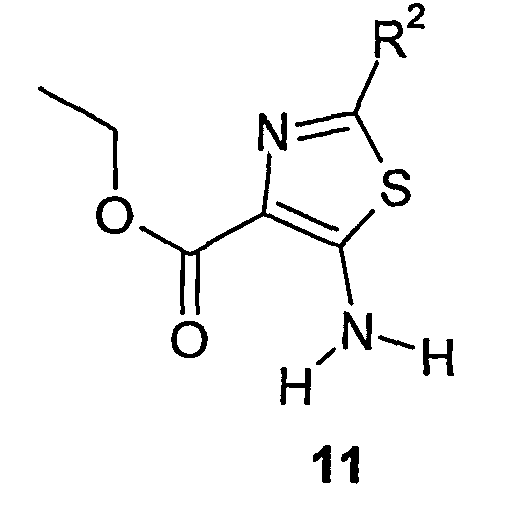
X-R3
to obtain a compound of formula (4):
- b) either reacting the compound of formula (4) with a compound of formula (24):
R1-NH2
- c) or hydrolyze the compound of formula (4) into a compound of formula (5):

R1-NH2
to obtain the compound of formula (I) wherein X is halo, preferably Br or Cl, R2 is C1-C7-alkyl, -(CH2)m-O-C1-C7-alkyl or C3-C6-cycloalkyl, R4 is H and R1 and R3 are as defined hereinabove. - This embodiment is further illustrated in schemes 2, 3 and 8 hereinbelow.
- In certain embodiments of the invention, the compounds of the invention of formula (I) wherein R2 is methyl and R4 is H or is as defined hereinabove, may be prepared according to a method comprising the steps of:
- a) reacting a compound of formula (14):

R1NH2
to obtain a compound of formula (15):
- b) either with a compound of formula (2):
R3NH2
to obtain the compound of formula I, wherein R2 is methyl, R4 is H and R1 and R3 are as defined hereinabove; - c) or with a compound of formula (26):
NR3R4
obtain the compound of formula I, wherein R2 is methyl and R1, R3 and R4 are as defined hereinabove. - This embodiment is further illustrated in scheme 4 hereinbelow.
- In certain embodiments of the invention, the compounds of the invention of formula (I) wherein R2 is methyl and R4 is H may be prepared according to a method comprising the steps of:
- a) either reacting a compound of formula (18):

R1-NH2
- b) or hydrolyze the compound of formula (18) into a compound of formula (5):

R1-NH2
to obtain the compound of formula (I) wherein R2 is methyl, R4 is H and R1 and R3 are as defined hereinabove. - This embodiment is further illustrated in scheme 5 hereinbelow.
- In certain embodiments of the invention, the compounds of the invention of formula (I) wherein R4 is H may be prepared according to a method comprising the steps of:
- a) protecting the amino moiety of a compound of formula (11):

R1NH2
and then deprotecting the amino moiety and reacting the resulting amino-deprotected compound with a compound of the following formula (25):
X-R3
to obtain the compound of formula (I), wherein X is halo, preferably Br or Cl, R4 is H and R1,R2 and R3 are as defined hereinabove. - This embodiment is further illustrated in schemes 6 and 9 hereinbelow.
- In certain embodiments of the invention, the compounds of the invention of formula (I) wherein R2 is methyl and R4 is H may be prepared according to a method comprising the steps of:
- a) reacting a compound of formula (17):

R1NH2
to obtain a compound of formula (15):
- b) and reacting the compound of formula (15) with a compound of the following formula (2):
R3NH2
to obtain the compound of formula (I) wherein R2 is methyl, R4 is H and R1 and R3 are as defined hereinabove. - This embodiment is further illustrated in scheme 7 hereinafter.
- In certain embodiments of the invention, the compounds of the invention of formula (I), wherein R3 is CH2-Rb and R4 is H may be prepared according to a method comprising the steps of:
- a) reacting a compound of formula (11):

RbCHO
to obtain a compound of formula (22):
- b) and reacting the compound of formula (22) with a compound of formula (24):
R1NH2
to obtain the compound of formula (I) wherein R3 is CH2-Rb, R4 is H and R1 and R3 are as defined in claim 1. - This embodiment is further illustrated in scheme 10 hereinbelow.
- The following schemes 1 to 10 further illustrate the various methods of preparation of the compounds of the invention. Unless otherwise specified all starting products and intermediates are commercially available.
-

- Compounds of general formula I, where R2 = H can be prepared according to schemes 1 and 2 and methods described in the literature (Suzuki, M.; Moriya, T.; Matsumoto, K.; Miyoshi, M. Synthesis 1982, 874.) This involves reacting the anion of ethyl isocyanoacetate 1, generated for example by reaction with potassium tert-butylate in tetrahydrofurane at -10°C, with a generic isothiocyanate 3 to afford the corresponding N-substituted-5-amino-1,3-thiazole-4-carboxylic acid ethyl ester 4 (R2 = H). Non-commercially available isothiocyanates 3 can be prepared by reaction of a generic amine 2 with thiophosgene and diisopropyl ethyl amine.
-

- Conversion of the esters 4 to the desired final products 6 can be accomplished by a variety of known methods. As described in scheme 2, for example, the esters 4 can be hydrolyzed to the corresponding acids 5 by the action of an aqueous base, and these reacted with an amine R1NH2 in the presence of a condensing agent such as O-(benzotriazol-1-yl)-N,N,N',N'-tetramethyluronium tetrafluoborate (TBTU), or converted to the corresponding acyl chlorides by the action of e.g. thionyl chloride or oxalyl chloride and then reacted with the generic amine in the presence of a base. Alternatively, the esters 4 can be heated directly with the aluminium salt of the desired amine (Basha, A.; Lipton, M.; Weinreb, S.M. Tetrahedron Lett. 1977, 18, 4171), which can be formed by reaction of the amine with trimethylaluminium. The reaction can be made more efficient by irradiation at 150°C in a microwave oven.
-

- Compounds of general formula I, where R2 is not H can be prepared according to scheme 3 and 2 and methods described in the literature. By treatment of a suitably substituted acylamino-cyanoacetic acid ethyl ester 10 with 2,4-bis(4-methoxyphenyl)-1,3,2,4-dithiadiphosphetane 2,4-disulfide (Lawesson's reagent), cyclisation to the corresponding 2-substituted-5-aminothiazole-4-carboxylic acid ethyl ester 11 is obtained (Golankiewicz, B.; Januszczyk, P.; Gdaniec, M.; Kosturkiewicz, Z. Tetrahedron 1985, 41, 5989). Acylamino-cyanoacetic acid ethyl ester 10 can be prepared by several known methods, for example by reacting aminocyanacetic acid ethyl ester 9 with an acyl chloride in the presence of a suitable base or with an acid in the presence of a coupling agent, as TBTU. Aminocyanacetic acid ethyl ester 9 is accessed by conversion of cyanacetic acid ethyl ester 7 to cyano-hydroxyimino-acetic acid ethyl ester 8, followed by reduction of the oxime with sodium dithionite. In the particular case where R2 = methyl, the commercially available acetylamino-cyanacetic acid ethyl ester (10, R2 = Me) can be used.
- 2-Substituted-5-aminothiazole-4-carboxylic acid ethyl ester 11 can then be converted to compounds of type 4 by coupling with an aryl or alkyl halide, for example by coupling with an aryl bromide under standard palladium catalysed N-C coupling conditions, such as using palladium dibenzylideneacetone (Pd2dba3) and 4,5-bis(diphenylphosphino)-9,9-dimethylxanthene (Xantphos) with cesium carbonate in dioxane. The efficiency of the reaction can be improved by irradiating in a microwave oven at 150°C. The esters 4 can then be transformed into the target compounds by one of the methods illustrated in scheme 2.
- Alternatively, compounds of general formula I, where R2 is methyl can be prepared starting from the commercially available 2-methyl-thiazole-4-carboxylic acid ethyl ester 12 as described in scheme 4. After conversion to the corresponding 2-methyl-thiazole-4-carboxylic acid 13 by acqueous hydrolysis, this is doubly deprotonated by the action of a strong base, as for example buthyl lithium. The dianion is then reacted with molecular bromine, to generate 5-bromo-2-methyl-thiazole-4-carboxylic acid 14. Coupling of the latter with a generic amine R1NH2 according to one of the standard methods described above, yields the corresponding 5-bromo-2-methyl thiazole-carboxylic acid amide 15. This can then be converted to the target compounds 6 (R2 = Me) by coupling with an aryl or alkyl amine, for example by coupling with an aryl amine under standard palladium catalysed N-C coupling conditions, as using Pd2dba3 and Xantphos with cesium carbonate in dioxane. The efficiency of the reaction can be improved by irradiating in a microwave oven at 150°C.
- Compounds of general formula I, where R2 is methyl and R4 is not H can be obtained analogously by reaction of the bromides 15 with a suitable secondary amine, as illustrated in scheme 4.
-

- For purposes of efficient application of parallel synthetic methods, 5-bromo-2-methyl-thiazole-4-carboxylic acid 14 can be esterified with an alcohol, for example methanol, to 5-bromo-2-methyl-thiazole-4-carboxylic acid methyl ester 17 (scheme 5), which can be employed as reactant in palladium catalysed C-N coupling reactions as described above, to yield 5-amino-2-methyl-thiazole-4-carboxylic acid methyl esters 18. These can be processed in analogy to ethyl esters 4, as described in scheme 2.
-

- For purposes of efficient application of parallel synthetic methods, the synthetic protocol illustrated in schemes 2 and 3 can also be inverted, as illustrated in scheme 6.
-

-
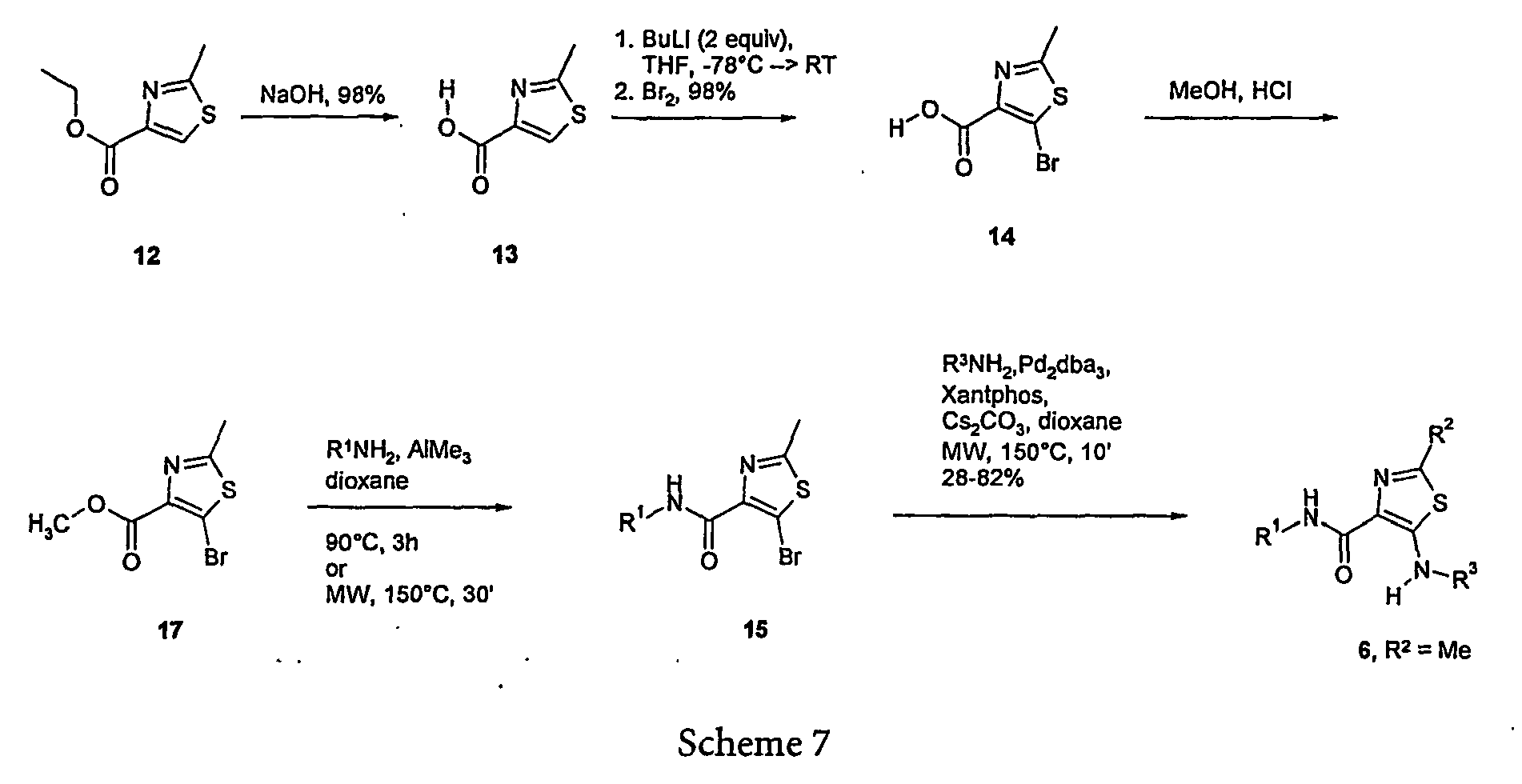
- Alternatively, compounds of general formula I, where R2 is methyl can be prepared starting from the commercially available 2-methyl-thiazole-4-carboxylic acid ethyl ester 12 as described in scheme 7. After conversion to the corresponding 2-methyl-thiazole-4-carboxylic acid 13 by aqueous hydrolysis, this is doubly deprotonated by the action of a strong base, as for example butyl lithium. The dianion is then reacted with molecular bromine, to generate 5-bromo-2-methyl-thiazole-4-carboxylic acid 14 which be esterified with an alcohol, for example methanol, to 5-bromo-2-methyl-thiazole-4-carboxylic acid methyl ester 17. The esters 17 can be heated directly with the aluminium salt of the desired amine, (Basha, A.; Lipton, M.; Weinreb, S.M. Tetrahedron Lett. 1977, 18, 4171) to yield amide 15. The reaction can be made more efficient by irradiation at 150°C in a microwave oven. Amide 15 can be employed as reactant in palladium catalyzed C-N coupling reactions as described above.
-

- Alternatively, compounds of general formula I, where R3 is methyl can be prepared by the sequence shown in scheme 8. The single steps have been described in detail hereinabove.
-

- The synthesis described in scheme 9 is a variation of the synthesis described in scheme 6.
-

- Compounds of the general formula 23 can be prepared from the already known intermediate 11 as described in scheme 10. Compound 11 is reductively laminated using an aldehyde, tetraisopropyl-orthotitanate and sodium cyanoborohydride to obtain compound 22 which is converted to amide 23 as described hereinabove.
- Pharmaceutically acceptable salts of compounds of formula I can be manufactured readily according to methods known per se and taking into consideration the nature of the compound to be converted into a salt. Inorganic or organic acids such as, for example, hydrochloric acid, hydrobromic acid, sulphuric acid, nitric acid, phosphoric acid or citric acid, formic acid, fumaric acid, maleic acid, acetic acid, succinic acid, tartaric acid, methanesulphonic acid, p-toluenesulphonic acid and the like are suitable for the formation of pharmaceutically acceptable salts of basic compounds of formula I. Compounds which contain the alkali metals or alkaline earth metals, for example sodium, potassium, calcium, magnesium or the like, basic amines or basic amino acids are suitable for the formation of pharmaceutically acceptable salts of acidic compounds.
- The compounds of formula I and their pharmaceutically acceptable salts are, as already mentioned above, metabotropic glutamate receptor antagonists and can be used for the treatment or prevention of mGluR5 receptor mediated disorders, such as acute and/or chronic neurological disorders, cognitive disorders and memory deficits, as well as acute and chronic pain. Treatable neurological disorders are for instance epilepsy, schizophrenia, anxiety, acute, traumatic or chronic degenerative processes of the nervous system, such as Alzheimer's disease, senile dementia, Huntington's chorea, ALS, multiple sclerosis, dementia caused by AIDS, eye injuries, retinopathy, idiopathic parkinsonisin or parkinsonism caused by medicaments as well as conditions which lead to glutamate-deficient functions, such as e.g. muscle spasms, convulsions, migraine, urinary incontinence, ethanol addiction, nicotine addiction, psychoses, opiate addiction, anxiety, vomiting, dyskinesia and depression. Other treatable indications are restricted brain function caused by bypass operations or transplants, poor blood supply to the brain, spinal cord injuries, head injuries, hypoxia caused by pregnancy, cardiac arrest and hypoglycaemia.
- The compounds of formula I and their pharmaceutically acceptable salts are especially useful as analgesics. Treatable kinds of pain include inflammatory pain such as arthritis and rheumatoid disease, vasculitis, neuropathic pain such as trigeminal or herpetic neuralgia, diabetic neuropathy pain, causalgia, hyperalgesia, severe chronic pain, post-operative pain and pain associated with various conditions like cancer, angina, renal or billiay colic, menstruation, migraine and gout.
- The pharmacological activity of the compounds was tested using the following method:
- For binding experiments, cDNA encoding human mGlu 5a receptor was transiently transfected into EBNA cells using a procedure described by Schlaeger and Christensen [Cytotechnology 15:1-13 (1998)]. Cell membrane homogenates were stored at -80°C until the day of assay where upon they were thawed and resuspended and polytronised in 15 mM Tris-HCl, 120 mM NaCl, 100 mM KCl, 25 mM CaCl2, 25 mM MgCl2 binding buffer at pH 7.4 to a final assay concentration of 20 µg protein/ well.
- Saturation isotherms were determined by addition of twelve [3H]MPEP concentrations (0.04-100 nM) to these membranes (in a total volume of 200 µl) for 1 h at 4°C. Competition experiments were performed with a fixed concentration of [3H]MPEP (2nM) and IC50 values of test compounds evaluated using 11 concentrations (0.3-10,000nM). Incubations were performed for 1 h at 4° C.
- At the end of the incubation, membranes were filtered onto unifilter (96-well white microplate with bonded GF/C filter preincubated 1 h in 0.1% PEI in wash buffer, Packard BioScience, Meriden, CT) with a Filtermate 96 harvester (Packard BioScience) and washed 3 times with cold 50 mM Tris-HCl, pH 7.4 buffer. Nonspecific binding was measured in the presence of 10 µM MPEP. The radioactivity on the filter was counted (3 min) on a Packard Top-count microplate scintillation counter with quenching correction after addition of 45 µl of microscint 40 (Canberra Packard S.A., Zürich, Switzerland) and shaking for 20 min.
- For functional assays, [Ca2+]i measurements were performed as described previously by Porter et al. [Br. J. Pharmacol. 128:13-20 (1999)] on recombinant human mGlu 5a receptors in HEK-293 cells. The cells were dye loaded using Fluo 4-AM (obtainable by FLUKA, 0.2µM final concentration). [Ca2+]i measurements were performed using a fluorometric imaging plate reader (FLIPR, Molecular Devices Corporation, La Jolla, CA, USA). Antagonist evaluation was performed following a 5 min preincubation with the test compounds followed by the addition of a submaximal addition of agonist.
- The inhibition (antagonists) curves were fitted with a four parameter logistic equation giving IC50, and Hill coefficient using iterative non linear curve fitting software (Xcel fit).
- For binding experiments the Ki values of the compounds tested are given. The Ki value is defined by the following formula:

in which the IC50 values are those concentrations of the compounds tested which cause 50 % inhibition of the competing radioligand ([3H]MPEP). L is the concentration of radioligand used in the binding experiment and the Kd value of the radioligand is empirically determined for each batch of membranes prepared. - The compounds of the present invention are mGluR 5a receptor antagonists. The activities of compounds of formula I as measured in the assay described above are in the range of Ki<4 µM and preferably < 200 nM.
Example
No.Ki
nMExample
No.Ki
nMExample
No.Ki
nM1 29 24 127 145 40 2 124 74 99 149 53 13 26 81 19 209 40 18 458 88 18 - The compounds of formula I and pharmaceutically acceptable salts thereof can be used as medicaments, e.g. in the form of pharmaceutical preparations. The pharmaceutical preparations can be administered orally, e.g. in the form of tablets, coated tablets,dragées, hard and soft gelatine capsules, solutions, emulsions or suspensions. However, the administration can also be effected rectally, e.g. in the form of suppositories, or parenterally, e.g. in the form of injection solutions.
- The compounds of formula I and pharmaceutically acceptable salts thereof can be processed with pharmaceutically inert, inorganic or organic carriers for the production of pharmaceutical preparations. Lactose, corn starch or derivatives thereof, talc, stearic acid or its salts and the like can be used, for example, as such carriers for tablets, coated tablets, dragées and hard gelatine capsules. Suitable carriers for soft gelatine capsules are, for example, vegetable oils, waxes, fats, semi-solid and liquid polyols and the like; depending on the nature of the active substance no carriers are, however, usually required in the case of soft gelatine capsules. Suitable carriers for the production of solutions and syrups are, for example, water, polyols, sucrose, invert sugar, glucose and the like. Adjuvants, such as alcohols, polyols, glycerol, vegetable oils and the like, can be used for aqueous injection solutions of water-soluble salts of compounds of formula I, but as a rule are not necessary. Suitable carriers for suppositories are, for example, natural or hardened oils, waxes, fats, semi-liquid or liquid polyols and the like.
- In addition, the pharmaceutical preparations can contain preservatives, solubilizers, stabilizers, wetting agents, emulsifiers, sweeteners, colorants, flavorants, salts for varying the osmotic pressure, buffers, masking agents or antioxidants. They can also contain still other therapeutically valuable substances.
- As mentioned earlier, medicaments containing a compound of formula I or pharmaceutically acceptable salts thereof and a therapeutically inert excipient are also an object of the present invention, as is a process for the production of such medicaments which comprises bringing one or more compounds of formula I or pharmaceutically acceptable salts thereof and, if desired, one or more other therapeutically valuable substances into a galenical dosage form together with one or more therapeutically inert carriers.
- The dosage can vary within wide limits and will, of course, be fitted to the individual requirements in each particular case. In general, the effective dosage for oral or parenteral administration is between 0.01-20 mg/kg/day, with a dosage of 0.1-10 mg/kg/day being preferred for all of the indications described. The daily dosage for an adult human being weighing 70 kg accordingly lies between 0.7-1400 mg per day, preferably between 7 and 700 mg per day.
- The following examples are provided to further elucidate the invention:
- The title compound was prepared as illustrated in schemes 1 and 2.
- A) A three-necked flask equipped with a mechanical stirrer, a dropping funnel and an argon inlet was charged with anhydrous tetrahydrofurane (THF) (25.00 ml). Solid potassium tert-butylate (5.46 g, 44.20 mmol) was added and the slurry was stirred until dissolution was complete. The mixture was cooled to -40°C by means of a dry ice/acetone bath. A solution of isocyano-acetic acid ethyl ester (5.00 g, 44.20 mmol) and 3-isothiocyanato-pyridine (6.02 g, 44.20 mmol) in anhydrous THF (50.00 ml) was added dropwise via the dropping funnel at such a rate that the temperature did not exceed -35°C and the mixture remained homogeneously stirred (a thick precipitate forms). After addition was complete, the mixture was stirred for further 1 hour letting the temperature free to rise. The reaction was quenched by addition of glacial acetic acid (2.50 ml). The mixture was diluted with THF and ethyl acetate and filtered through celite. The filtrate was evaporated to a dark yellow solid residue, which was purified by flash chromatography (heptane/ethyl acetate) to yield 5-(pyridin-3-ylamino)-thiazole-4-carboxylic acid ethyl ester (4.85 g, 44%) as a light yellow solid, MS (ISP): m/e = 250.2 (M+H+).
- B) A solution of 5-(pyridin-3-ylamino)-thiazole-4-carboxylic acid ethyl ester. (2.90 g, 11.63 mmol) in methanol (24.00 ml) was treated at room temperature with a solution of KOH (1.95 g, 34.90 mmol) in water (18 ml) and stirred at 65°C for 2 h 45 min. The methanol was evaporated and the residual slurry acidified to pH 5 with 1N HCl. The mixture was sonicated for 15 minutes, then filtered washing with water. The solid was dried under high vacuum overnight, yielding 5-(pyridin-3-ylamino)-thiazole-4-carboxylic acid (2.37 g, 92%) as a white solid.
- C) A solution of 5-(pyridin-3-ylamino)-thiazole-4-carboxylic acid (0.50 g, 2.26 mmol) in DMF (5.00 ml) was treated with TBTU (0.94 g, 2.94 mmol) and diisopropyl ethyl amine (DIPEA) (0.58 g, 4.52 mmol). 6-Methyl-pyridin-2-ylamine (0.49 g, 4.52 mmol) was added and the mixture was stirred at room temperature overnight. Precipitation was favored by adding acetonitrile (5.00 ml). The crystalline precipitate was filtered and dried under high vacuum, yielding the title compound in high purity. Evaporation of the mother liquors gave a residue which was purified by flash chromatography (heptane/ethyl acetate) to yield a second batch of title compound as an amorphous solid (total 0.59 g, 84%), MS (ISP): m/e = 312.0 (M+H+).
- The title compound, MS (ISP): m/e = 331.5 (M+H+), was prepared as for example 1, steps A to C. Step C was performed using 3-chloro aniline.
- The title compound, MS (ISP): m/e = 332.1 (M+H+), was prepared as for example 1, steps A to C. Step C was performed using 6-chloro-pyridin-2-ylamine
- The title compound, MS (ISP): m/e = 376.0, 378.0 (M+H+), was prepared as for example 1, steps A to C. Step C was performed using 6-bromo-pyridin-2-ylamine
- The title compound, MS (ISP): m/e = 318.1 (M+H+), was prepared as for example 1, steps A to C. Step C was performed using 4-methyl-thiazol-2-ylamine.
- The title compound, MS (ISP): m/e = 318.1 (M+H+), was prepared as for example 1, steps A to C. Step C was performed using 2-methyl-thiazol-4-ylamine.
- The title compound, MS (ISP): m/e = 310.7 (M+H+), was prepared as for example 1, steps A to C. Step C was performed using m-tolylamine.
- The title compound, MS (ISP): m/e = 326.3 (M+H+), was prepared as for example 1, steps A to C. Step C was performed using 6-ethyl-pyridin-2-ylamine.
- The title compound, MS (ISP): m/e = 366.3 (M+H+), was prepared as for example 1, steps A to C. Step C was performed using 6-trifluoromethyl-pyridin-2-ylamine.
- The title compound, MS (ISP): m/e = 296.1 (M+H+), was prepared as for example 1, steps A to C. Step A was performed using isothiocyanato-benzene and yielded 5-phenylamino-thiazole-4-carboxylic acid ethyl ester. This was hydrolyzed in step B to 5-phenylamino-thiazole-4-carboxylic acid, which was reacted with aniline in step C.
- The title compound, MS (ISP): m/e = 330.1 (M+H+), was prepared as for example 10, steps A to C. Step C was performed using 3-chloro aniline.
- The title compound, MS (ISP): m/e = 314.1 (M+H+), was prepared as for example 10, steps A to C. Step C was performed using 3-fluoro aniline.
- The title compound, MS (ISP): m/e = 311.2 (M+H+), was prepared as for example 10, steps A to C. Step C was performed using 6-methyl-pyridin-2-ylamine.
- The title compound, MS (ISP): m/e = 331.1 (M+H+), was prepared as for example 10, steps A to C. Step C was performed using 6-chloro-pyridin-2-ylamine.
- The title compound, MS (ISP): m/e = 303.1 (M+H+), was prepared as for example 10, steps A to C. Step C was performed using thiazol-2-ylamine.
- The title compound, MS (ISP): m/e = 317.1 (M+H+), was prepared as for example 10, steps A to C. Step C was performed using 4-methyl-thiazol-2-ylamine.
- The title compound, MS (ISP): m/e = 364.3 (M+H+), was prepared as for example 1, steps A to C. Step A was performed using 1-chloro-3-isothiocyanato-benzene and yielded 5-(3-chloro-phenylamino)-thiazole-4-carboxylic acid ethyl ester. This was hydrolised in step B to 5-(3-chloro-phenylamino)-thiazole-4-carboxylic acid, which was reacted with 3-chloro aniline in step C.
- The title compound, MS (ISP): m/e = 294.1 (M+H+), was prepared as for example 1, steps A to C. Step A was performed using isothiocyanato-cyclopropane and yielded 5-cyclopropylamino-thiazole-4-carboxylic acid ethyl ester. This was hydrolised in step B to 5-cyclopropylamino-thiazole-4-carboxylic acid, which was reacted with 3-chloro aniline in step C.
- The title compound, MS (ISP): m/e = 278.1 (M+H+), was prepared as for example 18, steps A to C. Step C was performed using 3-fluoro aniline.
- The title compound, MS (ISP): m/e = 260.1 (M+H+), was prepared as for example 18, steps A to C. Step C was performed using aniline.
- The title compound, MS (ISP): m/e = 274.1 (M+H+), was prepared as for example 18, steps A to C. Step C was performed using m-tolylamine.
- The title compound, MS (ISP): m/e = 317.1 (M+H+), was prepared as for example 18, steps A to C. Step C was performed using 3-bromo aniline.
- The title compound, MS (ISP): m/e = 336.1 (M+H+), was prepared as for example 1, steps A to C. Step A was performed using isothiocyanato-cyclohexane and yielded 5-cyclohexylamino-thiazole-4-carboxylic acid ethyl ester. This was hydrolised in step B to 5-cyclohexylamino-thiazole-4-carboxylic acid, which was reacted with 3-chloro aniline in step C.
- The title compound, MS (ISP): m/e = 268.1 (M+H+), was prepared as for example 1, steps A to C. Step A was performed using isothiocyanatomethane and yielded 5-methylamino-thiazole-4-carboxylic acid ethyl ester. This was hydrolised in step B to 5-methylamino-thiazole-4-carboxylic acid, which was reacted with 3-chloro aniline in step C.
- The title compound, MS (ISP): m/e = 252.1 (M+H+), was prepared as for example 24, steps A to C. Step C was performed using 3-fluoro aniline.
- The title compound, MS (ISP): m/e = 234.2 (M+H+), was prepared as for example 24, steps A to C. Step C was performed using aniline.
- The title compound, MS (ISP): m/e = 248.2 (M+H+), was prepared as for example 24, steps A to C. Step C was performed using m-tolylamine.
- The title compound, MS (ISP): m/e = 314.1 (M+H+), was prepared as for example 24, steps A to C. Step C was performed using 3-bromo aniline.
- The title compound, MS (ISP): m/e = 268.7 (M+H+), was prepared as for example 24, steps A to C. Step C was performed using 6-chloro-pyridin-2-ylamine.
- The title compound, MS (ISP): m/e = 313.0, 315.0 (M+H+), was prepared as for example 24, steps A to C. Step C was performed using 6-bromo-pyridin-2-ylamine.
- The title compound, MS (ISP): m/e = 249.1 (M+H+), was prepared as for example 24, steps A to C. Step C was performed using 6-methyl-pyridin-2-ylamine.
- The title compound, MS (ISP): m/e = 322.1 (M+H+), was prepared as for example 1, steps A to C. Step A was performed using isothiocyanato-cyclopentane and yielded 5-cydopentylamino-thiazole-4-carboxylic acid ethyl ester. This was hydrolised in step B to 5-cyclopentylamino-thiazole-4-carboxylic acid, which was reacted with 3-chloro aniline in step C.
- The title compound, MS (ISP): m/e = 306.1 (M+H+), was prepared as for example 32, steps A to C. Step C was performed using 3-fluoro aniline.
- The title compound, MS (ISP): m/e = 288.1 (M+H+), was prepared as for example 32, steps A to C. Step C was performed using aniline.
- The title compound, MS (ISP): m/e = 302.2 (M+H+), was prepared as for example 32, steps A to C. Step C was performed using m-tolylamine.
- The title compound, MS (ISP): m/e = 366.0 (M+H+), was prepared as for example 32, steps A to C. Step C was performed using 3-bromo aniline.
- The title compound,MS (ISP): m/e = 303.2 (M+H+); was-prepared as for example 32, steps A to C. Step C was performed using 6-methyl-pyridin-2-ylamine.
- The title compound, MS (ISP): m/e = 323.1 (M+H+), was prepared as for example 32, steps A to C. Step C was performed using 6-chloro-pyridin-2-ylamine.
- The title compound, MS (ISP): m/e = 367.0 (M+H+), was prepared as for example 32, steps A to C. Step C was performed using 6-bromo-pyridin-2-ylamine.
- The title compound, MS (ISP): m/e = 310.2 (M+H+), was prepared as for example 1, steps A to C. Step A was performed using 1-isothiocyanato-2-methyl-propane and yielded 5-isobutylamino-thiazole-4-carboxylic acid ethyl ester. This was hydrolised in step B to 5-isobutylamino-thiazole-4-carboxylic acid, which was reacted with 3-chloro aniline in step C.
- The title compound, MS (ISP): m/e = 294.1 (M+H+), was prepared as for example 40, steps A to C. Step C was performed using 3-fluoro aniline.
- The title compound, MS (ISP): m/e = 276.1 (M+H+), was prepared as for example 40, steps A to C. Step C was performed using aniline.
- The title compound, MS (ISP): m/e = 290:1 (M+H+), was prepared as for example 40, steps A to C. Step C was performed using m-tolylamine.
- The title compound, MS (ISP): m/e = 356.1 (M+H+), was prepared as for example 40, steps A to C. Step C was performed using 3-bromo aniline.
- The title compound, MS (ISP): m/e = 291.1 (M+H+), was prepared as for example 40, steps A to C. Step C was performed using 6-methyl-pyridin-2-ylamine.
- The title compound, MS (ISP): m/e = 311.1 (M+H+), was prepared as for example 40, steps A to C. Step C was performed using 6-chloro-pyridin-2-ylamine.
- The title compound, MS (ISP): m/e = 355.0, 357.0 (M+H+), was prepared as for example 40, steps A to C. Step C was performed using 6-bromo-pyridin-2-ylamine..
- The title compound, MS (ISP): m/e = 310.2 (M+H+), was prepared as for example 1, steps A to C. Step A was performed using 2-isothiocyanato-2-methyl-propane and yielded 5-tert-butylamino-thiazole-4-carboxylic acid ethyl ester. This was hydrolised in step B to 5-tert-butylamino-thiazole-4-carboxylic acid, which was reacted with 3-chloro aniline in step C.
- The title compound, MS (ISP): m/e = 294.0 (M+H+), was prepared as for example 48, steps A to C. Step C was performed using 3-fluoro aniline.
- The title compound, MS (ISP): m/e = 290.1 (M+H+), was prepared as for example 48, steps A to C. Step C was performed using m-tolylamine.
- The title compound, MS (ISP): m/e = 356.1 (M+H+), was prepared as for example 48, steps A to C. Step C was performed using 3-bromo aniline.
- The title compound, MS (ISP): m/e = 326.1 (M+H+), was prepared as for example 1, steps A to C. Step A was performed using 1-isothiocyanato-3-methoxy-propane and yielded 5-(3-methoxy-propylamino)-thiazole-4-carboxylic acid ethyl ester. This was hydrolised in step B to 5-(3-methoxy-propylamino)-thiazole-4-carboxylic acid, which was reacted with 3-chloro aniline in step C.
- The title compound, MS (ISP): m/e = 306.1 (M+H+), was prepared as for example 52, steps A to C. Step C was performed using m-tolylamine.
- The title compound, MS (ISP): m/e = 372.1 (M+H+), was prepared as for example 52, steps A to C. Step C was performed using 3-bromo-aniline.
- The title compound, MS (ISP): m/e = 325.1 (M+H+), was prepared as for example 1, steps A to C. Step A was performed using isothiocyanatomethyl-benzene and yielded 5-benzylamino-thiazole-4-carboxylic acid ethyl ester. This was hydrolised in step B to 5-benzylamino-thiazole-4-carboxylic acid, which was reacted with 6-methyl-pyridin-2-ylamine in step C.
- The title compound, MS (ISP): m/e = 344.1 (M+H+), was prepared as for example 55, steps A to C. Step C was performed using 3-chloro aniline.
- The title compound, MS (ISP): m/e = 276.0 (M+H+), was prepared as for example 1, steps A to C. Step A was performed using 2-isothiocyanato-propane and yielded 5-isopropylamino-thiazole-4-carboxylic acid ethyl ester. This was hydrolyzed in step B to 5-isopropylamino-thiazole-4-carboxylic acid, which was reacted with m-tolylamine in step C.
- The title compound, MS (ISP): m/e = 343.1 (M+H+), was prepared as for example 57, steps A to C. Step C was performed using 6-bromo-pyridin-2-ylamine.
- The title compound, MS (ISP): m/e = 282.9 (M+H+), was prepared as for example 57, steps A to C. Step C was performed using 4-methyl-thiazol-2-ylamine.
- The title compound, MS (ISP): m/e = 324.3 (M+H+), was prepared as for example 1, steps A to C. Step A was performed using 2-isothiocyanato-2-methyl-butane and yielded 5-(1,1-dimethyl-propylamino)-thiazole-4-carboxylic acid ethyl ester. This was hydrolyzed in step B to 5-(1,1-dimethyl-propylamino)-thiazole-4-carboxylic acid, which was reacted with 3-chloro aniline in step C.
- The title compound, MS (ISP): m/e = 304.4 (M+H+), was prepared as for example 60, steps A to C. Step C was performed using m-tolylamine.
- The title compound, MS (ISP): m/e = 305.3 (M+H+), was prepared as for example 60, steps A to C. Step C was performed using 6-methyl-pyridin-2-ylamine.
- The title compound, MS (ISP): m/e = 311.1 (M+H+), was prepared as for example 60, steps A to C. Step C was performed using 4-methyl-thiazol-2-yl-amine.
- The title compound, MS (ISP): m/e. = 262.0 (M+H+), was prepared as for example 1, steps A to C. Step A was performed using isothiocyanato-ethane and yielded 5-ethylamino-thiazole-4-carboxylic acid ethyl ester. This was hydrolyzed in step B to 5-ethylamino-thiazole-4-carboxylic acid, which was reacted with m-tolylamine in step C.
- The title compound, MS (ISP): m/e = 329.0 (M+H+), was prepared as for example 64, steps A to C. Step C was performed using 6-bromo-pyridin-2-yl-amine.
- The title compound, MS (ISP): m/e = 269.1 (M+H+), was prepared as for example 64, steps A to C. Step C was performed using 4-methyl-thiazol-2-yl-amine.
- The title compound, MS (ISP): m/e = 400.3 (M+H+), was prepared as for example 1, steps A to C. Step A was performed using 1,3-dichloro-2-isothiocyanato-benzene and yielded 5-(2,6-dichloro-phenylamino)-thiazole-4-carboxylic acid ethyl ester. This was hydrolyzed in step B to 5-(2,6-dichloro-phenylamino)-thiazole-4-carboxylic acid, which was reacted with 3-chloro aniline in step C.
- The title compound, MS (ISP): m/e = 378.3 (M+H+), was prepared as for example 67, steps A to C. Step C was performed using m-tolylamine.
- The title compound, MS (ISP): m/e = 379.4 (M+H+), was prepared as for example 67, steps A to C. Step C was performed using 6-methyl-pyridin-2-ylamine.
- The title compound, MS (ISP): m/e = 445.1 (M+H+), was prepared as for example 67, steps A to C. Step C was performed using 6-bromo-pyridin-2-yl-amine.
- The title compound, MS (ISP): m/e = 385.0 (M+H+), was prepared as for example 67, steps A to C. Step C was performed using 4-methyl-thiazol-2-yl-amine.
- The title compound, MS (ISP): m/e = 349.4 (M+H+), was prepared as for example 1, steps A to C. Step A was performed using 4-isothiocyanato-3,5-dimethyl-isoxazole and yielded 5-(3,5-dimethyl-isoxazol-4-ylamino)-thiazole-4-carboxylic acid ethyl ester. This was hydrolised in step B to 5-(3,5-dimethyl-isoxazol-4-ylamino)-thiazole-4-carboxylic acid, which was reacted with 3-chloro aniline in step C.
- The title compound, MS (ISP): m/e = 329.1 (M+H+), was prepared as for example 72, steps A to C. Step C was performed using m-tolylamine.
- The title compound, MS (ISP): m/e = 330.3 (M+H+), was prepared as for example 72, steps A to C. Step C was performed using 6-methyl-pyridin-2-ylamine.
- The title compound, MS (ISP): m/e = 396.0 (M+H+), was prepared as for example 72, steps A to C. Step C was performed using 6-bromo-pyridin-2-yl-amine.
- The title compound, MS (ISP): m/e = 336.1 (M+H+), was prepared as for example 72, steps A to C. Step C was performed using 4-methyl-thiazol-2-yl-amine.
- The title compound, MS (ISP): m/e = 355.1 (M+H+), was prepared as for example 1, steps A to C. Step A was performed using 3-isothiocyanato-benzonitrile and yielded 5-(3-cyano-phenylamino)-thiazole-4-carboxylic acid ethyl ester. This was hydrolyzed in step B to 5-(3-cyano-phenylamino)-thiazole-4-carboxylic acid, which was reacted with 3-chloro aniline in step C.
- The title compound, MS (ISP): m/e = 335.1 (M+H+), was prepared as for example 77, steps A to C. Step C was performed using m-tolylamine.
- The title compound, MS (ISP): m/e = 336.0 (M+H+), was prepared as for example 77, steps A to C. Step C was performed using 6-methyl-pyridin-2-ylamine.
- The title compound, MS (ISP): m/e = 403.5 (M+H+), was prepared as for example 77, steps A to C. Step C was performed using 6-bromo-pyridin-2-yl-amine.
- The title compound, MS (ISP): m/e = 342.1 (M+H+), was prepared as for example 77, steps A to C. Step C was performed using 4-methyl-thiazol-2-yl-amine.
- The title compound, MS (ISP): m/e = 341.7 (M+H+), was prepared as for example 77, steps A to C. Step C was performed using 2-methyl-thiazol-4-yl-amine.
- The title compound, MS (ISP): m/e = 344.0 (M+H+), was prepared as for example 1, steps A to C. Step A was performed using 1-isothiocyanato-2-methyl-benzene and yielded 5-o-tolylamino-thiazole-4-carboxylic acid ethyl ester. This was hydrolyzed in step B to 5-o-tolylamino-thiazole-4-carboxylic acid, which was reacted with 3-chloro aniline in step C.
- The title compound, MS (ISP): m/e = 324.1 (M+H+), was prepared as for example 83, steps A to C. Step C was performed using m-tolylamine.
- The title compound, MS (ISP): m/e = 325.3 (M+H+), was prepared as for example 83, steps A to C. Step C was performed using 6-methyl-pyridin-2-ylamine.
- The title compound, MS (ISP): m/e = 331.1 (M+H+), was prepared as for example 83, steps A to C. Step C was performed using 4-methyl-thiazol-2-yl-amine.
- The title compound, MS (ISP): m/e = 391.4 (M+H+), was prepared as for example 1, steps A to C. Step A was performed using 1-bromo-2-isothiocyanato-benzene and yielded 5-(2-bromo-phenylamino)-thiazole-4-carboxylic acid ethyl ester. This was hydrolyzed in step B to 5-(2-bromo-phenylamino)-thiazole-4-carboxylic acid, which was reacted with 6-methyl-pyridin-2-ylamine in step C.
- The title compound, MS (ISP): m/e = 353.4 (M+H+), was prepared as for example 1, steps A to C. Step A was performed using 1-(3-isothiocyanato-phenyl)-ethanone and yielded 5-(3-acetyl-phenylamino)-thiazole-4-carboxylic acid ethyl ester. This was hydrolyzed in step B to 5-(3-acetyl-phenylamino)-thiazole-4-carboxylic acid, which was reacted with 6-methyl-pyridin-2-ylamine in step C.
- The title compound, MS (ISP): m/e = 371.3 (M+H+), was prepared as for example 1, steps A to C. Step A was performed using 1-isothiocyanato-3,5-dimethoxy-benzene and yielded 5-(3,5-dimethoxy-phenylamino)-thiazole-4-carboxylic acid ethyl ester. This was hydrolised in step B to 5-(3,5-dimethoxy-phenylamino)-thiazole-4-carboxylic acid, which was reacted with 6-methyl-pyridin-2-ylamine in step C.
- The title compound, MS (ISP): m/e = 370.4 (M+H+), was prepared as for example 89, steps A to C. Step C was performed using m-tolylamine.
- The title compound, MS (ISP): m/e = 341.1 (M+H+), was prepared as for example 1, steps A to C. Step A was performed using 1-isothiocyanato-3-methoxy-benzene and yielded 5-(3-methoxy-phenylamino)-thiazole-4-carboxylic acid ethyl ester. This was hydrolyzed in step B to 5-(3-methoxy-phenylamino)-thiazole-4-carboxylic acid, which was reacted with 6-methyl-pyridin-2-ylamine in step C.
- The title compound, MS (ISP): m/e = 329.2 (M+H+), was prepared as for example 1, steps A to C. Step A was performed using 1-fluoro-3-isothiocyanato-benzene and yielded 5-(3-fluoro-phenylamino)-thiazole-4-carboxylic acid ethyl ester. This was hydrolyzed in step B to 5-(3-fluoro-phenylamino)-thiazole-4-carboxylic acid, which was reacted with 6-methyl-pyridin-2-ylamine in step C.
- The title compound, MS (ISP): m/e = 329.2 (M+H+), was prepared as for example 1, steps A to C. Step A was performed using 1-fluoro-2-isothiocyanato-benzene and yielded 5-(2-fluoro-phenylamino)-thiazole-4-carboxylic acid ethyl ester. This was hydrolyzed in step B to 5-(2-fluoro-phenylamino)-thiazole-4-carboxylic acid, which was reacted with 6-methyl-pyridin-2-ylamine in step C.
- The title compound, MS (ISP): m/e = 329.2 (M+H+), was prepared as for example 1, steps A to C. Step A was performed using 1-fluoro-4-isothiocyanato-benzene and yielded 5-(4-fluoro-phenylamino)-thiazole-4-carboxylic acid ethyl ester. This was hydrolyzed in step B to 5-(4-fluoro-phenylamino)-thiazole-4-carboxylic acid, which was reacted with 6-methyl-pyridin-2-ylamine in step C.
- The title compound, MS (ISP): m/e = 347.3 (M+H+), was prepared as for example 1, steps A to C. Step A was performed using 1,4-difluoro-2-isothiocyanato-benzene and yielded 5-(2,5-difluoro-phenylamino)-thiazole-4-carboxylic acid ethyl ester. This was hydrolised in step B to 5-(2,5-difluoro-phenylamino)-thiazole-4-carboxylic acid, which was reacted with 6-methyl-pyridin-2-ylamine in step C.
- The title compound, MS (ISP): m/e = 347.3 (M+H+), was prepared as for example 1, steps A to C. Step A was performed using 1,3-difluoro-2-isothiocyanato-benzene and yielded 5-(2,6-difluoro-phenylamino)-thiazole-4-carboxylic acid ethyl ester. This was hydrolised in step B to 5-(2,6-difluoro-phenylamino)-thiazole-4-carboxylic acid, which was reacted with 6-methyl-pyridin-2-ylamine in step C.
- 1,3-Difluoro-2-isothiocyanato-benzene was synthesized as follows, according to scheme 1.
- A solution of 2,6-difluoro aniline (0.13 g, 1.01 mmol) in dichloromethane (10.00 ml) was treated with thiophosgene (0.12 g, 1.06 mmol) and diisopropylethylamine (0.26 g, 2.01 mmol). The mixture was stirred for 1 h at room temperature. The solvent was then evaporated, leaving 1,3-difluoro-2-isothiocyanato-benzene (0.17g, 99%) as a light brown gum, which was used crude.
- The title compound, MS (ISP): m/e = 342.1 (M+H+), was prepared as for example 1, steps A to C. Step A was performed using 3-isothiocyanato-2-methoxy-pyridine and yielded 5-(2-methoxy-pyridin-3-ylamino)-thiazole-4-carboxylic acid ethyl ester. This was hydrolised in step B to 5-(2-methoxy-pyridin-3-ylamino)-thiazole-4-carboxylic acid, which was reacted with 6-methyl-pyridin-2-ylamine in step C.
- 3-Isothiocyanato-2-methoxy-pyridine was prepared as in example 96, starting from 2-methoxy-pyridin-3-ylamine.
- The title compound, MS (ISP): m/e = 347.5 (M+H+), was prepared as for example 1, steps A to C. Step A was performed using 1,3-difluoro-5-isothiocyanato-benzene and yielded 5-(3,5-difluoro-phenylamino)-thiazole-4-carboxylic acid ethyl ester. This was hydrolised in step B to 5-(3,5-difluoro-phenylamino)-thiazole-4-carboxylic acid, which was reacted with 6-methyl-pyridin-2-ylamine in step C.
- 1,3-Difluoro-5-isothiocyanato-benzene was prepared as in example 96, starting from 3,5-difluoro-phenylamine.
- The title compound, MS (ISP): m/e = 347.3 (M+H+), was prepared as for example 1, steps A to C. Step A was performed using 1,2-difluoro-3-isothiocyanato-benzene and yielded 5-(2,3-difluoro-phenylamino)-thiazole-4-carboxylic acid ethyl ester. This was hydrolised in step B to 5-(2,3-difluoro-phenylamino)-thiazole-4-carboxylic acid, which was reacted with 6-methyl-pyridin-2-ylamine in step C.
- 1,2-Difluoro-3-isothiocyanato-benzene was prepared as in example 96, starting from 2,3-difluoro-phenylamine.
- The title compound, MS (ISP): m/e = 348.0 (M+H+), was prepared as described in example 113, reacting 5-(2,5-difluoro-phenylamino)-thiazole-4-carboxylic acid ethyl ester with 2-methyl-pyrimidin-4-ylamine.
- 5-(2,5-Difluoro-phenylamino)-thiazole-4-carboxylic acid ethyl ester was prepared as described in example 95, step A.
- The title compound was prepared as illustrated in schemes 2 and 3.
- A) A suspension of 2-acetylamino-cyanoacetic acid ethyl ester (1.70 g, 10.00 mmol) and 2,4-bis(4-methoxyphenyl)-1,3,2,4-dithiadiphosphetane 2,4-disulfide (Lawesson's reagent) (2.02 g, 5.00 mmol) in toluene (25.00 ml) was heated under argon to 110°C and stirred for 22 h. The solvent was then evaporated, and the residue purified by flash chromatography (heptane/ethyl acetate 1:1) to yield 5-amino-2-methyl-thiazole-4-carboxylic acid ethyl ester (0.94 g, 50.5%) as a yellow solid, MS (ISP): m/e =187.3 (M+H+).
- B) A Schlenck flask was charged with 5-amino-2-methyl-thiazole-4-carboxylic acid ethyl ester (0.33 g, 1.80 mmol), 4,5-bis(diphenylphosphino)-9,9-dimethylxanthene (Xantphos) (0.15 g, 0.26 mmol) and palladium dibenzylideneacetone (Pd2dba3) - chloroform complex (0.08 g, 0.08 mmol). Degassed dioxane (6.00 ml) was added, followed by 3-bromopyridine (0.23 g, 1.50 mmol). The flask was subjected to 5 cycles of evacuation and backfilling with argon. The reaction mixture was then transferred under argon to a microwave vial containing cesium carbonate (0.84 g, 2.60 mmol). The vial was then irradiated in a microwave oven at 150°C for 10 min. The mixture was diluted with THF and the solids filtered, washing with THF. The filtrate was evaporated and the residue purified by flash chromatography (ethyl acetate/methanol) to yield 2-methyl-5-(pyridin-3-ylamino)-thiazole-4-carboxylic acid ethyl ester (0.25 g, 65%) as a light yellow solid, MS (ISP): m/e = 264.1 (M+H+).
- C) A solution of 2-methyl-5-(pyridin-3-ylamino)-thiazole-4-carboxylic acid ethyl ester (0.24 g, 0.90 mmol) in methanol (1.6 ml) was treated with a 2.55 N solution of KOH in water (1.06 ml). The mixture was stirred at 55°C for 40 min then cooled to room temperature. The volatiles were evaporated and the residue dissolved in water (2.00 ml) and treated with HCl 1N under vigorous stirring until pH 5 was reached. The mixture was stirred for 1h, then the solids were filtered, washed with water and dried under high vacuum to yield 2-methyl-5-(pyridin-3-ylamino)-thiazole-4-carboxylic acid (0.15 g, 70%) as a light yellow solid, MS (ISP): m/e = 234.1 (M-H).
- D) A solution of 2-methyl-5-(pyridin-3-ylamino)-thiazole-4-carboxylic acid (0.05 g, 0.21 mmol) in dry dimethylformamide (1.00 ml) was treated with 3-chloroaniline (0.04 g, 0.31 mmol), diisopropylethylamine (0.08 g, 0.63 mmol) and TBTU (0.10 g, 0.31 mmol) and stirred at room temperature overnight. The solvent was evaporated and the residue triturated with acetonitrile/methanol 1:1. Filtration and drying of the solid under vacuum provided the title compound (0.04 g, 48%) as a white solid, MS (ISP): m/e = 344.8 (M+H+). Alternatively, the reaction mixture could be purified directly by preparative HPLC (ZORBAX Eclipse XDB-C18,21.2x50 mm, 5 µm, gradient acetonitrile/water + 0.1% formic acid).
- The title compound, MS (ISP): m/e = 325.8 (M+H+), was prepared as for example 101, steps A to D. Step D was performed using 6-methyl-pyridin-2-ylamine.
- The title compound, MS (ISP): m/e = 332.0 (M+H+), was prepared as for example 101, steps A to D. Step D was performed using 2-methyl-thiazol-4-yl-amine.
- The title compound, MS (ISP): m/e = 346.1 (M+H+), was prepared as for example 101, steps A to D. Step D was performed using 6-chloro-pyridin-2-ylamine.
- The title compound, MS (ISP): m/e = 389.7, 391.7 (M+H+), was prepared as for example 101, steps A to D. Step D was performed using 6-bromo-pyridin-2-ylamine.
- The title compound, MS (ISP): m/e = 335.9 (M+H+), was prepared as for example 101, steps A to D. Step D was performed using 3-amino-benzonitrile.
- The title compound, MS (ISP): m/e = 343.0 (M+H+), was prepared as for example 101, steps A to D. Step D was performed using 2-fluoro-5-methyl-phenylamine.
- The title compound, MS (ISP): m/e = 363.0 (M+H+), was prepared as for example 101, steps A to D. Step D was performed using 5-chloro-2-fluoro-phenylamine.
- The title compound, MS (ISP): m/e = 363.0 (M+H+), was prepared as for example 101, steps A to D. Step D was performed using 3-chloro-2-fluoro-phenylamine.
- The title compound, MS (ISP): m/e = 325.1 (M+H+), was prepared as for example 101, steps A to D. Step D was performed using m-tolylamine.
- The title compound, MS (ISP): m/e = 344.1 (M+H+), was prepared as for example 101, steps A to D. Step D was performed using 6-fluoromethyl-pyridin-2-ylamine.
- 6-Fluoromethyl-pyridin-2-ylamine was prepared according to the following scheme.

- A) A solution of (6-hydroxymethyl-pyridin-2-yl)-carbamic acid tert-butyl ester (prepared as illustrated in example 135) (0.20 g, 0.90 mmol) in dichloromethane (20.00 ml) was cooled under argon to 0°C and (diethylamino)sulfur trifluoride (DAST) (0.20 g, 1.25 mmol) was added dropwise. The resulting solution was stirred at room temperature for 30 min, then quenched by pouring the reaction mixture onto saturated sodium bicarbonate. The organic phase was separated, dried over sodium sulphate and evaporated to a orange oil, which was purified by flash chromatography (dichloromethane/ether) to yield (6-fluoromethyl-pyridin-2-yl)-carbamic acid tert-butyl ester (0.10 g, 51%) as a colorless oil, MS (ISP): m/e = 211.3 (M+H+).
- B) A suspension of (6-fluoromethyl-pyridin-2-yl)-carbamic acid tert-butyl ester (0.10 g, 0.43 mmol) in 6N HCl (2.00 ml) was warmed to 100°C and stirred for 6 h. The clear solution was then cooled to room temperature and neutralized with 5N NaOH: The acqueous phase was extracted several times with dichloromethane. The combined organic phases were dried over sodium sulfate and evaporated to yield 6-fluoromethyl-pyridin-2-ylamine (0.04 g, 78%) as colorless oil, which was used crude.
- The title compound, MS (ISP): m/e = 346.1 (M+H+), was prepared as for example 101, steps A to D. Step D was performed using 2-chloro-pyridin-4-ylamine.
- The title compound was prepared as follows, according to scheme 2.
- A solution of 2-methyl-pyridin-4-ylamine (0.10 g, 0.91 mmol) in dry dioxane (2.00 ml) was added to a 2N solution of trimethylaluminium in heptane (0.46 ml, 0.91 mmol). The mixture was stirred at room temperature for 1 h, then 2-methyl-5-(pyridin-3-ylamino)-thiazole-4-carboxylic acid ethyl ester (0.08 g, 0.30 mmol) was added and the reaction mixture was irradiated in a microwave oven at 150°C for 15 min. The mixture was quenched with water (1.00 ml) and diluted with dichloromethane. After drying with sodium sulphate, the solvent was evaporated. The residue was purified by flash chromatography (dichloromethane/methanol) yielding the title compound (0.04 g, 41%) as a yellow solid, MS (ISP): m/e = 326.1 (M+H+).
- 2-Methyl-5-(pyridin-3-ylamino)-thiazole-4-carboxylic acid ethyl ester was prepared as described in example 101, steps A to B.
- The title compound, MS (ISP): m/e = 328.1 (M-H), was prepared as for example 113, using 5-fluoro-pyridin-2-ylamine.
- The title compound was prepared as illustrated in schemes 4 and 5.
- A) A solution of 2-methyl-thiazole-4-carboxylic acid ethyl ester (3.14 g, 20.00mmol) in methanol (50.00 ml) was treated with 2N NaOH (30.00 ml) and stirred at room temperature for 45 min. Methanol was removed in vacuo and the resulting slurry was neutralized with HCl 2N (30.00 ml). The acqueous phase was then extracted three times with ethyl acetate. The combined organic layers were dried with sodium sulphate and evaporated. 2-Methyl-thiazole-4-carboxylic acid (2.48 g, 87%) was obtained as a yellow solid, MS (ISP): m/e = 142.1 (M-H), which was used crude.
- B) A solution of 2-methyl-thiazole-4-carboxylic acid (2.48 g, 17.32 mmol) in tetrahydrofurane (200.00 ml) was cooled to -78°C under argon and treated with a 1.6N solution of buthyllithium in hexanes (22.74 ml, 36.38 mmol). The reaction mixture was left to warm to room temperature over 15 min, then cooled again to - 78°C. A solution of elemental bromine (3.04 g, 19.05 mmol) in hexane (2.00 ml) was added. The reaction mixture was left to warm to room temperature, then quenched by addition of 1N HCl. The mixture was extracted three times with methylene chloride, and the combined organic layers were dried over sodium sulphate and evaporated. 5-Bromo-2-methyl-thiazole-4-carboxylic acid (3.79 g, 99%) was obtained as a yellow solid, MS (ISP): m/e = 220.0, 222.1 (M-H), which was used crude.
- C) A solution of 5-bromo-2-methyl-thiazole-4-carboxylic acid (1.50 g, 6.75 mmol) in methanol (80.00 ml) was treated with a saturated solution of HCl in ether (3.00 ml). The reaction mixture was heated at reflux for 3 h then the volatiles were removed. The residue was purified by flash chromatography (methylene chloride/methanol) yielding 5-bromo-2-methyl-thiazole-4-carboxylic acid methyl ester (1.30 g, 82%) as a white solid, MS (ISP): m/e = 235.9, 237.9 (M+H+).
- D) Dry dioxane (10.00 ml) was degassed by bubbling with argon in an ultrasonic bath, then added to a sealed microwave vial containing a mixture of 4,5-bis(diphenylphosphino)-9,9-dimethylxanthene (Xantphos) (0.38 g, 0.66 mmol), palladium dibenzylideneacetone chloroform complex (0.21 g, 0.20 mmol), pyridin-3-ylamine (0.19 g, 2.00 mmol), 5-bromo-2-methyl-thiazole-4-carboxylic acid methyl ester (0.47 g, 2.00 mmol) and cesium carbonate (1.16 g, 6.00 mmol). The mixture was stirred for 10 min, then a few drops of 1-butyl-3-methylimidazolium hexafluorophosphate were added and the vial was irradiated in a microwave oven at 150°C for 15 min. The volatiles were then removed under vacuum, and the residue was purified by flash chromatography (heptane/ethyl acetate), yielding 2-methyl-5-(pyridin-3-ylamino)-thiazole-4-carboxylic acid methyl ester (0.47 g, 94%), as a yellow solid, MS (ISP): m/e = 250.1 (M+H+).
- E) A solution of 2-methyl-pyrimidin-4-ylamine (0.18 g, 1.66 mmol) in dry dioxane (5.00 ml) was added to a 2N solution of trimethylaluminium in heptane (0.83 ml, 1.66 mmol). The mixture was stirred at room temperature for 1 h, then 2-methyl-5-(pyridin-3-ylamino)-thiazole-4-carboxylic acid methyl ester (0.14 g, 0.55 mmol) was added and the reaction mixture was irradiated in a microwave oven at 140°C for 15 min. The mixture was quenched with water (1.00 ml) and diluted with dichloromethane and methanol. After drying with sodium sulphate, the solvents were evaporated. The residue was purified by flash chromatography (dichloromethane/methanol), followed by trituration in diethyl ether. The title compound (0.04 g, 20%) was obtained as a white solid, MS (ISP): m/e = 327.3 (M+H+).
- The title compound, MS (ISP): m/e = 347.0 (M+H+), was prepared as for example 101, steps A to D. Step B was performed using 5-bromo-pyrimidine and yielded 2-methyl-5-(pyrimidin-5-ylamino)-thiazole-4-carboxylic acid ethyl ester, which was hydrolised to 2-methyl-5-(pyrimidin-5-ylamino)-thiazole-4-carboxylic acid in step C. This was coupled with 6-chloro-pyridin-2-yl-amine in step D.
- The title compound, MS (ISP): m/e = 327.1 (M+H+), was prepared as for example 116, steps A to D. Step D was performed using 6-methyl-pyridin-2-yl-amine.
- The title compound, MS (ISP): m/e = 333.3 (M+H+), was prepared as for example 116, steps A to D. Step D was performed using 2-methyl-thiazol-4-yl-amine.
- The title compound, MS (ISP): m/e = 327.1 (M+H+), was prepared as described in example 113, reacting 2-methyl-5-(pyrimidin-5-ylamino)-thiazole-4-carboxylic acid ethyl ester with 2-methyl-pyridin-4-ylamine.
- 2-Methyl-5-(pyrimidin-5-ylamino)-thiazole-4-carboxylic acid ethyl ester was prepared as described in example 116, steps A to B.
- The title compound, MS (ISP): m/e = 331.1 (M+H+), was prepared as described in example 113, reacting 2-methyl-5-(pyrimidin-5-ylamino)-thiazole-4-carboxylic acid ethyl ester with 5-fluoro-pyridin-2-ylamine.
- 2-Methyl-5-(pyrimidin-5-ylamino)-thiazole-4-carboxylic acid ethyl ester was prepared as described in example 116, steps A to B.
- The title compound, MS (ISP): m/e = 346.5 (M+H+), was prepared as for example 116, steps A to D. Step D was performed using 3-chloro aniline.
- The title compound, MS (ISP): m/e = 359.5 (M+H+), was prepared as for example 101, steps A to D. Step B was performed using 3-bromo-4-methyl-pyridine and yielded 2-methyl-5-(4-methyl-pyridin-3-ylamino)-thiazole-4-carboxylic acid ethyl ester, which was hydrolised to 2-methyl-5-(4-methyl-pyridin-3-ylamino)-thiazole-4-carboxylic acid in step C. This was coupled with 3-chloro aniline in step D.
- The title compound, MS (ISP): m/e = 340.2 (M+H+), was prepared as for example 122, steps A to D. Step D was performed using 6-methyl-pyridin-2-ylamine.
- The title compound, MS (ISP): m/e = 340.3 (M-H), was prepared as for example 113, using 2-methyl-5-(4-methyl-pyridin-3-ylamino)-thiazole-4-carboxylic acid ethyl ester and 2-methyl-pyridin-4-ylamine. 2-Methyl-5-(4-methyl-pyridin-3-ylamino)-thiazole-4-carboxylic acid ethyl ester was prepared as described in example 101, steps A to B, using 3-bromo-4-methyl-pyridine.
- The title compound, MS (ISP): m/e = 370.6 (M+H+), was prepared as for example 101, steps A to D. Step B was performed using 5-bromo-nicotinonitrile and yielded 5-(5-cyano-pyridin-3-ylamino)-2-methyl-thiazole-4-carboxylic acid ethyl ester, which was hydrolised to 5-(5-cyano-pyridin-3-ylamino)-2-methyl-thiazole-4-carboxylic acid in step C. This was coupled with 3-chloro aniline in step D.
- The title compound, MS (ISP): m/e = 351.2 (M+H+), was prepared as for example 125, steps A to D. Step D was performed using-6-methyl-pyridin-2-ylamine.
- The title compound was prepared as described in scheme 6.
- A) A solution of 5-amino-2-methyl-thiazole-4-carboxylic acid ethyl ester (prepared as described in example 105, step A) (0.10 g, 0.54 mmol) in THF (2.5 ml) was treated with dimethylaminopyridine (DMAP) and di-tert-butyl dicarbonate (Boc2O). The mixture was irradiated in a microwave oven at 100°C for 10min, then the solvent was evaporated. The residue was purified by flash chromatography (heptane/ethyl acetate) yielding 2-tert-butoxycarbonylammo-5-methyl-thiophene-3-carboxylic acid ethyl ester (0.11 g, 70%) as a yellow oil, MS (ISP): m/e = 287.2 (M+H+).
- B) A solution of 2-tert-butoxycarbonylamino-5-methyl-thiophene-3-carboxylic acid ethyl ester (0.69 g, 2.41 mmol) in MeOH (7.00 ml) was treated with a 2.55 N solution of KOH in water (2.83 ml, 7.22 mmol). The mixture was warmed to 55°C for 1 h, then acidified to pH 5 with HCl 1N. The precipitated solid was filtered and dried under vacuum to yield 2-tert-btoxycarbonylamino-5-methylthiophene-3-carboxylic acid (0.52 g, 83%) as a white solid, MS (ISP): m/e = 257.1 (M-H+).
- C) A solution of 2-tert-butoxycarbonylamino-5-methyl-thiophene-3-carboxylic acid (1.16 g, 4.49 mmol) in dimethylformamide (50.00 ml) was treated with 3-chloro aniline (0.86 g, 6.73 mmol), DIPEA (1.74 g, 13.47 mmol) and TBTU (2.16 g, 6.73 mmol) and stirred at room temperature for 48 h. The volatiles were evaporated and the residue purified by flash chromatography (heptane/ethyl acetate), to yield [3-(3-chloro-phenylcarbamoyl)-5-methyl-thiophen-2-yl]-carbamic acid tert-butyl ester (0.45 g, 27%) as a yellow solid, MS (ISP): m/e = 368.6 (M+H+)
- D) [3-(3-Chloro-phenylcarbamoyl)-5-methyl-thiophen-2-yl]-carbamic acid tert-butyl ester (0.45 g, 1.20 mmol) was dissolved in trifluoroacetic acid (TFA) (16.00 ml) and stirred at room temperature for 15min. The acid was then evaporated and the residue purified by flash chromatography (dichloromethane/methanol) to yield the title compound (0.28 g, 88%) as a light brown solid, MS (ISP): m/e = 268.3 (M+H+).
- The title compound was prepared by benzoylation of 5-amino-2-methyl-thiazole-4-carboxylic acid (3-chloro-phenyl)-amide (prepared as illustrated in example 127), as follows.
- A solution of 5-amino-2-methyl-thiazole-4-carboxylic acid (3-chloro-phenyl)-amide (0.04 g, 0.17 mmol) in dry dioxane (0.50 ml) and pyridine (0.02 ml) was cooled to 0°C and treated with benzoyl chloride (0.02 g, 0.17 mmol). The mixture was then left to warm to room temperature and stirred overnight. After evaporation of the solvent, the residue was triturated in acetonitrile to yield the title compound (0.003 g, 4%) as a white solid, MS (ISP): m/e = 372.3 (M+H+)
- The title compound was prepared by reaction of 5-amino-2-methyl-thiazole-4-carboxylic acid (3-chloro-phenyl)-amide (prepared as illustrated in example 127) with 4-bromopyridine, as follows.
- Dry dioxane (1.00 ml) was added to a sealed microwave vial containing a mixture of 4,5-bis(diphenylphosphino)-9,9-dimethylxanthene (Xantphos) (0.015 g, 0.026 mmol), palladium dibenzylideneacetone chloroform complex (0.008 g, 0.008 mmol), 4-bromopyridine hydrochloride (0.03 g, 0.15 mmol), 5-amino-2-methyl-thiazole-4-carboxylic acid (3-chloro-phenyl)-amide (0.05 g, 0.19 mmol) and cesium carbonate (0.18 g, 0.54 mmol). The mixture was stirred for 10min, then irradiated in a microwave oven at 150°C for 10min. The volatiles were then removed under vacuum, and the residue was purified by flash chromatography (dichloromethane/methanol), yielding the title compound (0.005 g, 9%), as a yellow solid, MS (ISP): m/e = 345.5 (M+H+).
- The title compound was prepared as illustrated in scheme 4.
- A) A solution of 5-bromo-2-methyl-thiazole-4-carboxylic acid (prepared as described in example 119, steps A to B) (0.31 g, 1.39 mmol) in dimethylformamide (20.00 ml) was treated with DIPEA (0.27 g, 2.08 mmol) TBTU (0.47 g, 1.46 mmol) and 6-methyl-pyridin-2-ylamine (0.18 g, 1.66 mmol) and stirred at room temperature overnight. The volatiles were removed under vacuum and the residue purified by flash chromatography (heptane/ethyl acetate) to yield 2-bromo-5-methyl-thiophene-3-carboxylic acid (6-methyl-pyridin-2-yl)-amide (0.16 g, 38%) as a light yellow solid, MS (ISP): m/e = 314.0, 312.0 (M+H+)
- B) A solution of 2-bromo-5-methyl-thiophene-3-carboxylic acid (6-methyl-pyridin-2-yl)-amide (0.05 g, 0.16 mmol) and 2-methyl-pyridin-3-ylamine in dry dioxane (1.50 ml) was degassed by sonication and argon bubbling. 4,5-Bis(diphenylphosphino)-9,9-dimethylxanthene (Xantphos) (0.016 g, 0.03 mmol) and palladium dibenzylideneacetone chloroform complex (0.008 g, 0.01 mmol) were added and the mixture was stirred until dissolution was complete. Finally, the mixture was treated with cesium carbonate (0.05 g, 0.28 mmol) and irradiated in a microwave oven at 150°C for 13min. The solvent was removed under vacuum and the residue purified by flash chromatography (dichloromethane/methanol/ammonia) to yield the title compound (0.015 g, 28%) as a light yellow solid, MS (ISP): m/e = 340.1 (M+H+).
- The title compound, MS (ISP): m/e = 327.3 (M+H+), was prepared as for example 130, steps A to B. Step B was performed using pyrazin-2-ylamine.
- The title compound, MS (ISP): m/e = 327.3 (M+H+), was prepared as for example 130, steps A to B. Step B was performed using pyrimidin-2-ylamine.
- The title compound, MS (ISP): m/e = 326.1 (M+H+), was prepared as for example 130, steps A to B. Step B was performed using pyridin-2-ylamine.
- The title compound, MS (ISP): m/e = 327.3 (M+H+), was prepared as for example 130, steps A to B. Step B was performed using pyridazin-3-ylamine.
- The title compound, MS (ISP): m/e = 384.1 (M+H+), was prepared as for example 130, steps A to B. Step A was performed using acetic acid 6-amino-pyridin-2-ylmethyl ester and using a different condensation protocol as follows:
- A solution of 5-bromo-2-methyl-thiazole-4-carboxylic (prepared as described in example 119, steps A to B) (0.13 g, 0.60 mmol) in dichloromethane (5.00 ml) and DMF (0.10 ml) was treated with thionyl chloride (0.08 g, 0.66 mmol) and stirred at room temperature for 4.5 h. After this time, 6-amino-pyridin-2-ylmethyl ester (0.10 g, 0.60 mmol) and DIPEA (0.16 g, 1.20 mmol) were added, and the mixture stirred for 30min. The solvents were then evaporated and the residue purified by flash chromatography (heptane/ethyl aceate) to yield acetic acid 6-[(5-bromo-2-methyl-thiazole-4-carbonyl)-amino]-pyridin-2-ylmethyl ester (0.17 g, 76%) as a white solid, MS (ISP): m/e = 372.0, 370.0 (M+H+).
- Acetic acid 6-[(5-bromo-2-methyl-thiazole-4-carbonyl)-amino]-pyridin-2-ylmethyl ester was then coupled with pyridin-3-ylamine in step B to yield the title compound.
- Acetic acid 6-amino-pyridin-2-ylmethyl ester was prepared as illustrated in the following scheme:

- A) A solution of pyridine-2,6-dicarboxylic acid monoethyl ester (1.00 g, 5.12mmol), triethylamine (1.04 g, 10.24 mmol), diphenylphosphoryl azide (DPPA) (1.93 g, 7.02 mmol) and tert-butanol (3.00 ml) in toluene (30.00 ml) was warmed at 100°C for 20 h. The mixture was then cooled at room temperature, diluted with ethyl acetate and washed with saturated sodium bicarbonate and brine. The organic layer was then dried over sodium sulphate and evaporated. The residue was purified by flash chromatography to yield 6-tert-butoxycarbonylamino-pyridine-2-carboxylic acid ethyl ester (1.06 g, 78%) as a viscous orange oil, MS (ISP): m/e = 267.3 (M+H+).
- B) A solution of 6-tert-butoxycarbonylamino-pyridine-2-carboxylic acid ethyl ester (1.06 g, 3.98 mmol) in ethanol (30.00 ml) was flushed with argon and treated with finely powdered CaCl2 (0.89 g, 7.98 mmol) and stirred at room temperature for 5min. The mixture was then cooled to 0°C and sodium boron hydride was added portionwise. The mixture was stirred at 0°C for 2 h, then poured into water and extracted with chloroform. The combined extracts were dried over sodium sulphate and evaporated to a thick colorless oil (0.85 g, 95%) consisting of almost pure (6-hydroxymethyl-pyridin-2-yl)-carbamic acid tert-butyl ester, MS (ISP): m/e = 225.1 (M+H+), which was used crude.
- C) (6-Hydroxymethyl-pyridin-2-yl)-carbamic acid tert-butyl ester (0.85 g, 3.79 mmol) was dissolved in dichloromethane (30.00 ml) and triethylamine (1.32 ml) and treated with dimethylaminopyridine (0.09 g, 0.76 mmol) and acetic anhydride (0.43 g, 4.17 mmol). The mixture was stirred at room temperature for 10min, then partitioned between water and dichloromethane. The organic layer was dried over sodium sulphate and evaporated. The residue was purified by flash chromatography (heptane/ethyl acetate) to yield acetic acid 6-tert-butoxycarbonylamino-pyridin-2-ylmethyl ester (0.85 g, 84%) as a white solid, MS (ISP): m/e = 267.1 (M+H+).
- D) A solution of acetic acid 6-tert-butoxycarbonylamino-pyridin-2-ylmethyl ester (0.85 g, 3.18 mmol) in dichloromethane (30.00 ml) was cooled to 0°C and trifluoroacetic acid (2.40 ml) was added dropwise. After stirring at room temperature for 3 h, further trifluoroacetic acid (1.50 ml) was added and stirring was maintained for further 2 h. The reaction mixture was basified with 1 N sodium bicarbonate (54.00 ml) to a pH 8. The organic phase was separated and the acqueous phase extracted twice with dichloromethane. The combined organic layers were dried over sodium sulphate and evaporated to yield pure acetic acid 6-amino-pyridin-2-ylmethyl ester (0.54 g, 100%) as a white solid, MS (ISP): m/e = 167.4 (M+H+).
- The title compound was prepared by hydrolysis of acetic acid 6-{[2-methyl-5-(pyridin-3-ylamino)-thiazole-4-carbonyl]-amino}-pyridin-2-ylmethyl ester (prepared as described in example 135) as follows.
- A solution of acetic acid 6-{[2-methyl-5-(pyridin-3-ylamino)-thiazole-4-carbonyl]-amino}-pyridin-2-ylmethyl ester (0.046 g, 0.12 mmol) in methanol (20.00 ml) was treated with a 2N solution of NaOH in water (1.00 ml, 2.00 mmol). After 15min stirring at room temperature, the mixture was acidified with HCl 2N, and the solvents removed. The residue was purified by flash chromatography (dichloromethane/methanol) to yield the title compound (0.035 g, 85%) as a light yellow solid, MS (ISP): m/e = 342.1 (M+H+).
- The title compound, MS (ISP): m/e = 343.0 (M+H+), was prepared as for example 136, by hydrolysis of acetic acid 6-{[2-methyl-5-(pyrimidin-5-ylamino)-thiazole-4-carbonyl]-amino}-pyridin-2-ylmethyl ester.
- Acetic acid 6-{[2-methyl-5-(pyrimidin-5-ylamino)-thiazole-4-carbonyl]-amino}-pyridin-2-ylmethyl ester was prepared as for example 116, steps A to D. Step D was performed using acetic acid 6-amino-pyridin-2-ylmethyl ester.
- Acetic acid 6-amino-pyridin-2-ylmethyl ester was prepared as illustrated for example 135.
- The title compound, MS (ISP): m/e = 384.4 (M+H+), was prepared as for example 135, steps A to B. Step A was performed using acetic acid 6-amino-2-methyl-pyridin-3-yl ester, and yielded acetic acid 6-[(5-bromo-2-methyl-thiazole-4-carbonyl)-amino]-2-methyl-pyridin-3-yl ester, which was used in step B.
- Acetic acid 6-amino-2-methyl-pyridin-3-yl ester was prepared according to the following scheme:
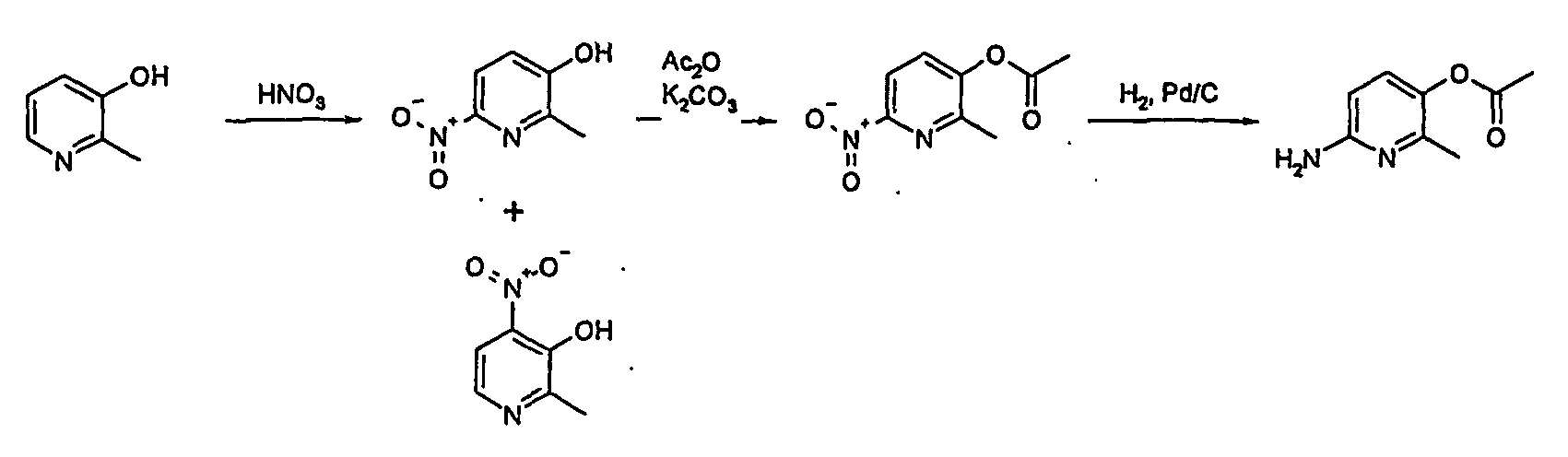
- A) While maintaining a temperature of 0-5°C with external ice cooling, 3-hydroxy-2-methyl pyridine (10.00 g, 91.63 mmol) was added gradually to concentrated sulfuric acid (65.00 ml). A mixture of concentrated sulfuric acid (8.50 ml) and nitric acid (6.50 g, 103.16 mmol) was added over 2h. The resulting mixture was poured onto ice. Addition of a few milliliters of saturated ammonium hydroxide caused precipitation of crude 2-methyl-6-nitro-pyridin-3-ol. This was collected by filtration and recrystallised from methanol/water to yield pure 2-methyl-6-nitro-pyridin-3-ol (1.37 g, 10%). Basification of the mother liquors to pH 3-4 triggered precipitation of the isomeric 2-methyl-4-nitro-pyridin-3-ol (major component), which was discarded.
- B) A solution of 2-methyl-6-nitro-pyridin-3-ol (0.77 g, 5.00 mmol) in acetone (50.00 ml) was treated with acetic anhydride (1.00 g, 9.80 mmol) and potassium carbonate (2.07 g, 15.00 mmol). The mixture was stirred for 1h at room temperature then filtered, washing with acetone. The solvent was removed, yielding acetic acid 2-methyl-6-nitro-pyridin-3-yl ester (0.75 g, 77%) as a white solid, MS (ISP): m/e =196.1 (M+), which was used crude.
- C) Acetic acid 2-methyl-6-nitro-pyridin-3-yl ester (0.30 g, 1.53 mmol) was dissolved in ethanol. 10% Pd/C (0.04 g, 0.38 mmol) was added, and the mixture was put under an atmosphere of hydrogen and stirred vigorously for 50min at room temperature. The catalyst was filtered off, washing with ethanol, and the solvent removed under vacuum to yield acetic acid 6-amino-2-methyl-pyridin-3-yl ester (0.24 g, 95%) as a white solid, MS (ISP): m/e =166.2 (M+), which was used crude.
- The title compound, MS (ISP): m/e = 342.1 (M+H+), was prepared as for example 136, by hydrolysis of acetic acid 2-methyl-6-{[2-methyl-5-(pyridin-3-ylamino)-thiazole-4-carbonyl]-amino}-pyridin-3-yl ester, prepared as described in example 138.
- The title compound, MS (ISP): m/e = 343.0 (M+H+), was prepared as for example 136, by hydrolysis of acetic acid 2-methyl-6-{[2-methyl-5-(pyrimidin-5-ylamino)-thiazole-4-carbonyl]-amino}-pyridin-3-yl ester.
- Acetic acid 2-methyl-6-{ [2-methyl-5-(pyrimidin-5-ylamino)-thiazole-4-carbonyl]-amino}-pyridin-3-yl ester was prepared as for example 116, steps A to D. Step D was performed using acetic acid 6-amino-2-methyl-pyridin-3-yl ester.
- Acetic acid 6-amino-2-methyl-pyridin-3-yl ester was prepared as illustrated for example 138.
- The title compound, MS (ISP): m/e = 401.4 (M+H+), was prepared as for example 130, steps A to B. Step A was performed using 3-chloro aniline and yielded 5-bromo-2-methyl-thiazole-4-carboxylic acid (3-chloro-phenyl)-amide. This was coupled with 3-amino-benzoic acid methyl ester in step B.
- The title compound, MS (ISP): m/e = 374.5 (M+H+), was prepared by reduction of 3-[4-(3-chloro-phenylcarbamoyl)-2-methyl-thiazol-5-ylamino]-benzoic acid methyl ester (prepared as illustrated in example 141) as follows.
- A solution of 3-[4-(3-chloro-phenylcarbamoyl)-2-methyl-thiazol-5-ylamino]-benzoic acid methyl ester (0.02 g, 0.05 mmol) in THF (1.00 ml) was treated at room temperature with lithium aluminium hydride (0.008 g, 0.20 mmol) and stirred at room temperature for 30min. The reaction mixture was quenched with a drop of 5N NaOH and sodium sulphate. The solids were filtered and the mother liquor evaporated. The residue was purified by flash chromatography (heptane/ethyl acetate) to yield the title compound (0.02 g, 90%) as a light brown gum.
- The title compound, MS (ISP): m/e = 401.3 (M+H+), was prepared as for example 141, steps A to B. Step B was performed using N-(3-amino-phenyl)-acetamide.
- The title compound, MS (ISP): m/e = 423.2 (M+H+), was prepared as for example 141, steps A to B. Step B was performed using 3-amino-benzenesulfonamide.
- The title compound, MS (ISP): m/e = 473.6 (M+H+), was prepared as for example 141, steps A to B. Step B was performed using (3-amino-benzyl)-carbamic acid tert-butyl ester.
- The title compound, MS (ISP): m/e = 373.1 (M+H+), was prepared by deprotection of {3-[4-(3-chloro-phenylcarbamoyl)-2-methyl-thiazol-5-ylamino]-benzyl}-carbamic acid tert-butyl ester (prepared as illustrated in example 145) as follows.
- A solution of {3-[4-(3-chloro-phenylcarbamoyl)-2-methyl-thiazol-5-ylamino]-benzyl}-carbamic acid tert-butyl ester (0.02 g, 0.04 mmol) in dichloromethane (0.50 ml) was treated with trifluoroacetic acid (0.10 ml) and stirred at room temperature for 5min. The reaction mixture was diluted with dichloromethane and quenched with saturated sodium hydrogenocarbonate. The organic layer is separated, dried over sodium sulphate and evaporated, to yield the title compound (0.015 g, 94%).
- The title compound, MS (ISP): m/e = 382.9 (M+H+), was prepared as for example 130, steps A to B. Step B was performed using 3-amino-benzoic acid methyl ester.
- The title compound, MS (ISP): m/e = 354.9 (M+H+), was prepared by reduction of 3-[2-methyl-4-(6-methyl-pyridin-2-ylcarbamoyl)-thiazol-5-ylamino]-benzoic acid methyl ester (prepared as illustrated in example 147) with lithium aluminium hydride, as described for example 142.
- The title compound, MS (ISP): m/e = 403.4 (M+H+), was prepared as for example 130, steps A to B. Step B was performed using 3-methanesulfonyl-phenylamine.
- The title compound, MS (ISP): m/e = 403.9 (M+H+), was prepared as for example 130, steps A to B. Step B was performed using 3-amino-benzenesulfonamide.
- The title compound, MS (ISP): m/e = 277.1 (M+H+), was prepared by reaction of 2-bromo-5-methyl-thiophene-3-carboxylic acid (6-methyl-pyridin-2-yl)-amide (prepared as illustrated in example 130) with dimethylamine as follows.
- 2-Bromo-5-methyl-thiophene-3-carboxylic acid (6-methyl-pyridin-2-yl)-amide (0.05 g, 0.16 mmol) was dissolved in a 2N solution of dimethylamine in methanol (2.00 ml). The mixture was stirred at 50°C for 48 h (after the first 24 h, another 1.00 ml of dimethylamine solution was added). The volatiles were then evaporated, and the residue purified by flash chromatography (heptane/ethyl acetate), yielding the title compound (0.02 g, 45%) as a white solid.
- The title compound was prepared as described in schemes 2 and 3
- A) A solution of sodium nitrite (57.30 g, 830.60 mmol) in water (710.00 ml) was treated with ethyl cyanoacetate (100.00 g, 884.00 mmol). 85% Orthophosphoric acid (36.60 ml, 540.00 mmol) was added dropwise over 45 min, while keeping the temperature of the reaction mixture below 35°C with the aid of an ice bath. At the end of the addition, the mixture was warmed to 40°C and stirred for 1 hour. The reaction was quenched at 45°C with fuming HCl (73.90 ml, 880.00 mmol), and the mixture was then left to cool to room temperature and at 0°C overnight to complete precipitation. The solid was filtered, the filtrate washed with water and dried under high vacuum overnight to yield 70 g of cyano-hydroxyimino-acetic acid ethyl ester as white crystals. A second batch was obtained by extracting the mother liquor with ether (44.00 g, total yield 91%).
- B) Cyano-hydroxyimino-acetic acid ethyl ester (30.00 g, 211.10 mmol) was added portionwise to a solution of water (766.00 ml) and saturated sodium bicarbonate (192.00 ml). Sodium dithionite (73.50 g, 422.00 mmol) was then added during 5min. The mixture was stirred at room temperature for 2 hours, then extracted four times with dichloromethane. The combined organic extracts were dried with Na2SO4 and evaporated to afford aminocyanacetic acid ethyl ester as a light yellow oil (11.80 g, 44%).
- C) A solution of aminocyanacetic acid ethyl ester (1.00 g, 7.80 mmol) in ethyl acetate (16.00 ml) was cooled to 0°C and treated with dimethylaminopyridine (0.09 g, 0.78 mmol) and dicyclohexylcarbodiimide (1.93 g, 9.36 mmol). 3-Methoxypropionic acid (0.81 g, 7.80 mmol) was added portionwise. After completed addition, the mixture was stirred at 0°C for 1h, then at room temperature for 3 h. The precipitated dicyclohexylurea was filtered off and the mother liquors washed with water, dried over sodium sulphate and evaporated. The residue was purified by trituration in diisopropylether to yield cyano-(3-methoxy-propionylamino)-acetic acid ethyl ester (1.27 g, 76%), MS (ISP): m/e = 215.3 (M+H+).
- D) A suspension of cyano-(3-methoxy-propionylamino)-acetic acid ethyl ester (0.95 g, 4.44 mmol) in toluene (11.00 ml) was flushed with argon. 2,4-bis(4-Methoxyphenyl)-1,3,2,4-dithiadiphosphetane 2,4-disulfide (Lawesson's reagent) (0.90 g, 2.22 mmol) was added at once and the mixture was warmed at 110°C for 2h. Toluene was evaporated and the residue purified by flash chromatography (heptane/ethyl acetate) to yield 5-amino-2-(2-methoxy-ethyl)-thiazole-4-carboxylic acid ethyl ester (0.42 g, 40%), MS (ISP): m/e = 231.1 (M+H+).
- E) A microwave vial was charged with Pd2dba3-chloroform complex (0.09 g, 0.09 mmol), Xantphos (0.17 g, 0.30 mmol) and cesium carbonate (1.00 g, 3.06 mmol), sealed and flushed with argon. A solution of 5-amino-2-(2-methoxy-ethyl)-thiazole-4-carboxylic acid ethyl ester (0.40 g, 1.75 mmol) and 3-bromopyridine (0.28 g, 1.75 mmol) in dioxane (5.80 ml) was degassed by sonicating and bubbling with argon, then transferred to the reaction vial. After stirring at room temperature for 5min, the reaction mixture was irradiated in a microwave oven at 150°C for 10min. The mixture was diluted with THF, filtered and the mother liquors evaporated. The residue was purified by flash chromatography (heptane/ethyl acetate/methanol) to yield 2-(2-methoxy-ethyl)-5-(pyridin-3-ylamino)-thiazole-4-carboxylic acid ethyl ester (0.18 g, 40%), MS (ISP): m/e = 308.3 (M+H+).
- F) A solution of 2-(2-methoxy-ethyl)-5-(pyridin-3-ylamino)-thiazole-4-carboxylic acid ethyl ester (0.17 g, 0.56 mmol) in methanol (1.00 ml) was treated with a 2.55 N solution of KOH in water (0.66 ml). The mixture was stirred at 55°C for 40min, then the volatiles were evaporated. The residue was redissolved in water (1.30 ml) and acidified to pH 3 with 1N HCl. Filtration and drying under vacuum afforded 2-(2-methoxy-ethyl)-5-(pyridin-3-ylamino)-thiazole-4-carboxylic acid (0.08 g, 50%), MS (ISP): m/e = 278.1 (M-H)
- G) A solution of 2-(2-methoxy-ethyl)-5-(pyridin-3-ylamino)-thiazole-4-carboxylic acid (0.032 g, 0.11 mmol) in dimethylformamide (1.00 ml) was treated with DIPEA (0.042 g, 0.33 mmol), TBTU (0.053 g, 0.16 mmol) and 6-methyl-pyridin-2-yl-amine (0.018 g, 0.16 mmol). The mixture was stirred at room temperature overnight, then purified by direct injection in preparative HPLC (ZORBAX Eclipse XDB-C18, 21.2x50 mm, 5 µm, gradient acetonitrile/water + 0.1% formic acid). The title compound (0.011 g, 27%) was obtained as a white solid, MS (ISP): m/e = 370.1 (M+H+).
- The title compound, MS (ISP): m/e = 356.4 (M+H+), was prepared as for example 152, steps A to G. Step C was substituted with an alternative coupling procedure as follows.
- A solution of aminocyanacetic acid ethyl ester (1.00 g, 7.80 mmol) in dichloromethane (15.00 ml) was cooled to 0°C and treated with pyridine (0.62 g, 7.80 mmol). Methoxyacetyl chloride (0.85 g, 7.80 mmol) was added dropwise during 15min. The mixture was stirred for 5min at 0°C, then warmed to room temperature and stirred for 10min. The volatiles were evaporated, and the residue was redissolved in dichloromethane and washed twice with water. The organic layer was dried with sodium sulphate and evaporated. The residue was triturated in diisopropyl ether to yield cyano-(2-methoxy-acetylamino)-acetic acid ethyl ester (1.04 g, 66%), MS (ISP): m/e = 201.1 (M+H+).
- Cyano-(2-methoxy-acetylamino)-acetic acid ethyl ester was cyclized to 5-amino-2-methoxymethyl-thiazole-4-carboxylic acid ethyl ester in step D, which was used in step E to generate 2-methoxymethyl-5-(pyridin-3-ylamino)-thiazole-4-carboxylic acid ethyl ester. This was hydrolised to 2-methoxymethyl-5-(pyridin-3-ylamino)-thiazole-4-carboxylic acid in step F, which was used in step G to generate the title compound.
- The title compound, MS (ISP): m/e = 352.3 (M+H+), was prepared as for example 153, steps A to G. Step C was performed using cyclopropanecarbonyl chloride, and yielded cyano-(cyclopropanecarbonyl-amino)-acetic acid ethyl ester, which was cyclized to 5-amino-2-cyclopropyl-thiazole-4-carboxylic acid ethyl ester in step D. This was used in step E to generate 2-cyclopropyl-5-(pyridin-3-ylamino)-thiazole-4-carboxylic acid ethyl ester, which was hydrolised to 2-cyclopropyl-5-(pyridin-3-ylamino)-thiazole-4-carboxylic acid in step F. Coupling as described in step G generated the title compound.
- The title compound, MS (ISP): m/e = 366.0 (M+H+), was prepared as for example 153, steps A to G. Step C was performed using cyclobutanecarbonyl chloride, and yielded cyano-(cyclobutanecarbonyl-amino)-acetic acid ethyl ester, which was cyclized to 5-amino-2-cyclobutyl-thiazole-4-carboxylic acid ethyl ester in step D. This was used in step E to generate 2-cyclobutyl-5-(pyridin-3-ylamino)-thiazole-4-carboxylic acid ethyl ester, which was hydrolised to 2-cyclobutyl-5-(pyridin-3-ylamino)-thiazole-4-carboxylic acid in step F. Coupling as described in step G generated the title compound.
- The title compound, MS (ISP): m/e = 340.3 (M+H+), was prepared as for example 153, steps A to G. Step C was performed using propionyl chloride, and yielded cyano-propionylamino-acetic acid ethyl ester, which was cyclized to 5-amino-2-ethyl-thiazole-4-carboxylic acid ethyl ester in step D. This was used in step E to generate 2-ethyl-5-(pyridin-3-ylamino)-thiazole-4-carboxylic acid ethyl ester, which was hydrolised to 2-ethyl-5-(pyridin-3-ylamino)-thiazole-4-carboxylic acid in step F. Coupling as described in step G generated the title compound.
- The title compound, MS (ISP): m/e = 354.0 (M+H+), was prepared as for example 153, steps A to G. Step C was performed using butyryl chloride, and yielded butyrylamino-cyano-acetic acid ethyl ester, which was cyclized to 5-amino-2-propyl-thiazole-4-carboxylic acid ethyl ester in step D. This was used in step E to generate 2-propyl-5-(pyridin-3-ylamino)-thiazole-4-carboxylic acid ethyl ester, which was hydrolised to 2-propyl-5-(pyridin-3-ylamino)-thiazole-4-carboxylic acid in step F. Coupling as described in step G generated the title compound.
- The title compound, MS (ISP): m/e = 352.3 (M+H+), was prepared as for example 153, steps A to G. Step C was performed using isobutyryl chloride, and yielded cyano-isobutyrylamino-acetic acid ethyl ester, which was cyclized to 5-amino-2-isopropyl-thiazole-4-carboxylic acid ethyl ester in step D. This was used in step E to generate 2-isopropyl-5-(pyridin-3-ylamino)-thiazole-4-carboxylic acid ethyl ester, which was hydrolised to 2-isopropyl-5-(pyridin-3-ylamino)-thiazole-4-carboxylic acid in step F. Coupling as described in step G generated the title compound.
- The title compound was prepared as illustrated in scheme 7.
- A) A solution of 5-bromo-2-methyl-thiazole-4-carboxylic acid (prepared as described in example 119, steps A to B) (1.50 g, 6.75 mmol) in methanol (80.00 ml) was treated with a saturated solution of HCl in ether (3.00 ml). The reaction mixture was heated at reflux for 3 h, then the volatiles were removed. The residue was purified by flash chromatography (methylene chloride/methanol) yielding 5-bromo-2-methyl-thiazole-4-carboxylic acid methyl ester (1.30 g, 82%) as a white solid, MS (ISP): m/e = 235.9, 237.9 (M+H+).
- B) A solution of 2-amino-5-fluoropyridine (6.0 g, 53 mmol) in 40 ml dry dioxane was treated at 0°C with trimethylaluminium (2M in hexane, 26.8 ml, 53 mmol). The mixture was stirred at room temperature for 1 h. A solution of 5-bromo-2-methyl-thiazole-4-carboxylic acid methyl ester (4.2 g, 18 mmol) in 40 mL dry dioxane was added and the reaction mixture was refluxed for 4 h. 10 ml water and 10 g sodium sulfate were sequentially added and filtered. The filtrate was evaporated and the residue purified by flash chromatography (hetane, ethyl acetate) to yield 5-bromo-2-methyl-thiazole-4-carboxylic acid (5-fluoro-pyridin-2-yl)-amide (3.0 g, 53%) as a white solid, MS (ISP): m/e = 318.0 (M+H+).
- C) A solution of 5-bromo-2-methyl-thiazole-4-carboxylic acid (5-fluoro-pyridin-2-yl)-amide (0.24 g, 0.76 mmol) and 2-methyl-pyridin-3-ylamine (0.099 g, 0.92 mmol) in dry dioxane (12 ml) was degassed by sonication and argon bubbling. 4,5-Bis(diphenylphosphino)-9,9-dimethylxanthene (Xantphos) (0.149 g, 0.26 mmol) and palladium dibenzylideneacetone chloroform complex (0.081 g, 0.08 mmol) were added and the mixture was stirred until dissolution was complete. Finally, the mixture was treated with cesium carbonate (0.495 g, 1.52 mmol) and irradiated in a microwave oven at 100°C for 10min, 130°C for 10min and 150°C for 10min. The solvent was removed under vacuum and the residue purified by flash chromatography (heptane, ethyl acetate) to yield the title compound (0.178 g, 68%) as a light brown solid, MS (ISP): m/e = 344.0 (M+H+).
- The title compound, MS (ISP): m/e = 421.1 (M+H+), was prepared as for example 159, steps A to C. Step B was performed using 2-methyl-pyridin-4-ylamine and step C was performed using 2-fluoro-5-methylsulfonyl-aniline.
- The title compound, MS (ISP): m/e = 404.4 (M+H+), was prepared as for example 159, steps A to C. Step B was performed using 2-methyl-pyridin-4-ylamine and step C was performed using 3-aminobenzene sulfonamide.
- The title compound, MS (ISP): m/e = 394.0 (M+H+), was prepared as for example 159, steps A to C. Step B was performed using 2-methyl-pyridin-4-ylamine and step C was performed using 3-amino-6-(trifluoromethyl)pyridine.
- The title compound was prepared as illustrated in scheme 8.
- A) A suspension of 2- acetylamino-cyanoacetic acid ethyl ester (1.70 g, 10.00 mmol) and 2,4-bis(4-methoxyphenyl)-1,3,2,4-dithiadiphosphetane 2,4-disulfide (Lawesson's reagent) (2.02 g, 5.00 mmol) in toluene (25.00 ml) was heated under argon to 110°C and stirred for 22 h. The solvent was then evaporated, and the residue purified by flash chromatography (heptane/ethyl acetate 1:1) to yield 5-amino-2-methyl-thiazole-4-carboxylic acid ethyl ester (0.94 g, 50.5%) as a yellow solid, MS (ISP): m/e = 187.3 (M+H+).
- B) A microwave vial was charged with 5-amino-2-methyl-thiazole-4-carboxylic acid ethyl ester (0.300 g, 1.61 mmol), 4,5-bis(diphenylphosphino)-9,9-dimethylxanthene (Xantphos) (0.28 g, 0.48 mmol) and palladium dibenzylideneacetone (Pd2dba3) - chloroform complex (0.17 g, 0.16 mmol). Degassed dioxane (15.00 ml) was added, followed by 3-bromobenzenesulfonamide (0.38 g, 1.61 mmol) and cesium carbonate (0.93 g, 2.87 mmol) The vial was then irradiated in a microwave oven at 150°C for 15min. The mixture was diluted with THF and the solids filtered, washing with THF. The filtrate was evaporated and the residue purified by flash chromatography (heptane ethyl acetate) to yield 2-methyl-5-(3-sulfamoyl-phenylamino)-thiazole-4-carboxylic acid ethyl ester (0.13 g, 24%) as an off-white solid, MS (ISP): m/e = 342.1 (M+H+).
- C) A solution of 2-amino-5-fluoro pyridine (0.15 g, 1.38 mmol) in 10 ml dry dioxane was treated at 0°C with trimethylaluminium (2M in hexane, 0.69 ml, 1.38 mmol). The mixture was stirred at room temperature for 1 h. 2-Methyl-5-(3-sulfamoyl-phenylamino)-thiazole-4-carboxylic acid ethyl ester (0.12 g, 0.35 mmol) was added and the reaction mixture was refluxed for 4 h. 1 ml water and 2 g sodium sulfate were sequentially added and filtered. The filtrate was evaporated and the residue purified by flash chromatography (hetane, ethyl acetate) to yield 2-methyl-5-(3-sulfamoyl-phenylamino)-thiazole-4-carboxylic acid (5-fluoro-pyridin-2-yl)-amide (0.004 g, 3%) as an off-white solid, MS (ISP): m/e = 408.4 (M+H+).
- The title compound, MS (ISP): m/e = 340.3 (M+H+), was prepared as for example 159, steps A to C. Step B was performed using 2-methyl-pyridin-4-ylamine and step C was performed using 2-methyl-pyridin-3-ylamine.
- The title compound, MS (ISP): m/e = 407.4 (M+H+), was prepared as for example 159, steps A to C. Step B was performed using 2-amino-5-fluoro pyridine and step C was performed using 3-methylsulfonylaniline.
- The title compound, MS (ISP): m/e = 331.3 (M+H+), was prepared as for example 159, steps A to C. Step B was performed using 2-amino-5-fluoro pyridine and step C was performed using aminopyrazine.
- The title compound, MS (ISP): m/e = 364.1 (M+H+), was prepared as for example 159, steps A to C. Step B was performed using 2-amino-5-fluoro pyridine and step C was performed using 5-chloropyridin-3-amine.
- The title compound, MS (ISP): m/e = 344.1 (M+H+), was prepared as for example 159, steps A to C. Step B was performed using 2-amino-5-fluoro pyridine and step C was performed using 2-amino-5-methylpyridine.
- The title compound, MS (ISP): m/e = 363.3 (M+H+), was prepared as for example 159, steps A to C. Step B was performed using 2-chloro-pyridin-4-ylamine and step C was performed using 4-fluoroaniline.
- The title compound, MS (ISP): m/e = 347.3 (M+H+), was prepared as for example 159, steps A to C. Step B was performed using 2-chloro-pyridin-4-ylamine and step C was performed using 5-aminopyrimidine.
- The title compound, MS (ISP): m/e = 344.1 (M+H+), was prepared as for example 159, steps A to C. Step B was performed using 2-amino-5-fluoro pyridine and step C was performed using 2-methyl-pyridin-4-ylamine.
- The title compound, MS (ISP): m/e = 360.3 (M+H+), was prepared as for example 159, steps A to C. Step B was performed using 2-chloro-pyridin-4-ylamine and step C was performed using 2-methyl-pyridin-3-ylamine.
- The title compound, MS (ISP): m/e = 347.1 (M+H+), was prepared as for example 159, steps A to C. Step B was performed using 2-chloro-pyridin-4-ylamine and step C was performed using aminopyrazine.
- The title compound, MS (ISP): m/e = 360.4 (M+H+), was prepared as for example 159, steps A to C. Step B was performed using 2-methyl-pyridin-4-ylamine and step C was performed using 5-chloropyridin-3-amine.
- The title compound, MS (ISP): m/e = 395.0 (M+H+), was prepared as for example 159, steps A to C. Step B was performed using 2-amino-5-fluoro pyridine and step C was performed using 3-(difluoromethoxy)aniline.
- The title compound, MS (ISP): m/e = 464.4 (M+H+), was prepared as for example 159, steps A to C. Step B was performed using 2-amino-5-fluoro pyridine and step C was performed using 3-amino-N,N-diethyl-benzenesulfonamide.
- The title compound, MS (ISP): m/e = 380.1 (M+H+), was prepared as for example 159, steps A to C. Step B was performed using 2-chloro-pyridin-4-ylamine and step C was performed using 5-chloropyridin-3-amine.
- The title compound, MS (ISP): m/e = 355.3 (M+H+), was prepared as for example 163, steps A to C. Step B was performed using 5-bromopyridine-3-carbonitrile and step C was performed using 2-amino-5-fluoro pyridine.
- The title compound, MS (ISP): m/e = 352.3 (M+H+), was prepared as for example 163, steps A to C. Step B was performed using 5-bromopyridine-3-carbonitrile and step C was performed using 2-methyl-4-amino-pyrimidine.
- The title compound, MS (ISP): m/e = 3.44.0 (M+H+), was prepared as for example 163, steps A to C. Step B was performed using 3-bromo-4-methylpyridine and step C was performed using 2-amino-5-fluoro pyridine.
- The title compound, MS (ISP): m/e = 328.3 (M+H+), was prepared as for example 159, steps A to C. Step B was performed using 2-methyl-4-amino-pyrimidine and step C was performed using 5-aminopyrimidine.
- The title compound, MS (ISP): m/e = 351.4 (M+H+), was prepared as for example 163, steps A to C. Step B was performed using 5-bromopyridine-3-carbonitrile and step C was performed using 2-methyl-pyridin-4-ylamine.
- The title compound, MS (ISP): m/e = 352.3 (M+H+), was prepared as for example 163, steps A to C. Step B was performed using 5-bromopyridine-3-carbonitrile and step C was performed using 2-amino-4-methylpyrimidine.
- The title compound, MS (ISP): m/e = 393.1 (M+H+), was prepared as for example 159, steps A to C. Step B was performed using 2-methyl-4-amino-pyrimidine and step C was performed using 3-(1,3-oxazol-5-yl)aniline.
- The title compound, MS (ISP): m/e = 360.3 (M+H+), was prepared as for example 163, steps A to C. Step B was performed using 3-bromo-4-methylpyridine and step C was performed using 4-amino-2-chloropyridine.
- The title compound, MS (ISP): m/e = 404.4 (M+H+), was prepared as for example 163, steps A to C. Step B was performed using 3-bromo-5-methanesulfonyl-pyridine and step C was performed using 2-methyl-pyridin-4-ylamine.
- The title compound, MS (ISP): m/e = 344.1 (M+H+), was prepared as for example 159, steps A to C. Step B was performed using 2-methyl-4-amino-pyrimidine and step C was performed using 3-fluoro-aniline.
- The title compound, MS (ISP): m/e = 341.3 (M+H+), was obtained as a by-product of 2-methyl-5-(6-methyl-pyridazin-4-ylamino)-thiazole-4-carboxylic acid (2-chloro-pyridin-4-yl)-amide (example 190) through substitution of the chloro for methyl by the trimethylaluminium reagent.
- The title compound, MS (ISP): m/e = 351.4 (M+H+), was prepared as for example 159, steps A to C. Step B was performed using 2-methyl-4-amino-pyrimidine and step C was performed using 3-aminobenzonitrile.
- The title compound, MS (ISP): m/e = 361.4 (M+H+), was prepared as for example 163, steps A to C. Step B was performed using 5-chloro-3-methyl-pyridazine and step C was performed using 4-amino-2-chloropyridine.
- The title compound, MS (ISP): m/e = 436.1 (M+H+), was prepared as for example 159, steps A to C. Step B was performed using 2-amino-5-fluoro pyridine and step C was performed using 3-amino-N-ethyl-benzenesulfonamide.
- The title compound, MS (ISP): m/e = 317.3 (M+H+), was prepared as for example 159, steps A to C. Step B was performed using 2-methyl-4-amino-pyrimidine and step C was performed using 3-aminoisoxazole.
- The title compound, MS (ISP): m/e = 351.3 (M+H+), was prepared as for example 159, steps A to C. Step B was performed using 2-methyl-pyridin-4-ylamine and step C was performed using 2-amino-isonicotinonitrile.
- The title compound, MS (ISP): m/e = 362.3 (M+H+), was prepared as for example 159, steps A to C. Step B was performed using 2-methyl-4-amino-pyrimidine and step C was performed using 3,5-difluoro-ahiline.
- The title compound, MS (ISP): m/e = 360.0 (M+H+), was prepared as for example 159, steps A to C. Step B was performed using 2-methyl-pyridin-4-ylamine and step C was performed using 4-amino-2-chloropyridine.
- The title compound, MS (ISP): m/e = 361.0 (M+H+), was prepared as for example 159, steps A to C. Step B was performed using 2-methyl-pyridin-4-ylamine and step C was performed using 4-chloro-pyridin-2-ylamine.
- The title compound, MS (ISP): m/e = 364.0 (M+H+), was prepared as for example 163, steps A to C. Step B was performed using 5-bromopyrimidine and step C was performed using 3-chloro-4-fluoro-aniline.
- The title compound, MS (ISP): m/e = 408.3 (M+H+), was prepared as for example 163, steps A to C. Step B was performed using 3-bromo-5-methanesulfonyl-pyridine and step C was performed using 2-amino-5-fluoropyridine.
- The title compound, MS (ISP): m/e = 405.4 (M+H+), was prepared as for example 163, steps A to C. Step B was performed using 3-bromo-5-methanesulfonyl-pyridine and step C was performed using 2-methyl-4-amino-pyrimidine.
- The title compound, MS (ISP): m/e = 404.4 (M+H+), was prepared as for example 159, steps A to C. Step B was performed using 2-methyl-4-amino-pyrimidine and step C was performed using 3-methylsulphonylaniline.
- The title compound, MS (ISP): m/e = 343.1 (M+H+), was prepared as for example 159, steps A to C. Step B was performed using 2-methyl-pyridin-4-ylamine and step C was performed using 3-fluoroaniline.
- The title compound, MS (ISP): m/e = 361.4 (M+H+), was prepared as for example 159, steps A to C. Step B was performed using 2-methyl-pyridin-4-ylamine and step C was performed using 3,5-difluoroaniline.
- The title compound, MS (ISP): m/e = 344.3 (M+H+), was prepared as for example 163, steps A to C. Step B was performed using 5-bromopyrimidine and step C was performed using 4-fluoro-3-methyl-aniline.
- The title compound, MS (ISP): m/e = 341.3 (M+H+), was prepared as for example 163, steps A to C. Step B was performed using 3-bromopyridine and step C was performed using 2-ethyl-4-amino-pyrimidine.
-
- A) A suspension of 2- acetylamino-cyanoacetic acid ethyl ester (1.70 g, 10.00 mmol) and 2,4-bis(4-methoxyphenyl)-1,3,2,4-dithiadiphosphetane 2,4-disulfide (Lawesson's reagent) (2.02 g, 5.00 mmol) in toluene (25.00 ml) was heated under argon to 110°C and stirred for 22 h. The solvent was then evaporated, and the residue purified by flash chromatography (heptane/ethyl acetate 1:1) to yield 5-amino-2-methyl-thiazole-4-carboxylic acid ethyl ester (0.94 g, 50.5%) as a yellow solid, MS (ISP): m/e = 187.3 (M+H+).
- B) 5-Amino-2-methyl-thiazole-4-carboxylic acid ethyl ester (0.200 g, 1.07 mmol) was dissolved in 10 mL dry DMF. Potassium carbonate (0.45 g, 3.26 mmol) and cyclopropyl methylbromide (0.166 g, 1.23 mmol) were added and the reaction mixture was stirred at 80°C overnight. The reaction mixture was diluted with 100 mL water and extracted three times with ethyl acetate (50 mL each). The organic phases were pooled, dried with sodium sulfate and evaporated. The crude product was flash-chromatographed on silica gel with heptane/ethyl acetate 100:0 -> 0:100 gradient to yield 5-(cyclopropylmethoxycarbonyl-(cyclopropylmethyl)-amino)-2-methyl-thiazole-4-carboxylic acid ethyl ester (140 mg, 39%).
- C) A solution of 2-methyl-4-amino-pyrimidine (0.184 g, 1.68 mmol) in 10 ml dry dioxane was treated at 0°C with trimethylaluminium (2M in hexane, 0.84 ml, 1.68 mmol). The mixture was stirred at room temperature for 1 h. 5-(Cyclopropylmethoxycarbonyl-(cyclopropylmethyl)-amino)-2-methyl-thiazole-4-carboxylic acid ethyl ester (0.135 g, 0.40 mmol) was added and the reaction mixture was refluxed for 4 h. 1 ml water and 2 g sodium sulfate were sequentially added and filtered. The filtrate was evaporated and the residue purified by flash chromatography with heptane/ethyl acetate 100:0 -> 0:100 gradient to yield cyclopropylmethyl-[2-methyl-4-(2-methyl-pyrimidin-4-ylcarbamoyl)-thiazol-5-yl]-carbamic acid cyclopropylmethyl ester (0.101 g, 63%) as a colourless oil, MS (ISP): m/e = 402.5 (M+H+).
- The title compound, MS (ISP): m/e = 344.1 (M+H+), was prepared as for example 163, steps A to C. Step B was performed using 3,5-dichloropyridine and step C was performed using 2-amino-5-fluoropyridine. The chloro was substituted by methyl through the trimethylaluminium reagent.
- The title compound, MS (ISP): m/e = 361.4 (M+H+), Was prepared as for example 159, steps A to C. Step B was performed using 2-methyl-4-amino-pyrimidine and step C was performed using 4-amino-2-chloroaniline.
- Cyclopropylmethyl-[2-methyl-4-(2-methyl-pyrimidin-4-ylcarbamoyl)-thiazol-5-yl]-carbamic acid cyclopropylmethyl ester (example 205, 0.091 g, 0.227 mmol) was dissolved in 1 mL trifluoroacetic acid and stirred at 50°C for 3h. The reaction mixture was diluted with 20 mL saturated sodium bicarbonate solution and extracted three times with ethyl acetate (30 mL each). The organic phases were pooled, dried with sodium sulfate and evaporated. The crude product was flash-chromatographed on silica gel with heptane/ethyl acetate 100:0 -> 0:100 gradient to yield the desired compound as a white solid (37 mg, 54%), MS (ISP): m/e = 304.0 (M+H+).
- The title compound, MS (ISP): m/e= 369.0 (M+H+), was prepared as for example 159, steps A to C. Step B was performed using 2-methyl-4-amino-pyrimidine and step C was performed using 3-aminobenzamide.
- The title compound, MS (ISP): m/e = 393.1 (M+H+), was prepared as for example 159, steps A to C. Step B was performed using 2-methyl-pyridin-4-ylamine and step C was performed using 3-aminobenzotrifluoride.
- The title compound, MS (ISP): m/e = 368.1 (M+H+), was prepared as for example 159, steps A to C. Step B was performed using 2-methyl-pyridin-4-ylamine and step C was performed using 3-aminobenzamide.
- The title compound, MS (ISP): m/e = 356.3 (M+H+), was prepared as for example 159, steps A to C. Step B was performed using 5-bromo-3-methoxy-pyridine and step C was performed using 2-methyl-pyridin-4-ylamine.
- The title compound, MS (ISP): m/e = 340.3 (M+H+), was prepared as for example 159, steps A to C. Step B was performed using 5-bromo-3-picoline and step C was performed using 2-methyl-pyridin-4-ylamine.
- The title compound was prepared as illustrated in scheme 9.
- A) A suspension of 2- acetylamino-cyanoacetic acid ethyl ester (1.70 g, 10.00 mmol) and 2,4-bis(4-methoxyphenyl)-1,3,2,4-dithiadiphosphetane 2,4-disulfide (Lawesson's reagent) (2.02 g, 5.00 mmol) in toluene (25.00 ml) was heated under argon to 110°C and stirred for 22 h. The solvent was then evaporated, and the residue purified by flash chromatography (heptane/ethyl acetate 1:1) to yield 5-amino-2-methyl-thiazole-4-carboxylic acid ethyl ester (0.94 g, 50.5%) as a yellow solid, MS (ISP): m/e = 187.3 (M+H+).
- B) 5-Amino-2-methyl-thiazole-4-carboxylic acid ethyl ester (0.40 g, 2.15 mmol) was dissolved in 20 ml dry THF. Di-tert.-butyl dicarbonate (0.526 g, 4.41 mmol) and 4-(N,N-dimethylamino)pyridine (0.036 g, 0.3 mmol) were added and the reaction mixture was stirred at 70°C overnight..The solvent was evaporated, the residue taken up in 20 mL saturated sodium bicarbonate solution and extracted three times with ethyl acetate (30 mL each). The organic phases were pooled, dried with sodium sulfate and evaporated. The crude product was flash-chromatographed on silica gel with heptane/ethyl acetate 100:0 -> 0:100 gradient to yield 5-tert-butoxycarbonylamino-2-methyl-thiazole-4-carboxylic acid ethyl ester as a light yellow solid (0.553 g, 90%), MS (ISP): m/e = 287.1 (M+H+).
- C) A solution of 2-methyl-pyridin-4-ylamine (0.623 g, 5.77 mmol) in 20 ml dry dioxane was treated at 0°C with trimethylaluminium (2M in hexane, 2.88 ml, 5.77 mmol). The mixture was stirred at room temperature for 1 h. 5-tert-Butoxycarbonylamino-2-methyl-thiazole-4-carboxylic acid ethyl ester (0.55 g, 1.92 mmol) was added and the reaction mixture was refluxed for 4 h. 1 ml water and 2 g sodium sulfate were sequentially added and filtered. The filtrate was evaporated and the residue purified by flash chromatography on silica gel with heptane/ethyl acetate 100:0 -> 0:100 to yield [2-methyl-4-(2-methyl-pyridin-4-ylcarbamoyl)-thiazol-5-yl]-carbamic acid tert-butyl ester (0.555 g, 83%) as a light yellow solid, MS (ISP): m/e = 349.5 (M+H+).
- D) [2-Methyl-4-(2-methyl-pyridin-4-ylcarbamoyl)-thiazol-5-yl]-carbamic acid tert-butyl ester (0.532 g, 1.53 mmol) was dissolved in 12 mL trifluoroacetic acid and stirred at room temperature for 30 min. The reaction mixture was treated with 2N sodium carbonate solution until pH10 and extracted three times with ethyl acetate (50 mL each). The organic phases were pooled, dried with sodium sulfate and evaporated. The crude product was flash-chromatographed on silica gel with heptane/ethyl acetate 100:0 -> 0:100 gradient to yield 5-amino-2-methyl-thiazole-4-carboxylic acid (2-methyl-pyridin-4-yl)-amide as a light yellow solid (0.361 g, 95%), MS (ISP): m/e = 249.1 (M+H+).
- E) 5-Amino-2-methyl-thiazole-4-carboxylic acid (2-methyl-pyridin-4-yl)-amide (0.15 g, 0.605 mmol) was dissolved in 5 mL fry DMF. 3,5-Difluoropyridine (0.213 g, 1.85 mmol) and cesium carbonate (0.59 g, 1.85 mmol) were added. The reaction mixture was irradiated in the microwave at 150°C for 45 min, diluted with 100 mL water and extracted three times with ethyl acetate (50 mL each). The organic phases were pooled, dried with sodium sulfate and evaporated. The crude product was flash-chromatographed on silica gel with heptane/ethyl acetate 100:0 -> 0:100 gradient to yield the title compound as an off-white solid (0.135 g, 65%), MS (ISP): m/e = 344.1 (M+H+).
- The title compound, MS (ISP): m/e = 350.4 (M+H+), was prepared as for example 159, steps A to C. Step B was performed using 2-methyl-pyridin-4-ylamine and step C was performed using 3-aminobenzonitrile.
- The title compound, MS (ISP): m/e = 329.0 (M+H+), was prepared as for example 159, steps A to C. Step B was performed using 2-methyl-pyridin-4-ylamine and step C was performed using 5-amino-1-methylpyrazole.
- The title compound, MS (ISP): m/e = 383.1 (M+H+), was prepared as for example 159, steps A to C. Step B was performed using 2-methyl-pyridin-4-ylamine and step C was performed using methyl-3-aminobenzoate.
- The title compound, MS (ISP): m/e = 361.4 (M+H+), was prepared as for example 159, steps A to C. Step B was performed using 2-methyl-pyridin-4-ylamine and step C was performed using 2,5-difluoroaniline.
- The title compound, MS (ISP): m/e = 327.3 (M+H+), was prepared as for example 163, steps A to C. Step B was performed using 3-bromo-pyridine and step C was performed using 2-amino-4-methylpyrimidine.
- The title compound, MS (ISP): m/e = 381.0 (M+H+), was prepared as for example 159, steps A to C. Step B was performed using 4-amino-2-chloropyridine and step C was performed using 3,5-difluoroaniline.
- 3-[2-Methyl-4-(2-methyl-pyridin-4-ylcarbamoyl)-thiazol-5-ylamino]-benzoic acid methyl ester (example 222, 0.425 g, 1.11 mmol) was dissolved in 15 mL dry THF. Lithiumalumiumhydride (0.169 g, 4.44 mmol) was added and the reaction mixture was stirred at room temperature for 1h. Water (0.169 mL), 15% NaOH (0.169 mL) and again water (0.507 mL) was slowly added and the reaction mixture was filtered and evaporated. The crude material was recrystallized from ethyl acetate and dichloromethane to yield the title compound as a yellow solid (0.257 g, 65%), MS (ISP): m/e = 355.3 (M+H+).
- The title compound, MS (ISP): m/e = 346.1 (M+H+), was prepared as for example 159, steps A to C. Step B was performed using 4-amino-2-chloropyridine and step C was performed using 2-aminopyridine.
- The title compound was prepared as illustrated in scheme 9.
- A) A suspension of 2- acetylamino-cyanoacetic acid ethyl ester (1.70 g, 10.00 mmol) and 2,4-bis(4-methoxyphenyl)-1,3,2,4-dithiadiphosphetane 2,4-disulfide (Lawesson's reagent) (2.02 g, 5.00 mmol) in toluene (25.00 ml) was heated under argon to 110°C and stirred for 22 h. The solvent was then evaporated, and the residue purified by flash chromatography (heptane/ethyl acetate 1:1) to yield 5-amino-2-methyl-thiazole-4-carboxylic acid ethyl ester (0.94 g, 50.5%) as a yellow solid, MS (ISP): m/e = 187.3 (M+H+).
- B) 5-Amino-2-methyl-thiazole-4-carboxylic acid ethyl ester (0.40 g, 2.15 mmol) was dissolved in 20 ml dry THF. Di-tert.-butyl dicarbonate (0.526 g, 4.41 mmol) and 4-(N,N-dimethylamino)pyridine (0.036 g, 0.3 mmol) were added and the reaction mixture was stirred at 70°C overnight. The solvent was evaporated, the residue taken up in 20 mL saturated sodium bicarbonate solution and extracted three times with ethyl acetate (30 mL each). The organic phases were pooled, dried with sodium sulfate and evaporated. The crude product was flash-chromatographed on silica gel with heptane/ethyl acetate 100:0 -> 0:100 gradient to yield 5-tert-butoxycarbonylamino-2-methyl-thiazole-4-carboxylic acid ethyl ester as a light yellow solid (0.553 g, 90%), MS (ISP): m/e = 287.1 (M+H+).
- C) A solution of 2-methyl-pyridin-4-ylamine (0.623 g, 5.77 mmol) in 20 ml dry dioxane was treated at 0°C with trimethylaluminium (2M in hexane, 2.88 ml, 5.77 mmol). The mixture was stirred at room temperature for 1 h. 5-tert-Butoxycarbonylamino-2-methyl-thiazole-4-carboxylic acid ethyl ester (0.55 g, 1.92 mmol) was added and the reaction mixture was refluxed for 4 h. 1 ml water and 2 g sodium sulfate were sequentially added and filtered. The filtrate was evaporated and the residue purified by flash chromatography on silica gel with heptane/ethyl acetate 100:0 -> 0:100 to yield [2-methyl-4-(2-methyl-pyridin-4-ylcarbamoyl)-thiazol-5-yl]-carbamic acid tert-butyl ester (0.555 g, 83%) as a light yellow solid, MS (ISP): m/e = 349.5 (M+H+).
- D) [2-Methyl-4-(2-methyl-pyridin-4-ylcarbamoyl)-thiazol-5-yl]-carbamic acid tert-butyl ester (0.532 g, 1.53 mmol) was dissolved in 12 mL trifluoroacetic acid and stirred at room temperature for 30 min. The reaction mixture was treated with 2N sodium carbonate solution until pH10 and extracted three times with ethyl acetate (50 mL each). The organic phases were pooled, dried with sodium sulfate and evaporated. The crude product was flash-chromatographed on silica gel with heptane/ethyl acetate 100:0 -> 0:100 gradient to yield 5-amino-2-methyl-thiazole-4-carboxylic acid (2-methyl-pyridin-4-yl)-amide as a light yellow solid (0.361 g, 95%), MS (ISP): m/e = 249.1 (M+H+).
- E) A microwave vial was charged with 5-amino-2-methyl-thiazole-4-carboxylic acid (2-methyl-pyridin-4-yl)-amide (0.200 g, 0.806 mmol), 4,5-bis(diphenylphosphino)-9,9-dimethylxanthene (Xantphos) (0.159 g, 0.275 mmol) and palladium dibenzylideneacetone (Pd2dba3) - chloroform complex (0.086 g, 0.083 mmol). Degassed dioxane (10 ml) was added, followed by 3-bromo-5-(trifluoromethyl)pyridine (0.223 g, 0.991 mmol) and cesium carbonate (0.527 g, 1.62 mmol) The vial was then irradiated in a microwave oven at 150°C for 90min. The mixture was diluted with THF and the solids filtered, washing with THF. The filtrate was evaporated and the residue purified by flash chromatography on silica gel with dichloromethane/methanol 100:0 -> 90:10 gradient to yield the title compound (0.147 g, 46%) as an off-white solid, MS (ISP): m/e = 394.0 (M+H+).
- The title compound, MS (ISP): m/e = 344.1 (M+H+), was prepared as for example 223, steps A to E. Step C was performed using 2-methyl-pyridin-4-ylamine and step E was performed using 2-chloro-4-fluoropyridine.
- The title compound, MS (ISP): m/e = 380.1 (M+H+), was prepared as for example 159, steps A to C. Step B was performed using 4-amino-2-chloropyridine and step C was performed using 4-amino-2-chloropyridine.
- The title compound was prepared as illustrated in scheme 9.
- A) A suspension of 2- acetylamino-cyanoacetic acid ethyl ester (1.70 g, 10.00 mmol) and 2,4-bis(4-methoxyphenyl)-1,3,2,4-dithiadiphosphetane 2,4-disulfide (Lawesson's reagent) (2.02 g, 5.00 mmol) in toluene (25.00 ml) was heated under argon to 110°C and stirred for 22 h. The solvent was then evaporated, and the residue purified by flash chromatography (heptane/ethyl acetate 1:1) to yield 5-amino-2-methyl-thiazole-4-carboxylic acid ethyl ester (0.94 g, 50.5%) as a yellow solid, MS (ISP): m/e = 187.3 (M+H+).
- B) 5-Amino-2-methyl-thiazole-4-carboxylic acid ethyl ester (0.40 g, 2.15 mmol) was dissolved in 20 ml dry THF. Di-tert.-butyl dicarbonate (0.526 g, 4.41 mmol) and 4-(N,N-dimethylamino)pyridine (0.036 g, 0.3 mmol) were added and the reaction mixture was stirred at 70°C overnight. The solvent was evaporated, the residue taken up in 20 mL saturated sodium bicarbonate solution and extracted three times with ethyl acetate (30 mL each). The organic phases were pooled, dried with sodium sulfate and evaporated. The crude product was flash-chromatographed on silica gel with heptane/ethyl acetate 100:0 -> 0:100 gradient to yield 5-tert-butoxycarbonylamino-2-methyl-thiazole-4-carboxylic acid ethyl ester as a light yellow solid (0.553 g, 90%), MS (ISP): m/e = 287.1 (M+H+).
- C) A solution of 2-methyl-pyridin-4-ylamine (0.623 g, 5.77 mmol) in 20 ml dry dioxane was treated at 0°C with trimethylaluminium (2M in hexane, 2.88 ml, 5.77 mmol) The mixture was stirred at room temperature for 1 h. 5-tert-Butoxycarbonylamino-2-methyl-thiazole-4-carboxylic acid ethyl ester (0.55 g, 1.92 mmol) was added and the reaction mixture was refluxed for 4 h. 1 ml water and 2 g sodium sulfate were sequentially added and filtered. The filtrate was evaporated and the residue purified by flash chromatography on silica gel with heptane/ethyl acetate 100:0 -> 0:100 to yield [2-methyl-4-(2-methyl-pyridin-4-ylcarbamoyl)-thiazol-5-yl]-carbamic acid tert-butyl ester (0.555 g, 83%) as a light yellow solid, MS (ISP): m/e = 349.5 (M+H+).
- D) [2-Methyl-4-(2-methyl-pyridin-4-ylcarbamoyl)-thiazol-5-yl]-carbamic acid tert-butyl ester (0.532 g; 1.53 mmol) was dissolved in 12 mL trifluoroacetic acid and stirred at room temperature for 30 min. The reaction mixture was treated with 2N sodium carbonate solution until pH10 and extracted three times with ethyl acetate (50 mL each). The organic phases were pooled, dried with sodium sulfate and evaporated. The crude product was flash-chromatographed on silica gel with heptane/ethyl acetate 100:0 -> 0:100 gradient to yield 5-amino-2-methyl-thiazole-4-carboxylic acid (2-methyl-pyridin-4-yl)-amide as a light yellow solid (0.361 g, 95%), MS (ISP): m/e = 249.1 (M+H+).
- E) 5-Amino-2-methyl-thiazole-4-carboxylic acid (2-methyl-pyridin-4-yl)-amide (0.200 g, 0.806 mmol) was treated with cyclopropanecarboxaldehyde (0.230 g, 3.22 mmol) and tetraisopropyl-orthotitanate (0.916 g, 3.22 mmol) and stirred at room temperature overnight. Ethanol (5 mL) and sodium cyanoborohydride (0.213 g, 3.22 mmol) were added and the reaction mixture was stirred for 5h. Water (0.5 mL) was added to the reaction mixture and the solvent was evaporated. The residue was purified by flash chromatography on silica gel with ethyl acetate/methanol 100:0 -> 90:10 gradient to yield the title compound (0.110 g, 45%) as a light yellow solid, MS (ISP): m/e = 303.1 (M+H+).
- The title compound, MS (ISP): m/e = 356.3 (M+H+), was prepared as for example 223, steps A to E. Step C was performed using 2-methyl-pyridin-4-ylamine and step E was performed using 5-bromo-3-pyridinemethanol.
- The title compound, MS (ISP): m/e = 351.4 (M+H+), was prepared as for example 223, steps A to E. Step C was performed using 2-methyl-pyridin-4-ylamine and step E was performed using 4-bromo-pyridine-2-carbonitrile.
- The title compound, MS (ISP): m/e = 349.4 (M+H+), was prepared as for example 159, steps. A to C. Step B was performed using 4-amino-2-chloropyridine and step C was performed using 5-amino-1-methyl-pyrazole.
- The title compound, MS (ISP): m/e = 377.3 (M+H+), was prepared as for example 223, steps A to E. Step C was performed using 2-methyl-pyridin-4-ylamine and step E was performed using 1-bromo-3-chloro-5-fluoro-benzene.
- The title compound, MS (ISP): m/e = 369.3 (M+H+), was prepared as for example 223, steps A to E. Step C was performed using 2-methyl-pyridin-4-ylamine and step E was performed using 5-bromo-nicotinamide.
- The title compound, MS (ISP): m/e = 405.3 (M+H+), was prepared as for example 223, steps A to E. Step C was performed using 2-methyl-pyridin-4-ylamine and step E was performed using 5-bromo-pyridine-3-sulfonic acid amide.
- The title compound, MS (ISP): m/e = 375.3 (M+H+), was prepared as for example 223, steps A to E. Step C was performed using 2-methyl-pyridin-4-ylamine and step E was performed using 3-aminobenzyl alcohol.
- The title compound, MS (ISP): m/e = 368.3 (M+H+), was prepared as for example 223, steps A to E. Step C was performed using 2-methyl-pyridin-4-ylamine and step E was performed using 3-chloro-5-fluoro-benzonitrile.
- The title compound was prepared as illustrated in scheme 10.
- A) To a solution of 5-bromo-2-methyl-thiazole-4-carboxylic acid (2-methyl-pyridin-4-yl)-amide (prepared as described in example 164, steps A and B with 2-methyl-pyridin-4-ylamine) (0.30 g, 0.96 mmol) in 15 mL methylene chloride was added m-choroperbenzoic acid (70%, 0.474 g, 1.92 mmol) and the reaction mixture was stirred at room temperature overnight. Saturated sodium bicarbonate solution (50 mL) was added and the mixture was extracted three times with methylene chloride, and the combined organic layers were dried over sodium sulphate and evaporated. The crude 5-bromo-2-methyl-thiazole-4-carboxylic acid (2-methyl-1-oxy-pyridin-4-yl)-amide (0.315 g, 100%), MS (ISP): m/e = 328.1 (M+), was used without any further purification for the next step.
- B) To a solution of 5-bromo-2-methyl-thiazole-4-carboxylic acid (2-methyl-1-oxy-pyridin-4-yl)-amide (2-methyl-pyridin-4-yl)-amide (0.315 g, 0.96 mmol) in 15 mL methylene chloride was added trifluoroacetic acid (0.605 g, 2.88 mmol) and the reaction mixture was stirred at room temperature overnight. The solvents were evaporated and the residue was purified by flash chromatography on silica gel with methylene chloride/methanol 100:0 -> 90:10 gradient to yield 5-bromo-2-methyl-thiazole-4-carboxylic acid (2-hydroxymethyl-pyridin-4-yl)-amide (0.137 g, 43%) as a light yellow solid, MS (ISP): m/e = 330.1 (M+H+).
- C) A microwave vial was charged with 5-bromo-2-methyl-thiazole-4-carboxylic acid (2-hydroxymethyl-pyridin-4-yl)-amide (0.135 g, 0.411 mmol), 4,5-bis(diphenylphosphino)-9,9-dimethylxanthene (Xantphos) (0.81 g, 0.140 mmol) and palladium dibenzylideneacetone (Pd2dba3) - chloroform complex (0.044 g, 0.043 mmol). Degassed dioxane (10 ml) was added, followed by 3,5-difluoroaniline (0.064 g, 0.496 mmol) and cesium carbonate (0.271 g, 0.831 mmol) The vial was then irradiated in a microwave oven at 150°C for 40min. The mixture was diluted with THF and the solids filtered, washing with THF. The filtrate was evaporated and the residue purified by flash chromatography on silica gel with dichloromethane/methanol 100:0 -> 90:10 gradient to yield the title compound (0.013 g, 8%) as an off-white solid, MS (ISP): m/e = 377.4 (M+H+).
- The title compound was prepared as illustrated in scheme 10.
- A) A suspension of 2- acetylamino-cyanoacetic acid ethyl ester (1.70 g, 10.00 mmol) and 2,4-bis(4-methoxyphenyl)-1,3,2,4-dithiadiphosphetane 2,4-disulfide (Lawesson's reagent) (2.02 g, 5.00 mmol) in toluene (25.00 ml) was heated under argon to 110°C and stirred for 22 h. The solvent was then evaporated, and the residue purified by flash chromatography (heptane/ethyl acetate 1:1) to yield 5-amino-2-methyl-thiazole-4-carboxylic acid ethyl ester (0.94 g, 50.5%) as a yellow solid, MS (ISP): m/e = 187.3 (M+H+).
- B) A-amino-2-methyl-thiazole-4-carboxylic acid ethyl ester (0.15 g, 0.806 mmol), cyclopropancarboxaldehyde (0.23 g, 3.29 mmol) was treated with cyclopropanecarboxaldehyde (0.230 g, 3.22 mmol) and tetraisopropyl-orthotitanate (0.916 g, 3.22 mmol) and stirred at room temperature overnight. Ethanol (5 mL) and sodium cyanoborohydride (0.213 g, 3.22 mmol) were added and the reaction mixture was stirred for 5h. Water (0.5 mL) was added to the reaction mixture and the solvent was evaporated. The residue was purified by flash chromatography on silica gel with ethyl acetate/methanol 100:0 -> 90:10 gradient to yield 5-((cyclopropylmethyl)-amino)-2-methyl-thiazole-4-carboxylic acid isopropyl ester (0.170 g, 83%) as a yellow oil, MS (ISP): m/e = 255.3 (M+H+).
- C) A solution of 2-amino-2-chloropyridine (0.266 g, 2.07 mmol) in 7 ml dry dioxane was treated at 0°C with trimethylaluminium (2M in hexane, 1.00 ml, 2.00 mmol). The mixture was stirred at room temperature for 1 h. 5-((Cyclopropylmethyl)-amino)-2-methyl-thiazole-4-carboxylic acid isopropyl ester (0.170 g, 0.669 mmol) was added and the reaction mixture was refluxed for 5 h. 1 ml water and 2 g. sodium sulfate were sequentially added and filtered. The filtrate was evaporated and the residue purified by flash chromatography on silica gel with heptane/ethyl acetate 100:0 -> 0:100 to yield the title compound (0.030 g, 14%) as a yellow solid, MS (ISP): m/e = 323.5 (M+H+).
- The title compound, MS (ISP): m/e = 364.3 (M+H+), was prepared as for example 214, steps A to E. Step C was performed using 2-amino-2-chloropyridine and step E was performed using 3,5-difluoropyridine.
- The title compound, MS (ISP): m/e = 391.3 (M+H+), was prepared as for example 223, steps A to E. Step C was performed using 2-methyl-pyridin-4-ylamine and step E was performed using 1-(3-chlorophenyl)imidazole.
- The title compound, MS (ISP): m/e = 405.3 (M+H+), was prepared as for example 223, steps A to E. Step C was performed using 2-methyl-pyridin-4-ylamine and step E was performed using 3-(3-bromo-phenyl)-1-methyl-1H-pyrazole.
- The title compound, MS (ISP): m/e = 367.0 (M+H+), was prepared as for example 163, steps A to C. Step B was performed using 1-bromo-3,5-difluorobenzene and step C was performed using 2-amino-4-methylthiazole.
- The title compound, MS (ISP): m/e = 350.4 (M+H+), was prepared as for example 163, steps A to C. Step B was performed using 3,5-difluoropyridine and step C was performed using 2-amino-4-methylthiazole.
- Alternatively, the title compound can be prepared as in example 163 using steps A to C using 3-Bromo-5-fluoropyridine (the preparation of which is described in example P hereinafter) with the difference that step B is performed with conventional heating means instead of microwaves.
- The title compound, MS (ISP): m/e = 345.0 (M+H+), was prepared as for example 223, steps A to E. Step C was performed using 2-methyl-4-amino-pyrimidine and step E was performed using 3,5-difluoropyridine.
- The title compound, MS (ISP): m/e = 345.0 (M+H+), was prepared as for example 223, steps A to E. Step C was performed using 2-methyl-4-amino-pyrimidine and step E was performed using 2-chloro-4-fluoropyridine.
- The title compound, MS (ISP): m/e = 348.0 (M+H+), was prepared as for example 163, steps A to C. Step B was performed using 3,5-difluoropyridine and step C was performed using 2-amino-5-fluoropyridine.
- The title compound, MS (ISP): m/e = 333.3 (M+H+), was prepared as for example 163, steps A to C. Step B was performed using 3,5-difluoropyridine and step C was performed using 3-amino-1-methylpyrazole.
- The title compound, MS (ISP): m/e = 340.0 (M+H+), was prepared as for example 226, steps A to E. Step C was performed using 2-methyl-4-amino-pyridine and step E was performed using 3-pyridinecarboxaldehyde.
- The title compound, MS (ISP): m/e = 330.1 (M+H+), was prepared as for example 223, steps A to E. Step C was performed using 2-methyl-4-amino-pyrimidine and step E was performed using 5-amino-1-methylpyrazole.
- The title compound, MS (ISP): m/e = 344.1 (M+H+), was prepared as for example 223, steps A to E. Step C was performed using 2-methyl-4-amino-pyrimidine and step E was performed using 5-amino-1-ethylpyrazole.
- The title compound, MS (ISP): m/e = 344.1 (M+H+), was prepared as for example 223, steps A to E. Step C was performed using 2-methyl-4-amino-pyrimidine and step E was performed using 5-amino-1,3-dimethylpyrazole.
- The title compound, MS (ISP): m/e = 330.3 (M+H+), was prepared as for example 223, steps A to E. Step C was performed using 2-methyl-4-amino-pyrimidine and step E was performed using 1-methyl-1H-pyrazol-4-ylamine.
- The title compound, MS (ISP): m/e = 331.1 (M+H+), was prepared as for example 223, steps A to E. Step C was performed using 2-methyl-4-amino-pyrimidine and step E was performed using 3-amino-5-methylisoxazole.
- The title compound, MS (ISP): m/e = 347.3 (M+H+), was prepared as for example 226, steps A to E. Step C was performed using 2-methyl-4-amino-pyridine and step E was performed using tetrahydropyranyl-4-carboxaldehyde.
- The title compound, MS (ISP): m/e = 330.0 (M+H+), was prepared as for example 223, steps A to E. Step C was performed using 2-methyl-4-amino-pyrimidine and step E was performed using 1-methyl-1H-pyrazol-3-ylamine.
- The title compound, MS (ISP): m/e = 375.4 (M+H+), was prepared as for example 226, steps A to E. Step C was performed using 2-methyl-4-amino-pyridine and step E was performed using 3,5-difluorobenzaldehyde.
- The title compound, MS (ISP): m/e = 340.3 (M+H+), was prepared as for example 226, steps A to E. Step C was performed using 2-methyl-4-amino-pyridine and step E was performed using 2-pyridinecarboxaldehyde.
- The title compound, MS (ISP): m/e = 329.0 (M+H+), was prepared as for example 223, steps A to E. Step C was performed using 2-methyl-4-amino-pyrimidine and step E was performed using 1-methyl-1H-pyrazol-4-ylamine.
- The title compound, MS (ISP): m/e = 351.4 (M+H+), was prepared as for example 163, steps A to C. Step B was performed using 1-bromo-3,5-difluorobenzene and step C was performed using 1-methyl-1H-[1,2,4]triazol-3-ylamine.
- The title compound, MS (ISP): m/e = 376.4 (M+H+), was prepared as for example 223, steps A to E. Step C was performed using 2-methyl-4-amino-pyridine and step E was performed using 5-difluoromethyl-pyridin-3-ylamine.
- The title compound, MS (ISP): m/e = 368.0 (M+H+), was prepared as for example 163, steps A to C. Step B was performed using 1-bromo-3,5-difluorobenzene and step C was performed using 5-amino-3-methyl-1,2,4-thiadiazole.
- The title compound, MS (ISP): m/e = 350.4 (M+H+), was prepared as for example 163, steps A to C. Step B was performed using 1-bromo-3,5-difluorobenzene and step C was performed using 1-methyl-1H-pyrazol-3-ylamine.
- The title compound, MS (ISP): m/e = 404.3 (M+H+), was prepared as for example 163, steps A to C. Step B was performed using 3,5-difluoropyridine and step C was performed using 4-(trifluoromethyl)-1,3-thiazole-2-amine.
- The title compound, MS (ISP): m/e = 332.1 (M+H+), was prepared as for example 223, steps A to E. Step C was performed using 2-methyl-4-amino-pyridine and step E was performed using 2-aminothiazole.
- The title compound, MS (ISP): m/e = 343.3 (M+H+), was prepared as for example 226, steps A to E. Step C was performed using 2-methyl-4-amino-pyridine and step E was performed using 1-methyl-1H-imidazole-5-carbaldehyde.
- The title compound, MS (ISP): m/e = 392.3 (M+H+), was prepared as for example 223, steps A to E. Step C was performed using 2-methyl-4-amino-pyridine and step E was performed using 3-[1,2,3]triazol-1-yl-phenylamine.
- The title compound, MS (ISP): m/e = 405.3 (M+H+), was prepared as for example 223, steps A to E. Step C was performed using 2-methyl-4-amino-pyridine and step E was performed using 3-(2-methyl-imidazol-1-yl)-phenylamine.
- The title compound, MS (ISP): m/e = 454.3 (M+H+), was prepared as for example 223, steps A to E. Step C was performed using 2-methyl-4-amino-pyridine and step E was performed using (3-amino-benzyl)-carbamic acid tert-butyl ester.
- The title compound, MS (ISP): m/e = 454.3 (M+H+), was prepared as for example 223, steps A to E. Step C was performed using 1-methyl-1H-pyrazol-3-ylamine and step E was performed using 5-chloropyridin-3-amine.
- The title compound, MS (ISP): m/e = 316.1 (M+H+), was prepared as for example 223, steps A to E. Step C was performed using 1-methyl-1H-pyrazol-3-ylamine and step E was performed using 5-aminopyrimidine.
- The title compound, MS (ISP): m/e = 354.1 (M+H+), was prepared as for example 223, steps A to E. Step C was performed using 2-methyl-4-amino-pyridine and step E was performed using 5-amino-1-methyl-1H-pyrazole-4-carbonitrile.
- The title compound, MS (ISP): m/e = 390.3 (M+H+), was prepared as for example 163, steps A to C. Step B was performed using 1-bromo-3,5-difluorobenzene and step C was performed using 1-cyclopropylmethyl-1H-pyrazol-3-ylamine.
- The title compound, MS (ISP): m/e = 369.1 (M+H+), was prepared as for example 223, steps A to E. Step C was performed using 2-methyl-4-amino-pyridine and step E was performed using 5-amino-3-cyclopropyl-1-methylpyrazole.
- The title compound, MS (ISP): m/e = 318.0 (M+H+), was prepared as for example 223, steps A to E. Step C was performed using 1-methyl-1H-pyrazol-3-ylamine and step E was performed using 5-amino-1-methylpyrazole.
- The title compound, MS (ISP): m/e = 349.3 (M+H+), was prepared as for example 223, steps A to E. Step C was performed using 1-methyl-1H-pyrazol-3-ylamine and step E was performed using 4-amino-2-chloropyridine.
- The title compound, MS (ISP): m/e = 369.1 (M+H+), was prepared as for example 223, steps A to E. Step C was performed using 2-methyl-4-amino-pyridine and step E was performed using 3-methoxymethyl-phenylamine.
- The title compound, MS (ISP): m/e = 397.1 (M+H+), was prepared as for example 223, steps A to E. Step C was performed using 2-methyl-4-amino-pyridine and step E was performed using 2-(2,2,2-trifluoro-ethyl)-2H-pyrazol-3-ylamine.
- The title compound, MS (ISP): m/e = 358.3 (M+H+), was prepared as for example 115, steps A to E. Step D was performed using 5-amino-3-cyclopropyl-1-methylpyrazole and step E was performed using 1-methyl-1H-pyrazol-3-ylamine.
- The title compound, MS (ISP): m/e = 417.4 (M+H+), was prepared as for example 163, steps A to C. Step B was performed using 1-bromo-3,5-difluorobenzene and step C was performed using N-(3-amino-benzyl)-acetamide.
- The title compound, MS (ISP): m/e = 357.1 (M+H+), was prepared as for example 223, steps A to E. Step C was performed using 1-methyl-1H-pyrazol-3-ylamine and step E was performed using 5-amino-3-fluorobenzonitrile.
- The title compound, MS (ISP): m/e = 393.0 (M+H+), was prepared as for example 163, steps A to C. Step B was performed using 1-bromo-3,5-difluorobenzene and step C was performed using 4-cyclopropyl-thiazol-2-ylamine.
- The title compound, MS (ISP): m/e = 390.1 (M+H+), was prepared as for example 163, steps A to C. Step B was performed using 1-bromo-3,5-difluorobenzene and step C was performed using 3-methoxymethyl-phenylamine.
- The title compound, MS (ISP): m/e = 394.0 (M+H+), was prepared as for example 163, steps A to C. Step B was performed using 1-bromo-3,5-difluorobenzene and step C was performed using 1-(2-methoxy-ethyl)-1H-pyrazol-3-ylamine.
- The title compound, MS (ISP): m/e = 396.3 (M+H+), was prepared as for example 223, steps A to E. Step C was performed using 2-methyl-4-amino-pyridine and step E was performed using N-(3-amino-benzyl)-acetamide.
- The title compound, MS (ISP): m/e = 429.3 (M+H+), was prepared as for example 115, steps A to E. Step D was performed using 5-amino-3-ryclopropyl-1-methylpyrazole and step E was performed using 4-tnfluoromethyl-thiazole-2-ylamine.
- The title compound, MS (ISP): m/e = 379.0 (M+H+), was prepared as for example 163, steps A to C. Step B was performed using 1-bromo-3,5-difluorobenzene and step C was performed using 2-amino-5-fluoro-6-methylpyridine (Sanchez & al., J.Heterocycl.Chem. 24, 215(1987).
- The title compound, MS (ISP): m/e = 397.3 (M+H+), was prepared as for example 223, steps A to E. Step C was performed using 2-methyl-4-amino-pyridine and step E was performed using 2-methyl-5-trifluoromethyl-2H-pyrazol-3-ylamine.
- The title compound, MS (ISP): m/e = 376.0 (M+H+), was prepared as for example 163, steps A to C. Step B was performed using 3,5-difluoropyridine and step C was performed using 4-cyclopropyl-thiazol-2-ylamine.
- The title compound, MS (ISP): m/e = 373.1 (M+H+), was prepared as for example 163, steps A to C. Step B was performed using 3,5-difluoropyridine and step C was performed using 3-methoxymethyl-phenylamine.
- The title compound, MS (ISP): m/e = 397.3 (M+H+), was prepared as for example 163, steps A to C. Step B was performed using 1-bromo-3,5-difluorobenzene and step C was performed using 4-methoxymethyl-thiazole-2-ylamine [CAS 640768-40-7].
- The title compound, MS (ISP): m/e = 377.4 (M+H+), was prepared as for example 163, steps A to C. Step B was performed using 3,5-difluoropyridine and step C was performed using 1-(2-methoxy-ethyl)-1H-pyrazol-3-ylamine.
- The title compound, MS (ISP): m/e = 386.0 (M+H+), was prepared as for example 115, steps A to E. Step D was performed using 3-amino-pyridine and step E was performed using 4-trifluoromethyl-thiazole-2-ylamine.
- The title compound, MS (ISP): m/e = 315.1 (M+H+), was prepared as for example 115, steps A to E. Step D was performed using 3-amino-pyridine and step E was performed using 1-methyl-1H-pyrazol-3-ylamine.
- The title compound, MS (ISP): m/e = 359.0 (M+H+), was prepared as for example 115, steps A to E. Step D was performed using 3-amino-pyridine and step E was performed using 1-(2-methoxy-ethyl)-1H pyrazol-3-ylamine.
- The title compound, MS (ISP): m/e = 358.1 (M+H+), was prepared as for example 115, steps A to E. Step D was performed using 3-amino-pyridine and step E was performed using 4-cyclopropyl-thiazol-2-ylamine.
- The title compound, MS (ISP): m/e = 358.0 (M+H+), was prepared as for example 159, steps A to C. Step B was performed using 1-methyl-1H-pyrazol-3-ylamine and step C was performed using 3-methoxymethyl-phenylamine.
- The title compound, MS (ISP): m/e = 292.0 (M+H+), was prepared as for example 159, steps A to C. Step B was performed using 1-methyl-1H-pyrazol-3-ylamine and step C was performed using aminomethylcyclopropane.
- The title compound, MS (ISP): m/e = 344.1 (M+H+), was prepared as for example 159, steps A to C. Step B was performed using 1-methyl-1H-pyrazol-3-ylamine and step C was performed using 3-aminobenzylalcohol.
- The title compound, MS (ISP): m/e = 354.0 (M+H+), was prepared as for example 163, steps A to C. Step B was performed using 1-bromo-3,5-difluorobenzene and step C was performed using 2-amino-1,3,4-thiadiazole.
- The title compound, MS (ISP): m/e = 332.0 (M+H+), was prepared as for example 115, steps A to E. Step D was performed using 3-amino-pyridine and step E was performer using 2-amino-4-methylthiazole.
- The title compound, MS (ISP): m/e = 318.1 (M+H+), was prepared as for example 115, steps A to E. Step D was performed using 3-amino-pyridine and step E was performed using 2-aminothiazole.
- The title compound, MS (ISP): m/e = 351.1 (M+H+), was prepared as for example 163, steps A to C. Step B was performed using 1-bromo-3,5-difluorobenzene and step C was performed using 3-amino-5-methyl-4H-1,2,4-triazole.
- The title compound, MS (ISP): m/e = 350.3 (M+H+), was prepared as for example 159, steps A to C. Step B was performed using 1-methyl-1H-pyrazol-3-ylamine and step C was performed using 2,5-difluoroaniline.
- The title compound, MS (ISP): m/e = 375.4 (M+H+), was prepared as for example 159, steps A to C. Step B was performed using 2-amino-4-methylthiazole and step C was performed using 5-amino-3-cyclopropyl-1-methylpyrazole.
- The title compound, MS (ISP): m/e = 366.1 (M+H+), was prepared as for example 159, steps A to C. Step B was performed using 2-amino-4-methylthiazole and step C was performed using 4-amino-2-chloropyridine.
- The title compound MS (ISP): m/e = 346.1 (M+H+), was prepared as for example 115, steps A to E. Step D was performed using 3-amino-pyridine and step E was performed using 4-ethyl-thiazol-2-ylamine [CAS 34631-53-3].
- The title compound, MS (ISP): m/e = 333.3 (M+H+), was prepared as for example 159, steps A to C. Step B was performed using 2-amino-4-methylthiazole and step C was performed using 5-aminopyrimidine.
- The title compound, MS (ISP): m/e = 335.3 (M+H+), was prepared as for example 159, steps A to C. Step B was performed using 2-amino-4-methylthiazole and step C was performed using 1-methyl-1H-pyrazol-4-ylamine.
- The title compound, MS (ISP): m/e = 309.1 (M+H+), was prepared as for example 159, steps A to C. Step B was performed using 2-amino-4-methylthiazole and step C was performed using aminomethylcyclopropane.
- The title compound, MS (ISP): m/e = 332.3 (M+H+), was prepared as for example 159, steps A to C. Step B was performed using 2-amino-4-methylthiazole and step C was performed using 2-aminopyridine.
- The title compound, MS (ISP): m/e = 339.1 (M+H+), was prepared as for example 159, steps A to C. Step B was performed using 1-methyl-1H-pyrazol-3-ylamine and step C was performed using 3-aminobenzonitrile.
- The title compound, MS (ISP): m/e = 349.4 (M+H+), was prepared as for example 159, steps A to C. Step B was performed using 2-amino-4-methylthiazole and step C was performed using 5-amino-1,3-dimethylpyrazole.
- The title compound, MS (ISP): m/e = 335.4 (M+H+), was prepared as for example 159, steps A to C. Step B was performed using 2-amino-4-methylthiazole and step C was performed using 3-amino-1-methylpyrazole.
- The title compound, MS (ISP): m/e = 339.1 (M+H+), was prepared as for example 159, steps A to C. Step B was performed using 2-amino-4-methylthiazole and step C was performed using 4-aminotetrahydropyran.
- The title compound, MS (ISP): m/e = 269.5 (M+H+), was prepared as for example 159, steps A to C. Step B was performed using 2-amino-4-methylthiazole and step C was performed using methylamine (solution in water).
- The title compound, MS (ISP): m/e = 389.3 (M+H+), was prepared as for example 163, steps A to C. Step B was performed using 1-bromo-3,5-difluorobenzene and step C was performed using 5-amino-3-fluorobenzonitrile.
- The title compound, MS (ISP): m/e = 332.3 (M+H+), was prepared as for example 159, steps A to C. Step B was performed using 2-amino-4-methylthiazole and step C was performed using 4-aminopyridine.
- The title compound, MS (ISP): m/e = 382.3 (M+H+), was prepared as for example 159, steps A to C. Step B was performed using 2-amino-4-methylthiazole and step C was performed using 5-difluoromethyl-pyridin-3-ylamine.
- The title compound, MS (ISP): m/e = 333.3 (M+H+), was prepared as for example 159, steps A to C: Step B was performed using 2-amino-4-methylthiazole and step C was performed using 2-aminopyrimidine.
- The title compound, MS (ISP): m/e = 346.0 (M+H+), was prepared as for example 159, steps A to C. Step B was performed using 2-amino-4-methylthidzole and step C was performed using 3-picolylamine.
- The title compound, MS (ISP): m/e = 316.1 (M+H+), was prepared as for example 115, steps A to E. Step D was performed using 3-amino-pyridine and step E was performed using 3-amino-5-methyl-4H-1,2,4-triazole.
- The title compound, MS (ISP): m/e = 362.4 (M+H+), was prepared as for example 115, steps A to E. Step D was performed using 3-amino-pyridine and step E was performed using 4-methoxymethyl-thiazol-2-ylamine.
- The title compound, MS (ISP): m/e = 283.3 (M+H+), was prepared as for example 159, steps A to C. Step B was performed using 2-amino-4-methylthiazole and step C was performed using dimethylamine (40% solution in water).
- The title compound, MS (ISP): m/e = 381.0 (M+H+), was prepared as for example 159, steps. A to C. Step B was performed using 2-amino-4-methylthiazole and step C was performed using 3,5-difluorobenzylamine
- The title compound, MS (ISP): m/e = 357.1 (M+H+), was prepared as for example 163, steps A to C. Step B was performed using 5-bromopyridine-3-carbonitrile and step C was performed using 2-amino-4-methylthiazole.
- The title compound, MS (ISP): m/e = 370.3 (M+H+), was prepared as for example 159, steps A to C. Step B was performed using 2-methyl-4-amino-pyridine and step C was performed using 2-methoxyethylamine.
- The title compound, MS (ISP): m/e = 289.3 (M+H+), was prepared as for example 159, steps A to C. Step B was performed using 2-methyl-4-amino-pyridine and step C was performed using cyclopropylamine.
- The title compound, MS (ISP): m/e = 351.1 (M+H+), was prepared as for example 214, steps A to E. Step C was performed using 4-amino-2-methylthiazole [CAS.103392-01-4] and step E was performed using 3,5-difluoropyridine.
- The title compound, MS (ISP): m/e = 366.0 (M+H+), was prepared as for example 214, steps A to E. Step C was performed using 4-amino-2-methylthiazole [CAS 103392-01-4] and step E was performed using 2-chloro-4-iodopyridine.
- The title compound, MS (ISP): m/e = 366.0 (M+H+), was prepared as for example 163, steps A to C. Step B was performed using 3,5-dichloropyridine and step C was performed using 2-amino-4-methylthiazole.
- The title compound, MS (ISP): m/e = 346.3 (M+H+), was prepared as for example 223, steps A to E. Step C was performed using 2-amino-4-methylthiazole and step E was performed using 4-chloro-2-picoline.
- The title compound, MS (ISP): m/e = 350.3 (M+H+), was prepared as for example 223, steps A to E. Step C was performed using 2-amino-4-methylthiazole and step E was performed using 2-chloro-4-fluoropyridine.
- The compound was synthesized as described in
T.J. Kress, EP139477 A2 - The compound was synthesized as described in
T. Lu et al, WO2002060438 A1 . - The compound was synthesized as described in J.P. English et al, J. Am. Chem. Soc. 1946, 68, 1039-49.
- The compound was synthesized as described in D.J. Buurmann et al, J. Het. Chem. 1987, 24, 1377-80.
- The compound was synthesized as described in Y. Morisawa et al, J. Med. Chem. 1980, 23, 1376-80.
- The compound was synthesized as described in
M. Bettati et al, WO 2002038568 A1 . - 3-Methylpyridazine (10 g, 106 mmol) was dissolved in 62 mL acetic acid and hydrogen peroxide (30 % in water, 58 mL, 568 mmol) was added. The reaction mixture was heated at reflux for 6h and the solvents were evaporated. The residue was taken up in 200 mL water, neutralized with sodium carbonate and extracted three times with dichloromethane (150 mL each). The combined organic extracts were dried with magnesium sulfate, filtered and evaporated. The crude product was purified by three consecutive recrystallizations from toluene and the desired product was obtained as a white solid (800 mg, 6%).
- 3-Methyl-pyridazine-1-oxide (450 mg, 4.09 mmol) was dissolved in 2 mL conc. sulfuric acid. Nitric acid (0.47 mL, 11.4 mmol) was added dropwise and the reaction mixture was heated at reflux for 4h. The reaction mixture was carefully poured into crushed ice and the mixture was extracted three times with dichloromethane (50 mL each). The combined organic extracts were dried with magnesium sulfate, filtered and evaporated. The crude product (270 mg, 42 %) was used without any further purification for the next step.
- 6-Methyl-4-nitro-pyridazine-1-oxide (270 mg, 1.74 mmol) was dissolved in 2 mL acetic acid, acetyl bromide (650 mL, 8.7 mmol) was added and the reaction mixture was heated at reflux for 1h. The reaction mixture was poured into crushed ice, the mixture was neutralized by addition of sodium hydroxide and extracted three times with dichloromethane (50 mL each). The combined organic extracts were dried with magnesium sulfate, filtered and evaporated. The crude product was purified by flash-chromatography on silica gel (heptane/ethyl acetate 80:20 -> 30:70 gradient) and the desired product was obtained as a light brown solid (150 mg, 45 %).
- 4-Bromo-6-methyl-pyridazine-1-oxide (150 mg, 0.79 mmol) was dissolved in 5 mL chloroform. Phosphorus trichloride (501 mg, 3.65 mmol, dissolved in 1 mL chloroform) was added at 0 °C. The reaction mixture was stirred at room temperature for 36h and then poured into crushed ice. The mixture was neutralized by addition of sodium carbonate and extracted three times with dichloromethane (50 mL each). The combined organic extracts were dried with magnesium sulfate, filtered and evaporated. The crude product was purified by flash-chromatography on silica gel (heptane/ethyl acetate 80:20 - > 30:70 gradient) and the desired product was obtained as a brown oil (70.mg, 69 %).
- 1-Methyl-3-nitro-1H-1,2,4-triazole (synthesized as desribed in R.W. Middleton et al, Synthesis 1984, 740-3) (613 mg, 4.8 mmol) was dissolved in 6 ml methanol. Palladium on charcoal (10%, 51 mg) and hydrazine monohydrate (543 mg,11 mmol) were added. The reaction mixture was refluxed for 1.5 h. Palladium on charcoal was filtered off and washed with methanol. The solvent was evaporated off to yield the title compound (469 mg, 99%) as a white solid, MS (ISP): m/e = 98.0 (M+).
- (5-Formyl-pyridin-3-yl)-carbamic acid tert-butyl ester [CAS 337904-94-6] (1.75 g, 7.9 mmol) was dissolved in 40 ml dichloromethane. Diethylaminosulfur trifluoride (3.8 g, 24 mmol) was addedb and the reaction mixture was stirred at room temperature overnight. The reaction mixture was: quenched by addition of 50 ml sat. NaHCO3 solution and extracted three time with 100 ml dichloromethane. The organic phases were pooled; dried with sodium sulfate and evaporated. The crude product was purified by flash chromatography (heptane/ ethyl acetate 1:1) and the title compound was obtained as a yellow solid (0.39 g, 20%).
- (5-Difluoromethyl-pyridin-3-yl)-carbamic acid tert-butyl ester (0.30 g, 1.2 mmol) was dissolved in 10 ml ethyl acetate and 8M HCl in EtOH (3 ml, 25 mmol) were added. The reaction mixture was stirred at room temperature for 2h. The reaction mixture was quenched by addition of 20 ml sat. NaHCO3 solution and extracted three time with 50 ml ethyl acetate. The organic phases were pooled, dried with sodium sulfate and evaporated. The title compound was obtained as a brown oil (0.158 g, 89%).
- 1-Azido-3-nitro-benzene (CAS:1516-59-2,11.8 g, 72 mmol) were dissolved in 20 ml THF and 30 ml trimethylsilylacetylene. The reaction mixture was stirred at 60°C for 3 days. The solvents were evaporated off and the title compound was obtained as a brown solid (16.9 g, 90%), mp 75-78°C.
- 1-(3-Nitro-phenyl)-4-trimethylsilanyl-1H-[1,2,3]triazole (16.7 g, 64 mmol) and tetrabutylammonium fluoride in THF (1M, 100 ml, 100 mmol) were stirred at room temperature for 24h. The reaction mixture was diluted with ethyl acetate and washed with water and brine. The organic layer was dried with magnesium sulfate, filtered and evaporated. The crude product was purified by chromatography on silica gel (hexane/ethyl acetate 1:1) and the desired product was obtained as a brown solid (9.96 g, 82 %), mp 80-83°C.
- 1-(3-Nitro-phenyl)-1H-[1,2,3]triazole (9.66 g, 51 mmol) were dissolved in 300 ml methanol and 70 ml THF. Palladium on charcoal (10%, 500 mg) were added and the reaction mixture was stirred with a hydrogen balloon for 36h. Palladium on charcoal was filtered off and washed with methanol. The solvent was evaporated off to yield the title compound (8.3 g, 100%) as an off-white solid, mp 71-73°C.
- The compound was synthesized as described in
J.C. Zhou et al, WO 2002008199 . - 3-Aminopyrazole (2.43 g, 29 mmol) were dissolved in 30 ml DMSO. Potassium hydroxide (4.8 g, 86 mmol) was added and the mixture was stirred at room temperature for 30 min. (Bromomethyl)cyclopropane (4.4 g, 32 mmol) was added and stirring was continued at room temparture overnight. The reaction mixture was poured into 100 ml brine and extracted three time with 100 ml ethyl acetate. The organic phases were pooled, dried with sodium sulfate and evaporated. The two regiosomers were separated by flash chromatography and the title compound was obtained as a brown oil (1.739 g, 31%).
- The title compound, MS (ISP): m/e = 166.4 (M+H+), was prepared as for example L using 2,2,2-trifluoroethyl bromide. The two regiosomers were separated by flash chromatography and the title compound was obtained as a brown oil (7%).
- A solution of 2-Bromo-1-cyclopropyl-ethanone (CAS [69267-75-0], Indian J. Chem. Sect. B, 22(9), 841(1983) (1 g, 6.1 mmol) and thiourea (0.481 g, 6.1 mmol) in 15 ml of methanol was refluxed overnight. The solvent was evaporated off and the title compound was obtained as an off-white solid (1.38 g, 100%).
- 3-Aminopyrazole (2 g, 23, mmol) were dissolved in 15 ml DMSO. Potassium hydroxide (3.8 g, 69 mmol) was added and the mixture was stirred at room temperature for 30 min. 2-Bromoethyl methyl ether (3.2 g, 23 mmol) was added and stirring was continued at room temparture overnight. The reaction mixture was poured into 100 ml brine and extracted three time with 100 ml ethyl acetate. The organic phases were pooled, dried with sodium sulfate and evaporated. The two regiosomers were separated by flash chromatography and the title compound was obtained as a brown oil (0.824 g, 25%), MS (ISP): m/e =142.1 (M+H+).
- To a ice-cold solution of 31.8 g (0.79 mol) of Sodium hydroxide and 40.7 g (0.255 mol) of Bromine in 340 ml of water were added 42.0 g (0.209 mol) of commercially available 5-Bromonicotinamide. The mixture was allowed to warm up to room temperature and then heated for 1 h at 70°C. The resulting brown suspension was allowed to cool to room temperature. The aqueous phase was saturated with brine and extracted three times with a 1:1 mixture of THF and t-Butyl-methyl ether. The combined organic phases were dried over magnesium sulfate, filtered and concentrated in vaccuo. Concentration in vaccuo yielded 39.1 g of a dark brown residue which was purified by flash chromatography (heptane/ethyl acetate 1:1) to yield the title compound as a brown solid (total 70.2 g, 70%), MS (ISP): m/e = 173.1, 175.1 (M+H+).
- A at -10°C cooled solution of 10.0 g (0.058 mol) of 3-Amino-5-bromopyridine in 59 ml of 50% Tetrafluoroboric acid was treated by dropwise addition of a solution of 4.19 g (0.06 mol) of sodium nitrite in 13 ml of water. After stirring for 1h at -8°C,150 ml of ether was added to the brown suspension. The crude diazonium salt was filtered off, and washed with ether. This crude salt was then added in portions to 200 ml of toluene heated at 80°C. After stirring for 1h at 90°C, the organic phase was concentrated. The light yellow residue was suspended in 150 ml of water and the pH was adjusted to 11 with 32% sodium hydroxide solution. The resulting solution was extracted three times with 200 ml of methylene chloride. The combined organic phases were washed with water, dried over magnesium sulfate and concentrated. The crude material 15.4 g (brown oil) was purified by vaccum distillation (10 mBar, 35°C) and yielded 5.6 g (0.032 mol, 55%) of the title compound as a colorless oil (ISP): m/e = 176.1, 178.1 (M+H+).
Claims (27)
- Compounds of the general formula (I):
 R1 is aryl or heteroaryl which are optionally substituted by one or more -OH, chloro, fluoro, bromo, cyano, C1-C7-alkyl, C1-C7-akoxy, -O-(CO)-C1-C7-alkyl, C3-C6- cycloalkyl, -(CH2)m-Ra, wherein Ra is -OH, -CH2F, -CHF2, -CF3, C1-C7-alkoxy, C3-C6-rycloalkyl, -NH(CO)-C1-C7-akyl, or -O-(CO)-C1-C7-alkyl;R2 is H, C1-C7-alkyl, -(CH2)m-O-C1-C7-alkyl or C3-C6-cycloalkyl;R3 is C1-C7-alkyl;
-(CH2)m-Rb, wherein Rb is -O-C1-C7-alkyl, C3-C6-cycloalkyl, 5 or 6 membered heterocycloalkyl, aryl optionally substituted by fluoro, or heteroaryl optionally substituted by C1-C7-alkyl;
-(CO)-Rc, wherein RC is -O-(CH2)m-C3-C6-cycloalkyl, or aryl; C3-C6-cycloalkyl; or
5 or 6 membered heterocycloalkyl; or
aryl or heteroaryl which are optionally substituted by:cyano, chloro, fluoro, bromo, CF3, CHF2, C3-C6-cycloallcyl, or -O-C1-C7- alkyl;or-(CO)-Rd, wherein Rd is C1-C7-alkyl, NH2, or -O-C1-C7-alkyl; or-(CH2)m-Re, wherein Re is OH, C1-C7-akoxy, CHF2, CF3, NH2, -NH-(CO)- C1-C7-alkyl, -NH-(CO)-O-C1-C7-alkyl; or-NH-(CO)-C1-C7-akyl; or-O-CH2F, -O-CHF2, -O-CF3; or-S(O)2-Rf; wherein Rf is C1-C7-allcyl, -NH2, -NH-C1-C7-alkyl or -N-di(C1-C7- alkyl); orheteroaryl optionally substituted by C1-C7-alkyl;R4 is H, C1-C7-alkyl or C1-C7-alkyl-C3-C6-cydoakyl;m is 1 to 4;as well as pharmaceutically acceptable salts thereof. - Compounds of the general formula (I) according to claim 1:
 R1 is aryl or heteroaryl which are optionally substituted by one or more -OH, chloro, fluoro, bromo, cyano, C1-C7-alkyl, -O-(CO)-C1-C7-alkyl, -(CH2)m-Ra, wherein Ra is -OH, -CH2F, -CHF2, -CF3, or -O-(CO)-C1-C7-alkyl;R2 is H, C1-C7-alkyl, -(CH2)m-O-C1-C7-alkyl or C3-C6-cycloalkyl;R3 is C1-C7-alkyl;
-(CH2)m-Rb, wherein Rb is -O-C1-C7-alkyl, C3-C6-cycloalkyl, aryl;
-(CO)-RC, wherein Rc is -O-(CH2)m-C3-C6-cycloalkyl, or aryl;
C3-C6-cycloalkyl; or
aryl or heteroaryl which are optionally substituted by:cyano, chloro, fluoro, bromo, CF3, CHF2, or -O-C1-C7-alkyl; or-(CO)-Rd, wherein Rd is C1-C7-alkyl, NH2, or -O-C1-C7-alkyl; or-(CH2)m-R e , wherein Re is OH, NH2, -NH-(CO)-O-C1-C7-alkyl; or-NH-(CO)-C1-C7-alkyl; or-O-CH2F, -O-CHF2, -O-CF3; or-S(O)2-Rf, wherein Rf is C1-C7-alkyl, -NH2, -NH-C1-C7-alkyl or -N-di(C1-C7- alkyl); orheteroaryl optionally substituted by C1-C7-alkyl;R4 is H, C1-C7-alkyl or C1-C7-alkyl-C3-C6-cycloalkyl;m is 1 to 4;as well as pharmaceutically acceptable salts thereof. - Compounds according to claim 1, whereinR1 is aryl or heteroaryl which are optionally substituted by one or more -OH, chloro, fluoro, bromo, cyano, C1-C7-alkyl, C1-C7-akoxy, -O-(CO)-C1-C7-alkyl, C3-C6- cycloalkyl, -(CH2)m-Ra, wherein Ra is -OH, -CH2F, -CF3, C1-C7-alkoxy, C3-C6- cycloalkyl, -NH(CO)- C1-C7-alkyl, or -O-(CO)-C1-C7-alkyl;R2 is H, C1-C7-alkyl, -(CH2)m-O-C1-C7-alkyl or C3-C6-cycloalkyl;R3 is C1-C7-alkyl;
-(CH2)m-Rb, wherein Rb is -O-C1-C7-akyl, C3-C6-cycloalkyl, 5 or 6 membered heterocycloalkyl, aryl optionally substituted by fluoro, or heteroaryl optionally substituted by C1-C7-alkyl;
-(CO)-Rc, wherein Rc is -O-(CH2)m-C3-C6-cycloalkyl, or aryl;
C3-C6-cycloalkyl; or
5 or 6 membered heterocycloalkyl; or
aryl or heteroaryl which are optionally substituted by:cyano, chloro, fluoro, bromo, CF3 or -0-C1-C7-alkyl; or-(CO)-Rd, wherein Rd is C1-C7-alkyl, NH2, or -O-C1-C7-alkyl; or-(CH2)m-Re, wherein Re is OH, C1-C7-alkoxy, CHF2, CF3, NH2, -NH-(CO)-C1-C7-alkyl, -NH-(CO)-O-C1-C7-alkyl; or-NH-(CO)-C1-C7-alkyl; or-O-CHF2 or-S(O)2-Rf; wherein Rf is C1-C7-alkyl, -NH2, -NH-C1-C7-alkyl or -N-di(C1-C7- alkyl); orheteroaryl optionally substituted by C1-C7-alkyl;R4 is H, C1-C7-alkyl or C1-C7-alkyl-C3-C6-cycloalkyl;m is 1 to 4;as well as pharmaceutically acceptable salts thereof. - Compounds according to claim 1, wherein R3 is heteroaryl optionally substituted bycyano, chloro, fluoro, bromo, CF3, CHF2, or -O-C1-C7-alkyl; or-(CO)-Rd, wherein Rd is C1-C7-alkyl, NH2, or -O-C1-C7-alkyl; or-(CH2)m-Re, wherein Re is OH, C1-C7-alkoxy, CHF2, CF3, NH2, -NH-(CO)-C1-C7-alkyl, -NH-(CO)-O-C1-C7-alkyl; or-NH-(CO)-C1-C7-alkyl; or-O-CH2F, -O-CHF2, -O-CF3; or-S(O)2-Rf, wherein Rf is C1-C7-alkyl, -NH2, -NH-C1-C7-alkyl or -N-di(C1-C7-alkyl); orheteroaryl optionally substituted by C1-C7-alkyl.
- Compounds according to claim 4, wherein said compounds are selected from the group consisting of:5-(Pyridin-3-ylamino)-thiazole-4-carboxylic acid (6-methyl-pyridin-2-yl)-amide;5-(Pyridin-3-ylamino)-thiazole-4-carboxylic acid (3-chloro-phenyl)-amide;5-(Pyridin-3-ylamino)-thiazole-4-carboxylic acid (6-chloro-pyridin-2-yl)-amide;5-(Pyridin-3-ylamino)-thiazole-4-carboxylic acid (6-bromo-pyridin-2-yl)-amide;5-(Pyridin-3-ylamino)-thiazole-4-carboxylic acid (4-methyl-thiazol-2-yl)-amide;5-(Pyridin-3-ylamino)-thiazole-4-carboxylic acid (2-methyl-thiazol-4-yl)-amide;5-(Pyridin-3-ylamino)-thiazole-4-carboxylic acid m-tolylamide;5-(Pyridin-3-ylamino)-thiazole-4-carboxylic acid (6-ethyl-pyridin-2-yl)-amide;5-(Pyridin-3-ylamino)-thiazole-4-carboxylic acid (6-trifluoromethyl-pyridin-2-yl)-amide;5-(3,5-Dimethyl-isoxazol-4-ylamino)-thiazole-4-carboxylic acid (3-chlorophenyl)-amide;5-(3,5-Dimethyl-isoxazol-4-ylamino)-thiazole-4-carboxylic acid m-tolylamide;5-(3,5-Dimethyl-isoxazol-4-ylamino)-thiazole-4-carboxylic acid (6-methyl-pyridin-2-yl)-amide;5-(3,5-Dimethyl-isoxazol-4-ylamino)-thiazole-4-carboxylic acid (6-bromo-pyridin-2-yl)-amide;5-(3,5-Dimethyl-isoxazol-4-ylamino)-thiazole-4-carboxylic acid (4-methyl-thiazol-2-yl)-amide;5-(2-Methoxy-pyridin-3-ylamino)-thiazole-4-carboxylic acid (6-methyl-pyridin-2-yl)-amide;2-Methyl-5-(pyridin-3-ylamino)-thiazole-4-carboxylic acid (3-chloro-phenyl)-amide;2-Methyl-5-(pyridin-3-ylamino)-thiazole-4-carboxylic acid (6-methyl-pyridin-2-yl)-amide;2-Methyl-5-(pyridin-3-ylamino)-thiazole-4-carboxylic acid (2-methyl-thiazol-4-yl)-amide;2-Methyl-5-(pyridin-3-ylamino)-thiazole-4-carboxylic acid (6-chloro-pyridin-2-yl)-amide;2-Methyl-5-(pyridin-3-ylamino)-thiazole-4-carboxylic acid (6-bromo-pyridin-2-yl)-amide;2-Methyl-5-(pyridin-3-ylamino)-thiazole-4-carboxylic acid (3-cyano-phenyl)-amide;2-Methyl-5-(pyridin-3-ylamino)-thiazole-4-carboxylic acid (2-fluoro-5-methyl-phenyl)-amide;2-Methyl-5-(pyridin-3-ylamino)-thiazole-4-carboxylic acid (5-chloro-2-fluorophenyl)-amide;2-Methyl-5-(pyridin-3-ylamino)-thiazole-4-carboxylic acid (3-chloro-2-fluoro-phenyl)-amide;2-Methyl-5-(pyridin-3-ylamino)-thiazole-4-carboxylic acid m-tolylamide;2-Methyl-5-(pyridin-3-ylamino)-thiazole-4-carboxylic acid (6-fluoromethyl-pyridin-2-yl)-amide;2-Methyl-5-(pyridin-3-ylamino)-thiazole-4-carboxylic acid (2-chloro-pyridin-4-yl)-amide;2-Methyl-5-(pyridin-3-ylamino)-thiazole-4-carboxylic acid (2-methyl-pyridin-4-yl)-amide;2-Methyl-5-(pyridin-3-ylamino)-thiazole-4-carboxylic acid (5-fluoro-pyridin-2-yl)-amide;2-Methyl-5-(pyridin-3-ylamino)-thiazole-4-carboxylic acid (2-methyl-pyrimidin-4-yl)-amide;2-Methyl-5-(pyrimidin-5-ylamino)-thiazole-4-carboxylic acid (6-chloro-pyridin-2-yl)-amide;2-Methyl-5-(pyrimidin-5-ylamino)-thiazole-4-carboxylic acid (6-methyl-pyridin-2-yl)-amide;2-Methyl-5-(pyrimidin-5-ylamino)-thiazole-4-carboxylic acid (2-methyl-thiazol-4-yl)-amide;2-Methyl-5-(pyrimidin-5-ylamino)-thiazole-4-carboxylic acid (2-methyl-pyridin-4-yl)-amide;2-Methyl-5-(pyrimidin-5-ylamino)-thiazole-4-carboxylic acid (5-fluoro-pyridin-2-yl)-amide;2-Methyl-5-(pyrimidin-5-ylamino)-thiazole-4-carboxylic acid (3-chloro-phenyl)-amide;2-Methyl-5-(4-methyl-pyridin-3-ylamino)-thiazole-4-carboxylic acid (3-chlorophenyl)-amide;2-Methyl-5-(4-methyl-pyridin-3-ylamino)-thiazole-4-carboxylic acid (6-methyl-pyridin-2-yl)-amide;2-Methyl-5-(4-methyl-pyridin-3-ylamino)-thiazole-4-carboxylic acid (2-methyl-pyridin-4-yl)-amide;5-(5-Cyano-pyridin-3-ylamino)-2-methyl-thiazole-4-carboxylic acid (3-chlorophenyl)-amide;5-(5-Cyano-pyridin-3-ylamino)-2-methyl-thiazole-4-carboxylic acid (6-methyl-pyridin-2-yl)-amide;5-Amino-2-methyl-thiazole-4-carboxylic acid (3-chloro-phenyl)-amide;2-Methyl-5-(pyridin-4-ylamino)-thiazole-4-carboxylic acid (3-chloro-phenyl)-amide;2-Methyl-5-(2-methyl-pyridin-3-ylamino)-thiazole-4-carboxylic acid (6-methyl-pyridin-2-yl)-amide;2-Methyl-5-(pyrazin-2-ylamino)-thiazole-4-carboxylic acid (6-methyl-pyridin-2-yl)-amide;2-Methyl-5-(pyrimidin-2-ylamino)-thiazole-4-carboxylic acid (6-methyl-pyridin-2-yl)-amide;2-Methyl-5-(pyridin-2-ylamino)-thiazole-4-carboxylic acid (6-methyl-pyridin-2-yl)-amide;2-Methyl-5-(pyridazin-3-ylamino)-thiazole-4-carboxylic acid (6-methyl-pyridin-2-yl)-amide;Acetic acid 6-{[2-methyl-5-(pyridin-3-ylamino)-thiazole-4-carbonyl]-amino}-pyridin-2-ylmethyl ester;2-Methyl-5-(pyridin-3-ylamino)-thiazole-4-carboxylic acid (6-hydroxymethyl-pyridin-2-yl)-amide;2-Methyl-5-(pyrimidin-5-ylamino)-thiazole-4-carboxylic acid (6-hydroxymethyl-pyridin-2-yl)-amide;Acetic acid 2-methyl-6-{ [2-methyl-5-(pyridin-3-ylamino)-thiazole-4-carbonyl] - amino}-pyridin-3-yl ester;2-Methyl-5-(pyridin-3-ylamino)-thiazole-4-carboxylic acid (5-hydroxy-6-methyl-pyridin-2-yl)-amide;2-Methyl-5-(pyrimidin-5-ylamino)-thiazole-4-carboxylic acid (5-hydroxy-6-methyl-pyridin-2-yl)-amide;2-(2-Methoxy-ethyl)-5-(pyridin-3-ylamino)-thiazole-4-carboxylic acid (6-methyl-pyridin-2-yl)-amide;2-Methoxymethyl-5-(pyridin-3-ylamino)-thiazole-4-carboxylic acid (6-methyl-pyridin-2-yl)-amide;2-Cyclopropyl-5-(pyridin-3-ylamino)-thiazole-4-carboxylic acid (6-methyl-pyridin-2-yl)-amide;2-Cyclobutyl-5-(pyridin-3-ylamino)-thiazole-4-carboxylic acid (6-methyl-pyridin-2-yl)-amide;2-Ethyl-5-(pyridin-3-ylamino)-thiazole-4-carboxylic acid (6-methyl-pyridin-2-yl)-amide;2-Propyl-5-(pyridin-3-ylamino)-thiazole-4-carboxylic acid (6-methyl-pyridin-2-yl)-amide;2-Isopropyl-5-(pyridin-3-ylamino)-thiazole-4-carboxylic acid (6-methyl-pyridin-2-yl)-amide;2-Methyl-5-(2-methyl-pyridin-3-ylamino)-thiazole-4-carboxylic acid (5-fluoro-pyridin-2-yl)-amide;2-Methyl-5-((6-trifluoromethyl-pyridin-3-yl)amino)-thiazole-4-carboxylic acid (2-methyl-pyridin-4-yl)-amide;2-Methyl-5-(2-methyl-pyridin-3-ylamino)-thiazole-4-carboxylic acid (2-methyl-pyridin-4-yl)-amide;2-Methyl-5-(pyrazin-2-ylamino)-thiazole-4-carboxylic acid (5-fluoro-pyridin-2-yl)-amide;5-(5-Chloro-pyridin-3-ylamino)-2-methyl-thiazole-4-carboxylic acid (5-fluoro-pyridin-2-yl)-amide;2-Methyl-5-(4-methyl-pyridin-2-ylamino)-thiazole-4-carboxylic acid (5-fluoro-pyridin-2-yl)-amide;2-Methyl-5-(pyrimidin-5-ylamino)-thiazole-4-carboxylic acid (2-chloro-pyridin-4-yl)-amide;2-Methyl-5-(2-methyl-pyridin-4-ylamino)-thiazole-4-carboxylic acid (5-fluoro-pyridin-2-yl)-amide;2-Methyl-5-(2-methyl-pyridin-3-ylamino)-thiazole-4-carboxylic acid (2-chloro-pyridin-4-yl)-amide;2-Methyl-5-(pyrazin-2-ylamino)-thiazole-4-carboxylic acid (2-chloro-pyridin-4-yl)-amide;5-(5-Chloro-pyridin-3-ylamino)-2-methyl-thiazole-4-carboxylic acid (2-methyl-pyridin-4-yl)-amide;5-(5-Chloro-pyridin-3-ylamino)-2-methyl-thiazole-4-carboxylic acid (2-chloro-pyridin-4-yl)-amide;5-(5-Cyano-pyridin-3-ylamino)-2-methyl-thiazole-4-carboxylic acid (5-fluoro-pyridin-2-yl)-amide;5-(5-Cyano-pyridin-3-ylamino)-2-methyl-thiazole-4-carboxylic acid (2-methyl-pyrimidin-4-yl)-amide;2-Methyl-5-(4-methyl-pyridin-3-ylamino)-thiazole-4-carboxylic acid (5-fluoro-pyridin-2-yl)-amide;2-Methyl-5-(pyrimidin-5-ylamino)-thiazole-4-carboxylic acid (2-methyl-pyrimidin-4-yl)-amide;5-(5-Cyano-pyridin-3-ylamino)-2-methyl-thiazole-4-carboxylic acid (2-methyl-pyridin-4-yl)-amide;5-(5-Cyano-pyridin-3-ylamino)-2-methyl-thiazole-4-carboxylic acid (4-methyl-pyrimidin-2-yl)-amide;2-Methyl-5-(4-methyl-pyridin-3-ylamino)-thiazole-4-carboxylic acid (2-chloro-pyridin-4-yl)-amide;5-(5-Methanesulfonyl-pyridin-3-ylamino)-2-methyl-thiazole-4-carboxylic acid (2-methyl-pyridin-4-yl)-amide;2-Methyl-5-(6-methyl-pyridazin-4-ylamino)-thiazole-4-carboxylic acid (2-methyl-pyridin-4-yl)-amide;2-Methyl-5-(6-methyl-pyridazin-4-ylamino)-thiazole-4-carboxylic acid (2-chloro-pyridin-4-yl)-amide;5-(Isoxazol-3-ylamino)-2-methyl-thiazole-4-carboxylic acid (2-methyl-pyrimidin-4-yl)-amide;5-(4-Cyano-pyridin-2-ylamino)-2-methyl-thiazole-4-carboxylic acid (2-methyl-pyridin-4-yl)-amide;5-(2-Chloro-pyridin-4-ylamino)-2-methyl-thiazole-4-carboxylic acid (2-methyl-pyridin-4-yl)-amide;5-(4-Chloro-pyridin-2-ylamino)-2-methyl-thiazole-4-carboxylic acid (2-methyl-pyrimidin-4-yl)-amide;2-Methyl-5-(pyrimidin-5-ylamino)-thiazole-4-carboxylic acid (3-chloro-4-fluorophenyl)-amide;5-(5-Methanesulfonyl-pyridin-3-ylamino)-2-methyl-thiazole-4-carboxylic acid (6-fluoro-pyridin-3-yl)-amide;5-(5-Methanesulfonyl-pyridin-3-ylamino)-2-methyl-thiazole-4-carboxylic acid (2-methyl-pyrimidin-4-yl)-amide;2-Methyl-5-(pyrimidin-5-ylamino)-thiazole-4-carboxylic acid (4-fluoro-3-methylphenyl)-amide;2-Methyl-5-(pyridin-3-ylamino)-thiazole-4-carboxylic acid (2-ethyl-pyrimidin-4-yl)-amide;2-Methyl-5-(5-methyl-pyridin-3-ylamino)-thiazole-4-carboxylic acid (5-fluoro-pyridin-2-yl)-amide;5-(2-Chloro-pyridin-4-ylamino)-2-methyl-thiazole-4-carboxylic acid (2-methyl-pyrimidin-4-yl)-amide;5-(5-Methoxy-pyridin-3-ylamino)-2-methyl-thiazole-4-carboxylic acid (2-methyl-pyridin-4-yl)-amide;2-Methyl-5-(5-methyl-pyridin-3-ylamino)-thiazole-4-carboxylic acid (2-methyl-pyridin-4-yl)-amide;5-(5-Fluoro-pyridin-3-ylamino)-2-methyl-thiazole-4-carboxylic acid (2-methyl-pyridin-4-yl)-amide;2-Methyl-5-(2-methyl-2H-pyrazol-3-ylamino)-thiazole-4-carboxylic acid (2-methyl-pyridin-4-yl)-amide;2-Methyl-5-(pyridin-3-ylamino)-thiazole-4-carboxylic acid (4-methyl-pyrimidin-2-yl)-amide;2-Methyl-5-(pyridin-2-ylamino)-thiazole-4-carboxylic acid (2-chloro-pyridin-4-yl)-amide;2-Methyl-5-((5-trifluoromethyl-pyridin-3-yl)amino)-thiazole-4-carboxylic acid (2-methyl-pyridin-4-yl)-amide;5-(4-Fluoro-pyridin-2-ylamino)-2-methyl-thiazole-4-carboxylic acid (2-methyl-pyridin-4-yl)-amide;5-(2-Chloro-pyridin-4-ylamino)-2-methyl-thiazole-4-carboxylic acid (2-chloro-pyridin-4-yl)-amide;5-(5-Hydroxymethyl-pyridin-3-ylamino)-2-methyl-thiazole-4-carboxylic acid (2-methyl-pyridin-4-yl)-amide;5-(2-Cyano-pyridin-4-ylamino)-2-methyl-thiazole-4-carboxylic acid (2-methyl-pyridin-4-yl)-amide;2-Methyl-5-(2-methyl-2H-pyrazol-3-ylamino)-thiazole-4-carboxylic acid (2-chloro-pyridin-4-yl)-amide;5- [2-Methyl-4-(2-methyl-pyridin-4-ylcarbamoyl)-thiazol-5-ylamino]-nicotinamide;2-Methyl-5-(5-sulfamoyl-pyridin-3-ylamino)-thiazole-4-carboxylic acid (2-methyl-pyridin-4-yl)-amide;5-(5-Fluoro-pyridin-3-ylamino)-2-methyl-thiazole-4-carboxylic acid (2-chloro-pyridin-4-yl)-amide;5-(5-Fluoro-pyridin-3-ylamino)-2-methyl-thiazole-4-carboxylic acid (4-methyl-thiazol-2-yl)-amide;5-(5-Fluoro-pyridin-3-ylamino)-2-methyl-thiazole-4-carboxylic acid (2-methyl-pyrimidin-4-yl)-amide;5-(4-Fluoro-pyridin-2-ylamino)-2-methyl-thiazole-4-carboxylic acid (2-methyl-pyrimidin-4-yl)-amide;5-(5-Fluoro-pyridin-3-ylamino)-2-methyl-thiazole-4-carboxylic acid (5-fluoro-pyridin-2-yl)-amide;5-(5-Fluoro-pyridin-3-ylamino)-2-methyl-thiazole-4-carboxylic acid (1-methyl-1H-pyrazol-3-yl)-amide;2-Methyl-5-[(pyridin-3-ylmethyl)-amino] -thiazole-4-carboxylic acid (2-methyl-pyridin-4-yl)-amide;2-Methyl-5-(2-methyl-2H-pyrazol-3-ylamino)-thiazole-4-carboxylic acid (2-methyl-pyrimidin-4-yl)-amide;5-(2-Ethyl-2H-pyrazol-3-ylamino)-2-methyl-thiazole-4-carboxylic acid (2-methyl-pyrimidin-4-yl)-amide;5-(2,5-Dimethyl-2H-pyrazol-3-ylamino)-2-methyl-thiazole-4-carboxylic acid (2-methyl-pyrimidin-4-yl)-amide;2-Methyl-5-(1-methyl-1H-pyrazol-4-ylamino)-thiazole-4-carboxylic acid (2-methyl-pyrimidin-4-yl)-amide;2-Methyl-5-(3-methyl-isoxazol-5-ylamino)-thiazole-4-carboxylic acid (2-methyl-pyrimidin-4-yl)-amide;2-Methyl-5-(1-methyl-1H-pyrazol-3-ylamino)-thiazole-4-carboxylic acid (2-methyl-pyrimidin-4-yl)-amide;2-Methyl-5-(1-methyl-1H-pyrazol-4-ylamino)-thiazole-4-carboxylic acid (2-methyl-pyridin-4-yl)-amide;5-(5-Difluoromethyl-pyridin-3-ylamino)-2-methyl-thiazole-4-carboxylic acid (2-methyl-pyridin-4-yl)-amide;5-(5-Fluoro-pyridin-3-ylamino)-2-methyl-thiazole-4-carboxylic acid (4-trifluoromethyl-thiazol-2-yl)-amide;2-Methyl-5-(thiazol-2-ylamino)-thiazole-4-carboxylic acid (2-methyl-pyridin-4-yl)-amide;5-(5-Chloro-pyridin-3-ylamino)-2-methyl-thiazole-4-carboxylic acid (1-methyl-1H-pyrazol-3-yl)-amide;2-Methyl-5-(pyrimidin-5-ylamino)-thiazole-4-carboxylic acid (1-methyl-1H-pyrazol-3-yl)-amide;5-(4-Cyano-2-methyl-2H-pyrazol-3-ylamino)-2-methyl-thiazole-4-carboxylic acid (2-methyl-pyridin-4-yl)-amide;5-(5-Cyclopropyl-2-methyl-2H-pyrazol-3-ylamino)-2-methyl-thiazole-4-carboxylic acid (2-methyl-pyridin-4-yl)-amide;2-Methyl-5-(2-methyl-2H-pyrazol-3-ylamino)-thiazole-4-carboxylic acid (1-methyl-1H-pyrazol-3-yl)-amide;5-(2-Chloro-pyridin-4-ylamino)-2-methyl-thiazole-4-carboxylic acid (1-methyl-1H-pyrazol-3-yl)-amide;2-Methyl-5-[2-(2,2,2-trifluoro-ethyl)-2H-pyrazol-3-ylamino]-thiazole-4-carboxylic acid (2-methyl-pyridin-4-yl)-amide;5-(5-Cyclopropyl-2-methyl-2H-pyrazol-3-ylamino)-2-methyl-thiazole-4-carboxylic acid (1-methyl-1H-pyrazol-3-yl)-amide;5-(5-Cyclopropyl-2-methyl-2H-pyrazol-3-ylamino)-2-methyl-thiazole-4-carboxylic acid (4-trifluoromethyl-thiazol-2-yl)-amide;2-Methyl-5-(2-methyl-5-trifluoromethyl-2H-pyrazol-3-ylamino)-thiazole-4-carboxylic acid (2-methyl-pyridin-4-yl)-amide;5-(5-Fluoro-pyridin-3-ylamino)-2-methyl-thiazole-4-carboxylic acid (4-cyclopropyl-thiazol-2-yl)-amide;5-(5-Fluoro-pyridin-3-ylamino)-2-methyl-thiazole-4-carboxylic acid (3-methoxymethyl-phenyl)-amide;5-(5-Fluoro-pyridin-3-ylamino)-2-methyl-thiazole-4-carboxylic acid [1-(2-methoxy-ethyl)-1H-pyrazol-3-yl]-amide;2-Methyl-5-(pyridin-3-ylamino)-thiazole-4-carboxylic acid (4-trifluoromethyl-thiazol-2-yl)-amide;2-Methyl-5-(pyridin-3-ylamino)-thiazole-4-carboxylic acid (1-methyl-1H-pyrazol-3-yl)-amide;2-Methyl-5-(pyridin-3-ylamino)-thiazole-4-carboxylic acid [1-(2-methoxy-ethyl)-1H-pyrazol-3-yl]-amide;2-Methyl-5-(pyridin-3-ylamino)-thiazole-4-carboxylic acid (4-cyclopropyl-thiazol-2-yl)-amide;2-Methyl-5-(pyridin-3-ylamino)-thiazole-4-carboxylic acid (4-methyl-thiazol-2-yl)-amide;2-Methyl-5-(pyridin-3-ylamino)-thiazole-4-carboxylic acid thiazol-2-ylamide;5-(5-Cyclopropyl-2-methyl-2H-pyrazol-3-ylamino)-2-methyl-thiazole-4-carboxylic acid (4-methyl-thiazol-2-yl)-amide;5-(2-Chloro-pyridin-4-ylamino)-2-methyl-thiazole-4-carboxylic acid (4-methyl-thiazol-2-yl)-amide;2-Methyl-5-(pyridin-3-ylamino)-thiazole-4-carboxylic acid (5-ethyl-thiazol-2-yl)-amide;2-Methyl-5-(pyrimidin-5-ylamino)-thiazole-4-carboxylic acid (4-methyl-thiazol-2-yl)-amide;2-Methyl-5-(1-methyl-1H-pyrazol-4-ylamino)-thiazole-4-carboxylic acid (4-methyl-thiazol-2-yl)-amide;2-Methyl-5-(pyridin-2-ylamino)-thiazole-4-carboxylic acid (4-methyl-thiazol-2-yl)-amide;5-(2,5-Dimethyl-2H-pyrazol-3-ylamino)-2-methyl-thiazole-4-carboxylic acid (4-methyl-thiazol-2-yl)-amide;2-Methyl-5-(1-methyl-1H-pyrazol-3-ylamino)-thiazole-4-carboxylic acid (4-methyl-thiazol-2-yl)-amide;2-Methyl-5-(pyridin-4-ylamino)-thiazole-4-carboxylic acid (4-methyl-thiazol-2-yl)-amide;5-(5-Difluoromethyl-pyridin-3-ylamino)-2-methyl-thiazole-4-carboxylic acid (4-methyl-thiazol-2-yl)-amide;2-Methyl-5-(pyrimidin-2-ylamino)-thiazole-4-carboxylic acid (4-methyl-thiazol-2-yl)-amide;2-Methyl-5- [(pyridin-3-ylmethyl)-amino] -thiazole-4-carboxylic acid (4-methyl-thiazol-2-yl)-amide;2-Methyl-5-(pyridin-3-ylamino)-thiazole-4-carboxylic acid (5-methyl-4H-[1,2,4]triazol-3-yl)-amide;2-Methyl-5-(pyridin-3-ylamino)-thiazole-4-carboxylic acid (4-methoxymethyl-thiazol-2-yl)-amide;5-(5-Cyano-pyridin-3-ylamino)-2-methyl-thiazole-4-carboxylic acid (4-methyl-thiazol-2-yl)-amide;5-(5-Fluoro-pyridin-3-ylamino)-2-methyl-thiazole-4-carboxylic acid (2-methyl-thiazol-4-yl)-amide;5-(2-Chloro-pyridin-4-ylamino)-2-methyl-thiazole-4-carboxylic acid (2-methyl-thiazol-4-yl)-amide;5-(5-Chloro-pyridin-3-ylamino)-2-methyl-thiazole-4-carboxylic acid (4-methyl-thiazol-2-yl)-amide;2-Methyl-5-(2-methyl-pyridin-4-ylamino)-thiazole-4-carboxylic acid (4-methyl-thiazol-2-yl)-amide; and5-(4-Fluoro-pyridin-2-ylamino)-2-methyl-thiazole-4-carboxylic acid (4-methyl-thiazol-2-yl)-amide.
- Compounds according to claim 1, wherein R3 is aryl optionally substituted bycyano, chloro, fluoro, bromo, CF3, CHF2, or -O-C1-C7-alkyl; or-(CO)-Rd, wherein Rd is C1-C7-alkyl, NH2, or -O-C1-C7-alkyl; or-(CH2)m-Rc, wherein Rc is OH, NH2, -NH-(CO)-O-C1-C7-alkyl; or-NH-(CO)-C1-C7-alkyl; or-O-CH2F, -O-CHF2, -O-CF3; or-S(O)2-Rf, wherein Rf is C1-C7-alkyl, -NH2, -NH-C1-C7-alkyl or -N-di(C1-C7-alkyl); orheteroaryl optionally substituted by C1-C7-alkyl.
- Compounds according to claim 6, wherein said compounds are selected from the group consisting of:5-Phenylamino-thiazole-4-carboxylic acid phenylamide;5-Phenylamino-thiazole-4-carboxylic acid (3-chloro-phenyl)-amide;5-Phenylamino-thiazole-4-carboxylic acid (3-fluoro-phenyl)-amide;5-Phenylamino-thiazole-4-carboxylic acid (6-methyl-pyridin-2-yl)-amide;5-Phenylamino-thiazole-4-carboxylic acid (6-chloro-pyridin-2-yl)-amide;5-Phenylamino-thiazole-4-carboxylic acid thiazol-2-ylamide;5-Phenylamino-thiazole-4-carboxylic acid (4-methyl-thiazol-2-yl)-amide;5-(3-Chloro-phenylamino)-thiazole-4-carboxylic acid (3-chloro-phenyl)-amide;5-(2,6-Dichloro-phenylamino)-thiazole-4-carboxylic acid (3-chloro-phenyl)-amide;5-(2,6-Dichloro-phenylamino)-thiazole-4-carboxylic acid m-tolylamide;5-(2,6-Dichloro-phenylamino)-thiazole-4-carboxylic acid (6-methyl-pyridin-2-yl)-amide;5-(2,6-Dichloro-phenylamino)-thiazole-4-carboxylic acid (6-bromo-pyridin-2-yl)-amide;5-(2,6-Dichloro-phenylamino)-thiazole-4-carboxylic acid (4-methyl-thiazol-2-yl)-amide;5-(3-Cyano-phenylamino)-thiazole-4-carboxylic acid (3-chloro-phenyl)-amide;5-(3-Cyano-phenylamino)-thiazole-4-carboxylic acid m-tolylamide;5-(3-Cyano-phenylamino)-thiazole-4-carboxylic acid (6-methyl-pyridin-2-yl)-amide;5-(3-Cyano-phenylamino)-thiazole-4-carboxylic acid (6-bromo-pyridin-2-yl)-amide;5-(3-Cyano-phenylamino)-thiazole-4-carboxylic acid (4-methyl-thiazol-2-yl)-amide;5-(3-Cyano-phenylamino)-thiazole-4-carboxylic acid (2-methyl-thiazol-4-yl)-amide;5-o-Tolylamino-thiazole-4-carboxylic acid (3-chloro-phenyl)-amide;5-o-Tolylamino-thiazole-4-carboxylic acid m-tolylamide;5-o-Tolylamino-thiazole-4-carboxylic acid (6-methyl-pyridin-2-yl)-amide;5-o-Tolylamino-thiazole-4-carboxylic acid (4-methyl-thiazol-2-yl)-amide;5-(2-Bromo-phenylamino)-thiazole-4-carboxylic acid (6-methyl-pyridin-2-yl)-amide;5-(3-Acetyl-phenylamino)-thiazole-4-carboxylic acid (6-methyl-pyridin-2-yl)-amide;5-(3,5-Dimethoxy-phenylamino)-thiazole-4-carboxylic acid (6-methyl-pyridin-2-yl)-amide;5-(3,5-Dimethoxy-phenylamino)-thiazole-4-carboxylic acid m-tolylamide;5-(3-Methoxy-phenylamino)-thiazole-4-carboxylic acid (6-methyl-pyridin-2-yl)-amide;5-(3-Fluoro-phenylamino)-thiazole-4-carboxylic acid (6-methyl-pyridin-2-yl)-amide;5-(2-Fluoro-phenylamino)-thiazole-4-carboxylic acid (6-methyl-pyridin-2-yl)-amide;5-(4-Fluoro-phenylamino)-thiazole-4-carboxylic acid (6-methyl-pyridin-2-yl)-amide;5-(2,5-Difluoro-phenylamino)-thiazole-4-carboxylic acid (6-methyl-pyridin-2-yl)-amide;5-(2,6-Difluoro-phenylamino)-thiazole-4-carboxylic acid (6-methyl-pyridin-2-yl)-amide;5-(3,5-Difluoro-phenylamino)-thiazole-4-carboxylic acid (6-methyl-pyridin-2-yl)-amide;5-(2,3-Difluoro-phenylamino)-thiazole-4-carboxylic acid (6-methyl-pyridin-2-yl)-amide;5-(2,5-Difluoro-phenylamino)-thiazole-4-carboxylic acid (2-methyl-pyrimidin-4-yl)-amide;3-[4-(3-Chloro-phenylcarbamoyl)-2-methyl-thiazol-5-ylamino]-benzoic acid methyl ester;5-(3-Hydroxymethyl-phenylamino)-2-methyl-thiazole-4-carboxylic acid (3-chlorophenyl)-amide;5-(3-Acetylamino-phenylamino)-2-methyl-thiazole-4-carboxylic acid (3-chlorophenyl)-amide;2-Methyl-5-(3-sulfamoyl-phenylamino)-thiazole-4-carboxylic acid (3-chlorophenyl)-amide;{3-[4-(3-Chloro-phenylcarbamoyl)-2-methyl-thiazol-5-ylamino]-benzyl}-carbamic acid tert-butyl ester;5-(3-Aminomethyl-phenylamino)-2-methyl-thiazole-4-carboxylic acid (3-chlorophenyl)-amide;3-[2-Methyl-4-(6-methyl-pyridin-2-ylcarbamoyl)-thiazol-5-ylamino]-benzoic acid methyl ester;5-(3-Hydroxymethyl-phenylamino)-2-methyl-thiazole-4-carboxylic acid (6-methyl-pyridin-2-yl)-amide;5-(3-Methanesulfonyl-phenylamino)-2-methyl-thiazole-4-carboxylic acid (6-methyl-pyridin-2-yl)-amide;2-Methyl-5-(3-sulfamoyl-phenylamino)-thiazole-4-carboxylic acid (6-methyl-pyridin-2-yl)-amide;5-(2-Fluoro-5-methanesulfonyl-phenylamino)-2-methyl-thiazole-4-carboxylic acid (2-methyl-pyridin-4-yl)-amide;2-Methyl-5-(3-sulfamoyl-phenylamino)-thiazole-4-carboxylic acid (2-methyl-pyridin-4-yl)-amide;2-Methyl-5-(3-sulfamoyl-phenylamino)-thiazole-4-carboxylic acid (5-fluoro-pyridin-2-yl)-amide;5-(3-Methanesulfonyl-phenylamino)-2-methyl-thiazole-4-carboxylic acid (5-fluoro-pyridin-2-yl)-amide;5-(4-Fluoro-phenylamino)-2-methyl-thiazole-4-carboxylic acid (2-chloro-pyridin-4-yl)-amide;5-((3-Difluoromethoxy-phenyl)amino)-2-methyl-thiazole-4-carboxylic acid (5-fluoro-pyridin-2-yl)-amide;5-(3-Diethylsulfamoyl-phenylamino)-2-methyl-thiazole-4-carboxylic acid (5-fluoro-pyridin-2-yl)-amide;2-Methyl-5-(3-oxazol-5-yl-phenylamino)-thiazole-4-carboxylic acid (2-methyl-pyrimidin-4-yl)-amide;5-(3-Fluoro-phenylamino)-2-methyl-thiazole-4-carboxylic acid (2-methyl-pyrimidin-4-yl)-amide;5-(3-Cyano-phenylamino)-2-methyl-thiazole-4-carboxylic acid (2-methyl-pyrimidin-4-yl)-amide;5-(3-Ethylsulfamoyl-phenylamino)-2-methyl-thiazole-4-carboxylic acid (5-fluoro-pyridin-2-yl)-amide;5-(3,5-Difluoro-phenylamino)-2-methyl-thiazole-4-carboxylic acid (2-methyl-pyrimidin-4-yl)-amide;5-(3-Methanesulfonyl-phenylamino)-2-methyl-thiazole-4-carboxylic acid (2-methyl-pyrimidin-4-yl)-amide;5-(3-Fluoro-phenylamino)-2-methyl-thiazole-4-carboxylic acid (2-methyl-pyridin-4-yl)-amide;5-(3,5-Difluoro-phenylamino)-2-methyl-thiazole-4-carboxylic acid (2-methyl-pyridin-4-yl)-amide;5-(3-Carbamoyl-phenylamino)-2-methyl-thiazole-4-carboxylic acid (2-methyl-pyrimidin-4-yl)-amide;2-Methyl-5-((3-trifluoromethyl-phenyl)amino)-thiazole-4-carboxylic acid (2-methyl-pyridin-4-yl)-amide;5-(3-Carbamoyl-phenylamino)-2-methyl-thiazole-4-carboxylic acid (2-methyl-pyridin-4-yl)-amide;5-(3-Cyano-phenylamino)-2-methyl-thiazole-4-carboxylic acid (2-methyl-pyridin-4-yl)-amide;3-[2-Methyl-4-(2-methyl-pyridin-4-ylcarbamoyl)-thiazol-5-ylamino]-benzoic acid methyl ester;5-(2,5-Difluoro-phenylamino)-2-methyl-thiazole-4-carboxylic acid (2-methyl-pyridin-4-yl)-amide;5-(3,5-Difluoro-phenylamino)-2-methyl-thiazole-4-carboxylic acid (2-chloro-pyridin-4-yl)-amide;5-(3-Hydroxymethyl-phenylamino)-2-methyl-thiazole-4-carboxylic acid (2-methyl-pyridin-4-yl)-amide;5-(3-Chloro-5-fluoro-phenylamino)-2-methyl-tl1iazole-4-carboxylic acid (2-methyl-pyridin-4-yl)-amide;5-(3-Hydroxymethyl-phenylamino)-2-methyl-thiazole-4-carboxylic acid (2-chloro-pyridin-4-yl)-amide;5-(3-Cyano-5-fluoro-phenylamino)-2-methyl-thiazole-4-carboxylic acid (2-methyl-pyridin-4-yl)-amide;5-(3,5-Difluoro-phenylamino)-2-methyl-thiazole-4-carboxylic acid (2-hydroxymethyl-pyridin-4-yl)-amide;5-(3-Imidazol-1-yl-phenylamino)-2-methyl-thiazole-4-carboxylic acid (2-methyl-pyridin-4-yl)-amide;2-Methyl-5-[3-(1-methyl-1H-pyrazol-3-yl)-phenylamino]-thiazole-4-carboxylic acid (2-methyl-pyridin-4-yl)-amide;5-(3,5-Difluoro-phenylamino)-2-methyl-thiazole-4-carboxylic acid (4-methyl-thiazol-2-yl)-amide;5-(3,5-Difluoro-phenylamino)-2-methyl-thiazole-4-carboxylic acid (1-methyl-1H-[1,2,4]triazol-3-yl)-amide;5-(3,5-Difluoro-phenylamino)-2-methyl-thiazole-4-carboxylic acid (3-methyl-[1,2,4]thiadiazol-5-yl)-amide;5-(3,5-Difluoro-phenylamino)-2-methyl-thiazole-4-carboxylic acid (1-methyl-1H-pyrazol-3-yl)-amide;2-Methyl-5-(3-[1,2,3]triazol-1-yl-phenylamino)-thiazole-4-carboxylic acid (2-methyl-pyridin-4-yl)-amide;2-Methyl-5-[3-(2-methyl-imidazol-1-yl)-phenylamino]-thiazole-4-carboxylic acid (2-methyl-pyridin-4-yl)-amide;{3-[2-Methyl-4-(2-methyl-pyridin-4-ylcarbamoyl)-thiazol-5-ylamino]-benzyl}-carbamic acid tert-butyl ester;5-(3,5-Difluoro-phenylamino)-2-methyl-thiazole-4-carboxylic acid (1-cyclopropylmethyl-1H-pyrazol-3-yl)-amide;5-(3-Methoxymethyl-phenylamino)-2-methyl-thiazole-4-carboxylic acid (2-methyl-pyridin-4-yl)-amide;5-(3,5-Difluoro-phenylamino)-2-methyl-thiazole-4-carboxylic acid [3-(acetylamino-methyl)-phenyl]-amide;5-(3-Cyano-5-fluoro-phenylamino)-2-methyl-thiazole-4-carboxylic acid (1-methyl-1H-pyrazol-3-yl)-amide;5-(3,5-Difluoro-phenylamino)-2-methyl-thiazole-4-carboxylic acid (4-cyclopropyl-thiazol-2-yl)-amide;5-(3,5-Difluoro-phenylamino)-2-methyl-thiazole-4-carboxylic acid (3-methoxymethyl-phenyl)-amide;5-(3,5-Difluoro-phenylamino)-2-methyl-thiazole-4-carboxylic acid [1-(2-methoxy-ethyl)-1H-pyrazol-3-yl]-amide;5-[3-(Acetylamino-methyl)-phenylamino]-2-methyl-thiazole-4-carboxylic acid (2-methyl-pyridin-4-yl)-amide;5-(3,5-Difluoro-phenylamino)-2-methyl-thiazole-4-carboxylic acid (5-fluoro-6-methyl-pyridin-2-yl)-amide;5-(3,5-Difluoro-phenylamino)-2-methyl-thiazole-4-carboxylic acid (4-methoxymethyl-thiazol-2-yl)-amide;5-(3-Methoxymethyl-phenylamino)-2-methyl-thiazole-4-carboxylic acid (1-methyl-1H-pyrazol-3-yl)-amide;5-(3-Hydroxymethyl-phenylamino)-2-methyl-thiazole-4-carboxylic acid (1-methyl-1H-pyrazol-3-yl)-amide;5-(3,5-Difluoro-phenylamino)-2-methyl-thiazole-4-carboxylic acid [1,3,4] thiadiazol-2-ylamide;5-(3,5-Difluoro-phenylamino)-2-methyl-thiazole-4-carboxylic acid (5-methyl-1H-[1,2,4] triazol-3-yl)-amide;5-(2,5-Difluoro-phenylamino)-2-methyl-thiazole-4-carboxylic acid (1-methyl-1H-pyrazol-3-yl)-amide;5-(3-Cyano-phenylamino)-2-methyl-thiazole-4-carboxylic acid (1-methyl-1H-pyrazol-3-yl)-amide; and5-(3,5-Difluoro-phenylamino)-2-methyl-thiazole-4-carboxylic acid (3-cyano-5-fluoro-phenyl)-amide.
- Compounds according to claim 1, wherein R3 is C1-C7-alkyl.
- Compounds according to claim 8, wherein said compounds are selected from the group consisting of:5-Methylamino-thiazole-4-carboxylic acid (3-chloro-phenyl)-amide;5-Methylamino-thiazole-4-carboxylic acid (3-fluoro-phenyl)-amide;5-Methylamino-thiazole-4-carboxylic acid phenylamide;5-Methylamino-thiazole-4-carboxylic acid m-tolylamide;5-Methylamino-thiazole-4-carboxylic acid (3-bromo-phenyl)-amide;5-Methylamino-thiazole-4-carboxylic acid (6-chloro-pyridin-2-yl)-amide;5-Methylamino-thiazole-4-carboxylic acid (6-bromo-pyridin-2-yl)-amide;5-Methylamino-thiazole-4-carboxylic acid (6-methyl-pyridin-2-yl)-amide;5-Isobutylamino-thiazole-4-carboxylic acid (3-chloro-phenyl)-amide;5-Isobutylamino-thiazole-4-carboxylic acid (3-fluoro-phenyl)-amide;5-Isobutylamino-thiazole-4-carboxylic acid phenylamide;5-Isobutylamino-thiazole-4-carboxylic acid m-tolylamide;5-Isobutylamino-thiazole-4-carboxylic acid (3-bromo-phenyl)-amide;5-Isobutylamino-thiazole-4-carboxylic acid (6-methyl-pyridin-2-yl)-amide;5-Isobutylamino-thiazole-4-carboxylic acid (6-chloro-pyridin-2-yl)-amide;5-Isobutylamino-thiazole-4-carboxylic acid (6-bromo-pyridin-2-yl)-amide;5-tert-Butylamino-thiazole-4-carboxylic acid (3-chloro-phenyl)-amide;5-tert-Butylamino-thiazole-4-carboxylic acid (3-fluoro-phenyl)-amide;5-tert-Butylamino-thiazole-4-carboxylic acid m-tolylamide;5-tert-Butylamino-thiazole-4-carboxylic acid (3-bromo-phenyl)-amide;5-Isopropylamino-thiazole-4-carboxylic acid m-tolylamide;5-Isopropylamino-thiazole-4-carboxylic acid (6-bromo-pyridin-2-yl)-amide;5-Isopropylamino-thiazole-4-carboxylic acid (4-methyl-thiazol-2-yl)-amide;5-(1,1-Dimethyl-propylamino)-thiazole-4-carboxylic acid (3-chloro-phenyl)-amide;5-(1,1-Dimethyl-propylamino)-thiazole-4-carboxylic acid m-tolylamide;5-(1,1-Dimethyl-propylamino)-thiazole-4-carboxylic acid (6-methyl-pyridin-2-yl)-amide;5-(1,1-Dimethyl-propylamino)-thiazole-4-carboxylic acid (4-methyl-thiazol-2-yl)-amide;5-Ethylamino-thiazole-4-carboxylic acid m-tolylamide;5-Ethylamino-thiazole-4-carboxylic acid (6-bromo-pyridin-2-yl)-amide;5-Ethylamino-thiazole-4-carboxylic acid (4-methyl-thiazol-2-yl)-amide;5-Dimethylamino-2-methyl-thiazole-4-carboxylic acid (6-methyl-pyridin-2-yl)-amide;2-Methyl-5-methylamino-thiazole-4-carboxylic acid (4-methyl-thiazol-2-yl)-amide; and5-Dimethylamino-2-methyl-thiazole-4-carboxylic acid (4-methyl-thiazol-2-yl)-amide.
- Compounds according to claim 1, wherein R3 is -(CH2)m-Rb, wherein Rb is -O-C1-C7-alkyl, C3-C6-cycloalkyl, 5 or 6 membered heterocycloalkyl, aryl optionally substituted by fluoro, or heteroaryl optionally substituted by C1-C7-alkyl.
- Compounds according to claim 10, wherein said compounds are selected from the group consisting of:5-(3-Methoxy-propylamino)-thiazole-4-carboxylic acid (3-chloro-phenyl)-amide;5-(3-Methoxy-propylamino)-thiazole-4-carboxylic acid m-tolylamide;5-(3-Methoxy-propylamino)-thiazole-4-carboxylic acid (3-bromo-phenyl)-amide;5-Benzylamino-thiazole-4-carboxylic acid (6-methyl-pyridin-2-yl)-amide;5-Benzylamino-thiazole-4-carboxylic acid (3-chloro-phenyl)-amide;5-((Cyclopropylmethyl)-amino)-2-methyl-thiazole-4-carboxylic acid (2-methyl-pyrimidin-4-yl)-amide;5-((Cyclopropylmethyl)-amino)-2-methyl-thiazole-4-carboxylic acid (2-chloro-pyridin-4-yl)-amide;2-Methyl-5- [ (tetrahydro-pyran-4-ylmethyl)-amino] -thiazole-4-carboxylic acid (2-methyl-pyridin-4-yl)-amide;5-(3,5-Difluoro-benzylamino)-2-methyl-thiazole-4-carboxylic acid (2-methyl-pyridin-4-yl)-amide2-Methyl-5-[(pyridin-2-ylmethyl)-amino]-thiazole-4-carboxylic acid (2-methyl-pyridin-4-yl)-amide;2-Methyl-5-[(3-methyl-3H-imidazol-4-ylmethyl)-amino]-thiazole-4-carboxylic acid (2-methyl-pyridin-4-yl)-amide;5-(Cyclopropylmethyl-amino)-2-methyl-thiazole-4-carboxylic acid (1-methyl-1H-pyrazol-3-yl)-amide;5-(Cyclopropylmethyl-amino)-2-methyl-thiazole-4-carboxylic acid (4-methyl-thiazol-2-yl)-amide;2-Methyl-5-[(pyridin-3-ylmethyl)-amino]-thiazole-4-carboxylic acid (4-methyl-thiazol-2-yl)-amide;5-(3,5-Difluoro-benzylamino)-2-methyl-thiazole-4-carboxylic acid (4-methyl-thiazol-2-yl)-amide; and5-(2-Methoxy-ethylamino)-2-methyl-thiazole-4-carboxylic acid (2-methyl-pyridin-4-yl)-amide.
- Compounds according to claim 1, wherein R3 is -(CO)-Rc, wherein Rc is -O-(CH2)m-C3-C6-cycloalkyl, or aryl.
- Compounds according to claim 12, wherein said compounds are selected from the group consisting of:5-Benzoylamino-2-methyl-thiazole-4-carboxylic acid (3-chloro-phenyl)-amide; andCyclopropylmethyl- [2-methyl-4-(2-methyl-pyrimidin-4-ylcarbamoyl)-thiazol-5-yl]-carbamic acid cyclopropylmethyl ester.
- Compounds according to claim 1, wherein R3 is C3-C6-cycloalkyl.
- Compounds according to claim 14, wherein said compounds are selected from the group consisting of:5-Cyclopropylamino-thiazole-4-carboxylic acid (3-chloro-phenyl)-amide;5-Cyclopropylamino-thiazole-4-carboxylic acid (3-fluoro-phenyl)-amide;5-Cyclopropylamino-thiazole-4-carboxylic acid phenylamide;5-Cyclopropylamino-thiazole-4-carboxylic acid m-tolylamide;5-Cyclopropylamino-thiazole-4-carboxylic acid (3-bromo-phenyl)-amide;5-Cyclohexylamino-thiazole-4-carboxylic acid (3-chloro-phenyl)-amide;5-Cyclopentylamino-thiazole-4-carboxylic acid (3-chloro-phenyl)-amide;5-Cyclopentylamino-thiazole-4-carboxylic acid (3-fluoro-phenyl)-amide;5-Cyclopentylamino-thiazole-4-carboxylic acid phenylamide;5-Cyclopentylamino-thiazole-4-carboxylic acid m-tolylamide;5-Cyclopentylamino-thiazole-4-carboxylic acid (3-bromo-phenyl)-amide;5-Cyclopentylamino-thiazole-4-carboxylic acid (6-methyl-pyridin-2-yl)-amide;5-Cyclopentylamino-thiazole-4-carboxylic acid (6-chloro-pyridin-2-yl)-amide;5-Cyclopentylamino-thiazole-4-carboxylic acid (6-bromo-pyridin-2-yl)-amide; and5-Cyclopropylamino-2-methyl-thiazole-4-carboxylic acid (2-methyl-pyridin-4-yl)-amide.
- A method for the preparation of compounds of formula I according to claim 1 comprising the steps of:a) either reacting a compound of formula (4):
 b) with a compound of formula (24):
R1-NH2
c) or hydrolyze the compound of formula (4) into a compound of formula (5):
R1-NH2
to obtain the compound of formula (I) wherein R2 and R4 are H and R1 and R3 are as defined in claim 1. - A method for the preparation of compounds of formula I according to claim 1 comprising the steps of:a) reacting a compound of formula (11)

X-R3
to obtain a compound of formula (4):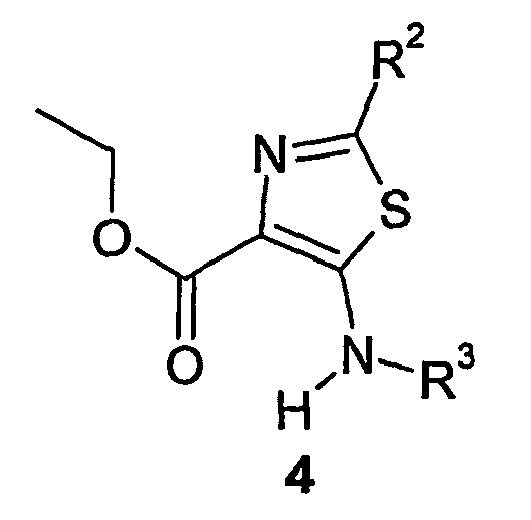 b) either reacting the compound of formula (4) with a compound of formula (24):
R1-NH2
c) or hydrolyze the compound of formula (4) into a compound of formula (5):
R1-NH2
to obtain a compound of formula (I) wherein X is halo, R2 is C1-C7-alkyl, -(CH2)m-O-C1-C7-alkyl or C3-C6-rycloalkyl, R4 is H and R1 and R3 are as defined in claim 1. - A method for the preparation of compounds of formula I according to claim 1 comprising the steps of:a) reacting a compound of formula (14):

R1NH2
to obtain a compound of formula (15): b) either with a compound of formula (2):
R3NH2
to obtain the compound of formula I, wherein R2 is methyl, R4 is H and R1 and R3 are as defined in claim 1;c) or with a compound of the following formula (26):
NR3R4
to obtain the compound of formula I, wherein R2 is methyl and R1, R3 and R4 are as defined in claim 1. - A method for the preparation of compounds of formula I according to claim 1 comprising the steps of:a) either reacting a compound of formula (18):

R1-NH2
b) or hydrolyze the compound of formula (18) into a compound of formula (5):
R1-NH2
to obtain a compound of formula (I) wherein R2 is methyl, R4 is H and R1 and R3 are as defined in claim1. - A method for the preparation of compounds of formula I according to claim 1 comprising the steps of:a) protecting the amino moiety of a compound of formula (11):

R1NH2
and then deprotecting the amino moiety and reacting the resulting amino-deprotected compound with a compound of the following formula (25):
X-R3
to obtain the compound of formula (I), wherein X is halo, R4 is H and R1,R2 and R3 are as defined in claim 1. - A method for the preparation of compounds of formula I according to claim 1 comprising the steps of:a) reacting a compound of formula (17):

R1NH2
to obtain a compound of formula (15): b) and reacting the compound of formula (15) with a compound of formula (2):
R1NH2
to obtain the compound of formula (I) wherein R2 is methyl, R4 is H and R1 and R3 are as defined hereinabove. - A method for the preparation of compounds of formula I according to claim 1 comprising the steps of:a) reacting a compound of formula (11):
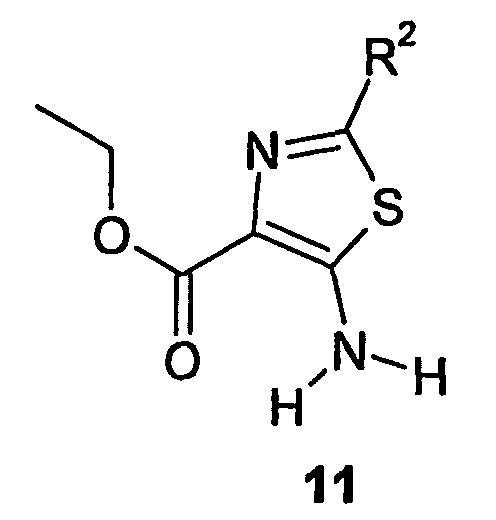
RbCHO
to obtain a compound of formula (22):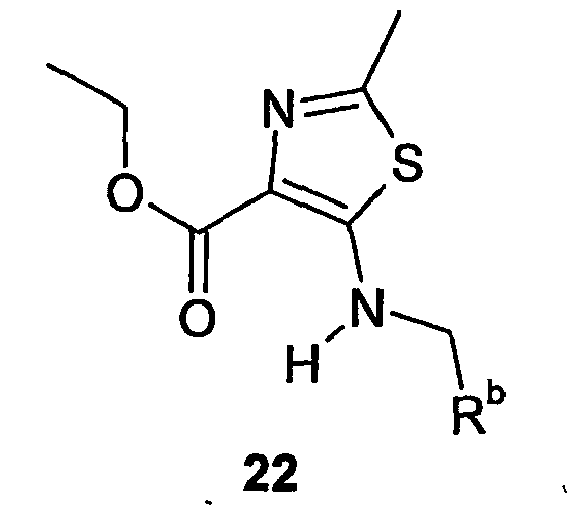 b) and reacting the compound of formula (22) with a compound of formula (24):
R1NH2
to obtain the compound of formula (I) wherein R3 is CH2-Rb, R4 is H and R1 and R3 are as defined in claim 1. - A medicament containing one or more compounds as claimed in any one of claims 1 to 15 and pharmaceutically acceptable excipients for the treatment and prevention of mGluR5 receptor mediated disorders.
- A medicament according to claim 23 for the treatment and prevention of acute and/or chronic neurological disorders, anxiety, the treatment of chronic and acute pain, urinary incontinence and obesity.
- A compound in accordance with any one of claims 1 to 15 as well as its pharmaceutically acceptable salt for use in the treatment or prevention of mGluR5 receptor mediated disorders.
- The use of a compound in accordance with any one of claims 1 to 15 as well as its pharmaceutically acceptable salt for the manufacture of medicaments for the treatment and prevention of mGluR5 receptor mediated disorders.
- The use according to claim 26 for the manufacture of medicaments for the treatment and prevention of acute and/or chronic neurological disorders, anxiety, the treatment of chronic and acute pain, urinary incontinence and obesity.
Priority Applications (1)
| Application Number | Priority Date | Filing Date | Title |
|---|---|---|---|
| EP06701375A EP1844044B1 (en) | 2005-01-14 | 2006-01-09 | Thiazole-4-carboxamide derivatives as mglur5 antagonists |
Applications Claiming Priority (3)
| Application Number | Priority Date | Filing Date | Title |
|---|---|---|---|
| EP05100203 | 2005-01-14 | ||
| PCT/EP2006/000090 WO2006074884A1 (en) | 2005-01-14 | 2006-01-09 | Thiazole-4-carboxamide derivatives as mglur5 antagonists |
| EP06701375A EP1844044B1 (en) | 2005-01-14 | 2006-01-09 | Thiazole-4-carboxamide derivatives as mglur5 antagonists |
Publications (2)
| Publication Number | Publication Date |
|---|---|
| EP1844044A1 EP1844044A1 (en) | 2007-10-17 |
| EP1844044B1 true EP1844044B1 (en) | 2010-07-21 |
Family
ID=35985686
Family Applications (1)
| Application Number | Title | Priority Date | Filing Date |
|---|---|---|---|
| EP06701375A Expired - Lifetime EP1844044B1 (en) | 2005-01-14 | 2006-01-09 | Thiazole-4-carboxamide derivatives as mglur5 antagonists |
Country Status (19)
| Country | Link |
|---|---|
| US (1) | US7678815B2 (en) |
| EP (1) | EP1844044B1 (en) |
| JP (1) | JP4966866B2 (en) |
| KR (1) | KR100905810B1 (en) |
| CN (1) | CN101137653B (en) |
| AR (1) | AR052558A1 (en) |
| AT (1) | ATE474839T1 (en) |
| AU (1) | AU2006205920B2 (en) |
| BR (1) | BRPI0606644A2 (en) |
| CA (1) | CA2593439C (en) |
| DE (1) | DE602006015607D1 (en) |
| ES (1) | ES2346685T3 (en) |
| IL (1) | IL184427A (en) |
| MX (1) | MX2007008410A (en) |
| NO (1) | NO20073663L (en) |
| RU (1) | RU2007125622A (en) |
| TW (1) | TW200637550A (en) |
| WO (1) | WO2006074884A1 (en) |
| ZA (1) | ZA200705670B (en) |
Families Citing this family (71)
| Publication number | Priority date | Publication date | Assignee | Title |
|---|---|---|---|---|
| CA2631991A1 (en) * | 2005-12-23 | 2007-06-28 | Astrazeneca Ab | Heterocyclic gaba-b modulators |
| US20080067077A1 (en) * | 2006-09-04 | 2008-03-20 | Akira Kodera | Electrolytic liquid for electrolytic polishing and electrolytic polishing method |
| GB0713686D0 (en) * | 2007-07-13 | 2007-08-22 | Addex Pharmaceuticals Sa | New compounds 2 |
| WO2009078432A1 (en) * | 2007-12-18 | 2009-06-25 | Taisho Pharmaceutical Co., Ltd. | 1-alkyl-4-amino-1h-pyrazole-3-carboxamide compound |
| GB0800411D0 (en) * | 2008-01-10 | 2008-02-20 | Glaxo Group Ltd | Novel compounds |
| HRP20190509T1 (en) | 2008-03-12 | 2019-05-03 | Ube Industries, Ltd. | PYRIDYLAMINOOCETIC ACID COMPOUND |
| EP2278969B1 (en) * | 2008-04-21 | 2013-02-13 | Merck Sharp & Dohme Corp. | Inhibitors of Janus kinases |
| US8349852B2 (en) | 2009-01-13 | 2013-01-08 | Novartis Ag | Quinazolinone derivatives useful as vanilloid antagonists |
| PT2415763E (en) | 2009-03-30 | 2016-03-30 | Ube Industries | Pharmaceutical composition for treating or preventing glaucoma |
| UA107791C2 (en) | 2009-05-05 | 2015-02-25 | Dow Agrosciences Llc | Pesticidal compositions |
| CA2760887A1 (en) * | 2009-06-12 | 2010-12-16 | Actelion Pharmaceuticals Ltd | Oxazole and thiazole derivatives as alx receptor agonists |
| TW201124391A (en) * | 2009-10-20 | 2011-07-16 | Lundbeck & Co As H | 2-substituted-ethynylthiazole derivatives and uses of same |
| WO2011073339A1 (en) | 2009-12-18 | 2011-06-23 | Janssen Pharmaceutica Nv | Bicyclic thiazoles as allosteric modulators of mglur5 receptors |
| CN102666551B (en) | 2009-12-18 | 2014-12-10 | 詹森药业有限公司 | Bicyclic thiazoles as allosteric modulators of MGLUR5 receptors |
| AR080056A1 (en) | 2010-02-01 | 2012-03-07 | Novartis Ag | CICLOHEXIL-AMIDA DERIVATIVES AS ANTAGONISTS OF CRF RECEIVERS |
| JP2013518085A (en) | 2010-02-01 | 2013-05-20 | ノバルティス アーゲー | Pyrazolo [5,1b] oxazole derivatives as CRF-1 receptor antagonists |
| JP5748777B2 (en) | 2010-02-02 | 2015-07-15 | ノバルティス アーゲー | Cyclohexylamide derivatives as CRF receptor antagonists |
| AU2011236155B2 (en) | 2010-04-06 | 2014-01-16 | Nippon Soda Co., Ltd. | Nitrogen-containing heterocyclic compound and method for producing same |
| AU2014201036B2 (en) * | 2010-04-06 | 2015-07-16 | Nippon Soda Co., Ltd | Nitrogen-containing heterocyclic compound and method for producing same |
| CA2806103A1 (en) | 2010-08-31 | 2012-03-08 | Vanderbilt University | Bicyclic oxazole and thiazole compounds and their use as allosteric modulators of mglur5 receptors |
| CN103619171B (en) | 2010-11-03 | 2015-11-25 | 陶氏益农公司 | Pesticidal compositions and methods related thereto |
| CN102336719B (en) * | 2011-07-12 | 2014-05-28 | 海南师范大学 | Method for synthesizing 1,2,3-triazole compounds by utilizing sila-alkyne compounds |
| JP6027128B2 (en) | 2011-10-26 | 2016-11-16 | ダウ アグロサイエンシィズ エルエルシー | Pest control compositions and related methods |
| WO2013113787A1 (en) | 2012-02-03 | 2013-08-08 | Basf Se | Fungicidal pyrimidine compounds |
| WO2013113776A1 (en) | 2012-02-03 | 2013-08-08 | Basf Se | Fungicidal pyrimidine compounds |
| WO2013113773A1 (en) | 2012-02-03 | 2013-08-08 | Basf Se | Fungicidal pyrimidine compounds |
| WO2013113782A1 (en) | 2012-02-03 | 2013-08-08 | Basf Se | Fungicidal pyrimidine compounds |
| WO2013113719A1 (en) | 2012-02-03 | 2013-08-08 | Basf Se | Fungicidal pyrimidine compounds ii |
| AU2013214137A1 (en) | 2012-02-03 | 2014-08-21 | Basf Se | Fungicidal pyrimidine compounds |
| WO2013113716A1 (en) | 2012-02-03 | 2013-08-08 | Basf Se | Fungicidal pyrimidine compounds |
| AU2013214353A1 (en) | 2012-02-03 | 2014-08-21 | Basf Se | Fungicidal pyrimidine compounds |
| WO2013113781A1 (en) | 2012-02-03 | 2013-08-08 | Basf Se | Fungicidal pyrimidine compounds i |
| EP2825533B1 (en) | 2012-03-13 | 2016-10-19 | Basf Se | Fungicidal pyrimidine compounds |
| WO2013135672A1 (en) | 2012-03-13 | 2013-09-19 | Basf Se | Fungicidal pyrimidine compounds |
| US9282739B2 (en) | 2012-04-27 | 2016-03-15 | Dow Agrosciences Llc | Pesticidal compositions and processes related thereto |
| CN104822266B (en) | 2012-04-27 | 2017-12-05 | 陶氏益农公司 | Pesticidal compositions and methods related thereto |
| US9708288B2 (en) | 2012-04-27 | 2017-07-18 | Dow Agrosciences Llc | Pesticidal compositions and processes related thereto |
| HK1219103A1 (en) | 2013-03-28 | 2017-03-24 | Ube Industries, Ltd. | Substituted biaryl compound |
| CA2923016A1 (en) | 2013-09-02 | 2015-03-05 | Ube Industries, Ltd. | Pharmaceutical composition for treatment and/or prevention of pulmonary disease |
| JP2016536295A (en) | 2013-10-17 | 2016-11-24 | ダウ アグロサイエンシィズ エルエルシー | Method for producing pest control compound |
| WO2015058022A1 (en) | 2013-10-17 | 2015-04-23 | Dow Agrosciences Llc | Processes for the preparation of pesticidal compounds |
| US9174962B2 (en) | 2013-10-17 | 2015-11-03 | Dow Agrosciences Llc | Processes for the preparation of pesticidal compounds |
| WO2015058028A1 (en) | 2013-10-17 | 2015-04-23 | Dow Agrosciences Llc | Processes for the preparation of pesticidal compounds |
| WO2015058024A1 (en) | 2013-10-17 | 2015-04-23 | Dow Agrosciences Llc | Processes for the preparation of pesticidal compounds |
| US9085564B2 (en) | 2013-10-17 | 2015-07-21 | Dow Agrosciences Llc | Processes for the preparation of pesticidal compounds |
| CN105636440A (en) | 2013-10-17 | 2016-06-01 | 美国陶氏益农公司 | Processes for the preparation of pesticidal compounds |
| TW201519786A (en) | 2013-10-22 | 2015-06-01 | 陶氏農業科學公司 | Insecticidal composition and related methods (1) |
| MX2016005317A (en) | 2013-10-22 | 2016-08-12 | Dow Agrosciences Llc | Pesticidal compositions and related methods. |
| TW201517797A (en) | 2013-10-22 | 2015-05-16 | Dow Agrosciences Llc | Synergistic pesticidal compositions and related methods |
| CN105828608A (en) | 2013-10-22 | 2016-08-03 | 美国陶氏益农公司 | Pesticidal Compositions And Related Methods |
| KR20160074633A (en) | 2013-10-22 | 2016-06-28 | 다우 아그로사이언시즈 엘엘씨 | Synergistic pesticidal compositions and related methods |
| JP2016538266A (en) | 2013-10-22 | 2016-12-08 | ダウ アグロサイエンシィズ エルエルシー | Synergistic pest control compositions and related methods |
| AU2014340437B2 (en) | 2013-10-22 | 2017-09-07 | Dow Agrosciences Llc | Synergistic pesticidal compositions and related methods |
| US9788545B2 (en) | 2013-10-22 | 2017-10-17 | Dow Agrosciences Llc | Synergistic pesticidal compositions and related methods |
| MX385974B (en) | 2013-10-22 | 2025-03-18 | Corteva Agriscience Llc | PESTICIDE COMPOSITIONS AND RELATED METHODS. |
| RU2016119560A (en) | 2013-10-22 | 2017-11-28 | ДАУ АГРОСАЙЕНСИЗ ЭлЭлСи | SYNERGETIC PESTICIDE COMPOSITIONS AND WAYS RELATED TO THEM |
| KR20160074640A (en) | 2013-10-22 | 2016-06-28 | 다우 아그로사이언시즈 엘엘씨 | Pesticidal compositions and related methods |
| TW201519771A (en) | 2013-10-22 | 2015-06-01 | Dow Agrosciences Llc | Synergistic pesticidal compositions and related methods |
| MX2016005304A (en) | 2013-10-22 | 2017-03-01 | Dow Agrosciences Llc | Synergistic pesticidal compositions and related methods. |
| US9282740B2 (en) | 2013-10-22 | 2016-03-15 | Dow Agrosciences Llc | Synergistic pesticidal compositions and related methods |
| TW201519779A (en) | 2013-10-22 | 2015-06-01 | Dow Agrosciences Llc | Synergistic pesticidal compositions and related methods |
| JP2016536307A (en) | 2013-10-22 | 2016-11-24 | ダウ アグロサイエンシィズ エルエルシー | Agrochemical compositions and related methods |
| KR20160074635A (en) | 2013-10-22 | 2016-06-28 | 다우 아그로사이언시즈 엘엘씨 | Synergistic pesticidal compositions and related methods |
| JP2017523168A (en) | 2014-07-31 | 2017-08-17 | ダウ アグロサイエンシィズ エルエルシー | Method for producing 3- (3-chloro-1H-pyrazol-1-yl) pyridine |
| EP3174856A4 (en) | 2014-07-31 | 2018-01-10 | Dow AgroSciences LLC | Process for the preparation of 3-(3-chloro-1h-pyrazol-1-yl)pyridine |
| BR112017000565A2 (en) | 2014-07-31 | 2017-11-07 | Dow Agrosciences Llc | Process for the preparation of 3- (3-chloro-1h-pyrazol-1-yl) pyridine |
| EP3183238A4 (en) | 2014-08-19 | 2018-01-10 | Dow AgroSciences LLC | Process for the preparation of 3-(3-chloro-1h-pyrazol-1-yl)pyridine |
| BR112017004613A2 (en) | 2014-09-12 | 2017-12-05 | Dow Agrosciences Llc | Process for the preparation of 3- (3-chloro-1h-pyrazol-1-yl) pyridine |
| WO2017087818A1 (en) * | 2015-11-19 | 2017-05-26 | The Regents Of The University Of Michigan | Dual src/p38 kinase inhibitor compounds and their use as therapeutic agents |
| CN110325036B (en) | 2016-12-29 | 2021-10-26 | 美国陶氏益农公司 | Process for preparing pesticidal compounds |
| WO2018125815A1 (en) | 2016-12-29 | 2018-07-05 | Dow Agrosciences Llc | Processes for the preparation of pesticidal compounds |
Family Cites Families (12)
| Publication number | Priority date | Publication date | Assignee | Title |
|---|---|---|---|---|
| AU3571997A (en) * | 1996-08-01 | 1998-02-25 | Warner-Lambert Company | Novel glutamate receptor antagonists: fused cycloalkyl quinoxalinediones |
| TW544448B (en) | 1997-07-11 | 2003-08-01 | Novartis Ag | Pyridine derivatives |
| KR100875222B1 (en) | 1999-08-19 | 2008-12-19 | 아스트라제네카 아베 | Heteropolycyclic Compounds and Their Uses as Indirect Glutamate Receptor Antagonists |
| US6660753B2 (en) * | 1999-08-19 | 2003-12-09 | Nps Pharmaceuticals, Inc. | Heteropolycyclic compounds and their use as metabotropic glutamate receptor antagonists |
| AU7961300A (en) * | 1999-10-29 | 2001-05-14 | Yamanouchi Pharmaceutical Co., Ltd. | Kainic acid neurocytotoxicity inhibitors |
| US6995162B2 (en) | 2001-01-12 | 2006-02-07 | Amgen Inc. | Substituted alkylamine derivatives and methods of use |
| US7105682B2 (en) | 2001-01-12 | 2006-09-12 | Amgen Inc. | Substituted amine derivatives and methods of use |
| MXPA03007513A (en) | 2001-02-21 | 2004-07-30 | Nps Pharma Inc | Heteropolycyclic compounds and their use as metabotropic glutamate receptor antagonists. |
| US7074809B2 (en) * | 2002-08-09 | 2006-07-11 | Astrazeneca Ab | Compounds |
| WO2004014881A2 (en) * | 2002-08-09 | 2004-02-19 | Astra Zeneca Ab | '1,2,4'oxadiazoles as modulators of metabotropic glutamate receptor-5 |
| CA2519954A1 (en) * | 2003-03-26 | 2004-10-14 | Merck & Co., Inc. | Benzamide modulators of metabotropic glutamate receptors |
| EP1781647A2 (en) * | 2004-07-22 | 2007-05-09 | Astex Therapeutics Limited | Thiazole and isothiazole derivatives as protein kinase inhibitors |
-
2006
- 2006-01-09 BR BRPI0606644-5A patent/BRPI0606644A2/en not_active IP Right Cessation
- 2006-01-09 CN CN2006800079746A patent/CN101137653B/en not_active Expired - Fee Related
- 2006-01-09 WO PCT/EP2006/000090 patent/WO2006074884A1/en not_active Ceased
- 2006-01-09 RU RU2007125622/04A patent/RU2007125622A/en not_active Application Discontinuation
- 2006-01-09 ES ES06701375T patent/ES2346685T3/en not_active Expired - Lifetime
- 2006-01-09 AU AU2006205920A patent/AU2006205920B2/en not_active Ceased
- 2006-01-09 EP EP06701375A patent/EP1844044B1/en not_active Expired - Lifetime
- 2006-01-09 CA CA2593439A patent/CA2593439C/en not_active Expired - Fee Related
- 2006-01-09 MX MX2007008410A patent/MX2007008410A/en active IP Right Grant
- 2006-01-09 AT AT06701375T patent/ATE474839T1/en active
- 2006-01-09 JP JP2007550737A patent/JP4966866B2/en not_active Expired - Fee Related
- 2006-01-09 KR KR1020077018398A patent/KR100905810B1/en not_active Expired - Fee Related
- 2006-01-09 DE DE602006015607T patent/DE602006015607D1/en not_active Expired - Lifetime
- 2006-01-10 US US11/328,879 patent/US7678815B2/en not_active Expired - Fee Related
- 2006-01-12 TW TW095101218A patent/TW200637550A/en unknown
- 2006-01-13 AR ARP060100140A patent/AR052558A1/en unknown
-
2007
- 2007-07-05 IL IL184427A patent/IL184427A/en not_active IP Right Cessation
- 2007-07-10 ZA ZA200705670A patent/ZA200705670B/en unknown
- 2007-07-17 NO NO20073663A patent/NO20073663L/en not_active Application Discontinuation
Also Published As
| Publication number | Publication date |
|---|---|
| BRPI0606644A2 (en) | 2009-07-14 |
| JP2008526909A (en) | 2008-07-24 |
| ZA200705670B (en) | 2008-12-31 |
| RU2007125622A (en) | 2009-02-20 |
| WO2006074884A1 (en) | 2006-07-20 |
| AU2006205920B2 (en) | 2012-11-15 |
| TW200637550A (en) | 2006-11-01 |
| CN101137653A (en) | 2008-03-05 |
| CA2593439A1 (en) | 2006-07-20 |
| NO20073663L (en) | 2007-09-03 |
| IL184427A (en) | 2013-11-28 |
| KR20070094659A (en) | 2007-09-20 |
| JP4966866B2 (en) | 2012-07-04 |
| DE602006015607D1 (en) | 2010-09-02 |
| US7678815B2 (en) | 2010-03-16 |
| CA2593439C (en) | 2014-02-25 |
| AU2006205920A1 (en) | 2006-07-20 |
| IL184427A0 (en) | 2007-10-31 |
| AR052558A1 (en) | 2007-03-21 |
| MX2007008410A (en) | 2007-08-21 |
| ATE474839T1 (en) | 2010-08-15 |
| ES2346685T3 (en) | 2010-10-19 |
| EP1844044A1 (en) | 2007-10-17 |
| KR100905810B1 (en) | 2009-07-02 |
| US20060160857A1 (en) | 2006-07-20 |
| CN101137653B (en) | 2012-05-09 |
Similar Documents
| Publication | Publication Date | Title |
|---|---|---|
| EP1844044B1 (en) | Thiazole-4-carboxamide derivatives as mglur5 antagonists | |
| EP3369732B1 (en) | Androgen receptor modulating compounds | |
| EP2428507B1 (en) | Cannabinoid receptor ligands | |
| EP3243826B1 (en) | Imidazothiadiazole and imidazopyrazine derivatives as protease activated receptor 4 (par4) inhibitors for treating platelet aggregation | |
| EP2917214B1 (en) | Substituted pyrimidinyl and pyridinyl-pyrrolopyridinones, process for their preparation and their use as kinase inhibitors | |
| EP1954696B1 (en) | 2-phenoxy-n-(1,3,4-thiadizol-2-yl)pyridin-3-amine derivatives and related compounds as p2y1 receptor inhibitors for the treatment of thromboembolic disorders | |
| EP2090570B1 (en) | Imidazole derivative | |
| EP2233474A1 (en) | Condensed aminodihydrothiazine derivative | |
| EP2096111A1 (en) | Pyrazoles and use thereof as drugs | |
| EP0540143A2 (en) | Compounds and methods for inhibition of HIV and related viruses | |
| EP2697232B1 (en) | 6,7-dihydroimidazo[2,1-b][1,3]oxazine bactericides | |
| EP3020718B1 (en) | Novel pde4 inhibitor | |
| EP3390396B1 (en) | Isoindole compounds | |
| EP2163554A1 (en) | Pyrimidodiazepinone derivative | |
| EP1612208A2 (en) | N-phenylarylsulfonamide compound, pharmaceutical composition comprising the compound as active ingredient, synthetic intermediate for the compound and process for its preparation | |
| EP3426246B1 (en) | Thiazolidinone compounds and use thereof | |
| EP1832584B1 (en) | Pyrimidinylisoxazole derivative | |
| EP1399439B1 (en) | 2-heteroaryl-imidazotriazinones and their use in the treatment of inflammatory or immune diseases | |
| EP4269400A1 (en) | Ykl-40 inhibitors and their therapeutic applications | |
| HK1136299A (en) | Pyrimidodiazepinone derivative | |
| HK1256181A1 (en) | Isoindole compounds | |
| HK1256181B (en) | Isoindole compounds | |
| HK1147743B (en) | Condensed aminodihydrothiazine derivative | |
| HK1133008B (en) | Imidazole derivative |
Legal Events
| Date | Code | Title | Description |
|---|---|---|---|
| PUAI | Public reference made under article 153(3) epc to a published international application that has entered the european phase |
Free format text: ORIGINAL CODE: 0009012 |
|
| 17P | Request for examination filed |
Effective date: 20070814 |
|
| AK | Designated contracting states |
Kind code of ref document: A1 Designated state(s): AT BE BG CH CY CZ DE DK EE ES FI FR GB GR HU IE IS IT LI LT LU LV MC NL PL PT RO SE SI SK TR |
|
| RIN1 | Information on inventor provided before grant (corrected) |
Inventor name: CECCARELLI, SIMONA, MARIA. Inventor name: PORTER, RICHARD, HUGH, PHILIP Inventor name: VIEIRA, ERIC Inventor name: BUETTELMANN, BERND Inventor name: JAESCHKE, GEORG Inventor name: KOLCZEWSKI, SABINE |
|
| DAX | Request for extension of the european patent (deleted) | ||
| GRAP | Despatch of communication of intention to grant a patent |
Free format text: ORIGINAL CODE: EPIDOSNIGR1 |
|
| GRAS | Grant fee paid |
Free format text: ORIGINAL CODE: EPIDOSNIGR3 |
|
| GRAA | (expected) grant |
Free format text: ORIGINAL CODE: 0009210 |
|
| AK | Designated contracting states |
Kind code of ref document: B1 Designated state(s): AT BE BG CH CY CZ DE DK EE ES FI FR GB GR HU IE IS IT LI LT LU LV MC NL PL PT RO SE SI SK TR |
|
| REG | Reference to a national code |
Ref country code: GB Ref legal event code: FG4D |
|
| REG | Reference to a national code |
Ref country code: CH Ref legal event code: EP |
|
| REG | Reference to a national code |
Ref country code: IE Ref legal event code: FG4D |
|
| REF | Corresponds to: |
Ref document number: 602006015607 Country of ref document: DE Date of ref document: 20100902 Kind code of ref document: P |
|
| REG | Reference to a national code |
Ref country code: ES Ref legal event code: FG2A Ref document number: 2346685 Country of ref document: ES Kind code of ref document: T3 |
|
| REG | Reference to a national code |
Ref country code: NL Ref legal event code: T3 |
|
| REG | Reference to a national code |
Ref country code: SE Ref legal event code: TRGR |
|
| LTIE | Lt: invalidation of european patent or patent extension |
Effective date: 20100721 |
|
| PG25 | Lapsed in a contracting state [announced via postgrant information from national office to epo] |
Ref country code: LT Free format text: LAPSE BECAUSE OF FAILURE TO SUBMIT A TRANSLATION OF THE DESCRIPTION OR TO PAY THE FEE WITHIN THE PRESCRIBED TIME-LIMIT Effective date: 20100721 |
|
| PG25 | Lapsed in a contracting state [announced via postgrant information from national office to epo] |
Ref country code: BG Free format text: LAPSE BECAUSE OF FAILURE TO SUBMIT A TRANSLATION OF THE DESCRIPTION OR TO PAY THE FEE WITHIN THE PRESCRIBED TIME-LIMIT Effective date: 20101021 Ref country code: PT Free format text: LAPSE BECAUSE OF FAILURE TO SUBMIT A TRANSLATION OF THE DESCRIPTION OR TO PAY THE FEE WITHIN THE PRESCRIBED TIME-LIMIT Effective date: 20101122 Ref country code: PL Free format text: LAPSE BECAUSE OF FAILURE TO SUBMIT A TRANSLATION OF THE DESCRIPTION OR TO PAY THE FEE WITHIN THE PRESCRIBED TIME-LIMIT Effective date: 20100721 Ref country code: IS Free format text: LAPSE BECAUSE OF FAILURE TO SUBMIT A TRANSLATION OF THE DESCRIPTION OR TO PAY THE FEE WITHIN THE PRESCRIBED TIME-LIMIT Effective date: 20101121 Ref country code: SI Free format text: LAPSE BECAUSE OF FAILURE TO SUBMIT A TRANSLATION OF THE DESCRIPTION OR TO PAY THE FEE WITHIN THE PRESCRIBED TIME-LIMIT Effective date: 20100721 Ref country code: CY Free format text: LAPSE BECAUSE OF FAILURE TO SUBMIT A TRANSLATION OF THE DESCRIPTION OR TO PAY THE FEE WITHIN THE PRESCRIBED TIME-LIMIT Effective date: 20100721 |
|
| REG | Reference to a national code |
Ref country code: HU Ref legal event code: AG4A Ref document number: E008921 Country of ref document: HU |
|
| PG25 | Lapsed in a contracting state [announced via postgrant information from national office to epo] |
Ref country code: LV Free format text: LAPSE BECAUSE OF FAILURE TO SUBMIT A TRANSLATION OF THE DESCRIPTION OR TO PAY THE FEE WITHIN THE PRESCRIBED TIME-LIMIT Effective date: 20100721 Ref country code: GR Free format text: LAPSE BECAUSE OF FAILURE TO SUBMIT A TRANSLATION OF THE DESCRIPTION OR TO PAY THE FEE WITHIN THE PRESCRIBED TIME-LIMIT Effective date: 20101022 |
|
| PG25 | Lapsed in a contracting state [announced via postgrant information from national office to epo] |
Ref country code: DK Free format text: LAPSE BECAUSE OF FAILURE TO SUBMIT A TRANSLATION OF THE DESCRIPTION OR TO PAY THE FEE WITHIN THE PRESCRIBED TIME-LIMIT Effective date: 20100721 |
|
| PLBE | No opposition filed within time limit |
Free format text: ORIGINAL CODE: 0009261 |
|
| STAA | Information on the status of an ep patent application or granted ep patent |
Free format text: STATUS: NO OPPOSITION FILED WITHIN TIME LIMIT |
|
| PG25 | Lapsed in a contracting state [announced via postgrant information from national office to epo] |
Ref country code: CZ Free format text: LAPSE BECAUSE OF FAILURE TO SUBMIT A TRANSLATION OF THE DESCRIPTION OR TO PAY THE FEE WITHIN THE PRESCRIBED TIME-LIMIT Effective date: 20100721 Ref country code: RO Free format text: LAPSE BECAUSE OF FAILURE TO SUBMIT A TRANSLATION OF THE DESCRIPTION OR TO PAY THE FEE WITHIN THE PRESCRIBED TIME-LIMIT Effective date: 20100721 Ref country code: SK Free format text: LAPSE BECAUSE OF FAILURE TO SUBMIT A TRANSLATION OF THE DESCRIPTION OR TO PAY THE FEE WITHIN THE PRESCRIBED TIME-LIMIT Effective date: 20100721 Ref country code: EE Free format text: LAPSE BECAUSE OF FAILURE TO SUBMIT A TRANSLATION OF THE DESCRIPTION OR TO PAY THE FEE WITHIN THE PRESCRIBED TIME-LIMIT Effective date: 20100721 |
|
| 26N | No opposition filed |
Effective date: 20110426 |
|
| REG | Reference to a national code |
Ref country code: DE Ref legal event code: R097 Ref document number: 602006015607 Country of ref document: DE Effective date: 20110426 |
|
| PG25 | Lapsed in a contracting state [announced via postgrant information from national office to epo] |
Ref country code: MC Free format text: LAPSE BECAUSE OF NON-PAYMENT OF DUE FEES Effective date: 20110131 |
|
| PG25 | Lapsed in a contracting state [announced via postgrant information from national office to epo] |
Ref country code: LU Free format text: LAPSE BECAUSE OF NON-PAYMENT OF DUE FEES Effective date: 20110109 |
|
| PG25 | Lapsed in a contracting state [announced via postgrant information from national office to epo] |
Ref country code: TR Free format text: LAPSE BECAUSE OF FAILURE TO SUBMIT A TRANSLATION OF THE DESCRIPTION OR TO PAY THE FEE WITHIN THE PRESCRIBED TIME-LIMIT Effective date: 20100721 |
|
| REG | Reference to a national code |
Ref country code: FR Ref legal event code: PLFP Year of fee payment: 11 |
|
| PGFP | Annual fee paid to national office [announced via postgrant information from national office to epo] |
Ref country code: GB Payment date: 20151230 Year of fee payment: 11 Ref country code: IE Payment date: 20151231 Year of fee payment: 11 |
|
| PGFP | Annual fee paid to national office [announced via postgrant information from national office to epo] |
Ref country code: NL Payment date: 20160108 Year of fee payment: 11 |
|
| PGFP | Annual fee paid to national office [announced via postgrant information from national office to epo] |
Ref country code: DE Payment date: 20160127 Year of fee payment: 11 Ref country code: IT Payment date: 20160119 Year of fee payment: 11 Ref country code: CH Payment date: 20160125 Year of fee payment: 11 Ref country code: ES Payment date: 20160119 Year of fee payment: 11 |
|
| PGFP | Annual fee paid to national office [announced via postgrant information from national office to epo] |
Ref country code: FI Payment date: 20160111 Year of fee payment: 11 Ref country code: FR Payment date: 20151230 Year of fee payment: 11 Ref country code: SE Payment date: 20160108 Year of fee payment: 11 Ref country code: HU Payment date: 20151228 Year of fee payment: 11 Ref country code: BE Payment date: 20160112 Year of fee payment: 11 Ref country code: AT Payment date: 20151229 Year of fee payment: 11 |
|
| PG25 | Lapsed in a contracting state [announced via postgrant information from national office to epo] |
Ref country code: BE Free format text: LAPSE BECAUSE OF NON-PAYMENT OF DUE FEES Effective date: 20170131 |
|
| REG | Reference to a national code |
Ref country code: DE Ref legal event code: R119 Ref document number: 602006015607 Country of ref document: DE |
|
| REG | Reference to a national code |
Ref country code: CH Ref legal event code: PL |
|
| REG | Reference to a national code |
Ref country code: NL Ref legal event code: MM Effective date: 20170201 |
|
| REG | Reference to a national code |
Ref country code: AT Ref legal event code: MM01 Ref document number: 474839 Country of ref document: AT Kind code of ref document: T Effective date: 20170109 |
|
| GBPC | Gb: european patent ceased through non-payment of renewal fee |
Effective date: 20170109 |
|
| REG | Reference to a national code |
Ref country code: FR Ref legal event code: ST Effective date: 20170929 |
|
| PG25 | Lapsed in a contracting state [announced via postgrant information from national office to epo] |
Ref country code: FI Free format text: LAPSE BECAUSE OF NON-PAYMENT OF DUE FEES Effective date: 20170109 Ref country code: CH Free format text: LAPSE BECAUSE OF NON-PAYMENT OF DUE FEES Effective date: 20170131 Ref country code: AT Free format text: LAPSE BECAUSE OF NON-PAYMENT OF DUE FEES Effective date: 20170109 Ref country code: LI Free format text: LAPSE BECAUSE OF NON-PAYMENT OF DUE FEES Effective date: 20170131 Ref country code: FR Free format text: LAPSE BECAUSE OF NON-PAYMENT OF DUE FEES Effective date: 20170131 |
|
| REG | Reference to a national code |
Ref country code: IE Ref legal event code: MM4A |
|
| PG25 | Lapsed in a contracting state [announced via postgrant information from national office to epo] |
Ref country code: DE Free format text: LAPSE BECAUSE OF NON-PAYMENT OF DUE FEES Effective date: 20170801 Ref country code: GB Free format text: LAPSE BECAUSE OF NON-PAYMENT OF DUE FEES Effective date: 20170109 Ref country code: HU Free format text: LAPSE BECAUSE OF NON-PAYMENT OF DUE FEES Effective date: 20170110 Ref country code: NL Free format text: LAPSE BECAUSE OF NON-PAYMENT OF DUE FEES Effective date: 20170201 Ref country code: SE Free format text: LAPSE BECAUSE OF NON-PAYMENT OF DUE FEES Effective date: 20170110 |
|
| REG | Reference to a national code |
Ref country code: BE Ref legal event code: MM Effective date: 20170131 |
|
| PG25 | Lapsed in a contracting state [announced via postgrant information from national office to epo] |
Ref country code: IE Free format text: LAPSE BECAUSE OF NON-PAYMENT OF DUE FEES Effective date: 20170109 Ref country code: IT Free format text: LAPSE BECAUSE OF NON-PAYMENT OF DUE FEES Effective date: 20170109 |
|
| PG25 | Lapsed in a contracting state [announced via postgrant information from national office to epo] |
Ref country code: ES Free format text: LAPSE BECAUSE OF NON-PAYMENT OF DUE FEES Effective date: 20170110 |
|
| REG | Reference to a national code |
Ref country code: ES Ref legal event code: FD2A Effective date: 20181116 |