EP1844004B1 - Quinazoline derivates as antiviral agents - Google Patents
Quinazoline derivates as antiviral agents Download PDFInfo
- Publication number
- EP1844004B1 EP1844004B1 EP06709585A EP06709585A EP1844004B1 EP 1844004 B1 EP1844004 B1 EP 1844004B1 EP 06709585 A EP06709585 A EP 06709585A EP 06709585 A EP06709585 A EP 06709585A EP 1844004 B1 EP1844004 B1 EP 1844004B1
- Authority
- EP
- European Patent Office
- Prior art keywords
- sub
- infection
- moiety
- aryl
- derivative
- Prior art date
- Legal status (The legal status is an assumption and is not a legal conclusion. Google has not performed a legal analysis and makes no representation as to the accuracy of the status listed.)
- Expired - Lifetime
Links
- 0 *c(cc1)ccc1Nc(c1c2)ncnc1ccc2-c1cc2c(*N(*)*)ncnc2cc1 Chemical compound *c(cc1)ccc1Nc(c1c2)ncnc1ccc2-c1cc2c(*N(*)*)ncnc2cc1 0.000 description 1
Classifications
-
- C—CHEMISTRY; METALLURGY
- C07—ORGANIC CHEMISTRY
- C07C—ACYCLIC OR CARBOCYCLIC COMPOUNDS
- C07C255/00—Carboxylic acid nitriles
- C07C255/61—Carboxylic acid nitriles containing cyano groups and nitrogen atoms being part of imino groups bound to the same carbon skeleton
-
- A—HUMAN NECESSITIES
- A61—MEDICAL OR VETERINARY SCIENCE; HYGIENE
- A61P—SPECIFIC THERAPEUTIC ACTIVITY OF CHEMICAL COMPOUNDS OR MEDICINAL PREPARATIONS
- A61P31/00—Antiinfectives, i.e. antibiotics, antiseptics, chemotherapeutics
- A61P31/12—Antivirals
-
- A—HUMAN NECESSITIES
- A61—MEDICAL OR VETERINARY SCIENCE; HYGIENE
- A61P—SPECIFIC THERAPEUTIC ACTIVITY OF CHEMICAL COMPOUNDS OR MEDICINAL PREPARATIONS
- A61P31/00—Antiinfectives, i.e. antibiotics, antiseptics, chemotherapeutics
- A61P31/12—Antivirals
- A61P31/14—Antivirals for RNA viruses
-
- C—CHEMISTRY; METALLURGY
- C07—ORGANIC CHEMISTRY
- C07D—HETEROCYCLIC COMPOUNDS
- C07D239/00—Heterocyclic compounds containing 1,3-diazine or hydrogenated 1,3-diazine rings
- C07D239/70—Heterocyclic compounds containing 1,3-diazine or hydrogenated 1,3-diazine rings condensed with carbocyclic rings or ring systems
- C07D239/72—Quinazolines; Hydrogenated quinazolines
- C07D239/86—Quinazolines; Hydrogenated quinazolines with hetero atoms directly attached in position 4
- C07D239/94—Nitrogen atoms
Definitions
- the present invention relates to a series of quinazoline derivatives which are useful in treating or preventing a flaviviridae infection.
- Viruses of the family flaviviridae are small, icosahedral, enveloped viruses that contain a positive-sense RNA genome.
- the family consists of three genera, flavivirus, pestivirus and hepacivirus.
- the hepacivirus genus includes the hepatitis C virus.
- WO 00/04900 discloses benzimidazole antiviral compounds which contain aromatic substituents.
- quinazoline derivatives of the formula (I) are active in inhibiting replication of flaviviridae viruses and are therefore effective in treating or preventing a flaviviridae infection.
- the present invention therefore provides a quinazoline derivative of formula (I), or a pharmaceutically acceptable salt thereof, wherein:
- the compound of formula (I) is a compound of formula (I') wherein:
- a C 1 -C 4 alkyl group or moiety is a linear or branched alkyl group or moiety containing from 1 to 4 carbon atoms.
- Examples of C 1 -C 4 alkyl groups and moieties include methyl, ethyl, n-propyl, i-propyl, n-butyl, i-butyl and t-butyl.
- the alkyl moieties may be the same or different.
- a C 1 -C 4 alkylene group or moiety is a linear or branched alkylene group or moiety. Examples include methylene, ethylene and n-propylene groups and moieties.
- a C 6 -C 10 aryl group or moiety is phenyl or naphthyl. Phenyl is preferred.
- a halogen is typically chlorine, fluorine, bromine or iodine and is preferably chlorine, bromine or fluorine.
- a C 1 -C 4 alkoxy group is typically a said C 1 -C 4 alkyl group attached to an oxygen atom.
- a haloalkyl or haloalkoxy group is typically a said alkyl or alkoxy group substituted by one or more said halogen atoms. Typically, it is substituted by 1, 2 or 3 said halogen atoms.
- Preferred haloalkyl and haloalkoxy groups include perhaloalkyl and perhaloalkoxy groups such as -CX 3 and -OCX 3 wherein X is a said halogen atom, for example chlorine and fluorine.
- Particularly preferred haloalkyl groups are -CF 3 and -CCl 3 .
- Particularly preferred haloalkoxy groups are -OCF 3 and -OCCl 3 .
- a C 1 -C 4 hydroxyalkyl group is a C 1 -C 4 alkyl group substituted by one or more hydroxy groups. Typically, it is substituted by one, two or three hydroxy groups. Preferably, it is substituted by a single hydroxy group.
- a preferred hydroxyalkyl group is -CH 2 -OH.
- a C 1 -C 4 thioalkyl group is a C 1 -C 4 alkyl group substituted by one or more thio groups (-SH). Typically, it is substituted by one, two or three thio groups. Preferably, it is substituted by a single thio group.
- a C 1 -C 4 aminoalkyl group is a C 1 -C 4 alkyl group substituted by one or more -NH 2 groups. Typically, it is substituted by one, two or three -NH 2 groups. Preferably, it is substituted by a single -NH 2 group.
- a 5- to 10- membered heteroaryl group or moiety is a 5- to 10-membered aromatic ring, such as a 5- or 6- membered ring, containing at least one heteroatom, for example 1, 2 or 3 heteroatoms, selected from O, S and N.
- heteroaryl group or moiety is monocyclic.
- heteroaryl groups include pyridyl, pyrazinyl, pyrimidinyl, pyridazinyl, furanyl, thienyl, pyrazolidinyl, pyrrolyl, oxadiazolyl, oxazolyl, isoxazolyl, thiazolyl, thiadiazolyl, imidazolyl, triazolyl and pyrazolyl groups.
- Furanyl, triazolyl, thienyl, pyrimidinyl and thiazolyl groups are preferred.
- Triazolyl groups are particularly preferred.
- a 5- to 10- membered heterocyclyl group or moiety is a non-aromatic, saturated or unsaturated C 5 -C 10 carbocyclic ring in which one or more, for example 1, 2 or 3, of the carbon atoms are replaced with a moiety selected from N, O, S, S(O) and S(O) 2 .
- a heterocyclyl group or moiety is monocyclic.
- a heterocyclyl group or moiety is a saturated C 5 -C 6 cycloalkyl group in which 1 or 2 of the carbon atoms are replaced with a moiety selected from NH, O and S.
- Suitable heterocyclyl groups and moieties include pyrazolidinyl, piperidyl, piperazinyl, thiomorpholinyl, S-oxo-thiomorpholinyl, S,S-dioxo-thiomorpholinyl, morpholinyl, pyrrolidinyl, pyrrolinyl, imidazolidinyl, imidazolinyl, 1,3-dioxolanyl, 1,4-dioxolyl and pyrazolinyl groups and moieties. Morpholino, pyrrolidinyl and piperazinyl groups are preferred.
- a C 3 -C 6 carbocyclyl group is a non-aromatic saturated or unsaturated monocyclic hydrocarbon ring, having from 3 to 6 carbon atoms.
- it is a saturated hydrocarbon ring (i.e. a cycloalkyl group) having from 3 to 6 carbon atoms.
- Examples include cyclopropyl, cyclobutyl, cyclopentyl and cyclohexyl. It is preferably cyclopentyl or cyclohexyl.
- the aryl, heteroaryl, carbocyclyl and heterocyclyl moieties in the R 1 , R 2 , R 3 and X moieties are unsubstituted or substituted by 1 or 2 substituents selected from halogen, C 1 -C 4 alkyl and C 1 -C 4 haloalkyl substituents. More preferably, they are unsubstituted.
- R is H.
- L is a phenylene moiety. More preferably, L is a 1,4-phenylene moiety.
- X is a direct bond or -L-NR- wherein L and R are as defined above.
- X is -L-NR-.
- R 1 is hydrogen.
- R 2 is C 6 to C 10 aryl, more preferably phenyl.
- R 1 and R 2 together form a cyclic moiety
- R 1 and R 2 together with the N atom to which they are attached, form a 5- to 6- membered heterocyclyl or 5-to 6- membered heteroaryl group.
- the heterocyclyl group is preferably a saturated 5- to 6- membered heterocycle, which contains 1 or 2 heteroatoms selected from N, O and S.
- R 1 and R 2 together form a cyclic moiety
- R 1 and R 2 together with the N atom to which they are attached, form a morpholino group or a triazolyl group.
- R 3 represents a 5- to 6- membered heteroaryl or heterocyclyl moiety. More preferably, R 3 represents a morpholino or triazolyl moiety.
- Preferred compounds of the invention are those in which:
- R 1 and R 2 together with the N atom to which they are attached, form a saturated 5- to 6- membered heterocyclic group which contains 1 or 2 heteroatoms selected from N, O and S.
- R 3 represents a morpholino or triazolyl moiety.
- a particularly preferred compounds of formula (I) is:
- Compounds of formula (I) containing one or more chiral centre may be used in enantiomerically or diastereoisomerically pure form, or in the form of a mixture of isomers.
- the compounds of formula (I) can, if desired, be used in the form of solvates. Further, for the avoidance of doubt, the compounds of the invention may be used in any tautomeric form.
- a pharmaceutically acceptable salt is a salt with a pharmaceutically acceptable acid or base.
- Pharmaceutically acceptable acids include both inorganic acids such as hydrochloric, sulphuric, phosphoric, diphosphoric, hydrobromic or nitric acid and organic acids such as citric, fumaric, maleic, malic, ascorbic, succinic, tartaric, benzoic, acetic, methanesulphonic, ethanesulphonic, benzenesulphonic orp-toluenesulphonic acid.
- Pharmaceutically acceptable bases include alkali metal (e.g. sodium or potassium) and alkali earth metal (e.g. calcium or magnesium) hydroxides and organic bases such as alkyl amines, aralkyl amines and heterocyclic amines.
- Preferred salts are hydrochloride salts.
- a particularly preferred salt is the tetrahydrochloride salt.
- the compounds of the invention can, for example, be prepared according to the following reaction scheme.
- Intermediate A can be prepared by dimerisation of an appropriate aniline, or via dimerisation of an amidine.
- X in the above reaction scheme is typically iodine or bromine.
- Dimerisation can be effected, for example, with Pd(dppf)Cl 2 , DMSO/H 2 O, K 3 PO 4 and 4,4,5,5-tetramethyl-2-(4,4,5,5-tetramethyl-1,3,2-dioxaborolan-2-yl)-1,3,2-dioxaborolane.
- Intermediate A can be reacted with a sub-stoichiometric amount of a substituted aniline to produce intermediate B.
- Intermediate B can be reacted with a nucleophilic amine of formula R 1 R 2 N-X-H to yield the asymmetric quinazolinyl-quinazolines of the invention.
- the intermediate B can also be prepared by transition metal-mediated coupling of a quinazoline iodide (C) with a suitable quinazoline or quinazoline precursor as shown below M in the above reaction scheme could be B(OR) 2 or SnR 3 .
- the intermediate B can also be prepared by transition metal-mediated coupling of aminobenzonitrile iodide (D) with a suitable quinazoline or quinazoline precursor as shown below.
- P in the above scheme is a suitable protecting group (eg N-tert butoxycarbonyl) so as to differentiate the aniline nitrogens in the resulting biphenyl product.
- N -(4-morpholinophenyl)-6-(4-(4-morpholinophenylamino)quinazolin-6-yl)quinazolin-4-amine can also be prepared by the following reaction.
- the compounds of the invention can be salified by standard techniques, in particular by reaction with an appropriate acid or base.
- the starting materials in the above reaction scheme are known compounds, or can be prepared by analogy with known methods.
- the compounds of the present invention are therapeutically useful.
- the present invention therefore provides a quinazoline derivative of the formula (I), as defined above, or a pharmaceutically acceptable salt thereof, for use in treating the human or animal body.
- a pharmaceutical composition comprising a quinazoline derivative of the formula (I), as defined above, or a pharmaceutically acceptable salt thereof, and a pharmaceutically acceptable carrier or diluent.
- Said pharmaceutical composition typically contains up to 85 wt% of a compound of the invention. More typically, it contains up to 50 wt% of a compound of the invention.
- Preferred pharmaceutical compositions are sterile and pyrogen free.
- the pharmaceutical compositions provided by the invention typically contain a compound of the invention which is a substantially pure optical isomer.
- the compounds of the invention are active against a flaviviridae infection.
- the present invention therefore provides the use of a quinazoline derivative of the formula (I), as defined above, or a pharmaceutically acceptable salt thereof, in the manufacture of a medicament for use in treating or preventing a flaviviridae infection.
- a compound for treating a patient suffering from or susceptible to a flaviviridae infection in a method which comprises administering to said patient an effective amount of a quinazoline derivative of formula (I) or a pharmaceutically acceptable salt thereof.
- the flaviviridae family contains three genera. These are hepacivirus, flavivirus and pestivirus.
- the compounds of the invention are active in treating or preventing a hepacivirus infection, a flavivirus infection or a pestivirus infection.
- Typical pestivirus infections which can be treated with the compounds of the invention include bovine viral diarrhea virus, classical swine fever virus and border disease virus.
- Typical flavivirus infections which can be treated with the compounds of the invention include yellow fever virus, dengue fever virus, Japanese encephalitis virus and tick borne encephalitis virus.
- Typical hepacivirus infections that can be treated with the compounds of the invention include hepatitis C virus.
- Compounds of the present invention are especially active against hepatitis C.
- said flavivirus is therefore hepatitis C virus.
- the compounds of the invention may be administered in a variety of dosage forms. Thus, they can be administered orally, for example as tablets, troches, lozenges, aqueous or oily suspensions, dispersible powders or granules.
- the compounds of the invention may also be administered parenterally, whether subcutaneously, intravenously, intramuscularly, intrasternally, transdermally or by infusion techniques.
- the compounds may also be administered as suppositories.
- solid oral forms may contain, together with the active compound, diluents, e.g. lactose, dextrose, saccharose, cellulose, corn starch or potato starch; lubricants, e.g. silica, talc, stearic acid, magnesium or calcium stearate, and/or polyethylene glycols; binding agents; e.g. starches, arabic gums, gelatin, methylcellulose, carboxymethylcellulose or polyvinyl pyrrolidone; disaggregating agents, e.g.
- diluents e.g. lactose, dextrose, saccharose, cellulose, corn starch or potato starch
- lubricants e.g. silica, talc, stearic acid, magnesium or calcium stearate, and/or polyethylene glycols
- binding agents e.g. starches, arabic gums, gelatin, methylcellulose, carboxymethylcellulose or polyvinyl pyrroli
- Such pharmaceutical preparations may be manufactured in known manner, for example, by means of mixing, granulating, tableting, sugar coating, or film coating processes.
- Liquid dispersions for oral administration may be syrups, emulsions and suspensions.
- the syrups may contain as carriers, for example, saccharose or saccharose with glycerine and/or mannitol and/or sorbitol.
- Suspensions and emulsions may contain as carrier, for example a natural gum, agar, sodium alginate, pectin, methylcellulose, carboxymethylcellulose, or polyvinyl alcohol.
- the suspension or solutions for intramuscular injections may contain, together with the active compound, a pharmaceutically acceptable carrier, e.g. sterile water, olive oil, ethyl oleate, glycols, e.g. propylene glycol, and if desired, a suitable amount of lidocaine hydrochloride.
- Solutions for injection or infusion may contain as carrier, for example, sterile water or preferably they may be in the form of sterile, aqueous, isotonic saline solutions.
- compositions comprising:
- Also provided is a product comprising:
- a preferred interferon derivative is PEG-interferon.
- a preferred ribavirin derivative is viramidine.
- a therapeutically effective amount of a compound of the invention is administered to a patient.
- a typical dose is from about 0.01 to 100 mg per kg of body weight, according to the activity of the specific compound, the age, weight and conditions of the subject to be treated, the type and severity of the disease and the frequency and route of administration.
- daily dosage levels are from 0.05 to 16 mg per kg of body weight, more preferably, from 0.05 to 1.25 mg per kg of body weight.
- N'-(2-Cyano-4-iodo-phenyl)-N,N-dimethyl-formamidine (1.5g, 5mmol), bis(pinacolato)diboron (762mg, 0.6eq) in DMSO (15ml) and potassium phosphate (3.2g, 3 eq) in water (3ml, CARE exotherm) were mixed with stirring.
- DCM (204mg, 5mol%) was added and the mixture heated to 80° overnight. The cooled reaction mixture was partitioned between water (100ml) and DCM(150ml).
- N'-[3,3'-Dicyano-4'-(dimethylamino-methyleneamino)-biphenyl-4-yl]-N,N-dimethylformamidine (35mg, 0.1mmol) and 4-morpholinoaniline (36mg, 0.2mmol) were combined in acetic acid (250uL) and heated to 85° for 90minutes. The mixture was diluted with 10% aq NaOH and the solid isolated by filtration and washed with water. The solid was then slurried in 2M HCl (1ml) to give a red solution that on addition of acetone precipitated the title compound hydrochloride salt as a light coloured solid. Filtration, washing with further acetone and drying in vacuo gave the title compound as a red brown solid (58mg, 77%) LC-MS and 1H NMR as previously described.
- N'-(2-Cyano-4-iodo-phenyl)-N,N-dimethyl-formamidine (10.9g, 36.4mmol) was dissolved in dry THF (250ml) and diisopropyl borate (2eq, 16.8ml) added. The mixture was cooled to -78° and butyl lithium (1.6M in hexanes, 3eq, 69ml) added dropwise. The resulting dark yellow solution was stirred for a further 2h at -78° before being allowed to warm to room temperature. 2M HCl was added until the pH reached 6 then concentrated in vacuo to remove THF. The resulting solid material was isolated by filtration and washed with diethyl ether.
- N'- ⁇ 2-Cyano-4-[4-(4-morpholin-4-yl-phenylamino)-quinazolin-6-yl]-phenyl ⁇ -N,N-dimethyl-formamidine (300mg) was treated with aniline (250uL) in acetic acid (2ml) at 125° for 2h. The cooled reaction mixture was neutralized with 2N NaOH and the resulting green precipitate isolated by filtration. This was then taken up in 2N HCl and concentrated to dryness. On standing with 1: 1 MeOH/EtOH an orange solid precipitated which was washed with acetone and ether to give the title compound as a red solid (170mg).
- N'-[3,3'-Dicyano-4'-(dimethylamino-methyleneamino)-biphenyl-4-yl]-N,N-dimethylformamidine (100mg, 0.29mmol) and 4-(1H-1,2,4-triazol-1-yl)aniline (93mg, 0.58mmol) were combined in acetic acid (500uL) and heated to 125° for 90minutes. The solid was isolated by filtration and washed with water, then slurried with aqueous potassium carbonate.
- HCV replicon cells Huh 9B (ReBlikon), containing the firefly luciferase - ubiquitin - neomycin phosphotransferase fusion protein and EMCV-IRES driven HCV polyprotein with cell culture adaptive mutations.
- Cells were cultured at 37°C in a 5% CO 2 environment and split twice a week on seeding at 2 x 10E6 cells/flask on day 1 and 1 x 10E6 3 days later. Some 0.25mg/ml G418 was added to the culture medium (125ul per 25ml) but not the assay medium.
- the culture medium consisted of DMEM with 4500g/l glucose and glutamax (Gibco 61965-026) supplemented with 1 x non-essential amino acids, penicillin (100 IU/ml) / streptomycin (100 ⁇ g/ml), FCS (10%, 50ml) and 1 mg/ml G418 (Invitrogen cat no 10131-027) & 10 % foetal calf serum.
- a flask of cells was trypsinised and a cell count carried out.
- Cells were diluted to 100,000 cells/ml and 100 ⁇ l of this used to seed one opaque white 96-well plate (for the replicon assay) and one flat-bottomed clear plate (for the tox assay) for every seven compounds to be tested for IC50.
- Wells G12 and H12 were left empty in the clear plate as the blank. Plates were then incubated at 37°C in a 5% CO 2 environment for 24 h.
- the cells in the white plate were harvested by washing with 200 ⁇ l/ well of warm (37°C) PBS and lysed with 20 ⁇ l cell culture lysis buffer (Promega). After 5 min incubation @ RT, luciferin solution was added to the luciferase assay buffer (LARB at 200 ⁇ l per 10 ml LARB.
- the M injector of the microplate luminometer (Lmax, Molecular Devices) was primed with 4 x 3001 injections. Plate were inserted into the luminometer and 100 ⁇ l luciferase assay reagent was added by the injector on the luminometer. The signal was measured using a 1 second delay followed by a 4 second measurement programme.
- the IC50 the concentration of the drug required for reducing the replicon level by 50% in relation to the untreated cell control value, can be calculated from the plot of the percentage reduction of the luciferase activity vs. drug concentration.
- the clear plate was stained with 100 ⁇ l 0.5% methylene blue in 50% ethanol at RT for 1h, followed by solvation of the absorbed methylene blue in 100 ⁇ l per well of 1% lauroylsarcosine. Absorbance of the plate was measured on a microplate spectrophotometer (Molecular Devices) and the absorbance for each concentration of compound expressed as a proportion of the relative DMSO control. The TD50, the concentration of drug required to reduce the total cell area by 50% relative to the DMSO controls can be calculated by plotting the absorbance at 620nm vs drug concentration.
Landscapes
- Chemical & Material Sciences (AREA)
- Organic Chemistry (AREA)
- Health & Medical Sciences (AREA)
- Life Sciences & Earth Sciences (AREA)
- Virology (AREA)
- Nuclear Medicine, Radiotherapy & Molecular Imaging (AREA)
- General Health & Medical Sciences (AREA)
- Chemical Kinetics & Catalysis (AREA)
- General Chemical & Material Sciences (AREA)
- Medicinal Chemistry (AREA)
- Communicable Diseases (AREA)
- Veterinary Medicine (AREA)
- Pharmacology & Pharmacy (AREA)
- Animal Behavior & Ethology (AREA)
- Oncology (AREA)
- Public Health (AREA)
- Molecular Biology (AREA)
- Pharmaceuticals Containing Other Organic And Inorganic Compounds (AREA)
- Plural Heterocyclic Compounds (AREA)
- Medicines Containing Plant Substances (AREA)
- Acyclic And Carbocyclic Compounds In Medicinal Compositions (AREA)
- Medicines That Contain Protein Lipid Enzymes And Other Medicines (AREA)
- Organic Low-Molecular-Weight Compounds And Preparation Thereof (AREA)
Abstract
Description
- The present invention relates to a series of quinazoline derivatives which are useful in treating or preventing a flaviviridae infection.
- Viruses of the family flaviviridae are small, icosahedral, enveloped viruses that contain a positive-sense RNA genome. The family consists of three genera, flavivirus, pestivirus and hepacivirus.
- Many of the flaviviridae viruses are important human pathogens. Indeed, the hepacivirus genus includes the hepatitis C virus. However, there exists, as yet, no effective and safe treatment for flaviviridae infections.
-
WO 00/04900 - It has now surprisingly been found that the quinazoline derivatives of the formula (I) are active in inhibiting replication of flaviviridae viruses and are therefore effective in treating or preventing a flaviviridae infection. The present invention therefore provides a quinazoline derivative of formula (I), or a pharmaceutically acceptable salt thereof,

- X represents a direct bond or a moiety -L-NR-, wherein R is hydrogen or C1-C4 alkyl, and L represents a C1-C4 alkylene, C6-C10 aryl or 5- to 10- membered heteroaryl moiety;
- either R1 and R2, together with the N atom to which they are attached, form a 5-to 10- membered heterocyclyl group or a 5- to 10- membered heteroaryl group, or R1 represents hydrogen, C6-C10 aryl, C1-C4 alkyl or C1-C4 hydroxyalkyl and R2 represents C6-C10 aryl, C1-C4 alkyl or C1-C4 hydroxyalkyl; and
- R3 represents a C6-C10 aryl, C3-C6 carbocyclyl, 5- to 10- membered heteroaryl or 5- to 10- membered heterocyclyl moiety,
- Typically, the compound of formula (I) is a compound of formula (I')

- X represents a direct bond or a moiety -L-NR-, wherein R is hydrogen or C1-C4 alkyl, and L represents a C1-C4 alkylene, C6-C10 aryl or 5- to 10- membered heteroaryl moiety; and
- either R1 and R2 are the same or different and each represent a C1-C4 alkyl or C1-C4 hydroxyalkyl group or R1 and R2, together with the N atom to which they are attached, form a 5- to 10- membered heterocyclyl group,
- For the avoidance of doubt, when X is -L-NR-, the NR moiety is attached to the quinazoline ring and the moiety L is attached to the -NR1R2 group.
- As used herein, a C1-C4 alkyl group or moiety is a linear or branched alkyl group or moiety containing from 1 to 4 carbon atoms. Examples of C1-C4 alkyl groups and moieties include methyl, ethyl, n-propyl, i-propyl, n-butyl, i-butyl and t-butyl. For the avoidance of doubt, where two alkyl moieties are present, the alkyl moieties may be the same or different.
- As used herein, a C1-C4 alkylene group or moiety is a linear or branched alkylene group or moiety. Examples include methylene, ethylene and n-propylene groups and moieties.
- Typically, as used herein, a C6-C10 aryl group or moiety is phenyl or naphthyl. Phenyl is preferred.
- As used herein, a halogen is typically chlorine, fluorine, bromine or iodine and is preferably chlorine, bromine or fluorine.
- As used herein, a C1-C4 alkoxy group is typically a said C1-C4 alkyl group attached to an oxygen atom. A haloalkyl or haloalkoxy group is typically a said alkyl or alkoxy group substituted by one or more said halogen atoms. Typically, it is substituted by 1, 2 or 3 said halogen atoms. Preferred haloalkyl and haloalkoxy groups include perhaloalkyl and perhaloalkoxy groups such as -CX3 and -OCX3 wherein X is a said halogen atom, for example chlorine and fluorine. Particularly preferred haloalkyl groups are -CF3 and -CCl3. Particularly preferred haloalkoxy groups are -OCF3 and -OCCl3.
- As used herein a C1-C4 hydroxyalkyl group is a C1-C4 alkyl group substituted by one or more hydroxy groups. Typically, it is substituted by one, two or three hydroxy groups. Preferably, it is substituted by a single hydroxy group. A preferred hydroxyalkyl group is -CH2-OH.
- As used herein, a C1-C4 thioalkyl group is a C1-C4 alkyl group substituted by one or more thio groups (-SH). Typically, it is substituted by one, two or three thio groups. Preferably, it is substituted by a single thio group.
- As used herein, a C1-C4 aminoalkyl group is a C1-C4 alkyl group substituted by one or more -NH2 groups. Typically, it is substituted by one, two or three -NH2 groups. Preferably, it is substituted by a single -NH2 group.
- As used herein, a 5- to 10- membered heteroaryl group or moiety is a 5- to 10-membered aromatic ring, such as a 5- or 6- membered ring, containing at least one heteroatom, for example 1, 2 or 3 heteroatoms, selected from O, S and N.
- Typically, a heteroaryl group or moiety is monocyclic. Examples of heteroaryl groups include pyridyl, pyrazinyl, pyrimidinyl, pyridazinyl, furanyl, thienyl, pyrazolidinyl, pyrrolyl, oxadiazolyl, oxazolyl, isoxazolyl, thiazolyl, thiadiazolyl, imidazolyl, triazolyl and pyrazolyl groups. Furanyl, triazolyl, thienyl, pyrimidinyl and thiazolyl groups are preferred. Triazolyl groups are particularly preferred.
- As used herein, a 5- to 10- membered heterocyclyl group or moiety is a non-aromatic, saturated or unsaturated C5-C10 carbocyclic ring in which one or more, for example 1, 2 or 3, of the carbon atoms are replaced with a moiety selected from N, O, S, S(O) and S(O)2. Typically, it is a 5- to 6- membered ring. Typically, a heterocyclyl group or moiety is monocyclic.
- Preferably, a heterocyclyl group or moiety is a saturated C5-C6 cycloalkyl group in which 1 or 2 of the carbon atoms are replaced with a moiety selected from NH, O and S.
- Suitable heterocyclyl groups and moieties include pyrazolidinyl, piperidyl, piperazinyl, thiomorpholinyl, S-oxo-thiomorpholinyl, S,S-dioxo-thiomorpholinyl, morpholinyl, pyrrolidinyl, pyrrolinyl, imidazolidinyl, imidazolinyl, 1,3-dioxolanyl, 1,4-dioxolyl and pyrazolinyl groups and moieties. Morpholino, pyrrolidinyl and piperazinyl groups are preferred.
- As used herein, a C3-C6 carbocyclyl group is a non-aromatic saturated or unsaturated monocyclic hydrocarbon ring, having from 3 to 6 carbon atoms. Preferably it is a saturated hydrocarbon ring (i.e. a cycloalkyl group) having from 3 to 6 carbon atoms. Examples include cyclopropyl, cyclobutyl, cyclopentyl and cyclohexyl. It is preferably cyclopentyl or cyclohexyl.
- Typically, the aryl, heteroaryl, carbocyclyl and heterocyclyl moieties in the R1, R2, R3 and X moieties are unsubstituted or substituted by 1 or 2 substituents selected from halogen, C1-C4 alkyl and C1-C4 haloalkyl substituents. More preferably, they are unsubstituted.
- Typically, R is H.
- Typically, L is a phenylene moiety. More preferably, L is a 1,4-phenylene moiety.
- Typically, X is a direct bond or -L-NR- wherein L and R are as defined above. Preferably, X is -L-NR-.
- Preferably, when R1 and R2 do not together form a cyclic moiety, R1 is hydrogen. Preferably, R2 is C6 to C10 aryl, more preferably phenyl.
- Preferably, when R1 and R2 together form a cyclic moiety, R1 and R2, together with the N atom to which they are attached, form a 5- to 6- membered heterocyclyl or 5-to 6- membered heteroaryl group. The heterocyclyl group is preferably a saturated 5- to 6- membered heterocycle, which contains 1 or 2 heteroatoms selected from N, O and S.
- Most preferably, when R1 and R2 together form a cyclic moiety, R1 and R2, together with the N atom to which they are attached, form a morpholino group or a triazolyl group.
- Preferably, R3 represents a 5- to 6- membered heteroaryl or heterocyclyl moiety. More preferably, R3 represents a morpholino or triazolyl moiety.
- Preferred compounds of the invention are those in which:
- X represents a direct bond or -L-NR-, wherein R is hydrogen or C1-C4 alkyl, and L represents a phenylene moiety;
- either R1 and R2, together with the N atom to which they are attached, form a 5-to 6- membered heteroaryl or heterocyclyl group or R1 represents hydrogen and R2 represents a phenyl group; and
- R3 represents a 5- to 6- membered heteroaryl or heterocyclyl moiety,
- Typically, in these preferred compounds of the invention, R1 and R2, together with the N atom to which they are attached, form a saturated 5- to 6- membered heterocyclic group which contains 1 or 2 heteroatoms selected from N, O and S.
- Typically, in these preferred compounds of the invention, R3 represents a morpholino or triazolyl moiety.
- Further preferred compounds of the invention are compounds of formula (I') in which:
- X represents -L-NR-, wherein R is hydrogen or C1-C4 alkyl, and L represents a phenylene moiety; and
- R1 and R2, together with the N atom to which they are attached, form a saturated 5- to 6- membered heterocycle which contains 1 or 2 heteroatoms selected from N, O and S,
- Preferred compounds of formula (I) are
- 6-(4-(4-morpholinophenylamino)quinazolin-6-yl)-N,N-dimethylquinazolin-4-amine
- 6-(4-(4-morpholinophenylamino)quinazolin-6-yl)-N,N-diethylquinazolin-4-amine
- 6-(4-(4-morpholinophenylaniino)quinazolin-6-yl)-N-(2-(dimethylamino)ethyl)quinazolin-4-amine
- 6-(4-(4-morpholinophenylamino)quinazolin-6-yl)-N-(2-(pyrrolidin-1-yl)ethyl)quinazolin-4-amine
- 6-(4-(4-morpholinophenylamino)quinazolin-6-yl)-N-(2-morpholinoethyl)quinazolin-4-amine
- 6-(4-(4-morpholinophenylamino)quinazolin-6-yl)-N-(3-(pyrrolidin-1-yl)propyl)quinazolin-4-amine
- 6-(4-(4-morpholinophenylamino)quinazolin-6-yl)-N-(3-morpholinopropyl)quinazolin-4-amine
- N-(4-morpholinophenyl)-6-(4-morpholinoquinazolin-6-yl)quinazolin-4-amine
- N-(4-morpholinophenyl)-6-(4-(piperazin-1-yl)quinazolin-6-yl)quinazolin-4-amine
- 6-(4-(4-methylpiperazin-1-yl)quinazolin-6-yl)-N-(4-morpholinophenyl)quinazolin-4-amine
- 6-(4-(4-ethylpiperazin-1-yl)quinazolin-6-yl)-N-(4-morpholinophenyl)quinazolin-4-amine
- 6-(4-(2-(N-(2-hydroxyethyl)-N-methylamino)ethylamino)quinazolin-6-yl)-N-(4-morpholinophenyl)quinazolin-4-amine
- N*4*-(4-Morpholin-4-yl-phenyl)-N*4*-phenyl-[6,6']biquinazolinyl-4,4'-diamine
- N*4*,N*4'*-Bis-(4-[1,2,4]triazol-1-yl-phenyl)-[6,6']biquinazolinyl-4,4'-diamine
- A particularly preferred compounds of formula (I) is:
- N-(4-morpholinophenyl)-6-(4-(4-morpholinophenylamino)quinazolin-6-yl)quinazolin-4-amine. That compound has the structure:
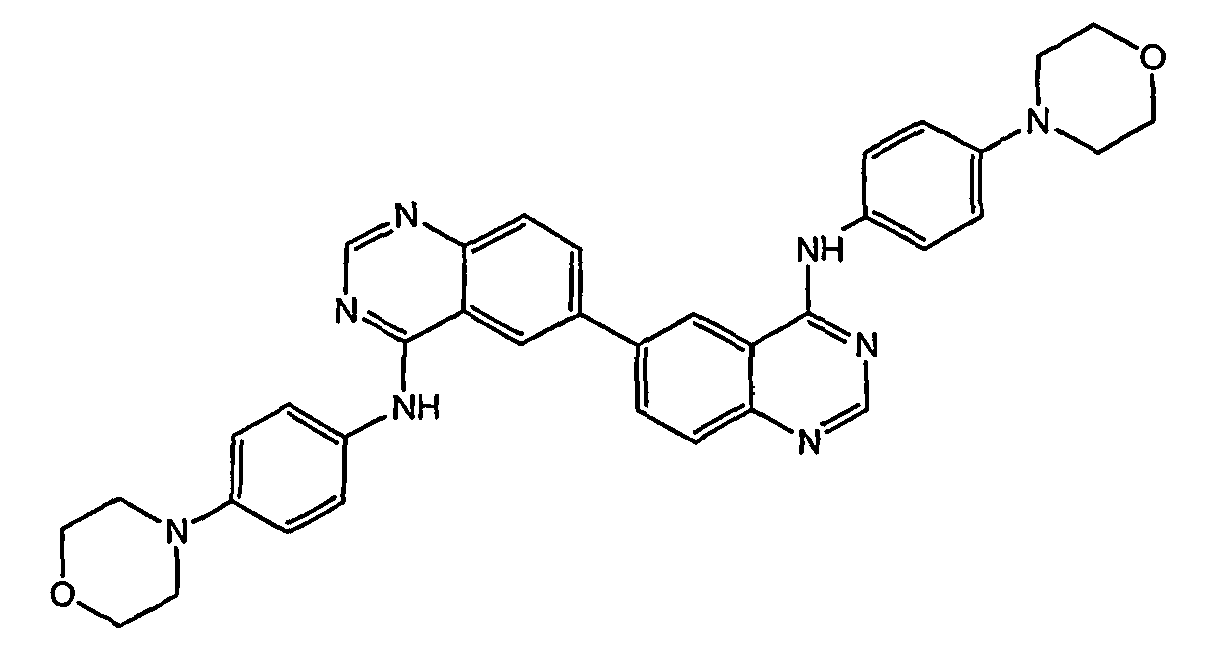
- Compounds of formula (I) containing one or more chiral centre may be used in enantiomerically or diastereoisomerically pure form, or in the form of a mixture of isomers. For the avoidance of doubt, the compounds of formula (I) can, if desired, be used in the form of solvates. Further, for the avoidance of doubt, the compounds of the invention may be used in any tautomeric form.
- As used herein, a pharmaceutically acceptable salt is a salt with a pharmaceutically acceptable acid or base. Pharmaceutically acceptable acids include both inorganic acids such as hydrochloric, sulphuric, phosphoric, diphosphoric, hydrobromic or nitric acid and organic acids such as citric, fumaric, maleic, malic, ascorbic, succinic, tartaric, benzoic, acetic, methanesulphonic, ethanesulphonic, benzenesulphonic orp-toluenesulphonic acid. Pharmaceutically acceptable bases include alkali metal (e.g. sodium or potassium) and alkali earth metal (e.g. calcium or magnesium) hydroxides and organic bases such as alkyl amines, aralkyl amines and heterocyclic amines. Preferred salts are hydrochloride salts. A particularly preferred salt is the tetrahydrochloride salt.
- The compounds of the invention can, for example, be prepared according to the following reaction scheme.
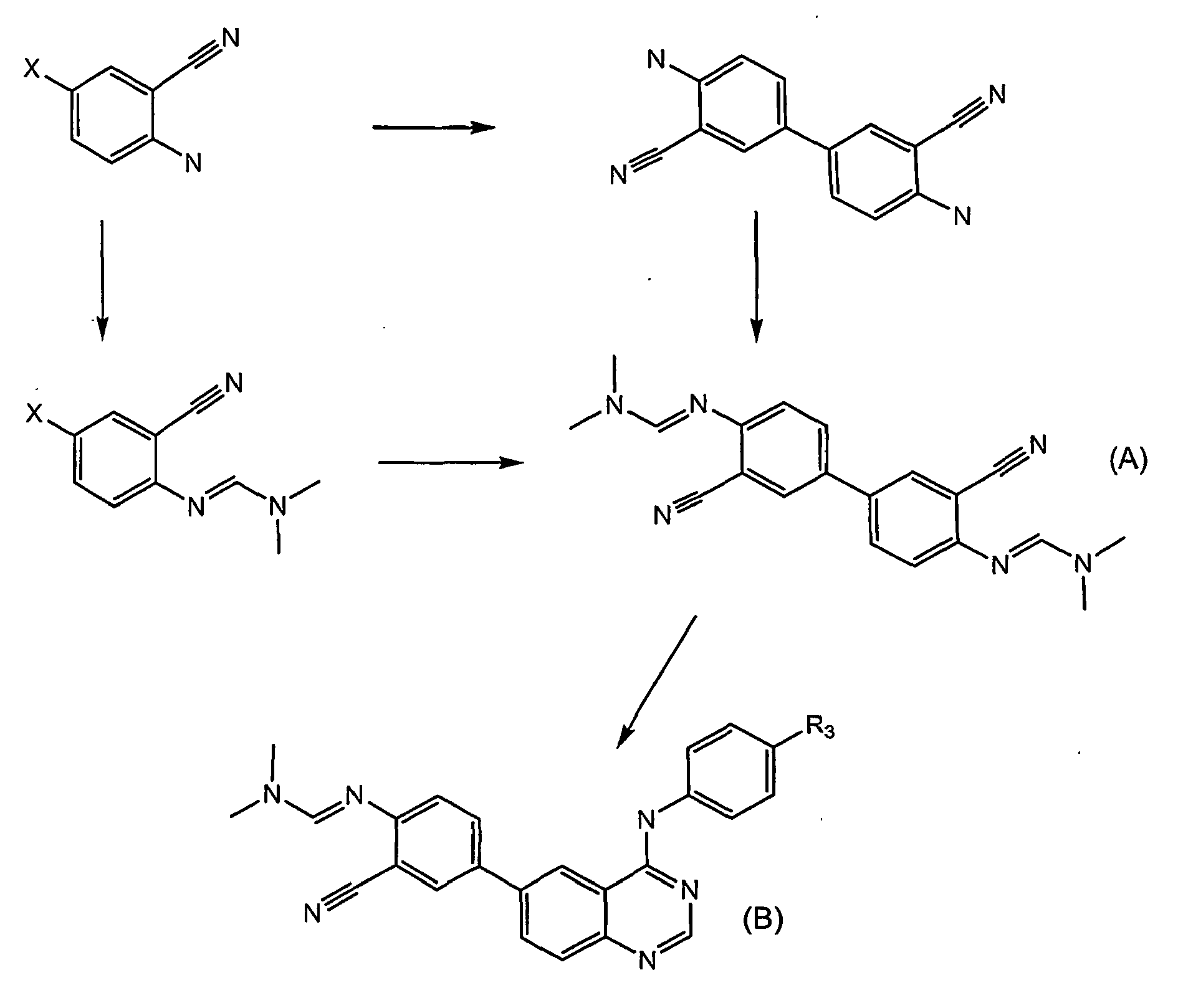
- As depicted above, Intermediate A can be prepared by dimerisation of an appropriate aniline, or via dimerisation of an amidine. The latter route is preferred. X in the above reaction scheme is typically iodine or bromine. Dimerisation can be effected, for example, with Pd(dppf)Cl2, DMSO/H2O, K3PO4 and 4,4,5,5-tetramethyl-2-(4,4,5,5-tetramethyl-1,3,2-dioxaborolan-2-yl)-1,3,2-dioxaborolane. Intermediate A can be reacted with a sub-stoichiometric amount of a substituted aniline to produce intermediate B. Intermediate B can be reacted with a nucleophilic amine of formula R1R2N-X-H to yield the asymmetric quinazolinyl-quinazolines of the invention.
- The intermediate B can also be prepared by transition metal-mediated coupling of a quinazoline iodide (C) with a suitable quinazoline or quinazoline precursor as shown below

- The intermediate B can also be prepared by transition metal-mediated coupling of aminobenzonitrile iodide (D) with a suitable quinazoline or quinazoline precursor as shown below.

- The compound N-(4-morpholinophenyl)-6-(4-(4-morpholinophenylamino)quinazolin-6-yl)quinazolin-4-amine can also be prepared by the following reaction.

- The compounds of the invention can be salified by standard techniques, in particular by reaction with an appropriate acid or base.
- The intermediates A and B depicted above are believed to be novel, and accordingly form part of the invention.
- The starting materials in the above reaction scheme are known compounds, or can be prepared by analogy with known methods.
- The compounds of the present invention are therapeutically useful. The present invention therefore provides a quinazoline derivative of the formula (I), as defined above, or a pharmaceutically acceptable salt thereof, for use in treating the human or animal body. Also provided is a pharmaceutical composition comprising a quinazoline derivative of the formula (I), as defined above, or a pharmaceutically acceptable salt thereof, and a pharmaceutically acceptable carrier or diluent.
- Said pharmaceutical composition typically contains up to 85 wt% of a compound of the invention. More typically, it contains up to 50 wt% of a compound of the invention. Preferred pharmaceutical compositions are sterile and pyrogen free. Further, the pharmaceutical compositions provided by the invention typically contain a compound of the invention which is a substantially pure optical isomer.
- As explained above, the compounds of the invention are active against a flaviviridae infection. The present invention therefore provides the use of a quinazoline derivative of the formula (I), as defined above, or a pharmaceutically acceptable salt thereof, in the manufacture of a medicament for use in treating or preventing a flaviviridae infection. Also provided is a compound for treating a patient suffering from or susceptible to a flaviviridae infection, in a method which comprises administering to said patient an effective amount of a quinazoline derivative of formula (I) or a pharmaceutically acceptable salt thereof.
- The flaviviridae family contains three genera. These are hepacivirus, flavivirus and pestivirus. The compounds of the invention are active in treating or preventing a hepacivirus infection, a flavivirus infection or a pestivirus infection.
- Typical pestivirus infections which can be treated with the compounds of the invention include bovine viral diarrhea virus, classical swine fever virus and border disease virus.
- Typical flavivirus infections which can be treated with the compounds of the invention include yellow fever virus, dengue fever virus, Japanese encephalitis virus and tick borne encephalitis virus.
- Typical hepacivirus infections that can be treated with the compounds of the invention include hepatitis C virus.
- Compounds of the present invention are especially active against hepatitis C. Typically, said flavivirus is therefore hepatitis C virus.
- The compounds of the invention may be administered in a variety of dosage forms. Thus, they can be administered orally, for example as tablets, troches, lozenges, aqueous or oily suspensions, dispersible powders or granules. The compounds of the invention may also be administered parenterally, whether subcutaneously, intravenously, intramuscularly, intrasternally, transdermally or by infusion techniques. The compounds may also be administered as suppositories.
- The compounds of the invention are typically formulated for administration with a pharmaceutically acceptable carrier or diluent. For example, solid oral forms may contain, together with the active compound, diluents, e.g. lactose, dextrose, saccharose, cellulose, corn starch or potato starch; lubricants, e.g. silica, talc, stearic acid, magnesium or calcium stearate, and/or polyethylene glycols; binding agents; e.g. starches, arabic gums, gelatin, methylcellulose, carboxymethylcellulose or polyvinyl pyrrolidone; disaggregating agents, e.g. starch, alginic acid, alginates or sodium starch glycolate; effervescing mixtures; dyestuffs; sweeteners; wetting agents, such as lecithin, polysorbates, laurylsulphates; and, in general, non toxic and pharmacologically inactive substances used in pharmaceutical formulations. Such pharmaceutical preparations may be manufactured in known manner, for example, by means of mixing, granulating, tableting, sugar coating, or film coating processes.
- Liquid dispersions for oral administration may be syrups, emulsions and suspensions. The syrups may contain as carriers, for example, saccharose or saccharose with glycerine and/or mannitol and/or sorbitol.
- Suspensions and emulsions may contain as carrier, for example a natural gum, agar, sodium alginate, pectin, methylcellulose, carboxymethylcellulose, or polyvinyl alcohol. The suspension or solutions for intramuscular injections may contain, together with the active compound, a pharmaceutically acceptable carrier, e.g. sterile water, olive oil, ethyl oleate, glycols, e.g. propylene glycol, and if desired, a suitable amount of lidocaine hydrochloride.
- Solutions for injection or infusion may contain as carrier, for example, sterile water or preferably they may be in the form of sterile, aqueous, isotonic saline solutions.
- Compounds of the present invention may be used in conjunction with known anti-viral agents. Preferred known anti-viral agents in this regard are interferon and ribavirin, and derivatives thereof, which are known for the treatment of hepatitis C (Clinical Microbiology Reviews, Jan. 2000, 67-82). The said medicament therefore typically further comprises interferon or a derivative thereof and/or ribavirin or a derivative thereof. Further, the present invention provides a pharmaceutical composition comprising:
- (a) a quinazoline derivative of the formula (I), as defined above, or a pharmaceutically acceptable salt thereof;
- (b) interferon or a derivative thereof and/or ribavirin or a derivative thereof; and
- (c) a pharmaceutically acceptable carrier or diluent.
- Also provided is a product comprising:
- (a) a quinazoline derivative of the formula (I), as defined above, or a pharmaceutically acceptable salt thereof; and
- (b) interferon or a derivative thereof and/or ribavirin or a derivative thereof,
- A preferred interferon derivative is PEG-interferon. A preferred ribavirin derivative is viramidine.
- A therapeutically effective amount of a compound of the invention is administered to a patient. A typical dose is from about 0.01 to 100 mg per kg of body weight, according to the activity of the specific compound, the age, weight and conditions of the subject to be treated, the type and severity of the disease and the frequency and route of administration. Preferably, daily dosage levels are from 0.05 to 16 mg per kg of body weight, more preferably, from 0.05 to 1.25 mg per kg of body weight.
- The following Examples illustrate the invention. They do not however, limit the invention in any way. In this regard, it is important to understand that the particular assay used in the Examples section is designed only to provide an indication of antiviral activity. There are many assays available to determine such activity, and a negative result in any one particular assay is therefore not determinative.
- All temperatures are in °C. Thin layer chromatography (TLC) was carried out on Si 60G coated plastic plates with uv254 indicator (Polygram). All NMR spectra were obtained at 250MHz in d6-DMSO unless stated otherwise.
- Samples were run on a MicroMass ZMD, using electrospray with simultaneous positive - negative ion detection.
- Column : Synergi Hydro-RP, 30 x 4.6mm I.D, 4 µm.
- Gradient: 95:5 to 5:95 v/v H2O/CH3CN + 0.05% Formic Acid over 4.0 min, hold 3 min, return to 95:5 v/v H2O/CH3C + 0.05% Formic Acid over 0.2 min and hold at 95:5 v/v H2O/CH3C + 0.05% Formic Acid over 3 min.
- Detection: PDA 250 - 340 nm.
- Flow rate : 1.5 ml/min
- A mixture of 6-iodo-N-(4-morpholinophenyl)quinazolin-4-amine (1eq, 1.004g), 4,4,5,5-tetramethyl-2-(4,4,5,5-tetramethyl-1,3,2-dioxaborolan-2-yl)-1,3,2-dioxaborolane (0.5eq, 295mg), dichloro diphenylphosphinylferrocene palladium (II) (10%, 200mg) and powdered potassium phosphate (3eq, 1.48g) in DMSO / H2O (5:1, 12ml) was heated to 80 degrees for 1.5h. The cooled reaction mixture was diluted with water and the green ppt isolated by filtration to give the crude product (1.46g).
- A portion of this material (517mg) was dissolved, with sonication and warming in aqueous 2N HCl (2.11ml, ∼5eq) and stirred whilst MeCN (21ml) added. Stirring and agitation was continued until the initial dark residue transformed into a solid. Filtration and drying in vacuo gave the title compound as a light brown solid (253mg, 83% recovery based on .4HCl)
LC-MS rt 2.41 m/z 611
1H NMR (DMSO) δ 11.80 (1H, brS), 9.71 (1H, s), 8.71 (1H, s), 8.52 (1H, d) 7.81 (1H, d), 7.57 (2H, d), 6.90 (2H, d), 4.29 (br s), 3.57 (4H, m), 2.98 (4H, m)
1H NMR (DMSO + K2CO3) δ 10.55 (1H, brS), 9.69 (1H, s), 8.66(1H, s), 8.58 (1H, d) 8.0 (2H, d), 7.12 (2H, d), 3.89 (4H, m), 3.24 (4H, m)
13C NMR (DMSO) δ 159.1, 151.0, 147.7, 138.1, 137.05, 134.1, 130.2, 125.8, 123.2, 120.25, 116.5, 114.2, 65.84, 49.82 - 2-Amino-5-iodo-benzonitrile (5g, 20.5mmol) was heated to reflux in DMF-DMA (20ml) for 2h. On cooling and concentrating to dryness in vacuo the residue was filtered through silica (20g, SiO2) eluting with dichloromethane to afford a brown oil (6.15g, 100%)
1H NMR (CDCl3 δ 7.71 (1H, d), 7.58 (1H, dd), 7.505 (1H, s), 6.64 (1H, d), 3.01 (6H, s)
LC-MS rt 3.46 m/z 299 MH+ - N'-(2-Cyano-4-iodo-phenyl)-N,N-dimethyl-formamidine (1.5g, 5mmol), bis(pinacolato)diboron (762mg, 0.6eq) in DMSO (15ml) and potassium phosphate (3.2g, 3 eq) in water (3ml, CARE exotherm) were mixed with stirring. Dichloro (diphenylphosphinylferrocenyl) palladium (II). DCM (204mg, 5mol%) was added and the mixture heated to 80° overnight. The cooled reaction mixture was partitioned between water (100ml) and DCM(150ml). The organic phase was separated and washed twice with water before being dried (Na2SO4) and concentrated to dryness. Trituration with diethyl ether afforded a brown crystalline solid (530mg, 62%)
1H NMR (DMSO) δ 8.045 (1H, s), 7.98(1H, d), 7.86 (1H, dd), 7.24 (1H, d) 3.1 (3H, S) 3.02 ( 3H, s)
LC-MS rt 2.12 M/z 345 - N'-[3,3'-Dicyano-4'-(dimethylamino-methyleneamino)-biphenyl-4-yl]-N,N-dimethylformamidine (35mg, 0.1mmol) and 4-morpholinoaniline (36mg, 0.2mmol) were combined in acetic acid (250uL) and heated to 85° for 90minutes. The mixture was diluted with 10% aq NaOH and the solid isolated by filtration and washed with water. The solid was then slurried in 2M HCl (1ml) to give a red solution that on addition of acetone precipitated the title compound hydrochloride salt as a light coloured solid. Filtration, washing with further acetone and drying in vacuo gave the title compound as a red brown solid (58mg, 77%)
LC-MS and 1H NMR as previously described. - 2-Amino-5-iodo-benzonitrile (5g) in DMF-DMA (10ml) was heated to 110° for 2h. The cooled reaction mixture was diluted with water (100ml) and extracted into ethyl acetate (3x100ml). The combined organic phases were dried (MgSO4) and concentrated to give a viscous brown oil (∼ quantitative) which was used without further purification.
1H NMR (CDCl3) δ 7.77 (1H, m), 7.65 (1H, dm, J8.85Hz), 7.57 (1H, s), 6.70 (1H, d, J8.85Hz), 3.012 (6H, s)
LC-MS rt 3.46 m/z 299.78 - N'-(2-Cyano-4-iodo-phenyl)-N,N-dimethyl-formamidine (10.9g, 36.4mmol) was dissolved in dry THF (250ml) and diisopropyl borate (2eq, 16.8ml) added. The mixture was cooled to -78° and butyl lithium (1.6M in hexanes, 3eq, 69ml) added dropwise. The resulting dark yellow solution was stirred for a further 2h at -78° before being allowed to warm to room temperature. 2M HCl was added until the pH reached 6 then concentrated in vacuo to remove THF. The resulting solid material was isolated by filtration and washed with diethyl ether. This gave, after drying overnight in vacuo, the product as an off-white solid (7.6g, 95%)
1H NMR (D2O δ 8.40 (1H, s), 8.12 (1H, s), 8.04 (1H, d), 7.48 (1H, d), 3.40 (3H, s), 3.28 (3H, s)
LC-MS rt 0.4 m/z 217.96 ES+ - A mixture of 3-Cyano-4-(dimethylamino-methyleneamino)-phenylboronic acid (184mg, 1.05eq) and (6-iodo-quinazolin-4-yl)-(4-morpholin-4-yl-phenyl)-amine (344mg, 0.8mmol) with tetrakistriphenylphosphine palladium (0) (5mol%, 45mg) in isopropanol (3.5ml) and saturated sodium bicarbonate (1.75ml) was heated to 100° for 2h then cooled and filtered. The resulting solid was washed with isopropanol (4x1ml) then TBME (2x1ml) and dried in vacuo to afford the title compound as a yellow solid ( 318mg, 83%)
1H NMR (DMSO) δ 9.83 (1H, s), 8.79 (1H, s), 8.49 (1H, s), 8.21-8.0 (4H, m), 7.77 (1H, d) 7.64 (2H, d), 7.34 (1H, d) , 7.0 (2H, d), 3.76 (4H, m) 3.11 (7H,m), 3.03 (3H, s) 13C NMR (DMSO) δ 158.225, 155.349, 155.080, 154.796, 149.236, 148.185, 136.008, 132.521, 132.418, 131.419, 131.336, 131.086, 128.581, 124.510, 124.111, 119.884, 119.643, 119.057, 115.886, 115.425, 106.991, 66.483, 49.168, 40.229, 34.443
LC-MS rt 2.35 m/z 478 - N'-{2-Cyano-4-[4-(4-morpholin-4-yl-phenylamino)-quinazolin-6-yl]-phenyl}-N,N-dimethyl-formamidine (300mg) was treated with aniline (250uL) in acetic acid (2ml) at 125° for 2h. The cooled reaction mixture was neutralized with 2N NaOH and the resulting green precipitate isolated by filtration. This was then taken up in 2N HCl and concentrated to dryness. On standing with 1: 1 MeOH/EtOH an orange solid precipitated which was washed with acetone and ether to give the title compound as a red solid (170mg).
1H NMR (DMSO) δ 12.56 (1H, s), 12.42 (1H, s), 10.38 (2H, m), 9.40 (2H, d), 9.214 ( 2H, m), 8.50 (2H, m), 8.36 (2H, d), 8.24 (2H, d), 7.85-7.73 (4H, m), 7.52 (2H, d), 4.25 (4H, m), 3.65 (4H, m)
LC-MS rt 2.52 m/z 526 - N'-[3,3'-Dicyano-4'-(dimethylamino-methyleneamino)-biphenyl-4-yl]-N,N-dimethylformamidine (100mg, 0.29mmol) and 4-(1H-1,2,4-triazol-1-yl)aniline (93mg, 0.58mmol) were combined in acetic acid (500uL) and heated to 125° for 90minutes. The solid was isolated by filtration and washed with water, then slurried with aqueous potassium carbonate. The solid was filtered and washed with water before drying in vacuo to give the title compound as a cream solid(90mg, 54%)
1H NMR (DMSO) δ 11.95 (1H, s), 10.2 (1H, s), 9.28 (1H, s), 9.03 (1H, s) 8.69 (1H, S), 8.47 (1H, d) 8.25 (1H, s), 7.9-8.1 (4H, m)
LC-MS rt 2.43 m/z 573 ES- 575 ES+ - HCV replicon cells Huh 9B (ReBlikon), containing the firefly luciferase - ubiquitin - neomycin phosphotransferase fusion protein and EMCV-IRES driven HCV polyprotein with cell culture adaptive mutations.
- Cells were cultured at 37°C in a 5% CO2 environment and split twice a week on seeding at 2 x 10E6 cells/flask on day 1 and 1 x 10E6 3 days later. Some 0.25mg/ml G418 was added to the culture medium (125ul per 25ml) but not the assay medium.
- The culture medium consisted of DMEM with 4500g/l glucose and glutamax (Gibco 61965-026) supplemented with 1 x non-essential amino acids, penicillin (100 IU/ml) / streptomycin (100 µg/ml), FCS (10%, 50ml) and 1 mg/ml G418 (Invitrogen cat no 10131-027) & 10 % foetal calf serum.
- A flask of cells was trypsinised and a cell count carried out. Cells were diluted to 100,000 cells/ml and 100 µl of this used to seed one opaque white 96-well plate (for the replicon assay) and one flat-bottomed clear plate (for the tox assay) for every seven compounds to be tested for IC50. Wells G12 and H12 were left empty in the clear plate as the blank. Plates were then incubated at 37°C in a 5% CO2 environment for 24 h.
- On the following day compound dilutions are made up in medium at twice their desired final concentration in a clear round bottomed plate. All dilutions have a final DMSO concentration of 1%.
- Once the dilution plate had been made up, controls and compounds were transferred to the assay plate (containing the cells) at 100µl /well in duplicate plates. Exception: in the white (replicon) plate, no compound was added to wells A1 and A2 and 100 µl of 1% DMSO was added to these instead. In the clear (Tox) plate, wells E12 & F12 only contained the DMSO control. Plates were then incubated at 37°C with 5% CO2 for 72h.
- At the end of the incubation time, the cells in the white plate were harvested by washing with 200 µl/ well of warm (37°C) PBS and lysed with 20 µl cell culture lysis buffer (Promega). After 5 min incubation @ RT, luciferin solution was added to the luciferase assay buffer (LARB at 200 µl per 10 ml LARB. The M injector of the microplate luminometer (Lmax, Molecular Devices) was primed with 4 x 3001 injections. Plate were inserted into the luminometer and 100 µl luciferase assay reagent was added by the injector on the luminometer. The signal was measured using a 1 second delay followed by a 4 second measurement programme. The IC50, the concentration of the drug required for reducing the replicon level by 50% in relation to the untreated cell control value, can be calculated from the plot of the percentage reduction of the luciferase activity vs. drug concentration.
- The clear plate was stained with 100 µl 0.5% methylene blue in 50% ethanol at RT for 1h, followed by solvation of the absorbed methylene blue in 100 µl per well of 1% lauroylsarcosine. Absorbance of the plate was measured on a microplate spectrophotometer (Molecular Devices) and the absorbance for each concentration of compound expressed as a proportion of the relative DMSO control. The TD50, the concentration of drug required to reduce the total cell area by 50% relative to the DMSO controls can be calculated by plotting the absorbance at 620nm vs drug concentration.
Replicon IC50 (<1 uM=***; 1 to 5uM=**; >10uM=*) Replicon TD50 (>25uM=***; 10 to 25uM=**; <10uM=*) Example no uM uM 1 *** *** 2 *** *** 3 *** ***
Claims (23)
- A quinazoline derivative of formula (I), or a pharmaceutically acceptable salt thereof,
 - X represents a direct bond or a moiety -L-NR-, wherein R is hydrogen or C1-C4 alkyl, and L represents a C1-C4 alkylene, C6-C10 aryl or 5- to 10- membered heteroaryl moiety;- either R1 and R2, together with the N atom to which they are attached, form a 5-to 10- membered heterocyclyl group or a 5- to 10- membered heteroaryl group, or R1 represents hydrogen, C6-C10 aryl, C1-C4 alkyl or C1-C4 hydroxyalkyl and R2 represents C6-C10 aryl, C1-C4 alkyl or C1-C4 hydroxyalkyl; and- R3 represents a C6-C10 aryl, C3-C6 carbocyclyl, 5- to 10- membered heteroaryl or 5- to 10- membered heterocyclyl moiety,said aryl, carbocyclyl, heteroaryl and heterocyclyl groups being unsubstituted or substituted by 1, 2 or 3 substituents selected from halogen, C1-C4 alkyl, C1-C4 alkoxy, C1-C4 haloalkyl, C1-C4 haloalkoxy, hydroxy, thiol, -NH2, C1-C4 hydroxyalkyl, C1-C4 thioalkyl and C1-C4 aminoalkyl substituents.
 - A compound according to claim 1, wherein the aryl, heteroaryl, carbocyclyl and heterocyclyl moieties in the R1, R2, R3 and X moieties are unsubstituted or substituted by 1 or 2 substituents selected from halogen, C1-C4 alkyl and C1-C4 haloalkyl substituents.
- A compound according to claim 1 or 2, wherein R is H.
- A compound according to any one of the preceding claims, wherein L is a phenylene moiety.
- A compound according to any one of the preceding claims, wherein X is -L-NR-, wherein L and R are as defined in any one of the preceding claims.
- A compound according to any one of the preceding claims, wherein R3 represents a 5- to 6- membered heteroaryl or heterocyclyl group.
- A compound according to any one of the preceding claims, wherein when R1 and R2 do not together form a cyclic moiety, R1 is hydrogen and R2 is phenyl.
- A compound according to any one of the preceding claims, wherein when R1 and R2 together form a cyclic moiety, R1 and R2, together with the N atom to which they are attached, form a 5- to 6- membered heterocyclyl or 5- to 6- membered heteroaryl group.
- A compound according to claim 8 wherein R1 and R2, together with the N atom to which they are attached, form a saturated 5- to 6- membered heterocycle, which contains 1 or 2 heteroatoms selected from N, O and S.
- A compound according to any one of the preceding claims, wherein the compound of formula (I) is N-(4-morpholinophenyl)-6-(4-(4-morpholinophenylamino)quinazolin-6-yl)quinazolin-4-amine, N*4*-(4-Morpholin-4-yl-phenyl)-N*4*-phenyl-[6,6']biquinazolinyl-4,4'-diamine or
N*4*,N*4'*-Bis-(4-[1,2,4]triazol-1-yl-phenyl)-[6,6']biquinazolinyl-4,4'-diamine - A quinazoline derivative of the formula (I), as defined in any one of the preceding claims, or a pharmaceutically acceptable salt thereof, for use in treating the human or animal body.
- A pharmaceutical composition which comprises a quinazoline derivative of the formula (I), as defined in any one of claims 1 to 10, or a pharmaceutically acceptable salt thereof, and a pharmaceutically acceptable carrier or diluent.
- Use of a quinazoline derivative of the formula (I), as defined in any one of claims 1 to 10, or a pharmaceutically acceptable salt thereof, in the manufacture of a medicament for use in treating or preventing a flaviviridae infection.
- Use according to claim 13, wherein the flaviviridae infection is a pestivirus infection.
- Use according to claim 14, wherein the pestivirus infection is an infection by a bovine viral diarrhea virus, classical swine fever virus or border disease virus.
- Use according to claim 13, wherein the flaviviridae infection is a flavivirus infection.
- Use according to claim 13, wherein the flavivirus infection is an infection by a yellow fever virus, dengue fever virus, Japanese encephalitis virus or tick borne encephalitis virus.
- Use according to claim 13, wherein the flavivirdae infection is a hepacivirus infection.
- Use according to claim 18, wherein the hepacivirus infection is an infection by a hepatitis C virus.
- Use according to claim 19, wherein the medicament further comprises (a) interferon or a derivative thereof and/or (b) ribavirin or a derivative thereof.
- Use according to claim 20 wherein the interferon derivative is PEG-interferon and/or the ribavirin derivative is viramidine.
- A product containing:(a) a quinazoline derivative of the formula (I), as defined in any one of claims 1 to 10, or a pharmaceutically acceptable salt thereof; and(b) interferon, or an interferon derivative as defined in claim 20 or 21 and/or ribavirin or a ribavirin derivative as defined in claim 20 or 21;for simultaneous, separate or sequential use in the treatment of the human or animal body.
- A compound which is


Applications Claiming Priority (4)
| Application Number | Priority Date | Filing Date | Title |
|---|---|---|---|
| GBGB0501964.1A GB0501964D0 (en) | 2005-01-31 | 2005-01-31 | Chemical compounds |
| US64956405P | 2005-02-04 | 2005-02-04 | |
| US66845605P | 2005-04-05 | 2005-04-05 | |
| PCT/GB2006/000294 WO2006079833A1 (en) | 2005-01-31 | 2006-01-30 | Quinazoline derivatives as antiviral agents |
Publications (2)
| Publication Number | Publication Date |
|---|---|
| EP1844004A1 EP1844004A1 (en) | 2007-10-17 |
| EP1844004B1 true EP1844004B1 (en) | 2009-06-24 |
Family
ID=34307734
Family Applications (1)
| Application Number | Title | Priority Date | Filing Date |
|---|---|---|---|
| EP06709585A Expired - Lifetime EP1844004B1 (en) | 2005-01-31 | 2006-01-30 | Quinazoline derivates as antiviral agents |
Country Status (8)
| Country | Link |
|---|---|
| US (1) | US20080114008A1 (en) |
| EP (1) | EP1844004B1 (en) |
| JP (1) | JP2008528564A (en) |
| AT (1) | ATE434603T1 (en) |
| DE (1) | DE602006007441D1 (en) |
| ES (1) | ES2327778T3 (en) |
| GB (1) | GB0501964D0 (en) |
| WO (1) | WO2006079833A1 (en) |
Families Citing this family (13)
| Publication number | Priority date | Publication date | Assignee | Title |
|---|---|---|---|---|
| GB0520475D0 (en) * | 2005-10-07 | 2005-11-16 | Arrow Therapeutics Ltd | Chemical compounds |
| CA2635916A1 (en) * | 2006-01-11 | 2007-07-19 | Arrow Therapeutics Limited | Triazoloanilinopyrimidine derivatives for use as antiviral agents |
| WO2008056149A1 (en) * | 2006-11-09 | 2008-05-15 | Arrow Therapeutics Limited | Quinazoline derivatives and pharmaceutical compositions containing them |
| KR20100123717A (en) * | 2008-02-12 | 2010-11-24 | 브리스톨-마이어스 스큅 컴퍼니 | Heterocyclic derivatives as hepatitis c virus inhibitors |
| WO2010075380A1 (en) | 2008-12-23 | 2010-07-01 | Abbott Laboratories | Anti-viral compounds |
| WO2010075376A2 (en) | 2008-12-23 | 2010-07-01 | Abbott Laboratories | Anti-viral compounds |
| ES2606717T3 (en) | 2009-02-27 | 2017-03-27 | Enanta Pharmaceuticals, Inc. | Hepatitis C virus inhibitors |
| EP2419404B1 (en) | 2009-04-15 | 2015-11-04 | AbbVie Inc. | Anti-viral compounds |
| CN101575319B (en) * | 2009-06-18 | 2011-07-27 | 南京医科大学 | Process for preparing lapatinib synthetic intermediate |
| US8653070B2 (en) | 2009-12-14 | 2014-02-18 | Enanta Pharmaceuticals, Inc. | Hepatitis C virus inhibitors |
| WO2013030750A1 (en) | 2011-09-01 | 2013-03-07 | Lupin Limited | Antiviral compounds |
| IN2014MN01547A (en) | 2012-02-10 | 2015-05-08 | Lupin Ltd | |
| US20220099637A1 (en) | 2018-12-04 | 2022-03-31 | Bristol-Myers Squibb Company | Methods of analysis using in-sample calibration curve by multiple isotopologue reaction monitoring |
Family Cites Families (2)
| Publication number | Priority date | Publication date | Assignee | Title |
|---|---|---|---|---|
| AU741946B2 (en) * | 1998-07-20 | 2001-12-13 | Bristol-Myers Squibb Company | Substituted benzimidazole antiviral agents |
| WO2005105761A1 (en) * | 2004-04-28 | 2005-11-10 | Arrow Therapeutics Limited | Morpholinylanilinoquinazo- line derivatives for use as antiviral agents |
-
2005
- 2005-01-31 GB GBGB0501964.1A patent/GB0501964D0/en not_active Ceased
-
2006
- 2006-01-30 ES ES06709585T patent/ES2327778T3/en not_active Expired - Lifetime
- 2006-01-30 US US11/883,191 patent/US20080114008A1/en not_active Abandoned
- 2006-01-30 EP EP06709585A patent/EP1844004B1/en not_active Expired - Lifetime
- 2006-01-30 JP JP2007552719A patent/JP2008528564A/en active Pending
- 2006-01-30 WO PCT/GB2006/000294 patent/WO2006079833A1/en not_active Ceased
- 2006-01-30 AT AT06709585T patent/ATE434603T1/en not_active IP Right Cessation
- 2006-01-30 DE DE602006007441T patent/DE602006007441D1/en not_active Expired - Fee Related
Also Published As
| Publication number | Publication date |
|---|---|
| US20080114008A1 (en) | 2008-05-15 |
| DE602006007441D1 (en) | 2009-08-06 |
| WO2006079833A1 (en) | 2006-08-03 |
| EP1844004A1 (en) | 2007-10-17 |
| ATE434603T1 (en) | 2009-07-15 |
| GB0501964D0 (en) | 2005-03-09 |
| JP2008528564A (en) | 2008-07-31 |
| ES2327778T3 (en) | 2009-11-03 |
Similar Documents
| Publication | Publication Date | Title |
|---|---|---|
| US20080311076A1 (en) | Morpholinylanilinoquinazoline Derivatives For Use As Antiviral Agents | |
| CN101619043B (en) | Quinazoline derivant and medical application thereof | |
| AU727013B2 (en) | Heterocyclic compound and antitumor agent comprising the same as effective component | |
| CA2641744C (en) | Benzazole derivatives, compositions, and methods of use as aurora kinase inhibitors | |
| CN102143953B (en) | Pyrimidines, triazines and their use as pharmaceutical agents | |
| US8592430B2 (en) | Quinazolin-oxime derivatives as Hsp90 inhibitors | |
| CS413791A3 (en) | Pyrrole-amidine antitumor preparations | |
| JPWO1999005138A1 (en) | Heterocyclic compounds and antitumor agents containing them as active ingredients | |
| IE913854A1 (en) | Quinazoline derivatives for enhancing antitumor activity | |
| CZ300293B6 (en) | Novel amide derivatives, process of their preparation and pharmaceutical composition in which they are comprised | |
| AU2007329480A1 (en) | Indazole compounds | |
| WO1998024785A1 (en) | Indole-urea derivatives with 5-ht antagonist properties | |
| US20080114008A1 (en) | Quinazoline Derivatives as Antiviral Agents | |
| KR20080006614A (en) | 2-amino-quinazolin-5-one, an HSP90 inhibitor useful for the treatment of proliferative diseases | |
| US20100158863A1 (en) | Triazoloanilinopyrimidine derivatives for use as antiviral agents | |
| JPWO2000043385A1 (en) | Heterocyclic compounds and antitumor agents containing them as active ingredients | |
| EP4682142A1 (en) | 1h-pyrrole-2-amide derivative and use thereof | |
| US20080267914A1 (en) | Chemical Compounds | |
| ES2363807T3 (en) | DERIVATIVES OF TRIAZOLOANYLINOPIRIMIDINE FOR USE AS ANTIVIRAL AGENTS. | |
| WO1994003439A1 (en) | Antiproliferative tricyclic compounds | |
| CN120247900A (en) | Phenylthiazolylamine pyrimidine derivatives and preparation methods and applications thereof |
Legal Events
| Date | Code | Title | Description |
|---|---|---|---|
| PUAI | Public reference made under article 153(3) epc to a published international application that has entered the european phase |
Free format text: ORIGINAL CODE: 0009012 |
|
| 17P | Request for examination filed |
Effective date: 20070727 |
|
| AK | Designated contracting states |
Kind code of ref document: A1 Designated state(s): AT BE BG CH CY CZ DE DK EE ES FI FR GB GR HU IE IS IT LI LT LU LV MC NL PL PT RO SE SI SK TR |
|
| DAX | Request for extension of the european patent (deleted) | ||
| GRAP | Despatch of communication of intention to grant a patent |
Free format text: ORIGINAL CODE: EPIDOSNIGR1 |
|
| GRAS | Grant fee paid |
Free format text: ORIGINAL CODE: EPIDOSNIGR3 |
|
| GRAA | (expected) grant |
Free format text: ORIGINAL CODE: 0009210 |
|
| AK | Designated contracting states |
Kind code of ref document: B1 Designated state(s): AT BE BG CH CY CZ DE DK EE ES FI FR GB GR HU IE IS IT LI LT LU LV MC NL PL PT RO SE SI SK TR |
|
| REG | Reference to a national code |
Ref country code: GB Ref legal event code: FG4D |
|
| REG | Reference to a national code |
Ref country code: CH Ref legal event code: EP |
|
| REG | Reference to a national code |
Ref country code: IE Ref legal event code: FG4D |
|
| REF | Corresponds to: |
Ref document number: 602006007441 Country of ref document: DE Date of ref document: 20090806 Kind code of ref document: P |
|
| REG | Reference to a national code |
Ref country code: SE Ref legal event code: TRGR |
|
| PG25 | Lapsed in a contracting state [announced via postgrant information from national office to epo] |
Ref country code: AT Free format text: LAPSE BECAUSE OF FAILURE TO SUBMIT A TRANSLATION OF THE DESCRIPTION OR TO PAY THE FEE WITHIN THE PRESCRIBED TIME-LIMIT Effective date: 20090624 Ref country code: LT Free format text: LAPSE BECAUSE OF FAILURE TO SUBMIT A TRANSLATION OF THE DESCRIPTION OR TO PAY THE FEE WITHIN THE PRESCRIBED TIME-LIMIT Effective date: 20090624 Ref country code: FI Free format text: LAPSE BECAUSE OF FAILURE TO SUBMIT A TRANSLATION OF THE DESCRIPTION OR TO PAY THE FEE WITHIN THE PRESCRIBED TIME-LIMIT Effective date: 20090624 |
|
| REG | Reference to a national code |
Ref country code: ES Ref legal event code: FG2A Ref document number: 2327778 Country of ref document: ES Kind code of ref document: T3 |
|
| PG25 | Lapsed in a contracting state [announced via postgrant information from national office to epo] |
Ref country code: LV Free format text: LAPSE BECAUSE OF FAILURE TO SUBMIT A TRANSLATION OF THE DESCRIPTION OR TO PAY THE FEE WITHIN THE PRESCRIBED TIME-LIMIT Effective date: 20090624 Ref country code: PL Free format text: LAPSE BECAUSE OF FAILURE TO SUBMIT A TRANSLATION OF THE DESCRIPTION OR TO PAY THE FEE WITHIN THE PRESCRIBED TIME-LIMIT Effective date: 20090624 Ref country code: SI Free format text: LAPSE BECAUSE OF FAILURE TO SUBMIT A TRANSLATION OF THE DESCRIPTION OR TO PAY THE FEE WITHIN THE PRESCRIBED TIME-LIMIT Effective date: 20090624 |
|
| NLV1 | Nl: lapsed or annulled due to failure to fulfill the requirements of art. 29p and 29m of the patents act | ||
| PG25 | Lapsed in a contracting state [announced via postgrant information from national office to epo] |
Ref country code: CZ Free format text: LAPSE BECAUSE OF FAILURE TO SUBMIT A TRANSLATION OF THE DESCRIPTION OR TO PAY THE FEE WITHIN THE PRESCRIBED TIME-LIMIT Effective date: 20090624 Ref country code: IS Free format text: LAPSE BECAUSE OF FAILURE TO SUBMIT A TRANSLATION OF THE DESCRIPTION OR TO PAY THE FEE WITHIN THE PRESCRIBED TIME-LIMIT Effective date: 20091024 Ref country code: EE Free format text: LAPSE BECAUSE OF FAILURE TO SUBMIT A TRANSLATION OF THE DESCRIPTION OR TO PAY THE FEE WITHIN THE PRESCRIBED TIME-LIMIT Effective date: 20090624 |
|
| PG25 | Lapsed in a contracting state [announced via postgrant information from national office to epo] |
Ref country code: NL Free format text: LAPSE BECAUSE OF FAILURE TO SUBMIT A TRANSLATION OF THE DESCRIPTION OR TO PAY THE FEE WITHIN THE PRESCRIBED TIME-LIMIT Effective date: 20090624 Ref country code: SK Free format text: LAPSE BECAUSE OF FAILURE TO SUBMIT A TRANSLATION OF THE DESCRIPTION OR TO PAY THE FEE WITHIN THE PRESCRIBED TIME-LIMIT Effective date: 20090624 Ref country code: BE Free format text: LAPSE BECAUSE OF FAILURE TO SUBMIT A TRANSLATION OF THE DESCRIPTION OR TO PAY THE FEE WITHIN THE PRESCRIBED TIME-LIMIT Effective date: 20090624 |
|
| PG25 | Lapsed in a contracting state [announced via postgrant information from national office to epo] |
Ref country code: PT Free format text: LAPSE BECAUSE OF FAILURE TO SUBMIT A TRANSLATION OF THE DESCRIPTION OR TO PAY THE FEE WITHIN THE PRESCRIBED TIME-LIMIT Effective date: 20091024 Ref country code: BG Free format text: LAPSE BECAUSE OF FAILURE TO SUBMIT A TRANSLATION OF THE DESCRIPTION OR TO PAY THE FEE WITHIN THE PRESCRIBED TIME-LIMIT Effective date: 20090924 |
|
| PG25 | Lapsed in a contracting state [announced via postgrant information from national office to epo] |
Ref country code: DK Free format text: LAPSE BECAUSE OF FAILURE TO SUBMIT A TRANSLATION OF THE DESCRIPTION OR TO PAY THE FEE WITHIN THE PRESCRIBED TIME-LIMIT Effective date: 20090624 |
|
| PLBE | No opposition filed within time limit |
Free format text: ORIGINAL CODE: 0009261 |
|
| STAA | Information on the status of an ep patent application or granted ep patent |
Free format text: STATUS: NO OPPOSITION FILED WITHIN TIME LIMIT |
|
| 26N | No opposition filed |
Effective date: 20100325 |
|
| PG25 | Lapsed in a contracting state [announced via postgrant information from national office to epo] |
Ref country code: MC Free format text: LAPSE BECAUSE OF NON-PAYMENT OF DUE FEES Effective date: 20100131 |
|
| REG | Reference to a national code |
Ref country code: CH Ref legal event code: PL |
|
| GBPC | Gb: european patent ceased through non-payment of renewal fee |
Effective date: 20100130 |
|
| EUG | Se: european patent has lapsed | ||
| REG | Reference to a national code |
Ref country code: FR Ref legal event code: ST Effective date: 20100930 |
|
| PG25 | Lapsed in a contracting state [announced via postgrant information from national office to epo] |
Ref country code: GR Free format text: LAPSE BECAUSE OF FAILURE TO SUBMIT A TRANSLATION OF THE DESCRIPTION OR TO PAY THE FEE WITHIN THE PRESCRIBED TIME-LIMIT Effective date: 20090925 Ref country code: FR Free format text: LAPSE BECAUSE OF NON-PAYMENT OF DUE FEES Effective date: 20100201 Ref country code: CH Free format text: LAPSE BECAUSE OF NON-PAYMENT OF DUE FEES Effective date: 20100131 Ref country code: LI Free format text: LAPSE BECAUSE OF NON-PAYMENT OF DUE FEES Effective date: 20100131 |
|
| PG25 | Lapsed in a contracting state [announced via postgrant information from national office to epo] |
Ref country code: DE Free format text: LAPSE BECAUSE OF NON-PAYMENT OF DUE FEES Effective date: 20100803 |
|
| PG25 | Lapsed in a contracting state [announced via postgrant information from national office to epo] |
Ref country code: GB Free format text: LAPSE BECAUSE OF NON-PAYMENT OF DUE FEES Effective date: 20100130 |
|
| PG25 | Lapsed in a contracting state [announced via postgrant information from national office to epo] |
Ref country code: IE Free format text: LAPSE BECAUSE OF NON-PAYMENT OF DUE FEES Effective date: 20100130 |
|
| REG | Reference to a national code |
Ref country code: ES Ref legal event code: FD2A Effective date: 20110309 |
|
| PG25 | Lapsed in a contracting state [announced via postgrant information from national office to epo] |
Ref country code: IT Free format text: LAPSE BECAUSE OF NON-PAYMENT OF DUE FEES Effective date: 20100130 |
|
| PG25 | Lapsed in a contracting state [announced via postgrant information from national office to epo] |
Ref country code: ES Free format text: LAPSE BECAUSE OF NON-PAYMENT OF DUE FEES Effective date: 20110308 |
|
| PG25 | Lapsed in a contracting state [announced via postgrant information from national office to epo] |
Ref country code: ES Free format text: LAPSE BECAUSE OF NON-PAYMENT OF DUE FEES Effective date: 20100131 |
|
| PG25 | Lapsed in a contracting state [announced via postgrant information from national office to epo] |
Ref country code: CY Free format text: LAPSE BECAUSE OF FAILURE TO SUBMIT A TRANSLATION OF THE DESCRIPTION OR TO PAY THE FEE WITHIN THE PRESCRIBED TIME-LIMIT Effective date: 20090624 |
|
| PG25 | Lapsed in a contracting state [announced via postgrant information from national office to epo] |
Ref country code: HU Free format text: LAPSE BECAUSE OF FAILURE TO SUBMIT A TRANSLATION OF THE DESCRIPTION OR TO PAY THE FEE WITHIN THE PRESCRIBED TIME-LIMIT Effective date: 20091225 Ref country code: LU Free format text: LAPSE BECAUSE OF NON-PAYMENT OF DUE FEES Effective date: 20100130 Ref country code: SE Free format text: LAPSE BECAUSE OF NON-PAYMENT OF DUE FEES Effective date: 20100131 |
|
| PG25 | Lapsed in a contracting state [announced via postgrant information from national office to epo] |
Ref country code: TR Free format text: LAPSE BECAUSE OF FAILURE TO SUBMIT A TRANSLATION OF THE DESCRIPTION OR TO PAY THE FEE WITHIN THE PRESCRIBED TIME-LIMIT Effective date: 20090624 |
|
| PG25 | Lapsed in a contracting state [announced via postgrant information from national office to epo] |
Ref country code: RO Free format text: LAPSE BECAUSE OF FAILURE TO SUBMIT A TRANSLATION OF THE DESCRIPTION OR TO PAY THE FEE WITHIN THE PRESCRIBED TIME-LIMIT Effective date: 20090624 |