EP1842849A1 - Trisoxetane compound, process for producing the same, and optical waveguide using the same - Google Patents
Trisoxetane compound, process for producing the same, and optical waveguide using the same Download PDFInfo
- Publication number
- EP1842849A1 EP1842849A1 EP20070007235 EP07007235A EP1842849A1 EP 1842849 A1 EP1842849 A1 EP 1842849A1 EP 20070007235 EP20070007235 EP 20070007235 EP 07007235 A EP07007235 A EP 07007235A EP 1842849 A1 EP1842849 A1 EP 1842849A1
- Authority
- EP
- European Patent Office
- Prior art keywords
- carbon atom
- group
- alkyl group
- compound
- optical waveguide
- Prior art date
- Legal status (The legal status is an assumption and is not a legal conclusion. Google has not performed a legal analysis and makes no representation as to the accuracy of the status listed.)
- Granted
Links
- 230000003287 optical effect Effects 0.000 title claims abstract description 86
- 150000001875 compounds Chemical class 0.000 title claims abstract description 69
- 238000000034 method Methods 0.000 title claims abstract description 12
- 229910052799 carbon Inorganic materials 0.000 claims abstract description 47
- 125000000217 alkyl group Chemical group 0.000 claims abstract description 33
- 125000004435 hydrogen atom Chemical group [H]* 0.000 claims abstract description 24
- 125000001931 aliphatic group Chemical group 0.000 claims abstract description 11
- 125000000962 organic group Chemical group 0.000 claims abstract description 11
- 125000004432 carbon atom Chemical group C* 0.000 claims abstract 16
- 238000005253 cladding Methods 0.000 claims description 19
- 239000011342 resin composition Substances 0.000 claims description 18
- TVFDJXOCXUVLDH-UHFFFAOYSA-N caesium atom Chemical class [Cs] TVFDJXOCXUVLDH-UHFFFAOYSA-N 0.000 claims description 14
- 239000000758 substrate Substances 0.000 claims description 14
- RZXLPPRPEOUENN-UHFFFAOYSA-N Chlorfenson Chemical compound C1=CC(Cl)=CC=C1OS(=O)(=O)C1=CC=C(Cl)C=C1 RZXLPPRPEOUENN-UHFFFAOYSA-N 0.000 claims description 13
- 125000002496 methyl group Chemical group [H]C([H])([H])* 0.000 claims description 12
- 150000002989 phenols Chemical class 0.000 claims description 10
- QYKIQEUNHZKYBP-UHFFFAOYSA-N Vinyl ether Chemical group C=COC=C QYKIQEUNHZKYBP-UHFFFAOYSA-N 0.000 claims description 7
- NHGGJRABQHWCGJ-UHFFFAOYSA-M cesium;phenoxide Chemical compound [Cs+].[O-]C1=CC=CC=C1 NHGGJRABQHWCGJ-UHFFFAOYSA-M 0.000 claims description 7
- 125000003700 epoxy group Chemical group 0.000 claims description 7
- FJDQFPXHSGXQBY-UHFFFAOYSA-L caesium carbonate Chemical group [Cs+].[Cs+].[O-]C([O-])=O FJDQFPXHSGXQBY-UHFFFAOYSA-L 0.000 claims description 5
- 229910000024 caesium carbonate Inorganic materials 0.000 claims description 5
- 125000001495 ethyl group Chemical group [H]C([H])([H])C([H])([H])* 0.000 claims description 5
- 125000001997 phenyl group Chemical group [H]C1=C([H])C([H])=C(*)C([H])=C1[H] 0.000 claims description 3
- 125000003944 tolyl group Chemical group 0.000 claims description 3
- 239000010410 layer Substances 0.000 description 35
- 150000001721 carbon Chemical group 0.000 description 30
- 239000000463 material Substances 0.000 description 17
- 230000015572 biosynthetic process Effects 0.000 description 15
- -1 oxetane compound Chemical class 0.000 description 13
- XLYOFNOQVPJJNP-UHFFFAOYSA-N water Substances O XLYOFNOQVPJJNP-UHFFFAOYSA-N 0.000 description 13
- XEKOWRVHYACXOJ-UHFFFAOYSA-N Ethyl acetate Chemical compound CCOC(C)=O XEKOWRVHYACXOJ-UHFFFAOYSA-N 0.000 description 12
- HEMHJVSKTPXQMS-UHFFFAOYSA-M Sodium hydroxide Chemical compound [OH-].[Na+] HEMHJVSKTPXQMS-UHFFFAOYSA-M 0.000 description 12
- 239000000203 mixture Substances 0.000 description 11
- 239000012074 organic phase Substances 0.000 description 10
- 238000003786 synthesis reaction Methods 0.000 description 10
- KWYUFKZDYYNOTN-UHFFFAOYSA-M Potassium hydroxide Chemical compound [OH-].[K+] KWYUFKZDYYNOTN-UHFFFAOYSA-M 0.000 description 9
- 238000006243 chemical reaction Methods 0.000 description 8
- 238000003756 stirring Methods 0.000 description 8
- CSNNHWWHGAXBCP-UHFFFAOYSA-L Magnesium sulfate Chemical compound [Mg+2].[O-][S+2]([O-])([O-])[O-] CSNNHWWHGAXBCP-UHFFFAOYSA-L 0.000 description 7
- 239000002585 base Substances 0.000 description 7
- 125000003566 oxetanyl group Chemical group 0.000 description 7
- YXFVVABEGXRONW-UHFFFAOYSA-N Toluene Chemical compound CC1=CC=CC=C1 YXFVVABEGXRONW-UHFFFAOYSA-N 0.000 description 6
- YFNONBGXNFCTMM-UHFFFAOYSA-N butoxybenzene Chemical group CCCCOC1=CC=CC=C1 YFNONBGXNFCTMM-UHFFFAOYSA-N 0.000 description 6
- 239000011248 coating agent Substances 0.000 description 6
- 238000000576 coating method Methods 0.000 description 6
- 239000000243 solution Substances 0.000 description 6
- JJHKELPFGSDAQK-UHFFFAOYSA-N 2-(oxetan-3-yl)butyl 4-methylbenzenesulfonate Chemical compound C1OCC1C(CC)COS(=O)(=O)C1=CC=C(C)C=C1 JJHKELPFGSDAQK-UHFFFAOYSA-N 0.000 description 5
- SECXISVLQFMRJM-UHFFFAOYSA-N N-Methylpyrrolidone Chemical compound CN1CCCC1=O SECXISVLQFMRJM-UHFFFAOYSA-N 0.000 description 5
- 239000000853 adhesive Substances 0.000 description 5
- 230000001070 adhesive effect Effects 0.000 description 5
- 239000008199 coating composition Substances 0.000 description 5
- ZUOUZKKEUPVFJK-UHFFFAOYSA-N diphenyl Chemical class C1=CC=CC=C1C1=CC=CC=C1 ZUOUZKKEUPVFJK-UHFFFAOYSA-N 0.000 description 5
- 238000010438 heat treatment Methods 0.000 description 5
- VLKZOEOYAKHREP-UHFFFAOYSA-N n-Hexane Chemical compound CCCCCC VLKZOEOYAKHREP-UHFFFAOYSA-N 0.000 description 5
- AHHWIHXENZJRFG-UHFFFAOYSA-N oxetane Chemical compound C1COC1 AHHWIHXENZJRFG-UHFFFAOYSA-N 0.000 description 5
- 150000002921 oxetanes Chemical class 0.000 description 5
- IAZDPXIOMUYVGZ-WFGJKAKNSA-N Dimethyl sulfoxide Chemical compound [2H]C([2H])([2H])S(=O)C([2H])([2H])[2H] IAZDPXIOMUYVGZ-WFGJKAKNSA-N 0.000 description 4
- 239000004593 Epoxy Substances 0.000 description 4
- 239000001273 butane Substances 0.000 description 4
- 239000012043 crude product Substances 0.000 description 4
- JHIVVAPYMSGYDF-UHFFFAOYSA-N cyclohexanone Chemical compound O=C1CCCCC1 JHIVVAPYMSGYDF-UHFFFAOYSA-N 0.000 description 4
- 238000001035 drying Methods 0.000 description 4
- OFBQJSOFQDEBGM-UHFFFAOYSA-N n-pentane Natural products CCCCC OFBQJSOFQDEBGM-UHFFFAOYSA-N 0.000 description 4
- 239000012299 nitrogen atmosphere Substances 0.000 description 4
- 239000012071 phase Substances 0.000 description 4
- 239000000047 product Substances 0.000 description 4
- 238000004528 spin coating Methods 0.000 description 4
- ZMXDDKWLCZADIW-UHFFFAOYSA-N N,N-Dimethylformamide Chemical compound CN(C)C=O ZMXDDKWLCZADIW-UHFFFAOYSA-N 0.000 description 3
- ISWSIDIOOBJBQZ-UHFFFAOYSA-N Phenol Chemical compound OC1=CC=CC=C1 ISWSIDIOOBJBQZ-UHFFFAOYSA-N 0.000 description 3
- 229910052783 alkali metal Inorganic materials 0.000 description 3
- 150000001340 alkali metals Chemical class 0.000 description 3
- 239000012295 chemical reaction liquid Substances 0.000 description 3
- 239000007810 chemical reaction solvent Substances 0.000 description 3
- 238000011161 development Methods 0.000 description 3
- 230000018109 developmental process Effects 0.000 description 3
- 125000002887 hydroxy group Chemical group [H]O* 0.000 description 3
- 239000007788 liquid Substances 0.000 description 3
- 238000004519 manufacturing process Methods 0.000 description 3
- 150000003242 quaternary ammonium salts Chemical class 0.000 description 3
- 239000000126 substance Substances 0.000 description 3
- 238000001308 synthesis method Methods 0.000 description 3
- 238000001644 13C nuclear magnetic resonance spectroscopy Methods 0.000 description 2
- 238000005160 1H NMR spectroscopy Methods 0.000 description 2
- NQXNYVAALXGLQT-UHFFFAOYSA-N 2-[4-[9-[4-(2-hydroxyethoxy)phenyl]fluoren-9-yl]phenoxy]ethanol Chemical compound C1=CC(OCCO)=CC=C1C1(C=2C=CC(OCCO)=CC=2)C2=CC=CC=C2C2=CC=CC=C21 NQXNYVAALXGLQT-UHFFFAOYSA-N 0.000 description 2
- VYZAMTAEIAYCRO-UHFFFAOYSA-N Chromium Chemical compound [Cr] VYZAMTAEIAYCRO-UHFFFAOYSA-N 0.000 description 2
- RTZKZFJDLAIYFH-UHFFFAOYSA-N Diethyl ether Chemical compound CCOCC RTZKZFJDLAIYFH-UHFFFAOYSA-N 0.000 description 2
- CDBYLPFSWZWCQE-UHFFFAOYSA-L Sodium Carbonate Chemical compound [Na+].[Na+].[O-]C([O-])=O CDBYLPFSWZWCQE-UHFFFAOYSA-L 0.000 description 2
- WYURNTSHIVDZCO-UHFFFAOYSA-N Tetrahydrofuran Chemical compound C1CCOC1 WYURNTSHIVDZCO-UHFFFAOYSA-N 0.000 description 2
- 125000002723 alicyclic group Chemical group 0.000 description 2
- 238000004458 analytical method Methods 0.000 description 2
- 239000012298 atmosphere Substances 0.000 description 2
- 238000005452 bending Methods 0.000 description 2
- 230000005540 biological transmission Effects 0.000 description 2
- XJHCXCQVJFPJIK-UHFFFAOYSA-M caesium fluoride Chemical compound [F-].[Cs+] XJHCXCQVJFPJIK-UHFFFAOYSA-M 0.000 description 2
- 238000010538 cationic polymerization reaction Methods 0.000 description 2
- 239000011247 coating layer Substances 0.000 description 2
- GYZLOYUZLJXAJU-UHFFFAOYSA-N diglycidyl ether Chemical compound C1OC1COCC1CO1 GYZLOYUZLJXAJU-UHFFFAOYSA-N 0.000 description 2
- 230000000694 effects Effects 0.000 description 2
- 238000011156 evaluation Methods 0.000 description 2
- 230000001747 exhibiting effect Effects 0.000 description 2
- 238000001914 filtration Methods 0.000 description 2
- 150000004820 halides Chemical class 0.000 description 2
- 229910052943 magnesium sulfate Inorganic materials 0.000 description 2
- 235000019341 magnesium sulphate Nutrition 0.000 description 2
- 238000005259 measurement Methods 0.000 description 2
- 150000004714 phosphonium salts Chemical group 0.000 description 2
- 229920000642 polymer Polymers 0.000 description 2
- 229920005989 resin Polymers 0.000 description 2
- 239000011347 resin Substances 0.000 description 2
- 238000010898 silica gel chromatography Methods 0.000 description 2
- JRMUNVKIHCOMHV-UHFFFAOYSA-M tetrabutylammonium bromide Chemical compound [Br-].CCCC[N+](CCCC)(CCCC)CCCC JRMUNVKIHCOMHV-UHFFFAOYSA-M 0.000 description 2
- WFAVRLRQPVFVCG-UHFFFAOYSA-N (3-ethyloxetan-2-yl)methanol Chemical compound CCC1COC1CO WFAVRLRQPVFVCG-UHFFFAOYSA-N 0.000 description 1
- HIYIGPVBMDKPCR-UHFFFAOYSA-N 1,1-bis(ethenoxymethyl)cyclohexane Chemical compound C=COCC1(COC=C)CCCCC1 HIYIGPVBMDKPCR-UHFFFAOYSA-N 0.000 description 1
- CYIGRWUIQAVBFG-UHFFFAOYSA-N 1,2-bis(2-ethenoxyethoxy)ethane Chemical compound C=COCCOCCOCCOC=C CYIGRWUIQAVBFG-UHFFFAOYSA-N 0.000 description 1
- DURPTKYDGMDSBL-UHFFFAOYSA-N 1-butoxybutane Chemical compound CCCCOCCCC DURPTKYDGMDSBL-UHFFFAOYSA-N 0.000 description 1
- LAYAKLSFVAPMEL-UHFFFAOYSA-N 1-ethenoxydodecane Chemical compound CCCCCCCCCCCCOC=C LAYAKLSFVAPMEL-UHFFFAOYSA-N 0.000 description 1
- YSUQLAYJZDEMOT-UHFFFAOYSA-N 2-(butoxymethyl)oxirane Chemical compound CCCCOCC1CO1 YSUQLAYJZDEMOT-UHFFFAOYSA-N 0.000 description 1
- MFGOFGRYDNHJTA-UHFFFAOYSA-N 2-amino-1-(2-fluorophenyl)ethanol Chemical compound NCC(O)C1=CC=CC=C1F MFGOFGRYDNHJTA-UHFFFAOYSA-N 0.000 description 1
- VUIWJRYTWUGOOF-UHFFFAOYSA-N 2-ethenoxyethanol Chemical compound OCCOC=C VUIWJRYTWUGOOF-UHFFFAOYSA-N 0.000 description 1
- 125000003903 2-propenyl group Chemical group [H]C([*])([H])C([H])=C([H])[H] 0.000 description 1
- IGBWEAUIDGFBPI-UHFFFAOYSA-N 3-(oxetan-3-yl)butane-1-sulfonic acid Chemical compound OS(=O)(=O)CCC(C)C1COC1 IGBWEAUIDGFBPI-UHFFFAOYSA-N 0.000 description 1
- VMQDHPHFUNWYOA-UHFFFAOYSA-N 3-(oxetan-3-yl)pentane-1-sulfonic acid Chemical compound OS(=O)(=O)CCC(CC)C1COC1 VMQDHPHFUNWYOA-UHFFFAOYSA-N 0.000 description 1
- MECNWXGGNCJFQJ-UHFFFAOYSA-N 3-piperidin-1-ylpropane-1,2-diol Chemical compound OCC(O)CN1CCCCC1 MECNWXGGNCJFQJ-UHFFFAOYSA-N 0.000 description 1
- FIGVNZUQNIUGPD-UHFFFAOYSA-N 4-[1,1-bis(4-hydroxy-3-methylphenyl)ethyl]-2-methylphenol Chemical compound C1=C(O)C(C)=CC(C(C)(C=2C=C(C)C(O)=CC=2)C=2C=C(C)C(O)=CC=2)=C1 FIGVNZUQNIUGPD-UHFFFAOYSA-N 0.000 description 1
- YJQMUHWWJJOBKT-UHFFFAOYSA-N 4-[1-(4-hydroxy-3-methylphenyl)-2-(2-hydroxyphenyl)ethyl]-2-methylphenol Chemical compound C1=C(O)C(C)=CC(C(CC=2C(=CC=CC=2)O)C=2C=C(C)C(O)=CC=2)=C1 YJQMUHWWJJOBKT-UHFFFAOYSA-N 0.000 description 1
- VQYWGZZOPQHYEY-UHFFFAOYSA-N 4-[2-(4-hydroxy-3,5-dimethylphenyl)-4-(4-hydroxyphenyl)butan-2-yl]-2,6-dimethylphenol Chemical compound CC1=C(O)C(C)=CC(C(C)(CCC=2C=CC(O)=CC=2)C=2C=C(C)C(O)=C(C)C=2)=C1 VQYWGZZOPQHYEY-UHFFFAOYSA-N 0.000 description 1
- JKIJWAZVIKCUDO-UHFFFAOYSA-N 4-[2-(4-hydroxy-3-methylphenyl)-4-(4-hydroxyphenyl)butan-2-yl]-2-methylphenol Chemical compound C1=C(O)C(C)=CC(C(C)(CCC=2C=CC(O)=CC=2)C=2C=C(C)C(O)=CC=2)=C1 JKIJWAZVIKCUDO-UHFFFAOYSA-N 0.000 description 1
- IOXGJCRLTFIKLX-UHFFFAOYSA-N 4-[2-(4-hydroxy-3-methylphenyl)-5-(4-hydroxyphenyl)pentan-2-yl]-2-methylphenol Chemical compound C1=C(O)C(C)=CC(C(C)(CCCC=2C=CC(O)=CC=2)C=2C=C(C)C(O)=CC=2)=C1 IOXGJCRLTFIKLX-UHFFFAOYSA-N 0.000 description 1
- GPQRSIWOKYAYCR-UHFFFAOYSA-N 4-[3,3-bis(4-hydroxy-3,5-dimethylphenyl)butyl]-2,6-dimethylphenol Chemical compound CC1=C(O)C(C)=CC(CCC(C)(C=2C=C(C)C(O)=C(C)C=2)C=2C=C(C)C(O)=C(C)C=2)=C1 GPQRSIWOKYAYCR-UHFFFAOYSA-N 0.000 description 1
- WVBIRDVQXRJMHT-UHFFFAOYSA-N 4-[3,3-bis(4-hydroxy-3-methylphenyl)butyl]-2-methylphenol Chemical compound C1=C(O)C(C)=CC(CCC(C)(C=2C=C(C)C(O)=CC=2)C=2C=C(C)C(O)=CC=2)=C1 WVBIRDVQXRJMHT-UHFFFAOYSA-N 0.000 description 1
- ZHDNVIMWWUKVPX-UHFFFAOYSA-N 4-[4,4-bis(4-hydroxy-3-methylphenyl)pentyl]-2-methylphenol Chemical compound C1=C(O)C(C)=CC(CCCC(C)(C=2C=C(C)C(O)=CC=2)C=2C=C(C)C(O)=CC=2)=C1 ZHDNVIMWWUKVPX-UHFFFAOYSA-N 0.000 description 1
- GKQPILGASPFKAS-UHFFFAOYSA-N 4-[bis(4-hydroxy-2-methylphenyl)methyl]-3-methylphenol Chemical compound CC1=CC(O)=CC=C1C(C=1C(=CC(O)=CC=1)C)C1=CC=C(O)C=C1C GKQPILGASPFKAS-UHFFFAOYSA-N 0.000 description 1
- ZGMJQQCFUSKSNH-UHFFFAOYSA-N 4-[bis(4-hydroxy-3-methylphenyl)methyl]-2-methylphenol Chemical compound C1=C(O)C(C)=CC(C(C=2C=C(C)C(O)=CC=2)C=2C=C(C)C(O)=CC=2)=C1 ZGMJQQCFUSKSNH-UHFFFAOYSA-N 0.000 description 1
- HMBNQNDUEFFFNZ-UHFFFAOYSA-N 4-ethenoxybutan-1-ol Chemical compound OCCCCOC=C HMBNQNDUEFFFNZ-UHFFFAOYSA-N 0.000 description 1
- QDYGIMAMLUKRLQ-UHFFFAOYSA-N 4-methylbenzenesulfonic acid;hydrochloride Chemical compound Cl.CC1=CC=C(S(O)(=O)=O)C=C1 QDYGIMAMLUKRLQ-UHFFFAOYSA-N 0.000 description 1
- LCFVJGUPQDGYKZ-UHFFFAOYSA-N Bisphenol A diglycidyl ether Chemical compound C=1C=C(OCC2OC2)C=CC=1C(C)(C)C(C=C1)=CC=C1OCC1CO1 LCFVJGUPQDGYKZ-UHFFFAOYSA-N 0.000 description 1
- OKTJSMMVPCPJKN-UHFFFAOYSA-N Carbon Chemical compound [C] OKTJSMMVPCPJKN-UHFFFAOYSA-N 0.000 description 1
- XDTMQSROBMDMFD-UHFFFAOYSA-N Cyclohexane Chemical compound C1CCCCC1 XDTMQSROBMDMFD-UHFFFAOYSA-N 0.000 description 1
- 241001050985 Disco Species 0.000 description 1
- DGAQECJNVWCQMB-PUAWFVPOSA-M Ilexoside XXIX Chemical compound C[C@@H]1CC[C@@]2(CC[C@@]3(C(=CC[C@H]4[C@]3(CC[C@@H]5[C@@]4(CC[C@@H](C5(C)C)OS(=O)(=O)[O-])C)C)[C@@H]2[C@]1(C)O)C)C(=O)O[C@H]6[C@@H]([C@H]([C@@H]([C@H](O6)CO)O)O)O.[Na+] DGAQECJNVWCQMB-PUAWFVPOSA-M 0.000 description 1
- FXHOOIRPVKKKFG-UHFFFAOYSA-N N,N-Dimethylacetamide Chemical compound CN(C)C(C)=O FXHOOIRPVKKKFG-UHFFFAOYSA-N 0.000 description 1
- CTQNGGLPUBDAKN-UHFFFAOYSA-N O-Xylene Chemical compound CC1=CC=CC=C1C CTQNGGLPUBDAKN-UHFFFAOYSA-N 0.000 description 1
- FQYUMYWMJTYZTK-UHFFFAOYSA-N Phenyl glycidyl ether Chemical compound C1OC1COC1=CC=CC=C1 FQYUMYWMJTYZTK-UHFFFAOYSA-N 0.000 description 1
- ZLMJMSJWJFRBEC-UHFFFAOYSA-N Potassium Chemical compound [K] ZLMJMSJWJFRBEC-UHFFFAOYSA-N 0.000 description 1
- KEAYESYHFKHZAL-UHFFFAOYSA-N Sodium Chemical compound [Na] KEAYESYHFKHZAL-UHFFFAOYSA-N 0.000 description 1
- FAPWRFPIFSIZLT-UHFFFAOYSA-M Sodium chloride Chemical class [Na+].[Cl-] FAPWRFPIFSIZLT-UHFFFAOYSA-M 0.000 description 1
- 229910000288 alkali metal carbonate Inorganic materials 0.000 description 1
- 150000008041 alkali metal carbonates Chemical class 0.000 description 1
- 229910000102 alkali metal hydride Inorganic materials 0.000 description 1
- 150000008046 alkali metal hydrides Chemical class 0.000 description 1
- 150000008044 alkali metal hydroxides Chemical class 0.000 description 1
- 150000004945 aromatic hydrocarbons Chemical class 0.000 description 1
- 125000003118 aryl group Chemical group 0.000 description 1
- KXHPPCXNWTUNSB-UHFFFAOYSA-M benzyl(trimethyl)azanium;chloride Chemical compound [Cl-].C[N+](C)(C)CC1=CC=CC=C1 KXHPPCXNWTUNSB-UHFFFAOYSA-M 0.000 description 1
- 125000000484 butyl group Chemical group [H]C([*])([H])C([H])([H])C([H])([H])C([H])([H])[H] 0.000 description 1
- 239000006227 byproduct Substances 0.000 description 1
- ATZQZZAXOPPAAQ-UHFFFAOYSA-M caesium formate Chemical compound [Cs+].[O-]C=O ATZQZZAXOPPAAQ-UHFFFAOYSA-M 0.000 description 1
- HUCVOHYBFXVBRW-UHFFFAOYSA-M caesium hydroxide Inorganic materials [OH-].[Cs+] HUCVOHYBFXVBRW-UHFFFAOYSA-M 0.000 description 1
- 239000003054 catalyst Substances 0.000 description 1
- 238000004891 communication Methods 0.000 description 1
- 238000007796 conventional method Methods 0.000 description 1
- 238000001816 cooling Methods 0.000 description 1
- 238000010586 diagram Methods 0.000 description 1
- 238000004090 dissolution Methods 0.000 description 1
- 239000012153 distilled water Substances 0.000 description 1
- 238000002474 experimental method Methods 0.000 description 1
- 238000000605 extraction Methods 0.000 description 1
- 239000000706 filtrate Substances 0.000 description 1
- 229910052731 fluorine Inorganic materials 0.000 description 1
- 125000001153 fluoro group Chemical group F* 0.000 description 1
- 125000003709 fluoroalkyl group Chemical group 0.000 description 1
- 125000002541 furyl group Chemical group 0.000 description 1
- 239000011521 glass Substances 0.000 description 1
- 230000010365 information processing Effects 0.000 description 1
- 230000001678 irradiating effect Effects 0.000 description 1
- 238000004811 liquid chromatography Methods 0.000 description 1
- SIAPCJWMELPYOE-UHFFFAOYSA-N lithium hydride Chemical compound [LiH] SIAPCJWMELPYOE-UHFFFAOYSA-N 0.000 description 1
- 229910000103 lithium hydride Inorganic materials 0.000 description 1
- 238000012986 modification Methods 0.000 description 1
- 230000004048 modification Effects 0.000 description 1
- 239000000178 monomer Substances 0.000 description 1
- IJDNQMDRQITEOD-UHFFFAOYSA-N n-butane Chemical compound CCCC IJDNQMDRQITEOD-UHFFFAOYSA-N 0.000 description 1
- 229920003986 novolac Polymers 0.000 description 1
- 239000003960 organic solvent Substances 0.000 description 1
- 125000004430 oxygen atom Chemical group O* 0.000 description 1
- 238000000059 patterning Methods 0.000 description 1
- WCVRQHFDJLLWFE-UHFFFAOYSA-N pentane-1,2-diol Chemical compound CCCC(O)CO WCVRQHFDJLLWFE-UHFFFAOYSA-N 0.000 description 1
- 239000003444 phase transfer catalyst Substances 0.000 description 1
- 239000002798 polar solvent Substances 0.000 description 1
- 239000003505 polymerization initiator Substances 0.000 description 1
- 229910052700 potassium Inorganic materials 0.000 description 1
- 239000011591 potassium Substances 0.000 description 1
- 238000012545 processing Methods 0.000 description 1
- 125000001436 propyl group Chemical group [H]C([*])([H])C([H])([H])C([H])([H])[H] 0.000 description 1
- 238000000746 purification Methods 0.000 description 1
- 239000010453 quartz Substances 0.000 description 1
- 230000009257 reactivity Effects 0.000 description 1
- 238000011160 research Methods 0.000 description 1
- 230000035945 sensitivity Effects 0.000 description 1
- VYPSYNLAJGMNEJ-UHFFFAOYSA-N silicon dioxide Inorganic materials O=[Si]=O VYPSYNLAJGMNEJ-UHFFFAOYSA-N 0.000 description 1
- 229910052708 sodium Inorganic materials 0.000 description 1
- 239000011734 sodium Substances 0.000 description 1
- 229910000029 sodium carbonate Inorganic materials 0.000 description 1
- 229910000104 sodium hydride Inorganic materials 0.000 description 1
- 239000012312 sodium hydride Substances 0.000 description 1
- 239000007787 solid Substances 0.000 description 1
- 239000002904 solvent Substances 0.000 description 1
- 229910052717 sulfur Inorganic materials 0.000 description 1
- 125000004434 sulfur atom Chemical group 0.000 description 1
- 230000002194 synthesizing effect Effects 0.000 description 1
- HWCKGOZZJDHMNC-UHFFFAOYSA-M tetraethylammonium bromide Chemical compound [Br-].CC[N+](CC)(CC)CC HWCKGOZZJDHMNC-UHFFFAOYSA-M 0.000 description 1
- YLQBMQCUIZJEEH-UHFFFAOYSA-N tetrahydrofuran Natural products C=1C=COC=1 YLQBMQCUIZJEEH-UHFFFAOYSA-N 0.000 description 1
- DDFYFBUWEBINLX-UHFFFAOYSA-M tetramethylammonium bromide Chemical compound [Br-].C[N+](C)(C)C DDFYFBUWEBINLX-UHFFFAOYSA-M 0.000 description 1
- BRKFQVAOMSWFDU-UHFFFAOYSA-M tetraphenylphosphanium;bromide Chemical compound [Br-].C1=CC=CC=C1[P+](C=1C=CC=CC=1)(C=1C=CC=CC=1)C1=CC=CC=C1 BRKFQVAOMSWFDU-UHFFFAOYSA-M 0.000 description 1
- 125000001544 thienyl group Chemical group 0.000 description 1
- 238000004809 thin layer chromatography Methods 0.000 description 1
- 238000012546 transfer Methods 0.000 description 1
- 229960000834 vinyl ether Drugs 0.000 description 1
- 239000008096 xylene Substances 0.000 description 1
- 125000006839 xylylene group Chemical group 0.000 description 1
Images


Classifications
-
- C—CHEMISTRY; METALLURGY
- C07—ORGANIC CHEMISTRY
- C07D—HETEROCYCLIC COMPOUNDS
- C07D305/00—Heterocyclic compounds containing four-membered rings having one oxygen atom as the only ring hetero atoms
-
- C—CHEMISTRY; METALLURGY
- C07—ORGANIC CHEMISTRY
- C07D—HETEROCYCLIC COMPOUNDS
- C07D305/00—Heterocyclic compounds containing four-membered rings having one oxygen atom as the only ring hetero atoms
- C07D305/02—Heterocyclic compounds containing four-membered rings having one oxygen atom as the only ring hetero atoms not condensed with other rings
- C07D305/04—Heterocyclic compounds containing four-membered rings having one oxygen atom as the only ring hetero atoms not condensed with other rings having no double bonds between ring members or between ring members and non-ring members
- C07D305/06—Heterocyclic compounds containing four-membered rings having one oxygen atom as the only ring hetero atoms not condensed with other rings having no double bonds between ring members or between ring members and non-ring members with only hydrogen atoms, hydrocarbon or substituted hydrocarbon radicals, directly attached to the ring atoms
-
- G—PHYSICS
- G02—OPTICS
- G02B—OPTICAL ELEMENTS, SYSTEMS OR APPARATUS
- G02B1/00—Optical elements characterised by the material of which they are made; Optical coatings for optical elements
- G02B1/04—Optical elements characterised by the material of which they are made; Optical coatings for optical elements made of organic materials, e.g. plastics
- G02B1/045—Light guides
-
- G—PHYSICS
- G02—OPTICS
- G02B—OPTICAL ELEMENTS, SYSTEMS OR APPARATUS
- G02B6/00—Light guides; Structural details of arrangements comprising light guides and other optical elements, e.g. couplings
- G02B6/10—Light guides; Structural details of arrangements comprising light guides and other optical elements, e.g. couplings of the optical waveguide type
- G02B6/12—Light guides; Structural details of arrangements comprising light guides and other optical elements, e.g. couplings of the optical waveguide type of the integrated circuit kind
- G02B6/13—Integrated optical circuits characterised by the manufacturing method
- G02B6/138—Integrated optical circuits characterised by the manufacturing method by using polymerisation
-
- G—PHYSICS
- G02—OPTICS
- G02B—OPTICAL ELEMENTS, SYSTEMS OR APPARATUS
- G02B6/00—Light guides; Structural details of arrangements comprising light guides and other optical elements, e.g. couplings
- G02B6/24—Coupling light guides
-
- Y—GENERAL TAGGING OF NEW TECHNOLOGICAL DEVELOPMENTS; GENERAL TAGGING OF CROSS-SECTIONAL TECHNOLOGIES SPANNING OVER SEVERAL SECTIONS OF THE IPC; TECHNICAL SUBJECTS COVERED BY FORMER USPC CROSS-REFERENCE ART COLLECTIONS [XRACs] AND DIGESTS
- Y10—TECHNICAL SUBJECTS COVERED BY FORMER USPC
- Y10T—TECHNICAL SUBJECTS COVERED BY FORMER US CLASSIFICATION
- Y10T428/00—Stock material or miscellaneous articles
- Y10T428/31504—Composite [nonstructural laminate]
Definitions
- the present invention relates to a trisoxetane compound having an oxetane ring which is capable of cationic polymerization, a process for producing the same, and an optical waveguide including the same.
- the photocurable resin composition and a heat curable resin composition containing the trisoxetane compound are excellent in heat resistance, mechanical property, reduced water absorbing property, coating flatness, and adhesion.
- An oxetane compound has recently attracted attention as a monomer capable of photo-initiated cationic polymerization or curing, and various oxetane compound synthesis methods have been proposed along with developments of many monofunctional and polyfunctional oxetane compounds.
- an oxetane compound represented by the following formula (4) (wherein R 5 is a hydrogen atom, a fluorine atom, an alkyl group having 1 to 6 carbon atom(s), a fluoroalkyl group having 1 to 6 carbon atom(s), an allyl group, an aryl group, a furyl group, or a thienyl group; R 6 is a group selected from a chained or branched poly(alkyleneoxy) group, a xylylene group, a siloxane bond, and an ester bond; Z is an oxygen atom or a sulfur atom; and m is an integer of 2 to 4), is disclosed in a patent document (see Patent document 1).
- a biphenyl derivative having an oxetane ring represented by the following formula (5) (wherein R 7 is a hydrogen atom or an alkyl group having 1 to 6 carbon atom(s)), and a biphenyl derivative having an oxetane ring represented by the following formula (6) (wherein each of R 8 to R 11 represents a hydrogen atom or a methyl group; and each of R 12 and R 13 represents a hydrogen atom or an alkyl group having 1 to 6 carbon atom(s)) have been also proposed (see Patent Documents 2 and 3).
- the above compounds are generally obtainable by using an alkali metal such as sodium hydroxide and potassium hydroxide as a base and synthesizing oxetane ester sulfonate and a divalent phenol compound corresponding to the oxetane ester sulfonate under the presence of the base.
- a phase transfer catalyst such as a quaternary ammonium salt is used according to the necessity in order to increase a yield of the compounds in the synthesis.
- Patent Documents 4 and 5 JP-A-6-16804 Patent Document 2: JP-A-11-106380 Patent Document 3: JP-A-2001-31665 Patent Document 4: JP-A-2000-356720 Patent Document 5: JP-A-2003-147045
- biphenyl derivative is a compound having a low molecular weight and has a low viscosity that makes it difficult to form a thick film on a substrate, for example. Further, due to the bifunctionality, the biphenyl derivative undesirably requires a long time for curing. Furthermore, the oxetane compounds other than the biphenyl derivative have problems that it is difficult to form a desired thick film as well as to achieve a desired curability.
- the conventional oxetane compound synthesis methods have a problem that introduction of an oxetanyl group does not proceed quantitatively to result in a low yield of a desired oxetane compound.
- a compound having a non-reacted hydroxyl group is generated as a byproduct, complicated operation is often required for obtaining the desired oxetane compound.
- the invention has been accomplished in view of the above-described circumstances, and an object thereof is to provide a novel trisoxetane compound which enables producing a polymer excellent in thick film formation property, curability, heat resistance, and the like, a process for producing the same, and an optical waveguide including the same.
- the present invention relates to the following (1) to (5).
- the inventors of the invention have sought an oxetane compound which enables producing a polymer that is excellent in heat resistance, mechanical property, and the like and effectively used as a material for coating compositions, coating materials, adhesives, lenses, optical waveguides, and the like and have conducted extensive researches.
- syntheses of various compounds each having a specific structure and many experiments they have found that it is possible to attain the above-described object by using the novel trisoxetane compound represented by the above formula (1), thereby accomplishing the invention.
- the novel compound since the novel compound has three oxetane rings in one molecule, the novel compound has a rapid curing property, and since the cured products thereof forms a high density network structure, the cured products has excellent heat resistance and the like. Further, since the novel compound has a high molecular weight unlike the conventional compounds each having a low molecular weight, the novel compound has a high viscosity to be advantageous for forming a thick film, particularly when used as a material for forming an optical waveguide (cladding layer and core) since it is possible to cure optical waveguides having an identical shape in a stable manner, thereby achieving effects of maintaining identical waveguide characteristic and the like.
- the inventors have made intensive studies also on a synthesis method that enables the novel compound to be synthesized at high yield. As a result, they have found that it is possible to synthesize the novel compound at high yield by reacting the phenolic compound represented by the formula (2) with the ester sulfonate of 3-alkyl-3-hydroxymethyloxetane represented by the formula (3) under predetermined conditions, particularly with the use of the cesium salt as a base.
- the invention relates to the novel trisoxetane compound represented by the formula (1). Since this compound has a high molecular weight unlike the conventional compounds having low molecular weights, this compound has such a high viscosity that makes it easy to form a thick film. In addition, since the compound has three oxetane rings in one molecule, the compound is able to be rapidly cured by light or heat. Therefore, a photocurable resin composition and a heat curable resin composition containing the trisoxetane compound of the invention are excellent in curability, heat resistance, toughness, and mechanical property and also have reduced water absorbing property, high coating flatness, and high adhesion.
- the composition since the compound is capable of reducing an amount of polymerization initiator due to its high reactivity, the composition has high transparency and is usable as a material for forming a coating composition, a coating material, an adhesive, an optical lens, an optical waveguide, and the like.
- the cladding layer and the core in the optical waveguide is constituted of the resin composition containing the trisoxetane compound represented by the formula (1), it is possible to stably cure the optical waveguide into an identical shape and to achieve stable waveguide characteristic and the like.
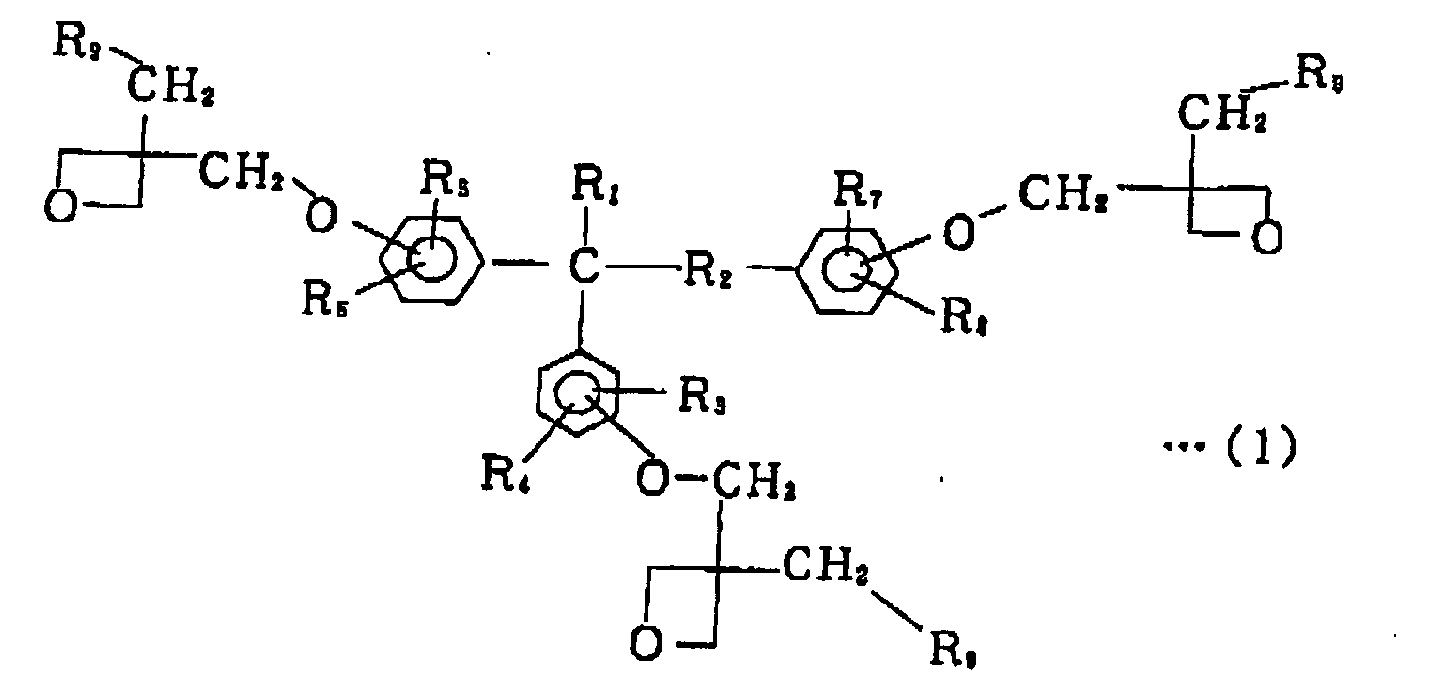
- the trisoxetane compound of the invention is a compound represented by the following formula (1): wherein R 1 and R 3 to R 8 are the same or different and each represents a hydrogen atom or an alkyl group having 1 to 6 carbon atom(s) with the proviso that at least one of R 3 to R 8 is an alkyl group having 1 to 6 carbon atom(s); R 2 represents a divalent aliphatic chained organic group having 0 to 16 carbon atom(s): and R 9 's each represents a hydrogen atom or an alkyl group having 1 to 6 carbon atom(s).
- the trisoxetane compound .of the invention has a structure having three oxetane rings in one molecule thereof.
- R 1 and R 3 to R 8 are the same or different and each represents a hydrogen atom or an alkyl group having 1 to 6 carbon atom(s), and at least one of R 3 to R 8 is an alkyl group having 1 to 6 carbon atom(s).
- R 1 may preferably be a methyl group, and at least one of R 3 to R 8 may preferably be a methyl group.
- R 9 's each represents a hydrogen atom or an alkyl group having 1 to 6 carbon atom(s), and examples of R 9 include a methyl group, an ethyl group, a propyl group, and a butyl group, in which a methyl group or a ethyl group is preferred.
- R 2 is a divalent aliphatic chained organic group having 0 to 16 carbon atom(s), and particularly, the number of carbon atom(s) may preferably be 1 to 4. In R 2 , the divalent aliphatic chained organic group having no carbon atom (the number of carbon atom is 0) means a single bond.
- a cesium salt is preferably used as the base in the invention.
- the synthesis of the materials is performed by, for example, (i) reacting the phenolic compound with the cesium salt to thereby obtain a cesium phenolate and then reacting the cesium phenolate with oxetane ester sulfonate, or (ii) reacting oxetane ester sulfonate with the phenolic compound under the presence of the cesium salt.
- the synthesis is performed in accordance with the process (i).
- the synthesis is ordinarily performed in an organic solvent (reaction solvent), and water and the like are added to the reaction liquid after the reaction to separate the reaction liquid into a water phase and an organic phase, followed by extraction of a desired trisoxetane compound from the organic phase.
- reaction solvent organic solvent
- water and the like are added to the reaction liquid after the reaction to separate the reaction liquid into a water phase and an organic phase, followed by extraction of a desired trisoxetane compound from the organic phase.
- cesium salt examples include cesium carbonate, cesium hydroxide, cesium fluoride, and cesium formate.
- cesium carbonate may preferably be used since it enables to obtain the desired trisoxetane compound at high yield.
- An amount of the cesium salt to be used may preferably be in the range of 0.8 to 2.0 mol, more preferably be in the range of 1.0 to 1.5 mol, with respect to 1 mol of the phenolic hydroxyl group of the phenolic compound represented by the formula (2).
- the phenolic compound represented by the formula (2) is not particularly limited, and examples thereof include tris(3-methyl-4-hydroxyphenyl)methane, tris(2-methyl-4-hydroxyphenyl)methane, 1,1-bis(3-methyl-4-hydroxyphenyl)-2-(hydroxyphenyl)ethane, 1,1,1-tris(3-methyl-4-hydroxyphenyl)ethane, 1-(4-hydroxyphenyl)-3,3-bis(3-methyl-4-hydroxyphenyJ.)butane, 1,3,3-tris(3-methyl-4-hydroxyphenyl)butane, 1-(4-hydroxyphenyl)-3,3-bis(3,5-dimethyl-4-hydroxyphenyl)butane, 1,3,3-tris(3,5-dimethyl-4-hydroxyphenyl) butane, 1,4,4-tris(3-methyl-4-hydroxyphenyl)pentane, and 1-(4-hydroxyphenyl)-4,4-bis(3-methyl-4-hydroxyphenyl
- ester sulfonate of 3-alkyl-3-hydroxymethyloxetane represented by the formula (3) include 2-(3-oxetanyl)propylmesylate, 2-(3-oxetanyl)propylphenyl sulfonylate, 2-(3-oxetanyl)propyltvsylate, 2-(3-oxetanyl)butylmesylate, and 2-(3-oxetanyl)butyltosylate. These may be used alone or in combination of two or more thereof.
- An amount of the ester sulfonate of 3-alkyl-3-hydroxymethyloxetane represented by the formula (3) to be used may preferably be in the range of 1.5 to 2.0 mol, more preferably be in the range of 1.0 to 1.5 mol, with respect to 1 mol of the phenolic hydroxyl group of the phenolic compound represented by the formula (2).
- a reaction temperature in the production of the trisoxetane compound of the invention may preferably be in the range of 0°C to 120°C, more preferably be in the range of 60°C to 100°C.
- a reaction temperature may preferably be set in the range of 0°C to 120°C, more preferably be in the range of 40°c to 100°C.
- a pressure during the reactions is not particularly limited and may be any one of an ordinary pressure, an increased pressure, and a reduced pressure.
- a reaction atmosphere is not particularly limited and may be a nitrogen atmosphere or an air atmosphere.
- an alkali metal such as sodium and potassium
- an alkali metal hydride such as lithium hydride and sodium hydride
- an alkali metal hydroxide such as sodium hydroxide and potassium hydroxide
- an alkali metal carbonate such as sodium carbonate; or the like
- a quaternary ammonium salt such as tetrabutylammonium bromide (TBAB) and tetraethylammonium bromide; and aralkyltrialkylammonium halide such as benzyltrimethylammonium chloride.
- TBAB tetrabutylammonium bromide
- aralkyltrialkylammonium halide such as benzyltrimethylammonium chloride.
- the quaternary phosphonium salt is not also particularly limited, and examples thereof include tetraarylphosphonium halide such as tetraphenylphosphonium bromide.
- the reaction solvent is ordinarily used as described above.
- the reaction solvent is not particularly limited, and preferred examples thereof include aromatic hydrocarbon such as toluene and xylene; ether such as tetrahydrofuran and dibutylether; and an aprotic polar solvent such as N-methylpyrrolidone, N-methyl-2-pyrrolidone, N,N-dimethylformamide and N,N-dimethylacetoamide. These may be used alone or in combination of two or more thereof.
- trisoxetane compound as a material for a photocurable resin and a heat curable resin each constituting a coating composition, a coating material, an adhesive, a lens, an optical waveguide, and the like.
- an optical waveguide including, as shown in Fig. 1, a substrate 1, a cladding layer 2 disposed on the substrate 1, and a core 3 having a predetermined patterning and disposed on the cladding layer 2 for transmitting an optical signal
- the resin composition containing the trisoxetane compound when used for forming at least one of the cladding layer 2 and the core 3, the compound is particularly advantageous for forming a thick film since the compound has a high molecular weight to achieve a high viscosity. Further, advantageous effects such as easy curing into an identical shape and stable waveguide characteristics are achieved.
- At least one of the cladding layer 2 and the core 3 is constituted of a resin composition containing the trisoxetane compound and a compound having an epoxy group or a vinylether group, since it is possible to obtain a cured material excellent in heat resistance and moisture resistance as well as to improve exposure sensitivity.
- the compound having an epoxy group it is possible to use any of those exhibiting compatibility with the compound of the invention which is represented by the formula (1).
- examples of the epoxy compound having one epoxy group include phenylglycidylether and butylglycidylether; examples of the epoxy compound having two or more epoxy groups include bisphenol A diglycidylether, bisphenoxyethanolfluorene diglycidylether, trimethylolpropane triglycidylether, and bisphenolfluorene tetraglycidylether; and 3,4-epoxycyclohexenylmethyl-3',4'-epoxycyclohexenecarboxylate, an adduct of 1,2-epoxy-4-(2-oxylanyl)cyclohexane of 2,2-bis(hydroxymethyl-1-butanol, and the like are preferably used as the compound having an alicyclic epoxy group.
- the compound having the vinylether group it is possible to use any of those exhibiting compatibility with the compound of the invention which is represented by the formula (1). More specifically, examples of the compound having one vinylether group include hydroxyethylvinylether, hydroxybutylvinylether and dodecylvinylether. As the compound having two or more vinylether groups, cyclohexanedimethanol divinylether, triethyleneglycol divinylether, novolac type divinylether, and the like are preferably used. These compounds may be used alone or in combination of two or more thereof.
- a substrate 1 is prepared as shown in Fig. 2A, and an undercladding layer 2a (lower portion of a cladding layer 2) is then disposed on the substrate 1 as shown in Fig. 2B.
- a layer 3' constituted of a resin composition for forming a core 3 is disposed on the undercladding layer 2a as shown in Fig. 2C.
- a photo mask 9 is disposed on the resin composition layer 3' for exposing a predetermined pattern (optical waveguide pattern) as shown in Fig. 2D, followed by irradiating the resin composition layer 3' with ultraviolet ray via the photomask 9 and heating.
- an unexposed part of the resin composition layer 3' is dissolved and removed with the use of a development liquid to form the core 3 as shown in Fig. 2E.
- An overcladding layer 2b (upper portion of the cladding layer 2) is then disposed on the core 3 as shown in Fig. 2F.
- the optical waveguide may be formed into a film-like optical waveguide by peeling off the substrate 1.
- the film-like optical waveguide is excellent in flexibility.
- the thus-obtained optical waveguide may be used as a linear optical waveguide, a curved optical waveguide, a crossing optical waveguide, a Y branch optical waveguide, a slab optical waveguide, a mach zender type optical waveguide, an AWG type optical waveguide, a grating, an optical waveguide lens, and the like.
- optical elements using the optical waveguides include a wavelength filter, an optical switch, an optical brancher, an optical multiplexer, an optical multiplexer/brancher, an optical amplifier, an waveguide converter, a waveguide divider, an optical splitter, a directional coupler, an optical transmission module having a laser diode and a photo diode that are hybrid-integrated, and the like.
- An optical waveguide (see Fig. 1) was produced by forming an undercladding layer, a core, and an overcladding layer as described below. Then, evaluation of the optical waveguide was conducted as described below.
- cyclohexanone 70 parts by weight (hereinafter abbreviated to parts) of 1- ⁇ 4-[2(3-oxetanyl)butoxyphenyl] ⁇ -3,3-bis ⁇ 3-methyl-4-[2-(3-oxetanyl)butoxyphenyl] ⁇ butane obtained in Example 1, 30 parts of 3,4-epoxycyclohexenylmethyl-3',4'-epoxycyclohexenecarboxylate (product of Daicel Chemical Industries, Ltd.; celoxide 2021P) which is alicyclic epoxy compound, and 1 part of a 50% propion carbide solution of 4,4-bis(di( ⁇ -hydroxyethoxy)phenylsulfinio)phenylsulfide-bis-hexafluoroantimonate were dissolved to prepare a polymerizable composition A for cladding layer formation.
- the polymerizable composition A was coated by spin coating, followed by drying at 100°C for 5 minutes.
- a whole surface was irradiated with ultraviolet ray at an irradiation amount of 2,000 mJ/cm 2 , followed by a heat treatment at 100°c for 30 minutes to form the undercladding layer (see Fig. 2B).
- a thickness of the undercladding layer measured by using a contact type film thickness meter was 30 ⁇ m.
- a refractive index of the underclad was 1.545 at a wavelength of 633. nm.
- the polymerizable composition B was coated on the undercladding layer by spin coating (see Fig. 2C).
- the coating layer was dried at 150°C for 20 minutes, and then a synthetic quartz-based chrome mask (photomask) on which a linear optical waveguide pattern of 50 ⁇ m pitch was printed was disposed on the coating layer (see Fig. 2D), followed by irradiation with ultraviolet ray at an irradiation amount of 2,000 mJ/cm 2 by a contact exposure method via the chrome mask and a heat treatment at 150°C for 30 minutes.
- a synthetic quartz-based chrome mask photomask
- a sectional shape of the core pattern was a square having a width of 50 ⁇ m and a height, of 50 ⁇ m, which was measured by using a length measurement microscope.
- a refractive index of the core was 1.570 at a wavelength of 633 nm.
- the polymerizable composition A prepared for the undercladding layer formation was coated on the core and the undercladding layer by spin coating. After drying at 100°C for 5 minutes, a whole surface was irradiated with ultraviolet ray at an irradiation amount of 2,000 mJ/cm 2 , followed by a heat treatment at 150°C for 60 minutes to form an overcladding layer (see Fig. 2F). Thus, the optical waveguide having a relative refractive index ⁇ of 1.6% was produced.
- the optical waveguide was cut by a length of 10 cm using a dicing device (Disco Corporation; model 522), followed by end face processing. Then, a sectional shape of the optical waveguide was observed by using a length measurement microscope to confirm that the optical waveguide was of an embedded multimode optical waveguide with a thickness of the undercladding layer being 30 ⁇ m, the size of the core being 50 ⁇ m ⁇ 50 ⁇ m; and a thickness of the overcladding layer being 70 ⁇ m.
- An optical propagation loss of the optical waveguide that was measured by an ordinary cut-back method using a laser beam of a wavelength of 850 nm was 0.07 dB/cm.
- the film-like waveguide was free from a loss reduction with respect to a bending with R of 20 mm and capable of bending with R of 5 mm, thereby proving its good flexibility.
- the trisoxetane compound of the invention is used as a component of a photocurable resin composition or a heat curable resin composition, and each of the resin compositions is usable as a material for forming coating compositions, coating materials, adhesives, optical lenses, optical waveguides, and the like.
- the optical waveguides include a linear optical waveguide, a curved optical waveguide, a crossing optical waveguide, a Y branch optical waveguide, a slab optical waveguide, a mach zender type optical waveguide, an AWG type optical waveguide, a grating, and an optical waveguide lens.
- optical elements using the optical waveguides include a wavelength filter, an optical switch, an optical brancher, an optical multiplexer, an optical multiplexer/brancher, an optical amplifier, an waveguide converter, a waveguide divider, an optical splitter, a directional coupler, and an optical transmission module having a laser diode and a photo diode that are hybrid-integrated.
Landscapes
- Physics & Mathematics (AREA)
- Chemical & Material Sciences (AREA)
- Organic Chemistry (AREA)
- General Physics & Mathematics (AREA)
- Optics & Photonics (AREA)
- Engineering & Computer Science (AREA)
- Microelectronics & Electronic Packaging (AREA)
- Optical Integrated Circuits (AREA)
- Epoxy Compounds (AREA)
- Polyethers (AREA)
Abstract
Description
- The present invention relates to a trisoxetane compound having an oxetane ring which is capable of cationic polymerization, a process for producing the same, and an optical waveguide including the same. The photocurable resin composition and a heat curable resin composition containing the trisoxetane compound are excellent in heat resistance, mechanical property, reduced water absorbing property, coating flatness, and adhesion.
- An oxetane compound has recently attracted attention as a monomer capable of photo-initiated cationic polymerization or curing, and various oxetane compound synthesis methods have been proposed along with developments of many monofunctional and polyfunctional oxetane compounds.
- As such oxetane compound, an oxetane compound represented by the following formula (4)

- Further, a biphenyl derivative having an oxetane ring represented by the following formula (5)


Patent Documents 2 and 3). - The above compounds are generally obtainable by using an alkali metal such as sodium hydroxide and potassium hydroxide as a base and synthesizing oxetane ester sulfonate and a divalent phenol compound corresponding to the oxetane ester sulfonate under the presence of the base. In addition, a phase transfer catalyst such as a quaternary ammonium salt is used according to the necessity in order to increase a yield of the compounds in the synthesis. Further, the oxetane compounds have heretofore been used as a material for coating compositions and adhesives for the purposes of increasing heat resistance, adhesion, and the like, and a use of the oxetane compound as a material for forming an optical waveguide has recently been proposed (see Patent Documents 4 and 5). The optical waveguide is incorporated into an optical waveguide device, an optical integrated circuit, and an optical wiring board and is used widely in the fields of optical communication, optical information processing, and like general optics.
Patent Document 1:JP-A-6-16804
Patent Document 2:JP-A-11-106380
Patent Document 3:JP-A-2001-31665
Patent Document 4:JP-A-2000-356720
Patent Document 5:JP-A-2003-147045 - However, among the oxetane compounds, biphenyl derivative is a compound having a low molecular weight and has a low viscosity that makes it difficult to form a thick film on a substrate, for example. Further, due to the bifunctionality, the biphenyl derivative undesirably requires a long time for curing. Furthermore, the oxetane compounds other than the biphenyl derivative have problems that it is difficult to form a desired thick film as well as to achieve a desired curability.
- When such conventional oxetane compounds are used as the material for forming the optical waveguide, since it is difficult to stably cure optical waveguides having an identical shape, there are problems that waveguide characteristic is fluctuated and that it is difficult to form a thick film in a convenient manner.
- Further, the conventional oxetane compound synthesis methods have a problem that introduction of an oxetanyl group does not proceed quantitatively to result in a low yield of a desired oxetane compound. In addition, since a compound having a non-reacted hydroxyl group is generated as a byproduct, complicated operation is often required for obtaining the desired oxetane compound.
- The invention has been accomplished in view of the above-described circumstances, and an object thereof is to provide a novel trisoxetane compound which enables producing a polymer excellent in thick film formation property, curability, heat resistance, and the like, a process for producing the same, and an optical waveguide including the same.
-
- Fig. 1 is a horizontal sectional view showing one example of an optical waveguide of the invention.
- Figs. 2A through 2F are diagrams for illustrating production steps of the optical waveguide of the invention.
-
- 1: substrate
- 2: cladding layer
- 3: core
- Namely, the present invention relates to the following (1) to (5).
- (1) A trisoxetane compound represented by the following formula (1):

R2 represents a divalent aliphatic chained organic group having 0 to 16 carbon atom(s); and
R9' s each represents a hydrogen atom or an alkyl group having 1 to 6 carbon atom(s). - (2) A process for producing the trisoxetane compound according to (1), which, comprises:
- reacting a phenolic compound represented by the following formula (2):

reacting the cesium phenolate with an ester sulfonate of 3-alkyl-3-hydroxymethyloxetane represented by the following formula (3):
- reacting a phenolic compound represented by the following formula (2):
- (3) The process according to (2), wherein the cesium salt is cesium carbonate.
- (4) An optical waveguide comprising:
- a substrate;
- a cladding layer disposed on the substrate; and
- a core having a predetermined pattern and disposed on the cladding layer, which transmits an optical signal,

R2 represents a divalent aliphatic chained organic group having 0 to 16 carbon atom(s); and
R9' s each represents a hydrogen atom or an alkyl group having 1 to 6 carbon atom(s). - (5) The optical waveguide according to (4), wherein at least one of the cladding layer and the core is constituted of a resin composition containing the trisoxetane compound and a compound having an epoxy group or a vinylether group.
- The inventors of the invention have sought an oxetane compound which enables producing a polymer that is excellent in heat resistance, mechanical property, and the like and effectively used as a material for coating compositions, coating materials, adhesives, lenses, optical waveguides, and the like and have conducted extensive researches. As a result of syntheses of various compounds each having a specific structure and many experiments, they have found that it is possible to attain the above-described object by using the novel trisoxetane compound represented by the above formula (1), thereby accomplishing the invention. More specifically, since the novel compound has three oxetane rings in one molecule, the novel compound has a rapid curing property, and since the cured products thereof forms a high density network structure, the cured products has excellent heat resistance and the like. Further, since the novel compound has a high molecular weight unlike the conventional compounds each having a low molecular weight, the novel compound has a high viscosity to be advantageous for forming a thick film, particularly when used as a material for forming an optical waveguide (cladding layer and core) since it is possible to cure optical waveguides having an identical shape in a stable manner, thereby achieving effects of maintaining identical waveguide characteristic and the like.
- Meanwhile, the inventors have made intensive studies also on a synthesis method that enables the novel compound to be synthesized at high yield. As a result, they have found that it is possible to synthesize the novel compound at high yield by reacting the phenolic compound represented by the formula (2) with the ester sulfonate of 3-alkyl-3-hydroxymethyloxetane represented by the formula (3) under predetermined conditions, particularly with the use of the cesium salt as a base.
- As described above, the invention relates to the novel trisoxetane compound represented by the formula (1). Since this compound has a high molecular weight unlike the conventional compounds having low molecular weights, this compound has such a high viscosity that makes it easy to form a thick film. In addition, since the compound has three oxetane rings in one molecule, the compound is able to be rapidly cured by light or heat. Therefore, a photocurable resin composition and a heat curable resin composition containing the trisoxetane compound of the invention are excellent in curability, heat resistance, toughness, and mechanical property and also have reduced water absorbing property, high coating flatness, and high adhesion. Further, since the compound is capable of reducing an amount of polymerization initiator due to its high reactivity, the composition has high transparency and is usable as a material for forming a coating composition, a coating material, an adhesive, an optical lens, an optical waveguide, and the like.
- By reacting the specific oxetane ester sulfonate with the specific phenol with the use of the cesium salt as a base, it is possible to synthesize the trisoxetane compound at high yield without complicated operation.
- Furthermore, when at least one of the cladding layer and the core in the optical waveguide is constituted of the resin composition containing the trisoxetane compound represented by the formula (1), it is possible to stably cure the optical waveguide into an identical shape and to achieve stable waveguide characteristic and the like.
- Hereinafter, embodiments of the invention will be described.
- The trisoxetane compound of the invention is a compound represented by the following formula (1):

R2 represents a divalent aliphatic chained organic group having 0 to 16 carbon atom(s): and
R9's each represents a hydrogen atom or an alkyl group having 1 to 6 carbon atom(s). - The trisoxetane compound .of the invention has a structure having three oxetane rings in one molecule thereof. In the formula (1), R1 and R3 to R8 are the same or different and each represents a hydrogen atom or an alkyl group having 1 to 6 carbon atom(s), and at least one of R3 to R8 is an alkyl group having 1 to 6 carbon atom(s). R1 may preferably be a methyl group, and at least one of R3 to R8 may preferably be a methyl group. R9's each represents a hydrogen atom or an alkyl group having 1 to 6 carbon atom(s), and examples of R9 include a methyl group, an ethyl group, a propyl group, and a butyl group, in which a methyl group or a ethyl group is preferred. R2 is a divalent aliphatic chained organic group having 0 to 16 carbon atom(s), and particularly, the number of carbon atom(s) may preferably be 1 to 4. In R2, the divalent aliphatic chained organic group having no carbon atom (the number of carbon atom is 0) means a single bond.
- It is possible to produce the trisoxetane compound represented by the formula (1) by using as synthesis materials a phenolic compound represented by the formula (2):


- Although an alkali metal such as sodium hydroxide and potassium hydroxide, which has been conventionally used, may be used as the base, a cesium salt is preferably used as the base in the invention. By using the cesium salt, it is possible to synthesize the trisoxetane compound at high yield without performing complicated operation. In this case, the synthesis of the materials is performed by, for example, (i) reacting the phenolic compound with the cesium salt to thereby obtain a cesium phenolate and then reacting the cesium phenolate with oxetane ester sulfonate, or (ii) reacting oxetane ester sulfonate with the phenolic compound under the presence of the cesium salt. Preferably, the synthesis is performed in accordance with the process (i). The synthesis is ordinarily performed in an organic solvent (reaction solvent), and water and the like are added to the reaction liquid after the reaction to separate the reaction liquid into a water phase and an organic phase, followed by extraction of a desired trisoxetane compound from the organic phase.
- Examples of the cesium salt include cesium carbonate, cesium hydroxide, cesium fluoride, and cesium formate. Among them, cesium carbonate may preferably be used since it enables to obtain the desired trisoxetane compound at high yield.
- An amount of the cesium salt to be used may preferably be in the range of 0.8 to 2.0 mol, more preferably be in the range of 1.0 to 1.5 mol, with respect to 1 mol of the phenolic hydroxyl group of the phenolic compound represented by the formula (2).
- The phenolic compound represented by the formula (2) is not particularly limited, and examples thereof include tris(3-methyl-4-hydroxyphenyl)methane, tris(2-methyl-4-hydroxyphenyl)methane, 1,1-bis(3-methyl-4-hydroxyphenyl)-2-(hydroxyphenyl)ethane, 1,1,1-tris(3-methyl-4-hydroxyphenyl)ethane, 1-(4-hydroxyphenyl)-3,3-bis(3-methyl-4-hydroxyphenyJ.)butane, 1,3,3-tris(3-methyl-4-hydroxyphenyl)butane, 1-(4-hydroxyphenyl)-3,3-bis(3,5-dimethyl-4-hydroxyphenyl)butane, 1,3,3-tris(3,5-dimethyl-4-hydroxyphenyl) butane, 1,4,4-tris(3-methyl-4-hydroxyphenyl)pentane, and 1-(4-hydroxyphenyl)-4,4-bis(3-methyl-4-hydroxyphenyl)pentane. These may be used alone or in combination of two or more thereof.
- Specific examples of the ester sulfonate of 3-alkyl-3-hydroxymethyloxetane represented by the formula (3) include 2-(3-oxetanyl)propylmesylate, 2-(3-oxetanyl)propylphenyl sulfonylate, 2-(3-oxetanyl)propyltvsylate, 2-(3-oxetanyl)butylmesylate, and 2-(3-oxetanyl)butyltosylate. These may be used alone or in combination of two or more thereof.
- In this regard, it is possible to synthesize the ester sulfonate of 3-alkyl-3-hydroxymethyloxetane represented by the formula (3), for example, in accordance with the method described in Organic Synthesis, Collective vol. 1, pp. 145 (1941), herein incorporated by reference.
- An amount of the ester sulfonate of 3-alkyl-3-hydroxymethyloxetane represented by the formula (3) to be used may preferably be in the range of 1.5 to 2.0 mol, more preferably be in the range of 1.0 to 1.5 mol, with respect to 1 mol of the phenolic hydroxyl group of the phenolic compound represented by the formula (2).
- A reaction temperature in the production of the trisoxetane compound of the invention may preferably be in the range of 0°C to 120°C, more preferably be in the range of 60°C to 100°C. In the case of reacting the phenolic compound with the cesium salt to thereby obtain the cesium phenolate, a reaction temperature may preferably be set in the range of 0°C to 120°C, more preferably be in the range of 40°c to 100°C. A pressure during the reactions is not particularly limited and may be any one of an ordinary pressure, an increased pressure, and a reduced pressure. A reaction atmosphere is not particularly limited and may be a nitrogen atmosphere or an air atmosphere.
- In the synthesis of the trisoxetane compound of the invention, an alkali metal such as sodium and potassium; an alkali metal hydride such as lithium hydride and sodium hydride; an alkali metal hydroxide such as sodium hydroxide and potassium hydroxide; an alkali metal carbonate such as sodium carbonate; or the like may be added as a synthesis material according to the necessity.
- Further, as a water-organic phase transfer catalyst, a quaternary ammonium salt, a quaternary phosphonium salt, or the like may be added according to the necessity. Examples of the quaternary ammonium salt include, but not particularly limited to, tetraalkylammonium halide such as tetrabutylammonium bromide (TBAB) and tetraethylammonium bromide; and aralkyltrialkylammonium halide such as benzyltrimethylammonium chloride. The quaternary phosphonium salt is not also particularly limited, and examples thereof include tetraarylphosphonium halide such as tetraphenylphosphonium bromide.
- Further, in the production of the trisoxetane compound of the invention, the reaction solvent is ordinarily used as described above. The reaction solvent is not particularly limited, and preferred examples thereof include aromatic hydrocarbon such as toluene and xylene; ether such as tetrahydrofuran and dibutylether; and an aprotic polar solvent such as N-methylpyrrolidone, N-methyl-2-pyrrolidone, N,N-dimethylformamide and N,N-dimethylacetoamide. These may be used alone or in combination of two or more thereof.
- As mentioned above, it is possible to collect the trisoxetane compound synthesized from the above-described materials by adding water or ethyl acetate to the reaction liquid; separating the liquid into a water phase and an organic phase; extracting the organic phase; and drying the extracted organic phase with anhydrous magnesium sulfate.
- It is possible to effectively use the thus-obtained trisoxetane compound as a material for a photocurable resin and a heat curable resin each constituting a coating composition, a coating material, an adhesive, a lens, an optical waveguide, and the like.
- Among all, with regard to an optical waveguide including, as shown in Fig. 1, a
substrate 1, acladding layer 2 disposed on thesubstrate 1, and acore 3 having a predetermined patterning and disposed on thecladding layer 2 for transmitting an optical signal, when the resin composition containing the trisoxetane compound is used for forming at least one of thecladding layer 2 and thecore 3, the compound is particularly advantageous for forming a thick film since the compound has a high molecular weight to achieve a high viscosity. Further, advantageous effects such as easy curing into an identical shape and stable waveguide characteristics are achieved. In this regard, it is necessary to regulate a refractive index of thecladding layer 2 to be smaller than that of thecore 3. - It is preferable that at least one of the
cladding layer 2 and thecore 3 is constituted of a resin composition containing the trisoxetane compound and a compound having an epoxy group or a vinylether group, since it is possible to obtain a cured material excellent in heat resistance and moisture resistance as well as to improve exposure sensitivity. As the compound having an epoxy group, it is possible to use any of those exhibiting compatibility with the compound of the invention which is represented by the formula (1). More specifically, examples of the epoxy compound having one epoxy group include phenylglycidylether and butylglycidylether; examples of the epoxy compound having two or more epoxy groups include bisphenol A diglycidylether, bisphenoxyethanolfluorene diglycidylether, trimethylolpropane triglycidylether, and bisphenolfluorene tetraglycidylether; and 3,4-epoxycyclohexenylmethyl-3',4'-epoxycyclohexenecarboxylate, an adduct of 1,2-epoxy-4-(2-oxylanyl)cyclohexane of 2,2-bis(hydroxymethyl-1-butanol, and the like are preferably used as the compound having an alicyclic epoxy group. As the compound having the vinylether group, it is possible to use any of those exhibiting compatibility with the compound of the invention which is represented by the formula (1). More specifically, examples of the compound having one vinylether group include hydroxyethylvinylether, hydroxybutylvinylether and dodecylvinylether. As the compound having two or more vinylether groups, cyclohexanedimethanol divinylether, triethyleneglycol divinylether, novolac type divinylether, and the like are preferably used. These compounds may be used alone or in combination of two or more thereof. - It is possible to produce the optical waveguide by the steps shown in Figs. 2A through 2F, for example. That is, a
substrate 1 is prepared as shown in Fig. 2A, and anundercladding layer 2a (lower portion of a cladding layer 2) is then disposed on thesubstrate 1 as shown in Fig. 2B. A layer 3' constituted of a resin composition for forming acore 3 is disposed on theundercladding layer 2a as shown in Fig. 2C. Aphoto mask 9 is disposed on the resin composition layer 3' for exposing a predetermined pattern (optical waveguide pattern) as shown in Fig. 2D, followed by irradiating the resin composition layer 3' with ultraviolet ray via thephotomask 9 and heating. After that, an unexposed part of the resin composition layer 3' is dissolved and removed with the use of a development liquid to form thecore 3 as shown in Fig. 2E. Anovercladding layer 2b (upper portion of the cladding layer 2) is then disposed on thecore 3 as shown in Fig. 2F. Thus, it is possible to obtain a desired optical waveguide. - It is possible to form each of the layers on the
substrate 1 by a conventional method such as spin coating and coater. The optical waveguide may be formed into a film-like optical waveguide by peeling off thesubstrate 1. The film-like optical waveguide is excellent in flexibility. - The thus-obtained optical waveguide may be used as a linear optical waveguide, a curved optical waveguide, a crossing optical waveguide, a Y branch optical waveguide, a slab optical waveguide, a mach zender type optical waveguide, an AWG type optical waveguide, a grating, an optical waveguide lens, and the like. Examples of optical elements using the optical waveguides include a wavelength filter, an optical switch, an optical brancher, an optical multiplexer, an optical multiplexer/brancher, an optical amplifier, an waveguide converter, a waveguide divider, an optical splitter, a directional coupler, an optical transmission module having a laser diode and a photo diode that are hybrid-integrated, and the like.
- The invention will be explained below in more detail by reference to Examples, but the invention should not be construed as being limited by the following Examples.
- In advance of the examples, 2-(3-oxetanyl)butyltosylate which is ester sulfonate of 3-alkyl-3-hydroxymethyloxetane was synthesized as described below.
- Into a 2000 ml three-neck flask having a thermometer, a cooler, a stirring device, and a dripping funnel, 190.65 g (1.0 mol) of p-toluene sulfonate chloride, 32.24 g (0.1 mol) of tetramethylammonium bromide, and 400 ml of toluene were poured and cooled to 5°C with stirring in an ice bath. After pouring 116.16 g (1.0 mmol) of 3-ethyl-hydroxymethyloxetane into the three-neck flask, 130 ml of a 35wt% sodium hydroxide solution was dripped into the three-neck flask in 30 minutes. After the dripping, stirring was continued for 1 hour at the same temperature and then for 16 hours at a room temperature. After the reaction, 800 ml of water was poured into the flask followed by violent stirring. The mixture was left to stand to separate a water phase from an organic phase. The organic phase was washed with 400 ml of water and then dried with anhydrous magnesium sulfate over night. Then, the magnesium sulfate was removed by filtration, and the filtrate was concentrated. The thus-obtained crude product was separated and purified by silica gel column chromatography (eluting solution: hexane/ethyl acetate) to obtain a desired substance, i.e. 243.3 g (yield: 90%) of 2-(3-oxetanyl)butyltosylate as a colorless liquid.
- Into a 200 ml three-neck flask having a thermometer, a cooling tube, and a stirring device, 3.62 g (10 mmol) of 1-(4-hydroxyphenyl)-3,3-bis(3-methyl-4-hydroxyphenyl)butane and 15 ml of N-methyl-2-pyrrolidone were poured and heated to 80°C with stirring under a nitrogen atmosphere until the substances were perfectly dissolved. After the dissolution, 11.73 g (36 mmol) of cesium carbonate was added, followed by stirring under a nitrogen atmosphere at 80°C for 30 minutes. To the mixture, 8.92 g (33 mmol) of 2-(3-oxetanyl)butyltosylate synthesized in advance was added, followed by stirring under the nitrogen atmosphere at 80°C for 20 hours. After the reaction, the mixture was cooled to a room temperature (25°C), and then 100 ml of ethyl acetate and 50 ml of distilled water were added to the mixture. The mixture was left to stand to be separated into a water phase and an organic phase. The separated organic phase was extracted and then washed with water and a saturated saline, followed by drying with anhydrous magnesium sulfate over night. Then, the magnesium sulfate was removed by filtration, and the solvent was distilled off to obtain a reaction crude product.
- As a result of an analysis of the thus-obtained crude product by thin layer chromatography, one spot was confirmed. Also, 5.92 g (yield: 90%) of a white solid matter was obtained by recrystallizing-the crude product after purification by silica gel chromatography (eluting solution: n-hexane/ethyl acetate). A purity of the compound detected by liquid chromatography was 99% or more.
- It was confirmed from the following results of an analysis using 1H-NMR and 13C-NMR (products of JEOL Ltd.) that the obtained compound was 1-(4-[2-(3-oxetanyl)butoxyphenyl]}-3,3-bis{3-methyl-4-[2-(3-oxetanyl)butoxyphenyl]}butane represented by the following structural formula (7).
1H-NMR (DMSO-d6, 400 MHz): δ (ppm); 0.87 (t, J=7.6 Hz, 3H, CH3), 0.89 (t, J=7.6 Hz, 6H, CH3), 1.60 (s, 3H, CH3), 1.77 (q, J=7.6 Hz, 2H, CH2), 1.80 (q, J=7.6 Hz, 4H, CH2), 2.10(s, 6H, CH3), 2.25 (s, 4H, CH2), 4.03 (s, 6H, CH2), 4.32 (d, J=6.4 Hz, 2H, CH2), 4.37 (d, J=5.6 Hz, 4H, CH2), 4.41(d, J=5.6 Hz, 2H, CH2), 4.46 (d, J=6.0 Hz, 4H, CH2), 6.86-6.90(m, 4H, Ar), 6.98 (m, 4H, Ar), 7.04 (d, J=8.8 Hz, 2H, Ar)
13C-NMR (DMSO-d6, 100 MHz): δ (ppm); 7.98, 8.04, 16.00, 26.17, 26.37, 27.34, 29.94, 42.46, 42.62, 43.84, 44.33, 70.02, 70.15, 76.77, 76.80, 110.70, 114.43, 125.02, 125.17, 128.99, 134.74, 141.28, 154.40, 156.85 -

- An optical waveguide (see Fig. 1) was produced by forming an undercladding layer, a core, and an overcladding layer as described below. Then, evaluation of the optical waveguide was conducted as described below.
- Into cyclohexanone, 70 parts by weight (hereinafter abbreviated to parts) of 1-{4-[2(3-oxetanyl)butoxyphenyl]}-3,3-bis{3-methyl-4-[2-(3-oxetanyl)butoxyphenyl]}butane obtained in Example 1, 30 parts of 3,4-epoxycyclohexenylmethyl-3',4'-epoxycyclohexenecarboxylate (product of Daicel Chemical Industries, Ltd.; celoxide 2021P) which is alicyclic epoxy compound, and 1 part of a 50% propion carbide solution of 4,4-bis(di(β-hydroxyethoxy)phenylsulfinio)phenylsulfide-bis-hexafluoroantimonate were dissolved to prepare a polymerizable composition A for cladding layer formation. Then, on a surface of a glass substrate (5 cm x 5 cm x thickness of 2 mm), the polymerizable composition A was coated by spin coating, followed by drying at 100°C for 5 minutes. A whole surface was irradiated with ultraviolet ray at an irradiation amount of 2,000 mJ/cm2, followed by a heat treatment at 100°c for 30 minutes to form the undercladding layer (see Fig. 2B). A thickness of the undercladding layer measured by using a contact type film thickness meter was 30 µm. A refractive index of the underclad was 1.545 at a wavelength of 633. nm.
- Then, into cyclohexanone, 90 parts of 1-{4-[2-(3-oxetanyl)butoxyphenyl]}-3,3-bis{3-methyl-4-[2-(3-oxetanyl)butoxyphenyl)}butane obtained in Example 1, 10 parts of bisphenoxyethanol fluorene diglycidylether (epoxy equivalent: 320), and 1 part of a 50% propion carbide solution of 4,4-bis[di(β-hydroxyethoxy)phenylsulfiniolphenylsulfide-bis-hexafluoroantimonate were dissolved to prepare a polymerizable composition B for core formation. Then, the polymerizable composition B was coated on the undercladding layer by spin coating (see Fig. 2C). The coating layer was dried at 150°C for 20 minutes, and then a synthetic quartz-based chrome mask (photomask) on which a linear optical waveguide pattern of 50 µm pitch was printed was disposed on the coating layer (see Fig. 2D), followed by irradiation with ultraviolet ray at an irradiation amount of 2,000 mJ/cm2 by a contact exposure method via the chrome mask and a heat treatment at 150°C for 30 minutes. After that, in order to eliminate a non-irradiated part, development was performed by using a γ-butylolactone solution, followed by heating at 150°C for 30 minutes to form a core pattern (see Fig. 2E). A sectional shape of the core pattern was a square having a width of 50 µm and a height, of 50 µm, which was measured by using a length measurement microscope. A refractive index of the core was 1.570 at a wavelength of 633 nm.
- The polymerizable composition A prepared for the undercladding layer formation was coated on the core and the undercladding layer by spin coating. After drying at 100°C for 5 minutes, a whole surface was irradiated with ultraviolet ray at an irradiation amount of 2,000 mJ/cm2, followed by a heat treatment at 150°C for 60 minutes to form an overcladding layer (see Fig. 2F). Thus, the optical waveguide having a relative refractive index Δ of 1.6% was produced.
- The optical waveguide was cut by a length of 10 cm using a dicing device (Disco Corporation; model 522), followed by end face processing. Then, a sectional shape of the optical waveguide was observed by using a length measurement microscope to confirm that the optical waveguide was of an embedded multimode optical waveguide with a thickness of the undercladding layer being 30 µm, the size of the core being 50 µm × 50 µm; and a thickness of the overcladding layer being 70 µm. An optical propagation loss of the optical waveguide that was measured by an ordinary cut-back method using a laser beam of a wavelength of 850 nm was 0.07 dB/cm. Also, it was possible to use the optical waveguide that was peeled off from the substrate as a film-like waveguide. The film-like waveguide was free from a loss reduction with respect to a bending with R of 20 mm and capable of bending with R of 5 mm, thereby proving its good flexibility.
- The trisoxetane compound of the invention is used as a component of a photocurable resin composition or a heat curable resin composition, and each of the resin compositions is usable as a material for forming coating compositions, coating materials, adhesives, optical lenses, optical waveguides, and the like. Examples of the optical waveguides include a linear optical waveguide, a curved optical waveguide, a crossing optical waveguide, a Y branch optical waveguide, a slab optical waveguide, a mach zender type optical waveguide, an AWG type optical waveguide, a grating, and an optical waveguide lens. Examples of optical elements using the optical waveguides include a wavelength filter, an optical switch, an optical brancher, an optical multiplexer, an optical multiplexer/brancher, an optical amplifier, an waveguide converter, a waveguide divider, an optical splitter, a directional coupler, and an optical transmission module having a laser diode and a photo diode that are hybrid-integrated.
- While the present invention has been described in detail and with reference to specific embodiments thereof, it will be apparent to one skilled in the art that various changes and modifications can be made therein without departing from the scope thereof.
- This application is based on
Japanese patent application No. 2006-105203 filed April 6, 2006
Claims (5)
- A trisoxetane compound represented by the following formula (1):

R2 represents a divalent aliphatic chained organic group having 0 to 16 carbon atom(s); and
R9's each represents a hydrogen atom or an alkyl group having 1 to 6 carbon atom(s). - A process for producing the trisoxetane compound according to claim 1, which comprises:reacting a phenolic compound represented by the following formula (2):wherein R1 and R3 to R8 are the same or different and each represents a hydrogen atom or an alkyl group having 1 to 6 carbon atom(s) with the proviso that at least one of R3 to R8 is an alkyl group having 1 to 6 carbon atom(s), and R2 represents a divalent aliphatic chained organic group having 0 to 16 carbon atom(s), with a cesium salt to thereby obtain a cesium phenolate; and

reacting the cesium phenolate with an ester sulfonate of 3-alkyl-3-hydroxymethyloxetane represented by the following formula (3):
- The process according to claim 2, wherein the cesium salt is cesium carbonate.
- An optical waveguide comprising:a substrate;a cladding layer disposed on the substrate; anda core having a predetermined pattern and disposed on the cladding layer, which transmits an optical signal,wherein at least one of the cladding layer and the core is constituted of a resin composition containing a trisoxetane compound represented by the following formula (1):wherein R1 and R3 to R8 are the same or different and each represents a hydrogen atom or an alkyl group having 1 to 6 carbon atom(s) with the proviso that at least one of R3 to R8 is an alkyl group having 1 to 6 carbon atom(s);

R2 represents a divalent aliphatic chained organic group having 0 to 16 carbon atom(s); and
R9' s each represents a hydrogen atom or an alkyl group having 1 to 6 carbon atom(s). - The optical waveguide according to claim 4, wherein at least one of the cladding layer and the core is constituted of a resin composition containing the trisoxetane compound and a compound having an epoxy group or a vinylether group.
Applications Claiming Priority (1)
| Application Number | Priority Date | Filing Date | Title |
|---|---|---|---|
| JP2006105203A JP2007277148A (en) | 2006-04-06 | 2006-04-06 | Tris oxetane ether compound, process for producing the same, and optical waveguide using the same |
Publications (2)
| Publication Number | Publication Date |
|---|---|
| EP1842849A1 true EP1842849A1 (en) | 2007-10-10 |
| EP1842849B1 EP1842849B1 (en) | 2008-10-08 |
Family
ID=38119508
Family Applications (1)
| Application Number | Title | Priority Date | Filing Date |
|---|---|---|---|
| EP20070007235 Ceased EP1842849B1 (en) | 2006-04-06 | 2007-04-05 | Trisoxetane compound, process for producing the same, and optical waveguide using the same |
Country Status (6)
| Country | Link |
|---|---|
| US (1) | US7732562B2 (en) |
| EP (1) | EP1842849B1 (en) |
| JP (1) | JP2007277148A (en) |
| KR (1) | KR101046835B1 (en) |
| CN (1) | CN101050207B (en) |
| DE (1) | DE602007000160D1 (en) |
Cited By (2)
| Publication number | Priority date | Publication date | Assignee | Title |
|---|---|---|---|---|
| EP1992971A1 (en) * | 2007-05-17 | 2008-11-19 | Nitto Denko Corporation | Optical waveguide made of a polyfunctional oxetane compound having a dicyclopentadiene ring |
| EP2075603A1 (en) * | 2007-12-25 | 2009-07-01 | Nitto Denko Corporation | Optical waveguide for luminescent device and manufacturing method thereof |
Families Citing this family (2)
| Publication number | Priority date | Publication date | Assignee | Title |
|---|---|---|---|---|
| JP5449109B2 (en) * | 2010-11-05 | 2014-03-19 | 日東電工株式会社 | Resin composition for optical waveguide and optical waveguide using the same |
| CN111057029B (en) * | 2018-10-17 | 2021-12-10 | 北京师范大学 | Fluorine-containing cationic polymerization monomer and synthesis and application thereof |
Citations (4)
| Publication number | Priority date | Publication date | Assignee | Title |
|---|---|---|---|---|
| JP2000356720A (en) * | 1999-06-16 | 2000-12-26 | Sony Corp | Optical waveguide material, optical waveguide and method for manufacturing the same |
| JP2002322268A (en) * | 2001-04-27 | 2002-11-08 | Toagosei Co Ltd | Process for producing oxetane resin comprising polyfunctional oxetane compound and cyclic carboxylic anhydride |
| JP2003147045A (en) * | 2001-11-15 | 2003-05-21 | Nippon Kayaku Co Ltd | Resin composition for optical wave guide, and its cured product |
| JP2004352622A (en) * | 2003-05-27 | 2004-12-16 | Univ Kanagawa | Curable composition containing oxetane compound |
Family Cites Families (12)
| Publication number | Priority date | Publication date | Assignee | Title |
|---|---|---|---|---|
| US5463084A (en) | 1992-02-18 | 1995-10-31 | Rensselaer Polytechnic Institute | Photocurable silicone oxetanes |
| JP3508502B2 (en) | 1997-09-30 | 2004-03-22 | 宇部興産株式会社 | Biphenyl derivative having oxetane ring |
| JP3775465B2 (en) | 1999-07-15 | 2006-05-17 | 東亞合成株式会社 | Biphenyl derivative with oxetane ring |
| DE60103529T2 (en) * | 2000-03-29 | 2005-06-02 | Kanagawa University, Yokohama | CURING COMPOSITION THAT IS CURED BY LIGHT AND HEAT, A LIGHT-SENSITIVE DRYER MANUFACTURED FROM THIS PRODUCT, AND METHOD FOR FORMING A PATTERN THEREFOR |
| JP4576676B2 (en) * | 2000-07-04 | 2010-11-10 | 東亞合成株式会社 | Method for producing tetramethyldiphenylmethane derivative having oxetane ring and tetramethyldiphenylmethane derivative having oxetane ring |
| JP2003149476A (en) * | 2001-11-13 | 2003-05-21 | Nippon Kayaku Co Ltd | Resin composition for optical waveguide and its hardened product |
| JP4346924B2 (en) * | 2002-02-25 | 2009-10-21 | 新日鐵化学株式会社 | Oxetane derivative and process for producing the same |
| JP3905059B2 (en) * | 2003-05-27 | 2007-04-18 | 学校法人神奈川大学 | Method for producing hyperbranched polymer using oxetane compound |
| JP4089562B2 (en) * | 2003-08-29 | 2008-05-28 | 日油株式会社 | Thermosetting composition |
| JP2006151859A (en) * | 2004-11-29 | 2006-06-15 | Nitto Denko Corp | Phenol derivative having oxetane ring and process for producing the same |
| JP4610452B2 (en) * | 2005-09-09 | 2011-01-12 | 日東電工株式会社 | Tris (hydroxyphenyl) -1,3,5-tri (alkylbenzene) derivative having oxetane ring, process for producing the same, and optical waveguide using the same |
| JP4664164B2 (en) * | 2005-09-09 | 2011-04-06 | 日東電工株式会社 | Trisoxetane ether compound, process for producing the same, optical waveguide using the same, and resin composition for optical waveguide formation |
-
2006
- 2006-04-06 JP JP2006105203A patent/JP2007277148A/en active Pending
-
2007
- 2007-04-05 EP EP20070007235 patent/EP1842849B1/en not_active Ceased
- 2007-04-05 KR KR1020070033875A patent/KR101046835B1/en not_active Expired - Fee Related
- 2007-04-05 DE DE200760000160 patent/DE602007000160D1/en active Active
- 2007-04-06 CN CN2007100967096A patent/CN101050207B/en not_active Expired - Fee Related
- 2007-04-06 US US11/783,206 patent/US7732562B2/en not_active Expired - Fee Related
Patent Citations (5)
| Publication number | Priority date | Publication date | Assignee | Title |
|---|---|---|---|---|
| JP2000356720A (en) * | 1999-06-16 | 2000-12-26 | Sony Corp | Optical waveguide material, optical waveguide and method for manufacturing the same |
| US6611651B1 (en) * | 1999-06-16 | 2003-08-26 | Sony Corporation | Material for optical waveguide, and optical waveguide and method for manufacturing the same |
| JP2002322268A (en) * | 2001-04-27 | 2002-11-08 | Toagosei Co Ltd | Process for producing oxetane resin comprising polyfunctional oxetane compound and cyclic carboxylic anhydride |
| JP2003147045A (en) * | 2001-11-15 | 2003-05-21 | Nippon Kayaku Co Ltd | Resin composition for optical wave guide, and its cured product |
| JP2004352622A (en) * | 2003-05-27 | 2004-12-16 | Univ Kanagawa | Curable composition containing oxetane compound |
Non-Patent Citations (1)
| Title |
|---|
| DATABASE CA [online] CHEMICAL ABSTRACTS SERVICE, COLUMBUS, OHIO, US; NISHIKUBO, TADAOMI ET AL: "Novel synthesis of oxetane resins from multifunctional oxetane compounds and cyclic carboxylic anhydrides", XP002437803, retrieved from STN Database accession no. 2002:847844 * |
Cited By (4)
| Publication number | Priority date | Publication date | Assignee | Title |
|---|---|---|---|---|
| EP1992971A1 (en) * | 2007-05-17 | 2008-11-19 | Nitto Denko Corporation | Optical waveguide made of a polyfunctional oxetane compound having a dicyclopentadiene ring |
| US7587113B2 (en) | 2007-05-17 | 2009-09-08 | Nitto Denko Corporation | Optical waveguide |
| EP2075603A1 (en) * | 2007-12-25 | 2009-07-01 | Nitto Denko Corporation | Optical waveguide for luminescent device and manufacturing method thereof |
| US7844157B2 (en) | 2007-12-25 | 2010-11-30 | Nitto Denko Corporation | Optical waveguide for luminescent device and manufacturing method thereof |
Also Published As
| Publication number | Publication date |
|---|---|
| EP1842849B1 (en) | 2008-10-08 |
| DE602007000160D1 (en) | 2008-11-20 |
| CN101050207B (en) | 2011-04-20 |
| KR20070100162A (en) | 2007-10-10 |
| KR101046835B1 (en) | 2011-07-06 |
| CN101050207A (en) | 2007-10-10 |
| JP2007277148A (en) | 2007-10-25 |
| US20070237963A1 (en) | 2007-10-11 |
| US7732562B2 (en) | 2010-06-08 |
Similar Documents
| Publication | Publication Date | Title |
|---|---|---|
| EP1992971B1 (en) | Optical waveguide made of a polyfunctional oxetane compound having a dicyclopentadiene ring | |
| JP4664164B2 (en) | Trisoxetane ether compound, process for producing the same, optical waveguide using the same, and resin composition for optical waveguide formation | |
| US7167629B2 (en) | Optical waveguide and production method thereof | |
| EP1842849B1 (en) | Trisoxetane compound, process for producing the same, and optical waveguide using the same | |
| EP1624327B1 (en) | Process for producing optical waveguide | |
| EP1958942B1 (en) | Trisoxetane compound, process for producing the same and optical waveguide using the same | |
| US7759503B2 (en) | Trisoxetane compound, process for producing the same, and optical waveguide using the same | |
| JP2007191432A (en) | Bisoxetane ether compound having fluorene structure, process for producing the same, and optical waveguide using the same | |
| JP4610452B2 (en) | Tris (hydroxyphenyl) -1,3,5-tri (alkylbenzene) derivative having oxetane ring, process for producing the same, and optical waveguide using the same | |
| JP2007070324A (en) | Bisoxetane ether compound having fluorene structure, process for producing the same, and optical waveguide using the same | |
| CN101260094B (en) | Tris(oxetane) compound, its preparation method and optical waveguide using same | |
| JP4664165B2 (en) | Bisoxetane ether compound, process for producing the same, optical waveguide using the same, and resin composition for forming optical waveguide | |
| JP4943011B2 (en) | Tris oxetane ether compound, process for producing the same, and optical waveguide using the same | |
| JP5000195B2 (en) | Bisoxetane compound and process for producing the same, and resin composition for optical waveguide and optical waveguide using the same | |
| KR101201042B1 (en) | Trisoxetane compound, process for producing the same, and optical waveguide using the same | |
| JP2007191431A (en) | Bisoxetane ether compound having adamantane structure, process for producing the same, and optical waveguide using the same | |
| JP2007070323A (en) | Tetrakisoxetane ether compound having fluorene structure, process for producing the same, and optical waveguide using the same | |
| JP2011089128A (en) | Resin composition for optical waveguide, method for preparing the same, and optical waveguide using the same | |
| JP2007070326A (en) | Bis (hydroxyphenyl) alkane derivative having oxetane ring, process for producing the same, and optical waveguide using the same | |
| JP2011089127A (en) | Resin composition for forming light guide and method of manufacturing the same, and light guide using the same | |
| JP2007070328A (en) | Tris oxetane ether compound, process for producing the same, and optical waveguide using the same | |
| JP2007070325A (en) | Bis (hydroxyphenyl) alkylbenzene derivative having oxetane ring, process for producing the same, and optical waveguide using the same | |
| JP2007070327A (en) | Oxetane ether compound having a carboxyl group, process for producing the same, and optical waveguide using the same |
Legal Events
| Date | Code | Title | Description |
|---|---|---|---|
| PUAI | Public reference made under article 153(3) epc to a published international application that has entered the european phase |
Free format text: ORIGINAL CODE: 0009012 |
|
| AK | Designated contracting states |
Kind code of ref document: A1 Designated state(s): AT BE BG CH CY CZ DE DK EE ES FI FR GB GR HU IE IS IT LI LT LU LV MC MT NL PL PT RO SE SI SK TR |
|
| AX | Request for extension of the european patent |
Extension state: AL BA HR MK YU |
|
| 17P | Request for examination filed |
Effective date: 20071119 |
|
| GRAP | Despatch of communication of intention to grant a patent |
Free format text: ORIGINAL CODE: EPIDOSNIGR1 |
|
| GRAS | Grant fee paid |
Free format text: ORIGINAL CODE: EPIDOSNIGR3 |
|
| AKX | Designation fees paid |
Designated state(s): DE GB |
|
| GRAA | (expected) grant |
Free format text: ORIGINAL CODE: 0009210 |
|
| AK | Designated contracting states |
Kind code of ref document: B1 Designated state(s): DE GB |
|
| REG | Reference to a national code |
Ref country code: GB Ref legal event code: FG4D |
|
| REF | Corresponds to: |
Ref document number: 602007000160 Country of ref document: DE Date of ref document: 20081120 Kind code of ref document: P |
|
| PLBE | No opposition filed within time limit |
Free format text: ORIGINAL CODE: 0009261 |
|
| STAA | Information on the status of an ep patent application or granted ep patent |
Free format text: STATUS: NO OPPOSITION FILED WITHIN TIME LIMIT |
|
| 26N | No opposition filed |
Effective date: 20090709 |
|
| PGFP | Annual fee paid to national office [announced via postgrant information from national office to epo] |
Ref country code: GB Payment date: 20150401 Year of fee payment: 9 |
|
| GBPC | Gb: european patent ceased through non-payment of renewal fee |
Effective date: 20160405 |
|
| PG25 | Lapsed in a contracting state [announced via postgrant information from national office to epo] |
Ref country code: GB Free format text: LAPSE BECAUSE OF NON-PAYMENT OF DUE FEES Effective date: 20160405 |
|
| PGFP | Annual fee paid to national office [announced via postgrant information from national office to epo] |
Ref country code: DE Payment date: 20170329 Year of fee payment: 11 |
|
| REG | Reference to a national code |
Ref country code: DE Ref legal event code: R119 Ref document number: 602007000160 Country of ref document: DE |
|
| PG25 | Lapsed in a contracting state [announced via postgrant information from national office to epo] |
Ref country code: DE Free format text: LAPSE BECAUSE OF NON-PAYMENT OF DUE FEES Effective date: 20181101 |