EP1839526A1 - Dispositif de support de cheveux et procédé de traitement de cheveux - Google Patents
Dispositif de support de cheveux et procédé de traitement de cheveux Download PDFInfo
- Publication number
- EP1839526A1 EP1839526A1 EP07104891A EP07104891A EP1839526A1 EP 1839526 A1 EP1839526 A1 EP 1839526A1 EP 07104891 A EP07104891 A EP 07104891A EP 07104891 A EP07104891 A EP 07104891A EP 1839526 A1 EP1839526 A1 EP 1839526A1
- Authority
- EP
- European Patent Office
- Prior art keywords
- hair
- trays
- plate
- tray
- distribution
- Prior art date
- Legal status (The legal status is an assumption and is not a legal conclusion. Google has not performed a legal analysis and makes no representation as to the accuracy of the status listed.)
- Granted
Links
Images




Classifications
-
- A—HUMAN NECESSITIES
- A45—HAND OR TRAVELLING ARTICLES
- A45D—HAIRDRESSING OR SHAVING EQUIPMENT; EQUIPMENT FOR COSMETICS OR COSMETIC TREATMENTS, e.g. FOR MANICURING OR PEDICURING
- A45D44/00—Other cosmetic or toiletry articles, e.g. for hairdressers' rooms
- A45D44/14—Stands for performing hairdressing work; Postiche heads
Definitions
- the present invention relates to the field of hair support for the purpose of testing, evaluation or learning.
- the present invention relates to a manikin for fixing hair and to allow an operator to train in the hairstyle or to evaluate treatment products on said hair.
- the document WO 03/063112 describes a wig that is just fixed on a wig head for learning the hairstyle.
- the hair in a wig of this kind is usually divided into groups and not individually, hence a different behavior of a real hair.
- the wig does not make it possible to test a treatment product on hair of different types and this simultaneously and under identical conditions of application.
- the present invention aims to overcome the disadvantages described above.
- the present invention aims to reproduce more faithfully the implantation of natural hair to provide a tool for training in hairdressing and a tool to test and evaluate the performance of hair treatment products, including shampoos, after -shampoos, coloring products, perms, straightening, fading, styling, etc.
- the invention also aims to provide a demonstration tool to show and / or compare the effectiveness of products for hair.
- the hair support device includes a plurality of coaxial stacked trays, a hair holding member, and a hair distribution member.
- the stacked trays can be assembled in a simple manner and the hair is properly held and distributed around the support.
- the hair may be arranged in the holding element and in the distribution element so as to have a portion extending along the periphery of at least one plate.
- the holding element and the distribution element may be separate.
- each tray includes an outer edge provided with sealing means.
- At least two trays are identical, hence a simple construction.
- the hair can extend along the periphery of at least two adjacent trays.
- the hair carried by a first tray may be partly covered by a second adjacent tray.
- At least one tray is circular. This form makes it possible to properly simulate a head. However, one can consider a slightly oval plateau.
- At least a portion of the trays has an identical circumference. The result is a simple construction and easy assembly.
- At least a portion of the trays has a decreasing circumference upwardly.
- the device comprises a central foot passing through a hole in the trays.
- the central foot can ensure the coaxiality of the trays and their maintenance together.
- the sealing means comprise an elastic seal housed in a groove of a plate.
- the sealing means may comprise two elastic seals housed in an upper groove and in a lower groove of a plate. This reduces the risk of penetration of a treatment product or water inside the device. Cleaning the device after use is facilitated. It is possible to ensure a tight junction between two plates.
- the hair holding member includes an opening in said tray for receive a hair retaining clip.
- the opening may be formed in a radial portion of the plate.
- the clip can come snap or snap between the edges of said opening.
- the opening may have a generally rectangular or trapezoidal shape for clamping clips.
- the hair distribution member comprises a row of teeth radially disposed between the hair holding member and the outer edge.
- a tray is associated with at least one hair distribution element, preferably with a plurality of distribution elements circumferentially evenly distributed around the tray.
- the row of teeth of a hair distribution element can form a kind of comb with teeth directed upwards and supported by the plate, the teeth and the plate can be made in one piece, for example molded.
- the number of teeth can be provided according to the number of hair of a lock of hair retained by a clip cooperating with the holding member. For locks comprising ten hairs, an eleven-tooth distribution element can be provided, leaving ten spaces.
- there can be provided a distribution element provided with nine teeth the end hair of a wick can be disposed beyond the corresponding end tooth of the distribution element.
- the distribution element can be continuous.
- the in vitro hair treatment method comprises arranging the hair in a holder, the hair being housed between two coaxial superimposed trays, a holding member of said hair and a distribution member of said hair.
- the sealing means reduce the risk of penetration of water or treatment product into the trays.
- the hair holding member reduces the risk of hair loss during handling of the hair-carrying medium.
- the distribution element allows a relatively homogeneous distribution of hair, preferably individually, thus reproducing faithfully the natural distribution of hair on a human head. It is therefore particularly advantageous to have a hair distribution one by one.
- the distribution element allows to divide a lock of hair in order to get closer to the natural implantation of the hair.
- the trays may be in contact with sealing means.
- a lock of hair is fixed in the holding member and the hair of the lock is distributed in a distribution element.
- the invention it is easier to apply the same product on different types of hair, different bits can be installed on the device. It is also easier to test two different products on similar hair. It is thus possible to quantify the performance of the products in terms of color volume, ease in shape, detachment of roots, definition of the loop pattern, brightness and degree of crimp.
- the invention makes it possible to control the implantation of hair, the amount of hair that can be modulated as well as the thermal regulation.
- the hair holding member includes a plurality of openings in the tray, each opening being capable of receiving a retaining clip of a lock of hair, such that locks of different types are provided. of hair are installed in the device.
- the device comprises a heating element.
- the heating element may comprise an electrical resistance, for example disposed in the groove, in a seal, or a conduit for bringing a heat transfer fluid, or a thin electrical circuit bonded to at least one tray and controlled by a heating control circuit.
- the device can have the proportions and the rendering of a hair with a surface important to perform multiple product comparisons simultaneously. Once the locks of hair installed, the proportions of the hair are in line with those of a real hair, the maniability of the hair is excellent and the visual rendering very close to that of a hair. Different types of treatments can be performed, such as a shampoo, a transition to iron with modes of application and a gesture almost identical to those used on real hair.
- the treatments can be carried out simultaneously on several strands, as well as on all the hair.
- the parameters related to the shape can be quantified directly on the support and in a standardized manner, in order to optimize the effects produced compared to the effects on real hair, in particular for hair hygiene or shaping and holding products. , such as hair combs and gels.
- the invention makes it possible to implant in the support quantities and qualities of hair determined with an orderly and relatively regular implantation, and while being able to remove the hair after a test or manipulation and reuse the support.
- the support thus has the advantage of having a shape and a dimension close to those of a head, to be able to receive the implantation of a quantity of hair going from a single lock to that corresponding to two whole heads, of achieve a relatively easy and modular implementation while retaining the ability to remove or install wicks during testing to perform in parallel other types of instrumental measurements, such as for example degradation to light or shampoos , slip, detangling, to achieve the application of products, such as shampoos, conditioners, realistic care products compared to an application on a real head, to be able to apply a temperature-controlled cosmetic treatment, which presents a notable interest for coloring, perms, the application of a relaxer, to be able to shape the hair directly on the support, in particular by placing in folds, smoothing or blow-dry, and to be able to evaluate the whole of
- the support device 1 is intended to receive hair and comprises a plurality of identical trays 2, here the number of 11, a lower plate 3 and upper trays 4, 5 and 6.
- the trays 2 at 6 are superimposed, the trays 2 and 3 forming a lower part while the trays 4 to 6 form an upper part.
- the lower part has a cylindrical outer shape, for example of regular diameter, while the upper part can form a cap, the plates 4 to 6 having a rounded outer surface, for example hemispherical, of diameter being reduced in going upwards.
- the device 1 also comprises a central foot 7, for example of cylindrical shape, with the exception of an annular bulge 8 disposed near its lower end and serving as a stop for supporting the lower plate 3.
- a notch 9 can be arranged near the upper end of the central foot 7 and be provided to receive a pin or an equivalent element preventing disassembly of the device, for example by removing the tray 6.
- Each tray 2 to 6 has a central hole 10, through which the foot 7.
- the number of trays that are mounted on the central foot 7 depends on the application or test chosen.
- the central foot 7 may be designed to position itself on other devices, in particular to be able to perform certain evaluations (gloss measurements, for example).
- the device does not have trays with a frustoconical outer surface 4 to 6 and only comprises the lower plate 3 and several plates 2.
- the trays 4 to 6 of the upper part forming the cap it is possible to add to the device illustrated on FIG. Figure 2, the trays 4 to 6 of the upper part forming the cap. It is also possible to use the device 1 illustrated in FIG. 2, in the form in which it is represented.
- each plate 2 comprises an outer edge 11 having an outer surface, preferably cylindrical.
- Annular grooves 12 and 13 are formed respectively from annular upper and lower annular surfaces of the edge 11.
- the plate 2 comprises a seal 14 disposed in the groove 12 and a seal 15 disposed in the groove 13.
- the upper seal 14 of a plate 2 is in contact with the lower seal 15 of the plate 2 disposed thereon.
- the trays 4 and 5 also have an edge provided with radially offset grooves to take into account the cap shape of the upper part of the device.
- a plate 2 shown here in an unfinished form without the seal 13 also comprises a small diameter edge 16 of similar shape to the edge 11 and also provided to accommodate two seals. sealing not shown and ensure the radial seal relative to the central foot 7.
- the plate 2 comprises a radial portion 17 in the form of a disk of generally annular shape.
- the radial portion 17 is provided with a plurality of hair holding members 18 in the form of an opening which may be substantially rectangular radially elongated.
- the holding elements 18 are circumferentially evenly distributed and are provided to receive the end of a lock of hair.
- a strand of hair may be provided at its end with an elastic link or a clip maintaining its cohesion and coming to snap or snap into the opening forming the holding member 18.
- the holding member 18 may comprise two radial beads 18a and two lower tabs 18b on the outer side to lock a lock of hair.
- the plate 2 further comprises a plurality of hair distribution elements 19 supported by the radial portion 17.
- Each distribution element 19 may be in the form of a comb comprising a determined number of teeth 20 arranged in an arc. and oriented axially upwards and having a length such that the following plate can come to rest on the current plate with contact between the upper seals 13 of the current and lower plate 15 of the next plate, the teeth 20 of the element holding 19 remaining at a distance from the radial portion 17 of the next tray.
- the plurality of distribution elements constitutes a continuous assembly.
- a marker must make it possible to separate the positioning of two contiguous bits. This marker may be a marked tooth.
- the teeth 20 define inter-tooth free spaces, in which a hair coming from a lock of hair can be distributed as illustrated in FIG. 4.
- the teeth 20 can be one-piece with the radial portion 17.
- Each tray can be one-piece, with the exception of seals 13 and 15, and manufactured by molding a material, for example polyoxymethylene. It can also be made of stainless steel. Alternatively, the seals can be replaced by a seal by interlocking and complementarity of shapes.
- each hair or each group of hair 21 coming from a wick can pass into a space between two teeth 20, and each space between two teeth. 20 can be occupied by a hair or a group of hair 21, and preferably only one.
- the length of hair used and the number of hair per wick may be variable. This gives an extremely regular distribution of hair from a lock and hair around the plate 2, especially around.
- the tray 2 can be arranged on the foot 7, then provided with the desired number of hair for the intended use, then covered by the next tray, which can be a tray 2 or a tray 4.
- the next tray which can be a tray 2 or a tray 4.
- the tray 6 can be covered by a cover 6 to complete the cap shape and not by a tray.
- the device 1 further comprises two rods 22 and 23 through the radial portion 17 of the plates 2 and 3 and whose end is provided with a nut 24, 25 to allow a clamping the trays.
- the rods 22 and 23 are provided for example in diametrically opposed positions.
- frustoconical trays 4 to 6 are not provided. Thus, it is possible to clamp the hair between the corresponding seals of two adjacent trays in order to prevent them from sliding between said seals.
- a heating element for example a resistor 26 shown in FIG. 1, in the form of a thin film containing an electrical conductor bonded to the cylindrical outer face of the flange 11. to allow a temperature control of the device, to approach the temperature of the scalp.
- the supply of the resistor 26 can be effected by means of contacts, not shown, extending on the radial portion 17, close to the groove 16 to allow contact between two consecutive trays and the power supply of the together, and in a dry zone of the device, insofar as the seals 13 and 15 prevent the entry of water or treatment products radially inward of said seals 13 and 15.
- the invention it is possible to mount from one to several hundreds of locks of hair of between 0.5 and 3 g depending on the type of evaluation or tests provided, which can be performed on a wick only or on the contrary on a quantity of hair corresponding to a real hair multiple.
- the material of the plate 2 and more particularly of the outer surface of the flange 11 is chosen to be inert to the chemical compounds contained in the coloring products, perms or straightening, not to change the nature of the treatments, including by catalysis and be adapted to the instrumental evaluation by image analysis by being relatively dull.
- the wicks can be implanted on the support without special preparation by a simple and fast assembly to perform the processing, formatting and evaluation on the same support.
- the locks of hair can then be recovered for further tests. Due to its modularity, the support device is compact, both on a laboratory bench and in a hairdressing salon, thanks to its multifunctional features and the possible evaluation of several treatments on the same support device.
Landscapes
- Hair Curling (AREA)
- Investigating Or Analysing Biological Materials (AREA)
Abstract
Description
- La présente invention concerne le domaine du support de cheveux dans un but d'essai, d'évaluation ou encore d'apprentissage.
- La présente invention concerne un mannequin permettant de fixer des cheveux et de permettre à un opérateur de s'entraîner à la coiffure ou encore d'évaluer des produits de traitement sur lesdits cheveux.
- Le document
WO 03/063112 - La présente invention a pour but de remédier aux inconvénients décrits ci-dessus.
- La présente invention a pour but de reproduire plus fidèlement l'implantation des cheveux naturels pour offrir un outil d'entraînement à la coiffure et un outil permettant de tester et d'évaluer les performances des produits de traitement capillaires, notamment des shampooings, des après-shampooings, des produits de coloration, de permanentes, de défrisage, de décoloration, de coiffage, etc.
- L'invention a également pour but de fournir un outil de démonstration permettant de montrer et/ou de comparer l'efficacité de produits destinés aux cheveux.
- Le dispositif de support de cheveux comprend une pluralité de plateaux superposés coaxiaux, un élément de maintien des cheveux et un élément de répartition des cheveux. Les plateaux superposés peuvent être assemblés de façon simple et les cheveux sont convenablement maintenus et répartis autour du support.
- Les cheveux peuvent être agencés dans l'élément de maintien et dans l'élément de répartition de manière à présenter une portion s'étendant le long du pourtour d'au moins un plateau.
- L'élément de maintient et l'élément de répartition peuvent être distincts.
- Dans un mode de réalisation, chaque plateau comprend un bord extérieur pourvu de moyens d'étanchéité.
- Avantageusement, au moins deux plateaux sont identiques, d'où une construction simple. Les cheveux peuvent s'étendre le long du pourtour d'au moins deux plateaux adjacents. Les cheveux portés par un premier plateau peuvent être en partie recouverts par un deuxième plateau adjacent.
- Dans un mode de réalisation, au moins un plateau est circulaire. Cette forme permet de simuler convenablement une tête. Toutefois, on peut envisager un plateau légèrement ovale.
- Dans un mode de réalisation, au moins une partie des plateaux présente une circonférence identique. Il en résulte une construction simple et un montage aisé.
- Dans un mode de réalisation, au moins une partie des plateaux présente une circonférence décroissante vers le haut. On peut ainsi simuler la partie supérieure d'une tête.
- Dans un mode de réalisation, le dispositif comprend un pied central passant dans un trou ménagé dans les plateaux. Le pied central peut assurer la coaxialité des plateaux et leur maintien ensemble.
- Dans un mode de réalisation, les moyens d'étanchéité comprennent un joint élastique logé dans une rainure d'un plateau. Les moyens d'étanchéité peuvent comprendre deux joints élastiques logés dans une rainure supérieure et dans une rainure inférieure d'un plateau. On réduit ainsi le risque de pénétration d'un produit de traitement ou d'eau à l'intérieur du dispositif. Le nettoyage du dispositif après usage s'en trouve facilité. On peut assurer une jonction étanche entre deux plateaux.
- Dans un mode de réalisation, l'élément de maintien des cheveux comprend une ouverture ménagée dans ledit plateau pour recevoir un clip de retenue de cheveux. L'ouverture peut être ménagée dans une partie radiale du plateau. Le clip peut venir s'emmancher ou s'encliqueter entre les bords de ladite ouverture. L'ouverture peut présenter une forme générale rectangulaire ou trapézoïdale permettant un coincement des clips.
- Dans un mode de réalisation, l'élément de répartition des cheveux comprend une rangée de dents disposées radialement entre l'élément de maintien des cheveux et le bord extérieur. Un plateau est associé à au moins un élément de répartition des cheveux, de préférence à une pluralité d'éléments de répartition circonférentiellement régulièrement répartis autour du plateau. La rangée de dents d'un élément de répartition des cheveux peut former une sorte de peigne avec des dents dirigées vers le haut et supporté par le plateau, les dents et le plateau pouvant être réalisés de façon monobloc, par exemple venus de moulage. Le nombre de dents peut être prévu en fonction du nombre de cheveux d'une mèche de cheveux retenue par un clip coopérant avec l'élément de maintien. Pour des mèches comprenant dix cheveux, un élément de répartition à onze dents peut être prévu, ménageant ainsi dix espaces. Alternativement, on peut prévoir un élément de répartition pourvu de neuf dents, les cheveux d'extrémité d'une mèche pouvant être disposés au-delà de la dent d'extrémité correspondante de l'élément de répartition. L'élément de répartition peut être continu.
- Le procédé de traitement de cheveux in vitro comprend le fait de disposer les cheveux dans un support, les cheveux étant logés entre deux plateaux superposés coaxiaux, un élément de maintien desdits cheveux et un élément de répartition desdits cheveux. Les moyens d'étanchéité réduisent le risque de pénétration d'eau ou de produit de traitement vers l'intérieur des plateaux. L'élément de maintien des cheveux réduit le risque de perte de cheveux lors des manipulations du support pourvu de cheveux. L'élément de répartition permet une répartition relativement homogène des cheveux, de préférence de façon individuelle, permettant ainsi de reproduire fidèlement la répartition naturelle des cheveux sur une tête humaine. Il est donc particulièrement avantageux d'avoir une répartition des cheveux un par un. L'élément de répartition permet de diviser une mèche de cheveux afin de se rapprocher de l'implantation naturelle des cheveux.
- Les plateaux peuvent être en contact avec des moyens d'étanchéité.
- Dans un mode de réalisation, on fixe une mèche de cheveux dans l'élément de maintien et on répartit les cheveux de la mèche dans un élément de répartition.
- Grâce à l'invention, il est plus aisé d'effectuer une application d'un même produit sur différents types de cheveux, des mèches différentes pouvant être installées sur le dispositif. Il est également plus facile d'effectuer des essais de deux produits différents sur des cheveux semblables. On peut ainsi quantifier les performances des produits en termes de volume de couleur, de facilité de mie en forme, de décollement de racines, de la définition du motif de boucle, de brillance et du degré de frisure.
- L'invention permet de maîtriser l'implantation de cheveux, la quantité de cheveux qui est modulable ainsi que la régulation thermique.
- Dans un mode de réalisation, l'élément de maintien des cheveux comprend une pluralité d'ouvertures ménagées dans le plateau, chaque ouverture étant capable de recevoir un clip de retenue d'une mèche de cheveux, de telle sorte que des mèches des différents types de cheveux soient installées dans le dispositif.
- Dans un mode particulier de réalisation, le dispositif comprend un élément de chauffage. L'élément de chauffage peut comprendre une résistance électrique, par exemple disposée dans la rainure, dans un joint d'étanchéité, ou encore une conduite permettant d'amener un fluide caloporteur, ou encore un circuit électrique mince collé sur au moins un plateau et commandé par un circuit de commande de chauffage.
- On peut ainsi effectuer des mesures standardisées et optimiser les effets obtenus par rapport aux effets réels. Le dispositif peut possèder les proportions et le rendu d'une chevelure avec une surface importante permettant d'effectuer plusieurs comparatifs de produits simultanément. Une fois les mèches de cheveux installées, les proportions de la chevelure sont conformes à celles d'une chevelure réelle, la maniabilité des cheveux est excellente et le rendu visuel très proche de celui d'une chevelure. Différents types de traitements peuvent être effectués, tels qu'un shampooing, un passage au fer avec des modes d'application et une gestuelle quasi identiques à ceux utilisés sur une chevelure réelle.
- Grâce à l'invention, on peut réaliser les traitements simultanément sur plusieurs mèches, aussi bien que sur l'ensemble des cheveux. On peut récupérer les mèches pour effectuer éventuellement d'autres tests instrumentaux. On peut quantifier directement sur le support et de manière standardisée les paramètres liés à la forme, afin d'optimiser les effets produits par rapport aux effets sur une chevelure réelle, notamment pour les produits d'hygiène capillaires ou de mise en forme et de maintien, tels que les peignes et gels de coiffure.
- L'invention permet d'implanter dans le support des quantités et des qualités de cheveux déterminées avec une implantation ordonnée et relativement régulière, et ce tout en pouvant ôter les cheveux après un test ou une manipulation et réutiliser le support. Le support présente donc l'avantage d'avoir une forme et une dimension proches de celles d'une tête, de pouvoir recevoir l'implantation d'une quantité de cheveux allant d'une seule mèche à celle correspondant à deux têtes entières, de réaliser une implantation relativement aisée et modulaire tout en conservant la possibilité de retirer ou d'installer des mèches en cours d'essais afin de réaliser en parallèle d'autres types de mesures instrumentales, tels que par exemple la dégradation à la lumière ou aux shampooings, le glissement, le démêlage, de réaliser l'application de produits, tels que shampooings, après-shampooings, produits de soins réalistes par rapport à une application sur une tête réelle, de pouvoir appliquer un traitement cosmétique à température régulée, ce qui présente un intérêt notable pour la coloration, les permanentes, l'application d'un défrisant, de pouvoir mettre en forme les cheveux directement sur le support, notamment par mise en plis, lissage ou brushing, et de pouvoir évaluer l'ensemble des propriétés cosmétiques réalisées sur les têtes réelles, tant sur cheveux secs que sur cheveux humides.
- La présente invention sera mieux comprise à la lecture de la description détaillée de quelques modes de réalisation pris à titre d'exemples nullement limitatifs et illustrés par les dessins annexés, sur lesquels :
- la figure 1 est une vue schématique en coupe axiale d'un dispositif de support de cheveux ;
- la figure 2 est une vue en perspective d'un dispositif de support de cheveux ;
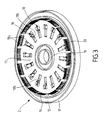
- la figure 3 est une vue de détail en perspective d'un plateau d'un dispositif de support de cheveux ;
- la figure 4 est une vue analogue à la figure 3 d'un plateau muni de cheveux ; et
- la figure 5 est une vue de dessus en élévation d'un dispositif de support de cheveux.
- Comme illustré sur la figure 1, le dispositif de support 1 est destiné à recevoir des cheveux et comprend une pluralité de plateaux 2 identiques, ici au nombre de 11, un plateau inférieur 3 et des plateaux supérieurs 4, 5 et 6. Les plateaux 2 à 6 sont superposés, les plateaux 2 et 3 formant une partie basse tandis que les plateaux 4 à 6 forment une partie haute. La partie basse présente une forme extérieure cylindrique, par exemple de diamètre régulier, tandis que la partie haute peut former une calotte, les plateaux 4 à 6 présentant une surface extérieure arrondie, par exemple hémisphérique, de diamètre se réduisant en allant vers le haut.
- Le dispositif 1 comprend également un pied central 7, par exemple de forme cylindrique, à l'exception d'un renflement annulaire 8 disposé à proximité de son extrémité inférieure et servant de butée pour supporter le plateau inférieur 3. Une encoche 9 peut être ménagée à proximité de l'extrémité supérieure du pied central 7 et être prévue pour recevoir une goupille ou un élément équivalent empêchant un démontage du dispositif, par exemple par enlèvement du plateau supérieur 6. Chaque plateau 2 à 6 présente un trou central 10, par lequel passe le pied 7. Bien entendu, le nombre de plateaux que l'on monte sur le pied central 7 dépend de l'application ou du test choisi.
- Le pied central 7 peut être conçu pour pouvoir se positionner sur d'autres appareillages, afin notamment de pouvoir réaliser certaines évaluations (mesures de brillance, par exemple).
- Dans l'exemple illustré sur la figure 1, on prévoit des plateaux d'un diamètre de l'ordre de 15 cm et disposés sur une hauteur de l'ordre de 20 cm. On peut bien entendu réduire cette hauteur.
- Dans le mode de réalisation illustré sur la figure 2, le dispositif est dépourvu de plateaux à surface extérieure tronconique 4 à 6 et comprend seulement le plateau inférieur 3 et plusieurs plateaux 2. Bien entendu, il est possible d'ajouter sur le dispositif illustré sur la figure 2, les plateaux 4 à 6 de la partie haute formant la calotte. Il est également possible d'utiliser le dispositif 1 illustré sur la figure 2, sous la forme dans laquelle il est représenté.
- Plus précisément, chaque plateau 2 comprend un bord extérieur 11 présentant une surface extérieure, de préférence cylindrique. Des rainures annulaires 12 et 13 sont ménagées respectivement à partir de surfaces supérieure et inférieure radiales annulaires du bord 11. Le plateau 2 comprend un joint d'étanchéité 14 disposé dans la rainure 12 et un joint d'étanchéité 15 disposé dans la rainure 13. Le joint supérieur 14 d'un plateau 2 est en contact avec le joint inférieur 15 du plateau 2 disposé dessus. Les plateaux 4 et 5 comportent également un bord muni de rainures décalées radialement pour tenir compte de la forme de calotte de la partie haute du dispositif.
- Comme on le voit plus précisément sur la figure 3, un plateau 2, représenté ici dans une forme non finie dépourvue du joint 13, comprend également un bord de petit diamètre 16 de forme semblable au bord 11 et prévu également pour loger deux joints d'étanchéité non représentés et assurer l'étanchéité radiale par rapport au pied central 7. Entre les rainures 12 de grand diamètre et 16 de petit diamètre, le plateau 2 comprend une partie radiale 17 sous la forme d'un disque de forme générale annulaire. La partie radiale 17 est munie d'une pluralité d'éléments de maintien 18 de cheveux, sous la forme d'une ouverture qui peut être sensiblement rectangulaire allongée radialement. Les éléments de maintien 18 sont circonférentiellement régulièrement répartis et sont prévus pour recevoir l'extrémité d'une mèche de cheveux. Une mèche de cheveux peut être munie à son extrémité d'un lien élastique ou d'un clip maintenant sa cohésion et venant s'emmancher ou s'encliqueter dans l'ouverture formant l'élément de maintien 18. L'élément de maintien 18 peut comprendre deux bourrelets radiaux 18a et deux pattes inférieures 18b du côté extérieur pour bloquer une mèche de cheveux.
- Le plateau 2 comprend en outre une pluralité d'éléments de répartition 19 de cheveux supportés par la partie radiale 17. Chaque élément de répartition 19 peut se présenter sous la forme d'un peigne comprenant un nombre déterminé de dents 20 disposées en arc de cercle et orientées axialement vers le haut et présentant une longueur telle que le plateau suivant peut venir se poser sur le plateau actuel avec contact entre les joints d'étanchéité supérieur 13 du plateau actuel et inférieur 15 du plateau suivant, les dents 20 de l'élément de maintien 19 restant à distance de la partie radiale 17 du plateau suivant. De préférence, la pluralité d'éléments de répartition constitue un ensemble continu. Dans ce cas, un repère doit permettre de séparer le positionnement de deux mèches contigües. Ce repère peut être une dent marquée. Les dents 20 définissent des espaces libres inter-dents, dans lesquels un cheveu provenant d'une mèche de cheveux peut être réparti comme illustré sur la figure 4. Les dents 20 peuvent être monoblocs avec la partie radiale 17. Chaque plateau peut être monobloc, à l'exception des joints 13 et 15, et fabriqué par moulage d'un matériau, par exemple du polyoxyméthylène. Il peut être aussi en inox. Alternativement, les joints peuvent être remplacés par une étanchéité par emboîtement et complémentarité de formes.
- On obtient ainsi un plateau 2 muni d'une pluralité de mèches de cheveux. L'extrémité d'un cheveu 21 est retenue dans l'élément de maintien 18, passe entre deux dents 20 de l'élément de répartition 19, passe entre les joints d'étanchéité 13 du plateau représenté et le joint d'étanchéité inférieur 15 d'un plateau suivant et s'étend en-dehors du dispositif pour simuler une chevelure d'être humain. Un élément de répartition 19 est disposé radialement entre chaque élément de maintien 18 et le rebord 11. Ainsi, chaque cheveu ou chaque groupe de cheveux 21 provenant d'une mèche peut passer dans un espace entre deux dents 20, et chaque espace entre deux dents 20 peut être occupé par un cheveu ou un groupe de cheveux 21, et de préférence un seul.
- La longueur des cheveux utilisée et le nombre de cheveux par mèche peuvent être variables. On obtient ainsi une répartition extrêmement régulière des cheveux provenant d'une mèche et des cheveux autour du plateau 2, notamment tout autour. Le plateau 2 peut être disposé sur le pied 7, puis muni du nombre de cheveux souhaités pour l'utilisation envisagée, puis recouvert par le plateau suivant, qui peut être un plateau 2 ou un plateau 4. Il en va de même des autres plateaux 3, 4, 5 et 6, à ceci près que le plateau 6 peut être recouvert par un couvercle 6 afin de terminer la forme de calotte et non par un plateau.
- Dans le mode de réalisation illustré sur la figure 5, le dispositif 1 comprend en outre deux tiges 22 et 23 traversant la partie radiale 17 des plateaux 2 et 3 et dont l'extrémité est munie d'un écrou 24, 25 afin de permettre un serrage des plateaux. Les tiges 22 et 23 sont prévues par exemple en des positions diamétralement opposées.
- Dans ce mode de réalisation, il n'est pas prévu de plateaux tronconiques 4 à 6. On peut donc ainsi serrer les cheveux entre les joints d'étanchéité correspondants de deux plateaux voisins afin d'éviter qu'ils ne coulissent entre lesdits joints.
- On peut ainsi effectuer le test de cheveux d'un même type en mesurant la perte de volume entre un témoin 27 sans traitement en partie droite de la figure 5 du côté de la tige 23, un témoin 28 ayant bénéficié d'un défrisant seul en partie centrale supérieure et un échantillon 29 de cheveux ayant bénéficié d'un défrisant et d'un traitement au fer chauffant en partie gauche à proximité de la tige 22.
- Bien entendu, on peut prévoir des variantes, notamment avec un seul joint d'étanchéité par plateau venant en contact avec le rebord du plateau voisin, par exemple en saillie dans la rainure inférieure 14 du plateau suivant. On peut également prévoir l'implantation d'un élément de chauffage, par exemple une résistance 26 représentée sur la figure 1, se présentant sous la forme d'un film de faible épaisseur contenant un conducteur électrique collé sur la face extérieure cylindrique du rebord 11 pour permettre un contrôle en température du dispositif, pour se rapprocher de la température du cuir chevelu. L'alimentation de la résistance 26 peut être effectuée au moyen de contacts, non représentés, s'étendant sur la partie radiale 17, jusqu'à proximité de la rainure 16 pour permettre un contact entre deux plateaux consécutifs et l'alimentation électrique de l'ensemble, et ce dans une zone sèche du dispositif, dans la mesure où les joints d'étanchéité 13 et 15 évitent l'entrée d'eau ou de produits de traitement radialement vers l'intérieur desdits joints 13 et 15.
- Grâce à l'invention, on peut monter de une à plusieurs centaines de mèches de cheveux de masse comprise entre 0,5 et 3 g selon le type d'évaluation ou de tests prévus, qui peut être effectué sur une mèche seulement ou au contraire sur une quantité de cheveux correspondant à un multiple de chevelure réelle.
- Bien entendu, le matériau du plateau 2 et plus particulièrement de la surface extérieure du rebord 11 est choisi pour être inerte aux composés chimiques contenus dans les produits de coloration, de permanentes ou encore de défrisage, de ne pas modifier la nature des traitements, notamment par catalyse et d'être adapté à l'évaluation instrumentale par analyse d'image en étant relativement mat.
- Grâce à l'invention, les mèches peuvent être implantées sur le support sans préparation particulière par un montage simple et rapide permettant de réaliser les traitements, la mise en forme et l'évaluation sur le même support. Les mèches de cheveux peuvent ensuite être récupérées pour d'autres tests. De par sa modularité, le dispositif de support est peu encombrant, tant sur une paillasse de laboratoire que dans un salon de coiffure, et ce grâce à ses multifonctionnalités et à l'évaluation possible de plusieurs traitements sur le même dispositif de support.
Claims (22)
- Dispositif de support (1) de cheveux, caractérisé par le fait qu'il comprend une pluralité de plateaux (2) superposés coaxiaux, un élément de maintien (18) desdits cheveux et un élément de répartition (19) desdits cheveux, les cheveux étant agencés dans l'élément de maintien et l'élément de répartition de manière à présenter une portion s'étendant le long du pourtour d'au moins un plateau.
- Dispositif selon la revendication 1, dans lequel chaque plateau comprend un bord extérieur pourvu de moyens d'étanchéité.
- Dispositif selon la revendication 2, dans lequel les moyens d'étanchéité comprennent un joint élastique (13) logé dans une rainure (12) d'un plateau.
- Dispositif selon les revendications 1 ou 2, dans lequel au moins deux plateaux sont identiques.
- Dispositif selon l'une quelconque des revendications précédentes, dans lequel au moins un plateau est circulaire.
- Dispositif selon l'une quelconque des revendications précédentes, dans lequel au moins une partie des plateaux (2) présente une circonférence identique.
- Dispositif selon l'une quelconque des revendications précédentes, dans lequel au moins une partie des plateaux (4, 5, 6) présente une circonférence décroissante vers le haut.
- Dispositif selon l'une quelconque des revendications précédentes, comprenant un pied central (7) passant dans un trou (10) ménagé dans lesdits plateaux.
- Dispositif selon l'une quelconque des revendications précédentes, dans lequel chaque plateau comprend des moyens de centrage et de maintien radial par rapport au plateau situé dessous.
- Dispositif selon l'une quelconque des revendications précédentes, comprenant une tige (22) de serrage passant dans un trou ménagé dans lesdits plateaux et un écrou (24) capable de venir en prise avec la tige.
- Dispositif selon l'une quelconque des revendications précédentes, dans lequel les moyens d'étanchéité comprennent deux joints élastiques (13, 15) logés dans une rainure supérieure (12) et dans une rainure inférieure (14) d'un plateau.
- Dispositif selon l'une quelconque des revendications précédentes, dans lequel l'élément de maintien (18) des cheveux comprend une ouverture ménagée dans ledit plateau pour recevoir un clip de retenue de cheveux.
- Dispositif selon la revendication 12, dans lequel l'élément de maintien (18) des cheveux comprend une pluralité d'ouvertures ménagées dans ledit plateau, chaque ouverture étant capable de recevoir un clip de retenue d'une mèche de cheveux de telle sorte que des mèches de différents types de cheveux soient installées dans le dispositif.
- Dispositif selon l'une quelconque des revendications précédentes, dans lequel l'élément de répartition (19) desdits cheveux comprend une rangée de dents (20) disposées radialement entre l'élément de maintien (18) des cheveux et le bord extérieur (11) pour une répartition régulière des cheveux à la périphérie du plateau.
- Dispositif selon la revendication 14, dans lequel l'élément de répartition est continu.
- Dispositif selon l'une quelconque des revendications précédentes, comprenant un élément de chauffage.
- Dispositif selon l'une quelconque des revendications précédentes, dans lequel les cheveux s'étendent le long du pourtour d'au moins deux plateaux adjacents.
- Dispositif selon l'une quelconque des revendications précédentes, dans lequel les cheveux portés par un premier plateau sont en partis recouverts par un second plateau adjacent.
- Dispositif selon l'une quelconque des revendications précédentes, dans lequel le dispositif comprend une jonction étanche entre les plateaux.
- Procédé de traitement de cheveux in vitro dans lequel on dispose des cheveux dans un support (1), lesdits cheveux étant logés entre deux plateaux (2) superposés coaxiaux, un élément de maintien (18) desdits cheveux et un élément de répartition (19) desdits cheveux, les cheveux étant agencés dans l'élément de maintien et l'élément de répartition de manière à présenter une portion s'étendant le long du pourtour d'au moins un plateau.
- Procédé selon la revendication 20, dans lequel les plateaux sont en contact avec des moyens d'étanchéité.
- Procédé selon la revendication 20 ou 21, dans lequel on fixe une mèche de cheveux dans l'élément de maintien, et on répartit les cheveux de la mèche dans un élément de répartition.
Applications Claiming Priority (1)
| Application Number | Priority Date | Filing Date | Title |
|---|---|---|---|
| FR0602781A FR2899077B1 (fr) | 2006-03-30 | 2006-03-30 | Dispositif de support de cheveux et procede de traitement de cheveux. |
Publications (2)
| Publication Number | Publication Date |
|---|---|
| EP1839526A1 true EP1839526A1 (fr) | 2007-10-03 |
| EP1839526B1 EP1839526B1 (fr) | 2009-07-22 |
Family
ID=37264145
Family Applications (1)
| Application Number | Title | Priority Date | Filing Date |
|---|---|---|---|
| EP20070104891 Not-in-force EP1839526B1 (fr) | 2006-03-30 | 2007-03-26 | Dispositif de support de cheveux et procédé de traitement de cheveux |
Country Status (4)
| Country | Link |
|---|---|
| EP (1) | EP1839526B1 (fr) |
| DE (1) | DE602007001612D1 (fr) |
| ES (1) | ES2327285T3 (fr) |
| FR (1) | FR2899077B1 (fr) |
Cited By (18)
| Publication number | Priority date | Publication date | Assignee | Title |
|---|---|---|---|---|
| WO2017070216A1 (fr) * | 2015-10-19 | 2017-04-27 | Palmer Kimberly Nicole | Procédé et système de séchage de rajouts de cheveux |
| US10638826B2 (en) | 2016-12-20 | 2020-05-05 | Lashify, Inc. | Applicator for artificial lash extensions |
| US20210161265A1 (en) * | 2018-10-19 | 2021-06-03 | Lashify, Inc. | Cases for storing lash extensions and methods for use and manufacture thereof |
| US11219260B2 (en) | 2016-07-28 | 2022-01-11 | Lashify, Inc. | Artificial lash extensions |
| USD952258S1 (en) | 2017-07-27 | 2022-05-17 | Lashify, Inc. | Artificial eyelash extension applicator |
| USD955635S1 (en) | 2018-10-19 | 2022-06-21 | Lashify, Inc. | False eyelash applicator |
| USD955645S1 (en) | 2016-12-05 | 2022-06-21 | Lashify, Inc. | Case for artificial lash extensions |
| US11432608B2 (en) | 2019-10-03 | 2022-09-06 | Lashify, Inc. | Stacking artificial lash extensions |
| US11497326B2 (en) * | 2018-03-22 | 2022-11-15 | The Procter & Gamble Company | Device for displaying and demonstrating a hair switch |
| USD981049S1 (en) | 2016-12-05 | 2023-03-14 | Lashify, Inc. | Case for artificial lash extensions |
| USD999995S1 (en) | 2016-12-05 | 2023-09-26 | Lashify, Inc. | Artificial eyelash extension storage cartridge |
| US11832669B2 (en) | 2019-01-14 | 2023-12-05 | Lashify, Inc. | Lash extensions and methods of manufacture and use thereof |
| US11998076B2 (en) | 2021-08-06 | 2024-06-04 | Lashify, Inc. | Applicator and method for detaching artificial hairs from an artificial lash extension and affixing the detached artificial hairs at natural lashes |
| US12178270B2 (en) | 2021-08-06 | 2024-12-31 | Lashify, Inc. | Applicator and method for detaching artificial hairs from an artificial lash extension and affixing the detached artificial hairs at natural lashes |
| USD1058043S1 (en) | 2022-07-20 | 2025-01-14 | Lashify, Inc. | Artificial lash extension separating comb |
| USD1063213S1 (en) | 2022-07-20 | 2025-02-18 | Lashify, Inc. | Combined tweezer and applicator for artificial lash extensions |
| USD1072355S1 (en) | 2024-01-08 | 2025-04-22 | Sahara Lotti | Rounded tweezer and applicator for artificial lash extensions |
| USD1093729S1 (en) | 2022-07-20 | 2025-09-16 | Lashify, Inc. | Combined curler and applicator for natural lashes and artificial lash extensions |
Citations (6)
| Publication number | Priority date | Publication date | Assignee | Title |
|---|---|---|---|---|
| DE950232C (de) * | 1953-10-15 | 1956-10-04 | Alfred Rat | Farbmustertafel zur Auswahl der Farbe beim Faerben von Haaren |
| FR1599988A (fr) * | 1968-07-16 | 1970-07-20 | ||
| GB2181049A (en) * | 1985-10-09 | 1987-04-15 | Taylor Bach Lindon Rae Angela | A display stand |
| FR2747897A1 (fr) * | 1996-04-26 | 1997-10-31 | Ind Kimu | Porte-meches pour presentoir de coiffeur |
| GB2369712A (en) * | 2000-11-30 | 2002-06-05 | Oreal | Display stand |
| US20050109367A1 (en) * | 2003-10-09 | 2005-05-26 | Smith Brenda A. | Braiding/weaving hair and beauty supply stand |
Family Cites Families (1)
| Publication number | Priority date | Publication date | Assignee | Title |
|---|---|---|---|---|
| CN2520536Y (zh) | 2002-01-23 | 2002-11-13 | 彭锦钊 | 一种理发教学用具 |
-
2006
- 2006-03-30 FR FR0602781A patent/FR2899077B1/fr not_active Expired - Fee Related
-
2007
- 2007-03-26 EP EP20070104891 patent/EP1839526B1/fr not_active Not-in-force
- 2007-03-26 DE DE200760001612 patent/DE602007001612D1/de active Active
- 2007-03-26 ES ES07104891T patent/ES2327285T3/es active Active
Patent Citations (6)
| Publication number | Priority date | Publication date | Assignee | Title |
|---|---|---|---|---|
| DE950232C (de) * | 1953-10-15 | 1956-10-04 | Alfred Rat | Farbmustertafel zur Auswahl der Farbe beim Faerben von Haaren |
| FR1599988A (fr) * | 1968-07-16 | 1970-07-20 | ||
| GB2181049A (en) * | 1985-10-09 | 1987-04-15 | Taylor Bach Lindon Rae Angela | A display stand |
| FR2747897A1 (fr) * | 1996-04-26 | 1997-10-31 | Ind Kimu | Porte-meches pour presentoir de coiffeur |
| GB2369712A (en) * | 2000-11-30 | 2002-06-05 | Oreal | Display stand |
| US20050109367A1 (en) * | 2003-10-09 | 2005-05-26 | Smith Brenda A. | Braiding/weaving hair and beauty supply stand |
Cited By (45)
| Publication number | Priority date | Publication date | Assignee | Title |
|---|---|---|---|---|
| WO2017070216A1 (fr) * | 2015-10-19 | 2017-04-27 | Palmer Kimberly Nicole | Procédé et système de séchage de rajouts de cheveux |
| US11253020B2 (en) | 2016-07-28 | 2022-02-22 | Lashify, Inc. | Artificial lash extensions |
| US12171290B2 (en) | 2016-07-28 | 2024-12-24 | Lashify, Inc. | Artificial lash extensions |
| US11330856B2 (en) | 2016-07-28 | 2022-05-17 | Lashify, Inc. | Artificial lash extensions |
| US11330855B2 (en) | 2016-07-28 | 2022-05-17 | Lashify, Inc. | Method of applying artificial lash extensions |
| US11219260B2 (en) | 2016-07-28 | 2022-01-11 | Lashify, Inc. | Artificial lash extensions |
| US11234472B2 (en) | 2016-07-28 | 2022-02-01 | Lashify, Inc. | Artificial lash extensions |
| USD999995S1 (en) | 2016-12-05 | 2023-09-26 | Lashify, Inc. | Artificial eyelash extension storage cartridge |
| USD981049S1 (en) | 2016-12-05 | 2023-03-14 | Lashify, Inc. | Case for artificial lash extensions |
| USD955645S1 (en) | 2016-12-05 | 2022-06-21 | Lashify, Inc. | Case for artificial lash extensions |
| US11832710B2 (en) | 2016-12-20 | 2023-12-05 | Lashify, Inc. | Storage case for artificial lash extensions |
| US11172749B2 (en) | 2016-12-20 | 2021-11-16 | Lashify, Inc. | Applicators and cases for artificial lash extensions |
| CN113425069A (zh) * | 2016-12-20 | 2021-09-24 | 拉什菲股份有限公司 | 施用器和制造施用器的方法 |
| US12239211B2 (en) | 2016-12-20 | 2025-03-04 | Lashify, Inc. | Applicator for artificial lash extensions |
| US10638826B2 (en) | 2016-12-20 | 2020-05-05 | Lashify, Inc. | Applicator for artificial lash extensions |
| US11278102B2 (en) | 2016-12-20 | 2022-03-22 | Lashify, Inc. | Applicator for artificial lash extensions |
| USD1049486S1 (en) | 2017-07-14 | 2024-10-29 | Lashify, Inc. | Applicator for applying lash extensions |
| USD971505S1 (en) | 2017-07-27 | 2022-11-29 | Lashify, Inc. | Artificial eyelash extension applicator |
| USD971506S1 (en) | 2017-07-27 | 2022-11-29 | Lashify, Inc. | Artifical eyelash extension applicator |
| USD1006319S1 (en) | 2017-07-27 | 2023-11-28 | Lashify, Inc. | Applicator for applying lash extensions |
| USD987891S1 (en) | 2017-07-27 | 2023-05-30 | Lashify, Inc. | Applicator for applying lash extensions |
| USD1064410S1 (en) | 2017-07-27 | 2025-02-25 | Lashify, Inc. | Artificial eyelash extension applicator |
| USD1041759S1 (en) | 2017-07-27 | 2024-09-10 | Lashify, Inc. | Artificial eyelash extension applicator |
| USD952258S1 (en) | 2017-07-27 | 2022-05-17 | Lashify, Inc. | Artificial eyelash extension applicator |
| US11497326B2 (en) * | 2018-03-22 | 2022-11-15 | The Procter & Gamble Company | Device for displaying and demonstrating a hair switch |
| US12193535B2 (en) | 2018-10-19 | 2025-01-14 | Lashify, Inc. | Applicators for applying eyelash extensions and methods for use and manufacture thereof |
| US12232552B2 (en) | 2018-10-19 | 2025-02-25 | Lashify, Inc. | Applicators for applying eyelash extensions and methods for use and manufacture thereof |
| USD1073181S1 (en) | 2018-10-19 | 2025-04-29 | Lashify, Inc. | False eyelash applicator |
| USD955635S1 (en) | 2018-10-19 | 2022-06-21 | Lashify, Inc. | False eyelash applicator |
| US11771158B2 (en) | 2018-10-19 | 2023-10-03 | Lashify, Inc. | Applicators for applying eyelash extensions and methods for use and manufacture thereof |
| KR20240152956A (ko) * | 2018-10-19 | 2024-10-22 | 래쉬파이 인코포레이티드 | 속눈썹 연장물 보관 케이스 및 그의 사용 및 제조 방법 |
| US20210161265A1 (en) * | 2018-10-19 | 2021-06-03 | Lashify, Inc. | Cases for storing lash extensions and methods for use and manufacture thereof |
| US20230218030A1 (en) * | 2018-10-19 | 2023-07-13 | Lashify, Inc. | Cases for storing lash extensions and methods for use and manufacture thereof |
| KR20250018561A (ko) * | 2018-10-19 | 2025-02-06 | 래쉬파이 인코포레이티드 | 속눈썹 연장물 보관 케이스 및 그의 사용 및 제조 방법 |
| US11647802B2 (en) * | 2018-10-19 | 2023-05-16 | Lashify, Inc. | Cases for storing lash extensions and methods for use and manufacture thereof |
| US11832669B2 (en) | 2019-01-14 | 2023-12-05 | Lashify, Inc. | Lash extensions and methods of manufacture and use thereof |
| US11432608B2 (en) | 2019-10-03 | 2022-09-06 | Lashify, Inc. | Stacking artificial lash extensions |
| US11819079B2 (en) | 2019-10-03 | 2023-11-21 | Lashify, Inc. | Stacking artificial lash extensions |
| US12178270B2 (en) | 2021-08-06 | 2024-12-31 | Lashify, Inc. | Applicator and method for detaching artificial hairs from an artificial lash extension and affixing the detached artificial hairs at natural lashes |
| US11998076B2 (en) | 2021-08-06 | 2024-06-04 | Lashify, Inc. | Applicator and method for detaching artificial hairs from an artificial lash extension and affixing the detached artificial hairs at natural lashes |
| USD1058043S1 (en) | 2022-07-20 | 2025-01-14 | Lashify, Inc. | Artificial lash extension separating comb |
| USD1063213S1 (en) | 2022-07-20 | 2025-02-18 | Lashify, Inc. | Combined tweezer and applicator for artificial lash extensions |
| USD1093729S1 (en) | 2022-07-20 | 2025-09-16 | Lashify, Inc. | Combined curler and applicator for natural lashes and artificial lash extensions |
| USD1072355S1 (en) | 2024-01-08 | 2025-04-22 | Sahara Lotti | Rounded tweezer and applicator for artificial lash extensions |
| USD1072354S1 (en) | 2024-01-08 | 2025-04-22 | Lashify, Inc. | Rounded tweezer and applicator for artificial lash extensions |
Also Published As
| Publication number | Publication date |
|---|---|
| DE602007001612D1 (de) | 2009-09-03 |
| ES2327285T3 (es) | 2009-10-27 |
| FR2899077B1 (fr) | 2008-08-22 |
| EP1839526B1 (fr) | 2009-07-22 |
| FR2899077A1 (fr) | 2007-10-05 |
Similar Documents
| Publication | Publication Date | Title |
|---|---|---|
| EP1839526B1 (fr) | Dispositif de support de cheveux et procédé de traitement de cheveux | |
| US20240041195A1 (en) | Hair brush | |
| CA2654204C (fr) | Applicateur de grande taille a surface optimalisee pour produits cosmetiques | |
| CN201814058U (zh) | 美发设备 | |
| Fu et al. | Dual origin of spinal oligodendrocyte progenitors and evidence for the cooperative role of Olig2 and Nkx2. 2 in the control of oligodendrocyte differentiation | |
| US7971593B2 (en) | Hair rollers | |
| KR101450513B1 (ko) | 모발 제품 및 헤어 드라이어와 함께 사용하기 위한 적색광 방출 장치 | |
| US20140246043A1 (en) | Cosmetic product applicator and associated production method | |
| EP2002753A2 (fr) | Dispositif et conditionnement de brossage et de peignage de précision, ainsi que procédé et outillage d'obtention | |
| US20110132390A1 (en) | Device, system, and method for applying hair color | |
| JP2015507988A (ja) | 衛生的なブラシヘッドの製造方法 | |
| FR2598822A1 (fr) | Equipement de repartition et raccordement de fibres optiques. | |
| CH648463A5 (fr) | Brosse de maquillage, procede pour sa fabrication et dispositif pour la mise en oeuvre de ce procede. | |
| JP2023022083A (ja) | 毛髪を成形および処置する光ベースシステムおよび方法 | |
| WO2013098335A3 (fr) | Procédé de modification de l'apparence de cheveux utilisant une composition contenant des colorants et des bases non-hydroxydes | |
| FR2937514A1 (fr) | Dispositif applicateur d'un produit cosmetique fluide ou pateux, typiquement du mascara | |
| JP7337066B2 (ja) | 蒸気封じ込めを備えた毛髪を処理するための装置 | |
| CN87200451U (zh) | 发刷的改进 | |
| FR2927783A1 (fr) | Dispositif de conditionnement et de distribution d'un produit cosmetique | |
| EP2865292A1 (fr) | Applicateur pour produit cosmétique et ensemble applicateur associé | |
| FR2955018A1 (fr) | Applicateur cosmetique. | |
| FR2965505A1 (fr) | Procede de formage d'un recipient muni d'une empreinte sur une zone surchauffee | |
| KR20170012434A (ko) | 케라틴 섬유의 화장 처리 | |
| FR2955017A1 (fr) | Applicateur pour appliquer un produit sur les cils et/ou les sourcils. | |
| JP2004261602A (ja) | アプリケータ並びに該アプリケータを備えた包装及び塗布装置 |
Legal Events
| Date | Code | Title | Description |
|---|---|---|---|
| PUAI | Public reference made under article 153(3) epc to a published international application that has entered the european phase |
Free format text: ORIGINAL CODE: 0009012 |
|
| 17P | Request for examination filed |
Effective date: 20070813 |
|
| AK | Designated contracting states |
Kind code of ref document: A1 Designated state(s): AT BE BG CH CY CZ DE DK EE ES FI FR GB GR HU IE IS IT LI LT LU LV MC MT NL PL PT RO SE SI SK TR |
|
| AX | Request for extension of the european patent |
Extension state: AL BA HR MK YU |
|
| 17Q | First examination report despatched |
Effective date: 20080111 |
|
| AKX | Designation fees paid |
Designated state(s): AT BE BG CH CY CZ DE DK EE ES FI FR GB GR HU IE IS IT LI LT LU LV MC MT NL PL PT RO SE SI SK TR |
|
| GRAP | Despatch of communication of intention to grant a patent |
Free format text: ORIGINAL CODE: EPIDOSNIGR1 |
|
| RIN1 | Information on inventor provided before grant (corrected) |
Inventor name: NEDELEC, BERTRAND Inventor name: PLANTIER, FRANCOIS |
|
| GRAS | Grant fee paid |
Free format text: ORIGINAL CODE: EPIDOSNIGR3 |
|
| GRAA | (expected) grant |
Free format text: ORIGINAL CODE: 0009210 |
|
| AK | Designated contracting states |
Kind code of ref document: B1 Designated state(s): AT BE BG CH CY CZ DE DK EE ES FI FR GB GR HU IE IS IT LI LT LU LV MC MT NL PL PT RO SE SI SK TR |
|
| REG | Reference to a national code |
Ref country code: GB Ref legal event code: FG4D Free format text: NOT ENGLISH |
|
| REG | Reference to a national code |
Ref country code: CH Ref legal event code: EP |
|
| REG | Reference to a national code |
Ref country code: IE Ref legal event code: FG4D |
|
| REF | Corresponds to: |
Ref document number: 602007001612 Country of ref document: DE Date of ref document: 20090903 Kind code of ref document: P |
|
| REG | Reference to a national code |
Ref country code: ES Ref legal event code: FG2A Ref document number: 2327285 Country of ref document: ES Kind code of ref document: T3 |
|
| NLV1 | Nl: lapsed or annulled due to failure to fulfill the requirements of art. 29p and 29m of the patents act | ||
| PG25 | Lapsed in a contracting state [announced via postgrant information from national office to epo] |
Ref country code: FI Free format text: LAPSE BECAUSE OF FAILURE TO SUBMIT A TRANSLATION OF THE DESCRIPTION OR TO PAY THE FEE WITHIN THE PRESCRIBED TIME-LIMIT Effective date: 20090722 Ref country code: SE Free format text: LAPSE BECAUSE OF FAILURE TO SUBMIT A TRANSLATION OF THE DESCRIPTION OR TO PAY THE FEE WITHIN THE PRESCRIBED TIME-LIMIT Effective date: 20090722 Ref country code: LT Free format text: LAPSE BECAUSE OF FAILURE TO SUBMIT A TRANSLATION OF THE DESCRIPTION OR TO PAY THE FEE WITHIN THE PRESCRIBED TIME-LIMIT Effective date: 20090722 Ref country code: IS Free format text: LAPSE BECAUSE OF FAILURE TO SUBMIT A TRANSLATION OF THE DESCRIPTION OR TO PAY THE FEE WITHIN THE PRESCRIBED TIME-LIMIT Effective date: 20091122 Ref country code: AT Free format text: LAPSE BECAUSE OF FAILURE TO SUBMIT A TRANSLATION OF THE DESCRIPTION OR TO PAY THE FEE WITHIN THE PRESCRIBED TIME-LIMIT Effective date: 20090722 |
|
| PG25 | Lapsed in a contracting state [announced via postgrant information from national office to epo] |
Ref country code: PL Free format text: LAPSE BECAUSE OF FAILURE TO SUBMIT A TRANSLATION OF THE DESCRIPTION OR TO PAY THE FEE WITHIN THE PRESCRIBED TIME-LIMIT Effective date: 20090722 Ref country code: NL Free format text: LAPSE BECAUSE OF FAILURE TO SUBMIT A TRANSLATION OF THE DESCRIPTION OR TO PAY THE FEE WITHIN THE PRESCRIBED TIME-LIMIT Effective date: 20090722 Ref country code: SI Free format text: LAPSE BECAUSE OF FAILURE TO SUBMIT A TRANSLATION OF THE DESCRIPTION OR TO PAY THE FEE WITHIN THE PRESCRIBED TIME-LIMIT Effective date: 20090722 Ref country code: LV Free format text: LAPSE BECAUSE OF FAILURE TO SUBMIT A TRANSLATION OF THE DESCRIPTION OR TO PAY THE FEE WITHIN THE PRESCRIBED TIME-LIMIT Effective date: 20090722 |
|
| REG | Reference to a national code |
Ref country code: IE Ref legal event code: FD4D |
|
| PG25 | Lapsed in a contracting state [announced via postgrant information from national office to epo] |
Ref country code: BG Free format text: LAPSE BECAUSE OF FAILURE TO SUBMIT A TRANSLATION OF THE DESCRIPTION OR TO PAY THE FEE WITHIN THE PRESCRIBED TIME-LIMIT Effective date: 20091022 Ref country code: PT Free format text: LAPSE BECAUSE OF FAILURE TO SUBMIT A TRANSLATION OF THE DESCRIPTION OR TO PAY THE FEE WITHIN THE PRESCRIBED TIME-LIMIT Effective date: 20091122 |
|
| PG25 | Lapsed in a contracting state [announced via postgrant information from national office to epo] |
Ref country code: CZ Free format text: LAPSE BECAUSE OF FAILURE TO SUBMIT A TRANSLATION OF THE DESCRIPTION OR TO PAY THE FEE WITHIN THE PRESCRIBED TIME-LIMIT Effective date: 20090722 Ref country code: DK Free format text: LAPSE BECAUSE OF FAILURE TO SUBMIT A TRANSLATION OF THE DESCRIPTION OR TO PAY THE FEE WITHIN THE PRESCRIBED TIME-LIMIT Effective date: 20090722 Ref country code: EE Free format text: LAPSE BECAUSE OF FAILURE TO SUBMIT A TRANSLATION OF THE DESCRIPTION OR TO PAY THE FEE WITHIN THE PRESCRIBED TIME-LIMIT Effective date: 20090722 Ref country code: IE Free format text: LAPSE BECAUSE OF FAILURE TO SUBMIT A TRANSLATION OF THE DESCRIPTION OR TO PAY THE FEE WITHIN THE PRESCRIBED TIME-LIMIT Effective date: 20090722 Ref country code: RO Free format text: LAPSE BECAUSE OF FAILURE TO SUBMIT A TRANSLATION OF THE DESCRIPTION OR TO PAY THE FEE WITHIN THE PRESCRIBED TIME-LIMIT Effective date: 20090722 |
|
| PLBE | No opposition filed within time limit |
Free format text: ORIGINAL CODE: 0009261 |
|
| STAA | Information on the status of an ep patent application or granted ep patent |
Free format text: STATUS: NO OPPOSITION FILED WITHIN TIME LIMIT |
|
| PG25 | Lapsed in a contracting state [announced via postgrant information from national office to epo] |
Ref country code: SK Free format text: LAPSE BECAUSE OF FAILURE TO SUBMIT A TRANSLATION OF THE DESCRIPTION OR TO PAY THE FEE WITHIN THE PRESCRIBED TIME-LIMIT Effective date: 20090722 |
|
| 26N | No opposition filed |
Effective date: 20100423 |
|
| BERE | Be: lapsed |
Owner name: L'OREAL Effective date: 20100331 |
|
| PG25 | Lapsed in a contracting state [announced via postgrant information from national office to epo] |
Ref country code: GR Free format text: LAPSE BECAUSE OF FAILURE TO SUBMIT A TRANSLATION OF THE DESCRIPTION OR TO PAY THE FEE WITHIN THE PRESCRIBED TIME-LIMIT Effective date: 20091023 Ref country code: MC Free format text: LAPSE BECAUSE OF NON-PAYMENT OF DUE FEES Effective date: 20100331 |
|
| PG25 | Lapsed in a contracting state [announced via postgrant information from national office to epo] |
Ref country code: BE Free format text: LAPSE BECAUSE OF NON-PAYMENT OF DUE FEES Effective date: 20100331 |
|
| PG25 | Lapsed in a contracting state [announced via postgrant information from national office to epo] |
Ref country code: IT Free format text: LAPSE BECAUSE OF NON-PAYMENT OF DUE FEES Effective date: 20100326 |
|
| PG25 | Lapsed in a contracting state [announced via postgrant information from national office to epo] |
Ref country code: MT Free format text: LAPSE BECAUSE OF FAILURE TO SUBMIT A TRANSLATION OF THE DESCRIPTION OR TO PAY THE FEE WITHIN THE PRESCRIBED TIME-LIMIT Effective date: 20090722 |
|
| REG | Reference to a national code |
Ref country code: CH Ref legal event code: PL |
|
| PG25 | Lapsed in a contracting state [announced via postgrant information from national office to epo] |
Ref country code: CH Free format text: LAPSE BECAUSE OF NON-PAYMENT OF DUE FEES Effective date: 20110331 Ref country code: LI Free format text: LAPSE BECAUSE OF NON-PAYMENT OF DUE FEES Effective date: 20110331 |
|
| PG25 | Lapsed in a contracting state [announced via postgrant information from national office to epo] |
Ref country code: CY Free format text: LAPSE BECAUSE OF FAILURE TO SUBMIT A TRANSLATION OF THE DESCRIPTION OR TO PAY THE FEE WITHIN THE PRESCRIBED TIME-LIMIT Effective date: 20090722 |
|
| PG25 | Lapsed in a contracting state [announced via postgrant information from national office to epo] |
Ref country code: LU Free format text: LAPSE BECAUSE OF NON-PAYMENT OF DUE FEES Effective date: 20100326 Ref country code: HU Free format text: LAPSE BECAUSE OF FAILURE TO SUBMIT A TRANSLATION OF THE DESCRIPTION OR TO PAY THE FEE WITHIN THE PRESCRIBED TIME-LIMIT Effective date: 20100123 |
|
| PG25 | Lapsed in a contracting state [announced via postgrant information from national office to epo] |
Ref country code: TR Free format text: LAPSE BECAUSE OF FAILURE TO SUBMIT A TRANSLATION OF THE DESCRIPTION OR TO PAY THE FEE WITHIN THE PRESCRIBED TIME-LIMIT Effective date: 20090722 |
|
| REG | Reference to a national code |
Ref country code: FR Ref legal event code: PLFP Year of fee payment: 10 |
|
| REG | Reference to a national code |
Ref country code: FR Ref legal event code: PLFP Year of fee payment: 11 |
|
| REG | Reference to a national code |
Ref country code: FR Ref legal event code: PLFP Year of fee payment: 12 |
|
| PGFP | Annual fee paid to national office [announced via postgrant information from national office to epo] |
Ref country code: GB Payment date: 20180321 Year of fee payment: 12 Ref country code: DE Payment date: 20180313 Year of fee payment: 12 |
|
| PGFP | Annual fee paid to national office [announced via postgrant information from national office to epo] |
Ref country code: IT Payment date: 20180321 Year of fee payment: 12 Ref country code: FR Payment date: 20180223 Year of fee payment: 12 |
|
| PGFP | Annual fee paid to national office [announced via postgrant information from national office to epo] |
Ref country code: ES Payment date: 20180402 Year of fee payment: 12 |
|
| REG | Reference to a national code |
Ref country code: DE Ref legal event code: R119 Ref document number: 602007001612 Country of ref document: DE |
|
| GBPC | Gb: european patent ceased through non-payment of renewal fee |
Effective date: 20190326 |
|
| PG25 | Lapsed in a contracting state [announced via postgrant information from national office to epo] |
Ref country code: DE Free format text: LAPSE BECAUSE OF NON-PAYMENT OF DUE FEES Effective date: 20191001 Ref country code: GB Free format text: LAPSE BECAUSE OF NON-PAYMENT OF DUE FEES Effective date: 20190326 |
|
| PG25 | Lapsed in a contracting state [announced via postgrant information from national office to epo] |
Ref country code: FR Free format text: LAPSE BECAUSE OF NON-PAYMENT OF DUE FEES Effective date: 20190331 Ref country code: IT Free format text: LAPSE BECAUSE OF NON-PAYMENT OF DUE FEES Effective date: 20190326 |
|
| REG | Reference to a national code |
Ref country code: ES Ref legal event code: FD2A Effective date: 20200728 |
|
| PG25 | Lapsed in a contracting state [announced via postgrant information from national office to epo] |
Ref country code: ES Free format text: LAPSE BECAUSE OF NON-PAYMENT OF DUE FEES Effective date: 20190327 |