EP1838135A1 - Method for simulating the sound of a vehicle and device therefore - Google Patents
Method for simulating the sound of a vehicle and device therefore Download PDFInfo
- Publication number
- EP1838135A1 EP1838135A1 EP06005711A EP06005711A EP1838135A1 EP 1838135 A1 EP1838135 A1 EP 1838135A1 EP 06005711 A EP06005711 A EP 06005711A EP 06005711 A EP06005711 A EP 06005711A EP 1838135 A1 EP1838135 A1 EP 1838135A1
- Authority
- EP
- European Patent Office
- Prior art keywords
- transducers
- sound
- audio input
- input signal
- description data
- Prior art date
- Legal status (The legal status is an assumption and is not a legal conclusion. Google has not performed a legal analysis and makes no representation as to the accuracy of the status listed.)
- Withdrawn
Links
- 238000000034 method Methods 0.000 title claims abstract description 30
- 238000012545 processing Methods 0.000 claims description 6
- 230000005855 radiation Effects 0.000 claims description 4
- 230000002194 synthesizing effect Effects 0.000 claims description 3
- 238000004088 simulation Methods 0.000 description 24
- 230000015572 biosynthetic process Effects 0.000 description 8
- 230000004807 localization Effects 0.000 description 8
- 238000003786 synthesis reaction Methods 0.000 description 8
- 238000013459 approach Methods 0.000 description 6
- 230000008447 perception Effects 0.000 description 4
- 235000009508 confectionery Nutrition 0.000 description 3
- 230000006870 function Effects 0.000 description 3
- 238000003384 imaging method Methods 0.000 description 3
- 238000012546 transfer Methods 0.000 description 3
- 238000011156 evaluation Methods 0.000 description 2
- 238000009434 installation Methods 0.000 description 2
- 238000011835 investigation Methods 0.000 description 2
- 230000000704 physical effect Effects 0.000 description 2
- 238000001303 quality assessment method Methods 0.000 description 2
- 230000005236 sound signal Effects 0.000 description 2
- 238000010276 construction Methods 0.000 description 1
- 238000000354 decomposition reaction Methods 0.000 description 1
- 238000013461 design Methods 0.000 description 1
- 238000011161 development Methods 0.000 description 1
- 238000005516 engineering process Methods 0.000 description 1
- 230000001788 irregular Effects 0.000 description 1
- 238000005259 measurement Methods 0.000 description 1
- 230000003287 optical effect Effects 0.000 description 1
- 238000000926 separation method Methods 0.000 description 1
- 238000012360 testing method Methods 0.000 description 1
- 230000000007 visual effect Effects 0.000 description 1
Images
Classifications
-
- H—ELECTRICITY
- H04—ELECTRIC COMMUNICATION TECHNIQUE
- H04S—STEREOPHONIC SYSTEMS
- H04S7/00—Indicating arrangements; Control arrangements, e.g. balance control
- H04S7/30—Control circuits for electronic adaptation of the sound field
-
- H—ELECTRICITY
- H04—ELECTRIC COMMUNICATION TECHNIQUE
- H04S—STEREOPHONIC SYSTEMS
- H04S2420/00—Techniques used stereophonic systems covered by H04S but not provided for in its groups
- H04S2420/11—Application of ambisonics in stereophonic audio systems
-
- H—ELECTRICITY
- H04—ELECTRIC COMMUNICATION TECHNIQUE
- H04S—STEREOPHONIC SYSTEMS
- H04S2420/00—Techniques used stereophonic systems covered by H04S but not provided for in its groups
- H04S2420/13—Application of wave-field synthesis in stereophonic audio systems
Definitions
- the invention relates to a method for reproducing sound of a vehicle using a plurality of transducers.
- simulation devices in vehicle engineering are used in order to predict acoustic properties of vehicles during the development phase.
- Such devices present sound of a possible or a real vehicle to a listener in order to investigate the subjective impression of certain vehicle sounds and to find an optimal sound for a certain application.
- Such simulation devices are including but not limited to NVH engineering purposes (noise, vibration, harshness) such as disclosed by Marc Allman-Ward, Roger Williams, G. Dunne and P.
- the aim of a sound representation using headphones is to provide ear input signals processed with head-related transfer functions (HRTF) to create a spatial impression of the virtual environment.
- HRTF head-related transfer functions
- the main advantage of this approach is to provide in theory a localization of sound sources in all three spatial dimensions as published by Jens Blauert in "Spatial hearing: The psychophysics of human sound localization", revised edition, The MIT press, Cambridge, MA, 1997 . Nevertheless, in practice, this technology shows clear artefacts and disadvantages as will be described below.
- the aim of the stereophonic loudspeaker reproduction is to reproduce stereophonic signals over loudspeakers in order to create a spatial impression of sound.
- Implementations of such systems for vehicle simulations are disclosed by Roland Sottek, Winfried Krebber and G (Randy) Stanley in “Tools and Methods for Product Sound Design of Vehicles", Society of Automotive Engineers, Proceedings of the SAE Noise & Vibration Conference, Traverse City, Ml, USA, May 16-19 2005 .
- a first method relies on the recreation of the curvature of the wave front of an acoustic field emitted by a sound source by using a plurality of loudspeakers. Such method has been disclosed by A .J. Berkhout in "A holographic approach to acoustic control", Journal of the Audio Eng. Soc., Vol. 36, pp 977-995, 1988 , and is known under the name of "wave field synthesis”.
- a second method relies on the decomposition of a wave field into spatially independent wave field components such as spherical harmonics or cylindrical harmonics. Such method has been disclosed by M. A.
- the physical control of the wave field is limited due to the distance of the loudspeakers, which results in spatial aliasing, and, in most implementations, due to the restriction of the loudspeaker set-up to the horizontal plane. This allows no localisation of sound sources outside of the loudspeaker plane. For these reasons, both methods do not provide a physically correct wave field but are able to create a perceptively sufficient spatial impression of virtual sound sources in a virtual room for simulation purposes. Both systems provide perceptive cues for sound localisation of human hearing without reproducing all physical properties of the desired wave field.
- Stereophonic reproduction works only for one specific listening position, the so called “sweet spot”. Outside of this listening position, the stereophonic sound image collapses and the sound seems to come from the nearest loudspeaker.
- the spatial sound imaging will only give a correct impression for one single listening position neglecting all other possible seating positions in the car.
- stereophonic systems still have strong drawbacks, since spatial sound reproduction is limited due to the relatively small number of loudspeakers.
- the listener may not freely move his head due to the small listening zone ("sweet spot") and the perception of a homogeneous diffuse field is limited since only a few loudspeakers are used and no further signal processing is applied to account for the loudspeaker position.
- the aim of the invention is to overcome these drawbacks of the state of the art. More precisely, it is the aim of the invention to use loudspeakers in order to avoid the feeling of wearing a headphone and to overcome the described problem of a sweet spot in order to create a spatial impression of sound in an enlarged listening area using possibly an irregular spatial configuration of loudspeakers. Diffuse sound field reproduction and localisation of simulated sound sources is to be improved. It is not the idea to create physically correct ear input signals as described for headphones reproduction but it is intended to create a perceptive impression that approximates the impression of a real sound field.
- the invention relies in processing audio signals representing the sound of a vehicle using a plurality of transducers by calculating a plurality of transducers driving signals from at least one said audio input signal and transducers positioning data as well as sound field description data associated to said audio input signal.
- Methods for such signal processing have been published for example under the names of "wave field synthesis” and "ambisonics" as described above but have not been transferred to such simulation approaches in sound quality assessment up to now since they do not allow in practice a physically correct sound simulation but are restricted to a perceptively correct sound simulation.
- Both exemplary methods do not provide a physically correct wave field reproduction but allow a correct perception of determining parameters for sound quality assessment in vehicle engineering. Quality of the simulation does not rely on the physical approximation of the audio signals to a real or a possible real signal but on approximating the perceptive properties of the simulation to those of a real or a possible real signal.
- the invention relates to a method for reproducing sound of a vehicle using a plurality of transducers, characterized by calculating a plurality of transducers driving signals from at least one audio input signal representing sound of a vehicle using transducers positioning data and sound field description data associated to said audio input signal.
- the method may comprise steps
- the invention comprises a device for reproducing sound of a vehicle using a plurality of transducers, characterized by, a storing unit for storing at least one audio input signal representing sound of a vehicle and by a wave field computing device connected to the storing unit calculating a plurality of transducers driving signals by using the said audio input signal and transducers positioning data as well as sound field description data associated to said audio input signal, for driving the plurality of transducers connected to the wave field computing device.
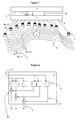
- FIG. 1 shows a possible configuration of the device according to the invention.
- a storing unit 7 stores audio input signals 2 representing the sound of a vehicle. It may also store sound field description data 8 associated to each audio input signal 2. If these sound field description data 8 are not stored in the storing unit 7 they are directly stored and processed in a wave field computing device 3.
- the wave field computing device 3 calculates a plurality of transducers driving signals 4 by using the said audio input signal 2 and transducers positioning data 15 as well as sound field description data 8 associated to said audio input signal 2.
- the transducers positioning data 15 describe the position of each transducer in space relative to a reference point 11.
- the sound field description data may comprise a description about the position of a virtual sound source 12 in space relative to a reference point 13.
- the plurality of transducers driving signals 4 drive the plurality of transducers 5 synthesizing a wave field 6. The said wave field 6 may then be perceived by a listener 1.
- Figure 2 shows a possible configuration of the wave field computing device 3.
- two audio input signals 2 are used. They are processed by set of filters 9 to form output signals 14 associated to each transducer. Then, a step of summing in summing units 10 is performed on the respective output signals 14 for each transducer to derive the plurality of transducers driving signals 4.
- Applications of the invention are including but not limited to the following domains: interior noise simulation for car, interior noise simulation for train, interior noise simulation for aircraft, flyover noise simulation for aircraft, outside noise simulation for car, etc.
- Vehicles can be any transportation device such as cars, trucks, trains, aircrafts, motorbikes, etc.
- the audio input signal 2 representing the sound of a vehicle may consist of recorded exterior or interior sounds of at least one vehicle or of synthesized exterior or interior sounds of at least one vehicle, such as road noise, wind noise, engine noise, warning noises from user interfaces, noise of small electric motors, etc. Recorded sounds may result from recordings using microphones. Synthesized sounds may result from models of a vehicle describing the construction and properties of different parts of the vehicle and their acoustic parameters such as transfer functions.
- Such audio input signal 2 does not necessarily need to approximate physically the properties of a real or a possible vehicle sound but may be a perceptive approximation to the sound of real or a possible vehicle.
- one can simulate an extended sound source by using phantom source imaging between two virtual sound sources reproduced with the said method wave field synthesis, allowing a control of sound source localisation and source extension as published by Günther Theile, Helmut Wittek and Markus Reisinger in "Wellenfeldsynthese-Verfahren: Ein Weg für Anlagen der syndromemlichen Tonpers", Proceedings of the 21st VDT International Audio Convention (Tonhofftagung), Hanover, Germany, 2002 .
- the audio input signal 2 represents perceptively the sound of a vehicle even if the physical properties of the synthesized wave field may be different from the sound field in a real vehicle.
- the sound described by one audio input signal 2 does not necessarily need to describe the whole vehicle sound. It is possible to use separated signals for different sound sources of the vehicle, especially when a model for sound synthesis is applied to generate the audio input signals 2.
- the spatial sound reproduction of this invention allows an enhanced spatial separation of different sound sources of the vehicle and separated investigations of different sources, e.g. for engine noise, road noise, wind noise, warning sounds from user interfaces, etc.
- the transducers will be loudspeakers.
- the wave field will be an acoustic field (sound field), which can be perceived by human hearing.
- the transducers positioning data can be derived from measurements of angle and distance of the loudspeakers in space relative to a given reference point.
- the sound field description data 8 associated to each audio input signal 2 provides information about how to calculate the plurality of transducers driving signals 4.
- Such information may describe the sound field according to at least one element of a group of elements comprising the methods of wave field synthesis and ambisonics.
- the sound field description data 8 associated to the audio input signal 2 may refer to the position of a virtual sound source in space in order to synthesize the wave field of this virtual source using the plurality of transducers 5.
- the sound field description data 8 may refer to at least one spatially independent wave field component such as spherical harmonics, or cylindrical harmonics. But also other information may be described by the sound field description data 8.
- the said sound field description data 8 may also describe parameters such as source width, dynamic behaviour of radiation characteristics and any other parameter influencing the sound field emitted by a source.
Landscapes
- Physics & Mathematics (AREA)
- Engineering & Computer Science (AREA)
- Acoustics & Sound (AREA)
- Signal Processing (AREA)
- Fittings On The Vehicle Exterior For Carrying Loads, And Devices For Holding Or Mounting Articles (AREA)
- Stereophonic System (AREA)
Abstract
The invention relates to a method for reproducing sound of a vehicle using a plurality of transducers (5). Therefore, a plurality of transducers driving signals (4) is calculated from at least one audio input signal (2) representing sound of a vehicle using transducers positioning data and sound field description data 8 associated to said audio input signal (2).
Description
- The invention relates to a method for reproducing sound of a vehicle using a plurality of transducers.
- In the current state of the art, simulation devices in vehicle engineering are used in order to predict acoustic properties of vehicles during the development phase. Such devices present sound of a possible or a real vehicle to a listener in order to investigate the subjective impression of certain vehicle sounds and to find an optimal sound for a certain application. Such simulation devices are including but not limited to NVH engineering purposes (noise, vibration, harshness) such as disclosed by Marc Allman-Ward, Roger Williams, G. Dunne and P. Jennings in "The evaluation of vehicle sound quality using an NVH simulator", Internoise 2004, 33rd International Congress and Exposition on Noise Control Engineering, Prag, Czech Republic, August 22-25 2004, and by Karl Janssens, Hans Coomans, Ismaël Belghit, Antonio Vecchio, Patrick Van de Ponseele and Herman Van der Auweraer in "A Virtual Sound Synthesis Approach for On-line Assessment of Interior Car and Aircraft Noise", ICSV Conference, St. Petersburg, Russia, July 2004.
- Vehicle sound simulation systems presented up to now use reproduction over headphones or stereophonic loudspeaker reproduction e.g. with a loudspeaker installation of 4 loudspeakers and a subwoofer.
- The aim of a sound representation using headphones is to provide ear input signals processed with head-related transfer functions (HRTF) to create a spatial impression of the virtual environment. The main advantage of this approach is to provide in theory a localization of sound sources in all three spatial dimensions as published by Jens Blauert in "Spatial hearing: The psychophysics of human sound localization", revised edition, The MIT press, Cambridge, MA, 1997. Nevertheless, in practice, this technology shows clear artefacts and disadvantages as will be described below.
- The aim of the stereophonic loudspeaker reproduction is to reproduce stereophonic signals over loudspeakers in order to create a spatial impression of sound. Implementations of such systems for vehicle simulations are disclosed by Roland Sottek, Winfried Krebber and G (Randy) Stanley in "Tools and Methods for Product Sound Design of Vehicles", Society of Automotive Engineers, Proceedings of the SAE Noise & Vibration Conference, Traverse City, Ml, USA, May 16-19 2005.
- In the past years, several methods have been developed to enable the control of a wave field in an extended listening area. A first method relies on the recreation of the curvature of the wave front of an acoustic field emitted by a sound source by using a plurality of loudspeakers. Such method has been disclosed by A .J. Berkhout in "A holographic approach to acoustic control", Journal of the Audio Eng. Soc., Vol. 36, pp 977-995, 1988, and is known under the name of "wave field synthesis". A second method relies on the decomposition of a wave field into spatially independent wave field components such as spherical harmonics or cylindrical harmonics. Such method has been disclosed by M. A. Gerzon in "Ambisonic in multichannel broadcasting and video", Journal of the Audio Engineering Society, vol. 33, pp. 859-871, 1985. Both methods are mathematically linked as disclosed by Jérôme Daniel, Rozenn Nicol and Sébastien Moreau in "Further Investigations of High Order Ambisonics and Wavefield Synthesis for Holophonic Sound Imaging", Audio Engineering Society, Proceedings of the 114th AES Convention, Amsterdam, The Netherlands, March 22-25, 2003. In theory, these methods allow the control of a wave field within a certain listening zone in all three spatial dimensions. In practice, the physical control of the wave field is limited due to the distance of the loudspeakers, which results in spatial aliasing, and, in most implementations, due to the restriction of the loudspeaker set-up to the horizontal plane. This allows no localisation of sound sources outside of the loudspeaker plane. For these reasons, both methods do not provide a physically correct wave field but are able to create a perceptively sufficient spatial impression of virtual sound sources in a virtual room for simulation purposes. Both systems provide perceptive cues for sound localisation of human hearing without reproducing all physical properties of the desired wave field.
- In practice, the said simulation approach with headphones using head-related transfer functions shows several drawbacks. The localization is disturbed by front-back confusions, out-of-head localization is limited and distance perception does not necessarily match the intended real image. The feeling of wearing a headphone reduces the feeling of being present into the virtual environment. In the past years, this method with headphones has been widely used since in theory it promises to reproduce physically correct ear input signals in order to create a spatial impression of sound. Practice has shown that the spatial impression provided by this method does not necessarily match the intended spatial sonic image and that strong differences in perception may occur from one listener to another due to mismatches of the used HRTFs in the signal processing to individual HRTFs of the listener. Such results have been published e.g. by H. Møller, M. F. Sørensen, C. B. Jensen, D.Hammershøi in "Binaural technique: Do we need individual recordings?", J. Audio Eng. Soc., Vol. 44, No. 6, pp. 451-469, June 1996 as well as by H. Møller, D. Hammershoi, C. B. Jensen, M. F. Sørensen in "Evaluation of artificial heads in listening tests", J. Audio Eng. Soc., Vol. 47, No. 3, pp. 83-100, March 1999. It has to be pointed out that in practice such physically correct sound simulations do not necessarily provide perceptively correct sound simulations.
- The said simulation approach with stereophonic loudspeaker reproduction shows very limited possibilities of spatial sound reproduction: Stereophonic reproduction works only for one specific listening position, the so called "sweet spot". Outside of this listening position, the stereophonic sound image collapses and the sound seems to come from the nearest loudspeaker. Taking as an example the simulation of a car interior where one would like to place the listener not only acoustically into the simulated environment but also provide a visual and haptical simulation of a car, it is almost impossible to place a listener correctly between the loudspeakers, because there is not enough space in a car for an equally distanced loudspeaker installation around the driver position according to the norms for stereophonic systems such as disclosed in the recommendation ITU-R BS.775-1 published by the International Telecommunication Union (ITU).
- Furthermore, in this example of a car simulator, the spatial sound imaging will only give a correct impression for one single listening position neglecting all other possible seating positions in the car.
- If we take the example of a car simulation device where only loudspeakers for an acoustic simulation are used without a mechanical and optical imitation of a car environment, stereophonic systems still have strong drawbacks, since spatial sound reproduction is limited due to the relatively small number of loudspeakers. The listener may not freely move his head due to the small listening zone ("sweet spot") and the perception of a homogeneous diffuse field is limited since only a few loudspeakers are used and no further signal processing is applied to account for the loudspeaker position.
- The aim of the invention is to overcome these drawbacks of the state of the art. More precisely, it is the aim of the invention to use loudspeakers in order to avoid the feeling of wearing a headphone and to overcome the described problem of a sweet spot in order to create a spatial impression of sound in an enlarged listening area using possibly an irregular spatial configuration of loudspeakers. Diffuse sound field reproduction and localisation of simulated sound sources is to be improved. It is not the idea to create physically correct ear input signals as described for headphones reproduction but it is intended to create a perceptive impression that approximates the impression of a real sound field.
- The invention relies in processing audio signals representing the sound of a vehicle using a plurality of transducers by calculating a plurality of transducers driving signals from at least one said audio input signal and transducers positioning data as well as sound field description data associated to said audio input signal. Methods for such signal processing have been published for example under the names of "wave field synthesis" and "ambisonics" as described above but have not been transferred to such simulation approaches in sound quality assessment up to now since they do not allow in practice a physically correct sound simulation but are restricted to a perceptively correct sound simulation. Both exemplary methods do not provide a physically correct wave field reproduction but allow a correct perception of determining parameters for sound quality assessment in vehicle engineering. Quality of the simulation does not rely on the physical approximation of the audio signals to a real or a possible real signal but on approximating the perceptive properties of the simulation to those of a real or a possible real signal.
- More precisely the invention relates to a method for reproducing sound of a vehicle using a plurality of transducers, characterized by calculating a plurality of transducers driving signals from at least one audio input signal representing sound of a vehicle using transducers positioning data and sound field description data associated to said audio input signal.
- Furthermore the method may comprise steps
- wherein the plurality of transducers driving signals drive a plurality of transducers synthesizing a wave field perceived by a listener.
- wherein sound field description data associated to the audio input signal refer to the position of a virtual sound source in space in order to synthesize the wave field of this virtual source using the plurality of transducers.
- wherein the position in space associated to at least one audio input signal is referring to a position of a virtual sound source in space at least very far distanced from the plurality of transducers such that the wave field synthesized by the plurality of transducers contains substantially planar wave fronts. If a sound source is located at a very far distance, the curvature of the wave front can be considered as almost planar. For virtual sound sources, this approximation is true in the loudspeaker plane. At least for virtual sound source at a larger distance than 10m from the loudspeakers, in most applications the wave front can be considered as planar from a perceptual point of view.
- wherein the sound field description data associated to an audio input signal refer to the radiation characteristics and the position of a virtual sound source in space in order to synthesize the wave field of this virtual sound source using the plurality of transducers.
- wherein the sound field description data refer to at least one spatially independent wave field components such as spherical harmonics, or cylindrical harmonics.
- wherein calculating the plurality of transducers driving signals comprises processing each audio input signal to form output signals associated to each transducer using filters derived from, at least, the sound field description data, and summing in summing units, for each transducer, the respective output signals derived from all audio input signals at the previous step. Furthermore it may comprise a step wherein the filters are used to compute the plurality of transducers driving signals for each audio input signal and wherein said filters are calculated in real time using the sound field description data and the transducers positioning data. Furthermore it may comprise a step wherein the filters used to compute the plurality of transducers driving signals for each audio input signal are extracted from a database of precalculated filters considering transducers positioning data and a set of sound field description data.
- Moreover the invention comprises a device for reproducing sound of a vehicle using a plurality of transducers, characterized by, a storing unit for storing at least one audio input signal representing sound of a vehicle and by a wave field computing device connected to the storing unit calculating a plurality of transducers driving signals by using the said audio input signal and transducers positioning data as well as sound field description data associated to said audio input signal, for driving the plurality of transducers connected to the wave field computing device.
- The invention will be described with more detail hereinafter with the aid of an example and with reference to the attached drawings, in which
- figure 1 shows a possible configuration of the device according to the invention and
- figure 2 shows a possible configuration of a wave field computing device.
- Figure 1 shows a possible configuration of the device according to the invention. A storing
unit 7 stores audio input signals 2 representing the sound of a vehicle. It may also store soundfield description data 8 associated to eachaudio input signal 2. If these soundfield description data 8 are not stored in thestoring unit 7 they are directly stored and processed in a wavefield computing device 3. The wavefield computing device 3 calculates a plurality of transducers driving signals 4 by using the saidaudio input signal 2 andtransducers positioning data 15 as well as soundfield description data 8 associated to saidaudio input signal 2. Thetransducers positioning data 15 describe the position of each transducer in space relative to areference point 11. The sound field description data may comprise a description about the position of avirtual sound source 12 in space relative to areference point 13. The plurality of transducers driving signals 4 drive the plurality of transducers 5 synthesizing awave field 6. The saidwave field 6 may then be perceived by a listener 1. - Figure 2 shows a possible configuration of the wave
field computing device 3. In this exemplary configuration, two audio input signals 2 are used. They are processed by set offilters 9 to form output signals 14 associated to each transducer. Then, a step of summing in summingunits 10 is performed on the respective output signals 14 for each transducer to derive the plurality of transducers driving signals 4. - Applications of the invention are including but not limited to the following domains: interior noise simulation for car, interior noise simulation for train, interior noise simulation for aircraft, flyover noise simulation for aircraft, outside noise simulation for car, etc.
- Vehicles can be any transportation device such as cars, trucks, trains, aircrafts, motorbikes, etc.
- The invention will hereinafter be more clearly described with the aid of an example of a simulation of the interior noise of a car or parts of the interior noise of a car. In such case, the
audio input signal 2 representing the sound of a vehicle may consist of recorded exterior or interior sounds of at least one vehicle or of synthesized exterior or interior sounds of at least one vehicle, such as road noise, wind noise, engine noise, warning noises from user interfaces, noise of small electric motors, etc. Recorded sounds may result from recordings using microphones. Synthesized sounds may result from models of a vehicle describing the construction and properties of different parts of the vehicle and their acoustic parameters such as transfer functions. Suchaudio input signal 2 does not necessarily need to approximate physically the properties of a real or a possible vehicle sound but may be a perceptive approximation to the sound of real or a possible vehicle. For example one can simulate an extended sound source by using phantom source imaging between two virtual sound sources reproduced with the said method wave field synthesis, allowing a control of sound source localisation and source extension as published by Günther Theile, Helmut Wittek and Markus Reisinger in "Wellenfeldsynthese-Verfahren: Ein Weg für neue Möglichkeiten der räumlichen Tongestaltung", Proceedings of the 21st VDT International Audio Convention (Tonmeistertagung), Hanover, Germany, 2002. Therefore theaudio input signal 2 represents perceptively the sound of a vehicle even if the physical properties of the synthesized wave field may be different from the sound field in a real vehicle. Note that the sound described by oneaudio input signal 2 does not necessarily need to describe the whole vehicle sound. It is possible to use separated signals for different sound sources of the vehicle, especially when a model for sound synthesis is applied to generate the audio input signals 2. Then, the spatial sound reproduction of this invention allows an enhanced spatial separation of different sound sources of the vehicle and separated investigations of different sources, e.g. for engine noise, road noise, wind noise, warning sounds from user interfaces, etc. - In such an exemplary application, the transducers will be loudspeakers.
- In such an exemplary application, the wave field will be an acoustic field (sound field), which can be perceived by human hearing.
- The transducers positioning data can be derived from measurements of angle and distance of the loudspeakers in space relative to a given reference point.
- The sound
field description data 8 associated to eachaudio input signal 2 provides information about how to calculate the plurality of transducers driving signals 4. - Such information may describe the sound field according to at least one element of a group of elements comprising the methods of wave field synthesis and ambisonics. In the case of wave field synthesis, the sound
field description data 8 associated to theaudio input signal 2 may refer to the position of a virtual sound source in space in order to synthesize the wave field of this virtual source using the plurality of transducers 5. In the case of ambisonics, the soundfield description data 8 may refer to at least one spatially independent wave field component such as spherical harmonics, or cylindrical harmonics. But also other information may be described by the soundfield description data 8. For example, it is possible to describe the radiation characteristics of a virtual sound source and to create a sound field according to this description as disclosed by Olivier Warusfel, Etienne Corteel, Nicolas Misdariis, Terence Caulkins in "Reproduction of sound source directivity for future audio applications", Proceedings of the ICA-International Congress on Acoustics, Kyoto, Japan, 2004. The said soundfield description data 8 may also describe parameters such as source width, dynamic behaviour of radiation characteristics and any other parameter influencing the sound field emitted by a source. - 1 listener
- 2 audio input signal (at least one)
- 3 wave field computing device
- 4 plurality of transducers driving signals
- 5 plurality of transducers
- 6 wave field
- 7 storing unit
- 8 sound field description data
- 9 filters
- 10 summing unit
- 11 reference point for loudspeaker position
- 12 virtual sound source
- 13 reference point for virtual sound source position
- 14 output signals
- 15 transducers positioning data
Claims (10)
- A method for reproducing sound of a vehicle using a plurality of transducers (5), characterized by calculating a plurality of transducers driving signals (4) from at least one audio input signal (2) representing sound of a vehicle using transducers positioning data (15) and sound field description data (8) associated to said audio input signal (2).
- The method of claim 1 wherein the plurality of transducers driving signals (4) drive a plurality of transducers (5) synthesizing a wave field (6) perceived by a listener (1).
- The method of claim 1, wherein sound field description data (8) associated to the audio input signal (2) refer to the position of a virtual sound source (12) in space in order to synthesize the wave field of said virtual sound source (12) using the plurality of transducers (5).
- The method of claim 3, wherein the position in space associated to at least one audio input signal (2) is referring to a position of a virtual sound source (12) in space at least very far distanced from the plurality of transducers (5) such that the wave field (6) synthesized by the plurality of transducers (5) contains substantially planar wave fronts.
- The method of claim 1, wherein the sound field description data (8) associated to an audio input signal (2) refer to the radiation characteristics and the position of a virtual sound source (12) in space in order to synthesize the wave field of the said virtual sound source (12) using the plurality of transducers (5).
- The method of claim 1, wherein the sound field description data (8) refer to at least one spatially independent wave field component such as spherical harmonics, or cylindrical harmonics.
- The method of claim 1, wherein calculating the plurality of transducers driving signals (4) comprises processing each audio input signal (2) to form output signals (14) associated to each transducer using filters (9) derived from, at least, the sound field description data (8), and summing in summing units (10), for each transducer, the respective output signals (14) derived from all audio input signals (2) at the previous step.
- The method of claim 7, wherein the filters (9) are used to compute the plurality of transducers driving signals (4) for each audio input signal (2) and wherein said filters (9) are calculated in real time using the sound field description data (8) and the transducers positioning data (15).
- The method of claim 7, wherein the filters (9) used to compute the plurality of transducers driving signals (4) for each audio input signal (2) are extracted from a database of pre-calculated filters considering transducers positioning data (15) and a set of sound field description data (8).
- A device for reproducing sound of a vehicle using a plurality of transducers (5), characterized by, a storing unit (7) for storing at least one audio input signal (2) representing sound of a vehicle and by a wave field computing device (3) connected to the storing unit (7) calculating a plurality of transducers driving signals (4) by using the said audio input signal (2) and transducers positioning data (15) as well as sound field description data (8) associated to said audio input signal (2), for driving the plurality of transducers (5) connected to the wave field computing device (3).
Priority Applications (1)
| Application Number | Priority Date | Filing Date | Title |
|---|---|---|---|
| EP06005711A EP1838135A1 (en) | 2006-03-21 | 2006-03-21 | Method for simulating the sound of a vehicle and device therefore |
Applications Claiming Priority (1)
| Application Number | Priority Date | Filing Date | Title |
|---|---|---|---|
| EP06005711A EP1838135A1 (en) | 2006-03-21 | 2006-03-21 | Method for simulating the sound of a vehicle and device therefore |
Publications (1)
| Publication Number | Publication Date |
|---|---|
| EP1838135A1 true EP1838135A1 (en) | 2007-09-26 |
Family
ID=36475785
Family Applications (1)
| Application Number | Title | Priority Date | Filing Date |
|---|---|---|---|
| EP06005711A Withdrawn EP1838135A1 (en) | 2006-03-21 | 2006-03-21 | Method for simulating the sound of a vehicle and device therefore |
Country Status (1)
| Country | Link |
|---|---|
| EP (1) | EP1838135A1 (en) |
Cited By (4)
| Publication number | Priority date | Publication date | Assignee | Title |
|---|---|---|---|---|
| DE102008013979B4 (en) * | 2008-03-12 | 2013-11-14 | Iav Gmbh Ingenieurgesellschaft Auto Und Verkehr | Vehicle with an audio system and method for operating an audio system in a vehicle |
| US8965546B2 (en) | 2010-07-26 | 2015-02-24 | Qualcomm Incorporated | Systems, methods, and apparatus for enhanced acoustic imaging |
| WO2018231763A1 (en) * | 2017-06-15 | 2018-12-20 | Cymatics Laboratories, Corp. | Wave propagation computing devices for machine learning |
| US12223853B2 (en) | 2022-10-05 | 2025-02-11 | Harman International Industries, Incorporated | Method and system for obtaining acoustical measurements |
Citations (1)
| Publication number | Priority date | Publication date | Assignee | Title |
|---|---|---|---|---|
| US20040131192A1 (en) * | 2002-09-30 | 2004-07-08 | Metcalf Randall B. | System and method for integral transference of acoustical events |
-
2006
- 2006-03-21 EP EP06005711A patent/EP1838135A1/en not_active Withdrawn
Patent Citations (1)
| Publication number | Priority date | Publication date | Assignee | Title |
|---|---|---|---|---|
| US20040131192A1 (en) * | 2002-09-30 | 2004-07-08 | Metcalf Randall B. | System and method for integral transference of acoustical events |
Non-Patent Citations (12)
| Title |
|---|
| A J. BERKHOUT: "A holographic approach to acoustic control", JOURNAL OF THE AUDIO ENG. SOC., vol. 36, 1988, pages 977 - 995 |
| DE VRIES D ET AL: "Wave field synthesis and analysis using array technology", APPLICATIONS OF SIGNAL PROCESSING TO AUDIO AND ACOUSTICS, 1999 IEEE WORKSHOP ON NEW PALTZ, NY, USA 17-20 OCT. 1999, PISCATAWAY, NJ, USA,IEEE, US, 17 October 1999 (1999-10-17), pages 15 - 18, XP010365058, ISBN: 0-7803-5612-8 * |
| GÜNTHER THEILE; HELMUT WITTEK; MARKUS REISINGER: "Wellenfeldsynthese-Verfahren: Ein Weg fur neue Möglichkeiten der räumlichen Tongestaltung", PROCEEDINGS OF THE 21ST VDT INTERNATIONAL AUDIO CONVENTION (TONMEISTERTAGUNG, 2002 |
| H. MOLLER ET AL.: "Binaural technique: Do we need individual recordings?", J. AUDIO ENG. SOC., vol. 44, no. 6, June 1996 (1996-06-01), pages 451 - 469, XP000721400 |
| H. MØLLER ET AL.: "Evaluation of artificial heads in listening tests", J. AUDIO ENG. SOC., vol. 47, no. 3, March 1999 (1999-03-01), pages 83 - 100, XP001003332 |
| JENS BLAUERT: "SPATIAL HEARING: THE PSYCHOPHYSICS OF HUMAN SOUND LOCALIZATION", 1997, MIT PRESS |
| JÉRÔME DANIEL; ROZENN NICOL; SÉBASTIEN MOREAU: "Further Investigations of High Order Ambisonics and Wavefield Synthesis for Holophonic Sound Imaging", AUDIO ENGINEERING SOCIETY, PROCEEDINGS OF THE 114TH AES CONVENTION, 22 March 2003 (2003-03-22) |
| KARL JANSSENS ET AL.: "A Virtual Sound Synthesis Approach for On-line Assessment of Interior Car and Aircraft Noise", ICSV CONFERENCE, July 2004 (2004-07-01) |
| M. A. GERZON: "Ambisonic in multichannel broadcasting and video", JOURNAL OF THE AUDIO ENGINEERING SOCIETY, vol. 33, 1985, pages 859 - 871 |
| MARC ALLMAN-WARD ET AL.: "The evaluation of vehicle sound quality using an NVH simulator", INTERNOISE 2004, 33RD INTERNATIONAL CONGRESS AND EXPOSITION ON NOISE CONTROL ENGINEERING, 22 August 2004 (2004-08-22) |
| OLIVIER WARUSFEL ET AL.: "Reproduction of sound source directivity for future audio applications", PROCEEDINGS OF THE ICA-INTERNATIONAL CONGRESS ON ACOUSTICS, 2004 |
| ROLAND SOTTEK; WINFRIED KREBBER; G (RANDY) STANLEY: "Tools and Methods for Product Sound Design of Vehicles", SOCIETY OF AUTOMOTIVE ENGINEERS, PROCEEDINGS OF THE SAE NOISE & VIBRATION CONFERENCE, 16 May 2005 (2005-05-16) |
Cited By (4)
| Publication number | Priority date | Publication date | Assignee | Title |
|---|---|---|---|---|
| DE102008013979B4 (en) * | 2008-03-12 | 2013-11-14 | Iav Gmbh Ingenieurgesellschaft Auto Und Verkehr | Vehicle with an audio system and method for operating an audio system in a vehicle |
| US8965546B2 (en) | 2010-07-26 | 2015-02-24 | Qualcomm Incorporated | Systems, methods, and apparatus for enhanced acoustic imaging |
| WO2018231763A1 (en) * | 2017-06-15 | 2018-12-20 | Cymatics Laboratories, Corp. | Wave propagation computing devices for machine learning |
| US12223853B2 (en) | 2022-10-05 | 2025-02-11 | Harman International Industries, Incorporated | Method and system for obtaining acoustical measurements |
Similar Documents
| Publication | Publication Date | Title |
|---|---|---|
| EP2206365B1 (en) | Method and device for improved sound field rendering accuracy within a preferred listening area | |
| US7783047B2 (en) | Sound filed reproduction apparatus and sound filed space reproduction system | |
| KR100943215B1 (en) | 3D sound field reproducing apparatus using sound field synthesis and its method | |
| JP5769967B2 (en) | Headphone playback method, headphone playback system, and computer program | |
| CN102256192A (en) | Individualization of sound signals | |
| KR20010001993A (en) | Multi-channel audio reproduction apparatus and method for loud-speaker reproduction | |
| JP2017153083A (en) | Apparatus and method for reproducing audio signal in automobile | |
| JP6434165B2 (en) | Apparatus and method for processing stereo signals for in-car reproduction, achieving individual three-dimensional sound with front loudspeakers | |
| JPWO2000045619A1 (en) | Virtual sound source device and acoustic device using the same | |
| HK1247494A1 (en) | Apparatus and method for processing stereo signals for reproduction in cars to achieve individual three-dimensional sound by frontal loudspeakers | |
| JP5338053B2 (en) | Wavefront synthesis signal conversion apparatus and wavefront synthesis signal conversion method | |
| EP1838135A1 (en) | Method for simulating the sound of a vehicle and device therefore | |
| CN116405837A (en) | A virtual surround method and system for converting stereo sound to multi-channel sound | |
| Krebber et al. | Auditory virtual environments: basics and applications for interactive simulations | |
| JP2007116365A (en) | Multi-channel acoustic system and virtual speaker sound generation method | |
| JP2011199707A (en) | Audio data reproduction device, and audio data reproduction method | |
| Blommer et al. | Realistic 3d sound simulation in the virttex driving simulator | |
| Furmann et al. | The effect of sound reproduction method on performance in sound source localization by visually impaired and normally sighted subjects | |
| WO2010095620A1 (en) | Sound field creation device | |
| JP2000333297A (en) | Stereophonic sound generator, method for generating stereophonic sound, and medium storing stereophonic sound | |
| Ranjan et al. | Wave field synthesis: The future of spatial audio | |
| JP5590169B2 (en) | Wavefront synthesis signal conversion apparatus and wavefront synthesis signal conversion method | |
| Pieren et al. | Evaluation of auralization and visualization systems for railway noise sceneries | |
| JPH0937397A (en) | Method and device for localization of sound image | |
| JP2005184140A (en) | Stereo sound recording method, stereo sound reproduction method, stereo sound reproduction apparatus |
Legal Events
| Date | Code | Title | Description |
|---|---|---|---|
| PUAI | Public reference made under article 153(3) epc to a published international application that has entered the european phase |
Free format text: ORIGINAL CODE: 0009012 |
|
| AK | Designated contracting states |
Kind code of ref document: A1 Designated state(s): AT BE BG CH CY CZ DE DK EE ES FI FR GB GR HU IE IS IT LI LT LU LV MC NL PL PT RO SE SI SK TR |
|
| AX | Request for extension of the european patent |
Extension state: AL BA HR MK YU |
|
| AKX | Designation fees paid |
Designated state(s): AT BE BG CH CY CZ DE DK EE ES FI FR GB GR HU IE IS IT LI LT LU LV MC NL PL PT RO SE SI SK TR |
|
| STAA | Information on the status of an ep patent application or granted ep patent |
Free format text: STATUS: THE APPLICATION IS DEEMED TO BE WITHDRAWN |
|
| 18D | Application deemed to be withdrawn |
Effective date: 20080327 |