EP1838066A2 - Jitter buffer controller - Google Patents
Jitter buffer controller Download PDFInfo
- Publication number
- EP1838066A2 EP1838066A2 EP20060253754 EP06253754A EP1838066A2 EP 1838066 A2 EP1838066 A2 EP 1838066A2 EP 20060253754 EP20060253754 EP 20060253754 EP 06253754 A EP06253754 A EP 06253754A EP 1838066 A2 EP1838066 A2 EP 1838066A2
- Authority
- EP
- European Patent Office
- Prior art keywords
- packet
- jitter
- packets
- importance
- accumulation capacity
- Prior art date
- Legal status (The legal status is an assumption and is not a legal conclusion. Google has not performed a legal analysis and makes no representation as to the accuracy of the status listed.)
- Granted
Links
Images








Classifications
-
- H—ELECTRICITY
- H04—ELECTRIC COMMUNICATION TECHNIQUE
- H04L—TRANSMISSION OF DIGITAL INFORMATION, e.g. TELEGRAPHIC COMMUNICATION
- H04L47/00—Traffic control in data switching networks
- H04L47/10—Flow control; Congestion control
-
- G—PHYSICS
- G10—MUSICAL INSTRUMENTS; ACOUSTICS
- G10L—SPEECH ANALYSIS TECHNIQUES OR SPEECH SYNTHESIS; SPEECH RECOGNITION; SPEECH OR VOICE PROCESSING TECHNIQUES; SPEECH OR AUDIO CODING OR DECODING
- G10L19/00—Speech or audio signals analysis-synthesis techniques for redundancy reduction, e.g. in vocoders; Coding or decoding of speech or audio signals, using source filter models or psychoacoustic analysis
-
- H—ELECTRICITY
- H04—ELECTRIC COMMUNICATION TECHNIQUE
- H04L—TRANSMISSION OF DIGITAL INFORMATION, e.g. TELEGRAPHIC COMMUNICATION
- H04L47/00—Traffic control in data switching networks
- H04L47/10—Flow control; Congestion control
- H04L47/22—Traffic shaping
-
- H—ELECTRICITY
- H04—ELECTRIC COMMUNICATION TECHNIQUE
- H04L—TRANSMISSION OF DIGITAL INFORMATION, e.g. TELEGRAPHIC COMMUNICATION
- H04L47/00—Traffic control in data switching networks
- H04L47/10—Flow control; Congestion control
- H04L47/28—Flow control; Congestion control in relation to timing considerations
- H04L47/283—Flow control; Congestion control in relation to timing considerations in response to processing delays, e.g. caused by jitter or round trip time [RTT]
-
- H—ELECTRICITY
- H04—ELECTRIC COMMUNICATION TECHNIQUE
- H04L—TRANSMISSION OF DIGITAL INFORMATION, e.g. TELEGRAPHIC COMMUNICATION
- H04L47/00—Traffic control in data switching networks
- H04L47/10—Flow control; Congestion control
- H04L47/32—Flow control; Congestion control by discarding or delaying data units, e.g. packets or frames
-
- G—PHYSICS
- G10—MUSICAL INSTRUMENTS; ACOUSTICS
- G10L—SPEECH ANALYSIS TECHNIQUES OR SPEECH SYNTHESIS; SPEECH RECOGNITION; SPEECH OR VOICE PROCESSING TECHNIQUES; SPEECH OR AUDIO CODING OR DECODING
- G10L19/00—Speech or audio signals analysis-synthesis techniques for redundancy reduction, e.g. in vocoders; Coding or decoding of speech or audio signals, using source filter models or psychoacoustic analysis
- G10L19/04—Speech or audio signals analysis-synthesis techniques for redundancy reduction, e.g. in vocoders; Coding or decoding of speech or audio signals, using source filter models or psychoacoustic analysis using predictive techniques
- G10L19/16—Vocoder architecture
- G10L19/18—Vocoders using multiple modes
- G10L19/22—Mode decision, i.e. based on audio signal content versus external parameters
-
- H—ELECTRICITY
- H04—ELECTRIC COMMUNICATION TECHNIQUE
- H04L—TRANSMISSION OF DIGITAL INFORMATION, e.g. TELEGRAPHIC COMMUNICATION
- H04L43/00—Arrangements for monitoring or testing data switching networks
- H04L43/08—Monitoring or testing based on specific metrics, e.g. QoS, energy consumption or environmental parameters
- H04L43/0852—Delays
- H04L43/087—Jitter
Definitions
- the present invention relates to a jitter buffer controller that can be adapted to a voice packet communication system, such as voice communications or VoIP (Voice over IP) using IP (Internet Protocol) network, in which voice is transformed into packets to be transmitted.
- a voice packet communication system such as voice communications or VoIP (Voice over IP) using IP (Internet Protocol) network, in which voice is transformed into packets to be transmitted.
- VoIP Voice over IP
- IP Internet Protocol
- VoIP communication has been receiving attention.
- voice data is transformed into IP packets to be transmitted over an IP network.
- IP network renders a so-called best-effort service, which means that a transmission bandwidth needed for voice transmission is not always secured, unlike the case of using a fixed telephone. Accordingly, there may be a spread (jitter) in packet arrival times due to network congestion and the like. Delays in the arrival of voice packets due to jitter cause discontinuity in voice reproduction on a receiver's side as packets to be reproduced run out, resulting in deterioration of voice quality in communications.
- a jitter buffer (hereinafter, referred to as “buffer”) is provided on the receiver's side, which is shown in FIG. 12.
- the buffer accumulates voice packets inputted at irregular intervals, and outputs the accumulated voice packets at regular intervals.
- Packets are accumulated in the buffer in advance of reproduction, so packet reproduction can be continuously performed even when packets arrive with delays due to jitter. That is, the accumulated packets continue to be output during the delay, to absorb the jitter and thereby attain stability in reproduction. It is possible to absorb jitter to a greater degree by increasing the number of packets to be accumulated in the buffer. However, as the number of packets to be accumulated increases, a longer delay arises in reproducing the received packets, which impairs the flow of speech between the calling parties.
- the number of the packets to be accumulated in the buffer is too small, it leads to deterioration of voice quality in communications, such as discontinuity in voice reproduction.
- the trade-off of increasing the number of packets to be accumulated is correspondingly longer delays in reproducing them. Therefore, it is necessary to optimize the number of packets to be accumulated in the buffer in accordance with the level of jitter in the network such that the minimum number of packets for retaining voice quality in communications is accumulated, to thereby minimize the transmission delay resulting from packet accumulation in the buffer.
- JP2001-160826A discloses a technique for minimizing the transmission delay by dynamically setting the number of packets to be accumulated in a buffer in accordance with jitter, with consideration given to influence on voice quality in communications.
- FIG. 13 shows a structural diagram of the technique described in this document.
- Received packets are sent to a jitter buffer and to a jitter measuring portion.
- the jitter measuring portion measures jitter in the arrived packets, and the jitter thus measured is sent to a reference value change determining portion.
- the reference value change determining portion receives current information on the accumulation capacity of the buffer from an accumulation capacity adjusting portion, and compares the information with the jitter measured by the jitter measuring portion.
- the reference value change determining portion determines a new accumulation capacity of the buffer based on the result of comparison, and notifies the accumulation capacity adjusting portion of the new accumulation capacity.
- a silence determining portion receives reproduced packets from the jitter buffer, determines whether the packets are silent or not, and notifies the accumulation capacity adjusting portion of the result of judgment.
- the accumulation capacity adjusting portion replicates or discards the silent packets based on the new capacity notified by the reference value change determining portion.
- the accumulation capacity adjusting portion also outputs voice signals to a reproduction device.
- the jitter in the arrived packets is measured, based on which the accumulation capacity large enough to absorb the measured jitter is set for the buffer, and silent packets in the buffer are replicated or discarded so that the buffer accumulates packets at the set accumulation capacity, to thereby dynamically set the buffer accumulation capacity.
- JP2003-264583A discloses another technique for setting optimal buffer accumulation capacity for minimizing transmission delay while avoiding buffer underflow.
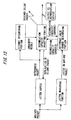
- FIG. 14 is a structural diagram of the technique described in this document.
- Received packets are sent to a jitter buffer and to a jitter measuring portion.
- the jitter measuring portion measures jitter in the arrived packets, and sends the result of measurement to a statistical processing portion.
- the statistical processing portion determines, based on a distribution of jitter, an accumulation capacity capable of absorbing the jitter, and notifies a reproduction control portion of the accumulation capacity.
- the reproduction control portion outputs a voice signal to a reproduction device.
- JP2003-264583A jitter in the arrived packets is measured, and the statistical processing is performed thereon. Based on the distribution of the jitter obtained by the statistical processing, a maximum value of jitter, with which buffer underflow is surely avoided according to the statistics, is determined, and an accumulation capacity capable of absorbing a jitter of the maximum value is set for the buffer.
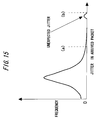
- the accumulation capacity capable of absorbing the measured jitter is set for the buffer. Accordingly, with the jitter distribution of FIG. 15, it is sufficient to provide the buffer with the accumulation capacity of level (a) for absorbing most of the jitter. However, in reality, the buffer accumulation capacity of level (b) is set in order to absorb an unexpected jitter of larger degree occurring at low frequency, which may develop longer transmission delay.
- the buffer is provided with the accumulation capacity (of level (a) in FIG. 15) based on the jitter distribution. Therefore, arrived packets having a jitter level exceeding the maximum level of the jitter ((a) in FIG. 15) determined based on the jitter distribution, are late for the timing of reproduction.
- the reproduction is generally performed by replicating the preceding packets through silent reproduction, repeat reproduction, packet interpolation, or the like. Therefore, the reproduction control portion regards the voice packets, which arrived with jitter exceeding the maximum value, as delayed packets, and discards them. There is no consideration given to the influence of this on voice quality in communications due to the discarding of the voice packets. Accordingly, there is a risk that voice quality in communications is deteriorated by discarding packets which correspond to an inflection point of voice or the like and thus have a great influence on perceived voice quality.
- a jitter buffer controller for controlling a jitter buffer in which arrived packets are accumulated, including:
- the controller further includes an accumulation capacity determining portion for determining a packet accumulation capacity in accordance with a jitter distribution obtained by the measuring portion relating to a plurality of packets, and the control portion replicates or discards, in accordance with the packet accumulation capacity determined, packets having a low importance.
- an accumulation capacity determining portion for determining a packet accumulation capacity in accordance with a jitter distribution obtained by the measuring portion relating to a plurality of packets, and the control portion replicates or discards, in accordance with the packet accumulation capacity determined, packets having a low importance.
- an accumulation capacity can be dynamically changed to an optimal amount in accordance with a jitter distribution of packets. Therefore, it is possible to decide an optimal packet accumulation capacity depending on the situation in a network so as to minimize transmission delay, to thereby improve speech quality.
- the present invention can provide a jitter buffer control method possessing the same characteristics as the jitter buffer controller according to the present invention described above.
- FIG. 1 is a diagram showing an exemplary configuration of a jitter buffer controller for absorbing jitter in voice packets according to a first embodiment of the present invention.
- the jitter buffer controller is provided, for example, between a reception device and reproduction device for voice packets.
- the jitter buffer controller includes: a jitter buffer 2 in which arriving packets are accumulated; a reproduction control portion 4 for outputting voice signals to the reproduction device; an importance processing portion 6 for determining levels of importance of the packets; a jitter measuring portion 8; and a statistical processing portion 10.
- Voice packets are inputted, upon arrival, to the jitter buffer 2, to the importance processing portion 6, and to the jitter measuring portion 8, as arrived (received) packets.
- the jitter measuring portion 8 measures the amount of jitter of each arrived packet, and notifies the statistical processing portion 10 of the measured results.
- the statistical processing portion 10 compares the measured jitter with a past distribution of jitter to determine whether or not the jitter buffer with a current capacity level is capable of absorbing the measured jitter (whether or not the arrived packets are to be discarded as packets of delay), and notifies the importance processing portion 6 of the result of determination.
- the statistical processing portion 10 also executes statistical processing on the measured jitter to obtain a new jitter distribution, and notifies the reproduction control portion 4 of an optimal accumulation capacity for the jitter buffer.
- the importance processing portion 6 determines levels of importance of the arrived packets, and notifies the reproduction control portion 4 of the levels of importance.
- the importance processing portion 6 instructs the reproduction control portion 4 to discard voice packets of low importance, and reproduce voice packets of high importance, based on the levels of importance determined, on condition that the reproduction control portion 4 is informed by the statistical processing portion 10 that the buffer is incapable of absorbing the jitter of the arrived packets.
- the jitter buffer 2 stores (accumulates) voice packets that have arrived, and the reproduction control portion 4 reads out the voice packets.
- the reproduction control portion 4 reads out voice packets from the jitter buffer 2 at regular intervals, and outputs voice signals to a reproduction device. In the course of this process, the reproduction control portion 4 discards or replicates voice packets of low importance based on the result given by the importance processing portion 6 to bring the number of packets to be accumulated in the jitter buffer 2 in line with the accumulation capacity of the buffer notified by the statistical processing portion 10. When there are packets arriving with delay, the reproduction control portion 4 discards or reproduces these packets in accordance with an instruction from the importance processing portion 6.
- the jitter measuring portion 8 records the times of reception of the arrived packets.
- the jitter measuring portion 8 uses Equation 1 to calculate an average packet reception interval (ave_recv_int) based on the records of the times of reception of the packets received in the past (recv_time(ti)).
- t represents a sequence number of a most-recently-arrived packet.
- the average packet reception interval can be obtained every time a packet arrives or after every predetermined number of packets.
- the number of packets, based on which the average packet reception interval is calculated, can be determined arbitrarily.
- a reference packet can be selected arbitrarily.
- the jitter measuring portion 8 uses Equation 2 below to calculate a jitter level (jit) of arrived packets based on the times of reception of the packets and the average packet reception intervals.
- Equation 2 jit recv_time t - ref_recv_time + seq_diff ⁇ ave_recv_int
- ref_recv_time represents a time of reception of a reference packet
- seq_diff represents a difference in sequence numbers of the reference packet and of the arrived packet.
- the jitter measuring portion 8 notifies the statistical processing portion 10 of the calculated jitter levels of the arrived packets.
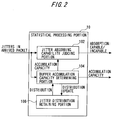
- FIG. 2 is a diagram showing an exemplary configuration of the statistical processing portion 10.
- the statistical processing portion 10 includes a jitter absorbing capability judging portion 102, a buffer accumulation capacity determining portion 104, and a jitter distribution retaining portion 106.
- the jitter absorbing capability judging portion 102 compares the jitter of the arrived packets notified by the jitter measuring portion 8 with the current accumulation capacity which is previously set for the buffer, and judges whether or not the current accumulation capacity is capable of absorbing the jitter in the arrived packets (see FIG. 2), and notifies the importance processing portion 6 of the result of judgment.
- the buffer accumulation capacity determining portion 104 notifies the jitter absorbing capability judging portion 102 of the accumulation capacity of the buffer.
- FIG. 3 shows a jitter distribution of the arrived packets.
- the lateral axis indicates a jitter level of the arrived packets (in terms of time), and the longitudinal axis indicates a frequency with which a given jitter level occurs.
- the dotted line represents a current accumulation capacity of the buffer.
- the buffer can absorb jitters to a degree equal to or lower than the buffer accumulation capacity thereof, but cannot absorb jitter exceeding the buffer accumulation capacity thereof.
- the buffer accumulation capacity determining portion 104 obtains a new jitter distribution based on the jitter of the arrived packets and on the jitter distribution determined for the previously received packets which is retained in the jitter distribution retaining portion 106, and determines an accumulation capacity of the buffer so that the buffer can absorb jitter maximum in value occurring at a frequency of a certain threshold and above.
- the buffer accumulation capacity determining portion 104 notifies the reproduction control portion 4 and the jitter absorbing capability judging portion 102 of the new accumulation capacity of the buffer.
- the buffer accumulation capacity determining portion 104 notifies the jitter distribution retaining portion 106 of the new jitter distribution.
- the jitter distribution retaining portion 106 retains a jitter distribution that relates to the arrived packets received in the past, and also retains the new jitter distribution notified by the buffer accumulation capacity determining portion 104.
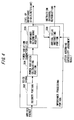
- FIG. 4 is a diagram showing an exemplary configuration of the importance processing portion 6.
- the importance processing portion 6 includes a decoder portion 202, a power variation calculating portion 204, an importance determining portion 206, and an arrival delay instructing portion 208.
- the decoder portion 202 decodes encoded data in the arrived packets to convert the data into voice signals.
- the decoder portion 202 notifies the power variation calculating portion 204 of the voice signals obtained through the decoding.
- the power variation calculating portion 204 uses Equation 3 to calculate power (pow(i)) of a current frame based on the voice signals obtained through the decoding.
- s_val(n) indicates a sample value
- number_sample indicates the number of samples in the frame.
- Equation 4 is used to obtain “s_pow”, which represents power variation characteristics of the current frame, based on the power "pow(i)" of the current frame and (N-1) past frames.
- ave_pow represents an average of the powers of the current frame and the past (N-1) frames as shown in Equation 5 below.
- the power variation calculating portion 204 notifies the importance determining portion 206 of the calculated power of the voice signals and the calculated power variation characteristics.
- Another calculation method may also be employed to calculate the power variation characteristics. For example, it is possible to calculate the power variation characteristics by obtaining a standard deviation, on the assumption that a power distribution has an appropriate distribution (such as a normal distribution).
- the importance determining portion 206 determines importance of the current frame based on the data given by the power variation calculating portion 204, and notifies the reproduction control portion 4 of the result of determination.
- FIG. 5 shows an operational flow in determining importance.
- the processing of FIG. 5 is executed for each frame.
- the importance determining portion 206 determines whether the power variation characteristics of the voice signals informed by the power variation calculating portion 204 have a value equal to or larger than a threshold "a", or less than the threshold "a” (S102). When the power variation characteristics have a value equal to or larger than the threshold "a" ("NO” in S102), the importance determining portion 206 then determines whether the power has a value equal to or larger than a threshold "b", or less than the threshold "b” (S105). When the power has a value equal to or larger than the threshold "b" ("NO” in S105), the importance of the voice signals is judged as being high (S106).
- the importance determining portion 206 determines whether the power has a value equal to or higher than the threshold "b", or less than the threshold "b" (S104). When the power has a value equal to or larger than the threshold "b" ("NO” in S104), the importance of the voice signals are judged as being low (S108). When the power has a value less than the threshold "b" ("YES” in S104), the voice signals are judged as being silent (S110).
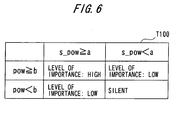
- levels of importance of voice signals are determined as shown in FIG. 6. That is, the importance determining portion 206 determines that:
- voice signals obtained through decoding are used for determining importance, but encoded data may also be used for determining importance.
- encoded data For example, data characteristics, which vary depending on levels of importance, are stored in a table beforehand, and the importance of the current packet (encoded data) can be determined by referring to the table.
- the arrival delay instructing portion 208 decides whether to discard or to reproduce the voice signals, based on the result of determination given by the importance determining portion 206, on condition that the statistical processing portion 10 notifies that the buffer cannot absorb the jitters. That is, when the voice signals are attached with high level of importance, the arrival delay instructing portion 208 instructs the reproduction control portion 4 to reproduce the voice signals arrived with delay. When the voice signals are attached with (designated as) low importance or when the voice signals are silent, the arrival delay instructing portion 208 instructs the reproduction control portion 4 to discard the voice signals arrived with delay.
- the jitter buffer 2 accumulates the arrived packets in order by sequence number, and the arrived packets are read out under control of the reproduction control portion 4.
- the accumulation capacity of the buffer can be increased or decreased under packet control performed by the reproduction control portion 4 which is provided in a subsequent stage of the jitter buffer 2.
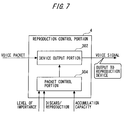
- FIG. 7 is a diagram showing an exemplary configuration of the reproduction control portion 4.
- the reproduction control portion 4 includes a device output portion 302 and a packet control portion 304.
- the device output portion 302 regularly outputs voice signals obtained from the voice packets to the reproduction device so as not to cause discontinuity in voice reproduction.
- the device output portion 302 as long as no instruction is given by the packet control portion 304 to reproduce or discard packets, reads out the packets (voice packets) accumulated in the jitter buffer 2, decodes the packets to obtain voice signals, and outputs the voice signals to the reproduction device.
- the device output portion 302 reproduces the packets (by replicating and outputting the previously received packet) or discards the packets.
- the packet control portion 304 instructs, in accordance with a notification from the importance processing portion 6, the device output portion 302 to replicate or discard packets so the accumulation capacity of the buffer can be adjusted to have the notified value. That is, when the accumulation capacity of the buffer is instructed to be increased, the packet control portion 304 instructs the device output portion 302 to repeat reproduction of packets by replicating packets of low importance or of silence (to generate and output voice signals). As a result, the accumulation capacity of the buffer increases. When the accumulation capacity of the buffer is instructed to be decreased, the packet control portion 304 instructs the device output portion 302 to discard a silent voice packet read out from the jitter buffer 2 and to reproduce the next voice packet. At this time, the packet control portion 304 may also instruct the device output portion 302 to discard voice packets of low importance. As a result, the accumulation capacity of the buffer decreases. A level of importance for each packet is informed by the importance processing portion 6.
- the packet control portion 304 instructs the device output portion 302 to reproduce the voice signals.
- the packet control portion 304 instructs the device output portion 302 to discard the voice signals.
- the packet control portion 304 does not discard or replicate a voice packet that follows the replicated or discarded voice packet, because there is a risk that a successive discard or replication of voice packets may cause deterioration in voice quality in communications.
- the importance processing portion 6 determines the level of importance of each voice packet accumulated in the jitter buffer 2. At this time, the importance processing portion 6 decides, with regards to voice packets having jitter of a level determined by the statistical processing portion 10 as being incapable of absorption with the accumulation capacity of the jitter buffer 2, whether to reproduce or to discard the voice packets. When the voice packets are of high importance, the importance processing portion 6 determines that the voice packets should be reproduced rather than being discarded, and when the voice packets are of low importance, the importance processing portion 6 determines that the voice packets should be discarded.
- the reproduction control portion 4 executes processing on voice packets read out from the jitter buffer 2, according to the levels of importance of the voice packets notified by the importance processing portion 6 along with the instruction to discard or reproduce the voice packets. Accordingly, the voice packets with jitter incapable of absorption with the packet accumulation capacity but which have been designated as high importance are reproduced without being discarded, with the result that no deterioration in voice quality of communications due to discarding important voice packets is caused. In other words, speech quality is improved.
- the statistical processing portion 10 determines the packet accumulation capacity in accordance with a jitter distribution, and the packet accumulation capacity is increased or decreased accordingly.
- the importance processing portion 6 determines whether voice packets accumulated in the jitter accumulation buffer are silent or not.
- the reproduction control portion 4 reproduces voice packets of low importance or of silence by replicating the voice packets to thereby attain the increased packet accumulation capacity.
- the reproduction control portion 4 discards voice packets of silence to attain the decreased packet accumulation capacity.
- the packet accumulation capacity is increased or decreased (dynamically changed) in accordance with the jitter distribution, which can reduce a transmission delay to a minimum. Even in this case, voice packets of high importance are not subject to discard, which leads to an improvement in speech quality through voice reproduction based on voice packets of high importance.
- the accumulation capacity of the buffer can be dynamically changed, which can reduce a transmission delay to a minimum.
- voice packets of low importance are replicated or discarded.
- voice packets of high importance are not discarded even if they are delayed in arriving. Accordingly, the voice quality in communications can be improved.
- the second embodiment has commonalities with the first embodiment. Accordingly, descriptions on the commonalities are omitted, and the dissimilarities from the first embodiment are mainly explained.
- a system according to the second embodiment has the same structure as the first embodiment of FIG. 1.
- the importance processing portion 6 in the system of the second embodiment is different from that of the first embodiment in the following ways.
- FIG. 8 is a diagram showing an exemplary configuration of the importance processing portion 6 according to the second embodiment.
- the importance processing portion 6 according to the second embodiment is different from the importance processing portion 6 of the first embodiment in that the importance processing portion 6 according to the second embodiment further includes a pitch characteristics calculating portion 210 besides the power variation calculating portion 204.
- the pitch characteristics calculation portion 210 calculates pitch characteristics of voice signals. Based on the obtained pitch characteristics, it is possible to determine whether a voice signal is monotonous having no change or the voice signal is changeful, and from this a level of importance of the voice signal can be determined.
- FIG. 11 is a diagram showing calculations performed by the pitch characteristics calculating portion 210.
- the pitch characteristics calculating portion 210 samples a current frame and a past frame and uses signals in each of the frames, and performs calculation on each sample based on Equation 6 over a range different from one frame to the other by staggering each frame to thereby obtain "apx" which represents a degree of approximation between the staggered signals (sig_dif) and the signals in the current frame (sig_org).
- the pitch characteristics calculating portion 210 further calculates a pitch gain (pgain), which is obtained at a point where the degree of approximation is maximum, by using Equation 7.
- signals with a pitch gain equal to or above the threshold are judged as having pitch characteristics, and signals with a pitch gain less than the threshold are judged as having no pitch characteristics.
- the pitch characteristics calculating portion 210 notifies the importance determining portion 206 of the result of calculation as to whether or not the signals in the current frame have pitch characteristics.
- a voice packet having pitch characteristics is less critical as regards reproduction/discarding of the voice packet, and the level of importance of the voice packet can be regarded as being low.
- Importance determining portion 206 determines levels of importance of voice signals based on the power variation characteristic and pitch characteristic of the current frame.
- FIG. 9 shows an operational flow in determining importance.
- the importance determining portion 206 determines whether the power variation characteristic of a voice signal informed by the power variation calculating portion 204 has a value equal to or lager than a threshold "a", or less than the threshold "a” (S202). When the power variation characteristic has a value equal to or larger than the threshold "a" ("NO” in S202), the importance determining portion 206 then determines whether the power has a value equal to or larger than a threshold "b", or less than the threshold “b” (S206). When the power has a value equal to or larger than the threshold "b" ("NO” in S206), the importance of the voice signal is judged as being high (S210).
- the importance determining portion 206 determines whether the power has a value equal to or higher than the threshold "b", or less than the threshold "b" (S204). When the power has a value equal to or larger than the threshold "b" ("NO” in S204), the importance determining portion 206 then determines whether the voice signal has pitch characteristics or not based on information given by the pitch characteristics calculating portion 210 (S208). When the voice signal has no pitch characteristics ("NO” in S208), importance of the voice signal is judged as being high (S210).
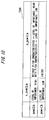
- a level of importance of a signal is determined as shown in FIG. 10. That is, the importance determining portion 206 determines that:
- the importance processing portion 6 calculates pitch characteristics of voice packets, based on which a level of importance is determined. Accordingly, levels of importance are determined with higher accuracy.
- a level of importance of a packet is determined based on whether or not the packet has pitch characteristics, which enables reproduction of a voice packet that corresponds to a turning point of sound without discarding the voice packet. Reproduction of a turning point of voice makes a reproduced voice clear, which helps smooth communications with the other party and thus improves speech quality.
Landscapes
- Engineering & Computer Science (AREA)
- Signal Processing (AREA)
- Computer Networks & Wireless Communication (AREA)
- Human Computer Interaction (AREA)
- Health & Medical Sciences (AREA)
- Audiology, Speech & Language Pathology (AREA)
- Computational Linguistics (AREA)
- Physics & Mathematics (AREA)
- Acoustics & Sound (AREA)
- Multimedia (AREA)
- Data Exchanges In Wide-Area Networks (AREA)
- Telephonic Communication Services (AREA)
- Communication Control (AREA)
Abstract
Description
- The present invention relates to a jitter buffer controller that can be adapted to a voice packet communication system, such as voice communications or VoIP (Voice over IP) using IP (Internet Protocol) network, in which voice is transformed into packets to be transmitted.
- In recent years, along with the rapid popularization of the Internet, VoIP communication has been receiving attention. In VoIP communication, voice data is transformed into IP packets to be transmitted over an IP network. The IP network renders a so-called best-effort service, which means that a transmission bandwidth needed for voice transmission is not always secured, unlike the case of using a fixed telephone. Accordingly, there may be a spread (jitter) in packet arrival times due to network congestion and the like. Delays in the arrival of voice packets due to jitter cause discontinuity in voice reproduction on a receiver's side as packets to be reproduced run out, resulting in deterioration of voice quality in communications. In VoIP communication, a jitter buffer (hereinafter, referred to as "buffer") is provided on the receiver's side, which is shown in FIG. 12. The buffer accumulates voice packets inputted at irregular intervals, and outputs the accumulated voice packets at regular intervals.
- Packets are accumulated in the buffer in advance of reproduction, so packet reproduction can be continuously performed even when packets arrive with delays due to jitter. That is, the accumulated packets continue to be output during the delay, to absorb the jitter and thereby attain stability in reproduction. It is possible to absorb jitter to a greater degree by increasing the number of packets to be accumulated in the buffer. However, as the number of packets to be accumulated increases, a longer delay arises in reproducing the received packets, which impairs the flow of speech between the calling parties.
- As described above, if the number of the packets to be accumulated in the buffer is too small, it leads to deterioration of voice quality in communications, such as discontinuity in voice reproduction. The trade-off of increasing the number of packets to be accumulated is correspondingly longer delays in reproducing them. Therefore, it is necessary to optimize the number of packets to be accumulated in the buffer in accordance with the level of jitter in the network such that the minimum number of packets for retaining voice quality in communications is accumulated, to thereby minimize the transmission delay resulting from packet accumulation in the buffer.
-
JP2001-160826A - FIG. 13 shows a structural diagram of the technique described in this document. Received packets are sent to a jitter buffer and to a jitter measuring portion. The jitter measuring portion measures jitter in the arrived packets, and the jitter thus measured is sent to a reference value change determining portion. The reference value change determining portion receives current information on the accumulation capacity of the buffer from an accumulation capacity adjusting portion, and compares the information with the jitter measured by the jitter measuring portion. The reference value change determining portion determines a new accumulation capacity of the buffer based on the result of comparison, and notifies the accumulation capacity adjusting portion of the new accumulation capacity. On the other hand, a silence determining portion receives reproduced packets from the jitter buffer, determines whether the packets are silent or not, and notifies the accumulation capacity adjusting portion of the result of judgment. The accumulation capacity adjusting portion replicates or discards the silent packets based on the new capacity notified by the reference value change determining portion. The accumulation capacity adjusting portion also outputs voice signals to a reproduction device.
- According to the prior art disclosed in
JP2001-160826A -
JP2003-264583A - FIG. 14 is a structural diagram of the technique described in this document. Received packets are sent to a jitter buffer and to a jitter measuring portion. The jitter measuring portion measures jitter in the arrived packets, and sends the result of measurement to a statistical processing portion. The statistical processing portion determines, based on a distribution of jitter, an accumulation capacity capable of absorbing the jitter, and notifies a reproduction control portion of the accumulation capacity. The reproduction control portion outputs a voice signal to a reproduction device.
- According to the prior art disclosed in
JP2003-264583A - However, the techniques disclosed in the above documents have the following problems.
- According to the technique disclosed in
JP2001-160826A - According to a technique disclosed in
JP2003-264583A - It is therefore desirable to improve speech quality, both by improving voice quality of communications and by reducing transmission delay, in voice communications.
- According to an aspect of the present invention, there is provided a jitter buffer controller for controlling a jitter buffer in which arrived packets are accumulated, including:
- a jitter measuring portion for measuring jitter in the arrived packets;
- a judging portion for judging whether or not the jitter of the packets can be absorbed with an accumulation capacity of the jitter buffer;
- a determining portion for determining levels of importance of the packets; and
- a control portion for performing reproduction processing or discarding processing on a packet, among the packets accumulated in the jitter buffer, having jitter that cannot be absorbed with the accumulation capacity of the buffer, depending on a level of importance of the packet.
- With this configuration, it is possible to decide whether packets arriving with a delay need to be discarded or not depending on levels of importance of the packets determined, rather than to discard, without exception, any packet arriving with delay. Even if packets of high importance arrive with delay, these packets are assured of reproduction, which prevents deterioration in voice quality in communications, to thereby improve speech quality.
- Preferably, the controller further includes an accumulation capacity determining portion for determining a packet accumulation capacity in accordance with a jitter distribution obtained by the measuring portion relating to a plurality of packets, and the control portion replicates or discards, in accordance with the packet accumulation capacity determined, packets having a low importance.
- With this configuration, an accumulation capacity can be dynamically changed to an optimal amount in accordance with a jitter distribution of packets. Therefore, it is possible to decide an optimal packet accumulation capacity depending on the situation in a network so as to minimize transmission delay, to thereby improve speech quality.
- In addition, the present invention can provide a jitter buffer control method possessing the same characteristics as the jitter buffer controller according to the present invention described above.
- According to the present invention, it is possible to improve speech quality.
Reference is made, by way of example only, to the accompanying drawings in which: - FIG. 1 is a diagram showing an exemplary configuration of a jitter buffer controller.
- FIG. 2 is a diagram showing a statistical processing portion of the jitter buffer controller.
- FIG. 3 is a diagram for explaining a jitter absorbing capability judgement.
- FIG. 4 is a diagram showing an exemplary configuration of an importance processing portion of the jitter buffer controller.
- FIG. 5 is a diagram showing an operational flow in determining importance.
- FIG. 6 is a diagram showing a table used for determining importance.
- FIG. 7 is a diagram showing an exemplary configuration of a reproduction control portion of the jitter buffer controller.
- FIG. 8 is a diagram showing an exemplary configuration of an importance processing portion of the jitter buffer controller.
- FIG. 9 is a diagram showing an operational flow in determining importance.
- FIG. 10 is a diagram showing a table used for determining importance.
- FIG. 11 is a diagram for explaining processing performed by a pitch characteristics calculation portion.
- FIG. 12 is a diagram for explaining a jitter buffer.
- FIG. 13 is a diagram showing a system configuration according to
JP2001-160826A - FIG. 14 is a diagram showing a system configuration according to
JP2003-264583A - FIG. 15 is a diagram showing a jitter distribution.
- Hereinafter, embodiments of the present invention will be explained with reference to the accompanying drawings. The embodiments are merely examples, and the present invention is not limited to structures of the embodiments.
- FIG. 1 is a diagram showing an exemplary configuration of a jitter buffer controller for absorbing jitter in voice packets according to a first embodiment of the present invention. The jitter buffer controller is provided, for example, between a reception device and reproduction device for voice packets. In FIG. 1, the jitter buffer controller includes: a jitter buffer 2 in which arriving packets are accumulated; a
reproduction control portion 4 for outputting voice signals to the reproduction device; animportance processing portion 6 for determining levels of importance of the packets; ajitter measuring portion 8; and astatistical processing portion 10. - Voice packets are inputted, upon arrival, to the jitter buffer 2, to the
importance processing portion 6, and to thejitter measuring portion 8, as arrived (received) packets. - The
jitter measuring portion 8 measures the amount of jitter of each arrived packet, and notifies thestatistical processing portion 10 of the measured results. - The
statistical processing portion 10 compares the measured jitter with a past distribution of jitter to determine whether or not the jitter buffer with a current capacity level is capable of absorbing the measured jitter (whether or not the arrived packets are to be discarded as packets of delay), and notifies theimportance processing portion 6 of the result of determination. Thestatistical processing portion 10 also executes statistical processing on the measured jitter to obtain a new jitter distribution, and notifies thereproduction control portion 4 of an optimal accumulation capacity for the jitter buffer. - The
importance processing portion 6 determines levels of importance of the arrived packets, and notifies thereproduction control portion 4 of the levels of importance. Theimportance processing portion 6 instructs thereproduction control portion 4 to discard voice packets of low importance, and reproduce voice packets of high importance, based on the levels of importance determined, on condition that thereproduction control portion 4 is informed by thestatistical processing portion 10 that the buffer is incapable of absorbing the jitter of the arrived packets. - The jitter buffer 2 stores (accumulates) voice packets that have arrived, and the
reproduction control portion 4 reads out the voice packets. - The
reproduction control portion 4 reads out voice packets from the jitter buffer 2 at regular intervals, and outputs voice signals to a reproduction device. In the course of this process, thereproduction control portion 4 discards or replicates voice packets of low importance based on the result given by theimportance processing portion 6 to bring the number of packets to be accumulated in the jitter buffer 2 in line with the accumulation capacity of the buffer notified by thestatistical processing portion 10. When there are packets arriving with delay, thereproduction control portion 4 discards or reproduces these packets in accordance with an instruction from theimportance processing portion 6. - Hereafter, each of the constituent elements will be explained in detail.
- «Jitter measuring portion»
Thejitter measuring portion 8 records the times of reception of the arrived packets. - The
jitter measuring portion 8 uses Equation 1 to calculate an average packet reception interval (ave_recv_int) based on the records of the times of reception of the packets received in the past (recv_time(ti)). -

In Equation 1, "t" represents a sequence number of a most-recently-arrived packet. - The average packet reception interval can be obtained every time a packet arrives or after every predetermined number of packets. The number of packets, based on which the average packet reception interval is calculated, can be determined arbitrarily. A reference packet can be selected arbitrarily.
- Also, the
jitter measuring portion 8 uses Equation 2 below to calculate a jitter level (jit) of arrived packets based on the times of reception of the packets and the average packet reception intervals. -

In Equation 2, "ref_recv_time" represents a time of reception of a reference packet, and "seq_diff" represents a difference in sequence numbers of the reference packet and of the arrived packet. - The
jitter measuring portion 8 notifies thestatistical processing portion 10 of the calculated jitter levels of the arrived packets. - «Statistical processing portion»
FIG. 2 is a diagram showing an exemplary configuration of thestatistical processing portion 10. Thestatistical processing portion 10 includes a jitter absorbingcapability judging portion 102, a buffer accumulationcapacity determining portion 104, and a jitterdistribution retaining portion 106. - (Jitter absorbing capability judging portion)
The jitter absorbingcapability judging portion 102 compares the jitter of the arrived packets notified by thejitter measuring portion 8 with the current accumulation capacity which is previously set for the buffer, and judges whether or not the current accumulation capacity is capable of absorbing the jitter in the arrived packets (see FIG. 2), and notifies theimportance processing portion 6 of the result of judgment. The buffer accumulationcapacity determining portion 104 notifies the jitter absorbingcapability judging portion 102 of the accumulation capacity of the buffer. - FIG. 3 shows a jitter distribution of the arrived packets. The lateral axis indicates a jitter level of the arrived packets (in terms of time), and the longitudinal axis indicates a frequency with which a given jitter level occurs. The dotted line represents a current accumulation capacity of the buffer. The buffer can absorb jitters to a degree equal to or lower than the buffer accumulation capacity thereof, but cannot absorb jitter exceeding the buffer accumulation capacity thereof.
- The buffer accumulation
capacity determining portion 104 obtains a new jitter distribution based on the jitter of the arrived packets and on the jitter distribution determined for the previously received packets which is retained in the jitterdistribution retaining portion 106, and determines an accumulation capacity of the buffer so that the buffer can absorb jitter maximum in value occurring at a frequency of a certain threshold and above. The buffer accumulationcapacity determining portion 104 notifies thereproduction control portion 4 and the jitter absorbingcapability judging portion 102 of the new accumulation capacity of the buffer. - The buffer accumulation
capacity determining portion 104 notifies the jitterdistribution retaining portion 106 of the new jitter distribution. - The jitter
distribution retaining portion 106 retains a jitter distribution that relates to the arrived packets received in the past, and also retains the new jitter distribution notified by the buffer accumulationcapacity determining portion 104. - FIG. 4 is a diagram showing an exemplary configuration of the
importance processing portion 6. Theimportance processing portion 6 includes adecoder portion 202, a powervariation calculating portion 204, animportance determining portion 206, and an arrivaldelay instructing portion 208. - The
decoder portion 202 decodes encoded data in the arrived packets to convert the data into voice signals. Thedecoder portion 202 notifies the powervariation calculating portion 204 of the voice signals obtained through the decoding. - The power
variation calculating portion 204 uses Equation 3 to calculate power (pow(i)) of a current frame based on the voice signals obtained through the decoding. -

In Equation 3, "s_val(n)" indicates a sample value, and "num_sample" indicates the number of samples in the frame.Equation 4 is used to obtain "s_pow", which represents power variation characteristics of the current frame, based on the power "pow(i)" of the current frame and (N-1) past frames. -

Here, "ave_pow" represents an average of the powers of the current frame and the past (N-1) frames as shown in Equation 5 below. -

The powervariation calculating portion 204 notifies theimportance determining portion 206 of the calculated power of the voice signals and the calculated power variation characteristics. - Another calculation method may also be employed to calculate the power variation characteristics. For example, it is possible to calculate the power variation characteristics by obtaining a standard deviation, on the assumption that a power distribution has an appropriate distribution (such as a normal distribution).
- The
importance determining portion 206 determines importance of the current frame based on the data given by the powervariation calculating portion 204, and notifies thereproduction control portion 4 of the result of determination. - FIG. 5 shows an operational flow in determining importance. The processing of FIG. 5 is executed for each frame. The
importance determining portion 206 determines whether the power variation characteristics of the voice signals informed by the powervariation calculating portion 204 have a value equal to or larger than a threshold "a", or less than the threshold "a" (S102). When the power variation characteristics have a value equal to or larger than the threshold "a" ("NO" in S102), theimportance determining portion 206 then determines whether the power has a value equal to or larger than a threshold "b", or less than the threshold "b" (S105). When the power has a value equal to or larger than the threshold "b" ("NO" in S105), the importance of the voice signals is judged as being high (S106). When the power has a value less than the threshold "b" ("YES" in S105), the importance of the voice signals are judged as being low (S108). When the power variation characteristics have a value less than the threshold "a" ("YES" in S102), theimportance determining portion 206 determines whether the power has a value equal to or higher than the threshold "b", or less than the threshold "b" (S104). When the power has a value equal to or larger than the threshold "b" ("NO" in S104), the importance of the voice signals are judged as being low (S108). When the power has a value less than the threshold "b" ("YES" in S104), the voice signals are judged as being silent (S110). - In summary, levels of importance of voice signals are determined as shown in FIG. 6. That is, the
importance determining portion 206 determines that: - (1) the importance is high when the power variation characteristics have a value equal to or larger than the threshold "a" and the power has a value equal to or larger than the threshold "b";
- (2) the importance is low when the power variation characteristics have a value less than the threshold "a" and the power has a value equal to or larger than the threshold "b";
- (3) the importance is low when the power variation characteristics have a value equal to or larger than the threshold "a" and the power has a value less than the threshold "b"; and
- (4) the voice signal is silent when the power variation characteristics has a value less than the threshold "a" and the power has a value less than the threshold "b".
Theimportance determining portion 206 notifies thereproduction control portion 4 of the result of determination. - In this embodiment, voice signals obtained through decoding are used for determining importance, but encoded data may also be used for determining importance. For example, data characteristics, which vary depending on levels of importance, are stored in a table beforehand, and the importance of the current packet (encoded data) can be determined by referring to the table.
- The arrival
delay instructing portion 208 decides whether to discard or to reproduce the voice signals, based on the result of determination given by theimportance determining portion 206, on condition that thestatistical processing portion 10 notifies that the buffer cannot absorb the jitters. That is, when the voice signals are attached with high level of importance, the arrivaldelay instructing portion 208 instructs thereproduction control portion 4 to reproduce the voice signals arrived with delay. When the voice signals are attached with (designated as) low importance or when the voice signals are silent, the arrivaldelay instructing portion 208 instructs thereproduction control portion 4 to discard the voice signals arrived with delay. - The jitter buffer 2 accumulates the arrived packets in order by sequence number, and the arrived packets are read out under control of the
reproduction control portion 4. The accumulation capacity of the buffer can be increased or decreased under packet control performed by thereproduction control portion 4 which is provided in a subsequent stage of the jitter buffer 2. - FIG. 7 is a diagram showing an exemplary configuration of the
reproduction control portion 4. Thereproduction control portion 4 includes adevice output portion 302 and apacket control portion 304. - The
device output portion 302 regularly outputs voice signals obtained from the voice packets to the reproduction device so as not to cause discontinuity in voice reproduction. Thedevice output portion 302, as long as no instruction is given by thepacket control portion 304 to reproduce or discard packets, reads out the packets (voice packets) accumulated in the jitter buffer 2, decodes the packets to obtain voice signals, and outputs the voice signals to the reproduction device. When being instructed to reproduce or discard packets, thedevice output portion 302 reproduces the packets (by replicating and outputting the previously received packet) or discards the packets. - When the accumulation capacity of the buffer is changed according to a notification from the
statistical processing portion 10, thepacket control portion 304 instructs, in accordance with a notification from theimportance processing portion 6, thedevice output portion 302 to replicate or discard packets so the accumulation capacity of the buffer can be adjusted to have the notified value. That is, when the accumulation capacity of the buffer is instructed to be increased, thepacket control portion 304 instructs thedevice output portion 302 to repeat reproduction of packets by replicating packets of low importance or of silence (to generate and output voice signals). As a result, the accumulation capacity of the buffer increases. When the accumulation capacity of the buffer is instructed to be decreased, thepacket control portion 304 instructs thedevice output portion 302 to discard a silent voice packet read out from the jitter buffer 2 and to reproduce the next voice packet. At this time, thepacket control portion 304 may also instruct thedevice output portion 302 to discard voice packets of low importance. As a result, the accumulation capacity of the buffer decreases. A level of importance for each packet is informed by theimportance processing portion 6. - When the
importance processing portion 6 instructs thepacket control portion 304 to reproduce voice signals which arrived with delay but are designated as high importance, thepacket control portion 304 instructs thedevice output portion 302 to reproduce the voice signals. When theimportance processing portion 6 instructs thepacket control portion 304 to discard voice signals which arrived with delay and are designated as low importance (or voice signals of silence), thepacket control portion 304 instructs thedevice output portion 302 to discard the voice signals. - It should be noted that the
packet control portion 304 does not discard or replicate a voice packet that follows the replicated or discarded voice packet, because there is a risk that a successive discard or replication of voice packets may cause deterioration in voice quality in communications. - According to the jitter buffer controller of the first embodiment described above, the
importance processing portion 6 determines the level of importance of each voice packet accumulated in the jitter buffer 2. At this time, theimportance processing portion 6 decides, with regards to voice packets having jitter of a level determined by thestatistical processing portion 10 as being incapable of absorption with the accumulation capacity of the jitter buffer 2, whether to reproduce or to discard the voice packets. When the voice packets are of high importance, theimportance processing portion 6 determines that the voice packets should be reproduced rather than being discarded, and when the voice packets are of low importance, theimportance processing portion 6 determines that the voice packets should be discarded. - The
reproduction control portion 4 executes processing on voice packets read out from the jitter buffer 2, according to the levels of importance of the voice packets notified by theimportance processing portion 6 along with the instruction to discard or reproduce the voice packets. Accordingly, the voice packets with jitter incapable of absorption with the packet accumulation capacity but which have been designated as high importance are reproduced without being discarded, with the result that no deterioration in voice quality of communications due to discarding important voice packets is caused. In other words, speech quality is improved. - Further, in the jitter buffer controller, the
statistical processing portion 10 determines the packet accumulation capacity in accordance with a jitter distribution, and the packet accumulation capacity is increased or decreased accordingly. On the other hand, theimportance processing portion 6 determines whether voice packets accumulated in the jitter accumulation buffer are silent or not. In increasing the packet accumulation capacity, thereproduction control portion 4 reproduces voice packets of low importance or of silence by replicating the voice packets to thereby attain the increased packet accumulation capacity. In contrast to this, in decreasing the packet accumulation capacity, thereproduction control portion 4 discards voice packets of silence to attain the decreased packet accumulation capacity. In this manner, the packet accumulation capacity is increased or decreased (dynamically changed) in accordance with the jitter distribution, which can reduce a transmission delay to a minimum. Even in this case, voice packets of high importance are not subject to discard, which leads to an improvement in speech quality through voice reproduction based on voice packets of high importance. - Further, when a voice packet is replicated or discarded, another voice packet read out from the jitter buffer 2 following the replicated or discarded voice packet is not replicated or discarded even if the other voice packet is of low importance or of silence. Accordingly, no deterioration in voice quality of communications due to replication or discard of successive voice packets is caused.
- According to this embodiment, the accumulation capacity of the buffer can be dynamically changed, which can reduce a transmission delay to a minimum. In order to change the accumulation capacity of the buffer, voice packets of low importance are replicated or discarded. In addition, voice packets of high importance are not discarded even if they are delayed in arriving. Accordingly, the voice quality in communications can be improved.
- Next, a second embodiment according to the present invention will be described. The second embodiment has commonalities with the first embodiment. Accordingly, descriptions on the commonalities are omitted, and the dissimilarities from the first embodiment are mainly explained.
- A system according to the second embodiment has the same structure as the first embodiment of FIG. 1. The
importance processing portion 6 in the system of the second embodiment is different from that of the first embodiment in the following ways. - FIG. 8 is a diagram showing an exemplary configuration of the
importance processing portion 6 according to the second embodiment. In FIG. 8, the same reference numerals are given to the same components as those of the first embodiment shown in FIG. 4. Theimportance processing portion 6 according to the second embodiment is different from theimportance processing portion 6 of the first embodiment in that theimportance processing portion 6 according to the second embodiment further includes a pitchcharacteristics calculating portion 210 besides the powervariation calculating portion 204. - The pitch
characteristics calculation portion 210 calculates pitch characteristics of voice signals. Based on the obtained pitch characteristics, it is possible to determine whether a voice signal is monotonous having no change or the voice signal is changeful, and from this a level of importance of the voice signal can be determined. - FIG. 11 is a diagram showing calculations performed by the pitch
characteristics calculating portion 210. As shown in FIG. 11, the pitchcharacteristics calculating portion 210 samples a current frame and a past frame and uses signals in each of the frames, and performs calculation on each sample based onEquation 6 over a range different from one frame to the other by staggering each frame to thereby obtain "apx" which represents a degree of approximation between the staggered signals (sig_dif) and the signals in the current frame (sig_org). The pitchcharacteristics calculating portion 210 further calculates a pitch gain (pgain), which is obtained at a point where the degree of approximation is maximum, by using Equation 7. -

-

Here, "max_sig_dif(i)" represents signals that produce a maximum degree of approximation. - At this time, signals with a pitch gain equal to or above the threshold are judged as having pitch characteristics, and signals with a pitch gain less than the threshold are judged as having no pitch characteristics.
- The pitch
characteristics calculating portion 210 notifies theimportance determining portion 206 of the result of calculation as to whether or not the signals in the current frame have pitch characteristics. - When a voice packet has pitch characteristics, the voice packet does not correspond to a turning point of sound, in other words the same tone of voice continues. Therefore, a voice packet having pitch characteristics is less critical as regards reproduction/discarding of the voice packet, and the level of importance of the voice packet can be regarded as being low.
-
Importance determining portion 206 determines levels of importance of voice signals based on the power variation characteristic and pitch characteristic of the current frame. - FIG. 9 shows an operational flow in determining importance. The
importance determining portion 206 determines whether the power variation characteristic of a voice signal informed by the powervariation calculating portion 204 has a value equal to or lager than a threshold "a", or less than the threshold "a" (S202). When the power variation characteristic has a value equal to or larger than the threshold "a" ("NO" in S202), theimportance determining portion 206 then determines whether the power has a value equal to or larger than a threshold "b", or less than the threshold "b" (S206). When the power has a value equal to or larger than the threshold "b" ("NO" in S206), the importance of the voice signal is judged as being high (S210). When the power has a value less than the threshold "b" ("YES" in S206), the importance of the voice signal is judged as being low (S212). When the power variation characteristic has a value less than the threshold "a" ("YES" in S202), theimportance determining portion 206 determines whether the power has a value equal to or higher than the threshold "b", or less than the threshold "b" (S204). When the power has a value equal to or larger than the threshold "b" ("NO" in S204), theimportance determining portion 206 then determines whether the voice signal has pitch characteristics or not based on information given by the pitch characteristics calculating portion 210 (S208). When the voice signal has no pitch characteristics ("NO" in S208), importance of the voice signal is judged as being high (S210). On the other hand, when the voice signal has pitch characteristics ("YES" in S208), importance of the voice signal is judged as being low (S212). When the power has a value less than the threshold "b" ("YES" in S204), the voice signal is judged as being silent (S214). - In summary, a level of importance of a signal is determined as shown in FIG. 10. That is, the
importance determining portion 206 determines that: - (1) the importance is high when the power variation characteristic has a value equal to or larger than the threshold "a" and the power has a value equal to or larger than the threshold "b";
- (2) the importance is high in a voice signal having no pitch characteristics, and
the importance is low in a voice signal having pitch characteristics, on condition that the power variation characteristic has a value less than the threshold "a" and the power has a value equal to or larger than the threshold "b"; - (3) the importance is low when the power variation characteristic has a value equal to or larger than the threshold "a" and the power has a value less than the threshold "b"; and
- (4) the voice signal is silent when the power variation characteristic has a value less than the threshold "a" and the power has a value less than the threshold "b". The
importance determining portion 206 notifies thereproduction control portion 4 of the result of determination. - According to the second embodiment described above, the
importance processing portion 6 calculates pitch characteristics of voice packets, based on which a level of importance is determined. Accordingly, levels of importance are determined with higher accuracy. - A level of importance of a packet is determined based on whether or not the packet has pitch characteristics, which enables reproduction of a voice packet that corresponds to a turning point of sound without discarding the voice packet. Reproduction of a turning point of voice makes a reproduced voice clear, which helps smooth communications with the other party and thus improves speech quality.
Claims (20)
- A jitter buffer controller for controlling a jitter buffer in which arrived packets are accumulated, including:a jitter measuring portion for measuring jitter in the arrived packets;a judging portion for judging whether or not the jitter of the packets can be absorbed with an accumulation capacity of the jitter buffer;a determining portion for determining levels of importance of the packets; anda control portion for performing reproduction processing or discarding processing on a packet, among the packets accumulated in the jitter buffer, having jitter that cannot be absorbed with the accumulation capacity of the buffer, depending on a level of importance of the packet.
- The jitter buffer controller according to Claim 1, in which the control portion performs reproduction processing on the packet having jitter that cannot be absorbed with the accumulation capacity of the buffer, without discarding the packet, when the packet is of high importance.
- The jitter buffer controller according to Claim 1 or 2, in which the control portion performs discarding processing on the packet having jitter that cannot be absorbed with the accumulation capacity of the buffer, when the packet is of low importance.
- The jitter buffer controller according to Claim 1 or 2, further including an accumulation capacity determining portion for determining a packet accumulation capacity in accordance with a jitter distribution obtained by the measuring portion relating to a plurality of packets;
wherein the control portion replicates or discards, in accordance with the packet accumulation capacity determined, packets having low importance. - The jitter buffer controller according to Claim 1 or 2, further including:an accumulation capacity determining portion for determining a packet accumulation capacity in accordance with a jitter distribution obtained by the measuring portion relating to a plurality of packets; anda silence determining portion for determining whether a packet accumulated in the jitter buffer is silent or not,wherein
the control portion replicates packets of low importance or of silence when the accumulation capacity determining portion decides to increase the packet accumulation capacity. - The jitter buffer controller according to Claim 5, in which the control portion discards packets of silence when the accumulation capacity determining portion decides to decrease the packet accumulation capacity.
- The jitter buffer controller according to Claim 4, in which the control portion performs reproduction processing on a packet without replicating or discarding the packet, the packet being read out from the jitter buffer following a packet that is replicated or discarded.
- The jitter buffer controller according to any preceding claim, in which the determining portion determines levels of importance of packets based on encoded voice data included in the packets.
- The jitter buffer controller according to any preceding claim, in which the determining portion determines levels of importance of packets using voice signals obtained by decoding encoded voice data included in the packets.
- The jitter buffer controller according to Claim 9, in which the determining portion determines levels of importance of a voice signal based on a power variation in the voice signal.
- The jitter buffer controller according to Claim 10, in which the determining portion further determines a level of importance of a voice signal based on whether or not the voice signal has periodic characteristics.
- The jitter buffer controller according to Claim 7, in which an orthogonal transformation is performed on a decoded voice signal, and a level of importance of the voice signal is determined based on variation in Spectral Power.
- A jitter buffer control method for controlling a jitter buffer in which arrived packets are accumulated, the method including the steps of:measuring jitter in the arrived packets;judging whether or not the jitter of the packets can be absorbed with an accumulation capacity of the jitter buffer;determining levels of importance of the packets; andperforming reproduction processing or discarding processing on a packet, among the packets accumulated in the jitter buffer, having jitter that cannot be absorbed with the accumulation capacity of the buffer, depending on the importance of the packet.
- The jitter buffer control method according to Claim 13, further including the step of performing reproduction processing on the packet having jitter that cannot be absorbed with the accumulation capacity of the buffer, without discarding the packet, when the packet is of high importance.
- The jitter buffer control method according to Claim 13 or 14, further including the step of performing discarding processing on the packet having jitter that cannot be absorbed with the accumulation capacity of the buffer, when the packet is of low importance.
- The jitter buffer control method according to Claim 13, further including the steps of:determining a packet accumulation capacity in accordance with a jitter distribution obtained relating to a plurality of packets; andreplicating or discarding, in accordance with the packet accumulation capacity determined, packets having low importance.
- The jitter buffer control method according to Claim 13, further including the steps of:determining a packet accumulation capacity in accordance with a jitter distribution obtained relating to a plurality of packets;judging whether a packet, among the packets accumulated in the jitter buffer, is silent or not; andreplicating packets of low importance or of silence when the packet accumulation capacity is to be increased in line with the packet accumulation capacity that is decided in accordance with the jitter distribution obtained relating to a plurality of packets.
- The jitter buffer control method according to Claim 17, further including the step of discarding a packet of silence when the packet accumulation capacity is to be decreased in line with the packet accumulation capacity that is decided in accordance with the jitter distribution obtained relating to a plurality of packets.
- The jitter buffer control method according to any one of Claims 16, 17, or 18, further including the step of performing reproduction processing on a packet without replicating or discarding the packet, the packet being read out from the jitter buffer following a packet that is replicated or discarded.
- The jitter buffer control method according to any of claims 13 to 19, further including the step of determining a level of importance of a packet based on encoded voice data included in the packet.
Applications Claiming Priority (1)
| Application Number | Priority Date | Filing Date | Title |
|---|---|---|---|
| JP2006079006A JP4744332B2 (en) | 2006-03-22 | 2006-03-22 | Fluctuation absorption buffer controller |
Publications (3)
| Publication Number | Publication Date |
|---|---|
| EP1838066A2 true EP1838066A2 (en) | 2007-09-26 |
| EP1838066A3 EP1838066A3 (en) | 2009-08-19 |
| EP1838066B1 EP1838066B1 (en) | 2015-10-28 |
Family
ID=36992497
Family Applications (1)
| Application Number | Title | Priority Date | Filing Date |
|---|---|---|---|
| EP06253754.3A Ceased EP1838066B1 (en) | 2006-03-22 | 2006-07-18 | Jitter buffer controller |
Country Status (3)
| Country | Link |
|---|---|
| US (1) | US8081622B2 (en) |
| EP (1) | EP1838066B1 (en) |
| JP (1) | JP4744332B2 (en) |
Cited By (4)
| Publication number | Priority date | Publication date | Assignee | Title |
|---|---|---|---|---|
| EP2114034A1 (en) * | 2008-04-28 | 2009-11-04 | British Telecommunications Public Limited Company | Communications network |
| CN102238294A (en) * | 2010-04-23 | 2011-11-09 | 鸿富锦精密工业(深圳)有限公司 | User terminal device and method for dynamically regulating size of shake buffer area |
| US9634947B2 (en) | 2015-08-28 | 2017-04-25 | At&T Mobility Ii, Llc | Dynamic jitter buffer size adjustment |
| US10103999B2 (en) | 2014-04-15 | 2018-10-16 | Dolby Laboratories Licensing Corporation | Jitter buffer level estimation |
Families Citing this family (20)
| Publication number | Priority date | Publication date | Assignee | Title |
|---|---|---|---|---|
| US7746847B2 (en) * | 2005-09-20 | 2010-06-29 | Intel Corporation | Jitter buffer management in a packet-based network |
| US8081579B2 (en) * | 2006-11-28 | 2011-12-20 | Kyocera Corporation | Communication control apparatus, wireless communication apparatus, communication control method and wireless communication method |
| US20080170562A1 (en) * | 2007-01-12 | 2008-07-17 | Accton Technology Corporation | Method and communication device for improving the performance of a VoIP call |
| FI120284B (en) * | 2007-07-20 | 2009-08-31 | Tellabs Oy | Control of the fill rate in a jitter buffer |
| CN101409609A (en) * | 2007-10-09 | 2009-04-15 | 北京信威通信技术股份有限公司 | A method and device for efficiently and reliably transmitting voice in a wireless system |
| US8281369B2 (en) * | 2008-03-12 | 2012-10-02 | Avaya Inc. | Method and apparatus for creating secure write-enabled web pages that are associated with active telephone calls |
| JP2009239633A (en) * | 2008-03-27 | 2009-10-15 | Pioneer Electronic Corp | Receiving apparatus |
| US8879464B2 (en) | 2009-01-29 | 2014-11-04 | Avaya Inc. | System and method for providing a replacement packet |
| US9525710B2 (en) * | 2009-01-29 | 2016-12-20 | Avaya Gmbh & Co., Kg | Seamless switch over from centralized to decentralized media streaming |
| US8238335B2 (en) | 2009-02-13 | 2012-08-07 | Avaya Inc. | Multi-route transmission of packets within a network |
| US7936746B2 (en) * | 2009-03-18 | 2011-05-03 | Avaya Inc. | Multimedia communication session coordination across heterogeneous transport networks |
| US20100265834A1 (en) * | 2009-04-17 | 2010-10-21 | Avaya Inc. | Variable latency jitter buffer based upon conversational dynamics |
| US8094556B2 (en) * | 2009-04-27 | 2012-01-10 | Avaya Inc. | Dynamic buffering and synchronization of related media streams in packet networks |
| US8553849B2 (en) | 2009-06-17 | 2013-10-08 | Avaya Inc. | Personal identification and interactive device for internet-based text and video communication services |
| US8800049B2 (en) * | 2009-08-26 | 2014-08-05 | Avaya Inc. | Licensing and certificate distribution via secondary or divided signaling communication pathway |
| JP6031752B2 (en) * | 2011-12-05 | 2016-11-24 | 沖電気工業株式会社 | Voice communication apparatus and program |
| KR101290166B1 (en) | 2011-12-28 | 2013-07-30 | 국방과학연구소 | Communication method of communication apparatus |
| CN103888381A (en) | 2012-12-20 | 2014-06-25 | 杜比实验室特许公司 | Device and method used for controlling jitter buffer |
| JP6492019B2 (en) * | 2016-02-12 | 2019-03-27 | 日本電信電話株式会社 | Delay estimation apparatus and delay estimation method |
| EP4221002B1 (en) * | 2020-12-03 | 2025-07-09 | Mitsubishi Electric Corporation | Interface conversion device, control circuit, storage medium and network configuration method |
Citations (4)
| Publication number | Priority date | Publication date | Assignee | Title |
|---|---|---|---|---|
| GB2356537A (en) | 1999-11-22 | 2001-05-23 | Mitel Corp | Silence suppression/insertion buffer management |
| US20020026310A1 (en) | 2000-08-25 | 2002-02-28 | Matsushita Electric Industrial Co., Ltd. | Real-time information receiving apparatus |
| US6658027B1 (en) | 1999-08-16 | 2003-12-02 | Nortel Networks Limited | Jitter buffer management |
| US20050207937A1 (en) | 2004-03-22 | 2005-09-22 | Ids Company, Ltd. | Carriage direction switching apparatus for test-tube carrier path |
Family Cites Families (10)
| Publication number | Priority date | Publication date | Assignee | Title |
|---|---|---|---|---|
| JPH02183638A (en) * | 1989-01-10 | 1990-07-18 | Fujitsu Ltd | Voice transmission system |
| US7423983B1 (en) * | 1999-09-20 | 2008-09-09 | Broadcom Corporation | Voice and data exchange over a packet based network |
| JP3397191B2 (en) | 1999-12-03 | 2003-04-14 | 日本電気株式会社 | Delay fluctuation absorbing device, delay fluctuation absorbing method |
| JP4110734B2 (en) * | 2000-11-27 | 2008-07-02 | 沖電気工業株式会社 | Voice packet communication quality control device |
| TW561451B (en) * | 2001-07-27 | 2003-11-11 | At Chip Corp | Audio mixing method and its device |
| JP3636348B2 (en) * | 2001-09-12 | 2005-04-06 | 日本電気株式会社 | Voice packet delay fluctuation absorbing apparatus and absorbing method |
| JP2003264583A (en) | 2002-03-08 | 2003-09-19 | Nippon Telegr & Teleph Corp <Ntt> | Packet shaping method and apparatus |
| JP4130612B2 (en) * | 2003-06-12 | 2008-08-06 | 沖電気工業株式会社 | Packet processing device |
| JP4033840B2 (en) * | 2004-02-12 | 2008-01-16 | 日本電信電話株式会社 | Audio mixing method, audio mixing apparatus, audio mixing program, and recording medium recording the same |
| US7499472B2 (en) * | 2004-03-16 | 2009-03-03 | Dialogic Corporation | Jitter buffer management |
-
2006
- 2006-03-22 JP JP2006079006A patent/JP4744332B2/en not_active Expired - Fee Related
- 2006-07-14 US US11/486,827 patent/US8081622B2/en not_active Expired - Fee Related
- 2006-07-18 EP EP06253754.3A patent/EP1838066B1/en not_active Ceased
Patent Citations (4)
| Publication number | Priority date | Publication date | Assignee | Title |
|---|---|---|---|---|
| US6658027B1 (en) | 1999-08-16 | 2003-12-02 | Nortel Networks Limited | Jitter buffer management |
| GB2356537A (en) | 1999-11-22 | 2001-05-23 | Mitel Corp | Silence suppression/insertion buffer management |
| US20020026310A1 (en) | 2000-08-25 | 2002-02-28 | Matsushita Electric Industrial Co., Ltd. | Real-time information receiving apparatus |
| US20050207937A1 (en) | 2004-03-22 | 2005-09-22 | Ids Company, Ltd. | Carriage direction switching apparatus for test-tube carrier path |
Cited By (9)
| Publication number | Priority date | Publication date | Assignee | Title |
|---|---|---|---|---|
| EP2114034A1 (en) * | 2008-04-28 | 2009-11-04 | British Telecommunications Public Limited Company | Communications network |
| WO2009133345A1 (en) * | 2008-04-28 | 2009-11-05 | British Telecommunications Public Limited Company | Communications network |
| CN102017523B (en) * | 2008-04-28 | 2014-01-15 | 英国电讯有限公司 | Communications network |
| US8948211B2 (en) | 2008-04-28 | 2015-02-03 | British Telecommunications Public Limited Company | Performance evaluation of a communications network using jitter parameter values |
| CN102238294A (en) * | 2010-04-23 | 2011-11-09 | 鸿富锦精密工业(深圳)有限公司 | User terminal device and method for dynamically regulating size of shake buffer area |
| CN102238294B (en) * | 2010-04-23 | 2013-07-03 | 鸿富锦精密工业(深圳)有限公司 | User terminal device and method for dynamically regulating size of shake buffer area |
| US10103999B2 (en) | 2014-04-15 | 2018-10-16 | Dolby Laboratories Licensing Corporation | Jitter buffer level estimation |
| US9634947B2 (en) | 2015-08-28 | 2017-04-25 | At&T Mobility Ii, Llc | Dynamic jitter buffer size adjustment |
| US10182022B2 (en) | 2015-08-28 | 2019-01-15 | At&T Mobility Ii Llc | Dynamic jitter buffer size adjustment |
Also Published As
| Publication number | Publication date |
|---|---|
| EP1838066A3 (en) | 2009-08-19 |
| JP2007258928A (en) | 2007-10-04 |
| EP1838066B1 (en) | 2015-10-28 |
| JP4744332B2 (en) | 2011-08-10 |
| US20070223467A1 (en) | 2007-09-27 |
| US8081622B2 (en) | 2011-12-20 |
Similar Documents
| Publication | Publication Date | Title |
|---|---|---|
| EP1838066B1 (en) | Jitter buffer controller | |
| US7881284B2 (en) | Method and apparatus for dynamically adjusting the playout delay of audio signals | |
| EP1278353B1 (en) | Dynamic jitter buffering for voice-over-ip and other packet-based communication systems | |
| US7450601B2 (en) | Method and communication apparatus for controlling a jitter buffer | |
| US7110422B1 (en) | Method and apparatus for managing voice call quality over packet networks | |
| EP2140635B1 (en) | Method and apparatus for modifying playback timing of talkspurts within a sentence without affecting intelligibility | |
| US7324444B1 (en) | Adaptive playout scheduling for multimedia communication | |
| US7787500B2 (en) | Packet receiving method and device | |
| US8081614B2 (en) | Voice transmission apparatus | |
| US8385325B2 (en) | Method of transmitting data in a communication system | |
| EP2200024A1 (en) | Adaptive de-jitter buffer for voice over IP | |
| US8885672B2 (en) | Method of transmitting data in a communication system | |
| KR101002405B1 (en) | Time-scaling control of audio signals | |
| US20050207342A1 (en) | Communication terminal device, communication terminal receiving method, communication system and gateway | |
| US20060083163A1 (en) | Method and apparatus to adaptively manage end-to-end voice over Internet protocol (VoIP) media latency | |
| JP3397191B2 (en) | Delay fluctuation absorbing device, delay fluctuation absorbing method | |
| EP1826959B1 (en) | Apparatus for absorbing fluctuations in the packet transmission rate of a communications network | |
| US7962334B2 (en) | Receiving device and method | |
| US8204753B2 (en) | Stabilization and glitch minimization for CCITT recommendation G.726 speech CODEC during packet loss scenarios by regressor control and internal state updates of the decoding process | |
| EP2053765B1 (en) | Apparatus and method for playout scheduling in voice over internet protocol (VoIP) System | |
| Casetti et al. | Adaptive voice over IP | |
| US20060203822A1 (en) | Method and apparatus for routing voice packets in a voice-over IP communications network based on a relative packet location within a sequence | |
| GB2396271A (en) | A user terminal and method for voice communication | |
| AU2012200349A1 (en) | Method of transmitting data in a communication system |
Legal Events
| Date | Code | Title | Description |
|---|---|---|---|
| PUAI | Public reference made under article 153(3) epc to a published international application that has entered the european phase |
Free format text: ORIGINAL CODE: 0009012 |
|
| AK | Designated contracting states |
Kind code of ref document: A2 Designated state(s): AT BE BG CH CY CZ DE DK EE ES FI FR GB GR HU IE IS IT LI LT LU LV MC NL PL PT RO SE SI SK TR |
|
| AX | Request for extension of the european patent |
Extension state: AL BA HR MK YU |
|
| PUAL | Search report despatched |
Free format text: ORIGINAL CODE: 0009013 |
|
| AK | Designated contracting states |
Kind code of ref document: A3 Designated state(s): AT BE BG CH CY CZ DE DK EE ES FI FR GB GR HU IE IS IT LI LT LU LV MC NL PL PT RO SE SI SK TR |
|
| AX | Request for extension of the european patent |
Extension state: AL BA HR MK RS |
|
| RIC1 | Information provided on ipc code assigned before grant |
Ipc: H04L 12/26 20060101ALI20090714BHEP Ipc: H04L 29/06 20060101AFI20060922BHEP Ipc: G10L 15/28 20060101ALI20090714BHEP Ipc: H04J 3/06 20060101ALI20090714BHEP |
|
| 17P | Request for examination filed |
Effective date: 20100215 |
|
| AKX | Designation fees paid |
Designated state(s): DE FR GB |
|
| GRAP | Despatch of communication of intention to grant a patent |
Free format text: ORIGINAL CODE: EPIDOSNIGR1 |
|
| INTG | Intention to grant announced |
Effective date: 20150518 |
|
| RAP1 | Party data changed (applicant data changed or rights of an application transferred) |
Owner name: FUJITSU LIMITED |
|
| RIC1 | Information provided on ipc code assigned before grant |
Ipc: G10L 15/28 20130101ALI20150504BHEP Ipc: H04L 12/26 20060101ALI20150504BHEP Ipc: H04L 29/06 20060101AFI20150504BHEP Ipc: H04J 3/06 20060101ALI20150504BHEP |
|
| RIN1 | Information on inventor provided before grant (corrected) |
Inventor name: MAKIUCHI, TAKASHI Inventor name: OTANI, TAKESHI Inventor name: SUZUKI, MASANAO Inventor name: TANAKA, MASAKIYO |
|
| GRAS | Grant fee paid |
Free format text: ORIGINAL CODE: EPIDOSNIGR3 |
|
| GRAA | (expected) grant |
Free format text: ORIGINAL CODE: 0009210 |
|
| AK | Designated contracting states |
Kind code of ref document: B1 Designated state(s): DE FR GB |
|
| REG | Reference to a national code |
Ref country code: GB Ref legal event code: FG4D |
|
| REG | Reference to a national code |
Ref country code: DE Ref legal event code: R096 Ref document number: 602006047073 Country of ref document: DE |
|
| REG | Reference to a national code |
Ref country code: FR Ref legal event code: PLFP Year of fee payment: 11 |
|
| REG | Reference to a national code |
Ref country code: DE Ref legal event code: R097 Ref document number: 602006047073 Country of ref document: DE |
|
| PLBE | No opposition filed within time limit |
Free format text: ORIGINAL CODE: 0009261 |
|
| STAA | Information on the status of an ep patent application or granted ep patent |
Free format text: STATUS: NO OPPOSITION FILED WITHIN TIME LIMIT |
|
| 26N | No opposition filed |
Effective date: 20160729 |
|
| REG | Reference to a national code |
Ref country code: FR Ref legal event code: PLFP Year of fee payment: 12 |
|
| PGFP | Annual fee paid to national office [announced via postgrant information from national office to epo] |
Ref country code: FR Payment date: 20170613 Year of fee payment: 12 |
|
| PGFP | Annual fee paid to national office [announced via postgrant information from national office to epo] |
Ref country code: DE Payment date: 20170711 Year of fee payment: 12 Ref country code: GB Payment date: 20170712 Year of fee payment: 12 |
|
| REG | Reference to a national code |
Ref country code: DE Ref legal event code: R119 Ref document number: 602006047073 Country of ref document: DE |
|
| GBPC | Gb: european patent ceased through non-payment of renewal fee |
Effective date: 20180718 |
|
| PG25 | Lapsed in a contracting state [announced via postgrant information from national office to epo] |
Ref country code: FR Free format text: LAPSE BECAUSE OF NON-PAYMENT OF DUE FEES Effective date: 20180731 Ref country code: GB Free format text: LAPSE BECAUSE OF NON-PAYMENT OF DUE FEES Effective date: 20180718 Ref country code: DE Free format text: LAPSE BECAUSE OF NON-PAYMENT OF DUE FEES Effective date: 20190201 |