EP1837263A2 - Vehicle control unit and vehicle - Google Patents
Vehicle control unit and vehicle Download PDFInfo
- Publication number
- EP1837263A2 EP1837263A2 EP07001797A EP07001797A EP1837263A2 EP 1837263 A2 EP1837263 A2 EP 1837263A2 EP 07001797 A EP07001797 A EP 07001797A EP 07001797 A EP07001797 A EP 07001797A EP 1837263 A2 EP1837263 A2 EP 1837263A2
- Authority
- EP
- European Patent Office
- Prior art keywords
- torque
- vehicle
- motor
- control unit
- basis
- Prior art date
- Legal status (The legal status is an assumption and is not a legal conclusion. Google has not performed a legal analysis and makes no representation as to the accuracy of the status listed.)
- Withdrawn
Links
Images


Classifications
-
- B—PERFORMING OPERATIONS; TRANSPORTING
- B60—VEHICLES IN GENERAL
- B60W—CONJOINT CONTROL OF VEHICLE SUB-UNITS OF DIFFERENT TYPE OR DIFFERENT FUNCTION; CONTROL SYSTEMS SPECIALLY ADAPTED FOR HYBRID VEHICLES; ROAD VEHICLE DRIVE CONTROL SYSTEMS FOR PURPOSES NOT RELATED TO THE CONTROL OF A PARTICULAR SUB-UNIT
- B60W20/00—Control systems specially adapted for hybrid vehicles
- B60W20/40—Controlling the engagement or disengagement of prime movers, e.g. for transition between prime movers
-
- B—PERFORMING OPERATIONS; TRANSPORTING
- B60—VEHICLES IN GENERAL
- B60K—ARRANGEMENT OR MOUNTING OF PROPULSION UNITS OR OF TRANSMISSIONS IN VEHICLES; ARRANGEMENT OR MOUNTING OF PLURAL DIVERSE PRIME-MOVERS IN VEHICLES; AUXILIARY DRIVES FOR VEHICLES; INSTRUMENTATION OR DASHBOARDS FOR VEHICLES; ARRANGEMENTS IN CONNECTION WITH COOLING, AIR INTAKE, GAS EXHAUST OR FUEL SUPPLY OF PROPULSION UNITS IN VEHICLES
- B60K6/00—Arrangement or mounting of plural diverse prime-movers for mutual or common propulsion, e.g. hybrid propulsion systems comprising electric motors and internal combustion engines
- B60K6/20—Arrangement or mounting of plural diverse prime-movers for mutual or common propulsion, e.g. hybrid propulsion systems comprising electric motors and internal combustion engines the prime-movers consisting of electric motors and internal combustion engines, e.g. HEVs
- B60K6/42—Arrangement or mounting of plural diverse prime-movers for mutual or common propulsion, e.g. hybrid propulsion systems comprising electric motors and internal combustion engines the prime-movers consisting of electric motors and internal combustion engines, e.g. HEVs characterised by the architecture of the hybrid electric vehicle
- B60K6/44—Series-parallel type
-
- B—PERFORMING OPERATIONS; TRANSPORTING
- B60—VEHICLES IN GENERAL
- B60K—ARRANGEMENT OR MOUNTING OF PROPULSION UNITS OR OF TRANSMISSIONS IN VEHICLES; ARRANGEMENT OR MOUNTING OF PLURAL DIVERSE PRIME-MOVERS IN VEHICLES; AUXILIARY DRIVES FOR VEHICLES; INSTRUMENTATION OR DASHBOARDS FOR VEHICLES; ARRANGEMENTS IN CONNECTION WITH COOLING, AIR INTAKE, GAS EXHAUST OR FUEL SUPPLY OF PROPULSION UNITS IN VEHICLES
- B60K6/00—Arrangement or mounting of plural diverse prime-movers for mutual or common propulsion, e.g. hybrid propulsion systems comprising electric motors and internal combustion engines
- B60K6/20—Arrangement or mounting of plural diverse prime-movers for mutual or common propulsion, e.g. hybrid propulsion systems comprising electric motors and internal combustion engines the prime-movers consisting of electric motors and internal combustion engines, e.g. HEVs
- B60K6/50—Architecture of the driveline characterised by arrangement or kind of transmission units
- B60K6/52—Driving a plurality of drive axles, e.g. four-wheel drive
-
- B—PERFORMING OPERATIONS; TRANSPORTING
- B60—VEHICLES IN GENERAL
- B60L—PROPULSION OF ELECTRICALLY-PROPELLED VEHICLES; SUPPLYING ELECTRIC POWER FOR AUXILIARY EQUIPMENT OF ELECTRICALLY-PROPELLED VEHICLES; ELECTRODYNAMIC BRAKE SYSTEMS FOR VEHICLES IN GENERAL; MAGNETIC SUSPENSION OR LEVITATION FOR VEHICLES; MONITORING OPERATING VARIABLES OF ELECTRICALLY-PROPELLED VEHICLES; ELECTRIC SAFETY DEVICES FOR ELECTRICALLY-PROPELLED VEHICLES
- B60L15/00—Methods, circuits, or devices for controlling the traction-motor speed of electrically-propelled vehicles
- B60L15/20—Methods, circuits, or devices for controlling the traction-motor speed of electrically-propelled vehicles for control of the vehicle or its driving motor to achieve a desired performance, e.g. speed, torque, programmed variation of speed
- B60L15/2009—Methods, circuits, or devices for controlling the traction-motor speed of electrically-propelled vehicles for control of the vehicle or its driving motor to achieve a desired performance, e.g. speed, torque, programmed variation of speed for braking
-
- B—PERFORMING OPERATIONS; TRANSPORTING
- B60—VEHICLES IN GENERAL
- B60L—PROPULSION OF ELECTRICALLY-PROPELLED VEHICLES; SUPPLYING ELECTRIC POWER FOR AUXILIARY EQUIPMENT OF ELECTRICALLY-PROPELLED VEHICLES; ELECTRODYNAMIC BRAKE SYSTEMS FOR VEHICLES IN GENERAL; MAGNETIC SUSPENSION OR LEVITATION FOR VEHICLES; MONITORING OPERATING VARIABLES OF ELECTRICALLY-PROPELLED VEHICLES; ELECTRIC SAFETY DEVICES FOR ELECTRICALLY-PROPELLED VEHICLES
- B60L50/00—Electric propulsion with power supplied within the vehicle
- B60L50/10—Electric propulsion with power supplied within the vehicle using propulsion power supplied by engine-driven generators, e.g. generators driven by combustion engines
- B60L50/16—Electric propulsion with power supplied within the vehicle using propulsion power supplied by engine-driven generators, e.g. generators driven by combustion engines with provision for separate direct mechanical propulsion
-
- B—PERFORMING OPERATIONS; TRANSPORTING
- B60—VEHICLES IN GENERAL
- B60W—CONJOINT CONTROL OF VEHICLE SUB-UNITS OF DIFFERENT TYPE OR DIFFERENT FUNCTION; CONTROL SYSTEMS SPECIALLY ADAPTED FOR HYBRID VEHICLES; ROAD VEHICLE DRIVE CONTROL SYSTEMS FOR PURPOSES NOT RELATED TO THE CONTROL OF A PARTICULAR SUB-UNIT
- B60W10/00—Conjoint control of vehicle sub-units of different type or different function
- B60W10/04—Conjoint control of vehicle sub-units of different type or different function including control of propulsion units
- B60W10/06—Conjoint control of vehicle sub-units of different type or different function including control of propulsion units including control of combustion engines
-
- B—PERFORMING OPERATIONS; TRANSPORTING
- B60—VEHICLES IN GENERAL
- B60W—CONJOINT CONTROL OF VEHICLE SUB-UNITS OF DIFFERENT TYPE OR DIFFERENT FUNCTION; CONTROL SYSTEMS SPECIALLY ADAPTED FOR HYBRID VEHICLES; ROAD VEHICLE DRIVE CONTROL SYSTEMS FOR PURPOSES NOT RELATED TO THE CONTROL OF A PARTICULAR SUB-UNIT
- B60W10/00—Conjoint control of vehicle sub-units of different type or different function
- B60W10/04—Conjoint control of vehicle sub-units of different type or different function including control of propulsion units
- B60W10/08—Conjoint control of vehicle sub-units of different type or different function including control of propulsion units including control of electric propulsion units, e.g. motors or generators
-
- B—PERFORMING OPERATIONS; TRANSPORTING
- B60—VEHICLES IN GENERAL
- B60W—CONJOINT CONTROL OF VEHICLE SUB-UNITS OF DIFFERENT TYPE OR DIFFERENT FUNCTION; CONTROL SYSTEMS SPECIALLY ADAPTED FOR HYBRID VEHICLES; ROAD VEHICLE DRIVE CONTROL SYSTEMS FOR PURPOSES NOT RELATED TO THE CONTROL OF A PARTICULAR SUB-UNIT
- B60W10/00—Conjoint control of vehicle sub-units of different type or different function
- B60W10/119—Conjoint control of vehicle sub-units of different type or different function including control of all-wheel-driveline means, e.g. transfer gears or clutches for dividing torque between front and rear axle
-
- B—PERFORMING OPERATIONS; TRANSPORTING
- B60—VEHICLES IN GENERAL
- B60W—CONJOINT CONTROL OF VEHICLE SUB-UNITS OF DIFFERENT TYPE OR DIFFERENT FUNCTION; CONTROL SYSTEMS SPECIALLY ADAPTED FOR HYBRID VEHICLES; ROAD VEHICLE DRIVE CONTROL SYSTEMS FOR PURPOSES NOT RELATED TO THE CONTROL OF A PARTICULAR SUB-UNIT
- B60W30/00—Purposes of road vehicle drive control systems not related to the control of a particular sub-unit, e.g. of systems using conjoint control of vehicle sub-units
- B60W30/02—Control of vehicle driving stability
- B60W30/045—Improving turning performance
-
- B—PERFORMING OPERATIONS; TRANSPORTING
- B60—VEHICLES IN GENERAL
- B60W—CONJOINT CONTROL OF VEHICLE SUB-UNITS OF DIFFERENT TYPE OR DIFFERENT FUNCTION; CONTROL SYSTEMS SPECIALLY ADAPTED FOR HYBRID VEHICLES; ROAD VEHICLE DRIVE CONTROL SYSTEMS FOR PURPOSES NOT RELATED TO THE CONTROL OF A PARTICULAR SUB-UNIT
- B60W30/00—Purposes of road vehicle drive control systems not related to the control of a particular sub-unit, e.g. of systems using conjoint control of vehicle sub-units
- B60W30/18—Propelling the vehicle
- B60W30/18009—Propelling the vehicle related to particular drive situations
- B60W30/18145—Cornering
-
- B—PERFORMING OPERATIONS; TRANSPORTING
- B60—VEHICLES IN GENERAL
- B60L—PROPULSION OF ELECTRICALLY-PROPELLED VEHICLES; SUPPLYING ELECTRIC POWER FOR AUXILIARY EQUIPMENT OF ELECTRICALLY-PROPELLED VEHICLES; ELECTRODYNAMIC BRAKE SYSTEMS FOR VEHICLES IN GENERAL; MAGNETIC SUSPENSION OR LEVITATION FOR VEHICLES; MONITORING OPERATING VARIABLES OF ELECTRICALLY-PROPELLED VEHICLES; ELECTRIC SAFETY DEVICES FOR ELECTRICALLY-PROPELLED VEHICLES
- B60L2240/00—Control parameters of input or output; Target parameters
- B60L2240/40—Drive Train control parameters
- B60L2240/42—Drive Train control parameters related to electric machines
- B60L2240/423—Torque
-
- B—PERFORMING OPERATIONS; TRANSPORTING
- B60—VEHICLES IN GENERAL
- B60L—PROPULSION OF ELECTRICALLY-PROPELLED VEHICLES; SUPPLYING ELECTRIC POWER FOR AUXILIARY EQUIPMENT OF ELECTRICALLY-PROPELLED VEHICLES; ELECTRODYNAMIC BRAKE SYSTEMS FOR VEHICLES IN GENERAL; MAGNETIC SUSPENSION OR LEVITATION FOR VEHICLES; MONITORING OPERATING VARIABLES OF ELECTRICALLY-PROPELLED VEHICLES; ELECTRIC SAFETY DEVICES FOR ELECTRICALLY-PROPELLED VEHICLES
- B60L2240/00—Control parameters of input or output; Target parameters
- B60L2240/40—Drive Train control parameters
- B60L2240/46—Drive Train control parameters related to wheels
- B60L2240/463—Torque
-
- B—PERFORMING OPERATIONS; TRANSPORTING
- B60—VEHICLES IN GENERAL
- B60L—PROPULSION OF ELECTRICALLY-PROPELLED VEHICLES; SUPPLYING ELECTRIC POWER FOR AUXILIARY EQUIPMENT OF ELECTRICALLY-PROPELLED VEHICLES; ELECTRODYNAMIC BRAKE SYSTEMS FOR VEHICLES IN GENERAL; MAGNETIC SUSPENSION OR LEVITATION FOR VEHICLES; MONITORING OPERATING VARIABLES OF ELECTRICALLY-PROPELLED VEHICLES; ELECTRIC SAFETY DEVICES FOR ELECTRICALLY-PROPELLED VEHICLES
- B60L2240/00—Control parameters of input or output; Target parameters
- B60L2240/40—Drive Train control parameters
- B60L2240/46—Drive Train control parameters related to wheels
- B60L2240/465—Slip
-
- B—PERFORMING OPERATIONS; TRANSPORTING
- B60—VEHICLES IN GENERAL
- B60L—PROPULSION OF ELECTRICALLY-PROPELLED VEHICLES; SUPPLYING ELECTRIC POWER FOR AUXILIARY EQUIPMENT OF ELECTRICALLY-PROPELLED VEHICLES; ELECTRODYNAMIC BRAKE SYSTEMS FOR VEHICLES IN GENERAL; MAGNETIC SUSPENSION OR LEVITATION FOR VEHICLES; MONITORING OPERATING VARIABLES OF ELECTRICALLY-PROPELLED VEHICLES; ELECTRIC SAFETY DEVICES FOR ELECTRICALLY-PROPELLED VEHICLES
- B60L2250/00—Driver interactions
- B60L2250/26—Driver interactions by pedal actuation
-
- B—PERFORMING OPERATIONS; TRANSPORTING
- B60—VEHICLES IN GENERAL
- B60L—PROPULSION OF ELECTRICALLY-PROPELLED VEHICLES; SUPPLYING ELECTRIC POWER FOR AUXILIARY EQUIPMENT OF ELECTRICALLY-PROPELLED VEHICLES; ELECTRODYNAMIC BRAKE SYSTEMS FOR VEHICLES IN GENERAL; MAGNETIC SUSPENSION OR LEVITATION FOR VEHICLES; MONITORING OPERATING VARIABLES OF ELECTRICALLY-PROPELLED VEHICLES; ELECTRIC SAFETY DEVICES FOR ELECTRICALLY-PROPELLED VEHICLES
- B60L2260/00—Operating Modes
- B60L2260/20—Drive modes; Transition between modes
- B60L2260/28—Four wheel or all wheel drive
-
- B—PERFORMING OPERATIONS; TRANSPORTING
- B60—VEHICLES IN GENERAL
- B60L—PROPULSION OF ELECTRICALLY-PROPELLED VEHICLES; SUPPLYING ELECTRIC POWER FOR AUXILIARY EQUIPMENT OF ELECTRICALLY-PROPELLED VEHICLES; ELECTRODYNAMIC BRAKE SYSTEMS FOR VEHICLES IN GENERAL; MAGNETIC SUSPENSION OR LEVITATION FOR VEHICLES; MONITORING OPERATING VARIABLES OF ELECTRICALLY-PROPELLED VEHICLES; ELECTRIC SAFETY DEVICES FOR ELECTRICALLY-PROPELLED VEHICLES
- B60L2260/00—Operating Modes
- B60L2260/20—Drive modes; Transition between modes
- B60L2260/34—Stabilising upright position of vehicles, e.g. of single axle vehicles
-
- B—PERFORMING OPERATIONS; TRANSPORTING
- B60—VEHICLES IN GENERAL
- B60W—CONJOINT CONTROL OF VEHICLE SUB-UNITS OF DIFFERENT TYPE OR DIFFERENT FUNCTION; CONTROL SYSTEMS SPECIALLY ADAPTED FOR HYBRID VEHICLES; ROAD VEHICLE DRIVE CONTROL SYSTEMS FOR PURPOSES NOT RELATED TO THE CONTROL OF A PARTICULAR SUB-UNIT
- B60W20/00—Control systems specially adapted for hybrid vehicles
-
- B—PERFORMING OPERATIONS; TRANSPORTING
- B60—VEHICLES IN GENERAL
- B60W—CONJOINT CONTROL OF VEHICLE SUB-UNITS OF DIFFERENT TYPE OR DIFFERENT FUNCTION; CONTROL SYSTEMS SPECIALLY ADAPTED FOR HYBRID VEHICLES; ROAD VEHICLE DRIVE CONTROL SYSTEMS FOR PURPOSES NOT RELATED TO THE CONTROL OF A PARTICULAR SUB-UNIT
- B60W2540/00—Input parameters relating to occupants
- B60W2540/10—Accelerator pedal position
-
- B—PERFORMING OPERATIONS; TRANSPORTING
- B60—VEHICLES IN GENERAL
- B60W—CONJOINT CONTROL OF VEHICLE SUB-UNITS OF DIFFERENT TYPE OR DIFFERENT FUNCTION; CONTROL SYSTEMS SPECIALLY ADAPTED FOR HYBRID VEHICLES; ROAD VEHICLE DRIVE CONTROL SYSTEMS FOR PURPOSES NOT RELATED TO THE CONTROL OF A PARTICULAR SUB-UNIT
- B60W2540/00—Input parameters relating to occupants
- B60W2540/18—Steering angle
-
- Y—GENERAL TAGGING OF NEW TECHNOLOGICAL DEVELOPMENTS; GENERAL TAGGING OF CROSS-SECTIONAL TECHNOLOGIES SPANNING OVER SEVERAL SECTIONS OF THE IPC; TECHNICAL SUBJECTS COVERED BY FORMER USPC CROSS-REFERENCE ART COLLECTIONS [XRACs] AND DIGESTS
- Y02—TECHNOLOGIES OR APPLICATIONS FOR MITIGATION OR ADAPTATION AGAINST CLIMATE CHANGE
- Y02T—CLIMATE CHANGE MITIGATION TECHNOLOGIES RELATED TO TRANSPORTATION
- Y02T10/00—Road transport of goods or passengers
- Y02T10/60—Other road transportation technologies with climate change mitigation effect
- Y02T10/62—Hybrid vehicles
-
- Y—GENERAL TAGGING OF NEW TECHNOLOGICAL DEVELOPMENTS; GENERAL TAGGING OF CROSS-SECTIONAL TECHNOLOGIES SPANNING OVER SEVERAL SECTIONS OF THE IPC; TECHNICAL SUBJECTS COVERED BY FORMER USPC CROSS-REFERENCE ART COLLECTIONS [XRACs] AND DIGESTS
- Y02—TECHNOLOGIES OR APPLICATIONS FOR MITIGATION OR ADAPTATION AGAINST CLIMATE CHANGE
- Y02T—CLIMATE CHANGE MITIGATION TECHNOLOGIES RELATED TO TRANSPORTATION
- Y02T10/00—Road transport of goods or passengers
- Y02T10/60—Other road transportation technologies with climate change mitigation effect
- Y02T10/64—Electric machine technologies in electromobility
-
- Y—GENERAL TAGGING OF NEW TECHNOLOGICAL DEVELOPMENTS; GENERAL TAGGING OF CROSS-SECTIONAL TECHNOLOGIES SPANNING OVER SEVERAL SECTIONS OF THE IPC; TECHNICAL SUBJECTS COVERED BY FORMER USPC CROSS-REFERENCE ART COLLECTIONS [XRACs] AND DIGESTS
- Y02—TECHNOLOGIES OR APPLICATIONS FOR MITIGATION OR ADAPTATION AGAINST CLIMATE CHANGE
- Y02T—CLIMATE CHANGE MITIGATION TECHNOLOGIES RELATED TO TRANSPORTATION
- Y02T10/00—Road transport of goods or passengers
- Y02T10/60—Other road transportation technologies with climate change mitigation effect
- Y02T10/70—Energy storage systems for electromobility, e.g. batteries
-
- Y—GENERAL TAGGING OF NEW TECHNOLOGICAL DEVELOPMENTS; GENERAL TAGGING OF CROSS-SECTIONAL TECHNOLOGIES SPANNING OVER SEVERAL SECTIONS OF THE IPC; TECHNICAL SUBJECTS COVERED BY FORMER USPC CROSS-REFERENCE ART COLLECTIONS [XRACs] AND DIGESTS
- Y02—TECHNOLOGIES OR APPLICATIONS FOR MITIGATION OR ADAPTATION AGAINST CLIMATE CHANGE
- Y02T—CLIMATE CHANGE MITIGATION TECHNOLOGIES RELATED TO TRANSPORTATION
- Y02T10/00—Road transport of goods or passengers
- Y02T10/60—Other road transportation technologies with climate change mitigation effect
- Y02T10/7072—Electromobility specific charging systems or methods for batteries, ultracapacitors, supercapacitors or double-layer capacitors
-
- Y—GENERAL TAGGING OF NEW TECHNOLOGICAL DEVELOPMENTS; GENERAL TAGGING OF CROSS-SECTIONAL TECHNOLOGIES SPANNING OVER SEVERAL SECTIONS OF THE IPC; TECHNICAL SUBJECTS COVERED BY FORMER USPC CROSS-REFERENCE ART COLLECTIONS [XRACs] AND DIGESTS
- Y02—TECHNOLOGIES OR APPLICATIONS FOR MITIGATION OR ADAPTATION AGAINST CLIMATE CHANGE
- Y02T—CLIMATE CHANGE MITIGATION TECHNOLOGIES RELATED TO TRANSPORTATION
- Y02T10/00—Road transport of goods or passengers
- Y02T10/60—Other road transportation technologies with climate change mitigation effect
- Y02T10/72—Electric energy management in electromobility
Definitions
- the present invention relates to a vehicle control unit provided with a motor applying a power to a rear wheel, and more particularly to a control method of a motor torque at a time when a vehicle turns.
- a control method of a rear wheel braking force at a time when the vehicle turns there is a method, for example, disclosed in JP-A-7-215188 .
- a risk of a side slip of a rear wheel is reduced by shutting off a bypass passage of a brake piping so as to make the rear wheel braking force small, at a time when a vehicle lateral acceleration gets over a previously set threshold value.
- An object of the present invention is to make it possible to obtain a sufficient braking force, and further a driving force within a range in which a rear wheel does not slip sideways at a time when a vehicle turns.
- a vehicle control unit provided with a motor applying a power to a rear wheel.
- the vehicle control unit may control the motor in such a manner that a torque of the motor continuously changes in response to a change of a steering angle at a time when a vehicle turns.
- a vehicle in which a front wheel is driven by an engine and/or a rear wheel is driven by a motor, wherein the vehicle comprises:
- the vehicle control unit in accordance with the present invention is provided with the motor control means continuously controlling the motor torque at a time when the vehicle turns. At this time, it is preferable to be provided with a motor control means making an absolute value of the motor torque small in accordance with an increase of a vehicle turning amount. Further, it is preferable to be provided with a motor control means making an absolute value of the motor torque large in accordance with an increase of an absolute value of the front wheel torque. Further, it is preferable to be provided with a motor control means making an absolute value of the motor torque small in accordance with a decrease of a rear wheel load. Further, it is preferable to be provided with a vehicle turning amount calculating means calculating a vehicle turning amount on the basis of a vehicle lateral acceleration.
- a vehicle turning amount calculating means calculating a vehicle turning amount on the basis of a steering angle and a vehicle speed. Further, it is preferable to be provided with a vehicle turning amount calculating means calculating a vehicle turning amount on the basis of a yaw rate and a vehicle speed. Further, it is preferable to be provided with a vehicle turning amount calculating means calculating a vehicle turning amount on the basis of a rotational speed of a wheel. Further, it is preferable to be provided with a front wheel torque calculating means calculating a front wheel torque on the basis of states of an engine, a generator attached to the engine and a transmission.
- a front wheel torque calculating means calculating a front wheel torque on the basis of a state of a brake. Further, it is preferable to be provided with a rear wheel load calculating means calculating a rear wheel load on the basis of a vehicle longitudinal acceleration and a road surface inclination. Further, it is preferable to be provided with a rear wheel load calculating means calculating a rear wheel load on the basis of a vehicle longitudinal acceleration, a front wheel torque and a motor torque.
- a vehicle in which a front wheel is driven by an engine, and/or a rear wheel is driven by a motor, wherein the vehicle comprises:
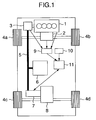
- Fig. 1 shows a structure example of a vehicle to which the present invention is applied.
- a power generated from an engine 1 is transmitted to a transmission 2 and a generator 3.
- the power transmitted to the transmission 2 is distributed into left and right sides so as to be transmitted to front wheels 4a and 4b.
- the generator 3 executes a power generation by using the power transmitted from the engine 1, and supplies an electric power to an energy storage 6 and a motor 7 via an electric power line 5.
- the energy storage 6 is constituted by a means for storing an energy such as a battery, a capacitor and the like, and a means constituted by a switch and a controller controlling the switch and controlling an acceptance and a discharge of the electric power.
- the stored electric power may be used for driving the motor 7, or may be used for the other electric devices (a starter, a blower and the like) provided in a vehicle.
- the motor 7 executes a power running or a regeneration in accordance with a command of a motor controller 11.
- the motor 7 executes the power running, the electric power supplied from the generator 3 and the energy storage 6 is used.
- the motor 7 executes the regeneration, the electric power is supplied to the energy storage 6.
- the torque generated by the power running or the regeneration of the motor 7 is distributed into left and right sides via a rear differential gear 8 so as to be transmitted to rear wheels 4c and 4d.
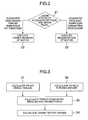
- Fig. 2 shows an example of a control executed by the motor controller 11.
- a state of an accelerator pedal and a brake pedal are judged in a block 21.
- the judgment of the state of the accelerator pedal may be executed on the basis of an output of an accelerator pedal sensor detecting a push down amount
- the judgment of the brake pedal may be executed on the basis of an output of a brake pedal sensor outputting an ON signal in the case that the brake pedal is pushed down and outputting an OFF signal in the case that the brake pedal is not pushed down.
- the accelerator pedal sensor can detect whether or not the accelerator pedal is pushed down, by detecting the push down amount.
- the power running of the motor 7 is executed in a block 22.
- the front wheels and the rear wheels hardly have a difference of rotational speeds, it is expected to be possible to sufficiently travel only by the front wheels. Accordingly, it is not necessary to execute the power running of the motor 7.
- the difference of the rotational speeds between the front wheels and the rear wheels can be detected by using a rotational speed sensor provided in each of the wheels.
- the motor 7 When the accelerator pedal is not pushed down and an engine brake is applied, or when the brake pedal is pushed down, the motor 7 is regenerated in a block 23. In the case that an energy stored in the energy storage 6 is large, and it is impossible to store any more, the rear wheel torque may be generated by the brake without regenerating the motor 7.
- Fig. 3 shows an example of a method of determining a target torque of the motor 7 at a time of the power running or the regeneration of the motor 7.
- a calculation of a block 31 is executed by a front wheel torque calculating means 9
- a calculation of a block 32 is executed by a vehicle turning amount calculating means 10
- calculations of blocks 33 and 34 are executed by the motor controller 11.
- torques, and braking and driving forces are expressed on the assumption that a direction of driving the vehicle is set to positive and a direction of braking the vehicle is set to negative.
- a total torque Tf of the right and left front wheels is calculated in a block 31.
- the front wheel torque Tf is calculated in accordance with the following expression on the basis of an engine torque Te, a generator torque Tg, a generator pulley ratio Rg, a transmission gear ratio Rt and a brake torque Tb (a total torque of the right and left sides).
- Tf Te + Tg ⁇ Rg ⁇ Rt + Tb
- the engine torque Te is determined on the basis of an accelerator opening degree and an engine speed by using a previously set engine torque map.
- the engine torque Te indicates a positive value in most cases at a time when the accelerator pedal is pushed down, and indicates a negative value in most cases at a time when the accelerator pedal is not pushed down.
- the higher the engine speed is, the larger an engine friction torque becomes, and the smaller the engine torque Te is (the larger an absolute value of the Te is).
- the generator torque Tg generally becomes a negative value. It is determined on the basis of a rotational speed of the generator and a power generating amount of the generator by using a previously set generator torque map. There is a tendency that the lower the rotational speed of the generator is, or the larger the power generating amount of the generator is, the smaller the generator torque Tg becomes (the larger an absolute value of the Tg is).
- the transmission gear ratio Rt corresponds to a value obtained by multiplying a transmission gear ratio of the current gear position by a final gear ratio.
- the brake torque Tb generally becomes a negative value. It is determined on the basis of the push down amount of the brake pedal by using a previously set brake torque map. There is a tendency that the larger the push down amount of the brake pedal is, the smaller the brake torque Tb becomes (the larger an absolute value of the Tb is).
- a vehicle turning amount ay is calculated in a block 32.
- the vehicle turning amount ay is constituted by a current value of a vehicle lateral acceleration or an estimated value of the vehicle lateral acceleration.
- the vehicle turning amount ay is constituted by the estimated value of the vehicle lateral acceleration, it is possible to do away with an influence caused by a response delay existing in the motor 7, or reduce the influence.
- the current value of the vehicle lateral acceleration is measured by using a lateral acceleration sensor. Alternatively, it is calculated in accordance with an expression V x V/r on the basis of a vehicle speed V and a turning radius r.
- the turning radius r is determined on the basis of the vehicle speed V and a steering angle, or the vehicle speed V and a yaw rate, or the vehicle speed V and a difference of rotational speeds between inner and outer wheels, by using a previously set map.
- the vehicle may be approximately provided with a lateral acceleration sensor, a steering angle sensor, a yaw rate sensor or the like, or a necessary information may be determined in accordance with a calculation on the basis of an output of the other sensor.
- An estimated value of the vehicle lateral acceleration is calculated in accordance with an expression V x V/r' on the basis of the vehicle speed V and an estimated value r' of the turning radius.
- the estimated value r' of the turning radius is determined on the basis of the vehicle speed V and the steering angle by using a previously set map. Since there has time until the lateral acceleration is actually generated after the steering is executed, it is possible to determine the estimated value of the vehicle lateral acceleration.
- a target value Fr of total braking and driving force of the rear wheels on the right and left sides is calculated in a block 33.
- the target rear wheel braking and driving force Fr is calculated in accordance with the following Expression 1 on the basis of the front wheel torque Tf, the turning amount ay, a tire radius rt and previously set constants k1 and k2.
- the target rear wheel braking and driving force Fr is calculated in accordance with the following Expression 2 on the basis of the front wheel torque Tf, the turning amount ay, the tire radius rt and previously set constants k3 and k4.
- Fr - k ⁇ 3 ⁇ Tf ⁇ rt 2 - k ⁇ 4 ⁇ a ⁇ y 2
- the rear wheel braking and driving force is fixed, the rear wheel tends to slip sideways in accordance with an increase of the vehicle turning amount.
- the absolute value of the rear wheel braking and driving force becomes smaller in accordance with the increase of the vehicle turning amount by using the expression, it is possible to reduce a possibility of a side slip of the rear wheel.
- the absolute value of the rear wheel braking and driving force is small in the case that the absolute value of the front wheel torque is small. Accordingly, if a driver operates in such a manner as to prevent the front wheels from slipping sideways, the rear wheels tend to be hard to slip sideways.
- k1 and k3 may be determined on the basis of the rear wheel load in place of being set to the constants. Since it is necessary to make the rear wheel braking and driving force smaller in accordance with a reduction of the rear wheel load, it is possible to determine by using a map which is set such that k1 and k3 become smaller in accordance with the reduction of the rear wheel load.
- the rear wheel load is determined on the basis of a contraction amount of a suspension in the rear wheel. Alternatively, it is calculated in accordance with an expression mr x g + m x g x h/l x (ax + tan ⁇ ) on the basis of a vehicle weight m, a weight mr applied to the rear wheel at a time of resting on a flat road, a gravitational acceleration g, a height h of center of gravity of the vehicle, a wheelbase 1, a vehicle longitudinal acceleration ax, and a road surface inclination ⁇ ( ⁇ is positive on a climbing road).
- the road surface inclination ⁇ is measured by using an inclination sensor.
- a target torque Tm of the motor 7 is calculated in a block 34.
- the target torque Tm of the motor 7 is calculated in accordance with the following expression on the basis of a target rear wheel braking and driving force Fr, a tire radius rt, and a gear ratio Rr of a rear differential gear 8.
- Tm Fr ⁇ rt ⁇ Rt
- the target torque Tm of the motor 7 is determined in accordance with the above manner.
- the motor controller 11 executes a power running or a regeneration of the motor 7 on the basis of this value.
- Fig. 4 shows an example of an absolute value of a front wheel torque, a steering angle and an absolute value of a motor torque at a time of traveling without pushing down the accelerator pedal in a vehicle to which the present invention is applied.
- the absolute value of the motor torque becomes continuously smaller in accordance with an increase of the steering angle. It is possible to obtain a sufficient braking force within a range in which the rear wheel does not slip sideways, in accordance with the control.
- the control mentioned above is particularly effective in a downward slope having a low ⁇ in which a great braking force is required under a condition that the rear wheel tends to slip sideways.
- the sufficient-driving force and braking force within the range in which the rear wheel does not slip sideways, by continuously controlling the motor torque, at a time when the vehicle turns.
- Obtaining the sufficient driving force is advantageous in point of an acceleration performance and a climbing performance of the vehicle.
- Obtaining the sufficient braking force is advantageous in point of a safety and an energy regeneration.
- Fig. 5 shows the other structure example of the vehicle to which the present invention is applied.
- the structure of Fig. 5 is obtained by adding an energy dissipating means 12 and a changing switch 13 to the structure in Fig. 1.
- the energy dissipating means 12 is constituted, for example, by a circuit having a large electric resistance, and can convert the energy regenerated by the motor 7 into heat or the like so as to dissipate it.
- the changing switch 13 generally connects the electric power line 5 and the energy storage 6, however, connects the electric power line 5 and the energy dissipating means 12 so as to dissipate the energy regenerated by the motor 7 in the case that the motor executes a regeneration under a condition that the energy stored in the energy storage 6 is large and the energy storage 6 can not store any more.
- the energy dissipating means 12 may be provided without setting the energy storage 6.
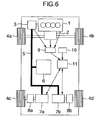
- Fig. 6 shows the other structure example of a vehicle to which the present invention is applied.
- Fig. 6 The structure of Fig. 6 is obtained by setting two motors while doing away with the rear differential gear 8 in the structure shown in Fig. 1.
- a motor 7a transmits a torque only to the rear wheel 4c via a reduction gear 8a
- a motor 7b transmits a torque only to the rear wheel 4d via a reduction gear 8b.
- the reduction gears 8a and 8b may not be provided.
- a target torque Tma of the motor 7a and a target torque Tmb of the motor 7b are calculated in accordance with the following expression on the basis of a target rear wheel braking and driving force Fr, a tire radius rt, a reduction gear ratio Rr' of the reduction gears 7a and 7b, and target torque corrected values ⁇ Tma and ⁇ Tmb.
- Tma Fr ⁇ rt / 2 ⁇ Rr ⁇ + ⁇ Tma
- Tmb Fr ⁇ rt / 2 ⁇ Rr ⁇ + ⁇ Tmb
- the target rear wheel braking and driving force Fr is determined in accordance with the same method as the embodiment 1.
- the value ⁇ Tma is made larger than the value ⁇ Tmb.
- the value ⁇ Tmb is made larger than the value ⁇ Tma.
- the values ⁇ Tma and ⁇ Tmb are determined by using a previously set map on the basis of the vehicle speed, the steering angle, the yaw rate and the like.
Landscapes
- Engineering & Computer Science (AREA)
- Transportation (AREA)
- Mechanical Engineering (AREA)
- Chemical & Material Sciences (AREA)
- Combustion & Propulsion (AREA)
- Automation & Control Theory (AREA)
- Power Engineering (AREA)
- Electric Propulsion And Braking For Vehicles (AREA)
- Hybrid Electric Vehicles (AREA)
- Arrangement And Driving Of Transmission Devices (AREA)
- Auxiliary Drives, Propulsion Controls, And Safety Devices (AREA)
Abstract
The invention relates to a vehicle control unit provided with a motor (7) applying a power to a rear wheel (4a, 4b), in order to obtain sufficient driving force and braking force in a range in which the rear wheel (4c, 4d) does not slip sideways at a time when a vehicle turns, a motor (7) torque is continuously controlled by calculating a rear wheel (4c, 4d) braking and driving force in the range in which the rear wheel (4c, 4d) does not slip sideways on the basis of a vehicle turning amount and a front wheel (4a, 4b) torque. Specifically, an absolute value of the motor (7) torque is made smaller in accordance with an increase of the vehicle turning amount, and an absolute value of the motor (7) torque is made larger in accordance with an increase of an absolute value of the front wheel (4a, 4b) torque.
Description
- The present invention relates to a vehicle control unit provided with a motor applying a power to a rear wheel, and more particularly to a control method of a motor torque at a time when a vehicle turns.
- As a control method of a rear wheel braking force at a time when the vehicle turns, there is a method, for example, disclosed in
JP-A-7-215188 - However, in an on-off control of switching a shutoff of the bypass passage of the brake piping such as the method disclosed in
JP-A-7-215188 - An object of the present invention is to make it possible to obtain a sufficient braking force, and further a driving force within a range in which a rear wheel does not slip sideways at a time when a vehicle turns.
- In order to achieve the object mentioned above, in accordance with the present invention, there is provided a vehicle control unit provided with a motor applying a power to a rear wheel. The vehicle control unit may control the motor in such a manner that a torque of the motor continuously changes in response to a change of a steering angle at a time when a vehicle turns.
- Further, in order to achieve the object mentioned above, in accordance with the present invention, there is provided a vehicle in which a front wheel is driven by an engine and/or a rear wheel is driven by a motor, wherein the vehicle comprises:
- a front wheel driving torque detecting means detecting a driving torque of the front wheel;
- an accelerator pedal sensor detecting whether or not an accelerator pedal is pushed down;
- a steering angle sensor detecting a steering angle;
- a motor torque detecting means detecting a torque of the motor; and/or
- a control unit controlling the motor in such a manner that an absolute value of the motor torque becomes continuously smaller in accordance with an increase of the steering angle under a condition that the front wheel torque is fixed.
- In accordance with the present invention, it is possible to obtain a sufficient braking force and a driving force within a range in which the rear wheel does not slip sideways, by continuously controlling the motor torque, at a time when the vehicle turns.
- The vehicle control unit in accordance with the present invention is provided with the motor control means continuously controlling the motor torque at a time when the vehicle turns. At this time, it is preferable to be provided with a motor control means making an absolute value of the motor torque small in accordance with an increase of a vehicle turning amount. Further, it is preferable to be provided with a motor control means making an absolute value of the motor torque large in accordance with an increase of an absolute value of the front wheel torque. Further, it is preferable to be provided with a motor control means making an absolute value of the motor torque small in accordance with a decrease of a rear wheel load. Further, it is preferable to be provided with a vehicle turning amount calculating means calculating a vehicle turning amount on the basis of a vehicle lateral acceleration. Further, it is preferable to be provided with a vehicle turning amount calculating means calculating a vehicle turning amount on the basis of a steering angle and a vehicle speed. Further, it is preferable to be provided with a vehicle turning amount calculating means calculating a vehicle turning amount on the basis of a yaw rate and a vehicle speed.
Further, it is preferable to be provided with a vehicle turning amount calculating means calculating a vehicle turning amount on the basis of a rotational speed of a wheel. Further, it is preferable to be provided with a front wheel torque calculating means calculating a front wheel torque on the basis of states of an engine, a generator attached to the engine and a transmission. Further, it is preferable to be provided with a front wheel torque calculating means calculating a front wheel torque on the basis of a state of a brake. Further, it is preferable to be provided with a rear wheel load calculating means calculating a rear wheel load on the basis of a vehicle longitudinal acceleration and a road surface inclination. Further, it is preferable to be provided with a rear wheel load calculating means calculating a rear wheel load on the basis of a vehicle longitudinal acceleration, a front wheel torque and a motor torque. - In accordance with the present invention, there is provided a vehicle in which a front wheel is driven by an engine, and/or a rear wheel is driven by a motor, wherein the vehicle comprises:
- a front wheel driving torque detecting means detecting a driving torque of the front wheel;
- an accelerator pedal sensor detecting whether or not an accelerator pedal is pushed down;
- a steering angle sensor detecting a steering angle;
- a motor torque detecting means detecting a torque of the motor; and/or
- a control unit controlling the motor in such a manner that an absolute value of the motor torque becomes continuously smaller in accordance with an increase of the steering angle under a condition that the front wheel torque is fixed.
- The above features can be combined in any way partly or as a whole.
- Other objects, features and advantages of the invention will become apparent from the following description of the embodiments of the invention taken in conjunction with the accompanying drawings.
-
- Fig. 1 is a view showing an example of a structure of a vehicle to which an
embodiment 1 in accordance with the present invention is applied; - Fig. 2 is a view showing an example of a control executed by a motor controller;
- Fig. 3 is a view showing an example of a determining method of a target braking torque;
- Fig. 4 is a view showing an example of a rear wheel braking force at a time when an accelerator pedal is not pushed down;
- Fig. 5 is a view showing an example of a structure of a vehicle to which an
embodiment 2 in accordance with the present invention is applied; and - Fig. 6 is a view showing an example of a structure of a vehicle to which an
embodiment 3 in accordance with the present invention is applied. - A description will be specifically given below of embodiments.
- Fig. 1 shows a structure example of a vehicle to which the present invention is applied.
- A power generated from an
engine 1 is transmitted to atransmission 2 and agenerator 3. The power transmitted to thetransmission 2 is distributed into left and right sides so as to be transmitted tofront wheels generator 3 executes a power generation by using the power transmitted from theengine 1, and supplies an electric power to anenergy storage 6 and amotor 7 via anelectric power line 5. - The
energy storage 6 is constituted by a means for storing an energy such as a battery, a capacitor and the like, and a means constituted by a switch and a controller controlling the switch and controlling an acceptance and a discharge of the electric power. The stored electric power may be used for driving themotor 7, or may be used for the other electric devices (a starter, a blower and the like) provided in a vehicle. - The
motor 7 executes a power running or a regeneration in accordance with a command of amotor controller 11. When themotor 7 executes the power running, the electric power supplied from thegenerator 3 and theenergy storage 6 is used. When themotor 7 executes the regeneration, the electric power is supplied to theenergy storage 6. - The torque generated by the power running or the regeneration of the
motor 7 is distributed into left and right sides via a reardifferential gear 8 so as to be transmitted torear wheels - Fig. 2 shows an example of a control executed by the
motor controller 11. - First, a state of an accelerator pedal and a brake pedal are judged in a
block 21. The judgment of the state of the accelerator pedal may be executed on the basis of an output of an accelerator pedal sensor detecting a push down amount, and the judgment of the brake pedal may be executed on the basis of an output of a brake pedal sensor outputting an ON signal in the case that the brake pedal is pushed down and outputting an OFF signal in the case that the brake pedal is not pushed down. In this case, the accelerator pedal sensor can detect whether or not the accelerator pedal is pushed down, by detecting the push down amount. - When the accelerator pedal is pushed down and the brake pedal is not pushed down, the power running of the
motor 7 is executed in ablock 22. In the case that the front wheels and the rear wheels hardly have a difference of rotational speeds, it is expected to be possible to sufficiently travel only by the front wheels. Accordingly, it is not necessary to execute the power running of themotor 7. The difference of the rotational speeds between the front wheels and the rear wheels can be detected by using a rotational speed sensor provided in each of the wheels. - When the accelerator pedal is not pushed down and an engine brake is applied, or when the brake pedal is pushed down, the
motor 7 is regenerated in ablock 23. In the case that an energy stored in theenergy storage 6 is large, and it is impossible to store any more, the rear wheel torque may be generated by the brake without regenerating themotor 7. - Fig. 3 shows an example of a method of determining a target torque of the
motor 7 at a time of the power running or the regeneration of themotor 7. In this case, a calculation of ablock 31 is executed by a front wheel torque calculating means 9, a calculation of ablock 32 is executed by a vehicle turning amount calculating means 10, and calculations ofblocks 33 and 34 are executed by themotor controller 11. Further, in the following description, torques, and braking and driving forces are expressed on the assumption that a direction of driving the vehicle is set to positive and a direction of braking the vehicle is set to negative. - A total torque Tf of the right and left front wheels is calculated in a
block 31. The front wheel torque Tf is calculated in accordance with the following expression on the basis of an engine torque Te, a generator torque Tg, a generator pulley ratio Rg, a transmission gear ratio Rt and a brake torque Tb (a total torque of the right and left sides).
- The engine torque Te is determined on the basis of an accelerator opening degree and an engine speed by using a previously set engine torque map. The engine torque Te indicates a positive value in most cases at a time when the accelerator pedal is pushed down, and indicates a negative value in most cases at a time when the accelerator pedal is not pushed down. When the accelerator pedal is not pushed down, there is a tendency that the higher the engine speed is, the larger an engine friction torque becomes, and the smaller the engine torque Te is (the larger an absolute value of the Te is).
- The generator torque Tg generally becomes a negative value. It is determined on the basis of a rotational speed of the generator and a power generating amount of the generator by using a previously set generator torque map. There is a tendency that the lower the rotational speed of the generator is, or the larger the power generating amount of the generator is, the smaller the generator torque Tg becomes (the larger an absolute value of the Tg is).
- The transmission gear ratio Rt corresponds to a value obtained by multiplying a transmission gear ratio of the current gear position by a final gear ratio.
- The brake torque Tb generally becomes a negative value. It is determined on the basis of the push down amount of the brake pedal by using a previously set brake torque map. There is a tendency that the larger the push down amount of the brake pedal is, the smaller the brake torque Tb becomes (the larger an absolute value of the Tb is).
- A vehicle turning amount ay is calculated in a
block 32. The vehicle turning amount ay is constituted by a current value of a vehicle lateral acceleration or an estimated value of the vehicle lateral acceleration. In the case that the vehicle turning amount ay is constituted by the estimated value of the vehicle lateral acceleration, it is possible to do away with an influence caused by a response delay existing in themotor 7, or reduce the influence. - The current value of the vehicle lateral acceleration is measured by using a lateral acceleration sensor. Alternatively, it is calculated in accordance with an expression V x V/r on the basis of a vehicle speed V and a turning radius r. The turning radius r is determined on the basis of the vehicle speed V and a steering angle, or the vehicle speed V and a yaw rate, or the vehicle speed V and a difference of rotational speeds between inner and outer wheels, by using a previously set map. Accordingly, the vehicle may be approximately provided with a lateral acceleration sensor, a steering angle sensor, a yaw rate sensor or the like, or a necessary information may be determined in accordance with a calculation on the basis of an output of the other sensor.
- An estimated value of the vehicle lateral acceleration is calculated in accordance with an expression V x V/r' on the basis of the vehicle speed V and an estimated value r' of the turning radius. The estimated value r' of the turning radius is determined on the basis of the vehicle speed V and the steering angle by using a previously set map. Since there has time until the lateral acceleration is actually generated after the steering is executed, it is possible to determine the estimated value of the vehicle lateral acceleration.
- A target value Fr of total braking and driving force of the rear wheels on the right and left sides is calculated in a
block 33. When the front wheel torque Tf is positive (when driving the vehicle), the target rear wheel braking and driving force Fr is calculated in accordance with the followingExpression 1 on the basis of the front wheel torque Tf, the turning amount ay, a tire radius rt and previously set constants k1 and k2.
- When the front wheel torque Tf is negative (when braking the vehicle), the target rear wheel braking and driving force Fr is calculated in accordance with the following
Expression 2 on the basis of the front wheel torque Tf, the turning amount ay, the tire radius rt and previously set constants k3 and k4.
- In the case that a result of calculation in a root becomes negative in both of (Expression 1) and (Expression 2), the value Fr is set to 0.
- If the rear wheel braking and driving force is fixed, the rear wheel tends to slip sideways in accordance with an increase of the vehicle turning amount. However, since the absolute value of the rear wheel braking and driving force becomes smaller in accordance with the increase of the vehicle turning amount by using the expression, it is possible to reduce a possibility of a side slip of the rear wheel. Further, if this expression is used, the absolute value of the rear wheel braking and driving force is small in the case that the absolute value of the front wheel torque is small. Accordingly, if a driver operates in such a manner as to prevent the front wheels from slipping sideways, the rear wheels tend to be hard to slip sideways.
- Further, k1 and k3 may be determined on the basis of the rear wheel load in place of being set to the constants. Since it is necessary to make the rear wheel braking and driving force smaller in accordance with a reduction of the rear wheel load, it is possible to determine by using a map which is set such that k1 and k3 become smaller in accordance with the reduction of the rear wheel load.
- The rear wheel load is determined on the basis of a contraction amount of a suspension in the rear wheel. Alternatively, it is calculated in accordance with an expression mr x g + m x g x h/l x (ax + tanθ) on the basis of a vehicle weight m, a weight mr applied to the rear wheel at a time of resting on a flat road, a gravitational acceleration g, a height h of center of gravity of the vehicle, a
wheelbase 1, a vehicle longitudinal acceleration ax, and a road surface inclination θ (θ is positive on a climbing road). The road surface inclination θ is measured by using an inclination sensor. Alternatively, it may be calculated in accordance with an expression arcsin {F/(m x g) - ax/g} on the basis of the vehicle weight m, the gravitational acceleration g, the vehicle longitudinal acceleration ax and a vehicle total braking and driving force F (a sum of a front wheel braking and driving force Ff and a rear wheel braking and driving force Fr). - Further, in the
block 33, it is possible to determine by using a map previously formed on the basis of (expression 1) and (expression 2) in place of calculating in accordance with (expression 1) and (expression 2). - A target torque Tm of the
motor 7 is calculated in a block 34. The target torque Tm of themotor 7 is calculated in accordance with the following expression on the basis of a target rear wheel braking and driving force Fr, a tire radius rt, and a gear ratio Rr of a reardifferential gear 8.
- The target torque Tm of the
motor 7 is determined in accordance with the above manner. Themotor controller 11 executes a power running or a regeneration of themotor 7 on the basis of this value. - Fig. 4 shows an example of an absolute value of a front wheel torque, a steering angle and an absolute value of a motor torque at a time of traveling without pushing down the accelerator pedal in a vehicle to which the present invention is applied. When the front wheel torque is fixed, the absolute value of the motor torque becomes continuously smaller in accordance with an increase of the steering angle. It is possible to obtain a sufficient braking force within a range in which the rear wheel does not slip sideways, in accordance with the control. The control mentioned above is particularly effective in a downward slope having a low µ in which a great braking force is required under a condition that the rear wheel tends to slip sideways.
- Even in the case of traveling while pushing down the accelerator pedal, when the front wheel torque is fixed, the motor torque becomes continuously smaller in accordance with an increase of the steering angle, and it is possible to obtain a sufficient driving force within a range in which the rear wheel does not slip sideways.
- As mentioned above, it is possible to obtain the sufficient-driving force and braking force within the range in which the rear wheel does not slip sideways, by continuously controlling the motor torque, at a time when the vehicle turns. Obtaining the sufficient driving force is advantageous in point of an acceleration performance and a climbing performance of the vehicle. Obtaining the sufficient braking force is advantageous in point of a safety and an energy regeneration.
- Fig. 5 shows the other structure example of the vehicle to which the present invention is applied.
- The structure of Fig. 5 is obtained by adding an
energy dissipating means 12 and a changingswitch 13 to the structure in Fig. 1. - The
energy dissipating means 12 is constituted, for example, by a circuit having a large electric resistance, and can convert the energy regenerated by themotor 7 into heat or the like so as to dissipate it. - The changing
switch 13 generally connects theelectric power line 5 and theenergy storage 6, however, connects theelectric power line 5 and the energy dissipating means 12 so as to dissipate the energy regenerated by themotor 7 in the case that the motor executes a regeneration under a condition that the energy stored in theenergy storage 6 is large and theenergy storage 6 can not store any more. - Further, only the energy dissipating means 12 may be provided without setting the
energy storage 6. - Even in the structure in Fig. 5, it is possible to obtain the sufficient driving force and braking force within the range in which the rear wheel does not slip sideways, in the same manner as the structure in Fig. 1.
- Fig. 6 shows the other structure example of a vehicle to which the present invention is applied.
- The structure of Fig. 6 is obtained by setting two motors while doing away with the rear
differential gear 8 in the structure shown in Fig. 1. - A
motor 7a transmits a torque only to therear wheel 4c via areduction gear 8a, and amotor 7b transmits a torque only to therear wheel 4d via areduction gear 8b. In this case, the reduction gears 8a and 8b may not be provided. - Each of the
motor 7a and themotor 7b is controlled by themotor controller 11. A target torque Tma of themotor 7a and a target torque Tmb of themotor 7b are calculated in accordance with the following expression on the basis of a target rear wheel braking and driving force Fr, a tire radius rt, a reduction gear ratio Rr' of the reduction gears 7a and 7b, and target torque corrected values ΔTma and ΔTmb.

- The target rear wheel braking and driving force Fr is determined in accordance with the same method as the
embodiment 1. - In the case that the front wheel slips sideways and cannot turn sufficiently at a time of turning to the right, the value ΔTma is made larger than the value ΔTmb. In the case that the front wheel slips sideways and cannot turn sufficiently at a time of turning to the left, the value ΔTmb is made larger than the value ΔTma. The values ΔTma and ΔTmb are determined by using a previously set map on the basis of the vehicle speed, the steering angle, the yaw rate and the like.
- Even in accordance with the structure in Fig. 6, it is possible to obtain the sufficient driving force and braking force within the range in which the rear wheel does not slip sideways, in the same manner as the structure in Fig. 1.
- It should be further understood by those skilled in the art that although the foregoing description has been made on embodiments of the invention, the invention is not limited thereto and various changes and modifications may be made without departing from the spirit of the invention and the scope of the appended claims.
- The above features and embodiments can be combined in any way partly or as a whole.
Claims (10)
- A vehicle control unit provided with a motor (7) applying a power to a rear wheel (4c, 4d), wherein the vehicle control unit controls the motor (7) in such a manner that a torque of the motor (7) continuously changes in response to a change of a steering angle at a time when a vehicle turns.
- A vehicle control unit as claimed in claim 1, the vehicle control unit makes an absolute value of the motor (7) torque small in accordance with an increase of a vehicle turning amount.
- A vehicle control unit as claimed in claim 1 or 2, wherein the vehicle control unit makes an absolute value of the motor (7) torque in accordance with an increase of an absolute value of the front wheel (4a, 4b) torque.
- A vehicle control unit as claimed in at least one of claims 1 to 3, wherein the vehicle control unit makes an absolute value of the motor (7) torque small in accordance with an decrease of a rear wheel (4c, 4d) load.
- A vehicle control unit as claimed in at least one of claims 1 to 4, wherein said vehicle turning amount is determined by calculating in accordance with any one of a calculation on the basis of a vehicle lateral acceleration, a calculation on the basis of a steering angle and a vehicle speed, a calculation on the basis of a yaw rate and a vehicle speed, and a calculation on the basis of a rotational speed of a wheel (4).
- A vehicle control unit as claimed in at least one of claims 1 to 5, wherein said front wheel (4a, 4b) torque is calculated on the basis of states of an engine (1), a generator (3) attached to the engine (1) and a transmission (2).
- A vehicle control unit as claimed in at least one of claims 1 to 6, wherein said front wheel (4a, 4b) torque is calculated on the basis of a state of a brake.
- A vehicle control unit as claimed in at least one of claims 1 to 7, wherein said rear wheel (4c, 4d) load is calculated on the basis of a vehicle longitudinal acceleration and a road surface inclination.
- A vehicle control unit as claimed in at least one of claims 1 to 8, wherein said rear wheel (4c, 4d) load is calculated on the basis of a vehicle longitudinal acceleration, said front wheel (4a, 4b) torque and the motor (7) torque.
- A vehicle in which a front wheel (4a, 4b) is driven by an engine (1), and a rear wheel (4c, 4d) is driven by a motor (7), wherein the vehicle comprises:a front wheel driving torque detecting means detecting a driving torque of the front wheel (4a, 4b);an accelerator pedal sensor detecting whether or not an accelerator pedal is pushed down;a steering angle sensor detecting a steering angle;a motor torque detecting means detecting a torque of said motor (7); anda control unit controlling said motor (7) in such a manner that an absolute value of the motor (7) torque becomes continuously smaller in accordance with an increase of the steering angle under a condition that the front wheel (4a, 4b) torque is fixed.
Applications Claiming Priority (1)
| Application Number | Priority Date | Filing Date | Title |
|---|---|---|---|
| JP2006075873A JP2007252153A (en) | 2006-03-20 | 2006-03-20 | Vehicle control device and vehicle |
Publications (1)
| Publication Number | Publication Date |
|---|---|
| EP1837263A2 true EP1837263A2 (en) | 2007-09-26 |
Family
ID=38181107
Family Applications (1)
| Application Number | Title | Priority Date | Filing Date |
|---|---|---|---|
| EP07001797A Withdrawn EP1837263A2 (en) | 2006-03-20 | 2007-01-26 | Vehicle control unit and vehicle |
Country Status (4)
| Country | Link |
|---|---|
| US (1) | US20070227789A1 (en) |
| EP (1) | EP1837263A2 (en) |
| JP (1) | JP2007252153A (en) |
| CN (1) | CN101041354A (en) |
Cited By (1)
| Publication number | Priority date | Publication date | Assignee | Title |
|---|---|---|---|---|
| WO2010121850A1 (en) * | 2009-04-23 | 2010-10-28 | Robert Bosch Gmbh | Method and device for operating a vehicle, in particular a hybrid vehicle |
Families Citing this family (14)
| Publication number | Priority date | Publication date | Assignee | Title |
|---|---|---|---|---|
| CN102470754A (en) * | 2009-07-31 | 2012-05-23 | 丰田自动车株式会社 | Vehicle operation device |
| JP5474636B2 (en) * | 2010-03-31 | 2014-04-16 | 本田技研工業株式会社 | Torque control device |
| GB2486632B (en) * | 2010-12-06 | 2014-04-02 | Protean Electric Ltd | An electric hybrid vehicle |
| EP2657094B1 (en) * | 2010-12-20 | 2018-06-27 | Bosch Corporation | Brake system and brake control method |
| JP5790865B2 (en) * | 2012-02-23 | 2015-10-07 | トヨタ自動車株式会社 | Vehicle suspension system |
| EP2886431B1 (en) * | 2012-07-25 | 2020-10-21 | Bosch Corporation | Overturn prevention method and device for two-wheel vehicle |
| JP2013173529A (en) * | 2013-04-11 | 2013-09-05 | Mitsubishi Motors Corp | Differential restriction control device of hybrid vehicle |
| CN103303157B (en) * | 2013-06-19 | 2015-04-08 | 电子科技大学 | Torque distribution method of four-wheel drive electric vehicle |
| WO2016050433A1 (en) * | 2014-10-01 | 2016-04-07 | Thyssenkrupp Presta Ag | Method for controlling an electric actuator |
| US10375901B2 (en) | 2014-12-09 | 2019-08-13 | Mtd Products Inc | Blower/vacuum |
| KR102375149B1 (en) * | 2017-10-18 | 2022-03-16 | 현대자동차주식회사 | Apparatus and method for estimating redius of curvature of vehicle |
| JP2020090217A (en) * | 2018-12-06 | 2020-06-11 | スズキ株式会社 | Control device of vehicle |
| CN114030361A (en) * | 2020-07-29 | 2022-02-11 | 四川鼎鸿智电装备科技有限公司 | Method and device for brake control of electric vehicle, electronic device, and storage medium |
| KR20250098004A (en) * | 2023-12-21 | 2025-07-01 | 현대자동차주식회사 | Driving control system and method for electric vehicle |
Family Cites Families (15)
| Publication number | Priority date | Publication date | Assignee | Title |
|---|---|---|---|---|
| JPH0755660B2 (en) * | 1985-10-02 | 1995-06-14 | 日産自動車株式会社 | Vehicle steering system controller |
| DE4134240C2 (en) * | 1991-10-16 | 1995-12-14 | Mannesmann Ag | Steering support for a non-track-bound vehicle |
| US6138782A (en) * | 1999-02-25 | 2000-10-31 | Deere & Company | Steering responsive power boost |
| JP3719116B2 (en) * | 2000-08-30 | 2005-11-24 | トヨタ自動車株式会社 | Vehicle driving force control device |
| JP2002104158A (en) * | 2000-10-03 | 2002-04-10 | Toyota Central Res & Dev Lab Inc | Road friction state calculation device, tire type determination device, tire wear determination device, road surface inclination estimation device, and offset correction device for acceleration sensor |
| JP4178955B2 (en) * | 2001-04-20 | 2008-11-12 | セイコーエプソン株式会社 | Drive control |
| JP2004076897A (en) * | 2002-08-21 | 2004-03-11 | Toyota Motor Corp | In-vehicle clutch control device |
| JP4069765B2 (en) * | 2003-02-26 | 2008-04-02 | 日産自動車株式会社 | Vehicle travel control device |
| JP2004328991A (en) * | 2003-04-09 | 2004-11-18 | Nissan Motor Co Ltd | Left and right wheel drive system for vehicles |
| EP1466775A3 (en) * | 2003-04-10 | 2010-09-15 | Nissan Motor Company Limited | Drive controlling apparatus and method for automotive vehicle |
| JP4217192B2 (en) * | 2004-06-01 | 2009-01-28 | 富士重工業株式会社 | Control device for hybrid vehicle |
| EP1616746B1 (en) * | 2004-07-15 | 2010-02-24 | Hitachi, Ltd. | Vehicle control system |
| JP3832499B2 (en) * | 2005-07-22 | 2006-10-11 | トヨタ自動車株式会社 | Vehicle driving force control device |
| JP3856041B2 (en) * | 2005-07-22 | 2006-12-13 | トヨタ自動車株式会社 | Vehicle driving force control device |
| US7966113B2 (en) * | 2005-08-25 | 2011-06-21 | Robert Bosch Gmbh | Vehicle stability control system |
-
2006
- 2006-03-20 JP JP2006075873A patent/JP2007252153A/en active Pending
-
2007
- 2007-01-25 US US11/657,660 patent/US20070227789A1/en not_active Abandoned
- 2007-01-25 CN CNA2007100072033A patent/CN101041354A/en active Pending
- 2007-01-26 EP EP07001797A patent/EP1837263A2/en not_active Withdrawn
Cited By (1)
| Publication number | Priority date | Publication date | Assignee | Title |
|---|---|---|---|---|
| WO2010121850A1 (en) * | 2009-04-23 | 2010-10-28 | Robert Bosch Gmbh | Method and device for operating a vehicle, in particular a hybrid vehicle |
Also Published As
| Publication number | Publication date |
|---|---|
| US20070227789A1 (en) | 2007-10-04 |
| JP2007252153A (en) | 2007-09-27 |
| CN101041354A (en) | 2007-09-26 |
Similar Documents
| Publication | Publication Date | Title |
|---|---|---|
| EP1837263A2 (en) | Vehicle control unit and vehicle | |
| CN106043284B (en) | The control method of the front and back wheel torque distribution of electric four-wheeled driving hybrid electric vehicle | |
| KR102417515B1 (en) | Brake control system and method for electric vehicle | |
| US8062175B2 (en) | Method and apparatus for optimizing braking control during a threshold braking event | |
| EP2172378B1 (en) | A method and device for regenerative braking in a vehicle | |
| EP3758993B1 (en) | Control of vehicle traction motor torque before stall launch | |
| KR101339231B1 (en) | Torque control system for fulltime 4 wheel drive green car and method thereof | |
| KR102692354B1 (en) | Vehicle driving control method using friction coefficient estimating of road surface | |
| US20080223634A1 (en) | Vehicle Drive System | |
| EP1897746A2 (en) | Vehicle control apparatus | |
| US9604624B2 (en) | Method for controlling four wheel driving of vehicle | |
| CN107264285B (en) | Driving motor detection method and device | |
| WO2014027109A1 (en) | Speed control system and method of operating the same | |
| JP2014527392A (en) | Method for controlling the deceleration configuration of a vehicle | |
| JP6366745B2 (en) | Torque control device and torque control method for vehicle | |
| KR20150103357A (en) | Vehicle speed control system and method employing torque balancing | |
| CN104520138A (en) | Wheel control device, vehicle, and wheel control method | |
| EP1125783B1 (en) | Method for controlling an automatic transmission | |
| US20240399886A1 (en) | eTELLIGENT LO RANGE CONTROL FOR AN ELECTRIC VEHICLE | |
| JP2005048696A (en) | Traction control device | |
| KR20140127619A (en) | Four Wheel Drive Vehicle and Wheel Slip Control Method thereof | |
| JP2023538410A (en) | Control system for controlling torque distribution | |
| JP5003580B2 (en) | Driving force distribution control device for four-wheel drive vehicles | |
| EP2903874B1 (en) | Device and method for comfortable and/or fuel saving driving of a motor vehicle | |
| CN114379380B (en) | A gear control method, storage medium and vehicle for electric vehicle |
Legal Events
| Date | Code | Title | Description |
|---|---|---|---|
| PUAI | Public reference made under article 153(3) epc to a published international application that has entered the european phase |
Free format text: ORIGINAL CODE: 0009012 |
|
| AK | Designated contracting states |
Kind code of ref document: A2 Designated state(s): AT BE BG CH CY CZ DE DK EE ES FI FR GB GR HU IE IS IT LI LT LU LV MC NL PL PT RO SE SI SK TR |
|
| AX | Request for extension of the european patent |
Extension state: AL BA HR MK YU |
|
| 17P | Request for examination filed |
Effective date: 20090701 |
|
| STAA | Information on the status of an ep patent application or granted ep patent |
Free format text: STATUS: THE APPLICATION HAS BEEN WITHDRAWN |
|
| 18W | Application withdrawn |
Effective date: 20090831 |